

Submitted:
23 June 2026
Posted:
24 June 2026
You are already at the latest version
Abstract
Background/Objectives: Irinotecan is a key late-line agent in metastatic gastric cancer, but its dose-limiting toxicities—severe neutropenia and diarrhea—are strongly influenced by UGT1A1 promoter polymorphisms. Commercial genotyping kits in Japan routinely interrogate only the common *6 and *28 alleles and may fail to resolve rarer TATA-box variants. We report a case in which an indeterminate commercial result unmasked an extremely rare loss-of-function genotype. Methods: A Japanese man in his 60s with HER2-negative, microsatellite-stable metastatic gastric cancer progressing after four prior lines underwent pretreatment UGT1A1 genotyping with a commercial DNA chip in anticipation of irinotecan. When the *28 result returned as indeterminate owing to a TA-ratio error, reflex Sanger sequencing of the UGT1A1 promoter TATA box was performed. Results: The chip reported *6 as wild-type but could not resolve *28. Sanger sequencing identified one allele with seven TA repeats (*28) and one with eight TA repeats (*37), with no wild-type six-repeat allele—a *28/*37 compound heterozygote. The *37 allele is exceptionally rare in Japanese (ToMMo 61KJPN allele frequency 0.000294) and has historically been reported almost exclusively in individuals of African ancestry. This genotype has previously caused fatal neutropenic colitis despite preemptive dose reduction. Given the patient's frailty and limited expected benefit, irinotecan was withheld entirely. Conclusions: Indeterminate commercial UGT1A1 results may conceal rare loss-of-function alleles with divergent functional consequences. Such results should trigger confirmatory sequencing rather than empiric dose reduction, and institutions should establish reflex pathways in advance to support biomarker-informed, frailty-adapted treatment selection.
Keywords:
UGT1A1*37
; irinotecan
; gastric cancer
; compound heterozygote
; medical safety
1. Introduction
Advanced gastric cancer that has progressed after fluoropyrimidine, platinum, taxane, and immune checkpoint inhibitor therapy frequently leaves clinicians with few cytotoxic options, and irinotecan remains one of the most commonly employed agents in this late-line setting. Irinotecan is a prodrug that is converted by hepatic carboxylesterases to its active metabolite SN-38, which is subsequently glucuronidated to the inactive SN-38G principally by uridine diphosphate glucuronosyltransferase 1A1 (UGT1A1). Reduced UGT1A1 activity therefore prolongs SN-38 exposure and predisposes patients to severe neutropenia and diarrhea, occasionally with fatal outcomes [1,2,3]. In Japan, pretreatment UGT1A1 *6 (c.211G>A) and *28 (TA7 promoter repeat) genotyping has become routine practice, and the domestic drug label recommends careful dose consideration in homozygotes and compound heterozygotes of these two alleles [4]. However, the binary "wild-type/variant" output of most commercial kits may obscure rarer variants in the TATA box, including *36 (TA5) and *37 (TA8), the latter of which markedly reduces transcriptional activity and is exceedingly rare in East Asians. We describe a frail patient with late-line gastric cancer in whom a commercial UGT1A1 chip returned an "indeterminate" *28 result, and in whom reflex Sanger sequencing disclosed an extremely rare *28/*37 compound heterozygous genotype, prompting the decision to withhold irinotecan altogether.
2. Materials and Methods
Pretreatment UGT1A1 genotyping was first performed using a commercial DNA chip assay (Gene Silicon DNA Chip Kit UGT1A1, Toyo Kohan, Tokyo, Japan), which interrogates the *6 (c.211G>A) and *28 (TA7 promoter repeat) alleles. Because the *28 result was returned as indeterminate due to a TA-ratio error, reflex confirmatory sequencing was performed. Genomic DNA was reanalyzed by direct Sanger sequencing of the UGT1A1 promoter TATA box, and the resulting electropherogram was compared against the reference sequence [A(TA)6TAA] to determine the number of TA repeats on each allele.
Population allele frequency data for the UGT1A1*37 (TA8) variant were obtained from the ToMMo 61KJPN reference panel (Tohoku Medical Megabank Organization, Sendai, Japan; https://jmorp.megabank.tohoku.ac.jp/, accessed 2 April 2026), a publicly available whole-genome reference dataset for the Japanese population.
3. Case Report
A Japanese man in his 60s, a former factory worker currently unemployed, was referred to our department for further chemotherapy of recurrent gastric cancer. His medical history was notable for insulin-treated type 2 diabetes mellitus, prior glaucoma surgery, and prior coronary surgery for angina pectoris; daily medications consisted of carvedilol, olmesartan, rosuvastatin, a vonoprazan/aspirin combination, clopidogrel, and amlodipine. He was an ex-smoker with a cumulative exposure of approximately four cigarettes per day for 38 years and reported only occasional alcohol consumption. There was no family history of malignancy or hepatobiliary disease. On examination his chest was unremarkable, an upper abdominal surgical scar was visible, and there was mild bilateral lower extremity edema; the Eastern Cooperative Oncology Group performance status was 1.
In 2021 he had been brought to the emergency department after hematemesis with melena, pallor, and a transient syncopal episode, with an initial hemoglobin of 5.5 g/dL. Emergent esophagogastroduodenoscopy revealed an actively bleeding Borrmann type 2 gastric tumor, which was managed with hemostatic forceps and topical thrombin. Repeat endoscopy on the following day confirmed hemostasis, and biopsy established a diagnosis of advanced gastric adenocarcinoma. The following month, he underwent distal gastrectomy with D1 lymph node dissection and Roux-en-Y reconstruction; pathology demonstrated tub2, pT4N2M0, Stage IIIA disease. Adjuvant chemotherapy was withheld at the patient's preference. Two years later, recurrence manifested as multiple lymph node metastases and peritoneal dissemination, with HER2-negative and microsatellite-stable status. He received first-line S-1 plus oxaliplatin combined with nivolumab [5] and second-line nab-paclitaxel [6], both of which were ultimately discontinued for progressive disease, after which he was referred to medical oncology. On referral his liver function tests, including total bilirubin, were entirely within normal limits (Table 1). Third-line therapy using trifluridine/tipiracil (TAS-102) [7] was initiated, with a clinical response observed.
In anticipation of subsequent irinotecan-based therapy, UGT1A1 genotyping was performed using a commercial DNA chip platform (Gene Silicon DNA Chip Kit UGT1A1, Toyo Kohan, Tokyo, Japan). The *6 allele was reported as −/− (wild-type homozygote), but the *28 allele result was returned as "indeterminate" owing to a TA ratio error. Reflex Sanger sequencing of the UGT1A1 promoter TATA box was therefore performed, and definitively identified one allele with seven TA repeats (*28) and the other with eight TA repeats (*37), with no wild-type six-repeat allele present (Figure 1). On detailed pedigree interview, all known ancestors and relatives were of Japanese origin, with no reported African or other non-Asian ancestry. There was no personal history of hyperbilirubinemia or hepatic dysfunction on prior occupational or community health screenings, and no relative had previously undergone UGT1A1 testing because none had been treated with irinotecan. Given the genotype, irinotecan was withheld from all subsequent treatment plans.
4. Discussion
Beutler and colleagues demonstrated, using a luciferase reporter system in human hepatoma cell lines, that UGT1A1 promoter activity decreases progressively with increasing TA repeat length across the range of five to eight repeats, with TA8 conferring lower transcriptional activity than TA7 [8]. Critically, in their population study of 71 Europeans, 47 Asians, and 101 individuals of African ancestry, TA8-containing alleles were detected exclusively in persons of African ancestry, with an allele frequency of 0.069, and were entirely absent in both European and Asian populations [8]. Our patient—of verified Japanese ancestry with no known African or non-Asian heritage—therefore represents a genotype outside the distribution described in that seminal study.
The *37 allele is exceptionally uncommon in Japanese populations: according to the ToMMo 61KJPN reference panel (Tohoku Medical Megabank Organization, Sendai, Japan; https://jmorp.megabank.tohoku.ac.jp/, accessed April 2, 2026), the allele frequency of the TA8 variant is 0.000294 (36/122,650), making homozygotes vanishingly rare and *28/*37 compound heterozygotes only marginally less so. To our knowledge, clinical descriptions of the *28/*37 genotype in the context of irinotecan therapy are confined to a handful of reports. Most pertinent is the case reported in 2018 in which a patient with metastatic colorectal cancer and a *28/*37 genotype received second-line irinotecan monotherapy at a reduced dose of 150 mg/m², yet developed Grade 4 neutropenia, febrile neutropenia, and fatal neutropenic colitis culminating in septic shock [3]. That outcome, occurring despite preemptive dose attenuation, illustrates that this genotype may not be safely managed by empiric dose reduction alone.
Several features of the present case deserve emphasis. First, the patient's baseline total bilirubin was unequivocally normal, and he reported no history of hyperbilirubinemia, no familial liver disease, and no non-Japanese ancestry. Each of these features, alone or in combination, might reasonably lead a clinician to assume that no severe UGT1A1 impairment was present. This case demonstrates that the absence of such clinical red flags cannot exclude a profoundly reduced UGT1A1 transcriptional capacity, and that pre-treatment genotyping retains independent predictive value even when the clinical phenotype is unremarkable.
Second, the indeterminate output of the commercial chip-based assay deserves explicit attention. The package insert of the Gene Silicon kit acknowledges that an indeterminate *28 result driven by a TA-ratio error may reflect either a TA5 (*36) or TA8 (*37) allele, because the assay cannot reliably distinguish these from the canonical TA6 and TA7. The *36 allele is a gain-of-function variant typically associated with normal or modestly enhanced glucuronidation, whereas *37 is loss-of-function. As noted above, both alleles are vanishingly rare in Japanese populations, and direct clinical experience with the *37 allele remains extremely limited. Because the two candidate alleles carry markedly divergent functional consequences but comparably low prior probabilities, population frequency alone cannot adjudicate an indeterminate result. Reflex Sanger sequencing — or an equivalent confirmatory assay — should therefore be the default response before any irinotecan administration, rather than empiric dose reduction. We propose that institutions offering routine UGT1A1 genotyping establish such a reflex pathway in advance, so that indeterminate results trigger confirmation rather than ad hoc clinical compromise.
Third, although germline inheritance from one of the patient's parents is the most likely origin of the *37 allele, the rarity of this variant in the local population, combined with the absence of relatives available for segregation analysis, precludes formal confirmation. A de novo origin, while improbable, cannot be entirely excluded; functionally, however, this distinction does not alter the immediate therapeutic implication.
Finally, this case illustrates frailty-adapted, biomarker-informed treatment selection in the late-line setting. The patient was frail, had received four prior lines of systemic therapy, and stood to gain only modest incremental benefit from irinotecan even under optimal pharmacogenomic conditions. Against this limited expected benefit, the predicted hepatic and hematologic toxicity arising from a compound loss-of-function UGT1A1 genotype was substantial. Complete withdrawal of irinotecan, rather than empiric dose reduction, was therefore both pharmacologically and ethically defensible. We suggest this case as a generalizable model for proactive risk management when an indeterminate UGT1A1 result is encountered in a vulnerable patient: confirm the genotype, estimate the cumulative transcriptional deficit, and let that estimate — rather than clinical optimism — guide the treatment decision.
Author Contributions
Conceptualization, S.S.; methodology, S.S.; software, S.S..; validation, S.S.; formal analysis, S.S.; investigation, S.S.; resources, S.S.; data curation, S.S.; writing—original draft preparation, S.S.; writing—review and editing, Y.K., T.O. and E.Y.; visualization, S.S.; supervision, S.S project administration, S.S.; funding acquisition, S.S. All authors have read and agreed to the published version of the manuscript.
Funding
This research received no external funding.
Institutional Review Board Statement
The study was conducted in accordance with the Declaration of Helsinki, and approved by the Institutional Review Board of Yamagata Prefectural Shinjo Hospital (2026-01 and date of approval is April 30th, 2026).
Informed Consent Statement
Written informed consent has been obtained from the patient to publish this paper.
Data Availability Statement
No new data were created.
Acknowledgments
In the process of preparing this English manuscript, we used artificial intelligence-based a language editing tool to enhance clarity and readability (Claude Sonnet 4.6). We thank the staff at H.U. Frontier Inc. for their technical assistance with the genetic analysis.
Conflicts of Interest
The authors declare no conflicts of interest.
Abbreviations
The following abbreviations are used in this manuscript:
| UGT1A1 | Uridine diphosphate glucuronosyltransferase 1A1 |
| SN-38 | 7-Ethyl-10-hydroxycamptothecin (active metabolite of irinotecan) |
| TA | Thymine-adenine (repeat in the UGT1A1 promoter TATA box) |
| ToMMo | Tohoku Medical Megabank Organization |
| 61KJPN | 61,000 Japanese genomes reference panel (jMorp) |
| HER2 | Human epidermal growth factor receptor 2 |
| ECOG | Eastern Cooperative Oncology Group |
| S-1 | Tegafur/gimeracil/oteracil combination |
| TAS-102 | Trifluridine/tipiracil |
References
- Barbarino, J.M.; Haidar, C.E.; Klein, T.E.; Altman, R.B. PharmGKB summary: very important pharmacogene information for UGT1A1. Pharmacogenet Genom. 2014, 24, 177–183. [Google Scholar] [CrossRef] [PubMed]
- Innocenti, F.; Undevia, S.D.; Iyer, L.; Chen, P.X.; Das, S.; Kocherginsky, M.; Karrison, T.; Janisch, L.; Ramírez, J.; Rudin, C.M.; et al. Genetic variants in the UDP-glucuronosyltransferase 1A1 gene predict the risk of severe neutropenia of irinotecan. J. Clin. Oncol. 2004, 22, 1382–1388. [Google Scholar] [CrossRef] [PubMed]
- Riera, P.; Salazar, J.; Virgili, A.C.; Tobeña, M.; Sebio, A.; Gallano, P.; Barnadas, A.; Páez, D. Relevance of CYP3A4*20, UGT1A1*37 and UGT1A1*28 variants in irinotecan-induced severe toxicity. Br. J. Clin. Pharmacol. 2018, 84, 1389–1392. [Google Scholar] [CrossRef] [PubMed]
- Minami, H.; Sai, K.; Saeki, M.; Saito, Y.; Ozawa, S.; Suzuki, K.; Kaniwa, N.; Sawada, J.; Hamaguchi, T.; Yamamoto, N.; et al. Irinotecan pharmacokinetics/pharmacodynamics and UGT1A genetic polymorphisms in Japanese: roles of UGT1A1*6 and *28. Pharmacogenet Genom. 2007, 17, 497–504. [Google Scholar] [CrossRef] [PubMed]
- Kang, Y.K.; Chen, L.T.; Ryu, M.H.; Oh, D.Y.; Oh, S.C.; Chung, H.C.; Lee, K.W.; Omori, T.; Shitara, K.; Sakuramoto, S.; et al. Nivolumab plus chemotherapy versus placebo plus chemotherapy in patients with HER2-negative, untreated, unresectable advanced or recurrent gastric or gastro-oesophageal junction cancer (ATTRACTION-4): a randomised, multicentre, double-blind, placebo-controlled, phase 3 trial. Lancet Oncol. 2022, 23, 234–247. [Google Scholar] [CrossRef] [PubMed]
- Shitara, K.; Takashima, A.; Fujitani, K.; Koeda, K.; Hara, H.; Nakayama, N.; Hironaka, S.; Nishikawa, K.; Makari, Y.; Amagai, K.; et al. Nab-paclitaxel versus solvent-based paclitaxel in patients with previously treated advanced gastric cancer (ABSOLUTE): an open-label, randomised, non-inferiority, phase 3 trial. Lancet Gastroenterol. Hepatol. 2017, 2, 277–287. [Google Scholar] [CrossRef] [PubMed]
- Shitara, K.; Doi, T.; Dvorkin, M.; Mansoor, W.; Arkenau, H.T.; Prokharau, A.; Alsina, M.; Ghidini, M.; Faustino, C.; Gorbunova, V.; et al. Trifluridine/tipiracil versus placebo in patients with heavily pretreated metastatic gastric cancer (TAGS): a randomised, double-blind, placebo-controlled, phase 3 trial. Lancet Oncol. 2018, 19, 1437–1448. [Google Scholar] [CrossRef] [PubMed]
- Beutler, E.; Gelbart, T.; Demina, A. Racial variability in the UDP-glucuronosyltransferase 1 (UGT1A1) promoter: a balanced polymorphism for regulation of bilirubin metabolism? Proc. Natl. Acad. Sci. U S A 1998, 95, 8170–8174. [Google Scholar] [CrossRef] [PubMed]
Figure 1.
Sanger sequencing electropherogram of the UGT1A1 promoter TATA box. The reference sequence is shown as A(TA)6TAA. The patient's electropherogram demonstrates superimposed peaks downstream of the TA tract, reflecting a compound heterozygous configuration consisting of one allele with seven TA repeats (*28) and one allele with eight TA repeats (*37), with no wild-type six-repeat allele detectable.
Figure 1.
Sanger sequencing electropherogram of the UGT1A1 promoter TATA box. The reference sequence is shown as A(TA)6TAA. The patient's electropherogram demonstrates superimposed peaks downstream of the TA tract, reflecting a compound heterozygous configuration consisting of one allele with seven TA repeats (*28) and one allele with eight TA repeats (*37), with no wild-type six-repeat allele detectable.
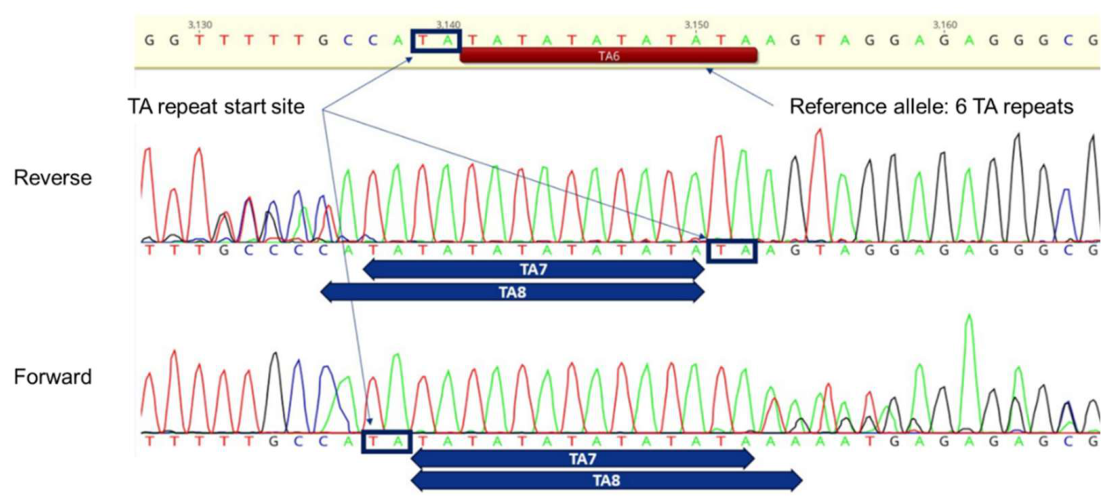

Table 1.
Baseline laboratory data at the time of referral to medical oncology. Total bilirubin and other hepatic function parameters were within normal limits, illustrating the dissociation between routine biochemical screening and underlying UGT1A1 transcriptional capacity.
Table 1.
Baseline laboratory data at the time of referral to medical oncology. Total bilirubin and other hepatic function parameters were within normal limits, illustrating the dissociation between routine biochemical screening and underlying UGT1A1 transcriptional capacity.
| Biochemistry | Immunology | ||||
|---|---|---|---|---|---|
| TP | 6.6 | g/dL | CRP | 0.08 | mg/dL |
| Alb | 3.8 | g/dL | |||
| AST | 13 | U/L | Hematology | ||
| ALT | 10 | U/L | WBC | 5,590 | /uL |
| Total Bil | 0.64 | mg/dL | Hb | 10.9 | g/dL |
| direct Bil | 0.06 | Plt | 192 | 103/uL | |
| LDH | 164 | U/L | |||
| ALP | 53 | U/L | |||
| Crea | 1.15 | mg/dL | |||
| UN | 18.8 | mg/dL | |||
| Na | 141 | mmol/L | Tumor Markers | ||
| K | 4.2 | mmol/L | CEA | 26.5 | ng/mL |
| Cl | 102 | mmol/L | CA19-9 | 212 | U/mL |
CRP: C-reactive protein, CEA: Carcinoembryonic antigen, CA19-9: Cancer Antigen 19-9.
Disclaimer/Publisher’s Note: The statements, opinions and data contained in all publications are solely those of the individual author(s) and contributor(s) and not of MDPI and/or the editor(s). MDPI and/or the editor(s) disclaim responsibility for any injury to people or property resulting from any ideas, methods, instructions or products referred to in the content. |
© 2026 by the authors. Licensee MDPI, Basel, Switzerland. This article is an open access article distributed under the terms and conditions of the Creative Commons Attribution (CC BY) license (http://creativecommons.org/licenses/by/4.0/).
Copyright: This open access article is published under a Creative Commons CC BY 4.0 license, which permit the free download, distribution, and reuse, provided that the author and preprint are cited in any reuse.


