

Submitted:
23 June 2026
Posted:
24 June 2026
You are already at the latest version
Abstract
This article examines how Spanish rural cinema functions as a media dispositif — understood, following the Foucauldian concept as operationalised in media studies, as an apparatus of heterogeneous practices, discourses and institutional arrangements that produces and governs representations — for the construction and circulation of territorial imaginaries, thereby participating in the media ecosystem of public debates on depopulation, migration and multicultural coexistence. Through a diachronic and sociodemographic comparison of La piel quemada (Josep Maria Forn, 1967) and Suro (Mikel Gurrea, 2022) — two feature films set in the province of Girona (Catalonia, Spain) but separated by 55 years and opposing migratory pressures — the study analyses how audiovisual fiction produces, challenges and renegotiates the dominant sociodemographic imaginaries of two distinct historical conjunctures: the developmentalist boom of late Francoism and the neo-rural turn of the early twenty-first century. A qualitative chronotopic methodology is applied to 18 systematically selected sequences from both films, organised around three contextualising axes (historical, territorial, sociodemographic). The central original contribution is the concept of the media-geographic diptych as an instrument for diachronic comparative analysis of rural cinema as a media form. Secondary contributions include evidence of the structural continuity of xenophobia in the rural territorial media discourse of Girona over five decades and a theoretical proposal on cinematic multilingualism as an undertheorised territorial media practice. The discussion situates these findings within current debates on rural cosmopolitanism, overtourism and the media construction of la España vaciada, and offers preliminary evidence that audiovisual fiction occupies a differentiated position in the media ecology of territorial public discourse that merits systematic attention in future studies.
Keywords:
rural cinema
; media discourse
; territorial imaginary
; media-geographic diptych
; neo-ruralism
; late Francoism
; rural migration
; cinematic multilingualism
; España vaciada
; media reception
1. Introduction: Rural Cinema as a Media-Political Instrument
Cinema is not a mere reflection of social reality; it is a constitutive medium that produces and circulates imaginaries, normalises or challenges dominant narratives, and constructs collective understanding of places, populations and historical processes (Rodríguez, 2017; Couldry and Hepp, 2017). In the specific domain of territorial politics, audiovisual fiction potentially performs a function that is simultaneously representational and agenda-participatory: it can render visible demographic phenomena — migration, depopulation, urban-rural dynamics — that frequently receive inadequate or stereotyped treatment in mainstream journalism, doing so for audiences that the news media do not always reach. Understood from the perspective of communication and media studies, Spanish rural cinema thus becomes a privileged site for analysing how media artefacts articulate, challenge and renegotiate collective identities and territorial imaginaries in relation to pressing contemporary issues: rural depopulation, overtourism, multicultural integration and climate change-induced agricultural precarity (Hall, 1997; Silverstone, 1999; Negreira-Rey et al., 2023).
This article develops a triple contextualisation — historical, territorial and sociodemographic — applied to the comparative analysis of two Spanish rural films set in the same geographical space but separated by more than five decades: La piel quemada (Josep Maria Forn, 1967) and Suro (Mikel Gurrea, 2022). The first belongs to the neo-realist tradition of late Francoism and documents the mass rural exodus from Andalusia towards the construction and tourism sectors on the Costa Brava of Girona during the Spanish desarrollismo. The second is a contemporary neo-rural drama tracing the inverse flow: a young couple of Barcelona architects who inherit a cork-oak estate in the Alt Empordà comarca and must negotiate identity, labour exploitation and ecological precarity in the rural interior of the same province.
The territorial anchoring of the province of Girona provides a stable geographical framework from which to trace discontinuities and continuities across two radically distinct historical conjunctures. Both films achieved notable critical and public impact in their respective contexts, confirming their role as media artefacts that shaped public debate: La piel quemada, although awarded a prize by the National Spectacle Syndicate, provoked censorship controversies and press debates on internal migration during late Francoism; Suro received the FIPRESCI Prize at the 2022 San Sebastián International Film Festival (SSIFF) and generated extensive journalistic commentary framing it within debates on la España vaciada, overtourism and multicultural rural life. The article makes three original contributions. The principal contribution is the concept of the media-geographic diptych as an operational instrument for diachronic comparative analysis of rural cinema as a media form. The secondary contributions are: evidence of the structural continuity of xenophobia in the rural territorial media discourse of the Girona area over five decades; and a theoretical proposal on cinematic multilingualism as an undertheorised dimension of territorial media practice. The article is structured as follows: Section 2 reviews the theoretical framework; Section 3 describes materials and methods; Section 4 presents the results in four blocks; Section 5 discusses the findings and limitations; and Section 6 draws the conclusions.
2. Theoretical Framework
2.1. Rural Cinema as a Mediating Dispositif
The study of rural cinema in Spain has consolidated since the early 2000s as a field of enquiry attentive to the ways in which audiovisual fiction represents and transforms collective perceptions of rural space (Gómez Gómez, 2015; Thibaudeau, 2020). From the perspective of communication and media studies, this enquiry is productively framed through two complementary concepts. First, media discourse: cinematographic texts are not transparent windows onto social reality, but constructions that select, frame and valorise certain representations over others (Hall, 1997; Fenton, 2016). Second, mediatisation: the long-range historical process through which social worlds — including rural territories — are constructed in and through the media (Couldry and Hepp, 2017). The term dispositif employed here refers to its Foucauldian genealogy: the organised set of media practices, technologies and discourses through which social reality — in this case, rural territorial imaginaries — is produced, governed and naturalised (Foucault, 1980). Rural cinema functions as a dispositif not only in its representational capacity, but also in its material insertion in circuits of production, distribution, censorship and reception that condition what can be seen, heard and said about rural territories at a given historical moment.
In the Spanish case, the discursive function of rural cinema is especially acute due to the long shadow cast by Francoist cultural policy. The neo-realist current that resisted this regime — Nieves Conde, Berlanga, Forn — functioned as a dissident media ecology producing counter-discourses in direct confrontation with the developmentalist narrative (Álvarez, 2011; Velázquez, 2012). To illustrate Hall's (1997) framework operationally: in La piel quemada, Forn resignifies the figure of the Andalusian worker through the juxtaposition of the construction site and the tourist beach, producing a counter-discourse in which the migrant becomes a victim of exploitation and spatial marginalisation. In Suro, the signifier "neo-rural return" is re-semanticised as a space of class contradiction and structural xenophobia. Contemporary rural cinema operates in a media environment saturated by what Castelló (2023) calls the competing imaginaries of España vacía and España vaciada — the distinction being politically significant: while the former is a primarily descriptive geographical characterisation, popularised by Sergio del Molino (2016), the latter is a deliberately politicised reformulation attributing rural depopulation to institutional abandonment (Saiz-Ezcherreta et al., 2022). Rural cinema occupies, moreover, a vacuum in the media ecology left by the contraction of local journalism (Negreira-Rey et al., 2023), contributing narrative frameworks for rural phenomena that news media increasingly cover with less depth.
2.2. Territorial Imaginary: Girona as a Media Geography
The concept of territorial imaginary refers to the ensemble of representations, narratives and affects through which a given geographical space is collectively known, valued and contested (Mormont, 2009). From a media studies perspective, communication geographies (Falkheimer and Jansson, 2006; Adams, 2009) designate the way in which media actively produce senses of place. Applied to cinema, this approach turns films into documents of geographical imagination. Cinema occupies a specific position through its capacity to construct what Bakhtin (1989) calls the chronotope: a specific articulation of time, space and subjectivity that organises narrative meaning. The province of Girona encompasses two contrasting territorial imaginaries in permanent dynamic tension: the Costa Brava coastline, emblematic of Spanish mass tourism; and the inland comarca of Alt Empordà — rural, agricultural, culturally Catalan — largely invisible in the national media. These two imaginaries within the same provincial frame create the conditions for the contrapuntal territorial analysis proposed by this article. Together, La piel quemada and Suro constitute what this article proposes to call the media-geographic diptych: two audiovisual documents that map, five decades apart, the transformation of the same provincial territory under opposing demographic pressures.
2.3. Sociodemographic Imaginaries and Cinematic Multilingualism
The Spanish demographic history of the late twentieth and early twenty-first centuries is inseparable from the sociodemographic imaginaries produced and contested through audiovisual media. The mass internal migration of the 1950s–1970s generated representations around the figure of the charnego (a pejorative Catalan term for the Castilian-speaking migrant), the construction worker and the emigrant family (Quintana, 2017; Bañón Hernández, 2002). From the late 1990s onwards, the arrival of international migrants added a new layer: Retis (2004) documented how the Spanish press constructed stereotyped representations of non-EU migrants. More recently, Pérez Castaño and Flores Martos (2022) demonstrated that journalistic coverage of Maghrebi workers in rural inland Spain systematically frames them through the lens of social conflict, rendering invisible the structural conditions of their exploitation. This journalistic repertoire provides the reception context in which Suro circulates: when Gurrea represents xenophobia towards the Maghrebi day labourer Karín, he intervenes in a pre-existing and naturalised field of media representations.
A dimension of sociodemographic imaginaries that has received less systematic attention in media studies is cinematic multilingualism. As Bleichenbacher (2008) demonstrates, the assignment of languages to characters is never neutral: it maps relations of power, cultural belonging and access to narrative agency. Mamula and Patti (2016) have shown that multilingualism in European cinema functions as a space of untranslatability, creating zones of resistance that escape the dominant linguistic regime. This perspective is directly relevant to rural migration in Spain, where both La piel quemada (Catalan/Castilian) and Suro (Catalan/Castilian/French/Arabic) construct what Adams (2009) calls an acoustic geography: a sonic and linguistic stratification of the territory that maps power relations and conditions the viewer's reading of ethnic conflict.
2.4. The Media-Geographic Diptych: Theoretical Consolidation of a Methodological Concept
The concept of the media-geographic diptych is introduced in this article as a methodological instrument for the comparative analysis of rural cinema and requires explicit theoretical grounding. A media-geographic diptych is a structured comparative design constituted by two audiovisual texts that simultaneously satisfy four conditions: (i) territorial anchoring — both texts are set in, and produce imaginaries centrally about, the same identifiable geographical space; (ii) historical differentiation — the texts are separated by a chronological interval sufficient to produce significantly distinct demographic and media-political regimes; (iii) oppositional demographic logic — the migratory processes central to each text are structured as counterpoints rather than variants of the same movement; and (iv) shared media-discursive field — both texts operate as media artefacts within the same discursive tradition and can be analysed using a common interpretive framework. The diptych metaphor is not merely decorative: it refers to a formal structure in which two panels are autonomous and legible separately, but achieve their full meaning only in relation to each other.
Standard diachronic comparison in film studies typically juxtaposes texts from different historical periods to trace the evolution of a genre, theme or style over time (Kellner, 2009). The diptych design differs from standard diachronic comparison in film studies in three key respects. First, the stabilisation of the territorial variable is constitutive rather than incidental: geographical anchoring is the analytical fulcrum, not mere setting. Second, the relationship between the panels is contrapuntal rather than cumulative: the 55-year interval between the two films is productive because the same geographical imaginary is constructed under structurally opposed demographic pressures, not because one film is a "response" to the other. Third, the unit of analysis is the chronotopic sequence, not the film as a totality. The design is transferable to other contexts involving the media construction of territory under demographic pressure, provided the four defining conditions are satisfied. Its constitutive limits must also be acknowledged: it is a dyadic design (two panels); it presupposes geographical stability over the comparison period; and it is a production-side design generating claims about inscribed imaginaries, not about audience reception.
3. Materials and Methods
3.1. Design: The Media-Geographic Diptych
The study employs a media-geographic diptych design as formally defined in Section 2.4, operationalised through three concretised contextualising axes: (a) Historical axis. La piel quemada was produced under a censorship regime during late Francoist desarrollismo; Suro in post-2008 Spain, in a media landscape saturated by debates on socioeconomic precarity, depopulation, climate change and multiculturalism. (b) Territorial axis. Both films are set in the province of Girona but in contrasting sub-spaces: the Costa Brava coastline (La piel quemada) and the Alt Empordà interior (Suro). (c) Sociodemographic axis. La piel quemada centres on the rural exodus of Andalusian working-class families towards the Catalan tourist coast; Suro on the selective migratory return of a Catalan professional couple, overlaid with the presence of Maghrebi seasonal agricultural workers.
3.2. Corpus, Selection Criteria and Analytical Protocol
The analytical corpus consists of both complete films (La piel quemada: 104 minutes; Suro: 116 minutes), viewed in multiple sessions with systematic annotation. From 47 initially identified candidate sequences (24/23 per film), 18 sequences were selected for intensive analysis (9 per film) applying four formal criteria: (1) axiological relevance: the sequence contains an evaluative statement about migration, territory, identity or labour relations; (2) chronotopic representativeness: the sequence articulates at least two of the three chronotopic dimensions (temporal, spatial, subjective); (3) comparability: the sequence allows a functional point of comparison with at least one sequence from the other film within the same thematic block; (4) block diversity: the selected sequences cover the four thematic blocks, with a minimum of four sequences per block across the corpus. Selection involved an iterative negotiation between the two authors: each independently produced a preliminary list of 28 sequences; 22 common selections were automatically included; the six divergent cases were resolved through a joint viewing session applying the chronotopic representativeness criterion. The analytical protocol developed in three phases: (1) description (transcription and characterisation of each sequence with time code); (2) chronotopic interpretation (application of the triple dimension to identify territorial and sociodemographic imaginaries); (3) comparison (dialogue across the three contextualising axes). Interpretations were cross-referenced with specialist film criticism (Fotogramas, Cinemanía, Screen Daily) and prior academic analyses (Quintana, 2017; Afinoguénova, 2016).
3.3. The Two Films: Comparative Overview
Table 2 provides a synoptic overview of the main comparative variables organising the analysis.
4. Results: Four Analytical Axes
The analysis is organised around four thematic blocks corresponding to the main sociodemographic and territorial dimensions of the migratory processes represented. Each block is examined through the three contextualising axes and with attention to how the selected sequences function as interventions in public media discourse. Time codes and sequence references (Table 1) enable precise location of the analysed scenes.
4.1. Historical Axis: Causes of Migration and Media Framing
4.1.1. From Agrarian Necessity to Post-Capitalist Disillusionment (S1–S2, S8, S10, S18)
In La piel quemada, the causal logic of migration is rooted in the material conditions of post-war rural Spain. S1 stages a train conversation in which a fellow passenger verbalises the structural logic of rural exodus: "Where is a man from? From wherever he can make a living." This condenses the neo-realist media construction of internal migration not as a lifestyle choice, but as economic necessity. S2 stages agrarian class relations — the oligarchic Andalusian landowner who selects day labourers at will — that drove the exodus and implicitly challenges the triumphalism of the developmentalist modernity narrative. Late Francoism displayed, in the comedies of the same period, a paradoxically condescending ambiguity towards the cacique (local political boss) and rural backwardness as idealised representations of essential patriotic values, compatible nonetheless with the abandonment of autarky and a fabricated progress (Martínez-Puche et al., 2022). In Suro, S10 opens with a farewell party in Barcelona at which a friend's reference to the closure of the cooperative situates Helena and Iván's migration as a response to the precarity of qualified professional work in a post-crisis economy and an opportunity due to inheriting a farmhouse. S18 closes this arc with Helena's bitter frustration at the renovated farmhouse party — an ambivalent ending that resists any consoling neo-rural resolution.
4.1.2. Tourism as Contested Media Discourse (S3, S11)
Tourism occupies a central position in both films, but with contrasting evaluative valences. In La piel quemada, S3 deploys a visual geography of inequality through the spatial juxtaposition of European tourists sunbathing on the beach at Lloret de Mar while Andalusian workers labour on nearby construction sites — a spatial counter-argument to the official developmentalist narrative of shared prosperity. In Suro, S11 reconfigures tourism as a problem rather than a solution: Iván's reply — "Let the tourists keep it" — signals a decisive inversion in the evaluation of tourism within the Catalan urban imaginary. The diachronic contrast between S3 and S11 traces a historical-media arc from tourism as aperturismo to tourism as displacement, echoing the public debate on overtourism and tourism-phobia prominent in Spanish media and politics since around 2015 (Bauzá, 2019). This arc also illuminates the changing relationship between territorial cinema and journalistic coverage of tourism.
4.2. Territorial Axis: Work, Property and the Construction of Rural Space
4.2.1. The Media Geography of Labour (S4, S7, S9, S12)
In La piel quemada, S4 and S7 map the social geography of the Costa Brava through a tripartite hierarchy: autochthonous Catalan bourgeoisie, European tourists and Andalusian migrant workers. The distinction between gamaruso and señorito andaluz (Andalusian gentleman) articulated in S4 by barman Antonio and José contrasts the dominant figures of the Catalan businessman (nouveaux-riche but hardworking) and the Andalusian landowner (amiable but lacking in solidarity). S7 evidences the exclusionary suspicion of the site foreman: "Catalans have to put up with all of you. And if there's no work for our own people, too bad." — a discourse that has since migrated, in the political arguments of the Spanish far right, to a new target: the foreigners. S9 closes the film with Manolo, José's brother newly arrived from the village, watching tourists dance from the hillside where the shed is located, rendering the developmentalist promise of upward mobility structurally false. In Suro, S12 stages Iván's attempts to introduce ethical labour practices — asking whether workers are registered with Social Security, insisting they not be called moros — met with sarcasm by the foreman Maurici. This reveals the normalisation of labour precarity in the rural interior as a structural phenomenon that persists across generations. In both films, the territorial economy of Girona depends on the exploitation of a migrant labour force to whom full social recognition is denied.
4.2.2. Housing and Habitat: The Chronotope of the Home (S5, S13, S17)
Domestic space functions in both films as a chronotopic node condensing territorial tensions. In La piel quemada, S5 — the shed beside the cemetery that José rents for 500 pesetas a month, renovated with materials appropriated from the construction site — embodies the spatial marginalisation of the charnego, his creative resourcefulness and the structural indifference of the host society. In Suro, S13 stages the debate over the farmhouse renovation: Iván accuses Helena of proposing an aesthetic that "monologues with its surroundings" rather than dialoguing with them. The masía condenses the tension between the authentic rurality the couple claims to seek and the bourgeois domesticity that reproduces their urban habitus (Morin, 1973). S17 — the defence during the forest fire — transforms this domestic tension into embodied territorial commitment, suggesting that belonging to a place can be forged through collective exposure to risk rather than deliberate lifestyle choice.
4.3. Sociodemographic Axis: Xenophobia and Multilingualism
4.3.1. The Generational Relay of Xenophobia (S6, S15, S16)
In La piel quemada, S6 — the bar scene in which Catalan men confront Andalusian workers, calling them charnegos and mursianos, ordering them back to their villages — condenses the xenophobic undercurrent running beneath the apparently cosmopolitan image of Francoist tourist aperturismo. In Suro, S15 and S16 establish what is arguably the study's most significant finding: the generational relay of xenophobia. The accident suffered by Chema — a sixtysomething day labourer who may himself have migrated to Catalonia as a child during the developmentalist period — is the trigger that incites his colleagues to pursue and assault the young Maghrebi worker Karín, blaming him for the incident. Chema occupies the structural position of the 1960s charnego, but reproduces towards the contemporary migrant the same logic of exclusion that may once have been directed at him. Iván's armed intervention in S16 is simultaneously an act of solidarity and an assertion of class privilege (Halfacree, 1997): the neo-rural professional can deploy property as a shield unavailable to the Maghrebi worker. This finding challenges the optimistic framing of "rural cosmopolitanism" (Woods, 2018) and has direct relevance for multicultural integration policies in rural and agricultural zones.
4.3.2. Cinematic Multilingualism as Territorial Media Practice (S6, S14)
Both films construct a specific acoustic geography of Girona (Adams, 2009) that maps social hierarchies in the sonic register. In La piel quemada, S6 stages the Catalan-Castilian border as the main sociolinguistic axis of the identity conflict: speaking Catalan is equivalent to claiming spatial belonging; being addressed in Catalan without being able to respond is equivalent to being reminded of one's outsider status. The residual presence of French and German spoken by foreign tourists represents the superficially cosmopolitan character of Francoist Spain. In Suro, S14 presents a considerably more complex linguistic landscape. Following Bleichenbacher (2008), Arabic appears exclusively in contexts of horizontal labour solidarity and everyday resistance — when Mohamed and his companions comment in Arabic on their living conditions ("That's not a house. It's a pigsty. It's only for a season. You have to put up with it") — the film grants subaltern migrant subjects a discursive space inaccessible to the neo-rural protagonists, creating what Mamula and Patti (2016) describe as a "zone of untranslatability." The quadrilingual landscape of Suro (Catalan, Castilian, French, Arabic) maps the power geometry of contemporary Girona: Catalan encodes local cultural authority and property; Castilian mediates inter-ethnic negotiation; French marks European cultural capital; Arabic designates the subaltern labour that sustains the agrarian economy while remaining invisible to the territorial imaginary of the neo-rural protagonists.
4.4. Media Reception: Preliminary Evidence of the Journalistic-Complementary Function
The preceding sections have analysed the films as texts constructing territorial imaginaries. A legitimate methodological critique is that claims about the "media function" of a film remain at the level of hypothesis if not accompanied by evidence about how it was received and circulated in the real media ecosystem. This section addresses that deficit through a mini-reception analysis based on a corpus of journalistic texts (Table 3): eight records relating to La piel quemada (1967–1968), obtained through systematic search in the National Digital Newspaper Library (BNE) and historical press archives; and seven relating to Suro (2022), identified in digital newspaper databases and film criticism databases. The corpus does not claim statistical exhaustiveness, but aims to illustrate the dominant framing frameworks and to ground in a controlled manner the claims about discursive visibilisation and media complementarity that the textual analysis suggests.
4.4.1. La piel quemada (1967–1968): Press Reception and Framing Frameworks
Before examining the frameworks, it is worth clarifying the context that conditions reception. La piel quemada was screened at the IV Week of New Spanish Cinema (Molins de Rey, Barcelona, January-February 1967), a parallel exhibition circuit organised outside the conventional commercial system. The initial coverage in Diario de León (26.01.1967) reports the words of Juan Francisco de Lasa, director of the festival, who articulates with clarity the function of this alternative space: "We ask, above all, for greater freedom of expression. Permission to address topics that have so far been systematically refused." This statement fixes the institutional framework: the new Spanish cinema typically lacks distribution and exhibition to reach a mass audience. It emerges at the instigation of the Salamanca Conversations (1955), coinciding with the subsequent change in the General Directorate of Cinematography and Theatre (1963) and the opening of the Official Film School (1964), and presents itself to the press as a device for rendering visible what is excluded by the dominant cultural system controlled by the successful popular comedy.
Analysis of the eight hemerographic records, published between January 1967 and February 1968 in national and regional publications, enables empirical grounding of the discursive visibilisation function postulated in the theoretical framework. In the context of late Francoism, La piel quemada did not simply reflect a prior journalistic debate on internal migration. In the absence of journalism capable of addressing that debate with the necessary directness, the film generated and sustained it through the cultural press, colloquia and public controversy. Three dominant frameworks emerge.
Framework 1 — Polarised reception as symptom of an uncomfortable topic. Kirchner's chronicle in La Vanguardia española (15.02.1967) documents that the screening "caused a degree of commotion" and that the audience was divided, confirming that the film had touched a social nerve: Catalan-Andalusian coexistence, xenophobia towards the internal migrant and tourism's complicity with territorial inequality. The same text notes that Francisco Candel, author of the essay Els altres catalans (1964) — the sociological reference closest to the film's universe — "found the film interesting, as it focused on the problems he raised in his book, and thought it useful that the more susceptible spectators should be irritated from time to time."
Framework 2 — Cinema as social chronicle substituting for absent journalism. Pedret Muntañola (La Vanguardia española, 23.11.1967) is explicit: the film treats internal migration "in the manner of a vivid journalistic reportage full of life, sincerity and purpose" — designating precisely the journalistic-complementary function that the textual analysis postulated, in a context where the censored press and the state newsreel No-Do could not produce it. Cebollada (Ya, 15.02.1968) and Sánchez (Informaciones, 16.02.1968) converge on this framing. Even in its less complacent view of developmentalist tourism: "it honestly exhibits the difference between those with a 'sun-tanned skin' from the caress of the sun and those with a 'burnt skin' from long hours of labour under a relentless sun."
Framework 3 — The debate over linguistic and cultural integration. López Español (El Mundo Deportivo, 19.11.1967) turns the film's subject into a question about Catalan territorial identity: "Can Catalonia (…) truly 'guide' those who come to it as if to a new California? Will it not be Catalonia itself that dissolves in the turbulent, murky waters of the torrent?" The quotation is significant because it turns the film's subject — the integration of the Andalusian migrant — into a question about Catalan territorial identity, articulating the media debate the film provoked in its most precise terms: language and culture as the boundary of belonging; Bonet-Mojica and Picó (Signo, 11.03.1967) offer the most explicit class interpretation in the corpus. The film presents the migratory problem "from a class-based viewpoint, with deep love and respect for workers who have had to leave their home region to find work." The public colloquium reported in Madrid (13.02.1968) — with the participation of Forn, Berlanga, Sastre and Bonald — provides the most compelling evidence of the film's media-public function: Berlanga himself acknowledged that "this is a subject that others of us had not dared to tackle in other periods of Spanish cinema." According to Antonio V. Kirchner, "the film could prove useful as a starting point for a cinema with a Catalan theme that addresses specific problems of our region."
In the context of late Francoism, La piel quemada did not simply "reflect" a prior journalistic debate on internal migration. In the absence of journalism capable of addressing that debate with the necessary directness, the film generated and sustained it in the public sphere through the cultural press, colloquia and cinema-hall controversy. This function is not equivalent to agenda-setting in the technical sense of McCombs and Shaw's (1972) theory, which would require quantitative evidence of salience transfer; but it does constitute, in precise conceptual terms, a case of discursive visibilisation of phenomena that the dominant informational regime left in the shadows.
4.4.2. Suro (2022): Press Reception and Migrant Labour Visibilisation
The corpus for Suro comprises seven records published between September and December 2022 in media of different nature and editorial orientation: the specialist magazines Fotogramas and Cinemanía; generalist criticism in El País; international trade press in Screen Daily; criticism and interview in Público and El Periódico de Aragón; and cultural reportage in El Español. This editorial diversity allows identification of three dominant framing frameworks that structure the film's reception in the Spanish media space.
Framework 1 — Rural cinema as a generational trend and post-crisis cultural diagnosis. The most recurrent framing in the corpus is not that of the individual film, but of the collective cultural symptom. A back-to-the-land exodus, sometimes more or less original in each proposal, continues to flood the screens." This formulation is analytically relevant because it turns Suro into an exponent of a documented and named media-cinematographic tendency. The review in El País (19.09.2022), signed by Elsa Fernández-Santos with the title "The best Spanish cinema returns to the countryside," reinforces this framing from the reference generalist press: the rural is not exoticism or nostalgia, but the terrain where contemporary Spanish cinema situates its most urgent conflicts. For its part, the reportage in Cinemanía (19.09.2022) establishes the explicit link between the return to the rural and the political cycle: the headline "the end of the 15M generational idyll" inscribes the film in the horizon of post-crisis disenchantment, as a cinematographic epitaph for the life project of the indignados generation.
Framework 2 — Counter-discourse against idealised neo-ruralism and visibilisation of class contradictions. The second dominant framework, articulated with greater density in interview sources, is the film as a challenge to the lifestyle neo-rural imaginary. Gurrea is in this respect the principal enunciator. In the interview in Público (01.12.2022), with Begoña Piña, the director formulates the film's central thesis with precision: "How easy it is to theorise from the city about [the classism, racism and sexism of the rural world]… No, we live in a city that is classist, racist and sexist. We live in a world like that." This statement explicitly inscribes Suro in the counter-discourse against neo-ruralism that projects onto the countryside the defects of the urban world it claims to transcend. In the same interview, Gurrea adds: "The film uses that; it's a play of mirrors: the environment they move to functions as a mirror to make visible and bring to the surface conflicts that they carry within themselves." This formulation has particular methodological value: the director articulates the film's specular function — making visible what one does not want to see — using the very terms of discursive visibilisation that the article's theoretical framework proposes. The reportage in El Español (02.12.2022), signed by Manu Yáñez, concurs in the framing: the headline "dismantles the idealised vision of the rural in Suro" and the description that the film "seeks to dismantle an idealised vision of rurality" without fear of rendering the characters "unsympathetic" confirm the film's reception as a deliberate counter-discourse exercise against neo-rural romanticism, also signalled in the Fotogramas review (02.12.2022): "A devastating chronicle of the disintegration of that supposedly happy Arcadia."
Framework 3 — Invisibility of migrant agricultural labour and the cinema's visibilisation function. The third framework is the most directly relevant to the media complementarity hypothesis, and is articulated most clearly in interview sources and the trade press. In the interview published in Público (01.12.2022), Gurrea explains: "The hierarchies and pecking orders in the film also exist in the construction world and in many other urban worlds that we choose not to look at because it is easier to talk about the other." The director explicitly names the media invisibility of migrant seasonal agricultural labour as the problem that justifies the cinematographic gesture. In El Periódico de Aragón (07.01.2022), the filmmaker explains that while working as a seasonal cork harvester one summer "I discovered a world that was completely unknown to me (…) I had never seen it filmed and that is where the desire was born." This statement has direct empirical value for the article's argument: it is the production agent himself who acknowledges that cinema occupies a visibilisation space that the informational media do not cover. The review in Screen Daily (19.09.2022), published at the film's world premiere in the Official Section of the SSIFF, certifies the international circulation of this framing: the English-language review for the European professional film sector constructs Suro as a document on the precarity of rural Spain, contributing to the construction of an imaginary of Spanish rurality for international audiences that English-language journalism on Spain rarely produces.
A transversal framing element in the corpus deserves specific attention for its relevance to the xenophobia and generational relay dimension analysed in Section 4.3.1. Begoña Piña (Público, 01.12.2022) describes Suro as "a lucid debut feature that reveals, through the intimate conflict of a couple starting a new life in the rural world, the way in which racism, xenophobia, classism and sexism emerge in this society." This formulation — "in this society," not "in the rural world" — articulates the same finding that the textual analysis identifies in S15 and S16: xenophobia towards the Maghrebi worker is not a specifically rural phenomenon, but a structural form of exclusion that the conditions of rural territory cause to surface. The press, by framing the film in these terms, confirms that the cross-sectional — and not localised — reading of xenophobia circulated in the discourse of media reception, which grounds the claim that Suro intervened in a public debate on racism and exclusion that daily journalism treats in a fragmentary and episodic manner. Also notable is the identity and multilingual factor: the film is originally shot in Catalan, naturalising a fact that in Spain is sometimes still a source of controversy.
In summary, analysis of the reception corpus for Suro enables empirical grounding of four propositions. First, specialist and generalist media frame the film within a collective tendency of returning to the countryside as a post-crisis cultural diagnosis: Fernández-Santos in El País titles her SSIFF review "The best Spanish cinema returns to the countryside," while Bermejo's Cinemanía piece frames it as the "end of the 15M generational idyll." Second, interviews with the director explicitly articulate the film's counter-discursive function. Gurrea (Público, 01.12.2022) states: "How easy it is to theorise from the city about [the classism, racism and sexism of the rural world]… No, we live in a city that is classist, racist and sexist." Third, the international press amplifies this visibilisation to audiences for whom English-language journalism on Spain rarely offers comparable depictions of rural precarity (Screen Daily, 19.09.2022). Fourth, media reception converges with the textual analysis in identifying xenophobia towards migrant labour as the film's central critical finding — confirming that this reading is not an academically superimposed interpretation, but the one that the media reception ecosystem itself produced spontaneously.
5. Discussion
The comparative analysis has implications for communication and media studies, for the sociology of rural cinema and for public policy debates on territorial development and multicultural coexistence. The principal contribution is methodological: the media-geographic diptych as an operational design for the diachronic comparative analysis of rural cinema as a media form. As elaborated in Section 2.4, the design's distinctive move is the stabilisation of the territorial variable as a methodological lever: by holding the geographical space constant while contrasting two historically distinct and demographically opposed regimes, the analysis can isolate what is structurally continuous from what is historically contingent in the media construction of rural migration. The three-axis contextualisation translates the abstract design into a reproducible analytical procedure applicable to any corpus satisfying the four defining conditions established in Section 2.4. Future applications could include the media geography of post-industrial European landscapes, the cinematographic imaginaries of depopulating Spanish provinces beyond Girona, or comparative ecocinema studies of rural communities affected by climate change.
The first substantive contribution is the evidence of the structural continuity of xenophobia in the rural territorial media discourse of Girona over five decades. The generational relay embodied by Chema — connecting the xenophobic construction of the charnego in the media landscape of the 1960s with the xenophobic construction of the Maghrebi migrant in the 2020s — demonstrates that rural territory functions as a persistent space of exclusionary demarcation, regardless of which migrant group occupies the position of the outsider. This finding challenges the optimistic framing of "rural cosmopolitanism" (Woods, 2018) and has direct relevance for policies on multicultural integration in rural and agricultural zones facing a demographic emergency. The second substantive contribution is the theoretical proposal on cinematic multilingualism as a territorial media practice. The acoustic geographies of both films — the Catalan-Castilian sociolinguistic fault line in La piel quemada, the quadrilingual landscape of Suro — are not accidental but constitutive of the territorial imaginary. The linguistic distribution in rural cinema maps power relations, defines access to narrative agency and produces zones of opacity that function as forms of subaltern resistance.
A fourth implication concerns the relationship between rural cinema and the media ecology of public debate. The mini-reception analysis in Section 4.4 provides preliminary evidence that this relationship is empirically observable. Both films achieved significant media circulation and generated framing frameworks that explicitly acknowledged their function of visibilising what journalism does not habitually cover. In both cases, the reception evidence suggests that the films contributed narrative frameworks and images that circulated in the territorial media discourse beyond the cinematographic space. Whether this function is equivalent to agenda-setting in the strict sense is a proposition that would require specific research designs — systematic press content analysis, audience panel studies — that exceed the scope of this study, but which constitute the most relevant research agenda that the present work opens.
5.1. Limitations
Four limitations must be acknowledged. First, the corpus is limited to two films, which restricts the transferability of the results. Claims about "the territorial imaginary of Girona" or "Spanish rural cinema" are interpretive hypotheses grounded in intensive qualitative evidence, not statistically representative generalisations. Second, the methodological triangulation in its media reception dimension is partial: the mini-corpus of press material provides exploratory evidence on journalistic framing frameworks, but substitutes neither for a systematic press coverage content analysis nor for audience reception studies. Third, the multilingualism analysis remains exploratory: a fully systematic approach would require multimodal discourse analysis tools (Kress and van Leeuwen, 2001) rigorously applied to the sonic and linguistic dimensions of both films. Fourth, there is a structural asymmetry in the critical bibliography available for the two films: La piel quemada has accumulated more than five decades of academic reception, while Suro has generated a substantially smaller body of academic analysis, which implies that interpretations of Suro rest to a greater extent on the authors' own analytical judgements.
6. Conclusions
This article has proposed and applied a triple contextualisation — historical, territorial and sociodemographic — to the comparative analysis of La piel quemada (Forn, 1967) and Suro (Gurrea, 2022) as media artefacts that produce and circulate territorial imaginaries of the province of Girona. The analysis yields three main conclusions. First, both films function as media counter-discourses — La piel quemada against Francoist developmentalist imagery, Suro against contemporary neo-rural romanticism — and their media-geographic diptych reveals the structural continuity of the territorial contradictions that rural territory generates: the exploitation of migrant labour, the commodification of rural space and the persistence of exclusionary xenophobia. Second, the analysis demonstrates the structural continuity of xenophobia over five decades of rural territorial media discourse in Girona. The generational relay from the charnego to the Maghrebi day labourer reveals that rural territory functions as a persistent space of exclusionary demarcation, regardless of which migrant group occupies the outsider position — a finding with immediate implications for multicultural integration policies in rural areas. Third, multilingualism emerges as an undertheorised but analytically productive dimension of rural cinema as a media form. The contrast between the bilingual legibility of La piel quemada and the multilingual opacity of Suro marks a significant evolution in the media-geographic function of cinematic multilingualism over five decades.
More broadly, this study contributes preliminary evidence — both textual and from media reception — that audiovisual fiction performs a discursive visibilisation function complementary to journalism in the construction of territorial public discourse. At a time when local and rural journalism is contracting in Spain and Europe (Negreira-Rey et al., 2023), rural cinema partially covers a representational vacuum by rendering visible phenomena — migrant seasonal labour, agricultural xenophobia, neo-rural class dynamics — that news media struggle to cover with narrative depth and temporal reach. Whether this function amounts to an agenda-setting effect on audiences in the empirical sense remains an open question. What this study demonstrates is that the hypothesis merits systematic formulation and testing — an agenda that matters equally to film studies and to communication and journalism research.
Author Contributions
Conceptualisation, S.M.-P.; Methodology, S.M.-P.; Formal analysis, S.M.-P. and A.M.-P.; Investigation, S.M.-P. and A.M.-P.; Writing — original draft, S.M.-P.; Writing — review and editing, S.M.-P. and A.M.-P. All authors have read and agreed to the published version of the manuscript.
Funding
This research was funded by the Spanish State Research Agency (2023-2026). Project "Rural and Natural Spaces in Spanish Fiction Cinema: Documentary Record and Territorial, Tourism and Audiovisual Analysis" (PID2022-138080OB-I00).
Institutional Review Board Statement
Not applicable.
Informed Consent Statement
Not applicable.
Data Availability Statement
No new data were created or analysed in this study. Data sharing is not applicable to this article.
Acknowledgements
The authors wish to thank the research group of project PID2022-138080OB-I00 for their support throughout the study.
Conflicts of Interest
The authors declare no conflicts of interest. The funding body had no role in the design of the study; in the collection, analysis or interpretation of data; in the writing of the manuscript; or in the decision to publish the results.
References
- Adams, P. C. Geographies of Media and Communication; Wiley-Blackwell, 2009. [Google Scholar]
- Afinoguénova, E. Más allá del turismo: La piel quemada a través de los estudios de movilidad. In Viajes de cine; del Rey-Reguillo, A., Ed.; Tirant Humanidades, 2016; pp. 187–204. [Google Scholar]
- Álvarez Suárez, I. Los surcos del cine neorrealista español. Centro Virtual Cervantes. 2011. Available online: https://cvc.cervantes.es/el_rinconete/anteriores/febrero_11/28022011_02.htm.
- Arilla, A. [Director interview on Suro]. El Periódico de Aragón. 7 December 2022. Available online: https://www.elperiodicodearagon.com/cultura/2022/12/07/mikel-gurrea-director-suro-escogi-79689818.html.
- Bakhtin, M.; Bakhtin, M. Forms of time and the chronotope in the novel. In The Dialogic Imagination; (Original work published 1975); University of Texas Press, 1989; pp. 84–258. [Google Scholar]
- Bañón Hernández, A. M. Discurso e inmigración: propuestas para el análisis de un debate social. In Universidad de Murcia; 2002. [Google Scholar]
- Bauzá, F. J. Limitaciones territoriales y ambientales al turismo. Rev. Int. De Derecho Del Tur. (RIDETUR) 2019, 3, 31–48. [Google Scholar] [CrossRef]
- Bermejo, G. [Review of Suro]. Cinemanía. 19 September 2022. Available online: https://www.20minutos.es/cinemania/noticias/san-sebastian-2022-suro-fin-idilio-generacional-15m-5061496/.
- Bleichenbacher, L. Multilingualism in the Movies: Hollywood Characters and Their Language Choices; Francke Verlag, 2008. [Google Scholar]
- Bonet-Mojica, L.; Picó, J. M. [Review of La piel quemada]. In Signo; Retrieved from the National Digital Newspaper Archive (BNE), 11 March 1967; Available online: https://hemerotecadigital.bne.es/hd/es/advanced.
- Castelló, E. The resituated rural: Exploring narratives beyond the empty Spain. J. Span. Cult. Stud. 2023, 24(4), 529–544. [Google Scholar] [CrossRef]
- Cebollada, P. [Review of La piel quemada]. Ya; Retrieved from the National Digital Newspaper Archive (BNE), 15 February 1968. Available online: https://hemerotecadigital.bne.es/hd/es/advanced.
- Couldry, N.; Hepp, A. The Mediated Construction of Reality; Polity Press, 2017. [Google Scholar]
- Colloquium on the occasion of the premiere of *La piel quemada* at the Pompeya Cinema [with J. M. Forn, L. G. Berlanga, A. Sastre, and Caballero Bonald]. Madrid. p. 28; National Digital Newspaper Archive (BNE), 13 February 1968. Available online: https://hemerotecadigital.bne.es/hd/es/advanced.
- Falkheimer, J.; Jansson, A. (Eds.) Geographies of Communication: The Spatial Turn in Media Studies; Nordicom, 2006. [Google Scholar]
- Fenton, N. Digital, Political, Radical; Polity Press, 2016. [Google Scholar]
- Fernández-Santos, E. Review/SSIFF premiere of Suro. El País. 19 September 2022. Available online: https://elpais.com/cultura/cine/2022-09-19/el-mejor-cine-espanol-vuelve-al-campo.html.
- Foucault, M. The confession of the flesh. In Power/Knowledge; Gordon, C., Ed.; Pantheon Books, 1980; pp. 194–228. [Google Scholar]
- Gómez Gómez, A. El cine rural en el siglo XXI, nuevos imaginarios y la adecuación a los nuevos tiempos. In Secuencias del cine rural español del siglo XX; Gómez Gómez, A., Ed.; CEDMA, 2015; pp. 15–20. [Google Scholar]
- Hall, S. Representation: Cultural Representations and Signifying Practices; SAGE/Open University, 1997. [Google Scholar]
- Halfacree, K. Contrasting roles for the post-productivist countryside. In Contested Countryside Cultures; Cloke, P., Little, J., Eds.; Routledge, 1997; pp. 70–93. [Google Scholar]
- Holland, L. [Review of Suro]. Screen Daily. 20 September 2022. Available online: https://www.screendaily.com/reviews/suro-san-sebastian-review/5174554.article.
- Kirchner, A. V. Chronicle / review of La piel quemada]. La Vanguardia española. Retrieved from the National Digital Newspaper Archive (BNE), 15 February 1967. Available online: https://hemerotecadigital.bne.es/hd/es/advanced.
- Kellner, D. Cultural studies, multiculturalism, and media culture. In Gender, Race, and Class in Media, 3rd ed.; Dines, G., Humez, J. M., Eds.; SAGE, 2009; pp. 7–18. [Google Scholar]
- Kress, G.; van Leeuwen, T. Multimodal Discourse: The Modes and Media of Contemporary Communication; Arnold, 2001. [Google Scholar]
- López Español, J. [Review of La piel quemada]. El Mundo Deportivo. Retrieved from the National Digital Newspaper Archive (BNE), 19 November 1967. Available online: https://hemerotecadigital.bne.es/hd/es/advanced.
- Mamula, T.; Patti, L. (Eds.) The Multilingual Screen: New Reflections on Cinema and Linguistic Difference; Bloomsbury Academic, 2016. [Google Scholar]
- Martínez-Puche, A.; Martínez-Puche, S.; et al. The representation of the rural exodus in Spanish cinema (1900–2020). Investig. Geográficas 2022, 77, 79–101. [Google Scholar] [CrossRef]
- McCombs, M. E.; Shaw, D. L. The agenda-setting function of mass media. Public Opin. Q. 1972, 36(2), 176–187. [Google Scholar] [CrossRef]
- Molino, S. del. La España vacía; Turner, 2016. [Google Scholar]
- Morell, B. [Film review of Suro]. Fotogramas. 2 December 2022. Available online: https://www.fotogramas.es/peliculas-criticas/a42131792/suro-pelicula-critica/.
- Morin, V. El espíritu del tiempo; Taurus, 1973. [Google Scholar]
- Mormont, M. Globalization and the transformation of rural worlds. J. Rural Stud. 2009, 25(4), 384–393. [Google Scholar] [CrossRef]
- Murillo, E. [Interview at New Spanish Cinema Week]. Diario de León; Retrieved from the National Digital Newspaper Archive (BNE), 26 January 1967; Available online: https://hemerotecadigital.bne.es/hd/es/advanced.
- Negreira-Rey, M. C.; Vázquez-Herrero, J.; López-García, X. No people, no news: News deserts and areas at risk in Spain. Media Commun. 2023, 11(3), 293–303. [Google Scholar] [CrossRef]
- Pedret Muntañola, J. [Review of La piel quemada]. La Vanguardia española. Retrieved from the National Digital Newspaper Archive (BNE). 23 November 1967. Available online: https://hemerotecadigital.bne.es/hd/es/advanced.
- Pérez Castaño, S.; Flores Martos, J. A. Trabajadores agrícolas migrantes en España: representaciones mediáticas y condiciones laborales. Política Y Soc. 2022, 59(2), e76433. [Google Scholar]
- Piña, B. [Director interview on Suro]. Público. 1 December 2022. Available online: https://www.publico.es/culturas/suro-opera-prima-mikel-gurrea-sobre-pareja-descubre-campo-alcornoques.html.
- Quintana, Á. La piel quemada y la cuestión de la inmigración interior durante el franquismo. In Fronteras y migraciones en ámbito mediterráneo; Bou, E., Zarco, J., Eds.; Edizioni Ca' Foscari, 2017; pp. 133–145. [Google Scholar] [CrossRef]
- Retis, J. La imagen del otro: inmigrantes latinoamericanos en la prensa nacional española. Sphera Pública 2004, 4, 119–140. [Google Scholar]
- Rivera, M. J. La neorruralidad y sus significados. El caso de Navarra. Rev. Int. De Sociol. 2009, 67(2), 413–433. [Google Scholar] [CrossRef]
- Rodríguez, E. Cine y discurso social; Universidad Complutense de Madrid, 2017. [Google Scholar]
- Saiz-Ezcherreta, V.; Galletero-Campos, B.; Castellet, A.; Martínez-Rodrigo, A. El problema público de la despoblación en España: análisis longitudinal de la agenda mediática. Prof. De La Inf. 2022, 31(5). [Google Scholar] [CrossRef]
- Sánchez, A. Review of La piel quemada. Informaciones; Retrieved from the National Digital Newspaper Archive (BNE), 16 February 1968. Available online: https://hemerotecadigital.bne.es/hd/es/advanced.
- Silverstone, R. Why Study the Media? SAGE, 1999. [Google Scholar]
- Thibaudeau, P. Paradojas de un campo desterritorializado en el cine español del siglo XXI. In Representaciones del mundo rural; García Ramos, M. D., Ed.; UCOPress, 2020; pp. 213–236. [Google Scholar]
- Velázquez García, S. El neorrealismo italiano. Influencia en el cine español de los años 50. Transfer 2012, 7(1), 160–171. [Google Scholar] [CrossRef]
- Woods, M. Precarious rural cosmopolitanism. J. Rural Stud. 2018, 64, 164–176. [Google Scholar] [CrossRef]
- Yáñez, M. Cultural chronicle on Suro]. El Español. 2 December 2022. Available online: https://www.elespanol.com/el-cultural/cine/20221202/mikel-gurrea-nominado-goya-desmonta-suro-idealizada/721677908_0.html.
Figure 1.
The province of Girona as a media-geographic diptych: migratory flows and territorial imaginaries in La piel quemada (1967) and Suro (2022). Source: own elaboration. Cartographic base: IGN (Spain); OpenStreetMap.
Figure 1.
The province of Girona as a media-geographic diptych: migratory flows and territorial imaginaries in La piel quemada (1967) and Suro (2022). Source: own elaboration. Cartographic base: IGN (Spain); OpenStreetMap.
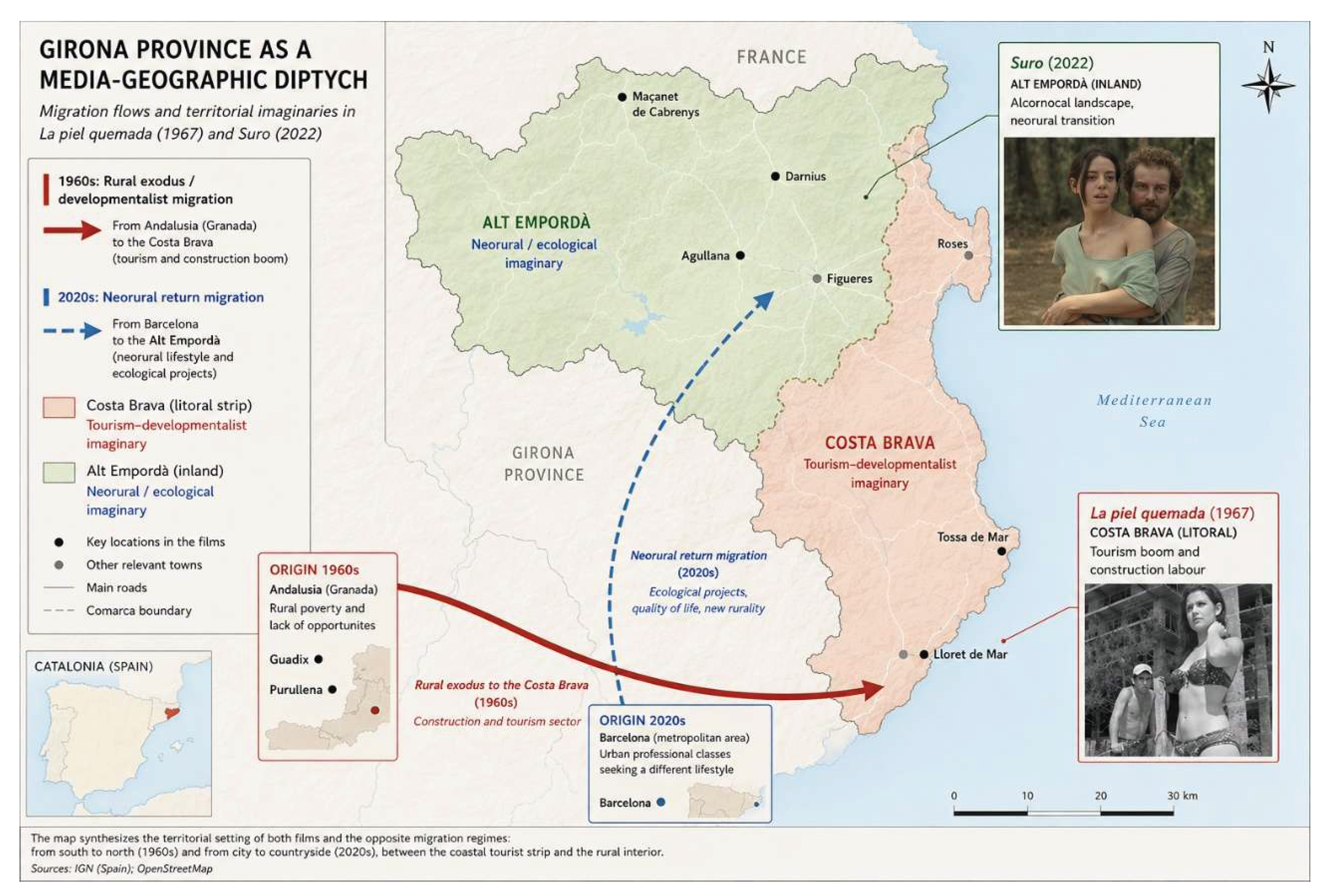

Table 1.
Corpus of 18 analytical sequences: film, scene, time code, chronotopic dimensions and thematic block. LPQ = La piel quemada; Suro = Suro. Source: own elaboration.
Table 1.
Corpus of 18 analytical sequences: film, scene, time code, chronotopic dimensions and thematic block. LPQ = La piel quemada; Suro = Suro. Source: own elaboration.
| Seq. | Film | Scene (approx. min / time code) | Chronotopic dimensions | Block |
|---|---|---|---|---|
| S1 | LPQ | Train journey / Juana + passenger (00:14:42–00:15:45) | Temporal (rural past), Spatial (displacement), Subjective (economic necessity) | 4.1.1 |
| S2 | LPQ | Landowner selects day labourers (flashback) (00:21:28–00:25:57) | Temporal (agrarian order), Subjective (class submission), Spatial (musical folklore) | 4.1.1 |
| S3 | LPQ | Beach / construction site juxtaposition (00:02:23–00:03:21; 00:10:32–00:13:45) | Spatial (leisure vs. labour), Temporal (desarrollismo), Subjective (inequality) | 4.1.2 |
| S4 | LPQ | Bar scene: gamaruso / señorito distinction (00:51:34–00:52:15) | Spatial (Costa Brava social geography), Subjective (ethnic hierarchy) | 4.2.1 |
| S5 | LPQ | Shed by the cemetery / José's domestic project (00:19:55–00:21:13; 01:39:30–01:42:31) | Spatial (marginalised habitat), Subjective (migrant resourcefulness) | 4.2.2 |
| S6 | LPQ | Catalan men confront Andalusian workers as charnegos (00:49:29–00:51:33) | Temporal (Francoist linguistic regime), Spatial (exclusion), Subjective (xenophobia) | 4.3.1/ 4.3.2 |
| S7 | LPQ | José with the site foreman (00:26:40–00:28:36) | Temporal (agrarian crisis), Subjective (construction hierarchy), Spatial (labour migration) | 4.2.1 |
| S8 | LPQ | Bus station arrival — family reunion (01:31:52–01:33:38) | Temporal (migratory chronotope), Spatial (Catalonia as destination), Subjective (life project) | 4.1.1 |
| S9 | LPQ | Final scene: Manolo watches tourists dancing (01:42:33–01:43:58) | Temporal (cyclical time), Spatial (tourist destination), Subjective (trapped belonging) | 4.2.1 |
| S10 | Suro | Farewell party in Barcelona (00:00:44–00:03:42) | Temporal (post-crisis urban present), Subjective (neo-rural motivation), Spatial (city) | 4.1.1 |
| S11 | Suro | "Let the tourists keep it" (00:04:48–00:05:44) | Spatial (Alt Empordà vs. Costa Brava), Temporal (post-tourism), Subjective (tourism-phobia) | 4.1.2 |
| S12 | Suro | Iván asks about Social Security registration (00:30:15–00:31:41) | Spatial (cork-oak estate), Subjective (class naivety / labour ethics) | 4.2.1 |
| S13 | Suro | Debate over the farmhouse renovation (00:37:49–00:42:07) | Spatial (domestic space), Subjective (class contradiction) | 4.2.2 |
| S14 | Suro | Workers' lunch break: conversation in Arabic (00:43:15–00:44:59) | Spatial (work in the forest), Subjective (subaltern solidarity, linguistic opacity) | 4.3.2 |
| S15 | Suro | Chema's accident / blame attributed to Karín (01:24:34–01:28:25) | Subjective (xenophobic relay), Temporal (generational continuity) | 4.3.1 |
| S16 | Suro | Night-time chase and armed intervention (01:37:17–01:39:09) | Spatial (night-time forest), Subjective (solidarity + class privilege) | 4.3.1 |
| S17 | Suro | Forest fire sequence / defence of the estate (01:50:25–01:52:15) | Spatial (territory as threat), Temporal (climate change), Subjective (belonging) | 4.2.2 |
| S18 | Suro | Helena at the house party with friends (01:45:54–01:49:12) | Spatial (bourgeoisified farmhouse), Temporal (unresolved neo-rural project), Subjective (ethical ambivalence) | 4.1.1 |
Table 2.
Comparative overview of La piel quemada (1967) and Suro (2022). Source: own elaboration.
| Category | La piel quemada (1967) | Suro (2022) |
|---|---|---|
| Historical period | Late Francoism (desarrollismo). Mass internal migration and tourist expansion. | Post-2008 Spain. Neo-rural movement, rural depopulation crisis, climatic precarity. |
| Locations (Girona) | Costa Brava: Lloret de Mar. Origin: Guadix-Purullena, Granada. | Alt Empordà interior: Darnius, Agullana, Maçanet de Cabrenys. |
| Genre / tradition | Social neo-realist drama. Counter-discourse to desarrollismo comedy. | Neo-rural drama. Counter-discourse to lifestyle neo-ruralism. |
| Thematic axes | Family, labour migration, tourist development, xenophobia. Rural-urban dichotomy. | Marital crisis, neo-rural return, agricultural precarity, ecological threat. Urban-rural dichotomy. |
| Migrant figures | Andalusian workers (charnego). European tourists. | Urban professional couple. Maghrebi seasonal agricultural workers. |
| Languages | Catalan / Castilian / German-French. | Catalan / Castilian / French / Arabic. |
| Narrative structure | Parallel narration (coast / journey). Flashbacks to village of origin. | Linear. Couple's conflicts with workers and landscape. Elliptical open ending. |
| Type of media discourse | Counter-discourse against Francoist developmentalist propaganda. | Counter-discourse against neo-rural romanticism (Halfacree, 1997). |
Table 3.
Mini-corpus of media reception: sources, authors, verified excerpts and framing (1967–2022). LPQ = La piel quemada; Suro = Suro. Source: own elaboration.
Table 3.
Mini-corpus of media reception: sources, authors, verified excerpts and framing (1967–2022). LPQ = La piel quemada; Suro = Suro. Source: own elaboration.
| Film | Source | Date | Author | Type | Excerpt / verified description | Framing |
|---|---|---|---|---|---|---|
| LPQ | Diario de León | 26.01.1967 | E. Murillo | Interview | Festival interview highlighting the need for greater freedom of expression and permission to address systematically excluded topics. | Dissident cinema as a space for freedom of expression unavailable to the official press. |
| LPQ | La Vanguardia española | 15.02.1967 | A. V. Kirchner | Chronicle / review | The screening caused commotion, with applause, approving comments and expressions of displeasure. | Polarised reception: Catalan-Andalusian coexistence as uncomfortable social issue. |
| LPQ | Signo | 11.03.1967 | L. Bonet-Mojica / J. M. Picó | Review / analysis | A serious and honest attempt to present a real problem from a class-based viewpoint. | Internal migration as a class issue; social realism versus escapist cinema. |
| LPQ | El Mundo Deportivo | 19.11.1967 | J. López Español | Review | The film will lend itself to controversy and is a decidedly important film. | Linguistic and cultural integration as an open question; public importance acknowledged. |
| LPQ | La Vanguardia española | 23.11.1967 | J. Pedret Muntañola | Review | The film tackles the social issue of immigrants in the manner of a vivid journalistic reportage. | Gap in official journalism on internal migration; cinema covers what the press does not. |
| LPQ | Ya | 15.02.1968 | P. Cebollada | Review / analysis | The film reads more as chronicle than fiction and strikes a fine tone of Spanish social realism. | The film as social chronicle: cinematic equivalent of the journalistic reportage that does not exist. |
| LPQ | Madrid | 13.02.1968 | Public colloquium [Forn, Berlanga, Sastre, Bonald] | Colloquium | "A testimony film about a social problem." [Forn] / "Here a social issue is raised in all its rawness." [Sastre] | Explicit public debate on the social function of cinema vs. dominant escapism. |
| LPQ | Informaciones | 16.02.1968 | A. Sánchez | Review | The drama is representative of all the charnegos and fills a gap left by the developmentalist press. | Social authenticity and denunciation; the film fills a representational vacuum. |
| Suro | El País | 19.09.2022 | E. Fernández-Santos | Review / SSIFF premiere | The rural as the terrain of the best contemporary Spanish cinema. | Generational convergence of directors on agricultural territory as political metaphor. |
| Suro | Cinemanía | 19.09.2022 | G. Bermejo | Cultural chronicle / review | End of the 15M generational idyll; post-crisis disenchantment. | The return to the rural as cultural diagnosis. |
| Suro | Screen Daily | 20.09.2022 | L. Holland | International review | Films about the impact of outsiders on rural Spanish life are becoming a recognisable tendency. | International reception: Spanish rurality on the European festival circuit. |
| Suro | Público | 01.12.2022 | B. Piña | Director interview | The film as a mirror revealing classism, racism and sexism projected onto the countryside from the city. | The film as a mirror of urban contradictions projected onto the rural world. |
| Suro | El Español | 02.12.2022 | M. Yáñez | Cultural chronicle | Dismantling of the idealised vision of the rural; thorny relation between ways of life. | Counter-discourse against idealised neo-ruralism; tension between progressive ideals and classist practice. |
| Suro | Fotogramas | 02.12.2022 | B. Morell | Film review | A devastating chronicle of the disintegration of the supposedly happy Arcadia. | Territorial, labour and emotional conflict demythologise the idealised rural Arcadia. |
| Suro | El Periódico de Aragón | 07.12.2022 | A. Arilla | Director interview | "I made it in Catalan because, in my experience in those lands, people expressed themselves in Catalan." | Multilingualism as cinematographic, identity and territorial feature / language as social organisation. |
Disclaimer/Publisher’s Note: The statements, opinions and data contained in all publications are solely those of the individual author(s) and contributor(s) and not of MDPI and/or the editor(s). MDPI and/or the editor(s) disclaim responsibility for any injury to people or property resulting from any ideas, methods, instructions or products referred to in the content. |
© 2026 by the authors. Licensee MDPI, Basel, Switzerland. This article is an open access article distributed under the terms and conditions of the Creative Commons Attribution (CC BY) license (http://creativecommons.org/licenses/by/4.0/).
Copyright: This open access article is published under a Creative Commons CC BY 4.0 license, which permit the free download, distribution, and reuse, provided that the author and preprint are cited in any reuse.


