

Submitted:
22 June 2026
Posted:
23 June 2026
You are already at the latest version
Abstract
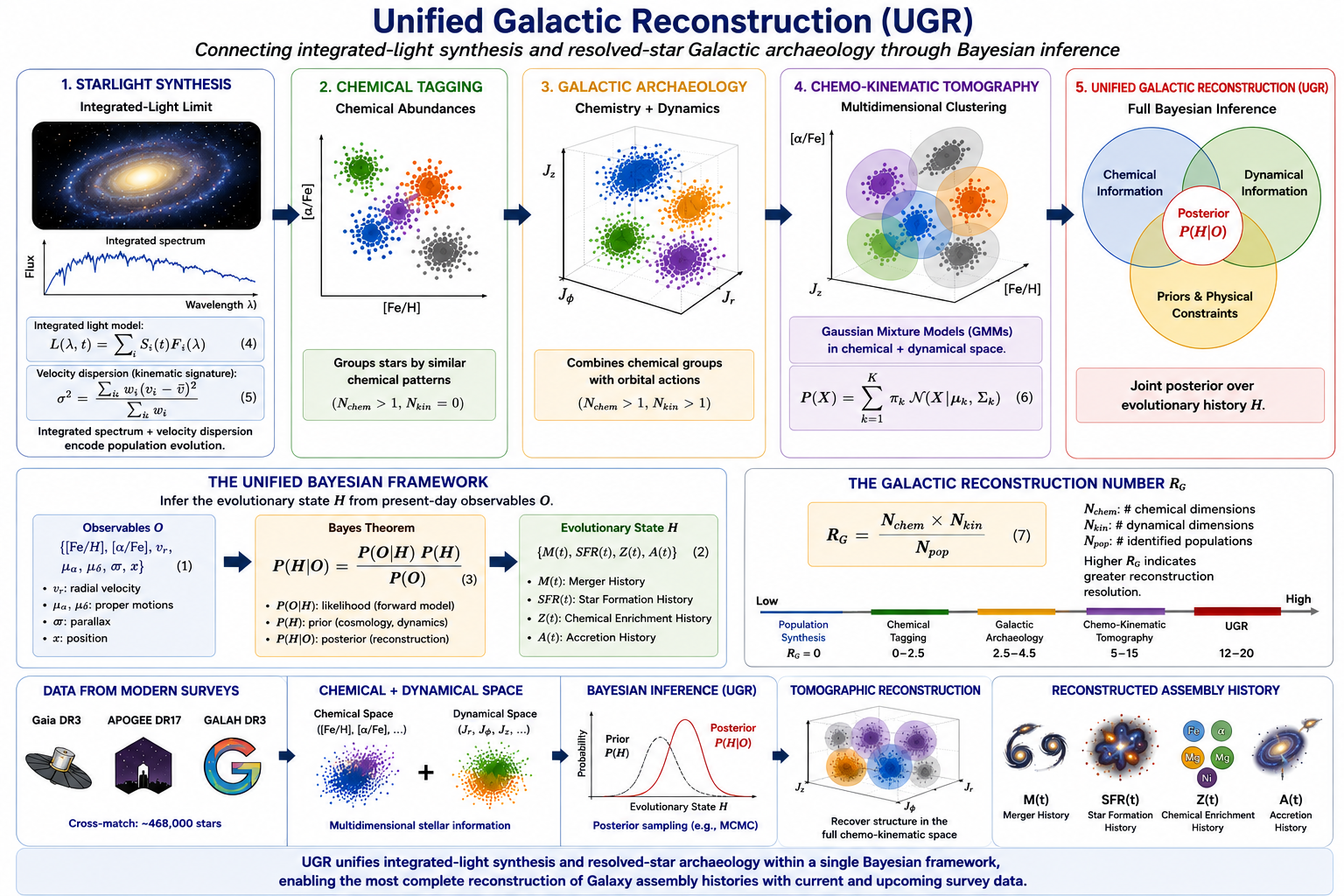
The reconstruction of galaxy assembly histories from contemporary stellar populations remains a central challenge in astrophysics. Both stellar population synthesis and Galactic Archaeology represent special cases of the same Bayesian inverse problem: inferring evolutionary history from present-day observables. This unification constitutes the central contribution of the present work. We formalise it as Unified Galactic Reconstruction (UGR), in which the full posterior over the evolutionary state is conditioned simultaneously on chemical and dynamical observables, rather than treating them sequentially. The Starlight Synthesis Algorithm operates as the integrated-light limiting case of UGR, while large-scale chemo-kinematic tomography represents the resolved-star limit. We additionally introduce the Galactic Reconstruction Number, R_G = N_chem × N_kin / N_pop, as a dimensionless heuristic index for comparing reconstruction methodologies. UGR naturally subsumes existing approaches as limiting cases and provides a conceptual foundation for next-generation Galactic studies with forthcoming surveys, including 4MOST, WEAVE, and the Roman Space Telescope.
Keywords:
Galactic Archaeology
; stellar population synthesis
; chemo-kinematics
; Bayesian inference
; Milky Way
; Gaia
; APOGEE
; GALAH
1. Introduction
The observable state of a galaxy is the cumulative outcome of star formation, chemical enrichment, dynamical evolution, and external interactions over cosmic time. Traditionally, these processes have been studied through two distinct paradigms: integrated-light stellar population synthesis, which models the spectral energy distribution of unresolved stellar systems (Tinsley, 1980; Bruzual & Charlot, 2003; Cid Fernandes et al., 2005; Conroy, 2013), and resolved stellar population reconstruction, which treats individual stars as fossils preserving the conditions of their birth environment (Freeman & Bland-Hawthorn, 2002).
The boundary between these paradigms has historically been defined by the resolution limit of the observations. At cosmological distances, stellar populations appear as unresolved ensembles; within the Local Group, and especially within the Milky Way, stars can be observed individually with full six-dimensional phase-space coordinates and detailed chemical abundance patterns. The development of surveys such as APOGEE (Majewski et al., 2017), GALAH (Buder et al., 2021), and successive Gaia data releases (Gaia Collaboration, 2023) has dramatically expanded the resolved regime, motivating a more unified theoretical treatment.
The Starlight Synthesis Algorithm (Barua, 2022) acts as a bridge between these domains, demonstrating that integrated stellar luminosity and velocity dispersion encode kinematic signatures of population evolution. More recently, Barua (2026) extended this conceptual framework to resolved stellar populations by analysing 468,000 stars from APOGEE DR17, GALAH DR3, and Gaia DR3 using multidimensional Gaussian-mixture modelling in chemical space with independent dynamical validation in action space.
Here, we propose that both approaches represent special cases of a more general inverse problem. Given present-day stellar observables, the reconstruction problem seeks to infer an evolutionary history. We formalise this as Unified Galactic Reconstruction (UGR) and demonstrate that existing methodologies emerge naturally as limiting cases of the general Bayesian framework.
2. Unified Galactic Reconstruction: The General Framework
2.1. The Inverse Problem
Let the observed stellar properties be
where v_r is radial velocity, μα and μδ are proper motions, ϖ is parallax, and x denotes position. The reconstruction problem seeks to infer an evolutionary state vector:
where M(t) is the merger history, SFR(t) is the star formation history, Z(t) is the chemical enrichment history, and A(t) is the accretion history. The inverse reconstruction problem is then
Equation (3) forms the foundation of UGR. The likelihood P(O | H) encodes the forward model from evolutionary history to observables; the prior P(H) encodes cosmological and dynamical constraints; and the posterior P(H | O) yields the probabilistic reconstruction of galaxy assembly.
2.2. Limiting Cases
Stellar Population Synthesis (Integrated-Light Limit). When spatial resolution is insufficient to resolve individual stars, O reduces to the integrated spectrum L(λ). The Starlight Synthesis Algorithm (Barua, 2022) operates in this limit, where
with S_i(t) the stellar population weights and F_i(λ) the spectral contributions. The velocity dispersion relation
provides a kinematic signature of population evolution.
Chemo-Kinematic Tomography (Resolved-Star Limit). When individual stars are resolved, O expands to the full chemo-dynamical space. Barua (2026) demonstrated population assignment via Gaussian Mixture Models:
where X = [[Fe/H], [α/Fe], v_r, Jϕ, J_r, J_z] and J denotes orbital actions. This represents the resolved-star limit of UGR, where the posterior over H is informed by multidimensional clustering in chemical and dynamical space simultaneously.
Figure 1 presents the conceptual evolution of Galactic reconstruction methods, from population synthesis to UGR, with the two Barua papers highlighted as motivating transition points.
2.3. The Galactic Reconstruction Number
We introduce a preliminary heuristic metric for comparing reconstruction methodologies:
where N_chem is the number of independent chemical dimensions, N_kin is the number of dynamical dimensions, and N_pop is the number of identified populations. Higher R_G indicates greater reconstruction resolution. We emphasise that R_G is intended as an order-of-magnitude heuristic; a rigorous derivation of its functional form and its relationship to reconstruction fidelity is deferred to future empirical work. Figure 2 illustrates R_G graphically across methodological eras. (see Section 3). Table 1 provides a quantitative summary.
3. Methodological Evolution and Comparison
4. Discussion
4.1. What UGR Adds
Existing Galactic Archaeology treats chemical tagging and dynamical classification as sequential or independent steps. Chemical tagging identifies co-natal groups from abundance patterns (Freeman & Bland-Hawthorn, 2002; Bland-Hawthorn et al., 2010; Ting et al., 2015); dynamical clustering identifies phase-mixed structures in action space (Helmi et al., 2018; Belokurov et al., 2018). UGR unifies these within a single posterior, such that chemical and dynamical information constrain H simultaneously rather than sequentially. This is not merely a procedural difference: it changes the statistical treatment of correlated uncertainties, allows chemical and dynamical constraints to mutually inform one another, and provides a principled basis for quantifying reconstruction uncertainty.
A second distinction concerns the treatment of unresolved and resolved regimes. Existing frameworks treat integrated-light synthesis and resolved-star archaeology as entirely separate methodologies with distinct software pipelines, data formats, and model architectures. UGR provides a common language: both are instances of Equation (3), differing only in the structure of P(O | H).
4.2. Validation Strategy
While a full empirical validation of R_G is beyond the scope of this perspective, we outline the strategy. Using the APOGEE DR17 + GALAH DR3 + Gaia DR3 cross-match (468,000 stars), one would: (1) define a grid of synthetic H using cosmological simulations; (2) forward-model the expected O for each H; (3) apply UGR to recover H’ and compare with the input; (4) compute R_G for each synthetic dataset and correlate with reconstruction fidelity. This program is feasible with existing computational resources and forthcoming survey data.
4.3. Future Prospects
The forthcoming Gaia DR4, Rubin Observatory LSST, Roman Space Telescope, 4MOST, and WEAVE surveys will increase both sample size and dimensionality. The reconstruction capability scales as
where N_obs is the number of stars and D is the dimensionality of the parameter space. This suggests substantial growth in reconstruction capability over the coming decade, provided that the UGR framework is adopted as the standard inference architecture.
5. Conclusions
Unified Galactic Reconstruction offers a conceptual and mathematical bridge between stellar population synthesis and Galactic Archaeology. By treating galaxy evolution as a single inverse reconstruction problem, UGR naturally incorporates the Starlight Synthesis Algorithm (Barua, 2022), chemical tagging, and chemo-kinematic tomography (Barua, 2026) within a common probabilistic formalism. The key insight — that two historically separate methodologies are limiting cases of a single Bayesian posterior — provides a foundation on which future survey-scale analyses can be built. The proposed Galactic Reconstruction Number R_G provides a heuristic basis for comparing methodologies and predicting the gains achievable with forthcoming surveys. We suggest that UGR may offer a useful conceptual framework for next-generation Galactic studies, though full empirical validation remains an important priority for future work.
References
- Barua, N. (2022). Formation and evolution of galaxies: Starlight Synthesis Algorithm. International Journal of Astronomy and Astrophysics, 12(1), 68–93. [CrossRef]
- Barua, N. (2026). Chemo-kinematic tomography of the Milky Way using APOGEE, GALAH, and Gaia DR3. SSRN Electronic Journal. [CrossRef]
- Belokurov, V., Erkal, D., Evans, N. W., Koposov, S. E., & Deason, A. J. (2018). Co-formation of the disc and the stellar halo. Monthly Notices of the Royal Astronomical Society, 478(1), 611–619. [CrossRef]
- Bland-Hawthorn, J., Krumholz, M. R., & Freeman, K. (2010). Chemical tagging can work. The Astrophysical Journal, 713(1), 166–179. [CrossRef]
- Bruzual, G., & Charlot, S. (2003). Stellar population synthesis at the resolution of 2003. Monthly Notices of the Royal Astronomical Society, 344(4), 1000–1028. [CrossRef]
- Buder, S., Sharma, S., Kos, J., et al. (2021). The GALAH+ Survey: Third Data Release. Monthly Notices of the Royal Astronomical Society, 506(1), 150–201. [CrossRef]
- Cid Fernandes, R., Mateus, A., Sodré, L., Stasińska, G., & Gomes, J. M. (2005). Semi-empirical analysis of Sloan Digital Sky Survey galaxies — I. Spectral synthesis method. Monthly Notices of the Royal Astronomical Society, 358(2), 363–378. [CrossRef]
- Conroy, C. (2013). Modeling the panchromatic spectral energy distributions of galaxies. Annual Review of Astronomy and Astrophysics, 51, 393–455. [CrossRef]
- Freeman, K., & Bland-Hawthorn, J. (2002). The new galaxy: Signatures of its formation. Annual Review of Astronomy and Astrophysics, 40, 487–537. [CrossRef]
- Gaia Collaboration, Vallenari, A., Brown, A. G. A., et al. (2023). Gaia Data Release 3: Summary of the content and survey properties. Astronomy & Astrophysics, 674, A1. [CrossRef]
- Helmi, A., Babusiaux, C., Koppelman, H. H., Massari, D., Veljanoski, J., & Brown, A. G. A. (2018). The merger that built the Milky Way. Nature, 563(7729), 85–88. [CrossRef]
- Majewski, S. R., Schiavon, R. P., Frinchaboy, P. M., et al. (2017). The Apache Point Observatory Galactic Evolution Experiment (APOGEE). The Astronomical Journal, 154(3), 94. [CrossRef]
- Ting, Y.-S., De Silva, G., Freeman, K. C., & Parker, S. J. (2015). Chemical tagging with GALAH. Monthly Notices of the Royal Astronomical Society, 452(1), 201–211. [CrossRef]
- Tinsley, B. M. (1980). Evolution of the stars and gas in galaxies. Fundamentals of Cosmic Physics, 5, 287–388.
Figure 1.
Conceptual evolution of Galactic reconstruction methods. A vertical flowchart showing the progression from Population Synthesis to Chemical Tagging to Galactic Archaeology to Chemo-Kinematic Tomography to Unified Galactic Reconstruction. The Starlight Synthesis Algorithm (Barua, 2022) and Chemo-Kinematic Tomography (Barua, 2026) are highlighted as transition points that motivate UGR.
Figure 1.
Conceptual evolution of Galactic reconstruction methods. A vertical flowchart showing the progression from Population Synthesis to Chemical Tagging to Galactic Archaeology to Chemo-Kinematic Tomography to Unified Galactic Reconstruction. The Starlight Synthesis Algorithm (Barua, 2022) and Chemo-Kinematic Tomography (Barua, 2026) are highlighted as transition points that motivate UGR.
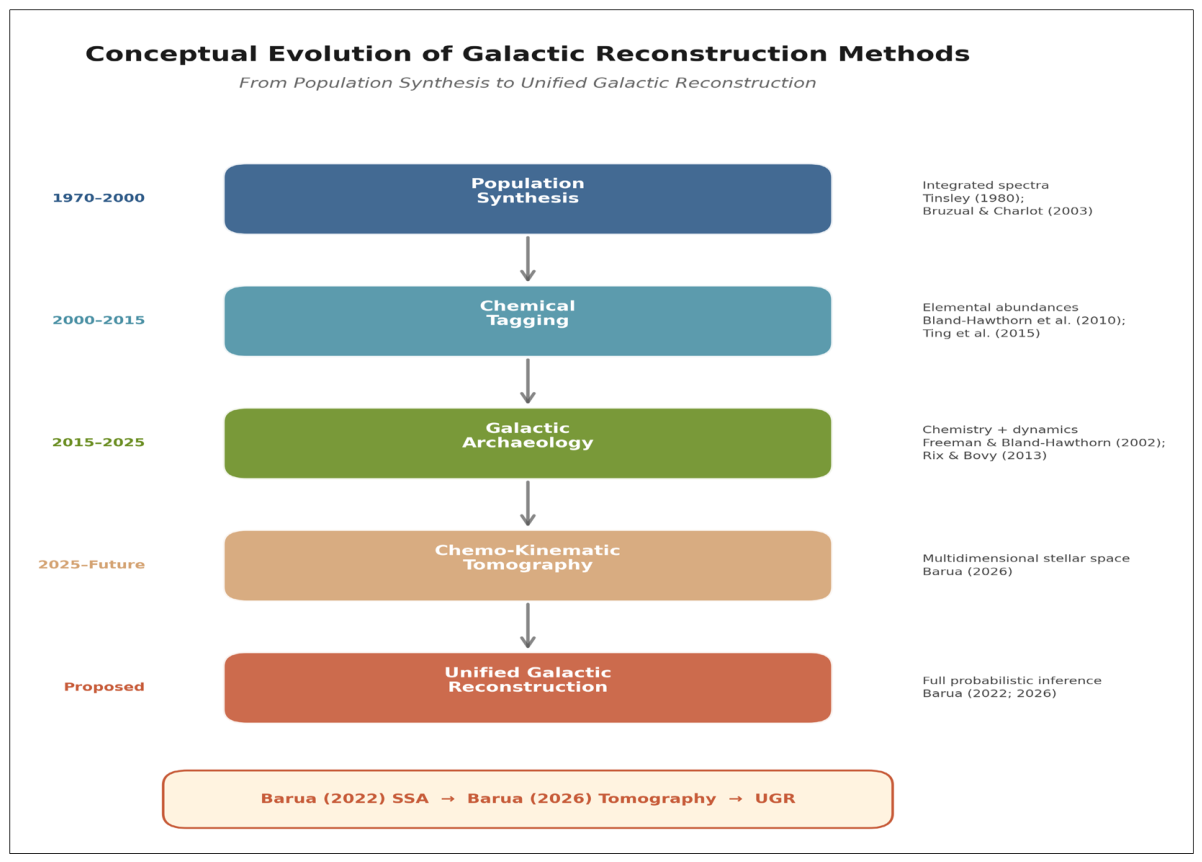
Figure 2.
The Galactic Reconstruction Number R_G across methodological eras. Population Synthesis (R_G = 0) represents the integrated-light limit with no dynamical information. Chemical Tagging (R_G = 0–2.5) adds chemical dimensions but lacks kinematics. Galactic Archaeology (R_G = 2.5–4.5) combines chemistry and dynamics. Chemo-Kinematic Tomography (R_G = 5–15) exploits multidimensional spaces. Unified Galactic Reconstruction (R_G = 12–20) achieves the highest reconstruction resolution by integrating full probabilistic inference across all dimensions.
Figure 2.
The Galactic Reconstruction Number R_G across methodological eras. Population Synthesis (R_G = 0) represents the integrated-light limit with no dynamical information. Chemical Tagging (R_G = 0–2.5) adds chemical dimensions but lacks kinematics. Galactic Archaeology (R_G = 2.5–4.5) combines chemistry and dynamics. Chemo-Kinematic Tomography (R_G = 5–15) exploits multidimensional spaces. Unified Galactic Reconstruction (R_G = 12–20) achieves the highest reconstruction resolution by integrating full probabilistic inference across all dimensions.
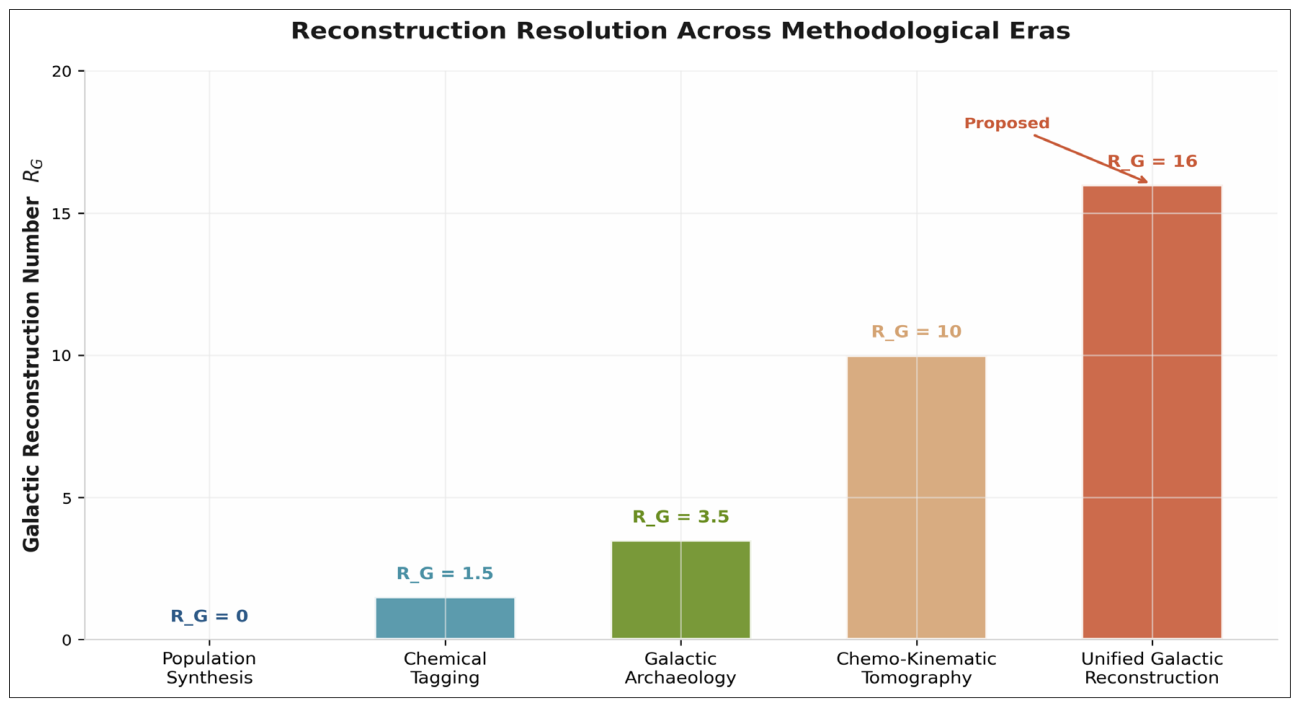
Figure 3.
Bayesian inference workflow in UGR. Horizontal flow from observations (Gaia + APOGEE + GALAH) to chemical space ([Fe/H], [α/Fe], …) to dynamical space (actions, integrals of motion) to joint likelihood construction to prior specification to posterior sampling to tomographic reconstruction to assembly history M(t), SFR(t), Z(t).
Figure 3.
Bayesian inference workflow in UGR. Horizontal flow from observations (Gaia + APOGEE + GALAH) to chemical space ([Fe/H], [α/Fe], …) to dynamical space (actions, integrals of motion) to joint likelihood construction to prior specification to posterior sampling to tomographic reconstruction to assembly history M(t), SFR(t), Z(t).
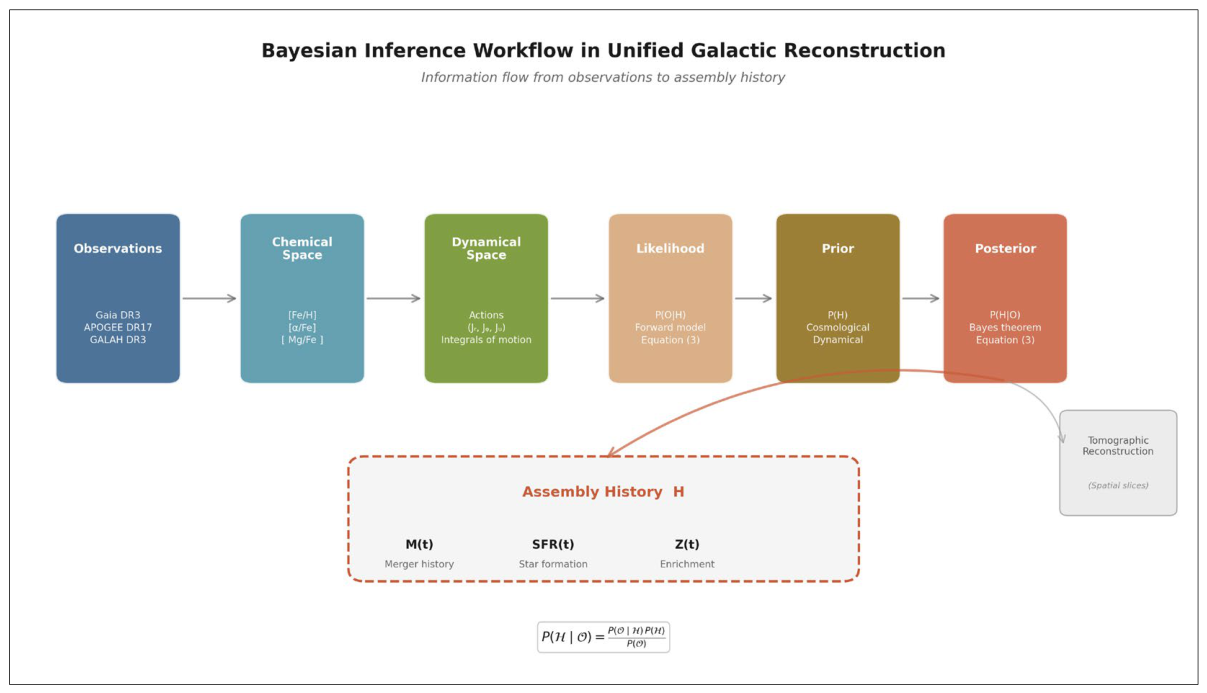

Table 1.
Evolution of Galactic Reconstruction Methodologies. N_chem, N_kin, and N_pop are the numbers of independent chemical dimensions, dynamical dimensions, and identified populations, respectively. R_G is defined in Equation (7).
Table 1.
Evolution of Galactic Reconstruction Methodologies. N_chem, N_kin, and N_pop are the numbers of independent chemical dimensions, dynamical dimensions, and identified populations, respectively. R_G is defined in Equation (7).
| Era | Method | Primary Observable | N_chem | N_kin | N_pop | R_G |
|---|---|---|---|---|---|---|
| 1970–2000 | Population Synthesis | Integrated spectra | 1 | 0 | 1 | 0 |
| 2000–2015 | Chemical Tagging | Elemental abundances | 3–5 | 0 | 5–10 | 0–2.5 |
| 2015–2025 | Galactic Archaeology | Chemistry + dynamics | 3–5 | 3 | 5–10 | 2.5–4.5 |
| 2025–Future | Chemo-Kinematic Tomography | Multidimensional space | 5–10 | 6 | 4–6 | 5–15 |
| Proposed | UGR | Full probabilistic inference | 10+ | 6+ | 3–5 | 12–20 |
Disclaimer/Publisher’s Note: The statements, opinions and data contained in all publications are solely those of the individual author(s) and contributor(s) and not of MDPI and/or the editor(s). MDPI and/or the editor(s) disclaim responsibility for any injury to people or property resulting from any ideas, methods, instructions or products referred to in the content. |
© 2026 by the authors. Licensee MDPI, Basel, Switzerland. This article is an open access article distributed under the terms and conditions of the Creative Commons Attribution (CC BY) license (http://creativecommons.org/licenses/by/4.0/).
Copyright: This open access article is published under a Creative Commons CC BY 4.0 license, which permit the free download, distribution, and reuse, provided that the author and preprint are cited in any reuse.


