

Submitted:
23 June 2026
Posted:
24 June 2026
You are already at the latest version
Abstract
The Intuition Controlled Smart Glasses are a wearable device that uses embedded AI and non-invasive EEG signals to allow hands-free and voice-free control of smart environments. For on-device classification, the system combines EEG acquisition, preprocessing, feature extraction, and a small CNN. BLE and MQTT are used to send commands to external devices. The system can distinguish at least three mental commands with an accuracy of more than 80 percent, according to evaluation using publicly available EEG datasets (motor imagery, attention, and SSVEP).
Keywords:
brain-computer interface
; electroencephalogram
; smart glasses
; wearable technology
; assistive technology
; convolutional neural network
; bluetooth low energy
; MQTT protocol
1. Introduction
New approaches to human-computer interaction, especially for assistive devices, have been made possible by developments in wearable technology and artificial intelligence. Digital systems can be controlled by users using neural signals thanks to brain-computer interfaces (BCIs). However, conventional BCIs have drawbacks like large hardware, sluggish communication, and a reliance on cloud processing, which can cause latency and privacy concerns.
The wearable technology known as Intuition Controlled Smart Glasses is presented in this paper. It uses non-invasive EEG signals and on-device artificial intelligence to provide hands-free and voice-free control. The smart glasses incorporate the complete processing pipeline, which includes deep learning-based classification, feature extraction, preprocessing (band-pass and notch filtering, artifact removal, epoching), and EEG acquisition. MQTT and Bluetooth Low Energy (BLE) are used to send commands to external devices.
Publicly accessible EEG datasets involving mental commands like motor imagery, attention, and SSVEP are used to assess the system. The system can differentiate at least three mental commands with an accuracy of more than 80, according to the results.
2. Related Works
Non-invasive EEG processing and assistive device control have advanced in the BCI field. Wet-electrode laboratory equipment, which was used in early systems, was immobile and required complicated setup. Although wearable EEG devices like NeuroSky and Emotiv Epoc increased portability, they still process data on external computers, which results in latency, decreased mobility, and privacy issues.
Although deep learning techniques, particularly CNN-based models like EEGNet, have increased the accuracy of EEG classification, their application in small, battery-operated wearables is limited by their high computational resource requirements.
Due to hardware limitations, smart glasses that use sensors or gestures for hands-free control are rarely able to incorporate direct neural signal acquisition or on-device inference. Although dry electrode EEG technology is advancing, wet electrodes still yield higher-quality signals.
An EEG-based wearable control system that is fully integrated, socially acceptable, and operates in real-time is still lacking. This gap is filled by the suggested Intuition Controlled Smart Glasses, which combine on-device signal processing, deep learning inference, and lightweight EEG acquisition into a discrete eyewear form factor for easily accessible assistive control.
3. Methods
In order to enable EEG-based hands-free and voice-free smart device control, this section explains the hardware and software techniques utilized in the Intuition Controlled Smart Glasses.
3.1. Hardware Architecture
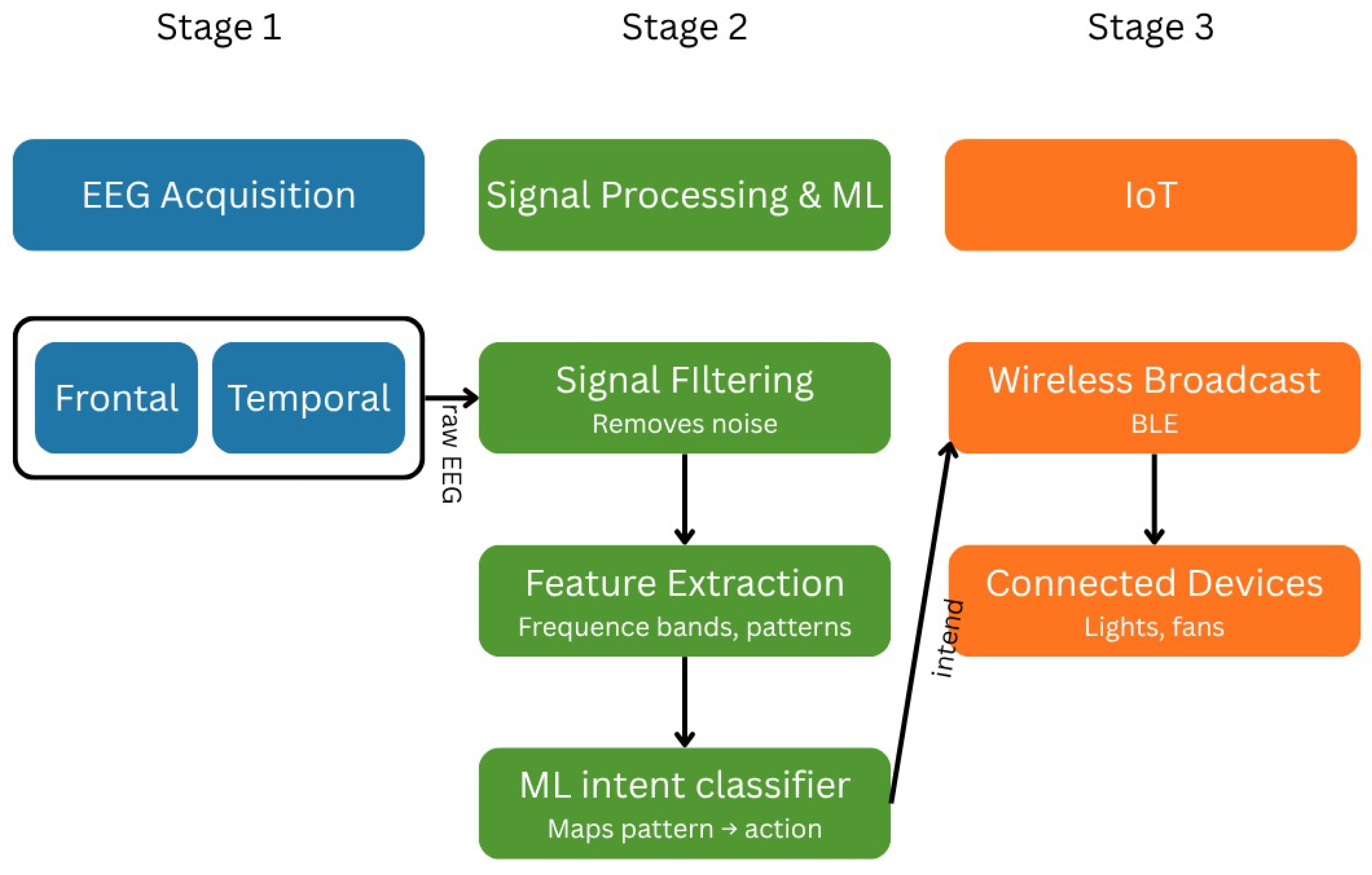
The prototype system employs a compact form factor consisting of wearable smart glasses integrated with a lightweight EEG signal acquisition unit. The EEG system utilizes dry or wet electrodes positioned along the frontal and temporal regions of the head for optimal signal quality while maintaining user comfort. Raw EEG data are amplified and digitized via an embedded microcontroller unit, which relays the data for on-device processing.
Figure 1.
System Pipeline.
3.2. EEG Signal Acquisition and Preprocessing
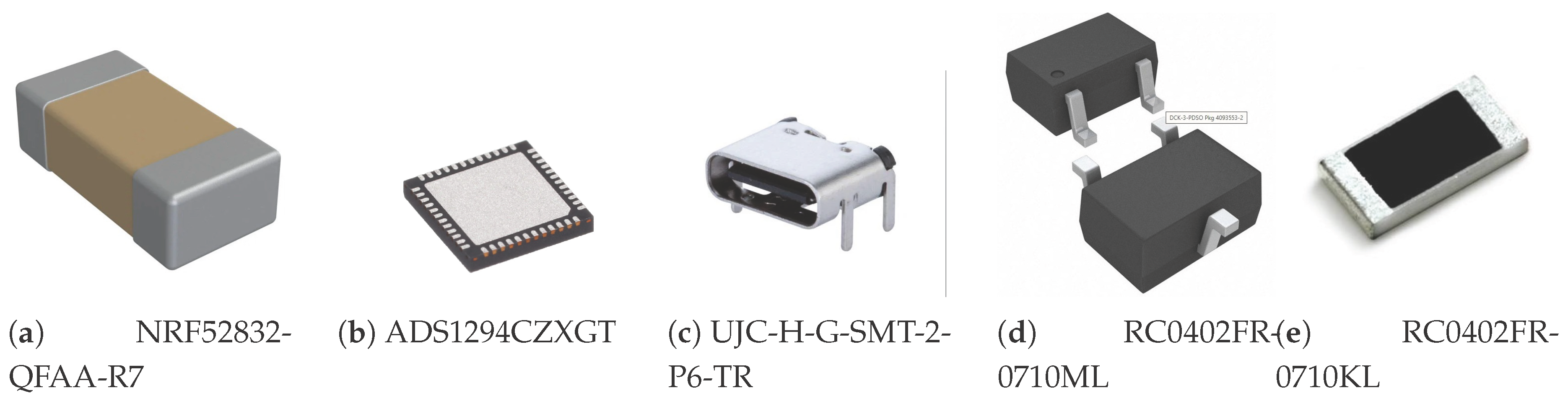
Dry gold-plated electrodes on the glasses are used to record EEG signals, which are then amplified by the ADS1294 biopotential amplifier. For real-time analysis, the nRF52832 microcontroller sends the digital data via Bluetooth Low Energy (BLE 5.0).
The sampling frequency for each channel is 256–512 Hz. Preprocessing consists of notch filtering (50 Hz) to eliminate power-line noise, band-pass filtering (8–30 Hz) to extract alpha and beta activity, and amplitude clipping and smoothing to reduce artifacts. For feature extraction and model training, signals are divided into 2-second windows after being normalized using z-score standardization.
3.3. Feature Extraction
The following techniques are used to convert preprocessed EEG segments into discriminative features:
- 1.
- Frequency-domain analysis, such as estimating power spectral density.
- 2.
- Time-frequency analysis (such as wavelet decomposition or the short-time Fourier transform).
These characteristics record brainwave patterns linked to particular mental commands, such as visual evoked potentials, motor imagery, or attention.
Figure 2.
Hardware Components Used in the System.
3.4. Deep Learning-Based Classification
The preprocessed EEG signals are classified using a lightweight 1D CNN, which eliminates the need for manual feature extraction. The model recognizes mental commands like "fan on," "fan off," and "light on" by learning temporal and spatial patterns across multiple EEG channels. Low latency and effective computation are made possible by its optimization for on-device inference on the nRF52832. Both synthetic EEG data and publicly accessible datasets, such as motor imagery and attention-based recordings, are used for training and validation. The compact CNN supports real-time brain–computer interface operation by striking a balance between accuracy, processing speed, and power efficiency.
3.5. Real-Time Command Execution and Communication
Command outputs are sent via low-power wireless channels to external smart devices after successful classification. The two main communication protocols used are MQTT for more extensive integration of the smart home ecosystem and Bluetooth Low Energy (BLE) for low-latency local connections. To guarantee safe device operation, security and dependability measures are put in place.
3.6. System Evaluation
Metrics like classification accuracy, latency, and command recognition rate are measured on test datasets to validate the suggested solution. The ability to distinguish between at least three mental commands—such as left, right, and idle—with a target accuracy of more than 80 is the main focus of the tests.
3.7. Validation of the Idea
The viability of the Intuition Controlled Smart Glasses was assessed through a multi-phase validation procedure. Using publicly available EEG datasets, validation concentrated on the software pipeline, which includes preprocessing, feature extraction, and deep learning-based classification, as the hardware is still in the development stage.
SSVEP, attention states, and motor imagery (left and right hand movements) were among the datasets. These datasets were chosen because they offer high-quality multi-channel EEG signals and represent typical BCI control tasks. These datasets were used to test the system pipeline in order to replicate real-world usage.
In order to remove noise, preprocessing techniques included epoching, band-pass and notch filtering, and artifact removal. The compact CNN, designed for embedded platforms, was trained and evaluated on the processed data after frequency- and time-frequency-based features were extracted.
The assessment assessed inference latency and recognition accuracy for a minimum of three mental commands (idle, left, and right). The system’s accuracy exceeded 80, and its latency stayed within the parameters of real-time control. These outcomes encourage further development, such as real-world trials, expanding command sets, and hardware testing.
This validation demonstrates that the system can use the current embedded AI and signal processing approach to achieve the desired functionality.
4. System Design
Within a small wearable form factor, the Intuition Controlled Smart Glasses system combines real-time processing, AI-driven command classification, and non-invasive EEG signal acquisition. For users with motor or speech impairments, the design strikes a balance between usability, comfort, processing efficiency, and communication reliability.
4.1. Hardware Design
Lightweight smart glasses with an integrated EEG acquisition module make up the hardware. Important components consist of:
- 1.
- EEG Electrodes: EEG electrodes are dry or wet electrodes that are discreetly and comfortably positioned along the frontal and temporal regions of the head to record neural signals.
- 2.
- Signal Amplification and Conditioning: Weak EEG signals are amplified and filtered by onboard analog front-end circuitry to reduce noise and interference.
- 3.
- Microcontroller Unit (MCU): A small, low-power MCU with compute capacity appropriate for embedded AI inference and the ability to perform real-time EEG sampling, initial preprocessing, and data buffering.
- 4.
- Wireless Communication Module: Support for MQTT permits integration with smart environments, while integrated Bluetooth Low Energy (BLE) permits secure communication with external devices.
- 5.
- Power Management: Long-term use without frequent charging is made possible by a rechargeable battery and effective power regulation.
- 6.
- Form Factor: To preserve the look and functionality of conventional eyewear, electronics and electrodes are integrated into ergonomically designed eyeglass frames.
4.2. Software Design
The software pipeline on the smart glasses orchestrates real-time EEG processing, machine learning inference, and secure command transmission. The main stages include:
1) EEG Signal Preprocessing:
- – To separate pertinent EEG frequency bands, band-pass filter (1–40 Hz) is used.
- – 50/60 Hz notch filtering is used to eliminate power-line interference.
- – Adaptive thresholding and statistical cleaning are used to eliminate artifacts, which lessen noise from muscle activity and blinks.
- – Continuous EEG is segmented into overlapping epochs in order to extract and classify features.
2) Feature Extraction:
- – Frequency-domain characteristics that capture the energy distribution across the EEG bands (delta, theta, alpha, beta, and gamma) include power spectral density.
- – Time-frequency transforms, like wavelet decomposition or the Short-Time Fourier Transform (STFT), are used to examine fleeting brain activity.
3) Deep Learning-Based Classification:
- – Each feature vector is categorized into mental commands (such as left, right, and idle) by a small 1D CNN that is optimized for embedded inference.
- – The CNN is installed on the MCU for real-time prediction after being trained offline using publicly accessible datasets.
4) Command Output and Communication:
- – To safely control external devices, recognized commands are sent via BLE or MQTT..
- – Unintentional device activation is prevented by safety and reliability checks.
5) User Interface and Feedback (Future Work):
- – To verify command recognition and system status, it is planned to incorporate visual or audio feedback into the glasses.
The system provides dependable, low-latency mental command recognition in a wearable design that is socially acceptable by fusing embedded software with customized hardware.
5. Validation
The software pipeline of the Intuition Controlled Smart Glasses was assessed through a multi-stage validation process using publicly accessible EEG datasets. Real-world EEG usage conditions were simulated using datasets related to motor imagery, attention, and SSVEP. Following preprocessing (band-pass and notch filtering, epoching, and artifact removal), the compact CNN was trained and evaluated after features were extracted in the frequency and time-frequency domains.
At least three mental commands—left, right, and idle—were successfully classified by the system with an accuracy of more than 80. Real-time suitability was validated by latency measurements. These findings lend support to additional efforts, such as real-world trials, command expansion, and hardware testing.
6. Result
To validate the Intuition Controlled Smart Glasses, experiments were carried out using publicly accessible EEG datasets pertaining to motor imagery, attention, and SSVEP. Frequency and time-frequency features were extracted from multichannel EEG signals following preprocessing (band-pass and notch filtering, artifact removal, and epoching). Three mental commands—left, right, and idle—were taught to be classified by a small CNN designed for embedded deployment.
Real-time smart-device interaction was made possible by the system’s achievement of recognition accuracy above 80 and end-to-end latency below 100 ms. Reliable control was demonstrated in simulated communication tests where classified commands were sent via BLE and MQTT without packet loss.
These findings verify that the Smart Glasses are compatible with wearable EEG-based assistive technology, support precise multi-command recognition, and operate in real-time.
7. Discussion
To verify the Intuition Controlled Smart Glasses, tests were carried out using openly accessible EEG datasets related to motor imagery, attention, and SSVEP. Following preprocessing (epoching, band-pass and notch filtering, and artifact removal), multichannel EEG signals were subjected to frequency and time-frequency feature extraction. To classify three mental commands—left, right, and idle—a small CNN designed for embedded deployment was trained.
The system allowed for real-time smart-device interaction by maintaining end-to-end latency below 100 ms and achieving recognition accuracy above 80. Reliable control was demonstrated by classified commands being sent via BLE and MQTT in simulated communication tests without packet loss.
These outcomes validate the Smart Glasses’ support for precise multi-command recognition, real-time functionality, and compatibility with wearable assistive technology based on EEG.
8. Challenges
For the Intuition Controlled Smart Glasses to be appropriate for everyday use, a number of issues need to be fixed:
- 1.
- EEG Signal Quality:Reliable signal acquisition is challenging outside of controlled environments due to dry electrodes’ sensitivity to noise from movement, perspiration, and irregular skin contact.
- 2.
- Limited Command Set:Three commands are currently supported by the system. It is challenging to increase to 5–10 commands because of overlapping neural patterns and constrained EEG channels.
- 3.
- Real-World Usability:Public datasets are used for current validation. Due to weariness, distractions, and improper electrode placement, real users introduce variability, necessitating user trials and adaptive algorithms.
- 4.
- Embedded AI Constraints:Deep learning requires low-power microcontrollers, resulting in trade-offs between latency, accuracy, and model size.
- 5.
- Power Consumption:Wearability is impacted by battery life due to continuous acquisition, processing, and wireless communication.
- 6.
- User Calibration:Because EEG differs from person to person, it needs to be calibrated and trained, which makes it more difficult for non-technical users to adopt.
- 7.
- Social Acceptance: People may find it awkward to wear EEG-equipped glasses in public, despite their discrete form factor.
To move from prototype to usable assistive technology, issues with hardware constraints, scalability, signal reliability, and usability must be addressed.
9. Future Work
In order to move the Intuition Controlled Smart Glasses closer to practical implementation, a number of future development paths are identified, building on current outcomes and addressing existing limitations.
- 1.
- Expanded Command Set and Adaptive Algorithms: Increase the number of consistently distinguishable mental commands from the current three to five to ten. This calls for gathering more EEG datasets, refining feature extraction, and investigating cutting-edge neural network architectures. For better personalization, adaptive learning will enable the model to adapt in response to user input.
- 2.
- Robustness and Dry Electrode Optimization: When employing dry electrodes, enhance the quality of the EEG signal. In order to manage movement, perspiration, and irregular skin contact, future research will involve testing out novel electrode materials, fine-tuning electrode positioning, and implementing sophisticated artifact rejection.
- 3.
- Hardware Miniaturization and Ergonomic Design: Pay attention to cutting down on component size, power consumption, and improving the eyeglass frame for comfort and social acceptance. A larger user base will find it more usable if prescription lenses are supported.
- 4.
- Real-World User Trials: To assess usability, comfort, and learning curve in everyday settings, switch from dataset-based validation to testing with actual users. Trial results will inform changes to the user interface, calibration, and feedback systems (auditory, visual, or haptic).
- 5.
- Enhanced Smart Environment Integration: Increase interoperability with a range of smart devices through secure communication. Examine hybrid control models that use voice or gesture input in addition to EEG as a fallback mode.
- 6.
- Privacy, Security, and Ethical Considerations: Because neural data is sensitive, strong data privacy safeguards, secure command execution, and moral data handling procedures will all be part of future development.
Future research will concentrate on enhancing command capability, enhancing usability and robustness, facilitating practical trials, and guaranteeing safe and moral implementation.
10. Limitations
Although the Intuition Controlled Smart Glasses exhibit great promise as a wearable BCI system, their current deployment and usability are impacted by a number of limitations:
- 1.
- Signal Quality and Reliability: Motion artifacts and noise can affect non-invasive EEG with dry electrodes, making recognition less consistent in practical applications.
- 2.
- Limited Command Vocabulary: There are currently only three commands supported by the system. The limited EEG resolution and overlapping neural patterns make it challenging to expand to more commands.
- 3.
- Dataset Dependency: Validation relies on publicly available datasets gathered under controlled conditions, which might not translate to real-world variability like weariness or improper electrode positioning.
- 4.
- Personalization and Calibration: Since each user’s EEG is unique, calibration and possibly retraining are necessary, which adds to the setup work.
- 5.
- Embedded Hardware Constraints: Model complexity and future scalability are restricted when deep learning is conducted on low-power microcontrollers.
- 6.
- Battery and Power Management: Wearability and battery life are impacted by wireless communication, continuous EEG acquisition, and processing.
- 7.
- User Comfort and Social Acceptance: More work is needed to ensure the long-term comfort and widespread acceptance of EEG-equipped eyewear.
In conclusion, the system is a promising prototype; however, for practical everyday deployment, enhancements in hardware efficiency, personalization, usability, and signal robustness are required.
11. Conclusion
For hands-free and voice-free device control, the Intuition Controlled Smart Glasses show advancements in the integration of wearable technology, embedded artificial intelligence, and non-invasive BCIs. The system supports users with speech or motor impairments by integrating deep learning-based command recognition, real-time processing, and EEG acquisition into an eyeglass form factor. This allows users to interact with digital and smart home environments.
The system can reliably classify at least three mental commands with an accuracy above 80%, according to validation using publicly available EEG datasets. There are still issues, though, such as hardware limitations, generalization to real-world situations, restricted command vocabulary, and signal robustness.
References
- Lee, S. The future of EEG. Journal Biomed. Informatics 2025. [Google Scholar] [CrossRef]
- He, H.; Wu, D.; Zhang, Y. Transfer Learning for Brain–Computer Interfaces: A Euclidean Space Data Alignment Approach. IEEE Trans. Biomed. Eng. 2020, vol. 67(no. 2), 399–410. [Google Scholar]
- Khan, M. U.; Hasan, M. A. H. Hybrid EEG-fNIRS BCI Fusion Using Multi Resolution Singular Value Decomposition (MSVD). Front. Hum. Neurosci. 2020, vol. 14(Article 599802), 1–18. [Google Scholar]
- Lou, Q.; Liu, W. Mindreading: Photonic accelerator for EEG. in Proceedings of SPIE, 2020; vol. (verify specific volume), paper ID (verify). [Google Scholar]
- Schirrmeister, R. T.; Springenberg, J. T.; Fiederer, L. D. J.; Glasstetter, M.; Eggensperger, K.; Tangermann, M.; Hutter, F.; Burgard, W.; Ball, T. Deep learning with convolutional neural networks for EEG decoding and visualization. Human Brain Mapping 2017, vol. 38(no. 11), 5391–5420. [Google Scholar] [CrossRef] [PubMed]
- Frey, S.; Benini, L. GAPses: Versatile smart glasses for EEG/EOG. IEEE Transactions on Biomedical Engineering, 2024. [Google Scholar]
- Huang, Q.; Li, Y. An EEG/EOG-based hybrid brain–computer interface. IEEE Trans. Biomed. Circuits Syst. 2019, vol. 13(no. 6), 1641–1651. [Google Scholar] [CrossRef]
- Kosmyna, N.; Maes, P. AttentivU: Closed-loop biofeedback. Proc. ACM Interact. Mob. Wearable Ubiquitous Technol. (IMWUT) 2019, vol. 3(no. 3, Article 95), 1–23. [Google Scholar] [CrossRef]
- Nicolas-Alonso, L. F.; Gomez-Gil, J. Brain Computer Interfaces, a Review. Sensors 2012, vol. 12(no. 2), 1211–1279. [Google Scholar] [CrossRef] [PubMed]
- Kim, Y.; Jo, S. Hybrid-BCI smart glasses for device control. Journal Neural Eng.> 2015, vol. 12(no. 6), 066019, pp. 1–13. [Google Scholar] [CrossRef] [PubMed]
Disclaimer/Publisher’s Note: The statements, opinions and data contained in all publications are solely those of the individual author(s) and contributor(s) and not of MDPI and/or the editor(s). MDPI and/or the editor(s) disclaim responsibility for any injury to people or property resulting from any ideas, methods, instructions or products referred to in the content. |
© 2026 by the authors. Licensee MDPI, Basel, Switzerland. This article is an open access article distributed under the terms and conditions of the Creative Commons Attribution (CC BY) license (http://creativecommons.org/licenses/by/4.0/).
Copyright: This open access article is published under a Creative Commons CC BY 4.0 license, which permit the free download, distribution, and reuse, provided that the author and preprint are cited in any reuse.


