

Submitted:
22 June 2026
Posted:
24 June 2026
You are already at the latest version
Abstract
Graphene oxide (GO) is a key precursor of functionalized graphene materials and reduced graphene oxide (rGO), but its wider use is limited by difficulties in obtaining materials with reproducible composition, controlled oxidation degree and low post-reaction impurity content. This study compares two purification routes for GO obtained by a modified Hummers method. After synthesis, the post-reaction mixture was divided into two parts: one was purified conventionally in acidic HCl medium (GO-HCl), whereas the other was neutralized with KOH, washed with water and finally treated with HCl to remove Mn2+ and K+ ions (GO-KOH). KOH-assisted purification reduced the number of washing cycles from 18 to 5. WAXS/XRD, SEM/EDS, XPS, FTIR, Raman spectroscopy, DSC and TGA showed that GO-KOH sedimented faster, formed a powder after drying, contained less sulfur (0.27 vs. 0.55 at.%), had a higher C/O ratio (2.01 vs. 1.57), a lower Raman ID/IG ratio (1.62 vs. 1.88), and a lower oxygen-group removal enthalpy (521 vs. 1080 J g-1). Sequential pH change is therefore an effective tool for shortening GO purification and controlling its properties.
Keywords:
graphene oxide
; modified Hummers method
; GO purification
; KOH neutralization
; sulfur residues
; organosulfate groups
; colloidal stability
; thermal reduction
; reduced graphene oxide
; adsorbent precursor
1. Introduction
Graphene is a two-dimensional carbon material consisting of a single layer of atoms arranged in a hexagonal lattice. Owing to its excellent mechanical, thermal and electrical properties, graphene-based materials are intensively studied in materials engineering, electronics, energy technologies, medicine and biotechnology [1,2,3]. In practical technological routes, graphene oxide (GO) is particularly important because it can be obtained chemically from graphite, and the presence of oxygen-containing groups facilitates its dispersion in water and selected polar solvents.
Graphene oxide is not a material with one strictly defined chemical structure. Its properties depend on the type of graphite used, oxidation conditions, reagent ratio, temperature, reaction time, work-up procedure, purification route and storage history. Recent literature emphasizes that GO should be considered a non-stoichiometric and heterogeneous two-dimensional material whose quality and reproducibility require a precise description of its synthesis and post-reaction treatment history [14,26,27,33].
The Hummers method and its numerous modifications remain the most common routes for GO preparation [4,5,6,7,8,9]. This method also has strong potential for scale-up from laboratory to larger production scales [10,11,12,26]. However, as the process scale increases, purification of the product from sulfuric acid residues, manganese compounds, sulfates, inorganic ions and oxidation by-products becomes particularly problematic.
Conventional GO purification involves washing, filtration, centrifugation, dialysis or combinations of these methods. These techniques are effective on a small scale, but they become time-consuming and technically difficult when larger amounts of material are processed. Aqueous GO dispersions are viscous, colloidally stable and prone to clogging membranes or filters. Recent studies on automated GO purification indicate that conductivity, ion concentration and water consumption should be controlled because insufficient removal of impurities can significantly alter the final material properties [28,29].
Sulfur residues are of particular importance. In earlier interpretations, they were mainly considered post-reaction impurities. More recent reports show that part of sulfur may occur as organosulfate groups bound to the GO structure, and these groups can influence surface charge, colloidal stability and material behavior during purification, drying and redispersion [17,21,30]. Therefore, sulfur removal should not be treated only as the elimination of inorganic ions, but also as a process that can modify the chemical and colloidal nature of GO.
The alkaline environment must also be considered as an active factor shaping GO properties. pH change can facilitate sedimentation, alter the ionic form of impurities and accelerate separation of GO from the liquid phase. Literature on oxidative debris shows that alkaline treatment may remove or transform loosely bound, highly oxidized fragments and modify the surface properties of GO [31]. The complexity of the origin and transformation of oxygen functionalities in GO is also supported by recent isotopic labeling studies [32]. Thus, alkaline treatment should be viewed not only as purification but also as controlled modification of GO properties by pH change.
Increasing attention has also been paid to time-dependent transformations occurring in GO after synthesis. Otsuka et al. demonstrated that colloidal GO is not fully stable, but can evolve between intrinsic, metastable and transient states during dispersion ripening. These transitions are accompanied by changes in oxygen-containing groups, layered structure and electrical properties [33]. From this perspective, the duration and chemical environment of purification may be as important as the oxidation conditions themselves.
Recent studies on alkaline treatment of GO further show that the interaction with KOH should not be interpreted only as a simple acid-neutralization step. Burresi and Protopapa described the degradation of GO in alkaline media and the formation of two photon-emitting phases in the visible region [34], while Protopapa et al. showed that KOH solutions can generate photoluminescent carbonaceous structures associated with oxidative debris [35]. The importance of pH for GO-based systems has also been confirmed in other graphene material studies [20]. These reports indicate that contact time, base concentration and the sequence of pH changes are parameters controlling GO structure and properties.
This picture is complemented by studies on stripping oxidative debris from GO surfaces. Li et al. showed that removal of such highly oxidized fragments can alter aggregation and dispersion behavior of GO [36].
The aim of this work was to determine the effect of sequential pH change during purification of GO obtained by a modified Hummers method on its supramolecular structure, chemical composition, morphology, defect state of the carbon structure and thermal properties. Particular attention was paid to comparing conventional purification in HCl medium with a route involving KOH neutralization, water washing and final acidic treatment. It was assumed that sequential pH change could shorten the purification process and produce GO with properties favorable for subsequent thermal reduction to rGO.
2. Materials and Methods
2.1. Materials and Reagents
Graphite powder with a grain size below 20 µm, sulfuric acid (H2SO4, 95–98%), potassium permanganate (KMnO4, analytical grade), 3% hydrogen peroxide (H2O2), 5% KOH solution, 10% HCl solution and barium nitrate Ba(NO3)2 were used for the synthesis and purification of GO. All reagents were purchased from Sigma-Aldrich and used without further purification.
2.2. Graphene Oxide Synthesis
A total of 0.5 dm3 of 95–98% H2SO4 was poured into a 5 dm3 beaker, and 20 g of graphite powder was then added. The mixture was stirred with a magnetic stirrer for 1 h. The system was then cooled in an ice bath to approximately 5 °C. Subsequently, 60 g of KMnO4 was added in small portions while controlling the addition rate so that the temperature of the reaction mixture did not exceed 35 °C.
After the complete addition of KMnO4, the mixture was kept for 2 h with continuous temperature control below 50 °C. In the next step, 1 dm3 of distilled water was added portionwise, with the addition rate controlled to keep the temperature below 65 °C. Then, 0.8 dm3 of distilled water at 60 °C and 0.8 dm3 of 3% H2O2 solution were added. After completion of the reaction, the post-reaction mixture was divided into two equal parts, which were subjected to different purification procedures.
2.3. Sample Purification
The first part of the post-reaction mixture was purified using a conventional HCl-based route and denoted GO-HCl. A 4 dm3 portion of 10% HCl was added to the sample, which was then intensively mixed using a mechanical stirrer, allowed to sediment, and decanted. After each cycle, a sample of the liquid phase was collected and tested for sulfate ions using Ba(NO3)2. The procedure was repeated until no visible turbidity was observed after the addition of Ba2+ ions. For GO-HCl, the purification process was completed after 18 washing cycles.
The second part of the post-reaction mixture was neutralized with KOH and denoted GO-KOH. Water and 5% KOH solution were added in an amount selected to neutralize the sulfuric acid present in the post-reaction mixture. The sample was then washed with distilled water using the same sequence of intensive mixing, sedimentation, decantation and sulfate detection with Ba(NO3)2. For GO-KOH, the absence of visible turbidity was achieved after 5 water-washing cycles. To limit the presence of Mn2+ and K+ ions, the sample was additionally subjected to a final washing step with 4 dm3 of 10% HCl.
After purification, the samples were vacuum-filtered and dried at 25 °C until dry mass was obtained. Before filtration, portions of each sample were poured onto Petri dishes to evaluate film-forming ability after drying.
2.4. Characterization Methods
X-ray diffraction and wide-angle X-ray scattering (XRD/WAXS) measurements were performed using a URD 63 Seifert diffractometer. CuKα radiation was used at an accelerating voltage of 40 kV and an anode current of 30 mA. Beam monochromatization was achieved with a nickel filter and a pulse-height analyzer. Measurements were carried out in the 2θ range from 4° to 60°.
The interplanar distance was calculated from Bragg’s law, nλ = 2d sinθ, where n is the reflection order, λ is the X-ray wavelength, d is the interplanar distance and θ is the diffraction angle. The size of ordered domains was estimated using the Scherrer equation, and the average number of layers was calculated from the interplanar distance and ordered-domain dimension. Diffraction patterns were analyzed using WAXSFIT software [15].
The morphology and elemental composition of the samples were examined using a Phenom ProX scanning electron microscope (PhenomWorld) equipped with an energy-dispersive X-ray spectroscopy (EDS) detector. Measurements were performed at an accelerating voltage of 15 kV. Three analyses were performed for each sample and the results are presented as average values. Because of the limitations of EDS, results for trace and light elements should be treated as comparative rather than as a full quantitative purity analysis.
Thermal properties were characterized by thermogravimetric analysis (TGA) using a TA Instruments Q500 V20.10 Build 36 thermobalance. Measurements were carried out under nitrogen in the temperature range 30–820 °C, at a heating rate of 10 °C min−1 and a gas flow rate of 60 cm3 min−1. Differential scanning calorimetry (DSC) was performed using a TA Instruments Universal V4.5A instrument in the range 0–300 °C at a heating rate of 10 °C min−1.
X-ray photoelectron spectroscopy (XPS) measurements were performed in a multi-chamber ultra-high-vacuum system with a base pressure of 7 × 10⁻¹¹ mbar in the analytical chamber. The system was equipped with a PREVAC EA15 hemispherical electron energy analyzer coupled with a 2D-MCP detector. Samples were irradiated using a PREVAC XR40B Al Kα X-ray source with an energy of 1486.6 eV. The spectra were fitted using CasaXPS software with mixed Gaussian–Lorentzian functions and Shirley background subtraction.
FTIR analysis was performed using a Thermo-Nicolet Magna-IR 860 spectrophotometer with a resolution of 8 cm−1, 64 scans and a measurement range of 7500–400 cm−1. Raman spectra were recorded using a Witec Raman Alpha M300+ system equipped with an Nd:YAG 532 nm laser. The laser power was 1 mW, the number of accumulations was 400 and the integration time was 2 s.
3. Results
3.1. WAXS/XRD Analysis
The obtained GO samples were structurally examined by WAXS/XRD. This method enables evaluation of the statistical layered ordering of GO, determination of the interplanar distance and estimation of the average number of layers in GO stacks. The results are shown in Figure 1 and Table 1.
The positions of the diffraction peaks of both samples are typical of oxidized graphite and correspond to the range characteristic of graphene oxide. For GO-HCl, the reflection maximum occurred at 2θ = 11.24°, whereas for GO-KOH it appeared at 2θ = 10.90°. The slight shift in peak position can be related to differences in interplanar spacing, functional group distribution and aggregation of GO sheets after purification.
The shape and position of the reflections indicate that the ordered-domain sizes in both samples are similar. The average number of layers calculated from WAXS/XRD data was 23 for GO-HCl and 22 for GO-KOH. Thus, the purification routes did not substantially alter the average number of layers estimated by X-ray methods. However, the reflection intensity differed significantly. The higher intensity observed for GO-HCl may indicate stronger layered ordering or stronger interactions between sheets in the film-forming material.
3.2. Macroscopic and Microscopic Observations
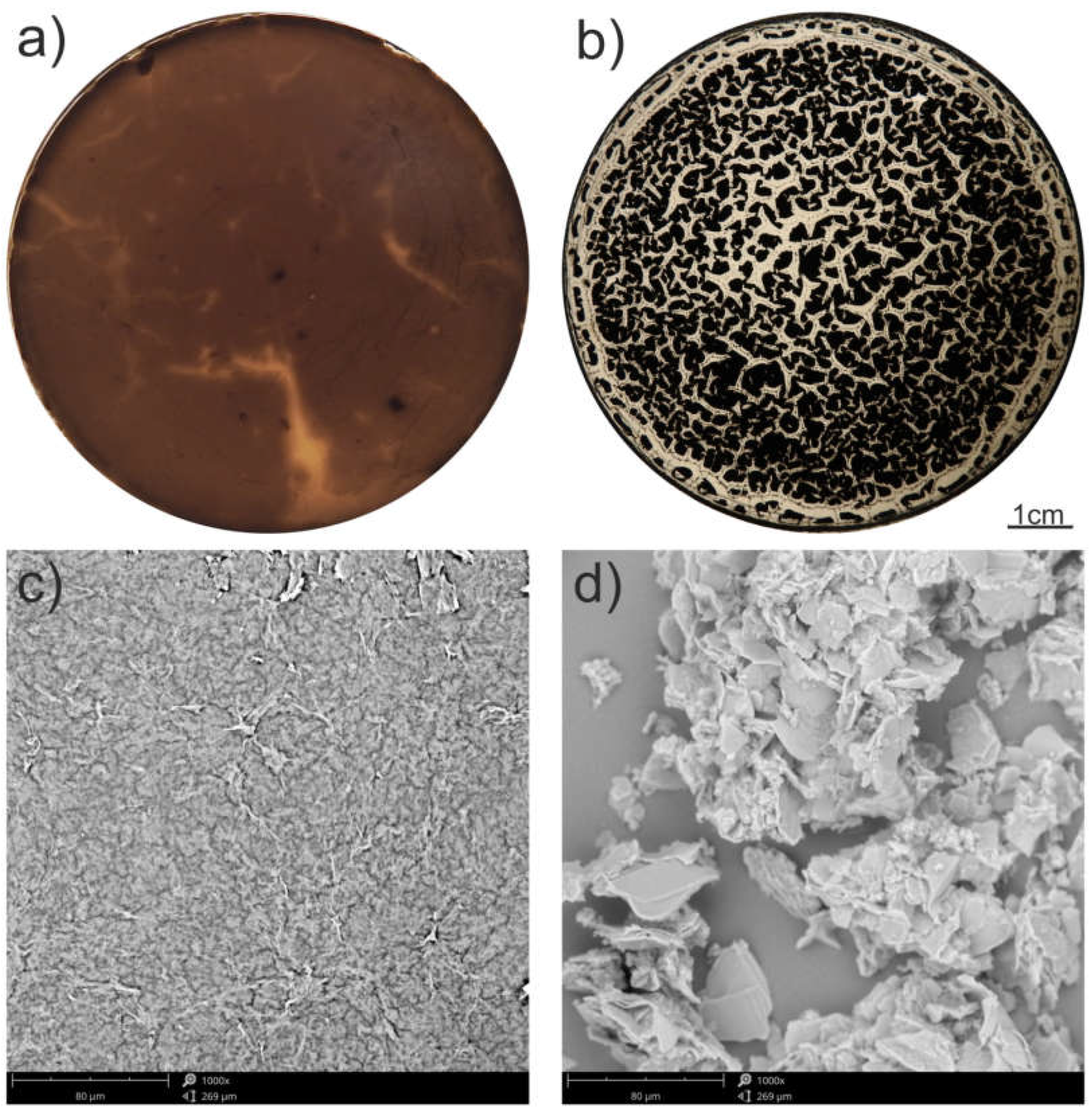
The X-ray results can be partly related to macroscopic and microscopic observations. After casting onto a Petri dish and drying, GO-HCl formed a continuous film with a relatively uniform surface and brown color. The film showed sufficient mechanical cohesion to allow transfer and further handling.
GO-KOH behaved clearly differently. During purification, lower dispersion stability and rapid sedimentation were observed. After casting onto a Petri dish, the sample did not form a continuous film, but a powdery, brittle and discontinuous material. SEM observations confirmed these differences: GO-HCl formed a compact film-like structure, whereas GO-KOH occurred as heterogeneous aggregates and agglomerates of GO flakes.
These differences are relevant for application. GO-HCl may be more favorable when films or GO membranes are required. In contrast, GO-KOH may be more useful when the material is intended as a powder for drying, dosing, mixing or thermal reduction. The observed change in dispersion behavior is consistent with the current view of GO as a pH-dependent colloidal material whose stability depends on surface charge, ions in solution and the presence of oxygen- and sulfur-containing groups [30].
Figure 2.
Morphology of GO: macroscopic photographs of (a) GO-HCl and (b) GO-KOH samples and SEM images of (c) GO-HCl and (d) GO-KOH.
Figure 2.
Morphology of GO: macroscopic photographs of (a) GO-HCl and (b) GO-KOH samples and SEM images of (c) GO-HCl and (d) GO-KOH.
3.3. Chemical Composition and Sulfur Residues
In the modified Hummers method performed without sodium nitrate, the main post-reaction impurities are residues of sulfuric acid and its derivatives, as well as manganese compounds. In assessing the effectiveness of purification, sulfur content is particularly important because it can reflect both sulfate ions and more strongly retained sulfur-containing groups associated with the GO structure.
Figure 3 shows the sulfur content in GO samples as a function of the number of washing cycles. For GO-HCl, measurement after the first wash was not possible because of the large amount of residual sulfuric acid and difficulty in drying the sample at room temperature. After an initial rapid decrease in sulfur content, its level stabilized and further washing brought only a slight improvement. Even after 18 washing cycles, the sulfur content did not decrease significantly.
For GO-KOH, after KOH neutralization and several water-washing cycles, a markedly lower sulfur content was obtained. After five washing cycles, the sulfur content was lower than that of GO-HCl after repeated washing in acidic medium. This result indicates that pH change facilitates transfer of part of the sulfur-containing impurities into the aqueous phase and limits their retention in the material.
Recent literature indicates that sulfur in GO prepared by the Hummers method may occur not only as residual inorganic sulfate but also as organosulfate groups that affect surface charge and colloidal stability [17,21,30]. From this perspective, the observed decrease in sulfur content in GO-KOH can be interpreted as the result of removal or transformation of some sulfur-containing groups during sequential pH change. This interpretation is consistent with the simultaneous changes in dispersion stability, oxygen content and thermal behavior of the samples.
EDS results obtained after final purification showed that GO-HCl contained 38.61 at.% oxygen, whereas GO-KOH contained 33.10 at.% oxygen. The C/O ratios were 1.57 and 2.01, respectively. Therefore, GO-KOH was a material with a lower oxidation degree.
3.4. XPS Analysis
XPS analysis allows evaluation of the surface chemical composition of the samples and the bonding states present in the GO structure. Particular attention was paid to the C1s region, where components corresponding to C–C/C=C, C–O/C–O–C/C=O and O–C=O bonds can be distinguished. In the GO-KOH sample, an additional component assigned to π–π interactions or COOH groups was also detected [22,23].
For GO-HCl, the contribution of the C–C/C=C component was 46.5%, while the component associated with C–O/C–O–C/C=O bonds accounted for 48.3%. For GO-KOH, the corresponding values were 48.34% and 40.36%, respectively. Thus, the ratio of carbon-bonded components to oxygen-containing components was higher for GO-KOH, in agreement with the EDS results and indicating a lower oxidation degree of the sample purified with KOH neutralization.
The XPS spectra show that the samples differ not only in total oxygen content but also in the distribution of functional groups. In GO-HCl, oxygen-containing components make a larger contribution, while in GO-KOH the relative contribution of the C–C/C=C component is higher. This result supports the conclusion that the purification environment influences the surface chemical state of GO.
Figure 5 complements the C1s analysis by showing deconvolution of additional energy regions, including O1s. These spectra confirm that GO-HCl and GO-KOH differ not only in the overall oxygen content but also in the chemical nature of surface functionalities. GO-HCl shows a greater contribution of diverse oxygen-containing components, whereas GO-KOH has a higher relative contribution of carbon components and a more limited oxygen-containing signal. The XPS results are consistent with EDS, FTIR, Raman and DSC analyses, indicating that sequential pH change produces GO with a lower oxidation degree, lower sulfur residue content and easier thermal reducibility.
Figure 4.
XPS C1s spectra of GO-HCl and GO-KOH samples.
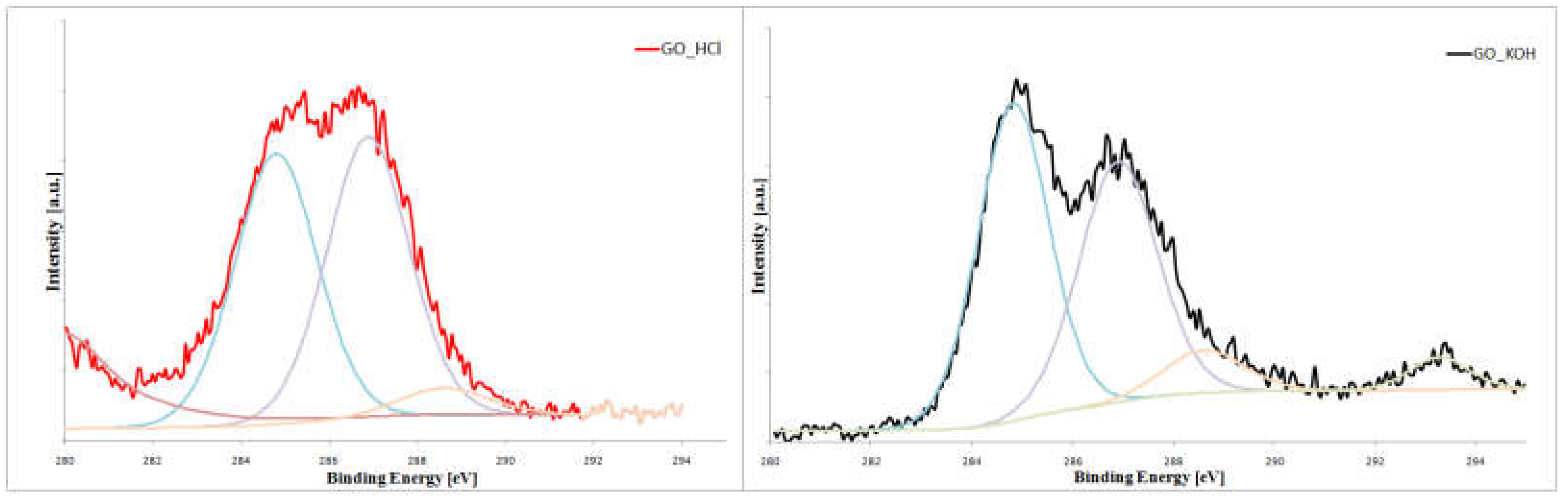
Figure 5.
High-resolution XPS spectra of GO-HCl and GO-KOH in the C1s and O1s regions with peak deconvolution, showing differences in the contribution of carbon–carbon and oxygen-containing surface groups.
Figure 5.
High-resolution XPS spectra of GO-HCl and GO-KOH in the C1s and O1s regions with peak deconvolution, showing differences in the contribution of carbon–carbon and oxygen-containing surface groups.
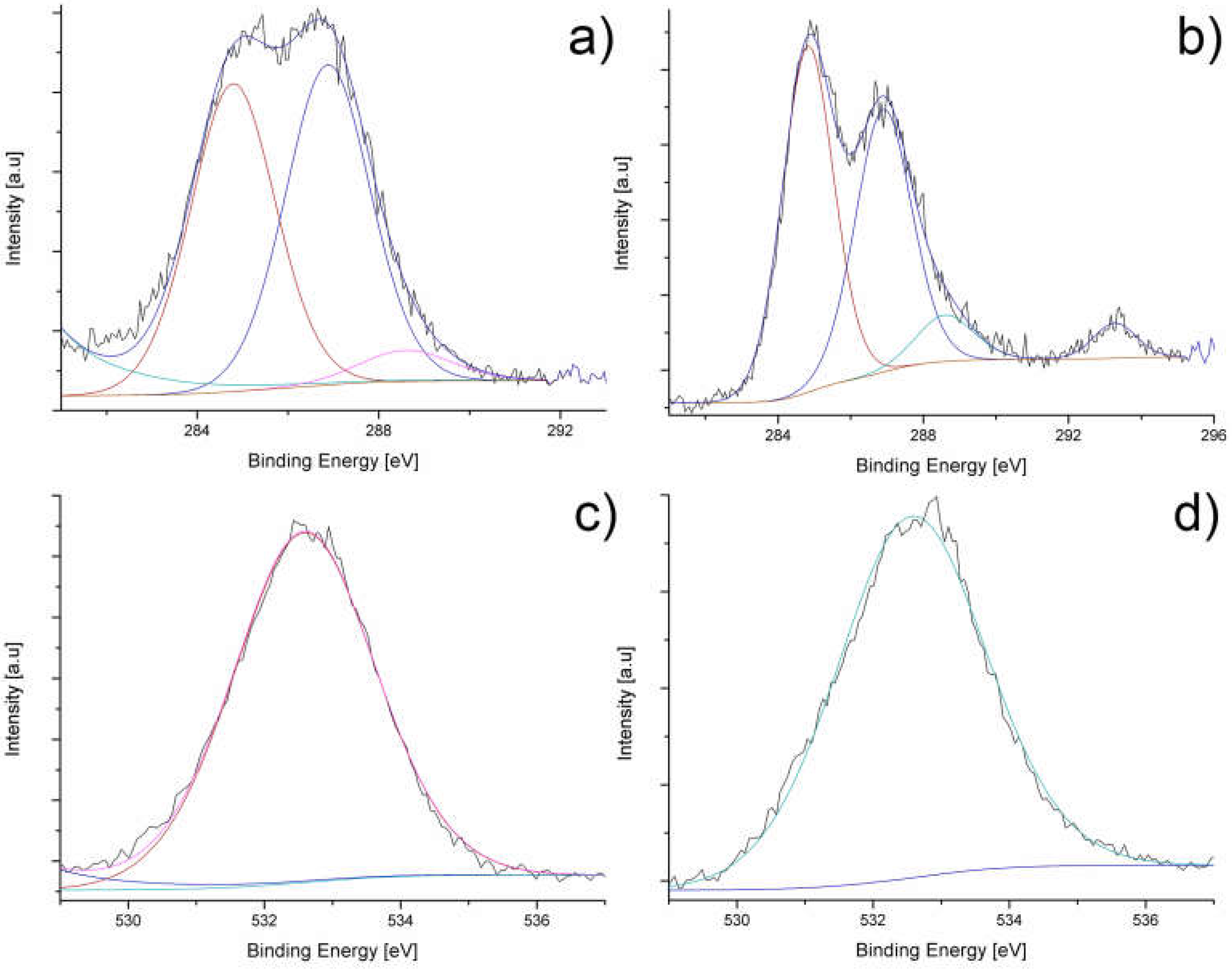

Table 2.
Deconvolution results of C1s XPS spectra.
| Sample | Parameter | C–C/C=C | C–O/C–O–C/C=O | O–C=O | π–π/COOH |
| GO-HCl | MAX [eV] | 284.8 | 286.9 | 288.5 | — |
| GO-HCl | Area | 92,322.5 | 95,979.5 | 1,024.0 | — |
| GO-HCl | Contribution [%] | 46.5 | 48.3 | 5.2 | — |
| GO-KOH | MAX [eV] | 284.8 | 286.9 | 288.6 | 293.3 |
| GO-KOH | Area | 83,233.8 | 69,490.6 | 12,454.0 | 6,991.8 |
| GO-KOH | Contribution [%] | 48.34 | 40.36 | 7.2 | 4.1 |
3.5. FTIR Analysis
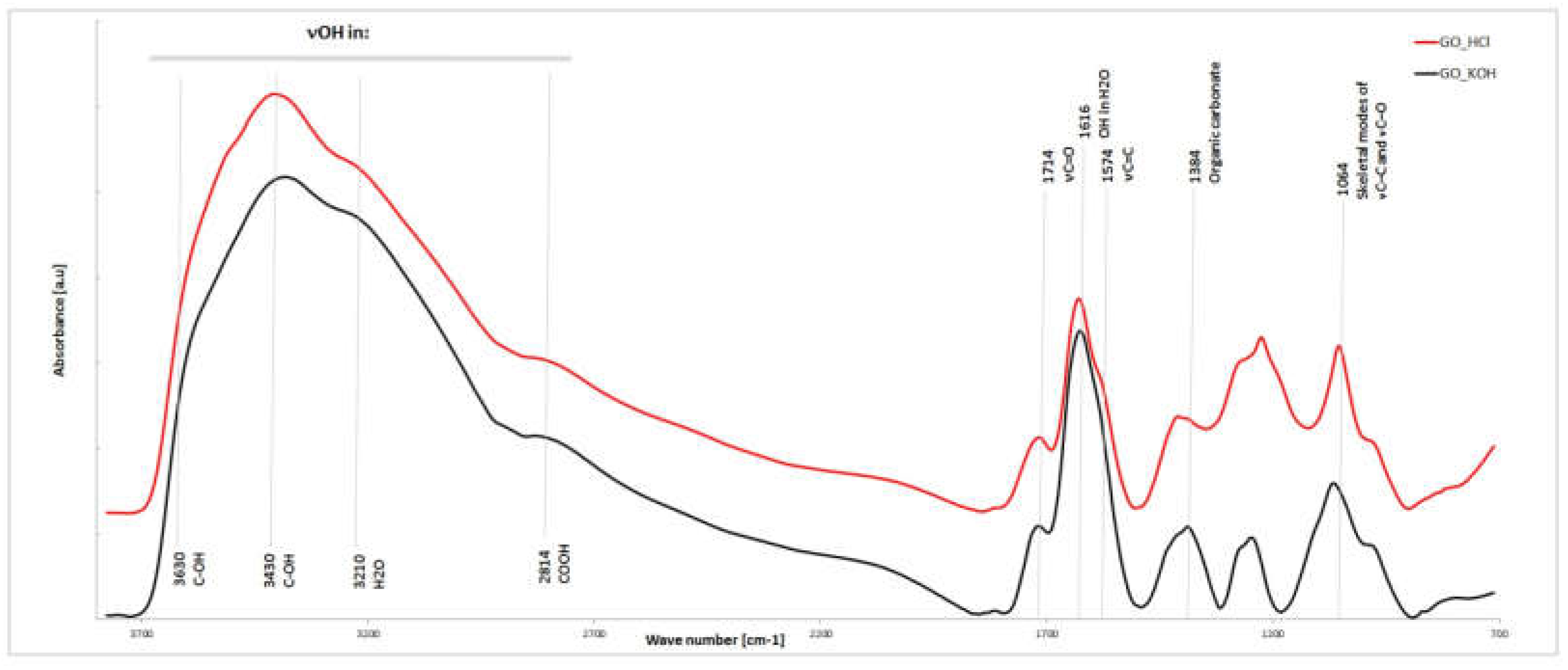
The FTIR spectra of both samples confirm the presence of oxygen-containing groups characteristic of graphene oxide. Bands assigned to carbonyl groups, bound water, C=C vibrations, hydroxyl groups and C–O bonds can be distinguished. These bands appear at approximately 1714, 1616, 1574, 1384 and 1064 cm−1, respectively [24].
For GO-KOH, a broad and intense band in the 3600–2800 cm−1 range is particularly visible and can be assigned to vibrations of –OH groups and water associated with the material. At the same time, other bands associated with oxygen-containing groups are less intense than in GO-HCl. In GO-HCl, the intensities of bands assigned to different oxygen-containing groups are more comparable, indicating a greater diversity of oxygen functionalities.
The FTIR results are consistent with EDS and XPS analyses. GO-KOH shows a lower overall oxygen content, but a relatively stronger signal in the region characteristic of hydroxyl groups.
Figure 6.
FTIR spectra of GO-HCl and GO-KOH samples.
3.6. Raman Spectroscopy
Raman spectra of graphene-based materials contain two characteristic bands: the D band, associated with structural disorder, defects and finite sp2 domain size, and the G band, corresponding to vibrations of sp2-hybridized carbon structures. The ID/IG ratio is often used as an indicator of disorder in the carbon structure; however, for GO it should be interpreted carefully because it also depends on sp2 domain size, oxidation degree and flake size.
For GO-HCl, the D-band maximum occurred at 1345 cm−1 and the G-band maximum at 1588 cm−1. For GO-KOH, the corresponding values were 1349 cm−1 and 1585 cm−1. The ID/IG ratio was 1.88 for GO-HCl and 1.62 for GO-KOH.
The lower ID/IG value for GO-KOH indicates a lower degree of disorder in the carbon structure or a greater contribution of more ordered sp2 domains compared with GO-HCl. This result is consistent with EDS, XPS, FTIR and DSC analyses, which indicate lower oxygen content and a different character of surface groups in the sample purified with KOH neutralization.
Figure 7.
Raman spectra of GO-HCl and GO-KOH samples.
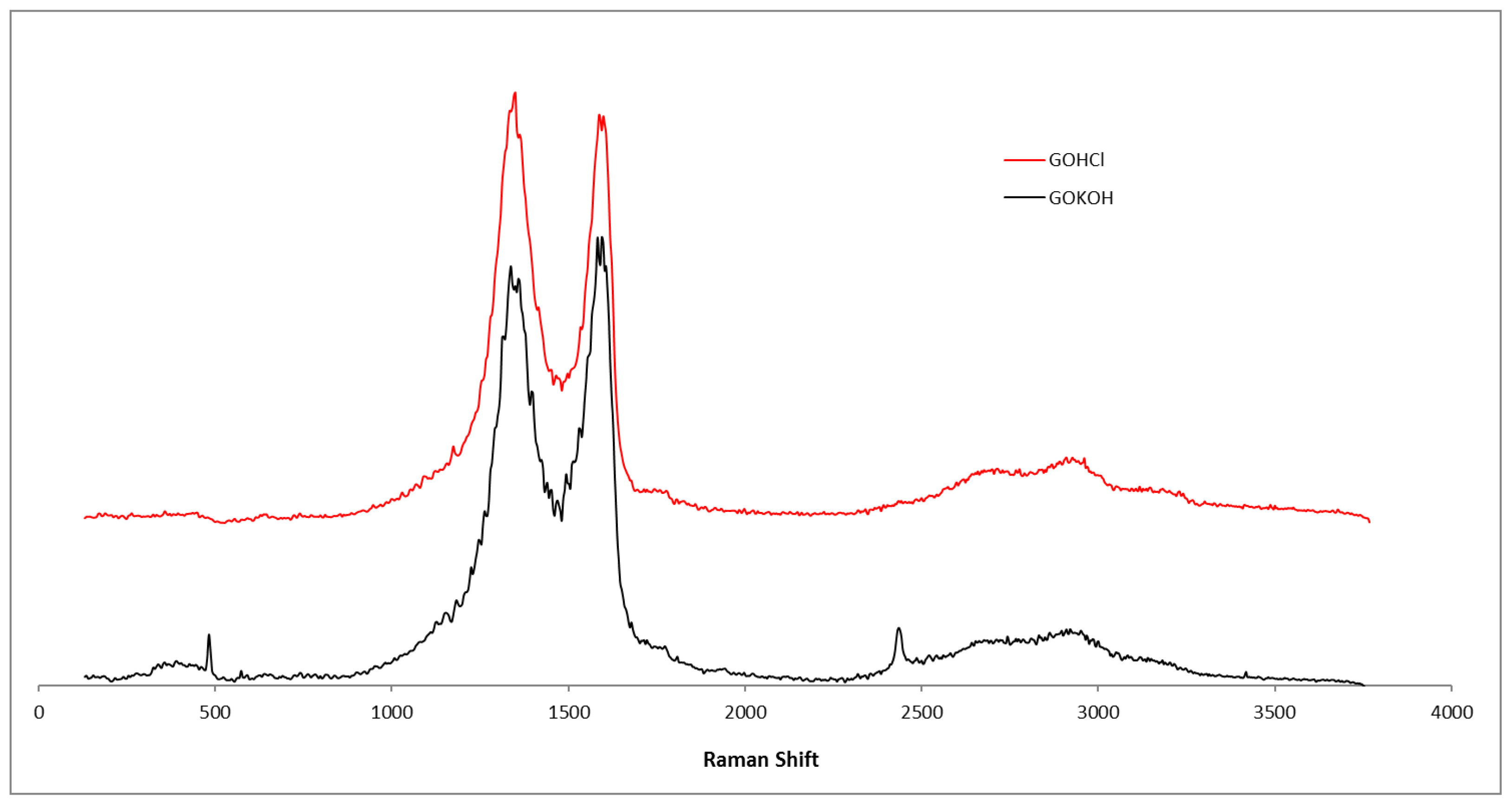
Table 3.
Raman spectrum parameters of the studied samples.
| Sample | D position [cm−1] | G position [cm−1] | D area | G area | ID/IG |
| GO-HCl | 1345 | 1588 | 205.63 | 109.65 | 1.88 |
| GO-KOH | 1349 | 1585 | 197.64 | 121.67 | 1.62 |
3.7. Thermal Properties
Graphene oxide is often used as a precursor for the preparation of reduced graphene oxide. Thermal reduction is one of the routes to rGO [19,22]. Therefore, the thermal properties of purified GO are important for assessing its technological usefulness.
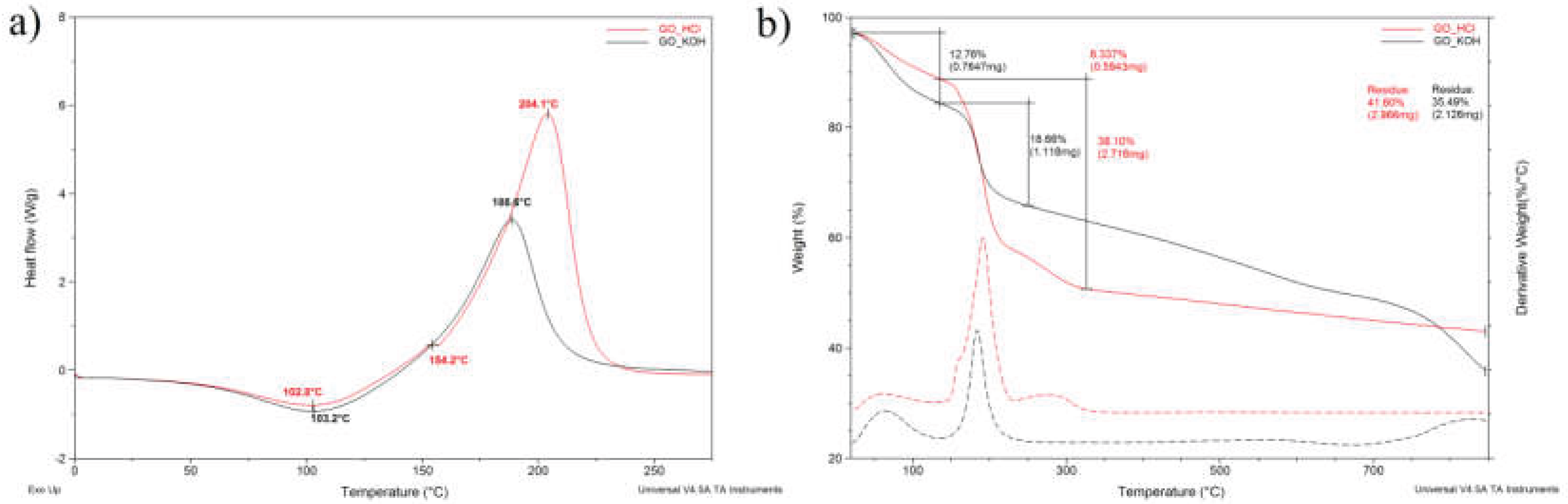
Two main thermal effects were observed in the DSC curves. The first, with a maximum near 100 °C, can be assigned to the removal of adsorbed or structurally bound water. The second thermal effect is associated with the removal of oxygen-containing groups and partial reduction of GO [13,16,18].
The most important difference between the samples was the magnitude of the heat effect related to the removal of oxygen-containing groups. For GO-HCl, the enthalpy of this effect was 1080 J g−1, whereas for GO-KOH it was 521 J g−1. Thus, the thermal effect for GO-KOH was almost two times smaller. Additionally, the maximum of this effect for GO-KOH was shifted by approximately 16 °C toward lower temperature.
The lower DSC enthalpy of GO-KOH can be attributed to its lower overall content of oxygen-containing groups, different distribution of functional groups and partial removal or transformation of sulfur-containing and highly oxidized fragments. The shift of the maximum toward lower temperature suggests that GO purified after KOH neutralization is more readily thermally reduced than GO purified conventionally in acidic medium.
The TGA curves also show differences between the samples. Up to approximately 100 °C, mass loss is associated with water removal. In the range of approximately 150–215 °C, decomposition of some oxygen-containing groups occurs. For GO-HCl, an additional mass loss in the range of approximately 215–320 °C can be associated with sulfur-containing groups or residues. For GO-KOH, a different mass-loss behavior is observed at high temperature, above 700 °C, which may reflect differences in residual structure or inorganic residues after purification.
Figure 8.
Thermal properties of GO samples: (a) DSC thermograms; (b) TGA/DTG curves of GO-HCl and GO-KOH.
Figure 8.
Thermal properties of GO samples: (a) DSC thermograms; (b) TGA/DTG curves of GO-HCl and GO-KOH.
4. Discussion in the Context of Recent Literature
The results clearly demonstrate that the purification route applied after the Hummers reaction has a significant effect on the structure, chemical composition, physical form and thermal properties of GO. Sequential pH change, consisting of neutralization of the post-reaction mixture with KOH followed by water washing and final HCl treatment, is an effective purification method. This route considerably shortens the technological process, reduces the number of washing operations and produces a material with favorable functional properties.
The most important effect of KOH application is the substantial reduction in the number of purification steps. GO-HCl required eighteen washing cycles, whereas GO-KOH required only five water-washing cycles and final washing with HCl. This represents a considerable simplification of the purification procedure, a reduction in the consumption of processing liquids and a shorter time required to obtain the final product. From the point of view of GO production technology, this is highly important because purification is one of the most troublesome operations in the Hummers synthesis.
EDS analysis confirms the effectiveness of the proposed method. GO-KOH contained less sulfur than GO-HCl, indicating more efficient removal of sulfate residues from the material. At the same time, the increase in the C/O ratio from 1.57 for GO-HCl to 2.01 for GO-KOH demonstrates that a material with a lower oxidation degree was obtained. This result agrees with XPS, FTIR, Raman and DSC analyses, showing that all characterization methods complement each other and lead to a coherent interpretation.
XPS analysis showed that GO-KOH contains a lower contribution of oxygen-containing functionalities associated with the carbon surface than GO-HCl. This confirms that purification in an alkaline environment affects not only the removal of post-reaction impurities, but also the chemical nature of the GO surface. The observed changes should be related to pH variation, transformation of oxygen- and sulfur-containing groups and limitation of prolonged exposure of GO to acidic medium. As a result, a material with a more favorable chemical composition and better suitability for further processing is obtained.
Raman spectroscopy further confirms the beneficial effect of KOH-assisted purification. The lower ID/IG ratio of GO-KOH indicates a more favorable state of the carbon structure compared with GO-HCl. This means that the purification method limits undesirable structural changes that may occur during prolonged exposure of GO to acidic medium. Together with XPS and EDS results, this confirms that GO-KOH has a more controlled chemical structure.
Thermal analysis provides additional important information. GO-KOH shows a significantly lower enthalpy of the thermal effect associated with the removal of oxygen-containing groups than GO-HCl. Moreover, the maximum of this effect is shifted toward lower temperature. This means that GO-KOH is more readily thermally reduced and can be a favorable precursor for the preparation of reduced graphene oxide. This is an important technological advantage because it allows the reduction process to be conducted with lower energy input.
The samples also differ in physical form. GO-HCl forms a stable dispersion and a continuous film, whereas GO-KOH sediments faster and becomes powdery after drying. Such a form is particularly favorable for further processing, dosing, mixing with other components and separation from aqueous systems. These properties are important in practice because graphene materials intended for technological applications should not only be well characterized but also easy to handle and separate.
GO-KOH can also be considered an attractive material for adsorption applications. Its powder form, rapid sedimentation, presence of carbon domains and retained amount of oxygen-containing groups provide a favorable combination of features required for graphene-based adsorbents. Such a material can interact with pollutants through π–π interactions, hydrogen bonding, electrostatic interactions and surface interactions characteristic of graphene materials [2,25]. It is especially attractive for removing organic compounds, dyes and other pollutants from aqueous solutions.
An additional advantage of GO-KOH as a potential adsorbent is easier separation after water treatment. In practical adsorption systems, binding capacity alone is not sufficient; rapid separation of the adsorbent from the purified liquid is equally important. In this context, the lower colloidal stability and faster sedimentation of GO-KOH represent a significant technological advantage. The material therefore combines characteristic features of graphene oxide with a practical physical form that facilitates its use.
The obtained results are consistent with current literature emphasizing the importance of purification route, pH, oxygen- and sulfur-containing groups and colloidal stability of GO. This work complements those reports by showing that a properly designed purification procedure can simultaneously shorten the technological process, reduce sulfur residues, modify surface properties and improve the suitability of GO for further processing. Importantly, the changes observed in elemental composition, XPS and FTIR spectra, ID/IG ratio, DSC/TGA results and morphology form a coherent picture of the effect of KOH on GO purification and properties.
In summary, the use of KOH in GO purification is an effective and technologically advantageous modification of the post-reaction stage. It enables the preparation of a material with lower sulfur content, a more favorable C/O ratio, easier thermal reducibility and a powder form suitable for further use. GO-KOH is a valuable intermediate for rGO preparation and may also be developed as an adsorbent material for environmental and technological applications.
5. Conclusions
The purification route applied to graphene oxide obtained by a modified Hummers method significantly influences its chemical composition, physical form, structural ordering and thermal properties. Conventional purification in acidic HCl medium produces a stable GO dispersion and enables formation of a continuous film, but it requires many washing steps. Under the studied conditions, GO-HCl required 18 washing cycles, whereas neutralization of the post-reaction mixture with KOH reduced the process to 5 water-washing cycles followed by final HCl washing to remove Mn2+ and K+ ions.
GO-KOH showed a higher C/O ratio, lower sulfur content determined by EDS, lower ID/IG ratio and lower DSC enthalpy associated with the removal of oxygen-containing groups. These results indicate that KOH-assisted purification produces a material with a lower oxidation degree, a more favorable carbon structure and easier thermal reducibility compared with GO-HCl. The observed changes result from the influence of pH on oxygen- and sulfur-containing groups, surface charge and colloidal stability.
The main practical conclusion is that sequential pH change is a simple and effective tool for controlling GO properties already at the post-reaction purification stage. The KOH-assisted route is particularly advantageous for preparing GO intended for further thermal reduction, powder-based processing and potential adsorption applications. Purification history should therefore be treated as a key parameter determining the quality, reproducibility and functional properties of graphene oxide.
Author Contributions
Conceptualization, R.F.; methodology, R.F. and T.K.; investigation, R.F. and T.K.; formal analysis, R.F. and T.K.; writing—original draft preparation, R.F.; writing—review and editing, R.F. and T.K.; visualization, R.F. and T.K.; supervision, R.F.; project administration, R.F. All authors have read and agreed to the published version of the manuscript.
Funding
This research received no external funding.
Institutional Review Board Statement
Not applicable.
Informed Consent Statement
Not applicable.
Data Availability Statement
The data presented in this study are contained within the article. Additional raw data are available from the corresponding author upon reasonable request.
Acknowledgments
The authors acknowledge the technical support associated with the physicochemical characterization of the graphene oxide samples.
Conflicts of Interest
The authors declare no conflict of interest.
Abbreviations
GO, graphene oxide; rGO, reduced graphene oxide; XRD, X-ray diffraction; WAXS, wide-angle X-ray scattering; SEM, scanning electron microscopy; EDS, energy-dispersive X-ray spectroscopy; XPS, X-ray photoelectron spectroscopy; FTIR, Fourier-transform infrared spectroscopy; DSC, differential scanning calorimetry; TGA, thermogravimetric analysis; DTG, derivative thermogravimetry.
References
- Novoselov, K.S.; Geim, A.K.; Morozov, S.V.; Jiang, D.; Zhang, Y.; Dubonos, S.V.; Grigorieva, I.V.; Firsov, A.A. Electric field effect in atomically thin carbon films. Science 2004, 306, 666–669. [Google Scholar] [CrossRef] [PubMed]
- Zhu, Y.; Murali, S.; Cai, W.; Li, X.; Suk, J.W.; Potts, J.R.; Ruoff, R.S. Graphene and graphene oxide: synthesis, properties, and applications. Adv. Mater. 2010, 22, 3906–3924. [Google Scholar] [CrossRef] [PubMed]
- Wang, Y.; Li, Z.; Wang, J.; Li, J.; Lin, Y. Graphene and graphene oxide: biofunctionalization and applications in biotechnology. Trends Biotechnol. 2011, 29, 205–212. [Google Scholar] [CrossRef] [PubMed]
- Brodie, B.C. Sur le poids atomique du graphite. Ann. Chim. Phys. 1860, 59, 466–472. [Google Scholar]
- Staudenmaier, L. Verfahren zur Darstellung der Graphitsäure. Ber. Dtsch. Chem. Ges. 1899, 32, 1394–1399. [Google Scholar] [CrossRef]
- Hummers, W.S.; Offeman, R.E. Preparation of graphitic oxide. J. Am. Chem. Soc. 1958, 80, 1339. [Google Scholar] [CrossRef]
- Marcano, D.C.; Kosynkin, D.V.; Berlin, J.M.; Sinitskii, A.; Sun, Z.; Slesarev, A.; Alemany, L.B.; Lu, W.; Tour, J.M. Improved synthesis of graphene oxide. ACS Nano 2010, 4, 4806–4814. [Google Scholar] [CrossRef] [PubMed]
- Kovtyukhova, N.I.; Ollivier, P.J.; Martin, B.R.; Mallouk, T.E.; Chizhik, S.A.; Buzaneva, E.V.; Gorchinskiy, A.D. Layer-by-layer assembly of ultrathin composite films from micron-sized graphite oxide sheets and polycations. Chem. Mater. 1999, 11, 771–778. [Google Scholar] [CrossRef]
- Chen, J.; Yao, B.; Li, C.; Shi, G. An improved Hummers method for eco-friendly synthesis of graphene oxide. Carbon 2013, 64, 225–229. [Google Scholar] [CrossRef]
- Tölle, F.J.; Gamp, K.; Mülhaupt, R. Scale-up and purification of graphite oxide as intermediate for functionalized graphene. Carbon 2014, 75, 432–442. [Google Scholar] [CrossRef]
- Emiru, T.F.; Ayele, D.W. Controlled synthesis, characterization and reduction of graphene oxide: a convenient method for large scale production. Egypt. J. Basic Appl. Sci. 2017, 4, 74–79. [Google Scholar] [CrossRef]
- Chen, J.; Li, Y.; Huang, L.; Li, C.; Shi, G. High-yield preparation of graphene oxide from small graphite flakes via an improved Hummers method with a simple purification process. Carbon 2015, 81, 826–834. [Google Scholar] [CrossRef]
- Shen, Y.; Boffa, V.; Corazzari, I.; Qiao, A.; Tao, H.; Yue, Y. Revealing hidden endotherm of Hummers’ graphene oxide during low-temperature thermal reduction. Carbon 2018, 138, 337–347. [Google Scholar] [CrossRef]
- Dimiev, A.M.; Alemany, L.B.; Tour, J.M. Graphene oxide. Origin of acidity, its instability in water, and a new dynamic structural model. ACS Nano 2013, 7, 576–588. [Google Scholar] [CrossRef] [PubMed]
- Rabiej, M. Application of the particle swarm optimization method for the analysis of wide-angle X-ray diffraction curves of semicrystalline polymers. J. Appl. Crystallogr. 2017, 50, 221–230. [Google Scholar] [CrossRef]
- Talyzin, A.V.; Mercier, G.; Klechikov, A.; Hedenström, M.; Johnels, D.; Wei, D.; Cotton, D.; Opitz, A.; Moons, E. Brodie vs Hummers graphite oxides for preparation of multi-layered materials. Carbon 2017, 115, 430–440. [Google Scholar] [CrossRef]
- Dimiev, A.; Kosynkin, D.V.; Alemany, L.B.; Chaguine, P.; Tour, J.M. Pristine graphite oxide. J. Am. Chem. Soc. 2012, 134, 2815–2822. [Google Scholar] [CrossRef] [PubMed]
- Qiu, Y.; Guo, F.; Hurt, R.; Külaots, I. Explosive thermal reduction of graphene oxide-based materials: mechanism and safety implications. Carbon 2014, 72, 215–223. [Google Scholar] [CrossRef] [PubMed]
- McAllister, M.J.; Li, J.; Adamson, D.H.; Schniepp, H.C.; Abdala, A.A.; Liu, J.; Herrera-Alonso, M.; Milius, D.L.; Car, R.; Prud’homme, R.K.; Aksay, I.A. Single sheet functionalized graphene by oxidation and thermal expansion of graphite. Chem. Mater. 2007, 19, 4396–4404. [Google Scholar] [CrossRef]
- Zhao, Y.C.; Huang, L.J.; Wang, Y.X.; Tang, J.G.; Wang, Y.; Liu, J.X.; Belfiore, L.A.; Kipper, M.J. Synthesis of graphene oxide/rare-earth complex hybrid luminescent materials via π–π stacking and their pH-dependent luminescence. J. Alloys Compd. 2016, 687, 95–103. [Google Scholar] [CrossRef]
- Eigler, S.; Dotzer, C.; Hof, F.; Bauer, W.; Hirsch, A. Sulfur species in graphene oxide. Chem. Eur. J. 2013, 19, 9490–9496. [Google Scholar] [CrossRef] [PubMed]
- Stankovich, S.; Dikin, D.A.; Piner, R.D.; Kohlhaas, K.A.; Kleinhammes, A.; Jia, Y.; Wu, Y.; Nguyen, S.B.T.; Ruoff, R.S. Synthesis of graphene-based nanosheets via chemical reduction of exfoliated graphite oxide. Carbon 2007, 45, 1558–1565. [Google Scholar] [CrossRef]
- Cui, Z.; Mei, T.; Yao, J.; Hou, B.; Zhu, X.; Liu, X.; Wang, X. Cabbage-like nitrogen-doped graphene/sulfur composite for lithium-sulfur batteries with enhanced rate performance. J. Alloys Compd. 2018, 753, 622–629. [Google Scholar] [CrossRef]
- Szabó, T.; Berkesi, O.; Dékány, I. DRIFT study of deuterium-exchanged graphite oxide. Carbon 2005, 43, 3186–3189. [Google Scholar] [CrossRef]
- Cheng, Z.L.; Li, Y.X.; Liu, Z. Novel adsorption materials based on graphene oxide/Beta zeolite composite materials and their adsorption performance for rhodamine B. J. Alloys Compd. 2017, 708, 255–263. [Google Scholar] [CrossRef]
- Nishina, Y. Mass production of graphene oxide beyond the laboratory: bridging the gap between academic research and industry. ACS Nano 2024, 18, 33264–33275. [Google Scholar] [CrossRef] [PubMed]
- Donato, K.Z.; Tan, C.; Gomes, G.; Smith, T.; Castro Neto, A.H. Graphene oxide classification and standardization. Sci. Rep. 2023, 13, 6064. [Google Scholar] [CrossRef] [PubMed]
- Dias, M.S.; dos Santos, M.A.; Angelo, E.; de Carvalho Castro Silva, C.; Maroneze, C.M. Automated device for the purification of graphene oxide dispersions: integration of cross-flow filtration and dialysis. npj 2D Mater. Appl. 2025, 9, 82. [Google Scholar] [CrossRef]
- Mikheev, I.V.; Romanchuk, A.Y.; Rybin, M.V.; Ivanov, V.K. High-throughput preparation of uncontaminated graphene-oxide aqueous dispersions with antioxidant properties by semi-automated diffusion dialysis. Nanomaterials 2022, 12, 4159. [Google Scholar] [CrossRef] [PubMed]
- Moazzami Gudarzi, M.; Sanjari Shahrezaei, M.A.; Hosseini, M.; Aboutalebi, S.H. Redefining graphene oxide: the role of organosulfate groups in charging dynamics and colloidal stability. Small Struct. 2025, 6, 2500035. [Google Scholar] [CrossRef]
- de Lima, A.H.; Scarpa, I.; Azevedo, N.C.L.; Lelis, G.C.; Strauss, M.; Martinez, D.S.T.; de Oliveira, R.F. Oxidative debris in graphene oxide: a decade of research. J. Mater. Chem. C 2023, 11, 12429–12452. [Google Scholar] [CrossRef]
- Halbig, C.E.; Mukherjee, B.; Eigler, S.; Garaj, S. Origin of oxygen in graphene oxide revealed by 17O and 18O isotopic labeling. J. Am. Chem. Soc. 2024, 146, 7431–7438. [Google Scholar] [CrossRef] [PubMed]
- Otsuka, H.; Urita, K.; Honma, N.; Kimuro, T.; Amako, Y.; Kukobat, R.; Bandosz, T.J.; Ukai, J.; Moriguchi, I.; Kaneko, K. Transient chemical and structural changes in graphene oxide during ripening. Nat. Commun. 2024, 15, 1708. [Google Scholar] [CrossRef] [PubMed]
- Burresi, E.; Protopapa, M.L. Optical investigation of degradation of graphene oxide in alkaline environment: evidence of two distinct photon-emitting phases in visible region. Carbon Trends 2024, 17, 100412. [Google Scholar] [CrossRef]
- Protopapa, M.L.; Burresi, E.; Palmisano, M.; Pesce, E. Fluorescent moieties through alkaline treatment of graphene oxide: a potential substitute to replace CRM in wLEDs. ChemEngineering 2025, 9, 73. [Google Scholar] [CrossRef]
- Li, W.; Tang, H.; Zhang, D.; Huang, T.; Xing, B. Identifying the stripping of oxide debris from graphene oxide: evidence from experimental analysis and molecular simulation. Environ. Sci. Technol. 2024, 58, 5963–5973. [Google Scholar] [CrossRef]
Figure 1.
XRD/WAXS diffractograms of graphene oxide samples purified by different methods: GO-HCl, purification in HCl medium; GO-KOH, purification involving KOH neutralization.
Figure 1.
XRD/WAXS diffractograms of graphene oxide samples purified by different methods: GO-HCl, purification in HCl medium; GO-KOH, purification involving KOH neutralization.
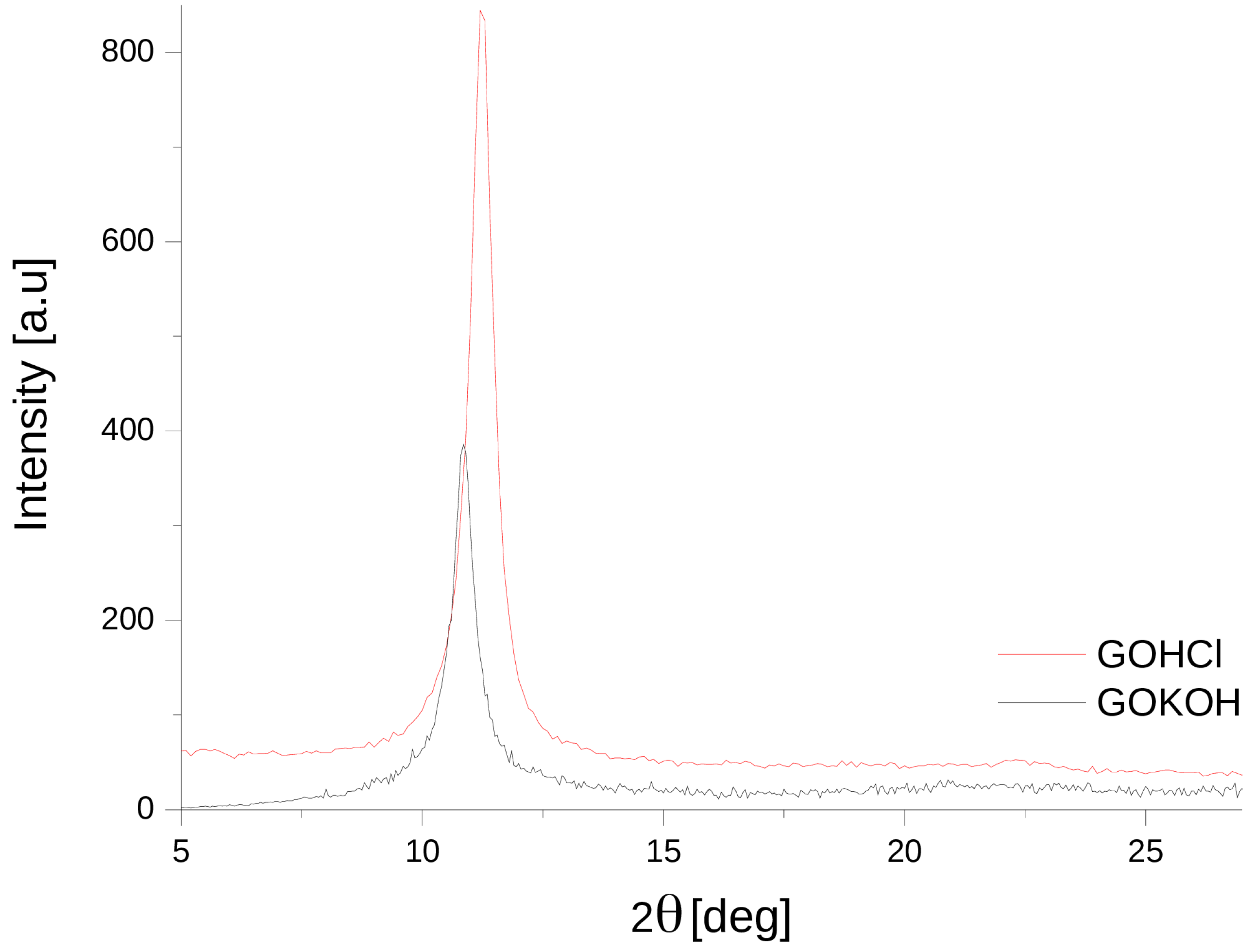
Figure 3.
Changes in sulfur impurity content in GO samples as a function of the number of washing cycles.
Figure 3.
Changes in sulfur impurity content in GO samples as a function of the number of washing cycles.
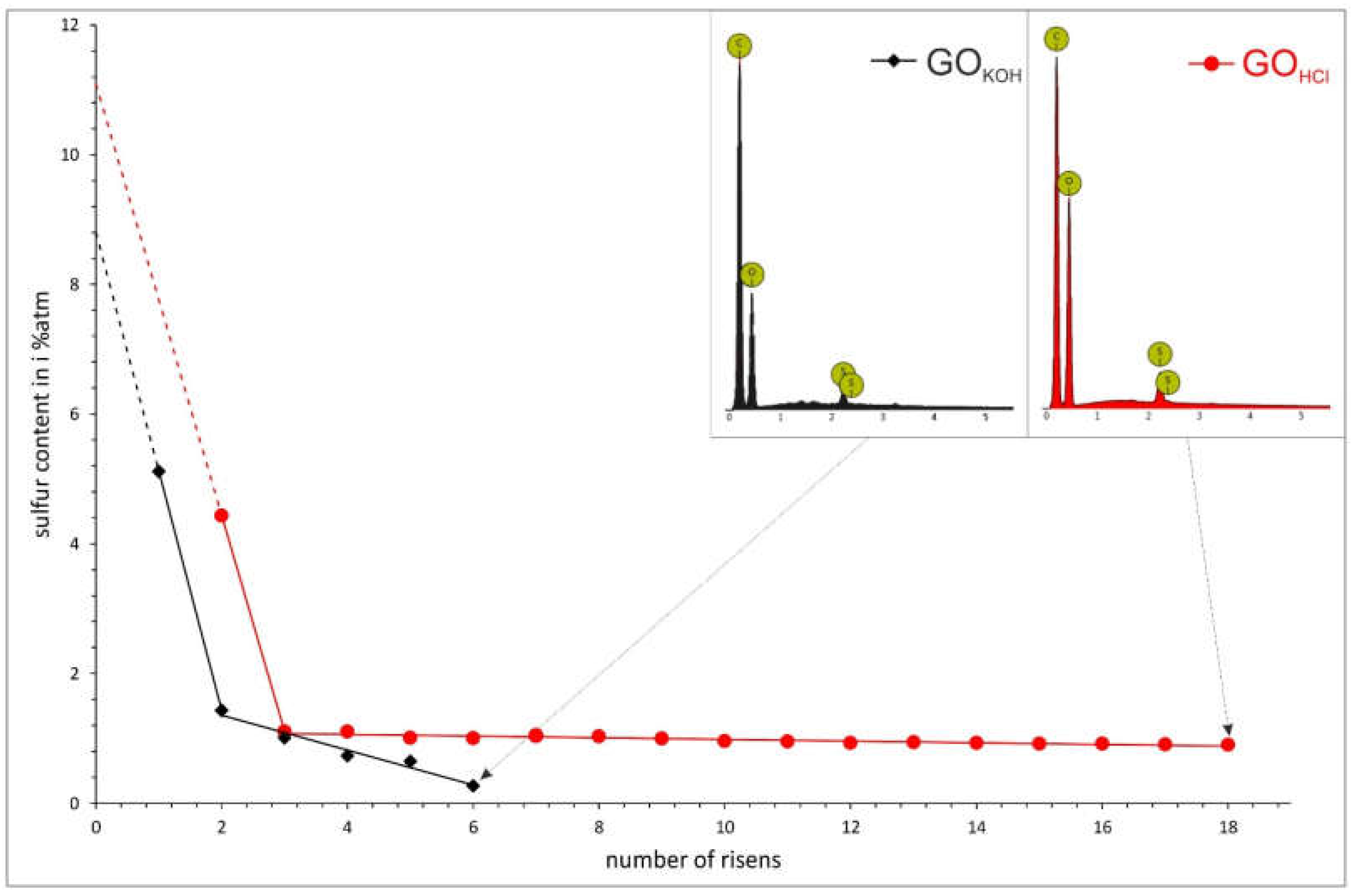
Table 1.
WAXS/XRD and EDS analysis of GO-HCl and GO-KOH samples.
| Sample | 2θ [°] | Number of layers | C [at.%] | O [at.%] | S [at.%] | Mn [at.%] | K [at.%] | C/O |
| GO-HCl | 11.24 | 23 | 60.78 | 38.61 | 0.55 | 0.05 | n.d. | 1.57 |
| GO-KOH | 10.90 | 22 | 66.57 | 33.10 | 0.27 | n.d. | 0.06 | 2.01 |
n.d., not detected.
Disclaimer/Publisher’s Note: The statements, opinions and data contained in all publications are solely those of the individual author(s) and contributor(s) and not of MDPI and/or the editor(s). MDPI and/or the editor(s) disclaim responsibility for any injury to people or property resulting from any ideas, methods, instructions or products referred to in the content. |
© 2026 by the authors. Licensee MDPI, Basel, Switzerland. This article is an open access article distributed under the terms and conditions of the Creative Commons Attribution (CC BY) license (http://creativecommons.org/licenses/by/4.0/).
Copyright: This open access article is published under a Creative Commons CC BY 4.0 license, which permit the free download, distribution, and reuse, provided that the author and preprint are cited in any reuse.


