
Submitted:
23 June 2026
Posted:
23 June 2026
You are already at the latest version
Abstract
River avulsion, the sudden relocation of a river channel to a new course from the parent channel, is a geomorphic process with direct implications for floodplain evolution, ecosystem dynamics, and infrastructure vulnerability. This review article discusses how sandbar migration acts as a precursor to avulsion by altering hydraulic geometry, redirecting flow paths, modifying sediment transport patterns, and affecting the development of incipient channels. The morphodynamical evolution of sandbars, influenced by sediment supply, flow regime, vegetation, and anthropogenic influences such as dams and sand mining, plays a central role in creating avulsion. Different methods, such as field measurements, remote sensing imagery (including multispectral, SAR, LiDAR and UAV), physics-based numerical models, machine learning, and deep learning techniques, which are used to evaluate river sandbar and river avulsion, are also thoroughly evaluated for efficacy and fit for purpose.
Keywords:
river avulsion
; sandbar migration
; sediment transport
; remote sensing
; machine learning
; deep learning
; predictive modelling
1. Introduction
River avulsion represents one of the most important and abrupt geomorphological processes in fluvial systems, defined as the sudden abandonment of an existing channel in favour of a new course across the floodplain [1]. This phenomenon differs from gradual channel migration by meander development, instead involving rapid channel switching that can occur over timescales ranging from individual flood events to several decades [2]. The avulsion process initiates when flow becomes diverted from the main channel [3], the channel bed superelevation in relation to the floodplain [4], or flow paths created by antecedent topography [5,6] identified three primary types of avulsion mechanisms: (1) local avulsion triggered by specific channel obstructions or flow diversions, (2) regional avulsion resulting from widespread aggradation and channel superelevation, and (3) progradation avulsion associated with delta front advancement. Each mechanism functions through unique physical processes but shares common elements related to flow diversion and the establishment of alternative flow pathways.
Avulsion events significantly impact the evolution of river systems, the environment, ecosystem dynamics, and human life. Avulsions control the long-term planform evolution of river systems, determining floodplain architecture and sediment distribution patterns [7]. Ecologically, avulsions promote habitat heterogeneity and maintain floodplain connectivity essential for riparian ecosystem function [8]. However, avulsions also pose significant hazards to human infrastructure, agriculture, and settlements, particularly in highly populated river deltas and alluvial plains [9].
Sandbars represent morphological units in alluvial rivers, formed through complex interactions between flow hydraulics, sediment transport, and channel boundary conditions. Sandbar bedforms range from small-scale ripples and dunes to large-scale alternate bars and mid-Channel Islands, each responding to different flow and sediment conditions [10]. The morphodynamics of sandbars involve their formation, growth, migration, and eventual destruction through cycles of erosion and deposition (Table 1) driven by varying flow conditions [10].
The importance of sandbar morphodynamics in river avulsion events lies in their role as agents of flow modification and channel geometry change [11]. Migrating sandbars can gradually alter channel cross-sectional areas, create flow obstructions, and redirect flow toward channel margins and floodplain surfaces [12]. These processes contribute to the development of conditions conducive to avulsion through multiple pathways, including local flow acceleration, preferential scour patterns, and the creation of incipient channels across floodplain surfaces [13]. High-resolution monitoring using remote sensing technologies has shown how sandbar migration patterns correlate with subsequent avulsion locations, providing insights into the predictive potential of morphodynamic indicators [14]. Furthermore, the interaction between sandbar dynamics and vegetation colonisation creates feedback mechanisms that influence both bar stabilisation and avulsion preparation processes [15].
The economic and societal importance of understanding sandbar-avulsion interactions has increased with rising populations in flood-prone areas and climate change impacts on river systems. Improved prediction of avulsion timing and location requires a comprehensive understanding of the morphodynamic processes by which sandbars prepare channel conditions for sudden course changes. This understanding forms the foundation for effective river management strategies and hazard mitigation.
Substantial progress has been made over the past two decades to study individual components of sandbar-avulsion systems. Studies on components of sandbar morpho dynamics and river avulsion have produced conceptual frameworks. The integration of remote sensing technologies, encompassing both optical and Synthetic Aperture Radar (SAR), along with Unmanned Aerial Vehicle (UAV)-based photogrammetry and machine learning techniques, provides a robust framework for conducting spatial and temporal analyses. Despite these advancements, a critical knowledge gap is there that addresses the linkage between sandbar dynamics with river avulsion processes into one framework. Furthermore, no existing review has systematically compared the full spectrum of monitoring methods from field based to physics-based models and machine learning-deep learning approaches. Also, same for types of remote sensing methods, from the earliest Landsat studies to the inclusion of SAR- and LiDAR-related studies.
The goal of this comprehensive review is to present a current understanding of the relation between sandbar dynamics and river avulsion events, and importantly, the methods available for the above study. The study is divided into two main parts. The first part focuses on the basic mechanisms controlling sandbar formation, evolution, migration and eventual transformation. The study explores geomorphic, hydraulic, and sedimentary behaviour, including the roles of flood impact, sediment supply, channel geometry, vegetation colonisation and anthropogenic influences such as dam construction and sand mining. The section further explains how sandbar change flow paths, channel cross sections, and conditions that allow for abrupt channel displacement. The second part of the paper systematically reviews the methodologies used to study sandbar dynamics and avulsion processes. These include field-based techniques (such as bathymetric surveys and sediment sampling), remote sensing and GIS tools (including satellite imagery, UAV-based photogrammetry, and SAR data), physics-based numerical models, and advanced machine learning and AI approaches.
Specific objectives of the review are to address the following key questions:
- What processes govern sandbar formation, migration in rivers?
- How do flood regime characteristics (magnitude, duration, frequency) influence bar growth and movement?
- Which sediment supply factors (volume, grain size, episodic pulses) most strongly affect bar dynamics?
- What roles do vegetation and human interventions play in migrating bars?
- What are the methods of numerical, empirical, remote sensing and Artificial Intelligence (AI) and Machine Learning (ML) models for predicting bar migration and avulsion risk?
2. Material and Methods
This review follows a systematic approach to literature identification and screening. It adheres to the Preferred Reporting Items for Systematic Reviews and Meta-Analysis (PRISMA 2020) framework. The complete workflow illustrated in Figure 1. The primary bibliographic database used was Scopus. Searches were conducted in the TITLE-ABS-KEY field with a publication date ceiling of 2024, as the review was conducted during January 2025. No lower temporal boundary caped as foundational theoretical and experimental work on bar instability and avulsion occurred before 2000s. No language restriction was imposed but screened only English literatures for the review. The review is organized in two different parts as first part concerns mechanism of bar formation and their factors, and the second part is about different methodologies. A broad string search that targets all the studies that happen to mention all but address neither works comprehensively. Also, specific string search creates missing integrative studies. Hence, this search (“sandbar dynamics” OR “sandbar migration” OR “avulsion” OR “channel shift”) AND (river OR fluvial) was used for collecting primary research articles to start the review process. The studies indexed in Web of Science or GeoRef are not included, which is a limitation of the work. But these limitations are partially addressed through forward citation tracking and grey literature through the Google Scholar database and specific journal databases from certain anchor papers. Grey literature that includes theses, book chapters, and conference proceedings was included selectively rather than systematically. The grey literature sources were included only where they provided methodological specificity or empirical data that are not available from indexed sources. A total of 1567 records were collected from the database searches. After removing 90 duplicate records, 1477 records selected for first screening stage. Then there is an exclusion of 1044 articles after title screening. The primary exclusion criteria were archeological or palaeo-morphological reconstructions of ancient channel systems, geophysical prospecting studies, stratigraphic studies, wetland, aquifer or groundwater modelling that are not related to fluvial components. After detail screening through abstract and full text screening 92 records finalized for initial review. After total completion of database more than 30% of the records are from 5-year time period from 2020-2025 and also more than 80% records from 2010-2025 period. All retrieved references were imported into Zotero (version 7; Corporation for Digital Scholarship) for deduplication management, metadata verification, and citation organisation throughout the review process.
3. Sandbar Morpho Dynamics
Sandbars and islands occur in predictable locations on river systems. As depositional features, they are found at locations that reach wide or highly localised areas, where bed material is continuously in motion (providing a potential supply), bed material sediment load exceeds transport capacity (providing material that will deposit) [15], and locations where a sudden increase in sediment supply or sudden decrease in transport capacity or both, creates the conditions for deposition (resulting in bar formation) [16]. Alternatively, sandbars are typically absent from areas with consistently high sediment transport capacity, or with low sediment supply, regardless of transport capacity (i.e., without adequate sediment loads in transport, bars will not be able to form).
3.1. Formation and Classification of Sandbars
The fundamental mechanism in the formation of sandbars involves flow separation and secondary circulation patterns that redistribute sediment within the channel cross-section, leading to deposition in zones of reduced flow velocity and shear stress [17]. These mechanisms function across multiple spatial scales, ranging from small-scale bedforms responding to local flow variations to large-scale morphological units that represent channel-scale hydraulic patterns [17]. Sandbars are classified as morphological and genetic characteristics that reflect their formation mechanisms and relationship to channel flow patterns. Alternate bars (Figure 2b) are the most common bar types in straight and slightly meandering channels, forming through lateral flow variations that create alternating zones of erosion and deposition along opposite banks [18]. These bars migrate downstream while maintaining their alternating pattern, with migration rates controlled by flow conditions and sediment supply. Point bars (Figure 2a) develop in meandering channels through preferential deposition on the inner bank of bends, driven by secondary circulation patterns that transport sediment from the outer bank toward the inner bank [19]. Mid-channel bars (Figure 2c) form wider channels where flow capacity exceeds sediment transport, creating conditions favourable for bar development in central channel positions. These bars often evolve into more complex compound bars through processes of bar dissection, tributary formation, and vegetation colonisation [20]. The distinction between braided bar (Figure 2d), free bars (Figure 2e), which migrate continuously downstream, and forced bars (Figure 2f), which remains stationary relative to channel features, reflects different balance conditions between formative flows and bar resistance to erosion [18].
Recent advances in high-resolution topographic mapping have shown greater complexity in bar morphology than previously known, including hybrid forms that combine characteristics of different bar types and transitional morphologies that evolve between different classification categories [21]. Three-dimensional bar structures show variation in long-stream and cross-stream dimensions, with implications for flow modification and sediment transport patterns that influence avulsion preparation processes [22]. The temporal evolution of sandbars involves cycles of formation, growth, migration, and destruction that respond to variations in flow and sediment conditions [10]. During low flows, bars may become exposed and experience subaerial change through wind transport and vegetation colonisation [23]. High flows typically cause bar migration and morphological change, with the magnitude and duration of the morphological response depending on the relationship between flow magnitude and critical thresholds for sediment mobilisation [23,24]. Bar formation process shows strong dependence on channel width-to-depth ratios, with narrow channels favouring alternate bar development [25,26] and wider channels supporting mid-channel bar formation [25]. The critical width-to-depth ratio for bar formation varies with flow conditions, sediment characteristics, and bank stability, but generally falls within the range of 10-40m for most natural rivers [27]. This geometric control links bar formation to broader channel evolution processes and helps explain why certain channel configurations are more susceptible to avulsion than others. Different types of sand bars and their formation mechanism, migration behaviour and stability are presented in Table 2.
3.2. Migration Processes: Lateral and Longitudinal Movement
Sandbar migration involves complex three-dimensional movement patterns that combine downstream translation, lateral shifting, and vertical growth or degradation in response to varying flow and sediment conditions. Longitudinal migration typically dominates during moderate to high flows when bedload transport rates exceed local deposition rates, causing bars to translate downstream while maintaining their basic morphological characteristics [28]. The rate of downstream migration depends on several factors, including flow magnitude [29], sediment grain size [30], bar geometry [31], and channel boundary conditions [29], with typical migration rates ranging from centimeters to meters per day during active transport conditions. While these factors collectively influence downstream migration rates, it is important to note that extreme events, such as floods, can disrupt these dynamics, leading to unpredictable sediment transport outcomes [32]. Alternate bars commonly exhibit lateral migration as they adjust to changing flow patterns, with the loci of maximum bar elevation shifting toward one bank or the other in response to flow asymmetries [33,34]. This lateral movement can significantly alter channel geometry and flow distribution, creating conditions that promote flow diversion toward channel margins and floodplain surfaces [34].
The relationship between longitudinal and lateral migration creates complex bar trajectory patterns that influence their role in avulsion preparation. Large-scale lateral migration, also known as sweeping (e.g., [35], suggests that the flow path varies gradually but at varying rates that are dependent on a number of factors, primarily the channel curvature and the river energy in relation to the bank erodibility [36]. The longitudinal migration could negatively affect flow condition and sediment distribution in the river [37]. Channels often exhibit continuous lateral migration rather than abrupt shifts [38]. Bars following predominantly downstream paths tend to cause temporary flow modifications that may trigger local scour [39] without necessarily leading to avulsion. Conversely, bars with significant lateral components can create persistent flow deflections that progressively modify channel geometry and increase avulsion potential [40]. Three-dimensional aspects of bar migration include vertical growth and degradation that affect bar relief and influence flow modification intensity. Bars that grow vertically during migration create stronger flow obstructions and more significant flow deflections, increasing their potential contribution to avulsion preparation. As bars grow vertically, they create more substantial resistance to flow, leading to increased turbulence and sediment deposition around them [41]. The migration of bars affects hydraulic conductivity in riverbeds, with low-velocity zones forming downstream, further influencing sediment dynamics [30]. Migrating bars can alter flow patterns, creating contraction and expansion zones that influence sediment transport and the formation of new bars [12]. Conversely, bars that degrade during migration may have reduced influence on flow patterns, but can contribute to overall channel aggradation that promotes avulsion through superelevation mechanisms [42].
3.3. Sediment Supply, Flow Regime, and Hydraulic Controls
The relationship between sediment supply and flow regime represents a fundamental control on sandbar morphodynamics, determining both the potential for bar formation and the characteristics of bar migration patterns. Sediment supply variations influence bar development through their effect on channel bed elevation, transport capacity utilisation, and the balance between erosion and deposition processes within the channel system [43]. Flow magnitude determines the extent of sediment mobilization and the intensity of bar migration, with higher flows generally producing more rapid morphological change [44]. Flow duration represents an equally important control, as extended periods of elevated flow can produce cumulative morphological changes that exceed those resulting from brief, high-magnitude events [45]. The concept of effective discharge, representing the flow that transports the most sediment over long periods, provides a framework for understanding how flow frequency and magnitude combine to control bar morphodynamics [46]. Long-duration flows can lead to substantial morphological changes, as seen in studies where extended flood events resulted in significant channel widening and sediment reworking [47]. Extended flows facilitate ongoing sediment transport, leading to more complex sedimentary architectures than those formed by singular, intense events [45]. Hydraulic controls on bar morphodynamics operate through their influence on flow patterns, sediment transport rates, and boundary shear stress distributions within the channel [48]. Channel slope affects flow velocity and energy gradients that control sediment transport capacity and deposition patterns. Steeper channels typically exhibit higher transport rates and more active bar migration [49], while gentler slopes favour bar Stabilisation and reduced migration rates [50].
Sediment grain size characteristics influence bar morphodynamics (Table 3) through their effect on transport thresholds, sorting processes, and surface armouring that affects erosion resistance. Bars composed of finer sediments typically exhibit higher migration rates and greater morphological plasticity, while coarser bars show greater stability and persistence [51]. Research has highlighted the importance of sediment pulses in controlling bar morphodynamics, with episodic inputs from tributaries, mass wasting events, or anthropogenic sources creating conditions favourable for enhanced bar formation and migration, which can trigger rapid morphological changes that significantly exceed background rates of change and contribute to sudden shifts in avulsion susceptibility [52]. Sediment concentration often exhibits hysteresis, with different values at identical discharges during rising and falling stages [53]. Mao ([54]) shows that bed load transport rates are consistently lower during the falling limb across various hydrograph types. The falling limb leads to a reorganisation of bed surface sediments, resulting in reduced sediment mobility and transport rates [54].
3.4. Vegetation Dynamics and Bar Stabilisation
Vegetation colonisation of sandbars creates complex mechanisms that fundamentally alter bar morphodynamics and their role in avulsion preparation processes. Over time, the establishment of vegetation can shift the river system from an unvegetated to a vegetated dynamic equilibrium, affecting the overall stability and morphology of the river channel [55]. Pioneer vegetation species typically establish on bar surfaces during low-flow periods when bars are exposed and surface sediments are stable enough to support plant growth [56]. The establishment and growth of vegetation on bars modifies both hydraulic conditions and sediment transport processes, generally leading to increased bar stability and reduced migration rates. The hydraulic effects of bar vegetation include increased flow resistance, flow deflection around vegetated areas, and creation of wake zones with reduced velocity and turbulence downstream of vegetation patches [57]. These effects concentrate flow into unvegetated portions of the channel, potentially increasing velocities and scour in those areas while protecting vegetated bar surfaces from erosion [57]. Root penetration into bar sediments creates a three-dimensional network that resists erosion and maintains bar integrity during high flow events that might otherwise cause significant morphological change [58].
The temporal dynamics of vegetation establishment and growth create episodic patterns in bar stabilisation that influence their morphodynamic behaviour (Table 3). Young vegetation provides limited stabilisation and may be removed during moderate flood events, while mature vegetation can withstand much higher flows and provide persistent flow modification [59]. Different vegetation types produce varying effects on bar morphodynamics, with grasses providing surface stabilisation but limited flow modification, while woody species create more significant hydraulic effects and deeper root systems [60]. Deeper root systems create significant hydraulic effects, altering flow patterns and increasing shear stress variability by 8-30% depending on density [60] and enhancing riverbed cohesion, reducing erosion and promoting stability [61]. The succession from herbaceous to woody vegetation on bars represents a progressive increase in bar stability and flow modification intensity, with implications for their role in avulsion preparation that change over time [62]. Flow deflection around vegetated areas creates zones of reduced velocity and enhanced deposition that favour additional vegetation colonisation, leading to progressive bar expansion and flow concentration [63]. Vegetation influences channel morphology by restricting lateral and longitudinal migration, leading to narrower and deeper channels [64]. Vegetated bar areas typically experience net deposition and vertical growth [65], while adjacent unvegetated areas may experience enhanced erosion due to flow concentration [66]. The presence and density of vegetation influence river planforms, with higher vegetation densities leading to single-channel flow and incipient meanders, while lower densities result in braided patterns [65]. This spatial differentiation in morphodynamic processes can create topographic conditions favourable for flow diversion and avulsion initiation [67]. A field of biogeomorphology recognizes vegetation as an active physical ecosystem engineer [68]. The Fluvial Biogeomorphic succession model developed by [62] couple the relation between vegetation succession and fluvial geomorphology. The [69] explains vegetation on alternate bars by intensifying with plant density using controlled flume experiment. Vegetated bars develop higher scour and deeper bed level changes compared to bare bed bars which indicates that vegetation induced flow concentration in unvegetated zones actively enhances erosion. [70] proposed a Green New Balance conceptual framework that concludes plant-river process interactions are influenced by specific functional traits such as above-ground biomass, stem density, flexibility, crown architecture and root morphology rather than simple presence and absence of vegetation. Also, there are two other phenomena affecting morphodynamics of river by shifting natural flow of river and they are climate change and invasion of alien species [71]. The BASEveg Python package provides an open source framework for coupling riparian vegetation with Two Dimension (2D)river models for simulation of vegetation stages and bed evolution [72].

Table 4.
Effect of different vegetation type on sandbars.
| Vegetation Type | Effect on Erosion | Effect on Flow Deflection | Stability Contribution |
|---|---|---|---|
| Grasses | Low | Low | Initial |
| Shrubs | Medium | Medium | Moderate |
| Woody Plants/Trees | High | High | High |
3.5. Anthropogenic Influences (Dams, Barrages, Sand Mining)
Human interventions in river systems have fundamentally altered sandbar morphodynamics through modifications to flow regimes, sediment supply, and channel geometry that affect both bar formation processes and their role in avulsion preparation (Table ). Dam construction represents one of the most significant anthropogenic influences, creating downstream effects that include flow regulation, sediment trapping, and altered flood patterns that modify natural bar dynamics [73]. Flow regulation through dam operations typically reduces flood peaks and extends low flow periods, creating hydraulic conditions that favour bar stabilisation through reduced mobilisation frequencies and enhanced vegetation establishment opportunities [74]. However, regulated flows may also create artificial flood patterns that do not correspond to natural sediment transport cycles, potentially leading to bar formation under conditions that would not occur naturally [75]. Rivers downstream of dams often exhibit sediment-starved conditions that limit bar development and promote channel incision rather than the aggradation processes that typically contribute to avulsion preparation [73]. This sediment limitation can fundamentally alter the role of bars in avulsion processes, shifting emphasis from migration-induced flow modification to other avulsion mechanisms. Dams typically trap coarser sediments while allowing finer fractions to pass downstream, creating changes in bar composition and stability that affect migration patterns and morphodynamics behaviour [76].
Sand mining activities directly remove sediment from river channels and bars, creating artificial modifications to channel geometry [77] and sediment budgets [78] that affect bar morphodynamics. Intensive sand mining can eliminate existing bars and prevent the formation of new ones, fundamentally altering flow patterns and removing natural mechanisms for flow modification and avulsion preparation [79]. The spatial distribution of mining activities influences the extent of these effects, with upstream mining potentially affecting downstream bar development through reduced sediment supply [80]. Sand mining activities have caused significant reductions in river water levels, disrupting hydrological connectivity and diminishing floodplain inundation [80].
Channel modifications, including bank protection, straightening, and construction of training works (e.g. artificial cutoffs, extensive realignment, tree planting etc.) alter boundary conditions that control bar formation and migration patterns. Bank protection structures prevent natural channel migration and can create artificial flow concentrations that enhance bar development in some areas while preventing it in others [81]. The cumulative effects of multiple anthropogenic influences create complex interactions that may produce non-linear responses in bar morphodynamics.
Table 5.
Influence of Anthropogenic activity to the river avulsion.
| Intervention Type | Effect on Flow Regime | Effect on Sediment Budget | Avulsion Risk |
|---|---|---|---|
| Dams | Reduced flood peaks | Sediment starvation | Medium–High |
| Sand Mining | Alters channel profile | Removes bedload sediment | High |
| Channelization | Inhibits natural migration | Fixes channel geometry | Variable |
3.6. Linkages Between Sandbar Migration and River Avulsion
The fundamental connection between sandbar migration and river avulsion lies in the ability of migrating bars to modify flow patterns, alter channel geometry, and create conditions conducive to flow diversion from the main channel. For instance, as bars aggrade, they can lead to increased sediment deposition in certain areas, promoting the formation of new channels [82]. The dynamics of bar migration can lead to a critical discharge threshold being exceeded, which is necessary for avulsion to occur. This is particularly evident during moderate floods when bar patterns transition, facilitating flow diversion [83]. The interaction between migrating bars and channel morphology can also influence the stability of existing channels, making them more susceptible to avulsion under certain conditions [83]. These linkages operate through multiple mechanisms that can act individually or in combination to prepare channels for avulsion events [1]. Flow deflection represents the most direct mechanism by which migrating bars contribute to avulsion preparation. As bars migrate through channels, they create temporary or persistent obstructions that deflect flow toward channel margins and floodplain surfaces [40]. Channel constriction through bar migration creates conditions favourable for avulsion through multiple pathways. Bars that migrate toward channel banks reduce local cross-sectional area and increase flow velocities, potentially triggering upstream aggradation as sediment transport capacity becomes exceeded [6]. Migrating bars can scour channels along their margins that provide pathways for flow diversion during high flow events. These pathways may initially carry only small fractions of total discharge but can grow through progressive erosion during successive floods until they capture the majority of channel flow [42].
Temporal aspects of bar migration create episodic contributions to avulsion preparation that may not be apparent from consideration of average conditions. Rapid bar migration during individual flood events can create sudden changes in flow patterns that exceed the adjustment capacity of channel boundaries, leading to bank failure or flow diversion that initiates avulsion processes [24]. The spatial distribution of bar migration within channel networks influences where avulsions are most likely to occur. Reaches with high rates of bar migration typically exhibit greater morphological instability and increased avulsion susceptibility, while reaches with stable bar populations may be less prone to avulsion [84]. Multi-scale interactions between bar migration and channel evolution create complex feedbacks that influence avulsion timing and location. Local bar migration events contribute to reach-scale changes in channel geometry that affect system-scale patterns of flow and sediment transport. These multi-scale interactions can create conditions where local bar migration triggers avulsion events that affect channel patterns far downstream from the initial disturbance [2].
4. Modelling Sandbar-Avulsion Interactions
To study the relation of sandbar morphodynamics and river avulsion requires a multidisciplinary framework that integrates field data collection from different sampling techniques, remote sensing, numerical modelling and data-driven methods. Each method provides a different insight into different aspects of river behaviour. The selection of methods listed in Table 6 was informed by their established application in the literature for understanding, monitoring, and forecasting sandbar and riverine processes. The selected studies represent methodologies from different spatial and temporal scales, including field-based measurement, satellite and UAV, physics-based numerical simulations, machine learning and deep learning techniques.
A comprehensive list of tools and methods used for modelling sandbars is presented in Table 6.
4.1. Field Methods: Bathymetry, Sediment Sampling, GPS Mapping
Field measurement techniques for studying sandbar-avulsion interactions have evolved significantly with advances in instrumentation and data collection methods, providing increasingly detailed insights into morphodynamics processes across multiple spatial and temporal scales. Traditional bathymetric surveying using echo sounders and total stations has been enhanced by multibeam sonar systems that provide high-resolution three-dimensional mapping of submerged bar surfaces and channel geometry [85]. These detailed topographic datasets enable quantification of bar migration rates, volumetric changes, and morphological evolution patterns that are essential for understanding how bars contribute to avulsion preparation. Real-time kinematic GPS (RTK-GPS) mapping has revolutionised the ability to track bar migration with high spatial and temporal resolution, allowing researchers to document rapid morphological changes during flood events and relate these changes to hydraulic conditions and sediment transport patterns [21]. Advanced bathymetric techniques, including airborne LiDAR and structure-from-motion photogrammetry, have extended the spatial coverage and resolution of topographic mapping while reducing field time requirements. These methods enable comprehensive mapping of exposed bar surfaces and shallow water areas that are difficult to survey with traditional techniques [86].
Sediment sampling programs designed to characterised bar composition and transport processes typically combine surface sampling, core analysis, and tracer studies to understand both contemporary processes and historical morphological evolution. Surface sampling across bar features reveals spatial patterns of grain size sorting and composition that reflect formation processes and migration patterns [87]. Tracer studies using magnetic tracers, painted pebbles, or passive integrated transponder (PIT) tags provide direct measurements of sediment transport pathways and rates that complement topographic monitoring. For PIT monitoring coarse size to cobble size sediment samples with high flow environment are generally suitable migration analysis. Grain size of samples <40mm are too small for PIT tag and >250mm difficult for lab analysis [80]. Fine sediments such as fine sand and silt that are transported in low flow energies can be monitored using optical measurements and remote sensing techniques. These techniques enable quantification of bar migration mechanisms and identification of critical flow conditions for sediment mobilisation [88,89]. Flow measurement techniques in channels with active bar migration require careful consideration of spatial and temporal variability in hydraulic conditions. Acoustic Doppler current profilers (ADCPs) provide detailed velocity measurements that capture the three-dimensional flow structure around bars and the modifications to flow patterns that contribute to avulsion preparation [90,91,92]. The accurate estimation depends on sediment concentration, particle size bit air bubbles, organic matter and other scatterers can interfere with the values and may slightly underestimate [81,82]. Also using ADCP based acoustic inversion methods suspended sediment transport in large sandy rivers while measuring flow velocity [82].
Sediment sampling and tracking experiments provide detailed information on sediment transport routes and rates, but they are time-consuming and restricted to local areas. On the other hand, measurements of the hydrodynamic environment with ADCPs characterised the mechanisms that lead to morphological changes on the bars and their transition into avulsions.
4.2. Remote Sensing and GIS: Satellite Imagery and UAV-Based Analysis
Remote sensing technologies have transformed the study of sandbar migration and river avulsion by providing coverage of river systems at temporal and spatial scales that are impractical to achieve through ground-based measurements alone. Satellite imagery analysis enables documentation of bar migration patterns over extended time periods and large spatial extents, revealing system-scale patterns of morphological change that provide context for understanding local avulsion processes [14]. The temporal coverage of satellite archives, extending back several decades for some sensors, provides insights into long-term morphological evolution and the relationship between bar migration and avulsion frequency. Landsat imagery represents the foundation for many long-term studies of river morphodynamics due to its extensive temporal coverage and consistent spatial resolution of 30 meters that is suitable for tracking large-scale bar migration and channel changes. Using LANDSAT imagery, [93] evaluated the island dynamics and river bank migration of the braided Jamuna River for 30 years. Pal et al. ([123]) used Landsat imagery to study River Bank Erosion-Accretion and Bar Dynamics of the Dudhkumar River for over 42 years. Hossain et al. ([95]) evaluated the Ganges River’s morphological changes for dry seasons for over 36 years using Landsat and IRS LISS images. Li et al. ([124]) assessed of Tarrim river’s Riverbank Erosion, Deposition, and Channel Migration using Landsat imagery with inclusion of hydrological data (water discharge and sediment load). After the advancement of Cloud services like Google Earth Engine a large-scale study with larger temporal coverage, like Chen et al. ([96]) studied channel migration for the Yellow River from 1986 to 2022. Although Landsat data overcomes the challenges of low spatial coverage and poor temporal resolution, their 32-year record is much less than the time scale of most meandering rivers from commencement to cutoff [14]. Talukder et al. ([94]) uses Landsat images and Sentinel 2 images of 30m resolution to evaluate the formation and evolution of Sandbars in Padma River. Baniya et al. ([125]) uses to Landsat 30m resolution data and Sentinel 2 10m resolution data to study Kosi River migration in Nepal. The multi-spectral capabilities of Landsat sensors enable discrimination between water, sediment, and vegetation that is essential for mapping bar surfaces and tracking their evolution over time with river channel morphometries [126]. Time series analysis of remote sensing data reveals episodic patterns in bar migration that correspond to flood events and longer-term cycles of morphological change [14]. Advanced processing techniques, including band ratio calculations, principal component analysis, and change detection algorithms, enhance the ability to extract morphological information from satellite imagery and quantify rates of change. Higher resolution satellite imagery from sensors such as WorldView, QuickBird, and SPOT provides detailed mapping of bar morphology and migration patterns that complement the temporal coverage of Landsat data. These high-resolution datasets enable quantification of bar dimensions, surface textures, and vegetation patterns that provide insights into formation processes and stability characteristics [97]. The integration of high-resolution imagery with digital elevation models derived from stereo photogrammetry or interferometric techniques provides three-dimensional characterisation of bar morphology that approaches the detail available from ground-based surveys.
Optical imaging captures the visible and shortwave infrared spectrum of reflected sunlight. Unlike thermal imagery, which records long wavelength, and lidar and radar, which emit a signal and record the timing and strength of its return, optical imagery records reflected sunlight. Clouds that block surface observations make it difficult to employ surface water mapping applications, even with well-defined techniques and easily accessible data from optical sensors [127]. Synthetic Aperture Radar (SAR) is an active sensor that works especially well on water. SAR data are sensitive to water bodies because of the weak backscatter from the water surface and body mapping, since this method enables data collection independent of the light source and weather conditions [98]. Water body mapping has been done over the past few decades using data from SAR operating at various wavelengths and multi-mode image configurations, such as the Chinese GF-3 [99], JERS-1/ALOSPALSAR/ALOS2 [128], RADARSAT/RADARSAT-2 [129,130,131], and ENVISAT-ASAR [100,132]. Sentinel-1 radar satellite images provide good temporal resolution and acceptable spatial resolution for studies of big rivers (greater than 400m width), and they can be used to analyse the forms and processes of channels and also measurements of sandbar geometry [98]. Studies like Liu et al. ([22]) use both optical Sentinel 2 and SAR Sentinel 1 data to study braided river changes. SAR interferometry can detect centimeter-scale changes in surface elevation over large areas, while repeat airborne LiDAR surveys provide detailed mapping of morphological change at resolutions comparable to ground-based surveys [101]. Temporal changes in water levels can be derived from repeated altimeter measurements [102].
UAV platforms have emerged as particularly valuable tools for studying bar migration at intermediate spatial and temporal scales, providing flexibility in data collection timing and coverage that enables rapid response to morphological changes during flood events. UAV-based photogrammetry produces high-resolution Digital elevation Models (DEMs) and orthophotographs that document detailed bar morphology and enable precise measurement of migration distances and volumetric changes and sediment grain size [103]. Structure-from-motion (SfM) photogrammetry processing of UAV imagery has revolutionised the production of high-resolution topographic data that can produce DEMs with vertical accuracies of several centimeters’ and horizontal resolutions of less than 10 centimeters, enabling detailed quantification of bar surface morphology [104]. Hemmelder et al. ([105]) and Rusnák et al. ([106]) calculate river morphology dynamics such as channel displacements, gravel bank displacement and avulsions and river bank erosion using Ortho mosaics and DEMs generated from UAV imagery. Gkiatas et al. ([107]) calculate erosional and depositional events in stream beds and banks using UAV imagery.
Satellite imagery can be used best for studying channel evolution at the large scale and on the timescale of centuries; its drawback lies in the low spatial resolution and inability to penetrate through clouds (for optical instruments). SAR addresses this problem while UAV-based photogrammetry ensures survey-level accuracy for local studies.
4.3. Physics-Based Numerical Models
Using basic fluid mechanics equations, sediment transport, and morphological change to capture the key mechanisms governing river morphodynamics, physics-based numerical models offer a method for simulating sandbar migration and forecasting avulsion events. To simulate the co-evolution of flow patterns, sediment transport, and channel morphology over time, these models usually solve the shallow water equations in conjunction with the bed evolution equations and the sediment transport equations [111]. Numerous processes and interactions have been used to validate the model, such as the entrainment, transport, and settling of sediment; different uniform bed shear stress levels; accelerating and decelerating flow; spiral flow in a bend; bed slope effects; the impact of wave orbital motion on the concentration of suspended sediment; and the combined effects of undertow and wave-driven currents. The complexity of these models ranges from 2D depth-averaged formulations suitable for large-scale applications to 3D models that capture detailed flow structures and sediment transport processes. 2D morphodynamics models are especially useful for studying bar migration and avulsion processes because they can show how flow and sediment transport change with lateral variation, which is important for figuring out how bars form and migrate [133]. 2D morphological evolution, including bar migration, channel widening, and avulsion development, can be simulated using models like Delft3D [108], MIKE21 [109], and Telemac-2D [134]. Lane et al. ([110]) a study finds that three Dimension (3D)computational fluid dynamics (CFD) models offer better predictive utility over 2D models in natural river channels, especially for bed shear stress estimation and resolving complex 3D flow structures critical for mixing processes. 3D models offer more accurate predictions of velocity and shear stress by resolving vertical variations and secondary circulations, while 2D models are simpler and faster but less accurate in complex flow conditions due to depth-averaged assumptions [110]. 3D Models such as FLOW-3D, Open FOAM, and FLUENT can capture detailed flow separation and reattachment processes that are important for understanding sediment transport patterns and morphological evolution.
Physics-based mathematical models provide higher process-level understanding as well as predictability compared to the field measurements or remote sensing methods. 2D models represent a compromise between computational efficiency and scale, while 3D models are better at capturing detailed flow and sediment dynamics, but they demand considerably more computing power.
4.4. Machine Learning and Artificial Intelligence Approaches in River Morphodynamics
ML algorithms are capable of classifying inputs based on patterns in large, high-dimensional datasets that may not be apparent using other types of analyses [112]. Random forest and gradient boosting algorithms provide ensemble approaches that combine multiple decision trees to create robust predictive models for morphological processes. These techniques are particularly effective for handling mixed data types, missing values, and nonlinear relationships while providing measures of variable importance that identify the hydrology of ungauged catchments [135]. Gardner and Dorsey ([112]) classify fluvial and river channels using Logistic Regression, Multi-layer Perceptron, and Random Forest and find the best accuracy with Random Forest. Support vector machines (SVMs) offer advantages for classification problems such as distinguishing between stable and unstable channel configurations or predicting avulsion probability based on morphological characteristics. Arora et al. [113] classify river sand deposits, including spectral indices and textural features, using Maximum Likelihood Classification (MLC) and Support Vector Machine (SVM). Liu et al. [22] propose a support vector machine (SVM)-based river water mapping method using Landsat-8 and SRTM DEM. ML techniques can enhance site-specific bed load transport forecasts across a variety of fluvial environments by utilising variability combined from numerous existing datasets [116].
For the analysis of remote sensing datasets and the automatic detection of morphological characteristics like sandbars, channels, and avulsion sites, deep learning neural networks have demonstrated significant potential. Deep learning is a branch of machine learning in which features are mapped into an output or collection of outputs using a well-known algorithm, neural network, Artificial Neural Networks (ANN), Deep Neural Network(DNN), or Feed-Forward Neural Network (FFNN), all of which refer to the same technique [119]. There is an input layer, several hidden layers, and an output layer in deep learning networks (Figure 3). Neurons are linked together by links with some given weight. One of the activation functions that is used in this is Rectified Linear Unit (ReLU) add nonlinearity, which lets the network learn both linear and nonlinear relationships. The Backpropagation (BP) algorithm and loss functions like Mean Squared Error (MSE) are used to train the network. These functions help the network work better by changing the weights to reduce prediction error. The network can learn hierarchical feature representations from raw input data because of its layered architecture. Deep learning is a modern method powered by multi-layer ANN), made possible by recent advancements in AI and graphics processing units (GPU) [136]. Bui et al. ([114]) shows that ANN can perform with great accuracy 1D morphological problems using ANN. Bui et al. ([115]) develop a framework for examining the relationship between porosity and grain size distribution that combines the ANN with the Discrete Element Method ). Hosseiny et al. ([116]) provide an ANN model that uses four bed surface sediment sizes, river discharge, flow width, and bed slope to forecast bed load transfer rates. Convolutional neural networks (CNNs) can analyse considerably larger datasets in less time and be taught to accurately differentiate and classify surface waters from other features like snow, shadow, and cloud. [117]. Ling et al. ([118]) proposed a CNN-based super-resolution mapping (SRM) method for the calculation of River Wetted Width using remote sensing imagery, which is important for river hydrological studies. Recurrent neural networks (RNNs) and Long hort-erm emory (LSTM) networks are particularly well-suited for analysing temporal sequences of morphological data and predicting future changes based on historical patterns, and can capture complex temporal dependencies and nonlinear dynamics that characterise morphological evolution processes [119].
Both machine-learning and deep-learning techniques can be used to recognise complicated nonlinear correlations and patterns within large multi-source datasets more effectively compared to conventional statistics-based or physics-based methodologies. They are especially useful in classification, feature extraction, and prediction of processes associated with sandbar avulsions. Unlike physics-based methodologies, however, such data-driven methodologies have the disadvantage of being less interpretable in terms of the underlying physics and being data-intensive.
Recent advances in explainable AI techniques address concerns about the “black box” nature of many machine learning models by providing methods to understand and interpret model predictions. Techniques such as SHapley Additive exPlanations (SHAP ) values and Local Interpretable Model-agnostic Explanations (LIME) can identify which input variables most strongly influence model predictions for individual cases [120]. These interpretability techniques are crucial for building confidence in AI-based predictions and understanding the physical processes captured by ML models. Transfer learning approaches enable the application of ML models trained on one river system to other systems with different characteristics, addressing the challenge of limited training data availability in many locations. Pre-trained models can be fine-tuned using smaller datasets from new locations, leveraging knowledge gained from data-rich sites to improve predictions in data-sparse environments [121]. The application of ML to real-time monitoring systems enables adaptive management approaches that can respond to changing conditions and emerging avulsion risks. Online learning algorithms can continuously update model predictions as new data becomes available, improving prediction accuracy and enabling early warning systems for avulsion events [122]. These real-time capabilities are essential for operational applications, including flood management and infrastructure protection. Challenges in applying ML to river morphodynamics include the need for large, high-quality training datasets, the temporal and spatial variability of morphological processes, and the importance of understanding physical constraints on system behaviour. Successful applications typically require careful attention to data preprocessing, feature engineering, and validation procedures to ensure that models capture meaningful relationships rather than spurious correlations [137].
5. Conclusions
Understanding the dynamic interplay between sandbar migration and river avulsion is critical for predicting and managing fluvial hazards in sediment-rich, morphologically active river systems. This review synthesises the state-of-the-art knowledge on the morphodynamics of sandbars, emphasising their formation, evolution, and migration under varying hydraulic, sedimentary, and anthropogenic conditions. Migrating sandbars act as geomorphic precursors to avulsion by modifying channel hydraulics, promoting superelevation, redirecting flow toward floodplains, and facilitating the development of incipient channels. The role of vegetation, human interventions such as damming and sand mining, and sediment pulses further shape the stability and behaviour of sandbars, either amplifying or suppressing their contribution to avulsion susceptibility. Despite significant advancements, several critical research gaps persist. First, the mechanistic linkage between three-dimensional bar migration patterns and avulsion thresholds remains inadequately quantified across different river morphologies [40,84]. Second, long-term predictive models still struggle to integrate multi-scale feedbacks and episodic events such as sediment pulses or extreme floods that can trigger sudden avulsion [24,42]. Third, while machine learning and AI methods offer high potential, their integration with physically-based models remains underdeveloped, particularly for systems with limited historical data [119,137]. Furthermore, vegetation-bar feedback processes are often oversimplified in current models, necessitating more refined representations of eco-morphodynamics interactions [56]. Lastly, real-time monitoring and assimilation of remote sensing data into dynamic models remain operationally limited, restricting the development of actionable early warning systems [22]. Many previous studies depends on remote sensing dataset without integrating discharge, rainfall, sediment load, and groundwater interaction which limit the outcome. Also, the majority of research have included local or reach scales which does not include diverse climatic, geological, geomorphic and anthropogenic altered river profiles. There are suggestions in various research articles to include suspended sediment transport, fine sediment deposition and multiple species inclusion rather than only including sediment sorting and simplified vegetation growth. Ultimately, a comprehensive understanding of sandbar morphodynamics serves as a foundation for anticipatory river management, especially in the context of climate variability, increasing anthropogenic pressures, and the growing need for sustainable development along riverine corridors.
Methodological limitations further contribute to existing knowledge gaps. Uncertainties associated with satellite image resolution, mixed pixel effects, cloud and shadow, water level variation and UAV-derived topographic effects affect accuracy. The field measurements, such as ACP, sediment tracing, permeability testing and RFID-based sediment tracking, require further refinement and standardisation to apply to different settings. Greater emphasis should be placed on understanding vegetation-sediment-flow feedback, sediment sorting processes, anthropogenic impacts and influence on extreme climate impacts on channel evolution. To understand and better interpret machine learning and deep learning models, the integration of explainable artificial intelligence is needed.
In short, sandbar-driven river avulsions strongly influence floodplain evolution, ecosystems, and infrastructure risk. This research clarifies the mechanistic links between sandbar morphodynamics and sudden channel shifts, offering critical insight for predicting and managing fluvial hazards. Integrating high-resolution UAV and satellite data with AI-driven models enables transformative early warning systems and proactive river management, supporting resilient and sustainable riverine landscapes under increasing anthropogenic and climate pressures.
Funding
This research was funded by the Science and Engineering Research Board - State University Research Excellence (SERB-SURE), grant number SUR/2022/002049.
Conflicts of Interest
The authors declare no conflicts of interest.
References
- Slingerland, R.; Smith, N.D. RIVER AVULSIONS AND THEIR DEPOSITS. Annu. Rev. Earth Planet. Sci. 2004, 32, 257–285. [CrossRef]
- Jerolmack, D.J.; Mohrig, D. Conditions for Branching in Depositional Rivers. Geol 2007, 35, 463. [CrossRef]
- Phillips, J.D. Log-jams and Avulsions in the San Antonio River Delta, Texas. Earth Surf Processes Landf 2012, 37, 936–950. [CrossRef]
- Ethridge, F.G.; Skelly, R.L.; Bristow, C.S. Avulsion and Crevassing in the Sandy, Braided Niobrara River: Complex Response to Base-Level Rise and Aggradation. In Fluvial Sedimentology VI; Smith, N.D., Rogers, J., Eds.; Wiley, 1999; pp. 179–191 ISBN 978-0-632-05354-4.
- Gearon, J.; Martin, H.; DeLisle, C.; Barefoot, E.; Mohrig, D.; Paola, C.; Edmonds, D. Rules of River Avulsion Change Downstream 2024.
- Jones, L.S.; Schumm, S.A. Causes of Avulsion: An Overview. In Fluvial Sedimentology VI; Smith, N.D., Rogers, J., Eds.; Wiley, 1999; pp. 169–178 ISBN 978-0-632-05354-4.
- Törnqvist, T.E.; Bridge, J.S. Spatial Variation of Overbank Aggradation Rate and Its Influence on Avulsion Frequency. Sedimentology 2002, 49, 891–905. [CrossRef]
- Ward, J.V.; Tockner, K.; Arscott, D.B.; Claret, C. Riverine Landscape Diversity. Freshwater Biology 2002, 47, 517–539. [CrossRef]
- Sinha, R.; Sripriyanka, K.; Jain, V.; Mukul, M. Avulsion Threshold and Planform Dynamics of the Kosi River in North Bihar (India) and Nepal: A GIS Framework. Geomorphology 2014, 216, 157–170. [CrossRef]
- Seminara, G. Meanders. J. Fluid Mech. 2006, 554, 271–297. [CrossRef]
- Cordier, F.; Tassi, P.; Claude, N.; Crosato, A.; Rodrigues, S.; Pham Van Bang, D. Numerical Study of Alternate Bars in Alluvial Channels With Nonuniform Sediment. Water Resources Research 2019, 55, 2976–3003. [CrossRef]
- Le Guern, J.; Rodrigues, S.; Tassi, P.; Cordier, F.; Wintenberger, C.L.; Jugé, P. Migrating Bars Influence the Formation and Dynamics of Their Peers in Large Sandy-gravel Bed Rivers. Earth Surf Processes Landf 2023, 48, 1512–1525. [CrossRef]
- Fagan, S.D.; Nanson, G.C. The Morphology and Formation of Floodplain-Surface Channels, Cooper Creek, Australia. Geomorphology 2004, 60, 107–126. [CrossRef]
- Schwenk, J.; Khandelwal, A.; Fratkin, M.; Kumar, V.; Foufoula-Georgiou, E. High Spatiotemporal Resolution of River Planform Dynamics from Landsat: The RivMAP Toolbox and Results from the Ucayali River. Earth and Space Science 2017, 4, 46–75. [CrossRef]
- Milan, D.J.; Tooth, S.; Heritage, G.L. Topographic, Hydraulic, and Vegetative Controls on Bar and Island Development in Mixed Bedrock-Alluvial, Multichanneled, Dryland Rivers. Water Resources Research 2020, 56, e2019WR026101. [CrossRef]
- Fagherazzi, S.; Edmonds, D.A.; Nardin, W.; Leonardi, N.; Canestrelli, A.; Falcini, F.; Jerolmack, D.J.; Mariotti, G.; Rowland, J.C.; Slingerland, R.L. Dynamics of River Mouth Deposits. Reviews of Geophysics 2015, 53, 642–672. [CrossRef]
- Nelson, P.A.; Brew, A.K.; Morgan, J.A. Morphodynamic Response of a Variable-width Channel to Changes in Sediment Supply. Water Resources Research 2015, 51, 5717–5734. [CrossRef]
- Tubino, M.; Seminara, G. Free–Forced Interactions in Developing Meanders and Suppression of Free Bars. J. Fluid Mech. 1990, 214, 131–159. [CrossRef]
- Dietrich, W.E.; Smith, J.D. Influence of the Point Bar on Flow through Curved Channels. Water Resources Research 1983, 19, 1173–1192. [CrossRef]
- Ashworth, P.J.; Best, J.L.; Roden, J.E.; Bristow, C.S.; Klaassen, G.J. Morphological Evolution and Dynamics of a Large, Sand Braid-bar, Jamuna River, Bangladesh. Sedimentology 2000, 47, 533–555. [CrossRef]
- Williams, R.D.; Brasington, J.; Vericat, D.; Hicks, D.M. Hyperscale Terrain Modelling of Braided Rivers: Fusing Mobile Terrestrial Laser Scanning and Optical Bathymetric Mapping. Earth Surf Processes Landf 2014, 39, 167–183. [CrossRef]
- Liu, Q.; Huang, C.; Shi, Z.; Zhang, S. Probabilistic River Water Mapping from Landsat-8 Using the Support Vector Machine Method. Remote Sensing 2020, 12, 1374. [CrossRef]
- Vargas-Luna, A.; Duró, G.; Crosato, A.; Uijttewaal, W. Morphological Adaptation of River Channels to Vegetation Establishment: A Laboratory Study. JGR Earth Surface 2019, 124, 1981–1995. [CrossRef]
- Hooke, J.M. Spatial Variability, Mechanisms and Propagation of Change in an Active Meandering River. Geomorphology 2007, 84, 277–296. [CrossRef]
- Jang, Chang-Lae Dynamic Characteristics of Multiple Bars in the Channels with Erodible Banks. Journal of Korea Water Resources Association 2013, 46, 25–34. [CrossRef]
- Jaeggi, M.N.R. Formation and Effects of Alternate Bars. J. Hydraul. Eng. 1984, 110, 142–156. [CrossRef]
- Eaton, B.C.; Church, M. A Graded Stream Response Relation for Bed Load–Dominated Streams. J. Geophys. Res. 2004, 109, 2003JF000062. [CrossRef]
- Lanzoni, S. Experiments on Bar Formation in a Straight Flume: 2. Graded Sediment. Water Resources Research 2000, 36, 3351–3363. [CrossRef]
- Richard, G.A.; Julien, P.Y.; Baird, D.C. Statistical Analysis of Lateral Migration of the Rio Grande, New Mexico. Geomorphology 2005, 71, 139–155. [CrossRef]
- Korus, J.T.; Gilmore, T.E.; Waszgis, M.M.; Mittelstet, A.R. Unit-Bar Migration and Bar-Trough Deposition: Impacts on Hydraulic Conductivity and Grain Size Heterogeneity in a Sandy Streambed. Hydrogeol J 2018, 26, 553–564. [CrossRef]
- Dhont, B.; Ancey, C.; Bohorquez, P. Bar Dynamics and Sediment Transport Pulses in Gravel-Bed Channels. E3S Web Conf. 2018, 40, 05047. [CrossRef]
- Frey, P.; Church, M. How River Beds Move. Science 2009, 325, 1509–1510. [CrossRef]
- Frothingham, K.M.; Rhoads, B.L. Three-dimensional Flow Structure and Channel Change in an Asymmetrical Compound Meander Loop, Embarras River, Illinois. Earth Surf Processes Landf 2003, 28, 625–644. [CrossRef]
- Salleh, M.Z.M.; Ibrahim, Z.; Jumain, M.; Saari, R.; Fathullah, M.F.M.; Ismail, Z.; Jamal, M.H. Simulation of Flow Profile Response to Alternate Bar Formation in Rivers. In Proceedings of AICCE’19; Mohamed Nazri, F., Ed.; Lecture Notes in Civil Engineering; Springer International Publishing: Cham, 2020; Vol. 53, pp. 1209–1218 ISBN 978-3-030-32815-3.
- Jerolmack, D.J. Conceptual Framework for Assessing the Response of Delta Channel Networks to Holocene Sea Level Rise. Quaternary Science Reviews 2009, 28, 1786–1800. [CrossRef]
- Sylvester, Z.; Durkin, P.; Covault, J.A. High Curvatures Drive River Meandering. Geology 2019, 47, 263–266. [CrossRef]
- Roy, S.; Sahu, A.S. Effect of Longitudinal Disconnection on In-Stream Bar Dynamics: A Study at Selected Road–Stream Crossings of Ajay River. In Neo-Thinking on Ganges-Brahmaputra Basin Geomorphology; Das, B.C., Ghosh, S., Islam, A., Ismail, Md., Eds.; Springer Geography; Springer International Publishing: Cham, 2016; pp. 81–97 ISBN 978-3-319-26442-4.
- Cazanacli, D.; Paola, C.; Singh, A. Sediment Load and Grain Size Controls on Channel Migration Patterns in Experimental Deltas. JGR Earth Surface 2022, 127, e2021JF006402. [CrossRef]
- Jaudzems, G.; Gjunsburgs, B. SCOUR, LOCAL AND CRITICAL VELOCITIES AT THE ABUTMENTS ON PLAIN RIVERS. In Proceedings of the International Scientific Conference People, Buildings and Environment 2014; 2014.
- Kleinhans, M.G.; Ferguson, R.I.; Lane, S.N.; Hardy, R.J. Splitting Rivers at Their Seams: Bifurcations and Avulsion. Earth Surf Processes Landf 2013, 38, 47–61. [CrossRef]
- David M. Rubin, John C. Schmidt (2) Origin, Structure, and Evolution of a Reattachment Bar, Colorado River, Grand Canyon, Arizona. SEPM JSR 1990, Vol. 60. [CrossRef]
- Mohrig, D.; Heller, P.L.; Paola, C.; Lyons, W.J. Interpreting Avulsion Process from Ancient Alluvial Sequences: Guadalope-Matarranya System (Northern Spain) and Wasatch Formation (Western Colorado). Geological Society of America Bulletin 2000, 112, 1787. [CrossRef]
- Wilcock, P.R.; Crowe, J.C. Surface-Based Transport Model for Mixed-Size Sediment. J. Hydraul. Eng. 2003, 129, 120–128. [CrossRef]
- Pyrce, R.S.; Ashmore, P.E. Particle Path Length Distributions in Meandering Gravel-bed Streams: Results from Physical Models. Earth Surf Processes Landf 2003, 28, 951–966. [CrossRef]
- Alexander, J.; Herbert, C.M.; Fielding, C.R.; Amos, K.J. Controls on Channel Deposits of Highly Variable Rivers: Comparing Hydrology and Event Deposits in the Burdekin River, Australia. Sedimentology 2020, 67, 2721–2746. [CrossRef]
- Wolman, M.G.; Miller, J.P. Magnitude and Frequency of Forces in Geomorphic Processes. The Journal of Geology 1960, 68, 54–74. [CrossRef]
- Vincent, L.T.; Eaton, B.C.; Leenman, A.S.; Jakob, M. Secondary Geomorphic Processes and Their Influence on Alluvial Fan Morphology, Channel Behavior and Flood Hazards. JGR Earth Surface 2022, 127, e2021JF006371. [CrossRef]
- Chiu, C.-L.; Hsiung, D.E. Secondary Flow, Shear Stress and Sediment Transport. J. Hydr. Div. 1981, 107, 879–898. [CrossRef]
- Dean, D.J.; Topping, D.J.; Schmidt, J.C.; Griffiths, R.E.; Sabol, T.A. Sediment Supply versus Local Hydraulic Controls on Sediment Transport and Storage in a River with Large Sediment Loads. JGR Earth Surface 2016, 121, 82–110. [CrossRef]
- Rachelly, C.; Vetsch, D.F.; Boes, R.M.; Weitbrecht, V. Sediment Supply Control on Morphodynamic Processes in Gravel-bed River Widenings. Earth Surf Processes Landf 2022, 47, 3415–3434. [CrossRef]
- Buffington, J.M.; Montgomery, D.R. A Systematic Analysis of Eight Decades of Incipient Motion Studies, with Special Reference to Gravel-bedded Rivers. Water Resources Research 1997, 33, 1993–2029. [CrossRef]
- Hoffman, D.F.; Gabet, E.J. Effects of Sediment Pulses on Channel Morphology in a Gravel-Bed River. Geological Society of America Bulletin 2007, 119, 116–125. [CrossRef]
- Ahanger, M.A.; Asawa, G.L.; Lone, M.A. Experimental Study of Sediment Transport Hysteresis. Journal of Hydraulic Research 2008, 46, 628–635. [CrossRef]
- Mao, L. The Effect of Hydrographs on Bed Load Transport and Bed Sediment Spatial Arrangement. J. Geophys. Res. 2012, 117, 2012JF002428. [CrossRef]
- Serlet, A.J.; Gurnell, A.M.; Zolezzi, G.; Wharton, G.; Belleudy, P.; Jourdain, C. Biomorphodynamics of Alternate Bars in a Channelized, Regulated River: An Integrated Historical and Modelling Analysis. Earth Surf Processes Landf 2018, 43, 1739–1756. [CrossRef]
- Gurnell, A. Plants as River System Engineers. Earth Surf Processes Landf 2014, 39, 4–25. [CrossRef]
- Tal, M.; Paola, C. Effects of Vegetation on Channel Morphodynamics: Results and Insights from Laboratory Experiments. Earth Surf Processes Landf 2010, 35, 1014–1028. [CrossRef]
- Pollen-Bankhead, N.; Simon, A. Hydrologic and Hydraulic Effects of Riparian Root Networks on Streambank Stability: Is Mechanical Root-Reinforcement the Whole Story? Geomorphology 2010, 116, 353–362. [CrossRef]
- Corenblit, D.; Tabacchi, E.; Steiger, J.; Gurnell, A.M. Reciprocal Interactions and Adjustments between Fluvial Landforms and Vegetation Dynamics in River Corridors: A Review of Complementary Approaches. Earth-Science Reviews 2007, 84, 56–86. [CrossRef]
- Box, S. Impacts of Vegetation Growth on Reach-Scale Flood Hydraulics in a Sand-Bed River and the Implications for Vegetation-Morphology Coevolution, University of Montana: Missoula, 2018.
- Caponi, F.; Siviglia, A. Numerical Modeling of Plant Root Controls on Gravel Bed River Morphodynamics. Geophysical Research Letters 2018, 45, 9013–9023. [CrossRef]
- Stromberg, J.C.; Beauchamp, V.B.; Dixon, M.D.; Lite, S.J.; Paradzick, C. Importance of Low-flow and High-flow Characteristics to Restoration of Riparian Vegetation along Rivers in Arid South-western United States. Freshwater Biology 2007, 52, 651–679. [CrossRef]
- Gurnell, A.; Tockner, K.; Edwards, P.; Petts, G. Effects of Deposited Wood on Biocomplexity of River Corridors. Frontiers in Ecology and the Environment 2005, 3, 377–382. [CrossRef]
- Gran, K.; Paola, C. Riparian Vegetation Controls on Braided Stream Dynamics. Water Resources Research 2001, 37, 3275–3283. [CrossRef]
- Crosato, A.; Saleh, M.S. Numerical Study on the Effects of Floodplain Vegetation on River Planform Style. Earth Surf Processes Landf 2011, 36, 711–720. [CrossRef]
- Bertoldi, W.; Siviglia, A.; Tettamanti, S.; Toffolon, M.; Vetsch, D.; Francalanci, S. Modeling Vegetation Controls on Fluvial Morphological Trajectories. Geophysical Research Letters 2014, 41, 7167–7175. [CrossRef]
- Zen, S.; Zolezzi, G.; Toffolon, M.; Gurnell, A.M. Biomorphodynamic Modelling of Inner Bank Advance in Migrating Meander Bends. Advances in Water Resources 2016, 93, 166–181. [CrossRef]
- Gurnell, A.M.; Bertoldi, W. Plants and River Morphodynamics: The Emergence of Fluvial Biogeomorphology. River Research and Applications 2024, 40, 887–942. [CrossRef]
- Calvani, G.; Francalanci, S.; Solari, L. Insights Into the Dynamics of Vegetated Alternate Bars by Means of Flume Experiments. Water Resources Research 2023, 59, e2022WR032536. [CrossRef]
- Bywater-Reyes, S.; Diehl, R.M.; Wilcox, A.C.; Stella, J.C.; Kui, L. A Green New Balance: Interactions among Riparian Vegetation Plant Traits and Morphodynamics in Alluvial Rivers. Earth Surf Processes Landf 2022, 47, 2410–2436. [CrossRef]
- O’Briain, R.; Corenblit, D.; Garófano-Gómez, V.; O’Leary, C. Towards Biogeomorphic River Restoration: Vegetation as a Critical Driver of Physical Habitat. River Research & Apps 2024, 40, 1087–1105. [CrossRef]
- Caponi, F.; Vetsch, D.F.; Vanzo, D. BASEveg: A Python Package to Model Riparian Vegetation Dynamics Coupled with River Morphodynamics. SoftwareX 2023, 22, 101361. [CrossRef]
- Williams, G.P.; Wolman, M.G. Downstream Effects of Dams on Alluvial Rivers; 1984;.
- Maheshwari, B.L.; Walker, K.F.; McMahon, T.A. Effects of Regulation on the Flow Regime of the River Murray, Australia. Regul. Rivers: Res. Mgmt. 1995, 10, 15–38. [CrossRef]
- Schmidt, J.C.; Wilcock, P.R. Metrics for Assessing the Downstream Effects of Dams. Water Resources Research 2008, 44, 2006WR005092. [CrossRef]
- Kondolf, G.M. PROFILE: Hungry Water: Effects of Dams and Gravel Mining on River Channels. Environmental Management 1997, 21, 533–551. [CrossRef]
- Bhattacharya, R.K.; Das Chatterjee, N. Sand Mining Consequences on Channel Morphology: Practical Use of Digital Shoreline Analysis System (DSAS), Geometrical Indices and Compound Factor (CF). In River Sand Mining Modelling and Sustainable Practice; Environmental Science and Engineering; Springer International Publishing: Cham, 2021; pp. 199–250 ISBN 978-3-030-72295-1.
- Nguyen, B.Q.; Kantoush, S.A.; Sumi, T. Quantifying the Consequences of Unsustainable Sand Mining and Cascade Dams on Aspects in a Tropical River Basin. Sci Rep 2024, 14, 1178. [CrossRef]
- Mathias Kondolf, G. Geomorphic and Environmental Effects of Instream Gravel Mining. Landscape and Urban Planning 1994, 28, 225–243. [CrossRef]
- Park, E. Sand Mining in the Mekong Delta: Extent and Compounded Impacts. Science of The Total Environment 2024, 924, 171620. [CrossRef]
- Brookes, A. Channelized Rivers: Perspectives for Environmental Management. 1988.
- Coles, D.R.; Klingeman, P.C. Channel Avulsion Dynamics in Meandering Rivers. In Proceedings of the World Environmental and Water Resources Congress 2014; American Society of Civil Engineers: Portland, Oregon, May 29 2014; pp. 1475–1485.
- Hajek, E.A.; Edmonds, D.A. Is River Avulsion Style Controlled by Floodplain Morphodynamics? Geology 2014, 42, 199–202. [CrossRef]
- Schuurman, F.; Marra, W.A.; Kleinhans, M.G. Physics-Based Modeling of Large Braided Sand-Bed Rivers: Bar Pattern Formation, Dynamics, and Sensitivity: BRAIDED RIVER MODELING. J. Geophys. Res. Earth Surf. 2013, 118, 2509–2527. [CrossRef]
- Parsons, D.R.; Best, J.L.; Orfeo, O.; Hardy, R.J.; Kostaschuk, R.; Lane, S.N. Morphology and Flow Fields of Three-dimensional Dunes, Rio Paraná, Argentina: Results from Simultaneous Multibeam Echo Sounding and Acoustic Doppler Current Profiling. J. Geophys. Res. 2005, 110, 2004JF000231. [CrossRef]
- Fonstad, M.A.; Dietrich, J.T.; Courville, B.C.; Jensen, J.L.; Carbonneau, P.E. Topographic Structure from Motion: A New Development in Photogrammetric Measurement. Earth Surf Processes Landf 2013, 38, 421–430. [CrossRef]
- Rice, S.; Church, M. Sampling Surficial Fluvial Gravels; the Precision of Size Distribution Percentile Sediments. Journal of Sedimentary Research 1996, 66, 654–665. [CrossRef]
- Arnaud, F.; Piégay, H.; Vaudor, L.; Bultingaire, L.; Fantino, G. Technical Specifications of Low-Frequency Radio Identification Bedload Tracking from Field Experiments: Differences in Antennas, Tags and Operators. Geomorphology 2015, 238, 37–46. [CrossRef]
- Lamarre, H.; MacVicar, B.; Roy, A.G. Using Passive Integrated Transponder (PIT) Tags to Investigate Sediment Transport in Gravel-Bed Rivers. Journal of Sedimentary Research 2005, 75, 736–741. [CrossRef]
- Guerrero, M.; Rüther, N.; Szupiany, R.N. Laboratory Validation of Acoustic Doppler Current Profiler (ADCP) Techniques for Suspended Sediment Investigations. Flow Measurement and Instrumentation 2012, 23, 40–48. [CrossRef]
- Dominguez Ruben, L.G.; Szupiany, R.N.; Latosinski, F.G.; López Weibel, C.; Wood, M.; Boldt, J. Acoustic Sediment Estimation Toolbox (ASET): A Software Package for Calibrating and Processing TRDI ADCP Data to Compute Suspended-Sediment Transport in Sandy Rivers. Computers & Geosciences 2020, 140, 104499. [CrossRef]
- Klema, M.R.; Pirzado, A.G.; Venayagamoorthy, S.K.; Gates, T.K. Analysis of Acoustic Doppler Current Profiler Mean Velocity Measurements in Shallow Flows. Flow Measurement and Instrumentation 2020, 74, 101755. [CrossRef]
- Baki, A.B.M.; Gan, T.Y. Riverbank Migration and Island Dynamics of the Braided Jamuna River of the Ganges–Brahmaputra Basin Using Multi-Temporal Landsat Images. Quaternary International 2012, 263, 148–161. [CrossRef]
- Talukder, M.S.H.; Talukder, M.S.H.; Islam, Md.T. FORMATION AND EVOLUTION OF SANDBARS IN THE PADMA RIVER, BANGLADESH. MJCE 2024, 36, 33–49. [CrossRef]
- Hossain, M.A.; Gan, T.Y.; Baki, A.B.M. Assessing Morphological Changes of the Ganges River Using Satellite Images. Quaternary International 2013, 304, 142–155. [CrossRef]
- Chen, P.; Cao, Z.; Yang, C.; Qiu, Z.; Guo, X.; Duan, H. Satellite Observations of Surface Water Dynamics and Channel Migration in the Yellow River since the 1980s. Journal of Hydrology: Regional Studies 2024, 56, 102029. [CrossRef]
- Marcus, W.A.; Fonstad, M.A. Optical Remote Mapping of Rivers at Sub-meter Resolutions and Watershed Extents. Earth Surf Processes Landf 2008, 33, 4–24. [CrossRef]
- Kryniecka, K.; Magnuszewski, A.; Radecki-Pawlik, A. Sentinel-1 Satellite Radar Images: A New Source of Information for Study of River Channel Dynamics on the Lower Vistula River, Poland. Remote Sensing 2022, 14, 1056. [CrossRef]
- Shen, G.; Fu, W. Water Body Extraction Using GF-3 Polsar Data - A Case Study in Poyang Lake. In Proceedings of the IGARSS 2020 - 2020 IEEE International Geoscience and Remote Sensing Symposium; IEEE: Waikoloa, HI, USA, September 26 2020; pp. 4762–4765.
- Ma, J.; Song, X.; Li, X.; Leng, P.; Zhou, F.; Li, S. A Novel Approach to Extract Water Body from ASAR Dual-Polarized Data. IOP Conf. Ser.: Earth Environ. Sci. 2014, 17, 012099. [CrossRef]
- Alsdorf, D.E.; Rodríguez, E.; Lettenmaier, D.P. Measuring Surface Water from Space. Reviews of Geophysics 2007, 45, 2006RG000197. [CrossRef]
- Alsdorf, D.E.; Melack, J.M.; Dunne, T.; Mertes, L.A.K.; Hess, L.L.; Smith, L.C. Interferometric Radar Measurements of Water Level Changes on the Amazon Flood Plain. Nature 2000, 404, 174–177. [CrossRef]
- Jiken, Y. INVESTIGATION OF QUANTITATIVE SANDBAR MONITORING USING UAV AND SEDIMENT ANALYSIS AT BABAMEGAWA RIVER. GEOMATE 2024, 27. [CrossRef]
- Taniguchi, J. INVESTIGATION ON THE RELATIONSHIP BETWEEN CHANGE OF THE RIVER MOUTH SANDBAR AND RIVER DISCHARGE AND OCEAN WAVE ENERGY AT OMONO RIVER. GEOMATE 2021, 21. [CrossRef]
- Hemmelder, S.; Marra, W.; Markies, H.; De Jong, S.M. Monitoring River Morphology & Bank Erosion Using UAV Imagery – A Case Study of the River Buëch, Hautes-Alpes, France. International Journal of Applied Earth Observation and Geoinformation 2018, 73, 428–437. [CrossRef]
- Rusnák, M.; Sládek, J.; Pacina, J.; Kidová, A. Monitoring of Avulsion Channel Evolution and River Morphology Changes Using UAV Photogrammetry: Case Study of the Gravel Bed Ondava River in Outer Western Carpathians. Area 2019, 51, 549–560. [CrossRef]
- Gkiatas, G.T.; Koutalakis, P.D.; Kasapidis, I.K.; Iakovoglou, V.; Zaimes, G.N. Monitoring and Quantifying the Fluvio-Geomorphological Changes in a Torrent Channel Using Images from Unmanned Aerial Vehicles. Hydrology 2022, 9, 184. [CrossRef]
- Edmonds, D.A.; Slingerland, R.L. Mechanics of River Mouth Bar Formation: Implications for the Morphodynamics of Delta Distributary Networks. J. Geophys. Res. 2007, 112, 2006JF000574. [CrossRef]
- Zavattero, E.; Du, M.; Ma, Q.; Delestre, O.; Gourbesville, P. 2D Sediment Transport Modelling in High Energy River – Application to Var River, France. Procedia Engineering 2016, 154, 536–543. [CrossRef]
- Lane, S.N.; Bradbrook, K.F.; Richards, K.S.; Biron, P.A.; Roy, A.G. The Application of Computational Fluid Dynamics to Natural River Channels: Three-Dimensional versus Two-Dimensional Approaches. Geomorphology 1999, 29, 1–20. [CrossRef]
- Lesser, G.R.; Roelvink, J.A.; Van Kester, J.A.T.M.; Stelling, G.S. Development and Validation of a Three-Dimensional Morphological Model. Coastal Engineering 2004, 51, 883–915. [CrossRef]
- Gardner, K.K.; Dorsey, R.J. Planform Geometric Classification of Fluvial and Tidal Channels via Machine Learning. Earth Surf Processes Landf 2025, 50, e70010. [CrossRef]
- Arora, V.; Rao, S.S.; Amminedu, E.; Rao, P.J. Incorporating Spectral Indices and Textural Features for Improved Classification Accuracy Towards Semi-Automated River Sand Mapping Using High-Resolution Multispectral Satellite Imagery. JGR 2019, 06, 8–15. [CrossRef]
- Bui, M.D.; Kaveh, K.; Rutschmann, P. INTEGRATING ARTIFICIAL NEURAL NETWORKS INTO HYDROMORPHOLOGICAL MODEL FOR FLUVIAL CHANNELS. In Proceedings of the Proceedings of the 36th IAHR World Congress; Hague, 2015.
- Bui, V.H.; Bui, M.D.; Rutschmann, P. Combination of Discrete Element Method and Artificial Neural Network for Predicting Porosity of Gravel-Bed River. Water 2019, 11, 1461. [CrossRef]
- Hosseiny, H.; Masteller, C.C.; Dale, J.E.; Phillips, C.B. Development of a Machine Learning Model for River Bed Load. Earth Surf. Dynam. 2023, 11, 681–693. [CrossRef]
- Isikdogan, F.; Bovik, A.C.; Passalacqua, P. Surface Water Mapping by Deep Learning. IEEE J. Sel. Top. Appl. Earth Observations Remote Sensing 2017, 10, 4909–4918. [CrossRef]
- Ling, F.; Boyd, D.; Ge, Y.; Foody, G.M.; Li, X.; Wang, L.; Zhang, Y.; Shi, L.; Shang, C.; Li, X.; et al. Measuring River Wetted Width From Remotely Sensed Imagery at the Subpixel Scale With a Deep Convolutional Neural Network. Water Resources Research 2019, 55, 5631–5649. [CrossRef]
- Sit, M.; Demiray, B.Z.; Xiang, Z.; Ewing, G.J.; Sermet, Y.; Demir, I. A Comprehensive Review of Deep Learning Applications in Hydrology and Water Resources. Water Science and Technology 2020, 82, 2635–2670. [CrossRef]
- Lundberg, S.M.; Lee, S.-I. A Unified Approach to Interpreting Model Predictions. In Proceedings of the 31st Conference on Neural Information Processing Systems; 2017.
- Zhuang, F.; Qi, Z.; Duan, K.; Xi, D.; Zhu, Y.; Zhu, H.; Xiong, H.; He, Q. A Comprehensive Survey on Transfer Learning. Proc. IEEE 2021, 109, 43–76. [CrossRef]
- Hoi, S.C.H.; Wang, J.; Wang, J.; Zhao, P. LIBOL: A Library for Online Learning Algorithms. Journal of Machine Learning Research.
- Kumar Pal, P.; Rahman, A.; Anika Yunus, Dr. Analysis on River Bank Erosion-Accretion and Bar Dynamics Using Multi-Temporal Satellite Images. AJWR 2017, 5, 132–141. [CrossRef]
- Li, Z.; Li, L.; Liu, J. Remote Sensing and GIS-Based Assessment of Riverbank Erosion, Deposition, and Channel Migration: A Case Study in Tarim River’s Xinqiman–Kelelik Mainstem. Applied Sciences 2025, 15, 6977. [CrossRef]
- Baniya, S.; Deshar, R.; Chauhan, R.; Thakuri, S. Assessment of Channel Migration of Koshi River in Nepal Using Remote Sensing and GIS. Environmental Challenges 2023, 11, 100692. [CrossRef]
- Rowland, J.C.; Shelef, E.; Pope, P.A.; Muss, J.; Gangodagamage, C.; Brumby, S.P.; Wilson, C.J. A Morphology Independent Methodology for Quantifying Planview River Change and Characteristics from Remotely Sensed Imagery. Remote Sensing of Environment 2016, 184, 212–228. [CrossRef]
- Markert, K.N.; Chishtie, F.; Anderson, E.R.; Saah, D.; Griffin, R.E. On the Merging of Optical and SAR Satellite Imagery for Surface Water Mapping Applications. Results in Physics 2018, 9, 275–277. [CrossRef]
- Rosenqvist, Å.; Birkett, C.M. Evaluation of JERS-1 SAR Mosaics for Hydrological Applications in the Congo River Basin. International Journal of Remote Sensing 2002, 23, 1283–1302. [CrossRef]
- Xie, L.; Zhang, H.; Wang, C.; Chen, F. Water-Body Types Identification in Urban Areas from Radarsat-2 Fully Polarimetric SAR Data. International Journal of Applied Earth Observation and Geoinformation 2016, 50, 10–25. [CrossRef]
- Bolanos, S.; Stiff, D.; Brisco, B.; Pietroniro, A. Operational Surface Water Detection and Monitoring Using Radarsat 2. Remote Sensing 2016, 8, 285. [CrossRef]
- Li, J.; Wang, S. An Automatic Method for Mapping Inland Surface Waterbodies with Radarsat-2 Imagery. International Journal of Remote Sensing 2015, 36, 1367–1384. [CrossRef]
- Santoro, M.; Wegmuller, U. Multi-Temporal Synthetic Aperture Radar Metrics Applied to Map Open Water Bodies. IEEE J. Sel. Top. Appl. Earth Observations Remote Sensing 2014, 7, 3225–3238. [CrossRef]
- Qian, H.; Cao, Z.; Liu, H.; Pender, G. Numerical Modelling of Alternate Bar Formation, Development and Sediment Sorting in Straight Channels. Earth Surf Processes Landf 2017, 42, 555–574. [CrossRef]
- Mendoza, A.; Abad, J.D.; Langendoen, E.J.; Wang, D.; Tassi, P.; Abderrezzak, K.E.K. Effect of Sediment Transport Boundary Conditions on the Numerical Modeling of Bed Morphodynamics. J. Hydraul. Eng. 2017, 143, 04016099. [CrossRef]
- Booker, D.J.; Woods, R.A. Comparing and Combining Physically-Based and Empirically-Based Approaches for Estimating the Hydrology of Ungauged Catchments. Journal of Hydrology 2014, 508, 227–239. [CrossRef]
- LeCun, Y.; Bengio, Y.; Hinton, G. Deep Learning. Nature 2015, 521, 436–444. [CrossRef]
- Nicholas, A.P. Modelling the Continuum of River Channel Patterns. Earth Surf Processes Landf 2013, 38, 1187–1196. [CrossRef]
Figure 1.
PRISMA workflow adopted for this literature review.
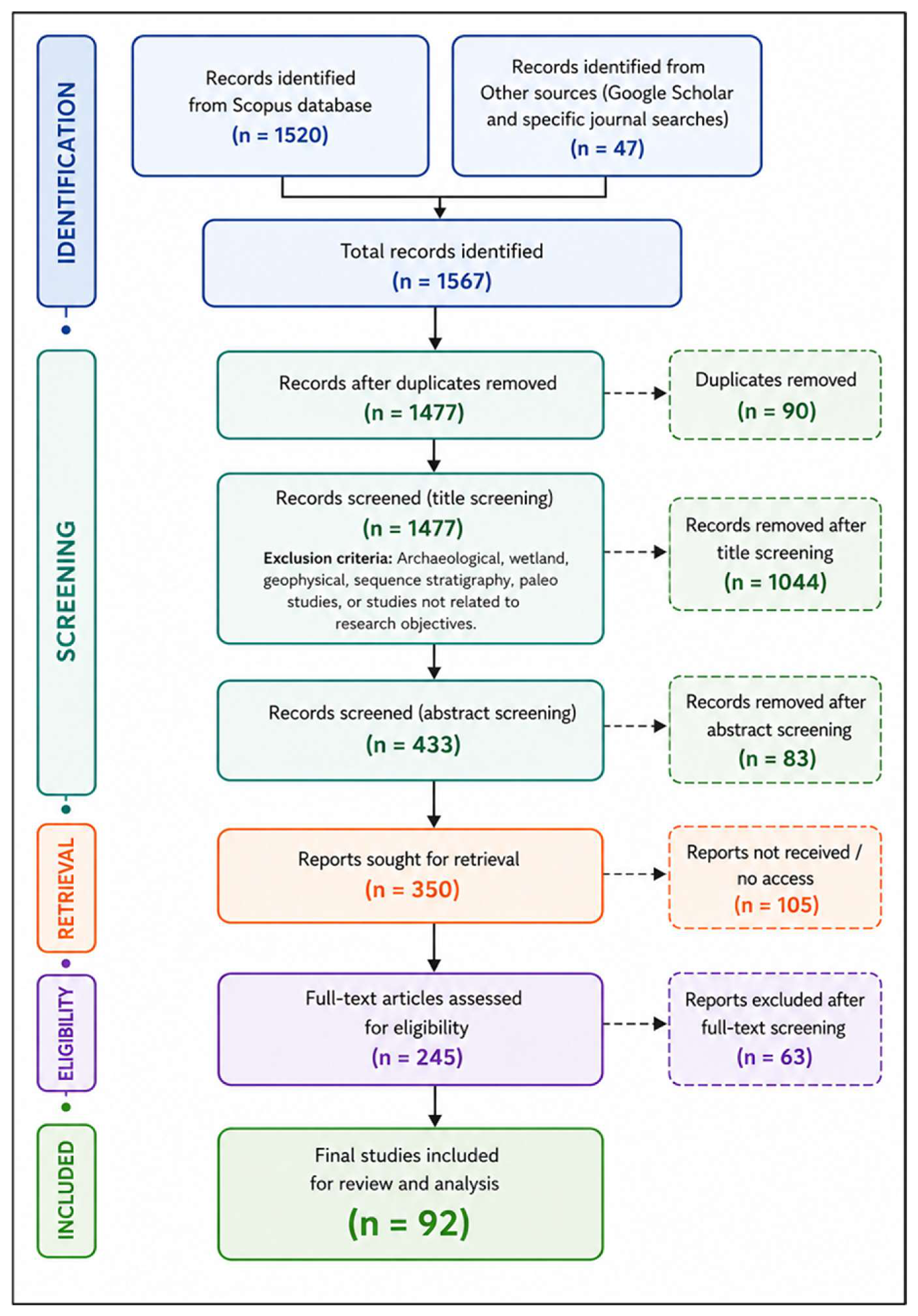
Figure 2.
Different types of bars.
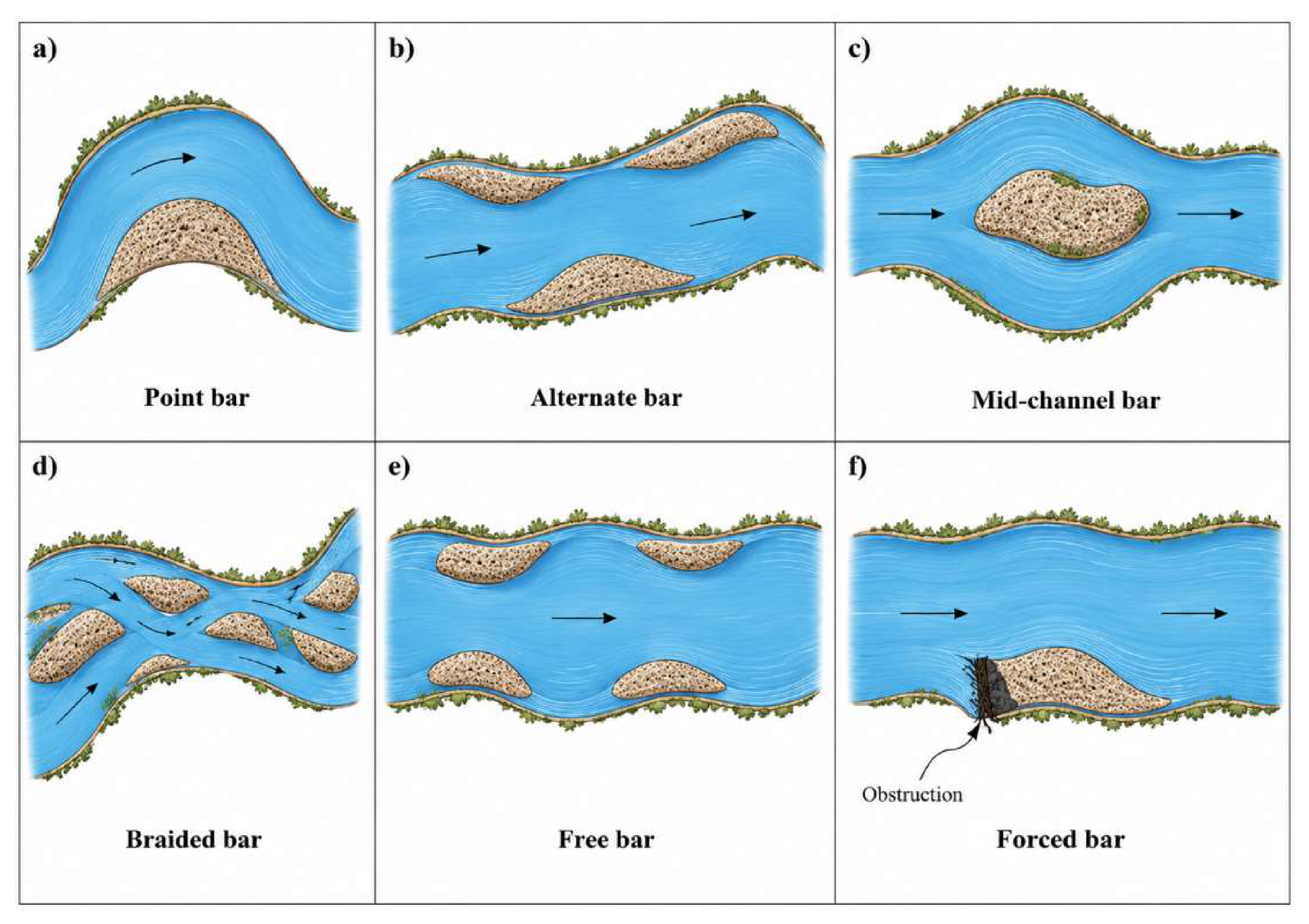
Figure 3.
Conceptual framework for sandbar migration and river avulsion studies (The graphical elements (SVGs) were generated with assistance from OpenAI’s DALL·E and subsequently modified and validated by the authors).
Figure 3.
Conceptual framework for sandbar migration and river avulsion studies (The graphical elements (SVGs) were generated with assistance from OpenAI’s DALL·E and subsequently modified and validated by the authors).
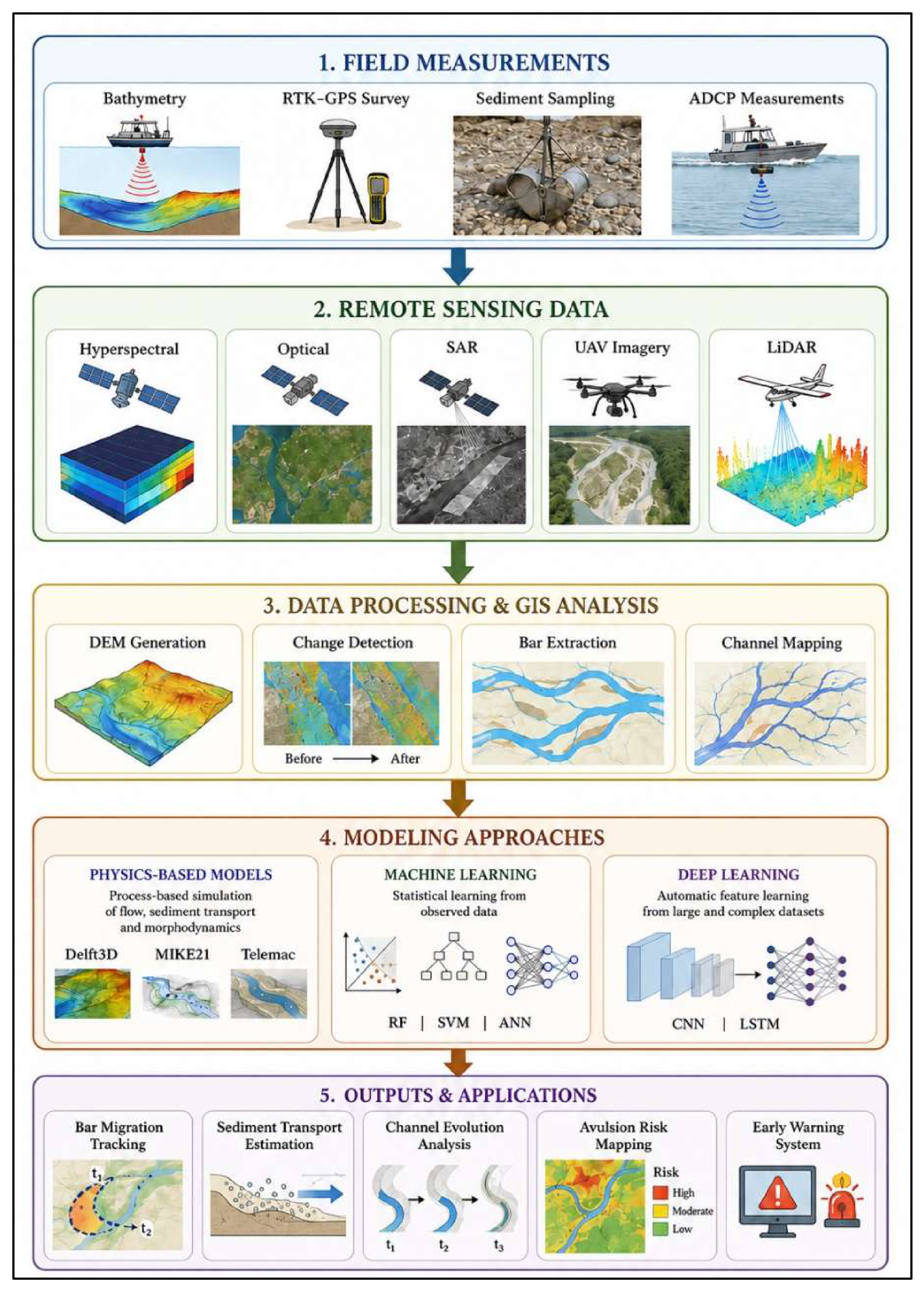
Table 1.
Different stages of the mid-channel bar.
| Images | Stage | Definition | Identification |
|---|---|---|---|
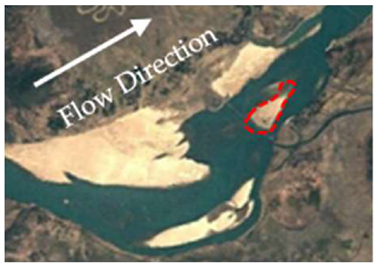 Dec, 1993 |
Formation | Sandbar appear through sediment deposition in a low velocity zone. | Small exposed bar, no vegetation |
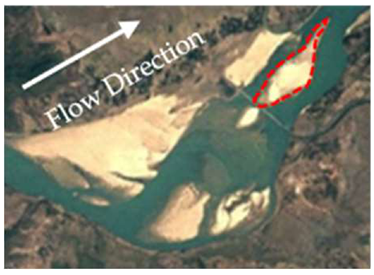 Dec, 1996 |
Migration | Downstream or lateral displacement due to sediment transport. | Shift in centroid position or bar elongation |
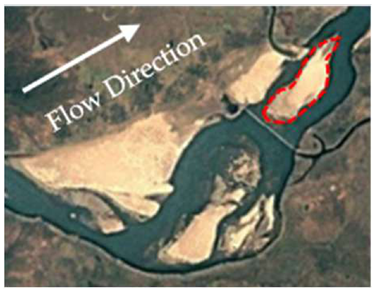 Dec, 2000 |
Growth | Sediment deposition increases bar area and elevation. | Increase in bar width/length. |
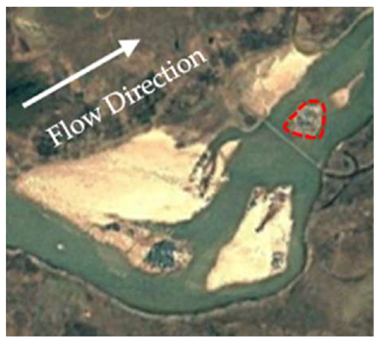 Dec, 2003 |
Destruction | Erosion removes part or all of the bar or submerged. | Area loss, fragmentation, disappearance |
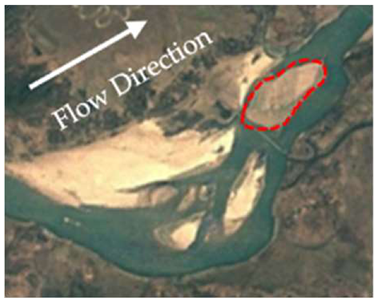 Dec, 2008 |
Stabilisation | Vegetation colonization | Vegetable patches, stable boundaries |
Table 2.
Classification of sand bars and related mechanisms.
| Bar Type | Channel Context | Formation Mechanism | Migration Behavior | Stability |
|---|---|---|---|---|
| Alternate Bars | Straight/Slightly sinuous | Lateral flow oscillations | Downstream + Lateral | Medium |
| Point Bars | Meandering bends | Inner bend deposition | Stationary + growth | High |
| Mid-Channel Bars | Wide braided channels | Flow division & deposition | Complex, multi-path | Variable |
| Free Bars | Straight channels | Flow instabilities | Continuous downstream | Low |
| Forced Bars | Obstacle-induced | Flow separation behind obstructions | Stationary | High |
Table 3.
Classification of sand bars and related mechanisms.
| Factor | Influence on Bar Dynamics |
|---|---|
| Sediment Supply Volume | Higher supply promotes formation and downstream migration |
| Sediment Grain Size | Coarser grains increase bar stability |
| Flow Magnitude | Strong flows promote migration and reshaping |
| Flow Duration | Extended flows lead to cumulative morphological change |
| Channel Slope | Steep slopes = faster migration, flatter = stabilization |
Table 6.
Comparison of different approaches to model sandbar.
| Approach | Tool / Method Used | Citation | Remarks |
|---|---|---|---|
| Bathymetry | Echo Sounders, Total Station | [85] | Traditional methods; used for submerged bar and channel geometry surveying |
| Multibeam Sonar | [85] | High-resolution 3D bathymetry of bar morphology | |
| Airborne LiDAR | [86] | Extended coverage, works in shallow water or dry bar zones | |
| Structure-from-Motion (SfM) Photogrammetry | [86] | UAV & image-based 3D topography | |
| GPS Mapping | Real-Time Kinematic GPS (RTK-GPS) | [21] | High spatial-temporal resolution for tracking bar migration during flood events |
| Sediment Sampling | Surface Sampling | [87] | Reveals sorting and grain size patterns |
| Magnetic Tracers, Painted Pebbles, PIT Tags | [88,89] | For sediment transport rate and path | |
| Flow Measurement | Acoustic Doppler Current Profiler (ADCP) | [90,91,92] | Captures complex flow dynamics around bars |
| Satellite Remote Sensing | Landsat (30m), Sentinel-2 (10m) | [14,93,94] | Long-term time series; large-scale bar evolution tracking |
| IRS LISS | [95] | Used for studying dry-season morphological change | |
| Google Earth Engine (GEE) | [96] | Cloud platform for large-scale time-series analysis | |
| WorldView, QuickBird, SPOT | [97] | A extensive review on usef of high-res optical imagery for fine-scale bar morphology | |
| Radar Remote Sensing (SAR) | Sentinel-1, RADARSAT-2, ENVISAT-ASAR, GF-3, ALOS/PALSAR | [98,99,100] | All-weather, day/night imaging; good for wide rivers |
| InSAR (Interferometric SAR) | [101] | Detects cm-scale elevation changes | |
| Satellite Altimetry | [102] | For water level fluctuation detection | |
| UAV-Based Methods | UAV + Orthophotography + SfM DEM generation | [103,104] | cm-scale topography, grain size analysis, rapid deployment |
| UAV Mapping of Riverbanks and Avulsion Points | [105,106,107] | Captures erosion/deposition dynamics | |
| 2D Numerical Modelling | Delft3D, MIKE21, Telemac-2D | [108,109] | Simulates bar migration and avulsion at the catchment scale |
| 3D Numerical Modelling | FLOW-3D, OpenFOAM, FLUENT | [110] | Captures secondary flow, bed shear stress, and sediment entrainment |
| Shallow Water Equations + Sediment Transport Models | [111] | Simulates co-evolution of flow, sediment transport, and channel morphology | |
| Machine Learning Models | Random Forest, Gradient Boosting, MLP, Logistic Regression, SVM | [22,112,113] | Predicts avulsion risk, sediment transport, and bar classification |
| Neural Networks (ANN, DNN) | ANN with DEM + Sediment + Flow + Width | [114,115,116] | Forecasting bed load and porosity-grain size relationships |
| Deep Learning - CNN | CNN for Surface Water and Sandbar Classification | [117,118] | Effective in imagery-based classification, e.g., bar width estimation |
| Deep Learning - RNN, LSTM | Temporal Modelling of Morphological Changes | [119] | Captures evolution trends and flood-driven changes over time |
| Explainable AI | SHAP (Shapley), LIME | [120] | Helps interpret model outputs, identify key influencing features |
| Transfer Learning | Pre-trained ML Models Adapted to New Rivers | [121] | Useful in data-poor basins |
| Online Learning for Real-Time | Adaptive ML Models with Real-time Data Streams | [122] | Enables early warning systems, live updates for avulsion forecasting |
Disclaimer/Publisher’s Note: The statements, opinions and data contained in all publications are solely those of the individual author(s) and contributor(s) and not of MDPI and/or the editor(s). MDPI and/or the editor(s) disclaim responsibility for any injury to people or property resulting from any ideas, methods, instructions or products referred to in the content. |
© 2026 by the authors. Licensee MDPI, Basel, Switzerland. This article is an open access article distributed under the terms and conditions of the Creative Commons Attribution (CC BY) license (http://creativecommons.org/licenses/by/4.0/).
Copyright: This open access article is published under a Creative Commons CC BY 4.0 license, which permit the free download, distribution, and reuse, provided that the author and preprint are cited in any reuse.


