
Submitted:
22 June 2026
Posted:
24 June 2026
You are already at the latest version
Abstract
In the UK, contaminated land risk assessments using the Contaminated Land Exposure Assessment (CLEA) model rely on soil organic matter (SOM) values to determine acceptable thresholds for contamination caused by anthropogenic pollution for human health. Soil organic carbon (SOC), total organic carbon (TOC) or loss on ignition (LOI) are routinely used as a proxy for SOM in the industry, both by contaminated land consultants and laboratories who rely on conversions such as the Van Bemmelen factor. Many standard laboratory methods for measuring SOC or TOC do not differentiate between natural organic carbon and petroleum hydrocarbons. This study investigates the interference of total petroleum hydrocarbons (TPH) on SOC measurements by analysing 2,375 brownfield soil samples. A positive correlation was observed between the two variables; an addition of 1,000 mg/kg of TPH inflates reported SOC by 0.46 percentage points. When converted to SOM for risk assessment purposes using the Van Bemmelen factor, this artificial increase rises to 0.79 percentage points calculated SOM per 1000mg/kg TPH. This can push soils into higher assessment bands, generating less stringent Generic Assessment Criteria (GAC). The study finds that relying on SOC as a proxy for SOM in hydrocarbon-impacted soils masks the absence of the natural organic matter required to sorb contaminants, leading to an underestimation of human health risks in contaminated land risk assessments.
Keywords:
soil organic carbon (SOC)
; contaminated land
; human health
; total petroleum hydrocarbons
; soil
; pollution
1. Introduction
Across the UK, industrial activity, waste disposal, leaks and spills of raw materials have contaminated soils. Historic contamination is particularly prevalent due to a lack of knowledge of environmental hazards and poor practice in the past [1]. Soil can become contaminated by heavy metals, oil, chemical substances, asbestos and radioactive substances among other potentially harmful materials. In sufficient quantities, contamination in soil can cause significant harm to people, property or protected species and significant pollution of surface or groundwater. Where there is a risk of significant harm or pollution, the land becomes legally defined as contaminated land [2]. In the UK, soil contamination is regulated by Part 2A of the Environmental Protection Act [3].
Soil contamination has been shown to lead to health issues including breathing difficulties, oral cancer, learning and behavioural difficulties [4]{Chiang, 2011 #38}{Mielke, 2005 #61}. As a result of the health risks associated with soil contamination, the UK and Scottish Governments have adopted generic screening criteria for contaminants in soil which represent a reasonable worst-case exposure scenario likely to pose a very low to low risk to users of a site. The screening criteria, or generic assessment criteria (GAC), are called the Category 4 Screening Levels (C4SLs), Suitable for Use Levels (S4ULs) and Soil Guideline Values (SGVs) [5]. The C4SLs have not been adopted in Scotland.
The S4ULs were set on the basis that different SOM values result in different risks to human health. This is because organic chemicals are prone to sorbing to organic soil carbon [6]. As SOM increases more of the contaminant is sorbed, thus reducing uptake of the contaminant by plants and providing a surface for bioavailable contaminants to bind to, immobilising a fraction of the pollutant concentration [7,8]. While the S4ULs give a single assessment criteria for metals (based on % SOM), TPHs and polycyclic aromatic hydrocarbons (PAHs) are assessed against SOM values of 1, 2.5 and 6%, respectively [9,10]. The higher SOM values lead to higher assessment criteria for measured concentrations of contaminants in soil – for example, the S4UL for TPH EC5-6 on an allotment is 730mg/kg at 1% SOM and 3,900mg/kg at 6% SOM {Nathanail, 2015 #12}.
The CLEA methodology is robust, however many contaminated land consultants do not include SOM in their standard suite of testing, instead using soil organic carbon (SOC), total organic carbon (TOC) or loss on ignition (LOI) as a proxy for SOM. SOM is composed of natural organic material, principally from plants and fungi, while SOC is the fraction of SOM that is exclusively carbon. These proxies are converted to an SOM value by using conversion such as the Van Bemmelen factor, which converts SOC values to SOM by multiplying SOC by 1.724, despite the use of a single factor for this conversion being a potentially unreliable method [11].
Even where SOM tests are scheduled, many of the laboratories use dry combustion and elemental analysers which only measure carbon dioxide emissions from a sample submitted for SOM testing [12]. Others use methods specified in BS1377:Part 3:1990 - dichromate oxidation or LOI to release easily oxidised carbon from samples [13,14]. None of these methods can determine if the carbon tested is from plant matter and thus contribute to SOM or not, and so the laboratories report SOM based on a calculation from TOC from this method.
There is a risk that using a conversion factor to determine the SOM content, and subsequently the assessment criteria for human health in contaminated land investigations, encompasses carbon sources other than organic matter. This includes the hydrocarbons that are the subject of the assessment – the conversion does not account for the contribution of pollutants to the organic carbon content. The danger here is that if SOM is lower than calculated then the higher contaminant assessment criteria are used in the assessment. This may mask exceedances of the correct assessment criteria for the non-TPH impacted SOM value, and so contaminant concentrations which pose a risk to human health are left unremediated.
The potential risk this common practice in contaminated land consultancy poses to end users has not been assessed in the existing literature. The Ohio Environmental Protection Agency in the United States has identified the risk of petroleum hydrocarbons impacting organic carbon readings and states that the fraction of organic carbon (foc) in contaminated soil assessments must be free of petroleum or other organic contaminants [15]. Other studies have identified the opposite problem – plant residues can elevate hydrocarbon readings, leading to unnecessary remediation [16]. This paper aims to determine the impact that TPH contamination has on SOC readings in brownfield soils and assess the implications of this for contaminated land risk assessment practices in the UK by comparing soil samples taken from contaminated land investigations to an uncontaminated urban soil baseline and to each other.
2. Data and Methods
2.1. Study Area and Soil Data Acquisition
Soil samples from potentially contaminated brownfield land were collected from a dataset provided by Soilutions Ltd, a contaminated land consultancy based in Edinburgh, Scotland. The dataset comprises 5,253 soil samples collected according to BS10175:2011+A2:2017 (the code of practice for the investigation of potentially contaminated sites) during site investigations at 113 sites across the UK and tested at UKAS accredited laboratories. Sampling density of the investigations is defined by BS10175, and is at least one sample every 50m, equivalent to 400 samples per km2. Samples are predominantly from urban centres including London, Liverpool, Glasgow and Edinburgh. The use of data from the contaminated land industry in academia is rare. However, compared with a similar study that demonstrated the potential application of commercial site investigation data in academic research using 1,707 samples from 120 brownfield sites, the dataset employed in this study contains a comparable number of samples after data processing {Hellawell, 2022 #81}.
Historic land uses at the sample locations vary and include factories, warehouses, fuel depots, chemical plants, houses, power stations, quarries or mines, fuel stations and farmyards amongst others. The dataset is considered to represent a realistic cross section of laboratory outputs from contaminated land investigations in the UK. Specific site details (addresses, coordinates) were redacted from the dataset. The samples included made ground (2,214 samples), reworked (17 samples) and natural soils (2,004 samples). Soil type was not recorded in the laboratory certificates for 1,009 samples.
The brownfield samples were compared to a baseline dataset of samples from urban green spaces in Glasgow. This was chosen as the baseline due to the availability of high-density SOC sample data from the British Geological Survey’s G-BASE survey [17,18]. G-BASE was a nationwide soil sampling project which included dense sampling in urban areas, including sampling at a rate of four topsoil samples per square kilometre in Glasgow. This produced a robust high-resolution dataset of 1,381 geographically referenced soil geochemistry sample points across the city [19]. For the purposes of this study, in the absence of specific SOM values, loss on ignition (LOI) values within the dataset were used as a proxy for SOC concentrations using a conversion ratio of LOI x 0.55, based on guidance from Hoogsteen et al [20]. Urban green spaces are considered a suitable baseline for comparison with the brownfield dataset as they represent soils from urban settings which are unlikely to have been contaminated with hydrocarbons in significant volumes.
The processing of the G-BASE data for urban green spaces is given in full in Bradley et al (2026) [21]. In summary, sample locations for urban green spaces were extracted using GIS and Python’s GeoPandas library based on the Ordnance Survey (OS) Open Green Space dataset [22]. This is an open-source dataset which includes detailed and geographically accurate boundaries for public green spaces, including parks, playing fields, sports pitches and public gardens (such as Glasgow Botanic Gardens) across the UK.
2.2. Carbon and Proxy Contaminant Quantification
To extract the relevant brownfield data, 253 laboratory certificates and the accompanying site investigation reports were reviewed. Data extraction databases were based on those used in Hellawell and Hughes (2022), Ander et al. (2013) and Rothwell and Cooke (2015) {Hellawell, 2022 #81} {Rothwell, 2015 #39} {Ander, 2013 #40}. The data extracted is shown in Table 1. As contaminated land consultants use only a few SOC values to represent the whole site, rather than testing every sample for soil carbon they test only a few per site {Curran, 2020 #44}. This practice means many samples have no soil carbon data, so samples with no LOI, SOC or TOC data were excluded, leaving 2,365 samples from the whole dataset of 5,253 samples.
Testing of LOI, SOC and TOC varied between samples – methodologies varied between laboratories and all three were rarely tested in the same sample due to the different approaches of project managers during site investigations which may be influenced by the choice of laboratory or price of testing among other reasons. If the test results included SOC values, these were used in the analysis. Where SOC was not tested, to enable an accurate comparison, TOC percentages were converted to SOC an established method where TOC=SOC [23]. If neither SOC nor TOC values were available, LOI was converted to SOC using a conversion ratio of LOI*0.55, based on guidance from Hoogsteen et al [20]. While flaws are noted in the use of such standard conversion factors, the absence of detailed analysis of natural variations in the soil sample data and the variation in laboratory test methods precludes the use of a sample specific conversion factor [11].
In the absence of SOC values in the G-BASE dataset, LOI values were used using the same conversion to provide a meaningful comparison. As the G-BASE dataset does not include TPH measurements, a direct comparison of contamination status between the urban green space dataset and the brownfield dataset was not possible. Therefore, the heavy metals As, Cr, and Pb, which are commonly associated with industrial activity, ash, clinker, and fill materials, were used as proxy indicators of contamination to assess the suitability of the G-BASE dataset as a non-contaminated baseline.
2.3. Statistical and Comparative Analysis
To give context to the impact of TPH on SOC values, a comparative statistical analysis was conducted between the brownfield samples and the high-density urban G-BASE data. Prior to hypothesis testing, descriptive statistics were generated, and the distribution of SOC values within both datasets was evaluated. Due to the right-skewed, non-normal distribution of the data (confirmed via a Shapiro-Wilk test and shown in Figure 1), non-parametric methods - specifically the Mann-Whitney U test - were used to assess statistical differences between the brownfield and green space soil carbon concentrations and proxy contaminant (As, Cr, Pb) levels [21,22]. To establish if there is any relationship between TPH and SOC in the brownfield samples, a Spearman’s correlation (rs) was carried out. To determine if soil type has an effect on any relationship between TPH and SOC, a Kruskal-Wallis Test comparing made ground and all other soil types was conducted.
Finally, linear regression with sensitivity analysis was carried out to quantify any impact of TPH on SOC. Linear regression was selected because the standard laboratory testing mechanism used for SOC determination in the contaminated land industry, dry combustion and elemental analysers, converts carbon within the sample to CO2, for analysis stoichiometrically. In TPH contaminated samples, the TPH adds carbon to the result proportionally and in a linear manner, best suited to linear regression analysis.
One linear regression analysis was run on all 2,365 samples in the brownfield dataset. The data was heavily skewed by outliers which contained TPH values likely associated with product above theoretical soil saturation limits (Csat) limit. Hydrocarbon saturation can occur from 1,700mg/kg depending on the soil type, though mid-range hydrocarbons may exceed the saturation limit from 27,000mg/kg. These outliers may have distorted the regression analysis. While the physical threshold for non-aqueous phase liquid (NAPL) mobility (residual saturation) varies depending on soil bulk density and hydrocarbon fraction, concentrations exceeding 10,000 mg/kg (1% of soil mass) are consistently higher than Csat for standard mixed hydrocarbons [24]. Therefore, a limit for outliers of 10,000mg/kg was set, along with an SOC value of >30% which may represent a pure peat layer. Sensitivity analysis was carried out by repeating the linear regression with these outliers removed, which reduced the number of samples in the dataset to 1,913 - a loss of 452.
3. Results and Discussion
3.1. Baseline Contamination Status
After processing, the brownfield soil sample dataset contained 2,365 samples. In comparison, a total of 465 urban shallow topsoil samples from public green spaces in Glasgow had been collected as part of BGS’ G-BASE survey to use as a low TPH baseline. The Shapiro-Wilk test showed that the distribution of SOC in both the green space and brownfield datasets was significantly right skewed and non-normal (p < 0.001 for both environments). The skew and the presence of notable outliers (such as the maximum SOC of 60.1% in the brownfield dataset) justifies the reporting of medians over means and the subsequent use of non-parametric comparative methods.
The proxy contaminants overall showed a statistically significant difference in contamination concentrations between the two datasets for As, Cr and Pb (all p = <0.001). Overall, this demonstrates that the green space soils are a comparatively uncontaminated or less contaminated baseline to compare the SOC values from the brownfield dataset with.
3.2. Baseline Carbon Concentrations
The Mann-Whitney analysis shows a clear distinction in baseline carbon concentrations between brownfield soil samples and green spaces (p= <0.001). Median urban green space SOC concentrations were higher than brownfield site SOC as shown in Table 1. which establishes that while undisturbed public parks act as carbon sinks, highly disturbed industrial soils have lower carbon concentrations due to topsoil stripping and the high volume of inorganic anthropogenic inclusions (e.g., crushed concrete and brick) characteristic of made ground [21,25,26].
3.3. Correlation Between SOC and TPH
The Spearman’s correlation shows that increases in hydrocarbon content in the brownfield dataset were linked to an increase in SOC (rs = 0.248, p <0.001). This demonstrates that, while overall SOC content in the brownfield soils is lower than in the urban green space soils, the elevated levels of SOC within the brownfield dataset are less likely to be due to plant material. Instead, SOC increases appear to be driven by TPH interference which presents as soil organic matter in laboratory tests.
The Kruskal-Wallis test shows a statistically significant difference in SOC concentrations between the different soil classifications (made ground, natural, reworked, or not recorded; p = 0.007). This is expected due to the differing sources of carbon present, such as natural organic matter in natural soils compared to anthropogenic inclusions like coal or ash in made ground. However, a further Kruskal-Wallis test shows that there is no significant relationship between soil type and TPH concentration (p = 0.908). This demonstrates that hydrocarbon contamination within the dataset occurs independently of the soil type. Consequently, while natural carbon baselines vary by soil type, the artificial elevation of SOC readings driven by TPH interference is present across all soil classifications.
Linear regression analysis on the complete dataset confirmed a statistically significant positive relationship (p = 0.024) with weak correlation and coefficient of determination (R = 0.0515, R2 = 0.00266) as shown in Table 2. The correlations are weak because of the heterogenous nature of made ground. Despite the weak correlation, the correlation is statistically significant and while the changes in SOC due to TPH are small, they can lead to a potentially significant risk to human health.
Sensitivity analysis on the dataset with outliers removed also identified a statistically significant positive relationship (p < 0.001) and weak correlation and coefficient of determination (R = 0.216, R2 = 0.0468), however the R value was over four times that of the complete dataset, suggesting a stronger relationship overall. The unstandardised regression coefficient of 4.60 x 10⁻⁴ demonstrates that for every 1,000mg/kg increase in TPH, reported SOC will artificially increase by 0.46 percentage points as shown in Table 3 and Figure 2.
| Model Coefficients - SOC Value (%) | ||||
| Predictor | Estimate | SE | t | p |
| Intercept | 2.85 | 0.0646 | 44.17 | <0.001 |
| Total TPH (C6-C40) (mg/kg) | 2.64e-5 | 1.17e-5 | 2.26 | 0.024 |
This increase occurs across all soil types covered in the study, both natural and made ground and appears not to be a result of physical artefacts of coal or ash. SOC values in the brownfield dataset were consistently lower than those from urban green spaces, which may mask the issue of TPH interference in SOC levels by suggesting that overall, SOC is low and unimpacted by hydrocarbons. The risk here comes from the assumption that SOC is lower in the sample in front of the consultant than in other urban soils and so TPH does not impact the choice of assessment criteria.
The interference exists because in most SOC tests, which rely on combustion of the sample at temperatures around 900oC, the TPH is oxidised alongside humic and fulvic acids and the TPH thus increases the SOC reading [27,28]. It is worth noting that the reverse can also be true – studies have found that standard chemical analysis procedures for TPH can coextract biogenic organic compounds, thus elevating the TPH concentration [29,30,31].

Table 4.
Linear regression and sensitivity analysis of SOC and TPH values from the brownfield dataset with outliers removed.
Table 4.
Linear regression and sensitivity analysis of SOC and TPH values from the brownfield dataset with outliers removed.
| Linear Regression - TPH and SOC Outliers Removed | ||
|---|---|---|
| Model Fit Measures | ||
| Model | R | R² |
| Brownfield data, TPH > 10,000mg/kg and SOC >30% removed |
0.216 | 0.0468 |
Note. Models estimated using sample size of N=1913.
| Model Coefficients - SOC Value (%) | ||||
| Predictor | Estimate | SE | t | p |
| Intercept | 2.55 | 0.0524 | 48.62 | <0.001 |
| Total TPH (C6-40, mg/kg) | 4.60e-4 | 4.74e-5 | 9.69 | <0.001 |
3.4. The implications for the CLEA Model and Human Health Risk Assessment
The implications of the connection between TPH and SOC are potentially significant for the CLEA model and human health risk assessments in contaminated land. In the context of the CLEA SOM value bands for different assessment criteria, if contaminated land consultants rely on the Van Bemmelen factor to convert SOC laboratory values to SOM to determine the GAC for a site, the increase of SOC by 0.46 percentage points determined in this study increases to an increase in SOC of 0.79 percentage points for every 1,000mg/kg TPH. If an uncontaminated soil has 1% SOM, TPH contamination of 1,899mg/kg would push that SOM to 2.5% when using the conversion factor. This represents a shift in the GAC for hydrocarbons – in the case of aliphatic TPH EC12-16 from 140mg/kg to 330mg/kg for a residential with homegrown produce end use scenario.
The risk associated with the interference of TPH on SOC is best demonstrated through a worked example as shown in Figure 3. If the true SOM were 1%, but the laboratory test reports show an SOC of 1.52% and total TPH of 2,000mg/kg, the SOM would be 2.58%. If, within that 2,000mg/kg of total TPH there is 250mg/kg of aromatic TPH EC12-16, the GAC of 330mg/kg would apply. The contaminated land risk assessment would state there is no need to remediate based on aromatic TPH EC12-16 concentrations. However, without the TPH the actual SOM of the soil is only 1%. This would lower the GAC to 140mg/kg and the aromatic TPH EC12-16 concentrations would exceed the GAC by nearly 80%, posing a potentially significant risk to end users. If TPH were accounted for, this site would fail the human health risk assessment and require remediation.
This demonstrates the potential for issues with the use of SOC as a proxy for SOM in contaminated land risk assessments, and the use of laboratory tests that also rely on a conversion factor rather than testing accurately for SOM. The TPH concentration of 1,899mg/kg required to push reported SOM from 1% to 2.5% was exceeded in 151 samples included in the analysis. This is 6.4% of the samples included, demonstrating that the risk of TPH causing the assessment criteria category to jump based on SOM does not occur in the majority of samples tested but is also not unusual.
The risk is caused by the absence of SOM for the contaminants to sorb to. This sorption is the key reason why GACs increase with SOM, but in the case of the worked example, the majority of the SOM used in the assessment is TPH. While TPH is capable of sorbing to itself, the premise of the CLEA model is that natural SOM acts as a sink to tightly sorb contaminants and is in itself harmless. Instead of undergoing solid-phase sorption to benign natural carbon, high concentrations of TPH exceed residual saturation and exist as NAPL. This NAPL acts as a long-term, dynamic secondary source, weathering over time by continually partitioning into the aqueous and vapor phases, thereby maintaining contaminant bioavailability and driving ongoing human health risks [32,33].
5. Conclusions
This study shows that SOC content is linked to hydrocarbon content in contaminated soils, with SOC rising with TPH levels consistently in a dataset of over 2,000 samples from brownfield sites regardless of whether soils are natural or artificial. The UK contaminated land regime is tied to the CLEA model for its risk assessments. The CLEA model sets assessment criteria for hydrocarbon contaminants based on SOM content, assuming that hydrocarbons will sorb to the organic material and thus have no pathway to the end user of the site. While the model itself is robust, consultants routinely use SOC to calculate SOM, or if they do schedule SOM testing laboratories often use methods which also use a conversion factor to determine SOM.
The use of conversion factors to estimate SOM presents a potential risk to end users of the site – the calculated SOM content includes TPH, which has the potential to remobilise. The TPH itself leads to a perceived increase in SOM, and as the SOM is used to determine the assessment criteria for the contaminated land risk assessment, there is a possibility that overreported SOM leads to contaminant concentrations which pose a risk to end users being missed. Consequently, potentially harmful soils may remain unremediated in new developments, creating a potentially significant long-term risk to human health. To minimise this risk, SOM should be measured directly rather than estimated using conversion factors. Regulators and local authorities reviewing contaminated land reports should not accept assessments that use conversion factors or unsuitable laboratory methods to avoid this risk. Future research could further investigate how risks vary according to historic land use and identify the most appropriate testing approaches for different contamination scenarios.
Author Contributions
Conceptualization, methodology, software, analysis, visualisation, writing—original draft preparation, L.B; validation, writing—review and editing L.K., R.B., I.S. and N.E. All authors have read and agreed to the published version of the manuscript.
Funding
This research received no external funding.
Data Availability Statement
The OS Open Green spaces data presented in this study are publicly available from https://www.ordnancesurvey.co.uk/products/os-open-green space. Contains OS data © Crown copyright and database right 2026 and used with an Open Government License. The British Geological Survey G-BASE survey data included in this study are partly available from https://www.data.gov.uk/dataset/ffc86fe5-9e7f-47ae-823a-1d3b945e636d/geochemical-baseline-survey-of-the-environment-g-base-geochemical-samples-and-analyses. The loss on ignition data was obtained on request from the British Geological Survey and is used under license. Contains British Geological Survey materials © UKRI 2026.
Conflicts of Interest
The authors declare no conflicts of interest.
References
- Scottish Environment Protection Agency (SEPA). Contaminated Land. 2023. Available online: https://www.sepa.org.uk/regulations/land/contaminated-land/ (accessed on 17 August 2023).
- Government Digital Service. Land contamination: technical guidance. 2026. Available online: https://www.gov.uk/government/collections/land-contamination-technical-guidance.
- UK Parliament. Environmental Protection Act 1990, Part IIA; HMSO: London, UK, 1990. [Google Scholar]
- Morrison, S.; Fordyce, F.M.; Scott, E.M. An initial assessment of spatial relationships between respiratory cases, soil metal content, air quality and deprivation indicators in Glasgow, Scotland, UK: relevance to the environmental justice agenda. Environ. Geochem. Health 2014, 36, 319–332. [Google Scholar]
- HM Government. Information Sheet 2: Generic screening criteria; HM Government: London, UK, 2020. [Google Scholar]
- Jeffries, J.; Martin, I. Updated technical background to the CLEA model; Science report SC050021/SR3; Environment Agency: Bristol, UK, 2009. [Google Scholar]
- Cheng, Y.; Nathanail, C.P.; Ja'afaru, S.W. Generic assessment criteria for human health risk management of agricultural land scenario in Jiangsu Province, China. Sci. Total Environ. 2019, 697, 134071. [Google Scholar] [CrossRef]
- Crispo, M.; Dobson, M.C.; Blevins, R.S.; Meredith, W.; Lake, J.A.; Edmondson, J.L. Heavy metals and metalloids concentrations across UK urban horticultural soils and the factors influencing their bioavailability to food crops. Environ. Pollut. 2021, 288, 117960. [Google Scholar] [CrossRef] [PubMed]
- Land Quality Management (LQM); Chartered Institute of Environmental Health (CIEH). The LQM/CIEH S4ULs for Human Health Risk Assessment: Frequently Asked Questions; Land Quality Press: Nottingham, UK, 2015. [Google Scholar]
- Nathanail, C.P.; McCaffrey, C.; Gillett, A.G.; Ogden, R.C.; Nathanail, J.F. The LQM/CIEH S4ULs for Human Health Risk Assessment; Land Quality Press, a Division of Land Quality Management Ltd: Nottinghamshire, UK, 2015. [Google Scholar]
- Pribyl, D.W. A critical review of the conventional SOC to SOM conversion factor. Geoderma 2010, 156, 75–83. [Google Scholar] [CrossRef]
- United Kingdom Accreditation Service (UKAS). Schedule of Accreditation: Chemtest Ltd (Testing Laboratory No. 2183); UKAS: Staines-upon-Thames, UK, 2018. [Google Scholar]
- British Standards Institution (BSI). BS 1377-3:1990 Methods of test for soils for civil engineering purposes. Chemical and electro-chemical tests. BSI: London, UK, 1990. [Google Scholar]
- United Kingdom Accreditation Service (UKAS). Schedule of Accreditation: Normec DETS Limited (Testing Laboratory No. 2139); UKAS: Staines-upon-Thames, UK, 2024. [Google Scholar]
- Ohio Environmental Protection Agency (Ohio EPA). Technical Decision Compendium: Sampling and Analysis of Fraction of Organic Carbon (foc) in Soils; Ohio EPA: Columbus, OH, USA, 2003. [Google Scholar]
- Vecchiato, M.; Bonato, T.; Bertin, A.; Argiriadis, E.; Barbante, C.; Piazza, R. Plant Residues as Direct and Indirect Sources of Hydrocarbons in Soils: Current Issues and Legal Implications. Environ. Sci. Technol. Lett. 2017, 4, 512–517. [Google Scholar] [CrossRef]
- Mahmood, S.; Wilebore, B.; Jenkins, R.; Willis, K.J.; Macias-Fauria, M.; Ebrahim, S.M. A High-resolution Soil Organic Carbon Map for Great Britain. Sustain. Environ. 2024, 10, 2415166. [Google Scholar] [CrossRef]
- British Geological Survey (BGS). Geochemical Baseline Survey of the Environment (G-BASE): Urban Geochemistry Datasets; BGS: Keyworth, Nottingham, UK, 2012. [Google Scholar]
- Fordyce, F.M.; Nice, S.E.; Lister, T.R.; Ó Dochartaigh, B.É.; Cooper, R.; Allen, M.; et al. Urban Soil Geochemistry of Glasgow; British Geological Survey: Keyworth, Nottingham, UK, 2012. [Google Scholar]
- Hoogsteen, M.J.J.; Lantinga, E.A.; Bakker, E.J.; Groot, J.C.J.; Tittonell, P.A. Estimating soil organic carbon through loss on ignition: effects of ignition conditions and structural water loss. Eur. J. Soil Sci. 2015, 66, 320–328. [Google Scholar] [CrossRef]
- Bradley, L.; Khaddour, L.; Boyko, R. The contribution of urban green spaces as a green urban solution to reductions in climate change - a high-resolution data case study from Scotland. In Proceedings of the 8th International Conference on Advanced Technologies for Humanity; Submitted for review; MDPI: Basel, Switzerland, 2026. [Google Scholar]
- Ordnance Survey. OS Open Greenspace; Ordnance Survey: Southampton, UK, 2023. [Google Scholar]
- Chen, L.; Flynn, D.F.B.; Jing, X.; Kühn, P.; Scholten, T.; He, J.-S. A Comparison of Two Methods for Quantifying Soil Organic Carbon of Alpine Grasslands on the Tibetan Plateau. PLoS ONE 2015, 10, e0126372. [Google Scholar] [CrossRef] [PubMed]
- Brost, E.J.; DeVaull, G.E. Non-aqueous phase liquid (NAPL) mobility limits in soil; API Soil and Groundwater Research Bulletin; American Petroleum Institute: Washington, D.C., USA, 2000. [Google Scholar]
- Lorenz, K.; Lal, R. Biogeochemical C and N cycles in urban soils. Environ. Int. 2009, 35, 1–8. [Google Scholar] [CrossRef] [PubMed]
- Scharenbroch, B.C.; Lloyd, J.E.; Johnson-Maynard, J.L. Distinguishing urban soils with physical, chemical, and biological properties. Pedobiologia 2005, 49, 283–296. [Google Scholar] [CrossRef]
- Nelson, D.W.; Sommers, L.E. Total Carbon, Organic Carbon, and Organic Matter. In Methods of Soil Analysis: Part 3 Chemical Methods; Sparks, D.L., Ed.; Soil Science Society of America, American Society of Agronomy: Madison, WI, USA, 1996; pp. 961–1010. [Google Scholar]
- Schumacher, B.A. Methods for the Determination of Total Organic Carbon (TOC) in Soils and Sediments; NCEA-C-1282; United States Environmental Protection Agency, Ecological Risk Assessment Support Center: Washington, D.C., USA, 2002. [Google Scholar]
- Wang, Z.; Yang, C.; Kelly-Hooper, F.; Hollebone, B.P.; Peng, X.; Brown, C.E.; et al. Forensic differentiation of biogenic organic compounds from petroleum hydrocarbons in biogenic and petrogenic compounds cross-contaminated soils and sediments. J. Chromatogr. A 2009, 1216, 1174–1191. [Google Scholar] [CrossRef] [PubMed]
- Kelly-Hooper, F.; Farwell, A.J.; Pike, G.; Kennedy, J.; Wang, Z.; Grunsky, E.C.; et al. Is it clean or contaminated soil? Using petrogenic versus biogenic GC-FID chromatogram patterns to mathematically resolve false petroleum hydrocarbon detections in clean organic soils: A crude oil–spiked peat microcosm experiment. Environ. Toxicol. Chem. 2013, 32, 2197–2206. [Google Scholar] [PubMed]
- Dahl, M.; Survo, S.; Välitalo, P.; Kabiersch, G.; Alitalo, O.S.; Penttinen, O.P.; et al. Identification of Toxicants from a Highly C10–C40-Contaminated Sediment Influenced by the Wood Industry: Petroleum Hydrocarbons or Biogenic Organic Compounds? Environ. Toxicol. Chem. 2019, 38, 936–946. [Google Scholar] [PubMed]
- Contaminated Land: Applications in Real Environments (CL:AIRE). An Illustrated Handbook of LNAPL Fate and Transport in the Sub-Surface; CL:AIRE: London, UK, 2014.
- Interstate Technology; Regulatory Council (ITRC). Evaluating LNAPL Remedial Technologies for Achieving Project Goals; ITRC LNAPLs Team: Washington, D.C., USA, 2009. [Google Scholar]
Figure 1.
graphs showing the right skewed non-normal distribution of SOC for both datasets.
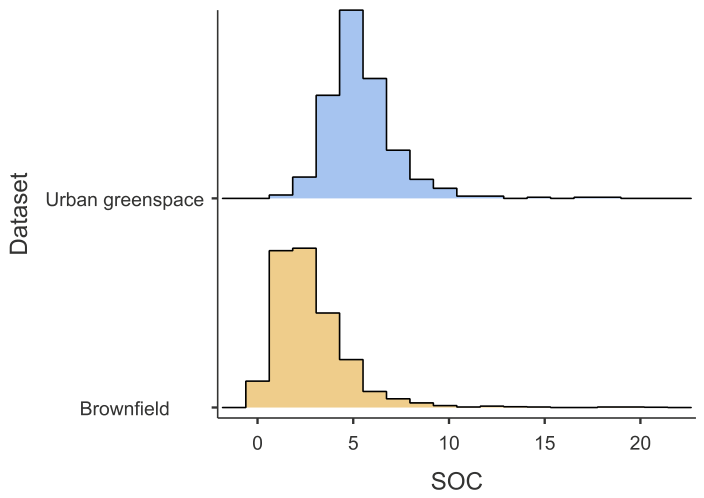
Figure 2.
Graph showing relationship between TPH and SOC in brownfield soil samples with outliers (TPH likely to be above Csat >10,000mg/kg and SOC >30%) removed. Sample size 1,913. The regression trendline shows a statistically significant positive correlation (p < 0.001) and inflation of 0.46 percentage points SOC for every 1,000 mg/kg increase due to TPH interference.
Figure 2.
Graph showing relationship between TPH and SOC in brownfield soil samples with outliers (TPH likely to be above Csat >10,000mg/kg and SOC >30%) removed. Sample size 1,913. The regression trendline shows a statistically significant positive correlation (p < 0.001) and inflation of 0.46 percentage points SOC for every 1,000 mg/kg increase due to TPH interference.
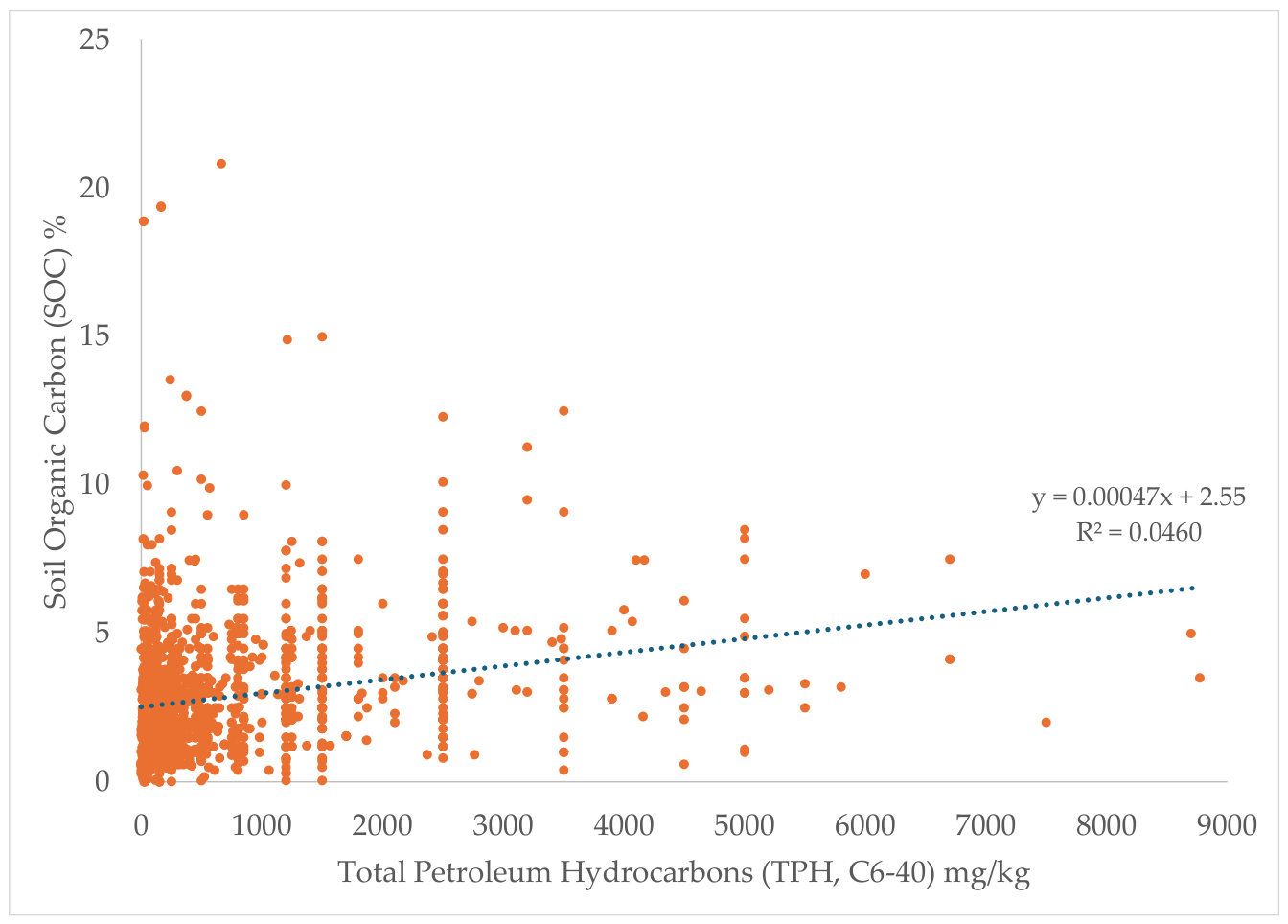
Figure 3.
Flow chart demonstrating a worked example of the risk posed by TPH interference with SOC and SOM values.
Figure 3.
Flow chart demonstrating a worked example of the risk posed by TPH interference with SOC and SOM values.
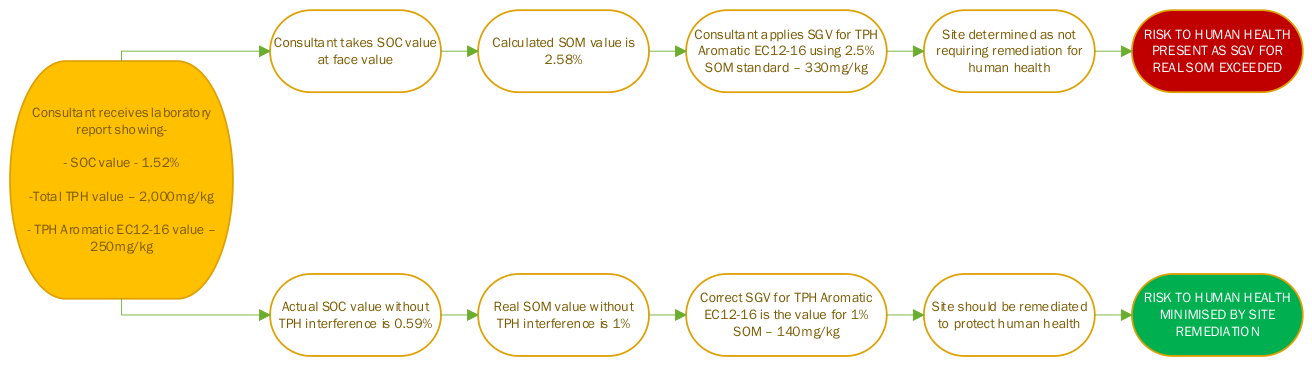
Table 1.
Data extracted from brownfield dataset.
| Qualitative details | Soil data | Soil properties | Organic contaminants | Inorganic contaminants |
|---|---|---|---|---|
| Historic and current land use | Sample depth (m) | Moisture content (%) |
Total TPH (C6-40, mg/kg) |
As (mg/kg) |
| Laboratory report number | Soil description | pH | Total PAH (mg/kg) |
Cd (mg/kg) |
| Sample ID | Visual contamination |
LOI (%) |
Total BTEX (Benzene, toluene, ethylbenzene, xylene) (mg/kg) |
Cr (mg/kg) |
| Olfactory contamination |
TOC (%) |
Cu (mg/kg) | ||
| SOC (%) |
Pb (mg/kg) Hg (mg/kg) Ni (mg/kg) Zn (mg/kg) |
Table 2.
SOC concentrations across the urban green space and brownfield datasets.
| Dataset | Number of samples |
Median SOC (%) |
IQR (%) |
Min SOC (%) |
Max SOC (%) |
|---|---|---|---|---|---|
| Brownfield | 2,365 | 2.25 | 1.90 | 0.01 | 60.1 |
| Glasgow urban green space | 465 | 5.07 | 1.88 | 1.00 | 18.50 |
Note – a Mann-Whitney U test comparing the urban green space baseline to brownfield samples demonstrated a statistically significant difference in SOC concentrations (U= 108601, p <0.001).
Table 3.
Linear regression and sensitivity analysis of SOC and TPH values from the brownfield dataset .
Table 3.
Linear regression and sensitivity analysis of SOC and TPH values from the brownfield dataset .
| Linear Regression - All Data | ||
|---|---|---|
| Model Fit Measures | ||
| Model | R | R² |
| All brownfield data, outliers included | 0.0515 | 0.00266 |
Note. Models estimated using sample size of N=2028.
Disclaimer/Publisher’s Note: The statements, opinions and data contained in all publications are solely those of the individual author(s) and contributor(s) and not of MDPI and/or the editor(s). MDPI and/or the editor(s) disclaim responsibility for any injury to people or property resulting from any ideas, methods, instructions or products referred to in the content. |
© 2026 by the authors. Licensee MDPI, Basel, Switzerland. This article is an open access article distributed under the terms and conditions of the Creative Commons Attribution (CC BY) license (http://creativecommons.org/licenses/by/4.0/).
Copyright: This open access article is published under a Creative Commons CC BY 4.0 license, which permit the free download, distribution, and reuse, provided that the author and preprint are cited in any reuse.


