
Submitted:
23 June 2026
Posted:
24 June 2026
You are already at the latest version
Abstract
Ship recycling is expanding in Nigeria with no dedicated statutory framework to govern it, creating a mismatch between a high-hazard industry and an underdeveloped regulatory environment. Although Nigeria ranks among the top ten emerging ship-recycling countries, the sector remains informally governed, with overlapping mandates, thin enforcement capacity, and fragmented risk-assessment practices. This study evaluates Nigeria's approach through a robustness lens, drawing on Rasmussen's socio-technical levels, Renn's integrative risk-governance model, and Hale's robustness criteria, with Hollnagel's Safety-II as a complementary, proactive perspective. The analysis combines documentary review, field observations across four recycling hubs (Lagos, Warri, Onne/Port Harcourt, and Calabar), and semi-structured interviews with fifteen stakeholders, including yard managers, regulators, workers and safety officers, and maritime experts, followed by a multi-stakeholder validation workshop. Of nineteen sub-criteria, only six are formally present, four are partially addressed, and nine are absent altogether, and even the elements that exist on paper are generic and weakly enforced. Field visits revealed ad hoc practices, hazardous working conditions, weak supervision, and little institutional learning. On this basis we propose a Nigeria-fit Robustness-Focused Risk-Governance Framework built on three pillars: multi-level safety oversight, an integrative risk-governance process, and enhanced mitigation strategies. It emphasises legal recognition, clearer accountabilities, interdisciplinary assessment, transparent risk-acceptance criteria, continuous monitoring, and feedback loops, with a phased implementation pathway. The study shows why robustness, not resilience, should be the organising principle for governing emergent high-hazard sectors in developing economies, and offers practical steps for strengthening institutional capacity in Nigeria's maritime domain.
Keywords:
ship recycling
; risk governance
; robustness
; resilience
; safety regulation
; Nigeria
; developing economies
; socio-technical systems
1. Introduction
Ship recycling closes the maritime materials loop, but it is also one of the world’s most dangerous industrial activities [1]. Fires and explosions, toxic exposures, heavy lifts at height, confined-space hazards, and shoreline contamination are well-documented in global ship recycling hubs. Nigeria is now beginning to receive end-of-life vessels, and these hazards are arriving in a regulatory environment that was never set up for the activity. The institutional choices made now will shape the sector’s safety performance for decades. In this respect Nigeria is a familiar type of case: a high-hazard industry running ahead of the rules meant to govern it, much as happened in Bangladesh and India [2,3]. That makes it a valuable place to study how resilience-like governance patterns take hold, and whether a shift toward robustness is feasible before those patterns harden.
Ship recycling is not yet formally recognised in Nigerian law, and yet Nigeria has already become one of the top ten ship recycling countries outside the established global hubs. UNCTAD figures show that between 2014 and 2021 it consistently handled a measurable share of the world’s recycled tonnage (Figure 1). This is the paradox that makes Nigeria worth studying: a growing industry operating without any dedicated regulatory architecture. The country is still in a “pre-formalisation” phase, where governance patterns remain open to change and the institutional choices made early on can set safety trajectories for the long term.
For now, Nigeria relies on general statutes and agency guidance that touch ship recycling risks only in passing. The activity is not comprehensively recognised in law, mandates overlap, enforcement resources are thin, and risk assessment in practice tends toward checklist compliance rather than the kind of interdisciplinary analysis that would weigh human factors, organisational drift, and community risk. Field observations and stakeholder accounts point to a reactive pattern: problems are managed as they arise, inspections are infrequent, and lessons stay local instead of feeding back into institutions. In a setting marked by deep uncertainty, with limited data, new actors, and evolving practices, and by institutional fragility, the natural policy instinct to “be resilient” and simply absorb and recover can end up entrenching after-the-fact fixes rather than prevention.
Our argument is for a shift toward robustness thinking: designing rules, institutions, and practices that can withstand disturbances while keeping core safety functions intact. Three lenses structure this. Rasmussen’s socio-technical levels, running from government through regulators and company management to the frontline, help expose where responsibilities fall out of alignment. Renn’s integrative governance (framing, assessment, evaluation, management, and communication) gives shape to the underlying processes. Hale’s criteria define what makes a regime robust, namely durability, adaptability, and learning. Hollnagel’s Safety-II informs the spirit of the approach, with its emphasis on proactively ensuring things go right rather than only reacting when things go wrong. Like resilience, though, it remains a complementary perspective rather than a structural component of the framework. The framework itself rests on the three integrated lenses of Rasmussen, Renn, and Hale.
Research question and objectives:
RQ: How can robustness thinking be applied to develop an effective risk-governance framework for Nigeria’s ship recycling industry, and how does it outperform resilience-based approaches in this context?
Objectives: (1) Diagnose governance gaps via documentary review, field observation, and stakeholder perspectives; (2) evaluate Nigeria’s current approach against robustness criteria; (3) propose a Nigeria-fit robust governance framework; (4) articulate implications for theory and policy in emerging economies.
The study makes three contributions. First, it specifies when and why robustness should take precedence over resilience in the governance of high-hazard sectors with weak institutions. Second, it operationalises robustness by mapping Renn’s and Hale’s concepts into implementable criteria for a developing-country maritime context. Third, it offers a policy roadmap covering legal recognition, clarified accountabilities, interdisciplinary assessment, transparent risk-acceptability criteria, and continuous-improvement mechanisms that regulators can begin to enact without waiting for the sector to mature fully.
2. Literature Review
2.1. Risk Governance and Regulatory Regimes
Risk governance refers to the processes through which societies frame, assess, evaluate, manage, and communicate risks [4]. In complex socio-technical systems, risk governance is distributed across multiple institutional levels. Rasmussen’s [5] socio-technical model emphasizes these cross-level couplings, showing how:
- policy decisions at the governmental level shape regulatory constraints,
- regulatory priorities influence organizational trade-offs between safety and production, and
- frontline adaptations generate feedback that should inform higher-level governance.
This perspective highlights that many failures in hazardous industries are systemic, not merely operational errors. Figure 2 illustrates how policy, regulatory, organisational, and frontline levels are coupled in the ship recycling safety control structure.
Regulatory regime theory provides a complementary lens. Hood et al. [6] define a regulatory regime as the full configuration of laws, standards, oversight practices, actor capacities, and institutional norms that collectively shape risk control. Hale [7] argues that a robust safety regime is one that:
- clearly defines and scopes the risk domain,
- allocates unambiguous roles and accountabilities,
- embeds the full risk-governance cycle (framing, assessment, evaluation, management, communication),
- ensures credible monitoring, enforcement, and learning functions, and
- remains adaptive as hazards and technologies evolve.
Regimes that lack these features tend to drift toward reactive compliance, where action is taken mainly after accidents occur, leading to recurrent failures in high-hazard domains such as offshore oil, petrochemicals, and ship recycling.
Building on this, Renn’s adaptive and integrative risk-governance model makes the “full cycle” explicit. It conceptualises governance as five interlinked functions: (i) pre-estimation and framing of risks, (ii) interdisciplinary appraisal of risks, (iii) evaluation of risk acceptability and tolerability, (iv) risk management through monitoring and control, and (v) communication and stakeholder involvement [4,8]. A regulatory regime is robust, in Hale’s sense, only as far as it maintains a stable balance across these functions over time (Figure 3).
Within this broader understanding of regimes, the regulation literature distinguishes between prescriptive, system-based, and performance-based approaches, with many real-world systems operating as hybrids [9,10,11]. Table 1 summarizes these ideal-typical regime forms; in practice, their effectiveness is mediated by how robustly they are embedded in institutions and enforcement.
This framework is therefore a useful foundation for evaluating the governance architecture of an emerging, high-risk industry such as ship recycling in Nigeria, where the type of regime (prescriptive/system/performance) matters less than whether the overall system meets the criteria for robust risk governance.
2.2. Robustness Versus Resilience in Safety Management
2.2.1. Conceptual Distinctions
Resilience and robustness are central concepts in contemporary safety science, yet they serve different governance functions.
- Resilience emphasizes adaptation, flexibility, and recovery. It is the ability to “bounce back” from disturbances.
- Robustness emphasizes strength, resistance, and maintenance of essential functions during disturbances.
Figure 4 illustrates this distinction: resilience enables “bouncing back,” whereas robustness focuses on “withstanding without breaking”.
Both matter, but their roles differ. Resilience is often associated with emergency response, graceful degradation, and post-event learning, while robustness concerns preventive design, structural safeguards, and the ability to withstand shocks without disruption.
2.2.2. Debates and Critiques
Resilience has been widely promoted through Resilience Engineering and Safety-II, which encourage learning from everyday successful performance rather than only from failures ([13]). However, several critiques are relevant to developing contexts:
- Resilience discourse can over-emphasize short-term responses to acute shocks while neglecting chronic vulnerabilities [14].
- Organizational constraints like limited flexibility, opaque information flows, weak reporting cultures can make resilience a rhetorical aspiration, not a practical capacity [15].
- Resilience does not substitute for strong institutions and enforcement, especially where governance capacity is low [16]. Without strong regulation and enforcement, resilience risks becoming a rhetorical substitution for missing capacity.
In contexts where hazards are severe, uncertainty is deep, and institutional capacity is thin as is the case in Nigeria’s emerging ship recycling sector, resilience alone cannot ensure prevention.
2.2.3. Arguments for Robustness
A growing literature argues that robustness should be the organizing principle for risk governance in high-hazard, high-uncertainty environments such as ship recycling in emerging economies[17,18].
Robustness thinking emphasizes:
- ex-ante safety design rather than post hoc recovery.
- redundant and engineered barriers that do not depend on individual initiative.
- codified safety functions and explicit accountabilities.
- transparent risk-acceptability criteria (RAC), to guide trade-offs.
- Independent oversight, monitoring, and verification
- Institutionalised learning embedded in regulatory cycles.
Aven & Ylönen [19] contend that robustness-oriented governance is better suited to industries where uncertainty is deep, hazards evolve, and institutions have limited adaptive capacity.
2.2.4. Operationalizing Robustness for Ship Recycling
Applied to ship recycling, an industry characterised by heavy lifts, hazardous materials, fire/explosion risk, and close contact with local communities, robustness requires formalising the system, not simply reacting within it.
Central elements include:
- Legal recognition of ship recycling as a regulated industrial activity with defined safety obligations.
- Restriction or engineering control of inherently unsafe practices, such as uncontrolled beaching and hot work on afloat vessels.
- Mandatory interdisciplinary risk assessment, combining engineering analysis, human factors evaluation, and environmental appraisal.
- Clear national Risk Acceptance Criteria (RAC) with transparent thresholds, subject to independent review.
- Predictable, well-resourced enforcement, including frequent inspections and sanctions.
- Incident and near-miss reporting systems with sector-wide dissemination of lessons learned.
- Worker training, certification, and competency assurance as preconditions for performing hazardous tasks.
- Periodic regulatory review to ensure adaptability to technological and industry changes.
These components provide the benchmark against which Nigeria’s current governance regime can be evaluated and the basis for constructing the Robustness-Focused Risk-Governance Framework presented later in the paper.
2.3. International Ship Recycling Regulatory Regimes: Structures, Variations, and What They Reveal About Robustness
Ship recycling is governed by several international frameworks, most prominently the Hong Kong International Convention [20], the Basel Convention [21], and the EU Ship Recycling Regulation [22]. However, national implementation differs markedly, resulting in a variety of regulatory regimes with varying levels of institutional maturity. Mapping these systems onto the typology presented in Table 1 helps clarify the relationship between rule type and safety performance.
2.3.1. South Asia (India, Bangladesh, Pakistan): Prescriptive Regulation with Weak Robustness
In the major South Asian hubs of Bangladesh, India, and Pakistan, regulatory frameworks historically display predominantly rule-based (prescriptive) features, including detailed requirements for gas-free certification, worker PPE, waste handling, cutting procedures, and environmental safeguards. However, multiple studies note that these rules often operate within weak institutional environments, characterised by:
- under-resourced and overstretched inspectorates,
- inconsistent enforcement practices,
- extensive informal labour structures,
- limited reporting and data transparency, and
Although India and Bangladesh have initiated HKC-aligned reforms such as yard-specific Ship Recycling Plans, Gas-Free for Man Entry certification, and improved waste-handling facilities, empirical work shows these processes can remain formality-driven when institutional capacity is thin. Documented patterns of fires, explosions, falls-from-height, and hazardous-material exposure continue to be reported in these yards. While such incidents cannot be attributed to rule type alone, the South Asian experience illustrates a broader regulatory lesson: prescriptive rules without strong institutional robustness tend to devolve into reactive compliance, where adherence is uneven, inspections are sporadic, and learning is limited.
2.3.2. Turkey and the European Union: Performance-Based Regulation Under Robust Institutions
Turkey’s Aliaga region and EU-listed ship recycling facilities operate under hybrid regulatory models that combine:
- performance-based elements (e.g., outcome obligations such as “no significant adverse environmental impact”),
- prescriptive technical standards (impermeable flooring, hazardous-material containment), and
- system-based requirements (safety management systems, certification, facility approval processes).
Crucially, these standards are embedded within stronger institutional architectures, a point highlighted in EU impact assessments and in comparative studies of Aliaga yards. Features include:
- frequent and independent inspections,
- publicly maintained facility approval lists (EU SRR Article 16),
- formalised reporting obligations and monitoring mechanisms,
- transparent documentation of accidents and non-compliance,
- professionalised workforce training and certification, and
- established channels for regulatory learning and periodic review.
Case studies consistently describe lower severe-accident occurrence in EU-approved and Aliaga facilities compared with large South Asian beaching yards [26]. Comprehensive cross-country injury-rate statistics remain limited, but available evidence supports the view that robust institutions, not simply the presence of performance-based rules enable higher safety performance.
2.3.3. Comparative Insights for Emerging Ship Recycling States
Synthesising international experience yields three consistent insights relevant to Nigeria and other new entrants:
- Rule type alone does not determine safety outcomes.Prescriptive regimes struggle without enforcement capacity; performance-based regimes fail when monitoring is symbolic or under-resourced [27].
- Institutional robustness is the key differentiator.Countries with coherent legislation, resourced inspectorates, transparent data systems, and feedback mechanisms outperform those with fragmented or capacity-limited institutions, regardless of the nominal regulatory model [28].
- New entrants must build governance architecture, not just adopt standards.Simply transplanting HKC-style provisions without strengthening inspectorates, clarifying agency roles, institutionalising interdisciplinary assessment, and enabling transparent decision-making risks replicating the weaknesses seen in early-stage South Asian regimes.
2.4. Implication for the Nigerian Context
Nigeria’s current profile characterized by the absence of formal legal recognition of ship recycling, reliance on general statutes, overlapping mandates across the Nigerian Maritime Administration and Safety Agency (NIMASA), the National Environmental Standards and Regulations Enforcement Agency (NESREA), and the Federal Ministry of Labour, limited inspection capacity, widespread informal operations, and minimal institutional learning shares similarities with the early developmental stage of South Asia’s ship recycling governance. Unlike those countries, however, Nigeria does not yet have decades of accumulated operational experience or entrenched regulatory practices.
This comparative position strengthens the rationale for the current study:
Nigeria does not primarily need “better rules;” it needs a robust risk-governance system, one that can hold safety functions steady even under uncertainty, market pressure, and institutional fragility.
2.4.1. Safety Governance in Developing Contexts (with Focus on Nigeria)
The safety governance literature on developing countries consistently highlights a set of structural constraints that undermine effective risk regulation. Common features include fragmented legal frameworks, overlapping institutional mandates, under-resourced inspectorates, political interference, extensive informal work arrangements, limited training and competency structures, and weak incident reporting systems. Together, these conditions foster reactive, event-driven responses rather than systematic prevention.
Nigeria exemplifies many of these patterns across its major industrial sectors. In construction, studies report persistently high accident rates and inadequate enforcement of existing rules [29,30]. In manufacturing, hazardous exposures are often normalized and poorly controlled [31]. In the oil and gas sector, production pressures and elements of regulatory capture have been identified as key barriers to sustained safety improvement [32,33,34]. Within the maritime domain, observers describe slow adoption of international conventions and limited resources for effective oversight [35].
Institutionally, Nigeria has maritime safety statutes and general labour laws but lacks a unified occupational health and safety (OHS) framework. Responsibilities for OHS are distributed across multiple agencies, including labour inspectorates, sector regulators, environmental authorities, and maritime bodies, with weak coordination mechanisms. This fragmentation contributes to inconsistent enforcement, regulatory gaps particularly in newer or informal activities and limited learning from incidents.
For an emerging high-hazard activity such as ship recycling, this governance context has direct implications. First, conventional compliance-oriented approaches that rely on detailed prescriptive rules are unlikely to be effective in the absence of credible inspection and sanctioning capacity. Second, resilience-based strategies that emphasize reactive adaptation and local coping may falter under institutional fragility, where information flows, resources and just culture are constrained. These conditions suggest that robustness-oriented governance built on strong preventive design, enforceable minimum standards and structured learning processes will be essential if ship recycling in Nigeria is to develop safely and sustainably.
2.5. Synthesis: Why Robustness Is the Appropriate Lens
The literature reviewed above points to three converging insights that motivate the analytical stance of this paper.
First, ship recycling is both highly hazardous and institutionally demanding. International experience shows that safety performance improves only where regulatory regimes possess structural strength: clear scoping of the risk domain, coherent allocation of responsibilities, credible monitoring and enforcement, and mechanisms for learning and continuous improvement.
Second, developing-country governance patterns—particularly weak enforcement, fragmented mandates, and pervasive informality—undermine resilience-oriented approaches when resilience is treated as the primary organising principle. Flexibility without institutional backbone can entrench ad hoc coping, normalization of deviance, and unequal risk distribution, rather than delivering sustained safety gains.
Third, robustness thinking offers a preventive, system-level logic that is better suited to settings characterised by limited data, evolving hazards, institutional fragility, and high-stakes consequences. By emphasising ex ante design of safety functions, enforceable standards, redundancy, independent scrutiny and structured learning, robustness provides a more appropriate organising lens for evaluating and redesigning risk governance in Nigeria’s emerging ship recycling sector.
On this basis, the remainder of the paper adopts robustness as the central analytical framework for assessing Nigeria’s current arrangements and for proposing a reconfigured risk-governance framework for ship recycling. Based on Hale’s and Renn’s work, and adapted to the ship recycling context, we consolidated six robustness dimensions for evaluating safety regulatory regimes (Table 2).
3. Methodology
3.1. Research Design
This study employs a qualitative case-study design to conduct a comprehensive gap analysis of risk governance in Nigeria’s ship recycling industry. A case-study approach suits the in-depth investigation of a contemporary phenomenon within its real-world context using multiple sources of evidence. We therefore triangulated three data sources: document and policy review, field observations, and stakeholder interviews to build a holistic, well-corroborated picture of the sector’s safety and risk-governance arrangements. The design is exploratory and descriptive, intended to identify where Nigeria’s regime departs from international best practice.
3.2. Data Collection
Document and Policy Review: We began by reviewing a broad range of documents and policies relevant to ship recycling safety in Nigeria. The sources examined include:
- National legislation – e.g., Nigeria’s Factories Act (2004) and Labour Act (2004), which contain general occupational safety provisions.
- Maritime regulations and guidelines – e.g., the Nigerian Maritime Administration and Safety Agency (NIMASA) Act (2007), as well as NIMASA’s specific guidelines for Ship Scrapping Facility Permits (which outline requirements for yards seeking approval to operate).
- International standards and conventions – e.g., the IMO’s Hong Kong International Convention for the Safe and Environmentally Sound Recycling of Ships (2009) and relevant guidelines from the International Maritime Organization (IMO) and International Labour Organization (ILO) on ship recycling safety.
From these documents, we systematically extracted provisions related to ship recycling safety and health such as requirements for worker protection, environmental measures, training, and emergency preparedness. These extracted provisions were then evaluated against best-practice criteria derived from our literature review (in particular, criteria for robust safety governance as identified by Hale and Renn; see Section 2). In practice, we created a checklist of expected elements of a comprehensive ship recycling safety regime (for example, presence of clear risk assessment procedures, multi-stakeholder involvement, continuous improvement mechanisms, etc.) and marked whether each document contained those elements. This document analysis provided a baseline “on paper” assessment of Nigeria’s regulatory framework, which we later compared with actual practices and stakeholder perceptions.
Field Observations: To understand how safety policies translate into practice, we conducted field observations through site visits in 2022. The research team visited four major ship-breaking and recycling locations across Nigeria: Lagos, Warri, Onne/Port Harcourt, and Calabar. Field observations were guided by SAFEMODE human factors protocols (observation, walk-through, talk-through) to systematically assess work processes and safety conditions [40]. The team took detailed field notes (and photographs, where permitted) to document conditions such as use of personal protective equipment, handling of hazardous materials, and environmental controls. We also conducted brief informal interviews on-site (talk-throughs) with available personnel, asking workers or supervisors to explain the steps of dismantling a ship, safety precautions in place, and any challenges they face. These direct observations provided valuable insight into the practical realities of ship recycling operations and allowed us to identify discrepancies between the written rules and the actual practices on the ground. The field observation data thus were essential in highlighting which safety measures were being neglected or poorly implemented in everyday operations.
Stakeholder Interviews: To capture diverse perspectives on safety governance, we conducted fifteen semi-structured interviews with key stakeholders in Nigeria’s ship recycling sector. The sample included yard managers (n = 4), regulators from NIMASA and the Ministry of Labour (n = 4), experienced workers and safety officers (n = 5), and maritime experts/academics (n = 2). Participants were selected using purposive sampling to ensure coverage across operational, regulatory, and expert domains, supplemented by targeted snowballing to reach specialised actors. Interviews lasted 45–75 minutes, were audio-recorded with consent, and transcribed verbatim.
The interview guide explored safety practices, regulatory enforcement, risk assessment processes, training and competency, and perceived governance gaps. Full participant characteristics and details of the sampling strategy are provided in Supplementary Material (S-Table 1; S-Text 1).
Validation Workshop: After preliminary analysis, we convened a workshop of about ten stakeholders: regulators (NIMASA and labour inspectors), industry representatives (yard managers and safety officers), and academic safety experts to review the emerging results and the draft framework. Participants critiqued each identified gap, related it to their own experience, and proposed practical refinements. Their feedback was incorporated into the final analysis and used to fine-tune the proposed framework, confirming its relevance and feasibility in the Nigerian context. The workshop also functioned as a respondent-validation (member-checking) exercise (see Section 3.4).
3.3. Data Analysis
Qualitative Thematic Analysis: Interview transcripts, field notes, and textual material from documents were imported into NVivo and analysed thematically using a combined deductive–inductive scheme. Deductive categories were drawn from the robustness criteria set out in the literature review (Table 2)—for example, risk framing and assessment, enforcement and compliance monitoring, stakeholder engagement, training and competency, adaptability and learning, and safety culture. Inductive coding then captured issues that emerged from the data itself, such as corruption and funding constraints affecting safety oversight. Coding was iterative: the team refined code definitions and cross-checked categorisation for consistency, anchoring the analysis in established theory while remaining open to context-specific findings.
Gap Analysis Framework: To evaluate Nigeria’s regime against best practice, we built a gap-analysis matrix from the robustness criteria identified in the literature review. Each criterion forms a row (Table 4); for every criterion we checked the laws and guidelines for relevant provisions and reviewed the interview and observation data for how the matter is managed in practice, then rated each as met, limited, or absent. This structured comparison pinpointed where the regime falls short of the robust-governance model.
3.4. Validity and Reliability
We used several strategies to strengthen validity and reliability. Triangulation across documents, observations, and interviews meant findings were retained only where sources converged, while divergences were examined rather than ignored. Two researchers coded the data independently and reconciled discrepancies by refining code definitions, improving consistency. Preliminary findings were tested with participants at the validation workshop (Section 3.2), a form of member checking that confirmed and refined our interpretations. Using Hale’s and Renn’s established criteria as the analytic lens gave the evaluation a transparent, literature-grounded structure, and we maintained an audit trail of coding rules and of the evidence behind each identified gap to support traceability.
3.5. Ethical Considerations
This study was conducted with strict adherence to ethical research standards. Ethical approval was obtained from the relevant institutional review board (IRB) of the authors’ university before commencing the fieldwork. All participants in the interviews (and the workshop) were provided with detailed information about the study’s purpose and what their participation entailed. We obtained informed consent from each interviewee, including permission to record the conversation and use the insights for research purposes. Participants were assured that their identities would remain confidential. We assigned codes or descriptors (e.g., “Regulator-1” or “Yard Manager-2”) in our notes and report instead of using real names, and any potentially identifying details were either generalized or omitted. The interview recordings and transcripts were stored securely and were accessible only to the research team. Similarly, during field observations at ship recycling sites, we ensured that our presence did not disrupt normal operations and that any photographs or notes taken did not contain sensitive personal identifiers without permission. We also adhered to data protection principles in managing the collected data, ensuring it was used solely for this research and stored in password-protected devices. Participants were informed that they could withdraw from the study at any time or decline to answer any question with which they were uncomfortable. We took care to approach sensitive topics (such as reporting of accidents or regulatory enforcement issues) in a respectful manner during interviews, to avoid causing distress or fear of repercussions. By following these ethical safeguards, the research upheld the rights and well-being of participants throughout the study, in line with both the university’s research ethics guidelines and international best practices for research involving human subjects.
4. Results
This section presents the findings from the document review, field observations across four ship recycling hubs (Lagos, Warri, Onne/Port Harcourt, Calabar), fifteen stakeholder interviews, and a validation workshop. Results are organised into two main components: (1) objective regulatory and operational gaps, and (2) stakeholder perceptions, both directly aligned with the research question on why Nigeria’s current system exhibits resilience-like (reactive, adaptive) characteristics rather than robustness (preventive, structured, enforced).
4.1. Current Risk Governance and Safety Practices in Nigeria’s Ship Recycling
4.1.1. Regulatory Framework Gaps
The document review reveals that Nigeria’s ship recycling sector operates within a fragmented and weakly defined regulatory environment. Although several statutory instruments contain general provisions on occupational safety, environmental protection, and maritime governance, none explicitly recognise ship recycling as a distinct industrial activity. This omission creates a foundational gap: without formal legal status, minimum standards, duties, and liabilities specific to ship recycling cannot be clearly articulated or enforced.
4.1.1.1. Absence of Legal Recognition and Fragmented Oversight
Ship recycling does not appear in any Nigerian law as a recognised industrial or hazardous activity. Instead, it falls under a patchwork of unrelated statutes, most notably the Factories Act (2004), Labour Act (2004), Environmental Protection legislation, and the NIMASA Act (2007). As a result, oversight responsibilities are dispersed across multiple agencies:
- NIMASA – maritime safety, permits, and guideline issuance.
- NESREA / environmental agencies – pollution control
- Federal Ministry of Labour – worker safety
- Port authorities – port access and local controls
- State governments – shoreline use and informal monitoring.
No agency holds a legally defined coordinating mandate. Interviewees repeatedly described this structure as one where “every agency checks something, but nobody owns it” (Regulator-2). This fragmentation creates regulatory blind spots, jurisdictional conflicts, and inconsistent inspections.
4.1.1.2. Permitting Requirements Exist on Paper but Lack Enforcement.
NIMASA’s Ship Scraping Facility Permit outlines several robust requirements such as an Environmental Impact Assessment (EIA), fire and contingency plans, waste-management plans, liability insurance, and facility maps. However, field observations identified multiple active yards operating without valid permits, and operators reported that compliance visits are infrequent. Of the six facilities formally recognised by NIMASA, many more informal sites operate in Lagos, Warri, and Port Harcourt with limited oversight. Permit renewals (every three months) appear administrative rather than performance-based, reducing their effectiveness as a safety-regulatory tool.
4.1.1.3. Existing Safety Laws Are Not Applied in Ship Recycling Contexts.
Although the Factories Act mandates PPE use, lifting-equipment inspection, machine guarding, and safe-work systems, implementation was largely absent at the visited sites. Inspectors acknowledged that the Act “is not designed for ship-breaking conditions” (Labour-1), contributing to widespread non-compliance. The prevalence of informal labour further weakens statutory protections, leaving many workers outside the scope of formal OHS systems.
4.1.1.4. Limited Alignment with International Standards
Nigeria has not ratified the Hong Kong Convention (HKC), and NIMASA’s guidelines only loosely reference HKC principles. Nigeria is also outside the EU Ship Recycling Regulation framework. Furthermore, the beaching-based dismantling methods used in most Nigerian facilities would not meet EU approval standards. The absence of international alignment limits Nigeria’s ability to benchmark practices against established global norms.
Table 3 summarises the key statutory and regulatory instruments relevant to ship recycling, illustrating the fragmented architecture upon which safety oversight currently rests.
To assess how these instruments collectively align with internationally recognised robustness criteria, each was mapped against the six major dimensions of a robust safety governance regime (derived from Hale and Renn). Table 4 presents this evaluation, showing substantial gaps across virtually all dimensions.

Table 4.
Coverage of robustness criteria by existing Nigerian safety regulatory instruments.
| Criterion | Specific Element | Status in Current Regime |
| I. Scope of regulatory properties | Recognition of ship recycling as an official occupation/industrial activity in the national economy | No |
| Safety and health protection of personnel and facilities | Yes | |
| Environmental protection | Yes | |
| Employment standards and work environment | Yes | |
| Emergency planning | Yes | |
| Oil spill preparedness requirements | Limited | |
| Liability for accidents | Limited | |
| Management system requirements with clear responsibilities | Yes | |
| Division of authority | No (fragmented and overlapping) | |
| Regulatory approach (existence of any formal safety-regulatory model) | Yes, but largely prescriptive and generic rather than ship recycling–specific | |
| II. Features of integrative risk governance | Requirement for multiple actor-network involvement in risk framing | No |
| Incorporation of human and organisational factors into risk assessment | No | |
| Requirement for legitimisation of risk judgement (transparent risk-acceptability criteria) | No | |
| Requirement for safety culture and inclusiveness | No | |
| Inclusion of multiple actors in deliberation of risk issues | No | |
| III. Sustainability of regulatory functions | Assessment of regime sustainability over time (institutional capacity, stable funding, continuity) | No |
| IV. Regulatory adaptability to changed circumstances | Adaptability to emerging risks, technological change, industry evolution, and new standards | Limited |
| V. Continuous improvement | Mechanisms for continuous improvement (data collection, investigations, lessons-learned integration) | No |
| VI. Worker training and competency | Explicit requirements for worker training and competency in ship recycling | Limited in existing statutes and regulations |
Out of nineteen sub-criteria across six robustness dimensions, six are formally present, four are only partially addressed, and nine are absent entirely. Even the ‘Yes’ elements are generic and weakly enforced, so the regime still lacks the structural and institutional features of a robust, preventive safety system.
4.1.2. On-the-Ground Safety Practices (Field Observations)
Field observations were conducted at four major ship recycling hubs: Lagos, Warri, Onne/Port Harcourt, and Calabar to evaluate real-world safety practices and compare them with Nigeria’s formal regulatory provisions. Observations followed the Observation, Walk-through, and Talk-through techniques from SAFEMODE’s Human Factors (HFs) Fact Sheets, enabling structured assessment of work processes, safety awareness, and human-system interactions. Figure 5 presents the geographical spread of yard locations visited.
4.1.2.1. Nature of Facilities and Shoreline Use
Nigeria’s ship recycling facilities range from informal tidal beaching strips to more advanced dry-dock repair yards in Lagos. Most yards visited rely on rudimentary open-shore dismantling, typically occupying 450 m to over 1 km of coastline. This was documented in site measurements (Figure 6 and Figure 7).
The 200. × 33 m, with cranes up to 25,000 t), showing pockets of modern practice, though these facilities are not formally registered as recycling yards.
4.1.2.2. Vessel Sourcing and Dismantling Processes
Vessels arrive at Nigerian yards through two main channels: (i) wrecks and confiscated vessels auctioned by government agencies (notably NIMASA) to clear waterways, and (ii) end-of-life ships often oil tankers sourced via brokers from West African states such as Angola. Shipwrecks along Nigeria’s coastline are estimated in the thousands, creating both a hazard and a potential feedstock for recycling.
Across all four sites, dismantling followed similar patterns:
- Vessels are beached or brought alongside using tugs, with depth constraints around jetties managed informally.
- Initial cutting is performed in the water using oxy-acetylene torches.
- As the hull becomes lighter, winches gradually pull the vessel further ashore.
- Machinery and equipment are removed at various stages, driven by convenience and resale priorities.
- Large blocks fall into the water or onto the beach; smaller components are transported to secondary cutting zones on land.
These processes were visually documented in, for example, an abandoned, corroding vessel stranded along the Lagos coastline (Figure 8) and a newly arrived oil tanker awaiting dismantling in Calabar (Figure 9).
Such practices point to high worker exposure to falling objects, risk of explosions during hot work on contaminated tanks, and high environmental leakage (oils, paint, sludge).
4.1.2.3. Waste Handling and Hazardous Materials.
One of the most striking findings was the absence of any systematic hazardous-waste identification or handling procedures:
- Yard operators showed little or no awareness of hazardous materials such as asbestos, PCBs, and mercury.
- No designated storage areas for hazardous waste were observed.
- Waste piles at several sites (Figure 10) consisted of unsegregated scrap, contaminated residues, and evidence of open burning.
- Informal scavenging is widespread (Figure 11), with traders handling exposed cables, oily scrap, and pipes without protection.
- Cutting debris described by workers as “small rocks” or carbonised slag from oxy-acetylene cutting is routinely used to fill swampy land and stabilise yard floors (Figure 12).
The reuse of cutting by-products as fill material is noteworthy: it provides an improvised means of land reclamation and floor hardening but also likely concentrates contaminants in intertidal zones and reclaimed swamps. Overall, waste management is effectively non-existent, consistent with the “No” or “Limited” ratings assigned to environmental protection and risk-control mechanisms in the robustness assessment.
4.1.2.4. Observed Unsafe Acts and Conditions
- Lack of PPE: workers cutting without gloves, helmets, hearing protection, or eye protection.
- Defective equipment: leaking gas hoses and visibly damaged cutting gear.
- Improper gas cylinder storage, including unsecured cylinders left in direct sunlight.
- Work under suspended loads, with workers standing or passing beneath lifted blocks.
- No effective fall protection for work at height; harnesses, where present, were often not properly latched.
- No oil-spill control; visible slicks and residues discharged into waterways.
- No accessible firefighting equipment near cutting zones.
Workers also reported pilfering valuable materials (e.g. copper cables) for resale, illustrating weak supervision, rule-bending, and a fragile safety culture.
These conditions align with the lowest end of the robustness spectrum: absence of effective safety management, weak supervision, no formal training, and limited application of known technical safeguards.
4.1.2.5. Community and Environmental Exposure
Ship-breaking activities significantly affect surrounding communities:
- Children and adult scavengers present inside the dismantling zone (Figure 10).
- Fishermen reported declining fish stock, with nets torn by metal scrap drifting into waterways.
- Burning of oily waste was observed in two yards.
- Oil sheen, paint chips, and hull residues enter the surrounding ecosystem.
This demonstrates that risk governance currently fails to protect non-worker stakeholders, which is a key dimension in Renn’s model and in robust governance standards.
4.1.2.6. Productivity, Workforce, and Work Patterns
Field data indicated typical operational patterns:
- Most yards process approximately 4–6 vessels per year.
- Tugboats may be dismantled within about 1-month, larger tankers in 4–5 months.
- A typical yard employs around 150 workers, many of whom are informal or casual labourers.
- Some facilities dismantle 2–3 vessels simultaneously to minimise waiting times.
- No evidence was found of formal training records, competency assessments, or routine safety drills.
This throughput and labour intensity, combined with weak safety systems, amplify the potential consequence of any failure and reinforce the importance of robust governance.
When combined with the regulatory findings in 4.1.1 and the robustness assessment in Table 4, the field observations reveal that Nigeria’s ship recycling sector operates through:
- improvised, informal, and hazardous techniques;
- adaptive coping behaviour rather than structured safety controls;
- limited or no enforcement presence;
- no systemic learning, drills, or monitoring;
- no engineered containment or hazard segregation;
- high environmental and community exposure;
- untrained workers supervised by untrained foremen.
The operational system mirrors a resilience-like safety regime: workers and supervisors continually improvise and “make things work” under hazardous conditions. But the system lacks all core features of robust risk governance: engineered barriers, transparent risk criteria, institutionalised monitoring, multi-actor involvement, and structured learning. This directly validates the need for the robustness framework proposed later in the paper.
4.2. Stakeholder Perspectives on Risk Governance Challenges
Stakeholder interviews (n=15) and a multi-stakeholder validation workshop provided insight into the perceptions, constraints, and lived experiences that shape Nigeria’s ship recycling safety regime. Overall, stakeholder narratives converge strongly with the findings from the regulatory analysis and field observations, revealing a system characterised by informality, improvisation, weak coordination, and absence of institutionalised risk governance.
4.2.1. Perceptions of the Regulatory Landscape
4.2.1.1. Fragmented Oversight and Lack of Clear Mandate
Across all participant groups, regulators, industry operators, and workers there was consistent recognition of fragmented institutional arrangements and confusion around roles.
Typical comments included:
“Every agency checks something, but nobody owns it.” — Regulator-2“Sometimes NIMASA comes, sometimes Labour. Nobody tells you who is in charge.” — Manager-3
Stakeholders described the system as reactive, with inspections triggered after incidents or community complaints. This aligns with the “No/Partial” ratings under Table 4 for governance structure, role clarity, and multi-actor coordination.
4.2.1.2. Permit System: Procedurally Heavy but Operationally Weak
Managers and regulators agreed that the Ship Scrapping Facility Permit requirements appear rigorous on paper (EIA, waste plans, contingency plans), but enforcement is inconsistent:
“Many yards operate without a permit. We know. But enforcement is another issue entirely.” — Regulator-1
“The renewal window which is three months before or after expiry feels more administrative than safety-driven.” — Yard Manager-2
Stakeholders described enforcement visits as infrequent and largely administrative, mirroring the weak practical application observed in 4.1.1.
4.2.2.1. Normalisation of Risk and Informal Adaptation
Workers and supervisors described safety as something handled informally, relying on experience, intuition, and peer guidance:
“We just know how to do it. The work teaches you.” — Worker-4
“We watch the older guys; nobody trains you officially.” — Worker-1
This confirms the absence of formal training and competency pathways in Table 4.
Some supervisors even framed improvisation as a positive skill:
“Cutting in the water is normal. It is how we manage the job.” — Supervisor-1
This reflects the resilience-as-coping pattern mentioned in 4.1.2: operators continuously adapt to hazardous conditions rather than operating under structured controls.
4.2.2.2. Awareness of Hazardous Materials: Low to Non-Existent
Regulators, workers, and managers all admitted limited awareness of asbestos, mercury, or PCBs:
“We do not really know all these chemicals. We cut what we see.” — Worker-2
“There is no equipment to detect anything. We just make do.” — Manager-4
This aligns directly with field observations regarding waste mismanagement and hazardous-material ignorance.
- insufficient in quality,
- inconsistently used,
- often purchased by workers themselves, and
- sometimes sold as scrap when damaged.
4.2.4.1. Productivity Pressures Drive Unsafe Practices
Managers highlighted commercial pressures:
“If you delay a vessel, you lose money. People want the metal fast.” — Manager-1
This explains the tolerance for cutting in the water, lack of blocking, and simultaneous dismantling of multiple vessels.
4.2.4.2. Informal Labour Market Effects
With a largely informal workforce, operators emphasised challenges:
“Training people who may leave tomorrow is difficult.” — Manager-5
Workers echoed insecurity:
“You work today, maybe tomorrow they don’t call you.” — Worker-2
This precarious labour structure undermines safety culture, supervision, and development of competencies.
- Regulators asked for clearer mandates and more resources.
- Yard managers suggested tax relief or incentives to formalise operations.
- Workers requested training and stable employment.
- Experts highlighted the need for a “proper safety management system,” not just sporadic inspections.
5. Discussion
This study examined Nigeria’s ship recycling safety governance using a robustness lens informed by Hale, Renn, and Rasmussen. The findings demonstrate that the current system operates largely through informal adaptation, weak enforcement, and fragmented institutional responsibilities, features characteristic of a resilience-type approach rather than a robust, preventive safety regime. In this section, we interpret the results through established theoretical frameworks, explain why robustness thinking is more suitable for Nigeria, present a proposed robust risk-governance framework, and outline implications for theory, policy, and practice.
5.1. Interpreting the Findings Through Theoretical Lenses
5.1.1. Deviations from Renn’s Integrative Risk Governance Model
Renn’s model outlines five steps: framing, assessment, evaluation, management, and communication that must operate as a coherent, cyclical process. Evidence from this study shows deficits in each area:
- Risk framing is narrow and dominated by yard managers and regulators, with no involvement of naval architects, classification societies, workers, communities, or environmental actors, deviating from the multi-actor inclusiveness central to integrative risk governance.
- Risk assessment is procedural rather than analytical. Firms treat it as a compliance formality. Critical engineering expertise (structural integrity, cutting sequence hazards, load-path risks, stability during beaching) is absent because naval architects and classification societies are not routinely part of the process.
- Risk evaluation lacks transparency or legitimacy. No national risk-acceptance criteria exist, and tolerability decisions are internal and subjective.
- Risk management and control are weak due to inconsistent inspections, under-resourced regulators, and absence of engineered containment; this confirms a breakdown in the monitoring/controlling function.
- Risk communication is minimal, with no reporting requirements for incidents or near-misses.
Together, these gaps illustrate a system that has not internalised integrative risk governance, reinforcing the need for a more structured, preventive framework.
5.1.2. Rasmussen’s Socio-Technical Perspective and System Drift
Rasmussen emphasises vertical couplings between policy, regulators, organisational management, supervisors, and workers. Findings show misalignments at every level:
- Policy level: No legal definition of ship recycling as an industry.
- Regulatory level: Fragmented mandates (NIMASA, NESREA, Labour), weak enforcement, dual role conflicts.
- Organisational level: Production pressure outweighs safety investments; informal labour predominates.
- Supervisory level: Minimal oversight; unsafe practices normalised.
- Worker level: Low training, informal improvisation, no hazard awareness.
The absence of firm constraints from higher levels allows drift toward unsafe operational boundaries, exactly the systemic failure Rasmussen predicts when governance structures are weak.
5.1.3. Why Resilience Thinking Is Insufficient in This Context
Current practices in Nigerian yards reflect reactive resilience:
- workers adapt to hazards,
- supervisors “make do,”
- yards adjust processes based on past incidents,
- regulators intervene mainly after something goes wrong.
In contexts where hazards are chronic, institutional capacity is weak, and structural safeguards are absent, resilience alone cannot prevent catastrophic events. As scholars such as Aven & Ylönen [19] and Capano & Woo [16] argue, robustness, not resilience, is the appropriate foundation for governing high-risk sociotechnical systems in developing contexts.
Thus, Nigeria’s safety problems persist precisely because the current system relies on improvisation rather than designed-in prevention.
5.2. A Robust Risk Governance Framework for Nigeria’s Ship Recycling Sector
Drawing from the empirical findings and the robustness literature, we propose a three-pillar framework tailored to Nigeria’s institutional capacities and the hazardous nature of ship recycling.
Figure 13 presents the integrated framework. Pillar 1 (left) defines the multi-level operational safety ecosystem, allocating explicit roles from international bodies through government, the regulator, recycling facilities, and workers (adapted from Rasmussen). Pillar 2 (centre) institutionalises the integrative risk-governance loop: multi-stakeholder framing, interdisciplinary risk estimation, legitimised risk-acceptance criteria, monitoring and control, and risk-information sharing (adapted from Renn). Pillar 3 (right) specifies robust mitigation levers at the regulatory, organisational, and operator levels (adapted from Hale). Feedback loops (dashed) return improvements in safety practice to all oversight levels, embedding continuous learning.
The three pillars are complementary rather than free-standing. Pillar 1 establishes who governs, by allocating explicit, coordinated roles across Rasmussen’s socio-technical levels; Pillar 2 establishes how risk decisions are made, by institutionalising Renn’s five-step governance cycle as a closed loop; and Pillar 3 establishes what must change on the ground, through regulatory, organisational, technical, and workforce mitigation levers consistent with Hale’s robustness criteria. Each element of the framework responds directly to a deficiency identified in the gap analysis (Table 4); this correspondence is made explicit in Table 5 (Section 5.2.4), which also sets out a phased implementation pathway.
5.2.1. Pillar 1 — Multi-Level Safety Oversight (Operational Safety Ecosystem)
A robust regime requires clear definition of actor roles across all socio-technical levels:
- International: IMO, ILO, Basel Convention
- Government: Ministries of Transport, Environment, and Labour
- Regulators: NIMASA (safety), NESREA (environment), state authorities (shoreline and land use)
- Technical actors: Naval architects, marine engineers, classification societies (ABS, DNV, Lloyd’s Register, Bureau Veritas, RINA)
- Industry: Ship recycling operators and associations
- Supervisors: trained safety officers, foremen
- Workers: certified cutting, lifting, and hazardous-material teams
- Community: local leaders, fishermen’s associations
Robustness requires restructuring oversight so responsibilities are explicit, coordinated, and supported by resources, reducing the fragmentation diagnosed in Section 4.
5.2.2. Pillar 2 — Integrative Risk Governance Process (Following Renn’s Model)
Our proposed model institutionalises all five steps of the risk-governance cycle:
-
Inclusive risk framing
- ○
- mandatory involvement of technical experts (naval architects, class societies), worker representatives, and community stakeholders in hazard identification.
-
Interdisciplinary risk assessment
- ○
- structural and stability analyses by naval architects;
- ○
- verification of gas-freeing, hot-work, lifting plans, and cutting sequences by classification societies;
- ○
- integration of human factors and organisational risk assessment tools.
-
Transparent risk evaluation
- ○
- government-issued risk-acceptability criteria;
- ○
- publication of safety performance and inspection findings.
-
Robust risk management and control
- ○
- frequent inspections, mandatory safety audits, enforcement sanctions, and minimum technical standards (e.g., impermeable floors, cranes, waste-segregation zones).
-
Risk communication and learning.
- ○
- national incident and near-miss database;
- ○
- annual safety reports;
- ○
- regular safety dialogues between regulators, yards, and communities.
This closed-loop process embeds robustness by making prevention and structured review compulsory rather than optional.
5.2.3. Pillar 3 — Enhanced Mitigation Strategies
Regulatory Enhancements
- Enact a Ship Recycling Regulation or Act modelled on HKC.
- Establish a unified regulatory authority or inter-agency taskforce.
- Require licensing and safety certification of facilities.
Organisational Enhancements
- Mandatory Safety Management Systems (SMS) for ship recycling.
- Safety accountability at managerial level.
- Worker participation through safety committees.
Technical and Infrastructure Improvements
- Gradual transition from beaching to safer methods (slipways, semi-dry docks).
- Investment in cranes, containment floors, and waste-management systems.
- Class-approved cutting and lifting plans.
Workforce Development
- National curriculum for ship recycling safety training.
- Certification of cutters, riggers, rescue teams.
- Empower workers with legal right to refuse unsafe work.
These measures shift the system from informal resilience to institutionalized robustness.
5.2.4. From Diagnosis to Design: Gap-to-Framework Mapping and Implementation Phasing
To make the link between the empirical gap analysis and the proposed framework explicit, Table 5 maps each of the six robustness dimensions evaluated in Table 4 to its principal deficiencies and to the corresponding framework response, indicating the pillar through which each response is delivered. This mapping demonstrates that the framework is not a generic best-practice template but a targeted remedy for the specific weaknesses identified in Nigeria’s current regime.
Because the gaps are interdependent, implementation should be sequenced rather than attempted simultaneously. A pragmatic three-phase pathway is proposed. Phase 1 (foundational, years 1–2) establishes the preconditions for all other reforms: statutory recognition of ship recycling, designation of a coordinating authority with a clear mandate, and registration of all operating yards. This phase addresses the most consequential “No” ratings in Dimension I, without which enforcement of any subsequent standard lacks a legal basis. Phase 2 (capability-building, years 2–5) constructs the operating machinery of robust governance: national risk-acceptance criteria, a programme of independent inspections and audits, a mandatory incident and near-miss reporting system, and the national training and certification scheme (Dimensions II, V, and VI). Phase 3 (consolidation, year 5 onwards) embeds adaptability and sustainability: progressive transition from beaching to engineered dismantling infrastructure, institutionalised periodic review of the regulatory regime, and benchmarking against HKC and EU standards (Dimensions III and IV). The sequencing reflects dependency, not priority: engineered controls and learning loops cannot function before mandates, resources, and reporting structures exist. Quick wins available within Phase 1—such as enforcing existing permit conditions and prohibiting hot work on un-certified tanks—should nonetheless be pursued immediately using current statutory powers.
5.3. Contributions to Theory
This study contributes to three areas of safety and risk-governance scholarship:
-
Empirical application of robustness theory in a developing-country context
- ○
- Few studies operationalise Hale’s and Renn’s principles in low-resource settings; this work fills that gap.
-
Demonstration of the limits of resilience in high-hazard, weak-institutional environments
- ○
- The Nigerian case provides evidence that resilience without robustness leads to chronic safety failures.
-
Integration of engineering actors into risk framing and governance
- ○
- We show why naval architects and classification societies must be embedded in the governance cycle. An aspect under-theorised in existing literature.
These contributions enhance conceptual clarity and expand the applicability of robustness theory.
5.4. Contributions to Practice and Policy
Policy Recommendations
- Formal recognition of ship recycling as an industry.
- Enactment of a national ship recycling regulation aligned with HKC.
- Creation of a national oversight body with clear mandates and stable funding.
Regulatory Practice
- Independent inspections supported by classification societies.
- National reporting system for accidents and near-misses.
- Enforcement penalties for non-compliance and incentives for safer technologies.
Industry
- Adoption of SMS, structured training, and safer dismantling methods.
- Investments in infrastructure (cranes, containment, waste zones).
Communities
- Consultation, risk communication, and environmental protection measures.
These recommendations collectively operationalise a robust, preventive regime.
5.5. Limitations and Future Research
The study has several limitations:
- 4.
- The qualitative sample, while diverse, was small and may not fully capture informal worker perspectives.
- 5.
- Lack of reliable accident statistics limited quantitative benchmarking.
- 6.
- Regulatory documents may be incomplete or unpublished, making some interpretations tentative.
Future research directions
- Develop quantitative risk-acceptance criteria for Nigeria using expected-utility or risk-cost-benefit methods.
- Conduct comparative case studies with other African ship recycling nations (e.g., Ghana, Côte d’Ivoire).
- Evaluate implementation of the proposed framework longitudinally.
- Model the economic implications of transitioning from beaching to safer infrastructure.
6. Conclusion
This study set out to investigate the state of risk governance in Nigeria’s emerging ship recycling industry and to determine whether resilience or robustness thinking provides the more appropriate foundation for managing its safety challenges. Through a triangulated analysis of regulatory documents, field observations across four recycling hubs, stakeholder interviews, and a validation workshop, we found that Nigeria’s current regime is fragmented, weakly enforced, and largely informal. These characteristics strongly align with a reactive, resilience-type governance system, one that relies on improvisation, post-incident adaptation, and coping strategies rather than structured prevention.
Our findings demonstrate that this resilience-driven approach is insufficient for a high-hazard, low-institutional-capacity environment such as Nigeria’s ship recycling sector. Key elements of robust governance which are clear legal recognition of the industry, coordinated regulatory oversight, interdisciplinary risk assessment involving naval architects and classification societies, transparent risk-evaluation criteria, engineered controls, structured learning mechanisms, and continuous improvement are either absent or only partially present. Both the documentary evidence and stakeholder perspectives point to the same conclusion: without strengthening the foundational governance architecture, the sector will continue to drift towards unsafe operational boundaries.
To address these gaps, we propose a robust Risk Governance Framework tailored to Nigeria’s context. The framework integrates three pillars: (1) multi-level safety oversight with clearly defined roles for government, regulators, technical actors, industry, workers, and communities; (2) an integrative risk-governance process aligned with Renn’s model, ensuring inclusive framing, interdisciplinary assessment, transparent evaluation, strong control, and continuous communication; and (3) enhanced mitigation strategies, including regulatory reforms, infrastructural improvements, organizational safety systems, and formalised worker training and certification. Adopting this robustness-based approach would enable Nigeria to transition from reactive adaptation to proactive prevention, substantially reducing accidents, improving environmental protection, and fostering a sustainable, globally credible ship recycling industry.
The significance of this work extends beyond Nigeria. As global demand for responsible ship recycling increases, developing countries face a critical choice: either replicate the historical trajectory of unsafe practices seen elsewhere or leapfrog directly to modern, robust safety regimes. Robustness thinking provides a clear roadmap for this transition, ensuring that economic development in the green-economy sector does not come at the expense of workers’ lives, community well-being, or environmental integrity.
Resilience may help an industry survive hazards, but robustness enables it to prevent them and thrive safely. For Nigeria’s ship recycling sector, which is at a pivotal moment of growth, the adoption of a robust risk-governance framework is not merely desirable; it is urgently necessary.
Declaration of generative AI and AI-assisted technologies in the manuscript preparation process: During the preparation of this work, the authors used ChatGPT for proof reading and editing, The authors reviewed and edited the output as needed and take full responsibility for the content of the published article.
References
- Y. Ozturkoglu, Y. Kazancoglu, and Y. D. Ozkan-Ozen, “A sustainable and preventative risk management model for ship recycling industry,” J. Clean. Prod., vol. 238, Nov. 2019. [CrossRef]
- S. Chowdhury, “Bangladesh’s Ship breaking Industry: A Stakeholder Analysis,” in Governance and Sustainability, Emerald Publishing Limited, 2020, pp. 173–184.
- E. Mathew, “Ship recycling, market imperfections and the relevance of a consortium of ship recycling nations in the Indian subcontinent,” Journal of International Maritime Safety, Environmental Affairs, and Shipping, vol. 5, no. 2, pp. 23–31, Apr. 2021. [CrossRef]
- Klinke and O. Renn, “Adaptive and integrative governance on risk and uncertainty,” J. Risk Res., vol. 15, no. 3, pp. 273–292, Mar. 2012. [CrossRef]
- J. Rasmussen, “Risk management in a dynamic society: a modelling problem,” Saf. Sci., vol. 27, no. 2–3, pp. 183–213, Nov. 1997. [CrossRef]
- C. Hood, H. Rothstein, and R. Baldwin, The Government of Risk. Oxford University PressOxford, 2001. [CrossRef]
- Hale, “Advancing Robust Regulation,” in Risk Governance of Offshore Oil and Gas Operations, Cambridge University Press, 2013, pp. 403–424. [CrossRef]
- M. Baram, P. H. Lindøe, and O. Renn, “Introduction: In Search of Robustness,” Risk Governance of Offshore Oil and Gas Operations, pp. 1–6, Jan. 2013. [CrossRef]
- P. Bang, O. Thuestad, P. H. Lindøe, M. Baram, and O. Renn, “Government-enforced self-regulation: the Norwegian case,” Risk governance of offshore oil and gas operations, pp. 243–273, 2014.
- P. J. May, “Performance-based Regulation,” in Handbook on the Politics of Regulation, Edward Elgar Publishing, 2011, p. 373. [CrossRef]
- D. Levi-Faur, “Regulation and regulatory governance,” Handbook on the Politics of Regulation, vol. 1, no. 1, pp. 1–25, 2011.
- C. Coglianese and D. Lazer, “Management-based regulation: Prescribing private management to achieve public goals,” Law Soc. Rev., vol. 37, no. 4, pp. 691–730, 2003.
- E. Hollnagel, Safety–I and Safety–II. CRC Press, 2018. [CrossRef]
- T. Mitchell and K. Harris, “Resilience: A risk management approach,” ODI background note, pp. 1–7, 2012.
- E. Hollnagel, “Resilience Engineering and the Future of Safety Management,” Handbook of Safety Principles, pp. 23–41, Jan. 2018. [CrossRef]
- G. Capano and J. J. Woo, “Resilience and robustness in policy design: a critical appraisal,” Policy Sci., vol. 50, no. 3, pp. 399–426, Sep. 2017. [CrossRef]
- Q. Chen, M. Wood, and J. Zhao, “Case study of the Tianjin accident: Application of barrier and systems analysis to understand challenges to industry loss prevention in emerging economies,” Process Safety and Environmental Protection, vol. 131, pp. 178–188, Nov. 2019. [CrossRef]
- J. M. Mendes, G. Kalonji, R. Jigyasu, and A. Chang-Richards, Strengthening disaster risk governance to manage disaster risk. Elsevier, 2021.
- T. Aven and M. Ylönen, “A risk interpretation of sociotechnical safety perspectives,” Reliab. Eng. Syst. Saf., vol. 175, pp. 13–18, Jul. 2018. [CrossRef]
- IMO, Hong Kong International Convention for the Safe and Environmentally Sound Recycling of Ships. . 2009. Accessed: Mar. 12, 2025. [Online]. Available: https://www.imo.org/en/MediaCentre/PressBriefings/pages/Hong-Kong-Convention-set-to-enter-into-force-.aspx.
- Basel Convention, “The Basel Convention on the Control of Transboundary Movements of Hazardous Wastes and Their Disposal. ,” 2020. Accessed: Mar. 12, 2025. [Online]. Available: Basel Convention. (2020). Basel Convention on the Control of Transboundary Movements of Hazardous Wastes and Their Disposal. Retrieved from https://www.basel.int.
- European Union., “Regulation (EU) No 1257/2013 on ship recycling.,” Official Journal of the European Union, no. L 330, pp. 1–20, 2013, Accessed: Sep. 11, 2025. [Online]. Available: https://eur-lex.europa.eu/eli/reg/2013/1257/oj/eng.
- S. Alam and A. Faruque, “Legal regulation of the shipbreaking industry in Bangladesh: The international regulatory framework and domestic implementation challenges,” Mar. Policy, vol. 47, pp. 46–56, Jul. 2014. [CrossRef]
- S. S. Sejan, M. I. Muhfuz, and U. S. A. Urmi, “A critical analysis of legal regime of ship-breaking and ship-recycling in Bangladesh,” J. Envtl. L. & Pol’y, vol. 4, p. 54, 2024.
- ILO, “Safety and health in shipbreaking: Guidelines for Asian countries and Turkey,” 2004, ILO Geneva.
- G. Neşer, D. Ünsalan, N. Tekoǧul, and F. Stuer-Lauridsen, “The shipbreaking industry in Turkey: environmental, safety and health issues,” J. Clean. Prod., vol. 16, no. 3, pp. 350–358, Feb. 2008. [CrossRef]
- M. Ye and R. Guo, “Regulatory overload or incentive deficit? Forty years of structural imbalances in China’s marine environmental policy instruments,” Front. Mar. Sci., vol. 12, p. 1674863, Oct. 2025. [CrossRef]
- S. ANANG ANKAMAH-LOMOTEY, “THE IMPACT OF OSH ON EMPLOYEE RETENTION: EXAMINING THE RELATIONSHIP BETWEEN OSH AND EMPLOYEE RETENTION,” International Journal of Research in Education Humanities and Commerce, vol. 06, no. 05, pp. 182–193, 2025. [CrossRef]
- Ebekozien, C. Aigbavboa, M. S. Samsurijan, R. B. Radin Firdaus, and M. I. Rohayati, “Investigating Safety Violations on Nigerian Construction Sites,” International Journal of Construction Management, vol. 24, no. 13, pp. 1454–1464, 2024. [CrossRef]
- G. I. Idoro, “Comparing occupational health and safety (OHS) management efforts and performance of Nigerian construction contractors,” Journal of Construction in developing Countries, vol. 16, no. 2, pp. 151–173, 2011.
- Oloyede, “Hazardous factories: Nigerian evidence,” Risk Analysis: An International Journal, vol. 25, no. 3, pp. 719–730, 2005.
- A. Babalola and D. S. Olawuyi, “Overcoming Regulatory Failure in the Design and Implementation of Gas Flaring Policies: The Potential and Promise of an Energy Justice Approach,” Sustainability 2022, Vol. 14, Page 6800, vol. 14, no. 11, p. 6800, Jun. 2022. [CrossRef]
- O. Noah, P. Adhikari, B. O. Ogundele, and H. Yazdifar, “Corporate environmental accountability in Nigeria: an example of regulatory failure and regulatory capture,” Journal of Accounting in Emerging Economies, vol. 11, no. 1, pp. 70–93, Jan. 2021. [CrossRef]
- F. Ayodele, “Regulatory Successes and Opportunities for Value Chain Analysis of Gas Industries,” Green Energy and Technology, vol. Part F3468, pp. 23–37, 2024. [CrossRef]
- A. Abayomi, “The anatomy of government neglect in Nigerian maritime industry,” Africa Policy Journal, vol. 12, p. 45, 2016, Accessed: Jun. 18, 2026. [Online]. Available: https://www.proquest.com/scholarly-journals/anatomy-government-neglect-nigerian-maritime/docview/1930760073/se-2?accountid=14116.
- Renn and A. Klinke, “Risk governance and resilience: New approaches to cope with uncertainty and ambiguity,” Risk Governance: The Articulation of Hazard, Politics and Ecology, pp. 19–41, Jan. 2015. [CrossRef]
- Pahl-Wostl, “A conceptual framework for analysing adaptive capacity and multi-level learning processes in resource governance regimes,” Global Environmental Change, vol. 19, no. 3, pp. 354–365, Aug. 2009. [CrossRef]
- K. Sivaprasad and C. G. Dr.Nandakumar, “Development of Best Practices for Ship Recycling Processes,” 2010.
- S. A. Gunbeyaz, R. E. Kurt, and R. Baumler, “A study on evaluating the status of current occupational training in the ship recycling industry in Bangladesh,” WMU Journal of Maritime Affairs 2019 18:1, vol. 18, no. 1, pp. 41–59, Feb. 2019. [CrossRef]
- AFEMODE, “HF Toolkit.” Accessed: Nov. 24, 2025. [Online]. Available: https://www.safemodeproject.eu/products.aspx?id=4.
Figure 1.
Emerging top ten ship recycling countries (outside the five major ship recycling countries) according to the percentage of ships recycled from 2014 to 2021. (Source: UNCTAD secretariat calculations, based on data supplied by Clarkson Research Service, 2022).
Figure 1.
Emerging top ten ship recycling countries (outside the five major ship recycling countries) according to the percentage of ships recycled from 2014 to 2021. (Source: UNCTAD secretariat calculations, based on data supplied by Clarkson Research Service, 2022).
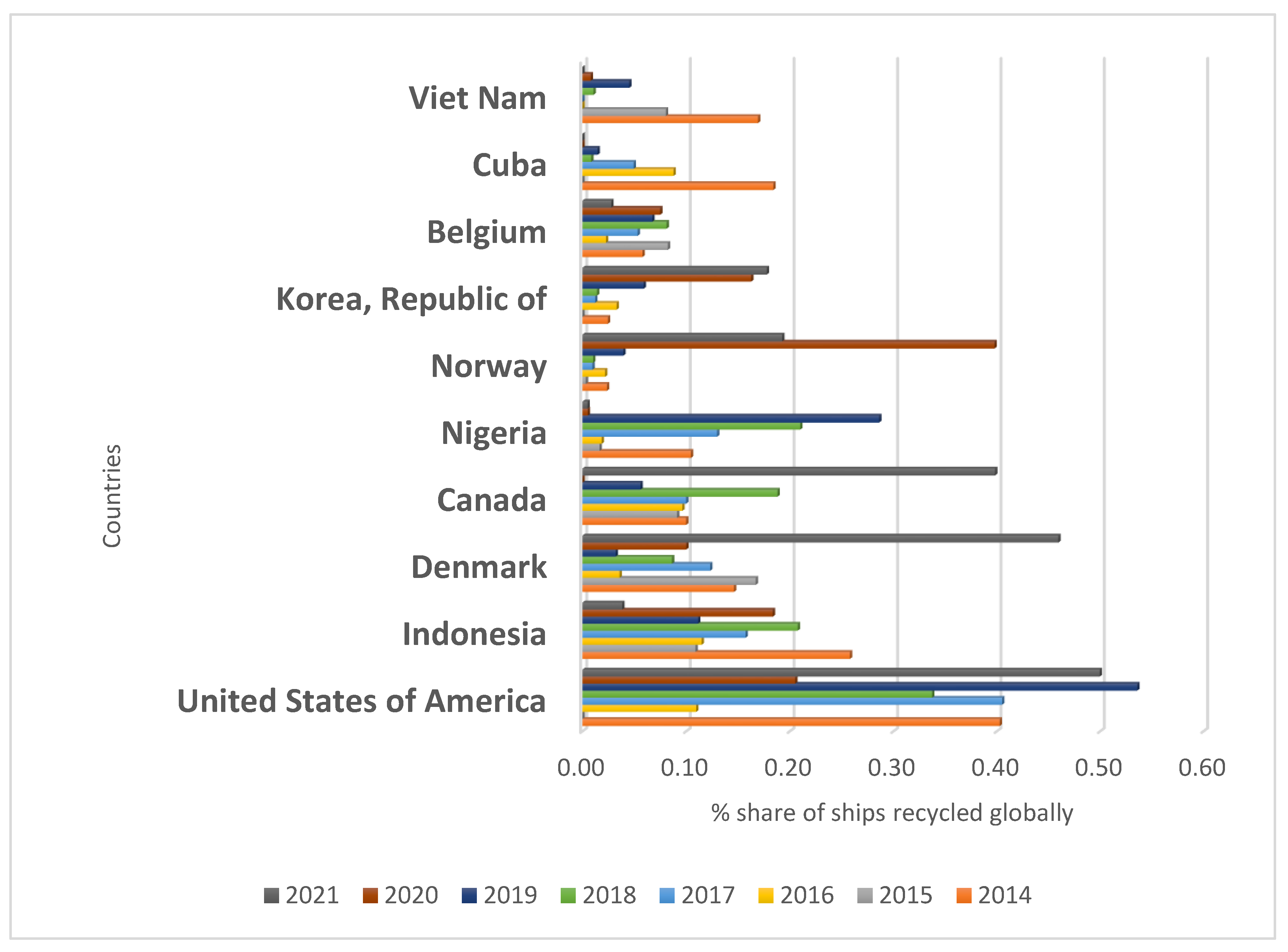
Figure 2.
Multi-level socio-technical safety control structure for ship recycling (adapted from Rasmussen, 1997).
Figure 2.
Multi-level socio-technical safety control structure for ship recycling (adapted from Rasmussen, 1997).
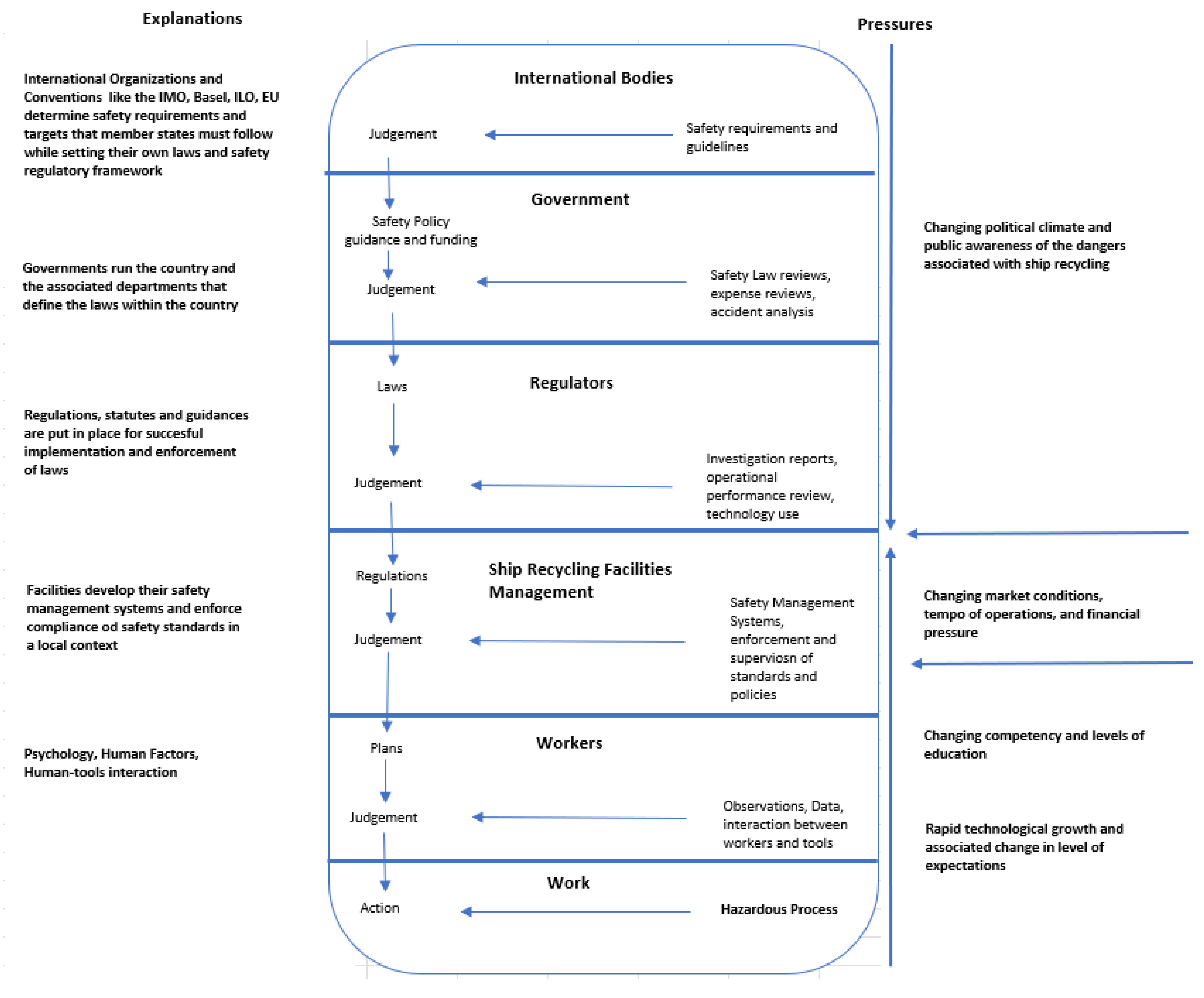
Figure 3.
Renn’s model for adaptive and integrative risk-governance cycle, showing five core functions – risk framing, interdisciplinary appraisal, evaluation of acceptability, management (monitoring and control) and communication that need to be balanced in a robust regulatory regime (adapted from Renn, [4,8]; Hale, [7]).
Figure 3.
Renn’s model for adaptive and integrative risk-governance cycle, showing five core functions – risk framing, interdisciplinary appraisal, evaluation of acceptability, management (monitoring and control) and communication that need to be balanced in a robust regulatory regime (adapted from Renn, [4,8]; Hale, [7]).
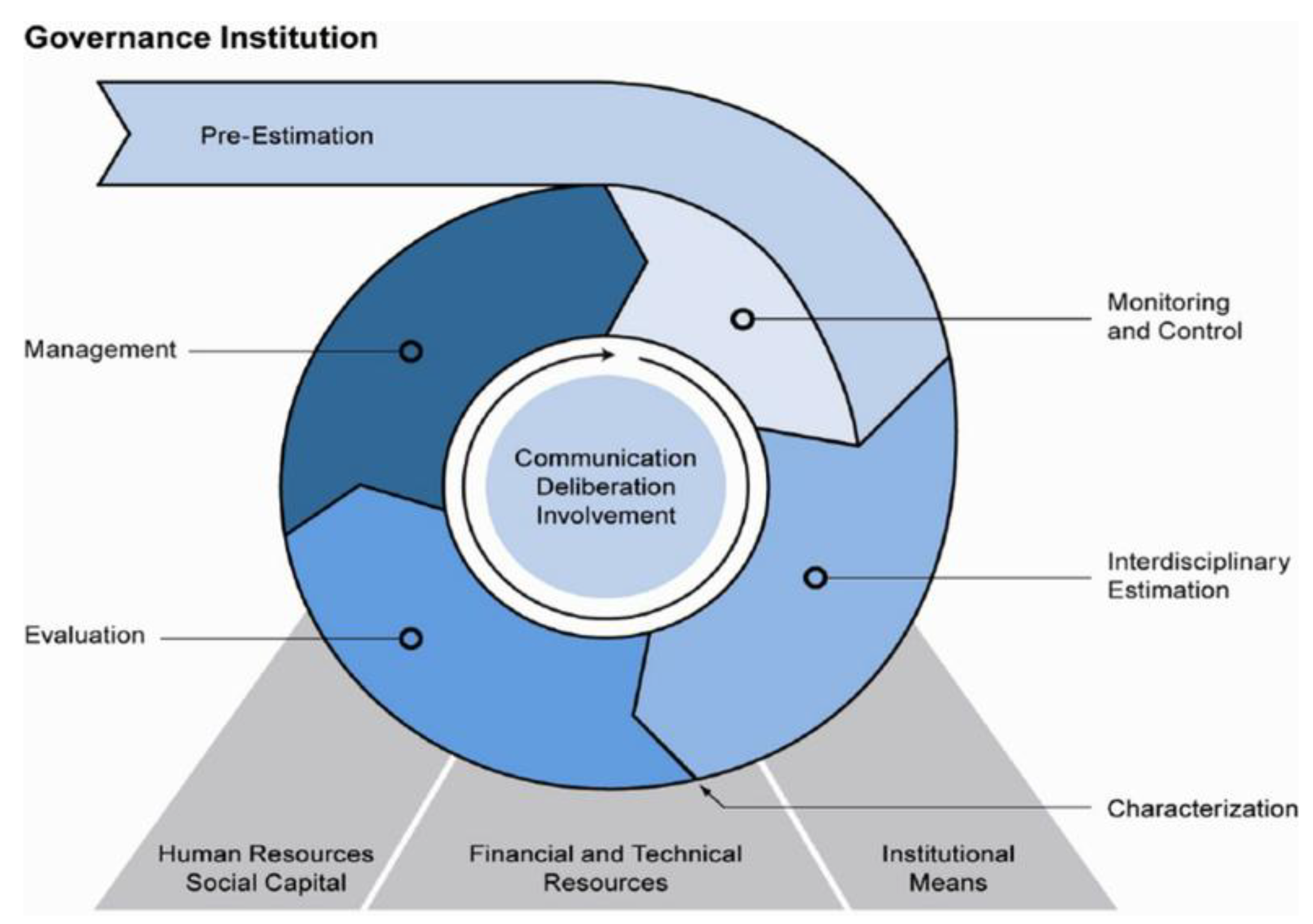
Figure 4.
Performance trajectories under resilience versus robustness following a disruptive event. A resilience-based system absorbs the shock and recovers over time (the dip-and-recovery curve), whereas a robust system maintains core performance with little or no degradation ("withstanding without breaking"). The difference between the two trajectories reflects the system's agility, with continual improvement of internal capabilities as the long-term goal.
Figure 4.
Performance trajectories under resilience versus robustness following a disruptive event. A resilience-based system absorbs the shock and recovers over time (the dip-and-recovery curve), whereas a robust system maintains core performance with little or no degradation ("withstanding without breaking"). The difference between the two trajectories reflects the system's agility, with continual improvement of internal capabilities as the long-term goal.
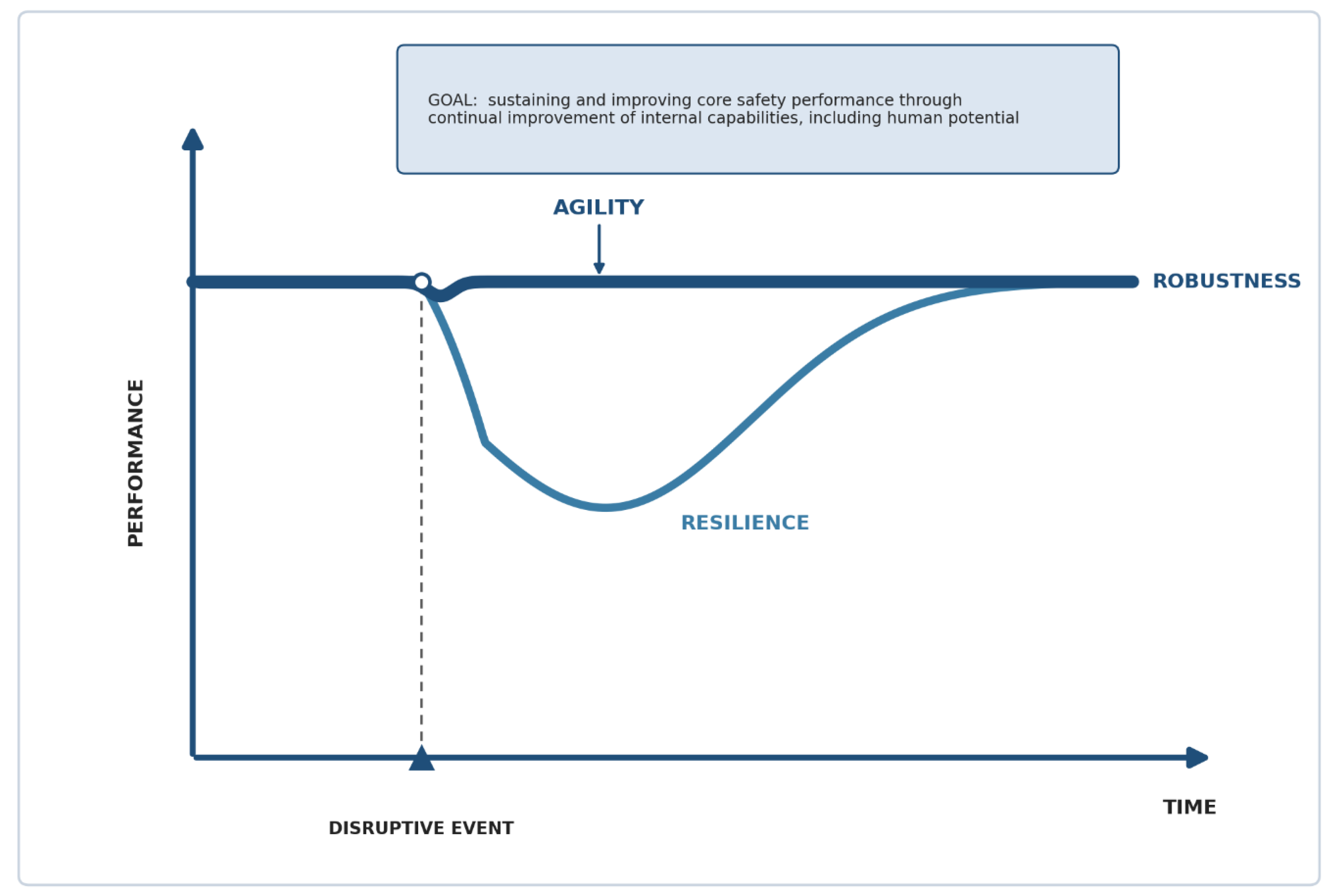
Figure 5.
Locations of the ship-breaking yards visited.
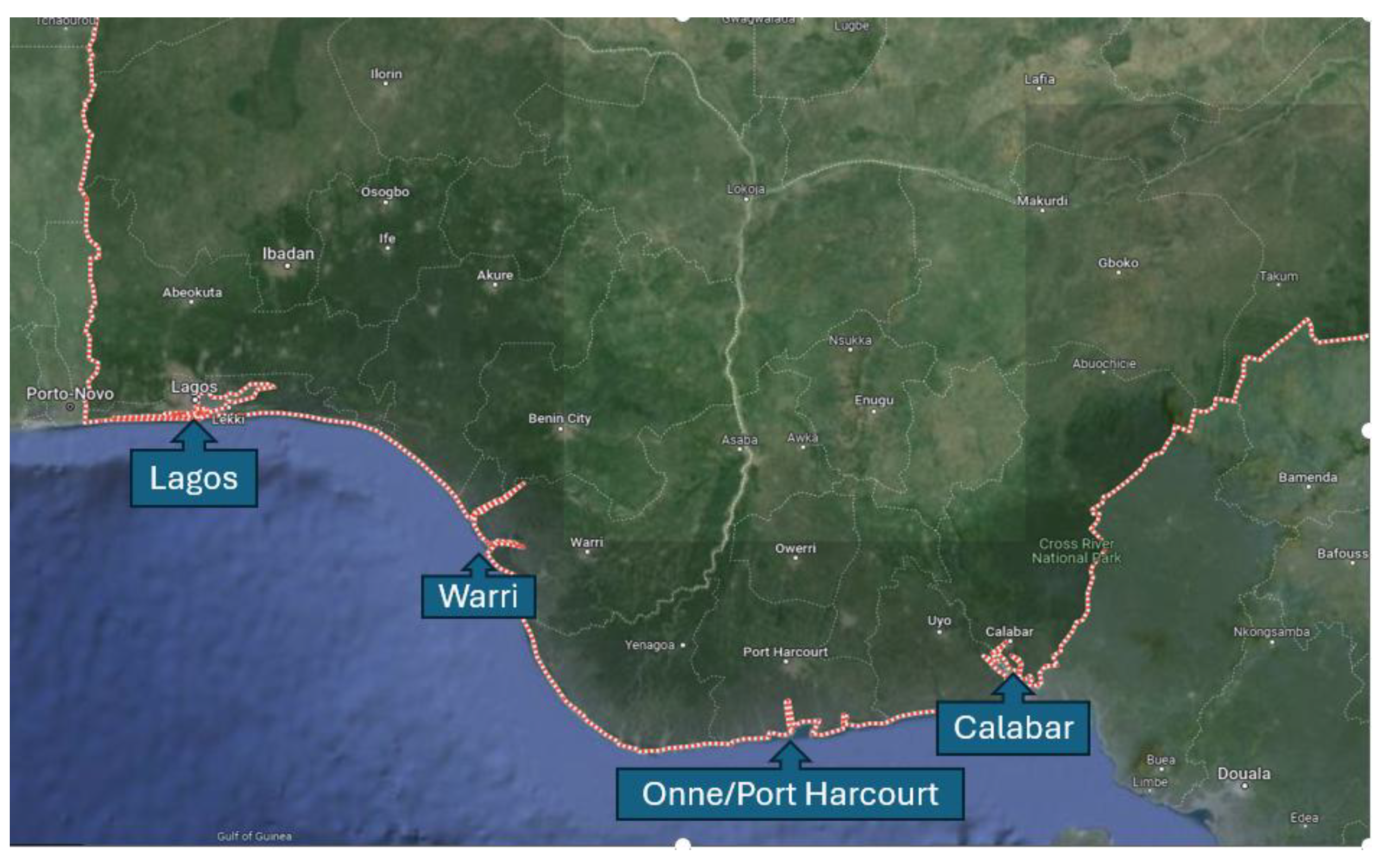
Figure 6.
Measured shoreline of over 450 m used in dismantling ships in Calabar.
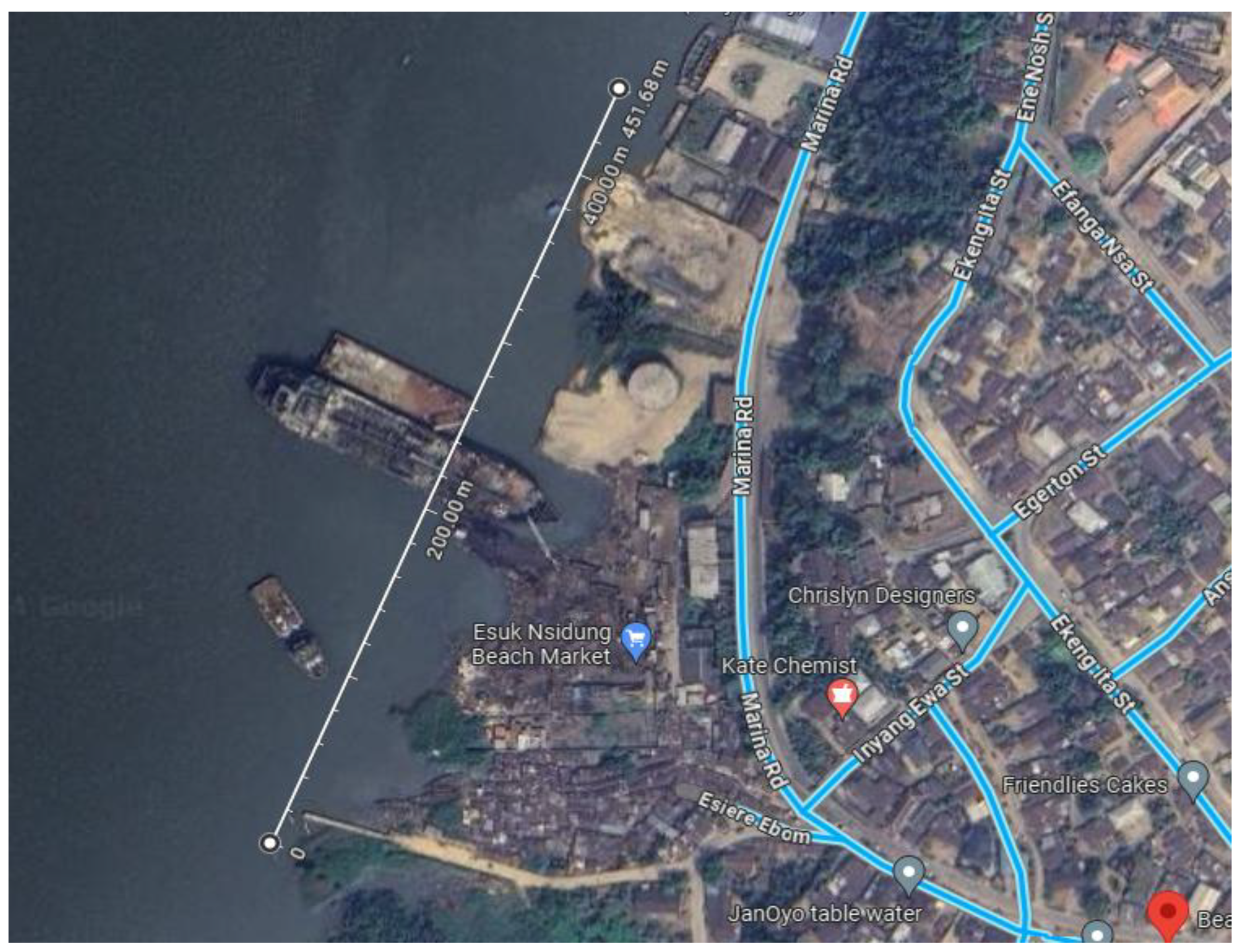
Figure 7.
Measured shoreline of over 700 m used to dismantle ships in Warri.
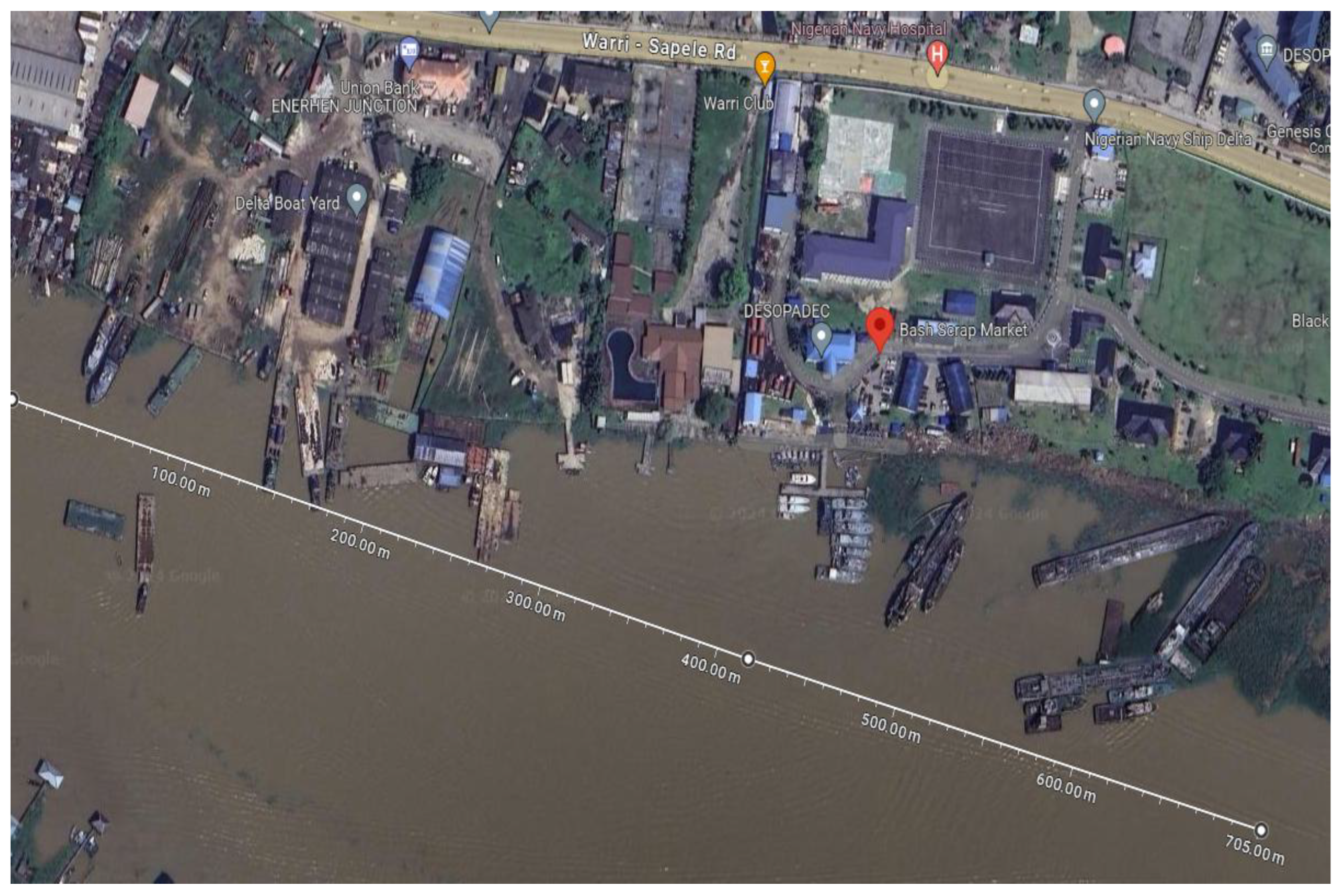
Figure 8.
The corroding remains of an abandoned ship stranded on the coastline in Lagos.
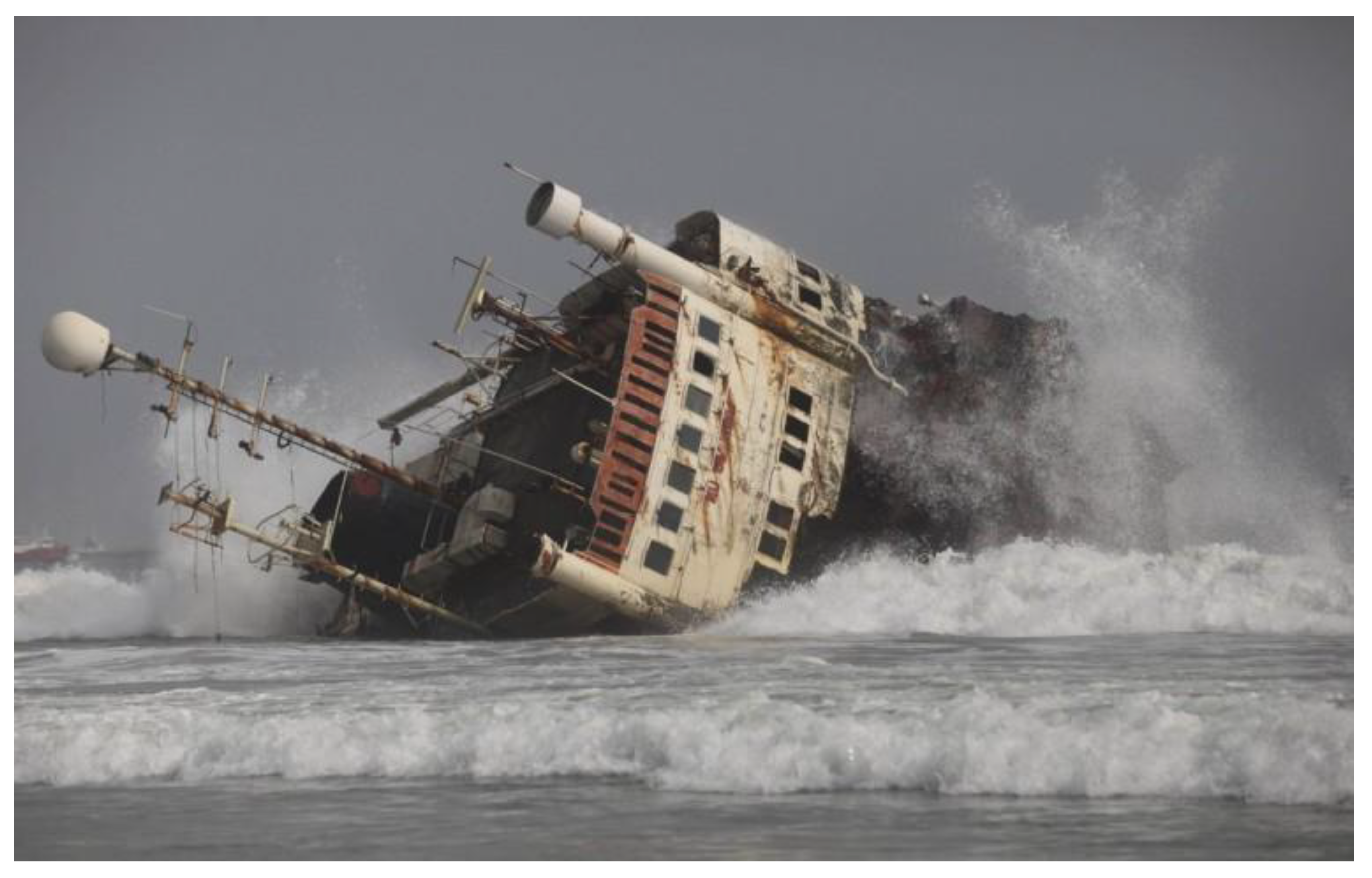
Figure 9.
An oil tanker brought in to be recycled in Calabar.
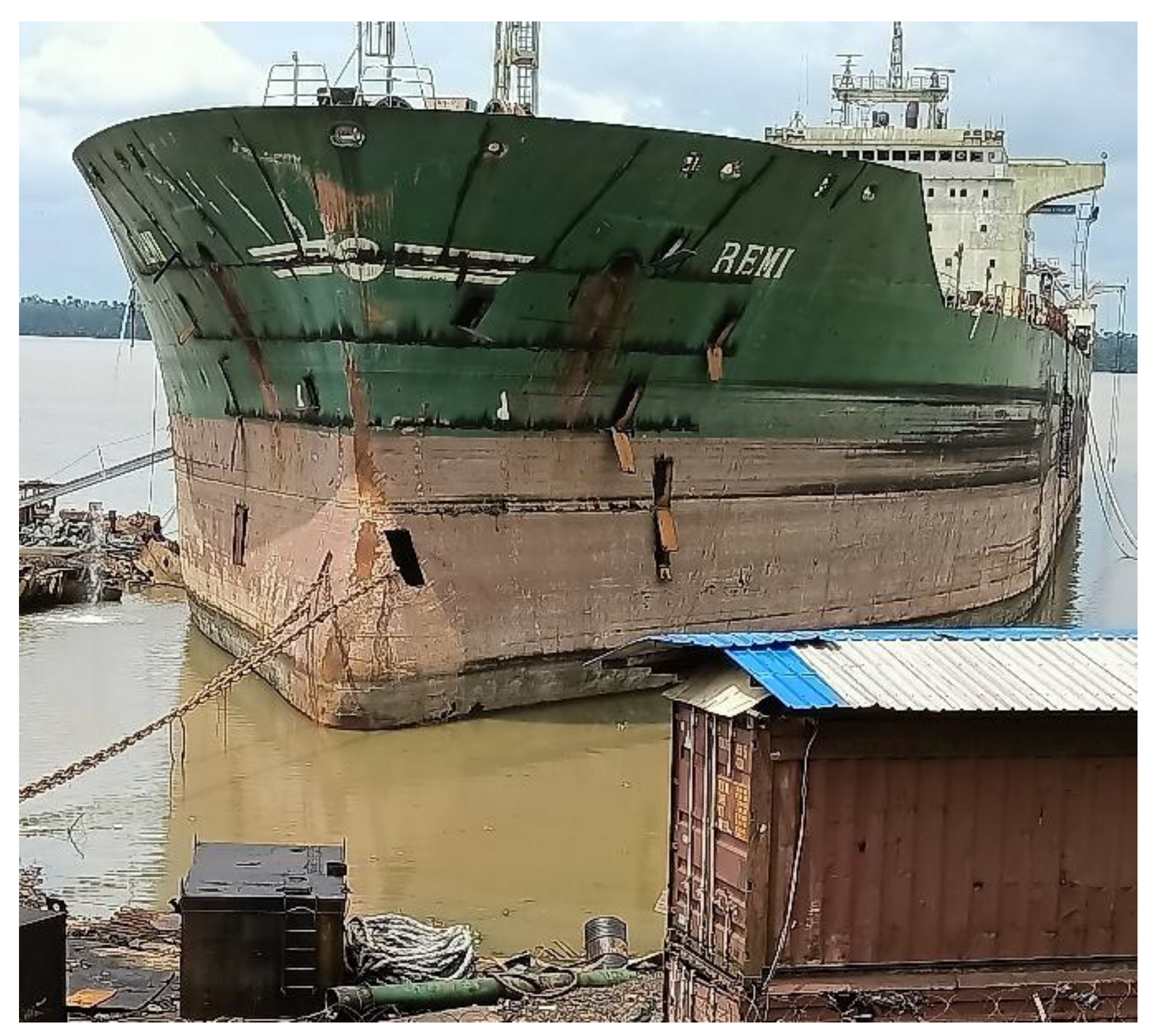
Figure 10.
Heap of waste after ‘useful’ scrap has been segregated.
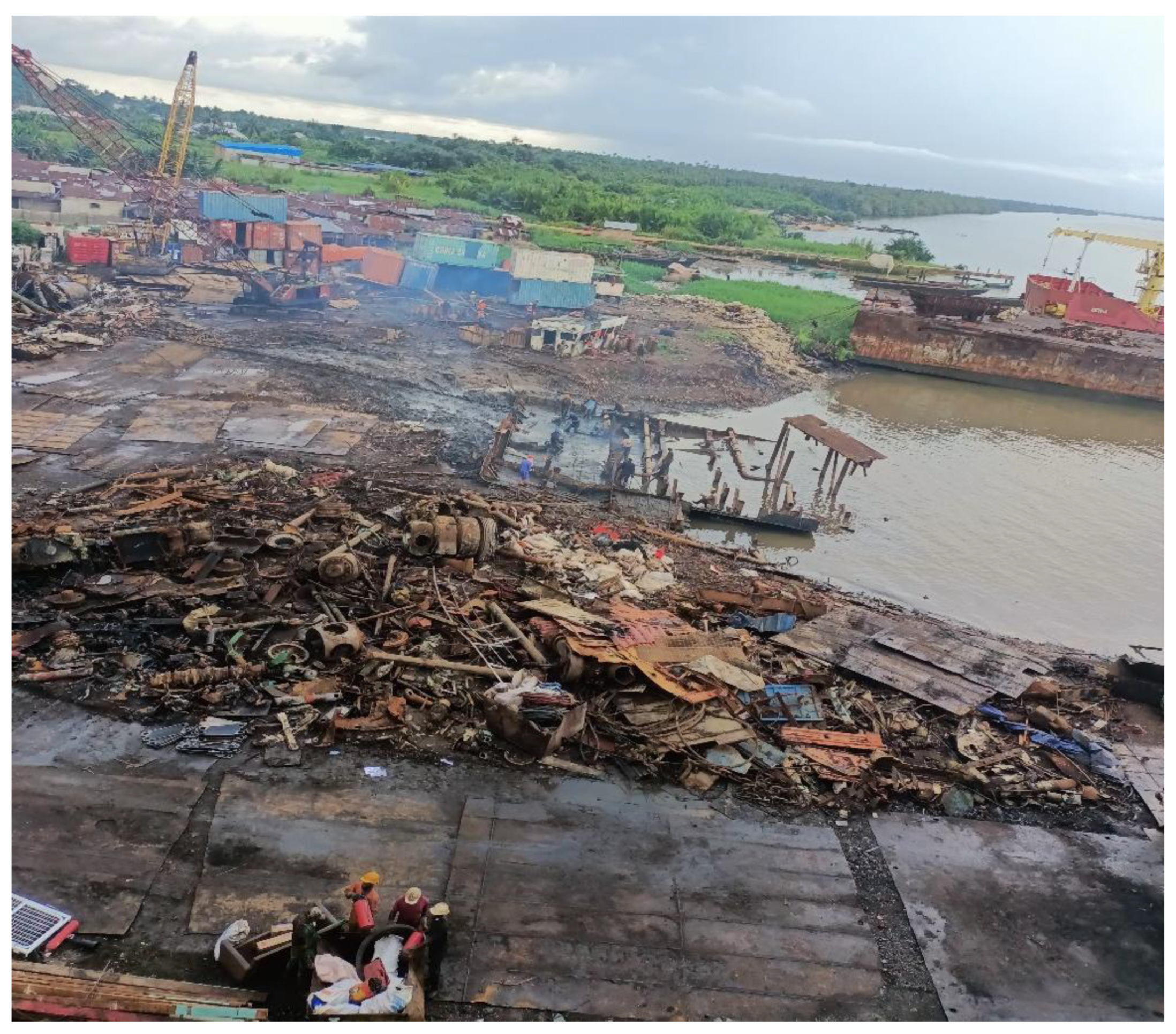
Figure 11.
Traders scavenge leftover materials from the ship-breaking process in the local beach market.
Figure 11.
Traders scavenge leftover materials from the ship-breaking process in the local beach market.
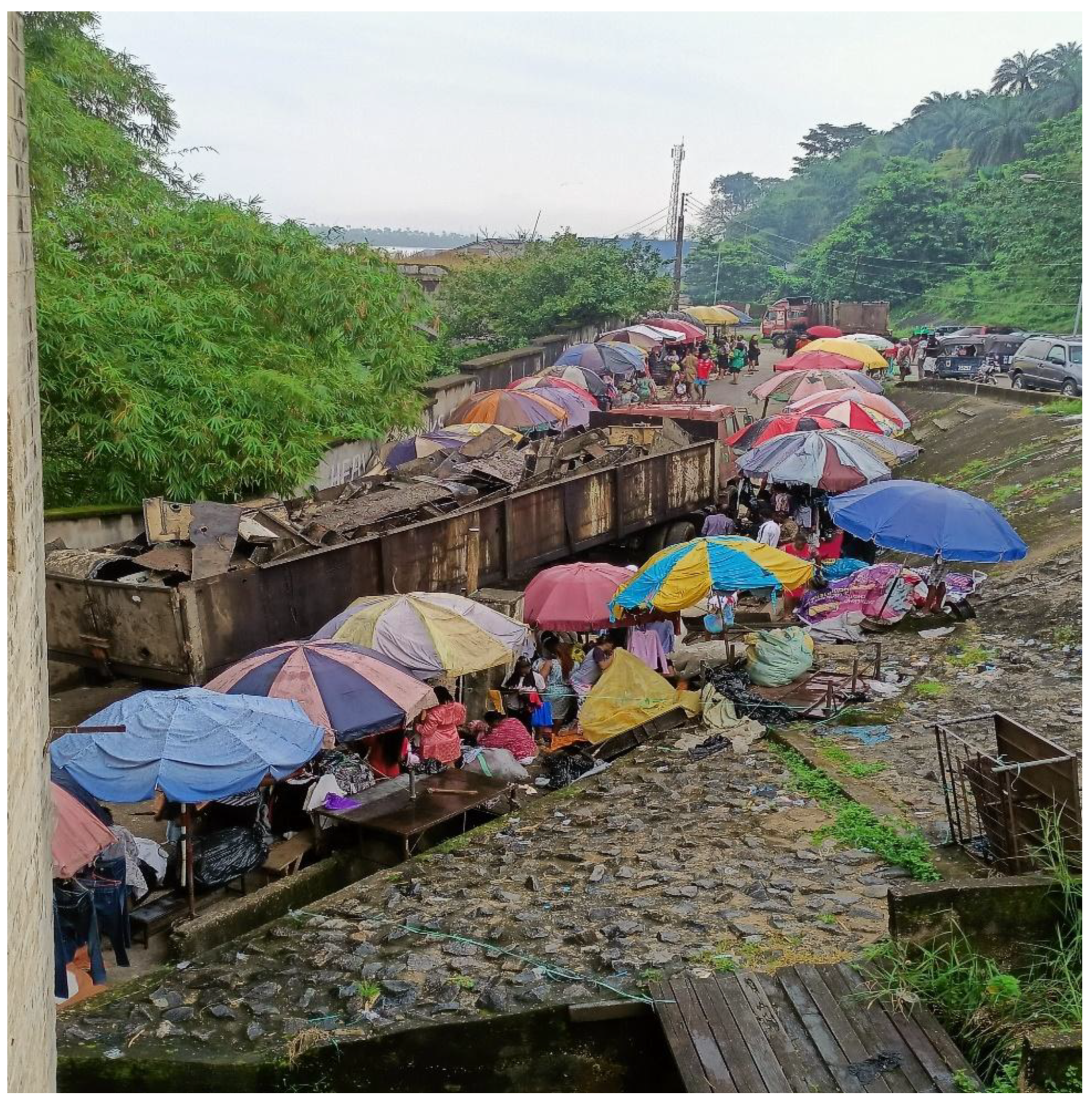
Figure 12.
Small rocks and stones generated from steel cutting used to fill yard floors and reclaim swamps.
Figure 12.
Small rocks and stones generated from steel cutting used to fill yard floors and reclaim swamps.
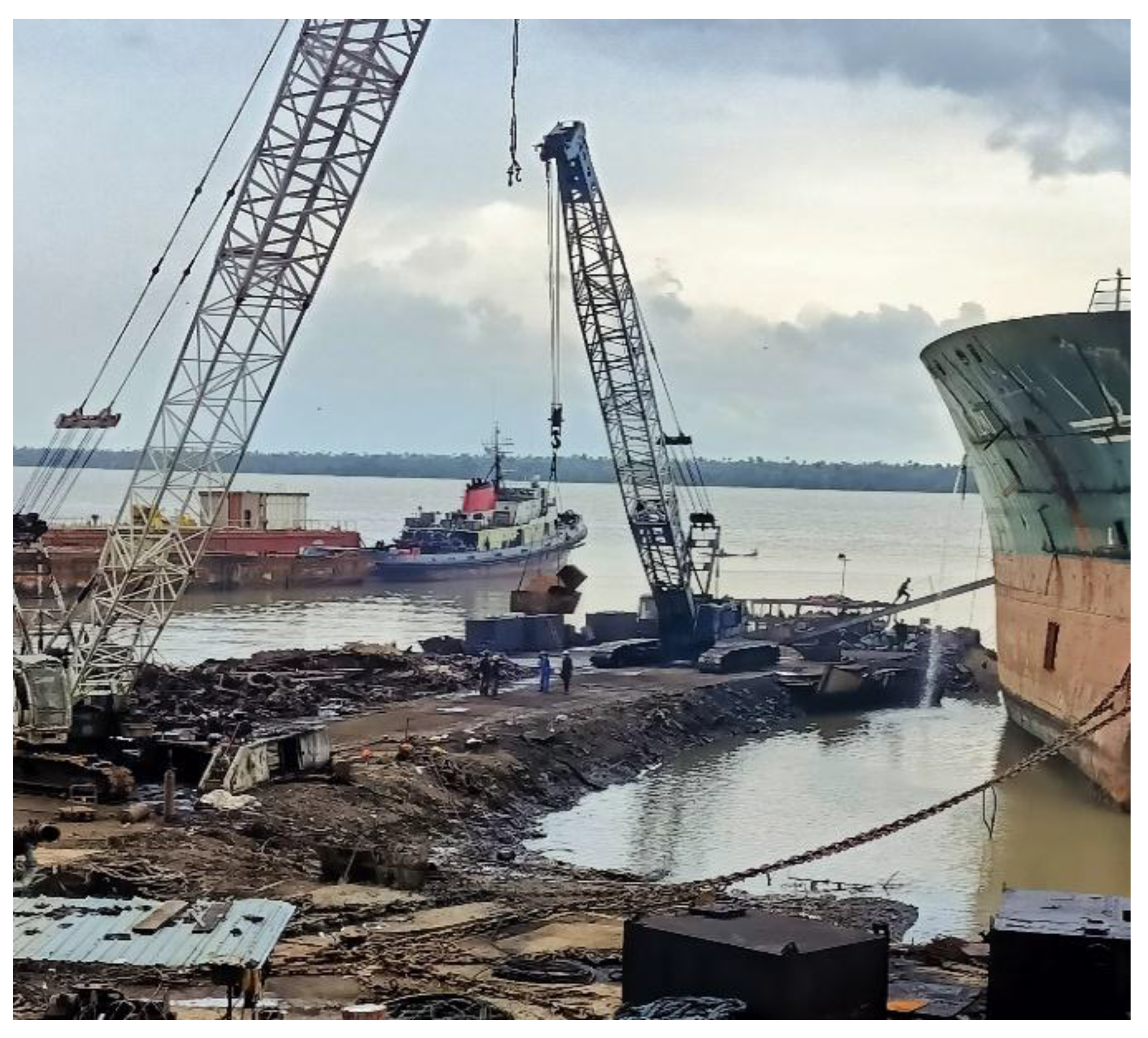
Figure 13.
The proposed Robustness-Focused Risk-Governance Framework for Nigeria’s ship recycling sector.
Figure 13.
The proposed Robustness-Focused Risk-Governance Framework for Nigeria’s ship recycling sector.
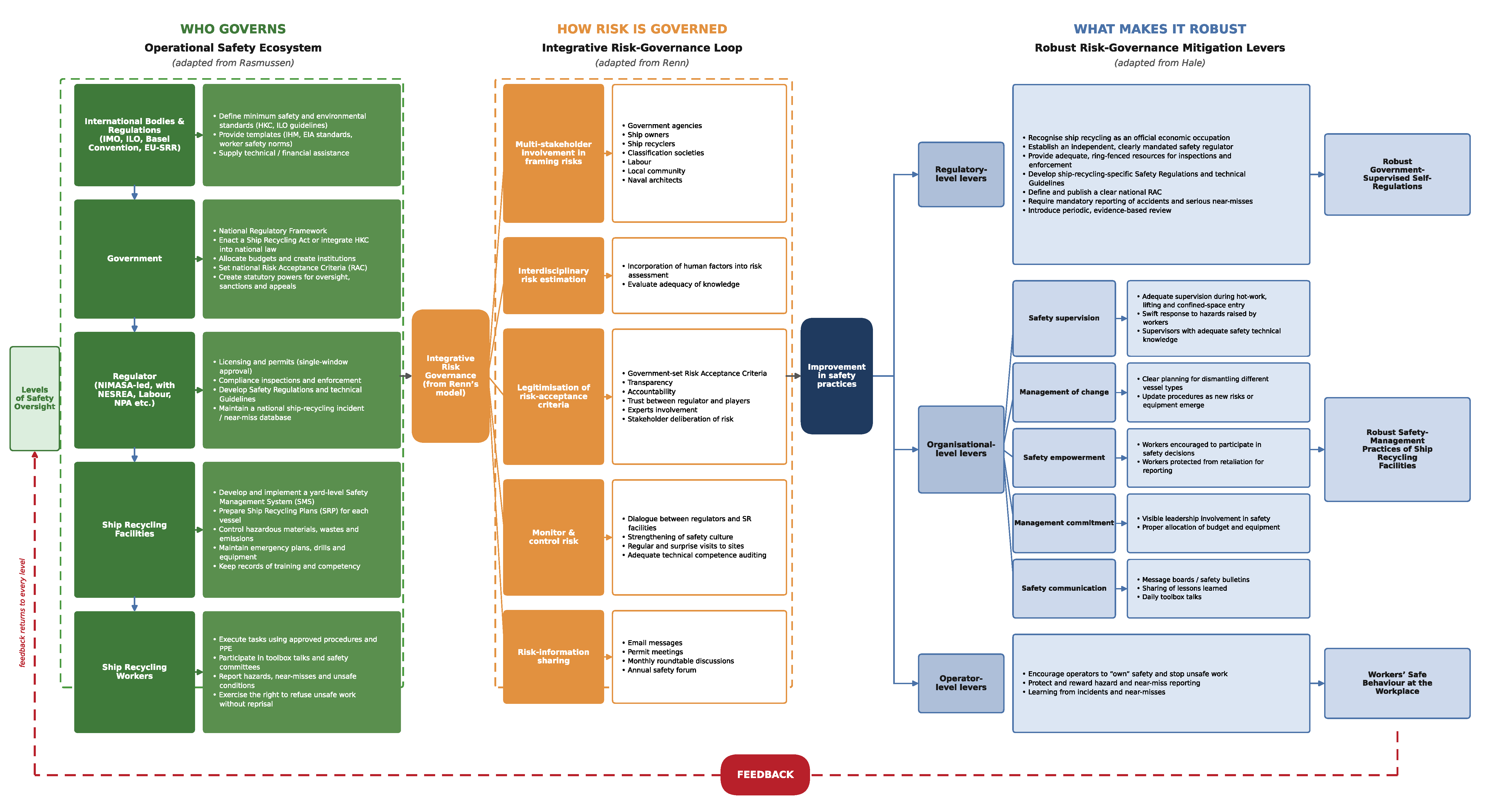
Table 1.
Comparative characteristics of regulatory regimes.
| Regulatory focus | Prescriptive regulation | System-based regulation | Performance-based regulation |
| Compliance basis | Detailed adherence to specified actions | Demonstration of effective management systems | Achievement of defined outcomes |
| Nature of rules | Technical, detailed requirements | Process-oriented standards | Goal- or results-oriented standards |
| Example sectors | US environmental regulation | Food safety, nuclear safety | EU air/water quality, energy efficiency |
Table 2.
Criteria used to evaluate robustness of Nigeria’s ship recycling safety regulatory regime (adapted from Hale and Renn).
Table 2.
Criteria used to evaluate robustness of Nigeria’s ship recycling safety regulatory regime (adapted from Hale and Renn).
| Criterion | Key Elements Assessed | Source(s) |
| Legislative and Administrative Framework |
|
Safety and health in shipbreaking: Guidelines for Asian countries and Turkey, International Labour Office, 2004 IMO GUIDELINES FOR SAFE AND ENVIRONMENTALLY SOUND SHIP RECYCLING. ANNEX 4 RESOLUTION MEPC.210(63), International Maritime Organization, 2012 |
| Integrative Risk Governance |
|
Risk Governance and Resilience: New Approaches to Cope with Uncertainty and Ambiguity, [36] |
| Sustainability of Regulatory Functions | Assessment of the sustainability of the regime's functionality over time | Advancing robust regulation: Reflections and lessons to be learned, [7] A conceptual framework for analysing adaptive capacity and multi-level learning processes in resource governance regimes, [37] |
| Regulatory Adaptability to Changed Circumstances | Assessment of how regulations are regularly reviewed to address:
|
Advancing robust regulation: Reflections and lessons to be learned, [7] |
| Continuous Improvement | Assessment of
|
Safety and health in shipbreaking: Guidelines for Asian countries and Turkey, International Labour Office, 2004 [25] IMO GUIDELINES FOR SAFE AND ENVIRONMENTALLY SOUND SHIP RECYCLING. ANNEX 4 RESOLUTION MEPC.210(63), International Maritime Organization, 2012 [20] Development of best practices for ship recycling processes [38] |
| Worker Training and Competency | Evaluation of worker training programs and verification of competency | IMO INTERNATIONAL CONVENTION FOR THE SAFE AND ENVIRONMENTALLY SOUND RECYCLING OF SHIPS. MEPC 58/23 [20] A study on evaluating the status of current occupational training in the ship recycling industry in Bangladesh, [39] |
Table 3.
Nigerian statutory and regulatory instruments relevant to ship recycling safety.
| Instrument | Scope / Relevance | Limitations |
| Factories Act (2004) | General OHS requirements, lifting equipment rules | Not tailored to ship-breaking; weak enforcement |
| Labour Act (2004) | Employment conditions, worker protection | Limited application to informal labour force |
| Environmental Protection Act (1994) | Pollution control, waste management | No ship recycling-specific provisions |
| NIMASA Act (2007) | Maritime safety, regulatory powers | No explicit mandate for ship recycling coordination |
| NIMASA Ship Scrapping Facility Permit Guidelines | Permit requirements for recycling facilities | Weak implementation; no performance-based audits |
| Employees Compensation Act (2010) | Compensation for work-related injuries | Limited applicability in informal settings |
| Lifting and Allied Work Equipment (Safety) Regulations (2018) | Equipment inspection and safe use | Not enforced at ship breaking sites |
Table 5.
Mapping of identified robustness gaps (Table 4) to elements of the proposed framework.
Table 5.
Mapping of identified robustness gaps (Table 4) to elements of the proposed framework.
| Robustness dimension (Table 4) | Principal gap identified | Framework response | Pillar |
| I. Scope of regulatory properties | No legal recognition of ship recycling; fragmented division of authority; permits administrative rather than performance-based | Ship Recycling Act aligned with the HKC; unified regulatory authority or inter-agency taskforce; licensing and safety certification of facilities | 1, 3 |
| II. Integrative risk governance | No multi-actor risk framing, no human and organisational factors in assessment, no transparent risk-acceptance criteria, no stakeholder deliberation | Institutionalised five-step governance cycle: mandatory inclusive framing; interdisciplinary assessment involving naval architects and classification societies; government-issued national RAC; publication of inspection findings | 2 |
| III. Sustainability of regulatory functions | No assurance of institutional capacity, stable funding, or continuity | Statutorily mandated and ring-fenced resourcing of the oversight body; professionalised, adequately staffed inspectorates | 1, 3 |
| IV. Regulatory adaptability | Only limited capacity to absorb emerging risks, new technologies, and evolving international standards | Mandatory periodic regulatory review; structured alignment with HKC, ILO, and EU SRR benchmarks | 2, 3 |
| V. Continuous improvement | No mechanisms for incident data collection, investigation, or institutional learning | National incident and near-miss database; annual safety reports; regular safety dialogues between regulators, yards, and communities | 2 |
| VI. Worker training and competency | Training requirements only weakly present; no competency assessment or certification | National ship recycling safety curriculum; certification of cutters, riggers, and rescue teams; legal right to refuse unsafe work | 3 |
Disclaimer/Publisher’s Note: The statements, opinions and data contained in all publications are solely those of the individual author(s) and contributor(s) and not of MDPI and/or the editor(s). MDPI and/or the editor(s) disclaim responsibility for any injury to people or property resulting from any ideas, methods, instructions or products referred to in the content. |
© 2026 by the authors. Licensee MDPI, Basel, Switzerland. This article is an open access article distributed under the terms and conditions of the Creative Commons Attribution (CC BY) license (http://creativecommons.org/licenses/by/4.0/).
Copyright: This open access article is published under a Creative Commons CC BY 4.0 license, which permit the free download, distribution, and reuse, provided that the author and preprint are cited in any reuse.