

Submitted:
22 June 2026
Posted:
23 June 2026
You are already at the latest version
Abstract
The electrocatalytic reduction of CO2 (CO2RR) into value-added chemicals represents a promising strategy for achieving carbon-neutral energy conversion. However, it is fundamentally limited by sluggish reaction kinetics, insufficient product selectivity, and the competitive hydrogen evolution reaction (HER). Herein, density functional theory (DFT) calculations were employed to systematically investigate transition-metal single-atom catalysts anchored on boron and nitrogen co-doped graphene (TM@BNG), with the aim of elucidating the role of heteroatom-induced coordination engineering in modulating catalytic performance. The results demonstrate that B, N co-doping effectively tailors the electronic structure of the metal active sites, thereby optimizing the adsorption energetics of key intermediates and dictating the reaction pathways. Among the 27 candidates examined, Pd@BNG, Ag@BNG, Sc@BNG, Cu@BNG, Co@BNG, Cd@BNG, and Y@BNG exhibit superior catalytic activity and selectivity toward CO or HCOOH production, featuring low limiting potentials down to −0.06 V while simultaneously suppressing HER. Mechanistic analysis reveals that product selectivity is governed by the relative stabilization of *COOH and *HCOO intermediates during the initial proton-coupled electron transfer step. Furthermore, a physically interpretable descriptor (φ), constructed via machine-learning approaches based on intrinsic electronic properties, establishes a volcano-type correlation with the limiting potential, thereby enabling quantitative prediction of catalytic activity. Collectively, these findings elucidate the electronic-structure modulation of single-atom catalysts and establish a generalizable framework for the rational design of high-performance CO2RR electrocatalysts.
Keywords:
CO2 electroreduction
; single-atom catalysts
; density functional theory
; machine learning
1. Introduction
Excessive consumption of fossil fuels has led to a rapid increase in atmospheric CO2 concentration, thereby intensifying global climate change. In this context, the electrocatalytic carbon dioxide reduction reaction (CO2RR) has attracted extensive attention as a sustainable technology for converting CO2 into value-added chemicals[1]. However, the high thermodynamic stability of the C=O bonds in CO2 imposes substantial energy barriers on its chemical conversion, leading to sluggish CO2 reduction kinetics. In addition, competition among multiple possible products, together with interference from the hydrogen evolution reaction (HER), gives rise to major challenges, including poor product selectivity and low Faradaic efficiency (FE) [1,2]. In recent years, metal-based materials, including pure metals, alloys, and metal oxides, have been widely investigated in CO2RR catalytic systems and have served as key catalysts for improving reaction performance. Although notable progress has been achieved, conventional metal-based catalysts still suffer from relatively high overpotentials, which not only lower energy utilization efficiency but also promote particle aggregation during the reaction, thereby compromising catalyst stability [45]. Therefore, the development of new high-efficiency CO2RR catalytic materials remains of great significance.
Single-atom catalysts (SACs) have shown remarkable advantages in electrocatalysis, particularly in CO2RR, owing to their exceptionally high atomic utilization efficiency and precisely tunable active-site configurations. The catalytic activity and product selectivity of SACs are governed primarily by the type of metal center and its coordination environment. Accordingly, catalytic performance can be effectively regulated through rational design of the coordination structure. In recent years, N-doped graphene and its derivatives have emerged as ideal supports for SACs because they provide abundant coordination sites for firmly anchoring isolated metal atoms, while also offering high specific surface area, excellent electrical conductivity, and outstanding chemical stability [4,10].
Significant progress has recently been made in CO2RR studies based on such systems. For example, the five-coordinated Fe-N5/C catalyst prepared by Wang et al. [7] exhibited outstanding performance in regulating syngas composition. Through theoretical calculations, Yang et al. [48] revealed the critical role of spin polarization in determining the selectivity of M-N4@Gr structures and found that Ni-N4@Gr shows high selectivity toward HCOOH. Bai et al. [49] proposed a strategy that simultaneously regulates the central metal, axial coordination, and nonmetal coordination environment, successfully breaking the scaling relationships of carbon-based intermediates in CO2RR. The screened systems, such as Ti-N4-B and Ru-C2NO-C, reduced the required applied voltage by 45%–71% relative to the current state-of-the-art level. Nevertheless, despite the great potential demonstrated by N-doped SACs, most existing studies remain limited to single planar coordination structures, such as M-N3, M-N4, and M-N5. This limitation often results in insufficient control over the adsorption strength of key intermediates, such as COOH and OCHO, making it difficult to balance CO2 activation with the synergistic optimization of multistep reaction intermediates. As a result, further improvement in catalytic performance remains restricted. Therefore, developing synergistic regulation strategies beyond the traditional single-coordination mode is essential for the design of a new generation of highly efficient CO2RR catalysts.
To address these limitations, heteroatom doping has provided a new route for optimizing CO2RR catalyst performance [50]. Previous studies have shown that the introduction of heteroatoms such as nitrogen (N) and boron (B) can regulate the adsorption behavior of key intermediates by modifying the local electronic structure and surface chemical environment of the catalyst, thereby affecting CO2RR activity and selectivity. Specifically, N doping can alter the coordination environment and electronic distribution of single-atom active centers, thereby tuning product selectivity [48]. In contrast, B doping can optimize the adsorption behavior of CO2 and its intermediates by changing the charge distribution and electronic structure around the metal sites, thus enhancing catalytic activity and stability [51]. In related work, Yan et al. [53] prepared an asymmetric Ni-N3-B catalyst supported on B, N-codoped carbon (Ni-SACs@BNC) by calcination, using Ni-SACs@NC with a symmetric Ni-N4 structure as the reference. The results showed that, under visible-light irradiation, the catalyst achieved a CO production rate of 37.1 μmol/h with a selectivity of 93.2% and operated stably for 24 h. Experimental characterization and DFT calculations further demonstrated that B doping broke the charge symmetry of the Ni center, enhanced electron-capturing capability, and shifted the d-band center upward, thereby strengthening CO2 adsorption and lowering the energy barrier for *COOH formation. Liu et al. [52] constructed an Fe single-atom catalyst supported on B, N-codoped carbon and applied it to the electrocatalytic reduction of CO2. Their study showed that the introduction of B regulated the coordination environment and electronic structure of the Fe active site, which enhanced CO2RR activity while suppressing the competing HER. Overall, N doping, B doping, and B,N co-doped supports can effectively regulate the electronic structure of single-atom sites and the adsorption behavior of intermediates, further indicating that B, N-codoped graphene is a suitable support for SACs in CO2RR.
Inspired by these studies, this work uses transition-metal single atoms supported on B, N -codoped graphene (TM@BNG) as a model system and systematically screens the CO2RR catalytic performance of different transition-metal active site. Based on density functional theory (DFT) calculations, the free-energy evolution and reaction-path characteristics of a series of systems during CO2 reduction are analyzed in detail. Active sites including Pd, Ag, Sc, Cu, Co, Cd, and Y are identified and confirmed to exhibit excellent activity and selectivity toward the formation of HCOOH or CO. Furthermore, the key descriptor φ is extracted from intrinsic material parameters using the GBR algorithm and the SISSO method, and a volcano-type relationship between φ and the limiting potential (UL) is revealed. These results clarify the regulatory role of the electronic structure of metal active sites in catalytic performance and provide a theoretical reference for the design of highly efficient CO2RR catalysts.
2. Computational Details
All spin-polarized DFT calculations in this study were performed using the Vienna Ab initio Simulation Package (VASP) [1,11]. The exchange-correlation energy was described by the Perdew-Burke-Ernzerhof (PBE) functional within the generalized gradient approximation (GGA) framework [12], and the plane-wave cutoff energy was set to 450 eV. During structural optimization, a 3×3×1 Monkhorst-Pack k-point mesh was adopted, whereas a denser 9×9×1 k-point mesh was used for electronic structure calculations to ensure computational accuracy [13]. The convergence thresholds for energy and force were set to 1×10⁻⁵ eV and 0.05 eV/Å, respectively. Van der Waals interactions were corrected using the DFT-D3 method [14], and solvent effects were described by an implicit solvation model implemented in the VASPsol program [15,16,17], with the dielectric constant set to 78.4. Bader charge analysis was carried out using the tools developed by the Henkelman group. To eliminate interference from interlayer interactions, a vacuum layer of 20 Å was introduced along the z direction. To evaluate the thermal stability of the catalysts, ab initio molecular dynamics (AIMD) simulations were performed at 400 K using the Nosé-Hoover thermostat, with a time step of 2.0 fs and a total simulation time of 10 ps [18].
The Gibbs free energy change (ΔG) of each elementary step in CO2RR was calculated according to the following equation[22]:
where ΔE represents the energy difference between the products and reactants. ZPE and ΔS denote the zero-point energy correction and entropy change at room temperature (T = 298.15 K), respectively. ΔGU = -neU, where n is the number of transferred electrons and U is the electrode potential. ΔGpH = kBT × ln10 × pH, where kB is the Boltzmann constant. In this work, the pH was set to 0 to simulate an acidic environment.
ΔG = ΔE + ΔZPE – TΔS + ΔGU + ΔGpH
The limiting potential of CO2RR was calculated using the following equation:
where ΔGPDS is the Gibbs free-energy change of the potential-determining step (PDS) in CO2RR.
UL = -ΔGPDS/e
3. Results and Discussion
3.1. Structure and Stability of TM@BNG
The geometric configurations of the SAC models constructed in this study are shown in Figure 1. Because Sc, Ti, V, Cr, Mn, Fe, Co, Ni, Cu, Zn, Y, Zr, Nb, Mo, Ru, Rh, Pd, Ag, Cd, Hf, Ta, W, Re, Os, Ir, Pt, and Au have been widely investigated in the design of CO2RR catalysts, these 27 metal atoms were selected as candidate active sites. Structural optimization showed that all systems retained a planar configuration after relaxation, and the optimized structures are presented in Fig.S1. To evaluate catalyst stability, both thermodynamic stability and electrochemical stability were considered in this study, and the formation energy (Ef) [20] and dissolution potential (Udiss) [20] were accordingly calculated.
where Ecatalyst is the total energy of the catalyst system, ETM-bulk is the energy of a single metal atom in the bulk metal, EBNG is the energy of the substrate after removal of the metal atom, U0diss(metal, bulk) is the standard dissolution potential of the bulk metal, and n is the number of electrons transferred in the dissolution reaction [21].
Ef = (Ecatalyst − ETM-bulk − EBNG)
Udiss = U0diss(metal,bulk) − Ef/ne
As shown in Figure 2a all single-atom catalysts except Au-SAC exhibit negative formation energies, ranging from -8.42 to -0.13 eV, indicating favorable thermodynamic stability. Meanwhile, the dissolution potentials (Udiss) of these catalysts range from 0.21 V for Hf@BNG to 1.57 V for Rh@BNG, suggesting high structural stability under electrochemical conditions. Therefore, 26 SACs that are stable under both thermodynamic and electrochemical conditions were selected for subsequent evaluation of catalytic performance. Taking Cu@BNG as a representative example, the total density of states analysis (Figure 2band) shows a pronounced distribution of electronic states near the Fermi level, mainly contributed by the Cu 3d orbitals. This feature is favorable for electron transport and for the adsorption and activation of CO2RR intermediates. Among these 26 SACs, the bond lengths between the transition-metal atoms and N atoms range from 1.78 Å to 2.25 Å, indicating that the metal atoms can be firmly anchored on the BNG substrate. Furthermore, electron localization function analysis (Figure 2cand), again using Cu@BNG as an example, shows that the ELF values in the Cu-N bond region are concentrated in the range of 0.70-0.80, displaying clear covalent-bonding characteristics [23,24]. This result further confirms the structural stability of the TM@BNG systems from the perspective of electronic structure.
3.2. Reaction Mechanism of CO2RR on TM@BNG
As shown in Figure 3, CO2RR on the surface of SACs proceeds through a series of proton-coupled electron transfer (PCET) steps. Through different reaction pathways, this process can generate a variety of C1 products. The 2e- reduction pathway mainly yields CO and HCOOH, whereas further reduction can produce HCHO, CH3OH, and CH4, corresponding to 4e-, 6e-, and 8e- processes, respectively. At the initial stage of CO2RR, the first PCET step is particularly important because it determines the subsequent reaction route. Protonation at different atomic sites leads to distinct intermediates and thus different product selectivities. Specifically, preferential protonation at an O atom forms the *COOH intermediate, whereas protonation at the C atom generates *HCOO, thereby directing the subsequent product distribution. According to the formation of the final C1 products, the 26 SACs investigated in this work can be classified into two categories: one tends to yield only a single product, whereas the other can generate multiple reduction products. The corresponding results are summarized in Figure 4 and Figure 5.
Taking Pd@BNG as an example, the reaction mechanism responsible for its tendency to produce a single product during CO2RR was systematically analyzed. As shown in Figure 4a, after adsorption of the CO2 molecule, the *CO2 intermediate is first formed, followed by an initial hydrogenation step that can proceed through two competing pathways. The free-energy change for *HCOO formation is -0.47 eV, whereas only 0.06 eV is required for *COOH formation, indicating that both intermediates are thermodynamically accessible. In the subsequent steps, dehydration of *COOH to form *CO is spontaneous, whereas *HCOO must undergo an additional hydrogenation step to produce HCOOH, with a corresponding ΔG of 0.57 eV. Alternatively, *HCOO may be further converted into the higher-energy *OCH2O intermediate (1.21 eV), which is thermodynamically unfavorable. Notably, the desorption energy of *CO on the Pd@BNG surface is low, indicating facile release from the active site. Therefore, the conversion of *CO2 to *COOH is identified as the potential rate-controlling step for CO formation, corresponding to a limiting potential of -0.06 V. In contrast, for the HCOOH pathway, the potential-determining step is the conversion of *HCOO to HCOOH, which requires a limiting potential of -0.57 V and is thus unfavorable. As hydrogenation proceeds, the system preferentially follows the *CO → *OCH and *OCH2O → *OCH2OH pathways. Among these steps, the formation of *OCH requires overcoming a free-energy barrier of 0.18 eV, whereas the formation of *OCH2O is thermodynamically spontaneous. Subsequently, *OCH2OH undergoes dehydration to form *OCH2 (-0.20 eV). In parallel, *OCH can be further hydrogenated to generate *OCH2 and *CHOH, requiring free-energy changes o 0.21 eV and 0.70 eV, respectively. Here, *OCH2 corresponds to the adsorbed state of formaldehyde, and its desorption requires only 0.20 eV. During further hydrogenation, *OCH2 can spontaneously transform into *OCH3 and *CH2OH, whereas *CHOH preferentially converts into *CH2OH (-0.69 eV) rather than following the higher-energy *CH pathway (1.06 eV). For the 6e- product CH3OH, formation is thermodynamically favorable through either hydrogenation of *OCH3 (-0.35 eV) or conversion of *CH2OH (-0.47 eV), and the CH3OH molecule can also desorb readily from the surface (-0.21 eV). On this basis, *CH3OH can be further converted into the 8e- product CH4 through dehydration and hydrogenation, and this process is spontaneous. It should be noted that the formation of HCHO, CH3OH, and CH4 is limited by the same rate-controlling step, namely the conversion of *OCH to *OCH2, with a limiting potential of -0.21 V. Overall, comparison of the limiting potentials for the different product pathways indicates that Pd@BNG preferentially produces CO at low applied potentials (UL = -0.06 V), whereas the formation of other competing products is suppressed. Therefore, this catalyst exhibits pronounced selectivity toward CO.
As shown in Figure 4b, the initial protonation of CO2 on the Ag@BNG surface,can generate two intermediates, namely *COOH and *HCOO. Among them, the formation of *HCOO requires only 0.09 eV, whereas *COOH formation requires 0.68 eV, indicating that *HCOO is thermodynamically more favorable at the initial stage of the reaction. Continued hydrogenation along the *HCOO pathway yields *HCOOH with a free-energy change of 0.11 eV. Therefore, the conversion of *HCOO to *HCOOH is identified as the potential-determining step (PDS) for HCOOH formation. By contrast, CO formation proceeds through the CO2 → *COOH → *CO pathway, in which the CO2 → *COOH step has a ΔG of 0.68 eV and serves as the PDS of this route. The further conversion of *HCOO to *OCH2O must overcome a free-energy barrier as high as 1.73 eV, making this pathway thermodynamically unfavorable. In the subsequent PCET steps, hydrogenation of *HCOOH to *OCH requires a free-energy input of 0.34 eV, and the resulting *OCH can then be spontaneously hydrogenated to form *OCH2, *CH2OH, and *OCH3 intermediates. Accordingly, the formation of both HCHO and CH3OH is limited by the *HCOOH → *OCH step, with a ΔG of 0.34 eV for each pathway. For the 8e- product CH4, the optimal reaction pathway is CO2 → *HCOO → *HCOOH → *OCH → *OCH2 → *CH2OH → *CH2 → *CH3 → CH4, in which the conversion of *CH2OH to *CH2 is the PDS, corresponding to a ΔG of 0.58 eV. Notably, product desorption on the Ag@BNG surface involves relatively low free-energy changes (ΔG < 0.70 eV) and therefore does not impose additional limitations on the reaction. Overall, the energetic features of the different pathways indicate that HCOOH formation is favored under lower free-energy conditions, making HCOOH the major reduction product on Ag@BNG.
As shown in Figure 4c after CO2 is adsorbed on the Os@BNG surface to form the *CO2 intermediate, it can spontaneously convert into *COOH and *HCOO, with ΔG values of -0.13 eV and -0.36 eV, respectively. Along the *COOH pathway, the subsequent formation of *CO is also thermodynamically favorable, giving the sequence CO2 → *CO2 → *COOH → *CO. However, *CO desorption requires overcoming a high energy barrier of 2.02 eV, which makes this pathway unfavorable under practical reaction conditions. By contrast, further hydrogenation of *HCOO to *HCOOH requires a free-energy input of 0.91 eV, indicating that this step is energetically demanding within that branch. Considering the unfavorable kinetic or desorption characteristics of these two pathways, the reaction is more likely to proceed through the *OCH2O intermediate, which involves a lower energy barrier. The hydrogenation of *OCH2O to *OCH2OH is exothermic, with a ΔG of -0.26 eV, and the subsequent conversion of *OCH2OH to *OCH2 is also thermodynamically favorable, with a ΔG of -0.24 eV. In addition, the reduction of *OCH2 to *CH2OH proceeds spontaneously, with a ΔG of -0.30 eV. Further hydrogenation of *CH2OH to *CH3OH requires an energy input of 0.48 eV, after which *CH3OH can desorb readily to yield the final stable product. Throughout the overall CO2RR process, the formation of other possible products is suppressed because the corresponding pathways involve either high limiting potentials for key intermediates or large desorption energies. Overall, the free-energy profiles indicate that Os@BNG preferentially produces CH3OH at relatively low applied potentials. The potential-determining step (PDS) is the conversion of *HCOO to *OCH2O, corresponding to a limiting potential UL of -0.60 V.
As shown in Figure 4d, after adsorption on the Re@BNG surface, CO2 can form two stable initial intermediates, *COOH and *HCOO, with free-energy changes of -0.85 eV and -1.39 eV, respectively, indicating that both protonated configurations are thermodynamically favorable. Along the *COOH pathway, the subsequent formation of *CO is spontaneous. However, CO desorption from the catalyst surface requires overcoming a relatively high energy barrier of 1.85 eV, which limits the feasibility of this route under practical reaction conditions. Although the *HCOO configuration is more stable, its further hydrogenation to *HCOOH still requires a considerable energy input. Therefore, the reaction is more likely to proceed through the lower-energy *OCH2O intermediate and then enter the subsequent reduction steps. In the following PCET steps, the hydrogenation of *OCH2O to *OCH2OH is exothermic, with a ΔG of -0.41 eV, whereas the subsequent conversion of *OCH2OH to *OCH2 requires a free-energy input of 0.31 eV. As the reaction proceeds, *OCH2 can be further reduced to *CH2OH with the same energy requirement of 0.31 eV. Thereafter, *CH2OH undergoes dehydration to form *CH2, which is thermodynamically favorable, with a ΔG of -0.49 eV. The resulting *CH2 is then hydrogenated to *CH3, and the final conversion of *CH3 to CH4 requires overcoming an energy input of 0.67 eV. Because other possible pathways involve either relatively high limiting potentials for key intermediates or hindered desorption of certain species, the formation of alternative reduction products on the Re@BNG surface is suppressed. Overall, the energetic features of the reaction pathways indicate that Re@BNG preferentially produces CH4 at relatively low applied potentials. The final PCET step (*CH3 → CH4) is the PDS, corresponding to a limiting potential UL of -0.67 V.
As shown in Figure 5a, after CO2 is adsorbed on the Pt@BNG surface, it can be protonated to form two intermediates, *COOH and *HCOO. Among them, *COOH can spontaneously convert into *CO, whereas the conversion of *HCOO to *HCOOH requires overcoming an energy barrier of 0.88 eV. Therefore, this branch is suppressed at the initial stage of the reaction. The resulting *CO can then be further hydrogenated to *OCH with a free-energy input o 0.36 eV, followed by subsequent conversion to *OCH2. It should be noted that the desorption energies of CO and HCHO on the Pt@BNG surface are as high as 1.53 eV and 1.01 eV, respectively, indicating that these two products are difficult to release from the active sites and are thus kinetically disfavored in practice. In contrast, *OCH2 can undergo successive hydrogenation to form CH3OH and CH4. The formation of these two C1 products is governed by the same PDS, namely the conversion of *CO to *OCH, with a corresponding ΔGPDS of 0.36 eV. Therefore, Pt@BNG mainly tends to produce CH3OH and CH4 with a limiting potential UL of -0.36 V. Similar reaction characteristics are observed for the W@BNG and Ta@BNG systems. In these systems, the formation of CH3OH and CH4 is limited by the *HCOO → *HCOOH and *OCH2 → *CH2OH steps, with corresponding limiting potentials of -0.55 V and -0.84 V, respectively. By contrast, the reaction pathway on Ru@BNG is slightly different, with the conversion of *CO to *OCH serving as the PDS (UL = -0.39 V). Under these conditions, the system can simultaneously generate multiple reduction products, including HCHO, CH3OH, and CH4.
As shown in Figure 5b, after CO2 is adsorbed on the Rh@BNG surface to form the *CO2 intermediate, the optimal reaction pathway for CO formation is *CO2 → *COOH → *CO → CO, in which the conversion of *CO2 to *COOH is the PDS, corresponding to a limiting potential of -0.17 V. By comparison, the formation of HCOOH, HCHO, CH3OH, and CH4 is all limited by the conversion of *HCOO to *HCOOH, with a corresponding limiting potential of -0.31 V. This result indicates that multiple C1 products on Rh@BNG share the same limiting step and may therefore be activated simultaneously during the reaction, leading to reduced product selectivity. In terms of desorption behavior, all C1 products except CO can desorb relatively easily from the catalyst surface, whereas CO exhibits a comparatively high desorption free energy (ΔGCO = 0.98 eV). Therefore, Rh@BNG tends to produce multiple products simultaneously, including COOH, HCHO, CH3OH, and CH4, rather than showing selectivity toward a single product. Similar reaction characteristics are also found for the Fe@BNG, Ni@BNG, and Ir@BNG catalysts. In all three systems, the PDS is *HCOO → *HCOOH, with corresponding limiting potentials UL of -0.43 V, -0.35 V, and -0.56 V, respectively, indicating poor product selectivity. For the V@BNG catalyst, the reaction is limited by the conversion of *CO2 to *COOH (UL = -0.07 V), and at this potential the system can simultaneously generate multiple C1 products, such as CO, HCHO, CH3OH, and CH4. Taken together, the pathway analysis indicates that these catalysts, because of their broad product distributions, do not satisfy the screening criteria for highly selective catalysts.
Based on the ability of the SACs in Figure 6 to produce C1 products, the reaction behaviors of the 26 SACs were systematically classified into five categories in this work. Pd@BNG, Ti@BNG, Mn@BNG, Zr@BNG, Mo@BNG, and Hf@BNG mainly produce CO. Ag@BNG, Sc@BNG, Cr@BNG, Co@BNG, Cu@BNG, Zn@BNG, Y@BNG, Nb@BNG, and Cd@BNG show a stronger tendency to produce HCOOH. Os@BNG mainly produces CH3OH, whereas Re@BNG mainly produces CH4. In contrast, while Rh@BNG, Pt@BNG, V@BNG, Fe@BNG, Ni@BNG, Ru@BNG, Ta@BNG, W@BNG, and Ir@BNG can generate multiple C1 products simultaneously under similar reaction conditions and therefore exhibit multi-product characteristics. Previous studies have identified the Cu(211) surface as a high-performance metal catalyst for CO2RR. Therefore, the limiting potentials of Cu(211) for different products were used in this work as the screening benchmarks, namely UL(CO) = -0.46 V, UL(HCOOH) = -0.32 V, and UL(CH4) = -0.61 V, while candidate catalysts were also required to exhibit selectivity toward a single product [22]. According to these criteria, 12 representative catalysts were screened from the 26 SACs, including Pd@BNG, Ti@BNG, Mn@BNG, Zr@BNG, Mo@BNG, Hf@BNG, Ag@BNG, Sc@BNG, Co@BNG, Cu@BNG, Y@BNG, and Cd@BNG, with corresponding UL values of -0.06 V, 0.00 V, -0.10 V, 0.00 V, -0.45 V, 0.00 V, -0.11 V, -0.22 V, -0.24 V, -0.22 V, -0.32 V, and -0.31 V, respectively. All of these catalysts outperform the Cu(211) benchmark in the production of a single C1 product. The remaining systems were excluded because of either excessively high limiting potentials or the simultaneous formation of multiple products at the same potential. The dominant product type, corresponding rate-controlling step, and limiting potential are summarized in Table 1.
3.3. Selectivity of CO2RR on TM@BNG
Because CO2RR and HER have similar thermodynamic reaction potentials, and HER usually occurs concurrently with CO2RR in aqueous electrolytes, the competing HER can lower the Faradaic efficiency and selectivity toward the target products [54]. Therefore, high-performance CO2RR catalysts should not only exhibit high activity but also effectively suppress HER to enhance selectivity toward the desired products [55]. To evaluate hydrogen evolution activity, this work calculated the Gibbs free-energy changes of HER on Pd@BNG, Ti@BNG, Mn@BNG, Zr@BNG, Mo@BNG, Hf@BNG, Ag@BNG, Sc@BNG, Co@BNG, Cu@BNG, Y@BNG, and Cd@BNG, and the corresponding results are shown in Figure 7a. The calculated limiting potentials for HER are -0.30 V, -0.54 V, -0.36 V, -1.26 V, 0.12 V, -0.71 V, -0.73 V, -2.27 V, -0.72 V, -0.91 V, -2.32 V, and -0.56 V, respectively. A further comparison between the limiting potentials of HER and CO2RR (Figure 7b) shows that, except for Mo@BNG, the HER limiting potentials of the other 11 catalysts are all higher than their corresponding CO2RR limiting potentials. This result indicates that Pd@BNG, Ti@BNG, Mn@BNG, Zr@BNG, Hf@BNG, Ag@BNG, Sc@BNG, Co@BNG, Cu@BNG, Y@BNG, and Cd@BNG can effectively suppress the competing HER during the reaction process and therefore exhibit high selectivity toward CO2RR.
The chemical state of the electrode surface plays a crucial role in electrochemical reaction processes. Under specific potential and pH conditions, adsorbed species in solution, such as *O and *OH, may accumulate on the electrode surface, thereby changing the availability of active sites and consequently affecting the reaction rate and product selectivity [56]. To clarify the surface coverage behavior under CO2RR conditions, surface Pourbaix diagrams were constructed for Pd@BNG, Ti@BNG, Mn@BNG, Zr@BNG, Hf@BNG, Ag@BNG, Sc@BNG, Co@BNG, Cu@BNG, Y@BNG, and Cd@BNG, and the corresponding results are presented in Figure 8. When the standard hydrogen electrode potential (USHE) exceeds the onset potential (Upristine, namely the critical potential for maintaining the pristine surface at pH = 0), the surfaces of these catalysts tend to be covered by *OH. However, as the potential increases further, all systems can revert to the bare-surface state, thus ensuring effective exposure of the single-atom active sites. Further analysis shows that the minimum potentials required to maintain an uncovered surface for Pd@BNG, Ag@BNG, Sc@BNG, Co@BNG, Cu@BNG, Y@BNG, and Cd@BNG are all lower than their corresponding limiting potentials for CO2RR, indicating that surface oxidation of these catalysts can be effectively suppressed under actual reaction conditions. To further evaluate catalyst stability, ab initio molecular dynamics simulations were performed for these seven catalysts at 400 K for 10 ps. As shown in Figure 9, throughout the entire simulation, the temperature and total energy of each system fluctuate only within a narrow range, while the structures remain intact without obvious distortion. These results indicate that the catalysts possess good thermodynamic structural stability and high experimental feasibility.
As shown in Figure 10, the projected density of states (PDOS) of Pd@BNG, Ag@BNG, Sc@BNG, and Co@BNG after *HCOO adsorption is presented, with the dashed line denoting the Fermi level. A comparison of these systems reveals clear differences in the d-state intensity near the Fermi level, which usually governs the electron-coupling efficiency between the adsorbed species and the active site. In Pd@BNG, the Pd 4dxz orbital exhibits a sharp peak near 0 eV, while the C-2p orbital shows pronounced overlap within a similar energy range, indicating strong orbital hybridization between the Pd site and *HCOO. The high density of states near the Fermi level is also favorable for interfacial charge redistribution, thereby stabilizing key intermediates and facilitating subsequent charge transfer. Similarly, Co@BNG shows a significant contribution from Co-3d states near the Fermi level, and the corresponding peak profile varies consistently with that of C-2p over a neighboring energy range, indicating that the Co site can form stable electronic interactions with *HCOO and thus promote intermediate activation. By contrast, in Sc@BNG, the Sc-3d peak is located close to the Fermi level but is more broadly distributed, and the coupling signal extends over a wider energy range. This feature suggests that the regulation of *HCOO by the Sc site is characterized by more continuous and moderate electronic participation. Ag@BNG is more representative of a moderately adsorbed state. Its 4d orbitals are mainly distributed at lower energy levels, and the overlap with C-2p near the Fermi level is less concentrated, although a clear response to the adsorbate orbitals is still observed. This result indicates relatively mild participation of near-Fermi electrons, which is favorable for intermediate desorption after conversion and reduces the risk of long-term occupation of active sites. Overall, Pd@BNG is characterized by strong orbital coupling and high electronic accessibility, Ag@BNG by moderate adsorption strength and favorable desorption behavior, Sc@BNG by more continuous electronic participation, and Co@BNG by more pronounced adsorption and activation capability. These four catalysts highlight different aspects of electronic-structure characteristics and adsorption-regulation behavior, and all can therefore be regarded as reasonable candidates for effective active sites. In addition, the PDOS results of Cd@BNG, Cu@BNG, and Y@BNG are provided in the Appendix for horizontal comparison and supplementary analysis.
3.4. Machine Learning
When constructing a machine-learning model to correlate catalytic performance with the intrinsic properties of materials, it is first necessary to determine whether redundancy exists among the input variables, because linear dependence or strong correlation between features may lead to multicollinearity and thus compromise model stability [57,58]. On this basis, pairwise correlation analysis was performed for all candidate parameters, and the correlation coefficient R was used to quantify the linear dependence between variables, with the results visualized in a correlation matrix [37]. As shown in Figure 11, the overall correlation distribution is relatively scattered, and the relationships among the features are clearly distinguishable. From a physical perspective, the nine input variables can be classified into three categories: the d-band center (εd), p-band center (εp), and Fermi level (Efermi), which describe band-position information; the first ionization energy (Ie), electronegativity (χ), and electron affinity (Ea), which reflect electron-donating and electron-accepting ability; and the magnetic moment (Mag), covalent radius (r), and atomic charge (Q), which represent local properties. The statistical results show that the absolute values of the correlation coefficients for all feature combinations remain outside the high-correlation range, indicating the absence of significant coupling among the variables. Such a data structure is beneficial for reducing the influence of multicollinearity on the model. Therefore, the nine parameters were collectively used as model inputs for subsequent performance prediction and trend analysis.
This chapter also employs the GBR method to train and predict the sample data [38,39,40,41,42]. As shown in Figure 12a, the model exhibits good fitting performance on the training set, with predicted values generally consistent with the corresponding actual values and only slight dispersion. The coefficient of determination (R2) for the training set reaches 0.97, while the root mean square error (RMSE) is 0.04, indicating low prediction error and confirming that the model provides sufficient accuracy and stability for the present study. On this basis, the contributions of the first nine input variables were further evaluated (F Figure 12). The results show that different features contribute to UL to different extents, among which Q, Ie, and Ea are particularly important, accounting for approximately 22%, 20%, and 18%, respectively. These three features therefore play dominant roles in the model decision process. Combined with the feature-ranking results, it is evident that Q, Ie, and Ea are closely associated with UL and may jointly affect the reaction-limiting step at the catalytic site through synergistic effects, thus providing a basis for subsequent mechanistic analysis.
To further reveal the relationship between the intrinsic parameters of single-atom catalysts and UL in mathematical terms, the SISSO method was introduced to identify an appropriate descriptor [43]. Through sure independence screening and sparsifying operator construction, this method selected, from candidate expressions associated with Ie and Ea, the descriptor that best characterizes UL. The resulting descriptor is denoted as φ, with the expression φ=sin(abs((εd/Ea)-(Ie*x))). As shown in Figure 13, φ exhibits a volcano-type relationship with UL, indicating the presence of an optimal range associated with relatively high catalytic activity. Specifically, for the active sites in TM@BNG, when φ falls within the approximate range of 0.35-0.66, the predicted UL is generally higher than that of Cu(211), suggesting more favorable CO2RR performance at these sites. In addition, this descriptor can be used to quantify the influence of the metal center and its coordination structure on catalytic activity, thereby providing guidance for the rational design of single-atom catalysts and the efficient screening of active sites in future studies.
4. Conclusions
In our study, the stability and catalytic performance of 27 TM@BNG single-atom systems toward CO2RR were systematically investigated based on DFT calculations. Analyses of formation energies and dissolution potentials indicate that most candidate structures possess good thermodynamic and electrochemical stability under reaction conditions. On this basis, combined with analyses of reaction pathways and product selectivity, seven active sites with superior performance were further screened from the 27 candidate systems, namely Pd, Ag, Sc, Cu, Co, Cd, and Y. These sites exhibit high selectivity toward the formation of HCOOH or CO, with corresponding limiting potentials of -0.06 V, -0.11 V, -0.22 V, -0.22 V, -0.24 V, -0.31 V, and -0.32 V, respectively. Further machine-learning analysis shows that catalytic activity is closely correlated with intrinsic parameters such as atomic charge, ionization energy, and electron affinity. Grounded in these findings, a descriptor containing key parameters was constructed, and a volcano-type relationship between this descriptor and UL was established. These results not only clarify the distribution pattern of favorable active sites in the TM@BNG system, but also provide a theoretical basis for the screening and performance regulation of single-atom catalysts for CO2RR.
Supplementary Materials
The following supporting information can be downloaded at the website of this paper posted on Preprints.org.
Author Contributions
Conceptualization, Lisha Ma and Jucai Yang; Methodology, Lin Cheng; Software, Lin Cheng; Validation, Lin Cheng; Formal analysis, Xinru Wu and Lin Cheng; Investigation, Xinru Wu and Yuhang Ren; Data curation, Xinru Wu and Yuhang Ren; Writing – original draft, Xinru Wu and Yuhang Ren; Writing – review & editing, Yuhang Ren, Lin Cheng, Lisha Ma and Jucai Yang; Visualization, Xinru Wu and Yuhang Ren; Supervision, Lisha Ma and Jucai Yang; Project administration, Lisha Ma and Jucai Yang; Funding acquisition, Lisha Ma and Jucai Yang. All authors have read and agreed to the published version of the manuscript.
Funding
This work was supported by the National Natural Science Foundation of China (NSFC) (Grant Nos. 21963009, 21343007, and 21403117), the Inner Mongolia Natural Science Foundation (Grant No. 2025MS02036), the Program for Innovative Research Team in Universities of Inner Mongolia Autonomous Region (Grant No. NMGIRT2214), the Local Scientific and Technological Development Plan Guided by the Central Government (Grant No. 2021ZY0025), the Revitalizing Inner Mongolia with Talents Program (Grant No. 2025TEL09), the Grassland Talents Engineering of Inner Mongolia, and the Light of West China Program of the Chinese Academy of Sciences.
Institutional Review Board Statement
Not applicable.
Informed Consent Statement
Not applicable.
Data Availability Statement
The original contributions presented in this study are included in the article/supplementary material. Further inquiries can be directed to the corresponding author.
Conflicts of Interest
The authors declare no conflict of interest.
References
- Nitopi, S.; Bertheussen, E.; Scott, S. B.; et al. Progress and perspectives of electrochemical CO2 reduction on copper in aqueous electrolyte[J]. Chem. Rev. 2019, 119(12), 7610–7672. [Google Scholar] [CrossRef] [PubMed]
- Chen, C.; Khosrowabadi Kotyk, J. F.; Sheehan, S. W. Progress toward commercial application of electrochemical carbon dioxide reduction[J]. Chem 2018, 4(11), 2571–2586. [Google Scholar] [CrossRef]
- Goyal, A.; Marcandalli, G.; Mints, V. A.; et al. Competition between CO2 reduction and hydrogen evolution on a gold electrode under well-defined mass transport conditions[J]. J. Am. Chem. Soc. 2020, 142(9), 4154–4161. [Google Scholar] [CrossRef] [PubMed]
- Zhang, H. W.; Jin, X. D.; Lee, J. M.; et al. Tailoring of active sites from single to dual atom sites for highly efficient electrocatalysis[J]. ACS Nano 2022, 16(11), 17572–17592. [Google Scholar] [CrossRef] [PubMed]
- Hu, C. H.; Wang, Y. J.; Chen, J. M.; et al. Main-Group Metal Single-Atomic Regulators in Dual-Metal Catalysts for Enhanced Electrochemical CO2 Reduction[J]. Small 2022, 18(22), e2201391. [Google Scholar] [CrossRef] [PubMed]
- Ma, F.; Chen, X. Theoretical Investigation of Graphene Supported Sn–M (M = Fe, Co, Ni, Cu, Zn) Dual-Atom Catalysts for CO2 Hydrogenation to HCOOH[J]. ACS Appl. Nano Mater. 2023. [Google Scholar] [CrossRef]
- Xie, W. F.; Li, H.; Cui, G. Q.; et al. NiSn Atomic Pair on an Integrated Electrode for Synergistic Electrocatalytic CO2 Reduction[J]. Angew. Chem. Int. Ed. 2021, 60, 7382–7388. [Google Scholar] [CrossRef]
- Li, H.; Xie, W. F.; Kang, B. T.; et al. Understanding the synergistic effects of dual-atom catalysts NiSn on carbon dioxide reduction[J]. Appl. Surf. Sci. 2023, 638, 158109. [Google Scholar] [CrossRef]
- Chen, Y.; Lin, J.; Pan, Q.; et al. Inter-Metal Interaction of Dual-Atom Catalysts in Heterogeneous Catalysis[J]. Angew. Chem. Int. Ed. 2023, 62, e202306469. [Google Scholar] [CrossRef]
- Zhao, X.; Pachfule, P.; Thomas, A. Nitrogen-doped graphene nanomaterials for electrochemical catalysis: synthesis, applications and perspectives[J]. Carbon 2021, 182, 836–857. [Google Scholar]
- Blöchl, P. E. Projector augmented-wave method[J]. Phys. Rev. B 1994, 50(24), 17953–17979. [Google Scholar] [CrossRef]
- Perdew, J. P.; Burke, K.; Ernzerhof, M. Generalized gradient approximation made simple[J]. Phys. Rev. Lett. 1997, 78(7), 1396–1396. [Google Scholar] [CrossRef]
- Monkhorst, H. J.; Pack, J. D. Special points for Brillouin-zone integrations[J]. Phys. Rev. B 1976, 13(12), 5188–5192. [Google Scholar] [CrossRef]
- Grimme, S.; Antony, J.; Ehrlich, S.; et al. A consistent and accurate ab initio parametrization of density functional dispersion correction (DFT-D) for the 94 elements H-Pu[J]. J. Chem. Phys. 2010, 132(15), 154104. [Google Scholar] [CrossRef] [PubMed]
- Mathew, K.; Kolluru, V. S. C.; Mula, S.; et al. Implicit self-consistent electrolyte model in plane-wave density-functional theory[J]. J. Chem. Phys. 2019, 151(23), 234101. [Google Scholar] [CrossRef] [PubMed]
- Mathew, K.; Sundararaman, R.; Letchworth-Weaver, K.; et al. Implicit solvation model for density-functional study of nanocrystal surfaces and reaction pathways[J]. J. Chem. Phys. 2014, 140(8), 084106. [Google Scholar] [CrossRef] [PubMed]
- Chen, K.; Downes, C. A.; Schneider, E.; et al. Improving and understanding the hydrogen evolving activity of a cobalt dithiolene metal-organic framework[J]. ACS Appl. Mater. Interfaces 2021, 13(14), 16384–16395. [Google Scholar] [CrossRef] [PubMed]
- Martyna, G. J.; Klein, M. L.; Tuckerman, M. Nosé-Hoover chains: The canonical ensemble via continuous dynamics[J]. J. Chem. Phys. 1992, 97(4), 2635–2643. [Google Scholar] [CrossRef]
- Yang, W.; Xu, S.; Ma, K.; et al. Geometric structures, electronic characteristics, stabilities, catalytic activities, and descriptors of graphene-based single-atom catalysts[J]. Nano Mater. Sci. 2020, 2(2), 120–131. [Google Scholar] [CrossRef]
- Greeley, J.; Nørskov, J. K. Electrochemical dissolution of surface alloys in acids: Thermodynamic trends from first-principles calculations[J]. Electrochimica Acta 2007, 52(19), 5829–5836. [Google Scholar] [CrossRef]
- Cao, S.; Chen, H.; Hu, Y.; et al. MXene-based single atom catalysts for efficient CO2RR towards CO: A novel strategy for high-throughput catalyst design and screening[J]. Chem. Eng. J. 2023, 461, 141936. [Google Scholar] [CrossRef]
- Peterson, A. A.; Abild-Pedersen, F.; Studt, F.; et al. How copper catalyzes the electroreduction of carbon dioxide into hydrocarbon fuels[J]. Energy Environ. Sci. 2010, 3(9), 1311–1315. [Google Scholar] [CrossRef]
- Becke, A. D.; Edgecombe, K. E. A simple measure of electron localization in atomic and molecular systems[J]. J. Chem. Phys. 1990, 92(9), 5397–5403. [Google Scholar] [CrossRef]
- De Santis, L.; Resta, R. Surface reconstructions and bonding via the electron localization function: The case of Si(001)[J]. Solid State Commun. 1999, 111(10), 583–588. [Google Scholar] [CrossRef]
- Qin, B.; Jia, S.; You, P.; et al. Highly dispersed nickel-copper bimetallic catalysts prepared by monolayer NiCu-layered double hydroxide nanocomposites for CO2 electrocatalytic reduction[J]. J. Electroanal. Chem. 2024, 965, 118359. [Google Scholar] [CrossRef]
- Zhu, J.; Zhang, Q.; Wang, C.; et al. Improved performances toward electrochemical carbon dioxide and oxygen reductions by iron-doped stannum nanoparticles[J]. Nanoscale 2025, 17(5), 2709–2717. [Google Scholar] [CrossRef] [PubMed]
- Meng, D.; Zheng, J.; Guo, J.; et al. Synergistic catalysis in Fe–In diatomic sites anchored on nitrogen-doped carbon for enhanced CO2 electroreduction[J]. Small 2025, 21(9), e2408146. [Google Scholar] [CrossRef] [PubMed]
- Lu, X.; Yang, C.; Cao, S.; et al. Tackling the activity and selectivity challenges of electrocatalysts towards CO2 reduction reaction via atomically dispersed dual atom catalysts[J]. Appl. Surf. Sci. 2024, 655, 159687. [Google Scholar] [CrossRef]
- Li, H.; Xie, W.; Kang, B.; et al. Understanding the synergistic effects of dual-atom catalysts NiSn on carbon dioxide reduction[J]. Appl. Surf. Sci. 2023, 638, 158109. [Google Scholar] [CrossRef]
- Park, J.; Oh, J.; Kim, J. S.; et al. Catalyst discovery for propane dehydrogenation through interpretable machine learning: Leveraging laboratory-scale database and atomic properties[J]. ACS Sustain. Chem. Eng. 2024, 12(28), 10376–10386. [Google Scholar] [CrossRef]
- Qin, H.; Zhang, H.; Wang, K.; et al. Theoretical study of CO2 hydrogenation to methanol on modified Au/In2O3 catalysts: Effects of hydrogen spillover and activation energy prediction for hydrogen transfer[J]. Surf. Sci. 2024, 744, 122469. [Google Scholar] [CrossRef]
- Yang, Z.; Gao, W.; Jiang, Q. A machine learning scheme for the catalytic activity of alloys with intrinsic descriptors[J]. J. Mater. Chem. A 2020, 8(34), 17507–17515. [Google Scholar] [CrossRef]
- Zhang, Y.; Yao, Z.; Yang, Y.; et al. Breaking the scaling relations of effective CO2 electrochemical reduction in diatomic catalysts by adjusting the flow direction of intermediate structures[J]. Chem. Sci. 2024, 15(33), 13160–13172. [Google Scholar] [CrossRef] [PubMed]
- Zhu, Q.; Gu, Y.; Liang, X.; et al. A machine learning model to predict CO2 reduction reactivity and products transferred from metal-zeolites[J]. ACS Catal. 2022, 12(19), 12336–12348. [Google Scholar] [CrossRef]
- Zhu, Q.; Gu, Y.; Wang, X.; et al. The synergistic effect between metal and sulfur vacancy to boost CO2 reduction efficiency: A study on descriptor transferability and activity prediction[J]. JACS Au 2024, 4(1), 125–138. [Google Scholar] [CrossRef] [PubMed]
- Pedregosa, F.; Varoquaux, G.; Gramfort, A.; et al. Scikit-learn: Machine learning in Python[J]. J. Mach. Learn. Res. 2011, 12, 2825–2830. [Google Scholar]
- Fu, Q.; Xu, T.; Wang, D.; et al. Rare earth modified carbon-based catalysts for oxygen electrode reactions: A machine learning assisted density functional theory investigation[J]. Carbon 2024, 223, 119045. [Google Scholar] [CrossRef]
- Friedman, J. H. Greedy function approximation: A gradient boosting machine[J]. Ann. Stat. 2001, 29(5), 1189–1232. [Google Scholar] [CrossRef]
- Salomone, M.; Re Fiorentin, M.; Risplendi, F.; et al. Efficient mapping of CO adsorption on Cu1–xMx bimetallic alloys via machine learning[J]. J. Mater. Chem. A 2024, 12(23), 14148–14158. [Google Scholar] [CrossRef]
- Wu, Z.; Liu, J.; Mu, B.; et al. Machine-Learning assisted screening of double metal catalysts for CO2 electroreduction to CH4[J]. Appl. Surf. Sci. 2024, 648, 159027. [Google Scholar] [CrossRef]
- Xing, G.; Liu, S.; Sun, G.; et al. Modification of metals and ligands in two-dimensional conjugated metal-organic frameworks for CO2 electroreduction: A combined density functional theory and machine learning study[J]. J. Colloid Interface Sci. 2025, 677, 111–119. [Google Scholar] [CrossRef] [PubMed]
- Zhou, N.; Liu, W.; Jan, F.; et al. Efficient screening of metal promoters of Pt catalysts for C–H bond activation in propane dehydrogenation from a combined first-principles calculations and machine-learning study[J]. ACS Omega 2023, 8(26), 23982–23990. [Google Scholar] [CrossRef] [PubMed]
- Ouyang, R.; Curtarolo, S.; Ahmetcik, E.; et al. SISSO: A compressed-sensing method for identifying the best low-dimensional descriptor in an immensity of offered candidates[J]. Phys. Rev. Mater. 2018, 2(8), 083802. [Google Scholar] [CrossRef]
- Bushuyev, O. S.; De Luna, P.; Dinh, C. T.; et al. What should we make with CO2 and how can we make it?[J]. Joule 2018, 2(5), 825–832. [Google Scholar] [CrossRef]
- Ramadan, M.; Aboul-Enein, A. A.; Ali, M.; et al. Nanoengineering of metal-based electrocatalysts for carbon dioxide (CO2) reduction reaction[J]. Mater. Today Sustain. 2023, 24, 100504. [Google Scholar]
- Jiang, K.; Siahrostami, S.; Zheng, T.; et al. Isolated Ni single atoms in graphene nanosheets for high-performance CO2 reduction[J]. Energy Environ. Sci. 2018, 11(4), 893–903. [Google Scholar] [CrossRef]
- Wang, L. J.; Lai, X. F.; Xu, Y. F.; et al. Fabricating penta-coordinated Fe single atoms for electrochemical CO2 reduction to syngas[J]. Catal. Sci. Technol. 2023, 13, 3946–3952. [Google Scholar] [CrossRef]
- Yang, Y.; Li, J. Y.; Zhang, C. Y.; et al. Theoretical insights into nitrogen-doped graphene-supported Fe, Co, and Ni as single-atom catalysts for CO2 reduction reaction[J]. J. Phys. Chem. C 2022, 126(9), 4338–4346. [Google Scholar] [CrossRef]
- Bai, Z. Z.; Jiang, X. Z.; Luo, K. H. Enhanced CO2 electrochemical reduction on single-atom catalysts with optimized environmental, central and axial chemical ambient[J]. J. Colloid Interface Sci. 2025, 686, 1188–1199. [Google Scholar] [CrossRef] [PubMed]
- Ji, Y. A.; Du, J.; Chen, A. B. Review on heteroatom doping carbonaceous materials toward electrocatalytic carbon dioxide reduction[J]. Trans. Tianjin Univ. 2022, 28, 292–306. [Google Scholar] [CrossRef]
- Zhou, Y. S.; Che, F. L.; Liu, M.; et al. Dopant-induced electron localization drives CO2 reduction to C2 hydrocarbons[J]. Nat. Chem. 2018, 10, 974–980. [Google Scholar] [CrossRef] [PubMed]
- Liu, S.; Jin, M.; Sun, J.; et al. Coordination environment engineering to boost electrocatalytic CO2 reduction performance by introducing boron into single-Fe-atomic catalyst[J]. Chem. Eng. J. 2022, 435, 135294. [Google Scholar] [CrossRef]
- Yan, Y. K.; Wang, Y.; Peng, C. X.; et al. Single-Atom Ni sites with asymmetric coordination structures for efficient photocatalytic CO2 reduction[J]. ACS Sustain. Chem. Eng. 2025, 13(4), 1628–1636. [Google Scholar] [CrossRef]
- Khalil, M.; Kadja, G. T. M.; Nugroho, F. A. A.; et al. Suppressing the competing hydrogen evolution reaction in CO2 electroreduction: A review[J]. Renew. Sustain. Energy Rev. 2024, 206, 114869. [Google Scholar] [CrossRef]
- Zhang, J. C.; Cai, W. Z.; Hu, F. X.; et al. Recent advances in single atom catalysts for the electrochemical carbon dioxide reduction reaction[J]. Chem. Sci. 2021, 12, 6800–6819. [Google Scholar] [CrossRef] [PubMed]
- Guo, Z. Y.; Wang, T. Y.; Xu, J.; et al. Surface coverage and reconstruction analyses bridge the correlation between structure and activity for electrocatalysis[J]. Chem. Commun. 2024, 60(97), 14346–14359. [Google Scholar] [CrossRef]
- Nogueira, S.; Sechidis, K.; Brown, G. On the stability of feature selection algorithms[J]. J. Mach. Learn. Res. 2018, 18, 1–54. [Google Scholar]
- Moradi, P.; Gholampour, M. A hybrid particle swarm optimization for feature subset selection by integrating a novel local search strategy[J]. Appl. Soft Comput. 2016, 43, 117–130. [Google Scholar] [CrossRef]
Figure 1.
Structure of TM@BNG and the transition-metal (TM) atoms considered in this work.
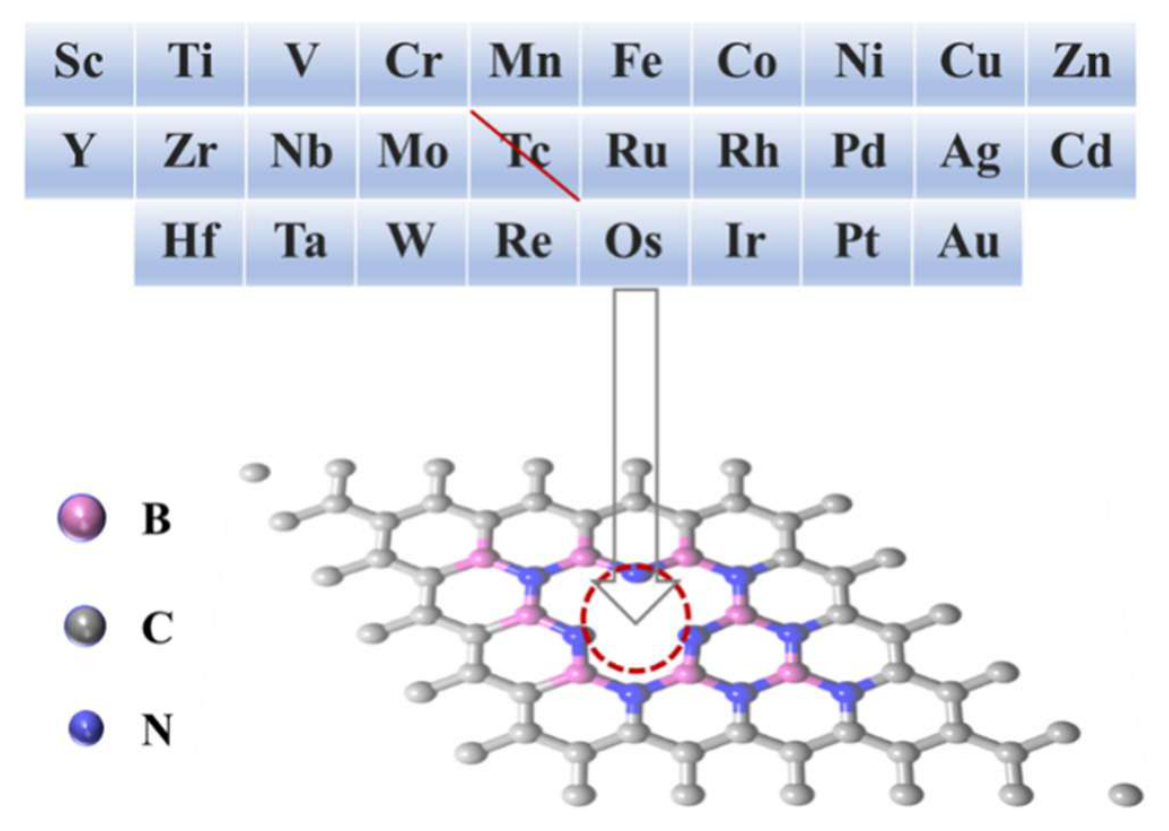
Figure 2.
(a) Formation energies and dissolution potentials of TM@BNG. (b) Density of states (DOS) of Cu@BNG. (c) Electron localization function (ELF) of Cu@BNG.
Figure 2.
(a) Formation energies and dissolution potentials of TM@BNG. (b) Density of states (DOS) of Cu@BNG. (c) Electron localization function (ELF) of Cu@BNG.
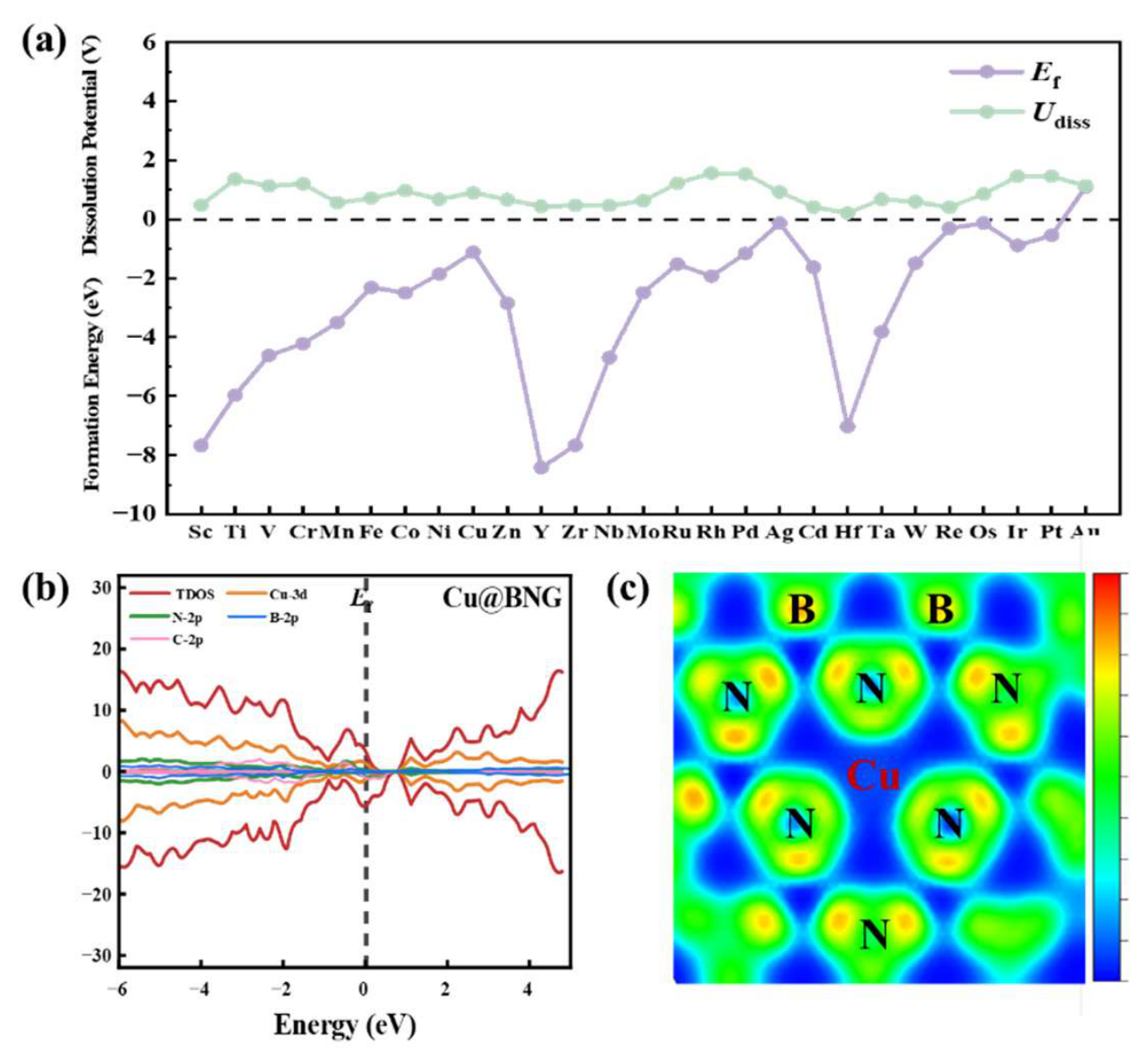
Figure 3.
Possible CO2RR Pathways on TM@BNG.
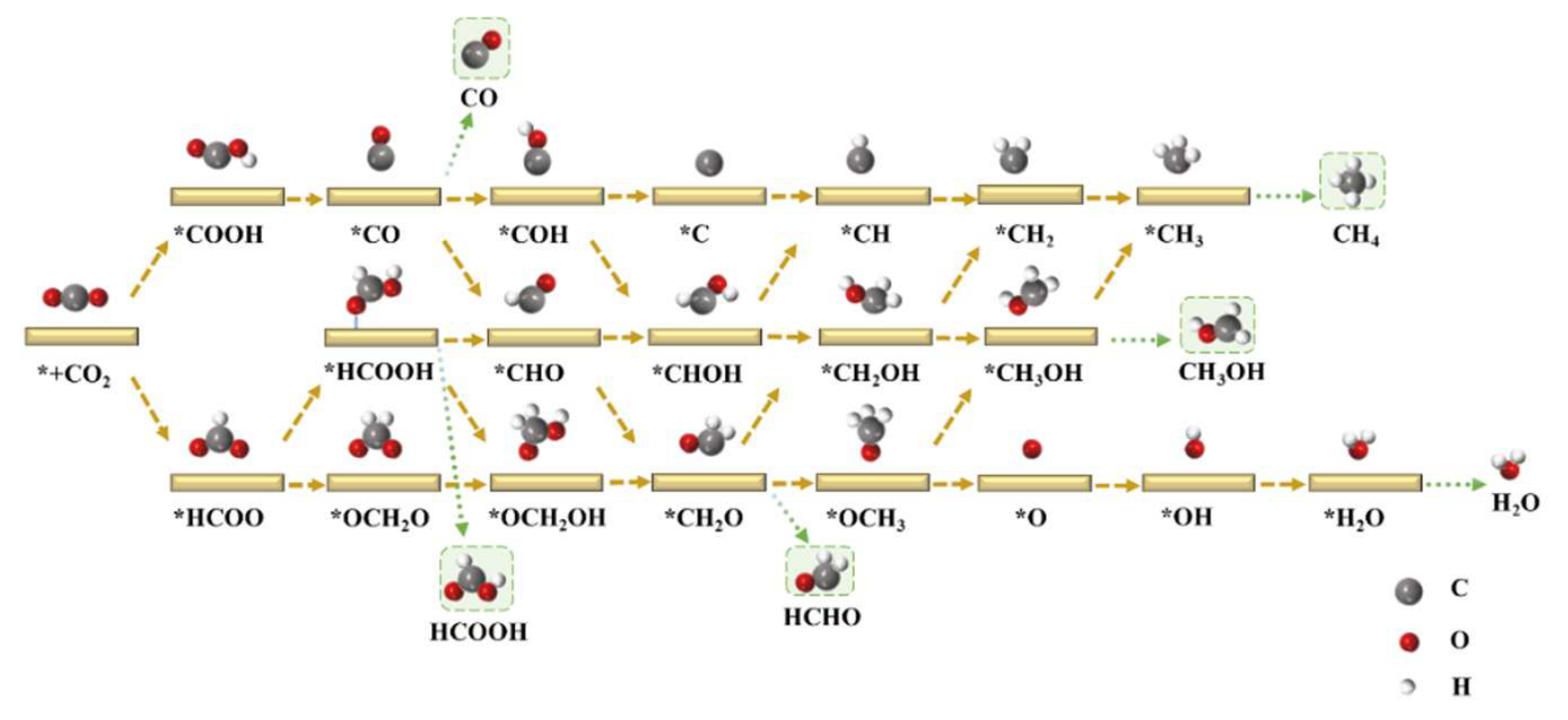
Figure 4.
Free-energy diagrams of CO2RR on (a) Pd@BNG, (b) Ag@BNG, (c) Os@BNG, and (d) Re@BNG at 298.15 K.
Figure 4.
Free-energy diagrams of CO2RR on (a) Pd@BNG, (b) Ag@BNG, (c) Os@BNG, and (d) Re@BNG at 298.15 K.
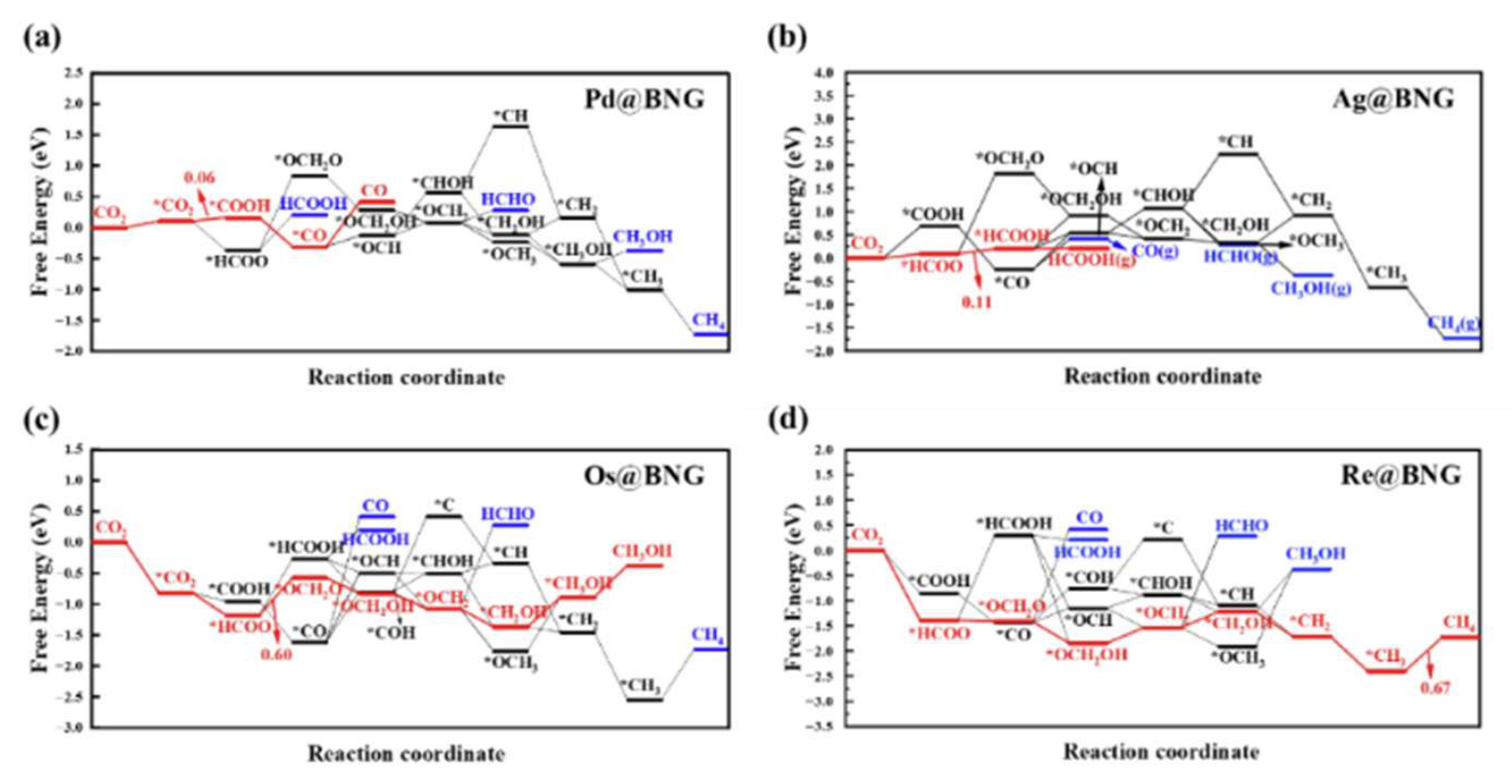
Figure 5.
Free-energy diagrams of CO2RR on (a) Pt@BNG and (b) Rh@BNG at 298.15 K.
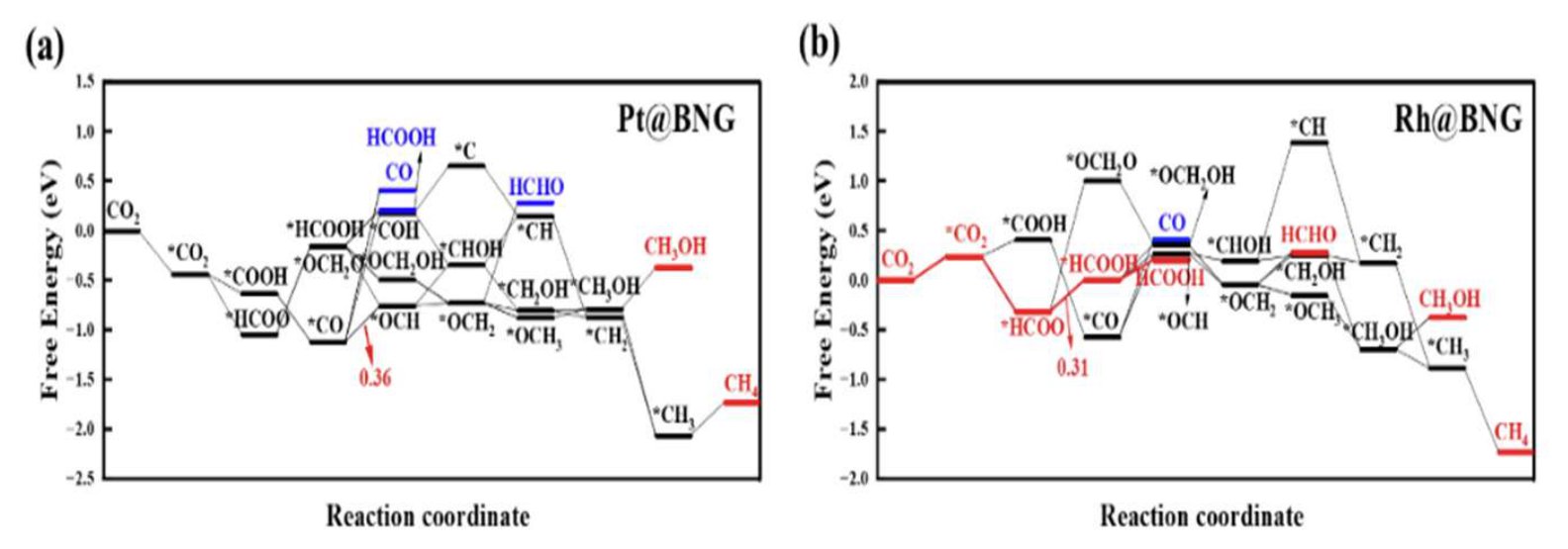
Figure 6.
The UL of CO2RR on SACs s.
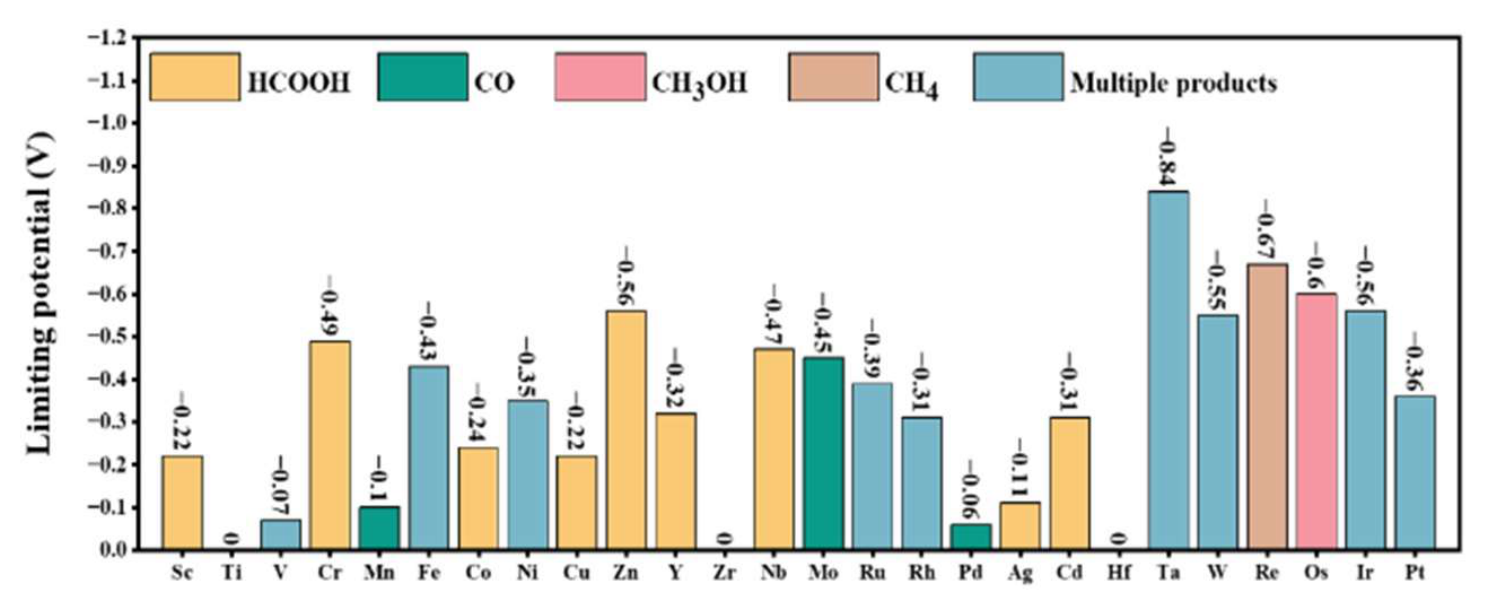
Figure 7.
(a) Free-energy diagrams of HER on SACs. (b) Comparison of UL values between CO2RR and HER on SACs.
Figure 7.
(a) Free-energy diagrams of HER on SACs. (b) Comparison of UL values between CO2RR and HER on SACs.
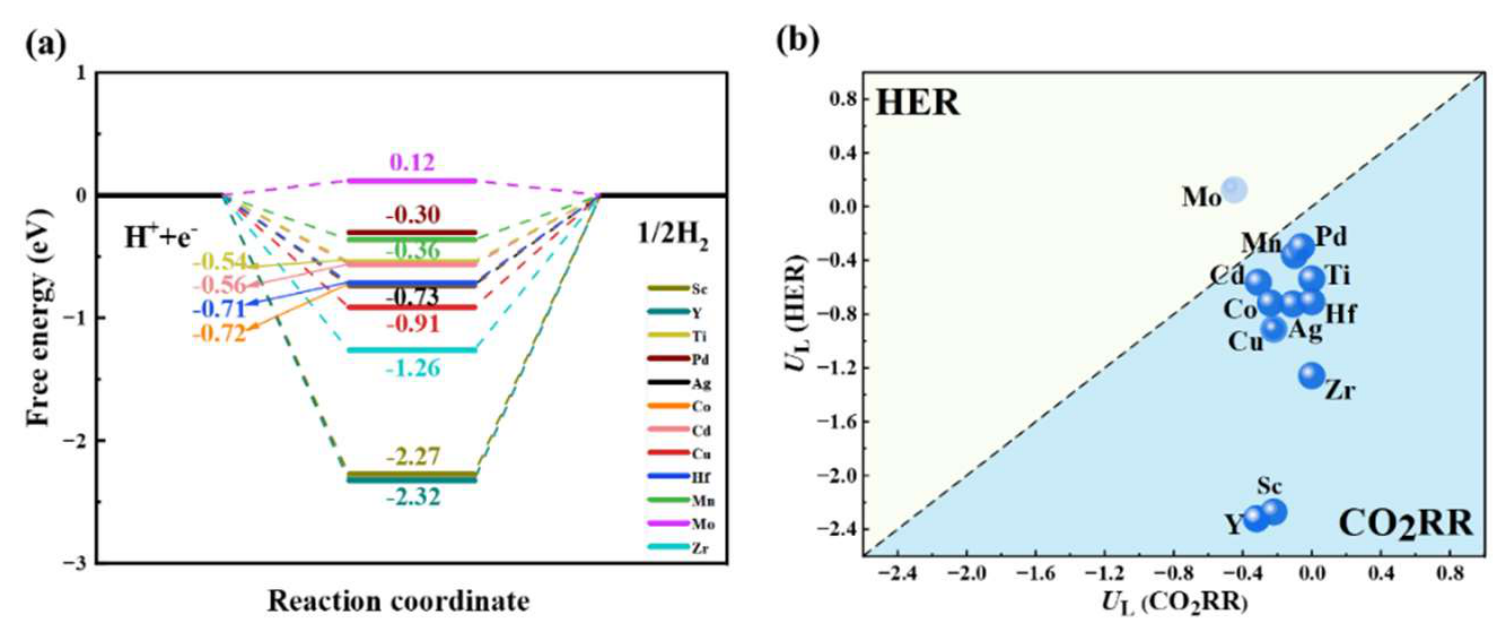
Figure 8.
Surface Pourbaix diagrams of (a–k) TM@BNG (TM = Pd, Ti, Mn, Zr, Hf, Ag, Sc, Co, Cu, Y, and Cd).
Figure 8.
Surface Pourbaix diagrams of (a–k) TM@BNG (TM = Pd, Ti, Mn, Zr, Hf, Ag, Sc, Co, Cu, Y, and Cd).
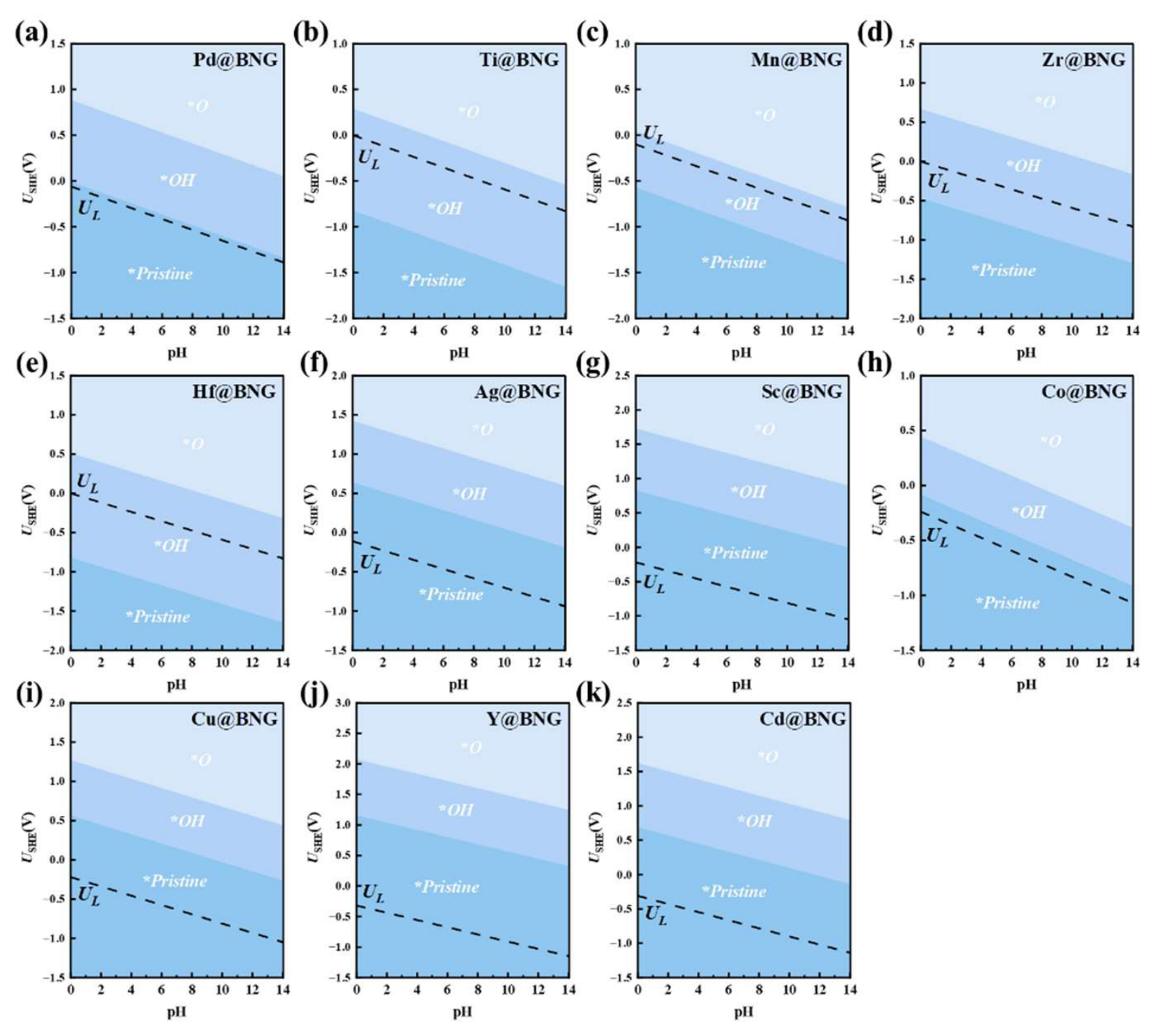
Figure 9.
Energy and temperature variations during 10 ps AIMD simulations of (a–g) TM@BNG (TM = Pd, Ag, Sc, Co, Cu, Y, and Cd) at 400 K.
Figure 9.
Energy and temperature variations during 10 ps AIMD simulations of (a–g) TM@BNG (TM = Pd, Ag, Sc, Co, Cu, Y, and Cd) at 400 K.
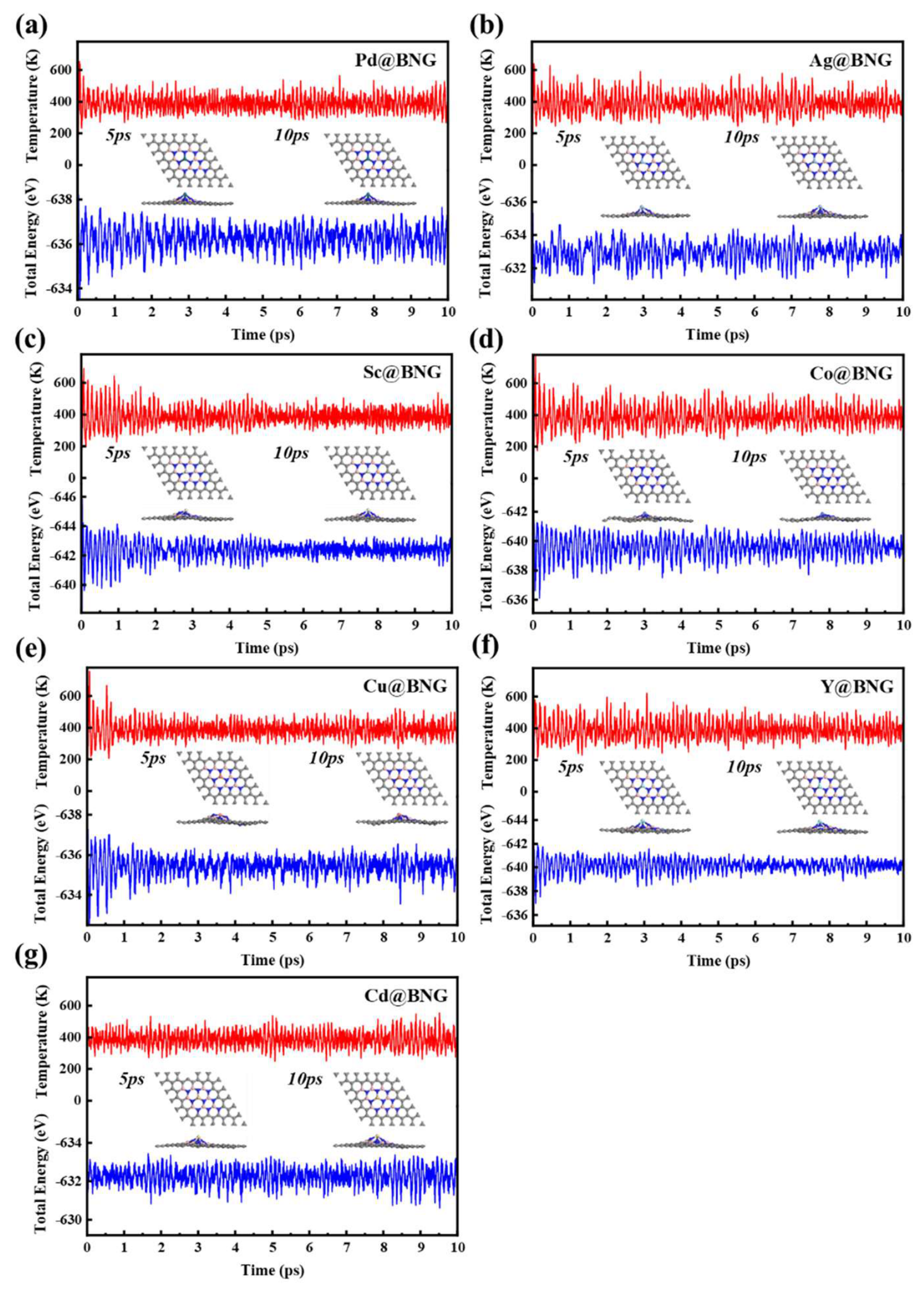
Figure 10.
PDOS of (a) Pd@BNG-*HCOO, (b) Ag@BNG-*HCOO, (c) Sc@BNG-*HCOO, and (d) Co@BNG-*HCOO.
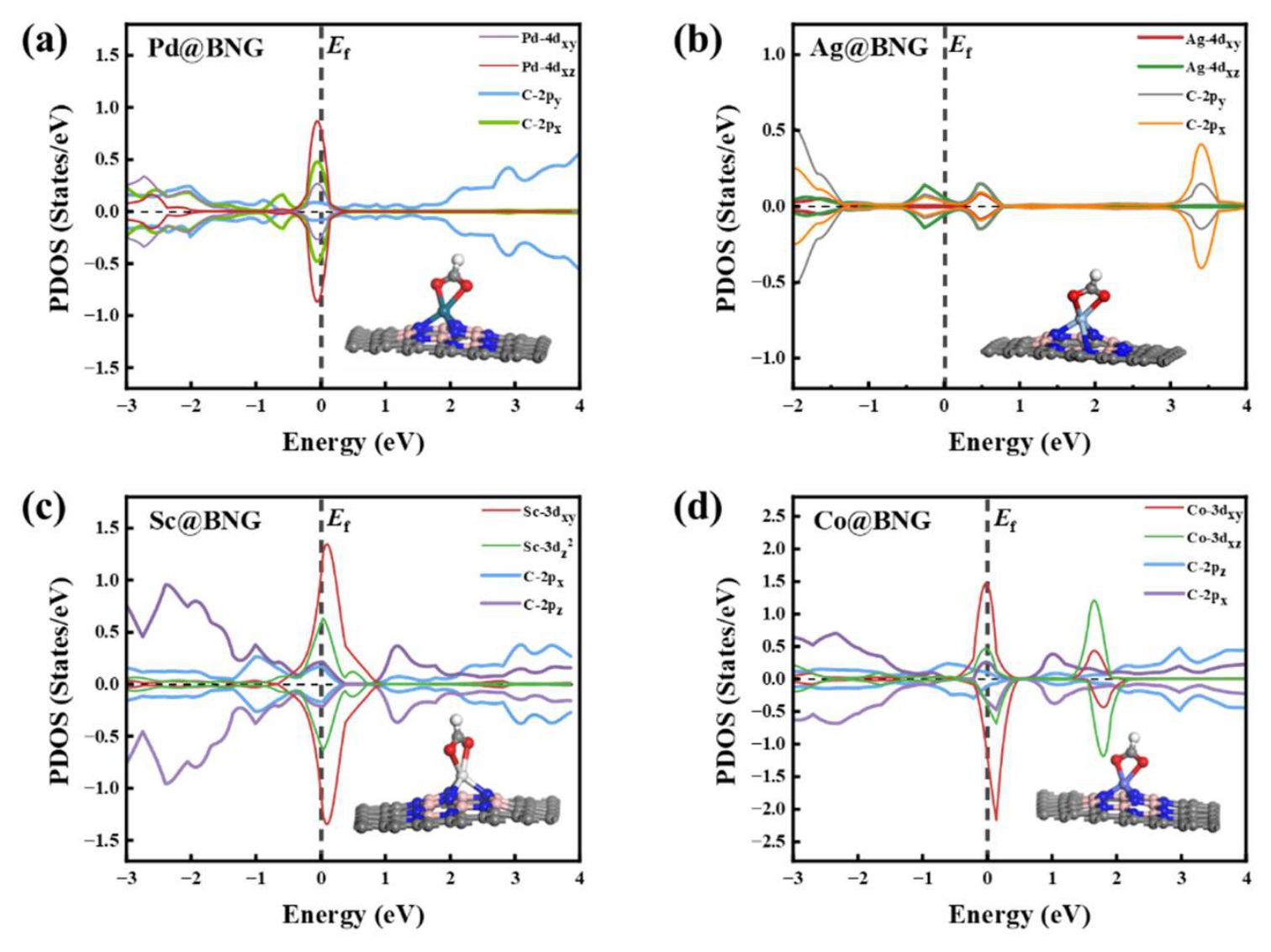
Figure 11.
Pearson correlation heatmap of different input features.
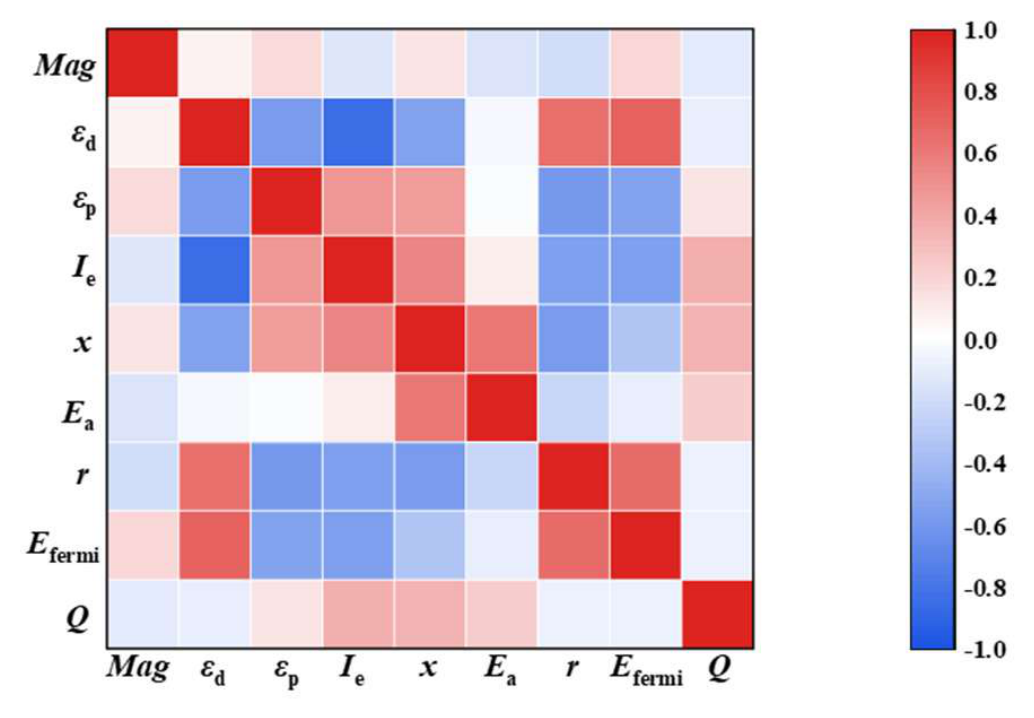
Figure 12.
(a) Comparison of UL predicted using DFT and the GBR algorithm. (b) Feature importance for UL predicted by the GBR algorithm.
Figure 12.
(a) Comparison of UL predicted using DFT and the GBR algorithm. (b) Feature importance for UL predicted by the GBR algorithm.
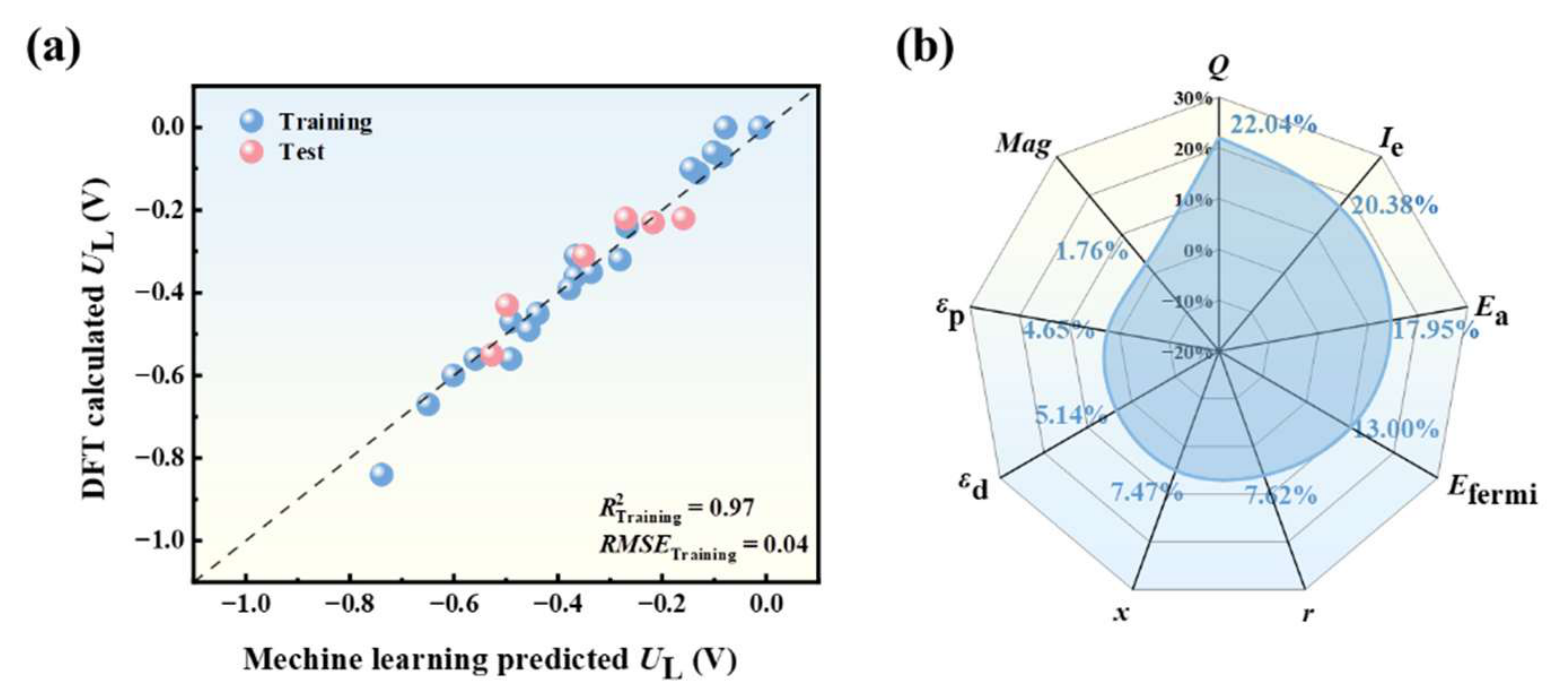
Figure 13.
Volcano plot of descriptor φ versus UL for CO2RR on TM@BNG sites.
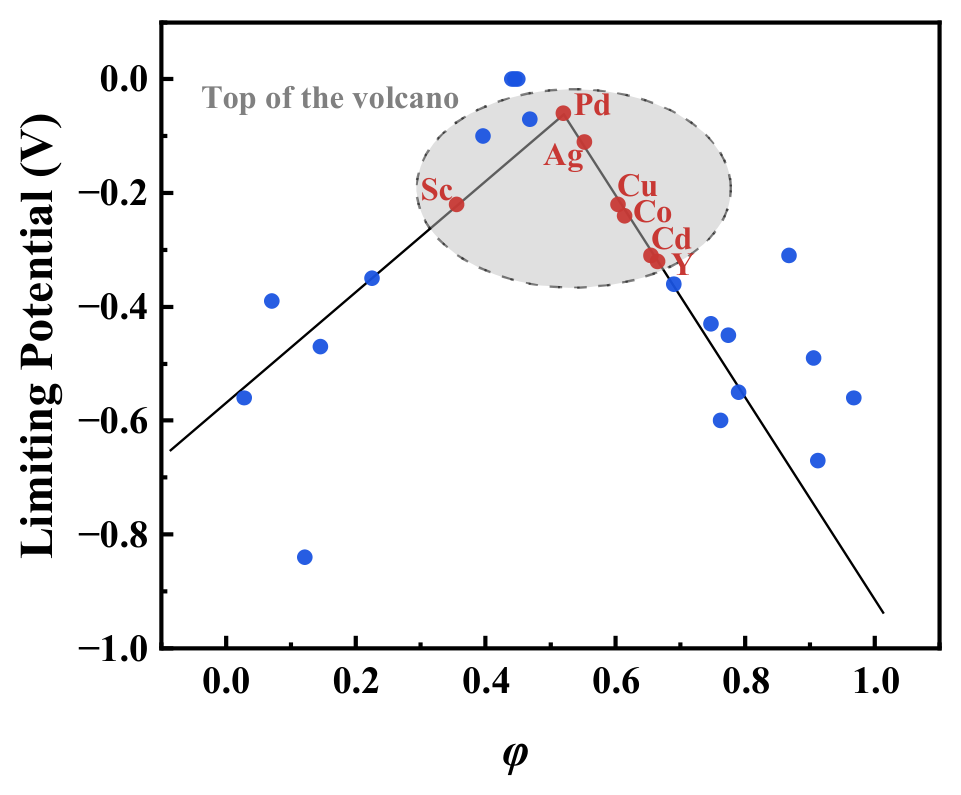

Table 1.
PDSof TM@BNG and the corresponding UL values / V.
| UL/V | Major product | PDS | TM@BNG |
| -0.22 | HCOOH | *CO2→*HCOO | Sc |
| 0.00 | CO | Thermodynamically spontaneous | Ti |
| -0.07 | CO、HCHO、CH3OH、CH4 | *CO2→*COOH | V |
| -0.49 | HCOOH | *HCOO→*HCOOH | Cr |
| -0.10 | CO | *CO2→*COOH | Mn |
| -0.43 | HCOOH、HCHO、CH3OH、CH4 | *HCOO→*HCOOH | Fe |
| -0.24 | HCOOH | *HCOO→*HCOOH | Co |
| -0.35 | HCOOH、HCHO、CH3OH、CH4 | *HCOO→*HCOOH | Ni |
| -0.22 | HCOOH | CO2→*HCOO | Cu |
| -0.56 | HCOOH | CO2→*HCOO | Zn |
| -0.32 | HCOOH | *CO2→*HCOO | Y |
| 0.00 | CO | Thermodynamically spontaneous | Zr |
| -0.47 | HCOOH | *HCOO→*HCOOH | Nb |
| -0.45 | CO | *CO2→*COOH | Mo |
| -0.39 | HCHO、CH3OH、CH4 | *CO→*OCH | Ru |
| -0.31 | HCOOH、HCHO、CH3OH、CH4 | *HCOO→*HCOOH | Rh |
| -0.06 | CO | *CO2→*COOH | Pd |
| -0.11 | HCOOH | *HCOO→*HCOOH | Ag |
| -0.31 | HCOOH | CO2→*HCOO | Cd |
| 0.00 | CO | Thermodynamically spontaneous | Hf |
| -0.84 | CH3OH、CH4 | *OCH2→* CH2OH | Ta |
| -0.55 | CH3OH、CH4 | *HCOO→*HCOOH | W |
| -0.67 | CH4 | *CH3→CH4 | Re |
| -0.60 | CH3OH | *HCOO→*OCH2O | Os |
| -0.56 | HCOOH、HCHO、CH3OH、CH4 | *HCOO→*HCOOH | Ir |
| -0.36 | CH3OH、CH4 | *CO→*OCH | Pt |
Disclaimer/Publisher’s Note: The statements, opinions and data contained in all publications are solely those of the individual author(s) and contributor(s) and not of MDPI and/or the editor(s). MDPI and/or the editor(s) disclaim responsibility for any injury to people or property resulting from any ideas, methods, instructions or products referred to in the content. |
© 2026 by the authors. Licensee MDPI, Basel, Switzerland. This article is an open access article distributed under the terms and conditions of the Creative Commons Attribution (CC BY) license (http://creativecommons.org/licenses/by/4.0/).
Copyright: This open access article is published under a Creative Commons CC BY 4.0 license, which permit the free download, distribution, and reuse, provided that the author and preprint are cited in any reuse.


