

Submitted:
22 June 2026
Posted:
23 June 2026
You are already at the latest version
Abstract
Cobalt-based catalysts using aluminum oxide as a support and 0.025-0.10 wt.% iridium as a second metal were prepared by the impregnation method and tested in steam and dry reforming of a model biogas with a ratio of CH4:CO2=1:1. The processes were carried out in a fixed bed flow reactor under atmospheric pressure, a gas hourly space velocity of 1000-1500 h-1, and temperature varied in the range of 300-800 ºC. The BET surface area, XRD, SEM, TEM, and H2-TPR methods were used to characterize the physicochemical properties of the “fresh” and “spent” samples of catalysts. The catalysts exhibit high and stable activity in the production of syngas from the biogas. Methane was almost completely converted at 750-800ºC in the steam reforming of biogas. Stability tests over 80-100 hours confirmed the catalyst's stable operation. Syngas with a ratio of H2/CO ~ 0.9 is formed in dry reforming of biogas, while in steam reforming the ratio exceeds 1. It is believed that the addition of iridium to Co/Al2O3 causes the improvement of the catalyst performance due to a synergetic effect because of the interaction between Co and Ir.
Keywords:
biogas
; dry reforming
; steam reforming
; syngas
; bimetallic Co-Ir alumina supported catalysts
1. Introduction
Interest in new uses of biogas has recently increased due to the threat of global climate change and the growing focus on renewable energy sources. Nations worldwide face the urgent environmental challenge to achieve zero greenhouse gas (GHG) emissions by 2050 [1]. One solution is carbon capture and storage, but CO2 utilization is a more attractive route as it solves the problem of resource depletion by using CO2 as a carbon source [2]. On the other hand, non-CO₂ greenhouse gases, mainly methane, contribute about one-third of the climate forcing from well-mixed GHGs [3]. CH₄ exhibits a global warming potential nearly 28 times higher than CO₂ on a 100-year horizon and around 84 times higher on a 20-year horizon [4]. Thus, the simultaneous reduction of CH₄ and CO₂ emissions is vital for effective climate change mitigation.
Reforming is a promising strategy for converting biogas/methane into syngas (CO + H₂), from which hydrogen can be extracted, while carbon monoxide can be further converted into additional hydrogen through the water-gas shift reaction (WGSR) [5]. In this context, dry reforming of methane (DRM) has attracted renewed attention, since it uses two major greenhouse gases – methane (CH₄) and carbon dioxide (CO₂) – as feedstocks for syngas production [6]. Hydrogen plays a crucial role in the transition to green energy; therefore, the DRM process, in addition to its environmental benefits, offers significant potential for the sustainable production of syngas and hydrogen [7,8,9,10].
Biogas is a powerful renewable energy source that can be obtained through the anaerobic digestion of organic matter. Its composition depends on the type of feedstock from which it originates. A clean biogas consists mainly of 35-75% methane and 25-55% carbon dioxide [11,12]. Currently biogas is used in internal combustion engines producing electricity and heat by co-generation. However, the high CO2 content reduces the fuel calorific value and in turn limits the engine peak power [13]. Therefore, using biogas as a feedstock for petrochemical production is more advantageous.
The technologies for biogas reforming are the same as those applied to natural gas reforming: steam reforming (SRM) (Eq. 1), dry reforming (DRM) (Eq. 2), partial oxidation (POX), and autothermal reforming [14].
CH4 + H2O ↔ 3H2 + CO ΔН = +247 кJ/mol
CH4 + CO2 ↔ 2H2 + 2CO ΔН = +247 кJ/mol
Among these applications of biogas, dry reforming (Eq.2) is considered as a promising one, because it involves two main greenhouse gases with production of useful value-added product – syngas [15]. Thus, syngas serves as the feedstock for a variety of down-stream processes: methanol synthesis, Fischer-Tropsch synthesis, ammonia synthesis, etc. Syngas produced by dry reforming of methane has a ratio near to unity, suitable for Fisher-Tropsch and oxo-synthesis [16].
For biogas processing, the combination of carbon dioxide and steam reforming (bi-reforming or combined steam-carbon dioxide reforming), which has been actively studied [17,18,19,20,21], will have greater advantages. Compared to dry and steam reforming of methane, bibliographic data on biogas reforming are not so numerous due to the high complexity of this reaction, although biogas reforming seems to be a very promising way of CO2 valorization [22].
However, the presence of carbon dioxide in the feedstock increases the likelihood of carbon formation and deposition on the catalyst surface, so catalysts for biogas reforming must be thermally stable, resistant to coking, and able to withstand impurities present in biogas. Ni and Co based catalysts are preferred over noble metals, because of their availability and low cost. However, both metals, especially Ni, also catalyze coke formation via methane decomposition (Eq. 3) and CO disproportionation (Eq. 3) [23].
CH4 → C + 2H2
2CO → CO2 + C
It has been revealed that supported cobalt catalysts present considerable activity for the dry reforming of methane [24,25]. Notably, catalysts containing cobalt have shown higher catalytic activity and better resistance to coking [26]. This is largely due to the optimal interaction between oxygen species (O*) and metallic cobalt, despite a slight compromise in catalytic activity. In the dry reforming of methane (DRM), these cobalt-based systems support an efficient redox cycle. The metallic cobalt (Co⁰) is oxidized by CO₂ to form cobalt-oxygen species, which are subsequently reduced back to Co⁰ through reactive intermediates produced during methane decomposition. This cyclical redox behavior effectively limits carbon buildup on the catalyst surface [27]. Cobalt catalysts, especially over silica and alumina supports, are also reported to have a good stability against temperature changes [28]. Numerous studies of supported cobalt catalysts have been published with the aim of developing a highly active and stable catalyst. Several factors such as the preparation method, the choice of support, the addition of promoter and combination of metals were observed to improve the quality of catalyst toward deactivation. According to reports, incorporating trace amounts of noble metals can greatly enhance catalytic activity and inhibit carbon formation by improving cobalt dispersion, reducing the formation of graphitic carbon, and boosting CO₂ activation efficiency [29]. Rostrup-Nielsen and Hansen compared the activity of various metals such as Rh, Ru, Pt, Pd, Ir, and Ni supported on MgO and found that Rh and Ru were the most active metals for dry reforming, followed by Ni, Ir, Pt, and Pd [30]. In our previous work, it has been observed that the bimetallic Co-Rh and Co-Pt systems supported on alumina demonstrated higher activity and stability than individual monometallic ones [31,32].
To the best of our knowledge, the incorporation of iridium into cobalt-based catalysts has been rarely reported. In this study, we investigated the alumina supported 5 wt. % Co-based catalysts modified with small amount of iridium and in dry reforming of model biogas (DRB), with particular focus on their performance in the presence of a modest amount of steam (up to 20 vol.%) added to the feed (steam reforming of biogas – SRB).
2. Results and Discussion
2.1. Catalyst Characterization
The 5% Co-Ir/Al2O3 catalysts with low Ir contents, varying in the range of 0.025-0.5 wt.%, were studied using several physicochemical methods at different stages of their operation: before the reaction – “fresh” sample and after the reaction of dry (DRB) or steam reforming of biogas (SRB) – “spent” sample.
Energy Dispersive X-ray study of fresh and spent samples of 5% Co-Ir/Al2O3 catalysts with nominal Ir and Co contents of 0.1-0.5 and 4.5-4.9% wt.%, respectively, showed the presence of all main elements: Al, O, Co, and Ir. The elemental composition of fresh samples (in normalized weight percent) is close to the nominal values: Al ~ 47-48%, O ~ 46-48%, Co ~ 4.5-4.7%, Ir ~ 0.1-0.5%. In the samples spent, the content of Co varies from 4.1 to 5.1 wt.%. Content of Ir slightly decreased to 0.07-0.42 wt.%. This is likely due to migration of Co and Ir to the surface or into the catalyst under the influence of the reaction medium rather than sintering, since sintering of metal particles was not observed by X-ray diffraction and transmission electron microscopy.
No changes in the catalyst morphology after their long-term operation in SRB were observed by SEM. Figure 1, for example, shows a typical SEM image of the 5% Co-Ir(98:2)/Al2O3 catalyst. The sample spent in SRB (Figure 1b) looks even more amorphous phase than fresh sample (Figure 1a).
Table 1 presents the specific surface area (SBET) obtained by N2 physisorption on the catalysts with Ir content varying from 0.025 to 0.5% of the total catalyst mass. The surface area ranged from 141.7 to 160.4 m2/g for fresh 5% Co-Ir/Al2O3 samples. A decrease in SBET to 97.2-135.7 and 84.9-134.6 m2/g occurred for the samples spent in DRB and SRB, respectively. The difference between surface area of the fresh and spent samples is increased with a decrease in Ir content. Despite a noticeable decrease in the specific surface area of all the catalysts studied, no significant decrease in catalytic activity was observed after 80-100 hours of in-stream operation. It should be noted that the spent samples were not subjected to post-reaction treatment; therefore, intermediate species formed during the reaction can remain on the surface of the catalyst, thereby reducing the surface area.
Table 2 presents the textural characteristics, such as pore diameters and pore volumes, for the 5% Co-Ir/Al2O3 catalyst with a low Ir content (0.025-0.1 wt.%). It is shown that the pore volume decreases for all samples tested in both dry (DRB) and steam (SRB) biogas reforming processes from 0.2 to 0.1 ml/g for fresh and spent samples, respectively. This can be due to the accumulation of reaction products on the catalyst surface and partial blocking of the pores. This is also the reason for the increase in the average pore diameter in the catalysts tested in DRB, except for 5% Co-Ir(98:2)/Al2O3, where no significant changes are observed. As narrower pores become clogged, the total number of small pores decreases, thereby artificially shifting the average pore size distribution towards wider, still open pores. The opposite pattern was observed for the samples processed in SRB, where the average pore size decreased from 4.5 to 1.7–2.6 nm for fresh and spent samples, respectively (Table 2). The decrease in pore diameter of the processed catalysts is primarily due to fouling (coke deposition). This thin carbon layer gradually accumulates along the pore walls and at the pore entrances, effectively reducing the accessible pore volume and narrowing the measured pore diameter. The different effects of the reaction environment on pore diameter may indicate differences in the kinds of the carbonaceous species formed during the process. Possibly in DRB, larger carbonaceous particles block narrow pores, whereas in SRB, thin layers of carbonaceous particles coat the inner pore walls, reducing their size without completely blocking the pores.
The catalysts before and after the reaction were examined by X-ray diffraction (XRD) to determine their crystal structure and phase composition. X-Ray diffraction analysis showed no features other than those of the γ-alumina; reflexes at 4.24, 2.84, 2.44, 2.28, 1.98; 1.55, and 1.39 Å contributed to γ-Al2O3 (ASTM, 10–425) were detected for the fresh and spent samples of the bimetallic 5%Co-Ir/Al2O3 catalysts (Figure 2).
While in monometallic 2.5% Ir/Al2O3 and 4.5% Co/Al2O3 catalysts the IrO2 phase (ASTM 15-870) (Figure 2) and the Co3O4 phase (ASTM, 15–806) (Figure 3), respectively, were clearly identified. The bimetallic 5%Co-Ir/Al2O3 catalysts are kept the X-ray amorphous state even after operation in DRB and SRB. Thus, which suggests that both the Co and Ir are present in a highly dispersed/amorphous state. High dispersion of bimetallic catalysts occurs due to interaction between Co and Ir. Even small amount of Ir (0.025 wt.%) led to the dispersion of Co particles.
A transmission electron microscopy (TEM) study of the catalysts confirmed the high dispersion of the 5%Co-Ir/Al2O3 catalysts. For comparison, monometallic catalysts based on Co and Ir were also studied. A fresh sample of the monometallic 4.5%Co/Al2O3 catalyst is represented by spherical particles, mainly 3-7 nm in size. Microdiffraction patterns correspond to Co2O3 (ASTM, 2-770). In the spent catalyst sample, the particle size, related to a mixture of Co and CoO (ASTM, 9-402), increases to 8-25 nm. Iridium in the monometallic 2.5% Ir/Al2O3 catalyst (fresh sample) is represented by needle-shaped particles. In 5%Co-Ir/Al2O3 bimetallic catalysts, spherical particles have a size of 2.0-4.0 nm, which are clearly visible only by dark-field TEM (Figure 4). In spent bimetallic catalysts, the particle size is generally the same as in fresh samples. Microdiffraction patterns are absent for all bimetallic catalysts due to their high dispersion. The particles can be attributed to both metals, Co and Ir or maybe to the bimetallic Co-Ir alloys.
Catalyst reducibility was examined by H2-TPR. The TPR profiles of the bimetallic catalysts are shown in Figure 5, displaying two primary peaks. In general, TPR studies of cobalt-supported catalysts show the classic two-step reduction. Firstly, Co3O4 is reduced to CoO (Eq. 5) at a lower temperature, and then, at a higher temperature, the reduction of CoO to Co occurs (Eq.6) [33,34,35]:
Co3O4 + H2 → 3CoO + H2O
3CoO + 3H2 → 3Co + 3H2O
For comparison, data on H2-TPR of Co- and Ir- monometallic catalysts supported on alumina were also included. Thus, the TPR profile of fresh monometallic Co/Al2O3 catalyst showed a low-temperature peak with maximum at 342 and shoulder at 276 ºC, followed by a broad peak with a maximum at 665 ºC that extends beyond 700 ºC. The first peak at 342 ºC may correspond to the reduction of bulk Co3O4 to CoO, whereas the shoulder at 276 ºC may represent the reduction of weakly interacting surface Co3O4 species. The second broad peak at 665 ºC can be attributed to further reduction of cobalt oxide (II) to metallic cobalt. The reduction in the high-temperature region may be due to the hindered reduction of cobalt aluminates (CoAl2O4) and/or high dispersed Co oxide species formed due to strong Co-support interaction. Ir in the monometallic catalyst is basically reduced at 126 ºC. The small peaks at this position are observed in bimetallic 5% Co-Ir/Al2O3 catalysts (Figure 5).
It is known that most noble metals (Pt, Ir, Ru, Pd) enhance the cobalt reduction [35]. The addition of 0.25 wt.% Ir strongly shifted both peaks towards lower temperatures; with the second peak being affected more (shift by about 300 ºC) than the first peak (shift by 100-150 ºC). This observation is consistent with earlier reports [36,37]. Further increase in the Ir content to 0.5 wt.% shifts the peaks towards lower temperatures. The catalyst with a higher Ir content (0.5 wt.%) has lower reduction temperatures of 176 and 327 ºC compared to 193 and 362 °C for the catalyst with 0.25% Ir. This is evidence of promotional effect of Ir on the reduction of cobalt oxides.
The data obtained indicates that the addition of Ir to Co/Al2O3 catalyst causes decreasing the metal particle size of both metals and increased the reducibility of Co due to interactions between metals or their precursors. The formation of Co–Ir nanoalloy particles well dispersed on γ-Al2O3 support were revealed by [38]. The same pattern was observed for Co-Rh bimetallic system supported on alumina [31]. These bimetallic systems possess the increased activity and stability in biogas conversion.
The stability of the Co-catalysts is enhanced by effect of Ir. The second reason for coke absence is the positive effect of water. Water suppresses coke formation as a result of interaction of surface carbon with production of carbon oxide and additional amount of hydrogen (Eq.7).
Cads + H2Oads → CO + H2
2.2. Catalysts Test
Temperature has the most significant effect on biogas conversion over catalysts, since this process is highly endothermic (Eq. 1). The dependences of biogas conversion on temperature over the 5%Co-Ir(90:10)/Al2O3 and 5%Co-Ir(95:5)/Al2O3 catalysts are shown in Figure 6a,b, respectively. The catalysts operate at relatively low temperatures – 350-450ºC, although dry and steam reforming proceeds slowly. An increase in temperature leads to a growth the extent of conversion of both biogas components – methane and carbon dioxide. The activity of the catalysts in both processes increases significantly at T > 450ºC (Figure 6a, b).
At 740 ºC, extents of conversion of methane and carbon dioxide reach 96.4 and 92.6%, respectively, and the resulting syngas has a ratio of H2/CO=0.9 in the DRB over the 5%Co-Ir(90:10)/Al2O3 catalyst (Table 3). During steam reforming of biogas, methane is completely converted at the same temperature, and the amount of hydrogen is increased (H2/CO=1). Thus, the addition of steam in small amounts equal to 20 vol.% facilitates methane conversion and increases hydrogen yield over this catalyst. As for carbon dioxide, its conversion is less in steam reforming over the entire temperature range (Figure 6a) due to possible competition between two reactions: CH4+CO2 and CH4+H2O as well as thanks to WGSR (Eq. 8). At 740 ºC, the extent of CO2 conversion was 84.1 and 92.6% in processes with presence and absence of steam, respectively (Table 3).
CO + H2O ↔ H2 + CO2
A similar effect of temperature on dry conversion of biogas was observed for a catalyst with a lower Ir content – 0.25 wt.% (Co:Ir=95:5) (Figure 6b, Table 3). It should be noted that this catalyst is slightly less active than the previous one with twice the Ir content – 0.5 wt.%. For example, methane conversion reaches 100% during steam reforming of biogas at 750 ºC compared to 740 ºC (Table 3).
For comparison, the further increase in Ir content up to 2.5 wt.%, that corresponds to the catalyst with the equal amount of Co and Ir – 5%Co-Ir(50:50)/Al2O3, was provided. In DRB, almost complete conversion of methane (XCH4=99.4%) occurred at 700 ºC, while extent of carbon dioxide conversion was 89.2%. Syngas formed under these conditions had a ratio of H2/CO=1.2 (Table 3). High yield of hydrogen and lower value of extent of CO2 conversion may indicate strengthening the Water Gas Shift Reaction due to effect of Ir (Eq.8).
The monometallic Co/Al2O3 has much lower activity in dry reforming of methane – extents of conversion of methane and carbon dioxide are 52.1 and 10%, respectively, at 800 ºC, does not provide the steam reforming of methane due to poisoning by water leading to the formation of inactive Co hydroxides, and prone to rapid deactivation due to the accumulation of graphite carbon as it has been proved in our work [37].
Thus, the data obtained demonstrate the effectiveness of Co-Ir bimetallic systems with an Ir content of 0.25-0.5 wt.%. No significant differences in catalytic activity are observed even with an increase in the Ir content to 2.5 wt.%. Therefore, it was of interest to study the effect of lower Ir content (≤ 0.1 wt.%). In subsequent studies, the Ir content was steadily halved, and the catalysts were tested under more severe conditions using model biogas without argon dilution. Stability tests were also conducted.
The same effect of temperature on 5%Co-Ir /Al2O3 catalysts with Ir content of 0.025-0.1 wt.% in DRB is shown in Figure 7. The conversions of CH4 and CO2 and the yields of hydrogen and carbon monoxide increase synchronously with increasing temperature in both processes – DRB and SRB.
The comparative characteristics of catalysts in dry and steam reforming of biogas under the same conditions: P=1 atm, t=700- 800 ºC, GHSV=1000 h-1 are summarized in Table 4.
All catalysts effectively operate in both DRB and SRB. During steam reforming, the formation of hydrogen increased compared to DRB from 12.9-13.8 to 13.9-18.4 μmol/gcat×s and from 15.0-17.2 to 18.2-20.0 μmol/gcat×s at 700 and 800 ºC, respectively. In opposite of the catalysts with higher Ir content, the catalysts with Ir content 0.025-0.1 wt.% are more sensitive to the effect of water. The suppression of conversion of carbon dioxide is more substantial. At 700 ºC, X(CO2) decreases to 22.0-46.0 % depending on Ir content (Table 4).
The stability of two catalysts with Ir contents of 0.05–0.1 wt% was tested in SRB for 80 and 100 hours, respectively (Figure 8 and Figure 9). Both catalysts demonstrated stable operation with constant reactant conversion and product yield. Except for the 5%Co-Ir(98:2)/Al2O3, where a slight decrease in CO2 conversion was observed after 90 hours, while the yield of CO and H2 remained at the same level (Figure 8). In contrast, for the catalyst with a lower Ir content of 0.05%, reactant conversion and product yield gradually increased (Figure 9). Apparently, the surface of this catalyst continues to develop.
To compare with literature data, the authors [39] reported the stable work of the catalyst with content 1wt.% for 12 hours.
Thus, addition of iridium improves the performance of Co/Al2O3 in reforming of biogas with production of syngas. The Co-Ir catalysts studied are very active and operate under comparatively low temperatures – 600-750 ºC. According to [40], the typical high temperature (700–950 ºC) used in biogas reforming can cause carbon deposition and metal Ni sintering, which can result in the catalysts deactivating. In addition, the high-temperature operation leads to high operation costs. Therefore, the development of catalysts and technologies for biogas reforming at low temperatures (<700 ºC) is needed.
4. Materials and Methods
3.1. Catalyst Preparation and Characterisation
The 5% Co-Ir/Al2O3 catalysts were prepared by wet co-impregnation of γ-alumina with aqueous solutions of Co(NO3)2·6H2O salt and hexachloroiridic acid – H2IrCl6·nH2O (content of Ir – 36.59%), purity was 99% for both compounds. Support is γ-alumina being granules in the form of balls with a diameter of 3–5 mm and BET surface area is 140 m2/g (IC-02-200, Novosibirsk, Russia, purity—99%). After drying the catalysts were calcined at 400 °С for 3 h and then prior testing were reduced by hydrogen at 300–400 ºC for 1–3 h. The total nominal content of Co and Ir metals was equal to 5% of the total catalyst mass. The mass ratio of Co:Ir was 99.5:0.5, 99:1; 98:2; 95:5, and 90:10, which corresponds to 4.975, 4.95, 4.9, 4.75, and 4.5 wt. % of Co and 0.025, 0.05, 0.1, 0.25, and 0.5 wt. % of Ir respectively. Element analysis provided by means of the scan electron microscope JSM 6610 LV JOEL, Japan showed a correlation between nominal and actual weight and deviation of no more than 2% on average for each element involved.
The catalysts were characterized using transmission electron microscopy (TEM), scanning electron microscopy (SEM), BET, X-ray diffraction (XRD), and H2-TPR methods. The physico-chemical studies of the catalysts were, as a rule, undertaken prior to the reaction (fresh sample) and after the reaction (spent sample) to understand the effects of the reaction feed and process conditions on the catalyst characteristics, such as the specific surface area, reducibility of Co, morphology, particle size, element distribution, etc.
The specific surface areas and average pore diameters were measured using the BET and BJH methods, respectively, with the help of a Thermo Scientific Surfer Gas Adsorption Porosimeter (Thermo Fisher Scientific, Italy) and the Advanced Data Processing program (Version 6.2). For sample preparation, the SURFER instrument is equipped with a GEFRAN 800P (Thermo Fisher Scientific, Italy) degassing unit. The sample was degassed by gradually increasing the temperature from 25 to 220 ºC and holding at 220 ºC for 120 minutes. The analysis consists of two parts: dead-space measurement with helium gas and adsorption–desorption measurements of the sample using nitrogen gas.
X-ray diffraction (XRD) measurements were performed with the fresh and used catalysts using the CuKα or CoKα radiation of a “Dron-4” powder diffractometer (Bourevestnik, Saint Petersburg, Russia) with CuKα radiation.
To determine the reducibility of metals, the temperature-programmed reduction (H2-TPR) was provided. TPR measurements were performed on SETARAM Instrumentation (Caluire, France) using a thermal conductivity detector (TCD) and a 5%H2/N2 mixture at a flow rate of 20 cm3/min. The catalyst samples were heated from ambient temperature to 900 ºC with a heating rate of 5 ºC /min.
Transmission electron microscopy at a resolution of approximately 0.5 nm was used to characterize the sizes of the metal particles, their distribution and state in the fresh and spent samples of catalysts. Electron microscopy studies were provided with a JEM-100CX unit, Japan. Phase identification was performed with the help of the ASTM (American Society for Testing and Materials, Powder Diffraction File. International Centre for Diffraction Data: Swarthmore, PA, USA, 2004).
Scanning electron microscopy (SEM) images were taken using a Jeol JSM 6610 LV instrument using a secondary electron detector. The external surface of the entire catalyst granule as well as the inner surface of a catalyst granule divided in half have been scanned.
3.2. Catalyst Test
The processes of the dry and steam reforming of biogas were performed in a laboratory quartz flow reactor with programmed heating and a controlled feeding velocity operated at atmospheric pressure. The feed (model biogas) was composed of CH4 and CO2 gases with purity 99.9% taken from cylinders in the molar ratio of CH4/CO2=1/1 (dry reforming of biogas – DRB). Water was added with a constant rate to a model biogas by means of a programmable syringe pump (Braun Melsungen AG) and then heated to be transformed into steam, which then mixed with biogas in certain amount equivalent to the gas composition of CH4/CO2/H2O=1/1/0.2-1. Temperature varied within a range of 300-800°С. The gas hourly space velocity (GHSV) was fixed at 1000 h-1. The volume of catalyst was 6 mL. Catalyst test duration was 10-20 hours. Stability test was extended to 80-100 hours.
The initial and final reaction products were online analysed using the GCs with a TCD (Chromatek-Krystall-5000 and Chromatek-Gazochrom-2000 using columns: Hayesep N, NaX, CaX and activated carbon; carrier gases are Ar and air). A special cooling trap was supplied to collect liquid products for case of their formation. Liquid products were analysed using the GC Agilent-7820А with FID. However, no liquid products except water were found over the studied catalysts under the process conditions (t=600-800 ºC, P=1atm).
The extent of conversion of carbon dioxide (XCO2) and methane (XCH4) were calculated according to expressions 1 and 2, respectively, and thus the activities of the catalysts were compared.
where f is the ratio of the measured outlet molar flow to the inlet molar flow, [CH4]in and [CO2]in are the concentrations of the reactants in the inlet (introduced) feed and [CH4]out and [CO2]out are the concentrations of the same compounds in the effluent flow.
XCO2= (1- f[CO2]out/[CO2]in) × 100%
XCH4 = (1 - f[CH4]out/[CH4]in) × 100%
The conversion of water was not calculated because of the difficulties in differentiating unreacted water and water formed by the secondary reaction. Water is always present in the reaction products.
The ratio of H2/CO in syngas formed was defined as follows: [H2]/[CO], where [H2] and [CO] are their concentrations in the outlet gas.
5. Conclusions
The bimetallic Co-Ir/Al2O3 catalysts were studied in dry and steam reforming of biogas. The addition of Ir to Co/Al2O3 catalysts leads to an increase in the activity, selectivity, and stability of the catalyst in biogas conversion. Catalysts show high efficiency in the steam reforming of biogas to produce hydrogen-enriched synthesis gas. Coke formation was not observed over the bimetallic Co-Ir catalysts studied. A strong increase in the activity and stability of Co-Ir catalysts in the processes of dry and steam reforming of biogas occurs due to the synergistic effect of Co-Ir interaction that is like the Co-Rh systems reported earlier [31].
As a result of Co-Ir interaction, an increase in the dispersion of the metals, the formation of more reactive intermediate carbon-containing particles, and an increase in the reducibility of Co were observed. The selection of the certain M-M pair is a key factor in the creation of a catalyst. The role of noble metals consists in maintaining the reduced state of the base metal, Co, and preventing its oxidation. Thus, the addition of iridium to the Co/Al2O3 catalyst leads to formation of metallic particles, stabilization of the highly dispersed and reduced state of Co and prevention of coke formation.
Author Contributions
Conceptualization, SSI; methodology, SSI and YAB; software, YAB, and KTT; validation, YAB, MAZ, and KTT; formal analysis, YYN, YAB, MAZ, and KTT; investigation, SSI, YYN, YAB, MAZ, and KTT; resources, YAB, MAZ, and KTT; data curation, YAB, MAZ, and KTT; writing—original draft preparation, SSI and YAB; writing—review and editing, SSI.; visualization, YYN, YAB, MAZ, and KTT; supervision, project administration, funding acquisition, SSI.
Funding
This research was funded by the Science Committee of the Ministry of Science and Higher Education of the Republic of Kazakhstan, Grant number АР19679439.
Data Availability Statement
The raw data supporting the conclusions of this article will be made available by the authors on request.
Acknowledgments
The authors wish to thank the Laboratory of the Physico-Chemical Methods of the Catalyst Analysis of IFCE for providing the catalyst characterization. The authors are very grateful to Prof. J.A. Anderson and A.J. McCue, Surface Chemistry and Catalysis Group, University of Aberdeen, Scotland for consultation and the opportunity to conduct part of the research at the University of Aberdeen.
Conflicts of Interest
The authors declare no conflicts of interest. The funders had no role in the design of the study; in the collection, analyses, or interpretation of data; in the writing of the manuscript; or in the decision to publish the results.
Abbreviations
The following abbreviations are used in this manuscript:
| BET DRB DRM Eq GHG GHSV H2-TPR POX RWGSR SEM SRB SRM TEM TOS WGSR X(CH4) X(CO2) XRD |
Brunauer-Emmett-Teller method to measure the specific surface area and porosity Dry Reforming of Biogas Dry Reforming of Methane Equation Greenhouse gas Gas Hourly Space Velocity Hydrogen Temperature-Programmed Reduction Partial Oxidation Reverse Water Gas Shift Reaction Scanning Electron Microscopy Steam Reforming of Biogas Steam Reforming of Methane Transmission Electron Microscopy Time on stream, h Water Gas Shift Reaction Extent of conversion of methane, % Extent of conversion of carbon dioxide, % X-Ray Diffraction |
| Y(CO) | Yield of carbon monoxide, micromoles per g of catalyst per second |
| Y(H2) | Yield of hydrogen, micromoles per g of catalyst per second |
References
- Wang, D.; Lin, Y. A comprehensive review on definitions, development, and policies of net-zero carbon buildings (nZCBs). Renew. Sustain. Energy Rev. 2025, 217, 115750. [Google Scholar] [CrossRef]
- Kang, K.; Sampei, H.; Sekine, Y. CO2 conversion to CO by reverse water gas shift and dry reforming using chemical looping. RSC Sustain. 2025, 3, 1598. [Google Scholar] [CrossRef]
- Pennacchio, L.; van Herpen, M.; Meidan, D.; Saiz-Lopez, A.; Johnson, M.S. Catalytic Efficiencies for Methane Removal: Impact of HOx, NOx, and Chemistry in the High-Chlorine Regime. ACS Earth Space Chem. 2025, 9, 504. [Google Scholar] [CrossRef]
- Mar, K.A.; Unger, C.; Walderdorff, L.; Butler, T. Beyond CO2 equivalence: The impacts of methane on climate, ecosystems, and health. Environ. Sci. Policy 2022, 134, 127. [Google Scholar] [CrossRef]
- Wang, Y.; Li, R.; Zeng, C.; Sun, W.; Fan, H.; Ma, Q.; Zhao, T.-S. Challenges on waste-to-energy for the valorization of industrial wastes: Recent research progress of methane dry reforming to syngas. Fuel 2025, 398, 135535. [Google Scholar] [CrossRef]
- Agún, B.; Abánades, A. Comprehensive review on dry reforming of methane: Challenges and potential for greenhouse gas mitigation. Int. J. Hydrog. Energy. 2025, 103, 395. [Google Scholar] [CrossRef]
- Merkouri, L.-P.; le Sach´e, E.; Pastor-P´erez, L.; Duyar, M.S.; Reina, T.R. Bringing closer dry reforming, reverse water gas shift and methanation to enable end-products flexibility. Fuel 2022, 315, 123097. [Google Scholar] [CrossRef]
- Awad, M.M.; Kotob, E.; Taialla, O.A.; Hussain, I.; Ganiyu, S.A.; Alhooshani, K. Recent developments and current trends on catalytic dry reforming of Methane: Hydrogen Production, thermodynamics analysis, techno feasibility, and machine learning. Energy Convers. Manag. 2024, 304, 118252. [Google Scholar] [CrossRef]
- Mokheimer, E.M.A.; Shakeel, M.R.; Harale, A.; Paglieri, S.; Mansour, R.B. Fuel reforming processes for hydrogen production. Fuel 2024, 359, 130427. [Google Scholar] [CrossRef]
- Yeong, Y.F.; Sunder, N.; Chan, Z.F. CO2 and CH4 conversion to syngas via membrane and plasma routes: Challenges and future directions. Int. J. Hydrog. Energy. 2025, 103, 327. [Google Scholar] [CrossRef]
- Yang, J.; Wang, S.; Zhang, Y.; Liu, W.; Fan, C.; Liao, Y.; Jiang, S.; Tian, S.; Han, L. Calcium-Looping Dry Reforming Enhances Biogas Conversion to Syngas with Simultaneous CO2 Abatement. ACS Sustain. Chem. Eng. 2025, 13, 3974. [Google Scholar] [CrossRef]
- Hos, T.; Herskowitz, M. Techno-economic Analysis of Biogas Conversion to Liquid Hydrocarbon Fuels through Production of Lean-Hydrogen Syngas. ACS Eng. Au. 2022, 2, 450. [Google Scholar] [CrossRef]
- Lau, C.S.; Allen, D.; Tsolakis, A.; Golunski, S.E.; Wyszynski, M.L. Biogas upgrade to syngas through thermochemical recovery using exhaust gas reforming. Biomass Bioenergy 2012, 40, 86. [Google Scholar] [CrossRef]
- Ashour, A.; Challiwala, M.S.; Musa, T.; Wilhite, B.; Elbashir, N. Modeling tri-reforming of methane for carbon dioxide utilization and hydrogen production. Energy 2025, 335, 137977. [Google Scholar] [CrossRef]
- Lyu, J.; Kim, D.; Hossain, M.N.; Lee, S.; Lee, J.; Alhammadi, S.; Kim, M.; Kang, D. Dry reforming of methane in molten manganese chloride mixtures. Chem. Eng. J. 2025, 521, 166788. [Google Scholar] [CrossRef]
- Wang, S.; Lu, G.Q.M.; Millar, G.J. Carbon dioxide reforming of methane to produce synthesis gas over metal-supported catalysts: State of the art. Energy Fuels 1996, 10, 896. [Google Scholar] [CrossRef]
- Firouzy, F.; Yari, M.; Zare, V.; Ranjbar, F.; Zare, A.A.D. Development and thermodynamic analysis of a biogas-assisted steam methane reforming process combined with a supercritical CO2 Brayton cycle for power, hydrogen, and heat production. Int. J. Hydrog. Energy. 2025, 140, 519. [Google Scholar] [CrossRef]
- Itkulova, S.S.; Nurmakanov, Y.Y.; Kussanova, S. K.; Boleubayev, Y.A. Production of a hydrogen-enriched syngas by combined CO2-steam reforming of methane over Co-based catalysts supported on alumina modified with zirconia. Catal. Today. 2018, 299, 272–279. [Google Scholar] [CrossRef]
- Ba Long, D.; Cam Anh, H.; Tri, N.; Luu, C.L. Role of Ruthenium in Modified CeNi1–xRuxO3 Perovskite Catalysts for the Bireforming of Methane. Energy Fuels 2025, 39, 1341. [Google Scholar] [CrossRef]
- Johnson, O.; He, Y.; Joseph, B.; Kuhn, J.N. Intensified Biogas-to-Fuels/Chemicals: Optimizing Tandem Bireforming and Fischer–Tropsch Synthesis in a Single Reactor. Energy Fuels 2025, 39, 7815. [Google Scholar] [CrossRef]
- Zhao, Y.; Qi, L.; Cheng, Z.; Zhou, Z. Syngas Production via Combined Steam and Carbon Dioxide Reforming of Methane over Ni-CexM1–xO2 (M = Ti or Zr) Catalysts. Ind. Eng. Chem. Res. 2022, 61, 12978. [Google Scholar] [CrossRef]
- Martín-Espejo, J.L.; Merkouri, L.-P.; Gándara-Loe, J.; Odriozola, J.A.; Reina, T.R.; Pastor-Pérez, L. Nickel-based cerium zirconate inorganic complex structures for CO2 valorisation via dry reforming of methane. J. Env. Sci. 2024, 140, 12. [Google Scholar] [CrossRef] [PubMed]
- Ruckenstein, E.; Hu, Y.H. Carbon dioxide reforming of methane over nickel/alkaline earth metal oxide catalysts. Appl. Cat. A Gen. 1995, 133, 149–161. [Google Scholar] [CrossRef]
- Sun, Y.; Zhang, Y.; Yin, X.; Zhang, C.; Li, Y.; Bai, J. Recent advances in the design of high-performance cobalt-based catalysts for dry reforming of methane. Green Chem. 2024, 26, 5103. [Google Scholar] [CrossRef]
- Sharifnattaj, A.; Ghaziasgar, S.; Bahadori, Y.; Saidi, M. Recent progress in catalysts development of dry reforming of methane process: Review of active phases and supports of catalyst. Mol. Catal. 2025, 582, 115060. [Google Scholar] [CrossRef]
- Wang, N.; Chu, W.; Zhang, T.; Zhao, X.S. Manganese promoting effects on the Co-Ce-Zr-Ox nano catalysts for methane dry reforming with carbon dioxide to hydrogen and carbon monoxide. Chem. Eng. J. 2011, 170, 457–463. [Google Scholar] [CrossRef]
- Tanios, C.; Bsaibes, S.; Gennequin, C.; Labaki, M.; Cazier, F.; Billet, S.; Tidahy, H. L.; Nsouli, B.; Aboukaïs, A.; Abi-Aad, E. Syngas production by the CO2 reforming of CH4 over Ni–Co–Mg–Al catalysts obtained from precursors. Int. J. Hydrog. Energy. 2017, 42, 12818. [Google Scholar] [CrossRef]
- Zhao, Y.; Cui, Y.; Sun, N.; Wu, H.; Yao, Z. First comparison of the catalytic stability of cobalt metal, nitride and phosphide catalysts for dry reforming of methane. Phosphorus Sulfur Silicon Relat. Elem. 2025, 200, 54. [Google Scholar] [CrossRef]
- Chen, S.; Zaffran, J.; Yang, B. Dry reforming of methane over the cobalt catalyst: Theoretical insights into the reaction kinetics and mechanism for catalyst deactivation. Appl. Cat. B Env. 2020, 270, 118859. [Google Scholar] [CrossRef]
- Rostrup-Nielsen, J.R.; Bak Hansen, J.H. CO2-reforming of methane over transition metals. J. Catal. 1993, 144, 38. [Google Scholar] [CrossRef]
- Itkulova, S.S.; Valishevskiy, K.A.; Boleubayev, Y.A. Bimetallic Co-Rh Systems as a Prospective Base for Design of CH4 Reforming Catalysts to Produce Syngas with a Controllable Composition. Catalysts 2022, 12, 105. [Google Scholar] [CrossRef]
- Itkulova, S.S.; Zakumbaeva, G.D.; Nurmakanov, Y.Y.; Mukazhanova, A.A.; Yermaganbetova, A.K. Syngas production by bireforming of methane over Co-based alumina-supported catalysts. Cat. Today. 2014, 228, 194. [Google Scholar] [CrossRef]
- van 't Blik, H.F.J.; Koningsberger, D.C.; Prins, R. Characterization of supported cobalt and cobalt-rhodium catalysts: III. Temperature-Programmed Reduction (TPR), Oxidation (TPO), and EXAFS of Co-Rh/SiO2. J. Catal. 1986, 97, 210–218. [Google Scholar] [CrossRef]
- Chu, W.; Chernavskii, P.A.; Gengembre, L.; Pankina, G.A.; Fongarland, P.; Khodakov, A.Y. Cobalt species in promoted cobalt alumina-supported Fischer-Tropsch catalysts. J. Catal. 2007, 252, 215–230. [Google Scholar] [CrossRef]
- Jacobs, G.; Ji, Y.; Davis, B.H.; Cronauer, D.; Kropf, A.J.; Marshall, C.L. Fischer-Tropsch synthesis: Temperature programmed EXAFS/XANES investigation of the influence of support type, cobalt loading, and noble metal promoter addition to the reduction behavior of cobalt oxide particles. Appl. Catal. A Gen. 2007, 333, 177–191. [Google Scholar] [CrossRef]
- Moreno-Tost, R.; Rodriguez-Castellon, E.; Jimenez-Lopez, A. Cobalt-iridium impregnated zirconium-doped mesoporous silica as catalysts for the selective catalytic reduction of NO with ammonia. J. Mol. Cat. A Chem. 2006, 248, 126–134. [Google Scholar] [CrossRef]
- Nurmakanov, Y.Y.; McCue, A.J.; Anderson, J.A.; Itkulova, S.S.; Kussanova, S.K. Methane reforming by CO2 or CO2-H2O over Co-containing supported catalysts. News of the National Academy of Sciences of the Republic of Kazakhstan. Series Chemistry and Technology. 2016, 5(419), 5. [Google Scholar]
- Firdous, N.; Janjua, N.K.; Qazi, I.; Sarwar Wattoo, M.H. Optimal Co-Ir bimetallic catalysts supported on γ-Al2O3 for hydrogen generation from hydrous hydrazine. Int. J. Hydrog. Energy. 2016, 41, 984–995. [Google Scholar] [CrossRef]
- Yentekakis, I.V.; Goula, G.; Panagiotopoulou, P.; Katsoni, A.; Diamadopoulos, E.; Mantzavinos, D.; Delimitis, A. Dry Reforming of Methane: Catalytic Performance and Stability of Ir Catalysts Supported on γ-Al2O3, Zr0.92Y0.08O2-δ (YSZ)or Ce0.9Gd0.1O2-δ (GDC) Supports. Top. Catal. 2015, 58, 1228. [Google Scholar] [CrossRef]
- Zhao, X.; Joseph, B.; Kuhn, J.; Ozcan, S. Biogas Reforming to Syngas: A Review. iScience 2020, 23, 101082. [Google Scholar]
Figure 1.
SEM images of the fresh (a) and spent in SRB (b) samples of bimetallic 5%Co-Ir(98:2)/Al2O3 catalysts.
Figure 1.
SEM images of the fresh (a) and spent in SRB (b) samples of bimetallic 5%Co-Ir(98:2)/Al2O3 catalysts.
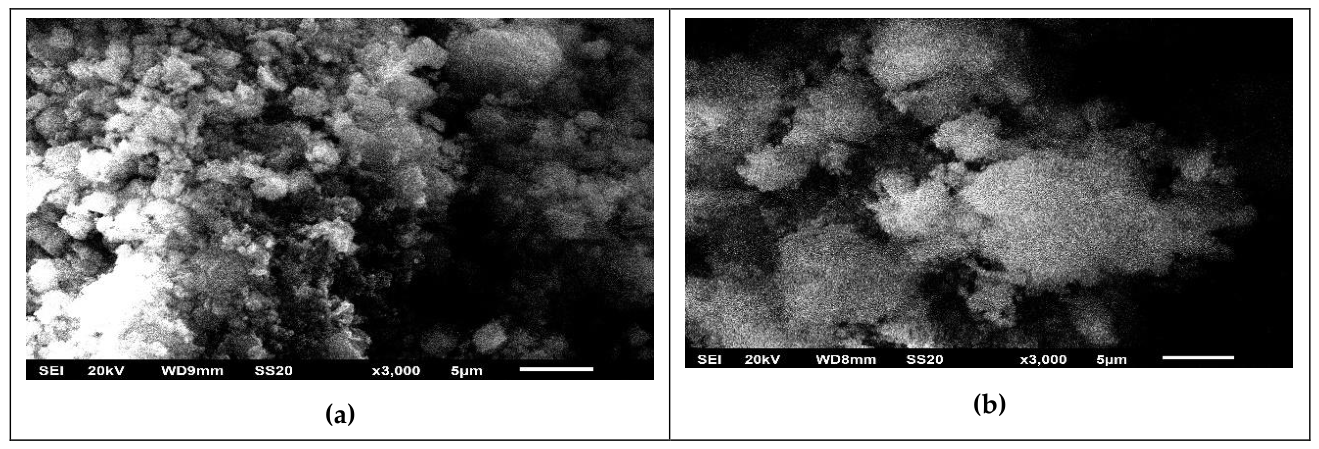
Figure 2.
XRD patterns of the fresh and spent mono- and bimetallic 5% Co-Ir/Al2O3 catalysts.
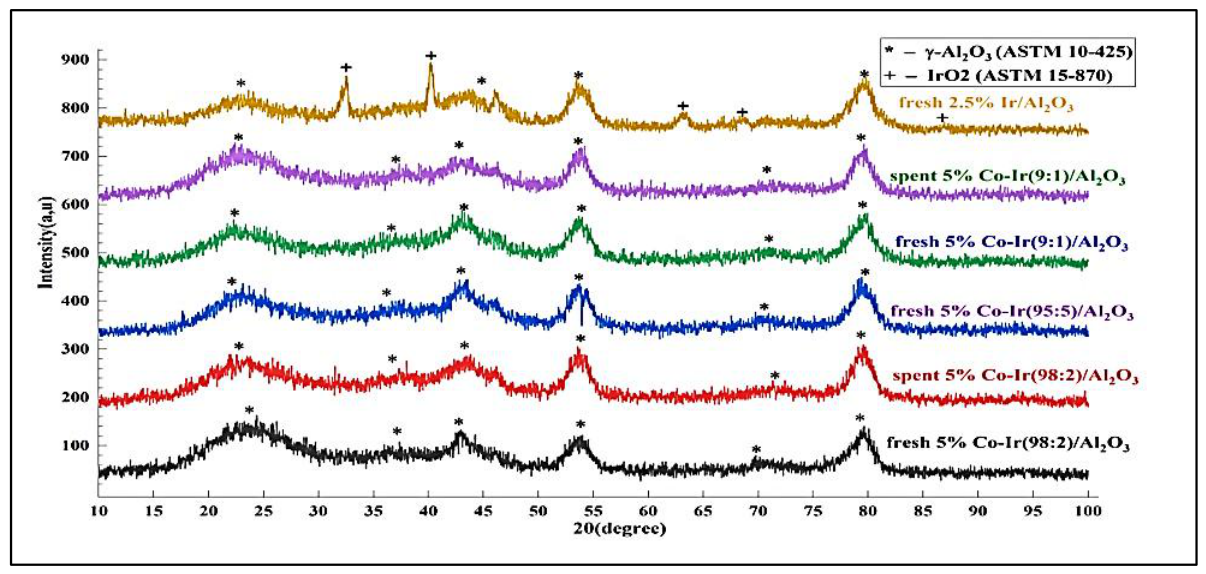
Figure 3.
XRD pattern of the monometallic 4.5% Co/Al2O3 catalyst.
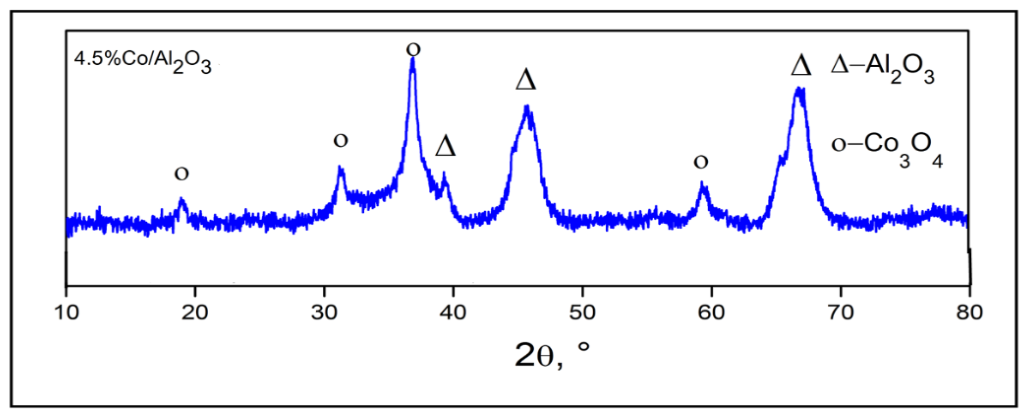
Figure 4.
Dark-field TEM pattern of 5%Co-Ir (95:5)/Al2O3 catalyst a) fresh sample; b) spent sample.
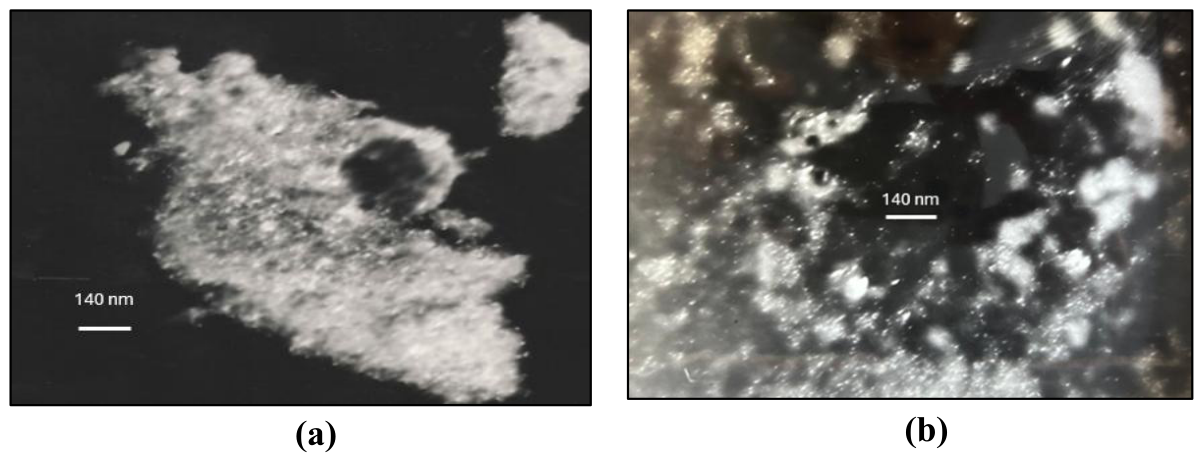
Figure 5.
TPR profiles of the mono- and bimetallic 5% Co-Ir/Al2O3 catalysts, Co:Ir=90:10 and 95:5, corresponding to 0.5 and 0.25 wt.% of Ir.
Figure 5.
TPR profiles of the mono- and bimetallic 5% Co-Ir/Al2O3 catalysts, Co:Ir=90:10 and 95:5, corresponding to 0.5 and 0.25 wt.% of Ir.
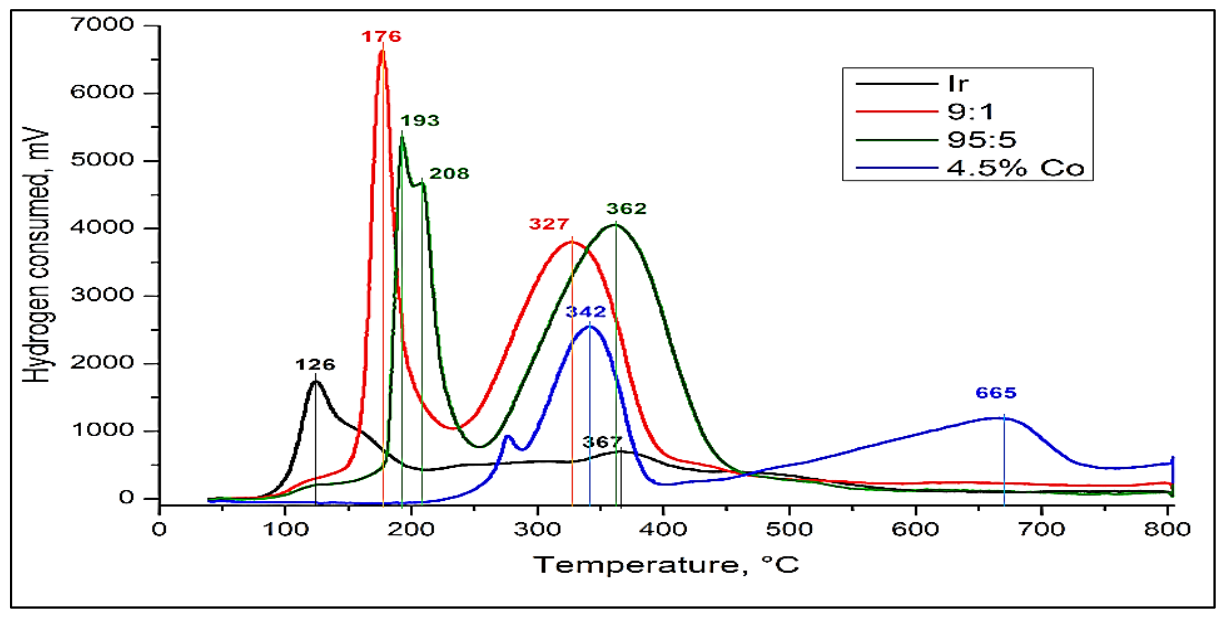
Figure 6.
The effect of temperature on conversion of biogas over (a) 5%Co-Ir (90:10)/Al2O3 and (b) 5%Co-Ir (95:5)/Al2O3 under P=1 atm, CH4:CO2:Ar=1:1:8, GHSV=1000 h-1.
Figure 6.
The effect of temperature on conversion of biogas over (a) 5%Co-Ir (90:10)/Al2O3 and (b) 5%Co-Ir (95:5)/Al2O3 under P=1 atm, CH4:CO2:Ar=1:1:8, GHSV=1000 h-1.
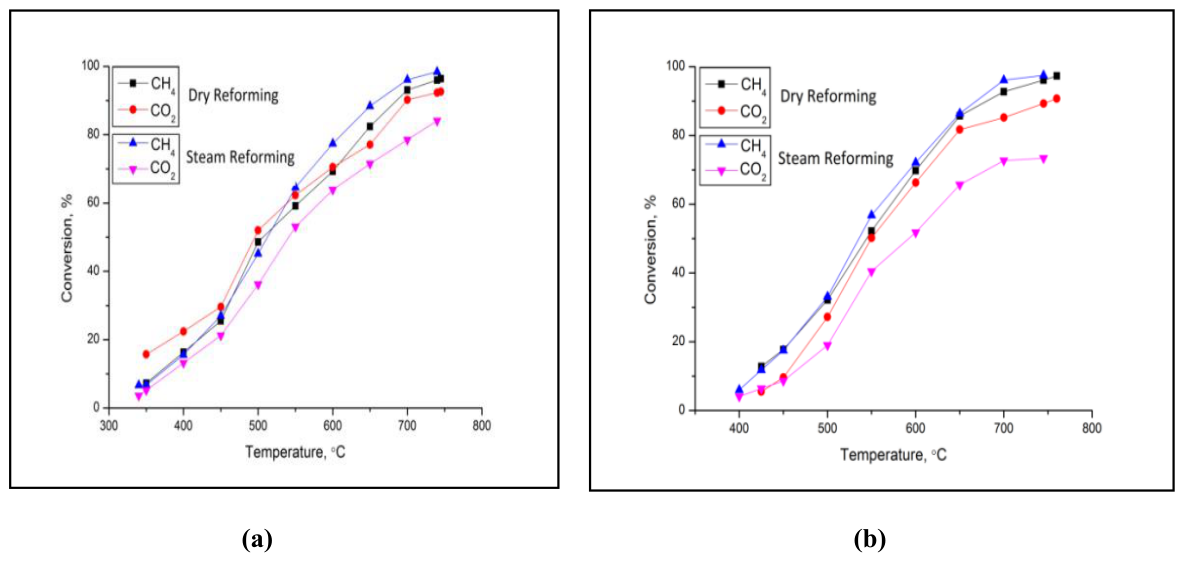
Figure 7.
The effect of temperature on dry reforming of biogas over (a) 5%Co-Ir (98:2)/Al2O3, (b) 5%Co- Ir (99:1)/Al2O3 and (c) 5%Co-Ir (99.5:0.5)/Al2O3 under P=1 atm, CH4:CO2 =1:1, GHSV=1000 h-1.
Figure 7.
The effect of temperature on dry reforming of biogas over (a) 5%Co-Ir (98:2)/Al2O3, (b) 5%Co- Ir (99:1)/Al2O3 and (c) 5%Co-Ir (99.5:0.5)/Al2O3 under P=1 atm, CH4:CO2 =1:1, GHSV=1000 h-1.
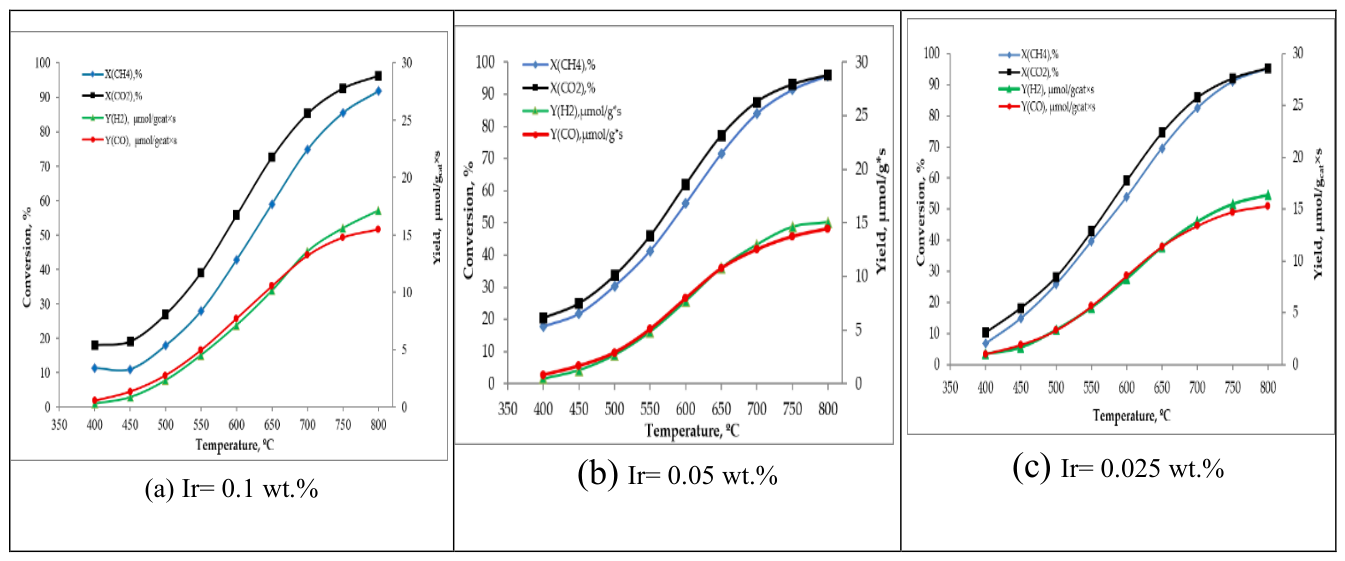
Figure 8.
The effect of process duration on performance of 5%Co-Ir(98:2)/Al2O3 in BRB (СН4:СО2:H2O =1:1:0.5, t=700 ºC, Р=1 atm, GHSV=1250 h-1).
Figure 8.
The effect of process duration on performance of 5%Co-Ir(98:2)/Al2O3 in BRB (СН4:СО2:H2O =1:1:0.5, t=700 ºC, Р=1 atm, GHSV=1250 h-1).
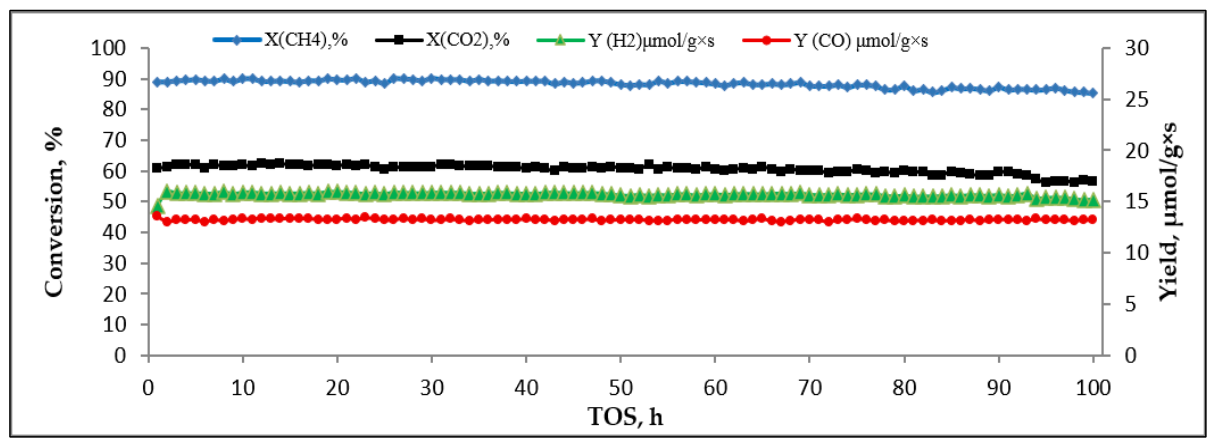
Figure 9.
The effect of process duration on performance of 5%Co-Ir(99:1)/Al2O3 in BRM (СН4:СО2:H2O =1:1:0.5, t=700 ºC, Р=1 atm, GHSV=1250 h-1).
Figure 9.
The effect of process duration on performance of 5%Co-Ir(99:1)/Al2O3 in BRM (СН4:СО2:H2O =1:1:0.5, t=700 ºC, Р=1 atm, GHSV=1250 h-1).
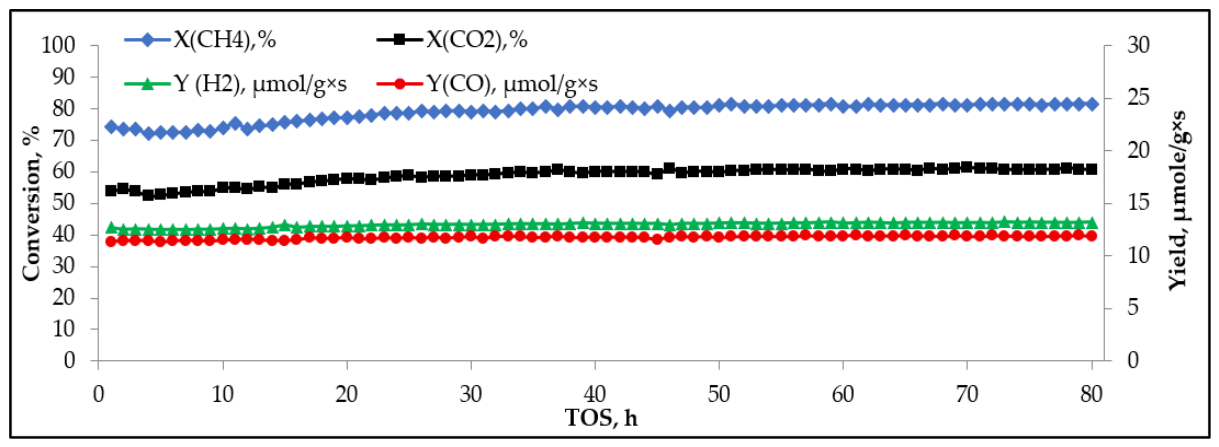

Table 1.
Specific surface area (SBET) of the 5% Co-Ir/Al2O3 catalysts.
| Co:Ir ratio (wt.) |
Nominal Ir content, % of total catalyst mass | Surface area, m2/g | ||
|---|---|---|---|---|
| Fresh sample |
Sample spent in | |||
| DRB | SRB | |||
| 90:10 | 0.5 | 153.7 | 135.7 | 134.6 |
| 95:5 | 0.25 | 160.4 | 130.4 | 128.3 |
| 98:2 | 0.1 | 143.9 | 89.4 | 88.9 |
| 99:1 | 0.05 | 149.2 | 103.2 | 84.9 |
| 99.5:0.5 | 0.025 | 141.7 | 97.2 | 100.0 |
Table 2.
Pore characteristics (BET) of the 5% Co-Ir/Al2O3 catalysts with a low content of Ir.
| Co:Ir ratio (wt.) |
Nominal Ir content, wt. % |
Pore volume, ml/g | Average pore diameter, nm | ||||
|---|---|---|---|---|---|---|---|
| Fresh Sample |
Sample spent in | Fresh sample |
Sample spent in | ||||
| DRB | SRB | DRB | SRB | ||||
| 98:2 | 0.1 | 0.2 | 0.1 | 0.1 | 4.5 | 5.7 | 1.7 |
| 99:1 | 0.05 | 0.2 | 0.1 | 0.1 | 4.5 | 4.4 | 2.6 |
| 99.5:0.5 | 0.025 | 0.2 | 0.1 | 0.1 | 4.2 | 5.0 | 2.2 |
Table 3.
Comparison of the performance of 5%Co-Ir/Al2O3 catalysts in dry (CH4:CO2:Ar=1:1:8) and steam (CH4:CO2:H2O:Ar=1:1:0.2:8) conversion of biogas depending on temperature and Ir content under P=1 atm, GHSV=1000 h-1.
Table 3.
Comparison of the performance of 5%Co-Ir/Al2O3 catalysts in dry (CH4:CO2:Ar=1:1:8) and steam (CH4:CO2:H2O:Ar=1:1:0.2:8) conversion of biogas depending on temperature and Ir content under P=1 atm, GHSV=1000 h-1.
| Ratio of Co-Ir |
Ir content, wt.% | Process | t, ºC | Extent of conversion, % | Ratio of H2/CO | |
|---|---|---|---|---|---|---|
| CH4 | CO2 | |||||
| 95:5 | 0.25 | Dry reforming | 600 | 69.8 | 66.3 | 0.8 |
| 700 | 92.7 | 85.2 | 0.9 | |||
| 740 | 96.2 | 89.6 | 0.9 | |||
| 750 | 97.3 | 90.7 | 0.9 | |||
| Steam reforming | 600 | 72.1 | 51.8 | 1.3 | ||
| 700 | 96.1 | 72.7 | 1.2 | |||
| 740 | 97.5 | 73.1 | 1.2 | |||
| 750 | 100 | 73.4 | 1.2 | |||
| 90:10 | 0.5 | Dry reforming | 600 | 69.3 | 70.5 | 0.8 |
| 700 | 93.1 | 90.2 | 0.9 | |||
| 740 | 96.4 | 92.6 | 0.9 | |||
| Steam reforming | 600 | 77.4 | 63.9 | 1.2 | ||
| 700 | 96.1 | 78.5 | 1.2 | |||
| 740 | 100 | 84.1 | 1.0 | |||
| 50:50 | 2.5 | Dry reforming | 600 | 82.2 | 75.9 | 1.1 |
| 700 | 99.4 | 89.2 | 1.2 | |||
Table 4.
Comparison of the performance of 5%Co-Ir/Al2O3 catalysts with a small amount of Ir in dry (CH4:CO2=1:1) and steam (CH4:CO2:H2O=1:1:0.2) conversion of biogas under P=1 atm, GHSV=1000 h-1.
Table 4.
Comparison of the performance of 5%Co-Ir/Al2O3 catalysts with a small amount of Ir in dry (CH4:CO2=1:1) and steam (CH4:CO2:H2O=1:1:0.2) conversion of biogas under P=1 atm, GHSV=1000 h-1.
| Ratio of Co-Ir |
Ir content, wt.% | Process | t, ºC | Degree of conversion, % | Yield of products, μmol/gcat×s |
Ratio of H2/CO | ||
|---|---|---|---|---|---|---|---|---|
| CH4 | CO2 | H2 | CO | |||||
| 98:2 | 0.1 | DRB | 700 | 74.8 | 85.2 | 13.6 | 13.2 | 1.03 |
| 800 | 91.8 | 96.3 | 17.2 | 15.5 | 1.11 | |||
| SRB | 700 | 94.1 | 46.0 | 18.4 | 12.2 | 1.55 | ||
| 800 | 98.8 | 74.8 | 18.2 | 12.8 | 1.49 | |||
| 99:1 | 0.05 | DRB | 700 | 84.0 | 87.6 | 12.9 | 12.5 | 1.03 |
| 800 | 95.8 | 95.9 | 15.0 | 14.5 | 1.04 | |||
| SRB | 700 | 82.7 | 36.8 | 15.8 | 8.2 | 1.94 | ||
| 800 | 98.9 | 57.8 | 18.7 | 13.6 | 1.38 | |||
| 99.5:0.5 | 0.025 | DRB | 700 | 82.5 | 85.9 | 13.8 | 13.4 | 1.03 |
| 800 | 95.2 | 95.4 | 16.4 | 15.3 | 1.07 | |||
| SRB | 700 | 65.8 | 22.0 | 13.9 | 6.9 | 2.02 | ||
| 800 | 99.1 | 49.5 | 20.0 | 11.9 | 1.68 | |||
Disclaimer/Publisher’s Note: The statements, opinions and data contained in all publications are solely those of the individual author(s) and contributor(s) and not of MDPI and/or the editor(s). MDPI and/or the editor(s) disclaim responsibility for any injury to people or property resulting from any ideas, methods, instructions or products referred to in the content. |
© 2026 by the authors. Licensee MDPI, Basel, Switzerland. This article is an open access article distributed under the terms and conditions of the Creative Commons Attribution (CC BY) license (http://creativecommons.org/licenses/by/4.0/).
Copyright: This open access article is published under a Creative Commons CC BY 4.0 license, which permit the free download, distribution, and reuse, provided that the author and preprint are cited in any reuse.


