

Submitted:
22 June 2026
Posted:
23 June 2026
You are already at the latest version
Abstract
The rapid integration of artificial intelligence (AI) into higher education has renewed concern that technology-related strain may erode students’ higher-order thinking. Drawing on a social-cognitive framework, this study tested whether AI self-efficacy and technostress predict critical thinking in 340 Peruvian undergraduates, who completed three validated scales (Yoon’s Critical Thinking Disposition Inventory; the brief General Self-Efficacy Scale for AI, GSE-6AI; and the RED-Technostress scale). Data were modeled with PLS-SEM, with significance from 5,000 bootstrap resamples and an out-of-sample predictive assessment (PLSpredict, CVPAT). AI self-efficacy was a robust positive predictor of critical thinking (β = 0.42, p < .001), whereas technostress had no direct effect (β = −0.06, p = .50); AI self-efficacy was associated with higher technostress (β = 0.24, p < .001), but that path did not carry over to critical thinking (no mediation). A hypothesized moderation (AI self-efficacy mattering more at higher technostress) was not confirmed: it reached significance under the two-stage method but not under a stricter bootstrap, and is therefore treated as preliminary. The model explained a modest share of variance in critical thinking (R2 = .17) and was invariant across public and private universities. These findings reposition technostress as, at most, a distal correlate and identify confident, literate engagement with AI, rather than the absence of strain, as the more promising lever for cultivating critical thinking.
Keywords:
technostress
; artificial intelligence self-efficacy
; critical thinking
; higher education
; university students
; PLS-SEM
1. Introduction
The rapid incorporation of digital and artificial-intelligence (AI) technologies into higher education has transformed how students access information, complete academic tasks, and regulate their own learning (Zawacki-Richter et al., 2019; Crompton & Burke, 2023). Generative AI tools have moved from the margins to the center of students’ academic routines within a remarkably short period, and a growing literature documents both their perceived benefits and the challenges they introduce (Chan & Hu, 2023; Strzelecki, 2024). As universities embed these technologies into curricula and communication platforms, the psychological demands placed on students have intensified accordingly, making the study of how digital strain interacts with cognition increasingly urgent.
One salient consequence of this intensification is technostress, the strain that arises when individuals cannot cope adaptively with information and communication technologies (ICT). First articulated in organizational research (Tarafdar et al., 2007; Ragu-Nathan et al., 2008) and later extended to broader populations (Salanova et al., 2013), technostress manifests through facets such as skepticism, fatigue, anxiety, inefficacy, and addiction. Among university students, technostress has been associated with diminished well-being, lower motivation, and weaker academic performance (Qi, 2019; Wang et al., 2021; Upadhyaya & Vrinda, 2021). Yet the evidence is not uniformly negative: some studies describe technology use as a “double-edged sword” whose consequences depend on how demands are appraised and managed (Qi, 2019), leaving open the question of how technostress relates to higher-order cognition.
Critical thinking: the ability to analyze, evaluate, and synthesize information to reach reasoned judgments, is widely regarded as a core graduate competency (Manalo et al., 2013; Shin et al., 2015). In contemporary higher education this competency must be exercised in technology-saturated, AI-rich environments, where students continuously appraise machine-generated information (Álvarez-Huerta et al., 2023; Meirbekov et al., 2022). It is therefore plausible that technology-related strain could compromise the cognitive resources critical thinking requires; however, this relationship has rarely been tested directly, and the mechanisms that might protect critical thinking under digital strain remain poorly understood.
Two gaps motivate the present study. First, the direct link between technostress and critical thinking has seldom been examined empirically. Second, the proliferation of AI tools introduces a new and understudied personal resource: students’ self-efficacy for using AI. Building on Bandura’s (1977) social-cognitive account of self-efficacy and on decades of work on technology self-efficacy (Compeau & Higgins, 1995), researchers have only recently begun to operationalize AI self-efficacy specifically (Wang & Chuang, 2024; Bewersdorff et al., 2025; Morales-García et al., 2024). Whether AI self-efficacy supports critical thinking, and whether technostress shapes that relationship remains unknown. Accordingly, this study tests (a) the direct effect of technostress on critical thinking, (b) the effect of AI self-efficacy on critical thinking, and (c) whether technostress moderates the AI self-efficacy–critical thinking relationship, in a sample of Peruvian undergraduates, a Latin American context in which technology integration is expanding rapidly and evidence remains scarce.
1.1. Theoretical Foundations and Hypotheses
The model described here draws on two traditions. Bandura’s (1977) social cognitive theory positions self-efficacy as a key component of motivation, perseverance, and self-regulation in complex cognitive activity. Therefore, it makes sense to explore the connection between self-efficacy in AI and critical thinking. The challenge–hindrance stressor model (Cavanaugh et al., 2000; LePine et al., 2005) posits that not all demands are negative. It depends on the evaluation of those demands and the personal resources available to cope with them. Both perspectives suggest that critical thinking can be influenced by technostress and self-efficacy in AI, both separately and in combination.
1.1.1. Technostress and Critical Thinking
Resource-based theories provide two complementary perspectives for explaining how technostress can have a detrimental effect on critical thinking. Cognitive load theory suggests that working memory has limited capacity. Additional demands due to poorly designed technology and extrinsic cognitive load compete with the processing required for analysis and evaluation (Paas et al., 2003; van Merriënboer & Sweller, 2005). The resource conservation model introduces a temporal aspect: students experience a burden and strain when technology fails to meet their needs and forces them to invest continuous effort to meet its demands. This burden and strain prevent students from engaging in high-demand computational tasks (Hobfoll, 1989; Hobfoll et al., 2018). In the context of the RED-Technostress model, fatigue, anxiety, and feelings of ineffectiveness reflect this dimension of exhaustion (Llorens et al., 2011; Salanova et al., 2013).
The empirical record consistently suggests a cost. College students’ well-being, motivation, and academic performance are negatively affected by technostress (Tarafdar et al., 2007; Ragu-Nathan et al., 2008; Qi, 2019; Wang et al., 2021; Upadhyaya and Vrinda, 2021), and negative effects have been observed in Latin America in Peruvian and Colombian samples (Alvarez-Risco et al., 2021; Andrade Navia et al., 2023). Whether the cost reaches a relatively constant level, as critical thinking does, is more debatable, since some describe students’ engagement with technology as a double-edged sword whose net impact depends on the assessment of demands (Qi, 2019). Reading technostress in its conventional form as a hindrance stressor that drains cognitive resources, we nonetheless expected a negative direct effect:
H1. Technostress has a significant negative direct effect on critical thinking.
1.1.2. AI Self-Efficacy and Critical Thinking
Within Bandura’s (1977) sociocognitive theory, self-efficacy is the primary driver of cognition: students who are confident in their ability to succeed are more likely to set challenging goals, persevere, and engage in the metacognitive strategies essential for complex reasoning. Meta-analytic syntheses show that academic self-efficacy is most consistently related to performance and self-regulated learning (Honicke & Broadbent, 2016; Honicke et al., 2020). Furthermore, other studies have investigated the relationship between academic self-efficacy and critical thinking (Dehghani et al., 2011; Fahim and Nasrollahi-Mouziraji, 2013; Hyytinen et al., 2018).
It is reasonable to extend this reasoning to the field of AI for two reasons. First, self-efficacy appears to influence reasoning processes through creative and metacognitive channels that impact the quality of a judgment, rather than just the quantity of a judgment (Qiang et al., 2020; Fu et al., 2023). Second, as AI tools have become standard study aids, confidence in using such tools has been identified as a construct, distinct from general academic self-efficacy (Compeau and Higgins, 1995; Wang and Chuang, 2024; Bewersdorff et al., 2025). Students who have confidence in their ability to effectively request and analyze AI output are more likely to challenge what the AI produces, rather than passively accepting it, and this is the emerging trend in AI-assisted learning (Meishar-Tal and Amzalag, 2026; Nasr et al., 2025). We therefore hypothesized:
H2. AI self-efficacy has a significant positive effect on critical thinking.
1.1.3. The Moderating Role of Technostress
The challenge–hindrance framework regarding job demands suggests that demands have a different impact depending on the resources a person can mobilize to cope with them (Cavanaugh et al., 2000; LePine et al., 2005; Crawford et al., 2010). Resources that may be redundant when demands are low can be critical when demands are high. Resource conservation theory posits that when demands are high, resources are the most protective and the most likely to be mobilized (Hobfoll et al., 2018; Zeng & Cong, 2025).
In the current case, when students experience low levels of technostress, they can maintain critical thinking through habitual routines, which may render differences in self-efficacy in AI insignificant. However, when technostress levels are high, and the information environment becomes more chaotic and exhausting, the ability to rely on AI to filter, verify, and synthesize information can improve the quality of a person’s thinking. The relationship is expected to be more than additive, meaning that increased levels of technostress will not only accompany but also strengthen the relationship between self-efficacy in AI and critical thinking. Thus:
H3. Technostress moderates the AI self-efficacy–critical thinking relationship, such that the relationship is stronger at higher levels of technostress.
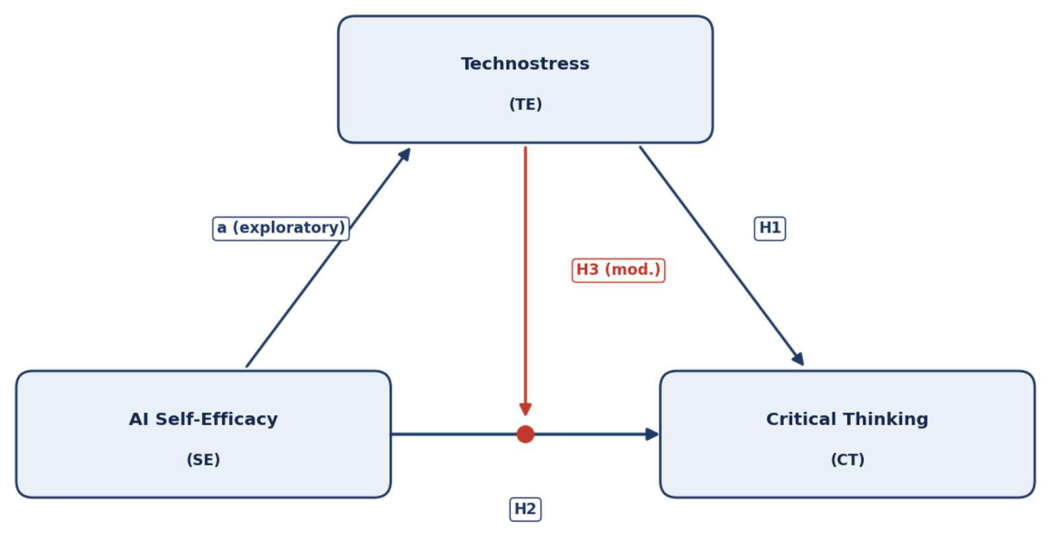
Figure 1.
Conceptual model. H1: technostress → critical thinking; H2: AI self-efficacy → critical thinking; H3: technostress moderates the AI self-efficacy → critical thinking relationship. Path a (AI self-efficacy → technostress) was examined only in a complementary, exploratory mediation analysis and was not hypothesized.
Figure 1.
Conceptual model. H1: technostress → critical thinking; H2: AI self-efficacy → critical thinking; H3: technostress moderates the AI self-efficacy → critical thinking relationship. Path a (AI self-efficacy → technostress) was examined only in a complementary, exploratory mediation analysis and was not hypothesized.
2. Materials and Methods
2.1. Design and Participants
A quantitative, cross-sectional, correlational design was used. The sample comprised 340 undergraduate students from public and private universities in Peru, recruited through non-probability convenience sampling. The sample of 340 exceeded the minimum suggested by the inverse-square-root method for detecting the main structural paths (Kock & Hadaya, 2018), although statistical power for the interaction term was comparatively limited. Demographic characteristics appear in Table 1.
2.2. Instruments
Critical thinking was measured with 13 retained items from Yoon’s Critical Thinking Disposition Inventory (validated by Shin et al., 2015; 5-point scale). One item was removed prior to analysis after it was found to duplicate another item in the dataset. AI self-efficacy was measured with the six-item General Self-Efficacy Scale adapted for AI use (GSE-6AI; Morales-García et al., 2024; 5-point scale). Technostress was measured with 18 retained items of the RED-Technostress scale (Eidman & Basualdo Felleau, 2021; 7-point scale), covering skepticism, fatigue, anxiety, inefficacy, and addiction. Full item wording appears in Appendix A.
2.3. Data Analysis
Analyses used PLS-SEM (Hair et al., 2019). The measurement model was assessed for internal consistency (Cronbach’s α, ρA, composite reliability ρc), convergent validity (AVE), and discriminant validity (Fornell–Larcker and HTMT; Henseler et al., 2015). The structural model was evaluated through path coefficients, R2, effect sizes (f2), and out-of-sample predictive relevance (Q2predict and PLSpredict; Shmueli et al., 2019), complemented by the cross-validated predictive ability test (CVPAT; Liengaard et al., 2021). Moderation was tested with the two-stage approach, and the interaction was additionally re-estimated under a full bootstrap that re-estimates the measurement model in each resample. Significance and confidence intervals were obtained from 5,000-resample bootstrapping; hypotheses were judged on bootstrap confidence intervals. Common method bias was examined with Harman’s single-factor test and the full-collinearity VIF (Kock, 2015). Finally, to test generalizability across institutional contexts, we ran a permutation-based multi-group analysis (MGA) comparing public and private university students, preceded by the measurement-invariance assessment of composite models (MICOM; Henseler et al., 2016).
3. Results
Before the model was tested, the construct scores were inspected for distribution. Mean technostress was comparatively low (M = 2.19 on a 0–6 scale), whereas AI self-efficacy (M = 3.23) and critical thinking (M = 3.66) sat above the midpoint of their 1–5 scales (Table 2). Skewness and kurtosis stayed within plus or minus 2 for every indicator, which supports the use of PLS-SEM with bootstrap inference.
3.1. Measurement Model (Stage 1)
All constructs exceeded the 0.70 threshold for α, ρA, and ρc (Table 3). Standardized loadings ranged from 0.52 to 0.85; following Hair et al. (2019), items with loadings between 0.40 and 0.70 were retained to preserve content coverage and multidimensional structure of the validated source scales. AVE was 0.60 for AI self-efficacy and approximately 0.40 for both critical thinking and technostress. Although these two values fall below the 0.50 benchmark, their composite reliabilities remain well above 0.70 (0.90 and 0.92, respectively); under the criterion of Fornell and Larcker (1981) and Malhotra and Dash (2011), a composite reliability above 0.60 supports adequate convergent validity even when AVE is below 0.50. A modest AVE is, moreover, expected for the broad, multidimensional constructs assessed here (critical-thinking disposition and the five-facet RED-Technostress scale), whose heterogeneous content lowers average item communality. We nonetheless note the below-threshold AVE as a measurement limitation. All indicator VIFs were below 3.3, indicating no indicator collinearity.
3.2. Discriminant Validity
Discriminant validity was supported. The square root of each construct’s AVE exceeded its inter-construct correlations (Fornell–Larcker), and all HTMT ratios were well below 0.85 (Table 4).
3.3. Common Method Bias and Model Fit
Harman’s single-factor test attributed 22.8% of variance to the first unrotated factor (< 40%), and all full-collinearity VIFs were below 1.3, indicating that common method bias was not a concern (Table 5). Approximate model fit was mixed: the SRMR of 0.105 exceeds the conventional 0.10 cutoff and indicates limited exact fit, although the NFI of 0.952 is above the 0.90 benchmark; consistent with current guidance, model fit is de-emphasized in PLS-SEM and inference relies on the measurement and predictive assessments (Table 6; Hair et al., 2019).
3.4. Explanatory and Predictive Power
AI self-efficacy and technostress explained 17.0% of the variance in critical thinking, and AI self-efficacy explained 5.7% of the variance in technostress (Table 7). Out-of-sample predictive relevance was limited: PLSpredict Q2predict was near zero for critical-thinking indicators (although PLS outperformed the linear-model benchmark on RMSE for all 13 indicators) and only marginally positive for technostress, and the CVPAT showed that the model did not surpass the indicator-average benchmark for critical thinking (Table 8). This pattern is consistent with technostress being, at most, weakly linked to critical thinking.
3.5. Structural Model and Hypothesis Testing (Stage 2)
AI self-efficacy had a robust positive effect on critical thinking (H2: β = 0.42, 95% CI [0.32, 0.53], p < .001, f2 = 0.20). Technostress had no direct effect (H1: β = −0.06, p = .50) and was therefore not supported. The technostress→AI self-efficacy path was positive but not robust (β = 0.24, 95% CI [−0.12, 0.36], p = .08). Results appear in Table 9.
3.6. Moderation (H3) and a Complementary Mediation Test
This section reports two complementary analyses of how technostress relates to the AI self-efficacy–critical-thinking link: the moderation hypothesized in H3 and an exploratory mediation test of whether technostress transmits AI self-efficacy’s effect on critical thinking. The moderation is reported as preliminary because its interaction term is underpowered (f2 = 0.03); the mediation is exploratory and was not hypothesized. The technostress × AI self-efficacy interaction on critical thinking was positive (β = 0.15, f2 = 0.031). Under the standard two-stage approach the interaction was significant (95% CI [0.024, 0.251], p = .012); however, under a full bootstrap that re-estimates the measurement model in each resample, it was only marginal (95% CI [−0.015, 0.264], p = .07). We therefore report it as preliminary evidence. Simple-slope analysis (Table 10, Figure 3) indicated that the AI self-efficacy→critical thinking slope rose from 0.31 at low technostress (−1 SD) to 0.60 at high technostress (+1 SD): AI self-efficacy appears to matter more when technostress is higher.
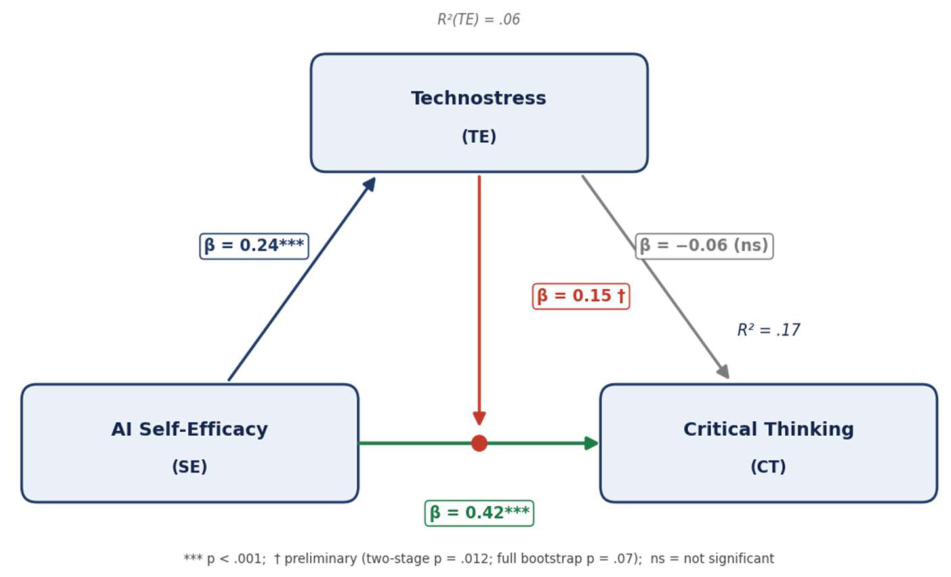
Figure 2.
Estimated model with standardized coefficients. AI self-efficacy → critical thinking (H2) and AI self-efficacy → technostress (path a) was significant (*** p < .001); technostress → critical thinking (H1) was non-significant (ns); the moderation (†) was significant only under the two-stage approach.
Figure 2.
Estimated model with standardized coefficients. AI self-efficacy → critical thinking (H2) and AI self-efficacy → technostress (path a) was significant (*** p < .001); technostress → critical thinking (H1) was non-significant (ns); the moderation (†) was significant only under the two-stage approach.
As a complementary, exploratory analysis (not a formal hypothesis), the indirect path from AI self-efficacy to critical thinking through technostress was also examined (Table 11). The component paths were uneven: AI self-efficacy predicted technostress significantly (a = 0.24, p < .001), but technostress did not predict critical thinking (b = −0.06, ns). The resulting specific indirect effect was negligible and non-significant (a×b = −0.014, 95% CI [−0.039, 0.011]), whereas the direct effect of AI self-efficacy on critical thinking was strong (c′ = 0.42, p < .001). Following the decision rules of Zhao et al. (2010) and the PLS mediation guidance of Nitzl et al. (2016), this configuration corresponds to a direct-only non-mediation pattern (AI self-efficacy relates to critical thinking directly, not through technostress); the variance-accounted-for index is not interpretable here because the direct and indirect effects carry opposite signs. The exploratory mediation therefore received no empirical support.

Table 12.
Summary of hypothesis testing.
| Hyp. | Path | β | Decision |
| H1 | Technostress → Critical thinking | −0.06 | Not supported |
| H2 | AI self-efficacy → Critical thinking | 0.42*** | Supported |
| H3 | Technostress × AI self-efficacy → Critical thinking | 0.15† | Not supported (significant only under two-stage; n.s. under full bootstrap) |
Note. *** p < .001; † significant under the two-stage approach (p = .012) but marginal under the full bootstrap (p = .07).
3.7. Multi-Group Analysis: Public versus Private Universities
To assess whether the findings generalize across institutional contexts, we compared public (n = 213) and private (n = 127) university students. Measurement invariance was first established with the MICOM procedure (Henseler et al., 2016): configural invariance held by design, compositional invariance was supported for all three constructs (c = 0.88–0.99, each above the 5% permutation threshold), and the composites exhibited equal means and variances across groups (all p > .10), indicating full measurement invariance. With invariance established, a permutation-based multi-group analysis revealed no significant difference in any structural path between the two groups (Table 13): AI self-efficacy → critical thinking (β = 0.40 vs. 0.48, p = .43), technostress → critical thinking (β = −0.05 vs. 0.02, p = .74), AI self-efficacy → technostress (β = 0.28 vs. 0.32, p = .72), and the technostress × AI self-efficacy interaction (β = 0.20 vs. 0.02, p = .20). The model therefore holds equivalently in public and private universities.
4. Discussion
This study sets out to clarify whether technostress impairs critical thinking among university students and whether AI self-efficacy shapes that outcome. Three findings stand out. First, AI self-efficacy was a robust positive predictor of critical thinking. Second, technostress exerted no direct effect on critical thinking. Third, a preliminary, unconfirmed interaction suggested that AI self-efficacy may matter more at higher levels of technostress. Together, these results reframe a widespread concern: in AI-mediated higher education, the strain that technology imposes may matter less for higher-order cognition than the confidence with which students mobilize technological resources (Crompton & Burke, 2023; Chan & Hu, 2023; Nasr et al., 2025).
4.1. AI Self-Efficacy as a Driver of Critical Thinking
The robust effect of AI self-efficacy on critical thinking (β = 0.42) is best understood through Bandura’s (1977) social-cognitive theory, in which efficacy beliefs govern the effort, persistence, and metacognitive self-regulation that complex reasoning demands. Meta-analytic evidence establishes academic self-efficacy as one of the most consistent correlates of academic performance and self-regulated learning (Honicke & Broadbent, 2016; Honicke et al., 2020), and a parallel literature ties self-efficacy specifically to critical-thinking dispositions and skills (Dehghani et al., 2011; Fahim & Nasrollahi-Mouziraji, 2013; Hyytinen et al., 2018; Qiang et al., 2020; Fu et al., 2023). Our results extend this evidence to the AI domain: students who feel capable of deploying AI tools to manage academic tasks appear better able to interrogate, evaluate, and integrate machine-generated information, the core acts of critical thinking. This interpretation converges with emerging work showing that academic and AI-related self-efficacy accompany stronger critical thinking and creativity in AI-supported settings (Meishar-Tal & Amzalag, 2026; Nasr et al., 2025), and with the broader argument that confident, literate engagement with AI, rather than mere exposure, is what benefits learning (Wang & Chuang, 2024; Bewersdorff et al., 2025; Carolus et al., 2023).
4.2. The Null Direct Effect of Technostress
Contrary to H1, technostress showed no direct effect on critical thinking. Although resource-based accounts, namely cognitive load theory (Paas et al., 2003; van Merriënboer & Sweller, 2005) and the conservation of resources model (Hobfoll, 1989; Hobfoll et al., 2018), predict that technological strain should deplete the cognitive resources reasoning requires, several explanations may reconcile theory with this null result. First, critical thinking is a relatively stable disposition rather than a momentary performance, and dispositions are less sensitive to transient strain than state-level outcomes such as fatigue or anxiety (Hyytinen et al., 2018; Kocak et al., 2021). Second, consistent with the “double-edged sword” view of student technology use (Qi, 2019; Wang et al., 2021), the effects of technostress may be appraisal-dependent: when demands are read as challenges rather than hindrances, they need not impair cognition (Cavanaugh et al., 2000; LePine et al., 2005; Crawford et al., 2010). Third, prior Latin American evidence indicates that technostress relates to academic outcomes indirectly (through exhaustion, cognitive load, or self-efficacy) rather than directly (Alvarez-Risco et al., 2021; Andrade Navia et al., 2023; Ma, 2025); yet the indirect path we tested was itself not robust, suggesting that any such mechanism is weak in this sample. Formally classified, the pattern is a non-mediation under the Zhao et al. (2010) typology (Nitzl et al., 2016): the exploratory route from AI self-efficacy through technostress to critical thinking does not hold, indicating that AI self-efficacy relates to critical thinking directly rather than through technostress, and that technostress is, at most, a distal correlate of critical thinking. The one robust association involving technostress ran counter to the usual concern: students more confident with AI reported somewhat higher technostress (β = 0.24), plausibly because greater AI self-efficacy goes hand in hand with heavier, more sustained use of these tools. That strain did not carry through to critical thinking, so technostress appears here as a companion of intensive AI engagement rather than a brake on higher-order cognition.
4.3. The Conditional Role of Technostress (Preliminary)
Research on the interaction between technostress and AI self-efficacy is still at an early stage. From the challenge–hindrance/resource-demand perspectives, an individual’s assessment of their personal resources increases with the level of demand faced (Cavanaugh et al., 2000; LePine et al., 2005; Crawford et al., 2010; Zeng and Cong, 2025). Students facing low levels of technostress engage in critical thinking and perform routine activities, making differences in AI self-efficacy of little importance. However, when facing high levels of technostress, the ability to use AI with confidence becomes critical, and the slope of self-efficacy nearly doubles (0.31 to 0.60). Conservation of Resources (COR) theory explains that resources are more valuable and necessary when the situation is more demanding (Hobfoll et al., 2018). The interaction was significant under the two-stage approach but only marginal under the stricter bootstrap, a pattern typical of small interaction effects (f2 = 0.03) evaluated under conservative inference. The close, rapid, and widespread adoption of generative AI technologies by Peruvian university students suggests that moderating effects may be context- and cohort-specific. Consequently, we present these findings as hypothesis-generating and in need of confirmation in larger, longitudinal studies.
4.4. Predictive Performance and Transparency
The predictive battery is reported at the indicator level. For the critical-thinking indicators, out-of-sample relevance was marginal (Q2predict close to zero), and the CVPAT showed the model performing no better than the indicator-mean benchmark. This is unsurprising: although AI self-efficacy is a strong in-sample predictor, critical thinking is a broad disposition shaped by many determinants beyond those modeled here, so the model explains only a modest share of its variance (R2 = .17) and offers little prediction beyond the mean (Kocak et al., 2021; Van et al., 2022). Reporting this limited predictive performance transparently, rather than overstating it, is itself a contribution in the context of PLS-SEM fit and prediction (Hair et al., 2019; Shmueli et al., 2019).
4.5. Theoretical and Practical Implications
Theoretically, the study develops social-cognitive theory within the context of AI by considering self-efficacy in AI as a proximal predictor of advanced cognition, while reconceptualizing the relationship between personal resources and technostress as a boundary condition where technostress is not perceived as a direct threat (Hobfoll et al., 2018; Crawford et al., 2010). Practically, the results imply that reducing technostress alone should not be the primary focus of interventions; rather, positive and effective student engagement with AI should be promoted through AI literacy education and the constructive and evaluative application of AI (Crompton & Burke, 2023; Chan & Hu, 2023; Nasr et al., 2025). For Latin American universities, which are in the process of expanding their digital infrastructures, incorporating elements of trust in AI and critical evaluation into flexible digital literacy training may be more effective in safeguarding critical thinking than interventions aimed at stress response, particularly for students operating in high-tech environments (Alvarez-Risco et al., 2021; Andrade Navia et al., 2023). Multi-group analysis further showed the model to be invariant, both in measurement and in structure, across public and private universities, indicating that these implications are not confined to a single institutional context.
Several limitations qualify for these conclusions. The cross-sectional design precludes causal inference; longitudinal and experimental work is needed to establish temporal order, especially for the proposed moderation. Non-probability convenience sampling within a single country limits generalizability, and reliance on self-report invites common-method concerns, although Harman’s test and full-collinearity VIFs indicated that such bias was not substantial (Kock, 2015). Relatedly, the average variance extracted fell below the 0.50 benchmark for critical thinking and technostress; rather than trimming items to inflate this index (which would have collapsed the technostress measure onto a single facet and narrowed the critical-thinking disposition), we retained the validated multidimensional item sets and relied on the high composite reliabilities to support convergent validity (Fornell & Larcker, 1981; Malhotra & Dash, 2011), a deliberate choice that favors content validity over a numerical threshold. AI self-efficacy is a recently introduced construct whose measurement continues to evolve, and future studies should triangulate it with AI-literacy and AI-attitude measures (Wang & Chuang, 2024; Wang et al., 2022; Grassini, 2023; Carolus et al., 2023). The interaction effect was underpowered and should be re-examined with larger samples and complementary moderation techniques. Finally, the modestly explained variance points to unmeasured determinants of critical thinking; future models should incorporate instructional, dispositional, and motivational antecedents, employ objective critical-thinking assessments rather than self-report dispositions, and test the model across cultural contexts and academic disciplines (Kocak et al., 2021; Van et al., 2022).
5. Conclusions
This study examined whether technostress erodes critical thinking and whether there are more complex answers to this question than the dominant narratives suggest. In a sample of 340 university students in Peru, technostress showed no direct effect on critical thinking and did not serve as the pathway linking AI self-efficacy to critical thinking. What was of greatest importance was the participants’ self-efficacy in using AI. This was the only variable shown to have a strong positive relationship with critical thinking. Preliminary evidence further suggested that this self-efficacy in using AI may be especially valuable under high technostress, although that moderation still requires confirmation.
This study makes three distinct contributions. First, this study demonstrates the importance of domain-specific self-efficacy for social-cognitive theory in the context of AI use and describes technostress more accurately as a potential limiting condition rather than a direct threat. Second, and on a methodological note, this study combines traditional estimation and a comprehensive predictive battery with bootstrap inference and reports the limited applicability of the model outside the sample, rather than an overly optimistic estimate of the model’s scope. Third, at the practical level, this study proposes the development of AI skills and critical thinking skills within the context of AI literacy programs and the controlled use of AI as a more direct approach to fostering critical thinking in the Latin American context than stress reduction.
The conclusions drawn are limited by a cross-sectional, single-country approach and an early consideration of self-efficacy in AI as a construct. Therefore, the moderating role of technostress should be considered a hypothesis to be explored rather than a definitive finding. Future research should be longitudinal and span multiple contexts, include larger samples designed to detect interaction effects, and employ objective measures of critical thinking. That said, the main message holds: in AI-rich higher education, strengthening students’ confidence and competence with AI is likely a more effective lever for critical thinking than shielding them from technostress.
Author Contributions
Conceptualization, S.L.L.L., C.J.S.R. and L.A.O.G.; methodology, S.L.L.L. and C.P.A.A.; software, M.A.A.B.; validation, M.A.A.B.; formal analysis, H.Y.M.Y., C.P.A.A. and L.A.O.G.; investigation, M.D.R.P., C.J.S.R. and L.A.O.G.; resources, S.L.L.L.; data curation, M.A.A.B.; writing—original draft preparation, H.Y.M.Y. and A.M.M.V.; writing—review and editing, H.Y.M.Y. and C.P.A.A.; visualization, M.D.R.P. and A.M.M.V.; supervision, C.J.S.R. and A.M.M.V.; project administration, M.D.R.P. All authors have read and agreed to the published version of the manuscript.
Funding
This research received no external funding.
Institutional Review Board Statement
The study was conducted in accordance with the Declaration of Helsinki and approved by the Institutional Ethics Committee “Comité de Ética 2025-IIICyT-ITCA” (approval code 0194-2025-GM-IIICyT, 5 November 2025).
Informed Consent Statement
Informed consent was obtained from all subjects involved in the study.
Data Availability Statement
The data presented in this study are available upon reasonable request from the corresponding author.
Conflicts of Interest
The authors declare no conflict of interest.
Appendix A. Item wording (faithful English translations of the administered Spanish items)
Table A1.
lists the full wording (English translation) of the retained items.
| Code | Item |
| Critical Thinking (CT) | |
| CT8 | I explain my reasons when I disagree with others |
| CT10 | Even when something is already proven, I still ask questions about it |
| CT11 | I have a reputation for being a rational person |
| CT12 | I continually evaluate whether my thinking is correct before forming an opinion |
| CT13 | I continually seek information related to solving a problem |
| CT15 | I willingly solve a complicated problem |
| CT16 | When I look at the world, I do so with an inquiring mind |
| CT17 | I believe I can solve any complicated problem |
| CT21 | I try to understand how the unknown works |
| CT22 | When facing a problem, I strive to find an answer until I solve it |
| CT25 | When solving a problem, I organize data systematically |
| CT26 | I fairly evaluate both my own opinion and that of others |
| CT27 | I trust my own judgment to solve problems |
| AI Self-Efficacy (SE) | |
| SE1 | If someone opposes me, I can find ways to get what I want using AI |
| SE2 | It is easy to stay true to my goals and accomplish them with AI |
| SE3 | I am confident I could deal efficiently with unexpected events using AI |
| SE4 | Thanks to my resourcefulness supported by AI, I handle unforeseen situations |
| SE5 | I stay calm facing difficulties because I trust my AI-supported coping |
| SE6 | No matter what comes my way, I can usually handle it with AI support |
| Technostress (TE) | |
| TE3 | I distrust whether technologies contribute anything to my studies (skepticism) |
| TE5 | I find it hard to relax after a day of studying using them (fatigue) |
| TE6 | When I finish studying with ICT, I feel exhausted (fatigue) |
| TE7 | I am so tired after studying with them that I cannot do anything else (fatigue) |
| TE8 | It is hard to concentrate after studying with technology (fatigue) |
| TE9 | I feel tense and anxious when studying with technology (anxiety) |
| TE10 | It frightens me that I could destroy information through improper use (anxiety) |
| TE11 | I hesitate to use technology for fear of making mistakes (anxiety) |
| TE12 | Studying with them makes me uncomfortable, irritable, impatient (anxiety) |
| TE14 | It is difficult to study with ICT (inefficacy) |
| TE15 | People say I am ineffective at using technologies (inefficacy) |
| TE16 | I am unsure about finishing my tasks well when I use ICT (inefficacy) |
| TE17 | I think I use technology excessively in my life (addiction) |
| TE18 | I continually use technology, even outside study hours (addiction) |
| TE19 | I think about technologies continually, even outside study hours (addiction) |
| TE20 | I feel anxious if I do not have access to technology (addiction) |
| TE21 | An inner urge compels me to use them anywhere, anytime (addiction) |
| TE22 | I devote more time to technology than to friends, family, and hobbies (addiction) |
References
- Álvarez-Huerta, P.; Muela, A.; Larrea, I. Disposition towards critical thinking and student engagement in higher education. Innovative Higher Education 2023, 48(2), 239–256. [Google Scholar] [CrossRef]
- Alvarez-Risco, A.; Del-Aguila-Arcentales, S.; Yáñez, J. A.; Rosen, M. A.; Mejia, C. R. Influence of technostress on academic performance of university medicine students in Peru during the COVID-19 pandemic. Sustainability 2021, 13(16), 8949. [Google Scholar] [CrossRef]
- Andrade Navia, J. M.; Ramírez Plazas, E.; Ramírez, J. C.; Bermeo Castro, D. Technostress, transformational leadership, and academic performance of university students in South Colombia. Problems and Perspectives in Management 2023, 21(4), 468–482. [Google Scholar] [CrossRef]
- Bandura, A. Self-efficacy: Toward a unifying theory of behavioral change. Psychological Review 1977, 84(2), 191–215. [Google Scholar] [CrossRef] [PubMed]
- Bewersdorff, A.; Hornberger, M.; Nerdel, C.; Schiff, D. S. AI advocates and cautious critics: How AI attitudes, AI interest, use of AI, and AI literacy build university students’ AI self-efficacy. Computers and Education: Artificial Intelligence 2025, 8, 100340. [Google Scholar] [CrossRef]
- Carolus, A.; Koch, M. J.; Straka, S.; Latoschik, M. E.; Wienrich, C. MAILS – Meta AI literacy scale: Development and testing of an AI literacy questionnaire. Computers in Human Behavior: Artificial Humans 2023, 1(2), 100014. [Google Scholar] [CrossRef]
- Cavanaugh, M. A.; Boswell, W. R.; Roehling, M. V.; Boudreau, J. W. An empirical examination of self-reported work stress among U.S. managers. Journal of Applied Psychology 2000, 85(1), 65–74. [Google Scholar] [CrossRef] [PubMed]
- Chan, C. K. Y.; Hu, W. Students’ voices on generative AI: Perceptions, benefits, and challenges in higher education. International Journal of Educational Technology in Higher Education 2023, 20(1), 43. [Google Scholar] [CrossRef]
- Cohen, J. Statistical power analysis for the behavioral sciences, 2nd ed.; Lawrence Erlbaum Associates, 1988. [Google Scholar]
- Compeau, D. R.; Higgins, C. A. Computer self-efficacy: Development of a measure and initial test. MIS Quarterly 1995, 19(2), 189–211. [Google Scholar] [CrossRef] [PubMed]
- Crawford, E. R.; LePine, J. A.; Rich, B. L. Linking job demands and resources to employee engagement and burnout: A theoretical extension and meta-analytic test. Journal of Applied Psychology 2010, 95(5), 834–848. [Google Scholar] [CrossRef] [PubMed]
- Crompton, H.; Burke, D. Artificial intelligence in higher education: The state of the field. International Journal of Educational Technology in Higher Education 2023, 20(1), 22. [Google Scholar] [CrossRef]
- Dehghani, M.; Jafari Sani, H.; Pakmehr, H.; Malekzadeh, A. Relationship between students’ critical thinking and self-efficacy beliefs in Ferdowsi University of Mashhad, Iran. Procedia—Social and Behavioral Sciences 2011, 15, 2952–2955. [Google Scholar] [CrossRef]
- Eidman, L.; Basualdo Felleau, S. E. Adaptación y validación de la escala RED-tecnoestrés en población de estudiantes universitarios argentinos. ACADEMO 2021, 8(2), 178–188. [Google Scholar] [CrossRef]
- Fahim, M.; Nasrollahi-Mouziraji, A. The relationship between Iranian EFL students’ self-efficacy beliefs and critical thinking ability. Theory and Practice in Language Studies 2013, 3(3), 538–543. [Google Scholar] [CrossRef]
- Fornell, C.; Larcker, D. F. Evaluating structural equation models with unobservable variables and measurement error. Journal of Marketing Research 1981, 18(1), 39–50. [Google Scholar] [CrossRef]
- Fu, J.; Ding, Y.; Nie, K.; Zaigham, G. H. K. How does self-efficacy, learner personality, and learner anxiety affect critical thinking of students. Frontiers in Psychology 2023, 14, 1289594. [Google Scholar] [CrossRef] [PubMed]
- Grassini, S. Development and validation of the AI attitude scale (AIAS-4): A brief measure of general attitude toward artificial intelligence. Frontiers in Psychology 2023, 14, 1191628. [Google Scholar] [CrossRef] [PubMed]
- Hair, J. F.; Risher, J. J.; Sarstedt, M.; Ringle, C. M. When to use and how to report the results of PLS-SEM. European Business Review 2019, 31(1), 2–24. [Google Scholar] [CrossRef]
- Henseler, J.; Ringle, C. M.; Sarstedt, M. A new criterion for assessing discriminant validity in variance-based structural equation modeling. Journal of the Academy of Marketing Science 2015, 43(1), 115–135. [Google Scholar] [CrossRef]
- Henseler, J.; Ringle, C. M.; Sarstedt, M. Testing measurement invariance of composites using partial least squares. International Marketing Review 2016, 33(3), 405–431. [Google Scholar] [CrossRef]
- Hobfoll, S. E. Conservation of resources: A new attempt at conceptualizing stress. American Psychologist 1989, 44(3), 513–524. [Google Scholar] [CrossRef] [PubMed]
- Hobfoll, S. E.; Halbesleben, J.; Neveu, J.-P.; Westman, M. Conservation of resources in the organizational context: The reality of resources and their consequences. Annual Review of Organizational Psychology and Organizational Behavior 2018, 5(1), 103–128. [Google Scholar] [CrossRef]
- Honicke, T.; Broadbent, J. The influence of academic self-efficacy on academic performance: A systematic review. Educational Research Review 2016, 17, 63–84. [Google Scholar] [CrossRef]
- Honicke, T.; Broadbent, J.; Fuller-Tyszkiewicz, M. Learner self-efficacy, goal orientation, and academic achievement: Exploring mediating and moderating relationships. Higher Education Research & Development 2020, 39(4), 689–703. [Google Scholar] [CrossRef]
- Hyytinen, H.; Toom, A.; Postareff, L. Unraveling the complex relationship in critical thinking, approaches to learning and self-efficacy beliefs among first-year educational science students. Learning and Individual Differences 2018, 67, 132–142. [Google Scholar] [CrossRef]
- Kocak, O.; Coban, M.; Aydin, A.; Cakmak, N. The mediating role of critical thinking and cooperativity in the 21st century skills of higher education students. Thinking Skills and Creativity 2021, 42, 100967. [Google Scholar] [CrossRef]
- Kock, N. Common method bias in PLS-SEM: A full collinearity assessment approach. International Journal of e-Collaboration 2015, 11(4), 1–10. [Google Scholar] [CrossRef]
- Kock, N.; Hadaya, P. Minimum sample size estimation in PLS-SEM: The inverse square root and gamma-exponential methods. Information Systems Journal 2018, 28(1), 227–261. [Google Scholar] [CrossRef]
- LePine, J. A.; Podsakoff, N. P.; LePine, M. A. A meta-analytic test of the challenge stressor–hindrance stressor framework. Academy of Management Journal 2005, 48(5), 764–775. [Google Scholar] [CrossRef]
- Liengaard, B. D.; Sharma, P. N.; Hult, G. T. M.; Jensen, M. B.; Sarstedt, M.; Hair, J. F.; Ringle, C. M. Prediction: Coveted, yet forsaken? Introducing a cross-validated predictive ability test in PLS-SEM. Decision Sciences 2021, 52(2), 362–392. [Google Scholar] [CrossRef]
- Llorens, S.; Salanova, M.; Ventura, M. Guía de intervención: Tecnoestrés; Síntesis, 2011. [Google Scholar]
- Ma, X. The relationship between psychological stress and academic performance among college students: The mediating roles of cognitive load and self-efficacy. Acta Psychologica 2025, 259, 105433. [Google Scholar] [CrossRef] [PubMed]
- Malhotra, N. K.; Dash, S. Marketing research: An applied orientation, 6th ed.; Pearson, 2011. [Google Scholar]
- Manalo, E.; Kusumi, T.; Koyasu, M.; Michita, Y.; Tanaka, Y. To what extent do culture-related factors influence university students’ critical thinking use? Thinking Skills and Creativity 2013, 10, 121–132. [Google Scholar] [CrossRef]
- Meirbekov, A.; Maslova, I.; Gallyamova, Z. Digital education tools for critical thinking development. Thinking Skills and Creativity 2022, 44, 101023. [Google Scholar] [CrossRef]
- Meishar-Tal, H.; Amzalag, M. Mind the gap: Perceived academic self-efficacy, creativity, and critical thinking with and without ChatGPT. Thinking Skills and Creativity 2026, 62, 102246. [Google Scholar] [CrossRef]
- Morales-García, W. C.; Sairitupa-Sánchez, L. Z.; Morales-García, S. B.; Morales-García, M. Adaptation and psychometric properties of a brief version of the General Self-Efficacy Scale for use with artificial intelligence (GSE-6AI) among university students. Frontiers in Education 2024, 9, 1293437. [Google Scholar] [CrossRef]
- Nasr, N. R.; Tu, C.-H.; Werner, J.; Bauer, T.; Yen, C.-J.; Sujo-Montes, L. Exploring the impact of generative AI ChatGPT on critical thinking in higher education. Education Sciences 2025, 15(9), 1198. [Google Scholar] [CrossRef]
- Nitzl, C.; Roldán, J. L.; Cepeda, G. Mediation analysis in partial least squares path modeling: Helping researchers discuss more sophisticated models. Industrial Management & Data Systems 2016, 116(9), 1849–1864. [Google Scholar] [CrossRef]
- Paas, F.; Renkl, A.; Sweller, J. Cognitive load theory and instructional design: Recent developments. Educational Psychologist 2003, 38(1), 1–4. [Google Scholar] [CrossRef] [PubMed]
- Qi, C. A double-edged sword? Exploring the impact of students’ academic usage of mobile devices on technostress and academic performance. Behaviour & Information Technology 2019, 38(12), 1337–1354. [Google Scholar] [CrossRef]
- Qiang, R.; Han, Q.; Guo, Y.; Bai, J.; Karwowski, M. Critical thinking disposition and scientific creativity: The mediating role of creative self-efficacy. The Journal of Creative Behavior 2020, 54(1), 90–99. [Google Scholar] [CrossRef]
- Ragu-Nathan, T. S.; Tarafdar, M.; Ragu-Nathan, B. S.; Tu, Q. The consequences of technostress for end users in organizations: Conceptual development and empirical validation. Information Systems Research 2008, 19(4), 417–433. [Google Scholar] [CrossRef]
- Salanova, M.; Llorens, S.; Cifre, E. The dark side of technologies: Technostress among users of information and communication technologies. International Journal of Psychology 2013, 48(3), 422–436. [Google Scholar] [CrossRef] [PubMed]
- Shin, H.; Park, C. G.; Kim, H. Validation of Yoon’s Critical Thinking Disposition Instrument. Asian Nursing Research 2015, 9(4), 342–348. [Google Scholar] [CrossRef] [PubMed]
- Shmueli, G.; Sarstedt, M.; Hair, J. F.; Cheah, J.-H.; Ting, H.; Vaithilingam, S.; Ringle, C. M. Predictive model assessment in PLS-SEM: Guidelines for using PLSpredict. European Journal of Marketing 2019, 53(11), 2322–2347. [Google Scholar] [CrossRef]
- Strzelecki, A. Students’ acceptance of ChatGPT in higher education: An extended unified theory of acceptance and use of technology. Innovative Higher Education 2024, 49(2), 223–245. [Google Scholar] [CrossRef]
- Tarafdar, M.; Tu, Q.; Ragu-Nathan, B. S.; Ragu-Nathan, T. S. The impact of technostress on role stress and productivity. Journal of Management Information Systems 2007, 24(1), 301–328. [Google Scholar] [CrossRef]
- Upadhyaya, P.; Vrinda. Impact of technostress on academic productivity of university students. Education and Information Technologies 2021, 26(2), 1647–1664. [Google Scholar] [CrossRef]
- van Merriënboer, J. J. G.; Sweller, J. Cognitive load theory and complex learning: Recent developments and future directions. Educational Psychology Review 2005, 17(2), 147–177. [Google Scholar] [CrossRef]
- Van, L. H.; Li, C. S.; Wan, R. Critical reading in higher education: A systematic review. Thinking Skills and Creativity 2022, 44, 101028. [Google Scholar] [CrossRef]
- Wang, B.; Rau, P.-L. P.; Yuan, T. Measuring user competence in using artificial intelligence: Validity and reliability of artificial intelligence literacy scale. Behaviour & Information Technology 2022, 42(9), 1324–1337. [Google Scholar] [CrossRef]
- Wang, X.; Li, Z.; Ouyang, Z.; Xu, Y. The Achilles heel of technology: How does technostress affect university students’ wellbeing and technology-enhanced learning. International Journal of Environmental Research and Public Health 2021, 18(23), 12322. [Google Scholar] [CrossRef] [PubMed]
- Wang, Y.-Y.; Chuang, Y.-W. Artificial intelligence self-efficacy: Scale development and validation. Education and Information Technologies 2024, 29(4), 4785–4808. [Google Scholar] [CrossRef]
- Zawacki-Richter, O.; Marín, V. I.; Bond, M.; Gouverneur, F. Systematic review of research on artificial intelligence applications in higher education—Where are the educators? International Journal of Educational Technology in Higher Education 2019, 16(1), 39. [Google Scholar] [CrossRef]
- Zeng, Y.; Cong, Y. Challenge and hindrance academic stressors and university students’ well-being: The chain mediating roles of meaning in life and academic self-efficacy. International Journal of Mental Health Promotion 2025, 27(11), 1663–1679. [Google Scholar] [CrossRef]
- Zhao, X.; Lynch, J. G.; Chen, Q. Reconsidering Baron and Kenny: Myths and truths about mediation analysis. Journal of Consumer Research 2010, 37(2), 197–206. [Google Scholar] [CrossRef]
Figure 3.
Technostress moderates the AI self-efficacy → critical thinking relationship (simple slopes).
Figure 3.
Technostress moderates the AI self-efficacy → critical thinking relationship (simple slopes).
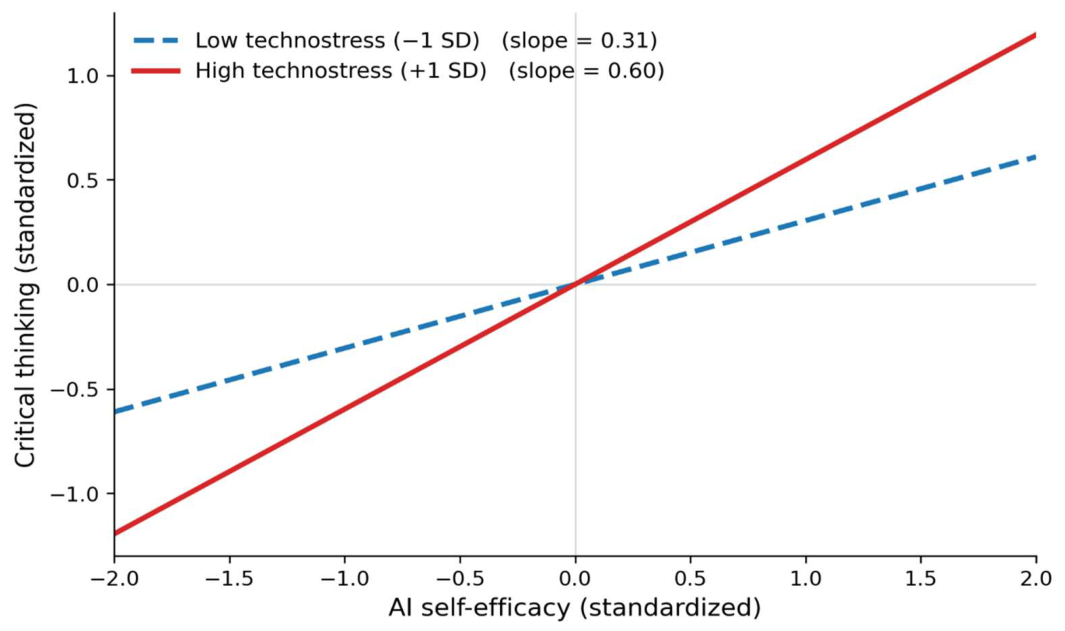
Table 1.
Sociodemographic characteristics of the sample (n = 340).
| Characteristic | Category | n | % |
| Sex | Female | 233 | 68.5 |
| Male | 107 | 31.5 | |
| Age (years) | 18–22 | 252 | 74.1 |
| 23–27 | 46 | 13.5 | |
| 28 or older | 42 | 12.4 | |
| University | Public | 213 | 62.6 |
| Private | 127 | 37.4 | |
| Year | First | 98 | 28.8 |
| Third | 136 | 40.0 | |
| Other | 106 | 31.2 | |
| Faculty | Health Sciences | 144 | 42.4 |
| Humanities | 107 | 31.5 | |
| Business/Eng./Law | 89 | 26.1 | |
| Employment | Not employed | 203 | 59.7 |
| Employed/interning | 137 | 40.3 |
Table 2.
Descriptive statistics and normality of the study constructs.
| Construct | M | SD | Skewness | Kurtosis | Response scale |
| Critical thinking (CT) | 3.66 | 0.52 | −0.18 | 1.22 | 1–5 |
| AI self-efficacy (SE) | 3.23 | 0.72 | −0.24 | 0.76 | 1–5 |
| Technostress (TE) | 2.19 | 1.01 | 0.74 | 1.13 | 0–6 |
Note. M and SD were computed on the mean score across each construct’s items; item-level skewness and kurtosis ranged within plus or minus 2, indicating no severe departures from normality.
Table 3.
Measurement model: standardized loadings, bootstrap confidence intervals, reliability, and AVE.
Table 3.
Measurement model: standardized loadings, bootstrap confidence intervals, reliability, and AVE.
| Item | λ [95% CI] | t | α | ρA | ρc | AVE | VIF |
| Critical Thinking (CT) | |||||||
| CT8 | 0.521 [0.422, 0.610] | 10.8 | .878 | .884 | .898 | .405 | 1.46 |
| CT10 | 0.579 [0.495, 0.652] | 14.5 | 1.44 | ||||
| CT11 | 0.651 [0.591, 0.705] | 22.6 | 1.53 | ||||
| CT12 | 0.650 [0.572, 0.721] | 16.9 | 1.61 | ||||
| CT13 | 0.703 [0.638, 0.764] | 21.8 | 1.89 | ||||
| CT15 | 0.605 [0.520, 0.683] | 14.5 | 1.49 | ||||
| CT16 | 0.660 [0.587, 0.727] | 18.3 | 1.70 | ||||
| CT17 | 0.665 [0.599, 0.723] | 20.3 | 1.69 | ||||
| CT21 | 0.602 [0.525, 0.674] | 15.7 | 1.49 | ||||
| CT22 | 0.692 [0.626, 0.748] | 22.4 | 1.94 | ||||
| CT25 | 0.575 [0.489, 0.656] | 13.5 | 1.41 | ||||
| CT26 | 0.642 [0.564, 0.711] | 16.9 | 1.69 | ||||
| CT27 | 0.704 [0.636, 0.765] | 21.4 | 1.81 | ||||
| AI Self-Efficacy (SE) | |||||||
| SE1 | 0.698 [0.632, 0.758] | 21.2 | .867 | .873 | .900 | .602 | 1.53 |
| SE2 | 0.740 [0.668, 0.800] | 22.2 | 1.75 | ||||
| SE3 | 0.806 [0.759, 0.847] | 35.7 | 2.04 | ||||
| SE4 | 0.850 [0.808, 0.886] | 42.4 | 2.45 | ||||
| SE5 | 0.786 [0.729, 0.833] | 29.4 | 1.96 | ||||
| SE6 | 0.765 [0.709, 0.814] | 27.6 | 1.91 | ||||
| Technostress (TE) | |||||||
| TE3 | 0.539 [0.451, 0.618] | 12.8 | .925 | .921 | .922 | .400 | 1.89 |
| TE5 | 0.613 [0.533, 0.686] | 15.6 | 2.45 | ||||
| TE6 | 0.646 [0.574, 0.710] | 18.6 | 2.71 | ||||
| TE7 | 0.702 [0.641, 0.758] | 24.1 | 3.28 | ||||
| TE8 | 0.640 [0.566, 0.703] | 18.3 | 3.22 | ||||
| TE9 | 0.669 [0.606, 0.731] | 21.2 | 3.09 | ||||
| TE10 | 0.561 [0.472, 0.640] | 13.0 | 2.12 | ||||
| TE11 | 0.546 [0.454, 0.632] | 11.8 | 2.50 | ||||
| TE12 | 0.631 [0.556, 0.698] | 17.4 | 2.75 | ||||
| TE14 | 0.586 [0.499, 0.662] | 13.9 | 3.06 | ||||
| TE15 | 0.558 [0.455, 0.644] | 11.6 | 2.30 | ||||
| TE16 | 0.542 [0.444, 0.627] | 11.4 | 2.12 | ||||
| TE17 | 0.669 [0.598, 0.729] | 20.3 | 1.97 | ||||
| TE18 | 0.590 [0.510, 0.661] | 15.4 | 2.15 | ||||
| TE19 | 0.641 [0.577, 0.701] | 20.3 | 1.93 | ||||
| TE20 | 0.694 [0.633, 0.747] | 23.9 | 2.37 | ||||
| TE21 | 0.776 [0.736, 0.813] | 40.1 | 2.83 | ||||
| TE22 | 0.722 [0.663, 0.775] | 25.3 | 1.93 | ||||
Note. λ = standardized loading; 95% CI from 5,000-resample bootstrap (fixed-weight, sign-stable); t = λ/bootstrap SE; α = Cronbach’s alpha; ρA = Dijkstra–Henseler rho; ρc = composite reliability; AVE = average variance extracted; VIF = indicator collinearity. Reliability indices are shown once per construct. Full item wording in Appendix A.
Table 4.
Discriminant validity: Fornell–Larcker criterion and HTMT.
| Construct | CT | SE | TE |
| CT | 0.636 | 0.428 | 0.007 |
| SE | 0.407 | 0.776 | 0.192 |
| TE | 0.037 | 0.239 | 0.632 |
Note. Diagonal (bold) = square root of AVE. Below diagonal = inter-construct correlations (Fornell–Larcker). Above diagonal = HTMT ratios (threshold < 0.85; Henseler et al., 2015).
Table 5.
Common method bias assessment.
| Indicator | Value | Threshold / decision |
| Harman first factor | 22.8% | < 40% → no critical CMB |
| Full collinearity VIF – CT | 1.20 | < 3.3 |
| Full collinearity VIF – SE | 1.28 | < 3.3 |
| Full collinearity VIF – TE | 1.07 | < 3.3 |
Table 6.
Model fit indices.
| Index | Value | Threshold | Decision |
| SRMR | 0.105 | < 0.08 (strict); < 0.10 (lenient) | Above 0.10 cutoff (limited exact fit) |
| NFI | 0.952 | ≥ 0.90 | Meets threshold |
| d_ULS | 7.40 | Bootstrap CI-based | Reported |
| d_G | 7.25 | Bootstrap CI-based | Reported |
Note. Because the structural model is recursive and just-identified (saturated), the saturated and estimated models produce identical model-implied matrices, so d_ULS and d_G coincide across them. Following Hair et al. (2019), global fit is treated as secondary in PLS-SEM; inference rests on the measurement and predictive assessments.
Table 7.
Explanatory power and predictive relevance.
| Endogenous construct | R2 | R2adj | Q2predict (PLS<LM) |
| Technostress (TE) | 0.057 | 0.054 | 0.009 (13/18) |
| Critical thinking (CT) | 0.170 | 0.165 | −0.003 (13/13) |
Note. Q2predict from PLSpredict (k = 10 folds, 10 repetitions); “PLS<LM” = number of indicators for which PLS RMSE is below the linear-model benchmark.
Table 8.
CVPAT: average loss difference vs. benchmarks.
| Endogenous construct | PLS − Indicator Avg. | PLS − Linear Model |
| Technostress (TE) | −0.016 | −0.006 |
| Critical thinking (CT) | +0.044 | −0.744 |
Note. Negative values indicate lower prediction loss (better) than the benchmark. PLS surpasses both benchmarks for technostress (TE), but not the indicator-average benchmark for critical thinking (CT).
Table 9.
Structural model and hypothesis testing (5,000 bootstrap resamples).
| Hyp. | Path | β | 95% CI | t | p | f2 | Decision |
| H1 | TE → CT | −0.064 | [−0.221, 0.114] | 0.61 | .50 | 0.005 | Not supported |
| H2 | SE → CT | 0.422 | [0.324, 0.529] | 8.15 | <.001 | 0.203 | Supported |
| — | SE → TE | 0.239 | [0.122, 0.345] | 4.17 | <.001 | 0.060 | Robust |
Note. β = standardized path coefficient; CI = percentile bootstrap interval; f2: 0.02 small, 0.15 medium, 0.35 large (Cohen, 1988). Hypotheses judged on bootstrap CIs.
Table 10.
Interaction effect and simple slopes.
| Effect | Estimate | 95% CI / note |
| Interaction TE × SE → CT (two-stage) | 0.146 | [0.024, 0.251], p = .012 |
| Interaction TE × SE → CT (full bootstrap) | 0.146 | [−0.015, 0.264], p = .07 |
| Simple slope SE→CT at −1 SD technostress | 0.305 | low technostress |
| Simple slope SE→CT at mean technostress | 0.451 | |
| Simple slope SE→CT at +1 SD technostress | 0.596 | high technostress |
Table 11.
Mediation analysis: direct, indirect, and total effects (5,000 bootstrap resamples).
| Effect | Coefficient | 95% CI | Decision |
| Path a: AI self-efficacy → TE | 0.239 | [0.122, 0.345] | Significant (p < .001) |
| Path b: TE → CT | −0.064 | [−0.221, 0.114] | Not significant |
| Direct effect c′: AI self-efficacy → CT | 0.422 | [0.324, 0.529] | p < .001 |
| Indirect effect a×b : AI self-efficacy → TE → CT | −0.014 | [−0.039, 0.011] | Not supported |
| Total effect c: AI self-efficacy → CT | 0.408 | — | p < .001 |
Note. 95% CIs from percentile bootstrap. Zhao et al. (2010) classification = no effect (no mediation); VAF not interpretable because direct and indirect effects have opposite signs.
Table 13.
Multi-group analysis (public vs. private universities) with measurement invariance.
| Path | Public β (n = 213) | Private β (n = 127) | Δ (Pub − Priv) | p (perm.) | Decision |
| AI self-efficacy → critical thinking | 0.40 | 0.48 | −0.09 | .43 | No difference |
| Technostress → critical thinking | −0.05 | 0.02 | −0.07 | .74 | No difference |
| AI self-efficacy → technostress | 0.28 | 0.32 | −0.04 | .72 | No difference |
| Technostress × AI self-efficacy → critical thinking | 0.20 | 0.02 | 0.18 | .20 | No difference |
Note. Δ = difference between group path coefficients; p from a permutation test (Henseler et al., 2016); none significant at α = .05. MICOM established full measurement invariance (compositional invariance c = 0.88–0.99; equal composite means and variances, all p > .10).
Disclaimer/Publisher’s Note: The statements, opinions and data contained in all publications are solely those of the individual author(s) and contributor(s) and not of MDPI and/or the editor(s). MDPI and/or the editor(s) disclaim responsibility for any injury to people or property resulting from any ideas, methods, instructions or products referred to in the content. |
© 2026 by the authors. Licensee MDPI, Basel, Switzerland. This article is an open access article distributed under the terms and conditions of the Creative Commons Attribution (CC BY) license (http://creativecommons.org/licenses/by/4.0/).
Copyright: This open access article is published under a Creative Commons CC BY 4.0 license, which permit the free download, distribution, and reuse, provided that the author and preprint are cited in any reuse.


