

Submitted:
22 June 2026
Posted:
23 June 2026
You are already at the latest version
Abstract
Background: Rwanda’s higher education sector is increasingly expected to support digital transformation, workforce development, flexible learning, and international comparability of qualifications. However, the quality of online and blended programmes cannot be assured by digital platforms alone. It requires coherent alignment among regulation, curriculum design, pedagogy, assessment, accessibility, staffing, infrastructure, learner support, data protection, artificial intelligence governance, and sustainability. Purpose: This article develops the Rwanda Online and Blended Programme Design and Quality Assurance Framework (ROB-PDQAF), a policy-informed framework and practical toolkit for higher learning institutions, programme development teams, internal quality assurance units, and external reviewers. Method: The study applies qualitative document analysis, integrative literature synthesis, standards mapping, and framework construction. Public Rwandan policy and regulatory documents were analysed alongside international and regional quality assurance standards and peer-reviewed literature on online learning, instructional design, assessment, accessibility, open educational resources, data governance, and AI in education. Results: The ROB-PDQAF comprises ten interdependent domains: strategic relevance and regulatory alignment; curriculum coherence and constructive alignment; online and blended course design; digital content, multimedia, OER, and copyright; accessibility, inclusion, and learner support; assessment, feedback, academic integrity, and AI governance; staffing and eLearning support; LMS, infrastructure, data protection, and technical readiness; internal quality assurance and continuous enhancement; and financial planning, partnerships, scalability, and sustainability. Originality: The article contributes a Rwanda-contextual, evidence-based framework that conceptualises online and blended programme quality as an academic ecosystem rather than a technology adoption exercise. Implications: The framework translates policy and research evidence into reviewable domains, evidence requirements, risk indicators, and practical tools for programme design, accreditation, and continuous enhancement.
Keywords:
Rwanda
; higher education quality assurance
; online learning
; blended learning
; programme accreditation
; instructional design
; AI governance
; digital learning
1. Introduction
1.1. Background and Problem Statement
Higher education systems are under growing pressure to expand access, improve graduate relevance, support lifelong learning, and respond to digital transformation while maintaining academic standards. Online and blended learning have become central to this agenda, especially after the COVID-19 pandemic accelerated emergency remote teaching and exposed the difference between crisis-driven online delivery and deliberately designed online learning (Hodges et al., 2020; UNESCO IESALC, 2020). However, the expansion of online and blended provision also exposes a core quality assurance problem: institutional readiness for digital delivery cannot be inferred from the existence of a learning management system (LMS), video-conferencing tools, or digitised lecture notes. Quality depends on whether a programme has been designed, delivered, assessed, supported, monitored, and improved as an integrated academic ecosystem (Commonwealth of Learning, 2024; Quality Matters, n.d.; SUNY Online, n.d.).
Rwanda provides a compelling context for developing such a framework. The country’s long-term development agenda emphasises human capital, competitiveness, innovation, and knowledge-based transformation (Government of Rwanda, 2020). The Second National Strategy for Transformation, NST2 2024–2029, positions digital transformation and education relevance among the strategic conditions for national development (Government of Rwanda, 2024). The Education Sector Strategic Plan 2024–2029 explicitly links higher education to labour market needs, transformative research, and digital transformation (Ministry of Education [MINEDUC], 2024). The ICT Sector Strategic Plan 2024–2029 similarly identifies accelerated digital transformation, digital inclusion, and improved digital service delivery as national priorities (Ministry of ICT and Innovation [MINICT], 2024). Within higher education, the Rwanda Qualifications Framework establishes the basis for coherent, comparable, competence-based qualifications (Republic of Rwanda, 2021a).
At the regulatory level, Rwanda’s Higher Education Council (HEC) has progressively strengthened the public architecture for programme accreditation, internal quality assurance, infrastructure standards, virtual learning, artificial intelligence, and distance learning. HEC’s quality assurance definition covers the systems, resources, and information used to maintain and improve standards and quality across teaching and learning, student support, research, consultancy, and community service (Higher Education Council [HEC], n.d.-b). Its accreditation process requires institutional evidence, self-assessment, trained peer review, and review visits, and it identifies programme proposal forms, programme specification forms, module description forms, the qualifications framework, and procedures for validation of modules and programmes as part of the public accreditation infrastructure (HEC, n.d.-a). More recent HEC guidance on virtual learning and artificial intelligence provides standards and assessment tools for infrastructure and facilities, materials development, staff readiness, student readiness, assessment, policies, and management (HEC, 2025a). Its distance learning guidelines further articulate standards, principles, and procedures for designing, delivering, and evaluating distance learning in Rwanda’s higher learning institutions (HEC, 2026a).
These policy developments create a strong regulatory foundation. Yet institutions and reviewers still need a practical synthesis that connects Rwanda’s policy requirements with educational theory, international quality assurance principles, and day-to-day programme design decisions. This article addresses that need by developing the Rwanda Online and Blended Programme Design and Quality Assurance Framework (ROB-PDQAF).
The central argument is that online and blended programme quality should be assessed not as the presence of digital delivery infrastructure, but as the demonstrated coherence of an educational system. In this system, regulatory compliance, qualification level, curriculum design, online pedagogy, assessment validity, learner support, staff capacity, digital infrastructure, data governance, and sustainability must mutually reinforce one another. This argument is especially important in accreditation contexts, where programme approval decisions require verifiable evidence rather than aspirational claims about institutional readiness (African Union Commission, 2018; European Association for Quality Assurance in Higher Education et al., 2015; HEC, n.d.-a).
1.2. Online and Blended Higher Education as a Quality Assurance Challenge
The quality challenge in online and blended education is often misunderstood as a technical problem. Institutions may focus on whether content has been uploaded to an LMS, whether lecturers can use video-conferencing software, or whether students can submit assignments online. These are necessary but insufficient. Research on online and blended learning shows that effective digital education depends on carefully designed interaction, teaching presence, cognitive engagement, student support, assessment validity, accessibility, and institutional systems (Garrison et al., 2000; Martin et al., 2020). Online quality therefore cannot be reduced to technology access; it is a configuration of curriculum, pedagogy, assessment, infrastructure, governance, support, and continuous improvement (Commonwealth of Learning, 2024; Quality Matters, n.d.; SUNY Online, n.d.).
This distinction matters for accreditation. A programme may have a sound academic rationale but weak digital learner support. Another may have a functional LMS but poorly aligned learning outcomes and assessments. A third may be technologically advanced but inaccessible to learners with disabilities or unrealistic in its staffing and cost assumptions. A fourth may use AI tools but lack academic integrity rules, data protection protocols, or transparent assessment guidance. In each case, quality risk emerges not from a single missing component but from misalignment across components.
1.3. The Rwandan Higher Education Context
Rwanda’s higher education system operates within a wider national development project that links education quality to productivity, innovation, and inclusive transformation. Vision 2050 frames human capital development as central to Rwanda’s movement toward upper-middle-income and high-income aspirations (Government of Rwanda, 2020). NST2 and ESSP 2024–2029 reinforce this agenda by connecting education with digital transformation, labour market relevance, and system performance (Government of Rwanda, 2024; MINEDUC, 2024). HEC’s Rwanda Higher Education Sector Strategic Plan 2025–2030 further frames higher education as a sector expected to contribute to Rwanda’s social and economic transformation through impact, resources, institutional foundations, and system-wide reform (HEC, 2026b).
These policy ambitions require higher learning institutions (HLIs) to design programmes that are not only academically valid but also implementable, inclusive, technologically supported, and sustainable. Online and blended provision can expand access, improve flexibility, support lifelong learning, and strengthen professional development when it is intentionally designed, adequately supported, and aligned with learner needs rather than treated as a simple transfer of face-to-face teaching into digital platforms (Bernard et al., 2014; Commonwealth of Learning, n.d.; Means et al., 2013). However, in contexts where infrastructure, digital competence, software licensing, accessibility, data governance, and staff workload vary across institutions, quality assurance must be sensitive to implementation realities. A contextual framework for Rwanda must therefore avoid two errors: uncritical importation of international rubrics without local policy alignment, and narrow local compliance checklists without engagement with global evidence and good practice.
1.4. Purpose of the Study
The purpose of this study is to develop a policy-informed and evidence-based framework for designing and quality-assuring online and blended programmes in Rwandan higher education. The framework is intended to support two primary users. First, HLIs can use it to design, internally review, strengthen, and monitor online and blended programmes before submission for approval or accreditation. Second, HEC and external reviewers can use it to assess programme readiness, verify evidence, formulate conditions and recommendations, and support post-approval monitoring.
1.5. Research Questions
This framework-development study was guided by four questions:
RQ1. What public Rwandan policy, regulatory, and quality assurance requirements are most relevant to the design and assessment of online and blended higher education programmes?
RQ2. What quality domains recur across international and regional literature, standards, and best-practice frameworks for online, blended, open, distance, and technology-enhanced learning?
RQ3. How can Rwanda-specific regulatory requirements and international evidence be synthesised into a coherent programme design and quality assurance framework?
RQ4. What practical tools can operationalise the framework for HLIs and external quality assurance reviewers?
1.6. Contribution of the Manuscript
This article makes four contributions to scholarship and practice. Conceptually, it advances an ecosystem view of online and blended programme quality by integrating regulatory, pedagogical, technical, ethical, accessibility, and sustainability dimensions into a single framework. Methodologically, it demonstrates how public policy document analysis, integrative literature synthesis, and standards mapping can be combined to construct a context-sensitive quality assurance framework in a national higher education system. Practically, it converts policy and research evidence into domains, indicators, evidence requirements, review questions, and toolkit components that can support programme design, internal validation, external review, and post-approval monitoring. Contextually, it contributes a Rwanda-specific framework that aligns international quality assurance evidence with the country’s higher education regulatory environment without relying on confidential institutional records or unpublished accreditation materials.
2. Policy and Regulatory Context of Online and Blended Higher Education in Rwanda
2.1. Rwanda’s Higher Education and Digital Transformation Agenda
Rwanda’s national development planning places education and digital transformation in a mutually reinforcing relationship. Vision 2050 identifies human capital, innovation, competitiveness, and accountable institutions as essential foundations for long-term national transformation (Government of Rwanda, 2020). NST2 2024–2029 builds on this orientation by linking social and economic transformation to quality education, skills development, and digital capability (Government of Rwanda, 2024). The ICT Sector Strategic Plan 2024–2029 provides a digital transformation roadmap focused on accelerating digital transformation, promoting digital inclusion, and enhancing digital service delivery (MINICT, 2024). The ESSP 2024–2029 positions higher education institutions, especially the University of Rwanda and Rwanda Polytechnic, as leaders in addressing labour market needs, advancing transformative research, and fostering digital transformation (MINEDUC, 2024).
For online and blended higher education, these policy signals imply that programmes should be assessed not only against internal curriculum logic but also against national priorities: relevance to human capital development, alignment with digital transformation, accessibility for diverse learners, readiness for labour market needs, and institutional capacity for quality implementation. They also imply that online learning should not be treated as a marginal or emergency delivery option. In Rwanda’s current policy environment, it is increasingly part of the formal higher education architecture and should therefore be governed through explicit standards for virtual learning, distance learning, institutional readiness, assessment, support, and quality assurance (HEC, 2025a, 2026a).
2.2. HEC’s Role in Higher Education Quality Assurance and Programme Accreditation
HEC is the principal public body responsible for higher education quality assurance and accreditation in Rwanda. Its Accreditation, Standards and Qualifications Framework Division is responsible for upholding academic quality and credibility through the development, implementation, and monitoring of accreditation and qualifications frameworks, including accreditation of new institutions, approval of curricula and academic programmes, licensing, qualifications framework services, and dissemination of laws, standards, policies, guidelines, and procedures (HEC, n.d.-c). Its General Higher Education Quality Standards Department coordinates quality assurance for general higher learning institutions, participates in setting accreditation standards, disseminates quality-related policies and guidelines, monitors implementation of standards, participates in approval of new curricula and academic programmes, and coordinates capacity building (HEC, n.d.-d).
HEC’s public accreditation process emphasises evidence, self-assessment, peer review, and external verification. The process requires institutions to submit application materials and self-assessments that are tested by trained peer reviewers during institutional visits (HEC, n.d.-a). This has direct implications for online and blended programme design. Institutions must not only describe programme intentions; they must provide evidence that the proposed programme can be delivered at the required academic level, with adequate staffing, infrastructure, learning resources, assessment systems, student support, and quality assurance mechanisms.
2.3. Rwanda Qualifications Framework and Implications for Programme Design
The Rwanda Qualifications Framework was established through Ministerial Order No. 003/MINEDUC/2021 to regulate education and training qualifications, support learner mobility, promote career development pathways, and strengthen the coherence, relevance, and quality of qualifications (Republic of Rwanda, 2021a). It consists of 10 qualification levels and three sub-frameworks: Basic Education, TVET, and General Higher Education. The General Higher Education Sub-Framework spans Levels 6 to 10, with the Postgraduate Certificate located at Level 9 and carrying 60 credits (Republic of Rwanda, 2021a).
This has several programme design implications. First, an online or blended postgraduate certificate must be demonstrably postgraduate in level, not merely short-course training with digital tools. Second, learning outcomes should reflect advanced knowledge, critical analysis, professional judgement, and applied competence appropriate to the qualification level. Third, credit volume and workload must be coherent with notional learning time. Fourth, admissions criteria, graduate profile, module sequencing, assessment, and exit competencies must align with the award type.
2.4. HEC Guidelines and Standards Relevant to Online, Blended, Distance, Virtual, and AI-Supported Learning
HEC’s guidelines page lists several public resources relevant to online and blended provision, including Guidelines and Assessment Tools for Distance Learning, Guidelines and Assessment Tools for Virtual Learning and the Use of Artificial Intelligence in Rwanda’s Higher Learning Institutions, Guidelines for Internal Quality Assurance Mechanisms for Higher Education, and Higher Education Institutional Infrastructure and Academic Standards (HEC, n.d.-e). The virtual learning and AI guidelines state that Rwanda’s higher education transformation requires structured approaches to virtual learning and responsible use of emerging technologies. They set standards and procedures for designing, delivering, and evaluating virtual and technology-enhanced education, while safeguarding academic integrity and supporting institutional capacity (HEC, 2025a). The assessment tool in that document is organised around seven standards: infrastructure and facilities, materials development, staff readiness, student readiness, assessment, policies, and management (HEC, 2025a).
HEC’s distance learning guidelines, published in 2026, provide a unified framework to design, deliver, and evaluate distance learning education, while encouraging all HLIs and partners involved in distance and blended learning to align policies, programmes, and practices with the guidelines (HEC, 2026a). HEC’s internal quality assurance guidelines emphasise a culture of continuous improvement in higher education (HEC, 2024). Infrastructure and academic standards provide expectations concerning the physical and institutional resources judged acceptable for accreditation and academic delivery (HEC, 2023). Together, these documents indicate that online and blended programme quality in Rwanda must be judged through multiple lenses: programme design, learning materials, digital infrastructure, assessment, policy, staff and student readiness, management, and continuous enhancement.
2.5. Implications for Higher Learning Institutions and Regulators
The policy context creates a dual responsibility. HLIs must design online and blended programmes that are academically coherent, nationally relevant, technologically feasible, inclusive, and sustainable. HEC and external reviewers must assess whether institutional claims are supported by evidence. The ROB-PDQAF proposed in this article responds to both responsibilities by translating policy and literature into domains, indicators, evidence requirements, review questions, and tools consistent with the broader quality assurance principle that institutions carry primary responsibility for quality while external review tests, verifies, and strengthens that responsibility (African Union Commission, 2018; European Association for Quality Assurance in Higher Education et al., 2015; HEC, n.d.-a).
3. Literature Review
3.1. Quality Assurance in Higher Education Programme Design
Quality assurance in higher education has moved beyond narrow compliance toward integrated systems of accountability, enhancement, and public trust. The African Standards and Guidelines for Quality Assurance in Higher Education emphasise that quality and quality assurance are primarily the responsibility of higher education institutions, while external quality assurance provides comparability, credibility, and public confidence (African Union Commission, 2018). The European Standards and Guidelines similarly frame internal and external quality assurance as interconnected mechanisms for supporting learning and teaching quality across institutions (European Association for Quality Assurance in Higher Education et al., 2015). HEC’s definition of quality assurance as the systems, resources, and information devoted to maintaining and improving standards resonates with this broader understanding (HEC, n.d.-b).
For online and blended programmes, quality assurance must be embedded from programme conception rather than added after delivery begins. Programme quality depends on the coherence of the qualification level, aims, learning outcomes, curriculum structure, teaching and learning strategy, assessment strategy, staff capacity, learner support, infrastructure, and monitoring arrangements. A programme may fail academically if outcomes are poorly specified, pedagogically if online interaction is weak, ethically if assessment integrity is unmanaged, and operationally if staffing, LMS support, or sustainability assumptions are unrealistic (Commonwealth of Learning, 2024; Quality Matters, n.d.; SUNY Online, n.d.).
3.2. Instructional Design and Constructive Alignment in Online and Blended Learning
Constructive alignment remains foundational for curriculum and course quality. Biggs (1996) argued that teaching systems should align intended learning outcomes, learning activities, and assessment tasks so that students are guided toward the intended forms of understanding and performance. In online and blended education, constructive alignment must be extended to digital learning activities, multimedia resources, interaction design, feedback channels, and assessment technologies. Alignment is weak when learning outcomes require design, analysis, or evaluation but assessments only test recall, or when a course claims to develop practical digital competence but offers limited hands-on production and feedback; this problem is especially acute in online graduate education, where competency claims must be traceable from outcomes to curriculum architecture, assessment evidence, platform configuration, faculty capacity, and quality assurance (Sangwa et al., 2026a).
Instructional design provides the operational bridge between curriculum intent and learning experience. Models such as ADDIE, backward design, rapid prototyping, and iterative design processes can help institutions translate outcomes into structured learning pathways, activities, resources, and assessment evidence (Branch, 2009; Tripp & Bichelmeyer, 1990; Wiggins & McTighe, 2005). Yet instructional design should not become a mechanical template exercise. Online and blended learning requires attention to learner context, connectivity, workload, facilitation, inclusion, cultural relevance, and assessment authenticity.
3.3. Online Course Design, Learner Engagement, and Interaction
The Community of Inquiry framework conceptualises effective online learning through the interaction of teaching presence, social presence, and cognitive presence (Garrison et al., 2000). Teaching presence includes design, facilitation, and direction; social presence concerns the ability of learners to project themselves socially and emotionally; cognitive presence concerns meaning-making through sustained inquiry. This framework remains useful because it shows that online quality is not limited to content delivery. Students need structured opportunities to engage with content, peers, teachers, tasks, and feedback.
Research synthesis on online teaching and learning identifies quality issues across learner, course and instructor, and organisational levels (Martin et al., 2020). Engagement is shaped by interaction, self-regulation, teaching support, course structure, and social presence (Wang et al., 2022). The implication for programme design is that institutions should not merely require online components; they should specify how online and face-to-face components interact, how synchronous and asynchronous learning are balanced, how students receive feedback, how participation is monitored, and how learning analytics are used ethically to support students (Martin et al., 2020; Slade & Prinsloo, 2013; Wang et al., 2022).
3.4. Digital Assessment, Authenticity, Feedback, and Academic Integrity
Assessment is a central risk area in online and blended programmes. A systematic review of online assessment in higher education found that online assessments can support feedback, interaction, engagement, and learning outcomes, but require careful alignment and implementation (Martin et al., 2023). Authentic assessment is particularly important because it asks students to apply knowledge and skills to real-world or professionally meaningful tasks. A systematic literature review by Vlachopoulos and Makri (2024) found that authentic assessment can support the development of twenty-first-century skills and employability, but its effectiveness depends on careful design, stakeholder clarity, and policy support.
Academic integrity must be addressed through assessment design and institutional culture, not simply surveillance. Holden et al. (2021) argue that understanding why academic dishonesty occurs is essential for designing proportionate strategies that promote integrity in online assessment. With generative AI, this challenge has become more complex. Miao and Holmes (2023) stress that generative AI in education requires regulation, data privacy protection, human capacity development, and a human-centred approach. Frameworks such as the AI Assessment Scale propose transparent levels of permissible AI use in assessment, helping instructors align AI guidance with learning outcomes and academic integrity expectations (Perkins et al., 2024).
3.5. Accessibility, Inclusion, Universal Design for Learning, and Learner Support
Digital learning can expand access, but it can also reproduce exclusion where courses are inaccessible, bandwidth-heavy, textually dense, linguistically inappropriate, or poorly supported. Universal Design for Learning (UDL) provides a framework for designing learning environments that improve and optimise teaching and learning for all people, based on scientific insights into how humans learn (CAST, 2024). In online programmes, UDL implies multiple means of engagement, representation, and action/expression. Practical requirements include captions, transcripts, alternative text, accessible document formats, screen-reader compatibility, mobile-friendly design, clear navigation, keyboard accessibility, adequate colour contrast, flexible participation options, and inclusive assessment (CAST, 2024; World Wide Web Consortium, 2023).
Learner support is equally central. Online students need orientation, digital skills support, academic advising, timely feedback, technical help, library access, communication protocols, and psychosocial support, because learner support, interaction, feedback, and early intervention are consistently associated with online student satisfaction, persistence, and retention (Kauffman, 2015; Muljana & Luo, 2019). For Rwanda, where institutions may serve learners with varied connectivity, device access, digital competence, language backgrounds, and disability needs, accessibility should be treated as a design requirement rather than an accommodation after enrolment.
3.6. Learning Management Systems, Infrastructure, Data Protection, and Technical Readiness
The LMS is an enabling system, not a guarantee of quality. Course shells should provide coherent navigation, structured learning pathways, resource access, interaction tools, assignment submission, feedback, gradebook transparency, accessibility features, analytics, and backup procedures. Infrastructure readiness includes server reliability, internet bandwidth, device access, software licensing, cybersecurity, helpdesk capacity, digital library access, multimedia production support, and contingency arrangements. These requirements are consistent with online course quality standards that emphasise navigation, accessibility, learner interaction, assessment support, technical readiness, and course-level evidence of implementation (Commonwealth of Learning, 2024; Quality Matters, n.d.; SUNY Online, n.d.; World Wide Web Consortium, 2023). This also aligns with recent African higher education work arguing that credible online and blended transition requires institutional architecture rather than isolated technology adoption, with governance, curriculum, quality assurance, infrastructure, data governance, and financing intentionally coupled (Sangwa et al., 2026b).
Data protection has become a key quality assurance concern. Rwanda’s Law No. 058/2021 relating to the protection of personal data and privacy establishes obligations concerning personal data processing, data subject rights, data controller and processor registration, consent, sensitive personal data, and data protection officers (Republic of Rwanda, 2021b). Online programmes generate educational data through LMS logs, assessment submissions, learner analytics, proctoring systems, AI tools, communication platforms, and student support records. Quality assurance must therefore ask whether institutions have lawful, transparent, secure, and pedagogically justified data practices.
3.7. Staff Capacity, Instructional Design Roles, and Institutional Support Structures
Online and blended programmes require staff capacity beyond conventional classroom teaching. Academic staff need competence in online facilitation, course design, digital assessment, feedback, accessibility, AI guidance, LMS use, and continuous course improvement (Martin et al., 2019; Martin et al., 2020). Institutions also need instructional designers, educational technologists, multimedia specialists, ICT support staff, librarians, student support officers, and quality assurance staff. International distance learning quality assurance guidance repeatedly identifies staffing, learner support, materials development, assessment, infrastructure, and institutional systems as core quality domains (Commonwealth of Learning, 2009; Commonwealth of Learning, 2024).
Staff workload is also a quality issue. Online teaching often requires significant front-loaded course design work, continuous facilitation, monitoring of participation, timely feedback, technical troubleshooting, and institutional support, all of which make workload planning a quality assurance issue rather than a purely administrative concern (Bolliger & Wasilik, 2009; Martin et al., 2019). If workload models treat online delivery as equivalent to uploading notes or recording lectures, programmes may become unsustainable. External contributors and partnerships can strengthen capacity, but they require clear commitments, roles, availability, continuity arrangements, and quality oversight.
3.8. AI, Learning Analytics, and Emerging Digital Governance Issues in Higher Education
AI and learning analytics are increasingly relevant to online and blended programmes. UNESCO’s AI and education guidance recommends that policy-makers address opportunities and risks, including equity, inclusion, privacy, transparency, teacher capacity, and governance (Miao et al., 2021). UNESCO’s AI competency frameworks for teachers and students provide global references for AI knowledge, ethics, application, and human-centred agency (UNESCO, 2024a, 2024b). HEC’s virtual learning and AI guidelines similarly require Rwanda’s HLIs to adopt responsible and ethical AI practices while strengthening digital teaching, learning, assessment, research, and academic governance (HEC, 2025a).
Learning analytics can support early warning, course improvement, and personalised support, but it can also create risks of surveillance, bias, misinterpretation, and data misuse. Therefore, analytics should be governed by clear purposes, data minimisation, transparency, consent where appropriate, accountability, and human review. AI governance and learning analytics should therefore be embedded in programme design rather than left to individual lecturers, with clear attention to transparency, privacy, consent where appropriate, data minimisation, accountability, bias, and human review (Miao & Holmes, 2023; Slade & Prinsloo, 2013; UNESCO, 2024a, 2024b).
3.9. Sustainability and Continuous Improvement in Online Programme Provision
Sustainability involves more than financial viability. It includes staffing continuity, platform maintenance, software licensing, equipment renewal, content updating, learner support capacity, quality assurance cycles, partnership governance, risk management, and responsiveness to technological change. The Commonwealth of Learning’s higher education work emphasises that online and blended approaches can support access, equity, quality, and cost effectiveness, but require policies, strategies, ICT capacity, authentic assessment, and relevant curricula (Commonwealth of Learning, n.d.). HEC’s distance learning and virtual learning guidelines likewise emphasise periodic review, institutional capacity, and alignment of policies and practices (HEC, 2025a, 2026a).
3.10. Gaps in Existing Literature and Need for a Rwanda-Contextual Framework
Existing frameworks offer valuable but partial guidance for online and blended higher education. Course-level quality rubrics are provided by Quality Matters and OSCQR (Quality Matters, n.d.; SUNY Online, n.d.); accessibility frameworks are advanced through Universal Design for Learning and WCAG 2.2 (CAST, 2024; World Wide Web Consortium, 2023); online interaction models are represented by the Community of Inquiry framework (Garrison et al., 2000); regional quality assurance standards are articulated through ASG-QA and ESG (African Union Commission, 2018; European Association for Quality Assurance in Higher Education et al., 2015); open, distance, blended, and online learning toolkits are provided by the Commonwealth of Learning (Commonwealth of Learning, 2009, 2024); and AI/OER guidance is developed through UNESCO’s work on open educational resources and AI competency frameworks (UNESCO, 2019, 2024a, 2024b).
These frameworks are useful, but none is sufficient on its own for Rwanda’s programme accreditation context. Course design rubrics do not fully address national qualification frameworks, programme-level accreditation evidence, institutional sustainability, or regulator review processes. General quality assurance standards do not provide detailed guidance for LMS readiness, online assessment, AI governance, accessibility testing, or digital learner support. Similarly, international AI and OER guidance requires contextual translation before it can be used in national programme approval.
The gap, therefore, is not the absence of quality assurance guidance in general. The gap is the absence of an integrated, Rwanda-contextual framework that connects national policy, HEC requirements, RQF expectations, online learning theory, digital assessment, accessibility, data protection, AI governance, staffing, infrastructure, and sustainability into a practical programme-level model. The ROB-PDQAF responds to this gap by synthesising these evidence streams into a framework that can be used both by institutions designing online and blended programmes and by reviewers assessing their readiness.
3.11. Integrative Logic of the Framework
The ROB-PDQAF integrates three complementary levels of quality assurance. The first is the regulatory level, which concerns national priorities, RQF alignment, HEC accreditation requirements, institutional accountability, and public trust. The second is the pedagogical level, which concerns curriculum coherence, constructive alignment, online interaction, accessibility, learner support, assessment validity, and feedback. The third is the implementation level, which concerns staffing, workload, infrastructure, data protection, AI governance, internal monitoring, financial viability, and sustainability. The framework assumes that programme quality is weakened when these levels are treated separately. A programme may be compliant but pedagogically weak, pedagogically coherent but technically unsupported, or technologically advanced but inaccessible, ethically fragile, or financially unsustainable. The ROB-PDQAF therefore evaluates online and blended programmes through the coherence of evidence across all three levels, drawing on quality assurance principles, constructive alignment, online interaction theory, accessibility guidance, digital learning standards, and Rwanda’s regulatory requirements (African Union Commission, 2018; Biggs, 1996; CAST, 2024; Commonwealth of Learning, 2024; European Association for Quality Assurance in Higher Education et al., 2015; Garrison et al., 2000; HEC, 2025a, 2026a).
4. Methodology
4.1. Research Design: Policy-Informed Framework Development
This study used a policy-informed framework development design. It combined qualitative document analysis (Bowen, 2009), integrative literature review principles (Snyder, 2019; Torraco, 2005), standards mapping, and conceptual framework construction (Jabareen, 2009). The purpose was not to conduct a systematic review or produce statistically generalisable findings. Rather, the study aimed to generate a coherent, evidence-informed framework and toolkit by synthesising public policy, regulatory requirements, peer-reviewed research, and established quality standards.
4.2. Data Sources and Search Strategy
Sources were identified through purposive and iterative searches across four source clusters. The first cluster comprised Rwanda-specific public policy and regulatory documents, including HEC accreditation resources, HEC guidelines, the Rwanda Qualifications Framework, MINEDUC strategic documents, national development strategies, the ICT Sector Strategic Plan, and Rwanda’s personal data and privacy legislation. The second cluster comprised regional and international quality assurance standards, including ASG-QA, ESG, and Commonwealth of Learning quality assurance resources. The third cluster comprised recognised professional frameworks relevant to online and blended learning, including Quality Matters, OSCQR, UDL, OER guidance, and AI governance resources. The fourth cluster comprised peer-reviewed literature on constructive alignment, online learning, learner engagement, assessment, academic integrity, accessibility, staff capacity, digital infrastructure, AI, and research methodology.
The search strategy prioritised sources that were publicly available, authoritative, directly relevant to higher education, and capable of informing programme-level design or external review. Search terms combined concepts such as higher education quality assurance, online learning, blended learning, distance learning, virtual learning, programme accreditation, constructive alignment, online assessment, academic integrity, accessibility, universal design for learning, open educational resources, learning management systems, data protection, artificial intelligence in education, and Rwanda higher education policy. The purpose was not exhaustive systematic coverage of all literature, but a transparent and credible synthesis of policy, standards, and research evidence relevant to framework construction.
4.3. Inclusion and Exclusion Criteria
Documents were included if they met at least one of the following criteria: direct relevance to Rwanda’s higher education regulatory context; relevance to online, blended, virtual, distance, or technology-enhanced learning; relevance to higher education quality assurance; relevance to instructional design, constructive alignment, assessment, accessibility, learner support, staff capacity, digital infrastructure, AI, or sustainability; public availability; and credibility as an official, peer-reviewed, or recognised professional source. Sources were excluded if they were confidential, institution-internal, unpublished, promotional, unverifiable, irrelevant to higher education, or not publicly accessible.
4.4. Policy Document Analysis
Policy documents were analysed for regulatory expectations, quality standards, evidence requirements, institutional responsibilities, review procedures, and terminology. Following Bowen’s (2009) approach to document analysis, documents were read for content, context, and relevance to the research questions. Extracted concepts were coded into preliminary categories such as regulatory alignment, qualification level, programme design, materials development, staff readiness, student readiness, infrastructure, assessment, AI policy, management, internal quality assurance, and sustainability.
4.5. Integrative Literature Synthesis
The literature synthesis followed an integrative rather than systematic review logic. Integrative reviews are appropriate when the objective is to generate new conceptual understanding from diverse sources (Torraco, 2005). The synthesis focused on recurring principles across research and standards: constructive alignment, online interaction, teaching presence, student support, accessibility, authentic assessment, academic integrity, infrastructure readiness, data protection, staff capacity, quality enhancement, and sustainability.
4.6. Standards and Best-Practice Mapping
Standards mapping was used to compare Rwanda-specific regulatory expectations with international and regional quality assurance principles. The mapping proceeded in three analytical steps. First, requirements from Rwandan policy and HEC documents were coded into preliminary categories such as qualification level, programme approval, materials development, staff readiness, student readiness, assessment, infrastructure, internal quality assurance, AI policy, and management. Second, these categories were compared with recurring domains from ASG-QA, ESG, COL resources, Quality Matters, OSCQR, UDL, OER guidance, and AI governance literature. Third, overlapping categories were consolidated, while Rwanda-specific requirements were retained where they reflected national regulatory priorities or implementation conditions. This process ensured that the ROB-PDQAF was neither an imported international rubric nor a narrow local compliance checklist, but a contextual synthesis of regulatory requirements and evidence-informed quality principles.
4.7. Framework Construction Procedure
Framework construction followed four steps. First, policy and literature domains were consolidated into a preliminary list. Second, overlapping domains were merged and clarified. Third, each domain was defined in terms of quality purpose, policy/literature rationale, quality indicators, evidence required from institutions, regulator review questions, risks, and practical implications. Fourth, toolkit components were developed to operationalise the domains across the programme lifecycle. The final ten domains were retained because each represented a recurring quality concern across at least two evidence streams and because each addressed a distinct point of programme-level risk, consistent with framework-development approaches that derive conceptual categories from systematic comparison, synthesis, and refinement of relevant source material (Jabareen, 2009; Torraco, 2005). For example, curriculum coherence emerged from constructive alignment literature and RQF requirements; online course design emerged from online learning research and HEC virtual learning guidance; assessment and AI governance emerged from assessment literature, academic integrity research, UNESCO guidance, and HEC AI-related standards; and sustainability emerged from distance learning quality assurance literature and HEC expectations for institutional capacity. The resulting framework therefore reflects convergence across policy, standards, and research, while remaining adapted to Rwanda’s accreditation context.
4.8. Trustworthiness, Transparency, and Limitations of the Method
Trustworthiness was strengthened through source triangulation, explicit inclusion and exclusion criteria, reliance on public and verifiable documents, comparison across national, regional, international, and peer-reviewed sources, and transparent documentation of how framework domains were derived. The use of public sources enhances auditability because readers can trace the policy and standards base of the framework. The study also distinguishes between framework construction and empirical validation. It does not claim that the ROB-PDQAF has already been tested in accreditation decisions, institutional pilots, or inter-rater reliability studies. Rather, it offers a theoretically and policy-informed framework that requires future validation through expert review, Delphi studies, programme-level piloting, reviewer calibration, and analysis of implementation outcomes. Table 1 summarises the main public policy and regulatory documents reviewed.
5. Findings: Development of the Rwanda Online and Blended Programme Design and Quality Assurance Framework
The Rwanda Online and Blended Programme Design and Quality Assurance Framework (ROB-PDQAF) is built around ten domains. The domains are interdependent. Weakness in one domain can compromise the entire programme. For example, a coherent curriculum may fail if staff are unprepared for online facilitation; a strong LMS may not compensate for invalid assessment; excellent content may still be inaccessible; and good initial funding may not guarantee sustainability. Figure 1 presents the conceptual model.
5.1. Domain 1: Strategic Relevance and Regulatory Alignment
Definition. Strategic relevance and regulatory alignment concern the extent to which a proposed online or blended programme has a clear identity, national and labour market relevance, appropriate qualification level, coherent title and award type, justified admission requirements, and demonstrable alignment with HEC and RQF requirements.
Rationale. Rwanda’s national strategies link education to human capital, digital transformation, labour market relevance, and innovation (Government of Rwanda, 2020, 2024; MINEDUC, 2024). The RQF requires qualifications to be described by level, credits, learning outcomes, and pathways (Republic of Rwanda, 2021a). HEC accreditation requires evidence-based programme documentation and review (HEC, n.d.-a).
Key indicators. The programme title is accurate and consistently used; the award type and RQF level are correct; credits and notional workload are coherent; admission requirements are appropriate; the rationale is supported by public evidence and stakeholder need; the graduate profile is realistic; the programme aligns with national priorities and HEC requirements.
Institutional evidence. Programme proposal, programme specification, needs assessment, benchmarking report, admission criteria, curriculum map, graduate profile, labour market evidence, alignment matrix with HEC/RQF requirements, and approval minutes.
Regulator review questions. Is the programme correctly located within the RQF? Is the title accurate and consistently used? Does the rationale demonstrate actual need rather than generic digital enthusiasm? Are admissions criteria appropriate for the qualification and intended competencies? Does the graduate profile match the curriculum?
Risks if weak. Misaligned title, inappropriate award level, weak labour market justification, overbroad admissions, regulatory non-compliance, and graduate profile inflation.
Practical implications. HLIs should produce a regulatory alignment matrix before submission. HEC reviewers should verify consistency across all documents rather than relying on the narrative proposal alone.
5.2. Domain 2: Curriculum Coherence and Constructive Alignment
Definition. Curriculum coherence refers to the logical relationship among programme aims, learning outcomes, module structure, credits, sequencing, workload, teaching methods, assessment tasks, and graduate competencies.
Rationale. Constructive alignment requires intended learning outcomes, learning activities, and assessments to support the same learning purposes (Biggs, 1996). RQF expectations require learning outcomes to reflect appropriate level, complexity, autonomy, and competence (Republic of Rwanda, 2021a). For online graduate provision, competency-based curriculum design further requires that outcomes, assessments, interaction design, platform workflows, faculty development, and quality assurance systems operate as a coherent evidence chain (Sangwa et al., 2026a).
Key indicators. Programme learning outcomes are measurable and postgraduate-level; modules collectively cover the graduate profile; credits correspond to workload; sequencing supports progression; prerequisites are logical; assessments test stated outcomes; curriculum mapping identifies where each outcome is taught, practised, and assessed.
Institutional evidence. Programme specification, module descriptors, curriculum map, assessment map, workload calculation, sequencing rationale, learning outcomes matrix, and moderation procedures.
Regulator review questions. Are outcomes stated with appropriate action verbs? Are there too many or redundant outcomes? Do module outcomes map to programme outcomes? Is the curriculum sufficient for the claimed competencies? Are assessment tasks capable of generating evidence of competence?
Risks if weak. Outcome overload, shallow learning, assessment mismatch, unrealistic workload, weak progression, and inability to demonstrate graduate competence.
Practical implications. HLIs should conduct a constructive alignment audit before submission. Reviewers should trace a sample of programme outcomes through modules, learning activities, assessment rubrics, and graduate profile statements.
5.3. Domain 3: Online and Blended Course Design
Definition. Online and blended course design concerns how each module is structured into coherent learning pathways that combine face-to-face, synchronous online, asynchronous online, self-directed, collaborative, and practical activities.
Rationale. The Community of Inquiry framework shows that online learning quality depends on teaching presence, social presence, and cognitive presence (Garrison et al., 2000). HEC’s virtual learning guidance requires differentiated attention to face-to-face, blended, and fully online modes (HEC, 2025a).
Key indicators. Each course has a weekly learning design; online and face-to-face components are pedagogically connected; learning activities require meaningful engagement; content is chunked; participation expectations are clear; facilitation roles are specified; feedback points are scheduled; workload is realistic.
Institutional evidence. Course blueprints, weekly plans, LMS screenshots or prototype course shells, facilitation plans, student orientation materials, online interaction strategy, and workload estimates.
Regulator review questions. Is the blended design integrated or merely alternating between classroom and online tasks? Do students know what to do each week? Are there structured opportunities for interaction? Are asynchronous learners supported? Is online facilitation planned and staffed?
Risks if weak. Passive content delivery, student isolation, low engagement, hidden workload, inconsistent facilitation, and poor completion rates.
Practical implications. HLIs should require module teams to produce course design blueprints before delivery. HEC reviewers should inspect sample LMS course shells, not only written module descriptors.
5.4. Domain 4: Digital Content, Multimedia, OER, and Copyright
Definition. This domain concerns the quality, accessibility, legality, cultural relevance, and pedagogical appropriateness of digital learning materials, multimedia resources, open educational resources, and copyrighted content.
Rationale. UNESCO’s OER Recommendation defines OER as learning, teaching, and research materials in any format that are in the public domain or released under open licences permitting access, reuse, adaptation, and redistribution (UNESCO, 2019). Multimedia learning research shows that digital content must be designed to support cognition rather than overwhelm learners (Mayer, 2021). HEC’s virtual learning standards include materials development as a core assessment area (HEC, 2025a).
Key indicators. Materials are aligned with outcomes; multimedia follows sound learning principles; resources are accessible and mobile-friendly; OER and copyrighted materials are properly licensed and attributed; examples are contextually relevant; content is updated; bandwidth-sensitive alternatives are available.
Institutional evidence. Digital content samples, multimedia production plan, OER/copyright policy, licensing records, accessibility checks, content review process, and update schedule.
Regulator review questions. Are digital materials original, licensed, or properly attributed? Are videos captioned? Are PDF files accessible? Are materials usable on low-bandwidth devices? Does multimedia serve learning rather than decoration?
Risks if weak. Copyright infringement, inaccessible content, cognitive overload, inequitable access, outdated materials, and low learning value.
Practical implications. HLIs should create a digital content review workflow involving academic staff, instructional designers, librarians, and accessibility reviewers.
5.5. Domain 5: Accessibility, Inclusion, and Learner Support
Definition. Accessibility, inclusion, and learner support concern the extent to which all students, including those with disabilities or limited digital access, can participate meaningfully in learning, assessment, communication, and support services.
Rationale. UDL emphasises proactive design for learner variability (CAST, 2024). HEC’s virtual learning and AI guidelines identify student readiness and support as review standards (HEC, 2025a). Inclusion is also embedded in Rwanda’s broader education quality agenda, particularly through the ESSP’s emphasis on equitable access, quality, relevance, and system performance (MINEDUC, 2024).
Key indicators. The programme provides digital orientation, academic support, technical support, accessibility accommodations, inclusive course design, captions and transcripts, clear communication channels, flexible participation options, and monitoring of students at risk.
Institutional evidence. Student orientation plan, helpdesk procedures, accessibility checklist, disability support procedures, digital skills support plan, communication protocols, student handbook, and learner analytics support policy.
Regulator review questions. How are students prepared for online learning? What happens when a student cannot access the LMS? Are accessibility requirements tested before delivery? Are support responsibilities clear? Are students with disabilities consulted and supported?
Risks if weak. Exclusion, attrition, inequitable assessment, student dissatisfaction, and reputational risk.
Practical implications. HLIs should integrate accessibility testing and learner support planning into programme approval. Reviewers should interview students and support staff during site visits.
5.6. Domain 6: Assessment, Feedback, Academic Integrity, and AI Governance
Definition. This domain concerns the validity, authenticity, transparency, fairness, security, feedback quality, moderation, and AI governance of assessment in online and blended programmes.
Rationale. Assessment quality is central to academic standards. Authentic assessment can support employability and transferable skills when carefully designed (Vlachopoulos & Makri, 2024). Online academic integrity requires assessment design, policy clarity, and student support, not only detection or surveillance (Holden et al., 2021). UNESCO and HEC both emphasise responsible AI governance in education (HEC, 2025a; Miao & Holmes, 2023).
Key indicators. Assessment tasks align with outcomes; rubrics are clear; feedback cycles are scheduled; moderation procedures exist; AI-use expectations are stated; plagiarism and misconduct policies are applied fairly; data protection is considered; assessments require meaningful application and reflection.
Institutional evidence. Assessment blueprint, sample rubrics, AI-use declaration forms, academic integrity policy, moderation plan, proctoring policy where relevant, feedback turnaround standards, and sample assessment briefs.
Regulator review questions. Do assessments test the stated outcomes? Are online assessments authentic and fair? Is AI use prohibited, limited, or permitted for each task? Are students informed of expectations? How are assessment data protected? Are moderation processes documented?
Risks if weak. Invalid grading, misconduct, unfair AI accusations, over-surveillance, weak feedback, and loss of public confidence.
Practical implications. HLIs should use assessment blueprints and AI-use classifications at module level. HEC reviewers should inspect assessment tasks and rubrics, not only assessment weightings.
5.7. Domain 7: Staffing, Workload, Professional Development, and eLearning Support
Definition. This domain concerns whether the programme has sufficient qualified academic, instructional design, ICT, multimedia, library, and learner support personnel to design, deliver, support, assess, and improve online and blended provision.
Rationale. Online and blended education require specialised expertise and team-based support (Commonwealth of Learning, 2024; HEC, 2025a). Staff readiness is an explicit HEC standard in virtual learning and AI assessment tools (HEC, 2025a). Institutional transition research in African higher education also indicates that online and blended quality depends on coordinated staffing, governance, instructional design support, learner support, infrastructure, and financing rather than lecturer effort alone (Sangwa et al., 2026b).
Key indicators. Module leaders have relevant academic and digital pedagogy competence; instructional design and educational technology support are available; ICT and multimedia support are staffed; workload is realistic; staff development is planned; external contributors have documented commitments.
Institutional evidence. Staffing matrix, CVs, workload allocation, staff development plan, eLearning support structure, external staff commitment letters, continuity plan, and technical support roster.
Regulator review questions. Who will design the online courses? Who will support the LMS? Who will produce multimedia? Are academic staff trained in online facilitation and assessment? Are external staff available and formally committed? Is workload credible?
Risks if weak. Poor implementation, staff overload, inconsistent teaching quality, weak feedback, dependency on individuals, and programme interruption.
Practical implications. HLIs should treat online programme staffing as a team model. Reviewers should verify staff availability, workload, and support structures.
5.8. Domain 8: LMS, Infrastructure, Data Protection, and Technical Readiness
Definition. This domain concerns the availability, reliability, accessibility, security, and governance of the digital and physical infrastructure required for programme delivery.
Rationale. HEC’s virtual learning assessment tool explicitly includes LMS functionality, mobile responsiveness, licensing or server arrangements, and student device access (HEC, 2025a). Rwanda’s data protection law requires lawful and secure handling of personal data (Republic of Rwanda, 2021b).
Key indicators. The LMS is functional, secure, accessible, mobile-responsive, and supported; students have device and connectivity plans; helpdesk services exist; software is licensed; digital library resources are available; data protection procedures cover LMS, AI tools, analytics, and assessment systems.
Institutional evidence. LMS audit, server or SaaS documentation, ICT policy, data protection policy, helpdesk records, software licences, digital library access, cybersecurity procedures, backup and disaster recovery plan, and accessibility test reports.
Regulator review questions. Is the LMS active and functional? Can staff create modules, organise content, create assignments, and manage feedback? Are students supported when systems fail? How is personal data protected? Are software licences valid?
Risks if weak. Delivery failure, data breaches, inaccessible learning, delayed assessment, inequitable access, and loss of institutional credibility.
Practical implications. HLIs should conduct technical readiness audits before programme launch. Reviewers should verify systems through live demonstrations.
5.9. Domain 9: Internal Quality Assurance, Monitoring, and Continuous Enhancement
Definition. This domain concerns institutional systems for approving, monitoring, evaluating, reviewing, and improving online and blended programmes.
Rationale. Internal quality assurance is the primary responsibility of institutions, while external quality assurance tests and strengthens that responsibility (African Union Commission, 2018; European Association for Quality Assurance in Higher Education et al., 2015). HEC’s IQA guidelines and quality assurance structures emphasise continuous improvement (HEC, 2024).
Key indicators. The programme has internal approval records, external review, student feedback mechanisms, course evaluation, assessment moderation, learning analytics review, periodic review, action planning, and documented follow-up.
Institutional evidence. QA policy, programme approval minutes, external review reports, module evaluation forms, assessment board records, moderation reports, analytics reports, improvement action plans, and periodic review schedule.
Regulator review questions. Has the programme passed internal validation? Were external comments addressed? How will student feedback be used? Who monitors online delivery quality? Are improvement actions tracked?
Risks if weak. Repeated weaknesses, lack of accountability, poor student experience, and inability to demonstrate enhancement.
Practical implications. HLIs should embed online learning indicators into ordinary IQA cycles rather than creating a separate digital compliance exercise.
5.10. Domain 10: Financial Planning, Partnerships, Scalability, and Sustainability
Definition. This domain concerns whether the programme has credible financial, partnership, staffing, infrastructure, and risk arrangements for sustainable delivery beyond initial approval or start-up funding.
Rationale. Online programmes require recurring investment in platforms, licences, staff development, support services, content updates, accessibility, and infrastructure renewal. Sustainability must therefore include financial planning, partnership governance, enrolment assumptions, and risk management (Commonwealth of Learning, 2009; HEC, 2026a).
Key indicators. Costing is realistic; revenue assumptions are evidenced; equipment renewal is budgeted; software licences are sustainable; partnerships have formal agreements; external funding exit plans exist; staff replacement and continuity are addressed; scalability is planned.
Institutional evidence. Budget, costing assumptions, enrolment projections, partnership agreements, funding commitments, sustainability plan, risk register, procurement plan, equipment renewal plan, and staffing continuity plan.
Regulator review questions. Are costs complete and realistic? Does the institution depend on short-term funding? Are partnerships formalised? What happens if enrolment is lower than projected? How will infrastructure be maintained?
Risks if weak. Programme collapse after pilot funding, outdated infrastructure, unfulfilled partnership promises, staff shortages, and compromised learner support.
Practical implications. HLIs should submit a multi-year sustainability plan. Reviewers should distinguish between asserted sustainability and evidenced sustainability.
Table 2 summarises how the principal policy, theoretical, and standards-based sources informed the ROB-PDQAF. Table 3 then operationalises the ten domains by linking selected indicators, institutional evidence, and regulator review questions.
Figure 2.
Online and blended programme lifecycle from concept note to post-approval monitoring. Note. The lifecycle shows how programme quality should be designed, evidenced, reviewed, implemented, monitored, and improved over time. Source: Author’s synthesis based on HEC accreditation and quality assurance processes, HEC (2025a, 2026a), and international QA literature.
Figure 2.
Online and blended programme lifecycle from concept note to post-approval monitoring. Note. The lifecycle shows how programme quality should be designed, evidenced, reviewed, implemented, monitored, and improved over time. Source: Author’s synthesis based on HEC accreditation and quality assurance processes, HEC (2025a, 2026a), and international QA literature.
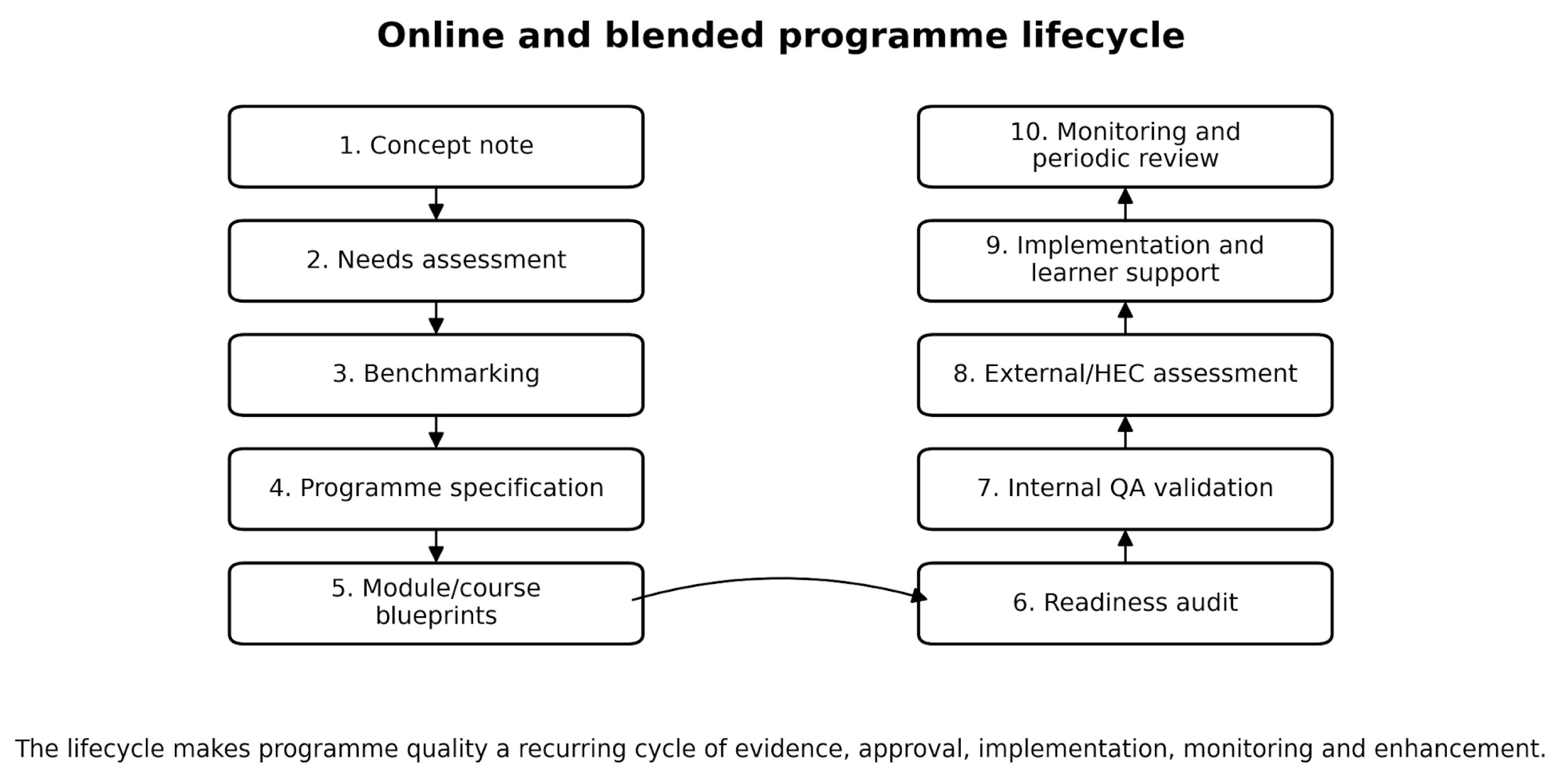
Figure 3.
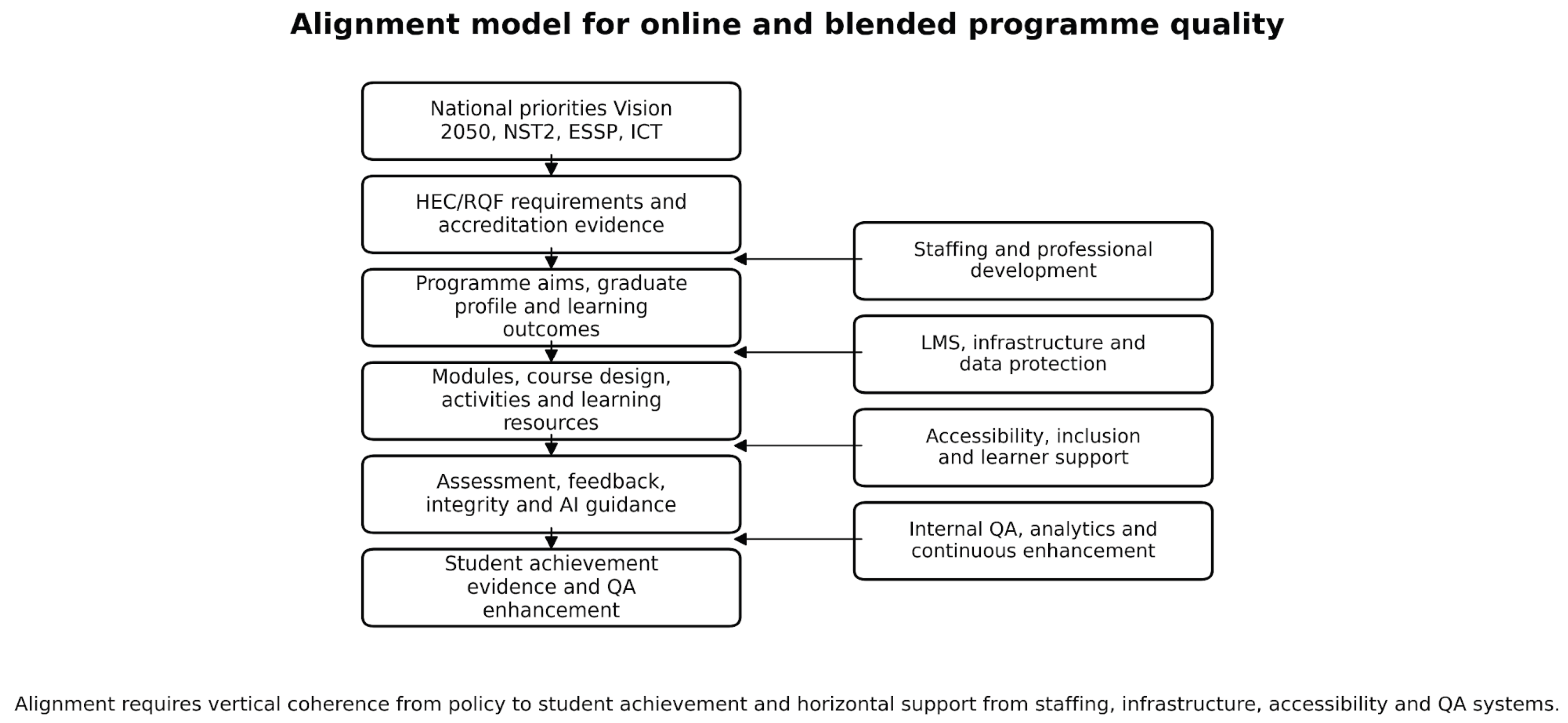
Alignment model for online and blended programme quality. Note. The alignment model links national priorities, HEC/RQF requirements, programme-level design, module-level delivery, assessment evidence, and quality enhancement, supported by staffing, infrastructure, accessibility, learner support, and data governance. Source: Author’s synthesis based on Biggs (1996), HEC (2025a), Republic of Rwanda (2021a), and Garrison et al. (2000).
Figure 3.
Alignment model for online and blended programme quality. Note. The alignment model links national priorities, HEC/RQF requirements, programme-level design, module-level delivery, assessment evidence, and quality enhancement, supported by staffing, infrastructure, accessibility, learner support, and data governance. Source: Author’s synthesis based on Biggs (1996), HEC (2025a), Republic of Rwanda (2021a), and Garrison et al. (2000).
Together, the three figures and three synthesis tables show how the framework moves from policy alignment to programme design, implementation readiness, review evidence, and continuous enhancement. The toolkit presented in the next section translates this conceptual model into practical instruments that institutions and reviewers can apply across the programme lifecycle.
6. The ROB-PDQAF Toolkit for Institutions and Regulators
The toolkit operationalises the framework. It is designed for programme development teams, institutional QA units, eLearning units, academic departments, HEC desk reviewers, and external review panels. The tools should be used iteratively rather than as a one-time compliance package, because online and blended programme quality requires recurring attention to course design, accessibility, learner support, assessment integrity, staffing, technical readiness, data governance, and continuous enhancement (Commonwealth of Learning, 2024; HEC, 2025a, 2026a; Quality Matters, n.d.; World Wide Web Consortium, 2023).
6.1. Online/Blended Programme Proposal Checklist
This checklist verifies programme identity, award, level, credits, rationale, national relevance, target learners, mode of delivery, admission requirements, staffing, resources, learner support, QA, and sustainability. It should be completed before internal approval.
6.2. Needs Assessment Template
The needs assessment should identify stakeholders, sampling strategy, data collection methods, labour market evidence, professional competency gaps, student demand, employer or sector relevance, digital access issues, and implications for curriculum design. It should distinguish between interest in a programme and demonstrated need for its competencies.
6.3. Benchmarking Matrix
Benchmarking should compare regional and international programmes on title, award level, credits, admission requirements, curriculum structure, delivery mode, assessment, learner support, staff roles, and distinctiveness. Benchmarking should inform design decisions rather than merely list comparator institutions.
6.4. Programme Specification Template
The specification should state programme title, award, RQF level, mode of delivery, mode of attendance, aims, rationale, learning outcomes, curriculum structure, module credits, teaching and learning strategy, assessment strategy, student support, resources, QA, staff development, and sustainability.
6.5. Curriculum Mapping Matrix
The matrix should map programme outcomes to modules, learning activities, assessments, graduate attributes, and evidence of achievement. It should identify where each outcome is introduced, developed, mastered, and assessed.
6.6. Module/Course Design Blueprint
The blueprint should translate each module into weekly or unit-based learning pathways. It should specify outcomes, content, readings, multimedia, learning activities, interaction, workload, assessment, feedback, accessibility features, and LMS tools.
6.7. Weekly Online Learning Design Template
This template should include weekly topic, outcomes, pre-class tasks, synchronous activities, asynchronous tasks, peer interaction, practical application, formative check, expected time on task, resources, support notes, and accessibility checks.
6.8. Assessment Blueprint and Rubric Template
The assessment blueprint should map each task to outcomes, level, weight, mode, submission format, feedback method, AI-use rules, integrity risks, and rubric criteria. Rubrics should define performance levels and evidence of achievement.
6.9. LMS Readiness Checklist
The LMS readiness checklist should verify course shell creation, enrolment, navigation, mobile responsiveness, content organisation, assignment submission, gradebook, forums, quizzes, feedback tools, analytics, accessibility, backup, and helpdesk integration.
6.10. Accessibility and Universal Design for Learning Checklist
This checklist should verify captions, transcripts, alternative text, accessible documents, colour contrast, keyboard navigation, screen-reader compatibility, flexible formats, accessible assessment, bandwidth alternatives, and disability support routes, drawing on UDL principles and digital accessibility standards (CAST, 2024; World Wide Web Consortium, 2023).
6.11. AI and Academic Integrity Checklist
The AI checklist should specify whether AI is prohibited, permitted in limited ways, or integrated into an assessment; require AI-use declarations where appropriate; define misconduct; address data privacy; provide staff and student guidance; and align AI rules with learning outcomes, assessment validity, academic integrity, and responsible AI governance (Miao & Holmes, 2023; Perkins et al., 2024; UNESCO, 2024a, 2024b).
6.12. Staff Capacity and Workload Matrix
The matrix should identify module leaders, lecturers, instructional designers, ICT staff, multimedia staff, librarians, QA staff, learner support staff, workload allocation, professional development needs, and continuity arrangements.
6.13. Student Orientation and Support Plan Template
The plan should cover LMS orientation, digital skills, communication channels, academic advising, library induction, accessibility support, helpdesk procedures, assessment guidance, AI guidance, and escalation routes.
6.14. Infrastructure and Technical Readiness Checklist
This checklist should cover LMS reliability, internet connectivity, devices, computer laboratories, multimedia facilities, licensed software, server or cloud arrangements, cybersecurity, data protection, digital library access, backup, and disaster recovery.
6.15. Programme Review and Site Visit Verification Rubric
The rubric should allow reviewers to rate each domain from 0 to 3: 0 = no evidence; 1 = limited or unclear evidence; 2 = adequate evidence with minor enhancement needed; 3 = strong evidence aligned with good practice. Reviewers should record strengths, weaknesses, required evidence, conditions, and recommendations.
6.16. Sustainability and Risk Management Matrix
The matrix should identify financial, staffing, technical, regulatory, accessibility, data protection, assessment, partnership, enrolment, and reputational risks. For each risk, institutions should state likelihood, impact, mitigation, responsible unit, timeline, and monitoring indicator.

Table 4.
Programme and course design toolkit components.
| Tool | Primary user | Main purpose | Output evidence |
|---|---|---|---|
| Programme proposal checklist | Programme team, QA unit | Verify core design and regulatory readiness | Completed checklist and action log |
| Needs assessment template | Programme team | Demonstrate stakeholder and labour market need | Needs assessment report |
| Benchmarking matrix | Programme team, QA unit | Compare programme with credible comparators | Benchmarking report and design decisions |
| Programme specification template | Academic department | Define award, outcomes, structure, support, QA | Programme specification |
| Curriculum mapping matrix | Module team | Align outcomes, modules, assessments | Curriculum map |
| Course design blueprint | Module leader, instructional designer | Design online/blended learning pathway | Course blueprint and LMS shell |
| Assessment blueprint | Module leader, QA unit | Ensure valid and authentic assessment | Assessment map and rubrics |
| LMS readiness checklist | eLearning/ICT unit | Verify technical readiness | LMS audit report |
| Accessibility checklist | Programme team, disability support | Ensure inclusive design | Accessibility review report |
| AI and integrity checklist | Academic staff, QA unit | Clarify AI and integrity rules | AI-use guidance and declarations |
| Staff capacity matrix | Dean, HoD, QA unit | Verify staffing and workload | Staffing and workload plan |
| Student support plan | Student support, eLearning unit | Prepare learners for digital study | Orientation and support plan |
| Technical readiness checklist | ICT unit | Verify infrastructure and systems | Technical readiness report |
| Site visit rubric | HEC reviewers | Assess evidence and readiness | Review report evidence matrix |
| Sustainability matrix | Management, finance, QA unit | Assess continuation and risk | Sustainability and risk plan |
Note. Source: Author’s synthesis based on the ROB-PDQAF domains.
Table 5.
Risk matrix for online and blended programme approval and implementation.
| Risk area | Typical risk | Likelihood indicators | Impact if unmanaged | Mitigation evidence |
|---|---|---|---|---|
| Regulatory alignment | Wrong award level, inconsistent title, unclear credits | Inconsistent documents | Accreditation delay or rejection | RQF/HEC alignment matrix |
| Curriculum | Outcomes not aligned with assessments | Weak curriculum map | Weak academic standards | Constructive alignment audit |
| Digital design | LMS used as repository only | No course blueprint | Low engagement and completion | Weekly learning design plan |
| Accessibility | Materials inaccessible | No captions or accessibility testing | Exclusion and inequity | UDL checklist and disability support plan |
| Assessment | High misconduct risk or weak rubrics | Generic tasks, unclear AI rules | Invalid grading and disputes | Authentic assessment blueprint |
| Staffing | Overreliance on few staff | No workload or commitments | Delivery instability | Staffing matrix and continuity plan |
| Infrastructure | LMS or internet unreliable | No audit or support plan | Delivery failure | LMS and ICT readiness audit |
| Data protection | Unclear handling of learner data | No data policy for tools | Legal and ethical risk | Data protection and privacy procedures |
| Sustainability | Short-term funding only | No renewal plan | Programme collapse | Multi-year budget and risk register |
| QA | No monitoring or follow-up | No action plan | Recurring weaknesses | QA cycle and improvement logs |
Note. Source: Author’s synthesis based on cited policy and literature.
Table 6.
Proposed rubric for assessing readiness of online and blended programmes.
| Score | Rating | Descriptor | Approval implication |
|---|---|---|---|
| 3 | Strong readiness | Evidence is clear, current, coherent, and demonstrates good practice across the domain | Approval may proceed, with routine enhancement recommendations |
| 2 | Adequate readiness | Evidence is sufficient but some aspects require clarification or strengthening | Approval may proceed with specific recommendations or minor conditions |
| 1 | Limited readiness | Evidence exists but is incomplete, inconsistent, weakly aligned, or insufficiently verified | Approval should require conditions before implementation |
| 0 | Not demonstrated | No relevant evidence, or evidence contradicts the claim of readiness | Approval should not proceed until evidence is provided and reviewed |
Note. This rubric adapts the logic of evidence-based review scales used in HEC virtual learning and AI assessment tools while broadening the domains for programme-level review. Source: Author’s synthesis based on HEC (2025a) and the ROB-PDQAF.
7. Discussion
7.1. The Framework’s Contribution to Higher Education Quality Assurance
The ROB-PDQAF contributes to higher education quality assurance by integrating programme accreditation, instructional design, digital learning, accessibility, AI governance, data protection, and sustainability into a single framework. Rather than treating online learning quality as a technical add-on, the framework positions it as a systemic academic responsibility. This is consistent with international quality assurance principles that locate primary responsibility for quality within institutions while recognising the role of external review in safeguarding standards and public trust (African Union Commission, 2018; European Association for Quality Assurance in Higher Education et al., 2015).
7.2. Why Online Programme Quality Must Be Assessed as an Ecosystem
The framework’s central argument is that online programme quality emerges from the fit among multiple components. An LMS without instructional design does not produce learning. Authentic assessment without clear AI rules may create confusion. Inclusive policy without accessible materials remains symbolic. Strong initial funding without renewal planning is fragile. Staff expertise without workload recognition leads to burnout. Therefore, reviewers should not assess isolated claims. They should examine whether evidence across domains converges toward credible implementation.
7.3. Implications for Higher Learning Institutions in Rwanda
For HLIs, the framework offers a structured way to prepare stronger programme submissions and avoid common weaknesses: inconsistent programme identity, weak needs assessment, superficial benchmarking, excessive or poorly written outcomes, unclear assessment alignment, unverified LMS readiness, insufficient accessibility planning, unsupported staffing claims, and overstated sustainability. It encourages institutions to conduct internal readiness audits before seeking external approval.
7.4. Implications for HEC and Regulatory Programme Assessment
For HEC and external reviewers, the framework supports more consistent review decisions. It provides domain-based evidence requirements and review questions that can be used in desk review, site visits, programme validation, and post-approval monitoring. It also supports proportionate decision-making: minor weaknesses may require recommendations, while serious gaps in assessment validity, staffing, infrastructure, accessibility, or sustainability may require approval conditions.
7.5. Implications for Online Pedagogy, Instructional Design, and Learner Support
The framework reinforces the need for team-based online programme design. Academic staff, instructional designers, ICT personnel, librarians, disability support staff, quality assurance officers, and managers must work together because high-quality online teaching depends on coordinated course design, facilitation, assessment, feedback, learner support, technical readiness, and continuous improvement (Commonwealth of Learning, 2024; Martin et al., 2019). This is especially important in contexts where lecturers may be expected to design digital content, facilitate online learning, assess students, troubleshoot technology, and support learners without adequate institutional structures.
7.6. Implications for AI, Accessibility, and Digital Governance
AI governance is no longer optional in online and blended higher education. HEC’s virtual learning and AI guidelines and UNESCO’s guidance indicate that AI must be addressed through policy, assessment design, academic integrity rules, privacy safeguards, and staff/student competence (HEC, 2025a; Miao & Holmes, 2023; UNESCO, 2024a, 2024b). The framework therefore treats AI not as a separate innovation topic but as part of assessment, data governance, staff development, learner support, and institutional policy.
7.7. Comparison with International Quality Assurance Trends
The ROB-PDQAF is consistent with international trends but contextualises them for Rwanda. Quality Matters and OSCQR provide strong course-level design insights (Quality Matters, n.d.; SUNY Online, n.d.). UDL provides accessibility principles (CAST, 2024). CoI provides a model for online interaction (Garrison et al., 2000). ASG-QA and ESG frame quality assurance responsibilities (African Union Commission, 2018; European Association for Quality Assurance in Higher Education et al., 2015). COL provides distance and blended learning quality assurance tools (Commonwealth of Learning, 2009, 2024). The ROB-PDQAF does not replace these frameworks. It synthesises them through Rwanda’s regulatory and institutional context.
7.8. Conditions for Successful Implementation
Implementation requires institutional leadership, QA capacity, staff development, instructional design support, ICT readiness, accessible learning materials, realistic budgets, and a culture of evidence, all of which are recurrent features of international online, blended, and distance learning quality assurance guidance (Commonwealth of Learning, 2009, 2024; HEC, 2025a, 2026a). HEC can support implementation by using the framework to structure guidance, reviewer training, institutional capacity building, and post-accreditation monitoring. HLIs can support implementation by embedding the framework into programme development procedures, internal validation, and course design workflows.
8. Recommendations
8.1. Higher Learning Institutions
HLIs should adopt a programme lifecycle approach in which online and blended quality is designed from the concept note stage. They should require every online or blended programme to submit an RQF/HEC alignment matrix, needs assessment, benchmarking matrix, curriculum map, course design blueprints, assessment blueprint, LMS readiness audit, accessibility checklist, staffing and workload matrix, learner support plan, and sustainability plan.
8.2. HEC and External Quality Assurance Reviewers
HEC and external reviewers should use domain-based evidence review rather than relying mainly on narrative descriptions. Review panels should verify LMS functionality, course shells, digital content, assessment rubrics, staff readiness, learner support, accessibility features, data protection arrangements, and sustainability assumptions. Serious weaknesses should be framed as approval conditions where they affect academic standards, student experience, implementation feasibility, or public confidence.
8.3. Programme Developers and Instructional Designers
Programme developers and instructional designers should collaborate from the earliest design stage. They should translate programme outcomes into course-level learning pathways, interaction plans, accessible resources, authentic assessment tasks, rubrics, and feedback cycles. Instructional design should be documented as part of quality assurance evidence.
8.4. Academic Staff and Module Leaders
Academic staff should receive professional development in online facilitation, digital assessment, accessibility, AI guidance, feedback, learning analytics interpretation, and LMS course management. Module leaders should be responsible for ensuring that learning outcomes, activities, content, assessments, and feedback are aligned and visible to students.
8.5. ICT, Library, eLearning, and Learner Support Units
Support units should be integrated into programme design and review. ICT teams should verify LMS and infrastructure readiness. Librarians should support digital resources, OER, copyright, and information literacy. eLearning units should support course design and staff development. Learner support units should provide orientation, accessibility support, helpdesk pathways, academic advising, and student wellbeing support.
8.6. Policymakers and Funders
Policymakers and funders should recognise that quality online education requires recurring investment in platforms, licences, staff development, instructional design, accessibility, learner support, content renewal, data protection, and quality monitoring (Commonwealth of Learning, 2009, 2024; HEC, 2026a). Funding should support not only equipment but also staff development, instructional design capacity, accessibility, software licensing, learner support, content renewal, data protection, and quality monitoring.
8.7. Future Researchers
Researchers should validate the ROB-PDQAF through expert review, Delphi studies, pilot implementation, inter-rater reliability testing, institutional case studies, and learner outcome studies. Comparative research across East African higher education systems would also help determine which domains are regionally generalisable and which require country-specific adaptation.
9. Limitations and Future Research
This study has four main limitations. First, it is based on public documents and literature rather than confidential institutional evidence or empirical field data. Second, although the framework is grounded in policy and literature, it has not yet undergone formal expert validation. Third, the framework is designed for online and blended higher education generally; discipline-specific adaptations may be necessary for clinical, laboratory, practicum-based, creative, and professional programmes. Fourth, the rapid evolution of AI, learning analytics, cybersecurity, and digital assessment means that some indicators will require periodic updating.
Future research should validate the framework through expert review and Delphi methods, which are widely used to develop consensus among knowledgeable participants, and should also test rubric reliability because readiness scores will only be defensible if reviewers can apply the rubric consistently (Hsu & Sandford, 2007; Moskal & Leydens, 2000). Subsequent studies should test the framework in programme approval processes, measure inter-rater reliability of the rubric, examine usability by programme teams, and investigate whether readiness scores predict implementation quality, student engagement, completion, and graduate outcomes.
10. Conclusions
Rwanda’s higher education system is entering a period in which online and blended programmes are likely to become increasingly important for access, flexibility, professional development, and digital transformation. Yet the quality of such programmes cannot be secured by technology adoption alone. It requires coherent alignment among national priorities, RQF and HEC requirements, curriculum design, course design, digital materials, learner support, assessment integrity, staff capacity, infrastructure, data governance, internal quality assurance, and sustainability.
The ROB-PDQAF offers a Rwanda-contextual framework for this task. It is grounded in public Rwandan policy and regulatory documents, informed by international literature and standards, and operationalised through tools usable by both HLIs and HEC reviewers. Its central contribution is practical and conceptual: online and blended programme quality must be treated as an evidence-based academic ecosystem. Properly applied, the framework can help institutions design stronger programmes, help regulators make more consistent decisions, and help Rwanda strengthen the credibility, accessibility, and relevance of digital higher education.
Use of AI-Assisted Tools
AI-assisted tools were used for language refinement, synthesis support, editing, and formatting checks during manuscript preparation. The author independently verified the cited sources, interpreted the evidence, made all scholarly judgements, and approved the final manuscript.
Competing Interests
The author (s) declare no competing interests.
Confidentiality and Source Use
The manuscript does not rely on confidential institutional submissions, private accreditation materials, unpublished programme validation documents, or restricted internal records.
Data Availability
All policy documents, standards, and literature sources analysed in this manuscript are publicly available and cited in the reference list.
Ethics Approval and Consent to Participate
Not applicable. This framework-development study used publicly available policy documents, standards, and published literature and did not involve human participants, personal data collection, or intervention with students or staff.
Author Contributions
The author conceptualised the study, conducted the document and literature synthesis, developed the framework and toolkit, interpreted the findings, and prepared the manuscript.
Funding
This research received no specific grant from any funding agency in the public, commercial, or not-for-profit sectors.
Appendix A. Source Search and Policy Document Inventory
Search sources: HEC Rwanda publications, HEC accreditation pages, MINEDUC publications, MINECOFIN/NST2 and Vision 2050 pages, MINICT ICT strategy, Rwanda official legal repositories, UNESCO digital library, Commonwealth of Learning OASIS repository, ASG-QA, ESG, Quality Matters, OSCQR, CAST UDL, and peer-reviewed academic databases and journal platforms.
Core Rwanda documents identified: RQF Ministerial Order; HEC accreditation process and forms; HEC quality guidelines; HEC IQA guidelines; HEC virtual learning and AI guidelines; HEC distance learning guidelines; infrastructure and academic standards; HESSP 2025–2030; ESSP 2024–2029; NST2 2024–2029; Vision 2050; ICT SSP 2024–2029; Personal Data and Privacy Law.
Core international and regional sources identified: ASG-QA; ESG; COL QA toolkit; UNESCO OER Recommendation; UNESCO AI guidance and AI competency frameworks; Quality Matters; OSCQR; UDL; Community of Inquiry; constructive alignment; online learning review literature; online assessment and academic integrity literature.
Appendix B. ROB-PDQAF Quality Domains and Indicators
| Domain | Minimum quality indicators |
| Strategic relevance and regulatory alignment | Consistent title, correct RQF level, credits, admission criteria, rationale, labour market relevance, graduate profile |
| Curriculum coherence | Measurable outcomes, curriculum map, module sequencing, workload, assessment alignment |
| Online/blended design | Weekly pathways, interaction, facilitation, synchronous/asynchronous balance, LMS organisation |
| Digital content | Multimedia quality, OER, copyright, accessibility, localisation, bandwidth sensitivity |
| Accessibility/support | UDL, orientation, helpdesk, disability support, digital skills, communication channels |
| Assessment/AI/integrity | Authentic tasks, rubrics, moderation, feedback, AI-use guidance, data ethics |
| Staffing/support | Academic, instructional design, ICT, multimedia, library, QA, and learner support capacity |
| Infrastructure/data | LMS, devices, connectivity, licences, cybersecurity, data protection, backups |
| Internal QA | Approval, external review, feedback, analytics, action plans, periodic review |
| Sustainability | Funding, renewal, partnerships, enrolment assumptions, risk management, scalability |
Appendix C. Programme Design Checklist
Programme title is accurate and consistent across all documents.
Award type, RQF level, credits, and notional workload are correctly stated.
Rationale is supported by policy, labour market, and stakeholder evidence.
Needs assessment includes relevant stakeholders and prospective learners.
Benchmarking compares credible regional and international programmes.
Admissions criteria match programme level and expected prior competence.
The graduate profile is realistic and supported by curriculum structure.
Programme outcomes are measurable, postgraduate-level, and non-redundant.
Module outcomes map clearly to programme outcomes.
Assessment strategy tests knowledge, application, design competence, reflection, and professional outputs.
Online/blended delivery strategy is specific and feasible.
Staffing, resources, learner support, QA, and sustainability are evidenced.
Appendix D. Online Course Design Blueprint
| Element | Required information |
| Module title and code | Official title and code |
| Module outcomes | Measurable outcomes aligned to programme outcomes |
| Weekly structure | Topics, activities, resources, assessment points |
| Delivery mode | Face-to-face, synchronous online, asynchronous online, practical/lab |
| Learning activities | Individual, collaborative, problem-based, project-based, reflective |
| Interaction | Student-content, student-student, student-teacher, student-community |
| Resources | Readings, multimedia, OER, datasets, tools |
| Assessment | Formative, summative, rubric, feedback method |
| Accessibility | Captions, transcripts, alternative formats, UDL notes |
| Workload | Expected student hours per activity |
| LMS tools | Forums, assignments, quizzes, gradebook, analytics |
| Support | Technical, academic, library, accessibility support |
Appendix E. Assessment Blueprint and Rubric Template
| Assessment task | Outcomes assessed | Weight | Authentic context | AI-use level | Integrity controls | Feedback method | Rubric criteria |
| Task 1 | Outcome numbers | % | Realistic scenario | No/limited/permitted | Declaration, oral defence, process evidence | Written/audio/video | Criteria and levels |
| Task 2 | Outcome numbers | % | Professional output | No/limited/permitted | Rubric, moderation, originality check | Written feedback | Criteria and levels |
Rubric levels: Excellent, Good, Satisfactory, Limited, Insufficient. Each level should describe observable performance evidence rather than vague judgement.
Appendix F. LMS and Infrastructure Readiness Checklist
LMS is functional, secure, and accessible.
Course shells are created for all modules.
Lecturers can upload content, create activities, set assignments, grade, and provide feedback.
Students can access content, submit work, participate in forums, view grades, and receive feedback.
LMS is mobile-responsive.
Data backup and recovery procedures exist.
Helpdesk support is available and documented.
Software licences are valid.
Digital library access is available.
Cybersecurity and data protection procedures are in place.
Accessibility features have been tested.
Contingency arrangements exist for system downtime.
Appendix G. Accessibility and AI Governance Checklist
Accessibility: captions, transcripts, alt text, accessible documents, screen-reader compatibility, keyboard navigation, mobile access, low-bandwidth alternatives, flexible assessment, disability support, and accessibility review.
AI governance: institutional AI policy, assessment-specific AI guidance, student AI-use declarations, staff AI competence, data privacy safeguards, bias awareness, academic integrity procedures, human review of AI-supported decisions, and periodic policy review. These checklist items are derived from UDL, WCAG 2.2, UNESCO AI guidance, and the AI Assessment Scale (CAST, 2024; Miao & Holmes, 2023; Perkins et al., 2024; World Wide Web Consortium, 2023).
Appendix H. Site Visit Verification Rubric
| Evidence area | Verification method | Score 0–3 | Reviewer notes |
| Programme identity and RQF alignment | Document review | ||
| Curriculum map and module coherence | Document review/interview | ||
| LMS readiness | Live demonstration | ||
| Digital content quality | Course shell/sample review | ||
| Accessibility | Checklist/test/interviews | ||
| Assessment and AI governance | Assessment sample review | ||
| Staffing and workload | CVs/interviews/workload records | ||
| ICT and data protection | ICT interview/document review | ||
| Learner support | Student/support staff interviews | ||
| Sustainability | Budget/partnership/risk review |
Appendix I. Sustainability and Risk Matrix
| Risk | Likelihood | Impact | Mitigation | Responsible unit | Timeline | Monitoring indicator |
| Low enrolment | Low/medium/high | Low/medium/high | Marketing, stakeholder engagement, flexible scheduling | Programme team | Date | Applications/enrolment |
| Staff unavailability | Low/medium/high | Low/medium/high | Backup instructors, commitment letters, workload plan | Dean/HoD | Date | Staff allocation report |
| LMS downtime | Low/medium/high | Low/medium/high | Backup server, SaaS SLA, offline alternatives | ICT | Date | Downtime logs |
| Software licence expiry | Low/medium/high | Low/medium/high | Multi-year licensing budget | Finance/ICT | Date | Licence register |
| Accessibility non-compliance | Low/medium/high | Low/medium/high | Accessibility audit and remediation | QA/eLearning | Date | Accessibility report |
| Data breach | Low/medium/high | Low/medium/high | Data protection policy, DPO, cybersecurity controls | ICT/DPO | Date | Incident reports |
| Funding gap | Low/medium/high | Low/medium/high | Multi-year budget and reserves | Management | Date | Budget review |
References
- African Union Commission. African standards and guidelines for quality assurance in higher education (ASG-QA); African Union Commission, 2018; Available online: https://nuc.edu.ng/wp-content/uploads/2018/11/ASG-QA_2018_edited_EN-min.pdf.
- Bernard, R. M.; Borokhovski, E.; Schmid, R. F.; Tamim, R. M.; Abrami, P. C. A meta-analysis of blended learning and technology use in higher education: From the general to the applied. Journal of Computing in Higher Education 2014, 26, 87–122. [Google Scholar] [CrossRef]
- Biggs, J. Enhancing teaching through constructive alignment. Higher Education 1996, 32(3), 347–364. [Google Scholar] [CrossRef]
- Bolliger, D. U.; Wasilik, O. Factors influencing faculty satisfaction with online teaching and learning in higher education. Distance Education 2009, 30(1), 103–116. [Google Scholar] [CrossRef]
- Branch, R. M. Instructional design: The ADDIE approach; Springer, 2009. [Google Scholar] [CrossRef]
- Bowen, G. A. Document analysis as a qualitative research method. Qualitative Research Journal 2009, 9(2), 27–40. [Google Scholar] [CrossRef]
- CAST. Universal design for learning guidelines 3.0. 2024. Available online: https://udlguidelines.cast.org/.
- Commonwealth of Learning. Quality assurance toolkit for distance higher education institutions and programmes; Commonwealth of Learning, 2009; Available online: https://oasis.col.org/entities/publication/6350e0c0-c62a-465f-8d71-dbf06c2545e5.
- Commonwealth of Learning. Quality assurance of blended and online learning; Commonwealth of Learning, 2024; Available online: https://oasis.col.org/bitstreams/0e8f50a2-77e5-426e-a0d3-9e901c42aeb5/download.
- Commonwealth of Learning. Higher education. n.d. Available online: https://www.col.org/education/higher-education/ (accessed on 31 May 2026).
- European Association for Quality Assurance in Higher Education; European Students’ Union; European University Association; European Association of Institutions in Higher Education. Standards and guidelines for quality assurance in the European Higher Education Area (ESG). 2015. Available online: https://www.enqa.eu/wp-content/uploads/2015/11/ESG_2015.pdf.
- Garrison, D. R.; Anderson, T.; Archer, W. Critical inquiry in a text-based environment: Computer conferencing in higher education. The Internet and Higher Education 2000, 2(2–3), 87–105. [Google Scholar] [CrossRef]
- Government of Rwanda. Vision 2050. 2020. Available online: https://www.minecofin.gov.rw/fileadmin/user_upload/Minecofin/Publications/REPORTS/National_Development_Planning_and_Research/Vision_2050/English-Vision_2050_full_version_WEB_Final.pdf.
- Government of Rwanda. National Strategy for Transformation 2: NST2 2024–2029. 2024. Available online: https://www.minecofin.gov.rw/fileadmin/user_upload/Minecofin/Publications/STRATEGIES/NST_2/NST2_2024-2029_Abridged.pdf.
- Higher Education Council. Higher education institutional infrastructure and academic standards. 2023. Available online: https://www.hec.gov.rw/fileadmin/user_upload/HEC/Publications/Guidelines/HIGHER_EDUCATION_INSTITUTIONAL_INFRASTRUCTURE_AND_ACADEMIC_STANDARDS.pdf.
- Higher Education Council. Guidelines for internal quality assurance (IQA) mechanisms for higher education. 2024. Available online: https://www.hec.gov.rw/fileadmin/user_upload/HEC/Publications/Guidelines/Guidelines_for_Internal_Quality_Assurance_IQA__for_Higher_Education-Rwanda.pdf.
- Higher Education Council. Guidelines and assessment tools for the virtual learning and the use of artificial intelligence in Rwanda’s higher learning institutions. 2025a. Available online: https://www.hec.gov.rw/fileadmin/user_upload/HEC/Publications/Guidelines/GUIDELINES_ASSESSMENT_TOOLS_FOR_VL_and_AI_in_HLIs.pdf.
- Higher Education Council. Benchmarks and guidelines for education-related programmes. 2025b. Available online: https://www.hec.gov.rw/publications/guidelines.
- Higher Education Council. Guidelines and assessment tools for distance learning in Rwanda’s higher learning institutions. 2026a. Available online: https://www.hec.gov.rw/fileadmin/user_upload/HEC/Publications/Guidelines/GUIDELINES_AND_ASSESSMENT_TOOLS_FOR_DISTANCE_LEARNING.pdf.
- Higher Education Council. Rwanda Higher Education Sector Strategic Plan (HESSP) 2025–2030. 2026b. Available online: https://www.hec.gov.rw/fileadmin/user_upload/HEC/Publications/Policies/Rwanda_Higher_Education_Sector_Strategic_Plan__HESSP__2025-2030.pdf.
- Higher Education Council. Accreditation process. n.d.-a. Available online: https://www.hec.gov.rw/accreditation-process (accessed on 31 May 2026).
- Higher Education Council. Quality guidelines. n.d.-b. Available online: https://www.hec.gov.rw/quality-guidelines (accessed on 31 May 2026).
- Higher Education Council. Accreditation, Standards and Qualifications Framework Division. n.d.-c. Available online: https://www.hec.gov.rw/accreditation-standards-and-qualifications-framework-division (accessed on 31 May 2026).
- Higher Education Council. General Higher Education Quality Standards Department. n.d.-d. Available online: https://www.hec.gov.rw/general-higher-education-quality-standards-department (accessed on 31 May 2026).
- Higher Education Council. Guidelines. n.d.-e. Available online: https://www.hec.gov.rw/publications/guidelines (accessed on 31 May 2026).
- Hodges, C.; Moore, S.; Lockee, B.; Trust, T.; Bond, A. The difference between emergency remote teaching and online learning; EDUCAUSE Review, 27 March 2020; Available online: https://er.educause.edu/articles/2020/3/the-difference-between-emergency-remote-teaching-and-online-learning.
- Holden, O. L.; Norris, M. E.; Kuhlmeier, V. A. Academic integrity in online assessment: A research review. Frontiers in Education 2021, 6, 639814. [Google Scholar] [CrossRef]
- Hsu, C.-C.; Sandford, B. A. The Delphi technique: Making sense of consensus. Practical Assessment, Research, and Evaluation 2007, 12, 10. [Google Scholar] [CrossRef]
- Jabareen, Y. Building a conceptual framework: Philosophy, definitions, and procedure. International Journal of Qualitative Methods 2009, 8(4), 49–62. [Google Scholar] [CrossRef]
- Kauffman, H. A review of predictive factors of student success in and satisfaction with online learning. Research in Learning Technology 2015, 23, 26507. [Google Scholar] [CrossRef]
- Martin, F.; Ritzhaupt, A.; Kumar, S.; Budhrani, K. Award-winning faculty online teaching practices: Course design, assessment and evaluation, and facilitation. The Internet and Higher Education 2019, 42, 34–43. [Google Scholar] [CrossRef]
- Martin, F.; Sun, T.; Westine, C. D. A systematic review of research on online teaching and learning from 2009 to 2018. Computers & Education 2020, 159, 104009. [Google Scholar] [CrossRef] [PubMed]
- Martin, F.; Polly, D.; Jokiaho, A.; May, B. Online assessment in higher education: A systematic review. Online Learning 2023, 27(1), 187–218. [Google Scholar] [CrossRef]
- Mayer, R. E. Multimedia learning, 3rd ed.; Cambridge University Press, 2021. [Google Scholar] [CrossRef]
- Means, B.; Toyama, Y.; Murphy, R.; Baki, M. The effectiveness of online and blended learning: A meta-analysis of the empirical literature. Teachers College Record 2013, 115(3), 1–47. Available online: https://eric.ed.gov/?id=EJ1018090. [CrossRef]
- Miao, F.; Holmes, W.; Huang, R.; Zhang, H. AI and education: Guidance for policy-makers; UNESCO, 2021; Available online: https://unesdoc.unesco.org/ark:/48223/pf0000376709.
- Miao, F.; Holmes, W. Guidance for generative AI in education and research; UNESCO, 2023; Available online: https://unesdoc.unesco.org/ark:/48223/pf0000386693.
- Ministry of Education. Education Sector Strategic Plan (ESSP) 2024–2029. 2024. Available online: https://www.mineduc.gov.rw/fileadmin/user_upload/Mineduc/Publications/PLANS/Education_Sector_Strategic_Plan/The_Education_Sector_Strategic_Plan__ESSP__2024-2029.pdf.
- Ministry of Education. 2023/2024 Education Statistical Yearbook. 2025. Available online: https://www.mineduc.gov.rw/fileadmin/user_upload/Mineduc/Publications/REPORTS/Education_Statistics/Education_statistical_yearbook/Final_Education_Statistical_Yearbook_23_24.pdf.
- Ministry of ICT and Innovation. ICT Sector Strategic Plan 2024–2029. 2024. Available online: https://www.minict.gov.rw/fileadmin/user_upload/minict_user_upload/Documents/Strategies/ICT__SSP_2024-2029_.pdf.
- Moskal, B. M.; Leydens, J. A. Scoring rubric development: Validity and reliability. Practical Assessment, Research, and Evaluation 2000, 7, 10. [Google Scholar] [CrossRef]
- Muljana, P. S.; Luo, T. Factors contributing to student retention in online learning and recommended strategies for improvement: A systematic literature review. Journal of Information Technology Education: Research 2019, 18, 19–57. [Google Scholar] [CrossRef] [PubMed]
- Perkins, M.; Furze, L.; Roe, J.; MacVaugh, J. The Artificial Intelligence Assessment Scale (AIAS): A framework for ethical integration of generative AI in educational assessment. Journal of University Teaching and Learning Practice 2024, 21(6). [Google Scholar] [CrossRef]
- Quality Matters. Higher education course design rubric. n.d. Available online: https://www.qualitymatters.org/qa-resources/rubric-standards/higher-ed-rubric (accessed on 31 May 2026).
- Republic of Rwanda. Ministerial Order No. 003/MINEDUC/2021 of 20/10/2021 determining Rwanda Qualifications Framework; Official Gazette of the Republic of Rwanda, 2021a; Available online: https://www.hec.gov.rw/fileadmin/user_upload/HEC/Publications/Laws/Ministerial_Order_N___003-MINEDUC-2021_of_20-10-2021determining_Rwanda_qualifications_framework.pdf.
- Republic of Rwanda. Law No. 058/2021 of 13/10/2021 relating to the protection of personal data and privacy; Official Gazette of the Republic of Rwanda, 2021b; Available online: https://www.rfl.rw/docs/kifclaws/04.Law_relating_to_the_protection_of_personal_data_and_privacy.pdf.
- Sangwa, S.; Ndahayo, C.; Dusengumuremyi, F. Competency-based curriculum design for online graduate education: A scoping review with implications for emerging African universities. Asian Journal of Education and Social Studies 2026a, 52(4), 624–637. [Google Scholar] [CrossRef]
- Sangwa, S.; Ndahayo, C.; Dusengumuremyi, F.; Mutabazi, P. Institutional architecture for credible online and blended provision in African higher education: A university-wide framework for digital transition. American Journal of Education and Information Technology 2026b, 10(1), 10–26. [Google Scholar] [CrossRef]
- Slade, S.; Prinsloo, P. Learning analytics: Ethical issues and dilemmas. American Behavioral Scientist 2013, 57(10), 1510–1529. [Google Scholar] [CrossRef]
- Snyder, H. Literature review as a research methodology: An overview and guidelines. Journal of Business Research 2019, 104, 333–339. [Google Scholar] [CrossRef]
- SUNY Online. OSCQR: SUNY Online Course Quality Review Rubric. n.d. Available online: https://oscqr.suny.edu/ (accessed on 31 May 2026).
- Torraco, R. J. Writing integrative literature reviews: Guidelines and examples. Human Resource Development Review 2005, 4(3), 356–367. [Google Scholar] [CrossRef]
- Tripp, S. D.; Bichelmeyer, B. Rapid prototyping: An alternative instructional design strategy. Educational Technology Research and Development 1990, 38(1), 31–44. [Google Scholar] [CrossRef]
- UNESCO. Recommendation on Open Educational Resources (OER). 2019. Available online: https://unesdoc.unesco.org/ark:/48223/pf0000383205.
- UNESCO International Institute for Higher Education in Latin America and the Caribbean. COVID-19 and higher education: Today and tomorrow: Impact analysis, policy responses and recommendations; UNESCO IESALC, 2020; Available online: https://unesdoc.unesco.org/ark:/48223/pf0000375693.
- UNESCO. AI competency framework for teachers. 2024a. Available online: https://unesdoc.unesco.org/ark:/48223/pf0000391104.
- UNESCO. AI competency framework for students. 2024b. Available online: https://unesdoc.unesco.org/ark:/48223/pf0000391105.
- Vlachopoulos, D.; Makri, A. A systematic literature review on authentic assessment in higher education: Best practices for the development of 21st century skills, and policy considerations. Studies in Educational Evaluation 2024, 83, 101425. [Google Scholar] [CrossRef]
- Wang, Y.; Stein, D.; Shen, S. Students’ and teachers’ perceived teaching presence in online courses. Distance Education 2022, 43(3), 373–390. [Google Scholar] [CrossRef]
- Wiggins, G.; McTighe, J. Understanding by design (Expanded 2nd ed.); ASCD, 2005; Available online: https://www.ascd.org/books/understanding-by-design-expanded-2nd-edition.
- World Wide Web Consortium. Web Content Accessibility Guidelines (WCAG) 2.2. 2023. Available online: https://www.w3.org/TR/WCAG22/.
Figure 1.
Conceptual model of the Rwanda Online and Blended Programme Design and Quality Assurance Framework. Note. The model positions online and blended programme quality as a cyclical ecosystem linking national priorities, regulatory alignment, curriculum design, course design, learner support, assessment, staffing, infrastructure, internal QA, and sustainability. Source: Author’s synthesis based on HEC (2025a, 2026a), Republic of Rwanda (2021a), Biggs (1996), Garrison et al. (2000), CAST (2024), and Commonwealth of Learning (2009).
Figure 1.
Conceptual model of the Rwanda Online and Blended Programme Design and Quality Assurance Framework. Note. The model positions online and blended programme quality as a cyclical ecosystem linking national priorities, regulatory alignment, curriculum design, course design, learner support, assessment, staffing, infrastructure, internal QA, and sustainability. Source: Author’s synthesis based on HEC (2025a, 2026a), Republic of Rwanda (2021a), Biggs (1996), Garrison et al. (2000), CAST (2024), and Commonwealth of Learning (2009).
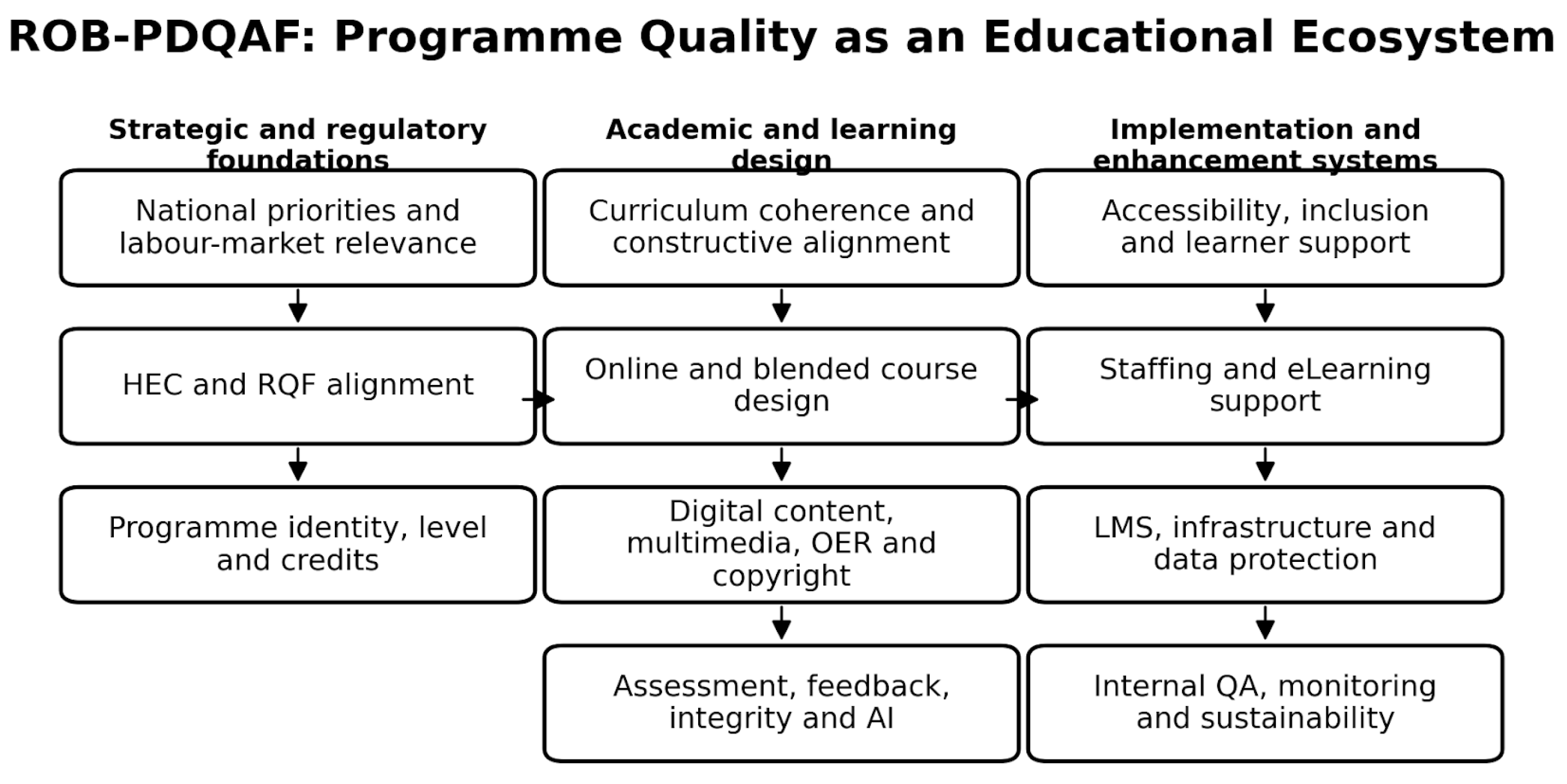
Table 1.
Public policy and regulatory documents reviewed.
| Source category | Document or source | Relevance to ROB-PDQAF |
|---|---|---|
| Rwanda qualifications | Ministerial Order No. 003/MINEDUC/2021 determining the Rwanda Qualifications Framework | Establishes qualification levels, sub-frameworks, credits, mobility, and quality functions |
| HEC accreditation | HEC accreditation process and related public forms | Identifies programme approval, evidence submission, self-assessment, peer review, and programme documentation |
| HEC quality assurance | HEC quality guidelines, IQA guidelines, quality departments, and accreditation division descriptions | Frames QA as systems, resources, standards, monitoring, enhancement, and programme approval |
| HEC digital learning | Guidelines and Assessment Tools for Virtual Learning and AI in HLIs | Provides standards for infrastructure, materials development, staff readiness, student readiness, assessment, policies, and management |
| HEC distance learning | Guidelines and Assessment Tools for Distance Learning in Rwanda’s HLIs | Provides standards and procedures for designing, delivering, and evaluating distance learning |
| HEC infrastructure | Higher Education Institutional Infrastructure and Academic Standards | Provides minimum expectations for institutional resources and academic delivery |
| National strategy | Vision 2050 and NST2 2024–2029 | Establishes human capital, innovation, competitiveness, and digital transformation priorities |
| Education strategy | ESSP 2024–2029 and HESSP 2025–2030 | Connects higher education to labour market relevance, research, and digital transformation |
| ICT strategy | ICT Sector Strategic Plan 2024–2029 | Frames digital transformation, inclusion, and service delivery priorities |
| Data governance | Law No. 058/2021 relating to protection of personal data and privacy | Establishes obligations relevant to LMS, analytics, AI, student data, and online assessment |
Note. Source: Author’s synthesis based on publicly available policy and regulatory documents cited in the manuscript.
Table 2.
Literature and standards synthesis matrix.
| Source or framework | Core emphasis | ROB-PDQAF implication |
|---|---|---|
| Rwanda Qualifications Framework | Qualification levels, credits, competence, pathways | Programmes must align award type, level, outcomes, credits, and progression |
| HEC virtual learning and AI guidelines | Infrastructure, materials, staff readiness, student readiness, assessment, policies, management | Digital learning quality must be evidenced through institutional systems and course-level readiness |
| HEC distance learning guidelines | Design, delivery, and evaluation of distance learning | Online and blended provision requires explicit procedures, support, and monitoring |
| Constructive alignment | Alignment of outcomes, activities, and assessment | Curriculum and course design must be mapped across outcomes, learning activities, and assessments |
| Community of Inquiry | Teaching, social, and cognitive presence | Online courses must intentionally design interaction, facilitation, and inquiry |
| UDL | Proactive design for learner variability | Accessibility must be built into course design, materials, assessment, and support |
| OER Recommendation | Open licensing, reuse, adaptation, redistribution | Digital materials should address copyright, OER, localisation, and sustainability |
| ASG-QA and ESG | Internal and external QA, public trust, institutional responsibility | QA must be institutionalised and externally verifiable |
| COL toolkits | ODL quality, learner support, materials, assessment, infrastructure, staffing | Online programme quality requires integrated institutional capacity |
| AI guidance and AIAS | Responsible AI, transparency, data protection, assessment clarity | AI governance must be embedded in assessment and academic policies |
Note. Source: Author’s synthesis based on cited policy and literature.
Table 3.
ROB-PDQAF domains, quality indicators, institutional evidence, and regulator review questions.
Table 3.
ROB-PDQAF domains, quality indicators, institutional evidence, and regulator review questions.
| Domain | Selected quality indicators | Institutional evidence | Regulator review questions |
|---|---|---|---|
| 1. Strategic relevance and regulatory alignment | Title, award, RQF level, credits, rationale, admissions, graduate profile | Proposal, specification, needs assessment, alignment matrix | Is the programme correctly framed and justified? |
| 2. Curriculum coherence and constructive alignment | Outcomes, modules, sequencing, credits, assessment alignment | Curriculum map, module descriptors, assessment map | Do outcomes, learning activities, and assessment align? |
| 3. Online and blended course design | Weekly pathways, interaction, facilitation, workload | Course blueprints, LMS shells, facilitation plan | Is the online/blended design pedagogically coherent? |
| 4. Digital content, multimedia, OER, copyright | Content quality, licensing, accessibility, bandwidth sensitivity | Sample content, OER/copyright records, review workflow | Are materials legal, accessible, and learning-oriented? |
| 5. Accessibility, inclusion, learner support | UDL, orientation, helpdesk, disability support, digital skills | Support plan, accessibility checklist, orientation materials | Can all learners participate equitably? |
| 6. Assessment, feedback, integrity, AI | Authentic tasks, rubrics, moderation, AI guidance | Assessment blueprint, rubrics, AI declaration, integrity policy | Are assessments valid, fair, and integrity-secure? |
| 7. Staffing and eLearning support | Academic, ID, ICT, multimedia, library, support capacity | Staffing matrix, CVs, workload, commitment letters | Are staff sufficient, qualified, and available? |
| 8. LMS and technical readiness | LMS, devices, connectivity, data protection, cybersecurity | LMS audit, licences, data policy, backup plan | Are systems reliable, secure, accessible, and supported? |
| 9. Internal QA and enhancement | Validation, review, feedback, analytics, moderation | QA records, evaluation reports, action plans | Is continuous improvement planned and evidenced? |
| 10. Financial sustainability | Costing, funding, licences, renewal, partnerships, risk | Budget, agreements, sustainability plan, risk register | Can the programme continue beyond approval or pilot funding? |
Note. Source: Author’s synthesis based on cited policy and literature.
Disclaimer/Publisher’s Note: The statements, opinions and data contained in all publications are solely those of the individual author(s) and contributor(s) and not of MDPI and/or the editor(s). MDPI and/or the editor(s) disclaim responsibility for any injury to people or property resulting from any ideas, methods, instructions or products referred to in the content. |
© 2026 by the author. Licensee MDPI, Basel, Switzerland. This article is an open access article distributed under the terms and conditions of the Creative Commons Attribution (CC BY) license.
Copyright: This open access article is published under a Creative Commons CC BY 4.0 license, which permit the free download, distribution, and reuse, provided that the author and preprint are cited in any reuse.


