

Submitted:
20 June 2026
Posted:
23 June 2026
You are already at the latest version
Abstract
Preliminary geotechnical site investigations often sample at intervals determined by cost rather than ground variability, risking missed transitions and inefficient characterization of uniform strata. Portable electrical resistivity offers low-cost, near-continuous screening, but conventional correlations based on absolute resistivity transfer poorly between locations. This study examines whether normalized trend-based descriptors of resistivity profiles provide a more transferable basis for cross-borehole interpretation of Standard Penetration Test (SPT) resistance. A Wenner array was measured at 0.5 m intervals across four boreholes in tropical sandy soils of the Khorat Plateau, Thailand, and paired with SPT and index testing, yielding 63 observations. The resistivity profiles were transformed into log-resistivity trends and represented using descriptors of relative electrical state, nonlinear deviation, and transition intensity. Using leakage-safe leave-one-borehole-out cross-validation, with regression coefficients fitted only from training boreholes and descriptor calculation for each held-out borehole based solely on its resistivity profile, the full descriptor model improved predictive performance beyond a strong depth-only baseline (R² = 0.617 to 0.733), whereas absolute resistivity alone performed poorly (R² = 0.133). Borehole-wise validation indicated consistent predictive capability across the four available validation boreholes. Laboratory indices, including Atterberg limits, fines content, water content, and unit weight, exhibited limited transferability. These findings provide preliminary evidence that resistivity profile structure may be more informative for cross-borehole SPT interpretation than absolute resistivity magnitude.
Keywords:
portable electrical resistivity
; SPT-N
; profile normalization
; trend-based descriptors
; transferability
; cross-validation
; preliminary site investigation
; sustainable geotechnics
; tropical sandy soils
1. Introduction
Geotechnical site investigation provides the direct evidence needed for foundation design, earthwork assessment, and infrastructure risk management. Boreholes, the Standard Penetration Test (SPT), and laboratory index tests remain essential because they provide physical samples and direct engineering measurements. However, these methods are discontinuous in space and depth. Increasing the number of boreholes or reducing the sampling interval improves resolution, but it also increases cost, time, logistics, and environmental disturbance. For sustainable preliminary investigation, the practical need is therefore not simply to replace conventional testing. The need is to extract more useful information from every test and to identify where direct confirmation is most valuable [1,2,3,4,5].
Electrical resistivity has long been viewed as a promising tool for this purpose. It is rapid, non-destructive, and sensitive to the subsurface conditions that control electrical current flow. The theoretical basis is well established. In granular media, resistivity is affected by porosity, saturation, and pore-fluid conductivity. In clay-bearing soils, surface conduction and clay mineralogy add further complexity [6,7,8,9,10,11]. Consequently, resistivity has been used to infer water content, salinity, compaction, void ratio, clay content, and stratigraphy in both laboratory and field settings [12,13,14,15,16,17,18,19,20,21].
Despite this promise, the geotechnical use of resistivity remains difficult. Many studies report relationships between resistivity and soil properties, including SPT-N, water content, fines content, Atterberg limits, density, and degree of compaction [22,23,24,25,26,27,28,29,30,31,32,33,34,35]. Some correlations are strong within a specific site or soil type. Others are weak, scattered, or even inconsistent. This inconsistency is not a minor statistical issue. It reflects the fact that the measured resistivity is controlled by several interacting factors at the same time, including moisture condition, degree of saturation, pore-water chemistry, density, fabric, clay fraction, mineralogy, and stress-dependent ground state [14,18,20,21,36,37,38,39,40].
Two recent regional studies illustrate this problem clearly. In the Wattar area of Nowshera, Pakistan, Asif et al. [40] reported useful agreement between electrical sounding and lithological interpretation. Their results showed that resistivity could identify layer-level changes and moisture-related trends. However, the interpretation remained strongly tied to local layering and to the resistivity ranges expected for the observed materials. The study was therefore valuable as a site-specific geoelectrical-geotechnical interpretation, but it did not resolve the broader problem of transferability.
The Phuket study of Puttiwongrak et al. [39] is even more instructive. When all sandy-soil data were pooled, the relationship between resistivity and SPT-N was almost absent. The reported coefficient of determination was only R2 = 0.0171. After classifying the data by geology, the relationship improved. After further considering geology and climate, the best exponential relationship increased to R2 = 0.6175, with a validation value of R2 = 0.5519 [39]. This result is important because it suggests that the problem may not be the absence of information in resistivity. Instead, the problem may be that absolute resistivity is a poor representation when site context is ignored.
This distinction is critical. Most previous studies have asked whether a soil parameter can be predicted directly from measured resistivity. This question leads naturally to empirical equations of the form . However, such equations assume that the absolute value of carries a transferable relationship to engineering behavior. That assumption is often weak. A resistivity value measured in one borehole may not represent the same engineering condition in another borehole if the local pore-fluid chemistry, saturation history, soil fabric, or shallow hydrogeological condition differs. Thus, the poor transferability of many resistivity correlations may arise not only from the complexity of soil, but also from the way resistivity data are represented before modelling [18,20,21,36,39,40,41,42].
An alternative view is to treat resistivity as a profile signal rather than as a single absolute predictor. In this view, the useful information may lie in the shape of the resistivity profile, the relative change from a local baseline, and the depth at which the electrical state changes. This is consistent with the physical behavior of soils. Saturation transitions, density changes, and stratigraphic boundaries may appear as profile-level electrical contrasts. These contrasts may be more stable than the absolute magnitude of resistivity itself. Therefore, profile-normalized, depth-conditioned, and trend-based descriptors may provide a more defensible basis for geotechnical interpretation than raw resistivity alone [32,33,37,39,40,45,46,47,48].
This study is built on that hypothesis. Rather than assuming that portable resistivity acts as a direct predictor of intrinsic soil material parameters, we examine whether transformed resistivity descriptors capture information that is more closely related to penetration resistance than to individual laboratory indices. Parameters such as liquid limit, plastic limit, fines content, natural water content, and unit weight describe material composition or sample-specific conditions, whereas penetration resistance reflects the combined influence of subsurface state and engineering condition. This interpretation is intentionally conservative. It accepts the weak transferability of raw resistivity and tests whether improved representation can recover useful engineering information.
The objective of this study is therefore to evaluate an alternative representation framework for portable resistivity data in preliminary geotechnical site characterization. First, the performance of raw resistivity is compared with depth-only and depth-conditioned models. Second, profile-normalized and trend-based descriptors are developed from the resistivity profile itself. Third, the descriptors are evaluated against both field SPT-N and laboratory-derived soil indices. Fourth, leave-one-borehole-out validation is used to test whether the proposed descriptors improve cross-borehole transferability. The goal is not to propose another universal resistivity correlation. Rather, it is to determine whether resistivity becomes more useful when interpreted through normalized and trend-based profile descriptors rather than through absolute resistivity values alone.
2. Materials and Methods
2.1. Study Site and Field Investigation
The study was conducted at a construction site located on the Khorat Plateau in northeastern Thailand. The location of the study site and the spatial arrangement of the four boreholes are shown in Figure 1. The subsurface profile is dominated by tropical sandy soils developed under seasonal climatic conditions, where fluctuations in moisture content and groundwater level may influence both geotechnical and electrical responses. Such conditions provide an appropriate setting for examining the practical use of portable electrical resistivity in preliminary site investigation.
Four boreholes (BH1–BH4), summarized in Table 1, were drilled across the site to characterize subsurface conditions. Standard Penetration Tests (SPT) were performed at regular depth intervals in accordance with conventional geotechnical investigation practice, and representative soil samples were collected for laboratory testing. In parallel, portable electrical resistivity measurements were obtained using a Wenner array configuration at the same investigation locations. The Wenner array configuration and geometric factor used for apparent resistivity calculation are illustrated in Figure 2. The resistivity survey was designed to provide a continuous electrical profile that could be directly compared with the discontinuous information obtained from boreholes and SPT measurements.
To facilitate point-by-point comparison, resistivity measurements, SPT-N values, and laboratory test results were matched at 0.5 m depth intervals. The resulting dataset enabled direct evaluation of relationships between electrical response, penetration resistance, and conventional soil indices under identical subsurface conditions. Particular attention was given to maintaining consistent depth registration among the different investigation methods to minimize interpretation uncertainty.
2.2. Laboratory Testing and Dataset Construction
Representative soil samples obtained from the boreholes were subjected to laboratory testing to determine natural water content, unit weight, Atterberg limits, and fines content using standard geotechnical testing procedures. These variables were selected because they are commonly reported in previous studies investigating relationships between electrical resistivity and soil behavior and therefore provide a useful reference framework for evaluating resistivity-derived descriptors.
To enable direct comparison among electrical, mechanical, and index-based measurements, all observations were referenced to a common borehole and depth coordinate system. Portable resistivity measurements, SPT-N values, and laboratory test results were matched at 0.5 m depth intervals. This procedure ensured that each record represented the same subsurface location and minimized uncertainty associated with depth misalignment among different investigation methods.
The initial database consisted of 64 depth intervals distributed across the four boreholes. Following quality-control screening and consistency checks among field and laboratory records, one interval associated with an incomplete laboratory record was excluded. The final dataset therefore comprised 63 paired observations available for subsequent analyses.
For interpretation purposes, the variables considered in this study were grouped into three categories: (i) direct field measurements, including apparent resistivity and SPT-N values; (ii) laboratory-derived soil indices, including water content, unit weight, Atterberg limits, and fines content; and (iii) profile-based descriptors derived from the resistivity profile. The first two categories represent directly measured quantities, whereas the third category represents transformed variables developed to evaluate whether profile-level electrical information provides a more transferable basis for geotechnical interpretation than absolute resistivity values alone. The resulting field and laboratory measurement counts for each borehole are summarized in Table 2.
2.3. Descriptor Framework Development
2.3.1. Descriptor Philosophy
Conventional resistivity interpretation commonly assumes that the measured electrical response can be directly related to a target soil property or engineering parameter through a functional relationship of the form (), where () represents the variable of interest and () denotes electrical resistivity. This assumption has motivated numerous empirical correlations linking resistivity to water content, fines content, density, penetration resistance, and other geotechnical properties. However, the physical meaning of resistivity differs fundamentally from that of most engineering parameters. Electrical resistivity reflects the combined influence of multiple factors, including moisture condition, degree of saturation, pore-water chemistry, soil fabric, and mineral composition. Consequently, similar resistivity values may arise from different subsurface conditions, while similar soils may exhibit different resistivity responses under different environmental states.
This study therefore adopts an alternative interpretation framework. Rather than treating resistivity as a direct predictor of soil properties, the resistivity profile is viewed as a depth-dependent signal that contains information about changes in subsurface condition. Under this interpretation, the engineering value of resistivity may lie less in its absolute magnitude and more in the spatial structure of the profile, including local contrasts, depth-dependent trends, and transitions associated with changes in subsurface state.
The proposed descriptor framework was developed to extract such information from the resistivity profile. The objective is not to replace conventional geotechnical measurements or to establish a universal resistivity correlation, but to evaluate whether transformed representations of the resistivity profile provide a more transferable basis for geotechnical interpretation than absolute resistivity values alone. The descriptor development process therefore focuses on profile normalization and trend characterization, which are described in the following sections.
2.3.2. Trend-Based Profile Normalization
A central assumption of this study is that the engineering significance of a resistivity profile may depend more on its relative structure and depth-dependent trend than on its absolute magnitude. Absolute resistivity values are influenced by site-specific factors such as groundwater chemistry, moisture condition, mineral composition, and local geological history. As a result, profiles obtained from different boreholes may exhibit similar depth-dependent patterns while differing substantially in their absolute resistivity levels.
To reduce sensitivity to absolute magnitude and local measurement fluctuations, the resistivity profile was first transformed into logarithmic space and then represented by a smoothed trend profile. The logarithmic transformation was adopted because apparent resistivity commonly varies over several orders of magnitude and because relative changes are more meaningful than absolute differences in such data. For each borehole, the measured apparent resistivity was transformed as where is the measured apparent resistivity at depth (), and () is the corresponding log-resistivity value.
A smoothed trend profile, , was then obtained from the log-resistivity profile using a Savitzky–Golay smoothing filter. In the present study, a window length of five depth intervals and a second-order polynomial were used. This procedure was selected to retain the major depth-dependent structure of the resistivity profile while reducing point-to-point fluctuations that may arise from local measurement variability. This configuration was found to provide sufficient smoothing to suppress local measurement fluctuations while preserving the major depth-dependent transitions and profile features relevant to geotechnical interpretation. The smoothing was performed independently for each borehole profile.
The normalized trend descriptor was then defined by centering the smoothed log-resistivity trend within each borehole:
where represents the relative electrical state at depth (), and is the mean value of the smoothed log-resistivity trend within the same borehole. This transformation produces a borehole-centered representation that emphasizes departures from the local profile average while reducing sensitivity to absolute resistivity magnitude.
Importantly, the trend extraction and normalization procedures were performed independently for each borehole using only resistivity measurements available within that profile. No SPT observations, laboratory measurements, or information from other boreholes were used during this process. Consequently, the descriptor calculation remained compatible with the leakage-safe validation framework adopted in this study. The selected configuration was intended to preserve the dominant profile structure while avoiding excessive smoothing of localized transitions.
2.3.3. Descriptor Formulation
Following trend-based profile normalization, a set of descriptors was derived to represent complementary aspects of subsurface electrical behavior. The objective was to extract information related not only to the relative electrical state at a given depth, but also to nonlinear departures from the local trend background and to the intensity of profile transitions with depth. The resulting descriptor framework is illustrated conceptually in Figure 3.
The borehole-centered log-trend descriptor, , defined in Equation 1, was adopted as the primary electrical-state descriptor. Positive values indicate that the local trend resistivity is higher than the borehole-average trend, whereas negative values indicate lower-than-average trend resistivity. Unlike raw resistivity, which is strongly influenced by site-specific factors, represents the relative electrical state within the borehole profile itself.
To account for potential nonlinear responses, a quadratic descriptor was introduced:
This transformation emphasizes departures from the borehole-average electrical trend regardless of sign, allowing both unusually high and unusually low trend-resistivity zones to contribute to the predictive framework.
As shown in Equation 3, the local intensity of profile transitions was quantified using the absolute gradient of the smoothed log-resistivity trend:
where () represents the transition intensity at depth (). Large values indicate rapid changes in the electrical trend over short depth intervals, whereas small values correspond to relatively uniform subsurface conditions. This descriptor was introduced to capture information associated with layer boundaries, groundwater-related transitions, and other localized changes that may not be evident from resistivity magnitude alone.
Because many geotechnical properties exhibit systematic depth dependence, depth (z) was retained as an additional predictor. The final descriptor framework therefore consisted of four variables, (), representing depth, relative electrical state, nonlinear deviation, and transition intensity, respectively. These descriptors formed the predictor set used in the subsequent regression analyses.
2.4. Model Development and Leakage-Safe Validation
The predictive capability of the proposed descriptor framework was evaluated using a series of progressively more informative models. The comparison began with conventional representations based on depth and absolute resistivity and then extended to models incorporating the profile-based descriptors developed in Section 2.3. This hierarchical structure was adopted to determine whether descriptor-based representations provide information beyond that contained in depth or raw resistivity alone. The overall leakage-safe validation workflow adopted in this study is illustrated in Figure 4, while the evaluated model groups and predictor variables are summarized in Table 3.
The evaluated models included: (i) a depth-only baseline, representing the predictive contribution of depth; (ii) models based on absolute resistivity; (iii) combined depth–resistivity models; and (iv) descriptor-based models incorporating the variables (). Additional comparisons were conducted using laboratory-derived variables to examine whether profile-based descriptors capture information distinct from conventional soil indices.
To assess cross-borehole transferability, model performance was evaluated using leave-one-borehole-out (LOGO) cross-validation. During each validation cycle, one borehole was excluded from model calibration and used exclusively for testing, while the remaining boreholes were used for model development. This procedure was repeated until every borehole had served once as the validation dataset.
Particular attention was given to preventing information leakage. All regression coefficients, normalization parameters, and descriptor-related quantities were determined using training boreholes only. For the held-out borehole, descriptor values were computed solely from its resistivity measurements without using SPT observations, laboratory data, or information from other boreholes. Consequently, the validation procedure reflects a realistic prediction scenario in which only resistivity measurements are available at a new location.
Model performance was quantified using the coefficient of determination (R²) obtained from leave-one-borehole-out (LOGO) cross-validation. Because the primary objective of this study was to evaluate the transferability of alternative resistivity representations across independent boreholes, R² was adopted as the principal performance metric for comparing predictive models.
3. Results
The results are presented in four stages. First, the subsurface conditions and resistivity profiles observed from the four boreholes are described to establish the geological and geophysical context of the study area. Subsequently, the effects of profile normalization and the behavior of the proposed descriptors are examined. The predictive performance of the descriptor-based models is then evaluated using leakage-safe LOGO validation, followed by a discussion of the engineering implications of profile-based resistivity representations and their potential role in sustainable site investigation.
3.1. Subsurface Conditions and Borehole Profiles
The four boreholes exhibited generally similar subsurface sequences consisting predominantly of fine-grained soils, although noticeable variations in layer thickness, resistivity magnitude, and SPT resistance were observed. Figure 5, Figure 6, Figure 7 and Figure 8 present the integrated borehole logs, including soil classification, SPT-N values, laboratory test results, and resistivity measurements. These profiles provide the geological and geophysical context for evaluating whether profile-based resistivity representations can capture transferable information related to subsurface variability across independent boreholes.
Figure 5, Figure 6, Figure 7 and Figure 8 show the borehole logs obtained from BH1–BH4 and provide an overview of the subsurface conditions encountered within the study area. The subsurface profile was generally dominated by tropical sandy soils with variable fines content and penetration resistance. Although the boreholes were located within the same study area, noticeable differences in stratigraphic sequence, groundwater occurrence, and SPT-N distribution were observed among the profiles.
Several boreholes exhibited relatively abrupt transitions in subsurface conditions, whereas others showed more gradual changes with depth. These variations indicate that meaningful profile-scale heterogeneity exists even within the limited geographical extent of the site. Such heterogeneity provides a suitable basis for evaluating whether profile-based electrical descriptors can capture changes in subsurface state more effectively than absolute resistivity values alone.
The borehole logs are presented primarily to provide geological and geotechnical context for the subsequent analyses. Particular attention is given to depth-dependent transitions and groundwater-related changes, which are expected to influence both electrical response and penetration resistance.
3.2. Information Content of Absolute Resistivity
Figure 9 summarizes the relationships between apparent resistivity and the measured field and laboratory variables obtained from all boreholes. In general, substantial scatter was observed in all cases, and no single variable exhibited a consistently strong relationship with absolute resistivity across the entire dataset. Although localized trends could be identified within individual boreholes, these trends became considerably weaker when data from all boreholes were combined. This behavior suggests that the engineering significance of absolute resistivity is strongly influenced by site-specific conditions and that similar resistivity values may correspond to different subsurface states in different boreholes.
The observed variability is consistent with the multi-factor nature of electrical resistivity, which is simultaneously affected by moisture condition, degree of saturation, pore-fluid chemistry, density, soil fabric, and mineral composition. Consequently, the relatively weak relationships observed between resistivity and SPT-N, water content, unit weight, Atterberg limits, and fines content indicate that absolute resistivity alone provides only limited transferable information for geotechnical interpretation. Rather than serving as a direct predictor of engineering properties, resistivity may be more valuable as a profile-scale indicator of subsurface variation. These results suggest that the principal value of resistivity may not lie in its absolute magnitude, but rather in the spatial structure of the resistivity profile itself.
3.3. Effects of Profile Normalization
Figure 10 compares the original resistivity profiles and their normalized representations for the four boreholes. Considerable differences in absolute resistivity magnitude are evident among the boreholes, with mean resistivity values ranging from approximately 1056 Ω·m in BH3 to 4589 Ω·m in BH2. Such variability reflects the influence of site-specific factors, including moisture condition, groundwater environment, soil fabric, and local geological variability. As a result, direct comparison of resistivity magnitude between boreholes is difficult and may obscure similarities in profile behavior.
After log-transformation, smoothing, and borehole-centering, the resistivity profiles are expressed on a common dimensionless scale. The transformation substantially reduces borehole-scale magnitude differences while preserving the relative profile structure. Major peaks, troughs, and depth-dependent transitions remain visible, indicating that normalization retains the spatial information contained within each profile. This representation facilitates comparison between boreholes and provides the basis for the descriptor framework developed in the following section.
3.4. Descriptor Behavior and Physical Interpretation
Figure 11 illustrates the behavior of the proposed trend-based resistivity descriptors derived from the normalized log-resistivity trends. The descriptors were designed to capture complementary aspects of subsurface electrical behavior, including relative electrical state, nonlinear deviation from the local trend background, and transition intensity with depth.
The electrical-state descriptor, (x), represents the relative position of the local log-resistivity trend within each borehole profile. Positive values indicate trend resistivity higher than the borehole-average trend, whereas negative values indicate lower-than-average trend resistivity. By centering the trend profile around its borehole mean, the descriptor reduces sensitivity to absolute resistivity magnitude and allows profiles from different boreholes to be compared on a common relative scale. As shown in Figure 11a, the descriptor preserves the overall profile structure while reducing the large magnitude differences observed in the raw resistivity profiles.
The nonlinear descriptor, , emphasizes departures from the borehole-average electrical trend regardless of sign. Consequently, both unusually high and unusually low trend-resistivity zones produce elevated values. Figure 11b shows that this transformation highlights intervals that deviate substantially from the dominant electrical background, thereby providing a mechanism for representing nonlinear relationships between electrical behavior and geotechnical response.
The transition-intensity descriptor in Figure 11c characterizes the local rate of change of the smoothed log-resistivity trend with depth. Large values occur where the electrical trend varies rapidly over short depth intervals, whereas small values correspond to relatively uniform subsurface conditions. Unlike x, which describes the electrical state itself, captures profile change rather than profile level. Consequently, intervals exhibiting similar electrical-state values may possess markedly different transition intensities if one occurs within a relatively uniform layer and the other lies near a profile boundary. In this sense, acts as a proxy for subsurface heterogeneity and highlights zones potentially associated with changes in soil condition, moisture regime, groundwater influence, or other localized geological transitions.
Taken together, the descriptors represent relative electrical state , nonlinear deviation , and transition intensity g, respectively. These descriptors provide complementary information extracted from the shape of the resistivity profile and form the basis of the predictive models evaluated in the following section. Whether the additional information contained in the nonlinear and transition descriptors translates into improved cross-borehole predictive performance is examined through the leakage-safe LOGO validation results presented next.
3.5. Cross-Borehole Predictive Performance
The predictive performance of the evaluated models is summarized in Table 4. The comparison was designed to determine whether trend-based resistivity descriptors provide transferable information beyond that contained in depth, absolute resistivity, or conventional laboratory-derived variables. All results were obtained using leakage-safe leave-one-borehole-out (LOGO) cross-validation, thereby ensuring that model evaluation reflected true cross-borehole predictive performance.
Several important trends emerge from the results. The depth-only model M1 achieved an overall LOGO of 0.617, indicating that SPT resistance retained a substantial systematic dependence on depth. In contrast, the resistivity-only model M2 performed poorly (=0.133), demonstrating that absolute resistivity values alone do not transfer reliably across boreholes. Combining depth and resistivity (M3) did not improve performance relative to the depth-only baseline (=0.597), further suggesting that absolute resistivity magnitude contains limited transferable information under the investigated site conditions.
A different pattern emerged when trend-based descriptors were introduced. The electrical-state descriptor model M4, based on z and x, increased predictive performance to =0.655, exceeding both the depth-only and depth-plus-resistivity models. Incorporation of the nonlinear descriptor , M5 produced a further improvement to =0.695, indicating that departures from the local trend background contributed meaningful predictive information. The best performance was achieved by the full descriptor framework (M6), which combined depth, electrical state, nonlinear deviation, and transition intensity (), yielding an overall LOGO of 0.733. This corresponds to an improvement of approximately 19% relative to the depth-only baseline model (M1).
The progressive increase in predictive performance from M4 to M6 is particularly noteworthy. The addition of the nonlinear descriptor improved the model beyond the linear electrical-state representation, while the inclusion of the transition-intensity descriptor produced a further increase in predictive capability. This result suggests that information associated with profile heterogeneity and depth-dependent transitions contributes meaningfully to cross-borehole interpretation. In other words, the shape of the resistivity profile contains predictive information that is not captured by absolute resistivity magnitude alone.
The laboratory-based models exhibited comparatively weak transferability. The laboratory-only model M7 produced a negative LOGO , indicating poor generalization across boreholes, whereas the inclusion of depth M8 improved performance to =0.383 but remained substantially below that achieved by the descriptor-based models. These findings suggest that conventional index properties alone provide limited predictive capability when applied across boreholes, despite their widespread use in geotechnical site characterization.
Overall, the results support the central hypothesis of this study: trend-based descriptors derived from the internal structure of resistivity profiles provide a more transferable basis for cross-borehole prediction than absolute resistivity values alone. The superior performance of the descriptor framework suggests that relative electrical state, nonlinear deviation, and transition intensity collectively capture information relevant to subsurface variability that is not adequately represented by conventional resistivity magnitude or laboratory-derived parameters. The consistency of these findings across individual boreholes is examined in the following section.
3.6. Borehole-Wise Validation Results
While Table 4 summarizes the overall predictive performance of the evaluated models, the practical usefulness of a transferable framework depends on its consistency across individual boreholes. Figure 12 therefore presents borehole-wise comparisons between measured and predicted SPT-N values obtained using the best-performing descriptor-based model (M6). The mean borehole-wise R² differs slightly from the overall LOGO R² reported in Table 4 because the latter was calculated using pooled predictions from all validation folds, whereas Table 5 summarizes individual fold performances.
The results demonstrate that the proposed framework maintained predictive capability across all four boreholes despite substantial differences in resistivity magnitude and subsurface conditions. The strongest agreement was observed for BH1 and BH2, which achieved LOGO coefficients of determination of 0.888 and 0.795, respectively. Although prediction accuracy decreased for BH3 and BH4, the corresponding values of 0.658 and 0.619 still indicate meaningful predictive capability under fully independent borehole validation.
The borehole-wise results also provide an indication of variability in predictive performance across independent validation folds. As summarized in Table 5, the LOGO R² values ranged from 0.619 to 0.888, with a mean of 0.740 and a standard deviation of 0.126. Although some variability was observed among boreholes, meaningful predictive capability was retained in all four validation cases. Importantly, predictive performance remained positive in every independent validation borehole, indicating that the observed improvement was not driven by a single favorable validation case. This consistency suggests that the descriptor framework captures transferable information associated with resistivity profile structure rather than borehole-specific correlations.
In general, the predicted values followed the major trends and depth-dependent variations observed in the measured SPT-N profiles. The model successfully reproduced both gradual increases in penetration resistance and major transitions within the subsurface profiles. Larger deviations were primarily associated with localized high-SPT intervals and abrupt profile transitions, where small-scale heterogeneity is expected to exert a stronger influence on both resistivity measurements and penetration resistance.
The borehole-wise results are consistent with the trends observed in Table 4. Rather than relying on absolute resistivity magnitude, the proposed framework utilizes information contained in the relative electrical state, nonlinear trend deviation, and transition intensity of the resistivity profile. Consequently, predictive performance remains robust even when absolute resistivity values differ substantially among boreholes.
Taken together, the results suggest that trend-based profile descriptors provide a transferable representation of subsurface electrical behavior and support reliable cross-borehole prediction of SPT resistance. The consistency observed across all four validation boreholes reinforces the central hypothesis of this study that profile structure is more informative than absolute resistivity magnitude for geotechnical interpretation.
4. Discussion
4.1. Why Absolute Resistivity Fails to Transfer Across Boreholes
One of the most important findings of this study is that absolute resistivity exhibited limited transferability across boreholes despite its widespread use in geotechnical site investigations. Although electrical resistivity is often associated with soil type, moisture condition, groundwater content, and fines fraction, the results presented in Figure 9 demonstrate that direct relationships between apparent resistivity and individual geotechnical variables were generally weak and inconsistent. Similarly, the resistivity-only model (M2) achieved an overall LOGO of only 0.133, indicating that absolute resistivity alone provides limited predictive capability when applied to independent boreholes.
This behavior is not unexpected because electrical resistivity is influenced by multiple interacting factors that vary spatially within a site. Variations in groundwater chemistry, degree of saturation, pore-fluid conductivity, fines content, mineral composition, and depositional history may all affect resistivity measurements. Consequently, similar soil conditions may exhibit substantially different resistivity values, while similar resistivity values may correspond to different subsurface conditions. Under such circumstances, site-specific correlations developed from absolute resistivity measurements are unlikely to remain valid when transferred to other boreholes or locations.
The results obtained in this study suggest that the principal limitation of absolute resistivity is not the absence of useful subsurface information, but rather the difficulty of separating local magnitude effects from information associated with changes in subsurface condition. The depth-plus-resistivity model (M3) provides a useful illustration of this issue. Despite incorporating both depth and apparent resistivity, its predictive performance (=0.597) remained comparable to, and slightly lower than, that of the depth-only baseline model (=0.617). This observation indicates that the additional information contained in absolute resistivity magnitude contributed little transferable predictive value beyond that already captured by depth.
The limited transferability observed in the laboratory-based models provides additional insight into this issue. Despite being derived from direct geotechnical measurements, the laboratory-only model (M7) produced a negative LOGO R², while the inclusion of depth information (M8) improved performance only to R² = 0.383. This observation does not imply that laboratory testing lacks engineering value. Rather, it suggests that individual index properties may not directly represent the combined subsurface state reflected by penetration resistance. The result further emphasizes that achieving transferable prediction across independent boreholes remains challenging, even when conventional geotechnical variables are available.
From a geotechnical perspective, this finding highlights an important distinction between resistivity magnitude and resistivity profile structure. Absolute magnitude reflects both subsurface conditions and local environmental influences, whereas the shape of a resistivity profile primarily reflects how subsurface conditions change with depth. While local factors may shift the overall resistivity level upward or downward, major profile features such as transitions, peaks, troughs, and changes in gradient often remain evident. These structural characteristics are more likely to be associated with changes in material state, groundwater influence, or stratigraphic boundaries than with the absolute resistivity values themselves.
The poor transferability of absolute resistivity therefore should not be interpreted as evidence that resistivity measurements are unsuitable for geotechnical characterization. Rather, the results suggest that conventional approaches based on direct correlations with resistivity magnitude may not fully exploit the information contained within the resistivity profile. The improved performance obtained from the trend-based descriptor framework indicates that the most valuable information resides not in the absolute value of resistivity, but in the relative behavior and internal structure of the profile. This observation provides the conceptual basis for the descriptor-based interpretation approach proposed in the present study.
4.2. Why Profile Shape Contains More Transferable Information
The superior performance of the descriptor-based models suggests that the transferable information contained within a resistivity profile is primarily associated with its internal structure rather than its absolute magnitude. This interpretation is supported by the progressive improvement observed from M4 to M6, where the inclusion of additional profile-based descriptors increased predictive performance from =0.655 to =0.695 and ultimately to =0.733. Such improvements indicate that different aspects of profile behavior contribute complementary information relevant to subsurface characterization.
The electrical-state descriptor, (x), represents the relative position of the local log-resistivity trend within a borehole profile. By centering the trend around its borehole mean, the descriptor reduces sensitivity to site-specific magnitude effects while preserving information associated with relative changes in subsurface condition. Consequently, profiles exhibiting similar structural behavior can be compared even when their absolute resistivity values differ substantially. The improvement achieved by M4 relative to both the resistivity-only and depth-plus-resistivity models suggests that relative electrical state is more transferable across boreholes than absolute resistivity magnitude.
A particularly important observation arises from the comparison between M3 and M4. Both models incorporate depth information together with information derived from resistivity measurements; however, M3 uses raw resistivity magnitude, whereas M4 uses the profile-based descriptor x. Replacing raw resistivity with the descriptor representation increased predictive performance from R² = 0.597 to R² = 0.655. This improvement suggests that the observed gains cannot be attributed simply to the inclusion of additional resistivity information. Rather, the manner in which resistivity is represented appears to be critical. The results therefore support the hypothesis that profile structure contains more transferable geotechnical information than absolute resistivity magnitude. This finding suggests that the limitation of resistivity-based interpretation may arise less from the absence of useful information in resistivity itself and more from the way resistivity data are represented prior to modelling. In this sense, the principal contribution of the proposed framework is not the extraction of new information from resistivity measurements, but the transformation of existing information into a representation that is less sensitive to site-specific magnitude effects and more reflective of subsurface structural variation.
Further improvement was obtained through the introduction of the nonlinear descriptor . This descriptor emphasizes departures from the dominant electrical background regardless of sign and highlights intervals that differ substantially from the surrounding profile. From a geotechnical perspective, such departures may correspond to localized changes in material state, groundwater influence, or stratigraphic condition. The increase in predictive performance from M4 to M5 indicates that the relationship between electrical behavior and SPT resistance is not purely linear and that information associated with anomalous profile behavior contributes meaningfully to prediction.
The transition-intensity descriptor g provided an additional improvement in predictive capability and resulted in the best-performing model M6. Unlike x, which describes the electrical state itself, characterizes the rate at which the profile changes with depth. High values of g identify intervals where electrical conditions vary rapidly over short vertical distances, whereas low values indicate relatively uniform conditions. These transitions frequently coincide with changes in soil condition, moisture distribution, groundwater influence, or layer boundaries. The improvement obtained after incorporating g therefore suggests that information related to subsurface heterogeneity and profile transitions is relevant to predicting penetration resistance.
An important implication of these findings is that geotechnical interpretation may benefit from focusing on profile shape rather than profile magnitude. While the absolute resistivity level can vary significantly due to local environmental influences, the relative arrangement of peaks, troughs, and transition zones appears to be more closely related to changes in subsurface condition. In this sense, the proposed descriptors function as profile-shape indicators that extract transferable information from resistivity measurements while reducing sensitivity to borehole-specific offsets.
Taken together, the results indicate that resistivity profiles contain useful geotechnical information that extends beyond direct resistivity–property correlations. By representing relative electrical state, nonlinear deviation, and transition intensity, the descriptor framework captures multiple dimensions of profile behavior and transforms resistivity measurements from a site-specific magnitude indicator into a more transferable characterization tool. This shift from magnitude-based interpretation to profile-based interpretation appears to be a key factor underlying the improved cross-borehole predictive performance observed in the present study.
4.3. Implications for Site Investigation Practice
The findings of this study have several practical implications for geotechnical site investigation. Conventional subsurface characterization relies heavily on borehole drilling, in situ testing, and laboratory measurements. Although these methods provide essential engineering information, their spatial coverage is often limited by cost, time, and logistical constraints. As a result, sampling intervals are frequently determined by available resources rather than by the actual variability of subsurface conditions, increasing the risk of missing important transitions or allocating investigation effort inefficiently.
The results presented herein suggest that portable electrical resistivity measurements can contribute to a more efficient investigation strategy when interpreted through profile-based descriptors rather than through direct correlations with absolute resistivity magnitude. The proposed framework does not seek to replace boreholes, SPT testing, or laboratory characterization. Instead, it provides a means of extracting transferable information from resistivity profiles that may assist in identifying zones of changing subsurface condition and in guiding the allocation of more detailed investigations.
From a practical perspective, resistivity surveys offer several advantages. Measurements can be acquired rapidly, at relatively low cost, and with substantially higher spatial resolution than is typically achievable using conventional borehole programs alone. When combined with the descriptor framework proposed in this study, the resulting profiles may be used to identify intervals exhibiting significant changes in electrical state or transition intensity, thereby highlighting locations where additional sampling or testing may be most beneficial. In this sense, resistivity measurements can function as a screening tool that complements, rather than replaces, traditional geotechnical investigations.
The distinction between screening and direct property prediction is particularly important. Many previous applications of electrical resistivity have focused on developing site-specific correlations between resistivity magnitude and individual engineering properties. Such relationships often exhibit limited transferability because resistivity is influenced by numerous environmental and geological factors. The present results suggest that greater value may be obtained by using resistivity measurements to characterize relative subsurface variability rather than to estimate specific material properties directly. This interpretation is consistent with the observed superiority of profile-based descriptors over both absolute resistivity and laboratory-index-based models under independent borehole validation.
More broadly, the proposed approach aligns with current efforts to improve the efficiency and sustainability of geotechnical investigations. By helping to identify zones of interest before extensive drilling and testing are undertaken, descriptor-based resistivity screening has the potential to reduce unnecessary investigation effort while improving the targeting of field and laboratory resources. Such improvements may contribute to more informed decision-making, more efficient use of engineering resources, and ultimately more sustainable site characterization practices.
4.4. Limitations and Future Research
Several limitations should be acknowledged when interpreting the findings of the present study. First, the investigation was conducted using data obtained from four boreholes located within a single site on the Khorat Plateau, Thailand. Although the leave-one-borehole-out (LOGO) validation framework provided a rigorous assessment of cross-borehole transferability within the investigated area, the results do not necessarily imply universal applicability across different geological settings, climatic conditions, or soil types. Additional validation using independent sites is therefore required before broader generalization can be established.
Second, the proposed framework was evaluated using Standard Penetration Test (SPT) resistance as the target variable. SPT-N was selected because it is one of the most widely available and commonly reported indicators in routine geotechnical investigations. Nevertheless, many engineering applications depend on other parameters, including shear strength, compressibility, stiffness, hydraulic conductivity, and settlement-related properties. The extent to which trend-based resistivity descriptors can improve prediction of these variables remains an important topic for future research.
Third, the descriptor framework was developed using one-dimensional borehole resistivity profiles acquired at discrete depth intervals. While the results demonstrate that profile structure contains transferable information relevant to subsurface characterization, more complex geological environments may require additional descriptors or alternative approaches capable of representing lateral variability and three-dimensional subsurface features. Future studies may therefore benefit from integrating profile-based descriptors with higher-resolution geophysical surveys or spatially distributed datasets.
Another limitation is that the present study focused primarily on demonstrating the value of profile-shape information rather than optimizing predictive algorithms. The regression models adopted herein were intentionally simple and interpretable, allowing the contribution of individual descriptors to be examined directly. More advanced machine-learning approaches may potentially achieve higher predictive accuracy; however, such improvements should be evaluated carefully using leakage-safe validation procedures to ensure that apparent gains in performance reflect genuine transferability rather than information leakage.
Given the limited number of boreholes available for independent validation, the present study should be regarded as a proof-of-concept investigation conducted on a pilot dataset rather than a definitive assessment of cross-site transferability. The primary objective was not to establish generalized prediction equations applicable to all geological environments, but rather to evaluate whether profile-based representations of resistivity exhibit greater cross-borehole transferability than absolute resistivity magnitude. The encouraging results obtained herein therefore provide a basis for broader validation using larger datasets and more diverse geological settings.
Despite these limitations, the study demonstrates that meaningful geotechnical information can be extracted from the internal structure of resistivity profiles and that such information remains transferable across independent boreholes. The proposed descriptor-based approach provides be extracted from the internal structure of resistivity profiles and that such information remains transferable across independent boreholes. Future research should therefore focus on multi-site validation, extension to additional geotechnical parameters, integration with other in situ and geophysical measurements, and development of generalized descriptor frameworks applicable across a wider range of geological environments. Such efforts would help establish the broader applicability of profile-based resistivity interpretation for sustainable and resource-efficient site investigation.
5. Conclusions
This study examined whether the poor transferability commonly observed in resistivity-based geotechnical correlations originates from the absence of useful information in resistivity itself or from the way resistivity data are represented prior to modelling. Resistivity measurements, SPT-N values, and laboratory test results obtained from four boreholes were evaluated using a leakage-safe leave-one-borehole-out (LOGO) validation framework.
The results showed that apparent resistivity exhibited weak and inconsistent relationships with SPT-N, water content, unit weight, Atterberg limits, and fines content when data from all boreholes were combined. Correspondingly, the resistivity-only model achieved a low cross-borehole predictive performance (R² = 0.133), indicating that absolute resistivity magnitude alone provides limited transferable information for geotechnical interpretation.
To address this limitation, the resistivity profiles were transformed into borehole-centered log-resistivity trends and represented using three descriptors: relative electrical state (x), nonlinear deviation (x²), and transition intensity (). These descriptors were designed to characterize profile structure rather than absolute resistivity magnitude. Progressive incorporation of the descriptors improved predictive performance from R² = 0.655 (M4) to R² = 0.695 (M5) and ultimately to R² = 0.733 (M6), outperforming both the depth-plus-resistivity model (R² = 0.597) and the depth-only baseline (R² = 0.617).
The results further demonstrated that laboratory-derived variables exhibited limited transferability across boreholes. The laboratory-only model produced a negative LOGO R², while the inclusion of depth improved performance only to R² = 0.383. In contrast, descriptor-based models consistently provided superior cross-borehole prediction, indicating that profile-derived electrical information captures aspects of subsurface variability that are not adequately represented by conventional index properties alone.
Overall, the findings support the central hypothesis of this study that the engineering value of resistivity lies primarily in the internal structure of the resistivity profile rather than in its absolute magnitude. The proposed framework transforms resistivity from a site-specific electrical measurement into a transferable representation of subsurface variability by emphasizing relative electrical state, nonlinear profile behavior, and transition intensity. Notably, the descriptor-based framework outperformed both absolute resistivity models and laboratory-index-based models under the same leakage-safe validation conditions.
Although further validation across different geological environments is required, the present study provides preliminary evidence that profile-based resistivity descriptors may offer a practical and resource-efficient strategy for preliminary site investigation. Rather than replacing boreholes, SPT testing, or laboratory characterization, the proposed framework is intended as a complementary screening tool for identifying subsurface variability and guiding more targeted geotechnical investigations. The findings suggest that future developments in portable resistivity-based site characterization may benefit more from improved representation of profile structure than from increasingly complex correlations based solely on absolute resistivity magnitude
Author Contributions
Conceptualization, N.K. and T.C.; methodology, N.K. and T.C.; software, T.C.; validation, N.K., S.K. and T.C.; formal analysis, N.K.; investigation, T.C. and S.K.; resources, S.K., S.E. and A.K.; data curation, N.C.; writing—original draft preparation, N.K.; writing—review and editing, N.K., A.K., S.E. and S.S.; visualization, S.S., A.K., S.K. and S.E.; supervision, A.K. and S.E.; project administration, N.K.; funding acquisition, N.K. All authors have read and agreed to the published version of the manuscript.
Funding
This research was funded by Mahasarakham University.
Data Availability Statement
The original contributions presented in this study are included in the article. Further inquiries can be directed to the corresponding author.
Acknowledgments
The authors gratefully acknowledge Mahasarakham University for its support in all aspects of this research. The authors also wish to thank the undergraduate students of the "Kularb Daeng" (Red Rose) group for their assistance in collecting the standard penetration test (SPT) and resistivity data, as well as in conducting the laboratory tests.
Conflicts of Interest
The authors confirm that they are no conflicts of interest with respect to the publication of this paper.
References
- Phoon, K.K.; Kulhawy, F.H. Characterization of geotechnical variability. Can. Geotech. J. 1999, 36, 612–624. [Google Scholar] [CrossRef]
- Phoon, K.K.; Kulhawy, F.H. Evaluation of geotechnical property variability. Can. Geotech. J. 1999, 36, 625–639. [Google Scholar] [CrossRef]
- Lacasse, S.; Nadim, F. Uncertainties in characterising soil properties. In Uncertainty in the Geologic Environment: From Theory to Practice; Shackelford, C.D., Nelson, P.P., Roth, M.J.S., Eds.; ASCE: Reston, VA, USA, 1996; pp. 49–75. [Google Scholar]
- Jaksa, M.B.; Kaggwa, W.S.; Brooker, P.I. Experimental evaluation of the scale of fluctuation of a stiff clay. In Proceedings of the 8th International Conference on Applications of Statistics and Probability in Civil Engineering (ICASP8); Sydney, Australia, 12–15 December 1999, Melchers, R.E., Stewart, M.G., Eds.; A.A. Balkema: Rotterdam, The Netherlands; Volume 1, pp. 415–422.
- Kulhawy, F.H.; Mayne, P.W. Manual on Estimating Soil Properties for Foundation Design; Electric Power Research Institute: Palo Alto, CA, USA, 1990. [Google Scholar]
- Archie, G.E. The electrical resistivity log as an aid in determining some reservoir characteristics. Trans. AIME 1942, 146, 54–62. [Google Scholar] [CrossRef]
- Waxman, M.H.; Smits, L.J.M. Electrical conductivities in oil-bearing shaly sands. Soc. Pet. Eng. J. 1968, 8, 107–122. [Google Scholar] [CrossRef]
- Sen, P.N.; Goode, P.A.; Sibbit, A. Electrical conduction in clay-bearing sandstones at low and high salinities. J. Appl. Phys. 1988, 63, 4832–4840. [Google Scholar] [CrossRef]
- Revil, A.; Glover, P.W.J. Nature of surface electrical conductivity in natural sands, sandstones, and clays. Geophys. Res. Lett. 1998, 25, 691–694. [Google Scholar] [CrossRef]
- Revil, A.; Cathles, L.M.; Losh, S.; Nunn, J.A. Electrical conductivity in shaly sands with geophysical applications. J. Geophys. Res. Solid Earth 1998, 103, 23925–23936. [Google Scholar] [CrossRef]
- Glover, P.W.J. Geophysical properties of the near surface Earth: Electrical properties. In Treatise on Geophysics, 2nd ed.; Schubert, G., Ed.; Elsevier: Amsterdam, The Netherlands, 2015; Volume 11, pp. 89–137. [Google Scholar] [CrossRef]
- Rhoades, J.D.; Raats, P.A.C.; Prather, R.J. Effects of liquid-phase electrical conductivity, water content, and surface conductivity on bulk soil electrical conductivity. Soil Sci. Soc. Am. J. 1976, 40, 651–655. [Google Scholar] [CrossRef]
- Friedman, S.P. Soil properties influencing apparent electrical conductivity: A review. Comput. Electron. Agric. 2005, 46, 45–70. [Google Scholar] [CrossRef]
- Samouëlian, A.; Cousin, I.; Tabbagh, A.; Bruand, A.; Richard, G. Electrical resistivity survey in soil science: A review. Soil Tillage Res. 2005, 83, 173–193. [Google Scholar] [CrossRef]
- Cosenza, P.; Ghorbani, A.; Florsch, N.; Revil, A. Effects of drying on the low-frequency electrical properties of Tournemire argillites. Pure Appl. Geophys. 2007, 164, 2043–2066. [Google Scholar] [CrossRef]
- Cosenza, P.; Ghorbani, A.; Revil, A.; Zamora, M.; Schmutz, M.; Jougnot, D.; Florsch, N. A physical model of the low-frequency electrical polarization of clay rocks. J. Geophys. Res. Solid Earth 2008, 113, B08204. [Google Scholar] [CrossRef]
- Pozdnyakova, L.; Pozdnyakov, A.; Zhang, R. Application of geophysical methods to evaluate hydrology and soil properties in urban areas. Urban Water 2001, 3, 205–216. [Google Scholar] [CrossRef]
- Besson, A.; Cousin, I.; Samouëlian, A.; Boizard, H.; Richard, G. Structural heterogeneity of the soil tilled layer as characterized by 2D electrical resistivity surveying. Soil Tillage Res. 2004, 79, 239–249. [Google Scholar] [CrossRef]
- Michot, D.; Benderitter, Y.; Dorigny, A.; Nicoullaud, B.; King, D.; Tabbagh, A. Spatial and temporal monitoring of soil water content with an irrigated corn crop cover using surface electrical resistivity tomography. Water Resour. Res. 2003, 39, 1138. [Google Scholar] [CrossRef]
- Binley, A.; Kemna, A. DC resistivity and induced polarization methods. In Hydrogeophysics; Rubin, Y., Hubbard, S.S., Eds.; Springer: Dordrecht, The Netherlands, 2005; pp. 129–156. [Google Scholar] [CrossRef]
- Kemna, A.; Binley, A.; Slater, L. Crosshole IP imaging for engineering and environmental applications. Geophysics 2004, 69, 97–107. [Google Scholar] [CrossRef]
- Abu-Hassanein, Z.S.; Benson, C.H.; Blotz, L.R. Electrical resistivity of compacted clays. J. Geotech. Eng. 1996, 122, 397–406. [Google Scholar] [CrossRef]
- Kalinski, R.J.; Kelly, W.E. Estimating water content of soils from electrical resistivity. Geotech. Test. J. 1993, 16, 323–329. [Google Scholar] [CrossRef]
- McCarter, W.J. The electrical resistivity characteristics of compacted clays. Géotechnique 1984, 34, 263–267. [Google Scholar] [CrossRef]
- Kowalczyk, S.; Maślakowski, M.; Tucholka, P. Determination of the correlation between the electrical resistivity of non-cohesive soils and the degree of compaction. J. Appl. Geophys. 2014, 110, 43–50. [Google Scholar] [CrossRef]
- Lin, J.; Cai, G.; Liu, S.; Puppala, A.J.; Zou, H. Correlations between electrical resistivity and geotechnical parameters for Jiangsu marine clay using Spearman’s coefficient test. Int. J. Civ. Eng. 2017, 15, 419–429. [Google Scholar] [CrossRef]
- Siddiqui, F.I.; Osman, S.B.A.B.S. Simple and multiple regression models for relationship between electrical resistivity and various soil properties for soil characterization. Environ. Earth Sci. 2013, 70, 259–267. [Google Scholar] [CrossRef]
- Osman, S.B.S.; Fikri, M.N.; Siddiqui, F.I. Correlation of electrical resistivity with some soil parameters for prediction of slope stability and bearing capacity of soil using electrical parameters. Pertanika J. Sci. Technol. 2014, 22, 139–152. [Google Scholar]
- Jusoh, H.; Osman, S.B.S. The correlation between resistivity and soil properties as an alternative to soil investigation. Indian J. Sci. Technol. 2017, 10, 1–5. [Google Scholar] [CrossRef]
- Giao, P.H.; Chung, S.G.; Kim, D.Y.; Tanaka, H. Electric imaging and laboratory resistivity testing for geotechnical investigation of Pusan clay deposits. J. Appl. Geophys. 2003, 52, 157–175. [Google Scholar] [CrossRef]
- Sudha, K.; Israil, M.; Mittal, S.; Rai, J. Soil characterization using electrical resistivity tomography and geotechnical investigations. J. Appl. Geophys. 2009, 67, 74–79. [Google Scholar] [CrossRef]
- Devi, A.; Israil, M.; Anbalagan, R.; Gupta, P.K. Subsurface soil characterization using geoelectrical and geotechnical investigations at a bridge site in Uttarakhand Himalayan region. J. Appl. Geophys. 2017, 144, 78–85. [Google Scholar] [CrossRef]
- Hegde, A.; Anand, A. Resistivity correlations with SPT-N and shear wave velocity for Patna soil in India. Indian Geotech. J. 2022, 52, 161–173. [Google Scholar] [CrossRef]
- Gonçalves, J.T.D.; Botelho, M.A.B.; Machado, S.L.; Netto, L.G. Correlation between field electrical resistivity and geotechnical SPT blow counts at tropical soils in Brazil. Environ. Chall. 2021, 5, 100220. [Google Scholar] [CrossRef]
- Islam, I.; Ahmed, W.; Rashid, M.U.; Orakzai, A.U.; Ditta, A. Geophysical and geotechnical characterization of shallow subsurface soil: A case study of University of Peshawar and surrounding areas. Arab. J. Geosci. 2020, 13, 949. [Google Scholar] [CrossRef]
- Alel, M.N.A.; Upom, M.R.A.; Abdullah, R.A.; Abidin, M.H.Z. Estimating SPT-N value based on soil resistivity using hybrid ANN-PSO algorithm. J. Phys. Conf. Ser. 2018, 995, 012035. [Google Scholar] [CrossRef]
- Tan, S.N.M.A.; Tonnizam, M.E.; Saad, R.; Dan, M.F.M.; Nordiana, M.M.; Hazreek, Z.A.M.; Madun, A. Correlation of resistivity value with geotechnical N-value of sedimentary area in Nusajaya, Johor, Malaysia. J. Phys. Conf. Ser. 2018, 995, 012079. [Google Scholar] [CrossRef]
- Hatta, K.A.; Osman, S.B.A.S. Correlation of electrical resistivity and SPT-N value from standard penetration test (SPT) of sandy soil. Appl. Mech. Mater. 2015, 785, 702–706. [Google Scholar] [CrossRef]
- Puttiwongrak, A.; Keo, S.; Vann, S.; Arpornthip, T.; Suteerasak, T.; Sukontasukkul, P. Geological and climatic factors affecting the correlation between electrical resistivity and SPT N-value in sandy soils of Phuket, Thailand. Geosciences 2023, 13, 185. [Google Scholar] [CrossRef]
- Asif, A.R.; Ali, S.S.; Noreen, N.; Ahmed, W.; Khan, S.; Khan, M.Y.; Waseem, M. Correlation of electrical resistivity of soil with geotechnical engineering parameters at Wattar area district Nowshera, Khyber Pakhtunkhwa, Pakistan. J. Himal. Earth Sci. 2016, 49, 124–130. [Google Scholar]
- Alsharari, B.; Olenko, A.; Abuel-Naga, H. Modeling of electrical resistivity of soil based on geotechnical properties. Expert Syst. Appl. 2020, 141, 112966. [Google Scholar] [CrossRef]
- De Carlo, L.; Caputo, M.C.; Masciale, R.; Vurro, M.; Portoghese, I.; Working group. Electrical resistivity method for water content and compaction evaluation, a laboratory test on construction material. J. Appl. Geophys. 2019, 168, 49–58. [Google Scholar] [CrossRef]
- Qin, P.; Liu, Y.; Song, Z.; Ma, F.; Wang, Y.; Zhang, X.; Miao, C.; Dong, X. An electrical resistivity method of characterizing hydromechanical and structural properties of compacted loess during constant rate of strain compression. Sensors 2020, 20, 4783. [Google Scholar] [CrossRef] [PubMed]
- Muñoz-Castelblanco, J.A.; Pereira, J.M.; Delage, P.; Cui, Y.J. The influence of changes in water content on the electrical resistivity of a natural unsaturated loess. Geotech. Test. J. 2012, 35, 11–20. [Google Scholar] [CrossRef]
- De Vita, P.; Di Maio, R.; Piegari, E. A study of the correlation between electrical resistivity and matric suction for unsaturated ash-fall pyroclastic soils in the Campania region (southern Italy). Environ. Earth Sci. 2012, 67, 787–798. [Google Scholar] [CrossRef]
- Kuras, O.; Pritchard, J.D.; Meldrum, P.I.; Chambers, J.E.; Wilkinson, P.B.; Ogilvy, R.D.; Wealthall, G.P. Monitoring hydraulic processes with automated time-lapse electrical resistivity tomography (ALERT). C. R. Geosci. 2009, 341, 868–885. [Google Scholar] [CrossRef]
- Chambers, J.E.; Kuras, O.; Meldrum, P.I.; Ogilvy, R.D.; Hollands, J. Electrical resistivity tomography applied to geologic, hydrogeologic, and engineering investigations at a former waste-disposal site. Geophysics 2006, 71, B231–B239. [Google Scholar] [CrossRef]
- Loke, M.H.; Chambers, J.E.; Rucker, D.F.; Kuras, O.; Wilkinson, P.B. Recent developments in the direct-current geoelectrical imaging method. J. Appl. Geophys. 2013, 95, 135–156. [Google Scholar] [CrossRef]
Figure 1.
Location of the study site, borehole layout, and field investigation program.
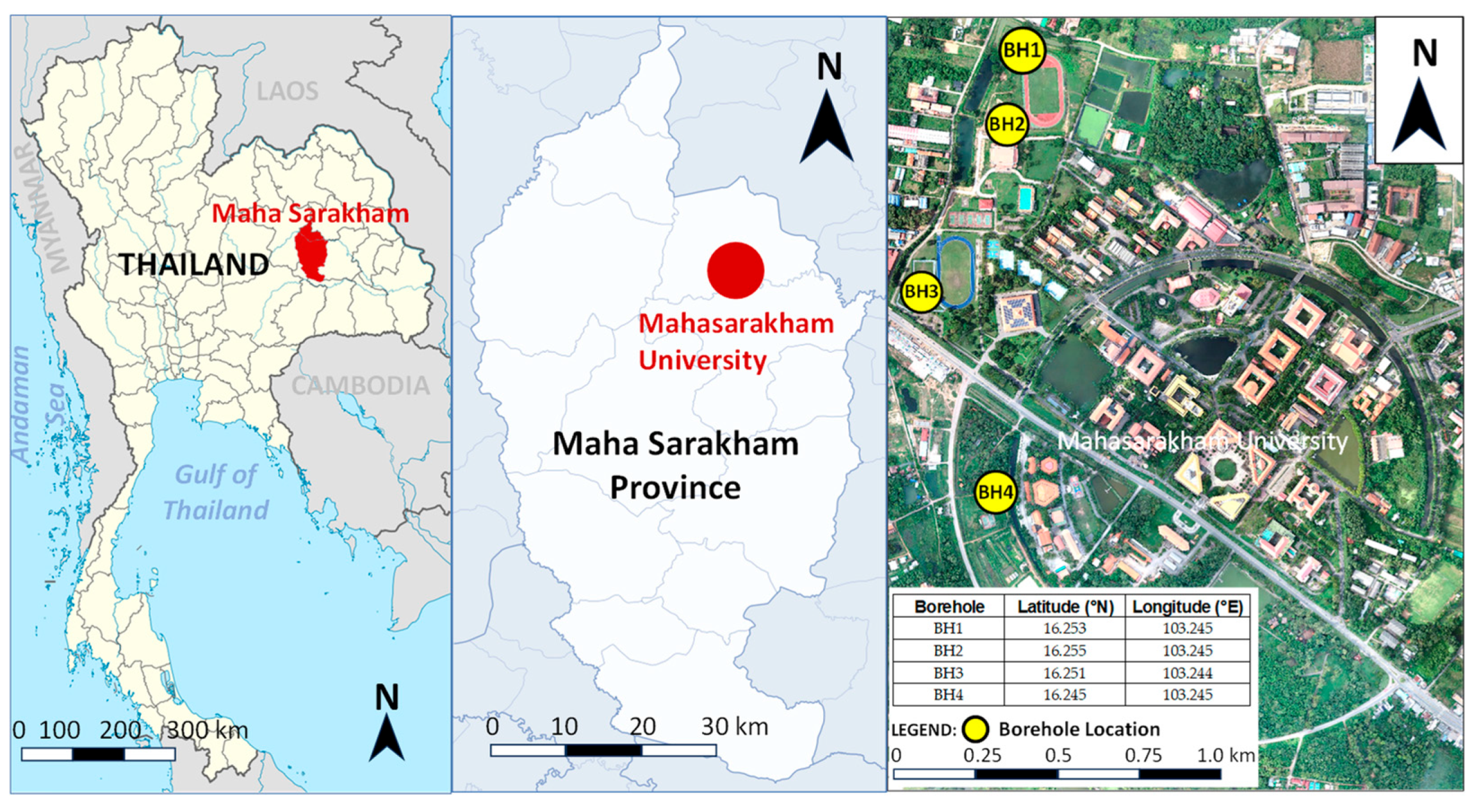
Figure 2.
Wenner array configuration and geometric factor used for apparent resistivity calculation.
Figure 2.
Wenner array configuration and geometric factor used for apparent resistivity calculation.
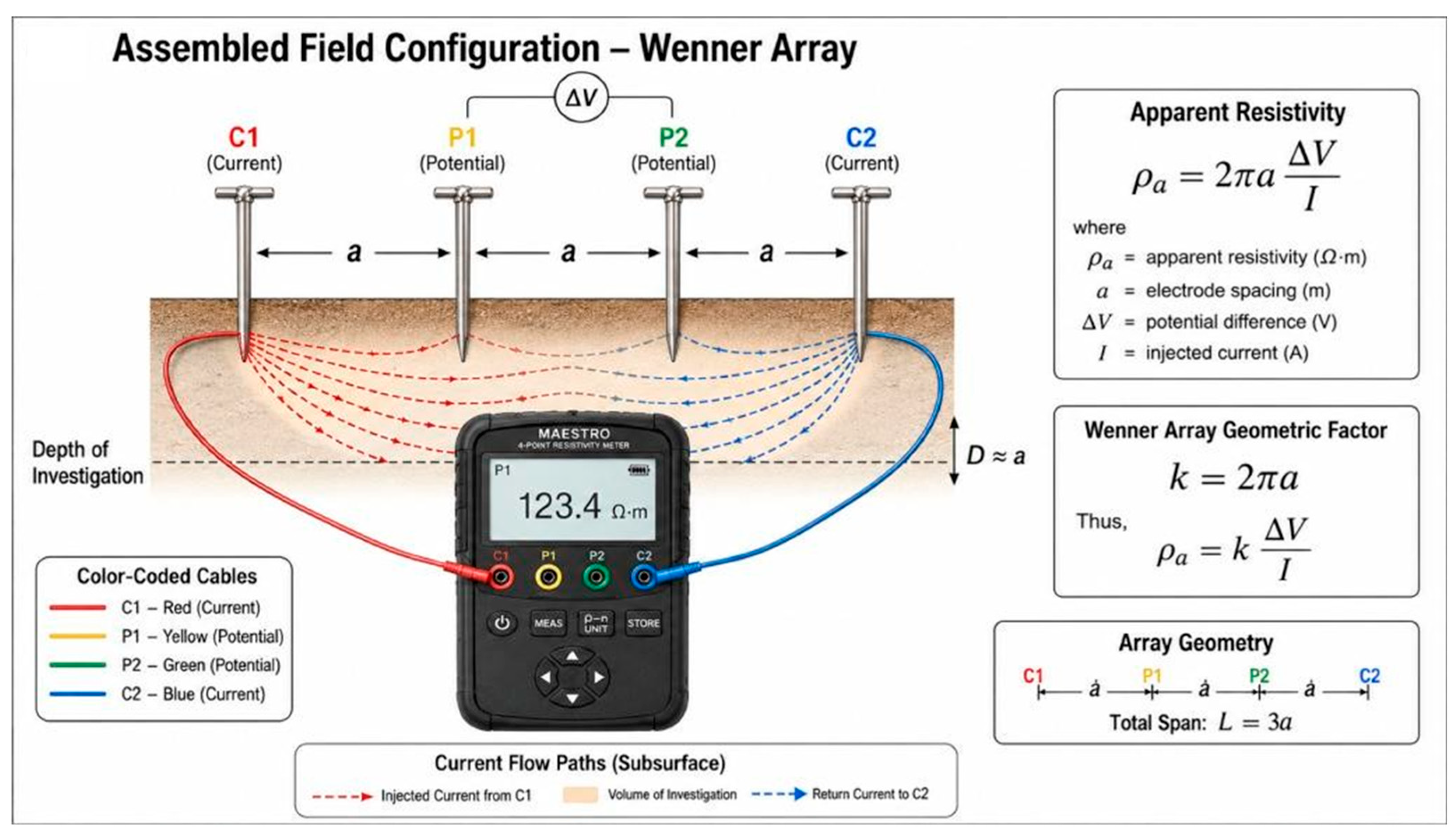
Figure 3.
Conceptual development of profile-based resistivity descriptors from normalized resistivity profiles: electrical state descriptor (), nonlinear response (), and transition intensity .
Figure 3.
Conceptual development of profile-based resistivity descriptors from normalized resistivity profiles: electrical state descriptor (), nonlinear response (), and transition intensity .
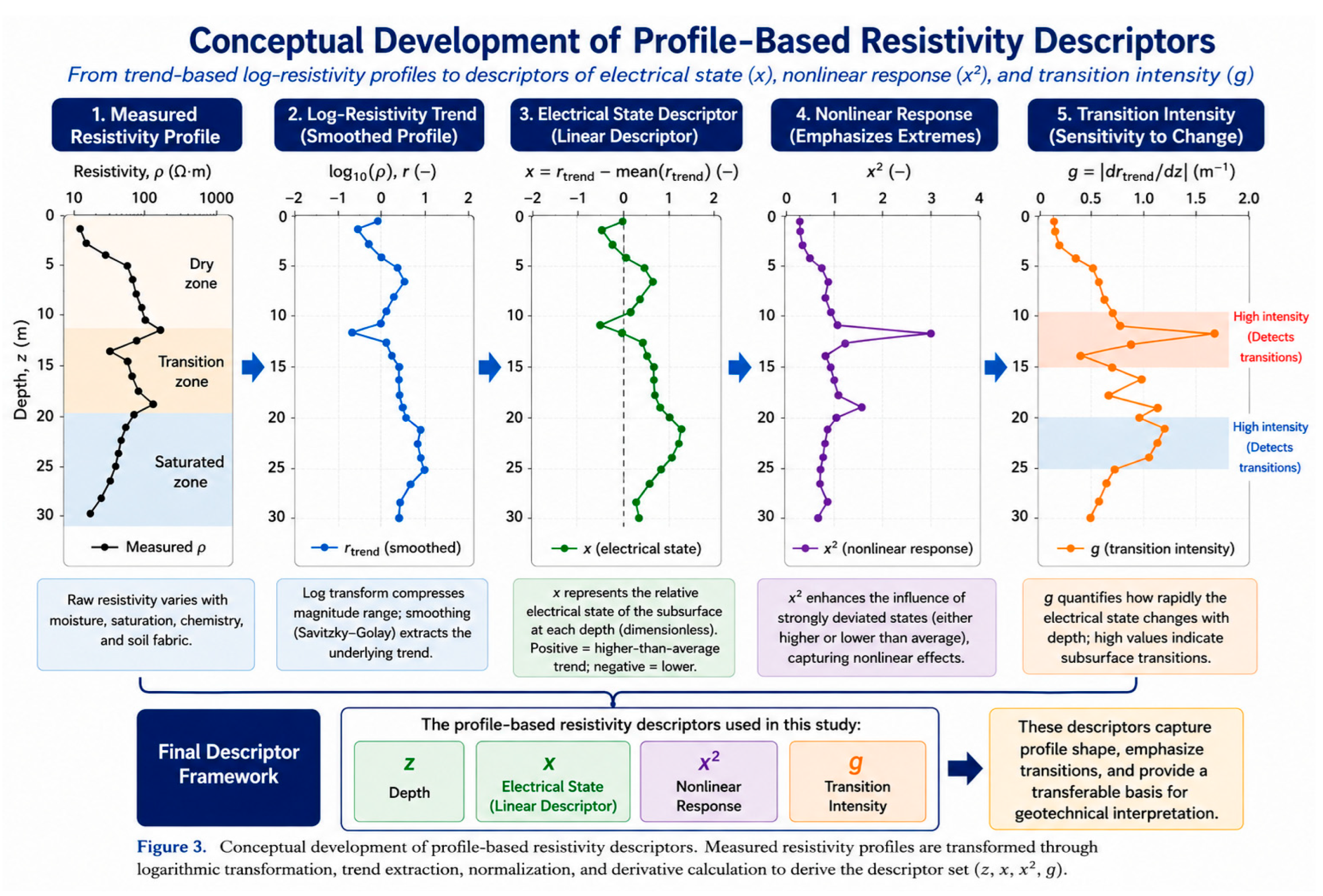
Figure 4.
Leakage-safe leave-one-borehole-out (LOGO) validation framework used to evaluate cross-borehole predictive performance.
Figure 4.
Leakage-safe leave-one-borehole-out (LOGO) validation framework used to evaluate cross-borehole predictive performance.
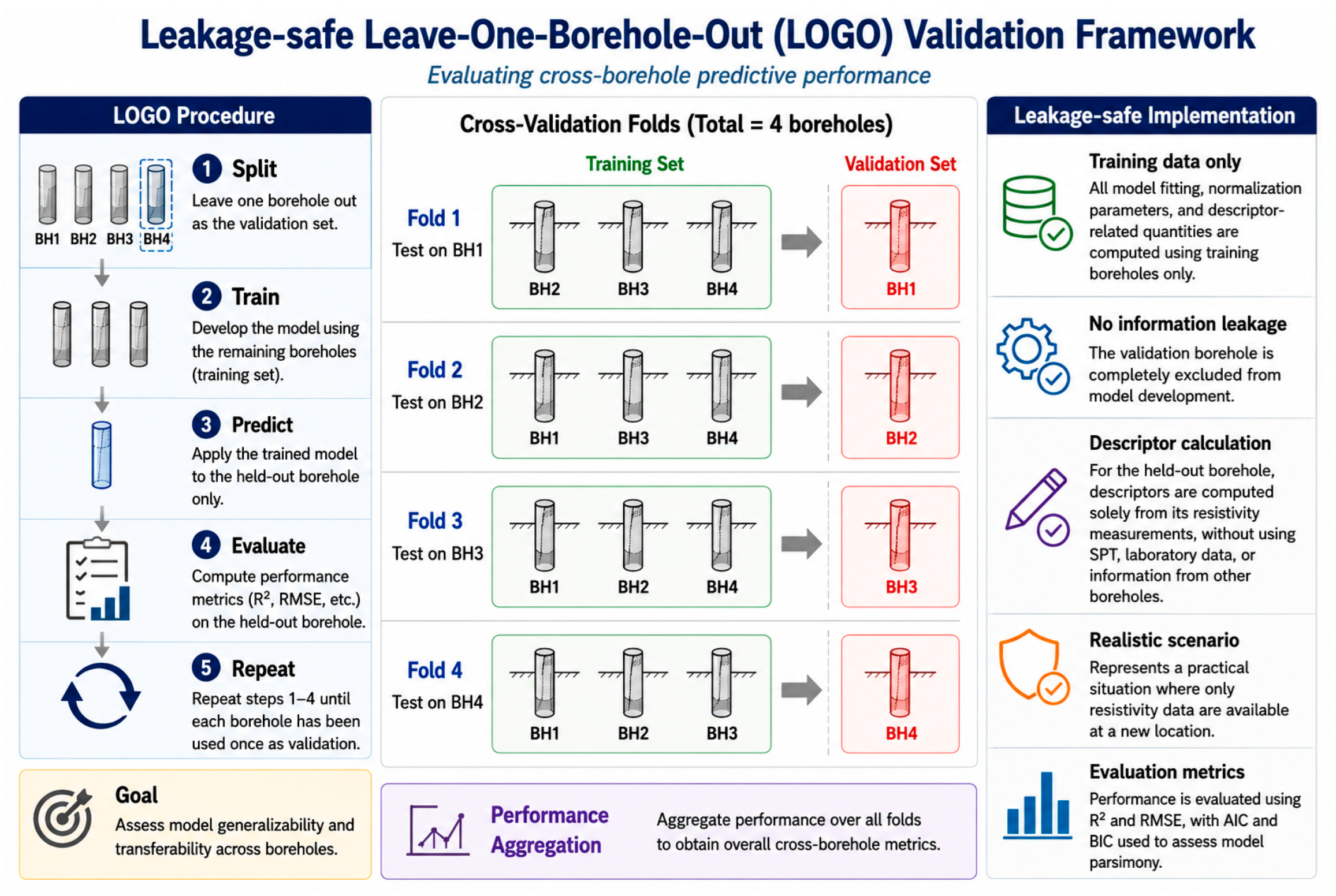
Figure 5.
Soil boring log of BH1.
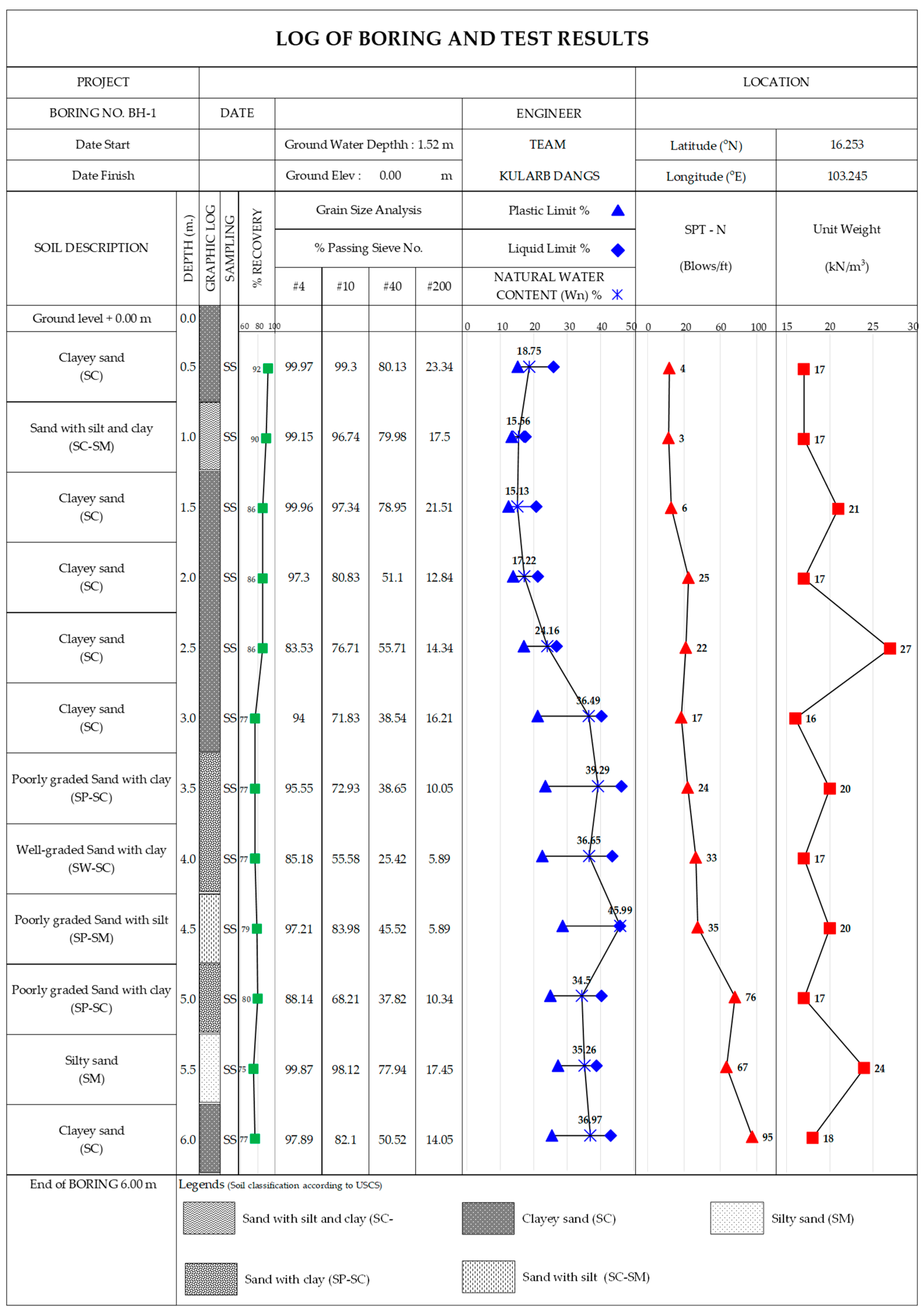
Figure 6.
Soil boring log of BH2.
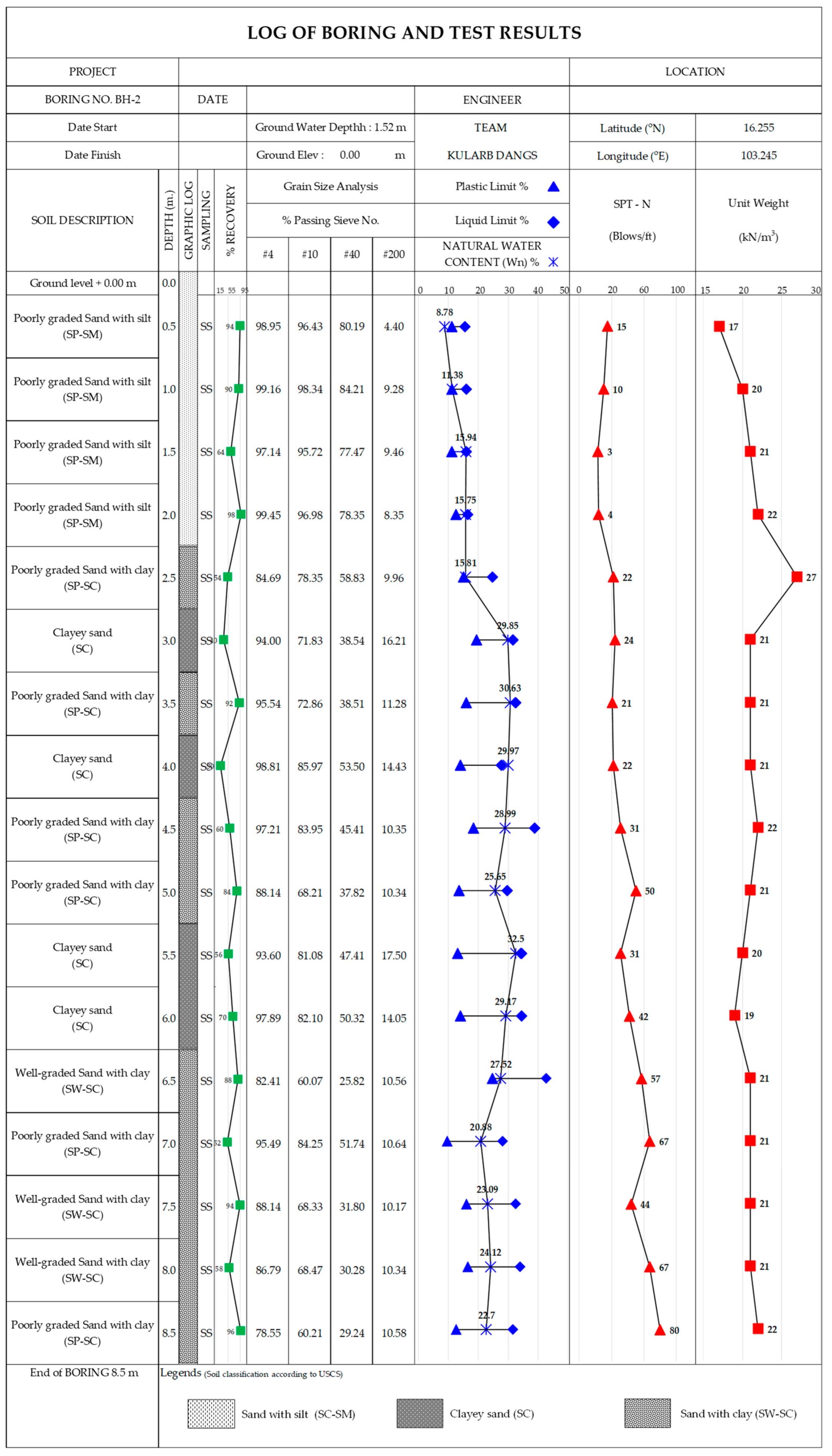
Figure 7.
Soil boring log of BH3.
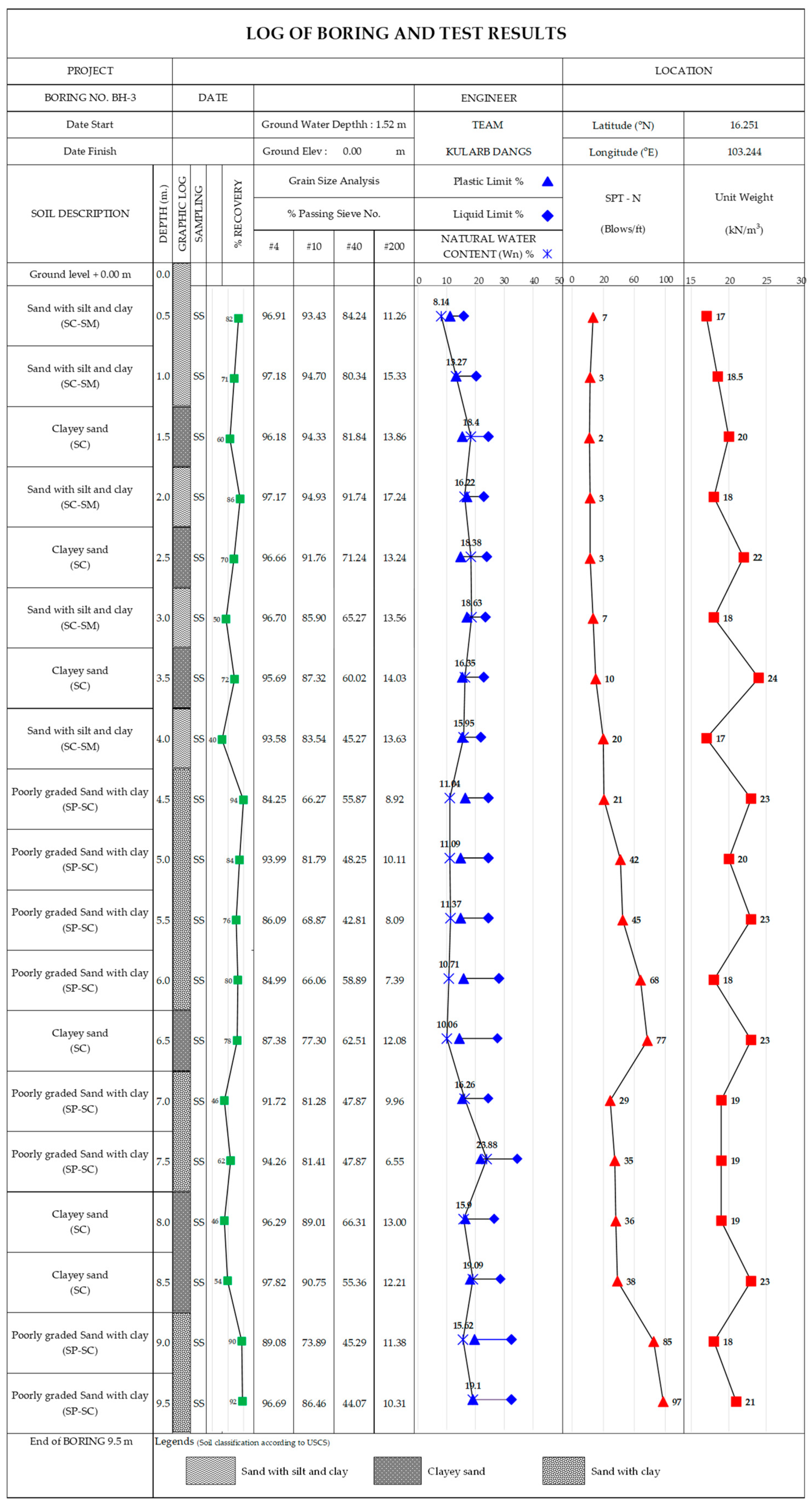
Figure 8.
Soil boring log of BH4.
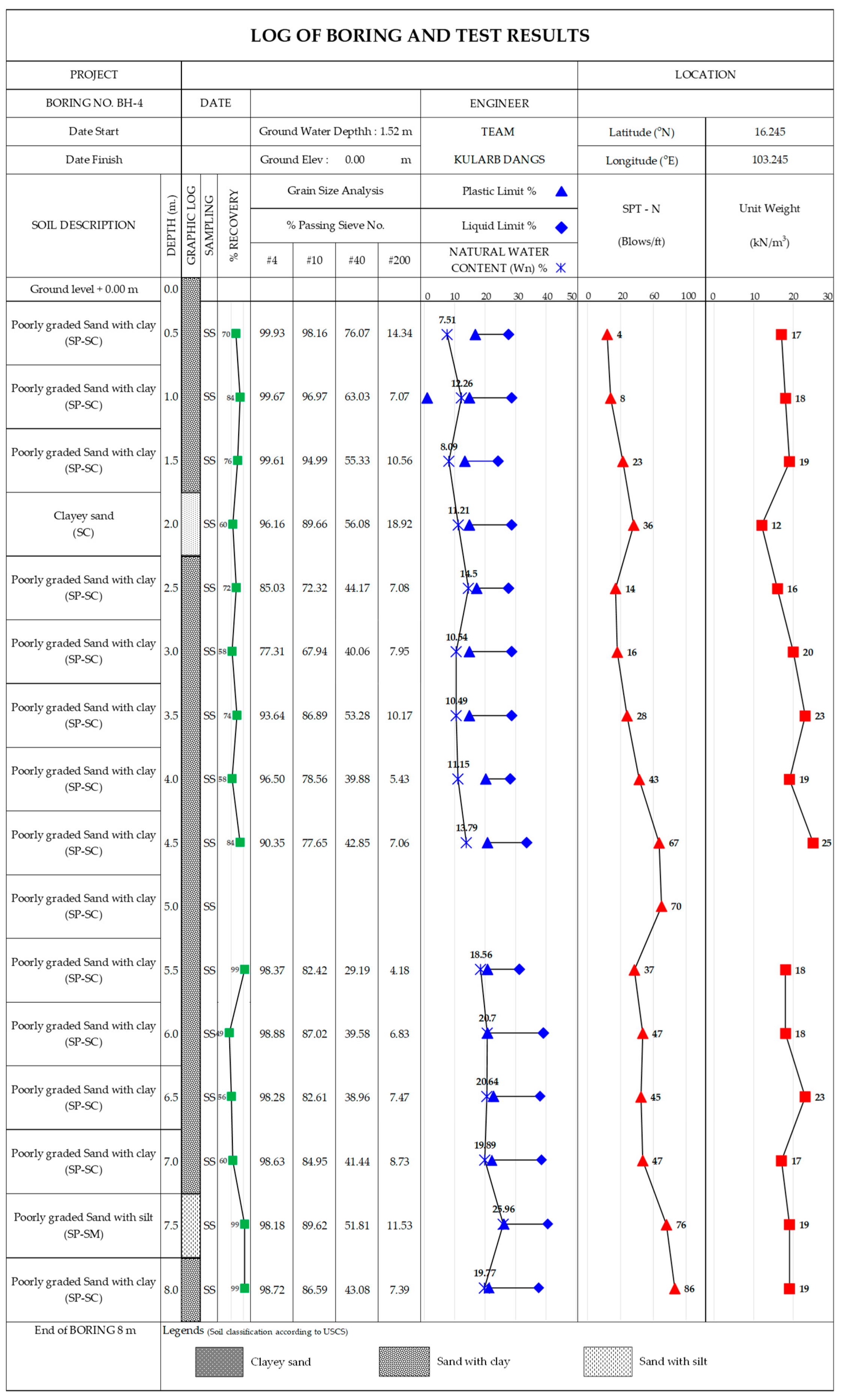
Figure 9.
Relationships between apparent resistivity and measured field and laboratory variables obtained from all boreholes: (a) SPT-N; (b) water content; (c) unit weight; (d) liquid limit; (e) plastic limit; and (f) fines content.
Figure 9.
Relationships between apparent resistivity and measured field and laboratory variables obtained from all boreholes: (a) SPT-N; (b) water content; (c) unit weight; (d) liquid limit; (e) plastic limit; and (f) fines content.
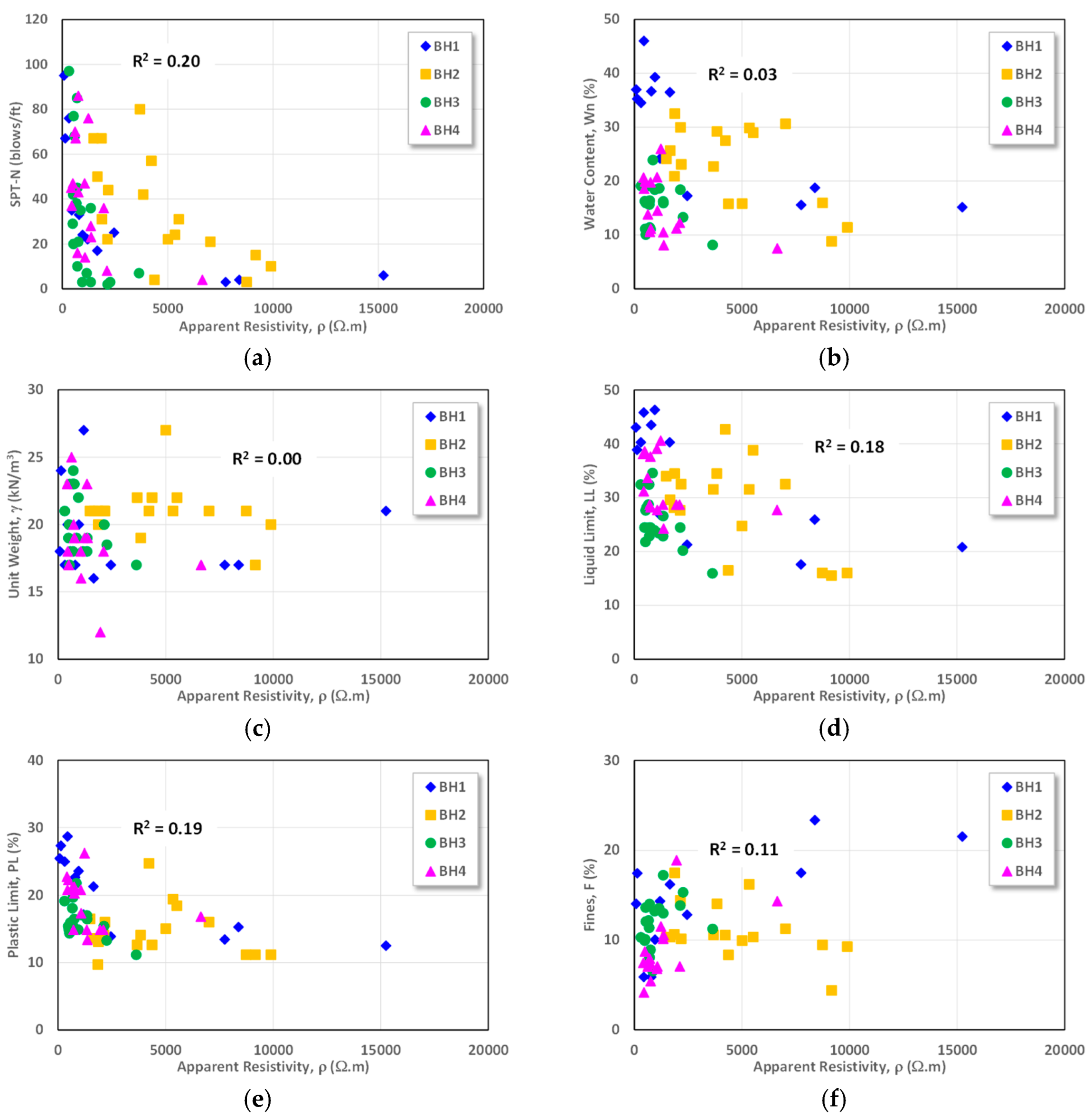
Figure 10.
Comparison between raw resistivity profiles and borehole-centered log-trend descriptor for the four boreholes: (a) apparent resistivity () plotted against depth; (b) borehole-centered log-trend descriptor () obtained from the smoothed log-resistivity trend according to Equation 1.
Figure 10.
Comparison between raw resistivity profiles and borehole-centered log-trend descriptor for the four boreholes: (a) apparent resistivity () plotted against depth; (b) borehole-centered log-trend descriptor () obtained from the smoothed log-resistivity trend according to Equation 1.
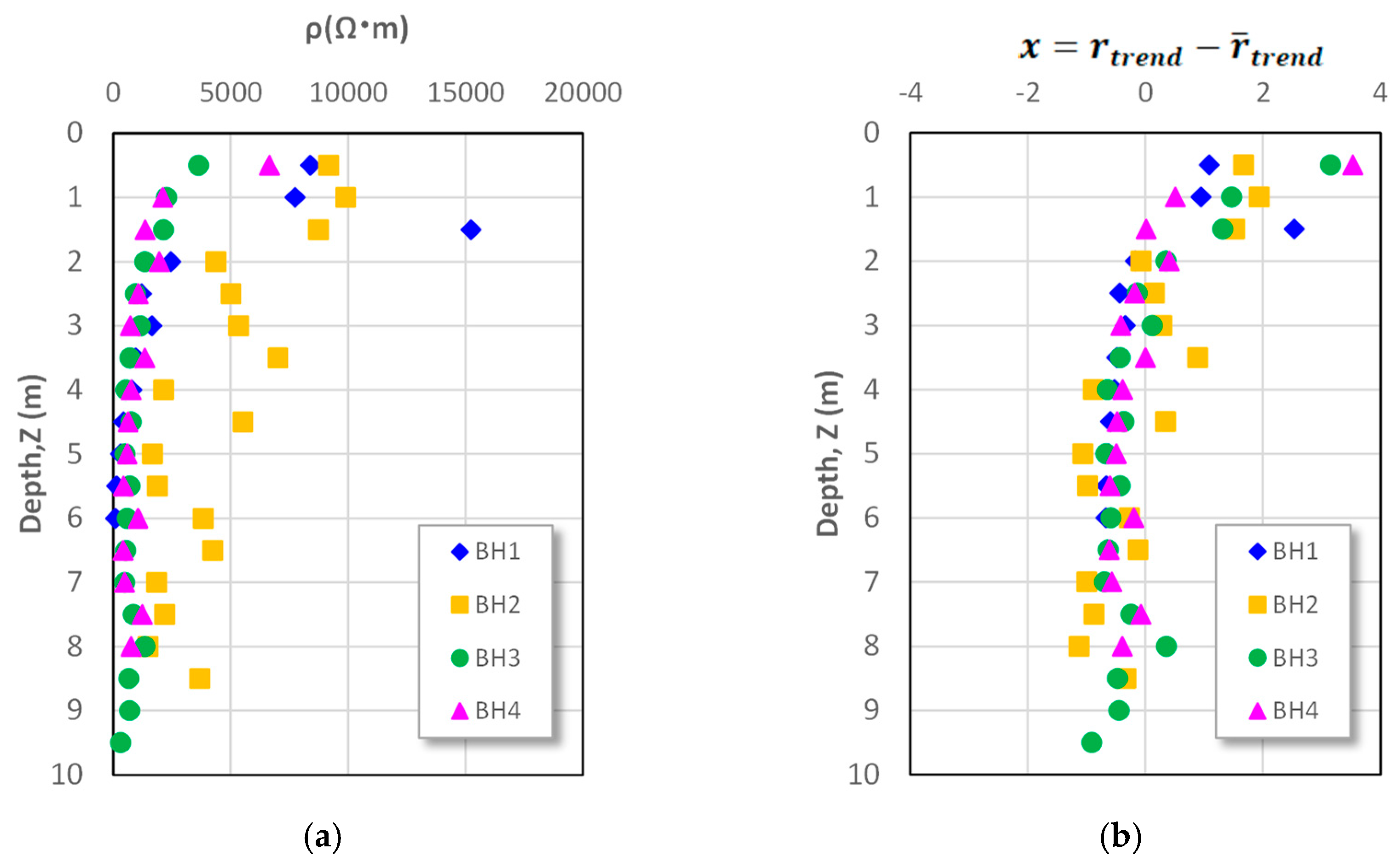
Figure 11.
Geotechnical interpretation of the trend-based resistivity descriptors derived from normalized log-resistivity trends: (a) relative electrical state descriptor (x); (b) nonlinear deviation descriptor (x²); and (c) transition-intensity descriptor ().
Figure 11.
Geotechnical interpretation of the trend-based resistivity descriptors derived from normalized log-resistivity trends: (a) relative electrical state descriptor (x); (b) nonlinear deviation descriptor (x²); and (c) transition-intensity descriptor ().
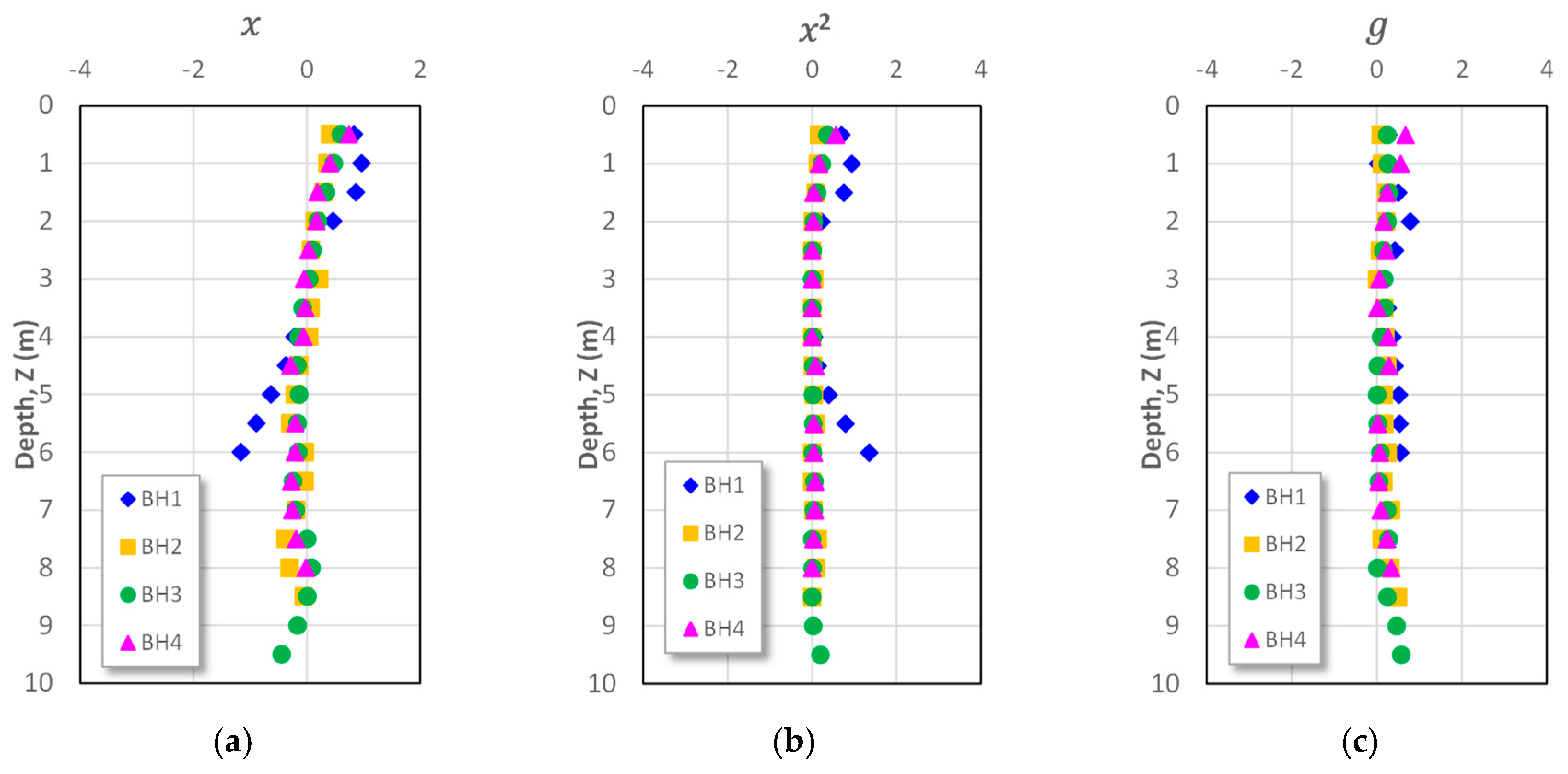
Figure 12.
Borehole-wise validation results obtained using the best-performing descriptor-based model (M6). Measured versus predicted SPT-N values are shown for (a) BH1, (b) BH2, (c) BH3, and (d) BH4. Predictions were generated using leakage-safe leave-one-borehole-out (LOGO) validation, in which each borehole was excluded from model calibration and used exclusively for testing. The solid line represents the 1:1 agreement line.
Figure 12.
Borehole-wise validation results obtained using the best-performing descriptor-based model (M6). Measured versus predicted SPT-N values are shown for (a) BH1, (b) BH2, (c) BH3, and (d) BH4. Predictions were generated using leakage-safe leave-one-borehole-out (LOGO) validation, in which each borehole was excluded from model calibration and used exclusively for testing. The solid line represents the 1:1 agreement line.
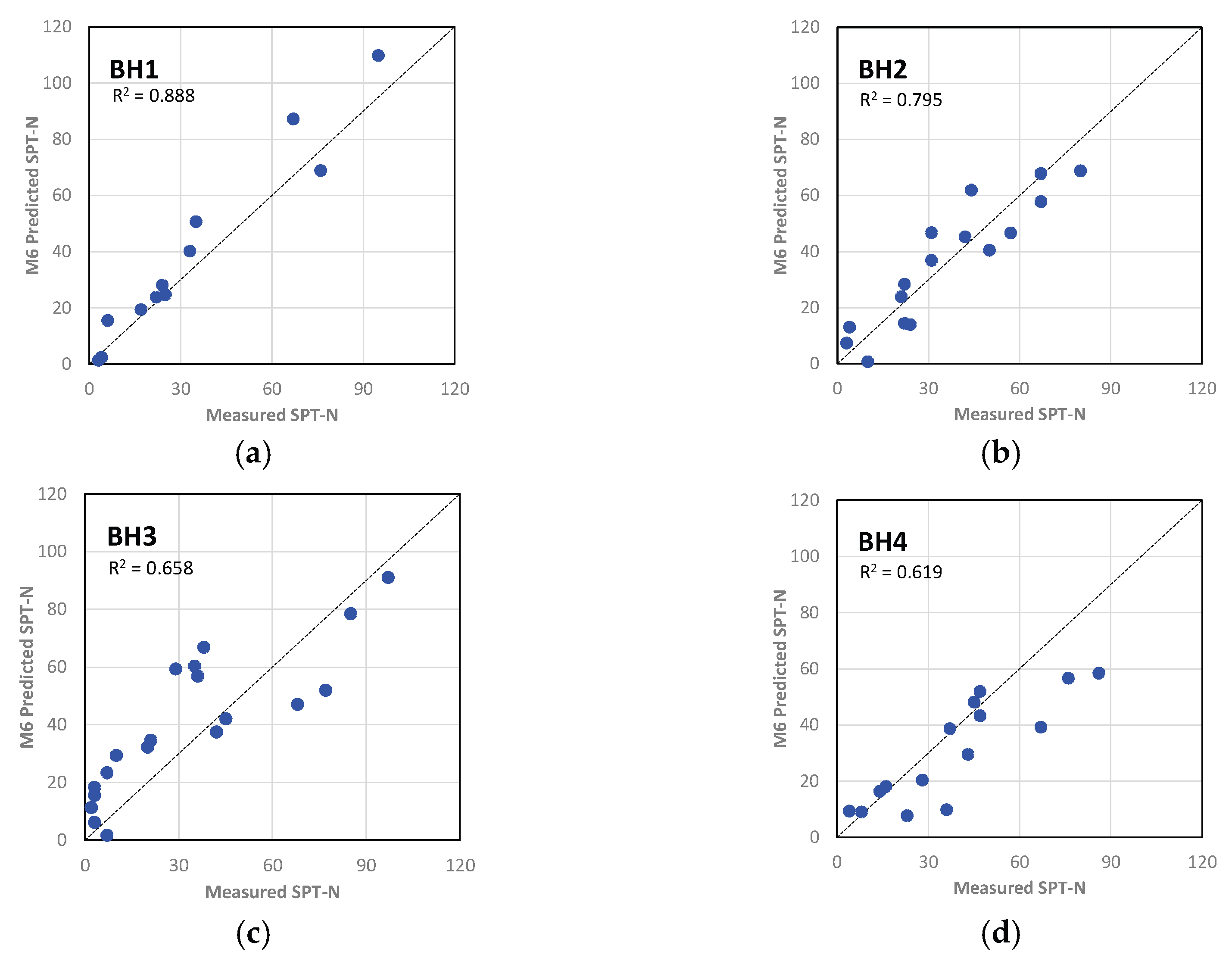

Table 1.
Borehole identification, coordinates, ground elevation, and termination depth.
| Borehole | Latitude (°N) |
Longitude (°E) |
Ground Elevation (m) |
Termination Depth (m) |
|---|---|---|---|---|
| BH1 | 16.253 | 103.245 | 140.40 | 6.0 |
| BH2 | 16.255 | 103.245 | 153.31 | 8.5 |
| BH3 | 16.251 | 103.244 | 153.01 | 9.5 |
| BH4 | 16.245 | 103.245 | 150.00 | 8.0 |
Table 2.
Summary of field and laboratory measurement counts per borehole.
| Borehole | Termination Depth (m) |
Number of 0.5m Depth intervals |
Resistivity Readings (depth × replicates) |
Water Content tests |
Sieve/ Hydrometer tests |
LL/PL tests |
|---|---|---|---|---|---|---|
| BH1 | 6.0 | 12 | 12 × 3 = 36 | 12 | 12 | 12 |
| BH2 | 8.5 | 17 | 17 × 3 = 51 | 17 | 17 | 17 |
| BH3 | 9.5 | 19 | 19 × 3 = 57 | 19 | 19 | 19 |
| BH4 | 8.0 | 16 | 16 × 3 = 48 | 16 | 16 | 16 |
| TOTAL | — | 64 | 192 | 64 | 64 | 64 |
Table 3.
Predictive models and predictor variables considered in the leakage-safe comparative evaluation framework.
Table 3.
Predictive models and predictor variables considered in the leakage-safe comparative evaluation framework.
| Model | Predictor |
|---|---|
| M1 | z |
| M2 | |
| M3 | z + |
| M4 | z + |
| M5 | z + + |
| M6 | z + + + |
| M7 | Laboratory indices |
| M8 | Laboratory indices + depth |
Table 4.
Summary of predictive models evaluated using leakage-safe leave-one-borehole-out (LOGO) cross-validation. Models were grouped according to predictor type to compare the relative contributions of depth, absolute resistivity, profile-based descriptors, and laboratory-derived variables to cross-borehole predictive performance.
Table 4.
Summary of predictive models evaluated using leakage-safe leave-one-borehole-out (LOGO) cross-validation. Models were grouped according to predictor type to compare the relative contributions of depth, absolute resistivity, profile-based descriptors, and laboratory-derived variables to cross-borehole predictive performance.
| Category | Model | Predictor Variables | Overall LOGO R² |
|---|---|---|---|
| Baseline | M1 | z | 0.617 |
| M2 | 0.133 | ||
| M3 | z + | 0.597 | |
| Profile-based descriptors | M4 | z + | 0.655 |
| M5 | z + + | 0.695 | |
| M6 | z + + + | 0.733 | |
| Laboratory variables | M7 | Laboratory indices | -0.237 |
| M8 | Laboratory indices + z | 0.383 |
Table 5.
Borehole-wise predictive performance of the best-performing descriptor-based model (M6) under leakage-safe leave-one-borehole-out (LOGO) validation.
Table 5.
Borehole-wise predictive performance of the best-performing descriptor-based model (M6) under leakage-safe leave-one-borehole-out (LOGO) validation.
| Borehole | LOGO R² |
|---|---|
| BH1 | 0.888 |
| BH2 | 0.795 |
| BH3 | 0.658 |
| BH4 | 0.619 |
| Mean | 0.740 |
| SD | 0.126 |
Disclaimer/Publisher’s Note: The statements, opinions and data contained in all publications are solely those of the individual author(s) and contributor(s) and not of MDPI and/or the editor(s). MDPI and/or the editor(s) disclaim responsibility for any injury to people or property resulting from any ideas, methods, instructions or products referred to in the content. |
© 2026 by the authors. Licensee MDPI, Basel, Switzerland. This article is an open access article distributed under the terms and conditions of the Creative Commons Attribution (CC BY) license (http://creativecommons.org/licenses/by/4.0/).
Copyright: This open access article is published under a Creative Commons CC BY 4.0 license, which permit the free download, distribution, and reuse, provided that the author and preprint are cited in any reuse.


