

Submitted:
22 June 2026
Posted:
23 June 2026
You are already at the latest version
Abstract
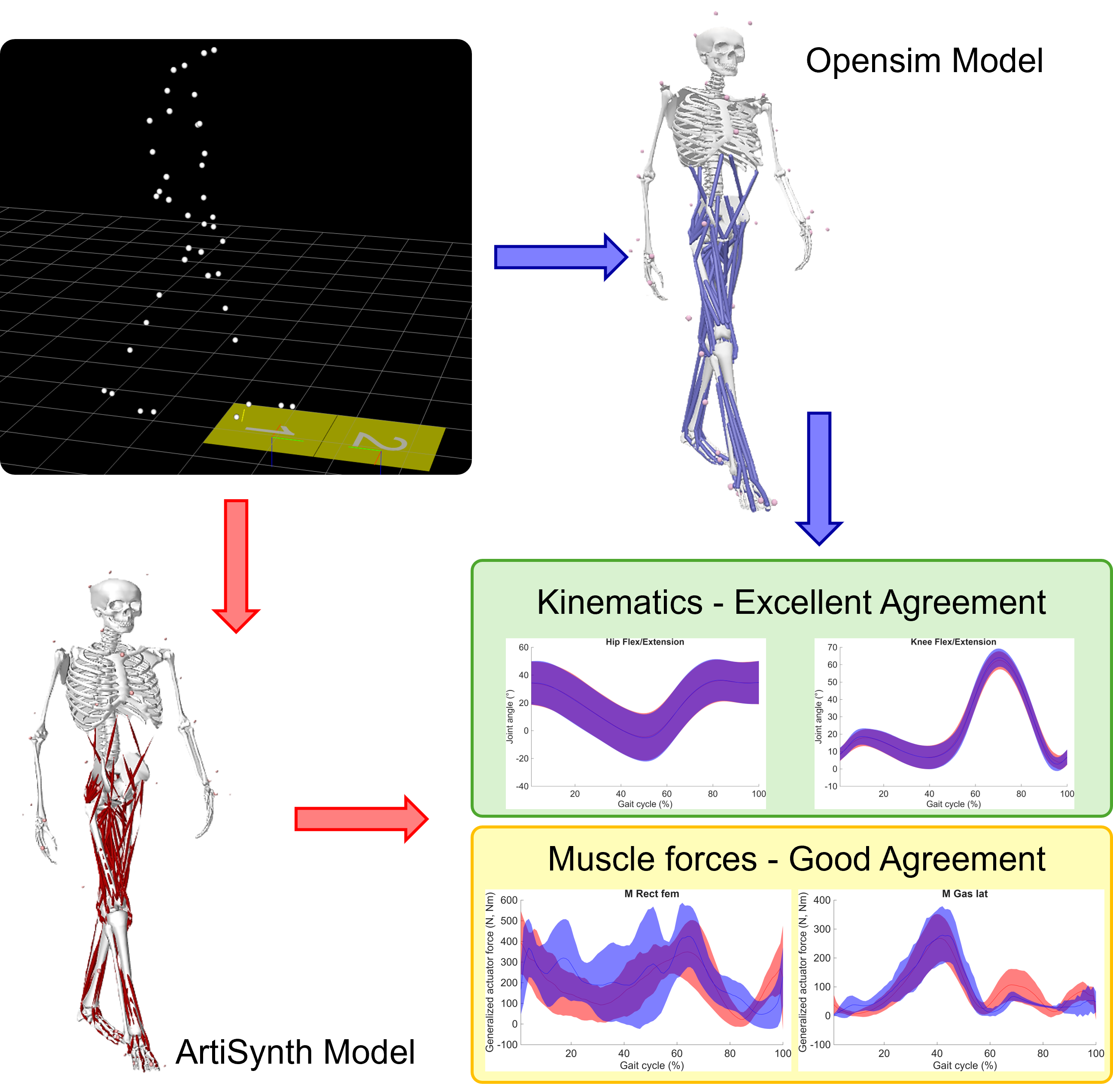
In biomechanical research, coupled multibody-finite element (MB-FE) simulations enable the simultaneous study of global dynamics and tissue-level mechanics. Yet validated pipelines that bridge the MB and FE domains are often complicated and involve multiple software tools. ArtiSynth is an open-source Java-based biomechanical simulation framework for coupled MB-FE simulations with forward and inverse simulation capabilities and FE contact modelling. It features an importer for OpenSim models to be used as foundation for coupled MB-FE models. However, the performance of OpenSim models in the ArtiSynth environment has not been evaluated to this day. To address this gap, we developed an ArtiSynth lower-limb model based on an OpenSim model and evaluated it across multiple subjects and trials. Motion and force data (98 trials, 29 healthy participants) were processed and used in OpenSim and ArtiSynth inverse/forward computations. A representative trial was selected using the SMaRT algorithm and pooled for Statistical Parametric Mapping (SPM, two-sample t-tests). No significant differences were found for kinematics, and differences were limited to short time frames for global dynamics. Muscle forces showed visible differences, but with good global agreement. Overall, the ArtiSynth model reproduces physiologically reasonable kinematics and largely consistent kinetics relative to OpenSim, thereby serving as baseline in future MB-FE applications.
Keywords:
musculoskeletal modeling
; multibody dynamics
; finite element analysis
; lower-limb biomechanics
; hybrid modeling
Copyright: This open access article is published under a Creative Commons CC BY 4.0 license, which permit the free download, distribution, and reuse, provided that the author and preprint are cited in any reuse.


