

Submitted:
22 June 2026
Posted:
23 June 2026
You are already at the latest version
Abstract
Dynamic stall and its control using synthetic jets are investigated for a sinusoidally pitching NACA 0018 airfoil at a chord-based Reynolds number of 40000, a reduced pitch frequency of 0.112, and two pitching amplitudes. An array of ten circular-orifice actuators is installed near the leading edge to examine the effects of low- and high-frequency burst-modulated forcing. Particle image velocimetry (PIV) is employed to measure phase-locked velocity fields along the airfoil centerline, while hot-wire anemometry is used to characterize wake frequency spectra. The baseline pitching cases exhibit complex vortex dynamics, with a wide range of coherent structures and vortex formation processes occurring over the entire airfoil surface. The formation and detachment of a leading-edge vortex (LEV) are identified as the primary features of dynamic stall across all cases. Both low- and high-frequency forcing are found to delay the onset of static and dynamic stall, although their influence on the boundary layer transition differs. The actuator placement near the leading edge is shown to be a critical parameter governing control effectiveness. Furthermore, the disparity between the forcing and pitching frequencies introduces additional unsteady vortex interactions associated with rapid variations in the adverse pressure gradient, which are unique to the dynamically stalling flow.
Keywords:
dynamic stall
; vortex dynamics
; flow control
; transition to turbulence
; low Reynolds number flows
1. Introduction
1.1. The Dynamic Stall on a Pitching Airfoil
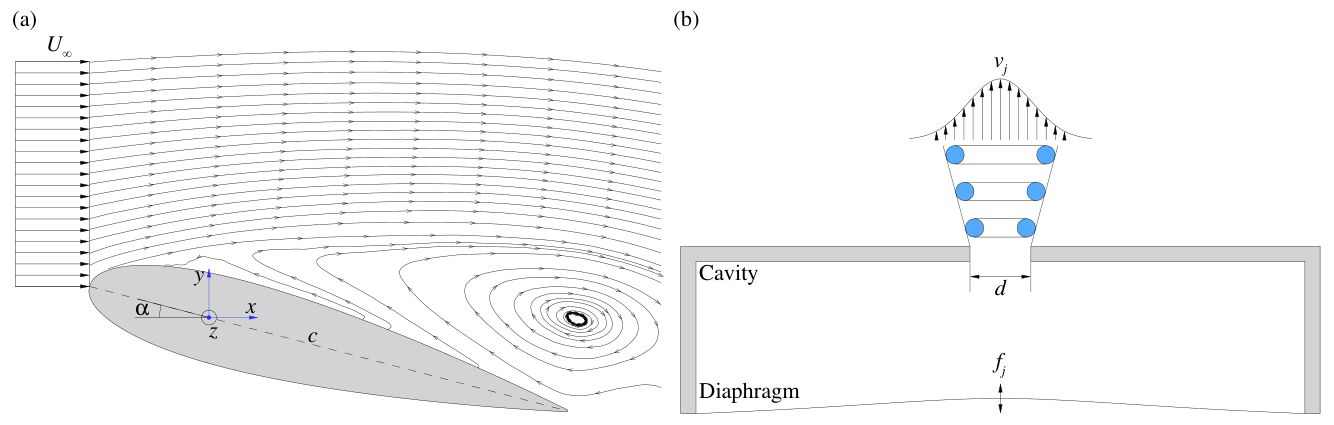
The dynamic stall phenomenon on airfoils and lifting surfaces is both a practically important and fundamentally challenging problem that arises in unsteady flow environments, including helicopter rotor blades, rapidly maneuvering aircraft, jet engine compressor blades, wind turbines, and even biological propulsion systems such as fish tails and insect wings [1,2]. For a static airfoil, when the angle of attack reaches a critical value , the adverse pressure gradient downstream of the suction peak inevitably causes the flow to break away from the surface, leading to static stall, which manifests as a reduction in lift and an increase in drag. Dynamic stall occurs when the effective angle of attack exceeds the static stall angle through a time-varying motion, such as pitching, ramping, or plunging, where the time scales of the airfoil motion are of similar order to or shorter than the time scales of the flow [1,3,4,5]. Early studies on the subject identified the formation of an energetic vortex on the suction surface, referred to as the dynamic stall vortex (DSV), as the predominant feature of the phenomenon [6,7,8,9]. The convection of the DSV along the chord temporarily delays stall onset; however, it is followed by abrupt flow separation and substantial excursions of highly unsteady aerodynamic loads once the vortex is shed into the wake. These impulsive load changes, which can be several times greater than those predicted under static conditions, are not only a major concern for aerodynamic performance but also induce vibrations, accelerate fatigue, and potentially cause structural damage to the airfoil and its supporting components [10]. Dynamic stall is therefore characterized by a highly nonlinear, fluctuating pressure field and pronounced load hysteresis, fundamentally distinct from the response observed under static stall conditions [11,12,13,14]. To simplify the dynamic stall problem, it has become common practice to investigate the canonical case of an airfoil undergoing sinusoidal pitching about its aerodynamic center, which for symmetric airfoils in subsonic flow lies at the quarter-chord point measured from the leading edge, though some studies suggest that pitching and plunging motions are equivalent when effective angles of attack are matched [15]. The sinusoidal pitching motion is generally appropriate for rotorcraft and vertical-axis wind turbines, as the temporal evolution of the effective angle of attack during the phase of the rotation cycle in which dynamic stall occurs is well approximated by a sinusoidal oscillation [16,17,18]. The flow field around a pitching airfoil is illustrated in Figure 1(a), where denote the global Cartesian coordinates, is the instantaneous angle of attack, is the pitching frequency, c is the chord length, and is the freestream velocity.
Figure 1.
Schematic of a pitching-airfoil configuration and a synthetic-jet actuator: (a) global coordinates, chord length c, freestream velocity , and instantaneous angle of attack for a sinusoidally pitching airfoil, and (b) synthetic-jet actuator and notations, including cavity, diaphragm, orifice diameter d, jet velocity , and excitation frequency .
Figure 1.
Schematic of a pitching-airfoil configuration and a synthetic-jet actuator: (a) global coordinates, chord length c, freestream velocity , and instantaneous angle of attack for a sinusoidally pitching airfoil, and (b) synthetic-jet actuator and notations, including cavity, diaphragm, orifice diameter d, jet velocity , and excitation frequency .
For a static airfoil, the flow regime primarily depends on the fixed angle of attack and the chord-based Reynolds number , where is the kinematic viscosity of the fluid. Depending on these parameters, the boundary layer may remain fully attached, become fully separated, or exhibit partial separation [19]. The angle of attack and Reynolds number have qualitatively similar, yet opposing, effects on the flow state. At low Reynolds numbers, the laminar boundary layer near the leading edge is prone to separation under an adverse pressure gradient. At the critical stall angle , when reattachment is not possible, a turbulent wake develops on the suction surface after a laminar-to-turbulent transition of the separated shear layer [20]. Prior to stall, however, the separated shear layer sometimes reattaches to the airfoil surface after separation-induced transition, forming a localized recirculating region known as a laminar separation bubble (LSB). LSBs have been documented over a wide range of Reynolds numbers and for both thin and thick airfoils [21,22]. Depending on the bubble-to-chord-length ratio, a bubble is classified as either long or short [23,24]. An increase in angle of attack may cause a short bubble to expand into a long one. An LSB eventually bursts at the critical stall angle , when reattachment is no longer possible. Although LSBs are detrimental to aerodynamic performance, the drastic loss-of-lift signature of stall is experienced only when the separated shear layer fails to reattach at the critical angle [25].
The sinusoidal variation of the angle of attack introduces two additional kinematic parameters to the problem, namely the reduced pitching frequency and the oscillation amplitude . Typical flow evolution stages within a dynamic stall cycle include attached flow, stall development, a fully stalled phase, and flow reattachment, with the presence and duration of each stage determined primarily by the kinematic parameters, Reynolds number, and airfoil geometry, among other secondary factors [26,27,28]. The airfoil kinematics in the present study are restricted to a zero mean angle of attack , representative of conditions encountered in vertical-axis wind turbines. In this configuration, the Reynolds number dictates the static stall angle, while the oscillation amplitude determines the extent of stall penetration and the severity of flow separation [26]. Increasing either the reduced frequency or the oscillation amplitude generally delays the onset of dynamic stall; however, variations in reduced frequency can substantially alter the shape of the hysteresis loop, whereas increasing the oscillation amplitude enlarges the enclosed area [2,28,29,30,31]. The Reynolds number and airfoil geometry also play a significant role in the complex underlying viscous–inviscid interactions. On thick airfoils, or sometimes thin airfoils if the pitch frequency is slow [5,32], a thin layer of reverse flow forms at the trailing edge and gradually progresses upstream, whereas on thin airfoils, flow reversal usually first emerges locally near the leading edge, close to the suction peak [26]. At low Reynolds numbers, the shear layer above the viscous–inviscid interface may become susceptible to instabilities, causing the shear layer to roll up into coherent structures known as shear-layer vortices. A shear-layer vortex (SLV) may shed prematurely or merge with the primary vortex through complex interactions, and its formation may persist even after the primary vortex has been shed [10,33,34,35,36,37]. At low-to-moderate Reynolds numbers, an LSB may form prior to stall, typically near the leading edge of thin airfoils.
In general, while the main characteristics of dynamic stall are well established, the mechanisms leading to the formation and detachment of the primary vortex remain an active area of research owing to the complex interplay among flow, kinematic, and geometric parameters [36,37,38]. Two widely accepted explanations of incompressible dynamic stall have been proposed, namely the Van Dommelen–Shen process [39] and the bubble-bursting mechanism [40,41]. The Van Dommelen–Shen interaction, which describes unsteady boundary-layer separation, is speculated to be Reynolds-number independent, beginning with near-wall flow reversal triggered by a strong adverse pressure gradient and continuing with the formation of a zero-vorticity line that progressively lifts away from the wall. The process culminates in streamwise compression of converging forward- and reverse-flow particles along this line, where inertial effects dominate viscous and pressure-gradient terms, ultimately leading to fluid eruption away from the wall and boundary-layer separation. The bubble-bursting mechanism, which is considered an extension of the same process leading to airfoil stall in steady or quasi-steady conditions, links the formation of the DSV to the bursting of an LSB [40,42].
Although the role of bubble bursting in the inception of dynamic stall is well established, stall does not necessarily originate from LSB bursting, and stall may instead be initiated by turbulent separation downstream of the reattachment point [4,13,29,43]. According to Carr et al. [13], in the former mechanism, referred to as leading-edge bubble-bursting stall, the LSB contracts with increasing angle of attack until turbulent reattachment is no longer possible. The latter mechanism is classified as either leading-edge or trailing-edge stall, depending on the location of turbulent separation, with the bubble remaining stable until separation eventually reaches the reattachment point. The mechanism responsible for dynamic stall onset is reported to shift from leading-edge bubble bursting to trailing-edge stall with increasing airfoil thickness [43,44]. A less frequently reported behavior is thin-airfoil stall, where the bubble progressively elongates and may extend over the entire airfoil surface [45].
1.2. Dynamic Stall Control by Synthetic Jets
Flow control is generally defined as any attempt to drive the character or disposition of a flow field toward a more favorable state [46]; accordingly, depending on the context, dynamic stall control may involve delaying detachment, enhancing, or completely suppressing the DSV. Due to the adverse impacts described in Section 1.1, the objective of control on turbine blades is typically to delay or eliminate the formation of the DSV. Flow control devices are broadly classified as passive or active, with the latter requiring an external power source to add momentum to the flow. A synthetic jet actuator (SJA) is an active flow control device, typically consisting of a piezoelectric disk that periodically modulates the fluid volume within a cavity. If the fluid expelled during the momentary ejection is fast enough to escape the subsequent suction phase, the vortex ring or a vortex pair that forms due to the roll up of the separated shear layer at the sharp edges of the aperture propagates away from its origin, ultimately producing a quasi-steady jet from the working fluid itself, adding momentum to the surrounding medium despite the net mass flux remaining zero [47]. Although synthetic jet actuators reduce the mechanical complexity and weight of the flow control system by eliminating the need for external pumps or plumbing, they expand the geometric and operational parameter space and thereby complicate control design. The pertinent actuator parameters are illustrated in Figure 1b, where denotes the diaphragm excitation frequency, d the aperture width or diameter, and the jet velocity.
The control authority of synthetic jets over a static airfoil is well documented. The interaction between the synthetic jet and the crossflow primarily depends on the actuator location, the reduced frequency , and the momentum coefficient , defined as the ratio of the time-averaged jet momentum to that of the freestream. The momentum coefficient is typically characterized under quiescent conditions and, for an actuator with a circular orifice, is mathematically given by the following relation:
where b is the reference spanwise length, is the effective jet area, r is the radial distance from the symmetry axis, and T is a sufficiently long reference time to ensure convergence. In general, a minimum threshold value of exists below which actuation is ineffective because the jet cannot penetrate the crossflow [48]. With a large enough momentum coefficient, the separated shear layer, which is generally highly receptive to disturbances, locks into the driving frequency, ultimately forming discrete coherent structures that mix high-momentum freestream fluid into the near-wall region, thereby suppressing flow separation [49]. Forcing is most effective when the reduced frequency targets an instability of the baseline flow, which for a static airfoil corresponds to either the global instability , the natural shear-layer frequency , or the separation bubble frequency lying between these two [50,51]. Both low- and high-frequency forcing have been shown to be effective, though forcing at results in unsteady reattachment, whereas forcing at leads to the damping of global flow oscillations. For optimal performance, actuators are often placed near the natural separation location [51,52].
Due to the success of SJAs in suppressing separation on static airfoils, efforts have been made to extend their application to dynamic stall control, with varying degrees of success [53,54,55,56,57]. Parametric analyses suggest that control authority of synthetic jets in dynamic stall depends on the choice of momentum coefficient and jet location [58,59], much as in static stall, though the influence of unsteady forcing on the resulting flow field is not as straightforward. Traub et al. [49] reported that although leading-edge forcing often delayed the onset of DSV formation to higher incidence, or even suppressed it entirely, in some cases it instead promoted its formation, resulting in increased aerodynamic loading. Taylor and Amitay [60] also observed that leading-edge forcing can delay or suppress the DSV formation, although this may occur at the expense of enhanced trailing-edge separation.
1.3. Objectives
The present work is partly motivated by the relative scarcity of studies on dynamic stall in thick airfoils and low-Reynolds-number flows, as also highlighted in some recent studies [61,62]. The vast majority of the literature reviewed in Section 1.1 has focused on thin airfoils at relatively high Reynolds numbers, largely because systematic investigations of the phenomenon originated from studies of retreating blade stall in helicopters during forward flight. However, certain rotary applications, such as vertical-axis wind turbines and water turbines, employ thick airfoils to improve blade stiffness. Vertical-axis wind turbines, in particular, require symmetric airfoils to maintain uniform blade loading as the blades oscillate between positive and negative angles of attack and typically operate in the built environment at low-to-moderate chord-based Reynolds numbers , where dynamic stall is likely to occur with coexisting laminar, transitional, and turbulent flow regions.
Thick symmetric airfoils are generally less aerodynamically efficient than their thinner counterparts and produce lower lift than cambered airfoils; hence, the application of effective flow control strategies is crucial for enhancing their aerodynamic performance. The use of burst modulation for static airfoil control was introduced by Amitay and Glezer [63], and subsequent studies have confirmed its effectiveness. A key advantage of this approach is that it allows the actuator to operate at its optimal excitation frequency, typically much higher than the frequencies required for control, while the modulation frequency targets the relevant flow instabilities. However, the effects of burst modulation in dynamic stall control remain relatively unexplored. A recent study by Rice et al. [64] on a thick NREL S817 airfoil demonstrated that low-frequency modulation improves several aspects of dynamic stall control while significantly reducing power consumption compared to continuous actuation at . Due to actuator limitations, the high-frequency forcing in their study was not burst-modulated, and only a single low reduced frequency was examined. The second objective of the present study is therefore to investigate the role of reduced frequency in burst-modulated synthetic jets for dynamic stall control. To this end, the experimental setup and data processing are described in Section 2, followed by the results and discussion in Section 3, and concluding with the key findings summarized in Section 4. The study is restricted to the spanwise mid-plane, where spanwise non-uniformity is minimal and control authority is greatest, resulting in steadier flow reattachment [65,66].
2. Methodology
2.1. Wind Tunnel Facility
The experiments were carried out in a closed-loop, low-speed wind tunnel housed within the Turbulence Research Laboratory at the Department of Mechanical and Industrial Engineering, University of Toronto. The wind tunnel features a 5000 -long test section with an octagonal cross-section measuring 1220 in height and 910 in width. The octagonal corners maintain a constant angle but taper in width along the length of the test section to expand the cross-sectional area and offset boundary layer growth. Optical access is provided through clear acrylic panels forming the ceiling and one side wall of the test section. Flow is driven by a six-bladed axial fan powered by a REEVES® MotoDrive® 500 series motor, mounted outside the tunnel on a vibration-isolating concrete pad. Flexible couplings connect the fan housing to the tunnel, minimizing vibration transmission to the test section. Freestream velocity is adjustable between / and /, measured at the test section inlet with a pitot-static tube, with an uncertainty estimated at less than . Upstream of the test section, flow passes through a conditioning unit composed of seven screens and a 9:1 converging section, which reduces turbulence and promotes flow uniformity. The resulting freestream exhibits low turbulence, with intensity typically below . After traversing the test section, the flow is redirected through four 90° bends using a turning vane system, enabling recirculation within the tunnel. The freestream velocity was maintained approximately constant at throughout all experiments.
2.2. Airfoil Instrumentation and Motion Control
The airfoil model used in this study has a NACA 0018 profile with an open trailing edge, a configuration commonly employed in vertical-axis wind turbines. The model was machined from aluminum, with a chord length of and a spanwise extent of 600 , yielding an aspect ratio of 4. Approximately 83 of the central section is hollow to accommodate synthetic jet actuators and reduce weight. To minimize end effects, the model was tightly fitted with two circular endplates, each having a 300 diameter and sharp leading edges. The endplates, made from polycarbonate rather than acrylic to withstand fatigue loading, were installed flush against the model to eliminate any gaps that could cause flow leakage or generate tip vortices. The model with attached endplates was installed 300 downstream of the test section entrance, where it was connected to a shaft at each end, allowing it to pivot about its aerodynamic center while remaining centered within the span of the wind tunnel. The spacing between each endplate and the nearest sidewall was sufficiently large to prevent interactions with the sidewall boundary layer. One shaft was supported by two SKF 61802-2Z deep groove ball bearings mounted on the transparent sidewall, while the other was coupled to a ClearPath CPM-SDSK-3432S-ELS servo motor capable of controlling the direction and angular position with a resolution of 0.056°. An Arduino UNO board was used to program the prescribed sinusoidal motion and to establish communication with National Instruments LabVIEW, which served as the primary user interface for all other controls.
An insert spanning 480 in width and 100 in length was carefully machined to preserve the NACA 0018 profile when installed within the hollow section of the model. The insert housed an array of ten Murata MZB1001T02 microblowers, flush-mounted beneath the surface and distributed symmetrically along the span with a center-to-center spacing of between neighboring actuators, with no actuator located on the centerline. Each SJA had an optimal excitation frequency of and discharged through an orifice of diameter . The driving signal for the microblowers was supplied by a Rigol DG1022Z function generator and amplified by a YAMAHA HTR5470 amplifier to a peak-to-peak voltage of 25 . Once activated, the issued jets exited at 14% chord from the leading edge at an angle of 80.4° relative to the airfoil surface. The SJA array was characterized outside the tunnel under quiescent conditions using a single-sensor hot-wire probe traversed along the span 5 downstream of the jet exit, sampling at 10 for 30 seconds at each position. This test was conducted to verify spanwise symmetry, with the momentum coefficient of each jet measured using Eq. (1) with a reference freestream velocity . An example of the time-averaged jet exit velocity and the corresponding momentum coefficients are reported in Figure 2. After the insert was installed in the model, the airfoil surface was coated with matte black paint to minimize reflections. For flow control, the driving signal was burst-modulated with a duty cycle of 50%. The momentum coefficient was held constant at approximately along the centerline, while forcing was applied at , 28 , and 280 , corresponding to , 1, and 10, respectively, to systematically investigate the effect of modulation frequency on dynamic stall control. An additional frequency at () was applied to examine potential competition between the synthetic jets and pitching motion due to their interaction in time.
2.3. Velocity Measurements
A single-sensor hot-wire probe and a two-dimensional, two-component (2D2C) particle image velocimetry (PIV) system were used in tandem to characterize the shedding behavior and instantaneous velocity fields at the spanwise mid-plane of the airfoil. The assumption of spanwise uniformity, required to minimize perspective errors in 2D2C PIV, is supported by the relatively large aspect ratio of the airfoil, the selection of the mid-plane for measurements, and the spanwise uniformity of the SJA array [65,66]. All measurements were conducted at a chord-based Reynolds number of . Due to to the relatively low freestream and jet-exit velocities, the Mach number remained very low (), allowing the flow to be treated as incompressible throughout the experimental campaign. The pitching airfoil was oscillated about a zero mean angle of attack () at a frequency of , corresponding to a reduced pitch frequency of . Two pitching amplitudes, and , were selected to ensure the occurrence of dynamic stall for both the uncontrolled and controlled cases. All cases considered are summarized in Table 1, and further experimental details are provided in the following paragraphs.
Hot-wire experiments were conducted at a sampling frequency of 10 for up to 900 seconds. For the static airfoil cases, measurements were performed at a single downstream location for three angles of attack , 15°, and 20°. For the pitching airfoil, two streamwise locations, and 3.75, were probed for the uncontrolled case (), while only was considered again for the controlled cases with and 10. For the PIV measurements, the flow was seeded using a SAFEX® 2010F fog generator operating with SAFEX®-Inside-Nebelfluid, a diethylene glycol–water mixture. Illumination was provided by a Litron Bernoulli neodymium-doped yttrium aluminum garnet (Nd:YAG) laser emitting green light at a wavelength of 532 with a maximum pulse energy of 200 /pulse. The initially circular laser beam was routed above the test section ceiling, where it was spread into a thin light sheet using a pair of THORLABS cylindrical lenses with focal lengths of and 1000 . The laser sheet was approximately 1 thick and was carefully aligned at the airfoil centerline. Scattered light from the tracer particles was recorded using a 12-bit complementary metal-oxide-semiconductor (CMOS) JAI SP-5000M-USB camera with a sensor resolution of , equipped with an Azure 5022ML12M 50 lens, providing a field of view approximately 175 in length and 140 in height. A schematic of the experimental arrangement, including the airfoil model, SJA array, and the PIV setup, is presented in Figure 3. PIV acquisition was timed by an NI PCI-6232e data acquisition card at a sampling frequency of 12 , with the interframe time delay for an image pair set to to obtain an appropriate in-plane particle displacement.
PIV measurements were performed near the static stall angle at , , , and for the uncontrolled airfoil, and at and for the controlled cases with and 10, to examine the flow behavior prior to stall. Image acquisition was phase-locked to 6 different positive angles of attack, with 400 image pairs collected at each angle. The PIV processing was accomplished using the open-source software OpenPIV-Python-GPU, employing a window-deformation iterative multigrid algorithm starting with an initial window size of , followed by two iterations at , and concluding with two iterations at a final window size of , yielding a physical resolution of . Median validation with a neighborhood kernel size of three and a threshold of two was applied at every iteration to identify and replace outliers. MATLAB and Python were used for data post-processing, while visualization was performed using Origin®.
3. Results and Discussion
As briefly outlined in Section 1, dynamic stall and its control with SJAs involve the formation and shedding of both small- and large-scale vortical structures. A variety of coherent-structure identification methods exist to locate, extract, and visualize flow features across different spatial and temporal scales [36]. In the present study, the Galilean-invariant criterion [67] is the primary structure-identification tool for instantaneous realizations. Given the velocity field and the in-plane position vector , is defined locally at the reference point according to:
where is the area of interest around the reference point , here taken as a square window here taken as a square window with side length equal to 5% of the chord. By definition, is a dimensionless scalar bounded by , with vortex cores identified by the local extrema of and the sense of rotation given by the sign of the extrema. In dynamic stall, the instantaneous flow field contains valuable information that is often lost in the mean field and includes vortical structures that are not necessarily phase coherent. As gradient-based approaches are sensitive to numerical differentiation noise, especially in instantaneous realizations, the criterion has been widely employed instead [36,56,60]. In what follows, we continue to use the nomenclature introduced in Section 1, while all other symbols are defined upon first use. In agreement with the terminology used so far and common turbulence conventions, , , and are used to denote time-averaging, magnitude (norm), and conditional or ensemble averaging, respectively. All plots are normalized by the freestream velocity and the airfoil chord length c. The SJA location is indicated by a black triangle, and upward and downward arrows represent the airfoil pitching direction, corresponding to the upstroke and downstroke phases of the motion cycle.
3.1. An Overview of the Static Airfoil
In this section, the static airfoil is examined first to establish a reference frame for the unsteady events occurring in the pitching configuration. Global flow features are extracted from the mean streamlines shown in Figure 4, complemented by instantaneous velocity fields overlaid with contours in Figure 5. For all cases considered here, the boundary layer near the leading edge is initially attached and laminar, followed by the onset of transition. Laminar-to-turbulent transition in shear flows, including separated shear layers on bluff bodies [68], boundary layers [69] , and laminar separation bubbles [70], exhibits similar characteristics. A laminar separation bubble is observed in Figure 4(a) and Figure 4(c), whereas Figure 4(b) and Figure 5(d) show a separated shear layer on a bluff body and a fully attached boundary layer, respectively. For all of these cases, the roll-up process initially redistributes the contained vorticity into elongated spanwise vortices, forming the so-called cat’s-eye pattern, and is subsequently followed by the emergence of fully rolled-up discrete spanwise vortices. The described evolution is commonly explained by the continued growth of the Kelvin–Helmholtz instability wave [70,71].
Beyond the initial roll-up phase, the discrete spanwise vortices enhance the entrainment of high-momentum fluid from the outer flow into the near-wall region. If conditions are met, the separated shear layer can reattach onto the airfoil surface in a mean sense, leading to the formation of an LSB, as observed for the case at . A comparison between Figure 4(a) and Figure 5(b) indicates that a further increase in angle of attack to for the uncontrolled airfoil leads to the failure of shear layer reattachment, resulting in massively separated flow in the mean sense. This regime change is evidenced by the onset of reverse flow over the aft portion of the suction side, along with a marked reduction in streamwise velocity near the leading edge, indicating the collapse of the suction peak. Previous studies on the NACA 0018 airfoil at similarly identify as representative of post-stall conditions [72,73,74,75], in agreement with the present observations.
Forcing at either or selectively amplifies the instabilities, thereby promoting earlier transition to turbulence. The resulting turbulent boundary layers exhibit increased resistance to flow separation, leading to a substantial delay in static stall to higher angles of attack for both and . As the angle of attack increases beyond the baseline static stall angle, the laminar portion of the boundary layer initially remains confined within the favorable pressure gradient region near the airfoil leading edge, thereby preventing laminar separation. Concurrently, the stagnation point moves down the pressure side, while the suction peak progressively shifts upstream and eventually moves ahead of the SJA location. At sufficiently high angles of attack, the laminar boundary layer upstream of the SJAs is once again exposed to an adverse pressure gradient, rendering separation unavoidable. If the entrainment of synthetic jet structures within the separated shear layer is sufficient to allow reattachment, an LSB can form in the mean sense, analogous to the baseline case.
Reattachment is more likely under low-frequency forcing, owing to the larger synthetic jet structures and enhanced entrainment. The formation of an LSB prior to stall is evident for the case, as shown in Figure 4(c). Under high-frequency forcing ; however, flow control is less effective and the response becomes more sensitive to small variations in angle of attack near the static stall condition. Consequently, prior to stall, only a fully attached boundary layer, as shown in Figure 4(d), could be captured for this case. The similarities and differences between LSBs formed with and without forcing are also of interest. At low Reynolds numbers, relatively long separation bubbles are known to form on the airfoil [76]. In the unforced case , the LSB is longer than in the forced case , due not only to disturbances introduced by the synthetic jets, but also to the increased adverse pressure gradient downstream, which promotes spanwise instabilities, leading to earlier transition and reattachment [77]. The solid blue lines in Figure 4 and Figure 5, extracted from the onset of the reverse flow on the airfoil surface, denote the dividing streamline and indicate the extent of the LSBs. In both cases, the separated shear layer undergoes periodic roll-up into spanwise vortices near the point of maximum bubble height, followed by breakdown into smaller-scale structures downstream of reattachment.
For the Reynolds number considered in this study, flow separation in the early post-stall range of angles of attack is highly intermittent in instantaneous realizations. Similar intermittency was reported by Aniffa and Mandal [78] for a NACA 0012 airfoil at a chord-based Reynolds number of and a stall angle of , conditions comparable to those of the present NACA 0018 case with and . In their work, proper orthogonal decomposition (POD) was used to examine intermittency. Here, the intermittency factor and the reverse-flow area A are used instead. The intermittency factor is defined as the fraction of instances during which reverse flow is present at a given location, such that , where P denotes the probability operator. Accordingly, contour, commonly referred to as the 50% forward-fraction line, identifies locations where the probability of reverse flow is 50%. This line is shown in Figure 4 and Figure 5 to indicate the extent of flow separation for case. The global reverse-flow area A may be defined on the Cartesian grid shown in Figure 1(a), and is mathematically given by:
The reverse-flow area is evaluated for three uncontrolled cases, , , and , with the corresponding probability density function (PDF) shown in Figure 6. The skewness and flatness of each distribution are reported in the top-right corner of each panel. The dashed blue and green lines denote the reverse-flow area computed from the mean flow field and the mean reverse-flow area respectively. Because the reverse-flow area is not a linear operator owing to the temporally varying topology of the reverse-flow region, in general . Nevertheless, as the massively separated flow becomes less intermittent, the two quantities become increasingly comparable, as evident for case in Figure 6(c). Despite the flow appearing completely separated in the mean sense for all three cases, case is highly intermittent, which motivated the selection of as the representative post-stall condition in Figure 4 and Figure 5. Statistics of the reverse-flow area for the three cases are reported in Table 2. The maximum, and consequently the mean, reverse-flow area increases considerably from to , and remains relatively unchanged from to . Overall, for the mean flow field is no longer a suitable representation of the flow state, and conditional averaging is therefore required. The conditioning criterion used here is , which partitions the dataset approximately in half such that for all three cases, as reported in Table 2. This criterion effectively classifies the flow into two distinct states corresponding to reattached and massively separated flow, as shown in Figure 7.
Around the static stall angle, irrespective of reattachment, the vortical structures in the airfoil wake lack coherence, resulting in broad peaks in the velocity spectra centered about a dominant frequency [73,79]. At sufficiently high post-stall angles of attack, however, the wake exhibits characteristics similar to those of a bluff body [80,81], with the shedding frequency decreasing as the angle of attack is further increased [82]. These patterns are evident in the premultiplied power spectra presented in Figure 8 for post-stall angles of , 15, and 20. Overall, for a pitching airfoil with continuously varying angle of attack, any of the above forcing frequencies may be employed within an open-loop control strategy. The low reduced frequencies considered here, and 0.643, are selected to correspond to the shedding frequencies at the midpoint and upper limit of the range , respectively.
3.2. The Dynamic Stall Cycle Without Synthetic Jets
As discussed in Section 1, a pitching airfoil exhibits flow features fundamentally distinct from those of the static case. To further highlight these differences, the frequency spectra for two cases with and at two downstream locations are presented in Figure 9. Based on the discussion in Section 3.1, these cases correspond to stall depths of and 11°, respectively. In contrast to the spectra shown earlier in Figure 8(b) and Figure 8(c), the pitching-airfoil spectra do not exhibit a sharp peak but instead display a broadband peak over a range close to the shedding frequency of the static airfoil. As expected, a distinct peak appears at the fundamental pitching frequency () due to the imposed airfoil motion. In addition, several higher-order harmonics remain relatively energetic, extending into the higher-frequency range and interacting with the broadband peak region, indicative of nonlinear coupling between the imposed pitching motion and vortex shedding. The energy content of some harmonics, most notably the second harmonic, increases with pitching amplitude as rises from 15° to 20°. Furthermore, the energy around the broadband peak intensifies at the downstream measurement location, suggesting progressive loss of vortex coherence. Beyond the broadband peak, the spectra exhibit an approximate slope, consistent with inertial-subrange scaling in turbulent flows. To quantitatively compare the spectra across different cases and measurement locations, the energy content of the nth harmonic is defined as:
The harmonic energy content for the first through fourth harmonics is reported in Table 3, again reinforcing that the energy content of the second harmonic increases significantly as rises from 15° to 20°, independent of measurement location. Table 3 further shows that the second and fourth harmonic energies remain approximately unchanged, whereas the first and third harmonic energies decrease at the farther downstream location. Overall, the multiple peaks observed in the pitching-airfoil spectra indicate the shedding of several energetic coherent structures, rather than the single dominant DSV typically observed for high-Reynolds-number pitching airfoils. These structures are not necessarily phase coherent and therefore may not appear in the phase-averaged flow field, as will be shown in the PIV results discussed next.
The characteristic features of dynamic stall are largely similar for the and 20° cases, and most events can be described using either case. At the beginning of the pitch-up motion, the boundary layer remains laminar and fully attached to the airfoil surface. As the airfoil continues to pitch up toward the static stall angle, an adverse pressure gradient develops downstream of the leading edge, while a thin region of reversed flow propagates upstream from the trailing edge [83], causing the upper portion of the boundary layer to behave as a local free shear layer. Shortly after its formation, this shear layer becomes susceptible to Kelvin–Helmholtz instability [37,84], which progressively spreads upstream and generates small-scale shear-layer vortices. As the rolled-up vortices are not phase coherent, these structures are illustrated at two representative instances in Figure 10, with the zero mean streamwise velocity contour () denoted by solid blue lines to highlight the extent of reverse flow. Evidently, the boundary layer over the rear half of the airfoil thickens due to flow reversal, while the onset of shear-layer roll-up progressively shifts toward the leading-edge region.
Beyond the static stall angle, the boundary layer becomes susceptible to laminar separation at the leading edge, as well as to trailing-edge separation as the adverse pressure gradient rapidly intensifies while the airfoil decelerates toward its maximum angle of attack. The onset of dynamic stall, and the precise mechanism responsible for it, cannot be definitively identified with the temporal resolution available here; however, both trailing-edge separation and leading-edge bubble bursting have been reported under similar kinematic and flow conditions [43,84]. In the present work, near stall onset, flow reversal at the trailing edge is intermittent and exhibits cyclic variations; consequently, the phase-averaged velocity field is again not particularly instructive. Instantaneous velocity fields and conditional averages are presented instead in Figure 11, with the 50% forward-fraction line () highlighted by solid green lines. Comparing Figure 11 with Figure 10, it is evident that the extent of reverse flow has decreased considerably at the present stage. In the instances shown in Figure 11(a) and Figure 11(b), interaction with the reverse flow leads to a sudden growth of shear-layer vortices over the aft portion of the airfoil, highlighted by dashed circular outlines. These structures are associated with a local ejection of streamlines away from the wall, causing the transverse velocity to switch from negative to positive values. To isolate these events, conditional averaging is performed using the criterion at the reference points and for and 20° cases, as shown in Figure 11(a) and Figure 11(b). The reference points are located immediately above the upstream extent of the forward-fraction line, where the conditioning criterion partitions the datasets such that . The defining feature of dynamic stall, namely a large energetic vortex (DSV) in the mean sense, has not yet emerged in either case.
For both the and 20° cases, the DSV first appears near the end of the upstroke, as shown for two representative instances in Figure 12. From a topological standpoint, the DSV here is classified as a leading-edge vortex (LEV), a structure commonly encountered in studies of flapping flight and biomimetic flyers, which continuously grows in size until its eventual detachment from the feeding leading-edge shear layer. The signature of the LEV was extracted from the mean flow using the contour, highlighted by solid gray lines in Figure 12. The threshold value of was selected following Graftieaux et al. [67]. In addition to the LEV, the remnants of boundary-layer shear-layer vortices roll up into another large structure over the aft portion of the airfoil, consistent with the observations of Visbal and Garmann [38]. Using the criterion, this large shear-layer vortex could only be identified for the case, as it is not strongly phase coherent for case. At higher Reynolds numbers , under similar stall depth () and reduced frequency () examined by Mueller-Vahl et al. [61], a lift-generating phase-coherent aft structure may be observed, whereas dynamic stall in the low-Reynolds-number cases considered here is dominated by LEVs (compare Figure 12(b) with Fig. 5(c) therein).
Prior to detachment, the LEV is bounded by two saddle points; one located where the vorticity-feeding leading-edge shear layer separates, and the other at the LEV reattachment point. Two principal LEV detachment mechanisms have been proposed in the literature, illustrated conceptually in Figure 13; each causes distinct topological changes in the flow and therefore determines the maximum achievable circulation. The first mechanism, shown in Figure 13(a), is referred to as bluff-body detachment, as it is analogous to the vortex-shedding process behind bluff bodies. This mechanism is initiated when the rear half-saddle of the LEV moves beyond the trailing edge and transforms into a full saddle in the wake, allowing the upstream-directed boundary layer to carry positive vorticity toward the leading edge and forming a new node associated with the trailing-edge vortex (TEV). In this case, the chord length acts as the characteristic length scale governing the frequency of LEV formation and the limiting circulation. The second mechanism, known as the boundary-layer eruption mechanism or, alternatively, vortex-induced separation, is a viscous–inviscid interaction inherent to any vortex–wall configuration and independent of any geometric length scale, in which the adverse pressure gradient imposed by the LEV on the upstream-directed boundary layer causes it to separate from the airfoil surface, forming spike-like eruptions containing positive vorticity that eventually pinch off the feeding shear layer from the LEV [36,38,85]. The topological changes caused by this eruption, shown in Figure 13(b), induce a new node at the leading edge associated with a secondary LEV.
To place the above discussion into context, instantaneous velocity fields and phase-averaged flow fields are presented in Figure 14, where the 5 velocity-magnitude contour () is highlighted by solid green lines to better visualize the nodes and saddles in the mean flow. For both cases, the mean streamline topology at this stage is consistent with the bluff-body detachment mechanism illustrated in Figure 13(a), exhibiting two nodes and a single full saddle in the wake immediately above the TEV. Boundary-layer eruptions, however, may only be identified from instantaneous realizations, as the mechanism is not phase-locked and is therefore washed out by phase averaging. In Figure 14(a), a boundary-layer eruption has resulted in the formation of a secondary LEV, as illustrated earlier in Figure 13(b). Several large vortices, however, have already detached from the feeding shear layer, with the rearmost structure having reached the trailing edge. Consequently, the bluff-body detachment mechanism is also active, as reverse flow has propagated upstream to the secondary LEV and is displacing the large-scale vortical structures away from the airfoil surface. In Figure 14(b), a large vortex has detached from the feeding shear layer before reaching the trailing edge; consequently, the bluff-body detachment mechanism is absent and no TEV is observed at this instant. Overall, for both the and 20° cases, the DSV exhibits a multi-scale character, comprising multiple large shear-layer vortices that arise due to low-Reynolds-number effects and the strong viscous response of the boundary layer. Furthermore, the instantaneous and mean flow fields suggest that the LEV detachment mechanism at the present chord-based Reynolds number lies within a transitional range in which both bluff-body detachment and boundary-layer eruption may occur simultaneously, consistent with Widmann and Tropea [86], who observed this transitional behavior for a ramping flat plate at and 35000 . The breakdown of the LEV into multiple large-scale structures excites the low-order harmonics of the fundamental pitching frequency, as observed in the spectra shown in Figure 9.
The primary distinction between the and 20° cases emerges after the detachment of the primary mean LEV. For , the flow transitions almost immediately into a massively separated state. For , however, the reverse flow intensifies due to a stronger adverse pressure gradient, leading to large cycle-to-cycle variations, before the flow eventually reaches a massively separated state similar to that observed for the case. These variations arise from distinct topological changes associated with the two LEV detachment mechanisms. Conditional averages based on the reverse-flow area A, introduced in Section 3.1, are therefore presented in Figure 15. The conditioning criterion partitions the dataset approximately in half, such that . To better isolate the nodes and saddles in the averaged flow fields, the 5% and 8% velocity-magnitude contours ( and 8%) are highlighted by solid green lines. As described earlier in Figure 13(b), the boundary-layer eruption mechanism generates additional LEVs which, if they persist, can prevent reverse flow from propagating into the leading-edge region and thereby significantly reduce the reverse-flow area. The flow topology in Figure 15(a) corresponds to such instances, with the rear reattachment point of the secondary LEV forming a half-saddle on the airfoil surface and a full saddle located just above the TEV node, indicating complete detachment of the TEV from the airfoil. Examples of studies reporting the formation and shedding of a secondary LEV immediately following the detachment of the primary LEV through boundary-layer eruption include those of Mulleners and Raffel [36] (see Fig. 3(k)) and Widmann and Tropea [86] (compare Figure 15(a) with Fig. 7(a) therein). If bluff-body detachment is dominant, the reverse-flow area increases considerably, yielding the flow topology shown in Figure 15(b). In this case, the TEV remains attached to the airfoil, as evidenced by a half-saddle on the surface, while the leading-edge shear layer is completely separated, forming a train of nodes and saddles (compare Figure 15(b) with Fig. 7(b) in Widmann and Tropea [86]).
Another distinction between the and 20° cases is the strength of the TEV, reported at the vortex eye for both cases in Table 4. Evidently, from the values, although the TEVs are relatively weak and of comparable strength at the phases shown in Figure 14, the TEV in the case continues to grow into a much larger and stronger coherent structure owing to the stronger adverse pressure gradient. The substantial increase in the energy of the second harmonic from the case to the case in Figure 9 is attributed to this enhanced TEV strength. During the remainder of the cycle, as the airfoil pitches down, the boundary layer progressively reattaches from the leading edge toward the trailing edge before eventually relaminarizing.
3.3. The Dynamic Stall Cycle with Synthetic Jets
In the presence of synthetic jets, dynamic stall is completely suppressed for , with neither an LEV nor a TEV forming. For , however, all cases still experience dynamic stall, as the maximum angle of attack exceeds the control limit identified in Section 3.1. The wake frequency spectra, shown for the and cases in Figure 16, are quite similar to that of the baseline flow in Figure 8, exhibiting several low-order harmonic peaks and a broadband region, although the energy of the second harmonic appears to be notably reduced. For a fair comparison between cases, the harmonic energy content for the first through fourth harmonics is reported in Table 5, indicating comparable harmonic energy between the and cases while also confirming that the second-harmonic energy is reduced for the controlled cases compared with the baseline case reported in Table 3. Overall, while synthetic jets appear to mitigate the severity of dynamic stall, strong vortex shedding persists.
The early stages of upstroke with the addition of synthetic jets are similar to the baseline flow, with the boundary layer initially fully attached to the surface. Particularly, under a favorable pressure gradient, the synthetic jet structures initially remain close to the airfoil surface, as was demonstrated in a recent study by Rice and Amitay [87]. Under an adverse pressure gradient, however, the synthetic jet structures immediately lift off from the surface and dissipate more quickly in space. For the pitching airfoil, unlike the static case, the adverse pressure gradient is not steady but instead rapidly builds up as the airfoil suddenly comes to rest. Consequently, the boundary-layer response to these unsteady conditions may depend on the immediate location of the synthetic jet on the airfoil surface.
For clarity, consider the mean spanwise-vorticity contours for and cases shown in Figure 17, where the boundaries of the large synthetic-jet structures are extracted from the mean flow field using the criterion , as before. The spanwise vorticity is particularly useful here for visualizing the smaller vortical structures near the leading edge and is computed from the velocity field using numerical differentiation:
At the high reduced frequency , the synthetic jet structures are closely spaced along the wall; when the adverse pressure gradient rapidly intensifies, these structures lift off and form larger, yet still relatively closely spaced, clusters. In contrast, at the low reduced frequency , while the structures are larger in size, they are also more widely spaced. Consequently, during the rapid increase in the adverse pressure gradient, regions in the immediate vicinity of the synthetic jets within the boundary layer experience excess momentum, whereas adjacent regions experience a relative momentum deficit. This spatial imbalance leads to distortion of the boundary layer and the associated coherent structures, as evident in Figure 17(b). To characterize the extent of interaction between the two competing sources of unsteadiness, namely the synthetic jets and the airfoil pitching motion, the dimensionless frequency disparity ratio is defined as the ratio of the SJA forcing frequency to the airfoil pitching frequency:
The interaction between the unsteady effects is negligible for () and remains mild for (). At critically low disparity ratios, phase synchronization between pitching and actuation is required to ensure proper spatiotemporal momentum injection [88].
The presence of synthetic jet structures in the transitional boundary layer enhances entrainment, suppressing flow reversal at the trailing edge. As a result, unlike the baseline case, the boundary layer remains attached as long as the adverse pressure gradient does not reach the laminar segment of the boundary layer upstream of the SJA location. This condition is inevitably reached for regardless of value, leading to leading-edge stall and the formation an energetic LEV. To further demonstrate the effects of disparity ratio near stall onset, this stage is examined for () and () in Figure 18. For (), not shown in Figure 18, the synthetic-jet structures grow convectively, and the boundary-layer thickness increases smoothly, similar to that observed in Figure 17(a). For , by the time the LEV forms, the synthetic-jet structures shown in Figure 17(b) have largely dissipated and merged into larger clusters within the boundary layer. In contrast, for , an abrupt distortion of the boundary layer is observed near the mid-chord location, forming a single large coherent structure that is evident in Figure 18(b) and is not present in the and cases.
Once the LEV forms, regardless of , the SJAs supply additional vorticity to the LEV, and the rear reattachment point moves rapidly downstream. Similar to the baseline and 20° cases, both boundary-layer eruption and bluff-body detachment mechanisms are observed. Instantaneous velocity fields and phase-averaged flow fields are presented in Figure 19, where the 8% velocity-magnitude contour () is highlighted by solid green lines to emphasize the nodes and saddles in the mean flow. Figure 19(a) and Figure 19(c) are intended to illustrate boundary-layer eruption. The rear reattachment point in this case remains on the airfoil surface, with a half-saddle evident very close to the trailing edge in Figure 19(c), and hence the bluff-body detachment mechanism is not active. The instance shown in Figure 19(a) exhibits both a secondary LEV and a large eruption-induced vortex, consistent with the schematic in Figure 13(b), indicating detachment governed by the boundary-layer eruption mechanism. Figure 19(b) and Figure 19(d) illustrate the bluff-body detachment mechanism, evident from the presence of the TEV and a full saddle point in the wake. The TEV in these cases remains relatively weak, similar to that observed in the baseline flow at . Overall, while synthetic jets do not fully suppress dynamic stall for , they significantly attenuate one of the two large mean coherent structures, namely the TEV. Following LEV detachment, the flow transitions to a separated state before progressively reattaching from the leading edge toward the trailing edge, with low-frequency forcing ( or ) being more effective in suppressing trailing-edge separation, as evident from the streamline patterns and coherent structures in Figure 20.
4. Summary and Conclusions
Static stall and dynamic stall under sinusoidal pitching at a fixed reduced pitch frequency , along with their control using burst-modulated synthetic jets, were investigated experimentally for a NACA 0018 airfoil at a chord-based Reynolds number of . A range of static angles of attack and two pitching amplitudes ( and 20°) were examined to assess the influence of stall depth. Phase-locked PIV measurements and wake velocity spectra were used to characterize the underlying vortex dynamics and the effects of actuation at different reduced frequencies.
For the baseline (uncontrolled) static airfoil, the flow was highly intermittent in the immediate post-stall regime, alternating between a laminar separation bubble (LSB) and a massively separated state. A slight increase in stall depth significantly reduced this intermittency, and the wake spectra became increasingly characteristic of bluff-body shedding at larger stall depths. The controlled cases were highly sensitive near the critical angle of attack, transitioning rapidly to a massively separated state without exhibiting the intermittency observed in the baseline flow. For the baseline (uncontrolled) pitching cases, dynamic stall was governed by the formation and evolution of a leading-edge vortex (LEV), which formed near the end of the upstroke and grew into a multi-scale structure rather than a single coherent vortex. LEV detachment occurred through both boundary-layer eruption and bluff-body detachment mechanisms, leading to the formation of a trailing-edge vortex (TEV), which was particularly larger at the higher pitching amplitude. The wake spectra exhibited several low-order harmonics and a broadband region near the static airfoil shedding frequency, indicating nonlinear coupling between the imposed pitching motion and vortex shedding.
The introduction of synthetic jets significantly modified the boundary-layer development and vortex dynamics. For , dynamic stall was completely suppressed for all forcing frequencies considered, with the boundary layer remaining attached throughout the cycle. For , dynamic stall still persisted, with an LEV forming and detaching via the same mechanisms observed in the baseline cases. Nevertheless, flow control mitigated the strength and coherence of the TEV, leading to a weaker wake signature and a reduction in second-harmonic content in the spectra. The control effectiveness depended on the forcing frequency. Both low- and high-frequency forcing delayed stall onset by promoting earlier transition and enhancing momentum exchange within the boundary layer. However, the resulting controlled flow structures differed markedly. High-frequency forcing () produced closely spaced, rapidly dissipating vortical structures, yielding a relatively uniform boundary-layer response. In contrast, low-frequency forcing () generated larger, more widely spaced structures, which introduced spatial non-uniformities in the momentum distribution under rapidly varying adverse pressure gradients.
Overall, low-frequency forcing appears more effective in promoting flow reattachment, whereas high-frequency forcing may still be advantageous in high-speed rotary applications, as it is decoupled from the motion frequency and therefore does not require phase synchronization. The results demonstrate that burst-modulated synthetic jets can effectively delay or suppress dynamic stall at low Reynolds numbers, with actuator placement near the leading edge being the critical factor; consequently, complete suppression of separation is limited by the maximum angle of attack. Although lift, drag, and pitching moment are not measured directly in the present study, the observed delay in separation, attenuation of large coherent structures (particularly the TEV), and weaker wake signatures are consistent with a less severe dynamic-stall response. Direct confirmation of load alleviation, which would require dedicated pressure, force, and moment measurements, is planned for future studies.
Data Availability Statement
The data that support the findings of this study are available from the corresponding author upon reasonable request.
Acknowledgments
The authors acknowledge the support provided by the Natural Sciences and Engineering Research Council of Canada (NSERC), the Digital Research Alliance of Canada (the Alliance), and the University of Toronto.
References
- Carr, L.W. Progress in analysis and prediction of dynamic stall. Journal of Aircraft 1988, 25, 6–17. [CrossRef]
- Panda, J.; Zaman, K.B.M.Q. Experimental investigation of the flow field of an oscillating airfoil and estimation of lift from wake surveys. Journal of Fluid Mechanics 1994, 265, 65–95. [CrossRef]
- Yen, J. Dynamic Stall Control Using Synthetic Jets. PhD thesis, University of New South Wales, 2016.
- Benton, S.I.; Visbal, M.R. The onset of dynamic stall at a high, transitional Reynolds number. Journal of Fluid Mechanics 2019, 861, 860–885. [CrossRef]
- Gardner, A.D.; Jones, A.R.; Mulleners, K.; Naughton, J.W.; Smith, M.J. Review of rotating wing dynamic stall: Experiments and flow control. Progress in Aerospace Sciences 2023, 137, 100887. [CrossRef]
- Ham, N.D.; Garelick, M.S. Dynamic stall considerations in helicopter rotors. Journal of the American Helicopter Society 1968, 13, 49–55. [CrossRef]
- Ham, N.D. Aerodynamic loading on a two-dimensional airfoil during dynamic stall. AIAA Journal 1968, 6, 1927–1934. [CrossRef]
- Martin, J.M.; Empey, R.W.; McCroskey, W.J.; Caradonna, F.X. An experimental analysis of dynamic stall on an oscillating airfoil. Journal of the American Helicopter Society 1974, 19, 26–32. [CrossRef]
- Silcox, R.; Szwarc, W., Wind tunnel dynamic analysis of an oscillating airfoil. In 10th Annual Meeting and Technical Display; 1974; p. 259. [CrossRef]
- McAlister, K.W.; Carr, L.W. Water Tunnel Visualizations of Dynamic Stall. Journal of Fluids Engineering 1979, 101, 376–380. [CrossRef]
- McCroskey, W.; Philippe, J. Unsteady Viscous Flow on Oscillating Airfoils. AIAA Journal 1975, 13, 71–79. [CrossRef]
- McCroskey, W.; Carr, L.; McAlister, K. Dynamic Stall Experiments on Oscillating Airfoils. AIAA Journal 1976, 14, 57–63. [CrossRef]
- Carr, L.W.; McAlister, K.W.; McCroskey, W.J. Analysis of the development of dynamic stall based on oscillating airfoil experiments. Technical Report TN-D-8382, NASA, 1977.
- McAlister, K.W.; Carr, L.W.; McCroskey, W.J. Dynamic stall experiments on the NACA 0012 airfoil. Technical Report TP-1100, NASA, 1978.
- Miotto, R.; Wolf, W.; Gaitonde, D.; Visbal, M. Pitch–Plunge Equivalence in Dynamic Stall of Ramp Motion Airfoils. AIAA Journal 2023, 61, 174–188. [CrossRef]
- McCroskey, W.J.; Fisher, R.K. Detailed aerodynamic measurements on a model rotor in the blade stall regime. Journal of the American Helicopter Society 1972, 17, 20–30. [CrossRef]
- Dunne, R.; McKeon, B.J., Dynamic separation on a pitching and surging airfoil as a model for flow over vertical axis wind turbine blades. In 32nd AIAA Applied Aerodynamics Conference; p. 3142. [CrossRef]
- Brunner, C.E.; Kiefer, J.; Hultmark, M. Comparison of dynamic stall on an airfoil undergoing sinusoidal and VAWT-shaped pitch motions. Journal of Physics: Conference Series 2022, 2265, 032006. [CrossRef]
- Winslow, J.; Otsuka, H.; Govindarajan, B.; Chopra, I. Basic Understanding of Airfoil Characteristics at Low Reynolds Numbers (104–105). Journal of Aircraft 2018, 55, 1050–1061. [CrossRef]
- Carmichael, B.H. Low Reynolds number airfoil survey, volume 1. Technical Report CR-165803-VOL-1, NASA, 1981.
- Tani, I. Low-speed flows involving bubble separations. Progress in Aerospace Sciences 1964, 5, 70–103. [CrossRef]
- Gerakopulos, R.; Boutilier, M.; Yarusevych, S., Aerodynamic Characterization of a NACA 0018 Airfoil at Low Reynolds Numbers. In 40th Fluid Dynamics Conference and Exhibit; 2010; p. 4629. [CrossRef]
- Tani, I. Note on the interplay between the laminar separation and the transition from laminar to turbulent of the boundary layer. Journal of the Society of Aeronautical Sciences of Japan 1939, 6, 122–134.
- Owen, P.; Klanfer, L. On the laminar boundary layer separation from the leading edge of a thin aerofoil. Technical Report ARC-CP-0220, British Aeronautical Research Council, 1953.
- Currier, J.M.; Fung, K.Y. Analysis of the onset of dynamic stall. AIAA Journal 1992, 30, 2469–2477. [CrossRef]
- McCroskey, W.J. The phenomenon of dynamic stall. Technical Report TM-81264, NASA, 1981.
- McCroskey, W.J.; Pucci, S.L. Viscous-Inviscid Interaction on Oscillating Airfoils in Subsonic Flow. AIAA Journal 1982, 20, 167–174. [CrossRef]
- Alex, Z. Retreating blade dynamic stall. PhD thesis, Politecnico di Milano, 2012.
- Lee, T.; Gerontakos, P. Investigation of flow over an oscillating airfoil. Journal of Fluid Mechanics 2004, 512, 313–341. [CrossRef]
- Rival, D.; Tropea, C. Characteristics of Pitching and Plunging Airfoils Under Dynamic-Stall Conditions. Journal of Aircraft 2010, 47, 80–86. [CrossRef]
- Yu, J.; Leu, T.S.; Miau, J.J. Investigation of reduced frequency and freestream turbulence effects on dynamic stall of a pitching airfoil. Journal of Visualization 2017, 20, 31–44. [CrossRef]
- Zanotti, A.; Gibertini, G. Experimental investigation of the dynamic stall phenomenon on a NACA 23012 oscillating airfoil. Proceedings of the Institution of Mechanical Engineers, Part G: Journal of Aerospace Engineering 2013, 227, 1375–1388. [CrossRef]
- Visbal, M.R.; Shang, J.S. Investigation of the flow structure around a rapidly pitching airfoil. AIAA Journal 1989, 27, 1044–1051. [CrossRef]
- Visbal, M.R. Numerical Investigation of Deep Dynamic Stall of a Plunging Airfoil. AIAA Journal 2011, 49, 2152–2170. [CrossRef]
- Baik, Y.S.; Bernal, L.P. Experimental study of pitching and plunging airfoils at low Reynolds numbers. Experiments in Fluids 2012, 53, 1979–1992. [CrossRef]
- Mulleners, K.; Raffel, M. The onset of dynamic stall revisited. Experiments in Fluids 2012, 52, 779–793. [CrossRef]
- Miotto, R.; Wolf, W.; Gaitonde, D.; Visbal, M. Analysis of the onset and evolution of a dynamic stall vortex on a periodic plunging aerofoil. Journal of Fluid Mechanics 2022, 938, A24. [CrossRef]
- Visbal, M.R.; Garmann, D.J. Analysis of Dynamic Stall on a Pitching Airfoil Using High-Fidelity Large-Eddy Simulations. AIAA Journal 2018, 56, 46–63. [CrossRef]
- Van Dommelen, L.L.; Shen, S.F. The spontaneous generation of the singularity in a separating laminar boundary layer. Journal of Computational Physics 1980, 38, 125–140. [CrossRef]
- Ham, N.D. Some Recent MIT Research on Dynamic Stall. Journal of Aircraft 1972, 9, 378–379. [CrossRef]
- Johnson, W.; Ham, N.D. On the mechanism of dynamic stall. Journal of the American Helicopter Society 1972, 17, 36–45. [CrossRef]
- Ham, N.D. Aerodynamic loading on a two-dimensional airfoil during dynamic stall. AIAA Journal 1968, 6, 1927–1934. [CrossRef]
- Sharma, A.; Visbal, M. Numerical investigation of the effect of airfoil thickness on onset of dynamic stall. Journal of Fluid Mechanics 2019, 870, 870–900. [CrossRef]
- Sharma, A.; Visbal, M.R., Airfoil Thickness Effects on Dynamic Stall Onset. In 23rd AIAA Computational Fluid Dynamics Conference; 2017; p. 3957. [CrossRef]
- McCroskey, W.J.; McAlister, K.W.; Carr, L.W.; Pucci, S.L.; Lambert, O.; Indergrand, R.F. Dynamic stall on advanced airfoil sections. Journal of the American Helicopter Society 1981, 26, 40–50. [CrossRef]
- Gad-el Hak, M. Flow Control: Passive, Active, and Reactive Flow Management; Cambridge University Press, 2000. [CrossRef]
- Glezer, A.; Amitay, M. Synthetic jets. Annual Review of Fluid Mechanics 2002, 34, 503–529. [CrossRef]
- Goodfellow, S.D.; Yarusevych, S.; Sullivan, P.E. Momentum coefficient as a parameter for aerodynamic flow control with synthetic jets. AIAA Journal 2013, 51, 623–631. [CrossRef]
- Traub, L.W.; Miller, A.; Rediniotis, O. Effects of Synthetic Jet Actuation on a Ramping NACA 0015 Airfoil. Journal of Aircraft 2004, 41, 1153–1162. [CrossRef]
- Amitay, M.; Glezer, A. Role of Actuation Frequency in Controlled Flow Reattachment over a Stalled Airfoil. AIAA Journal 2002, 40, 209–216. [CrossRef]
- Raju, R.; Mittal, R.; Cattafesta, L. Dynamics of Airfoil Separation Control using Zero-Net Mass-Flux Forcing. AIAA Journal 2008, 46, 3103–3115. [CrossRef]
- Amitay, M.; Smith, D.R.; Kibens, V.; Parekh, D.E.; Glezer, A. Aerodynamic Flow Control over an Unconventional Airfoil Using Synthetic Jet Actuators. AIAA Journal 2001, 39, 361–370. [CrossRef]
- Rehman, A.; Kontis, K. Synthetic Jet Control Effectiveness on Stationary and Pitching Airfoils. Journal of Aircraft 2006, 43, 1782–1789. [CrossRef]
- Greenblatt, D. Active Control of Leading-Edge Dynamic Stall. International Journal of Flow Control 2010, 2. [CrossRef]
- Yen, J.; Ahmed, N.A. Parametric Study of Dynamic Stall Flow Field With Synthetic Jet Actuation. Journal of Fluids Engineering 2012, 134, 071106. [CrossRef]
- Rice, T.T.; Taylor, K.; Amitay, M. Wind tunnel quantification of dynamic stall on an S817 airfoil and its control using synthetic jet actuators. Wind Energy 2019, 22, 21–33. [CrossRef]
- Feng, J.; Zhu, G.; Lin, Y.; Li, Y.; Wu, G.; Lu, J. Control of dynamic stall of an airfoil by using synthetic jet technology. Arabian Journal for Science and Engineering 2020, 45, 9835–9841. [CrossRef]
- Greenblatt, D.; Wygnanski, I. Dynamic Stall Control by Periodic Excitation, Part 1: NACA 0015 Parametric Study. Journal of Aircraft 2001, 38, 430–438. [CrossRef]
- Wang, J.; Wu, J. Aerodynamic performance improvement of a pitching airfoil via a synthetic jet. European Journal of Mechanics - B/Fluids 2020, 83, 73–85. [CrossRef]
- Taylor, K.; Amitay, M. Dynamic stall process on a finite span model and its control via synthetic jet actuators. Physics of Fluids 2015, 27, 077104. [CrossRef]
- Mueller-Vahl, H.; Strangfeld, C.; Nayeri, C.N.; Paschereit, C.O.; Greenblatt, D. Thick airfoil deep dynamic stall. In Proceedings of the Wind Energy - Impact of Turbulence, 2014, pp. 35–40. [CrossRef]
- Sudharsan, S.; Sharma, A. Criteria for dynamic stall onset and vortex shedding in low-Reynolds-number flows. Journal of Fluid Mechanics 2024, 996, A11. [CrossRef]
- Amitay, M.; Glezer, A. Controlled transients of flow reattachment over stalled airfoils. International Journal of Heat and Fluid Flow 2002, 23, 690–699. [CrossRef]
- Rice, T.T.; Taylor, K.; Amitay, M. Pulse modulation of synthetic jet actuators for control of separation. Physical Review Fluids 2021, 6, 093902. [CrossRef]
- Feero, M.A.; Lavoie, P.; Sullivan, P.E. Three-dimensional span effects of high-aspect ratio synthetic jet forcing for separation control on a low Reynolds number airfoil. Journal of Visualization 2017, 20, 45–51. [CrossRef]
- Machado, A.; Xu, K.; Sullivan, P.E. Spanwise control authority of synthetic jets on a stalled airfoil. Physics of Fluids 2024, 36, 064113. [CrossRef]
- Graftieaux, L.; Michard, M.; Grosjean, N. Combining PIV, POD and vortex identification algorithms for the study of unsteady turbulent swirling flows. Measurement Science and Technology 2001, 12, 1422. [CrossRef]
- Williamson, C.H.K. Vortex Dynamics in the Cylinder Wake. Annual Review of Fluid Mechanics 1996, 28, 477–539. [CrossRef]
- Herbert, T. Secondary instability of boundary layers. Annual Review of Fluid Mechanics 1988, 20, 487–526. [CrossRef]
- Watmuff, J.H. Evolution of a wave packet into vortex loops in a laminar separation bubble. Journal of Fluid Mechanics 1999, 397, 119–169. [CrossRef]
- Ho, C.M.; Huerre, P. Perturbed free shear layers. Annual Review of Fluid Mechanics 1984, 16, 365–422. [CrossRef]
- Kumar, V.; Paraschivoiu, M.; Paraschivoiu, I. Low Reynolds number vertical axis wind turbine for Mars. Wind Engineering 2010, 34, 461–476. [CrossRef]
- Yarusevych, S.; Boutilier, M., Vortex Shedding Characteristics of a NACA 0018 Airfoil at Low Reynolds Numbers. In 40th Fluid Dynamics Conference and Exhibit; 2010; p. 4628. [CrossRef]
- Rogowski, K.; Kubacki, S.; Michna, J. DNS Dataset of a Thick Symmetric Airfoil at Low Reynolds Number: NACA 0018 with LES Comparison. Journal of Applied Fluid Mechanics 2025, 19, 29–44. [CrossRef]
- Toppings, C.E.; Yarusevych, S. Spontaneous Laminar Separation Bubble Bursting on an Airfoil. AIAA Journal 2025, 63, 983–992. [CrossRef]
- O’Meara, M.M.; Mueller, T.J. Laminar separation bubble characteristics on an airfoil at low Reynolds numbers. AIAA Journal 1987, 25, 1033–1041. [CrossRef]
- Ol, M.V.; Bernal, L.; Kang, C.K.; Shyy, W. Shallow and deep dynamic stall for flapping low Reynolds number airfoils. Experiments in Fluids 2009, 46, 883–901. [CrossRef]
- Aniffa, S.M.; Mandal, A.C. Experiments on the unsteady massive separation over an aerofoil. Physical Review Fluids 2023, 8, 123901. [CrossRef]
- Yarusevych, S.; Sullivan, P.E.; Kawall, J.G. On vortex shedding from an airfoil in low-Reynolds-number flows. Journal of Fluid Mechanics 2009, 632, 245–271. [CrossRef]
- Huang, R.F.; Lin, C.L. Vortex shedding and shear-layer instability of wing at low-Reynolds numbers. AIAA Journal 1995, 33, 1398–1403. [CrossRef]
- Huang, R.F.; Lee, H.W. Turbulence Effect on Frequency Characteristics of Unsteady Motions in Wake of Wing. AIAA Journal 2000, 38, 87–94. [CrossRef]
- Jung, Y.; Park, S. Vortex-shedding characteristics in the wake of an oscillating airfoil at low Reynolds number. Journal of Fluids and Structures 2005, 20, 451–464. [CrossRef]
- Shih, C.; Lourenco, L.M.; Krothapalli, A. Investigation of flow at leading and trailing edges of pitching-up airfoil. AIAA Journal 1995, 33, 1369–1376. [CrossRef]
- Rosti, M.E.; Omidyeganeh, M.; Pinelli, A. Direct numerical simulation of the flow around an aerofoil in ramp-up motion. Physics of Fluids 2016, 28, 025106. [CrossRef]
- Widmann, A.; Tropea, C. Parameters influencing vortex growth and detachment on unsteady aerodynamic profiles. Journal of Fluid Mechanics 2015, 773, 432–459. [CrossRef]
- Widmann, A.; Tropea, C. Reynolds number influence on the formation of vortical structures on a pitching flat plate. Interface Focus 2017, 7, 20160079. [CrossRef]
- Rice, T.T.; Amitay, M. Forced Flow Reattachment Process and the Effect of Pressure Gradient. AIAA Journal 2019, 57, 2795–2807. [CrossRef]
- Tadjfar, M.; Asgari, E. The Role of Frequency and Phase Difference Between the Flow and the Actuation Signal of a Tangential Synthetic Jet on Dynamic Stall Flow Control. Journal of Fluids Engineering 2018, 140, 111203. [CrossRef]
Figure 2.
Quiescent characterization of the synthetic-jet array: (a) time-averaged exit-velocity profile of the strongest actuator as a function of radial position r, and (b) spanwise distribution of the momentum coefficient across the actuator array as a function of spanwise position z, indicating approximate spanwise symmetry. The centerlines are highlighted by dashed blue lines.
Figure 2.
Quiescent characterization of the synthetic-jet array: (a) time-averaged exit-velocity profile of the strongest actuator as a function of radial position r, and (b) spanwise distribution of the momentum coefficient across the actuator array as a function of spanwise position z, indicating approximate spanwise symmetry. The centerlines are highlighted by dashed blue lines.
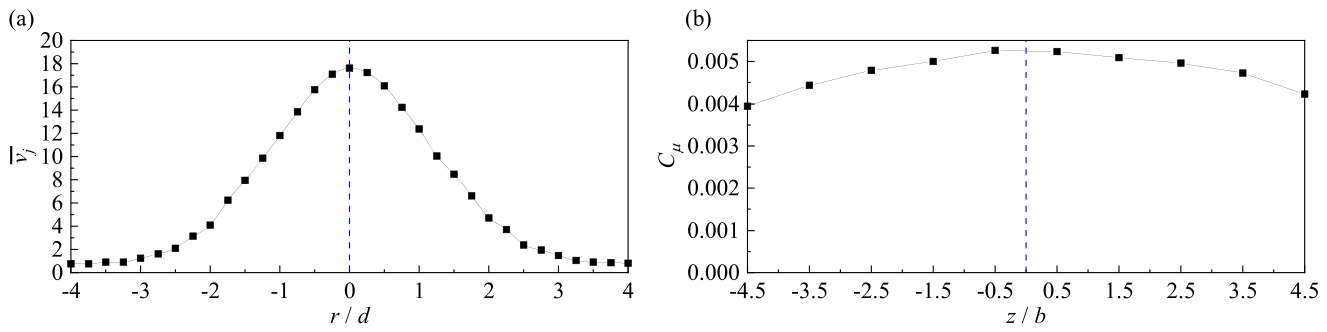
Figure 3.
Schematic of the experimental arrangement showing the NACA 0018 airfoil model with the SJA array insert, the pitching-motion system, the laser sheet, the camera field of view, and the principal optomechanical components used for the PIV measurements.
Figure 3.
Schematic of the experimental arrangement showing the NACA 0018 airfoil model with the SJA array insert, the pitching-motion system, the laser sheet, the camera field of view, and the principal optomechanical components used for the PIV measurements.
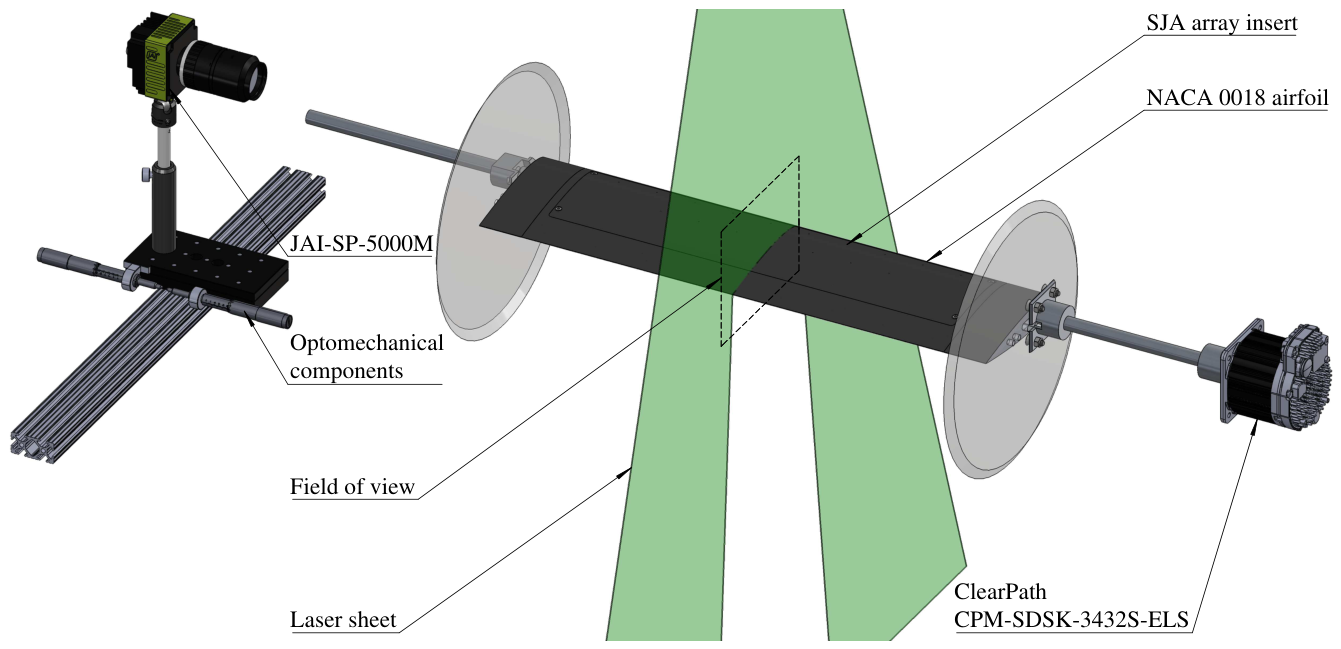
Figure 4.
Mean streamlines overlaid on contours of mean streamwise velocity: (a, b) progression of the uncontrolled flow from an LSB at to massively separated flow at post-stall angle of for , and (c, d) delayed stall to higher incidence due to enhanced transition induced by synthetic-jet forcing at and . The dividing streamline and the 50 forward-fraction line () are highlighted by solid blue and green lines.
Figure 4.
Mean streamlines overlaid on contours of mean streamwise velocity: (a, b) progression of the uncontrolled flow from an LSB at to massively separated flow at post-stall angle of for , and (c, d) delayed stall to higher incidence due to enhanced transition induced by synthetic-jet forcing at and . The dividing streamline and the 50 forward-fraction line () are highlighted by solid blue and green lines.
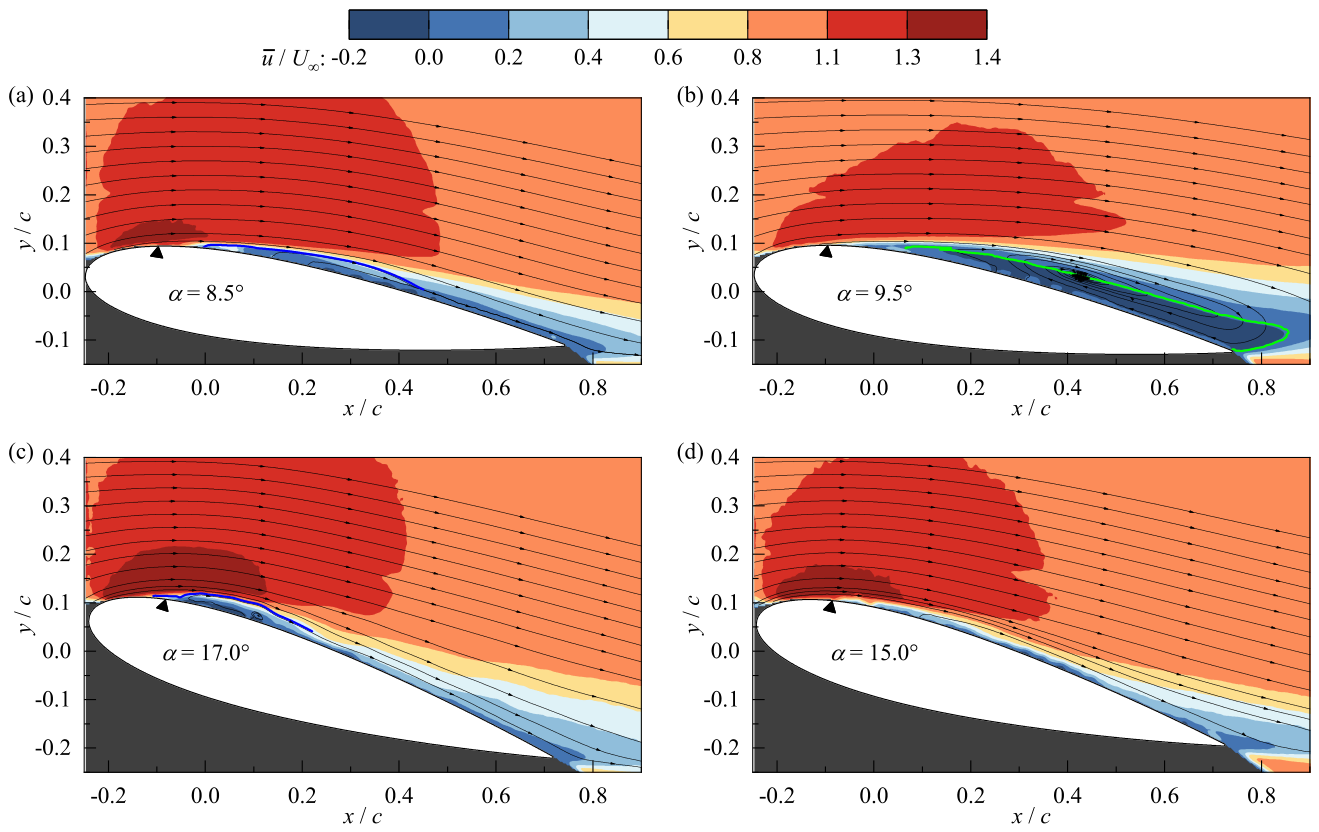
Figure 5.
Instantaneous velocity vectors overlaid on contours: (a, b) evolution of the separated shear layer from a reattaching state at to a fully detached state at the post-stall angle of for , and (c, d) delayed stall to higher incidence due to earlier transition and enhanced entrainment induced by synthetic-jet forcing at and . The dividing streamline and the 50 forward-fraction line () are highlighted by solid blue and green lines.
Figure 5.
Instantaneous velocity vectors overlaid on contours: (a, b) evolution of the separated shear layer from a reattaching state at to a fully detached state at the post-stall angle of for , and (c, d) delayed stall to higher incidence due to earlier transition and enhanced entrainment induced by synthetic-jet forcing at and . The dividing streamline and the 50 forward-fraction line () are highlighted by solid blue and green lines.
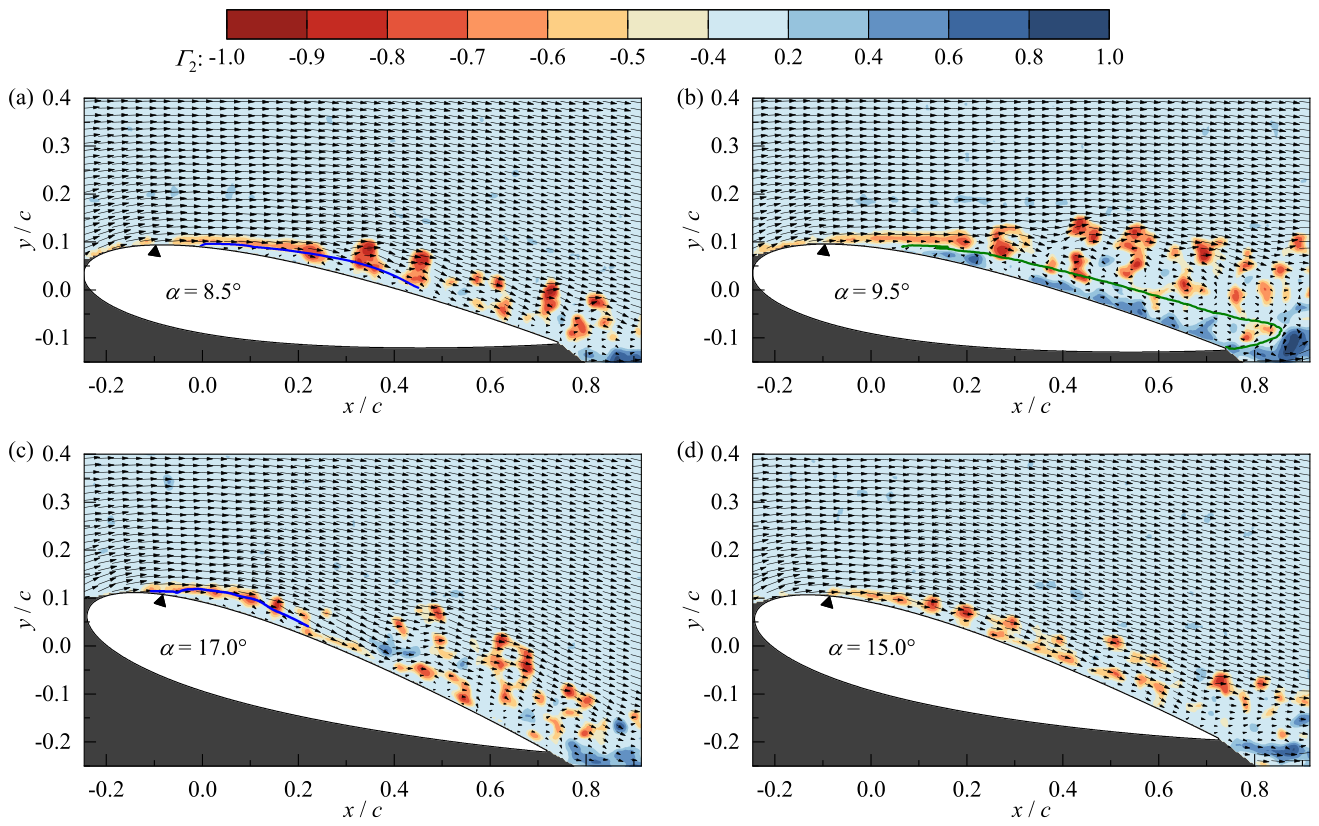
Figure 6.
PDF of reverse-flow area at for three angles of attack near static stall: (a) , (b) , and (c) . The blue and green dashed lines indicate the reverse-flow area of the mean flow field and the mean reverse-flow area , respectively.
Figure 6.
PDF of reverse-flow area at for three angles of attack near static stall: (a) , (b) , and (c) . The blue and green dashed lines indicate the reverse-flow area of the mean flow field and the mean reverse-flow area , respectively.
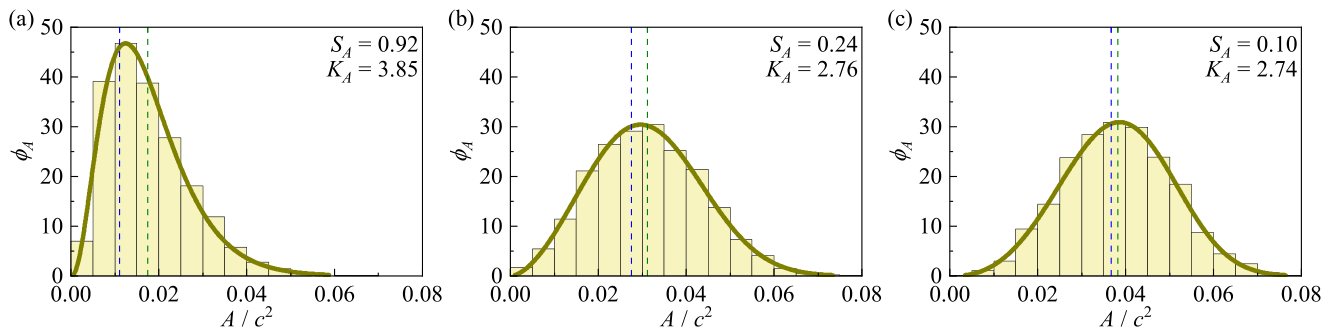
Figure 7.
Conditionally averaged streamlines overlaid on contours of streamwise velocity: (a) velocity fields averaged under , indicating reattached flow, and (b) velocity fields averaged under , showing massively separated flow.
Figure 7.
Conditionally averaged streamlines overlaid on contours of streamwise velocity: (a) velocity fields averaged under , indicating reattached flow, and (b) velocity fields averaged under , showing massively separated flow.
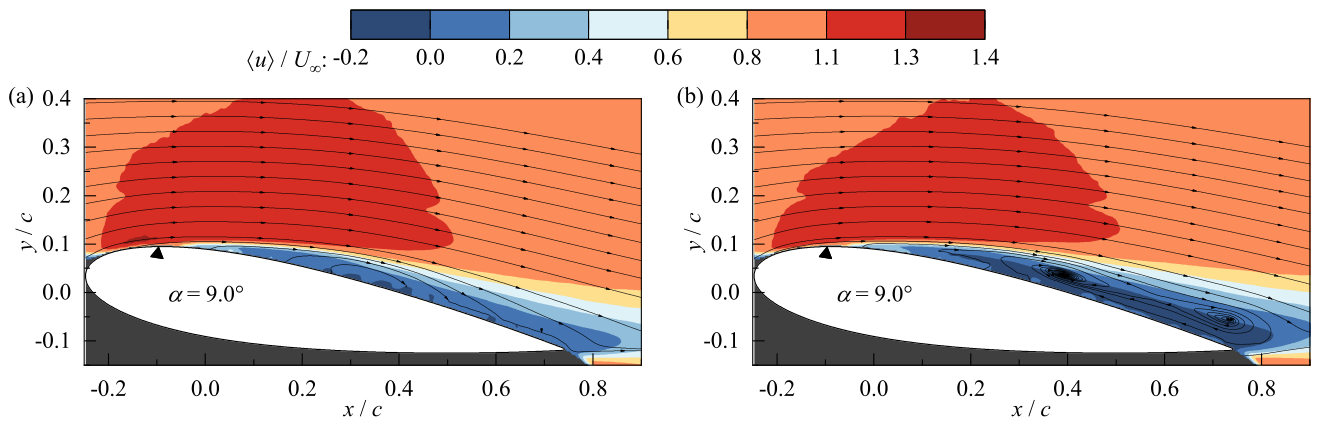
Figure 8.
Premultiplied power spectra at for three post-stall angles of attack: (a) , (b) , and (c) . The profile peaks are marked by dashed blue lines.
Figure 8.
Premultiplied power spectra at for three post-stall angles of attack: (a) , (b) , and (c) . The profile peaks are marked by dashed blue lines.
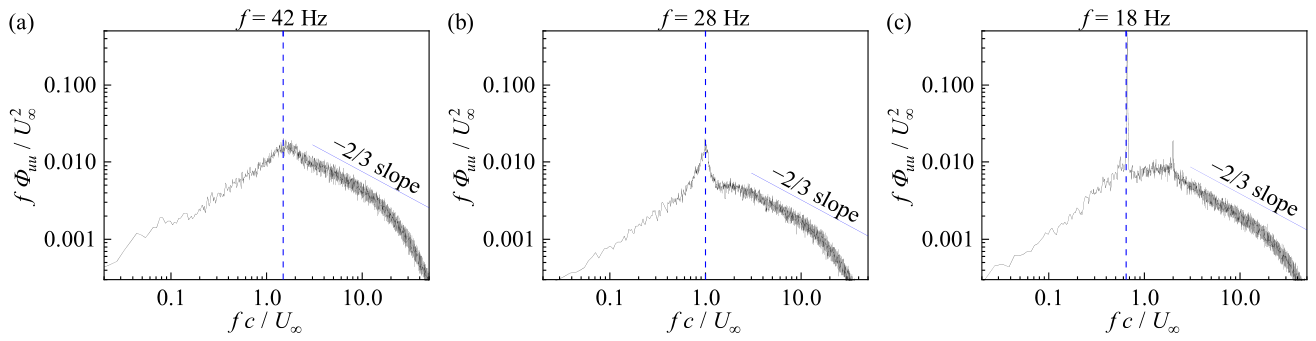
Figure 9.
Premultiplied power spectra for the pitching airfoil at for two pitching amplitudes and two downstream locations: (a, c) , (b, d) , (a, b) , and (c, d) . The first and second harmonics and the approximate center of the broadband region are highlighted by blue, green, and gray dashed lines.
Figure 9.
Premultiplied power spectra for the pitching airfoil at for two pitching amplitudes and two downstream locations: (a, c) , (b, d) , (a, b) , and (c, d) . The first and second harmonics and the approximate center of the broadband region are highlighted by blue, green, and gray dashed lines.
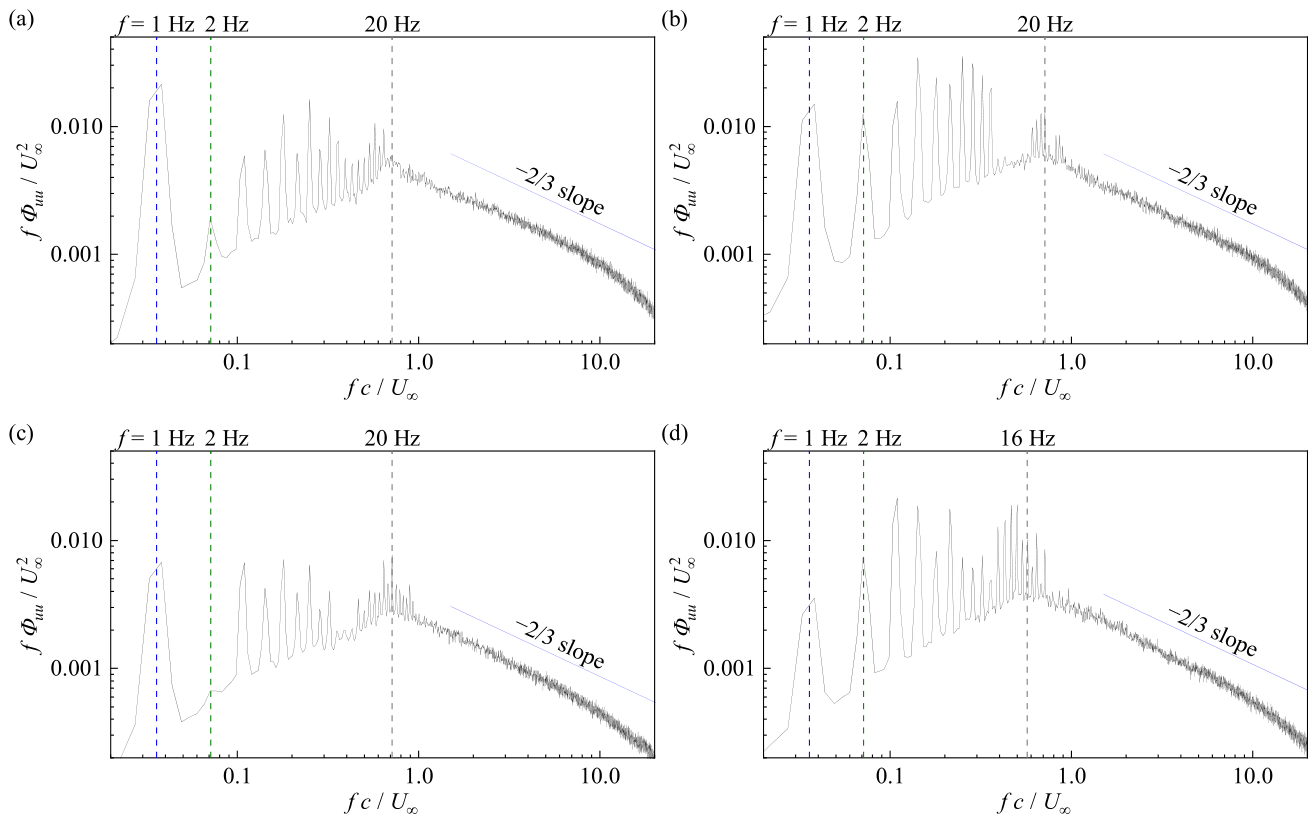
Figure 10.
Instantaneous velocity vectors overlaid on contours showing the growth of shear-layer vortices at the trailing edge: (a) and (b) . The zero mean streamwise velocity contour () is highlighted by solid blue lines.
Figure 10.
Instantaneous velocity vectors overlaid on contours showing the growth of shear-layer vortices at the trailing edge: (a) and (b) . The zero mean streamwise velocity contour () is highlighted by solid blue lines.
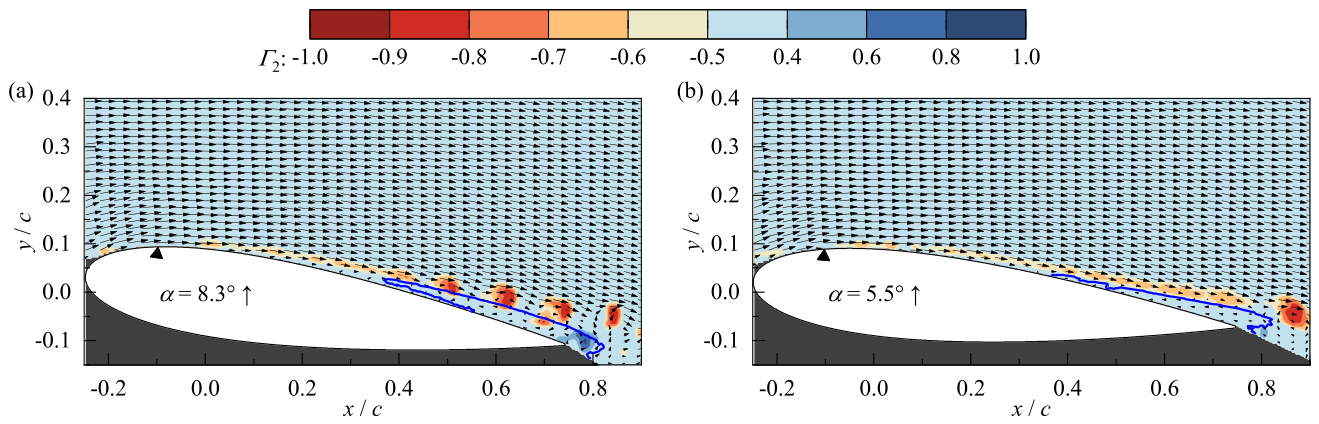
Figure 11.
Instantaneous velocity vectors overlaid on contours and conditionally averaged streamlines overlaid on contours of transverse velocity, illustrating the sudden growth of aft shear-layer vortices due to interaction with reverse flow: (a, c) and (b, d) . The 50% forward-fraction line () is highlighted by solid green lines.
Figure 11.
Instantaneous velocity vectors overlaid on contours and conditionally averaged streamlines overlaid on contours of transverse velocity, illustrating the sudden growth of aft shear-layer vortices due to interaction with reverse flow: (a, c) and (b, d) . The 50% forward-fraction line () is highlighted by solid green lines.
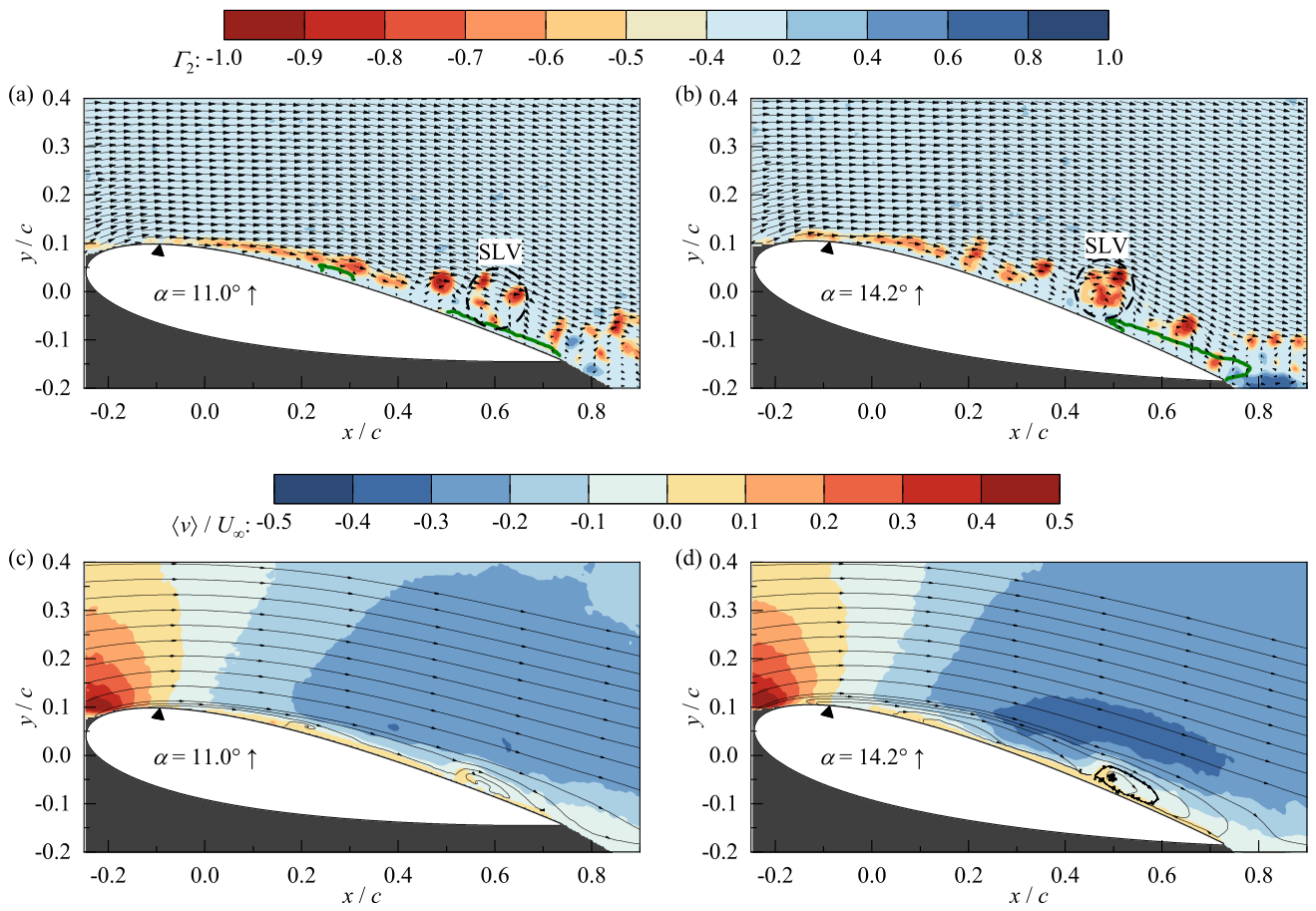
Figure 12.
Instantaneous velocity vectors overlaid on contours illustrating the appearance of an LEV near the end of the upstroke: (a) and (b) . The LEV boundary extracted from the mean flow field () is highlighted by solid gray lines.
Figure 12.
Instantaneous velocity vectors overlaid on contours illustrating the appearance of an LEV near the end of the upstroke: (a) and (b) . The LEV boundary extracted from the mean flow field () is highlighted by solid gray lines.
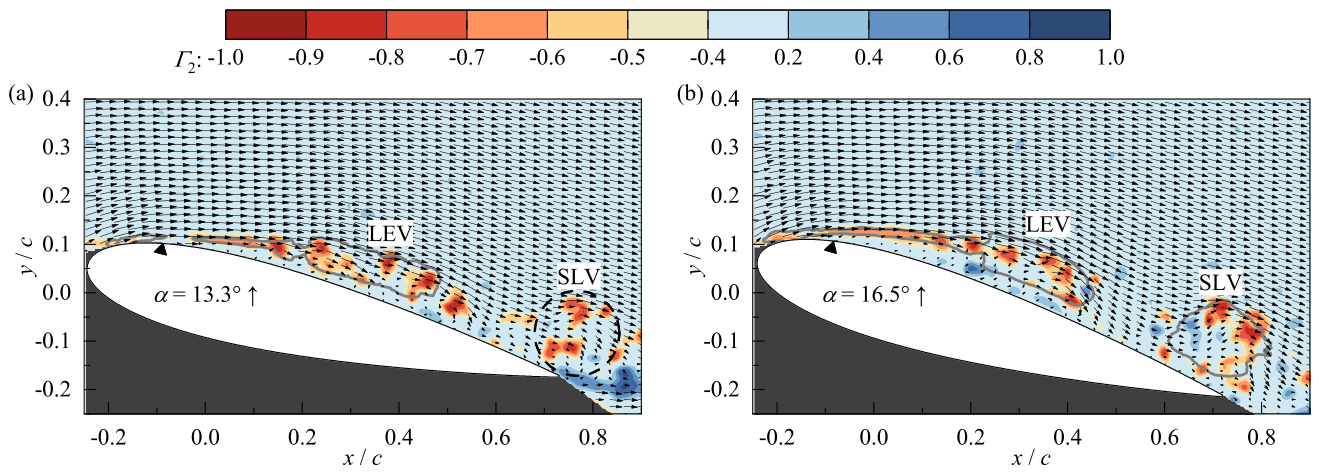
Figure 13.
Topological representation of LEV detachment mechanisms adapted from Widmann and Tropea [85]: (a) bluff-body detachment and (b) boundary-layer eruption. Boundaries of positive and negative rotational regions are highlighted by blue and red lines, and nodes and saddle points are marked by black circles.
Figure 13.
Topological representation of LEV detachment mechanisms adapted from Widmann and Tropea [85]: (a) bluff-body detachment and (b) boundary-layer eruption. Boundaries of positive and negative rotational regions are highlighted by blue and red lines, and nodes and saddle points are marked by black circles.
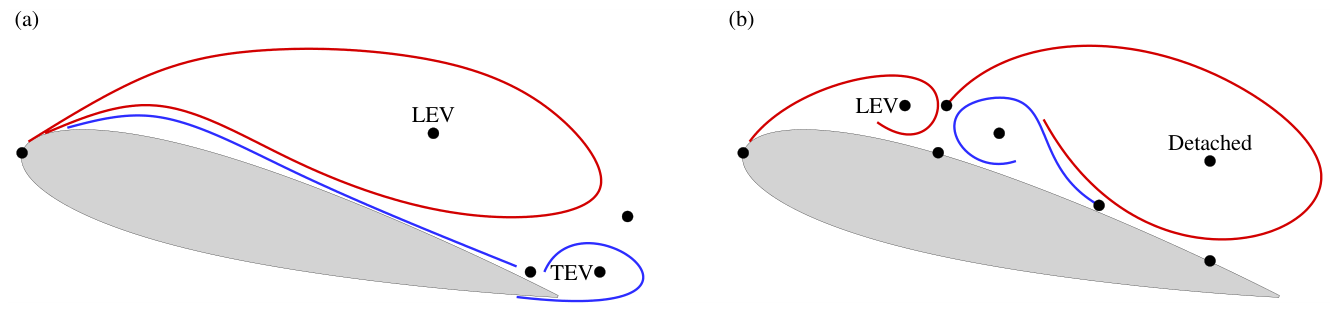
Figure 14.
Instantaneous velocity vectors overlaid on contours and mean streamlines overlaid on contours of velocity magnitude, illustrating the LEV detachment mechanisms: (a, c) and (b, d) . The 5% velocity-magnitude contour () is highlighted by solid green lines.
Figure 14.
Instantaneous velocity vectors overlaid on contours and mean streamlines overlaid on contours of velocity magnitude, illustrating the LEV detachment mechanisms: (a, c) and (b, d) . The 5% velocity-magnitude contour () is highlighted by solid green lines.
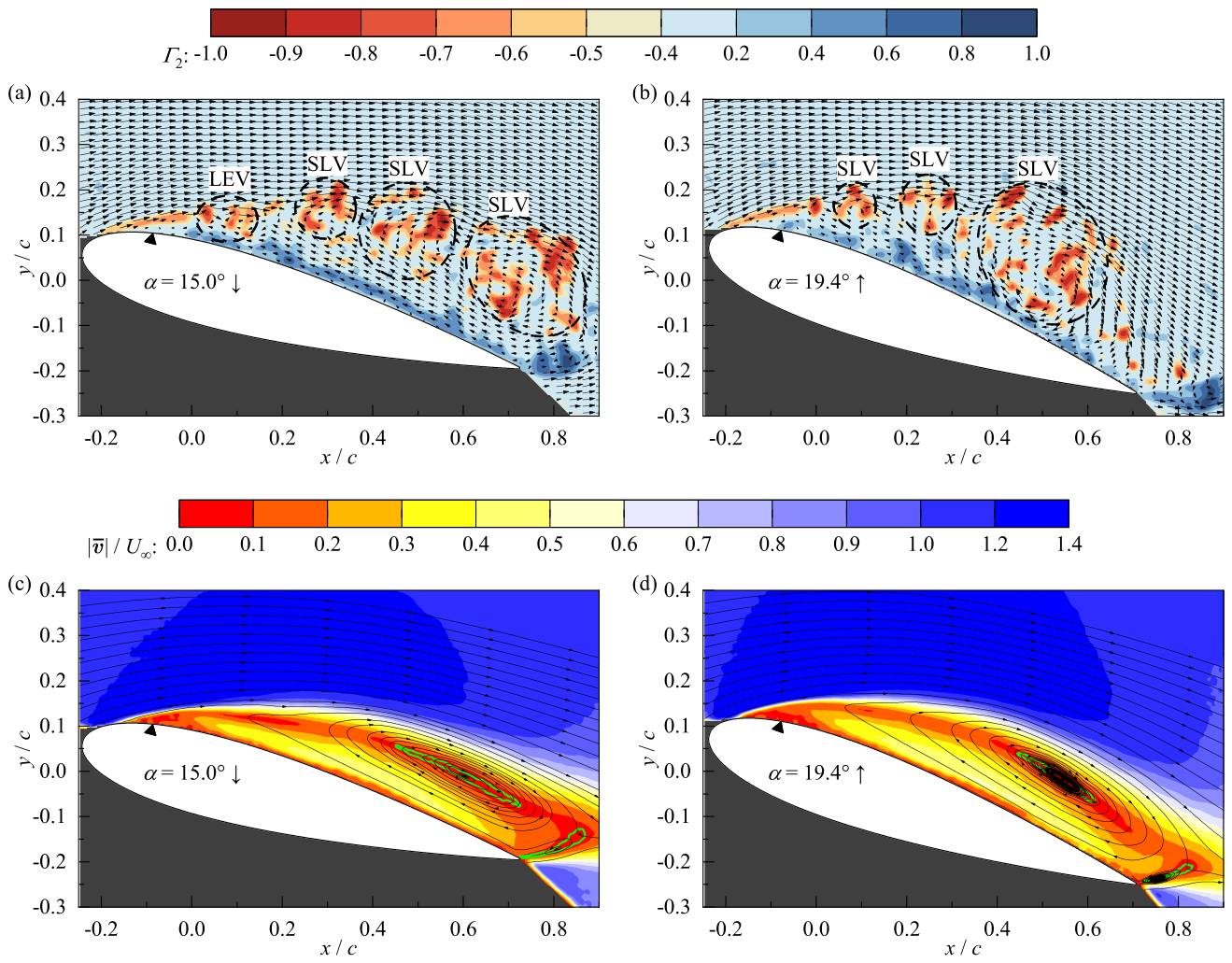
Figure 15.
Conditionally averaged streamlines overlaid on contours of velocity magnitude: (a) velocity fields averaged under , showing the presence of a secondary LEV, and (b) velocity fields averaged under , showing massively separated flow. The 5% and 8% velocity-magnitude contours ( and 8% ) are highlighted by solid green lines in (a) and (b), respectively.
Figure 15.
Conditionally averaged streamlines overlaid on contours of velocity magnitude: (a) velocity fields averaged under , showing the presence of a secondary LEV, and (b) velocity fields averaged under , showing massively separated flow. The 5% and 8% velocity-magnitude contours ( and 8% ) are highlighted by solid green lines in (a) and (b), respectively.
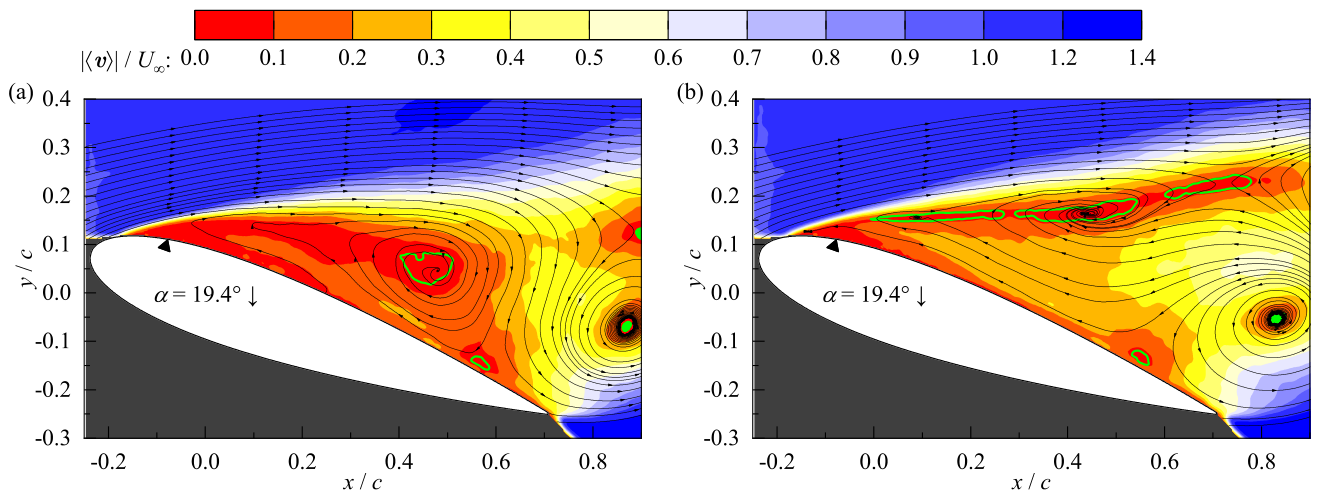
Figure 16.
Premultiplied power spectra for and two forcing frequencies at downstream of the airfoil: (a) and (b) . The first and second harmonics and the approximate center of the broadband region are highlighted by blue, green, and gray dashed lines.
Figure 16.
Premultiplied power spectra for and two forcing frequencies at downstream of the airfoil: (a) and (b) . The first and second harmonics and the approximate center of the broadband region are highlighted by blue, green, and gray dashed lines.
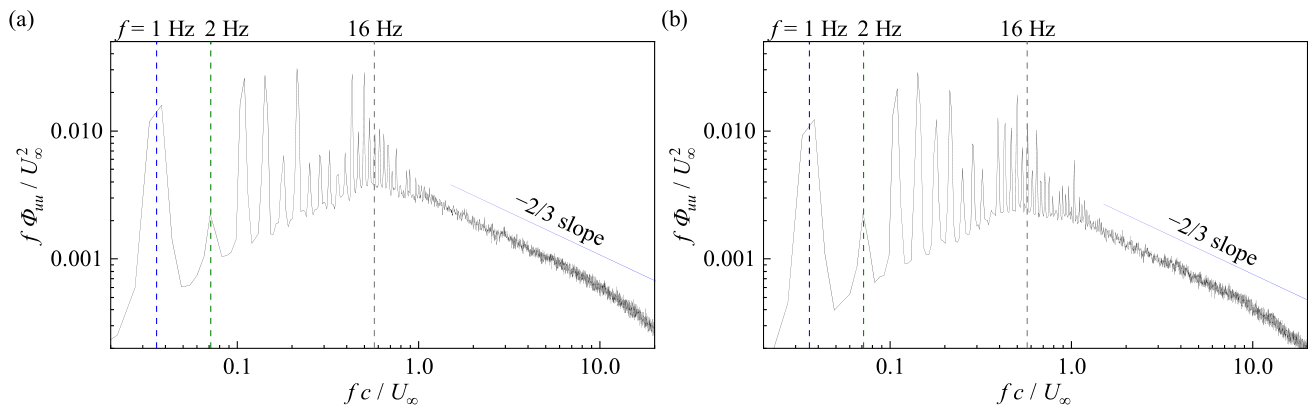
Figure 17.
Mean spanwise-vorticity contours for illustrating the lift-off and dissipation of synthetic-jet structures due to the adverse pressure gradient: (a) and (b) . The boundaries of large synthetic-jet structures extracted from the mean flow field () are highlighted by solid white lines.
Figure 17.
Mean spanwise-vorticity contours for illustrating the lift-off and dissipation of synthetic-jet structures due to the adverse pressure gradient: (a) and (b) . The boundaries of large synthetic-jet structures extracted from the mean flow field () are highlighted by solid white lines.
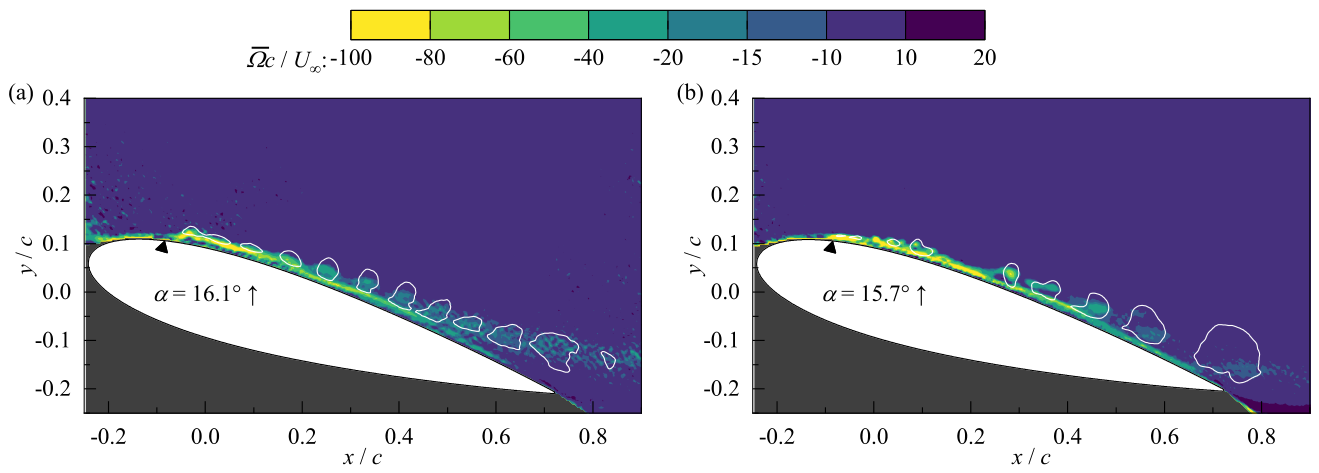
Figure 18.
Mean streamlines overlaid on contours of spanwise vorticity, showing LEV formation and downstream boundary-layer behavior for : (a) and (b) . The boundaries of large-scale structures extracted from the mean flow field () are highlighted by solid white lines.
Figure 18.
Mean streamlines overlaid on contours of spanwise vorticity, showing LEV formation and downstream boundary-layer behavior for : (a) and (b) . The boundaries of large-scale structures extracted from the mean flow field () are highlighted by solid white lines.
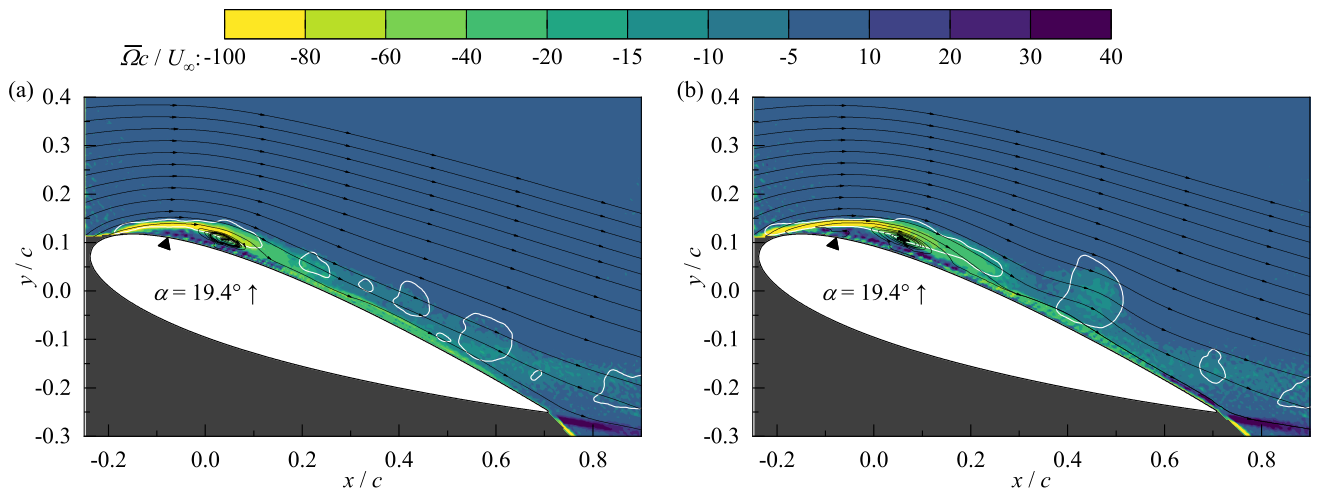
Figure 19.
Instantaneous velocity vectors overlaid on contours and mean streamlines overlaid on contours of velocity magnitude, illustrating the LEV detachment mechanisms: (a, c) and (b, d) . The 8% velocity-magnitude contour () is highlighted by solid green lines.
Figure 19.
Instantaneous velocity vectors overlaid on contours and mean streamlines overlaid on contours of velocity magnitude, illustrating the LEV detachment mechanisms: (a, c) and (b, d) . The 8% velocity-magnitude contour () is highlighted by solid green lines.
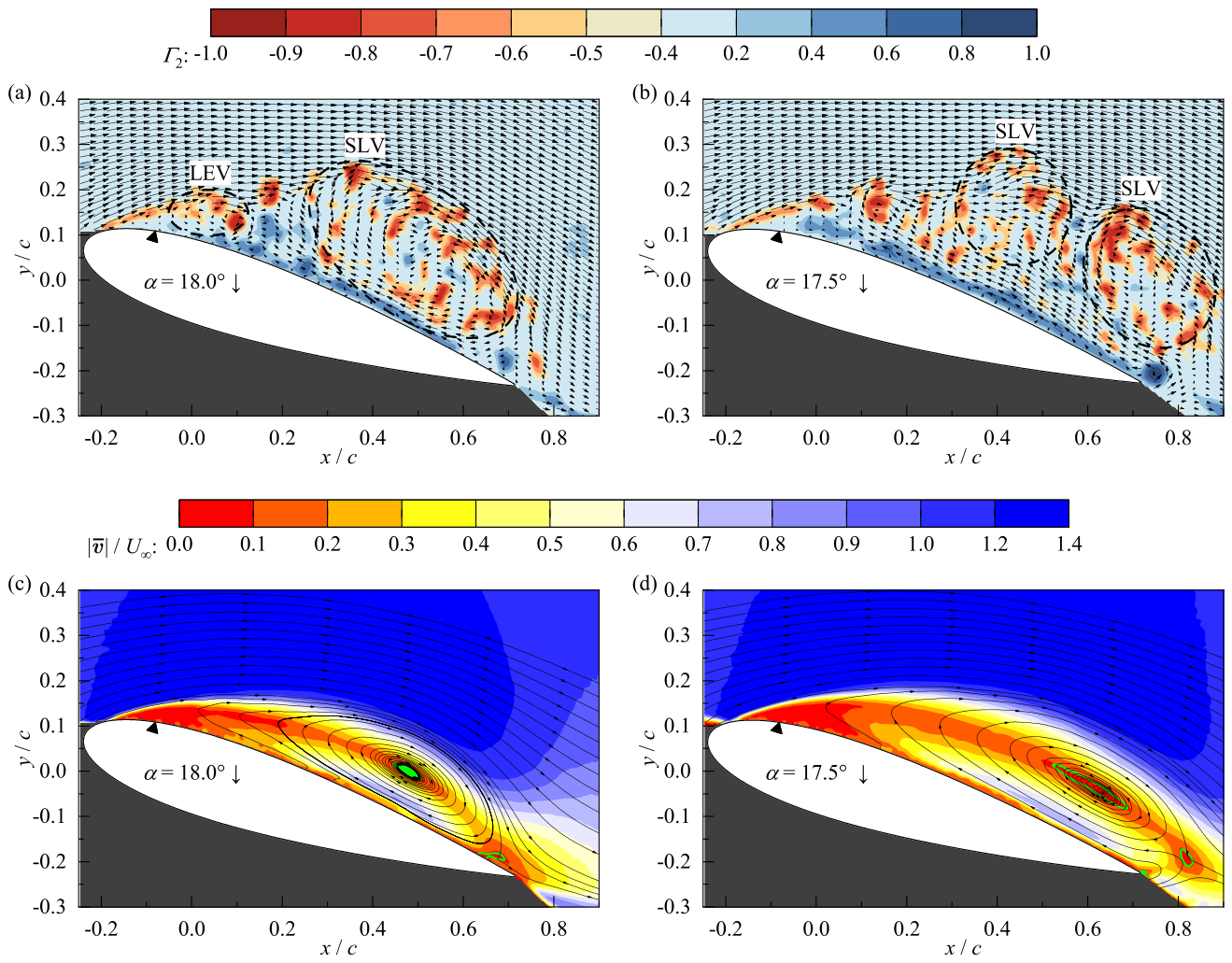
Figure 20.
Mean streamlines overlaid on contours of spanwise vorticity, illustrating the effect of forcing frequency on boundary-layer reattachment for : (a) and (b) . The boundaries of large synthetic-jet structures extracted from the mean flow field () are highlighted by solid white lines.
Figure 20.
Mean streamlines overlaid on contours of spanwise vorticity, illustrating the effect of forcing frequency on boundary-layer reattachment for : (a) and (b) . The boundaries of large synthetic-jet structures extracted from the mean flow field () are highlighted by solid white lines.
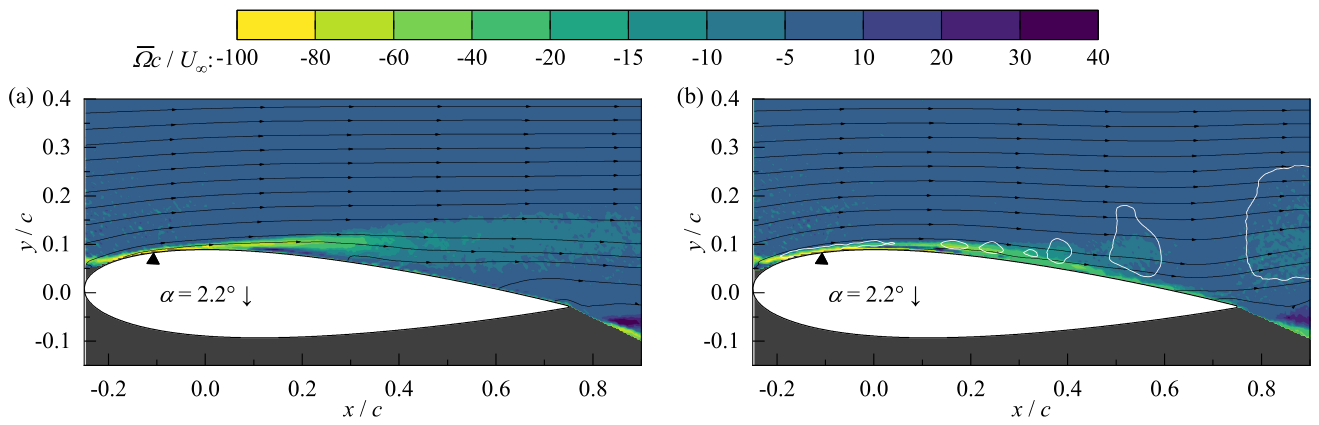

Table 1.
Summary of hot-wire and PIV measurements for the static and pitching airfoil cases. Upward and downward arrows denote the upstroke and downstroke portions of the motion cycle, respectively.
Table 1.
Summary of hot-wire and PIV measurements for the static and pitching airfoil cases. Upward and downward arrows denote the upstroke and downstroke portions of the motion cycle, respectively.
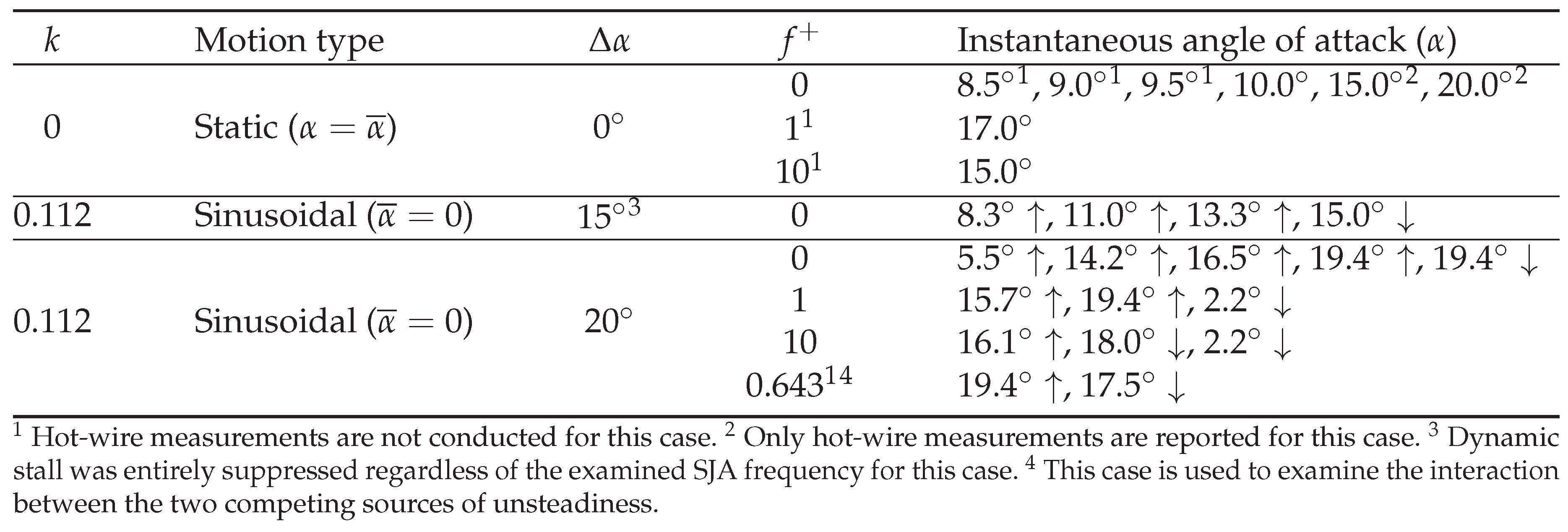 |
Table 2.
Summary of reverse-flow area statistics for static airfoil cases at near static stall.
| 1 | 2 | 3 | ) | ||||
|---|---|---|---|---|---|---|---|
| 9.0°4 | 0.0110 | 0.0175 | 0.0655 | 0.0021 | 0.92 | 3.85 | 57% |
| 9.5° | 0.0276 | 0.0312 | 0.0787 | 0.0027 | 0.24 | 2.76 | 52% |
| 10.0° | 0.0367 | 0.0383 | 0.0776 | 0.0026 | 0.10 | 2.74 | 50% |
1 is excluded here as the flow reattaches on the airfoil in the mean sense. 2 The skewness quantifies the asymmetry of the PDF about its mean, with positive values indicating a longer right tail. 3 The flatness quantifies the tail heaviness of the PDF, with a value of 3 for Gaussian distribution. 4 Streamlines and contours of the conditionally averaged velocity field are presented for this case.
Table 3.
Summary of harmonic energy content for the pitching airfoil at .
| 1 | |||||||
|---|---|---|---|---|---|---|---|
| 15.0° | 0 | 2.00° | |||||
| 3.75 | |||||||
| 20.0 | 0 | 2.00 | |||||
| 3.75 |
1 The summation is a measure of low-order harmonic energy content.
Table 4.
Coordinates and strength of the TEV cores identified from the mean flow field.
| 15° | 0 | 0.80 | -0.17 | 0.68 | |
| 20° | 0 | 0.75 | -0.24 | 0.66 | |
| 0.85 | -0.06 | 0.98 |
Table 5.
Summary of harmonic energy content for the pitching airfoil with active control.
| 20.0° | 10 | 3.75 | |||||
| 1 | 3.75 |
Disclaimer/Publisher’s Note: The statements, opinions and data contained in all publications are solely those of the individual author(s) and contributor(s) and not of MDPI and/or the editor(s). MDPI and/or the editor(s) disclaim responsibility for any injury to people or property resulting from any ideas, methods, instructions or products referred to in the content. |
© 2026 by the authors. Licensee MDPI, Basel, Switzerland. This article is an open access article distributed under the terms and conditions of the Creative Commons Attribution (CC BY) license (http://creativecommons.org/licenses/by/4.0/).
Copyright: This open access article is published under a Creative Commons CC BY 4.0 license, which permit the free download, distribution, and reuse, provided that the author and preprint are cited in any reuse.


