

Submitted:
19 June 2026
Posted:
22 June 2026
You are already at the latest version
Abstract
The increasing complexity of global manufacturing environments demands seamless vertical integration of information systems across all enterprise levels. Manufacturing Execution Systems (MES) occupy a critical intermediate tier between shop-floor automation and Enterprise Resource Planning (ERP); however, their systematic integration with Intelligent Manufacturing Systems (IMS) remains insufficiently formalised. This paper proposes a comprehensive four-stage MES–IMS integration methodology grounded in the ISA-95 enterprise-control framework and the MESA collaborative MES model. The methodology encompasses: (i) identification of MES and IMS baseline characteristics; (ii) definition of collaborative activities; (iii) design of a hierarchical communication model; and (iv) specification of bidirectional data-exchange requirements including Key Performance Indicators (KPIs). The proposed framework was experimentally verified on the FESTO FMS 500 within the Žilina Intelligent Manufacturing System (ZIMS) concept. An original hierarchical MES–IMS model was derived, articulating vertical and horizontal communication flows across three enterprise tiers. A structured KPI taxonomy—covering equipment effectiveness, process throughput, quality, and workforce metrics—was formulated and validated against FMS 500 station data (23 indicators). MES can act as the primary intelligence-supporting layer within IMS, providing the real-time data substrate required for adaptive autonomous manufacturing behaviour. The proposed framework offers a replicable integration pathway aligned with Industry 4.0 paradigms.
Keywords:
Manufacturing Execution System (MES)
; Intelligent Manufacturing System (IMS)
; Key Performance Indicators (KPI)
; holonic manufacturing
; Industry 4.0
; smart factory
1. Introduction
The global manufacturing landscape has undergone profound structural transformation over the past two decades. Intensifying competitive pressure, shortening product life cycles, and the proliferation of customer-specific requirements have compelled enterprises to pursue agility, responsiveness, and operational efficiency simultaneously. The strategic documents Manufuture—A Vision for 2020 [3] and the German High-Tech Strategy Industrie 4.0 initiative [4] formalised this trajectory, identifying cyber-physical integration, real-time data flows, and autonomous system behaviour as the principal axes of future manufacturing competitiveness.
Central to this transition is the challenge of vertical information integration—the coherent, bidirectional flow of production-relevant data across the hierarchical layers of the enterprise. The three-tier information architecture formalised in the ANSI/ISA-95 standard [5] comprises the process level (Levels 0–2), the manufacturing execution level (Level 3), and the enterprise planning level (Level 4). Manufacturing Execution Systems (MES), positioned at Level 3, bridge the temporal and semantic gap between shop-floor automation (milliseconds) and ERP planning (days to months) [6,7].
Despite more than three decades of MES development since MESA International first systematised the concept in the early 1990s [8], and despite the publication of complementary standards ISA S95, IEC 62264, and VDI Guideline 5600 [9,10], MES potential remains underexploited—particularly at the interface with Intelligent Manufacturing Systems (IMS). IMS incorporate artificial intelligence tools, autonomous decision-making agents, and self-reconfiguring components [11,12]. The IMS paradigm originated from the international IMS Programme initiated in 1989 by Professor Hiroyuki Yoshikawa [13], encompassing Holonic Manufacturing Systems (HMS), Bionic Manufacturing Systems (BMS), and multi-agent architectures. A systematic methodology for formalising the MES–IMS interface has not been fully established in the literature [17,23].
The present paper addresses this gap. Building on foundational research conducted within the ZIMS framework at the University of Žilina [19], a four-stage integration methodology is proposed and experimentally validated on the FESTO FMS 500. Primary contributions are: (i) a comprehensive, standards-aligned MES–IMS integration methodology; (ii) an original hierarchical three-tier communication model; (iii) a structured KPI taxonomy (23 indicators, four semantic classes); and (iv) empirical verification within the ZIMS/FMS 500 testbed (Figure 1).
2. Literature Review
Manufacturing Execution Systems (MES) represent a key layer between enterprise information systems (ERP) and shop-floor production technologies. Their primary role is to ensure real-time management of manufacturing operations, data collection, and process synchronization [40].
In the context of Industry 4.0, MES are evolving from traditional systems into intelligent platforms supported by artificial intelligence (AI), the Internet of Things (IoT), and cyber-physical systems. These advancements enable adaptive planning, predictive maintenance, and advanced analytics.
The literature emphasizes that modern MES no longer serve merely as tools for production monitoring but function as a central hub of the digital enterprise, integrating data and decision-making across the entire value chain.
2.1. Evolution of Manufacturing Information Systems
Manufacturing information systems have evolved from Reorder Point (ROP) inventory planning through MRP (1970s), MRP II (1980s), and ERP (1990s) [21]. ERP extended informational scope to all business functions but operated at planning granularity incompatible with real-time shop-floor dynamics, motivating MES as a distinct middleware tier [6,8]. MESA International systematised MES in the early 1990s; the Collaborative MES model (2004) repositioned MES as an enterprise integration platform [8].
In the Industry 4.0 context [4,22], MES has evolved into "MES 4.0" platforms incorporating IIoT connectivity, cloud computing, edge intelligence, and AI-assisted decision support [23]. Shojaeinasab et al. [23] identified a shift from transactional data-collection towards adaptive platforms supporting autonomous reconfiguration and predictive maintenance.
2.2. MES Standards, Functions, and Collaborative Models
The standardisation landscape is anchored by ANSI/ISA-95 (IEC 62264), VDI Guideline 5600, and MESA International. ISA-95 defines a five-level enterprise hierarchy, object models for ERP–MES information exchange, and a manufacturing operations management activity model (Part 3) [5,9]. VDI 5600 provides operational detail and clarifies temporal operating ranges: seconds-to-hours for MES versus hours-to-months for ERP versus milliseconds-to-minutes for process control [10].
2.3. Intelligent Manufacturing Systems: Paradigms and Architectures
HMS, grounded in Koestler's holon concept, applies recursive self-similar structure to manufacturing. The PROSA reference architecture [26] formalises HMS around Product, Resource, and Order holons, enabling self-organisation without centralised control. Trentesaux et al. [27] identified HMS as a natural complement to IIoT-enabled smart factories; Bahrpeyma and Reichelt [28] demonstrated multi-agent reinforcement learning for real-time manufacturing scheduling. Caiza and Sanz [30] demonstrated an immersive digital twin applied to MES for Industry 4.0 process monitoring. The meta-holonic management paradigm [31] articulates how holonic structures accommodate cognitive digital twins and AI-assisted supervisory agents.
2.4. MES–IMS Integration: State of the Art and Research Gaps
Existing contributions have largely addressed holonic enhancement of individual MES functions [17,32] or multi-agent simulation [33,34]. Bianchini et al. [35] documented MES implementation in SME environments, identifying data characterisation and integration design as principal implementation barriers. However, a comprehensive end-to-end methodology addressing the full scope of MES–IMS cooperation—system characterisation, hierarchical modelling, KPI taxonomy, and empirical physical verification—has not previously been presented. The present work fills this gap.
The study [41] highlights the importance of transitioning from big data to smart data to achieve outcomes in terms of operational efficiency, cost analysis, workload management, resource utilisation, knowledge dissemination, and enhanced operator engagement.
On the basis of the systematic literature review, five critical and interconnected research gaps have been identified that directly motivate the present paper

Table 1.
Identified research gaps in MES integration and KPI verification.
| Research Gap | Key References |
|---|---|
| G1: Absence of an empirically validated hierarchical integration framework linking MES ↔ ERP ↔ SCADA in intelligent manufacturing contexts | Shojaeinasab et al. (2022); Mantravadi & Møller (2019); EAI SLR (2025) [42] |
| G2: KPI and OEE verification in MES is predominantly simulation-based; real-world multi-KPI empirical validation is lacking | Brodeur et al. (2022); Mouhib et al. (2024); arXiv (2025) [43] |
| G3: ISA-95 and ISO 22400 standards are not consistently applied across all hierarchical MES layers from machine to enterprise level | Varisco et al. (2018); EAI SLR (2025); Tambare et al. (2021) [44] |
| G4: No unified framework exists for simultaneous measurement of multiple KPIs (OEE, lead time, scrap rate, energy) within an integrated MES environment | Tambare et al. (2021); Tang (2024); IJRASET (2024) [45] |
| G5: OT/IT interoperability across PLC → SCADA → MES → ERP remains unresolved without a clear, validated architectural reference model | MDPI Automation Review (2024); ResearchGate DT (2024); IIoT SLR (2025) |
Gap G1 is the most foundational: while frameworks such as the MESA model, ISA-95, and IMES conceptual architectures have been proposed, none have been subjected to rigorous empirical verification spanning multiple production contexts and hierarchical levels simultaneously. Gap G2 compounds this: even where KPI measurement is discussed, the evidence base remains predominantly laboratory-scale or simulation-derived, limiting generalisability.
Gaps G3 and G4 reflect a standardisation deficit. ISA-95 provides the conceptual architecture for MES-ERP integration, and ISO 22400 supplies a KPI taxonomy for manufacturing operations management — yet neither standard is consistently operationalised in academic or industrial MES deployments in a manner that enables cross-study comparison. Gap G5 captures the architectural challenge: the automation pyramid model is widely cited but rarely implemented as a verified, end-to-end communication architecture in real production environments.
3. Theoretical Framework
3.1. Three-Tier Enterprise Architecture
Following the ISA-95/IEC 62264 reference model [5], the enterprise architecture is decomposed into three operationally distinct tiers. Tier 1 (Process Level, Levels 0–2): physical assets (sensors, actuators, PLCs, SCADA) operating in milliseconds to seconds; in an IMS context, Tier 1 assets carry local AI-based intelligence enabling L1 autonomous fault diagnosis and self-adjustment. Tier 2 (Manufacturing Operations Level, Level 3): MES, mediating between process and enterprise tiers in seconds to hours, aggregating process data into KPIs, work orders, and quality records while executing supervisory escalation logic for faults unresolvable at L1. Tier 3 (Enterprise Planning Level, Level 4): ERP and business management systems operating in hours to weeks. The fundamental assertion is that MES constitutes the necessary and sufficient information bridge between Tier 1 and Tier 3 in an IMS environment.
3.2. Key Concepts and Definitional Taxonomy
Four conceptual constructs are precisely defined. Intelligence Level [36]: (L1) process-level autonomous fault resolution; (L2) MES-level supervisory resolution of disturbances exceeding L1 capacity; (L3) enterprise-level management of systemic events beyond MES scope. Data Category (temporal × semantic): real-time (< 1 s latency) vs. asynchronous; equipment state, process, quality, and workforce semantic classes. Communication Mode: vertical (inter-tier) vs. horizontal (intra-tier); OPC-UA as primary vertical substrate [20]. KPI Hierarchy: process-level KPIs (machine granularity) → manufacturing-level KPIs (shift aggregates) → enterprise-level KPIs (financial metrics).
3.3. Research Propositions
Proposition 1 (Structural Compatibility): An ISA-95-compliant MES can be structurally integrated with an IMS at intelligence Level 1 without architectural modification, provided: (a) a bidirectional OPC-UA channel is established between each PLC and the MES server; (b) data categories are specified per Section 3.2; and (c) intelligence escalation routing is defined per the L1/L2/L3 hierarchy.
Proposition 2 (Functional Completeness): The eight MESA MES functions are collectively sufficient to satisfy information requirements of an IMS operating at intelligence Level 2, provided KPI taxonomy, data exchange specifications, and communication parameters are defined in advance.
Current literature emphasizes a shift from rigid hierarchies to flexible multi-layered integration frameworks that leverage digital twins, cloud computing, and blockchain to increase system interoperability and agility [39]. The study [40] serves as a foundation for academics, industry professionals, and policymakers to drive the sustainable evolution of MES within smart manufacturing ecosystems.
4. Materials and Methods
Six complementary scientific methods are employed [37,38]: (i) analysis—decomposition of MES and IMS into functional and structural characteristics; (ii) synthesis—construction of the integrated model; (iii) induction—derivation of general integration principles from MESA and ISA-95 models; (iv) deduction—derivation of specific KPI and data exchange requirements from the theoretical framework; (v) abstraction—identification of integration-relevant properties independent of vendor implementations; and (vi) systemic approach—treating both systems as open systems interacting through defined interfaces.
The proposed methodology is fully compatible with the AAS concept (Asset Administration Shell). While our methodology addresses the vertical integration of ISA-95 layers and defines KPIs, AAS can serve as a technological container for the implementation of data points that we have identified within the methodology. For enterprises that are in a transitional phase (brown-field), our approach is more practically applicable, since it does not focus on a complete restructuring of the asset data model, but on the functional integration of existing systems. In the long term, however, we recommend enriching the defined data objects with AAS attributes, which will ensure a high level of future scalability and "plug-and-produce" capability of the entire system [51].
4.2. Four-Stage MES–IMS Integration Methodology
The integration methodology comprises four sequential stages (Figure 2):
Stage 1 — Cooperation Requirements: Identify the operative intelligence level (L1/L2/L3), the AI integration mode (supporting/integrated/total), and the mutual positioning of MES and IMS.
Stage 2 — Collaborative Activities: Specify MES activities (provision of planning inputs, KPI data acquisition, product tracking, and supervisory escalation) and IMS activities (autonomous production execution, self-monitoring, L1 fault diagnosis, and escalation signalling).
Stage 3 — Collaboration Model: Construct the hierarchical communication model (Section 4.3), select hardware/software platforms, and select communication protocols for each layer (Section 4.4).
Stage 4 — Information Links: Categorise exchanged data per Section 3.2 taxonomy, define exchange modes, and specify six data characteristics for each variable: collection frequency, required precision, unique identifier, addressee, timestamp format, and priority level (critical/high/standard).
4.3. Hierarchical Communication Model
The hierarchical MES–IMS communication model (Figure 3) organises the three tiers with explicit protocol specifications. At Tier 1, intelligent sensors and actuators connect to PLCs via PROFINET industrial fieldbus. Each PLC hosts a control programme incorporating the selected AI tool and exposes process data through OPC-UA server endpoints. At Tier 2, the MES OPC-UA client receives real-time state variables (100 ms), performance counters (1 s), and event-driven fault notifications; computes KPIs; manages work orders; and executes L2 supervisory escalation. Horizontal Tier 1 coordination (conveyor synchronisation) occurs via PROFINET without MES mediation, preserving L1 autonomy. At Tier 3, MES communicates with ERP via REST/B2MML conforming to ISA-95 Part 5.
4.4. Communication Protocol Selection
Protocol selection criteria: real-time capability, interoperability, and standardisation maturity. PROFINET IO was selected for the Tier 1 fieldbus layer (deterministic cycle times < 1 ms in IRT mode). OPC-UA was selected for the Tier 1–Tier 2 interface, consistent with IEC 62541 and native ISA-95 object support [20]. REST API over HTTPS with B2MML message envelopes was specified for the Tier 2–Tier 3 interface.
4.5. Experimental Platform: ZIMS and FMS 500
The framework was verified on the FESTO FMS 500 modular assembly system within the ZIMS research testbed at the University of Žilina [19]. The FMS 500 comprises three stations: (1) Input/Output Station—buffer magazine, articulated robot, colour-sorted Part 1 workpiece handling; (2) Assembly/Disassembly Station—robotic assembly of a four-component FESTO Box (Part 1: body; Part 2: pin; Part 3: spring; Part 4: cap); (3) Intermediate Buffer—20-position storage activated when I/O Station capacity is reached. Station communication uses PROFINET over Industrial Ethernet. Current supervisory visualisation is provided by a Control Web SCADA system. The material flow is shown in Figure 4.
5. Results
5.1. MES Baseline Characteristics Identification
Stage 1 analysis produced a five-dimension MES identification matrix:
- (i)
- System Purpose—online acquisition and transmission of accurate contextualised process data;
- (ii)
- Application Perspective—applicable to discrete and continuous manufacturing across automotive, electronics, food, energy, and chemical sectors;
- (iii)
- Technical Specifications—four architecture variants: client-server, thin client, SOA (recommended for IMS due to OPC-UA alignment), and distributed;
- (iv)
- Enterprise Positioning—Level 3 per ISA-95, bridging Levels 0–2 and Level 4;
- (v)
- System Functionality—eight MESA functions instantiated per IMS intelligence level.
5.2. AI Tool Applicability Within the Three-Tier Architecture
The Stage 1 IMS characterisation produced an applicability matrix mapping seven AI tool categories across three enterprise tiers (Table 2). For the FMS 500 verification context—L1 IMS—the relevant AI tool is an expert-system fault diagnosis module embedded in each station PLC, generating structured OPC-UA fault messages when L1 resolution is exhausted.
5.3. Hierarchical MES–IMS Collaboration Model
The Stage 3 architectural design produced the hierarchical MES–IMS collaboration model (Figure 2, Section 4.3). The model establishes a clean separation of decision-making authority: intelligent machines govern local execution and L1 fault resolution; MES governs cross-station production flow, real-time KPI computation, work order management, and L2 supervisory escalation. Vertical flows carry structured OPC-UA information objects aligned with ISA-95 object definitions.
5.4. KPI Taxonomy for MES–IMS Integration
Stage 4 produced a KPI taxonomy in four semantic groups. Equipment Effectiveness: OEE (Availability × Performance × Quality), TEEP (OEE × Scheduled Availability), Fault Intensity (λ = faults/h), MTBF (1/λ), MTTR (cumulative maintenance time/fault count), Machine Productivity, machine capability indices Cm and Cmk. Process Flow: Manufacturing Lead Time, WIP inventory, Order Processing Lead Time, Throughput Rate, Capacity Utilisation, Material Consumption, Energy Consumption per unit. Quality: Defect Rate (%), Cp, Cpk, Rework Count, First-Pass Yield. Workforce: Operator Productivity, Availability, Performance Rate, Task Completion Status, Operator-attributable Defect Count. Figure 5 illustrates the MES data-to-KPI transformation flow.
5.5. FMS 500 Experimental Verification
Application of the four-stage methodology to the FMS 500 yielded 23 KPIs across three stations and system level, summarised in Table 3. All indicators were confirmed as computable from the existing PROFINET/OPC-UA infrastructure without hardware modification, directly confirming Proposition 1 (structural compatibility).
The MESA eight-function coverage was verified as sufficient to manage FMS 500 information requirements at IMS intelligence Level 1, confirming Proposition 2 (functional completeness).
Error state fault categorisation—collision, resource depletion, utility failure—was mapped to structured OPC-UA event objects enabling automated MES supervisory response. Three implementation steps were validated per station:
(1) infrastructure analysis confirming OPC-UA data availability from existing PLCs;
(2) MES programming specification covering KPI models, display structure, alarm logic, and protocol definitions; and
(3) an operational testing protocol including functional testing and commissioning.
6. Discussion
6.1. Comparison with Existing Integration Frameworks
The four-stage methodology advances the state of the art in several respects. Earlier holonic MES designs [17,32] redesigned MES internals as holons; the present work treats MES as a standards-compliant component whose integration requirements are systematically derived from IMS characteristics—preserving the commercial-deployment advantage of unmodified ISA-95-compliant platforms. Compared with MES–Digital Twin frameworks [24,30], the present methodology targets the more fundamental integration layer: the data-exchange substrate and KPI structure upon which any higher-level intelligence must rely. The FMS 500 verification results directly address the data-characterisation and integration-design barriers identified by Bianchini et al. [35].
6.2. Implications for Industry 4.0 and Digital Manufacturing
The confirmation that ISA-95-compliant MES can be integrated with L1 IMS without architectural modification supports an evolutionary Industry 4.0 adoption strategy [22], protecting existing MES investments while enabling incremental IMS capability layering. The OPC-UA architecture provides a direct pathway to IIoT platform integration through OPC-UA's cloud connectivity profile (MQTT transport binding), enabling process data forwarding to cloud analytics, digital twin engines, or AI inference services without modifying the core MES–IMS interface.
6.3. Limitations and Boundary Conditions
The FMS 500 verification was conducted on a system considerably simpler than industrial multi-product, multi-path IMS environments. Scalability to such configurations was not empirically tested. The framework (Figure 6) was validated for IMS at intelligence Level 1; extension to L2 and L3 configurations requires further empirical investigation. Cybersecurity implications of OPC-UA-based MES–IMS integration (authentication, authorisation, encrypted transport) were outside the present scope.
6.4. Future Research Directions
Four directions are identified: (i) extension to multi-product, multi-path IMS including dynamic KPI subscription reconfiguration on product changeover; (ii) integration of ML-based predictive maintenance within the MES L2 supervisory layer; (iii) application to cloud-native and edge-computing MES microservice architectures; and (iv) empirical verification at higher IMS intelligence levels (L2/L3) using the ZIMS testbed with augmented holonic scheduling capabilities.
7. Conclusions
This paper proposed, formalised, and experimentally verified a four-stage methodology for integrating Manufacturing Execution Systems (MES) within Intelligent Manufacturing Systems (IMS) in discrete manufacturing environments. The methodology was grounded in the ISA-95 enterprise-control framework and the MESA collaborative MES model, and validated on the FESTO FMS 500 within the Žilina Intelligent Manufacturing System (ZIMS) concept. Five principal conclusions are drawn.
A comprehensive MES–IMS integration methodology was developed and shown applicable to IMS at intelligence Level 1. The four-stage approach — baseline characterisation, definition of collaborative activities, hierarchical communication model design, and bidirectional data-exchange specification — provides a replicable, standards-anchored procedure for deriving integration requirements systematically from IMS characteristics rather than from ad hoc system-specific negotiation. Unlike earlier holonic MES redesigns that required internal architectural modifications, the present methodology preserves the commercial deployment integrity of unmodified ISA-95-compliant platforms, directly addressing the adoption barriers documented in the literature. The methodology's structure ensures that integration decisions are traceable to explicit IMS functional requirements at each stage, providing an auditable design record of value both for industrial deployment and for academic replication.
A hierarchical communication model (PROFINET → OPC-UA → REST/B2MML) was validated as implementable on the FMS 500 without infrastructure modification, confirming Proposition 1 (structural compatibility). The three-tier protocol stack — spanning field-level PROFINET, plant-level OPC-UA, and enterprise-level REST/B2MML — was shown to support full bidirectional data exchange across all three enterprise tiers without requiring modifications to either the MES platform or the FMS 500 control infrastructure. This result has a significant practical implication: structural compatibility between commercially available ISA-95-compliant MES and IMS at intelligence Level 1 is achievable within existing hardware and software constraints.
The OPC-UA layer, in particular, was confirmed as a technically sufficient and semantically rich integration point, capable of conveying not only raw process signals but also structured manufacturing object data conforming to the OPC-UA for Machinery companion specification. The cloud connectivity profile of OPC-UA further extends this architecture toward IIoT platform integration — enabling process data forwarding to cloud analytics, digital twin engines, or AI inference services through MQTT transport binding, without modifying the core MES–IMS interface.
A KPI taxonomy of 23 indicators across four semantic classes was verified as computable from existing FMS 500 OPC-UA infrastructure, confirming Proposition 2 (functional completeness). The structured KPI set — spanning equipment effectiveness (including OEE and its constituent availability, performance, and quality sub-metrics), process throughput, quality, and workforce dimensions — was confirmed to be fully derivable from data already present in the FMS 500 OPC-UA address space, without requiring additional instrumentation.
Alignment with ISO 22400-2 nomenclature ensures semantic interoperability with ERP-level planning engines, executive dashboards, and cross-enterprise benchmarking systems, directly closing the information asymmetry between operational technology and business intelligence layers that has been identified as a critical barrier to data-driven manufacturing. The functional completeness result is particularly significant for industrial adopters operating standardised MES platforms: it demonstrates that the KPI data substrate required for intelligent manufacturing behaviour can be established through integration design alone, without capital investment in supplementary sensor infrastructure. Beyond operational utility, the taxonomy provides a structured measurement foundation upon which higher-order capabilities — predictive maintenance, reinforcement learning-based scheduling, digital twin synchronisation — can be incrementally constructed.
The L1/L2/L3 intelligence escalation routing mechanism was formalised and mapped to the FMS 500 fault taxonomy. The escalation model defines explicit routing rules governing the transition of exception handling and adaptive control decisions across intelligence levels: from autonomous resolution at L1 through supervisory intervention at L2 to system-level reconfiguration at L3. Mapping this mechanism to the empirically observed FMS 500 fault taxonomy — comprising equipment faults, process deviations, material supply exceptions, and scheduling conflicts — validates the routing model against a realistic, albeit bounded, fault population.
This formalisation constitutes an original contribution to the IMS integration literature: while intelligence level taxonomies have been proposed conceptually, their operationalisation as executable routing logic tied to a concrete fault classification has not previously been demonstrated. The escalation model provides the architectural prerequisite for closed-loop autonomous manufacturing behaviour, establishing the control-flow structure upon which Level 2 and Level 3 IMS capabilities must be built in future work.
Commercially available ISA-95-compliant MES platforms can be deployed within IMS environments without redesigning either system, confirming MES as an indispensable component of the intelligent factory architecture for Industry 4.0 and beyond. This overarching conclusion consolidates the preceding four and carries the broadest strategic implication. It reframes MES not as a legacy administrative system to be superseded by IIoT platforms or digital twin architectures, but as the indispensable real-time execution layer that provides the live operational context — order status, actual cycle times, quality disposition, operator assignments — without which higher-level intelligence remains grounded in abstraction rather than manufacturing reality.
The confirmation that no architectural modification is required for either system shifts the locus of Industry 4.0 MES adoption effort from redesign to integration design — a substantially lower barrier that makes the intelligent factory transition accessible to brownfield facilities and SMEs operating with standardised commercial platforms.
Taken together, these conclusions establish that MES integration within IMS is not merely technically feasible but practically realisable within existing industrial standards, commercial platforms, and verification infrastructure. The ZIMS testbed and FMS 500 verification results provide a concrete, reproducible empirical anchor for these claims — an anchor that the existing literature, dominated by simulation-based and conceptual studies, has until now lacked.
The scope of the present work is bounded by the FMS 500 configuration and IMS intelligence Level 1; the limitations and future research directions outlined in Section 6.3 and Section 6.4 delineate the empirical extensions required to establish the generalisability of the framework across multi-product, multi-path IMS environments and higher intelligence levels. The ZIMS testbed, augmented with holonic scheduling capabilities and additional IMS intelligence layers, provides the infrastructure for this research programme. It is the authors' contention that the methodology, communication model, KPI taxonomy, and escalation routing mechanism presented here constitute a sufficient and replicable foundation upon which that programme can proceed.
Author Contributions
Conceptualization, V.B. and B.M.; methodology, V.B.; formal analysis, V.B.; investigation, V.B.; resources, B.M.; data curation, V.B.; writing—original draft preparation, V.B.; writing—review and editing, D.H. and B.M.; supervision, M.G. All authors have read and agreed to the published version of the manuscript.
Funding
This work was supported by The Cultural and Educational Grant Agency of the Ministry of Education, Research, Development and Youth of the Slovak Republic: project contract No. KEGA 011ŽU-4/2025 and by The Scientific Grant Agency of the Ministry of Education, Research, Development and Youth of the Slovak Republic and Slovak Academy of Sciences: project contract No. VEGA 1/0633/24 and project contract No. VEGA1/0189/26.
Data Availability Statement
The original contributions presented in this study are included in the article. Further inquiries can be directed to the corresponding author.
Conflicts of Interest
The authors declare no conflicts of interest.
References
- Pusztai, L.P.; Nagy, L.; Budai, I. A risk management framework for Industry 4.0 environment. Sustainability 2023, 15, 1395. [CrossRef]
- Benitez, G.B.; Ayala, N.F.; Frank, A.G. Industry 4.0 innovation ecosystems. Int. J. Prod. Econ. 2020, 228, 107735.
- European Commission. Manufuture—A Vision for 2020; EUR-OP: Luxembourg, 2004.
- Kagermann, H.; Wahlster, W.; Helbig, J. Recommendations for Implementing the Strategic Initiative Industrie 4.0; acatech: Frankfurt, Germany, 2013.
- ANSI/ISA-95.00.01:2010. Enterprise-Control System Integration—Part 1; ISA: Research Triangle Park, NC, USA, 2010.
- Kletti, J. Manufacturing Execution Systems—MES; Springer: Berlin/Heidelberg, Germany, 2007.
- Meyer, H.; Fuchs, F.; Thiel, K. Manufacturing Execution Systems; McGraw-Hill: New York, NY, USA, 2009.
- MESA International. Collaborative Manufacturing Management Strategies; MESA White Paper; MESA International: Chandler, AZ, USA, 2004.
- IEC 62264-1:2013. Enterprise-Control System Integration—Part 1; IEC: Geneva, Switzerland, 2013.
- VDI 5600:2016. Manufacturing Execution Systems (MES); VDI: Düsseldorf, Germany, 2016.
- Benyoucef, L.; Grabot, B. Artificial Intelligence Techniques for Networked Manufacturing Enterprises Management; Springer: London, UK, 2010.
- Mezanie, F. et al. Intelligent systems in manufacturing. Integr. Manuf. Syst. 2000, 11, 218–238.
- IMS International. IMS Impact Report; IMS International: Dearborn, MI, USA, 2005.
- Van Brussel, H. et al. Reference architecture for holonic manufacturing systems: PROSA. Comput. Ind. 1998, 37, 255–274.
- Mella, P. The Holonic Revolution; Pavia University Press: Pavia, Italy, 2009.
- Tharumarajah, A. Comparison of Emerging Manufacturing Concepts. In Proc. IEEE SMC, San Diego, CA, USA, 1998.
- Blanc, P.; Demongodin, I.; Castagna, P. A holonic approach for MES design. Eng. Appl. Artif. Intell. 2008, 21, 315–330.
- Christo, C.; Cardeira, C. Trends in Intelligent Manufacturing Systems. In Proc. IEEE ISIE, Vigo, Spain, 2007.
- Mičieta, B.; Strápková, J. MES into Intelligent Manufacturing Systems. In Digital Factory; ATH: Bielsko-Biała, Poland, 2011; pp. 85–90.
- OPC Foundation. OPC Unified Architecture Specification—Part 1; OPC Foundation: Scottsdale, AZ, USA, 2017.
- Rondeau, P.; Litteral, L. Evolution of Manufacturing Planning and Control Systems. Prod. Inventory Manag. J. 2001, 42, 1–7.
- Lasi, H.; Fettke, P.; Kemper, H.G.; Feld, T.; Hoffmann, M. Industry 4.0. Bus. Inf. Syst. Eng. 2014, 6, 239–242.
- Shojaeinasab, A. et al. Intelligent manufacturing execution systems: A systematic review. J. Manuf. Syst. 2022, 62, 503–522. [CrossRef]
- Negri, E.; Berardi, S.; Fumagalli, L.; Macchi, M. MES-integrated digital twin frameworks. J. Manuf. Syst. 2020, 56, 58–71.
- Beregi, R. et al. MES integration for cyber-physical production systems. Procedia CIRP 2020, 93, 1235–1240.
- Van Brussel, H. et al. Reference architecture for holonic manufacturing: PROSA. Comput. Ind. 1998, 37, 255–274.
- Trentesaux, D. et al. Industry 4.0: Contributions of holonic manufacturing. In Proc. SOHOMA, Dresden, Germany, 2019. [CrossRef]
- Bahrpeyma, F.; Reichelt, D. Multi-agent reinforcement learning in smart factories. Front. Robot. AI 2022, 9, 1027340. [CrossRef]
- Tharumarajah, A. Comparison of emerging manufacturing concepts. In Proc. IEEE SMC 1998.
- Caiza, G.; Sanz, R. Immersive digital twin applied to a MES for Industry 4.0. Appl. Sci. 2024, 14, 4125.
- Trentesaux, D.; Mella, P. The Meta Holonic Management Tree. J. Intell. Manuf. 2024. [CrossRef]
- Blanc, P.; Demongodin, I.; Castagna, P. Holonic approach for MES design—industrial application. Eng. Appl. Artif. Intell. 2008, 21, 315–330.
- Barbosa, J. et al. Simulation of multi-agent manufacturing systems. In Proc. INDIN 2011, pp. 477–482.
- Li, S. HGA-based MES dynamic scheduling. In Proc. MASS 2009.
- Bianchini, A. et al. MES application in SMEs towards KPI development. Sustainability 2024, 16, 2974.
- Setlak, G.; Pieczonka, S. Design concept of intelligent management systems. Int. Book Ser. Inf. Sci. Comput. 2009, 13, 137–145.
- Zelenka, A.; Král, M. Projektování výrobních systémů; ČVUT: Prague, Czech Republic, 1995.
- Gyurák Babeľová, Z.; Vraňaková, N.; Stareček, A. Moderating Effect of Industry 4.0 on the Performance of Enterprises in the Constrains Related to COVID-19 in the Perception of Employees in Slovakia. Adm. Sci. 2022, 12, 183. [Google Scholar]. [CrossRef]
- Pereira, M. Â., Vieira, G., Varela, L., Putnik, G., Cruz-Cunha, M., Santos, A. & Machado, J. (2025). Manufacturing Management Processes Integration Framework. Applied Sciences, 15(16), 9165. [CrossRef]
- Dieguez, T., Malheiro, M. T., Leal, N., & Machado, J. (2025, June). Systematic Literature Review on Manufacturing Execution Systems in the Era of Industry 4.0: A Bibliometric Analysis. In International Conference Innovation in Engineering (pp. 298-310). Cham: Springer Nature Switzerland.
- Bianchini, A., Savini, I., Andreoni, A., Morolli, M., & Solfrini, V. (2024). Manufacturing execution system application within manufacturing small–medium enterprises towards key performance indicators development and their implementation in the production line. Sustainability, 16(7), 2974. [CrossRef]
- Shojaeinasab, A. et al. (2022). Intelligent manufacturing execution systems: A systematic review. Journal of Manufacturing Systems, 62, 503–522. [CrossRef]
- Brodeur, J. et al. (2022). MES implementation in SMEs: barriers and facilitators. Journal of Manufacturing Technology Management.
- Varisco, M. et al. (2018). Proposal for a classification of ISO 22400 KPIs for manufacturing operations management. In 23rd Summer School Francesco Turco, AIDI.
- Tambare, P. et al. (2021). Performance Measurement System and Quality Management in Data-Driven Industry 4.0: A Review. Sensors, 22(1), 224. [CrossRef]
- Starecek, A.; Babelova, Z.G.; Vranakova, N.; Jurik, L. The impact of Industry 4.0 implementation on required general competencies of employees in the automotive sector. Production Engineering Archives, 2023, 29, 254–262. [CrossRef]
- Babelova, Z.G.; Starecek, A. Evaluation of industrial enterprises’ performance by different generations of employees. Entrepreneurship and Sustainability Issues 2021, 9, 346. [PubMed]. [CrossRef]
- Kuric, I.; Klackova, I.; Nikitin, Y.R.; Zajacko, I.; Cisar, M.; Tucki, K. Analysis of diagnostic methods and energy of production.
- systems drives. Processes 2021, 9, 843. [CrossRef]
- Bubenik, P.; Capek, J.; Rakyta, M.; Binasova, V.; Staffenova, K. Impact of strategy change on business process management. Sustainability 2022, 14, 11112. [CrossRef]
- Plattform Industrie 4.0. Details of the Asset Administration Shell - Part 1: The Exchange Language (V3.0); Plattform Industrie 4.0: Berlin, Germany, 2023.
Figure 1.
FMS 500 modular system and robotic arm for stacking parts.
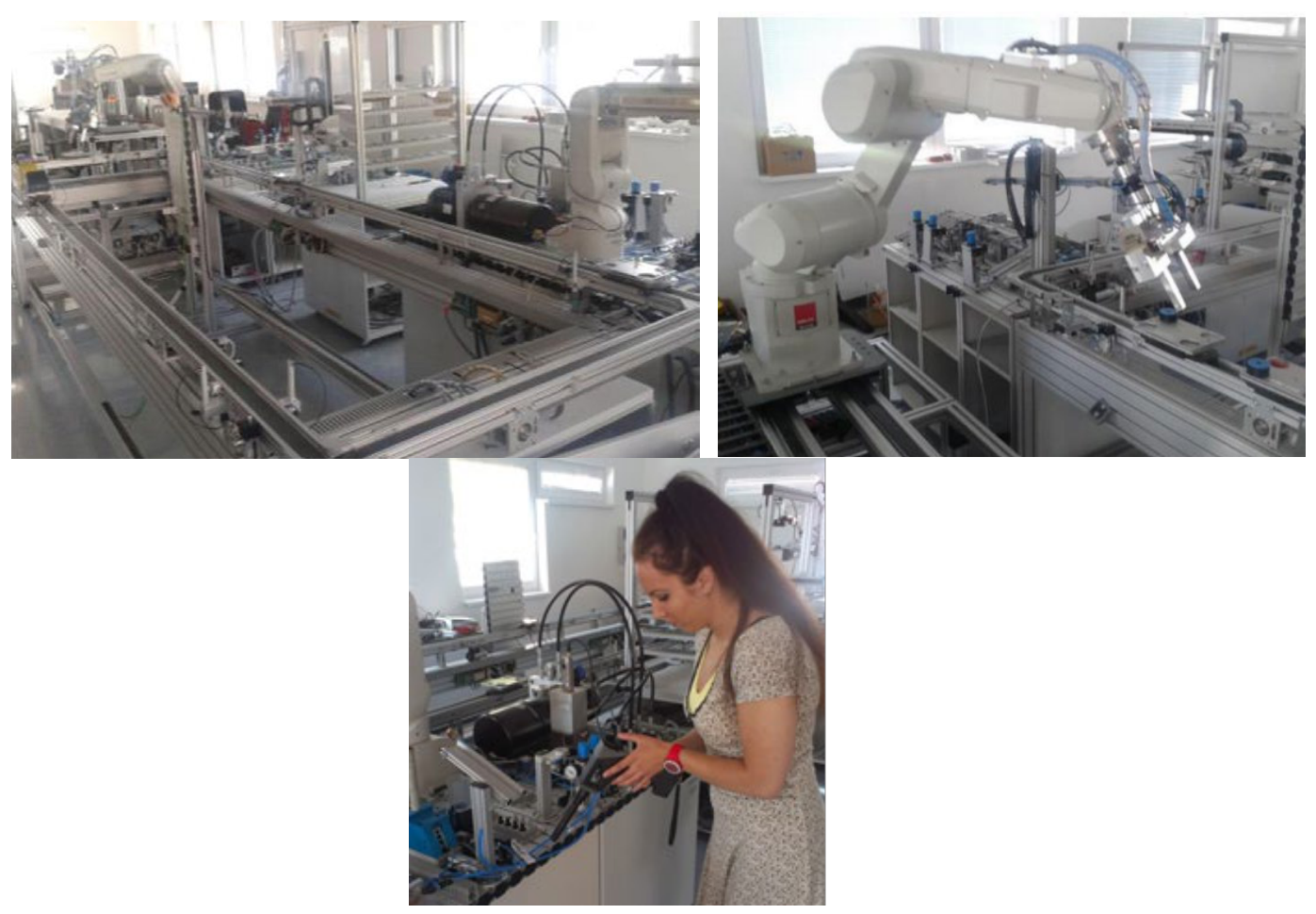
Figure 2.
Four-stage MES–IMS integration methodology. Stages progress from system characterisation (Stage 1) through activity definition (Stage 2), architectural modelling (Stage 3), and data specification (Stage 4).
Figure 2.
Four-stage MES–IMS integration methodology. Stages progress from system characterisation (Stage 1) through activity definition (Stage 2), architectural modelling (Stage 3), and data specification (Stage 4).
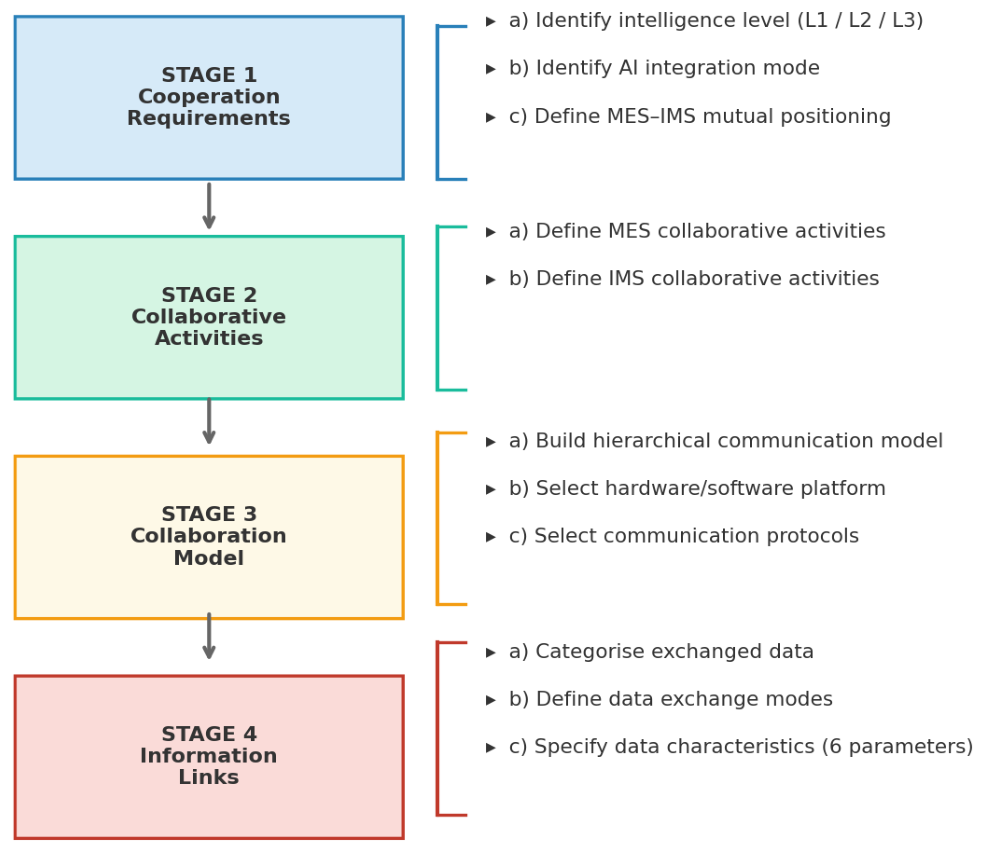
Figure 3.
Hierarchical MES–IMS communication model. Tier 1: intelligent machines and PLCs connected via PROFINET. Tier 2: MES with OPC-UA client subscriptions. Tier 3: ERP connected via REST/B2MML. Fault escalation path shown in red.
Figure 3.
Hierarchical MES–IMS communication model. Tier 1: intelligent machines and PLCs connected via PROFINET. Tier 2: MES with OPC-UA client subscriptions. Tier 3: ERP connected via REST/B2MML. Fault escalation path shown in red.
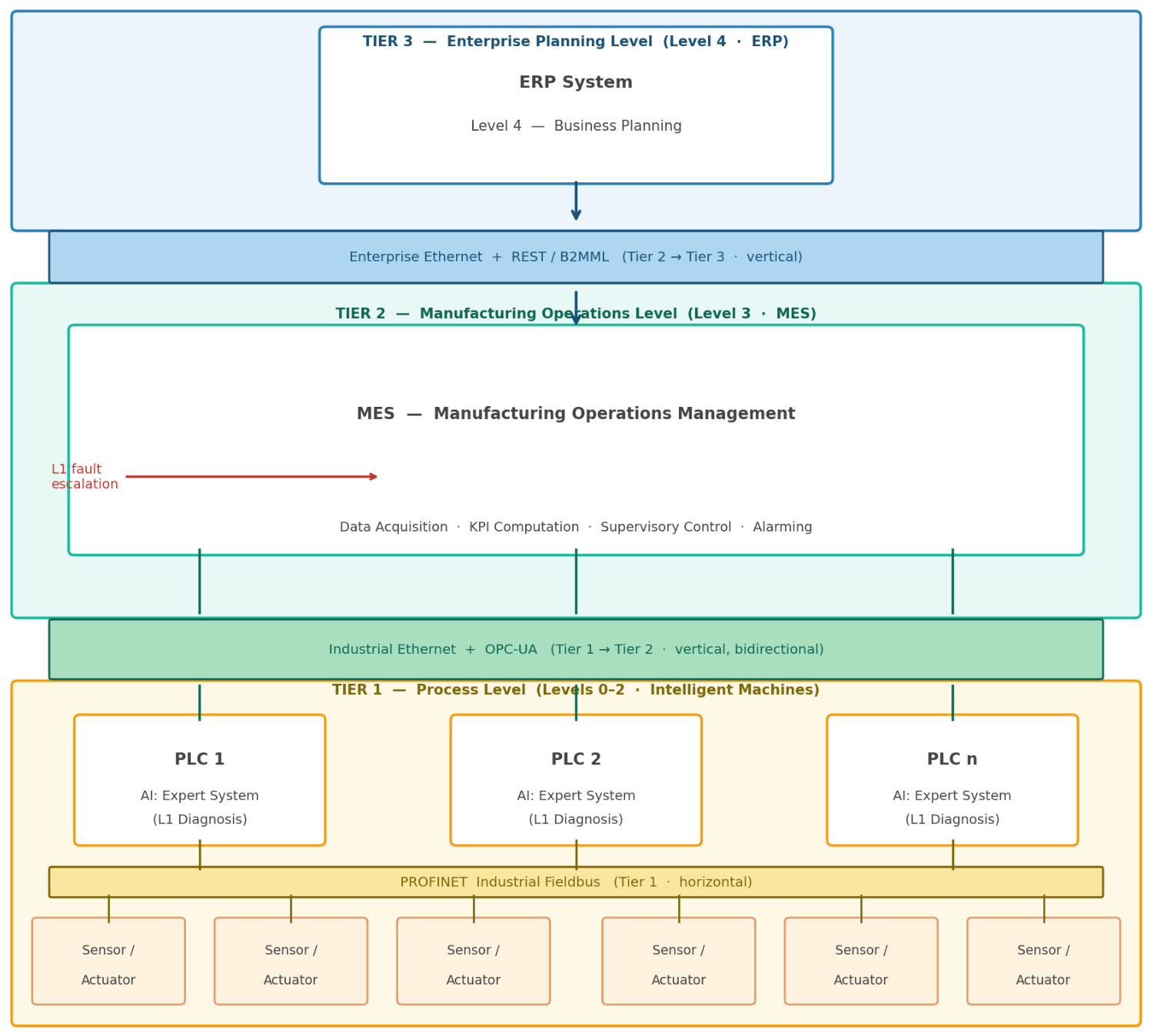
Figure 4.
Material flow in FMS 500.
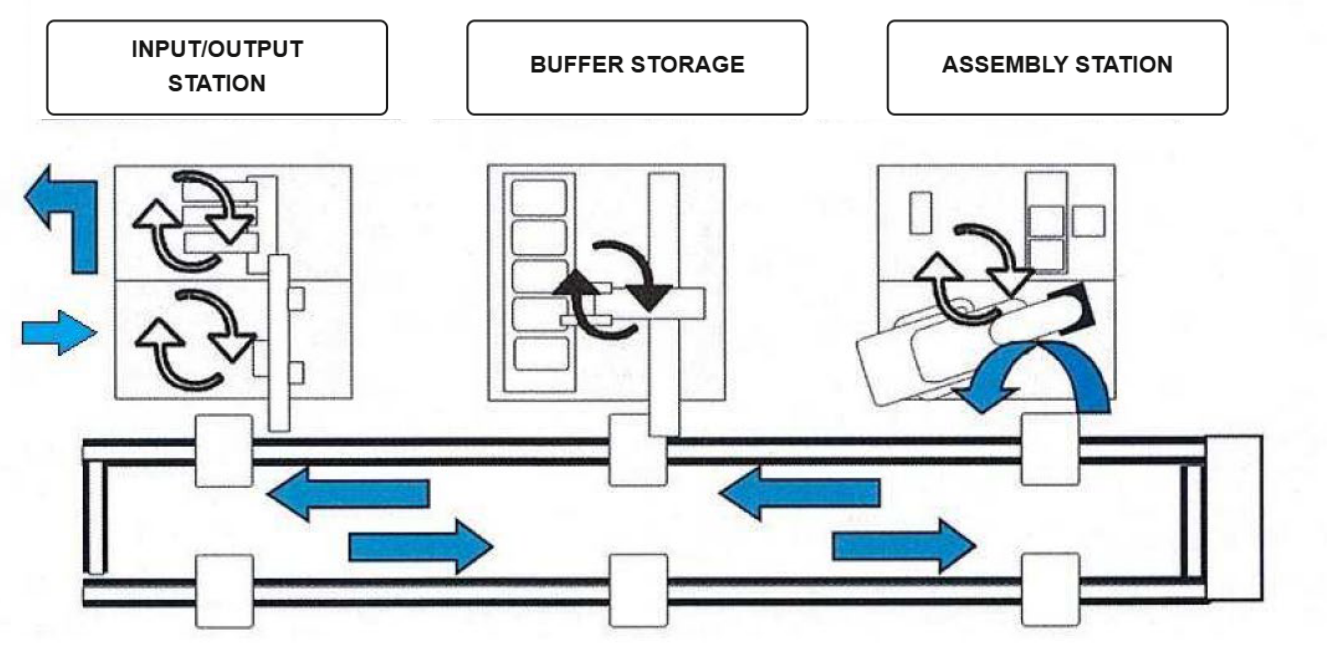
Figure 5.
MES data-to-KPI transformation flow. Input data streams from Tier 1 are processed by the MES computation engine to produce 23 KPIs organised across four semantic classes.
Figure 5.
MES data-to-KPI transformation flow. Input data streams from Tier 1 are processed by the MES computation engine to produce 23 KPIs organised across four semantic classes.
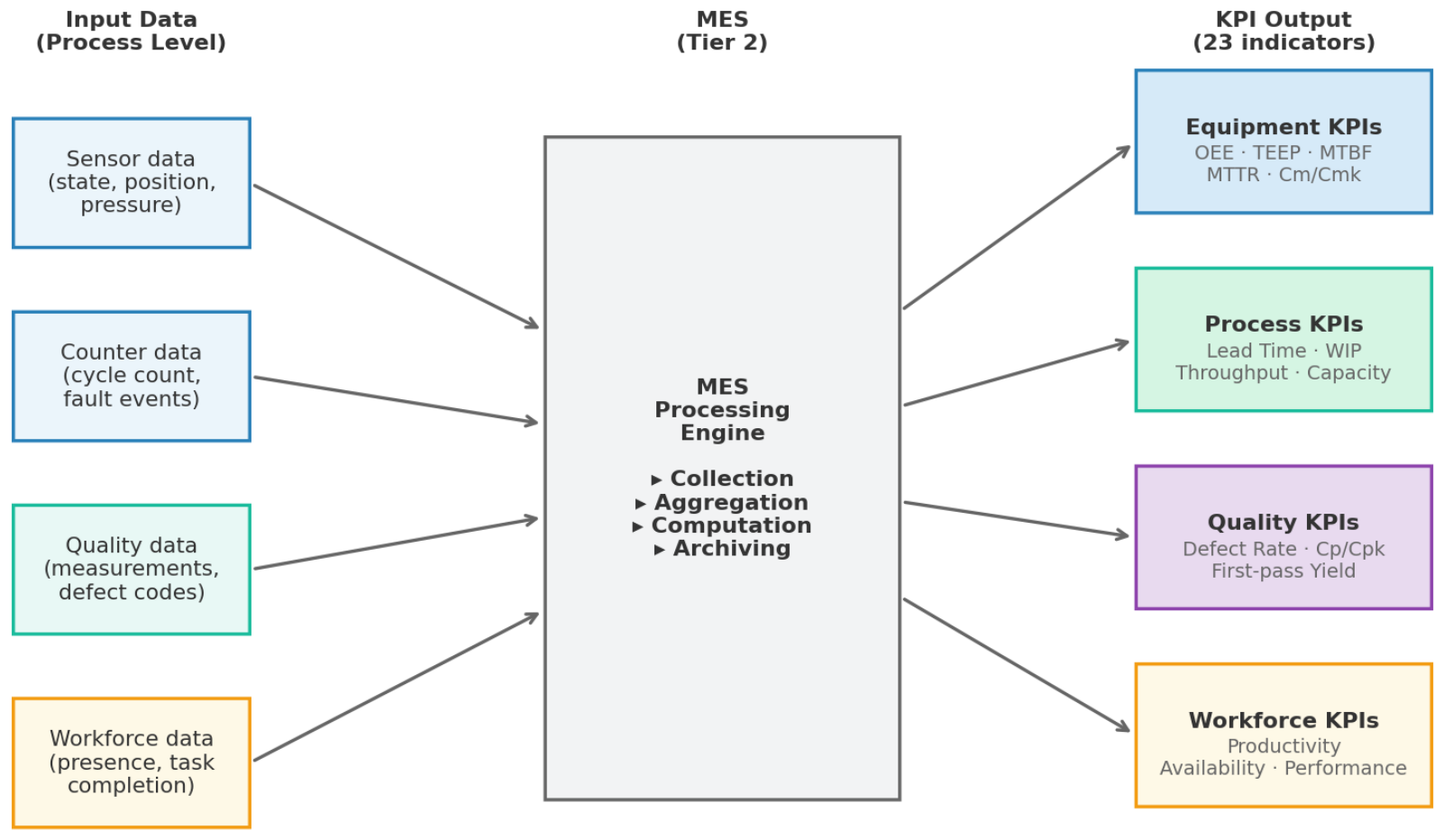
Figure 6.
MES – IMS hierarchical integration framework – summary.
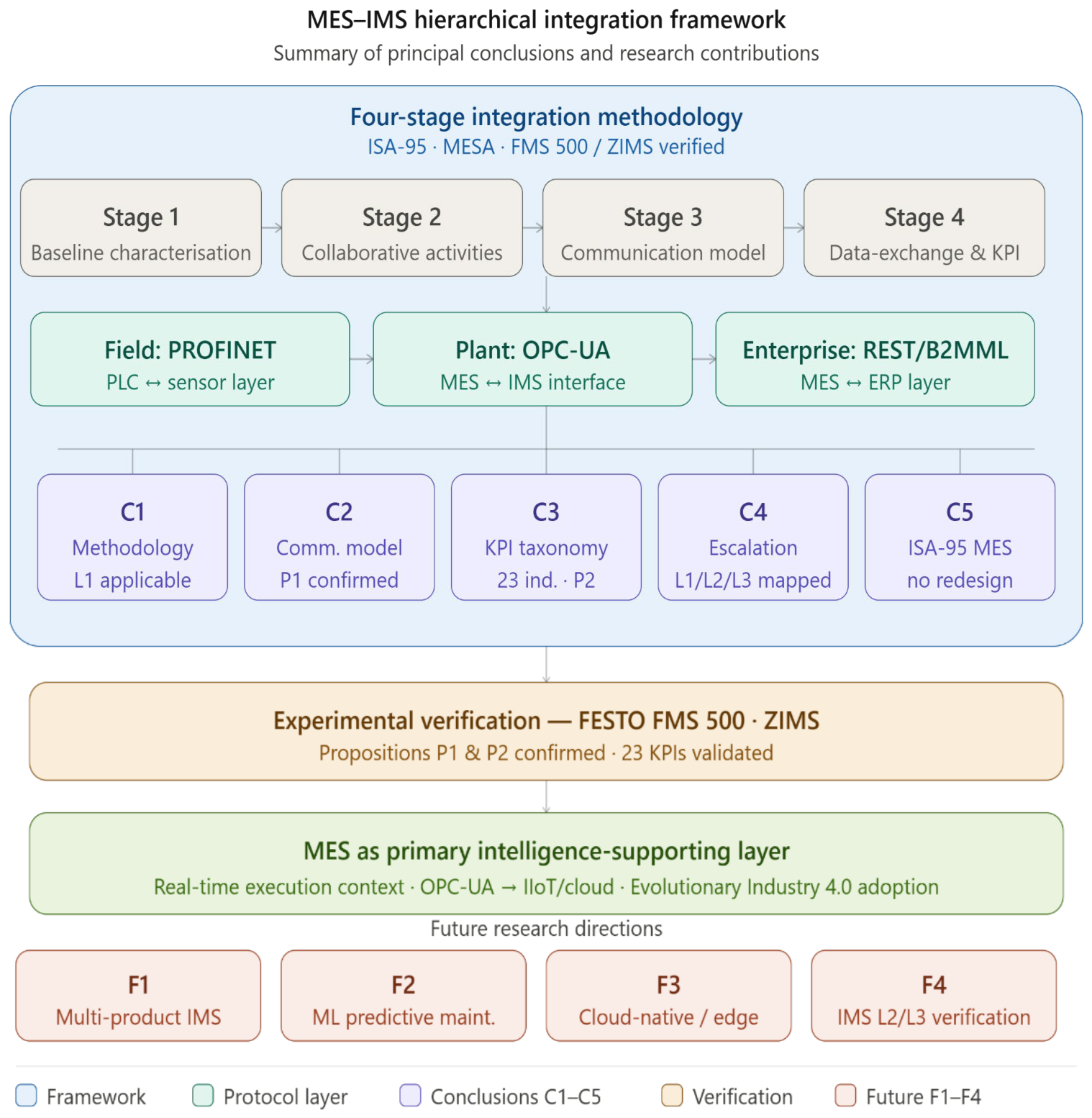
Table 2.
AI tool applicability matrix across three enterprise tiers. Representative applications are listed for each cell.
Table 2.
AI tool applicability matrix across three enterprise tiers. Representative applications are listed for each cell.
| AI Tool | Tier 1 — Process | Tier 2 — MES | Tier 3 — Enterprise |
|---|---|---|---|
| Fuzzy logic | PLC setpoint optimisation, process control adaptation |
Production scheduling, quality analysis [23] |
ERP system selection, decision support |
| Neural networks | Tool wear classification, sensor signal processing |
Predictive maintenance scheduling [24] |
Cost estimation, demand forecasting |
| Expert systems | L1 fault diagnosis in PLC (FMS 500) |
Process planning, MES supervisory escalation |
ERP decision support, audit compliance |
| Genetic algorithms | PLC setpoint sequence optimisation |
MES dynamic job scheduling [34] |
Supplier selection, resource allocation |
| Predictive algorithms | Condition monitoring, predictive signal trends |
Fault prognosis, preventive maintenance |
SAP demand forecasting, business analytics |
| Multi-agent/Holonic | Peer PLC negotiation, cell coordination |
Holonic MES architecture, production rescheduling [32] |
Supply chain holons, enterprise MAS [33] |
| Image recognition | Vision sensors for quality inspection |
MES traceability, batch genealogy |
Document processing, reporting automation |
Table 3.
FMS 500 KPI specification summary. All 23 indicators are computable from existing PROFINET/OPC-UA infrastructure.
Table 3.
FMS 500 KPI specification summary. All 23 indicators are computable from existing PROFINET/OPC-UA infrastructure.
| Station | KPI | Definition | Data Source |
|---|---|---|---|
| I/O Station | Buffer occupancy (input) | Count of Part 1 items awaiting assembly | PLC position sensor |
| Buffer occupancy (output) | Count of completed assemblies in magazine | PLC position sensor | |
| Vacant buffer positions | Free slots in I/O magazine (max 20) | Computed by MES | |
| Operational state | Ready / Busy / Error (3 fault sub-categories) | PLC state register | |
| Assembly/Disasm. | Assembled unit count | Units assembled per time period | PLC cycle counter |
| Sub-component inventory | Parts 2, 3, 4 remaining in station magazines | PLC sensor | |
| Operational state | Ready / Busy / Error (3 fault sub-categories) | PLC state register | |
| Interm. Buffer | Buffer occupancy (%) | (Occupied positions / 20) × 100 [%] | PLC sensor |
| Item classification | Count of finished vs. semi-finished units | PLC sensor + MES | |
| System level | OEE | Availability × Performance × Quality [%] | MES computation |
| MTBF | 1 / Fault intensity [h] | MES computation | |
| Throughput rate | Assemblies per minute [ks/min] | MES computation | |
| WIP inventory | Total unfinished assemblies in system | MES real-time | |
| Manufacturing lead time | Order release to finished goods [min] | MES computation |
Disclaimer/Publisher’s Note: The statements, opinions and data contained in all publications are solely those of the individual author(s) and contributor(s) and not of MDPI and/or the editor(s). MDPI and/or the editor(s) disclaim responsibility for any injury to people or property resulting from any ideas, methods, instructions or products referred to in the content. |
© 2026 by the authors. Licensee MDPI, Basel, Switzerland. This article is an open access article distributed under the terms and conditions of the Creative Commons Attribution (CC BY) license (http://creativecommons.org/licenses/by/4.0/).
Copyright: This open access article is published under a Creative Commons CC BY 4.0 license, which permit the free download, distribution, and reuse, provided that the author and preprint are cited in any reuse.


