
Submitted:
19 June 2026
Posted:
23 June 2026
You are already at the latest version
Abstract
Background: Inter-limb asymmetry has been widely studied as a potential determinant of physical performance in able-bodied athletes; however, its functional relevance in athletes with neurological impairments such as spastic hemiparesis remains unclear. This study aimed to examine the associations between lower-limb isometric strength, inter-limb asymmetry, physical performance, and match external-load variables in elite CP football players. Methods: Eleven male football players with spastic hemiparesis from the Spanish national team competing at the 2024 IFCPF World Cup participated in this observational cross-sectional study. Maximal isometric strength of the soleus, adductors, and hamstrings was assessed using a belt-stabilised dynamometer. Inter-limb asymmetry was calculated as a percentage difference between affected and non-affected limbs. Physical performance was evaluated using sprint, change-of-direction, dribbling, and intermittent endurance tests. Match external-load variables were collected during official competition using inertial measurement units. Associations were analysed using Spearman’s rank correlations, and between-group comparisons were conducted using a median split based on asymmetry magnitude. Results: Inter-limb asymmetry did not significantly differentiate physical performance outcomes across any field-based tests (p > .05). Isometric strength showed limited associations with performance variables, with a significant correlation between non-affected adductor strength and intermittent endurance (ρ = 0.63; p < .05). Soleus asymmetry was negatively associated with dribbling performance (ρ = −0.64; p < .05) and showed moderate-to-strong correlations with several match external-load variables, including mechanical work (ρ = −0.84; p < .01) and metabolic power (ρ = −0.83; p < .01). Conclusions: Inter-limb strength asymmetry did not appear to be a primary determinant of physical performance in CP football players with spastic hemiparesis. These findings suggest that asymmetry may represent a structural characteristic rather than a modifiable constraint, with athletes developing compensatory strategies to maintain performance. However, asymmetry in plantar flexor strength may influence match-specific physical demands, highlighting the importance of context-specific interpretation.
Keywords:
1. Introduction
2. Materials and Methods
2.1. Design
2.2. Participants
2.3. Procedures
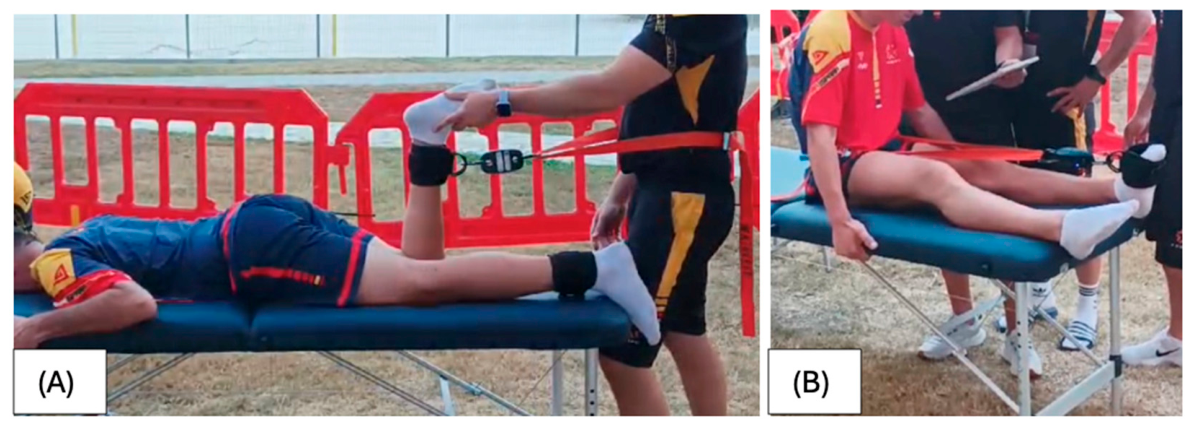
2.3.1. Isometric Strength and Asymmetry Assessment
2.3.2. Field-Based Physical Performance Assessment
2.3.3. Match External-Load Variables
- Global locomotor load: total distance per minute (m·min−1) and average velocity (km·h−1), representing overall movement volume and pace
- Locomotor intensity distribution: distance per minute at low, moderate, and high intensities (m·min−1), reflecting distribution of movement across speed zones
- Neuromuscular actions: number of accelerations and decelerations per minute (n·min−1), maximum and average acceleration/deceleration (m·s−2), and distance and frequency of moderate- and high-intensity accelerations/decelerations
- Explosive and sprint actions: explosive distance (m·min−1), sprint frequency (n·min−1), sprint distance (m·min−1), and maximum velocity (km·h−1)
- Mechanical and metabolic load: Player Load (AU·min−1), mechanical work (kJ·min−1), metabolic power (W·kg−1), and high metabolic load distance (m·min−1), providing an integrated estimate of the mechanical and energetic demands of match play.
2.4. Statistical Analysis
3. Results
4. Discussion
4.1. Methodological Considerations and Limitations
4.2. Practical Applications
5. Conclusions
Author Contributions
Funding
Institutional Review Board Statement
Informed Consent Statement
Data Availability Statement
Acknowledgments
Conflicts of Interest
Abbreviations
| CP | Cerebral palsy |
| COD | Change of direction |
| MVIC | Maximal voluntary isometric contraction |
| MAT | Modified Agility Test |
| MAT-B | Modified Agility Test with ball |
| Yo-Yo IR1 | Yo-Yo Intermittent Recovery Test Level 1 |
| IFCPF | International Federation of Cerebral Palsy Football |
| IMU | Inertial measurement unit |
| FT1 | Football class 1 |
| FT2 | Football class 2 |
| FT3 | Football class 3 |
| ICC | Intraclass correlation coefficient |
| SD | Standard deviation |
| ρ | Spearman’s rank correlation coefficient |
| GPS | Global Positioning System |
References
- Rosenbaum, P.; Paneth, N.; Leviton, A.; Goldstein, M.; Bax, M.; Damiano, D.; Dan, B.; Jacobsson, B. A report: the definition and classification of cerebral palsy April 2006. Dev. Med. Child Neurol. Suppl. 2007, 109, 8–14. [Google Scholar] [CrossRef] [PubMed]
- Graham, H.K.; Rosenbaum, P.; Paneth, N.; Dan, B.; Lin, J.P.; Damiano, D.L.; Becher, J.G.; Gaebler-Spira, D.; Colver, A.; Reddihough, D.S.; et al. Cerebral palsy. Nat. Rev. Dis. Prim. 2016, 2, 15082. [Google Scholar] [CrossRef] [PubMed]
- Clewes, O.; Skerritt, C.; Kumar, R.; Day, M.; Bhatt, H.; Sherrat, F.; Sharma, S.; Lindley, R. A systematic review of the neuromuscular impairments of spastic cerebral palsy and the evidence base for interventions. J. Pediatr. Rehabil. Med. 2024, 17, 195–211. [Google Scholar] [CrossRef]
- Reina, R.; Iturricastillo, A.; Castillo, D.; Urbán, T.; Ruiz-Perez, I. Match and training external loads of cerebral palsy football players according to sport classes. Int. J. Environ. Res. Public Health 2020, 17, 6701. [Google Scholar] [CrossRef] [PubMed]
- Bishop, C.; Turner, A.; Read, P. Effects of inter-limb asymmetries on physical and sports performance: a systematic review. J. Sports Sci. 2018, 36, 1135–1144. [Google Scholar] [CrossRef] [PubMed]
- Ličen, S.; Kozinc, Z. The effect of lower inter-limb asymmetries on athletic performance: a systematic review and meta-analysis. PLoS ONE 2023, 18, e0286942. [Google Scholar] [CrossRef] [PubMed]
- Helme, M.; Tee, J.; Emmonds, S.; Low, C. Does lower-limb asymmetry increase injury risk in sport? A systematic review. Phys. Ther. Sport 2021, 49, 103–116. [Google Scholar] [CrossRef] [PubMed]
- Buchheit, M.; Simpson, B.M. Player-Tracking Technology: Half-Full or Half-Empty Glass? Int. J. Sports Physiol. Perform. 2017, 12 (Suppl 2), S235–S241. [Google Scholar] [CrossRef] [PubMed]
- Bradley, P.S.; Ade, J.D. Are Current Physical Match Performance Metrics in Elite Soccer Fit for Purpose or Is the Adoption of an Integrated Approach Needed? Int. J. Sports Physiol. Perform. 2018, 1;13(5), 656–664. [Google Scholar] [CrossRef] [PubMed]
- Peña-González, I.; Maggiolo, M.; Roldán, A.; Moya-Ramón, M. Physical fitness determinants of international competitive status in CP football. J. Sports Sci. 2025. [Google Scholar]
- Andersson, C.; Grooten, W.; Hellsten, M.; Kaping, K.; Mattsson, E. Adults with cerebral palsy: walking ability after progressive strength training. Dev. Med. Child Neurol. 2018, 45, 220–228. [Google Scholar] [CrossRef]
- Reina, R.; Roldán, A.; Urbán, T.; Iturricastillo, A.; Castellote, J.M. Spasticity and its influence on motor function and sport performance in CP football players with spastic hemiparesis. Int. J. Environ. Res. Public Health 2022, 19, 3847. [Google Scholar] [CrossRef] [PubMed]
- Caña-Pino, A.; Apolo-Arenas, M.D.; Peña-González, I. Assessment by Surface Electromyography in International Football Players with Cerebral Palsy-A Pilot Study. J. Funct. Morphol. Kinesiol. 2025, 10(2), 125. [Google Scholar] [CrossRef] [PubMed]
- Kokaly, M.; Muñoz-Cofré, R.; Bravo-Fuentes, M.; Reyes-Contreras, F.; González-Cañete, N. Isokinetic knee strength and inter-limb asymmetry in CP football players. Int. J. Environ. Res. Public Health 2023, 20, 4198. [Google Scholar] [CrossRef] [PubMed]
- Maggiolo, M.; Peña-González, I.; Roldán, A.; Moya-Ramón, M. Inter-limb anthropometric asymmetry and physical performance in CP footballers with spastic hemiplegia. J. Sports Sci. 2025c. [Google Scholar]
- van Melick, N.; Meddeler, B.M.; Hoogeboom, T.J.; Nijhuis-van der Sanden, M.W.G.; van Cingel, R.E.H. How to determine leg dominance: The agreement between self-reported and observed performance in healthy adults. PLoS ONE 2017, 12, e0189876. [Google Scholar] [CrossRef] [PubMed]
- Aerts, W.; Peers, K.; Vleugels, M.; Loon, E.V.; Vandenberghe, T.; Van Campenhout, A. Reliability of handheld dynamometry using a belt stabilisation system in children and adolescents with cerebral palsy. Dev. Med. Child Neurol. 2025. [Google Scholar]
- Portilla-Cueto, K.; Mendiguchia, J.; Lesinski, M.; Granacher, U.; Caraballo, I.; Chaabene, H. Reliability and validity of handheld dynamometry for the assessment of lower-limb muscle strength in para-athletes. Int. J. Environ. Res. Public Health 2022, 19, 10774. [Google Scholar] [CrossRef] [PubMed]
- Adachi, T.; Yamada, S.; Ota, Y.; Kato, K.; Hirasawa, Y.; Uchida, Y. Test-retest reliability and measurement error of isometric muscle strength assessed with a hand-held dynamometer in people with neurological conditions. Disabil. Rehabil. 2025. [Google Scholar]
- van der Woude, L.H.V.; de Groot, S.; Bijker, K.E.; Dekker, R.; Janssen, T.W.J. Peak force reliability in isometric testing of muscle groups across populations with and without neurological conditions. J. Rehabil. Med. 2022, 54, jrm00251. [Google Scholar] [CrossRef]
- Bishop, C.; Read, P.; Chavda, S.; Turner, A. Asymmetries of the lower limb: the calculation conundrum in strength training and conditioning. Strength Cond. J. 2019, 38, 27–32. [Google Scholar] [CrossRef]
- Gómez-Carmona, C.D.; Bastida-Castillo, A.; García-Rubio, J.; Ibáñez, S.J.; Pino-Ortega, J. Static and dynamic reliability of WIMU PRO™ accelerometers according to anatomical placement. Proc. Inst. Mech. Eng. Part P J. Sports Eng. Technol. 2019, 233, 238–248. [Google Scholar] [CrossRef]
- Exell, T.A.; Irwin, G.; Gittoes, M.J.R.; Kerwin, D.G. Implications of intra-limb variability on asymmetry analyses. J. Sports Sci. 2012, 30, 403–409. [Google Scholar] [CrossRef] [PubMed]
- D'Emanuele, S.; Biscarini, A.; Greco, G.; Fischetti, F.; Benedini, S.; Raiola, G.; Adamo, S. Neuromuscular asymmetries are highly prevalent in athletic populations and may represent a normal functional characteristic. Front. Physiol. 2025, 16, 1543742. [Google Scholar] [CrossRef]
- Parkinson, A.O.; Apps, C.L.; Morris, J.G.; Dodd, J.; Lewis, M.G.C. The calculation, thresholds and reporting of inter-limb strength asymmetry: a systematic review. J. Sports Sci. Med. 2021, 20, 594–617. [Google Scholar] [CrossRef] [PubMed]
- Kozinc, Z.; Šarabon, N. Inter-limb asymmetries in young tennis players: assessment and relationship with performance. J. Sports Sci. Med. 2020, 19, 594–603. [Google Scholar]
- Dos'Santos, T.; Thomas, C.; Comfort, P.; Jones, P.A. The Effect of Angle and Velocity on Change of Direction Biomechanics: An Angle-Velocity Trade-Off. Sports Med. 2018, 48(10), 2235–2253. [Google Scholar] [CrossRef] [PubMed]
- Reina, R.; Roldán, A.; Morán, M.; Iturricastillo, A.; Shearer, D. A case study of para-sport classification in CP football: the impact of sport class on physical fitness. Int. J. Sports Physiol. Perform. 2021, 16, 571–578. [Google Scholar] [CrossRef]
- Runciman, P.; Derman, W.; Ferreira, S.; Albertus-Kajee, Y.; Tucker, R. A descriptive comparison of sprint cycling performance and neuromuscular characteristics in able-bodied athletes and Paralympic athletes with cerebral palsy. Am. J. Phys. Med. Rehabil. 2016, 95, 1–10. [Google Scholar] [CrossRef] [PubMed]
- Dos'Santos, T.; Thomas, C.; Jones, P.A.; Comfort, P. Asymmetries in isometric force-time characteristics are not detrimental to change of direction speed. J. Strength Cond. Res. 2018, 31, 3357–3366. [Google Scholar] [CrossRef] [PubMed]
- Fiorese, L.; Nakamura, F.Y.; Lorenzetti, S.; Zagatto, A.M.; Peyre-Tartaruga, L.A. Intersegmental coordination during change of direction in players with and without cerebral palsy. J. Sports Sci. 2020, 38, 1342–1349. [Google Scholar] [CrossRef]
- Impellizzeri, F.M.; Marcora, S.M.; Coutts, A.J. Internal and external training load: 15 years on. Int. J. Sports Physiol. Perform. 2019, 14, 270–273. [Google Scholar] [CrossRef] [PubMed]
- Croisier, J.L.; Ganteaume, S.; Binet, J.; Genty, M.; Ferret, J.M. Strength imbalances and prevention of hamstring injury in professional soccer players: a prospective study. Am. J. Sports Med. 2008, 36, 1469–1475. [Google Scholar] [CrossRef] [PubMed]
- Guan, Y.; Bredin, S.S.D.; Taunton, J.; Jiang, Q.; Wu, N.; Warburton, D.E.R. Relationship between inter-limb muscle strength asymmetry and injury risk in sports: a systematic review. J. Hum. Kinet. 2022, 85, 67–82. [Google Scholar] [CrossRef] [PubMed]

| Muscle Group | Affected Limb (N) | Non-Affected Limb (N) | Asymmetry (%) |
| Soleus | 79.29 ± 27.42 | 115.44 ± 51.11 | 46.58 ± 42.47 |
| Adductors | 123.38 ± 54.47 | 173.60 ± 57.08 | 49.83 ± 39.17 |
| Hamstrings | 131.88 ± 56.27 | 225.75 ± 66.21 | 81.81 ± 40.30 |
| Variable |
Soleus (A) |
Soleus (NA) |
Adductors (A) |
Adductors (NA) |
Hamstrings (A) |
Hamstrings (NA) |
Soleus Asymmetry (%) | Adductors Asymmetry (%) | Hamstrings Asymmetry (%) | ||
| 5 m sprint (s) | -0.47 | -0.49 | -0.39 | -0.32 | -0.19 | 0.04 | -0.27 | 0.23 | 0.35 | ||
| 15 m sprint (s) | -0.32 | -0.42 | -0.26 | -0.31 | -0.08 | -0.06 | -0.29 | 0.10 | 0.11 | ||
| 30 m sprint (s) | -0.33 | -0.52 | -0.17 | -0.32 | 0.02 | -0.05 | -0.47 | -0.02 | 0.04 | ||
| MAT (s) | -0.52 | -0.46 | -0.42 | -0.42 | -0.26 | -0.06 | -0.41 | 0.16 | 0.19 | ||
| MAT-B (s) | -0.33 | -0.58 | -0.08 | -0.49 | -0.03 | -0.21 | -0.64* | -0.33 | -0.03 | ||
| Dribbling ability (s) | -0.08 | -0.28 | 0.06 | -0.34 | -0.01 | -0.25 | -0.39 | -0.40 | -0.09 | ||
| Yo-Yo IR1 (m) | 0.38 | 0.38 | 0.57 | 0.63* | 0.51 | 0.53 | 0.11 | -0.09 | -0.27 | ||
| Variable | Soleus Asymmetry (%) | Adductors Asymmetry (%) | Hamstrings Asymmetry (%) |
| Global locomotor load | |||
| Total distance per min (m·min−1) | -0.14 | -0.05 | 0.04 |
| Average velocity (km·h−1) | -0.43 | -0.05 | 0.17 |
| Locomotor intensity distribution | |||
| Low-intensity distance (m·min−1) | 0.02 | 0.26 | 0.38 |
| Moderate-intensity distance (m·min−1) | -0.40 | -0.16 | -0.03 |
| High-intensity distance (m·min−1) | 0.28 | -0.24 | -0.24 |
| Neuromuscular actions (accelerations/decelerations) | |||
| Accelerations per min (n·min−1) | 0.54 | 0.30 | 0.19 |
| Decelerations per min (n·min−1) | 0.54 | 0.30 | 0.19 |
| Max acceleration (m·s−2) | 0.46 | -0.13 | -0.14 |
| Max deceleration (m·s−2) | -0.44 | -0.06 | 0.04 |
| Avg acceleration (m·s−2) | -0.48 | -0.05 | 0.03 |
| Avg deceleration (m·s−2) | 0.31 | 0.02 | 0.11 |
| High-intensity accelerations (n·min−1) | 0.16 | -0.17 | -0.29 |
| High-intensity decelerations (n·min−1) | 0.15 | -0.19 | -0.27 |
| Distance in high-intensity accelerations (m·min−1) | 0.55 | -0.08 | -0.22 |
| Distance in high-intensity decelerations (m·min−1) | 0.49 | -0.04 | -0.21 |
| Distance in moderate accelerations (m·min−1) | -0.25 | -0.01 | 0.03 |
| Distance in moderate decelerations (m·min−1) | -0.18 | -0.09 | -0.08 |
| Explosive and sprint actions | |||
| Explosive distance (m·min−1) | 0.06 | 0.02 | -0.01 |
| Sprints per min (n·min−1) | 0.39 | -0.10 | -0.20 |
| Sprint distance per min (m·min−1) | 0.44 | -0.16 | -0.28 |
| Maximum velocity (km·h−1) | 0.54 | -0.08 | -0.13 |
| Mechanical and metabolic load | |||
| Player load per min (AU·min−1) | -0.62* | 0.15 | 0.27 |
| Mechanical work per min (kJ·min−1) | -0.84** | -0.26 | -0.12 |
| Metabolic power (W·kg−1) | -0.83** | -0.27 | -0.09 |
| High metabolic load distance (m·min−1) | -0.24 | -0.18 | -0.10 |
| Physical performance variable | Soleus Asymmetry | ||||
| High | Moderate | U | p | r | |
| 5 m sprint (s) | 1.18 ± 0.06 | 1.20 ± 0.09 | 16.00 | 0.927 | 0.07 |
| 15 m sprint (s) | 2.74 ± 0.08 | 2.84 ± 0.24 | 16.50 | 0.854 | 0.10 |
| 30 m sprint (s) | 4.75 ± 0.13 | 4.89 ± 0.36 | 19.00 | 0.537 | 0.27 |
| MAT (s) | 5.76 ± 0.20 | 6.02 ± 0.41 | 20.00 | 0.429 | 0.33 |
| MAT-B (s) | 8.43 ± 0.42 | 8.89 ± 0.97 | 22.00 | 0.247 | 0.47 |
| Dribbling ability (s) | 2.67 ± 0.56 | 2.87 ± 0.78 | 19.00 | 0.537 | 0.27 |
| Yo-Yo IR1 (m) | 1088 ± 314 | 1227 ± 500 | 17.00 | 0.783 | 0.13 |
| Physical performance variable | Adductor Asymmetry | ||||
| High | Moderate | U | p | r | |
| 5 m sprint (s) | 1.18 ± 0.06 | 1.20 ± 0.09 | 13.00 | 0.783 | -0.13 |
| 15 m sprint (s) | 2.73 ± 0.09 | 2.85 ± 0.23 | 16.50 | 0.854 | 0.10 |
| 30 m sprint (s) | 4.76 ± 0.14 | 4.88 ± 0.35 | 17.00 | 0.792 | 0.13 |
| MAT (s) | 5.83 ± 0.21 | 5.96 ± 0.44 | 14.00 | 0.931 | -0.07 |
| MAT-B (s) | 8.59 ± 0.47 | 8.76 ± 1.01 | 18.00 | 0.662 | 0.20 |
| Dribbling ability (s) | 2.71 ± 0.55 | 2.84 ± 0.80 | 20.00 | 0.429 | 0.33 |
| Yo-Yo IR1 (m) | 1127 ± 336 | 1200 ± 505 | 13.00 | 0.783 | -0.13 |
| Physical performance variable | Hamstrings Asymmetry | ||||
| High | Moderate | U | p | r | |
| 5 m sprint (s) | 1.17 ± 0.05 | 1.21 ± 0.10 | 13.00 | 0.783 | -0.13 |
| 15 m sprint (s) | 2.72 ± 0.09 | 2.86 ± 0.23 | 16.50 | 0.854 | 0.10 |
| 30 m sprint (s) | 4.75 ± 0.15 | 4.90 ± 0.35 | 17.00 | 0.792 | 0.13 |
| MAT (s) | 5.80 ± 0.22 | 6.00 ± 0.43 | 14.00 | 0.931 | -0.07 |
| MAT-B (s) | 8.50 ± 0.48 | 8.85 ± 0.98 | 18.00 | 0.662 | 0.20 |
| Dribbling ability (s) | 2.69 ± 0.56 | 2.86 ± 0.79 | 20.00 | 0.429 | 0.33 |
| Yo-Yo IR1 (m) | 1100 ± 330 | 1215 ± 510 | 13.00 | 0.783 | -0.13 |
Disclaimer/Publisher’s Note: The statements, opinions and data contained in all publications are solely those of the individual author(s) and contributor(s) and not of MDPI and/or the editor(s). MDPI and/or the editor(s) disclaim responsibility for any injury to people or property resulting from any ideas, methods, instructions or products referred to in the content. |
© 2026 by the authors. Licensee MDPI, Basel, Switzerland. This article is an open access article distributed under the terms and conditions of the Creative Commons Attribution (CC BY) license.


