
Preprint
Article

This version is not peer-reviewed.

Inter-Limb Asymmetry and Its Limited Role in Physical Performance and Match Demands in Football Players with Spastic Hemiparesis: A Team Study

Submitted:

19 June 2026

Posted:

23 June 2026

You are already at the latest version

Abstract

Background: Inter-limb asymmetry has been widely studied as a potential determinant of physical performance in able-bodied athletes; however, its functional relevance in athletes with neurological impairments such as spastic hemiparesis remains unclear. This study aimed to examine the associations between lower-limb isometric strength, inter-limb asymmetry, physical performance, and match external-load variables in elite CP football players. Methods: Eleven male football players with spastic hemiparesis from the Spanish national team competing at the 2024 IFCPF World Cup participated in this observational cross-sectional study. Maximal isometric strength of the soleus, adductors, and hamstrings was assessed using a belt-stabilised dynamometer. Inter-limb asymmetry was calculated as a percentage difference between affected and non-affected limbs. Physical performance was evaluated using sprint, change-of-direction, dribbling, and intermittent endurance tests. Match external-load variables were collected during official competition using inertial measurement units. Associations were analysed using Spearman’s rank correlations, and between-group comparisons were conducted using a median split based on asymmetry magnitude. Results: Inter-limb asymmetry did not significantly differentiate physical performance outcomes across any field-based tests (p > .05). Isometric strength showed limited associations with performance variables, with a significant correlation between non-affected adductor strength and intermittent endurance (ρ = 0.63; p < .05). Soleus asymmetry was negatively associated with dribbling performance (ρ = −0.64; p < .05) and showed moderate-to-strong correlations with several match external-load variables, including mechanical work (ρ = −0.84; p < .01) and metabolic power (ρ = −0.83; p < .01). Conclusions: Inter-limb strength asymmetry did not appear to be a primary determinant of physical performance in CP football players with spastic hemiparesis. These findings suggest that asymmetry may represent a structural characteristic rather than a modifiable constraint, with athletes developing compensatory strategies to maintain performance. However, asymmetry in plantar flexor strength may influence match-specific physical demands, highlighting the importance of context-specific interpretation.

Keywords: 
;  ;  ;  ;  ;  ;  ;  

1. Introduction

Cerebral palsy (CP) is the most prevalent childhood-onset physical disability, affecting approximately 1.5–3 per 1,000 live births worldwide [1], and is characterised by a wide spectrum of permanent motor impairments including spasticity, muscle weakness, impaired selective motor control, and altered intersegmental coordination [2]. Among its clinical subtypes, spastic hemiparesis — defined by unilateral involvement of the upper and lower extremities — is the most frequently occurring form, representing between 38% and 42% of all CP cases [1]. From a neurophysiological standpoint, spastic CP is characterised by four primary interrelated neuromuscular impairments: muscle weakness, shortened muscle-tendon units due to reduced muscle growth relative to skeletal growth, velocity-dependent spasticity, and impaired selective motor control manifested through abnormal flexor and extensor synergies [3]. A direct functional consequence of this unilateral neuromuscular involvement is the emergence of marked inter-limb asymmetries, which in this population are not transient or modifiable training variables, but rather structural characteristics embedded within the individual's neuromuscular profile [4]. Although inter-limb asymmetry has received considerable attention in able-bodied athletes as a potential determinant of physical performance — with evidence of negative associations with sprint and COD ability, though highly task-dependent and methodologically inconsistent across studies [5,6,7] — its functional relevance in athletes with neurological impairments such as spastic hemiparesis remains poorly understood and may differ substantially from non-impaired populations.
CP football is a 7-a-side para-sport played by individuals with CP or acquired brain injury, governed by the International Federation of Cerebral Palsy Football (IFCPF). The sport is characterised by high-intensity intermittent actions —including sprints, changes of direction, accelerations, and decelerations— interspersed with periods of lower-intensity activity and is played on a reduced pitch (70 m × 50 m) under modified FIFA rules [4,8]. To ensure fair and equitable competition, the IFCPF employs an evidence-based functional classification system that groups players into three sport classes (FT1, FT2, and FT3) based on the severity and distribution of their motor impairment, where FT1 represents the highest level of activity limitation and FT3 the lowest [4]. Physical performance in CP football is shaped by the complex interaction between impairment characteristics, sport class, and match contextual factors. Previous studies have demonstrated that players in the FT3 class consistently achieve greater match-running performance than FT1 and FT2 players, covering more distance at high-intensity speeds and executing a higher frequency of explosive neuromuscular actions such as accelerations and decelerations [4,9]. Furthermore, high-intensity running has emerged as the strongest predictor of international competitive status in this population, with change of direction and dribbling performance serving as additional discriminative variables in the more impaired sport classes [10].
From a neuromuscular standpoint, the relationship between lower-limb muscle strength, inter-limb asymmetry, and sport-specific performance in CP football players remains poorly characterised. Isometric strength assessment has been used as a clinically accessible and reliable method for quantifying neuromuscular capacity across populations with neurological impairments, and plantar flexor isometric strength has been shown to independently explain 50–61% of the variance in functional performance in adults with CP [11]. In footballers with CP, spasticity of the lower limb musculature has demonstrated low-to-moderate negative associations with measures of balance, horizontal jump capacity, and COD performance [12]. Additionally, surface electromyography studies in CP footballers have confirmed significantly higher baseline muscle activation in affected lower limbs compared to non-affected limbs and to healthy controls, with lower maximal voluntary contraction levels, reflecting the characteristic co-contraction and impaired selective motor control inherent to spastic hemiparesis [13]. Strength asymmetries in CP footballers have also been documented with isokinetic dynamometry, with the majority of players exhibiting inter-limb deficits exceeding 10% in knee extensor and flexor strength, suggesting a potential association with injury risk factors in this population [14]. More recently, a study examining inter-limb anthropometric asymmetries in international CP footballers with spastic hemiplegia found no significant correlations between asymmetry indices and physical performance outcomes, while conversely identifying the morphological characteristics of the non-affected limb —specifically thigh and calf girth— as significant predictors of strength, jump, and sprint performance [15]. This finding is consistent with the hypothesis that athletes with unilateral impairments develop compensatory motor strategies that prioritise reliance on the non-affected limb for force generation and movement control, particularly in tasks requiring high levels of power output.
While previous research has begun to characterise the functional consequences of neuromuscular impairment in CP football, several important gaps remain. First, the relationship between lower-limb isometric strength in specific muscle groups —particularly the soleus, adductors, and hamstrings— and field-based physical performance outcomes has not been systematically examined in this population. Second, no study to date has explored the potential influence of inter-limb strength asymmetry, derived from standardised isometric assessments, on the external load variables recorded during official competition. Understanding this relationship is of both theoretical and applied relevance, as it could inform the interpretation of match physical demands in the context of individual neuromuscular profiles and contribute to more evidence-based player monitoring and training prescription. Third, the degree to which asymmetry magnitude —categorised according to individual levels rather than arbitrary population thresholds— differentiates physical performance outcomes in this population remains unknown. Addressing these questions may provide valuable insight into the interaction between impairment-related neuromuscular constraints, compensatory movement strategies, and the physical demands of high-level para-football competition.
Therefore, the aim of this study was to examine the associations between lower-limb isometric strength, inter-limb asymmetry, field-based physical performance, and match external-load variables in football players with spastic hemiparesis competing at the 2024 IFCPF World Cup. Given the exploratory and descriptive nature of the investigation, involving a single national team, the findings are intended to contribute to the emerging evidence base on the functional relevance of inter-limb asymmetry in para-sport athletes with neurological impairments.

2. Materials and Methods

2.1. Design

An observational analytical cross-sectional study design was adopted to examine the relationships between lower-limb isometric strength, inter-limb asymmetry, physical performance, and match external-load variables in football players with cerebral palsy. Isometric strength and field-based physical performance assessments were conducted during the training period immediately prior to the 2024 IFCPF World Cup, ensuring a minimum of 24 hours of rest before testing to minimise the potential influence of fatigue on performance outcomes. Match external-load data were collected during official matches played in the same competition.

2.2. Participants

Eleven male football players with spastic hemiparesis from the Spanish national CP football team participated in the study. According to the IFCPF classification system, the sample included 2 FT1, 7 FT2, and 2 FT3 players. Participants had a mean age of 23.73 ± 4.34 years, body mass of 74.68 ± 9.35 kg, and height of 178.42 ± 8.32 cm. All players held a valid competitive licence issued by the Spanish Federation for Athletes with Cerebral Palsy and had at least three years of international competitive experience. Inclusion criteria required players to be injury-free for at least 12 months prior to data collection. All participants provided written informed consent in accordance with the Declaration of Helsinki. The study protocol was approved by the institutional ethics committee (reference: ADH.DES.IPG.JFM.24).

2.3. Procedures

2.3.1. Isometric Strength and Asymmetry Assessment

Maximal isometric strength was assessed using a portable load-cell dynamometer (K-Pull V3, Kinvent®, Montpellier, France), which enables the quantification of tensile force through a belt-stabilised setup. The device has a maximum capacity of 300 kg, with a sensitivity of 500 g and a measurement precision of 0.1% of the recorded value. Force data were transmitted via Bluetooth to a dedicated mobile application and recorded in Newtons (N). Force signals were sampled and processed via the manufacturer’s proprietary software. The portable load-cell dynamometer (K-Pull V3, Kinvent®, Montpellier, France) has previously demonstrated excellent test–retest reliability for isometric strength assessment, with intraclass correlation coefficients (ICC) exceeding 0.97 across lower-limb muscle groups [16]. Furthermore, all dynamometry assessments were conducted by a licensed physiotherapist with more than 10 years of clinical and sports-performance experience. To minimise potential evaluator bias, strength assessments and field-based physical performance tests were performed by different evaluators.
All measurements were performed unilaterally on both affected and non-affected limbs using a belt-stabilised configuration, whereby the dynamometer was connected to the participant via a distal strap and anchored to the examiner through a rigid adjustable belt. This configuration was used to minimise examiner-related variability and ensure consistent force direction across trials [17].
Participants completed a standardised warm-up consisting of 5 minutes of low-intensity running, followed by dynamic mobility exercises and two to three submaximal familiarisation contractions for each muscle group.
Three muscle groups were evaluated: hamstrings, plantar flexors, and hip adductors. To facilitate familiarisation with the testing procedure and maximise the validity of maximal efforts, all participants were first assessed on the non-affected limb before testing the affected limb. This approach is consistent with recommendations in neuromuscular testing protocols, where familiarisation is known to influence maximal force output. [18,19]. All muscle groups were assessed in a fixed order (hamstrings, plantar flexors, and hip adductors) to ensure consistency across participants and minimise variability associated with randomised testing sequences. Although randomisation of test order may reduce systematic fatigue effects, a fixed sequence was used due to the exploratory nature of the study and the need for protocol standardisation. [18,19]. Participants were instructed to maintain a stable body position during all contractions, and visual observation by the examiner ensured that no compensatory movements occurred at the trunk or proximal joints.
Hamstring strength was assessed with participants in a prone position, with the knee flexed to 90°, while the dynamometer strap was secured just proximal to the ankle joint. Participants were instructed to perform a maximal isometric knee flexion against the fixed resistance.
Plantar flexor strength was assessed in a seated position with the knee extended and the ankle in a neutral position. The dynamometer was attached to the forefoot via a strap, and participants exerted maximal plantar flexion force against the fixed resistance. Although this position involves both gastrocnemius and soleus muscles, it has been widely used as a functional representation of plantar flexor strength.
Hip adductor strength was assessed in a supine position, with the tested limb positioned in slight abduction. The dynamometer was attached distally to the limb, and participants were instructed to perform a maximal isometric adduction against the resistance provided via the belt-stabilised system.
For each muscle group and limb, participants performed three maximal voluntary isometric contractions (MVICs) of 5 seconds duration, with a 10-second rest interval between trials. [18,19]. Strong verbal encouragement was provided during all contractions to maximise effort. The highest force value (peak force, N) obtained across the three trials was retained for analysis. Peak force (N) was used as the primary outcome variable for all analyses. This approach is consistent with established practice in isometric strength assessment, where peak force demonstrates high intra-session reliability and provides a valid representation of maximal neuromuscular capacity [20].
Inter-limb asymmetry was calculated for each muscle group using the following equation:
Asymmetry (%) = (|Non-affected − Affected|/max[Non-affected, Affected]) × 100
The non-affected limb was operationally considered the stronger reference limb for asymmetry calculations. This method has been widely adopted in sports science research for quantifying inter-limb differences, as it accounts for the magnitude of the strongest limb and reduces bias associated with directional dominance [21].

2.3.2. Field-Based Physical Performance Assessment

Physical performance was evaluated using a battery of field tests, including a 30-m linear sprint test (with split times at 5, 15, and 30 m to assess acceleration and maximal velocity), the Modified Agility Test (MAT) to evaluate change-of-direction ability, a ball-dribbling version of the MAT (MAT-B) to assess dribbling capacity, and the Yo-Yo Intermittent Recovery Test Level 1 (Yo-Yo IR1) to evaluate intermittent endurance. Sprint, change-of-direction, and dribbling performances were measured using photocell timing gates (Witty System, Microgate, Italy). Two trials were performed for each test, with 3 minutes of passive recovery between attempts, and the best performance was retained for analysis. Players started voluntarily from a standing position, located 30 cm behind the first timing gate. Dribbling ability was calculated as the difference (in seconds) between MAT-B and MAT performance, thereby isolating the additional time required to complete the task with ball control beyond change-of-direction ability alone. The Yo-Yo IR1 test was performed once, and total distance covered (m) was recorded. All tests were conducted on the same day, in a fixed order progressing from shorter to longer duration tasks to minimise fatigue effects. Participants wore football boots and standard training apparel and were instructed to perform maximally in all tests.

2.3.3. Match External-Load Variables

Match external-load data were collected using inertial measurement units (WIMU Pro™, RealTrack Systems, Almería, Spain), sampling at 18 Hz. These devices have demonstrated validity and reliability for assessing external load in team sports [22]. Players wore the devices during all official matches, positioned in a specific harness located between the scapulae. Variables dependent on playing time were normalised relative to effective playing time (expressed per minute). To enhance interpretability and reduce redundancy, variables were grouped into functional domains:
  • Global locomotor load: total distance per minute (m·min−1) and average velocity (km·h−1), representing overall movement volume and pace
  • Locomotor intensity distribution: distance per minute at low, moderate, and high intensities (m·min−1), reflecting distribution of movement across speed zones
  • Neuromuscular actions: number of accelerations and decelerations per minute (n·min−1), maximum and average acceleration/deceleration (m·s−2), and distance and frequency of moderate- and high-intensity accelerations/decelerations
  • Explosive and sprint actions: explosive distance (m·min−1), sprint frequency (n·min−1), sprint distance (m·min−1), and maximum velocity (km·h−1)
  • Mechanical and metabolic load: Player Load (AU·min−1), mechanical work (kJ·min−1), metabolic power (W·kg−1), and high metabolic load distance (m·min−1), providing an integrated estimate of the mechanical and energetic demands of match play.

2.4. Statistical Analysis

Descriptive statistics are reported as mean ± standard deviation. Normality of the data was assessed using the Shapiro–Wilk test. Given the small sample size and the non-normal distribution of several variables, non-parametric analyses were employed. Associations between isometric strength, inter-limb asymmetry, physical performance, and match external-load variables were examined using Spearman’s rank correlation coefficients (ρ). To explore the potential impact of asymmetry magnitude, players were categorised into moderate- and high-asymmetry groups for each muscle group using a median split. This approach was adopted to facilitate group comparisons while preserving statistical power given the limited sample size. Between-group comparisons in physical performance variables were conducted using the Mann–Whitney U test. Effect sizes were calculated using rank-biserial correlation (r). Statistical significance was set at p < .05. All analyses were performed using JASP software (version 0.19.1.0).

3. Results

In linear sprint assessments, players recorded times of 1.19 ± 0.07 s (5 m), 2.80 ± 0.20 s (15 m), and 4.83 ± 0.29 s (30 m). Performance in the MAT was 5.90 ± 0.36 s, increasing to 8.68 ± 0.78 s in the ball-dribbling version (MAT-B). Dribbling ability, calculated as the difference between MAT-B and MAT, was 2.78 ± 0.64 s. Intermittent endurance, assessed using the Yo-Yo IR1, resulted in a mean distance of 1163.64 ± 416.25 m. Isometric strength values and inter-limb asymmetry indices are reported in Table 1. Across all muscle groups, the affected limb consistently produced lower force values than the non-affected limb. The greatest asymmetry was observed in the hamstrings (81.81 ± 40.30%), followed by the adductors (49.83 ± 39.17%) and the soleus (46.58 ± 42.47%).
Spearman’s correlation coefficients between isometric strength, asymmetry, and physical performance variables are presented in Table 2. In general, isometric strength of both limbs was negatively associated with sprint times and agility performance, indicating that higher strength values were related to better performance. A statistically significant positive correlation was observed between non-affected adductor strength and Yo-Yo IR1 performance (ρ = 0.63; p < .05). Additionally, soleus asymmetry showed a significant negative association with MAT-B performance (ρ = −0.64; p < .05), indicating that greater asymmetry was related to poorer performance in the ball-dribbling condition.
Spearman’s correlation coefficients between inter-limb asymmetry and match external-load variables, grouped by functional domains, are reported in Table 3. No significant associations were found for adductor or hamstring asymmetry across any external-load variable (all p > .05). In contrast, soleus asymmetry showed a consistent pattern of moderate associations with neuromuscular variables, including accelerations and decelerations per minute (ρ = 0.54) and distance covered during high-intensity accelerations (ρ = 0.55), as well as with maximum velocity (ρ = 0.54). Significant associations were observed within the mechanical and metabolic load domain. Soleus asymmetry was negatively correlated with Player Load per minute (ρ = −0.62; p < .05), mechanical work per minute (ρ = −0.84; p < .01), and metabolic power (ρ = −0.83; p < .01). In line with these results, the moderate-asymmetry group showed higher values than the high-asymmetry group for metabolic power (97.65 ± 38.83 vs. 53.13 ± 4.90 W·kg−1; U = 29.00; p = .009; r = 0.93) and mechanical work per minute (1.85 ± 0.77 vs. 1.01 ± 0.10 kJ·min−1; U = 29.00; p = .009; r = 0.93).
Between-group comparisons based on asymmetry magnitude (median split) are presented in Table 4. No statistically significant differences were observed between moderate- and high-asymmetry groups in any physical performance variable, including sprint performance (5–30 m), change-of-direction ability (MAT and MAT-B), dribbling ability, and Yo-Yo IR1 performance (all p > .05). However, effect size analysis revealed small-to-moderate differences in some variables. Notably, a moderate effect size was observed for MAT-B performance in relation to soleus asymmetry (r = 0.47). Overall, these results indicate that inter-limb strength asymmetry was not associated with meaningful differences in physical performance in this sample.

4. Discussion

The aim of this study was to examine the relationships between lower-limb isometric strength, inter-limb asymmetry, physical performance, and match external-load variables in football players with spastic hemiparesis. Given the case-study nature of this investigation, involving a small sample of players from a single international-level team, the findings should be interpreted within this specific context. The main results indicated that (i) inter-limb asymmetry did not meaningfully differentiate physical performance outcomes, (ii) only isolated associations were observed between isometric strength and performance variables, and (iii) soleus asymmetry was more consistently associated with selected neuromuscular and mechanical match-load variables than with traditional field-based performance measures.
From a performance perspective, the absence of significant between-group differences across all asymmetry classifications suggests that inter-limb strength asymmetry is not a primary determinant of sprinting, change-of-direction ability, dribbling performance, or intermittent endurance in this population. This is broadly consistent with a growing body of evidence challenging the assumption that asymmetry is inherently detrimental to performance. In able-bodied athletes, the asymmetry–performance relationship has proven highly inconsistent, varying substantially depending on the physical quality assessed, the task structure, and the methodology employed [5,6]. For instance, Exell et al. [23] found no association between inter-limb asymmetry and sprint performance in trained sprinters, while D'Emanuele et al. [24] proposed that neuromuscular asymmetries are highly prevalent in athletic populations and may represent a normal functional characteristic rather than a deviation from optimal motor organisation. In this regard, commonly used asymmetry thresholds (e.g., 10–15%) have been increasingly questioned given their limited empirical basis and poor cross-test agreement [25,26], supporting the need for an individualised rather than threshold-based approach to asymmetry interpretation.
In athletes with neurological impairments such as spastic hemiparesis, this argument gains additional weight. Asymmetry in this population is not a modifiable training variable but an intrinsic and structurally stable feature of the condition, arising from spasticity, reduced selective motor control, and muscle weakness differentially affecting the two limbs [3,2]. In the present study, the magnitude of inter-limb asymmetry was notably high across all muscle groups, particularly in the hamstrings. This finding is consistent with the neuromuscular profile of spastic hemiparesis, where unilateral impairments lead to marked strength deficits in the affected limb. Interestingly, asymmetry magnitude differed across muscle groups, with the hamstrings exhibiting the greatest inter-limb deficits. This may reflect the greater susceptibility of biarticular muscles to neuromuscular impairment in spastic hemiparesis, as well as their involvement in complex motor functions such as knee flexion during locomotion. Furthermore, the non-affected limb consistently produced higher force values across all muscle groups, reinforcing the presence of compensatory motor strategies commonly observed in athletes with unilateral neurological impairments. Despite these substantial asymmetry magnitudes, their limited association with physical-performance outcomes supports the notion that asymmetry in this population represents a structural characteristic rather than a direct performance-limiting factor.
Consistent with this, inter-limb asymmetries in jump performance have been previously quantified in international CP footballers across sport classes, with greater magnitudes in FT1 and FT2 players, yet without significant inter-limb differences in COD performance [27]. Similarly, Reina et al. [4] reported marked asymmetries in functional performance in players with spastic hemiparesis that did not consistently translate into decrements in sport-specific tasks. More recently, Maggiolo et al. (2025) demonstrated that inter-limb anthropometric asymmetries were unrelated to sprinting, jumping, or agility performance in international CP footballers, while performance was more strongly associated with the morphological characteristics of the non-affected limb. Taken together, these findings converge on the notion that athletes with spastic hemiparesis rely on compensatory strategies centred on the non-affected side to maintain performance across a range of physical tasks, effectively decoupling asymmetry magnitude from performance outcomes [28,29].
The apparent dissociation between asymmetry and performance may also be explained by the biomechanical demands of the tasks themselves. Sprint and COD tests, unlike isolated unilateral assessments, permit considerable flexibility in motor strategy, allowing athletes to redistribute mechanical demands across limbs and adopt alternative coordination patterns. This has been observed in able-bodied populations: Dos'Santos et al. [30] reported that inter-limb asymmetries in unilateral tasks were not necessarily detrimental to COD performance, suggesting that the coordinative and neuromuscular demands of the two task types diverge substantially. These considerations reinforce the need to avoid over-interpreting asymmetry indices derived from isolated strength tests as universal predictors of sport-specific performance.
A notable exception to the general lack of association was the significant negative correlation between soleus asymmetry and MAT-B performance — a COD task performed while dribbling a ball. Although this relationship did not reach statistical significance in between-group comparisons, it may indicate that asymmetry becomes increasingly relevant as task complexity and ecological validity increase. When a standard COD task (MAT) is enriched with a concurrent ball-control demand (MAT-B), the additional perceptual, coordinative, and technical requirements may amplify the functional impact of neuromuscular asymmetry. In individuals with CP, impairments in selective motor control and intersegmental coordination may specifically limit the ability to simultaneously manage locomotion and ball manipulation under time constraints [2,31]. Reina et al. [4] similarly highlighted that activity limitations in CP football are more evident in tasks integrating multiple constraints, including technical execution and environmental interaction, while Dos'Santos T et al. [27] found that compensatory motor strategies were less effective at buffering the impact of asymmetry in more complex actions. These observations collectively suggest that standard field tests may underestimate the functional relevance of asymmetry in ecologically valid, sport-specific contexts, and underscore the value of including technically complex assessments in the evaluation of CP athletes.
With respect to match external-load variables, the findings reinforce the importance of contextual interpretation. Adductor and hamstring asymmetry showed no meaningful associations with any match-load domain, whereas soleus asymmetry demonstrated a consistent pattern of associations with neuromuscular variables (accelerations and decelerations per minute, distance in high-intensity accelerations) and strong negative correlations with mechanical and metabolic load indicators, specifically Player Load (ρ = −0.62), mechanical work per minute (ρ = −0.84), and metabolic power (ρ = −0.83). Between-group comparisons confirmed that players with moderate soleus asymmetry accumulated significantly greater metabolic power and mechanical work per minute during matches than their high-asymmetry counterparts.
These results should not, however, be interpreted as evidence that greater soleus asymmetry directly limits a player's physical capacity during competition. Match external-load variables in team sports are highly context-dependent, shaped by tactical role, opposition level, match status, and team dynamics [8,32], and in CP football specifically, activity limitation and sport class are known to substantially modulate physical match demands [4]. In this framework, the lower mechanical and metabolic loads observed in high-asymmetry players may reflect differences in contextual exposure — such as more conservative movement strategies, positional roles with lower physical demands, or reduced involvement in high-intensity actions — rather than intrinsic limitations in force production capacity. Asymmetry in the soleus is particularly relevant in this context given its critical role in propulsion, ankle stabilisation, and energy return during locomotion; a pronounced inter-limb deficit in plantar flexor function may alter the mechanical efficiency of accelerations and high-intensity movements, modifying the pattern and intensity of match actions even when gross performance metrics remain unaffected. Nonetheless, the cross-sectional and correlational nature of the data precludes causal inference, and the small sample size warrants caution in generalising these findings.
Although not a primary focus of this study, the pronounced strength deficits and asymmetry magnitudes observed — particularly in the hamstrings (81.81 ± 40.30%) — are noteworthy from an injury risk perspective. In able-bodied football, inter-limb asymmetries in knee flexor and extensor strength have been associated with elevated risk of muscle injury and reinjury [33], although large systematic reviews have reported mixed and generally low-to-moderate quality evidence for a generalizable asymmetry–injury relationship [7,34]. In CP footballers specifically, the majority of players have been reported to exhibit knee strength asymmetries exceeding 10% [14], and these deficits are likely compounded by co-contraction, impaired selective motor control, and altered loading patterns inherent to spastic hemiparesis. While the present study was not designed to examine injury incidence, these observations suggest that neuromuscular asymmetry in CP athletes should be monitored within a multifactorial framework that accounts for impairment characteristics, sport class, and training load, rather than being assessed against arbitrary symmetry thresholds derived from non-impaired populations.

4.1. Methodological Considerations and Limitations

Several limitations of this investigation should be acknowledged. The small sample size (n = 11) reduces statistical power and limits the generalisability of the findings beyond the specific context of this national team. The use of a median split to form asymmetry groups, while preserving statistical power, is a methodological simplification that may obscure more nuanced dose–response relationships. The cross-sectional design precludes any causal inference regarding the direction of the associations observed. Additionally, match external-load data were influenced by contextual factors — including opposition level, tactical instructions, and individual playing time — that could not be fully controlled for in the analysis. Future research should aim to replicate these findings in larger, multi-team samples and to incorporate longitudinal designs that allow for the examination of how changes in asymmetry magnitude interact with physical performance and match demands over competitive seasons.

4.2. Practical Applications

The findings of this study have several implications for the assessment and monitoring of CP football players at the international level. First, inter-limb strength asymmetry, while substantially elevated in this population, should not be used as a standalone predictor of physical performance or as a basis for exclusion from high-intensity training. Practitioners are encouraged to interpret asymmetry indices in the context of the individual player’s impairment profile, sport class, and compensatory motor strategies, rather than applying symmetry thresholds derived from non-impaired athletic populations.
Second, the association between soleus asymmetry and reduced mechanical and metabolic match loads suggests that plantar flexor function deserves specific attention in the neuromuscular profiling of players with spastic hemiparesis. Belt-stabilised isometric dynamometry, as used in this study, represents a portable, accessible, and reliable method for quantifying lower-limb strength in field settings. Conditioning staff should consider including regular plantar flexor and adductor assessments as part of player monitoring protocols, given their potential links to locomotor efficiency during competition.
Third, the significant correlation between soleus asymmetry and dribbling performance (MAT-B), but not standard COD performance (MAT), highlights the importance of including technically complex, ecologically valid assessments when evaluating CP athletes. Test batteries should incorporate tasks that integrate locomotion with ball control, as these appear more sensitive to the functional consequences of neuromuscular asymmetry in this population.
Finally, the pronounced hamstring strength asymmetries observed (mean >80%) underscore the need for ongoing monitoring of injury-risk-related neuromuscular variables in CP football players. Although the injury implications of such deficits require dedicated longitudinal investigation, practitioners should incorporate strength-focused training for the affected limb where functionally appropriate, while continuing to leverage the compensatory capacity of the non-affected limb to sustain match performance.

5. Conclusions

This study examined the associations between lower-limb isometric strength, inter-limb asymmetry, physical performance, and match external-load variables in international CP football players with spastic hemiparesis. Three key findings emerged. First, inter-limb strength asymmetry did not meaningfully differentiate physical performance outcomes across any of the field-based tests assessed, including sprint, change-of-direction, dribbling, and intermittent endurance. This supports the interpretation that asymmetry in this population functions as a structural characteristic of the neurological condition rather than a primary determinant of athletic capacity.

Author Contributions

Conceptualization, I.P.-G, A.R, A.C.P. and M.M.-R.; methodology, I.P.-G, A.R, B.L.B, A.C.P. and M.M.-R.; validation, I.P.-G, A.R, A.C.P. and M.M.-R.; formal analysis, I.P.-G, A.R. and M.M.-R.; investigation, I.P.-G, A.R, A.C.P. and M.M.-R. resources, I.P.-G, A.R. and M.M.-R.; data curation, I.P.-G, A.R, A.C.P. and M.M.-R.; writing—original draft preparation, I.P.-G, A.R, A.C.P. and M.M.-R..; writing—review and editing, I.P.-G, A.R, B.L.B, A.C.P. and M.M.-R.; supervision, I.P.-G, A.R. and M.M.-R.; project administration, I.P.-G. and M.M.-R.; funding acquisition, I.P.-G, A.R,. and M.M.-R.. All authors have read and agree to the published version of the manuscript.

Funding

This research was funded by Project PID2024-160673OB-I00 funded by MICIU/AEI/10.13039/501100011033 and by the FEDER, EU.

Institutional Review Board Statement

The study was conducted in accordance with the Declaration of Helsinki and approved by the Research Ethics Committee of the Department of Health of Alicante – General Hospital (CEIm), with a favourable opinion (approval number: 2025/164358; authorization code: DCD.IPG.250120; approval date: 13 November 2025). Reference: ADH.DES.IPG.JFM.24.

Data Availability Statement

Data are contained within the article.

Acknowledgments

The authors would like to thank the Federación Española de Deportes para Personas con Parálisis Cerebral y Daño Cerebral Adquirido (FEDPC) and Technical Staff for their participation in this project.

Conflicts of Interest

The authors declare no conflicts of interest.

Abbreviations

CP Cerebral palsy
COD Change of direction
MVIC Maximal voluntary isometric contraction
MAT Modified Agility Test
MAT-B Modified Agility Test with ball
Yo-Yo IR1 Yo-Yo Intermittent Recovery Test Level 1
IFCPF International Federation of Cerebral Palsy Football
IMU Inertial measurement unit
FT1 Football class 1
FT2 Football class 2
FT3 Football class 3
ICC Intraclass correlation coefficient
SD Standard deviation
ρ Spearman’s rank correlation coefficient
GPS Global Positioning System

References

  1. Rosenbaum, P.; Paneth, N.; Leviton, A.; Goldstein, M.; Bax, M.; Damiano, D.; Dan, B.; Jacobsson, B. A report: the definition and classification of cerebral palsy April 2006. Dev. Med. Child Neurol. Suppl. 2007, 109, 8–14. [Google Scholar] [CrossRef] [PubMed]
  2. Graham, H.K.; Rosenbaum, P.; Paneth, N.; Dan, B.; Lin, J.P.; Damiano, D.L.; Becher, J.G.; Gaebler-Spira, D.; Colver, A.; Reddihough, D.S.; et al. Cerebral palsy. Nat. Rev. Dis. Prim. 2016, 2, 15082. [Google Scholar] [CrossRef] [PubMed]
  3. Clewes, O.; Skerritt, C.; Kumar, R.; Day, M.; Bhatt, H.; Sherrat, F.; Sharma, S.; Lindley, R. A systematic review of the neuromuscular impairments of spastic cerebral palsy and the evidence base for interventions. J. Pediatr. Rehabil. Med. 2024, 17, 195–211. [Google Scholar] [CrossRef]
  4. Reina, R.; Iturricastillo, A.; Castillo, D.; Urbán, T.; Ruiz-Perez, I. Match and training external loads of cerebral palsy football players according to sport classes. Int. J. Environ. Res. Public Health 2020, 17, 6701. [Google Scholar] [CrossRef] [PubMed]
  5. Bishop, C.; Turner, A.; Read, P. Effects of inter-limb asymmetries on physical and sports performance: a systematic review. J. Sports Sci. 2018, 36, 1135–1144. [Google Scholar] [CrossRef] [PubMed]
  6. Ličen, S.; Kozinc, Z. The effect of lower inter-limb asymmetries on athletic performance: a systematic review and meta-analysis. PLoS ONE 2023, 18, e0286942. [Google Scholar] [CrossRef] [PubMed]
  7. Helme, M.; Tee, J.; Emmonds, S.; Low, C. Does lower-limb asymmetry increase injury risk in sport? A systematic review. Phys. Ther. Sport 2021, 49, 103–116. [Google Scholar] [CrossRef] [PubMed]
  8. Buchheit, M.; Simpson, B.M. Player-Tracking Technology: Half-Full or Half-Empty Glass? Int. J. Sports Physiol. Perform. 2017, 12 (Suppl 2), S235–S241. [Google Scholar] [CrossRef] [PubMed]
  9. Bradley, P.S.; Ade, J.D. Are Current Physical Match Performance Metrics in Elite Soccer Fit for Purpose or Is the Adoption of an Integrated Approach Needed? Int. J. Sports Physiol. Perform. 2018, 1;13(5), 656–664. [Google Scholar] [CrossRef] [PubMed]
  10. Peña-González, I.; Maggiolo, M.; Roldán, A.; Moya-Ramón, M. Physical fitness determinants of international competitive status in CP football. J. Sports Sci. 2025. [Google Scholar]
  11. Andersson, C.; Grooten, W.; Hellsten, M.; Kaping, K.; Mattsson, E. Adults with cerebral palsy: walking ability after progressive strength training. Dev. Med. Child Neurol. 2018, 45, 220–228. [Google Scholar] [CrossRef]
  12. Reina, R.; Roldán, A.; Urbán, T.; Iturricastillo, A.; Castellote, J.M. Spasticity and its influence on motor function and sport performance in CP football players with spastic hemiparesis. Int. J. Environ. Res. Public Health 2022, 19, 3847. [Google Scholar] [CrossRef] [PubMed]
  13. Caña-Pino, A.; Apolo-Arenas, M.D.; Peña-González, I. Assessment by Surface Electromyography in International Football Players with Cerebral Palsy-A Pilot Study. J. Funct. Morphol. Kinesiol. 2025, 10(2), 125. [Google Scholar] [CrossRef] [PubMed]
  14. Kokaly, M.; Muñoz-Cofré, R.; Bravo-Fuentes, M.; Reyes-Contreras, F.; González-Cañete, N. Isokinetic knee strength and inter-limb asymmetry in CP football players. Int. J. Environ. Res. Public Health 2023, 20, 4198. [Google Scholar] [CrossRef] [PubMed]
  15. Maggiolo, M.; Peña-González, I.; Roldán, A.; Moya-Ramón, M. Inter-limb anthropometric asymmetry and physical performance in CP footballers with spastic hemiplegia. J. Sports Sci. 2025c. [Google Scholar]
  16. van Melick, N.; Meddeler, B.M.; Hoogeboom, T.J.; Nijhuis-van der Sanden, M.W.G.; van Cingel, R.E.H. How to determine leg dominance: The agreement between self-reported and observed performance in healthy adults. PLoS ONE 2017, 12, e0189876. [Google Scholar] [CrossRef] [PubMed]
  17. Aerts, W.; Peers, K.; Vleugels, M.; Loon, E.V.; Vandenberghe, T.; Van Campenhout, A. Reliability of handheld dynamometry using a belt stabilisation system in children and adolescents with cerebral palsy. Dev. Med. Child Neurol. 2025. [Google Scholar]
  18. Portilla-Cueto, K.; Mendiguchia, J.; Lesinski, M.; Granacher, U.; Caraballo, I.; Chaabene, H. Reliability and validity of handheld dynamometry for the assessment of lower-limb muscle strength in para-athletes. Int. J. Environ. Res. Public Health 2022, 19, 10774. [Google Scholar] [CrossRef] [PubMed]
  19. Adachi, T.; Yamada, S.; Ota, Y.; Kato, K.; Hirasawa, Y.; Uchida, Y. Test-retest reliability and measurement error of isometric muscle strength assessed with a hand-held dynamometer in people with neurological conditions. Disabil. Rehabil. 2025. [Google Scholar]
  20. van der Woude, L.H.V.; de Groot, S.; Bijker, K.E.; Dekker, R.; Janssen, T.W.J. Peak force reliability in isometric testing of muscle groups across populations with and without neurological conditions. J. Rehabil. Med. 2022, 54, jrm00251. [Google Scholar] [CrossRef]
  21. Bishop, C.; Read, P.; Chavda, S.; Turner, A. Asymmetries of the lower limb: the calculation conundrum in strength training and conditioning. Strength Cond. J. 2019, 38, 27–32. [Google Scholar] [CrossRef]
  22. Gómez-Carmona, C.D.; Bastida-Castillo, A.; García-Rubio, J.; Ibáñez, S.J.; Pino-Ortega, J. Static and dynamic reliability of WIMU PRO™ accelerometers according to anatomical placement. Proc. Inst. Mech. Eng. Part P J. Sports Eng. Technol. 2019, 233, 238–248. [Google Scholar] [CrossRef]
  23. Exell, T.A.; Irwin, G.; Gittoes, M.J.R.; Kerwin, D.G. Implications of intra-limb variability on asymmetry analyses. J. Sports Sci. 2012, 30, 403–409. [Google Scholar] [CrossRef] [PubMed]
  24. D'Emanuele, S.; Biscarini, A.; Greco, G.; Fischetti, F.; Benedini, S.; Raiola, G.; Adamo, S. Neuromuscular asymmetries are highly prevalent in athletic populations and may represent a normal functional characteristic. Front. Physiol. 2025, 16, 1543742. [Google Scholar] [CrossRef]
  25. Parkinson, A.O.; Apps, C.L.; Morris, J.G.; Dodd, J.; Lewis, M.G.C. The calculation, thresholds and reporting of inter-limb strength asymmetry: a systematic review. J. Sports Sci. Med. 2021, 20, 594–617. [Google Scholar] [CrossRef] [PubMed]
  26. Kozinc, Z.; Šarabon, N. Inter-limb asymmetries in young tennis players: assessment and relationship with performance. J. Sports Sci. Med. 2020, 19, 594–603. [Google Scholar]
  27. Dos'Santos, T.; Thomas, C.; Comfort, P.; Jones, P.A. The Effect of Angle and Velocity on Change of Direction Biomechanics: An Angle-Velocity Trade-Off. Sports Med. 2018, 48(10), 2235–2253. [Google Scholar] [CrossRef] [PubMed]
  28. Reina, R.; Roldán, A.; Morán, M.; Iturricastillo, A.; Shearer, D. A case study of para-sport classification in CP football: the impact of sport class on physical fitness. Int. J. Sports Physiol. Perform. 2021, 16, 571–578. [Google Scholar] [CrossRef]
  29. Runciman, P.; Derman, W.; Ferreira, S.; Albertus-Kajee, Y.; Tucker, R. A descriptive comparison of sprint cycling performance and neuromuscular characteristics in able-bodied athletes and Paralympic athletes with cerebral palsy. Am. J. Phys. Med. Rehabil. 2016, 95, 1–10. [Google Scholar] [CrossRef] [PubMed]
  30. Dos'Santos, T.; Thomas, C.; Jones, P.A.; Comfort, P. Asymmetries in isometric force-time characteristics are not detrimental to change of direction speed. J. Strength Cond. Res. 2018, 31, 3357–3366. [Google Scholar] [CrossRef] [PubMed]
  31. Fiorese, L.; Nakamura, F.Y.; Lorenzetti, S.; Zagatto, A.M.; Peyre-Tartaruga, L.A. Intersegmental coordination during change of direction in players with and without cerebral palsy. J. Sports Sci. 2020, 38, 1342–1349. [Google Scholar] [CrossRef]
  32. Impellizzeri, F.M.; Marcora, S.M.; Coutts, A.J. Internal and external training load: 15 years on. Int. J. Sports Physiol. Perform. 2019, 14, 270–273. [Google Scholar] [CrossRef] [PubMed]
  33. Croisier, J.L.; Ganteaume, S.; Binet, J.; Genty, M.; Ferret, J.M. Strength imbalances and prevention of hamstring injury in professional soccer players: a prospective study. Am. J. Sports Med. 2008, 36, 1469–1475. [Google Scholar] [CrossRef] [PubMed]
  34. Guan, Y.; Bredin, S.S.D.; Taunton, J.; Jiang, Q.; Wu, N.; Warburton, D.E.R. Relationship between inter-limb muscle strength asymmetry and injury risk in sports: a systematic review. J. Hum. Kinet. 2022, 85, 67–82. [Google Scholar] [CrossRef] [PubMed]
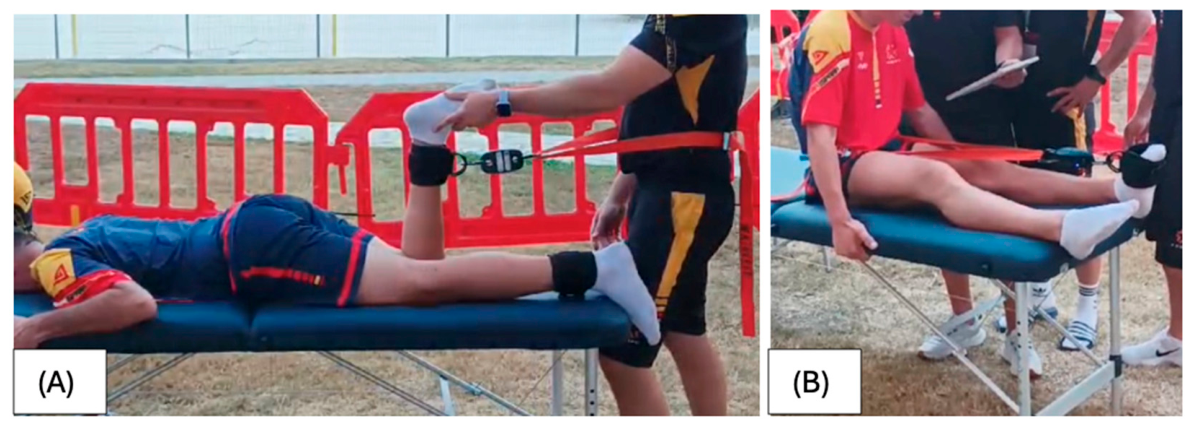
Figure 1. Standardised setup for isometric strength assessment using a belt-stabilised dynamometry system (K-Pull V3, Kinvent®). (A) Hamstring assessment performed in prone position with the knee flexed at 90°. (B) Plantar flexor assessment performed in a seated position with the knee extended. Hip adductor strength was assessed using a similar belt-stabilised configuration in a supine position, with the limb placed in slight abduction and force applied medially against external fixation, although this setup is not shown in the figure. In all conditions, the dynamometer was attached distally to the limb and anchored to the examiner using a rigid belt to ensure a consistent direction of force application and to minimise measurement variability.
Preprints 219364 g001
Table 1. Lower-limb isometric strength and inter-limb asymmetry in players with spastic hemiparesis.
Muscle Group Affected Limb (N) Non-Affected Limb (N) Asymmetry (%)
Soleus 79.29 ± 27.42 115.44 ± 51.11 46.58 ± 42.47
Adductors 123.38 ± 54.47 173.60 ± 57.08 49.83 ± 39.17
Hamstrings 131.88 ± 56.27 225.75 ± 66.21 81.81 ± 40.30
Values are presented as mean ± standard deviation. Strength values correspond to isometric force (Newtons) measured in the soleus, adductor, and hamstring muscle groups for the affected and non-affected limbs.
Table 2. Spearman’s correlations between lower-limb strength, inter-limb asymmetry, and physical performance variables.
Variable Soleus
(A)
Soleus
(NA)
Adductors
(A)
Adductors
(NA)
Hamstrings
(A)
Hamstrings
(NA)
Soleus Asymmetry (%) Adductors Asymmetry (%) Hamstrings Asymmetry (%)
5 m sprint (s) -0.47 -0.49 -0.39 -0.32 -0.19 0.04 -0.27 0.23 0.35
15 m sprint (s) -0.32 -0.42 -0.26 -0.31 -0.08 -0.06 -0.29 0.10 0.11
30 m sprint (s) -0.33 -0.52 -0.17 -0.32 0.02 -0.05 -0.47 -0.02 0.04
MAT (s) -0.52 -0.46 -0.42 -0.42 -0.26 -0.06 -0.41 0.16 0.19
MAT-B (s) -0.33 -0.58 -0.08 -0.49 -0.03 -0.21 -0.64* -0.33 -0.03
Dribbling ability (s) -0.08 -0.28 0.06 -0.34 -0.01 -0.25 -0.39 -0.40 -0.09
Yo-Yo IR1 (m) 0.38 0.38 0.57 0.63* 0.51 0.53 0.11 -0.09 -0.27
Values represent Spearman’s correlation coefficients (ρ). *p < .05. A: affected limb; NA: non-affected limb.
Table 3. Spearman’s correlations between inter-limb asymmetry and match external-load variables grouped by functional domains.
Variable Soleus Asymmetry (%) Adductors Asymmetry (%) Hamstrings Asymmetry (%)
Global locomotor load
Total distance per min (m·min−1) -0.14 -0.05 0.04
Average velocity (km·h−1) -0.43 -0.05 0.17
Locomotor intensity distribution
Low-intensity distance (m·min−1) 0.02 0.26 0.38
Moderate-intensity distance (m·min−1) -0.40 -0.16 -0.03
High-intensity distance (m·min−1) 0.28 -0.24 -0.24
Neuromuscular actions (accelerations/decelerations)
Accelerations per min (n·min−1) 0.54 0.30 0.19
Decelerations per min (n·min−1) 0.54 0.30 0.19
Max acceleration (m·s−2) 0.46 -0.13 -0.14
Max deceleration (m·s−2) -0.44 -0.06 0.04
Avg acceleration (m·s−2) -0.48 -0.05 0.03
Avg deceleration (m·s−2) 0.31 0.02 0.11
High-intensity accelerations (n·min−1) 0.16 -0.17 -0.29
High-intensity decelerations (n·min−1) 0.15 -0.19 -0.27
Distance in high-intensity accelerations (m·min−1) 0.55 -0.08 -0.22
Distance in high-intensity decelerations (m·min−1) 0.49 -0.04 -0.21
Distance in moderate accelerations (m·min−1) -0.25 -0.01 0.03
Distance in moderate decelerations (m·min−1) -0.18 -0.09 -0.08
Explosive and sprint actions
Explosive distance (m·min−1) 0.06 0.02 -0.01
Sprints per min (n·min−1) 0.39 -0.10 -0.20
Sprint distance per min (m·min−1) 0.44 -0.16 -0.28
Maximum velocity (km·h−1) 0.54 -0.08 -0.13
Mechanical and metabolic load
Player load per min (AU·min−1) -0.62* 0.15 0.27
Mechanical work per min (kJ·min−1) -0.84** -0.26 -0.12
Metabolic power (W·kg−1) -0.83** -0.27 -0.09
High metabolic load distance (m·min−1) -0.24 -0.18 -0.10
*p < .05; **p < .01. Variables are grouped according to functional domains of external load: global locomotor load, locomotor intensity distribution, neuromuscular actions, explosive/sprint actions, mechanical and metabolic load.
Table 4. Differences in physical performance between low and high asymmetry groups.
Physical performance variable Soleus Asymmetry
High Moderate U p r
5 m sprint (s) 1.18 ± 0.06 1.20 ± 0.09 16.00 0.927 0.07
15 m sprint (s) 2.74 ± 0.08 2.84 ± 0.24 16.50 0.854 0.10
30 m sprint (s) 4.75 ± 0.13 4.89 ± 0.36 19.00 0.537 0.27
MAT (s) 5.76 ± 0.20 6.02 ± 0.41 20.00 0.429 0.33
MAT-B (s) 8.43 ± 0.42 8.89 ± 0.97 22.00 0.247 0.47
Dribbling ability (s) 2.67 ± 0.56 2.87 ± 0.78 19.00 0.537 0.27
Yo-Yo IR1 (m) 1088 ± 314 1227 ± 500 17.00 0.783 0.13
Physical performance variable Adductor Asymmetry
High Moderate U p r
5 m sprint (s) 1.18 ± 0.06 1.20 ± 0.09 13.00 0.783 -0.13
15 m sprint (s) 2.73 ± 0.09 2.85 ± 0.23 16.50 0.854 0.10
30 m sprint (s) 4.76 ± 0.14 4.88 ± 0.35 17.00 0.792 0.13
MAT (s) 5.83 ± 0.21 5.96 ± 0.44 14.00 0.931 -0.07
MAT-B (s) 8.59 ± 0.47 8.76 ± 1.01 18.00 0.662 0.20
Dribbling ability (s) 2.71 ± 0.55 2.84 ± 0.80 20.00 0.429 0.33
Yo-Yo IR1 (m) 1127 ± 336 1200 ± 505 13.00 0.783 -0.13
Physical performance variable Hamstrings Asymmetry
High Moderate U p r
5 m sprint (s) 1.17 ± 0.05 1.21 ± 0.10 13.00 0.783 -0.13
15 m sprint (s) 2.72 ± 0.09 2.86 ± 0.23 16.50 0.854 0.10
30 m sprint (s) 4.75 ± 0.15 4.90 ± 0.35 17.00 0.792 0.13
MAT (s) 5.80 ± 0.22 6.00 ± 0.43 14.00 0.931 -0.07
MAT-B (s) 8.50 ± 0.48 8.85 ± 0.98 18.00 0.662 0.20
Dribbling ability (s) 2.69 ± 0.56 2.86 ± 0.79 20.00 0.429 0.33
Yo-Yo IR1 (m) 1100 ± 330 1215 ± 510 13.00 0.783 -0.13
Values correspond to Mann–Whitney U test results comparing low vs high asymmetry groups. Effect size is reported as rank-biserial correlation (r). No statistically significant differences were observed between groups (p > .05).
Disclaimer/Publisher’s Note: The statements, opinions and data contained in all publications are solely those of the individual author(s) and contributor(s) and not of MDPI and/or the editor(s). MDPI and/or the editor(s) disclaim responsibility for any injury to people or property resulting from any ideas, methods, instructions or products referred to in the content.
Copyright: This open access article is published under a Creative Commons CC BY 4.0 license, which permit the free download, distribution, and reuse, provided that the author and preprint are cited in any reuse.
Prerpints.org logo

Preprints.org is a free preprint server supported by MDPI in Basel, Switzerland.

Subscribe

Accessibility

Disclaimer

Terms of Use

Privacy Policy

Privacy Settings

© 2026 MDPI (Basel, Switzerland) unless otherwise stated
