

Submitted:
20 June 2026
Posted:
22 June 2026
You are already at the latest version
Abstract
Background and Objectives: Functional decline is a major determinant of disability, caregiver burden, and loss of independence in behavioral variant frontotemporal dementia (bvFTD). Although bvFTD is characterized by early and rapidly progressive deterioration in everyday functioning, longitudinal multimodal predictors of this decline remain insufficiently understood. The present study aimed to identify cognitive, behavioral, personality, and neuroimaging predictors of longitudinal functional deterioration in bvFTD using an integrated multimodal framework over a 12-month follow-up period. Methods: Twenty-seven patients diagnosed with bvFTD were recruited from the 2nd Neurology Clinic at the “AHEPA” University Hospital in Thessaloniki, Greece, and underwent comprehensive face-to-face neuropsychological assessment for the evaluation of a wide range of cognitive domains, alongside caregiver-based informant evaluations of behavioral disturbances, personality changes, and functional abilities, at baseline, 6 months, and 12 months. Functional status was assessed using the Disability Assessment for Dementia (DAD) as the primary outcome, while the Frontotemporal Dementia Rating Scale (FRS) served as a secondary measure. Brain perfusion single-photon emission computed tomography (SPECT) was acquired only at baseline, with regional cerebral blood flow quantified using a Brodmann area (BA)–based approach. Repeated-measures analysis of variance (ANOVA) was used to characterize longitudinal changes across cognitive, behavioral, personality, and functional domains, while linear mixed-effects (LME) models were applied to identify predictors of functional trajectories and sources of inter-individual variability in functional outcomes. Results: Significant progressive decline in functional abilities was observed over the 1-year follow-up period, consistent with an aggressive and rapidly deteriorating clinical course in bvFTD. Functional impairment affected both basic and instrumental activities of daily living, with a more pronounced decline in instrumental activities. Based on the final LME model, greater apathy-related (negative) behavioral symptoms, global cognitive impairment, attentional and processing speed deficits, and impaired inhibitory control were independently associated with poorer longitudinal functional outcomes. At the neuroimaging level, reduced perfusion in the right BA 24 within the anterior cingulate cortex was also significantly associated with greater loss of functional independence over time. Conclusions: Longitudinal functional decline in bvFTD reflects the combined disruption of behavioral regulation, global cognition, executive control, and frontal–cingulate network integrity. These findings support a multidimensional model of functional deterioration and highlight clinically actionable markers for prognosis, stratification, and personalized care in bvFTD.
Keywords:
bvFTD
; functional decline
; longitudinal study
; cognitive deficits
; behavioral disturbances
; personality changes
; neuroimaging biomarkers
; SPECT imaging
1. Introduction
Behavioral variant frontotemporal dementia (bvFTD) is the most common clinical subtype of frontotemporal lobar degeneration (FTLD) and is characterized by early and progressive alterations in personality, social conduct, motivation, and executive control [1,2,3]. In contrast to other neurodegenerative syndromes such as Alzheimer’s disease (AD), where episodic memory impairment is often the dominant early feature, bvFTD is primarily defined by profound changes in behavior and socio-emotional functioning that emerge early in the disease course and rapidly compromise patients’ ability to function independently in everyday life [1,2,3,4].
A defining clinical feature of bvFTD is the marked and relatively early impairment in everyday functional abilities, including both basic and instrumental activities of daily living (BADLs and IADLs, respectively) [5,6,7,8,9,10,11]. These abilities encompass essential self-care activities as well as more complex, goal-directed behaviors required for independent living, such as managing finances, medication adherence, social interactions, and household responsibilities. Functional decline in bvFTD is particularly devastating, as it reflects the loss of autonomy and is strongly associated with reduced quality of life, increased caregiver burden, earlier institutionalization, and substantial socioeconomic consequences, including loss of employment and increased healthcare utilization [5,6,7,8,9,10,11]. Therefore, functional status represents a clinically meaningful and highly ecologically valid outcome measure in dementia research, capturing the real-world disease impact more effectively than isolated cognitive test performance or global disease severity indices.
Importantly, bvFTD is often associated with a relatively rapid clinical course [5,9]. Longitudinal studies suggest that many patients progress to severe functional disability within approximately five years from symptom onset, although marked inter-individual variability in disease trajectories is consistently observed [5,6,7,8,9,10,11,12]. This heterogeneity highlights the need to identify clinically meaningful predictors of disease progression and functional decline, with the ultimate goal of improving prognostic accuracy and informing individualized clinical management [9,12].
Despite the clinical importance of functional outcomes in bvFTD, the number of longitudinal studies investigating predictors of functional decline remains limited [9,11,12,13,14,15,16,17,18,19]. Most existing research has relied on cross-sectional designs, examining associations between clinical features and functional impairment at a single time point rather than modeling change over time [5,6,7,8,20,21,22,23,24,25,26,27,28,29,30,31]. Even among longitudinal studies, sample sizes are often modest, follow-up intervals are heterogeneous, and analytic approaches frequently focus on isolated predictors rather than integrative multivariate frameworks [7]. As a result, a comprehensive understanding of the multidimensional determinants of functional decline in bvFTD remains incomplete [12].
Functional impairment in bvFTD emerges from the complex interaction of cognitive, behavioral, personality, and neurobiological factors [7,8]. From a cognitive perspective, executive dysfunction, attentional deficits, and global cognitive decline have consistently been associated with poorer functional outcomes [5,8,11,12,23,27,29,31]. Executive processes are particularly relevant, as they support goal-directed behavior, planning, cognitive flexibility, and the ability to adapt to changing environmental demands, which are essential for maintaining independence in everyday life [5,8,12,27,31]. Although episodic memory impairment may also be present in bvFTD [4], findings regarding its contribution to functional disability have been mixed [6,8,11,16,27]. Some studies have reported significant memory deficits and associations with everyday functioning [11,16,27], whereas others suggest that its contribution to functional disability may be secondary to deficits in executive control mechanisms that support strategic retrieval and adaptive behavior, rather than primary memory storage deficits [8].
Social cognition constitutes another critical domain underlying functional disability in bvFTD [18,31]. Deficits in emotion recognition, theory of mind, and socio-emotional processing significantly disrupts interpersonal functioning and the ability to navigate complex social environments [18]. Given the inherently social nature of many everyday activities, these impairments are increasingly recognized as key determinants of real-world functioning [18,31].
Beyond cognitive and social cognitive deficits, behavioral disturbances also represent a core feature of bvFTD and play a central role in functional decline [6,7,8,11,12,14,21,27,28,29,31]. Negative behavioral symptoms, particularly apathy, reduced initiative, emotional blunting, and loss of insight, have been consistently identified as strong predictors of impaired daily functioning [6,8,14,21,28,29,31]. These symptoms directly reduce goal-directed behavior and engagement with both cognitive and social environments, thereby accelerating functional deterioration. Positive behavioral symptoms, including disinhibition, impulsivity, stereotyped behaviors, and affective disturbances, have also been associated with poorer functional outcomes, although findings are somewhat less consistent across studies [6,8,11,14,31].
In addition to behavioral symptoms, personality change represents a central [1,2,3] yet often underexplored dimension of bvFTD with important implications for everyday functioning [8]. Alterations in enduring personality traits, particularly reductions in conscientiousness, agreeableness, and emotional stability, have been consistently reported in patients with bvFTD and are thought to reflect early disruption of fronto-limbic and salience network systems [8,32,33,34]. Among these changes, diminished conscientiousness appears especially relevant, as it directly affects goal-directed behavior, reliability, planning, and the capacity to maintain structured daily routines [8]. Recent evidence suggests that personality changes may not only co-occur with cognitive and behavioral symptoms but may also provide additional explanatory value in understanding functional disability, beyond traditional neuropsychological measures [8], highlighting their potential role in longitudinal models of disease progression and functional decline.
Neuroimaging and neurophysiological studies further support the structural and functional basis of disability in bvFTD [8,12,15,17,21,25,26,34]. Atrophy and functional disruption in frontal and anterior temporal regions, particularly within right-lateralized networks, have been associated with more severe functional impairment and faster disease progression [12,26]. In addition, recent multimodal evidence integrating cognitive, behavioral, personality, and perfusion-based measures has shown that regional brain hypoperfusion in prefrontal and parietal regions is closely linked to attentional and executive dysfunction, negative behavioral symptoms, personality changes, and reduced daily functioning [8,34]. Emerging evidence also suggests that neurophysiological and fluid biomarkers, such as measures derived from transcranial magnetic stimulation (TMS) and serum neurofilament light chain (NfL), may provide additional prognostic information regarding disease progression and functional decline in bvFTD [15,17].
Although this body of research has significantly advanced understanding of bvFTD, important gaps remain. First, most prior studies have examined predictors in isolation rather than within integrated frameworks that reflect the multidimensional nature of bvFTD. Second, longitudinal evidence remains relatively scarce compared to cross-sectional research, limiting understanding of how different domains relate to functional change over time. Third, personality variables remain underrepresented in longitudinal models of functional decline, despite their theoretical relevance and emerging empirical support.
Consequently, there is a critical need for integrative approaches that simultaneously examine cognitive, behavioral, personality-related, and neuroimaging variables within a longitudinal research design, in order to identify the most robust and clinically meaningful predictors of functional outcomes in bvFTD.
Study Aims
The present study aimed to examine the strongest predictors of the longitudinal course of functional decline in bvFTD over a one-year follow-up period, with comprehensive assessments conducted at baseline, 6 months, and 12 months. Specifically, we sought to identify the most robust longitudinal correlates of functional status across repeated observations in bvFTD, as well as to characterize the sources of inter-individual variability in functional outcomes over time.
A central objective of the study was to determine which clinical characteristics are most closely associated with longitudinal changes in everyday functioning in this clinical population. In particular, we examined whether specific cognitive, behavioral, personality-related and neural features are linked to distinct functional trajectories, reflecting variability in both the magnitude and rate of deterioration across individuals. We investigated whether individuals with particular clinical profiles exhibit steeper declines in everyday functioning over time and less favorable outcomes compared to others. Through this approach, we aimed to identify variables most strongly associated with functional status longitudinally, thereby clarifying which clinical factors may be most informative for understanding prognosis and disease progression in bvFTD.
The unique contribution of this work lies in its integrative longitudinal perspective, in which multiple domains of disease expression are considered simultaneously in relation to changes in everyday functioning over time. In contrast to prior research that has predominantly focused on isolated clinical correlates, this approach enables a more comprehensive characterization of the factors associated with differential functional trajectories in bvFTD.
Taken together, this study provides an exploratory and clinically oriented investigation of multimodal predictors of longitudinal functional impairment in bvFTD, with the aim of advancing understanding of disease heterogeneity and informing future efforts to identify individuals at increased risk of accelerated functional deterioration.
2. Materials and Methods
2.1. Participants
This prospective longitudinal observational study included 27 patients who met the International Behavioral Variant FTD Consortium (FTDC) revised criteria [1] for at least possible bvFTD. Participants, together with their caregivers, were recruited from the 2nd Neurology Clinic of the “AHEPA” University General Hospital of Thessaloniki, Greece, between January 2023 and February 2025.
Diagnoses were established by a multidisciplinary team of neurologists and neuropsychologists following comprehensive clinical evaluation. As part of the diagnostic work-up, all participants underwent detailed neurological and neuropsychological assessment, structural and functional neuroimaging, genetic testing, and cerebrospinal fluid biomarker analysis, in order to exclude alternative neurological or systemic causes.
Inclusion criteria required the availability of a knowledgeable informant (family member or close friend) capable of reliably reporting on the patient’s behavior, personality, and functional abilities. To focus on early-stage disease, only patients with symptom onset within the three years preceding study enrollment were included, based on informant report.
Exclusion criteria included the presence of significant vascular pathology on magnetic resonance imaging (MRI) or computed tomography (CT) that could confound neuroimaging interpretation, as well as any other neurological disorders (e.g., stroke, Parkinson’s disease, multiple sclerosis, epilepsy, or traumatic brain injury) capable of explaining cognitive or functional impairment. Participants with major psychiatric conditions (e.g., schizophrenia, bipolar disorder, or major depressive disorder) were excluded. Individuals with severe sensory, motor, or other physical impairments that could interfere with neuropsychological assessment of daily functioning were also not eligible.
2.2. Procedures
This study followed a longitudinal prospective observational design with repeated assessments conducted at three time points: baseline (T1), 6-month follow-up (T2; ± 2 weeks), and 12-month follow-up (T3; ± 2 weeks). Thus, participants were monitored over a total period of one year.
At each time point, participants were evaluated during scheduled outpatient visits at the memory clinic using standardized assessment protocols. Each assessment session lasted approximately 45 minutes and was conducted in quiet, well-lit rooms designed to minimize distractions and optimize cognitive performance. Testing was administered in the morning hours to reduce fatigue-related variability.
Caregivers were interviewed during scheduled clinic visits, typically across two structured sessions of approximately two hours each. Semi-structured interviews were conducted to obtain detailed information regarding patients’ behavioral changes, personality alterations, and functional abilities in everyday life, using validated informant-based instruments and disease staging scales.
All assessments were performed by certified clinical neuropsychologists with extensive experience in dementia research and clinical evaluation. A detailed description of all psychometric instruments is provided below.
Across all three time points, participants completed the full neuropsychological battery and informant-based questionnaires. Importantly, all cognitive, behavioral, personality, and functional measures were administered at each visit according to the study protocol. In contrast, brain perfusion SPECT imaging was acquired only at baseline (T1) and was not repeated at follow-up assessments.
The study protocol was approved by the Bioethics and Ethics Committee of Aristotle University of Thessaloniki (AUTh), Greece (protocol code: 331191/2022; approval date: 20 December 2022). Written informed consent was obtained from all participants and their informants. All data were anonymized in accordance with the European Union General Data Protection Regulation (GDPR; Regulation (EU) 2016/679) [35] and handled in full compliance with the Declaration of Helsinki [36].
2.3. Neuropsychological Assessment
A comprehensive neuropsychological battery [8] was administered to evaluate multiple cognitive domains, behavioral symptoms, personality changes, disease severity, and functional abilities.
Global cognitive functioning was assessed using the Montreal Cognitive Assessment (MoCA) [37], employing the psychometrically validated Greek adaptation [38]. Total scores (0–30) were used in the analyses, with higher scores indicating better cognitive performance.
The Clock Drawing Test (CDT) [39] was also administered as an additional measure of global cognition, using the validated Greek version [40,41]. Performance was rated on a 15-point scale, with higher scores reflecting better cognitive functioning.
Visuoconstructional abilities and episodic visual memory were evaluated using the Taylor Complex Figure Test [42]. Two indices were derived: (i) copy performance (0–36), reflecting visuospatial construction and perceptual organization, and (ii) delayed recall (0–36), indexing episodic visual memory.
Episodic verbal memory was assessed using two standardized tasks: the Word Learning Test and the Story Memory Test [41]. These evaluate memory for unrelated and semantically related material, respectively. For both measures, only delayed recall scores were used (0–10 and 0–16), which were summed to generate a composite verbal memory index (0–26), with higher scores reflecting better performance.
Language abilities were assessed using the Confrontation Naming Test [41,43], which measures object naming and word retrieval. The total number of correctly named items (0–40) was used as the dependent variable, with higher scores indicating better naming performance.
Attention and psychomotor processing speed were evaluated using the Trail Making Test—Part A (TMT-A) [44], administered in its validated Greek version [45,46]. Performance was indexed by completion time, with shorter times reflecting better performance.
Short-term verbal memory and auditory attention were assessed using the Forward Digit Span Task [41,47], with scores reflecting the maximum number of digits correctly repeated in forward order (range: 0–9), where higher scores indicate better performance.
Executive functioning was assessed according to the widely accepted framework proposed by Miyake et al. (2000) [48], encompassing set-shifting, working memory updating, and inhibitory control.
Set-shifting was evaluated using the Greek version of the Trail Making Test—Part B (TMT-B) [44,45,46], with shorter completion times indicating better cognitive flexibility.
Working memory was assessed using the Backward Digit Span Task [41,47], with span scores ranging from 0 to 8, where higher values indicate better performance.
Inhibitory control was measured using the Stroop Test [49], in its validated Greek adaptation [50], which requires suppression of automatic reading responses in favor of color naming. The number of correctly identified ink colors was used as the outcome measure, with higher scores reflecting better inhibitory control.
Additionally, verbal fluency was assessed using the Verbal Fluency Test [47], in its validated Greek adaptation [51], including both semantic and phonemic conditions. Higher scores, defined as the total number of valid words generated, indicate better lexical retrieval and executive control.
A brief executive screening battery, the FRONTIER Executive Screen (FES) [52], was also administered. The Greek-adapted version [53] assesses phonemic fluency, verbal inhibitory control, and working memory. Each subtest is scored from 0 to 5, yielding a total score range of 0–15, with higher scores indicating better executive functioning.
In addition to conventional paper-and-pencil measures, computerized executive functioning was assessed using the REMEDES for Alzheimer-Revised (R4Alz-R) battery [54,55,56], a validated web-based neuropsychological assessment tool designed to evaluate attentional processes and executive control. For the purposes of the present study, only the total score of Part 3 of the battery was included in the analyses. This component assesses inhibitory control, task/rule switching, and cognitive flexibility. The score ranges from 0 to 179, with higher scores indicating poorer executive performance, corresponding to a greater number of errors and increased executive dysfunction.
Social cognition was evaluated using the Emotion Evaluation Test (EET), part of the Awareness of Social Inference Test—Short (TASIT-S) [57,58], assessing emotion recognition based on paralinguistic cues. Scores range from 0 to 10, with higher scores indicating better performance.
Theory of mind abilities were assessed using the Test of Social Inference—Minimal (SI-M), also part of TASIT-S [57,59], with scores ranging from 0 to 36; higher scores indicate better social inference ability.
Personality traits were assessed using the informant-rated Greek adaptation of the International Personality Item Pool (IPIP) Big Five questionnaire [60,61], based on the Five-Factor model of personality [62]. Given the well-documented impairment of insight in bvFTD [63,64,65], informant reports were used instead of patient self-reports. Ratings were provided in a third-person format, and composite scores (10–50) were computed for each of the five personality dimensions, with higher scores reflecting greater trait expression.
Behavioral symptoms were assessed using the Frontal Behavioral Inventory (FBI) [66], a validated 24-item informant-based scale specifically developed to quantify the presence and severity of behavioral symptoms typically associated with FTD [67]. The Greek version [68] was used in the present study. The FBI yields separate scores for negative symptoms (e.g., apathy, loss of insight) and positive symptoms (e.g., disinhibition, impulsivity), each ranging from 0 to 36, with higher scores indicating more severe behavioral disturbances.
Disease severity was evaluated using the Clinical Dementia Rating (CDR) scale [69], including both the standard version (CDR-GS; 0–3, CDR-SB; 0–18) and the FTLD-modified version (FTLD-CDR) [70,71,72], which incorporates additional language and behavioral domains (FTLD-CDR-SB; 0–24). Higher scores indicate greater disease severity.
The Greek version of the Frontotemporal Dementia Rating Scale (FRS) [19,71], a 30-item informant-based instrument, was additionally administered as an FTD-specific measure of disease staging, evaluating both behavioral disturbances and functional abilities. Raw FRS scores (maximum score = 30) were converted to percentage scores according to the standard scoring procedure, with higher percentages indicating less severe behavioral and functional impairment. The resulting percentage score was used in all subsequent analyses.
Functional status was assessed as the primary outcome using the Disability Assessment for Dementia (DAD) [73], in its validated Greek adaptation [6,8,74]. This informant-based scale evaluates both BADLs and IADLs, as well as initiation, planning/organization, and execution components. Scores are expressed as percentages, with higher values indicating greater functional independence. The DAD was selected as the primary outcome measure due to its comprehensive assessment of both basic and instrumental daily functioning and its extensive validation in dementia and bvFTD research [5,6,7,8,14,22,23,28,29].
The Functional Activities Questionnaire (FAQ) [75] was also administered as an additional functional measure focusing primarily on IADLs, with higher scores indicating greater functional impairment.
2.4. Neuroimaging: Brain Perfusion SPECT
Regional cerebral blood flow (rCBF) was assessed at baseline using SPECT imaging at the 2nd Academic Nuclear Medicine Department of the “AHEPA” University General Hospital of Thessaloniki, Greece, in accordance with European Association of Nuclear Medicine (EANM) guidelines [76]. Participants underwent imaging 30 minutes after intravenous administration of 740 MBq of technetium-99m–labeled hexamethylpropyleneamine oxime (99mTc-HMPAO) at rest. Image acquisition was performed using a Philips gamma camera, and data were reconstructed using filtered back-projection techniques. Quantitative analysis of regional cerebral blood flow (rCBF) was performed using NeuroGam™ software (Segami Corporation, Columbia, SC, USA), with normalization to Talairach space and comparison against an age-matched normative database. For statistical analyses, z-score transformed rCBF values were used to account for age-related variability in cerebral perfusion.
2.5. Statistical Analyses
All statistical analyses and data visualization were performed using the R statistical programming environment (version 4.5.3, www.r-project.org, accessed on 30 March 2026; R Foundation for Statistical Computing, Vienna, Austria) [77].
Prior to statistical modeling, descriptive statistics were computed to summarize participants’ baseline demographic and clinical characteristics. Data were examined for potential outliers using standardized z-scores and graphical inspection of boxplots, with extreme values evaluated for plausibility. Missing data were minimal, as all participants completed the full clinical, neuropsychological, and behavioral assessment battery across all time points. The only exception concerned a single participant for whom SPECT imaging data were unavailable at baseline. No imputation procedures were therefore required.
Longitudinal changes in neuropsychological, behavioral, personality, functional, and disease severity measures across the 1-year follow-up period were evaluated using repeated-measures analyses of variance (ANOVA), implemented with the “ez” package in R. For each variable, time (baseline, 6-month follow-up, and 12-month follow-up) was specified as a within-subject factor. Repeated-measures ANOVA was used to assess whether performance changed significantly across the three assessment time points. For each analysis, F-statistics, associated p-values, and generalized eta-squared (η²G) effect sizes were extracted and reported. Assumptions of sphericity were evaluated using Mauchly’s test. When the assumption of sphericity was violated, Greenhouse–Geisser corrected p-values were used for statistical inference. A p-value < 0.05 was considered the threshold for statistical significance. Descriptive statistics, including means and standard deviations at each assessment time point, were calculated to characterize longitudinal trajectories of change.
To explore preliminary associations between variables and functional outcome, Pearson’s correlation coefficients were computed between all candidate predictors and the primary outcome measure (DAD) at the 12-month follow-up. Variables demonstrating significant associations at a conservative threshold of p < 0.01 (**) were considered for further analysis. This initial screening step served as a first-stage dimensionality reduction procedure aimed at identifying the strongest correlates of functional impairment.
To further reduce dimensionality and prevent overfitting in subsequent multivariable modeling, a penalized Least Absolute Shrinkage and Selection Operator (LASSO) regression approach was implemented using the “glmnet” package, with the alpha parameter set to 1 for L1 regularization. This method was selected due to its ability to perform simultaneous shrinkage and variable selection in the context of potentially correlated predictors, making it particularly suitable for high-dimensional datasets with limited sample size [78,79,80]. The optimal penalty parameter was determined using cross-validation, and predictors with non-zero coefficients were retained for inclusion in the subsequent longitudinal model. This procedure ensured that only the most robust and informative variables were carried forward to the final inferential stage.
The primary analysis of the present study consisted of linear mixed-effects (LME) modeling, conducted using the “lme4” and “lmerTest” packages in R. This approach was chosen to appropriately account for the repeated-measures structure of the data, in which repeated observations at baseline, 6-month, and 12-month follow-ups were nested within individuals. Importantly, all available measurements across all time points were included in the analysis through the use of a long-format dataset, thereby allowing full utilization of the longitudinal structure of the data.
LME models are particularly suited for longitudinal clinical data as they allow the simultaneous estimation of fixed effects, representing population-level associations, and random effects, capturing inter-individual variability in baseline performance and longitudinal change. This framework therefore enables the modeling of individual trajectories of functional decline while accounting for within-subject correlations across repeated assessments.
Maximum likelihood (ML) estimation was used for model fitting, allowing for the comparison of fixed effects within the model framework. Statistical inference for fixed effects was based on t-tests with Satterthwaite’s approximation for degrees of freedom, providing robust estimation of significance in the presence of repeated measures and complex variance structures.
Functional status (DAD total score) was specified as the dependent variable, with time included as a fixed effect to capture longitudinal change. Predictors identified through the LASSO procedure were entered as fixed effects to examine their association with baseline performance and trajectories of functional decline. A random intercept for each participant was included to account for inter-individual variability in baseline functional status.
Overall, this statistical strategy was specifically designed to leverage the full longitudinal structure of the dataset, allowing integration of all repeated measurements across time points while appropriately modeling within-subject correlations and inter-individual variability in functional trajectories in bvFTD.
Finally, to evaluate robustness and generalizability, the same analytical framework was applied using the FRS as a complementary outcome measure, commonly used to assess disease severity and functional status in bvFTD [11,81], thereby providing additional insights into the longitudinal predictors of functional abilities and disease severity in this clinical group.
3. Results
3.1. Demographic and Clinical Characteristics
The study sample comprised 27 patients with a diagnosis of bvFTD, including 12 males and 15 females. Participants had at baseline a mean age of 70.15 years (SD = 7.57), while the mean age at symptom onset was 68.04 years (SD = 7.70), indicating an average disease duration of approximately two years at study entry. The mean educational attainment was 10.85 years (SD = 3.90).
Regarding disease severity, the mean CDR-GS was 1.17 (SD = 0.67), and the mean CDR-SB score was 6.54 (SD = 3.81), findings consistent with mild-stage dementia [82]. As expected, the FTLD-modified CDR-SB score yielded higher values (M = 8.57, SD = 4.33), reflecting the additional contribution of behavioral and language impairments that characterize the FTLD spectrum.
Notably, two participants carried a genetically confirmed pathogenic mutation associated with bvFTD, specifically a C9orf72 repeat expansion. No known pathogenic FTD-related genetic mutations were identified in the remaining participants.
With respect to the knowledgeable informants who provided collateral information, spouses constituted the majority (63%), followed by adult children (30%) and siblings (7%).
Table 1 summarizes the baseline demographic and clinical characteristics of the study sample.
3.2. Longitudinal Changes in Neuropsychological, Behavioral, Personality, and Functional Measures Across the 1-Year Follow-Up Period
Descriptive statistics for all neuropsychological, behavioral, personality, disease severity, and functional measures across baseline, 6-month, and 12-month assessments, together with the results of the repeated-measures ANOVA analyses, are presented in Table 2.
Repeated-measures analyses revealed statistically significant longitudinal changes in the majority of variables, consistent with progressive and widespread disease-related deterioration over the 12-month follow-up period in bvFTD.
Regarding the primary outcome measure of the present study, DAD scale demonstrated a substantial and progressive decline in functional abilities over the 12-month follow-up period (Figure 1). Total functional performance decreased markedly from baseline (65.76 ± 24.83) to 6 months (53.38 ± 24.35) and further to 12 months (42.89 ± 22.77), reflecting a clear worsening pattern in daily functioning over time (F = 28.39, p < 0.001, η²G = 0.136).
A similar longitudinal pattern was observed when functional abilities were further decomposed into BADLs and IADLs. BADLs showed a significant and progressive decline across all time points (82.79 ± 20.95 at baseline, 72.33 ± 24.02 at 6 months, and 62.09 ± 26.28 at 12 months; F = 18.29, p < 0.001, η²G = 0.115), indicating gradual deterioration in fundamental self-care abilities. Likewise, IADLs exhibited an even more pronounced decline over time (52.66 ± 30.74 at baseline, 38.99 ± 27.66 at 6 months, and 28.26 ± 22.40 at 12 months; F = 24.69, p < 0.001, η²G = 0.123), reflecting substantial loss of independence in more complex, cognitively demanding daily activities (Figure 1).
Overall, these findings indicate a robust and clinically meaningful decline in functional independence, with both BADLs and IADLs showing consistent deterioration across the 1-year follow-up period in bvFTD.
Additionally, Figure 2 illustrates the longitudinal pattern of functional impairment across the 10 individual DAD domains in bvFTD over the 12-month follow-up period. Changes in performance across BADLs and IADLs are visualized over time, highlighting domain-specific vulnerability and a progressive pattern of decline, which is more pronounced and more rapidly expressed in IADLs relative to BADLs.
3.3. Preliminary Variable Screening and Penalized LASSO Regression Analysis
As an initial variable reduction step, Pearson’s correlation analyses were performed between all candidate predictors and DAD scores at the 12-month follow-up assessment. Of the variables examined, 14 met the predefined inclusion criterion of a statistically significant association with functional status (p < 0.01) and were therefore retained for further analyses.
The retained variables included the FBI Negative Symptoms sub-score, the IPIP Conscientiousness score, the MoCA total score, the Taylor Complex Figure copy score, the verbal memory composite score, the semantic verbal fluency performance, the completion time on the TMT-A, the confrontation naming performance, the Clock Drawing Test score, the Stroop Words and Colors condition score, the executive control composite score (Part 3) derived from the computerized R4Alz-R battery, the TASIT-S Part 2 total score, and the regional cerebral perfusion measures of right BA 8 and 24.
Prior to penalized regression modeling, multicollinearity among the selected predictors was assessed using Variance Inflation Factor (VIF) values. No evidence of problematic multicollinearity was observed, as all VIF values remained within acceptable limits.
The 14 retained variables were subsequently entered into the penalized LASSO regression model for further dimensionality reduction and predictor selection prior to longitudinal mixed-effects modeling. The optimal regularization parameter identified through the 10-fold cross-validation procedure was λ = 1.34 (λ_min = 1.340), corresponding to the minimum cross-validated prediction error. Using this level of penalization, the final LASSO model retained eight predictors with non-zero coefficients, indicating their contribution to the prediction of functional status as measured by the DAD at the 12-month follow-up.
Specifically, the retained predictors included the FBI Negative Symptoms sub-score (β = −1.04), the IPIP Conscientiousness score (β = 0.45), the MoCA total score (β = 1.33), the Taylor Complex Figure copy score (β = 0.60), the semantic verbal fluency performance (β = 0.49), the completion time on the TMT–Part A (β = −0.05), the Stroop Words and Colors score (β = 0.11), and the rCBF in right BA 24 (β = 1.03).
The intercept of the final model was estimated at 76.21. The remaining candidate predictors, namely the confrontation naming score, the verbal memory composite score, the Clock Drawing Test performance, the executive control composite score (Part 3) derived from the R4Alz-R battery, the TASIT-S Part 2 score, and the rCBF in right BA 8, were excluded from the final model as their coefficients were shrunk to zero by the LASSO penalization procedure.
The predictive performance of the model was satisfactory, yielding a mean squared error (MSE) of 206.19 on the test dataset and explaining approximately 67.1% of the variance in DAD scores (R² = 0.671). The variables retained through this two-step procedure were subsequently entered into the longitudinal LME model as candidate predictors of longitudinal functional decline.
3.4. Longitudinal Predictors of Functional Decline in bvFTD: LME Model Results
To identify the factors associated with functional status across the study period, a LME model was fitted with DAD scores as the dependent variable. The model incorporated repeated measurements obtained at baseline, 6-month, and 12-month follow-up assessments, while accounting for within-subject dependence through the inclusion of a participant-specific random intercept. The final model included time, as well as the eight variables retained following the previously described variable selection procedure. By utilizing a long-format dataset, the model was able to incorporate all available observations across all assessment waves, thereby fully leveraging the longitudinal structure of the data while accounting for the correlation among repeated measurements obtained from the same individual.
The analysis revealed a significant longitudinal decline in functional status over the follow-up period. Specifically, time was negatively associated with DAD scores (β = −0.43, SE = 0.22, t = −1.91, p < 0.05), indicating an average decline of approximately 0.43 DAD percentage points per month. This corresponds to an estimated decline of approximately 2.6 DAD points over a six-month interval and approximately 5.2 DAD points over one year. This finding provides evidence of progressive deterioration in ADLs across the follow-up period in patients with bvFTD.
In addition to the effect of time, five variables emerged as significant independent predictors of longitudinal functional status. At the behavioral level, greater severity of FBI negative symptoms was associated with poorer functional outcomes, as reflected by lower DAD scores (β = −1.21, SE = 0.31, t = −3.87, p < 0.001). At the cognitive level, better global cognitive functioning, measured by the MoCA (β = 1.51, SE = 0.43, t = 3.50, p < 0.001), faster processing speed and attentional efficiency, assessed using the TMT–Part A (β = −0.18, SE = 0.03, t = −5.55, p < 0.001), and better performance on the Stroop Words and Colors condition (β = 0.82, SE = 0.30, t = 2.78, p < 0.001) were all associated with higher levels of functional independence. At the neuroimaging level, greater rCBF within right BA 24 was also significantly associated with better functional status across repeated assessments (β = 0.79, SE = 0.24, t = 3.36, p < 0.001).
By contrast, semantic verbal fluency (β = 0.31, p = 0.527), Taylor Complex Figure copy performance (β = 0.35, p = 0.101), and the IPIP Conscientiousness personality trait (β = 0.002, p = 0.991) did not significantly predict functional status, after accounting for the effects of the remaining variables in the model.
The random-effects component of the model revealed substantial between-subject variability in baseline functional status (intercept variance = 91.65, SD = 9.57), supporting the presence of considerable inter-individual differences in functional performance among patients with bvFTD. The residual variance was estimated at 35.70 (SD = 5.98), indicating that a substantial proportion of variability in DAD scores was explained by differences between individuals rather than solely by within-person fluctuations over time.
The findings indicate that FBI negative behavioral symptoms, global cognitive functioning (MoCA), attention and processing speed (TMT-Part A), inhibitory control abilities (Stroop-Words and Colors), and perfusion within right BA 24 represent the strongest independent longitudinal correlates of functional status in bvFTD. Importantly, these associations were identified while simultaneously accounting for repeated measurements across all three assessment waves and for individual differences in baseline functional performance.
3.5. Longitudinal Predictors of Functional Status Using the FRS as a Secondary Outcome Measure
To evaluate the robustness and generalizability of the findings obtained using the DAD as the primary functional outcome measure, the same analytical framework was applied using the FRS as a secondary measure of functional status.
Following the initial correlation screening procedure, twelve variables demonstrated significant associations with FRS scores (p < 0.01**) and were retained for further analyses. These included FBI Negative Symptoms, IPIP Conscientiousness, MoCA total score, Taylor Complex Figure copy performance, semantic verbal fluency, TMT-A completion time, Clock Drawing Test performance, Backward Digit Span, Stroop Words and Colors condition performance, the executive control composite score (Part 3) derived from the computerized R4Alz-R battery, the FES total score, and regional cerebral perfusion within right BA 8. These variables were subsequently entered into a penalized LASSO regression model. Using the optimal regularization parameter identified through 10-fold cross-validation (λ = 4.43), the final model retained five predictors with non-zero coefficients: FBI Negative Symptoms (β = −1.26), MoCA (β = 0.71), Taylor Complex Figure copy performance (β = 0.05), the executive control composite score derived from the computerized R4Alz-R battery (β = −0.07), and regional cerebral perfusion within right BA 8 (β = 7.48). The model explained 55.9% of the variance in FRS scores (R² = 0.559).
The retained variables were subsequently entered into a longitudinal LME model with FRS scores as the dependent variable. Consistent with the findings obtained using the DAD, a significant decline in functional status was observed over time (β = −0.92, SE = 0.25, t = −3.61, p < 0.001). At the behavioral level, greater severity of FBI negative symptoms was associated with poorer functional outcomes, as reflected by lower FRS scores (β = −0.83, SE = 0.34, t = −2.47, p < 0.05). Additionally, among the retained predictors, better global cognitive functioning, as measured by the MoCA, was associated with better functional status across repeated assessments (β = 1.47, SE = 0.43, t = 3.39, p < 0.01). At the neuroimaging level, greater regional cerebral perfusion within right BA 8 was significantly associated with higher FRS scores (β = 7.32, SE = 2.37, t = 3.09, p < 0.01). By contrast, Taylor Complex Figure copy performance (β = 0.22, SE = 0.21, t = 1.06, p = 0.293) and the executive control composite score derived from the R4Alz-R battery (β = −0.07, SE = 0.08, t = −0.84, p = 0.403) did not emerge as significant independent predictors of functional status.
4. Discussion
The present study aimed to identify multimodal predictors of longitudinal functional decline in individuals with bvFTD by integrating behavioral, cognitive, personality, and neuroimaging measures within a prospective longitudinal framework. By examining repeated assessments over a 12-month period, we sought to characterize both the magnitude of functional change and the clinical and neurobiological factors associated with inter-individual variability in functional trajectories.
A first key finding was the marked and progressive deterioration in functional abilities over a relatively short follow-up period. Significant declines were evident across global functional status as well as across both BADLs and IADLs, indicating a widespread loss of independence over time in both basic and complex everyday activities [5,9]. Importantly, the deterioration was particularly pronounced in IADLs, which rely heavily on executive control, planning, organization, judgment, and self-monitoring capacities. This pattern is consistent with the clinical phenotype of bvFTD, in which impairments in executive and behavioral regulation frequently compromise complex daily activities before more fundamental self-care abilities become affected [6]. The observed trajectory aligns with prior longitudinal evidence suggesting a relatively aggressive course of functional deterioration in bvFTD compared with other neurodegenerative conditions, including AD and other FTD variants [5,7,9]. Even within a relatively brief 12-month window, participants experienced marked reductions in functional independence, a finding that likely carries profound implications for caregiver burden, supervision needs, healthcare utilization, and risk of institutionalization. These observations reinforce the importance of early identification of patients at heightened risk for accelerated functional decline and highlight the need for timely interventions aimed at preserving independence and optimizing long-term care planning.
Beyond documenting the extent of functional decline, an important observation of the present study concerns the range of factors associated with these longitudinal changes. Notably, the predictors retained in the final longitudinal model were drawn from multiple domains, including behavioral symptoms, global cognition, attentional and executive functioning, and neuroimaging measures. This finding highlights the multifaceted nature of functional decline in bvFTD and suggests that loss of independence reflects the combined disruption of motivational, cognitive, and neural systems rather than impairment within any single domain [8,16]. The results therefore support a multidimensional conceptualization of disability in bvFTD and underscore the importance of multimodal assessment approaches that extend beyond isolated domains of impairment, when evaluating functional prognosis.
Among the examined predictors, FBI negative behavioral symptoms [66] emerged as one of the strongest independent correlates of longitudinal functional status in bvFTD [6,8,14,21,28,29,31]. This finding is particularly noteworthy given that negative behavioral symptoms—including apathy, aspontaneity, emotional withdrawal, reduced initiative, indifference, and loss of motivation—represent core clinical features of the disease [1,2,3,6,7,83]. Unlike more fluctuating positive behavioral features, negative symptoms appear to reflect a relatively persistent reduction in behavioral activation systems that are essential for initiating and sustaining daily functioning [7,8,84]. Individuals who fail to initiate behavior, organize goal-directed actions, or maintain motivation are likely to experience functional impairment even when specific cognitive abilities remain relatively preserved [8]. Importantly, the present findings extend previous cross-sectional work in the field by demonstrating that negative behavioral symptoms are not merely concurrent correlates of disability but also relate to functional trajectories over time. These results reinforce their central role in the clinical expression of bvFTD and highlight their relevance for prognostic assessment.
Global cognitive functioning, as assessed by the MoCA [37], also emerged as a significant independent predictor of longitudinal functional status. Although bvFTD is often conceptualized primarily as a behavioral syndrome, accumulating evidence suggests that global cognitive impairment contributes substantially to disease progression and everyday functioning [7,8,10,11,29]. The MoCA provides a broad assessment of multiple cognitive domains, including executive functioning, attention, memory, language, visuospatial abilities, and orientation, thereby providing a global index of disease burden, probably more effectively than individual neuropsychological measures. Previous studies have similarly reported associations between global cognitive performance and functional outcomes in neurodegenerative disorders [7,8,10,11,29]. The present findings indicate that brief cognitive screening measures may offer clinically meaningful information regarding future functional trajectories, even in relatively early stages of the disease.
Attentional efficiency and processing speed, indexed by TMT-A performance [44], emerged as another robust predictor of longitudinal functional status. At first glance, TMT-A is often considered a relatively simple cognitive task compared with more complex executive measures. However, successful performance requires sustained attention, visual scanning, psychomotor speed, and efficient information processing, all of which constitute foundational cognitive processes supporting everyday functioning [8,44]. Everyday activities frequently require individuals to rapidly detect relevant information, sustain attention, monitor environmental demands, and respond appropriately to changing circumstances. Impairments in these basic attentional mechanisms may therefore have widespread downstream consequences for daily functioning. Notably, TMT-A had previously emerged as a significant correlate of functional status in our earlier cross-sectional work [8], and its continued significance in the present longitudinal analyses suggests that attentional efficiency may represent a stable and clinically relevant marker of both current and future functional capacity in bvFTD.
In addition, inhibitory control, as measured by the Stroop Words and Colors condition [49], was significantly associated with longitudinal functional outcomes. The Stroop paradigm is widely considered a measure of inhibitory control and the ability to suppress prepotent or automatic responses. Successful everyday functioning requires individuals to inhibit inappropriate or automatic behaviors, regulate impulses, resist environmental distractions, and flexibly adapt behavior according to situational demands. In bvFTD, breakdowns in these inhibitory mechanisms constitute hallmark features of the syndrome and contribute to socially inappropriate behavior and reduced self-regulation [1,2,3]. Poorer Stroop performance may therefore reflect a broader breakdown in executive control mechanisms that can directly contribute to loss of functional independence. Notably, the association between Stroop performance and functional status may also reflect aspects of behavioral disinhibition [85], including impulsive decision-making, tactless or inappropriate social comments, violations of social norms, and diminished restraint in interpersonal interactions, that overlap conceptually with positive behavioral symptoms.
At the neurobiological level, regional cerebral perfusion within right BA 24, corresponding to the ventral anterior cingulate cortex (ACC), emerged as a significant independent predictor of functional status in bvFTD [85]. BA 24 constitutes a key subdivision of the ACC located along the medial frontal wall within the cingulate gyrus, a region that occupies a central position within large-scale frontal networks involved in motivation, error monitoring, conflict detection, behavioral regulation, goal-directed behavior, and cognitive control [85,86,87,88,89,90]. It is typically associated with the ventral and limbic-oriented sector of the cingulate cortex, which is strongly interconnected with orbitofrontal, insular, amygdalar, and striatal regions. Importantly, the anterior cingulate is also considered a key hub of the salience network, one of the neural systems most consistently implicated in bvFTD [85,86,87,88,89,90]. Dysfunction within this network has been consistently associated with apathy, impaired social behavior, reduced motivation, and executive dysfunction, all of which are key determinants of everyday functional disability in bvFTD [7,8]. The present findings suggest that bvFTD individuals with relatively preserved perfusion within right BA 24 maintain better functional abilities over time, whereas reduced perfusion may reflect more advanced disruption of neural systems necessary for adaptive everyday behavior. These results further support the growing body of evidence indicating that neuroimaging biomarkers can provide meaningful prognostic information regarding disease progression and functional outcomes in bvFTD [12]. Additionally, the fact that perfusion within the right hemisphere emerged as predictive may be particularly noteworthy. Converging evidence suggests that right frontotemporal and medial frontal networks play a critical role in socioemotional processing, empathy, emotional regulation, and social conduct [8,34,91]. In neurodegenerative disorders, including bvFTD, degeneration of right-sided frontotemporal structures has been associated with loss of empathy and disturbances in interpersonal functioning [34,91], deficits that often have profound consequences for real-world independence and caregiver burden. Thus, preserved perfusion within right BA 24 may support the maintenance of socioemotional and behavioral capacities that are essential for adaptive daily functioning [18].
Interestingly, abnormalities involving BA 24 and adjacent anterior cingulate regions have also been reported in psychiatric disorders characterized by disturbances in emotion regulation, motivation, and behavioral control, including bipolar disorder and schizophrenia-spectrum conditions [89,92]. Although the etiopathogenic mechanisms underlying these disorders differ substantially from those of bvFTD, converging evidence suggests the involvement of partially overlapping neural circuits centered on the ACC and related salience-network regions. These observations are consistent with emerging transdiagnostic models proposing that psychiatric and neurodegenerative disorders, such as bvFTD, may share common vulnerabilities within large-scale networks subserving socioemotional processing, behavioral regulation, motivation, and executive control. Such convergence is perhaps not surprising given the prominent behavioral, affective, and neuropsychiatric disturbances that characterize bvFTD [1,2,3].
Interestingly, several variables that demonstrated significant associations during the initial screening procedures did not retain independent significance in the multivariate model. These included semantic verbal fluency, visuoconstructive abilities, and conscientiousness. Although variables were related to functional status at the univariate level, their effects were attenuated after accounting for the influence of other cognitive, behavioral, and neuroimaging predictors. This pattern may reflect substantial overlap between these measures and broader constructs such as overall cognitive status, executive-attentional efficiency, and behavioral dysregulation. Thus, while these measures appear to be important correlates of functional status [8], they may provide less unique explanatory value for longitudinal functional trajectories. For example, conscientiousness, while clinically relevant, may serve as a clinically informative marker of disease-related disruption, reflecting behavioral and executive dysfunction in bvFTD, rather than independently predicting longitudinal functional outcomes.
Equally noteworthy was the absence of verbal or visuospatial episodic memory measures among the final predictors. This finding is broadly consistent with the established neuropsychological profile of bvFTD, in which executive, behavioral, and social-cognitive disturbances typically play a more central role than episodic memory dysfunction, particularly during earlier disease stages [1,2,3]. Whereas memory impairment frequently represents a major determinant of functional decline in AD, functional deterioration in bvFTD appears to be driven primarily by disruptions in executive control, behavioral regulation, and motivational systems [7]. The present findings therefore provide additional support for the view that episodic memory deficits are not among the principal drivers of functional disability in bvFTD [8].
Similarly, social-cognitive measures and the computerized executive control measure derived from the R4Alz-R battery did not survive the final variable-selection procedures. One possible explanation is that many patients already exhibited substantial impairments in these domains at baseline, reducing their ability to differentiate future functional trajectories [8]. In other words, social-cognitive and complex executive deficits may be characteristic features of the syndrome itself, but once these impairments become widespread across patients, they may contribute less to prognostic discrimination. By contrast, measures such as TMT-A and Stroop performance may capture more subtle individual differences in attentional and inhibitory functioning that remain informative regarding subsequent functional outcomes.
An additional finding was the lack of independent association between FBI positive symptoms and functional outcomes. Although symptoms such as disinhibition, impulsivity, and irritability are clinically prominent in bvFTD, their relationship with everyday functional impairment may be less direct than that of negative symptoms [7,8]. Positive behavioral features may also overlap with executive dysfunction measures, particularly inhibitory control tasks such as the Stroop test, which may partially account for their variance in multivariate analyses. In contrast, negative symptoms such as apathy and reduced initiative may exert a more direct impact on the initiation and maintenance of daily activities, thereby showing stronger associations with functional outcomes [7,8].
The secondary analysis using the FRS [19] as an alternative measure of functional status provided important convergent evidence supporting the robustness of the primary findings. Several variables associated with DAD performance also demonstrated significant relationships with FRS scores during the preliminary analyses, indicating substantial overlap in the factors underlying functional impairment across different measures of everyday functioning. Importantly, the final longitudinal FRS model identified time, FBI negative behavioral symptoms, and global cognitive functioning (MoCA) as independent predictors of functional status, closely mirroring the pattern observed in the primary DAD analysis. The replication of these key behavioral and cognitive predictors across two distinct functional outcome measures strengthens confidence in the stability and reliability of the observed associations and suggests that these factors represent core determinants of functional decline in bvFTD rather than measure-specific effects.
At the neurobiological level, rCBF within right BA 8 also demonstrated longitudinal prognostic value for FRS performance. BA 8 forms part of the dorsolateral prefrontal cortex and is implicated in higher-order executive processes, including attentional control, monitoring of environmental information, decision-making under uncertainty, working-memory operations, and the regulation of goal-directed behavior [8,34,93,94,95]. Although distinct from the ACC (BA 24) identified in the primary DAD analysis, BA 8 is extensively interconnected with broader frontal and cingulo-frontal networks that support executive control and adaptive behavior. Previous cross-sectional studies in bvFTD have linked dysfunction within this region to impaired functional status, behavioral disturbances, executive dysfunction and personality changes, and the present findings extend this literature by demonstrating its longitudinal predictive value [8,34].
Together with the DAD findings involving BA 24, the results suggest that the integrity of interconnected frontal–cingulate network systems may be particularly important for maintaining functional independence in bvFTD. While BA 24 may reflect motivational and salience-related mechanisms and BA 8 more closely reflects executive-attentional control processes [85,86,87,88,89,90,91,92,93,94,95], both regions contribute to the coordinated neural systems required for effective everyday functioning.
Overall, the substantial overlap observed across the two longitudinal models provide additional support for the robustness of the identified predictors, whereas the differences between models likely reflect the partially distinct functional domains and conceptual emphases captured by each outcome measure.
Clinical Implications
The clinical implications of these findings are substantial. Functional decline represents one of the most important outcomes in dementia because it directly determines patient autonomy, caregiver burden, quality of life, healthcare utilization, and institutionalization risk. Identifying individuals who are at heightened risk for rapid functional deterioration is therefore of considerable clinical importance.
The present findings suggest that a relatively brief multimodal assessment battery incorporating behavioral measures (especially apathy-related symptoms), cognitive screening (MoCA), basic attentional measures (TMT-A), inhibitory control tasks (Stroop), and neuroimaging markers of frontal–cingulate network systems integrity may provide valuable prognostic information regarding future functional trajectories in bvFTD. Such information may facilitate individualized care planning, improve prognostic counseling for patients and families, guide resource allocation, and assist clinicians in identifying patients who may require more intensive monitoring and support. Moreover, these markers may prove useful for patient stratification in future clinical trials targeting disease progression and functional outcomes [7].
Strengths and Limitations
Several strengths of the present study warrant mention. The longitudinal design enabled examination of predictors of functional change rather than merely cross-sectional associations. The use of repeated assessments allowed characterization of functional trajectories over time, while the integration of behavioral, cognitive, personality, and neuroimaging measures provided a comprehensive multidimensional perspective. The combination of correlation screening, LASSO-based variable selection, and longitudinal mixed-effects modeling further reduced the likelihood of overfitting and allowed identification of the most robust predictors within a relatively large set of candidate variables.
Nevertheless, certain limitations should also be acknowledged. The sample size was modest, reflecting the challenges inherent in recruiting and longitudinally following patients with relatively uncommon neurodegenerative syndromes. As a consequence, statistical power may have been reduced, particularly for detecting small-to-moderate effects and more subtle associations among predictors, thereby increasing the possibility that potentially relevant variables were not identified as significant. Replication in larger multicenter cohorts is therefore warranted. Although the study incorporated a broad range of candidate predictors, additional biological markers, including structural MRI measures, genetic variables, and fluid biomarkers, were not examined and may contribute additional prognostic value. Furthermore, the follow-up period was limited to one year. Longer longitudinal investigations will be necessary to determine whether the identified predictors maintain their prognostic utility across later disease stages and over extended periods of disease progression.
Future research should seek to validate the present findings in larger and more diverse cohorts, integrate multimodal predictors across cognitive, behavioral, neuroimaging, and biological domains, and develop clinically applicable prognostic models capable of accurately predicting individual functional trajectories. Such efforts may ultimately facilitate precision medicine approaches aimed at identifying patients at highest risk for accelerated decline and tailoring interventions accordingly [7,18].
Finally, future directions should also include comparative longitudinal investigations across dementia syndromes. In particular, studies directly contrasting bvFTD with other neurodegenerative disorders, such as AD and other FTD phenotypes, may help to further delineate disease-specific patterns of functional decline. Such work would be instrumental in clarifying the unique clinical, cognitive, and neurobiological signatures of bvFTD, improving differential diagnosis, and enhancing our understanding of how distinct pathological processes translate into divergent trajectories of functional impairment.
5. Conclusions
Functional decline in bvFTD appears to be a complex and multifaceted process that reflects the interplay of behavioral, cognitive, and neurobiological alterations. Importantly, the marked decline in functional independence observed over just one year underscores the aggressive nature of functional deterioration that characterizes bvFTD and highlights its profound consequences for patient autonomy, everyday functioning, and the growing need for caregiver support. In the present study, apathy-related behavioral symptoms, global cognitive functioning, attentional efficiency, inhibitory control, and regional cerebral perfusion within networks involving the anterior cingulate and prefrontal cortex emerged as the most robust longitudinal correlates of functional status. Together, these findings suggest that loss of independence in bvFTD cannot be attributed to a single domain of impairment but is associated with the progressive disruption of multiple systems supporting motivation, executive control, and adaptive everyday behavior. Understanding how these domains relate to functional outcomes may provide valuable insights into the mechanisms underlying disability and loss of independence in this population.
These findings underscore the importance of comprehensive multimodal assessments when evaluating prognosis and planning clinical management in bvFTD. Earlier identification of patients at greater risk for accelerated functional decline may facilitate individualized care planning, more accurate prognostic counseling, and improved targeting of supportive interventions. Ultimately, identifying reliable predictors of functional deterioration may contribute to the development of more personalized approaches to patient care, disease monitoring, and management in bvFTD, with the goal of improving clinical outcomes and quality of life for individuals affected by this complex and highly disabling syndrome.
Author Contributions
Conceptualization, Electra Chatzidimitriou, Eleni Aretouli, Katherine P. Rankin, Panagiotis Ioannidis and Despina Moraitou; Methodology, Electra Chatzidimitriou, Georgios Ntritsos, Katherine P. Rankin, Panagiotis Ioannidis and Despina Moraitou; Software, Electra Chatzidimitriou, Georgios Ntritsos and Despina Moraitou; Validation, Electra Chatzidimitriou, Georgios Ntritsos and Despina Moraitou; Formal analysis, Electra Chatzidimitriou, Georgios Ntritsos and Despina Moraitou; Investigation, Electra Chatzidimitriou, Eleni Poptsi, Emmanouil Tsardoulias, Andreas L. Symeonidis, Magda Tsolaki, Panos Charalambous, Chrissa Sioka, Ioannis Iakovou, Panagiotis Ioannidis and Despina Moraitou; Resources, Electra Chatzidimitriou, Eleni Poptsi, Emmanouil Tsardoulias, Andreas L. Symeonidis, Magda Tsolaki, Panos Charalambous, Chrissa Sioka, Ioannis Iakovou, Panagiotis Ioannidis and Despina Moraitou; Data curation, Electra Chatzidimitriou, Chrissa Sioka, Ioannis Iakovou, Panagiotis Ioannidis and Despina Moraitou; Writing – original draft, Electra Chatzidimitriou, Eleni Aretouli, Ioannis Iakovou, Katherine P. Rankin, Panagiotis Ioannidis and Despina Moraitou; Writing – review & editing, Electra Chatzidimitriou, Georgios Ntritsos, Eleni Poptsi, Emmanouil Tsardoulias, Andreas L. Symeonidis, Magda Tsolaki, Panos Charalambous, Chrissa Sioka, Eleni Aretouli, Ioannis Iakovou, Katherine P. Rankin, Panagiotis Ioannidis and Despina Moraitou; Visualization, Electra Chatzidimitriou; Supervision, Eleni Aretouli, Katherine P. Rankin, Panagiotis Ioannidis and Despina Moraitou; Project administration, Electra Chatzidimitriou and Panagiotis Ioannidis. All authors have read and agreed to the published version of the manuscript.
Funding
This research received no external funding.
Institutional Review Board Statement
The study was conducted in accordance with the Declaration of Helsinki and was approved by the Institutional Review Board of the Bioethics and Research Ethics Committee of Aristotle University of Thessaloniki (AUTh), Greece (protocol code: 331191/2022; approval date: 20 December 2022).
Informed Consent Statement
All patients and their informants were provided with detailed information regarding the nature, objectives, and procedures of the research and gave their written informed consent to participate and share data.
Data Availability Statement
Anonymized data may be shared upon request to the corresponding author from any qualified investigator for the purpose of replicating procedures and results.
Conflicts of Interest
The authors declare no conflicts of interest.
Abbreviations
The following abbreviations, listed in alphabetical order, are used throughout this manuscript:
| AD: | Alzheimer’s Disease |
| ADLs: | Activities of Daily Living |
| BADLs: | Basic Activities of Daily Living |
| BA: | Brodmann Area |
| bvFTD: | Behavioral Variant Frontotemporal Dementia |
| CDR: | Clinical Dementia Rating |
| CDT: | Clock Drawing Test |
| DAD: | Disability Assessment for Dementia |
| FAQ: | Functional Activities Questionnaire |
| FBI: | Frontal Behavioral Inventory |
| FES: | FRONTIER Executive Screen |
| FRS: | Frontotemporal Dementia Rating Scale |
| FTD: | Frontotemporal Dementia |
| FTLD-CDR: | Frontotemporal Lobar Degeneration–Clinical Dementia Rating |
| FWER: | Family-Wise Error Rate |
| IADLs: | Instrumental Activities of Daily Living |
| IPIP: | International Personality Item Pool |
| LASSO: | Least Absolute Shrinkage and Selection Operator |
| LME: | Linear Mixed-Effects |
| MAE: | Mean Absolute Error |
| ML: | Maximum Likelihood |
| MoCA: | Montreal Cognitive Assessment |
| MSE: | Mean Squared Error |
| R²: | Coefficient of Determination |
| R4Alz-R: | REMEDES for Alzheimer-Revised Battery |
| rCBF: | Regional Cerebral Blood Flow |
| SD: | Standard Deviation |
| SPECT: | Single-Photon Emission Computed Tomography |
| TASIT-S EET: | The Awareness of Social Inference Test—Short Form, Emotion Evaluation Test |
| TASIT-S SI-M: | The Awareness of Social Inference Test—Short Form, Minimal Subtest |
| TMT-A: | Trail Making Test Part A |
| TMT-B: | Trail Making Test Part B |
| VIF: | Variance Inflation Factor |
| η²G: | Generalized Eta Squared |
References
- Rascovsky, K.; Hodges, J. R.; Knopman, D.; Mendez, M. F.; Kramer, J. H.; Neuhaus, J.; et al. Sensitivity of revised diagnostic criteria for the behavioural variant of frontotemporal dementia. Brain 2011, 134(9), 2456–2477. [Google Scholar] [CrossRef] [PubMed]
- Piguet, O.; Hornberger, M.; Mioshi, E.; Hodges, J. R. Behavioural-variant frontotemporal dementia: diagnosis, clinical staging, and management. Lancet Neurol. 2010, 10(2), 162–172. [Google Scholar] [CrossRef] [PubMed]
- Bang, J.; Spina, S.; Miller, B. L. Frontotemporal dementia. The Lancet 2015, 386(10004), 1672–1682. [Google Scholar] [CrossRef] [PubMed]
- Mansoor, Y.; Jastrzab, L.; Dutt, S.; Miller, B. L.; Seeley, W. W.; Kramer, J. H. Memory profiles in pathology or biomarker confirmed Alzheimer disease and frontotemporal dementia. Alzheimer Dis. Assoc. Disord. 2014, 29(2), 135–140. [Google Scholar] [CrossRef]
- Mioshi, E.; Kipps, C. M.; Dawson, K.; Mitchell, J.; Graham, A.; Hodges, J. R. Activities of daily living in frontotemporal dementia and Alzheimer disease. Neurology 2007, 68(24), 2077–2084. [Google Scholar] [CrossRef] [PubMed]
- Chatzidimitriou, E.; Ioannidis, P.; Moraitou, D.; Konstantinopoulou, E.; Aretouli, E. The cognitive and behavioral correlates of functional status in patients with frontotemporal dementia: A pilot study. Front. Hum. Neurosci. 2023, 17, 1087765. [Google Scholar] [CrossRef] [PubMed]
- Chatzidimitriou, E.; Ioannidis, P.; Aretouli, E.; Papaliagkas, V.; Moraitou, D. Correlates of Functional Impairment in Patients with the Behavioral Variant of Frontotemporal Dementia: A PRISMA-Compliant Systematic Review. Int. J. Mol. Sci. 2023, 24(18), 13810. [Google Scholar] [CrossRef] [PubMed]
- Chatzidimitriou, E.; Ntritsos, G.; Lagoudaki, R.; Poptsi, E.; Tsardoulias, E.; Symeonidis, A. L.; et al. Functional impairment in behavioral variant frontotemporal dementia: cognitive, behavioral, personality, and brain perfusion contributions. J. Pers. Med. 2025, 15(10), 466. [Google Scholar] [CrossRef] [PubMed]
- Mioshi, E.; Hodges, J. R. Rate of change of functional abilities in frontotemporal dementia. Dement. Geriatr. Cogn. Disord. 2009, 28(5), 404–411. [Google Scholar] [CrossRef] [PubMed]
- Lima-Silva, T. B.; Bahia, V. S.; Nitrini, R.; Yassuda, M. S. Functional status in behavioral variant frontotemporal dementia: a systematic review. BioMed Res. Int. 2013, 2013, 1–7. [Google Scholar] [CrossRef] [PubMed]
- Devenney, E.; Bartley, L.; Hoon, C.; O’Callaghan, C.; Kumfor, F.; Hornberger, M.; et al. Progression in behavioral variant frontotemporal dementia. JAMA Neurol. 2015, 72(12), 1501. [Google Scholar] [CrossRef] [PubMed]
- Josephs, K. A.; Whitwell, J. L.; Weigand, S. D.; Senjem, M. L.; Boeve, B. F.; Knopman, D. S.; et al. Predicting functional decline in behavioural variant frontotemporal dementia. Brain 2011, 134(2), 432–448. [Google Scholar] [CrossRef] [PubMed]
- De Silva, D.; Hsieh, S.; Caga, J.; Leslie, F. V. C.; Kiernan, M. C.; Hodges, J. R.; et al. Motor function and behaviour across the ALS-FTD spectrum. Acta Neurol. Scand. 2015, 133(5), 367–372. [Google Scholar] [CrossRef] [PubMed]
- O’Connor, C. M.; Clemson, L.; Hornberger, M.; Leyton, C. E.; Hodges, J. R.; Piguet, O.; et al. Longitudinal change in everyday function and behavioral symptoms in frontotemporal dementia. Neurol. Clin. Pract. 2016, 6(5), 419–428. [Google Scholar] [CrossRef] [PubMed]
- Steinacker, P.; Anderl-Straub, S.; Diehl-Schmid, J.; Semler, E.; Uttner, I.; Von Arnim, C. A. F.; et al. Serum neurofilament light chain in behavioral variant frontotemporal dementia. Neurology 2018, 91(15), e1390–e1401. [Google Scholar] [CrossRef] [PubMed]
- Split, M.; Kunicki, Z. J.; Ross, D.; Keszycki, R.; Prieto, S.; Manoochehri, M.; et al. Factors influencing accelerated progression in behavioral variant frontotemporal dementia. J. Neurol. 2026, 273(5). [Google Scholar] [CrossRef] [PubMed]
- Benussi, A.; Dell’Era, V.; Cantoni, V.; Cotelli, M. S.; Cosseddu, M.; Spallazzi, M.; et al. TMS for staging and predicting functional decline in frontotemporal dementia. Brain Stimul. 2019, 13(2), 386–392. [Google Scholar] [CrossRef] [PubMed]
- Chatzidimitriou, E.; Chen, Y.; Moraitou, D.; Ioannidis, P.; Aretouli, E.; Kramer, J. H.; et al. The predictive value of social cognition assessment for 1-year follow-up functional outcomes in behavioral variant frontotemporal dementia. J. Neurol. 2025, 272(8), 526. [Google Scholar] [CrossRef] [PubMed]
- Mioshi, E.; Hsieh, S.; Savage, S.; Hornberger, M.; Hodges, J. R. Clinical staging and disease progression in frontotemporal dementia. Neurology 2010, 74(20), 1591–1597. [Google Scholar] [CrossRef] [PubMed]
- Warren, S. L.; Ahmed, R. M.; Piguet, O.; Foxe, D.; Irish, M. Modeling contributions of cognition and apathy to functional impairment in younger-onset dementia. Alzheimer S Dement. Diagn. Assess. Dis. Monit. 2026, 18(1), e70249. [Google Scholar] [CrossRef] [PubMed]
- Kipps, C. M.; Davies, R. R.; Mitchell, J.; Kril, J. J.; Halliday, G. M.; Hodges, J. R. Clinical significance of Lobar atrophy in frontotemporal dementia: application of an MRI Visual Rating scale. Dement. Geriatr. Cogn. Disord. 2007, 23(5), 334–342. [Google Scholar] [CrossRef] [PubMed]
- Kipps, C. M.; Mioshi, E.; Hodges, J. R. Emotion, social functioning and activities of daily living in frontotemporal dementia. Neurocase 2009, 15(3), 182–189. [Google Scholar] [CrossRef] [PubMed]
- Lima-Silva, T. B.; Bahia, V. S.; Carvalho, V. A.; Guimarães, H. C.; Caramelli, P.; Balthazar, M. L. F.; et al. Direct and indirect assessments of activities of daily living in behavioral variant frontotemporal dementia and Alzheimer disease. J. Geriatr. Psychiatry Neurol. 2014, 28(1), 19–26. [Google Scholar] [CrossRef] [PubMed]
- Torralva, T.; Sposato, L. A.; Riccio, P. M.; Gleichgerrcht, E.; Roca, M.; Toledo, J. B.; et al. Role of brain infarcts in behavioral variant frontotemporal dementia. Neurobiol. Aging 2015, 36(10), 2861–2868. [Google Scholar] [CrossRef] [PubMed]
- Amanzio, M.; D’Agata, F.; Palermo, S.; Rubino, E.; Zucca, M.; Galati, A.; et al. Neural correlates of reduced awareness in instrumental activities of daily living in frontotemporal dementia. Exp. Gerontol. 2016, 83, 158–164. [Google Scholar] [CrossRef] [PubMed]
- Premi, E.; Gualeni, V.; Costa, P.; Cosseddu, M.; Gasparotti, R.; Padovani, A.; et al. Looking for measures of disease severity in the frontotemporal dementia continuum. J. Alzheimer S Dis. 2016, 52(4), 1227–1235. [Google Scholar] [CrossRef] [PubMed]
- Moheb, N.; Mendez, M. F.; Kremen, S. A.; Teng, E. Executive Dysfunction and Behavioral Symptoms Are Associated with Deficits in Instrumental Activities of Daily Living in Frontotemporal Dementia. Dement. Geriatr. Cogn. Disord. 2017, 43(1–2), 89–99. [Google Scholar] [CrossRef] [PubMed]
- O’Connor, C. M.; Landin-Romero, R.; Clemson, L.; Kaizik, C.; Daveson, N.; Hodges, J. R.; et al. Behavioral-variant frontotemporal dementia. Neurology 2017, 89(6), 570–577. [Google Scholar] [CrossRef] [PubMed]
- Yassuda, M. S.; Da Silva, T. B. L.; O’Connor, C. M.; Mekala, S.; Alladi, S.; Bahia, V. S.; et al. Apathy and functional disability in behavioral variant frontotemporal dementia. Neurol. Clin. Pract. 2018, 8(2), 120–128. [Google Scholar] [CrossRef] [PubMed]
- Marin, S. D. M.C.; Mansur, L. L.; De Oliveira, F. F.; Marin, L. F.; Wajman, J. R.; Bahia, V. S.; et al. Swallowing in behavioral variant frontotemporal dementia. Arq. De Neuro-Psiquiatr. 2021, 79(1), 8–14. [Google Scholar] [CrossRef] [PubMed]
- Salech, G. M.; Lillo, P.; Van Der Hiele, K.; Méndez-Orellana, C.; Ibáñez, A.; Slachevsky, A. Apathy, executive function, and emotion recognition are the main drivers of functional impairment in behavioral variant of frontotemporal dementia. Front. Neurol. 2022, 12, 734251. [Google Scholar] [CrossRef] [PubMed]
- Lykou, E.; Rankin, K. P.; Chatziantoniou, L.; Boulas, C.; Papatriantafyllou, O.; Tsaousis, I.; et al. Big 5 Personality changes in Greek BVFTD, AD, and MCI patients. Alzheimer Dis. Assoc. Disord. 2012, 27(3), 258–264. [Google Scholar] [CrossRef]
- Sollberger, M.; Neuhaus, J.; Ketelle, R.; Stanley, C. M.; Beckman, V.; Growdon, M.; et al. Interpersonal traits change as a function of disease type and severity in degenerative brain diseases. J. Neurol. Neurosurg. Psychiatry 2010, 82(7), 732–739. [Google Scholar] [CrossRef] [PubMed]
- Chatzidimitriou, E.; Sioka, C.; Aretouli, E.; Iakovou, I.; Ioannidis, P.; Moraitou, D. Mapping the clinical correlates of brain hypoperfusion in behavioral variant frontotemporal dementia: insights from a SPECT imaging study. Front. Neurosci. 2026, 20, 1737054. [Google Scholar] [CrossRef] [PubMed]
- European Union. Regulation (EU) 2016/679 of the European Parliament and of the Council of 27 April 2016 on the protection of natural persons with regard to the processing of personal data and on the free movement of such data, and repealing Directive 95/46/EC (General Data Protection Regulation). Off. J. Eur. Union 2016, 119, 10–13. Available online: http://data.europa.eu/eli/reg/2016/679/2016-05-04 (accessed on 3 March 2026). [CrossRef]
- World Medical Association. World Medical Association Declaration of Helsinki: Ethical Principles for Medical Research Involving Human Participants. JAMA 2024, 333, 71–74. [Google Scholar]
- Nasreddine, Z. S.; Phillips, N. A.; Bédirian, V.; Charbonneau, S.; Whitehead, V.; Collin, I.; et al. The Montreal Cognitive Assessment, MOCA: a brief screening tool for mild cognitive impairment. J. Am. Geriatr. Soc. 2005, 53(4), 695–699. [Google Scholar] [CrossRef] [PubMed]
- Poptsi, E.; Moraitou, D.; Eleftheriou, M.; Kounti-Zafeiropoulou, F.; Papasozomenou, C.; Agogiatou, C.; et al. Normative data for the Montreal Cognitive Assessment in Greek older adults with subjective cognitive decline, mild cognitive impairment and dementia. J. Geriatr. Psychiatry Neurol. 2019, 32(5), 265–274. [Google Scholar] [CrossRef] [PubMed]
- Freedman, M. Clock Drawing: A Neuropsychological Analysis; Oxford University Press: Oxford, UK, 1994. [Google Scholar]
- Bozikas, V. P.; Giazkoulidou, A.; Hatzigeorgiadou, M.; Karavatos, A.; Kosmidis, M. H. Do age and education contribute to performance on the clock drawing test? Normative data for the Greek population. J. Clin. Exp. Neuropsychol. 2008, 30(2), 199–203. [Google Scholar] [CrossRef] [PubMed]
- Kosmidis, M.H.; Bozikas, V.; Vlahou, C.H.; Giaglis, G. Neuropsychological Battery. In Cognitive Neuroscience Laboratory; Aristotle University of Thessaloniki (AUTh): Thessaloniki, Greece, 2011; Unpublished work. [Google Scholar]
- Taylor, E.M. Psychological Appraisal of Children with Cerebral Deficits; Harvard University Press: Cambridge, MA, USA, 1959. [Google Scholar]
- Borod, J. C.; Goodglass, H.; Kaplan, E. Normative data on the boston diagnostic aphasia examination, parietal lobe battery, and the boston naming Test. J. Clin. Neuropsychol. 1980, 2(3), 209–215. [Google Scholar] [CrossRef]
- Reitan, R. M. Validity of the trail making test as an indicator of organic brain damage. Percept. Mot. Ski. 1958, 8(3), 271–276. [Google Scholar] [CrossRef]
- Tsatali, M.; Surdu, F.; Konstantinou, A.; Moraitou, D. Normative data for the D-KEFS Color-Word interference and trail making tests adapted in Greek adult population 20–49 years old. NeuroSci 2024, 5(4), 378–395. [Google Scholar] [CrossRef] [PubMed]
- Zalonis, I.; Kararizou, E.; Triantafyllou, N. I.; Kapaki, E.; Papageorgiou, S.; Sgouropoulos, P.; et al. A normative study of the trail making test A and B in Greek adults. Clin. Neuropsychol. 2008, 22(5), 842–850. [Google Scholar] [CrossRef] [PubMed]
- Lezak, M.; Howieson, M.; Loring, D. Neuropsychological Assessment, 4th ed.; Oxford University Press: Oxford, UK, 2004. [Google Scholar]
- Miyake, A.; Friedman, N. P.; Emerson, M. J.; Witzki, A. H.; Howerter, A.; Wager, T. D. The unity and diversity of executive functions and their contributions to complex “Frontal lobe” tasks: a latent variable analysis. Cogn. Psychol. 2000, 41(1), 49–100. [Google Scholar] [CrossRef] [PubMed]
- Stroop, J. R. Studies of interference in serial verbal reactions. J. Exp. Psychol. 1935, 18(6), 643–662. [Google Scholar] [CrossRef]
- Zalonis, I.; Christidi, F.; Bonakis, A.; Kararizou, E.; Triantafyllou, N. I.; Paraskevas, G.; et al. The Stroop effect in Greek healthy population: Normative data for the Stroop Neuropsychological Screening Test. Arch. Clin. Neuropsychol. 2009, 24(1), 81–88. [Google Scholar] [CrossRef] [PubMed]
- Kosmidis, M. H.; Vlahou, C. H.; Panagiotaki, P.; Kiosseoglou, G. The verbal fluency task in the Greek population: Normative data, and clustering and switching strategies. J. Int. Neuropsychol. Soc. 2004, 10(2), 164–172. [Google Scholar] [CrossRef] [PubMed]
- Leslie, F. V. C.; Foxe, D.; Daveson, N.; Flannagan, E.; Hodges, J. R.; Piguet, O. FRONTIER Executive Screen: a brief executive battery to differentiate frontotemporal dementia and Alzheimer’s disease. J. Neurol. Neurosurg. Psychiatry 2015, 87(8), 831–835. [Google Scholar] [CrossRef] [PubMed]
- Konstantinopoulou, E.; Vilou, I.; Falega, I.; Papadopoulou, V.; Chatzidimitriou, E.; Grigoriadis, N.; et al. Screening for Executive Impairment in Patients with Frontotemporal Dementia: Evidence from the Greek Version of the Frontier Executive Screen. Arch. Clin. Neuropsychol. 2023, 40(3), 626–634. [Google Scholar] [CrossRef]
- Poptsi, E.; Tsardoulias, E.; Moraitou, D.; Symeonidis, A. L.; Tsolaki, M. REMEDES for Alzheimer-R4ALZ Battery: Design and development of a new tool of Cognitive Control assessment for the diagnosis of minor and major neurocognitive disorders. J. Alzheimer S Dis. 2019, 72(3), 783–801. [Google Scholar] [CrossRef] [PubMed]
- Poptsi, E.; Moraitou, D.; Tsardoulias, E.; Symeonidis, A. L.; Tsolaki, M. R4Alz-R: a cutting-edge tool for spotting the very first and subtle signs of aging-related cognitive impairment with high accuracy. GeroScience 2024, 47(3), 5317–5335. [Google Scholar] [CrossRef] [PubMed]
- Poptsi, E.; Moraitou, D.; Tsardoulias, E.; Symeonidis, A. L.; Tsolaki, M. Subjective Cognitive Impairment Can Be Detected from the Decline of Complex Cognition: Findings from the Examination of Remedes 4 Alzheimer’s (R4Alz) Structural Validity. Brain Sci. 2024, 14(6), 548. [Google Scholar] [CrossRef] [PubMed]
- McDonald, S.; Flanagan, S.; Honan, C. The Awareness of Social Inference Test–Short (TASIT-S); ASSBI Resources: Sydney, Australia, 2017. [Google Scholar]
- Moraitou, D.; Papantoniou, G.; Gkinopoulos, T.; Nigritinou, M. Older adults’ decoding of emotions: age-related differences in interpreting dynamic emotional displays and the well-preserved ability to recognize happiness. Psychogeriatrics 2013, 13(3), 139–147. [Google Scholar] [CrossRef] [PubMed]
- Tsentidou, G.; Moraitou, D.; Tsolaki, M. Similar Theory of Mind Deficits in Community Dwelling Older Adults with Vascular Risk Profile and Patients with Mild Cognitive Impairment: The Case of Paradoxical Sarcasm Comprehension. Brain Sci. 2021, 11(5), 627. [Google Scholar] [CrossRef] [PubMed]
- Goldberg, L. R.; Johnson, J. A.; Eber, H. W.; Hogan, R.; Ashton, M. C.; Cloninger, C. R.; et al. The international personality item pool and the future of public-domain personality measures. J. Res. Personal. 2005, 40(1), 84–96. [Google Scholar] [CrossRef]
- Ypofanti, M.; Zisi, V.; Zourbanos, N.; Mouchtouri, B.; Tzanne, P.; Theodorakis, Y.; et al. Psychometric properties of the International Personality Item Pool Big-Five personality questionnaire for the Greek population. Health Psychol. Res. 2015, 3(2), 1. [Google Scholar] [CrossRef] [PubMed]
- Costa, P. T.; McCrae, R. R. The Five-Factor model of personality and its relevance to personality disorders. J. Personal. Disord. 1992, 6(4), 343–359. [Google Scholar] [CrossRef]
- Dutczak, B.; Pachalska, M. Assessment of personality changes in dementia of the Alzheimer’s type and frontotemporal dementia. Ann. General. Psychiatry 2008, 7(S1). [Google Scholar] [CrossRef]
- Leocadi, M.; Canu, E.; Paldino, A.; Agosta, F.; Filippi, M. Awareness impairment in Alzheimer’s disease and frontotemporal dementia: a systematic MRI review. J. Neurol. 2022, 270(4), 1880–1907. [Google Scholar] [CrossRef] [PubMed]
- Bracca, V.; Premi, E.; Cotelli, M. S.; Micheli, A.; Altomare, D.; Cantoni, V.; et al. Loss of Insight in Syndromes Associated with Frontotemporal Lobar Degeneration: Clinical and Imaging Features. Am. J. Geriatr. Psychiatry 2024, 33(4), 450–462. [Google Scholar] [CrossRef] [PubMed]
- Kertesz, A.; Davidson, W.; Fox, H. Frontal Behavioral Inventory: diagnostic criteria for frontal lobe dementia. Can. J. Neurol. Sci. J. Can. Des. Sci. Neurol. 1997, 24(1), 29–36. [Google Scholar] [CrossRef] [PubMed]
- Neary, D.; Snowden, J. S.; Gustafson, L.; Passant, U.; Stuss, D.; Black, S.; et al. Frontotemporal lobar degeneration. Neurology 1998, 51(6), 1546–1554. [Google Scholar] [CrossRef] [PubMed]
- Konstantinopoulou, E.; Aretouli, E.; Ioannidis, P.; Karacostas, D.; Kosmidis, M. H. Behavioral disturbances differentiate frontotemporal lobar degeneration subtypes and Alzheimer’s disease: evidence from the Frontal Behavioral Inventory. Int. J. Geriatr. Psychiatry 2012, 28(9), 939–946. [Google Scholar] [CrossRef] [PubMed]
- Morris, J. C. Clinical Dementia Rating: A reliable and valid diagnostic and staging measure for dementia of the Alzheimer type. Int. Psychogeriatr. 1997, 9, 173–176. [Google Scholar] [CrossRef] [PubMed]
- Knopman, D. S.; Kramer, J. H.; Boeve, B. F.; Caselli, R. J.; Graff-Radford, N. R.; Mendez, M. F.; et al. Development of methodology for conducting clinical trials in frontotemporal lobar degeneration. Brain 2008, 131(11), 2957–2968. [Google Scholar] [CrossRef] [PubMed]
- Maiovis, P.; Ioannidis, P.; Gerasimou, G.; Gotzamani-Psarrakou, A.; Karacostas, D. Frontotemporal Lobar Degeneration-Modified Clinical Dementia Rating (FTLD-CDR) scale and Frontotemporal Dementia Rating Scale (FRS) correlation with regional brain perfusion in a series of FTLD patients. J. Neuropsychiatry 2016, 29(1), 26–30. [Google Scholar] [CrossRef]
- Knopman, D. S.; Weintraub, S.; Pankratz, V. S. Language and behavior domains enhance the value of the clinical dementia rating scale. Alzheimer S Dement. 2011, 7(3), 293–299. [Google Scholar] [CrossRef] [PubMed]
- Gélinas, I.; Gauthier, L.; McIntyre, M.; Gauthier, S. Development of a functional measure for persons with Alzheimer’s disease: the Disability Assessment for Dementia. Am. J. Occup. Ther. 1999, 53(5), 471–481. [Google Scholar] [CrossRef] [PubMed]
- Pornari, X.; Tsantali, E.; Tsolaki, M.; Kigiaki, E. Do functional disability is a good predictor index for Alzheimer’s disease? Ann. General. Psychiatry 2006, 5(S1). [Google Scholar] [CrossRef]
- Pfeffer, R. I.; Kurosaki, T. T.; Harrah, C. H.; Chance, J. M.; Filos, S. Measurement of functional activities in older adults in the community. J. Gerontol. 1982, 37(3), 323–329. [Google Scholar] [CrossRef] [PubMed]
- Kapucu, Ö. L.; Nobili, F.; Varrone, A.; Booij, J.; Borght, T. V.; Någren, K.; et al. EANM procedure guideline for brain perfusion SPECT using 99mTc-labelled radiopharmaceuticals, version 2. Eur. J. Nucl. Med. Mol. Imaging 2009, 36(12), 2093–2102. [Google Scholar] [CrossRef] [PubMed]
- R Core Team. R: A Language and Environment for Statistical Computing; R Foundation for Statistical Computing: Vienna, Austria, 2025. [Google Scholar]
- Zhou, D. J.; Chahal, R.; Gotlib, I. H.; Liu, S. Comparison of lasso and stepwise regression in psychological data. Methodology 2024, 20(2), 121–143. [Google Scholar] [CrossRef]
- Kim, J.; An, S.; Hong, S. Exploring the factors that influence academic stress among elementary school students using a LASSO penalty regression model. Asia Pac. Educ. Rev. 2023, 25(5), 1331–1343. [Google Scholar] [CrossRef]
- Hovens, I. B.; Dalenberg, J. R.; Small, D. M. A Brief Neuropsychological Battery for Measuring Cognitive Functions Associated with Obesity. Obesity 2019, 27(12), 1988–1996. [Google Scholar] [CrossRef] [PubMed]
- De Silva, D.; Hsieh, S.; Caga, J.; Leslie, F. V. C.; Kiernan, M. C.; Hodges, J. R.; et al. Motor function and behaviour across the ALS-FTD spectrum. Acta Neurol. Scand. 2015, 133(5), 367–372. [Google Scholar] [CrossRef] [PubMed]
- O’Bryant, S. E. Staging dementia using Clinical dementia rating scale sum of boxes scores. Arch. Neurol. 2008, 65(8), 1091. [Google Scholar] [CrossRef] [PubMed]
- Chow, T. W.; Binns, M. A.; Cummings, J. L.; Lam, I.; Black, S. E.; Miller, B. L.; et al. Apathy Symptom Profile and Behavioral Associations in Frontotemporal Dementia vs Dementia of Alzheimer Type. Arch. Neurol. 2009, 66(7), 888–893. [Google Scholar] [CrossRef] [PubMed]
- Eslinger, P. J.; Moore, P.; Antani, S.; Anderson, C.; Grossman, M. Apathy in frontotemporal dementia: behavioral and neuroimaging correlates. PubMed 2012, 25(2), 127–136. [Google Scholar] [CrossRef]
- Vogt, B. A.; Finch, D. M.; Olson, C. R. Functional heterogeneity in cingulate cortex: the anterior executive and posterior evaluative regions. Cereb. Cortex 1992, 2(6), 435–443. [Google Scholar] [CrossRef] [PubMed]
- Chu, M.; Liu, L.; Wang, J.; Liu, L.; Kong, Y.; Jing, D.; et al. Investigating the roles of anterior cingulate in behavioral variant frontotemporal dementia: a PET/MRI study. J. Alzheimer S Dis. 2021, 84(4), 1771–1779. [Google Scholar] [CrossRef] [PubMed]
- Stevens, F. L.; Hurley, R. A.; Taber, K. H. Anterior cingulate cortex: unique role in cognition and emotion. J. Neuropsychiatry 2011, 23(2), 121–125. [Google Scholar] [CrossRef] [PubMed]
- Myers, D. C.; Simon, J.; Oh, J.; Kabotyanski, K. E.; Fujimoto, S.; Oathes, D. J.; et al. Circuit-Based Approaches to Understanding the Anterior Cingulate Cortex (ACC). J. Neurosci. 2025, 45(46), e1311252025. [Google Scholar] [CrossRef] [PubMed]
- Dean, B.; Seymour, N.; Gibbons, A. Lower levels of TRAF1 in Brodmann’s area 24, but not 46, in bipolar disorders are not detectable in major depressive disorders. J. Affect. Disord. 2024, 356, 316–322. [Google Scholar] [CrossRef] [PubMed]
- Seeley, W. W.; Crawford, R. K.; Zhou, J.; Miller, B. L.; Greicius, M. D. Neurodegenerative diseases target Large-Scale human brain networks. Neuron 2009, 62(1), 42–52. [Google Scholar] [CrossRef] [PubMed]
- Rankin, K. P.; Gorno-Tempini, M. L.; Allison, S. C.; Stanley, C. M.; Glenn, S.; Weiner, M. W.; et al. Structural anatomy of empathy in neurodegenerative disease. Brain 2006, 129(11), 2945–2956. [Google Scholar] [CrossRef] [PubMed]
- Bouras, C.; Kövari, E.; Hof, P. R.; Riederer, B. M.; Giannakopoulos, P. Anterior cingulate cortex pathology in schizophrenia and bipolar disorder. Acta Neuropathol. 2001, 102(4), 373–379. [Google Scholar] [CrossRef] [PubMed]
- Petrides, M. Lateral prefrontal cortex: architectonic and functional organization. Philos. Trans. R. Soc. B Biol. Sci. 2005, 360(1456), 781–795. [Google Scholar] [CrossRef] [PubMed]
- Dadario, N. B.; Tanglay, O.; Sughrue, M. E. Deconvoluting human Brodmann area 8 based on its unique structural and functional connectivity. Front. Neuroanat. 2023, 17, 1127143. [Google Scholar] [CrossRef] [PubMed]
- Godefroy, V.; Batrancourt, B.; Charron, S.; Bouzigues, A.; Bendetowicz, D.; Carle, G.; et al. Functional connectivity correlates of reduced goal-directed behaviors in behavioural variant frontotemporal dementia. Brain Struct. Funct. 2022, 227(9), 2971–2989. [Google Scholar] [CrossRef] [PubMed]
Figure 1.
Progressive Functional Decline in bvFTD Over the 12-Month Follow-Up Based on DAD Total Score, as well as BADLs and IADLs sub-scores. Abbreviations (in alphabetical order): BADLs, basic activities of daily living; DAD, Disability Assessment for Dementia; IADLs, instrumental activities of daily living.
Figure 1.
Progressive Functional Decline in bvFTD Over the 12-Month Follow-Up Based on DAD Total Score, as well as BADLs and IADLs sub-scores. Abbreviations (in alphabetical order): BADLs, basic activities of daily living; DAD, Disability Assessment for Dementia; IADLs, instrumental activities of daily living.
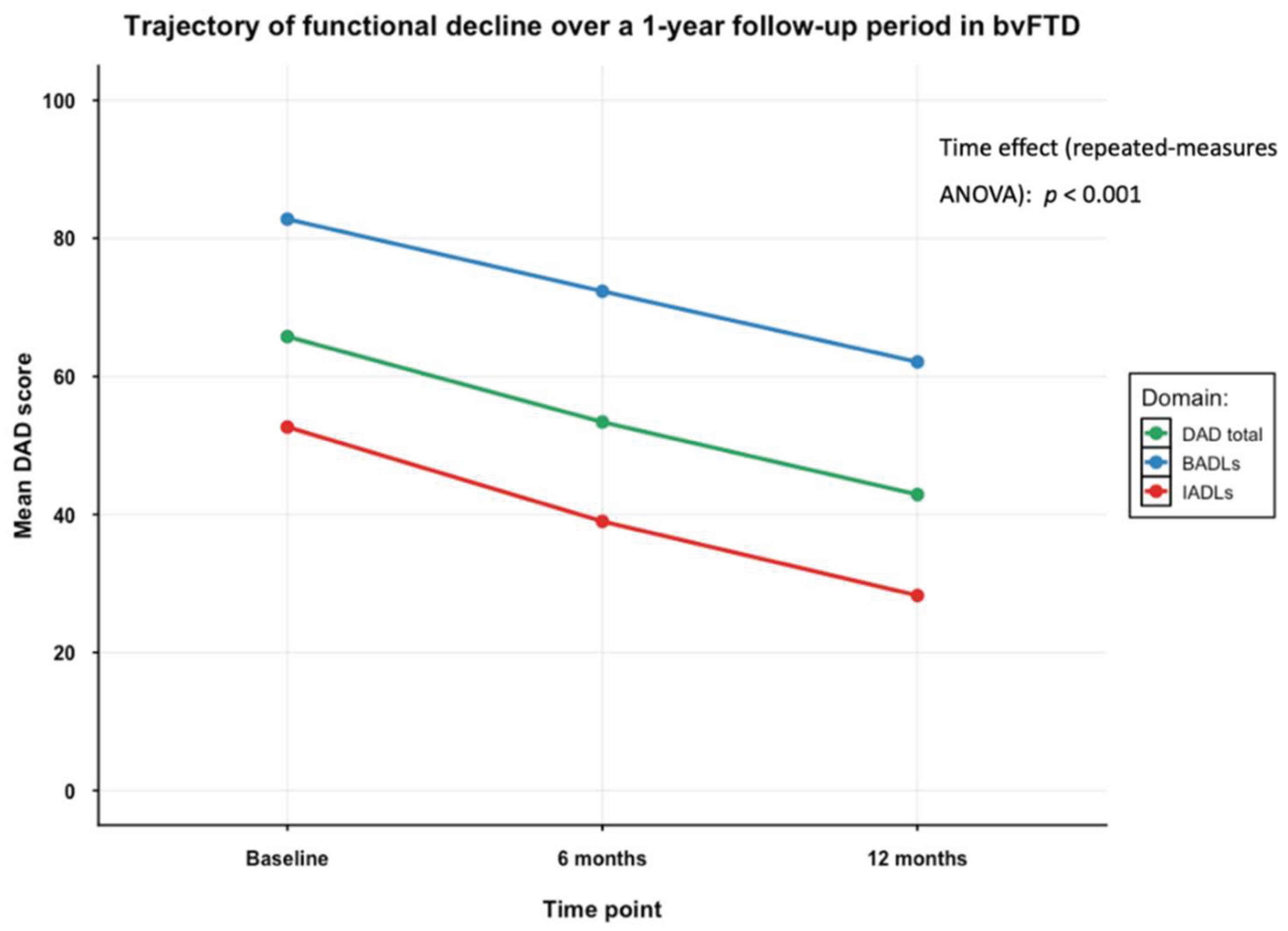
Figure 2.
Domain-Specific Patterns of Functional Deterioration in bvFTD Over a 1-Year Follow-Up. Abbreviations (in alphabetical order): BADLs, basic activities of daily living; DAD, Disability Assessment for Dementia; IADLs, instrumental activities of daily living.
Figure 2.
Domain-Specific Patterns of Functional Deterioration in bvFTD Over a 1-Year Follow-Up. Abbreviations (in alphabetical order): BADLs, basic activities of daily living; DAD, Disability Assessment for Dementia; IADLs, instrumental activities of daily living.
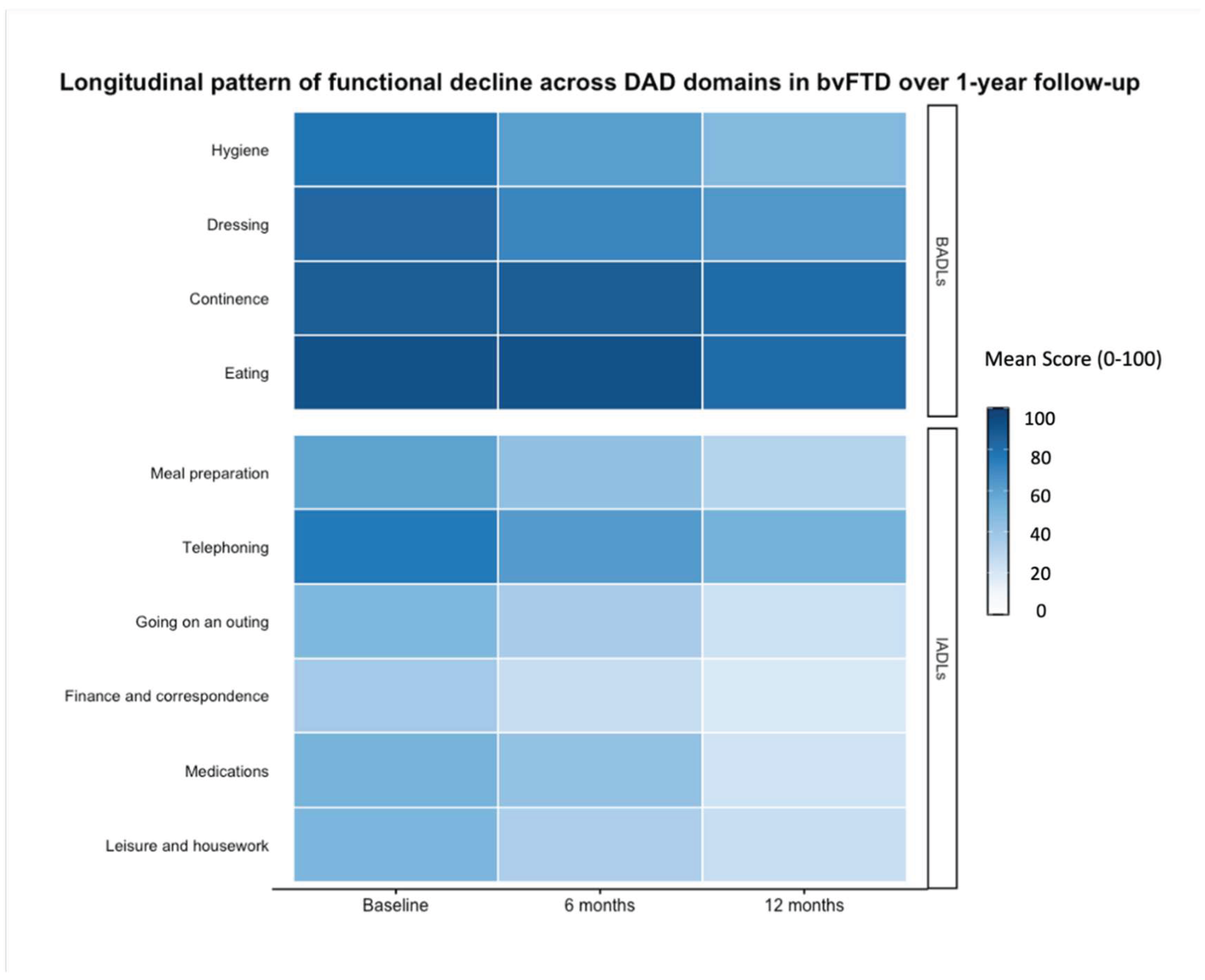

Table 1.
Demographic and clinical characteristics of participants at baseline.
| Mean (SD) | bvFTD Patients |
|---|---|
| n | 27 |
| Age, years | 70.15 (7.57) |
| Sex, M/F, n | 12/15 |
| Education, years | 10.85 (3.90) |
| Age at symptom onset, years | 68.04 (7.70) |
| Time since symptom onset, years | 2.07 (0.73) |
| CDR Sum of Boxes | 6.54 (3.81) |
| CDR Global Score | 1.17 (0.67) |
| FTLD-CDR Sum of Boxes | 8.57 (4.33) |
Table 2.
Longitudinal Changes in Neuropsychological, Behavioral, Personality, Functional, and Disease Severity Measures Across a 1-Year Follow-Up Period in bvFTD.
Table 2.
Longitudinal Changes in Neuropsychological, Behavioral, Personality, Functional, and Disease Severity Measures Across a 1-Year Follow-Up Period in bvFTD.
| Measure | Baseline Mean (SD) | 6-Month Mean (SD) | 12-Month Mean (SD) | F | p | η²G |
|---|---|---|---|---|---|---|
| FBI - Negative Symptoms | 19.41 (5.44) | 23.19 (6.49) | 27.07 (4.64) | 47.42 | <0.001*** | 0.247 |
| FBI - Positive Symptoms | 13.19 (4.88) | 15.26 (5.54) | 17.00 (5.31) | 12.09 | <0.001*** | 0.084 |
| IPIP - Conscientiousness | 22.67 (11.47) | 22.00 (11.81) | 17.26 (9.16) | 10.47 | <0.001*** | 0.048 |
| IPIP - Emotional Stability | 25.89 (11.61) | 23.89 (11.98) | 23.74 (13.83) | 1.64 | 0.204 | 0.006 |
| IPIP - Intellect | 20.82 (7.20) | 20.44 (8.07) | 15.78 (5.48) | 15.71 | <0.001*** | 0.100 |
| IPIP - Agreeableness | 29.19 (10.43) | 28.67 (10.58) | 23.59 (9.29) | 13.04 | <0.001*** | 0.061 |
| IPIP - Extraversion | 24.74 (7.56) | 25.56 (8.00) | 21.07 (7.17) | 6.61 | <0.01** | 0.064 |
| MoCA | 15.11 (4.99) | 13.30 (5.56) | 10.82 (6.36) | 22.25 | <0.001*** | 0.091 |
| CDT | 11.44 (3.63) | 9.52 (3.56) | 7.96 (4.21) | 39.15 | <0.001*** | 0.127 |
| Taylor - Copy | 25.17 (8.94) | 24.09 (10.22) | 21.20 (11.53) | 6.05 | <0.01** | 0.027 |
| Taylor - Delayed Recall | 4.65 (5.19) | 3.22 (4.39) | 2.48 (3.92) | 6.07 | <0.01** | 0.039 |
| Verbal Memory - Delayed Recall | 4.04 (4.24) | 3.11 (3.70) | 2.33 (3.51) | 14.05 | <0.001*** | 0.033 |
| Confrontation Naming | 33.22 (6.84) | 30.48 (8.60) | 27.89 (10.72) | 10.76 | <0.001*** | 0.059 |
| TMT - Part A | 120.93 (78.98) | 134.26 (82.73) | 157.19 (87.71) | 11.11 | <0.001*** | 0.032 |
| TMT - Part B | 247.70 (67.15) | 256.56 (66.77) | 267.00 (60.88) | 5.37 | <0.01** | 0.015 |
| Forward Digit Span | 5.52 (1.22) | 4.89 (1.16) | 4.37 (1.47) | 20.96 | <0.001*** | 0.121 |
| Backward Digit Span | 3.59 (1.28) | 3.15 (0.95) | 2.93 (1.27) | 5.10 | <0.01** | 0.054 |
| Stroop – Words and Colors | 14.04 (7.53) | 12.48 (8.19) | 10.22 (7.07) | 18.81 | <0.001*** | 0.042 |
| Semantic Verbal Fluency | 9.48 (3.90) | 8.63 (4.51) | 7.56 (4.69) | 8.40 | <0.001*** | 0.033 |
| Phonemic Verbal Fluency | 6.26 (3.25) | 5.26 (3.68) | 4.70 (3.80) | 11.22 | <0.001*** | 0.032 |
| FES | 3.59 (3.20) | 2.63 (2.57) | 2.11 (2.26) | 20.44 | <0.001*** | 0.051 |
| R4Alz-R (Part 3) | 90.22 (27.35) | 99.93 (33.30) | 114.96 (33.77) | 48.20 | <0.001*** | 0.097 |
| TASIT-S EET | 5.48 (2.29) | 4.70 (2.22) | 3.85 (2.21) | 16.05 | <0.001*** | 0.084 |
| TASIT-S SI-M | 23.30 (5.00) | 22.07 (5.84) | 18.89 (7.28) | 18.18 | <0.001*** | 0.087 |
| DAD total | 65.76 (24.83) | 53.38 (24.35) | 42.89 (22.77) | 28.39 | <0.001*** | 0.136 |
| BADLs (DAD) | 82.79 (20.95) | 72.33 (24.02) | 62.09 (26.28) | 18.29 | <0.001*** | 0.115 |
| IADLs (DAD) | 52.66 (30.74) | 38.99 (27.66) | 28.26 (22.40) | 24.69 | <0.001*** | 0.123 |
| FAQ | 16.48 (9.14) | 20.78 (7.76) | 24.82 (5.50) | 26.57 | <0.001*** | 0.171 |
| FRS | 48.91 (22.37) | 37.52 (20.91) | 29.40 (18.08) | 28.63 | <0.001*** | 0.136 |
| FTLD-CDR Sum of Boxes | 8.57 (4.33) | 11.91 (4.68) | 15.39 (4.87) | 61.00 | <0.001*** | 0.273 |
Longitudinal changes across time were examined using repeated-measures analysis of variance (ANOVA), with time (baseline, 6 months, 12 months) as the within-subject factor. The F statistic, associated p values, and effect sizes are reported. Effect sizes are expressed as generalized eta squared (η²G), which provides an appropriate measure of explained variance for repeated-measures designs. Levels of Statistical Significance: p > 0.05: not statistically significant; p < 0.05: *; p < 0.01: **; p < 0.001: ***. Abbreviations (in alphabetical order): BADLs, basic activities of daily living; CDT, Clock Drawing Test; DAD, Disability Assessment for Dementia; FAQ, Functional Activities Questionnaire; FBI, Frontal Behavioral Inventory; FES, FRONTIER Executive Screen battery; FRS, Frontotemporal Dementia Rating Scale; IADLs, instrumental activities of daily living; IPIP, International Personality Item Pool; MoCA, Montreal Cognitive Assessment; R4Alz-R, REMEDES for Alzheimer-Revised battery (Part 3: computerized executive function measure assessing inhibitory control, task switching, and cognitive flexibility); TASIT-S EET, The Awareness of Social Inference Test—Short Form Emotion Evaluation Test; TASIT-S SI-M, The Awareness of Social Inference Test—Short Form Minimal Subtest; TMT, Trail Making Test.
Disclaimer/Publisher’s Note: The statements, opinions and data contained in all publications are solely those of the individual author(s) and contributor(s) and not of MDPI and/or the editor(s). MDPI and/or the editor(s) disclaim responsibility for any injury to people or property resulting from any ideas, methods, instructions or products referred to in the content. |
© 2026 by the authors. Licensee MDPI, Basel, Switzerland. This article is an open access article distributed under the terms and conditions of the Creative Commons Attribution (CC BY) license (http://creativecommons.org/licenses/by/4.0/).
Copyright: This open access article is published under a Creative Commons CC BY 4.0 license, which permit the free download, distribution, and reuse, provided that the author and preprint are cited in any reuse.


