
Submitted:
18 June 2026
Posted:
23 June 2026
You are already at the latest version
Abstract
Background:
Sarcopenia is highly prevalent among older adults with chronic kidney disease (CKD) and is associated with adverse clinical outcomes. The finger-ring (Yubi-wakka) test is a simple anthropometric screening tool based on calf circumference; however, its performance in older adults with CKD remains unclear. This study aimed to investigate the association of the finger-ring test with low muscle mass, sarcopenia, and comprehensive geriatric assessment parameters and to evaluate its diagnostic performance for identifying low muscle mass in older adults with CKD.
Methods:
This cross-sectional study included 115 patients aged ≥65 years with CKD who were evaluated in geriatric and nephrology inpatient services. After excluding two participants with missing finger-ring measurements, 113 individuals were analyzed. Muscle mass was assessed using bioelectrical impedance analysis and low muscle mass was defined according to EWGSOP2-based Turkish cut-off values. Demographic characteristics, anthropometric measurements, laboratory findings, and comprehensive geriatric assessment parameters were recorded. Correlation analyses, logistic regression models, receiver operating characteristic (ROC) analyses, and likelihood-ratio tests were performed.
Results:
Among 113 participants, 62 were classified as finger-ring positive (FR=0) and 51 as finger-ring negative (FR=1). Low muscle mass was significantly more frequent in the FR=0 group than in the FR=1 group (51.6% vs. 24.0%, p=0.005). Finger-ring test results showed strong correlations with calf circumference (rho=0.689, p< 0.001) and body mass index (BMI) (rho=0.631, p< 0.001), whereas the correlation with muscle mass was modest (rho=0.250, p=0.008). For detecting low muscle mass, the finger-ring test demonstrated an area under the curve (AUC) of 0.643 (95% CI 0.554–0.732), sensitivity of 72.7%, specificity of 55.9%, positive predictive value of 51.6%, and negative predictive value of 76.0%. In multivariable analyses, BMI remained the strongest independent determinant of finger-ring test results, whereas the association with muscle mass lost statistical significance after BMI adjustment. Adding age and sex significantly improved discrimination, while the contribution of nutritional status was limited.
Conclusions:
The finger-ring test is associated with low muscle mass in older adults with CKD; however, its diagnostic performance is modest and appears to be substantially influenced by body size and calf circumference. Therefore, the finger-ring test should be considered a simple adjunctive screening tool rather than a stand-alone method for identifying low muscle mass in this population.
Keywords:
chronic kidney disease
; sarcopenia
; low muscle mass
; finger-ring test
; Yubi-wakka
; older adults
Introduction
Chronic kidney disease (CKD) is a highly burdensome clinical condition that is closely associated with functional decline, malnutrition, frailty, and adverse clinical outcomes in older adults. The uremic milieu, chronic inflammation, metabolic acidosis, hormonal dysregulation, physical inactivity, and inadequate nutritional intake may disrupt muscle protein turnover, leading to reductions in both muscle mass and muscle strength [1,2,3]. Consequently, sarcopenia is of particular importance in older adults with CKD, not only from a geriatric assessment perspective but also for prognostic evaluation and care planning [2,3].
According to the updated European Working Group on Sarcopenia in Older People (EWGSOP2) consensus, sarcopenia is defined as a progressive muscle disease characterized primarily by low muscle strength, confirmed by low muscle quantity or quality, and classified as severe when accompanied by impaired physical performance [4]. Recent systematic reviews and meta-analyses conducted in CKD populations have demonstrated that sarcopenia is highly prevalent and that loss of muscle strength affects a substantial proportion of patients [2]. However, direct assessment of muscle mass is not always readily available in routine clinical practice. Therefore, there remains a need for simple, rapid, low-cost, bedside screening tools that can be easily implemented in everyday clinical settings [3,4].
Anthropometric approaches based on calf circumference have attracted considerable attention in this regard. The EWGSOP2 consensus recommends calf circumference as a practical surrogate marker in settings where advanced body composition assessment methods are unavailable [4]. The finger-ring (Yubi-wakka) test, which compares calf circumference with a ring formed by the thumbs and index fingers, represents one of the simplest applications of this approach. Population-based studies have reported associations between the finger-ring test and sarcopenia, functional decline, and mortality risk, while more recent validation studies have shown promising, albeit variable, diagnostic performance [5,6,7].
Nevertheless, most of the available evidence regarding the finger-ring test has been derived from community-dwelling older adults. In geriatric patients with CKD, factors such as fluid status, edema, alterations in body composition, malnutrition, and multimorbidity may complicate the interpretation of calf circumference–based measurements [3,8]. Therefore, findings obtained from community-based populations may not be directly applicable to hospitalized older adults with CKD. The present study aimed to investigate the association of the finger-ring test with muscle mass, sarcopenia, and comprehensive geriatric assessment parameters in older adults with CKD, and to evaluate its diagnostic performance for identifying low muscle mass.
Materials and Methods
Study Design and Participants
This cross-sectional observational study was based on prospectively collected data and was conducted to investigate the association of the finger-ring test with muscle mass and comprehensive geriatric assessment parameters in older adults with chronic kidney disease (CKD). A total of 115 patients evaluated in the Geriatrics and Nephrology inpatient services of Ankara Bilkent City Hospital between July 2022 and March 2024 were included. The study was approved by the Clinical Research Ethics Committee (Approval Date: 21 December 2021; Approval No: E1-21-2168). The study was conducted in accordance with the principles of the Declaration of Helsinki. Written informed consent was obtained from all participants.
Participant Selection
Individuals aged 65 years and older with a diagnosis of CKD were eligible for inclusion. Because muscle mass was assessed using bioelectrical impedance analysis (BIA), participants receiving maintenance hemodialysis were evaluated only immediately after their dialysis session, when fluid balance was considered most stable, in order to minimize the influence of hydration status on body composition measurements. Although hemodialysis patients were clinically identified, dialysis modality was not available as a separate variable in the analytical dataset; therefore, subgroup analyses according to dialysis modality could not be performed. This standardized approach was adopted to improve the accuracy of BIA measurements.
Clinical and Geriatric Assessment
Demographic characteristics, anthropometric measurements, laboratory parameters, and comprehensive geriatric assessment findings were obtained from patient records. Age, sex, educational status, body mass index (BMI), right and left calf circumference, serum albumin, estimated glomerular filtration rate (eGFR), dominant handgrip strength, and gait speed were recorded.
Comprehensive geriatric assessment included the Katz Activities of Daily Living (ADL) Index, Lawton Instrumental Activities of Daily Living (IADL) Scale, Mini Nutritional Assessment–Short Form (MNA-SF), Geriatric Depression Scale–Short Form (GDS-SF), FRAIL Scale, Fried frailty phenotype, SARC-F questionnaire, number of medications, polypharmacy status, history of falls, osteoporosis, and dynapenia.
Finger-Ring Test Procedure and Classification
The finger-ring (Yubi-wakka) test was the primary variable of interest in this study. Participants were instructed to identify the widest circumference of the calf on their non-dominant leg. A ring was then formed using the thumbs and index fingers of both hands and placed around the calf at its widest point. The test was performed twice, and the consistent result was recorded.
The test was categorized into three levels: 0 = calf circumference smaller than the finger ring (a gap remained between the ring and the calf); 1 = calf circumference exactly matched the finger ring; and 2 = calf circumference larger than the finger ring (the fingers could not completely encircle the calf). For analytical purposes, categories 0 and 1 were combined and defined as a positive test result (FR=0), whereas category 2 was defined as a negative test result (FR=1).
Two participants with missing finger-ring test measurements were excluded from the analyses. For diagnostic performance analyses aimed at identifying low muscle mass, FR=0 was considered a positive test result [5].
Inclusion Criteria
- Age ≥65 years
- Diagnosis of chronic kidney disease (CKD)
- Ability to cooperate with study assessments and procedures
- Provision of written informed consent
Exclusion Criteria
- Advanced dementia
- Active delirium
- Severe visual or hearing impairment that could interfere with participation in study assessments
- Neuromuscular disorders (e.g., amyotrophic lateral sclerosis, myopathy, peripheral neuropathy)
- Major acute illness (e.g., acute myocardial infarction, acute stroke, or sepsis)
- Metastatic cancer with an expected survival of less than 3 months
- Severe edema that could substantially affect anthropometric measurements
Muscle Mass Assessment and Definition of Sarcopenia
Muscle mass was assessed using bioelectrical impedance analysis (BIA). Body composition and skeletal muscle mass measurements were performed using a multifrequency bioelectrical impedance analyzer (Bodystat QuadScan 4000, Bodystat Ltd., Isle of Man, UK). Measurements were obtained after hemodialysis sessions and with participants in the supine position. Individuals with permanent cardiac pacemakers or metallic implants were excluded from BIA assessment.
Low muscle mass was defined according to the recommendations of the European Working Group on Sarcopenia in Older People 2 (EWGSOP2) using sex-specific cut-off values for the skeletal muscle mass index (SMMI) derived from BIA and validated in the Turkish population: <9.2 kg/m² for men and <7.4 kg/m² for women [9].
Handgrip strength was measured using a digital hand dynamometer (Grip-D T.K.K. 5401, Takei Scientific Instruments Co., Ltd., Niigata, Japan) according to standardized procedures. Low muscle strength was defined as handgrip strength <32 kg in men and <22 kg in women, based on Turkish population–specific cut-off values [9].
Sarcopenia was classified according to the EWGSOP2 algorithm using measures of muscle strength, muscle mass, and physical performance. Low physical performance was defined as a gait speed of ≤0.8 m/s in accordance with EWGSOP2 recommendations. Following the EWGSOP2 diagnostic framework, low muscle mass and sarcopenia variables were not included simultaneously in the same multivariable model.
Statistical Analysis
Data quality was assessed before statistical analyses. An outlying value in the education variable was recoded as missing data, and an implausible value identified in the FRAIL scale was considered a data-entry error and excluded from the analyses. Missing data rates were compared between finger-ring test groups, and no significant differences were detected in evaluable comparisons. Complete-case analysis was applied for derived binary categorical variables, and participants with missing data in the source variable were excluded from the corresponding analyses.
Statistical analyses were performed using Python 3.12 with the SciPy 1.14, Statsmodels 0.14, and Scikit-learn 1.5 packages. Continuous variables were evaluated according to their distributional characteristics. Because departures from normality were common, continuous variables were summarized as medians and interquartile ranges (IQRs), whereas categorical variables were presented as frequencies and percentages. Normality was assessed using the Shapiro–Wilk test.
Given the frequent non-normal distribution of continuous variables and to ensure methodological consistency, between-group comparisons were performed using the Mann–Whitney U test for continuous variables and the chi-square test for categorical variables; Fisher’s exact test was used when expected cell counts were <5. Associations between variables were evaluated using Spearman’s rank correlation analysis.
Binary logistic regression analyses were performed to identify independent determinants of finger-ring test results. Variables associated with the outcome at p<0.10 in univariable analyses were considered candidates for multivariable models. Calf circumference was not included in multivariable models because it represents the anatomical basis of the finger-ring test and was highly correlated with body mass index (BMI).
Model performance was evaluated using the Hosmer–Lemeshow goodness-of-fit test, Nagelkerke pseudo-R², and classification accuracy. The diagnostic performance of the finger-ring test for identifying low muscle mass was assessed using the area under the receiver operating characteristic curve (AUC), sensitivity, specificity, positive predictive value, negative predictive value, likelihood ratios, and the Youden index. Confidence intervals for diagnostic accuracy measures were calculated using the Wilson method. Additional subgroup analyses were performed according to BMI categories.
The incremental contribution of variables added to nested models was evaluated using likelihood-ratio tests. Therefore, the DeLong test was not used to compare AUC values between nested models [10]. The discriminative performance of the final model was internally validated using 1,000 bootstrap resamples with optimism correction. Potential differences in discriminative performance across BMI categories were evaluated using a finger-ring × BMI interaction term. Because of multiple comparisons, borderline findings were considered exploratory. All statistical tests were two-sided, and a p-value <0.05 was considered statistically significant.
Results
A total of 115 patients were enrolled in the study. After being recorded in three categories, finger-ring test results were dichotomized (FR=0: calf circumference smaller than or equal to the finger ring; FR=1: calf circumference larger than the finger ring). Two participants with missing finger-ring measurements were excluded, leaving 113 individuals for analysis, including 62 in the FR=0 group and 51 in the FR=1 group. In the missing data analysis, no significant differences in the proportion of missing observations were observed between the finger-ring test groups in evaluable comparisons.
Comparison of demographic and clinical characteristics showed that age distribution was similar between the two groups (median 74 [69–80] vs. 73 [69–77] years, p=0.554). Female sex was more common in the FR=1 group than in the FR=0 group (28/51 [54.9%] vs. 19/62 [30.6%], p=0.016). BMI was significantly higher in the FR=1 group (31.6 [28.1–35.4] vs. 24.6 [22.2–27.3] kg/m², p<0.001). Low muscle mass was more prevalent in the FR=0 group (32/62 [51.6%] vs. 12/50 [24.0%], p=0.005). Both right and left calf circumferences were significantly greater in the FR=1 group (both p<0.001). In contrast, no significant differences were observed between the groups with respect to eGFR, serum albumin, sex-specific dominant handgrip strength, or gait speed.
When comprehensive geriatric assessment parameters were examined, the MNA-SF score was significantly higher in the FR=1 group (12 [10–13] vs. 11 [8–12], p=0.019). Malnutrition risk, defined according to the MNA-SF, was more frequent in the FR=0 group (38/60 [63.3%] vs. 20/51 [39.2%], p=0.019). The number of medications did not differ significantly between groups (7 [5–9] vs. 8 [6–11], p=0.075). The distribution of sarcopenia categories differed nominally between groups (p=0.039), with confirmed and severe sarcopenia being more common in the FR=0 group; however, this finding should be interpreted as exploratory because of multiple comparisons and small cell counts. No significant differences were observed in Katz ADL, Lawton IADL, GDS-SF, FRAIL score, SARC-F score, polypharmacy, or history of falls. Although dynapenia was more frequent in the FR=0 group (95.2% vs. 84.3%), the difference did not reach statistical significance (p=0.063).
In Spearman correlation analyses, the strongest associations with finger-ring test results were observed for calf circumference (rho=0.689, p<0.001) and BMI (rho=0.631, p<0.001). A weak-to-moderate positive correlation was found between finger-ring test results and muscle mass (rho=0.250, p=0.008). MNA-SF scores also showed a weak-to-moderate positive correlation (rho=0.301, p=0.001). No significant correlations were identified with number of medications, GDS-SF, FRAIL score, age, SARC-F score, Katz ADL, Lawton IADL, handgrip strength, or gait speed.
In the diagnostic performance analysis for low muscle mass (complete-case analysis, n=112), the finger-ring test yielded an AUC of 0.643 (95% CI: 0.554–0.732). Sensitivity was 72.7% (95% CI: 58.2–83.7), specificity was 55.9% (95% CI: 44.1–67.1), positive predictive value was 51.6% (95% CI: 39.4–63.6), and negative predictive value was 76.0% (95% CI: 62.6–85.7). The positive likelihood ratio (LR+) was 1.65 (95% CI: 1.19–2.28), the negative likelihood ratio (LR−) was 0.49 (95% CI: 0.29–0.83), overall accuracy was 62.5%, and the Youden index was 0.286. Because these likelihood ratios produced only limited changes in post-test probability, the finger-ring test cannot be considered a stand-alone diagnostic tool. According to BMI categories, the AUC values were 0.536, 0.575, and 0.662, respectively; however, differences in discriminative performance were not statistically significant in the formal interaction analysis (p=0.44). As BMI increased, sensitivity decreased (90% to 40%), whereas specificity increased (17% to 92%). The high specificity observed in the obese subgroup suggests that increasing body size may shift classification errors toward false-negative results; therefore, this finding should be interpreted as exploratory.
In univariable logistic regression analyses, right calf circumference (OR 1.64, 95% CI: 1.36–1.98, p<0.001), BMI (OR 1.44, 95% CI: 1.26–1.64, p<0.001), preserved muscle mass (OR 3.12, 95% CI: 1.40–6.96, p=0.006), MNA-SF score (OR 1.23, 95% CI: 1.05–1.44, p=0.009), male sex (OR 0.36, 95% CI: 0.17–0.79, p=0.010), and number of medications (OR 1.16, 95% CI: 1.01–1.32, p=0.031) were significantly associated with finger-ring test results. In multivariable models, BMI remained the strongest independent predictor across all models (OR range: 1.41–1.45; all p<0.001). In contrast, the association between preserved muscle mass and finger-ring test results weakened after adjustment for BMI and lost statistical significance (adjusted OR range: 2.1–2.7; p=0.08–0.15). Similarly, MNA-SF score, number of medications, and sex were no longer significant after BMI was included in the models. This pattern suggests that finger-ring test results primarily reflect body size, as represented by BMI, and that the observed association with muscle mass is largely mediated through body size.
In combined model analyses, the finger-ring test alone yielded an AUC of 0.643. The addition of MNA-SF did not significantly improve discrimination (AUC 0.674; likelihood-ratio test p=0.13). In contrast, the addition of calf circumference (AUC 0.701; p=0.019), age and sex (AUC 0.737; p=0.004), and the full model (AUC 0.752; p=0.008) significantly improved discriminative performance compared with the finger-ring test alone. However, because calf circumference represents the direct anatomical basis of the finger-ring test, the observed improvement likely reflects a structural component of the measurement rather than an independent clinical contribution. The finger-ring test provided a statistically significant but modest incremental contribution beyond age and sex (p=0.001), whereas no significant additional contribution was observed after BMI was included in the model (p=0.14). The apparent AUC of the full model was 0.752, and the optimism-corrected bootstrap AUC was 0.71.

Table 1.
Demographic, Anthropometric, and Laboratory Characteristics of Participants Stratified by Finger-Ring Test Results.
Table 1.
Demographic, Anthropometric, and Laboratory Characteristics of Participants Stratified by Finger-Ring Test Results.
| Variable | Total | FR=0 | FR=1 | p-value |
|---|---|---|---|---|
| Age, median (IQR), years | 73 (69–79) | 74 (69–80) | 73 (69–77) | 0.554 |
| Female sex, n (%) | 47 (41.6) | 19 (30.6) | 28 (54.9) | 0.016 |
| BMI, median (IQR), kg/m² | 27.3 (23.6–31.2) | 24.6 (22.2–27.3) | 31.6 (28.1–35.4) | <0.001 |
| Low muscle mass, n (%) | 44 (39.3) | 32 (51.6) | 12 (24.0) | 0.005 |
| Right calf circumference, median (IQR), cm | 35.0 (32.0–37.5) | 32.0 (30.0–34.9) | 37.0 (35.8–40.0) | <0.001 |
| Left calf circumference, median (IQR), cm | 35.0 (32.0–37.9) | 32.0 (30.0–35.0) | 37.0 (35.5–40.0) | <0.001 |
| eGFR, median (IQR), mL/min/1.73 m² | 22.0 (11.0–38.0) | 28.0 (14.0–43.5) | 20.0 (11.0–33.0) | 0.381 |
| Serum albumin, median (IQR), g/L | 34.5 (30.2–39.0) | 34.0 (31.0–38.0) | 35.5 (30.0–40.2) | 0.335 |
| Dominant handgrip strength (men), median (IQR), kg | 23.3 (17.6–28.4) | 23.3 (17.6–27.1) | 23.6 (17.6–28.9) | 0.58 |
| Dominant handgrip strength (women), median (IQR), kg | 13.8 (9.0–18.2) | 10.4 (8.2–16.1) | 14.7 (10.2–18.7) | 0.22 |
| Gait speed, median (IQR), m/s | 0.81 (0.63–0.82) | 0.81 (0.42–0.85) | 0.81 (0.81–0.81) | 0.423 |
Abbreviations: BMI, body mass index; eGFR, estimated glomerular filtration rate; IQR, interquartile range. Footnote: Continuous variables are presented as median (interquartile range [IQR]) and were compared using the Mann–Whitney U test. Categorical variables are presented as n (%) and were compared using the chi-square test or Fisher’s exact test, as appropriate. Dominant handgrip strength represents the maximum value of three measurements and is presented separately for men and women. Because of the well-established sex-related differences in handgrip strength and the unequal sex distribution between the finger-ring test groups (with a higher proportion of women in the FR=1 group), sex-independent comparisons of handgrip strength were not performed. Due to missing data, the sample size was <113 for eGFR and serum albumin. Analyses of muscle mass and calf circumference were based on 62 participants in the FR=0 group and 50 participants in the FR=1 group. MNA-SF scores and malnutrition risk were calculated using denominators of 60 and 51 participants, respectively.
Table 2.
Comparison of Comprehensive Geriatric Assessment Parameters According to Finger-Ring Test Groups.
Table 2.
Comparison of Comprehensive Geriatric Assessment Parameters According to Finger-Ring Test Groups.
| Parameter | Total | FR=0 | FR=1 | p-value |
|---|---|---|---|---|
| Katz ADL, median (IQR) | 5 (4–6) | 5 (4–6) | 5 (5–6) | 0.781 |
| Lawton IADL, median (IQR) | 7 (4–8) | 8 (4–8) | 7 (5–8) | 0.509 |
| MNA-SF, median (IQR) | 11 (9–13) | 11 (8–12) | 12 (10–13) | 0.019 |
| Malnutrition risk (MNA-SF ≤11), n (%) | 58/111 (52.3) | 38/60 (63.3) | 20/51 (39.2) | 0.019 |
| GDS-SF, median (IQR) | 3 (2–5) | 3 (2–4) | 4 (2–6) | 0.143 |
| Depression (GDS-SF ≥5), n (%) | 33/111 (29.7) | 15/60 (25.0) | 18/51 (35.3) | 0.330 |
| FRAIL score, median (IQR) | 2 (1–3) | 2 (1–3) | 2 (1–3) | 0.452 |
| SARC-F score, median (IQR) | 4 (1–6) | 4 (1–6) | 5 (2–6) | 0.688 |
| Number of medications, median (IQR) | 7 (5–10) | 7 (5–9) | 8 (6–11) | 0.075 |
| Polypharmacy (≥5 medications), n (%) | 94/112 (83.9) | 50/62 (80.6) | 44/50 (88.0) | 0.427 |
| Sarcopenia distribution, % (None/Probable/Confirmed/Severe) | 4.5 / 56.4 / 10.0 / 29.1 (n=110) | 3.3 / 45.9 / 11.5 / 39.3 (n=61) | 6.1 / 69.4 / 8.2 / 16.3 (n=49) | 0.039 |
| History of falls (≥1), n (%) | 36/112 (32.1) | 18/62 (29.0) | 18/50 (36.0) | 0.561 |
| Dynapenia, n (%) | 102/113 (90.3) | 59/62 (95.2) | 43/51 (84.3) | 0.063 |
Categorical variables are presented as n/N (%) and were compared using the chi-square test or Fisher’s exact test, as appropriate. Due to missing data, denominators varied across variables.
Figure 1.
Distribution of Low and Preserved Muscle Mass According to Finger-Ring Test Groups. Muscle mass data were unavailable for one participant in the FR=1 group; therefore, this individual was excluded from the figure (n=62 for FR=0 and n=50 for FR=1).
Figure 1.
Distribution of Low and Preserved Muscle Mass According to Finger-Ring Test Groups. Muscle mass data were unavailable for one participant in the FR=1 group; therefore, this individual was excluded from the figure (n=62 for FR=0 and n=50 for FR=1).
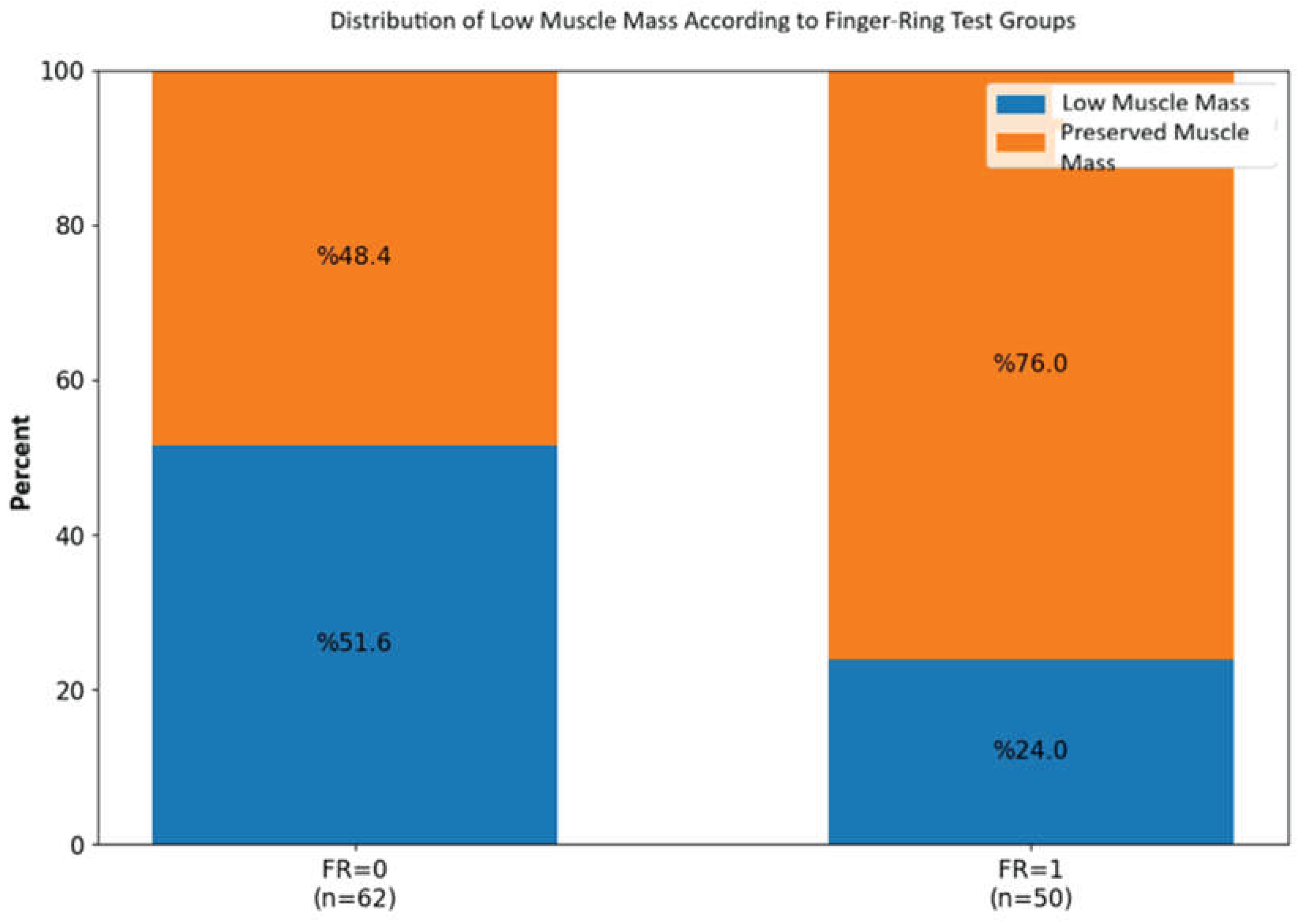
Figure 2.
Spearman Correlation Coefficients Between Finger-Ring Test Results and Selected Clinical Variables. Significant positive correlations were observed between finger-ring test results and calf circumference, body mass index (BMI), MNA-SF score, and muscle mass (all p<0.05). No significant correlations were found for the remaining variables.
Figure 2.
Spearman Correlation Coefficients Between Finger-Ring Test Results and Selected Clinical Variables. Significant positive correlations were observed between finger-ring test results and calf circumference, body mass index (BMI), MNA-SF score, and muscle mass (all p<0.05). No significant correlations were found for the remaining variables.
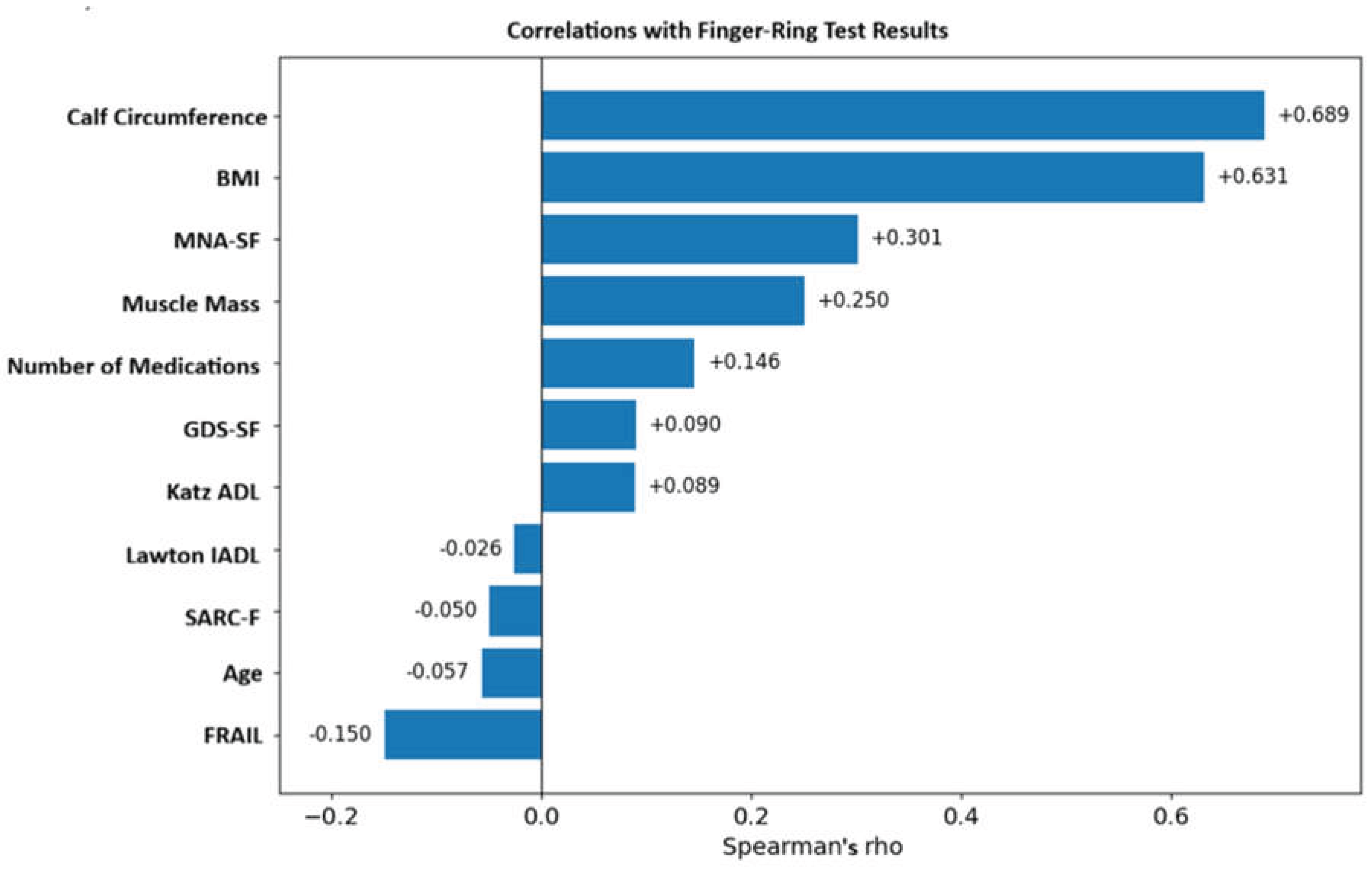
Figure 3.
Comparison of the Discriminative Performance of Combined Models for Identifying Low Muscle Mass. Area under the receiver operating characteristic curve (AUC) values are shown for the finger-ring test alone and for combined models. p-values were obtained from likelihood-ratio (LR) tests comparing each model with the finger-ring test alone model.
Figure 3.
Comparison of the Discriminative Performance of Combined Models for Identifying Low Muscle Mass. Area under the receiver operating characteristic curve (AUC) values are shown for the finger-ring test alone and for combined models. p-values were obtained from likelihood-ratio (LR) tests comparing each model with the finger-ring test alone model.
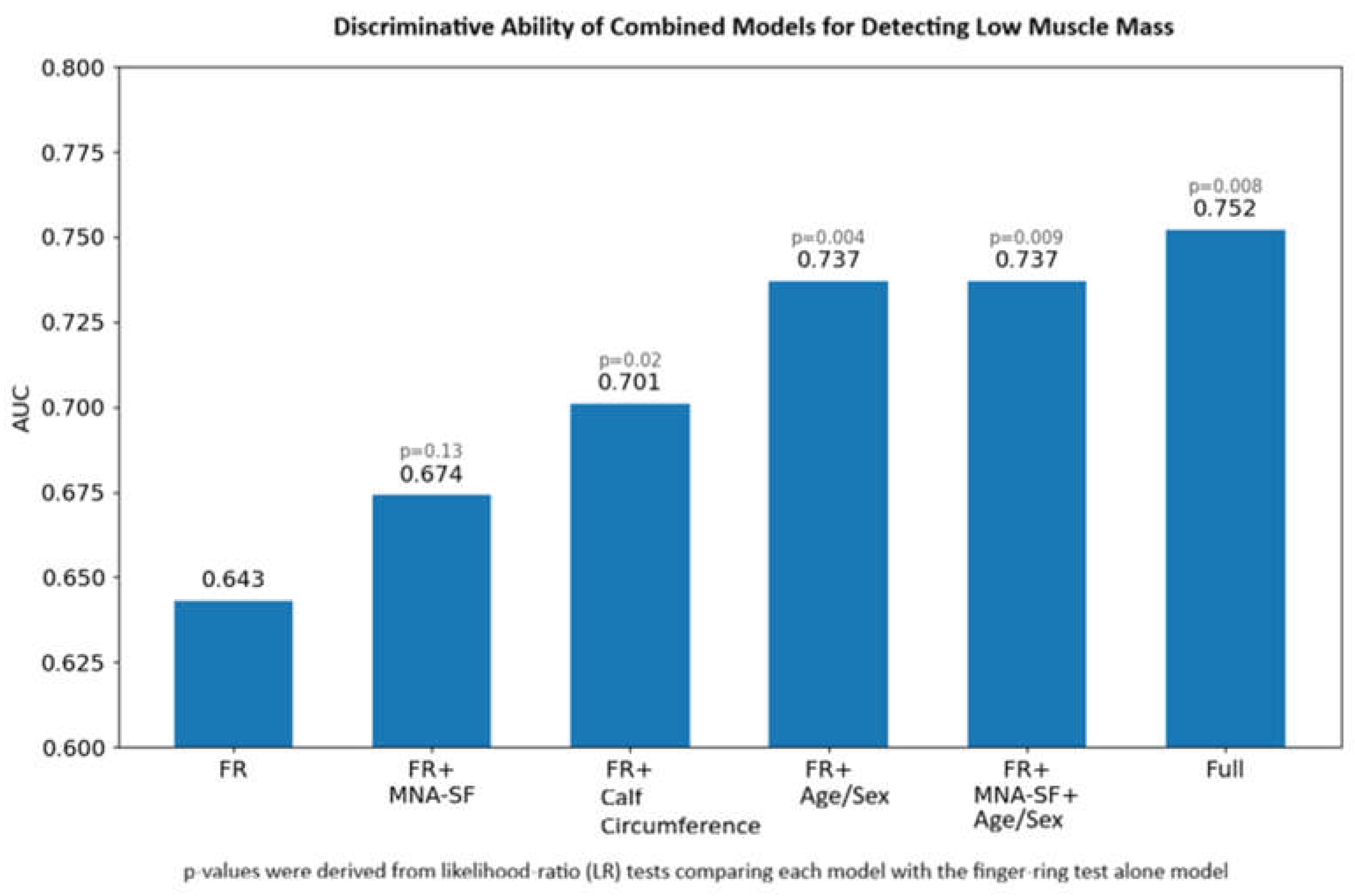
Table 3.
Diagnostic Performance of the Finger-Ring Test for Identifying Low Muscle Mass.
| Diagnostic Metric | Overall Sample | 95% CI / Subgroup Results |
|---|---|---|
| AUC | 0.643 | 0.554–0.732 |
| Sensitivity | 72.7% | 58.2–83.7 |
| Specificity | 55.9% | 44.1–67.1 |
| Positive Predictive Value | 51.6% | 39.4–63.6 |
| Negative Predictive Value | 76.0% | 62.6–85.7 |
| LR+ | 1,65 | 1.19–2.28 |
| LR− | 0.49 | 0.29–0.83 |
| Accuracy | 62.5% | 53.3–70.9 |
| Youden Index | 0.286 | — |
| BMI <25 kg/m² (n=39) | AUC 0.536 | Sensitivity 90.5% / Specificity 16.7% |
| BMI 25–30 kg/m² (n=37) | AUC 0.575 | Sensitivity 69.2% / Specificity 45.8% |
| BMI >30 kg/m² (n=36) | AUC 0.662 | Sensitivity 40.0% / Specificity 92.3% |
Footnote: Analyses were based on complete-case data (n=112); two participants with missing finger-ring measurements and one participant with missing muscle mass data were excluded. Confidence intervals for proportions were calculated using the Wilson method and for likelihood ratios using the method of Simel et al. FR=0 was considered a positive test result.
Table 4.
Univariable and Multivariable Logistic Regression Analyses of Factors Associated with a Negative Finger-Ring Test Result (FR=1).
Table 4.
Univariable and Multivariable Logistic Regression Analyses of Factors Associated with a Negative Finger-Ring Test Result (FR=1).
| Model / Variable | OR | 95% CI | p-value |
|---|---|---|---|
| Univariable analysis | |||
| Right calf circumference (cm) | 1.641 | 1.360–1.981 | <0.001 |
| BMI (kg/m²) | 1.436 | 1.255–1.642 | <0.001 |
| Preserved muscle mass | 3.118 | 1.397–6.959 | 0.006 |
| MNA-SF score | 1.232 | 1.053–1.441 | 0.009 |
| Male sex | 0.363 | 0.168–0.785 | 0.010 |
| Number of medications | 1.156 | 1.014–1.318 | 0.031 |
| Multivariable Model 1 | |||
| Preserved muscle mass | 2.654 | 0.904–7.794 | 0.076 |
| BMI (kg/m²) | 1.414 | 1.228–1.629 | <0.001 |
| Age (years) | 1.016 | 0.946–1.092 | 0.656 |
| Male sex | 0.591 | 0.204–1.708 | 0.331 |
| Multivariable Model 2 | |||
| Preserved muscle mass | 2.246 | 0.807–6.252 | 0.121 |
| BMI (kg/m²) | 1.427 | 1.231–1.654 | <0.001 |
| MNA-SF score | 0.996 | 0.810–1.225 | 0.970 |
| Multivariable Model 3 | |||
| Preserved muscle mass | 2.145 | 0.759–6.066 | 0.150 |
| BMI (kg/m²) | 1.453 | 1.242–1.700 | <0.001 |
| MNA-SF score | 0.968 | 0.784–1.195 | 0.763 |
| Number of medications | 0.990 | 0.817–1.201 | 0.920 |
Abbreviations: AUC, area under the receiver operating characteristic curve; LR, likelihood ratio; MNA-SF, Mini Nutritional Assessment–Short Form. Footnote: Model 1 included age, sex, BMI, and muscle mass status. Model 2 included all variables in Model 1 plus the MNA-SF score. Model 3 included all variables in Model 2 plus the number of medications. The outcome variable was FR=1 (calf circumference larger than the finger ring). This category was considered a negative test result for low muscle mass; therefore, odds ratios (ORs) >1 indicate an increased likelihood of a negative finger-ring test result (FR=1). For the variable preserved muscle mass, the reference category was low muscle mass.
Table 5.
Discriminative Performance (AUC) of Combined Models for Identifying Low Muscle Mass and Results of Likelihood-Ratio Tests.
Table 5.
Discriminative Performance (AUC) of Combined Models for Identifying Low Muscle Mass and Results of Likelihood-Ratio Tests.
| Model | AUC | LR Test p-value |
|---|---|---|
| Finger-ring test alone | 0.643 | — |
| Finger-ring test + MNA-SF | 0.674 | 0.127 |
| Finger-ring test + calf circumference | 0.701 | 0.019 |
| Finger-ring test + age + sex | 0.737 | 0.004 |
| Finger-ring test + MNA-SF + age + sex | 0.737 | 0.009 |
| Full model | 0.752 (optimism-corrected: 0.710) | 0.008 |
Abbreviations: AUC, area under the receiver operating characteristic curve; LR, likelihood ratio; MNA-SF, Mini Nutritional Assessment–Short Form. Footnote: The outcome variable was low muscle mass. Each combined model was compared with the finger-ring test–only model using a likelihood-ratio (LR) test. Because the models were nested, the DeLong test was not used to compare differences in ROC curve areas; therefore, only AUC values and LR test p-values are presented. For the full model, the apparent AUC was 0.752, whereas the optimism-corrected AUC estimated using 1,000 bootstrap resamples was 0.710. Model calibration and performance were acceptable (Hosmer–Lemeshow test p=0.155, Nagelkerke R²=0.254, classification accuracy 68.2%). The finger-ring test provided significant incremental information beyond age and sex (LR test p=0.001), whereas its incremental contribution beyond BMI was not statistically significant (LR test p=0.138).
Discussion
In the present study, the finger-ring test was significantly associated with muscle mass in older adults with chronic kidney disease (CKD); however, this association appeared to be largely intertwined with overall body size and lower-extremity circumference. When used alone, the finger-ring test demonstrated only modest discriminative ability for identifying low muscle mass (AUC ≈ 0.64). An AUC below 0.70 is generally considered to indicate limited discriminative ability, supporting the use of the finger-ring test as a screening rather than a diagnostic tool. Compared with the higher predictive performance reported in community-dwelling older populations [5,6], the diagnostic utility of the test appears more limited in geriatric patients with CKD and substantial chronic disease burden. At the same time, the strong associations observed with BMI and calf circumference suggest that the finger-ring test reflects not only muscle mass but also overall body habitus. A recent systematic review and meta-analysis confirmed a significant association between the finger-ring test and sarcopenia; however, the authors emphasized that most available studies were conducted in community-based populations and that evidence from clinical populations remains limited [11]. Therefore, in this patient group, the finger-ring test may be more appropriately considered a practical adjunctive indicator that complements clinical assessment rather than an independent screening tool.
Our findings indicate that the finger-ring test is most strongly associated with anthropometric measures. The highest Spearman correlation coefficients were observed for calf circumference (rho=0.689) and BMI (rho=0.631), while BMI remained an independent predictor in all multivariable models. Similarly, Rosa et al. demonstrated a significant association between finger-ring test categories and appendicular lean soft tissue mass measured by dual-energy X-ray absorptiometry (DXA), although body size played a major role in this relationship [12]. Piodena-Aportadera et al. reported that, among community-dwelling older adults, the finger-ring test showed substantially lower diagnostic performance than calf circumference for both low muscle mass (AUC 0.591 vs. 0.855–0.870) and sarcopenia (AUC 0.581 vs. 0.788–0.818) [13]. In our study, muscle mass was associated with finger-ring test results in univariable analyses; however, this association weakened and lost statistical significance after adjustment for BMI. Although discriminative performance appeared to vary across BMI categories (AUC 0.536 in normal-weight/underweight participants and 0.662 in obese participants), the interaction was not statistically significant (p=0.44). This pattern suggests that the test contains a mechanical component that is strongly influenced by body size. Consistent with this interpretation, Fujii et al. identified metabolic syndrome as an independent predictor of a positive finger-ring test result among women in a large cohort of 12,894 individuals [14]. Clinically, this observation is important because obesity may mask muscle loss, particularly in older adults with chronic disease, thereby complicating the interpretation of simple circumference-based assessments. Indeed, the recent Asia–Oceania consensus on sarcopenic obesity includes the finger-ring test among potential screening tools for sarcopenia but recommends cautious interpretation in individuals with obesity [15].
The weak association observed between the finger-ring test and functional parameters is also noteworthy. No significant relationships were found with handgrip strength, gait speed, Katz ADL, Lawton IADL, or frailty measures. Although dynapenia was more frequent in the FR=0 group, the difference did not reach statistical significance. These findings suggest that the finger-ring test does not adequately capture the functional dimension of sarcopenia as defined by the EWGSOP2 framework [4]. Lee et al. reported a similar dissociation among community-dwelling older women: finger-ring test results were associated with muscle mass and quality of life, but not with objective physical performance measures such as the Short Physical Performance Battery (SPPB) or the Timed Up and Go (TUG) test [16]. Likewise, Piodena-Aportadera et al. found that the finger-ring test correlated with muscle mass and handgrip strength but not with physical performance [13]. In a study comparing four sarcopenia screening tools among community-dwelling older adults, Lin et al. also confirmed a significant association between the finger-ring test and sarcopenia, while demonstrating that calf circumference measurement provided superior overall diagnostic accuracy [17]. In other words, the finger-ring test appears to generate a signal that primarily reflects muscle mass and body circumference rather than muscle strength and physical performance. These findings support the role of the finger-ring test as a rough preliminary screening approach in situations where direct calf circumference measurement is unavailable, rather than as a stand-alone screening tool within the EWGSOP2 diagnostic algorithm.
The observed association with nutritional status should likewise be interpreted cautiously. Higher MNA-SF scores and a lower prevalence of malnutrition risk in the FR=1 group might initially suggest that the finger-ring test reflects nutritional status. Indeed, Li et al. developed a screening approach combining the SARC-F questionnaire with the finger-ring test and demonstrated that the calf circumference component improved diagnostic accuracy [18]. However, in our study, this association weakened after adjustment for BMI in multivariable analyses, suggesting that the finding may be explained, at least in part, by body composition and overall body size. Protein-energy wasting is highly prevalent in CKD and may affect up to 30% of patients with advanced disease [19]. Therefore, the close interrelationship between nutritional indicators, body size, and muscle mass is not unexpected in this population. Consequently, the finger-ring test should not be interpreted as an independent screening tool for malnutrition.
These findings should also be considered within the specific context of chronic kidney disease. In CKD, fluid retention, peripheral edema, chronic inflammation, physical inactivity, and protein-energy wasting frequently coexist [1,3]. Each of these factors may influence both calf circumference and muscle mass measurements obtained by BIA. Kang et al. demonstrated that volume status directly affects the assessment of sarcopenia in patients with non-dialysis CKD [8]. Similarly, Huang et al. reported that male sex and older age were independent risk factors for more advanced sarcopenia stages in patients with pre-dialysis CKD [20]. In our study, sex was significantly associated with finger-ring test results, although this relationship weakened after adjustment for BMI, suggesting that sex-related differences may be partially mediated by body size. Therefore, the observed association between the finger-ring test and low muscle mass may reflect a combination of true muscle loss and changes in fluid status and tissue composition. The finger-ring test has also been evaluated in older adults with cirrhosis, where it was found to be associated with dysphagia [21], suggesting that similar limitations may apply across different chronic disease populations. Clinicians should therefore be aware that, particularly in patients prone to edema, the finger-ring test may yield both false-negative and false-positive results, requiring cautious interpretation.
Strengths of the Study
This study has several important strengths. First, it focuses on the evaluation of the finger-ring test in older adults with chronic kidney disease, a relatively understudied and clinically challenging population. Second, the analysis was not limited to anthropometric measurements alone; instead, multiple components of comprehensive geriatric assessment—including muscle mass, sarcopenia, nutritional status, depression, frailty, activities of daily living, and medication burden—were evaluated simultaneously. Third, data cleaning was performed systematically, the pattern of missing data was explicitly assessed, and variables with potential collinearity were deliberately handled separately during multivariable model construction. Finally, BMI-stratified subgroup analyses provided insight into potential body size–related limitations of the finger-ring test, although differences in discriminative performance across BMI categories were not statistically significant in formal interaction analyses.
Limitations
Several limitations should also be acknowledged. First, the study had a cross-sectional design; therefore, the observed associations between the finger-ring test and muscle mass or geriatric syndromes cannot be interpreted as causal. Second, the sample size was relatively modest, and the study was conducted at a single center among hospitalized older adults with CKD. Consequently, the findings may not be directly generalizable to community-dwelling older adults, younger patients with CKD, or dialysis populations. In addition, CKD stages were not available for all participants; therefore, analyses according to CKD severity could not be performed. Since sarcopenia prevalence and body composition may vary across CKD stages, residual confounding related to disease severity cannot be excluded.
Although the use of BIA for muscle mass assessment is practical and clinically feasible, it remains susceptible to measurement error due to fluctuations in volume status, particularly in patients with CKD. Likewise, finger-ring test results and calf circumference measurements may be influenced by edema. In addition, inter-rater agreement and test–retest reliability of the finger-ring test were not evaluated.
When differences in discriminative performance between models were assessed using likelihood-ratio tests, the addition of calf circumference, age and sex, and the full model significantly improved model performance compared with the finger-ring test alone, whereas the addition of MNA-SF did not. Given the limited sample size, these findings should be considered exploratory. Furthermore, no adjustment was made for multiple comparisons, and the relatively small sample sizes within BMI subgroups increase the possibility of both type I error and limited statistical power.
Finally, because some variables contained missing data, complete-case analysis was used for derived categorical variables. Although this approach is practical and commonly applied, it may have reduced the effective sample size and statistical power of certain analyses.
Clinical Implications
Taken together, these findings suggest that the finger-ring test may provide a useful alert for the presence of low muscle mass in older adults with chronic kidney disease; however, it should not be used as a stand-alone decision-making tool. In addition, the relatively higher negative predictive value compared with the positive predictive value suggests that the finger-ring test may be more useful for excluding low muscle mass than for confirming its presence. Therefore, a negative test result may provide some reassurance, whereas a positive result should be interpreted in conjunction with further clinical and objective assessments. As BMI increases, the sensitivity of the test decreases while specificity increases; however, differences in discriminative performance across BMI categories were not statistically significant in formal interaction analyses. Therefore, subgroup findings should not be interpreted as evidence of superior diagnostic performance in specific BMI categories but rather as reflecting body size–dependent measurement behavior. Accordingly, interpretation of finger-ring test results should always be considered within the broader context of body composition.
A recent review encompassing more than 50 validated sarcopenia screening tools emphasized that selecting an appropriate instrument according to the clinical setting is of critical importance [22]. In clinical practice, the finger-ring test may be most useful when combined with calf circumference measurement, assessment of muscle strength, nutritional evaluation, and, whenever feasible, objective measurement of muscle mass. Given that the Asian Working Group for Sarcopenia (AWGS) 2019 consensus recommends calf circumference and SARC-F as screening tools [23], the finger-ring test may serve as a complementary approach, particularly in settings where access to standard measurement instruments is limited.
In conclusion, the finger-ring test is a simple and feasible screening tool for identifying low muscle mass in older adults with chronic kidney disease. Nevertheless, it should not be used for diagnostic purposes in isolation and should be interpreted in conjunction with a comprehensive geriatric assessment.
References
- Sabatino A, Cuppari L, Stenvinkel P, Lindholm B, Avesani CM. Sarcopenia in chronic kidney disease: what have we learned so far? J Nephrol. 2021;34(4):1347-1372. [CrossRef]
- Duarte MP, Almeida LS, Neri SGR, Oliveira JS, Wilkinson TJ, Ribeiro HS, et al. Prevalence of sarcopenia in patients with chronic kidney disease: a global systematic review and meta-analysis. J Cachexia Sarcopenia Muscle. 2024;15(2):501-512. doi:10.1002/jcsm.13425. [CrossRef]
- Song SH, Kim K, Kim SM. Sarcopenia in chronic kidney disease: from bench to bedside. Kidney Res Clin Pract. 2023;42(3):321-333.
- Cruz-Jentoft AJ, Bahat G, Bauer J, Boirie Y, Bruyère O, Cederholm T, et al. Sarcopenia: revised European consensus on definition and diagnosis. Age Ageing. 2019;48(1):16-31. [CrossRef]
- Tanaka T, Takahashi K, Akishita M, Tsuji T, Iijima K. “Yubi-wakka” (finger-ring) test: a practical self-screening method for sarcopenia, and a predictor of disability and mortality among Japanese community-dwelling older adults. Geriatr Gerontol Int. 2018;18(2):224-232. [CrossRef]
- Lawongsa K, Srisuwan P, Tejavanija S, Gesakomol K. Sensitivity and specificity of Yubi-wakka (finger-ring) screening method for sarcopenia among older Thai adults. Geriatr Gerontol Int. 2024;24(3):263-268. doi:10.1111/ggi.14787. [CrossRef]
- Watanabe D, Yoshimura Y, Yamada M, Motokawa K, Shirobe M, Yoshida Y, et al. Factors associated with sarcopenia screened by finger-circle test among middle-aged and older adults: a population-based cross-sectional study. Geriatr Gerontol Int. 2021;21(6):486-492.
- Kang SH, Kim JC, Cha RH, Kim HW, Han SY, Joo YS, et al. Impact of volume status on sarcopenia in non-dialysis chronic kidney disease patients. Sci Rep. 2022;12:22289.
- Bahat G, Tufan A, Tufan F, Kilic C, Akpinar TS, Kose M, et al. Cut-off points to identify sarcopenia according to European Working Group on Sarcopenia in Older People definition. Clin Nutr. 2016;35(6):1557-1563. doi:10.1016/j.clnu.2016.02.002. [CrossRef]
- Demler OV, Pencina MJ, D’Agostino RB Sr. Misuse of DeLong test to compare AUCs for nested models. Stat Med. 2012;31(23):2577-2587. [CrossRef]
- Chinoraso J, Phoocharoenpaiboon V, Yeekian C, Ongkanchana C. Effect of the finger-ring test, compared with the standard test, as a predictor of sarcopenia in older adult patients: a systematic review and meta-analysis. Geriatr Gerontol Int. 2025;25(6):730-737. [CrossRef]
- Rosa B, Valdiviesso R, Cunha-Rodrigues M, Oliveira A, Nascimento H, Moreira P, et al. The finger-ring test as an indicator of muscle mass estimated by dual-energy X-ray absorptiometry in an adult community-dwelling population. Eur J Clin Nutr. 2024;79(5):435-442.
- Piodena-Aportadera MRB, Lau S, Tan CN, Lim WS, Ding YY, Ng TP, et al. Yubi-wakka test for sarcopenia screening in the community: comparative agreement, diagnostic performance and validity with calf circumference measurements. J Frailty Aging. 2024;13(2):98-107. [CrossRef]
- Fujii H, Kodani E, Kaneko T, Watanabe K, Takemura Y, Takahashi K, et al. Sarcopenia and coexistent risk factors detected using the ‘Yubi-wakka’ (finger-ring) test in adults aged over 65 years in the public annual health check-up in Tama City, Tokyo: a cross-sectional study. BMJ Open. 2022;12(12):e061613.
- Chen TP, Kao HH, Ogawa W, Arai H, Tahapary DL, Assantachai P, et al. The Asia-Oceania consensus: definitions and diagnostic criteria for sarcopenic obesity. Obes Res Clin Pract. 2025;19(3):185-192. doi:10.1016/j.orcp.2025.05.001. [CrossRef]
- Lee BC, Lee J, Cho KH, Moon C. Association between the finger-ring test and quality of life in community-dwelling older women: cross-sectional study. BMC Geriatr. 2025;26(1):98. doi:10.1186/s12877-025-06908-3. [CrossRef]
- Lin YH, Lee KC, Tzeng YL, Chen HC, Hsu CC, Wang CY, et al. Comparison of four screening methods for sarcopenia among community-dwelling older adults: a diagnostic accuracy study. Geriatr Nurs. 2022;49:157-163.
- Li R, Hu X, Tan L, Zhang Y, Wang H, Liu Y, et al. Screening for sarcopenia with a self-reported cartoon questionnaire: combining SARC-F with finger-ring test. J Nutr Health Aging. 2020;24(10):1100-1106.
- Pérez-Torres A, González Garcia ME, San José-Valiente B, Fernández-Reyes MJ, Pérez-Rojas J, Molina P, et al. Protein-energy wasting syndrome in advanced chronic kidney disease: prevalence and specific clinical characteristics. Nefrologia. 2017;38(2):141-151.
- Huang YF, Liu SP, Muo CH, Hsu CY, Chen YC, Wu IW, et al. Male sex and ageing are independent risk factors for sarcopenia stage in patients with chronic kidney disease not yet on dialysis. J Cachexia Sarcopenia Muscle. 2024;15(6):2684-2692.
- Haraguchi M, Miyaaki H, Nakamura Y, Miuma S, Taura N, Shibata H, et al. Assessment of the association between dysphagia and sarcopenia among elderly patients with cirrhosis: usefulness of the finger-ring test. Arch Gerontol Geriatr. 2021;95:104430. [CrossRef]
- Lian R, Jiang G, Liu Q, Zhang H, Wang Y, Li X, et al. Validated tools for screening sarcopenia: a scoping review. J Am Med Dir Assoc. 2023;24(11):1645-1654.
- Chen LK, Woo J, Assantachai P, Auyeung TW, Chou MY, Iijima K, et al. Asian Working Group for Sarcopenia: 2019 consensus update on sarcopenia diagnosis and treatment. J Am Med Dir Assoc. 2020;21(3):300-307.e2. [CrossRef]
Disclaimer/Publisher’s Note: The statements, opinions and data contained in all publications are solely those of the individual author(s) and contributor(s) and not of MDPI and/or the editor(s). MDPI and/or the editor(s) disclaim responsibility for any injury to people or property resulting from any ideas, methods, instructions or products referred to in the content. |
© 2026 by the authors. Licensee MDPI, Basel, Switzerland. This article is an open access article distributed under the terms and conditions of the Creative Commons Attribution (CC BY) license (http://creativecommons.org/licenses/by/4.0/).
Copyright: This open access article is published under a Creative Commons CC BY 4.0 license, which permit the free download, distribution, and reuse, provided that the author and preprint are cited in any reuse.


