
Submitted:
16 June 2026
Posted:
22 June 2026
You are already at the latest version
Abstract
The inclusion of landmarks in navigation aids is an effective strategy for mitigating spatial deskilling; however, increasing landmark density may also increase cognitive load during locomotion. This study investigates how landmark density (LM5, LM6, and LM7 corresponding to five, six, and seven landmarks respectively) influences cognitive load and brain activity during navigational locomotion using a combination of blink-related event-related potentials (bERPs) and EEG microstate analysis. EEG data were analysed using the EEGLAB Microstate Toolbox, where group-level clustering based on global field power identified four canonical microstate classes (A–D). Micros-tate temporal parameters (mean duration, occurrence, and coverage) were extracted through backfitting, and topographic differences were assessed using topographic analysis of variance (TANOVA), while bERPs were used to examine localized neural responses. Linear mixed-effects modelling revealed that the LM7 condition produced significantly longer duration and greater coverage of Microstate D compared to LM5, indicating increased engagement of attentional and visuospatial networks under higher landmark density. In contrast, traditional ERP components showed limited sensitivity to changes in cognitive load. TANOVA further confirmed significant topographic differ-ences across conditions (p = .001). These findings indicate that cognitive load increases non-linearly with landmark density and demonstrate that EEG microstate analysis pro-vides a more sensitive measure of large-scale brain dynamics than traditional ERP approaches.
Keywords:
microstate
; cognitive load
; TANOVA
; BlinkERP
; locomotion
1. Introduction
Navigation can be defined as coordinated, goal-directed movement through an environment [1]. It is a critical aspect of human survival and supports everyday activities such as wayfinding in complex environments, planning routes to distant locations, and orienting in unfamiliar settings [2,3]. These navigation abilities rely on multiple cognitive processes, including visuospatial attention, spatial memory, and perceptual processing, which are supported by distributed brain regions such as the occipital cortex and hippocampus [4,5].
A GPS-enabled mobile map is taking away cognitive tasks during locomotion because of the automated nature of the system, such as automatic self-localization and route planning, which leads to passive interaction with the environment [6,7]. As a result, with the increasing use of GPS-enabled mobile maps, spatial learning decreases, and innate spatial skills are negatively affected [8,9,10]. To address the negative consequences of using GPS-enabled mobile maps, researchers have suggested incorporating landmarks into navigation systems [11,12,13,14,15]. Landmarks are distinctive features in an environment that serve as reference points, helping individuals determine their position, orient themselves, and recall routes [16,17]. However, while landmarks facilitate navigation, increasing numbers may impose additional cognitive load as more visual information must be processed [2].
Cognitive load refers to the total mental resources required to process task-related information and increases when the amount of information exceeds an individual’s processing capacity [18,19]. During locomotion, navigation involves continuous interaction with dynamic visual information, requiring real-time processing of environmental cues. Increasing landmark density may therefore elevate cognitive load and affect neural processing during movement [2]. However, the relationship between landmark density and cognitive load is not fully understood.
Several approaches have been used to assess cognitive load during navigation, including behavioural measures, subjective assessments, and neuroimaging techniques [13]. Among these, electroencephalography (EEG) provides a suitable method due to its high temporal resolution and ability to capture brain dynamics during movement [20]. Blink-related event-related potentials (bERPs) are one of the novel approaches used to measure cognitive load during navigation in more naturalistic environments; however, they primarily reflect localised neural responses and may not capture large-scale brain dynamics. Typical ERP analysis relies on information from specific electrodes, such as frontocentral, parietal, and occipital regions, where effects are expected to occur. In addition, the processing of ERP data is reference-dependent, which can introduce bias and may negatively affect the replicability of findings. Furthermore, ERP analysis is often restricted to specific time windows and predefined components. As a result, some neural activity, particularly low-amplitude signals, may not be detected if they fall outside these selected windows. This limitation can lead to an incomplete representation of the underlying brain dynamics during navigation [21].
However, despite these advances, there remains a lack of studies that examine large-scale brain dynamics during real-time locomotion. In particular, the relationship between landmark density and cognitive load is not well understood, and existing approaches such as ERP analysis may not fully capture the underlying neural mechanisms.
To mitigate the above limitations, microstate analysis is a powerful tool that can be used. Microstate analysis segments EEG signals into brief, quasi-stable spatial configurations lasting approximately 40–120 ms and offers a complementary approach to understanding large-scale neural dynamics [22]. This method captures global brain activity across all electrodes and is not limited to specific time windows, unlike traditional ERP approaches [21]. Despite its potential advantages, microstate analysis has been relatively underexplored in the context of cognitive load during locomotion.
Furthermore, the relationship between environmental complexity and cognitive load remains a subject of debate. While some studies suggest that cognitive load increases linearly with the amount of available information, others propose non-linear or threshold effects, whereby cognitive processing stabilizes or changes once certain levels of complexity are reached [2].
Accordingly, this study aims to investigate how varying landmark density (five, six, and seven landmarks) influences cognitive load and brain activity during locomotion using EEG microstate analysis. By integrating bERP and microstate approaches, this study seeks to provide a more comprehensive characterization of large-scale neural dynamics during navigation.
2. Materials and Methods
2.1. Participants
To determine an adequate sample size for detecting the effect of landmark conditions on cognitive load during navigation, a priori power analysis was conducted for a linear mixed-effects model. The model was specified to assess the fixed effect of landmark condition (three levels: 5, 6, and 7 landmarks) while accounting for participant-specific random intercepts. Based on previous findings reporting a medium effect size (Cohen’s d ≈ 0.40) [2]. The analysis indicated that approximately 126 observations per condition would be required to achieve 80% statistical significance. Assuming each participant contributed data across all three conditions, a minimum sample of 42 participants was estimated. This sample size yielded an achieved power of 80.86%, providing sufficient sensitivity to detect meaningful differences in cognitive load across landmark conditions.
Participants received a $25 mall voucher as compensation for their participation. Informed consent was obtained from all participants in accordance with the ethical standards of the University of Canterbury Human Research Ethics Committee (HREC). Eligibility criteria required participants to be at least 18 years of age, possess normal or corrected-to-normal vision, and report no history of motor, visual, or cognitive impairments.
2.2. Dependent and Independent Variables
The dependent variables included cognitive load, as measured by the amplitude of blink event-related potentials (bERPs), and microstate temporal parameters, including mean duration, occurrence rate, and coverage.
The independent variable was landmark density, defined as the number of landmarks displayed on a mobile map presented as a pop-up window during navigation within an immersive virtual environment.
2.3. Experimental Design
The experimental setup was adapted from previous research conducted at the University of Zurich, Switzerland [2]. Building on this paradigm, the present study employed a modified landmark configuration. Landmark selection followed the design reported in [2], which originally employed three experimental conditions (3, 5, and 7 landmarks). In the present study, the 3-landmark condition was replaced with a 6-landmark condition, resulting in three experimental conditions (5, 6, and 7 landmarks). This modification aimed to examine whether cognitive load (measured by the amplitude of the event-related potential (ERP) component within the region of interest (ROI)) shows a constant increase with landmark density or instead follows a non-linear pattern A key extension of the previous findings is whether the relationship between the number of landmarks and blink-related cognitive load is monotonic, indicating a consistent increase, or whether it whether it reflects discrete processing thresholds at specific levels of environmental complexity.
A within-subject design was employed, with participants completing navigation tasks under all three landmark conditions. These conditions were counterbalanced across three different virtual cities. Each route consisted of five intersections and was visualized within a 360-degree immersive virtual environment (igloo vision; 5m cylindrical projection system with five 1080p/4K resolution projectors). Seven salient 3D buildings served as potential landmarks (at start, five intersections, and destination), with condition-specific subsets (5, 6, or 7 landmarks), displayed on a mobile map presented as a pop-up interface.
2.4. Experimental Task
Participants were tested individually in English. After providing informed consent, they were briefed on the experimental procedure and screened for the ability to stand and walk for approximately one hour. Participants then completed the Santa Barbara Sense of Direction Scale (SBSOD) [23], and the Perspective Taking/Spatial Orientation Test (PT/SOT) [24].
Motion-tracking sensors were then attached, including an abdominal sensor for orientation and ankle sensors for walking speed estimation. Participants completed a training session inside a neutral virtual city inside an immersive virtual environment using a joystick to complete spatial learning tests.
Following training, mobile EEG and vertical and horizontal electrooculogram (EOG) electrodes were applied. Additional physiological sensors were installed, including respiratory rate, galvanic skin response (GSR), and peripheral oxygen saturation (SpO₂) sensors. EEG was recorded using a 32-channel system (ANT Neuro B.V., Enschede, The Netherlands) at 500 Hz with electrode impedances maintained below 40 kΩ.
Participants then completed navigation through three virtual cities in sequence, with each session separated by a two-minute rest interval. Each city included a map-assisted navigation task followed by a spatial learning test. During navigation, participants were instructed to follow the route indicated on the mobile map as quickly and accurately as possible and to encode intersection landmarks, including those not shown on the map. All physiological and neural signals were synchronized using the Lab Streaming Layer (LSL).
2.5. Experimental Stimuli and Apparatus
The experimental design and navigation procedure were largely adapted from previous work [2] where three virtual cities were created using ArcGIS CityEngine 2018.0 and rendered in Unity 2018.4 LTS. While previously a three-sided, stereoscopic Cave Automatic Virtual Environment (CAVE) was used for virtual city visualization, in the present study, the cities were projected into a 360-degree cylindrical immersive environment (Igloo Vision). Participants previously navigated the virtual cities by using a foot-operated controller, while in the present study, motion-tracking sensors worn on the body were used for the same aim.
Navigation followed predefined routes supported by a mobile map interface projected within the immersive environment. The map displayed the participant’s current position and provided turn-by-turn navigation guidance via a route shown as a black line that rotated according to heading direction. Consistent with [2], the map was presented 17 times per trial for 5s each, during which the virtual city was temporarily hidden, and participant movement was paused. The map was presented shortly before intersections, immediately after intersections, and at mid-segment points when upcoming intersections first became visible. This design simulated real-world mobile map usage during wayfinding.
While landmarks were continuously visible in the virtual environment, condition-specific landmarks, at intersections were additionally displayed on the mobile map in 3D, consistent with their appearance in the environment. The primary methodological deviation from Cheng et al [2] was the use of a 360-degree cylindrical projection system for virtual city and mobile map presentation.
2.6. EEG Data Preprocessing
EEG preprocessing was conducted using the BeMoBIL, an open-source, standardized, and transparent analytical pipeline, implemented in MATLAB [25]. The pipeline is built on EEGLAB and FieldTrip and comprises automated functions for EEG preprocessing and subsequent source separation [26].
Raw EEG data were first imported into EEGLAB and visually inspected for integrity. Non-experimental segments were removed prior to preprocessing. Data were downsampled to 250 Hz to reduce computational load while preserving relevant neural information and referenced to standardized 10–20 electrode coordinates. Line noise artifacts at 50Hz were removed using Zapline-Plus [27] with CleanLine applied as a fallback when necessary to ensure robust removal of power-line interference [28].
Noisy channels were identified using the clean artifacts function over 10 iterative runs. Channels consistently flagged as noisy in more than four iterations were removed and interpolated using spherical interpolation. Data were then re-referenced to the common average [27].
Prior to executing independent component analysis (ICA), data were high-pass filtered at 2 Hz to improve source separation. ICA decomposition was performed using AMICA, which is well suited for MoBI data due to its ability to model non-stationary signals. AMICA was configured according to recommended BeMoBIL parameters including sample rejection, five rejection passes, and a log-likelihood threshold of three standard deviations. The resulting independent components were automatically classified using ICLabel and non-brain components (e.g., muscle or movement artifacts) were removed based on established predefined probability thresholds [27].
Source localization was performed using the DIPFIT plugin with a standard boundary element head model in MNI space. Components with residual variance greater than 15% were excluded. ICA and dipole fitting information were then projected back to the unfiltered dataset to enable later ERP analysis with lower cutoff filtering.
Following artifact removal and source localization, EEG data were band-pass filtered between 0.5 and 30 Hz[2]. This was done to suppress slow and very high frequencies found in the EEG signal. Segments corresponding to map presentation events (5 s windows) were excluded to ensure analyses focused on locomotion-related activity. The final dataset was visually inspected for quality assurance prior to further analysis, which included brain activity during locomotion.
2.7. Additional Denoising Using GEDAI
To further improve the signal quality of the EEG data, the Generalized Eigenvalue De-Artifacting Instrument (GEDAI) denoising algorithm was applied in addition to ICA and ASR. Denoising performance was evaluated using three standard metrics: Signal-to-Noise Ratio (SNR), Relative Root Mean Square Error (RRMSE), and correlation coefficient (R). SNR quantifies residual artifact suppression, with higher values indicating improved denoising performance. RRMSE measures the normalized deviation between the denoised sand reference signals, where lower values indicate better performance. The correlation coefficient (R) quantifies similarity between denoised and reference signals, with higher values indicating greater fidelity [29].
2.8. Microstate Analysis
EEG microstate analysis was performed using the EEGLAB Microstate Toolbox [24,28]. Pre-processed EEG datasets from all participants and experimental conditions (LM5, LM6, and LM7) were imported into EEGLAB and analyzed at the group level. Microstate segmentation was conducted on global field power (GFP) peaks to maximize the signal-to-noise ratio, with polarity ignored to ensure topographic consistency across maps. Prior to clustering, EEG maps were normalized, and clustering stability was enhanced through multiple random restarts.
A k-means clustering procedure was applied, with the number of microstate classes fixed at four, consistent with the canonical microstate model. Individual microstate maps were first derived for each dataset and subsequently averaged across participants within each experimental condition to generate condition-specific mean microstate maps. These condition-level maps were then combined to produce a grand-mean microstate template, which was visually inspected and labeled as microstates A–D. The resulting template was used to align and sort individual- and condition-level microstate maps, ensuring consistent class assignment across all datasets.
Microstate templates were subsequently backfitted to the continuous EEG data using GFP peak-based fitting, assigning each time point to one of the four microstate classes. Following backfitting, temporal microstate parameters, including mean duration, occurrence, coverage, and global explained variance (GEV), were extracted for each participant and condition. These parameters were then exported for statistical analysis to examine differences in microstate dynamics across the three landmark conditions (LM5, LM6, and LM7).
2.9. Blink Detection
The VEOG channel, recorded concurrently with the 32-channel EEG, was first extracted from the preprocessed continuous EEG data. The absolute value of the VEOG signal was computed to eliminate blink polarity effects and ensure both upward and downward deflections were treated equivalently. The resulting signal was then smoothed using a moving median filter with a window size of 20 samples (80 ms) to reduce high-frequency noise while preserving the steepness of blink deflections and avoiding the introduction of artificial signal distortions. Blink peaks were subsequently detected using MATLAB’s findpeaks function with physiologically informed criteria. Specifically, a minimum peak width of five samples (20 ms) and a maximum peak width of 80 samples (320 ms) were applied to exclude high-amplitude artefacts and slow oscillatory activity. A minimum peak distance of 0.3 × EEG sampling rate was specified to prevent consecutive peaks from being detected as separate blinks. In addition, the minimum peak height was set at the 85th percentile of the smoothed signal, while the minimum peak prominence was set at the 90th percentile. Event markers labeled blink were inserted into the EEG dataset at the time points corresponding to the maximum blink deflections. Finally, the EEG event structure was validated and sorted using EEGLAB’s eeg_checkset function to ensure temporal consistency and readiness for subsequent blink-related event-related potential (bERP) analyses.
2.10. Blink-Related Potential
Unlike previous studies that employed independent component analysis (ICA) to estimate vertical electrooculogram (VEOG) activity and detect blinks directly from EEG recordings [2,29,30], the present study detected identified blinks directly from a dedicated VEOG channel that was recorded concurrently with the 32-channel EEG. Blink events were detected at time points corresponding to the maximum blink deflections, and event markers labelled blink were inserted into the EEG dataset accordingly. Following blink detection, the VEOG channel was removed from the dataset, as it was used solely for event marking and was not required for subsequent analyses.
The cleaned EEG data were then further processed, and blink-related event-related potentials (bERPs) were extracted from predefined brain regions of interest (ROIs). To dissociate blink-related neural activity associated with locomotion from that associated with map consultation, the data were segmented according to task phase prior to bERP analysis.
2.11. Extraction of bERPs Using the Unfold Toolbox
The present experiment involved complex neural responses characterized by temporally overlapping event-related activity and the influence of nuisance variables that could not be fully controlled. In such circumstances, advanced regression-based methods capable of deconvolving overlapping event-related potential are required. To address this challenge, the Unfold toolbox was employed to model and separate temporally overlapping neural events. The Unfold toolbox is an open-source, flexible, and user-friendly MATLAB toolbox designed to facilitate the use of advanced deconvolution modelling and spline regression techniques in ERP research [32]
The following processing pipeline was implemented. First, the regression model was specified, and a design matrix was constructed, with blink events modelled using the formula y ~ 1. Continuous artifact detection was then applied prior to time expansion, whereby data exceeding ±80 µV were rejected to remove high-amplitude noise. Subsequently, the continuous EEG data were time-expanded relative to blink events using a window ranging from −300 ms to 800 ms. Finally, baseline correction was performed using the pre-blink interval from −500 ms to −200 ms to normalize the signal before analysis. The modelled bERP was recovered from the unfolded intercept and beta values using matrix multiplication [32].
In the occipital region of the brain, the time window of 110–150 ms after the blink maximum was used to extract the N1 component. The N2 component was also detected in the time window of 250–390 ms at the fronto-central region after the blink maximum. Consequently, the P3 component was detected in the time window of 250–340 ms after the blink maximum [2,31,33,34].
2.12. Statistical Analysis
Multilevel modelling (MLM), a regression-based analytical approach, was used to assess the effects of landmark condition on cognitive load and neural temporal parameters. This approach was selected because it allows the simultaneous estimation of individual-level and group-level effects [35]. Another advantage of MLM is its ability to ignore missing values in the predictor [36]. All analyses were conducted in R (Version 4.0) using the lme4 package [37].
To perform the multilevel linear regression analyses, a maximal random-effects structure was initially specified, including both by-participant random intercepts and random slopes, consistent with the within-subject design of the experiment. This approach accounts for individual differences in baseline responses as well as variability in and in responses to the experimental conditions.
When the maximal model failed to converge, the random-effects structure was simplified in a stepwise manner until convergence was achieved. Random slopes were removed first, followed by additional simplification if required. The first convergent model retained only by-participant random intercepts and was therefore adopted asthe final random-effects structure for all analyses [38]
The multilevel model was specified as:
Yij = β0 + β1Conditionij + u0j + εij
Where Yij represents the outcome for observation i from participant j, β_0 denotes the fixed intercept, β_1 represents the fixed effect of condition, u_0j is the participant-specific random intercept, and ε_ij is the residual error term.
Statistical significance was determined using a threshold of (p <.05).
3. Results
3.1. Demographic Characteristics
A total of 49 participants took part in the study. The sample comprised 24 females (48.98%), 23 males (46.94%), and 2 participants (4.08%) who preferred not to disclose their gender (PNTS). Participants ranged from 18 to 65 years (M = 32.19, SD = 11.75). Data from two participants were excluded due to excessive motion artifacts, resulting in a final sample of 47 participants for all subsequent analyses.
3.2. Characteristics of Blink-Related ERPs Associated with Cognitive Load and Visual Encoding
Across all regions of interest (parieto-occipital, occipital, and fronto-central), the blink-related ERP exhibited a sequence of components comprising an early negative deflection (N1), followed by a positive component (P2), a subsequent negative component (N2), and a broad late positive component consistent with the P3 waveform (Figure 1).
3.3. Effects of Landmark Condition, Age, and Gender on Brain Activity During Locomotion
3.3.1. Cognitive Load–Blink-Related N2 and P3 Components
Linear mixed-effects modelling revealed no significant effects of landmark condition on blink-related P3 mean amplitude in the parieto-occipital region. Specifically, no significant differences were observed between LM6 and LM5 (β = 0.07, SE = 0.40, t = 0.18, p = .859) or between LM7 and LM5 (β = −0.16, SE = 0.40, t = −0.40, p = .700). Neither gender nor age exerted significant main effects on P3 amplitude. No interaction effects were observed (all ps > .56).
Similarly, blink-related N2 amplitude in the parieto-occipital region did not differ significantly across landmark conditions (LM6 vs. LM5: β = −0.02, SE = 0.43, p = .958; LM7 vs. LM5: β = −0.64, SE = 0.43, p = .144). No significant main effects of gender or age were detected, and no interaction effects reached significance (all ps > .37).
Within the occipital region, P3 amplitude also showed no significant differences across landmark conditions (LM6 vs. LM5: β = −0.038, p = .868; LM7 vs. LM5: β = −0.174, p = .448). Gender and age did not significantly influence P3 amplitude, and no interaction effects were observed.
For occipital N2 amplitude, no significant main effects of landmark condition were identified (LM6 vs. LM5: β = −0.350, p = .248; LM7 vs. LM5: β = −0.215, p = .473). However, a significant interaction between landmark condition and gender was observed for LM7 (β = 1.351, SE = 0.625, t = 2.163, p = .034), indicating that the difference between LM7 and LM5 was greater in males than in females.
In the fronto-central region, N2 amplitude did not significantly differ across landmark conditions (LM6 vs. LM5: β = 0.128, p = .424; LM7 vs. LM5: β = 0.082, p = .603). Neither male gender nor PNTS status showed significant main effects, whereas age demonstrated a marginal trend towards significance (β = 0.0137, p = .056). A significant interaction between male gender and LM7 was observed (β = −0.901, SE = 0.326, t = −2.767, p = .007), indicating a reduced N2 amplitude in males relative to females under the LM7 condition.
3.3.2. Early Visual Encoding: Blink-Related N1 Component
No significant effects of landmark conditions were observed on blink-related N1 amplitude in the parieto-occipital region (LM6 vs. LM5: β = 0.19, p = .434; LM7 vs. LM5: β = −0.10, p = .688). Gender and age likewise showed no significant main effects, and no significant interaction effects were detected.
Similarly, occipital N1 amplitude did not significantly differ across conditions (LM6 vs. LM5: β = −0.123, p = .816; LM7 vs. LM5: β = 0.037, p = .944). Neither gender nor age significantly influenced N1 amplitude, and no interaction effects were observed (See Table 1)
3.4. Cognitive Load Measurement and Early Visual Encoding Using Microstate Analysis During Locomotion
3.4.1. Cognitive Load Measurement Using EEG Microstate Class D during Locomotion
Linear mixed-effects modelling revealed a significant effect of landmark condition on the mean duration of microstate class D. Specifically, the LM7 condition was associated with a significantly longer mean duration than LM5 (β = 0.00421, SE = 0.00177, p = .019), no significant difference was observed between LM6 and LM5 (β = 0.00146, SE = 0.00177, p = .412). Neither age nor gender showed significant main effects, and no significant interaction effects were identified.
For microstate D mean occurrence, landmark conditions did not have a significant effect over occurrence rates (LM6 vs. LM5: β = 0.32, SE = 0.18, p = .088; LM7 vs. LM5: β = 0.25, SE = 0.18, p = .180). However, significant main effects of gender and age were observed. Male participants exhibited lower occurrence rates than females (β = −1.47, SE = 0.57, p = .013), while occurrence increased with age (β = 0.06, SE = 0.02, p = .012). No interaction effects were observed.
A significant effect of the landmark condition was also found for microstate D coverage. Compared with LM5, coverage was significantly greater in the LM7 condition (β = 2.99, SE = 1.11, t = 2.70, p = .008), whereas the difference between LM6 and LM5 was not significant (β = 1.43, SE = 1.11, p = .199). Neither age nor gender-related \ significant main effects were observed. However, a significant interaction between gender and LM7 was observed (β = −5.43, SE = 2.30, t = −2.36, p = .021), indicating that the increase in Microstate D coverage under LM7 was smaller in males compared to females.
3.4.2. Early Visual Encoding Measurement Using EEG Microstate Class B during Locomotion
Linear mixed-effects models indicated no significant effect of landmark condition on the mean duration of microstate class B (LM6 vs. LM5: β = 0.00053, SE = 0.00094, p = .576; LM7 vs. LM5: β = 0.00066, SE = 0.00094, p = .482). In contrast, both gender and age emerged as significant predictors. Male participants exhibited longer Microstate D durations than females and PNTS (β = 0.00772, SE = 0.00352, p = .034), whereas duration decreased with increasing age (β = −0.00042, SE = 0.00014, p = .006). No significant interaction effects were observed.
For microstate B occurrence, no significant main effects of landmark condition, gender, or age were observed. However, a significant interaction between age and the LM6 condition was detected (β = 0.054, SE = 0.025, p = .034), suggesting that occurrence increased with age under the LM6 condition. No other interaction effects reached significance.
Similarly, microstate B coverage did not differ significantly across landmark conditions (LM6 vs. LM5: β = 0.75, SE = 0.81, p = .359; LM7 vs. LM5: β = 0.24, SE = 0.81, p = .767). Neither age nor gender indicated significant effects on coverage, and no significant interaction effects were observed (see Table 2).
3.5. Microstate Topographies During Locomotion
The extracted microstate topographies were compared with those reported in the literature and found to resemble the canonical microstate classes described by [39]. (2002; see Figure 2 and Figure 3). A topographic analysis of variance (TANOVA) was conducted to examine differences in the individual microstate topographies (MS A, MS B, MS C, and MS D) across the three landmarks (LM5, LM6, and LM7). The overall TANOVA revealed a significant difference in brain topographies across the landmarks, p = .001, explaining 37.76% of the variance.
4. Discussion
4.1. Effect of Landmark Density on Brain Activity During Locomotion
4.1.1. Cognitive Load: Blink Related ERPs (P3, N2) and Microstate D
The present study investigated whether increasing landmark density during locomotion influenced neural indices of cognitive load, as measured using blink-related ERPs and EEG microstate analysis.
No significant effects of landmark conditions were observed for the parieto-occipital or occipital P3 components. Given that P3 has frequently been associated with attentional resource allocation and cognitive effort [29,37], these findings suggest that increasing landmark density from five to seven landmarks did not produce detectable changes in cognitive load as measured by this ERP component during locomotion.
These findings are consistent with those reported by Wascher et al. [30], who observed reduced P3 amplitude during physically active tasks. Although the experimental setups differed, both studies involved active movement and suggest that locomotion may influence the sensitivity of the P3 component to cognitive demands.
In contrast, Cheng et al. [2], reported increased P3 amplitudes with higher landmark density during virtual navigation. However, participants in their study remained seated throughout the task. The disparity between studies may therefore reflect differences between stationery and locomotor navigation, where the additional sensory and motor demands of walking could alter the allocation of attentional resources and reduce the sensitivity of traditional ERP measures.
A significant interaction between landmark conditions and gender was observed for the fronto-central N2 component. Specifically, male participants exhibited reduced N2 amplitudes in the 7-landmark condition compared to the 5-landmark condition, whereas this effect was not observed in female participants or the PNTS group. The N2 component has been linked to cognitive control and conflict monitoring processes [30].
While Wascher et al. [30] reported increased N2 amplitudes under conditions of elevated cognitive control demand, Cheng et al. [2] found no significant effects of landmark density on N2 amplitude. Differences in analytical approaches may partly account for these contrasting findings, as the present study explicitly modelled interactions with demographic variables such as age and gender.
The observed interaction suggests that the relationship between landmark density and cognitive control processes may differ across participant groups. However, given the absence of a corresponding main effect of landmark conditions, this finding should be interpreted cautiously and requires replication in future studies.
In contrast to the blink-related ERP findings, Microstate analysis revealed significant effects of landmark density. Specifically, Microstate D demonstrated significantly greater mean duration and coverage in the seven-landmark condition compared to the five-landmark condition. In addition, Microstate D occurrence was influenced by both age and gender, with lower occurrence observed in male participants, and higher occurrence associated with increasing age. A significant interaction between gender and the seven-landmark condition was also observed for coverage.
Microstate D has been previously associated with fronto-parietal attentional and cognitive control networks. The observed increases in duration and coverage therefore suggest that higher landmark density may alter large-scale brain network dynamics during locomotion. Importantly, these effects were detected despite the absence of significant differences in the P3 component, indicating that microstate measures may be more sensitive to changes in cognitive processing during active navigation.
This interpretation is further supported by the TANOVA findings, which demonstrated significant differences in global brain topography between the seven-landmark conditions and the lower-density landmark conditions. with increasing landmark density. Together, these findings suggest that increasing environmental complexity during locomotion is associated with changes in large-scale neural network organizations, and that these effects may be moderated by individual characteristics such as age and gender.
4.1.2. Bottom-Up Visual Processing: Blink Related ERPs (N1) and Microstate B
No significant effects of landmark conditions were observed for the occipital N1 component. Similarly, landmark density did not significantly influence the mean duration, occurrence, or coverage of Microstate B.
These findings are consistent with those reported by Cheng et al. [2], who likewise found no significant differences in occipital N1 amplitude across landmark-density conditions. Accordingly, the results suggest that increasing the number of landmarks within the navigation environment does not substantially influence early visual processing mechanisms during locomotion.
Although landmark density did not affect Microstate B parameters, significant effects of age and gender were observed for some temporal measures. These findings indicate that individual differences may contribute to variability in neural processes associated with visual information processing during navigation.
Overall, the results provide little evidence that landmark density influences bottom-up visual processing during locomotion. Rather, the effects of landmark density appear to be more strongly reflected in neural processes associated with higher-order cognitive control and large-scale network dynamics.
5. Conclusions
This study examined the effects of landmark density on neural indices of cognitive processing during locomotor navigation in a virtual environment. Among the blink-related ERP measures, landmark density did not significantly influence the P3 or N1 components, while a significant interaction between landmark condition and gender was observed for the fronto-central N2 component. These findings suggest that traditional blink-related ERP measures may have limited sensitivity to changes associated with varying landmark density during active navigation.
In contrast, EEG microstate analysis revealed significant effects of landmark density on Microstate D, with increased duration and coverage observed in the seven-landmark condition relative to the five-landmark condition. Given the association of Microstate D with attentional and cognitive control networks, these findings indicate that increasing environmental complexity influences large-scale neural dynamics during locomotion. Furthermore, age and gender moderated several microstate parameters, highlighting the importance of individual differences in navigation-related brain activity.
Methodologically, the findings demonstrate the value of combining blink-related ERP and microstate approaches to investigate neural activity during navigation. Whereas traditional ERP measures showed limited sensitivity to changes in landmark density, microstate analysis captured alterations in large-scale brain network dynamics associated with environmental complexity. These findings contribute to the growing body of research supporting the use of EEG microstate analysis as a sensitive tool for examining cognitive processes during real-world and ecologically valid navigation tasks.
Author Contributions
Conceptualization: ID.; methodology: ID.; validation, ID., AB., and PZ.; formal analysis: AB.; investigation: ID. and AB.; resources: ID.; data curation: ID. and AB.; writing-original draft preparation: AB.; writing-review and editing: ID., AB., and PZ.; visualization: ID., AB., and PZ.; supervision: ID. and PZ.; project administration: ID.; funding acquisition: ID. and PZ; All authors have read and agreed to the published version of the manuscript.
Funding
This research received no external funding.
Institutional Review Board Statement
The study was conducted in accordance with the Declaration of Helsinki and approved by the Ethics Committee of the University of Canterbury (HREC 2024/15/LR-PS), approval date: 17 April 2024.
Informed Consent Statement
Informed consent was obtained from all subjects involved in the study.
Data Availability Statement
All data will be available upon request.
Conflicts of Interest
The authors declare no conflicts of interest.
Abbreviations
The following abbreviations are used in this manuscript:
| EEG | Electroencephalography |
| ERP | Event-Related Potential |
| bERP | Blink-Related Event-Related Potential |
| N1 | Early Negative Component |
| P2 | Positive Component |
| N2 | Late Negative Component |
| P3 | Late Positive Component |
| VEOG | Vertical Electrooculogram |
| HEOG | Horizontal Electrooculogram |
| GSR | Galvanic Skin Response |
| SpO2 | Peripheral Oxygen Saturation |
| LM5 | 5-Landmark Condition |
| LM6 | 6-Landmark Condition |
| LM7 | 7-Landmark Condition |
| ROI | Region of Interest |
| GFP | Global Field Power |
| TANOVA | Topographic Analysis of Variance |
| ICA | Independent Component Analysis |
| ASR | Artifact Subspace Reconstruction |
| GEDAI | Generalized Eigenvalue De-Artifacting Instrument |
| RRMSE | Relative Root Mean Square Error |
| RMSE | Root Mean Square Error |
| SNR | Signal-to-Noise Ratio |
| CAVE | Cave Automatic Virtual Environment |
| LSL | Lab Streaming Layer |
| MoBI | Mobile Brain/Body Imaging |
| MDS | Multidimensional Scaling |
| PNTS: | Prefer Not To Say |
References
- D. Montello and C. Sas, “Human Factors of Wayfinding in Navigation,” Int. Encycl. Ergon. Hum. Factors, Mar. 2006. [CrossRef]
- B. Cheng, E. Lin, A. Wunderlich, K. Gramann, and S. I. Fabrikant, “Using spontaneous eye blink-related brain activity to investigate cognitive load during mobile map-assisted navigation,” Front. Neurosci., vol. 17, p. 1024583, Feb. 2023. [CrossRef]
- T. Wolbers and M. Hegarty, “What determines our navigational abilities?,” Trends Cogn. Sci., vol. 14, no. 3, pp. 138–146, Mar. 2010. [CrossRef]
- A. D. Ekstrom, A. E. G. F. Arnold, and G. Iaria, “A critical review of the allocentric spatial representation and its neural underpinnings: toward a network-based perspective,” Front. Hum. Neurosci., vol. 8, Oct. 2014. [CrossRef]
- T.-T. N. Do, C.-T. Lin, and K. Gramann, “Human brain dynamics in active spatial navigation,” Sci. Rep., vol. 11, no. 1, p. 13036, Jun. 2021. [CrossRef]
- N. Wenig, D. Wenig, S. Ernst, R. Malaka, B. Hecht, and J. Schöning, “Pharos: improving navigation instructions on smartwatches by including global landmarks,” in Proceedings of the 19th International Conference on Human-Computer Interaction with Mobile Devices and Services, in MobileHCI ’17. New York, NY, USA: Association for Computing Machinery, Sep. 2017, pp. 1–13. [CrossRef]
- G. D. Clemenson, A. Maselli, A. J. Fiannaca, A. Miller, and M. Gonzalez-Franco, “Rethinking GPS navigation: creating cognitive maps through auditory clues,” Sci. Rep., vol. 11, no. 1, p. 7764, Apr. 2021. [CrossRef]
- T. Ishikawa, “Satellite Navigation and Geospatial Awareness: Long-Term Effects of Using Navigation Tools on Wayfinding and Spatial Orientation,” Prof. Geogr., vol. 71, no. 2, pp. 197–209, Apr. 2019. [CrossRef]
- T. Ruginski, S. H. Creem-Regehr, J. K. Stefanucci, and E. Cashdan, “GPS use negatively affects environmental learning through spatial transformation abilities,” J. Environ. Psychol., vol. 64, pp. 12–20, Aug. 2019. [CrossRef]
- L. Dahmani and V. D. Bohbot, “Habitual use of GPS negatively impacts spatial memory during self-guided navigation,” Sci. Rep., vol. 10, no. 1, p. 6310, Apr. 2020. [CrossRef]
- M. Raubal and S. Winter, “Enriching Wayfinding Instructions with Local Landmarks,” in Geographic Information Science, M. J. Egenhofer and D. M. Mark, Eds., Berlin, Heidelberg: Springer, 2002, pp. 243–259. [CrossRef]
- M. Duckham, S. Winter, and M. Robinson, “Including landmarks in routing instructions,” J. Locat. Based Serv., vol. 4, no. 1, pp. 28–52, Mar. 2010. [CrossRef]
- S. Credé, T. Thrash, C. Hölscher, and S. I. Fabrikant, “The advantage of globally visible landmarks for spatial learning,” J. Environ. Psychol., vol. 67, p. 101369, Feb. 2020. [CrossRef]
- Keil, D. Edler, L. Kuchinke, and F. Dickmann, “Effects of visual map complexity on the attentional processing of landmarks,” PLoS ONE, vol. 15, no. 3, p. e0229575, Mar. 2020. [CrossRef]
- Liu, A. K. Singh, A. Wunderlich, K. Gramann, and C.-T. Lin, “Redesigning navigational aids using virtual global landmarks to improve spatial knowledge retrieval,” NPJ Sci. Learn., vol. 7, no. 1, p. 17, Jul. 2022. [CrossRef]
- K.-F. Richter and S. Winter, “Introduction: What Landmarks Are, and Why They Are Important,” in Landmarks, Springer, Cham, 2014, pp. 1–25. [CrossRef]
- R. A. Epstein and L. K. Vass, “Neural systems for landmark-based wayfinding in humans,” Philos. Trans. R. Soc. B Biol. Sci., Feb. 2014. [CrossRef]
- J. Sweller, “Cognitive Load During Problem Solving: Effects on Learning,” Cogn. Sci., vol. 12, no. 2, pp. 257–285, Apr. 1988. [CrossRef]
- A. Baddeley, “Working memory: looking back and looking forward,” Nat. Rev. Neurosci., vol. 4, no. 10, Art. no. 10, Oct. 2003. [CrossRef]
- McLaren-Gradinaru et al., “Exploring human spatial orientation and navigation with electroencephalography: a scoping review,” Spat. Cogn. Comput., vol. 0, no. 0, pp. 1–47, 2025. [CrossRef]
- A. Schiller, M. F. J. Sperl, T. Kleinert, K. Nash, and L. R. R. Gianotti, “EEG Microstates in Social and Affective Neuroscience,” Brain Topogr., vol. 37, no. 4, pp. 479–495, Jul. 2024. [CrossRef]
- K. Nash, T. Kleinert, J. Leota, A. Scott, and J. Schimel, “Resting-state networks of believers and non-believers: An EEG microstate study,” Biol. Psychol., vol. 169, p. 108283, Mar. 2022. [CrossRef]
- Klug et al., “The BeMoBIL Pipeline for automated analyses of multimodal mobile brain and body imaging data,” Oct. 06, 2022, bioRxiv. [CrossRef]
- A. Delorme and S. Makeig, “EEGLAB: an open source toolbox for analysis of single-trial EEG dynamics including independent component analysis,” J. Neurosci. Methods, vol. 134, no. 1, pp. 9–21, Mar. 2004. [CrossRef]
- M. Klug and N. A. Kloosterman, “Zapline-plus: A Zapline extension for automatic and adaptive removal of frequency-specific noise artifacts in M/EEG,” Hum. Brain Mapp., vol. 43, no. 9, pp. 2743–2758, 2022. [CrossRef]
- S. Leske and S. S. Dalal, “Reducing power line noise in EEG and MEG data via spectrum interpolation,” NeuroImage, vol. 189, pp. 763–776, Apr. 2019. [CrossRef]
- M. Bullock, G. D. Jackson, and D. F. Abbott, “Artifact Reduction in Simultaneous EEG-fMRI: A Systematic Review of Methods and Contemporary Usage,” Front. Neurol., vol. 12, p. 622719, Mar. 2021. [CrossRef]
- T. Ros et al., “Return of the GEDAI: Unsupervised EEG Denoising based on Leadfield Filtering,” bioRxiv, p. 2025.10.04.680449, Oct. 2025. [CrossRef]
- E. Wascher, H. Heppner, and S. Hoffmann, “Towards the measurement of event-related EEG activity in real-life working environments,” Int. J. Psychophysiol., vol. 91, no. 1, pp. 3–9, Jan. 2014. [CrossRef]
- Wunderlich and K. Gramann, “Eye movement-related brain potentials during assisted navigation in real-world environments,” Eur. J. Neurosci., vol. 54, no. 12, pp. 8336–8354, 2021. [CrossRef]
- V. Ehinger and O. Dimigen, “Unfold: an integrated toolbox for overlap correction, non-linear modeling, and regression-based EEG analysis,” PeerJ, vol. 7, p. e7838, Oct. 2019. [CrossRef]
- Gelman, “Multilevel (Hierarchical) Modeling: What It Can and Cannot Do,” Technometrics, vol. 48, no. 3, pp. 432–435, Aug. 2006. [CrossRef]
- G. Fitzmaurice, M. Davidian, G. Verbeke, and G. Molenberghs, Eds., Longitudinal Data Analysis, 0 ed. Chapman and Hall/CRC, 2008. [CrossRef]
- D. Bates, M. Maechler, B. Bolker, and S. Walker, “lme4: Linear Mixed-Effects Models using ‘Eigen’ and S4.” p. 1.1-35.5, Jun. 25, 2003. [CrossRef]
- D. J. Barr, R. Levy, C. Scheepers, and H. J. Tily, “Random effects structure for confirmatory hypothesis testing: Keep it maximal,” J. Mem. Lang., vol. 68, no. 3, Apr. 2013. [CrossRef]
- M. Michel and T. Koenig, “EEG microstates as a tool for studying the temporal dynamics of whole-brain neuronal networks: A review,” NeuroImage, vol. 180, pp. 577–593, Oct. 2018. [CrossRef]
- A. Kok, “On the utility of P3 amplitude as a measure of processing capacity,” Psychophysiology, vol. 38, no. 3, pp. 557–577, 2001. [CrossRef]
Figure 1.
Blink-related event-related potentials (bERPs) across experimental conditions: Grand-averaged bERP waveforms are shown for three regions of interest arranged horizontally: (A) posterior electrodes (Pz, POz, Oz), (B) fronto-central electrodes (Fz, FC5, FC1, FC2, FC6), and (C) occipital electrode (Oz). Waveforms are presented for three landmark conditions: LM5 (red), LM6 (blue), and LM7 (green). The horizontal axis indicates time (ms) relative to blink onset (0 ms), and the vertical axis represents amplitude (µV). Shaded areas around each waveform represent ± standard error of the mean (SEM). Colored vertical bands indicate the predefined time windows used for peak extraction: N1 (110–150 ms) at occipital sites, N2 (250–390 ms) at fronto-central sites, and P3 (250–340 ms) at parieto-occipital sites.
Figure 1.
Blink-related event-related potentials (bERPs) across experimental conditions: Grand-averaged bERP waveforms are shown for three regions of interest arranged horizontally: (A) posterior electrodes (Pz, POz, Oz), (B) fronto-central electrodes (Fz, FC5, FC1, FC2, FC6), and (C) occipital electrode (Oz). Waveforms are presented for three landmark conditions: LM5 (red), LM6 (blue), and LM7 (green). The horizontal axis indicates time (ms) relative to blink onset (0 ms), and the vertical axis represents amplitude (µV). Shaded areas around each waveform represent ± standard error of the mean (SEM). Colored vertical bands indicate the predefined time windows used for peak extraction: N1 (110–150 ms) at occipital sites, N2 (250–390 ms) at fronto-central sites, and P3 (250–340 ms) at parieto-occipital sites.
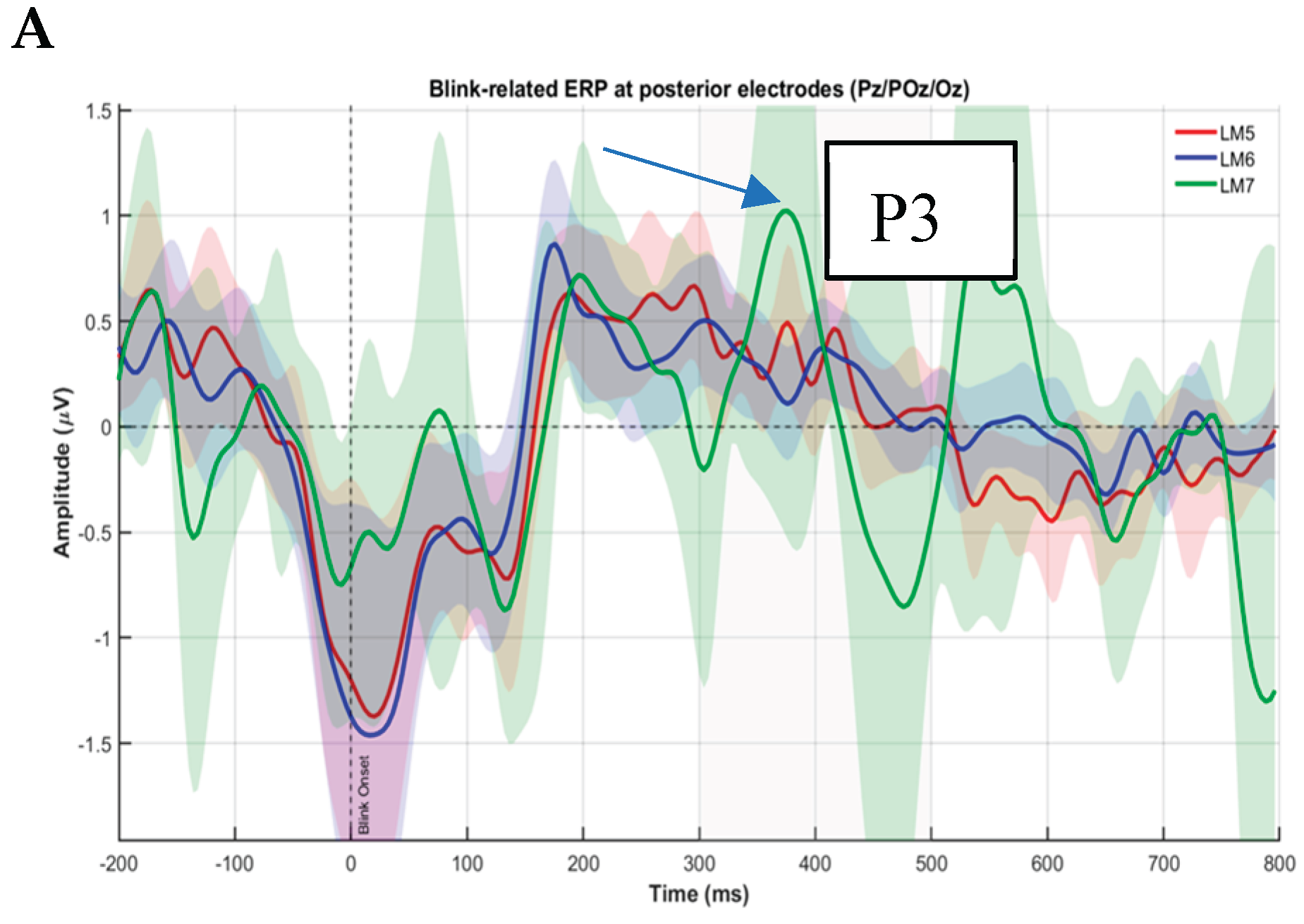
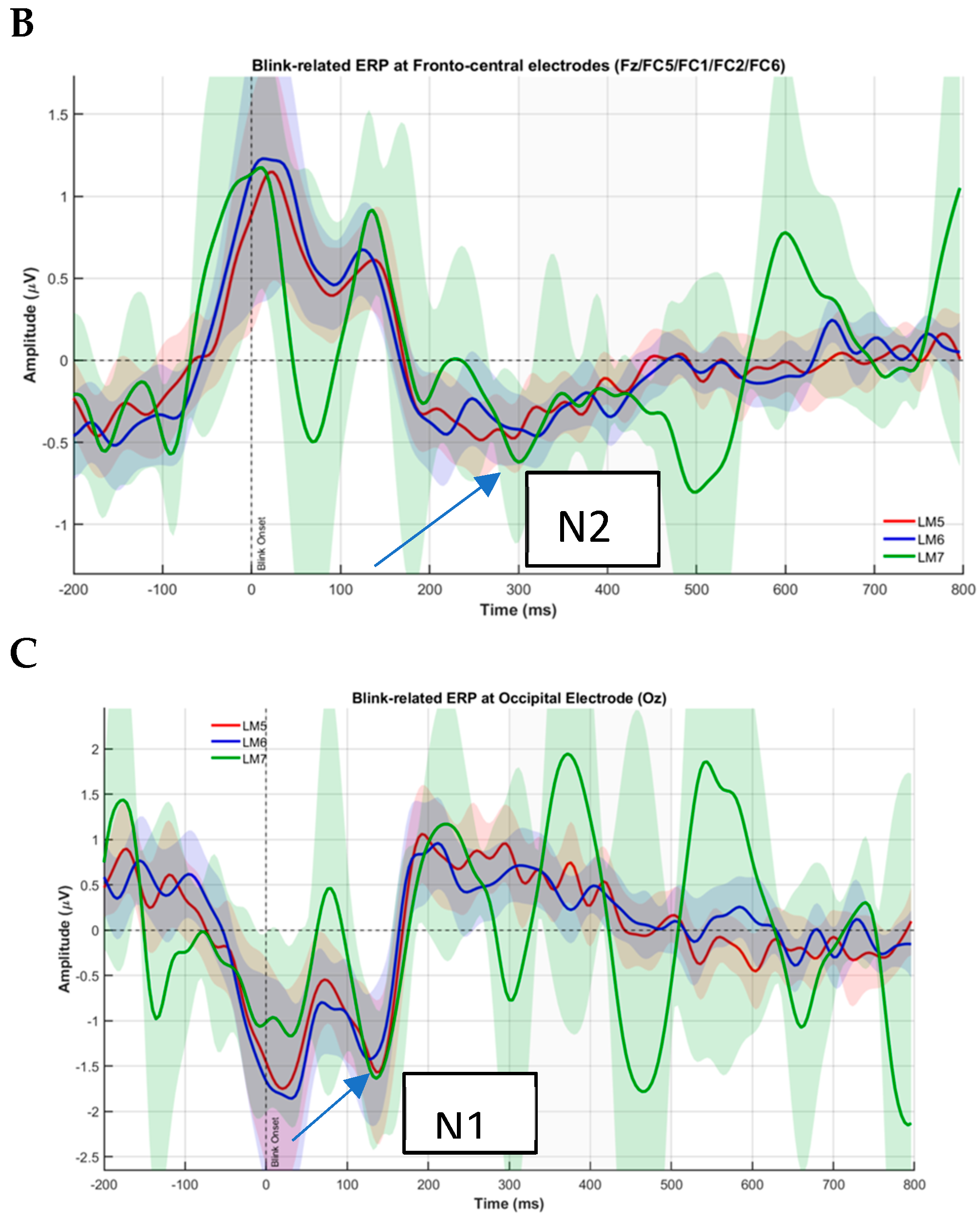
Figure 2.
Panels A–D represent different landmark conditions during the locomotion phase of the navigation task. Panel A corresponds to the 5-landmark condition (LM5), panel B corresponds to the 6-landmark condition (LM6), panel C corresponds to the 7-landmark condition (LM7), and panel D represents the grand average across all landmark conditions. The topographic maps illustrate variations in large-scale brain activity associated with increasing landmark density.
Figure 2.
Panels A–D represent different landmark conditions during the locomotion phase of the navigation task. Panel A corresponds to the 5-landmark condition (LM5), panel B corresponds to the 6-landmark condition (LM6), panel C corresponds to the 7-landmark condition (LM7), and panel D represents the grand average across all landmark conditions. The topographic maps illustrate variations in large-scale brain activity associated with increasing landmark density.
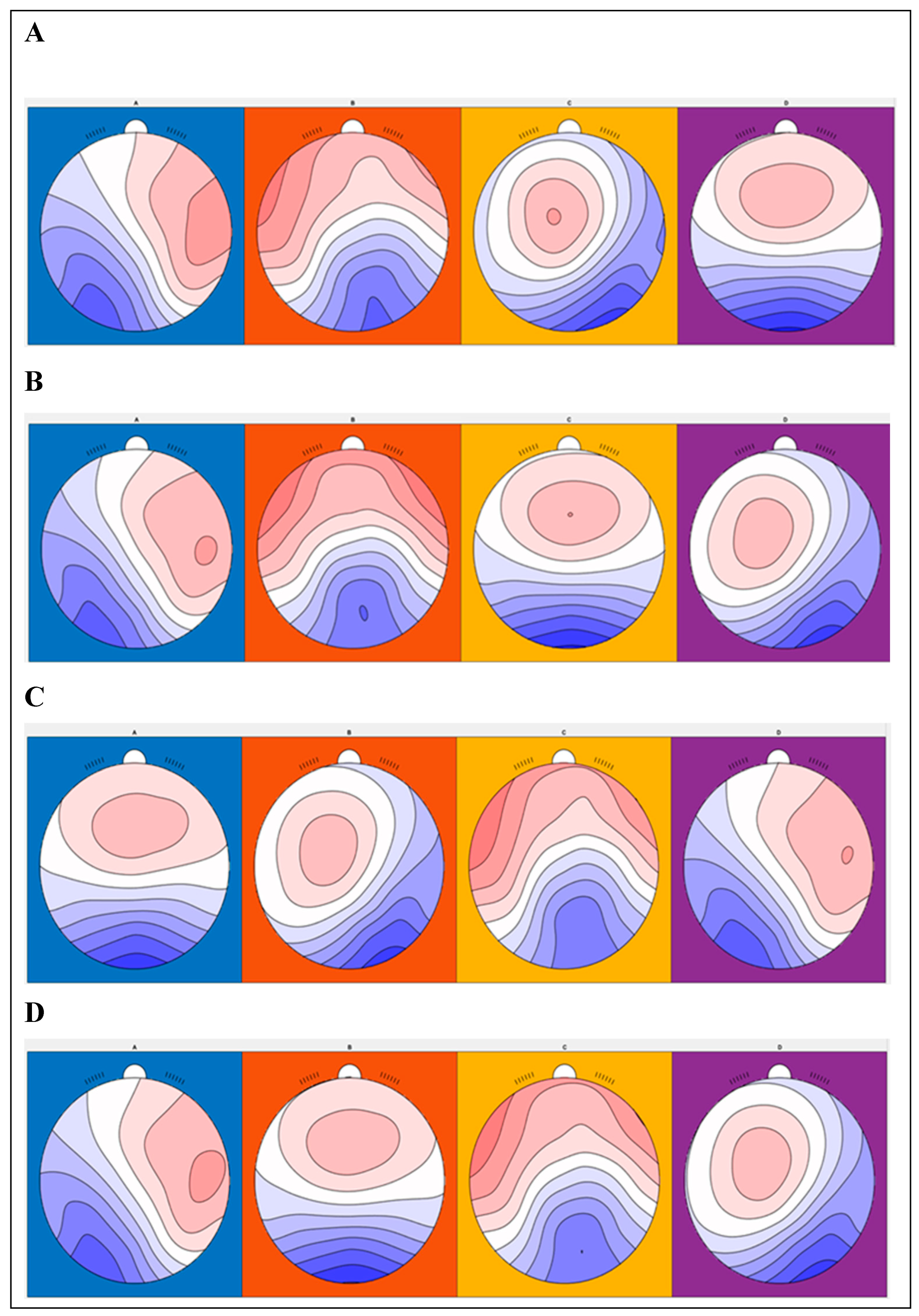
Figure 3.
The figure presents scalp topographies for the three landmark conditions (LM5, LM6, and LM7) during the navigation task. The multidimensional scaling (MDS) plot illustrates the similarity of spatial patterns across conditions. LM5 and LM6 cluster closely, indicating similar brain activity, whereas LM7 is clearly separated, reflecting a distinct pattern of large-scale neural dynamics under higher landmark density.
Figure 3.
The figure presents scalp topographies for the three landmark conditions (LM5, LM6, and LM7) during the navigation task. The multidimensional scaling (MDS) plot illustrates the similarity of spatial patterns across conditions. LM5 and LM6 cluster closely, indicating similar brain activity, whereas LM7 is clearly separated, reflecting a distinct pattern of large-scale neural dynamics under higher landmark density.
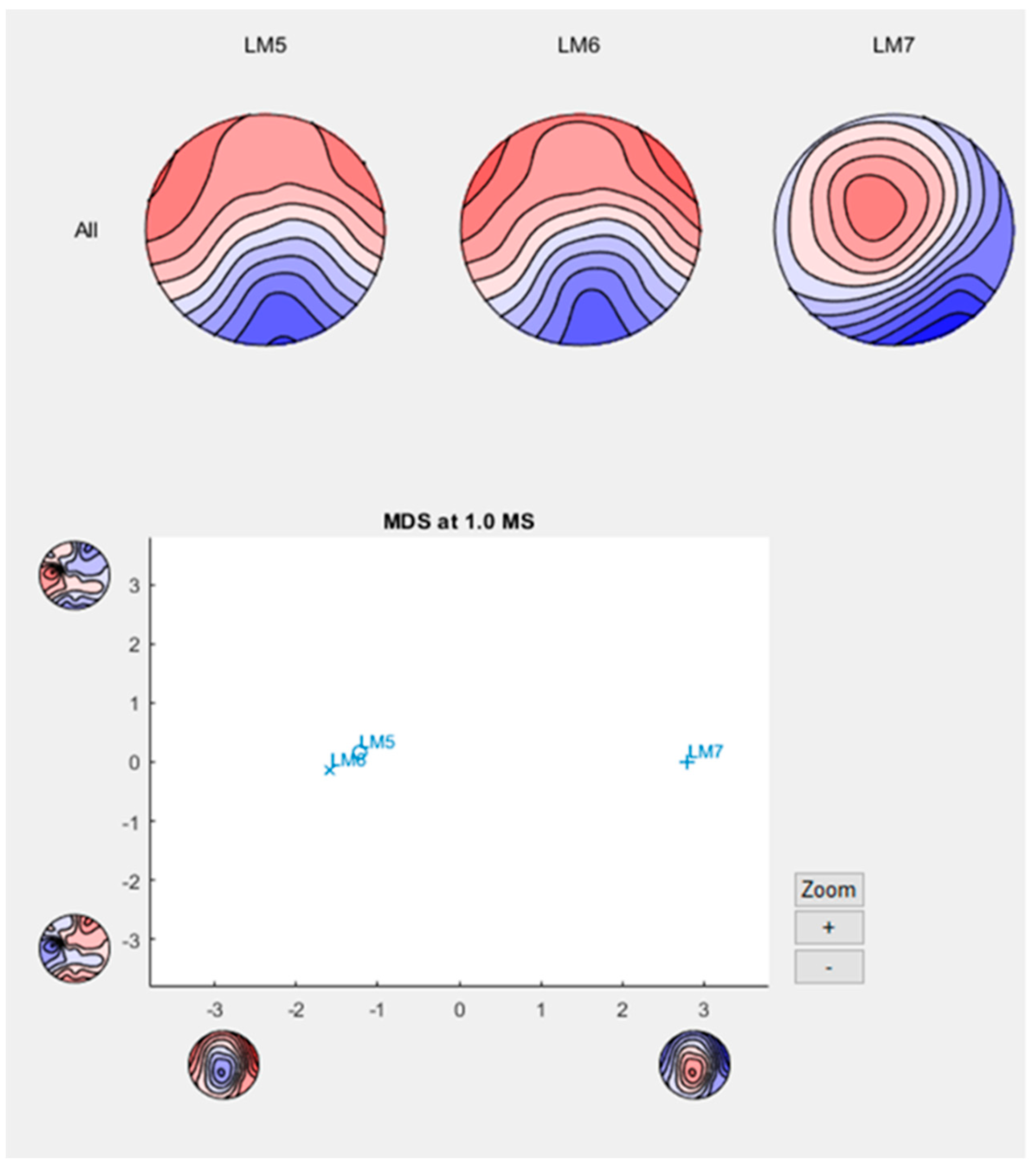

Table 1.
Linear mixed-effects model results for blink-related ERP components across brain regions during locomotion.
Table 1.
Linear mixed-effects model results for blink-related ERP components across brain regions during locomotion.
| Region | Component | Predictor | β | SE | t | p |
|---|---|---|---|---|---|---|
| Parieto-occipital | P3 | LM6 vs LM5 | 0.07 | 0.40 | 0.18 | .859 |
| Parieto-occipital | P3 | LM7 vs LM5 | −0.16 | 0.40 | −0.40 | .700 |
| Parieto-occipital | P3 | Male vs Female | −0.16 | 0.24 | −0.67 | .499 |
| Parieto-occipital | P3 | PNTS vs Female | −0.30 | 0.57 | −0.53 | .598 |
| Parieto-occipital | P3 | Age | −0.004 | 0.010 | −0.40 | .686 |
| Parieto-occipital | N2 | LM6 vs LM5 | −0.02 | 0.43 | −0.05 | .958 |
| Parieto-occipital | N2 | LM7 vs LM5 | −0.64 | 0.43 | −1.49 | .144 |
| Parieto-occipital | N2 | Male vs Female | −0.12 | 0.46 | −0.26 | .800 |
| Parieto-occipital | N2 | PNTS vs Female | 0.15 | 1.09 | 0.14 | .890 |
| Parieto-occipital | N2 | Age | 0.003 | 0.019 | 0.16 | .856 |
| Parieto-occipital | N1 | LM6 vs LM5 | 0.19 | 0.25 | 0.76 | .434 |
| Parieto-occipital | N1 | LM7 vs LM5 | −0.10 | 0.25 | −0.40 | .688 |
| Parieto-occipital | N1 | Male vs Female | 0.19 | 0.40 | 0.48 | .638 |
| Parieto-occipital | N1 | PNTS vs Female | 0.24 | 0.95 | 0.25 | .804 |
| Parieto-occipital | N1 | Age | 0.001 | 0.016 | 0.06 | .931 |
| Occipital | N1 | LM6 vs LM5 | −0.123 | 0.527 | −0.23 | .816 |
| Occipital | N1 | LM7 vs LM5 | 0.037 | 0.523 | 0.07 | .944 |
| Occipital | N1 | Male vs Female | 0.424 | 0.699 | 0.61 | .548 |
| Occipital | N1 | PNTS vs Female | −0.742 | 1.646 | −0.45 | .655 |
| Occipital | N1 | Age | 0.021 | 0.029 | 0.72 | .467 |
| Occipital | P3 | LM6 vs LM5 | −0.038 | 0.230 | −0.17 | .868 |
| Occipital | P3 | LM7 vs LM5 | −0.174 | 0.228 | −0.76 | .448 |
| Occipital | P3 | Male vs Female | 0.048 | 0.255 | 0.19 | .851 |
| Occipital | P3 | PNTS vs Female | 0.080 | 0.600 | 0.13 | .894 |
| Occipital | P3 | Age | −0.005 | 0.010 | −0.50 | .626 |
| Fronto-central | N2 | LM6 vs LM5 | 0.128 | 0.159 | 0.80 | .424 |
| Fronto-central | N2 | LM7 vs LM5 | 0.082 | 0.158 | 0.52 | .603 |
| Fronto-central | N2 | Male vs Female | −0.006 | 0.170 | −0.03 | .973 |
| Fronto-central | N2 | PNTS vs Female | 0.055 | 0.399 | 0.14 | .891 |
| Fronto-central | N2 | Age | 0.0137 | 0.0069 | 1.97 | .056 |
| Fronto-central | N2 | LM7 × Male | −0.901 | 0.326 | −2.77 | .007** |
Note. β = regression coefficient; SE = standard error; LM = landmark condition; PNTS = preferred not to say. Significant effects (p < .05) are shown in bold.
Table 2.
Linear mixed-effects model results for EEG microstate temporal parameters during Locomotion.
Table 2.
Linear mixed-effects model results for EEG microstate temporal parameters during Locomotion.
| Microstate | Parameter | Predictor | β | SE | t | p |
|---|---|---|---|---|---|---|
| B | Duration | LM6 vs LM5 | 0.00053 | 0.00094 | 0.56 | .576 |
| B | Duration | LM7 vs LM5 | 0.00066 | 0.00094 | 0.70 | .482 |
| B | Duration | Male | 0.00772 | 0.00352 | 2.19 | .034* |
| B | Duration | PNTS | 0.00031 | 0.00834 | 0.04 | .971 |
| B | Duration | Age | −0.00042 | 0.00014 | −3.00 | .006** |
| D | Duration | LM6 vs LM5 | 0.00146 | 0.00177 | 0.83 | .412 |
| D | Duration | LM7 vs LM5 | 0.00421 | 0.00177 | 2.38 | .019* |
| D | Duration | Male | 0.01440 | 0.01107 | 1.30 | .201 |
| D | Duration | Age | −0.00083 | 0.00046 | −1.80 | .078 |
| B | Occurrence | LM6 vs LM5 | 0.265 | 0.294 | 0.90 | .371 |
| B | Occurrence | LM7 vs LM5 | 0.161 | 0.294 | 0.55 | .586 |
| B | Occurrence | Male | −0.168 | 0.541 | −0.31 | .758 |
| B | Occurrence | PNTS | 0.204 | 1.280 | 0.16 | .874 |
| B | Occurrence | Age | 0.0047 | 0.0222 | 0.21 | .835 |
| B | Occurrence | LM6 × Age | 0.054 | 0.025 | 2.16 | .034* |
| B | Occurrence | LM7 × Age | 0.019 | 0.025 | 0.76 | .456 |
| D | Occurrence | LM6 vs LM5 | 0.32 | 0.18 | 1.73 | .088 |
| D | Occurrence | LM7 vs LM5 | 0.25 | 0.18 | 1.35 | .180 |
| D | Occurrence | Male | −1.47 | 0.57 | −2.59 | .013* |
| D | Occurrence | Age | 0.06 | 0.02 | 2.62 | .012* |
| D | Occurrence | LM6 × Male | −0.75 | 0.38 | −1.97 | .052 |
| D | Occurrence | LM6 × Age | 0.03 | 0.02 | 1.83 | .070 |
| B | Coverage | LM6 vs LM5 | 0.75 | 0.81 | 0.92 | .359 |
| B | Coverage | LM7 vs LM5 | 0.24 | 0.81 | 0.30 | .767 |
| B | Coverage | Male | 2.91 | 3.17 | 0.92 | .365 |
| B | Coverage | PNTS | 1.26 | 7.50 | 0.17 | .867 |
| B | Coverage | Age | −0.17 | 0.13 | −1.34 | .187 |
| B | Coverage | LM6 × Age | 0.13 | 0.07 | 1.90 | .061 |
| D | Coverage | LM6 vs LM5 | 1.43 | 1.11 | 1.30 | .199 |
| D | Coverage | LM7 vs LM5 | 2.99 | 1.11 | 2.70 | .008** |
| D | Coverage | Male | 0.46 | 3.81 | 0.12 | .905 |
| D | Coverage | PNTS | 2.26 | 9.03 | 0.25 | .804 |
| D | Coverage | Age | −0.13 | 0.16 | −0.81 | .421 |
| D | Coverage | LM7 × Male | −5.43 | 2.30 | −2.36 | .021* |
Note. β = regression coefficient; SE = standard error; LM = landmark condition; PNTS = preferred not to say. Significant effects (p < .05) are shown in bold.
Disclaimer/Publisher’s Note: The statements, opinions and data contained in all publications are solely those of the individual author(s) and contributor(s) and not of MDPI and/or the editor(s). MDPI and/or the editor(s) disclaim responsibility for any injury to people or property resulting from any ideas, methods, instructions or products referred to in the content. |
© 2026 by the authors. Licensee MDPI, Basel, Switzerland. This article is an open access article distributed under the terms and conditions of the Creative Commons Attribution (CC BY) license (http://creativecommons.org/licenses/by/4.0/).
Copyright: This open access article is published under a Creative Commons CC BY 4.0 license, which permit the free download, distribution, and reuse, provided that the author and preprint are cited in any reuse.


