

Submitted:
18 June 2026
Posted:
23 June 2026
You are already at the latest version
Abstract
We review arguments showing that Big Bang, subsequent cosmic inflation, present accelerating expansion of the universe (dark energy) and lightness of elementary particles have the same physical origin. Namely, these phenomena are manifestations of the negative value of the gravitational field energy in the vector theory of gravity, which causes these effects and yields value of the cosmological constant and masses of elementary particles in excellent agreement with experiment without free parameters. We also explain how arrow of time emerges in vector gravity. According to the latter, universe is a region of 4-dimensional space with geometry of Minkowski signature, embedded in a fixed Euclidean background. The theory predicts that cosmic inflation exponentially expands the spatial size of the universe and exponentially contracts its temporal size. As a result, size of the universe along the temporal dimension is close to zero, and universe as a whole is moving through the Euclidean background along the time direction,
which yields a unidirectional flow of time.
Keywords:
vector gravity
; Big Bang
; cosmic inflation
; arrow of time
; dark energy
; dark matter
; elementary particle masses
; origin of charges
; Higgs boson
; gravitational waves
Mysterious dark energy gives rise the universe to expand at an accelerated rate which, in the standard model of cosmology, is described by a nonzero cosmological constant . In the spatially uniform and isotropic model with zero spatial curvature the universe evolution is described by the spacetime metric
Metric (1) does not have a preferred location or direction and is invariant under spatial translations and rotations.
If matter pressure can be disregarded (cold universe), the scaling factor evolves according to the following Friedmann equation
where and are independent of time. The cosmological constant is usually denoted as , the equivalent density. The constant has a meaning of the matter density at .
The measured ratio of the cosmological constant to the critical density of the universe in the present epoch ()
has a value [1]
For this value, the right-hand-side of Eq. (2) is negative and universe expansion is accelerating in the present epoch.
Einstein’s theory of gravity (general relativity) does not predict . In addition, general relativity (GR) is incompatible with quantum mechanics and predicts spacetime singularities.
These deficiencies are usually justified by arguing that GR is incomplete. For example, to eliminate singularities, various extensions of GR have been proposed - string theory, loop quantum gravity, etc. However, so far there is no experimental evidence for those. Moreover, as we discuss below, elementary particles are not vibrations of strings or membranes.
It would be nice if theory of gravity could shed light on yet unanswered fundamental questions. For example, explain what was before the Big Bang; how universe was created; what caused matter generation at the Big Bang and the stage of cosmic inflation; why universe is spatially flat; explain the value of elementary particle masses; nature of dark matter and dark energy; the arrow of time; origin of charges and why there is no Higgs field charge in nature, etc. In this review we summarize arguments, known in the literature, showing that GR must be replaced with the vector theory of gravity. The latter not only passes all available gravity tests, compatible with quantum mechanics and predicts no singularities, but also answers the fundamental questions mentioned above (see Refs. [2,3,4,5] and the present paper). In particular, a spatially flat universe is the only solution of equations of vector gravity in the cosmological model. We don’t know whether all the answers are correct and require no further refinement, but in situations when predictions of vector gravity (e.g. value of elementary particle masses and cosmological constant) can be verified by comparison with observations there is an excellent agreement between the theory and experiment.
GR is an extension of the special theory of relativity. The latter postulates that in the absence of gravity, the geometry of our universe is the four-dimensional Minkowski spacetime. A point particle with a rest mass m, freely moving in such spacetime with velocity is described by the action
where diag is Minkowski metric, and repeated indices are implicitly summed over.
In 1907 A. Einstein noticed a physical equivalence of a gravitational field and the corresponding acceleration of the reference system [6]. Namely, the gravitational force experienced locally is the same as the force experienced by an observer in a non-inertial (accelerated) frame of reference. Nowadays this is known as Einstein’s equivalence principle. Mathematically, the principle implies that in a gravitational field, particles move along geodesics of some metric tensor . That is, the action for a point particle moving in the gravitational field is given by Eq. (4), in which Minkowski metric is replaced with
Variation of the action (5) with respect to the particle trajectory yields geodesic equation of motion for a massive particle
where and metric is inverse to : , is the Kronecker delta.
To complete formulation of GR, we need to make another assumption; namely, assume that spacetime metric (spacetime geometry) is a dynamical gravitational field. Mathematically this means that all 10 independent components of the symmetric tensor are independent fields. The gravitational field action , and the Einstein field equations are constructed in a unique way from these postulates following the self-consistency requirement that and must possess the same symmetries.
However, the assumption about being the dynamical gravitational field does not follow from Einstein’s equivalence principle. There is another possibility. Namely, one can assume that universe has a fixed background geometry, and in Eq. (5) is an equivalent metric through which the gravitational field interacts with matter. Symmetry arguments suggest that the background geometry of the universe is completely isotropic 4-dimensional Euclidean space with the fixed metric
and the gravitational field is a 4-dimentional vector field (), which lives in the Euclidean space and breaks the Euclidean symmetry of the background. The direction of is preferred, and this direction becomes the time coordinate. Directions perpendicular to are the three spatial coordinates.
The equivalent metric can be uniquely obtained in terms of and using the equivalence principle which yields (see Ref. [2])
where for convenience we introduced a scalar and a 4-dimentional unit vector () according to
where A is the norm of (). Thus, is a functional of the vector gravitational field, which effectively alters the geometry of the Universe - metric (8) has signature of the Minkowski metric . Plugging Eq. (8) into Eq. (5), gives the action for a particle moving in the four-vector gravitational field.
As in the case of GR, the field action can be constructed in a unique way using the self-consistency requirement that and must possess the same symmetries. This procedure yields a unique alternative theory of gravity that has been developed in Refs. [2,3], which is known as vector gravity (VG). According to Will’s classification [7], VG is a Lagrangian-based metric theory of gravity with fixed background geometry. In VG, the action for the vector gravitational field in the background Euclidean space reads [2]
where G is gravitational constant. The action (9) is written in the background metric , which means that raising and lowering of indexes is carried out using .
Variation of the total action with respect to the scalar and the unit vector gives equations for the gravitational field, which can be found in Refs. [2,3,5]. Plugging the solution of these equations ( and ) in Eq. (8) yields the equivalent metric. The motion of particles in the vector gravitational field is described by the same equations (6) as in GR, in which metric tensor is replaced with the equivalent metric (8). Similarly, in terms of the equivalent metric, Maxwell’s equations have the same form as in GR. That is, matter interacts with gravitational field as if the spacetime geometry is described by an equivalent metric different from the isotopic Euclidean background, and particles move along geodesics of the equivalent metric.
In VG, the gravitational field does not interact with itself through the equivalent metric and “feels” the background geometry. That is gravitational field equations are not generally covariant (not invariant under general coordinate transformations). However, motion of particles in gravitational field is described by the generally covariant equations. This is a typical feature of metric theories of gravity with a prior geometry in which only gravity senses the fixed background (7). In VG, gravitational waves travel with the speed of light [2]. This is usually not the case in other alternative theories of gravity with a prior geometry. After the multi-messenging detection of the GW170817 coalescence of neutron stars [8], where light and gravitational waves were measured to travel at the same speed with an error of , many alternative theories of gravity were excluded [9].
From our perspective, the vector gravitational field alters the spacetime we live in. Namely, it alters the spacetime geometry, making it geometry with Minkowski signature, and alters the apparent spacetime size. Time and space are manifestations of interaction with the gravitational field. For us, evolution of the gravitational field with time looks like creation or elimination of space. In particular, since in Eq. (1) is an increasing function of t we sense that universe is expanding increasing its spatial volume. Even though in the background Euclidean coordinates the size of the universe might not change at all.
According to VG, transition between Euclidean geometry of the equivalent metric and geometry of Minkowski signature occurred at the moment of Big Bang [3]. Before the Big Bang the vector gravitational field had no preferred direction and was undergoing quantum fluctuations on a Planck scale. Averaging Eq. (8) over a small four-dimensional volume with size much larger than Planck length and assuming that fluctuations are isotropic yields
where stands for the spatial averaging. Thus, the average equivalent metric has Euclidean character on “macroscopic” scales.
Big Bang is the point of quantum phase transition at which the gravitational field vector acquires nonzero expectation value on the “macroscopic” scales, that is . This expectation value serves as a transition order parameter. We choose the coordinate axis along the direction of . Since is a unit 4-vector, in the disordered phase the spatial average of is
Deviation of from caused by quantum fluctuations can result in the signature flip of on “macroscopic” scales. Amplitude of the fluctuation which produces the signature flip depends on the local value of . According to Eq. (10), there is a special value of given by
for which . For this the signature flip occurs when only slightly deviates from its value in the disordered phase [3]
where is a small positive number. This small deviation creates an average equivalent metric with Minkowski character [3]
In the pre-Big Bang era, is inhomogeneous in the four-dimensional space. Big Bangs occur at points where . At such points a small ordering of caused by quantum fluctuations produces spatially averaged equivalent metric with Minkowski character yielding instability toward generation of matter and gravitational waves and onset of the inflation stage [2]. Equations of VG yield that just after the Big Bang (in the ordered phase) gravitational waves have negative energy. That is system is unstable toward generation of matter with positive energy and gravitational waves that carry negative energy. The total energy of the universe is conserved (equal to zero). This instability caused the stage of cosmic inflation during which matter was generated and scaling factor was exponentially growing with time. In VG, inflation occurs naturally without introducing an additional ad hoc field.
Models of inflation based on GR introduce a hypothetical scalar field - inflaton - as the energy source for mater generation that drives a period of rapid expansion, forming a universe consistent with observed spatial isotropy and homogeneity. Inflaton was originally postulated by A. Guth in 1981 and conjectured to have driven cosmic inflation [10,11]. Guth hypothesized that the universe was initially trapped in a peculiar state (the “false vacuum”) from which it decayed, in the process expanding exponentially and liberating the energy present in our universe today. In 1982 A. Linde expanded on Guth’s ideas by developing models of inflation that allowed for a graceful exit from the inflationary phase without creating unacceptable inhomogeneities [12]. In 1980, A. Starobinsky independently postulated a similar early phase of exponential expansion, in this case driven by quantum fluctuations of conformally covariant matter fields [13].
In VG, inflation is somewhat analogous to the excitation of the Glauber’s inverted oscillators [14,15]. The latter system works as an amplifier which leads to excitation of the oscillators out of the vacuum fluctuations. Indeed, in the rotating wave approximation, two coupled harmonic oscillators with frequencies and are described by the Hamiltonian
where and are bosonic annihilation operators of the oscillator excitations. The Hamiltonian yields that the number of the oscillator excitations exponentially grow with time from zero
Inflation led to the creation of a new field vacuum for which gravitational waves have positive energy (the present epoch) [2]. This can be the case if gravitons are particles composed of fermion-antifermion pairs [2], by analogy with the composite model of photons [16,17,18,19,20,21]. Inflation stops together with matter generation as soon as the negative-energy fermion states are filled. This is a stable “true vacuum” state of the universe. Creation of a graviton out of the true vacuum corresponds to annihilation of the fermion pairs from the filled negative-energy states. That is, the graviton energy is positive in the true vacuum state. After inflation the evolution of the universe scaling factor is governed by Eq. (2), or it’s analog that incorporates nonzero matter pressure at the hot stage of the universe.
Universe expansion during cosmic inflation resulted in exponentially large deviation of from the initial value such that shortly after Big Bang the scaling factor . If we disregard exponentially small terms compared to the exponentially large terms of the order of , the gravitational field is no longer “absolute”. Namely, shift of by a constant is equivalent to rescaling of coordinates even if the field is inhomogeneous. As shown in [2], this suppresses the preferred frame and preferred location effects, in agreement with observations.
Physically, universe is a region of 4-dimensional space (perhaps finite in volume) having geometry (equivalent metric) of Minkowski character. The spatial size of the universe is very large - it is bigger than the size of the observable universe which is about 93 billion light-years. However, the size of the universe along the time coordinate is close to zero. The latter is an observational fact - we do not see extension of the universe along the time coordinate and travel back in time is impossible - we cannot change the past. If the size would be finite, it would be possible to travel back in time at a distance equal to the size of the time dimension, similarly to the travel along the spatial dimensions upto the universe boundary. We observe that time cannot be stopped and the universe appears as a 3-dimensional spatial membrane moving along the 4th (time) dimension. Due to essentially zero size of the time dimension, there is arrow of time - objects in the universe can move only in one time direction.
This property of the universe is predicted by vector gravity. Indeed, for isotropic spacetime , and the equivalent metric (8) is diagonal and has an exponential form
At the moment of Big Bang and the size of the universe was approximately the same along all four dimensions. Equation (12) shows that if the cosmic inflation expands the spatial size of the universe - makes the scaling factor exponentially large, it contracts the temporal size because the factor in front of becomes exponentially small. According to VG, such pancake-shape space with Minkowski geometry - the universe - is embedded into the 4-dimensional Euclidean space. Equation (6) can be applied to describe geodesic motion of the universe as a whole through the fixed Euclidean background (7), which yields solution
where s is the distance traveled (the interval) which serves as a parameter describing the universe worldline. That is, universe moves through the Euclidean background space with a constant velocity along the direction of the gravitational field - the time axis, leading to flow of time (see Figure 1). Thus, VG explains how a direction to the arrow of time emerges, which has puzzled scientists and philosophers for decades [22]. Such a picture implies that past does not exist, and we can not go back to the moment of time after the universe passes it during its travel through the Euclidean background. It also explains why we have memory of the past but not of the future.
Time in a reference frame of an observer , the proper time, depends on how the observer moves through space and on the value of the gravitational potential at the observer’s location. The proper time is a monotonic function of the Euclidean time t, and in terms of the temporal size of the universe is also close to zero. Proper time flows at different speeds for observers moving relative to each other or located in regions with different . For example, for an observer at rest in a static spacetime, Eq. (12) yields . That is, in the vicinity of massive objects, where is smaller, the proper time runs slower.
Conservation of momentum requires that universes are created in entangled pairs (universe and anti-universe) moving through the Euclidean background in the opposite directions and having opposite directions of the gravitational field vector. This is analogous to generation of photon pairs in the dynamical Casimir effect, and cosmological particle creation in entangled pairs with zero net momentum from the vacuum by the curved space-time of an expanding universe [23,24]. Together with other effects, such mechanism is considered to be responsible for the reheating of our universe after the inflationary period. Furthermore, a very similar process explains the creation of the seeds for structure formation. This yields spontaneous production of the primordial density fluctuations which led to the acoustic peaks in the cosmic microwave background radiation spectrum [25,26,27]. One can speculate that creation of the universe and anti-universe pairs could explain why our universe is dominated by matter (baryonic asymmetry), while the anti-universe should be dominated by antimatter.
In contrast to GR, VG can explain accelerated expansion of the universe in the present epoch (dark energy). Namely, dark energy is the energy of longitudinal gravitational field induced by the universe expansion (Figure 2a). In VG, the energy density of such induced gravitational field is negative, which produces apparent acceleration of the universe expansion. With no free parameters, VG predicts the value of [2,3], in agreement with the measured value (3) within the 2% experimental uncertainty.
One should note that due to lack of general covariance of the gravitational field equations, in VG the value of the cosmological constant depends on the reference frame. In the reference frame of an observer that takes a snapshot of the universe at an arbitrary time , at In such a frame, the direction of the time axis is fixed by the moment of observation . Namely, the observer interprets time axis as the instantaneous direction of the gravitational field four-vector at the point of observation. This moment fixes the time coordinate in the entire four-dimensional space, and from the perspective of such observer the universe evolves along this time coordinate according to Eq. (2) with nonzero .
Matter current, generated by the universe expansion, causes change of the direction with time. That is in reality the time axis is evolving together with the universe. As shown in [3], dark energy does not affect universe evolution in the co-evolving reference frame for which the time axis follows the instantaneous direction of during the universe expansion. In such a frame . As a result, dark energy does not affect the Big Bang nucleosynthesis and galaxy formation, in agreement with observations. In the co-evolving frame, universe is expanding at a continually decelerating rate, with expansion asymptotically approaching zero [3]. This is what is expected for spatially flat universe in absence of exotic forms of energy.
Recent paper [5] studies elementary particles in the framework of vector gravity and shows that charged elementary particles are nonsingular bound states of fundamental fields held together by gravity (Figure 2b). For example, electric charge is a nonsingular bound state of the electric and gravitational fields emerging as a solution of free-field equations. That is electric charge emerges as a solution of Maxwell’s equations with no charge if we add gravity.
In spherical coordinates, the bound state solution corresponding to the electric charge is described by the equivalent metric [5]
where
is the charge gravitational radius, and q is the electric charge of the bound state which emerges as an integration constant of the free-field equations, and can be both positive or negative.
The equivalent metric (13) has no singularities, including the point . Namely, scalar invariants (Ricci, Weyl, and Kretschmann scalars) are finite everywhere in the spacetime (13). In particular, for the metric (13), the Ricci scalar is
while the nonzero Weyl scalar reads
The corresponding electric field
is finite everywhere, and for reduces to the Coulomb’s law. That is, gravity eliminates the divergence of the electric field at the center and yields a finite mass of the spinless charge
The gravitational attraction force between two such charges is precisely equal to the Coulomb force. That is, contrary to the conventional wisdom, the force of gravity is as strong as the Coulomb force if the charge has no spin.
In the classical treatment of the problem, q can have an arbitrary value. However, in the quantum description, has a minimum value - the elementary electric charge. Since the energy is minimum, such ground-state solution is stable. The bound state can be represented as a superposition of a classical solution and quantum fluctuations of the field which give quantum correction to the mass [28]. Similar bound states of EM field (quantum solitons) have been studied in nonlinear optics [29,30,31,32].
The classical solution is accurate provided the quantum corrections are small. The latter increase if the size of the bound state decreases. One can estimate the minimum electric charge using the variational principle. If a massless field is confined into a finite volume of size this produces kinetic energy of quantum confinement . As a consequence, one can estimate the total energy of the charge as
where the first term is the classical energy of the bound state, and the second term is the quantum correction. In the context of the quantum field theory, quantum correction to the energy has been accurately calculated for various classical solitons [28]. These accurate results show that the quantum correction is indeed of the order of , where a is the size of the soliton.
The total energy (15) is minimum for , which is the Planck length. Using Eq. (14), we then obtain
where is the fine structure constant
and e is the electron charge. That is, the elementary charge value is independent of the gravitational constant. Equation (16) gives an order of magnitude estimate of the electric charge of a particle composed of the electric and gravitational fields.
According to VG, elementary electric charge is a nonsingular bound state of the free electric and gravitational fields having Planck mass and confined to a Planck size region (quantum core). The balance between the quantum pressure and the gravitational self-attraction of the fields determines the magnitude of elementary charges. Because quantum uncertainty in the charge position is about Planck length, for modeling the lepton structure, such a bound state can be approximated as a classical point charge when viewed from a distance greater than the Planck length.
VG yields small value of elementary particle masses on the Planck scale, because in VG, the spinning gravitational field can have negative energy density, which screens the large positive contribution to the mass from the electromagnetic field. To decrease the particle energy (mass), the field around the quantum core spins, which reduces the mass from the Planck scale to the orders of magnitude smaller value of elementary particle masses we observe in experiment (Figure 2b). Thus, dark energy in the universe and lightness of elementary particles have the same physical origin. In both cases, the negative energy of gravitational field causes the effect.
Also, the present “microscopic” model explains the origin of lepton’s magnetic moment. Namely, magnetic moment is not produced by electric current, but rather appears because of “dragging” the electric field by the spinning gravitational field [5]. The spinning gravitational field does not compensate energy of the electromagnetic field completely because electric field of a charge has a monopole configuration and decays with r slower than the dipole configuration of the spinning gravitational and magnetic fields. As a result, for electron, at the distance greater than the classical electron radius the electric field contribution to the mass is not compensated, yielding a nonzero mass value.
For the given electroweak charge and spin, a spinning gravitational field can be attached to the quantum core in different bound state configurations, yielding electron, muon, tau lepton, W boson, and much heavier particles not yet discovered [5]. Electron is the lowest-energy bound state of electromagnetic, weak and gravitational fields, which is a stable particle. Muon is the first excited state, which is unstable. Energy of the bound state solutions yields particle masses in excellent agreement with experiment without free parameters.
For example, as shown in Ref. [5], electron and muon masses m are given by solutions of the following algebraic equations
and
respectively, where
and
is the Planck mass. That is masses of electron and muon are calculated in terms of the fundamental constants - electron charge (which enters the fine structure constant ), Planck constant ℏ and gravitational constant G.
The first term in the left-hand-side of Eqs. (17) and (18) comes from the energy of the bound state calculated in VG, while the second term appears due to a small (about ) quantum self-energy correction to the mass of particles arising from emission and reabsorption of virtual photons, calculated by Schwinger and Feynman in 1948 [33,34]. The quantum correction contains a high-energy cut-off parameter GeV (electroweak scale).
Accuracy of the particle mass calculation is limited by the 1% accuracy of the quantum correction arising due to uncertain value of the cutoff parameter . Equations (17) and (18) give for the electron and muon masses the values which agree with experiment within this 1% accuracy [5]. If we plug in the experimental values for the electron and muon masses into the left-hand-side of Eqs. (17) and (18) respectively, the left-hand-side deviates from 1 (the right-hand-side) only by .
The striking agreement with experiment indicates that VG gives correct microscopic description of elementary particles and that particle masses are not generated by a rather bizarre Higgs mechanism. Instead, particle mass is simply the total energy of the fields forming the bound state. For tau lepton and W boson, contribution to the mass from the weak charge becomes important [5].
Higgs field was introduced into the Standard Model of particle physics to explain why elementary particles have nonzero masses. Without Higgs field, the Standard Model predicts that all elementary particles are massless due to gauge symmetry of the electroweak and strong interaction originating from the charge conservation. It was proposed that due to peculiar self-interaction, described by a Mexican-hat-like potential, Higgs field has a nonzero expectation value in the ground state everywhere in space, known as a Higgs condensate. That is, the gauge symmetry is spontaneously broken by the presence of the condensate, and particle masses emerge due to interaction with the Higgs condensate. The Higgs mechanism predicts that the Higgs boson is coupled to the rest mass of particles, but it does not predict the value of elementary particle masses - they remain free parameters in the Standard Model.
As shown in Ref. [5], VG predicts existence of the Higgs boson without Higgs mechanism. Namely, additional massive scalar and vector fields naturally emerge in VG as the fields restoring the gauge symmetry of gravity at low energy, and the emerging scalar particle has properties of the Higgs boson discovered at the Large Hadron Collider (LHC) in 2012. That is, VG predicts that the Higgs boson and the vector Z-boson (the carrier of weak interaction) should exist and the Higgs boson is coupled to the rest mass of particles, while the Z-boson is coupled to the weak charge (see Sect. 8 in Ref. [5]).
The latter property of the Higgs boson has been confirmed by ATLAS and CMS experiments at LHC by measuring it decay rates into different particle channels [35]. The measured rates are found to be proportional to the particle masses, as predicted by the Higgs mechanism, which is considered by many as the conformation of the latter. However, VG predicts existence of the Higgs boson with the same properties without Higgs mechanism. That is, there is no Higgs condensate, and the vacuum expectation value of the Higgs field is equal to zero.
VG also predicts existence of a nonsingular bound state formed solely from the gravitational field. The corresponding solution for the equivalent metric in spherical coordinates reads [5]
where is the mass (size) of the bound state. The metric (19) has no event horizon and no singularities. Namely, scalar invariants (Ricci, Weyl and Kretschmann scalars) are finite everywhere in the spacetime (19). In particular, for the metric (19), the Ricci scalar is
Physically, the bound state (19) is a spacetime region with nonzero curvature confined into a volume of size M. It appears due to the self-interaction of the gravitational field caused by the nonlinear structure of the gravitational field equations.
In the classical treatment of the problem, M can have any positive value. In quantum treatment, due to additional energy of quantum confinement, the bound state has a minimum mass of the order of Planck mass. One can think of such a bound state as an elementary charge (called u charge because it produces u field along the radial direction). The sign ± in Eq. (19) implies that the charge can be positive or negative (corresponding to the particle and antiparticle, respectively), while the mass of the particle is always positive.
Similarly to the electric charge, to reduce the energy (mass), the gravitational field around the quantum core might spin, and the stable bound state might be a fermion. The corresponding particle does not carry electroweak or color charges and couples only to the mass through gravity. Thus, such a particle very weakly interacts with ordinary matter, and is a natural candidate for the dark matter in the universe. Since VG correctly predicts the known elementary particles, it is likely that the dark matter particle predicted by VG also exists.
In the following, we discuss other predictions of VG and compare them with experiment. VG predicts no spacetime singularities such as black holes and, despite being fundamentally different from GR, passes all gravitational tests [2]. For example, as shown in Ref. [2], VG and GR are equivalent in the post-Newtonian limit and, thus, both theories pass the solar system tests of gravity. As we mentioned above, preferred frame and preferred location effects are suppressed in VG due to the exponentially large universe expansion during the stage of cosmic inflation [2].
When a star exhausts its nuclear fuel, thermal pressure can no longer support the star against the force of gravity, leading to gravitational collapse. In GR, a massive star collapses to zero volume leading to formation of a singularity with infinite matter density and infinite spacetime curvature, known as a black hole. In contrast, in VG, gravitational collapse creates exponentially large volume of space in the inner region, rather than a singularity. This is the case because, according to Eq. (12), gravitational collapse makes the factor in front of exponentially large in the stellar interior. That is, spatial volume expands similarly to the universe expansion during the stage of cosmic inflation, and matter expands together with space.
Interior of the collapsing star expands into this self-generated “infinite” volume in the vicinity of , leaving behind a very cold dilute cloud of gas and dust that produce no radiation, resembling black hole interior. For a distant observer, the generated “infinite” volume of space appears as a point-like dark object in the sky with exponentially large gravitational redshift. Such spacetime structure - “infinite” volumes of essentially flat space (exterior and interior) separated by a region with large spacetime curvature – is known as a wormhole (see Figure 3).
In VG, the exterior region of the collapsed object is described by the exponential metric
where is the gravitational radius of the collapsed object with mass m, and r is the radial coordinate. Metric (20) has no event horizon and no singularities. Indeed, scalar invariants (Ricci, Weyl and Kretschmann scalars) are finite everywhere in the exponential spacetime [36]. In particular, they decay to zero both as and as . E.g., the Ricci scalar is given by
It was pointed out in [36] that the metric (20) represents a traversable wormhole in the sense of Morris and Thorne [37,38].
In VG, surface of a collapsing dust sphere follows geodesic of the metric (20). From the perspective of a distant observer, the sphere surface reaches the radial coordinate during an exponentially large time. Thus, the star continues collapsing “forever”, and there is no rebounce off the center during the age of the universe.
The point-like collapsed objects made of baryonic or dark matter with large masses could be the supermassive compact objects residing in galactic centers. The exterior exponential metric (20) of the collapsed objects produces essentially the same shadow due to gravitational bending of light and the same size of the accretion disk as the black hole geometry predicted by GR. Namely, for metric (20), the inner radius of the accretion disk (the innermost stable circular orbit), size of the shadow, and radius of the photon sphere are only larger than prediction of GR [36,39].
Accretion disks around supermassive objects at the center of the Milky Way and M87 galaxies have been imaged by the Event Horizon Telescope (EHT) [40,41]. However, the image angular resolution is insufficient to distinguish between the close predictions of VG and GR (see Figure 4). To notice the difference between GR and VG predictions, one should increase the EHT angular resolution by an order of magnitude.
The exponentially large redshift reduces the radiation power coming out from the central region of the collapsed object by a factor of , which mimics black holes. In addition, since scale factor grows exponentially at small r, accreting matter undergoes exponential expansion and cools down to low temperature, which reduces its luminosity. Thus, EHT images of the galactic centers can also be explained as the images of the collapsed objects in the exponential geometry (20), rather than black holes.
In GR and VG the power of weak gravitational waves emitted by binary systems is given by the same quadrupole formula
where
is the quadrupole moment of masses [2]. There is no dipole and “magnetic” dipole radiation because total linear and angular momenta are conserved for the isolated system.
According to VG, gravitational wave events interpreted in GR as merger of black holes, are produced by merger of collapsed point-like objects with exponential spacetime geometry (20), which mimic black holes. It was shown in Ref. [2] that VG and GR predictions for the radiation waveforms, produced by the merger of the compact objects, are indistinguishable within the sensitivity limit of LIGO and Virgo interferometers (see Figure 5). This is not surprising because the Schwarzschild spacetime of GR mimics the exponential metric (20) of VG even at distances of the order of the gravitational radius.
In Figure 6 we plot the metric component produced by a static point mass in GR (blue solid line) and VG (red solid line given by Eq. (20)) in isotropic (a) and Schwarzschild (b) coordinates as a function of the distance to the center. Schwarzschild and isotropic r coordinates are related by the following nonlinear transformation (for )
Figure shows that predictions of VG and GR for start to deviate only in the vicinity of the gravitational radius . In the Schwarzschild coordinates the deviation is not visible in the plot, but it can be noticed if we use the isotropic coordinates because the latter are stretched by the nonlinear transformation (22).
Position of the peak of the radiation waveform amplitude emitted by an inspiraling binary system with equal mass components is marked by the cross in Figure 6. In the dimensionless coordinate , where is the gravitational radius ( in the Schwarzschild coordinates, and in isotropic coordinates), position of the peak is independent of m. The peak is located at in isotropic coordinates, and at in Schwarzschild coordinates. That is, in the isotropic coordinates, the inspiraling objects appear far apart at the onset of waveform ringdown. Radiation waveform decay occurs because deviation from the Newtonian gravity results in slowing down the orbital motion which reduces the wave amplitude.
What matters for the present discussion is that even in the region of the ringdown inspiral (see Figure 5) the VG and GR predictions for the metric are very close to each other. As a consequence, both theories can explain the measured radiation waveforms equally well, as shown in Figure 5, but with a different set of free parameters (masses of objects in the binaries, orientation of the orbital plane, wave propagation direction). Thus, gravitational waveforms for detected events are consistent, within the experimental uncertainty, not only with GR but also with VG. LIGO-Virgo-KAGRA collaboration analyze the measured waveforms in the framework of GR only, which creates an illusion in favor of GR.
Contrary to the gravitational waveforms, measurement of the gravitational wave polarization can distinguish between GR and VG within available LIGO-Virgo sensitivity. VG predicts two types of gravitational waves - transverse and longitudinal [2]. For weak plane gravitational waves propagating along the axis in a properly chosen coordinate system the corresponding equivalent metric oscillates as
where is Minkowski metric, , , h are small perturbations obeying the wave equation
and □ is the d’Alembertian operator. In GR, there are only transverse gravitational waves having the structure
Both in GR and VG, gravitational waves emitted by orbiting binary systems are transverse. However, the longitudinal gravitational waves (24), predicted by VG, could be generated during gravitational collapse and contribute to the stochastic gravitational wave background. The latter can be studied using pulsar timing arrays [42,43,44,45], which have a unique advantage: they observe many pulsars along different lines of sight, effectively sampling the polarization pattern in multiple projections.
If detectors would have an ideal sensitivity, one can distinguish between the vector (23) and the tensor (25) gravitational wave polarizations by measuring the gravitational wave signal in three interferometers. However, since LIGO and Virgo sensitivity is limited, such a detection does not yield a conclusive result [46]. For example, the relative Bayes factor (marginalized likelihood ratio) reported for the GW170818 event is about 12 in favor of tensor vs vector polarization [47]. For the GW170814 event, Ref. [47] reported the Bayes factor of 30 in favor of tensor vs vector polarization, while the estimate of Ref. [48] is about 1. None of these results is conclusive. Only if the Bayes factor in favor of a certain polarization is exponentially large the result is conclusive. This can be the case if there is an additional constraint on the parameter space. For example, if the precise sky localization of the source is known from discovery of an electromagnetic counterpart of the gravitational wave event.
There is evidence that LIGO-Virgo detection of the binary neutron star event GW170817, for which the wave source was discovered, supports the vector gravitational wave polarization (23) predicted by vector gravity and rules out the tensor polarization (25) of general relativity [4]. Prediction for the sky location of the gravitational wave source, based on the LIGO-Virgo detection, is very sensitive to the following:
- Assumption about gravitational wave polarization, yielding very different sky regions for the tensor and vector polarizations (see Figure 7).
- Ratio of signal amplitudes measured by different interferometers.
If both these contributions are estimated incorrectly, there is a small chance that errors cancel each other, yielding a correct prediction for the source sky location. It turned out that such a coincidence played a role for the GW170817 event.
Ground-based gravitational-wave observatories, such as LIGO, Virgo, and KAGRA, are sensitive instruments capable of measuring strain changes on the order of . Such high sensitivity is achieved, in particular, by subtracting instrumental noise from the gravitational-wave strain data in real time [53]. In this approach, witness sensors are placed around the interferometer. For a given noise source with a linear coupling, the measured gravitational wave strain data, , contains a noise component that can be modeled as a convolution of a transfer function and the output of the witness sensor
The noise component is removed from in real time by filtering the witness sensor data with this transfer function and subtracting its contribution from the measured strain, resulting in a residual strain denoted . By removing the correlated instrumental noise, the method improves the signal-to-noise ratio, which is being used in LIGO.
There is substantial overlap of the frequency chirped gravitational wave signal with periodic noise. Such noise, e.g., is produced by fans used for cooling the detector. If not filtered out properly, the residual noise interferes with the signal and the latter might be measured incorrectly. To demonstrate the effect, let us assume that strain consists of a signal and a periodic noise. The signal has a fixed amplitude equal to 1, but phase of the signal varies with time as in the case of a typical waveform produced by merger of neutron stars in a binary system
where t is measured in seconds, and is the moment of star merger. We assume that noise is a harmonic function with frequency 80 Hz
In Figure 8a we plot frequency of the signal and noise as a function of time. The two curves cross at s when the signal frequency is equal to 80 Hz.
To extract the signal amplitude from the noisy we follow the standard signal accumulation procedure. Namely, we multiply by the complex conjugate , and average over time
If there is no noise, for any time interval and we recover the signal amplitude. This is not the case in the presence of noise. We choose and in Eq. (26) such that the time intervals correspond to the signal frequency bins of 10 Hz each. For example, s and s correspond to the signal frequency segment of Hz, etc. In Figure 8b we plot I obtained by accumulating the signal from different frequency bins. Figure 8b shows that if we use the frequency bin covering the noise bandwidth (80 Hz), I gives incorrect answer for the signal amplitude due to interference between the signal and the periodic noise. That is, noise contribution is not averaged out in this bin in the process of signal accumulation, in contrast to other bins for which I is very close to 1.
The periodic fan noise was an issue for the LIGO-Livingston interferometer located in Louisiana, which is a hot place in August when the GW170817 event was detected, and cooling was necessary. The signal amplitude for the GW170817 event was orders of magnitude smaller than the noise. As a result, even a small error in estimating the transfer function could leave, in the residual strain, an amount of fan noise comparable to the signal. As we demonstrated in Figure 8b, this could lead to a wrong signal estimate if the signal is accumulated in the frequency bands of the fan noise.
Thus, there is a pretty big chance that periodic noise would corrupt accumulation of a weak gravitational wave signal. To obtain the signal amplitude correctly, one should perform a self-consistency check of the signal amplitude in different frequency bands, and remove the corrupted frequency intervals from the data analysis. Such a check is possible to make because gravitational waveforms are known from the theory, that is we know how signal amplitude changes with time. In the example of Figure 8, one can use the knowledge that signal amplitude is constant and, based on this information, identify the frequency interval Hz as corrupted.
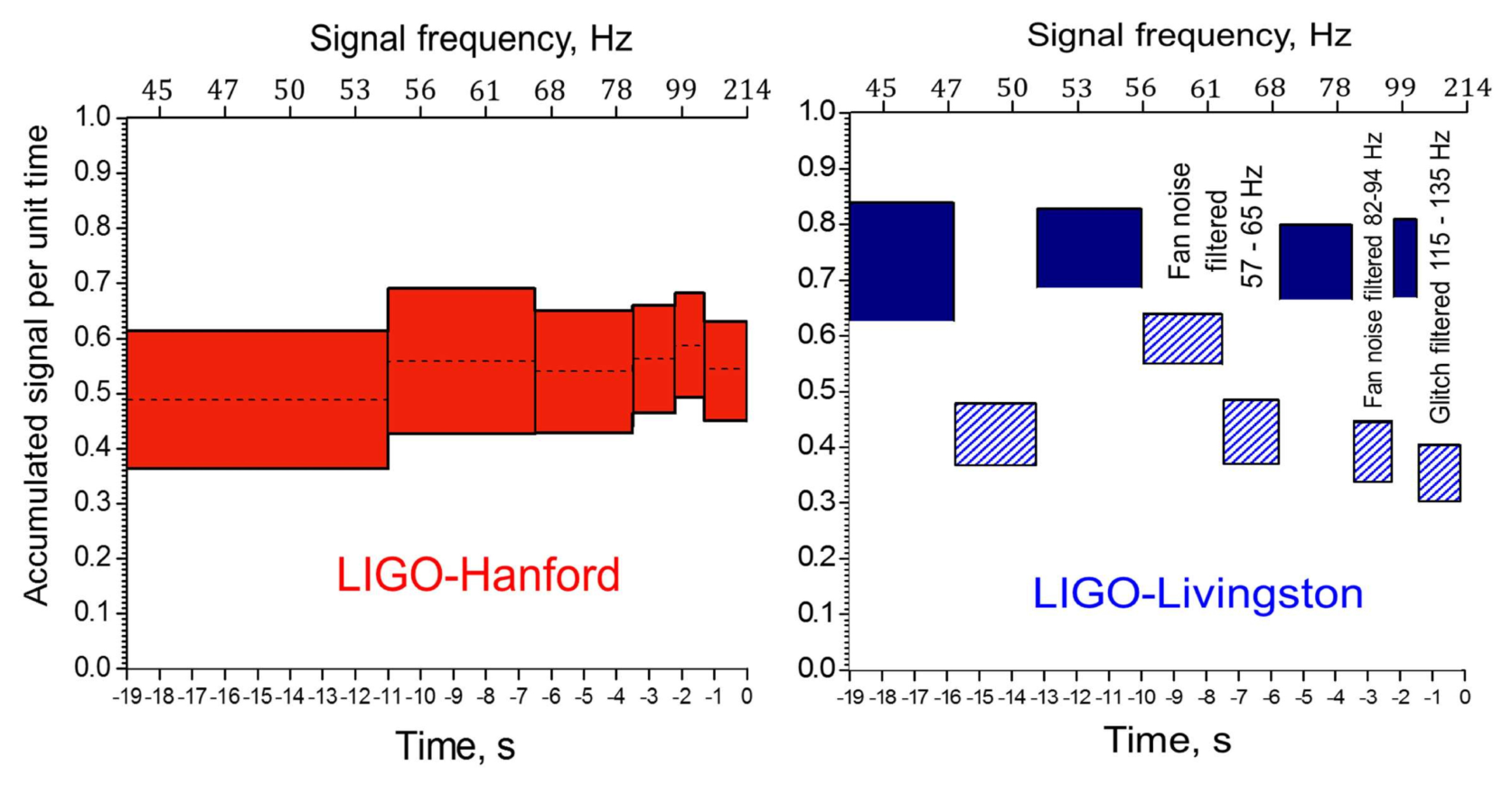
The self-consistency check of the signal in different frequency bands was not performed in the LIGO-Virgo analysis of the GW170817 event, and the whole detector bandwidth was used for signal accumulation. Such a check was conducted in Ref. [4], which found presence of the corrupted frequency intervals in the LIGO-Livingston residual strain (see Figure 9). Those were mainly caused by the interference between the signal and the residual fan noise.
Article [4] shows that for the GW170817 event the source location is accidentally predicted correctly by GR if the LIGO-Livingston signal amplitude erroneously estimated keeping contribution from the corrupted frequency intervals (that is accumulating signal from the entire detector bandwidth). The error cancellation yields the same prediction for the source location by general relativity as vector gravity if for the latter the signal amplitude is estimated correctly. It is a pure coincidence, which is unlikely to happen again. The fact that during almost a decade of gravitational wave detection the source was discovered only for the GW170817 event supports this conclusion and suggests that astronomers attempt to locate electromagnetic counterparts in the “wrong” patches in the sky predicted by GR. Recall that LIGO - Virgo rapid determination of the source sky location is based on the tensor polarization assumption, which may be directing astronomers’ search for the concomitant electromagnetic emissions to the wrong part of the sky. If search continues in the sky regions predicted by GR, then likely no gravitational wave sources will be identified in the future LIGO - Virgo - KAGRA observing runs as well, which is unfortunate for the multi-messenger astronomy.
In contrast to mergers of massive point-like collapsed objects, mergers of low-mass neutron stars are expected to produce a strong burst of EM radiation. This is known as a kilonova - a transient astronomical event that occurs in a compact binary system when two neutron stars collide. In this case, the chance of finding EM counterpart of gravitational wave signal is pretty big provided the sky localization is predicted correctly. The compact binary merger candidate S251112cm is an example of such sub-solar-mass gravitational wave detection occurred on November 12, 2025. Analysis based on the tensor gravitational wave polarization assumption resulted in a credible sky-localization region of 1681 deg2, but no EM counterpart was found in this region. Perhaps, if the sky localization was calculated based on the vector polarization, astronomers would have discovered another event for multi-messenger astronomy.
The present review explains why GR is so successful in describing many experiments, including those in which gravitational field is not weak. Such a success considered by many as a confirmation of the Einstein’s theory of gravity. A comparison of GR and VG shows that this happens because GR mimics VG on those “successful” occasions, and both theories pass the corresponding gravity tests. For these “successful” mimicking the experimental accuracy is not sufficient to distinguish between the two theories. This is, e.g., the case for all solar system tests of gravity because GR is equivalent to VG in the post-Newtonian limit [2]; for LIGO - Virgo - KAGRA measurements of gravitational waveforms produced by merger of compact objects in binary systems (Figure 5); imaging of compact supermassive objects at galactic centers by the EHT (Figure 4); etc. In situations where GR and VG predictions are substantially different and can be noticed experimentally, GR could not explain observations. For example, GR does not answer the fundamental questions mentioned at the beginning of this review. In contrast, VG does provide answers to those questions and VG predictions are in excellent quantitative agreement with experiment when such a comparison is possible to make.
Vector gravity can be further tested by searching for gravitational wave sources in the sky regions reconstructed from LIGO - Virgo - KAGRA detection under the assumption of vector gravitational wave polarization; measuring polarization of stochastic gravitational wave background using pulsar timing arrays [43,44]; searching for new elementary particles predicted by VG in the electroweak sector (see Figure 9 in Ref. [5]) and the predicted dark matter particle which interacts only gravitationally; improving the angular resolution of the EHT images of galactic centers which would allow us to distinguish between the exponential and the black hole spacetime geometries.
Funding
This work was supported by U.S. Department of Energy (DE-SC-0023103; DE-AC36-08GO28308, SUB-2023-10388; DE-SC0024882); Welch Foundation (A-1261); Air Force Office of Scientific Research (FA9550-20-1-0366).
Data Availability Statement
No data were generated or analyzed during this study.
Conflicts of Interest
The author declares no conflicts of interest.
References
- Planck Collaboration; Ade, P.A.R.; Aghanim, N.; Armitage-Caplan, C.; et al. Planck 2013 results. XVI. Cosmological parameters. A&A 2014, 571, A16. [Google Scholar] [CrossRef]
- Svidzinsky, A.A. Vector theory of gravity: Universe without black holes and solution of dark energy problem. Phys. Scr. 2017, 92, 125001. [Google Scholar] [CrossRef]
- Svidzinsky, A.A. Simplified equations for gravitational field in the vector theory of gravity and new insights into dark energy. Phys. Dark Universe 2019, 25, 100321. [Google Scholar] [CrossRef]
- Svidzinsky, A.A.; Hilborn, R.C. GW170817 event rules out general relativity in favor of vector gravity. Eur. Phys. J. Spec. Top. 2021, 230, 1149. [Google Scholar] [CrossRef]
- Svidzinsky, A.A. Inner structure of leptons, nature of dark matter, and non-Higgs origin of elementary particle masses. Quantum Stud. Math. Found. 2026, 13, 17. Available online: https://link.springer.com/article/10.1007/s40509-026-00387-w;See https://hal.science/hal-05580240v1. [CrossRef]
- Einstein, A. On the relativity principle and the conclusions drawn from it. Jahrb. Radioakt. Elektron. 1907, 4, 411. [Google Scholar]
- Will, C. Theory and experiment in gravitational physics; Cambridge University Press, 1993. [Google Scholar]
- Abbott, B.P.; et al. : (LIGO Scientific Collaboration and Virgo Collaboration), GW170817: Observation of Gravitational Waves from a Binary Neutron Star Inspiral. Phys. Rev. Lett. 2017, 119, 161101. [Google Scholar] [CrossRef] [PubMed]
- Sakstein, J.; Jain, B. Implications of the Neutron Star Merger GW170817 for Cosmological Scalar-Tensor Theories. Phys. Rev. Lett. 2017, 119, 251303. [Google Scholar] [CrossRef] [PubMed]
- Guth, A.H. Inflationary universe: A possible solution to the horizon and flatness problems. Phys. Rev. D. 1981, 23, 347. [Google Scholar] [CrossRef]
- Guth, A. The inflationary universe: the quest for a new theory of cosmic origins.; Basic Books: New York, 1997; Available online: https://archive.org/details/inflationaryuniv0000guth.
- Linde, A.D. A new inflationary universe scenario: A possible solution of the horizon, flatness, homogeneity, isotropy and primordial monopole problems. Phys. Lett. B 1982, 108, 389. [Google Scholar] [CrossRef]
- Starobinsky, A.A. A new type of isotropic cosmological models without singularity. Phys. Lett. 1980, 91B, 99. [Google Scholar] [CrossRef]
- Glauber, R.J. Amplifiers, Attenuators and Schrödinger’s Cat. Ann. N. Y. Acad. Sci. 1986, 480, 336. [Google Scholar] [CrossRef]
- Svidzinsky, A. Time reflection of light from a quantum perspective and vacuum entanglement. Opt. Express 2024, 32, 15623. [Google Scholar] [CrossRef] [PubMed]
- de Broglie, L. Sur une analogie entre l’électron de Dirac et l’onde électromagnétique. C. R. 1932, 195, 536. [Google Scholar]
- Perkins, W. Quasibosons. Int. J. Theor. Phys. 2002, 41, 823. [Google Scholar] [CrossRef]
- Dvoeglazov, V.V. Again on the possible compositeness of the photon. Phys. Scr. 2001, 64, 119. [Google Scholar] [CrossRef]
- Sen, D.K. Left and right-handed neutrinos and baryonlepton masses. J. Math. Phys. 2007, 48, 022304. [Google Scholar] [CrossRef]
- Perkins, W.A. The antiparticles of neutral bosons. J. Mod. Phys. 2013, 4, 12. [Google Scholar] [CrossRef]
- Perkins, W.A. Composite photon theory versus elementary photon theory. J. Mod. Phys. 2014, 5, 2089. [Google Scholar] [CrossRef]
- Prigogine, I. The arrow of time; The Chaotic Universe, 2000; Volume 1. [Google Scholar] [CrossRef]
- Parker, L. Particle creation in expanding universes. Phys. Rev. Lett. 1968, 21, 562. [Google Scholar] [CrossRef]
- Parker, L. Particle creation in isotropic cosmologies. Phys. Rev. Lett. 1972, 28, 705. [Google Scholar] [CrossRef]
- Peebles, P.J.E.; Yu, J.T. Primeval adiabatic perturbation in an expanding universe. Astrophys. J. 1970, 162, 815. Available online: https://articles.adsabs.harvard.edu/pdf/1970ApJ...162..815P. [CrossRef] [PubMed]
- Grishchuk, L.P.; Sidorov, Y.V. Squeezed quantum states of relic gravitons and primordial density fluctuations. Phys. Rev. D. 1990, 42, 3413. [Google Scholar] [CrossRef] [PubMed]
- Mukhanov, V.F.; Feldman, H.A.; Brandenberger, R.H. Theory of cosmological perturbations. Phys. Rep. 1992, 215, 203. [Google Scholar] [CrossRef]
- Jackiw, R. Quantum meaning of classical field theory. Rev. Mod. Phys. 1977, 49, 681. [Google Scholar] [CrossRef]
- Lai, Y.; Haus, H.A. Quantum theory of solitons in optical fibers. I. Time-dependent Hartree approximation. Phys. Rev. A 1989, 40, 844. [Google Scholar] [CrossRef] [PubMed]
- Lai, Y.; Haus, H. Quantum theory of solitons in optical fibers. II. Exact solution. Phys. Rev. A 1989, 40, 854. [Google Scholar] [CrossRef] [PubMed]
- Abram, I. Quantum solitons. In Phys. World (February); 1999; p. 21. [Google Scholar] [CrossRef]
- Bullough, R.K.; Wadati, M. Optical solitons and quantum solitons. J. Opt. B Quantum Semiclass. Opt. 2004, 6 S205. [Google Scholar] [CrossRef]
- Feynman, R. Relativistic Cut-Off for Quantum Electrodynamics. Phys. Bev. 1948, 74, 1430. [Google Scholar] [CrossRef]
- Mandl, F.; Shaw, G. Quantum Field Theory.; John Wiley and Sons: New York, 1986; Volume Sect. 10.2. [Google Scholar]
- The ATLAS Collaboration. A detailed map of Higgs boson interactions by the ATLAS experiment ten years after the discovery. Nature 2022, 607, 52. [Google Scholar] [CrossRef] [PubMed]
- Boonserm, P.; Ngampitipan, T.; Simpson, A.; Visser, M. Exponential metric represents a traversable wormhole. Phys. Rev. D. 2018, 98, 084048. [Google Scholar] [CrossRef]
- Morris, M.S.; Thorne, K. Wormholes in space-time and their use for interstellar travel: A tool for teaching general relativity. Am. J. Phys. 1988, 56, 395. [Google Scholar] [CrossRef]
- Morris, M.S.; Thorne, K.S.; Yurtsever, U. Wormholes, Time Machines, and the Weak Energy Condition. Phys. Rev. Lett. 1988, 61, 1446. [Google Scholar] [CrossRef] [PubMed]
- Makukov, M.A.; Mychelkin, E.G. Simpler than vacuum: Antiscalar alternatives to black holes. Phys. Rev. D. 2018, 98, 064050. [Google Scholar] [CrossRef]
- The Event Horizon Telescope Collaboration. First M87 Event Horizon Telescope Results. I. The Shadow of the Supermassive Black Hole. ApJL 2019, 875, L1. [Google Scholar] [CrossRef]
- The Event Horizon Telescope Collaboration. First Sagittarius A* Event Horizon Telescope Results. I. The Shadow of the Supermassive Black Hole in the Center of the Milky Way. ApJL 2022, 930, L12. [Google Scholar] [CrossRef]
- Arzoumanian, Z.; et al. The NANOGrav 12.5-year Data Set: Search for Non-Einsteinian Polarization Modes in the Gravitational-wave Background. ApJL 2021, 923, L22. [Google Scholar] [CrossRef]
- EPTA Collaboration: The second data release from the European Pulsar Timing Array. I. The dataset and timing analysis. A&A 2023, 678, A48. [CrossRef]
- EPTA Collaboration and InPTA Collaboration: The second data release from the European Pulsar Timing Array. IV. Implications for massive black holes, dark matter, and the early Universe. A&A 2024, 685, A94. [CrossRef]
- Shaifullah, G. M. Pulsar timing arrays-challenges, and current status. Class. Quantum Grav. 2025, 42, 243001. [Google Scholar] [CrossRef]
- Allen, B. Can a pure vector gravitational wave mimic a pure tensor one? Phys. Rev. D. 2018, 97, 124020. [Google Scholar] [CrossRef]
- Abbott, B.P.; et al. Tests of general relativity with the binary black hole signals from the LIGO Virgo catalog GWTC-1. Phys. Rev. D. 2019, 100, 104036. [Google Scholar] [CrossRef]
- Hilborn, R.C. Does GW170814 rule out non-tensorial gravitational wave polarization? Class. Quant. Gravity 2021, 38, 085003. [Google Scholar] [CrossRef]
- Isi, M. Fundamental physics in the era of gravitational wave astronomy: the direct measurement of gravitational-wave polarizations and other topics. Ph.D. Thesis, Caltech, 2019. Available online: https://thesis.caltech.edu/11264/.
- Abbott, B.P.; et al. GW170814: A Three-Detector Observation of Gravitational Waves from a Binary Black Hole Coalescence. Phys. Rev. Lett. 2017, 119, 141101. [Google Scholar] [CrossRef] [PubMed]
- Abbott, B.P.; et al. Tests of General Relativity with GW170817. Phys. Rev. Lett. 2019, 123, 011102. [Google Scholar] [CrossRef] [PubMed]
- Takeda, H.; Morisaki, S.; Nishizawa, A. Pure polarization test of GW170814 and GW170817 using waveforms consistent with modified theories of gravity. Phys. Rev. D. 2021, 103, 064037. [Google Scholar] [CrossRef]
- Davis, D.; et al. Improving the sensitivity of Advanced LIGO using noise subtraction. Class. Quantum Grav. 2019, 36, 055011. Available online: https://iopscience.iop.org/article/10.1088/1361-6382/ab01c5. [CrossRef]
Figure 1.
According to vector gravity, universe is a region of 4-dimensional space of finite volume with geometry of Minkowski signature (filled area) embedded into infinite 4-dimensional Euclidean space. Universe is created as a result of quantum phase transition (the Big Bang) at which the gravitational field vector acquires nonzero expectation value on the “macroscopic” scales, which generates Minkowski spacetime geometry. Universe moves through the Euclidean space along the direction of the gravitational field - the time axis. The left side sketches universe motion in the background Euclidean coordinates, while the right side shows universe evolution from the perspective of an observer situated inside the universe (proper coordinates). Such an observer sees that universe exponentially expands along spatial dimensions during the stage of cosmic inflation and exponentially contracts along the time axis transforming into a 3-dimensional membrane of essentially zero thickness.
Figure 1.
According to vector gravity, universe is a region of 4-dimensional space of finite volume with geometry of Minkowski signature (filled area) embedded into infinite 4-dimensional Euclidean space. Universe is created as a result of quantum phase transition (the Big Bang) at which the gravitational field vector acquires nonzero expectation value on the “macroscopic” scales, which generates Minkowski spacetime geometry. Universe moves through the Euclidean space along the direction of the gravitational field - the time axis. The left side sketches universe motion in the background Euclidean coordinates, while the right side shows universe evolution from the perspective of an observer situated inside the universe (proper coordinates). Such an observer sees that universe exponentially expands along spatial dimensions during the stage of cosmic inflation and exponentially contracts along the time axis transforming into a 3-dimensional membrane of essentially zero thickness.
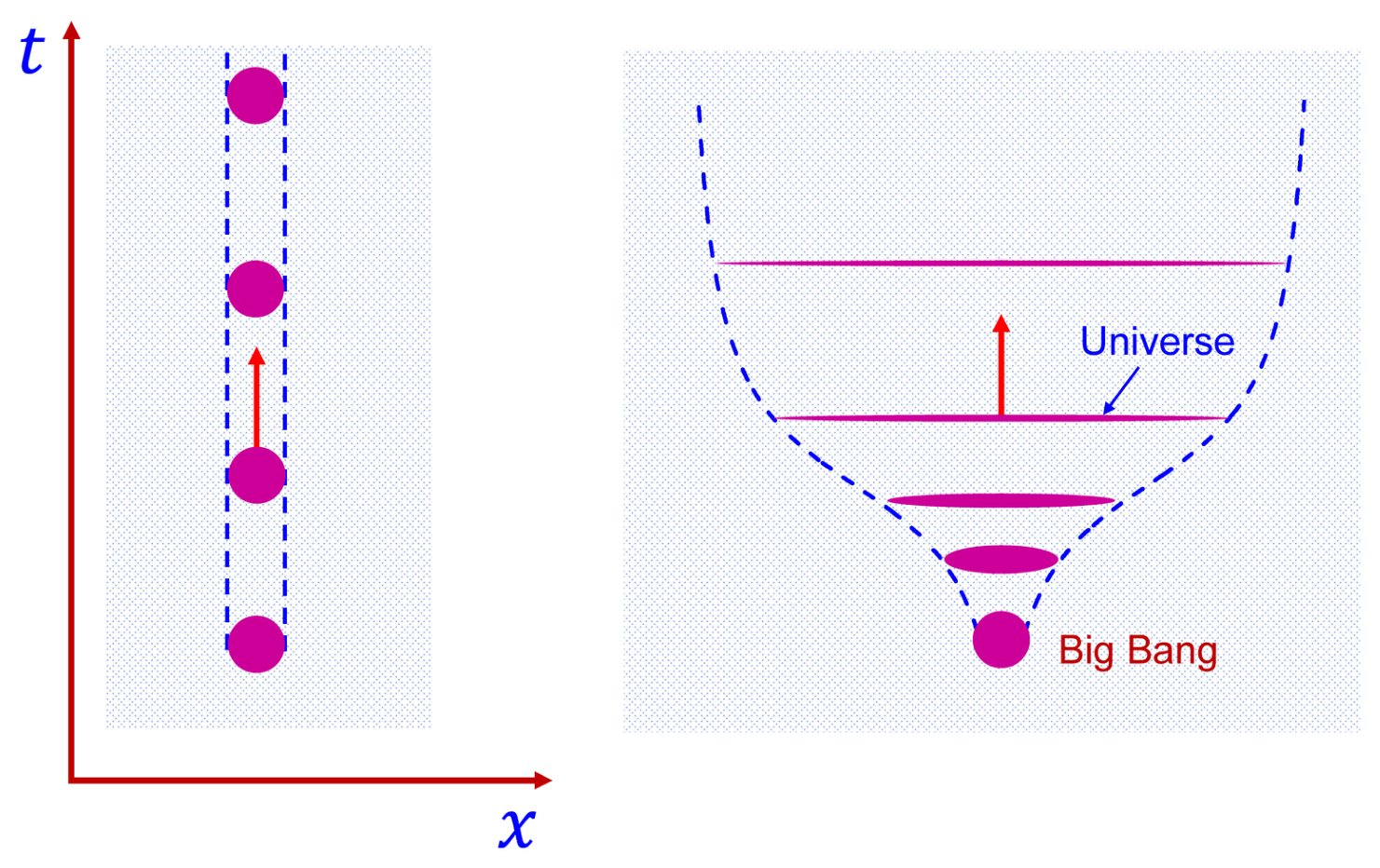
Figure 2.
(a) Universe expansion generates matter current directed away from an observer O. Such current induces longitudinal gravitational field which has negative energy density and produces apparent acceleration of the universe expansion. (b) Structure of charged leptons from vector gravity perspective. The particle center contains a quantum core of Planck size and Planck mass, which is the lowest energy bound state of electromagnetic, weak (Z), and gravitational (G) fields. At distance greater than Planck length the core behaves as a point electroweak charge. In vector gravity, similarly to dark energy, the spinning gravitational field can have negative energy. To decrease the particle energy (mass), the field around the core spins, which reduces the mass from the Planck scale to the orders of magnitude smaller value of elementary particle masses we observe in experiment. In the presence of the electric field, the spinning gravitational field induces a magnetic moment due to field dragging. For the given electroweak charge and spin, a spinning gravitational field can be attached to the core in different bound state configurations, yielding electron, muon, tau lepton, W boson, and much heavier particles not yet discovered [5].
Figure 2.
(a) Universe expansion generates matter current directed away from an observer O. Such current induces longitudinal gravitational field which has negative energy density and produces apparent acceleration of the universe expansion. (b) Structure of charged leptons from vector gravity perspective. The particle center contains a quantum core of Planck size and Planck mass, which is the lowest energy bound state of electromagnetic, weak (Z), and gravitational (G) fields. At distance greater than Planck length the core behaves as a point electroweak charge. In vector gravity, similarly to dark energy, the spinning gravitational field can have negative energy. To decrease the particle energy (mass), the field around the core spins, which reduces the mass from the Planck scale to the orders of magnitude smaller value of elementary particle masses we observe in experiment. In the presence of the electric field, the spinning gravitational field induces a magnetic moment due to field dragging. For the given electroweak charge and spin, a spinning gravitational field can be attached to the core in different bound state configurations, yielding electron, muon, tau lepton, W boson, and much heavier particles not yet discovered [5].
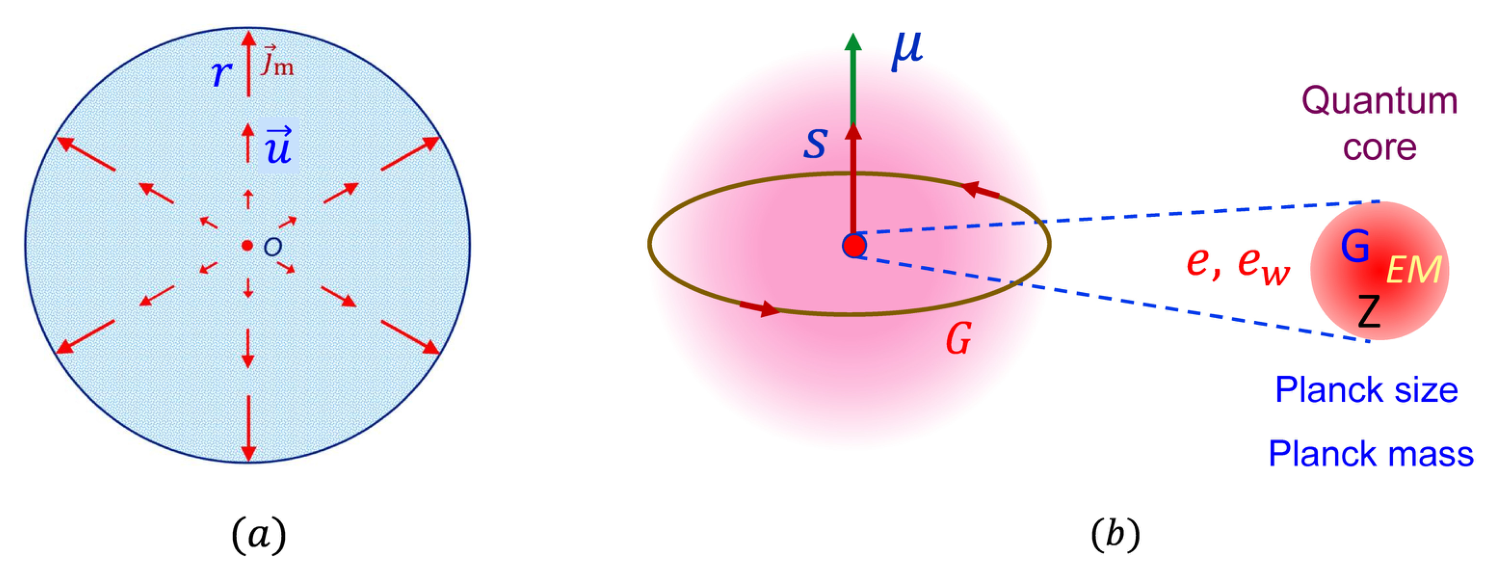
Figure 3.
(a) Illustration of a wormhole - a tunnel with large spatial curvature that connects one region of essentially flat “infinite" space (interior region) with another (exterior region). Figure shows the area of the spherical surface of constant radial coordinate r as a function of r. The area is a concave function of r and has a minimum at the throat of the wormhole. (b) Sketch of the gravitational potential as a function of r for a wormhole spacetime. undergoes rapid change in the vicinity of the wormhole throat. In vector gravity, stable wormholes form as a result of gravitational collapse of massive stars.
Figure 3.
(a) Illustration of a wormhole - a tunnel with large spatial curvature that connects one region of essentially flat “infinite" space (interior region) with another (exterior region). Figure shows the area of the spherical surface of constant radial coordinate r as a function of r. The area is a concave function of r and has a minimum at the throat of the wormhole. (b) Sketch of the gravitational potential as a function of r for a wormhole spacetime. undergoes rapid change in the vicinity of the wormhole throat. In vector gravity, stable wormholes form as a result of gravitational collapse of massive stars.
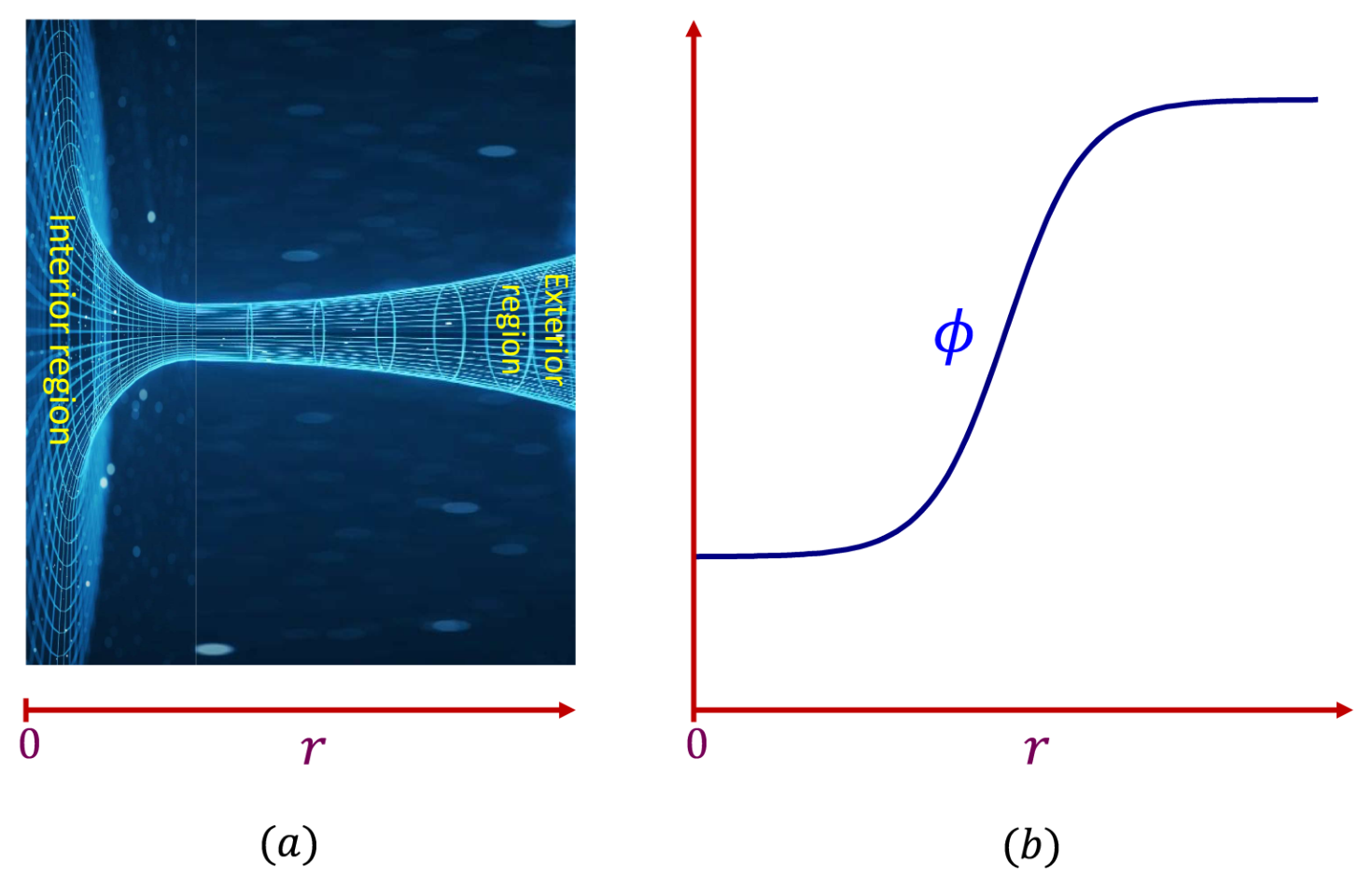
Figure 4.
(a): Sketch of the luminous accretion disk of hot material that encircles a dark compact object. The inner radius of the disk corresponds to the innermost stable orbit, while the bright circle inside the disk is the photon sphere. (b,c): The Event Horizon Telescope images of supermassive objects at the center of M87 (b) and the Milky Way (c) galaxies with colors indicating the brightness temperature. The telescope image angular resolution of 20 micro-arcseconds (shown as a circle in (b)) is insufficient to capture the 4% difference between general relativity and vector gravity predictions for the size of the accreting disc and the radius of the photon sphere. Adopted from Figure 7 of Ref. [5].
Figure 4.
(a): Sketch of the luminous accretion disk of hot material that encircles a dark compact object. The inner radius of the disk corresponds to the innermost stable orbit, while the bright circle inside the disk is the photon sphere. (b,c): The Event Horizon Telescope images of supermassive objects at the center of M87 (b) and the Milky Way (c) galaxies with colors indicating the brightness temperature. The telescope image angular resolution of 20 micro-arcseconds (shown as a circle in (b)) is insufficient to capture the 4% difference between general relativity and vector gravity predictions for the size of the accreting disc and the radius of the photon sphere. Adopted from Figure 7 of Ref. [5].
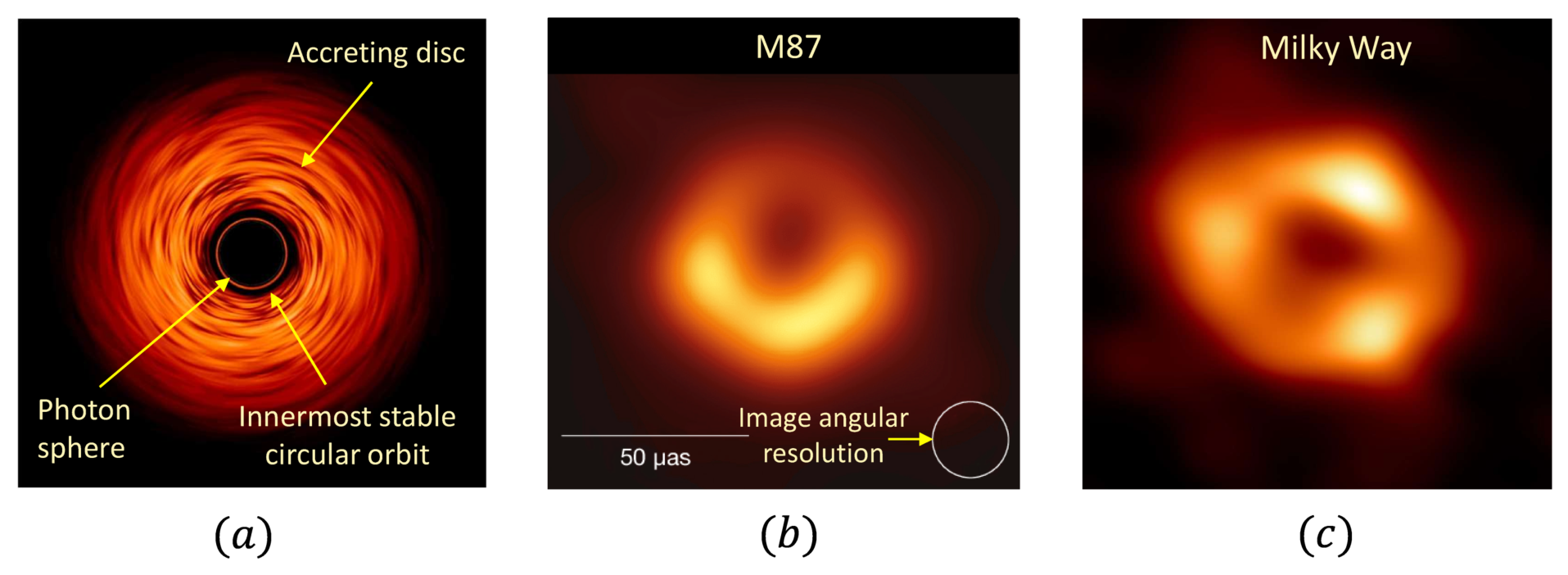
Figure 5.
Gravitational waveform (in arbitrary units) as a function of time produced by the merger of compact objects in vector gravity (red solid line) and general relativity (blue dashed line). Orbital parameters (masses of objects in the binaries, orientation of the orbital plane, wave propagation direction) are chosen to obtain the best fit of the LIGO GW150914 event signal and varied independently for vector gravity and general relativity. The two radiation waveforms are indistinguishable within the sensitivity limit of LIGO and Virgo interferometers. Adopted from Figure 7 of Ref. [2].
Figure 5.
Gravitational waveform (in arbitrary units) as a function of time produced by the merger of compact objects in vector gravity (red solid line) and general relativity (blue dashed line). Orbital parameters (masses of objects in the binaries, orientation of the orbital plane, wave propagation direction) are chosen to obtain the best fit of the LIGO GW150914 event signal and varied independently for vector gravity and general relativity. The two radiation waveforms are indistinguishable within the sensitivity limit of LIGO and Virgo interferometers. Adopted from Figure 7 of Ref. [2].
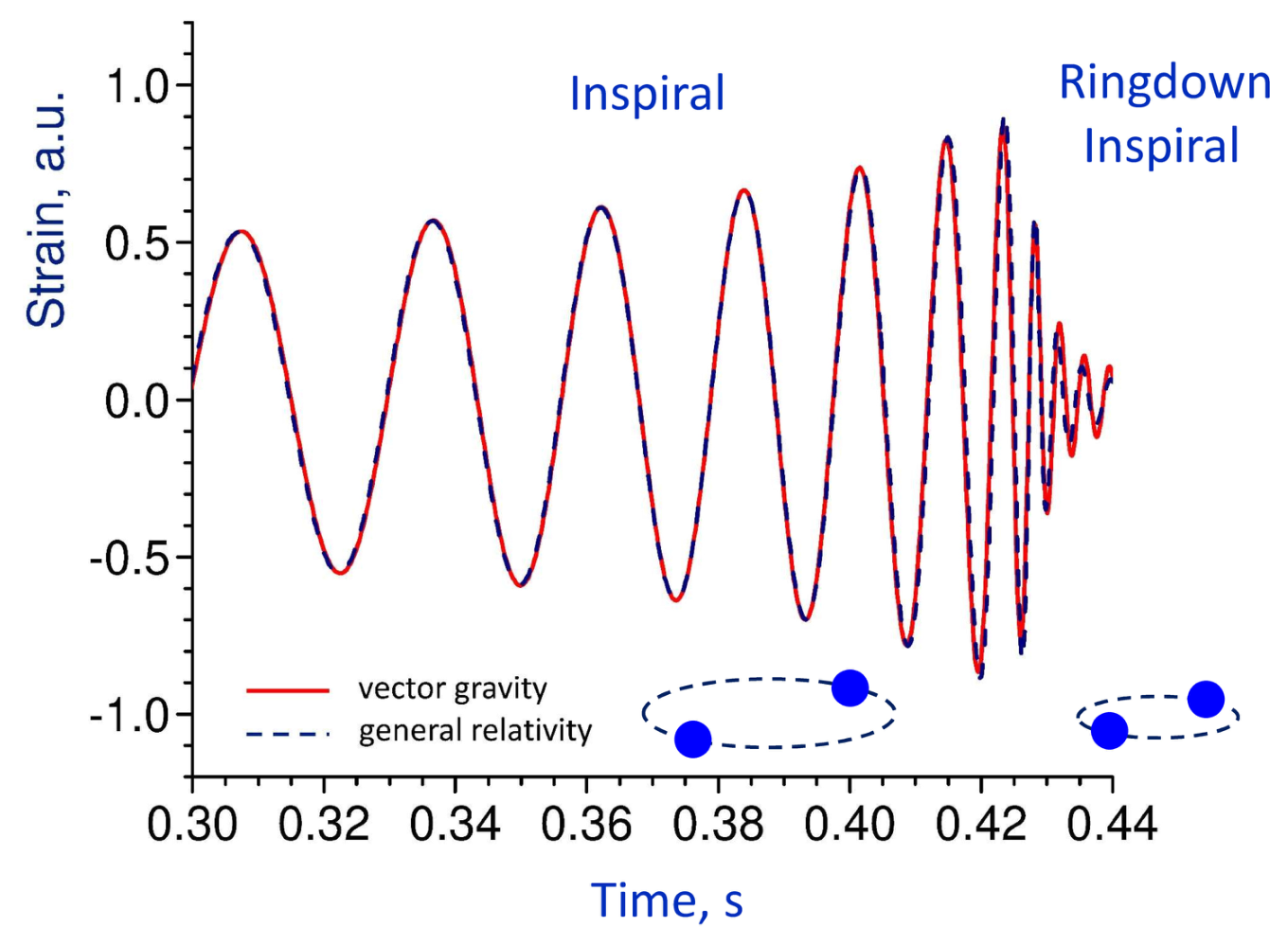
Figure 6.
Metric component produced by a point mass in isotropic coordinates (a) and Schwarzschild coordinates (b) as a function of distance to a compact object in general relativity (blue solid line) and vector gravity (red solid line). The unit of distance is the gravitational radius. The cross denotes the location of the maximum of the radiation waveform amplitude emitted by an inspiraling binary system with equal mass components. Vertical line separates regions of the orbital inspiral and ringdown inspiral in the radiation waveform.
Figure 6.
Metric component produced by a point mass in isotropic coordinates (a) and Schwarzschild coordinates (b) as a function of distance to a compact object in general relativity (blue solid line) and vector gravity (red solid line). The unit of distance is the gravitational radius. The cross denotes the location of the maximum of the radiation waveform amplitude emitted by an inspiraling binary system with equal mass components. Vertical line separates regions of the orbital inspiral and ringdown inspiral in the radiation waveform.
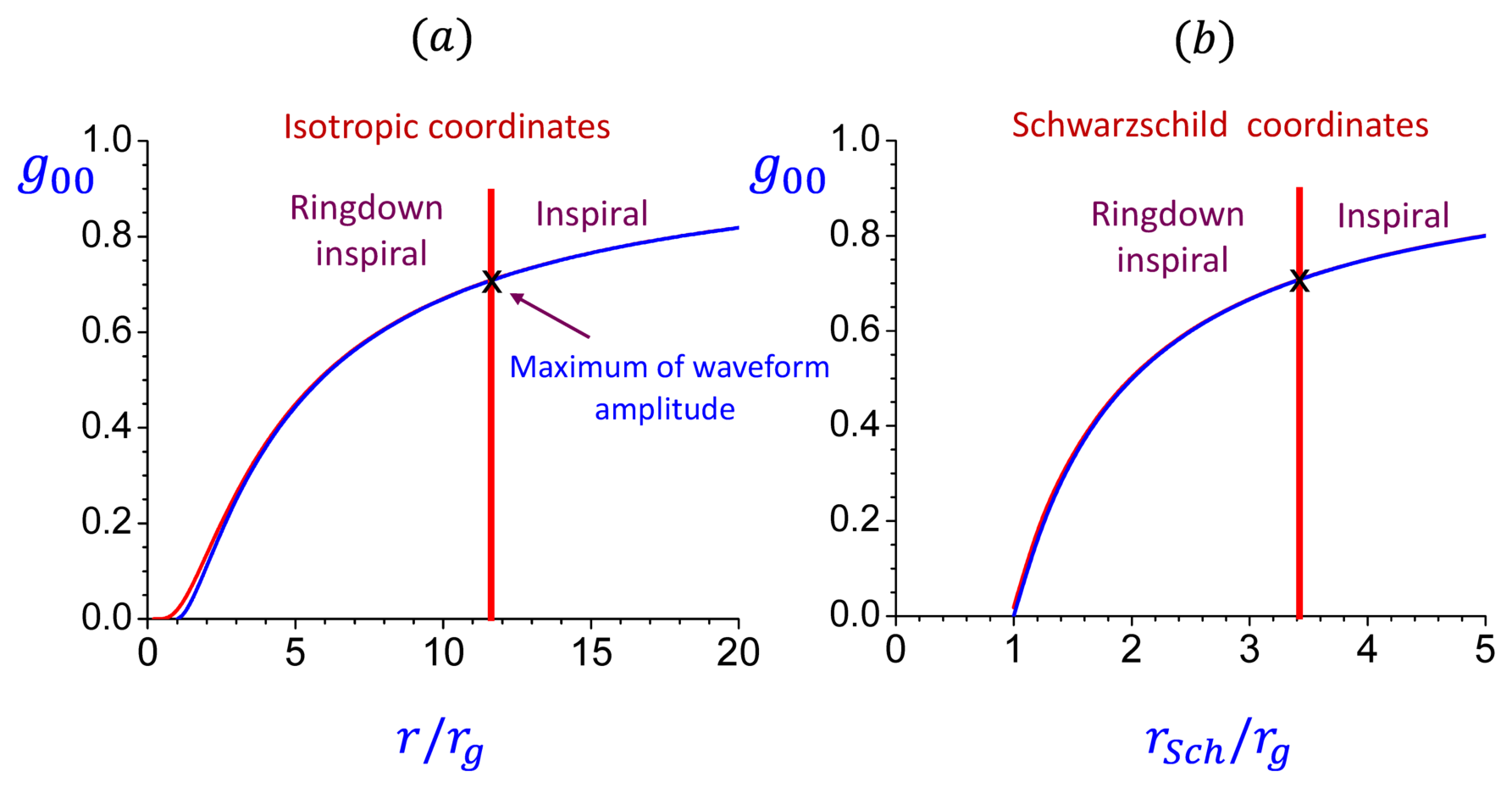
Figure 7.
Reconstructed sky location of the source for the GW170814 event under the assumption of tensor (a) and vector (b) gravitational wave polarization hypotheses. Color represents probability density, as a function of equatorial coordinates in a Mollweide projection. Adopted from Figure 6.2 of Ref. [49]. In Ref. [49], as well as Refs. [50,51], the source sky localization for the vector gravitational wave was obtained by replacing the tensor antenna pattern functions in the detector signal with those for the vector polarization modes, keeping gravitational waveforms and dependence on the binary orbital orientation the same as in GR. In a more accurate approach of Ref. [52], in addition, the dependence on the orbital inclination angle was replaced with the VG prediction, which for the GW170814 event has not changed the source sky localization significantly compared to Ref. [49] (see Figure 4 in [52]).
Figure 7.
Reconstructed sky location of the source for the GW170814 event under the assumption of tensor (a) and vector (b) gravitational wave polarization hypotheses. Color represents probability density, as a function of equatorial coordinates in a Mollweide projection. Adopted from Figure 6.2 of Ref. [49]. In Ref. [49], as well as Refs. [50,51], the source sky localization for the vector gravitational wave was obtained by replacing the tensor antenna pattern functions in the detector signal with those for the vector polarization modes, keeping gravitational waveforms and dependence on the binary orbital orientation the same as in GR. In a more accurate approach of Ref. [52], in addition, the dependence on the orbital inclination angle was replaced with the VG prediction, which for the GW170814 event has not changed the source sky localization significantly compared to Ref. [49] (see Figure 4 in [52]).
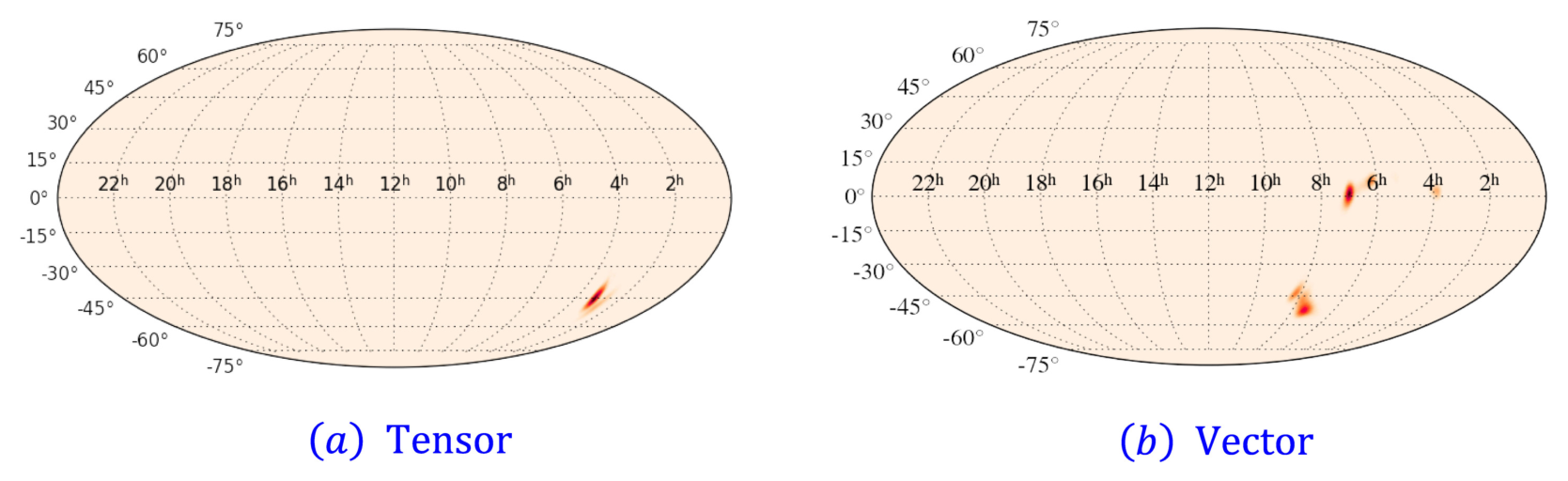
Figure 8.
(a) Frequency of the signal and noise as a function of time in the toy-model. (b) Signal amplitude accumulated from different frequency intervals with a span of 10 Hz. In the interval Hz the accumulated amplitude is substantially reduced due to interference between the chirped signal and the periodic noise.
Figure 8.
(a) Frequency of the signal and noise as a function of time in the toy-model. (b) Signal amplitude accumulated from different frequency intervals with a span of 10 Hz. In the interval Hz the accumulated amplitude is substantially reduced due to interference between the chirped signal and the periodic noise.
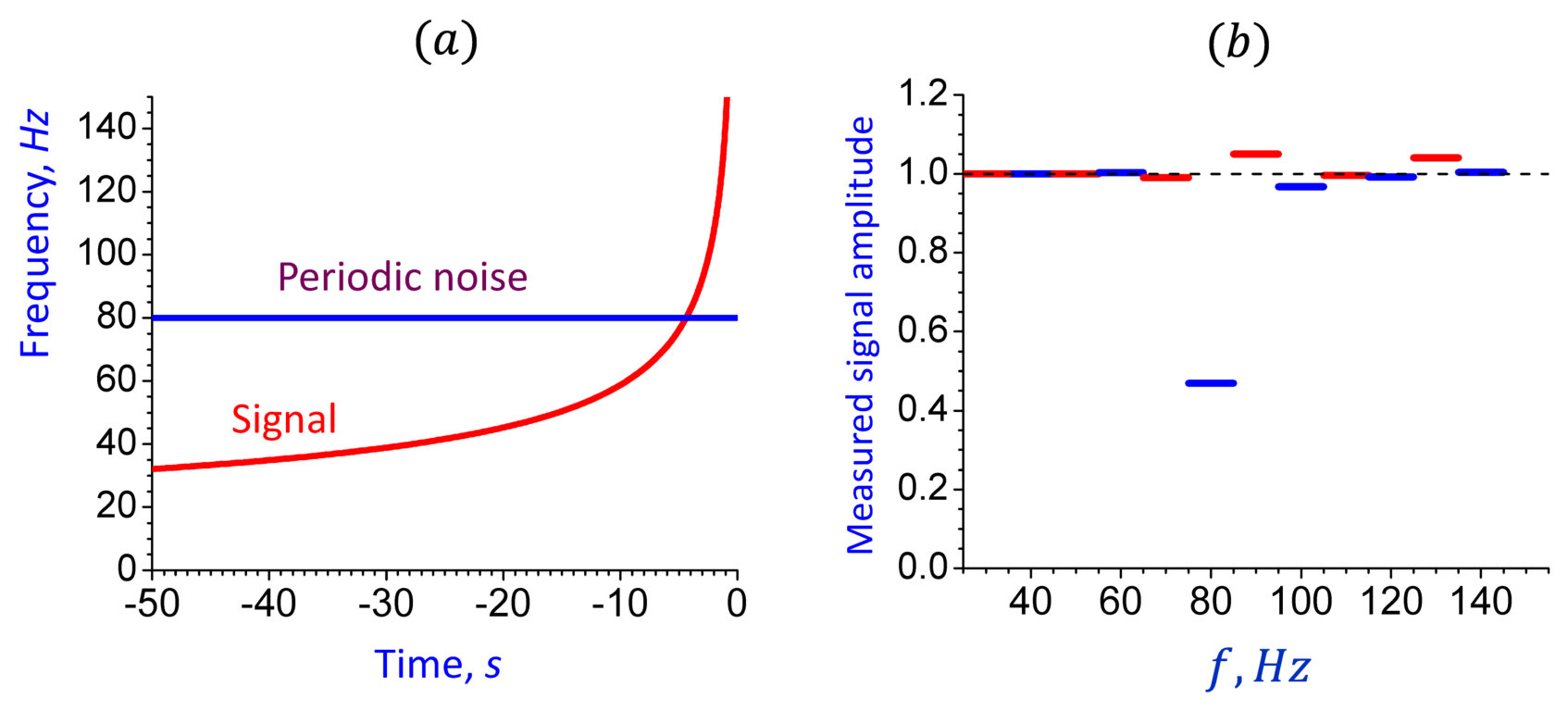
Figure 9.
Adjusted gravitational wave signal amplitude measured by LIGO-Hanford (a) and LIGO-Livingston (b) detectors for the GW170817 event using different signal collection time intervals (frequency bands). Times are shown relative to the moment of neutron stars merger. The adjusted signal amplitude must be the same in different intervals if the accumulated signal is not corrupted by interference with the residual noise. Adjusted signal amplitudes in different frequency bands are consistent for the Hanford detector. This is not the case for the LIGO-Livingston detector. Frequency regions in which the accumulated LIGO-Livingston signal is reduced due to interference with residual noise are indicated as dashed bars. It would be a mistake to include those “corrupted" frequency intervals in the data analysis. If they are included, after averaging over the whole detector bandwidth, the signal amplitude is underestimated, which alters the conclusion about gravitational wave polarization. Namely, if the “corrupted" frequency intervals are included the tensor gravitational wave polarization of GR is consistent with the sky location of the kilonova, discovered in close proximity to the galaxy NGC 4993, while vector polarization is ruled out. But if the “corrupted" frequency intervals are excluded, the conclusion is the opposite - pure vector gravitational wave polarization is consistent with the sky location and distance to the source, while tensor polarization is ruled out. Adopted from Figure 9 of Ref. [4].
Figure 9.
Adjusted gravitational wave signal amplitude measured by LIGO-Hanford (a) and LIGO-Livingston (b) detectors for the GW170817 event using different signal collection time intervals (frequency bands). Times are shown relative to the moment of neutron stars merger. The adjusted signal amplitude must be the same in different intervals if the accumulated signal is not corrupted by interference with the residual noise. Adjusted signal amplitudes in different frequency bands are consistent for the Hanford detector. This is not the case for the LIGO-Livingston detector. Frequency regions in which the accumulated LIGO-Livingston signal is reduced due to interference with residual noise are indicated as dashed bars. It would be a mistake to include those “corrupted" frequency intervals in the data analysis. If they are included, after averaging over the whole detector bandwidth, the signal amplitude is underestimated, which alters the conclusion about gravitational wave polarization. Namely, if the “corrupted" frequency intervals are included the tensor gravitational wave polarization of GR is consistent with the sky location of the kilonova, discovered in close proximity to the galaxy NGC 4993, while vector polarization is ruled out. But if the “corrupted" frequency intervals are excluded, the conclusion is the opposite - pure vector gravitational wave polarization is consistent with the sky location and distance to the source, while tensor polarization is ruled out. Adopted from Figure 9 of Ref. [4].
Disclaimer/Publisher’s Note: The statements, opinions and data contained in all publications are solely those of the individual author(s) and contributor(s) and not of MDPI and/or the editor(s). MDPI and/or the editor(s) disclaim responsibility for any injury to people or property resulting from any ideas, methods, instructions or products referred to in the content. |
© 2026 by the authors. Licensee MDPI, Basel, Switzerland. This article is an open access article distributed under the terms and conditions of the Creative Commons Attribution (CC BY) license (http://creativecommons.org/licenses/by/4.0/).
Copyright: This open access article is published under a Creative Commons CC BY 4.0 license, which permit the free download, distribution, and reuse, provided that the author and preprint are cited in any reuse.


