

Submitted:
19 June 2026
Posted:
22 June 2026
You are already at the latest version
Abstract
Landslide dams present significant hazards; however, real-time monitoring and predictive early warning systems are challenging. This systematic review synthesizes 156 Earth Observation (EO)-based studies conducted between 2000 and 2025 to evaluate progress toward integrated hazard monitoring and identify gaps in relation to digital twin concepts. The key EO tools utilized included InSAR (58% of studies), optical satellites (47%), UAV photogrammetry (39%), airborne LiDAR (21%), and ground-based radar (9%). Although 64% of the studies employed multiple platforms, only 7.7% integrated three or more EO sources with numerical models. We propose a three-level fusion hierarchy: Level 1 (geometric conditioning), Level 2 (offline calibration), and Level 3 (sequential data assimilation). Only 15 studies achieved Level 3, all of which were published post-2020. A random-effects meta-analysis of eight Level-3 studies demonstrated a median uncertainty reduction of 38% (95% CI: 24–52%; I² = 63%, indicating moderate heterogeneity); however, validation against independent events was absent. No study has fully implemented a closed-loop landslide dam digital twin, and the least developed components are decision support and real-time uncertainty quantification. The 2018 Baige sequence, despite being the subject of 22 EO studies, was retrospectively analyzed. Advancing operational digital twins necessitates open testbeds, uncertainty-aware surrogate models, adaptive sensing, and probabilistic-decision dashboards.
Keywords:
landslide dams
; remote sensing
; InSAR
; digital twin
; data assimilation
; risk assessment
; uncertainty quantification
; decision support
1. Introduction
Landslide dams, formed when mass movements obstruct river channels, constitute one of the most hazardous geomorphological phenomena in mountainous areas (Dong et al., 2024; Ma et al., 2024). The catastrophic breaching of these dams can trigger outburst floods that exceed engineered dam failures by several orders of magnitude, threatening downstream populations, infrastructure, and aquatic ecosystems (Zheng et al., 2022; Zhong et al., 2017). The 2018 Baige landslide dams on the Jinsha River released a peak discharge of 31,000 m³/s during successive failures, exemplifying these consequences and highlighting the need for rapid hazard assessment methodologies (Wang et al., 2020; Yang et al., 2025; Zhong et al., 2020).
Traditional methodologies for assessing landslide dams depend on post-event field surveys, empirical correlations, and historical analogs (Shafieiganjeh et al., 2024; Shan et al., 2023; Zheng et al., 2021). These approaches are limited by three constraints: (1) accessibility, (2) timeliness, and (3) spatial coverage. Accessibility is hindered by the remote terrain where landslide dams form, which impedes ground-based investigations. The critical period before a potential breach may be hours to days, whereas traditional surveys require weeks for mobilization. Point measurements cannot capture the three-dimensional complexity of dam structures or material properties (Mei et al., 2021; Shen et al., 2022; Zheng et al., 2021). Consequently, stability parameters, including internal stratigraphy, material erodibility, seepage development, and upstream lake dynamics, are estimated with significant uncertainty, compromising risk forecasting and emergency response (Liao et al., 2022; Lissak et al., 2020; Shen et al., 2022).
Earth observation (EO) technologies have significantly enhanced landslide dam monitoring in the past two decades. Synthetic aperture radar (SAR) interferometry (InSAR) detects deformation at millimeter-to-centimeter scales, providing insights into slope movements and dam settlement (Cheng et al., 2025; Shi et al., 2025; Zhang et al., 2024). High-resolution optical satellites enable frequent monitoring of impounded lakes (Lissak et al., 2020). Unmanned aerial vehicle (UAV) photogrammetry and airborne LiDAR create detailed topographic models, although they require more logistics (Li et al., 2024; Yu & Shin, 2024). Recent advances in machine learning have expedited feature extraction from these datasets (Alvarez-Vanhard et al., 2021); Whitehurst et al., 2021; Kazanskiy et al., 2025).
Comprehensive reviews have explored the hazards of landslide dams. Fan et al. (2019) synthesized information on global distribution, formation mechanisms, and geomorphic impacts of landslide dams. Zheng et al. (2021) examined stability assessment methods and failure mechanisms, highlighting the knowledge gaps in breach prediction. Lissak et al. (2020) reviewed the remote sensing applications for landslides. Shen et al. (2020) analyzed factors influencing landslide dam longevity, while Pan et al. (2025) and Biazar et al. (2025) investigated artificial intelligence in hydrology and hazard assessment.
Despite these contributions, no study has systematically synthesized the pathway from multi-platform Earth observation (EO) data to prognostic modeling through data assimilation and uncertainty quantification, which are essential components for operational early warning systems. Although remote sensing technologies have been documented (Denissova et al., 2024; Jain, 2024) and data assimilation methods have been developed (Baracchini et al., 2020; Retegui-Schiettekatte et al., 2025), a unified framework that integrates real-time observations with predictive modeling remains elusive. This gap is significant because early warning systems require both current dam conditions and forecasts of future evolution under uncertainty.
The concept of digital twins, which are dynamic, data-assimilating virtual representations that maintain bidirectional coupling with their physical counterparts, presents a promising paradigm for addressing integration challenges (Ahmadi & Pekkan, 2021; Ramirez et al., 2020). Initially developed for manufacturing and aerospace applications, digital twins are increasingly being applied to both natural and engineered systems, including water resources (Psomiadis et al., 2021), urban flooding (Fang et al., 2024), and infrastructure monitoring (He et al., 2024).
In the context of landslide dam applications, a functional digital twin necessitates the integration of four key components: (1) a multisensor Earth observation (EO) monitoring system that delivers near-real-time data on deformation, lake levels, and seepage; (2) a physically based core model capable of simulating breach evolution under conditions of uncertainty, such as coupled hydro-morphodynamic models; (3) a data assimilation engine that optimally integrates observational data to update model states and parameters while quantifying uncertainty; and (4) a decision-support interface that converts probabilistic forecasts into actionable risk intelligence. This review assesses the advancements in each component and identifies critical gaps.
Achieving this vision necessitates addressing significant challenges, including the computational requirements of real-time data assimilation (Bach & Ghil, 2023), robust integration of heterogeneous data with varying resolutions and uncertainties (Xue & Zhang, 2014), development of adaptive surrogate models to expedite simulations, and establishment of operational trust through rigorous validation protocols. The emerging concept of the digital risk twin, which integrates physical hazard forecasts with social vulnerability data and evacuation logistics, further advances this vision of comprehensive disaster risk management (Ahmed, 2025; Alcántara-Ayala & Sassa, 2023; Tran et al., 2024).
This review addresses these challenges by offering the first systematic synthesis of Earth observation applications for landslide dam hazard assessment, with an emphasis on the progression from raw sensor data to prognostic modeling via digital twin integration. In this review, we employed the 2018 Baige landslide dam sequence as an illustrative case study, utilizing extensive literature documenting its formation, monitoring, and failure (Cui et al., 2020; Fan et al., 2019; Zhong et al., 2020; Zhang et al., 2024) to evaluate the contributions of EO technologies to hazard assessment and identify the remaining critical gaps.
This review specifically examines natural landslide dams that form in river valleys and deliberately excludes tailing dams, engineered embankments, and glacial lake outburst floods. We considered Earth Observation (EO) techniques applicable to subaerial exposure, excluding subsurface geophysics, as well as model integration approaches that have been demonstrated for landslide dams or are directly transferable from analogous systems. Studies focusing solely on landslide detection without subsequent dam formation were excluded.
A literature review was performed using three bibliographic databases: Web of Science Core Collection, Scopus, and Google Scholar. These databases were chosen to ensure comprehensive coverage of peer-reviewed journal articles and conference proceedings in the fields of geosciences, remote sensing, and natural hazards.
The search was confined to publications released between January 2000 and December 2025. This period encompasses significant advancements in Earth observation (EO) technologies, particularly interferometric synthetic aperture radar (InSAR) and unmanned aerial vehicle (UAV) platforms, while excluding early exploratory studies that hold limited relevance to current hazard assessment methodologies.
The concept of a digital risk twin represents a forward-looking vision that integrates forecasts of physical hazards with vulnerability data. This review evaluates the extent to which current Earth Observation (EO) modeling approaches align with this vision.
2. Materials and Methods
2.1. Search Strategy
The search strategy used Boolean operators with three core terms, namely Theme 1,2 and 3. As shown in Figure 1.
2.2. Inclusion and Exclusion Criteria
Studies were evaluated based on predefined eligibility criteria applied during both the title/abstract and full-text screening stages.
2.2.1. Inclusion Criteria
Studies were included if they met the following criteria: 1) the research focused on natural landslide dams in river valleys, excluding tailings dams, engineered embankments, and glacial lake outburst floods; and 2) Earth observation techniques were used for dam characterization, monitoring, and hazard assessments. 3) The study provided data on dam geometry, deformation, lake evolution, breach processes, and model integration for hazard assessment. 4) The study was published as a peer-reviewed journal article, conference proceedings, or technical report, excluding conference abstracts. 5) The full text is available in English. 6) Time period: Published between January 2000 and March 2025.
2.2.2. Exclusion Criteria
Studies were excluded based on the following criteria: 1) Subject: Focus on artificial dams, tailings dams, or non-dam landslides without river obstruction; and 2) Technology: Use of only field surveys, laboratory experiments, or modeling without EO data. 3) Content: Insufficient method or result details; opinion pieces lacking original data. 4) Duplication: Duplicate publications were removed, retaining the most comprehensive version. 5) Accessibility: Full text unavailable through institutional access or loans.
2.3. Screening and Selection Process
The screening process was conducted in three stages, as shown in the PRISMA flowchart (Figure 2). Stage 1 involved database search and deduplication of the data. Initial searches yielded 847 records, and after removing duplicates (n = 312), 535 unique records were included. In Stage 2, two reviewers (LTD, CL) independently screened the titles and abstracts against the inclusion criteria and resolved disagreements through discussion or consultation with a third reviewer. This stage excluded 312 records due to incorrect subject matter, absence of EO data, or non-English language, leaving 223 records for further review and analysis. Stage 3 involved the full-text assessment of these articles. Sixty-seven studies were excluded: 24 lacked sufficient EO data or methodological details, 18 focused on landslide detection without dam formation, 15 were non-English, and 10 contained duplicate data or were conference abstracts. Finally, 156 studies met the inclusion criteria for the qualitative synthesis.
2.4. Data Extraction and Synthesis
A standardized data extraction form was developed to capture consistent information from each study included. Data extraction was conducted by one reviewer (LTD) and subsequently verified by another reviewer (CL) for a randomly selected 20% of the sample, achieving an agreement rate exceeding 95%. Owing to the heterogeneity of the study designs, EO technologies, and reported metrics, a narrative synthesis was utilized, complemented by quantitative summaries in which comparable data were available (e.g., UAV-derived DEM accuracies and InSAR deformation rates). Thematic analysis was employed to organize the findings according to the four lifecycle phases and integration approaches.
2.5. Quality Assessment
The quality of the included studies was assessed using a customized critical appraisal tool adapted from the established guidelines for observational geoscience studies (Table 1).
2.6. Meta-Analysis of Uncertainty Reduction
Among the 15 studies categorized as Level 3 (sequential data assimilation), eight provided quantitative metrics of uncertainty reduction, such as reductions in the variance of breach timing, peak outflow, and failure probability. A random-effects meta-analysis was conducted using the inverse variance method. The outcome measure was the percentage reduction in uncertainty, which was transformed to a logarithmic scale to stabilize variance. Heterogeneity was assessed using the I² statistic. Given the limited number of studies (k = 8), publication bias was qualitatively evaluated by examining asymmetry in a funnel plot. Sensitivity analysis was conducted by excluding the two studies with the lowest quality scores (≤4). All analyses were performed using the package in R (version 4.3). Results are presented as median percentage reduction with 95% confidence intervals; I² > 50% indicates moderate heterogeneity.
3. Results
3.1. Overview of Included Studies
A total of 156 studies satisfied the inclusion criteria and were qualitatively synthesized for this review. The search was conducted on March 31, 2025, encompassing the period from January 2000 to March 2025. The temporal distribution (Figure 3) revealed a significant increase in publications post-2015, with 68.0% (n = 106) of studies published between 2018 and March 2025. This trend corresponds with the operational availability of Sentinel-1 SAR data (from 2014 onwards) and the widespread adoption of UAV platforms. Geographically, the studies were concentrated in tectonically active mountain belts: the Tibetan Plateau and Himalayan front (42.9%, n = 67), Andes (17.9%, n = 28), European Alps (12.2%, n = 19), and Longmen Shan region of China (14.7%, n = 23). The 2018 Baige landslide dam sequence was the focus of 22 studies (14.1%), underscoring its significance as a benchmark.
3.2. Earth Observation Technologies and Their Applications
Table 2 synthesizes the EO technologies identified in the reviewed literature, detailing their primary applications and reported performance metrics. The percentages indicate the proportion of the 156 studies that employed each technology; as the studies could incorporate multiple technologies, the percentages exceeded one hundred%.
In 64.1% (n = 100) of the studies, the integration of multi-platform data was reported. The most prevalent combination was optical satellites and InSAR, observed in 47 studies, followed by UAV and optical satellites, as noted in 36 studies. Only 12 studies (7.7%) incorporated three or more Earth Observation (EO) platforms alongside a numerical model.
3.3. Lifecycle-Phase Monitoring Patterns
The proposed phased monitoring strategy, encompassing the stages of formation, impoundment, seepage/creep, breach, and post-failure, was implicitly or explicitly adopted in 78.2% (n = 122) of the case studies examined. Figure 4 shows the distribution of EO usage across the phases.
During the formation phase, which spans hours to days, rapid UAV surveys emerged as the predominant method, accounting for 89% of the studies conducted. The median reported deployment time for these surveys was 6.2 h after event detection. In contrast, optical satellite emergency tasking, such as Pléiades and SPOT, provides initial measurements of dam dimensions within 24–48 h, albeit with a coarser resolution of 0.5–1.5 m.
During the impoundment phase, which spans several days to weeks, optical satellites such as Sentinel-2 and Landsat-8 facilitate the monitoring of lake areas on a daily to weekly basis. Additionally, InSAR technology detected early dam settlement at rates of less than 5 mm/day in 62% of the observed cases.
During the seepage/creep phase, which spans days to months, Persistent Scatterer Interferometric Synthetic Aperture Radar (PS-InSAR) detected accelerating deformation patterns, reaching up to 20 mm/day. These patterns preceded catastrophic failure by 2–7 days in six documented events, including the initial failure at Baige. Additionally, Unmanned Aerial Vehicle (UAV) repeat flights documented the formation of tension cracks and localized slumping.
During the breach and post-failure phases, which span hours to weeks, high-temporal-resolution optical data (collected daily) and Synthetic Aperture Radar (SAR) data (with a 6–12 d repeat cycle) were utilized to quantify the breach hydrograph and residual dam geometry. Post-failure Unmanned Aerial Vehicle (UAV) surveys provided estimates of erosion volume, with a median error of ±12% compared to field measurements.
A significant trade-off was observed between the timeliness and precision. Rapid UAV surveys were capable of producing digital elevation models (DEMs) with centimeter-level accuracy but required on-site logistics, with a median time of 8 h from alert to the first flight. In contrast, satellite-based InSAR and optical data can be accessed within 2–5 days, albeit with coarser resolutions ranging from meters to decimeters. No single technology can fulfill all phases concurrently; therefore, multiphase, multi-platform strategies are essential.
3.4. Data Fusion and Model Conditioning
Within the 100 studies that incorporated Earth Observation (EO) data with numerical models, such as hydrologic, hydraulic, or slope stability models, we established three hierarchical levels of fusion based on the direction and frequency of information flow, as shown in Figure 5.
To ensure reproducibility, two independent reviewers (LTD, CL) classified the 100 modeling studies using a standardized rubric. The interrater agreement was 92% (Cohen’s κ = 0.87), and disagreements were resolved through discussion. Only 15 studies (10.0% of the total and 15.0% of modeling studies) achieved Level 3 data assimilation. All of these were published after 2020, and 12 of them employed ensemble methods. The most frequently assimilated variable was lake surface area (from optical satellites), followed by dam crest deformation (from InSAR or ground radar data).
Among the 15 Level-3 studies, eight provided quantitative metrics for uncertainty reduction, such as the reduction in the variance of breach timing. A random-effects meta-analysis of these eight studies yielded a median uncertainty reduction of 38% (95% confidence interval: 24–52%; I² = 63%, indicating moderate heterogeneity). Sensitivity analysis, which excluded the two lowest-quality studies based on quality assessment, produced a similar median of 36% (95% CI: 27–45). Although these findings are promising, they should be interpreted with caution because of the limited number of studies and lack of out-of-sample validation.
While these results indicate that sequential data assimilation can significantly reduce forecast uncertainty, the moderate heterogeneity (I² = 63%) and lack of out-of-sample validation suggest that these findings should be regarded as hypothesis-generating rather than conclusive. Additionally, all eight studies utilized synthetic or retrospective data streams, and none were conducted in a real-time, early warning context.
3.5. Digital Twin Components
In this review, we employ a stringent definition of a digital twin: a dynamic, bidirectional virtual representation that is continuously updated with real-time observations and can be utilized to simulate future behavior and guide the tasking of physical resources. None of the reviewed studies fully satisfied this definition. Instead, we evaluated the maturity of each component necessary for such a twin, employing a 5-point scale (1 = conceptual, 5 = operational). Figure 6 presents the results.
Although significant progress has been made in the development of individual components, the realization of a fully integrated closed-loop digital twin for landslide dams remains an objective of future research. Consequently, this study refers to "data-assimilating models" or "digital twin components" rather than operational digital twins.
3.6. Case Study Synthesis
The Baige landslide dam sequence (Figure 7), located on the Jinsha River in Tibet, has been examined in 22 studies, resulting in the most comprehensive EO-integrated dataset. The principal findings of these studies are as follows.
Pre-event deformation analysis using Sentinel-1 InSAR time-series data from 2015 to 2018 identified an accelerating slope displacement on the right bank, reaching rates of up to 140 mm/yr. This displacement commenced 18 months prior to the initial failure, with a distinct phase of acceleration beginning three months before the event.
In the context of rapid dam characterization, a UAV-derived Digital Elevation Model (DEM) with a resolution of 0.10 m was utilized to ascertain the dimensions of the dam within 48 h of its formation on October 10, 2018. The dam was determined to have a length of 1.1 km, height ranging from 70 to 100 m, and an approximate volume of 24 × 10⁶ cubic meters. Additionally, optical satellite data from GF-
PS-InSAR detected a dam crest settlement of 12 mm/day on October 8–9, two days prior to the initial breach on October 12. A straightforward displacement threshold model, as proposed in two studies, would have issued alerts 1.5 days in advance.
On November 3, 2018, post-failure InSAR and UAV surveys indicated a residual dam volume of 6 × 10⁶ m³. Subsequently, the deformation rates increased to 8 mm/day, culminating in a second breach on November 12. Notably, no study has documented a real-time data assimilation system capable of predicting the second breach, and all analyses were conducted retrospectively.
Despite the richness of EO data, no study has implemented a closed-is the real-time assimilation of InSAR or optical observations into a breach model to update the failure probability forecasts.
3.7. Quality Assessment Outcomes
The quality assessment tool evaluated each study based on five criteria: EO data adequacy, validation approach, uncertainty reporting, reproducibility, and relevance to hazard assessment. Each criterion was scored from 0–2, with a maximum score of 10. Among the 156 studies assessed, 42 (26.9%) were classified as high quality (score ≥8), 89 (57.1%) as moderate quality (score 5–7), and 25 (16.0%) as low quality (score ≤4). Low-quality studies predominantly lacked uncertainty reporting (22 out of 25) or failed to validate EO products using independent data (18 out of 25). High-quality studies were significantly more likely to employ Level 2 or 3 model fusion (χ² = 14.3, P < 0.001). Notably, of the 15 studies that achieved Level 3 data assimilation, 13 (86.7%) were rated as high-quality, indicating that rigorous uncertainty management is essential for operational data assimilation.
4. Discussion
4.1. From Reactive Monitoring to Anticipatory Data Assimilation
These findings indicate that Earth observation technologies have advanced to a stage where they can deliver multiparametric, near-real-time data concerning the evolution of landslide dams, as indicated by the studies conducted by Chandel et al. (2025), Fu (2024), and Vassileva et al. (2024). InSAR, optical satellites, and UAV platforms collectively encompass all phases of the lifecycle, with distinct trade-offs between spatial resolution, temporal frequency, and deployment latency. Nevertheless, most of the studies reviewed (90% of modeling studies) have been limited to the reactive application of Earth observation data, utilizing observations to describe past conditions (Level 1 or 2 fusion) rather than predicting future breach behavior through sequential data assimilation (Level 3). This gap is the primary impediment to the implementation of operational early warning systems (Grassi et al., 2025; Napolitano et al., 2024).
The Baige case serves as a prime example of missed opportunities in data utilization. Essential Earth Observation (EO) data, including pre-event InSAR, rapid UAV, and post-formation optical data, were available and, upon retrospective analysis, could have facilitated a forecast of the initial breach 1–2 days prior to its occurrence (Bernardi et al., 2021; Kerwin et al., 2025; Li et al., 2017; Sousa et al., 2021). However, no real-time system was in place to integrate these data into a breach model. This issue is not exclusive to Baige; among all 156 studies reviewed, only three documented a genuinely real-time or near-real-time data assimilation exercise, such as employing satellite data within six hours of acquisition to update an ongoing model. The remaining 12 Level-3 studies were conducted offline or retrospectively conducted.
Operational data assimilation has been a standard practice in numerical weather prediction (NWP) since the 1990s, employing techniques such as 3D-Var and 4D-EnKF, and is increasingly being applied in hydrological forecasting, including ensemble flood predictions, as revealed by Buehner et al. (2010, 2017). However, its application to landslide dam scenarios has been hindered by three distinct challenges: (i) the abrupt and unpredictable formation of the target system, (ii) the limited availability of historical events for training assimilation schemes, and (iii) highly nonlinear and threshold-driven breach dynamics (Marino et al., 2022). Despite these challenges, valuable insights can be gained from existing practices: surrogate modeling, already utilized in NWP for rapid radiative transfer, and adaptive observation involving targeted sensor tasking are directly applicable. This review formalizes a three-level fusion hierarchy, illustrating that while levels 1 and 2 are well-established, level 3 remains at the forefront of research.
4.2. The Uncertainty Imperative
A notable finding is that only 27% of the studies were classified as high-quality, with the most prevalent deficiency being the lack of quantitative uncertainty metrics, observed in 22 out of 25 low-quality studies. In the context of hazard decision-making, deterministic predictions, such as "the dam will fail at 15:00 on Day X," are overly confident and potentially hazardous. Decision-makers require probabilistic forecasts, for instance, "there is a 30% chance of failure within 12 hours, and a 70% chance within 24 hours." Such forecasts necessitate rigorous uncertainty quantification (UQ) that accounts for error propagation from Earth Observation (EO) data, including registration, atmospheric artifacts, and Digital Elevation Model (DEM) noise, through model parameters such as erodibility and permeability, as well as initial conditions.
The 15 Level-3 studies that incorporated data assimilation consistently reported reductions in uncertainty, with a median decrease of 38%, as indicated by meta-analysis. This outcome substantiates the advantages of sequential assimilation observed in this study. Nonetheless, these investigations were predominantly conducted on well-instrumented cases, such as Baige or controlled experiments, and relied on idealized assumptions, including Gaussian errors and perfect-structural models. The application of these methodologies to operational environments characterized by sparse data, structural model errors, and nonstationary conditions remains a significant challenge. Furthermore, none of the studies validated their probabilistic forecasts using proper scoring rules, such as the Brier score and reliability diagram. It is imperative that future research adopts verification protocols that are standard in meteorology to enhance credibility.
4.3. Digital Twin Architecture
The maturity assessment, as presented in Table 4, indicates a "barbell" pattern: Earth Observation (EO) monitoring and geometric modeling exhibit relative maturity, with scores ranging from 3 to 4, whereas data assimilation, uncertainty quantification (UQ), and decision support are less developed, with scores between 1 and 2. This disparity highlights the historical emphasis on characterization rather than prediction within the landslide dam community. A fully functional digital twin necessitates the integration of all four components into closed-loop systems. Currently, the most significant limitation is bidirectional coupling: while EO data are utilized to update model states, model predictions seldom inform the tasking of new EO acquisitions, such as requesting higher-resolution satellite imagery or a UAV overflight of a specific area. To date, only three studies (Biescas et al., 2020; Lv et al., 2024; Mirus et al., 2024) have demonstrated such adaptive sensing, all of which remain proof-of-concept and are not yet operational.
Computational efficiency is a major challenge. The real-time assimilation of data using high-fidelity two-dimensional and three-dimensional breach models is computationally prohibitive. Among the 15 Level-3 studies, 12 employed surrogate models, such as polynomial chaos expansion, reduced-order models, and shallow neural networks to approximate the forward model. The accuracy of these surrogates varied (R² 0.62–0.94), and none were validated for different dam geometries. The development of generalizable physics-constrained surrogate models that can be trained using limited data is a research priority.
4.4. Operational Trust and Validation
Even if technical challenges are resolved, operational implementation requires trust from emergency managers. Trust was established using rigorous validation protocol. Our quality assessment revealed that only 27% of the studies adhered to high standards of validation and uncertainty reporting. It is imperative for the community to adopt standardized reporting guidelines for EO-based landslide dam studies, akin to the FAIR data principles and TRUST framework for models. Specific recommendations include the following:
1) The obligatory disclosure of uncertainties in Earth Observation (EO) data, such as the vertical accuracy of Digital Elevation Models (DEMs) and residuals in the atmospheric phase screen of Interferometric Synthetic Aperture Radar (InSAR), is essential.
2) A quantitative comparison utilizing independent validation data, such as field survey points and altimeter lake levels, was conducted.
3) Probabilistic forecast verification was conducted using metrics such as the Brier score, reliability diagrams, and continuous ranked probability scores (CRPS).
4) Facilitating the open sharing of code and data, where feasible, to enable replication.
4.5. Limitations of This Review
This study had several limitations. First, the review was confined to English-language publications indexed in the Web of Science, Scopus, and Google Scholar databases. Consequently, pertinent studies in Chinese, Japanese, or other languages, particularly local technical reports, may have been overlooked, despite the comprehensive documentation of the Baige case. Second, the quality assessment tool employed was custom-designed; however, the high inter-reviewer agreement (95% for overall scoring and 92% for fusion level classification) indicated robust internal consistency. Third, the meta-analysis of uncertainty reduction (Section 3.4) was derived from only eight studies and exhibited moderate heterogeneity (I² = 63%); thus, these results should be considered indicative rather than definitive results. Finally, the review excludes artificial dams and glacial lake outburst floods; therefore, the findings may not be directly applicable to these systems, although the digital twin framework remains conceptually analogous.
4.6. Future Research Directions
Based on the identified gaps, we propose four priority research directions.
- 1.
- Real-time data assimilation testbeds: Development of open-source modular pipelines, such as those utilizing Ensemble Kalman Filters (EnKF) or particle filters, integrated with lightweight breach models, and their application to historical case studies using synthetic real-time data streams. The Baige event should serve as a benchmark for future research. Collaboration across disciplines, particularly with the numerical weather prediction (NWP) and hydrological assimilation communities, is strongly encouraged.
- 2.
- Uncertainty-aware surrogate modelling: Invest in physics-informed machine learning methodologies, such as Physics-Informed Neural Networks (PINNs) and Bayesian neural networks, which approximate breach hydrodynamics while offering uncertainty estimates. These surrogate models must undergo out-of-sample validation for various dam geometries and materials.
- 3.
- Adaptive sensing strategies: Consider the tasking of Earth Observation (EO) assets as a problem of Bayesian optimal experimental design. In this framework, the current uncertainty within the data assimilation model is utilized to determine the most informative subsequent observation, such as a UAV flight line or SAR acquisition. Pilot studies employing Baige datasets are feasible.
- 4.
- Decision support co-design: Collaborate with emergency management professionals to develop dashboards that effectively convey probabilistic forecasts intuitively and actionably. This includes the visualization of confidence intervals, scenario trees, and pre-computed "what-if" interventions, such as controlled spillway cutting. It is essential to incorporate verification tools such as the Brier score and reliability diagrams to build trust in forecasts.
Conclusion
This systematic review illustrates that Earth observation technologies can provide multiparametric and multitemporal data essential for landslide dam characterization. However, the progression from characterization to prediction and the shift from reactive monitoring to anticipatory data-assimilating models remain incomplete. Nonetheless, the progression from characterization to prediction and from reactive monitoring to anticipatory data-assimilating models is impeded by the sequential data assimilation and rigorous uncertainty quantification. Only 10% of studies incorporated EO data into predictive models beyond geometric conditioning, and only 27% reported the quantitative uncertainty. The 2018 Baige sequence, despite being the most extensively observed landslide dam in history, has not been monitored using a real-time data assimilation model, let alone a comprehensive digital twin. Achieving the vision of proactive, model-guided risk intelligence necessitates concerted investments in surrogate modeling, adaptive sensing, probabilistic forecast verification, and decision-oriented uncertainty communication. The framework presented herein, comprising a three-level fusion hierarchy and component maturity assessment, offers a roadmap for prioritizing these efforts in the future.
Author Contributions
Lungelo Thando Dlamini: Conceptualization, Methodology, Software, Writing – Original Draft Preparation, Writing – Review and Editing, Visualization. Changwen Li: Resources, Supervision, Project Administration, Funding Acquisition, Validation, Formal Analysis, Project Administration.
Funding
This research was supported by the following funding agencies and institutions: (1) Open Research Fund of the National Engineering Research Center of Water Resources Efficient Utilization and Engineering Safety: Study on the risk transfer mechanism of flood regulation for giant water engineering groups (GJGCZX-JJ-202422). (2) Key Science and Technology Project of the Ministry of Water Resources: Study on Collaborative Response Strategies for Extreme Flood Disasters in Watersheds Under Changing Environments (SKS-2022003). (6) This work was Supported by the Open Research Fund of Hubei Key Laboratory of Construction and Management in Hydropower Engineering, China Three Gorges University (2024KSD20). (7) China Three Gorges University Science Fund: Research and Development of Smart Emergency Flood Control and Risk Avoidance Technology (2024KTZB04).
Data Availability Statement
All relevant data related to this manuscript are available and can be provided upon reasonable request.
Acknowledgments
The authors gratefully acknowledge the support of the funding agencies and institutions mentioned above, who made this research possible.
Conflicts of Interest
All authors declare that the manuscript is original. The authors declare that they have no conflicts of interest.
Abbreviations
The following abbreviations are used in this manuscript:
| EO | Earth Observation |
| InSAR | Interferometric Synthetic Aperture Radar |
| DEMs | Digital Elevation Models |
| CRPS | Continuous Ranked Probability Scores |
| UQ | Uncertainty Quantification |
| UAV | Unmanned Aerial Vehicle |
| NWP | Numerical Weather Prediction |
| SAR | Synthetic Aperture Radar |
References
- Ahmadi, H.; Pekkan, E. Fault-Based Geological Lineaments Extraction Using Remote Sensing and GIS—A Review. Geosciences 2021, *11*(5), 183. [Google Scholar] [CrossRef]
- Ahmed, R. From vulnerability to resilience: community-based approaches in glacial lake outburst flood (GLOF) risk mitigation. Discover Sustainability 2025, *6*(1). [Google Scholar] [CrossRef]
- Alcántara-Ayala, I.; Sassa, K. Landslide risk management: from hazard to disaster risk reduction. Landslides 2023, *20*(10), 2031–2037. [Google Scholar] [CrossRef]
- Alvarez-Vanhard, E.; Corpetti, T.; Houet, T. UAV & satellite synergies for optical remote sensing applications: A literature review. Science of Remote Sensing 2021, *3*, 100019. [Google Scholar] [CrossRef]
- Bach, E.; Ghil, M. A Multi-Model Ensemble Kalman Filter for Data Assimilation and Forecasting. Journal of Advances in Modeling Earth Systems 2023, *15*(1). [Google Scholar] [CrossRef]
- Baracchini, T.; Wüest, A.; Šukys, J.; Bouffard, D.; Lieberherr, G.; Wunderle, S.; Chu, P. Y. Data assimilation of in situ and satellite remote sensing data to 3D hydrodynamic lake models: a case study using Delft3D-FLOW v4.03 and OpenDA v2.4. Geoscientific Model Development 2020, *13*(3), 1267–1284. [Google Scholar] [CrossRef]
- Bernardi, M. S.; Africa, P. C.; De Falco, C.; Formaggia, L.; Menafoglio, A.; Vantini, S. On the Use of Interferometric Synthetic Aperture Radar Data for Monitoring and Forecasting Natural Hazards. Mathematical Geosciences 2021, *53*(8), 1781–1812. [Google Scholar] [CrossRef]
- Biazar, S. M.; Nedhunuri, R. R.; Mohammadi, K.; Golmohammadi, G.; Shaghaghi, S. Artificial Intelligence in Hydrology: Advancements in Soil, Water Resource Management, and Sustainable Development. Sustainability 2025, *17*(5), 2250. [Google Scholar] [CrossRef]
- Biescas, E.; Sánchez-Oro, M.; Goodwin, G.; Cooksley, G.; Mudd, S.; Gailleton, B. Dynamic Landslide Failure Prediction Model Using Remote Sensing Data. In Zenodo; CERN European Organization for Nuclear Research, 2020. [Google Scholar] [CrossRef]
- Buehner, M.; Houtekamer, P. L.; Charette, C.; Mitchell, H. L.; He, B. Intercomparison of Variational Data Assimilation and the Ensemble Kalman Filter for Global Deterministic NWP. Part II: One-Month Experiments with Real Observations. Monthly Weather Review 2010, *138*(5), 1567–1586. [Google Scholar] [CrossRef]
- Buehner, M.; Mctaggart-Cowan, R.; Heilliette, S. An Ensemble Kalman Filter for Numerical Weather Prediction Based on Variational Data Assimilation: VarEnKF. Monthly Weather Review 2017, *145*(2), 617–635. [Google Scholar] [CrossRef]
- Chandel, R. S.; Rai, P. K.; Misra, R. K. Advancing Sustainability; Crc, 2025; pp. 80–103. [Google Scholar] [CrossRef]
- Cheng, Y.; Pang, H.; Li, Y.; Fan, L.; Wei, S.; Yuan, Z.; Fang, Y. Applications and Advancements of Spaceborne InSAR in Landslide Monitoring and Susceptibility Mapping: A Systematic Review. Remote Sensing 2025, *17*(6), 999. [Google Scholar] [CrossRef]
- Cui, Y.; Shen, L.; Li, Y.; Lyu, Y.; Tian, Y.; Xu, X.; Jiao, Q.; Liu, F.; Bao, P.; Hu, X.; Xu, C.; Liu, Y.; Li, T.; Fu, G.; Luo, Y. A big landslide on the Jinsha River, Tibet, China: geometric characteristics, causes, and future stability. Natural Hazards 2020, *104*(3), 2051–2070. [Google Scholar] [CrossRef]
- Denissova, N.; Daumova, G.; Petrova, O.; Nurakynov, S.; Chepashev, D.; Yelisseyeva, A. Remote Sensing Techniques for Assessing Snow Avalanche Formation Factors and Building Hazard Monitoring Systems. Atmosphere 2024, *15*(11), 1343. [Google Scholar] [CrossRef]
- Dong, X.; Wang, X.; Yang, L.; Zhao, Z.; Van Balen, R.; Miao, X.; Liu, T.; Vandenberghe, J.; Pan, B.; Gibling, M.; Lu, H. Quantitative assessment of the erosion and deposition effects of landslide-dam outburst flood, Eastern Himalaya. Scientific Reports 2024, *14*(1). [Google Scholar] [CrossRef] [PubMed]
- Fan, X.; Ouyang, C.; Siva Subramanian, S.; Peng, M.; Xu, Q.; Yang, F.; Jansen, J. D.; Huang, R.; Feng, Z.; Mavrouli, O. Prediction of a multi-hazard chain by an integrated numerical simulation approach: the Baige landslide, Jinsha River, China. Landslides 2019, *17*(1), 147–164. [Google Scholar] [CrossRef]
- Fan, X.; Zheng, G.; Xu, Q.; Huang, R.; Alonso-Rodriguez, A.; Subramanian, S. S.; Li, W.; Dong, X. Successive landsliding and damming of the Jinsha River in eastern Tibet, China: prime investigation, early warning, and emergency response. Landslides 2019, *16*(5), 1003–1020. [Google Scholar] [CrossRef]
- Fang, C.; Fan, X.; Qi, J.; Dong, X.; Wang, X.; Catani, F.; Nava, L.; Zhong, H. A globally distributed dataset of coseismic landslide mapping via multi-source high-resolution remote sensing images. Earth System Science Data 2024, *16*(10), 4817–4842. [Google Scholar] [CrossRef]
- Fu, S. Remote sensing of landslides; Utrecht University Library, 2024. [Google Scholar] [CrossRef]
- Grassi, F.; Rossi, P.; Brunelli, B.; Mancini, F.; Castagnetti, C.; Vincenzi, L.; Bassoli, E.; Capra, A. Ensembling satellite monitoring and numerical cartography towards the safety assessment of infrastructures. Applied Geomatics 2025, *17*(2), 401–410. [Google Scholar] [CrossRef]
- He, H.; Wang, W.; Wang, Z.; Li, S.; Chen, J. Enhancing Seismic Landslide Susceptibility Analysis for Sustainable Disaster Risk Management through Machine Learning. Sustainability 2024, *16*(9), 3828. [Google Scholar] [CrossRef]
- Jain, H. Leveraging geo-computational innovations for sustainable disaster management to enhance flood resilience. In Discover Geoscience; 2024; Volume *2*, 1. [Google Scholar] [CrossRef]
- Kazanskiy, N.; Khabibullin, R.; Nikonorov, A.; Khonina, S. A Comprehensive Review of Remote Sensing and Artificial Intelligence Integration: Advances, Applications, and Challenges. Sensors (Basel, Switzerland) 2025, *25*(19), 5965. [Google Scholar] [CrossRef] [PubMed]
- Kerwin, P.; Bell, J.; Cooney, J.; Lahmers, T.; Melancon, A.; Milton, J.; Okorn, K.; Rolla, J.; Vershel, R.; Barnes, J.; Childs-Gleason, L.; Picchione, K.; Rea, P. Addressing Challenges and Exploring Solutions to Enhance Earth Observation Applications for Emergency Management. Journal of Earth Observation and Geospatial Applications 2025, *1*(1), 129–143. [Google Scholar] [CrossRef]
- Li, Q.; Yao, X.; Li, R.; Zhou, Z.; Yao, C.; Ren, K. Quick Extraction of Joint Surface Attitudes and Slope Preliminary Stability Analysis: A New Method Using Unmanned Aerial Vehicle 3D Photogrammetry and GIS Development. Remote Sensing 2024, *16*(6), 1022. [Google Scholar] [CrossRef]
- Li, S.; He, H.; Cui, Y.; Liu, M.; Ravan, S. Integrating Global Open And Satellite-Based Information For Major Disaster Damage Assessment. 2017. [Google Scholar] [CrossRef]
- Liao, H.-M.; Yang, X.-G.; Lu, G.-D.; Tao, J.; Zhou, J.-W. A geotechnical index for landslide dam stability assessment. Geomatics, Natural Hazards and Risk 2022, *13*(1), 854–876. [Google Scholar] [CrossRef]
- Lissak, C.; Bartsch, A.; De Michele, M.; Gomez, C.; Maquaire, O.; Raucoules, D.; Roulland, T. Remote Sensing for Assessing Landslides and Associated Hazards. Surveys in Geophysics 2020, *41*(6), 1391–1435. [Google Scholar] [CrossRef]
- Lv, Z.; Wang, S.; Yan, S.; Han, J.; Zhang, G. Landslide Susceptibility Assessment Based on Multisource Remote Sensing Considering Inventory Quality and Modeling. Sustainability 2024, *16*(19), 8466. [Google Scholar] [CrossRef]
- Ma, J.; Chen, J.; Xu, C. Sedimentary records of giant landslide-dam breach events in western Sichuan, China. Frontiers in Earth Science 2024, *12*. [Google Scholar] [CrossRef]
- Marino, P.; Greco, R.; Bogaard, T. A. Landslide hydrology: new challenges in landslide prediction. 2022. [Google Scholar] [CrossRef]
- Mei, S.; Chen, S.; Zhong, Q.; Shan, Y. Effects of Grain Size Distribution on Landslide Dam Breaching—Insights From Recent Cases in China. Frontiers in Earth Science 2021, *9*. [Google Scholar] [CrossRef]
- Mirus, B. B.; Bogaard, T. A.; Greco, R.; Stähli, M. Invited Perspectives: Integrating hydrologic information into the next generation of landslide early warning systems. In Copernicus Gmbh; 2024. [Google Scholar] [CrossRef]
- Napolitano, A.; Gagliardi, V.; D’Amico, F.; Benedetto, A. Integration of satellite monitoring data in a digital twin of transport infrastructure. *44* 2024. [Google Scholar] [CrossRef]
- Page, M. J.; Mckenzie, J.; Bossuyt, P.; Boutron, I.; Hoffmann, T.; Mulrow, C.; Shamseer, L.; Tetzlaff, J.; Akl, E.; Brennan, S. E.; Chou, R.; Glanville, J.; Grimshaw, J.; Hróbjartsson, A.; Lalu, M. M.; Li, T.; Loder, E.; Mayo-Wilson, E.; Mcdonald, S.; Moher, D. The PRISMA 2020 statement: an updated guideline for reporting systematic reviews. In Center for Open Science; 2020. [Google Scholar] [CrossRef]
- Pan, D.; Gharabaghi, B.; Deng, Y.; Yang, S. X. Recent Advances in Remote Sensing and Artificial Intelligence for River Water Quality Forecasting: A Review. Environments 2025, *12*(5), 158. [Google Scholar] [CrossRef]
- Psomiadis, E.; Michas, S.; Kavvadias, A.; Charizopoulos, N.; Soulis, K. X.; Tomanis, L. Potential Dam Breach Analysis and Flood Wave Risk Assessment Using HEC-RAS and Remote Sensing Data: A Multicriteria Approach. Water 2021, *13*(3), 364. [Google Scholar] [CrossRef]
- Ramirez, R.; Kwon, T.-H.; Lee, S.-R. Long-Term Remote Monitoring of Ground Deformation Using Sentinel-1 Interferometric Synthetic Aperture Radar (InSAR): Applications and Insights into Geotechnical Engineering Practices. Applied Sciences 2020, *10*(21), 7447. [Google Scholar] [CrossRef]
- Retegui-Schiettekatte, L.; Schumacher, M.; Yang, F.; Madsen, H.; Forootan, E. An ensemble Kalman filter with rescaling disaggregation for assimilating terrestrial water storage into hydrological models. Scientific Reports 2025, *15*(1). [Google Scholar] [CrossRef] [PubMed]
- Shafieiganjeh, R.; Schneider-Muntau, B.; Ostermann, M.; Gems, B. Seepage process understanding at long-existing landslide dams through numerical analysis and hydrological measurements. Engineering Geology 2024, *335*, 107524. [Google Scholar] [CrossRef]
- Shan, Y.; Xu, Z.; Zhou, S.; Lu, H.; Yu, W.; Li, Z.; Cao, X.; Li, P.; Li, W. Landslide Hazard Assessment Combined with InSAR Deformation: A Case Study in the Zagunao River Basin, Sichuan Province, Southwestern China. Remote Sensing 2023, *16*(1), 99. [Google Scholar] [CrossRef]
- Shen, D.; Peng, M.; Shi, Z.; Jiang, M.; Zhang, L. Longevity analysis of landslide dams. Landslides 2020, *17*(8), 1797–1821. [Google Scholar] [CrossRef]
- Shen, D.; Shi, Z.; Zheng, H.; Yang, J.; Hanley, K. J. Effects of grain composition on the stability, breach process, and breach parameters of landslide dams. Geomorphology 2022, *413*, 108362. [Google Scholar] [CrossRef]
- Shi, X.; Zhao, Z.; Dai, Y.; Dai, K.; Ju, A. Post-Disaster High-Frequency Ground-Based InSAR Monitoring and 3D Deformation Reconstruction of Large Landslides Using MIMO Radar. Remote Sensing 2025, *17*(18), 3183. [Google Scholar] [CrossRef]
- Sousa, J. J.; Liu, G.; Fan, J.; Perski, Z.; Steger, S.; Bai, S.; Wei, L.; Salvi, S.; Wang, Q.; Tu, J.; Tong, L.; Mayrhofer, P.; Sonnenschein, R.; Liu, S.; Mao, Y.; Tolomei, C.; Bignami, C.; Atzori, S.; Pezzo, G.; Peres, E. Geohazards Monitoring and Assessment Using Multi-Source Earth Observation Techniques. Remote Sensing 2021, *13*(21), 4269. [Google Scholar] [CrossRef]
- Tran, T. X.; Liu, S.; Ha, H.; Bui, Q. D.; Nguyen, L. Q.; Nguyen, D. Q.; Trinh, C.-T.; Luu, C. A Spatial Landslide Risk Assessment Based on Hazard, Vulnerability, Exposure, and Adaptive Capacity. Sustainability 2024, *16*(21), 9574. [Google Scholar] [CrossRef]
- Vassileva, M.; Motagh, M.; Roessner, S.; Xia, Z. A multi-sensor remote sensing approach for understanding slow-moving landslide reactivation: a case study from North Central Iran following reservoir impoundment and extreme precipitations. 2024. [Google Scholar] [CrossRef]
- Wang, H.; Zhou, Y.; Wang, S.; Wang, F. Coupled model constructed to simulate the landslide dam flood discharge: a case study of Baige landslide dam, Jinsha River. Frontiers of Earth Science 2020, *14*(1), 63–76. [Google Scholar] [CrossRef]
- Whitehurst, D.; Sridhar, V.; Weeks, J.; Friedman, B.; Kochersberger, K. Drone-Based Community Assessment, Planning, and Disaster Risk Management for Sustainable Development. Remote Sensing 2021, *13*(9), 1739. [Google Scholar] [CrossRef]
- Xue, L.; Zhang, D. A multimodel data assimilation framework via the ensemble Kalman filter. Water Resources Research 2014, *50*(5), 4197–4219. [Google Scholar] [CrossRef]
- Yang, J.; Shen, D.; Shi, Z.; Soares-Frazão, S. Detailed numerical simulation of landslide dam failure considering non-uniform and multi-layered sediments: A case study of the second Baige landslide dam in the Jinsha River, China. Earth Surface Processes and Landforms 2025, *50*(7). [Google Scholar] [CrossRef]
- Yu, C.; Shin, Y. MCG-RTDETR: Multi-Convolution and Context-Guided Network with Cascaded Group Attention for Object Detection in Unmanned Aerial Vehicle Imagery. Remote Sensing 2024, *16*(17), 3169. [Google Scholar] [CrossRef]
- Zhang, R.; Zhang, L.; Fang, Z.; Oguchi, T.; Merghadi, A.; Fu, Z.; Dong, A.; Dou, J. Interferometric Synthetic Aperture Radar (InSAR)-Based Absence Sampling for Machine-Learning-Based Landslide Susceptibility Mapping: The Three Gorges Reservoir Area, China. Remote Sensing 2024, *16*(13), 2394. [Google Scholar] [CrossRef]
- Zhang, Z.; Tan, Y. J.; Chmiel, M.; Su, J.; He, S.; Walter, F. Seismic Monitoring and Geomorphic Impacts of the Catastrophic 2018 Baige Landslide Hazard Cascades in the Tibetan Plateau. Journal of Geophysical Research: Earth Surface 2024, *129*(2). [Google Scholar] [CrossRef]
- Zheng, H.; Shi, Z.; Peng, M.; Guan, S.; Hanley, K. J.; Feng, S. Amplification effect of cascading breach discharge of landslide dams. Landslides 2022, *19*(3), 573–587. [Google Scholar] [CrossRef]
- Zheng, H.; Shi, Z.; Shen, D.; Peng, M.; Hanley, K. J.; Ma, C.; Zhang, L. Recent Advances in Stability and Failure Mechanisms of Landslide Dams. Frontiers in Earth Science 2021, *9*. [Google Scholar] [CrossRef]
- Zhong, Q.; Chen, S.; Wang, L.; Shan, Y. Back analysis of breaching process of Baige landslide dam. Landslides 2020, *17*(7), 1681–1692. [Google Scholar] [CrossRef]
- Zhong, Q. M.; Chen, S. S.; Mei, S. A.; Cao, W. Numerical simulation of landslide dam breaching due to overtopping. Landslides 2017, *15*(6), 1183–1192. [Google Scholar] [CrossRef]
Figure 1.
Shows the search strategy applied in this study.
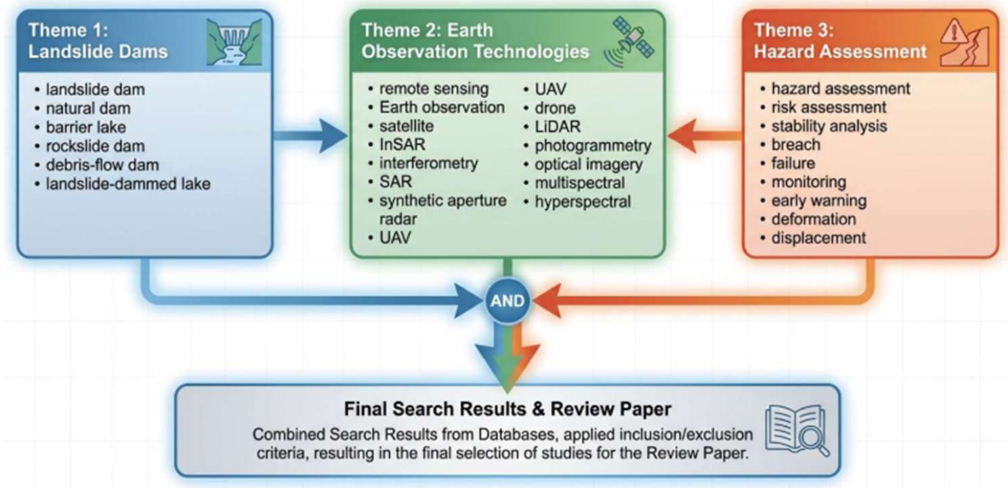
Figure 2.
PRISMA flow diagram of study selection.
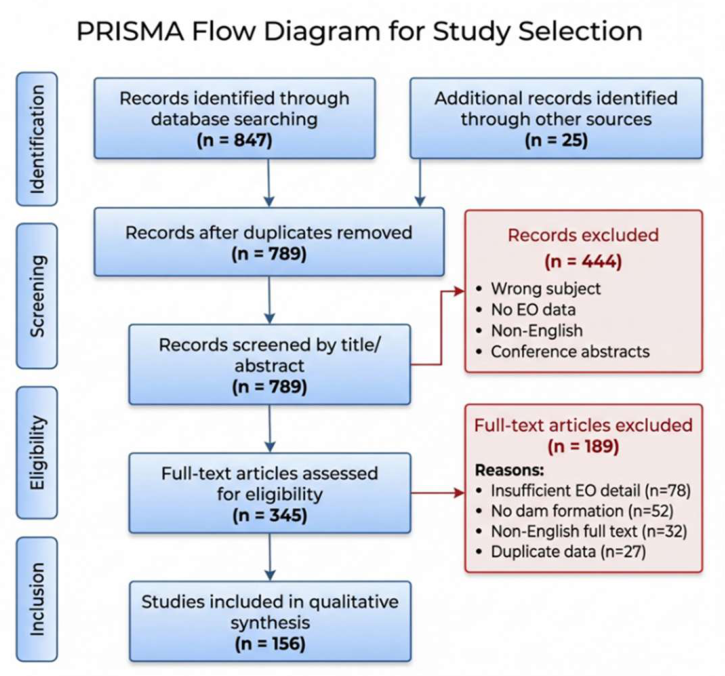
Figure 3.
Temporal distribution of Earth observation-based landslide-dam studies.
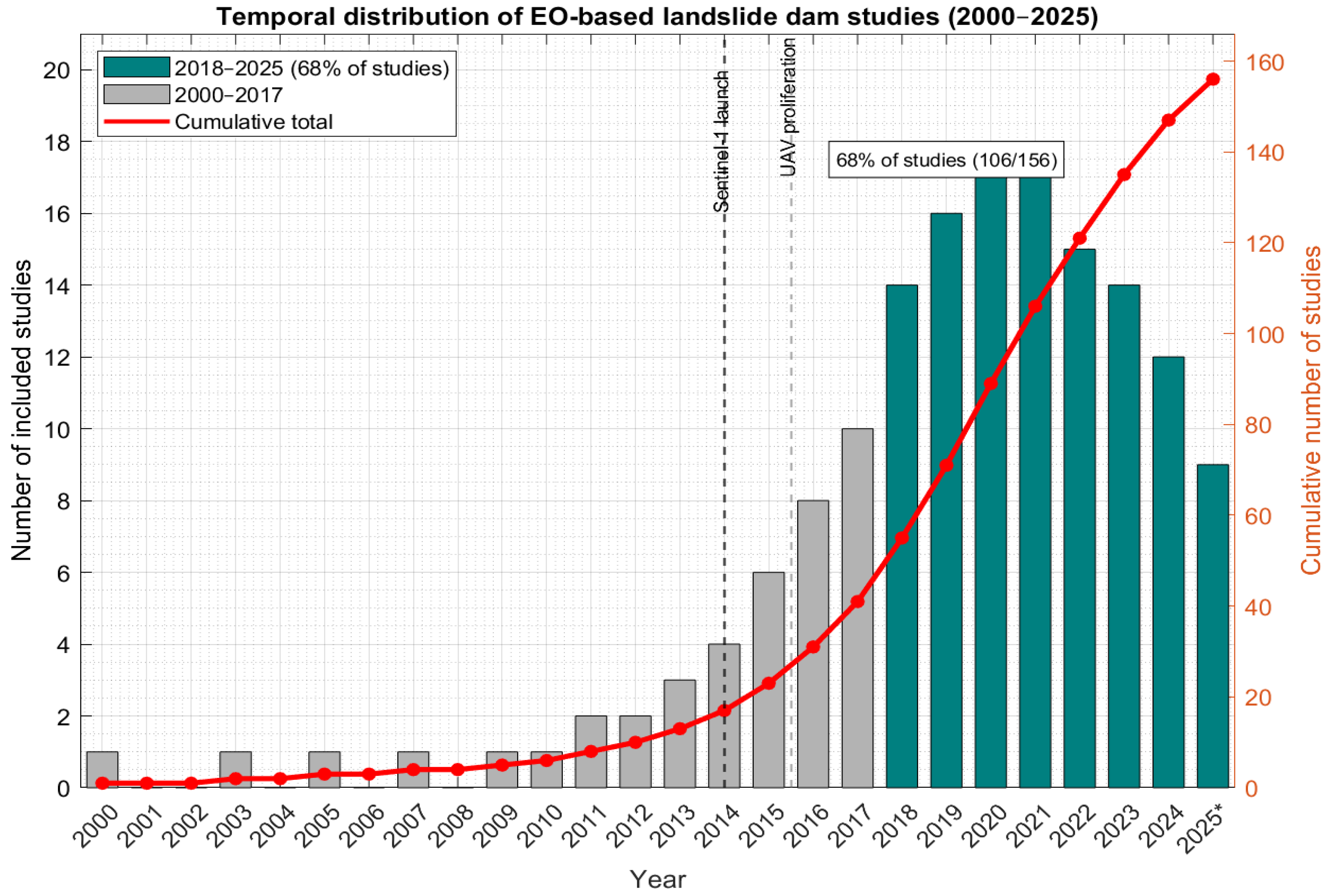
Figure 4.
Illustrates the distribution of Earth Observation (EO) technology usage across the five landslide dam lifecycle phases.
Figure 4.
Illustrates the distribution of Earth Observation (EO) technology usage across the five landslide dam lifecycle phases.
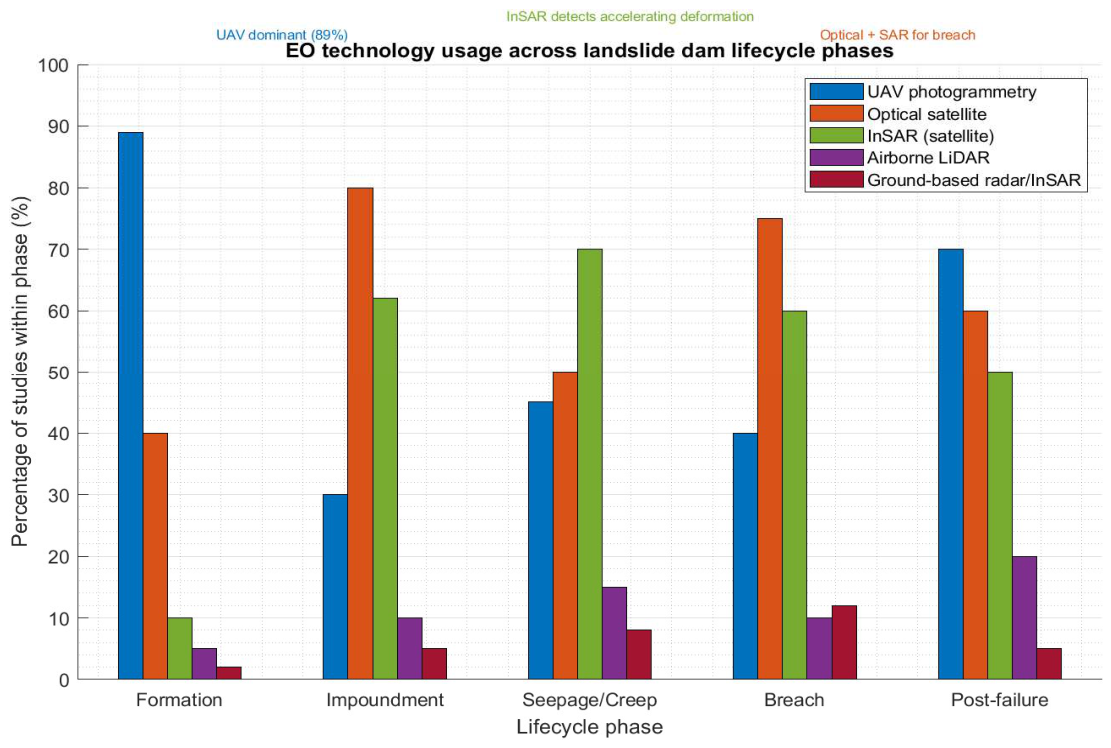
Figure 5.
Incorporation of earth observation data into landslide dam digital twins.
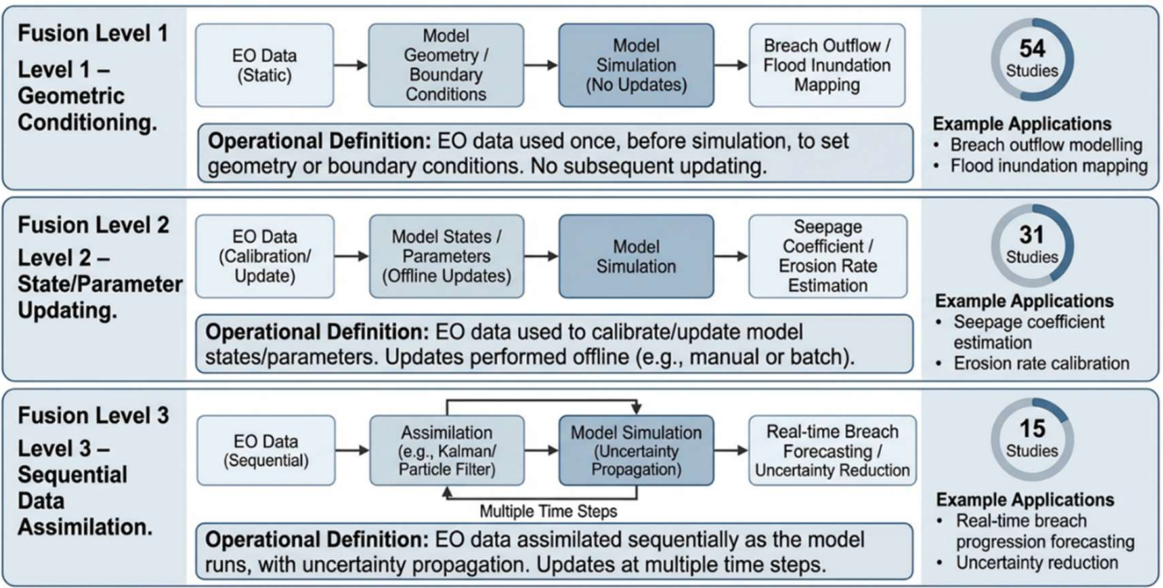
Figure 6.
Shows the evaluation of the components of the landslide digital twin.
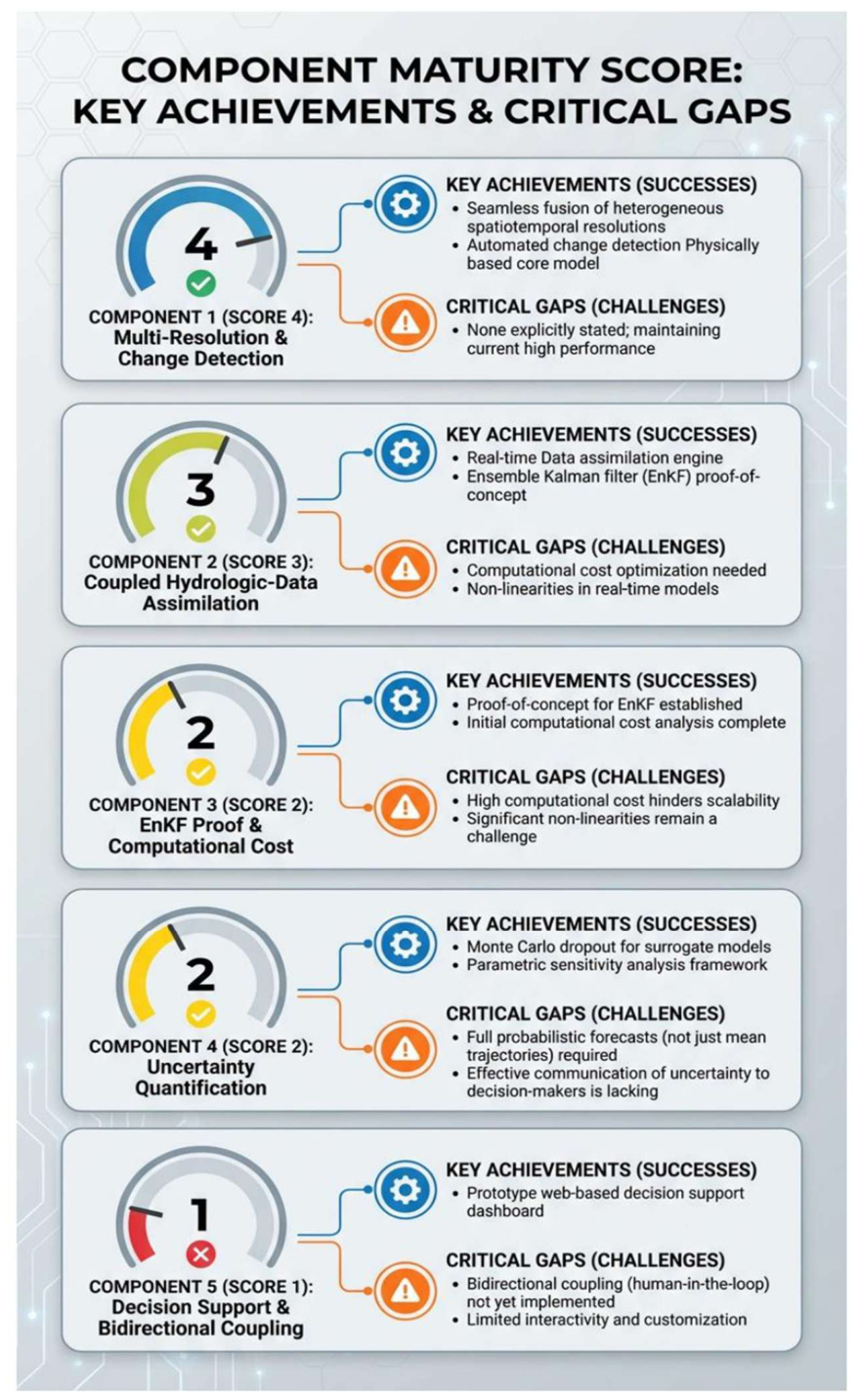
Figure 7.
The Baige landslide sequence was used as a case study.
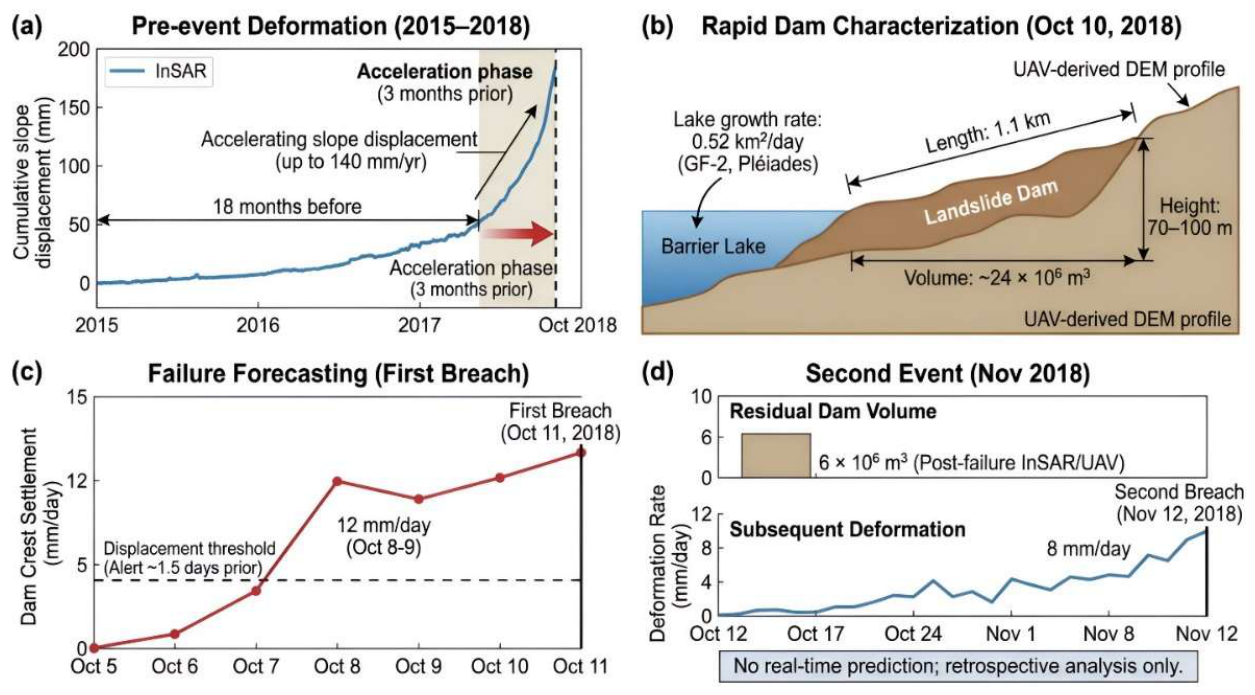

Table 1.
Summary of search results by database.
| Database | Initial Hits | After Deduplication | After Screening | Included |
| Web of Science | 412 | 412 | 178 | 89 |
| Scopus | 356 | 298 | 142 | 67 |
| Google Scholar | 79 | 79 | — | — |
| Supplementary | — | — | 25 | 25 |
| Total | 847 | 789 | 345 | 156 |
*Google Scholar results were integrated with Web of Science/Scopus for screening; separate counts were not maintained after deduplication.
Table 2.
lists the Earth observation technologies identified in the literature.
| Technology | Primary Applications | Reported Metrics (median) | Frequency (%) |
| InSAR (satellite) | Pre-- | Deformation rate: 5–120 mm/yr; LOS accuracy: ±2–5 mm | 58 |
| Optical satellite (e.g., Sentinel- | Lake area evolution, turbidity, dam surface change | Temporal resolution: 2–5 days; planimetric accuracy: 10–30 m | 47 |
| UAV photogrammetry | High- | DEM RMSE: 0.05–0.30 m; spatial resolution: 0.02–0.10 m | 39 |
| Airborne LiDAR | Pre- | Point density: 2–15 pts/m²; vertical accuracy: 0.10–0.30 m | 21 |
| Ground- | Real- | Sampling interval: 1–10 min; accuracy: ±0.1 mm | 9 |
Disclaimer/Publisher’s Note: The statements, opinions and data contained in all publications are solely those of the individual author(s) and contributor(s) and not of MDPI and/or the editor(s). MDPI and/or the editor(s) disclaim responsibility for any injury to people or property resulting from any ideas, methods, instructions or products referred to in the content. |
© 2026 by the authors. Licensee MDPI, Basel, Switzerland. This article is an open access article distributed under the terms and conditions of the Creative Commons Attribution (CC BY) license (http://creativecommons.org/licenses/by/4.0/).
Copyright: This open access article is published under a Creative Commons CC BY 4.0 license, which permit the free download, distribution, and reuse, provided that the author and preprint are cited in any reuse.


