
Submitted:
20 June 2026
Posted:
22 June 2026
You are already at the latest version
Abstract
Despite ethical constraints and strict oversight by local Institutional Animal Care and Use Committees, animal models still permit molecular investigations that would never be acceptable to humans. Nevertheless, experimental outcomes depend on species, strain, sex, age, hormonal status, diet, exposure to hypoxia, toxins, radiation, external stimuli, stress, and even housing conditions. Further complications stem from the heterogeneous cellular composition of tissues and from the procedures required to isolate and eventually immortalize specific cell subtypes. Moreover, most diseases are multi-factorial and associated with altered structure or/and expression of several genes. A major problem with genetically engineered animals is that together with the targeted gene numerous other genes are mutated or/and regulated owing to their interlinkage in functional pathways. However, animal models have the important advantage of allowing the investigator to control most of the regulating factors and produce biological replicates, while every human is a dynamic unique. This review examines the challenges, accuracy and limitations of the mouse, rat and rabbit models we used to decipher the transcriptomic alterations associated with several neurological disorders. Links to publicly accessible databases presenting the experimental protocols and expression profiles are provided for readers interested in reanalyzing our data and comparing with their own results.
Keywords:
AT-EAE
; cerebral malaria
; cerebral palsy
; CMT1X
; epilepsy
; glaucoma
; infantile spasms
; intraventricular hemorrhage
; neuropsychiatric lupus erythematosus
; ODDD
1. Introduction
In addition to common disease indicators related to memory, cognition, behavior, and senses, medical statistics categorizes the neurological patients in large groups according to race [1], sex [2], age group [3], geography [4], and climate [5]. However, there are numerous other non-negligible influential factors like smoking [6], alcohol [7] and drug [8] consumption habits, medical history [9,10], diet [11], exposure to stress [12] and toxins [13], whose dynamic combination is unique for each human. Even monozygotic twins might be differently affected by the same disease, each of them experiencing distinct severity and development course and treatment outcomes [14,15]. Although the physician deals with the sickness of the real patient with all his/her distinctive characteristics, in medical school s/he learned about the disease [16], i.e., a simplified, yet general enough, model of the deviation from what is considered “normal”. The “normal” is defined in medical textbooks by selected sets of average characteristics of the so-called “healthy” human, although the distributions of “healthy” and “diseased” features partially overlap.
Beyond the locally imposed moral and religious rules, medical research on human subjects must also respect the ethical principles included in the Declaration of Helsinki [17] and the additional constraints imposed by the local Institutional Review Board (IRB). These mandatory rules limit exploration of molecular phenomena to tissues removed in routine surgery (eventually spread into immortalized cell cultures), blood and body waste, imaging and non-invasive investigations. Postmortem human tissue samples purchased from accredited biobanks are free of most ethical constraints but still represent a narrow spectrum of pathologies [18,19].
Therefore, one needs to replicate human diseases into animal models that, although restricted to protocols approved by the local Institutional Animal Care and Use Committee (IACUC), still allow never acceptable studies on living humans. IACUC should adhere to internationally recognized ethical principles [20] and align with the Guide for the Care and Use of Laboratory Animals (e.g., [21]. Our expertise on neurological diseases is with animal models, although in cancer research, we have also profiled surgically removed thyroid, prostate, lung and kidney tumors from living human patients. Although there is no way to exactly reproduce a human disease on an animal model, one may assume that certain recipes for physiological phenomena and their alterations are shared with some other mammals and remained unchanged during evolution. Moreover, a non-negligible advantage of the animal model is that the investigator has full control of the experimental conditions while each human is affected by a never repeatable, mostly out of our control, combination of favoring factors.
This Report details the challenges our labs faced in developing and investigating animal models of some neurological disorders over many years of research. The challenges are illustrated through our genomic investigations on hippocampus regions, hypothalamic arcuate and periventricular nuclei, frontal cortex, spinal cord, striatum, dorsal root ganglia, retina, and primary, immortalized and genetically engineered neurons, astrocytes, and oligodendrocytes. The cells and tissues were collected from in-house maintained mouse, rat and rabbit colonies that modeled astrocytoma, epilepsies, glaucoma, cerebral malaria, multiple sclerosis, neuroblastoma, neuropsychiatric lupus erythematosus, occulo-dento-digital dysplasia, and X-linked Charcot–Marie–Tooth diseases. We were also involved in confocal imaging of calcium signaling in mouse astrocytoma, behavioral studies of epileptic rats, and electrophysiological experiments on various components of the nervous systems from mice, rats, rabbits, earthworms, and frogs. In addition to caring for animal colonies and cell cultures, improving technology, and performing molecular experiments with optimized wet protocols, we developed mathematically advanced algorithms and software, and acquired bioinformatic expertise.
2. Major Modulators of Animal Models
Almost all molecular characteristics of an animal model depend on species [22,23], strain [24,25], sex [26,27,28,29], explored region [30], age/developmental stage [31,32,33]. They are modulated also by exposure to oxygen deprivation [34,35], toxins [36,37] and radiation [38], diet [39,40,41], and external stimuli [42,43,44]. Not negligible are the hormonal status [45,46], disease history [47] and treatment [48,49], and even exposure to microgravity [50]. We proved that neuronal status is also strongly dependent on the pattern of action potential [43,51]. Moreover, the subcellular localization of certain proteins not only differs between sexes but also changes during the estrogen cycle [52,53], making the female animal models much more difficult to manage and interpret than the male counterparts.
Therefore, choosing and handling the right animal model [54] is far from an easy task. Furthermore, sanitary precautions and housing conditions (e.g.,: distribution of cages and vicinity of other caged animals [55,56], chow and water abundance and quality, environmental temperature, humidity, and day-night lighting cycle [57] are also major modulators of the experimental results. Not negligible are the neurological effects of the anesthesia used for painless sacrifice of the animal. For instance, the intraperitoneal injection of urethane we used to study the neurotranscriptomic effects of microgravity [50] desynchronize the electric waves in the hippocampal dentate gyrus [58]. Therefore, to minimize the anesthesia effects, in other experiments we used either carbon dioxide [59] or just decapitation. However, even if all animal characteristics were hypothetically identical, there is still biological variability due to the stochasticity of biological responses. The variability extends also to samples collected from different regions of the same tissue as we found by profiling pathologically equally graded cancer nodules in surgically removed prostate [60] and kidney [61] cancer tumors from the same individuals. This transcriptomic heterogeneity results from the coexistence of several stem cell clones with similar yet nonidentical phenotypes within the same region, potentially generated by exposure to different local conditions [62,63].
Increasing evidence shows that the molecular characteristics of individual cells depend on cellular environment in a heterogeneous tissue [64,65] and change dramatically when studied outside their original tissue. We demonstrated the impact of cellular environment on several functional pathways by profiling the transcriptomes of astrocytes and oligodendrocytes when co-cultured in insert systems vs. cultured separately [66,67,68].
Over one hundred single-cell sequencing methods have been developed so far to determine separately the omics of the several cell types composing a tissue (e.g., [69,70,71]) but it is difficult to estimate how much the separation method of cell phenotypes alters the real transcriptome. Moreover, transcripts’ counting appears sparse in some platforms that might bias the expression ratios between two cell phenotypes (Iacobas, unpublished observations). 2D and 3D coculture systems [72,73,74] where two or more cell types are grown with or without direct physical contact, are now used by many groups trying to understand the intricacy of the nervous system physiopathology [75,76,77]. Nonetheless, integrating multicellular features of a hetero-cellular tissue into a mathematical model faces enormous theoretical difficulties and requires powerful computer techniques like those used in machine learning approaches [78].
The characteristics of the specimen studied are also strongly influenced by the culture preparation technique [79,80] and applied stimuli [43,81,82,83], hormones [84,85] and chemical treatment [86,87]. In some investigations [66,67,68], we have used immortalized mouse oligodendroglial precursor cell lines (Oli-neu) obtained through the standard protocol [88,89], while in others we used primary cultures of mouse and rat neurons, astrocytes, oligodendrocytes and microglia [50,67,79]. Therefore, we can affirm that, although preferred for their stability, immortalized cell lines [90,91,92] have substantially modified physiology with respect to the primary cells. The purity of cell culture is extremely important, not only because the result would be averaged expression levels over all present phenotypes, but the “infectant” might interact and thus modify the transcriptome of the investigated cells. However, even in pure cultures, cells are not identical. For instance, in cultured rat β-pancreatic cells, we found that only part of them expressed connexin 36 and in cultured HL-1 cardiomyocytes some cells were contracting spasmodically, while others were not (Iacobas, unpublished observations). When possible, it is also preferable to synchronize the cultured cells to detect the dynamics of the cell cycle. As such, one should be careful when extending the findings from either primary or immortalized cell cultures to the original in situ hetero-cellular tissue.
3. Genetically Engineered Animal Models
3.1. General Considerations
It is a widespread belief that many diseases are frequently associated with altered sequence (e.g.,: [93,94,95]) or/and expression level (e.g.,: [96,97,98,99] of certain critical genes, termed (gene) biomarker(s) (e.g.,: [98,99,100,101]. Therefore, it is assumed that, by engineering the same alteration in the genome of an animal, one might reproduce the key features of that human disease (e.g.,: [102,103]). It is also assumed and already included in clinical trials that a cure may be provided by restoring the normal sequence/expression level of the biomarker gene(s) (e.g., [104,105]).
The problem is that many disorders are multifactorial, involving alteration of two or more genes. For instance, mutations of six genes (SNCA, LRRK2, Parkin, PINK1, DJ-1, ATP13A2) are blamed for Parkinson disease [106], while NF-κB, NLRP3 inflammasome, and mTOR signaling pathways are significantly altered following spinal cord injury [107]. A few selected multi-gene diseases were simulated in double knockout mouse models like the Gfap-/-Vim-/- mouse with attenuated glial scar formation in post-stroke [108]. Moreover, effective mutations can be located within several exons, such are the 65 known mutations of GJA1 identified as responsible for the autosomal-dominant ODDD [109].
Despite being adopted by most genomicists, the biomarker paradigm has major flaws [110]. When even pathologically graded cancer nodules from the same tumor exhibit substantial differences in transcriptomic topologies [60], it is hard to accept that distinct individuals exhibiting similar symptoms should have the same set of gene mutations and/or transcriptomic signature. Hence, we have proposed replacing the gene biomarker paradigm with the genomic fabric paradigm [34] that provides the most theoretically possible comprehensive characterization of the transcriptome and allows identification of personalized gene master regulators [111].
The main challenge with the use of genetically engineered animals and cells is that the targeted mutation goes over the ~3 million other mutations present in every cell at any given time. About one in every 1000 nucleotides is randomly mutated just because of the stochastic nature of the chemical reactions involved in DNA replication [112], although most of these mutations have practically no effect because they occur in non-coding regions. Moreover, in addition to the gene whose expression level is experimentally altered, expressions of hundreds of other genes are also regulated through their interlinkages in functional pathways. To make things much more difficult, the combination of the affected genes is not only unique to each individual and even to each histopathologically distinct region to the tissue, but also changes over time Furthermore, each region exhibits distinct strengths in the homeostatic control of transcript abundances, gene networks, and functional pathways. We encountered these difficulties in all (below described) genetically engineered animal models used in our neuro-genomics studies.
3.2. Occulo-Dento-Digital Dysplasia (ODDD)
ODDD is believed to be caused by mutations in the GJA1 (gap junction alpha 1) gene that encodes connexin 43 (Cx43), the most important gap junction channel forming protein in astrocytes [113,114]. Neurological manifestations of ODDD include isolated ataxia combined with spasticity [115,116], microphthalmia, microcornea, glaucoma, cataracts, and optic neuropathy [117]. ODDD was simulated in genetically engineered C57Bl/6j, C3H/HeJ, FVB mice (e.g., [118]). I130T/+ and G60S/+ mutations of Gja1 reproduce most of the ODDD features [119,120,121] in mouse models. We profiled the gene expression in C57Bl/6j and 129/SvEv mice whose Gja1 gene was: i) knocked out (Cx43KO, Cx43-/-) through homologous recombination [122,123], ii) conditionally knocked out with hGFAP-Cre:Cx43f/f (method in [31]) only in the brain [24], or iii) knocked down through siRNA [79]. In addition to Cx43-/- mice, we also used brains and astrocytes from Cx43+/- mice [124,125] and performed several other transcriptomic experiments with truncated carboxy terminal of Cx4388n various loci [126]. However, although the brain looks anatomically normal, the Cx43KO mouse is not a good model for ODDD since the mutant dies at birth because of a developmental heart abnormality [127]. Therefore, we have profiled the brains of Cx43KO neonates taken from C-section on G17 day. Even though our mice with a genetically altered Gja1 did not age to exhibit ODDD features, the experiments provided valuable information about the major roles played by Gja1 in modulating several functional pathways and its interaction with membrane purinergic receptors [128]. Nonetheless, in all experiments with these mice, we found that, together with the targeted Gja1, expressions of hundreds of other genes that are involved in a wide diversity of physiological functions were significantly altered. Moreover, we found that the transcriptomic alterations strongly depended on the mouse strain (e.g., C57Bl/6 vs 129/SvEv) [24].
3.3. X-Linked Charcot–Marie–Tooth Syndrome (CMT1X)
CMT1X is a demyelinating disorder characterized by muscle weakness and sensory neuropathy [129,130]. It is believed that CMT1X is caused by loss-of-function mutations affecting the GJB1 (gap junction beta 1) gene, located on chromosome X, that encodes connexin 32 (Cx32) the gap junction channel forming protein in oligodendrocytes (brain) and Schwann cells (peripheral nervous system) [131]. Several CMT1X-causing missense mutations of GJB1 have been identified so far, including: p.Arg15Trp, p.Val63Ile, p.Leu89Val, p.Ala96Gly, p.Arg107Trp, p.Arg142Gln, p.Arg164Trp, p.Arg164Gln, p.Pro172Ala, p.Asn205Ser, p.Val13Glu, p.Glu186Gly, and p.Met194Ile [132]. The disease was reproduced in several mouse models (e.g.,: [133], by knocking out Gjb1 or by CRISPR/Cas9 genome editing to induce mutations in p.T55I, p.R75W [134], or R15Q [135] in Gjb1. Although over 100 other genes were blamed for CMT1X [136], GJB1 remains the main suspect and animal modeling are focusing on manipulating this gene [136].
Because males have only one chromosome X while females have two, GJB1 pathological alterations occur more frequently, at younger ages and with higher severity in men than in women with Cx32 deficiency [137]. We compared the brain transcriptomes of Cx32KO and wild-type C57Bl/6 male mice and found that together with Gjb1, hundreds of other genes were significantly regulated in Cx32KO mice. Moreover, the significant overlap between the brain regulomes of Cx43KO and Cx32KO mice indicates a pan-glial transcriptomic continuity in the brain [138] although the two genes are expressed in different cell types. However, there is no known overlap of the ODDD and CMT1X syndromes.
3.4. Temporal Lobe Epilepsy (TLE)
TLE is a group of chronic brain disorders characterized by recurring seizures (abnormal, paroxysmal changes in the electrical activity) of the brain [139], excitotoxicity, neuronal loss and cognitive decline [140,141]. A frequently used rat model is obtained by lithium–pilocarpine-induced status epilepticus [142]. Also in use are the kainic acid model [44,143], obtained like the pilocarpine model and flurothyl model [144] by administration of a chemoconvulsant. Other models are obtained by traumatic brain injury [144], electrical kindling [145] and genetic manipulation of the sodium channel gene SCNA1 [146]. The efficiency of cannabidiol treatment of TLE was tested on a mouse kindling model [147].
It was reported that GJD2 (gap junction delta2) which encodes connexin 36 (Cx36), the main neuronal gap junction channel forming protein, plays a major role in epilepsy [148,149]. This finding stimulated the use of quinine, a blocker of the interneuronal Cx36 gap junction channel, as an effective suppressor of seizures [150,151]. Our transcriptomic study of Cx36KO mouse brain revealed hundreds of other genes being significantly regulated in addition to Gjd2. We also found that the Cx36KO mouse brain regulome was largely different from those of the Cx43KO and Cx32KO mice [122,138], indicating a lack of transcriptomic interaction between neurons and glial cells.
3.5. Juvenile Myoclonic Epilepsy (JME)
JME, a subsyndrome of idiopathic generalized epilepsy [152], was simulated in several transgenic mouse models including Efhc1 (EF-hand domain containing 1)-deficient [153], Kcnc1-p.Arg320His/+ [154] and Brd2+/- [155]. Interestingly, none of the mutations of CILK1 (ciliogenesis associated kinase 1)/ICK (intestinal cell kinase), blamed for JME in humans [156], reproduced the JME phenotype in mice [157], questioning the validity of the gene biomarker paradigm. The diversity of the animal models is justified by the multi-gene JME etiology. Moreover, in our hands, the haploinsufficiency in bromodomain containing 2 (Brd2+/-) JME mouse model reveled sex specific behavioral traits [158] that we explain by the observed sex differences in the networking of neurotransmission genes [159].
3.6. Neuropsychiatric Lupus Erythematosus (NPSLE)
Patients with NPSLE present cognitive impairment, psychosis, anxiety, mood, and movement disorders, confusional state, memory loss, seizures, stroke, and headache [160]. The interaction of the tumor necrosis factor (TNF)-like weak inducer of apoptosis (TWEAK or TNFSF12) with its cognate receptor, FN14 (TNFRSF12A, expressed in astrocytes, microglia, brain microvascular endothelial cells, and neurons), is believed to activate pro-inflammatory cytokine production [161]. We profiled the transcriptomes of brain cortices and hippocampi of MRL/+, MRL/lpr (that manifest lupus-like phenotype [162] and MRL/lpr-Fn14 knockout (Fn14ko backcross generation #8) adult female mice, all sacrificed at diestrus of the estrogen cycle to minimize the biological variability caused by hormonal activity. The experiments revealed significant alterations in the chemokine and PI3K/AKT signaling pathways [163] and an interesting link between neuroinflammation and neurodegeneration [164] Currently in use is also the tetramethylpentadecane (known also as pristane)-induced NPSLE mouse model [165] with various reporters to visualize the cellular dynamics [166].
4. Chemical, Hormonal, Viral and Mechanical Induction of Neurological Diseases in Animal Models
4.1. Multiple Sclerosis (MS)
MS is an inflammatory demyelinating disease that alters the neuronal circuits in the brain and spinal cord, resulting in paralysis and death ([167,168]. MS symptoms were satisfactorily replicated in rodents’ adoptive transfer experimental autoimmune encephalomyelitis (AT-EAE) [169,170]. Current MS therapy includes administration of immunomodulators and immunosuppressants, but it just alleviates the symptoms and reduces relapse frequency without stopping progression of disability [171]. AT-EAE, the golden standard MS murine model, is induced by injecting myelin basic protein dissolved in sterile phosphate-buffered saline and emulsified with incomplete Freund’s adjuvant supplemented with Mycobacterium tuberculosis emulsion in the rodent spinal cord [172]. The disease develops after 8 - 10 days, the animals manifesting ascending paralysis, starting with the hind limbs.
Our study on spinal cords of SJL/J adult, clinical index 4 (hind- and front-limb paralysis) female AT-EAE mice revealed that Gja1 is down-regulated, and its downregulation correlates with a substantial increase in the populations of dystrophic neurons and monocytes [173]. We also found that, together with the immune response, the expression control and the coordination of several genes included in the functional pathways Ca2+-signaling, cell cycle, cytoskeleton, energy-metabolism, RNA-processing, and transport of ions and small molecules were also altered [174].
4.2. Glaucoma (GL)
GL is a group of eye diseases leading to blindness that is caused by degeneration of the retinal ganglion cells (RGC), sometimes triggered by damage to the optic nerve [175]. The disease was induced in domestic chicks by exposure to continuous intense light [176], in rabbits by lensectomy, vitrectomy, and transvitreal photocoagulation of the ciliary processes [177] and in rats by injection of magnetic microspheres [178] or hydrogel [179] into the anterior chamber. It was also obtained in rats by external ocular compression through circumlimbal suture [180] or by crushing the optic nerve [181], and in mice by subretinal or intravitreal injections of fluorescently labeled mitochondria [182].
We explored the retinal transcriptomes of adult Lister Hooded rats two weeks after optic nerve crush and compared them with those of sham-operated controls to experience similar surgical stress. Experiments have shown about 60% reduction in the number of viable RGCs and significant alterations in the expression level, control and networking of genes involved in the complement cascade and Notch signaling functional pathways [183]. However, excepting exposure to intense light, the other methods to induce glaucoma in animal models are rarely the cause of the disease in humans and therefore RGC might follow a different trajectory [184]. Moreover, in addition to the species, the relevance of the animal model depends also on the strain [185].
4.3. Catamenial Epilepsy (CE)
CE, also known as menstrual seizures, is a cyclical change of seizures frequency at various stages of the menstrual cycle [186] owing to the interdependence between β-estradiol concentration and synaptic transmission. CE was partially induced in rodent female models by extended exposure to high levels of progesterone and estrogens followed by rapid decline [187] or by administration of exogenous hormones in ovariectomized rats [188]. Recent models use optogenetics, consisting in stimulation of membrane ion channels of parvalbumin-positive interneurons neurons by blue light pulses [189].
To quantify the influence of the sex hormone on the epilepsy development, we profiled the hippocampal dentate gyrus transcriptomes of intact and ovariectomized (OVX) 8–9-week-old female Sprague-Dawley rats with kainic acid-induced status epilepticus. Kainic acid was injected through mini-osmotic pump implants [190] and the success of castration was confirmed by measurement of vaginal impedance. The estrogen protection of neurotransmission was quantified by comparing the group that received 17β-estradiol benzoate with the group that received only sterile peanut oil, both with intact females [45]. From the perspective of estrogen production, OVX female rats recapitulate the menopausal state despite being forced into a young female state, whereas in women, it occurs naturally at mature ages. However, the epilepsy in menopausal women is not triggered by kainic acid, so the dynamic of the disease progression in humans is most likely different from what was observed in rats [191].
4.4. Infantile Spasms (IS)
IS (epileptic spasms during infancy or West syndrome [192]) start in the first year of life, the infant presenting stereotypical spasms, chaotic brain hypsarrhythmia and developmental delay [193]. Most likely caused by hypothalamic dysfunction, IS infants have decreased concentrations of adrenocorticotrophic hormone (ACTH) and cortisol in cerebrospinal fluid. Therefore, ACTH is the FDA-approved first-line treatment of IS [194]. There are several genetically engineered mouse models of IS in use including: Arx (Aristaless-related homeobox) Knock-In (Arx(GCG)10+7), Arx Conditional Knock-Out (cKO), APC (Adenomatous polyposis coli) cKO, and Tsc1+/ (Tuberous sclerosis 1) [195,196]. IS was also induced in rats by infusing tetrodotoxin (TTX) into the developing hippocampus [197].
We preferred the two-hit model where IS is triggered by postnatally administrating N-methyl-D-aspartic acid (NMDA) to prenatally primed with betamethasone rat pups. The model is based on the observation that prenatal exposure to corticosteroids like betamethasone in difficult pregnancy affects children’s mental development [198,199]. We explored the transcriptomic effects of prenatal (G15) intraperitoneal injection with betamethasone on synaptic transmission in the prefrontal cortex and in the arcuate and paraventricular hypothalamic nuclei of Sprague Dawley rats of both sexes [200]. From postnatal day 12 (P12) to P15, male and female pups who received either betamethasone or saline (G15) prenatally were injected with either NMDA to trigger the spasms or saline. The IS positive rats were then randomly divided into 3 treatment groups: saline, ACTH or PMX53 (a potent, selective, cyclic hexapeptide, C5ar1 antagonist [201]). We found a significant sex dichotomy with males exhibiting more transcriptomic alterations of the (glutamatergic, GABAergic, cholinergic, dopaminergic, and serotonergic) synaptic transmission but also more efficient recovery following the anti-inflammatory treatment [47,200,202]. Importantly, the transcriptomic effects were significantly different in paraventricular nuclei collected from the same animals, indicating regional brain specialization in neurodegenerative diseases [29].
4.5. Germinal Matrix Hemorrhage - Intraventricular Hemorrhage (IVH)
IVH, a major neurologic complication of 20% of premature (< 1500g at birth) infants [203], is responsible for brain injury (including post-hemorrhagic hydrocephalus), cerebral palsy (10%), and mental retardation [204]. IVH was induced so far in mouse [205,206], rat [207,208] and rabbit [209,210] animal models. We used the standard protocol for rabbits delivered prematurely by C-section at G29 (32 days full-term) that were injected intraperitoneally 3-hour postnatal with either 50% glycerol (6.5g/kg) or saline [211]. Presence and severity of IVH were assessed 24h post injection by head ultrasound. Oligodendrocyte precursor cells were isolated from coronal slices cut at the level of the head of the caudate nucleus from the frontoparietal region. The IVH rabbit model was used to determine the efficacy of the peroxisome proliferator activated receptor-γ (PPAR-γ) in enhancing myelination, and the efficacy of the 17β-estradiol treatment to restore the hippocampal dentate gyrus development [212]. We found that estrogen treatment increases the number of calbindin interneurons and prox1 neurons in the hippocampus dentate gyrus [213].
4.6. Cerebral Palsy (CP)
Children with cerebral palsy [214], astrogliosis and motor impairment present ataxia (lack of muscle coordination in voluntary movement), spasticity (stiff or tight muscles and exaggerated reflexes), weakness in one or more arms or legs, walking on the toes, a crouched gait, or a “scissored” gait [215]. Postnatal administration of glucocorticoids (GC) in premature infants for the treatment of lung disease was associated with CP and neurodevelopmental delay [216]. CP was induced in mouse [217], rat [218] and rabbit [219].
We studied the effects of postnatal administration of glucocorticoids dexamethasone and betamethasone on the forebrains of preterm (GD29) rabbits. The experiments have shown that postnatal GC induces hypomyelination, gliosis and neurologic deficits [220].
4.7. Cerebral Malaria (CM)
CM, a severe neurological manifestation of Plasmodium falciparum infection is associated in 50% of cases with cognition deficit, memory impairment, visual ataxia, seizures, hemiplegia, psychiatric disorders, and deficient motor coordination [221,222,223]. The most popular mouse model is obtained through intraperitoneal injection of blood infected with Plasmodium berghei ANKA, a single-celled parasite from the subgenus Vinckeia [224,225].
Our gene expression study with CM simulated in 5-week-old C57BL/6j female mice [226] infected with Plasmodium berghei ANKA revealed substantial transcriptomic alteration of genes involved in chromatin remodeling, cell development, negative regulation of apoptosis, lipid metabolism, hydrolase activity, walking, and regulation of muscle contraction. However, despite their accessibility and affordability, murine models of CM are still far from human CM. Therefore, efforts are made to refine organoids, spheroids and organs-on-chip with human cells collected from various organs affected by CM [227].
5. Experimental Issues
5.1. Technical Noise
From sample collection to results delivery any molecular investigation is affected by the technology limited resolution to detect small concentrations, distorted outcomes by saturation at high concentrations, and inherent technical noise that produces nonuniform background signals. Both resolution and saturation limits are continually improved by technological advancements in gene expression platforms. They can also be optimized through sample preparation protocols (adjusting sample dilution and the amounts of fluorescent markers), more efficient processing kits, and adjustments of scanning parameters.
RNA-sequencing is based on converting the mRNAs obtained by rRNA depletion/mRNA enrichment of total RNA extracted from the tissue of interest into fragments of complementary DNAs (cDNAs) which are then aligned to standard or de novo genome. There are several potential noise-generating steps in library preparation, clustering and sequencing. Part of it is caused by the impossibility of fully eliminating hybridization errors and washing out the no longer needed fragments.
Microarray technology relies on selective hybridization of fluorescently labeled cDNAs obtained by reverse transcribing of total RNA with tens of thousands of ~1000bp DNA clones (the cDNA method) or with 50 – 70 mer oligonucleotide sequences spotted on the treated surface of a glass slide. Because of this, the microarray can detect only the transcripts that stably hybridize to the spotted sequences and are not removed by the washing. Moreover, inherent slight differences on the deposited cDNAs or oligonucleotides amounts occur among the microarray domains printed on the glass slide with different pins that would bias the results if not corrected by an appropriate normalization procedure.
The protocol for quantitative reverse transcription polymerase chain reaction (qRT-PCR) involves reverse transcription of RNA into cDNA, followed by quantitative PCR to measure RNA levels by comparing to a standard curve. As such, qRT-PCR is affected by technical noise during RNA extraction, purification, cDNA conversion, and amplification.
A gene may be transcribed into numerous mRNAs differing from each other by what exons were used, how much their normal succession was preserved, whether their nucleotide sequences were integral or truncated, and whether portions of exons from other genes were translocated. By evidence, local conditions are neither uniform nor constant, depending on various physical and chemical interactions at the site of transcription. Therefore, the distribution of gene transcripts depends on the animal strain, sex, tissue, disease development, and response to treatment and/or other external stimuli. As a result, a microarray study might miss some very important transcripts in the investigated tissue and condition. On the other side, increasing the number of distinct transcripts picked by the RNA-sequencing is limited by the increasing time and price of the sequencing.
Almost all our experimental studies with qRT-PCR, microarrays or NextGen RNA-sequencing started with profiling technical replicas to determine the technical noise of the method. We found that all microarray and sequencing platforms were affected by 25 – 35% technical noise when respecting the manufacturer protocol, and even qRT-PCR, the so-called “golden standard” for gene expression profiling, is affected by noise [228] (~12% Iacobas, unpublished results). Figure 1 shows how the observed expression ratio of a real 2x up regulation and of a real expression equality are affected by the technical noise, potentially transforming into false negative or false positive results.
By evidence, (in)/validating regulation of one or a few genes with qRT-PCR out of tens of thousands quantified by a high throughput (microarray or RNA-sequencing) platform has no statistical significance. Therefore, if needed, results of high throughput platform should be checked only with another high throughput platform using technical replicas of the investigated specimens. Owing to lower price and possibility to optimize the protocol, we preferred Agilent microarrays [229] (where the noise was reduced to 15 – 20% with our wet strategy and normalization algorithm), even though microarrays profiled redundantly only the 44k transcript variants printed on the slide.
Nevertheless, one very important challenge for any optics-based transcriptomic experiment is the choice of fluorescent tags to be efficiently attached to nucleotides used in the reverse transcription. In our experiments, we used both the pair of organic cyanine dyes Cy3 (green emission)/Cy5 (red emission) and the pair Alexa Fluor® 555 (green)/Alexa Fluor® 647 (red). The cyanide pair is affected by different stability and fluorescence intensity of the two fluorophores. While the Alexa pair has the stability advantage across multiple scanning, the cyanides provide a slightly better foreground-to-background ratio [230]. Because of the differences between the green and red dyes, the traditional protocol recommends either profiling each sample twice by swapping the dyes or using a red-labeled universal reference to refer to both tissues to be compared [231]. Each of these recommendations doubles the experimental costs either by twice profiling the same sample or by using a totally not interesting specimen (the reference). We avoided such waste by adopting the “multiple yellow strategy” where biological replicas were hybridized against each-other on two-color microarray slides. Our strategy eliminates the bias between the two dyes because, instead of red-to-green ratio we considered red-to-red and green-to-green by normalizing the net signal of any transcript to the median expression of all transcripts in that microarray like in a single-color experiment. Figure 2 presents the flow-chart of our computational procedure in microarray experiments).
5.2. Analysis Issues
Traditional analysis is limited to characterizing the transcriptome only by the gene expression profile, like reducing the blueprint of a supercomputer to a list of the electronic components, ignoring how these components are wired and what voltages are applied to each of them. Therefore, we characterize each transcript gene by the independent measures AVE (average expression level), REV (relative expression variation) and COR (expression correlation with each other gene) across four biological replicates (defined in Appendix). Compared to traditional analysis limited to only the average expression levels AVE of N genes, our strategy considers also N REVs and N(N-1)/2 CORs the entire information available, increasing the amount of data by several orders of magnitude.
The additional independent measures, REV and COR provide valuable biological insights on cellular transcriptomics. REV (midinterval of the chi-square estimate of the coefficient of variation) quantifies through the derived measure REC (Relative Expression Control) the strength of the homeostatic mechanism to limit the random fluctuation of the gene expression resulting from the stochasticity of the chemical reactions involved in gene transcription. High positive RECs indicate genes that are critical for cell physiology, while large negative RECs point to genes used as vectors of adaptation to continuously changing environment [29]. By comparing the REC of the disease state with the corresponding control, one determines cell priority changes in controlling expression of important genes.
COR is the pair-wise Pearson correlation coefficient of the (log2) expression levels of two genes across biological replicates. COR analysis determines the statistically significant transcriptomic networks of functional pathways in the actual condition and their remodeling during the disease development or in response to a treatment. Traditional correlation network analyses [232,233,234] cluster the genes according to their expressions in time series, various experimental conditions and other unmatched samples allegedly to reveal system-level properties of prognostic genes. For instance, Oldham et al. 2012 [235], clustered the genes expressed in caudate nucleus, cerebellum, primary motor cortex, and prefrontal cortex in 36 healthy and 44 patients across five grades of Huntington Disease, matched as age and sex.
COR-determined networks are closer to the biological reality than the constructed functional pathways by text-mining software like Pathway Analysis [236], DAVID [237], KEGG [238] or GenMapp/MAPPFinder [239] which are the same regardless of race/strain, sex, hormonal activity, age, diet, climate or other influential factors. Moreover, the gene “wiring” of such inferred pathways is unique (no alternative interlinks) and rigid (does not change during progression of the disease or in response to treatment). Importantly, calcium signaling and several other signaling pathways are considered the same in all tissues.
Expression of a gene is usually considered as significantly regulated when comparing two conditions D (diseased) vs. C (control) if the p-value of the heteroscedastic t-test of means’ equality is below a certain value, usually 0.05. We added the condition of the absolute fold-change |x| to exceed a cut-off value CUT computed for each transcript to incorporate both the biological variability across biological replicates and the technical noises of the probing spots in the used microarrays (see Appendix).
6. Discussion
This Review presents issues and sources of errors we faced in decades of profiling the gene expression on cells and tissues collected from animal models of several human neurologic diseases. Online links to publicly available experimental protocols and results of our studies are provided in the References section for readers interested in reanalyzing our raw data or comparing them with expression profiles of other models (like those mentioned for every disease discussed). Even though limited to 12 major pathologies induced in a few strains of mice, rats and rabbits, the above discussed aspects might be common to transcriptomic studies on almost all animal models of disorders affecting the human nervous system. We have learned firsthand that, beyond animal species, strain, sex, age and explored tissue, factors like hormonal status, diet, exposure to stress, toxins, radiation, microgravity, treatment and other external stimuli and housing conditions determine the results.
Nevertheless, although mimicking the main features of the human disease, an animal model accounts only for a part of the complex, yet not completely known, etiology of that disorder. Despite practically all neuro-diseases are multi-factorial, most of the transgenic animal models had only one gene (termed biomarker) experimentally manipulated (e.g., [240]). Double transgenic (e.g., [241,242]) or even triple transgenic (e.g., [243,244] animal models are more rarely used. Moreover, in addition to the induced mutation(s), transgenic animals present at any time millions of other mutations simply caused by the stochastic nature of DNA replication chemistry and downstream ripple effects of genetic manipulation. Also, together with the targeted gene, expression levels of hundreds of other genes are spontaneously regulated owing to their networking in functional pathways.
Since gene expression profile is strongly dependent on the cellular environment, it is also important to select the most homogeneous part of the tissue to investigate and caution the interpretation when using either primary or immortalized cell cultures. Despite being cheaper, free of IACUC or IRB constraints and much easier to profile, primary or immortalized cell monocultures are the last choice for them not reproducing with enough fidelity the remodeling of functional pathways as happens in the regular hetero-cellular tissue [245].
Although the actual technology is far better than what we used at the time, a good amount of actual knowledge was generated by studies like ours and we believe it is useful to discuss their trustworthiness. Nevertheless, methods such are Frozen Immunolabeled Nuclei Sequencing [246], Single-Cell Combinatorial Fluidic Indexing [247], neuronal cultures in 3D thin gel [248], spatial transcriptomics [249] and Nerve-on-a-Chip [250] to mention just a few, are more suitable to characterize the high complexity of the nervous structures under controlled environment but these spectacular technologies still need refinement and validation with technical replicates.
7. Conclusions
Notwithstanding the limited accuracy partially caused by the oversimplified etiology and the inherent technical noise, the animal models of human neurological disorders are still very important tools to decipher the fundamental molecular mechanisms of simulated pathology. In addition to mouse, rat and rabbit, neurological diseases were also studied in pig, dog, cat, horse, goat, and other mammalian models [251,252,253,254,255,256,257,258,259,260,261,262,263]. A notable advantage of the animal model is the possibility to control most of the favorably factors of the simulated disease in biological replicates, while every human is who s/he is, different from everybody else, even from a monozygotic twin [264,265,266].
Author Contributions
Conceptualization, D.A.I., S.I. and D.D.; methodology, D.A.I. and S.I.; resources, D.D.; writing—original draft preparation, D.A.I.; writing—review and editing, D.D.; funding acquisition, D.D. All authors have read and agreed to the published version of the manuscript.
Funding
This research received no external funding.
Institutional Review Board Statement
Not applicable.
Informed Consent Statement
Not applicable.
Data Availability Statement
All our cited transcriptomic studies provide links to publicly accessible Gene Expression Omnibus dbases.
Conflicts of Interest
The authors declare no conflicts of interest.
Abbreviations
The following abbreviations are used in this manuscript:
| AT-EAE | Adoptive transfer experimental autoimmune encephalomyelitis |
| CE | Catamenial epilepsy |
| cKO | Conditional knockout |
| CMT1X | X-linked Charcot–Marie–Tooth syndrome |
| CM | Cerebral malaria |
| CP | Cerebral palsy |
| FDA | (US) Food and Drug Administration Agency |
| GL | Glaucoma |
| IACUC | Institutional Animal Care and Use Committee |
| IRB | Institutional Review Board |
| IS | Infantile spasms |
| IVH | Intraventricular hemorrhage |
| JME | Juvenile myoclonic epilepsy |
| MS | Multiple sclerosis |
| NMDA | N-methyl-D-aspartic acid |
| NPSLE | Neuropsychiatric lupus erythematosus |
| ODDD | Occulo-dento-digital dysplasia |
| OVX | Ovaryectomized |
| qRT-PCR | Quantitative Reverse Transcription Polymerase Chain Reaction |
| TLE | Temporal lobe epilepsy |
| TTX | Tetrodotoxin |
Appendix A
Appendix A.1. The Three Independent Measures of the Gene Expression
Appendix A.2. Significant Expression Regulation
Absolute fold-change and p-value composite criterion
References
- Caunca, M.R.; Bahorik, A.; Jiang, X.; Braskie, M.N.; O’Bryant, S.; Yaffe, K. Neuroimaging markers of dementia across race/ethnicity and sex/gender using an intersectional approach within the HABS-HD cohort. Alzheimers Dement. 2025, 21, e70733. [Google Scholar] [CrossRef] [PubMed]
- Foschi, M.; Marastoni, D.; Panzera, I.; Mancinelli, L.; Ganino, C.; Abbadessa, G.; et al. Sex differences in relapse-independent and relapse-associated disability progression in relapsing-remitting multiple sclerosis: a real-world inverse-probability weighted study. Ther. Adv. Neurol. Disord. 2025, 18, 17562864251376807. [Google Scholar] [CrossRef] [PubMed]
- Chen, X.; Ko, W.; Waseem, F.; Cilcic, L.; Kazi, N.; Abdelhafiz, A. Guillain-Barré Syndrome in Older People-A Case Report and Literature Review. Diseases 2025, 13, 306. [Google Scholar] [CrossRef] [PubMed]
- de Lima, S.T.S.; Claro, I.M.; Hua, X.; de Jesus, R.; Serres, K.; Simões Mello, L.M.; et al. Active West Nile virus transmission in Brazil: an epidemiological study. Lancet Reg. Health Am. 2025, 51, 101229. [Google Scholar] [CrossRef] [PubMed]
- Roy, K.; Basu, R.; Basu, A. Climate change and neurotropic vector-borne viruses: addressing emerging threats through a One Health approach. mBio 2025, 16, e0088625. [Google Scholar] [CrossRef] [PubMed]
- Grahe, C.; Egleton, R.D.; Santanam, N.; Bihl, J.C. Nicotine-Mediated Alterations in Exosome Content: Implications for Stroke and Neurological Dysfunction. Biomolecules 2026, 16, 463. [Google Scholar] [CrossRef] [PubMed]
- Peregu, d D.I.; Gulyaeva, N.V. BDNF as a Mediator between Body Metabolism and Brain Function in Health and Disease: The Case of Alcohol Dependence. Biochemistry (Mosc) . 2026, 91, 713–732. [Google Scholar] [CrossRef] [PubMed]
- Gogerdchian, H.; Hajivandi, B.; Jafarmadar, A.; Koleng, M.; Paparozzi, J.; Rodriguez, J.R.; et al. Cocaine Use Disorder: Neuropathology and Exploratory Treatments. Mol. Neurobiol. 2026, 63, 538. [Google Scholar] [CrossRef] [PubMed]
- Faustmann, T.J.; Corvace, F.; Faustmann, P.M.; Ismail, F.S. Influence of antipsychotic drugs on microglia-mediated neuroinflammation in schizophrenia: perspectives in an astrocyte-microglia co-culture model. Front Psychiatry 2025, 16, 1522128. [Google Scholar] [CrossRef] [PubMed]
- Waheed, I.; Sikandri, T.; Zaheen, S.; Khakwani, M.M.A.K.; An, Z.; Liu, T.; et al. Evaluating the Molecular Interactions between Type 2 Diabetes Mellitus and Parkinson’s Disease: Role of Antidiabetic Drugs as Promising Therapeutics. ACS Chem. Neurosci. 2025, 16, 988–999. [Google Scholar] [CrossRef] [PubMed]
- Targett, I.L.; Hancock, J.T.; Craig, T.J. Diet, Metabolism and Synaptic Function: Integrating Evidence Across Models in Neurodegeneration Research. Biomedicines 2026, 14, 1089. [Google Scholar] [CrossRef] [PubMed]
- Tan, Y.; Luo, Y.; Mao, H. A Review of Biological Pathways of Chronic Stress as a Risk Hub for Multiple Psychosomatic Diseases From the Perspective of Clinical Nursing. Nurs. Res. Pract. 2026, 2026, 9570388. [Google Scholar] [CrossRef] [PubMed]
- Gross, A.R.; Lee, H.; Chacko, N.; Kovacevic, L.; Smith, A.; Shanthanna, H.; et al. Botulinum toxin type A for subacute/chronic neck pain. Cochrane Database Syst. Rev. 2026, 5, CD008626. [Google Scholar] [CrossRef] [PubMed]
- Penichet, E.N.; Beam, C.R.; Luczak, S.E.; Davis, D.W. A genetically informed longitudinal study of early-life temperament and childhood aggression. Dev. Psychopathol. 2024, 1–23. [Google Scholar] [CrossRef] [PubMed]
- Hegarty, J.P., 2nd; Monterrey, J.C.; Tian, Q.; Cleveland, S.C.; Gong, X.; Phillips, J.M.; et al. A Twin Study of Altered White Matter Heritability in Youth With Autism Spectrum Disorder. J. Am. Acad. Child Adolesc. Psychiatry 2024, 63, 65–79. [Google Scholar] [CrossRef] [PubMed]
- Encyclopedia Britannica. Diseases. Available online: https://www.britannica.com/science/disease (accessed on May 22nd 2026).
- World Medical Association. Declaration of Helsinki: Ethical Principles for Medical Research Involving Human Participants. JAMA 2025, 333, 71–74. [Google Scholar] [CrossRef] [PubMed]
- Haorah, J.; Iyappan, H.; Samikkannu, M.; Chennakesavan, K.; McLaughlin, J.P.; Samikkannu, T. Epigenetics and Mitochondrial Biogenesis: The Role of Sirtuins in HIV Neuropathogenesis. Mol. Neurobiol. 2025, 62, 10333–10348. [Google Scholar] [CrossRef] [PubMed]
- Lendemeijer, B.; de Vrij, F.M.S. In vitro models for human neuroglia. Handb. Clin. Neurol. 2025, 209, 213–227. [Google Scholar] [CrossRef] [PubMed]
- Kiani, A.K.; Pheby, D.; Henehan, G.; Brown, R.; Sieving, P.; Sykora, P.; INTERNATIONAL BIOETHICS STUDY GROUP; et al. Ethical considerations regarding animal experimentation. J. Prev. Med. Hyg. 2022, 63, E255–E266. [Google Scholar] [CrossRef] [PubMed]
- National Research Council. Guide for the care and use of laboratory animals. 8th Edition. Washington D.C. The National Academies Press. Available online: https://grants.nih.gov/grants/olaw/guide-for-the-care-and-use-of-laboratory-animals.pdf.
- DeFranco, J.P.; Telling, G.C. The Evolution of Experimental Rodent Models for Prion Diseases. J. Neurochem. 2025, 169, e70039. [Google Scholar] [CrossRef] [PubMed]
- Lu, W.J.; Xi, J.; Li, Z.S.; Fei, F.; Chen, J.Z.; Wang, Y. Diverse species of animal models in epilepsy research: Progress and perspectives. Zool. Res. 2025, 46, 1588–1614. [Google Scholar] [CrossRef] [PubMed]
- Iacobas, S.; Iacobas, D.A.; Spray, D.C.; Scemes, E. The connexin43-dependent transcriptome during brain development: importance of genetic background. Brain Res. 2012, 1487, 131–9. Available online: https://www.ncbi.nlm.nih.gov/geo/query/acc.cgi?acc=GSE37239 (accessed on May 21st 2026). [CrossRef] [PubMed]
- Gryksa, K.; Schäfer, T.; Gareis, F.; Fuchs, E.; Royer, M.; Schmidtner, A.K.; et al. Beyond fur color: differences in socio-emotional behavior and the oxytocin system between male BL6 and CD1 mice in adolescence and adulthood. Front Neurosci. 2024, 18, 1493619. [Google Scholar] [CrossRef] [PubMed]
- Diederich, K.; Steinfath, M.; Bannach-Brown, A.; Bert, B.; Butzke, D.; Wildner, P.L.; et al. Protocol for the systematic review of age and sex in preclinical models of age-correlated diseases. F1000Res. 2024, 13, 858. [Google Scholar] [CrossRef] [PubMed]
- Kelly, L.A.; Branagan, A.; Semova, G.; Molloy, E.J. Sex differences in neonatal brain injury and inflammation. Front Immunol. 2023, 14, 1243364. [Google Scholar] [CrossRef] [PubMed]
- Murray, K.E.; Ravula, A.R.; Stiritz, V.A.; Cominski, T.P.; Delic, V.; Marín de Evsikova, C.; et al. Sex and Genotype Affect Mouse Hippocampal Gene Expression in Response to Blast-Induced Traumatic Brain Injury. Mol. Neurobiol. 2025, 62, 9980–10005. [Google Scholar] [CrossRef] [PubMed]
- Iacobas, D.A.; Veliskova, J.; Chachua, T.; Chern, C.R.; Vieira, K.; Iacobas, S.; et al. Neurotransmission Sex Dichotomy in the Rat Hypothalamic Paraventricular Nucleus in Healthy and Infantile Spasm Model. Curr. Issues Mol. Biol. 2025, 47, 380. Available online: https://www.ncbi.nlm.nih.gov/geo/query/acc.cgi?acc=GSE123721. [CrossRef] [PubMed]
- Bishnoi, I.R.; Bordt, E.A. Sex and Region-Specific Differences in Microglial Morphology and Function Across Development. Neuroglia 2025, 6, 2. [Google Scholar] [CrossRef] [PubMed]
- Wiencken-Barger, A.E.; Djukic, B.; Casper, K.B.; McCarthy, K.D. A role for Connexin43 during neurodevelopment. Glia. 2007, 55, 675–86. [Google Scholar] [CrossRef] [PubMed]
- Figg, J.; Chen, D.; Falceto Font, L.; Flores, C.; Jin, D. In vivo mouse models for adult brain tumors: Exploring tumorigenesis and advancing immunotherapy development. Neuro Oncol. 2024, 26, 1964–1980. [Google Scholar] [CrossRef] [PubMed]
- Wang, L.; Cui, C.Y.; Lee, C.T.; Bodogai, M.; Yang, N.; Shi, C.; et al. Spatial transcriptomics of the aging mouse brain reveals origins of inflammation in the white matter. Nat. Commun. 2025, 16, 3231. [Google Scholar] [CrossRef] [PubMed]
- Iacobas, D.A.; Xi, L. Theory and Applications of the (Cardio) Genomic Fabric Approach to Post-Ischemic and Hypoxia-Induced Heart Failure. J. Pers. Med. 2022, 12, 1246. [Google Scholar] [CrossRef] [PubMed]
- Cheng, T.; Du, S.; Cao, Y.; Lu, Z.; Xu, Y. Neuroprotection in neonatal Hypoxia-ischaemia: melatonin targets NCX1 to inhibit mitochondrial autophagy via the PINK1-Parkin pathway. J. Mol. Histol. 2025, 56, 313. [Google Scholar] [CrossRef] [PubMed]
- Kobets, T.; Iatropoulos, M.J.; Duan, J.D.; Brunnemann, K.D.; Iacobas, D.A.; Iacobas, S.; et al. Expression of Genes Encoding for Xenobiotic Metabolism After Exposure to Dialkylnitrosamines in the Chicken Egg Genotoxicity Alternative Model. Toxicol. Sci. 2018, 166, 82–96. Available online: https://www.ncbi.nlm.nih.gov/gds/?term=iacobas%2C+chicken (accessed on May 21st 2026). [CrossRef] [PubMed]
- Ichihara, G. Neuro-reproductive toxicity and carcinogenicity of 1-bromopropane: studies for evidence-based preventive medicine. J. Occup. Heal. 2025, 67, uiaf004. [Google Scholar] [CrossRef] [PubMed]
- Song, D.; Qi, J.; Zhang, Y.; Liu, R.; Wang, M.; Wang, X.; et al. Moderate UVB exposure ameliorate chronic stress-induced anxiety and social impairment by activating mPFC to basal lateral amygdala pathway. Brain Res. Bull. 2025, 222, 111260. [Google Scholar] [CrossRef] [PubMed]
- Iacobas, D.A.; Allen, H.; Iacobas, S. Low-Salt Diet Regulates the Metabolic and Signal Transduction Genomic Fabrics and Remodels the Cardiac Normal and Chronic Pathological Pathways. Curr. Issues Mol. Biol. 2024, 46, 2355–2385. Available online: https://www.ncbi.nlm.nih.gov/geo/query/acc.cgi?acc=GSE72561 (accessed on May 21st 2026). [CrossRef] [PubMed]
- Chandrashekar, D.V.; Jagadeesan, N.; Abdullah, T.; Chang, R.; Steinberg, R.A.; Sanchez, F.; et al. Effect of chronic alcohol feeding using the Lieber-DeCarli diet on Alzheimer’s disease pathology in Tg2576 mice. Front Aging Neurosci. 2025, 17, 1526571. [Google Scholar] [CrossRef] [PubMed]
- Tanabe, M.; Kunisawa, K.; Saito, I.; Ojika, H.; Saito, K.; Nabeshima, T.; et al. High-cellulose diet ameliorates cognitive impairment by modulating gut microbiota and metabolic pathways in mice. In J Nutr.; 2025; ISBN S0022-3166(25)00187-7. [Google Scholar] [CrossRef] [PubMed]
- Ishibashi, T.; Dakin, K.A.; Stevens, B.; Lee, P.R.; Kozlov, S.V.; Stewart, C.L.; et al. Astrocytes promote myelination in response to electrical impulses. Neuron 2006, 49, 823–32. [Google Scholar] [CrossRef] [PubMed]
- Lee, P.R.; Cohen, J.E.; Iacobas, D.A.; Iacobas, S.; Fields, R.D. Gene networks activated by specific patterns of action potentials in dorsal root ganglia neurons. Sci. Rep. 2017, 7, 43765. Available online: https://www.ncbi.nlm.nih.gov/geo/query/acc.cgi?acc=GSE84872 (accessed on May 21st 2026). [CrossRef] [PubMed]
- Antrobus, M.R.; Desai, T.; Young, D.; Machado, L.; Ribbans, W.J.; El Khoury, L.Y.; et al. Epigenetics of concussion: A systematic review. Gene. 2025, 935, 149046. [Google Scholar] [CrossRef] [PubMed]
- Iacobas, D.A.; Iacobas, S.; Nebieridze, N.; Velisek, L.; Veliskova, J. Estrogen protects neurotransmission transcriptome during status epilepticus. Front Neurosci. 2018, 12, 332. Available online: https://www.ncbi.nlm.nih.gov/geo/query/acc.cgi?acc=GSE107725. [CrossRef] [PubMed]
- Arvind, A.; Sreelekshmi, S.; Dubey, N. Genetic, Epigenetic, and Hormonal Regulation of Stress Phenotypes in Major Depressive Disorder: From Maladaptation to Resilience. Cell Mol. Neurobiol. 2025, 45, 29. [Google Scholar] [CrossRef] [PubMed]
- Friedman, L.K.; Mancuso, J.; Patel, A.; Kudur, V.; Leheste, J.; Iacobas, S. Transcriptome Profiling of Hippocampal CA1 after Early Life Seizure-Induced Preconditioning May Elucidate New Genetic Therapies for Epilepsy Experimental protocol and transcriptomic raw data. Eur. J. Neurosci. 2013, 38, 2139–52. Available online: https://www.ncbi.nlm.nih.gov/geo/query/acc.cgi?acc=GSE107725 (accessed on May 21st 2026). [CrossRef] [PubMed]
- Iacobas, D.A.; Velisek, L. Regeneration of neurotransmission transcriptome in a model of epileptic encephalopathy after antiinflammatory treatment. Neural Regen. Res. 2018, 13, 1715–1718. [Google Scholar] [CrossRef] [PubMed]
- Mostafa, M.; Disouky, A.; Lazarov, O. Therapeutic modulation of neurogenesis to improve hippocampal plasticity and cognition in aging and Alzheimer’s disease. Neurotherapeutics. 2025, e00580. [Google Scholar] [CrossRef] [PubMed]
- Frigeri, A.; Iacobas, D.A.; Iacobas, S.; Nicchia, G.P.; Desaphy, J.F.; Camerino, D.C. Effect of microgravity on gene expression in mouse brain Experimental protocol and gene expression data. Exp. Brain Res. 2008, 191, 289–300. Available online: https://www.ncbi.nlm.nih.gov/geo/query/acc.cgi?acc=GSE12312 (accessed on May 21st 2026). [CrossRef] [PubMed]
- Iacobas, D.A.; Iacobas, S.; Lee, P.R.; Cohen, J.E.; Fields, R.D. Coordinated Activity of Transcriptional Networks Responding to the Pattern of Action Potential Firing in Neurons. Genes 2019, 10, 754. [Google Scholar] [CrossRef] [PubMed]
- Bühler, L.; de Moura, A.C.; Giovenardi, M.; Goffin, V.; Rasia-Filho, A.A. Sex-related gene expression in the posterodorsal medial amygdala of cycling female rats along with prolactin modulation of lordosis behavior. Brain Res. 2025, 149602. [Google Scholar] [CrossRef] [PubMed]
- Thomas, N.M.; Jasmin, J.F.; Lisanti, M.P.; Iacobas, D.A. Sex Differences in Expression and Subcellular Localization of Heart Rhythm Determinant Proteins. Biochem Biophys. Res. Commun. 2011, 406, 117–22. Available online: https://www.ncbi.nlm.nih.gov/geo/query/acc.cgi?acc=GSE17324. [CrossRef] [PubMed]
- Castro de Jesus, L. S.; Rodrigues, A.L. Non-aversive handling in laboratory animals and its effects on depressive-like and anxiety-related behaviors: A scoping review. Physiol. Behav. 2025, 294, 114883. [Google Scholar] [CrossRef] [PubMed]
- Stanisavljević Ilić, A.; Filipović, D. Mapping of c-Fos Expression in Rat Brain Sub/Regions Following Chronic Social Isolation: Effective Treatments of Olanzapine, Clozapine or Fluoxetine. Pharmaceuticals 2024, 17, 1527. [Google Scholar] [CrossRef] [PubMed]
- Yeo, S.; Lee, C.; Park, H.; Eo, K.; Yeom, S.C.; Kim, H.; et al. Overcrowding Stress in Livestock Production Alters Gut Microbiota Composition and Neuronal Nitric Oxide Synthase (nNOS) Expression in nNOS-HiBiT Knock-in Mouse Model. Food Sci. Anim. Resour. 2025, 45, 598–613. [Google Scholar] [CrossRef] [PubMed]
- Jasińska, M.; Jasek-Gajda, E.; Ziaja, M.; Litwin, J.A.; Lis, G.J.; Pyza, E. Light-Modulated Circadian Synaptic Plasticity in the Somatosensory Cortex: Link to Locomotor Activity. Int. J. Mol. Sci. 2024, 25, 12870. [Google Scholar] [CrossRef] [PubMed]
- Nokia, M.S.; Lensu, S.; Lehtonen, S.M.; Harjupatana, T.; Penttonen, M. Lateralization of Hippocampal Dentate Spikes and Sharp-Wave Ripples in Urethane Anesthetized Rats Depends on Cholinergic Tone. Hippocampus 2025, 35, e70035. [Google Scholar] [CrossRef] [PubMed]
- Desruisseaux, M.S.; Iacobas, D.A.; Iacobas, S.; Mukherjee, S.; Weiss, L.M.; Tanowitz, H.B.; et al. Alterations in the Brain Transcriptome in Plasmodium Berghei ANKA Infected Mice. J. Neuroparasitology 2010, 1, N100803. [Google Scholar] [CrossRef]
- Iacobas, S.; Iacobas, D.A. Personalized 3-Gene Panel for Prostate Cancer Target Therapy Raw and processed gene-expression data were deposited and are publicly accessible. Curr. Issues Mol. Biol. 2022, 44, 360–382. Available online: https://www.ncbi.nlm.nih.gov/geo/query/acc.cgi?acc= (accessed on 1 September 2025). [CrossRef] [PubMed]
- Iacobas, D.A.; Obiomon, E.A.; Iacobas, S. Genomic Fabrics of the Excretory System’s Functional Pathways Remodeled in Clear Cell Renal Cell Carcinoma. Curr. Issues Mol. Biol. 2023, 45, 9471–9499. Available online: https://www.ncbi.nlm.nih.gov/geo/query/acc.cgi?acc=GSE72304. [CrossRef] [PubMed]
- Berglund, E.; Maaskola, J.; Schultz, N.; Friedrich, S.; Marklund, M.; Bergenstråhle, J.; et al. Spatial maps of prostate cancer transcriptomes reveal an unexplored landscape of heterogeneity. Nat. Commun. 2018, 9, 2419. [Google Scholar] [CrossRef] [PubMed]
- Tu, S.-M.; Zhang, M.; Wood, C.G.; Pisters, L.L. Stem Cell Theory of Cancer: Origin of Tumor Heterogeneity and Plasticity. Cancers. 2021, 13, 4006. [Google Scholar] [CrossRef] [PubMed]
- Fumagalli, L.; Nazlie Mohebiany, A.; Premereur, J.; Polanco Miquel, P.; Bijnens, B.; Van de Walle, P.; et al. Microglia heterogeneity, modeling and cell-state annotation in development and neurodegeneration. Nat. Neurosci. 2025. [Google Scholar] [CrossRef] [PubMed]
- Zhou, Y.; Glass, C.K. Microglia networks within the tapestry of alzheimer’s disease through spatial transcriptomics. Mol. Neurodegener. 2025, 20, 102. [Google Scholar] [CrossRef] [PubMed]
- Iacobas, S.; Iacobas, D.A. Astrocyte proximity modulates the myelination gene fabric of oligodendrocytes. Neuron Glia Biol. 2010, 6, 157–169. Available online: https://www.ncbi.nlm.nih.gov/geo/query/acc.cgi?acc=GSE18726 (accessed on May 21st 2026). [CrossRef] [PubMed]
- Iacobas, S.; Thomas, N.M.; Iacobas, D.A. Plasticity of the myelination genomic fabric. Mol. Genet Genom. 2012, 287, 237–246. [Google Scholar] [CrossRef] [PubMed]
- Iacobas, D.A.; Iacobas, S.; Stout, R.F.; Spray, D.C. Cellular Environment Remodels the Genomic Fabrics of Functional Pathways in Astrocytes. Genes 2020, 11, 520. Available online: https://www.ncbi.nlm.nih.gov/geo/query/acc.cgi?acc=GSE109035 (accessed on May 21st 2026). [CrossRef]
- Islam, S.; Zeisel, A.; Joost, S.; La Manno, G.; Zajac, P.; Kasper, M.; et al. Quantitative single-cell RNA-seq with unique molecular identifiers. Nat. Methods 2014, 11, 163–6. [Google Scholar] [CrossRef] [PubMed]
- Varela-Martínez, I.; Pipicelli, F.; Hippenmeyer, S. Tracing cell lineages in the developing brain: Insights from mosaic analysis and clone-resolved transcriptomics. Curr. Opin. Genet Dev. 2026, 99, 102487. [Google Scholar] [CrossRef] [PubMed]
- Tian, D.; Yang, J.; Wang, Z.; Lan, J.; Shi, T.; Xu, S.; et al. Heterogeneity of Microglia in Ischemic Stroke from the Perspective of Single-Cell RNA Sequencing: Subset Characteristics, Mechanisms and Therapeutic Potential. J. Cent. Nerv. Syst. Dis. 2026, 18, 11795735261452744. [Google Scholar] [CrossRef] [PubMed]
- Thomas, G.; Rahman, R. Evolution of Preclinical Models for Glioblastoma Modelling and Drug Screening. Curr. Oncol. Rep. 2025, 27, 601–624. [Google Scholar] [CrossRef] [PubMed]
- Etebar, F.; White, A.R.; Quek, H. Microglial heterogeneity: influence of human 2D, 3D, and co-culture models on gene expression and immune function. Front Cell Neurosci. 2026, 20, 1770518. [Google Scholar] [CrossRef] [PubMed]
- Hartig, T.; Schlotterose, L.; Atteh, G.; Turcanu, A.; Markale, A.; Chan, G.; et al. 3D Aerohydrogel Scaffolds for Brain Tissue Engineering and In Vitro Neuroscience. Chem. Bio Eng. 2026, 3, 487–495. [Google Scholar] [CrossRef] [PubMed]
- Fan, Q.; Wang, H.; Gu, T.; Liu, H.; Deng, P.; Li, B.; et al. Modeling the precise interaction of glioblastoma with human brain region-specific organoids. iScience. 2024, 27, 109111. [Google Scholar] [CrossRef] [PubMed]
- Sonninen, T.M.; Peltonen, S.; Kälvälä, S.; Nguyen, H.T.; Ruponen, M.; Singh, P.; et al. From inserts to chips: microfluidic culture and 3D astrocyte co-culture drive functional and transcriptomic changes in hiPSC-derived endothelial cells. Fluids Barriers CNS 2025, 22, 58. [Google Scholar] [CrossRef]
- Lish, A.M.; Young-Pearse, T.L. Decoding Alzheimer’s genetic risk through intercellular communication in the human brain: Lessons from Clusterin. Curr. Opin. Neurobiol. 2026, 97, 103165. [Google Scholar] [CrossRef] [PubMed]
- Maisumu, G.; Willerth, S.; Nestor, M.; Waldau, B.; Schülke, S.; Nardi, F.V.; et al. Brain organoids: building higher-order complexity and neural circuitry models. Trends Biotechnol. 2025, S0167-7799((25)00046-0). [Google Scholar] [CrossRef] [PubMed]
- Iacobas, D.A.; Iacobas, S.; Urban-Maldonado, M.; Scemes, E.; Spray, D.C. Similar transcriptomic alterations in Cx43 knockdown and knockout astrocytes. Cell Commun. Adhes. 2008, 15, 195–206. Available online: https://www.ncbi.nlm.nih.gov/geo/query/acc.cgi?acc=GSE8168. [CrossRef] [PubMed]
- Moloney, R.A.; Pavy, C.L.; Kahl, R.G.S.; Palliser, H.K.; Hirst, J.J.; Shaw, J.C. Dual isolation of primary neurons and oligodendrocytes from guinea pig frontal cortex. Front Cell Neurosci. 2024, 17, 1298685. [Google Scholar] [CrossRef] [PubMed]
- Galanis, C.; Neuhaus, L.; Hananeia, N.; Turi, Z.; Jedlicka, P.; Vlachos, A. Axon morphology and intrinsic cellular properties determine repetitive transcranial magnetic stimulation threshold for plasticity. Front Cell Neurosci. 2024, 18, 1374555. [Google Scholar] [CrossRef] [PubMed]
- Losgott, T.; Schicker, K.W.; Hilber, K.; Boehm, S.; Salzer, I. Gaussian white noise stimulation as an alternative method to excite sensory neurons. Front Pharmacol. 2025, 16, 1561905. [Google Scholar] [CrossRef] [PubMed]
- Katlowitz, K.A.; Cole, E.R.; Mickiewicz, E.A.; Shah, S.; Franch, M.; Adkinson, J.A.; et al. Plasticity and language in the anaesthetized human hippocampus. Nature 2026. [Google Scholar] [CrossRef] [PubMed]
- Velíšková, J.; Iacobas, D.A.; Iacobas, S.; Sidyelyeva, G.; Chachua, T.; Velíšek, L. Oestradiol regulates neuropeptide Y release and the gene coupling with GABAergic and glutamatergic synapse in adult female rat dentate gyrus Experimental protocol and transcriptomic data. J. Neuroendocrinol. 2015, 27, 911–20. Available online: https://www.ncbi.nlm.nih.gov/geo/query/acc.cgi?acc=GSE60013 (accessed on May 21st 2026). [CrossRef] [PubMed]
- Kim, B.; Elzinga, S.E.; Henn, R.E.; McGinley, L.M.; Feldman, E.L. The effects of insulin and insulin-like growth factor I on amyloid precursor protein phosphorylation in in vitro and in vivo models of Alzheimer’s disease. Neurobiol. Dis. 2019, 132, 104541. [Google Scholar] [CrossRef] [PubMed]
- Miguel-Hidalgo, J.J.; Pang, Y. Primary Central Nervous System (CNS) Cultures with Mixed Neural Cell Types to Study Correlative Effects of High Glucocorticoids on Astrocytes, Oligodendrocytes, and Myelination Markers. Methods Mol. Biol. 2025, 2896, 95–106. [Google Scholar] [CrossRef] [PubMed]
- Onaka, Y.; Yamaguchi, T.; Yamasaki, T.; Morishige, K.; Yoneyama, M. Memantine Exacerbates Trimethyltin-Induced Neurodegeneration and Delays Cognitive Impairment Recovery. Neuropsychopharmacol. Rep. 2025, 45, e70014. [Google Scholar] [CrossRef]
- Trotter, J. The development of myelin-forming glia: studies with primary cell cultures and immortalized cell lines. Perspect. Dev. Neurobiol. 1993, 1, 149–54. [Google Scholar] [PubMed]
- Jung, M.; Krämer, E.; Grzenkowski, M.; Tang, K.; Blakemore, W.; Aguzzi, A.; et al. Lines of murine oligodendroglial precursor cells immortalized by an activated neu tyrosine kinase show distinct degrees of interaction with axons in vitro and in vivo. Eur. J. Neurosci. 1995, 7, 1245–65. [Google Scholar] [CrossRef] [PubMed]
- Labusek, N.; Mouloud, Y.; Köster, C.; Diesterbeck, E.; Tertel, T.; Wiek, C.; et al. Extracellular vesicles from immortalized mesenchymal stromal cells protect against neonatal hypoxic-ischemic brain injury. Inflamm. Regen. 2023, 43, 24. [Google Scholar] [CrossRef] [PubMed]
- Göksu, A.Y. A review article on the development of dopaminergic neurons and establishment of dopaminergic neuron-based in vitro models by using immortal cell lines or stem cells to study and treat Parkinson’s disease. Int. J. Dev. Neurosci. 2024, 84, 817–842. [Google Scholar] [CrossRef] [PubMed]
- Loganathan, N.; Lieu, C.V.; Belsham, D.D. Immortalization and Characterization of GFAP-expressing Glial Cells from the Adult Mouse Hypothalamus, Cortex, and Brain Stem. Neuroscience 2024. 551, 43–54. [Google Scholar] [CrossRef] [PubMed]
- Sawaguchi, S.; Ishida, M.; Miyamoto, Y.; Yamauchi, J. Hypomyelination Leukodystrophy 16 (HLD16)-Associated Mutation p.Asp252Asn of TMEM106B Blunts Cell Morphological Differentiation. Curr. Issues Mol. Biol. 2024, 46, 8088–8103. [Google Scholar] [CrossRef] [PubMed]
- Brücke, C.; Al-Azzani, M.; Ramalingam, N.; Ramón, M.; Sousa, R.L.; Buratti, F.; et al. A novel alpha-synuclein G14R missense variant is associated with atypical neuropathological features. Mol. Neurodegener. 2025, 20, 98. [Google Scholar] [CrossRef] [PubMed]
- Feng, M.Y.; Cao, W.; Tahmasian, N.; Kukreja, B.; Li, G.; Rusu, B.; et al. Molecular cartography of the human down syndrome and trisomic mouse brain. Nat. Commun. 2025, 16, 8689. [Google Scholar] [CrossRef] [PubMed]
- Eratne, D.; Kang, M.; Malpas, C.B.; Dang, C.; Lewis, C.; Bhalala, O.G.; et al. The MiND Study Group. Plasma p-tau217, NfL, GFAP diagnostic performance and biomarker profiles in Alzheimer’s disease, frontotemporal dementia, and psychiatric disorders, in a prospective unselected neuropsychiatry memory clinic. Alzheimers Dement. 2025, 21, e70717. [Google Scholar] [CrossRef] [PubMed]
- Su, Y.; Wang, Y.; Liu, F.; Chen, Q. Pan-cancer multi-omics profiling reveals ubiquitin D as a novel biomarker for diagnosis, immune microenvironment remodeling and prognostic prediction. Discov. Oncol. 2025, 16, 1707. [Google Scholar] [CrossRef] [PubMed]
- Li, H.; Xie, Z.; Tian, Y.; Zhou, R.; Yang, Y.; Lin, B.; et al. Genome-wide consensus transcriptional signatures identify synaptic pruning linking Alzheimer’s disease and epilepsy. Mol. Psychiatry 2026, 31, 1774–1784. [Google Scholar] [CrossRef] [PubMed]
- Ali, N.; Sayeed, U.; Shahid, S.M.A.; Akhtar, S.; Khan, M.K.A. Molecular mechanisms and biomarkers in neurodegenerative disorders: a comprehensive review. Mol. Biol. Rep. 2025, 52, 337. [Google Scholar] [CrossRef] [PubMed]
- Apeltsin, L.; Yu, X. IgG Biomarkers in Multiple Sclerosis: Deciphering Their Puzzling Protein A Connection. Biomolecules 2025, 15, 369. [Google Scholar] [CrossRef] [PubMed]
- Li, F.; You, D.; Li, Y.; Wang, X.; Lin, Z.; Shi, X.; et al. Multi-omics integration reveals gut microbiota dysbiosis and metabolic alterations of cerebrospinal fluid in children with epilepsy. Front Microbiol. 2025, 16, 1630062. [Google Scholar] [CrossRef] [PubMed]
- Jiménez-Jiménez, F.J.; Alonso-Navarro, H.; García-Martín, E.; Cárcamo-Fonfría, A.; Martín-Gómez, M.A.; Agúndez, J.A.G. Oxidative Stress and Antioxidant Therapies in Friedreich’s Ataxia. Cells 2025, 14, 1406. [Google Scholar] [CrossRef] [PubMed]
- Ruiz-Sánchez, E.; Rojas, C.; Yescas Gómez, P.; Martínez-Rodríguez, N.; Ruiz-Chow, Á.A.; Nava-Ruiz, C.; et al. Regulation of NR4A2 Gene Expression and Its Importance in Neurodegenerative and Psychiatric Diseases. Int. J. Mol. Sci. 2025, 26, 9162. [Google Scholar] [CrossRef] [PubMed]
- Sudhakar, V.; Richardson, R.M. Gene Therapy for Neurodegenerative Diseases. Neurotherapeutics 2019, 16, 166–175. [Google Scholar] [CrossRef] [PubMed]
- Ginn, S.L.; Mandwie, M.; Alexander, I.E.; Edelstein, M.; Abedi, M.R. Gene therapy clinical trials worldwide to 2023-an update. J. Gene Med. 2024, 26, e3721. [Google Scholar] [CrossRef] [PubMed]
- Klein, C.; Westenberger, A. Genetics of Parkinson’s disease. Cold Spring Harb. Perspect. Med. 2012, 2, a008888. [Google Scholar] [CrossRef] [PubMed]
- Darabniya, A. The neuroinflammatory triumvirate: NF-κB, NLRP3, and mTOR in spinal cord injury. Inflammopharmacology. 2025, 33, 5769–5775. [Google Scholar] [CrossRef] [PubMed]
- Chen, K.Z.; Liu, S.X.; Li, Y.W.; He, T.; Zhao, J.; Wang, T.; et al. Vimentin as a potential target for diverse nervous system diseases. Neural Regen. Res. 2023, 18, 969–975. [Google Scholar] [CrossRef] [PubMed]
- Huang, T.; Shao, Q.; Barr, K.; Simek, J.; Fishman, G.I.; Laird, D.W. Myogenic bladder defects in mouse models of human oculodentodigital dysplasia. Biochem J. 2014, 457 D, 441–9. [Google Scholar] [CrossRef]
- Iacobas, D.A. Advanced Molecular Solutions for Cancer Therapy—The Good, the Bad, and the Ugly of the Biomarker Paradigm. Curr. Issues Mol. Biol. 2024, 46, 1694–1699. [Google Scholar] [CrossRef] [PubMed]
- Iacobas, D.A.; Mgbemena, V.E.; Iacobas, S.; Menezes, K.M.; Wang, H.; Saganti, P.B. Genomic Fabric Remodeling in Metastatic Clear Cell Renal Cell Carcinoma (ccRCC): A New Paradigm and Proposal for a Personalized Gene Therapy Approach. Cancers 2020, 12, 3678. [Google Scholar] [CrossRef] [PubMed]
- Movilla Miangolarra, A.; Howard, M. Theory of epigenetic switching due to stochastic histone mark loss during DNA replication. Phys. Biol. 2024, 22, 016005. [Google Scholar] [CrossRef] [PubMed]
- Kalcheva, N.; Qu, J.; Sandeep, N.; Garcia, L.; Zhang, J.; Wang, Z.; et al. Gap junction remodeling and cardiac arrhythmogenesis in a murine model of oculodentodigital dysplasia. Proc. Natl. Acad. Sci. U S A. 2007, 104, 20512–6. [Google Scholar] [CrossRef] [PubMed]
- Hindu, K.D.; Umer, F. Oculo-dento-digital dysplasia: a systematic analysis of published dental literature. BDJ Open. 2023, 9, 13. [Google Scholar] [CrossRef] [PubMed]
- Moore, A.C.; Wu, J.; Jewlal, E.; Barr, K.; Laird, D.W.; Willmore, K.E. Effects of Reduced Connexin43 Function on Mandibular Morphology and Osteogenesis in Mutant Mouse Models of Oculodentodigital Dysplasia. Calcif. Tissue Int. 2020, 107, 611–624. [Google Scholar] [CrossRef] [PubMed]
- Lopriore, P.; Vista, M.; Maritato, P.; Caldarazzo Ienco, E.; Bassani, L.; Natale, G.; et al. Deep neurological phenotyping in oculo-dento-digital syndrome. Neurol. Sci. 2024, 45, 2853–2857. [Google Scholar] [CrossRef] [PubMed]
- Pace, N.P.; Benoit, V.; Agius, D.; Grima, M.A.; Parascandalo, R.; Hilbert, P.; et al. Two novel GJA1 variants in oculodentodigital dysplasia. Mol. Genet Genom. Med. 2019, 7, e882. [Google Scholar] [CrossRef] [PubMed]
- Flenniken, A.M.; Osborne, L.R.; Anderson, N.; Ciliberti, N.; Fleming, C.; Gittens, J.E.; et al. A Gja1 missense mutation in a mouse model of oculodentodigital dysplasia. Development 2005, 132, 4375–86. [Google Scholar] [CrossRef] [PubMed]
- Abitbol, J.M.; Kelly, J.J.; Barr, K.J.; Allman, B.L.; Laird, D.W. Mice harbouring an oculodentodigital dysplasia-linked Cx43 G60S mutation have severe hearing loss. J. Cell Sci. 2018, 131, jcs214635. [Google Scholar] [CrossRef] [PubMed]
- Jarvis, S.E.; Lee, J.E.; Jewlal, E.; Barr, K.; Kelly, G.M.; Laird, D.W.; et al. Effects of reduced connexin43 function on skull development in the Cx43I130T/+ mutant mouse that models oculodentodigital dysplasia. Bone 2020, 136, 115365. [Google Scholar] [CrossRef] [PubMed]
- Jewlal, E.; Barr, K.; Laird, D.W.; Willmore, K.E. Connexin 43 contributes to phenotypic robustness of the mouse skull. Dev. Dyn. 2021, 250, 1810–1827. [Google Scholar] [CrossRef] [PubMed]
- Spray, D.C.; Iacobas, D.A. Organizational principles of the connexin-related brain transcriptome. J. Membr. Biol. 2007, 218(1-3), 39–47. [Google Scholar] [CrossRef] [PubMed]
- Iacobas, D.A.; Iacobas, S.; Spray, D.C. Connexin43 and the brain transcriptome of newborn mice. Genomics. 2007, 89(1), 113–123. Available online: https://www.ncbi.nlm.nih.gov/geo/query/acc.cgi?acc=GSE37239 (accessed on May 21st 2026). [CrossRef] [PubMed]
- Iacobas, D.A.; Iacobas, S.; Urban-Maldonado, M.; Spray, D.C. Sensitivity of the brain transcriptome to connexin ablation. Biochim. Et. Biophys. Acta. 2005, 1711, 183–196. [Google Scholar] [CrossRef] [PubMed]
- Iacobas, D.A.; Urban-Maldonado, M.; Iacobas, S.; Scemes, E.; Spray, D.C. Array analysis of gene expression in connexin-43 null astrocytes. Physiol. Genom. 2003, 15, 177–90. [Google Scholar] [CrossRef] [PubMed]
- Kardami, E.; Dang, X.; Iacobas, D.A.; Nickel, B.E.; Jeyaraman, M.; Srisakuldee, W.; et al. The role of connexins in controlling cell growth and gene expression. Prog. Biophys. Mol. Biol. 2007, 94(1-2), 245–64. [Google Scholar] [CrossRef] [PubMed]
- Reaume, A.G.; de Sousa, P.A.; Kulkarni, S.; Langille, B.L.; Zhu, D.; Davies, T.C.; et al. Cardiac malformation in neonatal mice lacking connexin43. Science 1995, 267, 1831–4. [Google Scholar] [CrossRef] [PubMed]
- Iacobas, D.A.; Suadicani, S.O.; Iacobas, S.; Chrisman, C.; Cohen, M.A.; Spray, D.C.; et al. Gap junction and purinergic P2 receptor proteins as a functional unit: insights from transcriptomics. J. Membr. Biol. 2007, 217(1-3), 83–91. [Google Scholar] [CrossRef] [PubMed]
- Caballé, R.B.; Bortolozzi, M. New perspectives for gene therapy of the X-linked form of Charcot-Marie-Tooth disease. Mol. Ther. Methods Clin. Dev. 2024, 32, 101184. [Google Scholar] [CrossRef] [PubMed]
- Barbat du Closel, L.; Bonello-Palot, N.; Delmont, E.; Péréon, Y.; Echaniz-Laguna, A.; Camdessanché, J.P.; et al. Phenotype-genotype correlation in X-linked Charcot-Marie-Tooth disease: A French cohort study. Eur. J. Neurol. 2025, 32, e16523. [Google Scholar] [CrossRef] [PubMed]
- Kagiava, A.; Karaiskos, C.; Lapathitis, G.; Heslegrave, A.; Sargiannidou, I.; Zetterberg, H.; et al. Gene replacement therapy in two Golgi-retained CMT1X mutants before and after the onset of demyelinating neuropathy. Mol. Ther. Methods Clin. Dev. 2023, 30, 377–393. [Google Scholar] [CrossRef] [PubMed]
- Milley, G.M.; Varga, E.T.; Grosz, Z.; Bereznai, B.; Aranyi, Z.; Boczan, J.; et al. Three novel mutations and genetic epidemiology analysis of the Gap Junction Beta 1 (GJB1) gene among Hungarian Charcot-Marie-Tooth disease patients. Neuromuscul. Disord. 2016, 26, 706–711. [Google Scholar] [CrossRef] [PubMed]
- Klein, D.; Yépez, M.G.; Martini, R. Physical exercise halts further functional decline in an animal model for Charcot-Marie-Tooth disease 1X at an advanced disease stage. J. Peripher Nerv. Syst. 2024, 29, 494–504. [Google Scholar] [CrossRef] [PubMed]
- Abrams, C. K.; Lancaster, E.; Li, J. J.; Dungan, G.; Gong, D.; Scherer, S. S.; Freidin, M. M. Knock-in mouse models for CMTX1 show a loss of function phenotype in the peripheral nervous system. Exp. Neurol. 2023, 360, 114277. [Google Scholar] [CrossRef] [PubMed]
- Tadenev, A.L.D.; Hatton, C.L.; Pattavina, B.; Mullins, T.; Schneider, R.; Bogdanik, L.P.; et al. Two new mouse models of Gjb1-associated Charcot-Marie-Tooth disease type 1X. J. Peripher Nerv. Syst. 2023, 28, 317–328. [Google Scholar] [CrossRef] [PubMed]
- Klein, D.; Yépez, M.G.; Martini, R. Physical exercise halts further functional decline in an animal model for Charcot-Marie-Tooth disease 1X at an advanced disease stage. J. Peripher Nerv. Syst. 2024, 29, 494–504. [Google Scholar] [CrossRef] [PubMed]
- Yuan, J.H.; Sakiyama, Y.; Hashiguchi, A.; Ando, M.; Okamoto, Y.; Yoshimura, A.; et al. Genetic and phenotypic profile of 112 patients with X-linked Charcot-Marie-Tooth disease type 1. Eur. J. Neurol. 2018, 25, 1454–1461. [Google Scholar] [CrossRef] [PubMed]
- Iacobas, D.A.; Iacobas, S.; Spray, D.C. Connexin-dependent transcellular transcriptomic networks in mouse brain Review. DOI:10.1016/j.pbiomolbio.2007.03.015. Prog. Biophys. Mol. Biol. 2007, 94(1-2), 168–184. Available online: https://www.ncbi.nlm.nih.gov/geo/query/acc.cgi?acc=GSE6355 (accessed on May 21st 2026).
- Goldberg, E.M.; Coulter, D.A. Mechanisms of epileptogenesis: a convergence on neural circuit dysfunction. Nat. Rev. Neurosci. 2013, 14, 337–49. [Google Scholar] [CrossRef] [PubMed]
- Shishmanova-Doseva, M.; Barbutska, D. BDNF/Cyclin D1 Signaling System and Cognitive Performance After Perampanel and Lacosamide Treatment Singly or in Combination in an Experimental Model of Temporal Lobe Epilepsy. Curr. Issues Mol. Biol. 2024, 46, 14010–14032. [Google Scholar] [CrossRef] [PubMed]
- Zeng, C.; Gao, F.; Hu, M.; Zhang, J.; Zhu, D.; Sun, L.; et al. Inhibition of endocannabinoid degradation in astrocytes reprograms glial reactivity and prevents seizure sequelae. J Neuroinflammation. 2026. [CrossRef]
- Rahimi, S.; Silvagni, F.; Matulewicz, P.; Kreis, S.L.; Fenzl, T.; Drexel, M. Sleep and circadian rhythm disruptions in animal models of temporal lobe epilepsy. Front Neurosci. 2026, 20, 1824376. [Google Scholar] [CrossRef] [PubMed]
- Lévesque, M.; Avoli, M. The kainic acid model of temporal lobe epilepsy. Neurosci. Biobehav. Rev. 2013, 37 (10 Pt 2), 2887–2899. [Google Scholar] [CrossRef] [PubMed]
- Di Sapia, R.; Rizzi, M.; Moro, F.; Lisi, I.; Caccamo, A.; Ravizza, T.; et al. ECoG spiking activity and signal dimension are early predictive measures of epileptogenesis in a translational mouse model of traumatic brain injury. Neurobiol. Dis. 2023, 185, 106251. [Google Scholar] [CrossRef] [PubMed]
- Jiji, P.J.; Rai, R.; Kumar, N.A.; Blossom, V.; Pai, M.M.; Rai, A.R.; et al. Experimental models of epilepsy: A comprehensive review of mechanisms, translational relevance, and future directions. Vet. World. 2025, 18, 3041–3050. [Google Scholar] [CrossRef] [PubMed]
- Marini, C.; Mei, D.; Temudo, T.; Ferrari, A.R.; Buti, D.; Dravet, C.; et al. Idiopathic epilepsies with seizures precipitated by fever and SCN1A abnormalities. Epilepsia 2007, 48, 1678–1685. [Google Scholar] [CrossRef] [PubMed]
- Reddy, D.S.; Mbilinyi, R.H.; Ramakrishnan, S. Efficacy of the FDA-approved cannabidiol on the development and persistence of temporal lobe epilepsy and complex focal onset seizures. Exp. Neurol. 2023, 359, 114240. [Google Scholar] [CrossRef] [PubMed]
- Jacobson, G.M.; Voss, L.J.; Melin, S.M.; Mason, J.P.; Cursons, R.T.; Steyn-Ross, D.A. Connexin36 knockout mice display increased sensitivity to pentylenetetrazol-induced seizure-like behaviors. Brain Res. 2010, 1360, 198–204. [Google Scholar] [CrossRef] [PubMed]
- Wu, X.L.; Ma, D.M.; Zhang, W.; Zhou, J.S.; Huo, Y.W.; Lu, M.; et al. Cx36 in the mouse hippocampus during and after pilocarpine-induced status epilepticus. Epilepsy Res. 2018, 141, 64–72. [Google Scholar] [CrossRef] [PubMed]
- Gajda, Z.; Szupera, Z.; Blazsó, G.; Szente, M. Quinine, a blocker of neuronal cx36 channels, suppresses seizure activity in rat neocortex in vivo. Epilepsia 2005, 46, 1581–91. [Google Scholar] [CrossRef] [PubMed]
- Wang, G.; Wu, X. The potential antiepileptogenic effect of neuronal Cx36 gap junction channel blockage. Transl. Neurosci. 2021, 12, 46–51. [Google Scholar] [CrossRef] [PubMed]
- Liu, X.; Sun, M.; Du, X. Juvenile myoclonic epilepsy as a spectrum disorder: mechanisms of drug resistance and precision management. Front Neurol. 2026, 17, 1802052. [Google Scholar] [CrossRef] [PubMed]
- Suzuki, T.; Tatsukawa, T.; Sudo, G.; Miyamoto, H.; Zhang, Y.; Holtzman, M.J.; et al. Myoclonin1 haploinsufficiency in motile ciliated cells partially recapitulates epileptic features of Efhc1-deficient mice in adult age. Mol. Cell Neurosci. 2026, 137, 104095. [Google Scholar] [CrossRef] [PubMed]
- Feng, H.; Clatot, J.; Kaneko, K.; Flores-Mendez, M.; Wengert, E.R.; Koutcher, C.; et al. Targeted therapy improves cellular dysfunction, ataxia, and seizure susceptibility in a model of a progressive myoclonus epilepsy. Cell Rep. Med. 2024, 5, 101389. [Google Scholar] [CrossRef] [PubMed]
- McCarthy, E.; Shakil, F.; Saint Ange, P.; Morris Cameron, E.; Miller, J.; Pathak, S.L.; et al. Developmental decrease in parvalbumin-positive neurons precedes increase in flurothyl-induced seizure susceptibility in the Brd2+/- mouse model of juvenile myoclonic epilepsy. Epilepsia. 2020, 61, 892–902. [Google Scholar] [CrossRef] [PubMed]
- Bailey, J.N.; de Nijs, L.; Bai, D.; Suzuki, T.; Miyamoto, H.; Tanaka, M.; et al. Variant Intestinal-Cell Kinase in Juvenile Myoclonic Epilepsy. N Engl. J. Med. 2018, 378, 1018–1028. [Google Scholar] [CrossRef] [PubMed]
- Salvati, K.A.; Mason, A.J.; Gailey, C.D.; Wang, E.J.; Fu, Z.; Beenhakker, M.P. Mice Harboring a Non-Functional CILK1/ICK Allele Fail to Model the Epileptic Phenotype in Patients Carrying Variant CILK1/ICK. Int. J. Mol. Sci. 2021, 22, 8875. [Google Scholar] [CrossRef] [PubMed]
- Chachua, T.; Goletiani, C.; Maglakelidze, G.; Sidyelyeva, G.; Daniel, M.; Morris, E.; et al. Sex-specific behavioral traits in the Brd2 mouse model of juvenile myoclonic epilepsy. Genes Brain Behav. 2014, 13, 702–12. [Google Scholar] [CrossRef] [PubMed]
- Iacobas, D.A. The Genomic Fabric Perspective on the Transcriptome Between Universal Quantifiers and Personalized Genomic Medicine Transcriptomic data for “Haploinsufficiency in bromodomain containing 2 (Brd2) gene remodels synaptic transmission in female mouse striatum in a sex-specific manner”. Biol. Theory 2016, 11, 123–137. Available online: https://www.ncbi.nlm.nih.gov/geo/query/acc.cgi?acc=GSE72563 (accessed on June 3rd 2026). [CrossRef]
- Schwartz, N.; Stock, A.D.; Putterman, C. Neuropsychiatric lupus: New mechanistic insights and future treatment directions. Nat. Rev. Rheumatol. 2019, 15, 137–152. [Google Scholar] [CrossRef] [PubMed]
- Wen, J.; Xia, Y.; Stock, A.; Michaelson, J.S.; Burkly, L.C.; Gulinello, M.; et al. Neuropsychiatric disease in murine lupus is dependent on the TWEAK/Fn14 pathway. J. Autoimmun. 2013, 43, 44–54. [Google Scholar] [CrossRef] [PubMed]
- Deng, Y.; Shang, Y.; Zhang, Y.; Li, D.; Xiong, Y.; Shen, Y.; et al. Inhibition of neutrophil infiltration and NETs formation ameliorates neuropsychiatric and renal dysfunction in MRL/lpr mice with lupus. PLoS ONE 2026, 21, e0348011. [Google Scholar] [CrossRef] [PubMed]
- Iacobas, D.A.; Wen, J.; Iacobas, S.; Schwartz, N.; Putterman, C. Remodeling of Neurotransmission, Chemokine, and PI3K-AKT Signaling Genomic Fabrics in Neuropsychiatric Systemic Lupus Erythematosus Experimental protocol and gene expression data on female mouse cortices. In Genes (Basel) 2021. 12; Available online: https://www.ncbi.nlm.nih.gov/geo/query/acc.cgi?acc=GSE164140 (accessed on June 1st 2026). [CrossRef] [PubMed]
- Iacobas, D.A.; Wen, J.; Iacobas, S.; Putterman, C.; Schwartz, N. TWEAKing the Hippocampus: The Effects of TWEAK on the Genomic Fabric of the Hippocampus in a Neuropsychiatric Lupus Mouse Model Experimental protocol and gene expression data data about Remodeling of Mouse Hippocampus Genomic Fabrics in Neuropsychiatric Systemic Lupus Erythematosus. Genes 2021, 12, 1172. Available online: https://www.ncbi.nlm.nih.gov/geo/query/acc.cgi?acc=GSE169486 (accessed on June 1st 2026). [CrossRef] [PubMed]
- Reeves, W.H.; Lee, P.Y.; Weinstein, J.S.; Satoh, M.; Lu, L. Induction of autoimmunity by pristane and other naturally occurring hydrocarbons. Trends Immunol. 2009, 30, 455–464. [Google Scholar] [CrossRef] [PubMed]
- Han, N.; Wang, K.; Yang, D.; Han, M.; Hou, X.; Xu, Z. Cre-driven tdTomato expression unexpectedly confers resistance to peripheral but not central lupus in dLckCre mice. J. Transl. Autoimmun. 2025, 11, 100320. [Google Scholar] [CrossRef] [PubMed]
- Calabrese, M.; Preziosa, P.; Scalfari, A.; Colato, E.; Marastoni, D.; Absinta, M.; et al. Determinants and Biomarkers of Progression Independent of Relapses in Multiple Sclerosis. Ann. Neurol. 2024, 96, 1–20. [Google Scholar] [CrossRef] [PubMed]
- Filippi, M.; Preziosa, P.; Barkhof, F.; Ciccarelli, O.; Cossarizza, A.; De Stefano, N.; et al. The ageing central nervous system in multiple sclerosis: the imaging perspective. Brain 2024, 147, 3665–3680. [Google Scholar] [CrossRef] [PubMed]
- Constantinescu, C.S.; Farooqi, N.; O’Brien, K.; Gran, B. Experimental autoimmune encephalomyelitis (EAE) as a model for multiple sclerosis (MS). Br. J. Pharmacol. 2011, 164, 1079–106. [Google Scholar] [CrossRef] [PubMed]
- Ouédraogo, O.; Balthazard, R.; Mamane, V.H.; Jamann, H.; Millette, F.; Daigneault, A.; et al. Investigating anti-inflammatory and immunomodulatory properties of brivaracetam and lacosamide in experimental autoimmune encephalomyelitis (EAE). Epilepsy Res. 2023, 192, 107125. [Google Scholar] [CrossRef] [PubMed]
- Serrano-Regal, M.P.; Camacho-Toledano, C.; Alonso-García, I.; Ortega, M.C.; Machín-Díaz, I.; Lebrón-Galán, R.; et al. Circulating myeloid-derived suppressor cell load and disease severity are associated to an enhanced oligodendroglial production in a murine model of multiple sclerosis. Neurobiol. Dis. 210, 106919. [CrossRef] [PubMed]
- Brand-Schieber, E.; Werner, P. Calcium channel blockers ameliorate disease in a mouse model of multiple sclerosis. Exp. Neurol. 2004, 189, 5–9. [Google Scholar] [CrossRef] [PubMed]
- Brand-Schieber, E.; Werner, P.; Iacobas, D.A.; Iacobas, S.; Beelitz, M.; Lowery, S.L.; et al. Connexin43, the major gap junction protein of astrocytes, is down regulated in an animal model of multiple sclerosis. J. Neurosci. Res. 2005, 80, 798–808. [Google Scholar] [CrossRef] [PubMed]
- Iacobas, D.A.; Iacobas, S.; Werner, P.; Scemes, E.; Spray, D.C. Alteration of transcriptomic networks in adoptive-transfer experimental autoimmune encephalomyelitis. Front Integr. Neurosci. 2007, 1, 10. Available online: https://www.ncbi.nlm.nih.gov/geo/query/acc.cgi?acc=GSE2446 (accessed on June 1st 2026). [CrossRef] [PubMed]
- Bugara, K.; Pacwa, A.; Smedowski, A. Molecular pathways in experimental glaucoma models. Front Neurosci. 2024, 18, 1363170. [Google Scholar] [CrossRef] [PubMed]
- Lauber, J.K. Light-induced avian glaucoma as an animal model for human primary glaucoma. J. Ocul. Pharmacol. 1987, 3, 77–100. [Google Scholar] [CrossRef] [PubMed]
- Haller, J.A. Transvitreal endocyclophotocoagulation. Trans. Am. Ophthalmol. Soc. 1996, 94, 589–676. [Google Scholar] [PubMed] [PubMed Central]
- Tribble, J.R.; Otmani, A.; Kokkali, E.; Lardner, E.; Morgan, J.E.; Williams, P.A. Retinal Ganglion Cell Degeneration in a Rat Magnetic Bead Model of Ocular Hypertensive Glaucoma. Transl. Vis. Sci. Technol. 2021, 10, 21. [Google Scholar] [CrossRef] [PubMed]
- Yu, H.; Zhong, H.; Chen, J.; Sun, J.; Huang, P.; Xu, X.; et al. Efficacy, Drug Sensitivity, and Safety of a Chronic Ocular Hypertension Rat Model Established Using a Single Intracameral Injection of Hydrogel into the Anterior Chamber. Med. Sci. Monit. 2020, 26, e925852. [Google Scholar] [CrossRef] [PubMed]
- Liu, H.H.; Bui, B.V.; Nguyen, C.T.; Kezic, J.M.; Vingrys, A.J.; He, Z. Chronic ocular hypertension induced by circumlimbal suture in rats. Invest Ophthalmol. Vis. Sci. 2015, 56, 2811–20. [Google Scholar] [CrossRef] [PubMed]
- Yoles, E.; Schwartz, M. Potential neuroprotective therapy for glaucomatous optic neuropathy. Surv. Ophthalmol. 1998, 42, 367–72. [Google Scholar] [CrossRef] [PubMed]
- Cakir, B.; Yeh, T.C.; Lin, C.H.; Wu, M.R.; Boilard, É.; Pelletier, M.; et al. Mitochondrial Transplantation in the Eye: A Review and Evaluation of Surgical Approaches. bioRxiv [Preprint] 2026, 2026, 04.06.716722. [Google Scholar] [CrossRef] [PubMed]
- Victorino, P.H.; Marra, C.; Iacobas, D.A.; Iacobas, S.; Spray, D.C.; Linden, R.; et al. Retinal Genomic Fabric Remodeling after Optic Nerve Injury. Genes 2021, 12, 403. Available online: https://www.ncbi.nlm.nih.gov/geo/query/acc.cgi?acc=GSE133563 (accessed on June 1st 2026). [CrossRef] [PubMed]
- Grosso, A.; Borrelli, E.; Sacchi, M.; Calzetti, G.; Ceruti, P.; Neri, G.; et al. Neuroprotection beyond intraocular pressure: game changer or quiet addiction. Graefes Arch. Clin. Exp. Ophthalmol. 2025, 263, 1755–1763. [Google Scholar] [CrossRef] [PubMed]
- Lee, K.M.; Song, D.Y.; Kim, S. Effect of Strain on Rodent Glaucoma Models: Magnetic Bead Injection Versus Hydrogel Injection Versus Circumlimbal Suture. Transl. Vis. Sci. Technol. 2022, 11, 31. [Google Scholar] [CrossRef] [PubMed]
- Goyette, M.J.; Murray, S.L.; Saldanha, C.J.; Holton, K. Sex Hormones, Neurosteroids, and Glutamatergic Neurotransmission: A Review of the Literature. Neuroendocrinology. 2023, 113, 905–914. [Google Scholar] [CrossRef] [PubMed]
- Moran, M.H.; Smith, S. Progesterone withdrawal I: pro-convulsant effects. Brain Res. 1998, 807, 84–90. [Google Scholar] [CrossRef] [PubMed]
- Frye, C.A.; Scalise, T.J.; Bayon, L.E. Finasteride blocks the reduction in ictal activity produced by exogenous estrous cyclicity. J. Neuroendocrinol. 1998, 10, 291–296. [Google Scholar] [CrossRef] [PubMed]
- Li, F.R.; Lévesque, M.; Wang, S.; Gemayel, M.; Avoli, M. Modulation of in vitro Network Activity by Optogenetic Stimulation of Parvalbumin-positive Interneurons During Estrous Cycle. Curr. Neuropharmacol. 23, 862–871. [CrossRef] [PubMed]
- Velísková, J.; Velísek, L. Beta-estradiol increases dentate gyrus inhibition in female rats via augmentation of hilar neuropeptide Y. J. Neurosci. 2007, 27, 6054–63. [Google Scholar] [CrossRef] [PubMed]
- Hojo, Y.; Kawato, S. Neurosteroids in Adult Hippocampus of Male and Female Rodents: Biosynthesis and Actions of Sex Steroids. Front Endocrinol 2018, 9, 183. [Google Scholar] [CrossRef] [PubMed]
- West, W.J. On a peculiar form of infantile convulsions. Lancet Neurol. 1841, 1, 724–725. [Google Scholar] [CrossRef]
- CURE Infantile Spasms Consortium; CURE Staff; Lubbers, L.; Iyengar, S.S. A team science approach to discover novel targets for infantile spasms (IS). Epilepsia Open 2020, 6, 49–61. [Google Scholar] [CrossRef] [PubMed]
- Innes, E.A.; Han, V.X.; Patel, S.; Farrar, M.A.; Gill, D.; Mohammad, S.S.; et al. Aetiopathogenesis of infantile epileptic spasms syndrome and mechanisms of action of adrenocorticotrophin hormone/corticosteroids in children: A scoping review. Dev. Med. Child Neurol. 2025, 67, 1004–1025. [Google Scholar] [CrossRef] [PubMed]
- Galanopoulou, A.S.; Moshe, S.L. Neonatal and Infantile Epilepsy: Acquired and Genetic Models. Cold Spring Harb. Perspect. Med. 2015, 6, a022707. [Google Scholar] [CrossRef] [PubMed]
- Dulla, C.G. Utilizing Animal Models of Infantile Spasms. Epilepsy Curr. 2018, 18, 107–112. [Google Scholar] [CrossRef] [PubMed]
- Swann, J.W.; Ballester-Rosado, C.J.; Lee, C.H. New insights into epileptic spasm generation and treatment from the TTX animal model. Epilepsia Open 2025. [Google Scholar] [CrossRef] [PubMed]
- Davis, E.P.; Waffarn, F.; Sandman, C.A. Prenatal treatment with glucocorticoids sensitizes the hpa axis response to stress among full-term infants. Dev. Psychobiol. 2011, 53, 175–183. [Google Scholar] [CrossRef] [PubMed]
- Vidaeff, A.C.; Blackwell, S.C. Potential risks and benefits of antenatal corticosteroid therapy prior to preterm birth in pregnancies complicated by severe fetal growth restriction. Obstet. Gynecol. Clin. North Am. 2011, 38, 205–14, ix. [Google Scholar] [CrossRef] [PubMed]
- Iacobas, D.A.; Iacobas, S.; Chachua, T.; Goletiani, C.; Sidyelyeva, G.; Velíšková, J.; et al. Prenatal corticosteroids modify glutamatergic and GABAergic synapse genomic fabric: insights from a novel animal model of infantile spasms. J. Neuroendocrinol. 2013, 25, 964–79. Available online: https://www.ncbi.nlm.nih.gov/geo/query/acc.cgi?acc=GSE44858 (accessed on June 1st 2026). [CrossRef] [PubMed]
- Vieira, K.; Schonwald, A.; Chern, C.R.; Shah, K.; Velíšková, J.; Velíšek, L. Prenatal betamethasone-postnatal N-methyl-D-aspartic acid model of spasms: Update on mechanisms and treatments. Epilepsia Open 2025. [Google Scholar] [CrossRef] [PubMed]
- Iacobaş, D.A.; Chachua, T.; Iacobaş, S.; Benson, M.J.; Borges, K.; Velíšková, J. ACTH and PMX53 recover synaptic transcriptome alterations in a rat model of infantile spasms Experimental protocol and transcriptomic data. Sci. Rep. 2018, 8, 5722. Available online: https://www.ncbi.nlm.nih.gov/geo/query/acc.cgi?acc=GSE81061. [CrossRef] [PubMed]
- Ballabh, P. Pathogenesis and prevention of intraventricular hemorrhage. Clin. Perinatol. 2014, 41, 47–67. [Google Scholar] [CrossRef] [PubMed]
- Tsao, P.C. Pathogenesis and Prevention of Intraventricular Hemorrhage in Preterm Infants. J. Korean Neurosurg. Soc. 2023, 66, 228–238. [Google Scholar] [CrossRef] [PubMed]
- Shi, S.X.; Xiu, Y.; Li, Y.; Yuan, M.; Shi, K.; Liu, Q.; et al. CD4+ T cells aggravate hemorrhagic brain injury. Sci. Adv. 2023, 9, eabq0712. [Google Scholar] [CrossRef] [PubMed]
- Jison, G.; Ramos, N.; Tran, C.T.; Milo, S.; Shahriari, A.; Sato, S.; et al. A stereotactic injection method to establish a clinically relevant germinal matrix hemorrhage murine model. J. Neurosci. Methods 2026, 431, 110741. [Google Scholar] [CrossRef] [PubMed]
- Kim, K.M.; Cheetham-West, A.O.; Ahmed, M.R.; Phillips, M.; Malkovskiy, A.V.; Pothineni, V.R.; et al. Intraventricular iron causes severe hydrocephalus - a model of severe neonatal hydrocephalus. Fluids Barriers CNS 2025, 23, 16. [Google Scholar] [CrossRef] [PubMed]
- Yuan, Y.; Ouyang, Q.; Yang, Y.; Wang, J.; Wang, K.; Long, P.; et al. CircHIPK3 regulates TGF-β1/smad3 signaling in communicating hydrocephalus after intraventricular hemorrhage by sponging miR-30a-3p via ACT1. Brain Res. Bull. 2026, 235, 111751. [Google Scholar] [CrossRef] [PubMed]
- Jethe, J.V.; Shen, Y.Y.; La Gamma, E.F.; Vinukonda, G.; Fisher, J.A.N. Noninvasive optical monitoring of cerebral hemodynamics in a preclinical model of neonatal intraventricular hemorrhage. Front Pediatr. 2025, 13, 1512613. [Google Scholar] [CrossRef] [PubMed]
- Kristiansson, A.; Karlsson, H.; Vallius, S.; Ortenlöf, N.; Ekström, C.; Wiatrowska, K.; et al. Exploring hemoglobin dynamics and scavenging mechanisms in preterm infants and preterm rabbits with cerebral intraventricular hemorrhage. Pediatr. Res. 2025. [Google Scholar] [CrossRef] [PubMed]
- Georgiadis, P.; Xu, H.; Chua, C.; Hu, F.; Collins, L.; Huynh, C.; et al. Characterization of acute brain injuries and neurobehavioral profiles in a rabbit model of germinal matrix hemorrhage. Stroke. 2008, 39, 3378–88. [Google Scholar] [CrossRef] [PubMed]
- Krishna, S.; Cheng, B.; Sharma, D.R.; Yadav, S.; Stempinski, E.S.; Mamtani, S.; et al. PPAR-γ activation enhances myelination and neurological recovery in premature rabbits with intraventricular hemorrhage. Proc. Natl. Acad. Sci. U S A. 2012, 118, e2103084118. [Google Scholar] [CrossRef] [PubMed]
- Sharma, D.R.; Cheng, B.; Sahu, R.; Zhang, X.; Mehdizadeh, R.; Singh, D.; et al. Oestrogen treatment restores dentate gyrus development in premature newborns by IGF1 regulation. J. Cell Mol. Med. 2023, 27, 2467–2481. [Google Scholar] [CrossRef] [PubMed]
- Majnemer, A.; Fehlings, D.; Alkot, M.; Sanford, M.R.; Ogourtsova, T. Bridging the Gap in Early Cerebral Palsy Detection: Primary Care Providers’ and Specialists’ Perspectives on Implementing PROMPTs for Referral. Child Care Health Dev. 2026, 52, e70287. [Google Scholar] [CrossRef] [PubMed]
- NINDS; National Institute of Neurological Disorders and Stroke. Cerebral palsy. Available online: https://www.ninds.nih.gov/health-information/disorders/cerebral-palsy (accessed on May 16th 2026).
- Löfberg, L.; Serenius, F.; Hellstrom-Westas, L.; Olhager, E.; Ley, D.; Farooqi, A.; Stephansson, O.; Abrahamsson, T. Postnatal betamethasone treatment in extremely preterm infants and risk of neurodevelopmental impairment: a cohort study. Arch. Dis. Child Fetal Neonatal Ed. 2025, 110, 382–387. [Google Scholar] [CrossRef] [PubMed]
- Paz, I.A.A.S.G.; Manhães-de-Castro, R.; Leandro de Albuquerque, G.; Dos Santos Junior, O.H.; Gouveia, H.J.C.B.; Melo, N.C.O.; et al. Neonatal Quercetin Reduces Intestinal Oxidative Damage and Upregulates Tight Junction-Related Genes in a Mouse Experimental Model of Cerebral Palsy. Antioxidants 2026, 15, 495. [Google Scholar] [CrossRef] [PubMed]
- Lai, Y.; Fan, H.; Zeng, L.; Chen, L.; Li, W.; Li, J.; et al. Manual therapy ameliorates neuromuscular dysfunction in spastic model rat: involvement of the C-Fiber-mediated CaMKII pathway. Front Neurosci. 2026, 20, 1780013. [Google Scholar] [CrossRef] [PubMed]
- Steele, P.R.; Feldmann, J.; Quinlan, K.A.; Manuel, M. A low-cost, open-source device to evaluate limb stiffness in a rabbit model of cerebral palsy. Front Bioeng. Biotechnol. 2025, 13, 1554775. [Google Scholar] [CrossRef] [PubMed]
- Zia, M.T.; Vinukonda, G.; Vose, L.R.; Bhimavarapu, B.B.; Iacobas, S.; Pandey, N.K. Postnatal glucocorticoid-induced hypomyelination, gliosis, and neurologic deficits are dose-dependent, preparation-specific, and reversible Experimental protocol and transcriptomic data. Exp. Neurol. 2015, 263, 200–13. Available online: https://www.ncbi.nlm.nih.gov/geo/query/acc.cgi?acc=GSE44610 (accessed on May 23rd 2026). [CrossRef] [PubMed]
- Holding, P.A.; Stevenson, J.; Peshu, N.; Marsh, K. Cognitive sequelae of severe malaria with impaired consciousness. Trans. R Soc. Trop. Med. Hyg. 1999, 93, 529–534. [Google Scholar] [CrossRef] [PubMed]
- Boivin, M.J.; Bangirana, P.; Byarugaba, J.; Opoka, R.O.; Idro, R.; Jurek, A.M.; et al. Cognitive impairment after cerebral malaria in children: a prospective study. Pediatrics. 2007, 119, E360–E366. [Google Scholar] [CrossRef] [PubMed]
- Dai, M.; Reznik, S.E.; Spray, D.C.; Weiss, L.M.; Tanowitz, H.B.; Gulinello, M.; et al. Persistent cognitive and motor deficits after successful antimalarial treatment in murine cerebral malaria. Microbes Infect. 2010, 12(14-15), 1198–207. [Google Scholar] [CrossRef] [PubMed]
- Gupta, A.; Sharan Thakur, R.; Ojha, R.K.; Khan, T.; Kalkal, M.; Das, J. Macrophage markers and gene signature profiling reveals mesenchymal stem cells mediated immune modulation in Plasmodium berghei ANKA infection. Int. Rev. Immunol. 2026, 1–19. [Google Scholar] [CrossRef] [PubMed]
- Ghosh, P.; Ghosh, S.; Khamaru, P.; Gangopadhyay, A.; Choudhury, A.; Hossain Daptary, A.; et al. IL-9 Orchestrates MDSC Expansion and Inflammatory Programming to Amplify Immunopathology During Experimental Cerebral Malaria. Microb. Pathog. 2026, 108622. [Google Scholar] [CrossRef] [PubMed]
- Desruisseaux, M.S.; Iacobas, D.A.; Iacobas, S.; Mukherjee, S.; Weiss, L.M.; Tanowitz, H.B.; et al. Alterations in the Brain Transcriptome in Plasmodium Berghei ANKA Infected Mice. J. Neuroparasitology 2010, 1, N100803. Available online: https://www.ncbi.nlm.nih.gov/geo/query/acc.cgi?acc=GSE24086. [CrossRef] [PubMed]
- Dormoi, J.; Amalvict, R.; Pradines, B. Beyond the mouse: organoids, spheroids, and organs-on-chips as the (inevitable) future of malaria research? Malar. J. [CrossRef] [PubMed]
- Cecillon, J.; Nasheri, N. Detection of Foodborne RNA Viruses by Reverse Transcriptase Droplet Digital PCR. Methods Mol. Biol. 2024, 2822, 77–86. [Google Scholar] [CrossRef] [PubMed]
- Agilent. SurePrint Microarray Hybridization Setup. Available online: https://www.youtube.com/watch?v=AgWbneDtVXU.
- Ballard, J.L.; Peeva, V.K.; deSilva, C.J.S.; Lynch, J.L.; Swanson, N.R. Comparison of Alexa Fluor® and CyDye™ for practical DNA microarray use. Mol. Biotechnol. 2007, 36, 175–183. [Google Scholar] [CrossRef] [PubMed]
- Churchill, G. Fundamentals of experimental design for cDNA microarrays. Nat. Genet 2002, 32, 490–495. [Google Scholar] [CrossRef] [PubMed]
- Eisen, M.; Spellman, P.; Brown, P.; Botstein, D. Cluster analysis and display of genome-wide expression patterns. Proc. Natl. Acad. Sci. USA. 1998, 95, 14863–14868. [Google Scholar] [CrossRef] [PubMed]
- Butte, A.J.; Tamayo, P.; Slonim, D.; Golub, T.R.; Kohane, I.S. Discovering functional relationships between RNA expression and chemotherapeutic susceptibility using relevance networks. Proc. Natl. Acad. Sci. USA. 2000, 97, 12182–12186. [Google Scholar] [CrossRef] [PubMed]
- Horvath, S.; Dong, J. Geometric Interpretation of Gene Coexpression Network Analysis. PLoS Comput. Biol. 2008, 4, e1000117. [Google Scholar] [CrossRef] [PubMed]
- Oldham, M.C.; Langfelder, P.; Horvath, S. Network methods for describing sample relationships in genomic datasets: Application to Huntington’s disease. BMC Syst. Biol. 2012, 6, 63. [Google Scholar] [CrossRef] [PubMed]
- Qiagen. Ingenuity Pathway Analysis. 1st June 2026. Available online: https://digitalinsights.qiagen.com/products-overview/discovery-insights-portfolio/analysis-and-visualization/qiagen-ipa/.
- DAVID. The Database for Annotation, Visualization, and Integrated Discovery (DAVID) Functional Annotation Bioinformatics Microarray Analysis. Available online: https://davidbioinformatics.nih.gov/ (accessed on June 1st 2026).
- KEGG. Kyoto Encyclopedia of Genes and Genomes. Available online: https://www.kegg.jp/kegg/pathway.html.
- Prickett, D.; Watson, M. Use of GenMAPP and MAPPFinder to analyse pathways involved in chickens infected with the protozoan parasite Eimeria. BMC Proc. 2009, 3, S7. [Google Scholar] [CrossRef] [PubMed]
- Castranio, E.L.; Varghese, M.; Argyrousi, E.K.; Tripathi, K.; Huang, Y.; Asada, A.; et al. Endogenously generated Dutch-type Aβ non-fibrillar aggregates dysregulate presynaptic neurotransmission in the absence of detectable inflammation. Alzheimers Dement. 2026, 22, e71426. [Google Scholar] [CrossRef] [PubMed]
- You, J.; Liu, Q.; Li, X. Anti-Aβ3-10 monoclonal antibody 7B8 improves cognitive function and protects the blood-brain barrier in APP/PS1 mice by regulating the HMGB-1/RAGE/NF-κB pathway. Front Immunol. 2026, 17, 1781351. [Google Scholar] [CrossRef] [PubMed]
- Hassanzadeh, K.; Liu, J.; Zhang, J.; Tabari, M.A.; Maddila, S.; Mouradian, M.M. The cross-linking activity of transglutaminase 2 drives α-Synuclein pathology in synucleinopathy models. Proc. Natl. Acad. Sci. U S A. 2026, 123, e2517886123. [Google Scholar] [CrossRef] [PubMed]
- Pastén-Castrejón, N.J.; Martínez-Orozco, H.; Gutiérrez-Silerio, G.Y.; Hernández-Montiel, H.L.; Maya-Arteaga, J.P.; Poblano-Paez, I.; et al. Hippocampal, Microglial, Morphological, and Amyloid Profiles Following Thiamine Pyrophosphate Treatment in 3xTg-AD Mice. Int. J. Mol. Sci. 2026, 27, 5022. [Google Scholar] [CrossRef] [PubMed]
- De la Fuente, M.; Garrido, A.; Vida, C.; Manassra, R.; Gimenez-Llort, L. Peripheral Oxidation-Inflammation and Immunosenescence in Triple-Transgenic Mice for Alzheimer’s Disease (3xTg-AD) at Early Neuropathological Stages of Disease and Decrease of Immune Impairment by Voluntary Exercise. Biomolecules. 2026, 16, 475. [Google Scholar] [CrossRef] [PubMed]
- Iacobas, D.A. Special Issue “Molecules at Play in Neurological Diseases”. Curr. Issues Mol. Biol. 2025, 47, 600. [Google Scholar] [CrossRef] [PubMed]
- Amamoto, R.; Zuccaro, E.; Curry, N.C.; Khurana, S.; Chen, H.H.; Cepko, C.L.; et al. FIN-Seq: transcriptional profiling of specific cell types from frozen archived tissue of the human central nervous system. Nucleic Acids Res. 2019, 48, gkz968: e4. [Google Scholar] [CrossRef] [PubMed]
- Datlinger, P.; Rendeiro, A.F.; Boenke, T.; Krausgruber, T.; Barreca, D.; Bock, C. Ultra-high-throughput single-cell RNA sequencing and perturbation screening with combinatorial fluidic indexing. Nat. Methods 2021, 18, 635–642. [Google Scholar] [CrossRef]
- Sun, Z.; Lee, Y.; Walker, C.K.; Karch, C.M.; Yoo, A.S. Three-dimensional direct neuronal reprogramming for modeling Alzheimer’s disease neuropathology. Nat Protoc. 2026. [CrossRef]
- Wang, X.; Rong, Z.; Xue, F. Multi-Dimensional Transcriptomics Reveals the Prominent Role of Neuroinflammation in Alzheimer’s Disease. Int. J. Mol. Sci. 2026, 27, 5020. [Google Scholar] [CrossRef] [PubMed]
- Wei, Y.; Li, X.; Zhang, C.; Cheng, Z.; Li, M.; Zhang, Z.; et al. Advancing microfluidic nerve-on-a-chip systems: From physiological simulation to disease modeling. Biomater. Adv. 2026, 188, 214986. [Google Scholar] [CrossRef] [PubMed]
- Aderibigbe, O.; Wood, L.B.; Margulies, S.S. Cyclosporine A Accelerates Neurorecovery Transcriptional Trajectory in a Swine Model of Diffuse Traumatic Brain Injury. Int. J. Mol. Sci. 2025, 26, 3531. [Google Scholar] [CrossRef] [PubMed]
- Bai, J.; Cheng, K.; Zhang, N.; Chen, Y.; Ni, J.; Wang, Z. Research advances in dysphagia animal models. Anim. Model Exp. Med. 2025, 8, 1579–1589. [Google Scholar] [CrossRef] [PubMed]
- Cooper, D.K.C.; Mou, L.; Cleveland, J.D.; Simmons, J.H.; Cleveland, D.C. Xenotransplantation Research -the Nonhuman Primate Model Is Preferable to the Human Decedent Model. Transpl. Int. 2025, 38, 14452. [Google Scholar] [CrossRef] [PubMed]
- Stan, C.M.; James, M.; Lowrie, M. Presumptive steroid-responsive radiculoneuritis in dogs. J. Vet. Intern Med. 2026, 40, aalag091. [Google Scholar] [CrossRef] [PubMed]
- Cabri, G.; Bhatti, S.F.M.; Hemeryck, L.Y.; Boon, P.; Volk, H.A.; Hesta, M.; et al. Canine Idiopathic Epilepsy as a Natural Animal Model for Human Epilepsy: A Scoping Review Highlighting Metabolic Perspectives Beyond the Brain. Nutrients 2026, 18, 1734. [Google Scholar] [CrossRef] [PubMed]
- Sacco, A.; Gordon, S.G.; Lomber, S.G. Identifying biomarkers of deafness-induced cerebral plasticity using MRI. Neuroimage. 2026, 3 33, 121943. [Google Scholar] [CrossRef] [PubMed]
- Massardi, E.; Gaudenzi, G.; Carra, S.; Oldani, M.; Rybinska, I.; Persani, L.; et al. Cushing’s Disease in the Animal Kingdom: Translational Insights for Human Medicine. Int. J. Mol. Sci. 2025, 26, 8626. [Google Scholar] [CrossRef] [PubMed]
- Soufizadeh, P.; Ghadakchi, H.F.; Tonekabony, S.H.M.; Molazem, M. Deep Learning for Diagnosis of Disc Herniation in Small Animals: A CNN-Based Approach Using CT Imaging. Vet. Radiol. Ultrasound 2026, 67, e70161. [Google Scholar] [CrossRef] [PubMed]
- Zhu, S.; Bao, X.; Lomber, S.G. Time course of visual plasticity following adult-onset deafness. Sci. Rep. 2026, 16, 9384. [Google Scholar] [CrossRef] [PubMed]
- van Heusden, K.J.; van Stee, L.L.; Blees, N.R.; Bergmann, W.; Planas Padrós, C.; Meij, B.P. Surgical treatment of feline meningioma: a single-institution survival analysis. J. Feline Med. Surg. 2026, 28, 1098612X261421991. [Google Scholar] [CrossRef] [PubMed]
- Perret, A.C.; Guevar, J.; Jagannathan, V.; Leeb, T. LHFPL5 splice site variant in a cat with deafness and vestibular dysfunction. Anim. Genet. 2025, 56, e70062. [Google Scholar] [CrossRef] [PubMed]
- Brown, B.N.; Dahlgren, A.R.; Ghosh, S.; Durbin-Johnson, B.; Willis, A.; Olivas, C.; et al. An intronic variant in Ferredoxin Reductase (FDXR) creates a cryptic exon in Quarter Horses with Equine Juvenile Spinocerebellar Ataxia. PLoS Genet. 2026, 22, e1012158. [Google Scholar] [CrossRef] [PubMed]
- Polopalli, S.; Saha, A.; Niri, P.; Kumar, M.; Das, P.; Adhikari, P.; et al. Development of a Sustainable In Situ Gel System for Ocular Delivery of p-Coumaric Acid for Corneal Wound Healing. Mol. Pharm. 2026, 23, 2449–2468. [Google Scholar] [CrossRef] [PubMed]
- Sakaguchi, S.; Morito, Y.; Konyo, M.; Sakata, D.; Akada, K.; Watanabe, M.; Osaka Twin Research Group; et al. Reduced sensitivity to tactile stimuli associated with physical and mental disorders: A monozygotic twin study. Sci. Rep. 2026. [Google Scholar] [CrossRef] [PubMed]
- Beucke, J.C.; May, L.; Diez, I.; Franke, J.; Kaufmann, C.; Pol-Fuster, J.; et al. Corticostriatal connectivity in monozygotic twin pairs discordant for obsessive-compulsive disorder. Brain. 2026, awag198. [Google Scholar] [CrossRef]
- Olsson, T.; Joshi, A.; Schaefer, M.; Arshamian, A.; Hummel, T.; Lundström, J.N.; et al. Heritability of the olfactory bulb and its associated brain network. Neuroimage 2026, 337, 122021. [Google Scholar] [CrossRef] [PubMed]
Figure 1.
The impact of technical noise on expression ratio (negative for downregulation). (a) A real two-fold upregulation. (b) A real equal expression levels. Note that for 25% noise, the observed expression ratio can be anywhere within the interval [1.33, 3,00], while for 35% noise the interval is [0.96, 4.15]. Because of the technical noise, not all regulated genes are identified, while the regulation of others might be exacerbated. Over 20% noise, expression equality might be turned into a significant up- or downregulation.
Figure 1.
The impact of technical noise on expression ratio (negative for downregulation). (a) A real two-fold upregulation. (b) A real equal expression levels. Note that for 25% noise, the observed expression ratio can be anywhere within the interval [1.33, 3,00], while for 35% noise the interval is [0.96, 4.15]. Because of the technical noise, not all regulated genes are identified, while the regulation of others might be exacerbated. Over 20% noise, expression equality might be turned into a significant up- or downregulation.
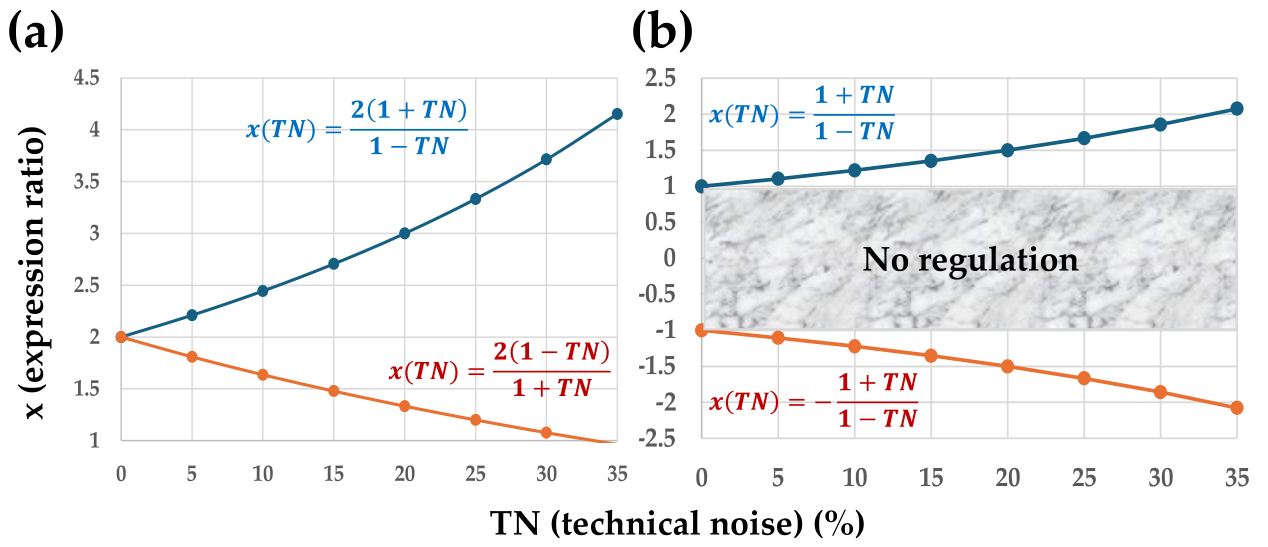
Figure 2.
Flow-chart of mathematically processing microarray expression data. Background subtracted (net) fluorescence signals α are normalized to the median α in that profiled sample. Normalized expression levels a are used to compute for every gene i in each of the compared conditions “D” (diseased) and “C” (control), the average expression level AVE, the Relative Expression Variation across biological replicas REV (and derived measure REC = Relative Expression Control), and the expression correlation COR with each other gene. Results of the two conditions are compared through expression ratio x, p-value p-val of the heteroscedastic t-test of the AVEs equality and cut-off CUT of the absolute fold-change |x| to decide about the significance of the expression regulation, REG. The two conditions are also compared in terms of expression control and expression correlation to estimate the changes of the homeostatic mechanisms that limit the random expression fluctuations and the remodeling of the gene networking.
Figure 2.
Flow-chart of mathematically processing microarray expression data. Background subtracted (net) fluorescence signals α are normalized to the median α in that profiled sample. Normalized expression levels a are used to compute for every gene i in each of the compared conditions “D” (diseased) and “C” (control), the average expression level AVE, the Relative Expression Variation across biological replicas REV (and derived measure REC = Relative Expression Control), and the expression correlation COR with each other gene. Results of the two conditions are compared through expression ratio x, p-value p-val of the heteroscedastic t-test of the AVEs equality and cut-off CUT of the absolute fold-change |x| to decide about the significance of the expression regulation, REG. The two conditions are also compared in terms of expression control and expression correlation to estimate the changes of the homeostatic mechanisms that limit the random expression fluctuations and the remodeling of the gene networking.
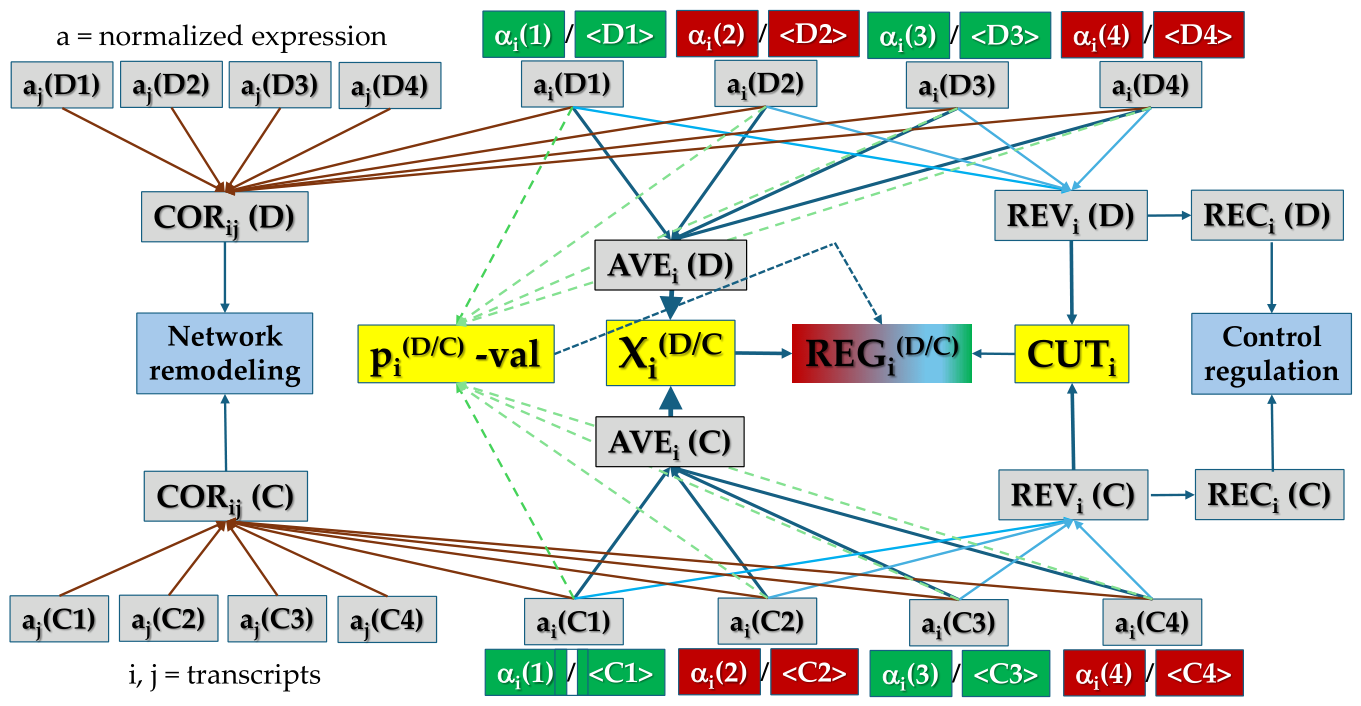
Disclaimer/Publisher’s Note: The statements, opinions and data contained in all publications are solely those of the individual author(s) and contributor(s) and not of MDPI and/or the editor(s). MDPI and/or the editor(s) disclaim responsibility for any injury to people or property resulting from any ideas, methods, instructions or products referred to in the content. |
© 2026 by the authors. Licensee MDPI, Basel, Switzerland. This article is an open access article distributed under the terms and conditions of the Creative Commons Attribution (CC BY) license (http://creativecommons.org/licenses/by/4.0/).
Copyright: This open access article is published under a Creative Commons CC BY 4.0 license, which permit the free download, distribution, and reuse, provided that the author and preprint are cited in any reuse.


