
Submitted:
19 June 2026
Posted:
23 June 2026
You are already at the latest version
Abstract
The potential existence of distinct geographical zones across the island of Great Britain, distinguished by differential extents to which climate change is responsible for changes in high streamflows is investigated. A probabilistic separation of the climate change and land use change signals as drivers of streamflow change through time is applied to river systems in Great Britain, and the behaviour of the climate change/land use proportions through time and across catchments is then used to identify geographic regions across Great Britain. Different zones may be defined by the presence or absence of synchronous changes in the climate change/land use change proportions in the sub-catchments comprising the parent systems. Frequently, a number of non-nested sub-catchments which do not share flow within a given river system form a set showing synchronous changes in the proportion to which climate change is driving change in high streamflow. Parent river systems in the north and west of Great Britain tend to show greater internal synchrony in the behaviour of their component non-nested sub-catchments than do the components of parent river systems in the south and east. Parent river systems in the north and west also tend to show more synchrony with other parents in the same region, whereas parent river catchments in the south and east do not show much mutual synchrony. The trajectories of the climate change/land use change proportions through time in northern and western parent catchments also tend to show mutual similarities, and dissimilarity to those trajectories from southern and eastern parent catchments. The north-west/south-east geographical division is also, firstly, present in the proportions themselves to which climate change is a driver of streamflow change in the parent catchments of river systems in Great Britain, and, secondly, in the degree to which the proportion of climate change as a driver of streamflow change correlates with catchment size.
Keywords:
climate change
; land use
; probabilistic
; catchment
; descriptor
; synchrony
1. Introduction
Research has suggested that the island of Great Britain (GB) may be divided into at least two distinct regions, defined by the local interaction of climate, weather systems, geology, topology and longitude/latitude [1]. Chan et al. [2] distinguish two climatological regimes across GB, a northern zone, Scotland and the English Lake District, and a southern zone, i.e, the rest of the island. For the northern area they predict a precipitation increase in winter, and a decrease in summer, and with greater overall intensity of precipitation; they say, also, that the intensification will be larger in magnitude in the south of GB , with the largest increase in winter precipitation being over Wales. Visser-Quinn et al. [3] forecast that the south-west of England, Wales, the English Midlands and north-east Scotland will be hydrohazard “hotspots”, that is, the locations of extremes of flooding and droughts. According to Collet et al. [4] the south-east of GB will undergo the largest increase in 100-year return period run-off of any region.
In contrast, Wheeler and Mayes [5] divide GB into eight zones, and describe the climate characteristics of each one in detail. Conway [6] distinguishes between regions such as Scotland, Wales and Central England, as well as noting an intensification of a north-west south-east precipitation gradient. Overall, with all these classifications, there is a clear topographic factor in play, whereby the mountainous areas of Wales and Scotland can be seen to mark out different climate zones from, for example, the south east of England, the topographic element being compounded by the geographical factor of latitude.
Climate change and land use change are considered to be the major drivers of extreme streamflow change in GB [7]; this hypothesis is supported by projections over the British archipelago for the twenty-first century which show an increased probability of wetter winters as well as drier summers, [8,9], which will have more frequent and intense convective rainfall, in turn leading to high flows of greater frequency and magnitude. These could have severe economic and social effects, as well as presenting an actual danger to human life [10]. The effects are projected to vary across the country; in the north and west, where rainfall is driven by the prevailing westerly winds from the Atlantic, the most significant change is the expected increase in winter precipitation, and floods of greater magnitude and frequency [11].
Effects not attributable to either climate change or land use change might include tectonic activity, but, aside from an occasional minor earthquake, perhaps leading to a landslip, the British archipelago is tectonically very stable [12]. Rivers and other inland water bodies in the British Isles are too small to be affected to any detectable degree by tidal activity, and there does not appear to be any reference to such activity or effects in the British Isles in the available literature.
As well as potentially being defined by the degree to which climate change is driving streamflow change in any given river system, zones themselves can be defined by their internal characteristics (descriptors), such as mean altitude, size, compactness and substrate descriptors such as BFIHOST.
The separation of climate change and land use change in their proportions as drivers of streamflow change is a long-standing topic in hydrology. Mitigating the effects of climate change is a long-term and costly project, needing a high degree of international co-operation [13]. Responses to international efforts to curb greenhouse gas emissions, for instance, are a paradigmatic illustration of the “free rider” issue, whereby defectors from an agreement can still benefit from that agreement themselves without incurring much, if any, of the costs [14].
On the other hand, local measures to alter the deleterious effects (such as flooding) of land use change on streamflow, whilst still requiring investment and political will, would be easier and cheaper [15,16,17]. To this end it is therefore important to know whether land use change could be a significant driver of streamflow change, and to identify areas where this may be case. Answering this question has driven research into disentangling climate change and land use change in their effects on streamflow extremes; Wray et al. [18] identified both as significant drivers of streamflow change, initially in the River Tweed catchment system and then across across Scotland [19] as a whole.
Nearly all previous research into the separation of the climate change and land use change signals has resulted in one single figure for each river system being published for the proportions of the two, referred to as the climate change attribution proportion [20,21,22,23]. A few authors have suggested that the balance of climate change and land use change might alter through time [2,24,25], and there has been discussion of the hypothesis that streamflow changes in large catchments are driven more by climate change, and more by land use change in smaller catchments [26,27]. However, at least one researcher has reported results implying the opposite, that climate change effects decrease with catchment area increase [28], although this may be a result confounded by the characteristics of the region studied in this case. Moreover, there does not seem to be any discussion in the literature of the variation in the climate change attribution proportion which can be observed across different flow metrics, for example Q95 as contrasted with Q05.
The climate change attribution proportion does not just vary through time, across flow metrics and from river system to river system (say if one compares the Tweed to the Tay) but subtly within systems themselves - if non-nested sub-catchments within a single river system are examined, it becomes clear that both, firstly, the timings of change in some of them (and not all), as well as, secondly, the intensity, from land use change dominance to climate change dominance (or vice versa) of stream flow change frequently show striking (near) synchrony. Sometimes a second set of sub-catchments, within the same system, may show a different pattern of synchrony to the first set. Yet other catchments within the same river system may not synchronise to much of a degree, if at all, with other catchments.
It is further observed that synchronously behaving catchments are not necessarily neighbours within the system, sometimes being at the opposite ends of the system in question, whilst, on the other hand, sub-catchments which are physically close or sharing a boundary can sometimes show quite different climate change attribution profiles. So there are at least two potential metrics available here - firstly, to what degree for any given system do the catchments within it show synchrony, and secondly, what degree of spatial proximity do the synchronised catchments within a system show?
Neither of these questions may be answered straightforwardly. Metrics for judging the similarity in behaviour through time of any two climate change attribution proportion vectors are complicated, as it is not simply a question, say, of the vector shifting from land use change dominance to climate change dominance at any given point, but also the magnitude of the change. In fact, there is no actual necessity for a attribution proportion vector to shift from (say) land use change dominance to climate change dominance for it to be significant - a shift from a strong land use change dominance to a weaker one can be of greater magnitude than a shift from land use change to climate change. Metrics to quantify the spatial distribution of synchronised catchments across the parent system are also not straightforward, not least because of the problem of defining how intense a change needs to be, and how close in time it needs to be for these changes to be considered both significant and synchronous.
In this paper the following research questions are posed:
- By examining sub-catchment behaviour across different systems, is there evidence that different regions of GB have different streamflow responses to climate change?
- Can it be shown that synchronous behaviour in the climate change attribution proportion vectors of different sub-catchments within a system are correlated to a degree which is not simply ascribable to coincidence?
- Given that many sub-catchments within a system do show synchrony of behaviour, can the observation that other sub-catchments within the same system show very different and non-synchronous behaviour to those operating in synchrony be explained?
2. Materials
Flow Data
Flow gauging stations across GB provide flow rate data at daily intervals which is used in this study. There are gauging stations located on some of the smaller islands of the British archipelago but none of them provided records long enough to be used. Daily streamflow data for all the catchments used were downloaded as files from the NRFA (National River Flow Archive) website from the Centre for Ecology and Hydrology [29]. NRFA gathers readings taken throughout the water day from 9.00 am to 9.00 am [30], which can then yield one daily mean flow value. Data for leap days (29th of February) has been discarded in this study so that every year has exactly 35,040 datapoints, thus simplifying analysis. There are 327 parent catchments across GB, that is, catchments derived from a gauging station which are not nested inside a larger catchment. Of these which have adequate data, 79 have have at least one child sub-catchment nested inside them and there are 226 of these child sub-catchments. All the GB gauging stations, both parent and non-parent catchments, used in this research have an NRFA ID, which alongside other data and descriptors, may be downloaded via the R package “rnrfa”. To keep matters within a reasonable length, in this paper only the behaviours of Q05 flows have been included.
Climate Data
The UK Meteorological Office (UK Met Office) has thermometers or temperature gauges of different types situated across GB. The sites are chosen to reflect different kinds of terrain and avoid biasses such as urban heat islands. The data are checked for outliers or sudden unexplained shifts. [31] and from them UKCEH (the UK Centre for Ecology and Hydrology) provides interpolated and adjusted 1 km2 gridded daily mean temperature data (CHESS) across the whole of Great Britain and its islands [32].
UKCEH also provide interpolated 1km2 grid square precipitation data (rainfall and snowfall equivalent), via the Met Office, which measures precipitation via a set of irregularly placed gauges around the country [31]. UKCEH precipitation data can then be used to calculate total precipitation volumes for each sub-catchment upstream of the respective gauging stations, corrected by an evapotranspiration factor also supplied on the 1 km2 grid by UKCEH [32,33]. Two sets of evapotranspiration data are issued, and for this study the first set was recommended for use in a personal email communication with CEH. The meteorological data are supplied as netCDF files, which require the R “ncdf4” package for downloading and reading.
These input datasets are really samples, whose variations are controlled by the accuracy of the measuring devices and data processing. The “end product” of the numerical analysis in this study has been presented as a probability density function, but it should be borne in mind that this histogram is derived from single daily data samples.
Catchments
Each gauging station, by definition, is at the lowest flow point of a sub-catchment extending upstream; associated with each NRFA station data set is the corresponding shapefile showing the outline of this sub-catchment. The locations of gauging stations are a product of human considerations and that these locations do not necessarily reflect any natural structure within the river system, although obviously the placing of a gauge may be influenced by topographic or geological considerations.
The lay concept of a catchment is an area with a boundary or “water divide” [34], a curve (the “topographic boundary”) inside which all water flows downwards under gravity to collect in bodies such as rivers or lakes. In this paper, it is assumed that a catchment corresponds to the area bounded by the topographic boundary (which for GB catchments is downloadable as a shapefile from NRFA). This boundary is a locus of points, whence any direction except towards the next points on the locus always leads to a point of lower gravitational potential. As mentioned above, a catchment is defined by the location of a gauging at its lowest point. Two catchments are defined as “nested” if one (the child) lies wholly withing the other (the parent), although boundaries may be shared. Non-nested catchments which are in the same system thus do not share any flow, making the assumption that sub-surface transmission is not significant, which may not always be the case [35].
For each (sub-)catchment NRFA supplies the easting and northing co-ordinates of the associated gauging station at the sub-catchment’s lowest point, as well as a sub-catchment shapefile, so an envelope of coordinates can be created as () points, and all 1km2 CHESS grid squares within the envelope can be identified. The total daily precipitation and evapotranspiration volumes across the catchment in question, as well as the mean daily temperature across all grid squares within the envelope can then be calculated.
Figure 1 shows the sixteen largest parent catchments across GB which had adequate (30 years plus) flow records. The outline in each case shows the extent of the largest parent catchment for each system - there were sometimes smaller catchments flowing into the named river which were outside this largest parent, and which were not used for the analysis.
Methods
The Regression Separation Method
The regression separation method, originally applied by Liang et al. [36], (where precise details of the algorithmic steps may be found) building on work by Wei and Zhang [37], has the merit of simplicity, in that it does not use modelling to determine attribution proportions, and therefore does not require the estimation of input parameters. It uses the data from only one catchment at a time, avoiding assumptions and approximations associated with paired or multi-catchment methods. It employs a double mass curve method using cumulative flow, temperature and precipitation data [38]. It thus provides a robust basis from which to develop a statistical method (Figure 2 left). Modifications of this method were used firstly, to disentangle the climate change and land use change proportions as drivers of streamflow change in the Tweed system in southern Scotland [18] and then of river systems across the whole of Scotland [19]. Again, precise details of the algorithms may be found in these two papers.
The Modified Extended Separation Algorithm
The modified regression separation applies a “wisdom of crowds” approach [39], by using multiple metrics. The outcome may be influenced by the choice of metrics, but as a homogeneous but wide-ranging “quasi-continuous” set, it can be hypothesised that any gross biases will be balanced out. Since the main interest lies in demonstrating the diachronous behaviour of catchments through time, the choice of metrics in itself may be less important than the (potential) demonstration of through-time changes. For precipitation a range of percentile metrics at intervals of one percent is used: P100 (the minimum for the water year), P99 …P50 (the median) …P01, P00 (the maximum). A corresponding set of percentile metrics is used for temperature, i.e. T100, T99 …T50 …T01, T00. The use of combinations of 101 precipitation metrics and 101 temperature metrics means that for each flow a distribution of up to candidate climate change attribution proportion values can be generated, and this can be plotted as a histogram interpretable as a pdf, which can then be used to describe the distribution of candidate climate change attribution values (Figure 4).
Like the original regression separation method, the modified method works directly with the input data, does not depend on input assumptions or parameters, is simple in conception and operation, and can be run repeatedly with different percentile vectors for flow, precipitation and temperature, generating an assemblage of results. It is also sensitive to through-time changes in the proportions to which climate change and land use change are drivers of streamflow changes and these proportion changes are easy to trace in successive plots. The method does, however, make the assumption, as did Liang et al. [36] in their original regression separation method, that abrupt changes in flow (that is, those which occur within the space of one water year) are attributable to land use change, and that climate changes are smoother.
| Algorithm 1 The modified extended regression separation algorithm |
|
Inputs: For each catchment, daily flow F, precipitation R, evapotranspiration E, temperature T, and water years to .
|
Moment Calculations
The dominance of either climate change or land use as the streamflow change driver is represented by the moment M of each year’s distribution, calculated by :
where i is the climate change attribution proportion is a percentage across the generated pdf (from 0 to 100) and is the number of points for that corresponding value of i.
The Stepwise Analysis of Sub-Catchments
If a river system is considered as an assemblage of successively nested sub-catchments, then changes in flow will be inherited at least partially by lower catchments from the smaller, higher catchments nested within them, and comparisons of the climate change attribution proportion profiles of all catchments within a system are then confounded by this nesting, which implies a repetition of data inputs. However, if only the highest catchments, i.e those which do not have any other catchment feeding into them, are considered, then we have a set in which no catchment is assumed to share surface run-off or streamflow with any other.
A “child” sub-catchment is one nested within a larger “parent”. For this paper the parent for any river system is that delineated by the catchment boundary for the lowest gauging station, although, as has been mentioned, sometimes there are isolated catchments outwith the parent which have been disregarded in this study. Child catchments may contain “grandchildren” or “great-grandchildren” etc nested within them.
As an example of a river system, the Tay (Figure 3) has nested within it a number of children, themselves sometimes nested to various depths (Table 1).
The Steps
| Algorithm 2 Algorithm for stepwise coalescing of sub-catchments |
|
- (Step 1) Sub-catchments which are either not fed by a child catchment, or are fed only by one child catchment. In the latter case the child sub-catchment can be subsumed into the parent, as this preserves the principle of unique flows, and also gives a bigger data set for analysis. Sometimes there are chains of singly nested sub-catchments, i.e, a single grandchild within a single child within a parent, in which case all the offspring can be coalesced into the parent. In Figure ?? sub-catchment c, as an “only child” has been subsumed into sub-catchmentm, b into j and f into d. The resulting catchments in the first step plot are all therefore non-nested .
- (Step 2) Sub-catchments which are fed either by zero, one or two level 1 child catchments. If, however, a catchment is fed by two children, both of which are fed by two grandchildren, the grandchildren are subsumed into the children but the children are not, at this level, subsumed into the parent. In other words, if the parent has more than two exit points (gauging station locations) within it, the children are not subsumed. This is to provide as many levels of non-nested catchments as possible; Figure ?? second step, where sub-catchments i and k are subsumed into the parent l.
- (Step 3) Following on, any parent which has up to three, i.e the step number of exit points within it, subsumes the respective children, as is shown in Figure ??, where m, l and e are all subsumed into sub-catchment n.
-
... the process is repeated until all offspring would be subsumed into the maximal parent river system on the next step.For the Tay, however, the third step provides the maximal non-nested child catchment cover, as any further steps would subsume all remaining non-nested child catchments into the overall parent catchment o.
3. Results
Climate Change Attribution Proportions, Flow and Time Columns
Figure 4 contrasts two catchments, Tilley Bridge, in Sussex in southeast England, where land use change is dominant for almost the whole recorded period, and Daldowie, which is the parent catchment on the Clyde in Scotland, where there is a shift from land use change dominance to that of climate change. Whereas there are several catchments which are almost wholly driven by land use change, there are no equivalent catchments where climate change seems to have dominant for the whole period, but Daldowie has a high proportion of climate change as a driver.
The histograms (upper right) in Figure 4 show the respective distributions of the climate change attribution proportion elements for the water year 2007 as an example. The time columns, (lower right) in Figure 4 are series of “compressed histograms”, where for any given year, the horizontal width of each of the black bars corresponds to the height of the column, that is the proportional contribution of the respective climate change attribution proportion decile. Thus, the total width sum of all the bars across any given year is constant, and the evolution in trends in attribution through time can be seen more easily. Figure 5 then shows the Q05 time columns for the sixteen largest catchments with adequate data across GB.
The median climate change attribution proportion for each year is shown by the blue line. The column on the right hand side of the time column shows the moment around 50% of the climate change/land use change attribution proportion for each year.
The upper right-hand plot in Figure 4 shows the standardised flow volumes - after a somewhat irregular period between 1970 and 1982 the Daldowie flow settles into a stable pattern, whereas the Tilley Bridge is much more variable across time. The lower right-hand plot compares the standardised cumulative flow volumes for the two catchments - Daldowie is generally much smoother, the overall curve shape being driven by longer-term climate change and the differences between successive points being both fairly constant and small, whereas the more irregular plot for Tilley Bridge shows a regime driven more by land use change, where there are large abrupt differences of different magnitudes.
In Figure 6 the upper panel shows the moment vectors for the 44 largest maximal area child sub-catchments (as in, for example the third step in Figure 3) ranked by (log) size of sub-catchment, irrespective of system and the lower panel shows the next 52 largest maximal area child sub-catchments in order. The total area covered by the catchments in both panels is the same.
Catchment Area and Climate Change as a Driver
It has been suggested by Blöchl et al. [26], Pattison and Lane [27] and others that the larger a catchment area is, the greater the proportion of climate change as a driver of climate change. However, although this relationship may be broadly true, it does not appear to hold at all times, and the relationship between catchment size and climate change attribution proportion is neither linear nor monotonic [40] and differs in behaviour depending on the flow metric under consideration, at any rate for parent catchments in GB (Figure 7).
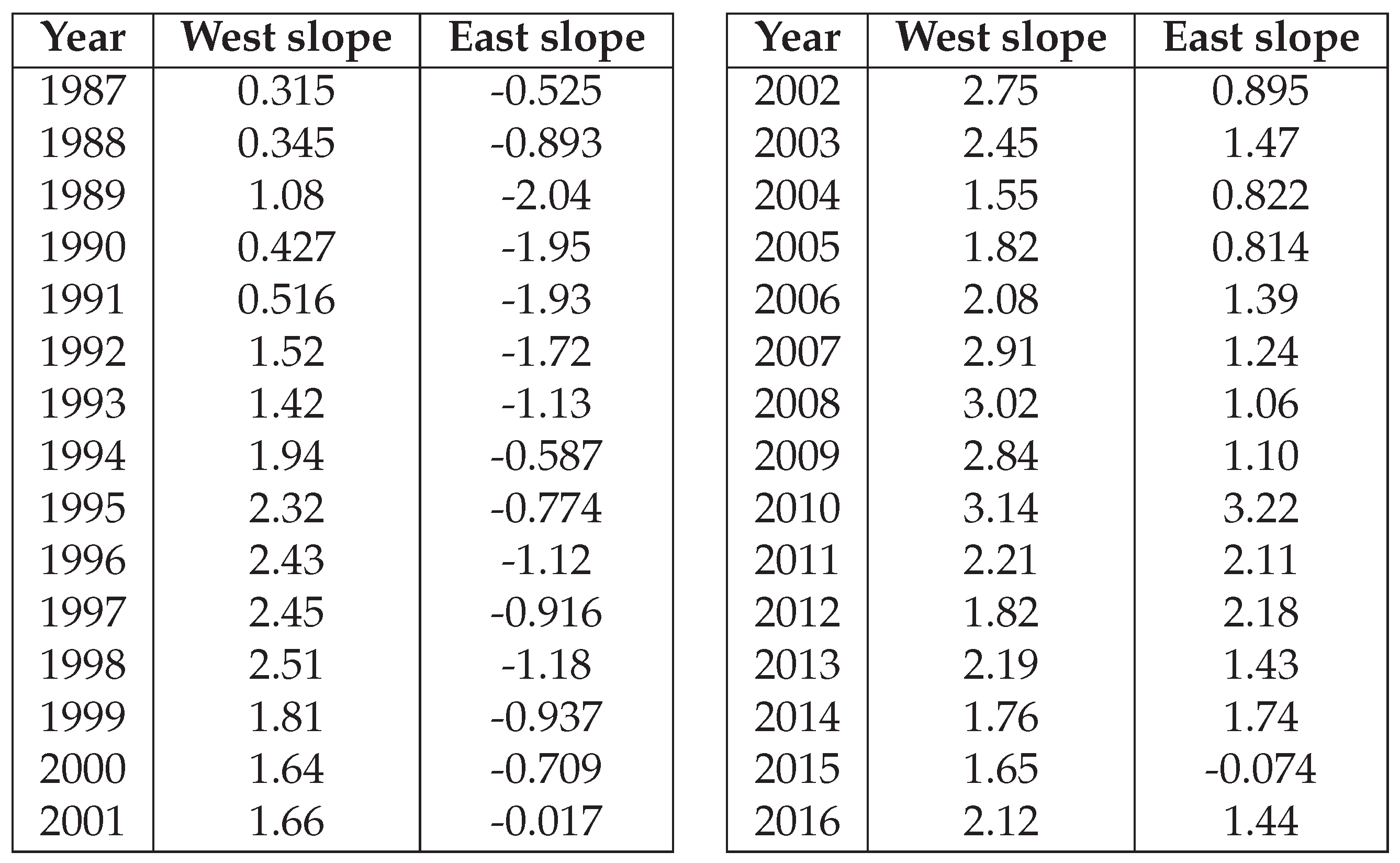
Nevertheless, there are statistically significant differences between the regression relationship of climate change attribution proportion against area, which shadow the division of GB into a north-western and south-eastern zone as outlined by Chan et al. [2], Conway [6], and Collet et al. [4], amongst others. In Figure 8 on the east side of the line there is a negative regression slope for climate change attribution proportion against log area for the years 1987 to 2001, in marked contrast to the wholly positive regression slopes for the western catchments. In the second half of the time period, from 2002 to 2016, all bar one of the eastern values are positive, but with two exceptions they are still smaller than the corresponding western values. A non-parametric permutation test [41] gives a p-value of 0.0002, suggesting that there is evidence to reject the null hypothesis that the means of the two sets are equal.
For each parent catchment for each year we have a set of up to 10201 climate change attribution proportion elements (which form the histograms in, for example, Figure 4). All these elements can then be plotted against the log area of the respective catchment, and the slope, and most importantly, the sign of the regression line in each case calculated. Table 2 shows the respective slopes of regressions of climate change attribution proportion elements against log of the catchment size for “western” catchments (red in Figure 8 and for “eastern” catchments, (blue in Figure 8). A permutation test on the difference in means between the two slope sets gives a p-value of approximately 0.0002, suggesting that there is evidence to suggest rejection of the null hypothesis that the difference in means of the two groups is zero.
Zones of Different Climate Change Impact Across Great Britain
Figure 5 shows the Q05 climate change attribution proportion time columns for sixteen of the largest eighteen parent catchments across GB arranged in the figure as closely as possible to their geographical position. (the two omitted catchments had data sets not long enough for analysis). The larger catchments generally have more climate change dominated moment distributions, in conformity with the hypothesis put forward by [26] and later [27], that streamflow changes are driven more by climate change for larger catchments, and by land use for smaller ones. but this is at least partially confounded by a geographical factor, whereby large catchments in central and southern England (Kingston and North Muskham, ID 28022) have Q05 with a strong LU signal, as does the Scottish catchment of Park and the Lincolnshire catchment of Beal (ID 27003).
The time columns in Figure 10 also suggest that there are different regimes operating across different regions of GB. The Tweed, Tay, Spey, Clyde, Eden and Wye all have a rough “backwards S” profile to their Q05 trajectories, something not seen in the other catchments which generally lie to the south and east of the six listed above.
Discussion
Confounding Issues
When comparing aspects of behaviour of catchments across GB and seeking to find characteristics which allow zoning it has to be borne in mind that there are many confounding factors which may play a disruptive role. When comparing aspects of behaviour of catchments across GB and seeking to find characteristics which allow zoning it has to be borne in mind that there are many confounding factors which may play a disruptive role.
For example, an obvious problem when comparing river systems in Scotland and the extreme north of England with those further south(-east) is that the Trent and Thames systems are much larger in area than even the largest of the north(-western) systems. Associated with this size discrepancy is that the larger river systems then tend to have larger sub-catchments, and as a consequence a longer chain of nested sub-catchments as there has been more scope for placing gauges. Hence the top level catchments in different systems may not correspond exactly. Nevertheless, on a wider perspective it is possible to see differences in nature between systems in different zones.
Two neighbouring sub-catchments within a single system may show synchronised behaviour because they are largely subjected to the same weather regimes, and may also have similar land use inputs. On the other hand, it is also perfectly possible for two nearby or neighbouring catchments to have have similar topography and geology but be subjected to wholly different land use. For example, one catchment may be (still) agricultural, whilst its neighbour, similar in original respects, may now have had urban development, quarrying or other changes which affect its hydrograph.
Synchronous Catchments
The patterns of the moment vectors in Figure 10 are contingent on the placing and number of the gauging stations, and the associated river systems vary in overall size. The overall systems in Figure 10 range greatly in size - the largest sub-catchment in the Thames system, bounded by the station at Kingston (and not including those catchments outside this boundary), has an area of 9948 km2, whereas the Clyde upstream of its lowest station at Daldowie has an area of 1903 km2, again, not including the “detached” catchments. Visually there appear to be differing degrees of synchrony, and, in fact, where there is synchrony, the changes appear of different kinds. For example, across the Tweed and the Clyde (Figure 5 and Figure 10), and contemporaneous in both in many of the sub-catchments, there was a switch from land use change dominance to climate change dominance in about 1980, followed by a switch back to land use change or at least a lessening of the intensity of the climate change proportion in about 2005 (also shared by the Tay). The maximal sub-catchments of the Tweed and the Tay in Figure 11, as well as the panel for the Clyde in Figure 5 also show this episode of change. Both these Scottish systems show a high degree of synchrony at Q05 for around three-quarters of their sub-catchments, where the transitions from a land use dominated regime to climate change domination take place through a period of about fives, whilst the rest of the sub-catchments in both systems simply stay under a land use regime. Some of the larger catchments in the Thames and in the Severn may have undergone the same change but later (around 1995), and there is then a suggestion that the land use change proportion is once more increasing in these English catchments. The Trent shows very diverse moment vectors - this may be because of quite diverse topograhical and geological factors across this particular catchment [42].
Asynchronous Neighbouring Sub-Catchments
That two non-nested catchments within the same system might show similar moment trajectories is not necessarily that surprising - especially as, if they are geographically close, they may be under the same climatic regime and may have similar geology, land cover and descriptor profiles. A harder question to answer is asking why are some catchments which are geographically close within the same system so different in their moment paths? One answer may be that the separation processes employed to identify the moment trajectories disentangle climate change and land use change - in other words, if at the beginning of the analysis period two otherwise quite similar (sub-)catchments have different land use regimes, this may have the effect of creating quite diverse moment trajectories henceforth. For the Tweed (see the moments panel for this system in Figure 10 and Figure 11), for example, there seems to be two groupings of catchments. Neither group consists wholly of adjacent catchments. Of course, coincidental similarity cannot be ruled out, and chance resemblances become likelier the more sub-catchments from a system are presented, as for example for the Thames system, in Figure 11.
Quantifying Synchronicity
Visually examining the moment plots for each system shows up the synchronies between sub-catchments of particular systems, but a quantification of how much the profile of a given sub-catchment resembles that of another is a complicated task, as it involves giving a figure not only to the time of a change, but to the degree of change, and whether a particular change can be seen as significant. Clearly the moment vector elements change in value between almost every water year, but most of these changes would not signify anything more than the expected stochastic variation one would get in any time series generated by a natural process with many interacting and non-linear inputs. Fully exploring the quantification of (non-)synchronicity, would be a natural extension of the work in this paper.
Exogenous Factors in Zoning
However, there are also exogenous factors such as the North Atlantic Oscillation (NAO), [43], a pressure pattern located over Greenland and the north Atlantic, which is considered to be the major influence on climate variability across the British Isles [44], who also say that the topograhic altitude of the terrain “amplifies” the NAO effects. According to Cornes et al. [45], who have reconstructed NAO patterns back in time to 1692, the NAO has been largely negative since about 1970, representing a change in regime from earlier times. A negative NAO means that the pressure difference between the Azores high and the Iceland low is smaller than (historically) usual, and this has led to increased blocking.of the usual westerly air flow. The East Atlantic (EA) pattern, located further south and east than the NAO, is also being increasingly seen as a subordinate influence [46].
Trends in Climate Change Attribution Proportion Across GB
Figure 5 and Figure 8 suggest that there is a division in behaviour between those parent catchments in the north and west of GB, and those to the south and east. In Figure 8, a line running north to south shows catchments to the west with the “Ballathie pattern” and those to the east showing the “North Muskham” type pattern (although Norham ostensibly falls to the east of the line, the vast bulk of the Tweed catchment is to the west side). This divide was also suggested by Mayes [48], who ascribes it to both the NAO and “orographic” precipitation.
Chan et al. [2] distinguish climatological regimes between “Northern UK”, by which they mean Scotland and the English Lake district, but not Northern Ireland, and “Southern UK”. For the northern zone they predict a precipitation increase in winter, and a decrease in summer, and with greater intensity of precipitation; they say, also, that the intensification will be larger in magnitude in the southern zone. According to West et al. [43], the North Atlantic Oscillation (NAO, a pressure pattern located over Greenland and the north Atlantic) has been considered to be the major teleconnection influence on climate variability across the British Isles, especially over the north and west, although the East Atlantic (EA) pattern, located further south and east than the NAO, is being increasingly seen as a subordinate influence for central, southern and eastern England, which ties in with the different behaviours of more southerly time columns, as opposed to more northerly and westerly (including Redbrook on the Wye in the Welsh Marches). [46]. Burt and Howden [44] say that the NAO is especially influential in the winter in the north-west. Barnes et al. [49] cite the predictions made by the UK Climate Projections model (UKCP18) ensembles as displaying a pronounced northeast-southwest gradient. The Climate Change Committee for the UK report: “There is now unequivocal evidence that climate change is making extreme weather in UK, such as heatwaves, heavy rainfall, and wildfire-conducive conditions, more likely and more extreme. The period between October 2022 to March 2024 was the wettest 18-months on record for England.” [50].
The time columns for rivers in England and Wales, such as those shown in Figure 5, show discontinuities comparable in magnitude and frequency to those in Scotland but often at different times and in different directions. The Q95 flows for English catchments especially show some quite rapid oscillation between climate change and land use change dominance.
Figure 12 suggests that for low and mid flows the responses of larger catchments in southern and central England tends to be more variable within the climate change attribution proportion vector for each catchment than are the responses of the catchments in northern England and Scotland. However, the responses in Scotland to high flows appears more variable for many catchments both in comparison to low and mid flows in Scotland, and in comparison with catchments further south. Thus, again, there is the implication that different hydrological regimes may be operating in different regions of GB.
Conclusions
These research questions were posed earlier:
-
By examining sub-catchment behaviour across different systems, is there evidence that different regions of GB have different streamflow responses to climate change?The differential distribution of degrees of synchrony of sub-catchment behaviour within river systems, the shapes of the climate change attribution proportion paths in the time columns, and the comparison of the slopes of the regression lines for the attributions against catchment area, all suggest that systems in the north-western part of GB behave somewhat differently to those in the south-east [2,43,46], although the zone delineation marked out by any of three criteria given above is not necessarily the same in all cases.
-
Is there evidence to support the hypothesis put forward by Blöchl et al. [26] and by Pattison and Lane [27] that climate change is a proportionately greater driver of streamflow change for larger catchments than it is for smaller ones?It has been shown that this hypothesis may be true for catchments in a particular hydrological zone, rather than necessarily being a general truth. In other words, whether the catchments in a particular region do conform to this hypothesis or not is itself a criterion for delineating zones, as can be seen in Figure 8In Figure 6 there seems, in many of the sub-catchments, to have been a regime change in about 1985, and especially with the very largest sub-catchments there is switch to climate change dominance after this date.Figure 11 shows the moment vectors for the maximal sub-catchments across the 16 largest systems in GB. The larger sub-catchments, i.e. those on the right hand side of their respective catchment vectors (for example the Tay, the Clyde and the Avon) tend to show a greater climate change dominance, but a detailed quantification of the distribution of higher climate change moments would be an extension of the analysis here. In the supplementary materials climate change/land use change moment vectors plotted for, variously the seven largest to sixteen largest
-
Can it be shown that synchronous behaviour in the climate change attribution proportions of different sub-catchments within a system are correlated to a degree which is not simply ascribable to coincidence?To create a quantifying algorithm to answer this question would be an extension of this current work, although visual inspection of, say, the Tweed sub-catchment plots gives a strong impression that the synchronies are not simply random events which happen to line up.
-
Given that many sub-catchments within a system do show synchrony of behaviour, can the observation that other sub-catchments within the same system show very different and non-synchronous behaviour to those operating in synchrony be explained?Possible answers to this question might be that LU (perhaps particularly urbanisation) is responsible for highly distinct climate change/land use change vector change patterns. It is to be borne in mind that the separation process disentangles climate change and land use change, not land use per se and that therefore the initial conditions from which the attribution proportions are then induced may play a large role in determining the path of the attribution proportion. Other factors, such as geology or slope may also play a role.
The zones are also distinguished by catchment responses across different flow metrics. In Figure 5 and the corresponding map for Q95 in the supplementary materials the north-western zone has climate change as the main driver for Q05 and the south-eastern zone has land use change as the main driver, whereas for Q95 it is the north-western zone which is more influenced by land use change and the south-eastern zone by climate change, although these observations are not universal across all catchments.
Further Work
It has been noted that only Q05 flows were investigated in this study, but in fact if other flow metrics are used, such as Q50 or Q95, the general level of synchrony manifest across sub-catchments within a system falls away, but the synchronies of catchments under other flows would be a further project. The quantification of what constitutes synchrony need further development. It is relatively easy for the eye to spot synchronous changes in the parallel moment vector plots, but much more complicated to write a program which can decide whether a particular apparent coincidence of behaviour is significant, and where, when and to what degree changes in the vectors should be regarded as significant. Again, further work on this is needed. The relationship between climate change attribution proportions and (sub-)catchment size has also been examined here. A natural extension would be to examine the relationships between climate change and other decriptors, such as BFIHOST, compaction etc [40].
Notes
In this paper the word “system” is used to denote the water bodies in a complete river basin, such as the Tweed or the Trent, to distinguish between the river and its tributaries as a whole, and the (sub-)catchments which are nested within the system, each of which has a gauging station at its lowest point. Thus “catchments” here are human constructions, contingent upon the placing of the gauging stations.
Supplementary materials, including the R programs which were written to process flow and meteorological data can be downloaded from https://github.com/supermollusc/Paper 070626
The document “Plots” has the comparative sub-catchment moment vectors plotted for each of the largest GB parent systems, and also maps showing the stages of coalescing the non-nested sub-catchments of each parent system.
The flow data and catchment descriptors may be downloaded at https://nrfa.ceh.ac.uk/data/search. Precipitation, temperature and evapotranspiration data is available for download as ncr files from https://doi.org/10.5285/8651771d-aa6d-4d0f-8bcd-b3be1f733852.
Author Contributions
Conceptualization, N.W. and L.B.; methodology, N.W., A.A and L.B.; software, N.W.; validation, N.W., A.A.. and L.B.; formal analysis, N.W.; investigation, N.W.; resources, N.W. and L.B.; data curation, N.W.; writing—original draft preparation, N.W.; writing—review and editing, N.W, A.A. and L.B; visualization, N.W and L.B.; supervision, A.A and L.B.; project administration, L.B; funding acquisition, L.B. All authors have read and agreed to the published version of the manuscript.
Funding
This research received no external funding.
Conflicts of Interest
The authors declare no conflicts of interest.
Abbreviations
The following abbreviations are used in this manuscript:
| BFIHOST | Base Flow Index Hydrology of Soil Types |
| CEH | Centre for Ecology and Hydrology (see UKCEH) |
| CHESS | Climate Hydrology and Ecology Support System |
| EA | East Atlantic |
| GB | Great Britain |
| NAO | North Atlantic Oscillation |
| NRFA | National River Flow Archive |
| UK | United Kingdom |
| UKCEH | United Kingdom Centre for Ecology and Hydrology |
References
- Barker, L.J.; Hannaford, J.; Chiverton, A.; Svensson, C. From meteorological to hydrological drought using standardised indicators. Hydrol. Earth Syst. Sci. 2016, 20, 2483–2505. [Google Scholar] [CrossRef]
- Chan, S.C.; Kahana, R.; Kendon, E.J.; Fowler, H.J. Projected changes in extreme precipitation over Scotland and Northern England using a high-resolution regional climate model. Clim. Dyn. 2018, 51, 3559–3577. [Google Scholar] [CrossRef]
- Visser-Quinn, A.; Beevers, L.; Collet, L.; Formetta, G.; Smith, K.; Wanders, N.; Thober, S.; Pan, M.; Kumar, R. Spatio-temporal analysis of compound hydro-hazard extremes across the UK. Adv. Water Resour. 2019, 130, 77–90. [Google Scholar] [CrossRef]
- Collet, L.; Beevers, L.; Prudhomme, C. Assessing the Impact of Climate Change and Extreme Value Uncertainty to Extreme Flows across Great Britain. Water 2017, 9, 103. [Google Scholar] [CrossRef]
- Wheeler, D.; Mayes, J. Regional Climates of the British Isles; Routledge: London, 1997. [Google Scholar]
- Conway, D. Recent climate variability and future climate change scenarios for Great Britain. Prog. Phys. Geogr. 1998, 22, 350–374. [Google Scholar] [CrossRef]
- Arnell, N.W.; Reynard, N.S. The effects of climate change due to global warming on river flows in Great Britain. J. Hydrol. 1996, 183, 397–424. [Google Scholar] [CrossRef]
- Watts, G.; Battarbee, R.W.; Bloomfield, J.P.; Crossman, J.; Daccache, A.; Durance, I.; Elliott, J.A.; Garner, G.; Hannaford, J.; Hannah, D.M.; et al. Climate change and water in the UK – past changes and future prospects. Prog. Phys. Geogr. 2015, 39, 6–28. [Google Scholar] [CrossRef]
- Speight, L.; Krupska, K. Understanding the impact of climate change on inland flood risk in the UK. Weather 2021, 76(10). [Google Scholar] [CrossRef]
- Milojevic, A.; Armstrong, B.; Kovats, S.; Butler, B.; Hayes, E.; Leonardi, G.; Murray, V.; Wilkinson, P. Long-term effects of flooding on mortality in England and Wales, 1994–2005: controlled interrupted time-series analysis. Environ. Health 2011, 10, 11. [Google Scholar] [CrossRef] [PubMed]
- Smith, B.A.; Birkinshaw, S.J.; Lewis, E.; McGrady, E.; Sayers, P. Physically-based modelling of UK river flows under climate change. Front. Water 2024, 6. [Google Scholar] [CrossRef]
- Embleton, C.; Brunsden, D. Great Britain. Dev. Earth Surf. Process. 1997, 5, 179–214. [Google Scholar] [CrossRef]
- Harris, P.G. Collective action on climate change: the logic of regime failure. Nat. Resour. J. 2007, 47, 195–224. [Google Scholar]
- Carattini, S.; Levin, S.; Tavoni, A. Cooperation in the Climate Commons. Rev. Environ. Econ. Policy 2019, 13, 227–247. [Google Scholar] [CrossRef]
- Clements, B. Exploring public opinion on the issue of climate change in Britain. Br. Politics 2012, 7, 183–202. [Google Scholar] [CrossRef]
- Searchinger, T.D.; Wirsenius, S.; Beringer, T.; Dumas, P. Assessing the efficiency of changes in land use for mitigating climate change. Nature 2018, 564, 249–253. [Google Scholar] [CrossRef] [PubMed]
- Forster, E.J.; Healey, J.R.; Dymond, C.; Styles, D. Commercial afforestation can deliver effective climate change mitigation under multiple decarbonisation pathways. Nat. Commun. 2021, 12, 3831. [Google Scholar] [CrossRef] [PubMed]
- Wray, N.; Bowie, D.; Pattison, I.; Angeloudis, A.; Beevers, L. Disentangling climate change & land use change effects on river flows: A probabilistic approach. J. Hydrol. 2024, 639. [Google Scholar] [CrossRef]
- Wray, N.; Angeloudis, A.; Pattison, I.; Beevers, L. Distinguishing Regional Spatio-temporal Hydrological Regimes. Hydrol. Sci. J. 2026; in press. [Google Scholar] [CrossRef]
- Li, L.J.; Zhang, L.; Wang, H.; Wang, J.; Yang, J.W.; Jiang, D.J.; Li, J.Y.; Qin, D.Y. Assessing the impact of climate variability and human activities on streamflow from the Wuding River basin in China. Hydrol. Process. 2007, 21, 3485–3491. [Google Scholar] [CrossRef]
- Wang, M.; Shao, Y.; Jiang, Q.; Xiao, L.; Yan, H.; Gao, X.; Wang, L.; Liu, P. Impacts of climate change and human activity on the runoff changes in the Guishui River Basin. Land 2020, 9. [Google Scholar] [CrossRef]
- Andaryani, S.; Nourani, V.; Ball, J.; Jahanbakhsh Asl, S.; Keshtkar, H.; Trolle, D. A comparison of frameworks for separating the impacts of human activities and climate change on river flow in existing records and different near-future scenarios. Hydrol. Process. 2021, 35. [Google Scholar] [CrossRef]
- Mikaeili, O.; Shourian, M. Assessment of the Analytic and Hydrologic Methods in Separation of Watershed Response to Climate and Land Use Changes. Water Resour. Manag. 2023, 37, 2575–2591. [Google Scholar] [CrossRef]
- Zhang, A.; Zhang, C.; Fu, G.; Wang, B.; Bao, Z.; Zheng, H. Assessments of Impacts of Climate Change and Human Activities on Runoff with SWAT for the Huifa River Basin, Northeast China. Water Resour. Manag. 2012, 26, 2199–2217. [Google Scholar] [CrossRef]
- Bao, Z.; Zhang, J.; Wang, G.; Chen, Q.; Guan, T.; Yan, X.; Liu, C.; Liu, J.; Wang, J. The impact of climate variability and land use/cover change on the water balance in the Middle Yellow River Basin, China. J. Hydrol. 2019, 577. [Google Scholar] [CrossRef]
- Blöchl, G.; Ardoin-Bardin, S.; Bonell, M.; Dorninger, M.; Goodrich, D.; Gutknecht, D.; Matamoros, D.; Merz, B.; Shand, P.; Szolgay, J. At what scales do climate variability and land cover change impact on flooding and low flows? 2007. [Google Scholar] [CrossRef]
- Pattison, I.; Lane, S.N. The link between land-use management and fluvial flood risk: A chaotic conception? 2012. [Google Scholar] [CrossRef]
- Dong, L.; Xiong, L.; Lall, U.; Wang, J. The effects of land use change and precipitation change on direct runoff in Wei River watershed, China. Water Sci. Technol. 2015, 71, 289–295. [Google Scholar] [CrossRef] [PubMed]
- CEH. 2005. Available online: https://nrfa.ceh.ac.uk/.
- Institute of Hydrology. Hydrological Data UK: Hydrometric Register and Statistics 1981 Yearbook; Institute of Hydrology: Wallingford, UK, 1982; Hydrometric Register and Statistics 1981. [Google Scholar]
- Met Office. How we measure rainfall. 2025. (accessed on 2025-12-03).
- Robinson, E.L.; Blyth, E.M.; Clark, D.B.; Comyn-Platt, E.; Rudd, A.C.; Wiggins, M. Climate hydrology and ecology research support system meteorology dataset for Great Britain (1961–2012. 2015. [Google Scholar]
- Robinson, E.L.; Blyth, E.M.; Clark, D.B.; Comyn-Platt, E.; Rudd, A.C.; Wiggins, M. Climate hydrology and ecology research support system potential evapotranspiration dataset for Great Britain (1961–2019) [CHESS-PE]. NERC EDS Environmental Information Data Centre. 2023; (accessed on 2025-12-03). [Google Scholar] [CrossRef]
- Rodhe, A.; Killingtveit, A. Catchment Hydrology. In Geochemical Processes, Weathering and Groundwater Recharge in Catchments; CRC Press, 2020; pp. 77–107. [Google Scholar]
- Liu, Y.; Wagener, T.; Beck, H.E.; Hartmann, A. What is the hydrologically effective area of a catchment? Environ. Res. Lett. 2020, 15, 104024. [Google Scholar] [CrossRef]
- Liang, S.; Wang, W.; Zhang, D.; Li, Y.; Wang, G. Quantifying the Impacts of Climate Change and Human Activities on Runoff Variation: Case Study of the Upstream of Minjiang River, China. J. Hydrol. Eng. 2020, 25. [Google Scholar] [CrossRef]
- Wei, X.; Zhang, M. Quantifying streamflow change caused by forest disturbance at a large spatial scale: A single watershed study. Water Resour. Res. 2010, 46. [Google Scholar] [CrossRef]
- Searcy, J.; Hardison, C. Double-Mass Curves USGSW Supply Paper 1541-B; Technical report; US Geological Survey, 1960. [Google Scholar]
- Surowiecki, J. The Wisdom of Crowds; Abacus: London, 2005. [Google Scholar]
- Wray, N. Disentangling climate change and land use change effects on river flows: a probabilistic approach. Phd thesis, University of Edinburgh, 2026. [Google Scholar]
- Arboretti, R.; Barzizza, E.; Biasetton, N.; Disegna, M. A review of multivariate permutation tests: Findings and trends. J. Multivar. Anal. 2025, 207, 105421. [Google Scholar] [CrossRef]
- Carney, J. Geological Evolution of Central England with Reference to the Trent Basin and its Landscapes. Mercian Geol. 2007, 16, 231–240. [Google Scholar]
- West, H.; Quinn, N.; Horswell, M. Spatio-Temporal Variability in North Atlantic Oscillation Monthly Rainfall Signatures in Great Britain. Atmosphere 2021, 12, 763. [Google Scholar] [CrossRef]
- Burt, T.P.; Howden, N.J. North Atlantic Oscillation amplifies orographic precipitation and river flow in upland Britain. Water Resour. Res. 2013, 49, 3504–3515. [Google Scholar] [CrossRef]
- Cornes, R.C.; Jones, P.D.; Briffa, K.R.; Osborn, T.J. Estimates of the North Atlantic Oscillation back to 1692 using a Paris–London westerly index. Int. J. Climatol. 2013, 33, 2288–2295. [Google Scholar] [CrossRef]
- Iglesias, I.; Lorenzo, M.N.; Taboada, J.J. Seasonal predictability of the East Atlantic pattern from sea surface temperatures. PLoS ONE 2014, 9, e86439. [Google Scholar] [CrossRef] [PubMed]
- Comas-Bru, L.; McDermott, M. Impacts of the EA and NAO modes on the climate of the British Isles. Int. J. Climatol. 2016, 36, 418–432. [Google Scholar] [CrossRef]
- Mayes, J.C. Changing regional climatic gradients in the United Kingdom. Geogr. J. 2000, 166, 125–138. [Google Scholar] [CrossRef]
- Barnes, C.R.; et al. A Comparison of Regional Climate Projections With a Range of Climate Sensitivities. J. Geophys. Res. AGU 2024. [Google Scholar] [CrossRef]
- Climate Change Committee. Progress in Adapting to Climate Change. 2023. (accessed on 2025-10-19).
Figure 1.
The 16 largest parent catchments across GB with adequate data records.
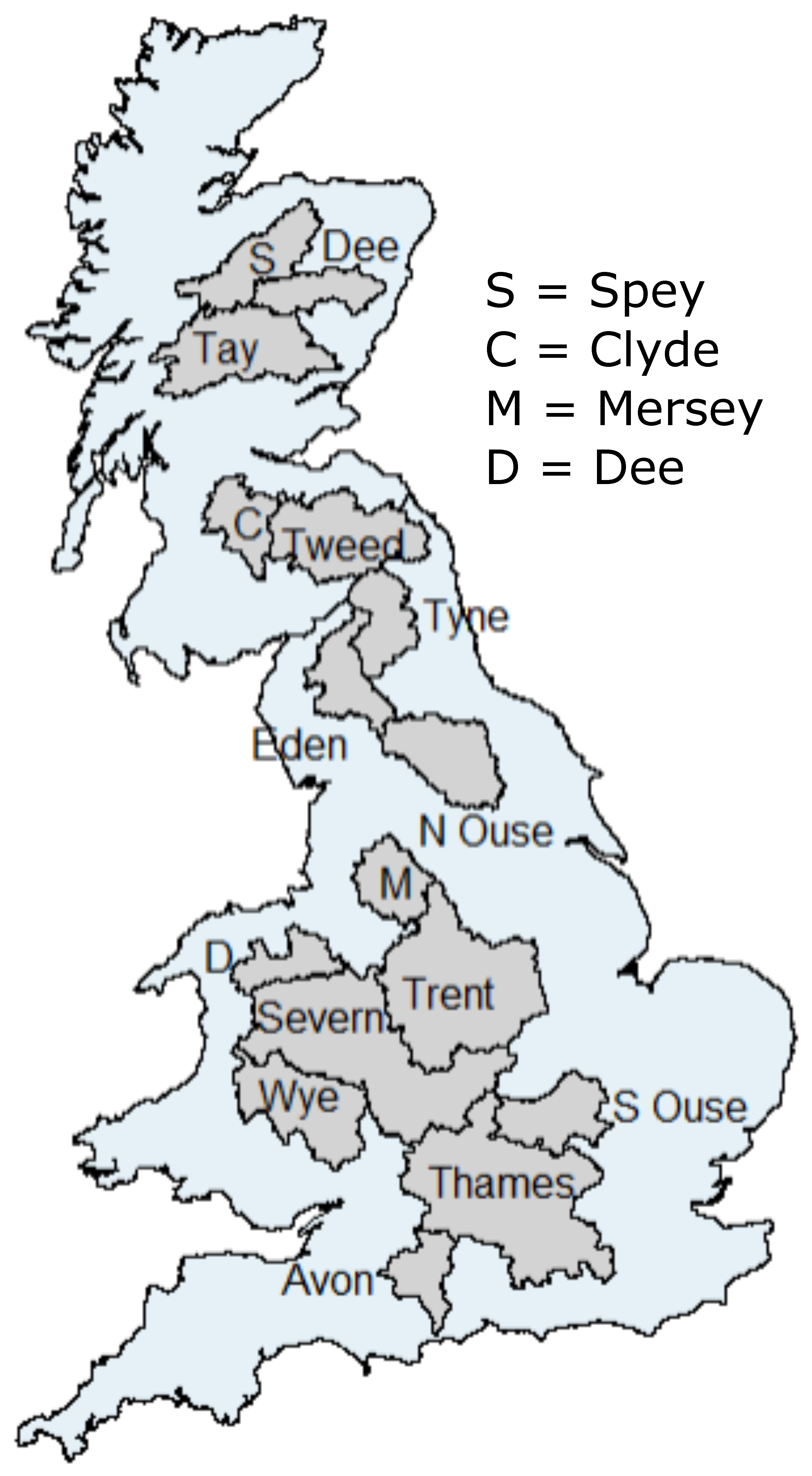
Figure 2.
Diagrams showing the working principles of the separation methods. Left: the initial regression separation method [36]. A breakpoint is found in the cumulative mean flow vector, and the best fit coefficients are calculated from the regression of the mean precipitation and temperature against the flow up to the breakpoint (here year 14). The coefficients are then used to calculate the hypothetical flow if the breakpoint had not in fact occurred (red points). The climate change attribution proportion can then be calculated between the mean value of the red points and the mean value of the subset of the grey points which have the same year values as the red points. Right: the extended regression separation method treats every year except the first and last three as breakpoints and carries out a regression using every combination percentile of 101 precipitation and 101 temperature percentiles. The mean of each projection is then used against the mean of the true flow again, to generate the climate change attribution proportion histogram - for clarity only two regression point sets are shown here, whereas in fact there is a maximal (101 x 101 =10201) number of regressions and hence elements in the histogram. The red points represent a forward projection from year 14, whereas the blue points are projections forward from year 15, where the grey point is higher in the y direction than is the year 14 point. This generates a blue set higher up than the red set.
Figure 2.
Diagrams showing the working principles of the separation methods. Left: the initial regression separation method [36]. A breakpoint is found in the cumulative mean flow vector, and the best fit coefficients are calculated from the regression of the mean precipitation and temperature against the flow up to the breakpoint (here year 14). The coefficients are then used to calculate the hypothetical flow if the breakpoint had not in fact occurred (red points). The climate change attribution proportion can then be calculated between the mean value of the red points and the mean value of the subset of the grey points which have the same year values as the red points. Right: the extended regression separation method treats every year except the first and last three as breakpoints and carries out a regression using every combination percentile of 101 precipitation and 101 temperature percentiles. The mean of each projection is then used against the mean of the true flow again, to generate the climate change attribution proportion histogram - for clarity only two regression point sets are shown here, whereas in fact there is a maximal (101 x 101 =10201) number of regressions and hence elements in the histogram. The red points represent a forward projection from year 14, whereas the blue points are projections forward from year 15, where the grey point is higher in the y direction than is the year 14 point. This generates a blue set higher up than the red set.
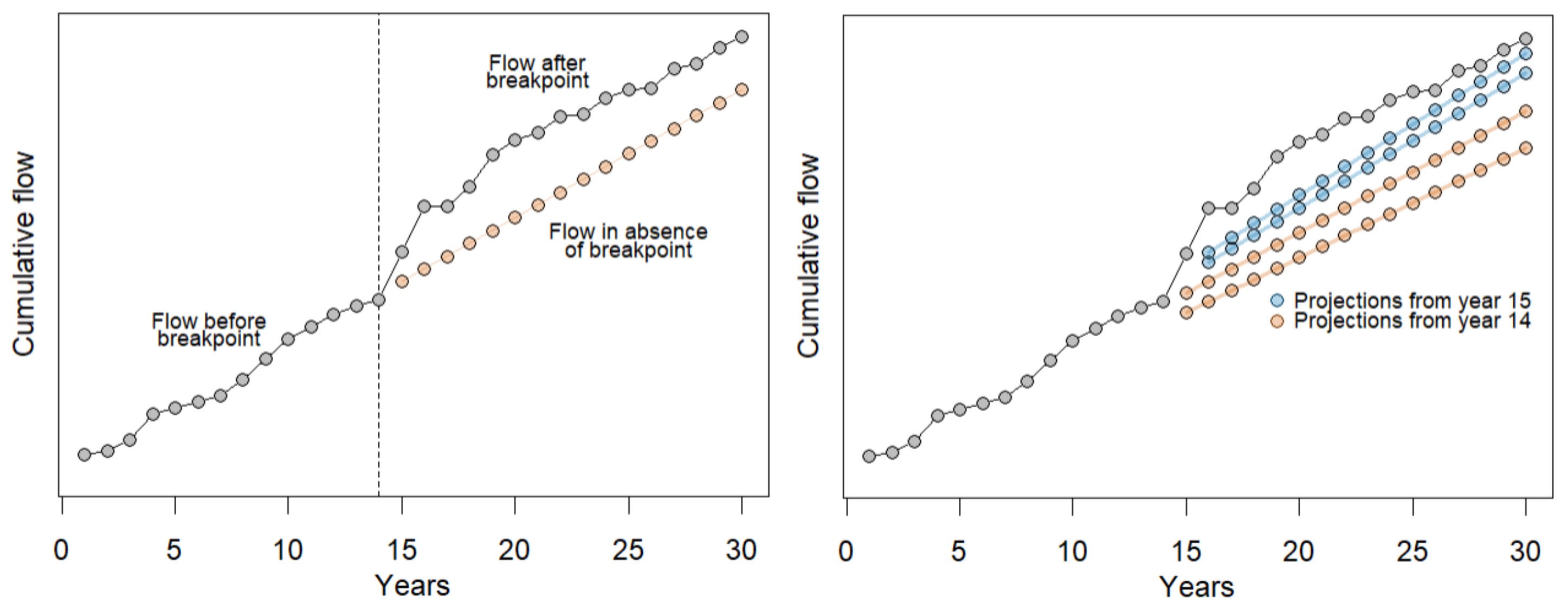
Figure 3.
Upper All sub-catchments of the Tay system overlain. Lower Successive subsuming of nested sub-catchments with the corresponding plots of climate change/land use change moments.
Figure 3.
Upper All sub-catchments of the Tay system overlain. Lower Successive subsuming of nested sub-catchments with the corresponding plots of climate change/land use change moments.
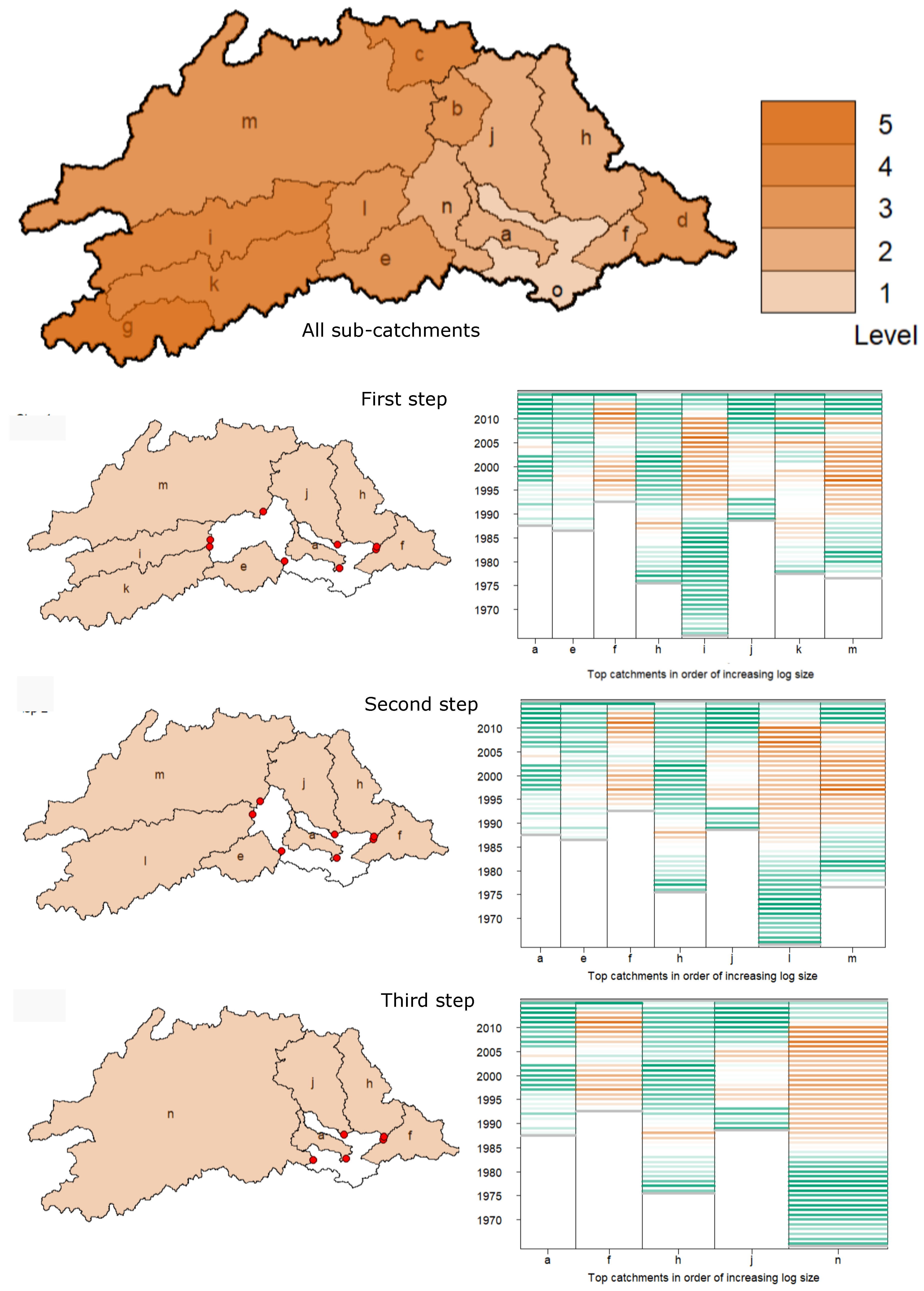
Figure 4.
Upper left: The positions of Daldowie and the small Tilley Bridge catchments within GB. Upper right The climate change attribution proportion distributions for 2007 for the Q05 metrics for Daldowie and Tilley Bridge Lower left The Q05 time columns for Daldowie and Tilley Bridge. Lower right upper: the standardised Q05 flows for Daldowie (upper flow) and Tilley Bridge (lower flow) The vectors are green when land use change was dominant and red when climate change was dominant. Lower right lower: the standardised cumulative Q05 flows for the two catchments; the flows are not proxies for the climate change attribution vectors.
Figure 4.
Upper left: The positions of Daldowie and the small Tilley Bridge catchments within GB. Upper right The climate change attribution proportion distributions for 2007 for the Q05 metrics for Daldowie and Tilley Bridge Lower left The Q05 time columns for Daldowie and Tilley Bridge. Lower right upper: the standardised Q05 flows for Daldowie (upper flow) and Tilley Bridge (lower flow) The vectors are green when land use change was dominant and red when climate change was dominant. Lower right lower: the standardised cumulative Q05 flows for the two catchments; the flows are not proxies for the climate change attribution vectors.
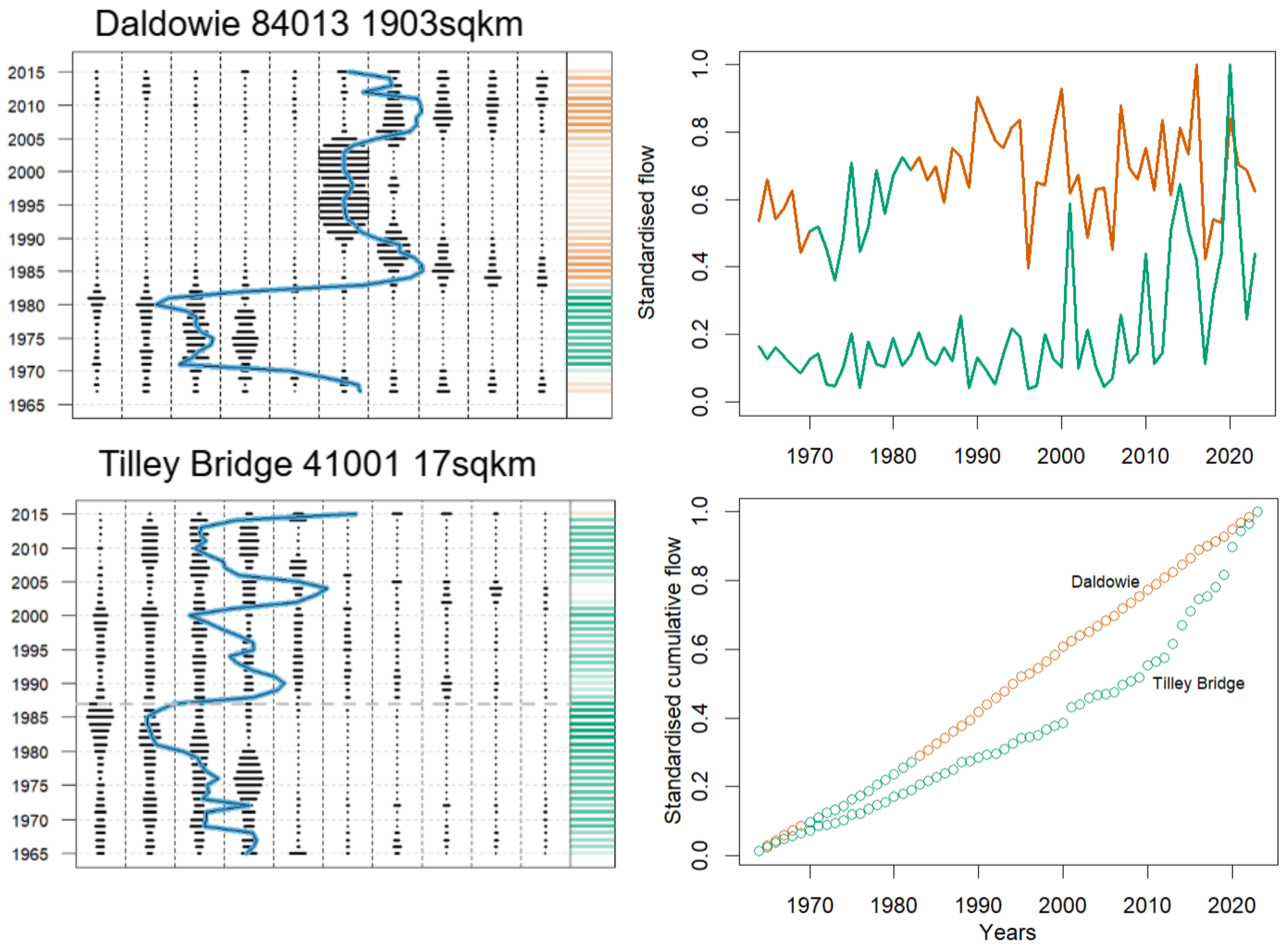
Figure 5.
Q05 time columns for the largest 16 GB systems with adequate data. The corresponding map for Q95 is given in the supplementary material.
Figure 5.
Q05 time columns for the largest 16 GB systems with adequate data. The corresponding map for Q95 is given in the supplementary material.
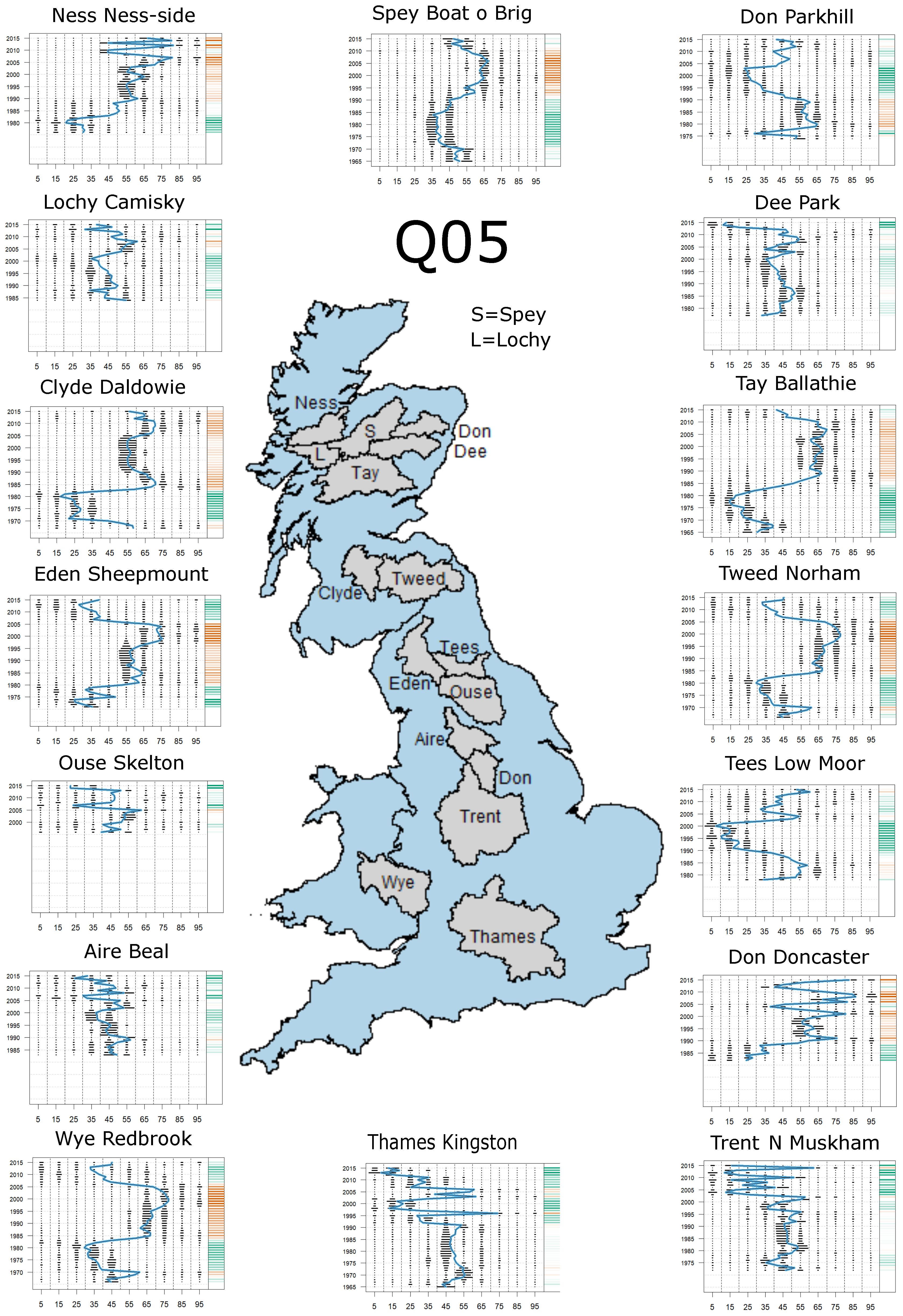
Figure 6.
Upper The 44 largest maximal non-nested child catchments across all parent catchments in GB Lower The 52 next largest maximal non-nested child catchments across all parents in GB. The total area occupied by these 52 sub-catchments is equal to the area occupied by the 44 sub-catchments in the top plot.
Figure 6.
Upper The 44 largest maximal non-nested child catchments across all parent catchments in GB Lower The 52 next largest maximal non-nested child catchments across all parents in GB. The total area occupied by these 52 sub-catchments is equal to the area occupied by the 44 sub-catchments in the top plot.
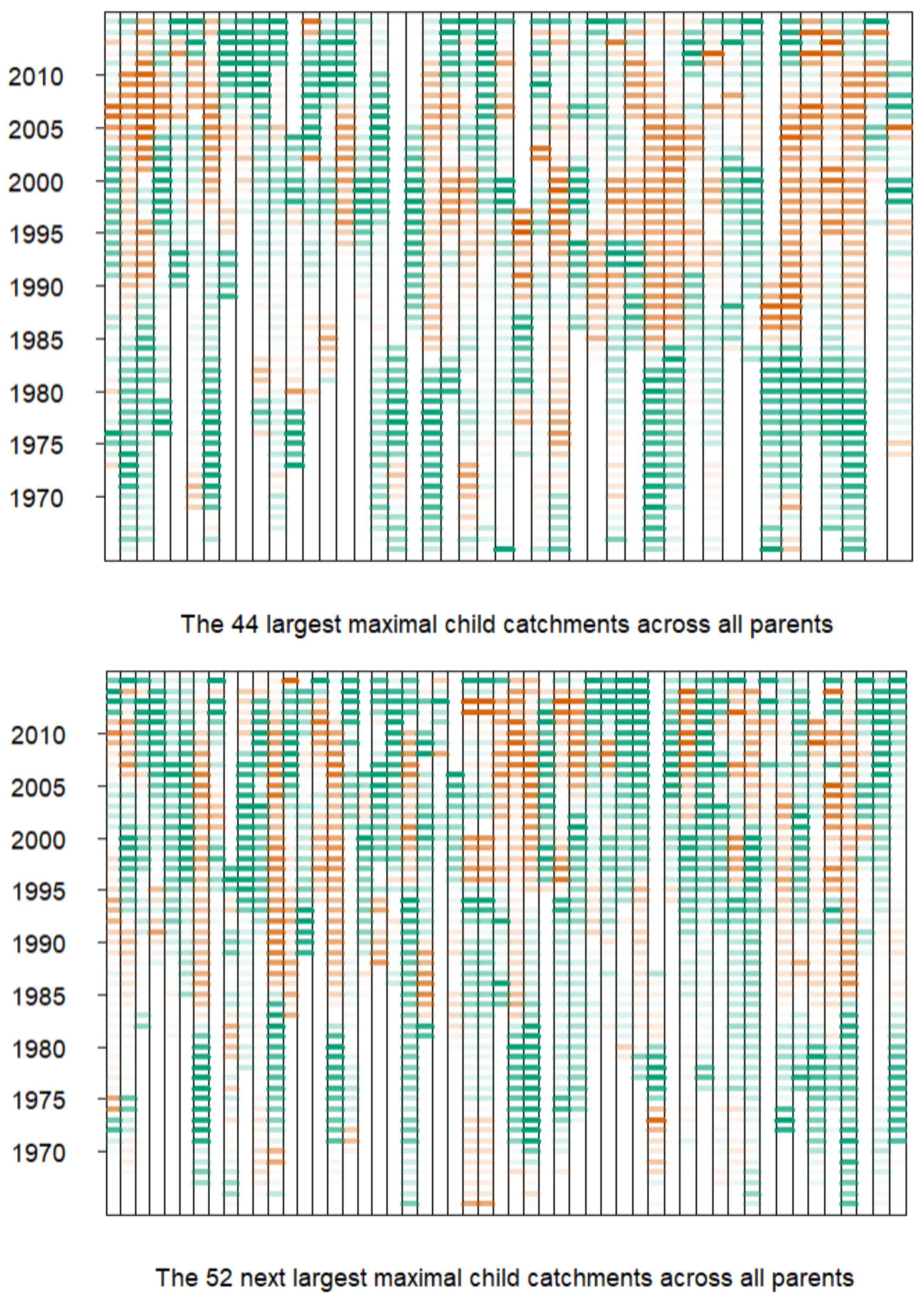
Figure 7.
The Q05 regression slopes of some non-nested sub-catchments.
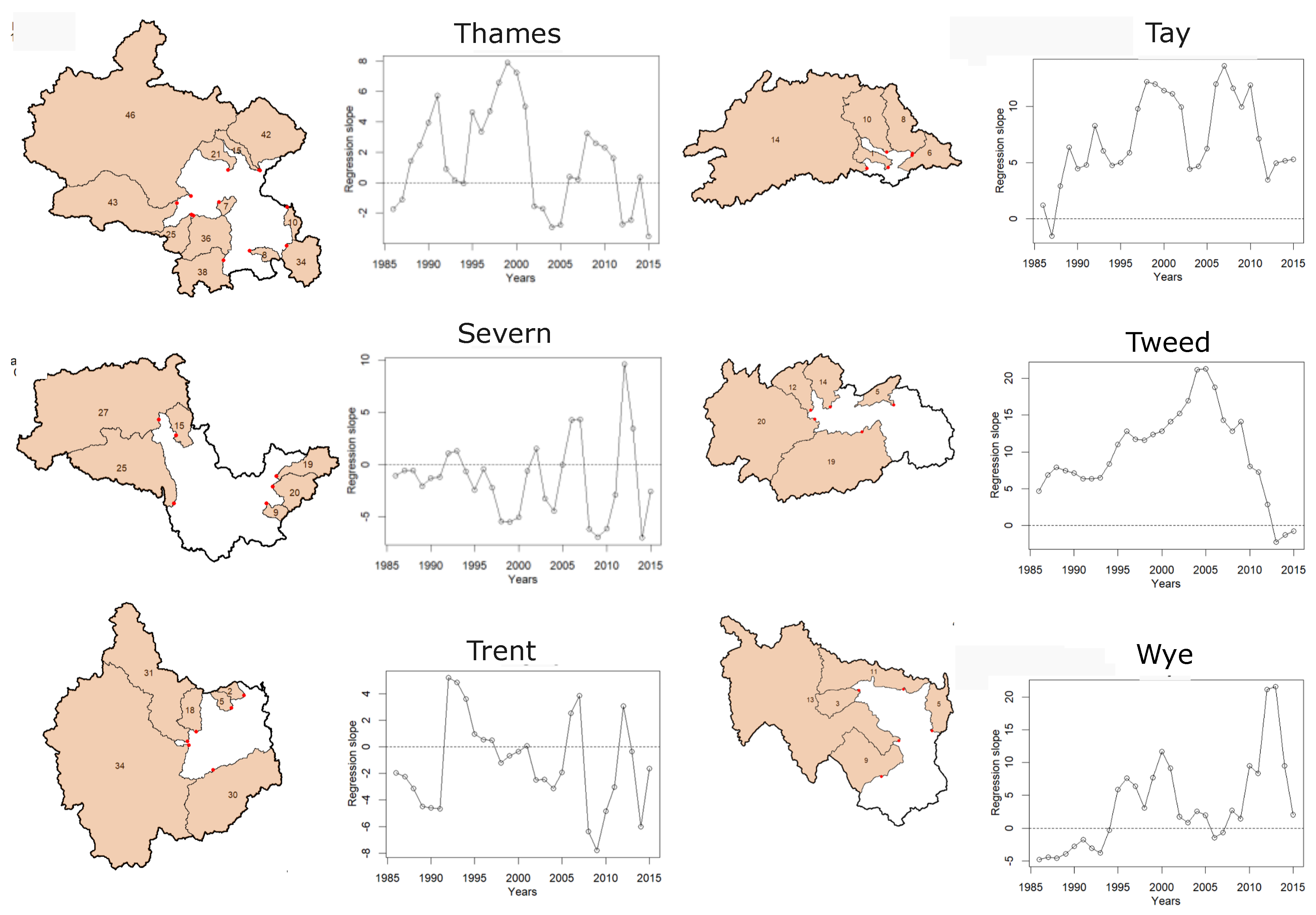
Figure 8.
A division of GB into two zones, where the mean slopes of the climate change attribution proportion against log area are statistically significantly different. The coordinates of the upper line point are (4.6,1) and those of the lower (2.7,0).
Figure 8.
A division of GB into two zones, where the mean slopes of the climate change attribution proportion against log area are statistically significantly different. The coordinates of the upper line point are (4.6,1) and those of the lower (2.7,0).
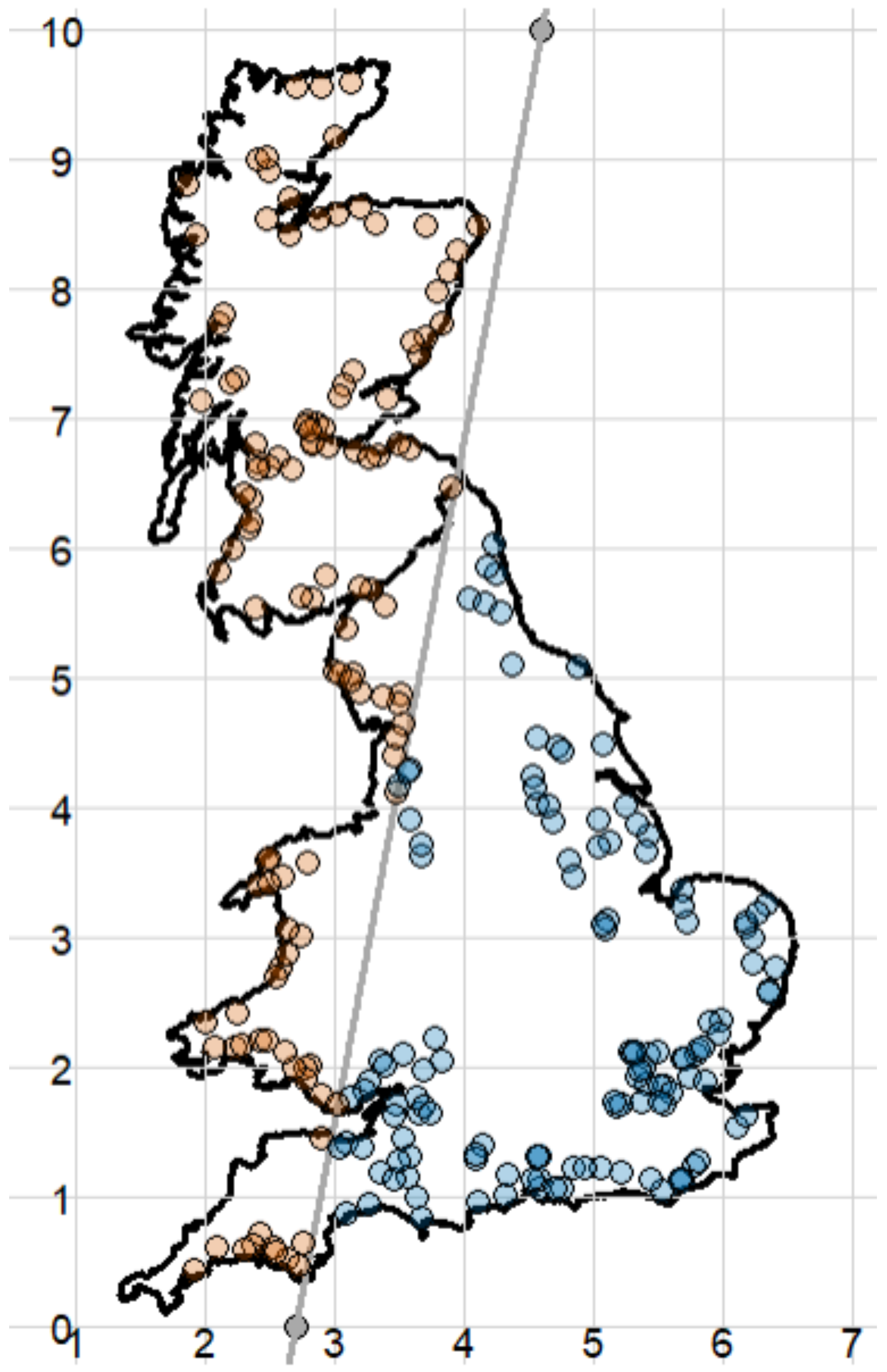
Figure 9.
Regression lines (in red) for the year 1993 for (upper) the “western” parent catchments and (lower) the “eastern” parent catchments.
Figure 9.
Regression lines (in red) for the year 1993 for (upper) the “western” parent catchments and (lower) the “eastern” parent catchments.
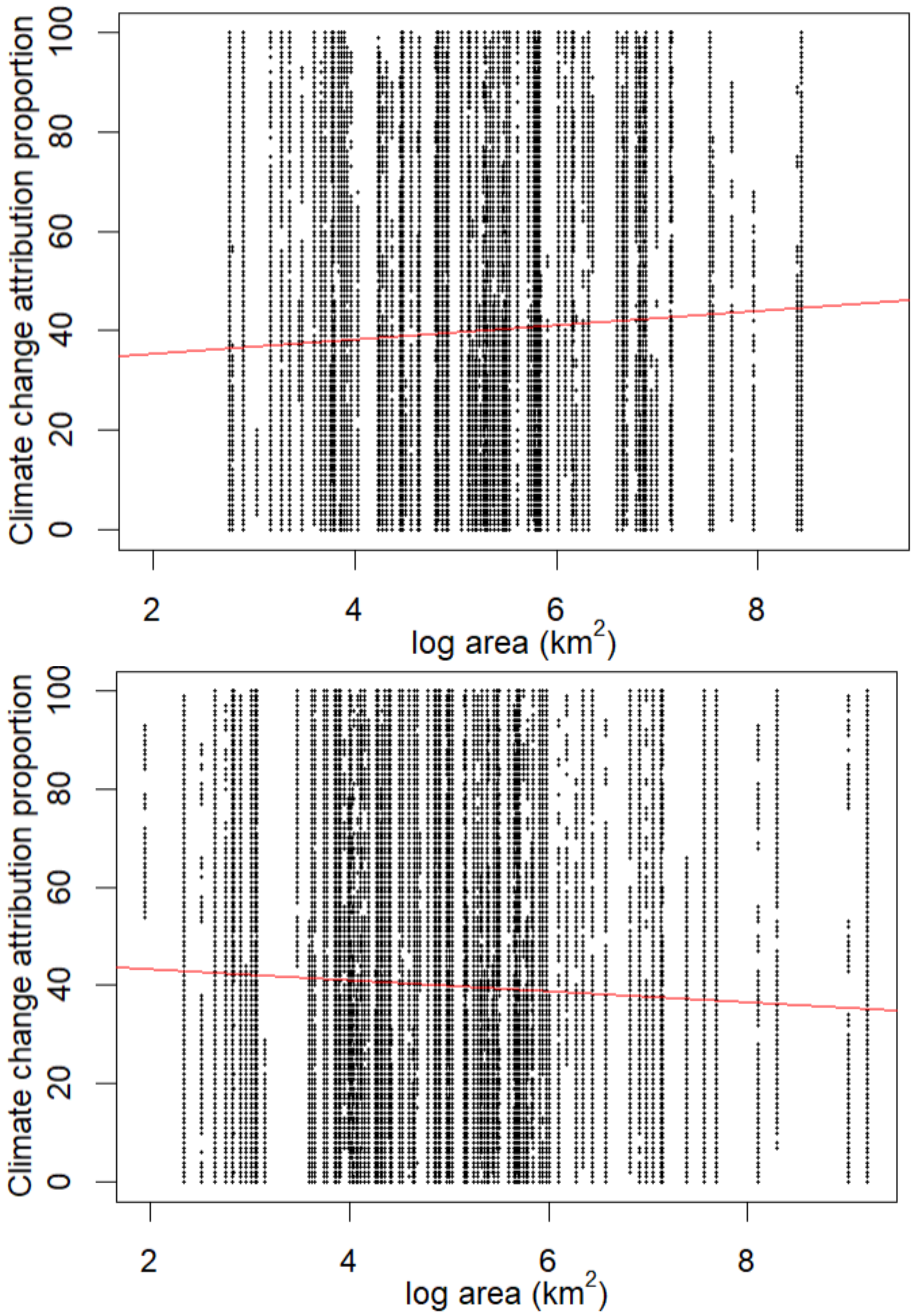
Figure 10.
Climate change/land use change vectors for the maximal non-nested children catchments for the 16 largest parent catchments across GB with adequate data.
Figure 10.
Climate change/land use change vectors for the maximal non-nested children catchments for the 16 largest parent catchments across GB with adequate data.
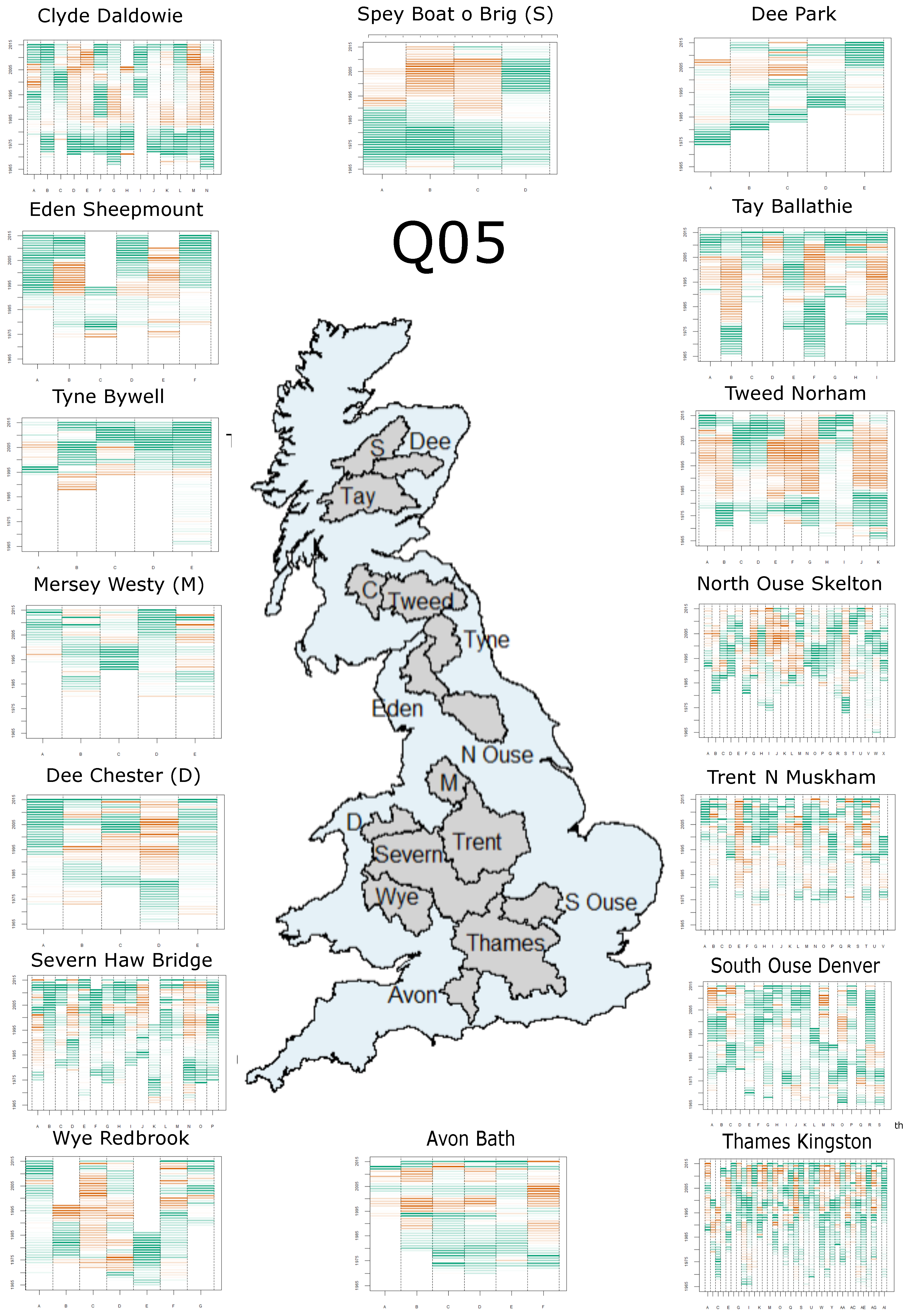
Figure 11.
Upper The moment vectors for the maximal non-nested sub-catchments in each of the six largest parent catchments across GB Lower The 57 largest maximal non-nested sub-catchments across the sixteenth to seventh largest parent catchments in GB. The total catchment area covered in the upper plot is equal to the total catchment area covered in the lower plot. A plot of the moment vectors for the catchment considered as a whole for the 16 largest parent catchments is given in the supplementary materials.
Figure 11.
Upper The moment vectors for the maximal non-nested sub-catchments in each of the six largest parent catchments across GB Lower The 57 largest maximal non-nested sub-catchments across the sixteenth to seventh largest parent catchments in GB. The total catchment area covered in the upper plot is equal to the total catchment area covered in the lower plot. A plot of the moment vectors for the catchment considered as a whole for the 16 largest parent catchments is given in the supplementary materials.
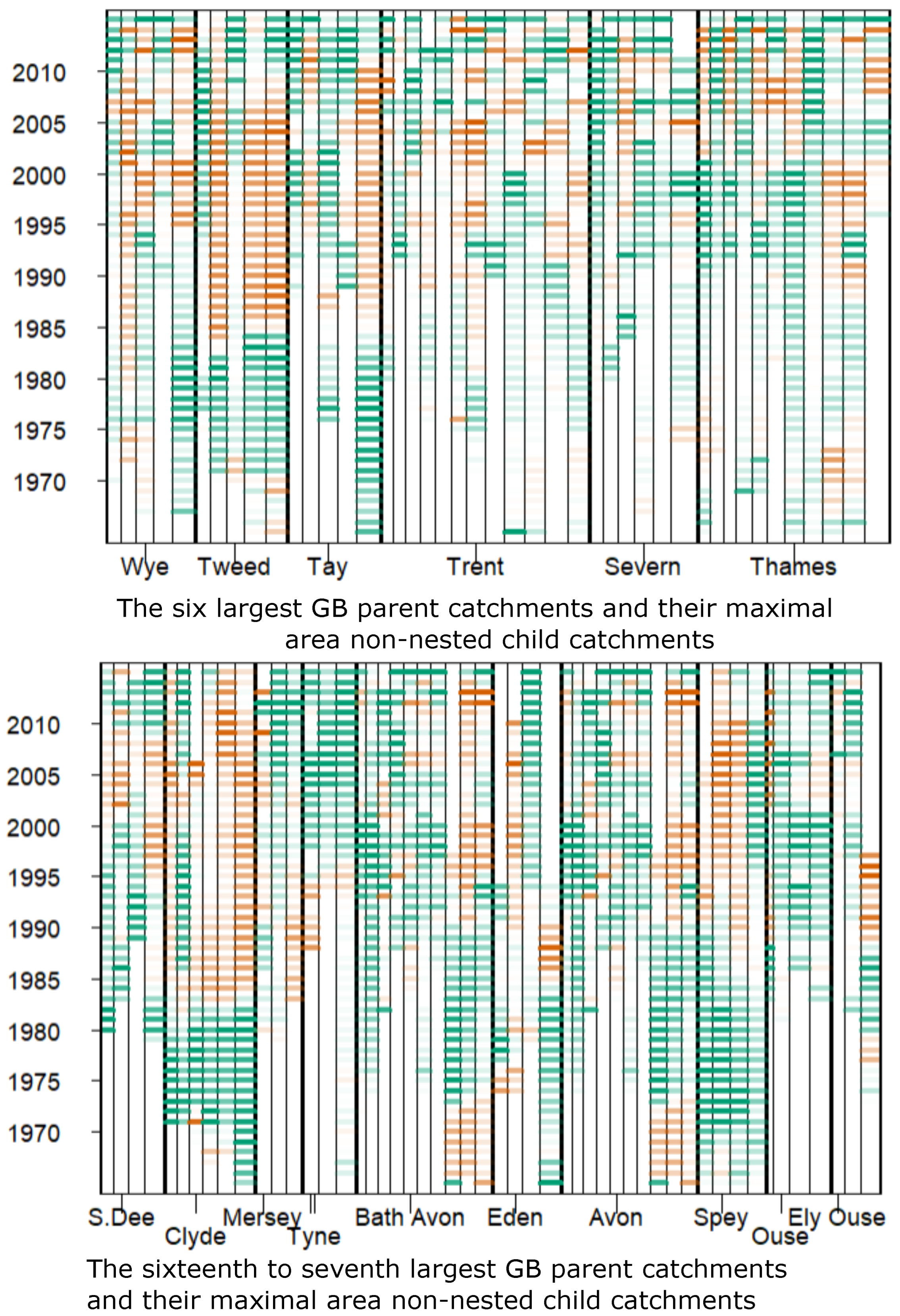
Figure 12.
Variability interval width across Q05 for GB parent catchments - for example, if the lowest climate change attribution proportion median for a catchment were 20% and the highest 60%, the gap shown in the figure would be shaded as 40.
Figure 12.
Variability interval width across Q05 for GB parent catchments - for example, if the lowest climate change attribution proportion median for a catchment were 20% and the highest 60%, the gap shown in the figure would be shaded as 40.
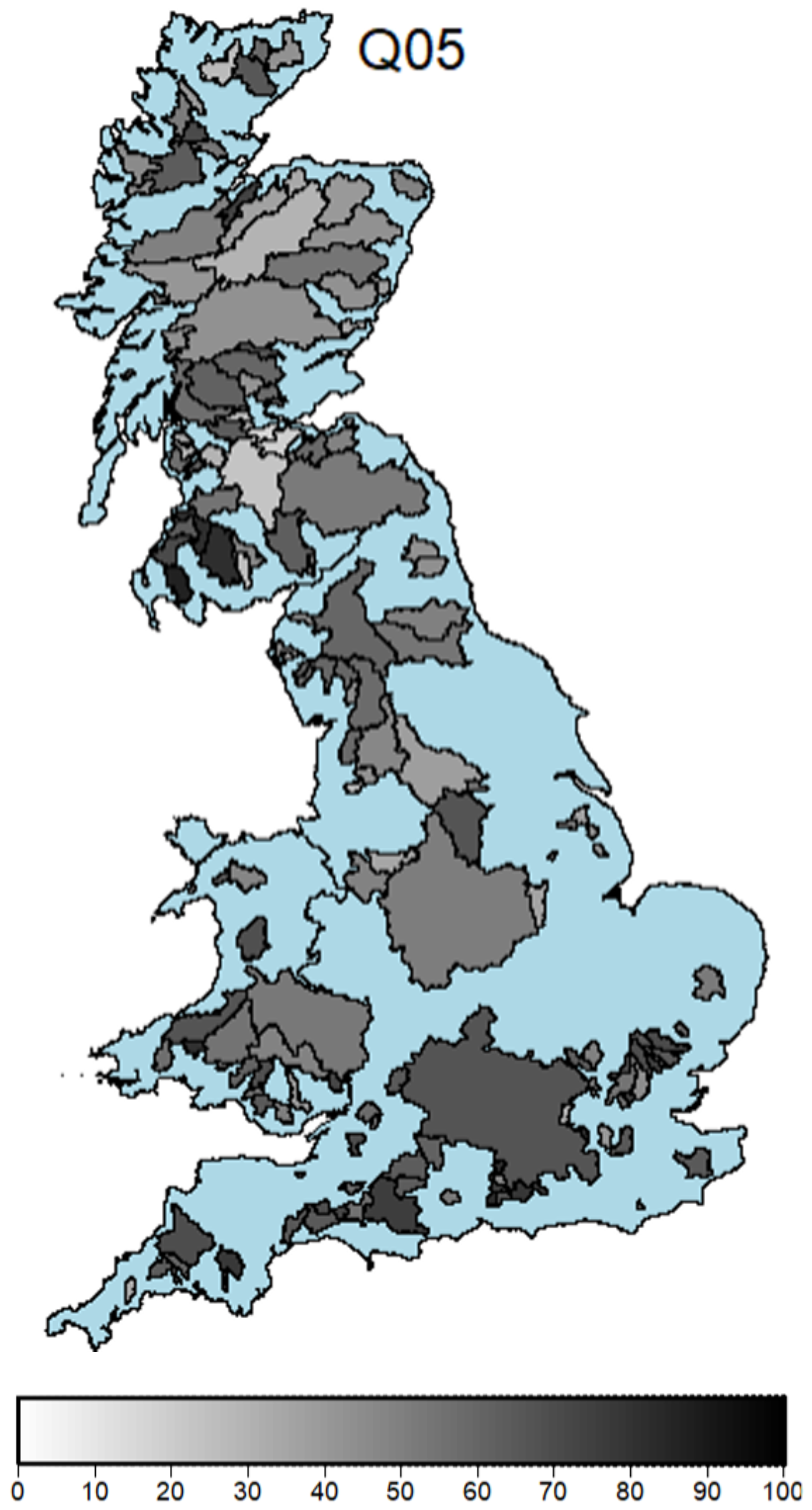

Table 1.
River monitoring stations and catchment areas.
| Code | River | Station | ID | Area in km2 |
| a | Lunan Burn | Mill Bank | 15021 | 94 |
| b | Ardle | Kindrogan | 15014 | 103 |
| c | Tilt | Marble Lodge | 15039 | 165 |
| d | Dean Water | Cookston | 15008 | 177.1 |
| e | Braan | Hermitage | 15023 | 210 |
| f | Dean Water | Dean Bridge | 15030 | 230 |
| g | Dochart | Killin | 15024 | 239 |
| h | Isla | Wester Cardney | 15010 | 366.5 |
| i | Lyon | Comrie Bridge | 15011 | 391.1 |
| j | Ericht | Craighall | 15025 | 432 |
| l | Tay | Kenmore | 15016 | 600.9 |
| m | Tay | Pitnacree | 15007 | 1149.4 |
| n | Tummel | Pitlochry | 15012 | 1670 |
| o | Tay | Caputh | 15003 | 3210 |
| p | Tay | Ballathie | 15006 | 4587.1 |
Table 2.
West and East mean slope values by year.
 |
|---|
Disclaimer/Publisher’s Note: The statements, opinions and data contained in all publications are solely those of the individual author(s) and contributor(s) and not of MDPI and/or the editor(s). MDPI and/or the editor(s) disclaim responsibility for any injury to people or property resulting from any ideas, methods, instructions or products referred to in the content. |
© 2026 by the authors. Licensee MDPI, Basel, Switzerland. This article is an open access article distributed under the terms and conditions of the Creative Commons Attribution (CC BY) license (http://creativecommons.org/licenses/by/4.0/).
Copyright: This open access article is published under a Creative Commons CC BY 4.0 license, which permit the free download, distribution, and reuse, provided that the author and preprint are cited in any reuse.


