

Submitted:
20 June 2026
Posted:
22 June 2026
You are already at the latest version
Abstract
The Haber-Bosch process dominates industrial ammonia synthesis but incurs massive energy consumption and carbon emissions. Here, we demonstrate a catalyst-free approach for direct ammonia synthesis from atmospheric nitrogen and water under ambient temperature and pressure, leveraging ultra-fast laser-induced plasma at the gas-liquid interface. By optimizing irradiation parameters (irradiation time, pulse energy, number of beams) and implementing a concentric laser scanning strategy, we achieved a maximum ammonia concentration of 0.624 μmol/20mL. This method bypasses the need for high temperature/pressure or catalysts, offering a sustainable path for distributed ammonia production. Our work underscores the potential of strong optical fields in activating inert molecules like N2 and H2O, with implications for decarbonizing chemical synthesis.
Keywords:
ultra-fast laser plasma
; plasma-water interaction
; water splitting
; nitrogen splitting
; ammonia production
1. Introduction
Ammonia (NH3), one of the most produced inorganic chemicals worldwide, serves as the foundation of modern agriculture and a promising carbon-free energy carrier, owing to its advantages such as high hydrogen content, low liquefaction pressure, relatively stable chemical structure, and no greenhouse gas emissions during utilization [1,2,3]. Ammonia and its derivatives are widely used in fields such as fertilizer production and fine chemicals [4,5]. Although atmospheric nitrogen (N2) accounts for 78% of the air, cleaving the exceptionally stable N≡N triple bond requires a dissociation enthalpy of 945.33 kJ mol-1, presenting a significant challenge for ammonia synthesis [6]. The century-old Haber–Bosch process remains the dominant method for ammonia production. This process relies on iron-based catalysts to facilitate the reaction between atmospheric nitrogen and hydrogen derived from fossil fuels under harsh conditions of high temperature (400-500 °C) and high pressure (150-300 atm) [7,8]. However, this energy-intensive process accounts for more than 2% of global energy consumption and 5% of worldwide natural gas usage, while emitting over 400 million metric tons of carbon dioxide annually, starkly contradicting current carbon peak and carbon neutrality goals [9,10]. Therefore, it is imperative to develop novel green ammonia synthesis technologies that can operate under mild conditions (ambient temperature and pressure) and be driven by renewable energy sources.
In pursuit of alternatives to the energy-intensive Haber-Bosch process, multiple pathways have been investigated [11,12]. Electrocatalytic nitrogen reduction has garnered significant interest due to its compatibility with renewable electricity and potential for higher efficiency. By applying a controlled electrochemical potential, nitrogen can be hydrogenated at lower temperatures and pressures, thereby reducing energy demands. Electrocatalytic ammonia synthesis typically employs rare metals such as Ru, Pt, Pd, Mo, Nb, Au, often combined with lithium-mediated nitrogen reduction strategies to enhance Faradaic efficiency and reaction rates [13,14,15,16,17,18,19]. Water, as a hydrogen source, offers advantages over methane or hydrogen gas in being cleaner and more abundant. Studies on hydrogen production via femtosecond-laser-induced plasma dissociation of water, along with electrochemistry involving water microdroplets in air with catalysts, suggest the feasibility of producing ammonia from atmospheric nitrogen and water [20,21,22]. The emerging laser-induced plasma synthesis of ammonia utilizes the laser bubbling in liquids (LBL) to successfully decompose N2 and H2O in water filled with N2 using high-energy nanosecond lasers (750 mJ/pulse, 10 ns), achieving an ammonia yield of up to 4.2 mmolh-1, far exceeding electrocatalytic methods [23]. However, this high-temperature thermochemical process concurrently initiates the nitrogen oxidation reaction (NOR), resulting in a mixture of NH3 and NO3-1/NO2-1, and the overall energy consumption remains high.
Over the past few decades, ultra-fast lasers have enabled highly localized material processing due to their ultrashort pulse duration and extremely high peak intensities, with applications spanning precision micromachining, laser writing, and laser-induced breakdown spectroscopy [24,25,26]. These lasers have also established ultra-fast laser-induced plasma as a pivotal tool for probing atomic and molecular energy levels and elucidating electron dynamics. In contrast to nanosecond pulses, the interaction of ultra-fast lasers with nitrogen is a nonlinear process that enables the cleavage of the robust N-N bond under ambient conditions. Crucially, the ultrashort temporal and spatial scales of this interaction are shorter than the electron-phonon coupling thermalization time, ensuring that energy deposition occurs faster than thermal diffusion. This unique characteristic prevents bulk heating of the solution and effectively suppresses competing reactions, such as the hydrogen evolution reaction and other parasitic pathways.
While research exists on plasma-water interactions and plasma-assisted nitrogen fixation, the regime of ultra-fast laser-induced plasma chemistry at the gas-liquid interface remains largely unexplored. Derive the chemical mechanism of the reaction by referring to the photolysis path of water induced by femtosecond laser pulses and the activation path of nitrogen gas [22,23]. The process is fundamentally driven by the high-energy electrons and radicals within the plasma generated at the air-water interface. This unique environment enables the simultaneous cleavage of both adsorbed water molecules and nitrogen gas from the air, producing a rich mixture of radicals that react to form ammonia.
Subsequently, ammonia is synthesized through a series of free radical addition reactions.
Ammonia dissolves in water
Our work utilizes ultra-fast laser-induced plasma at the ambient air-water interface to simultaneously dissociate N2 and H2O without a catalyst, achieving catalyst-free and CO2-free ammonia production under mild conditions. We have quantified the ammonia yield under various experimental configurations. Furthermore, we propose a rapid photolytic process for simultaneous water and nitrogen dissociation to enhance ammonia production efficiency. This work bridges gaps in gas-liquid interfacial photochemistry and provides a platform for activating stable molecules (CO2, CH4) under ambient conditions.
2. Experimental Setup
The experimental setup is shown in the Figure 1. Ytterbium-doped high-energy picosecond laser system (Zimao Laser Technology, TCR-FS-1030-1.8-RGA) as the excitation source. The center wavelength of the laser is 1030 nm, the output pulse duration is 1.54 ps, and the 10dB spectral width is 2 nm, as shown in Figure 2. The repetition rate can be adjusted from 1 to 50 kHz, and the pulse energy can be adjusted to 0.68 mJ.
Laser beam split to direct 1% of its power to a photodetector for monitoring, with the remaining 99% used for reaction. The beam is expanded to 1 cm, scanned by a galvanometer (SCANLAB, hurrySCAN 20), and focused via a 254 mm lens into an open quartz cell containing 20 mL deionized water. The cell is positioned on a three-axis stage to align the focal spot at the gas–liquid interface, where plasma emission is strongest, as shown in Figure 1(b). Using programmed software, the laser scans a concentric circular path (3-30 mm diameter, 20 circles, 1.5 mm spacing) at 500 mm/s. This strategy maximizes exposure to both water and atmospheric nitrogen at the interface. All experiments were performed at room temperature and ambient pressure. Optical alignment and focus were verified before each test.
3. Results and Discussion
The first step in investigating ammonia synthesis with laser-induced plasma was to establish the relationship between the amount of ammonia generated and the irradiation time. The ammonia quantity referred to here represents the amount collected and detected in the solution. It should be noted that, as the reaction vessel was unsealed, a significant portion of ammonia produced during laser irradiation escaped into the atmosphere without being collected - this issue will be addressed in subsequent experimental improvements. The ammonia concentration was determined by the Nessler's reagent colorimetric method and quantified using a standard curve, with measurements conducted on an Agilent Cary 60 UV-Vis spectrophotometer. Figure 3 shows the variation of ammonia yield with continuous irradiation time. As the irradiation time increases, the ammonia yield gradually increases, and the ammonia yield reaches 0.107 μmol at 80 minutes. This increase in production with time indicates that localized heating effects around the plasma volume had a negligible impact on dissolved plasma-derived species in the water. The observed trend further suggests that longer irradiation durations can lead to higher cumulative ammonia yields.
Figure 4 shows the relationship between ammonia yield and laser pulse energy. At pulse energies of 0.5mJ and 0.59mJ, the ammonia yield increased from 0.061 μmol to 0.064 μmol, but the increase in ammonia yield was not significant. When the pulse energy increased to 0.68mJ, an ammonia yield of 0.107 μmol was observed, showing a non-linear growth trend. The nonlinear growth aligns with the critical intensity required for plasma ignition and N₂ bond cleavage. During the experimental exploration process, when the peak power density reached 1.26×10¹³ W/cm2, ammonia could be detected in water. Due to the limitation of the available laser system, higher pulse energies could not be tested with a single laser. However, the correlation between ammonia yield and laser energy suggests that higher pulse energy may lead to a rapid increase in yield.
To investigate the effect of the number of laser beams on the ammonia yield, a second laser (Laser 2) was introduced. The beams from both lasers were combined to act simultaneously on the same spot at the gas–liquid interface. Laser 2 operated at a wavelength of 1030 nm, with a pulse width of 1.5 ps, a repetition rate of 30 kHz, and a pulse energy of 0.6 mJ. The beam from Laser 2 was spatially matched to the size of the beam from Laser 1. The two beams were then combined incoherently using a polarizing beam splitter (PBS), expanded and collimated, and directed through the galvanometer scanner and focusing lens to converge coaxially onto the same spot.
When only Laser 1 was used at 0.6 mJ/pulse, the ammonia yield was 0.339 μmol, as shown in Figure 5. When both Laser 1 and Laser 2 were employed simultaneously, the yield increased to 0.624 μmol. Since the two lasers were not synchronized, their simultaneous operation effectively increased the number of pulses irradiating the interface, which is equivalent to raising the effective pulse repetition rate. Although the direct influence of repetition rate was not explicitly investigated in this study, this comparative experiment and the resulting enhancement in yield strongly suggest that ammonia yield can be significantly improved by increasing the laser pulse repetition frequency.
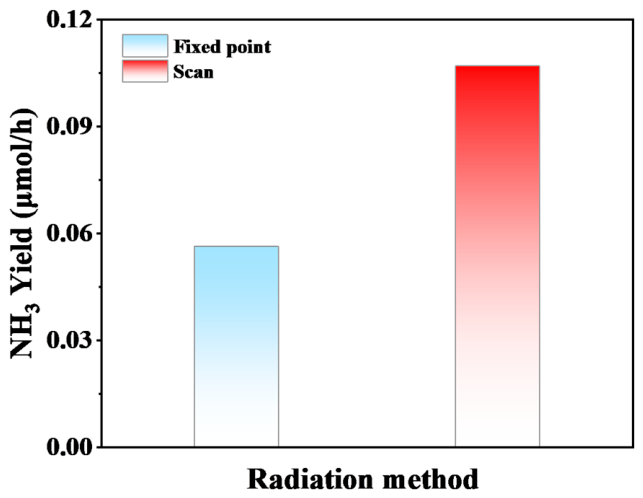
Under identical laser output parameters (Pulse width 1.5 ps, repetition rate 50 kHz, pulse energy 0.68 mJ, time 80 minutes), we compared the ammonia yields obtained using different irradiation strategies. The first strategy employed stationary irradiation, where the laser beam was focused on a single spot at the gas-liquid interface for the entire duration. The second strategy, utilized a concentric circular scanning pattern across the interface, achieved via a galvanometer scanner and focusing lens. The ammonia yield of the scanning irradiation strategy is twice that of the fixed single point irradiation method, as shown in Figure 6. In the stationary case, the initial pulse vaporizes the water and generates a dense plasma plume. This plume can absorb or scatter subsequent pulses, leading to significant energy loss. In contrast, dynamic scanning ensures each pulse interacts with a pristine interface, doubling efficiency compared to static exposure. Furthermore, this method prevents the localized heat accumulation caused by continuous energy deposition at a single spot, which can otherwise accelerate the volatilization of produced ammonia.
4. Conclusions and Outlook
Our scanning irradiation approach mitigates the drawbacks associated with single-point exposure. Using this method, we systematically investigated the correlations between ammonia yield and key parameters—including irradiation time, pulse energy, and the number of beams—and quantified the ammonia collected in solution. The results presented in this study establish laser-induced plasma as a viable, catalyst-free pathway for synthesizing ammonia from just air and water under ambient conditions. This simple, environmentally benign, and operational straightforward method opens a new avenue for sustainable chemical synthesis.
It is worth noting that we are only at the beginning of the road, several aspects warrant further investigation, including the detailed reaction mechanism, control of by-products beyond ammonia, and the overall energy efficiency. Future work will focus on optimizing the experimental setup to minimize ammonia volatilization and implementing precise laser control to favor nitrogen reduction pathways. This study lays the groundwork for a deeper understanding of the chemistry within this unique plasma environment.
The potential of this technology is considerable. It offers a route toward distributed fertilizer production and a means for storing renewable energy in the form of a carbon-free fuel. More broadly, this approach provides a blueprint for activating other stable small molecules and is poised to stimulate broad, interdisciplinary interest across physical chemistry, optics, and energy science.
Author Contributions
X. H. was responsible for methodology, measurements, analyzed the data, and wrote the manuscript. Y. P. and Y. W. provided the software. L. X. and Y. L. contributed to review and editing X. C. supervised the project, and contributed to data interpretation and writing the manuscript.
Data Availability Statement
The raw data supporting the conclusions of this article will be made available by the authors on request.
Acknowledgments
We are profoundly grateful to Chen Xiangyu and Wang Mingming for their invaluable insights regarding the experimental details. Our sincere appreciation also extends to Zimao Laser Technology for their generous provision of the essential laser equipment on a complimentary basis. Furthermore, we wish to acknowledge Li Zhishan from Foshan Xianhu Laboratory for his expert measurements and constructive recommendations throughout this study.
Conflicts of Interest
The authors declare no conflicts of interest.
References
- Cesaro, Z.; Ives, M.; Nayak-Luke, R.; Mason, M.; Bañares-Alcántara, R. Ammonia to power: Forecasting the levelized cost of electricity from green ammonia in large-scale power plants. Appl. Energy 2021, 282, 116009. [Google Scholar] [CrossRef]
- Fasihi, M.; Weiss, R.; Savolainen, J.; Breyer, C. Global potential of green ammonia based on hybrid PV-wind power plants. Appl. Energy 2021, 294, 116170. [Google Scholar] [CrossRef]
- Li, D.; Liu, J.; Wang, S.; Cheng, J. Study on coal water slurries prepared from coal chemical wastewater and their industrial application. Appl. Energy 2020, 268, 114976. [Google Scholar] [CrossRef]
- Lim, J.; Fernández, C. A.; Lee, S. W.; Hatzell, M. C. Ammonia and Nitric Acid Demands for Fertilizer Use in 2050. ACS Energy Lett. 2021, 6, 3676–3685. [Google Scholar] [CrossRef]
- Yapicioglu, A.; Dincer, I. A review on clean ammonia as a potential fuel for power generators. Renew. Sustain. Energy Rev. 2019, 103, 96–108. [Google Scholar] [CrossRef]
- Klopsch, I.; Yuzik-Klimova, E. Y.; Schneider, S. Functionalization of N2 by Mid to Late Transition Metals via N–N Bond Cleavage. Top. Organomet. Chem. 2017, 60, 71–112. [Google Scholar] [CrossRef]
- Humphreys, J.; Lan, R.; Tao, S. W. Development and Recent Progress on Ammonia Synthesis Catalysts for Haber–Bosch Process. Adv. Energy Sustain. Res. 2020, 2, 2000043. [Google Scholar] [CrossRef]
- Martín, A. J.; Shinagawa, T.; Pérez-Ramírez, J. Electrocatalytic Reduction of Nitrogen: From Haber-Bosch to Ammonia Artificial Leaf. Chem 2019, 5, 263–283. [Google Scholar] [CrossRef]
- Valera-Medina, A.; Xiao, H.; Owen-Jones, M.; David, W. I. F.; Bowen, P. J. Ammonia for power. Prog. Energy Combust. Sci. 2018, 69, 63–102. [Google Scholar] [CrossRef]
- Elbaz, A. M.; Wang, S.; Guiberti, T. F.; Roberts, W. L. Review on the recent advances on ammonia combustion from the fundamentals to the applications. Fuel Commun. 2022, 10, 100053. [Google Scholar] [CrossRef]
- Lan, R.; Tao, S. W. Electrochemical synthesis of ammonia directly from air and water using a Li+/H+/NH4+ mixed conducting electrolyte. RSC Adv. 2013, 3, 18016–18021. [Google Scholar]
- McEnaney, J. M.; Singh, A. R.; Schwalbe, J. A.; Kibsgaard, J.; Lin, J. C.; Cargnello, M.; Jaramillo, T. F.; Norskov, J. K. Ammonia synthesis from N2 and H2O using a lithium cycling electrification strategy at atmospheric pressure. Energy Environ. Sci. 2017, 10, 1621–1630. [Google Scholar]
- Kyriakou, V.; Garagounis, I.; Vasileiou, E.; Vourros, A.; Stoukides, M. Progress in the Electrochemical Synthesis of Ammonia. Catal. Today 2017, 286, 2–13. [Google Scholar] [CrossRef]
- Medford, A. J.; Hatzell, M. C. Photon-Driven Nitrogen Fixation: Current Progress, Thermodynamic Considerations, and Future Outlook. ACS Catal. 2017, 7, 2624–2643. [Google Scholar] [CrossRef]
- Kim, H.-H.; Teramoto, Y.; Ogata, A.; Takagi, H.; Nanba, T. Plasma Catalysis for Environmental Treatment and Energy Applications. Plasma Chem. Plasma Process. 2016, 36, 45–72. [Google Scholar]
- Kim, H.-H.; Teramoto, Y.; Ogata, A.; Takagi, H.; Nanba, T. Atmospheric-pressure nonthermal plasma synthesis of ammonia over ruthenium catalysts. Plasma Process. Polym. 2017, 14, 1600157. [Google Scholar]
- Rouwenhorst, K. H. R.; Lefferts, L. Feasibility Study of Plasma-Catalytic Ammonia Synthesis for Energy Storage Applications. Catalysts 2020, 10, 999. [Google Scholar] [CrossRef]
- Cao, W. W.; Li, Y. W.; Yan, B.; Zeng, Z. P.; Liu, P.; Li, R.; Jiang, J. X.; Ke, Z. F.; Yang, G. W. Catalyst-Free Activation and Fixation of Nitrogen by Laser-Induced Conversion. J. Am. Chem. Soc. 2024, 146, 14765–14775. [Google Scholar] [CrossRef] [PubMed]
- Fu, X. B.; Pedersent, J. B.; Zhou, Y. Y.; Saccoccio, M.; Li, S. F.; Li, R. S.; Z. Andersen, S. Z.; Xu, A.; Deissler, N. H.; Mygind, J. B. V.; et al. Continuous-flow electrosynthesis of ammonia by nitrogen reduction and hydrogen oxidation. Science 2023, 379, 707–712. [Google Scholar] [CrossRef] [PubMed]
- Lin, S. Q.; Xiangyu Chen, X. Y.; Wang, Z. L. Contact electrification at the liquid-solid interface. Chem. Rev. 2022, 122, 5209–5232. [Google Scholar] [PubMed]
- Galembeck, F.; Santos, L. P.; Burgo, T. A. L.; Galembeck, A. The emerging chemistry of self-electrified water interfaces. Chem. Soc. Rev. 2024, 53, 2578–2602. [Google Scholar] [CrossRef] [PubMed]
- Kierzkowska-Pawlak, H.; Tyczkowski, J.; Jarota, A.; Abramczyk, H. Hydrogen production in liquid water by femtosecond laser-induced plasma. Appl. Energy 2019, 247, 24–31. [Google Scholar] [CrossRef]
- Cao, W. W.; Li, Y. W.; Yan, B.; Zeng, Z. P.; Liu, P.; Li, R.; Jiang, J. X.; Ke, Z. F.; Yang, G. W. Catalyst-Free Activation and Fixation of Nitrogen by Laser-Induced Conversion. J. Am. Chem. Soc. 2024, 146, 14765–14775. [Google Scholar] [CrossRef] [PubMed]
- Sugioka, K.; Meunier, M.; Piqué, A. Laser precision microfabrication. Springer Ser. Mater. Sci. 2010, 135. [Google Scholar]
- Fernandez, T. T.; Siegel, J.; Hoyo, J.; Sotillo, B.; Fernandez, P.; Solis, J. Controlling plasma distributions as driving forces for ion migration during fs laser writing. J. Phys. D. Appl. Phys. 2015, 48, 155101. [Google Scholar] [CrossRef]
- Patnaik, A. K.; Adamovich, I.; Gord, J. R.; Roy, S. Recent advances in ultrafast-laser-based spectroscopy and imaging for reacting plasmas and flames. Plasma Sources Sci. Technol. 2017, 26, 103001. [Google Scholar]
Figure 1.
Experimental setup diagram. (a) Schematic diagram of the device for ultra-fast laser acting on gas-liquid interface. (b) Schematic diagram of the distribution of molecules, ions and free radicals at the gas-liquid interface under plasma action.
Figure 1.
Experimental setup diagram. (a) Schematic diagram of the device for ultra-fast laser acting on gas-liquid interface. (b) Schematic diagram of the distribution of molecules, ions and free radicals at the gas-liquid interface under plasma action.
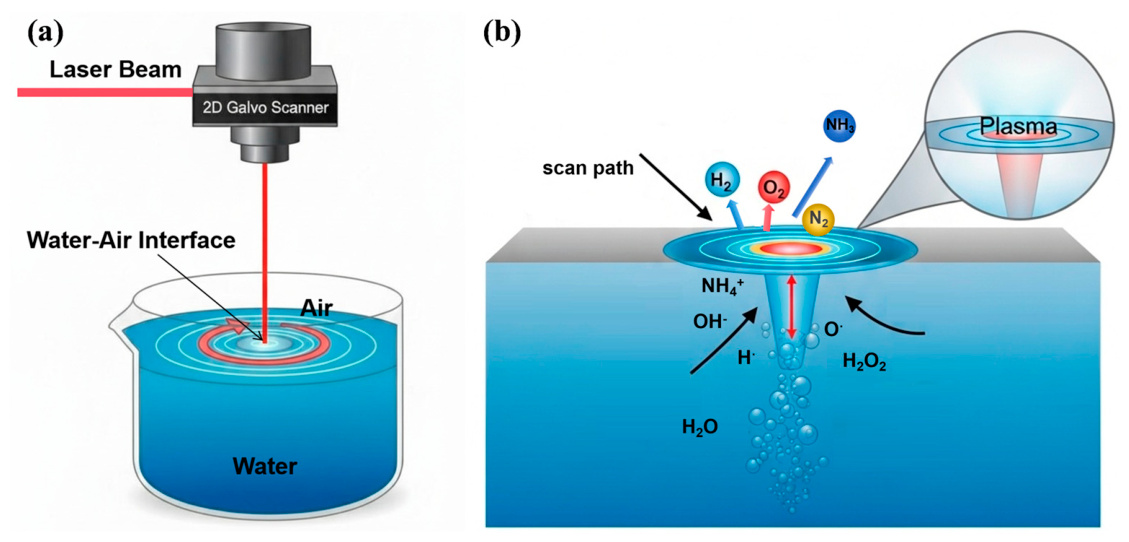
Figure 2.
Laser output parameters. (a) Compressed pulse spectrum. (b) Corresponding autocorrelation traces.
Figure 2.
Laser output parameters. (a) Compressed pulse spectrum. (b) Corresponding autocorrelation traces.
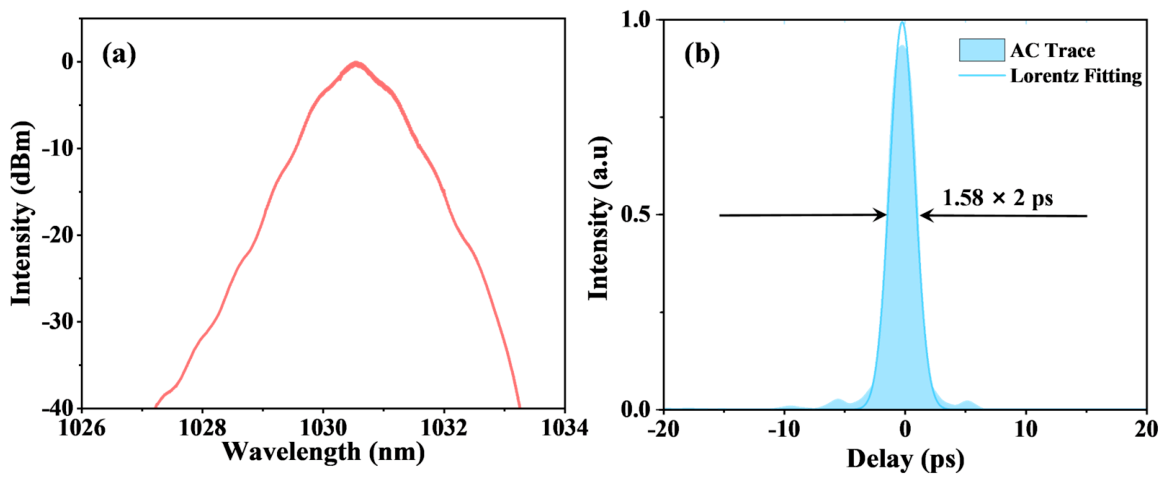
Figure 3.
The relationship between ammonia yield and irradiation time.
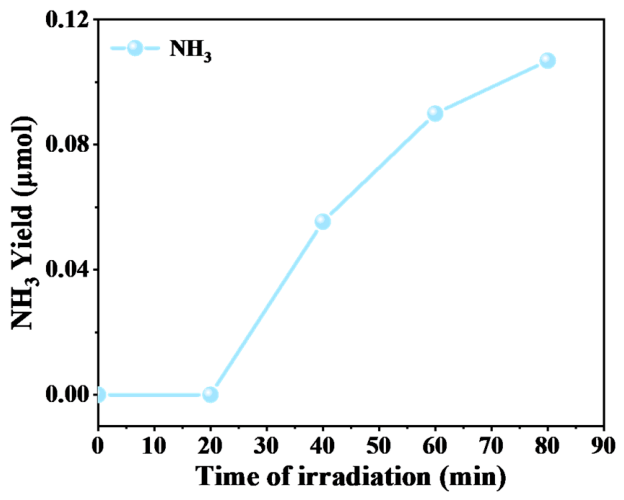
Figure 4.
Relationship between ammonia yield and pulse energy.
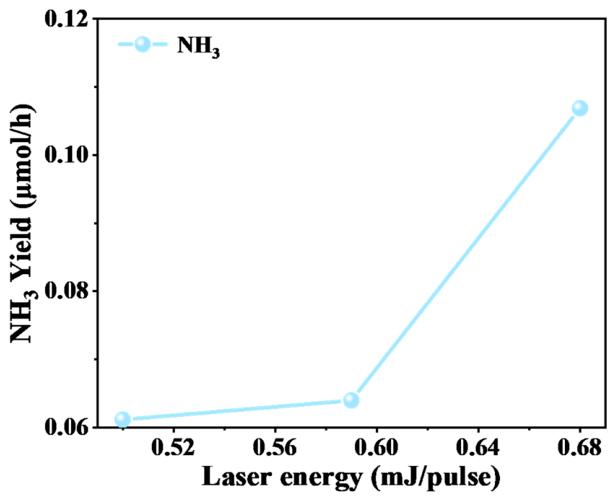
Figure 5.
The relationship between ammonia yield and the number of light beams.
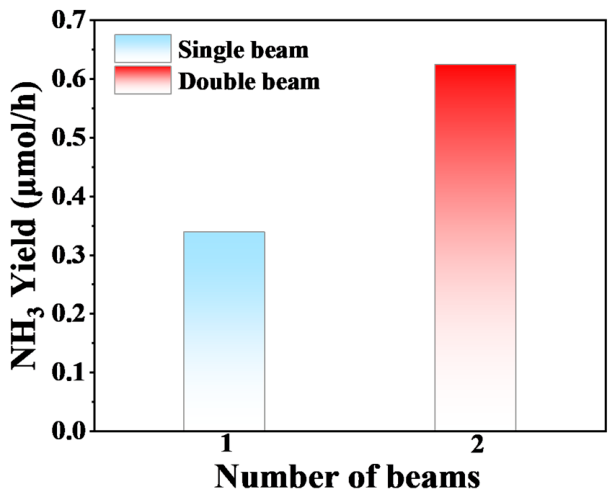
Figure 6.
Relationship between ammonia yield and irradiation mode.
Disclaimer/Publisher’s Note: The statements, opinions and data contained in all publications are solely those of the individual author(s) and contributor(s) and not of MDPI and/or the editor(s). MDPI and/or the editor(s) disclaim responsibility for any injury to people or property resulting from any ideas, methods, instructions or products referred to in the content. |
© 2026 by the authors. Licensee MDPI, Basel, Switzerland. This article is an open access article distributed under the terms and conditions of the Creative Commons Attribution (CC BY) license (http://creativecommons.org/licenses/by/4.0/).
Copyright: This open access article is published under a Creative Commons CC BY 4.0 license, which permit the free download, distribution, and reuse, provided that the author and preprint are cited in any reuse.


