

Submitted:
18 June 2026
Posted:
23 June 2026
You are already at the latest version
Abstract
Electromagnetic field (EMF) treatment of irrigation water has been studied as a low-energy conditioning approach to improve soil-plant performance under conventional and unconventional water use. Unlike desalination technologies, EMF does not remove dissolved salts, instead, it is hypothesized to modify water-soil-ion interactions that influence infiltration, solute mobility, and mineral precipitation kinetics. This review synthesizes and critically evaluates evidence on EMF-treated irrigation, focusing on physicochemical mechanisms, soil salinity dynamics, nutrient availability, crop responses, and the role of EMF within agricultural water reuse systems. Across laboratory, greenhouse, and a limited number of field studies, EMF-treated irrigation is most consistently associated with altered wetting behavior and redistribution of salts within the soil profile, commonly expressed as reduced electrical conductivity in surface or root-zone layers accompanied by increased salt accumulation at depth. Reported crop responses include improved ionic balance, enhanced growth, and increased water productivity, particularly under moderate salinity or deficit irrigation. These outcomes are primarily linked to modified transport and crystallization processes rather than persistent changes in bulk water chemistry, and they vary strongly with EMF exposure configuration, hydraulic residence time, irrigation water chemistry, soil texture, drainage conditions, and crop sensitivity. Accordingly, the effectiveness of EMF treatment is better interpreted in terms of cumulative EMF exposure dose rather than magnetic field intensity alone. EMF treatment cannot substitute for reverse osmosis where salinity exceeds crop tolerance thresholds, however, it may serve as a complementary conditioning step within integrated reuse frameworks that combine partial desalination or blending with soil amendments to improve the soil compatibility of unconventional waters. Key research priorities include standardized reporting of EMF exposure, mechanistic validation of soil-water-ion transport pathways and replicated multi-season field trials incorporating soil salinity mass balance and drainage assessment.
Keywords:
electromagnetic field treatment
; soil salinity dynamics
; unconventional water irrigation
; root-zone
; desalination
; crop productivity
1. Introduction
Soil salinization and agricultural water scarcity are increasingly constraining crop productivity in arid and semi-arid regions, where irrigation is essential but freshwater availability is limited [1,2,3,4]. Salinity stress reduces plant water uptake through osmotic effects, disrupts nutrient balance via ion toxicity, and degrades soil structure under sodic conditions, collectively leading to yield losses and long-term land degradation [5,6,7]. At the same time, expanding reliance on unconventional water sources, including brackish groundwater, reclaimed wastewater, and treated industrial wastewater, has intensified the need for integrated strategies that improve irrigation water usability while maintaining soil health [8,9,10].
Reverse osmosis (RO) is widely applied for desalinating brackish waters and can effectively reduce total dissolved solids to levels suitable for irrigation. However, its agricultural deployment is limited by high cost and energy demand, membrane fouling and scaling, concentrate disposal, and operational complexity [11,12,13]. These constraints have motivated interest in complementary, low-energy approaches that do not replace desalination but may enhance water-soil-plant interactions, particularly when complete salt removal is economically or environmentally impractical.
Electromagnetic field (EMF) treatment of water has emerged as one such physical conditioning technique. Unlike chemical or membrane-based treatments, EMF does not remove dissolved constituents but is proposed to modify physicochemical properties of flowing water, influence ion transport behavior, and alter crystallization kinetics. Initially investigated for industrial scale control, EMF treatment has more recently been explored in agricultural systems, where reported benefits include enhanced seed germination, improved vegetative growth, increased water productivity, and partial alleviation of salinity stress [14,15,16,17,18,19,20,21,22]. Agricultural and water treatment applications employ a variety of static magnetic field (MF) and time-varying electrically induced electromagnetic field (E-EMF) device configurations, including permanent magnets, magnetic rings, solenoid coils, and electromagnetic core systems, each generating distinct field geometries and exposure conditions that may influence ion transport and crystallization behavior (Figure 1). Static MF systems typically employ permanent magnets that generate constant magnetic fields around flowing water, whereas E-EMF systems utilize electrically induced time-varying magnetic fields generated through solenoid coils or electromagnetic cores. These configurations differ in electric and magnetic field geometry, field stability, frequency characteristics, and exposure dynamics, which may influence ion transport, crystallization behavior, and treatment efficiency under varying hydraulic conditions [16,23,24,25]. In this study, the EMF refers broadly to all types of electric and magnetic field induced by different types of devices. Throughout this review, the effectiveness of EMF treatment is interpreted in terms of EMF exposure dose - a composite of electric field and magnetic field strength, hydraulic residence time, and flow conditions - rather than magnetic intensity alone.
Proposed mechanisms underlying these responses include changes in hydrogen bonding networks, reductions in surface tension, altered ion pairing and hydration, and modified nucleation of sparingly soluble salts such as calcium carbonate and calcium sulfate [16,23,26,27,28]. These physicochemical effects are hypothesized to influence wettability, infiltration patterns, nutrient mobility, and salt redistribution within the profile at the soil scale. Importantly, EMF treatment does not desalinate irrigation water; rather, its agronomic relevance lies in modifying how salts and water move through soil-plant systems [29,30,31].
Despite growing interest, outcomes of EMF-treated irrigation remain highly variable. Reported effects depend strongly on EMF field strength, exposure configuration, flow conditions, irrigation water chemistry, soil texture, and crop species [32]. Most published studies are short-term laboratory or greenhouse experiments, with limited multi-season field validation. Moreover, inconsistent reporting of EMF parameters and baseline soil-water characteristics constrains reproducibility and cross-study comparison. As a result, EMF water treatment continues to be viewed with skepticism in both soil science and agricultural engineering communities.
Recent work suggests that EMF may be most appropriately considered not as a standalone solution but as a complementary component within integrated water reuse frameworks. In brackish and unconventional water contexts, EMF conditioning has been associated with downward redistribution of salts below the root-zone, improved K and Na in plant tissues, and enhanced soil moisture retention, particularly when combined with organic amendments such as compost [29,31]. These effects indicate potential synergy between EMF treatment, partial desalination, and soil rehabilitation practices. Hybrid approaches that combine RO for bulk salinity reduction with EMF conditioning to influence transport and crystallization behavior may offer pathways to reduce membrane fouling, improve soil compatibility of blended waters, and enhance crop performance while minimizing energy input.
However, critical knowledge gaps remain regarding mechanistic pathways, long-term soil impacts, and economic feasibility. In particular, it is unclear under what irrigation water, chemical and soil physicochemical conditions EMF treatment produces meaningful agronomic benefits, how salt redistribution affects subsoil salinity over time, and whether observed improvements can be sustained at the field scale.
This review critically synthesizes experimental evidence on EMF-treated irrigation water in soil-plant systems, with emphasis on physicochemical mechanisms, soil salinity dynamics, nutrient availability, crop responses, and integration with RO and compost-based soil amendments. By distinguishing validated observations from hypothesized mechanisms, identifying sources of variability, and outlining standardized reporting and research priorities, this work aims to clarify the potential role of EMF treatment as a low-energy complement within sustainable agricultural water reuse strategies. In addition, conceptual synthesis figures and decision-support frameworks are presented to summarize proposed EMF interaction mechanisms, implementation conditions, and integration pathways within sustainable agricultural water reuse systems.
2. Physicochemical Basis of EMF-Treated Irrigation Water in Soil–Plant Systems
EMF treatment of irrigation water is postulated to influence soil-plant systems primarily through modifications to water physicochemical behavior, ion transport, and mineral precipitation kinetics as summarized in Table 1 [15,31,33,34,35,36,37,38,39,40,41,42]. Unlike membrane-based or chemical treatments, EMF does not remove dissolved constituents; its agronomic relevance, therefore, lies in altering how water and solutes move through soils and interact with plant roots (Figure 2) [43].
Most agricultural applications employ inline permanent magnets or electromagnetic devices installed upstream of irrigation emitters. Reported field strengths vary widely, while exposure time depends strongly on flow velocity and treatment path length. Consequently, treatment effectiveness is better conceptualized as an EMF exposure dose, defined by field strength, residence time, and hydraulic conditions rather than magnetic intensity alone [24,25]. Inconsistent reporting of these parameters remains a major barrier to reproducibility.
Laboratory and simulation studies suggest that EMF exposure can induce subtle, often transient changes in bulk water properties, including reduced surface tension and viscosity and altered hydrogen bonding dynamics [30,33,34,37,44,45,46]. Under continuous irrigation, such effects may influence wetting behavior at soil particle surfaces, potentially enhancing lateral water spreading and modifying wetting front geometry, particularly in localized irrigation systems [15,47,48,49]. In sandy soil under drip irrigation, magnetized water increased wetted soil volume from 2576 cm³ to 2919 cm³ and improved irrigation efficiency from 64.07% to 72.62% [48].
At the ionic scale, EMF exposure is reported to affect ion hydration and pairing through Lorentz-force interactions on moving charged species [16,50]. Some studies describe weakened intra-cluster hydrogen bonds and smaller water clusters, whereas others report strengthened or newly formed hydrogen bonds, larger clusters, or expanded hydration layers [36]. In contrast, other work suggests that charge-density redistribution, rather than hydrogen-bond strengthening, represents the primary system response to EMF exposure [51,52]. In engineered systems, these interactions have been associated with altered calcium carbonate crystallization kinetics and scale morphology [23,53,54]. Translated to soil environments, this implies a kinetic rather than thermodynamic mechanism whereby EMF conditioning influences where and how salts precipitate during evapoconcentration, without changing total salt mass.
Consistent agricultural responses relate primarily to transport processes, including modified infiltration, altered solute mobility, and redistribution of salts within the soil profile. Suvendran et al. [31] reported that E-EMF, resulted in lower electrical conductivity in the surface soil layer and progressively higher salinity with depth as compared to non-EMF-treated irrigated soils, indicating enhanced downward transport and redistribution of soluble ions rather than net salt removal. E-EMF application also increased soil nitrate (NO₃⁻) concentrations, suggesting improved nitrogen mobility and retention within the soil profile under treated irrigation. Consistent transport behavior has been observed in a field plot studies with sandy soil, where magnetized irrigation water enhanced soil salt leaching and reduced the rate of salt accumulation relative to non-EMF-treated irrigation. Soil salt content decreased by 15.0–33.7%, while total soil salt storage was reduced by 44.99–86.78% compared with controls. The lowest salt accumulation rate (4.96%) occurred at a magnetization intensity of 3000 G, indicating an optimal treatment intensity. Magnetized irrigation altered soil ion composition by increasing the leaching of Na⁺, Cl⁻, and SO₄²⁻. Repeated magnetization produced stronger effects than single-pass treatment, with double magnetization at 3000 G resulting in the largest reductions in the relative proportions of Na⁺ (80.90%) and Cl⁻ (82.36%), confirming intensified downward ion transport [29]. One-dimensional soil column experiments using magnetized brackish water (0.2, 1, 3, and 5 g·L⁻¹) at a magnetic field strength of 3000 G showed that magnetization slowed wetting-front migration while increasing cumulative infiltration under drip irrigation conditions. Compared to non-EMF-treated controls, infiltration time at 40 cm depth increased by 17.42%, 42.16%, 47.02%, and 39.19%, respectively, while cumulative infiltration volumes increased by 7.88%, 8.09%, 10.60%, and 5.38%. MF-treated brackish water also increased soil water retention and reduced salinity in upper soil layers, producing an L-shaped salinity profile characterized by salinity reduction near the surface and salt accumulation at depth. The strongest surface-layer “desalting” occurred at a water salinity of 3 g·L⁻¹, indicating an optimal salinity range for transport enhancement [30]. These results indicate that EMF functions as a kinetic modifier of infiltration and solute transport, promoting downward salt redistribution and delaying surface crystallization.
Noticeable reductions in root-zone salinity arise from redistribution rather than removal of salts, making agronomic benefits highly dependent on drainage conditions and leaching fraction. In well-drained soils, downward transport can alleviate osmotic stress in the rooting zone, whereas in poorly drained systems salts may accumulate in shallow subsurface horizons. Enhanced nutrient mobility has also been reported under EMF-treated water, exhibited through improved availability of macronutrients and reduced sodium stress in soils and plants [29,31,55,56]. Wang et al. [29] reported that irrigation with MF-treated water increased total soil carbon by 13.48–63.35% and total nitrogen by 11.73–147.96%, indicating substantial enhancement of nutrient retention and cycling under treated irrigation. Consistent crop-scale responses have been observed in earlier studies, where magnetic treatment of recycled and saline irrigation water (1500 and 3000 mg·L⁻¹) significantly increased available soil phosphorus and extractable potassium in celery relative to non-MF-treated controls [56]. E-EMF-treated irrigation columns exhibited a ~7% increase in soil organic carbon compared with non-EMF columns, while compost incorporation under E-EMF irrigation reduced NO₃⁻ leaching by more than 15%, indicating improved nitrogen retention within the soil profile [31]. Collectively, these responses are attributed to altered ion transport, improved soil moisture distribution, and enhanced rhizosphere conditions rather than direct changes in irrigation water chemistry, with secondary benefits for phosphorus availability and nutrient use efficiency.
Simulations have shown that applied magnetic fields can modulate water flux through aquaporin channels in model membrane systems, indicating that MF can influence membrane-associated transport in controlled environments [57]. However, plant water absorption is biologically regulated through aquaporins and osmotic gradients [58], suggesting that any EMF influence operates indirectly via soil hydraulic properties and boundary-layer transport rather than direct modification of root membrane physiology. Overall, available evidence indicates that EMF-treated irrigation affects soil–plant systems primarily through coupled physical and transport mechanisms, including modified wettability and altered solute mobility, and redistribution of salts and nutrients within the soil profile. Consequently, EMF treatment is best viewed as a kinetic modifier of soil-water-ion interactions rather than a transformative water quality technology.
While altered wetting behavior, salt redistribution, and emitter clogging mitigation are consistently observed outcomes of EMF-treated irrigation, proposed molecular-scale mechanisms (e.g., hydrogen bond restructuring or ion hydration changes) remain partially speculative and system-dependent. The agronomic relevance of EMF treatment is therefore better supported by macroscopic transport observations than by persistent modifications of bulk water structure.
3. Effects of EMF-Treated Irrigation Water on Soil Moisture, Salinity, and Nutrient Dynamics
EMF-treated irrigation water alters soil moisture dynamics, salinity distribution, and nutrient behavior by modifying infiltration patterns and solute transport within the soil profile (Figure 2). As a result, observed soil responses reflect coupled hydraulic and geochemical processes, including changes in wetting behavior, downward redistribution of salts, and shifts in nutrient availability and retention in the rhizosphere. This section synthesizes experimental evidence describing how EMF-treated irrigation influences soil water storage, salinity gradients, and nutrient mobility across laboratories, columns, and field scales.

Table 1.
Reported physiochemical changes in water following electro-magnetic field (EMF) water treatment.
Table 1.
Reported physiochemical changes in water following electro-magnetic field (EMF) water treatment.
| Water parameter | Observed change | Water type | Key implication | Reference |
|---|---|---|---|---|
| Surface tension | ↓ (typically, 2–8%) | Fresh, saline | Enhanced wettability, capillary-driven flow in porous media | [34,38,39,59] |
| Viscosity | ↓ (small but measurable) | Fresh | Reduced hydraulic resistance | [36,39,60] |
| Contact angle | ↓ ~6–12% | Fresh | Improved soil wetting | [34,37,45] |
| Dissolved gases (O₂, CO₂) | ↓ (degassing effect) | Fresh | Increased permeability, infiltration | [33,37,39] |
| Hydrogen bond dynamics | Altered H-bond vibrational dynamics and cluster organization | Fresh | May influence interfacial properties, wettability, and diffusion behavior | [40,61,62] |
| Electrical conductivity | Minor ↑ or ↓ | Fresh/ saline | Confirms EMF is not desalination | [31,39,60,63,64] |
| pH | Minor ↑ or ↓ | Fresh/ Saline |
Reflects CO₂ degassing and carbonate equilibrium shifts; EMF does not chemically alter water | [31,41,63,65] |
| Zeta potential | ↓ (reported) | Saline | Reduced colloid stability, enhanced aggregation and precipitation | [66,67,68] |
| Crystal morphology/ Scaling propensity | Altered nucleation / ↓ scaling tendency | Saline/ hard/ brackish water | Scaling and clogging mitigation, Reduced emitter clogging | [23,33,37,42,44] |
3.1. Soil Moisture Distribution, Infiltration, and Salinity Dynamics
Multiple studies report altered soil moisture patterns under EMF-treated irrigation, particularly under drip and localized irrigation systems. MF-conditioned water is commonly associated with increased lateral wetting and more uniform moisture distribution around emitters, often accompanied by modest reductions in vertical percolation depth [69]. These effects are attributed to reduced surface tension and improved soil wettability, which enhance capillary-driven lateral flow and expand the effective wetted volume.
Experimental evidence consistently indicates that EMF-treated irrigation water alters soil moisture distribution with depth and modifies wetting-front dynamics, rather than increasing total water input [30,42,70,71,72,73]. Column and field studies report that soils irrigated with MF-treated water exhibit higher moisture content in the root-zone compared with non-MF controls, with moisture varying systematically with depth [74]. In sandy loam soils irrigated with MF-treated water (0.07–0.36 T), soil water-holding capacity increased by approximately 25%, and soil matric potentials were less negative than in non-MF-treated soils, indicating reduced energy required for plant water uptake and enhanced moisture retention [74]. Field experiments across slightly, moderately, and heavily salinized soils demonstrate that MF-treated irrigation water significantly alters soil water-salt distribution, increasing soil water-holding capacity, enhancing salt leaching, and reducing salt content throughout the soil profile, with effects most pronounced in slightly saline soils. Among tested magnetic intensities (0–5000 GS), irrigation at 3000 GS produced the strongest soil response, increasing soil water content by 33.2–56.2% and improving desalination rates by 29.2–50.4% relative to the control, confirming the strong dependence of MF effectiveness on both soil salinity level and magnetic field intensity [75].
Under saline conditions, MF of irrigation water substantially enhanced soil wetting and irrigation performance, with subsurface drip irrigation achieving a markedly larger wetted soil volume (94,500 cm³) than non-MF-treated surface drip systems (6720 cm³), alongside increased soil moisture retention, higher field capacity, reduced emitter clogging (12% to 5%), and improved application efficiency and emission uniformity [42]. Drip irrigation systems operating with brackish or fertilizer-enriched water are particularly prone to emitter clogging due to mineral precipitation and suspended solids, which reduces discharge uniformity and irrigation efficiency [76,77,78]. Field experiments further show that MF-treated irrigation water mitigates emitter clogging in drip fertigation systems under increasing fertilizer loads, increasing discharge variation rates by 4.1–29.0% (up to 64.4% across seasons) and reducing clogging mass by 14–75%, largely by limiting deposition of quartz, silicate, and carbonate-based precipitates [77]. However, the effectiveness of magnetic water treatment on dripline uniformity appears to be water-quality dependent, with poor performance observed under certain saline water compositions but improved uniformity under intermediate salinity conditions, supporting evidence that EMF treatment efficiency is strongly governed by irrigation water chemistry [46,78].
Several studies attribute these responses to changes in water-soil interactions following magnetic treatment. Laboratory and column investigations suggest that magnetic treatment can reduce surface tension and viscosity and promote partial degassing of irrigation water, leading to enhanced soil permeability and capillary-driven flow [33,61]. Under drip irrigation, MF-treated water altered wetted bulb geometry, increasing surface wetted radius by ~6% and reducing vertical wetted depth by ~6% in homogeneous soils rather than deep percolation. In layered-textural profiles, responses depended on stratification, with increases or decreases in wetted depth observed depending on soil layering, while changes in water content distribution were not statistically significant [70]. However, not all studies report significant changes in bulk soil water content, highlighting strong dependence on soil texture, structure, and wettability.
Quantitative increases in soil moisture content of approximately 7–8% relative to untreated irrigation have been reported in loam and sandy loam soils irrigated with EMF-treated water [71,79]. Field-scale experiments further indicate that prolonged irrigation with EMF-treated water can reduce evaporation and percolation losses, contributing to improved soil water availability under drip irrigation systems [69,72,75].
Recent column and field studies using MF-treated brackish water provide additional resolution of infiltration and salt transport processes. In one-dimensional soil column experiments using MF-treated water (0.2–5 g L⁻¹) at 3000 G, infiltration time to a depth of 40 cm increased by 17.4–47.0%, while cumulative infiltration increased by 5.4–10.6%, indicating slower wetting-front advance combined with greater water retention within the soil profile [30]. These hydraulic changes were accompanied by pronounced vertical salinity redistribution, characterized by reduced salinity in upper soil layers and increased salt accumulation at depth. Niaz et al. [80] reported that MF-treated water treatments significantly increased leachate volume and salt leaching compared with the control.
Column studies further demonstrate sodium displacement depths of 15–40 cm, with increased salt accumulation at ~90 cm, confirming redistribution rather than removal of salts from the soil system [74]. Magnetic conditioning also altered salinity dynamics by reducing sodium and chloride accumulation in the root-zone, lowering the Na/Cl ratio (1.07 to 0.98), decreasing soil electrical conductivity and soluble ion concentrations, and thereby facilitating salt leaching and reducing salinity stress in the root-zone [42,81]. Across all salinity levels, reductions in soil salt content under MF-treated irrigation were negatively correlated with plant growth indicators, highlighting the importance of soil salinity redistribution in mediating downstream crop responses [75]. EMF-treated water was associated with notably lower soil salinity and sodicity indicators, electrical conductivity, and sodium adsorption ratio relative to non-EMF-treated irrigation [31,82].
Importantly, and consistent across studies, EMF treatment does not reduce total salt input to the soil. Reported reductions in surface or root-zone electrical conductivity instead reflect downward redistribution of salts following the advance of the wetting front, consistent with classical soil physics describing onion-shaped wetting and solute fronts under localized irrigation [83]. In well-drained soils, such redistribution can alleviate osmotic stress in the active rooting zone, whereas in poorly drained or shallow water-table systems, salts may accumulate in subsurface horizons and return to the surface through capillary rise during drying cycles [84,85]. Consequently, agronomic benefits of EMF-treated irrigation depend critically on soil drainage, leaching fraction, and long-term salt export rather than redistribution alone. Collectively, these findings indicate that EMF-treated irrigation modifies soil moisture and salinity dynamics primarily by reshaping wetting-front geometry and solute transport pathways, with outcomes strongly conditioned by soil texture, drainage, and irrigation design.
3.2. Nutrient Mobility, Rhizosphere Processes, and Implications for Unconventional Water Reuse
Several investigations studies using EMF-treated water further report enhanced uptake of K and Ca alongside other macro- and micronutrients, reinforcing the role of EMF treatment in promoting nutrient assimilation and physiological activation, and reflected in improved K⁺/Na⁺ ratios [29,82,86,87,88,89,90,91]. These responses are attributed to altered ion transport, expanded wetted soil volume, and changes in rhizosphere chemistry rather than increased nutrient concentrations in irrigation water. Enhanced availability of phosphorus and selected micronutrients has also been observed, potentially resulting from increased dissolution of sparingly soluble minerals and greater root accessibility.
Controlled field experiments further demonstrate that magnetically treated irrigation water enhances plant nutrient uptake in a depth-dependent manner. Under MF irrigation, leaf nitrogen concentrations were significantly higher than under conventional water. Phosphorus concentrations increased linearly with irrigation depth for both water types, but MF irrigation resulted in significantly greater P accumulation at moderate to full replacement levels [92]. Calcium and magnesium concentrations declined with increasing irrigation depth overall, yet MF-conditioned irrigation consistently maintained higher Ca and Mg levels at full irrigation. In addition, MF treatments increased shoot concentrations of micronutrients such as Cu and Mn, indicating enhanced nutrient availability and uptake under magnetically conditioned irrigation [91]. In poplar seedlings subjected to NaCl stress, MF treatment reduced root Na⁺ concentrations by approximately 29% and prevented salt-induced depletion of K⁺ and Ca²⁺, maintaining K⁺/Na⁺ and Ca²⁺/Na⁺ ratios near control levels and indicating enhanced ionic homeostasis under saline conditions [93]. Ion-specific responses have also been reported, with water MF-treated at 0.2 T increasing Ca²⁺ and Mg²⁺ concentrations by approximately 10% relative to non-MF-treated controls, while no significant effects were observed for P or Fe, indicating selective enhancement of divalent cation uptake rather than uniform increases across all nutrients [94]. Similarly, MF-treated irrigation has been shown to substantially increase potassium accumulation, in some cases approaching twofold higher K concentrations than non-MF-treated controls at advanced growth stages [88].
At the fertilizer management level, MI Zedan et al. [86] demonstrated that irrigation with MF-treated water improved nitrogen use efficiency in cowpea, allowing reductions in applied nitrogen fertilizer of up to 25% without adverse effects on crop performance. Rhizosphere-mediated nutrient mobilization has also been reported, where magnetically treated recycled and saline irrigation water (1500–3000 mg·L⁻¹) increased available soil P and extractable K, coinciding with post-harvest soil pH reductions attributed to enhanced organic acid release by roots, which likely promoted desorption and availability of P and K [56]. Column experiments demonstrate that E-EMF-treated irrigation alone can increase NO₃⁻ leaching (by ~19–37%, depending on water type), whereas the combination of E-EMF treatment with compost significantly reduced NO₃⁻ losses (up to ~25% under brackish water), highlighting a strong synergistic interaction between E-EMF conditioning and organic amendments in improving nitrate retention [31]. This synergistic effect was accompanied by substantial increases in soil organic carbon, with EMF-treated composted columns exhibiting organic carbon gains exceeding those of compost alone, indicating enhanced carbon stabilization and nutrient retention under combined EMF and organic matter management. Recent field studies further show that MF-treated irrigation particularly when combined with aerated irrigation can substantially enhance soil nitrogen retention, with soil nitrate-N concentrations increasing by ~25–30% and soil available nitrogen and organic matter consistently maintained at higher levels across seasons, indicating improved nitrogen transformation and stabilization rather than simple accumulation [95].
Soil microbial activity may contribute indirectly through improved moisture conditions and nutrient cycling, although comprehensive microbial assessments remain scarce. Integration of EMF treatment with organic/chemical or bio-fertilizer amendments such as compost, organic fertilizer has demonstrated synergistic benefits, including increased cation exchange capacity, improved aggregation, and enhanced microbial biomass, collectively supporting nutrient retention and availability in saline soils [31,49,86,96,97,98,99].
Figure 2.
Conceptual framework showing how EMF treated irrigation influences soil–water–plant systems through transient physicochemical modulation, altered soil hydraulics and solute redistribution, and constrained rhizosphere responses that affect crop ionic balance, yield stability, and water productivity.
Figure 2.
Conceptual framework showing how EMF treated irrigation influences soil–water–plant systems through transient physicochemical modulation, altered soil hydraulics and solute redistribution, and constrained rhizosphere responses that affect crop ionic balance, yield stability, and water productivity.
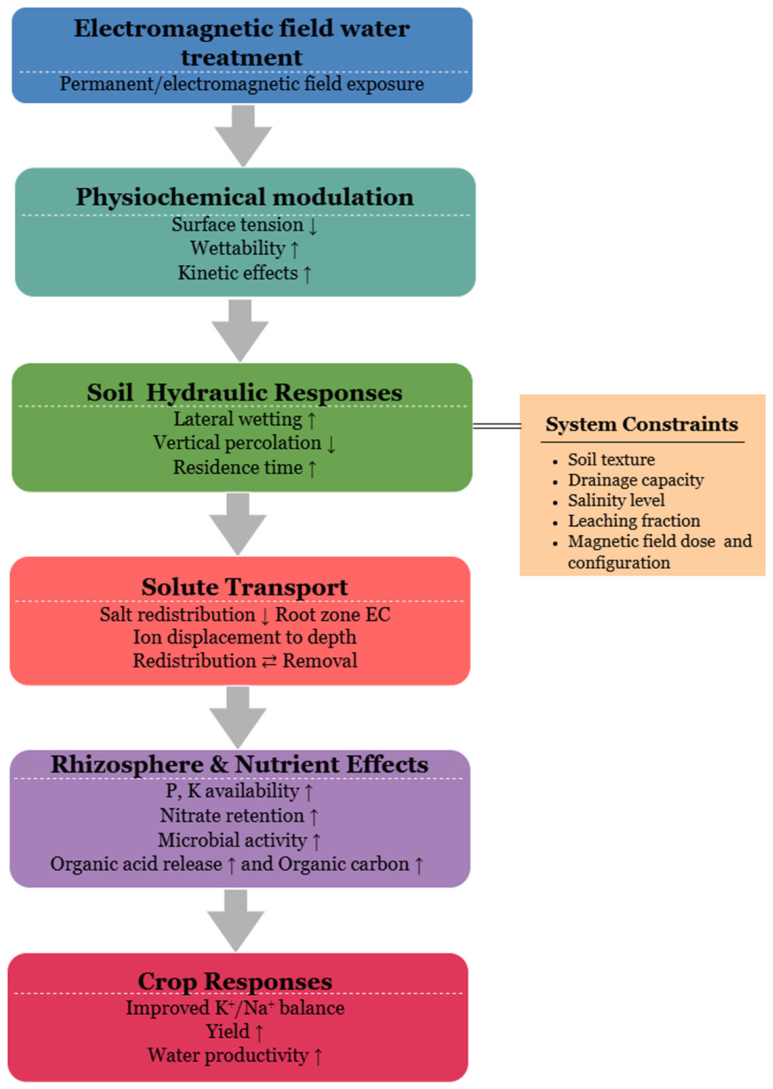
When applied to unconventional waters, including brackish groundwater and treated wastewater, EMF conditioning may improve soil compatibility by modifying salt transport pathways and enhancing root-zone moisture retention. Reported benefits include reduced sodium accumulation in upper soil layers, improved plant ionic balance, and increased water productivity. However, EMF does not address trace contaminants or boron toxicity and should be viewed as complementary, rather than a substitute for, desalination or targeted treatment processes. The most promising applications lie within integrated reuse frameworks that combine partial desalination, EMF conditioning, and soil amendments, integrating RO to reduce bulk salinity, EMF to influence transport behavior, and organic matter to enhance soil buffering capacity. Verification of these synergistic effects requires field-scale experiments with full soil–water–plant mass balance.
4. Crop Physiological Responses, Yield, and Water Productivity Under EMF-Treated Irrigation
Crop responses to EMF-treated irrigation reflect integrated effects of modified soil moisture distribution, altered salt transport, and changes in nutrient availability. Reported outcomes include accelerated germination, enhanced vegetative growth, improved ionic balance, and increased yield or water productivity, particularly under saline or deficit irrigation. However, responses vary widely with crop species, soil texture, irrigation regime, and EMF exposure parameters as summarized in Table 2. Several studies report faster germination and improved seedling establishment when crops are irrigated with EMF-treated water, especially under moderate salinity or water by stimulating proteins and enzyme activity [56,100,101,102,103,104,105,106]. Enhanced early vitality has been attributed to improved hydration kinetics during seed imbibition, although field-scale validation remains limited and many studies confound seed magnetic exposure with irrigation water treatment. Agronomically, establishment benefits appear most relevant where salinity or limited water availability delays emergence, while under optimal irrigation conditions EMF-related effects on germination are generally modest.
EMF-treated irrigation has been associated with increased plant height, leaf area, chlorophyll content, and stomatal conductance across cereals, vegetables, and fruit crops [18,29,55,97,100,101,107,108]. Elevated chlorophyll and carotenoid concentrations suggest improved photosynthetic capacity and stress tolerance, commonly linked to improved root-zone moisture availability and enhanced uptake of potassium, calcium, and magnesium [18,19,87,102,109,110,111,112]. Under saline conditions, EMF-treated systems frequently exhibit reduced sodium accumulation in shoots and improved nutrient uptake, mitigating ion toxicity and supporting metabolic function [56,81,99,113]. Several investigations also report increased antioxidant enzyme activity and phenolic compound production in plants irrigated with EMF-treated water under osmotic or abiotic stress, indicating modulation of plant defense pathways (e.g., elevated peroxidase and polyphenol oxidase activity and greater total phenolic content relative to untreated irrigation) [89,111,114,115,116]. Evidence from pulsed magnetic field pretreatment study further indicates that magnetic exposure can selectively modulate enzyme activities, enhancing antioxidant and stress-related enzymes while downregulating specific hydrolytic enzymes during early development, consistent with metabolic reprogramming rather than uniform stimulation [89]. These physiological responses are indirect consequences of soil and rhizosphere processes rather than direct effects of EMF on plant tissues. Across field and controlled studies, EMF-treated irrigation has been associated with improved vegetative growth, higher nutrient uptake, and reduced sodium accumulation in plant tissues under saline or unconventional water conditions, contributing to yield stabilization and stress mitigation [19,56]. Reported yield increases, with the largest benefits observed for salt-sensitive crops and under moderate salinity where root-zone electrical conductivity is effectively reduced [75].
Recent two-year field experiments using magnetoelectric brackish water further demonstrate that E-EMF conditioning enhances crop physiological performance and water productivity under arid, saline conditions. Compared with untreated brackish water, magnetoelectric treatment increased chlorophyll content by ~1.4–8.5%, enhanced photosynthetic efficiency, reduced lipid peroxidation (malondialdehyde ↓ by ~2–10%), and increased antioxidant enzyme activities (peroxidase, catalase, and superoxide dismutase ↑ by ~2–17%). These physiological improvements translated into greater dry matter accumulation (↑ ~3–22%), higher yields (↑ ~2–13%), and improved water use efficiency, with optimal irrigation quotas under E-EMF-treated brackish water lower than those required for yield maximization under untreated brackish irrigation [117].
Yield increases ranging from approximately 10% to over 40% have been reported under EMF-treated irrigation, with the largest gains typically observed under saline or unconventional water conditions [29,56,72,75,86,118]. Improved biomass accumulation and fruit yield are generally associated with reduced root-zone salinity, enhanced nutrient availability, and improved soil moisture distribution. Under moderately saline irrigation, MF-treated systems often maintain yields comparable to freshwater controls by alleviating osmotic stress and improving ionic balance [56]. In contrast, when salinity exceeds crop tolerance thresholds, EMF treatment alone is insufficient to prevent yield decline, underscoring the continued need for partial desalination or blending strategies. Yield responses are crop-specific and strongly influenced by soil texture and drainage, with salt-sensitive crops benefiting most when EMF-induced redistribution effectively lowers electrical conductivity in the rooting zone. Salt-sensitive crops (e.g., vegetables and fruit trees) generally exhibit stronger relative responses to EMF-treated irrigation than salt-tolerant cereals and forage crops, reflecting greater benefits from reductions in root-zone EC and improved nutrient balance. In contrast, halophytic or moderately salt-tolerant species tend to show smaller proportional gains, suggesting that EMF conditioning primarily mitigates osmotic and ionic stress rather than enhancing intrinsic salt tolerance.
Improved water productivity defined as yield per unit of applied water is among the most practically relevant outcomes of EMF-treated irrigation. Several field studies report maintenance or enhancement of yield under reduced irrigation volumes, indicating more efficient utilization of soil moisture [18,56,75,86,109]. These gains are attributed to expanded wetted soil volume, improved lateral water movement, and enhanced root access to available moisture, particularly under drip irrigation where MF conditioning may reduce localized drying and salt accumulation near emitters. However, many studies estimate water productivity based solely on applied irrigation and yield, without accounting for evapotranspiration or drainage losses [119]. Rigorous evaluation requires full water balance measurements to distinguish true gains in crop water use efficiency from shifts in soil water storage. Water use efficiency often exhibits strong responses to MF conditioning, with increases of approximately 25–45% relative to untreated irrigation reported across crops and irrigation systems. Optimal crop performance is frequently observed at magnetic field strengths near 3000 GS, while weaker (≈1000 GS) or stronger (≥4000–5000 GS) fields tend to produce diminished responses. Nevertheless, MF treatment does not eliminate salinity stress under severe conditions and cannot substitute for desalination or adequate drainage; rather, it functions as a complementary management strategy that enhances water productivity and yield stability when integrated with appropriate irrigation design and salinity control practices [75].
Functionally, crop responses to EMF-treated irrigation can be interpreted as enhanced establishment, physiological stress mitigation through improved ionic balance, yield stabilization under moderate salinity, and increased water productivity under deficit irrigation. Importantly, EMF treatment does not eliminate salinity stress but alters its spatial expression within the soil profile, making crop benefits contingent on adequate drainage, appropriate leaching fractions, and integration with complementary management practices.
Despite numerous positive reports, crop responses remain inconsistent. Variability arises from differences in EMF exposure dose, irrigation water chemistry, soil texture, crop species, and experimental scale, with many studies relying on short-term pot or greenhouse experiments that may overestimate field performance. Few investigations quantify long-term impacts on soil salinity or groundwater quality, raising concerns that EMF-induced redistribution may delay rather than resolve salinization when salt export through drainage is insufficient. Consequently, EMF-treated irrigation is best viewed as a complementary tool within integrated water and soil management frameworks, particularly when combined with partial desalination, organic amendments, and precision irrigation to enhance resilience of cropping systems under unconventional water reuse.
5. EMF Treatment in Agricultural Water Reuse Systems: Complementarity with Reverse Osmosis and Soil Amendments
The increasing reliance on unconventional water sources for irrigation has intensified interest in treatment strategies that balance water quality improvement, energy consumption, and soil sustainability. Reverse osmosis (RO) remains the dominant technology for removing dissolved salts from brackish and saline waters, providing reliable control of electrical conductivity and ionic composition [11,54,123,124,125]. However, agricultural utilization is constrained by energy demand, membrane fouling and scaling, concentrate disposal, and capital cost, particularly in inland regions lacking brine management infrastructure [12,126,127,128,129]. Even when RO permeate is blended with untreated water to achieve crop-appropriate salinity, residual sodicity and trace constituents may continue to affect soil structure and plant performance, highlighting that RO alone does not resolve all constraints associated with unconventional water reuse [130]. EMF treatment operates fundamentally differently from RO. EMF does not remove salts or contaminants; instead, it modifies transport behavior and crystallization kinetics, influencing how water and solutes interact with soils and plant roots [16,24,25]. Consequently, E-EMF should be viewed not as an alternative to RO but as a complementary conditioning step that may enhance downstream soil performance and irrigation efficiency when partial desalination or blending strategies are employed [31].
Within this context, EMF treatment may provide value by conditioning irrigation water after partial desalination. Rather than altering bulk water chemistry, EMF modifies physical and kinetic processes governing infiltration, salt redistribution, and mineral precipitation. When applied to blended RO permeate or moderate saline irrigation water, EMF conditioning has been associated with improved wetting behavior, enhanced downward salt transport, and reduced surface crystallization in soils. EMF has also been proposed as a pre-conditioning step to influence scaling propensity upstream of RO or during concentrate handling by altering crystallization pathways and particle morphology, potentially reducing mineral attachment to membrane surfaces [26,37,44,131]. While such effects are primarily demonstrated in engineered systems, extension to agricultural RO applications requires validation through controlled fouling experiments and long-term performance monitoring.
Importantly, EMF conditioning may improve the soil compatibility of partially desalinated waters. Blended irrigation waters often retain elevated sodium adsorption ratios even when total salinity is reduced [3]. EMF-treated irrigation has been reported to facilitate downward migration of sodium and improve ion balance in plant tissues, suggesting potential benefits for sodicity management when combined with adequate calcium supply and drainage [29,31,56]. The most promising role of EMF-treated irrigation is within integrated water reuse frameworks that combine engineered treatment with soil rehabilitation practices. In such systems, partial RO or blending reduces bulk salinity to crop-tolerable levels, EMF conditioning modifies transport behavior and surface salt accumulation, and soil amendments particularly compost or organic matter, enhance aggregation, cation exchange capacity, and microbial activity. Together, these components act synergistically to improve root-zone conditions, nutrient availability, and water productivity [31,96,98,99].
Table 2.
Representative laboratory, greenhouse, and field studies reporting plant physiological responses, yield, and yield components under EMF–treated irrigation water.
Table 2.
Representative laboratory, greenhouse, and field studies reporting plant physiological responses, yield, and yield components under EMF–treated irrigation water.
| Crop | Experimental scale | Water type / salinity | EMF device & exposure (reported) | Major soil / plant responses | Yield / water productivity outcome | Study |
|---|---|---|---|---|---|---|
| Tomato (Rocca and Monza varieties) | Pot | Fresh water | Static MF (seed & water) | Accelerated phenology and enhanced early reproductive development | Early yield ↑ 28–51% in Monza, flowering advanced by 3–4 days, total yield ↑, no significant effect in Rocco variety | [120] |
| Cereals, fodder crops, vegetables, melons | Field & Greenhouse (large-scale trials) | Fresh to alkaline irrigation water | Static MF (100 mT) Magnetic treatment of irrigation water | Improved root-zone moisture supplies due to high penetration of water and CO₂-mediated nutrient availability | Yield ↑ ~10–15% (greenhouse), 5–20% yield ↑ in ~75% of field cases, improvement in water productivity, high salts leaching | [121] |
| Rice | Laboratory | Fresh water | Static MF (seed & water) (150 mT) | Enhanced germination rate and seedling growth | Early establishment benefit | [106] |
| Strawberry | Laboratory | Fresh water | Alternating MF | Improved nutrient uptake (N, K, Ca, Mg, Fe, Mn and Zn) (0.384 T) | Fruit yield and weight ↑ ~15% (0.096 T) | [90] |
| Celery, Snow peas | Pot | Recycled & saline (1500–3000 mg·L⁻¹) | Inline MF device (3.5-1.36 mT) | Reduced Na⁺ uptake, increased K⁺ and Ca²⁺, higher soil P and K | Celery: Yield maintained or ↑ under saline irrigation and 12% water productivity ↑; Snow peas: ↑ Pod yield | [56] |
| Wheat and Flax | Pot | Fresh water | Inline MF (~30 mT) | Photosynthetic pigments ↑, endogenous total indole, total phenol and protein synthesis, nutrient uptake | Yield ↑ ~15–30% | [122] |
| Brinjal | Field | Normal, and saline water | Static MF (18-20 mT) | Improved soil moisture, reduced salinity stress | Yield ↑ ~15–20%, ↑ plant height | [72] |
| Cucumber, Eggplant, Tomato, Squash | Greenhouse conditions | Brackish water | Static MF (40 mT) | Nutrient uptake ↑ and ↑ germination percentage, ↓ Na⁺ in soil | Yield ↑, Plant height and fruits ↑ | [55] |
| Lettuce | Pot | Saline water | Static MF (36 mT) | Reduced root-zone EC, improved ionic balance | Yield ↑ ~10–25%, total chlorophyll ↑ ~50-70% and concentrations of some macro and micro-nutrient | [19] |
| Potato and corn | Field | Saline water | E-EMF treatment | Na⁺ accumulation ↓, nutrient (N, P, K) uptake ↑ | Early establishment benefit, Yield ↑ ~10% | [81] |
| Poplar | Pot | Brackish water | MF-treated irrigation (0.2 T) | Photosynthesis and nutrient uptake ↑, root development ↑, C/N ratio in leaves ↑, Na⁺ toxicity ↓ | Biomass ↑, water use efficiency ↑ | [107] |
| Grapevine | Pot | Saline water | MF-treated irrigation (0.2 T) | Chlorophyll ↑, photosynthetic rate ↑, stomatal conductance and transpiration date | Growth ↑, Photosynthetic performance 18-56%↑ stress tolerance and water use efficiency ↑ | [109] |
| Cotton | Field | Fresh water and saline soil | MF-treated irrigation 0.1–0.5 T (optimum ≈0.3 T) | Soil water content 33-56%↑, ↑ salt leaching | Yield ↑ 28–32%, water use efficiency ↑ 27–43% | [75] |
| Sweet fennel | Field | Sprinkler-irrigated | Foliar application of MF water (~200 mT) | Nutrient and physiological status (chlorophyll) ↑, K content ↑ and in the K/Na ratio ↑ | Seed and biological yield ↑ significantly | [113] |
| Cowpea | Field | Fresh–moderate salinity | MF-treated irrigation | N uptake efficiency ↑ and 25% ↓ rate of nitrogen fertilizer | Yield ↑, vegetative growth↑, water use efficiency ↑ | [86] |
| Maize | Field | Brackish water | MF-treated irrigation water (0.1- 0.5 T) |
↓ salt content 15-34%, ↑ downward salt transport, ↑ total carbon 13-63 % and nitrogen (12-148%) | Yield ↑ ~12–22% | [29] |
| Salvia | Pot | Saline water | Static MF (0.3 T- 0.6 T) |
↑ chlorophyll, ↑ phenolic compounds and stimulated the activity of peroxidase and polyphenol oxidase, ↑ salt tolerance | Water use efficiency↑, Plant growth↑ | [114] |
| Dundale pea | Soil columns, greenhouse study | Fresh & brackish water | E-EMF treatment (150 kHz electric field) | Downward salt redistribution; improved NO₃⁻ retention with compost | Yield and growth ↑, Organic carbon 7% ↑ | [31] |
| Cotton | Field (2 years) | Brackish water | E-EMF treatment | ↑ chlorophyll, ↑ antioxidants, ↓ lipid peroxidation | Yield ↑ 2–13%, Water use efficiency ↑ | [117] |
* Reported yield and water productivity responses are relative to non-EMF controls within each study and are not directly comparable across experiments due to differences in crop, salinity, irrigation regime, and EMF exposure.
Implementation of EMF within agricultural reuse systems requires careful consideration of exposure configuration, flow rate, and water chemistry. Treatment effectiveness depends on cumulative EMF dose, defined by field strength, residence time, and hydraulic conditions, while placement upstream of irrigation emitters enables continuous conditioning in drip or micro-irrigation systems. However, variability in device design and inconsistent reporting of operational parameters complicate comparison across studies, underscoring the need for standardized exposure metrics. EMF-induced salt redistribution must also be evaluated alongside drainage capacity and leaching fraction to avoid unintended accumulation in subsoil horizons or groundwater [3,16,25].
EMF devices are generally low-energy, non-separative conditioning technologies whose primary value lies in enhancing the performance of existing water treatment and irrigation infrastructure rather than replacing conventional treatments such as RO [12,25]. Life-cycle assessments comparing RO-only systems with EMF and integrated RO–EMF–soil amendment frameworks are needed to quantify trade-offs in energy use, greenhouse gas emissions, nutrient cycling, and long-term soil health.
Beyond engineered desalination, soil-based interventions remain critical to the long-term success of agricultural water reuse. Within this context, EMF-treated irrigation is most effective as a low-energy conditioning approach integrated with partial desalination, soil amendments, and precision irrigation, rather than as a standalone treatment. By modifying transport processes that influence salinity expression and nutrient availability, EMF can improve the soil compatibility of unconventional waters and support resilient crop production, while desalination remains essential where salinity exceeds crop tolerance thresholds.
The performance of EMF treatment depends strongly on salinity level, soil drainage, crop sensitivity, and irrigation design, implementation requires site-specific evaluation rather than universal application [29,30,31]. In particular, EMF treatment may provide greater benefit under moderate salinity conditions where salt redistribution and improved wetting behavior can alleviate root-zone stress, whereas severe salinity conditions may still require desalination or blending strategies. Figure 3 presents a conceptual decision-support framework illustrating conditions under which EMF treatment may function as a standalone conditioning approach or as part of integrated salinity management strategies.
The most promising future application of EMF technologies lies within integrated agricultural water reuse systems that combine partial desalination, physical water conditioning, soil amendments, and precision irrigation strategies. In such systems, desalination or blending reduces bulk salinity, EMF treatment modifies transport and crystallization behavior, and soil amendments improve buffering capacity, aggregation, and nutrient retention. Figure 4 illustrates a conceptual framework integrating these complementary approaches to enhance the sustainability and soil compatibility of unconventional irrigation water reuse.
6. Field-Scale Limitations, Variability, and Knowledge Gaps
Despite numerous laboratory and greenhouse studies reporting positive effects of EMF-treated irrigation, translation to field-scale agricultural systems remains limited and inconsistent. Reported outcomes vary widely, reflecting strong dependence on EMF exposure parameters, irrigation water chemistry, soil properties, crop species, and experimental scale. This variability represents a primary barrier to broader adoption and scientific acceptance [70,72,132].
A fundamental limitation is the lack of standardized reporting of EMF treatment conditions. Many studies fail to specify field strength, exposure duration, flow rate, device geometry, or cumulative treatment dose, severely constraining reproducibility and cross-study comparison. Development of an operational definition of E-EMF exposure analogous to dosage in chemical treatments is essential for advancing mechanistic understanding and practical implementation [24].
Experimental scale further contributes to uncertainty. A substantial proportion of reported positive outcomes derive from pot or column studies conducted under controlled conditions, which may exaggerate treatment effects relative to heterogeneous field environments. Conversely, field studies reporting marginal effects often lack sufficient replication or process-level measurements, limiting interpretation.
Soil texture, mineralogy, and irrigation water chemistry strongly mediate EMF responses [32]. Enhanced wettability and lateral water redistribution observed in sandy loam and loam soils may not translate to coarse sands dominated by gravitational drainage or to fine-textured clays prone to dispersion [30,70,71,79]. Similarly, ionic strength, alkalinity, calcium concentration, and sodium adsorption ratio (SAR) govern both salinity expression and soil structural stability, leading to context-dependent EMF effects [32,46,78]. Studies that do not characterize baseline soil and water properties risk attributing observed responses to EMF when they may reflect inherent physicochemical variability.
Long-term sustainability remains insufficiently addressed. EMF-treated irrigation commonly promotes downward redistribution of salts, reducing root-zone electrical conductivity in the short term. Without adequate drainage, however, salts may accumulate in subsurface horizons or groundwater [3,133,134]. Few investigations quantify salt mass balance or groundwater quality over multiple seasons, leaving cumulative impacts unresolved. Without sufficient drainage and salt export, EMF-induced redistribution may delay rather than prevent soil salinization, potentially shifting salinity risk from the surface to subsoil or groundwater compartments.
Economic considerations are also underexplored. Although EMF devices are generally low-cost and energy-efficient, their agronomic value depends on consistent field performance [25]. Comprehensive techno-economic analyses comparing RO-only systems with integrated RO-EMF-soil amendment frameworks are largely absent, limiting assessment of cost-effectiveness and scalability.
Finally, publication bias toward positive outcomes complicates objective evaluation of EMF efficacy. Negative or null-result studies are rarely reported, skewing perception of effectiveness. Coordinated multi-site trials with standardized protocols and transparent reporting including unsuccessful cases are required to establish evidence-based guidance. Collectively, these limitations indicate that future progress requires hypothesis-driven, field-validated research integrating soil, plant, and water system processes.
7. Future Research Framework and Standardization Needs
Advancing EMF-treated irrigation from experimental applications to reliable agricultural practice requires a coordinated shift toward standardized methodologies, mechanistic validation, and field-scale integration. Future research should prioritize reproducibility, quantitative process measurements, and system-level evaluation.
A critical first step is establishment of minimum reporting standards for EMF-treated irrigation studies. At a minimum, publications should document field strength, device geometry, exposure length, flow rate, residence time, and whether treatment is continuous or intermittent, as these parameters collectively define EMF exposure dose. Comprehensive characterization of irrigation water chemistry (EC, pH, alkalinity, major ions, SAR) and soil properties (texture, bulk density, initial EC and SAR, organic matter content, carbonate presence, and drainage class) is equally essential to enable interpretation and reproducibility.
Targeted mechanistic experiments are needed to directly test hypothesized pathways. Controlled soil column studies should quantify ion breakthrough behavior, wetting front geometry, and mineral precipitation patterns to clarify whether EMF primarily affects infiltration, solute mobility, or crystallization kinetics. At the plant scale, measurements of root hydraulic conductivity and ion transport under controlled salinity can help distinguish soil-mediated effects from potential direct influences on water uptake.
Robust evaluation further requires replicated, multi-season field trials across diverse soil textures, salinity levels, and climatic regimes. These trials should include monitoring of soil electrical conductivity and ion profiles with depth, crop yield components, and water balance metrics, with particular attention to sodicity indicators, aggregate stability, and infiltration. Integration with drainage assessment and groundwater monitoring is necessary to evaluate the sustainability of EMF-induced salt redistribution.
Given the complementary roles of EMF and RO, future work should prioritize integrated system testing. Comparative evaluation of RO-only, EMF-only, and combined blended water from RO-EMF configurations can quantify effects on membrane fouling, soil salinity dynamics, and crop performance. Coupling these approaches with compost or organic amendments offers additional opportunity to enhance cation exchange capacity, microbial activity, and soil buffering. Lifecycle and techno-economic assessments are needed to compare energy use, greenhouse gas emissions, operational costs, and agronomic benefits across standalone and hybrid treatment strategies.
Finally, emerging precision irrigation technologies provide powerful tools for evaluating EMF-treated systems. High-resolution soil moisture and electrical conductivity sensors, combined with remote sensing and automated irrigation control, enable real-time tracking of wetting fronts and salinity redistribution, moving evaluation beyond endpoint measurements such as yield alone.
8. Conclusions
EMF-treated irrigation water influences soil-plant systems primarily by modifying transport processes rather than altering bulk water chemistry. Reported benefits include improved soil moisture distribution, salt redistribution below the root-zone, enhanced nutrient availability, and increased crop water productivity arised from coupled hydraulic and geochemical interactions that shape root-zone conditions, particularly under saline or unconventional water irrigation.
Importantly, EMF treatment does not remove dissolved salts and therefore cannot replace desalination technologies such as reverse osmosis when irrigating with moderate to high salinity brackish water. Instead, EMF functions as a low-energy conditioning tool that may improve the soil compatibility of partially desalinated or blended waters by influencing wetting behavior, ion mobility, and crystallization pathways. When integrated with partial RO and soil amendments, EMF-treated irrigation represents a promising systems-level approach for improving salinity management in agricultural water reuse.
Despite encouraging laboratory and greenhouse results, field-scale evidence remains limited. Variability in EMF exposure parameters, soil properties, water chemistry, and experimental design, combined with limited long-term monitoring, constrains reproducibility and deployment. Moreover, root-zone salinity reductions achieved through EMF-induced redistribution raise sustainability concerns under inadequate drainage, underscoring the need for salt mass balance assessment.
Advancing EMF-treated irrigation toward reliable application will require standardized reporting of EMF exposure, mechanistic experiments linking treatment to soil transport processes, and replicated multi-season field trials across diverse agroecological contexts. Integrated evaluation of EMF, RO, and soil rehabilitation strategies supported by precision irrigation and digital monitoring will be essential to quantify agronomic benefits, environmental trade-offs, and economic feasibility. Within appropriately designed reuse frameworks, EMF-treated irrigation has the potential to contribute to climate-resilient agriculture by improving the efficiency of unconventional water use
Author Contributions
Conceptualization (S.S., P.X.); resources (S.S. P.X.); data curation (S.S.); writing—original draft preparation (S.S., P.X.); writing—review and editing (S.S., P.X., I.J.); visualization (S.S., P.X.); supervision (P.X.); project administration (P.X.). All authors have read and agreed to the published version of the manuscript.
Funding
Funding support was provided by the Innovations at the Nexus of Food, Energy, and Water Systems (INFEWS) program of the National Science Foundation under award number 1856052 to the University of North Texas (UNT), New Mexico State University (NMSU), and Colorado State University (CSU).
Conflicts of Interest
The authors declare that they have no affiliations with or involvement in any organization or entity with any financial interest in the subject matter or materials discussed in this manuscript.
References
- Khondoker, M.; Mandal, S.; Gurav, R.; Hwang, S. Freshwater shortage, salinity increase, and global food production: A need for sustainable irrigation water desalination—A scoping review. Earth 2023, 4(2), 223–240. [Google Scholar] [CrossRef]
- Tarolli, P.; Luo, J.; Park, E.; Barcaccia, G.; Masin, R. Soil salinization in agriculture: Mitigation and adaptation strategies combining nature-based solutions and bioengineering. Iscience 2024, 27(2). [Google Scholar] [CrossRef] [PubMed]
- Ayers, R.S.W.; D., W. Water Quality for Agriculture. In FAO Irrigation and Drainage Paper; Rome, Italy, 1985. [Google Scholar]
- FAO. Global status of salt-affected soils; Food and Agriculture Organization of the United Nations, 2024. [Google Scholar]
- Atta, K.; Mondal, S.; Gorai, S.; Singh, A.P.; Kumari, A.; Ghosh, T.; Roy, A.; Hembram, S.; Gaikwad, D.J.; Mondal, S. Impacts of salinity stress on crop plants: improving salt tolerance through genetic and molecular dissection. Front. Plant Sci. 2023, 14, 1241736. [Google Scholar] [CrossRef] [PubMed]
- Balasubramaniam, T.; Shen, G.; Esmaeili, N.; Zhang, H. Plants’ response mechanisms to salinity stress. Plants 2023, 12(12), 2253. [Google Scholar] [CrossRef] [PubMed]
- Munns, R.; Tester, M. Mechanisms of salinity tolerance. Annu. Rev. Plant Biol. 2008, 59(1), 651–681. [Google Scholar] [CrossRef] [PubMed]
- Angelakis, A.N.; Tchobanoglous, G.; Capodaglio, A.G.; Tzanakakis, V.A. The importance of nonconventional water resources under water scarcity. Water 2024, 16(7), 1015. [Google Scholar] [CrossRef]
- Karimidastenaei, Z.; Avellán, T.; Sadegh, M.; Kløve, B.; Haghighi, A.T. Unconventional water resources: Global opportunities and challenges. Sci. Total Environ. 2022, 827, 154429. [Google Scholar] [CrossRef] [PubMed]
- Wright, W.F.; Longley, K.E.; Mizuno, W.K.; Banerjee, S.; Waite, M.; Stringfellow, W.; Xu, P. Production of Agricultural Water and Nutrients from Brackish Water Sources. J. Irrig. Drain. Eng. 2025, 151(6), 04025039. [Google Scholar] [CrossRef]
- Edirisooriya, E.M.N.T.; Wang, H.; Banerjee, S.; Longley, K.; Wright, W.; Mizuno, W.; Xu, P. Economic feasibility of developing alternative water supplies for agricultural irrigation. Curr. Opin. Chem. Eng. 2024, 43, 100987. [Google Scholar] [CrossRef]
- Xu, X.; Ness, J.E.; Miara, A.; Sitterley, K.A.; Talmadge, M.; O’Neill, B.; Coughlin, K.; Akar, S.; Edirisooriya, E.T.; Kurup, P. Analysis of brackish water desalination for municipal uses: case studies on challenges and opportunities. Acs Es&T Eng. 2022, 2(3), 306–322. [Google Scholar] [CrossRef]
- McCool, B.C.; Rahardianto, A.; Faria, J.; Kovac, K.; Lara, D.; Cohen, Y. Feasibility of reverse osmosis desalination of brackish agricultural drainage water in the San Joaquin Valley. Desalination 2010, 261(3), 240–250. [Google Scholar] [CrossRef]
- Noran, R.; Shani, U.; Lin, I. The effect of irrigation with magnetically treated water on the translocation of minerals in the soil. Magnetic and Electrical Separation 1970, 7. [Google Scholar]
- Abdelghany, A.E.; Abdo, A.I.; Alashram, M.G.; Eltohamy, K.M.; Li, J.; Xiang, Y.; Zhang, F. Magnetized Saline Water Irrigation Enhances Soil Chemical and Physical Properties. Water 2022, 14(24), 4048. [Google Scholar] [CrossRef]
- Gabrielli, C.; Jaouhari, R.; Maurin, G.; Keddam, M. Magnetic water treatment for scale prevention. Water Res. 2001, 35(13), 3249–3259. [Google Scholar] [CrossRef] [PubMed]
- Khaskhoussy, K.; Bouhlel, M.; Dahmouni, M.; Hachicha, M. Performance of different magnetic and electromagnetic water treatment devices on soil and two tomato cultivars. Sci. Hortic. 2023, 322, 112437. [Google Scholar] [CrossRef]
- Hozayn, M.; Qados, A.A. Irrigation with magnetized water enhances growth, chemical constituent and yield of chickpea (Cicer arietinum L.). Agric. Biol. J. N. Am. 2010, 1(4), 671–676. [Google Scholar]
- Zlotopolski, V. Magnetic treatment reduces water usage in irrigation without negatively impacting yield, photosynthesis and nutrient uptake in lettuce. Int. J. Appl. Agric. Sci. 2017, 3(5), 117–122. [Google Scholar] [CrossRef]
- Ali, Y.; Samaneh, R.; Kavakebian, F. Applications of magnetic water technology in farming and agriculture development: A review of recent advances. Curr. World Environ. 2014, 9(3), 695. [Google Scholar] [CrossRef]
- Moussa, M.; Michot, D.; Hachicha, M. Effect of electromagnetic treatment of treated wastewater on soil and drainage water. Desalin. Water Treat. 2021, 213, 177–189. [Google Scholar] [CrossRef]
- Noran, R.; Shani, U.; Lin, I. The effect of irrigation with magnetically treated water on the translocation of minerals in the soil. Phys. Sep. Sci. Eng. 1996, 7(2), 109–122. [Google Scholar]
- Du, X.; Ahasan, T.; Perera, H.; Jiang, W.; Wang, Y.; Shu, F.; Wang, H.; Yuan, K.; Anovitz, L.M.; Ben Ishai, P. Impact of Electromagnetic Fields on Gypsum and Silica Scaling in Reverse Osmosis. Environ. Sci. Technol. 2025. [Google Scholar] [CrossRef] [PubMed]
- Du, X.; Wang, Y.; Shu, F.; Jiang, W.; Ahasan, T.; Wang, H.; Yuan, K.; Anovitz, L.M.; Ishai, P.B.; Xu, P. Electromagnetic fields for scaling mitigation in water treatment: Mechanisms, challenges, and optimization strategies. Chem. Eng. J. 2025, 171077. [Google Scholar]
- Zaidi, N.S.; Sohaili, J.; Muda, K.; Sillanpää, M. Magnetic field application and its potential in water and wastewater treatment systems. Sep. Purif. Rev. 2014, 43(3), 206–240. [Google Scholar]
- Chang, M.-C.; Tai, C.Y. Effect of the magnetic field on the growth rate of aragonite and the precipitation of CaCO3. Chem. Eng. J. 2010, 164(1), 1–9. [Google Scholar] [CrossRef]
- Seyyedi, M. Mechanisms of Ion Dehydration by Magnetic Fields; University of Wyoming, 2024. [Google Scholar]
- Piyadasa, C. Effects of commercially available pulsed electromagnetic field devices on bacterial viability and calcium carbonate precipitation; Victoria University, 2017. [Google Scholar]
- Wang, D.; Zhang, L.; Zhang, J.; Li, W.; Li, H.; Liang, Y.; Han, Y.; Luo, P.; Wang, Z. Effect of magnetized brackish water drip irrigation on water and salt transport characteristics of sandy soil in southern Xinjiang, China. Water 2023, 15(3), 577. [Google Scholar] [CrossRef]
- Wang, D.; Wang, Z.; Zhang, J.; Zhang, Y.; Chen, P. Effects of Salinity of Magnetized Water on Water–Salt Transport and Infiltration Characteristics of Soil Under Drip Irrigation. Agronomy 2024, 14(12), 2873. [Google Scholar] [CrossRef]
- Suvendran, S.; Johnson, D.; Acevedo, M.; Smithers, B.; Xu, P. Electromagnetic Water Treatment and Soil Compost Incorporation to Alleviate the Impact of Soil Salinization. Water 2024, 16(11), 1577. [Google Scholar] [CrossRef]
- Sarraf, M.; Kataria, S.; Taimourya, H.; Santos, L.O.; Menegatti, R.D.; Jain, M.; Ihtisham, M.; Liu, S. Magnetic field (MF) applications in plants: An overview. Plants 2020, 9(9), 1139. [Google Scholar] [CrossRef] [PubMed]
- Bogatin, J.; Bondarenko, N.P.; Gak, E.Z.; Rokhinson, E.E.; Ananyev, I.P. Magnetic treatment of irrigation water: experimental results and application conditions. Environ. Sci. Technol. 1999, 33(8), 1280–1285. [Google Scholar] [CrossRef]
- Amiri, M.; Dadkhah, A.A. On reduction in the surface tension of water due to magnetic treatment. Colloids Surf. A Physicochem. Eng. Asp. 2006, 278(1-3), 252–255. [Google Scholar] [CrossRef]
- Chibowski, E.; Szcześ, A.; Hołysz, L. Influence of magnetic field on evaporation rate and surface tension of water. Colloids Interfaces 2018, 2(4), 68. [Google Scholar] [CrossRef]
- Toledo, E.J.; Ramalho, T.C.; Magriotis, Z.M. Influence of magnetic field on physical–chemical properties of the liquid water: Insights from experimental and theoretical models. J. Mol. Struct. 2008, 888(1-3), 409–415. [Google Scholar] [CrossRef]
- Otsuka, I.; Ozeki, S. Does magnetic treatment of water change its properties? J. Phys. Chem. B 2006, 110(4), 1509–1512. [Google Scholar] [CrossRef] [PubMed]
- Cho, Y.I.; Lee, S.-H. Reduction in the surface tension of water due to physical water treatment for fouling control in heat exchangers. Int. Commun. Heat Mass Transf. 2005, 32(1-2), 1–9. [Google Scholar] [CrossRef]
- Abdelsalam, H.; Mostafa, H.; El-Ansary, M.; Awad, M.; Sultan, W. Magnetization treatment effect on some physical and biological characteristics of saline irrigation water. Sci. Rep. 2025. 15, 1, 19803. [Google Scholar]
- Koza, J.A.; Mühlenhoff, S.; Żabiński, P.; Nikrityuk, P.A.; Eckert, K.; Uhlemann, M.; Gebert, A.; Weier, T.; Schultz, L.; Odenbach, S. Hydrogen evolution under the influence of a magnetic field. Electrochimica Acta 2011, 56(6), 2665–2675. [Google Scholar] [CrossRef]
- Ramalingam, M.; Narayanan, K.; Masilamani, A.; Kathirvel, P.; Murali, G.; Vatin, N.I. Influence of magnetic water on concrete properties with different magnetic field exposure times. Materials 2022, 15(12), 4291. [Google Scholar] [CrossRef] [PubMed]
- Al-Othman, A.A.; El-Shinawy, D.M.; Oraiath, A.A.T.; Elwakeel, A.E.; Dewidar, A.Z.; Elbeltagi, A.; Hamza, A. Effects of a Magnetic Field on Surface and Subsurface Drip Irrigation Water, Tomato Plants and Desert Sandy Soil Characteristics. Irrig. Drain. 2025. [Google Scholar] [CrossRef]
- Tidke, S.D.; Kedar, P.D.; Chambhare, M.R.; Khandagale, A.S.; Dawani, R.J. The influence of magnetic fields and magnetized water on the growth and physio-biochemical parameters of soybean. Discov. Plants 2025. 2, 1, 168. [Google Scholar]
- Du, X.; Perera, H.; Ahasan, T.; Wang, Y.; Shu, F.; Wang, H.; Yuan, K.; Anovitz, L.M.; Ishai, P.B.; Xu, P. Mechanisms of electromagnetic field control on mineral scaling in brackish water reverse osmosis: Combined homogenous and heterogeneous nucleation. Sep. Purif. Technol. 2025, 355, 129630. [Google Scholar] [CrossRef]
- Liu, Y.-M.; Wu, Z.-Q.; Chen, F.-H.; Wang, Q.-S.; Guo, W.-H.; Yin, D.-C. On the surface tension of water under high magnetic field: A contact angle method. J. Appl. Phys. 2025, 138(7). [Google Scholar] [CrossRef]
- Botello-Zubiate, M.; Alvarez, A.; Martı́nez-Villafañe, A.; Almeraya-Calderon, F.; Matutes-Aquino, J. Influence of magnetic water treatment on the calcium carbonate phase formation and the electrochemical corrosion behavior of carbon steel. J. Alloys Compd. 2004, 369(1-2), 256–259. [Google Scholar] [CrossRef]
- Kandelous, M. Assessment of Infiltration Plumes in Soils Using Flow-Tech Treated Water; Crop and Soil Science, Ohio State University, 2019. [Google Scholar]
- Hamza, A.H.; Shreif, M.; Abd El-Azeim, M.M.; Mohamed, W.A. Impacts of Magnetic Field Treatment on Water Quality for Irrigation, Soil Properties and Maize Yield. J. Mod. Res. 2021, 3(1), 51–61. [Google Scholar]
- Tao, W.; Shao, F.; Yan, H.; Wang, Q. Microbial organic fertilizer combined with magnetically treated water drip irrigation promoted the stability of desert soil aggregates and improved the yield and quality of jujubes. Plants 2024, 13(14), 1930. [Google Scholar] [CrossRef] [PubMed]
- Luo, S.; Elouarzaki, K.; Xu, Z.J. Electrochemistry in magnetic fields. Angew. Chem. Int. Ed. 2022, 61(27), e202203564. [Google Scholar] [CrossRef]
- Gu, Y.; Li, S.; Xu, Y.; Han, J.; Gu, M.; Cai, Z.; Xie, G.; Ma, T.; Luo, J. The effect of magnetic field on the hydration of cation in solution revealed by THz spectroscopy and MDs. Colloids Surf. A Physicochem. Eng. Asp. 2019, 582, 123822. [Google Scholar] [CrossRef]
- Cai, R.; Yang, H.; He, J.; Zhu, W. The effects of magnetic fields on water molecular hydrogen bonds. J. Mol. Struct. 2009, 938(1-3), 15–19. [Google Scholar] [CrossRef]
- Alimbekova, S.; Ishmuratov, F.; Nosov, V.; Voloshin, A.; Alimbekov, R.; Dokichev, V. Electromagnetic field influence on the calcium carbonate crystallization in the iron ions Fe2+ presence in mineralized aqueous media. In Journal of Physics: Conference Series; IOP Publishing, 2021. [Google Scholar]
- Jiang, W.; Xu, X.; Lin, L.; Wang, H.; Shaw, R.; Lucero, D.; Xu, P. A pilot study of an electromagnetic field for control of reverse osmosis membrane fouling and scaling during brackish groundwater desalination. Water 2019, 11(5), 1015. [Google Scholar] [CrossRef]
- Shahin, M.; Mashhour, A.; Abd-Elhady, E. Effect of magnetized irrigation water and seeds on some water properties, growth parameter and yield productivity of cucumber plants. Curr. Sci. Int. 2016, 5(2), 152–164. [Google Scholar] [CrossRef]
- Maheshwari, B.L.; Grewal, H.S. Magnetic treatment of irrigation water: Its effects on vegetable crop yield and water productivity. Agric. Water Manag. 2009, 96(8), 1229–1236. [Google Scholar] [CrossRef]
- Nieto-Giraldo, D.F.; Rodríguez, J.M.R.; Torres-Osorio, J. Analysis of the Effect of the Magnetic Field on Water Flux Through TIP3; 1 Aquaporins Using Molecular Dynamics in GROMACS. J. Membr. Biol. 2026, 259(1), 7. [Google Scholar] [CrossRef] [PubMed]
- Taiz, L.; Zeiger, E.; Møller, I.; Murphy, A. Plant physiology and development; Sinauer Associates Sunderland, 2021. [Google Scholar]
- Liu, J.; Cao, Y. Experimental study on the surface tension of magnetized water. Int. Commun. Heat Mass Transf. 2021, 121, 105091. [Google Scholar] [CrossRef]
- Pang, X.-F.; Deng, B. The changes of macroscopic features and microscopic structures of water under influence of magnetic field. Phys. B Condens. Matter 2008, 403(19-20), 3571–3577. [Google Scholar] [CrossRef]
- Chang, K.-T.; Weng, C.-I. The effect of an external magnetic field on the structure of liquid water using molecular dynamics simulation. J. Appl. Phys. 2006, 100(4). [Google Scholar] [CrossRef]
- Yan, Z.; Kong, X.-Y.; Zhu, Z.; Xiao, H. Magnetic field modulation of confined water structure and transport in nanochannel. J. Mol. Liq. 2024, 414, 126121. [Google Scholar] [CrossRef]
- Jiang, H.; Fan, C.; Zhao, Z.; Zhou, X.; Liang, S.; Wang, X. Effect of magnetization conditions on the slump and compressive strength of magnetized water concrete. Case Stud. Constr. Mater. 2024, 21, e03920. [Google Scholar] [CrossRef]
- Akopian, S.; Aĭrapetian, S. A study of specific electrical conductivity of water by the action of constant magnetic field, electromagnetic field, and low-frequency mechanical vibrations. Biofizika 2005, 50(2), 265–270. [Google Scholar] [PubMed]
- McMahon, C.A. Investigation of the quality of water treated by magnetic fields; 2009. [Google Scholar]
- Umeki, S.; Kato, T.; Shimabukuro, H.; Yoshikawa, N.; Taniguchi, S.; Tohji, K. Elucidation of the scale prevention effect by alternating magnetic treatment. In AIP Conference Proceedings; 2007, American Institute of Physics.
- Higashitani, K.; Iseri, H.; Okuhara, K.; Kage, A.; Hatade, S. Magnetic effects on zeta potential and diffusivity of nonmagnetic colloidal particles. J. Colloid Interface Sci. 1995, 172(2), 383–388. [Google Scholar] [CrossRef]
- Hołysz, L.; Chibowski, M.; Chibowski, E. Time-dependent changes of zeta potential and other parameters of in situ calcium carbonate due to magnetic field treatment. Colloids Surf. A Physicochem. Eng. Asp. 2002, 208(1-3), 231–240. [Google Scholar] [CrossRef]
- Lorenzoni, M.Z.; Rezende, R.; de Souza, Á.H.C.; de Castro Seron, C.; Gonçalves, A.C.A.; Saath, R. Growth and development of bell pepper crop irrigated with magnetically-treated water. Rev. De Agric. Neotrop. 2020, 7(2), 9–16. [Google Scholar] [CrossRef]
- Al-Ogaidi, A.A.; Wayayok, A.; Rowshon, M.; Abdullah, A.F. The influence of magnetized water on soil water dynamics under drip irrigation systems. Agric. Water Manag. 2017, 180, 70–77. [Google Scholar] [CrossRef]
- Khoshravesh, M.; Mostafazadeh-Fard, B.; Mousavi, S.; Kiani, A. Effects of magnetized water on the distribution pattern of soil water with respect to time in trickle irrigation. Soil Use Manag. 2011, 27(4), 515–522. [Google Scholar] [CrossRef]
- Surendran, U.; Sandeep, O.; Joseph, E. The impacts of magnetic treatment of irrigation water on plant, water and soil characteristics. Agric. Water Manag. 2016, 178, 21–29. [Google Scholar] [CrossRef]
- Zlotopolski, V. Effect of Magnetic Treatment on Water Permeability Through a Semi-Permeable Membrane. Am. J. Water Sci. Eng. 2017, 3(2), 28–33. [Google Scholar] [CrossRef]
- Zlotopolski, V. The impact of magnetic water treatment on salt distribution in a large unsaturated soil column. Int. Soil Water Conserv. Res. 2017, 5(4), 253–257. [Google Scholar] [CrossRef]
- Zhou, B.; Yang, L.; Chen, X.; Ye, S.; Peng, Y.; Liang, C. Effect of magnetic water irrigation on the improvement of salinized soil and cotton growth in Xinjiang. Agric. Water Manag. 2021, 248, 106784. [Google Scholar] [CrossRef]
- Shi, J.; Jain, M.; Narasimhan, G. Time series forecasting (tsf) using various deep learning models. arXiv 2022, arXiv:2204.11115. [Google Scholar]
- Shi, K.; Kong, J.; Yue, H.; Huang, Y.; Wei, X.; Zhangzhong, L. Magnetized water irrigation alleviates emitter clogging of a drip fertigation system. Agronomy 2022, 13(1), 108. [Google Scholar] [CrossRef]
- Sahin, U.; Tunc, T.; Eroğlu, S. Evaluation of CaCO3 clogging in emitters with magnetized saline waters. Desalin. Water Treat. 2012, 40(1-3), 168–173. [Google Scholar] [CrossRef]
- Mostafazadeh-Fard, B.; Khoshravesh, M.; Mousavi, S.-F.; Kiani, A.-R. Effects of magnetized water and irrigation water salinity on soil moisture distribution in trickle irrigation. J. Irrig. Drain. Eng. 2011, 137(6), 398–402. [Google Scholar] [CrossRef]
- Niaz, N.; Tang, C.; Zhang, R.; Chu, G. Application of magnetic treated water irrigation increased soil salt leachate by altering water property. Eurasian Soil Sci. 2021, 54 (Suppl 1), S26–S32. [Google Scholar] [CrossRef]
- Hachicha, M.; Kahlaoui, B.; Khamassi, N.; Misle, E.; Jouzdan, O. Effect of electromagnetic treatment of saline water on soil and crops. J. Saudi Soc. Agric. Sci. 2018, 17(2), 154–162. [Google Scholar] [CrossRef]
- Pedroza-Sandoval, A.; González-Espíndola, L.Á.; Jacobo-Salcedo, M.d.R.; Gramillo-Ávila, I.; Miranda-Rojas, J.A. Magnetized Saline Water Modulates Soil Salinization and Enhances Forage Productivity: Genotype-Specific Responses of Lotus corniculatus L. Horticulturae 2025, 11(4), 428. [Google Scholar] [CrossRef]
- Bresler, E. Saline and sodic soils: principles, dynamics, modeling/E. Bresler, BL McNeal, DL Carter. Advanced series in agricultural sciences; 10. 10.
- Lu, Y.; Fricke, W. Salt Stress—Regulation of root water uptake in a whole-plant and diurnal context. Int. J. Mol. Sci. 2023, 24(9), 8070. [Google Scholar] [CrossRef] [PubMed]
- Barker, B.; Cardon, G.; Yost, M.; Stock, M.; Creech, E.; Gale, J. Managing saline and sodic soils and irrigation water; Utah State University Extension: Logan, Utah, USA, 2023. [Google Scholar]
- MI Zedan, A.T.; Khedr, A. F.; Rashad, M. A. Effect of irrigation water and nitrogen fertilizer on growth and productivity of cowpea crop with magnetized water. Misr J. Agric. Eng. 2022, 39(1), 105–118. [Google Scholar]
- Selim, D.A.-F.H.; Nassar, R.M.A.; Boghdady, M.S.; Bonfill, M. Physiological and anatomical studies of two wheat cultivars irrigated with magnetic water under drought stress conditions. Plant Physiol. Biochem. 2019, 135, 480–488. [Google Scholar] [CrossRef] [PubMed]
- Al-Khazan, M.; Abdullatif, B.M.; Al-Assaf, N. Effects of magnetically treated water on water status, chlorophyll pigments and some elements content of Jojoba (Simmondsia chinensis L.) at different growth stages. Afr. J. Environ. Sci. Technol. 2011, 5(9), 722–731. [Google Scholar]
- Radhakrishnan, R.; Kumari, B.D.R. Pulsed magnetic field: A contemporary approach offers to enhance plant growth and yield of soybean. Plant Physiol. Biochem. 2012, 51, 139–144. [Google Scholar] [CrossRef] [PubMed]
- Eşitken, A.; Turan, M. Alternating magnetic field effects on yield and plant nutrient element composition of strawberry (Fragaria x ananassa cv. Camarosa). Acta Agric. Scand. Sect. B-Soil Plant Sci. 2004, 54(3), 135–139. [Google Scholar] [CrossRef]
- Putti, F.F.; Vicente, E.F.; Chaves, P.P.N.; Mantoan, L.P.B.; Cremasco, C.P.; Arruda, B.; Forti, J.C.; Junior, J.F.S.; Campos, M.; Reis, A.R.d. Effect of magnetic water treatment on the growth, nutritional status, and yield of lettuce plants with irrigation rate. Horticulturae 2023, 9(4), 504. [Google Scholar] [CrossRef]
- Mohamed, A.I.; Ebead, B.M. Effect of magnetic treated irrigation water on salt removal from a sandy soil and on the availability of certain nutrients. Int. J. Eng. 2013, 2(2), 2305–8269. [Google Scholar]
- Hu, J.; Zhang, H.; Han, W.; Wang, N.; Ma, S.; Ma, F.; Tian, H.; Wang, Y. Physiological responses revealed static magnetic fields potentially improving the tolerance of poplar seedlings to salt stress. Forests 2024, 15(1), 138. [Google Scholar] [CrossRef]
- Zareei, E.; Zaare-Nahandi, F.; Hajilou, J.; Oustan, S. Eliciting effects of magnetized solution on physiological and biochemical characteristics and elemental uptake in hydroponically grown grape (Vitis vinifera L. cv. Thompson Seedless). Plant Physiol. Biochem. 2021, 167, 586–595. [Google Scholar] [CrossRef] [PubMed]
- Fan, Y.; Zhao, W.; Zhang, Y.; Zhu, X.; Aerdake, A.-B.; Heng, T. Magnetized and Aerated Irrigation Promotes Nitrogen Dynamics and Metabolite Accumulation in Salvia miltiorrhiza. Agriculture 2025. 15, 21, 2243. [Google Scholar]
- Lin, S.; Wang, Q.; Deng, M.; Wei, K.; Sun, Y.; Tao, W. The mechanism of using magnetized-ionized water in combination with organic fertilizer to enhance soil health and cotton yield. Sci. Total Environ. 2024, 941, 173781. [Google Scholar] [CrossRef] [PubMed]
- Helmy, A.M.; Niel, E.M.; Shaban, K.A.; Ramadan, M.F. Magnetic treatment of irrigation water and seeds and its effect on the productivity and quality of Wheat (Triticum aestivium L.) grown in saline soil. Commun. Soil Sci. Plant Anal. 2023, 54(12), 1583–1600. [Google Scholar] [CrossRef]
- Ali, A.F.; Alsaady, M.H.M.; Salim, H.A. Influence of magnetized water and nitrogen bio-fertilizers on the quantity and quality features of the butternut squash Cucurbita moschata. Iraqi J. Sci. 2019, 2398–2409. [Google Scholar] [CrossRef]
- Mostafa, H. Influence of magnetised irrigation water on the fertigation process and potato productivity. Res. Agric. Eng. 2020, 66(2). [Google Scholar] [CrossRef]
- Samarah, N.H.; Hani, M.a.M.I. Bany; Makhadmeh, I.M. Effect of magnetic treatment of water or seeds on germination and productivity of tomato plants under salinity stress. Horticulturae 2021, 7(8), 220. [Google Scholar] [CrossRef]
- Selim, D.A.-F.H.; Zayed, M.; Ali, M.M.; Eldesouky, H.S.; Bonfill, M.; El-Tahan, A.M.; Ibrahim, O.M.; El-Saadony, M.T.; El-Tarabily, K.A.; AbuQamar, S.F. Germination, physio-anatomical behavior, and productivity of wheat plants irrigated with magnetically treated seawater. Front. Plant Sci. 2022, 13, 923872. [Google Scholar] [CrossRef] [PubMed]
- Abhary, M.K.; Akhkha, A. Effects of neodymium magneto-priming on seed germination and salinity tolerance in tomato. Bioelectromagnetics 2023, 44(1-2), 47–56. [Google Scholar] [CrossRef] [PubMed]
- Minorsky, P.V. Do geomagnetic variations affect plant function? J. Atmos. Sol.-Terr. Phys. 2007, 69(14), 1770–1774. [Google Scholar] [CrossRef]
- Phirke, P.; Kubde, A.; Umbarkar, S. The influence of magnetic field on plant growth; 1996. [Google Scholar]
- Mahmood, S.; Usman, M. Consequences of magnetized water application on maize seed emergence in sand culture. J. Agric. Sci. Technol. 2014, 16(1), 47–55. [Google Scholar]
- Carbonell, M.V.; Martinez, E.; Amaya, J.M. Stimulation of germination in rice (Oryza sativa L.) by a static magnetic field. Electro-And. Magnetobiology 2000, 19(1), 121–128. [Google Scholar] [CrossRef]
- Liu, X.; Zhu, H.; Meng, S.; Bi, S.; Zhang, Y.; Wang, H.; Song, C.; Ma, F. The effects of magnetic treatment of irrigation water on seedling growth, photosynthetic capacity and nutrient contents of Populus× euramericana ‘Neva’under NaCl stress. Acta Physiol. Plant. 2019, 41(1), 11. [Google Scholar] [CrossRef]
- Awad, O.; Ahmed, A.F. Influences of Magnetically Treated Water on Physicochemical Properties of Water and Soil, Vegetative Growth, Biochemical Content, Fruit Quality, and Yield of Superior Grapevines. Egypt. J. Soil Sci. 2025, 65(1), 553–567. [Google Scholar] [CrossRef]
- Liu, X.; Wang, L.; Wei, Y.; Zhang, Z.; Zhu, H.; Kong, L.; Meng, S.; Song, C.; Wang, H.; Ma, F. Irrigation with magnetically treated saline water influences the growth and photosynthetic capability of Vitis vinifera L. seedlings. Sci. Hortic. 2020, 262, 109056. [Google Scholar] [CrossRef]
- Hozayn, M.; Qados, A.A. Magn. Water Appl. Improv. Wheat (Triticum aestivum L.) Crop Prod. 2010. [CrossRef]
- Ma, C.; Li, Q.; Song, Z.; Su, L.; Tao, W.; Zhou, B.; Wang, Q. Irrigation with magnetized water alleviates the harmful effect of saline–alkaline stress on rice seedlings. Int. J. Mol. Sci. 2022, 23(17), 10048. [Google Scholar] [CrossRef] [PubMed]
- HeeáCho, C.; WilseáRobinson, G. Liquid water and biological systems: the most important problem in science that hardly anyone wants to see solved. Faraday Discuss. 1996, 103, 19–27. [Google Scholar] [CrossRef]
- Faridvand, S.; Amirnia, R.; Tajbakhsh, M.; El Enshasy, H.A.; Sayyed, R.Z. The effect of foliar application of magnetic water and nano-fertilizers on phytochemical and yield characteristics of fennel. Horticulturae 2021, 7(11), 475. [Google Scholar] [CrossRef]
- Khosrojerdi, M.; Moghaddam, M.; Farhadi, N. Magnetic water irrigation changes physiological traits and stress tolerance of Salvia virgata under saline conditions. Sci. Hortic. 2023, 314, 111935. [Google Scholar] [CrossRef]
- Hashem, H.; Hegab, R.H. Effect of magnetic water and ascorbic acid on the productivity of Lavandula pubescens Decne and nutrients availability in soil under Siwa Oasis conditions. Middle East J. Agric. Res. 2018, 7(3), 1072–1089. [Google Scholar]
- Rani, D.; Kobtrakul, K.; De-Eknamkul, W.; Vimolmangkang, S. Magnetized water: A way to enhance isoflavonoids in cultured Pueraria candollei var. mirifica cells. Ind. Crops Prod. 2022, 180, 114779. [Google Scholar] [CrossRef]
- Duan, X.; Wang, Q.; Mu, W.; Ma, C.; Wei, K.; Sun, Y.; Zhao, X. Optimizing brackish water irrigation using magnetoelectric treatment for sustainable cotton cultivation in the arid region of southern Xinjiang. Agric. Water Manag. 2025, 318, 109684. [Google Scholar] [CrossRef]
- Hozayn, M.; Abdallha, M.; Abd El-Monem, A.; El-Saady, A.; Darwish, M. Applications of magnetic technology in agriculture: A novel tool for improving crop productivity (1): Canola. Afr. J. Agric. Res. 2016, 11(5), 441–449. [Google Scholar] [CrossRef]
- Sadeghipour, O.; Aghaei, P. Improving the growth of cowpea (Vigna unguiculata L. Walp.) by magnetized water. J. Biodivers. Environ. Sci. 2013, 3(1), 37–43. [Google Scholar]
- Danilov, V.; Bas, T.; Eltez, M.; Rizakulyeva, A. Artificial magnetic field effect on yield and quality of tomatoes. In II Symposium on Protected Cultivation of Solanacea in Mild Winter Climates 366; 1993, 1993. [Google Scholar]
- Rokhinson, E.; Baskin, V. Magnetic treatment of irrigation water. Zeszyty Problemowe Postępów Nauk Rolniczych 1996, 436. [Google Scholar]
- Hozayn, M.; Abdel-Monem, A.A.; Qados, A.M.A. Irrigation with magnetized water: a novel tool for improving crop production in Egypt. In World Environmental and Water Resources Congress 2011: Bearing Knowledge for Sustainability; 2011, 2011. [Google Scholar]
- Xu, P.; Capito, M.; Cath, T.Y. Selective removal of arsenic and monovalent ions from brackish water reverse osmosis concentrate. J. Hazard. Mater. 2013, 260, 885–891. [Google Scholar] [CrossRef] [PubMed]
- Fritzmann, C.; Löwenberg, J.; Wintgens, T.; Melin, T. State-of-the-art of reverse osmosis desalination. Desalination 2007, 216(1-3), 1–76. [Google Scholar] [CrossRef]
- Boubakri, A. Desalination with membrane technology: applications and innovations. In Membrane Technology for Water Purification; Elsevier, 2026; pp. 555–579. [Google Scholar]
- Eke, J.; Yusuf, A.; Giwa, A.; Sodiq, A. The global status of desalination: An assessment of current desalination technologies, plants and capacity. Desalination 2020, 495, 114633. [Google Scholar] [CrossRef]
- Al-Obaidi, M.A.; Alsarayreh, A.A.; Bdour, A.; Jassam, S.H.; Rashid, F.L.; Mujtaba, I.M. Simulation and optimisation of a medium scale reverse osmosis brackish water desalination system under variable feed quality: Energy saving and maintenance opportunity. Desalination 2023, 565, 116831. [Google Scholar] [CrossRef]
- Barron, O.; Ali, R.; Hodgson, G.; Smith, D.; Qureshi, E.; McFarlane, D.; Campos, E.; Zarzo, D. Feasibility assessment of desalination application in Australian traditional agriculture. Desalination 2015, 364, 33–45. [Google Scholar] [CrossRef]
- Suwaileh, W.; Johnson, D.; Hilal, N. Membrane desalination and water re-use for agriculture: State of the art and future outlook. Desalination 2020, 491, 114559. [Google Scholar] [CrossRef]
- Abusam, A.; Al-Rashidi, H.; Shahalam, A. Assessment of the irrigation quality of the admixture of reverse osmosis permeate and tertiary effluent. Desalin. Water Treat. 2012, 44(1-3), 60–66. [Google Scholar] [CrossRef]
- Jiang, W.; Xu, X.; Johnson, D.; Lin, L.; Wang, H.; Xu, P. Effectiveness and mechanisms of electromagnetic field on reverse osmosis membrane scaling control during brackish groundwater desalination. Sep. Purif. Technol. 2022, 280, 119823. [Google Scholar] [CrossRef]
- Ha Duc, C.; La Viet, H.; Bach Duc, N.; Gioi Huy, D.; Loc Van, N. Magnetic fields in agriculture: Physiological mechanisms, stress mitigation, and future applications. 2025. [Google Scholar] [CrossRef] [PubMed]
- Stavi, I.; Thevs, N.; Priori, S. Soil salinity and sodicity in drylands: A review of causes, effects, monitoring, and restoration measures. Front. Environ. Sci. 2021, 9, 712831. [Google Scholar] [CrossRef]
- Liu, Y.; Hu, Y.; Wei, C.; Zeng, W.; Huang, J.; Ao, C. Synergistic regulation of irrigation and drainage based on crop salt tolerance and leaching threshold. Agric. Water Manag. 2024, 292, 108679. [Google Scholar] [CrossRef]
Figure 1.
Representative magnetic field (MF) and electrically induced electromagnetic field (E-EMF) devices used for irrigation water treatment, illustrating static and time-varying magnetic field configurations and representative field directions around flow-through systems. Static MF devices include permanent magnets, magnetic rings, and multi-pole magnets, whereas EMF devices include solenoid coils, Helmholtz coils, and electromagnetic core systems. Differences in field geometry and exposure characteristics influence ion transport behavior, crystallization pathways, and treatment performance in irrigation and water treatment applications.
Figure 1.
Representative magnetic field (MF) and electrically induced electromagnetic field (E-EMF) devices used for irrigation water treatment, illustrating static and time-varying magnetic field configurations and representative field directions around flow-through systems. Static MF devices include permanent magnets, magnetic rings, and multi-pole magnets, whereas EMF devices include solenoid coils, Helmholtz coils, and electromagnetic core systems. Differences in field geometry and exposure characteristics influence ion transport behavior, crystallization pathways, and treatment performance in irrigation and water treatment applications.
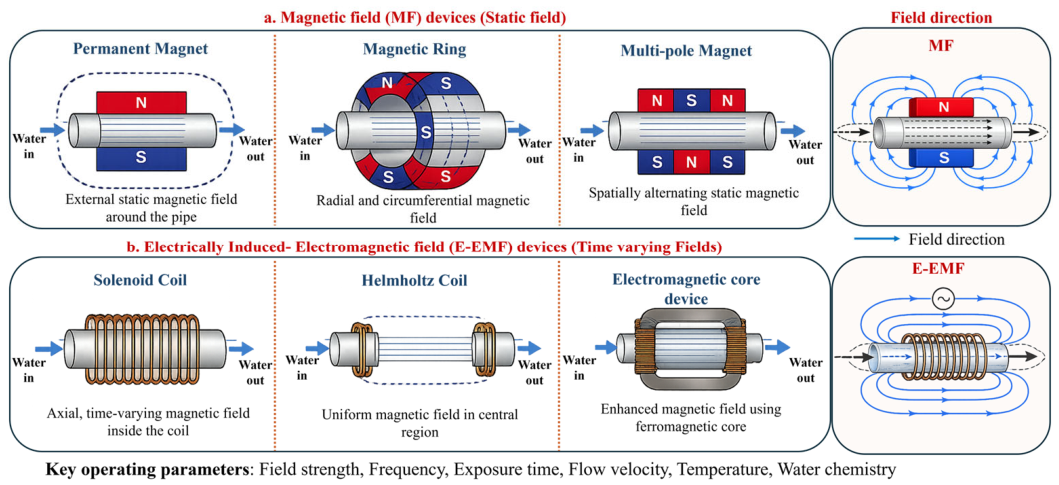
Figure 3.
Conceptual decision-support framework illustrating conditions under which MF/EMF treatment may improve irrigation performance and salinity management in agricultural reuse systems. The framework integrates irrigation water salinity, soil and crop conditions, drainage characteristics, and management strategies to identify scenarios where MF/EMF treatment may function as a standalone conditioning approach or where additional interventions such as desalination, blending, or soil amendments are required.
Figure 3.
Conceptual decision-support framework illustrating conditions under which MF/EMF treatment may improve irrigation performance and salinity management in agricultural reuse systems. The framework integrates irrigation water salinity, soil and crop conditions, drainage characteristics, and management strategies to identify scenarios where MF/EMF treatment may function as a standalone conditioning approach or where additional interventions such as desalination, blending, or soil amendments are required.
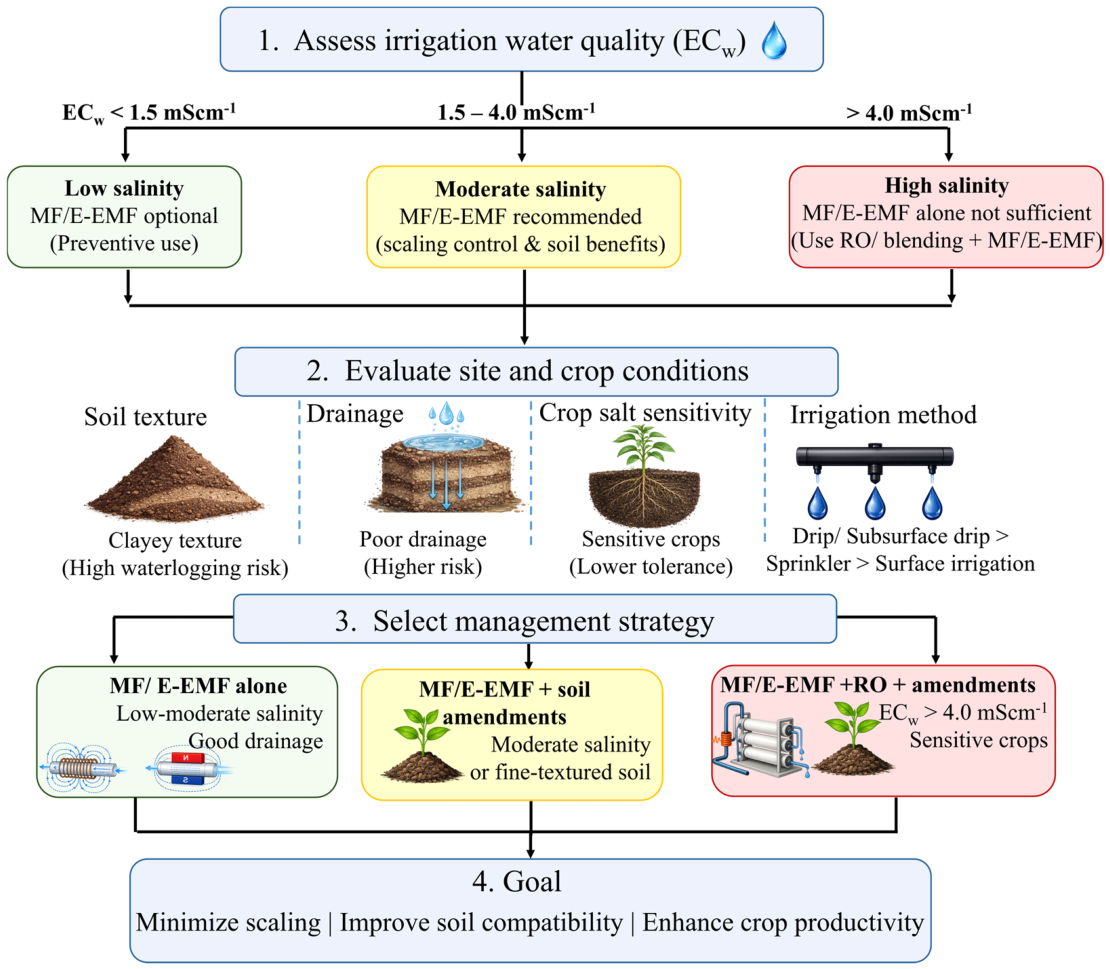
Figure 4.
Integrated framework for sustainable agricultural reuse of saline and unconventional waters combining desalination or blending, MF/EMF conditioning, soil amendments, and precision irrigation strategies. In this conceptual system, desalination reduces bulk salinity, MF/EMF treatment modifies ion transport and crystallization behavior, soil amendments improve buffering capacity and soil structure, and precision irrigation enhances water and nutrient delivery efficiency. Collectively, these approaches contribute to improved soil compatibility, reduced root-zone salinity, enhanced crop productivity, and greater water-use efficiency.
Figure 4.
Integrated framework for sustainable agricultural reuse of saline and unconventional waters combining desalination or blending, MF/EMF conditioning, soil amendments, and precision irrigation strategies. In this conceptual system, desalination reduces bulk salinity, MF/EMF treatment modifies ion transport and crystallization behavior, soil amendments improve buffering capacity and soil structure, and precision irrigation enhances water and nutrient delivery efficiency. Collectively, these approaches contribute to improved soil compatibility, reduced root-zone salinity, enhanced crop productivity, and greater water-use efficiency.
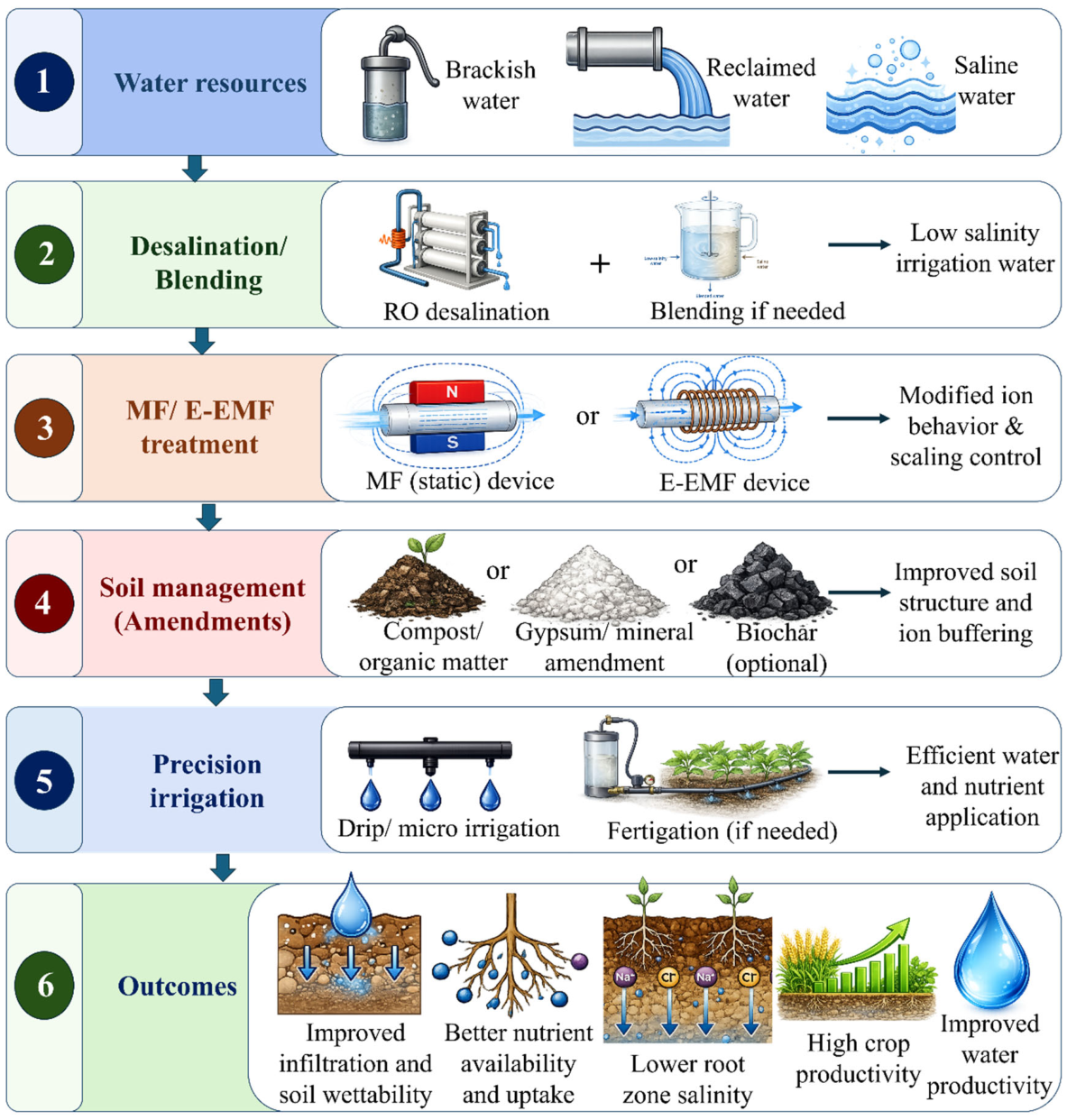
Disclaimer/Publisher’s Note: The statements, opinions and data contained in all publications are solely those of the individual author(s) and contributor(s) and not of MDPI and/or the editor(s). MDPI and/or the editor(s) disclaim responsibility for any injury to people or property resulting from any ideas, methods, instructions or products referred to in the content. |
© 2026 by the authors. Licensee MDPI, Basel, Switzerland. This article is an open access article distributed under the terms and conditions of the Creative Commons Attribution (CC BY) license (http://creativecommons.org/licenses/by/4.0/).
Copyright: This open access article is published under a Creative Commons CC BY 4.0 license, which permit the free download, distribution, and reuse, provided that the author and preprint are cited in any reuse.


