
Submitted:
19 June 2026
Posted:
22 June 2026
You are already at the latest version
Abstract
Background: Educational technologies support the development of clinical skills in nursing education, especially in procedures that require technical accuracy and patient safety. This study aimed to develop and validate an educational video for teaching capillary blood glucose measurement to nursing students. Method: A methodological design was used, comprising four stages: conceptualization, development, implementation, and evaluation. Experts (nursing professors and clinical nurses) and users (nursing students) assessed the video regarding objectives, content, usability, and efficiency. The Content Validity Index (CVI) was applied, with CVI ≥ 0.80 considered acceptable. Results: The final product was a video organized into nursing prescription, material preparation, patient approach, capillary blood glucose measurement, disposal, and checking/recording. Filming was conducted by an audiovisual professional, and free software was used for editing and distribution. Subtitles in Portuguese and English were added to enhance accessibility. Thirteen professors/clinical nurses and seventeen students evaluated the material, with all domains achieving CVI ≥ 0.80. Conclusion: The video demonstrated strong content validity and is an effective tool for teaching capillary blood glucose measurement in traditional, digital, and virtual learning environments.
Keywords:
nursing education
; clinical skills
; educational technology
; capillary blood glucose measurement
; educational video
1. Introduction
The International Diabetes Federation (IDF) recommends routine blood glucose monitoring for hospitalized patients at risk, including individuals over 40 years of age, those with obesity, patients receiving corticosteroids, and those with acute illness or infection [1]. Among the most common NANDA-International Nursing Diagnoses in patients admitted to medical and surgical wards is Risk for Unstable Blood Glucose Level (00179), defined as “susceptibility to variation or fluctuation in serum glucose levels outside the normal range, which may compromise health” [2]. Risk factors include advanced age, excessive stress, fasting, infection, and uncontrolled diabetes [3] .
Nursing care for patients with this diagnosis aims to achieve the expected outcome Blood Glucose Level (2300) through the interventions Hyperglycemia Management (2120) and Hypoglycemia Management (2130), with capillary blood glucose measurement being one of the main monitoring actions [2].
Capillary blood glucose testing measures the concentration of glucose in capillary blood obtained from the fingertips [4]. The procedure involves placing a drop of blood on a test strip connected to a portable glucose meter, which analyzes the sample and displays the result immediately [4,5]. This practice is essential for glycemic control, preventing episodes of hyperglycemia and hypoglycemia, and monitoring individuals with Diabetes Mellitus (DM) [1,6,7]. As an invasive procedure widely performed in hospital settings, it requires technical expertise, adherence to biosafety measures, and adequate training to ensure the comfort and safety of both patients and healthcare professionals [5] .
In addition, the wide variety of glucose meter models and test strip manufacturers requires continuous training to ensure correct device use and prevent measurement errors. In this context, innovative teaching and learning strategies are essential for disseminating scientific knowledge and strengthening clinical practice in a safe and up-to-date manner [8].
Health Technologies (HT) encompass the means, methods, instruments, and knowledge applied by professionals for teaching, diagnosis, treatment, rehabilitation, prevention, and health promotion [9]. These technologies include not only equipment and medications but also organizational, informational, and educational systems that support healthcare delivery [9,10]. Within this scope, Educational Technologies (ET) aim to train individuals and professionals for healthcare practice and may take tactile, visual, auditory, printed, expository, dialogical, or audiovisual formats [9,11].
Educational videos have proven effective in promoting learning and improving nursing practices, supporting both patient and family self-care and the development of clinical skills among students. Several studies highlight the effectiveness of this strategy in areas such as colostomy care [12], self-management of fluid restriction in heart failure [13], cardiopulmonary resuscitation for laypeople [14], bed baths [15], medication administration [16] , and gastric tube insertion [17].
However, no validated audiovisual tools specifically designed for teaching capillary blood glucose measurement have been identified. Most available videos are produced by equipment manufacturers and focus on technical instructions for device use rather than evidence-based procedural teaching.
Furthermore, educational videos can promote inclusion for people with hearing impairments through subtitles, sign language interpretation, or audio description [18] . The COVID-19 pandemic further highlighted the need for accessible technologies, given the increased use of remote and blended teaching methods [19,20] .
Given the scarcity of validated educational audiovisual materials on capillary blood glucose measurement and the importance of inclusive, evidence-based resources, this study aims to develop and evaluate an audiovisual educational tool for teaching this procedure.
2. Materials and Methods
2.1. Type of Study
This is a methodological study focused on the development of an audiovisual educational tool. The tool was created at the Nursing Skills and Simulation Laboratory of a public higher education institution (HEI) located in São Paulo, Brazil.
2.2. Development
The development of the educational tool followed four methodological stages: Conceptualization, Development, Implementation, and Evaluation [21,22].
2.2.1. Stage 1 – Conceptualization
To describe the stages of the procedure, nursing technique textbooks [23], manuals and Standard Operating Procedures (SOPs) [24,25] , guidelines from the Brazilian Diabetes Society [7] , and scientific articles on the topic [4,26] were consulted.
Based on the evidence identified in the literature, the decision was made to develop an educational video aimed at students and healthcare professionals. A detailed step-by-step script of the procedure was prepared, serving as the basis for filming and editing the video.
2.2.2. Stage 2 – Development
Based on the script, the settings, actors, materials, and equipment required for filming the capillary blood glucose measurement technique in a simulated hospital environment were defined. Filming took place in the institution’s skills laboratory.
The scenes featured researchers and a volunteer undergraduate student. Filming was conducted by a staff member from the institution’s IT Department.
The video was edited using the free Clipchamp® editor, with on-screen text descriptions added to support narration and dialogue. The final version was translated into English and subtitled to enhance accessibility and broaden the reach of the material.
2.2.3. Stage 3 – Implementation
The video was hosted on an online platform and made available through a direct link and a QR code.
2.2.4. Stage 4 – Evaluation
The link to access the video was sent by email to two groups of evaluators, accompanied by an invitation letter, an Informed Consent Form (ICF), and an evaluation guide.
The first group, termed “Experts,” consisted of lecturers in adult health and technology, postgraduate students, and nurses involved in undergraduate nursing education at the institution. Professionals who had participated in the development of the study were excluded.
After incorporating the corrections suggested by the experts, the video was submitted to the second group, termed “Users,” consisting of fourth-year nursing undergraduates at the HEI who had already studied the content addressed in the video. Students who were on leave, had suspended enrollment, or had participated in earlier stages of the research were excluded.
A total of 50 experts and 67 undergraduates were invited according to the established inclusion criteria.
2.3. Data Collection
Data collection was conducted using an electronic form designed by the researchers. The questionnaire included sociodemographic data (gender, age group, occupational category, educational background) and video performance criteria related to Objective (aims, goals, and intended purposes), Content (information provided, organization, structure, and presentation strategy), Usability (expected ease of use), and Efficiency (expected performance relative to available resources) [27].
After reading and accepting the ICF, participants were given access to the video and then to the evaluation questionnaire, which consisted of seven sections. Sections four to seven contained the evaluation items: two questions on Objective, nine on Content, four on Usability, and four on Efficiency.
Responses were recorded on a five-point Likert scale ranging from 1 (“strongly disagree”) to 5 (“strongly agree”). An open-ended field was provided for comments and suggestions.
2.4. Data Analysis
Data were organized in a Microsoft Excel spreadsheet and analyzed using R software, version 4.5.2. Sociodemographic and professional variables were analyzed using descriptive statistics. Measures of central tendency and dispersion were calculated for numerical variables, and absolute and relative frequencies were calculated for categorical variables.
To assess the level of agreement among evaluators (experts and users), the Content Validity Index (CVI) was used [28], where n is the number of judges who agreed on the relevance of the item and N is the total number of judges. The weighted mean of each item was calculated based on participants’ responses, with the following values assigned: 1 = 0; 2 = 0.25; 3 = 0.50; 4 = 0.75; and 5 = 1. Items with a CVI ≥ 0.80 were considered relevant and appropriate.
2.5. Ethical Considerations
The project was approved by the Research Ethics Committee of the Higher Education Institution in May 2022 (Opinion No. 5.381.330). All participants signed the informed consent form. Individuals featured in the video signed an Image Use Consent Form. The study complied with Resolution No. 466/2012 of the National Health Council.
3. Results
The product developed was an educational video designed to teach students and healthcare professionals how to perform capillary blood glucose measurement. The video is 7 minutes and 43 seconds long and, to enhance accessibility for the target audience, is narrated in Portuguese with bilingual subtitles (Portuguese and English). It features a light-colored background and a soft soundtrack, beginning with an introduction to the topic, authors, institution, target audience, and objectives. The opening image pays tribute to the 80th anniversary of the Higher Education Institution (HEI) where the video was produced in 2022.
The steps involved in the capillary blood glucose measurement procedure were organized into six parts:
Part 1 – Checking the nursing order: The procedure begins at the nursing station, where the professional checks the time of the order and the finger used in the previous measurement to ensure rotation of the puncture site [4,23,29] .
Part 2 – Preparation of materials: After performing hand hygiene, the practitioner selects and arranges the necessary reusable and disposable materials, as well as personal protective equipment, on a tray [4,24,25,30,31] .
Part 3 – Approaching and guiding the patient: The healthcare professional approaches the bed, introduces themselves, checks the identification wristband, confirms the patient’s identity using two identifiers (full name and date of birth), and explains the procedure [23,32] .
Part 4 – Capillary blood glucose measurement: The professional performs hand hygiene, dons surgical gloves, and checks the site of the previous puncture. Recommendations are provided regarding glucose meter models and test strips, finger rotation, and the correct puncture site (lateral side of the fingertip) [4,26,33] . After antisepsis with cotton and 70% alcohol, the puncture is performed, a drop of blood is placed on the test strip [4,5] , and the finger is dried. The result is displayed and communicated to the patient [34] . Before leaving the room, the nurse removes the glove from one hand (to avoid touching objects while gloved) and raises the bed rail [30,31,32] .
Part 5 – Disposal of materials: Back at the nursing station, disposable materials and sharps are discarded in appropriate containers; hand hygiene is then performed, and the tray is cleaned [30,31] .
Part 6 – Verification and recording: The result is checked against the nursing prescription and recorded in the patient’s medical record, including details of the digit used and an interpretation of the value obtained [23,29] .
The video concludes with references used, production credits, and acknowledgments [35] . Figure 1 presents images illustrating the main stages of the video.
3.1. Implementation and Validation
The video was hosted on an online platform and made available via a direct link and a QR code for evaluation by two groups of participants: experts and users.
3.1.2. Validation with Experts
Fifty nursing professionals (nursing lecturers specializing in adult health and technology, postdoctoral researchers, and nurses) were invited to participate, of whom 13 agreed to take part. Among the experts, 92.3% were women, the predominant age group was 41–60 years (53.8%), and 61.5% held a PhD.
The results of the video evaluation—covering its objective, content, usability, and effectiveness—as assessed by the expert participants, are presented in Table 1.
All criteria were deemed adequate by the experts, with a CVI ≥ 0.80. The main suggestions referred to adjusting the tone of voice, improving image clarity, and making minor visual refinements, all of which were incorporated before proceeding to the next stage.
3.1.3. User Validation
Seventeen fourth-year nursing students participated, out of the 67 invited. The majority (76.5%) were female, and 94.1% were aged 30 years or younger. The results of the user evaluation are presented in Table 2.
All criteria assessed obtained a CVI ≥ 0.80, confirming the relevance and suitability of the educational video. Ten participants (58.8%) assigned the highest score (“strongly agree”) to all items, resulting in a CVI of 1.0. In addition to their approval, the undergraduates also provided positive comments regarding the video’s performance:
“Great video, very informative and easy to understand.” (student reviewer 4)
Two comments also addressed the length of the video:
“I loved the video! It’s long enough to explain everything, it’s comprehensive, leaves no room for doubt and isn’t boring.” (student evaluator 10)
“The video is short and self-explanatory when showing the necessary steps. For this reason, the video does not become boring.” (student evaluator 16)
No undergraduate suggested any changes, reinforcing the tool’s acceptance and applicability among the target audience.
3.1.3. Availability of the Final Version
The video “Capillary Blood Glucose Measurement in a Hospital Setting” is available on digital platforms and can be accessed via the following links:
YouTube (Portuguese version): https://youtu.be/dB8PxE4Eg_8
YouTube (English version): https://youtu.be/4gL8AbV74R8
4. Discussion
The results of this study demonstrate that the proposed objective was achieved, as an educational video on capillary blood glucose measurement in a hospital setting, aimed at healthcare students and professionals, was successfully developed and validated by both experts and users, in accordance with best practices and recommendations from the literature. The video addresses the procedure in a comprehensive and up-to-date manner, respecting the needs of both the patient and the nursing team [4,31,34] .
This research represents a step forward in the use of digital technologies for teaching clinical healthcare skills [8,11,34] . Its evidence-based design, practical applicability, and validation by experts make it an innovative tool for the education and training of healthcare professionals [10,11,35] . The resource combines technical rigor with accessible language, promoting self-directed learning and the consolidation of skills essential for safe, individualized care [36] .
Educational videos are widely used in educational contexts because they combine visual, auditory, and narrative elements that enhance student understanding and engagement [19,36,37] . The literature recognizes educational videos as effective teaching strategies, particularly due to their low cost, broad dissemination, and flexibility of use in face-to-face, blended, or remote learning environments [19,36] . Another relevant aspect is their contribution to the standardization of teaching, especially in practical contexts such as healthcare skills training, ensuring that all students receive the same information and procedural demonstrations [36]. Furthermore, educational videos can help reduce costs and optimize institutional resources [36].
When compared with other digital educational technologies, educational videos strike a balance between accessibility, engagement, and cognitive effectiveness, making them a versatile and efficient resource in the teaching–learning process [38] .
As observed in other studies on videos addressing nursing procedural skills, the material developed in this study demonstrated didactic clarity, logical sequencing, and alignment with good clinical practice [14,15,16] . However, it differs from previous studies by incorporating the Nursing Process and biosafety standards, integrating clinical reasoning and patient safety within a single audiovisual resource [29,30,31,32] . The application of the Nursing Process facilitates the organization of care, enabling nursing interventions to be planned, implemented, and evaluated systematically, based on evidence and the individual needs of each patient [29,39,40] . It also contributes to reducing errors, improving communication among members of the multidisciplinary team, and strengthening the autonomy and professional identity of nurses [40] .
By integrating the Nursing Process into educational resources such as instructional videos, students’ understanding of the importance of systematic, non-routine care is enhanced, fostering the development of clinical reasoning from the early stages of their training. This approach also reinforces the adoption of safe practices aligned with biosafety guidelines, which is essential for preventing adverse events and promoting a safer and more effective care environment [29,39,40,41]. It is noteworthy that the evaluation item “The video addresses the use of the Nursing Process” showed the lowest levels of agreement among both experts (CVI = 0.81) and users (CVI = 0.94). This may be explained by the fact that capillary blood glucose measurement constitutes a nursing intervention, thus representing only one stage of the Nursing Process [29].
Compared with other educational videos available, this one stands out for its inclusive and international approach, featuring bilingual subtitles and an English translation. In terms of accessibility, studies indicate that videos with subtitles, audio description, and plain language are more inclusive for diverse audiences, particularly individuals with hearing or visual impairments or cognitive difficulties, promoting greater understanding and equity in access to content [42] . Another highlight is its free availability on an open platform (YouTube) and an institutional platform (E-aulas USP), which broadens the reach of the content and enhances its use in Interprofessional Education programs [43] . Many audiovisual resources described in the literature remain restricted to institutional contexts or lack accessibility adaptations, limiting their educational impact [14,15,16,37] .
The validation of the video by experts and users reinforces its educational value and relevance for skills training. The combination of visual elements, simple language, and appropriate duration enhances engagement and content retention, promoting the development of clinical skills with greater autonomy [35,36,38] . Furthermore, the video has broad applicability and can be used both in undergraduate programs and in continuing professional development for healthcare professionals [43].
In summary, the educational video “Capillary Blood Glucose Measurement in the Hospital Setting” stands as a valid, accessible, and inclusive resource that contributes to strengthening nursing education, promoting patient safety, and disseminating evidence-based practices. Its adoption in academic and clinical settings reinforces the transformative potential of digital technologies in health education and highlights nursing’s commitment to innovation, quality of care, and equity in access to knowledge.
Limitations of the Study
The video was produced during the COVID-19 pandemic; consequently, healthcare professionals and patients in the simulated hospital environment are wearing N95 masks. The use of an N95 mask is not required as part of personal protective equipment (PPE) for performing capillary blood glucose testing in a hospital setting. Another limitation relates to the absence of a translation into Brazilian Sign Language (Libras), which was not feasible due to budgetary constraints. It is recommended that future versions include this feature to enhance accessibility and inclusion.
5. Conclusions
This study enabled the development and validation of an audiovisual tool for teaching the technique of capillary blood glucose measurement in a hospital setting. The educational video produced proved to be a clear and didactic resource aligned with best care practices, incorporating principles of patient safety and compliance with technical and ethical nursing standards.
The validation results demonstrated a high level of agreement among experts and users, confirming the tool’s relevance, usability, and efficiency. Thus, the video has the potential to be used as a complementary resource in the teaching and learning process for students and healthcare professionals, promoting the standardization of clinical practices and strengthening nurses’ clinical reasoning.
The tool developed represents a significant advance in health education by combining technological innovation, accessibility, and scientific rigor. Its application in different educational settings can contribute to improving the quality of teaching, care, and, consequently, patient safety. It is recommended that future versions expand accessibility through the inclusion of Brazilian Sign Language translation and that new evidence-based educational videos be developed to support the teaching of other clinical nursing skills.
Author Contributions
All authors contributed substantially to the study. Conceptualization and Design: [Regina Célia dos Santos Diogo], [Rosely da Silva Matos Liberatori], [José Carlos de Santana Neto], [Paula Cristina Nogueira]. Methodology and Software Development: [Regina Célia dos Santos Diogo], [Rosely da Silva Matos Liberatori], [José Carlos de Santana Neto]. Data Collection and Analysis: [Regina Célia dos Santos Diogo], [Rosely da Silva Matos Liberatori], [José Carlos de Santana Neto], [Karoline de Oliveira Lins Souto], Writing – Original Draft Preparation: [Regina Célia dos Santos Diogo], [Rosely da Silva Matos Liberatori], [José Carlos de Santana Neto], Writing – Review & Editing: [Regina Célia dos Santos Diogo], [Rosely da Silva Ma-tos Liberatori], [Paula Cristina Nogueira]. Supervision: [Regina Célia dos Santos Diogo], [Rosely da Silva Matos Liberatori], [Paula Cristina Nogueira]. All authors have read and approved the final manuscript and agree to be accountable for all aspects of the work.
Funding
This research was funded by Unified Scholarship Programme (PUB) – Vice-Dean’s Office for Inclusion and Belonging; Institutional Programme for Scientific Initiation Scholarships (PIBIC): National Council for Scientific and Technological Development (CNPQ); São Paulo Research Foundation (Fapesp), Grant n 2024/14448.
Institutional Review Board Statement
The project was approved by the Research Ethics Committee of the School of Nursing, University of Sao Paulo in May 2022 (Opinion No. 5.381.330).
Informed Consent Statement
Informed consent was obtained from all subjects involved in the study.
Data Availability Statement
In accordance with Open Science principles, the data generated and analyzed in this study are available from the corresponding author upon reasonable request.
Public Involvement Statement
No public involvement in any aspect of this research.
Guidelines and Standards Statement
This methodological study followed best-practice guidelines for the development and validation of educational technologies, including the stages of conceptualization, development, implementation, and evaluation as recommended by Trochim (1996) and Filatro (2017). Although no specific international reporting guideline exists for studies on the development of educational videos, the research adhered to ethical standards, methodological rigor, and evidence-based instructional design principles.
Use of Artificial Intelligence
During the preparation of this manuscript, the authors used ChatGPT (OpenAI) to assist with language revision, textual restructuring, and enhancement of scientific clarity across all sections. All content generated or suggested by the tool was subsequently reviewed, edited, and approved by the authors, who take full responsibility for the final version of the manuscript.
Acknowledgments
The authors thank the staff of the Nursing Skills and Simulation Laboratory for their technical and logistical support during video production. We also acknowledge the undergraduate students and nursing professionals who contributed to the evaluation process.
Conflicts of Interest
The authors declare no conflicts of interest.
Abbreviations
The following abbreviations are used in this manuscript:
| HEI | Higher Education Institution |
| HT | Health Technologies |
| ICF | Informed Consent Form |
| CVI | Content Validity Index |
References
- International Diabetes Federation. IDF Diabetes Atlas, 11th ed.; International Diabetes Federation: Brussels, Belgium, 2024.
- Gengo e Silva, R.C.; Dos Santos Diogo, R.C.; Da Cruz, D.A.L.M.; Ortiz, D.; Ortiz, D.; Peres, H.H.C.; Moorhead, S. Linkages of nursing diagnoses, outcomes, and interventions performed by nurses caring for medical and surgical patients using a decision support system. Int. J. Nurs. Knowl. 2018, 29, 269–275. [CrossRef]
- Herdman, T.H.; Kamitsuru, S.; Lopes, C.T. NANDA International Nursing Diagnoses: Definitions and Classification, 12th ed.; Thieme: New York, NY, USA, 2021.
- Mathew, T.K.; Tadi, P. Blood glucose monitoring. In StatPearls; StatPearls Publishing: Treasure Island, FL, USA, 2022. Available online: https://www.ncbi.nlm.nih.gov/books/NBK555976/.
- Xavier, A.T.F.; Alves, B.S.; Gamba, M.A. Guidelines on capillary blood glucose for health professionals. Brazilian Diabetes Society – Nursing Department Management 2022–2023, 2023. Available online: https://diabetes.org.br/wp-content/uploads/2023/09/Orientacoes_Glicemia_SBD.pdf.
- American Diabetes Association. Classification and diagnosis of diabetes: Standards of medical care in diabetes—2022. Diabetes Care 2022, 45 (Suppl. 1), S17–S38. [CrossRef]
- Brazilian Diabetes Society. Brazilian Diabetes Society Guideline – 2025 Edition; Brazilian Diabetes Society: São Paulo, Brazil, 2025. [CrossRef]
- Sá, G.G.M.; Silva, F.L.; Santos, A.M.R.; Nolêto, J.S.; Gouveia, M.T.O.; Nogueira, L.T. Technologies that promote health education for the community elderly: Integrative review. Rev. Latino-Am. Enferm. 2019, 27, e3186. [CrossRef]
- Tourinho, F.S.V.; Schuelter, P.I.; Fermo, V.C. Desenvolvimento de Tecnologias em Pesquisa e Saúde: Da Teoria à Prática; Científica Digital: São Paulo, Brazil, 2022. Available online: https://do.novsu.ru/.
- Rodrigues Filho, F.J.; Pereira, M.C. The profile of health technologies incorporated in SUS during 2012–2019: Who are the mainly demanders? Saúde Debate 2021, 45, 707–719. [CrossRef]
- Teixeira, E. Technology in nursing: Trends for production and health education to the community. Rev. Eletrônica Enferm. 2010, 12, 598–600. [CrossRef]
- Dalmolin, A.; Girardon-Perlini, N.M.O.; Coppetti, L.C.; Rossato, G.C.; Gomes, J.S.; Silva, M.E.N. Educational video as a healthcare education resource for people with colostomy and their families. Rev. Gaúcha Enferm. 2016, 37, e68373. [CrossRef]
- Rosseto, S.C.; Aprile, D.C.B.; Grisante, D.L.; Vancini, M.G.; D’Agostino, F.; Herdman, H.T.; Lopes, J.L.; Santos, V.B.; Lopes, C.T. Development and content validity of educational videos on self-management of fluid restriction and thirst for individuals with heart failure. Int. J. Nurs. Knowl. 2024, in press. [CrossRef]
- Carmo, R.L.; Panho, E.L.; Quadros, C.A.Z.; Santos, J.V.A.L.; Pitilin, E.B.; Araújo, J.S.; et al. Elaboration of an educational video for cardiopulmonary resuscitation with chest compressions in adults. Rev. Bras. Enferm. 2023, 76, e20220367. [CrossRef]
- Lopes, J.L.; Baptista, R.C.N.; Domingues, T.A.M.; Ohl, R.I.B.; Barros, A.L.B.L. Development and validation of a video on bed baths. Rev. Latino-Am. Enferm. 2020, 28, e3329. [CrossRef]
- Magnabosco, P.; Godoy, S.; Mendes, I.A.C.; Raponi, M.B.G.; Toneti, B.F.; Marchi-Alves, M. Production and validation of an educational video on the use of the Z-Track Technique. Rev. Bras. Enferm. 2023, 76, e20220439. [CrossRef]
- Araujo, C.E.S.; Ferreira, S.Q.F.; Aragão, A.G.; Assis, D.C.; Beserra, E.P. The production of educational videos in nursing education: An experience report. Rev. Encontros Univ. UFC 2022, 7, 1–10. Available online: http://www.periodicos.ufc.br/eu/article/view/87595. [CrossRef]
- Pereira Gomes, J.D.; De Carvalho, A.T.; Albuquerque Brandão, M.G.S.; Galindo Neto, N.M.; Fortes Figueiredo, M.L.; Mariano Grimaldi, M.R. Construction and validation of a video about breast cancer for deaf women. Rev. Cuidarte 2023, 14, 1–12. Available online: https://revistas.udes.edu.co/cuidarte/article/view/3076.
- Coyne, E.; Rands, H.; Frommolt, V.; Kain, V.; Plugge, M.; Mitchell, M. Investigation of blended learning video resources to teach health students clinical skills: An integrative review. Nurse Educ. Today 2018, 63, 101–107. [CrossRef]
- Serra, I.V.S.; Lima, J.M.M.; Silva, G.T.R.; Santos, J.X.P.; Santana, L.S. Remote teaching during the COVID-19 pandemic: A viewpoint according to Paulo Freire’s approach. Cogitare Enferm. 2022, 27, e84547. [CrossRef]
- Trochim, W.M.K. Evaluating websites. Cornell University, 1996. Available online: https://socialresearchmethods.net/kb/evaluation/.
- Filatro, A. Design Instrucional Contextualizado: Educação e Tecnologia; Senac São Paulo: São Paulo, Brazil, 2017.
- Bergamasco, E.C. Habilidades Clínicas em Enfermagem; Grupo GEN: São Paulo, Brazil, 2019.
- Giovani, A.M.M.; Rodrigues, C.F.S.; Leite, C.D.S.; Meireles, C.C.S.; Carvalho, M.K.; Fernandes, S.L.B.; Santolim, T.Q.; Dias, V.C. Procedimentos de Enfermagem IOT HC FMUSP; Editora Manole: Barueri, Brazil, 2014.
- Stacciarini, T.S.G.; Cunha, M.H.R. Procedimentos Operacionais Padrão em Enfermagem; Editora Atheneu: São Paulo, Brazil, 2014.
- Topping, J.; Reardon, M.; Coleman, J.; Hunter, B.; Shojima Perera, H.; Thyer, L.; Simpson, P. A comparison of venous versus capillary blood samples when measuring blood glucose using a point-of-care, capillary-based glucometer. Prehosp. Disaster Med. 2019, 34, 506–509. [CrossRef]
- Campoy, L.T.; Rabeh, S.A.N.; Castro, F.F.S.; Nogueira, P.C.; Terçariol, C.A.S. Bowel rehabilitation of individuals with spinal cord injury: Video production. Rev. Bras. Enferm. 2018, 71, 2376–2382. [CrossRef]
- Ayre, C.; Scally, A.J. Critical values for Lawshe’s content validity ratio: Revisiting the original methods of calculation. Meas. Eval. Couns. Dev. 2014, 47, 79–86. [CrossRef]
- Federal Nursing Council. Cofen Resolution No. 736/2024: Provides for the Implementation of the Nursing Process in All Socio-Environmental Contexts Where Nursing Care Occurs; Cofen: Brasília, Brazil, 2024. Available online: https://www.cofen.gov.br/resolucao-cofen-no-736-de-17-de-janeiro-de-2024/.
- Pan American Health Organization. Prevention and Control of Healthcare-Associated Infections: Basic Recommendations; PAHO: Washington, DC, USA, 2017.
- Brazil. Ministry of Health. Patient Identification Protocol: National Patient Safety Program; Ministry of Health: Brasília, Brazil, 2022. Available online: https://www.gov.br/saude/pt-br/composicao/saes/dahu/pnsp/protocolos-basicos/protocolo-de-identificacao-do-paciente/view.
- Brazil. Ministry of Labor. NR 32: Safety and Health at Work in Health Services; Ministry of Labor: Brasília, Brazil, 2022. Available online: https://www.gov.br/trabalho-e-emprego/.../nr-32-atualizada-2022.pdf/view.
- Laguna Neto, D.; Robles, F.C.; Dias, F.G.; Pires, A.C. Analysis of fingerstick capillary glycemia versus alternative site: Results and patients’ preferences. Arq. Bras. Endocrinol. Metab. 2009, 53, 344–347. [CrossRef]
- Carvalho, P.R.; Ferraz, E.S.D.; Teixeira, C.C.; Machado, V.B.; Bezerra, A.L.Q.; Paranaguá, T.T.B. Patient participation in care safety: Primary Health Care professionals’ perception. Rev. Bras. Enferm. 2021, 74, e20200773. [CrossRef]
- Araujo, C.E.S.; Ferreira, S.Q.F.; Aragão, A.G.; Assis, D.C.; Beserra, E.P. The production of educational videos in nursing education: An experience report. Rev. Encontros Univ. UFC 2022, 7, 1–10. Available online: http://www.periodicos.ufc.br/eu/article/view/87595. [CrossRef]
- Brazil. Ministry of Education. Digital Educational Resources; Ministry of Education: Brasília, Brazil, 2025. Available online: https://www.gov.br/mec/pt-br/escolas-conectadas/recursos-educacionais-digitais.
- Meneses, J.C.B.C.; Alves, D.A.; Alencar, A.M.P.G.; Lisboa, K.W.S.C.; Oliveira, C.R.T.; et al. Development and validation of an educational video on podiatric care for the prevention of ulcers in elderly people with diabetes. Res. Soc. Dev. 2022, 11, e59411729777. [CrossRef]
- Wutke, M.S.; Cardoso, V.C. The evolution of short videos and their use in education. Rev. Sala Aula Foco 2024, 13, 1–15. [CrossRef]
- Bavaresco, T.; Silva, M.B.; Argenta, C.; et al. The nursing process in building evidence for clinical practice. In Nursing Process: From Theory to Practice in Intensive Care; Argenta, C., Adamy, E.K., Bitencourt, J.V.O., Eds.; Editora UFFS: Chapecó, Brazil, 2022; pp. 12–33. Available online: https://books.scielo.org/id/6z3tw/pdf/argenta-9786586545708-01.pdf.
- Gadelha, G.G.R.S.; Andrade, A.F.; Souza, A.J.A.; Souza, É.S.; Silva, F.E.S.; Santos, K.A.G.; Sousa, P.B.; Jorge, A.R.C. The impact of the nursing process (NP) on patient health. Rev. Foco 2024, 17, e6590. [CrossRef]
- Almeida, S.L.P.; Primo, C.C.; Almeida, M.V.S.; et al. Guide for Systematization of Care and Nursing Process: Educational technology for professional practice. Rev. Bras. Enferm. 2023, 76, e20210975. [CrossRef]
- Marcus-Quinn, A. The critical role of subtitles and audio description in enhancing eLearning effectiveness. University of Limerick, 2020. Available online: https://conference.pixel-online.net/files/foe/ed0014/FP/7553-ELRN6510-FP-FOE14.pdf.
- Petermann, X.B.; Miolo, S.B. Interprofessional education in health in higher education: Integrative review on Brazilian experience. Educ. Teor. Prát. 2021, 31, e02. [CrossRef]
Figure 1.
Illustrative images: Top left: home screen; followed by prescription verification, material preparation, patient assessment, capillary blood glucose measurement, and sharps disposal. São Paulo, SP, 2022.
Figure 1.
Illustrative images: Top left: home screen; followed by prescription verification, material preparation, patient assessment, capillary blood glucose measurement, and sharps disposal. São Paulo, SP, 2022.
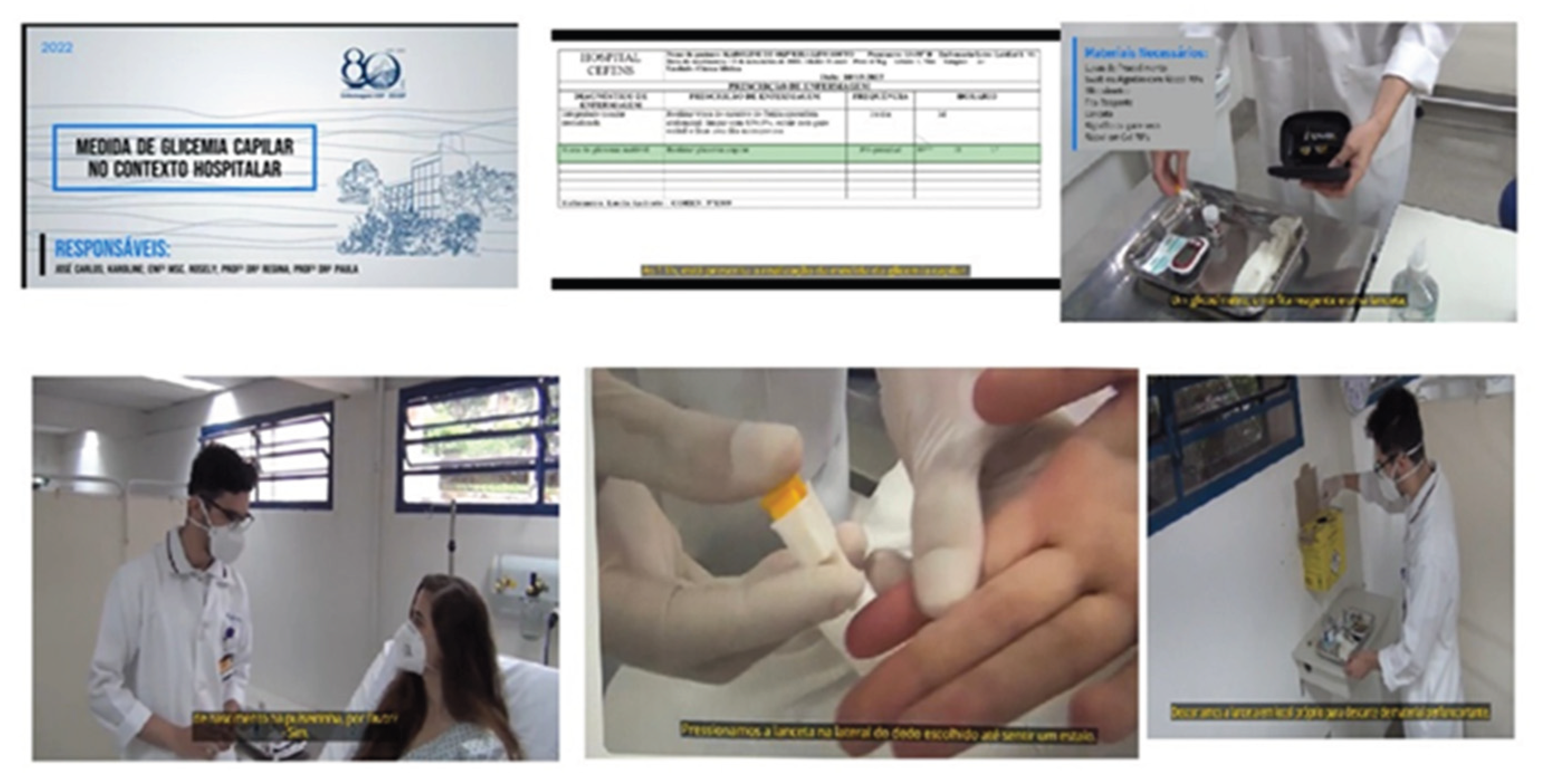

Table 1.
Distribution of video evaluation results by experts (n = 13). São Paulo, SP, 2022.
| Criteria | CVI* |
|---|---|
| Objectives | |
| 1. The objectives are consistent with the practice of capillary blood glucose testing in a hospital setting. | 0.88 |
| 2. The video can be used to teach capillary blood glucose testing in a hospital setting. | 0.98 |
| Content | |
| 3. The content is consistent with the stated objective. | 0.98 |
| 4. The content facilitates the teaching and learning process regarding the procedure for measuring capillary blood glucose in a hospital setting. | 1.00 |
| 5. The content enables an understanding of the capillary blood glucose measurement procedure in a hospital setting. | 0.98 |
| 6. The content follows a logical sequence. | 0.98 |
| 7. The content is consistent with the steps required to perform capillary blood glucose measurement in a hospital setting. | 1.00 |
| 8. The video provides the materials required to demonstrate the capillary blood glucose procedure in a hospital setting. | 0.98 |
| 9. The video incorporates the use of the Nursing Process. | 0.81 |
| 10. The video enables the performance of capillary blood glucose measurement in a hospital setting in accordance with biosafety criteria. | 0.94 |
| 11. The video meets Patient Safety objectives. | 0.96 |
| Usability | |
| 12. The language used (dialogue, narration and subtitles) is easy for you to understand. | 0.96 |
| 13. It is easy to grasp the concepts used in the video and how they are applied. | 0.94 |
| 14. The video provides a clear and practical guide to measuring capillary blood glucose in a hospital setting. | 0.96 |
| 15. The video is engaging and does not feel boring. | 0.96 |
| Effectiveness | |
| 16. The video’s duration is appropriate for the user to learn the content. | 0.96 |
| 17. The number and characterisation of the characters serve the intended purpose. | 0.92 |
| 18. Communication between the characters is effective and comprehensible. | 0.90 |
| 19. The description of the materials used is clear. | 0.98 |
Legend: *Content Validity Index.
Table 2.
Distribution of video evaluation results by users (n = 17). São Paulo, SP, 2022.
| Criteria | CVI* |
|---|---|
| Objectives | |
| 1. The objectives are consistent with the practice of capillary blood glucose testing in a hospital setting. | 1.00 |
| 2. The video can be used to teach capillary blood glucose testing in a hospital setting. | 1.00 |
| Content | |
| 3. The content is consistent with the stated objective. | 1.00 |
| 4. The content facilitates the teaching and learning process regarding the procedure for measuring capillary blood glucose in a hospital setting. | 0.98 |
| 5. The content enables an understanding of the capillary blood glucose measurement procedure in a hospital setting. | 1.00 |
| 6. The content follows a logical sequence. | 1.00 |
| 7. The content is consistent with the steps required to perform capillary blood glucose measurement in a hospital setting. | 1.00 |
| 8. The video provides the materials required to demonstrate the capillary blood glucose procedure in a hospital setting. | 0.98 |
| 9. The video incorporates the use of the Nursing Process. | 0.94 |
| 10. The video enables the performance of capillary blood glucose measurement in a hospital setting in accordance with biosafety criteria. | 0.98 |
| 11. The video meets Patient Safety objectives. | 1.00 |
| Usability | |
| 12. The language used (dialogue, narration and subtitles) is easy for you to understand. | 1.00 |
| 13. It is easy to grasp the concepts used in the video and how they are applied. | 0.98 |
| 14. The video provides a clear and practical guide to measuring capillary blood glucose in a hospital setting. | 0.98 |
| 15. The video is engaging and does not feel boring. | 0.95 |
| Effectiveness | |
| 16. The video’s duration is appropriate for the user to learn the content. | 0.97 |
| 17. The number and characterisation of the characters serve the intended purpose. | 1.00 |
| 18. Communication between the characters is effective and comprehensible. | 1.00 |
| 19. The description of the materials used is clear. | 0.98 |
Legend: *Content Validity Index.
Disclaimer/Publisher’s Note: The statements, opinions and data contained in all publications are solely those of the individual author(s) and contributor(s) and not of MDPI and/or the editor(s). MDPI and/or the editor(s) disclaim responsibility for any injury to people or property resulting from any ideas, methods, instructions or products referred to in the content. |
© 2026 by the authors. Licensee MDPI, Basel, Switzerland. This article is an open access article distributed under the terms and conditions of the Creative Commons Attribution (CC BY) license (http://creativecommons.org/licenses/by/4.0/).
Copyright: This open access article is published under a Creative Commons CC BY 4.0 license, which permit the free download, distribution, and reuse, provided that the author and preprint are cited in any reuse.


