
Submitted:
18 June 2026
Posted:
22 June 2026
You are already at the latest version
Abstract
Traumatic brain injury (TBI) triggers complex molecular responses that remain incompletely understood at the structural level, where it's highly connected to neurodegeneration and synaptic dysfunction. Growing evidence implicates intrinsically disordered proteins (IDPs), and proteins with intrinsically disordered regions (IDRs), as key regulators of stress-responsive signaling. In this study, we represent an in silico study of the 24 TBI-relevant proteins, such as MAPT, SERF2, SERBP1, BEX3, TDP43, NFL, C9orf16, C9orf58, APP, NRN1, NEFM, SYNGAP1, SNAP25, DLG4, APOC2, HCLS1, HMGB1, FUS, EPHA4, SEMA4D, S100B, PLEK, CAMK2A, and SNCA, integrating analysis of the predisposition for intrinsic disorder and liquid–liquid phase separation (LLPS) through RIDAO, FuzDrop, and AlphaFold platforms. We demonstrate that more than 90% of residues in SERF2, BEX3, MAPT, SERBP1, HMGB1, SNCA, and FUS are predicted as disordered. The amino acid sequences of NEFM, HCLS1, C9orf16, NEFL, C9orf58, SNAP25, SYNGAP1, S100B, and TDP43 contain between 50% and 90% of disordered residues, and the disorder contents of APP, APOC2, and DLG4 are 47.53%, 45.54% and 33.29%. Only five proteins (SEMA4D, PLEK, CAMK2A, EPHA4, and NRN1) have less than 30% disordered residues. The high prevalence of disorder in TBI-associated proteins correlates with their strong propensity for spontaneous liquid-liquid phase separation (LLPS). In fact, 15 proteins (FUS, SYNGAP1, MAPT, NEFM, SERBP1, HCLS1, SERF2, BEX3, C9orf16, TDP43, HMGB1, APP, NEF, DLG4, and SNCA) are expected to act as droplet drivers, and five more proteins (SEMA4D, C9orf58, SNAP25, CAMK2A, and EPHA4) can serve as droplet clients. The gene ontology analysis emphasized that the 24 TBI-related proteins (TBIome) are functionally associated with synaptic regulation, RNA metabolism, cytoskeletal dynamics, and mitochondrial stress response. We also show that human proteins interacting the members of TBIome are on average a bit more disordered than the human brain proteins in general. This extended TBI interactome is functionally connected to cytoplasmic translation, translation, synaptic vesicle cycle, modulation of chemical synaptic transmission, regulation of neurotransmitter levels, regulation of synaptic plasticity, neurotransmitter secretion, synaptic vesicle exocytosis, protein localization to synapse, and trans-synaptic signaling. Many of these proteins have strong LLPS potential as well. Therefore, high intrinsic disorder propensity and strong LLPS potential represent shared structural and functional features of proteins linked to the TBI-related pathophysiology. Collectively, these findings support a model in which disorder-based mechanisms contribute to post-traumatic molecular reprogramming, which underlie the pathological roles of TBI-related proteins.
Keywords:
traumatic brain injury
; intrinsically disordered proteins
; liquid-liquid phase separation
; bioinformatics analysis
; structural organization
; and cellular functions
1. Introduction
Traumatic brain injury (TBI) is a complex neurological condition characterized by the disruption of brain function due to external mechanical forces, affecting millions worldwide annually [1]. Furthermore, TBI represents a leading cause of death and disability, accounting for 30–50% of all injury-related fatalities [2,3]. Over 2.8 million Americans sustain a TBI every year, over 5 million Americans are living with a permanent TBI-related disability, and 68,663 TBI-related deaths (~190 per day) were reported in 2023 in the United States alone [4,5,6]. Globally, TBI affects over 50 million people annually and represents a leading cause of death and disability, particularly in individuals under 45 years of age, and costs approximately 400 billion US dollars annually, representing 0.5% of the gross world product [7,8]. This widespread impact underscores TBI as a significant public health concern, pressing need for improved therapeutic strategies, which necessitates a deeper understanding of the molecular mechanisms underlying TBI pathogenesis [1,9], with particular attention to the roles played by intrinsically disordered proteins (IDPs).
This condition, considered a global public health concern, manifests as an alteration of injured brain tissue involving inflammatory responses, excitotoxicity, and oxidative stress [10]. Neuroinflammation, broadly defined as the reactive response of central nervous system (CNS) elements to altered homeostasis, is a ubiquitous feature across a spectrum of neurological disorders, encompassing developmental, traumatic, ischemic, metabolic, infectious, and neurodegenerative conditions [11]. This complex process is orchestrated by resident glial cells, primarily microglia and astrocytes, and is further modulated by neuronal and vascular interactions, as well as peripheral immune signals [12]. While initially serving a protective role, prolonged or dysregulated neuroinflammation can transition into a pathological driver, contributing significantly to disease progression [13]. This dual nature underscores the necessity of a nuanced understanding of neuroinflammatory mechanisms, particularly how the intricate interplay between the pro- and anti-inflammatory mediators determines functional outcomes [12,14,15]. Uncontrolled or deregulated neuroinflammation is a pathological condition within the brain, triggered by various factors, and is characterized by the activation of resident immune cells such as Alzheimer’s disease (AD), Parkinson’s disease (PD), Huntington’s disease (HD), and amyotrophic lateral sclerosis (ALS), leads to the release of neuroinflammatory markers, such as TNF-α and IL-1β, which contribute to neuronal dysfunction and degeneration [16,17,18].
Over the past decades, our understanding of protein structure and function has advanced substantially, which proposed rigid, highly specific interactions between enzymes and substrates, to a dynamic structure-function continuum considerations emphasizing conformational flexibility and intrinsic disorder [19,20,21]. As a result, there has been an exponential increase in the interest in studying intrinsically disordered proteins (IDPs) alongside the development of computational tools capable of predicting disordered regions and increasing reports on the involvement of protein disorder in carrying out cellular functions [22,23]. Strong electrostatic repulsions due to a higher net charge, combined with low overall hydrophobicity that reduces the driving force for compaction, are generally considered the primary reasons for the extended structure of IDPs/IDRs, best defined as the ensemble of functionally relevant, transient structures interconverting on a fast timescale [24]. Despite lacking a stable structure, IDPs and IDRs are functional under physiological conditions. Their structural organization is governed by the same fundamental physical forces that shape ordered proteins, though the balance of these forces and the resulting dynamic behavior differ considerably [25]. Like structured proteins, the expression, localization, and interactions of IDPs are highly coordinated and regulated [26,27]. Multiple checkpoints at various stages of the expression of IDP-encoding genes, from transcript synthesis to protein degradation, ensure the availability of IDPs in appropriate quantities and for the desired duration, preventing any ectopic interactions [26,27]. Therefore, a chaos generated by IDPs/IDRs (defined by their high propensity for promiscuous interactions, aggregation, and potential toxicity) to the cellular machinery is managed through a multi-layered regulatory approach providing tight control of their abundance via precise regulation of transcript clearance, proteolytic degradation, and translational rates [26,27].
Alignment tools designed for IDPs/IDRs rely on specialized amino acid substitution matrices that reflect the characteristic residue frequencies found within disordered protein regions [28,29]. Comparative analyses of amino acid compositions in ordered versus disordered segments, together with physicochemical property-based scales, including coordination number, aromaticity, strand and helix propensities, flexibility, and volume and composition-based metrics, such as combinations of one to four residue types, have been instrumental in distinguishing intrinsically disordered regions from structured protein domains [30,31,32,33,34].
The role of IDPs/IDRs in human diseases has been actively studied. However, there are several limitations and challenges associated with in silico studies of IDP-associated neurodegenerative disorders [35]. Several proteins implicated in TBI pathology contain IDRs, which make them structurally flexible but vulnerable to stress-induced misfolding and aggregation. Experimental models demonstrate that mild TBI induces chronic MAPT phosphorylation and tauopathy, similar to human post-traumatic pathology [36]. α-Synuclein (SNCA) is another intrinsically disordered neuronal protein, particularly aggregation-prone within its NAC region. Oxidative stress and membrane disruption after TBI promote α-synuclein oligomerization, and recent analyses highlighted biochemical changes in α-synuclein relevant to trauma-related neurodegeneration [37]. TAR DNA-binding protein 43 (TDP43) combines a structured N-terminal RNA-binding domain with a disordered, prion-like C-terminal region. TBI can trigger cytoplasmic mis-localization, cleavage, and accumulation of TDP43, consistent with patterns observed in ALS and frontotemporal dementia [38]. Additional work suggests that trauma-induced defects in nucleocytoplasmic transport promote TDP43 aggregation [39]. Although amyloid precursor protein (APP) is not fully disordered, it generates the intrinsically aggregation-prone Aβ peptide. Aβ deposition has been detected in individuals with prior TBI using advanced PET imaging [40,41,42], and cerebrospinal fluid studies show distinct Aβ and tau signatures in chronic traumatic encephalopathy [43]. Neurofilament light chain (NEFL) contains disordered head and tail domains essential for cytoskeletal dynamics. After TBI, serum NfL levels rise and correlate strongly with axonal injury and long-term outcomes [44].
2. Results and Discussion
2.1. Intrinsic Disorder Status of Human TBI-Related Proteins
The outputs of the RIDAO tool representing the intrinsic disorder propensities of the 24 human proteins involved in TBI are summarized in Figure 1, which shows the outputs of all the tools included in RIDAO as ADS vs. PPIDR dependencies and demonstrates that the outputs of all the predictors are correlated. This conclusion is further supported by the Spearman Rank Order Correlation analysis, which shows a statistically significant positive correlation between pairs of variables generated by different algorithms. In fact, for the pairs of PPIDRs generated by different predictors, the correlation coefficients ranged from 0.834 (for the PPIDRVLXT – PPIDRVSL2 pair) to 0.985 (for the PPIDRIUPred_short – PPIDRIUPred_long pair) (mean: 0.912±0.038), with the correlation p-values between all the pairs being 2×10⁻⁷. Similarly, the corresponding ADS pairs showed the correlation coefficients ranging from 0.772 (for the ADSVLXT – ADSVL3 pair) to 0.990 (for the ADSIUPred_short – ADSIUPred_long pair) (mean: 0.933±0.049), with the correlation p-values between all the pairs being 2×10⁻⁷. Because of this high positive correlation between the outputs of the different disorder predictors included in RIDAO, in the subsequent analyses, we focused on the outputs of PONDR® VSL2 (PPIDRVSL2 and ADSVSL2).
Table 1 shows that the length of the analyzed proteins varied in a wide range, from 59 and 83 residues for SERBP1 and C9or16 to 758, 770, and 1343 residues for MAPT, APP, and SYNGAP1, respectively. This broad range is crucial because the structural properties, functional roles, and prediction of disorder can depend on the size of the protein. Including varied sizes allows for a more comprehensive analysis of how disorder occurs in short regions compared to long, entirely disordered proteins, which may have distinct amino acid compositions.
Table 2, Table 3 and Table 4 represent some major characteristics of the analyzed proteins classified as upregulated, downregulated or mixed based on their expression status in TBI, respectively. According to the PONDR® VSL2, all the TBI-related proteins analyzed in this study were classified as highly or moderately disordered, since their PPIDR values was above 10% threshold. This analysis revealed that more than 90% of residues in SERF2, BEX3, MAPT, SERBP1, HMGB1, SNCA, and FUS are predicted as disordered. The amino acid sequences of NEFM, HCLS1, C9orf16, NEFL, C9orf58, SNAP25, SYNGAP1, S100B, and TDP43 were shown to contain between 50% and 90% of disordered residues. Although APP, APOC2, and DLG4 were characterized by the PPIDRVSL2 values of 47.53%, 45.54% and 33.29%, respectively, their ADS values were below 0.5 threshold (0.4982, 0.4577, and 0.4186, respectively), classifying them as “moderately disordered plus” proteins. Only five proteins (SEMA4D, PLEK, CAMK2A, EPHA4, and NRN1) had less than 30% disordered residues and were therefore identifies as moderately disordered. Therefore, the set of human TBI-related proteins included 16 highly disordered proteins, 3 “moderately disordered plus” proteins, and 5 moderately disordered proteins. In other words, the TBI-related protein set is largely made up of proteins that act in functional modes not achievable by ordered proteins, making at least some of them prone to aggregation and highly relevant as biofluid-based biomarkers.
Table 2, Table 3 and Table 4 show that almost all analyzed proteins contain disorder-based binding sites, molecular recognition features (MoRFs), which are IDRs that can fold at interaction with specific binding partners. Since only three proteins, APOC2, PLEK, and NRN1, did not contain MoRFs, it is clear that intrinsic disorder contributes to the functionality and interactivity of the vast majority of human TBI-related proteins. Importantly, the global disorder content is not directly correlated to the prevalence of MoRFs. For example, although more than 90% of SNCA are predicted as disordered, it is expected to have only two MoRFs. On the other hand, although only a bit more than a half of TDP43 (PPIDRVSL2= 57.25%) is predicted to be disordered, there are five MoRFs in this protein, whereas there are no MoRFs in APOC2, which is almost as disordered as TDP43 (PPIDRVSL2 = 45.54%). This suggests that the functional, binding-rich nature of TBI-related proteins is not merely dependent on the amount of disorder, but rather on the specific type and location of ordered-disordered transition regions (MoRFs). This also indicates that the functional interaction mechanisms of TBI-related proteins are complex, with specific, rather than total, disordered content determining the MoRF-mediated interaction capabilities. This also emphasizes that intrinsic disorder acts as a scaffold for MoRFs allowing these proteins to bind to multiple partners, which is likely why they are so central to the complex pathology of TBI.
Proteins listed in Table 2 are upregulated in TBI. FUS, HMGB1, HCLS1, SNCA, TDP43, and S100B are highly disordered proteins, as their PPIDR and ADS values exceed the corresponding thresholds. APP and APOC2 are classified as “moderately disordered plus”, whereas SEMA4D, PLEK, and EPHA4 are moderately disordered. Six upregulated proteins (FUS, HMGB1, HCLS1, SNCA, TDP43, and APP) are also predicted to be capable of spontaneous LLPS and therefore can act as droplet drivers. APOC2, SEMA4D, and EPHA4 are droplet clients; i.e., proteins that cannot phase separate on their own but are recruited into the biomolecular condensates formed by drivers due to their own droplet-promoting regions. Finally, S100B and PLEK are not related to the LLPS processes although both have noticeable levels of intrinsic disorder. In fact, despite being a highly disordered protein characterized by the ADSVSL2 = 0.5099 and PPIDRVSL2 = 63.04%, S100B has the lowest pLLPS value among all the proteins analyzed in this study and does not have DPRs. Since expression of these IDPs increases in TBI, and since at least some them have strong aggregation potential (FUS, SNCA, TDP43, and APP/Aβ), these two features serve as a crucial mechanistic link between acute physical trauma and chronic neurodegenerative diseases. The neuroinflammatory environment caused by the TBI (notably, via the FUS, HMGB1, SNCA, S100B, and TDP43 overexpression) drives secondary injury cascades; i.e., promoting misfolding and accumulation of some of these same proteins, which can create a “seeding” effect, where one proteinopathy triggers another, leading to long-term neurodegeneration. More specifically, overexpression of HMGB1 is associated with chronic neuroinflammation, epilepsy, and cognitive decline [45,46,47], whereas enhanced levels of S100B serve as a severe injury biomarker, indicate active cell death, and worsen secondary injury [48]. The overexpression of FUS, TRP43, MAPT, APP, and SNCA is linked to the progressive brain dysfunction, neurotoxicity, and neurodegeneration through gain-of-function mechanisms, explaining why TBI can act as an environmental risk factor for neurodegenerative diseases like ALS, AD, and PD [49,50,51,52]. Upregulated expression of EPHA4 in the brain tissue after the TBI enhances the endoplasmic reticulum stress by activating the MAPK signaling pathway and promotes M1 polarization of microglia [53], and acts as a mediator of secondary injury, neuroinflammation, and poor recovery [54]. HCLS1 one of the “molecular beacons” associated with tight junction integrity and the formation of perihematomal edema after brain injury [55]. A transmembrane protein, SEMA4D, acts as a significant mediator of neuroinflammation, immune cell infiltration, and inhibition of repair mechanisms following TBI, where SEMA4D overexpression contributes to secondary injury by promoting astrocyte reactivity, glial scar formation, and axonal growth inhibition [56,57]. Significant upregulation of PLEK following TBI is linked to the inflammatory response and platelet activation that occur as secondary injury mechanisms after the initial trauma [58].
Table 3 shows that the downregulated TBI-associated proteins also possess mixed characteristics, with half of them being highly disordered (NEFM, SNAP25, and SYNGAP1), DLG4 being a “moderately disordered plus” protein, and CAMK2A and NRN1 being moderately disordered. Curiously, SNAP25, which is the second most disordered protein in this set (PPIDRVSL2 = 78.16%) is not predicted as a droplet driver, whereas DLG4, with more than two-fold lower disorder content (PPIDRVSL2 = 33.29%), can promote spontaneous LLPS. The expression of these proteins decreases in TBI, which may impair their functions and affect biological processes such as synaptic transmission, cytoskeletal stability, and signal transduction.
Figure 2 provides another look at the global intrinsic disorder status of human proteins related to TBI by comparing them with the whole human brainome (i.e., 1470 proteins found in the brain as per Human Protein Atlas [59,60,61,62]. Figure 2A represents the PONDR® VSL2 score (ADS) vs. PONDR® VSL2% (PPDR) plot, and the corresponding data are summarized in Table 5. This analysis revealed that 16 of 24 proteins are located in the red region of the plot, representing 66.67% of the proteins considered highly disordered. These highly disordered proteins are MAPT, TDP43, SNCA, NEFL, SERBP1, C9orf58, BEX3, C9orf16, SERF2, HCLS1, NEFM, SYNGAP1, SNAP25, HMGB1, FUS, and S100B. The highest levels of disorder were found in SERF2 (PPIDRVSL2 = 100.00%; ADSVSL2 = 0.9906) and BEX (PPIDRVSL2 = 100.00%; ADSVSL2 = 0.8194). Five more proteins have PPIDR values exceeding 90%: MAPT (PPIDRVSL2 = 99.08%; ADSVSL2 = 0.8602), SERBP1 (PPIDRVSL2 = 96.32%; ADSVSL2 = 0.8413) ; FUS (PPIDRVSL2 = 90.68%; ADSVSL2 = 0.8894), HMGB1 (PPIDRVSL2 = 91.16%; ADSVSL2 = 0.8511) and SNCA (PPIDRVSL2 = 90.71%; ADSVSL2 = 0.7199). The analyzed set of the TBI-related proteins also contains three “moderately disordered plus” proteins (APP, APOC2, and DLG4) located in the light pink area of the PONDR® VSL2 score vs. PONDR® VSL2% plot, with remaining five proteins (SEMA4D, PLEK, CAMK2A, EPHA4, and NRN1) being moderately disordered.
Along with these observations, the ΔCH-ΔCDF plot, which is presented in Figure 2B, provides additional support to the highly disordered status of the human TBI-related proteins. It demonstrates that most of the proteins are classified as intrinsically disordered. Particularly, 11 proteins (i.e., 45.83% of the entire TBIome) are located in the quadrant Q3, which corresponds to the highly disordered proteins (native coils and native pre-molten globule). This set includes BEX3, C9orf16, NEFL, SERBP1, SERF2, MAPT, FUS, HCLS1, HMGB1, NEFM, and SNAP25. The quadrant Q2, which corresponds to the native molten globules or hybrid proteins with sizable IDRs, contains 12.5% of the TBIome, namely APP, DLG4, and SYNGAP1. Only one protein, S100N, is located within the quadrant Q4. Finally, the quadrant Q1 that corresponds to mostly ordered proteins, contains 37.5% of TBIome, namely SNCA, C9orf58, TDP43, APOC2, CAMK2A, EPHA4, NRN1, PLEK, and SEMA4D. These observations support the evidence that the majority of selected proteins exhibit intricate disorder.
Table 5 shows that relative to the relative to the human brainome (1470 proteins found in the brain as per the Human Protein Atlas) and the entire human proteome (20,317 proteins from the Proteome ID: UP000005640) human TBI-related proteins (TBIome) are noticeably more disordered, possessing very high proportions of highly disordered proteins (see corresponding populations of red area in the PONDR® VSL2 score vs. PONDR® VSL2 percentage plot and quadrant Q3 in the ΔCH-ΔCDF plot. Importantly, although significant fractions of the localized human brainome and the broader human proteome are disordered, in fact, ~35–40% of the general human proteome (ID: UP000005640) consists of disordered residues [63], and the human brainome is a bit more disordered than the proteome [64], TBIome proteins show even higher levels of disorder, similar to or exceeding those found in other signaling and cancer-related protein sets.
Figure 2C,D and Supplementary Table S1 provide further support to this idea by showing the nested box-and-whiskers plots comparing the intrinsic disorder predispositions of proteins in the analyzed sets using the PPIDR and ADS outputs of seven per-residue disorder predictors PONDR® VLXT, PONDR® VSL2, PONDR® VL3, IUPRed_Short, IUPRed_Long, PONDR® FIT, and MDP (see Figure 2C and 2D, respectively). Analysis of these data clearly shows that the intrinsic disorder levels in the members of TBIome dramatically exceed those of brainome and proteome. This idea is further supported by Supplementary Table S1, representing the results of the statistical analysis of these datasets using the Mann-Whitney rank sum test. This analysis indicated that all the observed PPIDR and ADS differences between the TBIome and brainome, and the TBIome and proteome were statistically significant (p ≤ 0.05). This analysis revealed that the TBIome exhibits a distinct “disordered” signature compared to the proteome, which directly links TBI to the development of neurodegenerative diseases [65]. In other words, proteins that are specifically accumulated or altered after injury (the TBIome) are disproportionately disordered, often because their IDRs serve as “molecular glue” or scaffolds that promote pathological aggregation. It seems that TBI induces a structural shift in the proteome, where the dominance of highly disordered proteins mimics the molecular characteristics of neurodegenerative disease. Therefore, these observations suggest that the TBI-induced structural shift to a more disordered proteome provides a unifying molecular explanation for how a physical trauma initiates a progressive, chronic, and often delayed neurodegenerative disease process [66,67,68]. By shifting the proteome toward highly disordered proteins, TBI creates a perfect storm, as many IDPs are prone to misfolding and aggregation. This mimics the environment seen in AD, PD, or ALS, where protein aggregation drives cell death. Instead of a slow age-related decline, the trauma acts as a biological catalyst, accelerating a path toward neurodegeneration that would otherwise take decades to develop, thereby bypassing the slow decline of normal aging.
Further validation of the prevalence of intrinsic disorder in human proteins associated with TBI was retrieved by generating the 3D structural models of these proteins using AlphaFold. Results of this analysis are summarized in Figure 3, Figure 4 and Figure 5, showing models generated for upregulated, downregulated, and variably regulated proteins, respectively, and in Table 2, Table 3 and Table 4 showing average pLDDT predicted for these proteins by AlphaFold. In all three figures, many structures contain regions with low and very low confidence (yellow and orange segments) that correspond to regions with high conformational flexibility and which can be disordered in the absence of binding partners. Furthermore, many structures contain long, bended, and mostly isolated α-helices predicted with high confidence. These mostly blue or cyan helices can be seen in structures of HCLS1, SNCA, APOC2 (Figure 3), NEFM, SNAP25, SYNGAP1, NRN1 (Figure 4), NEFL, BEX3, and C9orf16 (Figure 5). Since the existence of such structural elements in isolation is physically impossible, these isolated α-helices observed in structures of the indicated proteins likely represent examples of the AlphaFold “hallucinations”, which are plausible-looking structures, where the real protein is actually unstructured [69].
It is recognized now that such “hallucinations” represent a new kind of error characteristic for the generative artificial intelligence (AI) models producing outputs that are highly detailed and informationally rich [70,71]. From the viewpoint of AI, such predictions appear plausible but they do not necessarily follow the actual physical laws or biological structures of the real world. Hallucinations represent erroneous, autonomous outputs generated by the model itself, rather than just inaccuracies inherited from training data [72]. Note that often, the long, mostly isolated α-helices predicted in proteins by AlphaFold, AlphaFold2, and newer versions are located within the long-coiled coil domains [69,73]. Furthermore, AlphaFold2 was shown to identify structures for a subset of IDRs that fold under certain conditions (conditional folding) [69]. Therefore, certain high-confidence segments can in fact correspond to the MoRFs, i.e., IDRs capable of undergoing disorder-to-order transition at binding to specific partners.
Figure 3 shows that the upregulated TBI-related proteins (FUS, HMGB1, HCLS1, SNCA, TDP43, S100B, APP, APOC2, SEMA4D, PLEK, and EPHA4) are characterized by high structural variability, with some possessing high levels of regions with low and very low confidence (e.g., FUS, HCLS1, and TDP43) and others shown high structural integrity (e.g., S100B, PLEK, and EPHA4). Importantly, structural analysis reveals a mix of characteristics. Even proteins primarily classified as ordered (“blue”) contain low-confidence regions, and those primarily classified as disordered (“orange”) possess structured, high-confidence domains. Therefore, this AlphaFold-based analysis revealed a mixture of intrinsically disordered regions and ordered domains, with significant differences in structural confidence among the proteins. The mixed structures of these proteins combine ordered domains for function and disordered regions for interactions, suggesting a complex role in neuroinflammation, protein aggregation, and structural damage following traumatic brain injury.
The downregulated proteins in Figure 4 are in a bit more structured state in comparison with the upregulated proteins (see Figure 3), which tend to be more disordered and mixed. The dark blue color (pLDDT > 90), indicating high confidence, is abundantly present among all six downregulated proteins, NRN1, NEFM, SYNGAP1, SNAP25, DLG4, and CAMK2A, primarily representing their stable, folded globular domains and structural cores. However, regions with low to very low pLDDT scores (below 50-70, colored in yellow and orange) are still present in these proteins. The peculiarities of pLDDT distribution in these proteins potentially reflect their functionality. For example, high-confidence regions are essential for the structural integrity of these proteins and, in the case of SYNGAP1 and DLG4, their structural scaffolding role in the postsynaptic density (PSD) [74,75]. The low-confidence regions in signaling proteins (SYNGAP1, DLG4 (PSD-95), and CAMK2A) can be involved in binding, phosphorylation, and modulation of synaptic plasticity. These regions can become ordered upon interaction with partners, enabling them to act as molecular switches that control synaptic signaling [76]. Therefore, the pLDDT distribution for these proteins reflects a balance between stable, high-confidence scaffolding structures and flexible, low-confidence, intrinsically disordered regions that are essential for their dynamic signaling functions in the brain.
The expression levels of differently regulated proteins depend on the context of the biological process; they can be both upregulated and downregulated. The confidence of the 3D structure predictions for these seven proteins, MAPT, SERF2, SERBP1, C9orf58, BEX3, C9orf16, and NEFL, is generally low, indicating their high structural flexibility and intrinsic disorder (see Figure 5). Particularly, almost entire structures of MAPT and SERBP1 are predicted with low and very low confidence scores (70 > pLDDT > 50 and pLDDT < 50, respectively), suggesting that they are largely disordered and lack a fixed, stable 3D shape, enabling them to change conformation and bind to multiple partners. Therefore, the differently expressed proteins are highly flexible. Due to their ability to move, mediate, and communicate, they are essential for regulation and organization. Additionally, these proteins are adaptive regulators, where they behave normally under stable conditions, and become harmful during the cell stress phase. These seven proteins represent a class of proteins whose adaptability allows them to switch between beneficial physiological roles and harmful, disease-related functions (e.g., neurodegenerative disease pathways).
Even simple visual inspection of Figure 3, Figure 4 and Figure 5 clearly indicates that differently regulated TBI-related proteins are noticeably more disordered than up- and downregulated proteins. This is also confirmed by statistical analysis (Kruskal-Wallis one-way analysis of variance on ranks), according to which, based on their corresponding median pLDDT values, these datasets are arranged as follows: differently regulated () < upregulated () < downregulated (). Although the observed differences are not statistically significant (p = 0.661), this trend suggests a potential, though not statistically supported, correlation between gene expression regulation levels and the structural confidence (measured by pLDDT) of the corresponding protein products. The data indicate that downregulated proteins tend to have slightly higher median structural confidence compared to upregulated and differently regulated proteins, possibly suggesting that downregulated proteins are, on average, more ordered or stable in their predicted structures, or that their structural models are better supported by the available sequence alignments. This idea is further supported by the Kruskal-Wallis one-way analysis of variance on ranks of these protein sets, which revealed that, based on their ADSVSL2 values, these sets can be arranged as follows: differently regulated () > downregulated () > upregulated (). According to this analysis, these differences in the median values among the groups are statistically significant (p = 0.029). The use of the PPIDRVSL2 in Kruskal-Wallis analysis showed that sets are statistically different (p = 0.007 and can be arranged in the following order: differently regulated () < upregulated () < downregulated (). The analysis consistently indicates that differently regulated TBI-related proteins possess higher levels of intrinsic disorder compared to up- and downregulated protein sets. Furthermore, while the pLDDT results were not significant, the disorder prediction metrics (ADSVSL2 and PPIDRVSL2) suggest that downregulated proteins tend to be more ordered than up-regulated ones, with significant differences between the groups.
This is further supported by Figure 6, representing the correlation between the AlphaFold-determined average pLDDT and intrinsic disorder predisposition (in terms of ADSVSL2) and showing that differently regulated proteins are clearly characterized by the highest disorder propensity and lowest structural confidence compared to two other sets. Figure 6 also shows that globally, there is a statistically significant (p = 0.0073) moderate negative linear relationship (correlation coefficient is -0.523) between the AlphaFold-determined average pLDDT and intrinsic disorder predisposition of human TBI-related proteins as determined by the Pearson product-moment correlation analysis.
2.2. Disorder-Based Functionality and LLPS Potential of the 24 Human TBI-Related Proteins
2.2.1. Looking at the LLPS Potential
The FizDrop-based analysis revealed that most human TBI-related proteins exhibit strong LLPS potential. In fact, as shown in Table 2 and Figure 7, 15 proteins (i.e., 62.5%; FUS, SYNGAP1, MAPT, NEFM, SERBP1, HCLS1, SERF2, BEX3, C9orf16, TDP43, HMGB1, APP, NEFL, DLG4, and SNCA) are predicted to be capable of spontaneous LLPS. This is evidenced by their pLLPS values exceeding the 0.6 threshold and the presence of the prominent DPRs, making them droplet drivers. Five more proteins (SEMA4D, C9orf58, SNAP25, CAMK2A, and EPHA4) can act as droplet clients (i.e., can be recruited into the biomolecular condensates formed by drivers), being characterized by pLLPS values below the threshold but containing DPRs. Finally, PLEK, NRN1, APOC2, and S100B (i.e., 16.67%) are not engaged in the LLPS process, possessing very low pLLPS values and not containing DPRs. By classifying these proteins into three tiers, drivers (such as FUS, TDP43, and MAPT), clients (such as SNAP25 and SEMA4D), and non-participants (e.g., S100B), this analysis suggests that the formation of biomolecular condensates heavily drives the pathology of TBI. The fact that over 60% of these proteins are “droplet drivers” underscores how physical changes in protein state might be a primary mechanism in neurodegeneration following an injury.
Figure 7 also shows that there is a strong positive correlation between the LLPS potential and disorder predisposition of these proteins, as evidenced by the Spearman rank order correlation analysis, which revealed that these two parameters were characterized by the correlation coefficient of 0.706, indicating a strong, positive, monotonic, and statistically significant (p = 6.44×10⁻⁵) relationship between them. This indicates that as the disorder predisposition (number of intrinsically disordered residues) of a protein increases, its potential to form droplets via LLPS also significantly increases. Therefore, in line with the previously established correlations, this finding is indicative of an important mechanistic link, where the increased conformational flexibility (disorder) allows the TBI-related proteins to participate in multivalent interactions required for phase separation. In other words, the higher disorder levels in these proteins directly correlate with a higher probability of forming condensates, which may contribute to the pathogenic processes observed in TBI, an important observation as it explains how these specific proteins might start clumping together abnormally after an injury.
Next, we analyzed the functionalities of human TBI-related proteins based on their interactivity with other human proteins. To this end, we used the power of STRING.
2.2.2. Small EDRK-Rich Factor 2 (SERF2; UniProt ID: P84101; ADSVSL2 = 0.9906; PPIDRVSL2 = 100.00%; pLLPS = 0.9942)
Alternative splicing generates four primaries human SERF2 isoforms, with lengths spanning 45 to 170 amino acids. Among these, the 59-amino acid variant is generally recognized as the canonical form (UniProt: P84101). Human SERF2 (a highly charged, 59-residue-long protein), also known as modifier of aggregation 4 (MOAG4) in the nematode worm Caenorhabditis elegans, can positively regulate aggregation of various amyloid proteins, including Aβ and α-synuclein, acting independently from HSF-1-induced molecular chaperones, proteasomal degradation, and autophagy [77]. This unique potential of SERF2/MOAG4 to bind many amyloidogenic peptide sequences and modify proteotoxicity was linked to the ability of this protein to interact with the negatively charged segments in aggregation-prone proteins, leading to the acceleration of the primary nucleation of amyloid by initiating structural changes and by decreasing colloidal stability [78]. It was also shown that SERF2, being an intrinsically disordered RNA-binding protein [79], is important for the stress granule formation, being capable of specific interaction with the non-canonical tetrahelical RNA structures known as G-quadruplexes [80]. Recently, multidimensional solution NMR was used to define the structure of the canonical form of this protein, revealing that it has a disordered structure with ~ 30% helicity [81]. In agreement with these findings, our bioinformatics analysis revealed that both the canonical and longest isoforms of human SERF2 are highly disordered and show very strong LLPS potential.
STRING-generated PPI network centered at human SERF2 and its functional enrichment are shown in Figure 8A. This network, which was generated using the minimum required interaction score of 0.4 (medium confidence), includes 35 nodes and 152 edges. The average node degree is 8.69, and the average local clustering coefficient is 0.8. Compared to a random set of proteins with similar size and degree distribution, this network exhibits a significantly higher number of internal interactions (p < 10-16). This, together with the enrichment, suggests that the proteins form a biologically connected functional module. Among the most significantly enriched biological processes associated with this protein are cytoplasmic translation, ribosomal small subunit assembly, and cellular nitrogen compound biosynthetic process (see Figure 8B). The most enriched molecular functions are structural constituent of ribosome, Structural molecule activity, RNA binding, and mRNA binding (Figure 8C), while the most enriched cellular components are cytosolic ribosome, ribosomal subunit, cytosolic small ribosomal subunit, cytosolic large ribosomal subunit, and ribonucleoprotein complex (Figure 8D).
2.2.3. Fused in Sarcoma (FUS, UniProt ID: P35637; ADSVSL2 = 0.8894; PPIDRVSL2 = 90.68%; pLLPS = 0.9999)
The functional roles of the FUS protein are mainly related to the RNA-binding and regulation of metabolic process proteins, splicing factors, and stress granule proteins, such as HNRNPC, EWSR1, NONO, ILF3, TNPO1, UBQLN2, and SRSF2. It has similar behavior to TDP43 [82]. The FUS protein is involved in RNA transcription and processing, mRNA stabilization, and the regulation of telomere maintenance via telomere lengthening. In other words, the FUS controls how the RNA is produced and processed, particularly under stress conditions [83]. In normal conditions, the FUS protein is found in the nucleus. However, under stressful conditions in the cell, its releases to the cytoplasm, where it condenses, relocates, and protects these molecules. Due to its structural organization (it contains the prion-like domain, the RGG repeats, and the intrinsically disordered regions), FUS shows strong LLPS ability. This can make the protein an ideal classical intrinsically disordered protein that is a LLPS driver with a very high pLLPS value of 0.9999 [84]. The upregulation of this protein can lead to the production of more RNA protein complexes, increase the stress granules, and tighten the condensation of RNA in the cytoplasm. Interestingly, if there is an excessive production of FUS protein, there will be a transition of the protein from being in the liquid phase to the aggregated solid state, which eventually contributes to the neurodegeneration [84].
Figure 9A represents the STRING-generated PPI network of this protein designed using the minimum required interaction score of 0.7 (high confidence). The network includes 97 nodes and 1102 edges. Its average node degree is 22.7, and the average local clustering coefficient is 0.722. Among the most statistically significantly enriched biological processes associated with the members of this network are RNA splicing, mRNA processing, mRNA splicing via spliceosome, regulation of RNA splicing, and negative regulation of mRNA metabolic process (Figure 9B).
Their most enriched molecular functions are mRNA binding, single-stranded RNA binding, mRNA 3-UTR binding, RNA binding, and pre-mRNA binding (Figure 9C), and the most enriched cellular components are catalytic step 2 spliceosome, spliceosomal complex, cytoplasmic stress granule, ribonucleoprotein granule, and cytoplasmic ribonucleoprotein granule (Figure 9D).
2.2.4. Microtubule-Associated Protein tau (MAPT; UniProt ID: P10636; ADSVSL2 = 0.8580; PPIDRVSL2 = 99.08%; pLLPS = 0.9985)
STRING analysis portrayed MAPT as a strongly connected hub, which is centered at the dense network including proteins associated with synaptic, cytoskeletal, and neurodegenerative processes [85], as shown in Figure 10A. The PPI network shows a strong connection with the tubulin isoforms, particularly TUBA1A, TUBB2B, TUBA4A, and TUBB2B. These proteins have a major role in microtubule regulation, where it contributes to the tress-related factors, supporting their function in the stability of the microtubule, which plays a critical role in the integrity of neuronal structure [86]. Furthermore, although MAPT interacts with the tubulin isoforms, it is also connected to the proteins associated with neurodegeneration pathways, such as APP, SNCA, CASP3, and APOE [87]. This suggests that MAPT can have relevant functions in pathological stress responses, neural survival, and synaptic maintenance [88]. What supports these functionalities is the gene ontology analysis, which supports the strong connection of MAPT in the different biological processes, where it illustrates its relevance in neuron death, synapse organization, cytoskeleton origination, autophagy, and cellular stress response. These factors are shown in Figure 10B.
These biological processes are a hallmark of MAPT neural regulation and its strong link to LLPS. Molecular functions of the members of this network include tau protein binding, structural constituent of cytoskeleton, tau-protein kinase activity, kinase binding, and cytoskeletal protein binding. As far as the subcellular localization context is concerned, Figure 10C shows that MAPT is found within the non-membrane-bound compartment, which includes the dendrites, synapses, growth cones, amyloid complexes, and dendritic spines. The localization of the MAPT represents the dynamics of it and having less stable organelle complexes, but rather a membrane with fewer assemblies. This underlines the high pLLPS propensity (0.9985). This supports MAPT’s role as a droplet-promoting protein, as demonstrated in multiple recent studies [89,90,91,92,93,94,95].
2.2.5. High Mobility Group Protein B1 (HMGB1; UniProt ID: P09429; ADSVSL2 = 0.8511; PPIDRVSL2 = 91.16%; pLLPS = 0.8945)
High-mobility group box protein 1 (HMGB1) is a ubiquitous, chromatin-associated nonhistone protein found in the nucleus of eukaryotic cells. It functions as a DAMP (damage-associated molecular pattern) and an “alarmin” when released extracellularly, triggering immune and inflammatory responses to stimuli like infection or damage [96,97,98,99,100]. The STRING analysis illustrates the interaction of HMGB1 with proteins associated with chromatin-associated proteins, transcription factors, and inflammatory mediators, such as TLR2/4, TP53, IL1B, NFKB1, and CD24 (Figure 11). This represents the dual function of HMGB1 to regulate the DNA chromatin and regulate inflammation signaling; functionality inside and outside the cell [101,102]. The HMGB1 protein is involved in several biological process including lipopolysaccharide immune receptor activity, pattern recognition receptor activity, and pattern recognition receptor.
Therefore, this illustrates the involvement of HMBB1 in chromatin remodeling and inflammation signaling [100]. The HMGB1 is also known as one of the DAMP proteins, which are highly dynamic and play crucial roles in chromatin binding, stress response, and immune signaling [103]. The HMGB1 tends to be upregulated in various pathologies, including TBI. It is released from necrotizing brain cells, triggering neuroinflammation, blood-brain barrier breakdown, and secondary injury [104]. The increase in the HMGB1 expression can lead to an increase in inflammatory signaling, promote stress response, and activate immune pathways [103]. Respectively, the HMGB1 contributes to the chromatin flexibility and the dynamics of nucleosomes. In line with the high phase separation potential predicted by FuzDrop (pLLPS = 0.8945), HMGB1 was shown to undergo LLPS [105].
2.2.6. SERPINE1 mRNA-Binding Protein 1 (SERBP1; UniProt ID: Q8NC51; ADSVSL2 = 0.8413; PPIDRVSL2 = 96.32%; pLLPS = 0.9972)
Human SERPINE1 mRNA-binding protein 1 (SERBP1) is a highly disordered, 408-residue-long ribosome-binding protein promoting ribosome hibernation; i.e., a process during which ribosomes are stabilized in an inactive state and preserved from proteasomal degradation [106]. SERBP1 contains extended arginine-glycine (RG/RGG)–rich regions and has previously been classified as an intrinsically disordered RBP [107]. Its enrichment in cytoplasmic translation, polysomes, and ribosomal subunits is therefore compatible with a disorder-based functional role in translational regulation. Such localization patterns are characteristic of proteins that are capable of participating in dynamic ribonucleoprotein condensates and regulating mRNA fate through multivalent, RNA-mediated interactions rather than through stable, single-partner complexes [108]. TBI triggers acute cellular stress responses in neurons, including disruption of RNA metabolism and formation of stress granules, which are LLPS-driven condensates of RNA and RNA-binding proteins (RBPs). Although SERBP1 hasn’t been directly implicated in TBI to date, studies of other RBPs demonstrate that stress granule formation is enhanced following traumatic injury and that impaired granule resolution may contribute to pathological persistence of protein–RNA aggregates [109], which provides a conceptual framework for considering a potential role of SERBP1 in TBI. Within this context, exceptionally high LLPS propensity of SERBP1 and translational association suggest a plausible, yet currently untested, role in post-injury RNA metabolic reprogramming. Supporting this broader framework, recent bibliometric analyses indicate that RBPs and RNA regulatory mechanisms are increasingly recognized as relevant to TBI severity and outcomes, underscoring the need for targeted investigation of individual RBPs such as SERBP1 in traumatic injury models [2].
The STRING interaction network of SERBP1 revealed a dense and highly homogeneous association with ribosomal and translation-associated proteins, which is a pattern characteristic of intrinsically disordered RNA-binding scaffolds. This network, together with some results of its functional enrichment analysis, is summarized in Figure 12. This interaction pattern is consistent with a potential contribution of SERBP1 to serve as the organizer of translational hubs, the assembly of ribosome-associated RNP condensates, and the dynamic regulation of mRNA fate [110,111]. FuzDrop analysis showed a high-confidence phase separation propensity (pLLPS = 0.9972), with multiple predicted droplet-promoting regions (Table 2), indicative of extensive intrinsic disorder and multivalent interaction capacity rather than rigid domain-mediated binding. In line with these predictions, this intrinsically disordered RNA-binding protein (RBP) was shown to undergo LLPS and form biomolecular condensates [108,112]. It acts as a key component of MLOs, such as stress granules and nucleoli, often driven by its RG/RGG repeats and modulated by RNA and PARylation, regulating translation and RNA metabolism [108,112].
2.2.7. Neurofilament Medium Polypeptide (NEFM; UniProt ID: P07197; ADSVSL2 = 0.8292; PPIDRVSL2 = 88.32%; pLLPS = 0.9977)
Neurofilament medium polypeptide (NEFM) is a 916-residue-long component of the axon cytoskeleton. It heteropolymerizes with light (NEFL) and heavy (NEFH) chains, forming a type IV intermediate filament, which is essential for maintaining neuronal structural integrity, axonal radial growth, and caliber, which directly influences nerve conduction velocity [113,114]. NEFM is commonly used as a biomarker for neuronal or axonal damage. This is because when axons are injured or degenerate, whether from trauma or neurodegenerative diseases, such as ALS, AD, PD, or multiple sclerosis, NEFM is released into the cerebrospinal fluid (CSF) and blood [115].
The STRING network of NEFM illustrates a strong cluster between proteins, where it represents a strong protein-protein interaction (see Figure 13). Thus, the protein is a part of a tight structural protein complex. The collaboration of some of these proteins can form the neurofilament cytoskeleton system, meaning that their function is not signaling-based but structural [116]. The enrichment analysis demonstrates the involvement of NEFM in the cytoskeleton organization, axon development, and neuronal structural maintenance [117]. Therefore, these functionalities support the neurons to maintain their shape, promote the stability of axons, and provide resistance to mechanical stress. The NEFM protein is found in axons, kinesin complexes, and intermediate filaments. This confirms it is a structural axonal protein, not a secreted one. While the NEFM can be flexible, it also contains coiled-coil domains, which provide the rigidity of the 3D structure upon assembly [118]. Human NEFM is a highly disordered protein predicted to have a high potential to be involved in LLPS, with the ADSVSL2 and pLLPS values of 0.8292 and 0.9977, respectively. LLPS of NEFM is driven by its highly disordered C-terminal tail [113,119]. This region is highly phosphorylated and protrudes from the filament core. It is engaged in weak, multivalent interactions that drive the formation of liquid-like or gel-like phases [119]. In TBI, neurons experience mechanical shear forces, calcium overload, cytoskeleton breakdown, and the failure of axonal transport. Therefore, the downregulation of NEFM can cause protein degradation and the breakdown of the cytoskeleton after injury [120].
2.2.8. Brain-Expressed X-Linked Protein 3 (BEX3; UniProt ID: Q00994; ADSVSL2 = 0.8194; PPIDRVSL2 = 100.00%; pLLPS = 0.9751)
Brain-expressed X-linked protein 3 (BEX3) is a 111-residue-long signaling adapter molecule involved in the low-affinity nerve growth factor receptor p75NGFR-mediated apoptosis induced by nerve growth factor receptor (NGF) [121]. Therefore, it is also known as NADE, a p75NTR (low-affinity neurotrophin receptor p75)-associated cell death executor [122]. It is one of the five members of the human BEX family, which contains a characteristic BEX domain, is broadly expressed in different tissues, regulates signals from different cell surface receptors, and plays a role in neuronal development [121].
The STRING interaction network of (BEX3) represents a compact, highly interconnected module enriched for apoptosis- and neurodegeneration-associated proteins, including CASP3, CASP7, BID, BAD, DIABLO, NGFR, and BEX family members (Figure 14A). Gene Ontology analysis highlights strong overrepresentation of intrinsic and extrinsic apoptotic signaling pathways, including activation of cysteine-type endopeptidase activity, mitochondrial cytochrome c release, and regulation of apoptotic processes (Figure 14B). These findings are consistent with established roles of BEX3 as a pro-apoptotic adaptor [123,124] linking neurotrophin receptor signaling (particularly NGFR/p75NTR) to downstream caspase activation. Compartments analysis further supports this interpretation, with significant enrichment for the apoptosome [125,126], reinforcing BEX3’s involvement in mitochondrial apoptosis execution rather than upstream transcriptional control (Figure 14C).
In line with this, FuzDrop analysis predicted a very high pLLPS of 0.9751, together with multiple droplet-promoting regions (1–47, 55–65, 92–111), which indicated extensive intrinsic disorder and multivalent interaction capacity. This structural organization suggests that BEX3 is intrinsically disordered across much of its sequence, enabling multivalent, transient interactions with multiple apoptotic regulators. BEX3’s disorder is not incidental, but rather a functional requirement for adaptor-mediated apoptotic signaling, as it enables signal amplification [127], threshold tuning, and rapid pathway switching [128]. The coexistence of high disorder levels and strong pathway specificity suggests that BEX3 may function within dynamic, stress-induced signaling assemblies rather than stable macromolecular complexes [33]. It was demonstrated that BEX3 is capable of undergoing LLPS in vitro, and the process is further promoted by short tRNA fragments (tRFs) [129]. Importantly, over time, BEX3 was shown to transit from liquid condensates to aggregates, whereas the presence of the tRFs protected this protein from amyloid formation [129]. Furthermore, BEX3 was shown to exist as a conformational ensemble that shifts to a well-defined structure upon binding to a pool of small tRNA fragments [129]. The demonstrated propensity of BEX3 to form specific complexes suggests an emerging plausible role of LLPS in dynamic apoptotic signaling assemblies, and is further supported by the broader framework studies [130,131].
2.2.9. C9orf16; Bublin Coiled-Coil Protein (BBLN; UniProt ID: Q9BUW7; ADSVSL2 = 0.7337; PPIDRVSL2 = 84.34%; pLLPS = 0.9307)
Bublin (BBLN or UPF0184 protein C9orf16) is an 83-residue-long, highly charged, coiled-coil protein, which plays an important role in the organization of the intermediate filaments and regulation of apical membrane morphology [132]. Similar to SERF2 and SERBP1, BBLN is a heat-resistant obscure (Hero) protein with chaperone-like activity involved in the pathobiology of the heart and vessels [133,134]. Hero proteins constitute a widespread family, members of which, being hydrophilic and highly charged, function to stabilize various client proteins, protecting them from denaturation under a variety of stress conditions [135]. Although the currently available information about the structure and function of BBLN is rather limited, Figure 15 places this protein in the middle of a dense PPI network, members of which are related to vacuolar acidification, endosomal lumen acidification, Golgi lumen acidification, and lysosomal lumen acidification. regulation of macroautophagy, regulation of autophagy, inorganic cation transmembrane transport, inorganic ion transmembrane transport, cation transmembrane transport, and ion transmembrane transport.
Most enriched molecular functions of these proteins are rotational mechanism of proton-transporting ATPase activity, proton transmembrane transporter activity, primary active transmembrane transporter activity, active ion transmembrane transporter activity, inorganic cation transmembrane transporter activity, cation transmembrane transporter activity, ion transmembrane transporter activity, inorganic molecular entity transmembrane transporter activity, ATP-dependent activity, and oxidoreductase activity. They are parts of the following cellular components: vacuolar proton-transporting V-type ATPase complex, proton-transporting two-sector ATPase complex, clathrin-coated vesicle membrane, coated vesicle membrane, clathrin-coated vesicle, coated vesicle, vacuolar membrane, and transport vesicle.
2.2.10. Hematopoietic Lineage Cell-Specific Protein (HCLS1; UniProt ID: P14317; ADSVSL2 = 0.7326; PPIDRVSL2 = 87.45%; pLLPS = 0.9967)
Hematopoietic lineage cell-specific protein HCLS1 is a 486-residue-long substrate of the antigen receptor-coupled tyrosine kinase with a potential role in the regulation of gene expression. The STRING interaction network of the HCLS1 protein revealed an interconnection with proteins that are assumed to be involved in the cytoskeletal remodeling, actin dynamics, and immune signaling pathways (Figure 16A). This demonstrates the collaborative functional work that the HCLS1 protein does with the help of the interconnected proteins. These proteins shape the response of HCLS1 to signals, particularly immune activity. In hematopoietic cells, HCLS1 works as an adapter linking distinct proteins to control signaling pathways [136]. It also helps in regulating the actin reorganisation and signal transduction. These functions are very critical for cell movement and immune activation. The most enriched GO terms representing the biological processes in which HCLS1 is involved are illustrated in Figure 16B, showing that this protein is associated with cell activation, signal transduction, and the regulation of cytoskeleton organization.
These processes are critical during the stress response [137]. The HCLS1 protein is commonly found in the cytoplasm and regions rich in actin (see Figure 16C). A strong evdidence suggested that this protein is co-localized with the Arp2/3 complex, which is a central component of the actin machinery [138]. It seems that due to its highly disordered nature, HCLS1 not only participates in signaling but also promotes cytoskeleton organization [139]. Additionally, being an upregulated protein, HCLS1 can promote the improvement of sending signals under cellular stress conditions, which supports a faster response through its role in the organization of the cytoskeleton. This protein has a very high pLLPS value (0.9967) and, therefore, is expected to be capable of spontaneous LLPS and act as a droplet driver. In line with these observations, HCLS1 was recently linked to the regulation of the biomolecular condensates under stress conditions, likely via the processes associated with the lysine-63 (K63)-linked polyubiquitination of HCLS1-associated protein X-1 (HAX1) [140].
2.2.11. Ras/Rap GTPase-Activating Protein SynGAP (SYNGAP1; UniProt ID: Q96PV0; ADSVSL2 = 0.6640; PPIDRVSL2 = 66.34%; pLLPS = 0.9886)
Ras/Rap GTPase-activating protein SynGAP (SYNGAP1) is a 1343-residue-long protein acting as a major constituent of the postsynaptic density (PSD, which is a membrane semienclosed, submicron protein-enriched cellular compartment beneath postsynaptic membranes) essential for the regulation of postsynaptic signaling. It also acts as an inhibitory regulator of the RAS-cAMP pathway.
The STRING-based network analysis illustrates the tight connection of the SYNGAP1 protein with PSD scaffolding proteins, such as DLG4, SHANK3, HRAS, and NRAS (see Figure 17).
Respectively, it is enriched in synapse, postsynaptic density, which involves RAS signaling molecules and the NMDA receptor complex [141]. These biological process responsible for memory and learning, which particularly affects the neurotransmission efficiency [142,143]. The domain organization of the SYNGAP1 protein, containing a PH domain, a C2 domain, and a GAP domain, supports its role in lipid binding, RAS activation, and flexibility, thereby backing up the results of the STRING network analysis. It is classified as a hybrid scaffold protein containing both ordered and disordered regions [144]. Although it is not as disordered as some other downregulated TBI-related proteins (ADSVSL2 of 0.6640 versus 0.8292 found for the NEFM), it has a very high pLLPS value, almost 1. Therefore, it is not surprising that SYNGAP1 was shown to form liquid-like condensates at the PSD through LLPS, primarily driven by binding to scaffolding proteins like PSD-95 [145]. The expression of this protein decreases during TBI, which impairs the RAS regulation, disrupts the PSD organization, and reduces the synaptic plasticity [146].
Results of STRING-based functional analysis of the remaining TBI-related proteins (i.e., NEFL (Figure S1), SNCA (Figure S2), SNAP25 (Figure S3), C9orf58/AIF1L (Figure S4), TDP43 (Figure S5), S100B (Figure S6), APP (Figure S7), APOC2 (Figure S8), DLG4 (Figure S9), SEMA4D (Figure S10), PLEK (Figure S11), CAMK2A (Figure S12), EPHA4 (Figure S13), and NRN1(Figure S14)) are summarized in Supplementary Materials, where for each protein, the corresponding PPI network and its functional enrichments are assembled in the form of a short paragraph. These proteins, which are significantly dysregulated in TBI, form several key functional groups. For example, DLG4 (PSD-95), SNAP25, and CAMK2A are heavily involved in synapse organization, assembly, and regulation, confirming their role in post-TBI synaptic damage. NEFL acts as a hallmark of axonal injury and degeneration. TDP43 and APP interact in processes linking TBI to AD and neurodegenerative risk. APOC2 is involved in lipid metabolism and lysosomal degradation, pathways that show significant transcriptomic changes during early TDP-43 and tau co-pathology. SNCA is associated with synaptic vesicle trafficking and neurodegeneration, whereas S100B serves as a key biomarker for astroglial activation, neuronal injury, and increased blood-brain barrier (BBB) permeability.
2.2.12. Analysis of the Global Interactivity of TBIome
At the next step, we evaluated the interactivity of the members of human TBIome using the two analytic modes of the STRING platform: intra-set interactivity (i.e., analysis of the interactions strictly between the members within a query set) and group interactivity (i.e., evaluation of how the input set interacts with other human proteins). The intra-set PPI network was generated using the minimum required interaction score of 0.255 to ensure inclusion of all the TBIome members into the interconnected network (medium confidence) (see Figure 18A). It includes 24 nodes connected by 87 edges (this significantly exceeds the 23 interactions expected for a random set of proteins of the same size and degree distribution drawn from the genome), the average node degree of 7.25, and the PPI enrichment p-value of <1.0×10⁻¹⁶. The average local clustering coefficient of this network is 0.725, indicating a very high degree of local interconnectedness within a network with over 72% of any node’s neighbors being connected, thereby creating a small-world network, where “friends of friends” are highly likely to be friends themselves. The fact that all the TBI-related proteins analyzed in this study are included in the internal network indicates that all these proteins are functionally interdependent. This high connectivity implies that the proteins within this network likely act in a highly coordinated, integrated manner in response to trauma, potentially through tightly linked mechanisms of damage and repair. Furthermore, the high degree of interdependence within this network may suggest that a change in one component, whether due to injury or therapeutic intervention, is likely to significantly impact the entire module, making it a promising area for finding reliable diagnostic biomarkers and therapeutic targets.
Figure 18B shows a PPI network centered at human TBIome and shows that this network is characterized by high connectivity. To build this network, we used to set the number of nodes for the first shell to 500 (the maximum allowed in STRING) and used a strict STRING score of 0.907 to ensure high confidence. The minimum interaction score of 0.907 is an extremely high confidence threshold for protein-protein interactions, indicating that the analysis is set to display only those interactions that are strongly supported by evidence, such as experimental validation or multiple data sources, and have a less than 10% chance of being a false positive. The resulting network features 515 proteins. Given that the maximum possible size for our 24 seed proteins was 524 (24 seeds + 500 neighbors), this high yield demonstrates that the TBI-related proteins are exceptionally well-connected within the human interactome. This also indicates robust connectivity, as the high-stringency settings still allowed for a near-maximal number of biological interactors. The resulting TBIome-centered interactome contained 515 nodes connected by 6084 edges and was characterized by the average node degree of 23.6 (meaning that each node was connected to about 24 other nodes) and the average local clustering coefficient of 0.655, indicating that the neighbors of any given node are very likely to be connected, and therefore signifying the existence of tight, modular clusters. Such a network structure suggests robust, localized functional units, where TBI-related proteins connect to specific clients, forming a coordinated response system. Therefore, this interactome highlights a structured molecular response to brain trauma, positioning TBI as a critical juncture that links initial injury to chronic neurodegeneration through neuroinflammatory and apoptotic pathways.
Importantly, although raising the minimum interaction score from 0.255 to 0.907 fractured the inner connectivity of the TBIome, reducing it to 9 connected TBI-related proteins, a small cluster containing two proteins, and 13 loners (see Figure 18C), the resulting TBIome-centered interactome is highly connected. In fact, Figure 18B shows that this interactome contained only three loners (SERF2, C9orf58/AIF1L, and C9orf16). This observation highlights the resilience of biological networks in response to TBI. Even when high-stringency analytical filters (such as strict PPI network cutoffs) remove direct interactions between primary TBI-related proteins, the overall functionality of the network remains largely intact. This robustness suggests that the biological response to TBI is not merely driven by a small, isolated set of TBI-related proteins. Instead, the response relies on broad, extensive, and diverse molecular networks (client networks) that interact with these proteins. In other words, the persistence of a highly connected network of TBI proteins, despite strict analysis, highlights the “hub-and-spoke” nature of the molecular response to brain injury, where key molecules are essential and interconnected rather than operating in isolation. Furthermore, these observations indicate that the TBI response network is designed with redundancy, allowing the system to continue functioning through alternative connections when specific, high-intensity links are disrupted.
This idea is further supported by the comparative functional enrichment analysis of TBIome and the TBIome-centered interactome. Here, we looked at the numbers of the functional terms, which are statistically significantly enriched in the corresponding datasets using the whole human proteome as a background. Results of this functional enrichment analysis are summarized in Table 7 and demonstrate that the interactome centered at the TBI-related proteins contains a significantly broader and more diverse range of functional terms compared to the TBIome alone. Therefore, while the TBIome proteins serve as the primary “drivers,” their actual biological consequences are carried out by the larger cellular machinery they plug into. In other words, the functional significance of TBI-related proteins is not limited to their immediate roles, but is dramatically amplified through their extensive network of interaction partners connecting them to wider sets of cellular mechanisms and biological processes. These observations also suggest that the TBIome-centered interactome is essential for capturing the complex, interconnected nature of TBI at a systems level.
Our intrinsic disorder-centric analysis revealed that the human TBIome-centered interactome, being less disordered than a set of TBI-related proteins, is still significantly more disordered than the human brainome and the whole proteome (see Figure 2 and Table 5 and Table S1). These observations suggest that while the interactome surrounding TBI-related proteins has a bit more structural stability than the TBI proteins themselves, it still relies heavily on IDRs. This high level of intrinsic disorder is consistent with the need for high-plasticity, signaling-related, and regulatory functions, which are often enriched in disease-associated PPI networks. This suggests that TBI-related proteins are part of a highly connected, flexible network where disordered regions facilitate rapid, adaptive changes, but are not as intensely disordered as the primary proteins involved in the pathological process itself.
Finally, Figure 7 shows that human proteins interacting with TBI-related proteins demonstrate peculiar pLLPS vs. PPIDRVSL2 dependence. Importantly, although the well-established rule “more disorder - higher LLPS potential” applies to this set (e.g., almost all droplet drivers are highly disordered proteins, there are only six moderately disordered proteins in this category, whereas none of the mostly ordered proteins is a droplet driver), Figure 7 shows that these relationships are more nuanced. In fact, although the subset of the 343 highly disordered proteins (i.e., proteins with PPIDRVSL2 ≥ 30%) includes comparable numbers of droplet drivers (178) and droplet clients (125), there are also 40 disordered proteins, which were not predicted to be involved in LLPS. Furthermore, even very disordered proteins (e.g., large ribosomal subunit protein eL39 (RPL39, UniProt ID: P62891), large ribosomal subunit protein eL28 (RPL28, UniProt ID: P46779), syntaxin-3 (STX3, UniProt ID: Q13277), B-cell differentiation antigen CD72 (UniProt ID: P21854), large ribosomal subunit protein eL38 (RPL38, (UniProt ID: P63173), protein S100-A1 (S100A1, UniProt ID: P23297), calmodulin-like protein 3 (CALML3, (UniProt ID: P27482), large ribosomal subunit protein eL34 (RPL34, (UniProt ID: P49207), calmodulin-1 (CALM1, (UniProt ID: P0DP23), calmodulin-2 (CALM2, (UniProt ID: P0DP23), calmodulin-like protein 5 (CALML5, (UniProt ID: Q9NZT1), large ribosomal subunit protein eL36 (RPL36, (UniProt ID: Q9Y3U8), apolipoprotein C-I (APOC1, (UniProt ID: P02654), small ribosomal subunit protein eS28 (RPS28, (UniProt ID: P62857), and protein S100-B (S100B, UniProt ID: P04271), which all have PPIDRVSL2 > 50%) can be unrelated to LLPS.
Figure 7 also illustrates that the two analyzed parameters (pLLPS and PPIDRVSL2) show a strong positive correlation, indicated by a Spearman correlation coefficient of 0.690 (p = 2.0×10⁻⁷), which is comparable to that of TBIome. However, the composition differs: unlike TBIome (62.5% drivers, 25.0% clients), the current analysis of its interactome shows a lower proportion of droplet drivers (35.8%) and a higher proportion of clients (46.7%), with 17.5% showing no LLPS relation. This indicates that proteins interacting with TBI-related proteins are often involved in LLPS, but are more likely to be “clients” (recruited components) rather than “drivers” (initiators) compared to the TBIome proteins themselves. Importantly, both TBIome and its interactors are significantly more associated with LLPS than the general human proteome, where only 20.2% are predicted as drivers and 37.8% are LLPS unrelated.
3. Materials and Methods
3.1. Protein Selection
This research focuses on the functionality of intrinsically disordered proteins (IDPs) that have a strong connection with traumatic brain injury (TBI), which highlights the chronic and neuropathological consequences associated with it. The selection of protein in this research is guided by an extensive literature review. Accordingly, the information about identified proteins was based on:
- Compelling evidence of being characterized as intrinsically disordered proteins;
- Interplay of the roles in neurodegeneration, neuroinflammation, and axonal damage caused by the TBI;
- Relevance to TBI and clinical approval of acting as a tissue biomarker.
Therefore, these criteria supported the selection of specific proteins that are highly associated with TBI cases and can be used for future therapeutic directions and diagnostics. The selected proteins for this research were MAPT, TDP43, SNAC, NEFL, and Aβ. The five selected proteins were recognized as well-established and highly related to TBI pathologies, which encompass a range of related disorders, including chronic traumatic encephalopathy (CTE), AD, dysfunction of synaptic signals, and damage caused by progressive axonal injury. These proteins are not implicated only in TBI pathogenesis, but also serve as valuable biomarkers. They can be detected in blood, allowing for the determination of the severity of injury, disease progression, or the long-term outcome of this damage.
Furthermore, there are other TBI-associated proteins that were shown to be associated with the neurodegenerative pathways, including SERF2, C9orf16, BEX3, C9orf58, and SERBP1. These proteins are related to stress response, protein aggregation, and RNA metabolism. The evaluation of these candidates gives a broader insight into molecular networks that are linked to the progression of damage after the traumatic injury, which is known as post-traumatic neurodegeneration. The FASTA sequences of query proteins were obtained from the Uniprot database [147]. The canonical isoforms were selected for the analysis to ensure consistency. These proteins were used to determine the disorder and LLPS propensity and their potential role in the TBI pathways and to further enlarge the therapeutic approach for possible personalized medicine choices. The summary of the main characteristics of these proteins, including their length, domain organization, and relation to TBI is shown in Table 1.
3.2. Bioinformatic Analysis
In this research, intrinsic disorder propensity and liquid-liquid phase separation potential of query proteins associated with TBI were analyzed by the corresponding bioinformatics tools.
The RIDAO (rapid intrinsic disorder analysis online) platform, which can be applied for the analysis of individual proteins and protein datasets, was used for the evaluation of the intrinsic disorder propensity of query proteins [148]. This tool assembles the outputs of six commonly used per-residue predictors of intrinsic disorder, such as PONDR® VLXT, PONDR® VSL2, PONDR® VL3, IUPred-Short, IUPred-Long, and PONDR® FIT. These six predictors contribute to the generation of the mean disorder profile (MDP), which represents the average of the individual predictors to determine the disorder potential of each protein [148]. Using the RIDAO platform can give us a quantitative assessment, including the percentage of predicted disordered residues (PPDR) and average disorder score (ADS). The PPDR values provide means for the classification of proteins as mostly ordered, moderately disordered, and highly disordered. This is determined according to their PPIDR values, where proteins with the PPDR < 10% classified as mostly ordered, with PPIDR between 10–30% are considered as moderately disordered, and proteins with PPDR > 30% are taken as highly disordered. The ADS values can also be used for protein categorization as mostly ordered, moderately disordered, and highly disordered, if their ADS < 0.15, 0.15 < ADS < 0.5, and ADS > 0.5, respectively [149,150]. Because PPIDR and ADS offer complementary insights rather than identical information, combining them provides a robust method for refining protein disorder classification. This approach enables the identification of two distinct “plus” categories for edge cases: proteins with low PPIDR (<10%) but high ADS (≥ 0.15) are termed “mostly ordered plus,” while those with moderate ADS (0.15 ≤ ADS < 0.5) but high PPIDR (>30%) are labeled “moderately disordered plus.” These categories are useful for distinguishing proteins featuring a few highly disordered regions from those containing many slightly unstable regions. On a PONDR® VSL2 score (ADS) vs. percentage (PPIDR) plot, this is visualized by varying color intensities: darker blocks indicate regions where PPIDR and ADS align, representing mostly ordered, moderately disordered, or highly disordered proteins, whereas lighter-colored blocks represent the “mostly ordered plus” and “moderately disordered plus” classifications.
In addition, this platform provides charge-hydropathy (CH) and cumulative distribution function (CDF) analyses [148]. The CH analysis is done based on the physical properties of each of the selected proteins (124,125). The more hydrophobic the proteins are, the lower net charge they have, which reflects the principle of order proteins. Meanwhile, the lower the hydrophobicity they have, the higher the net will be, which represents the CH characteristics of IDP (124,125). CDF analysis utilizes a distribution curve to identify intrinsically disordered proteins, defined by the accumulation of disordered residues within that curve (125). This represents a means for evaluation of the intrinsic disorder propensity based on the protein’s amino acid sequence alone. The CH-CDF analysis combines data as a plot, where the location of proteins matters in terms of ID identification (126–128).
The predictions of liquid-liquid phase separation (LLPS) potential were achived using the FuzDrop platform. This tool is used to predict the probability of droplet formation, where it changes from liquid to solid state. It estimates the probability of a protein forming a bimolecular condensation [151,152,153] It tells us which proteins have the ability to achieve self-organization and help us in analyzing the neurodegenerative diseases, focusing on traumatic brain injury. The FuzDrop results are expressed as pLLPS, where the threshold of the proteins undergoing LLPS is pLLPS > 0.60, and proteins with pLLPS < 0.60 contain a droplet-promoting region. This evaluation is highly associated with TBI-selected proteins.
The 3D structures of the selected proteins were retrieved from the AlphaFold Protein Structure Database [154]. AlphaFold, a deep learning system that predicts protein structures by combining physical and biological insights with multi-sequence alignments [155], was systematically used here because it is more accurate in the 3D prediction for all proteins and ensures consistency in the resolution and the pattern. The experimentally determined 3D structure may lack accuracy in capturing unfixed regions, as it does not always provide the full amino acid sequence of the protein, which is missing from the crystallographic dataset. The colors in AlphaFold models represent the predicted local distance difference test (pLDDT) scores, where very high confidence (pLDDT >90, dark blue), high confidence (90 >pLDDT >70, light blue), low confidence (70 >pLDDT >50, yellow), and very low confidence (pLDDT <50, orange) [149,154].
4. Conclusions
Our analysis has demonstrated the specific features of disordered regions and the liquid-liquid phase separation propensities of 24 human proteins associated with traumatic brain injury. The study clearly revealed that the disordered regions are dominant across the 24 selected proteins, particularly among the upregulated proteins and the proteins with context-dependent expression. Most of these upregulated and differently regulated TBI-related proteins, including TAU, SERF2, SERFBP1, BEX3, HMGB1, and FUS, exhibit a very high disorder content combined with a strong LLPS potential. These proteins are suggested to serve as key modulators in biomolecular condensation during TBI and cellular organization. The high disordered content of these TBI-related proteins can contribute to the multivalent interactions required for RNA metabolism, cytoskeletal organization, and the cellular stress response. This is unlike the downregulated proteins, which tend to rely more on structure. We also show that the interactors of TBI-related proteins, being less disordered than the TBI-related proteins are still significantly more disordered than human brainome and the whole proteome. These proteins also show higher LLPS potential than average human protein. This indicates a specialized mechanism, where TBI-related proteins act as the core LLPS drivers, while their partners are recruited clients, with both sets being more involved in LLPS than the general protein population. The study suggests that TBI damage is not caused by a single protein but by a multi-component network of LLPS-prone proteins that enable rapid cell adaptation to stress. This in silico study identifies a significant, cooperative, and highly disordered protein network that acts as a central driver of LLPS and biomolecular condensation following TBI. It provides a molecular basis for the rapid, widespread changes in the neuronal proteome following injury, indicating that the disordered nature of these proteins allows them to function in flexible, fast-acting stress responses.
Supplementary Materials
The following supporting information can be downloaded at the website of this paper posted on Preprints.org, Table S1: Statistical comparison of the analyzed datasets using the Mann-Whitney rank sum test; Figure S1. Intractability of light neurofilament polypeptide (NEFL; UniProt ID: P07196); Figure S2. Intractability of α-synuclein (SNCA; UniProt ID: P37840); Figure S3. Interactivity of synaptosomal-associated protein 25 (UniProt ID: P60880); Figure S4. Interactivity of the allograft inflammatory factor 1-like protein (UniProt ID: Q9BQI0); Figure S5. Intractability of DNA-binding protein TDP43 (UniProt ID: Q13148); Figure S6. Interactivity of calcium binding protein S100B (UniProt ID: P04271); Figure S7. Interactivity of amyloid precursor protein (APP; UniProt ID: P05067); Figure S8. Interactivity of human apolipoprotein C-II (UniProt ID: P02655); Figure S9. Interactivity of disks large homolog 4 (DLG4/PSD95; UniProt ID: P78352); Figure S10. Interactivity of semaphorin-4D (SEMA4D; UniProt ID: Q92854); Figure S11. Interactivity of pleckstrin (UniProt ID: P08567); Figure S12. Interactivity of calcium/calmodulin-dependent protein kinase type II subunit alpha (UniProt ID: Q9UQM7); Figure S13. Interactivity of ephrin type-A receptor 4 Epha4 (UniProt ID: P54764); Figure S14. Interactivity of neuritin protein NRN1 (UniProt ID: Q9NPD7).
Author Contributions
Conceptualization, V.N.U.; methodology, V.N.U.; validation, R.A., A.D., E.Z., A.H.-J., M.A., and V.N.U.; formal analysis, V.N.U; investigation, R.A., A.D., E.Z., A.H.-J., M.A., and V.N.U.; data curation, R.A., A.D., E.Z., A.H.-J., M.A., and V.N.U.; writing—original draft preparation, R.A., A.D., E.Z., A.H.-J., M.A., and V.N.U.; writing—review and editing, R.A., A.D., E.Z., A.H.-J., M.A., and V.N.U.; visualization, V.N.U.; supervision, A.H.-J., M.A., and V.N.U. All authors have read and agreed to the published version of the manuscript.
Funding
This research was partially supported by the CREATE (Collaborative Research Excellence and Translational Efforts) award from the University of South Florida (V.N.U.).
Institutional Review Board Statement
Not applicable.
Informed Consent Statement
Not applicable.
Data Availability Statement
Data are contained within the article or supplementary material.
Conflicts of Interest
The authors declare no conflicts of interest. The funders had no role in the design of the study; in the collection, analyses, or interpretation of data; in the writing of the manuscript; or in the decision to publish the results.
Abbreviations
The following abbreviations are used in this manuscript:
| AD | Alzheimer’s disease |
| ADS | Average disorder acore |
| AI | Artificial intelligence |
| AIF1L | Allograft inflammatory factor 1-like |
| ALS | Amyotrophic lateral sclerosis |
| APOC2 | Apolipoprotein C-II |
| APP | Amyloid precursor protein |
| BBLN | Bublin coiled-coil protein |
| BEX3 | Brain-expressed X-linked protein 3 |
| CAMK2A | Calcium/calmodulin-dependent protein kinase type II subunit alpha |
| CNS | Central nervous system |
| DLG4 | Disks large homolog 4 |
| EPHA4 | Ephrin type-A receptor |
| FUS | RNA-binding protein FUS |
| GO | Gene ontology |
| HCLS1 | Hematopoietic cell-specific Lyn substrate 1 |
| HD | Huntington’s disease |
| HMGB1 | High mobility group protein B1 |
| IDP | Intrinsically disordered protein |
| IDR | Intrinsically disordered region |
| LLPS | Liquid-liquid phase separation |
| MAPT | Microtubule-associated protein tau |
| MOAG4 | Modifier of aggregation 4 |
| MoRF | Molecular recognition feature |
| NEFL | Neurofilament light chain |
| NEFM | Neurofilament medium polypeptide |
| NRN1 | Neuritin |
| PD | Parkinson’s disease |
| PET | Positron emission tomography |
| PLEK | Pleckstrin |
| PPI | Protein-protein interaction |
| PPIDR | Percent of predicted intrinsically disordered residues |
| PSD | Postsynaptic density |
| S100B | S100 calcium-binding protein B |
| SEMA4D | Semaphorin-4D |
| SERBP1 | SERPINE1 mRNA-binding protein 1 |
| SERF2 | Small EDRK-rich factor 2 |
| SNAP25 | Synaptosomal-associated protein 25 |
| SNCA | α-Synuclein |
| SYNGAP1 | Ras/Rap GTPase-activating protein SynGAP |
| TBI | Traumatic brain injury |
| TBIome | TBI-related proteins |
| TDP43 | TAR DNA-binding protein 43 |
References
- Tzara, O. Identification and Exploration of Neuronal Protein Fragments in Serum ad Biomarkers for Neurodegenerative Diseases; Technical University of Denmark: Lyngby, Denmark, 2020. [Google Scholar]
- Orr, T.J.; Lesha, E.; Kramer, A.H.; Cecia, A.; Dugan, J.E.; Schwartz, B.; Einhaus, S.L. Traumatic Brain Injury: A Comprehensive Review of Biomechanics and Molecular Pathophysiology. World Neurosurg. 2024, 185, 74–88. [Google Scholar] [CrossRef] [PubMed]
- Taylor, C.A.; Bell, J.M.; Breiding, M.J.; Xu, L. Traumatic Brain Injury-Related Emergency Department Visits, Hospitalizations, and Deaths - United States, 2007 and 2013. MMWR Surveill. Summ. 2017, 66, 1–16. [Google Scholar] [CrossRef] [PubMed]
- CDC. TBI Data. 2026. [Google Scholar] [CrossRef]
- WISQARS. CDC WISQARS - Injury Data Reports. 2026. [Google Scholar] [PubMed]
- Tu, F.; Wu, W.; Yin, S.; Liu, L.; Wei, S. RANA: Towards efficient neural acceleration with refresh-optimized embedded DRAM. In Proceedings of the 2018 ACM/IEEE 45th Annual International Symposium on Computer Architecture (ISCA), 2018; pp. 340–352. [Google Scholar]
- Yue, J.K.; Kobeissy, F.H.; Jain, S.; Sun, X.; Phelps, R.R.L.; Korley, F.K.; Gardner, R.C.; Ferguson, A.R.; Huie, J.R.; Schneider, A.L.C.; et al. Neuroinflammatory Biomarkers for Traumatic Brain Injury Diagnosis and Prognosis: A TRACK-TBI Pilot Study. Neurotrauma Rep. 2023, 4, 171–183. [Google Scholar] [CrossRef] [PubMed]
- Khellaf, A.; Khan, D.Z.; Helmy, A. Recent advances in traumatic brain injury. J. Neurol. 2019, 266, 2878–2889. [Google Scholar] [CrossRef] [PubMed]
- Balakin, E.; Yurku, K.; Fomina, T.; Butkova, T.; Nakhod, V.; Izotov, A.; Kaysheva, A.; Pustovoyt, V. A Systematic Review of Traumatic Brain Injury in Modern Rodent Models: Current Status and Future Prospects. Biology 2024, 13. [Google Scholar] [CrossRef] [PubMed]
- Freire, M.A.M.; Rocha, G.S.; Bittencourt, L.O.; Falcao, D.; Lima, R.R.; Cavalcanti, J. Cellular and Molecular Pathophysiology of Traumatic Brain Injury: What Have We Learned So Far? Biology 2023, 12. [Google Scholar] [CrossRef] [PubMed]
- Kokiko-Cochran, O.; Ransohoff, L.; Veenstra, M.; Lee, S.; Saber, M.; Sikora, M.; Teknipp, R.; Xu, G.; Bemiller, S.; Wilson, G.; et al. Altered Neuroinflammation and Behavior after Traumatic Brain Injury in a Mouse Model of Alzheimer’s Disease. J. Neurotrauma 2016, 33, 625–640. [Google Scholar] [CrossRef] [PubMed]
- Muller, L.; Di Benedetto, S.; Muller, V. The dual nature of neuroinflammation in networked brain. Front Immunol. 2025, 16, 1659947. [Google Scholar] [CrossRef] [PubMed]
- Fornari Laurindo, L.; Aparecido Dias, J.; Cressoni Araujo, A.; Torres Pomini, K.; Machado Galhardi, C.; Rucco Penteado Detregiachi, C.; Santos de Argollo Haber, L.; Donizeti Roque, D.; Dib Bechara, M.; Vialogo Marques de Castro, M.; et al. Immunological dimensions of neuroinflammation and microglial activation: exploring innovative immunomodulatory approaches to mitigate neuroinflammatory progression. Front Immunol. 2023, 14, 1305933. [Google Scholar] [CrossRef] [PubMed]
- Kamila, P.; Kar, K.; Chowdhury, S.; Chakraborty, P.; Dutta, R.; S, S.; Singh, S.A.; Prajapati, B.G. Effect of neuroinflammation on the progression of Alzheimer’s disease and its significant ramifications for novel anti-inflammatory treatments. IBRO Neurosci. Rep. 2025, 18, 771–782. [Google Scholar] [CrossRef] [PubMed]
- Kolliker-Frers, R.; Udovin, L.; Otero-Losada, M.; Kobiec, T.; Herrera, M.I.; Palacios, J.; Razzitte, G.; Capani, F. Neuroinflammation: An Integrating Overview of Reactive-Neuroimmune Cell Interactions in Health and Disease. Mediat. Inflamm. 2021, 2021, 9999146. [Google Scholar] [CrossRef] [PubMed]
- Balistreri, C. Is the Myasthenia Gravis (MG) the Result of Age and Sex/Gender? A Narrative Review for Identifying Genetic and Epigenetic Biomarkers for a Differential MG Management in Old and Young Women. Preprints 2024, 2024041538. [Google Scholar] [CrossRef]
- Zhang, W.; Xiao, D.; Mao, Q.; Xia, H. Role of neuroinflammation in neurodegeneration development. Signal Transduct. Target Ther. 2023, 8, 267. [Google Scholar] [CrossRef] [PubMed]
- Adamu, A.; Li, S.; Gao, F.; Xue, G. The role of neuroinflammation in neurodegenerative diseases: current understanding and future therapeutic targets. Front Aging Neurosci. 2024, 16, 1347987. [Google Scholar] [CrossRef] [PubMed]
- Uversky, V.N. Dancing Protein Clouds: The Strange Biology and Chaotic Physics of Intrinsically Disordered Proteins. J. Biol. Chem. 2016, 291, 6681–6688. [Google Scholar] [CrossRef] [PubMed]
- Uversky, V.N. Protein intrinsic disorder and structure-function continuum. Prog. Mol. Biol. Transl. Sci. 2019, 166, 1–17. [Google Scholar] [CrossRef] [PubMed]
- Gupta, M.N.; Uversky, V.N. Protein structure-function continuum model: Emerging nexuses between specificity, evolution, and structure. Protein Sci. 2024, 33, e4968. [Google Scholar] [CrossRef] [PubMed]
- Trivedi, R.; Nagarajaram, H.A. Intrinsically Disordered Proteins: An Overview. Int. J. Mol. Sci. 2022, 23. [Google Scholar] [CrossRef] [PubMed]
- Liu, Z.; Huang, Y. Advantages of proteins being disordered. Protein Sci. 2014, 23, 539–550. [Google Scholar] [CrossRef] [PubMed]
- Uversky, V.N. Natively unfolded proteins: a point where biology waits for physics. Protein Sci. 2002, 11, 739–756. [Google Scholar] [CrossRef] [PubMed]
- Lermyte, F. Roles, Characteristics, and Analysis of Intrinsically Disordered Proteins: A Minireview. Life 2020, 10. [Google Scholar] [CrossRef] [PubMed]
- Gsponer, J.; Futschik, M.E.; Teichmann, S.A.; Babu, M.M. Tight regulation of unstructured proteins: from transcript synthesis to protein degradation. Science 2008, 322, 1365–1368. [Google Scholar] [CrossRef] [PubMed]
- Uversky, V.N.; Dunker, A.K. Biochemistry. Controlled chaos. Science 2008, 322, 1340–1341. [Google Scholar] [CrossRef] [PubMed]
- Trivedi, R.; Nagarajaram, H.A. Amino acid substitution scoring matrices specific to intrinsically disordered regions in proteins. Sci. Rep. 2019, 9, 16380. [Google Scholar] [CrossRef] [PubMed]
- Brown, C.J.; Johnson, A.K.; Daughdrill, G.W. Comparing models of evolution for ordered and disordered proteins. Mol. Biol. Evol. 2010, 27, 609–621. [Google Scholar] [CrossRef] [PubMed]
- He, B.; Wang, K.; Liu, Y.; Xue, B.; Uversky, V.N.; Dunker, A.K. Predicting intrinsic disorder in proteins: an overview. Cell Res. 2009, 19, 929–949. [Google Scholar] [CrossRef] [PubMed]
- Dosztanyi, Z.; Meszaros, B.; Simon, I. Bioinformatical approaches to characterize intrinsically disordered/unstructured proteins. Brief. Bioinform. 2010, 11, 225–243. [Google Scholar] [CrossRef] [PubMed]
- Mizianty, M.J.; Zhang, T.; Xue, B.; Zhou, Y.; Dunker, A.K.; Uversky, V.N.; Kurgan, L. In-silico prediction of disorder content using hybrid sequence representation. BMC Bioinform. 2011, 12, 245. [Google Scholar] [CrossRef] [PubMed]
- van der Lee, R.; Buljan, M.; Lang, B.; Weatheritt, R.J.; Daughdrill, G.W.; Dunker, A.K.; Fuxreiter, M.; Gough, J.; Gsponer, J.; Jones, D.T.; et al. Classification of intrinsically disordered regions and proteins. Chem. Rev. 2014, 114, 6589–6631. [Google Scholar] [CrossRef] [PubMed]
- Meng, F.; Uversky, V.; Kurgan, L. Computational Prediction of Intrinsic Disorder in Proteins. Curr. Protoc. Protein Sci. 2017, 88, 2 16 11–12 16 14. [Google Scholar] [CrossRef] [PubMed]
- Roterman, I.; Stapor, K.; Fabian, P.; Konieczny, L. In Silico Modeling of the Influence of Environment on Amyloid Folding Using FOD-M Model. Int. J. Mol. Sci. 2021, 22. [Google Scholar] [CrossRef] [PubMed]
- Kahriman, A.; Bouley, J.; Smith, T.W.; Bosco, D.A.; Woerman, A.L.; Henninger, N. Mouse closed head traumatic brain injury replicates the histological tau pathology pattern of human disease: characterization of a novel model and systematic review of the literature. Acta Neuropathol. Commun. 2021, 9, 118. [Google Scholar] [CrossRef] [PubMed]
- Delic, V.; Beck, K.D.; Pang, K.C.H.; Citron, B.A. Biological links between traumatic brain injury and Parkinson’s disease. Acta Neuropathol. Commun. 2020, 8, 45. [Google Scholar] [CrossRef] [PubMed]
- Ayala, Y.M.; De Conti, L.; Avendano-Vazquez, S.E.; Dhir, A.; Romano, M.; D’Ambrogio, A.; Tollervey, J.; Ule, J.; Baralle, M.; Buratti, E.; et al. TDP-43 regulates its mRNA levels through a negative feedback loop. EMBO J. 2011, 30, 277–288. [Google Scholar] [CrossRef] [PubMed]
- Edwards, G., 3rd; Zhao, J.; Dash, P.K.; Soto, C.; Moreno-Gonzalez, I. Traumatic Brain Injury Induces Tau Aggregation and Spreading. J. Neurotrauma 2020, 37, 80–92. [Google Scholar] [CrossRef] [PubMed]
- Kawai, N.; Kawanishi, M.; Kudomi, N.; Maeda, Y.; Yamamoto, Y.; Nishiyama, Y.; Tamiya, T. Detection of brain amyloid beta deposition in patients with neuropsychological impairment after traumatic brain injury: PET evaluation using Pittsburgh Compound-B. Brain Inj. 2013, 27, 1026–1031. [Google Scholar] [CrossRef] [PubMed]
- Schneider, A.L.C.; Selvin, E.; Liang, M.; Latour, L.; Turtzo, L.C.; Koton, S.; Coresh, J.; Mosley, T.; Whitlow, C.T.; Zhou, Y.; et al. Association of Head Injury with Brain Amyloid Deposition: The ARIC-PET Study. J. Neurotrauma 2019, 36, 2549–2557. [Google Scholar] [CrossRef] [PubMed]
- Hicks, A.J.; Ponsford, J.L.; Spitz, G.; Dore, V.; Krishnadas, N.; Roberts, C.; Rowe, C.C. beta-Amyloid and Tau Imaging in Chronic Traumatic Brain Injury: A Cross-sectional Study. Neurology 2022, 99, e1131–e1141. [Google Scholar] [CrossRef] [PubMed]
- Turk, K.W.; Geada, A.; Alvarez, V.E.; Xia, W.; Cherry, J.D.; Nicks, R.; Meng, G.; Daley, S.; Tripodis, Y.; Huber, B.R.; et al. A comparison between tau and amyloid-beta cerebrospinal fluid biomarkers in chronic traumatic encephalopathy and Alzheimer disease. Alzheimers Res. Ther. 2022, 14, 28. [Google Scholar] [CrossRef] [PubMed]
- Thelin, E.P.; Zeiler, F.A.; Ercole, A.; Mondello, S.; Buki, A.; Bellander, B.M.; Helmy, A.; Menon, D.K.; Nelson, D.W. Serial Sampling of Serum Protein Biomarkers for Monitoring Human Traumatic Brain Injury Dynamics: A Systematic Review. Front Neurol. 2017, 8, 300. [Google Scholar] [CrossRef] [PubMed]
- Paudel, Y.N.; Angelopoulou, E.; Piperi, C.; Othman, I.; Shaikh, M.F. HMGB1-Mediated Neuroinflammatory Responses in Brain Injuries: Potential Mechanisms and Therapeutic Opportunities. Int. J. Mol. Sci. 2020, 21. [Google Scholar] [CrossRef] [PubMed]
- Ngadimon, I.W.; Mohan, D.; Shaikh, M.F.; Khoo, C.S.; Tan, H.J.; Lee, Y.M.; Chamhuri, N.S.; Fadzil, F.; Zolkafli, N.; Arulsamy, A.; et al. HMGB1 blood levels and neurological outcomes after traumatic brain injury: Insights from an exploratory study. Epilepsia Open 2025, 10, 494–507. [Google Scholar] [CrossRef] [PubMed]
- Chen, J.Q.; Gao, S.Q.; Luo, L.; Jiang, Z.Y.; Liang, C.F.; He, H.Y.; Guo, Y. Nonoxid-HMGB1 Attenuates Cognitive Impairment After Traumatic Brain Injury in Rats. Front Med. 2022, 9, 827585. [Google Scholar] [CrossRef] [PubMed]
- Di Pietro, V.; Amorini, A.M.; Lazzarino, G.; Yakoub, K.M.; D’Urso, S.; Lazzarino, G.; Belli, A. S100B and Glial Fibrillary Acidic Protein as Indexes to Monitor Damage Severity in an In Vitro Model of Traumatic Brain Injury. Neurochem Res. 2015, 40, 991–999. [Google Scholar] [CrossRef] [PubMed]
- Guerrero, E.N.; Wang, H.; Mitra, J.; Hegde, P.M.; Stowell, S.E.; Liachko, N.F.; Kraemer, B.C.; Garruto, R.M.; Rao, K.S.; Hegde, M.L. TDP-43/FUS in motor neuron disease: Complexity and challenges. Prog. Neurobiol. 2016, 145-146, 78–97. [Google Scholar] [CrossRef] [PubMed]
- Wiesner, D.; Tar, L.; Linkus, B.; Chandrasekar, A.; Olde Heuvel, F.; Dupuis, L.; Tsao, W.; Wong, P.C.; Ludolph, A.; Roselli, F. Reversible induction of TDP-43 granules in cortical neurons after traumatic injury. Exp. Neurol. 2018, 299, 15–25. [Google Scholar] [CrossRef] [PubMed]
- Acosta, S.A.; Tajiri, N.; de la Pena, I.; Bastawrous, M.; Sanberg, P.R.; Kaneko, Y.; Borlongan, C.V. Alpha-synuclein as a pathological link between chronic traumatic brain injury and Parkinson’s disease. J. Cell Physiol. 2015, 230, 1024–1032. [Google Scholar] [CrossRef] [PubMed]
- Yoshiyama, Y.; Uryu, K.; Higuchi, M.; Longhi, L.; Hoover, R.; Fujimoto, S.; McIntosh, T.; Lee, V.M.; Trojanowski, J.Q. Enhanced neurofibrillary tangle formation, cerebral atrophy, and cognitive deficits induced by repetitive mild brain injury in a transgenic tauopathy mouse model. J. Neurotrauma 2005, 22, 1134–1141. [Google Scholar] [CrossRef] [PubMed]
- Tan, Y.; Xia, J.; Liu, M.; Deng, S.; Wu, H.; Qian, C. After Traumatic Brain Injury, EPHA4 Enhances Endoplasmic Reticulum Stress to Promote M1 Microglial Polarization Through the MAPK Signaling Pathway. Mediat. Inflamm. 2026, 2026, 5595023. [Google Scholar] [CrossRef] [PubMed]
- Wei, H.X.; Guan, Y.N.; Chen, P.P.; Rao, Z.Z.; Yang, J.S. Upregulation of EphA4 deteriorate brain damage by shifting microglia M1-polarization via NF-kappaB signaling after focal cerebral ischemia in rats. Heliyon 2023, 9, e18429. [Google Scholar] [CrossRef] [PubMed]
- Chen, J.; Zhong, Y.; Xie, X.; Jiang, G.; Bai, L.; Li, H.; Li, X.; Wang, X.; Chen, G. VASP, HCLS1, MSN, and EZR: Key molecular beacons in the pathophysiology of perihematomal edema Post-Intracerebral hemorrhage. Brain Hemorrhages 2024, 5, 223–232. [Google Scholar] [CrossRef]
- Moreau-Fauvarque, C.; Kumanogoh, A.; Camand, E.; Jaillard, C.; Barbin, G.; Boquet, I.; Love, C.; Jones, E.Y.; Kikutani, H.; Lubetzki, C.; et al. The transmembrane semaphorin Sema4D/CD100, an inhibitor of axonal growth, is expressed on oligodendrocytes and upregulated after CNS lesion. J. Neurosci. 2003, 23, 9229–9239. [Google Scholar] [CrossRef] [PubMed]
- Evans, E.E.; Mishra, V.; Mallow, C.; Gersz, E.M.; Balch, L.; Howell, A.; Reilly, C.; Smith, E.S.; Fisher, T.L.; Zauderer, M. Semaphorin 4D is upregulated in neurons of diseased brains and triggers astrocyte reactivity. J. Neuroinflammation 2022, 19, 200. [Google Scholar] [CrossRef] [PubMed]
- Shultz, S.R.; Shah, A.D.; Huang, C.; Dill, L.K.; Schittenhelm, R.B.; Morganti-Kossmann, M.C.; Semple, B.D. Temporal proteomics of human cerebrospinal fluid after severe traumatic brain injury. J. Neuroinflammation 2022, 19, 291. [Google Scholar] [CrossRef] [PubMed]
- Ponten, F.; Jirstrom, K.; Uhlen, M. The Human Protein Atlas--a tool for pathology. J. Pathol. 2008, 216, 387–393. [Google Scholar] [CrossRef] [PubMed]
- Uhlen, M.; Oksvold, P.; Fagerberg, L.; Lundberg, E.; Jonasson, K.; Forsberg, M.; Zwahlen, M.; Kampf, C.; Wester, K.; Hober, S.; et al. Towards a knowledge-based Human Protein Atlas. Nat. Biotechnol. 2010, 28, 1248–1250. [Google Scholar] [CrossRef] [PubMed]
- Uhlen, M.; Fagerberg, L.; Hallstrom, B.M.; Lindskog, C.; Oksvold, P.; Mardinoglu, A.; Sivertsson, A.; Kampf, C.; Sjostedt, E.; Asplund, A.; et al. Proteomics. Tissue-based map of the human proteome. Science 2015, 347, 1260419. [Google Scholar] [CrossRef] [PubMed]
- Sjostedt, E.; Zhong, W.; Fagerberg, L.; Karlsson, M.; Mitsios, N.; Adori, C.; Oksvold, P.; Edfors, F.; Limiszewska, A.; Hikmet, F.; et al. An atlas of the protein-coding genes in the human, pig, and mouse brain. Science 2020, 367. [Google Scholar] [CrossRef] [PubMed]
- Pritisanac, I.; Alderson, T.R.; Kolaric, D.; Zarin, T.; Xie, S.; Lu, A.; Alam, A.; Maqsood, A.; Youn, J.Y.; Forman-Kay, J.D.; et al. A functional map of the human intrinsically disordered proteome. Proc. Natl. Acad. Sci. U S A 2026, 123, e2604562123. [Google Scholar] [CrossRef] [PubMed]
- Mohammed, A.S.; Uversky, V.N. Intrinsic Disorder as a Natural Preservative: High Levels of Intrinsic Disorder in Proteins Found in the 2600-Year-Old Human Brain. Biology 2022, 11. [Google Scholar] [CrossRef] [PubMed]
- Uversky, V.N. Targeting intrinsically disordered proteins in neurodegenerative and protein dysfunction diseases: another illustration of the D(2) concept. Expert Rev. Proteom. 2010, 7, 543–564. [Google Scholar] [CrossRef] [PubMed]
- Mantash, S.; Aboulouard, S.; Dakik, H.; Zirem, Y.; Ziane-Chaouche, L.; Nehme, A.; Mallah, K.; El-Kurdi, M.; Ramadan, N.; Fournier, I.; et al. Uncovering injury-specific proteomic signatures and neurodegenerative risks in single and repetitive traumatic brain injury. Signal Transduct. Target Ther. 2025, 10, 195. [Google Scholar] [CrossRef] [PubMed]
- Brett, B.L.; Gardner, R.C.; Godbout, J.; Dams-O’Connor, K.; Keene, C.D. Traumatic Brain Injury and Risk of Neurodegenerative Disorder. Biol. Psychiatry 2022, 91, 498–507. [Google Scholar] [CrossRef] [PubMed]
- Sowers, J.L.; Wu, P.; Zhang, K.; DeWitt, D.S.; Prough, D.S. Proteomic changes in traumatic brain injury: experimental approaches. Curr. Opin. Neurol. 2018, 31, 709–717. [Google Scholar] [CrossRef] [PubMed]
- Abramson, J.; Adler, J.; Dunger, J.; Evans, R.; Green, T.; Pritzel, A.; Ronneberger, O.; Willmore, L.; Ballard, A.J.; Bambrick, J.; et al. Accurate structure prediction of biomolecular interactions with AlphaFold 3. Nature 2024, 630, 493–500. [Google Scholar] [CrossRef] [PubMed]
- Sun, Y.; Sheng, D.; Zhou, Z.; Wu, Y. AI hallucination: towards a comprehensive classification of distorted information in artificial intelligence-generated content. Humanit. Soc. Sci. Commun. 2024, 11, 1–14. [Google Scholar] [CrossRef]
- Ji, Z.; Lee, N.; Frieske, R.; Yu, T.; Su, D.; Xu, Y.; Ishii, E.; Bang, Y.J.; Madotto, A.; Fung, P. Survey of hallucination in natural language generation. ACM Comput. Surv. 2023, 55, 1–38. [Google Scholar] [CrossRef]
- Rathkopf, C. Hallucination, reliability, and the role of generative AI in science. arXiv 2025, arXiv:2504.08526. [Google Scholar]
- Madaj, R.; Martinez-Goikoetxea, M.; Kaminski, K.; Ludwiczak, J.; Dunin-Horkawicz, S. Applicability of AlphaFold2 in the modeling of dimeric, trimeric, and tetrameric coiled-coil domains. Protein Sci. 2025, 34, e5244. [Google Scholar] [PubMed]
- Zhang, J.; Xue, G.; Wang, X.; Rao, X.; Chen, J.; Fan, L.; Liu, L.; Gan, J. Research progress in SYNGAP1-related neurodevelopmental disorders: from pathogenesis to therapeutic strategies. Front Neurol. 2026, 17, 1773363. [Google Scholar] [CrossRef] [PubMed]
- Gao, J.; Pang, X.; Zhang, L.; Li, S.; Qin, Z.; Xie, X.; Liu, J. Transcriptome analysis reveals the neuroprotective effect of Dlg4 against fastigial nucleus stimulation-induced ischemia/reperfusion injury in rats. BMC Neurosci. 2023, 24, 40. [Google Scholar] [CrossRef] [PubMed]
- Meili, F.; Wei, W.J.; Sin, W.C.; Meyers, W.M.; Dascalu, I.; Callaghan, D.B.; Rogic, S.; Pavlidis, P.; Haas, K. Multi-parametric analysis of 57 SYNGAP1 variants reveal impacts on GTPase signaling, localization, and protein stability. Am. J. Hum. Genet 2021, 108, 148–162. [Google Scholar] [CrossRef] [PubMed]
- van Ham, T.J.; Holmberg, M.A.; van der Goot, A.T.; Teuling, E.; Garcia-Arencibia, M.; Kim, H.E.; Du, D.; Thijssen, K.L.; Wiersma, M.; Burggraaff, R.; et al. Identification of MOAG-4/SERF as a regulator of age-related proteotoxicity. Cell 2010, 142, 601–612. [Google Scholar] [CrossRef] [PubMed]
- Pras, A.; Houben, B.; Aprile, F.A.; Seinstra, R.; Gallardo, R.; Janssen, L.; Hogewerf, W.; Gallrein, C.; De Vleeschouwer, M.; Mata-Cabana, A.; et al. The cellular modifier MOAG-4/SERF drives amyloid formation through charge complementation. EMBO J. 2021, 40, e107568. [Google Scholar] [CrossRef] [PubMed]
- Balasubramaniam, M.; Ayyadevara, S.; Shmookler Reis, R.J. Structural insights into pro-aggregation effects of C. elegans CRAM-1 and its human ortholog SERF2. Sci. Rep. 2018, 8, 14891. [Google Scholar] [CrossRef] [PubMed]
- Sahoo, B.R.; Deng, X.; Wong, E.L.; Clark, N.; Yang, H.J.; Kovalenko, A.; Subramanian, V.; Guzman, B.B.; Harris, S.E.; Dehury, B.; et al. Visualization of liquid-liquid phase transitions using a tiny G-quadruplex binding protein. Nat. Commun. 2025, 16, 8578. [Google Scholar] [CrossRef] [PubMed]
- Sahoo, B.R.; Subramanian, V.; Bardwell, J.C.A. Backbone 1H, 13C, and 15N chemical shift assignments for human SERF2. Biomol. NMR Assign. 2024, 18, 51–57. [Google Scholar] [CrossRef] [PubMed]
- Lagier-Tourenne, C.; Polymenidou, M.; Cleveland, D.W. TDP-43 and FUS/TLS: emerging roles in RNA processing and neurodegeneration. Hum. Mol. Genet 2010, 19, R46–64. [Google Scholar] [CrossRef] [PubMed]
- Conlon, E.G.; Manley, J.L. RNA-binding proteins in neurodegeneration: mechanisms in aggregate. Genes Dev. 2017, 31, 1509–1528. [Google Scholar] [CrossRef] [PubMed]
- Patel, A.; Lee, H.O.; Jawerth, L.; Maharana, S.; Jahnel, M.; Hein, M.Y.; Stoynov, S.; Mahamid, J.; Saha, S.; Franzmann, T.M.; et al. A Liquid-to-Solid Phase Transition of the ALS Protein FUS Accelerated by Disease Mutation. Cell 2015, 162, 1066–1077. [Google Scholar] [CrossRef] [PubMed]
- Mietelska-Porowska, A.; Wasik, U.; Goras, M.; Filipek, A.; Niewiadomska, G. Tau protein modifications and interactions: their role in function and dysfunction. Int. J. Mol. Sci. 2014, 15, 4671–4713. [Google Scholar] [CrossRef] [PubMed]
- Drechsel, D.N.; Hyman, A.A.; Cobb, M.H.; Kirschner, M.W. Modulation of the dynamic instability of tubulin assembly by the microtubule-associated protein tau. Mol. Biol. Cell 1992, 3, 1141–1154. [Google Scholar] [CrossRef] [PubMed]
- Shi, Y.; Yamada, K.; Liddelow, S.A.; Smith, S.T.; Zhao, L.; Luo, W.; Tsai, R.M.; Spina, S.; Grinberg, L.T.; Rojas, J.C.; et al. ApoE4 markedly exacerbates tau-mediated neurodegeneration in a mouse model of tauopathy. Nature 2017, 549, 523–527. [Google Scholar] [CrossRef] [PubMed]
- Venkatramani, A.; Panda, D. Regulation of neuronal microtubule dynamics by tau: Implications for tauopathies. Int. J. Biol. Macromol. 2019, 133, 473–483. [Google Scholar] [CrossRef] [PubMed]
- Zhang, X.; Lin, Y.; Eschmann, N.A.; Zhou, H.; Rauch, J.N.; Hernandez, I.; Guzman, E.; Kosik, K.S.; Han, S. RNA stores tau reversibly in complex coacervates. PLoS Biol. 2017, 15, e2002183. [Google Scholar] [CrossRef] [PubMed]
- Ambadipudi, S.; Biernat, J.; Riedel, D.; Mandelkow, E.; Zweckstetter, M. Liquid-liquid phase separation of the microtubule-binding repeats of the Alzheimer-related protein Tau. Nat. Commun. 2017, 8, 275. [Google Scholar] [CrossRef] [PubMed]
- Wegmann, S.; Eftekharzadeh, B.; Tepper, K.; Zoltowska, K.M.; Bennett, R.E.; Dujardin, S.; Laskowski, P.R.; MacKenzie, D.; Kamath, T.; Commins, C.; et al. Tau protein liquid-liquid phase separation can initiate tau aggregation. EMBO J. 2018, 37. [Google Scholar] [CrossRef] [PubMed]
- Ferreon, J.C.; Jain, A.; Choi, K.J.; Tsoi, P.S.; MacKenzie, K.R.; Jung, S.Y.; Ferreon, A.C. Acetylation Disfavors Tau Phase Separation. Int. J. Mol. Sci. 2018, 19. [Google Scholar] [CrossRef] [PubMed]
- Lin, Y.; McCarty, J.; Rauch, J.N.; Delaney, K.T.; Kosik, K.S.; Fredrickson, G.H.; Shea, J.E.; Han, S. Narrow equilibrium window for complex coacervation of tau and RNA under cellular conditions. Elife 2019, 8. [Google Scholar] [CrossRef] [PubMed]
- Boyko, S.; Qi, X.; Chen, T.H.; Surewicz, K.; Surewicz, W.K. Liquid-liquid phase separation of tau protein: The crucial role of electrostatic interactions. J. Biol. Chem. 2019, 294, 11054–11059. [Google Scholar] [CrossRef] [PubMed]
- Ambadipudi, S.; Reddy, J.G.; Biernat, J.; Mandelkow, E.; Zweckstetter, M. Residue-specific identification of phase separation hot spots of Alzheimer’s-related protein tau. Chem. Sci. 2019, 10, 6503–6507. [Google Scholar] [CrossRef] [PubMed]
- Yang, H.; Wang, H.; Chavan, S.S.; Andersson, U. High Mobility Group Box Protein 1 (HMGB1): The Prototypical Endogenous Danger Molecule. Mol. Med. 2015, 21 Suppl 1, S6–S12. [Google Scholar] [CrossRef] [PubMed]
- Martinotti, S.; Patrone, M.; Ranzato, E. Emerging roles for HMGB1 protein in immunity, inflammation, and cancer. Immunotargets Ther. 2015, 4, 101–109. [Google Scholar] [CrossRef] [PubMed]
- Taverna, S.; Tonacci, A.; Ferraro, M.; Cammarata, G.; Cuttitta, G.; Bucchieri, S.; Pace, E.; Gangemi, S. High Mobility Group Box 1: Biological Functions and Relevance in Oxidative Stress Related Chronic Diseases. Cells 2022, 11. [Google Scholar] [CrossRef] [PubMed]
- Wang, Y.; Wang, L.; Hu, F.; Zou, M.; Luo, R.; Sun, Y.; Wang, T.; Guo, Q.; Peng, X. Extracellular HMGB1 as Inflammatory Mediator in the Progression of Mycoplasma Gallisepticum Infection. Cells 2022, 11. [Google Scholar] [CrossRef] [PubMed]
- Datta, S.; Rahman, M.A.; Koka, S.; Boini, K.M. High Mobility Group Box 1 (HMGB1): Molecular Signaling and Potential Therapeutic Strategies. Cells 2024, 13. [Google Scholar] [CrossRef] [PubMed]
- Bianchi, M.E. HMGB1 loves company. J. Leukoc. Biol. 2009, 86, 573–576. [Google Scholar] [CrossRef] [PubMed]
- Strom, A.R.; Emelyanov, A.V.; Mir, M.; Fyodorov, D.V.; Darzacq, X.; Karpen, G.H. Phase separation drives heterochromatin domain formation. Nature 2017, 547, 241–245. [Google Scholar] [CrossRef] [PubMed]
- Yang, H.; Wang, H.; Andersson, U. Targeting Inflammation Driven by HMGB1. Front Immunol. 2020, 11, 484. [Google Scholar] [CrossRef] [PubMed]
- Du, O.; Wu, Y.J.; Li, M.Y.; Du, J.R. The role of HMGB1 in central nervous system (CNS) diseases: mechanisms and therapeutic perspectives. Cytokine 2026, 198, 157099. [Google Scholar] [CrossRef] [PubMed]
- Peng, K.; Fu, G.; Chen, L.; Xie, J.; Bao, K.; Li, J.P.; Luo, S.Z. CpG-A induces liquid-liquid phase separation of HMGB1 to activate the RAGE-mediated inflammatory pathway. Proc. Natl. Acad. Sci. U S A 2025, 122, e2505826122. [Google Scholar] [CrossRef] [PubMed]
- Shetty, S.; Hofstetter, J.; Battaglioni, S.; Ritz, D.; Hall, M.N. TORC1 phosphorylates and inhibits the ribosome preservation factor Stm1 to activate dormant ribosomes. EMBO J. 2023, 42, e112344. [Google Scholar] [CrossRef] [PubMed]
- Ji, Z.; Ablimit, A. SERBP1: A Multifunctional RNA-Binding Protein Linking Gene Expression, Cellular Metabolism, and Diseases. Cells 2025, 14. [Google Scholar] [CrossRef] [PubMed]
- Baudin, A.; Moreno-Romero, A.K.; Xu, X.; Selig, E.E.; Penalva, L.O.F.; Libich, D.S. Structural Characterization of the RNA-Binding Protein SERBP1 Reveals Intrinsic Disorder and Atypical RNA Binding Modes. Front Mol. Biosci. 2021, 8, 744707. [Google Scholar] [CrossRef] [PubMed]
- Anderson, E.N.; Gochenaur, L.; Singh, A.; Grant, R.; Patel, K.; Watkins, S.; Wu, J.Y.; Pandey, U.B. Traumatic injury induces stress granule formation and enhances motor dysfunctions in ALS/FTD models. Hum. Mol. Genet 2018, 27, 1366–1381. [Google Scholar] [CrossRef] [PubMed]
- Banani, S.F.; Lee, H.O.; Hyman, A.A.; Rosen, M.K. Biomolecular condensates: organizers of cellular biochemistry. Nat. Rev. Mol. Cell Biol. 2017, 18, 285–298. [Google Scholar] [CrossRef] [PubMed]
- Shao, W.; Bi, X.; Pan, Y.; Gao, B.; Wu, J.; Yin, Y.; Liu, Z.; Peng, M.; Zhang, W.; Jiang, X. Phase separation of RNA-binding protein promotes polymerase binding and transcription. Nat. Chem. Biol. 2022, 18, 70–80. [Google Scholar] [PubMed]
- Breunig, K.; Lei, X.; Montalbano, M.; Guardia, G.D.A.; Ostadrahimi, S.; Alers, V.; Kosti, A.; Chiou, J.; Klein, N.; Vinarov, C.; et al. SERBP1 interacts with PARP1 and is present in PARylation-dependent protein complexes regulating splicing, cell division, and ribosome biogenesis. Elife 2025, 13. [Google Scholar] [CrossRef]
- Tirupathi, S.J.; Uversky, V.N. Sticks with whips in neurodegenerative diseases: On the roles of intrinsic disorder in the (dis)function of cytoskeletal proteins. Adv. Protein Chem. Struct. Biol. 2026, 150, 29–118. [Google Scholar] [CrossRef] [PubMed]
- Yuan, A.; Rao, M.V.; Veeranna; Nixon, R.A. Neurofilaments at a glance. J. Cell Sci. 2012, 125, 3257–3263. [Google Scholar] [CrossRef] [PubMed]
- Delaby, C.; Bousiges, O.; Bouvier, D.; Fillee, C.; Fourier, A.; Mondesert, E.; Nezry, N.; Omar, S.; Quadrio, I.; Rucheton, B.; et al. Neurofilaments contribution in clinic: state of the art. Front Aging Neurosci. 2022, 14, 1034684. [Google Scholar] [CrossRef] [PubMed]
- Gafson, A.R.; Barthelemy, N.R.; Bomont, P.; Carare, R.O.; Durham, H.D.; Julien, J.P.; Kuhle, J.; Leppert, D.; Nixon, R.A.; Weller, R.O.; et al. Neurofilaments: neurobiological foundations for biomarker applications. Brain 2020, 143, 1975–1998. [Google Scholar] [CrossRef] [PubMed]
- Gallo, G. The Axonal Actin Filament Cytoskeleton: Structure, Function, and Relevance to Injury and Degeneration. Mol. Neurobiol. 2024, 61, 5646–5664. [Google Scholar] [CrossRef] [PubMed]
- Mongan, K.L.; Sharma, T.P. Neuritin: a multifaceted neuroprotective factor with emerging applications for neurodegeneration. Front Neurosci. 2025, 19, 1698598. [Google Scholar] [CrossRef] [PubMed]
- Ding, E.A.; Kumar, S. Neurofilament Biophysics: From Structure to Biomechanics. Mol. Biol. Cell 2024, 35, re1. [Google Scholar] [CrossRef] [PubMed]
- Yao, J.J.; Zhao, Q.R.; Lu, J.M.; Mei, Y.A. Functions and the related signaling pathways of the neurotrophic factor neuritin. Acta Pharmacol. Sin. 2018, 39, 1414–1420. [Google Scholar] [CrossRef] [PubMed]
- Kazi, J.U.; Kabir, N.N.; Ronnstrand, L. Brain-Expressed X-linked (BEX) proteins in human cancers. Biochim Biophys. Acta 2015, 1856, 226–233. [Google Scholar] [CrossRef] [PubMed]
- Tong, X.; Xie, D.; Roth, W.; Reed, J.; Koeffler, H.P. NADE (p75NTR-associated cell death executor) suppresses cellular growth in vivo. Int. J. Oncol. 2003, 22, 1357–1362. [Google Scholar] [CrossRef] [PubMed]
- Chang, J.Y.; Li, L.; Lai, P.H. A major kinetic trap for the oxidative folding of human epidermal growth factor. J. Biol. Chem. 2001, 276, 4845–4852. [Google Scholar] [CrossRef] [PubMed]
- Kenchappa, R.S.; Zampieri, N.; Chao, M.V.; Barker, P.A.; Teng, H.K.; Hempstead, B.L.; Carter, B.D. Ligand-dependent cleavage of the P75 neurotrophin receptor is necessary for NRIF nuclear translocation and apoptosis in sympathetic neurons. Neuron 2006, 50, 219–232. [Google Scholar] [CrossRef] [PubMed]
- Green, D.R.; Kroemer, G. The pathophysiology of mitochondrial cell death. Science 2004, 305, 626–629. [Google Scholar] [CrossRef] [PubMed]
- Shamas-Din, A.; Kale, J.; Leber, B.; Andrews, D.W. Mechanisms of action of Bcl-2 family proteins. Cold Spring Harb. Perspect. Biol. 2013, 5, a008714. [Google Scholar] [CrossRef] [PubMed]
- Uversky, V.N. Intrinsically disordered proteins from A to Z. Int. J. Biochem Cell Biol. 2011, 43, 1090–1103. [Google Scholar] [CrossRef] [PubMed]
- Dyson, H.J.; Wright, P.E. Intrinsically unstructured proteins and their functions. Nat. Rev. Mol. Cell Biol. 2005, 6, 197–208. [Google Scholar] [CrossRef] [PubMed]
- do Amaral, M.J.; Araujo, T.S.; Diaz, N.C.; Accornero, F.; Polycarpo, C.R.; Cordeiro, Y.; Cabral, K.M.S.; Almeida, M.S. Phase Separation and Disorder-to-Order Transition of Human Brain Expressed X-Linked 3 (hBEX3) in the Presence of Small Fragments of tRNA. J. Mol. Biol. 2020, 432, 2319–2348. [Google Scholar] [CrossRef] [PubMed]
- Case, L.B.; Ditlev, J.A.; Rosen, M.K. Regulation of Transmembrane Signaling by Phase Separation. Annu Rev. Biophys. 2019, 48, 465–494. [Google Scholar] [CrossRef] [PubMed]
- Zhang, H.; Elbaum-Garfinkle, S.; Langdon, E.M.; Taylor, N.; Occhipinti, P.; Bridges, A.A.; Brangwynne, C.P.; Gladfelter, A.S. RNA Controls PolyQ Protein Phase Transitions. Mol. Cell 2015, 60, 220–230. [Google Scholar] [CrossRef] [PubMed]
- Remmelzwaal, S.; Geisler, F.; Stucchi, R.; van der Horst, S.; Pasolli, M.; Kroll, J.R.; Jarosinska, O.D.; Akhmanova, A.; Richardson, C.A.; Altelaar, M.; et al. BBLN-1 is essential for intermediate filament organization and apical membrane morphology. Curr. Biol. 2021, 31, 2334–2346 e2339. [Google Scholar] [CrossRef] [PubMed]
- Dorofeeva, A.; Shilenok, V.; Kobzeva, K.; Bushueva, O. Genes Encoding Heat-Resistant Obscure Proteins with Chaperone-Like Activities-Bbln and Serf2-Are Associated with Coronary Artery Disease Risk: A Pilot Study. Georgian Med. News 2025, 133–138.
- Shilenok, V.V.; Shilenok, I.V.; Soldatov, V.O.; Orlov, Y.L.; Kobzeva, K.A.; Deykin, A.V.; Bushueva, O.Y. Bioinformatic analysis of the regulatory potential of tagging SNPs provides evidence of the involvement of genes encoding the heat-resistant obscure (Hero) proteins in the pathogenesis of cardiovascular diseases. J. Integr. Bioinform. 2025, 22. [Google Scholar] [CrossRef] [PubMed]
- Tsuboyama, K.; Osaki, T.; Matsuura-Suzuki, E.; Kozuka-Hata, H.; Okada, Y.; Oyama, M.; Ikeuchi, Y.; Iwasaki, S.; Tomari, Y. A widespread family of heat-resistant obscure (Hero) proteins protect against protein instability and aggregation. PLoS Biol. 2020, 18, e3000632. [Google Scholar] [CrossRef] [PubMed]
- Skokowa, J.; Klimiankou, M.; Klimenkova, O.; Lan, D.; Gupta, K.; Hussein, K.; Carrizosa, E.; Kusnetsova, I.; Li, Z.; Sustmann, C.; et al. Interactions among HCLS1, HAX1 and LEF-1 proteins are essential for G-CSF-triggered granulopoiesis. Nat. Med. 2012, 18, 1550–1559. [Google Scholar] [CrossRef] [PubMed]
- Castro-Ochoa, K.F.; Guerrero-Fonseca, I.M.; Schnoor, M. Hematopoietic cell-specific lyn substrate (HCLS1 or HS1): A versatile actin-binding protein in leukocytes. J. Leukoc. Biol. 2019, 105, 881–890. [Google Scholar] [CrossRef] [PubMed]
- Uruno, T.; Zhang, P.; Liu, J.; Hao, J.J.; Zhan, X. Haematopoietic lineage cell-specific protein 1 (HS1) promotes actin-related protein (Arp) 2/3 complex-mediated actin polymerization. Biochem J. 2003, 371, 485–493. [Google Scholar] [CrossRef] [PubMed]
- Wakula, M.; Balcerak, A.; Rubel, T.; Chmielarczyk, M.; Konopinski, R.; Lyczek, F.; Grzybowska, E.A. The interactome of multifunctional HAX1 protein suggests its role in the regulation of energy metabolism, de-aggregation, cytoskeleton organization and RNA-processing. Biosci. Rep. 2020, 40. [Google Scholar] [CrossRef] [PubMed]
- Zhan, W.; Li, Z.; Zhang, J.; Liu, Y.; Liu, G.; Li, B.; Shen, R.; Jiang, Y.; Shang, W.; Gao, S.; et al. Energy stress promotes P-bodies formation via lysine-63-linked polyubiquitination of HAX1. EMBO J. 2024, 43, 2759–2788. [Google Scholar] [CrossRef] [PubMed]
- Scheffzek, K.; Shivalingaiah, G. Ras-Specific GTPase-Activating Proteins-Structures, Mechanisms, and Interactions. Cold Spring Harb. Perspect. Med. 2019, 9. [Google Scholar] [CrossRef] [PubMed]
- Miotto, M.; Bo, L.; Ruocco, G.; Di Angelantonio, S.; Basilico, B. Missense mutations on SynGAP C2 domain impair membrane diffusion. Protein Sci. 2026, 35, e70574. [Google Scholar] [CrossRef] [PubMed]
- Cherra, S.J., 3rd; Lamb, R. Interactions between Ras and Rap signaling pathways during neurodevelopment in health and disease. Front Mol. Neurosci. 2024, 17, 1352731. [Google Scholar] [CrossRef] [PubMed]
- Llamosas, N.; Arora, V.; Vij, R.; Kilinc, M.; Bijoch, L.; Rojas, C.; Reich, A.; Sridharan, B.; Willems, E.; Piper, D.R.; et al. SYNGAP1 Controls the Maturation of Dendrites, Synaptic Function, and Network Activity in Developing Human Neurons. J. Neurosci. 2020, 40, 7980–7994. [Google Scholar] [CrossRef] [PubMed]
- Zeng, M.; Shang, Y.; Araki, Y.; Guo, T.; Huganir, R.L.; Zhang, M. Phase Transition in Postsynaptic Densities Underlies Formation of Synaptic Complexes and Synaptic Plasticity. Cell 2016, 166, 1163–1175 e1112. [Google Scholar] [CrossRef] [PubMed]
- Araki, Y.; Rajkovich, K.E.; Gerber, E.E.; Gamache, T.R.; Johnson, R.C.; Tran, T.H.N.; Liu, B.; Zhu, Q.; Hong, I.; Kirkwood, A.; et al. SynGAP regulates synaptic plasticity and cognition independently of its catalytic activity. Science 2024, 383, eadk1291. [Google Scholar] [CrossRef] [PubMed]
- Apweiler, R.; Bairoch, A.; Wu, C.H.; Barker, W.C.; Boeckmann, B.; Ferro, S.; Gasteiger, E.; Huang, H.; Lopez, R.; Magrane, M.; et al. UniProt: the Universal Protein knowledgebase. Nucleic Acids Res. 2004, 32, D115–119. [Google Scholar] [CrossRef] [PubMed]
- Dayhoff, G.W., 2nd; Uversky, V.N. Rapid prediction and analysis of protein intrinsic disorder. Protein Sci. 2022, 31, e4496. [Google Scholar] [CrossRef] [PubMed]
- Aldadah, R.; Lekic, D.; Sabanovic, K.; Kovalenko, B.; Adilovic, M.; Hromic-Jahjefendic, A.; Uversky, V.N. Looking at bacterial cell poles from a liquid-liquid phase separation of intrinsically disordered proteins perspective. Curr. Res. Struct. Biol. 2025, 10, 100175. [Google Scholar] [CrossRef] [PubMed]
- Uversky, V.N. Analyzing IDPs in Interactomes. Methods Mol. Biol. 2020, 2141, 895–945. [Google Scholar] [CrossRef] [PubMed]
- Hatos, A.; Tosatto, S.C.E.; Vendruscolo, M.; Fuxreiter, M. FuzDrop on AlphaFold: visualizing the sequence-dependent propensity of liquid-liquid phase separation and aggregation of proteins. Nucleic Acids Res. 2022, 50, W337–W344. [Google Scholar] [CrossRef] [PubMed]
- Hardenberg, M.; Horvath, A.; Ambrus, V.; Fuxreiter, M.; Vendruscolo, M. Widespread occurrence of the droplet state of proteins in the human proteome. Proc. Natl. Acad. Sci. U S A 2020, 117, 33254–33262. [Google Scholar] [CrossRef] [PubMed]
- Vendruscolo, M.; Fuxreiter, M. FuzDrop: sequence-based prediction of the propensity of proteins for liquid-liquid phase separation and aggregation. Nat. Protoc. 2026, 21, 2016–2042. [Google Scholar] [CrossRef] [PubMed]
- Bertoni, D.; Tsenkov, M.; Magana, P.; Nair, S.; Pidruchna, I.; Querino Lima Afonso, M.; Midlik, A.; Paramval, U.; Lawal, D.; Tanweer, A.; et al. AlphaFold Protein Structure Database 2025: a redesigned interface and updated structural coverage. Nucleic Acids Res. 2026, 54, D358–D362. [Google Scholar] [CrossRef] [PubMed]
- Jumper, J.; Evans, R.; Pritzel, A.; Green, T.; Figurnov, M.; Ronneberger, O.; Tunyasuvunakool, K.; Bates, R.; Zidek, A.; Potapenko, A.; et al. Highly accurate protein structure prediction with AlphaFold. Nature 2021, 596, 583–589. [Google Scholar] [CrossRef] [PubMed]
Figure 1.
Evaluation of intrinsic disorder propensity of 24 human proteins associated with TBI using RIDAO in the form of the corresponding ADS vs. PPIDR dependences. Solid lines show the PPIDR=30% and ADS=0.5 thresholds, whereas dashed lines correspond to PPIDR=10% ADS=0.15 thresholds.
Figure 1.
Evaluation of intrinsic disorder propensity of 24 human proteins associated with TBI using RIDAO in the form of the corresponding ADS vs. PPIDR dependences. Solid lines show the PPIDR=30% and ADS=0.5 thresholds, whereas dashed lines correspond to PPIDR=10% ADS=0.15 thresholds.
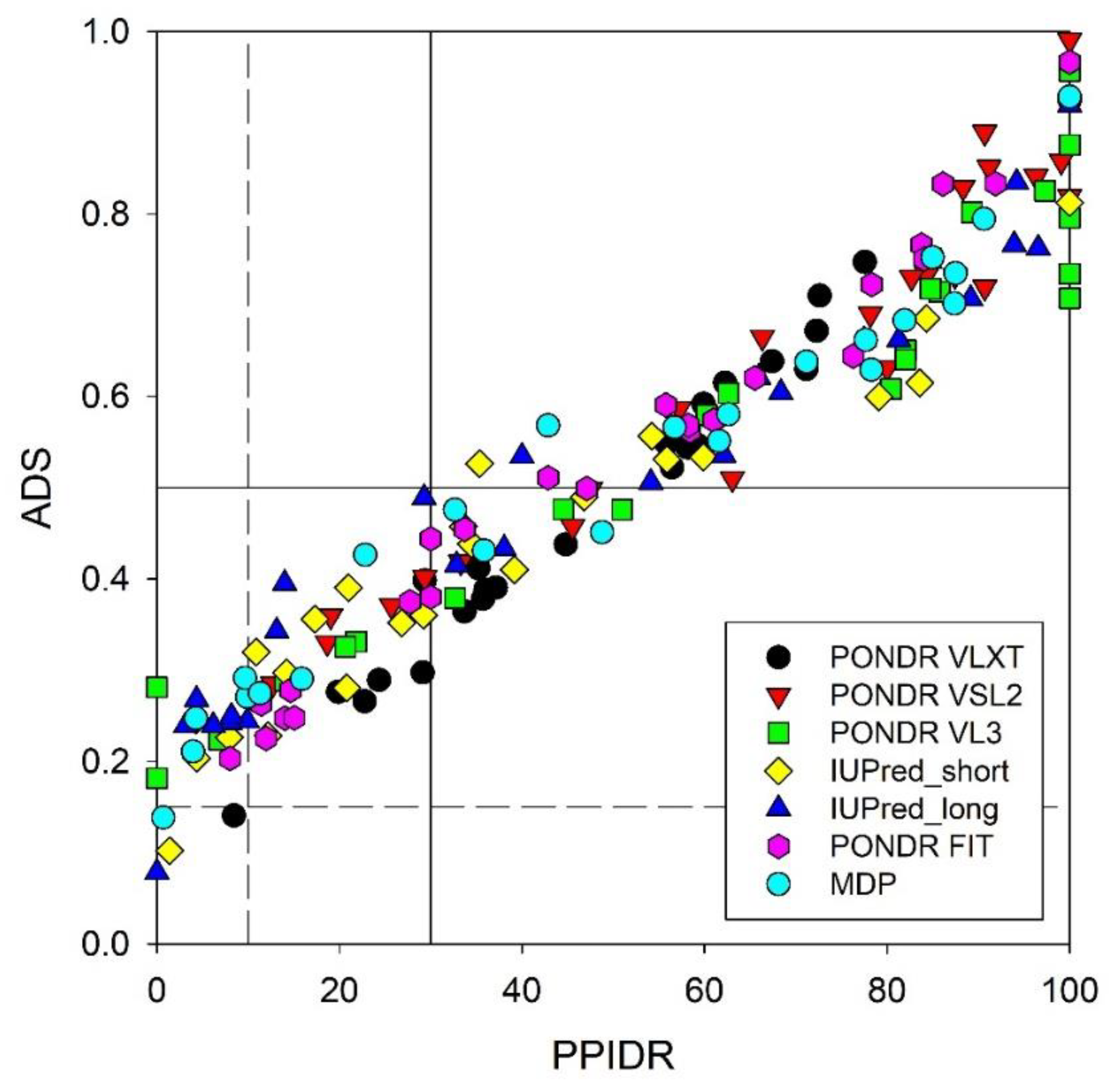
Figure 2.
Global evaluation of the intrinsic disorder propensity of the 24 human proteins associated with TBI (TBIome). Some analyzed proteins, including SNCA, APP, MAPT, TDP-43, and FUS, have various disease-related function. NEFL, NEFM, EPHA4, SEMA4D, and NRN1 are neuronal structural proteins, the DLG4, CAMK2A, SNAP25, SYNGAP1, and PLEK proteins involved in synaptic signaling, and SERF2, SERBP1, BEX3, C9orf16, C9orf58, HCLS1, HMGB1, S100B, and APOC2 proteins are considered as brain enriched protein highly relevant to neurological health. A. PONDR® VSL2 score (ADS) vs. PONDR® VSL2 percentage (PPDR) plot. Each point represents a query protein, and its coordinates are calculated using the corresponding PONDR® VSL2 outputs to evaluate ADS and PPDR values. Color blocks are used to depict proteins based on their intrinsic disorder classification as mostly ordered, mostly ordered plus, moderately disordered, moderately disordered plus and highly disordered (for additional clarifications see the text. B. The ΔCH-ΔCDF plot calculates the coordinates of a query protein based on the average distance of its CDF curve from the CDF boundary (X axis; ΔCDF) in the CDF plot and the distance from the CH boundary (ΔCH) in the CH plot. In these plots, positions of the TBI-related proteins are shown by differently colored symbols. In these plots, the corresponding data for human brainome (i.e., 1470 proteins found in brain) and TBI interactome (514 proteins identified by STRING) are shown by small gray white and circles, respectively. C. Nested box-and-whiskers plot comparing the global intrinsic disorder predispositions of the analyzed datasets (TBIome, TBI interactome, and brainome) by seven per-residue disorder predictors (PONDR® VLXT, PONDR® VSL2, PONDR® VL3, IUPRed_Short, IUPRed_Long, PONDR® FIT, and MDP) as evaluated by the corresponding PPIDR values. Horizontal lines in these plots show 10% (dotted lines) and 30% PPIDR (solid line) thresholds. D. Nested box-and-whiskers plot comparing the global intrinsic disorder predispositions of the analyzed datasets by seven per-residue disorder predictors as evaluated by the corresponding ADS values, which are calculated for each query protein as a protein length-normalized sum of all the per-residue disorder scores. In this plot, the horizontal lines represent 0.15 (dashed lines) and 0.5 ADS (solid line) thresholds, respectively.
Figure 2.
Global evaluation of the intrinsic disorder propensity of the 24 human proteins associated with TBI (TBIome). Some analyzed proteins, including SNCA, APP, MAPT, TDP-43, and FUS, have various disease-related function. NEFL, NEFM, EPHA4, SEMA4D, and NRN1 are neuronal structural proteins, the DLG4, CAMK2A, SNAP25, SYNGAP1, and PLEK proteins involved in synaptic signaling, and SERF2, SERBP1, BEX3, C9orf16, C9orf58, HCLS1, HMGB1, S100B, and APOC2 proteins are considered as brain enriched protein highly relevant to neurological health. A. PONDR® VSL2 score (ADS) vs. PONDR® VSL2 percentage (PPDR) plot. Each point represents a query protein, and its coordinates are calculated using the corresponding PONDR® VSL2 outputs to evaluate ADS and PPDR values. Color blocks are used to depict proteins based on their intrinsic disorder classification as mostly ordered, mostly ordered plus, moderately disordered, moderately disordered plus and highly disordered (for additional clarifications see the text. B. The ΔCH-ΔCDF plot calculates the coordinates of a query protein based on the average distance of its CDF curve from the CDF boundary (X axis; ΔCDF) in the CDF plot and the distance from the CH boundary (ΔCH) in the CH plot. In these plots, positions of the TBI-related proteins are shown by differently colored symbols. In these plots, the corresponding data for human brainome (i.e., 1470 proteins found in brain) and TBI interactome (514 proteins identified by STRING) are shown by small gray white and circles, respectively. C. Nested box-and-whiskers plot comparing the global intrinsic disorder predispositions of the analyzed datasets (TBIome, TBI interactome, and brainome) by seven per-residue disorder predictors (PONDR® VLXT, PONDR® VSL2, PONDR® VL3, IUPRed_Short, IUPRed_Long, PONDR® FIT, and MDP) as evaluated by the corresponding PPIDR values. Horizontal lines in these plots show 10% (dotted lines) and 30% PPIDR (solid line) thresholds. D. Nested box-and-whiskers plot comparing the global intrinsic disorder predispositions of the analyzed datasets by seven per-residue disorder predictors as evaluated by the corresponding ADS values, which are calculated for each query protein as a protein length-normalized sum of all the per-residue disorder scores. In this plot, the horizontal lines represent 0.15 (dashed lines) and 0.5 ADS (solid line) thresholds, respectively.
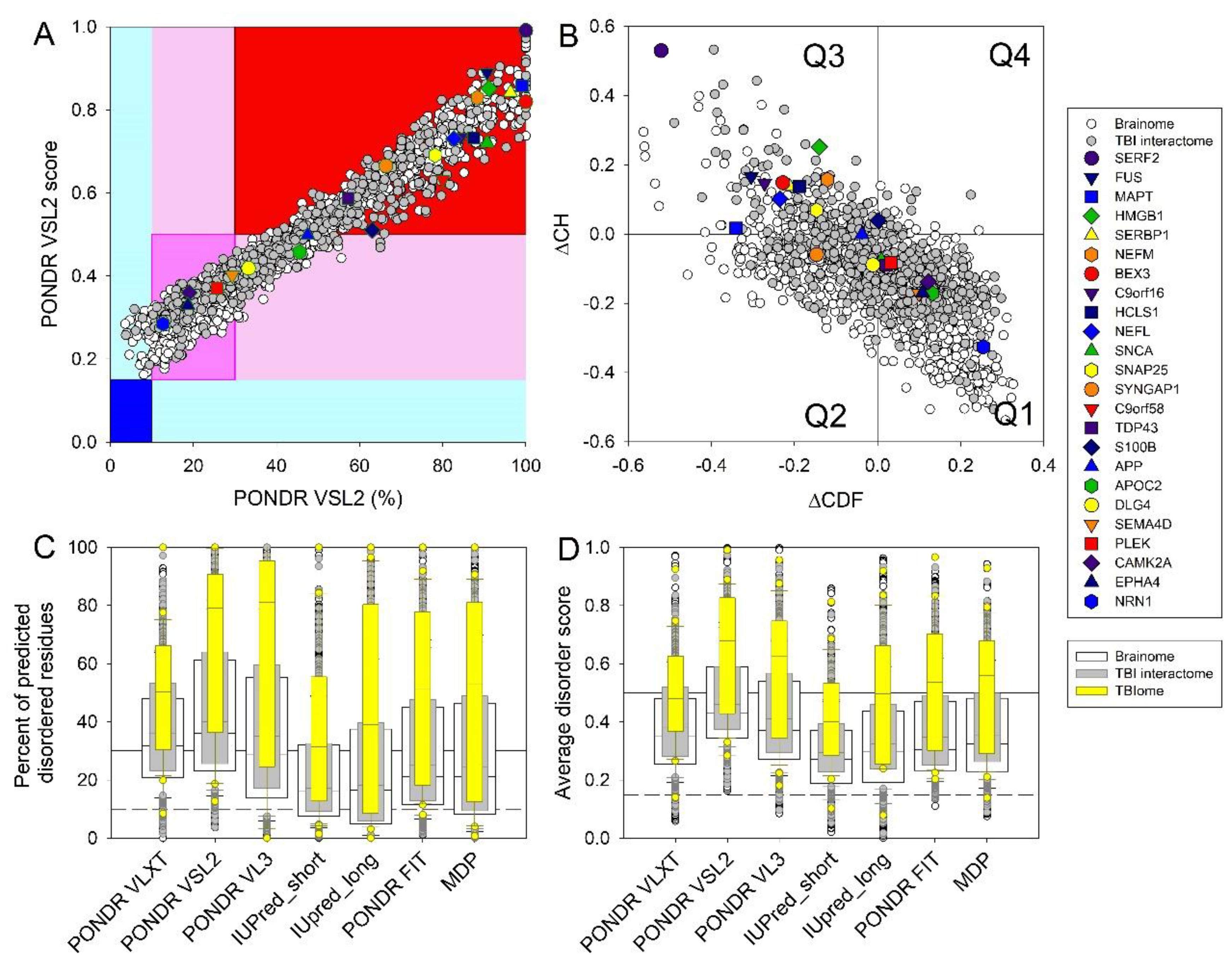
Figure 3.
Structural portrait gallery of the 11 upregulated human proteins known to be associated with TBI. 3D structures were modeled using AlphaFold. Colors represent the predicted local distance difference test (pLDDT) scores, which reflect the confidence of structure prediction: very high confidence (pLDDT >90, dark blue), high confidence (90 >pLDDT >70, light blue), low confidence (70 >pLDDT >50, yellow), and very low confidence (pLDDT <50, orange). It is expected that regions with low confidence are unstructured in isolation.
Figure 3.
Structural portrait gallery of the 11 upregulated human proteins known to be associated with TBI. 3D structures were modeled using AlphaFold. Colors represent the predicted local distance difference test (pLDDT) scores, which reflect the confidence of structure prediction: very high confidence (pLDDT >90, dark blue), high confidence (90 >pLDDT >70, light blue), low confidence (70 >pLDDT >50, yellow), and very low confidence (pLDDT <50, orange). It is expected that regions with low confidence are unstructured in isolation.
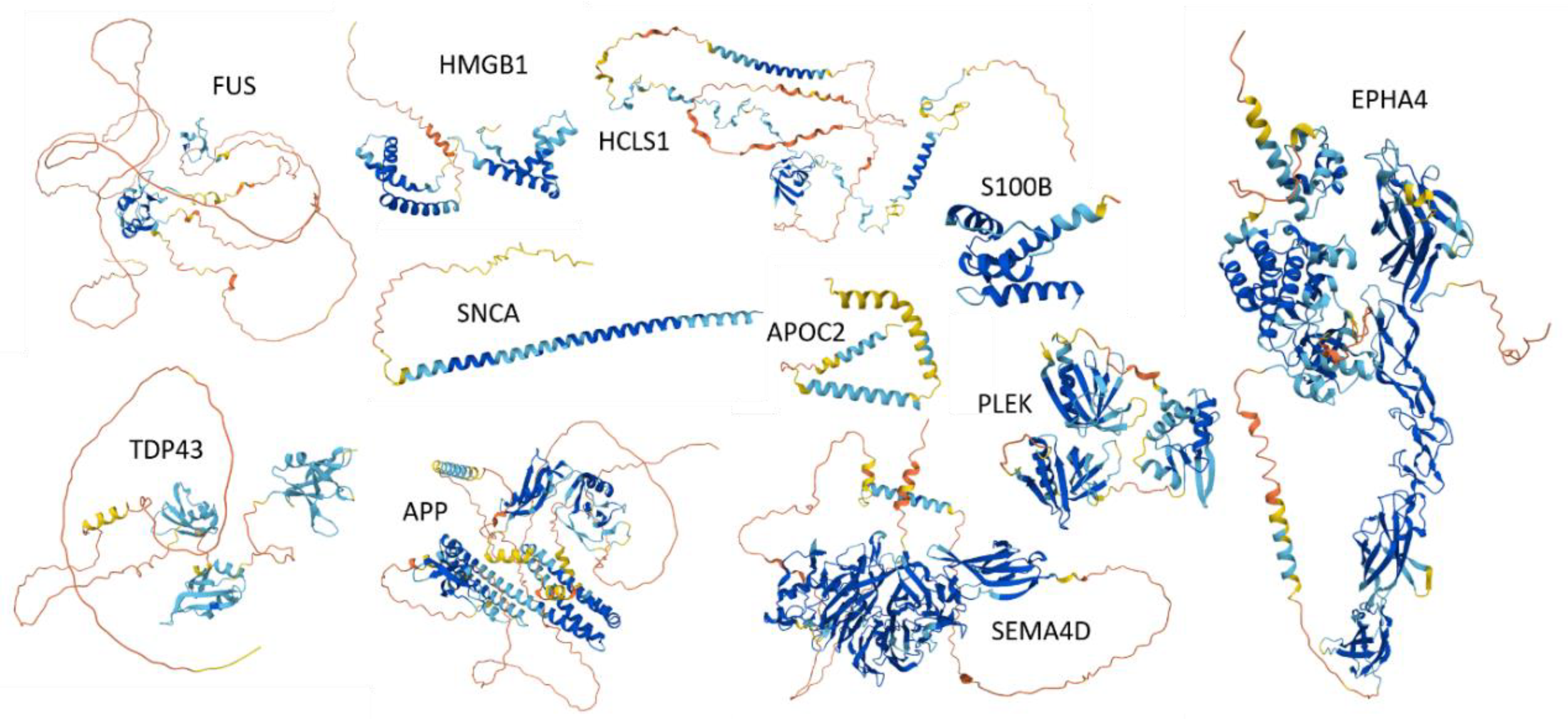
Figure 4.
AlphaFold-generated 3D structural models of six downregulated human proteins known to be associated with TBI.
Figure 4.
AlphaFold-generated 3D structural models of six downregulated human proteins known to be associated with TBI.
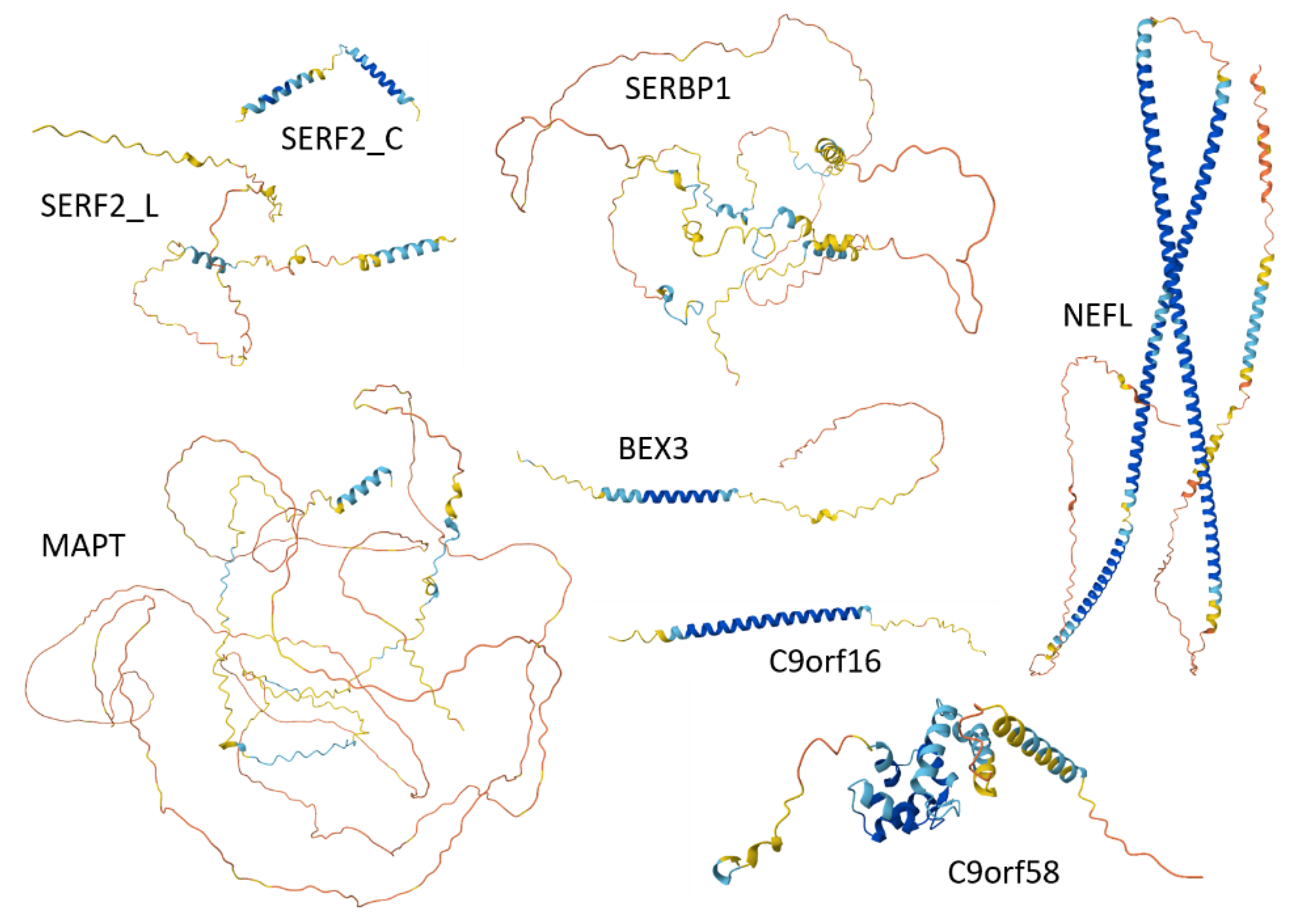
Figure 5.
3D structural models generated by AlphaFold for seven human TBI-related proteins with variable regulation. Note that since SERF2 exists in multiple alternatively spliced isoforms, 3D models are shown for two forms, canonical (59 residue-long (SERF-C) and 170 residue-long isoform 2 (SERF-L).
Figure 5.
3D structural models generated by AlphaFold for seven human TBI-related proteins with variable regulation. Note that since SERF2 exists in multiple alternatively spliced isoforms, 3D models are shown for two forms, canonical (59 residue-long (SERF-C) and 170 residue-long isoform 2 (SERF-L).
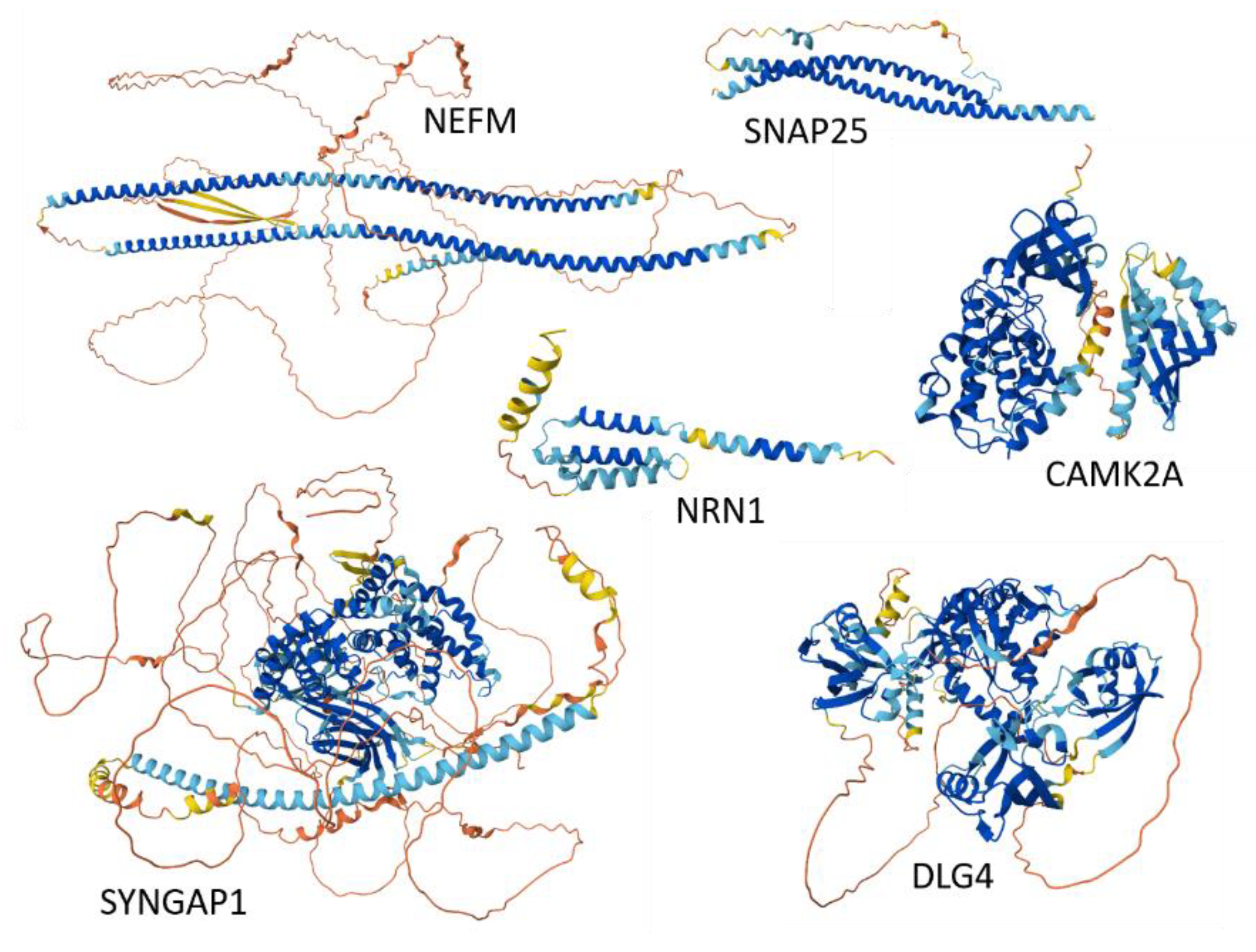
Figure 6.
Analysis of the correlation between the confidence of the AlphaFold-predicted structural models of human TBI-related proteins and their intrinsic disorder predispositions. Data for this plot can be found in Table 2, Table 3 and Table 4.
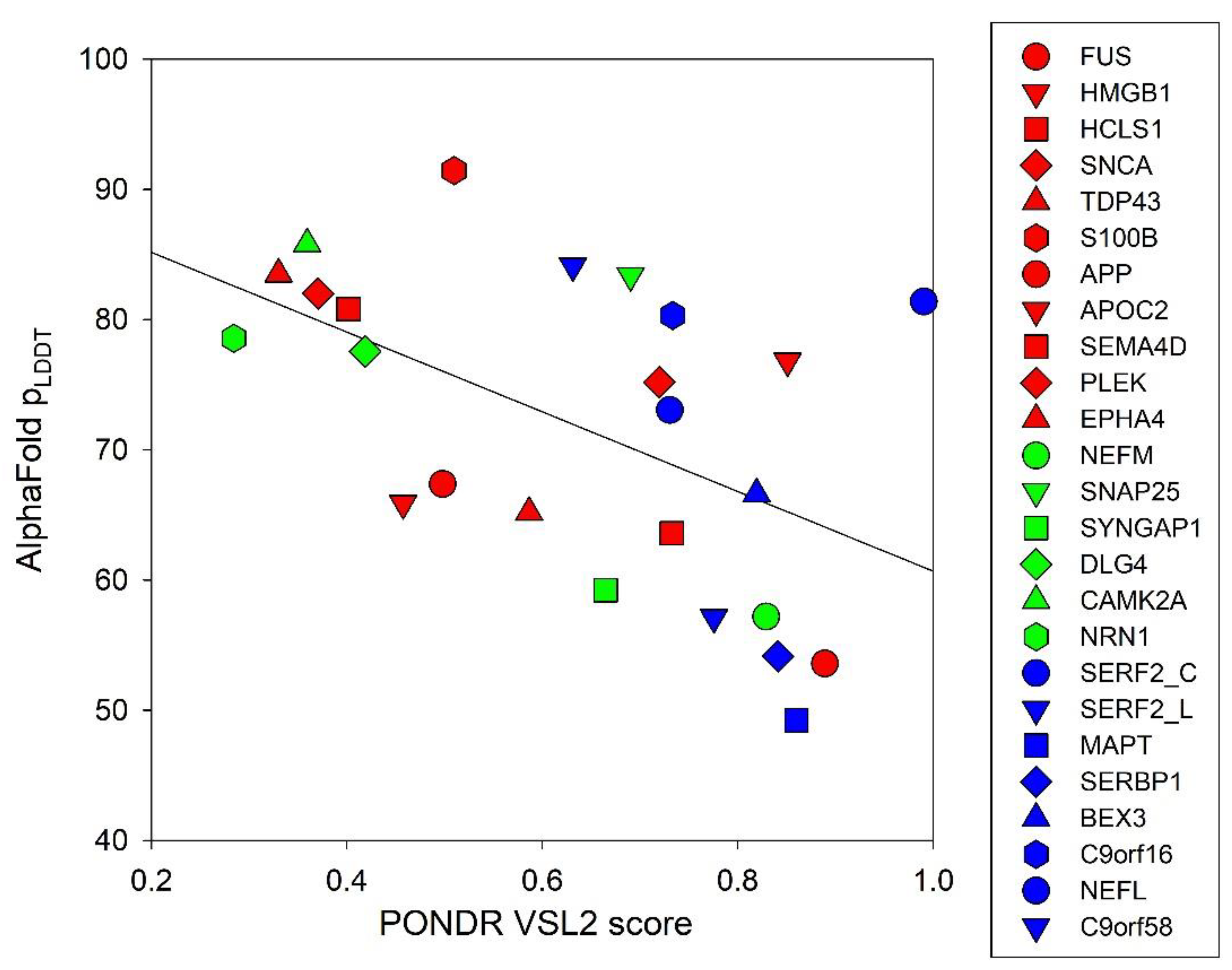
Figure 7.
Correlation between the LLPS potential (measured as FuzDrop-generated pLLPS, or probability of spontaneous liquid–liquid phase separation) and intrinsic disorder propensity (evaluated as PPIDRVSL2) of human proteins associated with TBI. Small gray circles correspond to the data generated for the 514 human proteins interacting with the TBI-related proteins. Dotted gray circles correspond to the proteins that are not related to LLPS (they have pLLPS below 0.6 threshold and do not have any DPRs).
Figure 7.
Correlation between the LLPS potential (measured as FuzDrop-generated pLLPS, or probability of spontaneous liquid–liquid phase separation) and intrinsic disorder propensity (evaluated as PPIDRVSL2) of human proteins associated with TBI. Small gray circles correspond to the data generated for the 514 human proteins interacting with the TBI-related proteins. Dotted gray circles correspond to the proteins that are not related to LLPS (they have pLLPS below 0.6 threshold and do not have any DPRs).
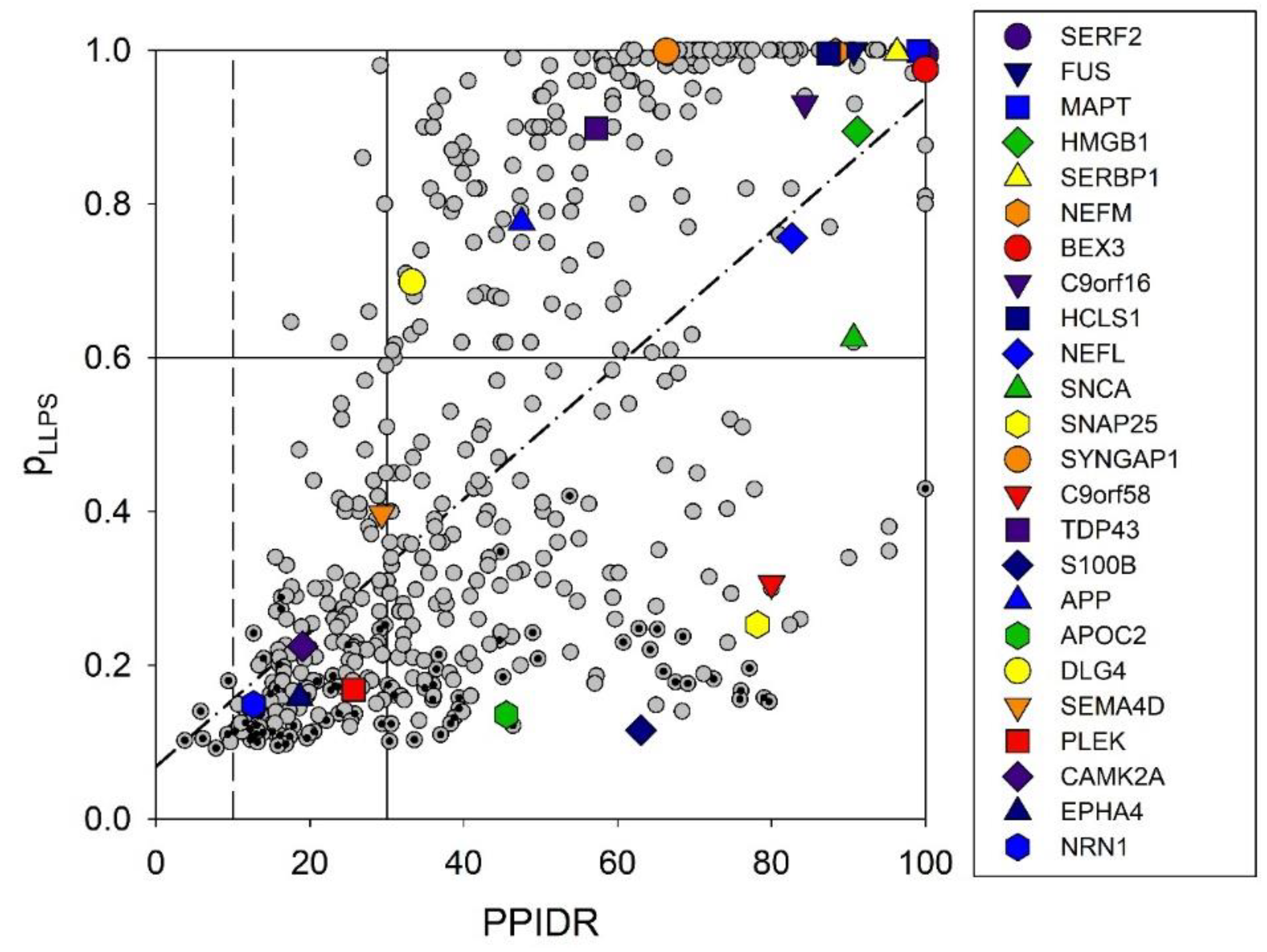
Figure 8.
Interactivity of human SERF2 (UniProt ID: P84101). A. STRING-generated PPI network centered as SERF2. B. Significantly enriched Gene Ontology (GO) terms related to biological processes. C. Significantly enriched GO terms related to molecular functions. D. Significantly enriched GO terms related to cellular components. The interactive version of this network is available at the permalink: https://version-12-0.string-db.org/cgi/network?networkId=bZe9JLxPNzsr.
Figure 8.
Interactivity of human SERF2 (UniProt ID: P84101). A. STRING-generated PPI network centered as SERF2. B. Significantly enriched Gene Ontology (GO) terms related to biological processes. C. Significantly enriched GO terms related to molecular functions. D. Significantly enriched GO terms related to cellular components. The interactive version of this network is available at the permalink: https://version-12-0.string-db.org/cgi/network?networkId=bZe9JLxPNzsr.
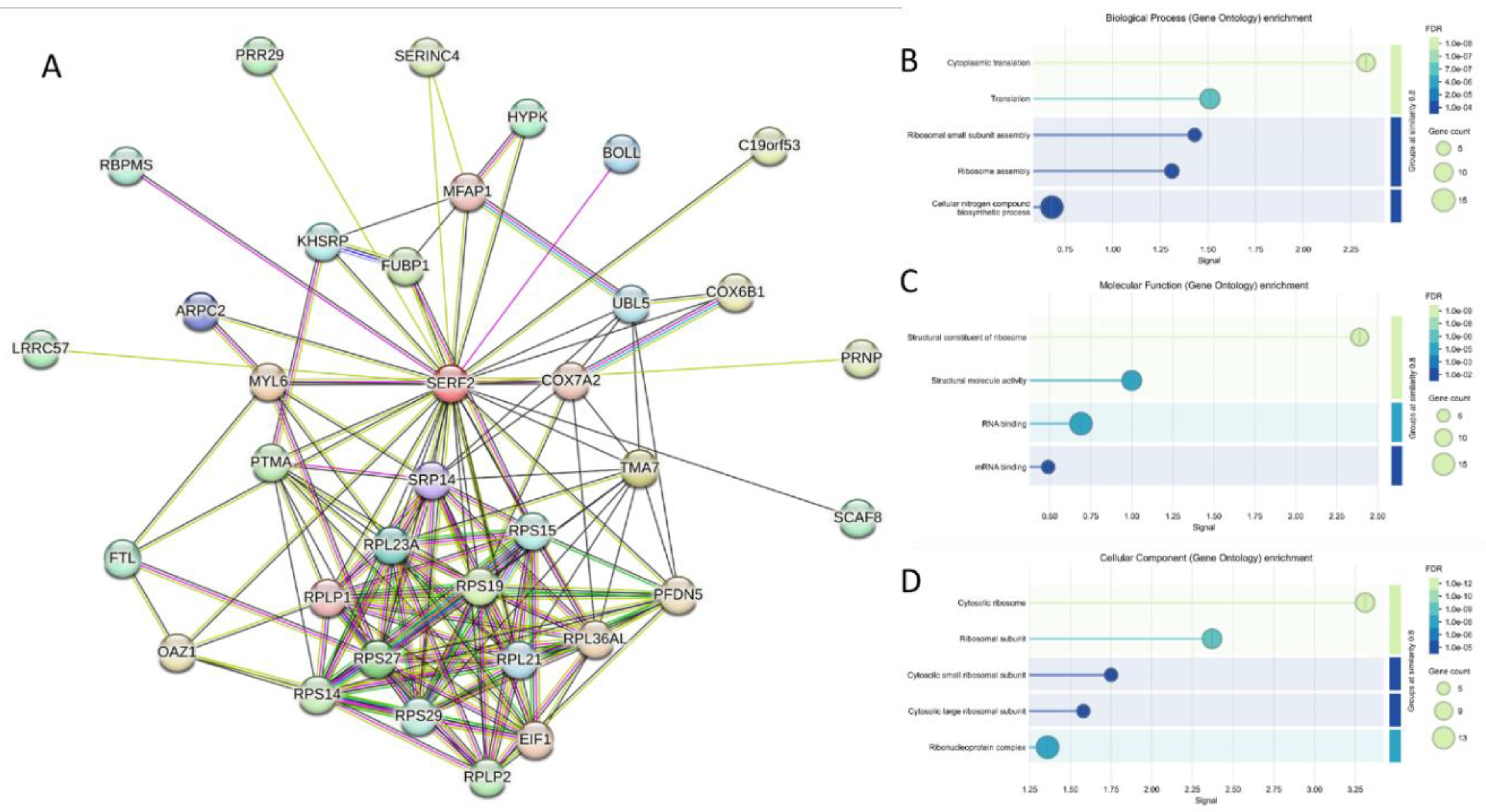
Figure 9.
Functionality of RNA-binding protein FUS (UniProt ID: P35637). A. STRING-generated PPI network centered at FUS. B. Significantly enriched GO terms related to biological processes. C. Significantly enriched GO terms related to molecular functions. D. Significantly enriched GO terms related to cellular components. The interactive version of this network is accessible via the permalink: https://version-12-0.string-db.org/cgi/network?networkId=b5DfVzRF5YVB.
Figure 9.
Functionality of RNA-binding protein FUS (UniProt ID: P35637). A. STRING-generated PPI network centered at FUS. B. Significantly enriched GO terms related to biological processes. C. Significantly enriched GO terms related to molecular functions. D. Significantly enriched GO terms related to cellular components. The interactive version of this network is accessible via the permalink: https://version-12-0.string-db.org/cgi/network?networkId=b5DfVzRF5YVB.
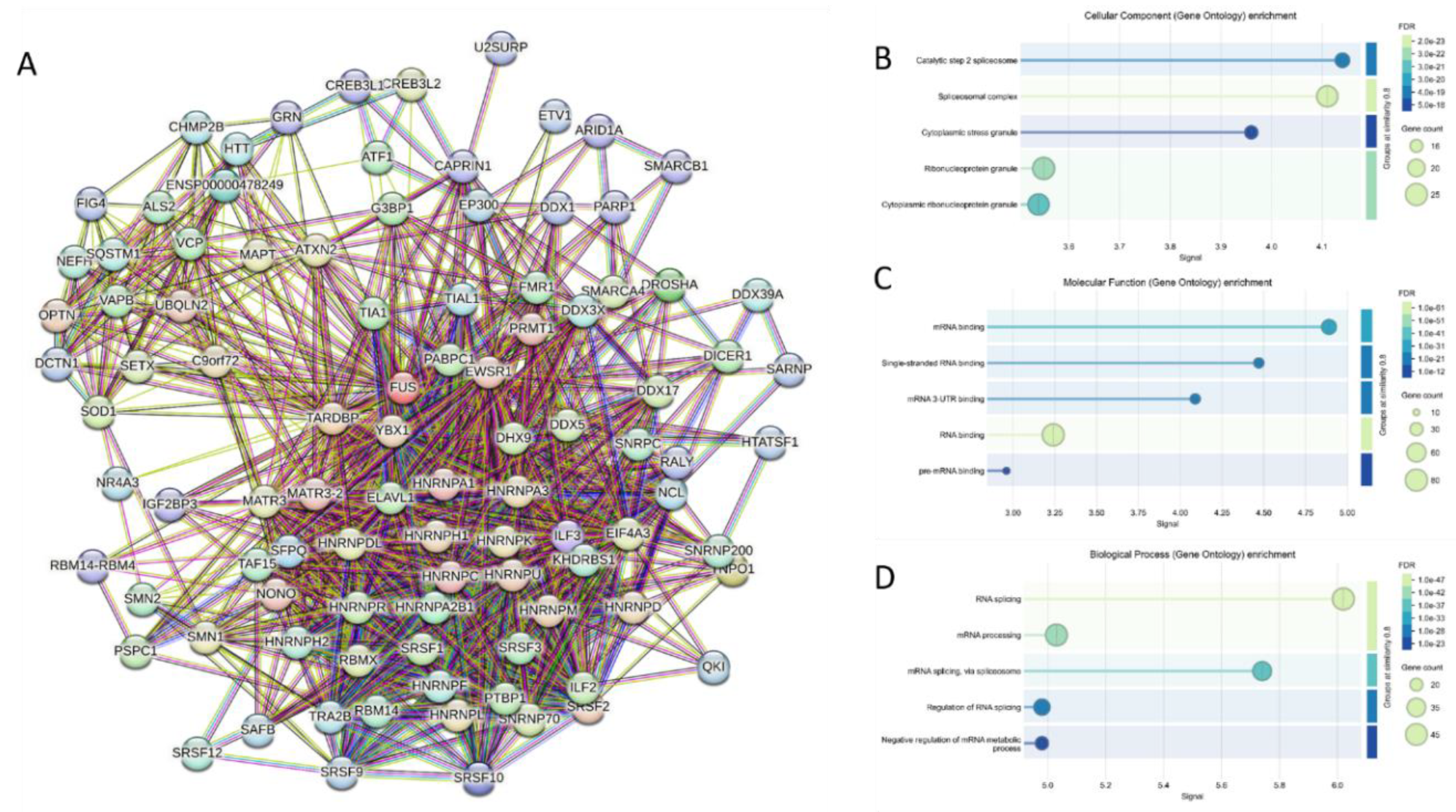
Figure 10.
Intractability of a microtubule-associated protein MAPT (UniProt ID: P10636). A. STRING-generated PPI network centered at MAPT. The network was generated using the minimum required interaction score of 0.7 (high confidence). It includes 117 nodes and 804 edges. It is characterized by the average node degree of 13.7 and the average local clustering coefficient of 0.62. B. Significantly enriched GO terms related to biological processes. C. Significantly enriched subcellular locations (compartments). The interactive version of this network is accessible via the permalink: https://version-12-0.string-db.org/cgi/network?networkId=bBACa24P4Plk.
Figure 10.
Intractability of a microtubule-associated protein MAPT (UniProt ID: P10636). A. STRING-generated PPI network centered at MAPT. The network was generated using the minimum required interaction score of 0.7 (high confidence). It includes 117 nodes and 804 edges. It is characterized by the average node degree of 13.7 and the average local clustering coefficient of 0.62. B. Significantly enriched GO terms related to biological processes. C. Significantly enriched subcellular locations (compartments). The interactive version of this network is accessible via the permalink: https://version-12-0.string-db.org/cgi/network?networkId=bBACa24P4Plk.
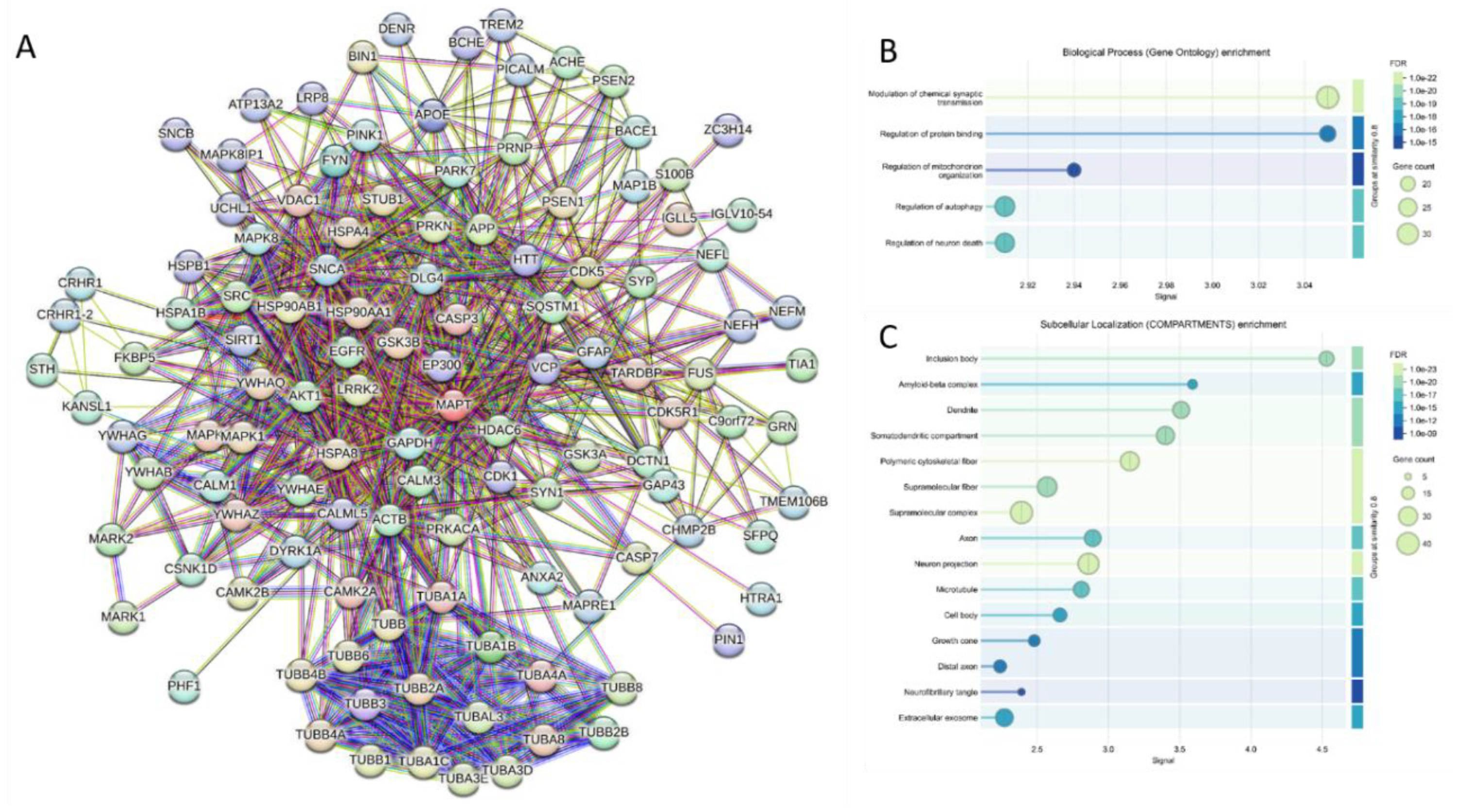
Figure 11.
Interactability analysis of human high mobility group protein B1 (HMGB1; UniProt ID: P09429). A. STRING-generated PPI network centered at HMGB1. The network was generated using the minimum required interaction score of 0.7 (high confidence). It includes 63 nodes and 412 edges, and is characterized by the average node degree of 13.1 and the average local clustering coefficient of 0.698. B. Significantly enriched GO terms related to biological processes. C. Significantly enriched GO terms related to molecular functions. D. Significantly enriched GO terms related to cellular components. The interactive version of this network is accessible via the permalink: https://version-12-0.string-db.org/cgi/network?networkId=b8W5VQYtXll4.
Figure 11.
Interactability analysis of human high mobility group protein B1 (HMGB1; UniProt ID: P09429). A. STRING-generated PPI network centered at HMGB1. The network was generated using the minimum required interaction score of 0.7 (high confidence). It includes 63 nodes and 412 edges, and is characterized by the average node degree of 13.1 and the average local clustering coefficient of 0.698. B. Significantly enriched GO terms related to biological processes. C. Significantly enriched GO terms related to molecular functions. D. Significantly enriched GO terms related to cellular components. The interactive version of this network is accessible via the permalink: https://version-12-0.string-db.org/cgi/network?networkId=b8W5VQYtXll4.
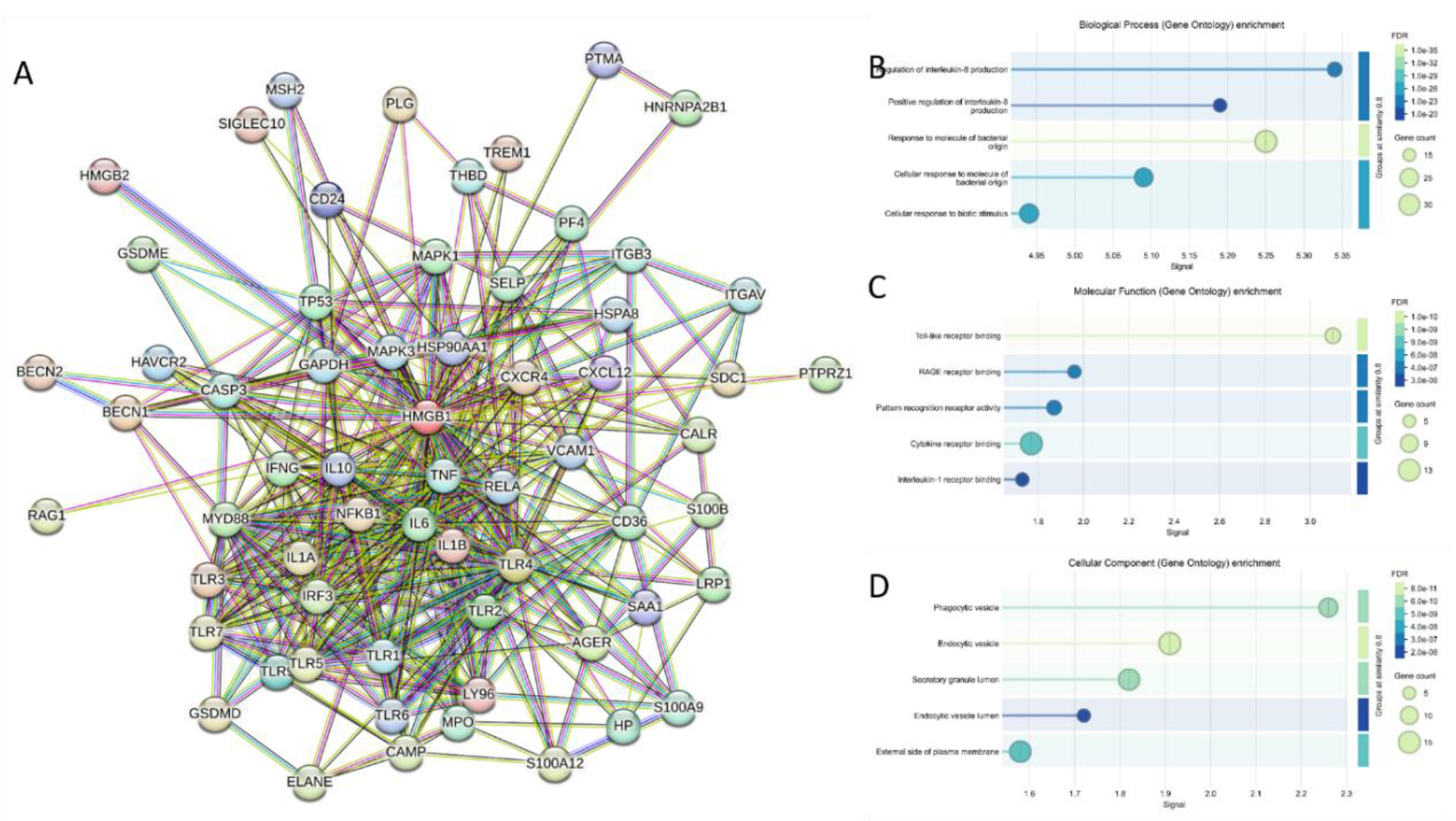
Figure 12.
Intractability of mRNA binding protein SERBP1 (UniProt ID: Q8NC51). A. STRING-generated PPI network centered at SERBP1. The network was generated using the minimum required interaction score of 0.7 (high confidence). It includes 130 nodes and 6358 edges. With a very high average node degree of 97.8 and an extremely high average local clustering coefficient of 0.951, this is an extremely dense, small-world network, where nearly every node is connected to almost every other node. B. Significantly enriched GO terms related to biological processes. C. Significantly enriched subcellular locations (compartments). The interactive version of this network is available at: https://version-12-0.string-db.org/cgi/network?networkId=boEd8HO69nL5.
Figure 12.
Intractability of mRNA binding protein SERBP1 (UniProt ID: Q8NC51). A. STRING-generated PPI network centered at SERBP1. The network was generated using the minimum required interaction score of 0.7 (high confidence). It includes 130 nodes and 6358 edges. With a very high average node degree of 97.8 and an extremely high average local clustering coefficient of 0.951, this is an extremely dense, small-world network, where nearly every node is connected to almost every other node. B. Significantly enriched GO terms related to biological processes. C. Significantly enriched subcellular locations (compartments). The interactive version of this network is available at: https://version-12-0.string-db.org/cgi/network?networkId=boEd8HO69nL5.
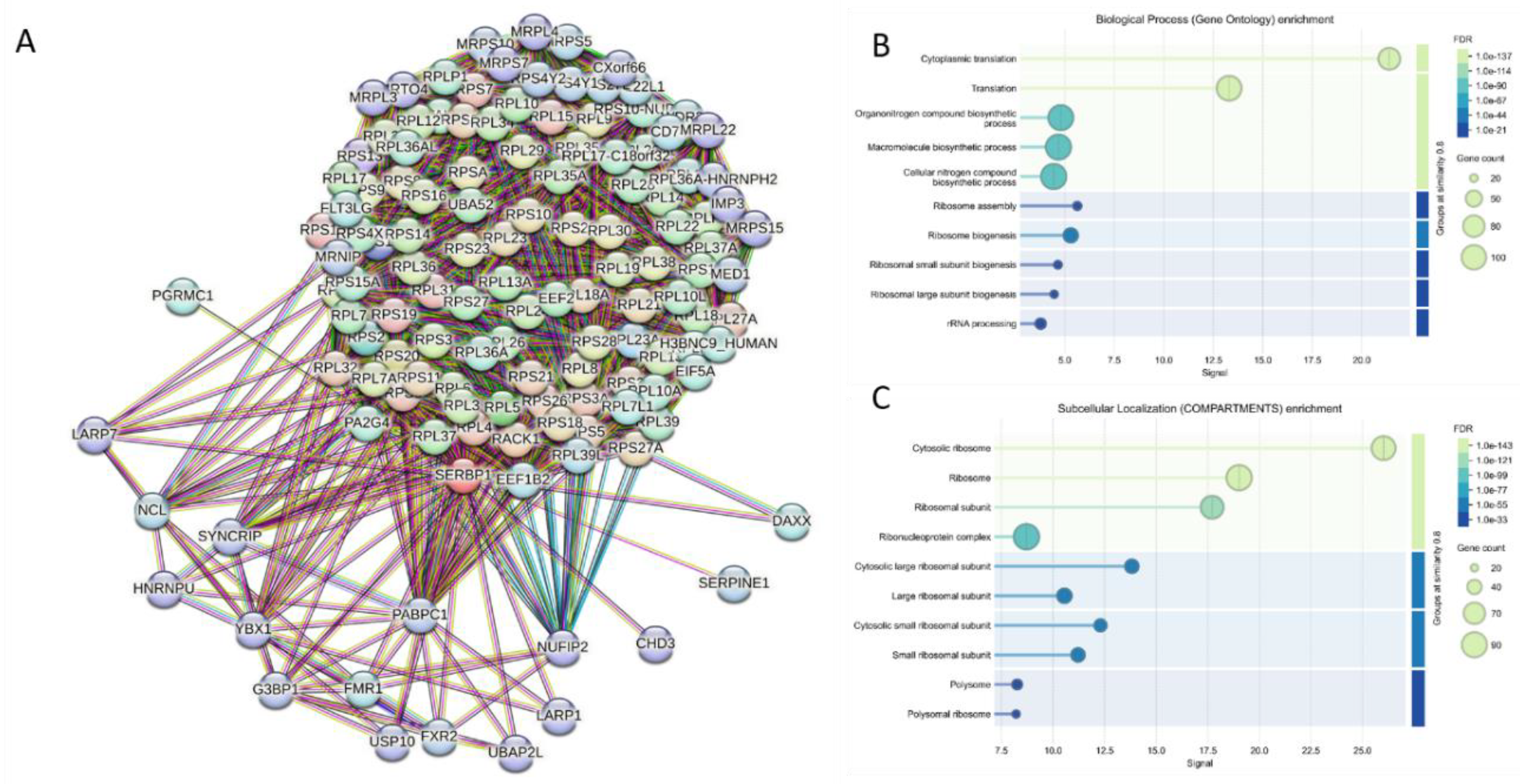
Figure 13.
Interactivity of human neurofilament medium polypeptide (NEFM, UniProt ID: P07197). A. STRING-generated PPI network centered at NEFM. The network was generated using the minimum required interaction score of 0.4 (medium confidence). It includes 111 nodes and 1056 edges, being characterized by the average node degree of 19.0 and the average local clustering coefficient of 0.632. B. Significantly enriched GO terms related to biological processes. C. Significantly enriched GO terms related to molecular functions. D. Significantly enriched GO terms related to cellular components. The interactive version of this network is accessible via the permalink: https://version-12-0.string-db.org/cgi/network?networkId=bDDyPDrCYPB5.
Figure 13.
Interactivity of human neurofilament medium polypeptide (NEFM, UniProt ID: P07197). A. STRING-generated PPI network centered at NEFM. The network was generated using the minimum required interaction score of 0.4 (medium confidence). It includes 111 nodes and 1056 edges, being characterized by the average node degree of 19.0 and the average local clustering coefficient of 0.632. B. Significantly enriched GO terms related to biological processes. C. Significantly enriched GO terms related to molecular functions. D. Significantly enriched GO terms related to cellular components. The interactive version of this network is accessible via the permalink: https://version-12-0.string-db.org/cgi/network?networkId=bDDyPDrCYPB5.
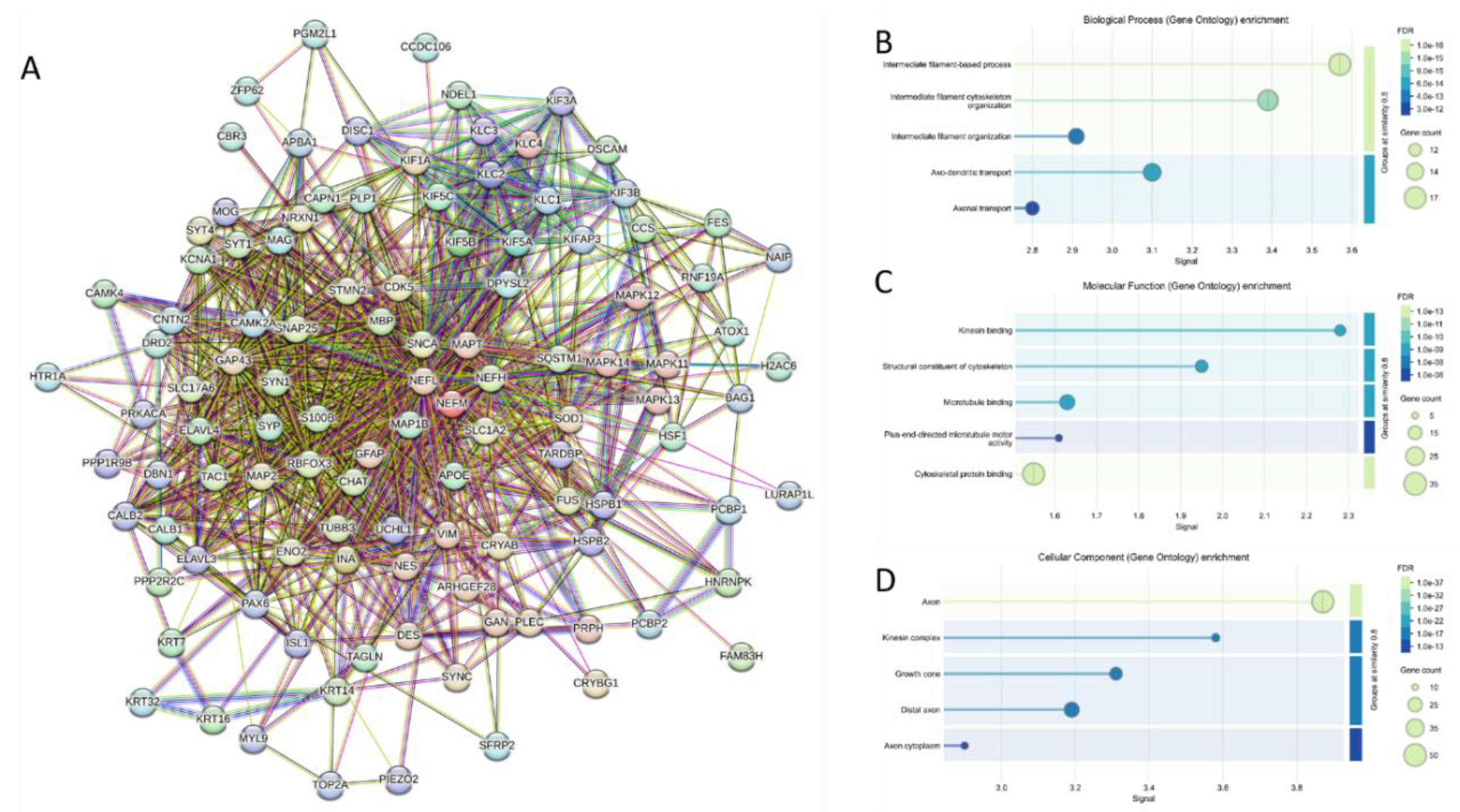
Figure 14.
Intractability of signaling adapter protein BEX3 (UniProt ID: Q00994). A. BEX3-centered PPI network generated by STRING using the minimum required interaction score of 0.4 (medium confidence). It includes 31 nodes and 100 edges, being characterized by the average node degree of 6.45 and the average local clustering coefficient of 0.772. B. Significantly enriched GO terms related to biological processes. C. Significantly enriched GO terms related to molecular functions. D. Significantly enriched GO terms related to cellular components. The interactive version of this network is available at: https://version-12-0.string-db.org/cgi/network?networkId=bne9frlI9Sfa.
Figure 14.
Intractability of signaling adapter protein BEX3 (UniProt ID: Q00994). A. BEX3-centered PPI network generated by STRING using the minimum required interaction score of 0.4 (medium confidence). It includes 31 nodes and 100 edges, being characterized by the average node degree of 6.45 and the average local clustering coefficient of 0.772. B. Significantly enriched GO terms related to biological processes. C. Significantly enriched GO terms related to molecular functions. D. Significantly enriched GO terms related to cellular components. The interactive version of this network is available at: https://version-12-0.string-db.org/cgi/network?networkId=bne9frlI9Sfa.
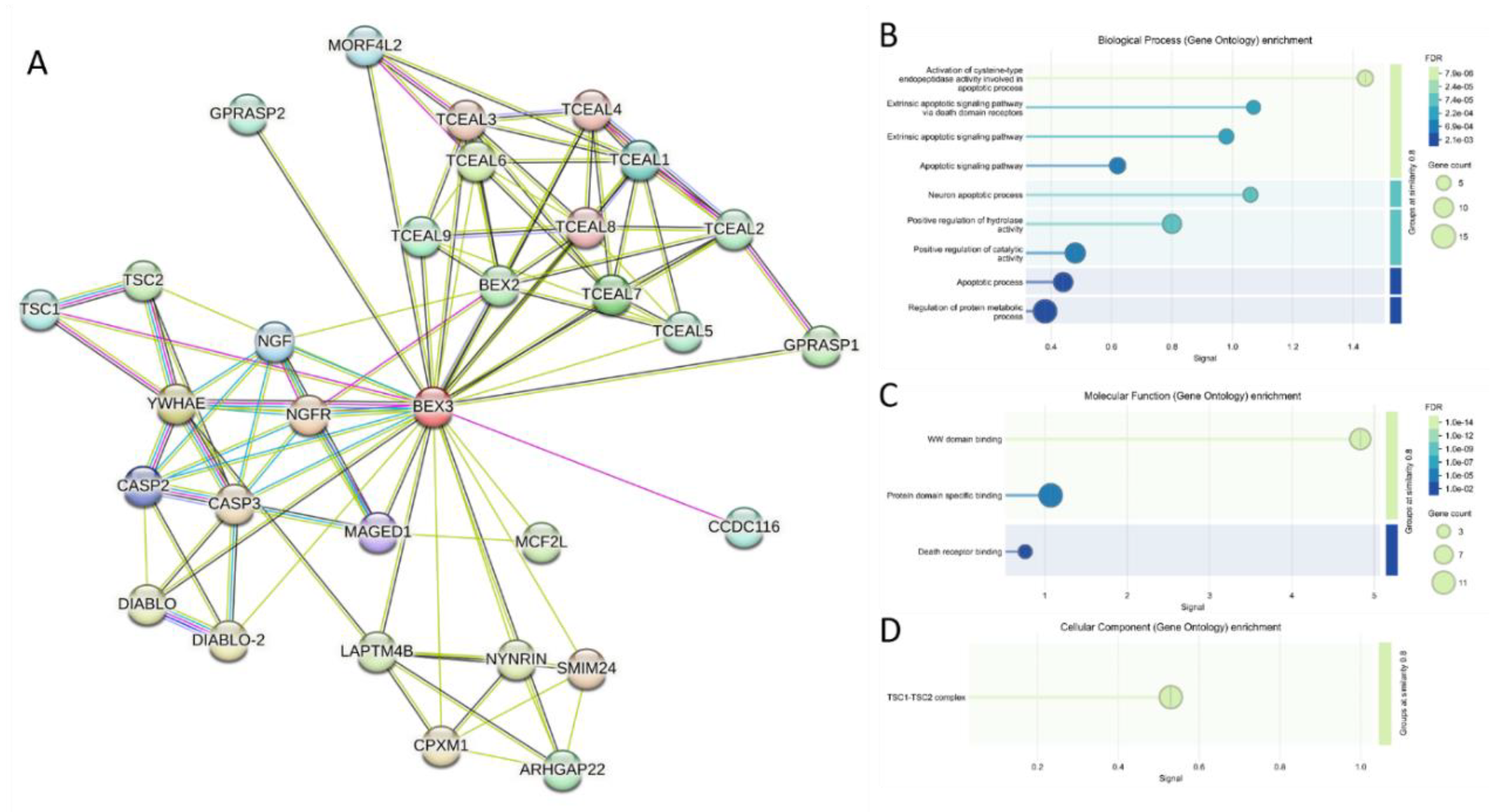
Figure 15.
Intractability of human bublin coiled-coil protein (UniProt ID: Q9BUW7). A. PPI network generated for BBLN by STRING using the minimum required interaction score of 0.15 (low confidence). It includes 191 nodes and 1917 edges, being characterized by the average node degree of 20.1 and the average local clustering coefficient of 0.475. B. Significantly enriched GO terms related to biological processes. C. Significantly enriched GO terms related to molecular functions. D. Significantly enriched GO terms related to cellular components. The interactive version of this network is available at: https://version-12-0.string-db.org/cgi/network?networkId=bcKjC16wDaw5.
Figure 15.
Intractability of human bublin coiled-coil protein (UniProt ID: Q9BUW7). A. PPI network generated for BBLN by STRING using the minimum required interaction score of 0.15 (low confidence). It includes 191 nodes and 1917 edges, being characterized by the average node degree of 20.1 and the average local clustering coefficient of 0.475. B. Significantly enriched GO terms related to biological processes. C. Significantly enriched GO terms related to molecular functions. D. Significantly enriched GO terms related to cellular components. The interactive version of this network is available at: https://version-12-0.string-db.org/cgi/network?networkId=bcKjC16wDaw5.
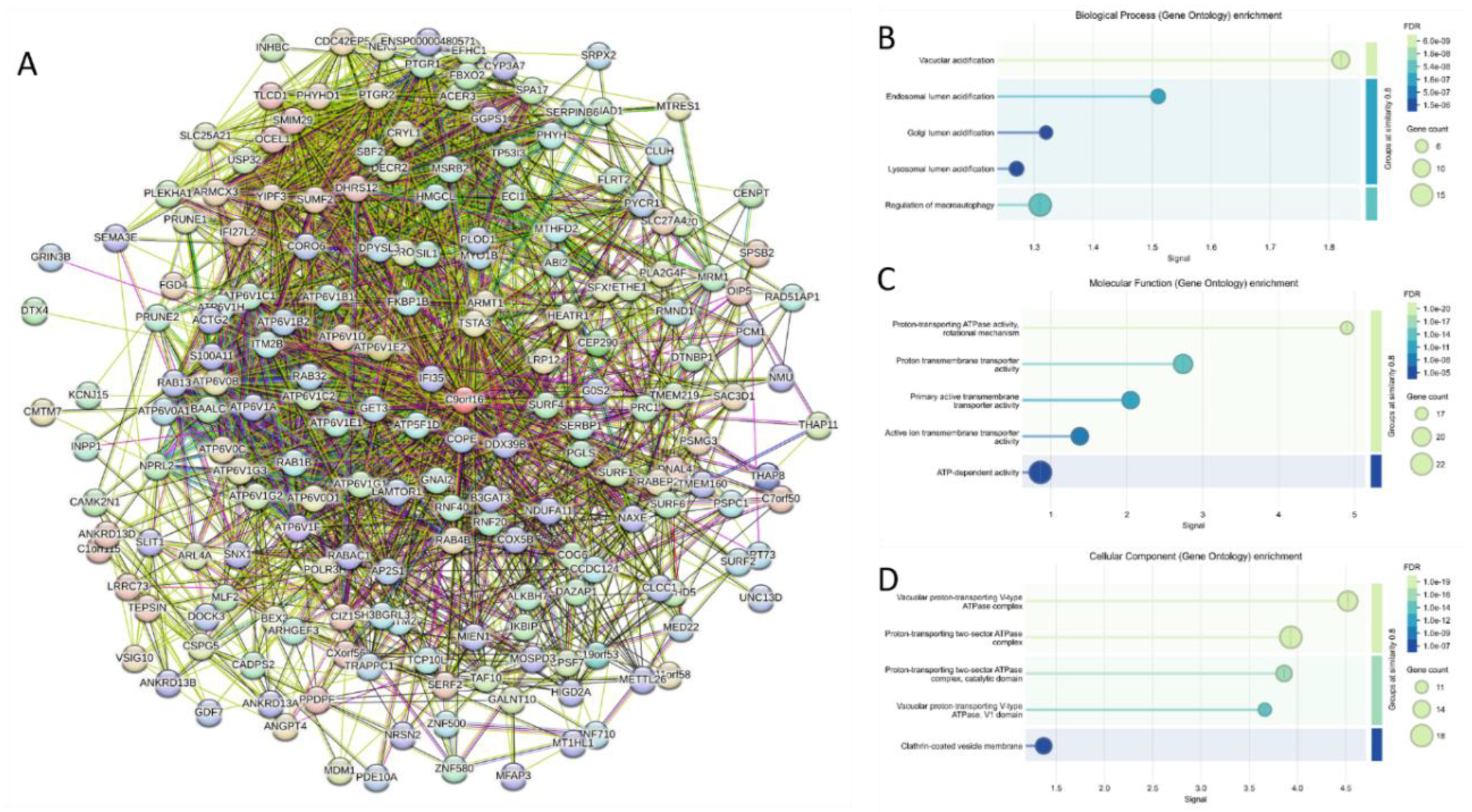
Figure 16.
Intractability of human hematopoietic lineage cell-specific protein HCLS1 (UniProt ID: P14317). A. STRING-generated PPI network centered at SERBP1. The network was generated using the minimum required interaction score of 0.7 (high confidence). It includes 91 nodes and 748 edges. It is characterized by the average node degree of 16.4 and the average local clustering coefficient of 0.737. B. Significantly enriched GO terms related to biological processes. C. Significantly enriched subcellular locations (compartments). The interactive version of this network is available at: https://version-12-0.string-db.org/cgi/network?networkId=bvmzdr0Vv6xB.
Figure 16.
Intractability of human hematopoietic lineage cell-specific protein HCLS1 (UniProt ID: P14317). A. STRING-generated PPI network centered at SERBP1. The network was generated using the minimum required interaction score of 0.7 (high confidence). It includes 91 nodes and 748 edges. It is characterized by the average node degree of 16.4 and the average local clustering coefficient of 0.737. B. Significantly enriched GO terms related to biological processes. C. Significantly enriched subcellular locations (compartments). The interactive version of this network is available at: https://version-12-0.string-db.org/cgi/network?networkId=bvmzdr0Vv6xB.
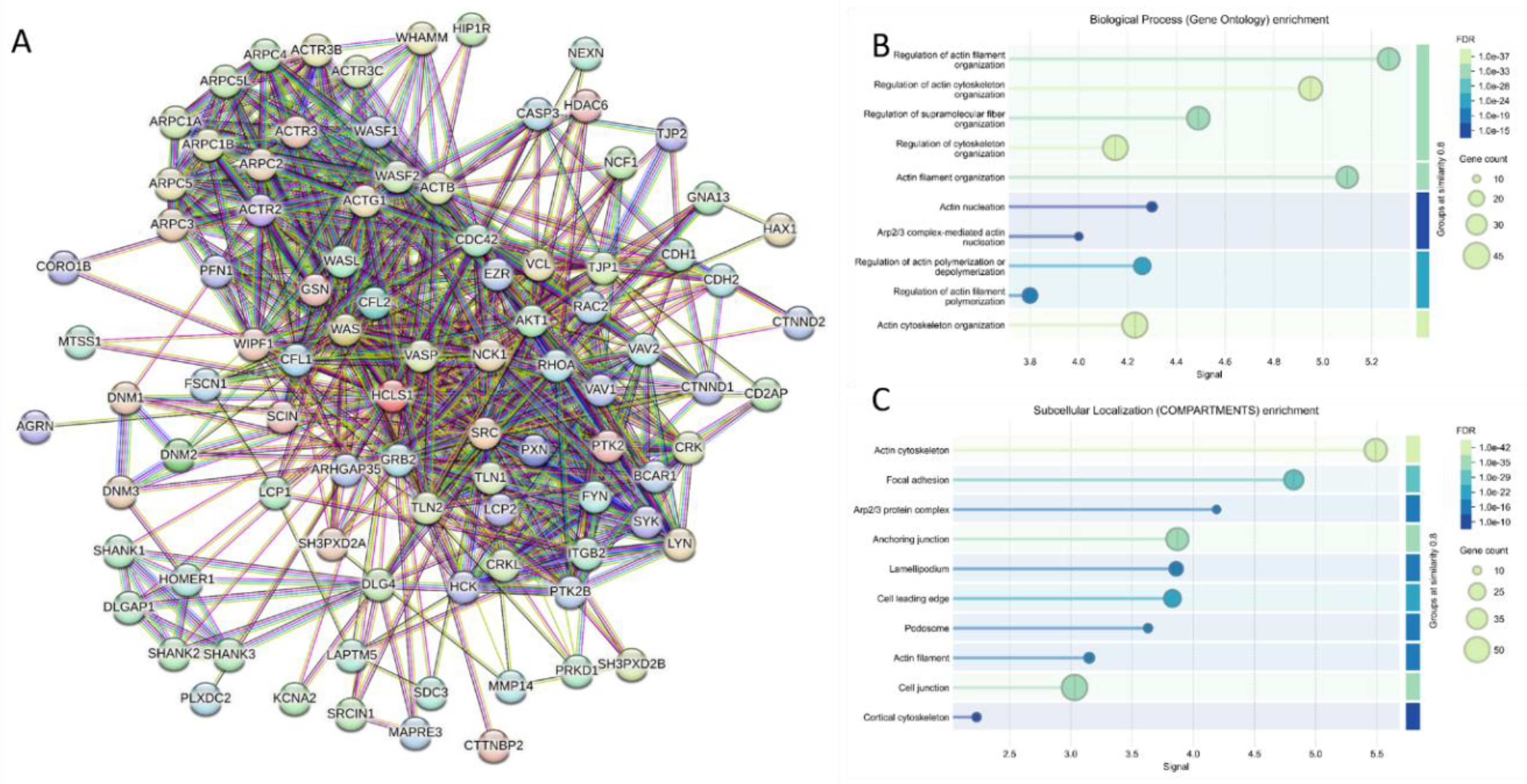
Figure 17.
Ras/Rap GTPase-activating protein SynGAP (UniProt ID: Q96PV0). A. STRING-generated PPI network centered at SYNGAP1. The network was generated using the minimum required interaction score of 0.4 (medium confidence). It includes 135 nodes and 1548 edges, being characterized by the average node degree of 22.9 and the average local clustering coefficient of 0.665. B. Significantly enriched GO terms related to biological processes. C. Significantly enriched GO terms related to molecular functions. D. Significantly enriched GO terms related to cellular components. The interactive version of this network can be found at the following permalink: https://version-12-0.string-db.org/cgi/network?networkId=b6vjUcECUySY.
Figure 17.
Ras/Rap GTPase-activating protein SynGAP (UniProt ID: Q96PV0). A. STRING-generated PPI network centered at SYNGAP1. The network was generated using the minimum required interaction score of 0.4 (medium confidence). It includes 135 nodes and 1548 edges, being characterized by the average node degree of 22.9 and the average local clustering coefficient of 0.665. B. Significantly enriched GO terms related to biological processes. C. Significantly enriched GO terms related to molecular functions. D. Significantly enriched GO terms related to cellular components. The interactive version of this network can be found at the following permalink: https://version-12-0.string-db.org/cgi/network?networkId=b6vjUcECUySY.
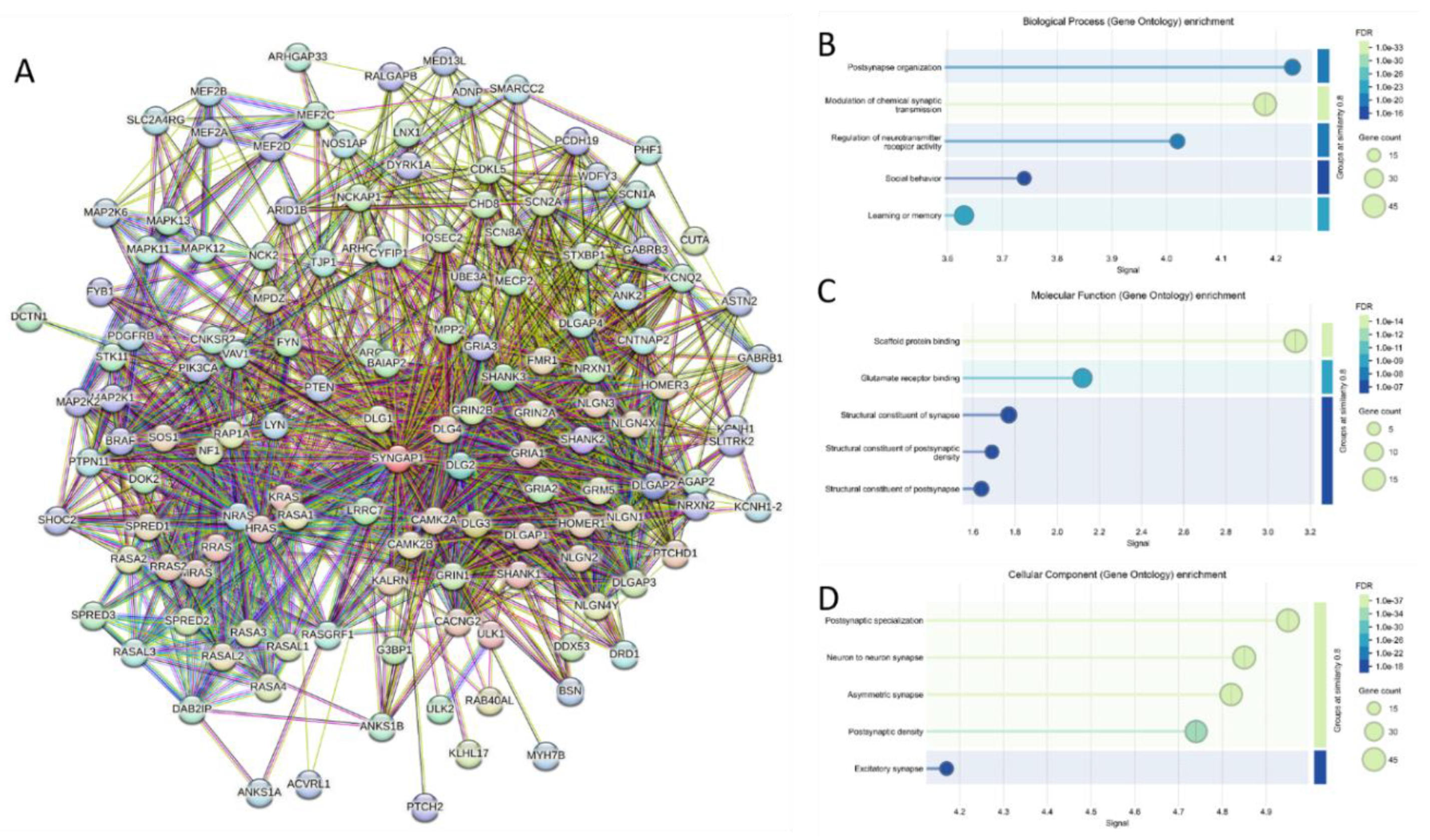
Figure 18.
STRING-based analysis of the global interactivity of the members of human TBIome. A. Intra-set interactome generated using a minimum required interaction score of 0.255. B. The TBI group interactome was generated using the minimum required interaction score of 0.907. C. Intra-TBI interactome generated using a minimum required interaction score of 0.907. Interactive versions of plots A and B are available at the following permalinks: https://version-12-0.string-db.org/cgi/network?networkId=bn9nAzsMxNO8 (plot A) and https://version-12-0.string-db.org/cgi/network?networkId=bPDDt7XRNUzG (plot B).
Figure 18.
STRING-based analysis of the global interactivity of the members of human TBIome. A. Intra-set interactome generated using a minimum required interaction score of 0.255. B. The TBI group interactome was generated using the minimum required interaction score of 0.907. C. Intra-TBI interactome generated using a minimum required interaction score of 0.907. Interactive versions of plots A and B are available at the following permalinks: https://version-12-0.string-db.org/cgi/network?networkId=bn9nAzsMxNO8 (plot A) and https://version-12-0.string-db.org/cgi/network?networkId=bPDDt7XRNUzG (plot B).
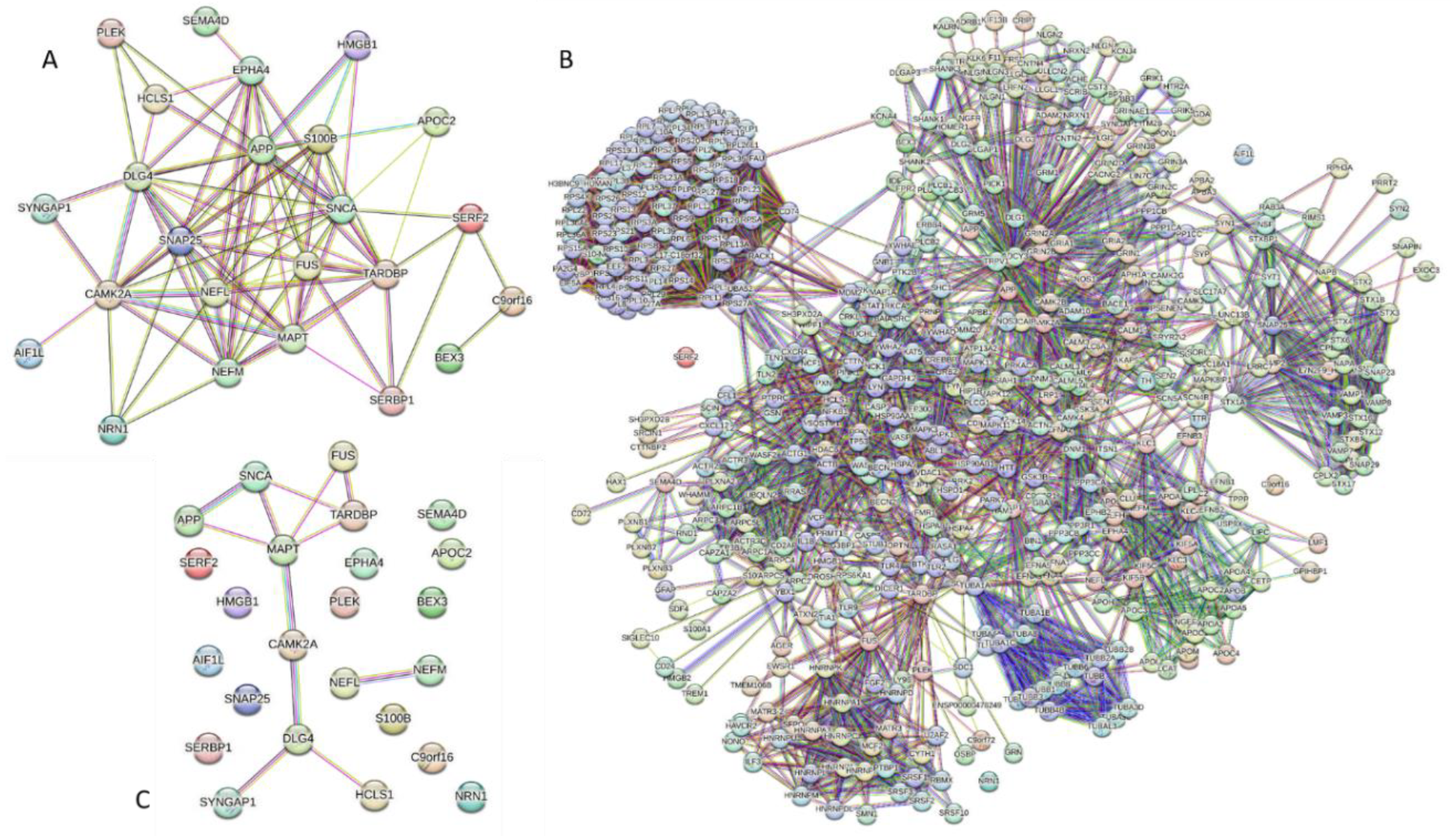

Table 1.
Summary of the characteristics of the proteins linked to the TBI.
| Protein | UniProt ID | Length | Domain Organization | Involvement in TBI and neurodegeneration | Classification |
| Ras/Rap GTPase-activating protein SynGAP (SYNGAP1) | Q96PV0 | 1343 | Disordered (92-129, 373-394, 725-753, 781-805, 933-1017, 1033-1154, 1274-1343), PH domain (150-251), C2 domain (242-363), Ras-GAP domain (459-667), SH3-binding motif (785-815) | Critical in synapse function, associated with TBI-related epilepsy and developmental dysfunction | Downregulated |
| Ephrin type-A receptor 4 (EPHA4) | P54764 | 986 | Eph receptor ligand-binding domain (30-209), Fibronectin type-III domains (328-439, 440-537), protein kinase domain (621-882), SAM domain (911-975), PDZ-binding motif (984-986) | Receptor tyrosine kinase involved in axon guidance and plasticity, often upregulated as part of the glial scar response following TBI | Upregulated |
| Neurofilament medium polypeptide (NEFM) | P07197 | 916 | Disordered (1-51), head (2-104), IF rod (101-412), coiled-coil regions (105-136, 150-248, 266-287, 292-412), tail (413-916), tandem repeates (614-626, 627-639, 649-652, 653-665m 666-678, 679-691) | Released following axonal injury, serving as markers of axonal damage and chronic neurodegeneration | Downregulated |
| Semaphorin-4D (SEMA4D) | Q92854 | 862 | Sema domain (22-500), PSI domain (521-551), IG-like C2-type domain (554-636), disordered (794-837¬) | Involved in regulating neuroinflammatory responses, particularly microglial activation in injury | Upregulated |
| Amyloid-beta precursor protein (APP) | P05067 | 770 | GFLD subdomain (28-123), E1 domauin (28-189), CuBD subdomain (131-189), disordered (194-284), BPTI/Kunitz inhibitor domain (291-341), OX-2 motif (344-365), E2 domain (374-565), heparin-binding region (391-423, 491-522), collagen binding region (523-540), PSEN1 binding region (695-722), basolateral sorting signal motif (724-734), interaction with Go-α (732-751), KIF5B bonding region (756-770), YENPXY motif (757-762) | Accumulates in damaged axons and is a major component of plaques that form as a secondary consequence of TBI, contributing to post-traumatic neurodegeneration | Upregulated |
| Microtubule-associated protein tau (MAPT) | P10636 | 758 | Disordered (1-573), microtubule-binding domain (561-685), tubulin-binding repeats (561-591, 592-622, 623-653, 654-685), disordered (714-734) | Released into the blood after severe TBI, with higher levels correlating with poorer long-term outcomes and chronic neuroplasticity change | Mixed |
| Disks large homolog 4 (DLG4) | P78352 | 724 | Disordered (15-35), PDZ domains (65-151, 160-246, 313-393), SH3 domain (428-498), guanylate kinase-like domain (534-798) | Released into cerebrospinal fluid (CSF) following acute traumatic damage, acting as indicators of synaptic | Downregulated |
| Neurofilament light polypeptide (NEFL) | P07196 | 543 | Head (2-92), IF rod (90-400), coiled coil domains (93-124, 138-234,235-252, 253-271, 281-396), tail subdomain A (397-443), tail (397-543), tail subdomain B (444-543) | Released following axonal injury, serving as markers of axonal damage and chronic neurodegeneration | Mixed |
| RNA-binding protein FUS (FUS) | P35637 | 526 | Disordered (1-286, 375-424, 444-526), RRM domain (285-371), RanBP2-type zinc finger (422-453) | An RNA-binding protein that can mislocalize and form aggregates after injury | Upregulated |
| Hematopoietic cell-specific Lyn substrate 1 (HCLS1) |
P14317 | 486 | HAX-1-binding region (27-66), contactin repeats (79-115. 116-152, 153-189, 190-212), DISORDERED (243-419), sh3 DOMAIN (428-486) | Associated with remodeling of the cytoskeleton in immune cells, likely involved in the neuroinflammatory response | Upregulated |
| Calcium/calmodulin-dependent protein kinase type II subunit alpha (CAMK2A) | Q9UQM7 | 478 | protein kinase domain (13-271), calmodulin-binding region (290-300), BAALC-binding region (310-320), disordered (314-341) | Involved in synaptic plasticity and memory formation, often dysfunctional following TBI-induced excitotoxicity | Downregulated |
| TAR DNA-binding protein 43 (TDP43) | Q13148 | 414 | Nuclear localization signal (82-98), nuclear export signal (239-250), RNA recognition motifs (RRMs; 104-200, 191-262), disordered (261-303, 341-373) | Misfolds and aggregates following TBI, contributing to long-term neurodegeneration, including CTE | Upregulated |
| Pleckstrin (PLEK) | P08567 | 350 | PH1 domain (4-101), DEP domain (136-221), OH2 domain (244-347) | Part of kinase signaling pathways in platelet and neuronal activity | Upregulated |
| SERPINE1 mRNA-binding protein 1 (SERBP1) | Q8NC51 | 408 | Disordered (33-292), N-terminal Habp4-like domains (5–152 and 189–314), RG/RGG (arginine/glycine-rich) repeat sequences (163–182 and 366–381), disordered (328-408) | Shows altered methylation patterns in the blood of individuals with TBI | Mixed |
| High mobility group protein B1 (HMGB1) | P09429 | 215 | Interaction with HAVCR2 (1-87), LPS binding regions (3-15, 80-96), nuclear localization signals (27-43, 178-184), disordered (76-95, 161-215), cytokine-stimulating activity (89-108), binding to AGER/RAGE | A mediator of neuroinflammation, consistently upregulated after TBI, contributing to blood-brain barrier dysfunction and secondary neurodegeneration | Upregulated |
| Synaptosomal-associated protein 25 (SNAP25) | P60880 | 206 | Disordered (1-23), interaction with CENPF (1-75), t-SNARE coiled-coil homology domains (18-92, 140-202), interaction with ZDHHC17 (111-120) | Released into cerebrospinal fluid (CSF) following acute traumatic damage, acting as indicators of synaptic | Downregulated |
| C9orf58; Allograft inflammatory factor 1-like (AIF1L); Ionized calcium-binding adapter molecule 2 (IBA2) | Q9BQI0 | 150 | EF-hand motifs (47-82 and 83-117), disordered (129-150) | Known functions in actin filament regulation, cellular morphology, and actin-related membrane reorganization suggest involvement in TBI; Aids the movement of immune cells to the site of injury; Participates in the remodeling of the cytoskeleton during glial scar formation or neuronal repair; Acts as a well-established marker of microglial activation | Mixed |
| Neuritin (NRN1) | Q9NPD7 | 142 | Signal (1-27), propeptide (117-142) | Involved in neurite outgrowth and neuronal remodeling after injury | Downregulated |
| α-Synuclein (SNCA) | P37840 | 140 | Tandem repeats (20-67:20-50, 31-41. 42-56, 57-67), non-Aβ component of Alzheimer’s disease amyloid (NAC; 61-95), interaction with SERF1A (111-140) | Misfolds and aggregates following TBI, contributing to long-term neurodegeneration, including CTE | Upregulated |
| Brain-expressed X-linked protein 3 (BEX3) | Q00994 | 111 | Disordered (1-63), interaction with p75NTR/NGFR (98-93), interaction with 14-3-3 epsilon (68-11), nuclear export signal (77-87), His cluster 100-104 | Involved in p75NTR-mediated neuronal death (apoptosis) following traumatic injuries | Mixed |
| Apolipoprotein C-II (APOC2) | P02655 | 101 | O-glycosylated region (23-38), lipid binding region (66-74), lipoprotein lipase cofactor (78-101) | Known for involvement in lipid metabolism, altered levels indicate lipid dysfunction after injury | Upregulated |
| S100 calcium-binding protein B (S100B) | P04271 | 92 | EF hand domains (13-48, 49-84) | A well-established glial-derived serum biomarker for TBI, used for assessing the risk of intracranial lesions | Upregulated |
| C9orf16; Bublin coiled-coil protein (BBLN) | Q9BUW7 | 83 | Disordered (1-24), coiled-coil domain (25-74) | Play roles in brain injuries associated with ischemic stroke and neurodegeneration; May serve as a neuroprotective chaperone and a potential biomarker in TBI | Mixed |
| Small EDRK-rich factor 2 (SERF2) | P84101 | 59 | Disordered (1-59) | Promotes protein misfolding and amyloid aggregation, linking it to the aggregation pathways of SNCA and MAPT following trauma | Mixed |
Table 2.
Major characteristics of the 11 upregulated proteins associated with TBI.
| Protein | UniProt ID | Length | ADSVSL2 | PPDRVSL2 | MoRFs | pLLPS | DPRs | Average pLDDT |
| FUS | P35637 | 526 | 0.8894 | 90.68% | 1-19, 33-61, 75-83, 89-103, 111-165, 175-196, 205-212, 231-240, 257-268, 285-312, 347-375, 423-428, 432-445, 478-486, 489-512 | 0.9999 | 1-294, 360-437, 443-526 | 53.59 |
| HMGB1 | P09429 | 215 | 0.8511 | 91.16% | 13-23, 37-44, 100-110, 121-133, 154-165 | 0.8945 | 1-14, 74-101, 155-215 | 76.81 |
| HCLS1 | P14317 | 486 | 0.7326 | 87.45% | 1-12, 52-58, 81-88, 98-106, 192-201, 208-213, 227-246, 278-307, 321-364, 375-387, 391-440 | 0.9962 | 1-24, 70-102, 111-165, 172-184, 189-200, 225-434 | 63.59 |
| SNCA | P37840 | 140 | 0.7199 | 90.71% | 87-96, 111-140 | 0.6249 | 101-140 | 75.19 |
| TDP43 | Q13148 | 414 | 0.5866 | 57.25% | 28-35, 245-255, 311-342, 380-387, 397-402 | 0.8981 | 251-414 | 65.19 |
| S100B | P04271 | 92 | 0.5099 | 63.04% | 8-15 | 0.1158 | Not found | 91.44 |
| APP | P05067 | 770 | 0.4982 | 47.53% | 181-190, 205-243, 251-275, 283-291, 301-322, 336-346, 391-396, 426-437, 471-478, 491-497, 545-550, 606-626 | 0.7463 | 188-216, 230-285, 353-373, 437-451, 624-657 | 67.38 |
| APOC2 | P02655 | 101 | 0.4577 | 45.54% | Not found | 0.1357 | 21-33 | 65.88 |
Table 3.
Major characteristics of the 6 downregulated proteins associated with TBI.
| Protein | UniProt ID | Length | ADSVSL2 | PPDRVSL2 | MoRFs | pLLPS | DPRs | Average pLDDT |
| NEFM | P07197 | 916 | 0.8292 | 88.32% | 1-8, 56-69, 110-122, 290-299, 390-401, 449-457, 469-486, 504-520, 543-551, 575-580, 594-609, 740-757, 796-806, 829-836, 853-858, 869-877 | 0.9977 | 1-51, 61-106, 265-290, 458-866 | 57.19 |
| SNAP25 | P60880 | 206 | 0.6905 | 78.16% | 43-50, 81-95, 128-135, 153-167, 199-206 | 0.2529 | 1-28, 196-206 | 83.38 |
| SYNGAP1 | Q96PV0 | 1343 | 0.6649 | 66.34% | 46-68, 81-87, 113-140, 155-163, 345-350, 751-786, 802-825, 833-848, 859-867, 896-939, 959-966-961-1137, 1148-1184, 1231-1240, 1258-12731288-1320, 1328-1343 | 0.9986 | 1-44, 87-134, 141-156, 177-194, 295-305, 331-343, 365-400, 716-756, 770-829, 849-1016, 1027-1155, 1237-1255, 1272-1343 | 59.22 |
| DLG4 | P78352 | 724 | 0.4186 | 33.29% | 43-54, 74-79, 94-99, 236-241336-343531-541 | 0.6983 | 17-37, 79-91, 253-265, 276-294, 412-429, 497-525 | 77.56 |
| CAMK2A | Q9UQM7 | 478 | 0.3594 | 19.04% | 289-294, 299-310, 351-359, 428-435 | 0.2248 | 309-348 | 85.81 |
| NRN1 | Q9NPD7 | 142 | 0.2844 | 12.68% | Not found | 0.1490 | Not found | 78.56 |
Table 4.
The major characteristics of the 7 variably regulated proteins in TBI.
| Protein | UniProt ID | Length | ADSVSL2 | PPDRVSL2 | MoRFs | pLLPS | DPRs | Average pLDDT |
| SERF2 | P84101_C P84101_L |
59 170 |
0.9906 0.7757 |
100.00% 98.82% |
1-50 1-61 |
0.9942 0.885 |
1-59 1-37, 75-95, 158-170 |
81.38 57.12 |
| MAPT | P10636 | 758 | 0.8602 | 99.08% | 1-56, 58-167, 177-214, 216-283, 288-334, 337-351, 357-386, 393-414, 419-492, 508-519, 525-532, 539-580, 589-608, 622-643, 663-576, 707-715, 741-758 | 0.9985 | 1-300, 309-589, 608-622, 719-739 | 49.22 |
| SERBP1 | Q8NC51 | 408 | 0.8413 | 96.32% | 1-34, 47-71, 81-90, 98-111, 116-125, 149-169, 179-187, 199-211, 230-252, 288-309, 317-329, 337-365, 390-408 | 0.9972 | 29-101, 105-236, 246-279, 359-408 | 54.16 |
| BEX3 | Q00994 | 111 | 0.8194 | 100.00% | 1-9, 41-55, 84-95 | 0.9751 | 1-47, 55-65, 92-11 | 66.62 |
| C9orf16 | Q9BUW7 | 83 | 0.7335 | 84.34% | 7-14, 22-49, 51-62, 67-77 | 0.9307 | 1-24, 67-83 | 80.31 |
| NEFL | P07196 | 543 | 0.7306 | 82.69% | 381-388, 422-466, 488-501, 530-539 | 0.7555 | 1-12, 409-448, 455-543 | 73.06 |
| C9orf58 | Q9BQI0 | 150 | 0.6315 | 80.00% | 116-126 | 0.3061 | 1-15, 126-150 | 84.12 |
Table 5.
Global classification of intrinsic disorder status in the analyzed protein sets.
| Protein set | Areas in the ADS vs. PPIDR plot | Quadrants in the ΔCH-ΔCDF plot | |||||||
| Blue | Cyan | Pink | Light pink | Red | Q1 | Q2 | Q3 | Q4 | |
| TBIome | 0.00 | 0.00 | 20.83 | 12.50 | 66.67 | 37.50 | 12.50 | 45.83 | 4.17 |
| Interactome of TBIome | 0.00 | 1.17 | 32.10 | 25.49 | 41.24 | 49.61 | 26.07 | 21.40 | 2.92 |
| Brainome | 0.00 | 3.06 | 35.72 | 25.10 | 36.12 | 59.73 | 30.14 | 8.91 | 1.22 |
| Proteome | 0.41 | 5.07 | 33.67 | 21.01 | 39.84 | 59.13 | 25.48 | 12.31 | 3.08 |
Table 7.
Functional enrichment analysis of human TBIome and TBIome-centered interactome.
| Functional term | Number of statistically significantly enriched functional terms | ||
| TBIome | TBIome interactome | Fold increase | |
| Biological Process (Gene Ontology) | 129 | 1585 | 12.29 |
| Molecular Function (Gene Ontology) | 5 | 212 | 42.40 |
| Cellular Component (Gene Ontology) | 30 | 292 | 9.73 |
| Local Network Cluster (STRING) | 0 | 116 | |
| KEGG Pathways | 0 | 154 | |
| Reactome Pathways | 12 | 497 | 41.42 |
| Disease-gene Associations (DISEASES) | 20 | 86 | 4.30 |
| Tissue Expression (TISSUES) | 39 | 139 | 3.56 |
| Subcellular Localization (COMPARTMENTS) | 35 | 268 | 7.66 |
| Human Phenotype (Monarch) | 55 | 647 | 11.76 |
Disclaimer/Publisher’s Note: The statements, opinions and data contained in all publications are solely those of the individual author(s) and contributor(s) and not of MDPI and/or the editor(s). MDPI and/or the editor(s) disclaim responsibility for any injury to people or property resulting from any ideas, methods, instructions or products referred to in the content. |
© 2026 by the authors. Licensee MDPI, Basel, Switzerland. This article is an open access article distributed under the terms and conditions of the Creative Commons Attribution (CC BY) license (http://creativecommons.org/licenses/by/4.0/).
Copyright: This open access article is published under a Creative Commons CC BY 4.0 license, which permit the free download, distribution, and reuse, provided that the author and preprint are cited in any reuse.


