
Submitted:
18 June 2026
Posted:
22 June 2026
You are already at the latest version
Abstract
Molecular hydrogen (H₂) has emerged as a potential redox-active molecule with distinctive physicochemical and biological properties. Due to its small molecular size and rapid diffusion, H₂ readily penetrates biological membranes and selectively interacts with highly reactive oxygen and nitrogen species particularly hydroxyl radicals (•OH) and peroxynitrite (ONOO⁻) while largely preserving physiological redox signaling. Experimental and clinical studies further suggest that H₂ may influence intracellular signaling pathways associated with oxidative stress and inflammation, including activation of the nuclear factor erythroid 2–related factor 2 (Nrf2) pathway and suppression of nuclear factor κB (NF-κB) signaling. Human studies employing hydrogen-rich water (HRW), inhaled hydrogen gas, or hydrogen-enriched dialysate have reported improvements in biomarkers related to oxidative stress, inflammation, cardiometabolic risk, and immune function, although effect sizes and reproducibility vary across studies. To date, however, no peer-reviewed investigations have evaluated sublingual delivery of molecular hydrogen. This review synthesizes current mechanistic and clinical evidence supporting the biological activity of H₂ and examines the physicochemical rationale for exploring sublingual administration as a potential alternative delivery route. Considerations related to dissolved hydrogen concentration, oxidation–reduction potential, stability, and safety are discussed, alongside key translational gaps that must be addressed. Rigorous pharmacokinetic studies and randomized controlled trials will be essential to determine the feasibility, bioavailability, and clinical relevance of sublingual hydrogen delivery.
Keywords:
molecular hydrogen
; hydrogen-rich water
; oxidative stress
; Nrf2 signaling
; redox modulation
; sublingual delivery
1. Introduction
Molecular hydrogen (H₂) was first recognized as a biologically active antioxidant following the landmark discovery that H₂ selectively scavenges highly cytotoxic reactive oxygen species (ROS), particularly hydroxyl radicals (•OH) and peroxynitrite, without disrupting physiological redox signaling [1]. The recognition of molecular hydrogen (H₂) as a biologically active molecule with antioxidant properties has led to the development of a research area commonly referred to as hydrogen medicine [1,2]. A pivotal study by Ohsawa et al., (2007) demonstrated that H₂ selectively reduces highly cytotoxic hydroxyl radicals while exerting minimal effects on other reactive oxygen species (ROS) involved in physiological signaling, thereby conferring protection against ischemia-reperfusion injury in experimental models. This foundational study demonstrated that H₂ penetrates membranes rapidly and mitigates oxidative injury in cerebral ischemia, establishing H₂ as a selective antioxidant gas rather than a conventional broad-spectrum radical scavenger [1]. Since this initial observation, increasing attention has been directed toward the potential role of molecular hydrogen in conditions associated with oxidative and inflammatory stress [3,4]. Subsequent work clarified that hydrogen does not merely neutralize ROS but modulates redox-sensitive signaling pathways, influencing gene expression, mitochondrial resilience, and inflammatory cascades [5].
In contrast to conventional antioxidants, which typically act through broad and non-selective scavenging of ROS, molecular hydrogen possesses unique physicochemical characteristics, including its small molecular size, electrical neutrality, and high diffusibility [2]. These properties enable H₂ to rapidly penetrate cellular membranes and subcellular compartments and, based on preclinical evidence, to cross the blood–brain barrier [6]. Such features have prompted interest in H₂ as a redox modulator rather than a classical antioxidant, with the theoretical advantage of mitigating oxidative damage while preserving essential redox signaling pathways [1,7].
Human studies investigating molecular hydrogen have largely focused on administration via hydrogen-rich water, inhalation of hydrogen gas, or hydrogen-enriched solutions used in clinical settings such as hemodialysis [2,4,8]. Across these modalities, changes have been reported in biomarkers related to oxidative stress, inflammation, cardiometabolic risk, and immune function [9,10,11]. However, these findings are characterized by substantial heterogeneity in study design, dosing regimens, exposure duration, and target populations, resulting in variable effect sizes and limited reproducibility [3,12,13]. Accordingly, although available evidence supports biological activity of H₂ in humans, definitive conclusions regarding clinical efficacy remain limited.
To date, sublingual delivery of molecular hydrogen has not been examined in peer-reviewed clinical studies. Nonetheless, the sublingual route is widely utilized for small, rapidly diffusible molecules due to its dense vascularization and potential to bypass gastrointestinal metabolism [2]. This review synthesizes current mechanistic and clinical evidence related to molecular hydrogen with a focus on redox biology and examines the physicochemical rationale and translational considerations for exploring sublingual administration as a potential alternative delivery route. Emphasis is placed on distinguishing established evidence from hypothesis-driven concepts and on identifying key gaps that must be addressed through rigorous experimental and clinical investigation.
2. Mechanistic Insights: Established and Emerging Concepts
2.1. Selective Redox Interactions
Molecular hydrogen (H₂) is increasingly recognized as a selective redox-active molecule that preferentially targets highly cytotoxic reactive species while largely preserving physiologic redox signaling. Chemically, this selectivity refers to the ability of H₂ to efficiently react with hydroxyl radicals (•OH) and, to a lesser extent, peroxynitrite (ONOO⁻)-derived species, while showing minimal reactivity toward superoxide (O₂•⁻), hydrogen peroxide (H₂O₂), and nitric oxide (NO•) under physiological conditions [1,14,15,16]. Quantum chemical and energetic analyses support this phenomenon by demonstrating that the reaction between H₂ and •OH has a sufficiently low activation energy to occur in vivo, whereas reactions with O₂•⁻ and H₂O₂ possess much higher energy barriers, rendering them kinetically unfavorable [17]. Monte Carlo track-chemistry simulations in irradiated water further confirm that dissolved H₂ selectively scavenges •OH radicals. Although H₂ is less potent than conventional radioprotective agents such as cystamine, it demonstrates a substantially superior safety profile [18].
In addition to hydroxyl radicals, H₂ also modulates reactive nitrogen species, particularly peroxynitrite-related oxidants. Experimental studies demonstrate that H₂ reduces protein tyrosine nitration and attenuates cell death in chondrocytes and retinal tissues exposed to nitric oxide donors, while simultaneously restoring disease-relevant gene expression profiles [18,19]. Importantly, H₂ appears to neutralize harmful nitrosative species without interfering with physiological nitric oxide signaling, thereby preserving essential vascular and cellular functions [20,21].
Beyond direct chemical scavenging, H₂ exerts broader regulatory effects on intracellular redox signaling pathways. Numerous studies show that H₂ activates redox-sensitive cytoprotective pathways, particularly the Nrf2/Keap1 axis, leading to upregulation of endogenous antioxidant enzymes and modulation of inflammatory and apoptotic responses [16,20,21]. One proposed mechanistic model identifies oxidized Fe-porphyrins, such as hematin, as intermediary redox targets. In this model, •OH initially oxidizes heme structures, after which H₂ reacts with hematin-OH complexes, facilitating catalytic conversion of •OH into H₂O and promoting downstream activation of Nrf2 signaling through oxidative modification of Keap1 [22]. Collectively, these findings support the concept that H₂ functions not merely as a simple radical scavenger, but as a selective redox modulator capable of preserving physiologic signaling while mitigating oxidative and nitrosative damage.
The proposed mechanisms by which molecular hydrogen influences redox biology including selective radical interactions, modulation of redox-sensitive signaling pathways, and downstream anti-inflammatory effects are summarized in Figure 1.
2.2. Anti-Inflammatory and Anti-Apoptotic Effects
Molecular hydrogen (H₂) has consistently demonstrated anti-inflammatory and anti-apoptotic properties across a wide range of experimental disease models. The anti-inflammatory actions of H₂ are strongly associated with suppression of pro-inflammatory cytokines and signaling pathways. Experimental studies show that H₂ decreases the production of inflammatory mediators such as tumor necrosis factor-alpha (TNF-α), interleukin (IL)-6, IL-1β, and high-mobility group box 1 (HMGB1), while enhancing anti-inflammatory cytokines including IL-10. These effects have been observed in models of sepsis [23,24], intestinal inflammation [25]23,24,[25]] neurodegeneration [26,27], ultraviolet B (UVB)-induced skin injury [28], and COVID-19-associated inflammation [29]. Mechanistically, H₂ suppresses activation of nuclear factor-kappa B (NF-κB) and inhibits phosphorylation of mitogen-activated protein kinases (MAPKs), including extracellular signal-regulated kinase (ERK), c-Jun N-terminal kinase (JNK), and p38 MAPK. Through these actions, H₂ reduces transcription of inflammatory genes in macrophages, endothelial cells, intestinal tissues, neural tissues, and skin [27,29].
In parallel, H₂ activates endogenous antioxidant defense systems, particularly the nuclear factor erythroid 2-related factor 2/heme oxygenase-1 (Nrf2/HO-1) pathway. Activation of Nrf2 leads to upregulation of phase II antioxidant and cytoprotective enzymes, including HO-1, superoxide dismutase (SOD), catalase (CAT), and glutathione peroxidase (GPx). Through modulation of the Nrf2/HO-1 axis, H₂ protects lung endothelial cells and neural tissues from septic and hypoxic-ischemic injury while simultaneously attenuating oxidative stress and inflammatory signaling [26,27,29].
Furthermore, H₂ exerts significant anti-apoptotic effects, particularly through preservation of mitochondrial integrity and inhibition of mitochondria-dependent cell death pathways. In myocardial infarction models, inhaled H₂ preserved mitochondrial membrane potential, increased ATP production, restored mitochondrial complex I and III activities, and reduced oxidative damage markers such as 8-hydroxy-2′-deoxyguanosine (8-OHdG) and malondialdehyde (MDA). These changes were accompanied by normalization of cytochrome c release, decreased Bax/Bcl-2 ratio, and reduced activation of cleaved caspase-9 and caspase-3, collectively indicating inhibition of intrinsic apoptotic signaling [30].
Protective anti-apoptotic effects have also been observed in neurologic injury models. In neonatal hypoxic-ischemic encephalopathy, H₂ reduced infarct volume, cerebral edema, apoptosis, and neurobehavioral deficits in Nrf2-competent mice. These effects were associated with decreased ROS and MDA levels, reduced inflammatory cytokines, and suppression of NF-κB and NLRP3 inflammasome activation [26]. In neurodegenerative disease models such as 5xFAD mice, H₂ lowered the BAX/BCL-2 ratio and preserved neuronal markers alongside its anti-inflammatory and antioxidant actions [27]. Broader reviews similarly identify H₂ as anti-apoptotic in cardiovascular, radiation-induced, and ischemia-reperfusion injuries, although the precise molecular targets remain incompletely characterized [5,29,30].
Emerging clinical and translational studies provide preliminary support for these mechanisms. In sepsis and COVID-19 patients, inhaled H₂ or H₂/O₂ gas mixtures have been associated with improved survival, reduced respiratory symptoms, and improved clinical status, findings consistent with anti-inflammatory and anti-apoptotic effects [29,30]. Experimental cardiovascular and dermatologic studies likewise support translational potential [28,29,30]. Nevertheless, current human studies remain relatively small, and large-scale controlled clinical trials incorporating apoptosis-specific and mechanistic biomarkers are still needed to establish definitive therapeutic efficacy and molecular targets of H₂ in human disease.
2.3. Mitochondrial Protection and Redox Homeostasis
Molecular hydrogen (H₂) has emerged as an important regulator of mitochondrial function and cellular redox homeostasis through both direct and indirect mechanisms. Experimental evidence from in vitro systems, animal studies, and integrative reviews indicates that H₂ influences mitochondrial bioenergetics, oxidative stress responses, and redox-sensitive signaling pathways. Rather than functioning solely as a conventional antioxidant, H₂ is increasingly viewed as a modulator of mitochondrial signaling and adaptive redox regulation.
One of the most consistently reported effects of H₂ is the enhancement of mitochondrial bioenergetic function. In SH-SY5Y neuroblastoma cells, H₂ increases mitochondrial membrane potential (Δψm), intracellular ATP levels, and state-3 oxygen consumption without altering mitochondrial DNA copy number, suggesting improved efficiency of oxidative phosphorylation (OXPHOS) rather than increased mitochondrial biogenesis. H₂ also demonstrates protective effects under oxidative stress conditions. Pretreatment with H₂, but not post-treatment, protects SH-SY5Y cells against H₂O₂-induced cell death, indicating that adaptive cellular responses may be required for protection [31]. Similarly, in melanocytes exposed to oxidative stress, H₂ preserves mitochondrial morphology, maintains Δψm and ATP production, and restores cytochrome b and cytochrome c expression while reducing apoptosis [32].
Protective mitochondrial effects of H₂ have also been observed following ischemic and hypoxic injury. In intestinal Caco-2 cells subjected to hypoxia-reoxygenation, hydrogen gas restores mitochondrial membrane potential, ATP production, and oxygen consumption while reducing reactive oxygen species (ROS) generation and pro-apoptotic signaling [33]. In models of subarachnoid hemorrhage and chronic stress, H₂ promotes mitochondrial quality control through activation of the NRF2-PINK1/Parkin pathway, enhancing mitophagy and preserving mitochondrial homeostasis [34,35]. These findings suggest that H₂ supports the removal of damaged mitochondria and maintenance of a healthy mitochondrial network during cellular stress.
A central feature of H₂ biology is its role in maintaining redox homeostasis through activation of endogenous antioxidant systems. Multiple studies demonstrate that H₂ activates the Keap1-Nrf2-antioxidant response element (ARE) signaling pathway, leading to increased expression of antioxidant and phase II detoxification enzymes such as heme oxygenase-1 (HO-1), superoxide dismutase (SOD), catalase, glutathione peroxidase (GPx), and NAD(P)H quinone oxidoreductase 1 (NQO1) [15,31,36,37]. These effects improve the cellular glutathione redox balance, increase the GSH/GSSG ratio, and reduce lipid peroxidation [31].
Emerging evidence further supports the concept of H₂ as a mitohormetic or “redox adaptogen” molecule. In SH-SY5Y cells, H₂ exposure mildly increases mitochondrial superoxide production and transiently lowers the GSH/GSSG ratio, changes that subsequently activate Nrf2 signaling and stimulate adaptive antioxidant defenses [31]. Importantly, the cytoprotective effects require pretreatment time, supporting the idea that H₂ induces an adaptive stress response rather than acting solely as an immediate antioxidant. Consequently, several reviews now describe H₂ as a “redox homeostasis regulator” or “mitochondria-targeting nutrient” rather than a simple free radical scavenger [15,36,37].
The above findings support a shift in perspective regarding the biological actions of H₂. While early research emphasized direct scavenging of hydroxyl radicals, accumulating evidence suggests that direct radical neutralization alone is insufficient to explain the broad protective effects observed experimentally. Instead, mitochondrial redox proteins, adaptive antioxidant signaling pathways, and modulation of mitochondrial electron transport appear to represent primary mechanisms through which H₂ preserves mitochondrial integrity, regulates redox homeostasis, and protects cells from oxidative and inflammatory injury.
2.4. Endothelial Function and Inflammation Modulation
Molecular hydrogen (H₂) has been increasingly investigated in vascular and neurovascular disorders characterized by oxidative stress, inflammation, and endothelial dysfunction.
One of the major vascular effects of H₂ is the improvement of endothelial function through modulation of nitric oxide bioavailability and endothelial nitric oxide synthase (eNOS) activity. In models of obstructive sleep apnea–hypopnea syndrome (OSAHS), intermittent hypoxia induced significant endothelial dysfunction characterized by elevated reactive oxygen species (ROS), increased malondialdehyde (MDA) levels, impaired endothelium-dependent vasodilation, and reduced NO signaling. Treatment with H₂-rich medium in vitro or inhaled 2% H₂ gas in rats significantly reduced ROS and MDA accumulation, restored endothelial function, and improved vasodilation by approximately 40%. Mechanistically, H₂ promoted eNOS recoupling through increased phosphorylation of eNOS at Ser1177 and preservation of the tetrahydrobiopterin/dihydrobiopterin (BH₄/BH₂) ratio, thereby restoring NO bioavailability and improving vascular responsiveness [38].
In addition to functional improvements, H₂ also attenuated structural vascular remodeling induced by intermittent hypoxia. Experimental studies demonstrated reductions in vascular medial thickening and collagen deposition following H₂ treatment, suggesting that H₂ provides both functional and structural protection to the vascular endothelium under chronic oxidative stress conditions [38].
H₂ also exerts potent anti-inflammatory effects within endothelial tissues. In lipopolysaccharide (LPS)-activated human umbilical vein endothelial cells (HUVECs) and polymicrobial sepsis mouse models, H₂-rich medium significantly reduced expression of vascular cell adhesion molecule-1 (VCAM-1), intercellular adhesion molecule-1 (ICAM-1), tumor necrosis factor-alpha (TNF-α), interleukin-1β (IL-1β), and high-mobility group box 1 (HMGB1), while simultaneously increasing levels of the anti-inflammatory cytokine IL-10. These findings indicate that H₂ suppresses endothelial inflammatory activation and leukocyte adhesion processes that contribute to vascular injury and dysfunction [38].
Many of these anti-inflammatory effects appear to depend on activation of the nuclear factor erythroid 2-related factor 2/heme oxygenase-1 (Nrf2/HO-1) signaling pathway. Studies showed that H₂ upregulated HO-1 expression through Nrf2 activation, and inhibition of HO-1 abolished the suppressive effects of H₂ on adhesion molecules and inflammatory cytokines [38]. This suggests that the Nrf2/HO-1 axis is a critical mediator of H₂-induced endothelial protection. Similar anti-inflammatory effects were observed in OSAHS models, where H₂ inhalation reduced TNF-α and ICAM-1 expression in aortic tissue in parallel with improvements in endothelial function [38].
Current vascular studies support several interconnected mechanistic pathways through which H₂ exerts endothelial protection. These include reduction of oxidative stress markers such as ROS and MDA, restoration of eNOS activity and NO bioavailability, activation of Nrf2-dependent antioxidant signaling, suppression of inflammatory cytokines and adhesion molecules, and reduction of endothelial apoptosis. Through these mechanisms, H₂ improves endothelial viability and preserves vascular integrity in conditions associated with oxidative and inflammatory injury [15,38,39].
Broader reviews of H₂ in cardiovascular disease consistently emphasize its antioxidant, anti-inflammatory, and anti-apoptotic properties, particularly those mediated through Nrf2-centered redox signaling ([5,15]. However, important gaps remain. The direct molecular targets of H₂ within endothelial cells and the precise hierarchy of signaling pathways involved are not yet fully defined. Likewise, while contemporary reviews of endothelial dysfunction extensively discuss oxidative stress, NO depletion, eNOS uncoupling, NLRP3 inflammasome activation, and adhesion molecule signaling in vascular disease, H₂ has not yet been systematically incorporated into standard endothelial-protective therapeutic frameworks [40,41,42]
Current evidence suggests that H₂ exerts endothelial-protective effects primarily through restoration of nitric oxide (NO) signaling, reduction of oxidative injury, suppression of inflammatory activation, and preservation of endothelial cell viability. Although most data are derived from experimental and preclinical models, the findings collectively support a potentially important role of H₂ in vascular homeostasis and cardiovascular protection. Consequently, further mechanistic and clinical studies are needed to clarify the translational role of H₂ in vascular medicine and endothelial dysfunction-related disorders.
2.5. Physicochemical Properties and Formulation Rationale
Molecular hydrogen possesses distinctive physicochemical properties that underpin its proposed biological activity and influence its suitability for different delivery routes [2]. As the smallest diatomic molecule, H₂ is nonpolar, electrically neutral, and characterized by rapid diffusion through aqueous solutions, lipid membranes, and biological tissues [2,43]. In aqueous media, the solubility of hydrogen at standard atmospheric pressure and room temperature is approximately 1.6 mg/L (1.6 ppm) [44]. Hydrogen-rich water produced by electrolysis or other enrichment methods typically achieves dissolved hydrogen concentrations ranging from approximately 100 to 1,300 ppb immediately after generation, with concentrations declining over time due to rapid outgassing. Midrange concentrations (~600 ppb) are often considered feasible formulation targets, although optimal concentrations for specific biological effects have not been definitively established [45].
Hydrogen-enriched aqueous solutions frequently exhibit a negative oxidation–reduction potential (ORP), commonly ranging from −100 to −750 mV. Importantly, ORP reflects the presence of dissolved hydrogen rather than serving as a quantitative measure of antioxidant capacity or biological potency, and it should not be used as a surrogate for hydrogen concentration [46,47].
The physicochemical behavior of dissolved hydrogen has important implications for formulation stability, delivery efficiency, and measurement strategies. These considerations including rapid outgassing, limitations of ORP as a proxy measure, and the importance of point-of-use concentration, are summarized in Figure 2.
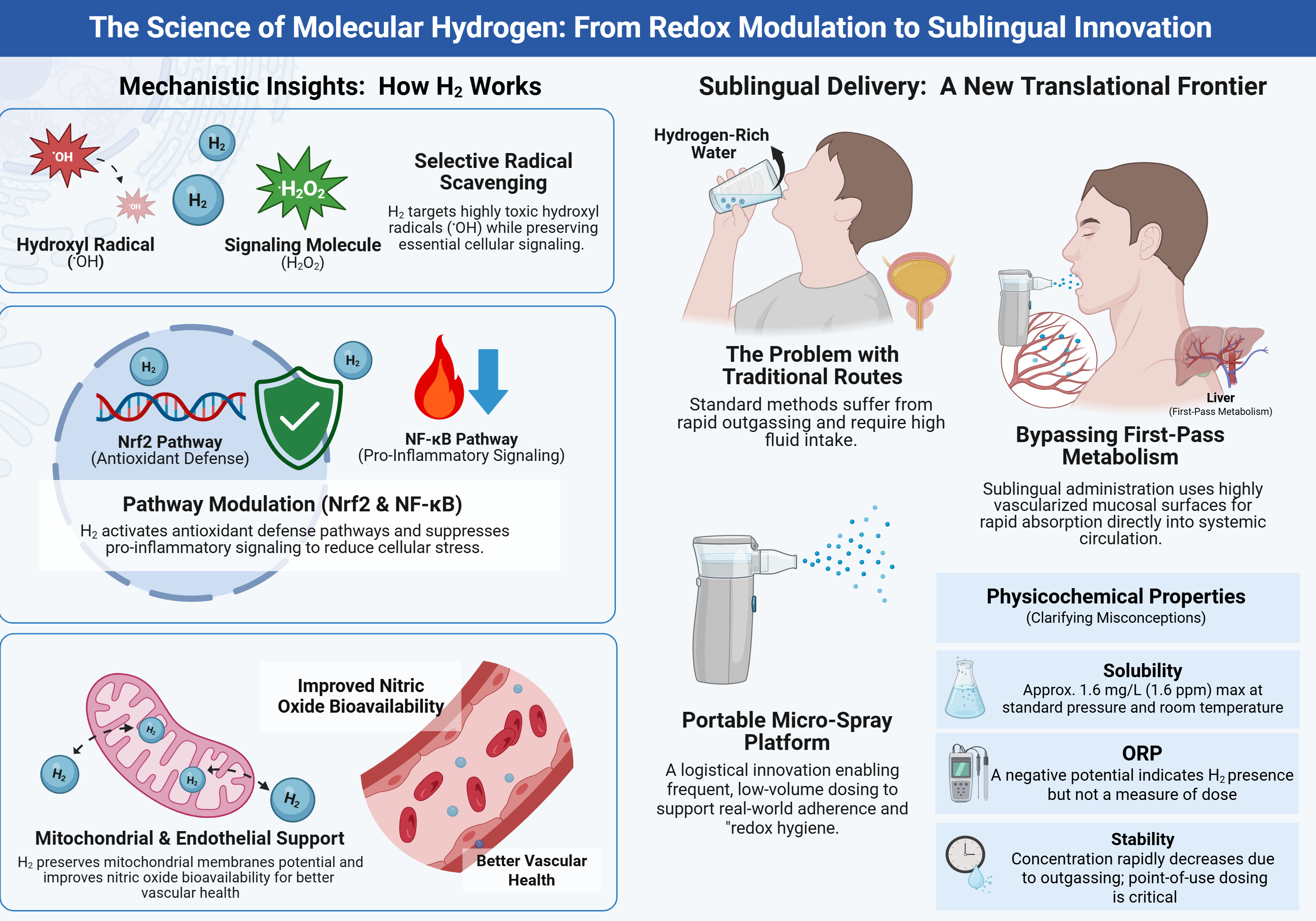
The sublingual route provides a highly vascularized mucosal surface that facilitates rapid absorption of small, diffusible molecules into the systemic circulation, potentially bypassing gastrointestinal transit and first-pass metabolism [48,49]. Although no pharmacokinetic data exist for sublingual hydrogen delivery, hydrogen’s small size and diffusibility suggest theoretical compatibility with this route. However, its volatility and rapid dissipation present unique formulation and delivery challenges [2].
Furthermore, as an example, the “Travel Water Spray” (TWS) developed by Travel Water Global Research Group (USA), may be conceptualized as a portable micro-spray platform designed to deliver dissolved molecular hydrogen via oral mucosal exposure. This approach represents both a behavioral and logistical innovation, enabling frequent, low-volume administration while avoiding the need for large fluid intake. Such a delivery model may support real-world adherence and aligns with emerging micro-dosing strategies aimed at maintaining redox homeostasis. Within this framework, TWS can be positioned as a potential daily-use tool to support mitochondrial redox balance, endothelial signaling, and the resolution of inflammatory processes. However, this concept remains a translational hypothesis and requires rigorous validation. Future studies should incorporate breath hydrogen pharmacokinetics, oxidative stress biomarkers, endothelial function panels, and pragmatic adherence trials to determine feasibility, bioavailability, and clinical relevance.
3. Clinical Evidence and Translational Relevance
Although sublingual delivery of molecular hydrogen has not been evaluated in peer-reviewed clinical studies, evidence from other administration routes provides context for its potential biological relevance [2,5]. Human investigations to date have primarily employed hydrogen-rich water (HRW), inhalation of hydrogen gas, or hydrogen-enriched solutions used in medical settings such as hemodialysis [2,8]. Across these modalities, outcomes have largely focused on biomarkers of oxidative stress, inflammation, metabolic regulation, and immune function [9,11].
Randomized controlled trials and controlled pilot studies of HRW have reported reductions in oxidative stress markers and inflammatory mediators in adults with metabolic risk factors, alongside changes in lipid profiles and glycemic indices [8,9]. For example, several trials have observed improvements in antioxidant capacity, reductions in low-density lipoprotein cholesterol, and modest changes in glycemic control following sustained HRW intake [5,8].
More recently, a double-blind randomized placebo-controlled study by Zhang et al., (2025) further demonstrated attenuation of oxidative stress and inflammation in patients with chronic high-altitude disease, supporting the biological activity of H₂ across diverse clinical populations [50]. However, not all studies report consistent results; a multicenter double-blind RCT by Ogawa et al., (2022) found no significant improvement in overall insulin resistance among patients with type 2 diabetes, though subgroup analysis suggested benefit in those with higher baseline insulin resistance [51]. The authors attributed these null findings in part to the small sample size and called for larger-scale, longer-term trials to verify the effects of electrolyzed hydrogen-rich water in T2DM patients, noting that current evidence remains insufficient to draw definitive conclusions [50].
Similarly, a randomized double-blind trial in healthy adults by Sim et al.,(2020) reported no significant between-group differences in serum oxidative stress markers, including derivatives of reactive oxygen and 8-OHdG, following four weeks of HRW consumption [11], suggesting that the magnitude of hydrogen’s redox effects may be influenced by baseline oxidative burden and disease status. Collectively, these findings reflect heterogeneity in study design, hydrogen concentration, intervention duration, and participant characteristics, and underscore the need for more standardized clinical investigation [2,11].
Beyond metabolic outcomes, exploratory clinical and preclinical studies have examined hydrogen administration in neurological, renal, oncologic, and immune-related contexts [1,2,52,53]. In neurological contexts, preclinical and early clinical studies suggest that molecular hydrogen may exert neuroprotective effects through antioxidant, anti-inflammatory, and anti-apoptotic mechanisms [52,53]. A 2025 review by Wang et al. examining hydrogen therapy in Parkinson’s disease noted promising preclinical findings; however, clinical trials have thus far yielded mixed outcomes, with some reporting limited or no therapeutic benefit, highlighting the gap between preclinical promise and clinical translation [54]. Regarding renal outcomes, a 2024 perspective review by Nakayama et al., reported that electrolyzed hydrogen-rich water may reduce oxidative stress and support renal function in chronic kidney disease and dialysis patients, though the authors emphasized that evidence remains largely preclinical and that robust clinical trials are still needed [45]. A 2025 case report by Lin et al. further described improvements in renal function and reduction in chronic fatigue following molecular hydrogen therapy in an elderly patient with multiple comorbidities, including diabetic nephropathy, suggesting potential clinical relevance that warrants further investigation [55].
In oncologic and immune-related settings, hydrogen has been investigated primarily as an adjunctive intervention. A 2024 review by Zhou et al. reported that molecular hydrogen may inhibit T cell exhaustion and enhance anti-tumor immune function while mitigating oxidative stress associated with radiation and chemotherapy [56]. However, a notable mechanistic concern was raised by Hasegawa et al., who demonstrated that molecular hydrogen enhanced proliferation in four out of seven human cancer cell lines tested, suggesting that its oncologic safety profile requires careful evaluation before broader clinical application [57]. Regarding fatigue and exercise recovery, a 2024 randomized double-blind placebo-controlled crossover trial by Sládečková et al. in elite fin swimmers reported that HRW supplementation promoted muscle recovery following two strenuous training sessions performed on the same day [58]. However, not all exercise-related studies report consistent benefits; a randomized double-blind placebo-controlled crossover study by Botek et al., (2020) demonstrated unclear effects of HRW on race time and fatigue, with performance improvements observed only in slower runners, suggesting that individual baseline fitness level may modulate hydrogen’s ergogenic effects [59]. Collectively, these findings across multiple organ systems and clinical contexts support the biological activity of molecular hydrogen beyond metabolic outcomes, though evidence in most areas remains preliminary, heterogeneous, and largely insufficient to draw definitive clinical conclusions [2,11].
In oncologic and infectious disease settings, hydrogen has been investigated primarily as an adjunctive intervention, with reports describing modulation of immune exhaustion markers and oxidative stress parameters [60,61,62]. These findings remain preliminary and are often limited by small sample sizes, lack of blinding, or absence of appropriate control groups [2].
Preclinical models further support biological activity of molecular hydrogen across multiple organ systems, including neuroprotection, reproductive function, hepatic metabolism, and protection against drug-induced toxicity [1,2,63,64]. Human studies using hydrogen-rich water, saline infusion, and inhalation report benefits in metabolic syndrome, rheumatoid arthritis, fatigue and exercise recovery, inflammatory biomarkers and neuroprotection models [9,65,66]. Collectively, these studies establish safety and biological activity. While these studies provide mechanistic insight, their translational relevance to human dosing and delivery routes remains uncertain [5].
Collectively, existing clinical and preclinical evidence supports the notion that molecular hydrogen can influence redox-related biological processes [2,11]. However, the diversity of delivery methods, exposure levels, and outcome measures limits direct comparison across studies. Importantly, no conclusions can be drawn regarding the efficacy, bioavailability, or clinical utility of sublingual hydrogen delivery based on the current literature. Instead, these data primarily inform biological plausibility and help define priorities for future translational research.
4. Safety and Practical Considerations
Molecular hydrogen is generally regarded as safe when administered at concentrations well below its flammability threshold of approximately 4% in air [1,2]. Clinical studies involving hydrogen-rich water, inhalation therapy, and hydrogen-enriched dialysate have reported minimal adverse effects, with safety profiles comparable to control interventions in most trials [5,8]. These observations are consistent with hydrogen’s endogenous production by intestinal microbiota and its rapid elimination via respiration [2].
Despite this favorable safety profile, novel delivery approaches such as sublingual administration warrant careful evaluation. Key considerations include verification of dissolved hydrogen concentration at the point of delivery, assessment of hydrogen stability during storage and dispensing, and confirmation of batch-to-batch reproducibility [5]. Hydrogen is volatile, diffuses rapidly, and is lost quickly once water containers are opened. Given the rapid diffusion and dissipation of dissolved hydrogen, failure to adequately characterize these parameters could result in substantial variability in delivered dose [2]. Most protocols require large fluid volumes, bulky generators and supervised inhalation. This creates barriers for daily consistency, especially in elderly, metabolic, or mobile populations.
Measurement methodology represents an additional practical concern. While oxidation–reduction potential is sometimes used as an indirect indicator of reducing conditions, it does not reliably reflect dissolved hydrogen concentration or biological activity [5]. Accordingly, direct quantification of hydrogen content using validated analytical methods is essential for both formulation development and clinical investigation.
Finally, although hydrogen itself is non-toxic, the materials, propellants, or additives used in delivery devices must be evaluated for mucosal safety and tolerability, particularly for repeated sublingual exposure. These considerations underscore the importance of rigorous preclinical testing and quality control prior to human use [2].
5. Research Gaps and Proposed Validation Framework
Despite growing evidence supporting the biological activity and therapeutic potential of molecular hydrogen (H₂), several scientific, technological, and translational challenges continue to limit its broader clinical and industrial adoption.
5.1. Biomedical and Clinical Research Gaps
A major limitation remains the incomplete understanding of H₂’s mechanisms of action. Although numerous preclinical studies and early clinical trials have demonstrated antioxidant, anti-inflammatory, anti-apoptotic, and cytoprotective effects across cardiovascular, neurological, metabolic, and inflammatory disorders, the primary molecular targets responsible for these benefits remain incompletely defined. Current evidence implicates redox-sensitive pathways such as Nrf2, NF-κB, mitochondrial signaling, and endothelial regulatory networks; however, the relative contributions of direct radical scavenging versus indirect modulation of cellular signaling remain unclear [4,39,67].
Clinical translation is further hindered by the lack of standardized treatment protocols. Existing studies employ diverse delivery modalities including hydrogen-rich water, inhaled hydrogen gas, hydrogen-enriched saline, and emerging formulations with substantial variation in hydrogen concentration, dosing regimens, treatment duration, and outcome measures. This heterogeneity complicates cross-study comparisons, limits the strength of meta-analyses, and impedes the development of evidence-based clinical guidelines [68,69,70].
Another important gap is the limited number of large-scale randomized controlled trials. Most human studies remain exploratory, involve relatively small sample sizes, or have short follow-up periods, leaving long-term efficacy, optimal dosing strategies, and safety profiles insufficiently characterized [4,39,68,70]. Furthermore, current methods for measuring hydrogen concentrations in biological systems often lack the sensitivity and precision required to establish robust dose–response relationships. The development of advanced analytical technologies and bioprobes will therefore be essential for future pharmacokinetic and mechanistic investigations [39,71].
5.2. Materials Science and Hydrogen Storage Gaps
Significant challenges also remain in hydrogen storage and delivery technologies. Reproducibility is a persistent concern due to inconsistencies in experimental methodologies, simulation parameters, and reporting standards across studies. Greater transparency, standardized protocols, and open-access datasets have been advocated to improve research quality and facilitate independent validation [19,72].
Practical deployment represents another major obstacle. Advanced hydrogen-storage materials, including metal-organic frameworks and other porous materials, frequently demonstrate excellent storage capacity under cryogenic or high-pressure conditions but show reduced performance under ambient conditions required for real-world applications [19,73,74]. Bridging this gap between laboratory performance and practical usability remains a critical challenge for commercialization.
In addition, the enormous chemical and materials design space creates a substantial screening bottleneck. Accelerating discovery will require integration of high-throughput computational screening, machine learning approaches, and experimental validation to efficiently identify promising materials with favorable storage capacity, stability, safety, and cost-effectiveness [75,76].
5.3. Cross-Domain Challenges
Several barriers extend across both biomedical and materials science domains. Research efforts remain fragmented, with limited interdisciplinary and international collaboration. Stronger integration among basic scientists, clinicians, engineers, industry partners, and regulatory agencies will be essential to accelerate the translation of promising discoveries into clinically and commercially viable technologies [69].
Regulatory and manufacturing considerations also remain significant obstacles. The absence of harmonized regulatory frameworks, standardized quality-control measures, validated analytical methods, and scalable manufacturing protocols creates uncertainty regarding product development, safety assessment, and market approval. Addressing these challenges will be critical for ensuring reproducibility, safety, and widespread adoption of hydrogen-based technologies in both healthcare and energy sectors [69].
Future progress in molecular hydrogen research will ultimately depend on resolving mechanistic uncertainties, standardizing clinical and technological methodologies, improving hydrogen detection and storage systems, validating emerging delivery platforms such as sublingual administration, and fostering stronger interdisciplinary collaboration. Addressing these priorities will be essential to translate the growing promise of molecular hydrogen into scientifically validated therapeutic and industrial applications
5.4. Proposed Validation Framework for Sublingual Molecular Hydrogen Delivery
To advance molecular hydrogen toward novel delivery routes such as sublingual administration, a systematic translational framework is needed. Device and formulation characterization studies should first establish dissolved hydrogen concentration, stability, reproducibility, and variability under storage and dispensing conditions. Direct quantification of hydrogen content should be prioritized over surrogate measures such as oxidation–reduction potential (ORP) or pH [5,77,78]. In silico analysis shows that small changes in pH, temperature, and meter error can shift ORP more than the entire contribution of dissolved H₂, making ORP-based “H₂ meters” highly inaccurate for quantification [46]. On the other hand, direct measurement techniques including electrochemical microsensors, gas chromatography, and validated hydrogen-specific sensors are considered the gold standard for dose determination and study comparability [77,78].
Subsequently, first-in-human pharmacokinetic studies should evaluate hydrogen absorption, systemic exposure, and clearance by measuring hydrogen levels in breath, saliva, and blood following sublingual administration [66]. These investigations would determine whether sublingual delivery achieves meaningful bioavailability compared with established routes such as hydrogen-rich water or inhalation.
Pilot randomized controlled trials should then assess safety, feasibility, and biological activity using mechanistic endpoints, including oxidative stress markers, inflammatory biomarkers, endothelial function, and mitochondrial responses. Consistent with previous hydrogen research, these early studies should focus on biological effects rather than clinical efficacy claims. Additional exploratory investigations incorporating micronutrient bioavailability assessments, metabolomics, and redox-sensitive metabolic profiling may further clarify the broader physiological consequences of hydrogen-mediated redox regulation [12,39,71].
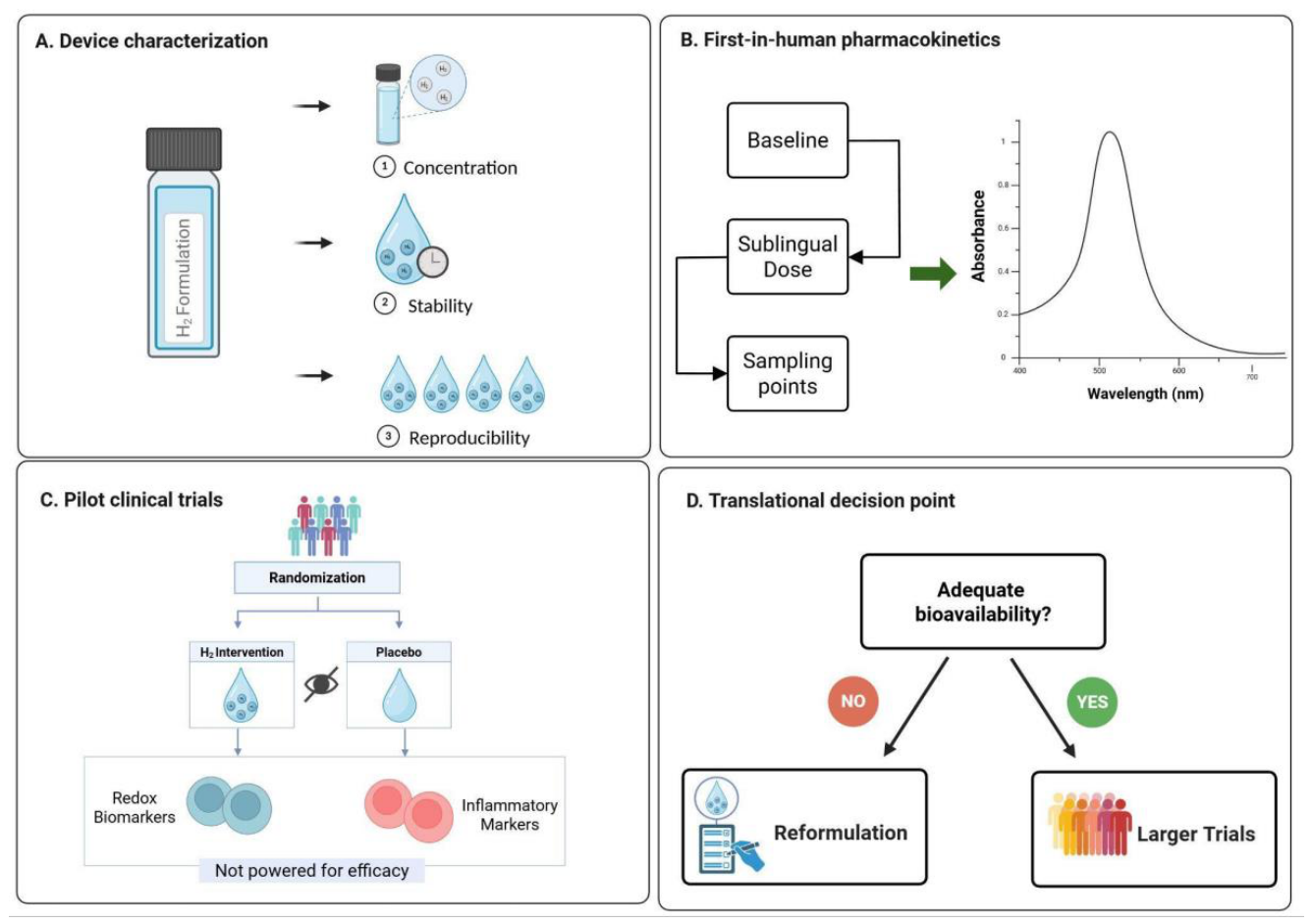
This stepwise framework from formulation characterization and pharmacokinetic evaluation to mechanistic clinical testing provides a scientifically rigorous and ethically responsible pathway for determining the feasibility and translational potential of sublingual molecular hydrogen delivery (Figure 3).
6. Future Directions
Future research on molecular hydrogen should focus on resolving several critical mechanistic, methodological, and translational gaps that currently limit its clinical integration. First, rigorous pharmacokinetic and pharmacodynamic studies are needed to determine the absorption, tissue distribution, and elimination kinetics of hydrogen across different delivery modalities, particularly for sublingual administration, which remains unexplored in peer-reviewed clinical studies. Establishing standardized dose–response relationships and exposure metrics will be essential for interpreting clinical outcomes and comparing results across studies. Second, future trials should incorporate direct quantification of dissolved hydrogen concentrations, standardized formulation protocols, and validated biomarkers of oxidative stress and inflammation to reduce the methodological heterogeneity that characterizes the current literature. Mechanistic investigations should further clarify the relative contributions of direct radical interactions versus modulation of redox-sensitive signaling pathways, including Nrf2, NF-κB, mitochondrial function, and endothelial signaling networks. In parallel, well-designed randomized controlled trials with adequate sample sizes and clearly defined endpoints are necessary to evaluate clinical efficacy across conditions associated with oxidative and inflammatory stress. Finally, emerging areas such as precision redox medicine, interactions with the gut microbiome, and the development of stable hydrogen delivery technologies may expand the therapeutic potential of hydrogen while improving reproducibility and translational relevance. Holistically, addressing these priorities will be essential to determine whether molecular hydrogen can move from a promising redox modulator to a clinically validated therapeutic strategy.
7. Conclusions
Molecular hydrogen has emerged as a biologically active molecule with distinctive physicochemical properties and the capacity to influence redox-related processes. Experimental and clinical studies using established delivery routes, including hydrogen-rich water and inhalation, suggest that hydrogen can modulate oxidative stress, inflammatory responses, and redox-sensitive signaling pathways such as Nrf2 and NF-κB. These effects appear to occur without broad suppression of physiological reactive oxygen species, supporting the concept of hydrogen as a selective redox modulator rather than a conventional antioxidant.
Despite growing interest and an expanding evidence base, current human data remain heterogeneous, and definitive conclusions regarding clinical efficacy are limited. Importantly, sublingual delivery of molecular hydrogen has not yet been evaluated in peer-reviewed studies. While physicochemical considerations provide a plausible rationale for exploring this route, its feasibility, bioavailability, and biological relevance must be established through rigorous formulation characterization, pharmacokinetic assessment, and well-controlled clinical trials.
Future research should prioritize methodological rigor, transparent reporting of hydrogen concentrations, and mechanistically grounded outcome measures. Until such data are available, claims regarding specific therapeutic indications or advantages of novel delivery routes should be regarded as investigational. Within these constraints, molecular hydrogen continues to represent an intriguing subject in redox biology, warranting careful and systematic investigation.
Author Contributions
Conceptualization, E.A.F and G.D; writing – original draft, G.D.,E.A.F., and A.K..; writing – editing, all authors; supervision, G.D.; All authors collected, summarized and interpreted studies; reviewed and made significant revisions to the manuscript. All authors approved the final version.
Funding
No funding was received by any author in the preparation of this narrative review.
Institutional Review Board Statement
Not applicable.
Informed Consent Statement
Not applicable.
Data Availability Statement
No new data were created or analyzed in this study. Data sharing is not applicable to this article.
Acknowledgments
During the preparation of this work the authors used Chat GPT in order to correct grammar and improve readability. After using this tool/service, the authors reviewed and edited the content as needed and take full responsibility for the content of the publication. Figures were created using BioRender.com.
Conflicts of Interest
Eugene A. Florendo is the principal and research lead for Travel Water Global Research Group (USA), maker of Travel Water Spray Acid ReliefTM.
Abbreviations
The following abbreviations are used in this manuscript:
Δψm Mitochondrial Membrane Potential
•OH Hydroxyl Radical
5xFAD Five Familial Alzheimer’s Disease mutation
8-OHdG 8-hydroxy-2’-deoxyguanosine
ARE Antioxidant Response Element
ATP Adenosine Triphosphate
Bax Bcl 2 Associated X Protein
Bcl B-cell lymphoma 2
BH2 Dihydrobiopterin
BH4 Tetrahydrobiopterin
Caco-2 Human Colorectal Adenocarcinoma Cell Line
CAT Catalase
COVID 19 Coronavirus Disease 2019
DNA Deoxyribonucleic Acid
eNOS endothelial Nitric Oxide Synthase
ERK Extracellular Signal-regulated Kinase
Fe Iron
GPx Glutathione Peroxidase
GSH Reduced Glutathione
GSSH Oxidized Glutathione
H₂ Molecular Hydrogen
HMGB1 High-mobility Group Box 1
HO-1 Heme Oxygenase-1
H2O2 Hydrogen Peroxide
HRW Hydrogen-Rich Water
HUVEC Human Umbilical Vein Endothelial Cell
ICAM-1 Intercellular Adhesion Molecule-1
IL Interleukin
JNK c-Jun N-terminal Kinase
Keap1 Kelch-like ECH-associated protein
LPS Lipopolysaccharide
MAPK Mitogen-activated Protein Kinase
MDA Malondialdehyde
NF-κB Nuclear Factor κB
NLRP3 NOD-like Receptor Family Pyrin Domain Containing 3
NQO1 NAD(P)H Quinone Dehydrogenase 1
Nrf-2 Nuclear Factor Erythroid 2-Related Factor 2
NO• Nitric Oxide
O2 Molecular Oxygen
O₂•⁻ Superoxide
ONOO⁻ Peroxynitrite
ORP Oxidation-Reduction Potential
OSAHS Obstructive Sleep Apnea-Hypopnea Syndrome
OXPHOS Oxidative Phosphorylation
PINK1 PTEN induced putative kinase 1
RCT Randomized Control Trial
ROS Reactive Oxygen Species
SOD Superoxide Dismutase
T2DM Type 2 Diabetes Mellites
TNF-α Tumor Necrosis Factor - Alpha
TWS Travel Water Spray
USA United States of America
UVB Ultraviolet B
VCAM-1 Vascular Cell Adhesion Molecule-1
References
- Ohsawa, I.; Ishikawa, M.; Takahashi, K.; Watanabe, M.; Nishimaki, K.; Yamagata, K.; Katsura, K.; Katayama, Y.; Asoh, S.; Ohta, S. Hydrogen Acts as a Therapeutic Antioxidant by Selectively Reducing Cytotoxic Oxygen Radicals. Nat. Med. 2007, 13, 688–694. [Google Scholar] [CrossRef] [PubMed]
- Ohta, S. Molecular Hydrogen as a Novel Antioxidant: Overview of the Advantages of Hydrogen for Medical Applications. Methods Enzymol. 2015, 555, 289–317. [Google Scholar] [CrossRef]
- Ge, L.; Yang, M.; Yang, N.-N.; Yin, X.-X.; Song, W.-G. Molecular Hydrogen: A Preventive and Therapeutic Medical Gas for Various Diseases. Oncotarget 2017, 8, 102653–102673. [Google Scholar] [CrossRef] [PubMed]
- Johnsen, H.M.; Hiorth, M.; Klaveness, J. Molecular Hydrogen Therapy—A Review on Clinical Studies and Outcomes. Molecules 2023, 28, 7785. [Google Scholar] [CrossRef] [PubMed]
- LeBaron, T.W.; Kura, B.; Kalocayova, B.; Tribulova, N.; Slezak, J. A New Approach for the Prevention and Treatment of Cardiovascular Disorders. Molecular Hydrogen Significantly Reduces the Effects of Oxidative Stress. Molecules 2019, 24, 2076. [Google Scholar] [CrossRef]
- Chen, J.-B.; Kong, X.-F.; Qian, W.; Mu, F.; Lu, T.-Y.; Lu, Y.-Y.; Xu, K.-C. Two Weeks of Hydrogen Inhalation Can Significantly Reverse Adaptive and Innate Immune System Senescence Patients with Advanced Non-Small Cell Lung Cancer: A Self-Controlled Study. Med. Gas. Res. 2020, 10, 149. [Google Scholar] [CrossRef] [PubMed]
- Rahman, Md.H.; Jeong, E.-S.; You, H.S.; Kim, C.-S.; Lee, K.-J. Redox-Mechanisms of Molecular Hydrogen Promote Healthful Longevity. Antioxidants 2023, 12, 988. [Google Scholar] [CrossRef] [PubMed]
- Nakao, A.; Toyoda, Y.; Sharma, P.; Evans, M.; Guthrie, N. Effectiveness of Hydrogen Rich Water on Antioxidant Status of Subjects with Potential Metabolic Syndrome—An Open Label Pilot Study. J. Clin. Biochem. Nutr. 2010, 46, 140–149. [Google Scholar] [CrossRef] [PubMed]
- Song, G.; Li, M.; Sang, H.; Zhang, L.; Li, X.; Yao, S.; Yu, Y.; Zong, C.; Xue, Y.; Qin, S. Hydrogen-Rich Water Decreases Serum LDL-Cholesterol Levels and Improves HDL Function in Patients with Potential Metabolic Syndrome. J. Lipid Res. 2013, 54, 1884–1893. [Google Scholar] [CrossRef] [PubMed]
- LeBaron, T.; Singh, R.; Fatima, G.; Kartikey, K.; Sharma, J.P.; Ostojic, S.; Gvozdjakova, A.; Kura, B.; Noda, M.; Mojto, V.; et al. The Effects of 24-Week, High-Concentration Hydrogen-Rich Water on Body Composition, Blood Lipid Profiles and Inflammation Biomarkers in Men and Women with Metabolic Syndrome: A Randomized Controlled Trial. Diabetes Metab. Syndr. Obes. Targets Ther. 2020, Volume 13, 889–896. [Google Scholar] [CrossRef]
- Sim, M.; Kim, C.-S.; Shon, W.-J.; Lee, Y.-K.; Choi, E.Y.; Shin, D.-M. Hydrogen-Rich Water Reduces Inflammatory Responses and Prevents Apoptosis of Peripheral Blood Cells in Healthy Adults: A Randomized, Double-Blind, Controlled Trial. Sci. Rep. 2020, 10, 12130. [Google Scholar] [CrossRef]
- Nguyen Puente, B.; Habet, V.; Wheeler, C.R.; Kheir, J.N. Emerging Clinical Applications for Molecular Hydrogen. Respir. Care 2026, 19433654251398759. [Google Scholar] [CrossRef]
- Zhou, K.; Shang, Z.; Yuan, C.; Guo, Z.; Wang, Y.; Bao, D.; Zhou, J. Can Molecular Hydrogen Supplementation Enhance Physical Performance in Healthy Adults? A Systematic Review and Meta-Analysis. Front. Nutr. 2024, 11, 1387657. [Google Scholar] [CrossRef] [PubMed]
- Hong, Y.; Chen, S.; Zhang, J.-M. Hydrogen as a Selective Antioxidant: A Review of Clinical and Experimental Studies. J. Int. Med. Res. 2010, 38, 1893–1903. [Google Scholar] [CrossRef] [PubMed]
- Barancik, M.; Kura, B.; LeBaron, T.W.; Bolli, R.; Buday, J.; Slezak, J. Molecular and Cellular Mechanisms Associated with Effects of Molecular Hydrogen in Cardiovascular and Central Nervous Systems. Antioxidants 2020, 9, 1281. [Google Scholar] [CrossRef] [PubMed]
- Yildiz, F.; LeBaron, T.; Alwazeer, D. A Comprehensive Review of Molecular Hydrogen as a Novel Nutrition Therapy in Relieving Oxidative Stress and Diseases: Mechanisms and Perspectives. Biochem. Biophys. Rep. 2025, 41, 101933. [Google Scholar] [CrossRef] [PubMed]
- Hanaoka, T.; Kamimura, N.; Yokota, T.; Takai, S.; Ohta, S. Molecular Hydrogen Protects Chondrocytes from Oxidative Stress and Indirectly Alters Gene Expressions through Reducing Peroxynitrite Derived from Nitric Oxide. Med. Gas. Res. 2011, 1, 18. [Google Scholar] [CrossRef] [PubMed]
- Ria, S.; Meesungnoen, J.; Jay-Gerin, J. Molecular Hydrogen as an Antioxidant and Radioprotector: Mechanistic Insights from Monte Carlo Radiation-Chemical Simulations. Antioxidants 2025, 14. [Google Scholar] [CrossRef] [PubMed]
- Zhang, Y.; Fan, W.; Li, X.; Wang, W.; Liu, S. Enhanced Removal of Free Radicals by Aqueous Hydrogen Nanobubbles and Their Role in Oxidative Stress. Environ. Sci. Technol. 2022. [Google Scholar] [CrossRef] [PubMed]
- Yokota, T.; Kamimura, N.; Igarashi, T.; Takahashi, H.; Ohta, S.; Oharazawa, H. Protective Effect of Molecular Hydrogen against Oxidative Stress Caused by Peroxynitrite Derived from Nitric Oxide in Rat Retina. Clin. Exp. Ophthalmol. 2015, 43. [Google Scholar] [CrossRef] [PubMed]
- Radyuk, S. Mechanisms Underlying the Biological Effects of Molecular Hydrogen. Curr. Pharm. Des. 2020. [Google Scholar] [CrossRef]
- Ohta, S. Molecular Hydrogen May Activate the Transcription Factor Nrf2 to Alleviate Oxidative Stress through the Hydrogen-Targeted Porphyrin. Aging Pathobiol. Ther. 2023. [Google Scholar] [CrossRef]
- Yu, Y.; Yang, Y.; Yang, M.; Wang, C.; Xie, K.; Yu, Y. Hydrogen Gas Reduces HMGB1 Release in Lung Tissues of Septic Mice in an Nrf2/HO-1-Dependent Pathway. Int. Immunopharmacol. 2019, 69, 11–18. [Google Scholar] [CrossRef] [PubMed]
- Chen, H.; Xie, K.; Han, H.; Li, Y.; Liu, L.; Yang, T.; Yu, Y. Molecular Hydrogen Protects Mice against Polymicrobial Sepsis by Ameliorating Endothelial Dysfunction via an Nrf2/HO-1 Signaling Pathway. Int. Immunopharmacol. 2015, 28, 643–654. [Google Scholar] [CrossRef] [PubMed]
- Peng, J.; He, Q.; Li, S.; Liu, T.; Zhang, J. Hydrogen-Rich Water Mitigates LPS-Induced Chronic Intestinal Inflammatory Response in Rats via Nrf-2 and NF-κB Signaling Pathways. Vet. Sci. 2022, 9. [Google Scholar] [CrossRef] [PubMed]
- Hu, Y.; Wang, P.; Han, K. Hydrogen Attenuated Inflammation Response and Oxidative in Hypoxic Ischemic Encephalopathy via Nrf2 Mediated the Inhibition of NLRP3 and NF-κB. Neuroscience 2021. [Google Scholar] [CrossRef] [PubMed]
- Mo, C.; Bajgai, J.; Rahman, M.; Pham, T.; Zhang, H.; Cao, B.; Jeong, E.; Kim, C.; Lee, K. Neuroprotective Effects of Molecular Hydrogen via Oxidative Stress and Neuroinflammation Regulation in a 5xFAD Mouse Model. Antioxidants 2026, 15. [Google Scholar] [CrossRef] [PubMed]
- Hori, F.; Sobue, S.; Inoue, C.; Murakumo, Y.; Ichihara, M. Molecular Hydrogen Attenuates Chronic Inflammation and Delays the Onset of Ultraviolet B-Induced Skin Carcinogenesis in Mice. Int. J. Mol. Sci. 2026, 27. [Google Scholar] [CrossRef] [PubMed]
- Alwazeer, D.; Liu, F.; Wu, X.; LeBaron, T. Combating Oxidative Stress and Inflammation in COVID-19 by Molecular Hydrogen Therapy: Mechanisms and Perspectives. Oxid. Med. Cell. Longev. 2021, 2021, 5513868. [Google Scholar] [CrossRef] [PubMed]
- Pan, S.; Wang, B.; Yu, M.; Zhang, J.; Fan, B.; Nie, C.; Zou, R.; Yang, X.; Zhang, Z.; Hong, X.; et al. Hydrogen Alleviates Myocardial Infarction by Impeding Apoptosis via ROS-Mediated Mitochondrial Endogenous Pathway. Free Radic. Res. 2025, 59, 226–238. [Google Scholar] [CrossRef]
- Murakami, Y.; Ito, M.; Ohsawa, I. Molecular Hydrogen Protects against Oxidative Stress-Induced SH-SY5Y Neuroblastoma Cell Death through the Process of Mitohormesis. PLoS ONE 2017, 12. [Google Scholar] [CrossRef] [PubMed]
- Fang, W.; Tang, L.; Wang, G.; Lin, J.; Liao, W.; Pan, W.; Xu, J. Molecular Hydrogen Protects Human Melanocytes from Oxidative Stress by Activating Nrf2 Signaling. J. Invest. Dermatol. 2020. [Google Scholar] [CrossRef] [PubMed]
- Seya, M.; Aokage, T.; Meng, Y.; Hirayama, T.; Obara, T.; Nojima, T.; Yoshinori, K.; Yumoto, T.; Watanabe, A.; Yamada, T.; et al. Hydrogen-Rich Gas Enhances Mitochondrial Membrane Potential and Respiratory Function Recovery in Caco-2 Cells Post-Ischemia-Reperfusion Injury. Biochem. Biophys. Res. Commun. 2025, 786, 152753. [Google Scholar] [CrossRef] [PubMed]
- Li, J.; Hao, G.; Yan, Y.; Li, M.; Li, G.; Lu, Z.; Sun, Z.; Chen, Y.; Liu, H.; Zhao, Y.; et al. Hydrogen Restores Central Tryptophan and Metabolite Levels and Maintains Mitochondrial Homeostasis to Protect Rats from Chronic Mild Unpredictable Stress Damage. Neurochem. Int. 2024, 105914. [Google Scholar] [CrossRef] [PubMed]
- Zhang, J.; Zhou, Y.; Zhu, X.; Peng, Z.; Zhu, Q.; Ding, P.; Ning, M.; Zhang, Q.; Zong, Z. Hydrogen Attenuates Oxidative Damage via NRF2-Mediated Mitophagy after Subarachnoid Hemorrhage. Antioxid. Redox Signal. 2025, 44, 443–463. [Google Scholar] [CrossRef]
- Cheng, D.; Long, J.; Zhao, L.; Liu, J. Hydrogen: A Rising Star in Gas Medicine as a Mitochondria-Targeting Nutrient via Activating Keap1-Nrf2 Antioxidant System. Antioxidants 2023, 12. [Google Scholar] [CrossRef] [PubMed]
- Ji, Y.; Hu, Y.; Feng, Y.; Liu, L.; Chen, Z.; Shen, H.; Han, Y.; Xu, H.; Lao, L. Mitochondrial “Birth-Death” Coordinator: An Intelligent Hydrogen Nanogenerator to Enhance Intervertebral Disc Regeneration. Biomaterials 2024, 313, 122764. [Google Scholar] [CrossRef] [PubMed]
- Chen, Q.; Jiang, D.; He, J.; Sun, M. Hydrogen Rescues Vascular Endothelial Cells in Obstructive Sleep Apnea-Hypopnea Syndrome by Modulating Nitric Oxide. J. Thorac. Dis. 2025, 17, 9598–9609. [Google Scholar] [CrossRef] [PubMed]
- Chen, S.; Zeng, L.; He, Q. Status Quo, Challenges and Future Directions of Hydrogen Medicine. Fundam. Res. 2025, 6, 1242–1246. [Google Scholar] [CrossRef]
- Incalza, M.; D’Oria, R.; Natalicchio, A.; Perrini, S.; Laviola, L.; Giorgino, F. Oxidative Stress and Reactive Oxygen Species in Endothelial Dysfunction Associated with Cardiovascular and Metabolic Diseases. Vasc. Pharmacol. 2017, 100, 1–19. [Google Scholar] [CrossRef]
- Janaszak-Jasiecka, A.; Płoska, A.; Wierońska, J.; Dobrucki, L.; Kalinowski, L. Endothelial Dysfunction Due to eNOS Uncoupling: Molecular Mechanisms as Potential Therapeutic Targets. Cell. Mol. Biol. Lett. 2023, 28. [Google Scholar] [CrossRef] [PubMed]
- Wang, X.; He, B. Endothelial Dysfunction: Molecular Mechanisms and Clinical Implications. MedComm 2024, 5. [Google Scholar] [CrossRef] [PubMed]
- Tian, Y.; Zhang, Y.; Wang, Y.; Chen, Y.; Fan, W.; Zhou, J.; Qiao, J.; Wei, Y. Hydrogen, a Novel Therapeutic Molecule, Regulates Oxidative Stress, Inflammation, and Apoptosis. Front. Physiol. 2021, 12, 789507. [Google Scholar] [CrossRef]
- Fukai, Y. Some Fundamental Properties of Hydrogen and Water. In Molecular Hydrogen for Medicine; Springer Singapore: Singapore, 2020; pp. 91–104. ISBN 978-981-15-7156-5. [Google Scholar]
- Nakayama, M.; Kabayama, S.; Miyazaki, M. Application of Electrolyzed Hydrogen Water for Management of Chronic Kidney Disease and Dialysis Treatment—Perspective View. Antioxidants 2024, 13, 90. [Google Scholar] [CrossRef] [PubMed]
- LeBaron, T.W.; Sharpe, R. ORP Should Not Be Used to Estimate or Compare Concentrations of Aqueous H2: An in Silico Analysis and Narrative Synopsis. Front. Food Sci. Technol. 2022, 2, 1007001. [Google Scholar] [CrossRef]
- LeBaron, T.W.; Sharpe, R.; Ohno, K. Electrolyzed–Reduced Water: Review I. Molecular Hydrogen Is the Exclusive Agent Responsible for the Therapeutic Effects. Int. J. Mol. Sci. 2022, 23, 14750. [Google Scholar] [CrossRef] [PubMed]
- Pawar, P.; Ghorpade, H.; Kokane, B. Sublingual Route for Systemic Drug Delivery. J. Drug Deliv. Ther. 2018. [Google Scholar] [CrossRef]
- Bahraminejad, S.; Almoazen, H. Sublingual and Buccal Delivery: A Historical and Scientific Prescriptive. Pharmaceutics 2025, 17. [Google Scholar] [CrossRef] [PubMed]
- Zhang, Q.; Zhang, F.; Zhong, Y.; Li, Q.; Hao, D.; Shi, Z.; Zhu, S.; Wu, Y.; Yue, X. Hydrogen-Rich Water Supplementation Attenuates Oxidative Stress and Inflammation in Chronic High-Altitude Disease Patients: A Double-Blind Randomized Placebo-Controlled Study. Food Res. Int. 2025, 219, 117118. [Google Scholar] [CrossRef] [PubMed]
- Ogawa, S.; Ohsaki, Y.; Shimizu, M. Electrolyzed Hydrogen-Rich Water for Oxidative Stress Suppression and Improvement of Insulin Resistance: A Multicenter Prospective Double-Blind Randomized Control Trial. Diabetol. Int. 2022, 13, 209–219. [Google Scholar]
- Ono, H.; Nishijima, Y.; Ohta, S.; Sakamoto, M.; Kinone, K.; Horikosi, T.; Tamaki, M.; Takeshita, H.; Futatuki, T.; Ohishi, W.; et al. Hydrogen Gas Inhalation Treatment in Acute Cerebral Infarction: A Randomized Controlled Clinical Study on Safety and Neuroprotection. J. Stroke Cerebrovasc. Dis. 2017, 26, 2587–2594. [Google Scholar] [CrossRef] [PubMed]
- Yoritaka, A.; Takanashi, M.; Hirayama, M.; Nakahara, T.; Ohta, S.; Hattori, N. Pilot Study of H2 Therapy in Parkinson’s Disease: A Randomized Double-blind Placebo-controlled Trial. Mov. Disord. 2013, 28, 836–839. [Google Scholar] [CrossRef] [PubMed]
- Wang, F.; Zhang, G.; Zhai, Q. Role and Mechanism of Molecular Hydrogen in the Treatment of Parkinson’s Diseases. Front. Neurosci. 2025, 19, 1576773. [Google Scholar] [CrossRef] [PubMed]
- Lin, Y.-T.; Lu, J.-W.; Ho, Y.-J.; Lui, S.-W.; Hsieh, T.-Y.; Wang, K.-Y.; Liu, F.-C. Molecular Hydrogen as a Potential Adjunctive Therapy to Improve Renal Function and Reduce Fatigue in an Elderly Patient With Chronic Comorbidities: A Case Report. Vivo 2025, 39, 572–576. [Google Scholar] [CrossRef]
- Zhou, W.; Zhang, J.; Chen, W. Prospects of Molecular Hydrogen in Cancer Prevention and Treatment. J. Cancer Res. Clin. Oncol. 2024, 150, 170. [Google Scholar] [CrossRef] [PubMed]
- Hasegawa, T.; Ito, M.; Hasegawa, S.; Teranishi, M.; Takeda, K.; Negishi, S.; Nishiwaki, H.; Takeda, J.; LeBaron, T.W.; Ohno, K. Molecular Hydrogen Enhances Proliferation of Cancer Cells That Exhibit Potent Mitochondrial Unfolded Protein Response. Int. J. Mol. Sci. 2022, 23, 2888. [Google Scholar] [CrossRef] [PubMed]
- Sládečková, B.; Botek, M.; Krejčí, J.; Valenta, M.; McKune, A.; Neuls, F.; Klimešová, I. Hydrogen-Rich Water Supplementation Promotes Muscle Recovery after Two Strenuous Training Sessions Performed on the Same Day in Elite Fin Swimmers: Randomized, Double-Blind, Placebo-Controlled, Crossover Trial. Front. Physiol. 2024, 15, 1321160. [Google Scholar] [CrossRef]
- Botek, M.; Krejčí, J.; McKune, A.J.; Sládečková, B. Hydrogen-Rich Water Supplementation and Up-Hill Running Performance: Effect of Athlete Performance Level. Int. J. Sports Physiol. Perform. 2020, 15, 1193–1196. [Google Scholar] [CrossRef] [PubMed]
- Chen, W.; Zhang, H.-T.; Qin, S.-C. Neuroprotective Effects of Molecular Hydrogen: A Critical Review. Neurosci. Bull. 2021, 37, 389–404. [Google Scholar] [CrossRef] [PubMed]
- Akagi, J.; Baba, H. Hydrogen Gas Restores Exhausted CD8+ T�cells in Patients with Advanced Colorectal Cancer to Improve Prognosis. Oncol. Rep. 2018. [Google Scholar] [CrossRef] [PubMed]
- Runtuwene, J.; Amitani, H.; Amitani, M.; Asakawa, A.; Cheng, K.-C.; Inui, A. Hydrogen–Water Enhances 5-Fluorouracil-Induced Inhibition of Colon Cancer. PeerJ 2015, 3, e859. [Google Scholar] [CrossRef]
- Kikkawa, Y.S.; Nakagawa, T.; Taniguchi, M.; Ito, J. Hydrogen Protects Auditory Hair Cells from Cisplatin-Induced Free Radicals. Neurosci. Lett. 2014, 579, 125–129. [Google Scholar] [CrossRef] [PubMed]
- Meng, X.; Zhang, S.; Zhao, L.; Wang, Y. Hydrogen-Rich Water Treatment Targets RT1-Db1 and RT1-Bb to Alleviate Premature Ovarian Failure in Rats. PeerJ 2023, 11, e15564. [Google Scholar] [CrossRef] [PubMed]
- Aoki, K.; Nakao, A.; Adachi, T.; Matsui, Y.; Miyakawa, S. Pilot Study: Effects of Drinking Hydrogen-Rich Water on Muscle Fatigue Caused by Acute Exercise in Elite Athletes. Med. Gas. Res. 2012, 2, 12. [Google Scholar] [CrossRef] [PubMed]
- Ishibashi, T.; Sato, B.; Rikitake, M.; Seo, T.; Kurokawa, R.; Hara, Y.; Naritomi, Y.; Hara, H.; Nagao, T. Consumption of Water Containing a High Concentration of Molecular Hydrogen Reduces Oxidative Stress and Disease Activity in Patients with Rheumatoid Arthritis: An Open-Label Pilot Study. Med. Gas. Res. 2012, 2, 27. [Google Scholar] [CrossRef] [PubMed]
- Xie, F.; Song, Y.; Yi, Y.; Jiang, X.; Li, J.; Zhanghuang, Z.; Liu, M.; Zhao, P. Therapeutic Potential of Molecular Hydrogen in Metabolic Diseases from Bench to Bedside. Pharmaceuticals 2023, 16. [Google Scholar] [CrossRef] [PubMed]
- Jin, J.; Yue, L.; Du, M.; Geng, F.; Gao, X.; Zhou, Y.; Lu, Q.; Pan, X. Molecular Hydrogen Therapy: Mechanisms, Delivery Methods, Preventive, and Therapeutic Application. MedComm 2025, 6. [Google Scholar] [CrossRef] [PubMed]
- Viana, J.; Castro, C.; Leiva, V. Molecular Hydrogen and Kidney Diseases: A Scoping Review Based on Scientometry and Data Analytics. Med. Gas. Res. 2025, 16, 161–168. [Google Scholar] [CrossRef] [PubMed]
- Jeyaraman, N.; Jeyaraman, M.; Ramasubramanian, S.; Murugan, S.; Nallakumarasamy, A.; Muthu, S. Molecular Hydrogen Therapy in Musculoskeletal Conditions: An Evidence-Based Review and Critical Analysis. World J. Orthop. 2026, 17. [Google Scholar] [CrossRef] [PubMed]
- Li, G.; Cui, H.; Fan, R.; Liu, G.; Hou, Z.; Zhang, Y.; Che, X.; Wang, T.; Wei, H.; Li, P. Delivery of Molecular Hydrogen for Precision Immunomodulation: Mechanisms, Detection Methods, and Applications. Adv. Sci. 2025, 12. [Google Scholar] [CrossRef] [PubMed]
- Rahbari, A.; Chakrapani, T.H.; Shuang, F.; Krokidas, P.; Habibi, P.; Lagerweij, V.J.; Ramdin, M.; Vlugt, T.J.H.; Hajibeygi, H.; Dey, P.; et al. Molecular Simulation of Hydrogen Systems: From Properties and Methods to Applications and Future Directions. Chem. Rev. 2025, 125, 11878–12029. [Google Scholar] [CrossRef] [PubMed]
- Ren, L.; Li, Y.; Zhang, N.; Li, Z.; Lin, X.; Zhu, W.; Lu, C.; Ding, W.; Zou, J. Nanostructuring of Mg-Based Hydrogen Storage Materials: Recent Advances for Promoting Key Applications. Nano-Micro Lett. 2023, 15, 93. [Google Scholar] [CrossRef] [PubMed]
- Ahmed, A.; Seth, S.; Purewal, J.; Wong-Foy, A.G.; Veenstra, M.; Matzger, A.J.; Siegel, D.J. Exceptional Hydrogen Storage Achieved by Screening Nearly Half a Million Metal-Organic Frameworks. Nat. Commun. 2019, 10, 1568. [Google Scholar] [CrossRef] [PubMed]
- Banerjee, T.; Balasubramanian, G. Predictive Modeling of Molecular Mechanisms in Hydrogen Production and Storage Materials. Materials 2023, 16, 6050. [Google Scholar] [CrossRef] [PubMed]
- Ga, S.; An, N.; Lee, G.Y.; Joo, C.; Kim, J. Multidisciplinary High-Throughput Screening of Metal–Organic Framework for Ammonia-Based Green Hydrogen Production. Renew. Sustain. Energy Rev. 2024, 192, 114275. [Google Scholar] [CrossRef]
- Ostojic, S.; Vranes, M. Molecular Hydrogen Content of Different Dietary Supplements. Czech. J. Food Sci. 2024. [Google Scholar] [CrossRef]
- Lu, K.; Shen, M.; Wang, R.; Chen, W.; Chiu, S.; Kao, Y.; Liu, F.; Hsiao, P. Using Oral Molecular Hydrogen Supplements to Combat Microinflammation in Humans: A Pilot Observational Study. Int. J. Med. Sci. 2024, 21, 2390–2401. [Google Scholar] [CrossRef] [PubMed]
Figure 1.
(A) Due to its small size and nonpolar structure, molecular hydrogen rapidly diffuses across cellular membranes and distributes into intracellular compartments including the cytosol, mitochondria, and nucleus. (B) Hydrogen selectively attenuates highly reactive cytotoxic species such as hydroxyl radicals (•OH) and peroxynitrite (ONOO⁻) while largely preserving physiological redox signaling molecules such as hydrogen peroxide. (C) Hydrogen may modulate redox-sensitive signaling pathways, including activation of the Nrf2–antioxidant response element (ARE) pathway and suppression of NF-κB–mediated inflammatory signaling. (D) These mechanisms collectively contribute to downstream biological effects such as reduced oxidative damage, attenuation of inflammatory responses, and improved cellular stress tolerance.
Figure 1.
(A) Due to its small size and nonpolar structure, molecular hydrogen rapidly diffuses across cellular membranes and distributes into intracellular compartments including the cytosol, mitochondria, and nucleus. (B) Hydrogen selectively attenuates highly reactive cytotoxic species such as hydroxyl radicals (•OH) and peroxynitrite (ONOO⁻) while largely preserving physiological redox signaling molecules such as hydrogen peroxide. (C) Hydrogen may modulate redox-sensitive signaling pathways, including activation of the Nrf2–antioxidant response element (ARE) pathway and suppression of NF-κB–mediated inflammatory signaling. (D) These mechanisms collectively contribute to downstream biological effects such as reduced oxidative damage, attenuation of inflammatory responses, and improved cellular stress tolerance.
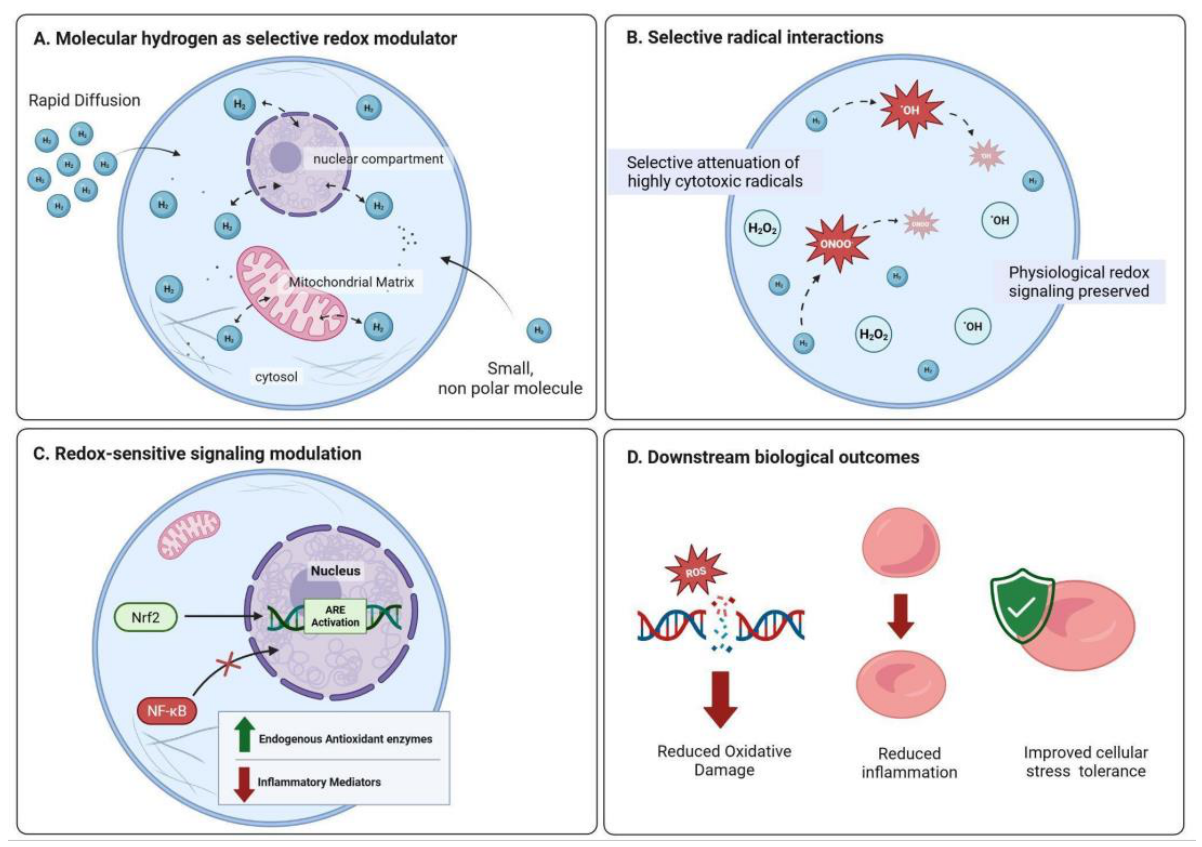
Figure 2.
Physicochemical considerations relevant to dissolved molecular hydrogen formulations.(A) Hydrogen dissolved in aqueous solutions rapidly decreases over time due to outgassing, resulting in concentration-dependent stability. (B) Oxidation–reduction potential (ORP) decreases as hydrogen concentration increases; however, ORP does not reliably reflect biological potency or actual hydrogen concentration. (C) Practical formulation constraints include concentration loss during storage, delivery-dependent losses during dispensing, and reduced availability with delayed administration. (D) Because ORP is an indirect measure, direct analytical quantification of dissolved hydrogen is required for accurate characterization of formulations and dosing.
Figure 2.
Physicochemical considerations relevant to dissolved molecular hydrogen formulations.(A) Hydrogen dissolved in aqueous solutions rapidly decreases over time due to outgassing, resulting in concentration-dependent stability. (B) Oxidation–reduction potential (ORP) decreases as hydrogen concentration increases; however, ORP does not reliably reflect biological potency or actual hydrogen concentration. (C) Practical formulation constraints include concentration loss during storage, delivery-dependent losses during dispensing, and reduced availability with delayed administration. (D) Because ORP is an indirect measure, direct analytical quantification of dissolved hydrogen is required for accurate characterization of formulations and dosing.
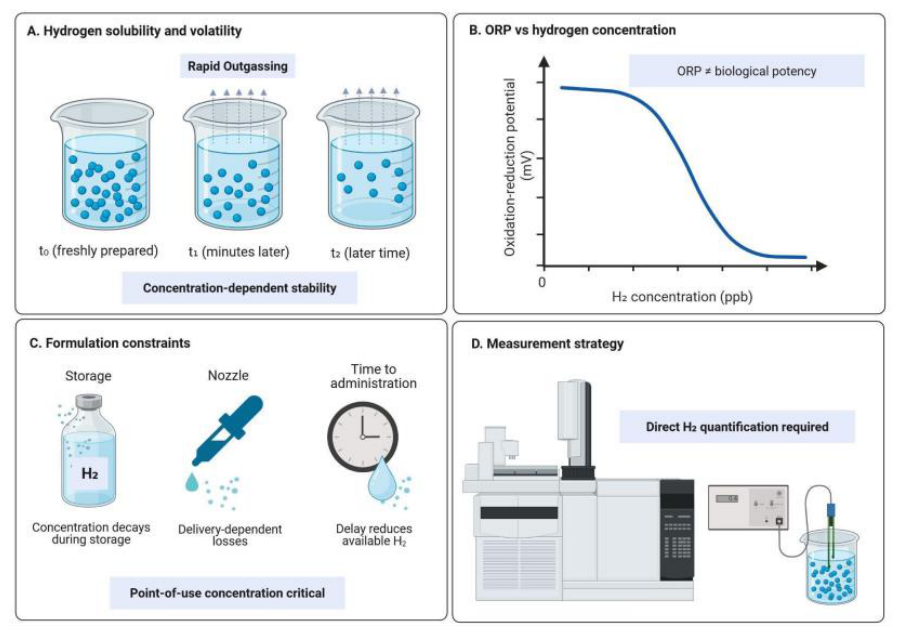
Figure 3.
Proposed translational validation framework for sublingual molecular hydrogen delivery.(A) Device and formulation characterization including dissolved hydrogen concentration, stability, and reproducibility. (B) First-in-human pharmacokinetic studies to determine systemic exposure and absorption kinetics following sublingual administration. (C) Pilot randomized controlled trials assessing mechanistic outcomes such as redox and inflammatory biomarkers. (D) Translational decision point evaluating whether sufficient bioavailability supports advancement to larger clinical trials or requires reformulation.
Figure 3.
Proposed translational validation framework for sublingual molecular hydrogen delivery.(A) Device and formulation characterization including dissolved hydrogen concentration, stability, and reproducibility. (B) First-in-human pharmacokinetic studies to determine systemic exposure and absorption kinetics following sublingual administration. (C) Pilot randomized controlled trials assessing mechanistic outcomes such as redox and inflammatory biomarkers. (D) Translational decision point evaluating whether sufficient bioavailability supports advancement to larger clinical trials or requires reformulation.
Disclaimer/Publisher’s Note: The statements, opinions and data contained in all publications are solely those of the individual author(s) and contributor(s) and not of MDPI and/or the editor(s). MDPI and/or the editor(s) disclaim responsibility for any injury to people or property resulting from any ideas, methods, instructions or products referred to in the content. |
© 2026 by the authors. Licensee MDPI, Basel, Switzerland. This article is an open access article distributed under the terms and conditions of the Creative Commons Attribution (CC BY) license (http://creativecommons.org/licenses/by/4.0/).
Copyright: This open access article is published under a Creative Commons CC BY 4.0 license, which permit the free download, distribution, and reuse, provided that the author and preprint are cited in any reuse.


