

Submitted:
18 June 2026
Posted:
22 June 2026
You are already at the latest version
Abstract
Downstream migration (DSM) of young fish is an efficient way of their dispersal in rivers. Regulation of rivers transform them into lotic-limnetic cascades fragmented by dams. Novel conditions of transformed riverine habitats influence migration routes and behavior of migrants, creating hazardous ecological situations, which lead to enhanced mortality and reduced fitness of fish. The review is aimed at ecological effects of river regulations on DSM, taking into account not only entrainment, damage and mortality of migrants in the water abstraction systems at the dam, but also modifications of DSM in the whole reservoir and within its sections. Habitat heterogeneity/complexity is one of the key factors controlling DSM both in natural and regulated rivers. It influences foraging, defense, migratory behavior at different spatial scales. In reservoirs, topography of the whole reservoir, stretched hydraulic gradients between migratory and residence habitats, widen inshore areas rich of shelters and landmarks provide higher retaining capacities for migrating fish. Homogeneous open waters are less suitable for feeding, communication, defense, and other behaviors of migrants than heterogeneous inshore habitats. Three ecologically distinct zones were recognized in the reservoir, where specific modifications of DSM were described. Fish from different taxonomical and ecological groups, e.g. Cyprinidae and Percidae, respond differently to the newly emerged structures and modified habitat heterogeneity. When creating fish-friendly migration routes and developing conservation measures, we have to take into account not only transformed habitats, but also characteristics of different ecological groups of fish.
Keywords:
regulated rivers
; fish juveniles
; downstream migration
; habitat heterogeneity
; mortality
; fitness
1. Introduction
Humans have extensively altered river systems through impoundments and diversions to meet their water, energy, and transportation needs. Dam construction is one of the most fundamental impacts humans can have on natural river systems [1,2,3,4]. Along with the positive effects, dams and other hydrotechnical constructions obstruct the dispersal and migration of organisms, and these and other consequences have been directly linked to impaired fitness, biological production, loss of populations and entire species of freshwater fish [3,5,6,7,8,9,10].
Both natural and anthropogenically transformed riverine habitats are heterogeneous [11,12,13,14]. Fish populations often occupy or travel through a diversity of habitats [15,16] wherein selection pressures are shaped by local environments. Periods of migration are physically challenging, often exposing individuals to elevated levels of predation, starvation and other risks [17,18]. Young fish migrating from the breeding to nursery habitats are especially vulnerable due to their poorly developed locomotion, orientation, foraging and defense abilities [19,20]. Flow regulation in rivers reduces the abundance of larval fish in nursery habitat, alter taxonomic composition, and disrupt microhabitat relations [21].
Contrary to the recent opinion that downstream migration of the young fish is a predominantly passive process [22], more evidence shows the key role of fish behavior in controlling their migration at the very early stages of the life cycle [23,24].
To date, there has been too much emphasis on upstream migration which is largely the domain of adult fish, and too little on downstream migration, which involves predominantly early stages [13,25]. Patterns and mechanisms governing the downstream migration (DSM) of young fish in natural and regulated rivers need special studies [but see [24,26,27]].
Here we review and analyze our published and unpublished results together with the literature on the patterns and processes associated with the downstream migration of young fish in natural and anthropogenically transformed rivers. Our primary goal is to determine ecologically significant newly emerged structures and habitats which influence migration of the young fish - modify migration patterns, cause enhanced mortality, and transform foraging conditions in the whole reservoir and within its sections from upper to lower reaches. More specifically, we consider impacts of altered topography, hydraulic structures, and biotic and abiotic conditions on 1) spatial and temporal patterns of downstream migration at different scales, 2) emigration rate of young fish out of the manmade reservoir, and 3) response of fish of different ecological groups to the variable conditions of water withdrawal from reservoirs.
The review is divided into four sections. In the first, we consider riverine fish migrations in natural rivers focusing mainly on the patterns and governing mechanisms of the downstream migration of young fish. In the second section, we highlight processes and patterns associated with modified habitat heterogeneity in regulated rivers, which control downstream migrations and their ecological consequences. In the third section, we consider and exemplify impacts of habitat structure and migratory behavior on trophic relations and fitness of young fish in natural and altered rivers. A brief overview of the main concepts and approaches to conservation and restoration of fish from different ecological groups in anthropogenically transformed rivers is provided in the fourth section.
2. Habitat Structure and Migrations of Young Fish in Natural (Undisturbed) Rivers
Natural riverine ecosystems are characterized by a high level of heterogeneity across a range of spatiotemporal scales [28,29]. The River Continuum Concept was proposed which provides a framework for integrating predictable and observable biological features of lotic systems [30]. The physical structure coupled with the hydrologic cycle form a templet [31] for biological responses, and result in consistent patterns of community structure, function, transport etc., along the length of a river. Fish make movements to gain access to patchily distributed resources, critical habitats (e.g., spawning and nursery grounds), and capitalize on favorable environmental conditions [32]. These movements influence demographic processes such as immigration and emigration, and functionally connect habitats [33,34].
Most of riverine fish migrate upstream towards the spawning grounds providing their descendants with opportunity to move (drift) downstream saving energy expenditures for swimming in viscous medium [26,35,36,37]. However, such a drift – downstream migration (DSM) - is not a safe and easy travel, but rather a serious behavioral and ecological challenge associated with various risks of passage through unknown habitats [24,27,32].
How young fish, especially at the early stages of their ontogeny, when they usually undertake risky DSM, respond to the conditions and physical structures of natural (undisturbed) rivers? The unidirectional drift along the main stream is the most evident and clearly pronounced part of DSM. According to the simplified view of the DSM of young larvae as a passive process [22,38], the migration is due to a lack of orientation in the dark and washing out from the inshore zone to the main channel of the river. If their transition to the flow is completely passive, the relative abundance of larvae of different species has to be basically similar in both habitats of residence and migratory habitats.
However, the results of field and experimental studies demonstrate that this is far from the case and suggest that behavioral mechanisms are at play [24,27,39,40]. We observed that despite a lower concentration in the habitat of residence, roach Rutilus rutilus larvae were more common migrants than another cyprinid species Phoxinus phoxinus, which were most abundant in the habitat of residence [41]. An increase in the number of roach larvae in the migratory habitat compared with the number in the inshore zone can be explained only by behavior. More examples illustrating the role of behavior in the control of the young fish DSM: 1) DSM takes place during the polar day, when illumination allows orientation for 24 h [24]; 2) the behavioral responses of migrants are more pronounced near interfaces, where small-scale topography and hydraulic gradients serve as cues for orientation [42,43]; 3) using an experimental model of the hydraulic interface between habitats of residence and migratory habitats, we discovered that fish larvae with the appropriate internal state (migrants) choose a suitable velocity depending on illumination. In the darkness, migrants choose zones with higher velocity, thus actively entering the drift (DSM), while at dawn fish were leaving the migratory habitat for entering the low velocity habitat of residence [44]; 4) we suggested that one of the important aspects of DSM, synchronization of migratory behavior, may result from the similarity of individual responses to changes in illumination and/ or could be related to shoaling behavior, which is typical of late-stage larvae and fry [45,46,47]. More synchronized responses of older larvae to diel changes in illumination support the concept of interactive behavioral responses [24]. Thus, we believe that the major temporal and spatial parameters of DSM are influenced by fish behavior (locomotion, orientation, decision-making), 3D flow structure, and diel cycles of illumination. Although we emphasize the importance of behavior in the control of DSM, we do not ignore passive drift. The whole process of DSM is composed of a sequence of active and passive components.
Short periods of decision-making when migrants enter the DSM at dusk and return to the inshore retention zone at dawn are of particular importance in controlling of DSM. We suggest that such key events are associated with high gradient/heterogeneous zones (interfaces between habitats of residence and migration habitats) [24,48]. Throughout DSM, migrating fish move across the transition zone many times when they enter the drift (migratory habitats) and return to the shore (habitat of residence).
The overall success of DSM depends not only on the migratory behavior of fish in the main channel of the river (migratory habitat) but also on other vital activities, such as foraging, defense, and grouping, associated with both habitats of residence and migratory habitats [42,43,49]. Migrating fish both drifting in the main channel, and moving from one inshore site to another constantly find themselves in unfamiliar habitats. The micro-scale heterogeneity and local aggregation of fish in these habitats within a natural river seem to have a significant influence on the synchronization of activity and DSM of the migrating fish.
The risk of dilution (drop of local concentration) is great for migrating populations of young fish, which have high feeding demands, vulnerability to predators, and a tendency to group [24,49,50]. Without shoaling, which is impossible at a low local population density [51], young fish would not be able to efficiently avoid predators, search for food, and navigate [46,47,52]. We hypothesized that DSM is adaptive if dispersal and widening of nursery grounds work together with mechanisms for maintenance of local aggregations to ensure efficient intraspecific interactions (“dispersal with low dilution” hypothesis) [24].
One of the most pronounced impacts of the river regulation on young fish is creation of enlarged water bodies, reservoirs, with reduced flow velocity, modified habitat heterogeneity, and high risk of fish mortality in some localities of reservoirs. In the following section, we consider most important physical traits and patterns of habitat heterogeneity in water reservoirs, as well as their effects for young fish migrations.
3. Multiscale Influence of Modified Habitat Heterogeneity on Downstream Migration of Young Fish in Regulated Rivers
Humans all over the planet are assisting with the development of new ecosystems. Such ecosystems are not emerging de novo. Instead, they are emerging from ‘within’ pre-existing systems that are naturally dynamic, both over long and short time-scales [53]. Habitat heterogeneity influence fish migratory behavior at different scales, from the local patterns of landmarks and gradients to the configuration of the whole river system [10,54]. Natural rivers with gradually changing characteristics ensuring connectivity provide conditions for the DSM along the length of a whole river [24,26,27].
Regulation of the rivers, mainly with dams, creates reservoirs and other structures which are considered movement barriers for riverine and anadromous species [48,54,55]. Flow regulation endangers migrating fish, especially those at the early ontogeny, predominantly by entrainment into water abstraction devices [56,57]. The vast majority of studies on downstream migration of young fish in regulated rivers is focused on passage through the turbines of power plants and other water intakes associated with dams [58,59,60]. These constructions for water discharge from reservoirs are considered the most dangerous for migrating fish in terms of high mortality and damage rate [37,61,62,63]. The role of transformed parts of the river located upstream the dam (proper reservoir) is still underestimated from the viewpoint of mortality and foraging conditions for migrating fish.
Reservoirs are usually created by damming rivers or streams and flooding the surrounding floodplain and tributaries. Many reservoirs may have properties that reflect both lakes and flowing systems. Two major types of water reservoirs are commonly distinguished, lake-like and channel-like reservoirs [48]. The main physical traits of these manmade objects, which are of primary importance from the point of influence on the DSM intensity, include a) annual water exchange rate, and b) morphological complexity of the reservoir (Table 1). The index of morphological complexity was calculated as the ratio of the total length of impounded tributaries to the length of impounded part of the main river [48]. We hypothesized that the water exchange rate is the main physical factor influencing the intensity of DSM and emigration of fish from reservoirs. Negative correlation between biomass of the pelagic (open water) fish inhabiting several reservoirs of the Volga River and water exchange rate supported this suggestion [64]. It means that withdrawal of fish is expected to be the highest from reservoirs with the largest water exchange rate. However, later we found another, probably not less important factor, morphological complexity of the reservoir, which hampers emigration of fish, predominantly 0+ juveniles, from reservoirs (Table 1). Taking into account only water exchange factor, we can expect the highest withdrawal (intensity of DSM) from the Ivan’kovskoe Reservoir. However, the highest annual withdrawal was observed from another, channel-like, reservoir of the Volga River cascade, Volgogradskoe, where morphological complexity was at minimum (Table 1). The lowest withdrawal rate was recorded for the Tsimlyanskoe Reservoir with relatively low exchange rate and rather high morphological complexity.
River regulation radically transforms environment for all types of fish migrations at different scales [5,54,65,66]. Reservoirs change stream conditions throughout impounded watersheds. Immediately upstream of the dam, the river gains lentic properties: flow is reduced, width, depth, and sedimentation increase [67].
Before considering ecological consequences of the river regulation and novel physical structures for the fish DSM, we have to provide a general scheme of the altered habitats in the reservoir emerged upstream the constructed dam. Modified parts of the river include: 1) lotic-limnetic interface (transient region in the upper part of reservoir); 2) reservoir itself with stretched gradients and changed heterogeneity; 3) water-intake zone at the dam.
In natural rivers, migrating fish are basically preadapted to habitat heterogeneity (hydraulics, topography, shelters, foraging sites) and spatiotemporal distribution of ecological risks [24,27]. Novel physical structures emerging in regulated rivers either fully block or significantly hamper DSM of young fish [48,54].
First newly emerged ecological barrier/filter, which seriously influences DSM of young fish, migrating from the upper reaches of the regulated river, is the lotic-limnetic interface in the upper part of a reservoir [70]. In this area (backwater zone), the river continuum is disrupted, which leads not only to changes in the living conditions of riverine fishes, but also dramatically changes conditions for DSM of young fish. The main features of this zone are: sharp drop in the flow velocity, intense sedimentation, modified habitat heterogeneity (flow structure, bottom topography, water transparency), high amount of juvenile piscivorous fish (Table 2).
Large water bodies of impounded parts of a river (reservoirs) are the most voluminous obstacles for migrating fish [48,54]. Their varying depth and currents, and modified transition zones between habitats of residence and migratory habitats radically change conditions of the DSM for young fish, creating ecological barriers of different permeability. To understand the relative influence of biotic and abiotic factors on the patterns and mechanisms of DSM either in undisturbed rivers, or in reservoirs, we have to consider the characteristics of not only migratory habitats (main channel of the river, or open water of the reservoir) but also habitats of residence (sites of stopovers in the inshore habitats) and the transition zone (interface) between these two types of habitats. The structure, topography, and flow parameters of the transition zone are especially important for fish undertaking DSM [22,24,69,71] (Figure 1).
Young fish, migrating in a reservoir, face enormously extended transition zones between the migratory habitat (open part of the reservoir) and the habitat of residence (shallow-water inshore zone). Compared with natural rivers, the extended transition zone makes repeated lateral diel movements between the habitats much more difficult. A significant number of migrants retain for the whole day in the open water of the reservoir (migratory habitat) instead of returning at dawn to the inshore zone (habitat of residence) (Figure 1 and Figure 2).
In the Upper Volga reservoirs, the period of downstream migration is more prolonged than in the river. Within this period, i.e., June–September, a much higher concentration of young percids was recorded in the open water (migration habitat) than in shallow water (habitat of residence) (Figure 3 and Figure 4). The opposite pattern was observed in cyprinids—they were much more abundant in the inshore zone (zone of residence). This difference produces a prerequisite for more intensive drift of the young percids than cyprinids towards the dam [14].
In homogeneous environments of the open part of the reservoir with few landmarks and highly variable flow structure, most of the main vital functions and biotic interactions of migrating fish are hampered and difficult to be fulfilled, especially for young fish [24,42]. Maintenance of local aggregations (shoals) is important not only for fish in habitats of residence in the inshore zone but also for drifting fish, as drifting is the most dangerous part of migration. Increased density of migrant conspecifics dramatically improved the survival rate of sockeye salmon Oncorhynchus nerka smolts [72].
Besides the impacts on the diel characteristics of DSM, changed conditions of regulated rivers significantly influence seasonal patterns of DSM. Compared to the DSM of 0+ perch, Perca fluviatilis, in the natural river (upper Volga River), peak of DSM of this species in the reservoir of the same river appears later and the migration lasts much longer. Thus, not only most numerous in the midsummer early stages are involved in migration, but also grownup juveniles in autumn – winter period (Figure 3). Several factors of different scale we mentioned above, namely, morphological complexity of the reservoir, variable hydraulic structure, extended transition zone between migratory habitat and habitat of residence, homogeneity of open water area are supposedly important factors, which modify seasonal dynamics of DSM in fish juveniles.
In the sequence of modified parts of the impounded river, a 3-D hydrological structure with a downstream flow through the Hydro-Power-Plant passage in the dam is the most dangerous area, where the impact on DSM and survival of young fish may be especially harmful. The total concentration of fish in this area is higher than that at the adjacent upstream area of the reservoir, largely due to the drift and the accumulation of migrants [48]. The area associated with the water intake constitutes an eco-hydraulic template where the DSM of fish is under control of the two interacting structures: (1) transformed water flow, which is like a hydraulic 3-D funnel, and (2) a set of adjacent ecological zones (habitats). Depending on the parameters of these structures, different types of Eco-Hydraulic Patterns of Interaction (EHPI) between water flow and ecological zones were observed [4]. Larvae and juveniles of pelagic fishes were significantly more vulnerable to be entrained by the outflow, especially through the deep-water intakes, than littoral fishes.
DSM of cyprinid and percid fishes are strongly influenced by novel ecological structures associated with different parts of water reservoirs [14]. While the intensity and patterns of the DSM of cyprinids and percids are rather similar in free-flowing natural rivers, a much more intensive emigration of juvenile percids, especially zander, Sander lucioperca, was observed from reservoirs with deep-water intakes. Modified conditions of regulated rivers, especially those at the lower part of water reservoirs (water intake zone), induce a new type of impact of the downstream water flow on fish inhabiting adjacent ecological zones [4].
Removal of migrants through the water intakes is under control of hydraulic and ecological impacts at different spatiotemporal scales: the whole-lake, between-habitats and within-habitat scales [48,71.4]. The pelagic zone of many reservoirs has lower fish diversity and populations numbers. Intensive (selective) removal of fish from this area through the water intake of the limnetic–lotic interface could be one of the factors causing this effect. For example, in the reservoirs of the Volga and Kama rivers, a strong negative relationship between the fish biomass in the pelagic zone and the intensity of water exchange was observed [64].
4. Ecological Effects of Transformed Habitats on Fish Migratory Behavior, Biotic Interactions, and Mortality in Different Parts of Reservoirs
Altered morphology, hydrology, chemical and biotic characteristics of regulated rivers dramatically change conditions of DSM and other vital activities of young fish. From the viewpoint of individual fitness and population number, mortality and foraging conditions are the major ecological factors/determinants influencing overall success of the DSM. In addition to the natural factors of mortality (predation, parasitism, starvation), newly emerged morphological and hydraulic structures create local dangerous situations in different parts of reservoirs, which directly or indirectly increase young fish mortality.
Predation by piscivorous fishes and birds is one of the major ecological threats for young fish, especially in the period of high migratory activity. Effects of predation depend not only on the numbers of interacting predators and prey, but to a large extent on the availability of prey, which is strongly related to the microscale heterogeneity of the foraging ground [49,73]. Such a heterogeneity is typical of the shallow-water inshore habitats, where residing young fish may easily find landmarks, food, and shelters. All these objects are much less available in the homogeneous open-water parts of reservoirs. Low permeability of the transient zone between inshore and open-water habitats, which prevents lateral movements of migrants, retains a significant number of young fish, especially percids [14], in the dangerous pelagic habitat for the most part of the diel cycle. Below, we consider ecological effects of staying in the open water on predator-prey interactions and feeding success of young fish. There are several sections of the regulated river (river stretches), where novel factors, besides natural factors of mortality, emerge.
Lotic-limnetic interface in the upper part of reservoir. The combined effect of abiotic and biotic factors leads to a significant inhibition of DSM of young riverine fish and an increase in their mortality in the transient zone between river and reservoir. Inhibition of DSM occurs not only due to a decrease in the average flow rate, but also due to the lateral transport of migrants from the incoming flow to the inshore shallow waters [71]. In shallow waters of the Ili River, where the flow rate is noticeably lower than in the midstream channel, and the water transparency is much higher, migrating larvae of gobies Rhinogobius brunneus, bream Abramis brama, dace Leuciscus leuciscus, and other species become easy prey for predatory fish like asp Aspius aspius, zander Sander lucioperca, and Balkhash perch Perca schrenki. Impact of predators, as well as the death of eggs and larvae in areas of intense sedimentation, determined the high total mortality of migrating riverine fish in the uppermost part of reservoir, where riverine conditions were sharply replaced by lacustrine ones [41]. This transient zone’s “filter” not only reduces the total number of migrants, but, acting selectively, reduces the abundance of certain species much more than others. Only a small number of the early stages of grass carp Ctenopharingodon idella, silver carp Hypophthalmichthys molitrix, and Aral barbel Luciobarbus brachycephalus migrating from the upstream stretch of the Ili River enter the reservoirs due to siltation of eggs and larvae, as well as predation pressure [71].
Water reservoir (impounded river stretch). The vast area of the reservoir itself is characterized by low and changeable flow velocity, and poorly structured (homogeneous) habitats [10,25,48,54,67]. These factors produce not only unfavorable conditions for fish migrations (migratory behavior) along the whole reservoir, but also influence various vital activities like foraging, defense, orientation, grouping in transformed river habitats [42,43,49].
Peak densities of migrating fish in natural rivers are usually recorded during the night. During the day, the migration habitat (main channel) is virtually free of downstream migrants (Figure 1). The diel rhythms in the behavior of migrating fish and their interactions with small scale hydrological gradients and heterogeneous topography shape the temporal patterns of DSM in young fish. Migration habitats in regulated rivers (open water of reservoirs) contain larval fish both day and night (0+ percids are often the most numerous migrants). Comparing these two contrasting water bodies, river vs reservoir, we argue that riverine migrants easily leave the migratory habitat at dawn and enter the heterogeneous inshore zone. Lateral movements allow them to cross a narrow flow gradient between the habitats, and undertake foraging under the structured, stable, and safe conditions. Such behavior seems much more difficult for larvae, which migrate in the reservoir, because extended interface between migratory and residence habitats creates a hardly permeable barrier for migrants. Thus, a large number of migrants stay in the poorly structured (homogeneous) open water during both night and day (Figure 2 and Figure 4). Under such conditions, feeding, communication, defense, and other behaviors are much less successful than in the structured (heterogeneous) inshore habitats. 0+ perch Perca fluviatilis foraging in the heterogeneous area at the macrophyte beds consumed twice more zooplankton crustaceans, than perch from the neighboring open-water area [74] (Figure 5).
Moreover, considerably bigger prey prevailed in the diet of fish from the heterogeneous area. Such a successful feeding of 0+ perch was supposedly related to their confident behavior under safe conditions, where physical and “social” (shoals of conspecifics) shelters were available. We also observed similar behavior in experiments with another predator-prey interaction: the guppy Poecilia reticulata fed intensively and readily consumed large prey even under the impact of piscivorous fish kairomons, if the interaction occurred nearby the macrophyte beds (heterogeneous habitat); in the open-water (homogeneous habitat) added kairomons strongly suppressed feeding, especially on large prey, handling of which is time-costly [73]. Our field and experimental data suggest that hampered foraging and high risk of predation for young fish migrating in the open waters of reservoirs lead to their lowered fitness and increased mortality. Large size and homogeneous structure of reservoirs makes them a significant ecological factor, which can control population number and composition of fish communities.
Water-intake zone at the dam. The DSM of juvenile fish through the water intakes of different types associated with dams and other constructions is a potentially powerful factor, which influences the abundance and composition of fish populations inhabiting reservoirs. Depending on the pattern of interactions between the discharge water flow and adjacent ecological zones, the outflow through the dam selectively removes fish of different ecological groups from different habitats [4].
The deep-water flow of Hydro-Power-Plant removes much more fish from the pelagic habitats than the littoral ones. The concentration of migrants through the water intake of the HPP is much higher than that through the nearby Shipping-lock, which abstracts water mainly from the shallow-water habitats [4,14]. These effects resulted not only from the higher amount of water going through the HPP intake, but also from the physical heterogeneity of the adjacent habitats. Heterogeneous habitats with various shelters and landmarks provide higher retaining capacities for fish from flashing out from the reservoir. Young fish of ubiquitous species from the Percidae and Cyprinidae families, perch, roach, bleak, bream, emigrate in mass through the lentic-lotic interface (deep-water HPP water intake) entrained by the 3-D outflow from the pelagic habitats (Figure 6 (a), (c)); DSM of these fishes, especially cyprinids, is much less intensive, when they migrate through the shallow-water intake, which entrains water and migrants from heterogeneous (rich of shelters and landmarks) inshore habitats (Figure 6 (b), (c)).
5. Ecologically Based Approaches to Conservation and Restoration of Fish in Regulated Rivers
Management and conservation of young fish inhabiting reservoirs are predominantly focused on prevention of the entrainment of migrating fish by the water abstraction flow, which carry them into the HPP passages equipped with damaging turbines and other obstacles. Development and design of various types of physical and behavioral screens, as well as fish-friendly turbines, which prevent or mitigate the impacts of entrainment and entrapment of migrants and their mortality, are still the main approaches to protection of fish larvae and juveniles in the periods of mass migration and dispersal. Most of the efforts and developed devices are linked with the lower part of reservoir adjacent to the dam and water abstraction sites. Other parts of the reservoir, where DSM and biotic interactions directly or indirectly influence mortality, fitness and emigration of young fish received much less attention.
Ecologically based approach to efficient management of fish populations in regulated rivers is mainly related to the principle of minimizing the overlap between the downstream flow patterns in the water-intake zone near the dam and the spatiotemporal distribution of young fish during their mass migration period. Knowledge of the diel and seasonal dynamics of DSM, as well as the structure of the spatial distribution of migrants both at the whole reservoir and between-habitats levels, especially near water intakes, makes it possible to regulate flow discharge and emigration of young fish. Maximum water discharge should not be associated with periods of mass fish migration (diurnal and seasonal migration windows).
To develop specific measures to minimize mortality risks, we have to (1) determine a target species or group of fishes, taking into account their ecology and behavior, especially those related to migrations of juveniles, predator-prey interactions and responses to habitat heterogeneity; (2) assess the major periods of migratory activity of fishes on both diel and seasonal scales; (3) estimate the rate of transportation of migrants from the upper to lower part of a reservoir—this process is strongly influenced by the topographical and hydraulic complexity of the reservoir, and the rate of water exchange; (4) estimate the eco-hydraulic pattern of interaction (EHPI) between the downstream water flow and ecological zones/habitats within the water intake area; (5) assess within-habitat complexity (availability of landmarks and shelters), which may suppress the removal of fish from habitats of residence by the outflow.
Author Contributions
Conceptualization, V.N.M. and D.S.P.; methodology, D.S.P., V.N.M. and V.V.K.; formal analysis, V.V.K.; resources, D.S.P.; data curation, V.V.K. and V.N.M.; writing— original draft preparation, V.N.M.; writing—review and editing, V.N.M. and D.S.P.; visualization, V.V.K.; supervision, D.S.P.; project administration, D.S.P. All authors have read and agreed to the published version of the manuscript.
Funding
This research was funded by “Migration polymorphism in fish and lampreys: shaping and ecological consequences”. Grant from the Russian Science Foundation, no. 24-14-00111, https://rscf.ru/en/project/24-14-00111/.
Institutional Review Board Statement
Ethical review and approval were waived for this study because it was conducted using only published data.
Data Availability Statement
No new data were used in this review. The analysis is based on the published (predominantly ours) papers.
Conflicts of Interest
The authors declare no conflict of interest.
References
- Dynesius, M.; Nilsson, C. Fragmentation and flow regulation of river systems in the northern third of the world. Science 1994, 266(5186), 753–762. [Google Scholar] [CrossRef] [PubMed]
- Malmqvist, B.; Rundle, S. Threats to the running water ecosystems of the world. Environ. Conserv. 2002, 29, 134–153. [Google Scholar] [CrossRef]
- Nilsson, C.; Reidy, C. A.; Dynesius, M.; Revenga, C. Fragmentation and Flow Regulation of the World’s Large River Systems. Science 2005, 308, 405–408. [Google Scholar] [PubMed]
- Pavlov, D.S.; Kostin, V.V.; Mikheev, V.N. Selective Removal of Fish from Reservoirs and Lakes: Interaction of Hydraulic and Ecological Factors. Article ID 1615; Water. 2022; 14. [Google Scholar]
- Pavlov, D.S. Structures assisting the migration of non-salmonid fish: USSR. FAO Fisheries Technical Papers, 1989; 308. [Google Scholar]
- Thorstad, E.B.; Økland, F.; Aarestrup, K.; Heggberget, T.G. Factors affecting the within-river spawning migration of Atlantic salmon, with emphasis on human impacts. Rev. Fish. Biol. Fish. 2008, 18, 345–371. [Google Scholar]
- Wilcove, D. S.; Wikelski, M. Going, going, gone: Is animal migration disappearing? PLoS Biol. 2008, 6, 1361–1364. [Google Scholar] [CrossRef] [PubMed]
- Wollebaek, J.; Heggenes, J.; Røed, K.H. Population connectivity: dam migration mitigations and contemporary site fidelity in arctic char. BMC Evol. Biol. 2011, 11, 207. [Google Scholar] [CrossRef]
- Anderson, R.L.; Anderson, C.A.; Larson, J.H.; Knights, B.; Vallazza, J.; Jenkins, S.E.; Lamer, J.T. Influence of a high-head dam as a dispersal barrier to fish community structure of the Upper Mississippi River. River. Res. Applic. 2020, 36, 47–56. [Google Scholar]
- Pavlov, D.S.; Mikheev, V.N.; Kostin, V.V. Factors of variability in downstream migration of juvenile fish in regulated rivers. J. Ichthyol. 2025, 65(7), 1197–1207. [Google Scholar] [CrossRef]
- Ward, J.V.; Stanford, J.A. Ecological connectivity in alluvial river ecosystems and its disruption by flow regulation. Regul. Rivers 1995, 11, 105–119. [Google Scholar] [CrossRef]
- Wiens, J.A. Riverine landscapes: taking landscape ecology into the water. Freshw. Biol. 2002, 47, 501–515. [Google Scholar] [CrossRef]
- Calles, E. O.; Greenberg, L. A. Connectivity is a two-way street – the need for a holistic approach to fish passage problems in regulated rivers. River Res. Appl. 2009, 25, 1268–1286. [Google Scholar] [CrossRef]
- Pavlov, D.S.; Kostin, V.V.; Mikheev, V.N. Migrations of Young Fish in Anthropogenically Transformed Rivers: Responses of Cyprinids and Percids to Ecological Filters and Barriers. Water 2021, 13, 1291. [Google Scholar] [CrossRef]
- Bradford, M.J.; Higgins, P.S. Habitat-, season-, and size-specific variation in diel activity patterns of juvenile chinook salmon (Oncorhynchus tshawytscha) and steelhead trout (Oncorhynchus mykiss). Can. J. Fish. Aquat. Sci. 2001, 58, 365–374. [Google Scholar] [CrossRef]
- Melnychuk, M. C.; Welch, D.W. Habitat-mediated effects of diurnal and seasonal migration strategies on juvenile salmon survival. Behav. Ecol. 2018, 29(6), 1340–1350. [Google Scholar] [CrossRef]
- Baker, R. R. The evolutionary ecology of animal migration; Holmes and Meier: New York (NY), 1978. [Google Scholar]
- Alerstam, T.; Hedenström, A.; Åkesson, S. Long-distance migration: evolution and determinants. Oikos 2003, 103, 247–260. [Google Scholar] [CrossRef]
- Blaxter, J.H.S. Development of sense-organs and behavior of teleost larvae with special reference to feeding and predator avoidance. Trans. Am. Fish. Soc. 1986, 115, 98–114. [Google Scholar]
- Trippel, E.A.; Chambers, R.C. Introduction: the early life history of fishes and its role in recruitment processes. In Early Life History and Recruitment in Fish Populations; Chambers, R.C., Trippel, E.A., Eds.; Chapman & Hall, London, 1997. [Google Scholar]
- Scheidegger, K.J.; Bain, M.B. Larval fish distribution and microhabitat use in free-flowing and regulated rivers. Copeia 1995, 1995(1), 125–135. [Google Scholar] [CrossRef]
- Wolter, C.; Sukhodolov, A. Random displacement versus habitat choice of fish larvae in rivers. River Res. Appl. 2008, 24, 661–672. [Google Scholar] [CrossRef]
- Schludermann, E.; Tritthart, M.; Humphries, P.; et al. Dispersal and retention of larval fish in a potential nursery habitat of a large temperate river: an experimental study. Can. J. Fish. Aquat. Sci. 2012, 69(8), 1302–1315. [Google Scholar] [CrossRef]
- Pavlov, D.S.; Mikheev, V.N. Downstream migration and mechanisms of dispersal of young fish in rivers. Can. Journ. Fish. Aquat. Sci. 2017, 74(8), 1312–1323. [Google Scholar] [CrossRef]
- Bolland, J. D.; Nunn, A. D.; Lucas, M. C.; Cowx, I. G. Rehabilitation of lowland river- floodplain ecosystems: The importance of variable connectivity between man-made floodplain waterbodies and the main river channel. River Res. Appl. 2012, 28, 1189–1199. [Google Scholar]
- Northcote, T.G. Mechanisms of fish migration in rivers. In Mechanisms of migration in fishes; Neil, W.H., Ed.; Plenum Press: New York, London, 1984; pp. 317–355. [Google Scholar]
- Lechner, A.; Keckeis, H.; Humphries, P. Patterns and processes in the drift of early developmental stages of fish in rivers: a review. Rev. Fish. Biol. Fish. 2016, 26, 471–489. [Google Scholar] [CrossRef]
- Hynes, H.B.N. The ecology of running waters; University of Toronto Press: Toronto, Ontario, Canada, 1972. [Google Scholar]
- Ward, J.V.; Wiens, J.A. Ecotones of riverine ecosystems: Role and typology, spatio-temporal dynamics, and river regulation. Ecohydrol. Hydrobiol. 2001, 1(1), 25–36. [Google Scholar]
- Vannote, R. L.; Minshall, G. W.; Cummins, K. W.; Sedell, J. R.; Cushing, C. E. The river continuum concept. Can. J. Fish. Aquat. Sci. 1980, 37, 130–137. [Google Scholar] [CrossRef]
- Southwood, T. R. E. Habitat, the templet for ecological strategies? J. Anim. Ecol. 1977, 46(2), 337–365. [Google Scholar] [CrossRef] [PubMed]
- Lucas, M.C.; Baras, E. Migration of freshwater fishes; Blackwell Science: Oxford, 2001. [Google Scholar]
- Flecker, A. S.; McIntyre, P. B.; Moore, J.; Anderson, J. T.; Taylor, B. W.; Hall, R. O. Migratory fishes as material and process subsidies in riverine ecosystems. In Community ecology of stream fishes: Concepts, approaches, and techniques; Gido, K. B., Jackson, D., Eds.; American Fisheries Society Symposium: Bethesda, 2010; pp. 559–592. [Google Scholar]
- Cooke, S. J.; Martins, E. G.; Struthers, D. P.; Gutowsky, L. F. G.; Power, M.; Doka, S. E.; Krueger, C. C. A moving target— Incorporating knowledge of the spatial ecology of fish into the assessment and management of freshwater fish populations. Environ. Monit. Assess. 2016, 188, 239. [Google Scholar] [CrossRef] [PubMed]
- Harden Jones, F.R. Fish migration; St. Martin’s Press: New York, 1968. [Google Scholar]
- Pavlov, D.S. The downstream migration of young fishes in rivers: mechanisms and distribution. Folia Zool. 1994, 43, 193–208. [Google Scholar]
- Pavlov, D.S.; Skorobogatov, M.A. Fish Migrations in Regulated Rivers; (In Russian). KMK Scientific Press: Moscow, Russia, 2014; pp. 1–413. [Google Scholar]
- Pavlov, D.S. Response of young fish to the water flow and orientation in it. Zool. Zh. In Russian.. 1966, 45(5), 891–896. [Google Scholar]
- Leis, J.M. Behaviour as input for modelling dispersal of fish larvae: behaviour, biogeography, hydrodynamics, ontogeny, physiology and phylogeny meet hydrography. Mar. Ecol. Progr. Ser. 2007, 347, 185–193. [Google Scholar] [CrossRef]
- Stoll, S.; Beeck, P. Larval fish in troubled waters — is the behavioural response of larval fish to hydrodynamic impacts active or passive? Can. J. Fish. Aquat. Sci. 2012, 69(10), 1576–1584. [Google Scholar] [CrossRef]
- Pavlov, D.S.; Nezdolii, V.K.; Khodorevskaya, R.P.; Ostrovskii, M.P.; Popova, I.K. Downstream migration of young fish in the Volga and Ili rivers. In Nauka, Moscow; In Russian.; 1981. [Google Scholar]
- Pavlov, D.S.; Mikheev, V.N.; Lupandin, A.I.; Skorobogatov, M.A. Ecological and behavioural influences on juvenile fish migrations in regulated rivers: a review of experimental and field studies. Hydrobiologia 2008, 609, 125–138. [Google Scholar] [CrossRef]
- Mikheev, V.N.; Afonina, M.O.; Pavlov, D.S. Habitat heterogeneity and fish behavior: units of heterogeneity as a resource and as a source of information. J. Ichthyol. 2010, 50, 386–395. [Google Scholar] [CrossRef]
- Pavlov, D.S.; Lupandin, A.I.; Kostin, V.V. Mekhanizmy pokatnoi migratsii molodi rechnykh ryb (Mechanisms of Downstream Migration of Juvenile River Fish), 2007; Nauka: Moscow.
- Radakov, D.V. Schooling in the ecology of fish; John Wiley & Sons: New York, 1973. [Google Scholar]
- Pitcher, T.J.; Parrish, J.K. Functions of shoaling behaviour in teleosts. In Behaviour of teleost fishes., 2nd ed.; Chapman and Hall: L., 1993; pp. P. 365–439. [Google Scholar]
- Krause, J.; Ruxton, G.D. Living in groups; Oxford University Press; Oxford, 2002. [Google Scholar]
- Pavlov, D.S.; Mikheev, V.N.; Kostin, V.V. Migrations of fish juveniles in dammed rivers: The role of ecological barriers. J. Icthyol. 2019, 59, 234–245. [Google Scholar] [CrossRef]
- Mikheev, V.N. Neodnorodnost’ sredy i troficheskie otnosh eniya u ryb (Heterogeneity of the Environment and Trophic Relationships in Fish); Nauka: Moscow, 2006. [Google Scholar]
- Begon, M.; Townsend, C.; Harper, J. Ecology: from individuals to ecosystems, 4th ed; Blackwell Publishing, 2006. [Google Scholar]
- Fréon, P.; Dagorn, L. Review of fish associative behaviour: toward a generalization of the meeting point hypothesis. Rev. Fish. Biol. Fish. 2000, 10, 183–207. [Google Scholar] [CrossRef]
- Kasumyan, A.O.; Pavlov, D.S. Schooling behavior of fishes; KMK Publishers: Moskow, 2018. [Google Scholar]
- Hobbs, R.J.; Arico, S.; Aronson, J.; et al. Novel ecosystems: theoretical and management aspects of the new ecological world order. Glob. Ecol. Biogeogr. (Global Ecol. Biogeogr.) 2006, 15, 1–7. [Google Scholar] [CrossRef]
- Pelicice, F.M.; Pompeu, P.S.; Agostinho, A.A. Large reservoirs as ecological barriers to downstream movements of neotropical migratory fish. Fish. Fish. 2015, 16, 697–715. [Google Scholar]
- Hudman, S. P.; Gido, K. B. Multi-scale effects of impoundments on genetic structure of creek chub (Semotilus atromaculatus) in the Kansas River basin. Freshw. Biol. 2013, 58, 441–453. [Google Scholar]
- Carter, K.L.; Reader, J.P. Patterns of drift and power station entrainment of 0+ fish in the River Trent, England. Fish. Manag Ecol. 2000, 7, 447–464. [Google Scholar] [CrossRef]
- Bracken, F.S.A.; Lucas, M.C. Potential impacts of small-scale hydroelectric power generation on downstream moving lampreys. River Res. Appl. 2013, 29, 1073–1081. [Google Scholar]
- Mitchell, C.; Boubée, J.A.T. New Zealand Freshwater Fisheries Miscellaneous Report. No. 112; Impacts of turbine passage on downstream migrating eels. Rotorua. New Zealand, 1992.
- Pavlov, D.S.; Lupandin, A.I.; Kostin, V.V. Downstream Migration of Fish Through Dams of Hydroelectric Power Plants. In ORNL/TR-02/02; Albert, T., Cada, G.F., Eds.; Nauka: Moscow, Russia; Oak Ridge National Laboratory: Oak Ridge, TN, USA, 2002; pp. 1–256. [Google Scholar]
- Silva, A. T.; Katopodis, C.; Tachie, M. F.; Santos, J. M.; Ferreira, M. T. Downstream swimming behaviour of catadromous and potamodromous fish over spillways. River Res. Appl. 2016, 32, 935–945. [Google Scholar]
- Williams, J. G. Fish passage in the Columbia River, USA and its tributaries: Problems and solutions. In Fish migration and fish bypasses; Jungwirth, M., Schmutz, S., Weiss, S., Eds.; Blackwell Science: Oxford, UK, 1998; pp. 180–191. [Google Scholar]
- Coutant, C.C.; Whitey, R.R. Fish behavior in relation to passage through hydropower turbines: A review. Trans. Am. Fish. Soc. 2000, 129(2), 351–380. [Google Scholar] [CrossRef]
- Cada, G.F. The development of advanced hydroelectric turbines to improve fish passage survival. Fisheries 2001, 26(9), 14–23. [Google Scholar] [CrossRef]
- Pavlov, D.S.; Vilenkin, B.Ya. Present state of the environment, biota, and fisheries of the Volga River. Can. Spec. Publ. Fish. Aquat. Sci. 1989, 106, 504–514. [Google Scholar]
- Pelicice, F.M.; Agostinho, A.A. Fish passage facilities as ecological traps in large Neotropical Rivers. Conserv. Biol. 2008, 22, 180–188. [Google Scholar] [PubMed]
- Enders, E. C.; Gessel, M. H.; Williams, J. G. Development of successful fish passage structures for downstream migrants requires knowledge of their behavioural response to accelerating flow. Can. J. Fish. Aquat. Sci. 2009, 66, 2109–2117. [Google Scholar] [CrossRef]
- Faucheux, N.M.; Miranda, L.E.; Taylor, J.M.; Farris, J. Impact of Dams on Stream Fish Diversity: A Different Result. Diversity 2023, 15, 728. [Google Scholar] [CrossRef]
- Larinier, M.; Travade, F. Downstream migration: problems and facilities. Bull. Fr. Pêche Piscic. 2002, 364 (Suppl), 181–205. [Google Scholar] [CrossRef]
- Lechner, A.; Keckeis, H.; Schludermann, E.; Humphries, P.; McCasker, N.; Tritthart, M. Hydraulic forces impact larval fish drift in the free flowing section of a large European river. Ecohydrology 2014a, 7, 648–658. [Google Scholar]
- Pavlov, D.S.; Mikheev, V.N.; Kostin, V.V. Migrations of young fish in regulated rivers: Effects of ecological filters (review). Inland Water Biol. 2020, 13(2), 217–227. [Google Scholar] [CrossRef]
- Lechner, A.; Keckeis, H.; Schludermann, E.; Loisl, F.; Humphries, P.; Glas, M.; Tritthart, M.; Habersack, H. Shoreline configurations affect dispersal patterns of fish larvae in a large river. ICES J. Mar. Sci. 2014b, 71, 930–942. [Google Scholar]
- Furey, N.B.; Hinch, S.G.; Bass, A.L.; Middleton, C.T.; Minke-Martin, V.; Lotto, A.G. Predator swamping reduces predation risk during nocturnal migration of juvenile salmon in a high-mortality landscape. J.Anim.Ecol. 2016, 85, 948–959. [Google Scholar] [CrossRef] [PubMed]
- Afonina, M. O.; Mikheev, V. N.; Pavlov, D. S. How Do Guppies Poecilia reticulata Neutralize the Effect of Kairomons Suppressing Their Feeding Activity? J. Ichthyol. 2005, 45, S324–S328. [Google Scholar]
- Mikheev, V.N. Changes in the availability of invertebrates with impaired behavior for fish juveniles. In Proceedings of IV All-Union Conf. on the Behavior of Aquatic Invertebrates.; Inst. Biol. of Inland Waters: Borok (Russia), 1986; pp. 18–22. [Google Scholar]
Figure 1.
Spatiotemporal distribution of the young fish in the period of downstream migration (DSM) in a river (a - c) and reservoir (d – f): (a, d) day time prior to DSM; (b, e) nocturnal distribution of migrants; (c, f) diurnal distribution of migrants. Black fish – migrants; white fish – residents. (→) — current vectors. 1 – migratory habitat; 2 – transition zone (interface); 3 – habitat of residence.
Figure 1.
Spatiotemporal distribution of the young fish in the period of downstream migration (DSM) in a river (a - c) and reservoir (d – f): (a, d) day time prior to DSM; (b, e) nocturnal distribution of migrants; (c, f) diurnal distribution of migrants. Black fish – migrants; white fish – residents. (→) — current vectors. 1 – migratory habitat; 2 – transition zone (interface); 3 – habitat of residence.
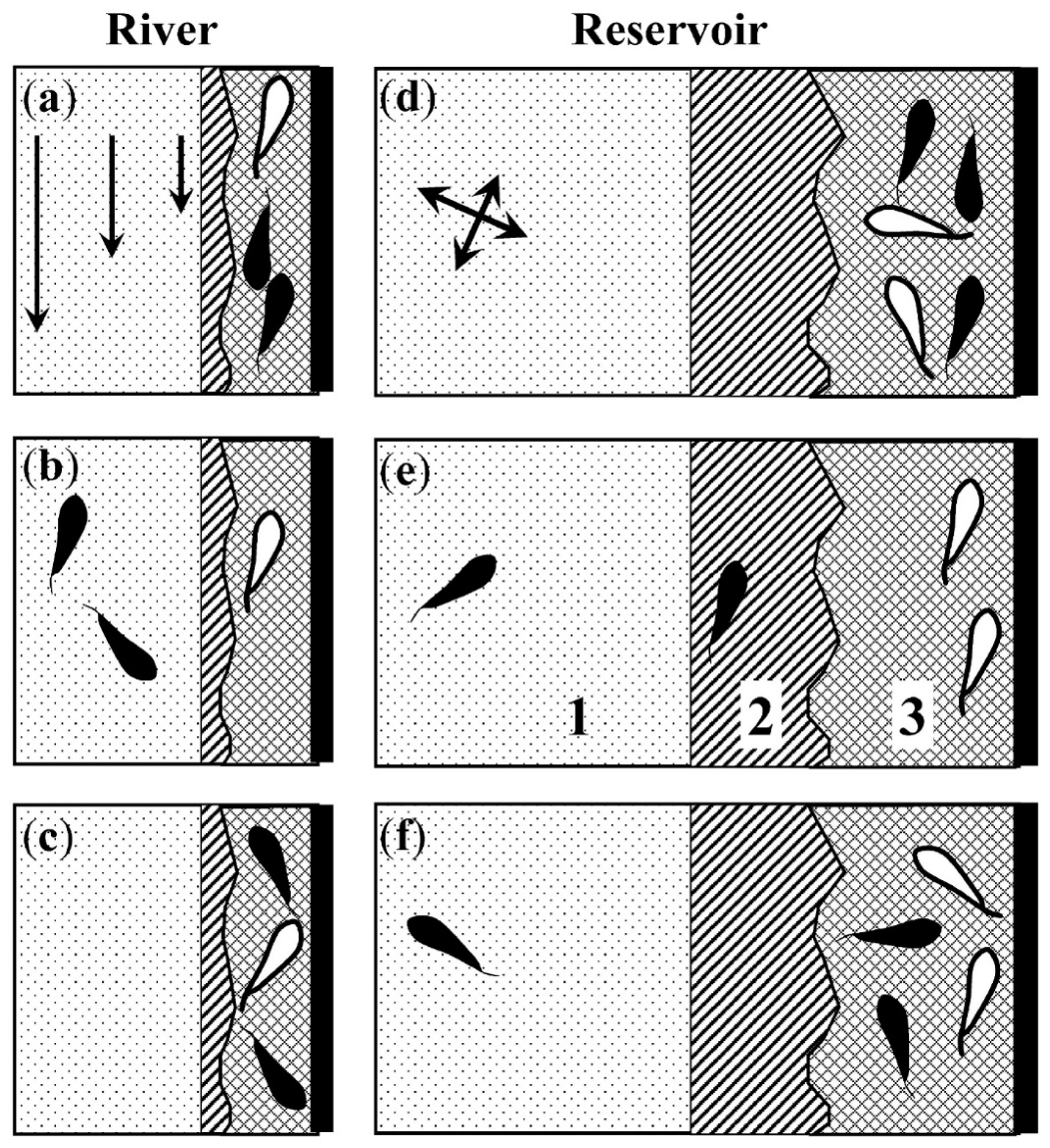
Figure 2.
Mean concentration of young fish (% of max) in migratory habitats: a – main channel of the Upper Volga River, b – open water of the Ivankovo Reservoir (Volga River). Black bars – night, white bars – day time. In the river, differences between day and night concentrations were highly significant; in the reservoir – nonsignificant (from [48] with changes).
Figure 2.
Mean concentration of young fish (% of max) in migratory habitats: a – main channel of the Upper Volga River, b – open water of the Ivankovo Reservoir (Volga River). Black bars – night, white bars – day time. In the river, differences between day and night concentrations were highly significant; in the reservoir – nonsignificant (from [48] with changes).
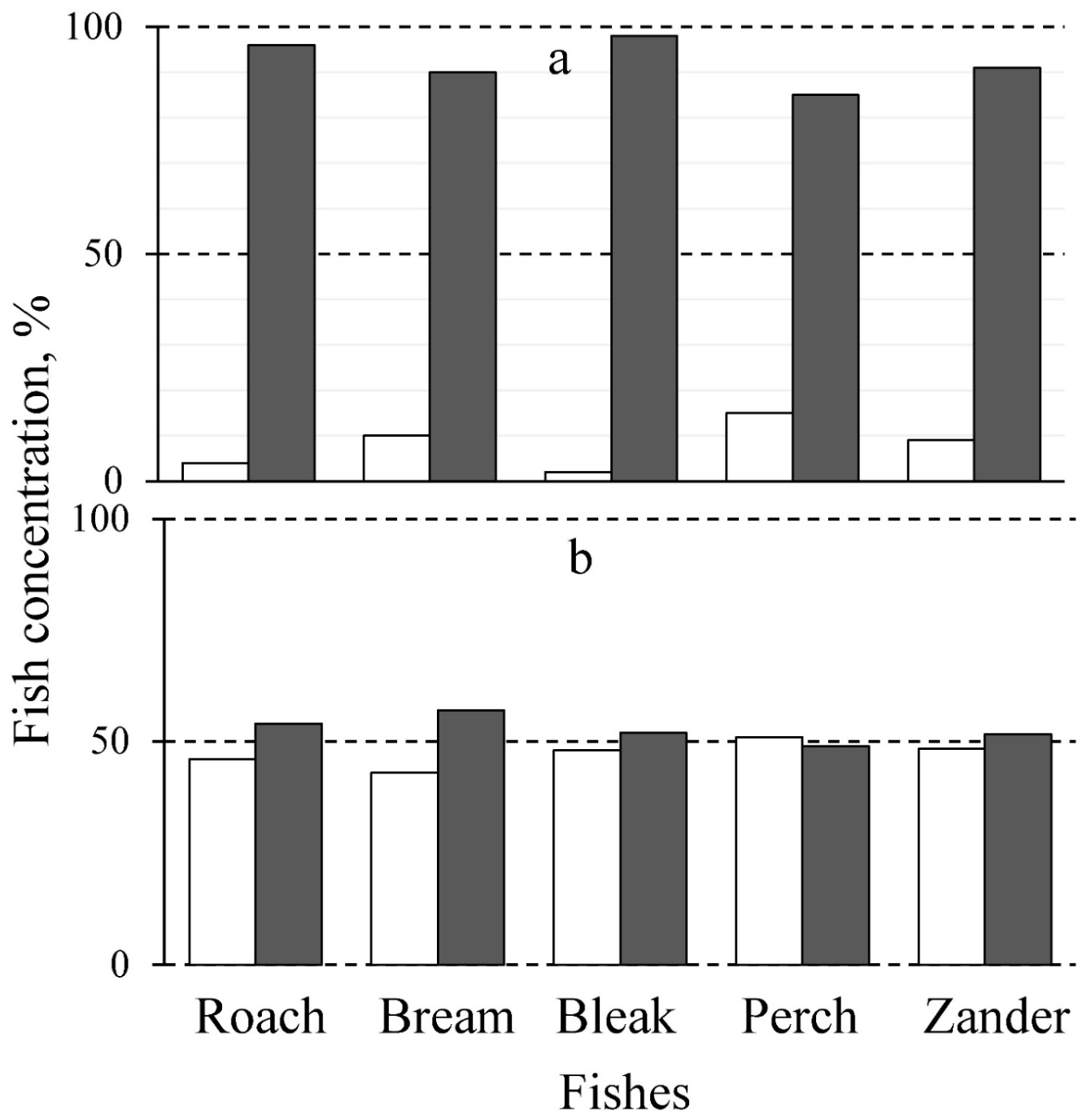
Figure 3.
Seasonal dynamics of the downstream migration of young Perca fluviatilis in the main channel of the Upper Volga (⎯) and through the water intake of the Ivankovo Power Plant (- - -); (Kolmogorov-Smirnov test, р < 0.01); (from [41,48].
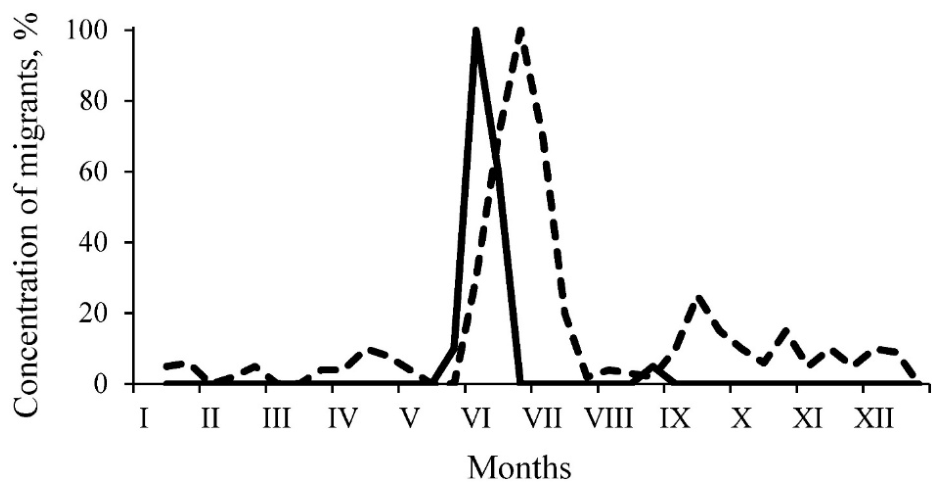
Figure 4.
Seasonal (A) and diel (B) spatiotemporal patterns of 0+ Cyprinidae and Percidae migrants from the natural river (B1) and reservoir of the Volga River (A, B2). A: 1-roach, 2-bream, 3-perch, 4-zander; black bars – specific concentration of fish in the migratory habitat, white bars – habitat of residence. B – diel changes in concentration of migrants: 1 – in the Upper Volga River, 2 – in the Ivankovo Reservoir (Volga River); solid line – Percidae; dashed line – Cyprinidae.
Figure 4.
Seasonal (A) and diel (B) spatiotemporal patterns of 0+ Cyprinidae and Percidae migrants from the natural river (B1) and reservoir of the Volga River (A, B2). A: 1-roach, 2-bream, 3-perch, 4-zander; black bars – specific concentration of fish in the migratory habitat, white bars – habitat of residence. B – diel changes in concentration of migrants: 1 – in the Upper Volga River, 2 – in the Ivankovo Reservoir (Volga River); solid line – Percidae; dashed line – Cyprinidae.
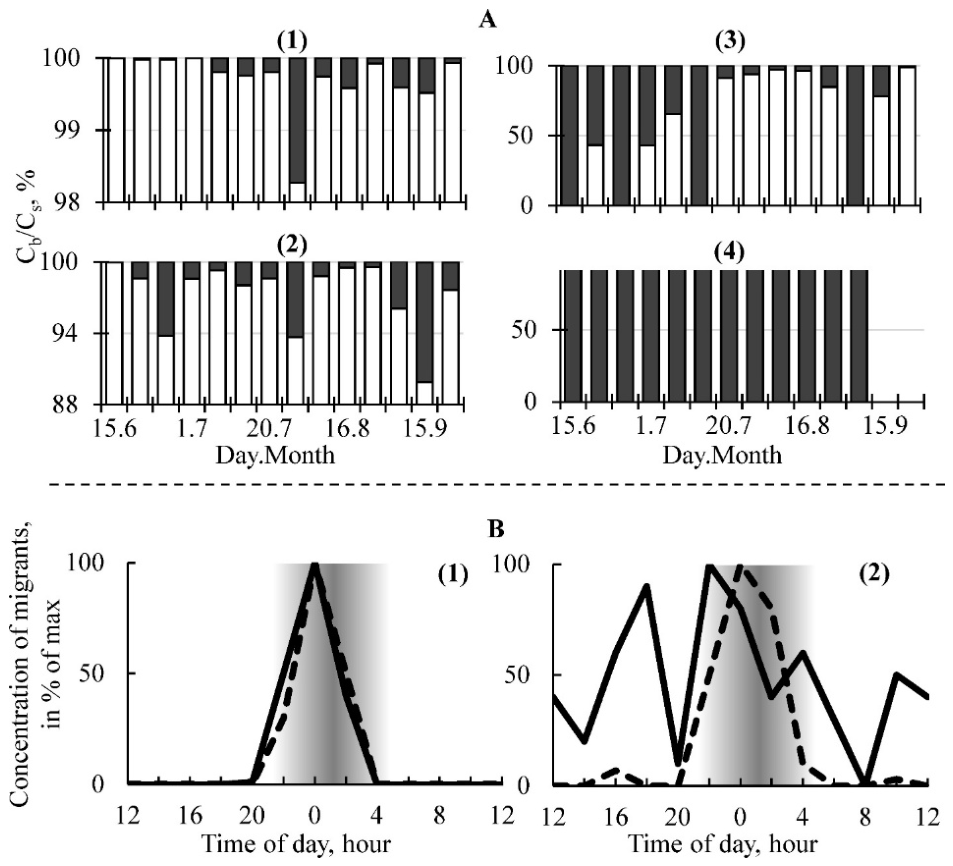
Figure 5.
Zooplankton prey size spectra in the water column (a) and in the 0+ perch, Perca fluviatilis, diet (b, c). Foraging site in the open water area (homogeneous habitat) – (b), and in the area nearby the macrophyte beds (heterogeneous habitat). (From [74].
Figure 5.
Zooplankton prey size spectra in the water column (a) and in the 0+ perch, Perca fluviatilis, diet (b, c). Foraging site in the open water area (homogeneous habitat) – (b), and in the area nearby the macrophyte beds (heterogeneous habitat). (From [74].
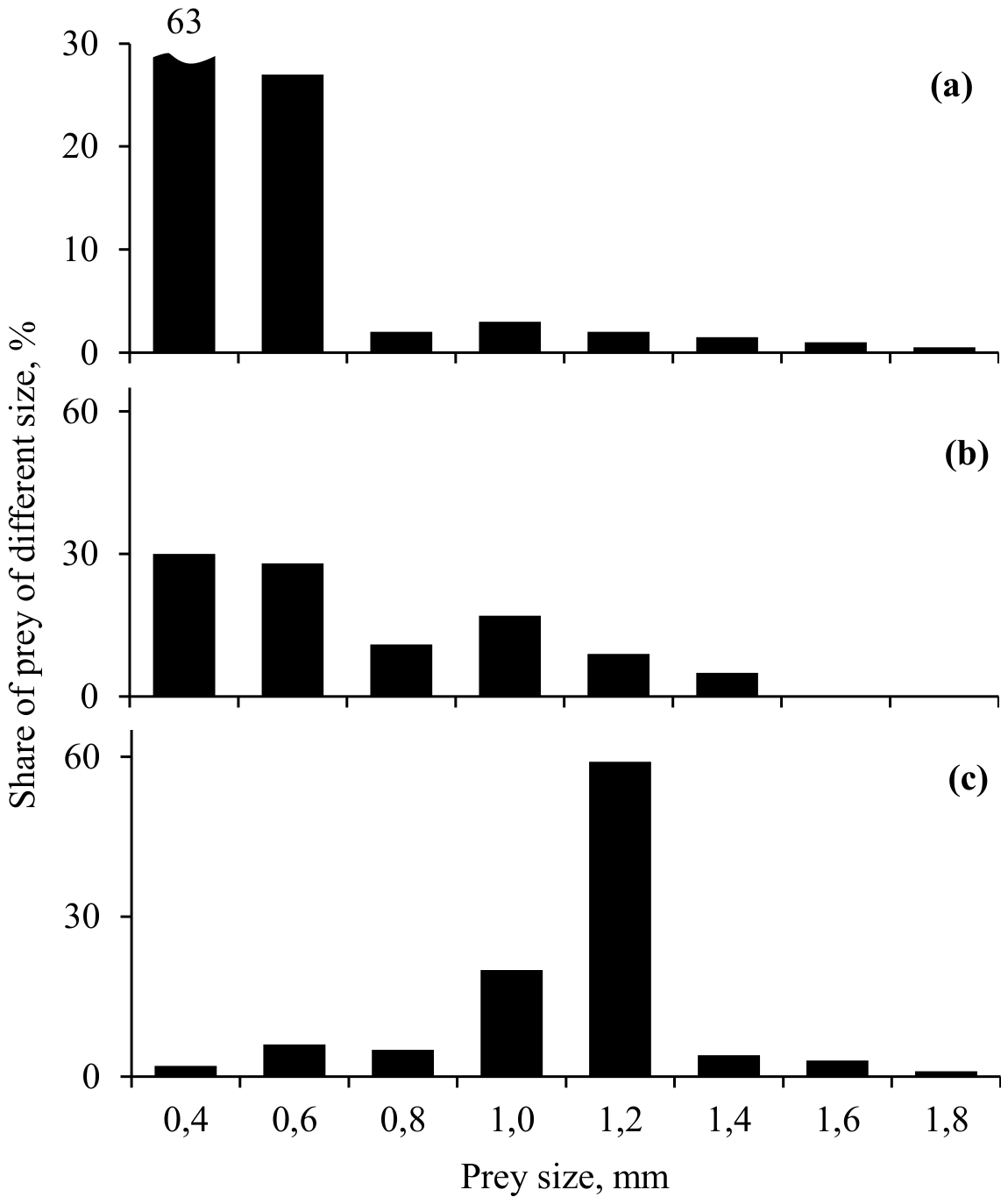
Figure 6.
Emigration of 0+ fish with water abstraction flow through the homogeneous (a) and heterogeneous (b) habitats. (c): 1 - perch Perca fluviatilis, 2 - roach Rutilus rutilus, 3 - bleak Alburnus alburnus, 4 - bream Abramis brama. Cm (ind m-3)/Ci (ind m-3) – ratio of the concentration of emigrants to the concentration of inhabitants of the water intake area. Black bars for emigrants from homogeneous area, white bars – from heterogeneous (from [4] with changes).
Figure 6.
Emigration of 0+ fish with water abstraction flow through the homogeneous (a) and heterogeneous (b) habitats. (c): 1 - perch Perca fluviatilis, 2 - roach Rutilus rutilus, 3 - bleak Alburnus alburnus, 4 - bream Abramis brama. Cm (ind m-3)/Ci (ind m-3) – ratio of the concentration of emigrants to the concentration of inhabitants of the water intake area. Black bars for emigrants from homogeneous area, white bars – from heterogeneous (from [4] with changes).
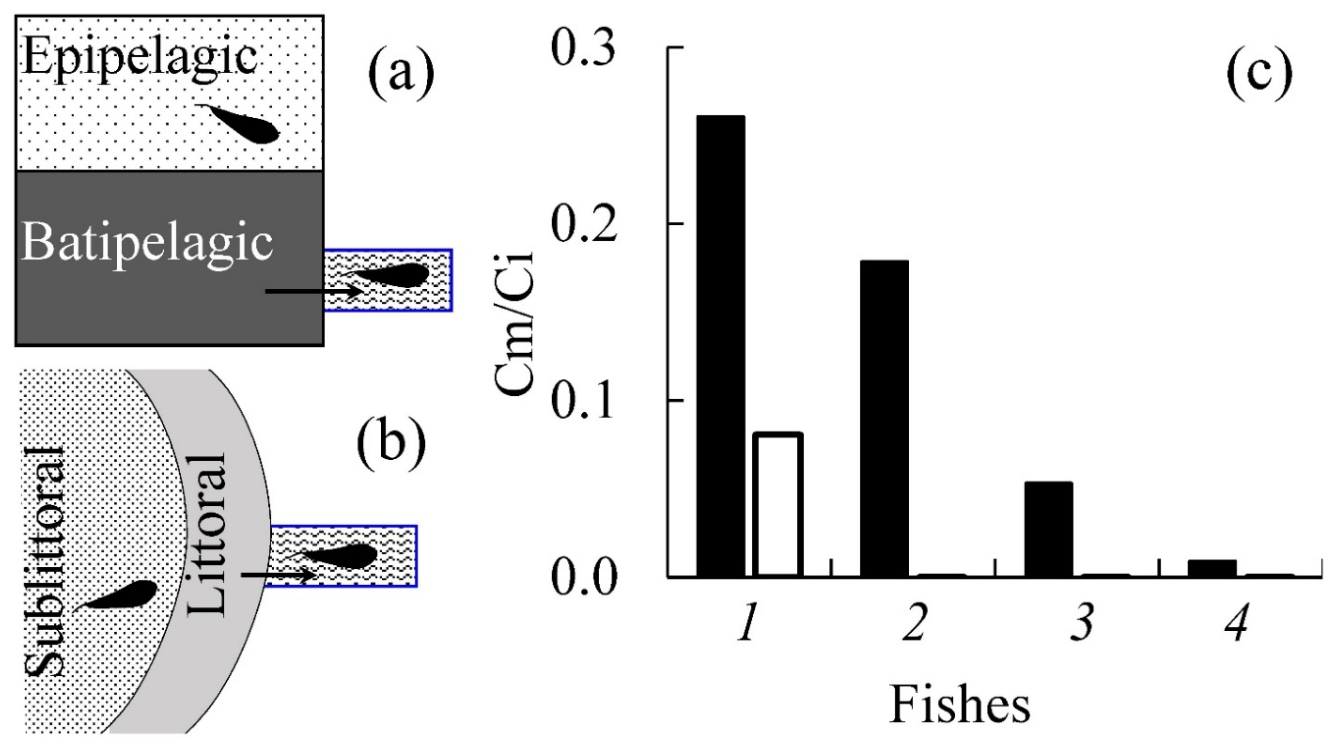

Table 1.
Withdrawal of fish from the three morphologically and hydrologically distinct reservoirs of the Volga (Ivan’kovskoe and Volgogradskoe) and Don (Tsimlyanskoe) rivers (from [48] with changes).
Table 1.
Withdrawal of fish from the three morphologically and hydrologically distinct reservoirs of the Volga (Ivan’kovskoe and Volgogradskoe) and Don (Tsimlyanskoe) rivers (from [48] with changes).
| Characteristics | Reservoir | ||
| Volgogradskoe | Ivan’kovskoe | Tsimlyanskoe | |
| Size of the water surface, km2 Annual fish catch, kg/ha Annual water exchange rate Morphological complexity index of the reservoir Annual number of fish withdrawn, x 106 |
3100 12 8.00 0.03 35137 |
3278 10.5 12.95 1.83 10.39 |
2700 36 0.93 0.68 0.40 |
Table 2.
Structure of the altered habitats of young fish migrating in a regulated river. Ecological and behavioral consequences. (From: [4,13,22,23,24,25,26,27,29,36,41,42,54,59,60,66,68,69,70]).
| Parts of regulated river upstream the dam from upper to lower reaches | Changed physical characteristics | Conditions for DSM | Connectivity between migratory habitat and habitat of residence | Ecological risks for migrants |
| Transient region (backwater) between river and reservoir | Flow velocity dropping; increased sedimentation; elevated temperature | Reduced velocity impairs transport function of the flow | Impaired connectivity due to disturbed flow gradients and increased turbidity. | Increased number of predators, poor conditions for orientation and enhanced sedimentation cause high mortality of early fish stages. |
| Reservoir itself (impounded part of the river) | Lower flow velocity, changeable flow directions, increased lateral dimensions and stretched flow gradients between migratory and residence habitats | Poorly permeable gradient zone between habitats, lowered and changeable flow velocity hamper DSM | Connectivity between migratory and residence habitats worsens due to extended interface with impaired conditions for orientation and locomotion | Fish retained in the migratory habitats during the day are exposed for predators, and forage with low success. They are also not efficient at school formation |
| Water-intake zone at the dam | Locally increased flow velocity and depth; converging flows of migratory and residence habitats | Shortage of landmarks and shelters, high velocity and sharp gradients of the flow in poorly structured surroundings of the water intake site facilitate entrainment and emigration of fish from the reservoir | Converged flows in the water intake zone increases probability of migrating fish to be entrained by the water abstraction current | Fish entrained by abstraction current suffer high mortality and damages. Pelagic inhabitants are especially vulnerable. Littoral habitats provide fish with landmarks and shelters preventing them from entrainment |
Disclaimer/Publisher’s Note: The statements, opinions and data contained in all publications are solely those of the individual author(s) and contributor(s) and not of MDPI and/or the editor(s). MDPI and/or the editor(s) disclaim responsibility for any injury to people or property resulting from any ideas, methods, instructions or products referred to in the content. |
© 2026 by the authors. Licensee MDPI, Basel, Switzerland. This article is an open access article distributed under the terms and conditions of the Creative Commons Attribution (CC BY) license (http://creativecommons.org/licenses/by/4.0/).
Copyright: This open access article is published under a Creative Commons CC BY 4.0 license, which permit the free download, distribution, and reuse, provided that the author and preprint are cited in any reuse.


