

Submitted:
18 June 2026
Posted:
22 June 2026
You are already at the latest version
Abstract
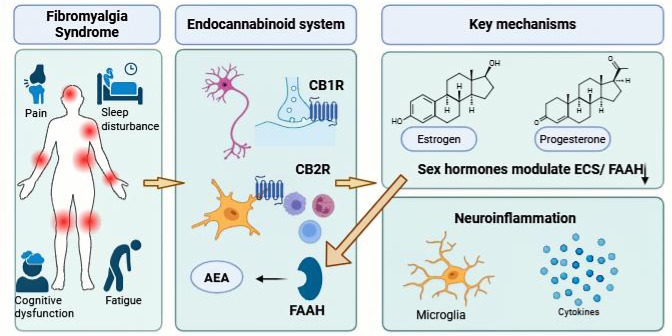
Fibromyalgia (FMS) is a chronic widespread pain syndrome characterized by hyperalgesia, sleep disturbances, fatigue and cognitive dysfunction. Its complex etiology may involve endocannabinoid system (ECS) dysfunction, modulating nociception, inflammation, and sleep. This review examines key ECS components, including CB1 and CB2 receptors, endocannabinoids such as anandamide and 2-AG, and degradative enzymes FAAH and MAGL, focusing on their roles in chronic pain and inflammation.This review explores sex differences in ECS components, including CB1 and CB2 receptors, endocannabinoids, and degradative enzymes such as FAAH. Evidence from human studies and animal models indicates sex-specific variations in receptor expression and responses to cannabinoids, influenced by sex hormones and epigenetic regulators such as the long non-coding RNA FAAH-OUT. CB1 receptors mediate antinociceptive effects through central pain pathways, whereas CB2 receptors modulate immune and inflammatory responses, which may contribute to the higher prevalence and symptom severity of FMS in women. Overall, the ECS represents a promising therapeutic target for FMS. However, no animal model fully replicates the clinical complexity of the syndrome, and human studies are limited. Further research is needed to elucidate sex-specific mechanisms, validate treatment strategies, and develop more personalized approaches to FMS management.
Keywords:
fibromyalgia (FMS)
; chronic pain
; endocannabinoid system (ECS)
; sexual dimorphism
; neuroinflammation
; FAAH enzyme
Copyright: This open access article is published under a Creative Commons CC BY 4.0 license, which permit the free download, distribution, and reuse, provided that the author and preprint are cited in any reuse.


