

Submitted:
18 June 2026
Posted:
19 June 2026
You are already at the latest version
Abstract
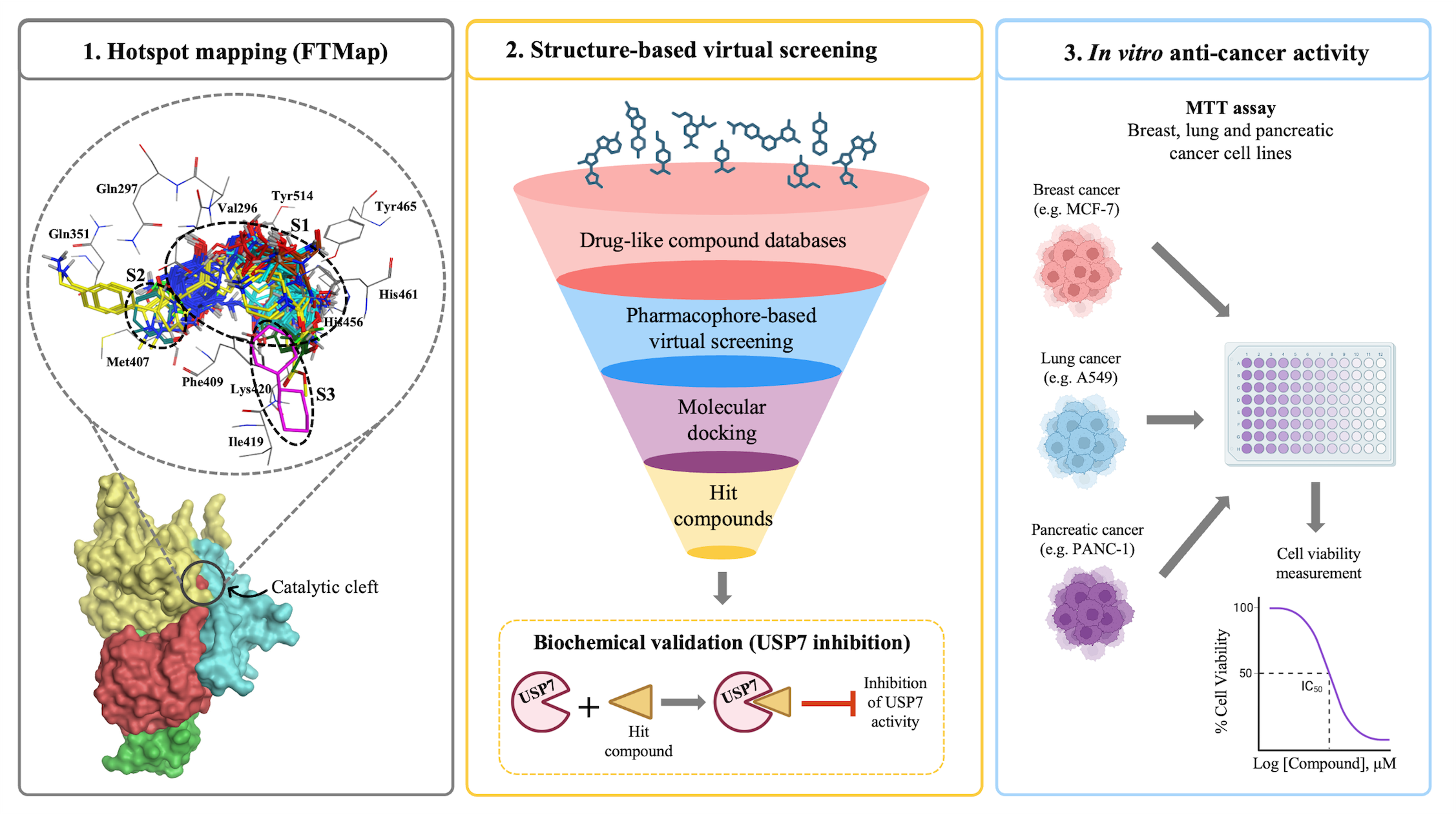
Background/Objectives: Ubiquitin-specific protease 7 (USP7) is a deubiquitinating enzyme that regulates multiple oncogenic and tumor-suppressive pathways and has emerged as a promising target for anticancer drug discovery. However, most reported USP7 inhibitors belong to a limited number of structural classes, and no USP7-targeted therapy has yet reached clinical application. This study aimed to identify structurally diverse USP7 inhibitors with anticancer potential using an integrated computational and experimental screening strategy. Methods: A drug discovery workflow combining pharmacophore modelling, structure-based virtual screening, molecular docking, and in silico pharmacokinetic assessment was employed to identify candidate USP7 inhibitors. Selected compounds were evaluated for inhibition of recombinant USP7 and for antiproliferative activity in a panel of human cancer cell lines. Molecular docking analyses were performed to investigate predicted binding modes. Results: The screening campaign identified 32 hit compounds with in vitro inhibitory activity against recombinant USP7, including structurally distinct approved drugs and compounds from an in-house chemical library. Four selected hits exhibited antiproliferative activity across cancer cell lines with different molecular backgrounds. Docking studies predicted binding within a pharmacologically relevant region of the USP7 catalytic cleft and revealed interactions with key residues involved in ligand recognition. Among the compounds evaluated in cells, rafoxanide demonstrated the most favorable combination of predicted USP7 engagement and antiproliferative activity. Conclusions: This integrated virtual screening and experimental validation approach enabled the identification of structurally diverse USP7 inhibitors with antiproliferative activity. The identified hits include approved drugs with previously unrecognized USP7 inhibitory activity, as well as underexplored scaffolds that expand the chemical space of USP7-targeting molecules. This provides a foundation for the future optimization and development of USP7 targeted anticancer agents.
Keywords:
virtual screening
; pharmacophore modelling
; molecular docking
; drug discovery
; USP7 inhibitors
; antitumor
Copyright: This open access article is published under a Creative Commons CC BY 4.0 license, which permit the free download, distribution, and reuse, provided that the author and preprint are cited in any reuse.


