
Submitted:
18 June 2026
Posted:
19 June 2026
You are already at the latest version
Abstract
This paper proposes that the charged-lepton mass hierarchy may originate from a dimensionless structural invariant of a neutral-parent carrier-defect architecture, prior to its effective Higgs–Yukawa read-out. The guiding principle is that indistinguishable admissible internal sectors carry equal primitive weight before physical carrier read-out. Applied to the charged-lepton root variables (me,mμ,mτ), this principle gives the Koide relation as an equal-power condition between a democratic parent component and a branch-splitting component. The Koide cone is therefore interpreted as a root-space representation of a discrete sector-power balance, not as a fundamental continuous mass geometry. The main quantitative result is an endpoint expansion for the small electron–muon mass ratio. In the proposed architecture, the electron is interpreted as a charged endpoint leakage of the lepton-facing branch, measured against the first exposed positive-closure environment. This leads to the charged endpoint towermemμch=132(4!−1)1+∑k=5∞∏n=5k2/n3(n!−1).
Keywords:
charged-lepton hierarchy
; Koide relation
; lepton mass ratios
; discrete symmetry
; equalweight counting
; neutral-parent structure
; endpoint expansion
; PMNS mixing
1. Introduction
This paper is based on the idea that matter particles may be different carrier read-outs of a common charge-neutral parent structure, rather than independent primitive entities. Within this view, the charged-lepton hierarchy is not an arbitrary list of three unrelated masses, but a dimensionless invariant selected by an underlying carrier-defect architecture.
The charged-lepton hierarchy is one of the most striking unexplained patterns in particle physics:
In the Standard Model, these masses arise from Yukawa couplings and are not derived from a deeper structural principle. Yet the charged-lepton spectrum exhibits the remarkable Koide relation [1,2,3],
Because this relation is naturally expressed in square-root mass variables, it is often represented geometrically as an angle condition in a three-dimensional root-amplitude space. The present paper argues that this geometric form should not be taken as fundamental. It is a useful continuous representation of a more primitive counting-native invariant: an equal-power relation between the democratic parent sector and the branch-splitting sector of an internal defect space.
The motivation for a charge-neutral parent is that observed particles do not behave as isolated structural islands. Physical processes are organized by charge closure, conservation laws, weak transitions, spinorial read-out, neutral compensation, and confined positive-side closure. For example, neutron beta decay,
does not display an isolated electron, proton, or neutrino as an independent primitive output. It displays a correlated positive, negative, and neutral closure pattern. This observation does not prove the neutral-parent interpretation, but it motivates a theory in which charged and neutral particle channels arise as different read-outs of a common charge-neutral organization. In the present paper this unresolved source is denoted .
The first resolved architecture used here is asymmetric:
The side is the lepton-facing branch. It supports a charged transverse read-out and a neutral continuation read-out,
The side is the positive closure branch. After carrier read-out, this side is compatible with hadron-facing threefold closure. The asymmetry is essential: if the two polarized sides were simple mirror copies, they would tend to recombine or annihilate at the unresolved level rather than produce stable distinguishable matter read-outs.
This whole-architecture viewpoint is central to the charged-lepton hierarchy. The electron endpoint is a charged leakage of the lepton-facing branch, but the count that selects it is not purely lepton-side. It is measured against the full neutral-parent resolution and begins with the first exposure environment of the positive-side closure,
The higher structures are nested embedding environments,
not additional particle generations, new colors, or new gauge sectors. Thus the charged-lepton mass ratios are controlled not by the charged leptons alone, but by how the lepton-facing branch, positive closure branch, and neutral compensational branch fit together inside a common neutral-parent carrier-defect structure.
Throughout the paper, denote the physical charged-lepton rest masses [4,5,6]. The internal counting argument does not treat these quantities as abstract mass-like labels. Rather, it fixes the relative root amplitudes of localized charged-lepton defects whose squared amplitudes are read out as carrier-localized rest-energy coefficients. The common charged-lepton scale is not derived here and cancels from all ratios. Appendix A states the minimal read-out assumptions under which the internal root-amplitude ratios become ratios of physical inertial masses and, in the long-field limit, gravitational stress-energy source coefficients.
The distinction between counting structure and geometric representation is essential. The internal space used in the paper is not ordinary spacetime. It is a premetric defect-internal space whose primitive data are branches, sectors, exclusions, identifications, monodromy, and closure relations. Such structures may be represented by vectors, projections, and angles for calculation, just as graphs may be represented by matrices, simplicial complexes by geometric realizations, and finite groups by linear representations. The representation is continuous, but the invariant being represented is discrete and structural. The Koide “angle” is therefore not introduced as a continuous physical parameter; it is the Euclidean representation of a sector-power equality.
The guiding picture is
The carrier supplies the physical read-out environment and common scale, while the internal counting structure supplies dimensionless ratios. The present paper addresses the charged-lepton hierarchy and argues that it may be a carrier-readable invariant of the neutral-parent architecture.
The paper uses a single structural principle: level-wise equal-weight counting in premetric defect-internal spaces. Indistinguishable admissible sectors are assigned equal primitive weight at the level at which they first become exposed; protected or identified sectors are removed or quotiented before the count is performed; later substructure is counted conditionally inside an already exposed sector and does not retroactively alter the earlier parent-level weights. This rule is introduced explicitly below before any application is made.
The first consequence is the Koide relation itself. In counting-native form, Koide states that the normalized charged-lepton root power is equally divided between the democratic parent sector and the branch-splitting sector,
The familiar Koide cone is only the continuous root-amplitude representation of this two-sector equality.
The main new quantitative result is a candidate counting derivation of the electron endpoint displacement. The small electron mass is not treated as an arbitrary perturbation. It is interpreted as a one-unit endpoint leakage through the first exposed non-protected chamber of the positive-side nested embedding,
with higher corrections supplied by nested conditional embedding refinements. This gives a rapidly convergent charged-sector expansion for .
A second result emerges after the charged endpoint tower is evaluated. The tower stabilizes by the embedding level: deeper and charged-tower terms are far too small to remove the remaining central discrepancy with the measured ratio. The charged tower is already highly accurate, within about in the inverse ratio, but its residual is stable under further charged refinements. This residual is therefore interpreted not as another ordinary charged endpoint term, but as a neutral-parent closure obstruction. Neutral-parent closure then requires a separate continuation-dual compensational read-out, identified with the neutrino sector.
The crucial point is that the compensational overlap is not inserted from the observed PMNS matrix. The first neutral overlap count begins from a democratic three-direction compensational exposure and removes one protected closure chamber from the two-slot interface. This gives
Thus the neutral correction entering the endpoint residual is , rather than a correction fitted from solar-neutrino data. The same counting rule gives the leading solar-angle target
which lies close to the empirical solar mixing region described by the PMNS framework [4,7,8,9]. In this paper the solar angle is therefore not used as an input to the mass hierarchy; instead, the solar-sector overlap appears as an independent structural byproduct of the neutral-closure calculation and as a future test target.
The resulting prediction is a two-step hierarchy. First, endpoint counting plus neutral compensation predicts
which differs from the observed central value by only , about relative to the present experimental uncertainty. Second, the Koide sector-power relation fixes the large- branch and gives
Using the present tau-mass uncertainty, these tau-sector predictions are compatible with observation at the current precision scale. Since the tau mass is measured much less precisely than the electron–muon mass ratio, improved tau-mass measurements provide a direct future test: if the proposed structure is correct, is not an independent free parameter once is fixed [4,10].
The paper is organized as follows. Section 2 introduces the carrier-defect architecture and the basic terminology, including carrier, neutral parent, internal defect space, read-out, root amplitude, positive-side closure, and neutral compensation. Section 3 introduces the equal-weight counting principle and explains why a continuous root-vector representation may be used for a discrete counting invariant. Section 4 derives the Koide relation as the first equal-sector-power theorem. Section 5 develops the endpoint expansion, beginning from the electron-zero boundary and continuing through the exact Koide displacement, the leading endpoint leakage count, and the nested higher-interface corrections. Section 6 evaluates the endpoint prediction numerically. Section 7 interprets the remaining charged-sector residual as a neutral compensation effect, derives the solar compensational overlap , and presents the complete two-step charged-lepton hierarchy prediction. Section 8 discusses the whole-particle-architecture viewpoint, the implication for PMNS mixing, and the relation to previous approaches to the charged-lepton hierarchy. The following section states the scope and limitations of the proposal, and the final section concludes.
Appendix A explains why the internal root-amplitude ratios may be compared with physical rest-mass ratios. Appendix B gives the structural justification for the free-fermion branch, the positive embedded closure branch, and the higher
embedding hierarchy used in the endpoint calculation. Appendix C presents a minimal toy Lorentz-read-out model showing how the lepton-facing branch can manifest as a spinorial free-fermion read-out, while the embedded positive branch can manifest as a closed hadron-facing read-out. Appendix D then explains the neutral-overlap closure mechanism used in Section 7, including the three compensational directions, the solar-sector overlap, the two-slot overlap count, and the origin of the compensational factor .
2. Carrier-Defect Architecture and Basic Terminology
This section defines the structural language used in the paper. The goal is not to replace the Standard Model as an effective field theory. The Standard Model successfully describes already read-out particles, fields, charges, and interactions, but it does not explain why the charged-lepton mass ratios take their observed values. The present paper asks whether those ratios may reflect a pre-read-out internal structure whose effects become physical only after carrier embedding.
This distinction is motivated by standard physics itself. In quantum field theory the vacuum is not an empty mathematical background; it carries field structure, fluctuations, phases, symmetry breaking, and renormalized parameters [11,12,13]. The physical masses and couplings measured in experiment are not bare labels. They are read-out quantities after embedding into the vacuum structure of the theory. The present framework asks whether the embedding of particle-like defects into this carrier can leave calculable traces in dimensionless mass ratios.
2.1. Carrier
The term carrier denotes the physically effective vacuum structure through which a localized internal configuration becomes a particle-like read-out. It should not be understood as an ordinary material ether, nor as a substance placed inside spacetime. In the present usage, the carrier is the spacetime vacuum viewed in its active physical role: the support of local fields, phases, defects, renormalized parameters, and observable particle manifestations.
The logical order is
The internal configuration supplies structural data such as branches, sectors, exclusions, identifications, monodromy, and closure relations. The carrier supplies the physical read-out environment: Lorentz-readable propagation, effective field representation, localization, rest-energy scale, and long-field stress-energy behavior.
This terminology is useful because the way a particle-like object is embedded into the vacuum carrier is an under-explored structural question. The Standard Model describes the resulting carrier-facing fields and interactions, but it does not by itself determine whether different particles may originate as different read-outs of a common pre-read-out structure.
2.2. Defect, Read-Out, and Pregeometric Internal Space
A defect is a localized stable carrier manifestation of a nontrivial internal structure. A particle is therefore not treated here as a structureless point inserted by hand, but as the carrier-facing read-out of a localized defect whose internal identity can be continued, closed, and recognized across admissible stages.
A read-out is the process by which an admissible internal configuration becomes a physical manifestation describable by the usual effective language of particle physics: fields, masses, charges, spinorial behavior, mixing matrices, and stress-energy. The present paper does not claim that charged-lepton masses exist as ordinary physical masses before carrier embedding. Instead, the internal counting structure fixes relative root amplitudes. After read-out, the squared amplitudes become relative rest-energy coefficients.
The associated internal defect space is called pregeometric or premetric in a limited sense. Before carrier embedding, the defect-internal structure has not yet been incorporated into the spacetime-vacuum read-out that gives ordinary metric, energetic, and field-theoretic descriptions. It should therefore not be assumed to carry an intrinsic distance, volume, angle, or physical energy scale. Its primitive information is combinatorial and topological: branch labels, sector relations, protected channels, excluded channels, identifications, monodromy, and closure constraints.
This is why the notation used below should not be read as a replacement for Standard Model gauge groups at the observable level. Before Lorentz-covariant read-out, the defect pocket is not yet a differentiable internal manifold carrying the Standard Model groups as its primary description. The finite structures describe pregeometric internal continuation and closure. Continuous gauge and spinorial descriptions become physically appropriate only after carrier read-out [14,15,16,17]. Appendix B gives the structural argument for why the primitive branch opposition is read out as spinorial behavior for free fermions, while the positive closure and its higher embeddings belong to the positive/hadron-facing side. Appendix C gives a minimal toy Lorentz-read-out model illustrating this distinction.
2.3. Neutral Parent and Asymmetric Branch Architecture
The central structural object is the charge-neutral parent, denoted . It is not introduced as a new observed particle, nor as a literal object that simultaneously decays into all possible channels. It is an unresolved admissibility structure whose different carrier read-outs may appear as distinct matter-particle channels.
The motivation for introducing such a neutral parent is severalfold. First, observed particle processes do not treat charge as an isolated label; charge appears in closed combinations. Standard Model interactions preserve total electric charge, and physical reaction channels are organized so that charge, spin, lepton-family labels, baryon number, and other conserved or approximately conserved quantum numbers are consistently balanced [4,11,13]. This suggests that particle identities are not arbitrary independent labels, but mutually constrained read-outs of a larger closure structure.
Second, it would be structurally unnatural to assume that all matter particles exist as unrelated primitive species while the total charge content of allowed physical processes nevertheless closes exactly to neutral combinations. The empirical success of charge conservation and the repeated appearance of compensating particle channels suggest a more economical possibility: charged and neutral particles may be different resolved aspects of an underlying charge-neutral organization.
Third, familiar weak processes already point in this direction. Neutron beta decay,
does not produce an isolated charged particle. It produces a correlated charged-positive, charged-negative, and neutral compensating structure. This does not prove the existence of a neutral parent in the present sense, but it motivates using a charge-neutral parent as a theory of origin: a structural source from which positive, negative, and neutral read-outs emerge together under conservation and closure constraints.
The first resolved architecture of the neutral parent is therefore written schematically as
This resolution is intentionally asymmetric. If the two polarized sides were simple mirror copies, they would tend to recombine or annihilate at the unresolved level and would not generate stable distinguishable matter read-outs. A persistent matter architecture therefore requires complementary but non-identical branches: a lepton-facing branch and a positive closure branch .
The side is the lepton-facing branch-resolution side. It supports a charged transverse read-out and a neutral continuation read-out,
Here denotes the charged-lepton read-out direction, while denotes the neutral compensating continuation direction. These symbols are structural labels, not claims that the electron, muon, tau, and neutrinos are already present as independent particles before read-out.
The side is the positive closure branch. It is the counterpart of the charged lepton-facing branch and supplies the first completed positive-side closure. In later carrier-facing language this side is compatible with hadron-facing threefold closure, but it should not be identified with the full color gauge group at the pregeometric level. It records a threefold closure condition inside the defect architecture. Appendix B explains why this positive closure begins with , whereas the free lepton-facing branch remains -primitive before spinorial carrier read-out.
Thus the charged-lepton hierarchy is not treated as a property of the negative branch in isolation. It is a projection of the full neutral-parent resolution
This point is essential for the endpoint calculation: the charged endpoint is a leakage of the lepton-facing branch, but the count that selects it is controlled by the full neutral-parent closure architecture.
2.4. Positive-Side Nested Embedding Hierarchy
Once the positive-side closure
is completed, it is exposed through nested carrier-readability environments,
These higher structures are not additional particle generations, not new colors, and not new independent gauge sectors. They are nested embedding environments of the already completed positive-side closure.
This distinction explains why the first endpoint leakage count begins with
The level separates complementary read-out directions of the neutral parent, but it is not yet a completed positive closure. The first completed positive-side support is the embedded closure. The first non-protected exposure chamber therefore appears only when this completed positive closure is embedded into a environment. The detailed motivation for this assignment is given in Appendix B.
In the charged-lepton calculation, the electron endpoint is not a purely leptonic count. It is a negative-side boundary leakage measured against the full neutral-parent closure architecture. The leading factor arises from the first exposed ordered chamber space after the protected closure channel has been removed. The later , , and deeper embeddings refine the already selected endpoint conditionally rather than opening independent new endpoints. This is why the charged endpoint expansion has a nested product structure rather than a sum of unrelated corrections.
2.5. Root Amplitude and Physical Mass Read-Out
The charged-lepton hierarchy is represented using the root vector
In the present interpretation, the square-root variables are internal root amplitudes. Their squared carrier read-out gives physical mass weights:
where is a common charged-lepton carrier scale. Since this scale cancels in ratios, the paper focuses on dimensionless quantities such as and .
This representation is not chosen merely for convenience. The Koide relation is naturally expressed in square-root mass variables, suggesting that the relevant invariant is not a direct linear mass sum, but a sector-power relation among root amplitudes [1,2,3]. The detailed physical-mass interpretation is given in Appendix A.
2.6. Neutral Compensation
A neutral compensational read-out is a neutral continuation channel required to complete the closure of a charged or asymmetric branch resolution. In the charged-lepton setting, this role is associated with the neutrino sector.
This concept is introduced because the charged endpoint expansion nearly, but not completely, closes the observed electron–muon ratio. The remaining discrepancy is too large to be supplied by deeper charged-layer terms, yet it has the correct size to be interpreted as a neutral compensation effect. Thus the neutrino sector is not treated as an unrelated addition to the charged-lepton hierarchy. It appears as the neutral continuation channel needed when the charged endpoint structure does not close by itself.
The present paper does not claim to derive the full PMNS matrix. It does, however, derive the particular solar-sector compensational overlap needed to close the charged endpoint residual. The observed solar mixing angle is therefore used only as an external consistency comparison, not as an input to the charged-lepton hierarchy [4,7,8,9]. Appendix B explains why this neutral continuation is naturally paired with the charged lepton-facing branch rather than with the positive -closure side.
2.7. Scope of the Terminology
The terminology introduced here is intended to organize the structural calculation, not to replace the Standard Model as an effective field theory. The Standard Model remains the successful description of carrier-facing particle fields and interactions. The present proposal addresses a different question: whether the dimensionless charged-lepton mass hierarchy can be understood as a structural invariant of a deeper neutral-parent carrier-defect architecture.
The quantitative claims of the paper concern mass ratios and dimensionless invariants. They do not constitute a complete microscopic derivation of all particle dynamics, the absolute mass scale, or the full neutrino mixing structure. The architecture needed for the calculations that follow is
together with the charged and neutral read-out split
With this architecture in place, and with the detailed structural justification deferred to Appendix B and Appendix C, the endpoint expansion derived below is not an isolated numerical rule. It is the charged-lepton projection of the same neutral-parent closure structure.
Before deriving the endpoint expansion, it is useful to summarize the asymmetric neutral-parent architecture that controls the charged, positive-closure, and neutral-compensational read-outs; this structure is shown schematically in Figure 1.
3. Equal-Weight Counting in Premetric Defect-Internal Spaces
The present paper uses one structural principle: equal primitive weight among indistinguishable admissible sectors at the level where they first become exposed. The principle is not specific to leptons. It applies to any premetric internal state space associated with a carrier-readable defect. Its role is to specify how primitive weights are assigned before metric, dynamical, energetic, or carrier-facing distinctions have appeared.
The internal spaces considered here are pregeometric in a limited but important sense. They are not ordinary spacetime regions equipped with distances, angles, volumes, or metric weights. Before carrier-facing read-out, the available data are combinatorial and topological: admissible branches, identified sectors, protected channels, excluded identity elements, connections, monodromy, and closure relations. In such a setting, there is no intrinsic reason to regard one admissible sector as larger, closer, stronger, or more important than another unless some additional structure distinguishes it.
This is the same kind of distinction that appears throughout topology. Metric size, material composition, and geometric embedding are not the primary data; connectivity, holes, boundaries, deformation class, and obstruction structure are. A premetric defect-internal space is used in the same spirit: it distinguishes admissible sectors only by the branching, identification, and closure data available before metric read-out [18,19,20,21,22].
This motivates the following rule.
Equal-weight defect-internal counting principle. In a premetric internal defect space, admissible sectors that are indistinguishable by the available branch, connection, monodromy, and closure data are assigned equal primitive weight at the level at which they first become exposed. Protected, excluded, or identified sectors are removed or quotiented before the count is performed. If later substructure appears inside an already exposed sector, it is counted conditionally within that sector and does not retroactively change the primitive weight assigned at the earlier level.
The level-wise qualification is essential. A defect-internal structure is not treated as a completed tree of final outcomes given all at once. It is exposed in stages. At a given stage, only the currently exposed admissible sectors exist as distinguishable alternatives. Later subbranches are refinements inside already formed sectors; they do not retroactively change the primitive weights assigned at the earlier level.
Formally, if X indistinguishable sectors are exposed at a level, each receives primitive weight
If sector i later exposes admissible subsectors, those subsectors are counted conditionally:
Thus the number of later subsectors does not alter the earlier weight . The later refinement is conditional on the prior formation of sector i.
This staged rule is analogous to familiar constructions in conditional probability, filtrations, branching processes, cell complexes, and simplicial refinements. In conditional probability one writes
rather than assigning the parent event a weight proportional to the number of later refinements it may contain. Likewise, in a filtration or cellular construction, coarse structure is fixed before finer structure is attached. The later refinement does not rewrite the primitive count at the earlier level.
The principle is deliberately conservative. It does not claim that all physical states have equal probability after metric read-out. It applies only at the premetric internal counting stage, before the carrier supplies scales, stiffnesses, propagation dynamics, effective couplings, and field-theoretic response. Once those structures are present, unequal physical responses may arise. But before they are present, assigning unequal primitive weights to sectors that are identical by the available internal data would introduce an arbitrary bias.
A continuous representation may be used without changing the primitive status of the invariant. This is standard in mathematics. A graph is discrete, but it may be represented by an adjacency matrix, a Laplacian, a spectrum, or an embedding. A simplicial complex is combinatorial, but it may be drawn geometrically. A finite group is algebraic, but it may be studied through linear representations. In each case, continuous or linear language is a representation of a more primitive structural object, not a replacement for it.
The same convention is used here. Root-amplitude vectors and geometric language provide efficient representations of normalized sector counts. They do not make spacetime geometry fundamental at the premetric stage. The counting-native statement is primary; the continuous representation is used only when it faithfully encodes the same invariant. In this sense, the geometric language used below is a calculational and visualization tool, while the underlying principle remains level-wise equal-weight counting in defect-internal space.
4. Koide Relation as an Equal-Weight Theorem
We first apply the equal-weight defect-internal counting principle to the charged-lepton root sector. The neutral parent is not assumed to contain an already actual Koide mass geometry. Before carrier read-out, it contains admissible internal potentialities, not three physical charged-lepton masses. The Koide relation is therefore not postulated as a pre-existing geometric mass pattern. It is interpreted as the carrier-facing read-out of an equal sector-power count in an unresolved internal root space [1,2,3].
Define the charged-lepton root vector
and its total root power
Here denote the physical charged-lepton rest masses. The square-root variables are interpreted as internal root amplitudes whose squared carrier read-out gives localized rest-energy weights:
with a common charged-lepton carrier scale . This common scale cancels from all mass ratios. The stress-energy interpretation of this read-out is discussed in Appendix A.
The vector belongs to an internal root-amplitude representation of the charged-lepton read-out sector. Its components label charged-lepton branch amplitudes, not directions in ordinary spacetime. The democratic component is the equal-weight unresolved parent direction. In root-vector representation it is
Its sector power is
The branch-splitting sector is the complementary non-democratic sector, with power
Before carrier-facing actualization, the democratic and branch-splitting sectors are complementary potential sectors of the same normalized internal root state. Neither sector has yet acquired an independent physical scale, metric weight, or dynamical preference. Therefore, by the equal-weight principle, the two unresolved sectors carry equal primitive root power:
This is the counting-native form of the Koide relation. The familiar representation is only the Euclidean visualization of this sector-power equality after the discrete counting invariant has been represented in root-vector coordinates.
Theorem 1
(Koide relation from equal sector-power counting). If the normalized charged-lepton root state is selected by equal primitive internal weight between the democratic parent sector and the branch-splitting sector,
then the charged-lepton masses satisfy
Proof.
Since
the equal-sector condition gives
Substituting the expressions above,
Rearranging yields
□
The same theorem explains why the Koide relation can be written as a geometric cone without making ordinary spacetime geometry fundamental. Introduce the normalized root vector
and the democratic unit direction
Then
The equality is therefore equivalent to
Thus the Koide cone is not an independent postulate. It is a faithful continuous representation of the discrete two-sector equality
The axes of this representation label admissible internal branch components, not directions in already-given physical space.
It is important not to reverse the logic. The parent is not assumed to contain actual charged-lepton masses or an actual Koide geometry before read-out. Rather, it contains admissible internal potentialities. Since the democratic and branch-splitting sectors are potential sectors of the same unresolved normalized root state, they have equal primitive status before carrier-facing actualization. Their equal-weight resolution appears, after read-out, as the Koide relation and, in a convenient Euclidean representation, as the Koide cone.
The remaining task is therefore not to postulate the charged-lepton mass ratios independently. Once the equal-weight principle fixes the sector-power relation, the hierarchy is reduced to determining the small endpoint displacement inside the same internal counting architecture. The following section applies the same level-wise counting principle to the first exposed chamber structure that opens the electron endpoint.
The equal-weight interpretation of the Koide relation can be visualized as the root-space decomposition shown in Figure 2.
5. From the Electron-Zero Boundary to the Endpoint Expansion
The Koide sector-power relation fixes one relation among the three charged-lepton masses. To determine the hierarchy, one must still identify the small endpoint displacement that makes the electron mass nonzero. This section develops that endpoint step. We begin at the electron-zero boundary, then turn on the small electron endpoint and derive the proposed endpoint expansion for .
The endpoint calculation should be read within the neutral-parent architecture introduced in Section 2 and clarified in Appendix B and Appendix C. The electron endpoint is a charged leakage of the lepton-facing branch, but it is not selected inside that branch alone. It is measured against the full asymmetric neutral-parent resolution
and, in particular, against the first exposure environment of the completed positive-side closure,
Thus the chamber counts below refer to nested embedding environments of the positive closure branch, not to independent new particle generations, new colors, or new gauge sectors.
5.1. Electron-Zero Koide Boundary
The smallness of the electron suggests that the first endpoint analysis should be formulated at the electron-zero boundary,
Let
Then the Koide relation becomes
Solving gives
so that the physical branch is
Therefore the electron-zero Koide boundary gives
The trigonometric form is only a compact representation of the same boundary value. The underlying claim is not that a literal spacetime angle is fundamental. Rather, the electron-zero boundary is the root-vector representation of a three-branch boundary of the two-sector Koide invariant.
The electron-zero solution is not exact phenomenologically, but it shows that the dominant - hierarchy is already constrained by the Koide sector-power relation. The small nonzero electron can therefore be treated as an endpoint displacement rather than as a freely fitted independent mass.
5.2. Exact Koide Displacement from a Nonzero Electron Endpoint
Define the two root ratios
Then the charged-lepton root vector may be written, up to an overall scale, as
The Koide relation becomes
Equivalently,
Solving for the physical branch gives
At ,
as required.
Thus once the electron endpoint parameter a is known, the Koide sector-power relation fixes the remaining - ratio:
The problem of deriving the charged-lepton hierarchy is therefore reduced to deriving one small endpoint parameter,
5.3. Leading Endpoint Leakage Count
We now apply the same equal-weight counting principle to the small nonzero electron endpoint. The first exposed non-protected chamber is not a free-standing object. It is the first embedding environment of the completed positive-side closure,
The ordered four-slot exposure environment contains
chambers. One chamber is protected by the identity/closure condition and does not contribute to endpoint leakage. Therefore the number of available non-protected leakage chambers is
The endpoint leakage must also be projected through the charged-family and compensational-family overlap structure. At leading order this gives a three-by-three family-pair denominator,
Therefore the leading number of admissible endpoint leakage channels is
The leading electron endpoint is then one equal-weight leakage unit:
Numerically,
which already identifies the correct scale of the observed pole-mass ratio,
The interpretation is that the electron endpoint is not selected by a free carrier-Lagrangian parameter and not by the lepton-facing branch in isolation. It is the first equal-weight leakage unit made available when the completed positive-side closure is embedded into the exposure environment, after the protected closure chamber has been removed from the count.
5.4. Nested Higher-Interface Corrections
The leading endpoint leakage can be refined by higher embedding environments. After the first exposure
the same completed positive-side closure is conditionally embedded into successively higher environments,
These steps should not be read as adding independent new layers or opening independent new electron endpoints. They are nested refinements of an endpoint already selected at the first exposure embedding.
Therefore the charged endpoint tower is written as
The product form expresses conditional refinement: refines the endpoint inside the embedding environment, refines the already -refined endpoint inside the environment, and so on.
Applying the same structural counting rule to the deeper embedding environments gives
Here is the non-protected ordered chamber count at the embedding level, the factor 3 is the residual single-family projection after the endpoint channel has already been selected, and is the two-sided spinorial residue distributed through the n-slot embedding environment.
Thus
and
The all-order endpoint formula is therefore
Keeping only the correction gives
Keeping the nested correction gives
The following section evaluates this endpoint expansion numerically and shows that the charged tower stabilizes by the embedding level. The remaining central residual will then be interpreted as a neutral-parent closure obstruction requiring neutrino-sector compensation.
6. Numerical Evaluation
We now evaluate the endpoint expansion derived in Section 5. The leading endpoint estimate is
Including the first two nested corrections gives
and
For comparison, using the CODATA values [5,6,10]
one obtains
or equivalently
The uncertainty in the inverse ratio is about and is dominated by the muon-mass uncertainty.
The endpoint leakage estimates for are summarized in Table 1, and the corresponding inverse ratios are shown in Table 2. The leading estimate already identifies the correct scale. The correction moves the result close to the observed value, and the correction stabilizes the charged endpoint tower. The remaining difference is small and experimentally meaningful at the present precision, but it is only at the level of about two standard deviations.
The large pull for the leading approximation should not be misread as a large absolute error; it reflects the high precision of the electron–muon mass ratio. After the correction, the absolute residual in the inverse ratio is
which is about relative to the present uncertainty. Equivalently, in the direct ratio,
while
The reason the charged tower stabilizes so quickly is that the endpoint rule is nested. The correction factors are
Explicitly,
But the successive contributions to the endpoint series are products:
Thus the and terms do not appreciably change the displayed prediction. The all-order nested value is already stabilized, to the precision relevant here, at the level:
or
Next insert the resulting endpoint value
into the exact Koide displacement formula
Then
The resulting – ratios are shown in Table 3. The uncertainty in the observed ratio is dominated by the present experimental uncertainty in the tau mass.
The important point is structural. Once the endpoint displacement is specified, the Koide sector-power relation fixes the remaining charged-lepton root direction. The nested charged tower captures the electron endpoint to high absolute accuracy and stabilizes rapidly. The and terms show that the remaining central electron–muon discrepancy is not removed by extending the same charged sequence. This is the central diagnostic observation of the paper. It suggests that the remaining gap should be interpreted not as another charged endpoint correction, but as a residual neutral-parent closure obstruction. The next section interprets this obstruction as the part supplied by the neutrino compensational sector.
7. Residual Closure and the Neutrino Compensation Sector
The nested endpoint-leakage rule gives a highly accurate charged-sector prediction for the electron–muon mass ratio. More importantly, it shows where the charged calculation stabilizes. Once the and nested corrections are included, the subsequent and terms are far too small to remove the remaining central-value discrepancy. The residual gap is therefore not naturally explained as another correction of the same charged endpoint tower.
In the neutral-parent framework, this is structurally significant. The charged endpoint is not selected in isolation. A resolved weak branch contains a charged transverse lepton and a neutral compensational continuation,
The charged endpoint tower computes the charged-side leakage before full neutral-parent closure. The remaining residue is interpreted here as a small closure obstruction left when one attempts to close the neutral parent using only the charged endpoint structure. The neutrino sector is therefore not introduced as an unrelated empirical addition; it is the neutral continuation branch required to patch this closure seam. A detailed explanation of the neutral-overlap mechanism, including the three compensational directions, the solar-sector overlap, and the two-slot overlap count, is given in Appendix D.
Let
denote the charged endpoint prediction stabilized through :
where
Numerically,
so that
The charged tower gives
By contrast, using the CODATA charged-lepton values gives
or, in concise notation,
Equivalently,
Thus the relative residual left by the charged tower is
In the inverse ratio this same residual is
Relative to the experimental uncertainty of about , this is approximately . The charged tower is therefore already a highly accurate central-value prediction, but it leaves a stable residual whose size is not removed by the deeper charged and terms.
The residual has the scale expected from a secondary projection of the already selected - interface. The neutral correction is therefore written as
where fixes the interface scale and is the neutral-overlap fraction. Appendix D derives
Thus the compensational correction is
Numerically,
This matches the central scale required to close the charged endpoint residual. The associated solar-sector value is
which lies close to the empirical solar-neutrino mixing region [4,9]. The observed solar angle is not used as an input; it is used only as an external comparison.
The neutral-compensated endpoint prediction is therefore
Equivalently,
This gives
Hence
which is about relative to the present experimental uncertainty. The electron–muon endpoint hierarchy is therefore closed to present experimental precision without inserting the observed solar PMNS angle as a fitted input.
The same relation can be read in reverse as a central-value consistency check. If the charged endpoint residual is used to infer the solar projection required by the correction, then
and therefore
This central value is close to the structural prediction
Because the present uncertainty in is much larger than the final neutral-corrected residual, this inverse reading should not be interpreted as a precision extraction of the solar angle. Its role is more modest: it shows that the central residual left by the charged endpoint tower has the size expected from the first neutral compensational overlap count.
The logic of the endpoint tower and the subsequent neutrino-sector compensation is summarized schematically in Figure 3.
Once is fixed, the Koide sector-power theorem fixes the large- branch. Set
The Koide relation becomes
Choosing the physical large- branch gives
Therefore
For comparison, using gives approximately
with uncertainties dominated by the tau mass. The tau-sector comparison is therefore much less precise than the electron–muon test, but it is compatible at the present tau-mass precision scale.
The complete two-step hierarchy prediction is summarized in Table 4.
This agreement should not be interpreted as a complete derivation of the PMNS matrix or of neutrino dynamics. The result derives only the particular solar-sector neutral compensational overlap required by the charged endpoint residual. A complete PMNS theory would still need to derive the atmospheric angle, reactor angle, CP phase, mass ordering, and full neutrino mass structure.
Together with the Koide sector-power theorem, the corrected endpoint prediction gives a compact two-step account of the charged-lepton hierarchy:
In this two-step structure, the tau mass is no longer a freely adjustable quantity once the electron–muon endpoint ratio has been fixed. Future higher-precision measurements of the tau mass therefore provide a direct test of the proposed endpoint-plus-neutral-compensation mechanism.
The logic of the endpoint tower and the subsequent neutral-compensation correction is summarized schematically in Figure 3.
8. Discussion
The preceding sections give the main charged-lepton result. The Koide relation is interpreted as an equal-sector-power theorem, the small electron endpoint is interpreted as a first exposed leakage of the neutral-parent architecture, and the remaining charged-sector residual is closed by a neutral compensational overlap. The central conceptual lesson is that the charged-lepton hierarchy should not be modeled as an isolated lepton-only pattern. It appears to depend on the coupled structure of the lepton-facing branch, the positive closure branch, and the neutral compensational branch of a common parent.
8.1. Particle Structure as a Coupled Whole
A key point of the present work is that particle structure should be modeled as a coupled whole rather than as a collection of isolated islands. In the Standard Model, electrons, neutrinos, quarks, nucleons, and gauge interactions are described by distinct fields and representations, but observed processes are organized by charge closure, weak transitions, spinorial read-out, neutral compensation, and confined positive-side closure. This suggests that the deeper structural problem should be formulated at the level of the whole particle architecture.
The charged-lepton hierarchy illustrates this point directly. In the present proposal, the electron endpoint is a leakage of the lepton-facing branch, but the count that selects it is controlled by the full asymmetric neutral-parent resolution
Thus the positive-side closure branch participates in the charged-lepton mass hierarchy, even though it is not itself a charged lepton. The relevant endpoint count begins with the first exposure embedding of the positive closure,
and the higher corrections arise from nested embeddings of the same positive-side structure.
The neutral sector also participates. The charged endpoint tower stabilizes by the embedding level, and deeper charged terms are too small to close the observed electron–muon residual. The residual is therefore interpreted as the part of the neutral-parent closure that belongs to the neutral continuation branch,
In this sense, the lepton mass ratios are not controlled by the charged leptons alone. They are controlled by how the charged branch, the positive closure branch, and the neutral compensational branch fit together inside one carrier-defect architecture.
The neutron beta-decay pattern provides a useful physical analogy:
This process does not display an isolated electron, proton, or neutrino as an independent structural island. It displays a correlated positive, negative, and neutral closure pattern. The present framework takes this as motivation for using a charge-neutral parent as a theory of origin: the observed particle channels are treated as different carrier read-outs of a common neutral organization.
At a more primitive level, the neutral parent may be viewed as a carrier-readable manifestation of an archetype loop: a primitive closure structure whose different embeddings generate lepton-facing, positive/hadron-facing, and neutral-compensating read-outs. The full development of this archetype-loop particle architecture is beyond the scope of the present paper. The narrower claim made here is that the charged-lepton hierarchy already shows evidence of whole-architecture control: Koide sector-power balance, endpoint leakage, positive-side nested embedding, and neutral compensation are different projections of one neutral-parent closure structure.
8.2. Implications for PMNS Mixing
The neutrino sector enters the present paper through a residual closure diagnostic. The charged endpoint tower gives a highly accurate bare charged-sector prediction, but after the embedding level the remaining discrepancy is too large to be closed by deeper charged-tower terms. The proposed interpretation is that this residual is not another charged endpoint correction. It is the part of the neutral-parent closure belonging to the neutral compensational read-out.
This gives a natural link to PMNS mixing. In the present framework, the PMNS matrix is not an unrelated neutrino-sector object added after the charged-lepton hierarchy is fixed. It is interpreted as an overlap structure of the neutral compensational channel. The charged endpoint calculation points to the need for a neutrino-like neutral continuation, while the first neutral compensational overlap supplies the closure scale required by the residual.
The solar-sector overlap is not inserted from the observed PMNS matrix, but structurally derived. The primitive neutral-continuation sector begins from a democratic three-direction compensational exposure. The first neutral displacement is then identified with one protected closure chamber in the two-slot interface. This gives
and therefore
The neutral correction entering the endpoint residual is consequently
Thus the solar-sector factor is a structural prediction of the neutral-compensation count, not an empirical parameter fitted from neutrino data.
The resulting value,
lies close to the empirical solar mixing region described by the PMNS framework [4,7,8,9]. This comparison is important, but it should be read in the correct direction. The observed solar angle is not used to tune the charged-lepton hierarchy. Rather, the charged-lepton residual predicts a solar compensational overlap that is independently close to the observed solar-neutrino mixing scale.
This should not be read as a full derivation of the PMNS matrix. The present paper derives only the particular solar-sector overlap that enters the charged-lepton residual. A complete PMNS theory would need to derive the full compensation-overlap basis, including the atmospheric angle, reactor angle, CP phase, and mass-ordering dependence. The present result supplies one nontrivial overlap component and shows why the neutral sector must participate in completing the charged-lepton hierarchy.
8.3. Relation to Previous Approaches to the Charged-Lepton Hierarchy
The charged-lepton hierarchy and the Koide relation have been studied from several viewpoints. Some approaches treat Koide’s relation as an empirical mass formula or as a geometric regularity in square-root mass space [1,2,3,23,24,25]. Others seek to protect or explain it through radiative mechanisms, family gauge symmetry, flavor symmetries, discrete flavor groups, mass-matrix textures, or Froggatt–Nielsen-type hierarchical charges [26,27,28,29,30,31]. These approaches have produced many suggestive structures, but the charged-lepton masses usually still depend on fitted parameters, chosen charges, assumed textures, or model-specific symmetry-breaking patterns.
The present proposal differs in its starting point. It does not begin with a Yukawa texture, mass matrix, or continuous flavor symmetry. It begins with a premetric internal counting rule: sectors indistinguishable at the level at which they first become exposed carry equal primitive weight. Koide’s relation is then interpreted as the carrier-facing root-vector representation of
In this view, the Koide cone is not a fundamental geometric postulate and not a fitted mass relation. It is the continuous representation of a sector-power balance.
The proposal also differs by treating the charged-lepton hierarchy as a whole-architecture problem. The electron endpoint is selected by the positive-side nested embedding, while the remaining charged residual is closed by a neutral compensational sector. Thus the charged-lepton masses are not generated entirely inside an isolated charged-lepton sector. The hierarchy is a projection of the coupled neutral-parent architecture.
The treatment of the electron is correspondingly distinctive. Instead of treating as a small fitted Yukawa coupling or suppressed texture entry, the present proposal interprets it as one endpoint leakage unit selected by the first exposed non-protected chamber of
The leading factor and the higher nested corrections are proposed as chamber-counting consequences of the neutral-parent carrier-defect architecture, not as independent numerical adjustments.
The treatment of the neutrino sector is also distinctive. The neutral correction is not introduced as a freely adjustable mixing parameter. The solar-sector overlap entering the residual is derived as
equivalent to the prediction
Thus the charged-lepton hierarchy and one PMNS-related overlap are linked by the same residual-closure logic, rather than treated as unrelated phenomena.
Finally, once the corrected electron–muon ratio is obtained, the Koide sector-power theorem fixes the large- branch. Thus is not an independent fitted parameter in the proposed mechanism. Future higher-precision tau-mass measurements can therefore directly test the combined endpoint-plus-neutral-compensation structure.
8.4. A Solar-Angle Prediction from Neutral Compensation
The neutral-compensation mechanism also gives a scoped prediction for the solar neutrino mixing angle. This point is important because the solar angle is not used as an input in the charged-lepton endpoint calculation. The charged endpoint tower first fixes the interface scale . The neutral-overlap count then supplies the compensational fraction
In the normalized 1-2 neutral subspace this fraction is interpreted as
Therefore
so that
Equivalently,
and
This should be read as a leading structural target, not as a fitted parameter. Current global analyses of neutrino oscillation data give a solar angle close to this value. For example, NuFIT 6.0 reports approximately
depending on the data variant and mass ordering [9]. The structural prediction
therefore lies within the present empirical solar-mixing region.
The significance of this comparison is not that the present experimental data already force the value . They do not. The present uncertainty in the solar angle is still large enough that nearby values remain allowed. Rather, the point is that the same neutral-overlap count which closes the central charged-lepton endpoint residual also predicts a specific solar-sector target. In this sense the solar angle becomes an independent future test of the neutral-compensation interpretation.
There are two possible outcomes. If future solar-neutrino and reactor data converge toward
then the leading neutral-overlap count would be strongly supported. If future data converge to a nearby but distinct value, the present framework would require a calculable higher-order correction to the leading neutral-overlap fixed point. Such corrections could arise from the full PMNS embedding, from carrier read-out effects, or from higher neutral overlap chambers not included in the leading two-slot count.
Thus the conservative prediction of the present paper is
as the leading neutral-compensation target, with possible subleading corrections to be derived only in a more complete theory of the full PMNS matrix. This gives the proposal a clear falsifiable direction: future precision measurements of the solar mixing angle should determine whether the neutral-overlap value is the final value or the leading term of a slightly corrected expansion.
8.5. Status of the Proposal
The present theory should be read as a structural derivation proposal, not as a completed microscopic theory of lepton masses. Its strength is that a single equal-weight counting principle organizes several otherwise separate facts: the Koide relation, the small electron endpoint, the rapid stabilization of the charged endpoint tower, the neutral compensational closure of the remaining central residual, the leading solar-angle target
and the downstream prediction of the tau branch.
Its limitations are equally important. The equal-weight principle is assumed rather than derived from deeper carrier dynamics. The endpoint denominator and higher-interface rule are motivated by the neutral-parent chamber architecture but still require formal counting theorems. The neutral-overlap factor is derived from a protected-chamber displacement in the two-slot exposure, but a full theory should derive this rule from a more complete neutral compensation algebra. The present result derives only the solar-sector overlap entering the charged-lepton residual; it does not yet derive the full PMNS matrix, including the atmospheric angle, reactor angle, CP phase, or mass-ordering dependence. The toy Lorentz read-out model in Appendix C is also only a structural compatibility argument, not a derivation of the Standard Model spin, weak, color, or confinement sectors.
For these reasons, the proposal is best understood as identifying a candidate invariant structure rather than completing the whole particle theory. The central claim is that the charged-lepton hierarchy may be controlled by a neutral-parent carrier-defect architecture whose dimensionless read-out is governed by equal-weight counting. The solar-overlap result strengthens this claim because it replaces an empirical PMNS input with a structural neutral-compensation count. If future measurements converge toward , the leading neutral-overlap prediction would be supported; if they converge to a nearby but distinct value, the framework would require a calculable higher-order neutral or carrier read-out correction. Whether this architecture can be developed into a full microscopic theory remains a task for future work.
9. Scope and Limitations
The quantitative scope of this paper is limited to dimensionless charged-lepton mass ratios and to the neutral compensational overlap that closes the remaining central endpoint residual. It does not attempt to derive the absolute charged-lepton mass scale, the full PMNS matrix, or a complete microscopic carrier Lagrangian.
Several open problems should therefore be stated explicitly.
First, the equal-weight internal counting principle is used here as a primitive assumption. A deeper carrier-defect theory should explain why premetric admissible sectors carry equal primitive weight before carrier-facing metric, dynamical, or field-theoretic distinctions appear.
Second, the electron-zero boundary should ultimately be derived from the topology of the charged-lepton branch sector, rather than inferred from the Koide sector-power relation.
Third, the leading endpoint denominator
requires a formal counting theorem. In the present paper, is interpreted as the number of non-protected ordered chambers in the first positive-side embedding environment
while is interpreted as a charged-family and compensational-family overlap projection. This interpretation should be made mathematically precise.
Fourth, the higher-interface rule
should be derived from a general theorem of nested endpoint leakage, rather than introduced as the minimal structural rule used in the present model.
Fifth, the neutral compensation sector is treated only at the leading solar-overlap level. The paper derives the neutral-overlap target
and the corresponding endpoint factor
This removes the need to insert the observed solar PMNS angle as an external input, but it is not yet a derivation of the full PMNS matrix. A complete theory should derive the atmospheric angle, reactor angle, CP phase, mass ordering, and any possible higher-order correction to the leading solar target .
Sixth, the comparison in this paper uses pole masses. The proposed structure concerns a dimensionless root-direction read-out, but a fuller theory should explain how this read-out relates to renormalization, running masses, and the conventional effective field-theoretic treatment of charged-lepton parameters.
Finally, the appendices provide structural support but not a complete particle theory. Appendix B clarifies the finite internal closure architecture, Appendix C gives a toy Lorentz-readable dictionary for the lepton branch and the embedded positive branch, and Appendix D explains the leading neutral-overlap count. These appendices do not yet derive the full Standard Model spin, weak, color, confinement, neutrino, or hadron-mass sectors. Those developments are beyond the scope of the present paper.
10. Conclusion
This paper has proposed a structural counting account of the charged-lepton hierarchy from a single equal-weight principle in premetric defect-internal space. The central claim is that the Koide relation need not be interpreted as a fundamental continuous angle or as an already actual geometric mass structure inside a parent object. In counting-native form, it is the sector-power equality
where is the root power in the democratic parent sector and is the root power in the branch-splitting sector. The familiar Koide cone is a Euclidean representation of this discrete two-sector equality, not an additional physical postulate.
This sector-power theorem yields
At the electron-zero boundary it gives
where the trigonometric notation is only a compact representation of the corresponding root-amplitude boundary. The small nonzero electron is then interpreted as an endpoint leakage selected by the first exposed non-protected chamber of the positive-side nested embedding,
leading at first order to
The nested higher-interface rule gives the charged endpoint tower
This tower captures the electron–muon ratio with high absolute accuracy and stabilizes by the embedding level. The , , and deeper charged-tower terms are far too small to remove the remaining central residual. This is a diagnostic feature of the proposal: the charged endpoint calculation is nearly complete, but not fully closed within the charged sector alone.
The remaining residual is interpreted as a neutral-parent closure obstruction. The present paper proposes that this obstruction is closed by a neutral compensational overlap rather than by an additional charged endpoint correction. The relevant interface scale is , and the first neutral compensational displacement gives
Thus the neutral correction is
rather than a correction fitted from the observed solar PMNS angle. The same neutral-overlap count gives the leading solar-angle target
which lies close to the present empirical solar-neutrino mixing region.
With this correction, the electron–muon endpoint prediction becomes
differing from the observed value by only about within the present experimental uncertainty. The Koide sector-power theorem then fixes the large- branch and gives
The proposed hierarchy is therefore two-step:
In this structure, the tau mass is not an independently fitted parameter once the electron–muon endpoint ratio has been fixed. Future higher-precision tau-mass measurements therefore provide a direct test of the endpoint-plus-neutral-compensation mechanism.
The solar angle provides a second, independent future test. If future solar-neutrino and reactor measurements converge toward
then the leading neutral-overlap count would be strongly supported. If they converge to a nearby but distinct value, the present framework would require a calculable higher-order correction from the full PMNS embedding, carrier read-out, or deeper neutral-overlap structure.
The proposal should be read as a structural derivation program rather than as a completed microscopic theory. The equal-weight principle is an explicit starting assumption, and the endpoint denominator, the higher-interface rule, and the neutral-compensation algebra still require deeper formal derivations. The present result derives only the solar compensational overlap needed for the charged-lepton residual, not the full PMNS matrix or neutrino dynamics. Its significance is that one carrier-defect architecture organizes several otherwise separate features: Koide sector-power balance, the small electron endpoint, positive-side nested embedding, rapid charged-tower stabilization, a structural solar-angle target, and the downstream prediction of the tau branch. If this program can be developed further, the charged-lepton hierarchy may be understood as a dimensionless invariant of a coupled neutral-parent particle architecture rather than as an isolated numerical coincidence.
Funding
This research received no external funding.
Data Availability Statement
The original contributions presented in this study are included in the article. Further inquiries can be directed to the corresponding author.
Conflicts of Interest
Bin Li is an employee of Silicon Minds Inc. The views expressed in this article are those of the author and do not necessarily represent the views of Silicon Minds Inc.
Appendix A. From Internal Root Amplitudes to Physical Rest Mass
This appendix clarifies the sense in which the mass ratios derived in the main text are ratios of physical charged-lepton rest masses rather than ratios of abstract internal labels. The distinction is important. The equal-weight counting argument is formulated in a premetric internal defect space, whereas physical mass is measured as rest energy, inertial response, and gravitational source. The purpose of this appendix is not to derive the complete microscopic carrier dynamics. Rather, it is to state the minimal read-out assumptions under which the internal root-amplitude ratios computed in the paper become ratios of physical rest masses.
Appendix A.1. Three Levels of Description
We distinguish three levels.
First, the internal counting theory assigns a normalized root-amplitude direction
The main text argues that this direction is fixed by equal-weight defect-internal counting. This level is premetric and scale-free.
Second, a carrier read-out map embeds the internal defect state into a localized physical excitation. This step supplies a common charged-lepton energy scale and converts internal root amplitudes into localized rest-energy densities.
Third, at distances large compared with the defect core, the localized excitation is described by an effective one-particle stress-energy tensor. The integrated rest energy is the physical rest mass [32].
Appendix A.2. Minimal Read-Out Assumptions
Let be the internal root amplitude for charged-lepton channel . The minimal read-out assumptions are:
- 1.
- Common carrier channel. The three charged leptons are read out through the same charged-lepton carrier sector. Therefore a common carrier scale multiplies the three channels.
- 2.
- Quadratic energy read-out. The localized rest-energy density is quadratic in the internal amplitude. Equivalently, the primitive amplitude is , while the physical energy weight is . This is consistent with the standard quadratic dependence of field energies and quantum probabilities on amplitudes [11,13].
- 3.
-
Normalized localization. For each channel, the carrier produces a localized rest-frame energy profile normalized byDifferences in short-distance profile shape are allowed, but they do not alter the integrated rest-energy coefficient at the level of mass ratios considered here.
- 4.
- Long-field stress-energy equivalence. At distances large compared with the defect core, the localized carrier excitation is represented by the standard effective stress-energy tensor of a massive particle with rest mass equal to its integrated rest energy [32].
Under these assumptions, the rest-frame energy density of channel i has the schematic form
After integration over the localized core, derivative and profile details renormalize the common carrier scale or the normalized profile, while the channel-dependent coefficient is . Thus
Consequently,
This is the sense in which the internal root-amplitude ratios are identified with physical charged-lepton mass ratios. The paper does not declare an internal number to be mass by definition. Rather, it assumes a carrier read-out in which the internal amplitude controls the coefficient of the localized rest-energy density.
Appendix A.3. Why the Read-Out Is Quadratic
The quadratic form
is not an arbitrary choice. It is the standard way in which an amplitude or field mode contributes to a positive energy functional. In ordinary field theory, energies and probabilities are typically quadratic in amplitudes: a normal mode with amplitude A contributes energy proportional to , and a quantum probability is quadratic in a wave amplitude [11,13]. Likewise, if is the internal root amplitude of a defect channel, the corresponding positive carrier-energy weight is naturally .
This is also why the Koide relation is naturally written in terms of square roots of masses. The square-root variables are treated as the primitive internal amplitudes, while the physical masses are their quadratic carrier read-out:
The main text therefore works in root space not for algebraic convenience alone, but because the internal variables are amplitudes whose squared norms supply physical rest-energy weights.
Appendix A.4. Relation to Stress-Energy and the Long-Field Limit
Physical mass is not only an internal energy label. In relativistic physics, rest mass is the invariant coefficient of a localized stress-energy source. For a localized excitation with worldline , the long-field effective stress-energy tensor takes the standard point-particle form [32]
where is the four-velocity. In a local rest-frame or asymptotically stationary long-field description, the integrated rest energy may be written schematically as
where denotes the relevant rest-frame time-translation direction and is the unit normal to the spatial slice . Therefore, if the carrier read-out gives
then the same quantity is the inertial rest energy and the long-field gravitational source coefficient. In the weak-field limit, it is the quantity that contributes to the source term for the metric through the effective stress-energy tensor. Thus the mass ratios computed from are ratios of the same masses that appear in the long-wavelength gravitational and inertial descriptions.
Appendix A.5. Why Only Ratios Are Claimed
The counting argument fixes the normalized direction
in internal root space. It does not fix the common carrier scale . This is why the present paper predicts ratios such as
rather than the absolute masses in MeV.
This limitation is also consistent with the structure of the Koide relation [1,2,3]. Koide is homogeneous under a common rescaling
It therefore constrains the direction of the charged-lepton mass vector, not its overall scale. The present theory explains this direction as an internal counting invariant and leaves the absolute scale as a separate carrier-read-out problem.
Appendix A.6. Comparison with Standard Particle-Physics Language
In the Standard Model, charged-lepton masses are written schematically as
where v is the electroweak scale and are dimensionless Yukawa couplings [4,12,13]. The Standard Model does not explain the hierarchy among the three . The present framework may be viewed, at the level of ratios, as replacing the unexplained hierarchy of Yukawa coefficients by a hierarchy of internal carrier-read-out weights:
The common scale remains external to the counting argument, while the relative weights are fixed by the defect-internal invariant.
Appendix A.7. What Is Not Claimed Here
Several difficult questions are not solved in this appendix.
First, we do not derive the full microscopic carrier Lagrangian. We only state the minimal form of the read-out needed for the internal root-amplitude ratios to become physical rest-mass ratios.
Second, we do not derive the common charged-lepton scale . The present paper is a theory of the dimensionless hierarchy, not of the absolute MeV scale.
Third, we do not claim that all short-distance core profiles are identical. The claim is weaker: after normalization and common charged-lepton carrier read-out, the channel-dependent integrated rest-energy coefficient is .
Fourth, we do not replace the effective field-theoretic description of charged leptons. At long wavelength the result must reduce to the standard description of a localized particle with mass . The present proposal concerns the internal origin of the ratios among these masses.
With these limitations stated, the bridge from internal counting to physical mass is defensible: the equal-weight argument fixes the relative root amplitudes; the carrier read-out maps squared amplitudes to localized stress-energy; the integrated stress-energy is the physical rest mass; and the same mass appears in the long-field effective stress-energy tensor.
Appendix B. Why Z2 Is the Primitive Free-Fermion Read-Out and Why Z3 → Z4 → Z5 → ⋯ Belongs to the Positive Closure Side
This appendix explains the structural role of the discrete monodromy symbols used in the main text. The goal is not to replace the Standard Model groups and . Rather, the point is to clarify which finite pregeometric closure structures are being represented before carrier read-out, and why they appear as familiar continuous structures only after the defect becomes a Lorentz-readable physical particle.
Appendix B.1. Finite Monodromy Before Carrier Read-Out
In the present framework, a particle is treated as a localized carrier-supported defect. Before carrier read-out, the defect pocket is not assumed to be an ordinary differentiable internal manifold equipped with metric, spin connection, gauge bundle, or continuum group action. Its primitive data are more limited: continuation, closure, branch opposition, exclusion, and admissible return. This use of finite branching and monodromy language is in the same broad mathematical spirit as standard uses of covering spaces, monodromy, and topological defect classification, although the present carrier-defect interpretation is specific to this paper [15,18,21].
For this reason the notation
is used to describe finite internal monodromy and closure structure. It does not mean that the Standard Model gauge groups are being replaced by finite cyclic groups at the observable field-theory level. The finite symbols describe pre-read-out closure rules inside the defect pocket. The usual continuous structures, including spinorial and color , become appropriate only after carrier embedding supplies a Lorentz-readable and gauge-readable effective description [11,13,16].
Thus the intended logical order is
The finite structure is not the observed gauge theory. It is the pregeometric closure pattern whose carrier read-out may be represented by the observed gauge and spinorial language.
Appendix B.2. Z2 as the Primitive Free-Fermion Branch Structure
The first nontrivial internal distinction of a neutral parent is a two-sided branch opposition. This is denoted by . It records the minimal fact that an unresolved neutral configuration can be resolved into complementary read-out directions:
At this stage is not yet the continuous spin group. It is the primitive branch opposition: two complementary orientations of the same unresolved parent.
After carrier read-out, however, a free fermion must be represented spinorially. The familiar spinorial fact is that a rotation does not return a spinor to itself, but changes its sign, while a rotation restores it:
This two-valued return behavior is the standard double-cover structure of spinorial representations [11,14]. It is precisely the type of two-valued return structure that a primitive branch opposition can support after Lorentz-readable carrier embedding.
The carrier-facing continuous representation of this two-valued structure is the spin lift
rather than the rotation group itself [11,14,17]. Thus the present interpretation is
The structure is therefore not a substitute for . It is the pregeometric primitive that makes a spinorial read-out natural once the defect becomes a Lorentz-readable free fermion.
This also explains why the charged-lepton side is fundamentally -like in the present paper. A charged lepton is a free fermion-facing read-out of the neutral parent. Its primitive internal branch structure is two-sided, and after carrier embedding this two-sided structure appears in the usual spinorial language of free fermions.
Appendix B.3. Lepton-Facing and Neutral-Compensating Z2 Read-Outs
The side of the neutral parent supports the lepton-facing read-out. In the charged-lepton application it is useful to resolve this side schematically as
Here denotes the charged transverse read-out and denotes the neutral continuation read-out. The symbols ⊥ and ‖ are structural labels: they indicate different carrier embeddings of the same -origin branch, not literal directions in ordinary spacetime.
This distinction is important. The electron, muon, tau, and neutrino channels are not assumed to be unrelated primitive particles before read-out. They are different carrier-facing manifestations of an underlying two-sided lepton branch. The charged branch supplies the charged-lepton endpoint hierarchy; the neutral continuation branch supplies the compensational channel needed to close the small residual left by the charged endpoint tower. The later appearance of the solar-sector angle should therefore be understood as a structural neutral-overlap prediction used to close the charged endpoint residual, not as an empirical PMNS input or as a full derivation of neutrino mixing[4,7,9].
Appendix B.4. Z3 as the First Completed Positive-Side Closure
The positive side of the neutral parent is not merely another free fermion branch. It continues toward the first completed positive-side closure:
The structure is interpreted as the primitive threefold closure condition of the positive branch. In carrier-facing language, this side is compatible with hadron-facing threefold closure. This is why it is natural to associate the positive side with the confined or hadron-facing sector.
Again, should not be identified with the full Standard Model color gauge group. The relation is instead
The finite records the minimal closure requirement: incomplete threefold sectors are not carrier-readable as isolated asymptotic positive-side objects, while completed threefold closure can support a hadron-facing read-out. The continuous gauge description belongs to the effective field-theory layer after carrier read-out [4,12,13,16].
Thus the neutral-parent architecture used in this paper is asymmetric:
The negative side supports free-fermion lepton-facing read-outs; the positive side supports the first completed closure branch. Both sides belong to the same charge-neutral parent.
The notation should be read as an internal embedding relation, not as the addition of an independent layer on top of a completed particle. The positive branch is a nested closure structure: the branch orientation is completed only through its embedding into the threefold closure. In this sense, the positive-side primitive relevant for later exposure is not a standalone , but the embedded closure object
Appendix B.5. Nested Embedding into Z4, Z5, Z6, …
The higher structure
is attached to the positive closure side. It is not a sequence in which new layers are simply added externally to previous layers. Rather, it is a nested embedding hierarchy. The already formed positive closure is first embedded into a exposure environment; that embedded structure may then be embedded into a environment, and so on.
Thus should not be interpreted as additional particle generations, new colors, or new independent gauge sectors. They are carrier-readability environments in which the same positive-side closure structure is exposed, tested, and refined at successively higher interface order. This distinction is important because observed color and electroweak gauge structures are already described by the Standard Model effective field theory; the present hierarchy is instead a pre-read-out closure hierarchy proposed to underlie selected dimensionless mass ratios [4,11,13].
The reason the first exposure begins with the embedding into is structural. The level provides branch opposition, but it does not by itself give a completed positive closure. The first completed positive support is the embedded closure
Only after this threefold closure exists can it be placed into a larger exposure environment. The first such environment is :
The slot is therefore not a fourth color. It is the first carrier-readable exposure environment of the completed positive-side closure. Likewise, the later steps
are nested embedding refinements of the same positive-side closure architecture.
This explains the logic of the endpoint expansion in the main text. The electron endpoint is a negative-side charged leakage, but it is not selected inside the negative branch alone. It is measured against the full neutral-parent architecture. Since the positive side first becomes complete as the embedded closure , the first non-protected exposure chamber available to the charged endpoint is the ordered chamber space of the embedding
Therefore the factor
appearing in the leading endpoint count is not arbitrary. It is the ordered four-slot exposure chamber of the first embedding environment of the completed positive-side closure, with the protected identity/closure chamber removed.
Appendix B.6. Why the Higher Endpoint Corrections Are Nested
Once the electron endpoint has been opened through the first embedding environment
later environments do not create independent new electron endpoints. They refine the already selected endpoint leakage conditionally. This is why the charged endpoint expansion has the nested form
The factors are not independent additive parameters. They are conditional refinement weights associated with the successive nested embedding environments
Equivalently, the hierarchy should be read as
rather than as a list of independent layers added side by side.
The rule
therefore has the following interpretation. The factor counts the non-protected ordered chamber possibilities at the embedding level; the factor 3 is the residual single-family projection after the endpoint has already been selected; and is the two-sided spinorial residue distributed through the n-slot embedding environment.
The rapid suppression of these terms is also structurally meaningful. The deeper environments are not equally strong new openings. They are higher conditional refinements of an endpoint already selected at the first exposure embedding. This is why the charged tower stabilizes by the level, and why the remaining discrepancy cannot plausibly be closed by simply continuing the charged tower to .
Appendix B.7. Summary of the Read-Out Hierarchy
The structural hierarchy used in the paper can now be summarized as
with
and the positive-side nested embedding hierarchy
The side gives the free-fermion lepton-facing primitive whose carrier read-out is spinorial. The side gives the positive closure primitive whose carrier-facing completion is compatible with the hadron side. The higher structures are not layers added as independent sectors; they are nested embedding environments of the same completed positive closure.
In summary, this appendix explains why the endpoint expansion in the main text is not an isolated numerical ansatz. It is the charged-lepton projection of a neutral-parent architecture in which the free-fermion branch, the positive embedded closure, and the higher
embedding hierarchy play distinct but connected roles. A full development of this carrier-defect particle architecture, including its complete relation to the Standard Model gauge and confinement sectors, is beyond the scope of the present paper and is deferred to future work.
Appendix C. A Toy Lorentz Read-Out Model for the Z2 Lepton Branch and the Embedded Z2 → Z3 Positive Branch
This appendix gives a minimal toy model showing how the finite internal structures used in the paper may become Lorentz-readable after carrier embedding. The purpose is not to derive the full Standard Model representation theory. Rather, the purpose is to demonstrate structural compatibility between two ingredients used in the main text:
and
The first naturally admits a spinorial free-fermion read-out. The second naturally admits a hadron-facing closure read-out in which isolated positive-side fragments are not carrier-readable as free asymptotic particles. The toy-model language should be read as a structural read-out dictionary, not as a replacement for the Standard Model gauge description [4,11,13,16].
Appendix C.1. Lorentz Read-Out of the Z 2 - Lepton Branch
Consider a minimal internal two-state branch variable
This is a toy representation of the internal opposition. Before carrier read-out, s is not yet an ordinary spin degree of freedom in spacetime. It is only a two-valued continuation label inside the defect-internal structure.
A Lorentz-readable carrier representation must assign this two-valued internal opposition to a field-like object whose state is not returned to itself by a single rotation, but is returned by a rotation. The minimal carrier-facing rule is therefore
This is the standard two-valued behavior of spinorial representations, associated with the double-cover relation between spin groups and rotation/Lorentz groups [11,14,17]. In a spatial rest-frame representation it is described by the spin lift
and in a Lorentz-covariant setting by the corresponding spinorial representation of [11,13,14]. Thus the toy read-out map is
This does not mean that is the Standard Model weak group. The finite structure is the internal primitive. The continuous spinorial representation appears only after the defect is embedded into a Lorentz-readable carrier. In this sense, is the correct primitive for a free lepton-facing branch: it supplies the two-valued return structure whose carrier-facing representation is spinorial.
The lepton-facing branch used in the main text is therefore written schematically as
The charged read-out and the neutral continuation read-out are two carrier-facing manifestations of the same -origin branch. Their distinction is not that one is spinorial and the other is not. Rather, both inherit the primitive two-valued branch structure, but they are embedded differently into the carrier: one as a charged transverse read-out and the other as a neutral continuation read-out. The later appearance of the solar-sector angle should therefore be understood as a structural neutral-overlap prediction used to close the charged endpoint residual, not as an empirical PMNS input or as a full derivation of neutrino mixing [4,7,9].
A compact toy representation is
where denotes the charged carrier read-out component and denotes the neutral continuation component. Under a spinorial carrier rotation,
while under a rotation,
This is the minimal Lorentz read-out of the lepton-facing branch.
Appendix C.2. Lorentz Read-Out of the Embedded Z2 + → Z3 + Positive Branch
The positive side is different. It is not a second free spinorial branch. Its polarity becomes carrier-readable only through completion into the threefold positive closure
The toy model should therefore not assign an isolated free spinor to alone. Instead, the carrier-facing positive object is an embedded closure object:
A minimal toy closure rule is the following. Let
denote three internal positive-side closure components. They are not assumed to be ordinary observed particles before carrier read-out. They are internal closure positions. A carrier-readable positive-side object must satisfy the threefold closure condition
or, equivalently at the level of internal phases,
In the simplest cyclic toy case one may take
The point is not that hadrons are literally phase products. The point is that the positive branch becomes carrier-readable only after a threefold internal closure has been completed.
This gives the qualitative confinement-like rule:
but
After carrier read-out, such a threefold closure can be represented by a color-compatible effective description. Thus the relation is
This is only a structural analogy at the present level. The finite closure should not be identified with the full color gauge theory. The latter belongs to the effective field-theoretic carrier-facing layer, while denotes the internal closure primitive. The standard color description and the associated confinement problem belong to QCD rather than to the finite toy closure rule itself [4,12,13,16].
Appendix C.3. Nested Lorentz-Readable Embeddings of the Positive Closure
The positive closure is not followed by a sequence of externally added independent layers. Rather, the completed positive closure is nested into larger carrier-readability environments:
In the toy model, each embedding environment supplies additional ordered chambers in which the same completed positive closure may be exposed and refined. This use of ordered chambers and nested refinement is a structural counting assumption of the present framework, not a standard QCD or electroweak construction.
At the first exposure level,
the ordered chamber space contains possible chamber orderings. One chamber is protected by the identity/closure condition and is not available for endpoint leakage. Thus the first non-protected exposure count is
This is the structural origin of the leading endpoint factor used in the main text.
At the next embedding level,
the previously selected endpoint is not reopened as a new independent endpoint. It is refined conditionally inside the environment. Likewise, the and deeper levels refine already selected structure rather than adding independent channels. This is why the endpoint expansion takes the nested product form
rather than a simple additive sum of unrelated chamber corrections.
The Lorentz read-out interpretation is therefore different on the two sides of the neutral parent:
whereas
The first supports free asymptotic fermion behavior. The second supports a closure condition whose incomplete components are not carrier-readable as isolated asymptotic positive-side particles.
Appendix C.4. A Minimal Read-Out Table
The toy read-out dictionary is summarized in Table A1. The table should not be read as a replacement for the Standard Model field content. Its role is only to show why the structural assignments used in the charged-lepton endpoint calculation are natural inside the neutral-parent carrier-defect architecture.

Table A1.
Minimal toy read-out dictionary for the neutral-parent architecture. The entries describe how the finite pre-read-out structures used in the endpoint calculation may be represented after carrier embedding. The table is not a replacement for the Standard Model field content; it is a structural dictionary connecting internal closure data to the effective read-out roles used in the paper.
Table A1.
Minimal toy read-out dictionary for the neutral-parent architecture. The entries describe how the finite pre-read-out structures used in the endpoint calculation may be represented after carrier embedding. The table is not a replacement for the Standard Model field content; it is a structural dictionary connecting internal closure data to the effective read-out roles used in the paper.
| Internal structure | Primitive role | Toy carrier read-out | Physical interpretation |
| Two-valued branch opposition | under a carrier rotation | Free spinorial lepton-facing read-out | |
| Charged transverse embedding | Charged-lepton channel | ||
| Neutral continuation embedding | Neutrino compensational channel | ||
| Positive threefold closure | Hadron-facing closed positive sector | ||
| First exposure environment | non-protected chambers | Leading electron endpoint leakage count | |
| Nested embedding refinement | Conditional endpoint corrections |
Table A1 should be interpreted only as a toy read-out dictionary. It records the structural roles needed for the endpoint calculation: the lepton-facing side is -primitive and spinorial after carrier read-out; the positive side is an embedded closure; and the higher structures are nested exposure environments that refine the already selected endpoint rather than introducing independent new particle sectors.
Appendix C.5. Scope of the Toy Model
This appendix is deliberately limited. It does not derive the full Lorentz group, the Standard Model weak interaction, the color gauge theory, confinement dynamics, or the PMNS matrix. It only shows that the finite internal structures used in the main text have plausible Lorentz-readable carrier manifestations:
and
The full development of this carrier-defect particle architecture is beyond the scope of the present paper and is deferred to future work. For the present argument, the toy model is sufficient to justify the structural distinction needed in the endpoint calculation: the lepton-facing side is -primitive and spinorial after carrier read-out, while the positive side is an embedded closure whose higher structures are nested exposure environments.
Appendix D. Neutral-Overlap Closure and the Solar Compensational Factor
This appendix explains the neutral-compensation mechanism used in Section 7. The purpose is not to derive the full PMNS matrix. The narrower purpose is to explain why the charged endpoint residual is naturally patched by a neutral overlap factor
and why this factor can be read as the solar-sector compensational overlap associated with the neutrino continuation channel.
The main point is that the charged endpoint tower computes only the charged transverse leakage. It nearly closes the electron–muon ratio, but after the and refinements the remaining discrepancy is too large to be supplied by deeper charged-tower terms. The residual is therefore interpreted as a small unclosed seam in the full neutral-parent architecture. The neutrino sector enters as the neutral continuation channel needed to close this seam.
Appendix D.1. The Closure Problem Left by the Charged Tower
The charged endpoint tower computes the leakage associated with the charged transverse branch,
This charged leakage is not selected in isolation. It is measured against the full neutral-parent resolution
and its leading endpoint count begins at the first positive-side exposure environment,
The higher charged corrections then refine this endpoint through nested positive-side embeddings,
The important observation is that the charged tower stabilizes rapidly. After the and refinements are included, the next charged terms are too small to remove the remaining discrepancy with the observed electron–muon mass ratio. Thus the residual is not naturally another ordinary charged endpoint correction. Instead, it indicates that the charged branch has nearly closed its own endpoint leakage, but has not yet closed the full neutral-parent architecture.
In this sense, the residual should be read as a small unclosed seam in the parent structure:
The role of the neutral compensational sector is to patch this seam. The neutrino sector is therefore not added as an unrelated empirical ingredient. It is interpreted as the neutral continuation branch needed to complete the same asymmetric parent closure:
Appendix D.2. Neutral Mixing Structure Before PMNS Read-Out
To make the neutral compensation mechanism precise, one must distinguish the pre-read-out neutral overlap structure from the full carrier-facing PMNS matrix. Before carrier read-out, the present theory does not assume that physical neutrino flavor states and physical neutrino mass eigenstates already exist as ordinary particles. It assumes only a neutral continuation sector whose internal directions may later be read out in PMNS-like form.
We denote the pre-read-out neutral compensation space by
The three directions are primitive compensational-family directions. They are not directions in ordinary space, and they are not yet physical neutrino mass eigenstates. They label the three neutral continuation possibilities paired with the charged-family closure problem.
A second set of directions is needed to describe closure read-out. Let
denote the neutral closure basis. For the purpose of defining overlap weights, both sets of directions are taken to be normalized in the pre-read-out overlap representation. The inner products below therefore measure sector-power overlaps rather than ordinary spatial angles.
After charged-family read-out, the three compensational directions may be labeled by the charged-lepton-paired indices
with denoting the read-out labeling of the same three primitive directions . In ordinary particle-physics language, the PMNS matrix compares charged-lepton-paired neutrino read-out directions with neutral mass or closure directions. Structurally, this is an overlap matrix:
After carrier read-out, this overlap structure is the object represented phenomenologically by the PMNS matrix [4,7,8,9].
The present paper does not derive the full matrix . It derives only the normalized solar-sector overlap in the 1-2 neutral subspace. In that subspace, the electron-paired neutral direction may be represented schematically as
This equation defines the normalized 1-2 neutral subspace after projecting out the remaining neutral directions. In the usual PMNS parameterization, the corresponding solar angle is likewise the normalized 1-2 mixing angle, rather than the full matrix element without qualification.
Thus
is the neutral solar-leakage weight in the normalized 1-2 subspace, while
is the complementary closure-aligned weight. This is why the notation is used. It is the pre-read-out structural counterpart of the solar PMNS angle, not an empirical PMNS input inserted into the charged-lepton hierarchy.
Appendix D.3. Primitive Democratic Neutral Exposure
At the primitive neutral-compensation level, the three directions are indistinguishable. No carrier-facing distinction has yet selected one as larger, lighter, heavier, more strongly coupled, or dynamically preferred. By the equal-weight principle, they therefore carry equal primitive weight:
The primitive solar leakage is one direction selected out of this threefold neutral exposure. Hence the uncorrected democratic value is
This should not be read as a measured PMNS input. It is the democratic pre-read-out value before the first protected neutral displacement is imposed. Equivalently, before the first neutral refinement, one solar leakage direction occupies one of three equal compensational directions.
The complementary neutral component at this primitive level is
However, the charged endpoint residual is not patched at this primitive level. The residual appears only after the charged endpoint tower has already selected and stabilized the - interface. Therefore the neutral overlap must be evaluated at the corresponding first higher neutral interface, not at the uncorrected democratic level.
Appendix D.4. Why the First Neutral Correction Is a Two-Slot Overlap
A neutral mixing angle is an overlap quantity, not a one-slot occupation quantity. A one-slot count would ask which single neutral continuation slot is occupied. A mixing or compensation angle asks how one neutral read-out direction overlaps another closure direction. It is therefore intrinsically pairwise.
For this reason, the first neutral correction is counted not by single slots but by two-slot overlap chambers among the five exposed continuation positions. Define the two-slot overlap space by
Its size is
The pairs are counted as unordered because the compensational quantity is a sector-power overlap, not an ordered transition amplitude. The overlap between slots i and j is the same primitive chamber as the overlap between slots j and i. Interchanging the two labels does not create a new sector-power chamber.
The five slots are counted as exposed continuation positions of the embedding environment. They are not quotiented by a global cyclic rotation at this stage, because the overlap chambers represent carrier-facing exposed positions inside the selected interface. The only symmetry reduction used here is the unordered-pair identification .
This also explains why the neutral correction begins at , rather than at . The exposure opens the leading charged endpoint,
The neutral sector does not open a separate leading charged endpoint. It patches the residual after the first higher refinement of the endpoint structure has become available. The first such higher neutral overlap environment is the two-slot exposure.
Appendix D.5. The Protected-Chamber Displacement
Among the ten pairwise overlap chambers, one chamber is protected by the neutral-parent closure condition. It is not available as an ordinary solar-leakage chamber. Instead, it is reserved as the closure unit whose removal distinguishes the leakage-facing part from the closure-aligned part.
Since the primitive democratic solar leakage is , removing one protected chamber out of the ten two-slot overlaps subtracts
from the democratic solar leakage. The structurally corrected solar leakage is therefore
Thus the proposed solar-sector prediction is
The interpretation is simple. The neutral continuation begins with a democratic leakage weight . The first two-slot refinement contains ten possible overlap chambers. One chamber is protected by closure and is removed from the ordinary leakage count. The result is a slightly reduced solar leakage weight, , rather than the uncorrected democratic value .
Appendix D.6. Closure-Aligned Complement and Endpoint Projection
The charged endpoint residual is not patched by the solar leakage part itself. It is patched by the complementary neutral component aligned with parent closure. Since
the closure-aligned complement is
This is the neutral component available to close the charged endpoint seam.
However, the charged endpoint residual sees only one compensational family projection of this closure-aligned neutral component. The same threefold compensational-family structure that entered the endpoint projection therefore contributes a further factor . Hence the neutral overlap fraction that actually patches the charged endpoint is
Thus
Combining this overlap with the - interface scale gives the neutral-compensational correction
This is the correction used in Section 7.
The sequence of counts is summarized as
In words: democratic neutral exposure gives ; removing one protected chamber from the ten two-slot overlaps gives the solar leakage ; the complementary closure-aligned part is ; and one compensational-family projection gives the endpoint patch factor . This sequence is illustrated schematically in Figure A1.
The neutral-overlap count underlying the compensational factor is shown schematically in Figure A1.
Figure A1.
Neutral-overlap closure mechanism underlying the compensational factor. The primitive neutral continuation begins with a democratic solar leakage among three compensational directions. Removing one protected chamber from the ten two-slot overlaps gives . The complementary closure-aligned component is . One compensational-family projection then gives the endpoint patch factor , so that the neutral correction is .
Figure A1.
Neutral-overlap closure mechanism underlying the compensational factor. The primitive neutral continuation begins with a democratic solar leakage among three compensational directions. Removing one protected chamber from the ten two-slot overlaps gives . The complementary closure-aligned component is . One compensational-family projection then gives the endpoint patch factor , so that the neutral correction is .
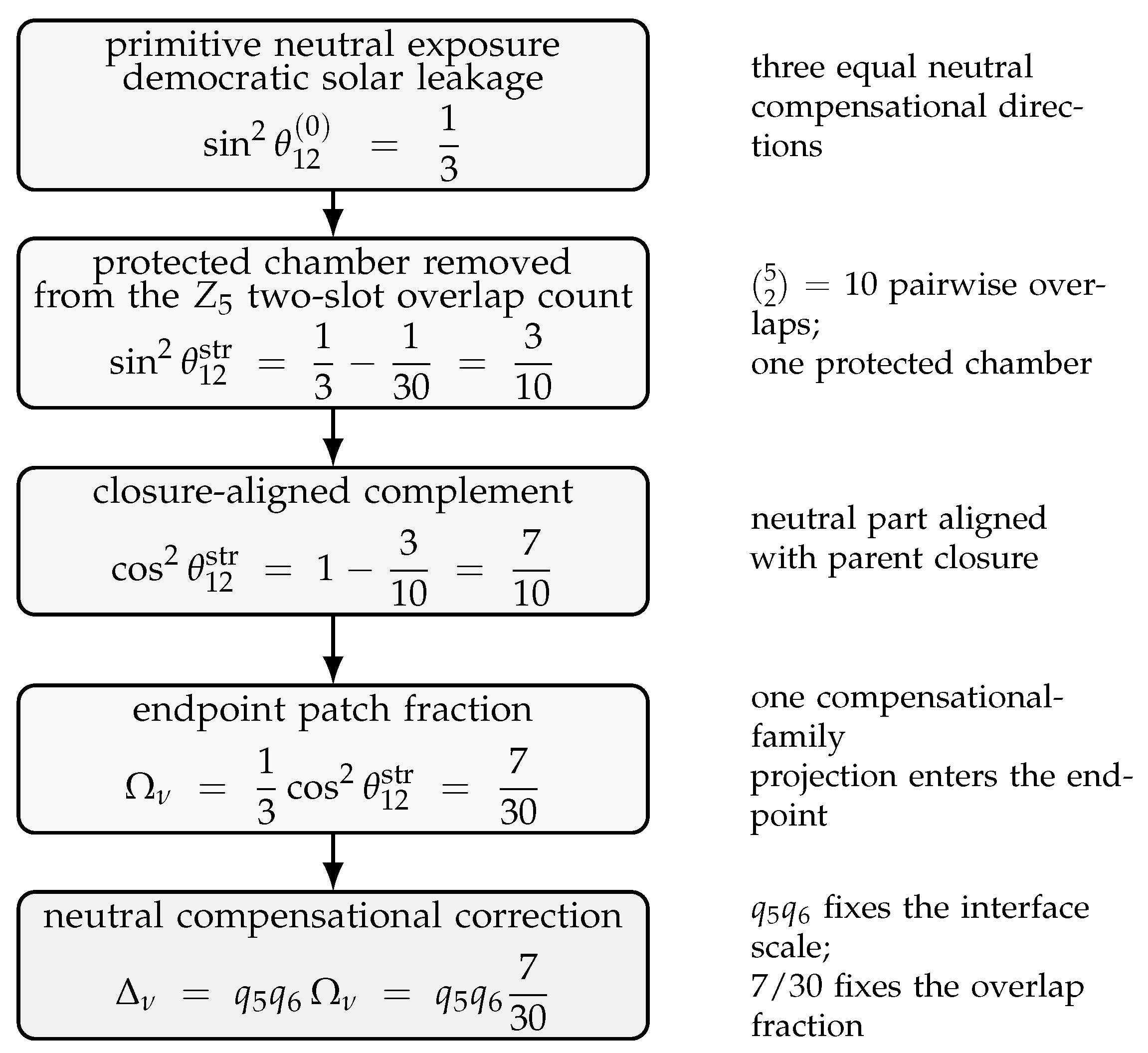
Appendix D.7. Why the Factor Patches the Charged Endpoint Residual
The charged endpoint tower has the form
where
The product structure is essential. The factor is not an independent additive correction unrelated to the leading endpoint. It is a conditional refinement inside the already selected endpoint. Likewise, refines the already -refined endpoint. Thus
marks the first nested interface at which the charged endpoint has become highly stabilized.
The residual left after the charged tower has stabilized has the scale expected from a secondary projection of this - interface. This motivates writing the neutral correction in the form
The charged calculation determines the interface scale . The neutral compensation calculation determines the overlap factor . Hence
This is why the neutrino sector is described as compensational. It does not replace the charged endpoint tower. It does not generate a new independent charged-lepton mass parameter. Rather, it supplies the small neutral component required to make the already selected charged endpoint compatible with the full neutral-parent closure.
A useful analogy is a seam in a three-part closure. The charged endpoint tower constructs the charged side of the seam and nearly closes it. The positive-side nested embedding fixes the chamber architecture in which the seam is measured. The neutral continuation then provides the final closure-aligned patch. The size of the seam is set by , and the fraction of the neutral sector aligned with the seam is .
Appendix D.8. Relation to the Solar PMNS Angle
The notation
is used because the neutral-overlap factor has the same structural role as the solar component of the PMNS mixing matrix. In the present proposal,
This value lies close to the empirical solar-neutrino mixing scale summarized in global neutrino-oscillation analyses [4,7,8,9].
The logical direction is important. The observed solar mixing angle is not inserted into the charged-lepton hierarchy calculation. Instead, the charged endpoint residual identifies the need for a neutral compensational patch, and the neutral-overlap count predicts a solar-sector value close to the empirical PMNS solar angle. Thus the solar angle enters the paper as an external consistency comparison, not as a fitted parameter.
Appendix D.9. What Is and Is Not Claimed
The neutral-overlap argument is a structural counting proposal. It claims that the solar-sector overlap needed to close the charged endpoint residual is not an arbitrary fitted PMNS input, but follows from a simple protected-chamber displacement in the first neutral two-slot exposure.
The argument does not claim to derive the full PMNS matrix. A complete neutrino-sector theory would need to derive the atmospheric angle, the reactor angle, the CP phase, mass ordering, and the full neutrino mass structure. The present appendix derives only the particular solar-sector overlap needed for the charged-lepton hierarchy:
This is sufficient for the endpoint residual calculation, but it is not yet a complete theory of neutrino mixing.
References
- Koide, Y. A fermion-boson composite model of quarks and leptons. Phys. Lett. B 1983, 120, 161–165. [Google Scholar] [CrossRef]
- Koide, Y. A new view of quark and lepton mass hierarchy. Phys. Rev. D. 1983, 28, 252. [Google Scholar] [CrossRef]
- Foot, R. A note on Koide’s lepton mass relation. Mod. Phys. Lett. A 1994, 9, 169–174, See also arXiv:hep-ph/9402242. [Google Scholar] [CrossRef]
- Navas, S.; et al. [Particle Data Group]. Review of Particle Physics. Phys. Rev. D. 2024, 110, 030001. [Google Scholar] [CrossRef]
- National Institute of Standards and Technology. 2022 CODATA Value: electron mass energy equivalent in MeV. The NIST Reference on Constants, Units, and Uncertainty; NIST: Gaithersburg, MD, USA. Available online: https://physics.nist.gov/cgi-bin/cuu/Value?mec2mev= (accessed on 15 June 2026).
- National Institute of Standards and Technology. 2022 CODATA Value: muon mass energy equivalent in MeV. The NIST Reference on Constants, Units, and Uncertainty; NIST: Gaithersburg, MD, USA. Available online: https://physics.nist.gov/cgi-bin/cuu/Value?mmuc2mev= (accessed on 15 June 2026).
- Maki, Z.; Nakagawa, M.; Sakata, S. Remarks on the unified model of elementary particles. Prog. Theor. Phys. 1962, 28, 870–880. [Google Scholar] [CrossRef]
- Pontecorvo, B. Neutrino experiments and the problem of conservation of leptonic charge. Sov. Phys. JETP 1968, 26, 984–988. [Google Scholar]
- Esteban, I.; Gonzalez-Garcia, M.C.; Maltoni, M.; Martínez-Soler, I.; Pinheiro, J.P.; Schwetz, T. NuFit-6.0: Updated global analysis of three-flavor neutrino oscillations. J. High Energy Phys. 2024, 12, 216, arXiv:2410.05380. [Google Scholar] [CrossRef]
- National Institute of Standards and Technology. 2022 CODATA Value: muon–electron mass ratio. The NIST Reference on Constants, Units, and Uncertainty; NIST: Gaithersburg, MD, USA. Available online: https://physics.nist.gov/cgi-bin/cuu/Value?mmusme= (accessed on 15 June 2026).
- Weinberg, S. The Quantum Theory of Fields, Volume I: Foundations; Cambridge University Press: Cambridge, UK, 1995. [Google Scholar]
- Weinberg, S. The Quantum Theory of Fields, Volume II: Modern Applications; Cambridge University Press: Cambridge, UK, 1996. [Google Scholar]
- Peskin, M.E.; Schroeder, D.V. An Introduction to Quantum Field Theory; Westview Press: Boulder, CO, USA, 1995. [Google Scholar]
- Lawson, H.B.; Michelsohn, M.-L. Spin Geometry; Princeton University Press: Princeton, NJ, USA, 1989. [Google Scholar]
- Nakahara, M. Geometry, Topology and Physics, 2nd ed.; Institute of Physics Publishing: Bristol, UK, 2003. [Google Scholar]
- Georgi, H. Lie Algebras in Particle Physics: From Isospin to Unified Theories, 2nd ed.; Westview Press: Boulder, CO, USA, 1999. [Google Scholar]
- Zee, A. Group Theory in a Nutshell for Physicists; Princeton University Press: Princeton, NJ, USA, 2016. [Google Scholar]
- Hatcher, A. Algebraic Topology; Cambridge University Press: Cambridge, UK, 2002. [Google Scholar]
- Bott, R.; Tu, L.W. Differential Forms in Algebraic Topology; Springer: New York, NY, USA, 1982. [Google Scholar]
- Milnor, J.W.; Stasheff, J.D. Characteristic Classes; Princeton University Press: Princeton, NJ, USA, 1974. [Google Scholar]
- Mermin, N.D. The topological theory of defects in ordered media. Rev. Mod. Phys. 1979, 51, 591–648. [Google Scholar] [CrossRef]
- Li, B. Topological classification of admissible reconstruction operations. Int. J. Topol. 2026, 3, 8. [Google Scholar] [CrossRef]
- Rosen, G. Koide’s lepton mass formula and the cosmic mass scale. Mod. Phys. Lett. A 2008, 23, 2385–2390. [Google Scholar]
- Rivero, A.; Gsponer, A. The strange formula of Dr. Koide. arXiv 2005, arXiv:hep-ph/0505220. [Google Scholar] [CrossRef]
- Brannen, C.A. The lepton masses. arXiv 2006, arXiv:hep-ph/0605331. [Google Scholar]
- Sumino, Y. Family gauge symmetry and Koide’s mass formula. Phys. Lett. B 2009, 671, 477–480. [Google Scholar] [CrossRef]
- Fritzsch, H. Calculating the Cabibbo angle. Phys. Lett. B 1977, 70, 436–440. [Google Scholar] [CrossRef]
- Froggatt, C.D.; Nielsen, H.B. Hierarchy of quark masses, Cabibbo angles and CP violation. Nucl. Phys. B 1979, 147, 277–298. [Google Scholar] [CrossRef]
- Altarelli, G.; Feruglio, F. Discrete flavor symmetries and models of neutrino mixing. Rev. Mod. Phys. 2010, 82, 2701–2729. [Google Scholar] [CrossRef]
- Ishimori, H.; Kobayashi, T.; Ohki, H.; Okada, H.; Shimizu, Y.; Tanimoto, M. Non-Abelian discrete symmetries in particle physics. Prog. Theor. Phys. Suppl. 2010, 183, 1–163. [Google Scholar] [CrossRef]
- King, S.F.; Luhn, C. Neutrino mass and mixing with discrete symmetry. Rep. Prog. Phys. 2013, 76, 056201. [Google Scholar] [CrossRef] [PubMed]
- Carroll, S.M. Spacetime and Geometry: An Introduction to General Relativity; Addison-Wesley: San Francisco, CA, USA, 2004. [Google Scholar]
Figure 1.
Compact schematic of the neutral-parent carrier-defect architecture. The unresolved neutral parent resolves asymmetrically into a lepton-facing branch and an embedded positive closure branch . The lepton-facing branch supports charged and neutral read-outs, while the positive closure branch is exposed through nested embedding environments . The electron endpoint is a charged leakage, but its count is controlled by the full neutral-parent architecture.
Figure 1.
Compact schematic of the neutral-parent carrier-defect architecture. The unresolved neutral parent resolves asymmetrically into a lepton-facing branch and an embedded positive closure branch . The lepton-facing branch supports charged and neutral read-outs, while the positive closure branch is exposed through nested embedding environments . The electron endpoint is a charged leakage, but its count is controlled by the full neutral-parent architecture.
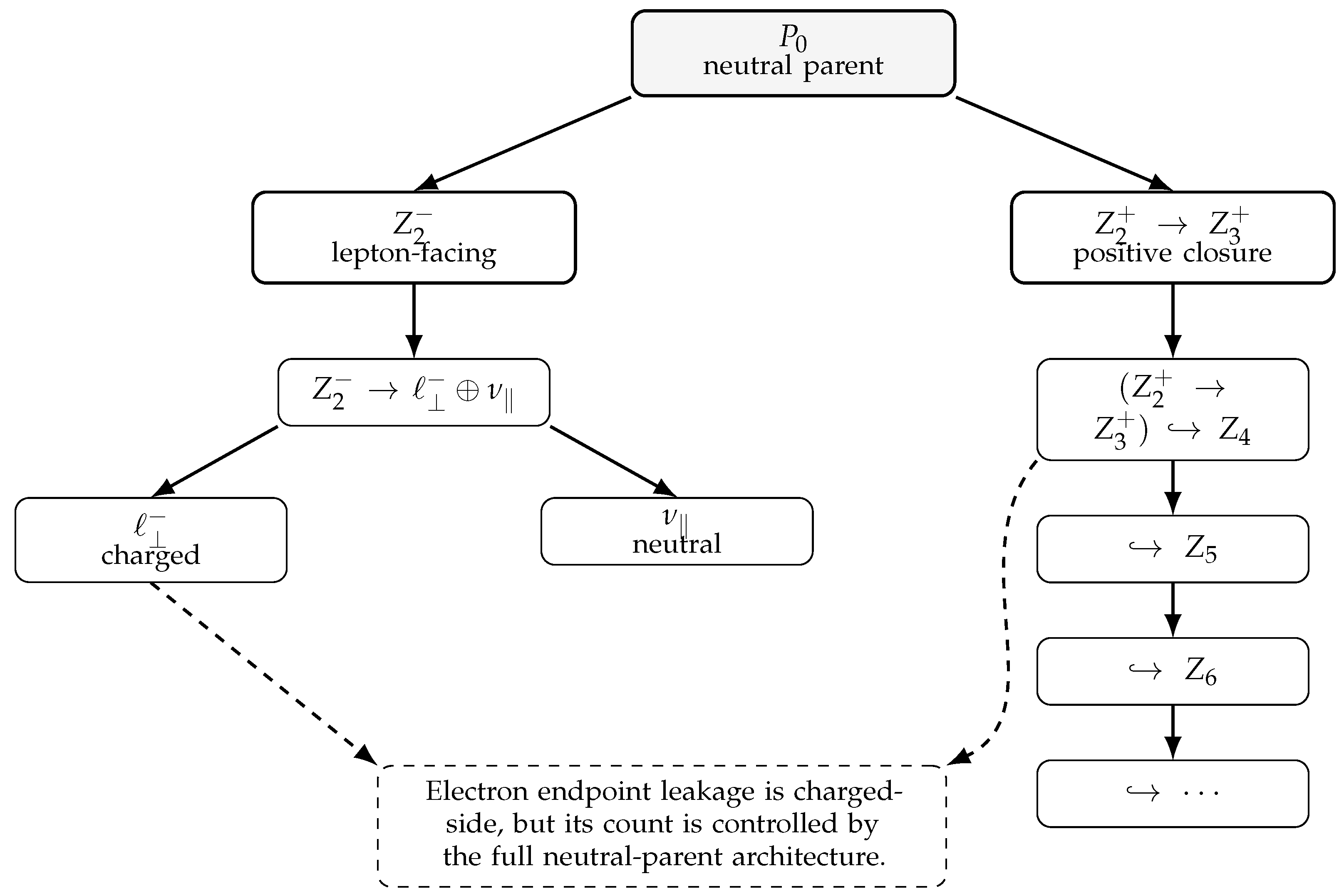
Figure 2.
Root-space representation of the Koide sector-power condition. The charged-lepton root vector decomposes into a democratic parent component and an orthogonal branch-splitting component . The Koide relation is equivalent to the equal-power condition , represented geometrically by a root-space decomposition. The geometry is used only as a representation of the underlying sector-power count.
Figure 2.
Root-space representation of the Koide sector-power condition. The charged-lepton root vector decomposes into a democratic parent component and an orthogonal branch-splitting component . The Koide relation is equivalent to the equal-power condition , represented geometrically by a root-space decomposition. The geometry is used only as a representation of the underlying sector-power count.
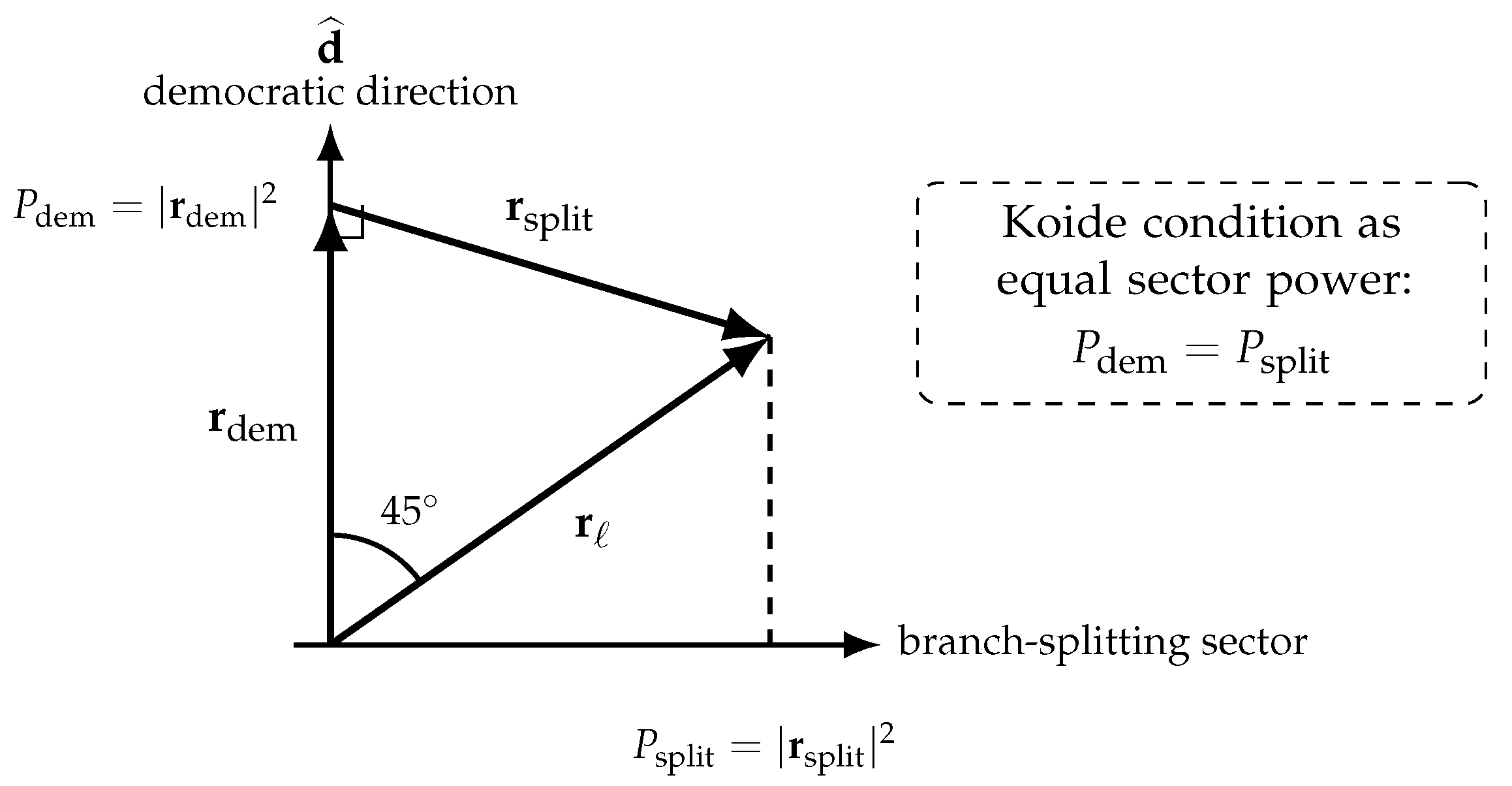
Figure 3.
Nested endpoint expansion and residual neutral compensation. The leading electron endpoint is opened at the first exposure environment . Higher charged corrections are conditional refinements , which rapidly stabilize by the level. The remaining charged-sector residual is then interpreted as a neutral-parent closure obstruction supplied by the neutral compensational channel. In the present counting interpretation, the first neutral overlap gives the structural factor , so the correction is .
Figure 3.
Nested endpoint expansion and residual neutral compensation. The leading electron endpoint is opened at the first exposure environment . Higher charged corrections are conditional refinements , which rapidly stabilize by the level. The remaining charged-sector residual is then interpreted as a neutral-parent closure obstruction supplied by the neutral compensational channel. In the present counting interpretation, the first neutral overlap gives the structural factor , so the correction is .
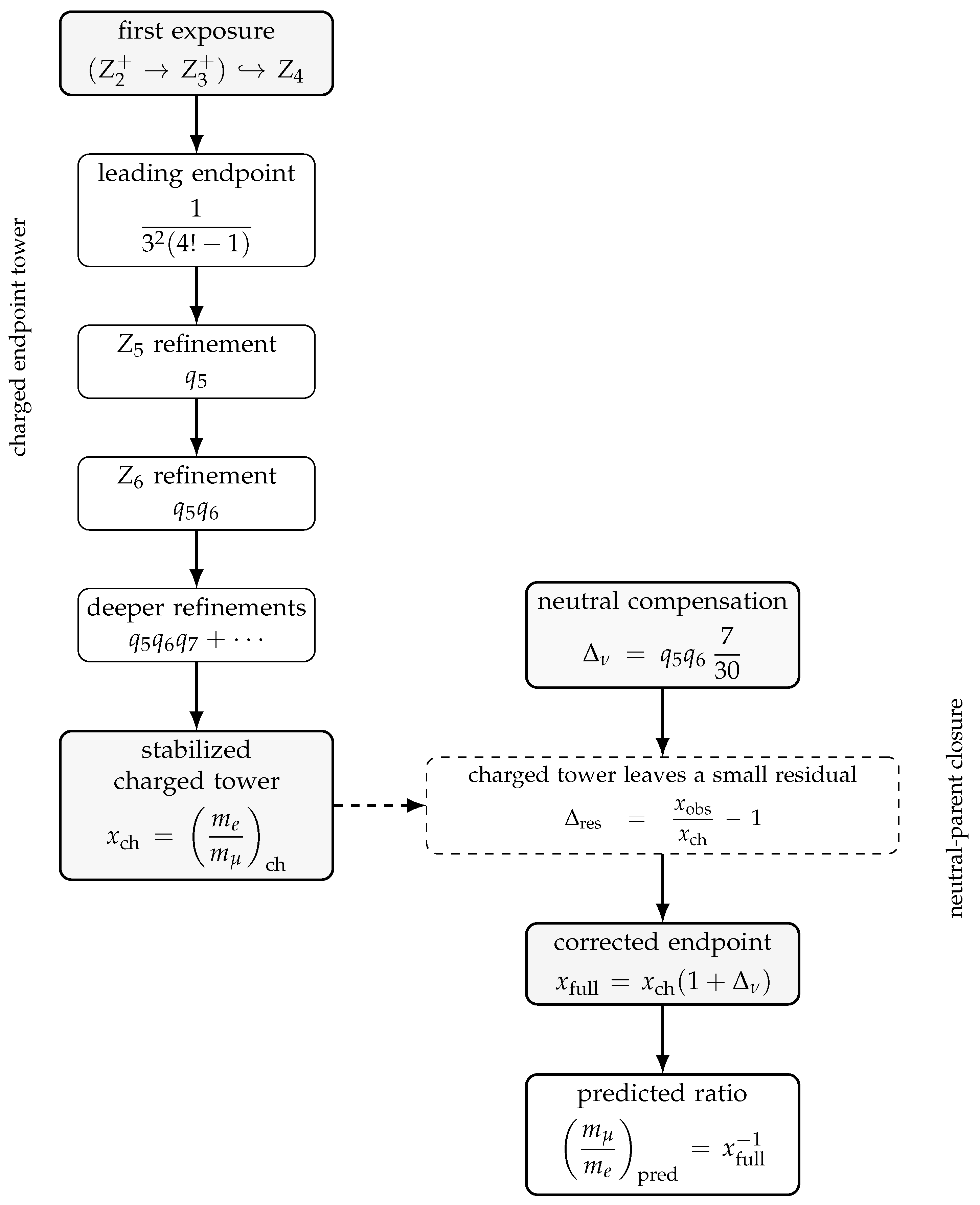
Table 1.
Endpoint leakage estimates for .
| Approximation | Formula | Value |
| Leading leakage | ||
| Including | ||
| Including | ||
| Observed |
Table 2.
Comparison of the endpoint prediction for with the observed mass ratio.
| Approximation | Predicted | Difference from observation | Pull |
| Leading leakage | |||
| Including | |||
| Including |
Table 3.
Muon–tau ratio obtained from the endpoint-corrected Koide constraint.
| Input for | Predicted | Difference from observation | Comment |
| Leading endpoint estimate | |||
| Nested through | Stabilized charged tower | ||
| Observed | 0 | Pole-mass comparison [4] |
Table 4.
Complete charged-lepton hierarchy prediction. The endpoint-counting tower, corrected by the neutral-compensational factor , predicts . The factor is the structural replacement for , corresponding to the solar-overlap prediction . The Koide sector-power theorem then fixes the large- branch. The electron–muon comparison is limited by the present uncertainty in the muon–electron mass ratio, while the tau-sector comparison is limited mainly by the experimental uncertainty in the tau mass.
Table 4.
Complete charged-lepton hierarchy prediction. The endpoint-counting tower, corrected by the neutral-compensational factor , predicts . The factor is the structural replacement for , corresponding to the solar-overlap prediction . The Koide sector-power theorem then fixes the large- branch. The electron–muon comparison is limited by the present uncertainty in the muon–electron mass ratio, while the tau-sector comparison is limited mainly by the experimental uncertainty in the tau mass.
| Ratio | Structural prediction | Observed value | Prediction–observation | Pull |
Disclaimer/Publisher’s Note: The statements, opinions and data contained in all publications are solely those of the individual author(s) and contributor(s) and not of MDPI and/or the editor(s). MDPI and/or the editor(s) disclaim responsibility for any injury to people or property resulting from any ideas, methods, instructions or products referred to in the content. |
© 2026 by the authors. Licensee MDPI, Basel, Switzerland. This article is an open access article distributed under the terms and conditions of the Creative Commons Attribution (CC BY) license (http://creativecommons.org/licenses/by/4.0/).
Copyright: This open access article is published under a Creative Commons CC BY 4.0 license, which permit the free download, distribution, and reuse, provided that the author and preprint are cited in any reuse.


