

Submitted:
02 June 2026
Posted:
22 June 2026
You are already at the latest version
Abstract
This study examines the StudyFAB, a Third Space project in Schweinfurt, Germany, as a case study for inner-city revitalization through comparative analysis. Facing challenges from declining pedestrian traffic and rising vacancies due to online shopping, the research investigates StudyFAB's measurable impact on marketplace foot traffic, perceived quality of stay, and user engagement, benchmarked against established Third Spaces like Utopiastadt Wuppertal and CityLAB Berlin. The central research question asks whether targeted social innovation hubs foster city revitalization. A mixed-methods approach combines pedestrian counts, standardized PHINEO impact metrics, StudyFAB usage data, and surveys across Users, Non-Aware Users, and the unfamiliar Non-Users to test hypotheses on foot traffic, perceptions, participation, and inclusion effects.Findings reveal that while StudyFAB did not significantly impact overall city-wide pedestrian frequency due to spatial limitations. it generated strong effects within its target groups—increased inner-city visits, improved city image perception, high satisfaction (Net Promoter Score), and measurable participation compared to peer projects' qualitative impact logics. Complementing Utopiastadt's neighborhood activation and CityLAB's governance focus, StudyFAB demonstrates niche efficacy through quantitative user-level evidence.The comparative perspective underscores Third Spaces as complementary urban transformation tools, suggesting integrated strategies combining social, cultural, educational, and commercial revitalization. Future research should address long-term scalability, sustainable funding, and cross-project transfer effects for policymakers and urban planners.
Keywords:
third space
; urban revitalization
; social innovation
; comparative case study
1. Introduction
Urban centres are essential hubs for society, driving economic activity, fostering cultural exchange, and facilitating community interaction (Brinker & Sinning, 2011; Siebel, 2000). However, contemporary urban landscapes are increasingly challenged by shifting consumer behaviours, most notably the surge in online retail, which has resulted in diminished pedestrian traffic and rising vacancy rates within city centres (Ehrbeck et al., 2007; HDE, 2023a; Henckel et al., 2007; Ruess et al., 2021). This evolving dynamic necessitates the development and implementation of innovative strategies aimed at revitalizing urban cores and enhancing the overall quality of stay for residents and visitors alike. This is especially important for smaller cities like Schweinfurt (53k habitants), as metropolitan areas with established omni-channel retail strategies have been shown to be more resilient to online competition (Bullinger, 2015; Jahn et al., 2017; Ruess et al., 2021). This requires strategies that meet the needs of visitors: a clean, green city with a high quality of stay and places to interact (Clark et al., 2002; Munzinger, 2020; Vrhovac et al., 2021) and a city for entertainment, not just shopping (Schiemenz, 2021; Wölfel & Kremmig, 2022).
Schweinfurt, like many German cities, is grappling with significant urban challenges, including increasing retail vacancies, declining pedestrian traffic, and dissatisfaction among residents with the quality of its inner-city spaces. These issues are primarily driven by structural changes in consumer behaviour, such as the rise of online shopping, which has reduced footfall in traditional retail areas (Gruninger-Hermann, 2017). The city’s marketplace, once a hub of activity, now struggles with underutilization and a lack of vibrancy. Residents express a desire for more engaging and multifunctional spaces that foster community interaction and improve the overall urban experience (Brinker & Sinning, 2011; Siebel, 2000). This situation is compounded by Schweinfurt’s broader demographic and economic trends. The city is experiencing a “downward curve” characterized by population aging, limited economic diversification, and urban stagnation. Without intervention, these trends threaten to exacerbate urban decline, making revitalization efforts increasingly urgent (Christmann, 2020; Domanski et al., 2020; Moulaert et al., 2005).
Despite the pressing nature of these challenges, there is a notable gap in research on effective solutions. Social innovations like Third Spaces - public or semi-public areas designed to encourage social interaction - are gaining attention as potential tools for revitalization. However, their impact remains unexplored in academic literature. Few studies rigorously evaluate their effectiveness in addressing urban vacancies or improving quality of stay or life.
The StudyFAB project in Schweinfurt provides a unique opportunity to address this gap. As an example of a Third Space initiative, it offers insights into how social innovation can contribute to urban renewal. By measuring its impact on pedestrian frequency and perceived quality of stay, this research aims to provide actionable evidence for policymakers and urban planners seeking sustainable solutions to revitalize declining city centres. Within academic discourse, there is growing recognition of the potential of social innovations as a means of addressing the complex challenges facing urban areas (Noack, 2015; Van Der Have & Rubalcaba, 2016).
A particularly promising concept is the Third Space, which are neither home (First Space) nor work (Second Space), but which serve as communal gathering points that encourage and facilitate social interaction (Oldenburg, 1989). These spaces are believed to foster stronger community bonds, improve the overall urban experience, and contribute to the rejuvenation of city centres (Alidoust et al., 2015; Camp, 2015; Jeffres et al., 2009; Oldenburg, 1989; Soukup, 2006).
This research focuses on a case study of a Third Space operating as a social innovation, the StudyFAB in Schweinfurt, Germany. The StudyFAB is a publicly accessible with space designed to provide a flexible workspace, meeting area, and community hub for students, entrepreneurs, travellers, and residents. It aims to address the challenges of vacancy and urban decline in Schweinfurt’s city centre by creating a welcoming and engaging space that attracts all people of all ages and genders to the area. The primary objective of this research is to evaluate the effectiveness of StudyFAB as a tool for urban revitalization, addressing the following key research questions:
- Does the Presence of Studyfab Influence Pedestrian Frequency in Schweinfurt’s Market Square?
- Does the use of StudyFAB have a positive impact on the perceived quality of stay in the downtown area?
- What is the overall impact of StudyFAB on its target group and the perception of the broader city centre?
2. Literature Review
The phenomenon of inner-city decline has been extensively studied in urban planning. Authors like Henckel et al. (2007) describe how increasing vacancy rates can trigger a “trading down” effect, leading to a downward spiral of decline. This effect manifests in less foot traffic, closures of small businesses and retailers and a general reduction in the quality of the urban environment (Frechen, 2022). Studies also highlight the impact of e- commerce on traditional retail, leading to decreased foot traffic in brick-and-mortar stores (HDE, 2023a).
The Third Space concept, popularized by Oldenburg (1989), provides a theoretical framework for understanding the role of informal public spaces in fostering social interaction and community building. Oldenburg argues that Third Spaces are essential for creating a sense of place and belonging in modern society. They provide opportunities for people to connect with one another, share ideas, and build relationships. Third Spaces can also serve as incubators for social innovation, providing a platform for community members to experiment with innovative ideas and solutions to local challenges (Howaldt & Schwarz, 2022; Putnam, 2000). Examples of social innovation in Germany include the creation of co-working spaces, urban gardens, and community-supported agriculture initiatives. These projects are often driven by grassroots organizations and aim to address local needs and challenges in innovative ways (Defourny & Nyssens, 2017).
Empirical studies on Third Spaces demonstrate their effectiveness in promoting social interaction and neighborhood revitalization, particularly through the interim use of vacant buildings as hybrid usage spaces (Aelbrecht, 2016; Lydon & Garcia, 2015). Comparable initiatives like Utopiastadt Wuppertal and CityLAB Berlin illustrate how Third Spaces enable participatory urban development and innovation (see Chapter 3).
The quality of stay refers to the overall attractiveness and comfort of an urban environment. Factors influencing the quality of stay include the availability of public spaces, the presence of green areas, the safety and cleanliness of the environment, and the diversity of cultural and commercial offerings (Borer, 2006; Gehl, 2011; Manfrahs, 2020b; Oldenburg, 1989; Sander, 2006; Schlegelmilch et al., 2008; Wölfel & Kremmig, 2022). Gehl (2011) identified twelve design criteria for enhancing urban spaces. Research suggests that improving the quality of stay of inner cities can help to attract visitors, boost economic activity, and enhance the overall well-being of residents (Knoell et.al. 014, Jeffres & Dobos 1993, Lusche, 2011).
The literature on social innovation highlights the potential of community-led initiatives to address complex social and economic challenges (Van Der Have & Rubalcaba, 2016). Social innovation is defined as “a new, sustainable and effective solution to address societal social problems and improve living standards” (Polovko & Grīnberga-Zālīte, 2019). In the context of urban revitalization, social innovation can involve creating new forms of public space, developing innovative business models, or fostering community engagement through participatory and inclusive processes (Drewe et al., 2008; Drewe & Hulsbergen, 2007; Mulgan, 2006; Polovko & Grīnberga-Zālīte, 2019).
3. Research Method
The conducted study is based on a mixed methods approach. The Research Design encompassed a combination of quantitative and qualitative methods to explore data from various sources. A digital interview was developed as a research design to capture the opinions of non-professional users of the Schweinfurt marketplace and StudyFAB. The questionnaire is a between-subject design in which the level of awareness of StudyFAB is surveyed to create three groups. Group one serves as a control group and comprises people who do not know and do not use StudyFAB. Group two is made up of people who are aware of StudyFAB and its services but have not yet used them, and group three is made up of those who have used StudyFAB at least once. These subdivisions function as independent variables (UV). The dependent variable (AV) is the quality of stay and the evaluation of Schweinfurt city centre.
- a.
- Frequency Measurement
Pedestrian frequency was measured using automated counting devices installed in Schweinfurt’s market square. Data were collected over a period of six years (2018-2024) to analyse trends. The StudyFAB opened on July 21, 2023, but this study focuses on October 2023 to February 2024 to reflect regular operations after staffing adjustments. This period is then compared to data from Schweinfurt`s marketplace from 2018-2024.
- b.
- Methode of Impact Assessment
The impact of StudyFAB was evaluated using the PHINEO impact staircase, see Figure 1, developed by the German social organization PHINEO, is a method for analysing the impact of social projects. According to this method, social impact occurs when measures lead to changes in the target group, their environment, and society. These changes are categorized into outputs, outcomes, and impact. Figure 1 illustrates the seven stages these changes go through and the alignment with the project Key Performance Indicators (KPI) (Kurz & Kubek, 2021).
The output forms the basis for the impact and is defined by providing planned activities in which the target group is reached, and the offer is accepted (stages 1 to 3). Stage four is when impact starts because the outcome begins, and behaviour is measurable. In the first part of the outcome section, there is a change in awareness or the abilities of the target group, while the action changes in stage five. Stage six is reached when the target group’s living situation changes. The last stage, the impact, no longer refers to the target group alone but rather has a societal effect (Kurz & Kubek, 2021). The framework was applied to the StudyFAB matching KPI’s and used tracking data, questionnaire results, and pedestrian data to evaluate each stage, uniting research methods.
- c.
- Questionnaire
A questionnaire was developed to gather data on perceptions of the downtown area, usage of StudyFAB, and demographic information. The questionnaire included both closed-ended and open-ended questions to provide quantitative and qualitative insights. The questionnaire was designed based on the variables and was translated in German. Most questions were closed- ended to increase objectivity in implementation and evaluation (Diekmann, 2021). Individual attitudes were captured using four- and five-point Likert scales. Open-ended questions were also asked to gather individual opinions beyond the information provided. The questionnaire was used to evaluate the remaining goals of the impact staircase and assesses the hypotheses.
The first section focuses on the potential of the StudyFAB. In terms of content, it looks at how the premises are used over time and which elements are important. In addition, the extent to which the use of the StudyFAB has an influence on Schweinfurt’s city centre in terms of their opinion and behaviour is explored. Three open questions allow participants to provide free feedback and suggestions for improvement. The section is rounded off with an evaluation of StudyFAB in the form of school grades and the Net Promoter Score (NPS). The NPS provides information on the extent to which respondents would recommend the company’s services to friends.
The second area surveyed the quality of stay at Schweinfurt’s market square in the city centre, including the surrounding buildings, and amenities. The measurement of the quality of stay can be done in different ways, such as observations, checklists, workshops, and surveys (Tawfik Mohamed et al., 2023). The Public Space Index (PSI) (Mehta, 2014) was selected because it enables a holistic view, has a weighting per item, and has already been used multiple times in studies (Evans et al., 2019; Tawfik Mohamed et al., 2023). The questionnaire is divided into five dimensions: Inclusiveness, Meaningful Activities, Comfort, Safety, and Pleasurability. Each dimension includes seven to twelve items. The weighting of the individual items is different. The answer format is a four-level Likert scale, which awards zero to four points per item. In this research, the questionnaire was reduced to two questions per dimension. Following this section, the entire Schweinfurt city centre was to be rated with a German school grade from 1 to 6. The questionnaire was pretested with a small group of respondents to ensure its clarity and validity. Based on the pretest results, minor revisions were made to the questionnaire before its final application.
- d.
- Sample Recruitment and Sample Description
To recruit participants for the questionnaire, the lead researcher approached passers-by at the Schweinfurt market square and within StudyFAB. After obtaining consent, participants completed the questionnaire independently on a provided notebook or via a QR code on their smartphone. The survey took 5-8 minutes and took place over 14 days, between April 26 and May 10, 2024.
The final sample included N = 93 individuals, with no exclusions due to data anomalies. The sample was divided into three groups through the survey: StudyFAB users (n = 33), those familiar with StudyFAB (n = 30), and non-users (n = 30). The sample included 60.2% female (n = 56), 38.7% male (n = 36), and 1% diverse (n = 1) participants, with a mean age of 37.25 years (SD = 17.24) and an age range of 12-83 years. Regarding employment, 17.2% were students, 12.9% were studying, 48.4% were employed, 9.68% were self-employed, 7.5% were retired, and 3.2% were unemployed. One participant was a legal trainee. See Table 1 for a complete demographic breakdown of each group.
4. Results
In the following section, we report only the empirical results of the StudyFAB case study; the qualitative comparison with other Third Space initiatives (Utopiastadt Wuppertal, CityLAB Berlin) is presented separately in Chapter 6. The previously established hypotheses are statistically evaluated and the impact of the StudyFAB is assessed using the PHINEO impact staircase, see Figure 1. The calculations were conducted using the IBM SPSS Statistics Version 25 program. The hypotheses were assessed under the assumption of a normal distribution, as the three samples have a size of n > 30. Therefore, a one-factorial ANOVA was used in each case. The requirements of a metrically scaled variable and three independent samples are met in this experiment. Cohen’s d is used as the effect size measure and α = .05 as the significance level (Bortz & Schuster, 2011; Cohen, 1992). According to Cohen (1992), an effect size of d = .20 can be described as a small effect, d = .50 as a medium effect and d = .80 as a large effect.
- a.
- Pedestrian Frequency
Our Hypothesis states that the frequency of pedestrians will be increased by offering a modern third space such as StudyFAB. To verify the hypothesis, the frequency of passers-by from 2018 to 2024 was compared in the period from October to February. Table 2 shows the descriptive data and the growth rate per year compared to the period 2023/2024. Analysis of the pedestrian frequency data revealed no significant increase in overall foot traffic in the Schweinfurt market square following the opening of the StudyFAB. The pedestrian frequency at Schweinfurt’s market square during October to February varied across the years. While the frequency in 2023/24 was 10.8% higher than in 2018/19 and 31.6% higher than in 2020/21, it was lower compared to 2020/21 (-10.3%), 2021/22 (-13.6%), and 2022/23 (-40.1%). Notably, December 2022 saw a significant increase in pedestrian frequency compared to December in previous years (2020/21, 2021/22).
- b.
- Perceived Quality of Stay
The hypotheses proposed that the perceived quality of stay at Schweinfurt’s market square would be higher for individuals who use or could use a modern Third Space like StudyFAB.
The targets for stage five are to increase the number of visits to the city centre by the target group. 39.4% of StudyFAB users take advantage of the offer several times a month and 39.4% even several times a week (see Figure 24). Due to its central location on the market square, a visit to the StudyFAB can be equated with a visit to the city centre. In addition, 33.3% of the users surveyed stated that they have used Schweinfurt city centre more frequently since StudyFAB opened. 30.3% tend to agree with this statement. More than half of those surveyed use the city centre’s offerings, such as restaurants and retail outlets, more often than before StudyFAB opened.
Reaching level seven is linked to a change in the target group’s living situation. H2a states that the perceived quality of the Schweinfurt marketplace is higher for people who use a modern third space such as StudyFAB. H2b postulates that the perceived quality of stay of the Schweinfurt marketplace is higher for people who can use a modern third space such as the StudyFAB.
However, the perceived quality of stay at the market square did not differ significantly (based on ANOVA) between Users (M = 1.84) those Aware User (M = 1.85) and Non-Users (M = 1.87). F(2.90) = .20. p = 0.821. Descriptive data for the respective scales can be found in Table 3.
5. Impact Assessment
It is exceedingly difficult to evaluate this kind of projects quantitatively. To solve this difficulty. we evaluated the project according to the principle of the impact staircase shown in Figure 1.
- a.
- Input
The input for StudyFAB included modern interior, financial resources, staff time and volunteer efforts were used to establish and operate the facility and implement related programs and activities.
- b.
- Output
The evaluation of StudyFAB’s outputs was conducted across the first three levels of the impact staircase from October 2023 to February 2024.
On Level 1 the key outputs included 94 operational days and three after-work events. Initially open four days per week in October. StudyFAB expanded to five days per week from November onwards.
On Level 2 the usage was tracked daily revealing a total of 4.372 visits (average: 45.51 visits per day). The number of visitors increased from 32/day in October to 55 per day in February. with a peak of 83 visitors on January 31. 2024. Visitors were 53.43% female (SD = 1.84%) and 46% male (SD = 1.89%). The largest age groups were 19–25 years (M = 35.56%. SD = 4.02%) and 26–65 years (M = 36.92%. SD = 7.54%) with younger visitors dominating in early 2024. Usage for work and study was the most common activity (M = 48.05%. SD = 3.31%). followed by reading/relaxing (M = 26.56%. SD = 3.15%).
The Level 3 assessed user satisfaction through indicators like increasing visitor numbers and longer stays. StudyFAB achieved a Google rating of 5.0 (N = 60) and a Net Promoter Score (NPS) of 72.7, indicating an important level of satisfaction and willingness to recommend the space to others. Survey respondents rated StudyFAB an average German school grade of 1.3 (SD = 0.47).
- c.
- Outcome
On Level 4 the survey data showed that 78.8% of users perceived StudyFAB as enriching. with 36.4% reporting a positive shift in their perception of Schweinfurt’s city centre since using the facility.
On Level 5 The StudyFAB’s central location has contributed to increased downtown visits. Notably 39.4% of users visit multiple times per week and 33.3% report more frequent visits to Schweinfurt’s city centre since its opening. Over half of respondents also indicate increased use of downtown amenities reflecting StudyFAB’s positive impact on local economic activity. Finally at level 7 the quality of stay in Schweinfurt’s market square should have improved.
The study examined the relationship between StudyFAB usage frequency and perceptions and utilization of Schweinfurt’s city centre. Two-sided Spearman’s rank correlations were calculated for ordinal data. Following Cohen’s (1988) guidelines. correlations were interpreted as small (|ρ| ≈ .10). medium (|ρ| ≈ .30). or large (|ρ| ≈ .50).
Results revealed strong positive correlations between StudyFAB usage frequency and Schweinfurt’s overall rating (ρ = .68. p < .001). As well as positive perceptions of the city centre (ρ = .61. p < .001). Medium positive correlations were found between StudyFAB usage and frequency of city visits (ρ = .41. p = .019) and utilization of other city centre offerings (ρ =.43. p = .014).
The positive feedback often related to the ambience and modern design as well as the working and learning opportunities. The noise level and the small number of workstations were rated negatively. Nevertheless, it should be noted that around half of the participants did not mention any negative aspects. Participants expressed a desire for larger workstations with more seating options and individual workstations for meetings. A third of respondents were satisfied with the facilities and had no further requests. The presented empirical results demonstrate StudyFAB’s measurable effects within its target group across the PHINEO impact staircase levels. To contextualize these findings within the broader landscape of Third Space initiatives and assess StudyFAB’s relative positioning, the following chapter provides a comparative analysis with established projects Utopiastadt Wuppertal and CityLAB Berlin (Chapter 6). This comparison highlights methodological strengths, scale differences, and complementary impact logics among urban social innovation hubs.
6. Comparative Analysis
- a.
- Introduction
The following comparison situates StudyFAB Schweinfurt within the context of two other third-space initiatives, Utopiastadt in Wuppertal and CityLAB Berlin, to identify similarities and differences in their mission, objectives, governance structures, service profiles and impact mechanisms, and to derive transferable strategies for the further development of StudyFAB. The focus is on third spaces that function as hybrid meeting and learning spaces at various urban scales, repurpose vacant properties or existing buildings, and involve civil society and institutional actors in co-productive formats. The chapter first presents the selected projects within their urban context (objectives, methods, target groups, offerings, initial results), then carries out a systematic comparison based on defined criteria, and, building on this, discusses the transferability of key elements to StudyFAB.
- b.
- Selection of Comparison Projects
Three key categories of comparability are used to select the comparative projects: Firstly, the functional role of the projects as third spaces in the context of structural change and pressure for transformation (e.g., dealing with vacant premises in city centres, repurposing existing buildings). Secondly, the nature of the initiative as a hybrid space for encounter and experimentation, bringing together creativity, education, digitalisation and social innovation. Thirdly, the target groups, each comprising a mix of students or young urban makers, the local business community, civil society actors and the interested urban public. Finally, the three cases cover different urban scales (medium-sized town centre, neighbourhood, metropolis), which allows conclusions to be drawn about scalable elements of third spaces.
- c.
- the Projects
This section provides a brief overview of each of the selected Third Space initiatives. For each project, it describes the objectives, key methods and formats, the target groups addressed, and the results and impacts observed to date. It then outlines the urban context and relevant background conditions of the respective city or region, in order to situate the projects within their socio-spatial context and lay the groundwork for the subsequent analytical comparison.
Utopiastadt, Wuppertal
Utopiastadt in Wuppertal (ca. 350,000 inhabitants) serves as an apt first comparative case to StudyFAB: Despite the larger city size, Wuppertal shares Schweinfurt’s (ca. 54,000 inhabitants) challenges of economic structural change and image problems, with both projects transforming vacant spaces into creative, community-oriented hubs (NRW-Stiftung, 2023; Quartier Mirke, 2018). Emerging from the interim use of the disused Mirker Bahnhof, Utopiastadt mirrors StudyFAB as a multifaceted Third Space offering open social exchange, co-working, workshops, urban gardening, and events that actively contribute to urban development (Bauwelt, 2017; Utopiastadt gGmbH, 2024). Target groups overlap in addressing students, founders, local initiatives, and the interested public, though Utopiastadt’s civil society focus contrasts with StudyFAB’s university affiliation (NRW-Stiftung, 2023).
Context and origins
Utopiastadt originated in 2014 from the temporary use of Wuppertal-Mirke’s abandoned railway station (built 1882, disused 1991) in the structurally weak Mirke neighborhood (NRW-Stiftung, 2023; Utopiastadt gGmbH, 2024). It positions itself as a permanent “idea space and laboratory for the city of tomorrow” (Bauwelt, 2017).
Objectives and methods
The goal is an open, public-benefit Third Space combining urban development, neighborhood work, and socially engaged art across ~3,000 m² (Bauwelt, 2017; Quartier Mirke, 2018). Spaces remain deliberately “unfinished” to foster user appropriation and co-design (NRW-Stiftung, 2023).
Offers and formats
Features include the “Hutmacher” café, concerts, readings, open workshops, participatory formats, neighborhood festivals, and guided tours on history and regeneration (Sparkasse Wuppertal, 2022; Bauwelt, 2017). The site functions as a real-lab for work, culture, education, mutual aid, and experimental urbanism (Quartier Mirke, 2018).
Organizational structure and target groups
Operated by Utopiastadt gGmbH (founded 2015, civil society-led), funding comes from café revenues, grants, events, and land acquisition (Mirker Bahnhof donated 2016; 11,100 m² purchased 2018) (NRW-Stiftung, 2023; Sparkasse Wuppertal, 2022). Targets creatives, residents, initiatives, students, and founders; it has improved neighborhood image but faces volunteer burnout and funding challenges (NRW-Stiftung, 2023).
Conclusion
Utopiastadt and StudyFAB are comparable as both repurpose vacant sites (Mirker station vs. Schweinfurt factory) into participatory Third Spaces addressing structural change through co-working, workshops, gardening, and events – differing in governance (civil society vs. university) and scale (NRW-Stiftung, 2023).
CityLAB, Berlin
CityLAB Berlin serves as a second comparative case to StudyFAB, creating a hybrid Third Space between public administration, urban society, and knowledge institutions in Berlin’s former Tempelhof Airport (Technologiestiftung Berlin, 2024; VisitBerlin, 2024). Both projects address digital and social transformation through open learning spaces and position themselves as experimental sites for “the city of tomorrow,” differing primarily in scale and institutional embedding (Technologiestiftung Berlin, 2024).
Context and origins
CityLAB Berlin opened in 2019 within the iconic former Tempelhof Airport building – a symbol of Berlin’s urban history now serving as a smart city hub – situated in a metropolis of over 3.5 million inhabitants marked by digitalization, social diversity, and complex administrative structures (Technologiestiftung Berlin, 2024; CityLAB Berlin, 2024).
Objectives and methods
CityLAB aims to function as a public innovation lab for the digital city, uniting administration, citizens, academia, and startups in public-benefit solutions. Methodologically, it employs user-centered development (service design, co-design), rapid prototyping, open data, and agile software development to transform ideas into testable prototypes, viewing digitalization as a tool for improving governance, participation, and urban quality of life (Technologiestiftung Berlin, 2024).
Offers and formats
CityLAB integrates co-working spaces, digital workshops, exhibition and event areas into an open experimental lab, offering workshops, hackathons, project studios, smart city exhibitions, and regular community formats where citizens and administrators co-create solutions. Mobile formats like the “Kiezlabor” bring participation and prototyping directly into Berlin’s neighborhoods (Technologiestiftung Berlin, 2024; Gemeinsam Digital, 2024).
Organizational structure and target groups
Operated by the Technologiestiftung Berlin in close cooperation with the State of Berlin, CityLAB functions at the intersection of urban society, administration, and academia. Target groups include public servants, civil society initiatives, research institutions, startups, and engaged citizens shaping Berlin’s digital future. Recognized as a smart city development benchmark, it faces challenges integrating experimental approaches into administrative routines and securing long-term funding (Technologiestiftung Berlin, 2024; LinkedIn CityLAB, 2025).
Conclusion
CityLAB Berlin and StudyFAB are comparable as both repurpose unused spaces (Tempelhof vs. Schweinfurt factory) into hybrid Third Spaces with co-working, workshops, events, and prototyping to advance digital/public-benefit urban development – differing in institutional embedding (administration/science vs. university) and urban scale (Technologiestiftung Berlin, 2024a).
- d.
- Comparison of the Projects
D.a Studyfab – Utopiastadt - Citylab
Context and Origins
StudyFAB was launched in 2023 as a pilot project of the “SchweinfurtFABulous” initiative in a vacant shop premises (150 m²) on Schweinfurt’s market square. It responds to inner-city vacancy rates, declining footfall and a ‘downward curve’ effect (ageing population, online retail) in this medium-sized town (approx. 54,000 inhabitants).
Utopiastadt emerged from 2014 onwards in the significantly larger city of Wuppertal (approx. 350,000 inhabitants) in the structurally weak district of Mirke, arising from the temporary use of the disused Mirke railway station, with the aim of re-programming a neglected area along the Nordbahntrasse and establishing it as a neighbourhood anchor. Here, a formerly neglected piece of infrastructure along the Nordbahntrasse is gradually being transformed into a public-benefit-oriented cultural and urban development hub (NRW-Stiftung, 2023).
CityLAB Berlin opened in 2019 in a section of the former Tempelhof Airport and, against the backdrop of Berlin’s Smart City Strategy, addresses the digital transformation of public administration and urban society (CityLAB Berlin, 2024; Technologiestiftung Berlin, 2024). It is situated in a metropolis with complex administrative structures and a highly developed innovation landscape.
What the three projects have in common is that they repurpose existing buildings in situations of change as innovative testing grounds and utilise them as third spaces; they differ primarily in terms of scale (small-to-medium-sized town centre, neighbourhood, metropolis) and initial focus (city centre regeneration, neighbourhood development, smart city). StudyFAB is distinguished by its university-based, research-driven focus (see PHINEO evaluation in the paper).
Objectives and Methods
StudyFAB pursues two closely linked objectives: as the THWS’s inner-city presence, it aims to highlight student life, start-up culture and cooperation with the local economy, whilst simultaneously contributing to the revitalisation of the city centre as a social innovation hub. The focus is less on a massive increase in footfall and more on the question of whether a social innovation hub can change the perception, quality of stay and usage behaviour of a clearly defined target group; methodologically, the project works with a mix of open work and learning zones, curated events and accompanying mixed-methods impact monitoring (counts, usage data, surveys, impact indicators).
Utopiastadt focuses more strongly on urban development for the common good, cultural revitalisation and the empowerment of civil society (NRW-Stiftung, 2023). The guiding principle is the idea of an ‘unfinished’ place that allows for appropriation: temporary use, long-term self-organisation, artistic and social projects, and ongoing architectural transformation serve as key methods for revitalising the neighbourhood and testing new urban practices (Eickhoff & Gräwe, 2017; Quartier Mirke, 2018).
CityLAB Berlin sees itself as a public innovation laboratory for the ‘digital city for all’ (CityLAB Berlin, 2024). At its heart lies the co-productive development of public-good-oriented digital solutions by public administration, civil society, academia and start-ups. Methodologically, the approach is dominated by design thinking, service design, open data, agile development and experimental pilot projects with Berlin’s public authorities (Technologiestiftung Berlin, 2024).
By comparison, StudyFAB sits between the two: socially, spatially and community-oriented like Utopiastadt, but with a more programmatically defined, research-based and experimental logic that brings it closer to CityLAB.
Facilities and Formats
Spanning around 150 m², StudyFAB offers a hybrid space comprising co-working stations, study and project zones, small meeting areas and communal spaces. This is complemented by workshops, information and networking events, start-up initiatives, hands-on activities with regional businesses, and experimental events (e.g., ‘Experience Days’ featuring technology demonstrations). Use is primarily work- and study-oriented; empirically, working/studying dominates, followed by reading/relaxing, with rising visitor numbers, very high satisfaction and an NPS of over 70.
Utopiastadt combines co-working, workshops, urban gardening, repair cafés, studios, the ‘Hutmacher’ café as a meeting place, and a wide range of cultural and participatory formats – from concerts and readings to festivals and neighbourhood celebrations, as well as workshops, participatory formats and guided tours (NRW-Stiftung, 2023; Quartier Mirke, 2018). The venue is thus equally a cultural centre, a neighbourhood space, a workshop and an urban laboratory, covering a significantly broader spectrum of everyday life and leisure activities (Eickhoff & Gräwe, 2017).
CityLAB Berlin combines co-working spaces, a digital workshop, exhibition and event areas, and uses them for hackathons, innovation workshops, project labs, smart city exhibitions, community meet-ups and co-design processes involving local government (VisitBerlin, 2024). In addition, there are mobile formats that go out into the boroughs to involve citizens and local government in innovation processes, such as the Kiezlabor (Gemeinsam Digital: Berlin, 2024).
In summary, StudyFAB lies between the two comparison cases in terms of the breadth of its offering: more focused and work-related than Utopiastadt, and more socially spatial and community-oriented than CityLAB; this profile can be specifically refined in future development (e.g., more cultural formats modelled on Utopiastadt or more structured innovation labs based on the CityLAB approach).
Funding and Target Groups
StudyFAB was initially funded by the City of Schweinfurt and THWS as part of a federal programme; currently, the City covers the rent and THWS covers the staff costs. The space is managed by a full-time project coordinator employed by THWS, who is also the managing director of the non-profit sponsoring association netSWerk e.V., supported by several student assistants and a voluntary board. In the future, the association is expected to take on an increasing share of the financing and coordination through donations, sponsorship and rentals. The target groups are students, school pupils, those interested in starting a business, local businesses, freelancers and interested members of the public; the study shows that younger users and working professionals make intensive use of the space, thereby changing their city usage patterns.
Utopiastadt is run by a civil society-oriented gGmbH, whose funding is derived from catering revenue, project and grant funding, events and the gradual purchase of land; the City of Wuppertal is a strategic partner, without directly managing the site (NRW-Stiftung, 2023; Neue Wuppertaler Zeitung, 2019). The target groups are creative professionals, residents, initiatives, students, start-up founders and the wider public, with a strong focus on residents and the cultural scene (NRW-Stiftung, 2023; Quartier Mirke, 2018).
CityLAB Berlin is a project run by the Technologiestiftung Berlin in close cooperation with the State of Berlin and is thus firmly embedded in the city’s smart city governance framework (Technologiestiftung Berlin, 2024; Smart City Berlin, 2025). Its target groups include public-sector employees, civil society organisations, research institutions, tech companies and interested citizens who are contributing to Berlin’s digital transformation (Technologiestiftung Berlin, 2024).
In terms of governance, StudyFAB represents a university-affiliated, locally rooted ‘third space’ with a hybrid funding structure (university + city + association); Utopiastadt is a civil society-led urban laboratory with a strong focus on the public good (NRW-Stiftung, 2023; Eickhoff & Gräwe, 2017); and CityLAB is an institutionally mandated innovation laboratory commissioned by the city (Technologiestiftung Berlin, 2024). For the further development of StudyFAB, different role models can be derived from this: as the university’s ‘Third Mission Hub’ (like CityLAB), as a more self-organised, public-good-oriented urban-making space (like Utopiastadt), or deliberately as a hybrid form that combines elements of both models.
D.b Shared Logic of Impact
All three locations generate impacts with different focal points. A direct comparison shows that, unlike many established urban laboratories such as Utopiastadt Wuppertal (NRW-Stiftung, 2023) and CityLAB Berlin (Technologiestiftung Berlin, 2024), StudyFAB has a particularly extensive empirical database for describing social acceptance, usage, participation and inclusion (e.g., 45.5 visits/day, NPS 72.7, ρ ≈ .68 between usage and city centre evaluation; see section 5.
Whilst Utopiastadt and CityLAB demonstrate their impact primarily through qualitative case studies, high visitor numbers, their role as central locations within the neighbourhood or in smart city governance, as well as through ongoing projects and new forms of cooperation (Utopiastadt, 2024; Technologiestiftung Berlin, 2024), StudyFAB has standardised metrics based on the PHINEO impact framework. These include high usage intensities, very positive satisfaction ratings (including the Net Promoter Score), demonstrable participatory co-creation of the space and programme, behavioural changes in favour of the city centre, and significant correlations between usage frequency, perception of the city centre and behaviour whilst in the area.
At the same time, it becomes clear that a single, physically small third space such as StudyFAB, despite these clearly measurable effects at the level of the target group, cannot yet exert a significant influence on macroscopic indicators such as the overall footfall in the city centre. Taken together, the three examples suggest that third spaces should be understood as effective but complementary building blocks of urban transformation: Utopiastadt and CityLAB primarily with regard to structural and governance-related changes (NRW-Stiftung, 2023; Technologiestiftung Berlin, 2024), and StudyFAB with regard to finely detailed, quantitatively documented effects on the perception, behaviour and inclusive participation of the users directly reached.
- e.
- Transferability of Results
The empirical findings from StudyFAB align well with the impact frameworks of established urban laboratories such as Utopiastadt (NRW-Stiftung, 2023) and CityLAB Berlin (Technologiestiftung Berlin, 2024) and offer concrete approaches for scaling up the initiative in Schweinfurt. Whilst StudyFAB has already achieved high levels of acceptance (NPS 72.7, rating 1.3) and target group-specific behavioural changes (more frequent visits to the city centre), Utopiastadt and CityLAB demonstrate strategies for long-term impact at the neighbourhood and governance levels (Utopiastadt, 2024; Technologiestiftung Berlin, 2024).
E.a Transferable Strategies From the Benchmark Projects
From Utopiastadt (community integration and self-organisation):
Hybrid financing and self-sustainability: Utopiastadt secures long-term independence from funding through catering (the ‘Hutmacher’ café), events and the gradual purchase of land – a model that StudyFAB could adopt by opening its own café or increasing event bookings to boost self-sustainability (NRW-Stiftung, 2023; Neue Wuppertaler Zeitung, 2019).
Wide range of everyday activities: Repair cafés, urban gardening and cultural events make Utopiastadt a neighbourhood hub; StudyFAB could complement this with ‘FabLab workshop evenings’ or ‘city centre repair events’ to extend opening hours and attract passers-by (Quartier Mirke, 2018).
From CityLAB Berlin (innovation governance and scaling):
Implementation of prototypes: CityLAB brings digital applications (e.g., ‘Fairgnügen’ for 700,000 users, an AI assistant for all employees) into administrative practice; StudyFAB could implement this with “city centre apps” (e.g., shared pedestrian navigation or event finder) through collaborations with city administration (Technologiestiftung Berlin, 2024).
Mobile formats: “Kiezlabor” and “Stadtlabor2Go” are rolled out to Berlin’s districts; StudyFAB could test “StudyFAB Pop-ups” across Schweinfurt’s city centre based on positive target group outcomes (Gemeinsam Digital: Berlin, 2024).
E.b Adaptations to Schweinfurt’s Local Conditions
Schweinfurt’s context as a medium-sized town (54,000 inhabitants, strong university presence, vacant premises) requires specific adaptations:
Scaling rather than 1:1 copy: Unlike Utopiastadt’s single-location transformation (several thousand m², 2,500 peak visitors), Schweinfurt’s scattered small vacancies (50–300 m²) favour modular scaling through ‘StudyFAB 2.0’ locations and pop-ups, creating synergy across multiple hubs (Quartier Mirke, 2018)
University focus: StudyFAB should build its unique “Third Mission Hub” position, leveraging THWS, MINT population and schools for Open Social Innovation – startup accelerators with regional automotive cluster, innovation workshops, dual projects connecting students with SMEs.
Continuing impact measurement: StudyFAB’s PHINEO-based metrics (45.5 visits/day, NPS 72.7, ρ ≈ .68) set it apart from qualitative benchmarks. Scaling requires a ‘Local Social Index’ (LoSI) tracking usage, satisfaction and city centre effects across locations for evidence-based optimisation.
In summary, StudyFAB should scale through modular consolidation, university profiling and refined impact monitoring. Whilst Utopiastadt and CityLAB show long-term embedding strategies, StudyFAB combines these with evidence-based management for medium-sized towns (NRW-Stiftung, 2023; Technologiestiftung Berlin, 2024).
7. Discussion
The results suggest that StudyFAB has not led to a measurable increase in overall pedestrian frequency in downtown Schweinfurt, but it has positively impacted on its target user group, consistent with the targeted effects observed in Utopiastadt (targeted neighbourhood activation) and CityLAB Berlin (specific governance improvements) (NRW-Stiftung, 2023; Technologiestiftung Berlin, 2024). StudyFAB functions effectively as a Third Space enhancing the downtown experience for its users and potentially contributing to long-term urban revitalization efforts.
The lack of significant change in pedestrian numbers overall may be attributed to multiple factors. On average StudyFAB attracted 46 daily visitors accounting for only 0.15% of the market square’s daily pedestrian frequency of 30.724 in 2023/24. The limited size of StudyFAB appr. 150 m² restricts its capacity to significantly influence the vibrancy of the market square vs. Utopiastadt’s campus-scale with 11,100m² (Quartier Mirke, 2018). Revitalization efforts would require either an expansion of StudyFAB or additional projects of similar nature. Moreover, Pedestrian frequency in urban areas is influenced by multiple factors making causal relationships difficult to establish (Gehl, 2011). However, the positive user feedback and increased downtown visits among StudyFAB users indicate potential for long- term impact.
While StudyFAB did not improve the overall perceived quality of stay significantly reaching Stage 5 of the impact staircase. At this stage changes in awareness and perceptions within the target group are evident. Survey results show that 75% of StudyFAB users reported visiting the city centre more frequently due to StudyFAB and 66% perceived the city centre more positively. Reaching Stage 5 demonstrates that StudyFAB has successfully influenced its target group contributing to urban revitalization efforts through increased engagement and improved perceptions of Schweinfurt’s downtown area.
- a.
- Methodological Discussion
The study’s methodology presents some limitations that may have influenced the results. One key issue is the reliability of the scales used in the questionnaire. The shortened version of the PSI (Mehta, 2014) used in this study showed poor reliability overall (α = .52) and unacceptable reliability for some subscales. This reduction in items. compared to the original PSI may have compromised its ability to reliably measure the quality of stay (Evans et al. 2019). Additionally, the small sample size of approximately 30 participants per group limits representativeness and reduces the statistical power of the findings.
The ex-post-facto design further limits control over external variables. Participants were grouped based on their usage of StudyFAB which introduces potential biases that are harder to control in field studies compared to laboratory settings (Raithel. 2008). External factors such as weather conditions and time of day during data collection may have influenced participant responses (Kaempfer & Mutz. 2014; Kazig et al. 2023).
The pedestrian frequency data also faces methodological challenges. The measurement device registers mobile phones connecting to its network which can result in inaccuracies, because individuals without phones are not counted. while those with multiple devices may be overcounted. These limitations reduce the reliability of frequency data for assessing market square activity. Future studies could benefit from integrating advanced technologies like Hystreet.com’s laser scanners, which offers higher accuracy and broader coverage (Hystreet. n.d.) and a long-Range Wide Area Network (LoRaWan) automated counting sensor was installed.
- b.
- Research Outlook
StudyFAB itself reduces the vacancy rate by utilising vacant properties. It would therefore be interesting to know, whether the project influences the attractiveness of the city in such a way that the vacancy rate in the surrounding neighbourhood is reduced. To check this, however, the existing vacancies would have to be compared over years before, during and after the project period.
The benchmark analysis (Ch. 6) suggests scaling StudyFAB modularly (like CityLAB’s Kiezlabor) rather than single-location expansion (Utopiastadt model), leveraging Schweinfurt’s scattered vacancies for networked impact (Gemeinsam Digital: Berlin, 2024).
Future research should explore the long-term impact of the StudyFAB, e.g., qualitative studies incorporating in-depth interviews with StudyFAB users and local business owners could provide richer insights into the perceived benefits and challenges of the project. Comparative studies of similar Third Space initiatives in other German cities would help to identify best practices and contextual factors that influence success. Investigating the potential for the StudyFAB to evolve into a more self-sustaining model reducing reliance on governmental funding would also be beneficial. Based on the study’s findings several recommendations can be made for improving the effectiveness of StudyFAB and similar urban revitalization initiatives. These include increasing visibility and awareness expanding services to attract a wider range of users and collaborating with other organizations to create a more comprehensive downtown experience.
8. Conclusion
This research provides valuable insights into the potential of Third Spaces as a tool for urban revitalization, complementing the benchmark analyses of Utopiastadt and CityLAB Berlin from Chapter 6 (NRW-Stiftung, 2023; Technologiestiftung Berlin, 2024).
While the StudyFAB has not had an impact on overall pedestrian frequency in Schweinfurt it has demonstrated the potential to engage a specific user group and improve their perception of the inner city. By creating a welcoming and engaging space that meets the needs of students, entrepreneurs, and residents. The StudyFAB has contributed to the social and economic vitality of Schweinfurt’s city centre significantly.
The assessment of the city centre by users and non-users was the same. However, it was shown that the StudyFAB has a positive effect on its target group. The centre’s operations and events are very well received by the target group. In addition, a positive change in the target group’s perception of the city centre and an increase in the use of the city centre were observed. To increase the informative value, it is recommended that a further survey and an analysis of the tracking data be conducted after the end of the funding period to re-evaluate the overall project and its impact. A legal form such as a limited liability company with a self- sustaining business model should be developed to ensure the continuation and independence of StudyFAB. In addition, further funding as one of the financing columns should be acquired to transform the interim use into a permanent use. In Addition, the project’s name should be rebranded to make the concept easier to understand.
Key recommendations from Chapter 6 include modular scaling through ‘StudyFAB 2.0’ pop-ups across city centre vacancies similar to CityLAB’s Kiezlabor (Gemeinsam Digital: Berlin, 2024), hybrid financing via café/events modelled on Utopiastadt’s Hutmacher concept (Neue Wuppertaler Zeitung, 2019), and strengthening the university Third Mission through THWS integration with lectures and startup accelerators. These approaches complement cooperation with other initiatives, e.g., modern Café concepts or open art labs.
The findings suggest that while the StudyFAB has been successful in engaging a specific user group its impact on overall pedestrian frequency and perceived quality of stay in the Schweinfurt marketplace has been limited. This study contributes to closing the research gap on social innovation and shows the positive effects of this type of intermediate use. Nevertheless, more research should be invested in measuring social innovation to make the data more reliable and comparable. As Chapter 6 demonstrates, StudyFAB combines Utopiastadt’s community strategies and CityLAB’s governance innovations with evidence-based PHINEO metrics, positioning Schweinfurt as a medium-sized town model for scalable Third Spaces (NRW-Stiftung, 2023; Technologiestiftung Berlin, 2024). The concept itself counteracts the desolation of city centres using a vacant property.
It remains to be seen whether such a project can prevent or further reduce further vacancies by increasing the attractiveness of the city centre. The project therefore has enormous potential to make sensible and efficient use of vacancies and to enhance the city centre. The StudyFAB approach has potential over time to develop itself to a highly frequented social public innovation space.
However, the study also highlights the challenges associated with implementing such initiatives including the need for sustainable funding strong partnerships and ongoing adaptation. Future research should focus on addressing these challenges and exploring the potential for Third Spaces to play a broader role in shaping the future of urban life.
The authors thank THWS for funding and support. This work was conducted without the use of generative AI tools for content creation, data analysis, or writing assistance.
References
- Achten. D. P. (2007). Risikopatient Innenstadt - Trading Down und Leerstand. In E. Frauns & J. Imorde (Hrsg.). Standort Innenstadt: Raum für Ideen; Ladenleerstand; ein Fachbuch. Eppstein: Stadtanalyse-Verl.
- Aelbrecht, S. (2016). ‘Fourth places’: the contemporary public settings for informal social interaction among strangers. Journal of Urban Design, 21(1), 124–152. doi:10.1080/13574809.2015.1106920.
- Aengenvoort. J. (2023). Innerstädtische Passantenfrequenzen vor. während und nach Covid-19-Einschränkungen: Eine Analyse am Beispiel von acht Großstädten. Standort. 47 (3). 274–279. doi:10.1007/s00548-023-00873-y.
- Borer, M. I. (2006). The Location of Culture: The Urban Culturalist Perspective. City & Community, 5 (2), 173–197. doi:10.1111/j.1540-6040.2006.00168.x.
- Brinker, D. & Sinning, H. (2011). Innerstädtische Entwicklung fördern. Beratungsangebote zur Revitalisierung von Brachflächen und Immobilienleerständen. ISP - Institut für Stadtforschung, Planung und Kommunikation, Erfurt. doi:10.13140/RG.2.1.3921.2406.
- Christmann, G. B. (2020). Introduction: struggling with innovations. Social innovations and conflicts in urban development and planning. European Planning Studies, 28 (3), 423–433. doi:10.1080/09654313.2019.1639396.
- CityLAB Berlin. (2024). CityLAB Berlin – öffentliches Innovationslabor für digitale Stadtentwicklung. https://citylab-berlin.org/de/start/.
- CityLAB Berlin. (2025). CityLAB Berlin | LinkedIn. https://www.linkedin.com/company/citylab-berlin/?originalSubdomain=de.
- Clark, T. N., Lloyd, R., Wong, K. K. & Jain, P. (2002). Amenities Drive Urban Growth. Journal of Urban Affairs, 24 (5), 493–515. doi:10.1111/1467-9906.00134.
- Cunha. J. & Benneworth. P. (2020). How to measure the impact of social innovation initiatives? International Review on Public and Nonprofit Marketing. 17 (1). 59–75. doi:10.1007/s12208-019-00240-4.
- Defourny. J. & Nyssens. M. (2017). Fundamentals for an International Typology of Social Enterprise Models. VOLUNTAS: International Journal of Voluntary and Nonprofit Organizations. 28(6). 2469-2497. https://doi.org/10.1007/s11266-017- 9884-7.
- Diekmann, A. (2021). Empirische Sozialforschung: Grundlagen, Methoden, Anwendungen (14. Auflage, vollständig überarbeitete und erweiterte Neuausgabe August 2007, Orginalausgabe.). Reinbek bei Hamburg: Rowohlts Enzyklopädie im Rowohlt Taschenbuch Verlag.
- Drewe. P. & Hulsbergen. E. (2007). Social innovation in urban revitalization – it might be a new experience. CORP 2007 Proceedings. 743-751.
- Drewe. P., Klein. J.-L. & Hulsbergen. E. (Eds.). (2008). The Challenge of Social Innovation in Urban Revitalization. Techne Press.
- Domanski. D., Howaldt. J. & Kaletka. C. (2020). A comprehensive concept of social innovation and its implications for the local context – on the growing importance of social innovation ecosystems and infrastructures. European Planning Studies. 28 (3). 454–474. doi:10.1080/09654313.2019.1639397.
- Ehrbeck, H., Henrich, S., Herz, S. & Pauly, M. (2007). Lebenswerte Innenstädte–Initiativen, die bewegen! Bundesministerium für Verkehr, Bau und Stadtentwicklung (BMVBS) und Bundesamt für Bauwesen und Raumordnung.
- Eickhoff, A., & Gräwe, C. (2017). Utopiastadt in Wuppertal - Alter Bahnhof Mirke als Denklabor. *Bauwelt*. https://www.bauwelt.de/das-heft/heftarchiv/Utopiastadt-in-Wuppertal-alter-Bahnhof-Mirke-Denklabor-2601438.html.
- Evans. J., Evans. S. Z., Morgan. J. D., Snyder. J. A. & Abderhalden. F. P. (2019). Evaluating the quality of mid-sized city parks: a replication and extension of the Public Space Index. Journal of Urban Design. 24 (1). 119–136. doi:10.1080/13574809.2017.1411185.
- Frechen, Dr. J. (2022). Chart des Monats Mai: Leerstandsquoten im Einzelhandel in deutschen Metropolen. Zugriff am 15.2.2024. Verfügbar unter: https://bulwiengesa.de/de/magazin/chart-des-monats-mai-leerstandsquoten-im-einzelhandel-deutschen-metropolen.
- Funk. M. & Markert. P. (2008). Leerstandsmanagement für den Einzelhandel: Aufgabe einer aktiven und marktorientierten kommunalen Wirtschaftsförderungspolitik 3. Teil der Standort-Serie: Innovative Ansätze beim Leerstandsmanagement und der Revitalisierung von Brachen”. Standort. 32.
- Gehl, J. (2011). Life between buildings: using public space. Washington, DC: Island Press.
- Gemeinsam Digital: Berlin. (2024). Kiezlabor. https://gemeinsamdigital.berlin.de/de/massnahmen-der-strategie/kiezlabor/.
- Gruninger-Hermann, C. (2017). Zukunft der Innenstädte? -Auswirkungen zunehmender Online-Käufe auf den stationären Einzelhandel und die Innenstädte. Working & Discussion Paper, DHBW Lörrach.
- HDE. (2023a). HDE Online Monitor 2023. Handelsverband Deutschland (HDE).
- Henckel, D., Pätzold, R. & Zahn, A. (2007). Leerstandsmanagement in Geschäftsstraßen. (Deutsches Seminar für Städtebau und Wirtschaft; Hrsg.). Zugriff am 15.2.2024. Verfügbar unter: https://docplayer.org/15302746-Leerstandsmanagement-in-geschaeftsstrassen.html.
- Howaldt. J. & Schwarz. M. (2022). Soziale Innovation und gesellschaftliche Transformationsprozesse (Zukunft und Forschung). In E. Schüll. H. Berner. M.L. Kolbinger & M. Pausch (Hrsg.). Soziale Innovation im Kontext (S. 7–30).
- Wiesbaden: Springer Fachmedien Wiesbaden. doi:10.1007/978-3-658-37221-7_1.
- Hystreet. (o. J.). Methodik - hystreet.com. Zugriff am 18.6.2024. Verfügbar unter: https://hystreet.com/methodology.
- Jeffres. L. W. & Dobos. J. (1993). Perceptions of Leisure Opportunities and the Quality of Life in a Metropolitan Area. Journal of Leisure Research. 25 (2). 203–217. doi:10.1080/00222216.1993.11969918.
- Kämpfer. S. & Mutz. M. (2014). Der Einfluss positiver und negativer Stimmungen von Befragten auf ihr Antwortverhalten in politischen Meinungsumfragen. Politische Vierteljahresschrift. 55 (2). 268–294. Temporary Publisher.
- Kazig. R., Rapp. H. & Bartmus. A. (2023). Leerstand und Stadterleben aus der Perspektive der Atmosphärenforschung: Das Beispiel der Fußgängerzone von Bad Bergzabern. Standort. 47 (3). 229–236. doi:10.1007/s00548-023-00852-3.
- Knöll, M., Neuheuser, K., Vogt, J. & Rudolph-Cleff, A. (2014). Einflussfaktoren der gebauten Umwelt auf wahrgenommene Aufenthaltsqualität während der Nutzung städtischer Räume. Umw. Psychol. Ger, 35, 84–10.
- Kurz. B. & Kubek. D. (2021). Kursbuch Wirkung: das Praxishandbuch für alle. die Gutes noch besser tun wollen: mit Schritt-für-Schritt-Anleitungen & Beispielen (6. überarbeitete Auflage.). Berlin: PHINEO.
- Lusche, J. (2011). Strategien zur Wiederherstellung von Multifunktionalität in europäischen Innenstädten-Maßnahmen zur Stärkung der Lebens- und Aufenthaltsqualität.
- Lydon, M., & Garcia, A. (2015). Tactical Urbanism: Short-term Action for Long-term Change. Washington, DC: Island Press.
- Manfrahs. F. (2020b). Ankommen. wohlfühlen. verweilen: Innenstadt-Belebung durch Schaffung von Aufenthaltsqualität. Citymanagement (S. 205–245). Wiesbaden: Springer Fachmedien Wiesbaden. doi:10.1007/978-3-658-26645-5_9.
- Mehta. V. (2014). Evaluating Public Space. Journal of Urban Design. 19 (1). 53–88. doi:10.1080/13574809.2013.854698.
- Mehta. V. & Bosson. J. K. (2010). Third Places and the Social Life of Streets. Environment and Behavior. 42 (6). 779–805. doi:10.1177/0013916509344677.
- Moulaert, F., Martinelli, F., Swyngedouw, E. & Gonzalez, S. (2005). Towards Alternative Model(s) of Local Innovation. Urban Studies, 42 (11), 1969–1990. doi:10.1080/00420980500279893.
- Mulgan. G. (2006). The Process of Social Innovation. Innovations: Technology. Governance. Globalization. 1(2). 145-162.
- Munzinger, T. (2020). Mischen! Aber was? In N. Berding & W.-D. Bukow (Hrsg.), Die Zukunft gehört dem urbanen Quartier: das Quartier als eine alles umfassende kleinste Einheit von Stadtgesellschaft (S. 83–91). Wiesbaden [Heidelberg]: Springer VS.
- Neue Wuppertaler Zeitung. (2019). Schöner Schein. https://www.neue-wuppertaler-zeitung.de/utopiastadt.html.
- NRW-Stiftung. (2023). Utopiastadt im ehemaligen Mirker Bahnhof Wuppertal. https://www.nrw-stiftung.de/entdecken/foerderprojekte/utopiastadt-im-ehemaligen-mirker-bahnhof-wuppertal.html.
- Oldenburg. R. (1989). The great good place: cafés. coffee shops. community centers. beauty parlors. general stores. bars. hangouts. and how they get you through the day (1st ed.). New York: Paragon House New York.
- Polovko. S., & Grīnberga-Zālīte. G. (2019). Defining social innovation: Theoretical discourse. Proceedings of the International Scientific Conference “Economic Science for Rural Development”. 50. 155-161. https://doi.org/10.22616/ESRD.2019.019.
- Putnam. R. D. (2000). Bowling alone: The collapse and revival of American community.
- Quartier Mirke. (2018). Utopiastadt CAMPUS – 11.100 Quadratmeter Fläche für das Quartier. https://quartier-mirke.de/utopiastadt-campus-11-100-quadratmeter-flaeche-fuer-das-quartier/.
- Raithel. J. (2008). Quantitative Forschung. Wiesbaden: VS Verlag für Sozialwissenschaften. doi:10.1007/978-3-531-91148-9.
- Ruess, P., Vrhovac, B. & Yoga, K. (2021). Zukunft der Innenstädte. Friedrich-Naumann-Stiftung für die Freiheit. Fraunhofer-Gesellschaft. doi:10.24406/PUBLICA-FHG-301348.
- Sander, R. (Hrsg.). (2006). Im Brennpunkt: Die gebaute Stadt - Stadtentwicklung und Städtbau im Bestand (Deutsche Zeitschrift für Kommunalwissenschaften). Berlin: Dt. Inst. für Urbanistik.
- Schiemenz, Dr. C. (2021). Die Innenstadt als Raum vielfältiger Nutzung. Bayrisches Zentrum für Tourismus.
- Schlegelmilch, F., Baumgart, Prof. Dr. S., Bembennek, J., Ackermann, J. & Söpper, K. (Hrsg.). (2008). Zwischennutzungen und Nischen im Städtebau als Beitrag für eine nachhaltige Stadtentwicklung: ein Projekt des Forschungsprogramms „Experimenteller Wohnungs- und Städtebau” (ExWoSt) des Bundesministeriums für Verkehr, Bau und Stadtentwicklung (BMVBS) und des Bundesamtes für Bauwesen und Raumordnung (BBR) (Werkstatt: Praxis). Berlin: Bundesministerium für Verkehr, Bau und Stadtentwicklung.
- Sparkasse Wuppertal. (2022). Utopiastadt – Wuppertals Wunderland. https://blog.sparkasse-wuppertal.de/utopiastadt/.
- Tawfik Mohamed, S., Mandour, A. & Baker, H. (2023). A Critical Review of Quality Assessment Tools for Public Spaces. Engineering Research Journal, 177 (0), 255–274. doi:10.21608/erj.2023.289998.
- Technologiestiftung Berlin. (2024). CityLAB Berlin | Technologiestiftung Berlin. https://www.technologiestiftung-berlin.de/en/projects/citylab-berlin.
- Utopiastadt gGmbH. (n. d.). *Sanierung*. https://utopiastadt.eu/sanierung/. Accessed on 25 March 2026.
- Van Der Have, R. P. & Rubalcaba, L. (2016). Social innovation research: An emerging area of innovation studies? Research Policy, 45 (9), 1923–1935. doi:10.1016/j.respol.2016.06.010.
- Vigar. G., Cowie. P. & Healey. P. (2020). Innovation in planning: creating and securing public value. European Planning Studies. 28 (3). 521–540. doi:10.1080/09654313.2019.1639400.
- VisitBerlin. (2024). CityLAB Berlin | visitBerlin.de. https://www.visitberlin.de/de/citylab-berlin.
- Vrhovac, Ž., Ruess, P. & Schaufler, C. (2021). #elasticity – Experimentelle Innenstädte und öffentliche Räume der Zukunft. (W. Bauer, S. Braun & O. Riedel, Hrsg.) Fraunhofer-Institut für Arbeitswirtschaft und Organisation IAO.
- Wölfel, R. & Kremmig, M. (2022). cima.monitor Deutschlandstudie Innenstadt 2022. cima.monitor. Zugriff am 12.2.2024. Verfügbar unter: https://cimamonitor.de/deutschlandstudie-innenstadt/.
Figure 1.
StudyFAB KPI Board impact staircase according to Kurz and Kubek 2021 (own illustration).
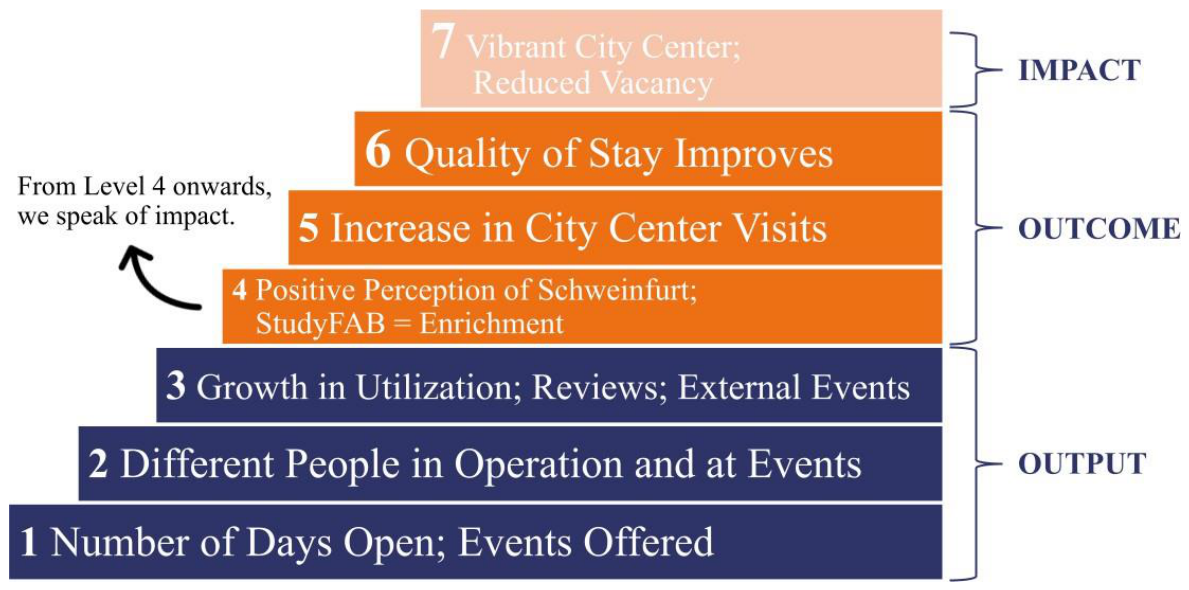
Figure 2.
NPS of StudyFAB during usage 2023/2024 (own illustration).
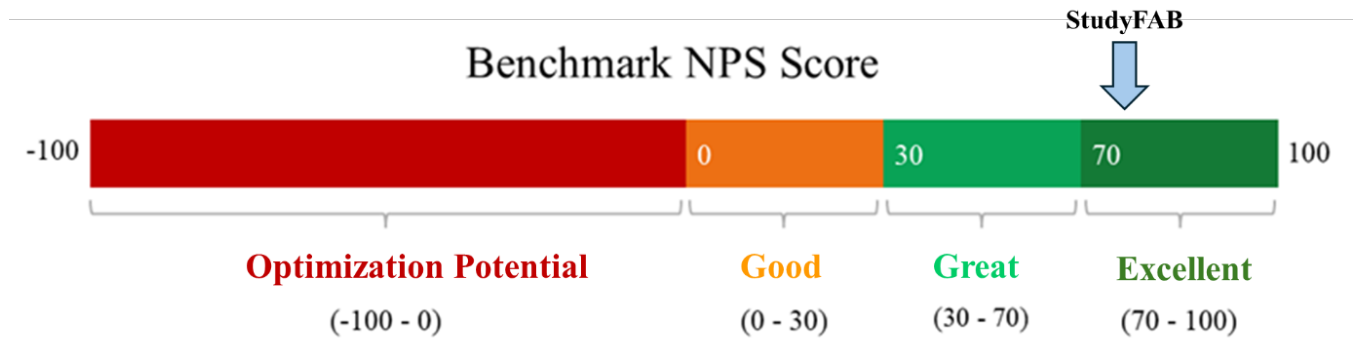

Table 1.
Demographic details of the three survey groups.
| Characteristic | Users | Aware-Users | Non-Users |
| Gender | |||
| Female | 63.6% | 70% | 46.7% |
| Male | 36.4% | 30% | 50% |
| Diverse | 0% | 0% | 3.3% |
| Average Age (Years) | 28.18 | 45.03 | 39.43 |
| Occupation | |||
| School Student | 33.3% | 6.7% | 10% |
| University Student | 18.2% | 10% | 10% |
| Employed | 30.3% | 53.3% | 63% |
| Self-Employed | 12.1% | 13.3% | 3.3% |
| Retired | 3% | 10% | 10% |
| Not Employed | 0% | 6.7% | 3.3% |
Table 2.
Frequency of pedestrians in Schweinfurt. Note: Only people carrying a mobile phone are recorded.
Table 2.
Frequency of pedestrians in Schweinfurt. Note: Only people carrying a mobile phone are recorded.
| Oct.–Feb. | Absolute Frequency | Median | Difference to 2023/2024 | Change Rate to 2023/2024 |
| 2018/2019 | 4.769.405 | 25.610 | 512.791 | 10.8% |
| 2019/2020 | 5.891.426 | 30.811 | -609.230 | -10.3% |
| 2020/2021 | 4.014.317 | 26.695 | 1.267.879 | 31.6% |
| 2021/2022 | 6.112.294 | 40.879 | -830.098 | -13.6% |
| 2022/2023 | 8.816.067 | 46.060 | -3.533.871 | -40.1% |
| 2023/2024 | 5.282.196 | 29.695 |
Table 3.
Comparison of None-Users, Aware Users and Users PSI Scales; N = 93; Response scale from 0 to 3.
Table 3.
Comparison of None-Users, Aware Users and Users PSI Scales; N = 93; Response scale from 0 to 3.
| Scales | Condition | M | SD | Item Count |
| Inclusiveness | Non-Users | 1.92 | 0.72 | 2 |
| Aware Users | 2.00 | 0.63 | 2 | |
| Users | 2.05 | 0.69 | 2 | |
| Meaningful Activities | Non-Users | 1.47 | 0.74 | 2 |
| Aware Users | 1.58 | 0.80 | 2 | |
| Users | 1.53 | 0.70 | 2 | |
| Comfort | Non-Users | 2.05 | 0.59 | 2 |
| Aware Users | 1.83 | 0.61 | 2 | |
| Users | 1.82 | 0.54 | 2 | |
| Safety | Non-Users | 2.37 | 0.60 | 2 |
| Aware Users | 2.37 | 0.56 | 2 | |
| Users | 2.02 | 0.61 | 2 | |
| Pleasurability | Non-Users | 1.55 | 0.89 | 2 |
| Aware Users | 1.45 | 0.85 | 2 | |
| Users | 1.61 | 0.77 | 2 |
M= Mean; SD = Standard Deviation.
Disclaimer/Publisher’s Note: The statements, opinions and data contained in all publications are solely those of the individual author(s) and contributor(s) and not of MDPI and/or the editor(s). MDPI and/or the editor(s) disclaim responsibility for any injury to people or property resulting from any ideas, methods, instructions or products referred to in the content. |
© 2026 by the authors. Licensee MDPI, Basel, Switzerland. This article is an open access article distributed under the terms and conditions of the Creative Commons Attribution (CC BY) license (http://creativecommons.org/licenses/by/4.0/).
Copyright: This open access article is published under a Creative Commons CC BY 4.0 license, which permit the free download, distribution, and reuse, provided that the author and preprint are cited in any reuse.


