
Submitted:
18 June 2026
Posted:
18 June 2026
You are already at the latest version
Abstract
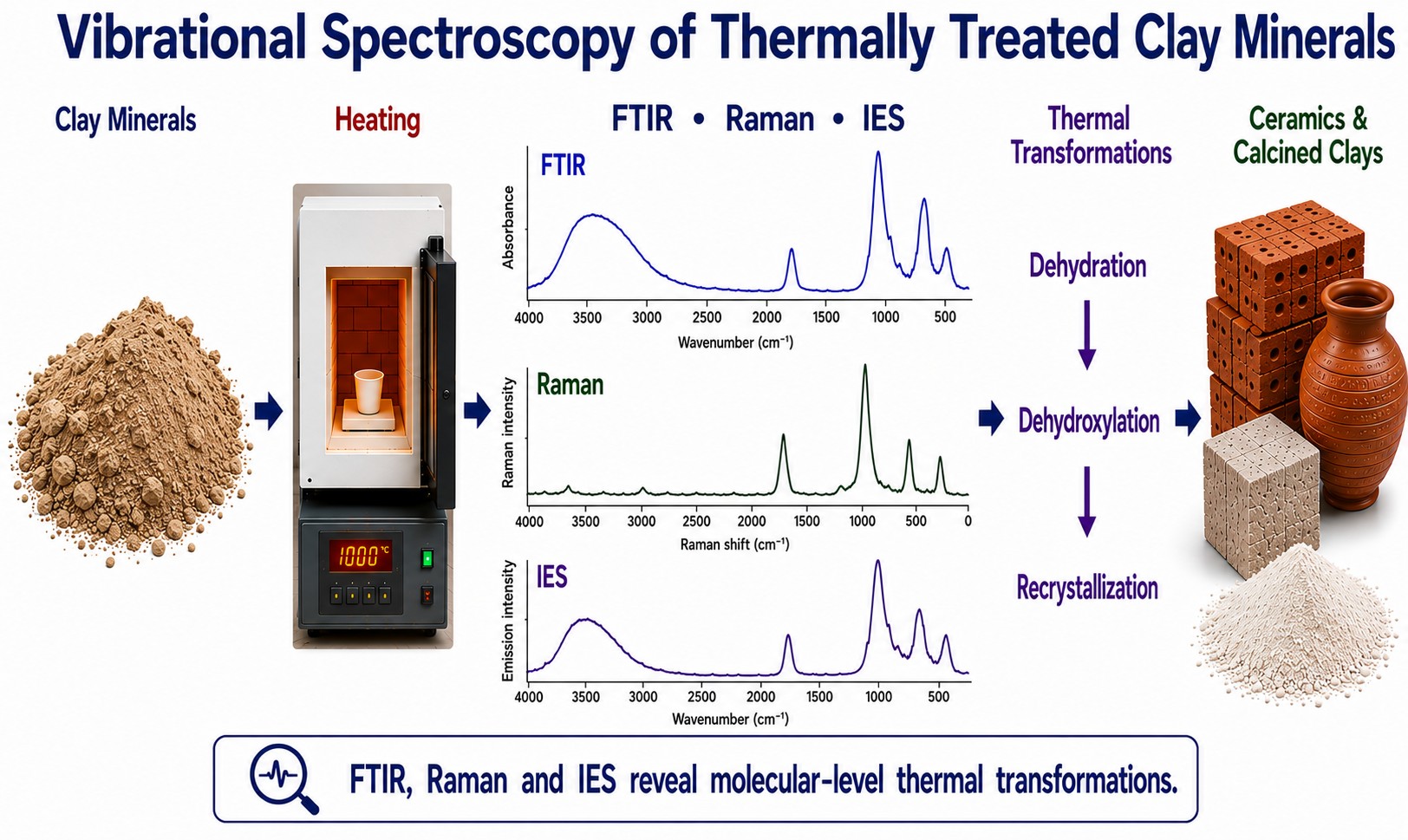
Thermal treatment of clay minerals induces a sequence of dehydration, dehydroxylation, and recrystallization reactions that control the properties of ceramic materials, calcined clays, and other high-temperature products. This review examines how vibrational spectroscopic techniques, particularly Fourier-transform infrared (FTIR), Raman, and infrared emission spectroscopy (IES), have advanced the molecular-level understanding of these transformations. Unlike conventional thermal analysis methods, these techniques directly monitor changes in hydroxyl groups, interlayer water, silicate frameworks, and newly formed phases during heating, providing real-time insight into reaction pathways and intermediate structures. The thermal behavior of major clay mineral groups, including kaolinite-group minerals, serpentines, smectites, illite, palygorskite, sepiolite, and mixed-layer clays, is compared in terms of their characteristic spectroscopic responses to increasing temperature. Particular attention is given to band shifts, intensity variations, band disappearance, and the appearance of new vibrational features associated with structural reorganization and phase development. The reviewed studies demonstrate that thermal stability is primarily governed by octahedral composition, cation–OH bond strength, vacancy distribution, and crystallinity. Integration of spectroscopic observations with complementary diffraction and thermal analysis data provides a unified framework for understanding clay mineral transformations and for optimizing thermal processing in ceramic manufacture and calcined clay applications.
Keywords:
thermal transformations
; clay minerals
; infrared emission spectroscopy (IES)
; Raman spectroscopy
; dehydration
; dehydroxylation
; calcined clays
; ceramic materials
; phase transformations
Copyright: This open access article is published under a Creative Commons CC BY 4.0 license, which permit the free download, distribution, and reuse, provided that the author and preprint are cited in any reuse.


