
Submitted:
07 July 2026
Posted:
08 July 2026
You are already at the latest version
Abstract
The creative combination of Gabriel horn (G-horn) hyperboloid with Finsler geometry opens a new door to black holes. G-horn with finite volume but infinite surface area can characterize the frame-dragging effects of strong gravitational fields. Finsler geometry is used to describe gravitational bounce depending on velocity direction. On the smooth and inextendible manifold representing by G-horn’s inner surface, the torsion determined by Cartan connection gives rise to centrifugal force and Coriolis force to counteract gravitational collapse. The Coriolis force serves as spin-flip trigger for gravitational bounce. The entering matters are choked at a certain inner-surface zone of horn’s neck as a novel non-Penrose’s trapped surfaces with global geodesic completeness, and forms a regular “hollow” core. Without any hidden or naked singularities, the mathematical singularity and the center of matter accumulating region need not coincide. By developing Cartan torsion-decomposing method, the competition mechanism between gravity of curvature and the “centrifugal force ± Coriolis force” of torsion is a elegant solution to those existing paradoxes or hypotheses such as black hole information loss, Penrose’s cosmic censorship, Weinberg’s asymptotically safe gravity. Further, the Schwarzschild, Kerr, Reissner‑Nordström black holes may be modified uniformly as this “singularity‑free” G-horn model.
Keywords:
Gabriel horn
; torsion‐induced reversal
; Finsler geometry
; black hole singularity
; geometrodynamics
; general relativity
; Cartan torsion
; geodesic completeness
Introduction
The seminal Einstein field equations only contain spacetime curvature, which perform perfectly in weak gravitational fields, but the Achilles’ heel of this theory lies in black hole singularities. As a mathematical prediction of general relativity, the singularity of black hole was first obtained by Schwarzschild [1], but it is not an observational fact so far. Whether singularities really exist remains an unsolved mystery although Penrose won the 2020 Nobel Prize in Physics for proving that “singularities are inevitable under general relativity” [2]. The existence and avoidance of singularities as one of the prominent themes have always fascinated researchers in this field [3,4,5,6,7,8,9,10]. In 2025, Bousso [3] extended the Penrose–Wall singularity theorem within the semiclassical gravity, claiming to rule out bounce phenomena inside black holes or any other forms of singularity avoidance mechanisms. However, as the renowned black hole scientist Kerr pointed out [4], there is no evidence that a singularity must necessarily exist inside a black hole. He provided a counterexample to the foundation of the singularity theorems of Penrose [2] and Hawking [6]: “light rays of finite affine length must end at a singularity.” As another example, the Reissner-Nordström radiating black holes may yield a solution containing a timelike singularity from the traditional point of view, but a recent paper [7] suggest a “regular core” rather than a singularity.
Schwarzschild’s solution of Einstein’s field equations in vacuum not only gives a puzzling concept of singularity but also a spherically symmetric horizon. As Penrose said [2], “most calculations of those gravitational collapse effects have adopted the simplifying assumption of spherical symmetry. “ As a consequence, black holes are frequently classified by the shape of their event horizons, which are spherical for non-rotating ones and oblate spheroidal for rotating (Kerr) ones. Notice that in the four-dimensional spacetime of physics, the geometric structure with a constant distance from the origin is not the closed hypersphere S3, but rather a hyperboloid or a light cone. Therefore, we believe that a black hole itself is neither point-like, nor spherical or ellipsoidal, but rather a strong gravitational field with hyperboloid spacetime structure.
Gabriel horn (G-horn) [11] is one of the simplest hyperboloids of revolution with z = 1/r. Surprisingly, its topological features of finite volume but infinite surface area are perfectly suit to characterize the frame-dragging effects in strong gravitational fields and the problem of matter accumulation in a black hole with geodesic completeness. Recall that Wheeler said [12], “Matter tells spacetime how to curve, and spacetime tells matter how to move.” As a kind of strong gravitational fields, black holes are essentially a problem of “geometrodynamics” proposed by Wheeler. With such a concrete topological structure of Gabriel’s horn, we can avoid those purely mathematical “patches” used in the modern black hole theories. For example, the quadratic gravity approach by adding a quadratic Ricci scalar, which can analyze the problem of singularity avoidance [13], but it suffers from a more confusing issue of the Weyl ghost field [14].
Research on Black hole is to develop the limiting theory of general relativity in extreme-strong gravitational fields. The authors believe that many questions in black hole theory [4,15,16] including violation of the third law of black hole mechanics [17] stem from the same root: whether Riemannian geometry is truly the only way to describe gravitational spacetime? From the perspective of geometrodynamics, if gravitational rebound is involved, it necessarily entails velocity direction-dependence of spacetime itself. Then, the more general Finsler geometry [18,19] might be better suited for describing the strong gravitational field of black holes.
Within the framework of Finsler geometric dynamics, this paper will propose the “G-horn” black hole model which can provide a unified “singularity-free” description of the Schwarzschild, Kerr, and Reissner-Nordström black holes with appropriate modifications. The creative combination of G-horn hyperboloid with Finsler geometry is a “chicken-and-egg” problem. Black hole as “hen” is a already-formed strong gravitational field characterized by a G-horn hyperbolic topology structure without any a singularity, rather than a point, a circle, a sphere, or an ellipsoid. Randers-Finsler geometry is used to analyze some “eggs” such as the gravitational bounce problem depending on velocity direction and the entered matters never approaching to a singularity. Not only considering the conventional consideration of spacetime curvature, we also incorporate torsion determined by Cartan connection and decompose out the Coriolis effect arising within a spin-adapted moving coordinate frame. Following this pure geometrodynamics idea, the gravitational bounce or some existing paradoxes are expected to be elegantly resolved based on the competition mechanism between gravity of curvature and the resultant forces of “centrifugal force ± Coriolis force” of torsion in G-horn model. Owing to the G-horn topology, an effective radius from the frame-dragging effect can capture the feature that the mathematical singularity need not coincide with the accumulating matter center. Accounting for the spin-flip trigger of Cartan torsion in gravitational bounce, we will demonstrate that the matter accumulation state inside black hole corresponds to a regular “hollow” core choked on the inner surface region of G-horn neck, rather than any hidden or naked physical singularity. On the “choked” inner surface zone, the damping oscillations during gravitational fluctuations ultimately degenerate into undamped simple harmonic rotation at the equilibrium position. Thus, the simple harmonic periodic motion of high-speed rotation is the final state of matter entering the horizon, which is the solution to the remnant of black hole and the storage carrier of information without loss.
Gabriel Horn Black Hole Model in Finsler Space
The classical Einstein field theory with only spacetime curvature gives the existence of singularities whereas the Einstein–Cartan theory with both curvature and torsion can predict the cessation of gravitational collapse and the absence of singularities. Notice that the two opposite conclusions in the framework of Riemannian geometry arise merely from incorporating more geometric properties of spacetime or not. In order to resolve the puzzles on black hole singularities and other paradoxes, we propose a novel black hole model with a “G-horn” topological structure in the framework of Finsler geometry—more general than Riemannian geometry. By developing a Cartan torsion-decomposing method, it is the first time to find the elegant competition mechanism between gravity of curvature and the resultant inertial forces of “centrifugal force ± Coriolis force” of torsion during gravitational collapse and bounce.
Finsler spacetime can encode the degrees of spatial curvature, torsion and also directional asymmetry which can effectively express the abrupt reversal properties of its velocity field during gravitational bounce. The Finsler–Randers metric function on the tangent bundle is employed,
where the first term on the right-hand side is the Riemann term and the second is the Finsler term. Obviously, the Finsler metric tensor depends on both position r and velocity y, which is an essential difference from Riemannian geometry. The first-order tensor as a vector potential is mathematically isomorphic to the magnetic vector potential in electromagnetism. According to the Gauss’s law, we can obtain its r-component as with spin charge and . Here k is the anisotropy factor and is the Einstein’s cosmological constant. After integration with respect to r, the generating line equation of the hyperboloid is obtained as . The torsion is derived from the Cartan connection within a spin-adapted moving coordinate frame. Together with the Finsler-Randers metric, the Cartan torsion determines the effective potential barrier Veff and the geometric potential barrier Vgeom of the G-horn, respectively.
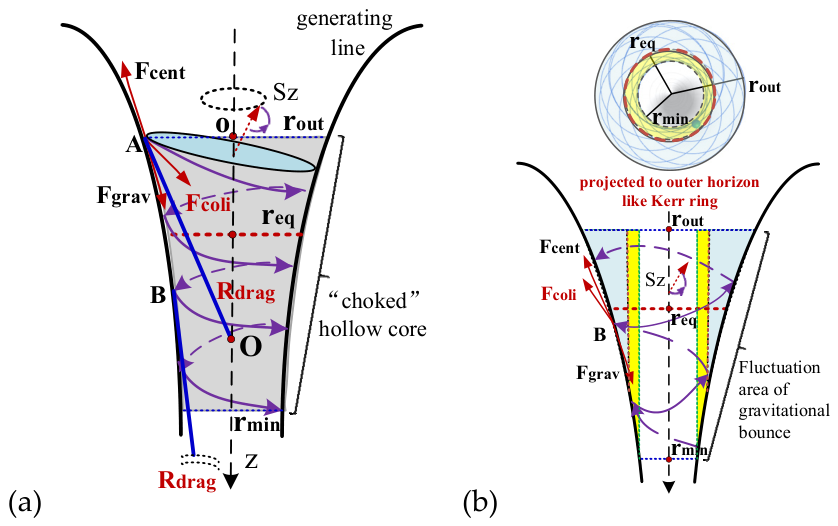
The elimination of physical singularities is verified by global geodesic completeness, which requires two conditions: 1) the background manifold is an inextendible smooth manifold; and 2) no geodesic terminates at any point or along the manifold’s extendible boundary. As shown in the supplementary materials, G-horn topological structure with finite volume and infinite inner surface area [11], can represent definitely an inextendible smooth background manifold, which constitutes a precondition for global geodesic completeness. The horizon represented by G-horn’s inner surface can continue to smoothly extend downward along the hyperbolic generating line of horn. Notice that the hyperbolic G-horn with r=kQs/z has never the properties of becoming a straight-line pipe or its two generating lines intersecting at a single point at the bottom. This implies that the curvature of any a point on G-horn’s inner surface is neither zero nor infinite, so is gravity. Its infinite inner area shows that throughout gravitational collapse, the G-horn spacetime can ensure the completeness of geodesics to avoid them terminating at any a singularity or boundary. If rotation existing, the torsion determined by Cartan connection can counteract gravitational collapse, and matter moving along with the horn’s inner area cannot fall into the indefinite bottom. Next, we show that matter entering this type of black holes seems being “choked” in the neck of the G-horn and accumulating as a regular “hollow” inner surface core in Figure 1.
Since this G-horn black hole model incorporates both orbital angular momentum and spin angular momentum within the Finslerian framework, it inevitably exhibits the frame-dragging effects such that geodesics characterize the gravitational collapse process through a helical precession pattern. The blue line AO denotes the frame-dragging radius Rdrag at point A, which consists of two dragging effects: 1) dragging of center o, corresponding to the intersection point O of the tangent line with the central axis z; 2) dragging of hyperbolic spiral phase, corresponding to the change rate of angular velocity. Analogous to the two-dimensional cylinder R×S1, which is generated by circles (S1) swept along the longitudinal direction (R) with their centers on the rotation axis, our dragged center O on the rotation axis represents the asymptotic center of the hyperbolic-rotation isometries, and the dragged radius Rdrag characterizes the rotation invariance of the pseudo-metric ds2. Crucially, neither O nor Rdrag is fixed. This constitutes the geometric rationale for abandoning spherical symmetry in the present work. During gravitational collapse, the dragged radius Rdrag becomes longer (see, ), and the dragged center O may go far away from the centers of the outer or inner horizon as r approaching to a mathematical singularity r=0. It is clear in Figure 1 that there is no real physical center point r=0 for the “hollow” accumulating core where geodesics can touch. In addition, the dragged center O also needs not coincide with the accumulating matter center at the equilibrium location req or the ones of outer horizon at rmax and inner horizon at rmin. Then, we establish the G-horn topological mappings of for non-rotation black holes, and with and for rotating black holes. If rotation is not considered (i.e., ), a spherical horizon of non-rotation black hole similar to the spherical Schwarzschild solution emerges because of if the horizon radius r is enough large. But, as r tends to zero (Schwarzschild singularity), the dragged center O with is dragged to the infinity point although the projected is always observed on the outer horizon. This differs from the Schwarzschild solution whose mathematical singularity r=0 and physical singularity have always coincided at the spherical center. The crucial mathematical conclusion can be obtained that due to the property of hyperbolic G-horn that its two generating lines never intersect at a single point at the bottom, the black center point of Schwarzschild solution is actually a tiny “hollow” physical point projected on the outer horizon. In other word, Schwarzschild solution also has no physical singular point.
In supplementary materials, we compute the affine parameter and the radial Ricci tensor for radially infalling null geodesics (e.g., photons dropping) with the four-velocity normalization condition . Due to both the Ricci tensor and the affine parameter diverge, a falling test particle needs infinite affine time to reach the mathematical singularity r=0. In other words, matter cannot reach the region of r=0 at all. Combined with the property of matter being choked at the horn neck, a novel mechanism of singularity avoidance can be established where the accumulating matter center is always prevented from hitting or touching the mathematical singularity r=0. Therefore, without any gravitational catastrophe, our G-horn model can be used to further discuss Weinberg’s asymptotically safe gravity [20]. Besides, if the aforementioned vectoral potential is replaced with the electromagnetic vectoral potential, our model can describe the Reissner-Nordström radiating black holes and obtain the result of Ref.[7]: a “regular core” rather than a singularity.
The Kerr black hole [5,21] is an exact solution describing rotating black holes and is one of the most valuable models in general relativity. As shown in Fig.(b), if the dynamical trajectory of a test particle entering the rotating G-horn space () is projected onto its outer horizon, the projected results look like the well-known Kerr ring. But, some essential differences of our model from Kerr ring include, 1) the traditional concept of only outer horizon with observability becomes the whole hollow accumulating core projected on outer horizon as indistinguishable superposition states; 2) there is only one event horizon in our model although the boundaries rmax and rmin may refer to the analogies of outer and inner horizons, respectively; 3) the projected results in the outer horizon as a “ring” seem like the geodesic away from the inner surface of the horn (incomplete), but all geodesics actually lie on the G-horn inner surface and always remain completeness throughout gravitational collapse. This shows an important fact that the hollow accumulating core in the G-horn model is regular because it is neither a Schwarzschild singularity point nor a Kerr singularity ring.
Next, we analyze whether matter falling into this black hole will undergo infinite descent, or will be “choked” at the hyperboloid of the G-horn neck, and what the corresponding “choked” state is. In Finsler geometry, the fundamental invariants include the Cartan tensor, which measures the change rate of metric along the fiber direction, and is essentially the velocity-dependent Finsler torsion. Based on the principle of least action. the dynamical trajectory of a test particle is derived from From its Euler–Lagrange equation,
where the antisymmetric term inside the parentheses on the right-hand side of Eq. (4) is from Cartan connection. By decomposed the Finsler tangent bundle into the horizontal and vertical subbundles, TM=HM⊕VM, the Cartan connection carries two kinds of independent torsions: the vertical Cartan torsion that gives the vertical component of Coriolis force as spin-flip trigger, and the translational torsion resulting in the geometric centrifugal force and the horizontal component of Coriolis force. As shown in supplementary materials, the covariances of decomposing gravity, centrifugal force and Coriolis force is preserved, and their vectoral sum as follows,
where with is the four-dimensional velocity of the selected observer with zero angular momentum, and is the Lorentz factor. The first term on the right hand side represents gravity. The term represents the geometric centrifugal force. The last item can be written as and defined as the geometric Coriolis force. Based on the geometric structure of the G-horn, it is obvious that the centrifugal force is always used to counteract gravitational collapse. But, for the Coriolis forces, we have with , and at the critical points of gravitational bounces such that the Coriolis force coupling with the radial acceleration changes its sign whereas keeps its sign unchanged at the critical points. This is because the Randers metric has a non-zero third-order derivative such that this Cartan torsion gives the impulsive torque source for the instantaneous “U-turn” of gravitational rebound, which we call as “torsion-induced reversal”. Although the existing literature [22] claims that Coriolis forces may inhibit gravitational collapse, the Coriolis force in our model actually enhances gravitational collapse when a particle falls downward. But, during the gravitational bounce process, the Coriolis force works as antagonist together with the centrifugal force to counteract gravitational collapse. That is, the positive and negative effects of Coriolis force resulting from a spin-adapted moving coordinate frame depend on the abrupt changes of velocity direction. This is the fundamental reason why the “gravitational bounce” problem must be investigated in Finsler space, whereas Riemannian space is not enough.
The reason for a testing particle trapped or “choked” at a certain zone on the inner surface of G-horn neck is a kind of pure geometrodynamic braking, which is related to the sign reversal of the Coriolis force during geodesic fluctuations. We next discuss the competition mechanism between gravity of curvature and the resultant inertial forces of “centrifugal force ± Coriolis force” of torsion in a Finsler spacetime. The dynamical trajectory of a test particle on this hyperboloid horn is expressed as,
where , and . Based on the potential well of gravity, we can obtain the rebound barrier for a test particle in the neck of the G-horn: the lowest location zmax , the highest location zmin and the equilibrium position zeq as follows:
In what follows, the spin flip of trajectory can be discussed by using the dominant term in the Hamiltonian,
where is the radial momentum, is the geometric vector potential, is the radial Pauli operator and is the coupling constant. At , we have,
where stands for a small perturbation. Also, the same procedures hold at zmin.
The creative combination of the G-horn’s hyperbolic structure with Finsler geometry opens a new door to some black hole paradoxes. Notice that the terms inside the braces {} of Eq.(6) represent damping. Interestingly, although angular momentum , we may obtain such that the damped oscillation of Eq.(6) can tune to a simple harmonic vibration near the equilibrium position req. This stabilization mechanism shows that during some energy dissipation processes such as black hole evaporation, not only have no singularities or naked singularities, but also indeed exist black hole remnants where energy is insufficient to radiate out of the outer horizon, continue to gravity collapse, or even bounce. During gravity bounce, although the geodesics fluctuates locally back and forth on the inner surface of the G-horn neck, the spacetime geometry of this black hole is with global geodesic completeness. The simple harmonic periodic trajectory of remnants as the ultimate storage carrier of information is an elegant resolution to the black hole information loss paradox. In summary, the G-horn model is an elegant solution as “geometrodynamic braking” of both gravity collapse to any hidden or naked singularities, and black hole to be completely annihilated itself.
Conclusions and Discussions
The G-horn hyperbolic base manifold combined with the Randers–Finsler space is a new theoretical framework for black hole analysis, while the proposed vertical-horizontal torsion decomposing method can establish a new “torsion-induced reversal” gravitational bounce mechanism. In addition, several new finding points include, 1) black center of Schwarzschild solution being a tiny “hollow” physical point but not a solid singularity; 2) new concept of trapped surface with global complete geodesic; 3) vertical Cartan torsion as the geometric source of gravitational bounce; 4) competition mechanism between gravity and “centrifugal force ± Coriolis force” during gravitational collapse.
Because the mathematical singularity and the accumulating matter center need not coincide each other, the hidden or naked singularities with some traditional mysteries do not exist. Thus, the Penrose’s cosmic censorship hypothesis [23] can be eliminated directionally. Due to the global geodesic completeness and the analytical solution to final state of matter in our G-horn model, the other existing paradoxes or hypotheses of black holes such as Hawking information loss paradox [9], Weinberg’s asymptotically safe gravity [20], remnant [24,25], fire-walls [16] are expected to be elegantly resolved based on the competition mechanism between gravity of curvature and the resultant force of “centrifugal force ± Coriolis force” of torsion in Finsler spacetime.
Note that the anisotropy of velocity direction is a property specific to the Randers-Finsler metric. Subject to the limitations of Riemannian geometry, the Einstein-Cartan theory used torsion can discuss the gravity collapse problem, but it still is difficult to address gravitational rebound problems because it cannot consider the anisotropy of velocity direction. Our method employs the Randers torsion of Finsler geometry to express the instantaneous changes of velocity direction called as “torsion-induced reversal”, as a basic route of returning to the spacetime essence of general relativity for the black hole problems. Then, the Coriolis force of decomposed vertical torsion is found as spin-flip trigger for gravity bounce.
In the Penrose singularity theorem, the existence of incomplete geodesic or singularity mainly depends on both the three energy conditions and the global trapped surface in spacetime. However, those existing regular black hole models [8] can show complete geodesics and absence of singularities when the strong energy conditions above are broken. With a distinguishable research route or starting point in this paper, the important discovery is that at the neck of the G-horn there exists a novel trapped surface but different from Penrose’s one above, where the entering geodesics do not terminate at any point or boundary. Because one can obtain analytically the geodesic completeness as simple harmonic oscillation solutions, the traditional singularity and other paradoxes of black holes might result from the Penrose’s concept of trapped surface.
The G-horn model provides a unified “singularity-free” interpretation for both Schwarzschild and Kerr black holes. In particular, we here correct the classical statement that the Schwarzschild solution is often referred to as a “static” black hole. From the perspective of geometric dynamics, gravity collapse toward r=0 is inherently a dynamical process. Strictly speaking, the Schwarzschild solution should be regarded as a non-rotating limit solution rather than a static state. Due to the asymptotic property of hyperbolic G-horn that its two generating lines never intersect at a single point at the bottom, the mathematical singularity at r=0 is dynamically dragged to an infinite proper distance. Consequently, for the non-rotating limit case, the black center of a Schwarzschild solution is not a solid singularity with divergent density, but rather a tiny “hollow” physical point projected onto the horizon. On the other hand, when rotation induced by Cartan torsion is considered, G-horn topology provides a matter accumulating mechanism that completely counteracts gravity collapse. From a non-rotating limit case to a rotating case, this torsion-induced rebound evolves the tiny hollow point into a macroscopic ring at rmin , thereby also preventing matter from hitting the mathematical singularity at r=0. Consequently, based on the G-horn topology, we arrive at a general prediction: no singularity exists in any strong gravitational field. The Schwarzschild and Kerr solutions are merely different topological manifestations of the same singularity-free hyperbolic structure with spin-polarization conditions or not.
Supplementary Materials
To ensure good readability within the limited text space, the detailed derivations of the formulas are provided in the supplementary materials for reference.
Funding
The Key Program of National Natural Science Foundation of China (No. 12332002).
Acknowledgments
The authors reported this work as the Keynote presentation in the third National Symposium on Analytical Mechanics for Young Scholars in China on April 18, 2026. We would like to thank Professor Li Li at Institute of Theoretical Physics in Chinese Academy of Sciences for useful revision suggestions.
Declaration of Competing Interest
The authors declare that they have no known competing financial interests or personal relationships that could have appeared to influence the work reported in this paper.
References
- K. Schwarzschild, On the Gravitational Field of a Mass Point According to Einstein’s Theory. Reprinted as Golden Oldie in Gen. Rel. Grav. 35, 951(2003). [CrossRef]
- R. Penrose, Gravitational collapse and space-time singularities. Phys. Rev. Lett. 14, 57–59 (1965). [CrossRef]
- R. Bousso, Robust Singularity Theorem. Phys. Rev. Lett.135, 011501 (2025). [CrossRef]
- R.P. Kerr, Do black holes have singularities? (2023). [CrossRef]
- R. P. Kerr, Gravitational field of a spinning mass as an example of a algebraically special metric, Phys. Rev. Lett. 11, 237 (1963). [CrossRef]
- S.W. Hawking, Black hole explosions? Nature. 248, 30 (1974). [CrossRef]
- F. D. Filippo. Radiating Black Holes in General Relativity Need Not Be Singular. Phys. Rev. Lett.136, 161402 (2026). [CrossRef]
- A. Borde. Regular black holes and topology change. Phys. Rev. D 55, 7615 (1997). [CrossRef]
- S. W. Hawking. Information loss in black holes. Phys. Rev. D 72, 084013 (2005). [CrossRef]
- D. Lehmkuhl. The prediction and interpretation of singularities and black holes: from Einstein and Schwarzschild to Penrose and Wheeler. Phys. Perspect. 27, 176 (2025). [CrossRef]
- Gabriel’s Horn. Brilliant.org. 2026. Available online: https://brilliant.org/wiki/gabriels-horn/.
- C.W. Misner, K.S. Thorne, J.A. Wheeler. Gravitation. Freeman and Company, New York, 1973.
- M. Asorey, F. Ezquerro, M. Pardina. Stability of cosmological singularity-free solutions in quadratic gravity. Phys. Rev. D. 111, 064020 (2025). [CrossRef]
- F. Sbisà. Classical and quantum ghosts. Eur. J. Phys. 36, 015009(2015).
- S. E. Gralla. Can black holes evaporate past extremality? Phys. Rev. D. 113, 064012 (2026). [CrossRef]
- A. Almheiri, D. Marolf, J. Polchinski and J. Sully, Black holes: complementarity or fire- walls? JHEP 1302, 062 (2013).
- J.R.V. Crump, M. Gadioux, H. S. Reall, J. E. Santos. Violation of the third law of black hole mechanics in vacuum gravity. Phys. Rev. Lett. 136, 171405 (2026). [CrossRef]
- Z. Nekouee, S.K. Narasimhamurthy, S.K.J. Pacif. Black hole solutions with constant Ricci scalar in a model of Finsler gravity. JCAP04, 2024, 061 (2024). [CrossRef]
- A. Triantafyllopoulos, S. Basilakos, E. Kapsabelis, et al. Schwarzschild-like solutions in Finsler–Randers gravity. Eur. Phys. J. C 80, 1200 (2020). [CrossRef]
- S. Weinberg, Critical Phenomena for Field Theorists, lectures at the 1976 Erice School of Subnuclear Physics, in Understanding the Fundamental Constituents of Matter, ed. A. Zichichi (Springer, 1976).
- E. Giorgi, S. Klainerman, J. Szeftel. Wave equations estimates and the nonlinear stability of slowly rotating Kerr black holes. Pure Appl. Math. Q. 20, 2865(2024). [CrossRef]
- L. E. Porter, S. M. R. Jeffreson, G. L. Bryan, L. Hernquist. What suppresses star formation in Bulge-dominated early-type galaxies? APJ1003, 97(2026). [CrossRef]
- R. Penrose. Gravitational collapse: the role of general relativity. Reprinted as Golden Oldie in Gen. Rel. Grav. 34, 1141(2002). [CrossRef]
- T. Banks, M. O’Loughlin, A. Strominger. Black hole remnants and the information puzzle. Phys. Rev. D 47, 4476 (1993). [CrossRef]
- R. Pincák, A. Pigazzini, M. Pudlák, E. Bartoš. Geometric origin of a stable black hole remnant from torsion in G2-manifold geometry. Gen. Rel. Grav. 58, 29(2026). [CrossRef]
Figure 1.
Hyperbolic G-horn black hole model with a hollow core “choked” in the neck, not a singularity.
Figure 1.
Hyperbolic G-horn black hole model with a hollow core “choked” in the neck, not a singularity.
Disclaimer/Publisher’s Note: The statements, opinions and data contained in all publications are solely those of the individual author(s) and contributor(s) and not of MDPI and/or the editor(s). MDPI and/or the editor(s) disclaim responsibility for any injury to people or property resulting from any ideas, methods, instructions or products referred to in the content. |
© 2026 by the authors. Licensee MDPI, Basel, Switzerland. This article is an open access article distributed under the terms and conditions of the Creative Commons Attribution (CC BY) license (http://creativecommons.org/licenses/by/4.0/).
Copyright: This open access article is published under a Creative Commons CC BY 4.0 license, which permit the free download, distribution, and reuse, provided that the author and preprint are cited in any reuse.


