
Submitted:
04 June 2026
Posted:
22 June 2026
You are already at the latest version
Abstract
Contemporary science has achieved extraordinary explanatory and predictive success, yet its ontological interpretation remains unsettled. This paper argues that one source of this instability lies in the inherited assumption that reality is fundamentally composed of independently existing substances. While this picture was historically fruitful, it has become increasingly difficult to sustain as a general ontology in light of three converging pressures: the relational and structural character of modern physics, the problem of emergence across levels of organization and the unresolved status of consciousness within physicalist metaphysics. The paper first examines why substance ontology has become unstable as an implicit background framework for scientific interpretation. It then argues that existing post-substance approaches, including ontic structural realism, relational interpretations of physics and process ontology, each capture important aspects of the required shift but often leave underdeveloped the question of how stable physical, organizational and experiential domains arise from a common ontological basis. This remaining difficulty is identified as a generative gap. In response, the paper argues that a post-substance ontology must be not only structural, relational or processual but generative. It must explain how effective objects stabilize, how levels of organization arise, how spacetime coordination becomes available, and how physical structure and conscious experience can belong to the same reality without reduction or fragmentation. The final section develops a generative-projection hypothesis that takes the derivative status of spacetime as its point of entry and introduces a generative domain, projection, invariance and compatibility as conceptual tools for articulating this ontological direction. The hypothesis is presented as preliminary rather than as a completed metaphysical system.
Keywords:
substance ontology
; generative relational ontology
; ontic structural realism
; emergence
; consciousness
; process ontology
; philosophy of science
; metaphysics
1. Introduction
Contemporary science has achieved extraordinary explanatory and predictive success, yet its ontological self-understanding remains deeply unsettled. Our best theories describe the world with increasing formal precision, but they do not thereby settle what kind of reality those structures are structures of. This gap is not merely an interpretive inconvenience. It suggests that scientific progress has, in important respects, outpaced ontological clarification.
This paper argues that contemporary science has outgrown the default assumption that reality is fundamentally composed of independently existing substances. That assumption was historically fruitful and helped stabilize the conceptual framework of classical science. But it has become increasingly difficult to sustain as a general ontological model in light of the relational character of modern physics, the instability of purely reductionist accounts of higher-level organization, and the unresolved status of consciousness within physicalist metaphysics.
The pressure is therefore threefold. In modern physics, fields, symmetries, relational states, and the possible emergence of spacetime sit uneasily with a picture centered on intrinsically self-subsisting objects. In debates on emergence, higher levels of organization resist straightforward reduction, while stronger notions of emergence threaten ontological discontinuity. In philosophy of mind, consciousness remains difficult to accommodate within an ontology that treats reality as exhaustively describable in third-person physical terms. Taken together, these pressures suggest not three isolated philosophical puzzles, but a deeper instability in the substance-based picture itself.
Recent post-substance approaches have captured important parts of this shift. Ontic structural realism emphasizes the primacy of structure over objects; relational approaches in physics stress interaction and dependence rather than intrinsic self-subsistence; process ontology replaces static entities with dynamic becoming. Each of these approaches marks a significant move beyond classical substance metaphysics. Yet they often stop short of a fully generative account of how stable physical, organizational, and experiential domains arise from a common ontological basis. In particular, they do not explain the conditions under which spacetime, objecthood, level-formation and experience become jointly intelligible rather than merely redescribed in non-substantialist terms.
The aim of this paper is therefore not to present a completed metaphysical system, but to argue that a generative relational ontology deserves to be taken seriously as a post-substance framework for contemporary science. The claim is modest in one sense and ambitious in another: modest, because it does not purport to derive a full theory of reality; ambitious, because it proposes that the most persistent tensions in contemporary science and metaphysics are not local anomalies but symptoms of an inherited ontological model reaching its limits. The present argument belongs to the broader project of scientific ontology and naturalized metaphysics, where metaphysical claims are constrained by, but not simply reducible to, scientific theory [7,22].
The constructive part of the paper develops a generative-projection hypothesis as one possible articulation of this ontological direction. The hypothesis begins from the thought that if spacetime is derivative rather than fundamental, then its ground cannot itself already presuppose full spacetime structure. This motivates the idea of a more basic generative domain from which effective physical and experiential domains may arise through projection, invariance and compatibility. The hypothesis is not presented as a completed theory, but as a structured proposal for making the generative requirement philosophically intelligible.
The paper is organized as follows. Section 2 examines why substance ontology, despite its historical strength, has become increasingly unstable as a general framework for contemporary science. Section 3 identifies three main sources of pressure on that framework: modern physics, the problem of emergence and the status of consciousness. Section 4 considers major post-substance alternatives, including structural, relational and process-based approaches, and argues that they remain incomplete in generative terms. Section 5 outlines the case for a generative relational ontology. Section 6 develops a generative-projection hypothesis by connecting the derivative status of spacetime with the notions of a generative domain, projection, invariance and compatibility. Section 7 concludes by clarifying the philosophical stakes of moving beyond substance ontology.
2. Why Substance Ontology Has Become Unstable
The claim of this section is not that contemporary science explicitly endorses a classical metaphysics of substances. The point is rather that much scientific interpretation continues to rely on a background picture in which reality is ultimately composed of entities that exist in their own right, bear properties, and enter into relations from that prior independence.1 This picture was historically powerful and for understandable reasons. It provided a clear image of what explanation was supposed to achieve: identify the basic units of reality, specify their intrinsic properties and describe the laws governing their interactions. Yet the very developments that have made contemporary science so successful increasingly strain this inherited model.
2.1. The Historical Strength of the Substance Picture
For much of the history of Western philosophy, substances were taken to be the primary occupants of reality. On the classical picture, change presupposed something that changes, properties presupposed a bearer of properties, and relations presupposed relata that are what they are independently of the relations they enter [1]. Early modern philosophy transformed this inheritance but preserved its core intuition. In the Cartesian framework, the physical world could be conceived as a domain of extended things whose essential features were analyzable apart from the experiencing subject [4]. The result was a powerful template for scientific explanation: objects are basic, properties are anchored in them and laws describe how those objects behave.
This template aligned naturally with the explanatory successes of classical mechanics. Matter could be represented as composed of discrete bodies with determinate positions, masses and trajectories in an independently given spatial framework. Even where theoretical idealization was required, the underlying image remained stable: reality consisted of basic entities whose interactions generated observable phenomena. The substance picture therefore did more than supply a metaphysical vocabulary. It helped stabilize a conception of objectivity, measurement, explanation and intelligibility that proved extraordinarily fruitful for the rise of modern science.
For that reason, substance ontology should not be dismissed as a simple philosophical mistake. Historically, it made possible a highly productive mode of inquiry. The present issue is different. A framework can be indispensable at one stage of scientific development and yet become increasingly strained when later theories no longer fit the assumptions that once made explanation seem transparent. The question, then, is not whether substance ontology once worked, but whether it still provides an adequate general model of what our best theories are about.
Contemporary substance ontologies have of course become more sophisticated than their classical predecessors [21]. The present argument is therefore not directed against a single historical doctrine, but against the broader assumption that ontological explanation ultimately bottoms out in independently existing bearers of properties.
2.2. Implicit Persistence in Contemporary Science
Contemporary science often presents itself as methodologically neutral with respect to ontology. In practice, ontological expectations do not disappear merely because they are no longer stated explicitly. They continue to operate in the background, shaping what counts as a satisfying interpretation of a theory. One sign of this persistence is the recurrent expectation that scientific understanding should ultimately terminate in an inventory of basic entities: particles, fields, spacetime structures or other candidates for the fundamental furniture of the world.
Even where the mathematics becomes highly abstract, the interpretive impulse often remains substance-oriented. The underlying question is still framed as: what are the fundamental things? This orientation is also visible in broader metaphysical habits. Reduction is frequently understood as the derivation of higher-level phenomena from more basic constituents, causal accounts are framed in terms of entities with intrinsic properties, and debates about realism tend to gravitate toward whatever it is that most fundamentally exists in its own right.
None of this requires an explicit commitment to a traditional doctrine of substance. What persists is a conceptual grammar in which ontological adequacy is measured by how well a theory can be mapped onto independently existing units. As a result, tensions within scientific theories are often interpreted as problems internal to the formalism rather than as possible signs that the underlying ontological model may itself be inadequate.
2.3. Why the Framework No Longer Holds
The instability of substance ontology does not consist in the disappearance of ordinary objects from experience or scientific practice. At the level of everyday life and many effective theories, object language remains indispensable. The issue is more fundamental: objects increasingly appear less as ultimate building blocks and more as stable outcomes of deeper structural and relational conditions. In that sense, what is under pressure is not the utility of object talk, but its claim to ontological primacy.
Modern physics provides the clearest source of this pressure. In quantum field theory, what appears as a particle is more naturally understood as an excitation within a field-theoretic structure than as an independently existing entity [12]. In relativity, apparently basic features such as simultaneity and spatial separation depend on relational structure rather than reflecting intrinsic properties of self-subsisting objects. In quantum theory more generally, the description of states and measurement outcomes resists assimilation to a picture of intrinsically determinate objects carrying their properties independently of context [9]. Developments in quantum gravity further suggest that spacetime itself may be emergent rather than fundamental [11,17].
The difficulty is not confined to physics. If substance ontology is treated as fundamental, higher levels of organization become difficult to understand without forcing a choice between two unsatisfactory options: reductive collapse, in which higher-level novelty becomes merely epistemic or ontological discontinuity, in which higher levels acquire a status insufficiently integrated with their basis [2,6]. Likewise, if reality is exhaustively built out of objective substances and their physical properties, it becomes unclear how subjective experience is to be situated within the same world without reduction, duplication or exclusion [3,8,16].
What has changed, then, is not simply that science has discovered new entities. Rather, the very form of scientific description has shifted. Our best theories increasingly emphasize structures, dependencies, symmetry relations, context-sensitivity and dynamical organization over self-subsisting bearers of intrinsic properties [20]. The burden of proof has therefore begun to reverse. The question is no longer why one should move beyond substance ontology, but why it should still be regarded as the overarching framework for contemporary science.
This does not yet establish what should replace it. It does, however, establish a philosophical task. If substance ontology has become historically inherited rather than theoretically secured, then contemporary metaphysics must ask what kind of framework can preserve the explanatory achievements of science without reimposing a picture of reality that science itself increasingly destabilizes. The next section develops this diagnosis by examining three sources of pressure on the substance picture: modern physics, the problem of emergence and the status of consciousness.
3. Three Pressures on Substance Ontology
The instability of substance ontology becomes clearest when several contemporary debates are considered together. Each of them can, of course, be treated as a local problem internal to a particular field. The interpretation of quantum theory belongs to philosophy of physics; the status of emergence belongs to philosophy of science and metaphysics; the problem of consciousness belongs to philosophy of mind. Yet these debates also exhibit a shared pattern. In each case, the substance-based picture struggles to explain how relational, higher-level or experiential phenomena can be accommodated within a world ultimately composed of independently existing bearers of properties.
The convergence matters because all three debates shift attention away from independently existing entities and toward the conditions under which stable domains become possible. Modern physics raises questions about whether objects and spacetime should be treated as fundamental. Emergence raises the question of how levels of organization arise without reduction or rupture. Consciousness raises the question of how experience belongs to the same reality as physical structure. Taken together, these pressures suggest that the problem is not merely to replace one set of entities with another, but to understand how stable, structured and experiential domains are generated at all.
3.1. Modern Physics and the Destabilization of Independent Objects
Classical substance ontology was naturally aligned with the image of the world suggested by early modern mechanics. Matter could be represented as composed of discrete bodies possessing determinate properties and moving through an independently given spatial framework. Explanation consisted in describing how such bodies interact according to lawful regularities. This picture remains useful in many domains, but it no longer fits comfortably with the conceptual structure of modern physics.
Quantum field theory is one important source of this shift. In the field-theoretic picture, particles are not most naturally understood as independently existing substances. They are better understood as excitations or stable patterns within underlying fields [12]. Their identity and behavior are inseparable from the mathematical and dynamical structures within which they occur. This does not eliminate objects from physical description, but it changes their ontological status. What appears as an object at one level may be a stabilized configuration of a more fundamental field-theoretic structure. The ontology of quantum field theory has itself become a contested issue, with several accounts questioning whether fundamental physics should be interpreted in terms of thing-like constituents at all [12,26].
A similar pressure arises from relativity theory. Relativity undermines the idea that spatial and temporal properties are simply intrinsic features of independently existing objects. Simultaneity, temporal duration and spatial separation depend on the relational structure of spacetime and on the frame-relative conditions under which measurements are made. Gravitation, in general relativity, is not treated as an external force acting between substances in a fixed arena, but as the dynamical geometry of spacetime itself. The result is a conception of physical reality in which relational structure plays a constitutive role.
Quantum theory adds a further complication. The measurement problem, the status of the wave function and the contextual character of quantum states all resist straightforward assimilation to an ontology of intrinsically determinate objects. Relational interpretations of quantum mechanics explicitly emphasize that physical properties may be defined only relative to other systems rather than as absolute attributes possessed independently of relational context [9]. Even if one does not accept such interpretations, the fact that quantum theory permits and motivates them shows how far contemporary physics has moved from the classical substance picture.
Finally, research in quantum gravity and emergent spacetime suggests that spacetime itself may not be fundamental. Several approaches in contemporary physics explore the possibility that spacetime geometry arises from deeper, non-spatiotemporal structures [10,11,17,18]. If spacetime is emergent rather than basic, then the traditional image of substances located in a pre-given spatial and temporal container becomes even less secure. The question is no longer merely what the fundamental objects are, but whether objecthood, location and spacetime structure are themselves derivative.
The lesson is not that physics has already established a single anti-substance ontology. It has not. The lesson is more modest but still significant: the conceptual direction of modern physics increasingly favors structures, fields, relations, symmetries and dynamical organization over self-subsisting objects as ontological primitives. Moreover, if spacetime itself is derivative rather than fundamental, then the classical image of substances located within a primitive spacetime arena is destabilized at its deepest level. Substance ontology can still describe effective levels of reality, but it no longer appears well suited to function as the most general metaphysical interpretation of physical theory.
3.2. Emergence and the Problem of Ontological Continuity
A second pressure arises from the problem of emergence. Modern science describes nature across multiple levels of organization: elementary physical processes, chemical structures, biological systems, cognitive agents and social forms of organization. Each level exhibits relatively stable patterns and regularities, yet these levels are not simply independent domains. They appear connected, layered and mutually constrained.
Substance ontology tends to interpret this hierarchy through the lens of composition. Higher-level phenomena are understood as built out of lower-level entities, and the task of explanation is to show how the former arise from the latter. This approach has been enormously successful in many domains. Chemical structures can often be explained in terms of atomic and molecular interactions and many biological processes can be analyzed through their underlying physical and biochemical mechanisms.
However, the general relation between levels remains philosophically difficult. If emergence is understood weakly, then higher-level phenomena are in principle derivable from lower-level facts, even if such derivations are computationally or epistemically inaccessible in practice [2]. On this view, the novelty of higher-level organization is real at the descriptive level, but it does not introduce anything ontologically fundamental. The risk is that higher-level phenomena become ontologically secondary in a way that fails to account for their apparent autonomy, stability and explanatory indispensability.
If emergence is understood strongly, by contrast, then higher-level phenomena possess features or causal powers that cannot be derived from the lower-level base [6]. This gives higher-level organization a more robust ontological status, but it creates a different problem. Strong emergence can appear to introduce discontinuities into the structure of reality. If genuinely new principles arise at higher levels, then it becomes unclear how ontological unity is preserved across the levels of nature.
More recent work has further clarified the distinction between weak and strong forms of metaphysical emergence and the question of whether higher-level entities and properties are genuinely dependent yet ontologically distinctive [24].
The problem is therefore not simply whether emergence is real. The deeper issue is how an ontology can explain the appearance of multiple levels without either collapsing them into the lowest level or fragmenting reality into separate domains. Reductionism preserves continuity but risks eliminating novelty. Strong emergence preserves novelty but risks losing continuity. Substance ontology, insofar as it begins with discrete entities and builds upward through composition, has difficulty explaining how organized levels arise as genuinely new yet ontologically continuous forms.
This difficulty is especially important because contemporary science increasingly deals with systems whose properties are relational, organizational and dynamic. Biological organisms, cognitive systems and ecological networks are not adequately understood merely as aggregates of independently existing parts. Their identity and behavior depend on patterns of organization, feedback, regulation and interaction. Such systems suggest that ontological explanation must include not only what entities exist, but how stable forms of organization are generated and maintained across levels.
The emergence problem therefore points beyond a purely substance-based ontology. It suggests the need for a framework in which levels of organization are neither reducible illusions nor isolated additions to reality, but structured developments within a continuous ontological process. This does not yet specify what such a framework must be, but it indicates why a generative conception of ontology becomes attractive.
3.3. Consciousness and the Limits of Physicalist Closure
The third pressure concerns consciousness. The problem of consciousness is not merely another instance of explanatory complexity. It concerns the status of subjective experience itself. Physical science describes the world in third-person terms: structures, processes, causal relations and measurable properties. Conscious experience, by contrast, is given from a first-person point of view. There is something it is like to undergo an experience, and this phenomenal character is not obviously captured by an inventory of objective physical properties [8]. The target here is not physicalism as such, but a substance-oriented version of physicalist metaphysics in which reality is assumed to be exhaustively describable in objective third-person terms [27].
This difficulty is often formulated as the hard problem of consciousness [3]. The issue is not simply how the brain performs cognitive functions, processes information or regulates behavior. Those are difficult scientific problems, but they are not the central ontological problem. The deeper question is why physical processes should be accompanied by subjective experience at all. Even a complete description of neural mechanisms may seem to leave open the question of why such mechanisms are experienced from within.
Substance-based physicalism faces a particular version of this difficulty. If the basic constituents of reality are physical substances or physical entities characterized entirely in objective terms, then consciousness must either be reduced to such entities, added as a further property, or treated as somehow derivative without being fully explained. Each option is problematic. Reduction risks eliminating precisely what is distinctive about experience. Addition risks dualism or unexplained psychophysical connection. Derivation risks becoming a label rather than an explanation unless the ontological relation between physical structure and experience is clarified.
This pressure has motivated a range of alternatives in contemporary philosophy of mind, including forms of panpsychism, neutral monism and other non-reductive approaches [16]. The details of these positions need not be assessed here. What matters for the present argument is that consciousness continues to expose a limitation in ontologies that begin from purely objective substances and then attempt to recover subjectivity as a late product. If subjectivity is real, then an adequate ontology must explain how it belongs to the same world as physical structure without reducing one side to the other.
The problem is sharpened by the relation between subject and object. Classical substance ontology tends to model the world as a domain of objects standing over against a subject who represents them. This separation has methodological value, especially for scientific objectivity. But as an ontological picture it leaves the subject strangely displaced. The experiencing subject is part of the world, yet it cannot be treated simply as one more object among objects without losing the first-person character of experience.
The consciousness problem therefore converges with the previous two pressures. Like modern physics, it challenges the idea that reality is adequately captured by independently existing objects with intrinsic properties. Like emergence, it raises the question of how apparently novel domains can arise without ontological discontinuity. But consciousness adds a further demand: the ontology must account not only for structure and organization, but also for experience.
Taken together, these three pressures suggest that the inadequacy of substance ontology is not a local defect. Modern physics destabilizes the primacy of independent objects and raises the possibility that spacetime itself is derivative. Emergence destabilizes the reduction of organized levels to lower-level constituents. Consciousness destabilizes the closure of ontology under third-person physical description. Each pressure can be debated separately, but their convergence is philosophically significant. They point toward the need for an ontology in which relations, structures, levels and experience are not secondary additions to substances, but central features of reality’s basic organization.
The next section considers existing post-substance alternatives that have attempted to respond to this situation. Ontic structural realism, relational approaches and process ontology each mark an important departure from the substance picture. Yet, as will be argued, they often leave unresolved the generative question that these pressures jointly raise: how stable physical, organizational and experiential domains arise from a common ontological basis.
4. Existing Post-Substance Alternatives and Their Limits
The pressures identified in the previous section have not gone unnoticed. Much of contemporary metaphysics and philosophy of science can be understood as an attempt to move beyond the classical picture of reality as composed of independently existing substances. Structural, relational and process-based approaches each challenge the idea that objects with intrinsic properties are the ultimate constituents of reality. In different ways, they replace the primacy of substances with the primacy of structure, relation, interaction or becoming.
These approaches are important for the present argument because they show that the instability of substance ontology is not merely a speculative worry. It is already reflected in several major developments within contemporary philosophy. At the same time, the question raised by the preceding section is not only whether objects should be replaced by structures, relations or processes as ontological primitives. The deeper question is how stable physical, organizational and experiential domains arise at all.
The point is not that ontic structural realism, relational interpretations of physics or process ontology fail on their own terms. Each addresses specific problems with considerable philosophical force. Rather, the claim is that they often leave open a further generative question: how a post-substance ontology can explain the emergence of spacetime coordination, effective objecthood, levels of organization and conscious experience from a common ontological basis without reverting to substances or fragmenting reality into disconnected domains.
4.1. Ontic Structural Realism
Ontic structural realism (OSR) is one of the most influential contemporary alternatives to substance ontology. Structural realism originally emerged as a way of preserving realism about the structural content of science despite radical changes in theoretical ontology [20,23]. Its central claim is that structure, rather than objects, should be regarded as ontologically fundamental. The entities described by scientific theories are not independently existing substances that later enter into relations; rather, they are understood as nodes, positions or relata within a prior structural order [5,7]. On this view, what science reveals most reliably is not the intrinsic nature of individual objects, but the structure of the world.
The motivation for structural realism is especially clear in the philosophy of physics. The history of science suggests that theoretical entities are often replaced or reinterpreted, while certain structural relations are preserved across theory change. Electromagnetic theory, relativity, quantum mechanics and quantum field theory each revise earlier conceptions of the basic entities of nature, yet they also preserve formal and relational structures that continue to support successful explanation and prediction. Structural realism therefore proposes that realism should be directed primarily toward these structures rather than toward the objects posited by any particular theory [20].
Ontic structural realism radicalizes this point. It does not merely claim that structure is what we know most securely; it claims that structure is what is ontologically fundamental. This is a decisive departure from substance ontology. If objects exist only as positions within a structure, then their identity is not prior to the relations in which they stand. The classical order of explanation is reversed: relations do not depend on independently constituted objects; objects depend on relational structure.
This reversal is attractive in light of modern physics. Quantum theory raises difficulties for the idea that particles possess determinate individuality independently of the structures in which they occur. Relativity theory emphasizes invariant structure over absolute spatial and temporal properties. Quantum field theory suggests that apparent particles are better understood in terms of field-theoretic and symmetry structures than as self-subsisting units. For these reasons, ontic structural realism has become a natural philosophical ally of post-substance interpretations of physics [14].
However, OSR also faces a limitation that is important for the present argument. If structure is fundamental, one must still ask what kind of structure it is and how it gives rise to the stable phenomena described by science. In some formulations, structure risks becoming a primitive replacement for substance: instead of saying that objects are fundamental, one says that structure is fundamental, but the generative relation between fundamental structure and the world of concrete phenomena remains underdeveloped.
This is not a decisive objection to OSR as a research program. It is rather a question about what must be added if OSR is to function as a general ontology. A structural ontology must explain not only that objects are structurally dependent, but also how relatively stable objects, systems and levels of organization emerge from structural conditions. Without such an account, OSR may successfully criticize substance ontology while leaving unclear how the differentiated world is generated.
A second limitation concerns the relation between physical structure and experience. OSR is primarily motivated by issues in the philosophy of physics and scientific realism. It provides a powerful way to interpret the structural character of physical theory, but it does not by itself explain how conscious experience belongs to the same ontological order. If the ontology is fundamentally structural, then the relation between structure and experience remains a further problem. Either experience must be reduced to structural relations, added to them or explained as arising from them. Each option requires more than the claim that structure is fundamental.
For the purposes of this paper, OSR should therefore be understood as an important but incomplete step beyond substance ontology. It correctly challenges the primacy of independently existing objects. It also captures the structural character of much contemporary physics. But unless supplemented by a generative account, it does not yet fully explain how stable physical systems, higher-level organization and experiential reality arise from a common basis.
4.2. Relational Approaches
A second family of post-substance views emphasizes relations rather than structures in the abstract. Relational approaches challenge the idea that the properties of things are intrinsic and self-contained. Instead, they propose that physical properties, identities or states depend on relations between systems. What something is cannot be fully specified independently of how it stands in relation to other things.
Relational interpretations of quantum mechanics provide a clear example of this shift. In Rovelli’s relational quantum mechanics, the state of a system is not an absolute property possessed by that system independently of all observers or interacting systems. Rather, states are relative to other systems [9]. Measurement does not reveal a pre-existing absolute state; it establishes or registers a relation between systems. This approach directly challenges the substance-based expectation that physical systems possess determinate intrinsic properties independently of relational context.
The broader philosophical significance of relational approaches is that they make dependence ontologically central. On a substance-based picture, relations are often secondary: first there are things, and then those things stand in relations. On a relational picture, this order is reversed or at least destabilized. Relations are not external additions to independently constituted entities; they are partly constitutive of what the entities are. Such a view is naturally suited to areas of contemporary physics in which context, interaction and frame-dependence play a central role.
Relationalism also has a longer metaphysical significance. Debates about space, time and motion have long involved the question of whether relations between things are more fundamental than an independently existing spatial or temporal container. In contemporary form, relationalism extends this concern beyond space and time to the ontology of physical systems more generally [19]. It suggests that reality may be better understood as a network of interdependencies than as a collection of self-contained units.
Yet relational approaches also face an important limitation. They often remain local in scope. Relational quantum mechanics, for example, is an interpretation of quantum theory. It provides a way of understanding quantum states and measurements, but it does not by itself provide a general ontology of levels, emergence or consciousness. Similarly, relationalism about space, time or physical properties does not automatically explain how the different domains of reality arise from a common ground.
There is also a question about the ontological status of relations themselves. If relations are fundamental, are they simply taken as primitive? If so, relational ontology may risk repeating the difficulty faced by substance ontology, only with relations replacing substances as the unexplained base. The problem is not that relations cannot be fundamental. The problem is that a general ontology must explain how relational dependence becomes organized into stable structures, effective objects, levels of complexity and experiential forms.
This point is especially important because relations alone do not necessarily provide a principle of generation. A network of relations may describe how entities or events depend on one another, but the existence of such a network does not yet explain why certain stable domains arise, why particular invariances persist, or how subjectivity appears within the same order. A relational ontology must therefore be supplemented by an account of how relations become structured, stabilized and differentiated.
For the present argument, relational approaches mark a crucial transition away from the substance picture. They show that the independence of objects can no longer be assumed as a default ontological principle. However, like structural approaches, they leave open the question of generativity. They tell us that reality is relational, but not yet how relationality produces the organized domains that science and experience disclose.
4.3. Process Ontology
A third alternative to substance ontology is process ontology. Whereas structural realism emphasizes structure and relational approaches emphasize dependence, process ontology emphasizes becoming, activity and event-like occurrence. Its central claim is that reality is not fundamentally composed of static things, but of processes, events or acts of becoming. Objects are not the basic units of reality; they are stabilized patterns within ongoing process.
Whitehead’s process metaphysics is the most important classical source for this orientation. In Process and Reality, Whitehead rejects the idea that the world is fundamentally made of enduring substances and instead develops an ontology centered on actual occasions, relational becoming and the creative advance of nature [13]. Reality is not a collection of self-identical things that persist unchanged through time. It is a dynamic order in which what exists comes into being through relations, transitions and processes of realization. Process ontology has also been developed as a broader metaphysical orientation in which processes rather than enduring things are taken to be ontologically basic [25].
The appeal of process ontology is clear in light of the problems discussed above. If the world is fundamentally dynamic rather than static, then change need not be explained as something that happens to already constituted substances. If entities are stabilized processes rather than primitive substances, then the persistence of objects can be interpreted as an achievement of organization rather than as an ontological given. This makes process ontology especially attractive for understanding biological systems, complex organization and perhaps consciousness.
Process ontology also offers a natural way to resist the sharp separation between subject and object. In a processual framework, experience need not be treated as an inexplicable addition to a world of inert matter. Whitehead’s own metaphysics, for example, treats experiential or prehensive dimensions as woven into the basic structure of becoming. One need not accept Whitehead’s full system in order to recognize the importance of this move. Process thought shows that an ontology can be dynamic, relational and hospitable to experience without beginning from the dualism of mind and matter.
Nevertheless, process ontology faces its own difficulty in the present context. Its metaphysical vision is often more general than the structures described by contemporary science. It provides a powerful conceptual alternative to substance metaphysics, but it does not always specify how the mathematical structures of modern physics arise from processual becoming. In other words, it may offer a broad metaphysical orientation without giving a sufficiently precise account of the relation between process and the formal structures of physical theory.
This is particularly important if the aim is to develop an ontology adequate to contemporary science rather than a general metaphysical worldview. An adequate post-substance ontology must not only say that reality is processual; it must also explain how stable physical laws, invariant structures, effective objects and levels of organization emerge from process. Without that connection, process ontology risks remaining too distant from the specific explanatory forms of physics, cosmology and the sciences of complex systems.
There is also a question about differentiation. If reality is fundamentally process, how do distinct domains arise within it? How are physical structure, biological organization and conscious experience differentiated without becoming separate substances or unrelated domains? Process ontology is well placed to pose this question, but it does not always provide a sufficiently determinate answer. It requires a further account of how process generates stable and differentiated forms.
For these reasons, process ontology is highly relevant but not sufficient by itself for the argument of this paper. It captures the dynamic character that a post-substance ontology requires. It also opens a path toward integrating experience more deeply into ontology. But unless it is connected to a generative account of structural stabilization and domain formation, it remains incomplete as a framework for contemporary science.
4.4. The Remaining Generative Gap
The three approaches considered above all mark significant advances beyond substance ontology. Ontic structural realism displaces objects in favor of structure. Relational approaches displace intrinsic self-subsistence in favor of dependence and interaction. Process ontology displaces static being in favor of becoming. Each therefore captures something important about the post-substance direction of contemporary metaphysics.
Yet they also reveal a common limitation. Structure, relation and process are not automatically generative explanations. To say that reality is structural does not yet explain how structures become concrete, stable and differentiated. To say that reality is relational does not yet explain how relations organize into persistent domains. To say that reality is processual does not yet explain how processes generate invariant forms, effective objects or conscious subjects. In each case, the central question remains: how does a non-substance ontology account for the emergence of the world as structured, stable, layered and experiential?
This question is especially important because the inadequacy of substance ontology does not only concern the ontology of physics. If the problem were limited to quantum theory or spacetime, a local structural or relational interpretation might be sufficient. But the pressures discussed in the previous section are broader. They concern spacetime coordination, effective objecthood, the continuity of levels and the status of consciousness. A general post-substance ontology must therefore do more than reinterpret the basic entities of physics. It must explain how multiple domains of reality become jointly intelligible without reduction or fragmentation.
The generative gap can be formulated as follows. Contemporary post-substance approaches often identify what should replace substances at the fundamental level: structures, relations, events, processes or networks. But they do not always explain how these fundamentals generate the stable domains that appear in science and experience. The problem is not merely to choose a different ontological primitive. The deeper task is to explain how spacetime, physical structure, organized levels and experiential perspective can arise from a common basis.
This is where the need for a generative relational ontology emerges. Such an ontology would preserve the central insights of existing post-substance approaches while adding a further requirement: the fundamental level must not only be non-substantialist, but generative. It must be capable of accounting for the formation of stable physical structures, the derivative availability of spacetime coordination, the continuity of levels of organization, and the relation between structural description and conscious experience.
The next section develops this requirement more explicitly. It asks what a post-substance ontology must explain if it is to provide not merely an alternative vocabulary, but a coherent framework for contemporary science and metaphysics.
5. Toward a Generative Relational Ontology
This section outlines the idea of a generative relational ontology. The proposal is not yet a completed metaphysical system. It is a philosophical direction motivated by the convergence of the pressures discussed above. Its central claim is that a post-substance ontology must treat relational organization not merely as a descriptive feature of the world, but as generative of the stable forms, levels and experiential domains that appear within it.
A generative relational ontology therefore differs from a merely relational or structural description. It does not only claim that things stand in relations, or that structures are more fundamental than objects. It asks how relations become organized into persistent patterns, how such patterns stabilize into effective objects and domains, how spacetime coordination becomes possible, and how subjectivity can arise within the same ontological order rather than being added to it from outside. The task is to preserve the insights of structural, relational and processual approaches while making explicit the generative function that remains underdeveloped in each.
5.1. What a Post-Substance Ontology Must Explain
A post-substance ontology must first explain why objects appear at all. The aim is not to deny the reality of ordinary objects, scientific systems or stable entities. Such objects are indispensable within experience and within many successful scientific theories. The question is whether they should be treated as ontological primitives. If contemporary physics and metaphysics increasingly point toward structures, fields, relations and processes, then objects should be understood as stabilized outcomes within a more basic order rather than as the ultimate building blocks of reality.
This requires a shift in explanatory priority. On a substance-based picture, one begins with entities and explains relations, structures and processes in terms of their interactions. On a generative relational picture, one begins with relational organization and explains entities as stable configurations within it. Objects are not eliminated; they are reinterpreted. Their apparent independence becomes a local and effective feature, not a fundamental metaphysical fact.
The first requirement for such an ontology is therefore an account of stabilization. If reality is fundamentally relational, why do stable structures appear? Why do particles, fields, organisms and subjects exhibit persistence across time? A purely relational ontology may say that entities depend on relations, but a generative ontology must explain how certain relational configurations become sufficiently stable to function as entities within a domain. Stability is not assumed; it is generated.
A second requirement is an account of level formation. Contemporary science does not describe a flat world. It describes multiple levels of organization: physical, chemical, biological, cognitive and social. These levels are not simply independent domains, but neither are they easily collapsed into one another. The emergence debate shows that reduction and discontinuity are both unsatisfactory if taken as exhaustive options [2,6]. A post-substance ontology must therefore explain how higher-level forms arise as genuine organizations without severing their continuity with more basic structures.
A third requirement is an account of structural intelligibility and spacetime coordination. Scientific theories do not merely list entities; they reveal invariances, dependencies, symmetries, transformations and constraints. This is one reason why structural realism has been so influential in the philosophy of physics [5,7,20]. A post-substance ontology must preserve this insight. It must explain why structure is so central to scientific understanding and why the world is accessible through formal and relational descriptions. But it must also explain the conditions under which a shared spacetime framework becomes available at all. If spacetime is not simply assumed as a primitive arena, then localization, metric comparability, causal ordering and inter-observer consistency become phenomena requiring ontological explanation rather than background assumptions.
A fourth requirement is an account of experience. Consciousness cannot be treated as an optional addition to ontology. It is part of what any complete account of reality must make intelligible. The problem is not only that consciousness is difficult to explain scientifically, but that subjective experience appears to resist reduction to objective third-person description [3,8]. A post-substance ontology must therefore clarify how experience belongs to the same world as physical structure without reducing one to the other or splitting reality into two unrelated domains.
Finally, a post-substance ontology must explain the relation between subject and object. The classical division between an observing subject and an observed world has methodological value, but it is ontologically incomplete. The subject is not outside reality; it is part of the same order it seeks to understand. Yet the subject cannot simply be treated as one object among others without losing the distinctive character of experience. A more adequate ontology must therefore explain how subject and object arise as differentiated poles within a common ontological structure.
Taken together, these requirements suggest that the alternative to substance ontology cannot simply be another inventory of fundamental items. The problem is not to replace substances with structures, relations, processes, events or experiences as new primitives. The deeper task is to explain how the world becomes differentiated into stable physical, organizational and experiential domains. This is the sense in which a post-substance ontology must be generative.
5.2. Common Ground for Physical and Experiential Domains
The most difficult requirement concerns the relation between physical structure and conscious experience. A substance-based physicalism typically begins with a world of objective physical entities and then attempts to explain how consciousness arises from them. The difficulty, as the hard problem of consciousness makes clear, is that no description of objective structure seems by itself to entail the existence of subjective experience [3]. If consciousness is real, then it cannot be treated merely as a late anomaly in an otherwise fully objective ontology.
One response is to reduce experience to physical structure. But this risks leaving out precisely what needs to be explained: the first-person character of experience. Another response is to treat consciousness as fundamental in its own right, as in some forms of panpsychism or related non-reductive approaches [16]. This avoids eliminative reduction, but it raises further questions about how experiential and physical aspects are related. A third response is dualism, but this threatens to divide reality into distinct ontological domains whose connection remains obscure.
A generative relational ontology seeks a different route. It does not begin by assuming that either physical structure or conscious experience is ontologically primary in isolation. Instead, it asks whether both might arise as differentiated manifestations of a deeper relational order. On this view, the physical and the experiential are not two substances, nor is one simply reducible to the other. They are distinct modes of manifestation within a common ontological ground.
This proposal should be understood carefully. It does not mean that every physical process is conscious, nor that consciousness can be read directly into the formalism of physics. Nor does it mean that empirical neuroscience is bypassed. Rather, the point is metaphysical: if physical structure and subjective experience are both real, then an adequate ontology must make their co-belonging intelligible at the most basic level. The relation between them cannot be left as an unexplained bridge between two otherwise separate domains.
The idea of a common ground also helps reframe the subject–object relation. In ordinary experience and scientific practice, subject and object appear as distinct poles. The subject observes, measures, interprets and experiences; the object is observed, measured, described and explained. Substance ontology tends to absolutize this distinction by treating the objective world as the primary domain of reality and the subject as either external to it or derivative from it. A generative relational ontology instead treats subject and object as co-arising differentiations within a shared order.
This does not collapse the distinction between subject and object. Scientific objectivity depends on maintaining a disciplined distinction between what is observed and the conditions of observation. The point is not to dissolve that distinction, but to deny that it is ontologically ultimate. The distinction between subject and object may be fundamental for experience and inquiry without being fundamental in the deepest metaphysical sense.
Such a view also clarifies why the problem of consciousness is not merely a local problem for philosophy of mind. Consciousness reveals a limit in any ontology that treats third-person structure as the whole of reality. If reality is described only in objective terms, then subjectivity appears either as an unexplained surplus or as something to be eliminated. A generative relational ontology avoids this by requiring that the ground of reality be capable of giving rise to both structural and experiential manifestation.
This requirement connects the consciousness problem with the structural character of physics. Modern physics increasingly describes reality in terms of relations and structures. Philosophy of mind, in turn, shows that structural description alone does not exhaust reality as experienced. A generative relational ontology must therefore explain not only why structure is central to the physical world, but also how experience can belong to the same underlying order as structure.
The common ground proposed here is therefore not a new substance behind matter and mind. It is not a hidden object or a further entity added to the world. It is the relational-generative order from which the distinction between physical structure and experiential perspective can arise. Whether such an order can be formulated in a precise and fruitful way is a further question. The present point is that without something like this common ground, the relation between physical and experiential domains remains philosophically unstable.
5.3. Generativity, Continuity and Ontological Economy
A generative relational ontology must in addition satisfy three closely connected constraints: generativity, continuity and ontological economy. These constraints are not independent doctrines. They express what is required if a post-substance ontology is to avoid both reductive collapse and metaphysical proliferation.
The first constraint is generativity. The ontology must explain how stable forms arise from a more basic relational order. This includes effective objects, physical systems, levels of organization and experiential perspectives. Generativity is therefore not merely causal production in the ordinary sense. It is the ontological capacity of a more basic order to differentiate into stable domains with their own patterns, regularities and forms of intelligibility.
This point distinguishes a generative relational ontology from a merely descriptive relationalism. A network of relations may describe how elements depend on one another, but it does not automatically explain why certain structures persist, why certain levels form, or why certain patterns become lawlike within a domain. A generative ontology must account for stabilization, differentiation and persistence. It must explain why the world is not only relational, but organized.
The second constraint is continuity. If multiple domains arise from a common relational ground, they must not be ontologically disconnected. Physical structure, biological organization and conscious experience may differ profoundly, but they should not require separate metaphysical foundations. Otherwise the ontology would merely reproduce the fragmentation it sought to overcome. Continuity requires that higher levels and experiential domains arise through transformations or differentiations of the same underlying order rather than through external addition.
Continuity does not imply flattening. To say that levels are continuous is not to say that they are identical. A biological organism is not simply a particle aggregate described at a larger scale; a conscious subject is not simply a collection of neural events under another name. Levels may possess relative autonomy, distinctive explanatory principles and emergent organization. The point is that this autonomy must be compatible with ontological unity. A generative relational ontology must therefore explain how difference arises without rupture.
The third constraint is ontological economy. An adequate ontology should not multiply independent principles beyond necessity. If matter, life, consciousness, subjectivity and structure are each assigned separate foundations, the result is metaphysical fragmentation. Conversely, if all are reduced to one privileged domain, the result is explanatory impoverishment. Ontological economy requires a common basis that is sufficiently minimal to avoid proliferation, yet sufficiently generative to account for the diversity of reality.
This is where the generative relational approach differs from both reductive physicalism and dualistic or pluralistic alternatives. Reductive physicalism is economical, but often at the cost of failing to account for experience and higher-level organization. Dualism and strong pluralism preserve difference, but often at the cost of losing unity. A generative relational ontology seeks to preserve both: one underlying order, multiple differentiated domains.
The same balance is required in relation to contemporary physics. A post-substance ontology should not impose an external metaphysical scheme on science. It must remain responsive to the structural and relational character of physical theory. At the same time, it should not simply identify ontology with current formalism. Scientific formalisms describe stable structures within particular domains, but the metaphysical question concerns why such domains and structures arise at all. The ontology must therefore be close enough to science to respect its achievements, but general enough to address the conditions under which scientific domains become intelligible.
In this sense, a generative relational ontology is best understood as a framework of constraints rather than a finished doctrine. It says that any adequate successor to substance ontology must explain stabilization, level formation, subject–object differentiation and the relation between structure and experience. It must do so without reducing all domains to one level, without positing unexplained discontinuities and without multiplying independent ontological bases.
The resulting view can be summarized as follows. Reality should not be conceived primarily as a collection of independently existing substances. Nor should it be conceived merely as an abstract structure, a network of relations, or an indefinite process without an account of stabilization. It should be understood, at least as a serious philosophical possibility, as a generative relational order from which effective objects, physical structures, higher levels and experiential perspectives arise.
This conclusion prepares the way for the next section. If a generative relational ontology is philosophically motivated, one may ask how such a view might begin to be stated more concretely. The following section develops a generative-projection hypothesis whose point of entry is the derivative status of spacetime. The hypothesis is not presented as a completed theory, but as a structured way of articulating how a generative domain, projection, invariance and compatibility might explain the emergence of stable physical and experiential domains.
6. A Generative-Projection Hypothesis
The preceding sections have argued that substance ontology is no longer sufficient as a general framework for contemporary science, and that existing post-substance alternatives remain incomplete unless supplemented by a generative account. The next step is therefore to ask how such an account might begin to be articulated. This section develops a generative-projection hypothesis as one possible formulation of the generative relational direction defended in the paper.
The hypothesis begins from the derivative status of spacetime. If spacetime is not fundamental, then its ground cannot itself already presuppose full spacetime structure. This motivates the idea of a non-spatiotemporal generative domain from which effective physical and experiential domains arise. The proposal remains preliminary, but it provides a concrete way of organizing the requirements identified in Section 5.1.
6.1. The Basic Architecture
The point of entry for the generative-projection hypothesis is the ontological status of spacetime. If spacetime is derivative rather than fundamental, then its ontological ground cannot itself already presuppose full spacetime structure. A derivative spacetime regime cannot be grounded in another structure that is simply spacetime under a different name. This gives reason to posit an ontologically prior basis that is not itself exhaustively articulated in spatiotemporal terms.
The present hypothesis is continuous with work in quantum gravity and philosophy of physics in which spacetime is treated as emergent, derivative or functionally recoverable rather than primitive [10,11,17,28,29,30]. It does not attempt to adjudicate between these approaches or to provide a competing physical mechanism. Rather, it draws a broader ontological consequence: if spacetime is derivative, then the conditions under which stable physical, organizational and experiential domains arise require a more general generative account.
This prior basis is here called the generative domain. The term should be understood carefully. It does not denote a hidden region within spacetime, an additional physical medium beneath ordinary interactions, or a more microscopic spacetime container. Nor does it name a completed physical theory. It names whatever ontologically prior basis is required if spacetime, physical regimes and possibly experiential perspectives are not fundamental but derivative. Its priority is therefore ontological rather than spatial or temporal. If time itself belongs to the derivative spacetime regime, then what is prior to spacetime need not be earlier than spacetime. It is prior in the order of dependence.
The hypothesis introduces three basic notions for articulating the relation between the generative domain and derivative domains: projection, invariance and compatibility. These notions are not intended as additions to established physical theory. They are ontological notions that describe how effective regimes may arise, stabilize and coexist.
Projection names the relation by which an effective domain arises from the generative domain through selective preservation of structure. Projection is not merely approximation, representation or coarse-graining within an already given spacetime background. It is the ontological relation by which a derivative regime becomes available at all. A projection does not reproduce the full content of the generative domain. Rather, it preserves certain structural features while leaving others unapparent, inaccessible or irrelevant within the effective regime.
Invariance names the stabilizing condition of a projection. If an effective regime is to be intelligible, something must remain stable across admissible transformations, restrictions, descriptions or changes of scale. In physics, such invariances may appear as symmetries, conservation principles, field structures, causal relations, metric relations or quantum-relational constraints. In the present context, however, invariance is used in a broader ontological sense: it refers to whatever preserved structure allows a projected domain to remain stable enough to support comparison, coordination and lawlike description.
Compatibility names the condition under which distinct invariant-preserving projections can coexist within a common order. Compatibility is stronger than mere logical non-contradiction but weaker than full reduction. Two regimes may be compatible even where neither is derivable from the other. This is especially important for the present hypothesis, because it does not assume that all effective domains must be reduced to one privileged domain. It instead asks under what conditions different projected regimes can remain mutually coordinated without collapsing into identity or fragmenting into unrelated worlds.
A further distinction is needed at this point. Projection, invariance and compatibility explain how effective regimes arise, stabilize and coexist. But they do not yet specify how different invariant-preserving regimes bear on the availability of spacetime. For that purpose, the hypothesis also distinguishes functional roles. Functional roles concern whether a regime helps make a shared spacetime framework available, presupposes it once available, enriches it, limits it or locally re-stabilizes it. This distinction does not add a fourth basic ontological principle alongside projection, invariance and compatibility. It clarifies how those notions are realized differently across derivative domains.
The case of spacetime illustrates this more specific point. Within the physical domain, some effective regimes play a structural–coordinative role: they make available the conditions under which a shared spacetime framework can arise at all. A shared spacetime regime becomes available only where several coordinative conditions can be jointly maintained: localization, metric comparability, causal ordering and inter-observer consistency. Localization makes it possible to distinguish here from there; metric comparability makes distances, durations and magnitudes comparable; causal ordering makes events intelligible as ordered in dependence; inter-observer consistency makes different perspectives coordinable within one shared framework. Spacetime is not any one of these conditions taken in isolation. It is the stable coordinative structure that becomes available when these conditions remain mutually compatible.
This means that spacetime is not the primitive arena in which projection occurs. It is itself a derivative coordinative achievement. Where the relevant invariances are jointly compatible, a shared spacetime description is available. Where compatibility is partial, unstable or restricted, spacetime-based concepts may remain locally useful while losing unrestricted applicability. The hypothesis therefore explains why spacetime can be real, robust and indispensable in many domains without being ontologically fundamental. The same point can be expressed schematically in Figure 1.
The figure is meant to show that the physical domain should not be understood as a single undifferentiated projection. Rather, it is organized through several invariance-preserving effective regimes or subprojections. Some regimes play a structural–coordinative role by making shared localization, metric comparison, causal ordering and inter-observer consistency available. Others play dynamical roles by stabilizing lawful evolution, symmetries and conservation principles. Others again play statistical–thermodynamic, quantum–relational or observational roles. These regimes are not separate worlds, but neither are they simply reducible to one another. They coexist insofar as their preserved invariances remain compatible.
On this interpretation, the physical world is not a collection of substances located within an already fundamental spacetime arena. It is a compatibility-structured domain in which different invariant-preserving projections jointly sustain the conditions under which spacetime, physical systems and lawful dynamics become available. Particles, fields and macroscopic objects are therefore real within the projected physical domain, but their reality is effective and derivative rather than ontologically primitive.
This also clarifies how the present hypothesis approaches consciousness. If spacetime and the physical domain are themselves derivative projections from a more basic generative order, then the physical domain need not be treated as the sole ontological ground from which consciousness must somehow be extracted. The hypothesis instead allows physical structure and experiential perspective to be understood as distinct but related modes of manifestation arising from the same generative domain. Referring to Figure 1, an experiential domain should then be understood analogously as an effective regime grounded in the same generative domain. The physical projection is characterized by public structure, invariance, lawfulness and spacetime coordination. The experiential projection is characterized by perspective, qualitative presence and first-person givenness. Their difference is therefore real, but their difference need not entail ontological dualism, since both are grounded in the same generative order.
This does not mean that consciousness is derived from spacetime, nor that it is simply another physical object within spacetime. Nor does it imply that every physical process is conscious. The claim is more limited: once the physical domain is no longer treated as ontologically fundamental, the relation between physical structure and conscious experience can be reframed. Consciousness need not be added to a completed physical ontology from the outside. It can instead be treated as a complementary mode of manifestation whose relation to physical organization must be understood through compatibility within a common generative order.
The same distinction helps situate other levels of organization. Chemistry, biology, cognition and social organization are not treated here as fundamental projection sectors in the same sense as the basic physical and experiential domains. They are better understood, at least at this stage of the hypothesis, as temporally and evolutionarily emerging levels within the already stabilized physical–experiential order. They depend on the fundamental projected structures that make spacetime, physical systems and experiential perspectives available, but their detailed formation requires further work beyond the scope of the present paper.
The basic architecture of the generative-projection hypothesis can therefore be summarized in four claims. First, spacetime is not fundamental but arises as a compatibility-induced coordinative structure. Second, its derivative status motivates positing a non-spatiotemporal generative domain. Third, effective domains arise from that generative domain through projection, invariance and compatibility. Fourth, physical structure and conscious experience may be understood as differentiated manifestations of the same generative order rather than as separate substances or as one domain reducible to the other.
The hypothesis remains schematic, but it is not merely a metaphor. It provides a disciplined ontological vocabulary for explaining how stable domains can arise without treating substances as primitive. The next subsection considers why this architecture is philosophically relevant by showing how it responds to the requirements identified in Section 5.1.
6.2. Response to the Requirements of a Post-Substance Ontology
The philosophical relevance of the generative-projection hypothesis lies in the fact that it offers a structured response to the requirements identified in Section 5.1. The present hypothesis does not fully satisfy all of these requirements in a completed theoretical form. It does, however, show how they may be addressed within a single ontological architecture.
The first requirement concerns the appearance of objects. The hypothesis does not deny the reality of objects, nor does it treat object-language as merely conventional. It instead changes the level at which objecthood is understood. Objects are not fundamental substances but stable configurations within projected domains. A particle, a field excitation, a biological organism or a macroscopic body can be real within the regime in which it appears, while still being ontologically derivative. Its apparent independence depends on preserved invariances that allow it to be identified, compared, tracked and integrated into lawful description.
This provides an account of stabilization. In a substance ontology, stability is often taken for granted: substances persist and bear properties. In the present hypothesis, stability is something to be explained. An effective object or system becomes stable when a projected pattern preserves enough invariant structure to remain coherent across admissible transformations, interactions and descriptive contexts. Stability is therefore not an unexplained primitive. It is the result of projection constrained by invariance and compatibility.
This point is especially clear in the case of spacetime. A shared spacetime framework becomes available only where localization, metric comparability, causal ordering and inter-observer consistency can be jointly maintained. Spacetime is therefore not the container in which stable objects first appear. It is itself one of the stabilizing coordinative achievements that makes objecthood, localization and public comparison possible. Once spacetime is understood in this way, objects located in spacetime can be treated as real without being treated as ontologically ultimate.
The second requirement concerns level formation. Contemporary science describes a world organized across multiple levels: physical, chemical, biological, cognitive and social. The present hypothesis does not yet provide a detailed theory of each such level. It does, however, provide a general ontological pattern for understanding how levels can arise without either reductive collapse or ontological discontinuity. Levels form when projected structures acquire stable patterns of organization that are not reducible to isolated lower-level units, yet remain compatible with the more basic regimes on which they depend.
This allows a distinction between fundamental projected domains and later organizational levels. The physical and experiential domains are treated here as basic modes of manifestation arising from a common generative domain. By contrast, chemistry, biology, cognition and social organization are better understood, at least at this stage of the hypothesis, as temporally and evolutionarily emerging levels within the already stabilized physical–experiential order. They are not independent ontological realms, but neither are they merely arbitrary aggregates. They are organized formations whose stability depends on deeper projected structures while introducing their own effective regularities.
The third requirement concerns structural intelligibility. Scientific theories do not merely list things. They disclose patterns, invariances, symmetries, transformations and constraints. The generative-projection hypothesis explains why such features are central. If effective domains arise through projection, then what becomes scientifically intelligible is precisely what remains stable under projection. Mathematical structures, conservation principles, symmetry relations and lawful regularities can therefore be understood as expressions of preserved invariance within projected regimes.
This does not mean that ontology should be identified with current mathematical formalism. The hypothesis is not a form of simple mathematical realism. Rather, it suggests that the success of formal scientific description reflects the fact that projected domains are stabilized by invariant structure. Scientific formalisms capture some of these invariances within particular regimes, but the ontological question concerns why such invariant regimes arise at all. In this respect, the hypothesis preserves an important insight of structural realism while adding a generative interpretation: structure is not only what science tracks; it is also what makes stable domains possible.
The fourth requirement concerns experience. If the physical domain is treated as ontologically fundamental, consciousness appears as something that must somehow be derived from an already complete objective order. That is the source of much of the difficulty discussed earlier. The present hypothesis changes this starting point. If spacetime and the physical domain are themselves derivative projections from a more basic generative domain, then consciousness need not be added to a completed physical ontology from the outside. It can instead be approached as a distinct mode of manifestation arising from the same underlying order.
This does not solve the hard problem of consciousness by stipulation. It does not derive phenomenal experience from physical law, nor does it claim that every physical process is conscious. Its contribution is more limited but still important: it removes the assumption that physical structure, understood in third-person spacetime terms, is the sole ontological ground from which experience must be extracted. Physical structure and experiential perspective may instead be understood as different but compatible manifestations of a common generative basis. The task then becomes to explain their compatibility and differentiation, rather than to reduce one to the other. On this view, the brain need not be treated simply as the producer of consciousness, but may instead be understood as a highly organized locus within the physical domain at which experiential and physical structure are brought into a stable relation.
The fifth requirement concerns the subject–object relation. In ordinary experience and scientific practice, subject and object appear as distinct poles. The object is what is publicly describable, measurable and locatable within a shared world. The subject is the perspective from which experience, meaning and givenness occur. Substance ontology tends either to externalize the subject from the objective world or to reduce it to one object among others. The present hypothesis offers a different interpretation: subject and object are differentiated poles within a common projected order.
On this view, objectivity is not abandoned. It is reinterpreted. A shared objective world becomes possible where experiential perspectives are coordinated through stable spacetime and observational structures. Inter-observer consistency is therefore not merely a technical condition for measurement; it is also part of the ontological explanation of how a public object-domain can arise in relation to multiple perspectives. The object-pole is characterized by public structure, invariance and shared coordinability. The subject-pole is characterized by first-person givenness, perspective and qualitative presence. Their distinction is real, but it need not be ontologically ultimate.
This also clarifies why the hypothesis is not dualistic. It does not posit matter and consciousness as two independent substances. Nor does it reduce consciousness to matter or matter to consciousness. Instead, it treats physical structure and experiential perspective as differentiated manifestations of a common generative domain. Their relation is therefore one of compatibility within a shared ontological source rather than external interaction between separate realms.
The sixth requirement concerns ontological economy. A post-substance ontology should not multiply independent foundations for matter, life, mind, subjectivity and structure. At the same time, it should not achieve economy by reducing all domains to one privileged level. The generative-projection hypothesis aims to preserve both unity and differentiation. It posits one generative domain, but allows for multiple projected regimes and levels of organization. Unity is secured by common ontological dependence; differentiation is secured by distinct invariance-preserving projections and by the compatibility conditions that allow them to coexist.
The result is not a finished metaphysical theory, but a disciplined way of organizing the requirements of such a theory. Effective objects are explained as stabilized projected configurations. Levels of organization are explained as differentiated formations within an already structured order. Scientific intelligibility is explained through preserved invariance. Conscious experience is situated as a distinct mode of manifestation rather than as an inexplicable late addition. The subject–object relation is interpreted as a differentiated structure within a common ontological field. Ontological economy is preserved by avoiding both reduction to a single physical level and proliferation into independent metaphysical domains.
The significance of the hypothesis is therefore not that it solves every problem raised in the preceding sections. It does not. Its significance is that it shows how those problems might be addressed together. The instability of substance ontology in physics, the problem of emergence and the status of consciousness are not treated as separate puzzles requiring separate metaphysical additions. They are interpreted as different expressions of the same underlying issue: the need to understand how stable, structured, layered and experiential domains arise from a common generative basis.
For this reason, the hypothesis should be understood as a constructive articulation of the generative relational direction defended in this paper. It is stronger than a mere metaphor, because it specifies the roles of projection, invariance, compatibility and spacetime coordination. But it is weaker than a completed system, because it does not yet derive the relevant structures formally or explain all levels of organization in detail. The next subsection therefore clarifies the limits of the present proposal.
6.3. Limits of the Present Hypothesis
The generative-projection hypothesis developed in this section should be understood as a preliminary ontological proposal, not as a completed theory. Its role is to make the broader generative relational direction more concrete by introducing a conceptual architecture organized around the notions of a generative domain, projection, invariance and compatibility. Several limitations must therefore be made explicit.
First, the hypothesis does not derive the laws of physics. It suggests that physical laws may be interpreted as expressions of stability and compatibility within projected domains, but it does not provide a formal derivation of specific equations, constants or dynamical principles. Nor does it offer a theory of quantum gravity or a technical reconstruction of spacetime from a completed underlying formalism. Its claim is ontological and metatheoretical rather than dynamical.
Second, the hypothesis does not provide a complete positive ontology of the generative domain. The argument is that if spacetime is derivative, then its ontological ground cannot already presuppose full spacetime structure. This motivates positing an ontologically prior, non-spatiotemporal basis. But the internal character of that basis remains open. It may ultimately be best understood in structural, relational, processual, formal or other terms. The present paper does not decide that question. It uses the idea of a generative domain to mark a required order of dependence, not to offer a finished inventory of what is most fundamental.
Third, the notions of projection, invariance and compatibility are not yet formalized. They function here as ontological concepts rather than as a completed mathematical theory. A more developed account would need to specify criteria for projection, clarify what counts as preserved invariant structure, and explain more precisely how compatibility obtains between distinct effective regimes. The present hypothesis therefore provides a disciplined conceptual vocabulary, but not yet a full formal apparatus.
Fourth, the hypothesis does not solve the hard problem of consciousness. It offers a metaphysical setting in which physical structure and conscious experience may be understood as differentiated manifestations of a common generative basis, but it does not explain in detail how neural organization is related to phenomenal consciousness. Its contribution is therefore not a complete theory of mind. It is a reframing of the ontological conditions under which such a theory might become possible.
Fifth, the hypothesis does not replace established scientific theories. Quantum mechanics, relativity, quantum field theory, neuroscience, and the sciences of complex systems remain indispensable within their respective domains. The present proposal is not a rival empirical theory at the same level. It is an ontological interpretation of how such domains might be situated within a more general post-substance framework.
Sixth, the hypothesis does not yet provide a detailed theory of all organizational levels. It distinguishes the basic projected domains of physical structure and experiential perspective from later levels such as chemistry, biology, cognition and social organization. But the detailed emergence of these later levels has not been worked out here. They are treated as temporally and evolutionarily developing formations within an already stabilized physical–experiential order, not as fully analyzed projection sectors.
Seventh, the hypothesis does not claim that existing post-substance approaches are mistaken. On the contrary, it depends on many of their insights. From structural realism it takes the thought that structure may be more fundamental than objects. From relational approaches it takes the idea that dependence and interaction are ontologically basic. From process ontology it takes the idea that reality is dynamic rather than static. Its distinctive contribution is to combine these insights under the additional requirement of generativity.
Finally, the hypothesis should not be treated as the conclusion of the paper’s argument. The argument of the paper is that substance ontology has become insufficient as a general framework for contemporary science, and that a generative relational ontology deserves serious consideration. The projection-based proposal developed in this section is one possible articulation of that direction. If it proves inadequate in its present form, the broader philosophical need identified in the preceding sections would remain.
The value of the hypothesis is thus limited but important. It prevents the discussion from remaining purely negative. The paper has argued that substance ontology is unstable and that existing alternatives leave a generative gap. The present hypothesis shows what a response to that gap might look like: an ontology in which spacetime, physical structures, effective objects, levels of organization, and experiential perspectives arise through constrained projections of a common generative order.
The concluding section returns to the broader philosophical stakes of this proposal. It argues that moving beyond substance ontology does not require abandoning realism, scientific explanation or objectivity. Rather, it requires rethinking the ontological ground from which objects, structures, subjects and levels of organization become intelligible.
7. Conclusions
This paper has argued that substance ontology is no longer sufficient as the overarching metaphysical framework for contemporary science. The substance picture has played a central role in stabilizing the conceptual framework of classical science. However, its limitation is that it no longer provides an adequate general interpretation of a scientific and philosophical landscape increasingly shaped by relations, structures, processes, levels of organization and conscious experience.
The argument began by showing that substance ontology continues to be taken for granted, and thereby to implicitly persist in scientific interpretation, even where it is no longer explicitly defended as a metaphysical doctrine. The expectation that explanation should ultimately terminate in independently existing bearers of properties still shapes many assumptions about realism, reduction, causation and fundamentality. Yet this inherited grammar is increasingly strained by the conceptual form of contemporary science.
Three sources of pressure were then identified. Modern physics destabilizes the primacy of independent objects by emphasizing fields, symmetries, relational states and the possible emergence of spacetime. The problem of emergence raises the question of how higher levels of organization can be both genuinely novel and ontologically continuous with more basic structures. The problem of consciousness shows that subjective experience cannot easily be accommodated within an ontology defined exclusively in third-person physical terms. Taken together, these pressures suggest that the difficulty is not local to one field, but concerns the general ontological model through which reality is interpreted.
The paper then considered existing post-substance alternatives. Ontic structural realism, relational approaches and process ontology each mark important advances beyond the classical substance picture. They rightly challenge the idea that independently existing objects are the ultimate constituents of reality. Nevertheless, they often leave underdeveloped a further question: how stable physical, organizational and experiential domains arise from a common ontological basis. This is what the paper has called the generative gap.
The constructive result of the paper is therefore modest but significant. A successor to substance ontology should not merely replace substances with structures, relations, processes, or events as new primitives. It must be generative. It must explain how effective objects stabilize, how levels of organization arise, how subject and object become differentiated, and how physical structure and conscious experience can belong to the same reality without reduction or ontological fragmentation. A generative relational ontology was proposed as a way of formulating these requirements.
Within this context, the paper developed a generative-projection hypothesis as one possible articulation of that ontological direction. The hypothesis takes as its point of entry the derivative status of spacetime: if spacetime is not fundamental, then its ground cannot itself already presuppose full spacetime structure. This motivates the idea of an ontologically prior generative domain. Projection, invariance and compatibility were introduced as conceptual tools for explaining how effective domains may arise, stabilize and coexist. On this view, spacetime, physical structures, effective objects, levels of organization and experiential perspectives can be understood as differentiated manifestations of a common generative order rather than as separate substances or as one domain reducible to another.
This hypothesis does not derive the laws of physics, provide a full positive ontology of the generative domain, solve the hard problem of consciousness or replace the empirical sciences. Nor does the broader argument depend on the final adequacy of this projection-based proposal in its present form. The main conclusion is more general: contemporary metaphysics should take seriously the possibility that an ontology adequate to science and experience must be not only structural, relational or processual but generative.
Moving beyond substance ontology does not require abandoning realism, objectivity or scientific explanation. It requires reinterpreting them. Objects may be real without being fundamental. Scientific structures may be objective without being substance-like. Spacetime may be indispensable without being ontologically primitive. Conscious experience may be part of reality without being reducible to third-person physical description or separated into a distinct ontological realm. The philosophical task is therefore not to choose between science and metaphysics or between matter and consciousness, but to develop an ontology capable of making their co-belonging intelligible.
The conclusion, then, is not that a new metaphysical system has been completed. It is that the inherited substance picture has reached its explanatory limits, and that a generative relational ontology offers a serious direction for future work. Such an ontology would preserve the achievements of modern science while rethinking the ground from which spacetime, physical structure, organized complexity and conscious experience become possible.
Funding
This research received no external funding
Institutional Review Board Statement
Not applicable
Informed Consent Statement
Not applicable
Data Availability Statement
No data was used in this research
References
- Aristotle. Metaphysics.; Ross, W. D., Translator; Oxford University Press, 1924. [Google Scholar]
- Bedau, Mark A. Weak Emergence. Philos. Perspect. 1997, 11, 375–399. [Google Scholar] [CrossRef]
- Chalmers, David J. The Conscious Mind: In Search of a Fundamental Theory; Oxford University Press, 1996. [Google Scholar]
- Descartes, René. Principles of Philosophy; 1644. [Google Scholar]
- French, Steven. The Structure of the World: Metaphysics and Representation; Oxford University Press, 2014. [Google Scholar]
- Kim, Jaegwon. Making Sense of Emergence. Philos. Stud. 1999, 95, 3–36. [Google Scholar] [CrossRef]
- Ladyman, James; Ross, Don. Every Thing Must Go: Metaphysics Naturalized; Oxford University Press, 2007. [Google Scholar]
- Nagel, Thomas. What Is It Like to Be a Bat? Philos. Rev. 1974, 83(4), 435–450. [Google Scholar] [CrossRef]
- Rovelli, Carlo. Relational Quantum Mechanics. Int. J. Theor. Phys. 1996, 35, 1637–1678. [Google Scholar] [CrossRef]
- Rovelli, Carlo. Quantum Gravity; Cambridge University Press, 2004. [Google Scholar]
- Van Raamsdonk, Mark. Building Up Spacetime with Quantum Entanglement. General. Relativ. Gravit. 2010, 42, 2323–2329. [Google Scholar] [CrossRef]
- Weinberg, Steven. The Quantum Theory of Fields; Cambridge University Press, 1995. [Google Scholar]
- Whitehead, Alfred North. Process and Reality; Macmillan, 1929. [Google Scholar]
- Esfeld, Michael. Ontic Structural Realism and the Interpretation of Quantum Mechanics. Eur. J. Philos. Sci. 2013, 3, 19–32. [Google Scholar]
- Esfeld, Michael. Quantum Humeanism; Springer, 2017. [Google Scholar]
- Goff, Philip. Consciousness and Fundamental Reality; Oxford University Press, 2017. [Google Scholar]
- Huggett, Nick; Wüthrich, Christian. Emergent Spacetime and Empirical (In)coherence. Stud. Hist. Philos. Mod. Phys. 2013, 44(3), 276–285. [Google Scholar] [CrossRef]
- Carroll, Sean. Something Deeply Hidden: Quantum Worlds and the Emergence of Spacetime; Dutton, 2019. [Google Scholar]
- Teller, Paul. Relationalism; Oxford University Press, 2020. [Google Scholar]
- Bain, Jonathan. Structural Realism and the Philosophy of Physics. Philos. Compass 2013, 8(12), 1162–1172. [Google Scholar]
- Lowe, E. J. The Four-Category Ontology: A Metaphysical Foundation for Natural Science; Oxford University Press, 2006. [Google Scholar]
- Chakravartty, Anjan. Scientific Ontology: Integrating Naturalized Metaphysics and Voluntarist Epistemology; Oxford University Press, 2017. [Google Scholar]
- Worrall, John. Structural Realism: The Best of Both Worlds? Dialectica 1989, 43(1–2), 99–124. [Google Scholar] [CrossRef]
- Wilson, Jessica M. Metaphysical Emergence; Oxford University Press, 2021. [Google Scholar]
- Rescher, Nicholas. Process Metaphysics: An Introduction to Process Philosophy; State University of New York Press, 1996. [Google Scholar]
- Kuhlmann, Meinard. The Ultimate Constituents of the Material World: In Search of an Ontology for Fundamental Physics; Ontos Verlag, 2010. [Google Scholar]
- Stoljar, Daniel. Physicalism; Routledge, 2010. [Google Scholar]
- Oriti, Daniele. Disappearance and Emergence of Space and Time in Quantum Gravity. Stud. Hist. Philos. Mod. Phys. 2014, 46, 186–199. [Google Scholar] [CrossRef]
- Lam, Vincent; Wüthrich, Christian. Spacetime Functionalism from a Realist Perspective. Synthese 2021, 199 (Suppl. 2), 335–353. [Google Scholar]
- Le Bihan, Baptiste. Spacetime Emergence in Quantum Gravity: Functionalism and the Hard Problem. Synthese 2021, 199 (Suppl. 2), 371–393. [Google Scholar]
- Lam, Vincent; Wüthrich, Christian. Laws Beyond Spacetime. Synthese 2023, 202, 71. [Google Scholar] [CrossRef] [PubMed]
| 1 | “Substance ontology” is here used in a broad sense, referring to the idea that ontological explanation bottoms out in independently existing bearers of properties. |
Figure 1.
Conceptual schema of the generative-projection hypothesis as applied to the physical domain. Projection from an ontologically prior, non-spatiotemporal generative domain preserves invariant structure and thereby stabilizes different effective regimes. Where the relevant preserved structures remain mutually compatible, a shared spacetime framework becomes available; where compatibility is only partial or restricted, the applicability of spacetime-based concepts is correspondingly limited.
Figure 1.
Conceptual schema of the generative-projection hypothesis as applied to the physical domain. Projection from an ontologically prior, non-spatiotemporal generative domain preserves invariant structure and thereby stabilizes different effective regimes. Where the relevant preserved structures remain mutually compatible, a shared spacetime framework becomes available; where compatibility is only partial or restricted, the applicability of spacetime-based concepts is correspondingly limited.
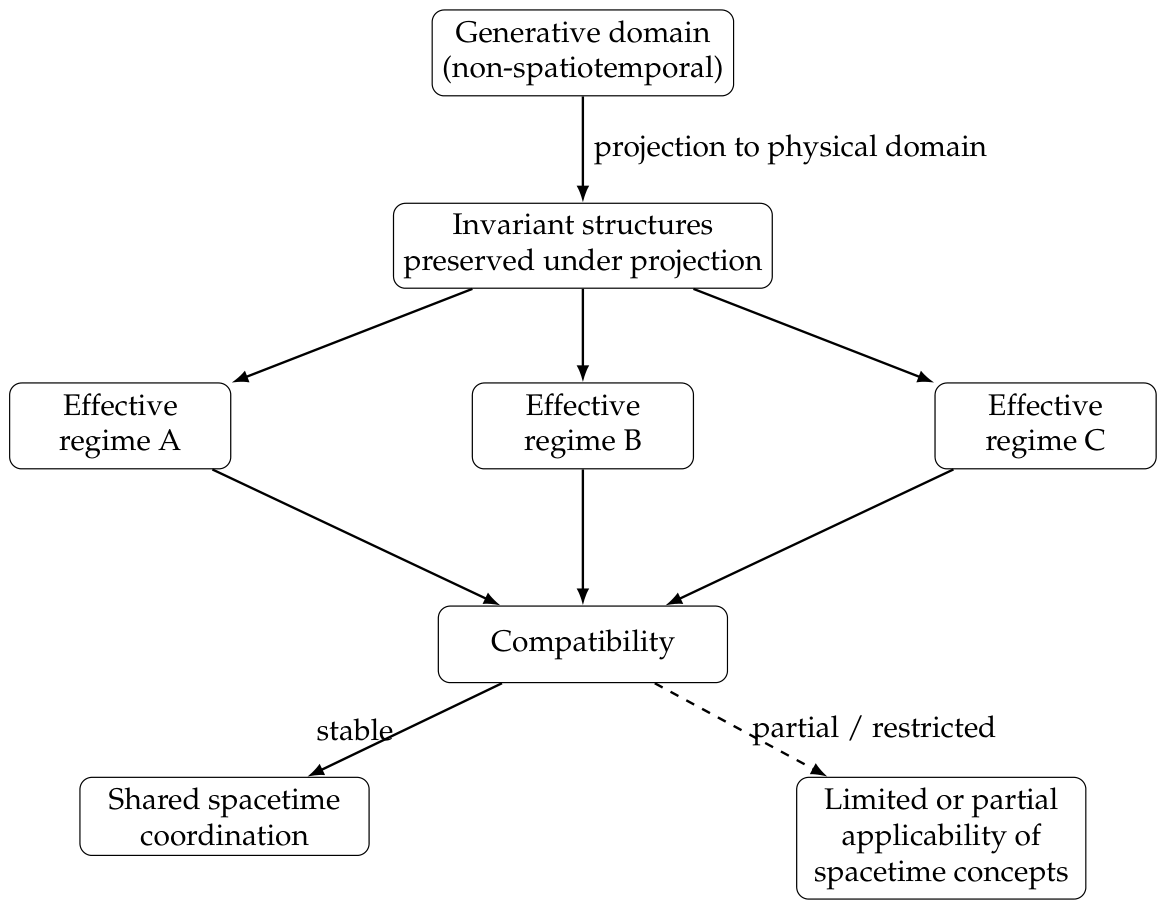
Disclaimer/Publisher’s Note: The statements, opinions and data contained in all publications are solely those of the individual author(s) and contributor(s) and not of MDPI and/or the editor(s). MDPI and/or the editor(s) disclaim responsibility for any injury to people or property resulting from any ideas, methods, instructions or products referred to in the content. |
© 2026 by the authors. Licensee MDPI, Basel, Switzerland. This article is an open access article distributed under the terms and conditions of the Creative Commons Attribution (CC BY) license (http://creativecommons.org/licenses/by/4.0/).
Copyright: This open access article is published under a Creative Commons CC BY 4.0 license, which permit the free download, distribution, and reuse, provided that the author and preprint are cited in any reuse.


