

Submitted:
16 June 2026
Posted:
18 June 2026
You are already at the latest version
Abstract
Grounded in self-determination theory, this study examined the role of psychological distress as a mediator between autonomous learning and academic engagement among university students in China. In this cross-sectional study, survey data from 234 Chinese university students were collected to evaluate autonomous learning, psychological distress including symptoms of depression, anxiety, and stress, and academic engagement. Structural equation modeling indicated that autonomous learning was positively associated with academic engagement and negatively related to psychological distress. Psychological distress, in turn, was negatively associated with academic engagement and mediated the relation between autonomous learning and academic engagement. Additional analyses further revealed significant alternative directionality of effects between psychological distress and autonomous learning, thereby suggesting that the relation may be bidirectional. These findings highlight the importance of fostering autonomous learning and addressing psychological distress to enhance engagement among Chinese students in higher education.
Keywords:
autonomous learning
; academic engagement
; psychological distress
; university students
Psychological Distress Mediates Between Autonomous Learning and Academic Engagement Among University Students
Studies have shown that university students face a risk of psychological distress, with research showing elevated depression and anxiety symptoms within this demographic (Arnett et al., 2014; Granieri et al., 2021; Matud et al., 2020). In China, university students face similar challenges with sleep problems, depressive symptoms, and self-harm being major concerns (Chen et al., 2022). Given students’ psychological distress is linked to overall well-being and learning outcomes (Cullinan et al., 2024), understanding the psychological distress process and correlates is crucial for students, researchers, and practitioners. To this end, based on self-determination theory (Deci & Ryan, 1985), this study aims to investigate the relations among psychological distress, autonomous learning, and academic engagement in university students.
Self-Determination Theory (SDT; Deci & Ryan, 1985) proposes that the satisfaction of the basic psychological needs for autonomy, competence, and relatedness, is essential for students to achieve optimal functioning (Deci et al., 2013). A lack of adequate satisfaction of these needs is likely to give rise to frustration and elevated psychological distress among students (Vansteenkiste et al., 2020). Among these three basic psychological needs, autonomy is central because having autonomous control over one’s behavior facilitates intrinsic motivation and persisting engagement (Ryan & Deci, 2020). Autonomous learning refers to the learner’s capacity to independently acquire valued knowledge and skills through self-determined processes (Chene, 1983). Over the last few decades, the link between autonomous learning and psychological distress has become a focal point in the literature (Merç, 2015; Zhao et al., 2022). Notably, autonomous learning enables learners to actively participate in learning activities actively, identify and utilize learning resources, sustain perseverance, and flexibly manage available resources (Ponton et al., 2000). Autonomy plays a principal role in learning among adult learners (Rogers, 1996). Notably, Black and Deci (2000) reported that university students exhibiting a stronger autonomous learning motivation at the beginning of a course reported a more positive learning experience, characterized by higher perceived interest and competence, along with lower anxiety. They also showed a greater focus on learning process, rather than grades, by the end of the course. Cultivating students’ autonomous learning skills can also improve their academic study habits and performance, such as reading achievements (Aryanjam et al., 2021). For instance, students receiving a 12-week training in autonomous learning showed significant improvements in assignment and project preparation, note-taking, and reading skills, as well as enhanced organizational abilities when completing academic tasks (Merç, 2015). Having these abilities is essential for managing academic pressure and promoting psychological well-being as well (Field et al., 2015). Notably, empirical studies have demonstrated that enhancing students’ autonomy in learning is directly associated with reduced psychological distress (Deng & Liu, 2025). For instance, university students diagnosed with anxiety disorders who participated in a three-month autonomy-supportive oral teaching program demonstrated greater reductions in depressive mood and anxiety than those in the control group, indicating that fostering learner autonomy can alleviate depressed mood and anxiety symptoms (Zhao et al., 2022).
When teachers provide autonomy support, students typically demonstrate stronger autonomous learning and greater well-being (Niemiec & Ryan, 2009). Autonomy-supportive teaching also promotes students’ endorsement of mastery goals (Black & Deci, 2000; Zheng et al., 2020), which is linked to beneficial educational achievements, including higher intrinsic motivation and lower academic stress (Senko et al., 2011). In addition, learners are likely to experience more positive affect in autonomy-supportive classrooms, particularly when they perceive greater opportunities for choice and decision-making (Pekrun et al., 2014). A plausible mechanism is that satisfying autonomy needs nurtures self-esteem, reducing reliance on external performance standards as the sole basis for self-worth (Shih, 2013), thereby sustaining intrinsic motivation and mitigating stress, anxiety, and overall psychological distress (Zheng et al., 2020).
The Role of Autonomous Learning in Academic Engagement
Aside from psychological distress, recent studies revealed that autonomy serves as a significant predictor of academic engagement (Alley, 2019; Guo, 2018; Wang et al., 2024). Academic engagement is defined as a positive learning-related behavior that encompasses vigor, dedication, and absorption (Siu et al., 2014). Such engagement often manifests through classroom conduct and is crucial for academic performance (Hanus & Fox, 2015). Highly engaged students are typically characterized by robust participation in the learning community. For instance, they contribute substantively to classroom discourse and are at a lower risk of school dropout (Sinval et al., 2025). As discussed earlier, autonomy is a crucial element for understanding classroom engagement (Hafen et al., 2012). When teachers provide autonomy support, they facilitate satisfaction of students’ psychological needs, which in turn contributes to classroom participation, academic engagement, and learning outcomes (Jang et al., 2016; Ni & Wu, 2011; Wang et al., 2024). Along the same lines, fulfillment of the need for autonomy is associated with more positive affective experiences, more efficient cognitive functioning, and more adaptive behavioral outcomes (Zhang, 2022). Autonomous learners are incline to engage actively in learning and gradually acquire knowledge (Fotiadou et al., 2017). Motivated by autonomy and academic skills, they set goals, confront difficulties, and gradually build their knowledge base (Zimmerman, 2000). Conversely, when autonomy is thwarted, students experience external pressure and feel compelled to comply with external contingencies (Reeve et al., 2003). Importantly, teachers who rely on controlling styles often overlook or even impede students’ autonomous learning motivation and classroom participation (Reeve, 2009) by undermining student’s freedom of choice and willingness to engage in independent learning (Ni & Wu, 2011).
Psychological Distress Undermines Academic Engagement
Contrary to the benefits of autonomy fulfilment, psychological distress often undermines classroom and academic engagement (Mou et al., 2022; Sinval et al., 2025; Tang & He, 2023). Students exhibiting more pronounced symptoms of depression, anxiety, and stress tend to have greater trouble adapting to campus life and show lower academic engagement (Klinck et al., 2020; Oral, 2020; Öztekin, 2024). Because depression, anxiety, and stress can disrupt physiological and psychological functioning, university students may experience difficulties in engaging in self-regulation, participating fully in the learning process, and having positive emotions toward school (Öztekin, 2024). These challenges may further weaken academic engagement (Öztekin, 2024). Supporting these links, a study showed that students experiencing depressive symptoms show lower levels of academic engagement (Gao et al., 2020). Against the backdrop of the COVID-19 pandemic, researchers similarly found a negative relation between university students’ psychological distress and academic engagement (Imdad, 2024; Tang & He, 2023). Another large-scale study involving 8,625 adolescents demonstrated that psychological distress directly and negatively predicted academic engagement (Yin et al., 2023). This relation was further substantiated by a prospective study involving 351 medical students, which showed that psychological distress was associated with lower academic engagement; academic engagement, in turn, undermined academic outcomes (Sinval et al., 2025).
The Present Study
Grounded in SDT (Deci & Ryan, 1985), the present study examined the role of autonomous learning and psychological distress in academic engagement within the cultural context of China, where psychological distress is both prevalent and increasing (Chen et al., 2022). As discussed earlier, autonomous learning could potentially mitigate psychological distress (Bekker & Belt, 2006; Patall et al., 2018; Thompson et al., 2021). Such relationship may also be bidirectional, i.e., higher levels of autonomy could alleviate psychological distress (Black & Deci, 2000; Zhao et al., 2022), whereas elevated psychological distress could undermine students’ ability to learn autonomously (Bai et al., 2020; Ji et al., 2021; Savaskan, 2017). Importantly, psychological distress may impose substantial affective strain and cognitive load that undermine attention, motivation, and persistence in learning (Moreira de Sousa et al., 2018).
Given the plausibility of a bidirectional relation between autonomous learning and psychological distress, the present study tested two competing models. In the primary model, autonomous learning was hypothesized to be positively associated with academic engagement (H1) and negatively with psychological distress (H2). Psychological distress, in turn, was hypothesized to be negatively associated with academic engagement (H3). Psychological distress was further hypothesized to mediate the relation between autonomous learning and academic engagement (H4). In the competing model, psychological distress was hypothesized to be negatively associated with academic engagement (H5) and autonomous learning (H6). Autonomous learning, in turn, was hypothesized to be positively associated with academic engagement (H7). Autonomous learning was further hypothesized to mediate the relation between autonomous learning and academic engagement (H8).
Method
Participants
Participants were 268 university students (men = 105; women = 163) who were recruited through online advertisements and mass emails and were between 18 and 28 years old. Ethical approval by the University Research Ethics Review Panel was sought at the authors’ affiliated university [BLIND FOR PEER REVIEW] prior to the implementation of the study. Following prespecified data-quality procedures, 12.7% (n = 34) participants were excluded. Specifically, 3 reported they were not university students and 11.5% (n = 31) failed attention checks (i.e., answered at least two of three attention-check items incorrectly). The final analytic sample comprised 234 participants.
Measures
Following established back-translation procedures (Brislin, 1970), all English-language measures were translated into Chinese.
Autonomous Learning
The 12-item Autonomous Learning Scale (Macaskill & Taylor, 2010) was used to assess students’ tendencies toward autonomous learning. The measure comprised two internally consistent sub-scales: Independence of Learning, “I enjoy finding information about new topics on my own”, and Study Habits, “I plan my time for study effectively.” The measure was previously used among Chinese college English learners and demonstrated adequate reliability (Qi et al., 2025). Each item was rated on a 5-point Likert scale ranging from 1 (very unlike me) to 5 (very like me). Negatively worded items were reverse-coded prior to computing composite mean scores for the subscales of Independence of Learning and Study Habits. Higher scores will indicate greater learner autonomy. The subscales were used as indicators in the structural equation modeling (SEM) analyses. In the Chinese sample, the scale demonstrated good internal consistency. Confirmatory factor analysis (CFA) showed the two-factor structure of Autonomous Learning, comprising Independence of Learning and Study Habits, fit the data well, χ2(50) = 126.28, p < .001, CFI = .94, TLI = .93, RMSEA = .08. In this study, Cronbach’s α was .71 for Independence of Learning and .79 for Study Habits.
Psychological Distress
The 21-item Depression Anxiety Stress Scales (DASS-21; Lovibond & Lovibond, 1995) were employed to measure the severity of depression, anxiety, and stress symptoms experienced over the past week. Representative items included “I felt that life was meaningless” and “I found it difficult to relax”. The measure was previously validated in China among college students, demonstrating good reliability and validity (Wang et al., 2016). Each item was rated on a 4-point scale ranging from 0 (did not apply to me at all) to 3 (applied to me very much or most of the time). Item scores were summed to create three subscale scores of Depression, Anxiety, and Stress, each ranging from 0 to 21 each; higher scores indicated greater symptom severity. DASS-21 has been widely used with Chinese samples (Gong et al., 2010). Evidence from cross-sectional and longitudinal surveys indicates that the Chinese version exhibits high internal consistency, with Cronbach’s α for the three subscales ranging from .86 to .92 (Cao et al., 2023). In this study, the Cronbach’s α was .87 for Depression, .86 for Anxiety, and .88 for Stress.
Academic Engagement
The 29-item Services for Active Participation and Inclusion of University Students (SInAPSi) Academic Engagement Scale (SAES; Freda et al., 2023) was used to assess students’ academic engagement. The scale consisted of six sub-dimensions. For example, two of these were Value of University Course and Engagement with University Peers. Sample items included, “I like the course of study I’m attending” and “I like to meet friends at university.” Each item was rated on a 5-point Likert scale ranging from 1 (never) to 5 (always). Item scores were averaged within each subscale to create composite scores, with higher scores indicating higher levels of academic engagement.
To evaluate the factor structure of the SAES in this study, a CFA model was tested. Model fit was unsatisfactory, as indicated by χ2(362) = 1044.02, p < .001, CFI = .90, TLI = .89, RMSEA = .09. Further inspection showed that the factor, Perception of the Capability to Persist in the University Choice, was unrelated to the other factors. This factor captures students’ perceived ability to persist with their university choice and includes the following items: “I would leave University right away if I had an alternative”, “Sometimes I think about leaving university”, “I had better do other things than go to University” and “In my opinion, University education is not worth all the time, money and effort it takes me” (Freda et al., 2023). In this study, 70.5% of the sample (n = 165) were students who were 18 to 19 years old and were in their first year or second year of study. A majority of the participants might not have developed stable cognitions about the choices reflected in this factor. Therefore, the factor was removed from subsequent analyses, and the five-factor model was re-estimated: The model fit improved substantially, χ2(260) = 684.34, p < .001, CFI = .93, TLI = .92, RMSEA = .08. In this sample, the Cronbach’s α coefficients ranged from .78 to .95.
Demographics
Demographic information, including age, gender, and education level, was collected.
Results
Means and correlations (see Table 1) for all study variables were computed as preliminary analyses prior to conducting SEM using MPLUS 8.3 (Muthén & Muthén, 2019).
Primary Model
The primary model, which hypothesized psychological distress as a mediator between autonomous learning and academic engagement, yielded adequate fit to the data, χ2 (52) = 122.26, p < .001; CFI = .96; TLI = .95; RMSEA = .08 (see Table 2 and Figure 1). In the measurement model, all latent constructs (autonomous learning, psychological distress, and academic engagement) were significantly indicated by their respective manifest variables, with standardized loadings ranging from .75 to .99, all ps < .001.
Consistent with H1, autonomous learning was significantly associated with academic engagement in the structural model (B = .65, SE = .10; β = .57; p < .001). Consistent with H2, autonomous learning was significantly and negatively associated with the psychological distress, as indicated by depression, anxiety, and stress (B = −.27, SE = .07; β = −.27; p < .001). Supporting H3, higher psychological distress was significantly associated with lower academic engagement in the structural model (B = −.28, SE = .10; β = −.23; p = .002). In H4, psychological distress was specified as a mediator of the relation between autonomous learning and academic engagement. Bias-corrected bootstrapping with 10,000 resamples revealed a positive and significant indirect effect of autonomous learning on academic engagement via psychological distress (B = .07, SE = .03; β = .06; p = .003). The 95% bias-corrected bootstrap confidence interval [.02, .13] did not include zero, indicating an indirect effect and supported H4.
Competing Model
In the competing model, psychological distress was specified as an antecedent of autonomous learning, which in turn predicted academic engagement, while a direct path from psychological distress to academic engagement was retained. This competing model exhibited identical fit to the primary model, χ2 (52) = 122.26, p < .001; CFI = .96; TLI = .95; RMSEA = .08 (see Figure 2). Consistent with H5, psychological distress was negatively associated with academic engagement (B = −.29, SE = .08; β = −.23, p < .001). Consistent with H6, psychological distress was negatively associated with autonomous learning (B = −.28, SE = .07; β = −.28, p < .001). Supporting H7, autonomous learning was positively associated with academic engagement (B = .71, SE = .08; β = .57, p < .001). Thus, the pattern of associations in the alternative model mirrored the key relationships observed in the primary model. H8 evaluated the indirect pathway from psychological distress to academic engagement via autonomous learning through a bias-corrected bootstrap procedure with 10,000 resamples. The specific indirect effect was statistically significant (B = −.20, SE = .05; β = −.16, p < .001; 95% bias-corrected confidence interval [−.24, −.07]) and the confidence interval did not include zero, suggesting autonomous learning was a mediator.
Discussion
Grounded in self-determination theory (Deci & Ryan, 1985), this cross-sectional study suggested that within the Chinese context, psychological distress functioned as a mediator in the relation between autonomous learning and academic engagement. The findings converged with existing studies conducted in other developmental periods and cultural contexts (Sinval et al., 2025; Tang & He, 2023; Zhao et al., 2022). A test of competing hypothesis also revealed that autonomous learning mediated the relation between psychological distress and academic engagement. As such, the association between autonomous learning and psychological distress may be bidirectional. These findings informed the literature by showing the potential underlying processes of academic engagement.
Our findings indicated a negative relation between autonomous learning and psychological distress, suggesting that students with stronger autonomous learning abilities reported lower levels of depression, anxiety, and stress. This finding indicates that autonomous learning may buffer psychological distress by helping students cope more effectively with academic stress and environmental challenges and by enhancing self-control and self-efficacy (Black & Deci, 2000; Merç, 2015; Zhao et al., 2022). Therefore, university instructors could provide an autonomy-supportive environments through opportunities for autonomous learning, constructive feedback, and emotional support, as pathways to foster autonomous learning and mental health (Zhao et al., 2022; Zheng et al., 2020).
Consistent with self-determination theory, autonomous learning was positively associated with academic engagement. Support for students’ need for autonomy enhances their sense of volition and promotes sustained behavioral engagement (Deci & Ryan, 1985; Ryan & Deci, 2020). Students who plan their learning, select appropriate resources, and regulate their study process may therefore are more motivated and to invest more time and effort in academic activities (Guo, 2018; Zimmerman, 2000). On the contrary, psychological distress was negatively related to academic engagement. This result was consistent with prior research, which indicated that depression, stress, and anxiety undermine learning motivation and reduce academic engagement (Sinval et al., 2025; Tang & He, 2023). Symptoms of depression, anxiety, and stress deplete cognitive and affective resources, which diminishes students’ motivation, attention, and persistence, resulting in poorer academic engagement and academic performance (Ji et al., 2021; Sinval et al., 2025).
The findings based on the primary model suggest that psychological distress mediated the relation between autonomous learning and academic engagement, thereby delineating a key psychological pathway through which autonomous learning fosters engagement. Autonomous learning not only was directly linked to academic engagement but also via lower psychological distress. This pattern extends the application of self-determination theory (Deci & Ryan, 1985) by demonstrating that autonomy-supportive contexts could simultaneously satisfy autonomy needs and mitigate psychological distress to foster academic engagement (Nielsen et al., 2017). The completing mediation model indicated that autonomous learning could mediate the relation between psychological distress and academic engagement, i.e., elevated distress could also weaken students’ capacity for autonomous learning (Bai et al., 2020; Savaskan, 2017). Given that both the primary and competing models are both valid, a potential bidirectional association has emerged between autonomous and psychological distress (Bai et al., 2020; Merç, 2015; Patall et al., 2018). Therefore, longitudinal research should explicitly explicate bidirectionality: High levels of distress may erode motivational foundations, which weaken autonomous learning. Compromised autonomy may also lower academic self-efficacy and increase academic pressure, thereby worsening psychological distress.
Limitations and Future Directions
Several methodological and contextual limitations highlight priorities for future research. Firstly, the present cross-sectional data cannot establish causality or temporal ordering among variables. Future research should utilize longitudinal and experimental approaches to clarify temporal sequences and causal mechanisms among the variables. Moreover, exclusive dependence on self-report instruments may increase the risk of common method bias. Therefore, future studies are encouraged to incorporate multiple data sources, such as teacher evaluations, academic records (e.g., grades, completion rates, attendance), and behavioral indicators, to increase the credibility and validity of the results. Next, the representativeness of the sample is limited, drawing exclusively from students at a small number of Chinese universities, with most participants aged 18-19 years and a predominance of female students, which may restrict the generalizability of the findings. Future research should further broaden the sampling frame to include different institution types and educational stages.
Theoretical and Practical Implications
The findings of this study have important theoretical and practical implications for higher education. At the theoretical level, the study extends the application of self-determination theory (Deci & Ryan, 1985) by showing that autonomous learning may indirectly foster academic engagement by alleviating psychological distress (Mou et al., 2022; Sinval et al., 2025; Tang & He, 2023). In addition, the findings suggest that the relations among the variables may be bidirectional, indicating that future theoretical work should place greater emphasis on dynamic processes and interactions rather than on simple linear associations. At the level of teaching practice, instructors could create autonomy-supportive learning environments (Jang et al., 2016), provide students with meaningful opportunities for choices, encourage self-directed planning, and reduce controlling instructional behaviors (Reeve, 2009). Teacher support could strengthen students’ autonomous self-regulation of learning and academic engagement by fostering the satisfaction of the basic psychological needs (Gutiérrez et al., 2018; Raufelder et al., 2014). For example, course design can incorporate inquiry-based projects, optional reading materials, and flexible assignment formats to better support students’ learning autonomy.
In sum, this study indicates that autonomous learning is associated with university students’ academic engagement both directly and indirectly through lower psychological distress. The findings also suggest a viable bidirectional association between autonomous learning and psychological distress, which warrants longitudinal investigation. Interventions gearing toward enhancing autonomous learning and mental health also merit future investigation.
Funding
The present study received no funding.
Author Contributions Statement
YZ contributed to the conceptualization and methodology, executed the study, performed formal analyses, collaborated in the writing of the manuscript, and reviewed and edited the manuscript. RYMC contributed to the conceptualization and methodology, supervised the execution of the study, collaborated in the writing of the manuscript, and reviewed and edited the manuscript.
Ethics Approval
This study was approved by the Ethics Review Panel at Xi’an Jiaotong-Liverpool University (Ref: 11000187120250812104936). It was conducted in accordance with the ethical standards in the 1964 Declaration of Helsinki and its later amendments.
Consent
Prior to the study’s administration, written informed consent was obtained from all participants.
Data, Materials and/or Code Availability
The dataset analyzed in this article is not publicly available. Requests to access the dataset should be directed to Rebecca Y. M. Cheung, Ph.D., Department of Educational Studies, Academy of Future Education, Xi’an Jiaotong-Liverpool University, Suzhou, China. E-mail: rebecca.cheung@xjtlu.edu.cn.
Conflicts of Interest
The authors declare that they have no conflict of interest.
Use of Artificial Intelligence
We have not used AI-assisted technologies in creating this article.
References
- Alley, K.M. Fostering middle school students’ autonomy to support motivation and engagement. Middle Sch. J. 2019, 50(3), 5–14. [Google Scholar] [CrossRef]
- Arnett, J.J.; Žukauskienė, R.; Sugimura, K. The new life stage of emerging adulthood at ages 18–29 years: Implications for mental health. Lancet Psychiatry 2014, 1(7), 569–576. [Google Scholar] [CrossRef] [PubMed]
- Aryanjam, L.; Rashtchi, M.; Maftoon, P. Boosting reading achievement by employing learner autonomy curriculum: Effects of strategy instruction. Iran. J. Engl. Acad. Purp. 2021, 10(2), 58–73. [Google Scholar]
- Bai, X.; Wang, X.; Wang, J.; Tian, J.; Ding, Q. College students’ autonomous learning behavior in blended learning: Learning motivation, self-efficacy, and learning anxiety. In 2020 International Symposium on Educational Technology (ISET); IEEE, 2020; pp. 155–158. [Google Scholar] [CrossRef]
- Bekker, M.H.; Belt, U. The role of autonomy–connectedness in depression and anxiety. Depress. Anxiety 2006, 23(5), 274–280. [Google Scholar] [CrossRef] [PubMed]
- Black, A.E.; Deci, E.L. The effects of instructors’ autonomy support and students’ autonomous motivation on learning organic chemistry: A self-determination theory perspective. Sci. Educ. 2000, 84(6), 740–756. [Google Scholar] [CrossRef]
- Brislin, R. Back-translation for cross-cultural research. J. Cross-Cult. Psychol. 1970, 1(3), 185–216. [Google Scholar] [CrossRef]
- Browne, M.W.; Cudeck, R. Alternative ways of assessing model fit. Sociol. Methods Res. 1992, 21(2), 230–258. [Google Scholar] [CrossRef]
- Cao, C.H.; Liao, X.L.; Jiang, X.Y.; Li, X.D.; Chen, I.H.; Lin, C.Y. Psychometric evaluation of the depression, anxiety, and stress scale-21 (DASS-21) among Chinese primary and middle school teachers. BMC Psychol. 2023, 11(1), 209. [Google Scholar] [CrossRef] [PubMed]
- Chen, Y.; Zhang, Y.; Yu, G. Prevalence of mental health problems among college students in mainland China from 2010 to 2020: A meta-analysis. Adv. Psychol. Sci. 2022, 30(5), 991–1004. [Google Scholar] [CrossRef]
- Chene, A. The concept of autonomy in adult education: A philosophical discussion. Adult Educ. Q. 1983, 34(1), 38–47. [Google Scholar] [CrossRef]
- Cullinan, J.; Walsh, S.; Flannery, D.; Kennelly, B. A cross-sectional analysis of psychological distress among higher education students in Ireland. Ir. J. Psychol. Med. 2024, 41(2), 211–219. [Google Scholar] [CrossRef] [PubMed]
- Deci, E.L.; Ryan, R.M. Intrinsic motivation and self-determination in human behavior; Plenum Press, 1985. [Google Scholar] [CrossRef]
- Deci, E. L.; Ryan, R. M.; Guay, F. Self-determination theory and actualization of human potential. In Theory driving research: New wave perspectives on self-processes and human development; McInerney, D., Craven, R., Marsh, H., Guay, F., Eds.; Information Age Press, 2013; pp. 109–133. [Google Scholar]
- Deng, Y.; Liu, H. To overcome test anxiety in online assessment: Unpacking the mediator roles of techno competencies, teacher support, self-efficacy, and autonomy. BMC Psychol. 2025, 13(1), Article 192. [Google Scholar] [CrossRef] [PubMed]
- Field, R.; Duffy, J.; Huggins, A. Teaching independent learning skills in the first year: A positive psychology strategy for promoting law student well-being. J. Learn. Des. 2015, 8(2), 1–10. [Google Scholar] [CrossRef]
- Fotiadou, A.; Angelaki, C.; Mavroidis, I. Learner autonomy as a factor of the learning process in distance education. Eur. J. Open Distance E-Learn. 2017, 20(1), 95–110. [Google Scholar] [CrossRef]
- Freda, M.F.; De Luca Picione, R.; Esposito, G.; Ragozini, G.; Testa, I. A new measure for the assessment of university engagement: The SInAPSi Academic Engagement Scale (SAES). Curr. Psychol. 2023, 42(12), 9674–9690. [Google Scholar] [CrossRef]
- Gao, F.; Mei, Q.; Guo, C. Relationship between depression and student engagement of senior high school students and the mediating role of resilience. Rev. Argent. De Clínica Psicológica 2020, 29(1), 14–20. [Google Scholar] [CrossRef]
- Gong, X.; Xie, X.; Xu, R.; Luo, Y. Psychometric properties of the Chinese versions of DASS-21 in Chinese college students. Chin. J. Clin. Psychol. 2010, 18(4), 443–446. [Google Scholar] [CrossRef]
- Granieri, A.; Franzoi, I. G.; Chung, M.C. Psychological distress among university students. Front. Psychol. 2021, 12, 647940. [Google Scholar] [CrossRef] [PubMed]
- Guo, Y. The influence of academic autonomous motivation on learning engagement and life satisfaction in adolescents: The mediating role of basic psychological needs satisfaction. J. Educ. Learn. 2018, 7(4), 254–261. [Google Scholar] [CrossRef]
- Gutiérrez, M.; Sancho, P.; Galiana, L.; Tomás, J.M. Autonomy support, psychological needs satisfaction, school engagement and academic success: A mediation model. Univ. Psychol. 2018, 17(5), 1–12. [Google Scholar] [CrossRef]
- Hafen, C.A.; Allen, J.P.; Mikami, A.Y.; Gregory, A.; Hamre, B.; Pianta, R.C. The pivotal role of adolescent autonomy in secondary school classrooms. J. Youth Adolesc. 2012, 41(3), 245–255. [Google Scholar] [CrossRef] [PubMed]
- Hanus, M.D.; Fox, J. Assessing the effects of gamification in the classroom: A longitudinal study on intrinsic motivation, social comparison, satisfaction, effort, and academic performance. Comput. Educ. 2015, 80, 152–161. [Google Scholar] [CrossRef]
- Imdad, H.R.; Dawood, S. Academic self-efficacy, student engagement and psychological distress in university students during Covid-19. Al-Mahdi Res. J. 2024, 5(4), 159–167. [Google Scholar]
- Jang, H.; Kim, E.J.; Reeve, J. Why students become more engaged or more disengaged during the semester: A self-determination theory dual-process model. Learn. Instr. 2016, 43, 27–38. [Google Scholar] [CrossRef]
- Ji, L.; Chen, C.; Hou, B.; Ren, D.; Yuan, F.; Liu, L.; He, G. A study of negative life events driven depressive symptoms and academic engagement in Chinese college students. Sci. Rep. 2021, 11(1), Article 17160. [Google Scholar] [CrossRef] [PubMed]
- Klinck, M.; Vannucci, A.; Ohannessian, C.M. Bidirectional relationships between school connectedness and internalizing symptoms during early adolescence. J. Early Adolesc. 2020, 40(9), 1336–1368. [Google Scholar] [CrossRef]
- Lovibond, P.F.; Lovibond, S.H. The structure of negative emotional states: Comparison of the Depression Anxiety Stress Scales (DASS) with the Beck Depression and Anxiety Inventories. Behav. Res. Ther. 1995, 33(3), 335–343. [Google Scholar] [CrossRef] [PubMed]
- Macaskill, A.; Taylor, E. The development of a brief measure of learner autonomy in university students. Stud. High. Educ. 2010, 35(3), 351–359. [Google Scholar] [CrossRef]
- Matud, M.P.; Díaz, A.; Bethencourt, J.M.; Ibáñez, I. Stress and psychological distress in emerging adulthood: A gender analysis. J. Clin. Med. 2020, 9(9), Article 2859. [Google Scholar] [CrossRef] [PubMed]
- Merç, A. The effect of a learner autonomy training on the study habits of the first-year ELT students. Educ. Res. Rev. 2015, 10(4), 378–387. [Google Scholar] [CrossRef]
- Moreira de Sousa, J.; Moreira, C.A.; Telles-Correia, D. Anxiety, depression and academic performance: A study amongst Portuguese medical students versus non-medical students. Acta Médica Port. 2018, 31(9), 454–462. [Google Scholar] [CrossRef] [PubMed]
- Mou, Q.; Zhuang, J.; Gao, Y.; Zhong, Y.; Lu, Q.; Gao, F.; Zhao, M. The relationship between social anxiety and academic engagement among Chinese college students: A serial mediation model. J. Affect. Disord. 2022, 311, 247–253. [Google Scholar] [CrossRef] [PubMed]
- Muthén, L.K.; Muthén, B.O. Mplus version 8.3 user’s guide; Muthén & Muthén, 2019. [Google Scholar]
- Ni, S. G.; Wu, X. C. Learning engagement: Concepts, measurements, and related variables. Psychol. Res. 2011, 4(1), 81–87. [Google Scholar]
- Nielsen, T.; Makransky, G.; Vang, M.L.; Dammeyer, J. How specific is specific self-efficacy? A construct validity study using Rasch measurement models. Stud. Educ. Eval. 2017, 53, 87–97. [Google Scholar] [CrossRef]
- Niemiec, C.P.; Ryan, R.M. Autonomy, competence, and relatedness in the classroom: Applying self-determination theory to educational practice. Theory Res. Educ. 2009, 7(2), 133–144. [Google Scholar] [CrossRef]
- Oral, T. Mediating role of school attachment in the relationship between perceived stress and school satisfaction. Eur. J. Educ. Sci. 2020, 7(3), 174–193. [Google Scholar] [CrossRef]
- Öztekin, G.G. Associations between internet addiction and school engagement among Turkish college students: Mediating role of psychological distress. Front. Psychol. 2024, 15, 1367462. [Google Scholar] [CrossRef] [PubMed]
- Patall, E.A.; Steingut, R.R.; Vasquez, A.C.; Trimble, S.S.; Pituch, K.A.; Freeman, J.L. Daily autonomy supporting or thwarting and students’ motivation and engagement in the high school science classroom. J. Educ. Psychol. 2018, 110(2), 269–288. [Google Scholar] [CrossRef]
- Pekrun, R.; Cusack, A.; Murayama, K.; Elliot, A.J.; Thomas, K. The power of anticipated feedback: Effects on students’ achievement goals and achievement emotions. Learn. Instr. 2014, 29, 115–124. [Google Scholar] [CrossRef]
- Ponton, M.K.; Carr, P.B.; Confessore, G.J. Learning conation: A psychological perspective of personal initiative and resourcefulness. In Practice and theory in self-directed learning; Long, H.B., Associates, Eds.; Motorola University Press, 2000; pp. 65–82. [Google Scholar]
- Qi, T.; Albakri, I.S.M.A.; Ismail, N.; Zaini, K.; Nor, M.M.; Uri, N.F.M. The impact of the Dalton Plan-based instruction on learner autonomy in reading among college English course learner in China. World J. Engl. Lang. 2025, 15(2), 223–239. [Google Scholar] [CrossRef]
- Raufelder, D.; Kittler, F.; Braun, S.R.; Lätsch, A.; Wilkinson, R.P.; Hoferichter, F. The interplay of perceived stress, self-determination and school engagement in adolescence. Sch. Psychol. Int. 2014, 35(4), 405–420. [Google Scholar] [CrossRef]
- Reeve, J. Why teachers adopt a controlling motivating style toward students and how they can become more autonomy supportive. Educ. Psychol. 2009, 44(3), 159–175. [Google Scholar] [CrossRef]
- Reeve, J.; Nix, G.; Hamm, D. Testing models of the experience of self-determination in intrinsic motivation and the conundrum of choice. J. Educ. Psychol. 2003, 95(2), 375–392. [Google Scholar] [CrossRef]
- Rogers, A. Teaching adults; Open University Press, 1996. [Google Scholar]
- Ryan, R.M.; Deci, E.L. Intrinsic and extrinsic motivation from a self-determination theory perspective: Definitions, theory, practices, and future directions. Contemp. Educ. Psychol. 2020, 61, 101860. [Google Scholar] [CrossRef]
- Savaskan, I. Does foreign language classroom anxiety mitigate learner autonomy development? Psychol. Res. 2017, 7(8), 436–444. [Google Scholar] [CrossRef]
- Senko, C.; Hulleman, C.S.; Harackiewicz, J.M. Achievement goal theory at the crossroads: Old controversies, current challenges, and new directions. Educ. Psychol. 2011, 46(1), 26–47. [Google Scholar] [CrossRef]
- Shih, S.S. The effects of autonomy support versus psychological control and work engagement versus academic burnout on adolescents’ use of avoidance strategies. Sch. Psychol. Int. 2013, 34(3), 330–347. [Google Scholar] [CrossRef]
- Sinval, J.; Oliveira, P.; Novais, F.; Almeida, C.M.; Telles-Correia, D. Depression, anxiety, stress, academic engagement and dropout intention on medical students’ academic performance: A prospective study. J. Affect. Disord. 2025, 368, 665–673. [Google Scholar] [CrossRef] [PubMed]
- Siu, O.L.; Bakker, A.B.; Jiang, X. Psychological capital among university students: Relationships with study engagement and intrinsic motivation. J. Happiness Stud. 2014, 15(4), 979–994. [Google Scholar] [CrossRef] [PubMed]
- Tang, Y.; He, W. Depression and academic engagement among college students: The role of sense of security and psychological impact of COVID-19. Front. Public Health 2023, 11, 1230142. [Google Scholar] [CrossRef] [PubMed]
- Thompson, M.; Pawson, C.; Evans, B. Navigating entry into higher education: The transition to independent learning and living. J. Furth. High. Educ. 2021, 45(10), 1398–1410. [Google Scholar] [CrossRef]
- Vansteenkiste, M.; Ryan, R.M.; Soenens, B. Basic psychological need theory: Advancements, critical themes, and future directions. Motiv. Emot. 2020, 44(1), 1–31. [Google Scholar] [CrossRef]
- Wang, K.; Shi, H.S.; Geng, F.L.; Zou, L.Q.; Tan, S.P.; Wang, Y.; Neumann, D.L.; Shum, D.H.K.; Chan, R.C.K. Cross-cultural validation of the Depression Anxiety Stress Scale–21 in China. Psychol. Assess. 2016, 28(5), e88–e100. [Google Scholar] [CrossRef] [PubMed]
- Wang, Y.; Luo, W.; Liao, X.; Zhao, P. Exploring the effect of teacher autonomy support on Chinese EFL undergraduates’ academic English speaking performance through the mediation of basic psychological needs and classroom engagement. Front. Psychol. 2024, 15, 1323713. [Google Scholar] [CrossRef] [PubMed]
- Yin, Z.; Guo, W.; Wang, Y. The effect of psychological distress on adolescents’ academic engagement: The roles of social-emotional competence and teachers’ caring behavior. Psychol. Res. Behav. Manag. 2023, 16, 5011–5021. [Google Scholar] [CrossRef] [PubMed]
- Zhao, P.; Abdullah, R.B.; Ismail, S.A.M.B.M. On the effectiveness of improvement of English-speaking competence and learner autonomy in lessening undergraduates’ anxiety. Psychiatr. Dan. 2022, 34(4), 967–972. [Google Scholar]
- Zhang, D. Affective cognition of students’ autonomous learning in college English teaching based on deep learning. Front. Psychol. 2022, 12, Article 808434. [Google Scholar] [CrossRef] [PubMed]
- Zheng, J.; Jiang, N.; Dou, J. Autonomy support and academic stress: A relationship mediated by self-regulated learning and mastery goal orientation. New Waves-Educ. Res. Dev. J. 2020, 23(1), 43–63. [Google Scholar]
- Zimmerman, B.J. Self-efficacy: An essential motive to learn. Contemp. Educ. Psychol. 2000, 25(1), 82–91. [Google Scholar] [CrossRef] [PubMed]
Figure 1.
Mediating Role of Psychological Distress for the Relation between Autonomous Learning and Academic Engagement. χ2 (52) = 122.26, p < .001; CFI = .96; TLI = .95; RMSEA = .08; SRMR = .03. *p < .05; **p < .01; ***p < .001.
Figure 1.
Mediating Role of Psychological Distress for the Relation between Autonomous Learning and Academic Engagement. χ2 (52) = 122.26, p < .001; CFI = .96; TLI = .95; RMSEA = .08; SRMR = .03. *p < .05; **p < .01; ***p < .001.
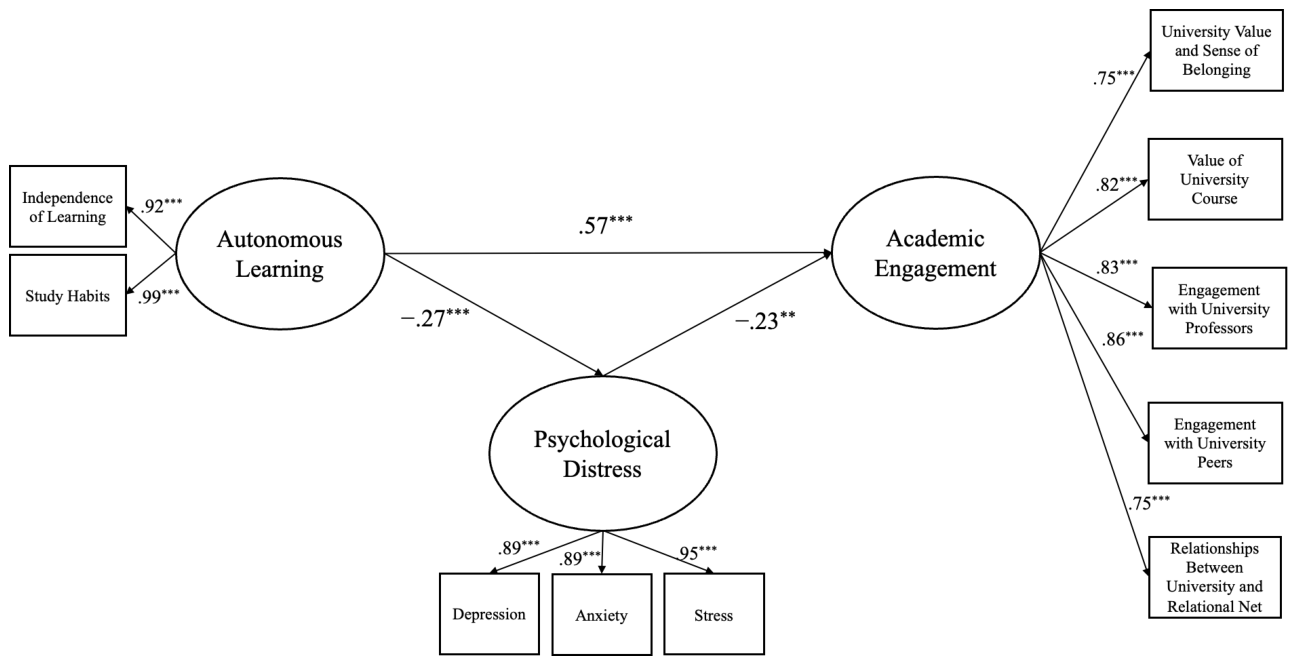
Figure 2.
Mediating Role of Autonomous Learning for the Relation between Psychological Distress and Academic Engagement. χ2 (52) = 122.26, p < .001; CFI = .96; TLI = .95; RMSEA = .08; SRMR = .03. *p < .05; **p < .01; ***p < .001.
Figure 2.
Mediating Role of Autonomous Learning for the Relation between Psychological Distress and Academic Engagement. χ2 (52) = 122.26, p < .001; CFI = .96; TLI = .95; RMSEA = .08; SRMR = .03. *p < .05; **p < .01; ***p < .001.
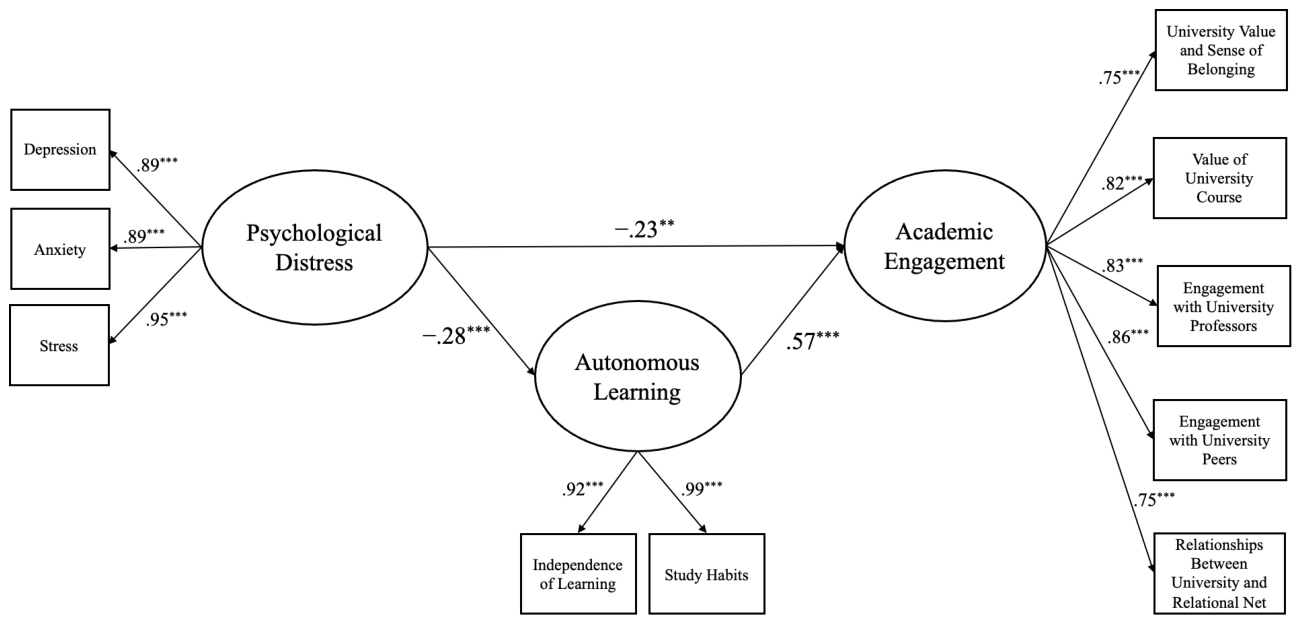

Table 1.
Correlations, and Means of the Variables under Study.
| Variable | 1 | 2 | 3 | 4 | 5 | 6 | 7 | 8 | 9 | 10 | 11 | 12 | 13 |
|---|---|---|---|---|---|---|---|---|---|---|---|---|---|
| 1. Independence of learning | 1.00 | ||||||||||||
| 2. Study Habits | .91*** | 1.00 | |||||||||||
| 3. Depression | -.23** | -.31*** | 1.00 | ||||||||||
| 4. Anxiety | -.15* | -.24*** | .79*** | 1.00 | |||||||||
| 5. Stress | -.14* | -.24*** | .84*** | .85*** | 1.00 | ||||||||
| 6. University Value & Sense of Belonging | .48*** | .49*** | -.36*** | -.30*** | -.29*** | 1.00 | |||||||
| 7. Value of University Course | .51*** | .57*** | -.33*** | -.24*** | -.25*** | .77*** | 1.00 | ||||||
| 8. Engagement with University Professors | .47*** | .49*** | -.27*** | -.23*** | -.27*** | .60*** | .73*** | 1.00 | |||||
| 9. Engagement with University Peers | .49*** | .51*** | -.32*** | -.29*** | -.30*** | .70*** | .69*** | .69*** | 1.00 | ||||
| 10. Relationships between University & Relational Net | .41*** | .46*** | -.29*** | -.29*** | -.31*** | .48*** | .56*** | .65*** | .68*** | 1.00 | |||
| 11. Gender (0 = men; 1 = women) | 0.06 | .00 | .09 | .09 | .16 | -.04 | -.05 | .04 | .06 | .02 | 1.00 | ||
| 12. Age | -.03 | -.04 | .07 | .00 | .08 | .06 | -.03 | .09 | .09 | .06 | .41 | 1.00 | |
| 13. Education | -.05 | -.03 | .06 | -.05 | .01 | .03 | -.01 | .02 | .07 | .10 | .06 | .48 | 1.00 |
| M | 3.68 | 3.63 | .46 | .57 | .70 | 4.14 | 3.81 | 3.64 | 4.10 | 3.69 | 1.64 | 19.76 | 2.84 |
| SD | .50 | .54 | .51 | .54 | .60 | .71 | .83 | .80 | .76 | 1.01 | .48 | 2.54 | .84 |
*p < .05; **p < .01; ***p < .001.
Table 2.
Parameter Estimates of the Hypothesized Primary Structural Equation Model.
| Parameter | Unstandardized estimate (SE) | Unstandardized estimate [95% C.I.] |
Standardized estimate | Standardized estimate [95% C.I.] |
|---|---|---|---|---|
| Measurement Model | ||||
| Autonomous Learning | ||||
| →Independence of learning | 1.00 ( — ) | [1.00, 1.00] | .92*** | [.86, .97] |
| →Study Habits | 1.16 (.07) | [1.05, 1.31] | .99*** | [.94, 1.05] |
| Psychological Distress | ||||
| →Depression | 1.00 ( — ) | [1.00, 1.00] | .89*** | [.84, .92] |
| →Anxiety | 1.06 (.06) | [.96, 1.19] | .89*** | [.84, .93] |
| →Stress | 1.26 (.07) | [1.14, 1.43] | .95*** | [.92, .98] |
| Academic Engagement | ||||
| →University Value and Sense of Belonging | 1.00 ( — ) | [1.00, 1.00] | .75*** | [.66, .83] |
| →Value of University Course | 1.28 (.09) | [1.12, 1.48] | .82*** | [.74, .88] |
| →Engagement with University Professors | 1.24 (.11) | [1.06, 1.49] | .83*** | [.77, .89] |
| →Engagement with University Peers | 1.22 (.09) | [1.07, 1.43] | .86*** | [.80, .91] |
| →Relationships between University and Relational Net | 1.42 (.15) | [1.17, 1.76] | .75*** | [.66, .83] |
| Structural Model | ||||
| Autonomous Learning →Psychological Distress |
-.27 (.07) |
[-.39, -.12] |
-.27*** |
[-.40, -.12] |
| →Academic Engagement | .65 (.10) | [.46, .87] | .57*** | [.42, .67] |
| Psychological Distress | ||||
| →Academic Engagement | -.28 (.10) | [-.48, -.11] | -.23** | [-.38, -.10] |
*p < .05; **p < .01; ***p < .001.
Disclaimer/Publisher’s Note: The statements, opinions and data contained in all publications are solely those of the individual author(s) and contributor(s) and not of MDPI and/or the editor(s). MDPI and/or the editor(s) disclaim responsibility for any injury to people or property resulting from any ideas, methods, instructions or products referred to in the content. |
© 2026 by the authors. Licensee MDPI, Basel, Switzerland. This article is an open access article distributed under the terms and conditions of the Creative Commons Attribution (CC BY) license.
Copyright: This open access article is published under a Creative Commons CC BY 4.0 license, which permit the free download, distribution, and reuse, provided that the author and preprint are cited in any reuse.


