
Submitted:
17 June 2026
Posted:
18 June 2026
You are already at the latest version
Abstract
This study reported on the multi-objective optimization of atmospheric plasma spraying parameters for zirconia coatings by incorporating the response surface method (RSM) with the desirability method, while simultaneously enhancing microhardness and reducing wear rates. Experiments were achieved using a L18 orthogonal array in Taguchi-based design. An analysis of variance was used to identify the key process parameters, including accelerating power, stand-off distance, powder feed rate and carrier gas flow rate. By constructing regression models and plotting response surface contour plots, the relationship between processing parameters and coating properties was comparatively examined. Subsequently, the optimal window of parameters that meets the requirements for high hardness and excellent wear resistance was determined using the desirability-overlapped method. The influence of these parameters on the hardness of the coatings and the wear volume was analysed graphically through modelling, both individually and in interaction. Experimental results have shown that the experimental results show that the prediction error for hardness was only 1.84%, while the prediction error for wear volume was 3.27%. The validation results demonstrate a high degree of consistency, as evidenced by the striking similarity between the results, which clearly indicates the reliability of the prediction made by the model. In addition, the microstructure of the optimal coating exhibits complete fusion and fine grain size, with very few pores or cracks, while there was only minor pitting and small spalling, and most of the original sprayed structure was preserved in the worn areas. Clearly, by adopting a desirability-overlapped based on RSM by Taguchi’s design, the multi-response properties of the plasma-sprayed coatings were significantly improved, and these results met the expected values for maximum hardness and minimum wear volume in the coatings.
Keywords:
zirconia
; plasma spray
; hardness
; worn volume
; orthogonal array
; response surface method
1. Introduction
A lack of surface wear resistance, high-temperature oxidation, medium corrosion and thermal fatigue are the primary causes of failure in critical components during the long-term operation of modern industrial equipment and mechanical systems [1,2,3]. Based on relevant statistics, wear-related economic losses in the global industrial sector amount to hundreds of billions of dollars annually. Notably, approximately 40% of equipment failures and maintenance costs are directly attributable to insufficient surface wear resistance of materials [4,5,6]. This is particularly evident in high-end sectors such as aerospace, energy and power generation, automotive manufacturing, metallurgy and mining. In these sectors, moving pairs, high-temperature components and pressure-bearing parts are subject to harsh environments involving high speeds, heavy loads, high temperatures and corrosion. Not only does surface failure significantly shorten the lifespan of equipment, it can also lead to downtime, leaks and even catastrophic accidents [7,8,9]. It is clear that, to make sure equipment is reliable, last longer, and cost less to use and maintain, it is important to meet a key technical requirement. This is to improve how well engineering materials work overall. This includes making them resistant to wear, heat, and corrosion. A surface coating is one of the most effective methods of achieving the desired properties of a surface and enhancing the performance of substrate materials. A variety of processes are employed to produce coatings for specialised applications, such as welding, plasma spraying and surface hardening [10,11,12,13]. These techniques form functional layers on the substrate surface, thereby improving its metallurgical and mechanical properties. Plasma spraying is a particularly versatile process for producing protective coatings and has therefore attracted widespread attention [15,16,17]. The process has many benefits, including being low-cost, having moderate operating temperatures, being easy to prepare, and resulting in high coating quality. Furthermore, the required wear resistance is achieved while less coating material is used. Because of these benefits, there is a lot of research into plasma spraying coatings because they are a cost-effective solution in numerous industrial applications [18,19,20].
Recently, plasma-sprayed ceramic and cermet coatings have garnered significant research interest due to their excellent properties, including high wear resistance, thermal insulation, and surface chemical stability [21,22]. Zirconia-based coatings are widely used for the protection of metal components, where they significantly enhance wear resistance and thermal insulation [23,24]. Zirconia ceramics are predominantly used in the production of hard, wear-resistant coatings, for which surface characteristics are of critical importance. Numerous studies have demonstrated that plasma-sprayed zirconia ceramic coatings exhibit highly promising properties [25,26,27]. These studies have focused on issues such as residual stress, porosity, cracking, deformation, microstructure, thickness, parameter control, bond strength between the coating and the substrate, and delamination [28,29]. Among these studies, the existing literature on plasma-sprayed cladding layers primarily focuses on high-wear-resistant coatings, which can improve the microstructure of the substrate surface and enhance properties such as wear resistance, corrosion resistance, oxidation resistance, and thermal shock resistance [30,31]. The existing literature primarily focuses on plasma-sprayed coatings made from highly wear-resistant materials. Despite the fact that these coatings have the potential to improve the microstructure of the substrate surface and enhance properties such as wear resistance, corrosion resistance, oxidation resistance, and thermal shock resistance [30,31], there are still many challenges that need to be addressed. Moreover, most studies to date have focused solely on the individual properties of tungsten carbide-cobalt coatings produced by plasma spraying, while paying little attention to their multifunctional behaviour. As a result, the overall performance of these coatings remains insufficiently understood, which limits their effective utilisation in industrial applications. As the manufacturing industry becomes increasingly diverse, multiple types of responses often occur simultaneously alongside multi-parameter effects [32,33]. These responses are influenced by numerous factors, making further analysis necessary.
A large number of studies have examined the relationship between plasma spraying process parameters and the mechanical properties of zirconia coatings. Numerical modelling of plasma spraying processes is of paramount importance, particularly in high-speed industrial production [34,35,36]. However, controlling coating quality using this technology is extremely challenging due to the interactions between operational parameters and the numerous uncertainties in the manufacturing environment. Despite a wealth of literature exploring the relationships between process parameters, interactions and coating properties, traditional modelling approaches still struggle to elucidate these relationships. However, most existing studies on plasma-sprayed zirconia coatings rely on trial-and-error methods, which fail to reveal the interactions among multiple process parameters and their combined effects on the surface properties of the coatings [37,38,39,40]. There is a significant challenge in establishing an appropriate model with multiple-response properties because of the inherent characteristics of the spraying process and the variations of multiple parameters in the manufacture of plasma-sprayed ceramic coatings [41,42,43]. Nevertheless, there are alternative strategies that are expected to address the issues associated with the multiple responses of plasma-sprayed deposits.
The challenges of process optimisation involving coupled multi-parameters with multiple responses are addressed by this study. It introduces methods such as the Taguchi method and response surface methodology to the field of plasma spraying coatings in surface engineering [43,44,45,46,47,48,49,50]. The Taguchi method uses orthogonal arrays to significantly reduce the number of experiments required for identifying key influencing factors, while the RSM constructs continuous mathematical models between multiple variables and response outputs to allow for the precise determination of process parameters that yield optimal responses. By using the methods described above, factors that are important can be identified quickly, and models that can predict things with a high precision can be developed. This provides an efficient and feasible way of improving the performance of plasma-sprayed coatings.This study aims to enhance solutions for multiple responses such as maxima hardness and minima wear volume by RSM with the desirability-overlapped method, based on Taguchi design. Meanwhile, the spraying process for zirconia coatings, which exhibit multiple response characteristics, has been optimized, and the influence of spraying parameters on coating properties has been investigated, thereby contributing to the improved mechanical properties of the coatings. In this study, the mechanical properties examined were limited to hardness and wear rate. To address the issue of these multiple quality attributes, the desirability-overlapped method of RSM was employed. Two-dimensional response surface plots are generated to visualize the individual and interactive effects of the parameters on the responses. Furthermore, multi-objective optimization was carried out using the desirability-overlapped function approach to identify the optimal parameter window that satisfies both high hardness and low wear volume. This study validated the effectiveness of the model using microstructural and phase composition analysis, as well as hardness and tribological property testing. The model can reliably predict how well plasma-sprayed ceramic coatings will perform. These coatings are resistant to wear and tear. The aim is to enhance production efficiency during the transition to large-scale industrial production.
2. Experiments
2.1. Materials and Preparations
In this study, the ceramic coating was prepared via plasma spraying using Y2O3-stabilized zirconia, a commonly used thermal spray coating material. Such coatings are widely used in thermal insulation and protective applications. The Y2O-stabilised zirconia powder in the specially coated powder manufactured by Sulzer Metco in Winterthur, Switzerland, with particles measuring approximately 80–120 µm in size was commercially available. It contained 90.28% ZrO2, 7.52% Y2O3 and trace amounts of other components (Al2O3, SiO2, TiO2, Fe2O3, CaO and MgO). The equipment used for spraying uses a plasma spraying system with an F4 plasma spray gun and a powder feeder, which is also made by Sulzer Metco. Figure 1 shows a schematic diagram of a plasma spraying system, which is a surface coating technology that uses a high-temperature plasma arc to heat the spray material to a molten or semi-molten state and propel it at high speed onto the workpiece surface to form a coating. The raw material was dried at 120 °C for two hours before spraying to remove moisture. Aluminium alloy 6066 was selected as the substrate material due to its widespread industrial use. It offers high strength, excellent corrosion resistance and superior mechanical properties, making it ideal for high-stress applications. The substrate material was aluminum-based alloy, machined into 150 mm × 100 mm × 10 mm specimens. The substrate surface was sandblasted with 60-mesh Al2O3 particles pre-spraying to achieve a surface roughness of approximately 4.5 µm. It was then ultrasonically cleaned in ethanol for 15 minutes to remove surface contaminants.The microhardness of the surface was measured. This was done using a micro-Vickers hardness tester (HVS-1000Z, Huazheng Electric, Baoding, China). A load of 300 gf was applied for 10 seconds. A total of five indentations were tested on each coating cross-section and the average value of these was calculated to determine the final hardness. The structure of the spray-coated Y2O-stabilized ZrO2 coating was analysed using a Hitachi S-2600H scanning electron microscope (Tokyo, Japan) and an energy-dispersive X-ray spectrometer. In addition, a series of wear tests were conducted on the ZrO2 coating, including a 100-metre test using a ball-on-disk wear tester and a WC ball as the counterpart. A reciprocating circular motion was employed between the ball and the disk in this test, with the disk remaining stationary while the ceramic ball slid back and forth across the disk surface. The parameters of wear test were as follows: a test load of 5 N, a sliding speed of 0.1 m/s, and a sliding distance of 100 m. The depth of the wear tracks was measured and subsequently the wear volume was calculated using a TalyScan 150 (Taylor Hobson, Leicester, UK) surface profilometer. An L18 mixed orthogonal array was used to identify eight plasma spraying process control factors. The research examined key process parameters, including: Number of passes: 6–8, acceleration voltage (65–75 V), arc current (A), stand-off distance (8–12 cm), primary gas flow rate (50–60 L/min), traverse speed: 300–500 mm/s, carrier gas (Ar)(20–30 l/min), and powder feed rate (20–30 g/min). Factor A had two levels, while factors B–H all had three. This design required only 18 runs to explore the main effects of the various parameters and some of their interactions, which significantly reduced the cost of the experiment. In addition, the performance of the coating is evaluated based on its surface hardness and volumetric wear loss properties..
3. Experimental Design and Analysis
3.1. Control Factors and Their Levels
The parameters for this study were determined based on expert experience and literature reports [3,4,5]. In the experiments, eight controllable operational parameters were listed on the left side of the orthogonal array, including the number of coating layers(A), acceleration voltage(B), arc current(C), travel speed(D), interlayer spacing(E), powder feed rate(F), carrier gas(G), and primary gas(H) are detailed in Table 1. The implementation of orthogonal array-based Taguchi methods has the potential to curtail the time and expense demanded by experimentation. These arrays provide a balanced experimental design covering a large number of design factors, while fulfilling the signal-to-noise ratio (SNR) requirements of Taguchi methods [10]. The experiment employed an L18 orthogonal design. The levels for each parameter are shown in the lower left corner of orthogonal array as shown in table 1. With the exception of the number of coating layers, which had only two levels, all other factors were assigned three levels.Additionally, the experimental results for the plasma-sprayed wear-resistant ZrO2 coating, including hardness (HV) and wear volume (mm³), are listed on the right side of Table 1. Both the hardness (HV) tests, repeated five times, and the wear volume tests, repeated three times, are shown with their respective mean values and standard deviations. The calculation of the Taguchi Signal-to-Noise Ratio (SNR) is displayed on the right-hand side of the table. The SNR for how hard the coating is and how much it wears is worked out using the idea that bigger is better and smaller is better. The utilisation of SNR for the purpose of evaluating quality results in an emphasis on variability. Additionally, it assists with data analysis, parameter optimisation and result prediction.
3.2. Response Surface Methodology
Response Surface Methodology (RSM) is a set of statistical and mathematical techniques used to model and optimize target responses influenced by multiple independent variables [33]. In this study, RSM was employed to investigate the effects of key plasma spraying parameters on coating microhardness and wear volume, and to determine the optimal process conditions capable of simultaneously improving these two performance metrics, such as achieving the maximal hardness and the minimal wear properties. The relationship between the response and the variables can be modelled, which helps to understand the extent of their influence. In addition, graphical maps of geometry and contour plots can be made available. These are visual illustrations. They help to better understand the behaviour of the relationships. Model-type attitudes are generally unknown, whereas the empirical model is used in the region of the independent variable of interest. The yield obtained by the process is expressed in terms of the x1, x2, ... and xn parameters, which can be expressed as follows::
Where
In addition, the mean of Y is:
To get the best possible prediction for Y, we use the least squares approach to find the regression parameter β. The least-squares estimate of the vector B, also known as by , makes the predicted values pretty similar to the observed values, and it also minimises the sum of squared errors (SSE), which is expressed like this:
The application of the techniques in matrix algebra to the minimisation of (3) yields
provided that the matrix XTX is non-singular. Consequently, the predicted value of Yi , as determined by the fitted regression model, is calculated as follows:
The quadratic equations of the response surface above are established using Taguchi design. This makes the design matrix for experiments more efficient. It is evident that in this particular study, an orthogonal array table from Taguchi's design was utilised. A mean and variance table was used to select important factors. We applied RSM to compute the coefficients of this response model, for which Design-Expert 8 software was used to perform the RSM calculation and various statistical analyses were conducted to validate the model.
4. Experimental Results and Discussion
4.1. Surface Performance of Coatings
Table 1 lists the L18 orthogonal experimental design, which includes eight plasma spraying parameters, the mean microhardness, the standard deviation, and the SNR for each trial. Microhardness was measured at five locations on the cross-section of the coating, while the signal-to-noise ratio was calculated based on the higher-is-better attribute to simultaneously evaluate both hardness performance and stability.The results of the tests conducted on the plasma-sprayed coatings, along with the calculations based on the SNRs. Surface hardness values range from 890 to 1490 HV, averaging 1165 HV with a standard deviation of 209. This wide variation in hardness demonstrates that process parameters significantly impact microstructural densities.The results of the tests on the plasma-sprayed coating, along with the calculations based on the SNRs, are shown in Table 1. Values for surface hardness range from 890 to 1490 HV, with an average of 1165 HV and a standard deviation of 209. This wide variation demonstrates that process parameters significantly impact microstructural densities.The highest hardness in the entire table was found in Test 6 at 1510 HV, with a standard deviation of 513 HV, indicating extremely poor uniformity of coating and placing it in the group with abnormally high hardness. This high hardness may be due to locally dense areas, whereas unmelted zones result in low hardness, rendering the coating unsuitable for mass industrial production. Test 16 exhibited the second highest hardness in the table at 1490 HV with a standard deviation of 98 HV, demonstrating high hardness and excellent uniformity. Examination of its microstructure revealed thorough powder melting, good spreading of flat particles, tight interlayer bonding, porosity of less than 2%, and no obvious unmelted particles. In contrast, the structure of test 14 shows insufficient powder melting, numerous unmelted particles, porosity greater than 5%, and microcracks between layers, resulting in a sharp drop in hardness. Additionally, as shown in Table 1, the volume loss of plasma-sprayed ZrO2 coatings due to wear varied significantly, ranging from 3.07 mm³ to 12.63 mm³. This difference was more than fourfold under different parameter conditions. This indicates that the wear resistance of the coating varies significantly depending on the spraying conditions.The lowest volume loss during wear (3.07 mm³) was shown by test 11, indicating the best wear resistance. The material is likely to have a dense coating structure with few pores and no unmelted particles. This, coupled with strong interlayer bonding, leads to a wear mechanism that is dominated by minor abrasive wear. In contrast, test 14 exhibited the highest volume loss (12.63 mm³), which corresponds to the poorest wear resistance. It appears to have a structure containing numerous unmelted particles and high porosity, as well as weak interlayer bonding. This results in coating spalling, particle detachment and abrasive scraping during wear, leading to a sharp increase in volume loss. Based on the hardness and wear volume data presented above, test11 exhibits moderate hardness (1151 HV) but the highest wear resistance (3.07 mm³). This demonstrates that toughness and density are more important than hardness alone. Test 6 had the highest hardness (1484 HV) but extremely poor wear resistance (11.19 mm³). This may be due to high hardness combined with high brittleness and numerous defects, making it prone to spalling. By contrast, test 16 exhibited high hardness (1490 HV) and low wear (3.82 mm³), highlighting the optimal balance of high hardness and high wear resistance in the table. It is noteworthy that high hardness does not always guarantee high wear resistance. In any case, it is only feasible to optimize a single property rather than multiple properties simultaneously. The properties of the aforementioned coating cannot be directly applied to industrial production. Further post-processing is required.
4.2. Surface Methodology of Coatings
As shown in Figure 2, the surface morphology of the ZrO2 coating applied to the substrate for tests 6, 9, 14, and 16 in Table 1 is shown at a magnification of approximately 1500–2000. It can be seen that the coating powder, when heated by the electrode in the plasma system, is sprayed onto the surface in the form of individual particles or droplets, resulting in the formation of partially melted and unmelted fine particles in the zirconia coating. It is shown in Figure 2a that the microstructure of Test 6 consists of a large, continuous, and rough fused deposit structure, which corresponds to a high-hardness region, whereas numerous radial/reticulated microcracks, are exhibited, which is a typical feature of high brittle hardness. This is accompanied by a small number of unmelted or partially melted particles and flower-like crystals, which indicate a region of high wear. This is mainly due to sources of stress concentration during wear, which can easily cause interlaminar delamination and block-like spalling. Consequently, although the hardness is high, the wear resistance is extremely poor. Figure 2b shows the morphology of test 9, which has a loose coating structure and extremely high porosity. The splat has not spread enough, which has led to a number of irregular voids and gaps between the layers. The particles are not firmly bonded to each other. The effective bearing area is consequently significantly reduced, leading to extremely low hardness. Meanwhile, these voids provide initial wear pathways, which result in moderate wear rates. A poor structural density of the coating is caused by too little powder melting and insufficient kinetic energy of particles impacting the surface. Such defects are caused by a mismatch of process conditions during manufacture.There are no advantages evident in its performance compared to other tests. As shown in Figure 2c, test 14 had the lowest hardness (890 HV) and the highest wear volume (12.63 mm³) of all the tests in the table. Structurally, there is a porous aggregate structure resembling coral or a flower cluster. This consists of spherical or block-shaped aggregates measuring approximately 5–10 μm. These aggregates grow outwards from the centre, forming a daisy-like pattern. A network of microporous channels is visible on the surface of and within the aggregated particles. This structure resembles a sponge or coral, filled with interconnected pores and channels. It exhibits signs of sintering following melting by a high-temperature plasma flame yet still has a large number of partially open pores inside it. This may be due to insufficient heat input, which causes only partial melting or sintering of the internal particles. The formation of numerous pores, coupled with a lack of metallurgical bonding due to insufficient sintering, results in weak internal particle bonding, making the material susceptible to delamination or fracture. Compared to other groups, this results in the most severe defects in this sample. Consequently, the porous structure cannot withstand sustained mechanical loads or wear and tear. The microstructure of test 16 is shown in Figure 2d. This consists of large splats that are fully melted and well-spread. There is a continuous, dense structure with only minor, fine thermal cracks. No unmelted particles or large pores are visible, and the interfaces between the splat layers are tightly bonded. This is attributed to the dense, fused structure, which provides high hardness. In addition, the coatings exhibit few structural defects and strong adhesion to flat surfaces, which effectively prevents wear and peeling. These results suggest that the appropriate set of spray parameters can achieve complete particle melting, high coating density, and the lowest defect rate, which is key to obtaining high-performance ZrO2 coatings that strike a balance between hardness and wear resistance.
4.3. Cross-Sectional Microstructure of Coatings
Figure 3 shows the microstructural distribution in the interface region of the plasma-sprayed ZrO2 coating. The coating exhibits the typical lamellar structure formed by deformed splats stacking after impacting the substrate. Various defects, such as pores, cracks and unmelted particles, are observed when different spraying parameters are used, and these defects are mainly concentrated near the interface. The microstructural distribution in the interface region is shown in Figure 3a. It reveals discontinuous and intermittent coating interfaces,with distinct voids, unmelted particles, cracks, and gaps. There is no tight mechanical interlocking between the coating and the substrate, and in some areas, debonding has nearly occurred. Such interface structural defects act as stress concentration zones, which degrade the mechanical strength and toughness of the coating. Furthermore, they may lead to rapid cracking and delamination when subjected to thermal shock or external forces. Figure 3b shows that the interfacial region of the coating exhibits a disordered layered structure with weak interlayer bonding, as well as a large number of transverse through-cracks, longitudinal cracks, and network-like microcracks. Numerous unmelted particles, high porosity, and oxide inclusions are concentrated in the interfacial region, resulting in a brittle interlayer that significantly reduces the interfacial bond strength. Figure 3c shows the microstructure of an interface exhibiting moderate defects. The interlocking lines at the interface are continuous but exhibit localized voids and slight delamination, while mechanical interlocking is observed in some areas. The layered stacking structure within the coating is loosely bonded, with microcracks, interlaminar cracks, and short longitudinal cracks visible. As shown in Figure 3d, the microstructure at the interface clearly reveals powder particles embedded in the substrate. The interface boundary is indistinct, and particles are randomly distributed within the interface region, suggesting a strong mechanical interlocking effect. Within the coating, a layered stacking structure is visible, and no interlayer microcracks, short longitudinal cracks, or reticulated microcracks were observed.
4.4. Wear Behabiour of Coatings
The surface morphology of the plasma-sprayed ZrO2 coating subjected to wear testing is shown in Figure 4a. It exhibits visual characteristics of severe spalling wear, with a highly prominent, dark, wide, plastic band-like region in the center. EDS analysis of this region revealed an Al content higher than that of ZrO2. This indicates deep friction marks exposed following the separation of the coating from the substrate or internal layers.It has been established that under these process parameters, extremely poor adhesion is exhibited by the coating. This is due to the fact that the coating is of a soft consistency during the process of abrasion testing. In such cases, microscopic fissures rapidly propagate, leading to the complete delamination of the coating, which is unable to withstand the abrasion load. As Figure 4b illustrates, the overall colour of the wear surface is almost identical to that of the unworn ZrO2 structure, with only the ZrO2 tracks resulting from wear being visible. The absence of deep abrasion marks is notable; the presence of localised pits in the central area is more evident. These pits are the result of particle pull-out and loosening. But it doesn't get worn out easily. It has been indicated by EDS analysis that the ZrO2 content is higher than that of Al, which indicates that the coating appears significantly more compact compared to that shown in Figure 4a. Unlike the unworn coating, Figure 4c shows distinct wear tracks, with the depth of the traces appearing significant and small pinholes in the central area seemingly indicating a loose coating structure. The accumulation of coating material on the substrate surface as a result of wear has caused plastic deformation. The EDS analysis indicates that the Al content is much higher than that of ZrO2, which indicates that the coating has been removed. The presence of pores in the unworn coating next to the wear tracks clearly confirms these findings. This is likely the source of cracks, which are leading to localized delamination. Figure 4d shows the characteristics of uniform wear, with a relatively uniform and fine surface texture. The wear grooves are relatively shallow, and no significant large-scale spalling is observed. Notably, no deep wear marks are visible in this area, nor are the localized pits in the central region as pronounced as those shown in Figure 4b. Due to its uniform and dense wear pattern, this coating has the lowest wear rate and is therefore the most wear-resistant of the four test specimens. There was no catastrophic spalling during the wear process. This is evidenced by the wear morphology observed in EDS analysis, which shows a high concentration of ZrO2 and oxides but no Al. These findings reflect the high strength and high toughness of the coating, which further confirms the excellent interfacial and interlayer.
4.5. Statistical Variation Estimation affecting Coating Characteristics
A study was conducted to determine the impact of different plasma spraying parameters on the hardness and wear volume of ZrO2 coatings. This analysis was performed using a statistical method known as analysis of variance (ANOVA). It aimed to identify the key parameters that significantly influence coating performance, while excluding those with negligible effects. These findings will inform subsequent predictions using a response surface modelling approach. Table 2 provides a detailed breakdown of the ANOVA results, including the process parameters (factors), sums of squares, degrees of freedom, variances, F-values and the percentage contribution of each factor.The results of the analysis of variance (ANOVA) indicate that acceleration voltage ( B), spraying distance ( E), powder feed rate ( F), and plasma carrier gas flow rate ( H) are the four major factors influencing the thickness of ZrO2 coatings, with a combined contribution of 79.70% (20.63%, 17.50%, 24.97%, and 16.60%, respectively). In contrast, the number of coating layers (A), travel speed ( D), arc current ( C), and carrier gas flow rate ( G) had smaller effects while exhibiting less error (contribution rate < 3%).These results were incorporated into subsequent studies of RSM models.
4.6. Construction of the Empirical Model
As shown in Table 1, the configurations of the experimental parameters and levels based on the Taguchi design method, along with the experimental results, are given. The responses of hardness and volumetric wear loss for plasma-sprayed ZrO2 coatings are presented. According to the analysis of variance (ANOVA) in the Taguchi design method, the significant parameters are accelerating voltage (B), stand-off distance (E), powder feeder rate (F), and primary gas Ar/H₂ (H). These parameters have been included in the regression analysis of the volumetric wear of ZrO₂ coatings.In this study, the aforesaid parameters were employed for regression modelling, which was constructed using SPSS 26 software based on the data obtained from the experimental design. Each of the different models was used to calculate the results. Models containing linear, interactive and quadratic terms were employed in the RSM. Based on Equation(4), a table of analysis of variance (ANOVA) including linear terms, interaction terms, and quadratic terms was constructed, as shown in Table 2. The four key factors were addressed by us by elucidating their response surfaces for hardness (Y1) and wear volume (Y2). The coefficient estimates (β) for these models were then calculated by employing regression methods. As a result, the fitted linear, interaction, and quadratic terms are shown in Equations (5) and (6), respectively.
Based on Table 3 and Table 4, the experimental data were fitted using the above model. It is demonstrated by the results of the regression analysis of the ZrO2 plasma-sprayed coating that the coefficients of determination (R²) for the interaction model of wear volume and the quadratic model of hardness are 0.845 and 0.935, respectively, which indicates that excellent model fit has been achieved. As shown in Table 3, the effects of E and H, the BE interaction term, and the H² quadratic term were all significant at the 0.05 level. The effects of the BH interaction term and the F² quadratic term were also significant, but only just (0.05 < P < 0.1). The remaining terms had no significant effect (P > 0.1). The model was re-fitted by removing all non-significant terms and retaining only the significant and marginally significant terms (E, H, BE, BH, F², H²). The significance of the model was significantly improved (P < 0.05) by re-fitting it in this way. This makes it easy to change the process settings and improve how well the model works for the coatings. Additionally, As shown in Table4, the BF, BH and EF interaction terms significantly affected wear volume (P < 0.05), while the main effect of F and the BE interaction term were marginally significant (0.05 < P < 0.1). The remaining terms had no significant effect (P > 0.1). These results suggest that wear resistance in the coating is primarily governed by the interaction of multiple process parameters. Therefore, optimising the BF, BH and EF interaction terms is the most effective way to improve wear resistance. Overall, the above equations can be used to predict coating hardness and wear volume for different sets of process parameters. They can be used not only to plot response surface maps that analyse parameter interactions and nonlinear effects, but also to optimise process parameters to help ensure that wear volume is minimised and hardness is maximised.
4.7. Graphical Analysis of Empirical Models for Wear Volume Properties
A more detailed insight into the properties of ZrO₂ coatings produced by plasma spraying can be obtained by presenting contour plots of the regression functions used in Equations (5–6) that relate to wear volume and hardness attributes in the coatings. Figure 5 shows the interaction functions, which depict two-dimensional contour plots of the response surfaces for wear volume production, showing how it is influenced by the primary controlling factors. As shown in Figure 5a, a two-dimensional contour plot illustrates the interaction between the accelerating voltage and the stand-off distance on the wear volume of the plasma-sprayed coating. The distinct non-parallel distribution of the contour lines confirms the significant interaction between the two parameters (P < 0.05). The wear volume decreases significantly with a reduction in accelerating voltage and an increase in stand-off distance. The minimum wear volume (~5.08 mm³) is achieved with a low accelerating voltage (65–67 V) and a high stand-off distance (11–12 cm). Together, these conditions constitute the optimal process window for superior wear resistance. Conversely, combining a high accelerating voltage (73–75 V) with a low stand-off distance (8–9 cm) results in the maximum wear volume (~10.01 mm³) and should therefore be avoided during process optimisation. These results demonstrate that synergistically regulating the accelerating voltage and stand-off distance is critical to achieving wear-resistant coatings with high durability. The plot in Figure 5b is a two-dimensional contour plot showing a highly significant interaction between the acceleration voltage (B) and the powder feed rate (F) on the wear volume of the plasma-sprayed coating, with P = 0.016. The diagram illustrates the optimal wear resistance range, which is indicated by the light blue area. This region is characterised by a low acceleration voltage of 65–67 V and a full powder feed rate of 20–30 g/min, and maintains a low wear volume of 5.35–5.88 mm³. Conversely, the wear volume can also be reduced to 5.35 mm³ at high acceleration voltages (73–75 V) and high powder feed rates (28–30 g/min). These two regions represent the optimal parameter windows for the coating’s wear resistance. Figure 5c illustrates a two-dimensional contour plot generated using the response surface method, which shows the interaction between acceleration voltage (B) and primary gas flow rate (H) on the wear volume of plasma-sprayed coatings. As can be seen from the graph, low acceleration voltage (65–67 V) and low primary gas flow rate (50–52 L/min) exhibit the lowest wear volume (4.88–5.26 mm³), representing the parameter range that yields the best wear resistance for the coating. Under this combination, the coating structure exhibits ideally melted powder, low thermal stress, tight interlayer bonding, and high surface compactness, resulting in optimal wear resistance. The pattern in Figure 5d is similar to that in Figure 5d. It illustrates the interactive effect of stand-off distance (E) and powder feeder rate (F) on the wear volume of plasma-sprayed coatings in the form of a 2D contour plot.The powder feed rate increased from 20 g/min to 30 g/min when the spray distance was compared at 8–9 cm and 11–12 cm. The wear volume decreased from 9.74 mm³ to 4.88 mm³, showing a reduction of 49.9%. In contrast, the wear volume for the latter remained stable at approximately 4.88 mm³, with a fluctuation range of just 14.3%. This suggests that the former demonstrates significantly improved wear resistance compared to the latter when the powder feed rate is increased. The two-dimensional contour plot in Figure 5e illustrates the interaction between the stand-off distance (E) and the primary gas flow rate (H) with respect to the wear volume of the plasma-sprayed coating.The stand-off distances were 8–9 cm and 11–12 cm. The primary gas flow rate was increased from 50 l/min to 60 l/min. The wear volume for the former increased from 5.14 mm³ to 10.01 mm³. This represents an increase of 94.7%. For the latter case, the wear volume increased only from 4.38 mm³ to 5.14 mm³. This represents an increase of just 17.4%. This suggests that when the main gas flow rate increases, the stand-off distance has a more significant impact on wear resistance in the former case. As shown in Figure 5f, the interactive effect of powder feeder rate (F) and primary gas flow rate (H) on the wear volume of plasma-sprayed coatings is illustrated by a 2D contour graph.The contour lines reveal a clear non-parallel distribution. The optimal wear resistance zone is found in the cyan-blue core area, which corresponds to a high powder feed rate of 28–30 g/min and a low primary gas flow rate of 50–52 l/min. This zone has the lowest wear volume (5.14 mm³), which makes it the parameter window that yields the best wear resistance for the coating. Such conditions result in uniform molten powder, a high-density coating and optimised wear resistance. Based on the 2D contour plot of the response surface, the process parameters that have been found to minimise the wear volume of the plasma-sprayed coating are: an acceleration voltage of 65–67 V; a stand-off distance of 11–12 cm; a primary gas flow rate of 50–52 l/min; and a powder feed rate of 28–30 g/min. The corresponding predicted minimum wear volume is 4.88–5.08 mm³. This result was confirmed by a regression model, with a calculation error of less than 2%.
4.8. Graphical Analysis of Empirical Models for Hardness Properties
Figure 6 presents a two-dimensional contour plot of the quadratic response surface function for the microhardness of the coating as a function of the four main control variables in plasma spraying. It visually illustrates the relationship between the interactions of these four key process parameters and hardness, where higher hardness values indicate superior mechanical properties of the coating. As shown in Figure 6a, the two-dimensional contour plot displays the effects of acceleration voltage and spray distance on the hardness of the plasma-sprayed coating. The hardness increases significantly as the acceleration voltage rises and the spraying distance decreases. The optimal parameter zone lies between an acceleration voltage of 73–75 V and a spraying distance of 8–9 cm, where the highest hardness reaches 1497 Hv. Conversely, the lowest hardness zone occurs at an acceleration voltage of 65 V and a spraying distance of 8–12 cm, where the minimum hardness is only 1100 Hv. The 2D contour plot in Figure 6b illustrates the significant interactive effect of accelerating voltage (B) and powder feeder rate (F) on the microhardness of plasma-sprayed coatings.The findings demonstrate that the most minimal microhardness (roughly 1371 Hv) was achieved at a powder feed speed of 24–26 g/min and an acceleration voltage of 69–71 V. Conversely, the highest microhardness (~1497 Hv) was produced by the combination of a low powder feed rate (20–22 g/min) and the full range of acceleration voltages (65–75 V). These conditions were identified as the optimal process parameters for achieving superior mechanical properties. The results suggest that adjusting the acceleration voltage and powder feed rate appropriately is essential for producing high-performance coatings with high microhardness.The contour plot in Figure 6c shows a saddle curve of coating hardness, where the independent variables are acceleration voltage (B) and main gas flow rate (F). The results show that the highest microhardness (approx. 1410 Hv) is achieved when using a combination of high acceleration voltage (73–75 V) and high primary gas flow rate (58–60 l/min), which is attributed to sufficient powder melting and high particle impact intensity. Conversely, the lowest microhardness (approx. 905 Hv) was observed with low voltage (65 V) and low gas flow rate (50–52 l/min), which was attributed to insufficient melting and high porosity. The contour plots exhibited a typical saddle-shaped pattern, further confirming the strong interaction between these two process parameters. As shown in Figure 6d, a saddle curve is represented by a two-dimensional contour plot, which illustrates the interaction between stand-off distance (E) and powder feed rate (F) with regard to the microhardness of the coating. The patterns shown in Figure 6a,c were approximated, wherein the contour curves exhibited a saddle-shaped profile, confirming the strong interactive effect between the two parameters. An increase in stand-off distance from 8 cm to 12 cm, when the feed rate was 25 g/min, resulted in a 14.1% increase in microhardness. The highest microhardness (approx. 1497 Hv) was observed at a stand-off distance of 8–9 cm and a powder feed rate of 20–22 g/min. In contrast, the combination of a stand-off distance of 11–12 cm and a powder feed rate of 28–30 g/min resulted in lower microhardness (approx. 1286 Hv). These results suggest that adjusting the stand-off distance and powder feed rate appropriately is crucial for achieving high hardness in the coatings. As shown in Figure 6e, the relationship between the stand-off distance (E) and the primary gas flow rate (H) with respect to microhardness is illustrated by the contours of the elliptical shape.The contour lines form a typical elliptical pattern. There is a distinct peak in hardness at the centre.The highest microhardness (approximately 1363 Hv) was achieved using the optimal combination of a stand-off distance of 10 cm and a primary gas flow rate of 56–58 l/min. This is due to the high gas flow rate ensuring sufficient powder melting and intense particle impact on the surface. Conversely, the lowest microhardness (approx. 905 Hv) occurred at distances of 8 cm or 11–12 cm, coupled with low gas flow rates of 50–52 l/min. This is due to insufficient powder melting and low kinetic energy upon impact with the surface, resulting in poor powder melting, high porosity and weak bonding.The contour plot of microhardness, as affected by powder feeder rate and primary gas flow rate, is shown in Figure 6f. There is a significant increase in microhardness with an increase in primary gas flow rate and a decrease in powder feeder rate. At a low powder feed rate (20 g/min) combined with a high main gas flow rate (60 L/min), the highest microhardness (~1497 Hv) can be achieved. These results indicate a dense coating structure, which is likely due to thorough powder melting, strong bonding, and minimal surface defects. Overall, the optimal process parameters to maximize the microhardness of the plasma-sprayed coating are determined based on the two-dimensional contour plot of the response surface. These are as follows: an acceleration voltage of 73–75 V, a stand-off distance of 8–9 cm, a primary gas flow rate of 58–60 l/min, and a powder feed rate of 20–22 g/min. This suggests that the physical mechanism underlying the coating structure is that high voltage increases the energy of the flame, allowing the powder to melt completely. Meanwhile, the close stand-off distance increases the particle impact velocity, thereby enhancing the density and bond strength of the coating structure while significantly improving the coating’s hardness.
4.9. Confirmation Experiments
To more effectively validate the statistical model and gain a better understanding of the properties of hardness and wear in coatings, We employed a variance-based method to identify a set of optimized parameters, namely A2B1C1D1E2F3G3H2. The key parameters (D, E, F, H) are shown in Figure 7, which illustrates the curves of hardness versus wear volume as Hv approaches its maximum value of 1. A Hv score falls between 0 and 1. A score closer to 1 indicates better performance. Because the influence of coating parameters on its individual properties and multi-response characteristics varies significantly. These individual results, however, do not allow for a determination of the mechanical properties of the coating, nor are sufficient to meet industrial requirements. By constructing a regression model and combining it with contour and response surface plots, the relationship between processing parameters and coating performance was revealed, which resolved the conflicting requirements inherent in multiple attributes of quality. Furthermore, the desirability-overlapped method was employed to identify the optimal parameter window that satisfies both high hardness requirements and excellent wear resistance. As shown in Figure 5 and Figure 6, the highest hardness was achieved in the range of 73–75 V and 8–9 cm. Conversely, the lowest wear was observed in the range of 65–67 V and 11–12 cm. However, the influence of coating parameters on individual properties and multifunctional characteristics varies significantly. Therefore, a desirability-overlapped approach based on the RSM was adopted. As shown in Figure 7a, the contour plot illustrates the desirability-overlapped function for the plasma-sprayed ceramic coating, which resolves the incompatibility between achieving maximum hardness and minimum wear volume. Based on the contour plots and the results of multi-objective optimization, the optimized process parameters for the plasma-sprayed ceramic coating are as follows: 66 V acceleration voltage, 11 cm stand-off distance, 22 g/min powder feed rate, and 57 L/min primary gas flow rate. Under these conditions, the predicted microhardness and wear volume properties for the contour plots are 1404.1 Hv (Fig.7b) and 4.529 mm³(Fig.7b), respectively, with a Hv of 1.00, indicating a well-balanced solution between high hardness and excellent wear resistance. Furthermore, a wide range of optimized process parameters (65–75 V, 8–12 cm) at a powder feed rate of 22 g/min and a carrier gas flow rate of 57 l/min yields numerous parameter combinations that satisfy an ideality of 1.00, which is beneficial for industrial mass production. Confirmatory experiments were conducted under the predicted optimal conditions to verify the accuracy and reliability of the optimization results. By conducting experiments that included microstructural characterization, phase analysis, microhardness measurements, and wear tests, we verified the accuracy and validity of the established model. The results of the prediction were validated by experiments under the optimal conditions described above. The hardness value obtained after five replicate measurements was 1378.7 ± 65 Hv, which compared favourably with the predicted value of 1404.1 Hv, a value that represented a percentage error of just 1.84%. Moreover, the value obtained after three values of the wear volume was 4.682 mm³, while the predicted value was 4.529 mm³. This represents a percentage error of 3.27%. The above validation results demonstrate a high degree of agreement, as shown by the fact that the results are very similar and there is a clear pattern to be seen. Furthermore, the SNRs for hardness and wear volume in Figure 7 are similar to those in trial 16, which performed well in the orthogonal array. This indicates that several properties of the plasma-sprayed ZrO2 coating have been significantly improved. Notably, as can be seen in Figure 8b and Figure 8e and 8f, the microstructure of the optimal coating appears to be fully fused and fine-grained, with minimal porosity and cracking. Only minor pitting and small flaking were observed in the worn areas, with a significant portion of the original sprayed structure retained. This results in an intact overall wear surface compared to the initial test (Fig. 8a, 8c, 8e). This study concludes that the optimised coating prepared using synthetic ZrO2 powder exhibits superior surface morphological and structural characteristics of coatings, as observed by SEM. As mentioned above, optimising controlled factors enables the production of high-quality coatings and demonstrates sufficient robustness against noise effects, thereby improving reproducibility.
5. Conclusions Remarks
This study has been successfully carried out by integrating the RSM with the desirability-overlapped method, which addresses the multi-objective optimization of atmospheric plasma spraying parameters for zirconia coatings, while simultaneously enhancing microhardness and reducing wear loss. Using a experimental design in Taguchi with an L18 orthogonal array. The experimental variation was identified through ANOVA, which revealed the key process parameters. These parameters included spray power, spray distance, powder feed rate and carrier gas flow rate, which accounted for nearly 79.70% of the variation. In addition, the influence of these parameters on the microstructure, mechanical properties and tribological properties of the sprayed coating, both individually and in interaction, was investigated through modelling.The results of the plasma-sprayed ZrO2 coatings in the regression model indicate an excellent model fit, with coefficients of determination (R²) of 0.845 and 0.935 for the wear volume interaction model and the hardness quadratic model, respectively. These models can be used not only to create response surface diagrams for analysing how different factors interact and nonlinear effects, but also to optimise process parameters. This ensures that wear is minimised and hardness is maximised. Furthermore, scanning electron microscopy (SEM) micrographs reveal that the coating is extremely dense with minimal porosity and cracking. A layered structure and a uniform surface morphology are also exhibited. The mechanical properties of the coating are characterised by significantly reduced surface wear and increased hardness, which are attributable to the effective model and optimisation of parameters. Overall, the results indicate that the proposed multi-objective optimization approach can effectively enhance the overall performance of plasma-sprayed ceramic coatings, such as their high hardness and wear resistance, thereby providing robust surface protection for industrial applications in high-wear environments. This work demonstrates that RSM is an effective and reliable approach for multi-response optimization of plasma-sprayed ceramic coatings.
Author Contributions
Data curation, formal analysis, software (optimization), validation, writing, and proofreading—original draft, Shengyu Chen, formal analysis, validation, writing, proofreading—original draft, Mengya Chen, software (optimization), validation, writing, and proofreading, Qiduan Chen; conceptualization, resources, supervision, project administration, formal analysis, validation, writing, proofreading—original draft, and review and editing, M.J. All authors have read and agreed to the published version of the manuscript.
Funding
The authors gratefully acknowledge financial support from the Fujian Social Sciences Association, 2025 (FJ2025B217); Research on the Sustainable Development of Fujian Rural Landscape under the Concept of Green and Low Carbon Research Project of Fujian Province (No. LJZX2024-D004); Project of Fujian Province (FBJG20220194); and Key Issues of Xiamen Humanities and Social Sciences Research Centre (2024B31).
Informed Consent Statement
Informed consent was obtained from all subjects involved in the study..
Data Availability Statement
The raw data supporting the conclusions of this article will be made available by the authors on request.
Conflicts of Interest
The authors declare no conflicts of interest.
References
- Suryanarayanan, R.; Hackensack, N. J. Plasma Spraying: Theory and Applications; World Scientific Publishing Company, 1993. [Google Scholar]
- Brossard, S.; Munroe, P.; Tran, A.; Hyland, M. Study of the splat-substrate interface for a NiCr coating plasma sprayed onto polished aluminum and stainless steel substrates. J. Therm. Spray. Technol. 2010a, 19, 24–30. [Google Scholar]
- Goutier, S.; Vardelle, M.; Fauchais, P. Comparison between metallic and ceramic splats: influence of viscosity and kinetic energy on the particle flattening. Surf. Coat. Technol. 2013, 235, 657–668. [Google Scholar] [CrossRef]
- Brossard, S.; Munroe, P.R.; Tran, A.T.T.; Hyland, M.M. Effects of substrate roughness on splat formation for Ni–Cr particles plasma sprayed onto aluminum substrates. J. Therm. Spray. Technol. 2010c, 19, 1131–1141. [Google Scholar]
- Garcia, E.; Miranzo, P.; Soltani, R.; Coyle, T.W. Microstructure and thermal behavior of thermal barrier coatings. J. Therm. Spray. Technol. 2008, 17, 478–485. [Google Scholar] [CrossRef]
- Arrabal, R.; Pardo, A.; Merino, M.; Mohedano, M.; Casajús, P.; Merino, S. Al/SiC thermal spray coatings for corrosion protection of Mg–Al alloys in humid and saline environments. Surf. Coat. Technol. 2010, 204, 2767–2774. [Google Scholar]
- Bhusal, S.; Zhang, C.; Bustillos, J.; Nautiyal, P.; Boesl, B.; Agarwal, A. A computational approach for predicting microstructure and mechanical properties of plasma sprayed ceramic coatings from powder to bulk. Surf. Coat. Technol. 2019, 374, 1–11. [Google Scholar] [CrossRef]
- Chandra, S.; Fauchais, P. Formation of solid splats during thermal spray deposition. J. Therm. Spray. Technol. 2009, 18, 148–180. [Google Scholar] [CrossRef]
- Sun, Meihui; Song, Jinsong; Du, Cuiwei; Yang, Yong; Yan, Dianran. Fundamental understanding on the microstructure and corrosion resistance of Cr-(Cr, Al)2O3 composite coatings in-situ synthetized by reactive plasma spraying. Surf. Coat. Technol. 423 2021, 127608. [Google Scholar] [CrossRef]
- Wu, Y. W.; Wu, A. Taguchi method for Robust Design; ASME: New York, 2000. [Google Scholar]
- Agarwal, H.; Breining, W.M.; Sánchez-Velázquez, G.; Lynn, D.M. Reactive multilayers and coatings fabricated by spray assembly: influence of polymer structure and process parameters on multiscale structure and interfacial properties. Chem. Mater. 2022, 34, 1245–1258. [Google Scholar] [CrossRef]
- Wang, Yuxin; Dong, Yanchun; Tian, Yun; Liu, Jianing; Zhang, Dongyao; Qiu, Chunli; Zhao, Yanqi; Yang, Yong. Characterization of the interfacial structure and fracture behavior of in situ synthesized ceramics to reinforce Ni-based composite coatings. J. Mater. Sci. Technol. 208(2025), 11–25. [CrossRef]
- Meng, Zhichen; Qian, Weifeng; Ning, Bingkun; Wang, Shuang; Chen, Yongnan; Zhang, Yong; Wang, Nan; Li, Yanchao; Zhang, Wen; Gao, Guangrui. High-temperature crack resistance of yttria-stabilized zirconia coatings enhanced by interfacial stress transfer. Appl. Surf. Sci. 682(2025), 161688.
- Lin, 14. Li; Kang, Jia-jie; Dong, Tian-shun; Li, Guo-lu; Wang, Hai-dou; Ma, Jian-long. Formation mechanism of supersonic plasma-sprayed nanostructured composite ceramic coatings. Vacuum 117(2015), 40–46. [CrossRef]
- Qin, Yanfang; He, Zhihua; Zhao, Hongjian; Song, Jinsong; Lu, Jinbin; Ma, Zhenwu; He, Jining. Study on the crystallization behaviors and mechanical properties of reactive plasma sprayed TiCN coatings. Ceram. Int. 15 48( 20)(2022), 30490–30498. [CrossRef]
- Semmler, 16. Christian; Gyoktepeliler-Akin, Ebru; Killinger, Andreas. Plasma sprayed ceramic coatings for the thermal protection of carbon fiber reinforced plastics (CFRP): Thermal and mechanical properties of YSZ, aluminum titanate, cordierite and mullite coatings. Surf. Coat. Technol. 2023, 462(15), 129509. [Google Scholar] [CrossRef]
- Wang, Cong; Liu, Ming; Wang, Haidou; Jin, Guo; Ma, Guozheng; Zhang, Jie; Chen, Shuying. Tribological properties and solid particle erosion wear behavior of Al2O3-13 wt%TiO2/Al2O3-PF composite coatings prepared on resin matrix by supersonic plasma spraying. Ceram. Int. [CrossRef]
- 2024, 50(17, Part A), 29987–29996.
- Liu, Ming; Peng, Qi-qing; Huang, Yan-fei; Zhu, Peng-tao; Luo, Xuan-ping; Qiao, Qian-sen; Wang, Hai-dou. Influencing factors and process optimization of Alsingle bond25Si coating prepared by inner-hole supersonic atmospheric plasma spraying. Surf. Coat. Technol. 2023, 464(15), 129456. [Google Scholar] [CrossRef]
- Kadam, N.R.; Karthikeyan, G.; Kulkarni, D.M. The effect of spray angle on the microstructural and mechanical properties of plasma sprayed8YSZ thermal barrier coatings. J. Micromanuf 2022a, 52(2), 181–192. [Google Scholar]
- Zhang, Chen; Zhang, Wei; Wang, Xin. Microstructural evolution and infrared emissivity of atmospheric plasma-sprayed Y2Ti2O7 pyrochlore coatings. J. Eur. Ceram. Soc. 46(4), 2026, 117948.
- Erickson, L. C.; Hawthorne, H. M.; Troczynski, T. Correlations between microstructural parameters, micromechanical properties and wear resistance of plasma sprayed ceramic coatings. Wear 2001, 250(1-12), 569–575. [Google Scholar] [CrossRef]
- Westergård, R.; Axén, N.; Wiklund, U.; et al. An evaluation of plasma sprayed ceramic coatings by erosion, abrasion and bend testing. Wear 2000, 246(1-2), 12–19. [Google Scholar] [CrossRef]
- Gell, M.; Jordan, E.H.; Sohn, Y.H.; Goberman, D.; Shaw, L.; Xiao, T.D. Development and implementation of plasma sprayed nanostructured ceramic coatings. Surf. Coat. Technol. 146–147(2001), 48–54. [CrossRef]
- Han, Bing-yuan; Wu, Hai-dong; Chen, Shu-ying; Gao, Xiang-han; Zhao, Hai-chao; Wang, Rui; Zhao, Yong-lin. Supersonic plasma-sprayed TiO2 coating: Performance optimization based on response surface methodology and tribological properties. Ceram. Int. 50 (18) Part B 2024, 33736–33750. [Google Scholar]
- Álvarez, M.R.; Landa, A.R.; Otero-Díaz, L.C.; Torralvo, M.J. Structural and textural study on ZrO2-Y2O3 powders. J. Eur. Ceram. Soc. 1998, 18(9), 1201–1210. [Google Scholar]
- Qadir, Danial; Sharif, Rabia; Nasir, Rizwan; Awad, Ali; Abdul Mannan, Hafiz. A review on coatings through thermal spraying. Chem. Pap. 2024, 78, 71–91. [Google Scholar]
- Praveen, K.; Kim, H.; Lee, J.; et al. High-performance ceramic thermal barrier coatings for carbon fiber-reinforced plastics developed by atmospheric plasma spraying. Compos. Part A Appl. Sci. Manuf. 2025, 109424. [Google Scholar]
- Goudarzi, Z. M.; Valefi, Z.; Zamani, P.; et al. Comparative investigation of the effect of composition and porosity gradient on thermo-mechanical properties of functionally graded thick thermal barrier coatings deposited by atmospheric plasma spraying. Ceram. Int. 2022, 48(19), 28800–28814. [Google Scholar] [CrossRef]
- Lv, B.; Fan, X.; Li, D.; et al. Towards enhanced sintering resistance: Air-plasma-sprayed thermal barrier coating system with porosity gradient. J. Eur. Ceram. Soc. 2018, 38(4), 1946–1956. [Google Scholar]
- Sun, Xuan; Zhang, Wei; Shang, Xin; Chen, Shenggui; Song, Changhui; Zhang, Lijuan. Influence of spraying power on microstructure and properties of TiC-TixO-CuTi coatings prepared by simultaneous solid-solid and solid-gas reactive plasma spraying. Mater. Today Commun. 44(2025), 112182.
- Fukumoto, M.; Yamaguchi, T.; Yamada, M.; Yasui, T. Splash splat to disk splat transition behavior in plasma-sprayed metallic materials. J. Therm. Spray. Technol. 2007, 16, 905–912. [Google Scholar] [CrossRef]
- Ratha, Itishree; Datta, Pradyot; Balla, Vamsi K.; Nandi, Samit K.; Kundu, Biswanath. Effect of doping in hydroxyapatite as coating material on biomedical implants by plasma spraying method: a review. Ceram. Int. 47( 4)(2021), 4426–4445. [CrossRef]
- Zamani, Pejman; Valefi, Zia; Jafarzadeh, Kourosh. Comprehensive study on corrosion protection properties of Al2O3, Cr2O3 and Al2O3–Cr2O3 ceramic coatings deposited by plasma spraying on carbon steel. Ceram. Int.V 2022, 48(2), 1574–1588. [Google Scholar]
- Wang, Yi; Guo, Yonggang; Zhang, Qing; Wang, Xinchao; Wang, Zhongpu; Guo, Zichao; Cui, Dongjin. Microstructure evolution and tribological properties of plasma sprayed FeCoNiCrMo-TiX composite coatings. Surf. Coat. Technol. 522((15) 2026), 133173.
- Myers, R.H.; Montgomery, D.C. Response Surface Methodology: Processand Product Optimization Using Design Experiments; John-Wiley &Sons, USA, 1995. [Google Scholar]
- Lin, Bor-Tsuen; Jean, Ming-Der; Chou, Jyh-Horng. Using response surface methodology for optimizing deposited partially stabilized zirconia in plasma spraying. Appl. Surf. Sci. 2007, 253, 3254–3262. [Google Scholar] [CrossRef]
- Heichal, Y.; Chandra, S. Predicting thermal contact resistance between molten metal droplets and a solid surface. J. Heat Transf. 2005, 127, 1269–1275. [Google Scholar] [CrossRef]
- Zhang, Kaicheng; Su, Zenan; Xu, Shiyao; Wu, Lintao; Zhang, Xin; Zhou, Zehua; Wang, Guangyu. Effect of efficient structural tuning on the microstructure, corrosion resistance, and wear performance of AlCoCrFeNi/AT13 composite coatings. Tribol. Int. 2025, 110377. [Google Scholar]
- Dhiman, R.; McDonald, A.G.; Chandra, S. Predicting splat morphology in a thermal spray process. Surf. Coat. Technol. 2007, 201, 7789–7801. [Google Scholar] [CrossRef]
- Wang, Yi; Guo, Yonggang; Zhang, Qing. Study on tribological properties and process optimization of Al2O3-xTiO2 composite coatings prepared by plasma spraying. [PubMed]
- Qin, Y.; et al. Microstructure evolution and reaction mechanism of reactive plasma sprayed Ti–C–N coatings Ceram. Int. 2024. [Google Scholar]
- Heimann, Robert B. Better Quality Control: Stochastic Approaches to Optimize Properties and Performance of Plasma-Sprayed Coatings. J. Therm. Spray. Technol. 2010, 19, 765–778. [Google Scholar]
- Swain, B.; Priyadarshini, M.; Mohapatra, S.S.; Gupta, Ram K.; Behera, Ajit. Parametric optimization of atmospheric plasma spray coating using fuzzy TOPSIS hybrid technique. J. Alloys Compd. 867(2021), 159074. [CrossRef]
- Azarmi; Coyle, T. W.; Mostaghimi, J. Optimization of atmospheric plasma spray process parameters using a design of experiment for alloy625 coatings. J. Therm. Spray. Technol. 2008, 17(1), 144–155. [Google Scholar] [CrossRef]
- Yu, Nan; Yang, Yanni; Jourdain, Renaud; Gourma, Mustapha; Bennett, Adam; Fang, Fengzhou. Design and optimization of plasma jet nozzles based on computational fluid dynamics. Int. J. Adv. Manuf. Technol. 2020, 108, 2559–2568. [Google Scholar] [CrossRef]
- Ling, Yeqing; Li, Qiannan; Zheng, Hewen; Omran, Mamdouh; Gao, Lei; Chen, Jin; Chen, Guo. Optimisation on the stability of CaO-doped partially stabilised zirconia by microwave heating. Ceram. Int. 47( 6)(2021), 8067–8074. [CrossRef]
- Ramachandran, C. S.; Balasubramanian, V.; Ananthapadmanabhan, P. V. Multiobjective optimization of atmospheric plasma spray process parameters to deposit yttria-stabilized zirconia coatings using response surface methodology. J. Therm. Spray. Technol. 2011, 20(3), 590–607. [Google Scholar]
- Pakseresht, A.H.; Ghasali, E.; Nejati, M.; Shirvanimoghaddam, K.; Javadi, A.H.; Teimouri, R. Development Empirical-Intelligent Relationship between Plasma Spray Parameters and Coating Performance of Yttria-Stabilized Zirconia. Int. J. Adv. Manuf. Technol. 2014, 76(5-8), p1031–1045. [Google Scholar] [CrossRef]
- Wang, Haoran; Zhao, Yuantao; Li, Wenge; Xu, Shengda; Zhong, Ning; Liu, Yanbo; Yin, Zhijian; Zhang, Jing. Optimization on the bonding strength and microstructure of atmospheric plasma sprayed Y2O3 coatings by response surface methodology. Ceram. Int. 50 (11) Part B 2024, 20055–20067. [Google Scholar] [CrossRef]
- Wei, Xinyang; Mitchell, Alasdair; Sun, Rongyan; Yu, Nan; Yamamura, Kazuya. A Review of Simulation Modeling of the State Evaluation and Process Prediction of Plasma Processing under Atmospheric Pressure. Nanomanufacturing Metrol. 2024, 7, 16. [Google Scholar] [CrossRef]
Figure 1.
A schematic diagram of a plasma spraying system, including a nozzle, a power-supply control system, a cooling system, a powder feed system, ionized argon gas, an arc flame and the resulting coating on the substrate.
Figure 1.
A schematic diagram of a plasma spraying system, including a nozzle, a power-supply control system, a cooling system, a powder feed system, ionized argon gas, an arc flame and the resulting coating on the substrate.
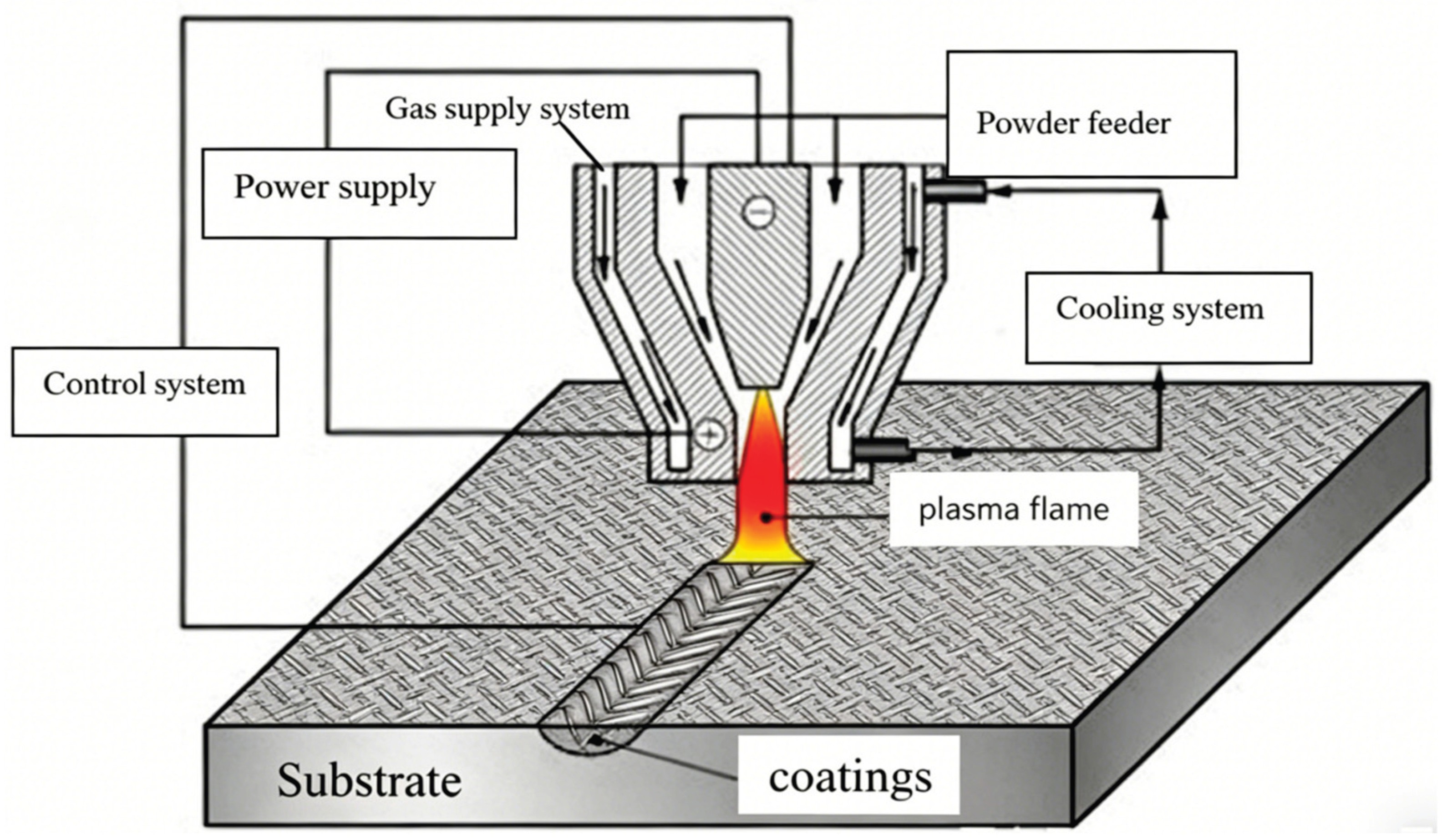
Figure 2.
The surface morphology of the ZrO2 coating applied to the substrate shown at 1000× magnification for tests (a)trial 6, (b)trial 9, (c)trial 14, and (d)trial 16.
Figure 2.
The surface morphology of the ZrO2 coating applied to the substrate shown at 1000× magnification for tests (a)trial 6, (b)trial 9, (c)trial 14, and (d)trial 16.
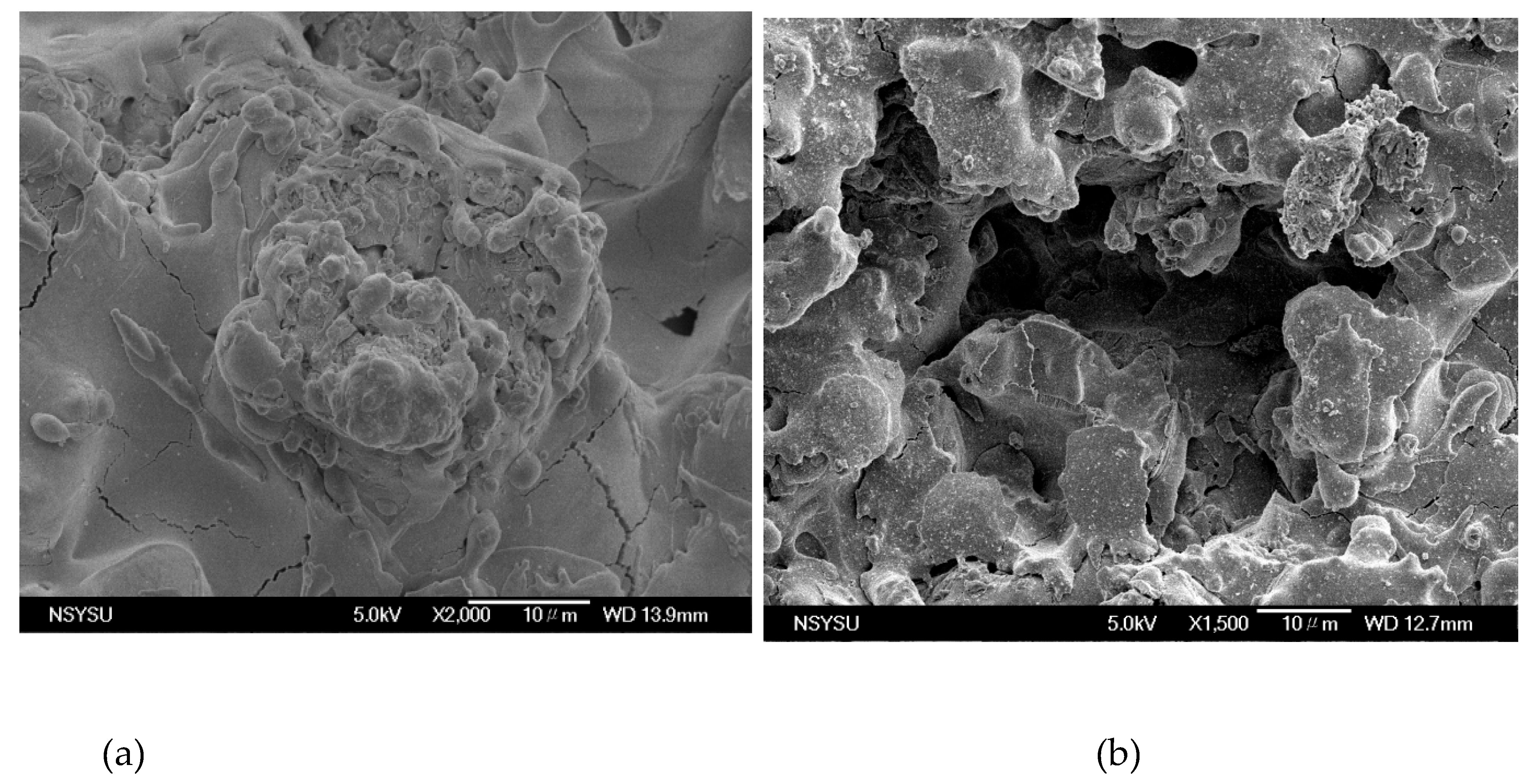
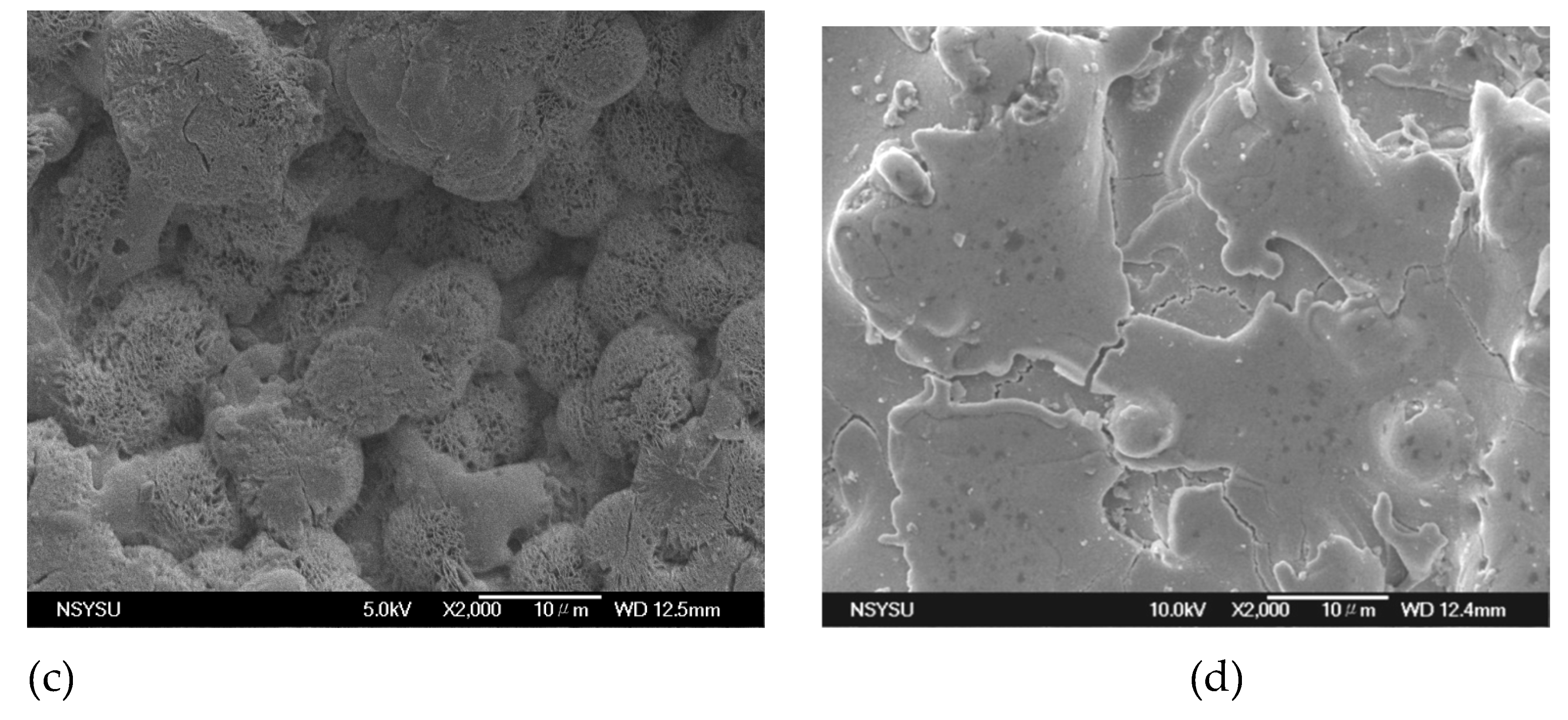
Figure 3.
Microstructural distribution in the interface region of plasma-sprayed coatings (a) Trial 6, (b) Trial 9, (c) Trial 14, and (d) Trial 16.
Figure 3.
Microstructural distribution in the interface region of plasma-sprayed coatings (a) Trial 6, (b) Trial 9, (c) Trial 14, and (d) Trial 16.
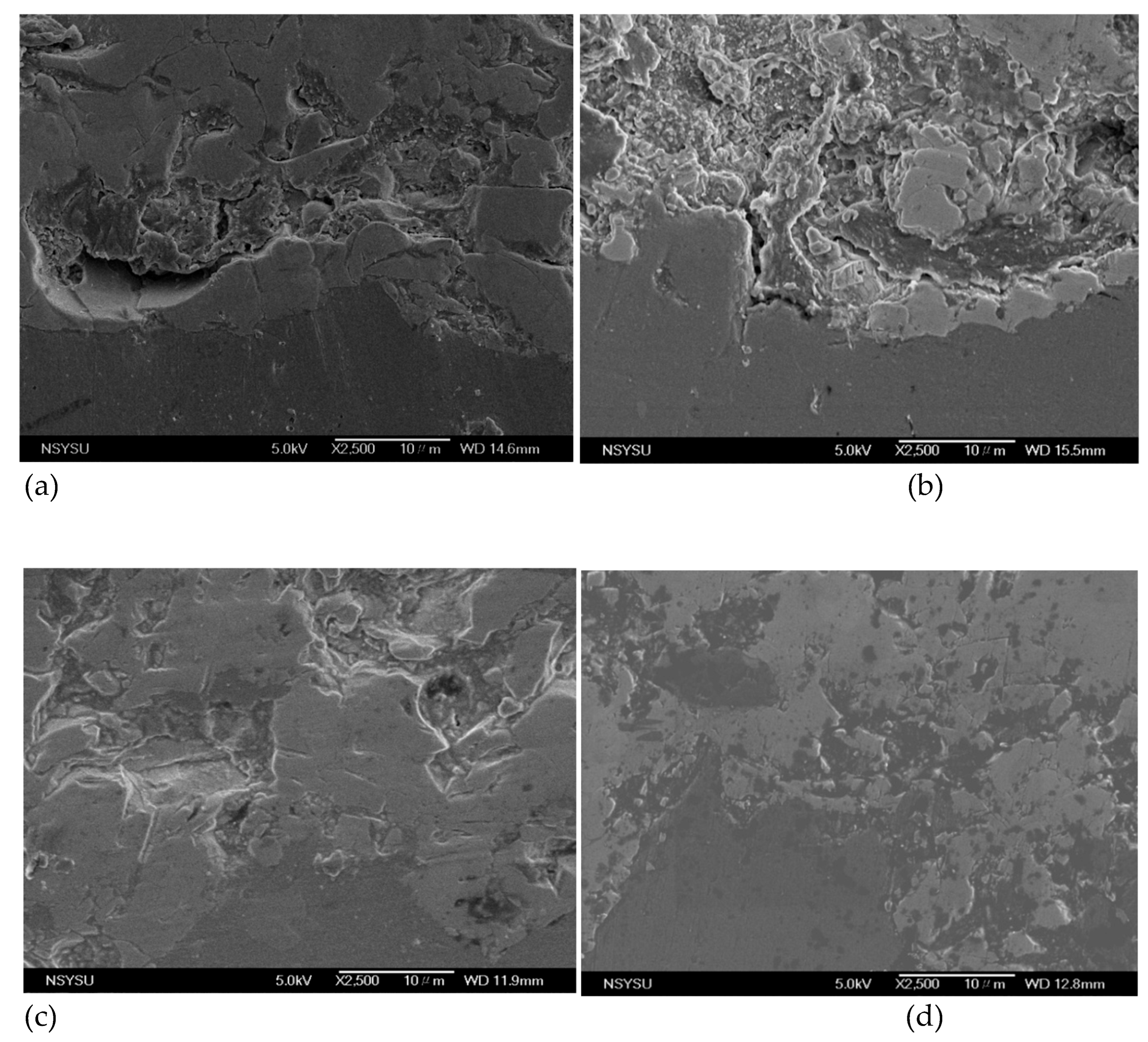
Figure 4.
Low-magnification wear morphologies illustrating the influence of different parameters on the wear resistance of coatings: (a) Trial 6, (b) Trial 11, (c) Trial 14, and (d) Trial 16. Note that the blue line in the top-left corner shows the distribution of aluminium (Al) , while the purple line in the bottom-right corner shows the distribution of zirconium (Zr).
Figure 4.
Low-magnification wear morphologies illustrating the influence of different parameters on the wear resistance of coatings: (a) Trial 6, (b) Trial 11, (c) Trial 14, and (d) Trial 16. Note that the blue line in the top-left corner shows the distribution of aluminium (Al) , while the purple line in the bottom-right corner shows the distribution of zirconium (Zr).
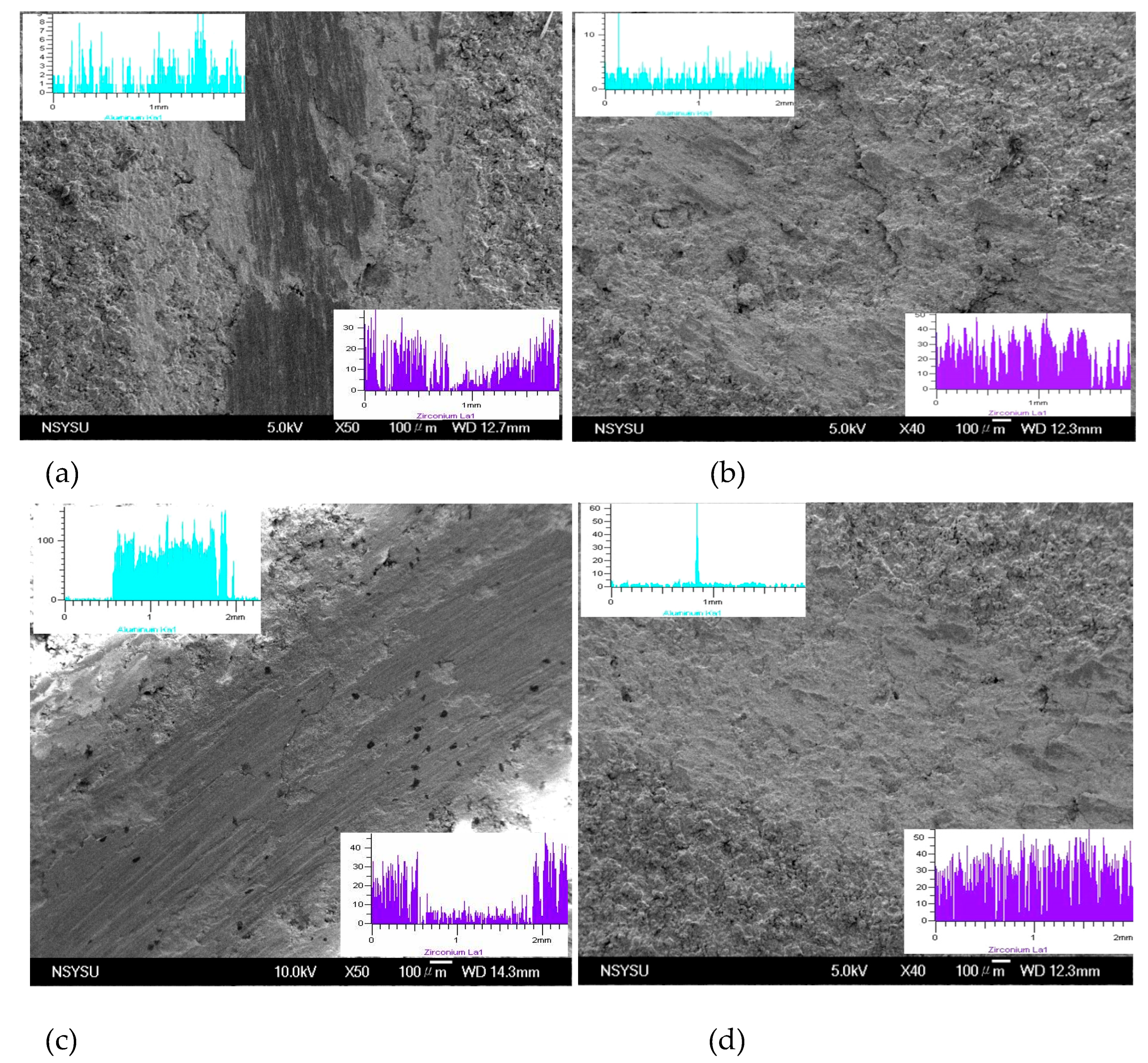
Figure 5.
Contour plot of the response surface for wear volume yield with the interaction function of the main control factors(a)accelerating voltage and stand-off distance,(b)accelerating voltage and powder feeder rate,(c)accelerating voltage and primary gas Ar/H2,(d)stand-off distance and powder feeder rate ,(e) stand-off distance and and primary gas Ar/H2 (f) powder feeder rate and primary gas Ar/H2.
Figure 5.
Contour plot of the response surface for wear volume yield with the interaction function of the main control factors(a)accelerating voltage and stand-off distance,(b)accelerating voltage and powder feeder rate,(c)accelerating voltage and primary gas Ar/H2,(d)stand-off distance and powder feeder rate ,(e) stand-off distance and and primary gas Ar/H2 (f) powder feeder rate and primary gas Ar/H2.
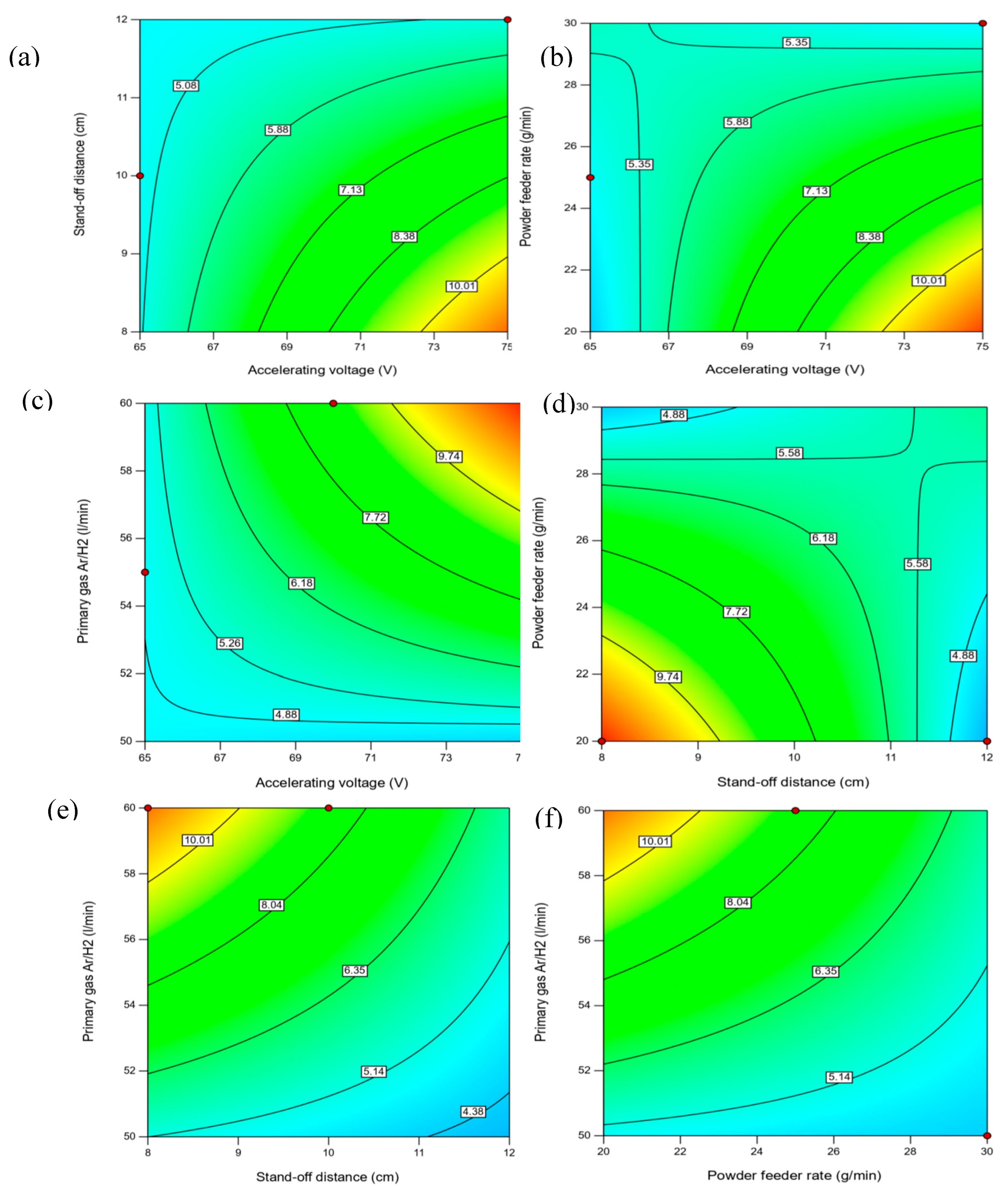
Figure 6.
Contour plot of the response surface for hardness yield with the quadratic function of the main control factors(a)accelerating voltage and stand-off distance,(b)accelerating voltage and powder feeder rate,(c)accelerating voltage and primary gas Ar/H2,(d)stand-off distance and powder feeder rate ,(e) stand-off distance and and primary gas Ar/H2 (f) powder feeder rate and primary gas Ar/H2.
Figure 6.
Contour plot of the response surface for hardness yield with the quadratic function of the main control factors(a)accelerating voltage and stand-off distance,(b)accelerating voltage and powder feeder rate,(c)accelerating voltage and primary gas Ar/H2,(d)stand-off distance and powder feeder rate ,(e) stand-off distance and and primary gas Ar/H2 (f) powder feeder rate and primary gas Ar/H2.
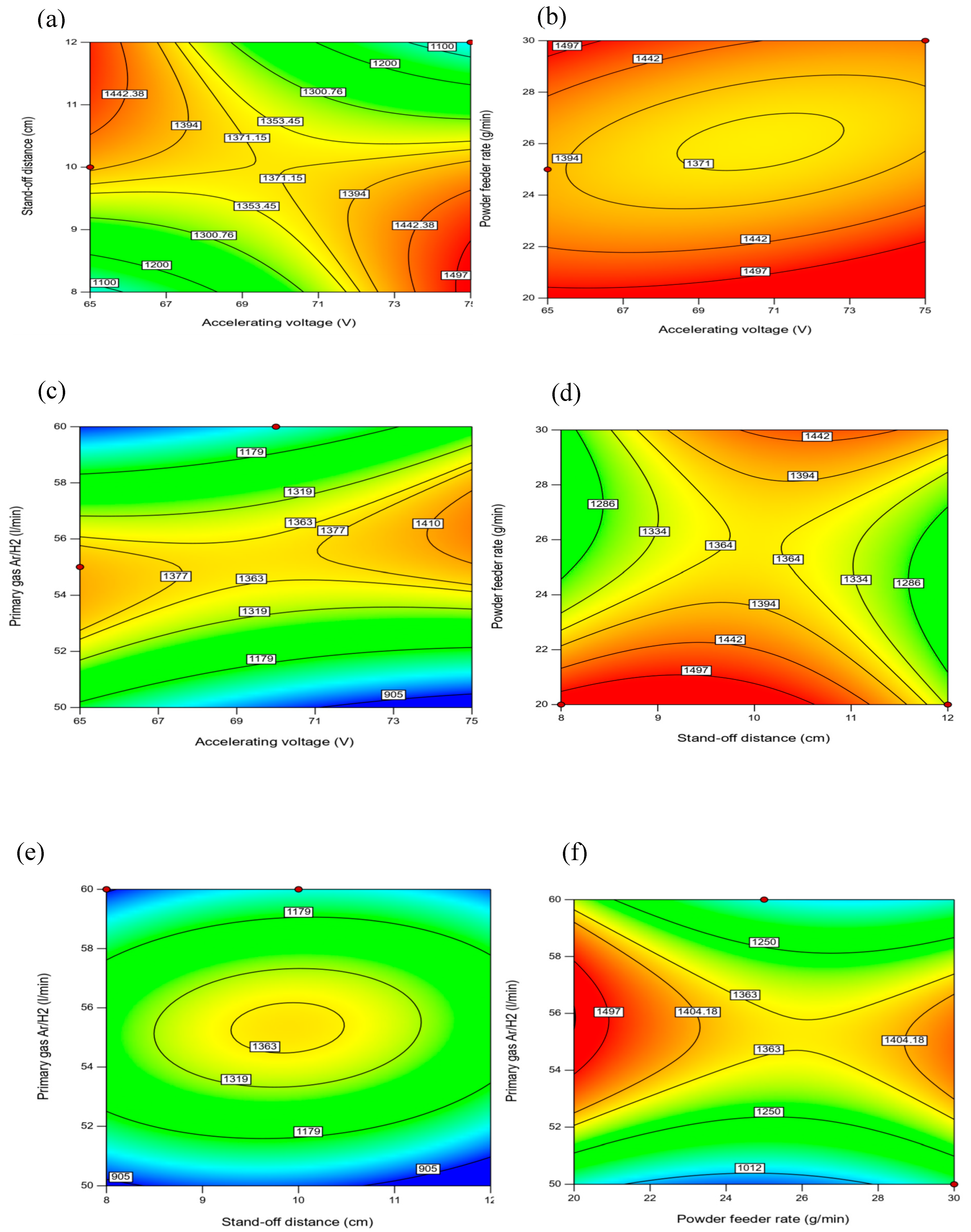
Figure 7.
The contour plot shows (a) the Hv, (b) the hardness, and (c) the wear volume of the plasma-sprayed ceramic coating.
Figure 7.
The contour plot shows (a) the Hv, (b) the hardness, and (c) the wear volume of the plasma-sprayed ceramic coating.
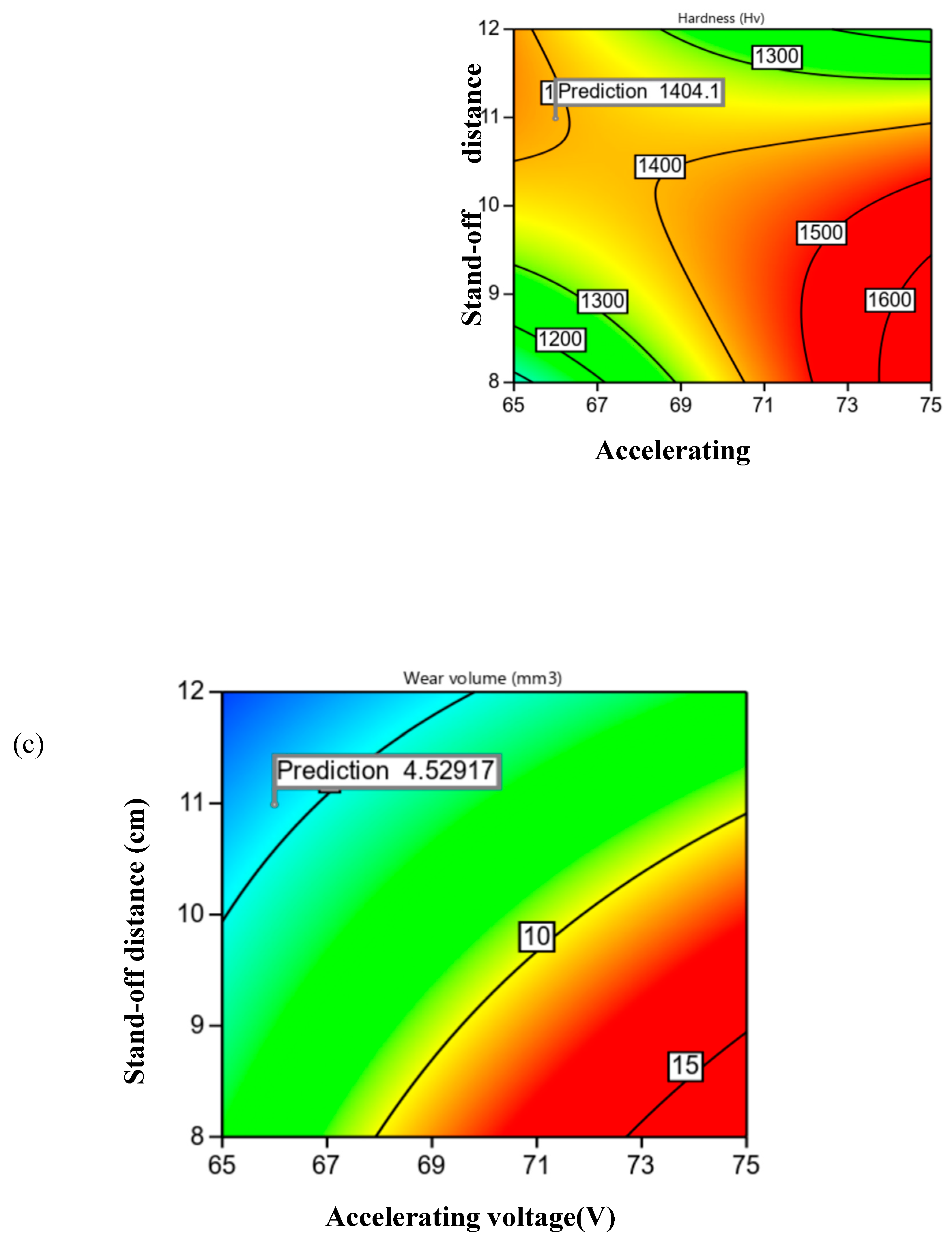
Figure 8.
SEM images of cross-sectional, surface topography and worn structures plasma sprayed ZrO2 coatings (a,c,e) initial test and (b,d,f) optimal test for multiple characteristics.
Figure 8.
SEM images of cross-sectional, surface topography and worn structures plasma sprayed ZrO2 coatings (a,c,e) initial test and (b,d,f) optimal test for multiple characteristics.
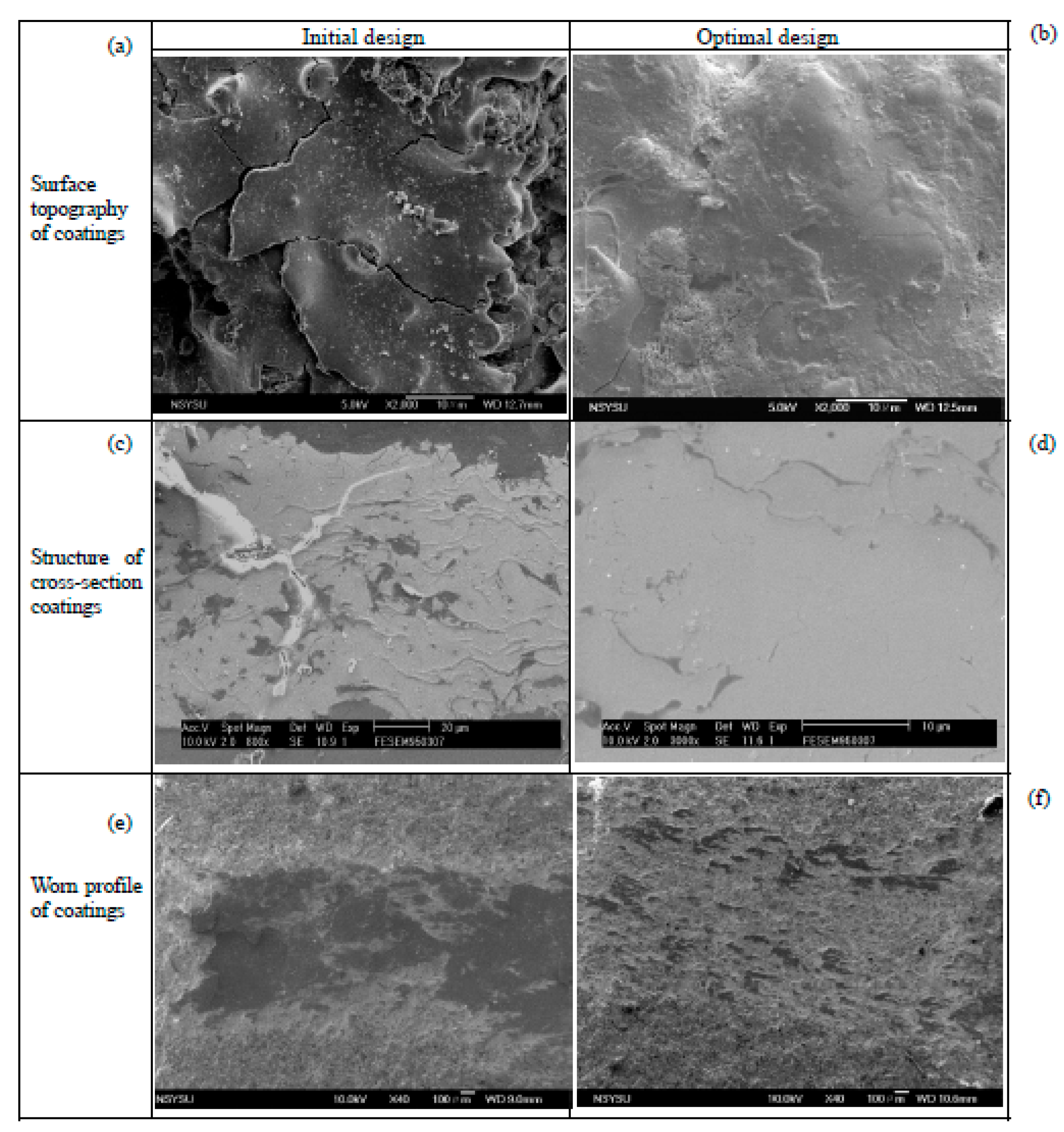

Table 1.
The results of experimental tests for an orthogonal array based on Taguchi designs, including the number of control factors, their properties and performance measures.
Table 1.
The results of experimental tests for an orthogonal array based on Taguchi designs, including the number of control factors, their properties and performance measures.
| No. of tests |
Control factors | Performance Estimate | |||||||||||||
|---|---|---|---|---|---|---|---|---|---|---|---|---|---|---|---|
| A | B | C | D | E | F | G | H | Microhardness (HV) | Wear volume(mm3) | Integrated | |||||
| Mean | St.dev | SNR | Mean | St.dev | SNR | SNR | |||||||||
| 1 | 5 | 65 | 550 | 20 | 8 | 20 | 5 | 50 | 1016 | 231 | 59.66 | 4.79 | 0.335 | -13.61 | 46.05 |
| 2 | 5 | 65 | 600 | 25 | 10 | 25 | 6 | 55 | 1396 | 248 | 62.08 | 6.72 | 0.354 | -16.56 | 45.52 |
| 3 | 5 | 65 | 650 | 30 | 12 | 30 | 7 | 60 | 1223 | 241 | 62.23 | 5.26 | 0.393 | -14.44 | 47.79 |
| 4 | 5 | 70 | 550 | 20 | 10 | 25 | 7 | 60 | 1122 | 131 | 61.58 | 8.39 | 0.140 | -18.48 | 43.10 |
| 5 | 5 | 70 | 600 | 25 | 12 | 30 | 5 | 50 | 1108 | 137 | 61.43 | 8.09 | 0.180 | -18.16 | 43.27 |
| 6 | 5 | 70 | 650 | 30 | 8 | 20 | 6 | 55 | 1510 | 513 | 61.94 | 11.19 | 0.207 | -20.98 | 40.96 |
| 7 | 5 | 75 | 550 | 25 | 8 | 30 | 6 | 60 | 1176 | 154 | 62.31 | 9.28 | 0.376 | -19.35 | 42.96 |
| 8 | 5 | 75 | 600 | 30 | 10 | 20 | 7 | 50 | 1014 | 288 | 59.96 | 5.47 | 0.472 | -14.78 | 45.18 |
| 9 | 5 | 75 | 650 | 20 | 12 | 25 | 5 | 55 | 958 | 151 | 59.77 | 5.63 | 0.124 | -15.01 | 44.76 |
| 10 | 8 | 65 | 550 | 30 | 12 | 25 | 6 | 50 | 1216 | 317 | 61.80 | 5.00 | 0.270 | -13.99 | 47.81 |
| 11 | 8 | 65 | 600 | 20 | 8 | 30 | 7 | 55 | 1151 | 159 | 61.39 | 3.07 | 0.761 | -9.91 | 51.48 |
| 12 | 8 | 65 | 650 | 25 | 10 | 20 | 5 | 60 | 1133 | 136 | 61.55 | 4.91 | 0.163 | -13.82 | 47.73 |
| 13 | 8 | 70 | 550 | 25 | 12 | 20 | 7 | 55 | 1346 | 287 | 62.37 | 5.17 | 0.116 | -14.28 | 48.09 |
| 14 | 8 | 70 | 600 | 30 | 8 | 25 | 5 | 60 | 890 | 162 | 59.59 | 12.63 | 0.888 | -22.04 | 37.55 |
| 15 | 8 | 70 | 650 | 20 | 10 | 30 | 6 | 50 | 1016 | 76 | 60.69 | 3.74 | 0.482 | -11.51 | 49.18 |
| 16 | 8 | 75 | 550 | 30 | 10 | 30 | 5 | 55 | 1490 | 98 | 64.18 | 3.82 | 0.301 | -11.65 | 52.53 |
| 17 | 8 | 75 | 600 | 20 | 12 | 20 | 6 | 60 | 1174 | 247 | 61.77 | 10.29 | 0.409 | -20.25 | 41.52 |
| 18 | 8 | 75 | 650 | 25 | 8 | 25 | 7 | 50 | 1035 | 184 | 59.69 | 8.59 | 0.428 | -18.68 | 41.01 |
Table 2.
A detailed analysis of the ANOVA results, including process parameters, sums of squares, degrees of freedom, variances, F-values, and the percentage contribution of each factor.
Table 2.
A detailed analysis of the ANOVA results, including process parameters, sums of squares, degrees of freedom, variances, F-values, and the percentage contribution of each factor.
| Control factors |
Sum of squares |
Degrees of Freedom |
Mean square |
F-value | Percent contribution |
|---|---|---|---|---|---|
| A | 16.646 | 1.0 | 16.646 | 10.211 | 6.44 |
| B | 53.341 | 2.0 | 26.671 | 16.360 | 20.63 |
| C | 21.521 | 2.0 | 10.761 | 6.601 | 8.32 |
| D | 4.729 | 2.0 | 2.365 | 1.451 | 1.83 |
| E | 45.259 | 2.0 | 22.630 | 13.881 | 17.50 |
| F | 64.571 | 2.0 | 32.286 | 19.804 | 24.97 |
| G | 6.326 | 2.0 | 3.163 | 1.940 | 2.45 |
| H | 42.931 | 2.0 | 21.466 | 13.167 | 16.60 |
| Error | 3.260 | 2.0 | 1.630 | 1.000 | 1.26 |
| Total | 258.587 | 17.0 | 15.211 | 100.00 |
Table 3.
The results of the ANOVA statistical analysis for the interaction model of wear volume including the model’s goodness of fit, analysis of variance, coefficient estimates, and significance tests for the wear volume of the coatings.
Table 3.
The results of the ANOVA statistical analysis for the interaction model of wear volume including the model’s goodness of fit, analysis of variance, coefficient estimates, and significance tests for the wear volume of the coatings.
| Source | Coefficient estimate |
Degree of freedom |
Standard error |
t-Stat | Prob > F |
|---|---|---|---|---|---|
| Model | 0.058 | 10 | 128.394 | -0.451 | 0.666 |
| B | -57.857 | 1 | 1.533 | -0.132 | 0.898 |
| E | -0.203 | 1 | 5.896 | 1.749 | 0.124 |
| F | 10.314 | 1 | 2.711 | 2.152 | 0.068 |
| H | 5.835 | 1 | 2.317 | -1.066 | 0.322 |
| BE | -2.469 | 1 | 0.077 | -2.014 | 0.084 |
| BF | -0.154 | 1 | 0.030 | -2.776 | 0.027 |
| BH | -0.083 | 1 | 0.030 | 2.511 | 0.040 |
| EF | 0.076 | 1 | 0.076 | 3.174 | 0.016 |
| EH | 0.241 | 1 | 0.074 | -1.574 | 0.159 |
| FH | -0.116 | 1 | 0.029 | -1.748 | 0.124 |
| Residual | 21.853 | 7 | 3.122 | ||
| Cor Total | 141.197028 | 17 |
Table 4.
The results of the ANOVA statistical analysis for the quadratic model of hardness including the model's goodness of fit, analysis of variance, and estimates and statistical tests of the significance for the hardness of the coatings.
Table 4.
The results of the ANOVA statistical analysis for the quadratic model of hardness including the model's goodness of fit, analysis of variance, and estimates and statistical tests of the significance for the hardness of the coatings.
| Source | Coefficient estimate | Degree of freedom |
Standard error |
t-Stat | Prob > F |
|---|---|---|---|---|---|
| Model | -29295.494 | 14 | 14891.843 | -1.967 | 0.144 |
| B | -266.131 | 1 | 386.755 | -0.688 | 0.541 |
| E | 1764.181 | 1 | 530.425 | 3.326 | 0.045 |
| F | -59.479 | 1 | 201.228 | -0.296 | 0.787 |
| H | 1156.246 | 1 | 291.627 | 3.965 | 0.029 |
| BE | -23.335 | 1 | 5.402 | -4.320 | 0.023 |
| BF | -2.264 | 1 | 2.038 | -1.111 | 0.348 |
| BH | 6.296 | 1 | 2.155 | 2.921 | 0.061 |
| EF | 8.866 | 1 | 5.280 | 1.679 | 0.192 |
| EH | 4.324 | 1 | 5.002 | 0.865 | 0.451 |
| FH | -2.962 | 1 | 1.995 | -1.484 | 0.234 |
| B2 | 1.496 | 1 | 2.741 | 0.546 | 0.623 |
| E2 | -29.814 | 1 | 15.811 | -1.886 | 0.156 |
| F2 | 5.644 | 1 | 2.242 | 2.517 | 0.086 |
| H2 | -14.150 | 1 | -5.667 | -5.667 | 0.011 |
| Residual | 34417.795 | 3 | 11472.598 | ||
| Cor Total | 525833.111 | 17 |
Disclaimer/Publisher’s Note: The statements, opinions and data contained in all publications are solely those of the individual author(s) and contributor(s) and not of MDPI and/or the editor(s). MDPI and/or the editor(s) disclaim responsibility for any injury to people or property resulting from any ideas, methods, instructions or products referred to in the content. |
© 2026 by the authors. Licensee MDPI, Basel, Switzerland. This article is an open access article distributed under the terms and conditions of the Creative Commons Attribution (CC BY) license (http://creativecommons.org/licenses/by/4.0/).
Copyright: This open access article is published under a Creative Commons CC BY 4.0 license, which permit the free download, distribution, and reuse, provided that the author and preprint are cited in any reuse.


