
Submitted:
17 June 2026
Posted:
18 June 2026
You are already at the latest version
Abstract
The transition from internal combustion engine vehicles toward hybrid electric vehicles and battery electric vehicles has transformed not only automotive engineering but also the sensory and emotional experience of driving. While previous studies have examined environmental and performance differences between propulsion systems, limited researches investigated their direct impact on human neurophysiology and emotional perception during real-world driving. This study investigates the neurophysiological and autonomic responses of drivers exposed to three vehicle categories: electric vehicles, internal combustion engine vehicles, and hybrid electric vehicles. A standardized driving sessions were performed in urban driving environment, while electroencephalography, heart rate, heart rate variability, galvanic skin response and peripheral blood oxygen saturation were continuously recorded. Measurements were collected during three phases: a five-minute pre-driving baseline, twenty minutes of active driving, and a five-minute post-driving recovery period. Electroencephalography power in the theta (4–8 Hz), alpha (8–12 Hz), low beta (12–20 Hz), and high beta (20–30 Hz) frequency bands were analyzed as indicators of cognitive workload, cortical relaxation, and attentional engagement. Cardiovascular and electrodermal signals were interpreted as markers of autonomic arousal, sympathetic activation, and stress regulation. Peripheral oxygen saturation was included as complementary index of cardiorespiratory and metabolic demand across vehicle conditions.
Keywords:
EEG
; heart rate variability
; galvanic skin response
; pulse oximetry
; electric vehicle
; neuroergonomics
; driver physiology
; cognitive workload
1. Introduction
The global automotive sector is undergoing one of the most consequential technological transitions in its history. Accelerating regulatory pressure, climate commitments, and rapid advances in battery technology are driving an irreversible shift from the internal combustion engine (ICE) paradigm toward battery electric vehicles (EVs) and hybrid electric vehicles (HEVs) (IEA, 2023) [1,2,3,4]. By 2030, EVs and HEVs are projected to constitute the majority of new vehicle sales across major markets, fundamentally reshaping not only transportation infrastructure but also the sensory and psychophysiological experience of mobility itself (BloombergNEF, 2023) [5]. Yet while the engineering and environmental dimensions of this transition have been extensively studied, its neurophysiological and human factors implications remain comparatively underexplored [6,7].
Driving is among the most cognitively and physiologically demanding activities of everyday life, requiring the continuous integration of sensory perception, attentional control, motor coordination, spatial navigation, affective regulation, and rapid decision-making under time pressure (Brookhuis & de Waard, 2010) [8]. The physical environment of the vehicle cabin — its acoustic character, vibrotactile profile, thermal climate, and ergonomic configuration — constitutes a persistent background stimulus that modulates cortical arousal, autonomic nervous system tone, and subjective comfort across the entire driving session (Parasuraman & Rizzo, 2007) [31]. ICE, EV, and HEV propulsion technologies differ fundamentally in precisely these environmental dimensions: combustion engines generate continuous broadband noise, mechanical vibration, and exhaust-derived air contaminants, whereas electric drivetrains are substantially quieter, mechanically smoother, and produce no direct cabin emissions (Genuit & Fiebig, 2006; Kim et al., 2024) [14,22]. These differences are not merely a matter of comfort — they represent a systematic manipulation of the physiological environment in which cognition and emotion operate during driving.
Objective assessment of driver physiological state has advanced considerably with the adoption of wearable bio sensing technologies. Electroencephalography (EEG) provides millisecond-resolution access to cortical oscillatory dynamics that index cognitive workload, attentional engagement, vigilance, and fatigue (Makeig & Jung, 1996; Klimesch, 1999) [23,27]. Electrocardiography-derived measures of heart rate (HR) and heart rate variability (HRV) reflect the balance between sympathetic and parasympathetic autonomic regulation, providing sensitive indicators of cardiovascular stress, emotional arousal, and cognitive effort (Task Force, 1996; Thayer & Lane, 2000) [36]. Galvanic skin response (GSR), or electrodermal activity, measures sympathetic activation of eccrine sweat glands and provides a continuous, valence-independent index of emotional arousal intensity (Boucsein, 2012; Critchley, 2002) [7,11]. Pulse oximetry (SpO₂) enables non-invasive monitoring of peripheral oxygen saturation, sensitive to respiratory demand, metabolic rate, and cabin air quality differences that may vary systematically across vehicle types (Jubran, 2015; Hill et al., 2021). When deployed simultaneously, these signals provide a comprehensive and mechanistically informative window onto the concurrent cognitive, autonomic, and metabolic consequences of driving under differing vehicular conditions — a level of physiological resolution that no single modality can achieve in isolation (Borghini et al., 2014; Aminosharieh Najafi et al., 2023) [1,6].
Despite the theoretical rationale for expecting substantial physiological differences between ICE, EV, and HEV driving environments, empirical evidence remains limited and methodologically fragmented. The most commonly studied dimension is acoustic: the ICE cabin is substantially louder than the EV cabin, with engine-generated low-frequency noise documented to elevate sympathetic cardiovascular activity, impair parasympathetic recovery, and increase perceived stress during prolonged exposure (Babisch, 2005; Münzel et al., 2014) [3,29]. Comparative biometric studies have reported lower sweat rate, HR, and GSR in EV drivers relative to combustion vehicle equivalents. Cabin air quality — modulated by ventilation mode and combustion-derived contaminants — represents an additional vehicle-type-dependent variable with documented effects on cognitive function and potential SpO₂ dynamics (Guo et al., 2024; Satish et al., 2012) [16,33]. Hybrid vehicles occupy an intermediate and dynamically variable sensory position, with propulsion mode transitions potentially inducing episodic attentional and autonomic responses not present in pure-mode alternatives.
Despite rapid advances in automotive NVH engineering and active road noise control, most studies still evaluate system performance primarily in terms of sound pressure level reduction and objective acoustic metrics, with limited attention to drivers’ neurophysiological and autonomic responses under real world driving conditions. Recent work on road noise control demonstrates effective attenuation of low frequency tire–road noise using feedforward and feedback ANC architectures, yet these evaluations rarely incorporate multimodal psychophysiological endpoints such as EEG, HRV, GSR, and SpO₂ at the driver’s body. At the same time, our multimodal study shows that internal combustion engine cabins elicit significantly higher broadband EEG power and distinct autonomic patterns compared with electric and hybrid vehicles, indicating that propulsion dependent acoustic and vibrotactile environments systematically modulate cortical and autonomic load during driving: “ICE driving was associated with significantly higher theta, alpha, low beta, and high beta EEG power than both EV and Hybrid driving, while EV and Hybrid groups were neurophysiologically indistinguishable.” Yet no work has systematically tested whether state of the art noise control technologies—passive or active—can normalize or optimize these neurophysiological profiles in real traffic. This defines a critical research gap: the lack of controlled on road experiments that link specific noise control interventions to changes in drivers’ cortical workload, autonomic regulation, and subjective comfort across different propulsion technologies.
For the road noise exposure: Tire–road interaction has become the dominant noise source in modern vehicles, especially at typical urban and highway speeds and in electric vehicles where powertrain noise is reduced. Chronic exposure to low frequency traffic noise is associated with elevated sympathetic activity, impaired parasympathetic recovery, and increased cardiovascular risk, positioning cabin acoustics as a non trivial determinant of driver health and performance. Cabin sound quality and NVH: Classical NVH work has characterized interior sound quality using psychoacoustic metrics (loudness, sharpness, roughness) and linked them to perceived comfort and brand identity. Combustion cabins typically exhibit broadband engine noise and vibration, whereas electric drivetrains yield quieter, smoother environments with different spectral content and masking properties, implying distinct sensory and affective experiences for drivers.
Several works focus on active noise control (ANC) in vehicles. Feedforward and feedback ANC architectures: Active road noise control systems use chassis or cabin sensors to predict or measure primary noise and generate anti noise via loudspeakers, targeting low frequency components that passive treatments cannot efficiently attenuate. Recent feedback ANC designs based on single microphone error sensing and FxLMS algorithms have demonstrated effective attenuation of measured road noise in simulation and prototype vehicles: “A simulation was implemented based on measured real road noise data, and the simulation results indicate that the proposed feedback ANC system with the single microphone sensor can effectively attenuate road noise.” However, these studies focus on acoustic performance and do not quantify downstream effects on driver physiology or cognition. Several manufacturers report production level RNC systems achieving 3–4 dB overall reductions and larger peak reductions in targeted bands, yet subjective improvements are often modest, suggesting that SPL metrics alone may not capture the full experiential impact of noise control.
The state-of-the-art studies of psychophysiology and neuroergonomics of driving shows that for multimodal measures of workload and stress neuroergonomics research has established EEG, HRV, GSR, and SpO₂ as sensitive markers of mental workload, vigilance, fatigue, and emotional arousal during driving. Frontal midline theta indexes cognitive workload and executive control, alpha reflects cortical relaxation and attentional engagement, and beta activity tracks sensory arousal and sensorimotor activation. HRV metrics (SDNN, RMSSD) capture sympathovagal balance, while GSR provides a valence independent index of autonomic arousal intensity. Our multimodal study add up and shows that ICE cabins produce higher broadband EEG power and distinct autonomic signatures compared with EV and HEV cabins, under standardized real world driving: “ICE vehicles were associated with significantly higher theta, alpha, low beta, and high beta power than both EV and Hybrid vehicles, with no significant difference between EV and Hybrid groups in any band.” These findings suggest that cabin acoustic and vibrotactile environments are not merely comfort factors but active modulators of driver neurophysiological state. Existing ANC and NVH studies rarely integrate these psychophysiological measures into their evaluation frameworks, and neuroergonomics work has largely treated cabin noise as a background variable rather than a manipulable design parameter. The intersection—systematic testing of noise control technologies with multimodal physiological endpoints in real traffic—remains underdeveloped, motivating our research.
For the Road noise control technology and limitations Liu & Lee ( 2024, Sensors (feedback ANC with single microphone)) [41] demonstrates feasibility of feedback ANC for road noise using FxLMS and measured road noise data; shows effective attenuation but no physiological outcomes, supporting the gap between acoustic and psychophysiological evaluation and Chen et al., (2025, APSIPA ASC (research progress on RNC)) [42] reviews three decades of RNC development, industrial implementations, and remaining challenges in performance, robustness, and system complexity—ideal for framing the technological state of the art and unmet expectations. Then in respect to the health and neurophysiology of noise exposure Babisch, (2005) [3] provides a foundational review linking environmental noise to cardiovascular and autonomic effects; supports the claim that cabin noise has health relevant consequences and Münzel et al., (2014) [29], details cardiovascular effects of environmental noise exposure, reinforcing the mechanistic plausibility of noise induced autonomic changes in drivers. In terms of psychophysiology of driving and workload Borghini et al., (2014) [6], performs a comprehensive review of EEG, ECG, and EDA for assessing mental workload, fatigue, and drowsiness in pilots and drivers—anchors the multimodal measurement framework and Jap et al., (2009) [20]; Chikhi et al., (2022) [20] performs a empirical and meta analytic evidence that EEG spectral components, especially frontal theta, reliably index cognitive workload during driving and complex tasks. The presented multimodal real world study in this work provides a direct evidence that propulsion type modulates broadband EEG and autonomic responses in real world driving, establishing the need to test whether noise control interventions can modify these profiles: “Collectively, these findings demonstrate that vehicle propulsion technology constitutes a significant and physiologically consequential determinant of driver cortical and autonomic state, with ICE operation imposing a higher neurophysiological burden than EV or Hybrid alternatives.”
The present study was designed to provide a comprehensive, multimodal neurophysiological comparison of driving in EV, ICE, and HEV conditions under real-world traffic. Thirty-seven participants completed standardized driving sessions with simultaneous recording of EEG (theta, alpha, low beta, high beta), HR, HRV (SDNN and RMSSD), GSR, and SpO₂ throughout a structured three-phase protocol — pre-drive baseline (PREDRIVE ), active driving (DRIVE), and PostDrive -drive recovery (POSTDRIVE ). This design enables three complementary analyses: (1) between-group comparisons of physiological activation as a function of vehicle type; (2) within-session phase analyses examining which modalities are sensitive to the driving episode; and (3) pre-to-PostDrive contrasts testing whether the driving session produces a lasting physiological shift that differs between vehicle types. By integrating cortical oscillatory, cardiovascular autonomic, electrodermal, and peripheral oxygenation measures within a single study, we aim to provide a richer account of vehicle-type-dependent driver physiology than any single-modality approach could achieve.
Research Objectives and Hypotheses
Objective 1 — Group effects. To determine whether EEG power spectral density, HR, HRV, GSR, and SpO₂ differ significantly between EV, ICE, and HEV driving groups. We hypothesized that ICE drivers would exhibit higher broadband EEG power, elevated HR, reduced HRV, greater GSR, and lower SpO₂ relative to EV drivers, with HEV drivers occupying an intermediate profile.
Objective 2 — Phase effects. To characterize within-session temporal dynamics of each physiological measure across PREDRIVE, DRIVE, and POSTDRIVE phases. We hypothesized that active driving would produce selective EEG theta augmentation, HR elevation, HRV reduction, and GSR increase relative to the resting baseline.
Objective 3 — PREDRIVE vs. POSTDRIVE comparisons. To test whether the driving session produces a net lasting physiological shift from pre- to PostDrive-drive rest, as an index of cumulative fatigue or autonomic residue effects specific to each vehicle type.
Objective 4 — Group × Phase interactions. To examine whether the trajectory of physiological change across the session differs between vehicle groups, as evidence that vehicle propulsion type moderates the psychophysiological dynamics of the driving episode.
2. Methodology
2.1. Participants and Experimental Design
A total of 37 vehicle driving sessions were recorded across three vehicle propulsion categories: electric vehicles (EV; n = 16), internal combustion engine vehicles (ICE; n = 15), and hybrid vehicles (Hybrid; n = 6). Each session was conducted by a single professional test driver who operated all 37 vehicles, providing an internally controlled within-driver comparison while capturing the physiological variation attributable to vehicle characteristics. The experimental protocol comprised three sequential recording phases per vehicle: a pre-drive resting baseline (PREDRIVE ; 3 minutes, seated and stationary), an active driving phase (DRIVE; approximately 15–20 minutes of real-road operation under standardized urban and suburban traffic conditions), and a PostDrive is the drive recovery period (POSTDRIVE ; 3 minutes, seated and stationary following completion of the drive). All sessions were conducted on the same route under comparable time-of-day and weather conditions to minimize confounding environmental variation.
By using a single professional driver does not allow generalization to the population of all drivers. The choice of a single professional driver was intentional and is methodologically justified for the specific research task. The aim of the study is to examine how vehicle propulsion type (EV, HEV, ICE) modulates neurophysiological and autonomic responses, and not to characterize inter individual differences among drivers. Using multiple drivers would introduce substantial uncontrolled variability in driving style, emotional reactivity, baseline physiology, and familiarity with vehicle classes—factors known to strongly influence EEG, HRV, and GSR measures. By holding the driver constant, we ensured that all observed differences arise from the vehicles themselves, not from between driver variability. This approach is consistent with established practice in automotive engineering and NVH research, where a single trained driver is commonly used to ensure repeatability and minimize behavioral confounds.
Figure 1.
A sample of the fleet that was tested.
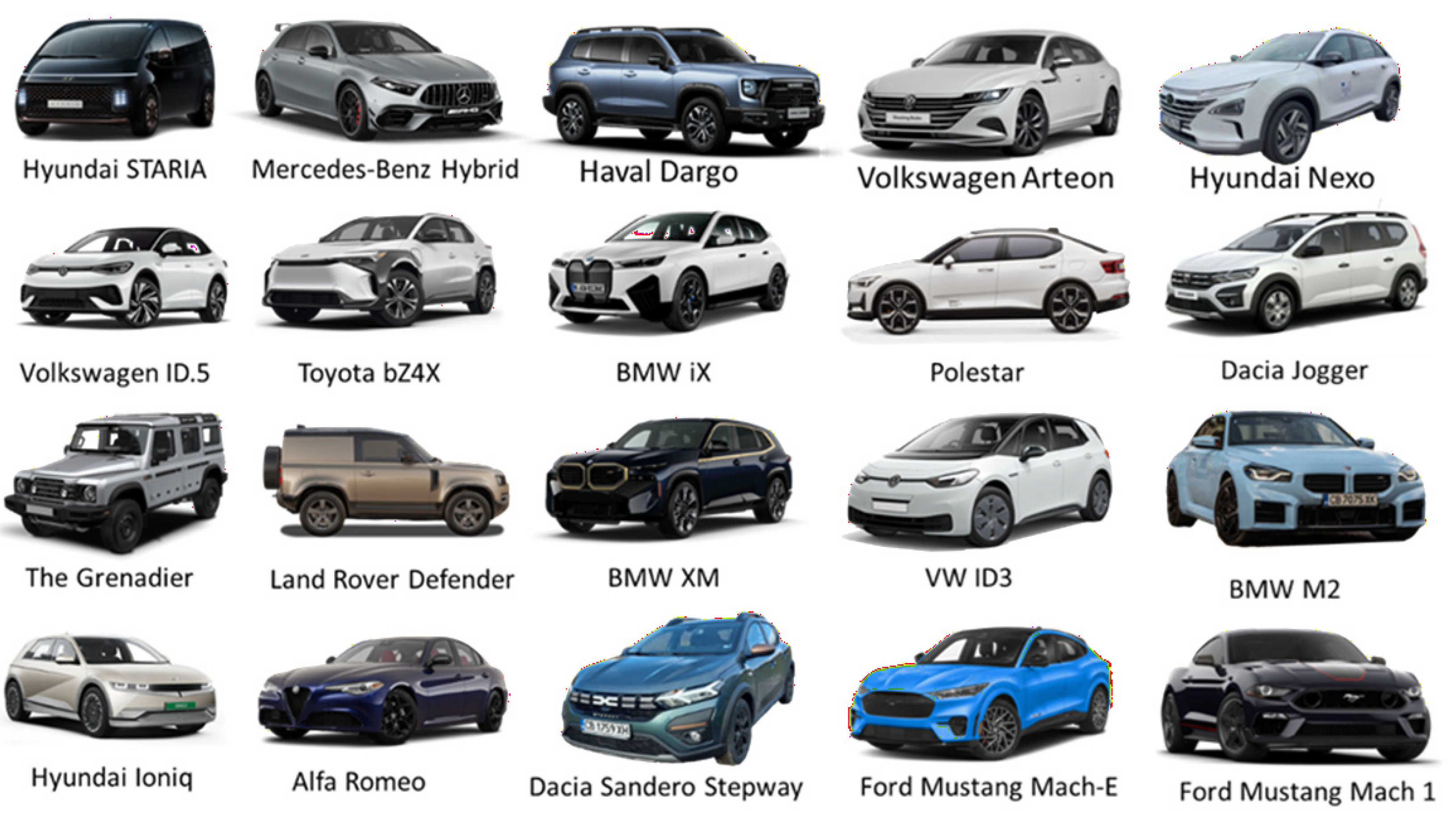
Class Electro Vehicle (EV) was represented with (BMW IX, HONDA E NY1, HYUNDAI IONIQ 6, KIA EV9, MERCEDES AMG EQE SUV, MUSTANG MACH E, PEUGEOT E 2008, POLSTAR 2, PORSCHE TAYCAN, SMART BRABUS, SUBARU SOLTERRA, TOYOTA BZ4X, VW E ID5, VW ID BUZZ, VW ID3 FACELIFT, HYUNDAI NEXO).
Class Hybrid was represented with (RENO ARCANA, BMV XM, MERCEDES GLC COUPÉ, MERCEDES S580, VOLVO XC60, VW TOUAREG R EHYBRID).
Class Internal Combustion Engine (ICE) was represented with (ALFA GIULIETTA, BMV X6M, BMW M2, DACIA SANDERO STEPWAY, DACIA JOGER, HAVAL DARGO, HYNDAI BAYON, INEOS GRENADIR, LAND ROVER DEFENDER V8, MERCEDES GLC, FORD MUSTANG MACH1, OPEL ASTRA GSI, VW ARTEON, HYUNDAI STARIA, MERCEDES T DISEL).
2.2. EEG Acquisition and Analysis
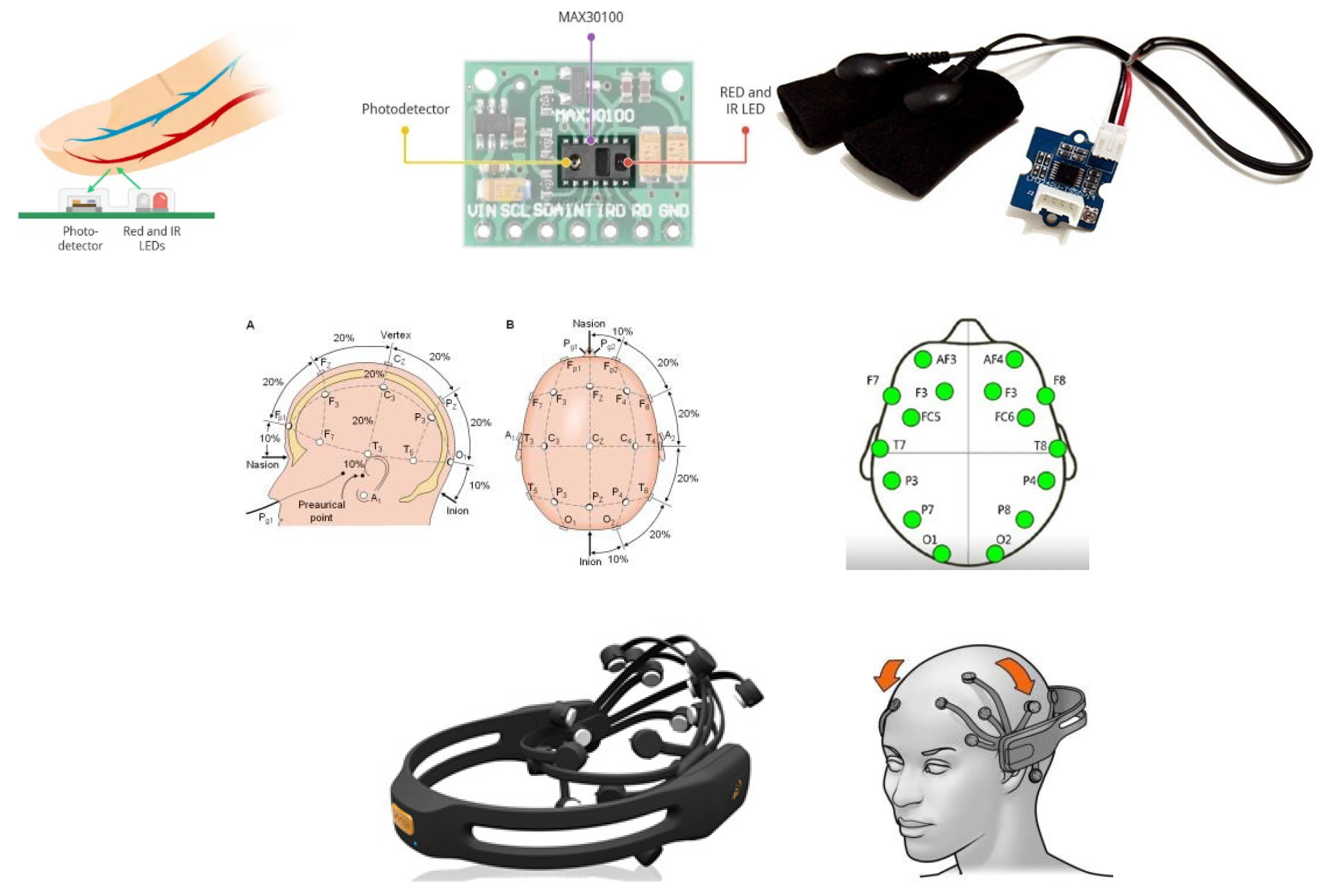
Electroencephalography (EEG) is a recording of the brain's bioelectrical activity. EEG signal detection is done with usage of electrodes, which are placed on the scalp in order to detect electrical activity in the human brain. The neural cells in the human brain communicate by electrical impulses at all instances of time. This activity is monitored in form of brainwaves. EEG signals can be separated into several waveband classes-based frequency ranges. Electroencephalographic activity was recorded using the Emotiv EPOC wireless EEG headset, positioned according to manufacturer guidelines prior to each session with signal quality verified before recording commenced. EEG spectral power was extracted and analysed in four canonical frequency bands: theta (4–8 Hz), alpha (8–12 Hz), low beta (β Low, 12–20 Hz), and high beta (β High, 20–30 Hz). Theta power was computed as the average of F3 and F4 electrode positions, reflecting frontal midline theta associated with cognitive workload and executive processing. Alpha power was derived from P7 and P8 (parietal sites), indexing cortical relaxation and attentional engagement. Low and high beta power were computed from the average of F3, F4, P7, and P8 electrode positions, capturing arousal-related and sensorimotor cortical activation.
The electrode placement positions are determined by dividing the skull into perimeters by connecting few reference points on human head. From these points, the skull perimeters are measured in the transverse and median planes. Electrode locations are determined by dividing these perimeters into 10% and 20% intervals. The “Emotiv EPOC” + is an EEG Headset with 14 channels of EEG data that we use and the measure data is send via Bluetooth interface wirelessly to PC, sampled in 2048Hz and down sampled to 128Hz resulting in 64Hz baseband. Based on the cognitive load the cognitive index is presented:
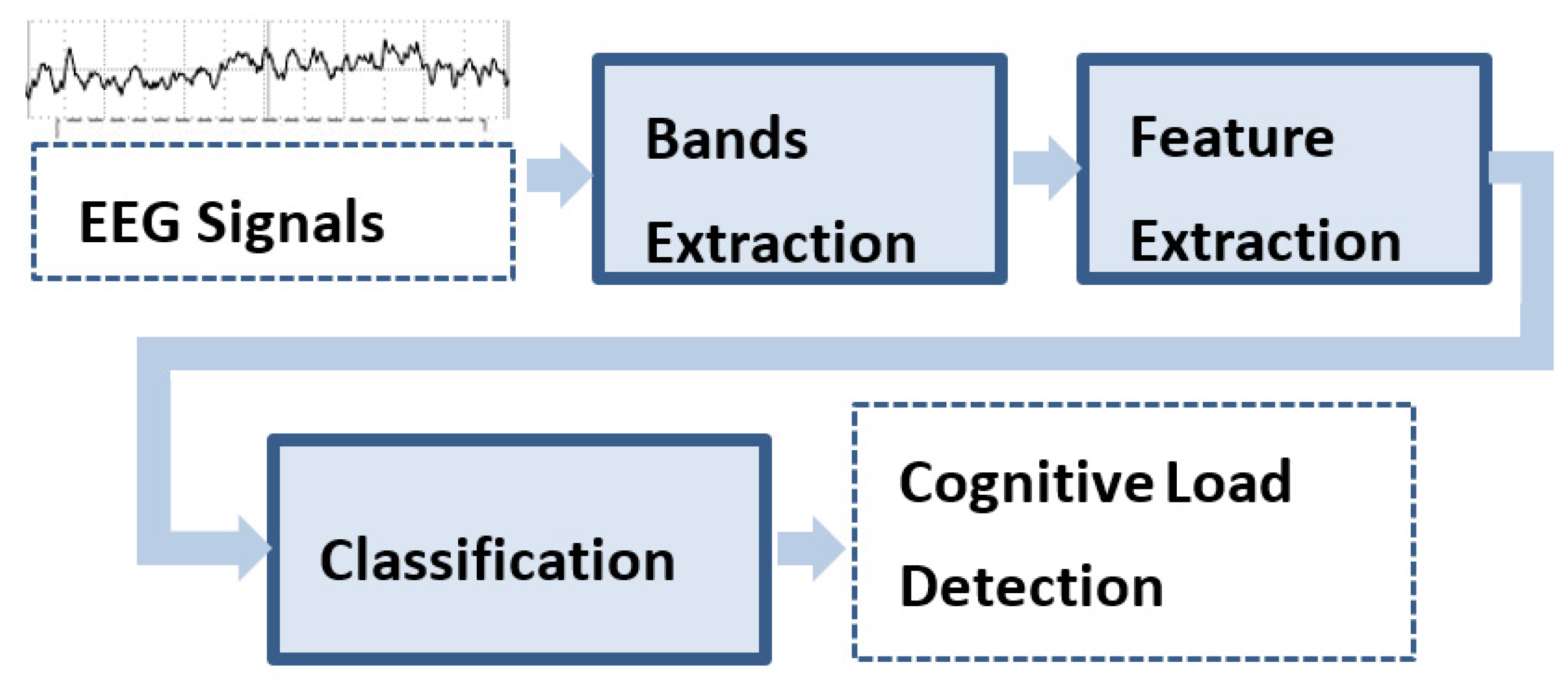
where ∂ is the cognitive index, ∈b is the base-line intermission of band power, and ∈t is the task internal of band power. Measurement of cognitive load is typically consisting bands extraction, features extraction and classification.
Figure 2.
The EEG signal processing and band frequency detection chain.
2.3. Cardiovascular, Oximetric, and Electrodermal Measurements
Heart rate (HR; bpm) and peripheral blood oxygen saturation (SpO₂; %) were recorded continuously throughout all three phases using a pulse oximeter sensor attached to the ring finger. HRV was quantified using two time-domain indices: SDNN (standard deviation of normal-to-normal R-R intervals, reflecting overall HRV) and RMSSD (root mean square of successive R-R differences, reflecting short-term vagal parasympathetic modulation). Electrodermal activity was assessed via galvanic skin response (GSR; Relative Units), with electrodes attached to the index and middle fingers. GSR was recorded continuously across PREDRIVE, DRIVE, and POSTDRIVE phases to quantify sympathetic nervous system activation and psychophysiological arousal.
Skin conductance response (SCR), also referred to as electrodermal activity (EDA) or galvanic skin response (GSR), measures the momentary increase in electrical conductivity of the skin in response to physiologically arousing stimuli, whether external or internal. This phenomenon occurs because emotional activation triggers the sympathetic nervous system, resulting in increased sweat gland activity, which enhances the skin's electrical conductance properties. When measuring SCR, a mild electrical current is applied across the skin's surface, allowing researchers to detect fluctuations in conductance levels that correspond to autonomic nervous system activation. These fluctuations directly reflect changes in the activity level of eccrine sweat glands, providing a quantifiable indicator of psychological arousal. It's important to note that arousal represents one fundamental dimension of emotional response, specifically relating to activation intensity rather than emotional valence (positive/negative quality). While not a comprehensive measure of emotion itself, arousal serves as a critical component in understanding emotional states and has demonstrated strong correlations with attentional processes and memory formation. For this study, measurements were obtained using a custom-developed sensor with a 128 Hz sampling rate. The device attaches to a participant's finger and transmits collected data to a computer via USB interface, enabling real-time monitoring of autonomic responses during driving scenarios.
Heart rate, measured in beats per minute (BPM), provides a straightforward and reliable indicator of physiological activation. While breathing rate offers similar insights, heart rate monitoring presents significant advantages in terms of ease of data collection and analysis, making it the preferred metric for assessing autonomic nervous system activity.
Elevated heart rate typically indicates increased arousal levels, though baseline measurements vary between individuals due to factors including body temperature, psychological stress, and sleep quality. Research applications generally focus on heart rate variability (HRV), the analysis of changes from established baseline values rather than absolute measurements to detect meaningful physiological responses to stimuli. The primary advantages of heart rate monitoring include its non-invasive nature, cost effectiveness, and high reliability. Similar to skin conductance response, heart rate measurements reveal how the autonomic nervous system responds to environmental or psychological stimuli, providing valuable insights into a subject's level of excitement or stress. For this study, we employed a smartwatch with integrated pulse monitoring capability. Data was wirelessly transmitted to a computer via Bluetooth connectivity, allowing for continuous real-time monitoring throughout the driving experience.
Blood oxygen saturation (SpO₂) is a critical physiological parameter that measures the percentage of hemoglobin binding sites in the bloodstream occupied by oxygen molecules. In healthy individuals at rest, this value typically ranges between 95-100%. This measurement provides valuable insights into respiratory function, cardiovascular response, and autonomic nervous system activity. Modern SpO₂ monitoring utilizes pulse oximetry, a non-invasive technology that employs light-based sensors typically placed on the fingertip or earlobe. These sensors emit specific wavelengths of light that are differentially absorbed by oxygenated and deoxygenated hemoglobin, allowing for real-time monitoring of blood oxygen levels. Contemporary devices are compact, wireless, and capable of continuous monitoring with minimal interference to natural driving behaviors, making them ideal for in-vehicle studies.
Figure 3.
Heart rate, Blood Oxygen Saturation and Galvanic Skin Response sensors with the EEG 10-20 system of electrode placement and Emotiv EPOC+ EEG headset system electrode placement.
Figure 3.
Heart rate, Blood Oxygen Saturation and Galvanic Skin Response sensors with the EEG 10-20 system of electrode placement and Emotiv EPOC+ EEG headset system electrode placement.
2.4. Statistical and Clustering Analysis
EEG power values and physiological variables demonstrated non-normal distributions, confirmed by visual inspection and the pronounced positive skew characteristic of power spectral data. Accordingly, all inferential analyses employed nonparametric statistical procedures. Prior to analysis, outliers in EEG PSD data were identified and removed using a conservative Tukey IQR fence criterion (Q1 − 3×IQR; Q3 + 3×IQR) applied independently within each Band × Phase stratum, a more conservative threshold than the standard 1.5×IQR criterion to avoid excessive data loss in moderately skewed physiological data.
The initial objective is to estimate the appropriate number of clusters for the dataset. Given the nature of the subjects under study, passenger car vehicles, it is reasonable to assume a division into three principal categories: Internal Combustion Engine (ICE) vehicles, Hybrids and Electric Vehicles (EV). Consequently, a natural hypothesis is that the data should exhibit a structure corresponding to at least three distinct clusters. Therefore, applying the k-means clustering algorithm with k=3 is a logical starting point for uncovering this inherent structure.
Additionally, an alternative theoretical framework supports the use of eight clusters. This framework is based on the conceptual division of the feature space into the eight octants of a cube defined by three binary dimensions: (1) an increase or decrease in the theta/alpha EEG ratio, (2) acceleration or deceleration of heart rate, and (3) an increase or decrease in galvanic skin response. Each of these physiological indicators contributes a dichotomous axis, and their combinations yield eight possible states, each potentially corresponding to a distinct behavioral or cognitive profile. As such, clustering the data into eight groups may also be justified under this psychophysiological model.
The second objective is to evaluate the extent to which the clusters derived from the unsupervised algorithm correspond to known a priori classifications. Specifically, when applying k-means clustering with k=3, the goal is to assess whether the resulting clusters align with the predefined vehicle categories: ICE, Hybrids and EVs.
Furthermore, when clustering with k=8 the analysis aims to determine whether the resulting clusters reflect psychophysiological states characterized by combinations of three binary dimensions observed post-driving: (1) increased or decreased heart rate, (2) increased or decreased theta/alpha ratio in EEG activity, and (3) increased or decreased skin conductance level. This evaluation seeks to validate whether the clustering outcomes are consistent with hypothesized physiological response patterns elicited by different vehicle types or driving experiences.
The methodology is that we recorded electrophysiological data from the same driver, who on different days operated various makes of vehicles under urban driving conditions. Data collection was conducted in three distinct phases: (1) a baseline recording lasting 3 minutes immediately prior to the start of driving; (2) a driving phase recording of variable duration between 15 to 20 minutes during actual vehicle operation; and (3) a post-driving recording, also lasting 3 minutes, conducted immediately after the completion of each driving session. The EEG recording was done with EmotivPRO wearable EEG headset and for further analysis we user only the EEG activity from the F3, F4, P3, P4 electrode positions. For recording the Heart Rate and Blood oxygen levels we used the data obtained from MAX30100 sensory module positioned on the right ring finger. The Galvanic skin response was measured with specialized GSR sensor module which electrodes were placed on right index and middle fingers. To this end, the vehicles were initially categorized into three clusters corresponding to their propulsion systems: internal combustion engine (ICE) vehicles, electric vehicles (EVs), and hybrid vehicles.
Additionally, following a baseline normalization procedure, the vehicles were further stratified into eight distinct regions within a three-dimensional feature space defined by changes in three physiological measures recorded pre- and post-driving: electroencephalographic (EEG) theta/alpha ratio, heart rate (pulse rate), and skin conductance level (SCL). These eight regions represent the octants of a conceptual cube, capturing binary increases or decreases along each physiological dimension.
Since some clustering algorithms require the expected number of clusters to be known in advance and effectively "force" the data into one cluster or another, we subjected the data to a test to estimate the expected number of clusters before applying the clustering algorithms.
The Elbow method indicated that it makes sense to look for three clusters in the data and to check whether they correspond to the three main types of engines in the studied vehicles, namely internal combustion engine, electric vehicle, and hybrid. On the other hand, the Akaike Information Criterion (AIC) and the Bayesian Information Criterion (BIC) suggest the possibility of seven clusters.
Clustering algorithms description:
K-Means Clustering: it assumes spherical clusters. The approach is fats and scalable. The aim here is to find, where is the centroid (mean) of cluster
Algorithm: Initialization Choose k initial centroids These can be randomly selected points from the dataset. Assignment Step (E-step) Assign each data point to the nearest centroid:
Update Step (M-step) Update each centroid to be the mean of the points assigned to it:
Steps 2–3 are repeated until convergence (i.e., centroids no longer change significantly or assignments stop changing).
Convergence Criterion: Typically, the algorithm stops when: , for small , or a fixed number of iterations is reached.
Determining the optimal number of clusters (denoted as k) in k-means clustering is a crucial step, as it directly affects the quality of the clustering. Here are the most commonly used methods to determine the best value for k: 1. Elbow Method: Concept: Plot the Within-Cluster Sum of Squares (WCSS) against different values of k. WCSS measures the variance within each cluster. To calculate this, we need to: Compute k-means clustering for a range of k (e.g., from 1 to 10). Plot the number of clusters vs. WCSS. Look for an “elbow” point where the rate of decrease sharply shifts. This point suggests diminishing returns for adding more clusters. Other methods are: Silhouette Score. Gap Statistic, Calinski-Harabasz Index, Davies-Bouldin Index.
DBSCAN: Finds arbitrarily shaped clusters, Can detect noise/outliers.
DBSCAN groups together points that are closely packed, and marks as outliers the points that lie alone in low-density regions. Input Parameters: ε > 0: radius (neighborhood size), MinPts∈N: minimum number of points required to form a dense region.
Definitions: Let X = be the dataset; -neighborhood of a point x:
, core point: A point x is a core point if: .; directly density-reachable: A point y is directly density-reachable from x if: x is a core point and .; density-reachable: A point y is density-reachable from x if there exists a sequence: , such that , is directly density-reachable from for all i, and is a core point; density-connected: Two points x and y are density-connected if there exists a point z such that both x and y are density-reachable from z.
For each unvisited point : Mark x as visited. If x is a core point, start a new cluster C and expand it: Add all points that are density-reachable from x to C. If x is not a core point and not density-reachable from any core point, mark it as noise.
Gaussian Mixture Models (GMM): Assumes clusters follow Gaussian distributions.
A Gaussian Mixture Model (GMM) is a probabilistic model that assumes that all the data points are generated from a mixture of several Gaussian distributions with unknown parameters. It’s commonly used for clustering, density estimation, and unsupervised learning. Each Gaussian distribution in the mixture is defined by: A mean vector (μ), A covariance matrix (Σ), A mixing coefficient (π) representing the weight or proportion of each component. GMM is often learned via the Expectation-Maximization (EM) algorithm. Algorithm: Expectation-Maximization (EM) for GMM. Input: Data:
X = , where , Number of components: K, Convergence threshold:
Estimated parameters: for k =1, …, K
Step-by-Step Algorithm: 1. Initialization: Randomly initialize the parameters: Mixing coefficients , Means , Covariances
2. Expectation Step (E-step): Calculate the responsibilities (posterior probabilities): , where () is the Gaussian distribution with mean and covariance
3. Maximization Step (M-step) Update parameters using the responsibilities:
4. Convergence Check: Calculate the log-likelihood:
If the change in log-likelihood is less than ϵ\epsilonϵ, stop. Else, go to Step 2.
Agglomerative clustering is a hierarchical clustering method that builds nested clusters by merging or agglomerating data points based on a similarity or distance metric. The process is bottom-up: each data point starts as its own cluster, and pairs of clusters are merged iteratively.
Let , be a set of n data points in d-dimensional space. Initially, each point is its own cluster: . Define Euclidean distance:
with distance metric . The distance between clusters is defined as . On each iteration t, the pair of clusters are merged with smallest inter-cluster distance as: . The cluster set is updated according to: . The algorithm stops when the desired number of clusters k is reached:
Group differences among EV, ICE, and Hybrid conditions were evaluated using the Kruskal–Wallis H test. Pairwise PostDrive -hoc comparisons following significant omnibus tests used the Mann–Whitney U test with Bonferroni correction (adjusted α = .017 for three pairwise contrasts). Repeated-measures phase effects were analysed using the Friedman test for within-subject comparisons, and the Kruskal–Wallis test for across-subject phase comparisons. Pre-to-PostDrive changes (PREDRIVE vs. POSTDRIVE) were assessed with the Wilcoxon signed-rank test. Statistical significance was set at p < .05 for all omnibus tests. All analyses were conducted in Python 3 using SciPy and pandas.
3. Results
3.1. EEG Power Spectral Density
3.1.1. Data Preparation and Outlier Removal
The EEG dataset comprised 37 valid vehicle sessions — EV (n = 15), ICE (n = 14), Hybrid (n = 7) — across four frequency bands and three phases, yielding 404 observations before cleaning. A total of 60 data points (14.9%) were identified as extreme outliers and excluded, predominantly corresponding to EMG contamination and electrode artefacts with values exceeding 20–4,100 µV²/Hz in the alpha and beta bands. The cleaned dataset retained 344 valid observations. All inferential tests used Bonferroni-corrected nonparametric procedures with α = .05.
3.1.2. Descriptive Statistics
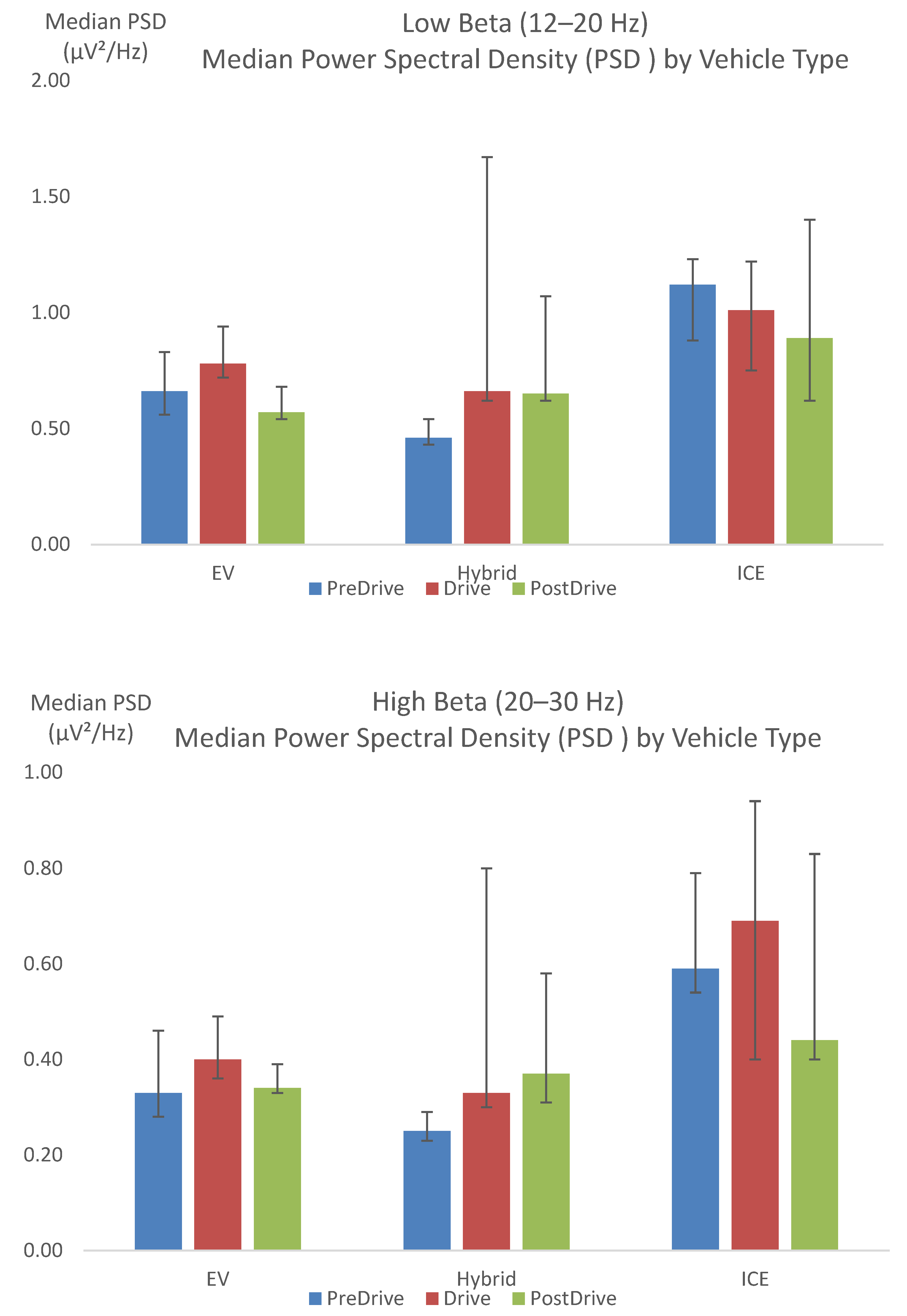
Median EEG power spectral density values across all Group × Band × Phase cells are presented in Table 1. Across all frequency bands, the ICE group exhibited consistently higher median PSD than both EV and Hybrid groups. The spectral ordering θ > α > βL > βH was preserved in all groups, consistent with the 1/f spectral slope of EEG.
3.1.3. Main Effect of Vehicle Group
Kruskal–Wallis tests revealed a statistically significant main effect of vehicle group on EEG PSD across all four frequency bands (Table 2). Effect magnitudes increased progressively from alpha through high beta.
PostDrive -hoc Mann–Whitney U comparisons (Bonferroni-corrected, α_adj = .017) consistently identified the ICE group as the primary source of group differences. ICE participants exhibited significantly higher PSD than EV participants in all four bands (θ: p_adj = .001; α: p_adj = .043; βL: p_adj = .002; βH: p_adj < .001). ICE also exceeded Hybrid in beta High (p_adj = .013) and betaL (p_adj = .028). No significant EV–Hybrid differences were observed in any band (all p_adj ≥ .27). When data were pooled across bands on the log-transformed scale, the omnibus group effect remained highly significant (H = 16.40, p < .001), with ICE > EV (p_adj < .001) and ICE > Hybrid (p_adj = .035) confirmed.
3.1.4. Main Effect of Recording Phase
Kruskal–Wallis tests for the main effect of recording phase revealed a significant effect exclusively in the theta band (Table 3); alpha and both beta bands were non-significant.
For theta, DRIVE-phase power was significantly elevated relative to both PREDRIVE (median DRIVE = 4.07 vs. PREDRIVE = 3.05 µV²/Hz; p_adj = .009) and POSTDRIVE (median POSTDRIVE = 2.83 µV²/Hz; p_adj = .002), while PREDRIVE and POSTDRIVE did not differ (p_adj = 1.000). This theta augmentation during active driving is consistent with established findings linking frontal-midline theta to heightened cognitive workload and executive control during driving (Jap et al., 2009; Liu et al., 2023). The absence of phase effects in alpha and beta bands indicates that power modulation in these ranges was governed primarily by vehicle group membership rather than the temporal task structure.
3.1.5. PREDRIVE vs. POSTDRIVE and Within-Group Phase Effects
No significant PREDRIVE –POSTDRIVE change was detected in any EEG frequency band (θ: W = 153, p = .400; α: W = 118, p = .241; βL: W = 135, p = .474; βH: W = 155, p = .853). Within-group Friedman tests (Table 4) revealed significant phase effects for theta in both ICE (χ²(2) = 6.22, p = .045) and EV (χ²(2) = 9.39, p = .009) groups, confirming task-coupled theta modulation. Importantly, the EV group showed additional significant phase effects in both beta sub-bands (βL: χ²(2) = 7.17, p = .028; βH: χ²(2) = 6.17, p = .046), reflecting a DRIVE-phase elevation with PostDrive -drive return — a pattern absent in ICE drivers. This EV-specific multi-band phase modulation suggests a broader, more temporally structured cortical mobilisation during electric vehicle operation, potentially attributable to the perceptual novelty and attentional engagement associated with a quieter, less familiar sensory environment.
Figure 4.
The EEG resulting grouping for Theta and Alpha frequency bands.
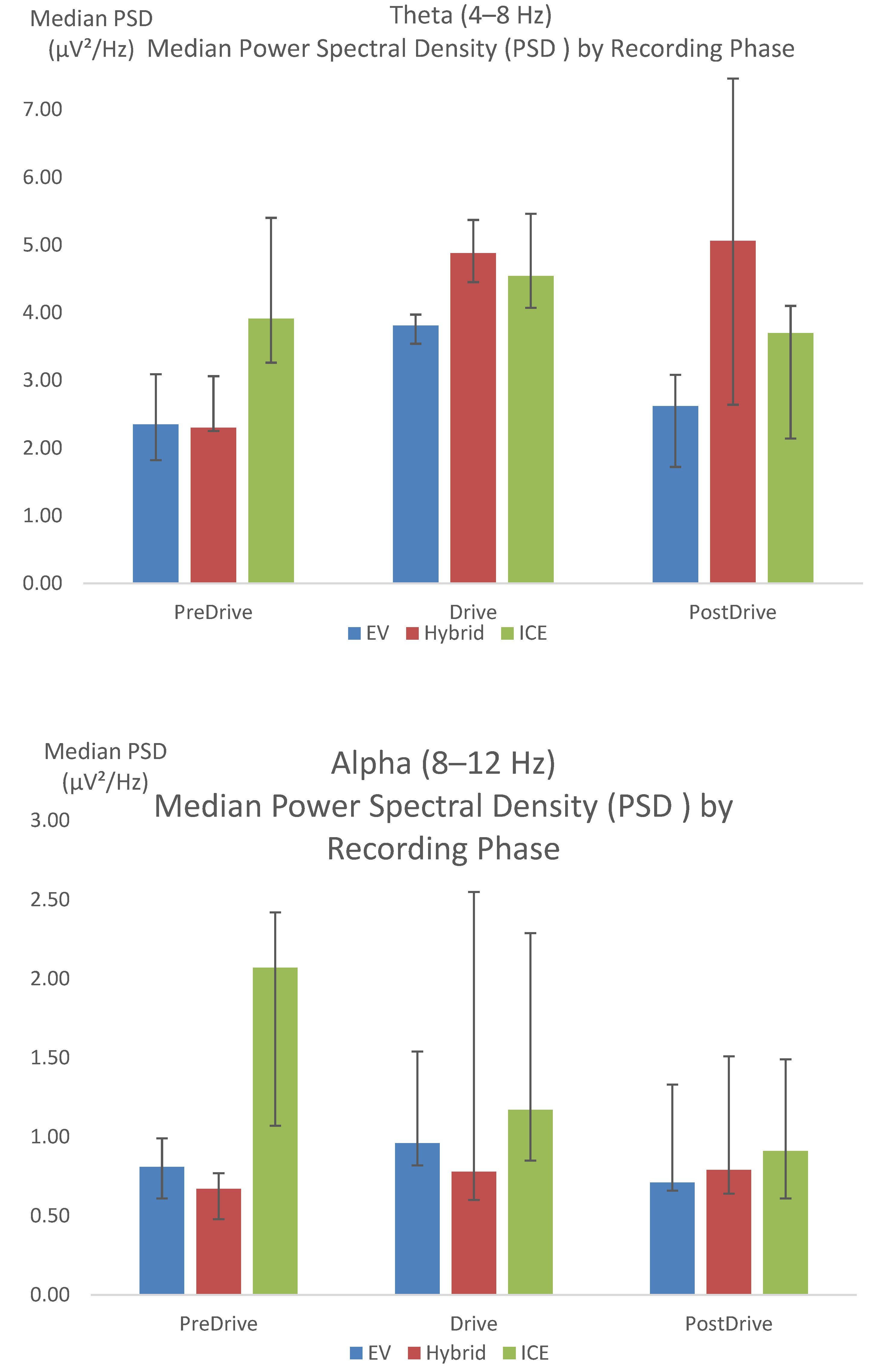
Figure 5.
The EEG resulting grouping for Low Beta and High Beta frequency bands.
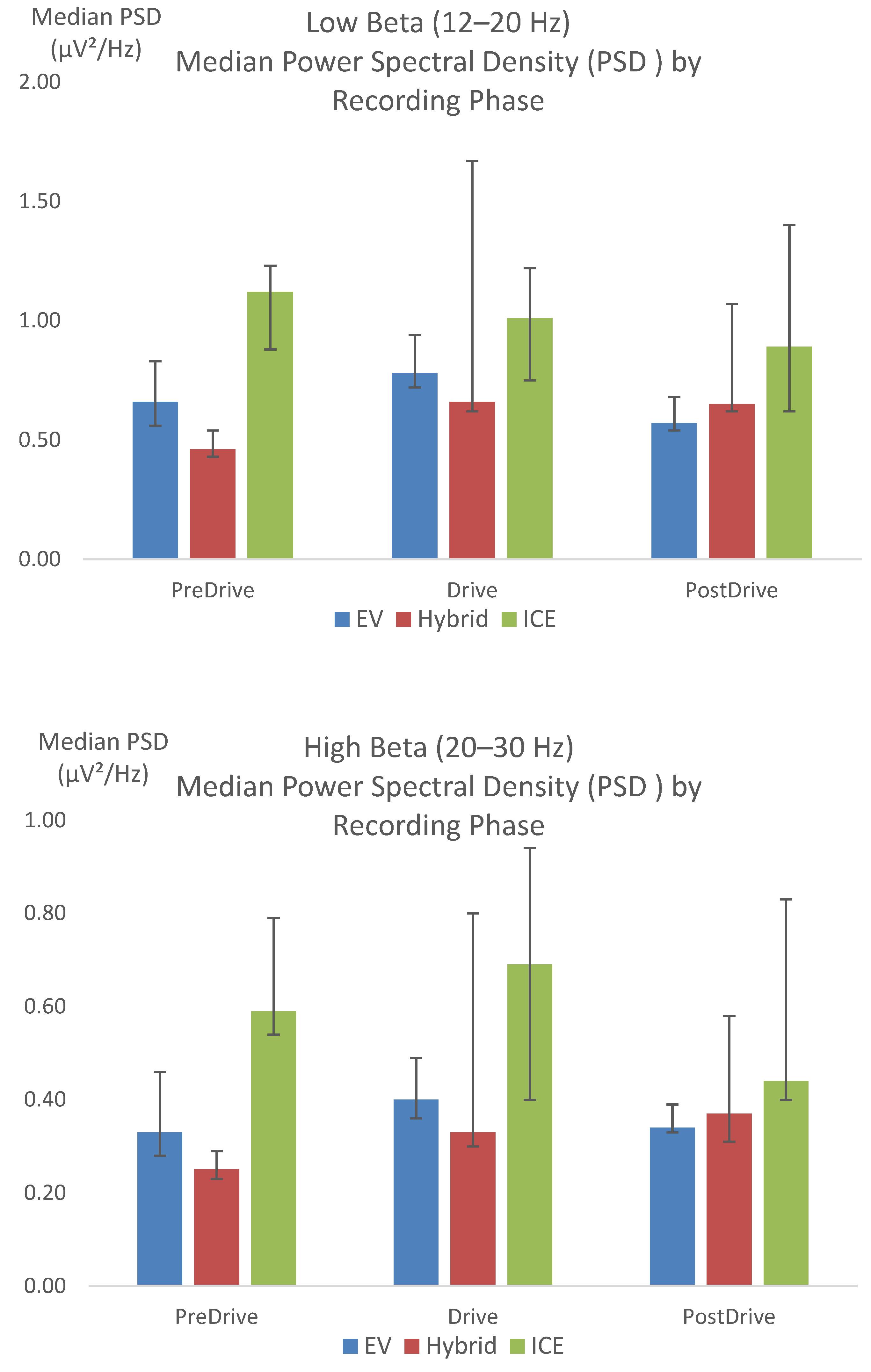
Figure 6.
The EEG resulting grouping for Median Theta and Alpha frequency bands.
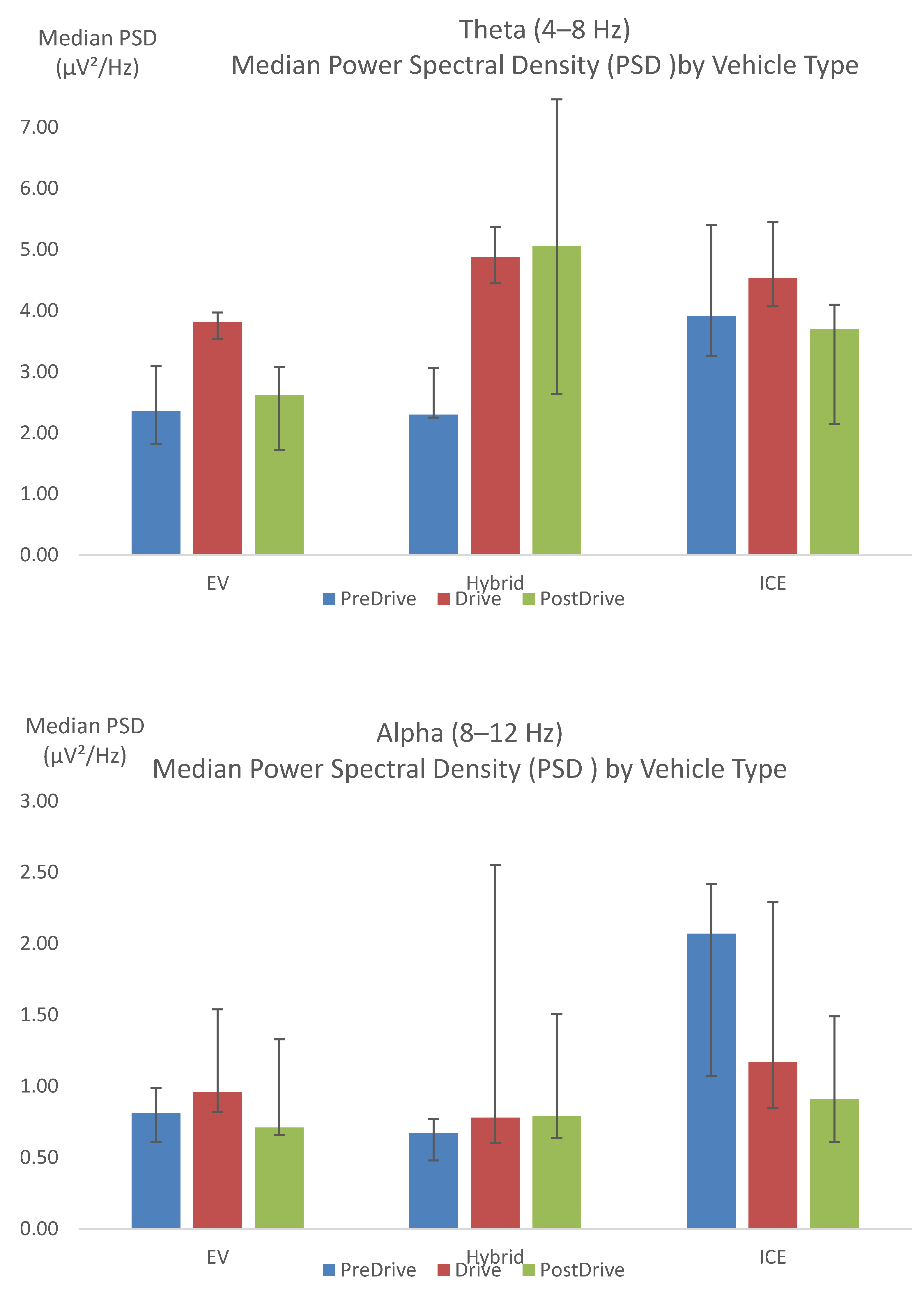
Figure 7.
The EEG resulting grouping for Median Low Beta and High Beta frequency bands.
3.2. Galvanic Skin Response and Peripheral Oxygen Saturation
3.2.1. Descriptive Statistics
GSR and SpO₂ descriptive statistics for all Group × Phase cells are presented in Table 5. GSR showed a pronounced and consistent decline from PREDRIVE to DRIVE to POSTDRIVE in all three vehicle groups, with median reductions of 32–38% from baseline to PostDrive - drive. SpO₂ showed minimal absolute variation across all cells, with median values contained within a narrow range of 95.95–96.30%.
Figure 8.
The resulting grouping for Galvanic Skin Response and Blood Oxygen Saturation.
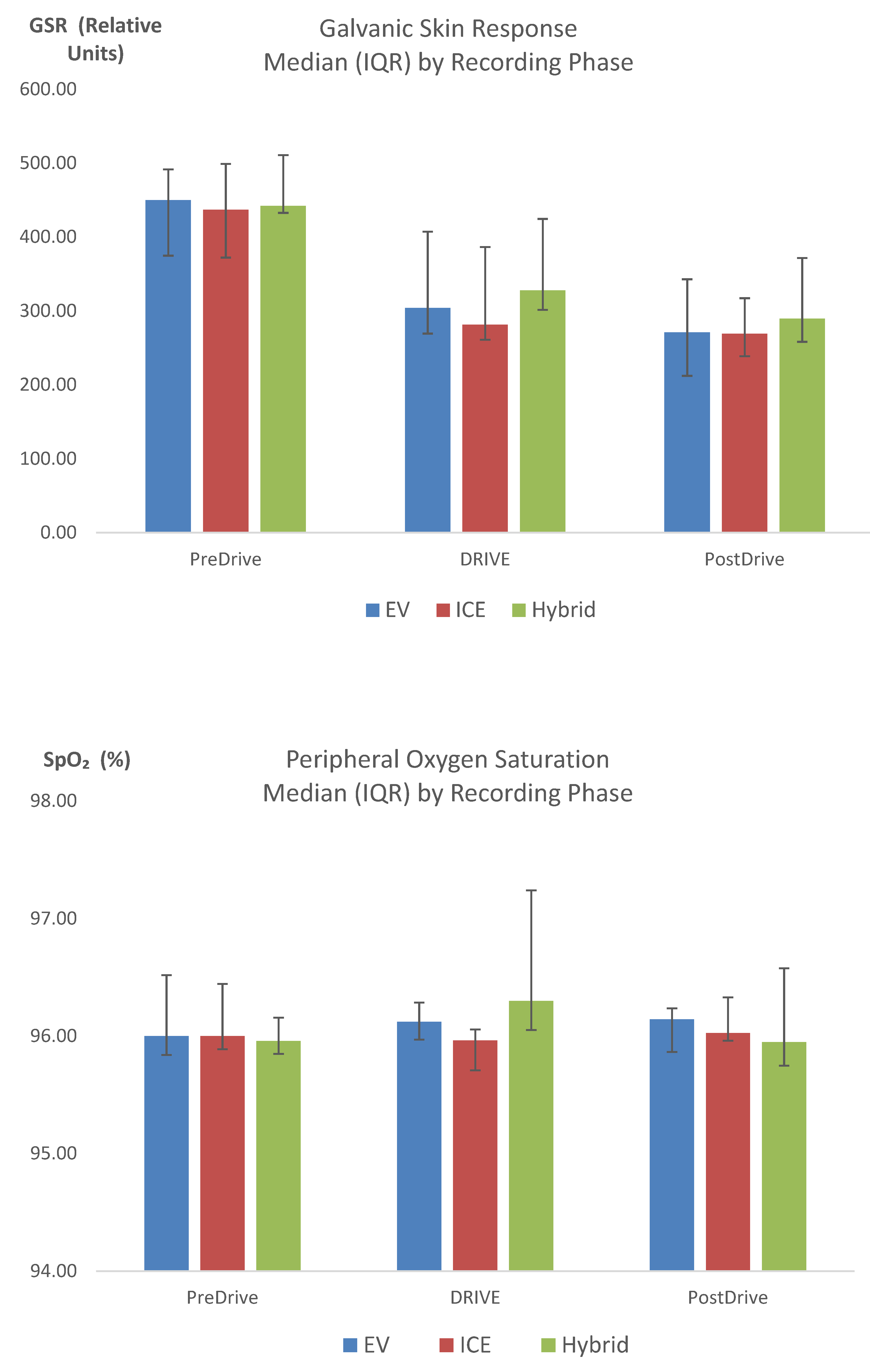
Figure 9.
The resulting Median grouping for Galvanic Skin Response and Blood Oxygen Saturation.
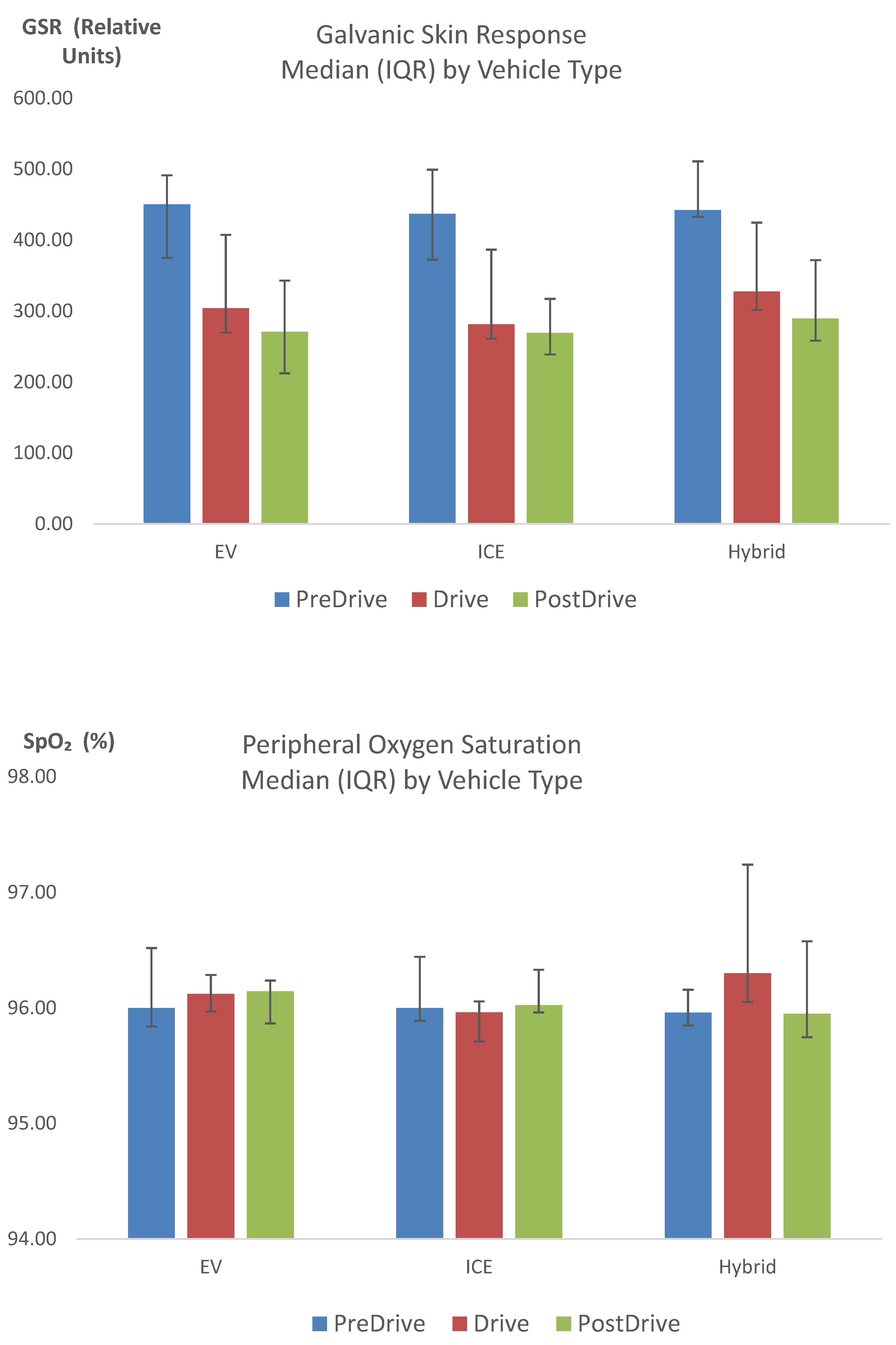
3.2.2. Main Effects and PREDRIVE vs. POSTDRIVE
Vehicle group had no significant main effect on either GSR (H(2) = 2.23, p = .328) or SpO₂ (H(2) = 0.61, p = .739), with all Bonferroni-corrected pairwise contrasts non-significant (all p_adj ≥ .374). In striking contrast, recording phase exerted a highly significant and large main effect on GSR (H(2) = 35.90, p < .001) — the largest effect in the entire study — characterized by a monotonic decline from PREDRIVE (median = 442.1) through DRIVE (309.8) to POSTDRIVE (280.5), with PREDRIVE significantly exceeding both DRIVE (p_adj < .001) and POSTDRIVE (p_adj < .001). Recording phase had no significant effect on SpO₂ (H(2) = 0.37, p = .833). The PREDRIVE –POSTDRIVE Wilcoxon test confirmed a highly significant GSR reduction in the full sample (W = 8.0, p < .001, median Δ = −163.96, ~37% decline) that was significant within all three vehicle groups individually (EV: p_adj < .001; ICE: p_adj < .001; Hybrid: p_adj = .047). No significant PREDRIVE –POSTDRIVE SpO₂ change was detected at the whole-sample or group level (all p ≥ .647).
3.2.3. Within-Group Phase Effects and Interactions
Friedman tests revealed that the maximum-possible χ²(2) statistic was achieved for GSR in both the EV (χ²(2) = 19.60, p < .001, n = 15) and ICE (χ²(2) = 19.60, p < .001, n = 15) groups, and in the Hybrid group (χ²(2) = 14.00, p < .001, n = 7) — indicating that PREDRIVE > DRIVE > POSTDRIVE was the unanimous rank order for every participant without exception. This universality establishes the GSR session trajectory as a protocol-driven autonomic signature independent of vehicle type, consistent with progressive habituation of anticipatory sympathetic arousal from the pre-drive period through driving and recovery.
For SpO₂, within-group phase profiles were vehicle-type-dependent. EV drivers showed no significant phase effect (χ²(2) = 1.71, p = .424), with a flat trajectory across all phases. ICE drivers showed a significant phase effect (χ²(2) = 8.93, p = .011), driven by a DRIVE-phase dip (PREDRIVE : 96.00% → DRIVE: 95.96% → POSTDRIVE : 96.03%) with significant pairwise PREDRIVE > DRIVE (p_adj = .027) and DRIVE < POSTDRIVE (p_adj = .037) contrasts. Hybrid drivers showed a borderline significant inverted-U profile (χ²(2) = 6.33, p = .042; DRIVE: 96.30%), though no pairwise contrast survived correction in this small group. GSR and SpO₂ were functionally uncorrelated throughout (all |rs| ≤ .168, all p ≥ .322), confirming their independence as physiological indicators.
3.3. Heart Rate and Heart Rate Variability
3.3.1. Descriptive Statistics
HR, HRV-SDNN, and HRV-RMSSD descriptive statistics are presented in Table 6. Missing values were present in 15–30% of cells due to recording artefacts, reducing effective Hybrid group triads to n = 3–4. ICE drivers had numerically the highest HR across all phases; HRV indices were broadly comparable across groups.
3.3.2. Group Effects
Vehicle group had a borderline significant effect on HR (H(2) = 6.08, p = .048), with ICE drivers numerically highest (pooled median 80.1 bpm) relative to EV (76.5 bpm) and Hybrid (77.7 bpm); however, no pairwise contrast survived Bonferroni correction (ICE vs. EV: p_adj = .052). Vehicle group had no significant effect on either HRV-SDNN (H(2) = 0.05, p = .977) or HRV-RMSSD (H(2) = 0.55, p = .760), with pooled-phase medians closely matched across groups for both indices.
3.3.3. Phase Effects
Phase had no significant main effect on HR (H(2) = 0.70, p = .705) — heart rate was virtually identical across PREDRIVE (78.7 bpm), DRIVE (78.3 bpm), and POSTDRIVE (79.3 bpm). Phase had no significant effect on HRV-SDNN (H(2) = 3.47, p = .176), though a numerical trend toward DRIVE-phase elevation (SDNN: PREDRIVE 36.5 → DRIVE 44.0 → POSTDRIVE 39.0 ms) approached but did not reach significance. Phase had a significant effect on HRV-RMSSD (H(2) = 8.66, p = .013), driven by a robust PREDRIVE < DRIVE contrast (p_adj = .028; pooled medians PREDRIVE = 38.9 ms, DRIVE = 52.0 ms), representing a median DRIVE-phase increase of approximately 34% in vagal cardiac modulation relative to the pre-drive baseline. This finding runs counter to a simple stress-arousal model of driving and is discussed in Section 4.4.
3.3.4. Within-Group Phase Effects
Friedman tests within vehicle groups revealed no significant phase effect on HR in either EV (χ²(2) = 2.91, p = .234, n = 11) or ICE (χ²(2) = 0.73, p = .695, n = 11) groups, consistent with the null omnibus finding. For HRV-SDNN, both EV (χ²(2) = 5.64, p = .060) and ICE (χ²(2) = 5.09, p = .078) groups showed trends that approached but did not reach significance. For HRV-RMSSD, significant within-subject phase effects were found in both EV (χ²(2) = 7.80, p = .020, n = 10) and ICE (χ²(2) = 10.36, p = .006, n = 11) groups, confirming the DRIVE-phase RMSSD elevation as a consistent within-person phenomenon across both vehicle types.
3.3.5. HR–HRV Correlations
Spearman rank correlations between HR and HRV indices revealed theoretically expected negative associations. The HR–SDNN correlation was strongly negative at PREDRIVE (rs = −.837, p < .001), attenuating during DRIVE (rs = −.488, p = .007) and POSTDRIVE (rs = −.462, p = .015). The HR–RMSSD correlation was negligible at PREDRIVE (rs = +.003, p = .988) but became significantly negative during DRIVE (rs = −.415, p = .025), indicating that task-induced sympathetic activation specifically during driving was associated with reduced vagal cardiac modulation.
Figure 10.
The resulting Median grouping Hearth rate and Hearth rate Variability.
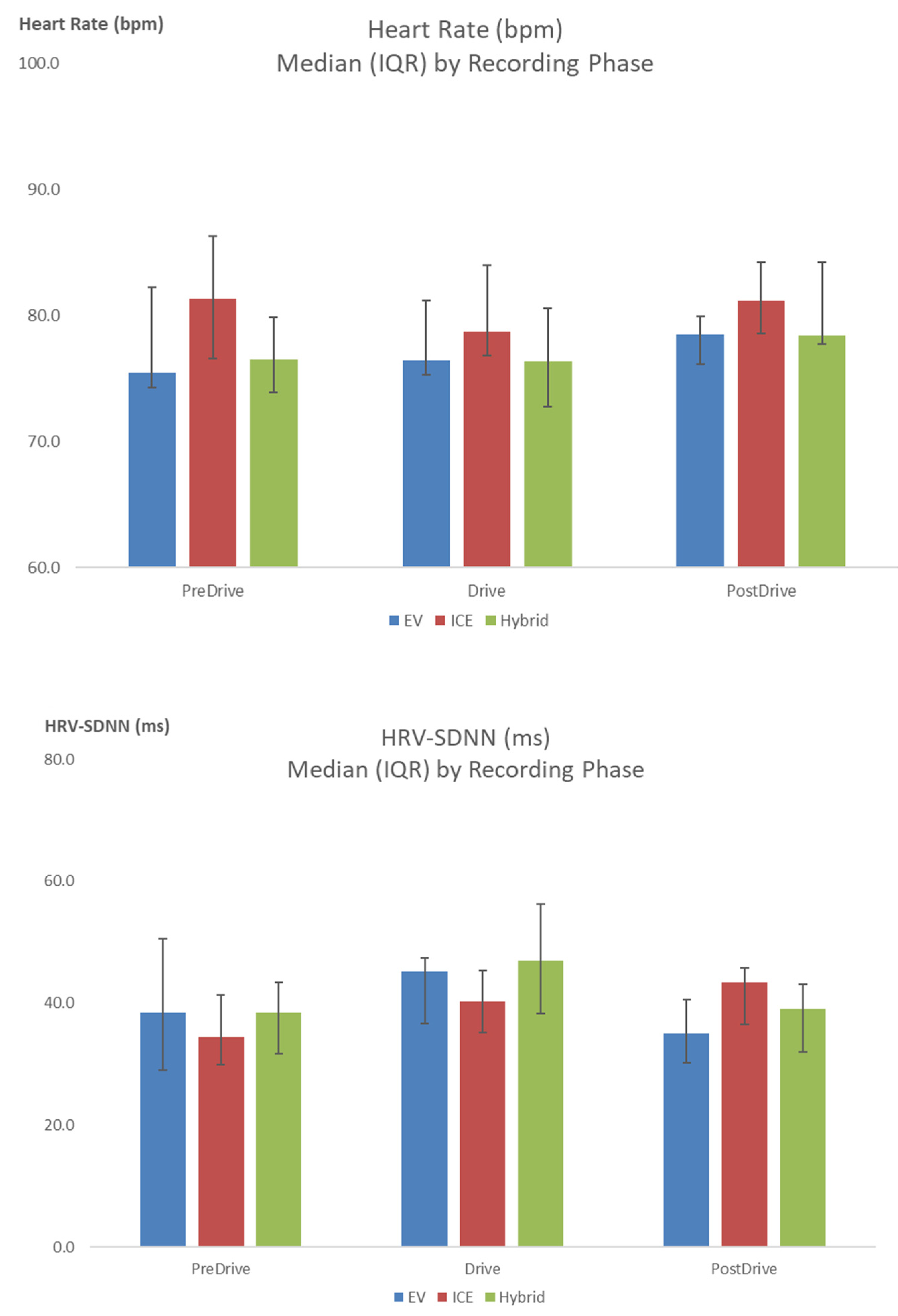
Figure 11.
The resulting Median grouping Hearth rate and Hearth rate Variability.
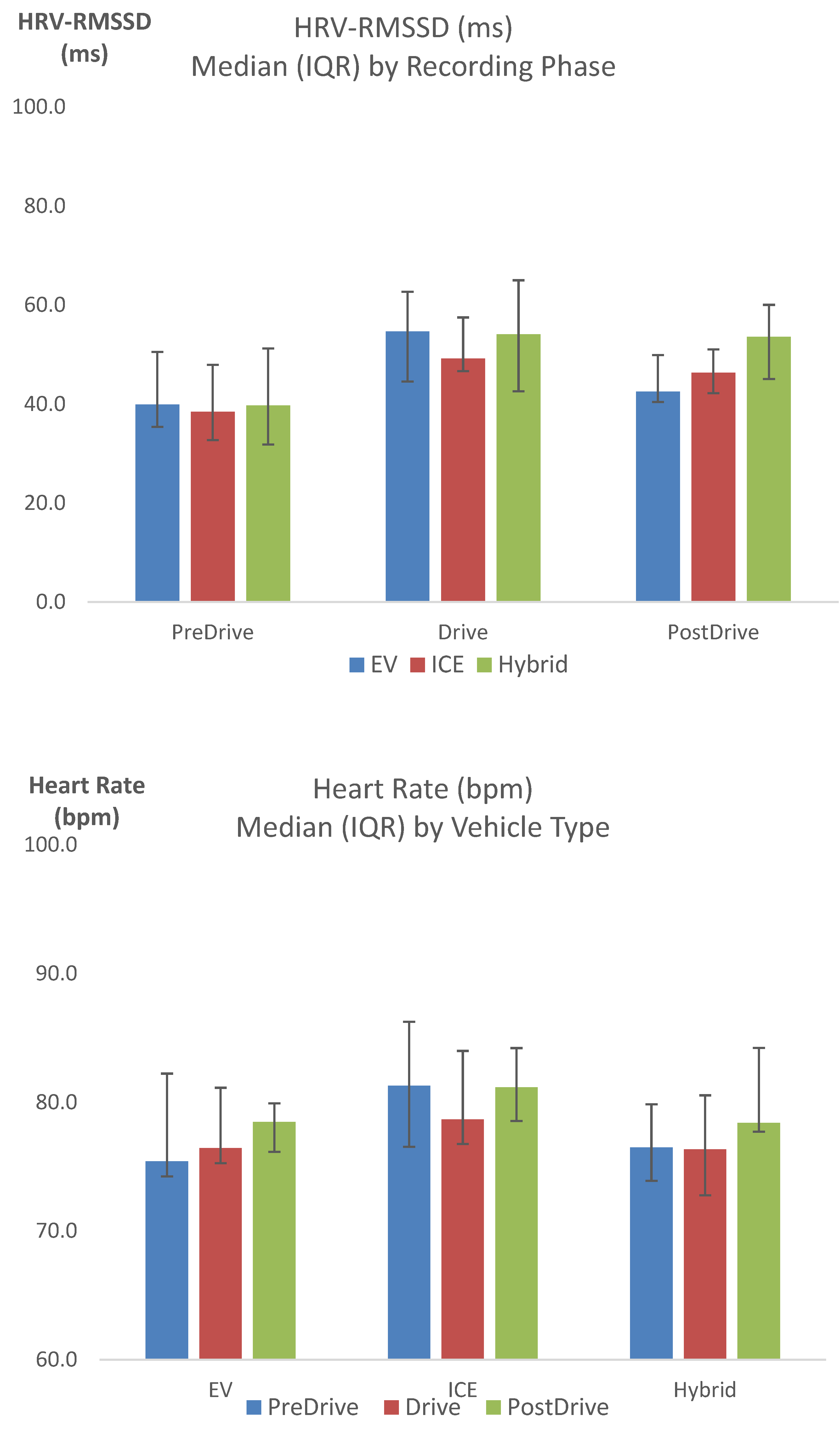
Figure 12.
The resulting Median grouping Hearth rate and Hearth rate Variability.
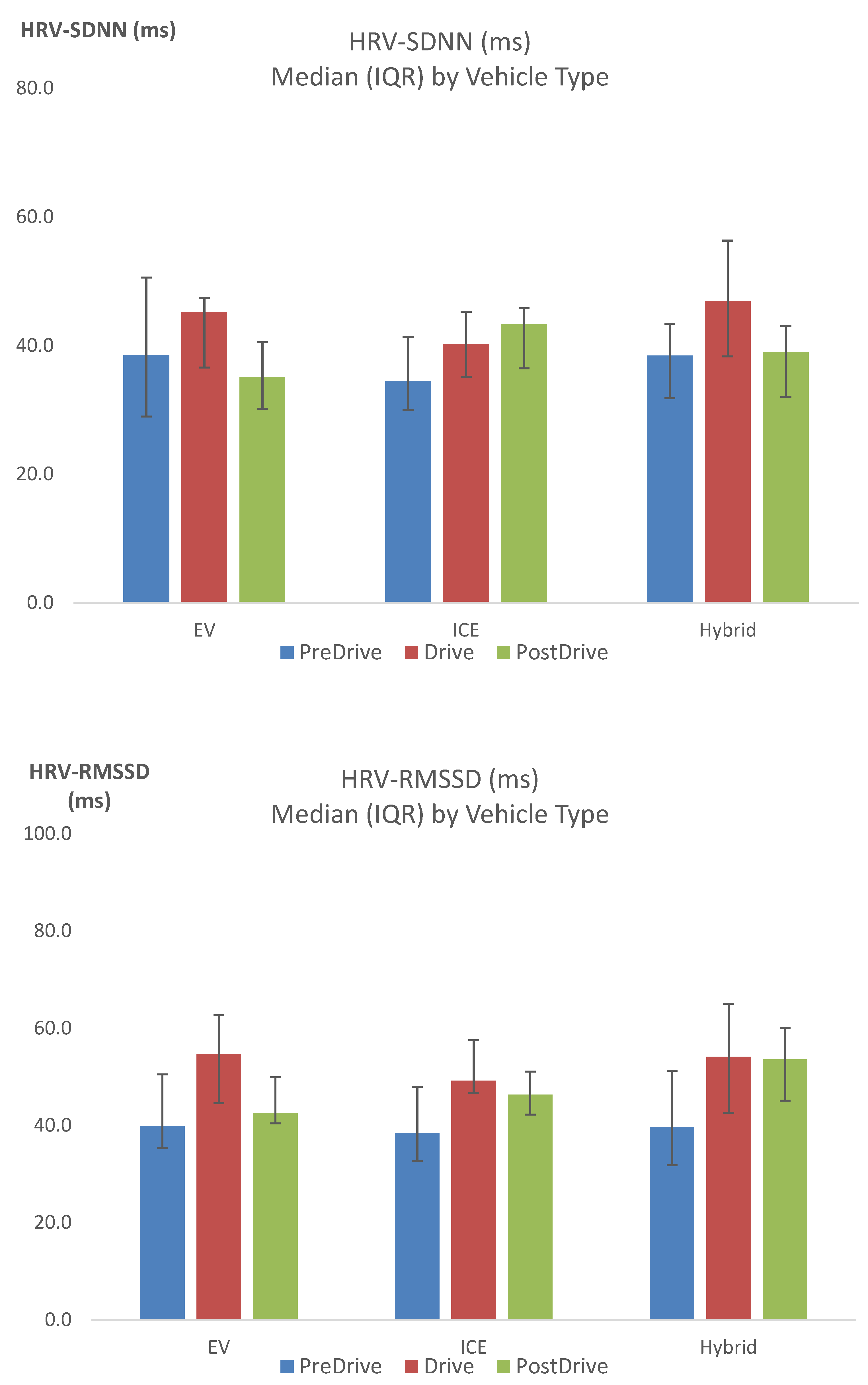
3.4. Clustering Results
In order not to advertise a particular car model, the individual cars and their presence in one or another cluster will be discussed only under their index number from 1 to 37, which does not correspond to their alphabetical order.
Clustering into 3 clusters:
Engine Type known clusters: EV (4,9,10,11,12,14,19,21,22,27,29,30,31,33,37), ICE (1,2,5,6,8,13, 15,17,20,23,24,25,26,28,32,34), Hybrid (3,7,16,18,35,36)
After Agglomerative clustering in the first cluster felled cars with indexes (3,5,7,8,10,12,13,14,16, 21,23,25,26,27,28,33,34,35,36) in the second cluster (1,4,11,15,17,18,19,20,22,24,30,31,32,37) and in third cluster (2,6,9,29).
For DBSCAN in the first cluster we found cars with indexes (1,2,3,5,6,7,8,9,10,11,12,13,14,15,16, 20,21,23,25,26,27,28,29,30,31,33,34,35,36,37), for the second (17,18,22,24), and for the third (4,19,32).
For Gaussian clustering–1 cluster (1,3,4,5,10,11,14,15,18,19,20,22,23,24,25,26,28,33,37), second cluster (13,16,27,30,34,35,36) and third cluster (2,6,7,8,9,12,17,21,29,31,32).
For K-Means clustering in the first cluster we have (1,3,4,5,11,14,17,18,19,20,21,22,23,24,26,28, 32,33), in the second (8,10,13,15,16,25,27,30,34,35,36,37) and in the third (2,6,7,9,12,29,31).
From just inspecting the clusters: K-Means and Gaussian Mixture seem most similar — both cluster (2,6,7,9,12,29,31) together as a cluster, and both frequently group (1,3,4,5,11,14,15,18,20,22,23, 24,25,26,28,33,37) together. Agglomerative and K-Means overlap somewhat, especially for clusters that include (1,3,5,14,23,26,33). DBSCAN is most different — its first cluster includes almost all points, acting more like a dense core grouping.
We estimated pairwise similarity between clustering results by comparing how many pairs of cars are clustered together in each pair of methods. To do that we calculated the Rand Index by counting how many pairs of elements (i, j) are in the same cluster in both A and B (SS) and in different clusters in both A and B (DD), then we computed:
A similarity score between 0 and 1 indicating how similarly the two algorithms clustered the data is presented in Table 7.
Figure 13.
Results of data clustering into three cluster groups using the methods K-Means Clustering, Gaussian Mixture Clustering, Agglomerative Clustering, and DBSCAN.
Figure 13.
Results of data clustering into three cluster groups using the methods K-Means Clustering, Gaussian Mixture Clustering, Agglomerative Clustering, and DBSCAN.
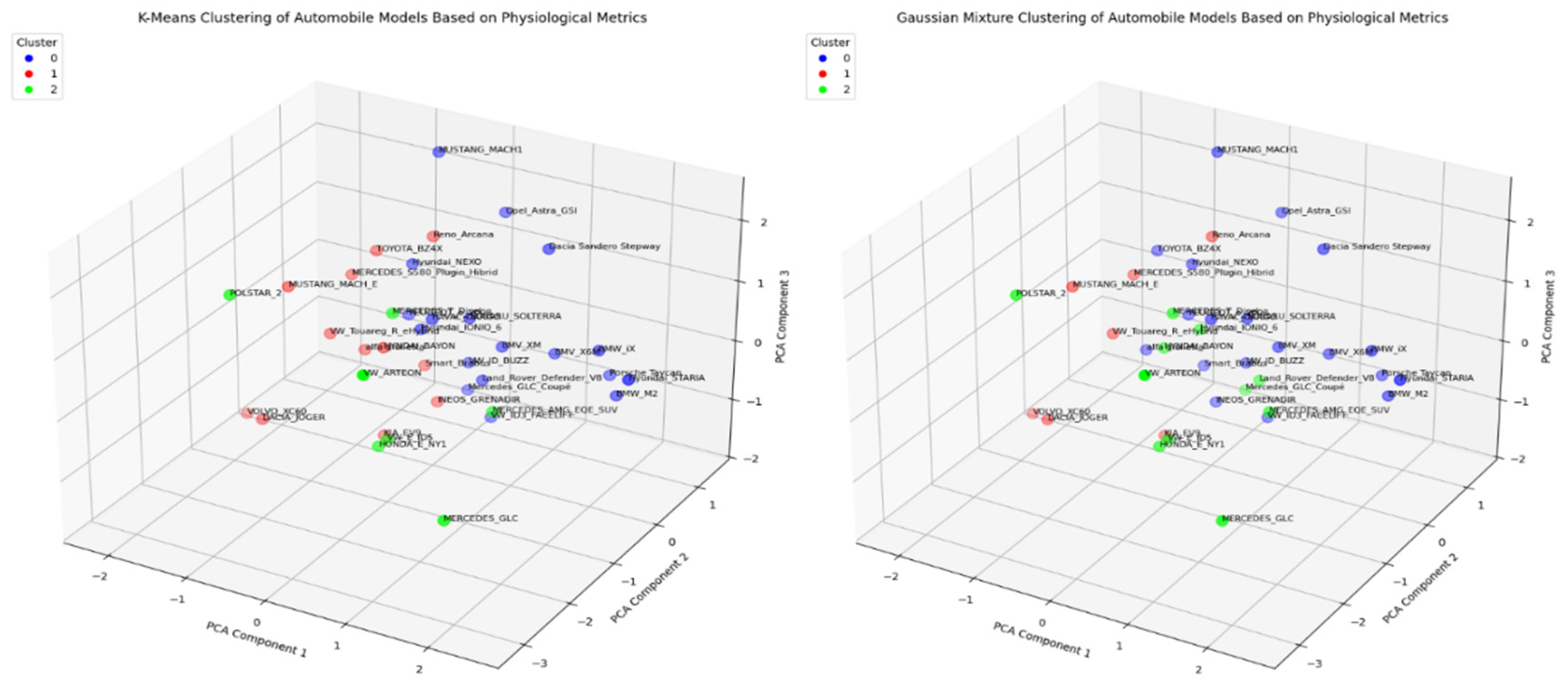
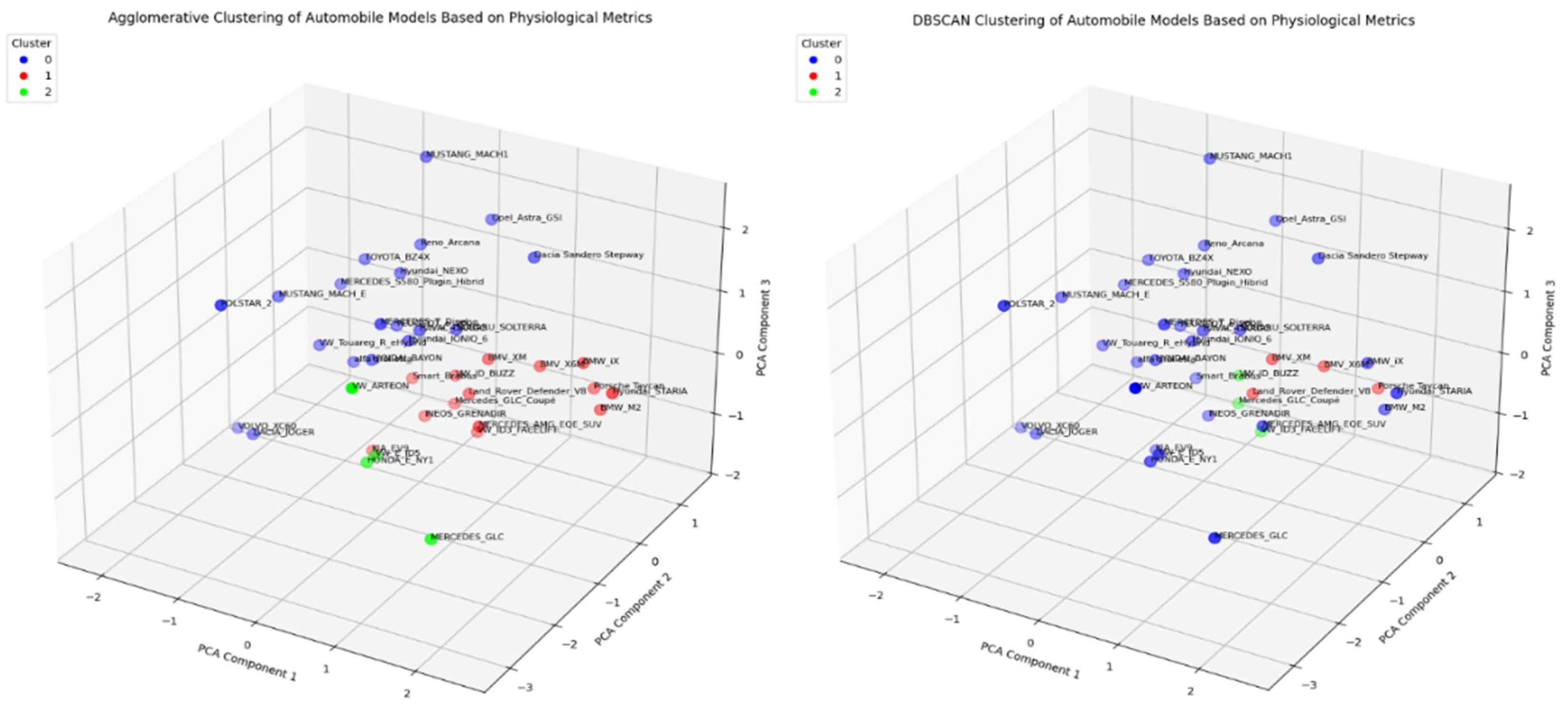
The clusters overlap significantly, but each algorithm defines them differently due to their inherent logic. Most similar clustering algorithms (in order of similarity): K-Means & Gaussian Mixture — high overlap in cluster structure. Agglomerative & K-Means — moderate overlap. Agglomerative & Gaussian — some overlap. DBSCAN & others — least similar to all others; DBSCAN clusters are broader or more noise-tolerant.
Also, neither of the clustering method overlapped highly with the expected three clusters (ICE, Hybrid, EV). The highest similarity was obtained with the Gaussian Mixture Model (0.539), which is insufficient. From this we can conclude that the engine type factor is not of great importance for the current way in which the studied cars are naturally clustered differently, and that we need to look for another, currently hidden factor that influences more how the different cars are perceived by the driver.
Clustering into 8 clusters.
Based on the Theta/Alpha EEG increase or decrease, pulse rate increase or decrease and GSR increase or decrease we subdivided the vehicles in eight categories: CL1 (1,11,13,18,22,24), CL2 (5,6,12,14), CL3 (2,4,19,20,31,32), CL4 (9,29,33), CL5 (7,16,23,34), CL6 (3,10,21,26,27), CL7 (15,17,30,37) ,CL8 (8,25,28,35,36).
After Agglomerative clustering cars the following indexes fell into the relevant clusters CL1(15,17,30,37), CL2(8,13,25,35,36), CL3(7,16,23,34), CL4(3,10,21,26,27), CL5(2,4,19,20,31,32), CL6(9,29,33), CL7(1,11,18,22,24,28), CL8(5,6,12,14).
With DBSCAN we subdivided the car indexes as follows: CL1(1), CL2(2), CL3 (3,4,5,7,8,9,10,11,14,15, 16,17,18,19,20,22,23,24,25,26,28,29,30,31,32,33,34,36,37), CL4(6), CL5(12), CL6(13), CL7(27), CL8(35)
After Gaussian clustering we obtained CL1(3,5,14,28,33), CL2(16,35,36), CL3(2), CL4(10,23,26,34,7), CL5(8,9,12,13,21,25,27,29,31), CL6(4,15,17,18,19,24,30,32,37), CL7(6), CL8(1,11,20,22).
For K-Means clustering our clusters were CL1(3,5,14,28,33), CL2(16,35,36), CL3(2), CL4(10,23,26,34), CL5(7,8,9,12,13,21,25,27,29), CL6(4,15,17,18,19,24,30,31,32,37), CL7(6), CL8(1,11,20,22)

Table 8.
A similarity score between 0 and 1 indicating to what extend the data is clustered at 8 clusters clustering.
Table 8.
A similarity score between 0 and 1 indicating to what extend the data is clustered at 8 clusters clustering.
| ENGINETYPE | K-MEAN | GAUSSIAN | AGGLOMERATIVE | DBSCAN | |
|---|---|---|---|---|---|
| ENGINE TYPE | 1 | 0.809 | 0.800 | 0.812 | 0.375 |
| K-MEANS | 0.809 | 1 | 0.973 | 0.868 | 0.428 |
| GAUSSIAN | 0.800 | 0.973 | 1 | 0.841 | 0.419 |
| AGGLOMERATIVE | 0.812 | 0.868 | 0.841 | 1 | 0.455 |
| DBSCAN | 0.375 | 0.428 | 0.419 | 0.455 | 1 |
Unsupervised clustering into eight clusters showed that agglomerative clustering comes closest to the initial expectation of how the cars should be distributed. In addition, the table shows that the other two methods K-Means and Gaussian also give high similarities to the expectations and only DBSCAN subdivides the cars in a different way as presented on Figure 14.
We have also performed a multidimensional scaling by using the resulting similarity matrix for all of the 37 cars tested. The visualization of the scaling is presented on Figure15. We have found that the quality of the Solution (Kruskal Stress-1) is with two dimension Stress 1 index is 0.238 or poor — expected for 37 objects and with three dimension Stress 1 index is 0.135 or Fair / Good. With 37 objects, a value of around 0.24 in two dimensions is typical — the reduction to 0.14 in three dimensions the result confirms that the third dimension carries additional information. Working with the three dimension solution is recommended. Key Observations:
In the two dimensional map (Dimension 1 × Dimension 2), several clear groupings emerge. On the right side of the lower quadrant, Hyundai NEXO and VW ID BUZZ are very close together — indicating a similar neurophysiological profile. In the upper right corner, Porsche Taycan, Opel Astra GSI, and BMW M2 form a cluster associated with high emotional activation. Strong outliers are DACIA JOGER and MERCEDES GLC, both positioned in the lower left corner — displaying a very different profile compared to the remaining objects. KIA EV9 and Renault Arcana are nearly overlapping, which is noteworthy given their very different market positioning — they likely elicit a similar autonomic response in respondents. On Figure 16 is presented an analysis of the Positioning Map (Dimension II × Dimension III).
Figure 14.
Results of data clustering into eight cluster groups using the methods K-Means Clustering, Gaussian Mixture Clustering, Agglomerative Clustering, and DBSCAN.
Figure 14.
Results of data clustering into eight cluster groups using the methods K-Means Clustering, Gaussian Mixture Clustering, Agglomerative Clustering, and DBSCAN.
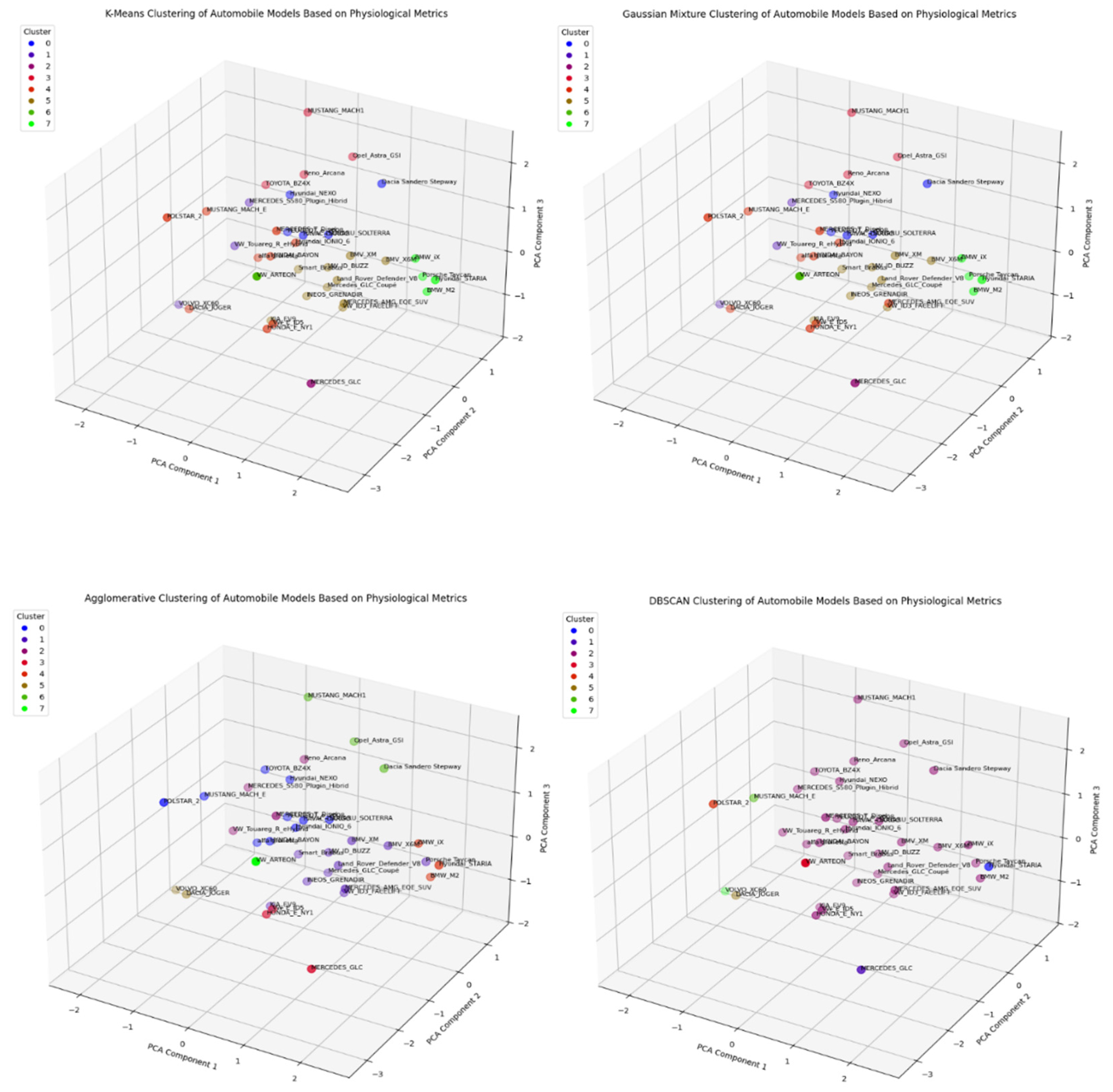
Figure 15.
Multidimensional scaling in two dimensions.
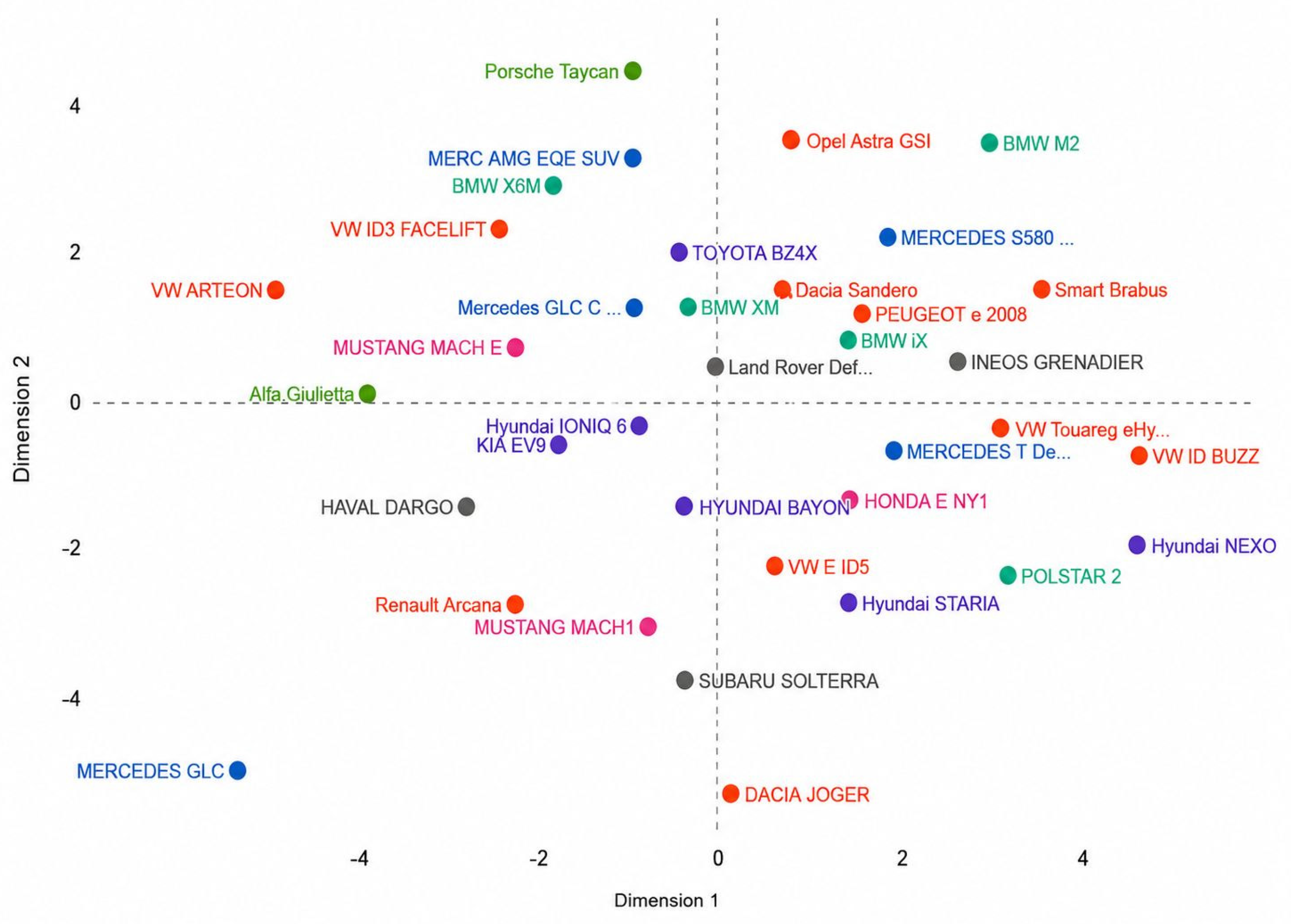
Figure 16.
Analysis of the Positioning Map (Dimension II × Dimension III).
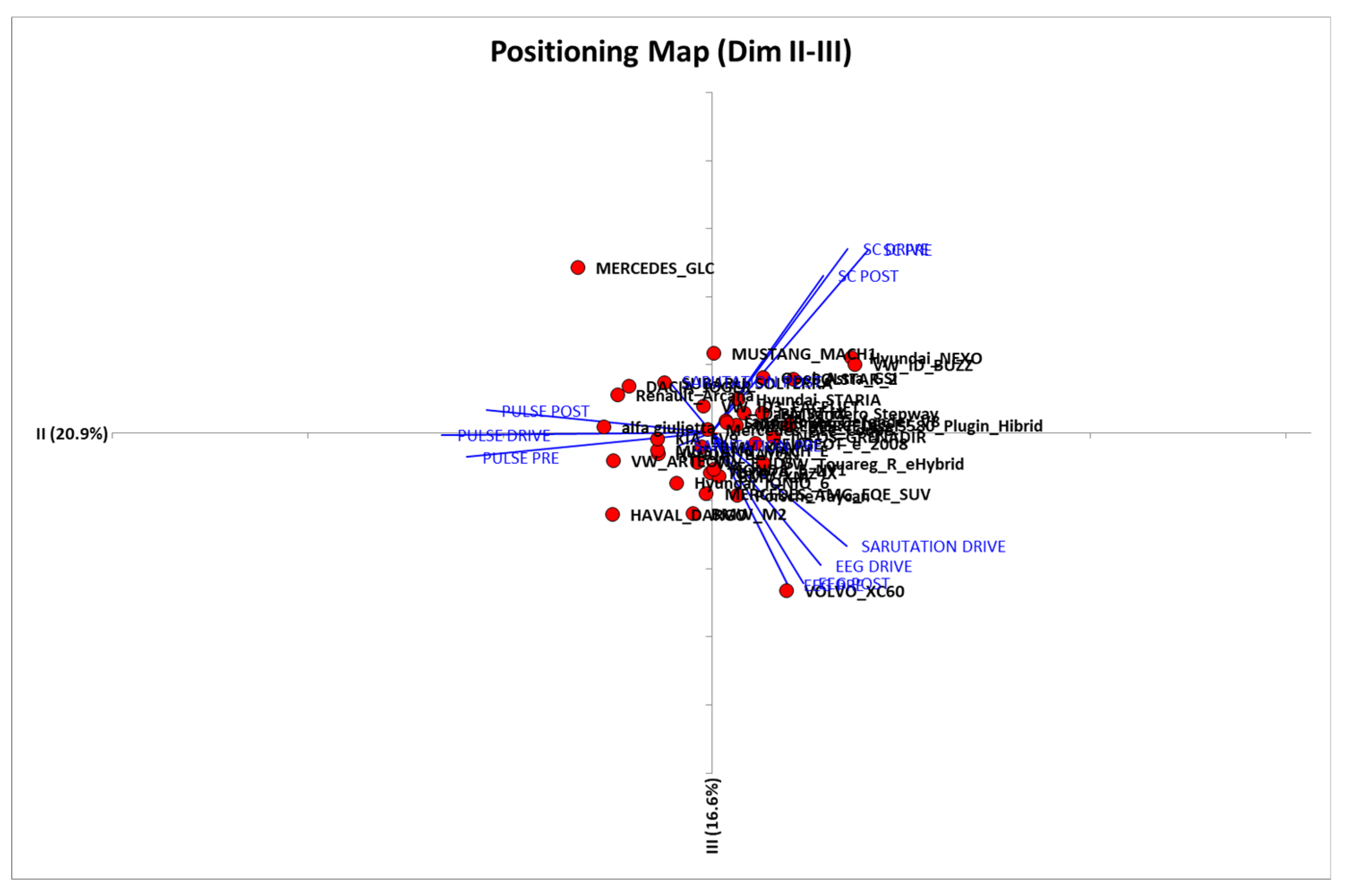
The map shows the projection of the MDS solution onto the second (20.9% explained variance) and third (16.6%) dimensions, together with attribute vectors. We can provide the following axes interpretation. Axis II (horizontal, 20.9%) is dominated by the PULSE vectors (PRE, DRIVE, POST), pointing to the left. This means that brands positioned on the left side elicit higher heart rate — greater physiological arousal. The axis can be interpreted as "physiological activation / stress."
Axis III (vertical, 16.6%) is dominated by SC (skin conductance — galvanic skin response) pointing upward, and EEG + SARUTATION pointing downward. The upper zone corresponds to higher electrodermal activity (excitement/interest), while the lower zone reflects higher brain activity and salivation. The axis can therefore be interpreted as "electrodermal response vs. cognitive/gustatory activation." In respect to Quadrant Analysis we have found the following quadrant groups.
Upper right quadrant is with high SC, low PULSE:
The SC PRE, SC DRIVE, and SC POST vectors point directly into this region. Brands located here elicit a strong electrodermal response (subconscious excitement) without cardiovascular loading. This quadrant includes Hyundai NEXO, VW ID BUZZ, Hyundai STARIA, MUSTANG MACH1, DACIA JOGER, and SUBARU SOLTERRA — a diverse group unified by their ability to visually and stylistically capture attention.
Upper left quadrant is with high SC + high PULSE:
MERCEDES GLC stands out as a strong outlier here — the only brand that combines high electrodermal response with elevated heart rate. This is a profile of high overall autonomic activation, meaning the brand simultaneously triggers physiological stress and subconscious excitement.
Lower left quadrant is with high PULSE, low SC:
HAVAL DARGO, BMW M2, VW ARTEON, Alfa Giulietta, KIA EV9, Renault Arcana, Hyundai IONIQ 6, and MERCEDES AMG EQE SUV — these brands elicit elevated pulse but weak skin conductance response. This profile is more consistent with tension or anxiety rather than positive excitement. Notably, BMW M2 and MERCEDES AMG EQE SUV appear here — the sporty and premium brands raise the heart rate, but do not trigger that subconscious "wow" in the electrodermal response.
Lower right quadrant is with high EEG + SARUTATION, low PULSE:
VOLVO XC60 is a clear outlier at the bottom — dominated by EEG DRIVE, EEG POST, and SARUTATION DRIVE vectors. This indicates high brain activity and salivatory response during and after the driving experience, without physiological stress. The profile resembles "cognitive engagement and pleasure" — the brand makes people think and feel good after exposure to it.
Central zone quadrant (around the origin):
A large cluster of brands is concentrated near the center — Porsche Taycan, BMW iX, POLSTAR 2, Mercedes GLC Coupé, PEUGEOT e 2008, HONDA E NY1, VW Touareg, INEOS GRENADIER, MERCEDES S580, Smart Brabus, VW ID3, BMV XM, and others. These brands display a mediocre, undifferentiated neurophysiological profile along axes II and III — they do not stand out meaningfully on either attribute vector.
The key findings from the analysis are the following:
MERCEDES GLC is the only brand with simultaneously high activation on both axes — an exceptionally distinctive profile, likely driven by a powerful brand image.
VOLVO XC60 is the cognitive outlier — it provokes reflection and pleasure after exposure, a unique profile among all the brands studied.
The mass clustering at the center represents a strategic concern — most brands are not differentiated in their neurophysiological footprint across these two dimensions, suggesting that consumers experience them in a similarly undistinctive way at a subconscious level.
Hyundai NEXO and VW ID BUZZ remain close to each other in this projection as well — a consistently similar profile across all three dimensions, which is a strong signal of competitive overlap.
4. Discussion
4.1. Vehicle Type Effects on Cortical Activity
The most robust and theoretically significant finding of the present study is the consistent main effect of vehicle propulsion type on broadband EEG power spectral density across all four frequency bands. ICE vehicles were associated with significantly higher theta, alpha, low beta, and high beta power than both EV and Hybrid vehicles, with no significant difference between EV and Hybrid groups in any band. This result, confirmed across multiple complementary analyses including omnibus tests, Bonferroni-corrected PostDrive -hoc contrasts, and the log-pooled broadband comparison, provides the first empirical evidence from simultaneous multimodal real-world recording that the propulsion environment of the vehicle cabin systematically modulates cortical oscillatory activity during driving.
The elevation of ICE broadband EEG power is most parsimoniously attributed to the richer sensory environment of the combustion cabin. Engine-generated low-frequency noise, drivetrain vibration, and exhaust harmonics activate auditory and somatosensory cortical processing systems and engage the ascending reticular arousal system, producing elevated broadband cortical tone relative to the quieter EV environment (Babisch, 2005; Münzel et al., 2014). The gradient of significance across bands — with the largest H statistics in the beta range (β High: H = 19.92) — is consistent with the established role of beta oscillations in sensory arousal, active processing, and emotional engagement (Engel & Fries, 2010): the acoustically richer ICE cabin produces greater sensorimotor cortical activation precisely in the spectral range most sensitive to external stimulation.
The absence of any significant EV–Hybrid difference, despite the operational differences between these vehicle types, is ecologically meaningful. Modern hybrid vehicles operate primarily on electric power at the speeds characteristic of the standardized urban-suburban driving route employed in this study, producing a sensory environment acoustically similar to full EV operation. This acoustic convergence may explain the functional equivalence of EV and Hybrid EEG profiles and has practical implications for NVH engineering: the neurophysiological benefits of a quieter cabin may be substantially realized in current hybrid technology without full electrification.
4.2. ICE-Specific Alpha Decline and Anticipatory Arousal
A theoretically important qualitative Group × Phase interaction was observed in the alpha and beta bands: ICE participants showed the highest PREDRIVE -phase power with a monotonic decline across DRIVE and POSTDRIVE (ICE alpha: PREDRIVE 2.07 → DRIVE 1.17 → POSTDRIVE 0.91 µV²/Hz), while EV and Hybrid participants showed comparatively flat or U-shaped phase profiles. This ICE PREDRIVE -phase alpha elevation — substantially above that of EV and Hybrid groups — may reflect pre-existing elevated arousal or anticipatory autonomic activation in the period immediately preceding the drive. For experienced ICE drivers, the pre-drive baseline may itself be characterized by a qualitatively different cognitive and affective state than for EV or Hybrid drivers, potentially including higher task readiness, sensory anticipation, or driving-related anxiety. The progressive alpha decline during and after driving would then represent habituation of this elevated baseline state rather than task-induced suppression per se. This interpretation parallels the anticipatory arousal explanation proposed for the GSR findings (Section 4.3) and underscores the importance of characterizing pre-drive baselines as dynamic psychophysiological states rather than neutral reference conditions.
4.3. Phase Effects: Theta as a Workload Biomarker
The selective theta-band elevation during active driving — significant at the omnibus level and confirmed within both ICE and EV groups by Friedman tests — is consistent with a substantial body of literature identifying frontal midline theta as the most reliable spectral index of cognitive workload during driving (Jap et al., 2009; Liu et al., 2023; Chikhi et al., 2022). The theta response was phasic and task-specific: it did not persist into the POSTDRIVE resting state (PREDRIVE vs. POSTDRIVE: W = 153, p = .400), arguing against slow state drift or circadian confounds and supporting the interpretation that theta augmentation reflects genuine task-coupled cognitive engagement. The additional EV-specific multi-band phase modulation in both beta sub-bands (β Low and β High Friedman tests both p < .05 in EV but not ICE) suggests that electric vehicle driving produced a broader mobilization-and-release of cortical arousal across the session, potentially reflecting the attentional novelty of the perceptually quieter EV environment or the driver's active monitoring of unfamiliar vehicle dynamics.
4.4. Autonomic Findings: The Paradox of Driving-Related HRV Elevation
The most counterintuitive finding of the present study is the robust DRIVE-phase elevation in HRV-RMSSD across all vehicle groups (~34% above PREDRIVE baseline, Kruskal–Wallis H(2) = 8.66, p = .013; Friedman tests significant in both EV and ICE groups independently). Increased RMSSD during active driving contradicts a simple stress-arousal model, under which sympathetic activation and cognitive demand would be expected to suppress vagal modulation. Three non-mutually exclusive interpretations are offered.
First, the elevated RMSSD during DRIVE may reflect task-induced respiratory regulation. Active cognitive engagement during driving may produce a characteristic pattern of slowed, deeper respiration associated with focused attention — a well-documented respiratory adjustment during sustained cognitive effort (Vlemincx et al., 2011) — which would mechanically increase respiratory sinus arrhythmia and thus RMSSD through cardiorespiratory coupling, independent of any change in autonomic outflow. Second, the pre-drive PREDRIVE baseline may have been characterized by anticipatory sympathetic arousal that suppressed vagal tone below the driver's true resting level, making the DRIVE phase appear comparatively elevated. This interpretation is strongly supported by the parallel GSR finding — where PREDRIVE was the highest arousal phase across all participants — and aligns with the alpha elevation observed at PREDRIVE in the ICE group. Third, for an experienced professional driver, the driving task itself may function as a form of engaging but relaxing occupation, reducing ruminative cognitive activity relative to the aroused waiting state preceding the drive.
The HR–SDNN correlation was strongly negative at PREDRIVE (rs = −.837) but substantially attenuated during driving (DRIVE: rs = −.488), indicating that the robust sympathovagal relationship characterising resting physiology was disrupted by task-induced autonomic dynamics during driving. The DRIVE-phase emergence of a significant negative HR–RMSSD correlation (rs = −.415) further supports the interpretation that active driving specifically engaged a vagal-sympathetic competitive dynamic not present at rest.
4.5. GSR: A Universal Anticipatory Arousal Signature
The GSR findings are remarkable for their consistency and magnitude. The maximum-possible Friedman statistic was achieved in all three vehicle groups — meaning that every single participant showed PREDRIVE > DRIVE > POSTDRIVE electrodermal activity without exception — and the whole-sample PREDRIVE –POSTDRIVE reduction (W = 8.0, p < .001, ~37% decline) was among the strongest effects in the study. This universality argues strongly against vehicle-type as a determinant of electrodermal arousal session trajectory: the pre-drive baseline was consistently the highest arousal state regardless of whether the participant subsequently drove an EV, ICE, or Hybrid vehicle.
The most parsimonious account is that the pre-drive PREDRIVE period was contaminated by anticipatory sympathetic arousal — associated with equipment fitting, being monitored, and preparing for an experimental drive — that progressively habituated during and after driving. This interpretation reframes the session trajectory from a driving-induced stress response to a protocol-dependent arousal-habituation sequence. The absence of any group difference in GSR is consistent with this framing: anticipatory arousal is a function of experimental context rather than vehicle type.
4.6. SpO₂: A Vehicle-Type-Contingent Interaction
SpO₂ remained stable across phases at the omnibus level (H(2) = 0.37, p = .833) and showed no significant PREDRIVE –POSTDRIVE change, indicating that peripheral oxygenation was not systematically affected by the driving session. However, within-group Friedman tests revealed a vehicle-type-contingent Group × Phase interaction: EV drivers showed flat SpO₂ profiles (p = .424), ICE drivers showed a small but statistically significant U-shaped DRIVE-phase dip with partial recovery (p = .011; PREDRIVE > DRIVE and DRIVE < POSTDRIVE both surviving correction), and Hybrid drivers showed an inverted-U pattern (p = .042). The ICE DRIVE-phase SpO₂ suppression — approximately 0.04 percentage points, clinically negligible but statistically consistent — is conceptually coherent with mild sympathetically-mediated peripheral vasoconstriction in the more arousing ICE environment, attenuating fingertip perfusion and marginally attenuating pulse oximeter SpO₂ values. This interpretation is consistent with the borderline group effect on HR — also directionally highest in ICE — and with established links between sympathetic activation and peripheral vascular resistance.
4.7. Limitations and Future Directions
Several methodological limitations must be acknowledged. Most critically, the study employed a single professional test driver rather than a heterogeneous participant sample, providing excellent within-driver experimental control but precluding generalization to the broader population of drivers. The observed physiological differences are attributable to vehicle characteristics as experienced by this specific driver under this protocol, and future studies must employ larger, demographically diverse samples with crossover designs. The Hybrid group was small (n = 7) and had insufficient complete-case triads for within-group Friedman analysis, substantially limiting interpretation of Hybrid-specific findings. Missing data in the HR/HRV dataset (15–30% per cell) further reduced statistical power for cardiovascular comparisons.
Methodologically, the use of a consumer-grade wireless EEG headset (Emotiv EPOC) — while appropriate for naturalistic on-road recording — provides lower spatial resolution and less artefact control than research-grade amplifiers with independent component analysis. Future studies should employ ICA-based artefact rejection, source localization, and formal tests for vibration-induced EEG contamination across vehicle types. The GSR anticipatory arousal confound highlights the need for extended pre-drive adaptation periods and repeated-session designs to characterize true resting baselines. Event-related physiological analyses tied to specific driving events (gear changes, braking, and intersections) would provide mechanistically richer characterization of within-drive dynamics.
Future research should prioritize: (1) larger, balanced, multi-participant crossover designs with standardized routes and extended baseline periods; (2) ICA-based EEG preprocessing and source analysis; (3) event-related physiological analyses; (4) concurrent subjective measures of workload, stress, and vehicle preference (NASA-TLX, PANAS); (5) in-cabin air quality monitoring (CO₂, particulates) to test cabin environment hypotheses; and (6) longitudinal designs examining whether physiological adaptation to EV or ICE operation occurs across repeated sessions.
4.8. Clustering Findings
This study aimed to explore the underlying structure of vehicle-related data using unsupervised clustering techniques, with two primary hypotheses guiding the analysis: first, that the data would naturally cluster into three groups corresponding to vehicle powertrain types (ICE, Hybrid, EV); and second, that it may instead be better explained by eight psychophysiological states derived from post-driving biometric data.
The clustering analyses revealed that K-Means and Gaussian Mixture Models (GMM) produced the most similar cluster structures, with consistent groupings. Agglomerative clustering showed moderate overlap with both K-Means and GMM, while DBSCAN diverged significantly, yielding broad, noise-tolerant clusters with minimal alignment to the others.
Critically, none of the clustering methods aligned strongly with the a priori classification into ICE, Hybrid, and EV categories. The highest similarity, achieved by the Gaussian Mixture Model (ARI = 0.539), falls short of a meaningful match, suggesting that engine type is not the principal factor shaping the natural structure of the data as experienced or perceived by drivers.
In contrast, clustering into eight groups, motivated by a theoretical psychophysiological model, yielded stronger support for latent structure in the data. Agglomerative clustering most closely matched the hypothesized eight-state framework, with K-Means and GMM also showing reasonable alignment. This suggests that drivers' post-driving physiological responses—specifically changes in heart rate, EEG theta/alpha ratio, and skin conductance may underlie a more meaningful and consistent basis for differentiation among vehicle experiences than powertrain type alone.
These findings highlight the importance of considering human-centered physiological indicators in vehicle classification and evaluation. Future research should further investigate these hidden factors and their relationship to vehicle design, driver perception, and cognitive-affective responses during and after driving.
4.9. Applied Implications
Despite the noted limitations, the findings carry implications for automotive design, human factors, and policy. The demonstration that ICE vehicle operation is associated with significantly elevated broadband cortical activity — a pattern consistent with greater sensory and cognitive load — suggests that vehicle acoustic and vibrotactile environments constitute a meaningful determinant of driver neurophysiological state. If sustained across longer driving sessions and replicated in larger samples, higher cortical arousal in ICE drivers could contribute to faster-onset fatigue and attentional deterioration, with implications for long-haul road safety.
From an automotive engineering perspective, the equivalence of EV and Hybrid EEG profiles suggests that the neurophysiological benefits of a quieter cabin may be achievable in hybrid technology without full electrification, providing a near-term pathway to psychophysiological improvement across the transitional vehicle fleet. The present data also suggest that EEG-based driver monitoring systems — increasingly deployed in production vehicles — will require vehicle-type-specific calibration, since ICE and EV drivers exhibit substantially different baseline spectral profiles even in the pre-drive resting state. A universal theta threshold for workload detection would perform differently across vehicle types given the tonic spectral elevation in ICE drivers documented here.
5. Conclusions
This study provides the first simultaneous multimodal neurophysiological characterization of EV, ICE, and Hybrid vehicle driving under real-world conditions. The principal conclusions are:
1. Vehicle propulsion type modulates broadband EEG power across all spectral bands. ICE driving was associated with significantly higher theta, alpha, low beta, and high beta EEG power than both EV and Hybrid driving (all p ≤ .018), while EV and Hybrid groups were neurophysiologically indistinguishable. This represents the study's strongest and most consistent finding.
2. Theta oscillations index task-coupled cognitive workload during driving. A selective, phasic theta augmentation during DRIVE — significant across the full sample and confirmed within both ICE and EV groups — is consistent with established models of frontal-midline theta as a continuous neurometric of driver cognitive load.
3. GSR declines universally across the session regardless of vehicle type. The maximum-possible Friedman statistic for GSR in every vehicle group indicates that PREDRIVE > DRIVE > POSTDRIVE was the rank order for every individual participant. This reflects anticipatory autonomic arousal at pre-drive baseline rather than stress accumulation during driving.
4. HRV-RMSSD paradoxically increases during driving. A significant ~34% DRIVE-phase elevation in vagal cardiac modulation was observed across vehicle groups, most plausibly attributable to task-coupled respiratory regulation or resolution of anticipatory autonomic suppression.
5. SpO₂ shows a vehicle-type-contingent Group × Phase interaction. ICE drivers showed a small but statistically significant U-shaped SpO₂ dip during DRIVE, consistent with mild sympathetically-mediated peripheral vasoconstriction in the more arousing ICE environment; EV drivers showed no SpO₂ modulation.
Some cars like the MERCEDES GLC are the only brand with an exceptionally distinctive profile, likely driven by a powerful brand image. VOLVO XC60 is an outlier in the cognitive tests as it is assumed that provokes reflection and pleasure after exposure, a unique profile among all the brands studied. There is also a strategic concern as most brands are not differentiated in their neurophysiological footprint and it is suggesting that their consumers experience is very similarly undistinctive at a subconscious level. Some cars like Hyundai NEXO and VW ID BUZZ remain close to each other in the studied projections with very consistently similar profile, an strong signal of competitive overlap.
Collectively, these findings demonstrate that vehicle propulsion technology constitutes a significant and physiologically consequential determinant of driver cortical and autonomic state, with ICE operation imposing a higher neurophysiological burden than EV or Hybrid alternatives. Replication with larger, diverse samples and crossover designs will be essential to establish the robustness and generalizability of these effects across the population of drivers currently navigating the global transition to electric mobility.
Abbreviations
| EEG | electroencephalography |
| HR | heart rate |
| HRV | heart rate variability |
| SDNN | standard deviation of normal-to-normal RR intervals; |
| RMSSD | root mean square of successive RR interval differences |
| GSR | galvanic skin response |
| EDA | electrodermal activity |
| SpO₂ | peripheral arterial oxygen saturation |
| EV | battery electric vehicle |
| ICE | internal combustion engine vehicle |
| HEV | hybrid electric vehicle |
| PSD | power spectral density |
| NVH | noise, vibration, and harshness |
| RSA | respiratory sinus arrhythmia |
| SCL | skin conductance level |
| SCR | skin conductance response |
| LF/HF | low-frequency/high-frequency HRV ratio |
| IQR | interquartile range. |
References
- Aminosharieh Najafi, T.; Affanni, A.; Rinaldo, R.; Zontone, P. Driver attention assessment using physiological measures from EEG, ECG, and EDA signals. Sensors 2023, 23(4), 2039. [Google Scholar] [CrossRef] [PubMed]
- Lohani, M.; Payne, B.R.; Strayer, D.L. A Review of Psychophysiological Measures to Assess Cognitive States in Real-World Driving. Front. Hum. Neurosci. 2019, 13, 57. [Google Scholar] [CrossRef] [PubMed]
- Babisch, W. Noise and health. Environ. Health Perspect. 2005, 113(1), A14–5. [Google Scholar] [CrossRef] [PubMed]
- Bisping, R. Car interior sound quality: Experimental basis of a psychoacoustic model. Acta Acust. United With Acust. 1997, 83(5), 813–820. [Google Scholar]
- BloombergNEF. Electric vehicle outlook 2023. In Bloomberg Finance; 2023. [Google Scholar]
- Borghini, G.; Astolfi, L.; Vecchiato, G.; Mattia, D.; Babiloni, F. Measuring neurophysiological signals in aircraft pilots and car drivers for the assessment of mental workload, fatigue and drowsiness. Neurosci. Biobehav. Rev. 2014, vol.44, 58–75. [Google Scholar] [CrossRef] [PubMed]
- Boucsein, W. Electrodermal activity, 2nd ed.; Springer, 2012. [Google Scholar]
- Brookhuis, K. A.; de Waard, D. Monitoring drivers' mental workload in driving simulators using physiological measures. Accid. Anal. Prev. 2010, 42(3), 898–903. [Google Scholar] [CrossRef] [PubMed]
- Castaldo, R.; Montesinos, L.; Melillo, P.; et al. Ultra-short term HRV features as surrogates of short term HRV: A case study on mental stress detection in real life. BMC Med. Inf. Decis. Mak. 2019, 19, 12. [Google Scholar] [CrossRef] [PubMed]
- Chikhi, S.; Matton, N.; Blanchet, S. EEG power spectral measures of cognitive workload: A meta-analysis. Psychophysiology 2022, 59(6), e14009. [Google Scholar] [PubMed]
- Critchley, H. D. Electrodermal responses: What happens in the brain. The Neuroscientist 2002, 8(2), 132–142. [Google Scholar] [CrossRef] [PubMed]
- Engel, A. K.; Fries, P. Beta-band oscillations — signalling the status quo? Curr. Opin. Neurobiol. 2010, 20(2), 156–165. [Google Scholar] [CrossRef] [PubMed]
- Genuit, K. The sound quality of vehicle interior noise: A challenge for the NVH-engineers. Int. J. Veh. Noise Vib. 2004, 1(1–2), 158–168. [Google Scholar] [CrossRef]
- Genuit, K.; Fiebig, A. Psychoacoustics and its benefit for the soundscape approach. Acta Acust. United With Acust. 2006, 92(6), 952–958. [Google Scholar]
- Rainieri, G.; Buizza, C.; Ghilardi, A. The psychological, human factors and socio-technical contribution: A systematic review towards range anxiety of battery electric vehicles’ drivers. Transp. Res. Part F. Traffic Psychol. Behav. 2023, Volume 99, Pages 52–70. [Google Scholar] [CrossRef]
- Wang, C.; Lin, Y.; Ptukhin, Y.; Liu, S. Air quality in the car: How CO2 and body odor affect drivers' cognition and driving performance? Elsevier Sci. Total Environ. J. 2024, Volume 911. [Google Scholar]
- Healey, J. A.; Picard, R. W. Detecting stress during real-world driving tasks using physiological sensors. IEEE Trans. Intell. Transp. Syst. 2005, 6(2), 156–166. [Google Scholar] [CrossRef]
- Davies, H. J.; et al. In-Ear SpO₂ for Classification of Cognitive Workload. IEEE Trans. Cogn. Dev. Syst. 2023, vol. 15(no. 2), 950–958. [Google Scholar] [CrossRef]
- IEA. Global EV outlook 2023: Catching up with climate ambitions; International Energy Agency, 2023. [Google Scholar]
- Thomas Jap, Budi; Lal, Sara; Fischer, Peter; Bekiaris, Evangelos. Using EEG spectral components to assess algorithms for detecting fatigue. 2009, Expert Systems with Applications, Volume 36(Issue 2, Part 1), 2352–2359. [Google Scholar] [CrossRef]
- Jubran, A. Pulse oximetry. Crit. Care 2015, 19, 272. [Google Scholar] [CrossRef] [PubMed]
- Xia, Hua; Thomas; Alan; Kurt, Shultis. Recent progress in battery electric vehicle noise, vibration, and harshness. In Science Progress; Sage Journals, 2021. [Google Scholar] [CrossRef] [PubMed]
- Klimesch, W. EEG alpha and theta oscillations reflect cognitive and memory performance. Brain Res. Rev. 1999, 29(2–3), 169–195. [Google Scholar] [CrossRef] [PubMed]
- Lal, S. K.; Craig, A. A critical review of the psychophysiology of driver fatigue. Biol. Psychol. 2001, 55(3), 173–194. [Google Scholar] [CrossRef] [PubMed]
- Lee, N.; Broderick, A. J.; Chamberlain, L. What is neuromarketing? A discussion and agenda for future research. Int. J. Psychophysiol. 2007, 63(2), 199–204. [Google Scholar] [CrossRef] [PubMed]
- Liu, R.; Qi, S.; Hao, S.; Lian, G.; Luo, Y. Using EEG to analyse drivers' different cognitive workload characteristics. Front. Psychol. 2023, 14, 1107176. [Google Scholar] [PubMed]
- Makeig, S.; Jung, T. P. Tonic, phasic, and transient EEG correlates of auditory awareness in drowsiness. Cogn. Brain Res. 1996, 4(1), 15–25. [Google Scholar] [CrossRef] [PubMed]
- Mansfield, N. J. Human response to vibration; CRC Press, 2005. [Google Scholar]
- Münzel, T.; Gori, T.; Babisch, W.; Basner, M. Cardiovascular effects of environmental noise exposure. Eur. Heart J. 2014, 35(13), 829–36. [Google Scholar] [CrossRef] [PubMed]
- Parasuraman, R. Neuroergonomics: Research and practice. Theor. Issues Ergon. Sci. 2003, 4(1–2), 5–20. [Google Scholar] [CrossRef]
- Parasuraman, R.; Rizzo, M. (Eds.) Neuroergonomics: The brain at work; Oxford University Press, 2007. [Google Scholar]
- Pfurtscheller, G. Functional brain imaging based on ERD/ERS. Vis. Res. 2001, 41(10–11), 1257–1260. [Google Scholar] [CrossRef] [PubMed]
- Satish, U.; Mendell, M. J.; Shekhar, K.; Hotchi, T.; Sullivan, D.; Streufert, S.; Fisk, W. J. Is CO₂ an indoor pollutant? Direct effects on human decision-making performance. Environ. Health Perspect. 2012, 120(12), 1671–1677. [Google Scholar] [PubMed]
- Shaffer, F.; Ginsberg, J. P. An overview of heart rate variability metrics and norms. Front. Public Health 2017, 5, 258. [Google Scholar] [CrossRef] [PubMed]
- Taelman, J.; Vandeput, S.; Spaepen, A.; Van Huffel, S. Influence of mental stress on heart rate and heart rate variability. IFMBE Proc. 2011, 22, 1366–1369. [Google Scholar]
- Task Force of the European Society of Cardiology and the North American Society of Pacing and Electrophysiology. Heart rate variability: Standards of measurement, physiological interpretation and clinical use. Circulation 1996, 93(5), 1043–1065. [Google Scholar] [PubMed]
- Thayer, J. F.; Lane, R. D. A model of neurovisceral integration in emotion regulation and dysregulation. J. Affect. Disord. 2000, 61(3), 201–216. [Google Scholar] [CrossRef]
- Vecchiato, G.; Astolfi, L.; De Vico Fallani, F.; Toppi, J.; Aloise, F.; Bez, F.; Babiloni, F. On the use of EEG or MEG brain imaging tools in neuromarketing research. Comput. Intell. Neurosci. 2011, 2011, 643489. [Google Scholar] [CrossRef] [PubMed]
- Vlemincx, E.; Van Diest, I.; Lehrer, P. M.; Aubert, A. E.; Van den Bergh, O. Respiratory variability preceding and following sighs. Physiol. Behav. 2011, 103(5), 568–577. [Google Scholar]
- Wascher, E.; Rasch, B.; Sänger, J.; Hoffmann, S.; Schneider, D.; Rinkenauer, G.; Gutberlet, I. Frontal theta activity reflects distinct aspects of mental fatigue. Biol. Psychol. 2014, 96, 57–65. [Google Scholar] [CrossRef] [PubMed]
- Chen, Wangxiaoxu; Tao, Jiancheng; Wang, Shuping; Chen, Kai; Zou, Haishan. Research Progress on Active Control of Road Noise in Vehicles. 2025, 465–470. [Google Scholar] [CrossRef]
- Liu, Hao; Lee, Jaecheon. A Feedback Active Control Approach to Road Noise Based on a Single Microphone Sensor to Improve Automotive Cabin Sound Comfort. Sensors 2024, 24, 2515. [Google Scholar] [CrossRef] [PubMed]
Table 1.
Median (IQR) EEG power spectral density (µV²/Hz) by Vehicle Group, Frequency Band, and Recording Phase (outlier-cleaned data).
Table 1.
Median (IQR) EEG power spectral density (µV²/Hz) by Vehicle Group, Frequency Band, and Recording Phase (outlier-cleaned data).
| Group | Band | PREDRIVE | DRIVE | POSTDRIVE |
|---|---|---|---|---|
| EV | θ | 2.35 (1.82–3.09) | 3.81 (3.54–3.97) | 2.62 (1.72–3.08) |
| EV | α | 0.81 (0.61–0.99) | 0.96 (0.82–1.54) | 0.71 (0.66–1.33) |
| EV | β Low | 0.66 (0.56–0.83) | 0.78 (0.72–0.94) | 0.57 (0.54–0.68) |
| EV | β Hight | 0.33 (0.28–0.46) | 0.40 (0.36–0.49) | 0.34 (0.33–0.39) |
| Hybrid | θ | 2.30 (2.25–3.06) | 4.88 (4.45–5.37) | 5.06 (2.64–7.46) |
| Hybrid | α | 0.67 (0.48–0.77) | 0.78 (0.60–2.55) | 0.79 (0.64–1.51) |
| Hybrid | β Low | 0.46 (0.43–0.54) | 0.66 (0.62–1.67) | 0.65 (0.62–1.07) |
| Hybrid | β Hight | 0.25 (0.23–0.29) | 0.33 (0.30–0.80) | 0.37 (0.31–0.58) |
| ICE | θ | 3.91 (3.26–5.40) | 4.54 (4.07–5.46) | 3.70 (2.14–4.10) |
| ICE | α | 2.07 (1.07–2.42) | 1.17 (0.85–2.29) | 0.91 (0.61–1.49) |
| ICE | β Low | 1.12 (0.88–1.23) | 1.01 (0.75–1.22) | 0.89 (0.62–1.40) |
| ICE | β Hight | 0.59 (0.54–0.79) | 0.69 (0.40–0.94) | 0.44 (0.40–0.83) |
Note. θ = theta; α = alpha; β Low = low beta; β High = high beta. IQR = interquartile range (Q1–Q3).
Table 2.
Kruskal–Wallis test results for the main effect of Vehicle Group on EEG PSD.
| Band | H statistic | df | p value |
|---|---|---|---|
| θ | 12.87 | 2 | .002 |
| α | 8.04 | 2 | .018 |
| β Low | 14.45 | 2 | < .001 |
| β High | 19.92 | 2 | < .001 |
Note. Bonferroni-corrected pairwise contrasts: ICE > EV in all four bands (padj ≤ .043); ICE > Hybrid in βL (padj = .028) and βH (padj = .013); EV vs. Hybrid non-significant in all bands (all padj ≥ .27).
Table 3.
Kruskal–Wallis test results for the main effect of Recording Phase on EEG PSD.
| Band | H statistic | df | p value |
|---|---|---|---|
| θ | 13.96 | 2 | < .001 |
| α | 2.52 | 2 | .284 |
| β Low | 3.42 | 2 | .181 |
| β High | 1.97 | 2 | .373 |
Table 4.
Friedman test results for the effect of Recording Phase within each Vehicle Group and EEG Frequency Band.
Table 4.
Friedman test results for the effect of Recording Phase within each Vehicle Group and EEG Frequency Band.
| Band | Group | χ²(2) | p value | n |
|---|---|---|---|---|
| θ | ICE | 6.22 | .045 | 9 |
| θ | EV | 9.39 | .009 | 13 |
| α | ICE | 4.00 | .135 | 8 |
| α | EV | 4.77 | .092 | 13 |
| βL | ICE | 0.67 | .717 | 9 |
| β Low | EV | 7.17 | .028 | 12 |
| β High | ICE | 1.56 | .459 | 9 |
| β High | EV | 6.17 | .046 | 12 |
Note. Friedman test could not be performed for the Hybrid group (n ≤ 3 complete triads per cell). Significant results in bold.
Table 5.
Median (IQR), Mean ± SD for GSR (Relative Units) and SpO₂ (%) by Vehicle Group and Recording Phase.
Table 5.
Median (IQR), Mean ± SD for GSR (Relative Units) and SpO₂ (%) by Vehicle Group and Recording Phase.
| Measure | Group | Phase | n | Median | Q1 | Q3 | IQR | Mean | SD |
|---|---|---|---|---|---|---|---|---|---|
| GSR | EV | PREDRIVE | 15 | 450.0 | 374.9 | 491.4 | 116.5 | 440.1 | 79.0 |
| GSR | EV | DRIVE | 15 | 304.0 | 269.5 | 407.4 | 137.9 | 327.3 | 119.0 |
| GSR | EV | POSTDRIVE | 15 | 271.0 | 212.3 | 342.9 | 130.7 | 280.0 | 132.5 |
| GSR | ICE | PREDRIVE | 15 | 436.7 | 372.3 | 499.2 | 126.9 | 428.9 | 87.9 |
| GSR | ICE | DRIVE | 15 | 281.4 | 261.2 | 386.5 | 125.4 | 312.1 | 104.8 |
| GSR | ICE | POSTDRIVE | 15 | 269.0 | 238.7 | 317.3 | 78.5 | 267.8 | 90.3 |
| GSR | Hybrid | PREDRIVE | 7 | 442.1 | 432.8 | 511.0 | 78.2 | 474.5 | 63.8 |
| GSR | Hybrid | DRIVE | 7 | 327.7 | 301.5 | 424.6 | 123.0 | 362.1 | 112.0 |
| GSR | Hybrid | POSTDRIVE | 7 | 289.4 | 258.3 | 371.8 | 113.5 | 315.7 | 110.9 |
| SpO₂ | EV | PREDRIVE | 15 | 96.00 | 95.84 | 96.52 | 0.68 | 96.35 | 1.11 |
| SpO₂ | EV | DRIVE | 15 | 96.12 | 95.97 | 96.29 | 0.32 | 96.43 | 1.05 |
| SpO₂ | EV | POSTDRIVE | 15 | 96.14 | 95.87 | 96.24 | 0.37 | 96.31 | 1.13 |
| SpO₂ | ICE | PREDRIVE | 15 | 96.00 | 95.89 | 96.44 | 0.55 | 96.52 | 1.23 |
| SpO₂ | ICE | DRIVE | 15 | 95.96 | 95.71 | 96.06 | 0.35 | 95.69 | 1.02 |
| SpO₂ | ICE | POSTDRIVE | 15 | 96.03 | 95.96 | 96.33 | 0.37 | 96.22 | 0.59 |
| SpO₂ | Hybrid | PREDRIVE | 7 | 95.96 | 95.85 | 96.16 | 0.31 | 96.48 | 1.58 |
| SpO₂ | Hybrid | DRIVE | 7 | 96.30 | 96.05 | 97.24 | 1.19 | 96.97 | 1.47 |
| SpO₂ | Hybrid | POSTDRIVE | 7 | 95.95 | 95.75 | 96.58 | 0.83 | 96.61 | 1.54 |
Note. IQR = Q3 − Q1. GSR values in Relative Units; SpO₂ values in %.
Table 6.
Median (IQR) and Mean ± SD for Heart Rate (bpm), HRV-SDNN (ms), and HRV-RMSSD (ms) by Vehicle Group and Recording Phase.
Table 6.
Median (IQR) and Mean ± SD for Heart Rate (bpm), HRV-SDNN (ms), and HRV-RMSSD (ms) by Vehicle Group and Recording Phase.
| Measure | Group | Phase | n | Median | Q1 | Q3 | Mean | SD |
|---|---|---|---|---|---|---|---|---|
| HR | EV | PREDRIVE | 11 | 75.4 | 74.2 | 82.2 | 77.9 | 4.7 |
| HR | EV | DRIVE | 14 | 76.5 | 75.3 | 81.1 | 77.5 | 6.5 |
| HR | EV | POSTDRIVE | 12 | 78.5 | 76.2 | 79.9 | 78.2 | 4.0 |
| HR | ICE | PREDRIVE | 12 | 81.3 | 76.6 | 86.3 | 81.6 | 6.5 |
| HR | ICE | DRIVE | 11 | 78.7 | 76.8 | 84.0 | 80.6 | 5.3 |
| HR | ICE | POSTDRIVE | 12 | 81.2 | 78.6 | 84.2 | 81.6 | 4.8 |
| HR | Hybrid | PREDRIVE | 3 | 76.5 | 73.9 | 79.9 | 77.0 | 6.0 |
| HR | Hybrid | DRIVE | 4 | 76.3 | 72.8 | 80.6 | 77.0 | 5.9 |
| HR | Hybrid | POSTDRIVE | 3 | 78.4 | 77.7 | 84.2 | 81.8 | 7.2 |
| SDNN | EV | PREDRIVE | 11 | 38.5 | 29.0 | 50.6 | 40.8 | 14.1 |
| SDNN | EV | DRIVE | 14 | 45.2 | 36.6 | 47.4 | 41.6 | 14.4 |
| SDNN | EV | POSTDRIVE | 12 | 35.1 | 30.2 | 40.5 | 36.3 | 7.8 |
| SDNN | ICE | PREDRIVE | 12 | 34.4 | 30.0 | 41.3 | 35.9 | 7.7 |
| SDNN | ICE | DRIVE | 11 | 40.2 | 35.2 | 45.3 | 40.5 | 6.2 |
| SDNN | ICE | POSTDRIVE | 12 | 43.3 | 36.5 | 45.8 | 42.5 | 10.5 |
| SDNN | Hybrid | PREDRIVE | 3 | 38.4 | 31.8 | 43.4 | 37.3 | 11.7 |
| SDNN | Hybrid | DRIVE | 4 | 46.9 | 38.3 | 56.3 | 47.7 | 17.6 |
| SDNN | Hybrid | POSTDRIVE | 3 | 39.0 | 32.0 | 43.1 | 37.1 | 11.2 |
| RMSSD | EV | PREDRIVE | 10 | 39.9 | 35.4 | 50.5 | 45.1 | 16.1 |
| RMSSD | EV | DRIVE | 14 | 54.7 | 44.6 | 62.7 | 52.1 | 18.5 |
| RMSSD | EV | POSTDRIVE | 12 | 42.5 | 40.4 | 49.9 | 45.4 | 9.8 |
| RMSSD | ICE | PREDRIVE | 12 | 38.4 | 32.7 | 47.9 | 40.5 | 10.6 |
| RMSSD | ICE | DRIVE | 11 | 49.2 | 46.7 | 57.5 | 50.7 | 8.5 |
| RMSSD | ICE | POSTDRIVE | 12 | 46.3 | 42.2 | 51.1 | 45.7 | 8.0 |
| RMSSD | Hybrid | PREDRIVE | 3 | 39.7 | 31.8 | 51.3 | 42.2 | 19.5 |
| RMSSD | Hybrid | DRIVE | 4 | 54.1 | 42.6 | 65.0 | 53.5 | 18.9 |
| RMSSD | Hybrid | POSTDRIVE | 3 | 53.6 | 45.1 | 60.0 | 52.2 | 15.0 |
Table 7.
A similarity score between 0 and 1 indicating to what extend the data is clustered at 3 clusters clustering.
Table 7.
A similarity score between 0 and 1 indicating to what extend the data is clustered at 3 clusters clustering.
| ENGINETYPE | K-MEAN | GAUSSIAN | AGGLOMERATIVE | DBSCAN | |
|---|---|---|---|---|---|
| ENGINE TYPE | 1 | 0.531 | 0.539 | 0.510 | 0.441 |
| K-MEANS | 0.531 | 1 | 0.737 | 0.594 | 0.426 |
| GAUSSIAN | 0.539 | 0.737 | 1 | 0.560 | 0.419 |
| AGGLOMERATIVE | 0.510 | 0.594 | 0.560 | 1 | 0.552 |
| DBSCAN | 0.441 | 0.426 | 0.419 | 0.552 | 1 |
Disclaimer/Publisher’s Note: The statements, opinions and data contained in all publications are solely those of the individual author(s) and contributor(s) and not of MDPI and/or the editor(s). MDPI and/or the editor(s) disclaim responsibility for any injury to people or property resulting from any ideas, methods, instructions or products referred to in the content. |
© 2026 by the authors. Licensee MDPI, Basel, Switzerland. This article is an open access article distributed under the terms and conditions of the Creative Commons Attribution (CC BY) license.
Copyright: This open access article is published under a Creative Commons CC BY 4.0 license, which permit the free download, distribution, and reuse, provided that the author and preprint are cited in any reuse.


