
Submitted:
17 June 2026
Posted:
18 June 2026
You are already at the latest version
Abstract
The cement industry is one of the most challenging sectors to decarbonize due to the coexistence of high-temperature thermal demand and process-related emissions from limestone calcination. This study presents an energy and emissions assessment of cement manufacturing based on representative mass and energy balances derived from literature benchmarks and industrial operating data. Typical cement production requires 2.8–3.6 GJ of thermal energy and 80–120 kWh of electricity per ton of final product, resulting in total emission in the range 500–850 kg CO₂/t cement, of which 55–65% originate from clinker calcination. Moving from this baseline, possible decarbonization pathways are evaluated, including energy efficiency improvements, clinker substitution through supplementary cementitious materials use of alternative fuels, electrification, hydrogen utilization and carbon capture technologies. The analysis shows that energy efficiency measures provide relatively limited reductions (10–30 kg CO₂/t cement), while alternative fuels and clinker substitution can achieve larger but still partial benefits. Hydrogen emerges as a promising option for decarbonizing the combustion-related share of emissions, with a potential reduction ranging from 50 to 250 kg CO₂/t cement, particularly when integrated with oxy-fuel combustion systems. Deep decarbonization ultimately requires carbon capture and storage (CCS), the only technology capable of addressing the substantial process emissions inherent to clinker production and use of hydrogen can be relevant too.
Keywords:
cement production
; energy consumption
; industrial decarbonization
; hydrogen utilization
; carbon capture and storage
1. Introduction
The cement industry, with its high thermal energy requirements and complex emissions profile arising from both fuel combustion and process-related reactions during clinker production, faces significant challenges in pursuing decarbonization policies. While reducing emissions is a primary goal, the sector’s inherent complexity and relatively low profit margins necessitate careful balancing of environmental objectives with operational reliability and economic feasibility [1]. After a short overview of the cement production process, the paper analyzes this industrial sector from an energy perspective, highlighting the main sources of energy consumption and emissions. Energy use in the cement industry is predominantly thermal, accounting for approximately 60–70% of total consumption, with natural gas as the main fuel, while electricity covers the remaining share, for mechanical and auxiliary processes [2,3]. The analysis is carried out using benchmark values obtained from literature, complemented by aggregated data from operating plants, largely available on the web, providing a realistic baseline for assessing energy consumption and associated emissions [4].
The further objective of the paper is systematic analysis and quantification of potential decarbonization strategies. The assessment progresses from simpler measures, such as energy efficiency and fuel substitution, to more structured approaches, including raw material modifications, process electrification, and integration of low-carbon energy carriers. The discussion reviews energy efficiency improvements in kiln systems, the growing deployment of alternative fuels and biomass, process electrification, and the development of low-clinker and alternative cementitious materials [5,6,7].
A common misconception in the energy transition debate is that industrial decarbonisation can be achieved through widespread electrification alone. While this approach is highly effective in several sectors, it becomes considerably more challenging when applied to energy-intensive industries requiring high-temperature heat and involving process-related emissions. In these hard-to-abate sectors, decarbonisation cannot be reduced to a single technological solution. The cement industry provides a clear example of this challenge. The production of clinker requires temperatures exceeding 1450 °C and generates substantial process emissions. Meaningful emission reductions can only be achieved through the coordinated deployment of multiple technologies acting simultaneously on energy consumption, fuel supply, material use, and carbon management.
This article adopts such a systemic perspective, investigating cement decarbonisation evaluating the potential contribution of different technological pathways within an integrated transition framework. Emphasis is also placed on the potential role of hydrogen as a low-carbon energy carrier and on carbon capture technologies, which are considered primarily as longer-term, complementary solutions. The analysis highlights how a combination of incremental and advanced strategies can support the progressive decarbonization of a sector traditionally regarded as hard-to-abate, while recognizing that economic constraints may limit the practical implementation of some measures. The paper critically examines several innovative options, including the use of alternative fuels, the use of hydrogen, including co-firing with natural gas through injection into burners, the electrification of processes through renewable sources, and the adoption of carbon capture and storage (CCS) technologies. The solutions are analyzed considering their emission reduction potential, technological readiness level (TRL), technical and economic feasibility, and scalability. The final objective is to provide a critical and systematic overview of the pillars on which the ecological transition of the cement industry can be based, in line with the Net Zero Emissions by 2050 scenario outlined by the International Energy Agency and with global climate change mitigation objectives.
The novelty of the proposal contained in the present paper concerns the role of hydrogen in cement production, that goes beyond simple fuel switching. Its production via electrolysis yields oxygen as a co-product, enabling oxy-fuel kiln operation and higher CO₂ concentration in flue gases. This creates a natural synergy with CCS technologies, improving their efficiency. In this perspective, hydrogen acts as an integration vector linking renewable electricity, high-temperature heat, and CCS for decarbonization.
The paper is organized into six sections. After the introduction Section 2 describes the cement production process, presenting both the plant architecture and the main stages of the production cycle. Section 3 focuses on the energy analysis of cement manufacturing, highlighting the major energy flows and consumption patterns. Section 4 reviews the principal strategies currently available for the decarbonization of the cement sector. Section 5 discusses these strategies in greater detail, with attention to the potential role of hydrogen as a decarbonization vector. Finally, the main findings and the conclusions.
2. Cement Production: Plant Configuration and Process Flow
Cement is one of the most widely used construction materials and plays a fundamental role in determining the mechanical performance and durability of concrete structures.
The main products of cement sector are white cement, clinkers, other hydraulic cements, aluminous cement, slag cement, superphosphate cements [8,9].
The global production of cement has shown a nearly continuous growth trend since the 1950s, when it stood at around 0.1 billion tonnes (approximately 100 million tonnes). In the following decades, the industry experienced strong expansion, reaching about 1 billion tonnes by the mid-1980s. This growth trend continued significantly in the subsequent decades, reaching approximately 4 billion tonnes around 2020. Only in recent years has a tendency toward market saturation emerged, with slower and less pronounced growth compared to the past. The overall production trend is illustrated in Figure 1.
According to the European standard classification, common cements are divided into five main categories (CEM I to CEM V) based on their clinker content and the type and amount of mineral additions, such as blast-furnace slag, pozzolanic materials, limestone, and silica fume. The compositional differences significantly influence the properties of the cement, including strength development, heat of hydration, resistance to chemical attack, and durability; so, each cement type is suitable for specific structural and environmental conditions. Table 1 summarizes the main types of cement, highlighting composition, key characteristics, and fields of application. The global distribution of the different types of Portland cement is not clearly defined due to differences among regulatory systems and the heterogeneous ways production data are reported. Available statistics therefore do not allow a clear distinction between pure Portland cement and blended cement, making only a qualitative or order-of-magnitude assessment possible.
Cement production takes place in four stages:
- (1)
- Extraction and preparation of raw materials: Limestone and clay are extracted, crushed, and blended to obtain a homogeneous mixture.
- (2)
- Heating in the kiln: the mixture is heated in a rotary kiln at about 1450 °C, producing clinker, small solid nodules.
- (3)
- Grinding: the clinker is finely ground together with gypsum and additives.
- (4)
- Final product and distribution: the result is cement powder, which is stored, packaged, or transported in bulk to construction sites.
Cement production begins with the selection and preparation of raw materials. The main components are limestone, clay, and corrective materials, sometimes supplemented with industrial by-products such as slag or fly ash. The composition and quality of raw materials directly affect both the chemical properties of the clinker and the performance of the final cement. Modern cement plants mostly use the dry process, in which raw materials are ground and homogenized as dry powder. Semi-dry and wet processes exist but are less common due to higher energy consumption.
A simplified overview of the main raw materials and their functions is presented in Table 2. Once selected, the materials are crushed, mixed, and finely ground to form the raw meal. Crushing reduces the particle size of rocks, while homogenization ensures a uniform chemical composition, crucial for kiln stability. Grinding in raw mills produces a fine powder that facilitates the subsequent chemical reactions during clinker formation. The quality of this stage significantly influences the efficiency of clinker production and the final properties of cement. The clinker production stage is the most critical in cement manufacturing. Raw meals pass through a preheating tower and a precalciner, where it is gradually heated by hot gases from the kiln. These preheating initiates partial decomposition of limestone (CaCO₃ → CaO + CO₂) before entering the rotary kiln, reducing fuel requirements and stabilizing the process. In the kiln, temperatures exceed 1,400 °C, and chemical reactions lead to the formation of clinker minerals such as alite, belite, aluminate, and fer-rite. The material typically remains in the kiln between 20 and 90 minutes, depending on process conditions. After firing, the clinker is cooled in a cooler to stabilize the mineral phases and recover thermal energy, preparing it for grinding. Following cooling, clinker is ground together with gypsum and supplementary cementitious materials (SCMs) to produce the final cement. Grinding takes place in ball mills or vertical roller mills, which allow precise control of particle size distribution and cement properties.
This step determines the setting time, early strength, and long-term performance of the cement. Different formulations produce various types of cement, with specific performance characteristics, as in Table 1. The overall cement plant can be visualized as a continuous material flow, starting from raw material extraction, through preparation and grinding, into clinker production, and finally cement grinding and storage. This flow is illustrated in Table 3, summarizing the main process stages and associated outputs. The cement production process is illustrated through a progressive level of detail across three figures. Figure 2 provides a simplified representation of cement manufacturing, identifying the three main production stages. Figure 3 offers a more detailed view of the same process, expanding it into 14 distinct sub-processes and highlighting the internal structure of each production step (rearranged from [10]). Figure 4 narrows the focus to clinker production, the central and most energy-intensive step of the entire process chain. In addition to the process layout, Figure 4 provides the typical operating temperatures associated with the different stages of clinker production, highlighting the progressive increase in thermal demand from raw meal preheating to clinker formation in the rotary kiln. The extremely high temperatures required for clinker production, typically reaching 1450–1500 °C in the sintering zone, help explain why process electrification remains particularly challenging.
Beyond its significant energy requirements, the clinkerization process is also responsible for the formation of the mineral phases that determine the hydraulic properties of cement. During the high-temperature reactions occurring in the pre-calciner, rotary kiln, and sintering zone, the raw meal is progressively transformed into a relatively homogeneous mixture of calcium silicates, aluminates, and ferrites. Although the exact composition depends on raw material characteristics and operating conditions, Portland clinker produced in modern cement plants exhibits a consistent mineralogical composition. The four principal clinker phases are commonly described using Cement Chemistry Notation (CCN) and are summarized in Table 4.
3. Energy Analysis of the Cement Production Process
The cement production process described in the previous section is characterized by a high and continuous energy demand, reflecting the scale of production and the thermal intensity of clinker manufacturing. Energy use in cement plants can be broadly divided into thermal energy, primarily required for high-temperature reactions, and electrical energy, used for material handling, grinding, and auxiliary systems. Understanding how energy is distributed across the different stages of production is essential for identifying the most effective levers for the energy transition.
A qualitative overview of the energy demand along the cement production chain is provided in Table 5, which highlights how energy consumption is unevenly distributed across process stages. Clinker production clearly dominates the overall energy profile, while raw material preparation and cement grinding account for a smaller but non-negligible share. The predominance of thermal energy is a defining feature of cement production. High-temperature heat is required to drive the chemical reactions occurring in the preheater, precalciner, and rotary kiln, with operating temperatures exceeding 1,400 °C. The level of consumption is different for different types of process (wet, dry etc.) and different types of kilns, as reported in Table 6.
Clinker production is the most energy-intensive part of the cement production process. If we're referring to the production of one ton of cement, the values can be reduced if we consider that one ton of clinker typically yields 1.2-1.4 tonnes of cement, depending on the type. The energy consumption values for one ton of cement may be slightly lower. For example, if we're referring to Portland Cement, the current Best Available Technologies value, according to a relevant document by [11,12] is 2.7-2.9 GJ per tonne of cement. Historically, this demand has been met almost exclusively through the combustion of fossil fuels and partially by electricity. The values reported in Figure 5 mainly refer to thermal energy consumption associated with fuel use in the kiln system. Electrical energy requirements, reported separately in Table 7, are considerably lower and account for approximately 8% of total energy demand (0.21 GJ/t cement versus 2.70 GJ/t cement of thermal energy), confirming the strongly heat-intensive nature of cement production.
As a result, the kiln system represents the central node of both energy consumption and emissions within a cement plant. In contrast, electrical energy consumption is distributed across several stages of the process. Electricity is required for crushing and grinding operations, particularly in raw mills and cement mills, as well as for fans, conveyors, and control systems. While electricity represents a smaller share of total energy demand compared to thermal energy, it plays a critical role in process efficiency, operational flexibility, and product quality. Improvements in electrical efficiency and the increasing availability of low-carbon electricity make this component increasingly relevant within the broader energy transition. The overall energy profile of a cement plant is also shaped by the choice of energy carriers used in cement production, referred to in Table 8 [11].
Coal and petcoke remain the dominant fuels for supplying the high-temperature thermal energy required by the kiln and precalciner systems, owing to their high calorific value, availability, and established integration within existing plants. Natural gas is generally used as a supplementary fuel, particularly during start-up phases and for operational support. The sector is experiencing a gradual transition towards lower-carbon energy sources. Alternative fuels, including solid recovered fuels (SRF) and waste-derived fuels, are increasingly being adopted as substitutes for conventional fossil fuels, while biomass is gaining relevance as a renewable source for partial fuel replacement.
This trend reflects the growing need to reduce combustion-related emissions without significantly modifying existing kiln technologies. Nevertheless, the continued reliance on combustion-based energy carriers highlights one of the key challenges in cement decarbonisation. The extremely high temperatures required for clinker production limit the immediate applicability of full electrification, making fuel substitution and hybrid decarbonisation strategies particularly important in the medium term.
Beyond individual process stages, the cement plant operates as an integrated energy system, where heat recovery and process integration play a key role in limiting energy losses. Hot gases from the kiln and clinker cooler are commonly reused for raw material preheating, improving overall efficiency and reducing the specific energy demand of clinker production. This level of integration reflects decades of incremental optimization and forms the baseline against which new energy solutions must be assessed. The dominance of high-temperature thermal demand, the continuous nature of kiln operation, and the limited substitutability of heat sources impose specific constraints on decarbonization strategies.
Figure 6.
Simplified energy flow diagram of a cement plant.
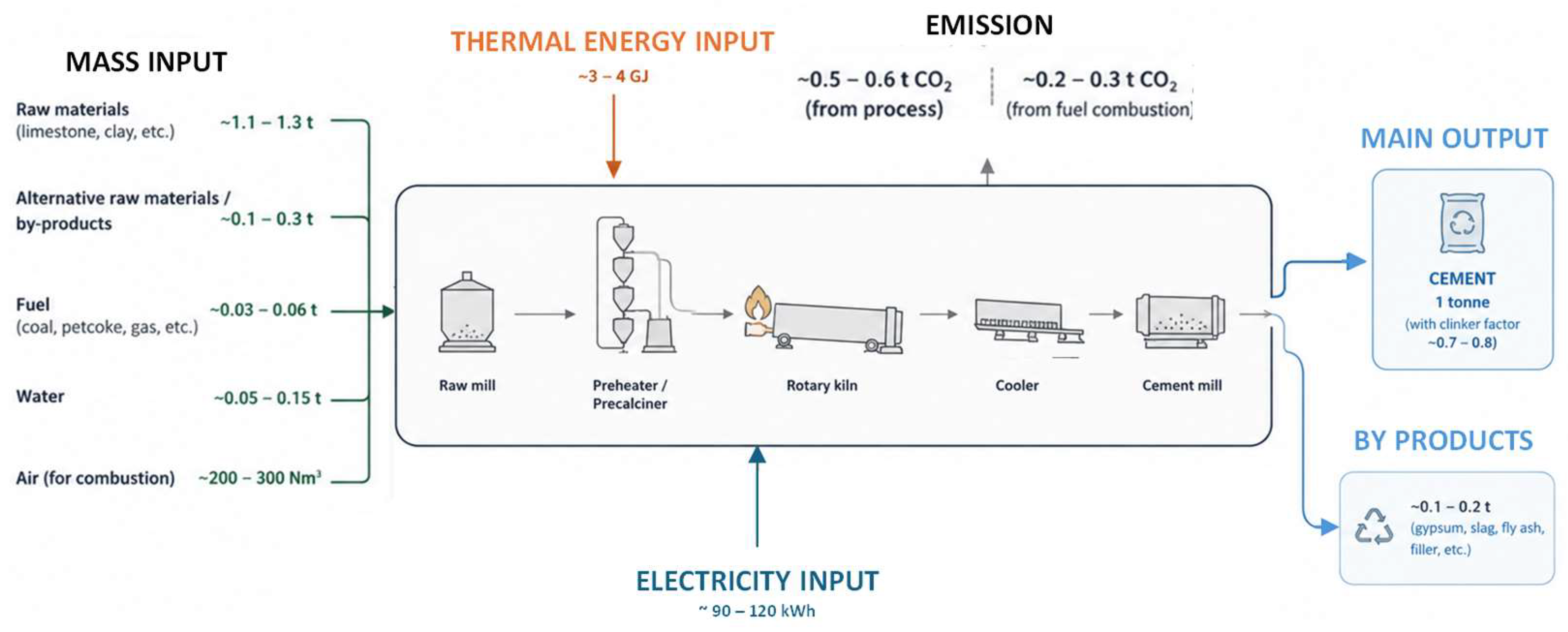
At the same time, the diversification of energy carriers, improvements in electrical efficiency, and growing integration with low-carbon energy systems open new pathways for reducing emissions. To provide a quantitative framework for the subsequent assessment, a set of representative mass, energy, and emission balances was developed. The values reported in Table 9 and Table 10 try to exemplify the mass and energy balances relating to the cement production processes. They have been obtained by combining benchmark figures available in technical literature, industrial reports, and Best Available Techniques (BAT) reference documents with aggregated operational data from several cement manufacturing plants, as [13]. As a result, the tables should not be interpreted as representative of typical performance levels observed in modern dry-process cement production.
The energy demand of cement production can also be expressed in terms of the equivalent thermal and electrical power required by a typical industrial facility. Considering a modern dry-process cement plant with a clinker production capacity of approximately 1 Mt/year and a specific thermal energy consumption of 2.7–3.2 GJ/t clinker, the corresponding thermal power demand ranges between 90 and 110 MWth under continuous operation. By comparison, the electrical demand is significantly lower, typically ranging from 10 to 15 MWe, based on specific electricity consumption values of 80–120 kWh/t cement. These figures clearly highlight the predominance of high-temperature thermal energy within the cement manufacturing process and explain why fuel decarbonization remains one of the most critical challenges for the sector. Table 11 reports the equivalent thermal and electrical power requirements associated with cement plants of different production capacities. The values have been estimated from typical specific energy consumption figures and continuous plant operation. The equivalent thermal power demand, , of a cement plant can be estimated from the specific thermal energy consumption, and the clinker production rate, :
Combining the two expressions:
Similarly, the equivalent electrical power, can be estimated as:
where is the cement production rate and or, in annual form:
The results clearly show that cement manufacturing is predominantly driven by thermal energy demand, with thermal power requirements typically one order of magnitude higher than electrical demand.
4. Strategies for Decarbonization of Cement Sector
While the previous chapter focused on the energy requirements of cement manufacturing, a comprehensive assessment of the sector must also consider the associated greenhouse gas emissions. The environmental impact of cement production is not only determined by fuel consumption but also by the intrinsic chemical reactions involved in clinker formation [14]. The environmental impact of the process cannot be assessed solely through energy consumption, as a significant fraction of emissions originates directly from the chemical transformations occurring during clinker production [15]. The total specific emissions associated with cement manufacturing can be expressed as the sum of three main contributions.
where are total specific emissions , the process emissions, the combustion-related emissions and the indirect emissions associated with electricity consumption. Process emissions arise from the calcination of limestone during clinker production. The decomposition reaction can be described as:
This reaction represents the largest source of CO₂ emissions in cement manufacturing linked to clinker formation. The specific process emissions, , can be estimated as:
where is the clinker content per tonne of cement, while is the calcination emission factor. Typical values of range between 0.52−0.54 kgCO2/kg clinker. The second contribution, , originates from the combustion of fuels required to reach the high temperatures required for clinker production. Combustion emissions can be estimated as:
where is the specific thermal energy demand and is the fuel emission factor. Typical emission factors are for coal and natural gas for example are 94 kg CO₂/GJ and 56 kg CO₂/GJ. Considering specific thermal consumptions ranging from 3 to 5 GJ/t cement, combustion emissions contribute between 250 and 350 kgCO₂/t cement. The third contribution is given by the indirect emissions associated with electricity consumption, , mainly required for raw material preparation, grinding operations, conveying systems, fans, and auxiliary equipment. Indirect emissions can be estimated as:
where is the specific electricity consumption, expressed in kWh/tcement and is the grid emission factor in kgCO2/kWh. Although electricity consumption is generally lower than thermal energy demand, its contribution may become increasingly relevant as electrification technologies are introduced. Combining the previous contributions yields a simplified emission model for cement production:
Following the analysis of energy consumption and emission throughout the production chain, a systematic assessment of the emission pathways has been carried out. As shown in Table 12, CO₂ emissions originate from both process-related reactions, primarily limestone calcination, and energy-related sources associated with fuel combustion and electricity consumption. Understanding the relative importance of these contributions is essential for evaluating the effectiveness of different decarbonisation strategies, including energy efficiency improvements, clinker substitutions through supplementary cementitious materials (SCMs), alternative fuels, electrification, hydrogen utilisation and carbon capture technologies.
The decarbonization strategies have been classified according to functional logic, distinguishing interventions based on their position within the value chain:
- -
- interventions on input materials, with partial substitution of clinker with supplementary cementitious materials (SCM) (e.g., slag, fly ash, calcined clay, limestone) aimed at reducing emissions associated with calcination, lowering clinker emission intensity;
- -
- interventions on direct energy use, focused on decarbonising combustion through alternative fuels, electrification, and integration of renewable energy sources (RES);
- -
- CO₂ capture and management technologies (CCS), acting downstream of the production process by directly targeting emission streams.
For each strategy, the emission reduction mechanism, estimated abatement potential, technology readiness level (TRL), integration challenges, and scalability prospects have been assessed. This framework enables a comparative and critical evaluation of available solutions, highlighting both complementarities and limitations. The decarbonization strategies adopted in the cement sector are summarized in Table 13.
Building upon the energy and emissions assessment presented in these sections, a systematic review of the main decarbonisation strategies for the cement sector is carried out. The analysis combines qualitative considerations regarding technology, implementation challenges, and process integration with quantitative estimates of their potential impact on energy consumption and CO₂ emissions.
4.1. Clinker-to-Cement Ratio Reduction
A significant share of CO₂ emissions in cement production originates from clinker formation, due to the calcination of limestone, which releases CO₂ during heating. Since a substantial fraction of cement-related CO₂ emissions originates from clinker production, both through limestone calcination and high-temperature thermal processes, reducing the clinker-to-cement ratio represents a mature and widely adopted mitigation option. Reducing the clinker content in cement by partially substituting it with SCM, such as volcanic pozzolans, industrial by-products (e.g. blast furnace slag), and fly ash, lowers both process emissions and fuel-related emissions. This strategy is already implemented. The main principle of clinker substitution is illustrated in Figure 7. According to industry estimates (e.g. [16]), a reduction of 1 kg of clinker can save approximately a range between 0.75 and 0.9 kg of CO₂. A decrease of around 30 kg of clinker per tonne of cement could result in avoided emissions in the range 22-27 kg CO₂ [17].
4.2. Use of Alternative Raw Materials (Substitution Materials)
Decarbonization of the cement manufacturing process can also be achieved through the incorporation of recycled and secondary materials, particularly construction and demolition waste added to traditional raw materials for clinker production like limestone and clay. Besides reducing the consumption of virgin raw materials, these materials may partially replace carbonate-rich feedstocks, thereby lowering both raw material extraction requirements and process-related CO₂ emissions. Although the impact strongly depends on the composition and substitution rate, the use of recycled mineral fractions is generally estimated to reduce emissions by approximately 5–15 kg CO₂ per tonne of cement. Efficiency improvements can be achieved by incorporating recycled or secondary materials, as construction and demolition waste [18]. Although its direct contribution to CO₂ mitigation is generally lower than that achievable through clinker substitution, fuel switching, or carbon capture technologies, it offers the additional benefits of reducing the consumption of virgin raw materials and promoting circular economy practices. Consequently, the incorporation of recycled and secondary materials should be regarded as a complementary measure within a broader portfolio of decarbonization actions for the cement sector.
4.3. Use of Alternative Fuels
Alternative fuels used in the cement industry include a wide range of waste-derived and biomass-based materials, which are increasingly integrated through co-processing in rotary kiln systems. A key requirement is that their combustion residues remain compatible with clinker chemistry, particularly in terms of calcium, silica, iron oxides, and alumina. Among these, solid recovered fuel (SRF), derived for example from municipal solid waste, plays a central role in industrial practice. Compared to fossil fuels such as petcoke and coal, SRF has a lower net carbon footprint per unit of thermal energy. Its utilization is enabled by modern multi-channel burner technologies and adapted kiln operation strategies, which allow for high flexibility in fuel input. According to industrial benchmarks, substitution rates more than 80–100% have been achieved in advanced cement plants under suitable technical conditions. From a decarbonization perspective, increasing the substitution rate of fossil fuels with alternative fuels from approximately 20% to around 45–50% could result in emission reductions in the order of 40–50 kg CO₂ per tonne of cement, depending on fuel composition and system efficiency ([19,20]).
4.4. Electrification and Use of Renewable Energy
Clinker production requires very high temperatures (≈1450-1500 °C), which are currently achieved predominantly through the combustion of fossil fuels or, increasingly, alternative fuels. Electrification of thermal processes is widely regarded as a fundamental decarbonization principle across industrial sectors; however, in energy-intensive “hard-to-abate” industries such as cement production, its application is constrained by thermodynamic, technological, and economic limitations. In particular, the direct substitution of high-temperature fossil-based heat with renewable electricity remains challenging due to the need for efficient heat transfer, process stability, and equipment compatibility.
Emerging technologies aim to electrify kiln heating through plasma systems, induction heating, resistive heating, and microwave-based approaches. These solutions are currently at different stages of development. In the short to medium term, partial electrification, particularly in preheating and in pre-calcination stages through indirect or hybrid electric heating, appears to be the most feasible pathway. Integration with low-carbon electricity from renewable sources could significantly reduce the carbon intensity of thermal energy use; however, full electrification of the rotary kiln remains a long-term option requiring substantial technological advances and system redesigns [21].
4.5. Oxy-Fuel Combustion and Hydrogen–Natural Gas Blends
Hydrogen-based fuels, particularly green hydrogen produced via water electrolysis, are increasingly identified as a promising long-term decarbonization pathway for the cement industry. Recent literature highlights that hydrogen can be used either as a partial substitute for conventional fossil fuels or as a primary fuel in fully decarbonized combustion systems, depending on its availability and production cost [22,23,24].
A potential plant configuration includes hydrogen injection at both the main kiln burner and the pre-calciner, with on-site hydrogen production via electrolysis. In such systems, oxygen required for combustion may be supplied either through water electrolysis or through dedicated air separation units (ASU), enabling more controlled combustion conditions and higher flame temperatures [25]. Several studies also emphasize that hydrogen-enabled combustion systems can be integrated with oxy-fuel or oxygen-enriched operation strategies, which are particularly relevant when combined with carbon capture and storage (CCS) technologies. Although oxy-fuel operation is not strictly required in cement production, its integration can significantly increase the CO₂ concentration in flue gases, thereby improving capture efficiency and reducing separation costs [16,25]. From a decarbonization perspective, hydrogen-based combustion systems have the potential to substantially reduce combustion-related emissions, with literature estimates suggesting reductions of up to approximately 250 kg CO₂ per tonne of cement under high hydrogen substitution scenarios [22,26]. Several technical and operational challenges remain. These include the high-water vapor content generated by hydrogen combustion, which can affect kiln atmosphere stability, heat transfer efficiency, and clinker quality. In addition, the need for large-scale green hydrogen production and associated electricity demand represents a critical bottleneck for large-scale deployment [16,27]. Overall, hydrogen utilization in cement production should currently be regarded as an emerging pathway with high theoretical mitigation potential, but still limited industrial maturity, requiring further technological development and system integration [24,26]. The strategic value of hydrogen in cement production extends beyond its direct use as a low-carbon fuel. Green hydrogen production through electrolysis simultaneously generates a significant oxygen stream, which can be utilized to support oxy-fuel kiln operation.
This can also create a technological synergy between hydrogen production and carbon capture systems. Hydrogen contributes to reduce combustion-related emissions, the associated oxygen production (8 kg for each kg of H2) increases the CO₂ concentration in flue gases, facilitating downstream capture and reducing the energy required for capture. Consequently, the benefit of hydrogen may not be limited to fuel substitution alone, but rather to its ability to integrate renewable electricity, high-temperature heat generation, oxy-fuel combustion, and carbon capture in a decarbonization pathway, as in Figure 8.
4.6. Carbon Capture and Storage (CCS)
Among the various decarbonization pathways available to the cement industry, carbon capture and storage (CCS) is widely recognized as the only technology capable of addressing the large fraction of process-related emissions generated during limestone calcination. CCS technologies directly target CO₂ emissions from both calcination and combustion processes. For this reason, CCS is often considered an essential component of long-term net-zero scenarios for cement production. However, despite its theoretical effectiveness, the practical deployment of CCS remains constrained by its substantial energy requirements and associated costs [28]. Depending on the capture technology adopted, the additional energy demand may significantly increase the overall energy consumption of the plant, thereby reduce the net environmental benefit and increase production costs. In this context, the integration of hydrogen-based technologies may provide a more attractive pathway. Hydrogen produced via renewable-powered electrolysis can simultaneously supply a low-carbon fuel for clinker production and significant amount of oxygen as a by-product. The availability of oxygen creates the opportunity to implement oxy-fuel combustion, in which nitrogen in the flue gas can be reduced.
From this perspective, the value of hydrogen extends beyond its direct contribution as a clean fuel. By coupling hydrogen production with oxy-fuel combustion, the oxygen generated during electrolysis can become a strategic enabler for more efficient carbon capture, creating a stronger synergy between renewable electricity, fuel decarbonization, and CO₂ mitigation technologies. This integrated approach may significantly improve the overall feasibility of deep decarbonization pathways for the cement sector. Oxy-fuel combustion uses pure oxygen instead of air, eliminating nitrogen dilution and increasing CO₂ concentration in flue gases, thereby simplifying downstream purification. Post-combustion capture, based on chemical absorption, is considered the most flexible option, as it can be integrated into both new and existing plants without major modifications to the kiln system. Capture rates of up to 95% of total emissions are theoretically achievable. In addition, complementary efficiency measures, such as energy optimisation of machinery, waste heat recovery, and compressed air management, can further reduce emissions [29]. Beyond its role as a low-carbon fuel, hydrogen production generates substantial quantities of oxygen that can be directly integrated into oxy-fuel clinker production systems. The resulting increase in CO₂ concentration in the flue gas can significantly reduce the energy penalty associated with downstream carbon capture, transforming hydrogen from a simple fuel substitute into a key enabler of integrated CCS deployment.
5. Discussion on the Decarbonization Strategies and Role of Hydrogen
The cement industry is widely recognized as one of the most challenging industrial sectors to decarbonize due to the simultaneous presence of energy-related and process-related emissions. The production of clinker requires large amounts of thermal energy at temperatures exceeding 1400 °C, while the calcination of limestone inherently releases significant quantities of CO₂. As discussed in the previous sections, process emissions typically account for approximately 60–65% of the total carbon footprint of cement production, with the remaining share associated with fuel combustion and electricity consumption. The analysis of the available mitigation pathways highlights that each strategy targets a specific component of these emissions and therefore offers different decarbonization potentials. Measures such as energy efficiency improvements and secondary raw materials primarily reduce energy demand, whereas alternative fuels, electrification, and hydrogen utilization mainly address combustion-related emissions. Carbon capture technologies are among the few options capable of mitigating the large fraction of process emissions arising from clinker production. As a result, deep decarbonization of the cement sector cannot rely on a single technological solution but requires the combination of multiple complementary measures. Table 14 illustrates a process-oriented framework that outlines key pathways for decarbonizing cement plants.
To provide a more systematic comparison, the qualitative considerations discussed above have been integrated with data collected from literature, industrial reports, and benchmark operating data. The resulting assessment, summarized in Table 15, compares the main decarbonization options in terms of their potential CO₂ reduction, providing an indicative measure of their relative contribution to the overall decarbonization of cement production. Among the available decarbonisation options, carbon capture and storage (CCS) represents the most effective one for achieving deep emission reductions, as it can address the substantial share of process-related CO₂ emissions generated during limestone calcination. Nevertheless, its large-scale deployment requires careful consideration of the associated energy penalties, infrastructure requirements, and economic costs.
Focusing on the more readily applicable mitigation measures, it should be noted that these strategies are not mutually exclusive and can be implemented in combination to maximise overall emission reductions. Within this framework, hydrogen-based solutions appear particularly promising, owing to their potential to substantially reduce combustion-related emissions while remaining compatible with existing cement production processes and future low-carbon energy systems. In this context, hydrogen is emerging as a potential decarbonisation vector, particularly for reducing combustion-related emissions and enabling the integration of advanced carbon capture systems. Hydrogen should not be interpreted as a standalone decarbonisation solution for the cement industry, but rather as an enabling energy carrier that facilitates the integration of renewable electricity, high-temperature thermal processes, and carbon capture technologies. Hydrogen can partially replace conventional fossil fuels such as coal, petcoke, or natural gas in rotary kilns and precalciners. When produced from renewable electricity (“green hydrogen”), its combustion does not generate direct CO₂ emissions:
This characteristic makes hydrogen particularly attractive for high-temperature industrial applications where direct electrification is still technologically challenging.
The role of hydrogen as a standalone fuel in cement production remains limited because process emissions from calcination are not affected, hydrogen combustion modifies flame characteristics, large quantities of water vapor are generated, and the required hydrogen volumes are extremely high. The thermal energy demand for clinker production, is typically . Considering an annual production of clinker, the annual thermal energy requirement of a cement plant is:
If a fraction of the thermal demand is supplied by hydrogen, the corresponding hydrogen-based thermal energy contribution becomes:
Considering the lower heating value (LHV) of hydrogen , the hydrogen demand for full fuel substitution is:
Considering an average value of the energy demand for clinker production as 3.4 GJ/tonn, complete fuel substitution would require approximately 28 kg of hydrogen for each tonn of clinker. This means that a medium-size cement plant producing 1 Mt/year of clinker could require approximately . Such demand would imply extremely large renewable electricity consumption for electrolysis, often exceeding several hundred MW of installed renewable capacity. The renewable electricity required to generate this hydrogen through electrolysis depends on the electrolyzer efficiency . The annual electrical energy demand can be estimated as:
Finally, assuming a renewable generation system characterized by equivalent operating hours per year, the installed renewable power required to sustain hydrogen production becomes:
This highlights one of the main limitations of hydrogen deployment in the cement industry: the scale of energy required. So, it seems quite clear that the most important role of hydrogen may not be direct fuel substitution, but its integration within broader decarbonisation architectures. In this perspective hydrogen can act as an energy carrier connecting renewable electricity and thermal processes (a flexibility mechanism for intermittent renewable power) and an interesting enabler for oxy-fuel combustion and CCS systems. This systemic role can be considered more relevant than simple fuel replacement. One of the most promising pathways involves combining hydrogen combustion with oxygen-enriched or oxy-fuel kiln operation. In conventional combustion, nitrogen from ambient air dilutes flue gases, reducing CO₂ concentration. By contrast, oxy-fuel systems use pure oxygen, generating flue gases mainly composed of CO₂, H₂O and limited impurities. This configuration significantly simplifies downstream carbon capture. Hydrogen integration is particularly attractive because:
- -
- electrolysis simultaneously produces hydrogen and oxygen;
- -
- oxygen can directly feed the kiln, and higher CO₂ concentration improves capture efficiency.
Hydrogen may indirectly contribute to near-zero-emission cement production. The strategic value of hydrogen in cement production extends beyond its direct use as a low-carbon fuel. Green hydrogen production through electrolysis simultaneously generates a significant oxygen stream, which can be utilized to support oxy-fuel kiln operation. This can also create a strong technological synergy between hydrogen deployment and carbon capture systems. While hydrogen contributes to reducing combustion-related emissions, the associated oxygen production increases the CO₂ concentration in flue gases, facilitating downstream capture and reducing the energy penalty of CCS. Consequently, the primary benefit of hydrogen may not be limited to fuel substitution alone, but rather to its ability to integrate renewable electricity, high-temperature heat generation, oxy-fuel combustion, and carbon capture into a single decarbonization pathway.
Anyway, it is important to consider the dimensional analysis, that highlights a critical insight: even under a partial substitution scenario, hydrogen demand reaches tens of thousands of tonnes per year per facility. To better quantify the scale of hydrogen deployment in the cement industry, a parametric assessment was performed considering a reference clinker production capacity of 1 Mt/year. Hydrogen substitution levels ranging from 5% to 20% of the thermal energy demand were analysed. Renewable electricity requirements were estimated assuming an electrolyzer efficiency of 70%, while equivalent operating hours of 1,200 h/year and 2,000 h/year were considered for photovoltaic and wind generation, respectively. The results are summarized in Table 16.
Scaled up across national or continental cement production, this implies a massive upstream requirement for low-carbon electricity and electrolysis capacity, reinforcing that hydrogen-based decarbonisation is technically plausible but highly infrastructure- and energy-intensive. Even relatively modest hydrogen substitution rates require renewable generation capacities that are comparable to utility-scale energy projects. This highlights both the decarbonization potential of hydrogen and the substantial infrastructure investments needed for its large-scale deployment in the cement sector, as also highlighted by one of the authors of the present paper in recent papers [30,31,32].
6. Conclusions
Decarbonizing the cement industry remains one of the most challenging tasks within the broader energy transition due to the simultaneous presence of high-temperature thermal demand and unavoidable process-related emissions. The analysis presented in this work shows that modern cement production typically requires between 2.8 and 3.6 GJ of thermal energy and 80–120 kWh of electricity per tons of cement, resulting in total emissions generally ranging from 500 to 850 kg CO₂/t cement.
Approximately 55–65% of these emissions originate from limestone calcination during clinker production, while 25–35% are associated with fuel combustion, confirming the hard-to-abate nature of the sector. The quantitative assessment of the main decarbonization pathways highlights that no single technology can deliver complete emission abatement. Energy efficiency measures, although essential, typically provide reductions of only 10–30 kg CO₂/t cement. Similarly, the use of secondary raw materials and clinker substitution through supplementary cementitious materials can reduce emissions by several tens of kilograms of CO₂ per tons, while alternative fuels generally achieve reductions in the range of 20–60 kg CO₂/t cement depending on substitution rates and biomass content. Within this framework, hydrogen emerges as one of the most promising long-term solutions for addressing the thermal energy demand of clinker production. The analysis suggests that hydrogen-based combustion systems could potentially avoid between 50 and 250 kg CO₂/t cement, particularly when integrated into kiln and precalciner operations. Beyond its direct role as a low-carbon fuel, hydrogen may act as a strategic enabler for oxy-fuel combustion systems, providing both renewable heat and oxygen streams that facilitate downstream CO₂ capture. This system level integration could significantly improve the overall effectiveness of carbon management strategies.
Nevertheless, even under optimistic fuel-switching scenarios, a substantial fraction of emissions associated with calcination remains unavoidable. Consequently, carbon capture and storage (CCS) appear to be the only technology capable of addressing the remaining 400–700 kg CO₂/t cement generated by clinker production. While CCS is associated with significant energy and economic penalties, its deployment is likely to become indispensable for achieving deep decarbonization targets.
The results therefore indicate that the transition toward low-carbon cement production will require the coordinated implementation of multiple complementary measures. Clinker factor reduction, secondary raw materials, alternative fuels, electrification, hydrogen utilization, and CCS should not be regarded as competing solutions but rather as elements of an integrated decarbonization framework.
Among the various options, hydrogen stands out for its ability to connect renewable electricity, high-temperature industrial heat, oxy-fuel combustion, and carbon capture technologies, thereby playing a potentially strategic role in the future evolution of a net-zero cement industry. Hydrogen produced via renewable-powered electrolysis can simultaneously supply a low-carbon fuel for clinker production and generate significant quantities of oxygen as a by-product. The availability of this oxygen creates the opportunity to implement oxy-fuel combustion systems, in which nitrogen from air is largely eliminated from the combustion process.
Author Contributions
Conceptualization, A.F. and W.M.S.T.; methodology, A.F.; software, A.F.; validation, A.F., W.M.S.T.; formal analysis, A.F.; investigation, A.F. and W.M.S.T.; resources, A.F.; data curation, A.F.; writing—original draft preparation, A.F; writing—review and editing, A.F. and W.M.S.T; visualization, A.F. and W.M.S.T; supervision, A.F.; project administration, A.F.; funding acquisition, A.F. All authors have read and agreed to the published version of the manuscript.”
Funding
This research was supported by the National Recovery and Resilience Plan (NRRP), Mission 4 Component 2 Investment 1.3—Call for tender No. 1561 of 11.10.2022 of Ministero dell’Università e della Ricerca (MUR); and by the European Union—NextGenerationEU. Award Number: Project code PE0000021, Concession Decree No. 1561 of 11.10.2022 adopted by Ministero dell’Università e della Ricerca (MUR), CUP I53C22001450006, according to attachment E of Decree No. 1561/2022, Project title “Network 4 Energy Sustainable Transition—NEST”.
Data Availability Statement
Data will be made available upon request.
Acknowledgments
The authors gratefully acknowledge the technical staff of NEST and the University of Pisa for their constant support and assistance throughout the duration of this project.
Conflicts of Interest
The authors declare no conflicts of interest
Abbreviations
The following abbreviations are used in this manuscript:
| ASU | Air Separation Units |
| BAT | Best Available Techniques |
| CCN | Cement chemistry notation |
| CCS | Carbon capture and storage |
| specific electricity consumption [kWh/] | |
| specific thermal energy consumption [GJ/] | |
| Indirect emissions associated with electricity consumption , | |
| Combustion related emissions , | |
| Process related emissions , | |
| Total specific emissions , | |
| Calcination emission factor c, | |
| Fuel emission factor [kgCO2/GJ] | |
| Grid emission factor [kgCO2/kWh] | |
| Fraction of the thermal power covered with hydrogen [--] | |
| annual operating hours [h/y] | |
| LHV | Lower heating value [MJ/kg] |
| cement production rate (t/h) | |
| clinker production rate [t/h] | |
| annual cement production [t/year] | |
| clinker content per tonne of cement | |
| Annual production of clincker [t] | |
| theoretical hydrogen demand for full fuel substitution | |
| electrical power demand [kW] | |
| installed renewable power required to sustain hydrogen production [kW] | |
| thermal power demand [kW] | |
| specific thermal energy demand | |
| specific thermal energy demand for clinker | |
| Total thermal energy demand | |
| RES | Renewable Energy Sources |
| SCM | Supplementary Cementitious Materials |
| SRF | solid recovered fuel |
| Specific electricity consumption | |
| TRL | Technology Readiness Level |
| electrolyzer efficiency |
References
- Cavalett, O.; Watanabe, M. D.; Voldsund, M.; Roussanaly, S.; Cherubini, F. Paving the way for sustainable decarbonization of the European cement industry. Nat. Sustain. 2024, 7(5), 568–580. [Google Scholar] [CrossRef]
- Mishra, U. C.; Sarsaiya, S.; Gupta, A. A systematic review on the impact of cement industries on the natural environment. Environ. Sci. Pollut. Res. 2022, 29(13), 18440–18451. [Google Scholar] [CrossRef] [PubMed]
- World Bank; IFC. Strengthening Sustainability in the Cement Industry. 2020. Available online: https://www.ifc.org/content/dam/ifc/doc/2025/2025-strengthening-sustainability-in-the-cement-industry.pdf.
- Bouckaert, S.; Pales, A. F.; McGlade, C.; Remme, U.; Wanner, B.; Varro, L.; Spencer, T. Net zero by 2050: A roadmap for the global energy sector. 2021. [Google Scholar] [CrossRef]
- Ige, O. E.; Kabeya, M. Decarbonizing the Cement Industry: Technological, Economic, and Policy Barriers to CO2 Mitigation Adoption. Clean. Technol. 2025, 7(4), 85. [Google Scholar] [CrossRef]
- Dwivedi, S. Sustainability-Driven CO2 Mitigation Strategies in the Cement Industry: A Review. In International Conference on Sustainable Planning, Architecture and Civil Engineering (SPACE 2026) (p. 279). Allied Publishers. 2026, January.
- Lehne, J.; Preston, F. Making concrete change. Innovation in low-carbon cement and concrete, 1-66.
- Bisulandu, B. J. R. M.; Huchet, F. Rotary kiln process: An overview of physical mechanisms, models and applications. Appl. Therm. Eng. 2023, 221, 119637. [Google Scholar]
- Abdul-Wahab, S. A.; Al-Dhamri, H.; Ram, G.; Chatterjee, V. P. An overview of alternative raw materials used in cement and clinker manufacturing. Int. J. Sustain. Eng. 2021, 14(4), 743–760. [Google Scholar]
- Joint Research Centre: Institute for Prospective Technological Studies; Delgado Sancho, L.; Kourti, I.; Roudier, S.; Scalet, B. M.; et al. Best available techniques (BAT) reference document for the production of cement, lime and magnesium oxide – Industrial Emissions Directive 2010/75/EU (integrated pollution prevention and control), Publications Office, 2013. Available online: https://data.europa.eu/doi/10.2788/12850.
- United Nations Industrial Development Organization (UNIDO). Industrial Energy Efficiency Project, Industrial Energy Efficiency, Benchmarking Report for Cement Sector. Available online: https://www.unido.org/sites/default/files/files/2019-05/Benchmarking%20Report%20Cement%20Sector.pdf.
- Sherif, Z.; Sarfraz, S.; Jolly, M.; Salonitis, K. A critical review of the decarbonisation potential in the Uk cement industry. Materials 2025, 18(2), 292. [Google Scholar] [CrossRef] [PubMed]
- Buzzi Unice, Annual Report 2024. Available online: https://www.annualreports.com/HostedData/AnnualReports/PDF/buzzi-unicem_2024.pdf (accessed on 15 June 2026).
- Habert, G.; Miller, S. A.; John, V. M.; Provis, J. L.; Favier, A.; Horvath, A.; Scrivener, K. L. Environmental impacts and decarbonization strategies in the cement and concrete industries. Nat. Rev. Earth Environ. 2020, 1(11), 559–573. [Google Scholar] [CrossRef]
- Carbon Dioxide Emissions from the Manufacture of Cement Worldwide from 1990 to 2023, by Select Country. Available online: https://www.statista.com/statistics/1091672/carbon-dioxide-emissions-global-cement-manufacturing/ (accessed on 10 June 2026).
- Federbeton (2022–2024), Sustainability Report of the Cement and Concrete Sector. Available online: https://www.federbeton.it/Portals/0/PubDoc/Pubblicazioni/Rapporti/Rapporto_di_Sostenibilit%C3%A0_Federbeton_2024.pdf?ver=StNu6Y0odSqFVXRXDVr0RA%3D%3D (accessed on 10 June 2026).
- Scrivener, K. L.; John, V. M.; Gartner, E. M. Eco-efficient cements: Potential economically viable solutions for a low-CO2 cement-based materials industry. Cem. Concr. Res. 2018, 114, 2–26. [Google Scholar] [CrossRef]
- Shah, I. H.; Miller, S. A.; Jiang, D.; Myers, R. J. Cement substitution with secondary materials can reduce annual global CO2 emissions by up to 1.3 gigatons. Nat. Commun. 2022, 13(1), 5758. [Google Scholar] [CrossRef] [PubMed]
- Madlool, N. A.; Saidur, R.; Rahim, N. A.; Kamalisarvestani, M. An overview of energy savings measures for cement industries. Renew. Sustain. Energy Rev. 2013, 19, 18–29. [Google Scholar] [CrossRef]
- Martinez, C. G. Mapping the transition of the EU cement industry to carbon neutrality. Available online: https://publications.jrc.ec.europa.eu/repository/handle/JRC144123 (accessed on 10 June 2026).
- Volaity, S. S.; Aylas-Paredes, B. K.; Han, T.; Huang, J.; Sridhar, S.; Sant, G.; Neithalath, N. Towards decarbonization of cement industry: a critical review of electrification technologies for sustainable cement production. Mater. Sustain. 2025, 3(1), 23. [Google Scholar] [CrossRef]
- Prasad, M. N. V. Use of hydrogen in iron, steel, and cement industries for decarbonization. In Accelerating the Transition to a Hydrogen Economy; Elsevier, 2025; pp. 179–205. [Google Scholar]
- Jibran, J. A.; Mahat, C. Application of green hydrogen for decarbonization of cement manufacturing process: A technical review. Journal of Physics: Conference Series 2023, Vol. 2629(No. 1), 012027. [Google Scholar] [CrossRef]
- Rai, P. Green Hydrogen for Cement Production: A Decarbonization Pathway (Doctoral dissertation, Department of Electrical Engineering, Faculty of Technology, Delhi University, India). 2025. [Google Scholar]
- Ricci, L.; Giaconia, L.; Mechaal, N.; Jung, J. Contributing to Decarbonizing the Cement Industry Thanks to Innovative Combustion Methods. In 2025 IEEE-IAS/PCA Cement Industry Conference (IAS/PCA) (pp. 1-10). IEEE. May.
- Luhar, S.; Ashour, A.; Luhar, I. Decarbonising the Cement and Concrete Industry—A Step Forward to a Sustainable Future. J. Compos. Sci. 2026, 10(5), 226. [Google Scholar] [CrossRef]
- Deng, Y.; Cao, H.; He, Z.; Han, K.; Zhao, J.; Jing, Y.; Li, Y. Techno-economic assessment of zero-carbon cement clinker production process based on limestone hydrogenation. Energy Convers. Manag. 2025, 341, 120022. [Google Scholar]
- Franco, A.; Diaz, A. R. Environmental sustainability of CO2 capture in fossil fuel based power plants. Ecosyst. Sustain. Dev. VI 2007, 6, 251. [Google Scholar] [CrossRef]
- Plaza, M. G.; Martínez, S.; Rubiera, F. CO2 capture, use, and storage in the cement industry: State of the art and expectations. Energies 2020, 13(21), 5692. [Google Scholar] [CrossRef]
- Franco, A.; Giovannini, C. Routes for hydrogen introduction in the industrial hard-to-abate sectors for promoting energy transition. Energies 2023, 16(16), 6098. [Google Scholar]
- Franco, A.; Rocca, M. Renewable electricity and green hydrogen integration for decarbonization of “hard-to-abate” industrial sectors. Electricity 2024, 5(3), 471–490. [Google Scholar]
- Franco, A. Green hydrogen and the energy transition: Hopes, challenges, and realistic opportunities. Hydrogen 2025, 6(2), 28. [Google Scholar] [CrossRef]
Figure 1.
Historical trend of global cement production (1950–2020).
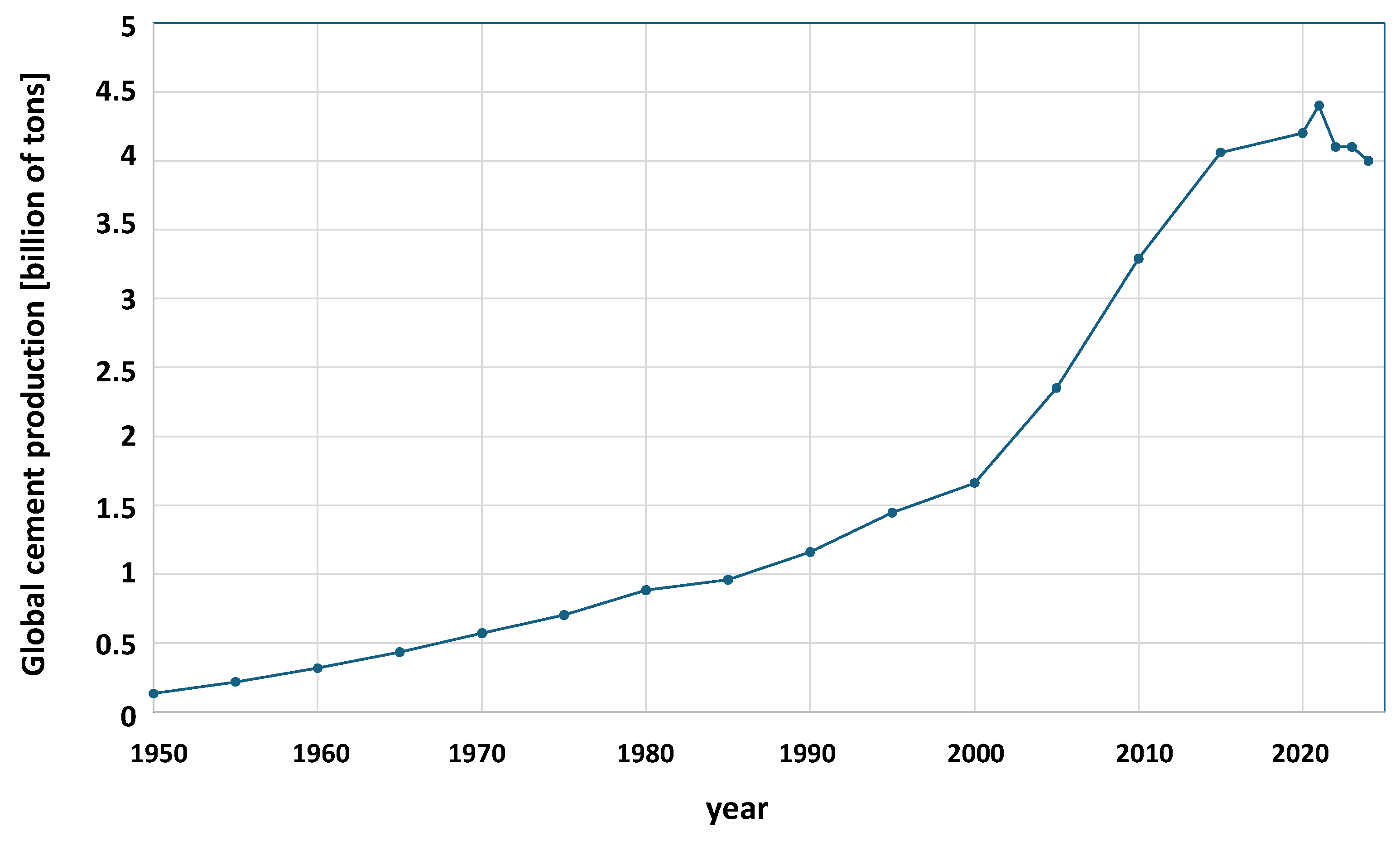
Figure 2.
simplified representation of the cement manufacturing process, identifying its three main production stages.
Figure 2.
simplified representation of the cement manufacturing process, identifying its three main production stages.
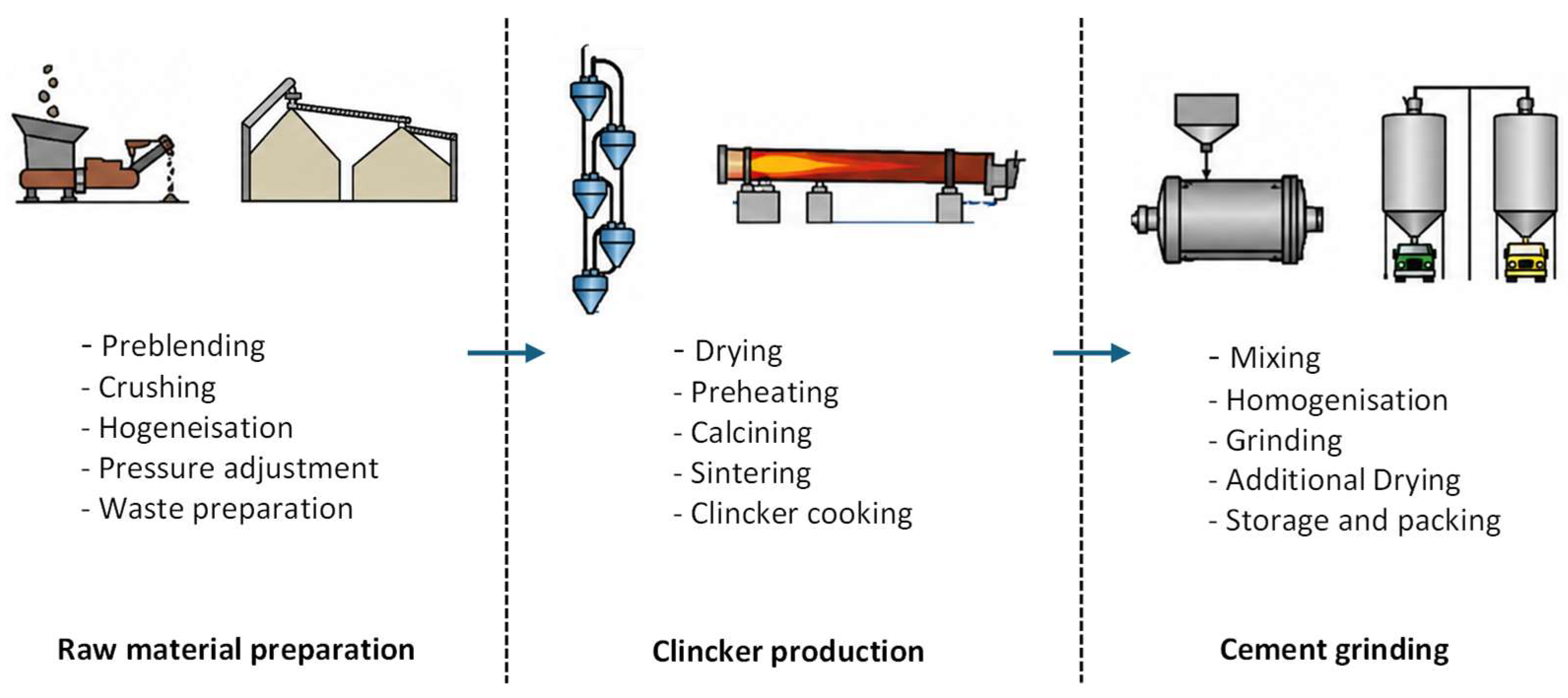
Figure 3.
More detailed representation of cement manufacturing process, decomposing it into 14 distinct sub-processes (rearranged from [10]).
Figure 3.
More detailed representation of cement manufacturing process, decomposing it into 14 distinct sub-processes (rearranged from [10]).
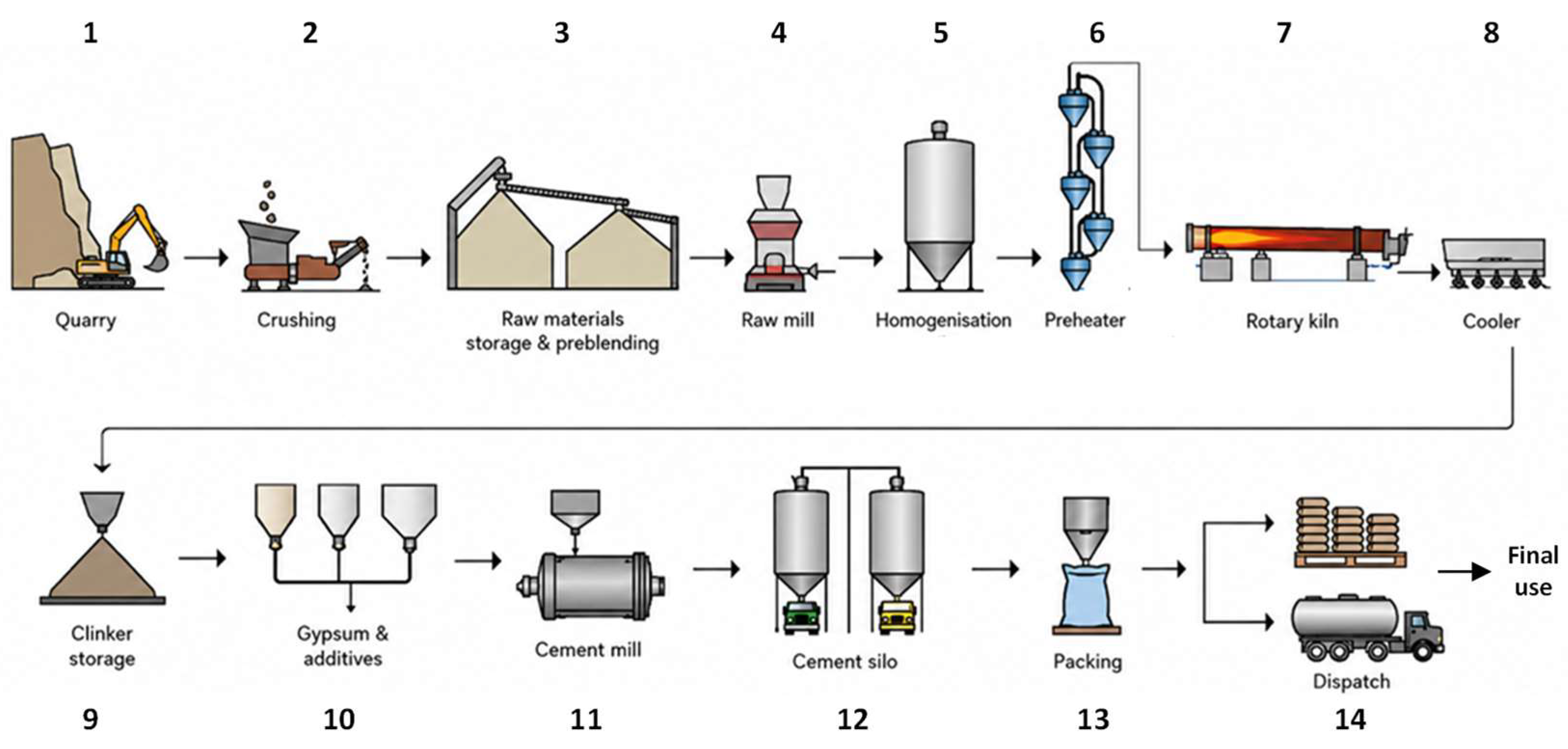
Figure 4.
Clinker production process.
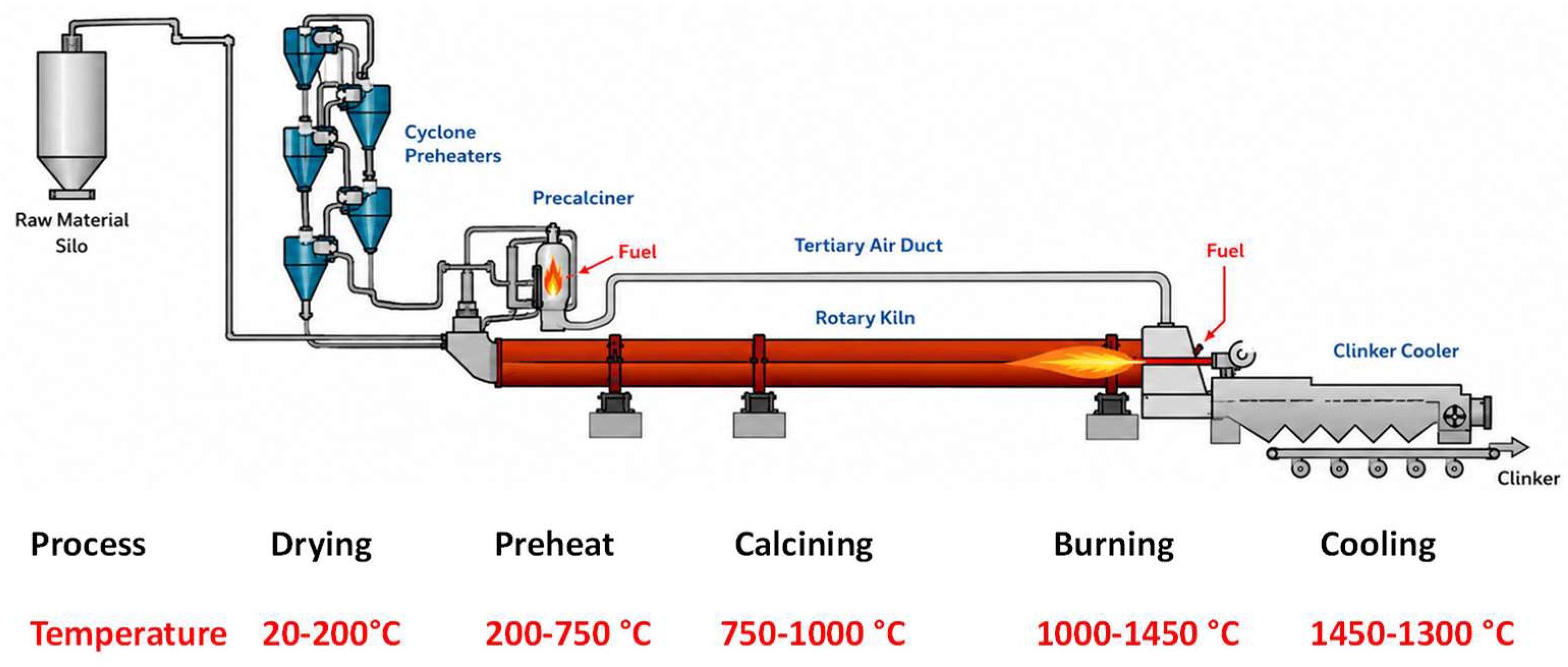
Figure 5.
Thermal energy use across cement production stages (data rearranged from [11]).
Figure 5.
Thermal energy use across cement production stages (data rearranged from [11]).
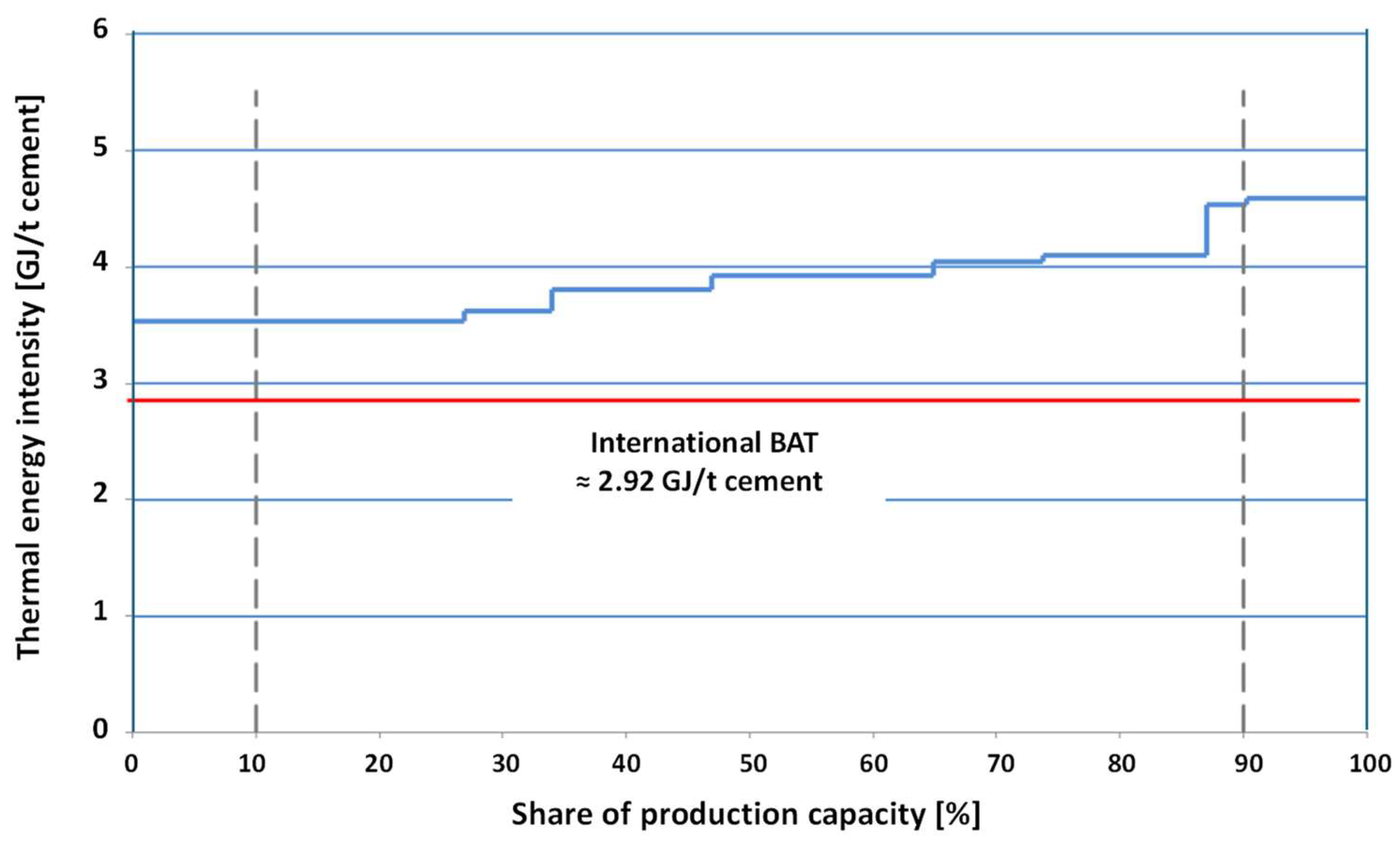
Figure 7.
Clinker substitution: a first decarbonization strategy.
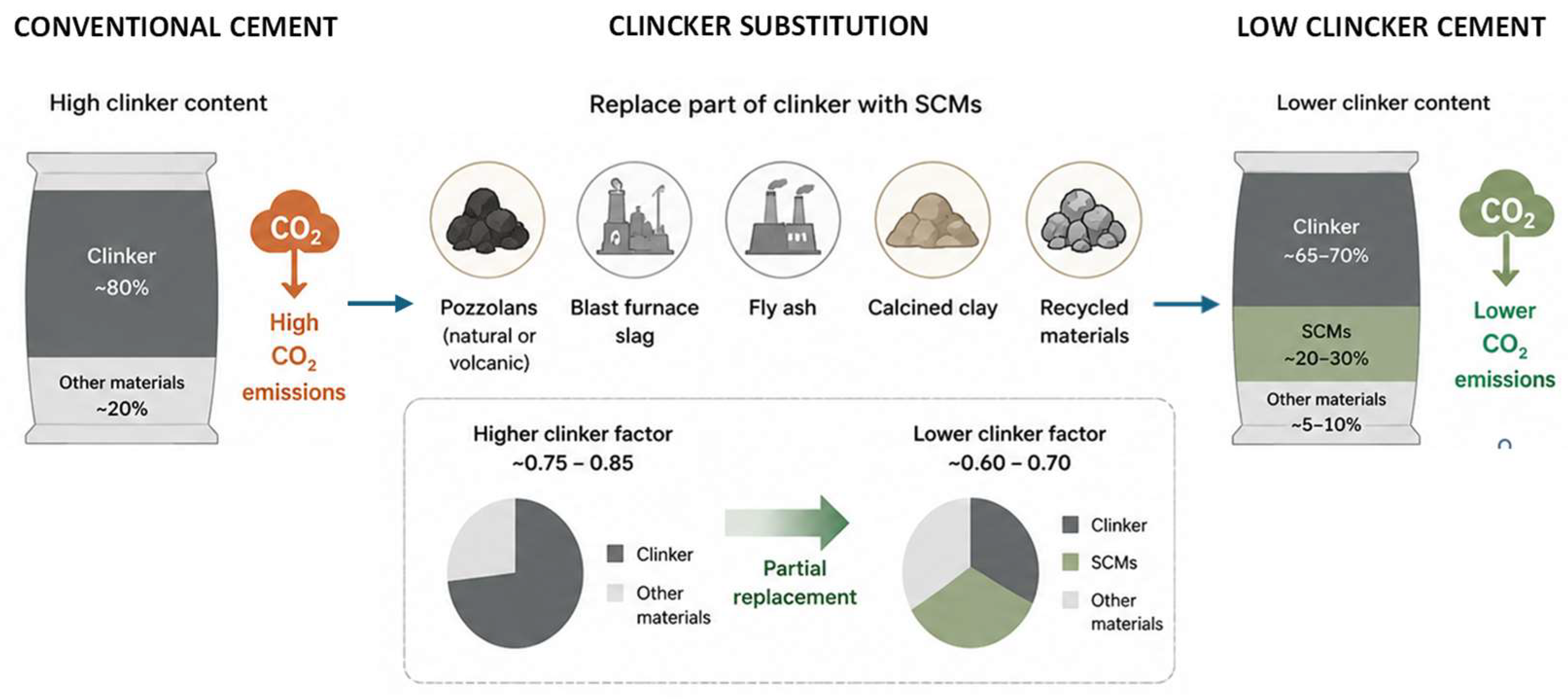
Figure 8.
Hydrogen assisted oxy-fuel combustion for low-carbon cement.
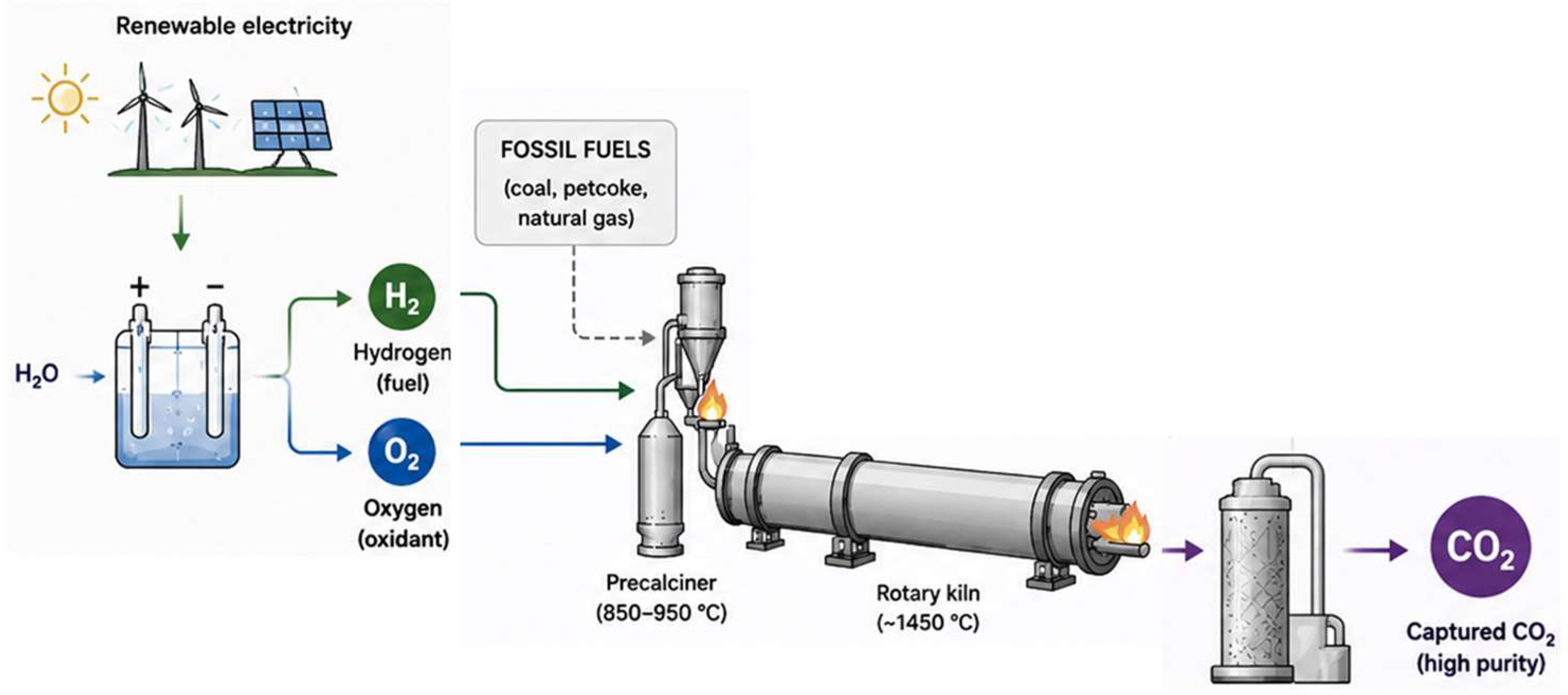

Table 1.
Classification of common cements: composition and main performance characteristics.
| Cement Type | Constituents | Main Characteristics |
|---|---|---|
| CEM I (Portland Cement) |
Clinker (95–100%); additional constituents (0–5%) |
High mechanical strength and rapid strength development |
| CEM II (Portland-Composite Cement) |
Clinker (65–94%), slag, silica, pozzolana, limestone |
Good workability and moderate heat of hydration |
| CEM III (Blast-Furnace Cement) |
Clinker (5–64%), granulated blast-furnace slag |
High resistance to chemical attack (sulfates) and low heat of hydration |
| CEM IV (Pozzolanic Cement) |
Clinker (45–89%), natural or industrial pozzolana |
Excellent durability, high resistance to chemical attack, improved watertightness |
| CEM V (Composite Cement) |
Clinker (20–64%), blast-furnace, slag, pozzolana |
High durability, and resistance to aggressive environments |
Table 2.
Main raw materials used in cement production and their respective functions.
| Material | Typical Content (%) | Role in Cement |
|---|---|---|
| Limestone | 70–90 | Provides CaO for clinker formation |
| Clay / Shale | 10–25 | Supplies SiO₂, Al₂O₃, Fe₂O₃ |
| Correctives / SCMs | 0–10 | Adjust chemical balance |
Table 3.
Typical raw material composition.
| Stage | Input | Output |
|---|---|---|
| Raw material preparation | Limestone, clay, additives | Raw meal |
| Clinker production | Raw meal | Clinker |
| Cement grinding | Clinker + gypsum + SCMs | Cement |
Table 4.
Typical raw material composition.
| Clinker phase | Cement chemistry notation (CCN) | Chemical formula | Typical content (% wt.) |
|---|---|---|---|
| Alite | C₃S | 3CaO·SiO₂ | 50–70 |
| Belite | C₂S | 2CaO·SiO₂ | 15–30 |
| Tricalcium aluminate | C₃A | 3CaO·Al₂O₃ | 5–12 |
| Tetracalcium aluminoferrite | C₄AF | 4CaO·Al₂O₃·Fe₂O₃ | 5–15 |
Table 5.
Typical distribution of energy demand by process stage.
| Process stage | Energy form | Relative share |
|---|---|---|
| Raw material preparation | Electricity | Low |
| Clinker production | Thermal | Very high |
| Cement grinding | Electricity | Medium |
Table 6.
Average energy consumption by kiln type.
| Kiln type | Thermal energy consumption [GJ/tonnes clinker] |
|---|---|
| Dry with preheater and precalciner | 3.6 |
| Dry with preheater without precalciner | 3.7 |
| Dry without preheater (long dry kiln) | 3.8 |
| Semi wet / Semi-dry | 4.0 |
| Wet / Shaft kiln | 5.2 |
Table 7.
Best Available Techniques (BAT) for energy consumption for Portland Cement.
| Production process | Energy type | Portland cement |
|---|---|---|
| Raw material preparation | Electricity | 0.07 |
| Clinker Making | Fuel Electricity |
2.70 0.08 |
| Finish grinding | Electricity | 0.07 |
| Total thermal energy use | 2.70 | |
| Total electricity use | 0.22 | |
| Total energy use | 2.92 |
Table 8.
Main energy carriers in cement production.
| Energy carrier | Typical application | Status |
|---|---|---|
| Coal / Petcoke | Kiln and precalciner | Conventional |
| Natural gas | Kiln support and startup | Conventional |
| Alternative fuels | Kiln and precalciner | Increasing |
| Biomass | Partial fuel substitution | Increasing |
Table 9.
Mass Balance for Portland Cement Production.
| Stream | Type | Typical Value (kg/t cement) |
|---|---|---|
| Limestone | Input | 1100–1300 |
| Clay and corrective materials | Input | 250–400 |
| Alternative raw materials | Input | 0–200 |
| Gypsum | Input | 30–50 |
| Fuels (thermal equivalent) | Input | 80–120 |
| Clinker | Intermediate product | 750–850 |
| Cement | Final product | 1000 |
| CO₂ from calcination | Output | 450–550 |
| CO₂ from fuel combustion | Output | 200–350 |
| Dust and particulate emissions | Output | < 1 |
Table 10.
Typical Energy Consumption by Process Stage.
| Process Stage | Thermal Energy (GJ/t cement) |
Electrical Energy (kWh/t cement) |
|---|---|---|
| Raw material crushing | – | 3–5 |
| Raw meal grinding and homogenization | – | 15–25 |
| Preheating and recalcination | 0.8–1.2 | 2–5 |
| Rotary kiln (clinker formation) | 1.8–2.5 | 2–4 |
| Clinker cooling | Heat recovery | 2–3 |
| Cement grinding | – | 25–40 |
| Auxiliary systems | – | 5–10 |
| Total | 2.8–3.6 | 80–120 |
Table 11.
Typical Energy Consumption by Process Stage.
| Plant Capacity (Mt clinker/year) |
Thermal Power Demand (MWth) | Electrical Power Demand (MWe) |
|---|---|---|
| 0.5 | 45–55 | 5–8 |
| 1.0 | 90–110 | 10–15 |
| 2.0 | 180–220 | 20–30 |
| 3.0 | 270–330 | 30–45 |
Table 12.
Typical CO₂ Emission Breakdown in Cement Production.
| Emission Source | Emissions (kg CO₂/t cement) |
Share (%) |
|---|---|---|
| Limestone calcination | 450–550 | 55–65 |
| Fuel combustion | 200–300 | 25–35 |
| Electricity consumption | 20–80 | 3–10 |
| Transport and auxiliary services | 10–30 | 1–3 |
| Total | 650–850 | 100 |
Table 13.
Strategies for decarbonizing the cement sector.
| Strategy | Description | Main emission reduction mechanism |
|---|---|---|
| Clinker factor reduction (SCMs) | Partial substitution of clinker with SCM | Reduces process emissions from clinker production |
| Energy efficiency improvements | Kiln optimization, heat recovery, process control | Reduces fuel-related CO₂ emissions |
| Alternative fuels | Use of biomass or waste-derived fuels | Lowers fossil CO₂ emissions from combustion |
| Carbon Capture and Storage (CCS) | Capture of CO₂ from kiln flue gases for storage or use | Direct capture of process and combustion emissions |
| Electrification & renewable integration | Electrification of processes using renewable electricity | Reduces indirect emissions from energy use |
| Low-carbon binders | Use of alternative material with reduced clinker or different chemistries | Reduces or eliminates clinker-related emissions |
Table 14.
Process-Oriented Framework for Cement Plant Decarbonization.
| Process Unit | Energy Input | Main CO₂ Source | Decarbonization Strategies |
|---|---|---|---|
| Raw material preparation | Electricity | Indirect emissions | RES electricity, efficiency |
| Raw meal grinding | Electricity | Indirect emissions | High-efficiency grinding systems |
| Preheater / Precalciner | Thermal energy | Fuel combustion; calcination |
Alternative fuels, H2, electrification |
| Rotary kiln | Thermal energy | Fuel combustion; calcination |
H2, oxy-fuel combustion, CCS |
| Clinker cooling | Thermal energy (recovery) | Minor | Heat recovery |
| Cement grinding | Electricity | Indirect emissions | RES electricity, efficient mills |
| Auxiliary systems | Electricity | Indirect emissions | Energy management systems |
| Entire plant | Multiple | Process emissions | clinker substitution, CCS |
Table 15.
Decarbonization Options and Potential CO₂ Reduction.
| Decarbonization Measure | Typical Reduction Potential (kg CO₂/t cement) | Technology Maturity |
|---|---|---|
| Energy efficiency improvements | 10–30 | Commercial |
| Secondary raw materials | 5–15 | Commercial |
| Clinker factor reduction | 20–150 | Commercial |
| Alternative fuels (SRF, biomass) | 20–60 | Commercial |
| Clinker electrification (partial) | 20–100 | Demonstration |
| Green hydrogen utilization | 50–250 | Demonstration |
| Carbon Capture and Storage (CCS) | 400–700 | Demonstration |
Table 16.
Renewable electricity demand and equivalent photovoltaic and wind capacities required to supply hydrogen for partial decarbonization of clinker production in a 1 Mtonn/year capacity.
Table 16.
Renewable electricity demand and equivalent photovoltaic and wind capacities required to supply hydrogen for partial decarbonization of clinker production in a 1 Mtonn/year capacity.
| H₂ substitution | H₂ demand (kg/t clinker) | H₂ production (t/y) | Electricity demand (GWh/y) | PV capacity (MWp) | Wind capacity (MW) |
|---|---|---|---|---|---|
| 5% | 1.4 | 1,420 | 67.5 | 56 | 34 |
| 10% | 2.8 | 2,830 | 135 | 113 | 68 |
| 15% | 4.3 | 4,250 | 203 | 169 | 101 |
| 20% | 5.7 | 5,670 | 270 | 225 | 135 |
Disclaimer/Publisher’s Note: The statements, opinions and data contained in all publications are solely those of the individual author(s) and contributor(s) and not of MDPI and/or the editor(s). MDPI and/or the editor(s) disclaim responsibility for any injury to people or property resulting from any ideas, methods, instructions or products referred to in the content. |
© 2026 by the authors. Licensee MDPI, Basel, Switzerland. This article is an open access article distributed under the terms and conditions of the Creative Commons Attribution (CC BY) license (http://creativecommons.org/licenses/by/4.0/).
Copyright: This open access article is published under a Creative Commons CC BY 4.0 license, which permit the free download, distribution, and reuse, provided that the author and preprint are cited in any reuse.


