

Submitted:
16 June 2026
Posted:
17 June 2026
You are already at the latest version
Abstract
The Brief Advanced Computerized Neuropsychological Battery (BACNB) was developed as a compact protocol to investigate, in a fully in silico environment, the functional geometry produced by four classical tasks: the Sustained Attention to Response Task, Stop-Signal Task, Flanker Task, and Digit Span. The study does not establish clinical norms or diagnostic validity. Its aim is to test whether synthetic agents completing all four tasks produce a coherent, reproducible, and theoretically interpretable state structure. We simulated 200,000 agents, each with continuous latent microparameters and observable metrics extracted from the four tasks. Measures were standardized into an oriented functional scale so that higher values represented greater cost under the task ecology, without implying biological inferiority. Variable clustering yielded 8 emergent cognitive parameters; agent clustering yielded 4 phenotypic-functional attractors. The main result is the BACNB Cognitive State Space: each agent is described by a compositional vector of relative approximation to attractors P1-P4. Because the weights sum to 1.00, the system has three degrees of freedom and can be visualized as a tetrahedron. The external comparison with Inhibitory Control, Working Memory, and Cognitive Flexibility showed partial convergence but did not literally reconstruct the Miyake model. The proposed interpretation shifts the battery from a taxonomy of deficits to a contextual cognitive kinematics in which functional cost depends on the relation among organism, task, and environment. This framing treats simulation as theoretical instrumentation for generating falsifiable hypotheses and clarifying which assumptions require empirical tests.
Keywords:
computational neuroscience
; executive functions
; Monte Carlo
; state space
; attractors
; compositional data
; thermodynamics of living systems
; evolution
Introduction
Neuropsychological assessment of executive functions is commonly organized around domains such as inhibitory control, working memory, and cognitive flexibility, especially within the unity-and-diversity tradition of executive functions (Diamond, 2013; Friedman & Miyake, 2017; Miyake et al., 2000). This organization is clinically useful, but it may obscure a conceptual problem: executive tasks rarely measure a single pure process, and factorial reviews show substantial heterogeneity across models, tasks, and samples (Karr et al., 2018). A Go/No-Go error may involve inhibition, sustained attention, speed, automatization, fatigue, and temporal strategy; a Flanker cost may reflect perceptual conflict, motor conflict, error monitoring, or criterion adjustment; a lower backward Digit Span may reflect verbal maintenance, sequence manipulation, attention, and updating cost. Thus, the central question is not merely whether BACNB measures three classical executive functions, but what functional space emerges when classical tasks are combined within the same computational agent.
This question matters because executive neuropsychology lives with a persistent methodological tension. Latent-variable models provide a useful language for organizing individual differences, but the validity of any inferred executive function depends on tasks that are necessarily impure. Perceptual, motor, motivational, temporal, and strategic components enter every task. BACNB treats this impurity not only as a limitation, but also as information. If a classical task is a controlled perturbation, then the pattern of responses across several perturbations may reveal the system’s dynamics better than any isolated score. The model therefore asks what geometry appears when task impurity is modeled rather than denied.
The cognitive-control literature also suggests that executive functioning is not merely a list of modules. Integrative accounts of prefrontal cortex function describe control as active maintenance of goals and means for guiding thought and action, whereas conflict-monitoring models describe control adjustment as a response to informational competition (Botvinick et al., 2001; Miller & Cohen, 2001). These views are naturally compatible with a state-space interpretation. The cognitive system does not simply possess functions; it occupies states, undergoes perturbations, changes gains, and moves between attraction basins. In this framing, the question becomes which state regimes make responses fast, costly, rigid, variable, stable, or interruptible.
The brief battery follows a principle of parsimony. SART was retained because it pressures sustained attention, prepotent responding, and failures of monitoring over time (Robertson et al., 1997). SST was retained because it estimates reactive motor inhibition under the race model between a Go response and a stop process (Logan et al., 1984; Verbruggen et al., 2019). Flanker was retained because it induces systematic interference between target and distractors (Eriksen & Eriksen, 1974). Digit Span was retained because it provides a sequential verbal perturbation capable of revealing maintenance, manipulation, and temporal stability (Wechsler, 2008; Woods et al., 2011). Stroop, Wisconsin/BCST, and Corsi Cubes were excluded from this version not because they are theoretically irrelevant, but because previous exploratory analysis suggested partial redundancy with the axes already covered and increased complexity without proportional gain for a first model formulation.
This parsimony is not merely pragmatic. A first model that includes too many tasks may look complete while making it harder to distinguish structure, redundancy, and noise. By reducing the battery to four complementary tasks, the experiment asks whether a minimal architecture already produces a non-trivial state space. If it does, additional tasks should not be added by accumulation alone; they should be evaluated by geometric gain. A new task should refine, deform, or expand the state space in a theoretically useful way. This criterion is more stringent than simply increasing test count.
The most delicate theoretical point is the interpretation of cost. In a rushed clinical reading, executive profiles (Ps) with higher cost in formal tasks could be described as deficits. That language is insufficient. A cognitive regime has no fixed adaptive value outside an ecology; in biology, the functional value of a trait depends on the environment in which it operates (Dobzhansky, 1973). Automatization may be advantageous in stable environments and costly when a rule requires sudden interruption. Variability may appear as a lapse in a sustained task but support exploration under uncertainty. Control economy may reduce performance in laboratory tests but conserve resources in low-demand contexts. Functional cost should therefore be understood as a relation among regime, task, and environment, not as an intrinsic moral or biological property of a profile.
BACNB therefore proposes a shift in explanatory level. Rather than treating executive functions as independent boxes, the model describes agents as trajectories in a state space, in dialogue with dynamical approaches to cognition and contemporary models of attractor landscapes (He et al., 2023; Song et al., 2026; Thelen & Smith, 1994; van Gelder, 1998). In this space, Ps are idealized phenotypic-functional attractors and Cs are emergent cognitive parameters extracted from observable covariance. Working memory, in particular, need not be assumed to be a discrete executive function; it may be described as a dynamic property of the trajectory: maintaining information, resisting perturbations, updating direction, and preserving stability over time. This hypothesis does not reject classical constructs; it repositions them as highlevel approximations to a potentially finer functional geometry (Baddeley & Hitch, 1974; Morra et al., 2025; Oberauer, 2019).
The thermodynamic motivation follows from the geometry itself. The center of the Cognitive State Space corresponds to a perfectly symmetric distribution across the four attractors. This configuration represents maximum assignment entropy in the coordinate system: all regimes receive the same weight and no functional direction dominates. The point is mathematically necessary but biologically suspicious as a stable regime, because living systems operate far from equilibrium, maintaining asymmetry, organization, and informational differentiation (Friston, 2012; Prigogine, 1978). The working hypothesis is that functional cognition does not organize around this entropic center, but instead occupies asymmetric regions of relative stability, interpreted here as attractors.
The present study therefore does not use simulation as a substitute for empirical validation. It uses simulation as a tool of computational theory. A fully specified in silico experiment makes assumptions, equations, noise sources, constraints, and consequences explicit. It cannot prove that the attractors exist biologically; it can test whether the proposal is mathematically coherent, whether it produces interpretable outputs, whether it avoids logical circularity, and whether it generates predictions that can later be falsified by real data. The standard of rigor is therefore that of a preempirical generative model: before a model deserves clinical testing, it must first be internally auditable.
This study has three goals. First, it tests whether an integrated simulation of the four tasks produces coherent emergent cognitive parameters without imposing classical constructs beforehand. Second, it tests whether agents organize into interpretable functional attractors represented by a compositional vector. Third, it compares the emergent structure with Inhibitory Control, Working Memory, and Cognitive Flexibility to evaluate whether BACNB reconstructs, refines, or departs from that model.
Materials and Methods
The study was entirely in silico. The main simulation generated 200000 synthetic agents with seed 20260610 and global noise 1.0. All agents completed the four tasks, avoiding the methodological problem of combining task-specific independent populations. Each agent was defined by continuous latent microparameters related to general efficiency, temporal strategy, motor impulsivity, cancellation cost, lapses/variability, conflict susceptibility, verbal-memory cost, and automatization. These microparameters were used only to generate observable behavior; they were not directly provided to clustering, preserving the distinction between generative mechanism and observable statistics.
Use of artificial intelligence. OpenAI Codex was used as a computational support tool during the development of this study. Its role included script auditing, file inspection, implementation and debugging of Python and OpenSesame/OSWeb routines, code generation and review for the Monte Carlo simulation, organization of outputs, standardization of figures, document-format conversion, assisted translation, textual expansion, argument restructuring, stylistic refinement, and editorial support in preparing the Portuguese and English versions of the manuscript. The process included multiple rounds of AI-assisted auditing and human auditing, covering experimental logic, statistical consistency, figure legibility, file traceability, theoretical coherence, and document integrity. Codex also supported consistency checks across text, tables, figures, and results. The tool was not treated as an author, did not autonomously define the final scientific hypotheses, did not replace human theoretical judgment, and did not assume responsibility for the content. All conceptual decisions, interpretations, final analysis selection, critical verification, and responsibility for the submitted version remained human, in accordance with current editorial recommendations on transparent AI disclosure in scientific manuscripts (Committee on Publication Ethics, 2023; International Committee of Medical Journal Editors, 2025).
The synthetic sample size was chosen to reduce Monte Carlo error without making the analysis needlessly opaque. For proportions, the statistical worst case occurs when the expected probability is 0.50; under that condition, the maximum standard error follows the classical binomial variance expression. With 200000 synthetic agents, this error is approximately 0.112 percentage points. Thus, the main global patterns do not depend on small sampling fluctuations. This choice does not increase clinical validity, but it stabilizes the in silico topology and allows clustering, similarity, and state-space structure to be inspected under low numerical noise.
Table 1 summarizes the operational role of each task in the battery. It should be read as a methodological map, not as proof of validity. SART pressures prepotent response, lapses, and sustained attention; SST estimates reactive motor cancellation and stop-signal delay adaptation; Flanker measures perceptual interference, motor conflict, and response monitoring; and Digit Span provides verbal retention, backward manipulation, and updating cost. This combination was selected to cover, with few tasks, the main gradients of temporal control, conflict, motor stopping, and sequential stability/manipulation described by classical experimental literature and current methodological recommendations (Eriksen & Eriksen, 1974; Robertson et al., 1997; Verbruggen et al., 2019; Woods et al., 2011).
The generative mechanism was intentionally simple, auditable, and biologically modest. Continuous latent dimensions were sampled with partial correlations and then transformed into observable metrics through monotonic rules, linear terms, logistic functions for probabilities, and observational noise. Higher impulsivity and automatization increase SART commissions; higher cancellation cost increases SST p(respond|signal) and SSRT; higher conflict susceptibility increases Flanker interference; higher verbal-memory cost reduces Digit Span accuracy and span. These relations are not claimed as biological laws. They are plausible generative approximations derived from the experimental role of each task.
This architecture creates an important methodological separation. Latent parameters generate agents, but the main analyses receive only observable behavior. The pipeline therefore does not cluster the latent identities it created; it clusters observable consequences of those latent dimensions under four tasks. This makes it possible to audit whether the emergent patterns can be recovered from measures that a real study could collect. Practically, the model functions as a dry laboratory: possible agents are generated, exposed to standardized perturbations, and then analyzed only through their performance.
Observable metrics were converted to a common oriented functional z-score scale. For each variable, the direction was defined so that higher values represented greater cost under the task demand. This procedure allows commissions, omissions, SSRT, interference, variability, and span to be compared in a single matrix. To reduce sensitivity to tails and outliers, standardization used robust references when possible, with symmetric clipping of extreme values. Functional orientation does not turn task cost into biological deficit; it only establishes a common statistical convention for multivariate analysis.
Each observable metric was standardized and oriented according to its functional meaning. When high values indicated greater task cost, the direction was preserved; when low values indicated greater cost, the direction was reversed. Robust centering and scaling were used when appropriate, followed by symmetric clipping to prevent rare tails from dominating multivariate distances. This step is essential because the battery mixes incompatible units: milliseconds, percentages, counts, spans, and time differences. Without this transformation, the geometry would be dominated by physical measurement scale rather than cognitive function.
Observable variables were grouped into 8 emergent cognitive parameters. Agents were grouped into 4 functional attractors. The agent solution used enough principal components to retain approximately 83.7% of the available variance. K was selected by centroid silhouette with a minimum cluster-size constraint, favoring solutions that were both separable and operationally interpretable (Rousseeuw, 1987). The K = 4 solution had centroid silhouette = 0.399, smallest cluster = 0.121, and largest cluster = 0.334. The full K-sensitivity table was retained in the audit files but not included in the main text because it is a methodological control, not a substantive result.
Principal components were used only as an operational step to stabilize agent clustering, not as the final theoretical interpretation. Substantive interpretation remains anchored in oriented functional z-scores, emergent Cs, Ps, and the compositional vector. K selection was not a narrative convenience: candidate solutions were evaluated by separability, minimum cluster size, and topological legibility. This point is crucial because very large N makes many differences statistically detectable; the relevant criteria are stability, parsimony, and functional interpretability.
After attractor identification, each agent received a multivariate distance to the P1 to P4 prototypes (De Maesschalck et al., 2000). These distances were converted into normalized weights, forming a state vector composed of four relative coordinates. Because these coordinates always sum to 1.00, the result belongs to a threedimensional simplex embedded in a real four-component space, requiring compositional interpretation (Aitchison, 1982). The tetrahedral visualization is therefore not arbitrary dimensionality reduction: it is the natural geometry of four relative weights under a constant-sum constraint.
Conceptually, each agent distance to the four prototypes was transformed into relative similarity through a smoothing function. The output is not a hard class but a barycentric decomposition. An agent may be simultaneously close to P1 and P2, or occupy a boundary between P3 and P4. This preserves clinically and theoretically relevant information that would be lost in a winner-takes-all classification, because real patients rarely express pure types.
The comparison with Miyake was deliberately external to the discovery process. First, Cs and Ps were derived from observable metrics. Only afterward were theoretical composites of Inhibitory Control, Working Memory, and Cognitive Flexibility constructed from a pre-specified matrix relating metrics to constructs (Friedman & Miyake, 2017; Miyake et al., 2000). The emergent Cs were then correlated with these composites. This sequence prevents circularity: the classical model serves as a lens for convergent and divergent validation, not as a template imposed on the data.
Statistical inference was interpreted in a way appropriate for massive synthetic N. p values were reported using conventional significance notation, but they were not treated as the primary criterion of theoretical relevance. With N = 200000, small correlations can become statistically significant. Interpretation therefore prioritized magnitude, direction, task coherence, and convergence across figures. This reduces the risk of confusing numerical precision with substantive importance.
Results
The simulation produced a clearly structured state space. Figure 1 presents the central result: each point corresponds to a synthetic agent, each vertex to an ideal attractor P1 to P4, and each internal position to a compositional similarity vector. This figure is the main piece of the manuscript because it shifts the result from categorical classification to dynamic coordinates. An agent need not be read as belonging exclusively to P1, P2, P3, or P4; it may be predominantly close to one attractor while retaining secondary components that also carry information. The constant-sum constraint allows this vector to be visualized as a position in a tetrahedron.
The tetrahedron should be read at three levels. First, vertices are ideal attractors defining functional directions in the state space. Second, the agent cloud shows the likely occupation of the space under the current generative assumptions. Third, each individual point is an interpretable vector, not merely a visual mark. This distinction prevents two errors: treating vertices as real diagnoses or treating the cloud as a decorative visualization. The figure represents the coordinate system proposed by the model.
The component distribution showed that the space did not collapse into a single vertex or homogeneous noise: P1: mean = 0.2153, SD = 0.3838, median = 0.0000; P2: mean = 0.3636, SD = 0.4404, median = 0.0184; P3: mean = 0.2444, SD = 0.4165, median = 0.0000; P4: mean = 0.1767, SD = 0.3582, median = 0.0000. Near-zero medians for some components indicate strong assignment asymmetry for many agents, whereas nonzero means across all Ps indicate regions of mixture and transition. This asymmetry is important because it supports the interpretation of functional attractors and makes the entropy center a geometric reference rather than the typical destination of the system.
The central point [0.25; 0.25; 0.25; 0.25] did not appear as the dominant organization. This is consistent with the hypothesis that maximum symmetry is informationally poor. In a probabilistic classification, the center represents maximum uncertainty; in the dynamic reading, it represents absence of attractor dominance. The relevance of this result is not that the center is impossible, but that it functions as a limit state. Real profiles may approach it under instability, transition, noise, or low measurement resolution, but the model predicts that organized functioning should express vector asymmetry.
Table 2 names the emergent cognitive parameters and indicates which observable metrics compose each C. It is retained as a table because it defines the operational taxonomy of the study. Figure 2 complements the table by showing the hierarchical structure from which the Cs emerge. The distinction is important: the table provides names and content; the dendrogram shows relational proximity. Together, they show that the simulation did not simply return three classical boxes, but eight more granular parameters: speed/temporal strategy, interference/conflict, automatization and sustained attention, motor cancellation, cross-task attentional stability, verbal span capacity, reverse manipulation cost, and adaptive SSD monitoring.
The emergence of eight Cs is theoretically important because it separates dimensions often compressed under broad labels. Interference/conflict and motor cancellation partially converge on Inhibitory Control, but they are not the same operational process. Verbal span capacity and reverse manipulation cost belong to the verbal-sequential domain, yet they separate empirically. Adaptive SSD monitoring is specific to SST and should not be collapsed into inhibition in general. This granularity allows the model to dialogue with Miyake without being reduced to it.
The distribution of agents across attractors was: P1 - flexible regulation: 31.5% (n = 62916); P2 - exploratory variability: 32.9% (n = 65788); P3 - prepotent automatization: 23.8% (n = 47600); P4 - global control economy: 11.8% (n = 23696). The four Ps were interpreted as idealized phenotypic-functional regimes. P1 expresses flexible regulation and lower global cost under the battery. P2 expresses exploratory variability, with greater temporal and attentional oscillation. P3 expresses prepotent automatization, that is, fast and stable responding that becomes costly when the task requires interruption or decoupling from routine. P4 expresses global control economy, with greater cost distributed across multiple performance channels. These names are functional and contextual; they should not be read as diagnoses.
The P labels were selected to reduce pathologizing interpretation. P1 does not mean absolute normality; it means lower relative cost under this battery. P2 does not mean attentional disorder; it means greater variability and exploration. P3 does not mean moral failure of inhibition; it means automatization dominance under tasks requiring interruption. P4 does not mean essential deficit; it means global control economy under an experimental ecology that penalizes distributed cost. This caution is necessary because the model aims to describe functional regimes before making clinical inferences.
Figure 3 and Figure 4 develop this interpretation. Figure 3 shows how each P is expressed across the eight emergent parameters, indicating that attractors differ by multivariate signatures rather than by a single metric. Figure 4 reorganizes the same question by task, showing where each task contributes to profile separation. These figures replace extensive numerical tables because the argument is relational: what matters is the signature of each attractor across the battery. Visually, P3 stands out through sustained automatization in SART, P4 through broad cross-task cost, P2 through variability, and P1 through lower relative cost expression.
The convergence between Figure 3 and Figure 4 also works as an interpretive control. If Ps were purely statistical artifacts, their separation would be difficult to translate into task logic. Instead, the profiles show coherent signatures: SART is especially sensitive to prepotent automatization; SST anchors motor cancellation and adaptive tracking; Flanker contributes conflict; Digit Span contributes verbal stability and sequence manipulation. The battery does not measure four isolated tasks; it uses four perturbations to expose different faces of a shared space. The external comparison with Miyake constructs showed partial convergence.
The strongest associations were: C6 - Verbal span capacity x Working Memory: r = 0.928, p < .001; C5 - Cross-task attentional stability x Working Memory: r = 0.881, p < .001; C2 - Interference/conflict x Inhibitory Control: r = 0.880, p < .001; C3 - Automatization and sustained attention x Inhibitory Control: r = 0.864, p < .001; C3 - Automatization and sustained attention x Cognitive Flexibility: r = 0.862, p < .001. Because N is massive, statistical significance was expected for non-trivial correlations; interpretation therefore relies mainly on magnitude, direction, and pattern.
Figure 5 shows that parameters related to interference, automatization/sustained attention, and motor cancellation align strongly with Inhibitory Control. Verbal span capacity and cross-task attentional stability align with the composite called Working Memory. Cognitive Flexibility appears less as an isolated axis and more as a distributed property of conflict, adaptation, and automatization. Thus, BACNB does not literally reconstruct Miyake’s model; it preserves enough convergence for theoretical dialogue while revealing finer operational parameters (Karr et al., 2018; Miyake et al., 2000).
This result is one of the central pieces of the argument. If the comparison with Miyake were perfect, the model would merely reproduce an existing taxonomy. If it were null, the battery would lose contact with the executive-function literature. Partial convergence is more informative: BACNB measures something close to the classical executive field, but decomposes it differently. Inhibitory Control appears robust; Working Memory and Cognitive Flexibility become less clear as independent boxes. This supports the hypothesis that classical constructs are useful approximations, but not necessarily the most fundamental coordinates of functional space.
Intermediate states are essential for future use of the model. A real patient is unlikely to be a pure vertex; more likely, the person will occupy a region with dominance, mixture, or dissociation. The compositional vector can distinguish, for example, a predominantly P3 profile with preserved P1 component from a predominantly P3 profile with elevated P4 component. These differences may have distinct clinical implications, but the present study does not validate them clinically. It provides the mathematical language required for such validation.
Discussion
The central finding is that a brief battery of four classical tasks, simulated in integrated agents and analyzed without imposing the three classical executive domains beforehand, produces a functional geometry of its own. This geometry has two levels. At the variable level, eight emergent cognitive parameters arise, mixing traditionally executive dimensions with operational task properties. At the agent level, four phenotypic-functional attractors organize the state space.
The comparison with Miyake is informative precisely because it is not perfect: Inhibitory Control shows strong convergence, Working Memory appears as a stability/verbal-manipulation axis, and Cognitive Flexibility appears distributed across conflict, adaptation, and automatization. This suggests that the classical model remains useful as a high-level map, but may not be the most fundamental geometry of executive performance (Friedman & Miyake, 2017; Karr et al., 2018; Miyake et al., 2000).
A first plausible objection is that the tetrahedron might be only a convenient visualization. This objection is important, but it does not apply to the way the space was defined. The model uses four relative components, one for each attractor, but the sumto-one constraint removes one degree of freedom. The resulting object is a threedimensional simplex embedded in a real four-component space, and the tetrahedron is the natural geometric representation of that simplex. Thus, the figure does not compress four independent dimensions into three; it displays the three real degrees of freedom produced by the compositional constraint.
A second objection is that the simulation might have imposed the same four profiles it later claims to discover. The pipeline was designed to reduce this risk. Latent microparameters generate behavior, but they are not directly entered into clustering; Miyake composites are computed only after emergent Cs are extracted; and Ps are derived from aggregated observable patterns. This does not remove all assumptions, because no simulation is assumption-free, but it prevents the most serious circularity: the battery was not instructed to find Inhibitory Control, Working Memory, and Cognitive Flexibility as three factors, nor were Ps supplied as final output labels. The result is produced by an auditable chain of transformations rather than by nominal imposition.
The key conceptual consequence is to abandon deficit language as the primary interpretation of Ps. The study uses oriented functional z-scores to measure taskspecific cost, but task cost is not synonymous with biological maladaptation. P2 may be costly in sustained tasks while representing exploration under uncertainty. P3 may fail a No-Go trial while representing an efficient strategy in predictable environments that reward speed and stability. P4 may indicate lower formal performance in the battery while expressing resource economy under certain ecological pressures. Deficit, when it exists, emerges from the relation between functional regime and environment. This distinction prevents a cognitive geometry from being prematurely converted into a pathological taxonomy and keeps the model compatible with a contextual evolutionary interpretation of biological functioning (Dobzhansky, 1973).
This language shift is not merely politically cautious; it is theoretically necessary. If a functional regime were intrinsically disadvantageous in every environment, its persistence as a recurrent phenotypic possibility would be difficult to explain. Evolutionary biology teaches that adaptation is relational. A trait may be advantageous in one niche, neutral in another, and costly in a third. BACNB applies this logic to executive functioning: a profile that performs poorly under sudden interruption may be efficient in predictable environments that reward automatization; a variable profile may be poor in monotonous vigilance and useful in exploration; an economical profile may be penalized by formal tests while conserving resources in low-demand ecologies. The word deficit should therefore be reserved for the relation among vector, environment, and functional demand, not for the attractor itself.
This interpretation also changes the potential clinical function of the battery. In a traditional approach, results tend to be read as normal or impaired across separate domains. In the vector model, the primary output is a functional position defined by the four weights of approximation to the attractors. The clinical question becomes not only "which domain is impaired?" but "which control regime dominates in this context, which secondary components are present, and what environment makes this regime costly or adaptive?". This shift is compatible with ecological and evolutionary reasoning: the same regime can be advantageous in one environment and costly in another.
The thermodynamic reading deepens this interpretation. The center [0.25; 0.25; 0.25; 0.25] is the point of maximum assignment entropy: it contains minimal information about attractor dominance. In a living system, however, functionality implies the maintenance of asymmetry, differentiation, and organization far from equilibrium. The tetrahedron center should therefore be understood as a mathematical limit of maximum symmetry, not as a biological ideal (Friston, 2012; Prigogine, 1978). The substantive hypothesis is that functional cognition occupies asymmetric regions, either near vertices or in structured mixtures. This makes the model falsifiable: real data should concentrate in coherent regions of the space, and vector entropy should relate to instability, state transition, or functional cost.
Entropy is used here in an informational and modeling sense, not as a direct measurement of physical brain entropy. Even so, the analogy is useful because it makes explicit a strong intuition: a functional system is not a perfect tie among all possibilities. Information processing requires symmetry breaking, trajectory selection, and restriction of degrees of freedom. In this sense, the simplex center is a point of maximal indeterminacy. It is mathematically necessary for defining the space, but it need not be biologically typical. The derived prediction is clear: when human data are collected, highly central vectors should appear as transition states, low-resolution states, unstable compensation, or noise rather than as optimal functional organization.
The term attractor must also be used carefully. In this manuscript, it does not mean that the simulation directly demonstrated neurobiological attraction basins. It means that, within the statistical space generated by the battery, stable regions of functional similarity appear around prototypes. The bridge to neurodynamics is a hypothesis, not an empirical conclusion. The model is valuable because it makes that bridge testable: if real behavioral, physiological, or neurodynamic time-series data converge on similar regions, the attractor interpretation becomes more plausible. If they do not, the tetrahedral model should be revised or abandoned.
The discussion of working memory is the most theoretically ambitious part of the manuscript. The result does not require rejecting the working-memory tradition; it requires distinguishing levels of description. Digit Span measures verbal maintenance and manipulation within a specific task. In the Cognitive State Space, however, the more general role of working memory may be reinterpreted as trajectory kinematics: maintaining an informative vector over time, updating it under perturbation, resisting capture by competing attractors, and preserving enough stability to guide action. In this framing, working memory is not necessarily an executive function parallel to inhibition and flexibility; it may be the capacity to sustain trajectory in state space, in productive tension with classical and contemporary formulations of the construct (Baddeley & Hitch, 1974; Morra et al., 2025; Oberauer, 2019). Inhibition can then be described as deflection of the trajectory against prepotent capture; flexibility as controlled transition between attraction basins; and variability as exploration or instability depending on task ecology.
This reinterpretation is strong, but not arbitrary. In classical models, working memory involves maintaining and manipulating task-relevant information. In cognitivecontrol models, active goals guide response selection and temporal organization of action. In the Cognitive State Space, these ideas can be condensed into a kinematic formulation: working memory is the capacity to maintain a sufficiently stable state direction for action and updating to remain organized. This explains why working memory correlates with multiple domains without needing to be a parallel domain beside all of them. It may operate as a trajectory property crossing inhibition, conflict, updating, and flexibility.
This proposal tensions Miyake’s model without discarding it. The unity-anddiversity framework was built to explain covariance among executive tasks and remains one of the most influential structures in the field. BACNB works at another level: it uses classical tasks to estimate individual dynamic coordinates. Working Memory can appear as a psychometric construct in factorial studies and simultaneously be reinterpreted as a trajectory property in a state-space model. These readings are not mutually exclusive; they answer different questions. The contribution of the present manuscript is to suggest that, for some clinical and computational purposes, the trajectory reading may be more informative than the modular reading.
The comparison with Miyake should therefore not be read as an attempt to defeat or negate a classical theory. It functions as external calibration. If the emergent Cs had no relation to Inhibitory Control, Working Memory, and Cognitive Flexibility, BACNB would likely be measuring a structure alien to the executive-function literature. If they overlapped perfectly, there would be little theoretical gain. Partial convergence is the informative result: it shows continuity with the tradition while suggesting that fundamental axes may be finer, more distributed, and more task-dynamic than a tripartite taxonomy implies.
The four-attractor solution must be treated rigorously, not dogmatically. In the present experiment, K = 4 was quantitatively selected and showed clear topological interpretation. Still, the discovery of four Ps does not prove that exactly four human cognitive types exist. The more conservative interpretation is that the tetrahedron represents a first-order resolution of the space generated by this battery and these assumptions. The strong hypothesis for future testing is topological invariance: adding new tasks should refine coordinates, reduce error, and perhaps reveal local submanifolds, but should not destroy first-order attractors if they correspond to real functional regimes. If new tasks reveal a stable fifth attractor, orthogonal and not reducible to the four current ones, the polytope should be expanded. This possibility does not weaken the model; it makes it scientifically testable and aligns it with dynamic approaches to attractor landscapes, still speculative at the clinical level but compatible with contemporary neurodynamic formulations (He et al., 2023; Song et al., 2026; van Gelder, 1998).
The hypothesis of topological invariance must be understood as a strong prediction, not as a protected premise. If the four-attractor structure is a real first-order property of cognitive regimes, new tasks should redistribute agents within the polytope, improve local resolution, and perhaps reveal subtypes, but should not dissolve the firstorder geometry. If, instead, new tasks radically change the structure, BACNB may have captured a task-set-dependent solution. In either case, the model is productive because it turns future divergence into a clear test. A strong scientific theory does not need to be immune to refutation; it needs to specify how it can fail.
This point also defines how BACNB should evolve. New tests should not be added only because they are traditional. They should be evaluated by what they do to the space: do they reduce uncertainty, separate previously collapsed regions, reveal a new direction of variation, stabilize vector estimation, or contradict the current topology? This logic turns battery expansion into a cumulative research program. The model stops being a collection of tasks and becomes a developing geometry in which each task must justify its place by informational contribution.
Even before human data are collected, the model can already succeed or fail against formal requirements. It succeeds if integrated agents generate coherent patterns across the four tasks; if Cs emerge from observable metrics rather than from Miyake labels; if Ps are separable, non-degenerate, and interpretable; if the compositional vector correctly recovers ideal cases; if external comparison shows partial convergence rather than total collapse or total independence; and if figures and tables make the path from metric to parameter, attractor, and vector traceable. These are pre-empirical successes, but they are not trivial. They show that the model is internally consistent, executable, auditable, and sufficiently connected to the literature to justify validation with real data.
The model also specifies failure conditions. It would fail if reasonable changes in noise destroyed the Ps; if variable clustering returned unstable groupings unrelated to task logic; if the comparison with Miyake were arbitrary or circular; if vectors failed to preserve functional mixtures; if real human data were distributed as homogeneous noise within the simplex; if repeated clinical profiles lacked test-retest stability; or if independent new tasks revealed an incompatible geometry not reducible to the current one. These possibilities matter because they make BACNB falsifiable. The proposal should not be protected against failure; it should be designed to learn from it.
The limitations are substantial. This work is entirely in silico. It demonstrates internal coherence, generative transparency, and geometric plausibility, but it does not demonstrate clinical validity, diagnostic sensitivity, specificity, test-retest stability, or definitive biological existence of the attractors. The latent microparameters were chosen to generate plausible and auditable agents, but they remain simulation assumptions. Relations with Miyake depend on a pre-specified theoretical matrix and should be treated as an initial external validation, not as conclusive proof. Translation into clinical or empirical research requires real samples, replication, longitudinal analysis, comparison with independent neuropsychological measures, and ideally integration with physiological or neurodynamic data. Even so, the study’s value is to propose an explicit mathematical structure, with auditable vector outputs, falsifiable hypotheses, and a language capable of avoiding both modular reductionism and automatic pathologization of contextual cognitive regimes.
The next empirical phase should follow a preregisterable plan. First, the four tests should be administered to a heterogeneous real sample and vector v estimated for each participant without opportunistic recalibration. Second, test-retest stability and sensitivity to sleep, medication, fatigue, and environmental context should be assessed. Third, vectors should be compared with independent external measures: clinical scales, traditional neuropsychological assessment, adaptive functioning, and, where possible, physiological or neurodynamic markers. Fourth, Ps should be tested as predictors of intervention response or environmental adaptation. Only after these steps should BACNB be treated as a clinical instrument; before that, it should be understood as a computational hypothesis.
In summary, the defense of the model depends on a clear hierarchy of claims. The study demonstrates that, given the current equations and assumptions, BACNB generates a coherent, auditable geometry that partially converges with the executivefunction literature. The study suggests that this geometry may be a useful representation of functional regimes. The study hypothesizes that these regimes may correspond, to some degree, to biologically relevant cognitive attractors. Only future studies can test the strong hypothesis. This hierarchy prevents both excessive skepticism and premature enthusiasm: the model is structured enough to deserve empirical testing, but it is not yet an established clinical truth.
Conclusion
BACNB, in its current formulation, should be understood as an in silico model of a Cognitive State Space. Its primary individual output is a compositional vector expressing relative approximation to four phenotypic-functional attractors. Cs are emergent cognitive parameters derived from the covariance structure of observable metrics; Ps are contextual functional regimes; and the comparison with Miyake is a partial external validation, not the model template. The study shows that classical executive tasks can generate an interpretable functional geometry before any direct clinical application.
The study suggests that classical executive tasks can be reinterpreted as perturbations revealing trajectories in a shared functional space. In this reading, working memory can be viewed as stability and updating of the cognitive trajectory, inhibition as deflection against prepotent capture, flexibility as transition between attraction basins, and variability as exploration or instability depending on context. The central hypothesis for the next phase is that real data will preserve an asymmetric, attractor-based, compositional geometry. If this occurs, BACNB will move beyond an elegant simulation and provide a multidimensional scale for studying executive profiles as dynamic states rather than fixed labels.
Supplementary Materials
The following supporting information can be downloaded at the website of this paper posted on Preprints.org.
References
- Aitchison, J. The statistical analysis of compositional data. J. R. Stat. Soc. Ser. B 1982, 44(2), 139–177. [Google Scholar] [CrossRef]
- Baddeley, A. D.; Hitch, G. Working memory. In The psychology of learning and motivation; Bower, G. A., Ed.; Academic Press, 1974; Vol. 8, pp. 47–89. [Google Scholar] [CrossRef]
- Botvinick, M. M.; Braver, T. S.; Barch, D. M.; Carter, C. S.; Cohen, J. D. Conflict monitoring and cognitive control. Psychol. Rev. 2001, 108(3), 624–652. [Google Scholar] [CrossRef] [PubMed]
- De Maesschalck, R.; Jouan-Rimbaud, D.; Massart, D. The Mahalanobis distance. Chemom. Intell. Lab. Syst. 2000, 50(1), 1–18. [Google Scholar] [CrossRef]
- Diamond, A. Executive functions. Annu. Rev. Psychol. 2013, 64, 135–168. [Google Scholar] [CrossRef] [PubMed]
- Dobzhansky, T. Nothing in biology makes sense except in the light of evolution. Am. Biol. Teach. 1973, 35(3), 125–129. [Google Scholar] [CrossRef]
- Eriksen, B. A.; Eriksen, C. W. Effects of noise letters upon the identification of a target letter in a nonsearch task. Percept. Psychophys. 1974, 16, 143–149. [Google Scholar] [CrossRef]
- Friston, K. A free energy principle for biological systems. Entropy 2012, 14(11), 2100–2121. [Google Scholar] [CrossRef] [PubMed]
- Friedman, N. P.; Miyake, A. Unity and diversity of executive functions: Individual differences as a window on cognitive control. Cortex 2017, 86, 186–204. [Google Scholar] [CrossRef] [PubMed]
- He, M.; Das, P.; Hotan, G.; Purdon, P. L. Switching state-space modeling of neural signal dynamics. PLoS Comput. Biol. 2023, 19(8), e1011395. [Google Scholar] [CrossRef] [PubMed]
- International Committee of Medical Journal Editors. Recommendations for the conduct, reporting, editing, and publication of scholarly work in medical journals: Use of AI by authors. 2025. Available online: https://www.icmje.org/recommendations/browse/artificial-intelligence/ai-use-by-authors.html.
- Karr, J. E.; Areshenkoff, C. N.; Rast, P.; Hofer, S. M.; Iverson, G. L.; Garcia-Barrera, M. A. The unity and diversity of executive functions: A systematic review and re-analysis of latent variable studies. Psychol. Bull. 2018, 144(11), 1147–1185. [Google Scholar] [CrossRef] [PubMed]
- Logan, G. D.; Cowan, W. B.; Davis, K. A. On the ability to inhibit simple and choice reaction time responses: A model and a method. J. Exp. Psychol. Hum. Percept. Perform. 1984, 10(2), 276–291. [Google Scholar] [CrossRef] [PubMed]
- Miller, E. K.; Cohen, J. D. An integrative theory of prefrontal cortex function. Annu. Rev. Neurosci. 2001, 24, 167–202. [Google Scholar] [CrossRef] [PubMed]
- Miyake, A.; Friedman, N. P.; Emerson, M. J.; Witzki, A. H.; Howerter, A.; Wager, T. D. The unity and diversity of executive functions and their contributions to complex frontal lobe tasks: A latent variable analysis. Cogn. Psychol. 2000, 41(1), 49–100. [Google Scholar] [CrossRef] [PubMed]
- Morra, S.; Howard, S. J.; Loaiza, V. M. Working memory and executive functions: Theoretical advances. J. Cogn. 2025, 8(1), Article 15. [Google Scholar] [CrossRef] [PubMed]
- Oberauer, K. Working memory and attention: A conceptual analysis and review. J. Cogn. 2019, 2(1), Article 36. [Google Scholar] [CrossRef] [PubMed]
- Prigogine, I. Time, structure, and fluctuations. Science 1978, 201(4358), 777–785. [Google Scholar] [CrossRef] [PubMed]
- Committee on Publication Ethics. Authorship and AI tools. 2023. Available online: https://publicationethics.org/guidance/cope-position/authorship-and-ai-tools.
- Robertson, I. H.; Manly, T.; Andrade, J.; Baddeley, B. T.; Yiend, J. Oops!: Performance correlates of everyday attentional failures in traumatic brain injured and normal subjects. Neuropsychologia 1997, 35(6), 747–758. [Google Scholar] [CrossRef] [PubMed]
- Rousseeuw, P. J. Silhouettes: A graphical aid to the interpretation and validation of cluster analysis. J. Comput. Appl. Math. 1987, 20, 53–65. [Google Scholar] [CrossRef]
- Song, H.; Chen, R.; Botch, T. L.; Braver, T. S.; Rosenberg, M. D.; Zacks, J. M.; Ching, S. Geometry of neural dynamics along the cortical attractor landscape reflects changes in attention. Nat. Commun. 2026, 17, Article 2673. [Google Scholar] [CrossRef] [PubMed]
- Thelen, E.; Smith, L. B. A dynamic systems approach to the development of cognition and action; MIT Press, 1994. [Google Scholar]
- van Gelder, T. The dynamical hypothesis in cognitive science. Behav. Brain Sci. 1998, 21(5), 615–628. [Google Scholar] [CrossRef] [PubMed]
- Verbruggen, F.; Aron, A. R.; Band, G. P. H.; Beste, C.; Bissett, P. G.; Brockett, A. T.; Brown, J. W.; Chamberlain, S. R.; Chambers, C. D.; Colonius, H.; Colzato, L. S.; Corneil, B. D.; Coxon, J. P.; Dupuis, A.; Eagle, D. M.; Garavan, H.; Greenhouse, I.; Heathcote, A.; Huster, R. J.; Boehler, C. N. A consensus guide to capturing the ability to inhibit actions and impulsive behaviors in the stop-signal task. eLife 2019, 8, e46323. [Google Scholar] [CrossRef] [PubMed]
- Wechsler, D. Wechsler Adult Intelligence Scale-Fourth Edition; Pearson, 2008. [Google Scholar]
- Woods, D. L.; Kishiyama, M. M.; Yund, E. W.; Herron, T. J.; Edwards, B.; Poliva, O.; Hink, R. F.; Reed, B. Improving digit span assessment of short-term verbal memory. J. Clin. Exp. Neuropsychol. 2011, 33(1), 101–111. [Google Scholar] [CrossRef] [PubMed]
Figure 1.
BACNB Cognitive State Space. Each point represents a synthetic agent that completed the four tasks. The vertices P1 to P4 are idealized phenotypic-functional attractors; internal positions represent the state vector composed of the four relative weights of approximation to these attractors. Because the components sum to 1.00, the compositional vector has three degrees of freedom and can be visualized as a tetrahedron.
Figure 1.
BACNB Cognitive State Space. Each point represents a synthetic agent that completed the four tasks. The vertices P1 to P4 are idealized phenotypic-functional attractors; internal positions represent the state vector composed of the four relative weights of approximation to these attractors. Because the components sum to 1.00, the compositional vector has three degrees of freedom and can be visualized as a tetrahedron.
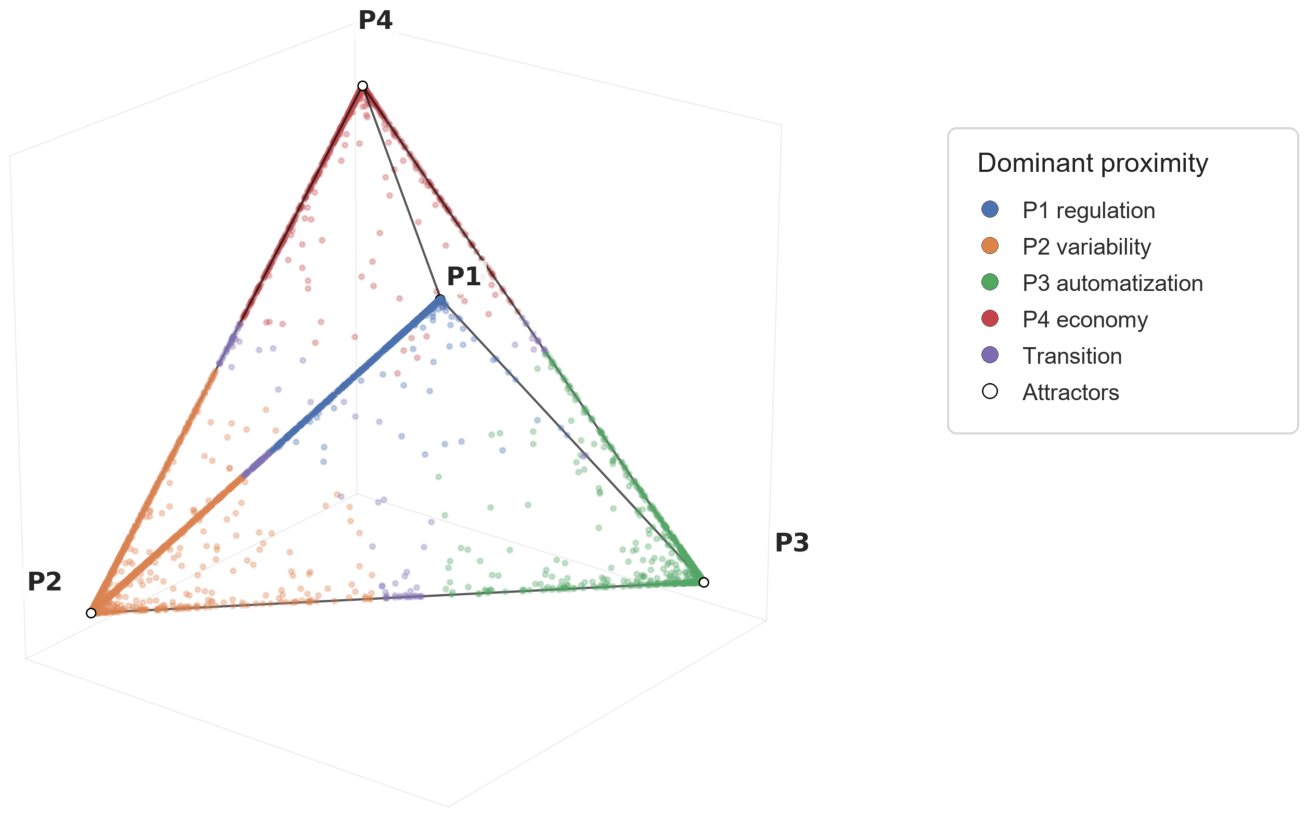
Figure 2.
Hierarchical dendrogram of observable metrics. The structure was extracted from the simulated data before the external comparison with Miyake, allowing emergent cognitive parameters to be identified without imposing theoretical categories beforehand.
Figure 2.
Hierarchical dendrogram of observable metrics. The structure was extracted from the simulated data before the external comparison with Miyake, allowing emergent cognitive parameters to be identified without imposing theoretical categories beforehand.
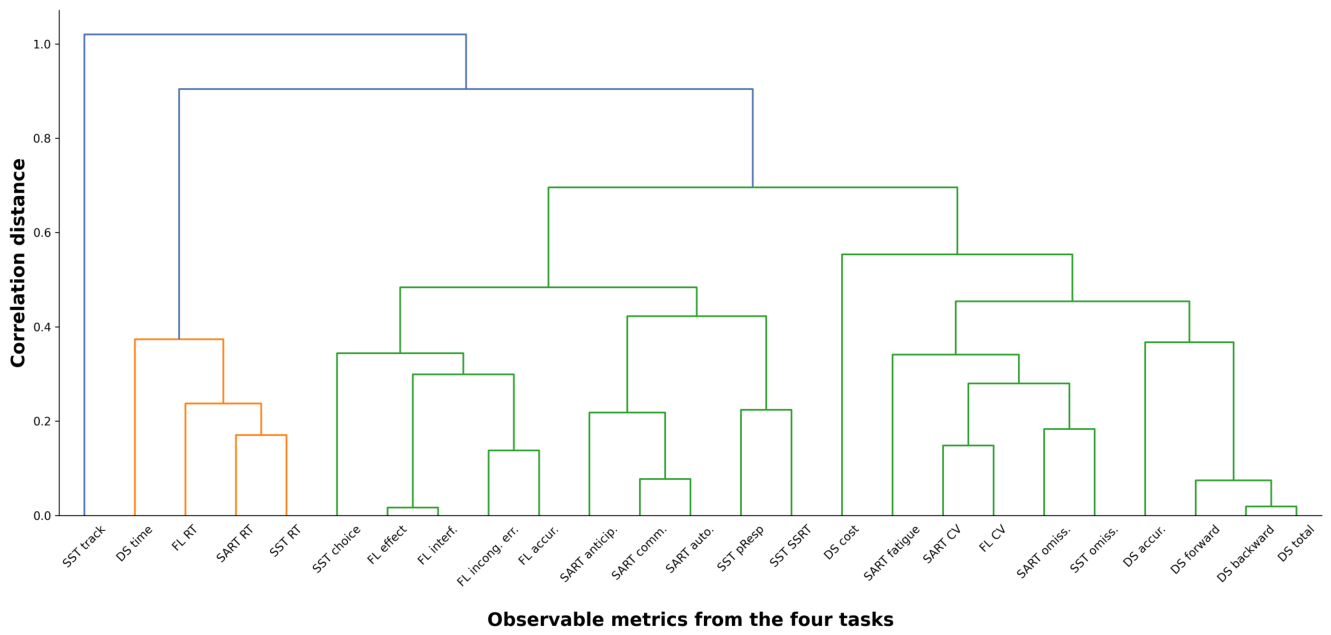
Figure 3.
Profiles of the four attractors across the eight emergent cognitive parameters. Positive values indicate greater relative expression of that parameter under the demands of the battery; they do not indicate intrinsic biological value.
Figure 3.
Profiles of the four attractors across the eight emergent cognitive parameters. Positive values indicate greater relative expression of that parameter under the demands of the battery; they do not indicate intrinsic biological value.
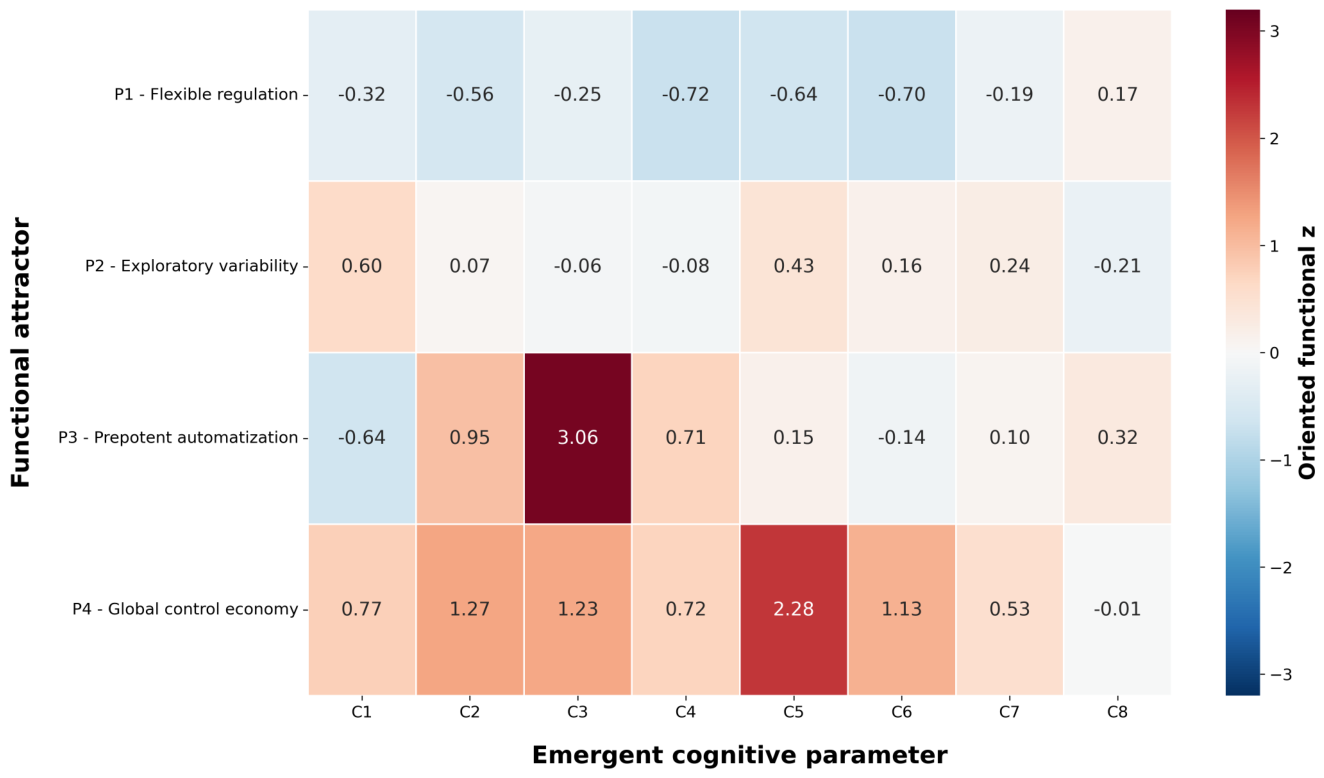
Figure 4.
Overlap of the four tasks across functional attractors. The figure indicates which tasks support each state regime and where dissociations across tasks appear.
Figure 4.
Overlap of the four tasks across functional attractors. The figure indicates which tasks support each state regime and where dissociations across tasks appear.
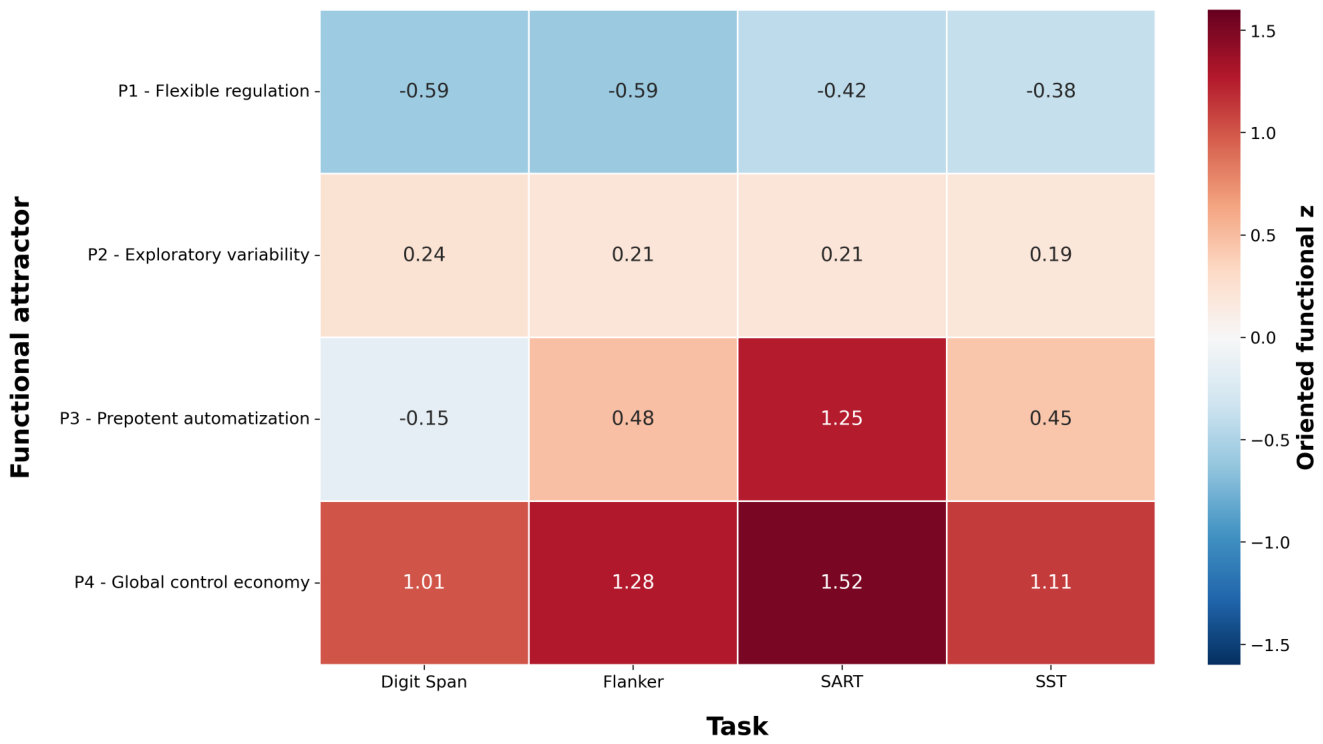
Figure 5.
External comparison between emergent cognitive parameters and the theoretical composites of Inhibitory Control, Working Memory, and Cognitive Flexibility derived from Miyake’s model. The comparison tests convergence; it did not create the parameters.
Figure 5.
External comparison between emergent cognitive parameters and the theoretical composites of Inhibitory Control, Working Memory, and Cognitive Flexibility derived from Miyake’s model. The comparison tests convergence; it did not create the parameters.
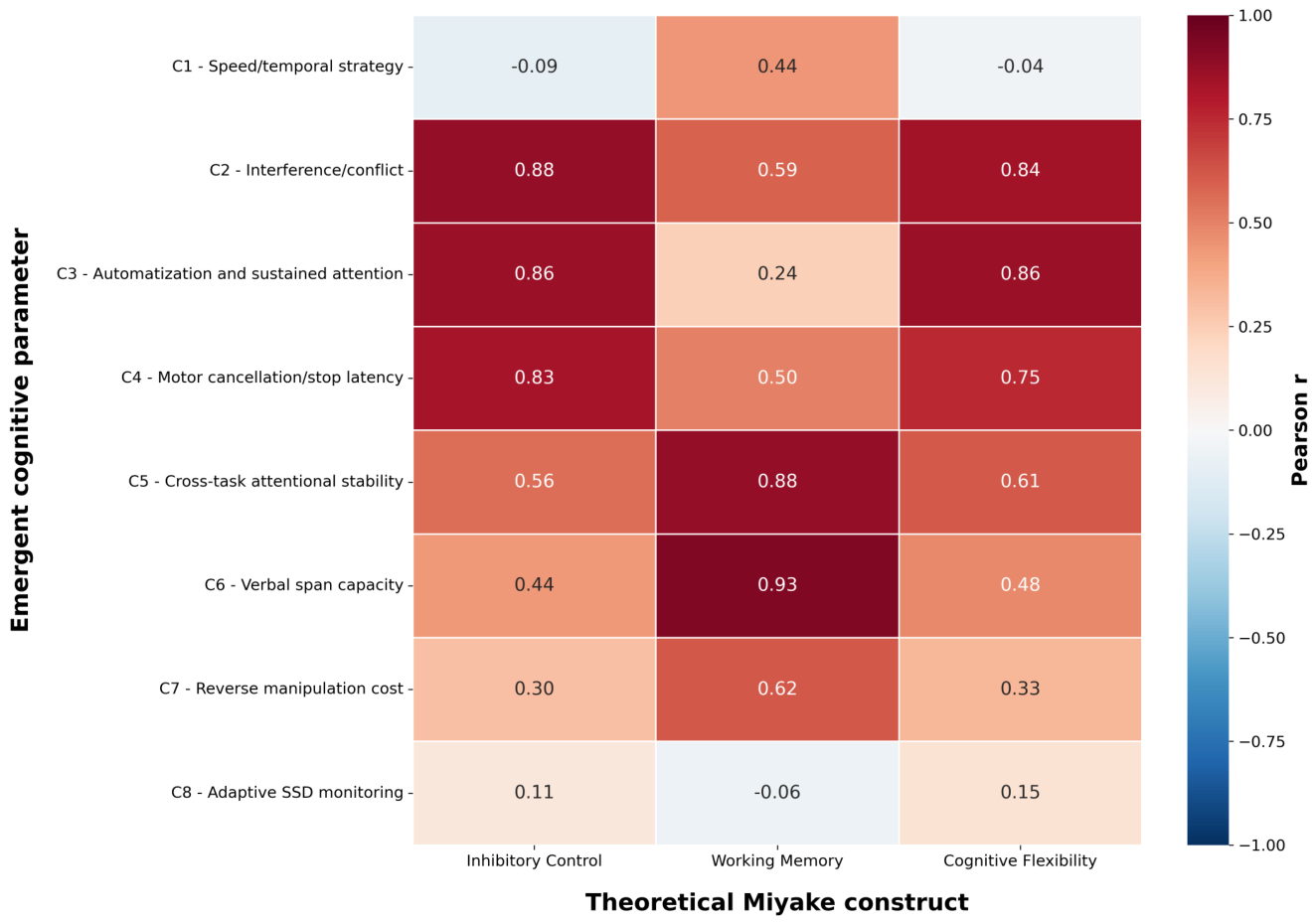

Table 1.
Tasks, operational parameters, and main BACNB metrics.
| Task | Operational construct | Main metrics | Theoretical relation |
|---|---|---|---|
| SART | Sustained attention, prepotent automatization, and lapses | No-Go commissions, omissions, anticipations, mean RT, RT CV, dynamic fatigue | Inhibitory control and attentional stability; the jittered adaptation increases sensitivity to rigidity/automatization. |
| SST | Reactive motor inhibition | p(respond|signal), p(inhibit|signal), integration SSRT, Go RT, Go omissions, SSD tracking | Reactive inhibitory control according to the race model and consensus recommendations. |
| Flanker | Response-conflict control | Interference effect, incongruent errors, accuracy, RT, and variability | Inhibitory/interference control and conflict monitoring. |
| Digit Span | Sequential verbal maintenance and manipulation | Forward span, backward span, total span, reverse cost, and accuracy | Classical proxy for verbal working memory; in this model, it contributes to trajectory stability and updating. |
Table 2.
Emergent cognitive parameters extracted from observable metrics.
| Emergent cognitive parameter | Tasks | Clustered variables |
|---|---|---|
| C1 - Speed/temporal strategy | DS, FLANKER, SART, SST | DS time, FL RT, SART RT, SST RT |
| C2 - Interference/conflict | FLANKER, SST | FL accuracy, FL effect, FL incongruent error, FL interference, SST choice error |
| C3 - Automatization and sustained attention | SART | SART anticipations, SART automatization, SART commissions |
| C4 - Motor cancellation/stop latency | SST | SST SSRT, SST pResp |
| C5 - Cross-task attentional stability | FLANKER, SART, SST | FL CV, SART CV, SART fatigue, SART omissions, SST omissions |
| C6 - Verbal span capacity | DS | DS accuracy, DS forward, DS backward, DS total |
| C7 - Reverse manipulation cost | DS | DS cost |
| C8 - Adaptive SSD monitoring | SST | SST tracking |
Disclaimer/Publisher’s Note: The statements, opinions and data contained in all publications are solely those of the individual author(s) and contributor(s) and not of MDPI and/or the editor(s). MDPI and/or the editor(s) disclaim responsibility for any injury to people or property resulting from any ideas, methods, instructions or products referred to in the content. |
© 2026 by the authors. Licensee MDPI, Basel, Switzerland. This article is an open access article distributed under the terms and conditions of the Creative Commons Attribution (CC BY) license (http://creativecommons.org/licenses/by/4.0/).
Copyright: This open access article is published under a Creative Commons CC BY 4.0 license, which permit the free download, distribution, and reuse, provided that the author and preprint are cited in any reuse.