

Submitted:
16 June 2026
Posted:
17 June 2026
You are already at the latest version
Abstract
This study deals with social intelligence within Moroccan associations, a sector that is witnessing rapid growth, as the number of associations exceeded 259,000 associations in 2022. The study aims to discuss the main factors that contribute to the development of collective intelligence, and propose practical strategies to improve the performance of these organizations. A multi tool research methodology was adopted, combining the review of scientific literature, qualitative interviews, and a quantitative study of 125 Moroccan associations.
The results highlight six key determinants of collective intelligence: social sensitivity, autonomy, motivation, transformational leadership, collaboration, and knowledge sharing. Collaboration and leadership have emerged as the most influential factors. In contrast, knowledge sharing and social sensitivity play a supportive role by improving communication and integrating dispersed knowledge.
The study provides theoretical contributions by adapting collective intelligence models to the peculiarities of Moroccan civil society. At the applied level, the study proposes a set of recommendations, including strengthening capacity building, developing lead-ership skills, and adopting collaborative digital platforms. The results in their entirety confirm the strategic importance of collective intelligence in improving the effective-ness of Moroccan associations and enhancing their impact in the face of increasingly complex social challenges.
Keywords:
collective intelligence
; Moroccan context
; associative sector
; cooperation
; leadership
; knowledge sharing
1. Introduction
Collective intelligence is increasingly considered a key mechanism enabling organizational and social innovation by facilitating, knowledge integration and collective problem solving. In this context of civil society organizations, these mechanisms are particularly important for coordination, learning and organizational effectiveness.
Since the early 2000s, Morocco has experienced a remarkable boom in terms of the number of associations created. Therefore, this number has reached 259,000 associations [1] until March 2022, covering the entire national territory and opening in various fields (sustainable development, sport, education, health, drinking water, culture, environment, etc.). Thus, the dynamic that characterizes this sector testifies the desire of citizens and the public authorities to achieve objectives of general interest.
However, these organizations necessary for the development of a dynamic civil society in Morocco are facing considerable challenges that limit their progress and influence. Although associations have the right to benefit from public support, a large majority have only low budgets, mainly from the contributions of their members [2]. In addition, weak leadership, poor internal governance and lack of professionalism are another challenge, in addition to the difficulties of networking and collaboration with other associations to overcome insufficient resources [2].
Faced with this observation, the strengthening of collective intelligence appears as a strategic lever to increase performance and improve the role of associations. In this context, the report on the new development model in Morocco highlights the importance of the participation of all actors in the country, especially civil society, to face the expanded complexity of problems, the resolution of which requires a systemic approach that mobilizes the collective intelligence of all actors [3]. However, collective intelligence can be defined as “the ability of a group for solving problems collaboratively by mixing the knowledge and expertise of group members” [4]. It also indicates to “the ability of a group of people, through concerted reflection among its members, to lead to a better solution to a problem that cannot be achieved if these members work alone” [5].
This study searches for understand how to show collective intelligence within Moroccan associations. She searches for answer the following research question: What are the relevant determinants of collective intelligence in the Moroccan associative community?
Therefore, the study tries to identify the main factors that promote collective intelligence within Moroccan associations, in order to propose strategies and recommendations to strengthen the capacities of these key actors in the local development of the Kingdom and support their performance through collective intelligence. Similarly, the originality of the study will contribute to the enrichment of knowledge by offering additional information on how collective intelligence manifests itself in the context of associations in Morocco, which will enrich both local understanding and academic literature on the subject.
In order to carry out this study, the following section proposes a theoretical framework on the potential determinants of collective intelligence. Section 3 is devoted to the presentation of the research methodology adopted during our research. Next, the research results are presented in section 4, while their interpretation is explored in depth in section 5. Finally, in the section 6, the conclusion focuses on the main theoretical and practical implications, while highlighting the limits and perspectives of research.
2. Theoretical Framework: Highlighting the Potential Determinants of Collective Intelligence
Collective intelligence is a concept that emerged in 1990s and 2000s, because of the new information and communication technologies. Many researchers looked into this phenomenon, and they suggested different theoretical frameworks to introduce and analyze it. This literature review examines the main perspectives on collective intelligence, based in particular on the founding work of [6,7,8,9,10]. Therefore, Woolley and his colleagues made a definition and a model of collective intelligence for group. Surowiecki [7] was interested in the “wisdom of the crowds” while Tjornbo [10] produced an exhaustive literature review on this subject. Tapscott and Williams [9] studied the new forms of collaboration that the internet made it possible. Finally, Heylighen [8] analyzed collective intelligence through the prism of distributed cognition. Other complementary viewpoints are also regarded. The goal is to get the main approaches of this rich concept with blurred contours sometimes.
Before studying the main theoretical viewpoints on collective intelligence, it is important to perform the key variables that structure this complex phenomenon. Several dimensions will be discussed in the rest of this review: social sensitivity, which allows members of a group to perceive and interpret the emotions and intentions of others; autonomy, it means the ability of each individual to contribute independently; motivation, the fundamental engine of collective investment; leadership, essential to guide and boots group dynamics; as well as collaboration, coordination and cooperation, which organize the synergy of collective actions. Finally, the sharing of knowledge is a decisive lever for the enrichment of the group and the emergence of collective intelligence. These interdependent variables will serve as a common thread for the analysis of the different approaches and models identified in the literature. To do this, Table 1 below summarizes the six hypotheses proposed, which will be developed and justified in the following literature review.
2.1. Social Sensitivity
Social sensitivity, defined as the ability accurately perceive and decode the social and emotional signals of others [11], has been identified by several studies as a key factor influencing collective intelligence within teams [6]. Therefore, a high level of social sensitivity within a team seems to promote better communication, cooperation and coordination among members, which translates into greater collective effectiveness in solving problems [12]. Social sensitivity facilitates harmonious social interactions and team cohesion [13].
Several studies have shown that the average social sensitivity of a team predicts its overall performance to various cognitive tests reflecting its collective intelligence [12]. However, some studies have not found a significant link between social sensitivity and team performance in specific contexts such as software projects or virtual teams [14]. Several studies also associate an increased social sensitivity of teams composed of a greater proportion of women [15].
Women would tend to better decode social interactions, which would strength collective intelligence. Therefore, despite certain contextual limitations, social sensitivity appears as a key determinant of the effectiveness of interactions within teams and their overall collective intelligence. To this end, our first hypothesis is reformulated in Table 1.
2.2. Autonomy
Professional autonomy is one of characteristics of work that has been widely studied in literature. It is defined as the degree of freedom and independence available employee to plan work and determine procedures [16]. It also refers to an employee’s ability to determine the place, sequence, and methods for performing assigned tasks [17]. Therefore, self-determination theory states that the satisfaction of the fundamental psychological needs of employees, including autonomy, leads to the maintenance of their well-being while the opposite causes motivational exhaustion [18]. It’s defined as one of key component of the organizational environment promoting creativity, innovation [19] and agility [20].
Therefore, many studies reported the positive impact of autonomy on the creative thinking and on teams’ organizational performance [21]. Langfred [22] concluded that the team autonomy has a positive impact on performance when interdependence is high, unlike individual autonomy that has negative impact on performance when interdependence is high [22]. For his part, Zaibet [23] considers autonomy in his model of collective action that must be present both at the individual level and at the team level [23].
For his part, James Surowiecki [7] emphasizes in his model of crowd wisdom the important of the independence of individuals in collective intelligence, specifying that one of the reasons for the success of collective decision in fact that people pay less attention of others say. It states that independence is the most important standard for intelligent collectives.
In his study about choosing the new nesting websites by bee swarms, [24] specifies that many independent evaluations acquired privately provide the swarm with a precise assessment of the quality of each potential nesting site, and avoids the recurrent amplification of publicly acquired information that can lead to information cascades (sheep’s behaving). To this end, our second hypothesis is reformulated in Table 1.
2.3. The Motivation
The motivation is a key element of collective intelligence [25]. Literature distinguishes between intrinsic motivation (pleasure in the activity, meaning at work) and extrinsic motivation [26]. Therefore, several studies have highlighted the role of intrinsic motivation in the development of employee well-being, creativity and organizational performance [26,27]. As well, others have highlighted the superiority of intrinsic motivation over extrinsic motivation to manage creative work by specifying that creativity is based on intrinsic motivation rather than financial rewards or bonuses [28,29].
As a result, self-determination theory emphasizes the multidimensional nature of motivation in the workplace (from extrinsic to intrinsic) and its influence on the behavior and well-being of employees [27]. Similarly, a study conducted with volunteer contributors to the trove project of the National Library of Australia, revealed the dynamic nature of motivation over time, moving from mostly intrinsic factors (initial participation) to a combination of intrinsic and extrinsic (continuous participation) [30]. In the same vein, Tjornbo [10] states that motivation is a key factor for collective intelligence to support social innovation.
Finally, motivation proves to be a determining element in the emergence and effectiveness of collective intelligence within organizations [31]. This built through the combination between the different organizational ‘genes’, for instance motivation (Love, Glory), playing a crucial role in the engagement and contribution of individuals within innovative collective systems for example Google, Wikipedia, and Threadless [32]. To this end, our third hypothesis is reformulated in Table 1.
2.4. Leadership
Effective leadership is highlighted in the literature as an important factor in collective intelligence given its role in developing cognitive diversity, promoting independence, facilitating access to decentralized knowledge and effective aggregation of knowledge, which allows a multitude of diverse individuals to surpass even the best experts in problem solving and innovation [33]. In addition, effective leadership fosters collaboration and creates alignment and harmony between the members of a group to work towards a common goal [34].
In a similar manner, Mayo and Woolley focus in their study on health care teams, on the important role of leadership in strengthening collective intelligence given its role in the enhancement of inclusive collaboration and open communication, essential to allow each team member to share and apply their expertise to improve the achievement of the group’s goals [35]. Moreover, some studies evoke the role of transformational leadership in the development of collective intelligence [36]. Similarly, Maqbool et al., emphasize the significant impact of emotional intelligence, project manager skills, and transformational leadership on project success, suggesting that leaders who display transformational leadership behaviors can positively influence collective iThese studies suggest that the adoption of transformational and adaptive leadership is fundamental to cultivating and improving collective intelligence in various organizations. Therefore, we do the fourth hypothesis below intelligence within their teams [37].
These studies show the adoption of changing and adaptive leadership is essential to cultivating and improving collective intelligence in various organizations.
2.5. Collaboration, Coordination, Cooperation
The concepts of collaboration, coordination and cooperation, although often used interchangeably, have different meanings. Some studies emphasize this differentiation by placing collaboration at the top of a hierarchy that also includes communication, cooperation and coordination [38]. This idea is supported by Gulati et al. [39] who see that collaboration is based on the interdependent pillars of cooperation and coordination.
Effective collaboration is based on multiple factors and conditions. Indeed, mutual commitment and alignment objective are the main elements [40]. Fuks et al. [41] see collaboration as an iterative process that includes communication, coordination and cooperation.
In different contexts, the modalities of collaboration, coordination and cooperation vary. Michaux et al. [42] observe how these interactions are part of various temporalities in a given territory. Alaloul et al. [43] apply these concepts to construction projects, highlighting the importance of the combined efforts of stakeholders. Wankmüller and Reiner [44] discuss the various ways in which the relationship between these concepts has been conceptualized in the literature, reflecting the complexity and variability of their application in different fields.
The progression from coordination to cooperation and ultimately to collaboration could be seen from an evolutionary and socio-cultural angle. Griesemer and Shavit [45] aim how this sequence represents a crucial step in human socio-cultural evolution, facilitating the transition to forms of collective individuality.
Therefore, several theoretical studies position collaborations as a catalyst for collective intelligence. Bedwell et al. [46] define collaboration as the process by which individuals mobilize their complementary expertise, highlighting results that they could not have achieved alone. This perspective highlights the role of collaboration in the synergy of individual contributions. Overall, this analysis of the literature reveals the complexity of the dynamics between collaboration and the emergence of forms of collective intelligence. To this end, our fifth hypothesis is reformulated in Table 1.
2.6. Knowledge Sharing
Knowledge sharing refers to the processes by which knowledge, especially tacit knowledge that is difficult to formalize, is communicated between individuals but also collected and exploited at the group and organizational level [47]. Numerous studies have demonstrated the decisive role of knowledge sharing in organizational performance, including by promoting innovation, creativity and quality collective decision making [48,49]. With this in mind, knowledge sharing is essential to the emergence of collective intelligence, defined as the ability of a group of individuals to jointly solve complex problems [50].
Thus, several studies point out that organizational culture significantly influences the willingness of employees to share their knowledge. Kang et al. [51] highlight the role of organizational culture and reward systems in motivating knowledge sharing within a Taiwanese company. Similarly, Khan et al. [48] reveal that leadership strategies such as self-leadership are crucial to promoting knowledge sharing and ultimately innovative employee behavior.
On the individual psychological level, Obrenovic et al. [52] highlight that personality traits (especially consciousness) positively influence the sharing of tacit knowledge between SME employees, as well as the cooperative attitude and intrinsic motivation of individuals. Thus, Sung et al. [53] show that social comparison can arouse emotions of envy that reinforce the intentions of sharing knowledge.
In addition, many studies highlight the facilitating role of digital technologies, and in particular virtual communities, in the sharing of knowledge. In addition, Al Qahtani and Aksoy [54] highlight a whole range of collaborative tools that facilitate the transfer of knowledge in organizations.
In conclusion, this literature review highlighted the central role of knowledge sharing in allowing the emergence of collective intelligence, whether through technological, cultural, psychological or managerial factors. Thus, we pose the sixth hypothesis in Table 1.
3. Methodology
3.1. Population and Sampling
The target population includes active Moroccan associations operating in various sectors such as education, health, sustainable development and culture. These associations were selected in a reasoned way from databases, online directories and searches on social networks. This approach made it possible to obtain a sample of 980 associations covering different regions of Morocco and various operational contexts (urban and rural). This method guarantees representativeness in terms of geographical and sectoral diversity, although not probabilistic.
3.2. Data Collection Tool
A structured questionnaire has been developed to measure the key dimensions of collective intelligence, based on scales recognized in the scientific literature. The dimensions included in the questionnaire are social sensitivity (Riggio, 2005), autonomy (Breaugh, 1999), motivation (Tremblay et al., 2009), transformational leadership (Podsakoff et al., 1996), collaboration (Orchard et al., 2018) and knowledge sharing (Yi, 2015). The questionnaire was designed in English and then translated into Arabic (both) to ensure better understanding by respondents. The translation was carried out by a bilingual expert, followed by validation by a panel of experts including academics, specialists and practitioners from the associative field to ensure the cultural and conceptual relevance of the questions.
3.3. Data Collection
The data were collected between January and August 2024. The questionnaire was distributed by e mail, using the e mail addresses of the associations contained in the database. In order to optimize the participation rate, regular reminders were made by e mail and via WhatsApp. These channels have been chosen for their accessibility and popularity among members of the associations. A total of 125 valid responses were obtained, corresponding to a response rate of 12.75%. This rate is in line with expectations for similar research involving online surveys of associations
3.4. Data Analysis
The collected data have been cleaned and prepared for statistical analysis. An exploratory factor analysis was conducted using SmartPLS to identify the latent structures of the dimensions studied and to validate the measurement scales. Cronbach’s Alpha coefficients were calculated to evaluate the internal reliability of the dimensions. Then, a confirmatory factor analysis was carried out using AMOS software to test the convergent and discriminating validity of the dimensions. The structural relationships between the explanatory variables and the dependent variable Collective Intelligence “CI” were modelled and analyzed to evaluate their significance and relative contribution.
4. Results
4.1. Descriptive Analysis
Our sample studied and analyzed is characterized by its diversity. The associations are diverse in terms of seniority, size and scope of action, the thing that has a strong ability to adapt to local needs. The size of the associations seems modest with an average of 11 active members, but on average they mobilize a huge network of 190 members, which testifies to their ability to engage entire communities to achieve their goals. These associations were created between 1929 and 2022 embodying the history of their existence in the economic fabric with a combination of recent and old structures. The old ones (before 2000) stand out for their rich experience and expertise, while the recent ones (after 2010) show the emergence of new generations of community actors.
Located in rural and semi-rural fields areas such as Chtouka Ait Baha, Tata…, associations meet fundamental needs, including having water DWS, local development, and social cohesion. These sectors reflect the priority axes of the regions concerned, which frequently face inaccessibility to social services and limited access to infrastructure. Local sustainable development is embodied in the implementation of infrastructure improvement projects, namely road opening, upgrading, sanitation, DWS, support for small farmers and training. In order to meet the vital needs in some areas suffering from a lack of water resources, emphasis was placed on community-based drinking water management. Although small in size, these associations underline organizational efficiency and show internal dynamics. The commitment of the members is necessary: our respondents are involved in the projects and have declared to be well informed of the rules of conduct.
4.2. Exploratory Factor Analysis
4.2.1. Factor Analysis of 1St Order Constructs
- Social sensitivity:
According to the iterative method, the items SenSocial.8, SenSocial.7, SenSocial.6, and SenSocial.4 were deleted during the main component analysis. These items had weaknesses in factor loads or high levels of uniqueness, which compromised the unidimensionality and validity of the construct.
The internal consistency of the remaining indicators mentioned in Table 2 (Sensi.2, Sensi.3, Sensi.5, and Sensi.1) is evaluated using the Cronbach Alpha test, which has a coefficient of 0.735. This result reflects an acceptable internal consistency, proposing that the items selected reliably measure the concept of social sensitivity. Similarly, the KMO index, with a value of 0.715, confirms that the data are adequate to perform a factor analysis. This shows that the correlations between the manifest variables make it possible to extract a significant latent factor. Moreover, the percentage of variance clarified by the main factor is 57.254%. This means that a significant proportion of the total variance of responses is attributable to a single latent factor. This percentage testifies to the validity of the measure and the relevance of the items selected.
- 2.
- Autonomy:
According to the iterative method, the Auton.1 item was deleted during the main component analysis. This item had weaknesses in factor loads or high levels of uniqueness, which compromised the unidimensionality and validity of the construct.
The internal consistency of the remaining indicators stated in Table 3 (Auton.2, Auton.3, Auton.4, and Auton.5) is analyzed using the Cronbach Alpha test, which has a coefficient of 0.775. This result reflects well internal consistency, proposing that the items selected reliably measure the concept of autonomy. Similarly, the KMO index, with a value of 0.756, proves that the data are adequate to perform a factor analysis. This shows that the correlations between the manifest variables make it possible to extract a significant latent factor. Besides, the percentage of variance clarified by the main factor is 60.337%. This means that a substantial proportion of the total variance of responses is caused by a single latent factor. This percentage testifies to the validity of the measure and the relevance of the items selected.
- 3.
- Motivation:
According to the iterative method, the Motiv.2 and Motiv.3 items were removed during the main component analysis. These items had weaknesses in factor loads or high levels of uniqueness, which compromised the unidimensionality and validity of the build.
The internal consistency of the residual indicators mentioned in Table 4 (Motiv.4, Motiv.6, Motiv.5, and Motiv.1) is evaluated using the Cronbach Alpha test, which has a coefficient of 0.805. This result shows a very good internal consistency, proposing that the items selected reliably measure the concept of motivation. Similarly, the KMO index, with a value of 0.783, proves that the data are adequate to perform a factor analysis. Moreover, the percentage of variance clarified by the main factor is 63.307%. This means that a significant proportion of the total variance of responses is caused by a single latent factor. This percentage testifies to the validity of the measure and the relevance of the items selected.
- 4.
- Leadership:
According to the iterative method, the items Leadership.4 and Leadership.5 were removed during the main element analysis. These items had weaknesses in factor loads or high levels of uniqueness, which compromised the unidimensionality and validity of the construct.
The internal consistency of the residual indicators mentioned in Table 5 (Leadership.2, Leadership.3, Leadership.1, and Leadership.6) is assessed using the Cronbach Alpha test, which has a coefficient of 0.898. This result reflects excellent internal consistency, proposing that the items selected reliably measure the concept of leadership. Similarly, the KMO index, with a value of 0.831, proves that the data collected is adequate to show a factor analysis. However, the percentage of variance proved by the main factor is 76.876%. This means that a very large proportion of the total variance of responses is attributable to a single latent factor.
- 5.
- Collaboration
According to the iterative method, several items were removed during the main element analysis. Items Collab.1, Collab.2, Collab.3, Collab.4, Collab.5, Collab.8, Collab.9, Collab.10, Collab.11, Collab.15, and Collab.17 have been excluded. These items had low factor loads or high levels of uniqueness, therefore compromising the unidimensionality and validity of the construct.
The internal consistency of the indicators selected (Collab.6, Collab.7, Collab.12, Collab.13, Collab.14, Collab.16, and Collab.18) was analyzed using the Cronbach Alpha test, which has a coefficient of 0.921. This result testifies to excellent internal consistency, confirming that these items reliably measure the concept of collaboration.
Similarly, the KMO index displayed in Table 6, with a value of 0.930, shows that the data are particularly adequate for carrying out a factor analysis. This means that the connections between the manifest variables make it possible to extract a significant latent factor. Moreover, the percentage of variance explained by the main factor is 68.538%. This suggests that a significant proportion of the total variance of responses is attributable to a single latent factor. This percentage reinforces the validity of the measure and underlines the relevance of the items selected.
- 6.
- Knowledge sharing:
According to the iterative method, several items were removed during the main component analysis. Items KS.3, KS.4, KS.5, KS.6, KS.7, KS.8, KS.9, KS.10, and KS.11 have been removed. These items had low factor loads or high levels of uniqueness, therefore compromising the unidimensionality and validity of the construct.
The internal consistency of the indicators selected (KS.12, KS.13, KS.2, and KS.1) was evaluated using the Cronbach Alpha test, which presents a coefficient of 0.820. This result testifies to better internal consistency, confirming that these items reliably measure the concept of knowledge sharing.
Similarly, the KMO index displayed in Table 7, with a value of 0.74, confirm that the data are adequate to show a factor analysis. Also, the percentage of variance clarified by the main factor is 65.494%. This signals that a significant proportion of the total variance of responses is attributable to a single latent factor. This percentage reinforces the validity of the measure and underlines the relevance of the items selected.
4.2.2. Exploratory Factor Analysis of 2Nd Order Buildings
The explanatory variable “collective intelligence” is considered a latent second order construct, measured by the six first order latent variables: “Social sensitivity”, “Autonomy”, “motivation”, “Leadership”, “Collaboration” and “Knowledge sharing”. According to this logic, this variable should be validated using the Maximum Likelihood (ML) method, which detected the underlying relationships between the variables while taking into account measurement faults.
Unlike the ACP, the ML method is depending on a probabilistic estimation that adjusts the relationships according to the presumed latent structures in the data. The number of extracted components was set at six, reflecting the six defined theoretical dimensions. The relationships between manifest variables and components were aimed using the Cross Loadings criterion. This criterion made it possible to keep only the manifest variables strongly associated with their respective components, while eliminating those that had significant loads on several components (cross loadings), thus compromising the validity of the construct.
In the end, a global Cronbach Alpha (Table 8) was calculated to assess the internal consistency of the second order construct. This coefficient evaluates the overall coherence of the dimensions included in the “collective intelligence” measurement, reinforcing the reliability and relevance of the model explored.
The consistency and internal coherence of the second order “CI” construct are very obvious: thanks to the robustness of the underlying (first order) constructs. This is validated by the various indicators resulting from factor analysis. A high Cronbach Alpha (0.894) points to a strong internal consistency, while a KMO index of 0.852 indicates an excellent adequacy of the sampling for this analysis. Also, the model clarifies 61.320% of the total variance, which far exceeds the acceptable threshold to guarantee the validity of the construct.
These results are corroborated in Table 9 by the analysis of the component matrix got during extraction. According to the Cross Loadings principle, the loads of the items selected are significantly higher on their own components than on others, which proves the discriminating validity of the factors and the relevance of the items to measure the explanatory variable “collective intelligence”. Also, to summarize the results gained, Table 9 presents a recapitulation of the results of the factor analysis and purification of the scales.
4.2.3. Synthesis of the Results of Exploratory Factor Analysis
During our exploratory approach, our main objective was to validate the measurement instrument that we had developed from the scales developed following an in-depth literature review. This validation was depending on a rigorous methodological process, including several important steps. First, an in-depth evaluation of the measured constructs was carried out in order to examine the internal consistency and robustness of the measurement scales. An iterative analysis was conducted to identify and eliminate problematic items, whether they are low representative or insufficient reliability.
At the end of this methodical process summarized in Table 10, the constructs demonstrated solid internal consistency and overall consistency, thus supporting their relevance for later use in a measurement model. However, in order to further strengthen the validity and robustness of these measures, additional validation by a confirmatory factor method is envisaged. We have therefore planned to use the AMOS software to perform a confirmatory factor analysis. This step will make it possible to evaluate and confirm the relevance of the measurement model in a more specific theoretical and practical framework, thus consolidating the reliability and validity of our instruments.
4.3. Confirmatory Factor Analysis
4.3.1. Validation of First Order Constructs
- Composite reliability and convergent validity:
The internal reliability of the constructs is generally satisfactory, with Cronbach’s alpha and composite reliability values better than 0.70 for all constructs, indicating good internal consistency of the items. Moreover, according to Table 11, the convergent validity, measured by the average extracted variance (AVE), isn’t enough for the Constructs Autonomy (0.483) and Social Sensitivity (0.460), because their ELAs are below the recommended threshold of 0.50, suggesting that the items associated with these constructs share an insufficient variance. Conversely, the Collaboration, KS, Leadership and Motivation constructs have an adequate convergent validity (AVE ≥ 0.50), which confirms that their items measure the concepts they are supposed to represent. These results call for a reassessment of the items built with low AVE to guarantee the theoretical and empirical robustness of the model.
After the removal of the Sensi.1 and Auton.5 items, the metrics present a clear improvement in the convergent validity of the constructs concerned. According to Table 12, the AVE for Autonomy has increased from 0.483 to 0.541, and for Social Sensitivity, from 0.460 to 0.571, now reaching the recommended threshold of 0.50. These results indicate that the remaining items capture a sufficient proportion of the common variance of their respective constructs. Besides, internal reliability, measured by Cronbach’s alpha and composite reliability, remain high for all constructs, with values better than 0.70. The other constructs, for instance Collaboration, KS, Leadership and Motivation, retain their robustness, with AVE well beyond the minimum required threshold. Thus, these adjustments reinforce the reliability and overall validity of the model, making it ready for final validation.
- 2.
- Discriminatory Validity
The results of the Fornell Larcker criterion presented in Table 13 show that all the constructs of the model respect the discriminating validity. The square root of the AVE for each construct (diagonal values) is better than the correlations between this construct and the others (non diagonal values). Such as, for Autonomy, the square root of the AVE is 0.735, which is higher than its correlations with other constructs, such as Collaboration (0.301) and KS (0.128). Similarly, the constructs Collaboration, Leadership, Motivation, KS and Social Sensitivity also meet this criterion, with square roots of AVE ranging from 0.714 to 0.835, all higher than the respective correlations. These results confirm that each construct is distinct from the others and that the items associated with a construct measure it more than any other. This reinforces the conceptual and empirical robustness of the model by validating its latent structure.
The cross-loading criterion is used to evaluate discriminating validity by ensuring that each item loads more heavily on its own built than on others. The results mentioned in Table 14 show that the most items meet this criterion, such as Auton.3 (0.878 on Autonomy), Collab.16 (0.865 on Collaboration) and Leadership.3 (0.862 on Leadership), confirming that these items mainly measure their own dimension. The loads on the other constructs are low, thus supporting the distinction between dimensions. Regarding the Motivation dimension, all items, including Motiv.4 (0.750), load satisfactorily on their own built, demonstrating their discriminatory validity. Also, some items, such as Collab.7, show relatively high loads on another built (for example, 0.825 on Collaboration and 0.581 on Leadership), which might suggest a significant correlation between these dimensions. Overall, the results indicate that discriminating validity is widely respected, although some minor adjustments may be considered to strengthen the robustness of the model.
A 3rd criterion of discriminating validity is that of HTMT (Heterotrait Monotrait Ratio), which requires that the ratios between constructs be less than 0.85 to confirm their distinction. The results of this criterion displayed in Table 15 show that this criterion is met for all built, with moderate HTMT ratios, such as between Autonomy and Collaboration (0.326) or Leadership and Collaboration (0.727), and low, as between Autonomy and Social Sensitivity (0.182). No HTMT value exceeds the critical threshold, confirming that the constructs are conceptually distinct and that the model fully meets the requirements of discriminating validity, reinforcing its reliability and theoretical robustness.
4.3.2. Validation Measure Model:
- Significance test:
The validation of developed formative “collective intelligence” based on the significance test of the explanatory dimensions identified in the model (Table 16) Autonomy, Collaboration, Knowledge Sharing (KS), Leadership, Motivation and Social Sensitivity. The hypotheses associated with this test are formulated as follows:
* H0: No significant effect of the variable (γ = 0).
* H1: The effect of the variable is significant (γ ≠ 0).
For this validation, a bootstrapping technique was carried out with 2000 subsamples, thus guaranteeing sufficient precision in the assessment of the parameters. The confidence level was set at 95%, using a bootstrap-based trust interval (Percentile Bootstrap), end of limit potential biases in estimates.
Standardized regression coefficients (γ), Student statistics (T statistics) and significance thresholds (p value) were calculated using smartPls. The analysis of the results reveals that all dimensions have a significant effect (p value < 0.05) on the variable “Collective Intelligence”.

Table 16.
Significance test of the effect of the “CI” dimensions.
| Relation | Original sample (O) | Sample mean (M) | T statistics | P values |
|---|---|---|---|---|
| Auton. –> CI | 0.089 | 0.091 | 2.781 | 0.005 |
| Collab. > CI | 0.487 | 0.481 | 13.742 | 0.000 |
| KS > CI | 0.179 | 0.177 | 6.383 | 0.000 |
| Leadership > CI | 0.300 | 0.298 | 10.458 | 0.000 |
| Motiv. > CI | 0.107 | 0.104 | 3.166 | 0.002 |
| Sensi. > CI | 0.180 | 0.177 | 8.250 | 0.000 |
After analyzing the signs of the standardized coefficients, our findings demonstrate the positive effect of all significant dimensions on the variable « CI ». The strongest effect is manifested in the variation between 0.091 for the « autonomy » dimension and 0.487 for « collaboration ». Leadership ranks second with a coefficient of 0.300, while other dimensions make moderate contributions, such as « social sensitivity 0.1777 » and « knowledge sharing 0.179 ». Our results affirm that dimensions make positive contributions to the explanation of « CI » particularly Leadership and Collaboration, while « motivation » has a weaker but significant positive effect (0.107).
- Multi collinearity test
The Collinearity test through the Variance Inflation Factor (VIF) values makes it possible to assess whether independent variables in the model have excessive redundancy, which might compromise the stability and interpretation of the regression coefficients. According to Table 17, VIF values less than 3 indicate negligible collinearity, ensuring that each variable contributes separately to the model. In the results, all dimensions (Autonomy, Collaboration, Leadership, Motivation, Social Sensitivity and Knowledge Sharing) have VIF values between 1,123 (Autonomy) and 2,229 (Collaboration), which is good below the critical threshold. This confirm that the collinearity in the model is low and does not negatively affect structural relationships. These results reinforce the validity and reliability of estimates in the “Collective Intelligence” model.
4.3.3. Model Test
To test the structural model, we rely on the structural relationships formulated from the theoretical hypotheses established during the literature review (Table 1).
First, we will test the significance of the regression coefficients (path coefficients) in order to confirm or invalidate the causal links specified in the structural model presented in Figure 1. Then, in a second step, we’ll evaluate the adjustment quality of the model to determine to what extent the observed data fit the theoretical model. For doing this, we’ll first calculate the determination coefficient R², which measures the predictive quality of the model. Next, we’ll examine the size f² effect of the explanatory variables to evaluate their individual contribution in the model. Finally, we will use the GoF (Goodness of Fit) index, which allows us to measure the overall fit quality of the model. These steps will provide a complete and rigorous analysis of the validity and effectiveness of the tested model.
4.3.4. Structural Model
- Test of the assumptions of the structural model
Table 18 present the results of the structural relationship significance test (Figure 1) between explanatory dimensions and collective intelligence, confirming that all relationships are statistically significant (P < 0.05). Path coefficients show that Collaboration (0.487) have the strong effect on collective intelligence, followed by Leadership (0.300) and Knowledge Sharing (KS) (0.179), which have moderate contributions. The dimensions social sensitivity (0.180), Motivation (0.107), and Autonomy (0.089) have a positive effect, but smaller. The T statistics values, all higher than 1.96, validate these results, especially with very high T for Collaboration (13.742) and Leadership (10,458), confirming their central role. Even the less influential dimensions, such as Autonomy (T = 2.781) and Motivation (T = 3.166), remain significant. These results confirm the hypotheses H1 to H6 and emphasize that Collaboration and Leadership are the key factors of collective intelligence, while the other dimensions make complementary contributions.
- 2.
- Quality of structural model adjustment
• Determination coefficient R²
The determination coefficient R² of 0.998 presented in Table 19 indicate that 99.8% of the variance of the dependent variable, Collective intelligence, is explained by the dimensions included in the structural model (Collaboration, Leadership, Knowledge Sharing, etc.). This extremely high value reflects an exceptional predictive quality of the model. In addition, the very high T statistic (1134,928) and the P significant value (0.000) confirm the statistical robustness of this relationship, indicating that explanatory variables are highly relevant to predicting collective intelligence. These results fully validate the theoretical model, demonstrating that the selected dimensions almost entirely capture the determinants of collective intelligence.
• Measurement of the size effect f²
The size effect f² is a measure used to assess the relative importance of each explanatory variable in the structural model. It indicates the extent to which an independent variable helps to explain the variance of the dependent variable when this variable is included or removed from the model. The higher the size effect f², the more significant the explanatory variable has on the dependent variable.
Indeed, the results of Table 20 show that Collaboration has the most important effect on collective intelligence, with a f² of 49.552, followed by Leadership with an f² of 23,655, indicating strong and central contributions to the model. The dimensions Knowledge Sharing (KS) (f² = 14.816) and Social Sensitivity (f² = 13.019) have moderate but significant effects, underlining their complementary role in the formation of collective intelligence. Similarly, Motivation (f² = 7.149) makes a positive but more limited contribution. Finally, Autonomy, with a f² of 4.406, has the weakest effect among the dimensions, proposing a positive but relatively limited influence. These results highlight the hierarchy of dimensions contributions, proving that Collaboration and Leadership are the primary levers of collective intelligence, while the other dimensions play significant supporting roles.
• GoF coefficient
The GoF (Goodness of Fit) calculated at the level of Table 21 is an indicator presented by Tenenhaus et al. [55] to evaluate the overall show of PLS models. Its value, between 0 and 1, is based on a mix of the results from the measurement model (AVE) and the structural model (R²). Different from the LISREL method, which improves a global scalar function, PLS does not offer an integrated global validation index. This is why the GoF was developed, offering a practical solution to fill this gap. According to Tenenhaus et al. [55], this index is an operational approach to validate a PLS model as a whole, by providing a synthetic measure of its overall quality.
The GoF (Goodness of Fit), calculated at 0.762, indicates an exceptional overall fit quality for the PLS model. This result combines a very strong explanatory capacity, with an average of R² of 0.998, reflecting that the explanatory dimensions collectively explain 99.8% of the variance of collective intelligence, and a satisfactory convergent validity, with an AVE average of 0.582, above the recommended threshold of 0.50. These results confirm that the structural model and the measurement model work optimally, validating the theoretical and empirical effectiveness of the model to explain collective intelligence from the dimensions included.
- 3.
- Synthesis of validation of hypotheses
The results presented confirm the validity of all the hypotheses formulated on the links between the explanatory dimensions and collective intelligence. According to Table 22, all the hypotheses present positive and significant regression coefficients (P value < 0.05), therefor validating the relationships tested. The Collaboration dimension (H5) is distinguished by the high coefficient (0.487) and a very strong T statistic (13.742), indicating that it has the most important impact on collective intelligence. Leadership (H4) follow with a coefficient of 0.300 and a T statistic of 10.458, highlighting its role key in the formation of collective intelligence. The Social Sensitivity (H1) and Knowledge Sharing (H6) dimensions have moderate coefficients (0.180 and 0.179 respectively), but remain significant with high T values. The results showed that cooperation and leadership are considered two essential dimensions for enhancing collective intelligence in the Moroccan societal context, in addition to the other dimensions are important and have complementary roles. This comes after the results showed low contributions to the dimensions of motivation (H3) and autonomy (H2) with the coefficients of 0.107 and 0.089 recorded.
5. Discussion
Within the framework of Moroccan associations, the results of this research are broadcast with a clear difference in the level of impact of each after all the dimensions examined, including social sensitivity, independence, motivation, transformational leadership, cooperation and knowledge exchange, always contribute to the improvement of collective intelligence in an effective and positive way. However, collaboration and leadership are the most important and influential dimension because of their ability to help understand the basic mechanisms that enhance collective intelligence
Due to its pivotal role in promoting cohesion among individuals, improving communication, and facilitating social interactions, and although its effect appeared to be average (coefficient 0.180), the research results showed that the social sensitivity dimension of members within the association clearly and significantly affects collective intelligence. This sensitivity is an essential tool for translating individual differences into common goals, especially in the Moroccan context, which is characterized by strong social and cultural relations. The result of social sensitivity is consistent with previous research that has confirmed an association between social sensitivity and the quality and effectiveness of teamwork
Similarly, independence showed a weak but statistically significant positive impact on collective intelligence (coefficient 0.089), which emphasizes the importance of giving members a margin of freedom to express their opinions and contribute to collective decision making. This data is consistent with the Surowiecky’s thesis [7], which holds that the autonomy of individuals limits collective biases and promotes diversity of views. However, the dominance of the central character in the management within a number of Moroccan associations reduces the effectiveness of this dimension, which makes the adoption of participatory and decentralized methods a necessary option to enhance its impact.
On the other hand, self-motivation emerged as a factor with a moderate positive impact, where the commitment of members, driven by individual and collective goals, contributes to stimulating the spirit of creativity and innovation within associations. Instead of focusing on incentives and financial rewards, the importance of motivation is emphasized by acknowledging the moral contributions and efforts of members, especially in the voluntary framework within the collective work.
With a score of 0.300, transformational leadership is the second factor influencing collective intelligence, highlighting the critical role of leaders in creating a shared vision and stimulating member engagement as well as collaboration. This finding is in line with Amabile’s work [19] and self-determination theory [18] as well as studies of Dionne and al. [56]. Individuals need explicit guidance and ongoing support because leadership is particularly important in the collective context. To foster collective intelligence, investment must be made in developing community leaders, particularly in conflict resolution, participatory decision making and communication.
Collaboration is the most influential of the other dimensions of collective intelligence. As he pointed out Bedwell et al. [46], the collaborative interactions within associations enable the increase of expertise and knowledge of their members. But in the Moroccan context, and given the difficulties related to lack of trust and poor coordination, these associations must use digital tools and establish mechanisms for cooperation and joint action.
In terms of knowledge sharing, an average positive effect of 0.179 on collective intelligence has been shown, as it has a role in solving complex problems. These results are in line with the works of Mačiulienė and Skaržauskienė [50] applied to virtual communities. Establishing common databases or communities of practice can reduce associations’ vulnerability to poor documentation and dissemination of good practices.
Finally, the interplay of individual factors such as autonomy, motivation, social sensitivity, and organizational factors make up collective intelligence. It thrives on collaboration, sharing, knowledge sharing, and synergy [57]. As cooperation and leadership are the critical dimensions, the rest of the variables have an important complementary role. These results contribute to enriching existing theoretical models and help Moroccan associations with the practical tools they provide to enhance their capacity to work and develop local and territorial development.
While our study has advantages and implications, it is not without its limitations. Limited access to online platforms and connection could be a difficulty to mobilize some associations even the response rate remains reasonable. Thus, non-probabilistic sampling may hinder the generalization of results. Also, contextual, cultural and interpretative biases could affect the responses even if the questionnaire was validated.
6. Conclusions
This study makes an important contribution to the understanding of the determinants of collective intelligence within Moroccan associations, by identifying the most important levers that contribute to the development of their ability to cooperate and solve complex and difficult problems collectively. Based on well-established theoretical references and a thorough research methodology, the study highlighted six key dimensions: social sensitivity, independence, motivation, transformational leadership, collaboration, and knowledge sharing. These dimensions are not understood as separate elements, but as dynamically interacting components that contribute to building collective intelligence capable of maximizing the effectiveness of associations within their surroundings.
The results show that both collaboration and transformational leadership play a pivotal role among the factors studied. Collaboration, by virtue of its decisive impact on collective intelligence, highlights the importance of harmonious teamwork in which each member participates effectively, where individual experiences are combined to produce innovative solutions. Transformational leadership manifests itself as a key driving factor by formulating an inspiring vision and motivating members to get around common goals. These two dimensions are essential pillars of any association that seeks to improve its organizational performance and enhance its social impact.
Other factors, such as social sensitivity and knowledge sharing, also play a complementary but crucial role. Social sensitivity contributes to improving the quality of communication, enhancing harmony, and building a climate of trust within work teams. These elements help improve the effectiveness of interactions, encourage innovation, and enhance organizational resilience in the face of challenges.
In terms of autonomy and motivation, although their impact seems relatively smaller, their contribution remains essential. Independence encourages members to initiate and develop creativity, and gives them a sense of responsibility and control over their contribution within teamwork. As for self-motivation, it is a crucial factor in maintaining the long-term commitment and engagement of members, which is crucial in the collective context, which is often characterized by the scarcity of human and financial resources.
Finally, this study opens up concrete practical prospects for Moroccan associations, providing a set of practical recommendations, including strengthening the capabilities of members through specialized training programs, adopting inclusive and transformative leadership styles, and establishing effective mechanisms for knowledge exchange. These strategies not only contribute to raising the level of collective intelligence within associations, but also contribute to enhancing their role as a key actor in local and national development. This study also enriches the scientific literature by providing an appropriate analytical framework for the Moroccan context, providing a basis for future studies that could address variables or other dimensions that have not been addressed in this research.
In general, the results of this research confirm that collective intelligence is a key strategic lever for Moroccan associations, as it enables them to respond more effectively to the growing and diverse needs of the societies within which they operate. By highlighting substantive dimensions and proposing practical solutions, this study contributes to building more efficient and flexible associations prepared to meet the challenges of sustainable development and promoting social cohesion in an increasingly complex context.
Author Contributions
Conceptualization, E.A. and N.Z.; methodology, E.A. and L.A.; software, E.A.; validation, L.A. and N.Z. and E.A.; formal analysis, E.A. and L.A.; investigation, K.B.; resources, E.A. and K.B.; data curation, E.A. and K.B.; writing—original draft preparation, E.A. and K.B.; writing—review and editing, L.A.; supervision, N.Z and L.A., All authors have read and agreed to the published version of the manuscript.
Funding
This research received no external funding.
Institutional Review Board Statement
Not applicable.
Informed Consent Statement
Not applicable.
Data Availability Statement
The data presented in this study are available from the corresponding author upon reasonable request.
Acknowledgments
We sincerely thank the authors, the editor, the anonymous reviewers, and all those whose contributions supported the successful completion of this research.
Conflicts of Interest
The authors declare no conflicts of interest.
Abbreviations
The following abbreviations are used in this manuscript:
| NHRC | National Human Rights Council |
| SCDM | Special Commission on the Development Model |
| CI | Collective Intelligence |
| SME | Small and Medium sized Enterprise |
| ACP | Analyse en Composantes Principales |
| KS | Knowledge sharing |
| Collab | Collaboration |
| HTMT | Heterotrait Monotrait |
| Motiv | Motivation |
| Auton | Autonomy |
| SenSocial | Social sensitivity |
| DWS | Drinking Water Supply |
References
- NHRC. Conseil National des Droits de l’Homme. Redéfinir les priorités pour consolider l’efficacité des droits: Rapport annuel sur la situation des droits de l’homme au Maroc 2022; Conseil National des Droits de l’Homme: Rabat, Morocco, 2022. Available online: https://cndh.ma/sites/default/files/inline-files/rapport_annuel_cndh_2022_vf_-_resume_executif_2022_4.pdf (accessed on 17 February 2024).
- Zaoui, Z.; Khlafa, M.; Himmich, H. Statut et dynamisation de la vie associative. Conseil économique, social et environnemental, 2016.
- SCDM. Report on the New Development Model: Unlocking energies and restoring trust to accelerate progress and prosperity for all. Special Commission on the Development Model. Available online: https://csmd.ma/documents/Rapport_General.pdf (accessed on 29 February 2024).
- Kaur, R.; Shah, R. Collective intelligence: Scale development and validation. J. Hum. Behav. Soc. Environ. 2018, 28, 535–547. [CrossRef]
- Weschsler, D. Concept of collective intelligence. Am. Psychol. 1971, 26, 904–907. [CrossRef]
- Woolley, A.W.; Chabris, C.F.; Pentland, A.; Hashmi, N.; Malone, T.W. Evidence for a collective intelligence factor in the performance of human groups. Science 2010, 330, 686–688. [CrossRef]
- Surowiecki, J. The wisdom of crowds. New York: Anchor Books, 2005.
- Heylighen, F. Collective intelligence and its implementation on the web: Algorithms to develop a collective mental map. Comput. Math. Organ. Theory 1999, 5, 253–280. [CrossRef]
- Tapscott, D.; Williams, A.D. Wikinomics: How mass collaboration changes everything. New York: Portfolio/Penguin, 2010.
- Tjornbo, O. Can collective intelligence produce social innovation? In Nicholls, A.; Simon, J.; Gabriel, M. (Eds.), New frontiers in social innovation research, London: Palgrave Macmillan, 2015, pp. 192–211. [CrossRef]
- Yusof, N.; Hussein, R.; Hashim, R.; Mansur, A.B.F.; Malik, S.; Bajnaid, N.; Mohd Arif, S. Teamwork effectiveness in students’ final year project. Int. J. Emerg. Technol. Learn. 2021, 16, 4. [CrossRef]
- Bender, L.; Walia, G.; Kambhampaty, K.; Nygard, K.E.; Nygard, T.E. Social sensitivity correlations with the effectiveness of team process performance: An empirical study. In Proceedings of the Annual International Conference on International Computing Education Research, Auckland, New Zealand, 19–21 August 2012; pp. 39–46. [CrossRef]
- Khosla, S. Female factor and team projects: A social sensitivity perspective. Available online: https://api.semanticscholar.org/CorpusID:55708898 (accessed on 22 March 2025).
- Lacher, L.L.; Biehl, C. Does social sensitivity impact virtual teams? In Proceedings of the 50th ACM Technical Symposium on Computer Science Education, Minneapolis, MN, USA, 27 February–2 March 2019; pp. 36–42. [CrossRef]
- Metcalfe, B.D.; Linstead, A. Gendering teamwork: Re-writing the feminine. Gender Work Organ. 2003, 10, 94–119.
- Bayo-Moriones, A.; Billon, M.; Lera-López, F. Are new work practices applied together with ICT and AMT? Int. J. Hum. Resour. Manag. 2017, 28, 553–580. [CrossRef]
- Dhar, R.L. Ethical leadership and its impact on service innovative behavior: The role of LMX and job autonomy. Tour. Manag. 2016, 57, 139–148. [CrossRef]
- Ryan, R.M.; Deci, E.L. Self-determination theory: Basic psychological needs in motivation, development, and wellness. Guilford Press 2017.
- Amabile, T.M. A model of creativity and innovation in organizations. Res. Organ. Behav. 1988, 10, 123–167.
- Poth, A.; Kottke, M.; Riel, A. The implementation of a digital service approach to fostering team autonomy, distant collaboration, and knowledge scaling in large enterprises. Hum. Syst. Manag. 2020, 39, 573–588. [CrossRef]
- Cordery, J.L.; Morrison, D.; Wright, B.M.; Wall, T.D. The impact of autonomy and task uncertainty on team performance: A longitudinal field study. J. Organ. Behav. 2010, 31, 240–258. [CrossRef]
- Langfred, C.W. Autonomy and performance in teams: The multilevel moderating effect of task interdependence. J. Manag. 2005, 31, 513–529. [CrossRef]
- Zaïbet, O. Vers l’intelligence collective des équipes de travail: Une étude de cas. Manag. Avenir 2007, 14, 41–59. [CrossRef]
- Foss, R. A self organising network model of information gathering by the honey bee swarm. Kybernetes 2015, 44, 353–367. [CrossRef]
- Leimeister, J.M. Collective intelligence. Bus. Inf. Syst. Eng. 2010, 2, 245–248. [CrossRef]
- Chang, J.-H.; Teng, C.-C. Intrinsic or extrinsic motivations for hospitality employees’ creativity: The moderating role of organization-level regulatory focus. Int. J. Hosp. Manag. 2017, 60, 133–141. [CrossRef]
- Van Den Broeck, A.; Howard, J.L.; Van Vaerenbergh, Y.; Leroy, H.; Gagné, M. Beyond intrinsic and extrinsic motivation: A meta-analysis on self-determination theory’s multidimensional conceptualization of work motivation. Organ. Psychol. Rev. 2021, 11, 240–273. [CrossRef]
- Stenmark, D. The role of intrinsic motivation when managing creative work. In Proceedings of the IEEE International Conference on Management of Innovation and Technology, 2000, pp. 310–315. [CrossRef]
- Yesuf, Y.M.; Getahun, D.A.; Debas, A.T. Factors affecting employees’ creativity: The mediating role of intrinsic motivation. J. Innov. Entrep. 2023, 12, 31. [CrossRef]
- Alam, S.L.; Sun, R.; Campbell, J. Helping yourself or others? Motivation dynamics for high-performing volunteers in GLAM crowdsourcing. Australas. J. Inf. Syst. 2020, 24, e2599. [CrossRef]
- Lee, J.-Y.; Jin, C.-H. How collective intelligence fosters incremental innovation. J. Open Innov. Technol. Mark. Complex. 2019, 5, 53. [CrossRef]
- Malone, T.W.; Laubacher, R.; Dellarocas, C. The collective intelligence genome. IEEE Eng. Manag. Rev. 2010, 38, 38–52. [CrossRef]
- Matzler, K.; Strobl, A.; Bailom, F. Leadership and the wisdom of crowds: How to tap into the collective intelligence of an organization. Strategy Leadersh. 2016, 44, 30–35. [CrossRef]
- McNulty, E.; Dorn, B.; Goralnick, E.; Serino, R.; Grimes, J.; Borelli Flynn, L.; Cheers, M.; Marcus, L. Swarm intelligence: Establishing behavioral norms for the emergence of collective leadership. J. Leadersh. Educ. 2018, 17, 19–41. [CrossRef]
- Mayo, A.T.; Woolley, A.W. Teamwork in health care: Maximizing collective intelligence via inclusive collaboration and open communication. AMA J. Ethics 2016, 18, 933–940. [CrossRef]
- Dabke, D. Impact of leader’s emotional intelligence and transformational behavior on perceived leadership effectiveness: A multiple source view. Bus. Perspect. Res. 2016, 4, 27–40. [CrossRef]
- Maqbool, R.; Sudong, Y.; Manzoor, N.; Rashid, Y. The impact of emotional intelligence, project managers’ competencies, and transformational leadership on project success: An empirical perspective. Proj. Manag. J. 2017, 48, 58–75. [CrossRef]
- Martin, E.; Nolte, I.; Vitolo, E. The four Cs of disaster partnering: Communication, cooperation, coordination and collaboration. Disasters 2016, 40, 621–643. [CrossRef]
- Gulati, R.; Wohlgezogen, F.; Zhelyazkov, P. The two facets of collaboration: Cooperation and coordination in strategic alliances. Acad. Manag. Ann. 2012, 6, 531–583. [CrossRef]
- Barron, B. Achieving coordination in collaborative problem-solving groups. J. Learn. Sci. 2000, 9, 403–436. [CrossRef]
- Fuks, H.; Raposo, A.; Gerosa, M.A.; Pimentel, M.; Filippo, D.; Lucena, C. Inter- and intra-relationships between communication coordination and cooperation in the scope of the 3C collaboration model. In Proceedings of the 12th International Conference on Computer Supported Cooperative Work in Design, Xi’an, China, 16–18 April 2008; pp. 148–153. [CrossRef]
- Michaux, V.; Defélix, C.; Raulet-Croset, N. Boosting territorial multi-stakeholder cooperation, coordination and collaboration: Strategic and managerial issues. Manag. Avenir 2012, 50, 122–136. [CrossRef]
- Alaloul, W.S.; Liew, M.S.; Wan Zawawi, N.A. Communication, coordination and cooperation in construction projects: Business environment and human behaviours. IOP Conf. Ser. Mater. Sci. Eng. 2017, 291, 012003. [CrossRef]
- Wankmüller, C.; Reiner, G. Coordination, cooperation and collaboration in relief supply chain management. J. Bus. Econ. 2020, 90, 239–276. [CrossRef]
- Griesemer, J.; Shavit, A. Scaffolding individuality: Coordination, cooperation, collaboration and community. Philos. Trans. R. Soc. B 2023, 378, 20210398. [CrossRef]
- Bedwell, W.L.; Wildman, J.L.; DiazGranados, D.; Salazar, M.; Kramer, W.S.; Salas, E. Collaboration at work: An integrative multilevel conceptualization. Hum. Resour. Manag. Rev. 2012, 22, 128–145. [CrossRef]
- Capestro, M.; Rizzo, C.; Kliestik, T.; Peluso, A.M.; Pino, G. Enabling digital technologies adoption in industrial districts: The key role of trust and knowledge sharing. Technol. Forecast. Soc. Change 2023, 198, 123003. [CrossRef]
- Khan, H.S.U.D.; Li, P.; Chughtai, M.S.; Mushtaq, M.T.; Zeng, X. The role of knowledge sharing and creative self-efficacy on the self-leadership and innovative work behavior relationship. J. Innov. Knowl. 2023, 8, 100441. [CrossRef]
- Kucharska, W.; Erickson, G.S. Tacit knowledge acquisition and sharing, and its influence on innovations: A Polish/US cross-country study. Int. J. Inf. Manag. 2023, 71, 102647. [CrossRef]
- Mačiulienė, M.; Skaržauskienė, A. Emergence of collective intelligence in online communities. J. Bus. Res. 2016, 69, 1718–1724. [CrossRef]
- Kang, Y.-C.; Chen, G.-L.; Ko, C.-T.; Fang, C.-H. The exploratory study of online knowledge sharing by applying wiki collaboration system. iBusiness 2010, 2, 243–248. [CrossRef]
- Obrenovic, B.; Du, J.; Godinić, D.; Tsoy, D. Personality trait of conscientiousness impact on tacit knowledge sharing: The mediating effect of eagerness and subjective norm. J. Knowl. Manag. 2022, 26, 1124–1163. [CrossRef]
- Sung, S.Y.; Li, Y.X.; Choi, J.N. Upward social comparison toward proactive and reactive knowledge sharing: The roles of envy and goal orientations. J. Bus. Res. 2023, 170, 114314. [CrossRef]
- Al-Qahtani, M.A.; Aksoy, M.S. Collaborative tools and techniques of knowledge sharing: A literature review. J. Comput. Commun. 2022, 10, 45–54. [CrossRef]
- Tenenhaus, M.; Amato, S.; Vinzi, V.E. A global goodness-of-fit index for PLS structural equation modelling. In Proceedings of the XLII SIS Scientific Meeting, 2004, 1, 739–742.
- Dionne, S.D.; Yammarino, F.J.; Atwater, L.E.; Spangler, W.D. Transformational leadership and team performance. J. Organ. Change Manag. 2004, 17, 177–193. [CrossRef]
- Bouachri, K.; Zerrad, N. Bibliometric study of approaches to studying collective intelligence for sustainable territorial innovation. Multidiscip. Rev. 2024, 8, 2025158. [CrossRef]
Figure 1.
Structural model on SamrtPL.
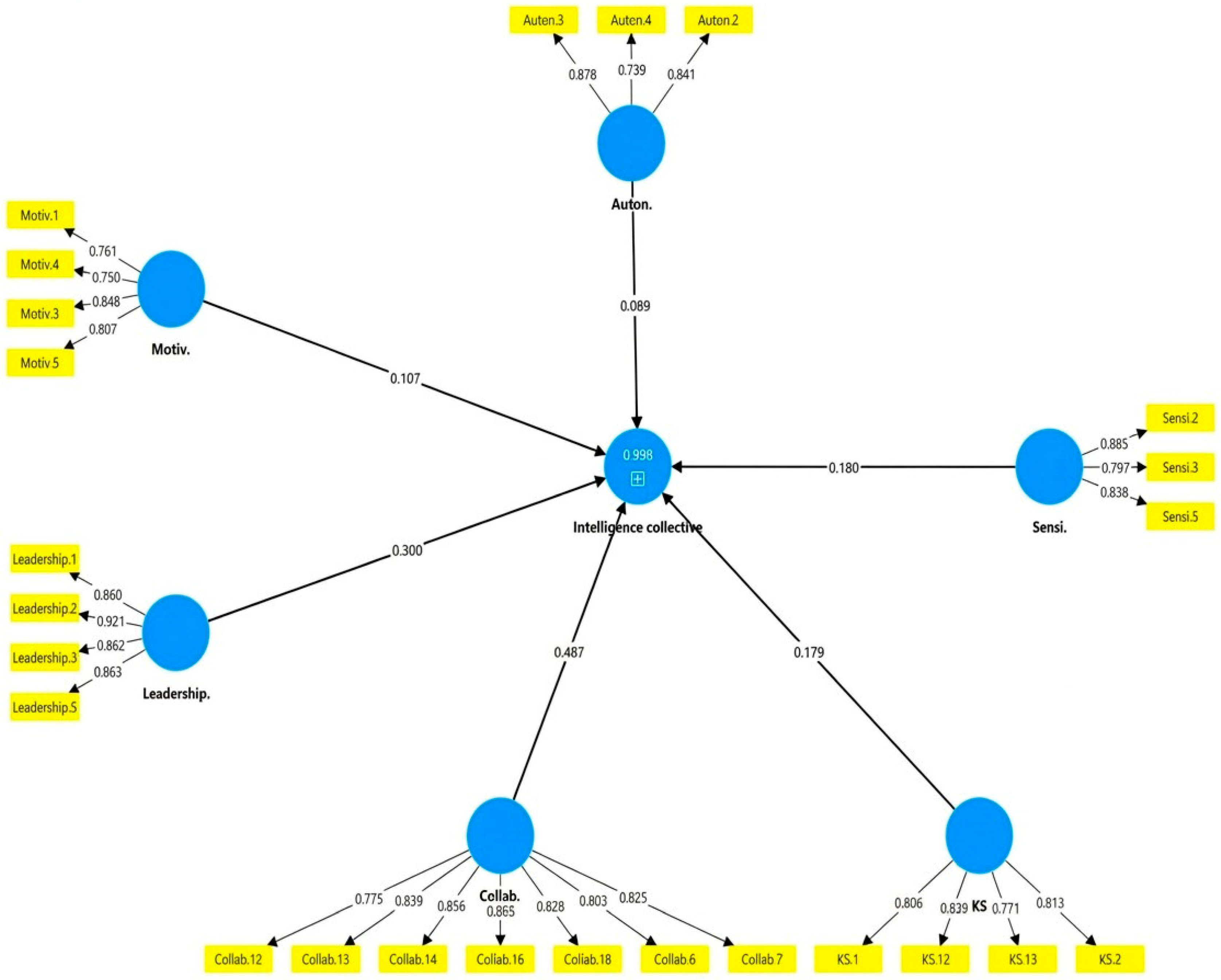
Table 1.
Research hypotheses.
| Code | Variables | Formulation |
|---|---|---|
| H1 | Social sensitivity | The social sensitivity of the members positively influences the collective intelligence of the association. |
| H2 | Professional autonomy | The autonomy of the members promotes the collective intelligence of the association and generates positive results |
| H3 | Motivation | Intrinsic motivation is the fundamental element necessary to improve the collective intelligence of the association |
| H4 | Leadership | Adopting a transformational leadership style within the association enhances collective intelligence |
| H5 | Involvement at work (collaboration) | The more members are involved in the associative life (collaboration), the higher the collective intelligence will be |
| H6 | Knowledge sharing | The sharing of knowledge between members promotes the emergence of collective intelligence. |
Table 2.
Analysis of the items of the Social Sensitivity dimension.
| Items | Extraction | Alpha of Cronbach | KMO | % variance |
|---|---|---|---|---|
| Sensi.2 | 0,755 | 0.735 | 0.715 | 57.254 |
| Sensi.3 | 0,648 | |||
| Sensi.5 | 0,620 | |||
| Sensi.1 | 0,268 |
Table 3.
Analysis of the items of the autonomy dimension.
| Items | Extraction | Alpha of Cronbach | KMO | % Variance |
|---|---|---|---|---|
| Auton..4 | 0,698 | 0.775 | 0.756 | 60.337 |
| Auton..3 | 0,709 | |||
| Auton..5 | 0,482 | |||
| Auton.2 | 0,524 |
Table 4.
Analysis of the items of the motivation dimension.
| Items | Extraction | Alpha of Cronbach | KMO | % Variance |
|---|---|---|---|---|
| Motiv.4 | 0,658 | 0.805 | 0.783 | 63.307 |
| Motiv.6 | 0,597 | |||
| Motiv.5 | 0,682 | |||
| Motiv.1 | 0,596 |
Table 5.
Analysis of the items of the transformational leadership dimension.
| Items | Extraction | Alpha of Cronbach | KMO | % variance |
|---|---|---|---|---|
| Leadership.2 | 0,850 | 0.898 | 0.831 | 76.876 |
| Leadership.3 | 0,744 | |||
| Leadership.1 | 0,745 | |||
| Leadership.6 | 0,737 |
Table 6.
Analysis of the items of the collaboration dimension.
| Items | Extraction | Alpha of Cronbach | KMO | % variance |
|---|---|---|---|---|
| Collab.12 | 0,612 | 0.921 | 0.930 | 68.538 |
| Collab.18 | 0,688 | |||
| Collab.13 | 0,707 | |||
| Collab.16 | 0,741 | |||
| Collab.14 | 0,724 | |||
| Collab.7 | 0,681 | |||
| Collab.6 | 0,644 |
Table 7.
Analysis of the items of the knowledge sharing dimension.
| Items | Extraction | Alpha of Cronbach | KMO | % variance |
|---|---|---|---|---|
| KS.12 | 0,720 | 0.820 | 0.74 | 65.494 |
| KS.13 | 0,639 | |||
| KS.2 | 0,680 | |||
| KS.1 | 0,581 |
Table 8.
Reliability and adequacy statistics for all items.
| Nombre of items | Alpha of Cronbach | KMO | % variance |
|---|---|---|---|
| 27 | 0.894 | 0.852 | 61.320 |
Table 9.
Matrix of components after rotational.
| 1 | 2 | 3 | 4 | 5 | 6 | |
|---|---|---|---|---|---|---|
| Collab.12 | ,890 | ,154 | ,217 | ,198 | ,022 | ,023 |
| Collab.18 | ,851 | ,128 | ,113 | ,023 | ,091 | ,042 |
| Collab.13 | ,763 | ,097 | ,021 | ,082 | ,042 | ,008 |
| Collab.16 | ,735 | ,261 | ,042 | ,074 | ,079 | ,035 |
| Collab.14 | ,706 | ,192 | ,270 | ,075 | ,108 | ,086 |
| Collab.7 | ,650 | ,132 | ,046 | ,065 | ,038 | ,110 |
| Collab.6 | ,631 | ,077 | ,155 | ,196 | ,074 | ,270 |
| Leadership.2 | ,005 | ,947 | ,029 | ,023 | ,071 | ,026 |
| Leadership.3 | ,024 | ,757 | ,146 | ,067 | ,141 | ,012 |
| Leadership.1 | ,085 | ,698 | ,053 | ,017 | ,032 | ,130 |
| Leadership.6 | ,332 | ,634 | ,037 | ,154 | ,046 | ,170 |
| KS.12 | ,024 | ,079 | ,807 | ,067 | ,038 | ,205 |
| KS.13 | ,138 | ,202 | ,665 | ,231 | ,018 | ,008 |
| KS.2 | ,128 | ,127 | ,664 | ,005 | ,036 | ,054 |
| KS.1 | ,189 | ,238 | ,566 | ,019 | ,004 | ,147 |
| Motiv.4 | ,018 | ,008 | ,006 | ,804 | ,124 | ,118 |
| Motiv.6 | ,213 | ,129 | ,007 | ,713 | ,070 | ,032 |
| Motiv.5 | ,183 | ,213 | ,146 | ,631 | ,121 | ,017 |
| Motiv.1 | ,208 | ,069 | ,214 | ,539 | ,054 | ,188 |
| Auton..4 | ,070 | ,051 | ,010 | ,081 | ,817 | ,020 |
| Auton..3 | ,021 | ,050 | ,001 | ,085 | ,772 | ,061 |
| Auton..5 | ,074 | ,226 | ,037 | ,086 | ,583 | ,038 |
| Auton.2 | ,196 | ,154 | ,039 | ,074 | ,567 | ,023 |
| Sensi.2 | ,002 | ,034 | ,010 | ,132 | ,028 | ,849 |
| Sensi.3 | ,017 | ,016 | ,254 | ,067 | ,056 | ,601 |
| Sensi.5 | ,273 | ,177 | ,293 | ,048 | ,005 | ,554 |
| Sensi.1 | ,011 | ,051 | ,117 | ,133 | ,017 | ,388 |
Table 10.
Matrix of components after rotational.
| Built in 2nd order | Alpha 2nd order |
KMO 2nd order | % 2nd order | 1st Order contruits | Nbr of item selected | Nbr of deleted items | Alpha of Cronbach | KMO | % Variance |
|---|---|---|---|---|---|---|---|---|---|
| Collective intelligence | 0.894 | 0.852 | 61.320 | Social Sensitivity | 4 | 4 | 0,735 | 0,715 | 57,254 |
| Autonomy | 4 | 1 | 0,775 | 0,756 | 60,337 | ||||
| Motivation | 4 | 5 | 0,805 | 0,783 | 63,307 | ||||
| Leadership | 4 | 2 | 0,898 | 0,831 | 76,876 | ||||
| Collaboration | 7 | 11 | 0,921 | 0,930 | 68,538 | ||||
| Knowledge sharing | 4 | 14 | 0,820 | 0,740 | 65,494 |
Table 11.
Reliability and convergent validity of the measurement model.
| Cronbach’s alpha | Composite reliability (CR) | Average variance extracted (AVE) | |
|---|---|---|---|
| Auton. | 0.778 | 0.785 | 0.483 |
| Collab. | 0.923 | 0.921 | 0.631 |
| KS | 0.824 | 0.825 | 0.543 |
| Leadership. | 0.899 | 0.900 | 0.697 |
| Motiv. | 0.806 | 0.809 | 0.509 |
| Sensi. | 0.739 | 0.752 | 0.460 |
Table 12.
Reliability and convergent validity of the measurement model after deletion of the two items.
Table 12.
Reliability and convergent validity of the measurement model after deletion of the two items.
| Cronbach’s alpha (standardized) | Cronbach’s alpha (unstandardized) | Composite reliability (rho_c) | Average variance extracted (AVE) | |
|---|---|---|---|---|
| Auton. | 0.772 | 0.763 | 0.770 | 0.541 |
| Collab. | 0.923 | 0.921 | 0.921 | 0.631 |
| KS | 0.824 | 0.820 | 0.825 | 0.543 |
| Leadership. | 0.899 | 0.898 | 0.900 | 0.697 |
| Motiv. | 0.806 | 0.805 | 0.809 | 0.509 |
| Sensi. | 0.792 | 0.790 | 0.799 | 0.571 |
Table 13.
Fornell Larcker Criterion of Discriminatory Validity.
| Auton. | Collab. | KS | Leadership. | Motiv. | Sensi. | |
|---|---|---|---|---|---|---|
| Auton. | 0.735 | |||||
| Collab. | 0.301 | 0.795 | ||||
| KS | 0.128 | 0.396 | 0.737 | |||
| Leadership. | 0.194 | 0.735 | 0.433 | 0.835 | ||
| Motiv. | 0.125 | 0.110 | 0.605 | 0.340 | 0.714 | |
| Sensi. | 0.136 | 0.603 | 0.438 | 0.612 | 0.382 | 0.756 |
Table 14.
Cross Loadings for the assessment of the discriminating validity of constructs.
| Auton. | Collab. | KS | Leadership. | Motiv. | Sensi. | |
|---|---|---|---|---|---|---|
| Auton..3 | 0.878 | 0.259 | 0.105 | 0.221 | 0.158 | 0.117 |
| Auton..4 | 0.739 | 0.133 | 0.042 | 0.040 | 0.025 | 0.026 |
| Auton.2 | 0.841 | 0.280 | 0.131 | 0.161 | 0.092 | 0.169 |
| Collab.12 | 0.294 | 0.775 | 0.144 | 0.407 | 0.120 | 0.401 |
| Collab.13 | 0.213 | 0.839 | 0.279 | 0.571 | 0.030 | 0.406 |
| Collab.14 | 0.178 | 0.856 | 0.474 | 0.652 | 0.149 | 0.423 |
| Collab.16 | 0.194 | 0.865 | 0.336 | 0.698 | 0.154 | 0.503 |
| Collab.18 | 0.344 | 0.828 | 0.328 | 0.467 | 0.079 | 0.403 |
| Collab.6 | 0.260 | 0.803 | 0.361 | 0.464 | 0.029 | 0.546 |
| Collab.7 | 0.230 | 0.825 | 0.224 | 0.581 | 0.075 | 0.446 |
| KS.1 | 0.115 | 0.446 | 0.806 | 0.470 | 0.290 | 0.254 |
| KS.12 | 0.100 | 0.269 | 0.839 | 0.317 | 0.455 | 0.376 |
| KS.13 | 0.135 | 0.249 | 0.771 | 0.215 | 0.459 | 0.220 |
| KS.2 | 0.046 | 0.205 | 0.813 | 0.310 | 0.353 | 0.254 |
| Leadership.1 | 0.082 | 0.561 | 0.295 | 0.860 | 0.209 | 0.517 |
| Leadership.2 | 0.080 | 0.588 | 0.386 | 0.921 | 0.277 | 0.512 |
| Leadership.3 | 0.247 | 0.547 | 0.417 | 0.862 | 0.255 | 0.448 |
| Leadership.6 | 0.270 | 0.650 | 0.371 | 0.863 | 0.278 | 0.397 |
| Motiv.1 | 0.026 | 0.025 | 0.426 | 0.234 | 0.761 | 0.286 |
| Motiv.4 | 0.011 | 0.014 | 0.308 | 0.123 | 0.750 | 0.148 |
| Motiv.5 | 0.141 | 0.092 | 0.457 | 0.312 | 0.848 | 0.248 |
| Motiv.6 | 0.156 | 0.197 | 0.294 | 0.208 | 0.807 | 0.224 |
| Sensi.2 | 0.124 | 0.444 | 0.357 | 0.454 | 0.375 | 0.885 |
| Sensi.3 | 0.054 | 0.367 | 0.417 | 0.379 | 0.224 | 0.797 |
| Sensi.5 | 0.150 | 0.543 | 0.108 | 0.506 | 0.136 | 0.838 |
Table 15.
Discriminating validity – Ratio Heterotrait Monotrait (HTMT).
| Auton. | Collab. | Leadership. | Motiv. | Sensi. | KS | |
|---|---|---|---|---|---|---|
| Auton. | ||||||
| Collab. | 0.326 | |||||
| Leadership. | 0.210 | 0.727 | ||||
| Motiv. | 0.159 | 0.149 | 0.323 | |||
| Sensi. | 0.182 | 0.628 | 0.631 | 0.355 | ||
| KS | 0.150 | 0.407 | 0.470 | 0.582 | 0.430 |
Table 17.
VIF (Variance Inflation Factor) of the explanatory variables of “collective intelligence”.
Table 17.
VIF (Variance Inflation Factor) of the explanatory variables of “collective intelligence”.
| Autonomie | 1.106 |
|---|---|
| Collaboration | 2.246 |
| Knowledge sharing | 1.521 |
| Leadership | 2.106 |
| Motivation | 1.420 |
| Social sensitivity | 1.608 |
Table 18.
Structural Model Significance Test.
| Relation | Original sample (O) | Sample mean (M) | T statistics | P values |
|---|---|---|---|---|
| Auton. –> CI | 0.089 | 0.091 | 2.781 | 0.005 |
| Collab. > CI | 0.487 | 0.481 | 13.742 | 0.000 |
| KS > CI | 0.179 | 0.177 | 6.383 | 0.000 |
| Leadership > CI | 0.300 | 0.298 | 10.458 | 0.000 |
| Motiv. > CI | 0.107 | 0.104 | 3.166 | 0.002 |
| Sensi. > CI | 0.180 | 0.177 | 8.250 | 0.000 |
Table 19.
Coefficient of determination R² of the variables dependent on the model.
| Original sample (O) | Sample mean (M) | T statistics | P values | |
|---|---|---|---|---|
| Collective intelligence | 0.998 | 0.998 | 1134.928 | 0.000 |
Table 20.
Size f² effect of the explanatory variables of the model.
| f square | |
|---|---|
| Auton. > CI | 4.406 |
| Collab. > CI | 49.552 |
| KS > CI | 14.816 |
| Leadership. > CI | 23.655 |
| Motiv. > CI | 7.149 |
| Sensi. > CI | 13.019 |
Table 21.
Overall Adjustment Coefficient GoD (Goodness of Fit).
| R2 | AVE | |
|---|---|---|
| Autonomy | 0,541 | |
| Collaboration | 0,631 | |
| KS | 0,543 | |
| Leadership | 0,697 | |
| Motivation | 0,509 | |
| Social sensitivity | 0,571 | |
| Collective intelligence | 0,998 | |
| Average | 0,998 | 0,582 |
| 0,762125974 | ||
Table 22.
Summary of Research Hypotheses.
| Hypothese | Nature of link | Coeff | T | P value | Decision |
|---|---|---|---|---|---|
| H1 : The social sensitivity of the members positively influences the CI of the association. | Factoriel | 0.180 | 8.250 | 0.000 | Validated |
| H2 : The autonomy of the members promotes the CI of the association. | Factoriel | 0.089 | 2.781 | 0.005 | Validated |
| H3 : The intrinsic motivation of the members contributes to the improvement of the CI of the association. | Factoriel | 0.107 | 3.166 | 0.002 | Validated |
| H4: The adoption of a transformational leadership style by the president of the association improves his CI. | Factoriel | 0.300 | 10.458 | 0.000 | Validated |
| H5 : The more members are involved in the associative life (collaboration), the higher the collective intelligence will be. | Factoriel | 0.487 | 13.742 | 0.000 | Validated |
| H6 : The sharing of knowledge between members will promote the emergence of CI. | Factoriel | 0.179 | 6.383 | 0.000 | Validated |
Disclaimer/Publisher’s Note: The statements, opinions and data contained in all publications are solely those of the individual author(s) and contributor(s) and not of MDPI and/or the editor(s). MDPI and/or the editor(s) disclaim responsibility for any injury to people or property resulting from any ideas, methods, instructions or products referred to in the content. |
© 2026 by the authors. Licensee MDPI, Basel, Switzerland. This article is an open access article distributed under the terms and conditions of the Creative Commons Attribution (CC BY) license (http://creativecommons.org/licenses/by/4.0/).
Copyright: This open access article is published under a Creative Commons CC BY 4.0 license, which permit the free download, distribution, and reuse, provided that the author and preprint are cited in any reuse.


