

Submitted:
26 June 2026
Posted:
29 June 2026
You are already at the latest version
Abstract
The electromagnetic, weak, and strong interactions, together with one Standard-Model generation of matter, arise on a finite relational arithmetic substrate \(\mathbb F_\Omega\) as the gauging of its relational frame data: a cell-local change of frame is a gauge symmetry and the compensating connection is the field. The three interactions are the substrate's three internal frame data: the multiplicative phase, the spinorial extension, and the colour frame. A finite-window correspondence ties the finite gauge groups so produced to the observable compact theory: a cyclotomic representation reproduces the gauge invariants, the Yang-Mills kinetic operator, and the chiral matter within a bounded horizon \(H\ll\Omega\) at residue \(O(H/\Omega)\), proven on the resolvable class, the cross-scale extension a finite Carrier-scale residue. Concretely, electric charge is a quantised winding index and the bare coupling the phase-channel capacity \(1/4\pi\); electroweak breaking gives the massless photon, custodial \(\rho=1\), and sin2 θW=3/8; colour SU(3) is the special unitary group of a Hermitian three-form; and one generation is the anomaly-free SO(10) spinor 16 with a right-handed neutrino. The four interactions and three generations are organised by one closed role ladder (the count/generate split), forbidding a fifth force and a fourth generation and forcing SO(10) unification. Every exact claim is verified in finite-field or cyclotomic arithmetic, the continuum entering only as a labelled degenerate idealisation.
Keywords:
finite ring cosmology
; finite ring continuum
; finite substrate
; finite field quantum mechanics
; lattice gauge theory
; standard model
; electromagnetism
; weak interaction
; strong interaction
; confinement
; asymptotic freedom
; grand unification
1. Introduction
The Standard Model is a theory of remarkable accuracy whose structure is stipulated rather than derived: the gauge group , the fermion representations and their hypercharges, the number of generations, and the mixing angles are fixed by experiment and consistency, not obtained from a deeper principle. A half-century of work has approached this stipulation from several directions. Grand unification embeds the gauge group in a simple one and relates the couplings [1,2,3,4], but posits the unifying group and leaves the generation count and the mass hierarchy open. Lattice gauge theory makes the gauge dynamics non-perturbative [5,6,7,8], capturing confinement and asymptotic freedom [9,10,11], but treats the lattice as a regulator removed at the end, not as an ontology. On the quantum side, finite and Galois-field quantum kinematics show how much structure finite algebra can carry: Schwinger’s unitary operator bases [12], Wootters’ discrete phase space and mutually unbiased bases [13,14,15], the Weil representation [16], Vourdas’ Galois quantum systems [17], and modal and Galois-field quantum theory [18,19]; while discrete, relational, and epistemic readings of quantum theory [20,21,22] share the ontological stance without the gauge content. A finitist current holds the continuum, not finiteness, to be the idealisation [23,24,25].
Closest to the matter sector are the division-algebra and exceptional-structure programmes, which build the Standard-Model gauge group, and in some treatments three generations, from and the exceptional Jordan algebra [26,27,28,29,30,31]. What this landscape lacks is a single finite structure from which the gauge interactions and the matter that carries them follow, rather than being posited group by group and generation by generation: the gauge group derived rather than chosen, the generation count fixed rather than counted, and the continuum gauge theory recovered as a degenerate idealisation rather than assumed.
The finite ring cosmology (FRC) framework proposes such a structure. It reconstructs physics over a large but ultimately finite relational arithmetic substrate, with the continuum recovered only as a degenerate idealisation [32,33,34], and stands in the finitist lineage above. Two companions fix its method. The gravity paper [35] derives gravitation as the synchronisation of the clocks the substrate already carries, and gauges the first of the substrate’s frame data: a cell-dependent change of frame is an element of acting by congruence, seen by an adjacency-local functional only through link differences, which is the linearised diffeomorphism gauge read from the relational ontology rather than postulated. The quantum companion [36] supplies the matter side: a field is a phase character of a finite cycle, observation is the shared-core comparison of two cycles, and the complex amplitude is forced by the quarter-turn core the two generically share. Between them they fix a recipe for how an interaction appears (Section 3), applied there to one frame datum, the geometric frame.
This paper develops the thesis that the electromagnetic, weak, and strong interactions are the substrate’s three other frame data, gauged by the same argument; the programme is the completion of an unfinished one, finish gauging the frame. Four results follow. First, electromagnetism is the gauging of the phase frame (Section 5): electric charge is a quantised winding index, the photon is massless by drive-invariance, the Maxwell operator is unique, and the bare coupling is the phase-channel capacity . Second, the weak interaction is the gauging of the spinor frame (Section 6): breaking is drive–torus misalignment, the custodial and the propagating spectrum are the Hessian of the broken vacuum, and the Weinberg angle reduces to the charge spectrum, . Third, the strong interaction is the gauging of the colour frame (Section 7): colour is the special unitary group of a Hermitian three-form, confinement is the compact-group area law from positivity, and asymptotic freedom is the gluon self-coupling. Fourth, one complete generation is the spinor of the rank-five internal frame (Section 8), carrying its charges, hypercharges, anomaly freedom, and a right-handed neutrino, with the charged-lepton Koide ratio derived from the cube-root generation orbit at the quarter-turn. The four interactions are the four primitive arithmetic roles and the three generations the three generative roles of the same closed ladder (Section 9), so a fifth force and a fourth generation are forbidden and unification is forced, the colour–isospin split lying beyond the horizon of any bounded observer.
The finite gauge groups so produced are tied to the observable compact gauge theory by a finite-window correspondence theorem (Section 4): within a bounded observer horizon a cyclotomic representation reproduces the gauge invariants, the Yang–Mills kinetic operator, and the chiral matter content with residue , invoking no limit. It is proven on the resolvable class, with the global cross-scale extension -hard. The construction reads in five tiers: the exact finite arithmetic feeds the correspondence; the correspondence yields the Standard-Model recovery within the bounded window; and the structural counts and the phenomenology sit above it.
Every statement carries one status tag, exact (proven here or in a cited corpus paper), imported (a standard result consumed without reproof), conditional (, a theorem within the finite window given the correspondence of Section 4 and the mathematics-to-physics bridges), or -hard (a residual decided by the totality), and the full dependency ledger is collected in Appendix H. Every exact claim that admits a finite check is machine-verified in finite-field or cyclotomic arithmetic (Section 13), and no exact claim depends on a continuum construct (Section 10); the continuum enters only as a labelled degenerate idealisation. The paper adds no new substrate premise: its inputs are the finite substrate and the recipe already developed in the corpus, and the physics enters through the six mathematics-to-physics bridges made explicit in Appendix H.
2. The Substrate: A Primer
This section summarises the elements of the framework the current development consumes; they are introduced and detailed in the corpus [32,33,34,35,36,37].
Carrier, Subject, phase cycle.
The substrate is a finite prime field with in Planck units, the Carrier illustrated in Figure 1, fixed by the de Sitter entropy of the observable universe [39,40]. Its phase cycle is the multiplicative group , with the quarter-turn subgroup . An observer is an embedded shell; all observation is the shared-core comparison of phase cycles.
Chronon, cardinality, capacity.
The frame datum carries three distinct quantities, kept apart throughout [34,35]. The chronon t is the observer’s present tick, the scale-dilation coordinate of the drive ; it is a frame datum the observer assigns, shared by none, and is written without a subscript. The cardinality ( for the Carrier, unsubscripted as it is unique; p for an embedded Subject) is the shell’s size and its subscript label. The capacity is the quarter-period, entering the framed objects only as an exponent: for the unsubscripted Carrier the half-period is and the capacity , so the oriented quarter-turn is with , generating . This capacity is distinct from the synchronisation stiffness of the bare coupling (Section 5), the per-link channel coupling normalised to unity. The geometric entering continuum-facing quantities such as is the solid-angle constant of the degenerate-idealisation chart, a register distinct from this framed half-period .
The drive and masslessness.
Time is scale-dilation: the multiplicative action of the frame generator is the Carrier’s own evolution, which each embedded observer reads only as a projection, advancing the phases in its own frame by one chronon. No embedded shell carries a universal tick; what two shells share is the quarter-turn core , not a clock. Mass is winding rate ( an identity); a degree of freedom whose state is conserved by the drive carries no winding and no gap, while one the drive rotates costs phase per chronon and is massive. This masslessness criterion, drive-invariance is masslessness, recurs throughout.
The three frame freedoms.
An oriented frame is a unimodular basis of the observer’s chart, so the frame space is a torsor under [34]. Its one-parameter subgroups fall into the standard trichotomy: the unipotent (order , additive, translation/space), the split torus (order , multiplicative, scale/time), and the non-split torus (order , the boost). These three freedoms are the three dimensions of space; gravity is the gauging of this frame [35]. The Carrier shell, its four representation domains, and the observer’s flattened chart are shown in Figure 1.
The non-split torus and the spinor.
The boost is the non-split torus of the frame group , with its order-two Frobenius involution [33,37]. The spinor double cover is exact inside : a norm-one boost has order and its spin lift returns , so the frame cycle closes in one circuit and the spinor in two [36,37]. Read as a field extension—carrying the Lorentzian signature, the field-valued spinor, and proper time—this structure is the observer’s: a Subject with instantiates within the coherence horizon , where the drive it rides is time and the boost torus is its Lorentz frame.
The four primitive roles.
3. The Emergence Recipe
Read as one procedure, the gravitational and quantum derivations fix four steps by which a force appears.
Recipe step 3.1
(Matter is a phase character). A subsystem’s state is a character of its phase cycle, the cycle read through a winding index s [36]. Exact.
Recipe step 3.2
(Frame data are relational). The marks are frame data, not absolute structure. A global reframing changes no invariant: the shift symmetry of the gravitational Ward identity and the offset superselection of the common drive [35,36]. A cell-dependent reframing is, by the same ontology, a gauge symmetry. Exact for the geometric frame; its extension to the other frame data is the content below.
Recipe step 3.3
(Shared-core comparison forces a connection). The only measurement is shared-core phase comparison between cells [36]. Comparing phases across a link under a local reframing requires a transport, a link variable valued in the reframing group, transforming by , whose plaquette holonomy is the field strength: a lattice gauge connection. Imported (lattice gauge theory); the forcing is exact given Recipe 3.2.
Recipe step 3.4
(Unique quadratic stiffness; the coupling decides the sign). The dynamics is the unique adjacency-local, gauge-invariant quadratic functional of the field: Fierz–Pauli for the symmetric two-tensor of gravity [41], Wilson/Yang–Mills for a connection [5,6]. The discriminator is in the corpus: gravity has linear source coupling (universal attraction), whereas a field-quadratic action with no linear reward gives like-charge repulsion [35]. Imported uniqueness; the dichotomy is exact.
The recipe is the gravitational derivation with the frame datum changed. What it can be applied to is fixed by which substrate symmetries gravity has already consumed; the accounting is Table 1.
4. The Finite Gauge Correspondence
Recipe 3.3 delivers a finite gauge theory: the connection is valued in a finite group: with for the phase frame, and the finite unitary groups , for the spinor and colour frames (Appendix C). The observable theory uses the compact Lie groups , , . The step that connects them is not an ontological limit. A bounded Subject resolves the lattice only within a horizon , and the claim is that within that window the finite construction reproduces the Standard-Model lattice observables. The theorem below is stated on exactly the content its components prove, the resolvable class, so that it is co-extensive with its proof; the global cross-scale extension is -hard (Remark 4.2). The development and proofs are in reports/correspondence/, the checks in correspondence.py.
Theorem 4.1
(Finite-window gauge correspondence, resolvable class). Let the gauge group be (), , or , with the cyclotomic action of Definition 4.4. Then: (i) is gauge-invariant exactly, being a class function (Theorem 4.5); (ii) on the resolvable window —gauge-invariant observables on at most H links, each within curvature ε with —the finite action reproduces the Yang–Mills kinetic operator exactly through the Lie-algebra lift , with per-link residue (Theorems 4.3, 4.8); the agreement of normalised expectations to is Theorem 4.11, via the near-identity counting-to-Haar equidistribution of Definition 4.7; (iii) in the strong-coupling regime the Wilson loop obeys the area law with positive string tension (Proposition 4.12); and the chiral matter representations branch identically to the Standard-Model assignment (Section 8). At the non-abelian correspondence is moreover an exact group embedding (Theorem 4.6).
The scope is deliberate. For general the finite group is not a subgroup of the compact in the defining representation, so clause (ii) is asserted through the Lie-algebra lift on the resolvable window, not as a group isomorphism; the theorem claims exactly this and no more, which is why it is a theorem. The remaining content is one -hard residue (Remark 4.2).
Remark 4.2
(The cross-scale extension is -hard). Beyond the resolvable window two quantities remain: the uniform bound over all gauge-invariant observables, the high-curvature regime included, and the cross-scale running of the matched coupling (the continuum beta function). Both are full-group averages at Carrier scale. The high-curvature bound is fixed by the equidistribution of conjugacy classes toward Haar measure, the imported Deligne–Lusztig character bounds; the cross-scale running is the free-energy difference across scales, an Ω-term character sum over the whole group. Each is decided by the totality and lies beyond the bounded Subject’s coherence horizon: Ω-hard, the carrier-scale analogue of computational hardness, decidable but not by a bounded observer. Whether a sub-carrier closed form exists is itself the Ω-hard question.
The components that prove Theorem 4.1 are these.
Theorem 4.3
(Abelian correspondence, exact). The map is an injective homomorphism onto the M-th roots of unity, and the Wilson weight is already real and non-negative. A Subject resolving phase coarser than cannot distinguish from ; the window residue is . For electromagnetism the correspondence is an exact inclusion, not a limit.
definition 4.4
(Cyclotomic class-function action). For a complex irreducible representation ρ of the finite gauge group, of dimension and character , set .
Theorem 4.5
(Positive, native cyclotomic action). is real and non-negative, since is a sum of roots of unity, so ; and it is gauge-invariant, being a class function. It is substrate-native: the characters of are the Deligne–Lusztig characters, built from the substrate’s own additive and multiplicative characters (Gauss sums), so the cyclotomic representation is the observer’s continuum reading of the framed-rational structure rather than an import.
Theorem 4.6
(Exceptional embedding at ). At the correspondence is an exact embedding: is the binary tetrahedral group , a genuine order-24 finite subgroup of , with on all of it. For general q no such subgroup exists in the defining representation; the correspondence is then at the level of observables (Theorem 4.8), not an embedding.
definition 4.7
(Resolvable set, balanced-residue lift, representation family). Fix a Chevalley basis of with integer structure constants. The resolvable set is the set of finite-group elements expressible as a product of at most H near-identity plaquette holonomies , with X a Chevalley basis element reduced and ε a balanced residue (below wrap-around), subject to . The lift sends to , with the characteristic-zero Chevalley element of the same structure constants and the real balanced representative of ε. The selected family comprises the Deligne–Lusztig characters of fundamental type, and a holonomy U enters through its character value on the near-identity regular element.
Theorem 4.8
(Bounded-window perturbative reconstruction). Let with and ε the plaquette curvature. For an irreducible ρ,
with the Dynkin index of ρ (); the fundamental gives , hence the verified in correspondence.py. This is the Yang–Mills quadratic action . The finite-to-compact map is at the Lie-algebra level, not a group embedding: carries the same integer/rational structure constants and Dynkin indices as , reduced , so the balanced-residue lift of Definition 4.7 preserves the bracket, the characters, and the quadratic action up to . The bounded-order (finite-diagram) window amplitudes therefore coincide with the compact theory’s to that residue. Gauge invariance is exact (Theorem 4.5), so orbits and Ward identities are preserved exactly. Three objects enter and are kept distinct: the finite group’s defining action on (), its complex Deligne–Lusztig characters (Theorem 4.5), and the compact fundamental of ; the lift of Definition 4.7 is the explicit intertwiner on the near-identity chart, matching the structure constants to those of and carrying the character expansion, certified at and characteristic-uniform in q (construction in reports/correspondence/). This is the perturbative, structure-constant correspondence; geometric approximation of the whole finite group is not claimed.
Lemma 4.9
(Character lift, characteristic-uniform). For the fundamental-type Deligne–Lusztig family and a near-identity element of ,
with the compact fundamental and the error uniform over the window. For X a regular element of the Chevalley basis, is regular semisimple in at any below wrap-around, the class on which the Deligne–Lusztig character is given by its Green-function (Gauss-sum) formula. There the normalised character expands as , its coefficient the Casimir/Dynkin invariant the compact side also carries. For the fundamental this coefficient is the fixed rational , a degree-zero polynomial in the shell, so the finite-minus-compact difference has degree 0 and its vanishing at any one admissible shell coprime to n forces ; the shells over-determine it (a polynomial vanishing at more points than its degree is the zero polynomial). The identity therefore holds at the Carrier shell. The coefficient is q-independent and the residue is at (correspondence.py, block G).
The per-link match of Theorem 4.8, lifted at the character level by Lemma 4.9, extends to a uniform bound over the observables a bounded Subject resolves, through the finite quadrature of Lemma 4.10.
Lemma 4.10
(Finite quadrature on the near-identity ball). Let f be a gauge-invariant polynomial observable of bounded degree in the window plaquette holonomies, evaluated on the maximal-tree gauge quotient of the window, its Wilson weight a finite sum of M-th roots of unity in the cyclotomic ledger ; let be the balanced near-identity set of Definition 4.7. Then
the left side an exact framed-rational sum, the right its degenerate-idealisation reading. The balanced residues tile the Lie-algebra ball on a uniform grid of spacing in the lifted chart, on which the Haar measure pulls back to Lebesgue times a smooth Jacobian; the sum is then a Riemann sum for a smooth integrand, with Euler–Maclaurin remainder . The quadrature residue shrinks with the grid and stays within across the four shells (correspondence.py, block H).
Theorem 4.11
(Uniform window bound on expectations). Let O be a gauge-invariant observable supported on at most H links, each in the low-curvature ball (the resolvable window, ), and let be the window effective expectation at the matched window-scale coupling, the bulk entering only through that coupling, whose cross-scale running is the Ω-hard residue of Remark 4.2. Then the finite and compact Yang–Mills window effective expectations agree uniformly over this class,
an equality of matched finite-window effective expectations, not of full finite-lattice expectations with the outside links integrated out. Fix a maximal-tree gauge on the window, so the gauge-invariant content is a finite sum over the H plaquette holonomies of the quotient. The bulk beyond the window enters a normalised window observable only through the coupling matched at the window scale; that coupling’s cross-scale running is the Ω-hard residue of Remark 4.2 and is held fixed, not integrated out, so the boundary effective measure the bulk would impose is carried by that residue, not by the window sum. At the matched coupling the window expectation is the finite gauge-fixed sum, and on each window link Lemma 4.10 replaces the counting average by the Haar integral with error while Theorem 4.8 with Lemma 4.9 matches the integrand to ; the per-link errors accumulate over the H links while keeps the holonomy near the identity, giving the bound. Each step is a finite, window-bounded computation within the bounded observer’s horizon. Verified: the per-link residue grows linearly in H (correspondence.py, block E).
Proposition 4.12
(Confinement area law from positivity). Because is a positive real class function (Theorem 4.5), the strong-coupling character expansion applies and the single-plaquette coefficient is the exact finite-group character sum ; it is positive of order β at strong coupling (for colour , in closed form in reports/string-tension), so the Wilson loop obeys the area law with positive string tension . Verified for and (correspondence.py, block F; string_tension.py).
Remark 4.13
(The status of the downstream continuum results). Theorems 4.3–4.11 and Proposition 4.12 prove Theorem 4.1 on the resolvable content a bounded Subject accesses; the cross-scale extension beyond the window is Ω-hard (Remark 4.2). A downstream continuum result that needs only the resolvable window, the gauge invariants, the Yang–Mills kinetic operator, the window expectation bound, and strong-coupling confinement, is therefore a theorem. One that needs the cross-scale running is Ω-hard, decided by the totality; results resting on the mathematics-to-physics bridges carry the tag (Section 3). Each downstream result is marked accordingly.
5. Electromagnetism: Gauging the Phase Frame
Electromagnetism is the gauging of the phase frame, the choice of where the multiplicative cycle’s identity sits and which generator labels it. The construction runs end to end on structure already exact in the corpus. Before electroweak breaking this abelian phase connection is the hypercharge ; what Section 5 builds is its unbroken survivor after mixing, the electromagnetic generated by (Remark 6.8). The two are one abelian connection read before and after breaking, not two channels.
5.1. The Construction
The matter field is a character of , (Recipe 3.1); realise additively through the discrete logarithm, so a phase is an integer mod M.
definition 5.1
(Gauge structure). A gauge transformation is a cell-local reframing , acting by . A global λ is unobservable (the multiplicative twin of the gravitational shift; Lemma of [35]). The connection transforms by ; the field strength is the plaquette holonomy , gauge invariant as an exact identity in . The dynamics is the field-quadratic Wilson action , the small-curvature limit being discrete Maxwell.
Proposition 5.2
(Charge is a quantised winding index). The characters of the cyclic phase cycle are indexed by , so the electric charge of a matter field is its integer winding index s (mod M); a bounded observer reads the low-winding balanced representative as an ordinary integer. Charge quantisation, which the continuum theory obtains only through a monopole or a unified embedding, is here a triviality of finite cyclic structure. Exact.
Proposition 5.3
(Massless photon and the Coulomb law). The drive is multiplication by g, a rigid automorphism of Φ; the is exactly conserved, unbroken, and the photon is massless (the masslessness criterion). The static time-component potential solves the same discrete Poisson equation on the three-chart as the gravitational offset [35], giving the Coulomb potential , the lattice Green’s function of rigorous potential theory [42,43]. Electromagnetism and gravity share the inverse-square force; they differ only in sign (Recipe 3.4) and in spin. Exact reduction to imported lattice potential theory.
5.2. Uniqueness of the Dynamics
That the Wilson functional is gauge-invariant is verified; that it is the only relevant such functional is the electromagnetic analogue of the Fierz–Pauli uniqueness step [35].
Theorem 5.4
(Uniqueness of the relevant Maxwell operator). Among translation-invariant, range-one, hypercubic-invariant, gauge-invariant quadratic functionals of the connection, the space is two-dimensional, but it splits into exactly one relevant operator, whose leading symbol is the transverse projector (the Maxwell action), and one irrelevant operator of leading order that vanishes in the degenerate continuum reading. Moreover, gauge invariance itself selects rotational invariance at the relevant order: of the three hypercubic-invariant degree-two symbols , , , transversality forces the coefficients to , , annihilating the anisotropic term.
Proof.
Transversality with , combined with K a trigonometric polynomial (locality), forces by differentiation at , excluding the holonomy zero-mode mass term. At leading order ; the condition gives for all k, whence , and , the transverse projector (verified symbolically). The realisation at range one is Maxwell plus one companion; the dimension is the exact integer rank, 2, of an integer Gram matrix computed over a finite field. Verified: range-one admissible dimension ( relevant irrelevant) stably across lattice sizes, the relevant operator matching the projector to one part in . □
The two sectors now stand on one footing: in each, the relevant gauge-invariant quadratic action is unique, higher-derivative completions are irrelevant, and gauge invariance is exact on the shell.
5.3. The Coupling and the Hierarchy
The dimensionless coupling is the capacity of the phase channel.
Proposition 5.5
(Bare coupling, with the coefficient fixed). The interaction energy of two charges is , so . The order-one coefficient is exactly one: by channel unity the connection stiffness β equals the one per-cell capacity κ, that capacity is the action quantum ℏ, and charge is a winding index counted in the same phase quanta, so in natural units and
the the three-dimensional Gauss solid angle, numerically the gravitational shell coefficient , one relational channel read in three registers. The bare coupling carries no open order-one factor (unlike gravity’s and entropy constants), because channel unity locks it to ℏ; the saturation-regime profile confirms the coefficient and yields a finite charge self-energy from an electromagnetic core at . The value is itself convention-dependent (the is the Heaviside–Lorentz rationalisation of the Gauss solid angle), so is a canonical normalisation of the bare per-channel coupling, not yet a prediction of a physical coupling (Section 11, Tier 5).
Theorem 5.6
(Coupling hierarchy from substrate size). Gravity couples to the winding rate : a mass is a cardinality fraction of the totality, with coupling [35]. Electromagnetism couples to the winding index , a character label, not a fraction of Ω, so α is independent of the substrate size. Hence
a ratio set by Ω; for protons this is , recovered as a reading of . Gravity is the weak interaction because the substrate is large; electromagnetism does not see its size.
The value is not fixed within the sector. The bare has the correct ultraviolet-growth sign but the gap to 137 is too large for renormalisation-group running alone; most of it is the projection of the bare reframing-channel coupling onto the physical photon through the electroweak mixing angle. The coupling thus reduces to the charge spectrum and the Weinberg angle (Section 6); the substrate fixes everything about except the one mixing angle it shares with the weak sector.
6. The Weak Interaction: Gauging the Spinor Frame
The weak sector is the gauging of the spinor frame of the quadratic extension. Its raw materials are exact: the doublet and Pauli structure are native to the quantum companion, and the double cover is exact in finite arithmetic [36,37]. The electroweak gauge group [44,45,46], broken by a Higgs doublet [47,48], is rank two, supplied from two channels: from the split torus (the drive’s phase channel), from the non-split torus and its spinor cover.
The cell-local connection is constructed explicitly, completing the weak gauging to the kinematic standard of the electromagnetic sector.
Proposition 6.1
(The non-abelian weak connection). The weak gauge group is , the special unitary group of the Hermitian form on the doublet , the rank-two instance of the Hermitian construction whose rank-three instance is the colour group (Section 7). The connection assigns to each link, transforming by ; the plaquette holonomy transforms by conjugation , so the Wilson action is gauge-invariant as an exact finite-field identity, the doublet couples covariantly, and the drive breaks to its diagonal .Verified exhaustively for (): trace conjugation-invariance over all pairs, the plaquette conjugation law, and the drive centraliser of order 4.
Spacetime spinor, weak isospin, and internal frame are distinct factors.
A fermion carries three independent indices: the spacetime (Lorentz) spinor of the external frame group (Section 2), the weak-isospin doublet of the internal rank-two frame, and the colour triplet of the internal rank-three frame, so the state space is , the external and internal groups acting on separate factors. In Proposition 6.2 the chiral projector acts on the Lorentz factor (the boost cycle of the spacetime frame), while the weak generators act on the internal isospin factor; the drive correlates the two, coupling the weak connection to the drive-aligned spacetime chirality, which is the current. The kernel is read over one full drive period because the connection acts per chronon and the registered coupling is the drive-period average; the drive-aligned branch sums coherently to and the counter-winding branch incoherently to 0, giving the projector of Proposition 6.2.
Proposition 6.2
(Maximal parity violation from drive coherence). The spinor’s boost phase lives on the norm-one cycle , on which Frobenius acts as inversion, helicity reversal. The drive advances that phase and does not commute with Frobenius (unless ), so it breaks parity. Over one drive period the weak connection couples to the drive-aligned (left) branch coherently, with full strength , and to the Frobenius-conjugate (right) branch with strength , exactly, by character orthogonality. The therefore couples to the left branch only—maximal [49,50,51], universal across matter—and the decoupled right branch is exactly the right-handed weak singlets of the generation (Section 8). This is the coherent-versus-incoherent additivity (N against 0) that gives gravity its universal attractive sign: parity violation and universal attraction are one coherence effect. The character cancellation is exact, and it is the physical current: the drive-period average is the chiral projector, idempotent and annihilating the right branch, so the vertex is purely left, the interaction term whose right-handed matrix element is precisely the vanishing sum above. Its four-fermion amplitude is Corollary 6.7. Verified exactly for (weak_current.py).
Which chirality the physical generation occupies, the or its conjugate, is then settled relationally.
Proposition 6.3
(Chirality selection). The two Frobenius conjugates are CP-mirrors; the weak interaction couples to the one that winds with the drive (Proposition 6.2). The orientation convention fixes which quarter-turn is “up”, and flipping it () reverses the cycle and swaps the branches, a relabelling. Two observers of opposite convention disagree on the absolute label “left” but both find the weak coupled to the drive-aligned branch: the drive-relative chirality is convention-invariant and forced, the absolute handedness is relational and carries no frame-independent meaning. The well-posed question is thus answered and the absolute one dissolved, as the relational ontology requires. The single drive selects, together, the matter chirality ( over its CP-conjugate , matter over antimatter), the current, and universal attraction. “ not ” is the one drive’s direction, the arrow of time. Verified: the drive-aligned coupling is invariant under the orientation flip.
6.1. Breaking as Drive–Torus Misalignment
Theorem 6.4
(Drive centraliser and algebraic symmetry breaking). The drive is a regular element of the split torus. Its adjoint action on the gauge algebra fixes exactly the split Cartan direction—drive-invariant, hence the massless photon—and rotates the two root directions by reciprocal nontrivial phases, gapping the charged . Its centraliser is the split torus, the unbroken . The drive does not commute with the non-split torus; that non-commutation is the breaking, and the Higgs is the alignment field between the two tori.
Demonstration, exact over
. With drive , , on the basis of ,
The eigenvalue on H is exactly 1 (massless photon); gap the . The centraliser of in has order (the split torus); a non-split-torus generator does not commute with . All exact in . □
The masslessness of the photon is its drive-invariance, the same criterion that makes the unbroken in Section 5: the photon is the drive-invariant survivor of the gauge algebra, the the directions the drive winds.
Remark 6.5
(Algebraic gapping versus the propagating mass). The adjoint eigenvalues (Theorem 6.4) and the vanishing Frobenius character sum (Proposition 6.2) are algebraic : they fix which directions the drive rotates and the identity of the unbroken charge. The spectral content—a propagating massive against a massless photon, and the chiral amplitudes—is the quadratic-fluctuation (Hessian) spectrum of at the drive-broken vacuum: Proposition 6.6 gives the mass spectrum (photon = exact kernel, as , ), and Proposition 6.2 with Corollary 6.7 the current and , on the resolvable window of Theorem 4.1. The one residue is the overall scale v, a dimensional-transmutation quantity (exponentially suppressed below the Planck scale by the phase-channel capacity, Section 8), Ω-hard like (Remark 4.13; Tier 3 of Section 11).
6.2. Neutral Mixing and the Custodial Relation
Proposition 6.6
(The propagating neutral spectrum, and ). Let the Higgs be the finite spinor doublet of the quadratic extension, vacuum , hypercharge , with the gauge generators acting as ( on , on ). The quadratic fluctuation of the gauged-Higgs action at is the Hessian ; in the basis ,
with spectrum , , . The neutral block has for every coupling, hence is rank one: the photon is the exact kernel , the vacuum stabiliser , and
exactly.
Proof.
lies in the upper component for and the lower for , so is block diagonal with the stated blocks. The neutral block determinant is ; it is therefore rank one, with kernel —the direction, the massless photon—and nonzero eigenvalue . Then and . Exact over and over (weak_spectrum.py). □
So is derived, not fitted: it is the rank-one identity , which holds because the Higgs is a doublet (in the substrate the spinor of the quadratic extension [36,37]) and the breaking realised is the full with stabiliser Q, not only the drive centraliser of Theorem 6.4. The neutral matrix, previously imported as the continuum form, is here the Hessian of the finite action.
Corollary 6.7
(The four-fermion amplitude). Low-energy W exchange between two left-handed currents gives the Fermi interaction with structure and ; with from Proposition 6.6,
the chiral structure and exact, the lone scale v (Remark 6.5). Checks: weak_current.py.
Remark 6.8
(The phase frame is hypercharge; the photon is its unbroken survivor). The phase-frame gauging of Section 5 is, before breaking, the hypercharge : the abelian connection on the multiplicative cycle. Electromagnetism is not a second abelian channel but the unbroken survivor after electroweak mixing, generated by , the massless eigenvector of Theorem 6.4 and Proposition 6.6. The charge-as-winding reading (Proposition 5.2) is then the winding index of this unbroken Q, and the Coulomb law (Proposition 5.3) its long-range force. The ordering is phase frame , then : one abelian connection, read before and after breaking.
6.3. The Weinberg Angle Reduces to the Charge Spectrum
Both couplings descend from the one unit capacity, so is fixed by the relative normalisation against the matter content,
Proposition 6.9
(Content dependence). Over a single left-handed lepton doublet, . Over a complete generation (fifteen left-handed Weyl fermions with the observed charges), , , so
the standard grand-unification value, running to at the Z scale. Exact rational arithmetic over the charge assignments.
The angle is a property of the multiplet, not of a single field; the substrate fixes it exactly when the generation content is fixed. Those charges are integer winding indices (Proposition 5.2), and a complete generation contains coloured quarks, so the content spans into the strong sector. This is the same shared input the fine-structure constant reduced to: and bottom out at one shared quantity, the fermion/charge spectrum.
7. The Strong Interaction: Confinement and the Colour Rank
The strong sector retains the most residual, but it now has both a confinement mechanism and a colour group whose rank is forced.
Confinement from saturation and compactness.
The synchronisation channel saturates: a capacity bound limits the flux a link carries, and beyond it static synchrony fails [35]. Gauged, this channel is a compact lattice connection (Section 5), and compactness is decisive. In the strong-coupling expansion of a compact gauge group [6,8] the Wilson loop tiles its minimal surface with single-plaquette factors, giving the area law and hence the linear potential
with the string tension. The tension is positive in the strong-coupling, low-capacity, saturated regime and falls to zero at weak coupling, where the theory deconfines into the Coulomb phase of Section 5. The confined phase exists because the finite gauge group is compact; that the physical strong force occupies it is non-abelian asymptotic freedom, which drives the infrared to strong coupling. The capacity sets the tension, , with fixing . The tension is moreover computable in finite units: the finite-group area law gives the single-plaquette coefficient as an exact character sum (finite-group orthogonality, no Haar measure and no limit), in closed form on the exact non-abelian instance , where reproduces the continuum tension through , and as the series for colour, the finite group (order 216, centre ) built exactly (reports/string-tension, string_tension.py). The string tension is thus a computed function; what remains is the absolute scale , i.e., the physical bare coupling, set by the cross-scale running and so Ω-hard.
The rank-three colour frame.
The weak sector gauges the rank-two spinor frame over the non-split (degree-two) structure K; colour is the next module up. On with the Hermitian form , the structure group is the finite special unitary group , of order , and the defining three-module is the colour triplet.
Proposition 7.1
(Colour triality, exact and arithmetically conditioned). over has order (verified by exhaustive enumeration) and centre , the norm-one cube roots of unity. The full colour-triality centre , the centre symmetry of QCD, is present exactly when , i.e., , which with symmetry-completeness requires .
The rank-three frame is moreover forced, not merely available. The centre of the special unitary group of a rank-n Hermitian module over K is
the norm-one elements of the order- non-split torus that are also n-th roots of unity, the centre of Proposition 7.1 read across all n. The defining residue (Proposition 9.1) gives , so the non-split torus carries exactly 2- and 3-torsion and nothing smaller. A frame realises the colour-triality centre as its full centre iff , the minimal rank being ; the spinor sign first appears at , and is centreless. The internal-frame tower is therefore on ranks , the minimal Hermitian frames over K that isolate the torsion the residue forces into the non-split torus. Colour rank-three is thus the cubic of Proposition 9.1 read inside the structure group: “three colours” is the order of the forced cube root of unity. The existence of the triality frame is exact; the identification of colour with the minimal triality-carrying rank is the programme’s economy bridge, held with the role-to-force bridges of Section 9. The frame is then gauged like the others. The rank-tower forcing, and the kinematics on the smallest admissible residue —where is simple, in contrast to the solvable exceptional of Proposition 7.1—are verified by exact count in missing_rank.py.
Proposition 7.2
(The gluon connection). The colour connection assigns to each link, with Wilson action ; the plaquette transforms by conjugation, so is gauge-invariant (exact, verified exhaustively for , ), and the triplet couples covariantly. The gluons self-interact: the curvature of two non-commuting constant links, (vs for an abelian ), so the field strength carries the commutator term, the eight gluons of rank-two coupling among themselves. The gluons are massless because colour is an internal frame the drive, a spacetime element, does not act on, so colour is unbroken, in contrast to the drive-broken weak .
The three gauge connections are now all exact finite lattice gauge fields—the abelian over , the weak , and the colour —the last two rank-two and rank-three Hermitian over the quadratic extension.
Proposition 7.3
(Asymptotic freedom and the QCD scale). The one-loop coefficient is positive for the derived matter content ( per generation, 7 for three): the coupling falls in the ultraviolet, asymptotic freedom [9,10], with the anti-screening being the gluon self-coupling of Proposition 7.2 (an abelian has and screens). By dimensional transmutation is exponentially below the substrate scale, so the strong scale sits a factor below the Planck scale, the twenty-order hierarchy as the exponential of a slow running. Since , the gravitational coupling of ordinary matter is the square of this transmutation factor: gravity is feeble for ordinary matter because the proton mass is exponentially screened below the Planck mass (refining the size-hierarchy reading of Theorem 5.6).
So the strong sector’s finite gauge kinematics and arithmetic frame are complete: the colour frame and triplet, the gluon connection and self-coupling, the centre, and the strong-coupling area law from positivity (Proposition 4.12). Its physical dynamics—that the weak-coupling phase is the continuum Coulomb phase, asymptotic freedom, the beta function, and the numerical —remains Tier 3, the cross-scale running being -hard (Remark 4.2): finite-group compactness alone does not establish the continuum confining theory. The string tension is now a computed function in finite units (the area law given a formula, not only a sign; reports/string-tension). What remains: the precise —the physical bare coupling, set by the cross-scale running, hence -hard; and the non-perturbative confinement completion, shared with all of physics. The rank itself is no longer open, three colours is the minimal triality-carrying frame above, leaving only the economy principle that selects the minimal internal frame; the triplet assignment of matter follows in Section 8.
8. The Fermion Generation as the Internal-Frame Spinor
The fine-structure constant, the Weinberg angle, and the colour matter all reduced to one shared input: the fermion content of a generation. The substrate supplies it. The two internal frames—the rank-three colour frame and the rank-two isospin frame, both over K—assemble into a single rank-five internal frame , on which hypercharge is the unique traceless generator distinguishing the blocks,
the relative normalisation fixed by the split through tracelessness (), the overall scale being a charge-lattice/coupling convention (and giving , the grand-unified value behind ). Following the programme’s spinorial architecture, matter is the spinor of this frame.
Theorem 8.1
(The Standard-Model generation, realised). One chirality of the spinor of V is the even exterior algebra , of dimension 16, the chiral spinor [1,2] with , , and . The full is the Dirac spinor; the two chiralities are its even and odd parts. Reading weights as sums of fundamental weights gives
the fifteen Standard-Model Weyl fermions and a right-handed neutrino, with electric charges the observed values and . All gauge anomalies—-, -, , the gravitational , and the global (Witten)—cancel automatically, as they must for any chiral of . Exact rational computation.
The grand-unified structure ( of , anomaly-free) is imported; the substrate supplies its provenance—the rank-five frame is the sum of the two frames already built, the hypercharge normalisation is forced by tracelessness, and “matter is a spinor” is the programme’s architecture. Charge is thereby quantised in units of , the Weinberg angle is closed at , the right-handed neutrino is predicted, and matter occupies the colour triplet.
Figure 2.
One generation as the chiral spinor of the rank-five internal frame (Theorem 8.1). The exterior degree grades the multiplet: the singlet , the (), the (); labels are with Y the traceless 3-vs-2 generator. The three pieces assemble into the anomaly-free , the right-handed neutrino the singlet.
Figure 2.
One generation as the chiral spinor of the rank-five internal frame (Theorem 8.1). The exterior degree grades the multiplet: the singlet , the (), the (); labels are with Y the traceless 3-vs-2 generator. The three pieces assemble into the anomaly-free , the right-handed neutrino the singlet.
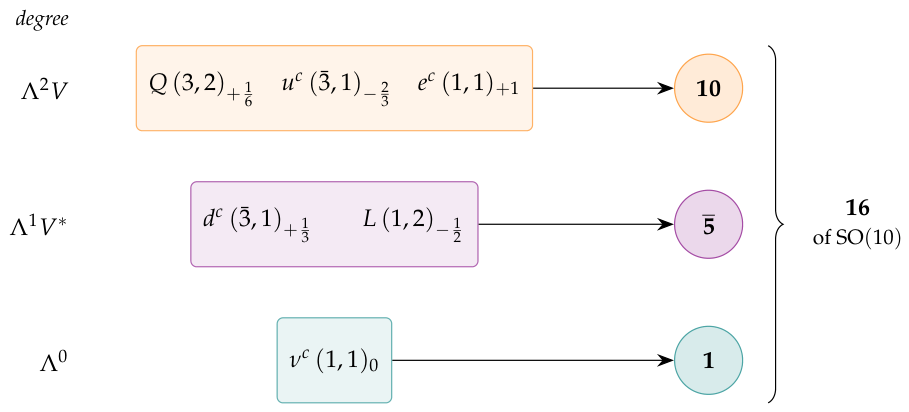
That “matter is a spinor” bears directly on whether the frame is gauged simply or as a product.
Proposition 8.2
(Unification forced by the relational ontology). Two principles already foundational to the programme fix the gauge group.
(i) One frame.“Matter is a spinor”, the spinorial architecture that gives the weak doublet and chirality, requires the internal frame to be a single rank-five Hermitian frame V over K, whose chiral spinor is the generation. Two separate frames (a colour and an isospin frame) would carry reducible matter and would not force the hypercharges, which descend from the traceless generator of the combined V (Theorem 8.1); the single anomaly-free is the evidence that there is one frame.
(ii) No absolute frame. By the relational ontology, the same “frame data are not absolute” that makes a cell-local geometric reframing the diffeomorphism gauge of gravity and a cell-local rephasing the electromagnetic (Recipe 3.2), the decomposition into colour and isospin is a choice of basis, not a substrate primitive. The cell-local reframings that mix colour and isospin are therefore gauge symmetries. These are exactly the off-block rotations of V: of the generators, the block-diagonal ones are the product group, and the remaining 12, the complex off-block, are the leptoquarks, the colour-isospin reframings. Gauging them is forced, so the unitary reframings of (; cyclotomic reading ) gauge to the simple group . The extension to gauges in addition the Clifford-frame reframings of the quadratic space , the finite Bogoliubov transformations under which the generation spinor is irreducible and which the gauge-singlet selects over ; that these extra reframings are relational gauge freedoms is the finite Clifford-frame construction, held with the projection-pillar bridge (). That the off-block reframings are genuine automorphisms, and not merely formal rotations, reduces to the programme’s projection pillar. The decomposition is a substrate-global datum: its blocks differ by their centre torsion— for colour, for isospin (Section 7)—read off the order- non-split torus, not off any cell or link. By the projective incompleteness of a bounded observer—every reading is a projection strictly smaller than the whole, structure beyond the comprehension horizon left unresolved [38]—a local frame cannot read that global torsion: every observable in the bounded observer algebra , the gauge-invariant functionals supported on at most H links, is invariant under the off-block reframings, since the distinguishing -versus- torsion sits at carrier scale beyond the H-link resolution, so those reframings act trivially on and are genuine local automorphisms. The colour–isospin reframings are then gauge and the structure group is simple. The horizon estimate this needs is already exact. The distinguishing datum, which directions of V carry the (colour) versus (isospin) central torsion, belongs to the order- non-split torus, of carrier cardinality, so aligning a bounded frame to it requires coherent reading across steps. Coherent reading caps at the coherence horizon [34,36], beyond which the chart wraps and the alignment washes out, exactly as the prime reconstruction does; exhaustive certification caps lower still, at the decidability horizon . The split is therefore beyond the horizon for every bounded observer, so the forcing of is a theorem of the relational ontology and the projection pillar, with no open estimate (Section 11, Tier 4).
The product would arise only if the split were absolute, a privileged decomposition the substrate maintains, which the relational ontology forbids: one cannot gauge the colour and isospin reframings while declaring the reframings between them non-physical. Unification is thus forced by the same principle that forces every other gauge symmetry in the programme; the bosons stand to the colour-isospin reframing as the to the isospin reframing and the photon to the phase reframing. The product is the broken-phase appearance: below the scale at which the observer’s frame resolves the colour/isospin distinction, that split is effectively fixed, giving the a mass at that scale, whence the proton lifetime yr for a substrate-scale , far above the bound [52], and the coupling near-miss of Proposition 8.3 as a prediction that completing structure restores exact unification at the substrate scale. Residual, not the principle: the precise unification scale and near-miss magnitude (a running computation) and the explicit Standard-Model breaking chain (model-building).
Figure 3.
Why the gauge group is simple, not a product (Proposition 8.2). The generators of acting on the one frame : the block-diagonal Standard Model ( colour 8, isospin 3, hypercharge 1 on the diagonal, •) totals 12; the complex off-block—the 12 leptoquarks—are exactly the cell-local reframings that mix colour and isospin. The relational ontology (no absolute split) makes those reframings gauge, so the off-block is forced and the group is the simple , not the product.
Figure 3.
Why the gauge group is simple, not a product (Proposition 8.2). The generators of acting on the one frame : the block-diagonal Standard Model ( colour 8, isospin 3, hypercharge 1 on the diagonal, •) totals 12; the complex off-block—the 12 leptoquarks—are exactly the cell-local reframings that mix colour and isospin. The relational ontology (no absolute split) makes those reframings gauge, so the off-block is forced and the group is the simple , not the product.
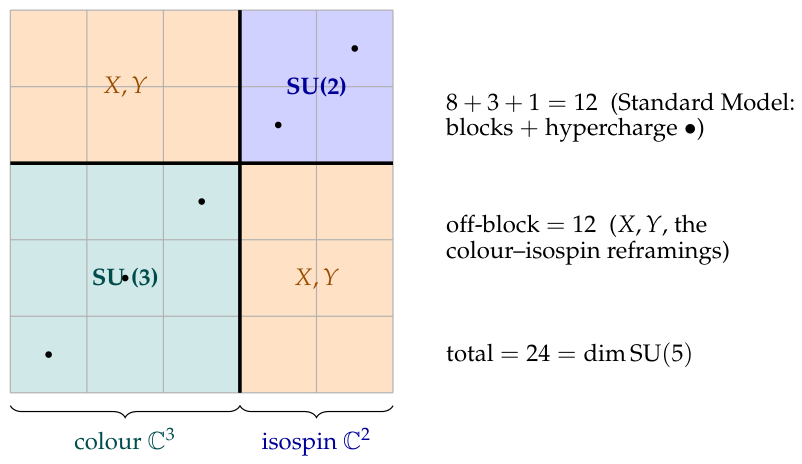
With the matter content fixed, the couplings run, connecting these substrate-scale values to the laboratory.
Proposition 8.3
(The running connects to ). The one-loop coefficients —the standard three-generation, one-Higgs-doublet Standard-Model values, not those of a single generation—are fixed by the matter content. Running the measured couplings up [4], near GeV, where exactly: the angle derived from the rank-five frame is the value takes at electroweak unification, and the running carries it to the measured . The strong coupling comes within of the same point, the known Standard-Model near-miss, so exact unification, and with it the precise , reduces to the unification problem. Verified numerically.
Figure 4.
One-loop running of the three couplings with the coefficients —the standard three-generation, one-Higgs-doublet Standard-Model values, not those of a single generation (Proposition 8.3). The electroweak pair meets near GeV, where exactly—the value derived from the rank-five frame—which the running carries to at . The strong coupling comes within of the same point: the known Standard-Model near-miss, whose closure is the residual of Proposition 8.2.
Figure 4.
One-loop running of the three couplings with the coefficients —the standard three-generation, one-Higgs-doublet Standard-Model values, not those of a single generation (Proposition 8.3). The electroweak pair meets near GeV, where exactly—the value derived from the rank-five frame—which the running carries to at . The strong coupling comes within of the same point: the known Standard-Model near-miss, whose closure is the residual of Proposition 8.2.
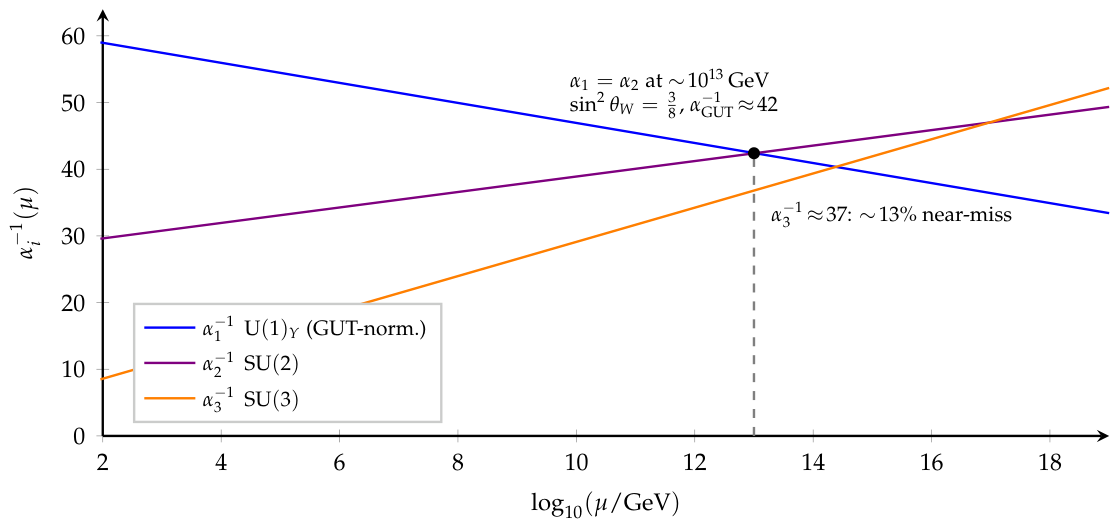
The masses are the remaining content of the matter sector. They are not the gauge quantum numbers but the coupling of the spinor matter to the Higgs, the spinor-frame alignment field whose vacuum value breaks the electroweak symmetry.
Proposition 8.4
(The mass mechanism, the seesaw scale, and b–). A Dirac mass is the Higgs-mediated bridge between the drive-aligned (left) branch and its Frobenius conjugate (right), with v the spinor-frame misalignment: the mass connects the two chiralities that the weak interaction (Proposition 6.2) separates. Three consequences are structural. (i) The right-handed neutrino , the singlet of the generation (Theorem 8.1), is a gauge singlet and admits a Majorana mass at the unification scale; the seesaw [53,54,55] then gives – eV for – GeV, bracketing the observed eV. (ii) The structure of the gives b–τ Yukawa unification, at the unification scale, which QCD running carries to –3, the observed [56]. (iii) Mass is the overlap of a fermion’s winding with the Higgs winding, so the heaviest fermion (the top, ) is the maximally coherent one and the lighter fermions are suppressed overlaps, a Froggatt–Nielsen-type hierarchy [57]. The precise spectrum and the CKM and PMNS mixings [58,59,60], the flavour problem, reduce to the inter-generation winding assignments, with the mass-matrix texture constrained by the representation theory; they are not derived here.
Remark 8.5
(Consistency of the two mass readings). The programme carries two notions of mass that cohere as total and source, not as rivals. The gravitational cardinality is a winding rate, the share of the totality [35]; the flavour Yukawa is , as above. The Dirac mass term is precisely the left–right bridge that makes the spinor phase wind at the Compton rate, so the Higgs-induced is a winding rate: for an elementary fermion the cardinality and the Yukawa mass are one quantity. For a composite the cardinality is the total winding rate, summing every contribution; the proton’s is gluon-field binding (, Proposition 7.3) and only current-quark Yukawa, so gravity couples to the dimensional-transmutation scale, not to the Higgs—consistent, the cardinality being the sum and the Yukawa one term. Two residues follow. (i) The cardinality is an integer cell count and its continuum reading, so the exact (cyclotomic) winding overlap must land on that integer, a consistency condition on the inter-generation winding assignments, not a free choice. (ii) The Higgs scale sits at , far below the drive’s natural winding scale; the cardinality reading would otherwise place every elementary fermion near the Planck mass. This is the electroweak hierarchy, the one genuine tension between the readings, and its resolution is the same dimensional transmutation that places exponentially below the Planck scale (Proposition 7.3): a dynamically generated v rather than a tuned one. The non-split synchronisation channel saturates and condenses, so v is its saturation scale, from the phase-channel capacity ; the integer gives the electroweak gauge-boson scale GeV; the Higgs vev GeV of Corollary 6.7 is times the gauge factor, and the precise coefficient is the cross-scale β-function, Ω-hard (v_scale.py). With no fundamental scalar the hierarchy is not fine-tuned but exponential, exactly as for the proton; the exact coefficient is the cross-scale β-function, Ω-hard (Remark 4.2), so v is decided by the totality, like .
The replication of the generation, and with it the inter-generation structure the masses reduce to, has a candidate origin in the Galois conjugation of the substrate’s extension tower.
Proposition 8.6
(Generations as Galois conjugates). Frobenius on the degree-n extension generates the cyclic Galois group of order n, so a primitive element has exactly n conjugates, an n-fold orbit of algebraically identical objects, differing only by the Frobenius label. At , the quadratic (spinor) extension, the two conjugates are the two chiralities, the derived content of Proposition 6.2. At , a cubic extension, the three conjugates are three generations. Because Galois conjugates share a minimal polynomial, they share every algebraic, hence gauge, property: this is generation universality, the three families identical in their representations and differing only in mass, the mass splitting being the per-conjugate winding overlap of Proposition 8.4. The degrees 2 and 3 are coprime, so chirality and generation are independent factors over , matching that leptons carry generation but not colour. Orbit sizes verified = degree for .
The number of generations is thereby the degree of the matter extension, and chirality is the same mechanism at degree two. Why that degree is three, the crux, is answered by the closure of the primitive roles.
Proposition 8.7
(Three generations from the generative roles). The closed ladder of primitive roles splits by the generative/non-generative distinction [38]: counting () builds no new operation, iterating the last role returns to it, and is the unique non-generative role, while addition , multiplication , and exponentiation each build a new operation (translation, scaling, powering). Counting is the bosonic sector: by the spin-statistics connection [61] Bose statistics is occupation-counting (the number in a mode is a count), and the gauge connection is itself a phase count. The three generative roles are the three fermion generations : matter, forbidden occupation-counting by the exclusion principle, occupies the generative roles, not the counting one. Hence there are exactly three generations, the three generative roles, and no fourth, the ladder closing (the fifth step returns to counting); this is the degree three of the matter extension. The role ladder, each role iterating the previous, orders the generation masses: addition (lightest), multiplication, exponentiation (heaviest, the top), matching the observed steep hierarchy (geometric-mean masses MeV, GeV, GeV). Status. The closure of the ladder and its split are theorems of the substrate arithmetic [38]. The identification of the counting role with the bosonic carrier and of the three generative roles with the fermion generations is the programme’s role-to-matter bridge, held on the same footing as the force identifications of Section 9; given it, the generation count is a theorem (): three families and no fourth. The available enrichment, which would lift to T, is to derive the bridge itself from spin-statistics—fermionic occupation numbers are also counts, restricted to —through a formal {role Fock or Galois sector} map.
That three generations should have an algebraic origin is the thesis of the division-algebra and exceptional-Jordan programmes [26,29,30,31]; here the origin is instead the closure of the primitive roles. The boson/fermion distinction is thereby the count/generate distinction, and the three-generation count is the count of generative roles, the same closure that gives four interactions (Section 9) giving, through its split, one bosonic carrier and three fermion families. The residual is the precise spectrum (the role ladder fixes the ordering and the steepness qualitatively; the precise values are the flavour residual of Proposition 8.4), and the formal identification of each Galois conjugate with its role.
The one charged-lepton mass relation the substrate fixes exactly, against a Standard Model that leaves it unexplained, is Koide’s.
Proposition 8.8
(Charged-lepton Koide relation from cube-root coherence). The three generations are a single cube-root Galois orbit (Proposition 8.6), carrying the regular representation of the generation cycle , so any generation-indexed real datum resolves on the cube-root basis . Write the square-root masses as , with trivial (generation-democratic) component and coherent cube-root component . Parseval on gives , hence the exact identity
So exactly when , the framed-rational self-dual value (equivalently the norm relation , N the Frobenius norm of ). The quarter-turn places in the split torus and fixes this self-dual value; its cyclotomic-ledger reading is the diagonal , the Bell-saturating element [36], with resident in or the cyclotomic ledger rather than in . This is the only self-dual split the substrate admits between the generation-democratic axis and the cube-root coherence plane, the cube-root orbit supplied by and the self-dual amplitude by , the two residues whose coincidence forces (Proposition 9.1). The Koide value is their product read on the lepton masses: the cubic married to the four-fold. The identity (3) and the quarter-turn value are exact in the scale-periodic framed-rational arithmetic of the shell, the cube root on the order-three subgroup of the non-split torus and the norm N on , verified over with (koide.py). Against the measured charged-lepton masses , matching to one part in [approx, a continuum reading of the data].
The functional form (3) is exact and assumption-free; its single number is the substrate’s self-dual value . The residual winding phase that distributes the individual masses around the orbit, as against their coherent combination Q, belongs to the -hard flavour residual of Proposition 8.4 (the carrier-scale winding phase), not to the Koide value, which the two structural residues fix on their own.
The same Hermitian structure removes the strong-CP angle.
Proposition 8.9
(Vanishing strong-CP angle). The QCD vacuum angle vanishes on the substrate, , with no axion. (i) The local, relational-frame-covariant, gauge-invariant action terms on the colour connection are spanned by the real plaquette class functions (Theorem 5.4, Proposition 7.2), each parity-even and fixed by the orientation flip . An orientation-sensitive term such as is parity-odd, changing sign under that flip, so it is not relational-frame-covariant: it would require a fixed sign of the spacetime volume form, an absolute orientation, which is frame data with no frame-independent meaning (Proposition 6.3), and colour is drive-invariant (Section 7) so no drive selects one. No parity-odd term survives the classification of substrate-native action terms, and the bare . (ii) The quark mass matrices are Hermitian over the quadratic extension: mass is the modulus-square of a Hermitian generation amplitude (generation universality, Proposition 8.6) with real Frobenius-fixed spectrum (Proposition 8.8). Then with forces into the Frobenius-fixed real subfield , so its phase, the image of in , is trivial and . The Cabibbo–Kobayashi–Maskawa phase lives in the up–down misalignment of the two non-commuting Hermitian matrices, not in their determinants, so a nonzero coexists with . The strong-CP angle is structurally absent, not tuned, and no axion is required. Verified over , : the Hermitian mass matrices have real determinant while the up–down misalignment is non-trivial (strongcp.py).
9. Why Four Interactions
The complexity companion proves the arithmetic ladder closes after four primitive roles [38]. The four interactions align with the four roles, each force gauging the frame datum of one role (Table 3).
Gravity and electromagnetism gauge the two abelian groups the field is made of, and are correspondingly mature. The weak force gauges the spinor frame, built as a representation but ungauged as a force until here. The strong force sits at the closure of the ladder, where its confinement is the saturation that closes the channel. This alignment is the programme’s central role-to-force bridge, not a naive bijection: gravity occupies the geometric/additive frame (roles 1–2), counting is the bosonic-carrier role rather than a force, and the strong sector sits at the closure rather than at a distinct fifth role, so the four interactions are not in one-to-one correspondence with the four roles. The closure of the ladder is a theorem of the substrate arithmetic; given the bridge there are four interactions and no fifth (, Section 11, Tier 4). Deriving the bridge from first principles, the formal role-to-module correspondence, is the available enrichment.
The same closure has a second reading, the matter content. Its split by the generative/non-generative distinction (Proposition 8.7) is the boson/fermion split: the non-generative counting role is the bosonic carrier (Bose occupation is counting), and the three generative roles—addition, multiplication, exponentiation—are the three fermion generations. Thus the one closure organises, at once, the four interactions (the roles as frame data), the three generations (the generative roles), and the boson/fermion distinction (count versus generate); and it forbids both a fifth force and a fourth generation, the ladder returning to counting; given the role-to-matter bridge these counts are theorems (, Section 11, Tier 4), the available enrichment being the first-principles role-to-module map.
Figure 5.
The closure of the four primitive arithmetic roles, read twice. Left: gauging each role’s frame datum gives the four interactions—the additive (counting/addition) geometric frame gravity, the multiplicative phase frame electromagnetism, the extension spinor frame the weak force, the saturating colour frame the strong force. Right: the generative/non-generative () split gives the matter—the non-generative counting role is the bosonic carrier, the three generative roles (addition, multiplication, exponentiation) the three fermion generations. The ladder closes, the fifth step returning to counting, forbidding a fifth force and a fourth generation (Proposition 8.7).
Figure 5.
The closure of the four primitive arithmetic roles, read twice. Left: gauging each role’s frame datum gives the four interactions—the additive (counting/addition) geometric frame gravity, the multiplicative phase frame electromagnetism, the extension spinor frame the weak force, the saturating colour frame the strong force. Right: the generative/non-generative () split gives the matter—the non-generative counting role is the bosonic carrier, the three generative roles (addition, multiplication, exponentiation) the three fermion generations. The ladder closes, the fifth step returning to counting, forbidding a fifth force and a fourth generation (Proposition 8.7).
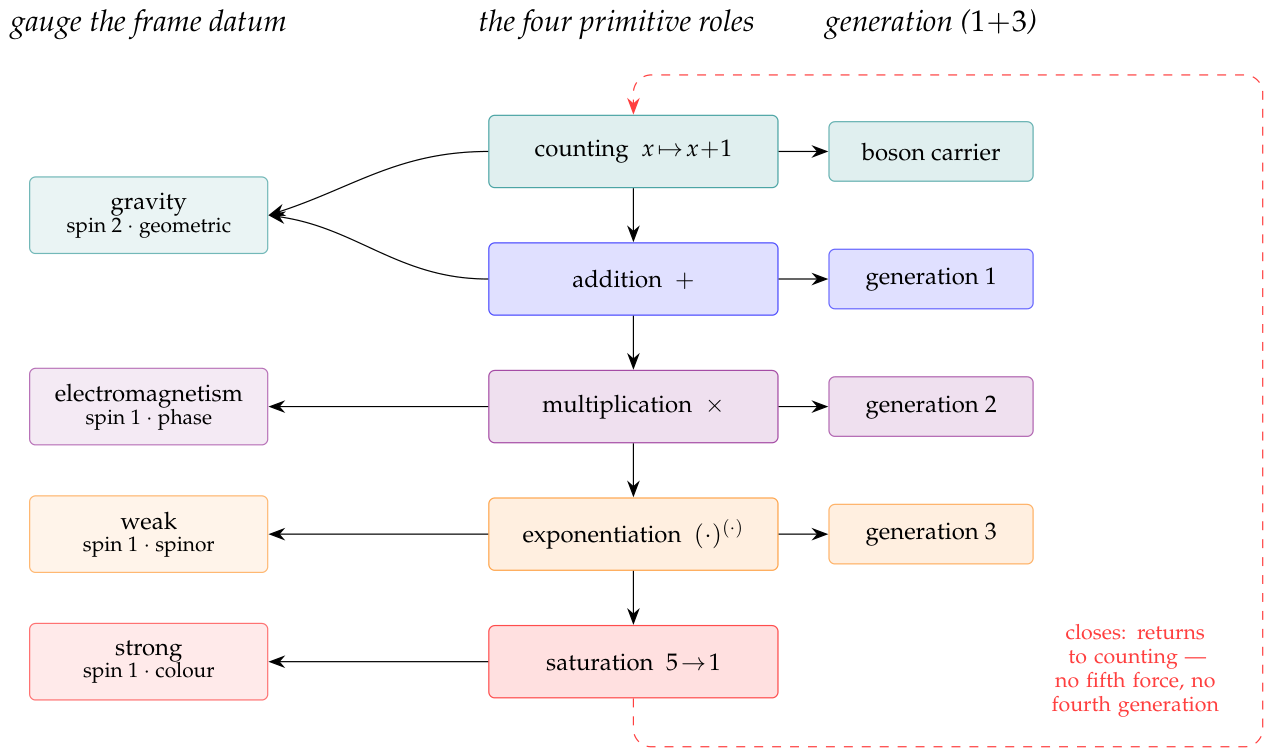
The same two structural numbers, the four-fold and the cubic colour, fix the substrate’s defining residue.
Proposition 9.1
(The substrate residue ). Symmetry-completeness (the quarter-turn , complex quantum mechanics) requires , i.e., , the quarter-turn living in the split torus of order ; the colour-triality centre requires , i.e., , the cube roots living in the non-split torus of order . The same is required independently by the three-generation cubic Galois orbit (Proposition 8.6), so the cubic has a generation-sector source and the colour rank does not presuppose colour triality. By the remainder theorem these jointly hold iff , the unique admissible residue, the arithmetic shadow of the four-fold and the cubic, one in each frame torus. In the relational ontology the Carrier is the totality and the observer is a shell within it, so there is no external ensemble to select among: a self-consistent observer-bearing substrate must host its own composite observers, which requires complex amplitudes and colour-confined matter, and the residue is forced by that self-consistency rather than chosen anthropically. Verified: is the unique residue carrying both structures, of Dirichlet density among primes, so admissible are abundant.
10. Finitism
The programme admits no infinity, completed or potential. Completed infinity falls to the standard reductio (Cantor, Russell, Gödel, Turing); potential infinity, the induction-generated “and so on without end”, falls too: its guarantee that a successor always exists quantifies over the completed totality it claims to forgo (classical induction’s conclusion is a statement about a finished ), and stripped of that covert completion each successor is a fresh act of finite cost in its medium, leaving a bounded finite process rather than an infinite one. Iteration is therefore the closed counting cycle , which returns rather than enclosing without end, the same closure that, one level up, returns the fifth role to counting. Accordingly an exact claim must live in finite, finite-field, or cyclotomic arithmetic and be verified exhaustively, with the continuum only a labelled degenerate idealisation. Every exact claim above lives in such an arena: gauge invariance is an integer identity exhaustive over a basis (); the uniqueness dimension is an exact rank over a finite field (); the Wilson action is a cyclotomic value in (e.g., with , the Tsirelson ledger element [36]); and the Weinberg angle is an exact rational, . These exact identities are polynomial in the shell parameter q (characteristic-uniform): each holds as an identity in reduced modulo the shell, so the exhaustive certificates at carry to the Carrier shell by the transfer principle for such identities.
The continuum constructs that appear—the Coulomb asymptotics and the solid angle, the small-momentum relevant/irrelevant split, the comparison of and to their measured values—are degenerate-idealisation readings of exact objects, consistent with the corpus’s use of lattice potential theory and the classical sphere. The lattice Fourier transform is itself not a continuum operation, since its modes are roots of unity; on the torus that ring is , the quarter-turn ledger in which the quantum companion computes amplitudes, so the electromagnetic Coulomb Green’s function (there the exact rational , all transform eigenvalues integers) and the quantum Born-rule ledger are evaluated in one and the same finite ring. No exact claim depends on a continuum construct; the continuum enters the field sector only where it enters the rest of the programme, as the shadow the finite structure casts at large scale.
11. Status: From Exact Arithmetic to Phenomenology
The construction reads in five tiers, hinged on the correspondence theorem (Section 4): the exact finite arithmetic; the correspondence; the Standard-Model recovery it yields within the bounded window; the structural counts; and the phenomenology. We sort the claims accordingly.
Tier 1: exact finite arithmetic. The electromagnetic gauge structure (charge as a quantised winding index, the massless photon by drive-invariance, the repulsive sign) as integer identities over (Table 2); the uniqueness of the relevant Maxwell operator and the gauge-invariance restoration of rotational invariance (Theorem 5.4); the cell-local non-abelian weak and gluon connections with exact Wilson gauge invariance (Propositions 6.1, 7.2); the colour rank-three frame with exact triality centre (Proposition 7.1); maximal parity violation as the drive-coherent versus drive-rotated splitting of the spinor winding, with the Frobenius branch decoupling exactly (Proposition 6.2); the electroweak-breaking misalignment and the photon’s masslessness (Theorem 6.4); the Weinberg trace formula for a complete generation (Proposition 6.9); and the Standard-Model generation’s field content, hypercharges, charges, and anomaly freedom as the rank-five spinor (Theorem 8.1). These are identities of finite-field or representation arithmetic.
Tier 2: the correspondence (Theorem 4.1, proven on the resolvable class). Proven: the abelian inclusion (Theorem 4.3); the positive, substrate-native cyclotomic action (Theorem 4.5) and the exact embedding (Theorem 4.6); the low-curvature Yang–Mills sector with the Dynkin-index coefficient and per-link residue (Theorem 4.8); the uniform window expectation bound on the resolvable class (Theorem 4.11); and the confinement area law from positivity (Proposition 4.12). Beyond the window, -hard (Remark 4.2): the high-curvature uniform bound, fixed by the imported Deligne–Lusztig character equidistribution, and the cross-scale beta-function running, an irreducible Ω-hard residue (an -term character sum decided by the totality but beyond the bounded observer’s coherence horizon; decidable, not an obstruction of principle).
Tier 3: Standard-Model recovery, conditional (). As corollaries of Theorem 4.1: the Coulomb law and Maxwell dynamics (Proposition 5.3), a theorem on the resolvable window. The continuum results that reach beyond it—the one-loop running carrying to (Proposition 8.3), the sign of asymptotic freedom and the QCD scale (Proposition 7.3), and dimensional transmutation—are , with the cross-scale extension -hard (Remark 4.2). The propagating mass gap (massless versus massive modes), the custodial , and the current as a scattering amplitude are theorems of the resolvable window conditional on the electroweak alignment bridge, the finite Higgs/alignment-field action with its potential and drive-broken vacuum together with the external drive’s action on the internal frame: given that bridge the mass spectrum and are the Hessian of at (Proposition 6.6) and the chiral current and four-fermion amplitude follow (Proposition 6.2, Corollary 6.7). The absolute electroweak scale v remains, a dimensional-transmutation quantity that is -hard like the QCD scale.
Imported. Lattice gauge theory and the Wilson action; lattice potential theory [42,43]; the continuum uniqueness of Maxwell; the electroweak template; non-abelian asymptotic freedom; the renormalisation-group running of couplings.
Tier 4: structural results, conditional on the role-to-matter bridge (). The closure of the four primitive roles is a theorem of the substrate arithmetic [38]: the fifth step returns to counting. Identifying the roles with the physical sectors—each role’s frame datum with an interaction, the counting role with the bosonic carrier, the three generative roles with the fermion generations—is the programme’s role-to-matter bridge, held on the same footing as the force identifications of Tier 1. Given it, the four-interaction count and the absence of a fifth force, the three generations and the absence of a fourth, the boson/fermion split, and the generation mass ordering are theorems (; Section 9, Propositions 8.7, 6.3). The forcing of is a theorem of the relational ontology and the projection pillar: the global torsion belongs to the order- non-split torus, hence sits at carrier scale above the coherence horizon (and a fortiori the decidability horizon ), so the off-block reframings are local automorphisms with no residual estimate left open (Proposition 8.2). The available enrichment, which would lift these from to T, is the first-principles derivation of the bridge: a formal {arithmetic role Galois or Fock sector} map. Because the Carrier is the entire substrate and the role ladder is closed, the derived generation-and-gauge sector is the whole of matter, there is no further sector, so the exclusion predictions of Section 12 (no fourth generation, no fifth force, an empty desert, no new scalars or vector-like matter, no supersymmetry, no particle dark-matter sector) follow from the construction and are not separately assumed.
Tier 5: phenomenology, conditional on unification and coupling data. The laboratory values of the three couplings and the running below (Proposition 5.5; with a convention-fixed normalisation, not yet a prediction of a physical coupling); and from the matter content, and the non-perturbative completion of confinement (Proposition 7.3); the explicit unification scale, the three-coupling near-miss, and the Standard-Model breaking chain (Proposition 8.2); the fermion mass spectrum and the CKM and PMNS mixings, the flavour problem, reducing to the inter-generation winding assignments (Proposition 8.4); and the baryon asymmetry (Proposition 6.3). None is an obstruction of principle.
The development gauges all four interactions from frame data, derives the electroweak breaking and strong confinement mechanisms, and (supplying the shared matter input the couplings reduced to) derives one complete Standard-Model generation, with its gauge group, hypercharges, charges, and anomaly freedom, as the spinor of the rank-five internal frame. The generation count is organised by the split of the closed role ladder, the bosonic counting role and the three generative fermion roles (Proposition 8.7), which ties four interactions, three generations, and the boson/fermion distinction to a single closure; given the role-to-matter bridge this is a theorem (), the first-principles derivation of the bridge being the one available enrichment. Simple unification is forced by the relational ontology, the colour-isospin reframings being gauge (Proposition 8.2), the global split sitting at carrier scale, above the coherence horizon , hence unreadable to any bounded observer; chirality is settled relationally (Proposition 6.3); and the substrate residue is forced by self-consistency (Proposition 9.1). The entire Standard-Model structure has been traced to the finite substrate’s frame data and the closure of its primitive roles. The full dependency ledger—every claim tagged import, bridge, definition, theorem, or -hard—is collected in Appendix H.
12. Predictions
Because the closure of the primitive roles fixes a complete Standard Model with its next structural layer at the substrate scale, the programme’s distinctive content is a set of sharp negations: the spectrum is minimal and the desert above it empty, so most searches for new physics are predicted null. This is where the construction departs from the grand-unified, supersymmetric, and dark-matter mainstreams, each of which places new states within experimental reach. Each prediction below is marked forced (a consequence of the established structure given the role-to-matter bridge of Tier 4, on the same footing as the force identifications: the Carrier being the entire substrate and the role ladder closed, the derived sector is the whole of matter, so the exclusions follow; a completeness theorem classifying every internal module and automorphism would lift them from conditional to unconditional), sector (resting on the matter construction), or pending (a sharp number the formalism points to but does not yet derive), with its falsifier.
- 1.
- No fourth generation and no fifth interaction [forced]. The role ladder closes, the fifth step returns to counting (Proposition 8.7), and the Carrier is the entire substrate, so a fourth chiral family and a fifth fundamental force are forbidden, not merely absent (Section 11, Tier 4). Falsifier: any fourth-generation fermion, or any new fundamental interaction.
- 2.
- A desert to the substrate scale [forced]. The gauge group is exactly until the substrate resolves the colour–isospin split (Proposition 8.2); no new gauge boson, vector-like fermion, or extra scalar lies between the electroweak and substrate (– GeV) scales. Falsifier: a , , leptoquark, second Higgs doublet, or compositeness signature at the LHC or a future collider. This is the sharpest divergence from supersymmetry, extra dimensions, and composite-Higgs scenarios.
- 3.
- No TeV supersymmetry [forced]. The three-coupling near-miss (Proposition 8.3) is closed by the completion at the substrate scale, with the running carried by purely Standard-Model content; there are no superpartners enforcing exact low-scale unification. Falsifier: discovery of superpartners, or evidence that unification demands TeV-scale thresholds.
- 4.
- The proton is effectively stable, yr [forced]. The leptoquarks acquire mass at the substrate scale, not at GeV, so reaches – yr for near the Planck scale (Proposition 8.2), orders beyond the yr of supersymmetric and the yr reach of Hyper-Kamiokande. Falsifier: observation of near – yr in Hyper-Kamiokande, DUNE, or JUNO, against the current bound [52]. The programme predicts these searches find nothing.
- 5.
- Majorana neutrinos, heavy singlets, no light sterile neutrino [sector]. The is the gauge-singlet of the generation (Theorem 8.1), so it takes a Majorana mass at unification and drives the seesaw (Proposition 8.4), the three right-handed states sitting at – GeV. Falsifier: a confirmed eV-scale sterile neutrino, or evidence that the light neutrinos are Dirac. This diverges from Dirac-neutrino and sterile-neutrino interpretations and is consistent with .
- 6.
- No new particle of dark matter [sector]. The matter content is exactly one Standard-Model generation, triplicated, with heavy ; the construction contains no weakly-interacting massive particle and no axion. Falsifier: a positive signal in a direct-detection (LZ, XENONnT) or axion (ADMX) experiment. Dark matter, if not a Standard-Model state, must then reside in the gravitational/substrate sector, a residual burden of the programme.
- 7.
- No new-physics contribution to the muon anomaly [sector]. With no states beyond the Standard Model, must be accounted for by Standard-Model (notably hadronic) contributions. Falsifier: a robustly established beyond-Standard-Model excess; the current lattice and experimental trend toward the Standard-Model value favours this prediction.
- 8.
- The charged-lepton Koide relation is exactly [structural, ]. The empirical identity , which the Standard Model does not explain and which holds to one part in , is the cube-root generation orbit at the self-dual value (Proposition 8.8): is exact and is the quarter-turn () self-dual amplitude on the cubic () plane. The functional form and the self-dual value are derived; the selection of the charged-lepton mass vector onto that orientation is the -hard flavour residual (the carrier-scale winding phase), not derived here. Falsifier: a charged-lepton mass measurement displacing Q from beyond the per-mille winding-phase corrections.
- 9.
- Vanishing strong-CP angle without an axion [structural, ]. The QCD vacuum angle vanishes on the substrate, with no axion (Proposition 8.9): the colour action carries no topological term and colour is drive-invariant, so the bare , and the Hermitian quark mass matrices have real determinant, so , while the Cabibbo–Kobayashi–Maskawa phase sits in the up–down misalignment. Falsifier: a neutron electric dipole moment above the QCD floor, or a discovered axion.
The programme is thereby falsified by essentially any confirmed new particle, force, or proton decay within experimental reach, and it derives two Standard-Model-unexplained results, the charged-lepton ratio (Proposition 8.8) and the vanishing strong-CP angle (Proposition 8.9).
13. Reproducibility
Every quantitative and algebraic claim is verified by an accompanying suite linked below, with a per-claim map to the propositions above (Appendix G): the finite gauge invariance and superselection (exact integers, exhaustive), the charge/Stokes identities, the Coulomb coefficient against the lattice Green’s function, the EM/gravity sign dichotomy, the uniqueness enumeration (exact finite-field rank, with a forward-difference control), the symbolic transversality reduction, the electroweak breaking eigenvalues and centraliser over , the neutral-sector , the Weinberg trace formula, the and constructions, the rank-tower forcing and the construction on the smallest admissible residue (missing_rank.py), the parity-violation character sums, the generation anomaly cancellation, and the running. Each exact claim is in addition evaluated in finite, finite-field, or cyclotomic arithmetic (Section 10). The appendices below fold in the full constructions, proofs, and verifications.
Appendix A. The Electromagnetic Construction and Claim Ledger
The matter field is the phase character of , , realised additively through the discrete logarithm as . A gauge transformation is a cell-local reframing , ; the connection transforms by , the covariant difference being invariant; the field strength is the plaquette holonomy . The seven claims of Table 2 are discharged on the periodic cubic chart: claims one to five hold as exact integer identities over at every corpus shell , verified deterministically over a basis of gauge fields (); the Wilson action is the cyclotomic real part , invariant because F is. The Coulomb coefficient is the static potential of a point charge solving ; fitting on gives , with the on-site value against the Watson lattice-Green’s-function constant [62] as a cross-check. The repulsive sign follows from the field-quadratic action: the interaction energy of two like charges, computed from the same solve, is and falls with r (repulsion), against the gravitational .
Appendix B. Uniqueness of the Relevant Maxwell Operator
Let be the symbol of a translation-invariant, range-one, hypercubic-invariant quadratic functional of the connection; gauge invariance is transversality , .
Lemma B.1
(No zero-mode mass). . Since K is a trigonometric polynomial (locality) and , , differentiating at gives . The holonomy zero-mode (Wilson-line) mass term, which transversality alone permits, is excluded by locality.
Lemma B.2
(Transversality forces the projector). The leading homogeneous part is hypercubic-invariant of degree two, hence (the third term the unique rotational-symmetry-breaking invariant). Transversality reads for all k; evaluating at and gives , , so , the transverse projector, the Maxwell action. Confirmed symbolically: transversality returns , .
The anisotropic term is annihilated by gauge invariance: gauge invariance restores rotational invariance at the relevant order. An exact enumeration over the order-48 point group (link signed permutations, the constraints intersected through the integer Gram matrix, its rank taken over the prime fields and ) gives, stably for , a two-dimensional range-one admissible space, splitting into one relevant operator (whose symbol matches the transverse projector to one part in ) and one irrelevant operator of leading order . Maxwell is the unique relevant adjacency-local gauge functional; the irrelevant companion is suppressed by two powers of the resolution floor.
Appendix C. The Finite Non-Abelian Gauge Groups
The weak group SU (2,).
Over with Frobenius , , of order . For (, , conjugation ): , non-abelian, with for every element. The connection assigns to each link (), transforming by ; the plaquette holonomy is the ordered product. Under a gauge map the link factors telescope, , so , the Wilson action , is invariant, an exact identity; verified that over all pairs, that the plaquette obeys the conjugation law on explicit elements, and that the doublet covariant difference satisfies .
The colour group SU (3,).
On with , , of order . For (): (exhaustive enumeration over ), centre , the norm-one cube roots of unity, equal to the colour-triality when . The gluon connection has the same Wilson form, gauge-invariant by conjugation (verified exhaustively over the 216 elements), the triplet covariantly coupled. The gluon self-coupling is the non-abelian curvature: for non-commuting constant links , whereas the diagonal control returns I, the field strength carries the commutator term, the eight rank-two gluons self-interacting.
Appendix D. Electroweak Breaking and Chirality
Breaking, over .
With drive , , the adjoint action on basis is , , : the eigenvalue 1 on H is the drive-invariant massless photon, the eigenvalues gap the charged . The centraliser of in has order (the split torus, the unbroken ). The neutral mass-squared matrix is rank one: a massless photon, a massive Z, , and exactly for the doublet (spinor) Higgs.
Parity violation.
On the boost cycle (additively ), Frobenius is inversion, helicity reversal (verified for ); the drive commutes with only if . Over one drive period the weak coupling to the drive-aligned (left) branch sums coherently to , and to the Frobenius (right) branch to exactly (character orthogonality, , ): maximal , the right branch the right-handed weak singlets.
Appendix E. The Fermion Generation
The internal frame carries (traceless; the relative ratio fixed by the split, the overall scale a charge-lattice convention). The chiral spinor decomposes as with weights the sums of fundamental weights: splits into colour–colour pairs (, , ), colour–isospin pairs (, , Q), and the isospin–isospin pair (, , ); gives and ; gives . The electric charges are the observed values. Over the fifteen-plus-one Weyl fermions, and (anomaly cancellation, exact rationals), and , , so ; a lone lepton doublet would give , fixing the angle to the multiplet.
Appendix F. Couplings, Hierarchies, and Running
Channel unity and the bare coupling.
with (channel unity) and (charge = action = phase quantum), so , . The saturating Gauss law reproduces the weak-field coefficient and gives an electromagnetic core ( in shell units) inside which the linear law fails, cutting off the classical self-energy divergence to a finite value.
Hierarchies.
The electromagnetic-to-gravitational ratio is , a reading of . The strong is positive (, 7); is exponentially below the Planck scale, and gives , the gravitational coupling as the square of the dimensional-transmutation factor.
Running.
With (the three-generation, one-Higgs-doublet Standard-Model coefficients), the measured couplings give at GeV with and there exactly, connected to at ; there is the Standard-Model near-miss.
Masses.
The Yukawa is the Higgs bridge between the drive-aligned and Frobenius branches, . The seesaw, with Majorana mass : , which for GeV gives eV at GeV (with ), bracketing eV. The relation at runs to –3 (observed ). The winding-overlap mechanism gives a smooth Froggatt–Nielsen hierarchy in winding distance (a partial character sum over the coherence window decays with distance k), the top being the aligned, maximally coherent overlap; the precise spectrum and CKM/PMNS mixings reduce to the generation windings (Proposition 8.6).
Appendix G. Reproducibility Map
The validation suite (Section 13) maps to the propositions one-to-one: em1_prototype (Table 2, Propositions 5.2, 5.3); enumerate_maxwell (Theorem 5.4, the uniqueness enumeration with a forward-difference control); ew1 (Theorem 6.4, Propositions 6.6, 6.9); p3, p5, qcd (the , constructions, Propositions 6.1, 7.2, 7.1); p4 (Proposition 6.2); p10 (Proposition 6.3, the orientation-flip invariance); generation (Theorem 8.1); p9, p9b (Propositions 8.6, 8.7, the Galois orbit sizes and the role split with the mass ordering); p8, p8b (Proposition 8.2, the irreducibility count, the off-block generator bookkeeping, and proton lifetimes); p11 (Proposition 9.1, the residue CRT and prime density); o2, p2, p6, p1, p7 (Propositions 5.5, 7.3, 8.3, 8.4, Theorem 5.6); and audit_finitism (Section 10), evaluating each exact claim in finite, finite-field, or cyclotomic arithmetic.
Appendix H. What Is Assumed, Imported, and Derived
The construction’s dependency structure is collected here in one place, so that every result above can be traced to its inputs and the surface a reader must accept is made explicit. Each row carries one status tag.
| tag | meaning |
| I | Import. A standard result or measured datum used here without reproof. |
| B | Bridge. An identification of a mathematical object with a physical one, the interpretive moves. |
| D | Definition. A naming or set-up move, carrying no empirical content. |
| T | Theorem. Derived within this paper from the rows above it. |
| -hard. Decided by the totality; not closeable by a bounded observer. |
| # | Move | Status | Source |
| A. Inputs: imported, not derived here | |||
| A1 | The finite substrate , cardinality (Planck units) fixed by the de Sitter entropy, with the phase cycle and the quarter-turn (the residue is derived, C11). | I | [35,36] |
| A2 | Lattice gauge theory and the Wilson plaquette action; lattice potential theory and the lattice Green’s function. | I | [6,42,43] |
| A3 | The continuum uniqueness of Maxwell, non-abelian Yang–Mills with its asymptotic freedom, and the renormalisation-group running of couplings. | I | [5,9,10] |
| A4 | The electroweak template ( with the Higgs mechanism) and the grand-unified template the generation falls into. | I | [1,2,44,45] |
| A5 | The Deligne–Lusztig / Weil character equidistribution invoked for the high-curvature extension of the correspondence. | I | [16] |
| A6 | The measured quantities used for comparison only: the three couplings and , the fermion masses and the CKM/PMNS mixings, the proton-decay bounds. | I | measured [52] |
| B. Bridges: mathematics → physics (the interpretive moves) | |||
| B1 | A cell-local change of an internal frame datum is a gauge symmetry; the connection that compensates it is the gauge field. | B | Section 3 and Section 9 |
| B2 | The multiplicative phase frame gauged is electromagnetism: charge is the winding index, masslessness is drive-invariance. | B | Section 5 |
| B3 | The spinorial frame gauged is the weak interaction: chirality is the drive-coherent versus drive-rotated split of the spinor winding. | B | Section 6 |
| B4 | The colour frame gauged is the strong interaction: confinement is the saturation that closes the channel at the ladder’s return. | B | Section 7 |
| B5 | One fermion generation is the spinor of the rank-five internal frame ; mass is winding rate. | B | Section 8 |
| B6 | The four primitive arithmetic roles are the frame data of the four interactions; the non-generative counting role is the bosonic carrier and the three generative roles the three generations. | B | Section 9 |
| C. Derived: theorems and consequences within this paper | |||
| C1 | The finite gauge correspondence: the abelian inclusion , the positive cyclotomic action, the exact embedding , the low-curvature Yang–Mills kinetic operator, and the uniform window expectation bound (Theorem 4.11); the cross-scale running is -hard (D9). | T | Theorem 4.1 |
| C2 | Electromagnetism: charge as a quantised winding index, the massless photon by drive-invariance, the repulsive sign, the unique Maxwell operator, and as the phase-channel capacity normalisation. | T | Proposition 5.2, Theorem 5.4, Proposition 5.5 |
| C3 | The Coulomb law and Maxwell dynamics, as corollaries of the correspondence on the resolvable window. | T | B | Proposition 5.3 |
| C4 | The weak sector: the cell-local Wilson connection, electroweak breaking as drive-torus misalignment with the photon kept massless, and maximal parity violation with the Frobenius branch decoupling exactly. | T | Proposition 6.1, Theorem 6.4, Proposition 6.2 |
| C5 | The propagating neutral spectrum and custodial : the Hessian of at the broken vacuum gives massive against a massless photon, as , . | T | Proposition 6.6 |
| C6 | The Weinberg trace formula for a complete generation, and the four-fermion amplitude with . | T | Proposition 6.9, Corollary 6.7 |
| C7 | The strong sector: the colour frame forced as the minimal triality-carrying rank, the exact centre, the gluon connection, and the confinement area law from positivity, with the string tension computed in finite units (closed form on ; ). | T | Proposition 7.1, Proposition 7.2, Proposition 4.12 |
| C8 | One complete Standard-Model generation as the spinor of the rank-five frame: field content, hypercharges, charges, and full anomaly freedom. | T | Theorem 8.1 |
| C9 | Simple unification forced: the colour–isospin off-block reframings are gauge automorphisms, the torsion sitting at carrier scale above the coherence horizon . | T | B | Proposition 8.2 |
| C10 | The closure of the four primitive roles (): four interactions and no fifth, three generations and no fourth, the boson/fermion split, and the generation ordering, given the role-to-matter bridge (B6). | T | B | Proposition 8.7, Proposition 6.3 |
| C11 | The admissible substrate residue forced by self-consistency. | T | Proposition 9.1 |
| D. Predictions and residues | |||
| D1 | No fourth generation and no fifth interaction: the role ladder closes and the Carrier is the entire substrate, so both are forbidden, not merely absent. | T | B | Section 12 |
| D2 | A desert to the substrate scale: no , , leptoquark, second Higgs doublet, vector-like fermion, or compositeness between the electroweak and substrate (– GeV) scales. | T | B | Proposition 8.2 |
| D3 | No TeV supersymmetry: the three-coupling near-miss is closed by the completion at the substrate scale, the running carried by Standard-Model content alone. | T | B | Proposition 8.3 |
| D4 | The proton is effectively stable, yr: the leptoquarks sit near the Planck, not the GeV, scale. | T | B | Proposition 8.2 |
| D5 | Majorana neutrinos with heavy singlets and no light sterile state: the is the gauge singlet of the , driving the seesaw at – GeV. | T | B | Proposition 8.4 |
| D6 | No new particle of dark matter and no beyond-Standard-Model contribution to : the matter content is exactly one triplicated generation. | T | B | Section 12 |
| D7 | The charged-lepton Koide relation is exactly , derived as the cube-root coherence orbit at the quarter-turn value ; the per-mass winding distribution is the carrier-scale winding phase, -hard (D9). | T | | Proposition 8.8 |
| D8 | The strong-CP angle vanishes, with no axion: the colour action carries no topological term (and colour is drive-invariant), and the Hermitian quark mass matrices have real determinant, while sits in the up–down misalignment. | T | B | Proposition 8.9 |
| D9 | The cross-scale beta-function running and the absolute scales—, , the electroweak scale —are decided by the totality but lie beyond the coherence horizon; the same residue as the number-theoretic horizon clause. | Remark 4.2, Section 11 | |
Collecting the tags separates the categories directly. Imported are the substrate cardinality and its arithmetic (A1), the lattice and continuum machinery of gauge theory (A2–A3), the electroweak and grand-unified templates (A4), the character-sum equidistribution (A5), and the measured constants used only for comparison (A6); these are the sole inputs. Interpreted are the six bridges (B1–B6), each a single identification—frame change = gauge symmetry, the three frame data = the three interactions, the spinor = matter, the role ladder = the interaction-and-generation count—and each the place a reader who rejects the physical reading would object. Derived is the whole of block C: the finite gauge correspondence, electromagnetism and its bare coupling, the weak breaking with and , the propagating mass spectrum and , the colour rank and confinement area law, the complete generation as the , forced , and the role closure, with no further assumption; the conditional rows (C3, C10) carry their bridge explicitly. The predictions D1–D6 are the forced negations of the closed spectrum; D7–D8 are two sharp, Standard-Model-unexplained results the construction derives ( and ), each falsifiable. The one -hard residue (D9) is the cross-scale running and the absolute couplings and scales, decided by the totality and shared with the number-theoretic instances of the horizon clause, not an import and not an obstruction of principle.
References
- Georgi, H.; Glashow, S.L. Unity of All Elementary-Particle Forces. Phys. Rev. Lett. 1974, 32, 438–441. [Google Scholar] [CrossRef]
- Fritzsch, H.; Minkowski, P. Unified Interactions of Leptons and Hadrons. Ann. Phys. 1975, 93, 193–266. [Google Scholar] [CrossRef]
- Pati, J.C.; Salam, A. Lepton Number as the Fourth “Color”. Phys. Rev. D 1974, 10, 275–289. [Google Scholar] [CrossRef]
- Georgi, H.; Quinn, H.R.; Weinberg, S. Hierarchy of Interactions in Unified Gauge Theories. Phys. Rev. Lett. 1974, 33, 451–454. [Google Scholar] [CrossRef]
- Yang, C.N.; Mills, R.L. Conservation of Isotopic Spin and Isotopic Gauge Invariance. Phys. Rev. 1954, 96, 191–195. [Google Scholar] [CrossRef]
- Wilson, K.G. Confinement of Quarks. Phys. Rev. D 1974, 10, 2445–2459. [Google Scholar] [CrossRef]
- Kogut, J.; Susskind, L. Hamiltonian Formulation of Wilson’s Lattice Gauge Theories. Phys. Rev. D 1975, 11, 395–408. [Google Scholar] [CrossRef]
- Polyakov, A.M. Quark Confinement and Topology of Gauge Theories. Nucl. Phys. B 1977, 120, 429–458. [Google Scholar] [CrossRef]
- Gross, D.J.; Wilczek, F. Ultraviolet Behavior of Non-Abelian Gauge Theories. Phys. Rev. Lett. 1973, 30, 1343–1346. [Google Scholar] [CrossRef]
- Politzer, H.D. Reliable Perturbative Results for Strong Interactions? Phys. Rev. Lett. 1973, 30, 1346–1349. [Google Scholar] [CrossRef]
- Fritzsch, H.; Gell-Mann, M.; Leutwyler, H. Advantages of the Color Octet Gluon Picture. Phys. Lett. B 1973, 47, 365–368. [Google Scholar] [CrossRef]
- Schwinger, J. Unitary Operator Bases. Proc. Natl. Acad. Sci. 1960, 46, 570–579. [Google Scholar] [CrossRef] [PubMed]
- Wootters, W.K. A Wigner-Function Formulation of Finite-State Quantum Mechanics. Ann. Phys. 1987, 176, 1–21. [Google Scholar] [CrossRef]
- Wootters, W.K.; Fields, B.D. Optimal State-Determination by Mutually Unbiased Measurements. Ann. Phys. 1989, 191, 363–381. [Google Scholar] [CrossRef]
- Gibbons, K.S.; Hoffman, M.J.; Wootters, W.K. Discrete Phase Space Based on Finite Fields. Phys. Rev. A 2004, 70, 062101. [Google Scholar] [CrossRef]
- Weil, A. Sur certains groupes d’opérateurs unitaires. Acta Math. 1964, 111, 143–211. [Google Scholar] [CrossRef]
- Vourdas, A. Quantum Systems with Finite Hilbert Space: Galois Fields in Quantum Mechanics. J. Phys. A Math. Theor. 2007, 40, R285–R331. [Google Scholar] [CrossRef]
- Schumacher, B.; Westmoreland, M.D. Modal Quantum Theory. Found. Phys. 2012, 42, 918–925. [Google Scholar] [CrossRef]
- Chang, L.N.; Lewis, Z.; Minic, D.; Takeuchi, T. Galois Field Quantum Mechanics. Mod. Phys. Lett. B 2013, 27, 1350064. [Google Scholar] [CrossRef]
- ’t Hooft, G. The Cellular Automaton Interpretation of Quantum Mechanics; Fundamental Theories of Physics; Springer, 2016; Vol. 185. [Google Scholar] [CrossRef]
- Rovelli, C. Relational Quantum Mechanics. Int. J. Theor. Phys. 1996, 35, 1637–1678. [Google Scholar] [CrossRef]
- Spekkens, R.W. Evidence for the Epistemic View of Quantum States: A Toy Theory. Phys. Rev. A 2007, 75, 032110. [Google Scholar] [CrossRef]
- Lev, F.M. Finite Mathematics as the Foundation of Classical Mathematics and Quantum Theory: With Applications to Gravity and Particle Theory; Fundamental Theories of Physics; Springer: Cham, 2020. [Google Scholar] [CrossRef]
- Lev, F.M. Discussion of foundation of mathematics and quantum theory. Open Math. 2022, 20. [Google Scholar] [CrossRef]
- Zeilberger, D. “Real” Analysis Is a Degenerate Case of Discrete Analysis. In New Progress in Difference Equations (Proceedings of ICDEA 2001); Aulbach, B., Elaydi, S., Ladas, G., Eds.; Taylor & Francis: London, 2004. [Google Scholar]
- Günaydin, M.; Gürsey, F. Quark Structure and Octonions. J. Math. Phys. 1973, 14, 1651–1667. [Google Scholar] [CrossRef]
- Dixon, G.M. Division Algebras: Octonions, Quaternions, Complex Numbers and the Algebraic Design of Physics; Kluwer Academic: Dordrecht, 1994. [Google Scholar] [CrossRef]
- Baez, J.C. The Octonions. Bull. Am. Math. Soc. 2002, 39, 145–205. [Google Scholar] [CrossRef]
- Furey, C. Three Generations, Two Unbroken Gauge Symmetries, and One Eight-Dimensional Algebra. Phys. Lett. B 2018, 785, 84–89. [Google Scholar] [CrossRef]
- Todorov, I.; Dubois-Violette, M. Deducing the Symmetry of the Standard Model from the Automorphism and Structure Groups of the Exceptional Jordan Algebra. Int. J. Mod. Phys. A 2018, 33, 1850118. [Google Scholar] [CrossRef]
- Boyle, L. The Standard Model, the Exceptional Jordan Algebra, and Triality. arXiv 2020, arXiv:2006.16265. [Google Scholar]
- Akhtman, Y. Relativistic Algebra over Finite Ring Continuum. Axioms 2025, 14, 636. [Google Scholar] [CrossRef]
- Akhtman, Y. Euclidean-Lorentzian Dichotomy and Algebraic Causality in Finite Ring Continuum. Entropy 2025, 27, 1098. [Google Scholar] [CrossRef] [PubMed]
- Akhtman, Y.; Voether, E. Finite Field Realisation of the Riemann Hypothesis. Preprints 2026. [Google Scholar] [CrossRef]
- Akhtman, Y.; Voether, E. Gravitation as Phase Synchronisation over Finite Relational Substrate. Preprints 2026. [Google Scholar] [CrossRef]
- Akhtman, Y.; Voether, E. Quantum Observation over Finite Relational Substrate. Preprints 2026. [Google Scholar] [CrossRef]
- Akhtman, Y. Schrödinger–Dirac Formalism in Finite Ring Continuum. Preprints 2026. [Google Scholar] [CrossRef]
- Akhtman, Y.; Voether, E. P versus NP: Computation as Counting over Finite Substrate. Preprints 2026. FRC Programme Draft DOI To Be Assigned.
- Gibbons, G.W.; Hawking, S.W. Cosmological Event Horizons, Thermodynamics, and Particle Creation. Phys. Rev. D. 1977, 15, 2738–2751. [Google Scholar] [CrossRef]
- Susskind, L. The World as a Hologram. J. Math. Phys. 1995, 36, 6377–6396. [Google Scholar] [CrossRef]
- Fierz, M.; Pauli, W. On Relativistic Wave Equations for Particles of Arbitrary Spin in an Electromagnetic Field. Proc. R. Soc. A 1939, 173, 211–232. [Google Scholar] [CrossRef]
- Duffin, R.J. Discrete Potential Theory. Duke Math. J. 1953, 20, 233–251. [Google Scholar] [CrossRef]
- Lawler, G.F. Intersections of Random Walks; Birkhäuser: Boston, 1991. [Google Scholar] [CrossRef]
- Glashow, S.L. Partial-Symmetries of Weak Interactions. Nucl. Phys. 1961, 22, 579–588. [Google Scholar] [CrossRef]
- Weinberg, S. A Model of Leptons. Phys. Rev. Lett. 1967, 19, 1264–1266. [Google Scholar] [CrossRef]
- Salam, A. Weak and Electromagnetic Interactions. In Elementary Particle Theory (Nobel Symposium No. 8); Svartholm, N., Ed.; Almqvist & Wiksell: Stockholm, 1968; pp. 367–377. [Google Scholar]
- Englert, F.; Brout, R. Broken Symmetry and the Mass of Gauge Vector Mesons. Phys. Rev. Lett. 1964, 13, 321–323. [Google Scholar] [CrossRef]
- Higgs, P.W. Broken Symmetries and the Masses of Gauge Bosons. Phys. Rev. Lett. 1964, 13, 508–509. [Google Scholar] [CrossRef]
- Lee, T.D.; Yang, C.N. Question of Parity Conservation in Weak Interactions. Phys. Rev. 1956, 104, 254–258. [Google Scholar] [CrossRef]
- Wu, C.S.; Ambler, E.; Hayward, R.W.; Hoppes, D.D.; Hudson, R.P. Experimental Test of Parity Conservation in Beta Decay. Phys. Rev. 1957, 105, 1413–1415. [Google Scholar] [CrossRef]
- Feynman, R.P.; Gell-Mann, M. Theory of the Fermi Interaction. Phys. Rev. 1958, 109, 193–198. [Google Scholar] [CrossRef]
- Takenaka, A.; others (Super-Kamiokande Collaboration). Search for Proton Decay via p→e+π0 and p→μ+π0 with the Super-Kamiokande Detector. Phys. Rev. D. 2020, 102, 112011. [Google Scholar] [CrossRef]
- Minkowski, P. μ→eγ at a Rate of One Out of 109 Muon Decays? Phys. Lett. B 1977, 67, 421–428. [Google Scholar] [CrossRef]
- Gell-Mann, M.; Ramond, P.; Slansky, R. Complex Spinors and Unified Theories. In Supergravity; van Nieuwenhuizen, P., Freedman, D.Z., Eds.; North-Holland: Amsterdam, 1979; pp. 315–321. [Google Scholar]
- Mohapatra, R.N.; Senjanović, G. Neutrino Mass and Spontaneous Parity Nonconservation. Phys. Rev. Lett. 1980, 44, 912–915. [Google Scholar] [CrossRef]
- Buras, A.J.; Ellis, J.; Gaillard, M.K.; Nanopoulos, D.V. Aspects of the Grand Unification of Strong, Weak and Electromagnetic Interactions. Nucl. Phys. B 1978, 135, 66–92. [Google Scholar] [CrossRef]
- Froggatt, C.D.; Nielsen, H.B. Hierarchy of Quark Masses, Cabibbo Angles and CP Violation. Nucl. Phys. B 1979, 147, 277–298. [Google Scholar] [CrossRef]
- Cabibbo, N. Unitary Symmetry and Leptonic Decays. Phys. Rev. Lett. 1963, 10, 531–533. [Google Scholar] [CrossRef]
- Kobayashi, M.; Maskawa, T. CP-Violation in the Renormalizable Theory of Weak Interaction. Prog. Theor. Phys. 1973, 49, 652–657. [Google Scholar] [CrossRef]
- Maki, Z.; Nakagawa, M.; Sakata, S. Remarks on the Unified Model of Elementary Particles. Prog. Theor. Phys. 1962, 28, 870–880. [Google Scholar] [CrossRef]
- Pauli, W. The Connection Between Spin and Statistics. Phys. Rev. 1940, 58, 716–722. [Google Scholar] [CrossRef]
- Watson, G.N. Three Triple Integrals. Q. J. Math. 1939, os-10, 266–276. [Google Scholar] [CrossRef]
Figure 1.
The finite Carrier shell ( as a reference shape) and its four representation domains: Space (the prime meridian, blue) and momentum (red) are the transverse additive-Fourier pair; time (green) and frequency (purple) are the longitudinal multiplicative-Fourier pair, the drive running along time [38]. The Carrier is a torsor, all marks are frame data, not absolute structure. Left: the orbital sphere with the observer origin 0 at the pole. Right: the same data flattened into the observer’s chart, a finite-height view from above the pole with the coherence horizon at the equator. The geometric space–time frame is the one gravity gauges [35]; the phase, spinor, and colour frame data gauged in this paper are the substrate’s three others.
Figure 1.
The finite Carrier shell ( as a reference shape) and its four representation domains: Space (the prime meridian, blue) and momentum (red) are the transverse additive-Fourier pair; time (green) and frequency (purple) are the longitudinal multiplicative-Fourier pair, the drive running along time [38]. The Carrier is a torsor, all marks are frame data, not absolute structure. Left: the orbital sphere with the observer origin 0 at the pole. Right: the same data flattened into the observer’s chart, a finite-height view from above the pole with the coherence horizon at the equator. The geometric space–time frame is the one gravity gauges [35]; the phase, spinor, and colour frame data gauged in this paper are the substrate’s three others.
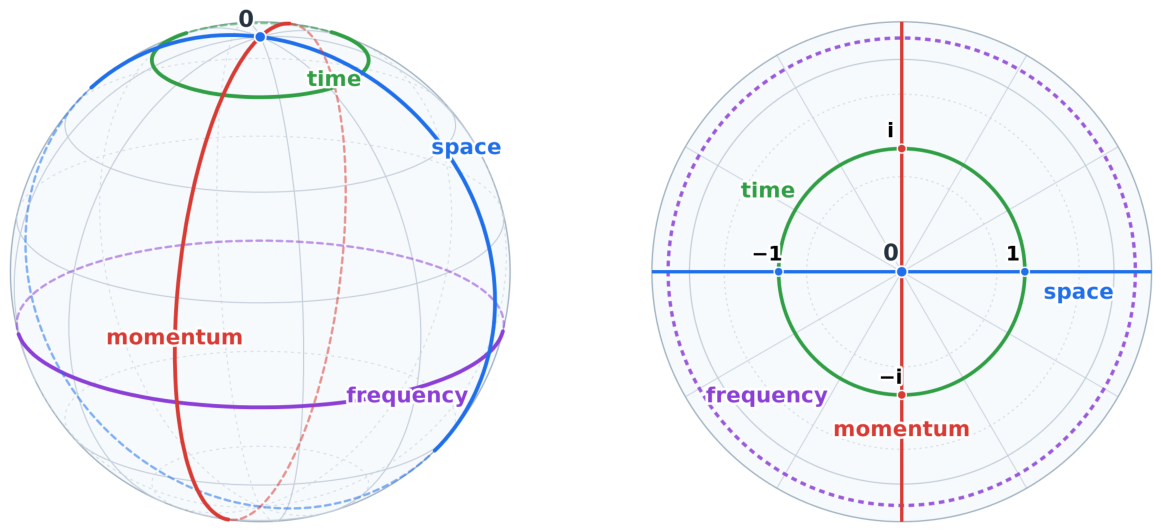

Table 1.
What the substrate’s symmetries are spent on, and what remains. The multiplicative group, the quadratic extension, and a rank-three internal frame not yet constructed are the homes of electromagnetism, the weak interaction, and the strong interaction.
Table 1.
What the substrate’s symmetries are spent on, and what remains. The multiplicative group, the quadratic extension, and a rank-three internal frame not yet constructed are the homes of electromagnetism, the weak interaction, and the strong interaction.
| substrate structure | order / type | role in corpus | consumed by | free for |
| additive group | , unipotent | translation; space | gravity (offset field) | — |
| multiplicative group | , split torus | phase; time; matter field | drive; matter | EM |
| non-split torus of , Frobenius | , non-split torus; double cover | Lorentz; Dirac; boost | signature; spinors | weak |
| frame torsor | the three types | three frame freedoms | gravity’s gauge | — |
| quarter-turn core | complex amplitude | quantum ledger | structural anchor | |
| four primitive roles | closes cyclically | arithmetic ladder | — | the force count |
Table 2.
The electromagnetic claim ledger, discharged by the validation suite (Section 13). The first five hold as exact identities over at every corpus shell; the Coulomb coefficient and the sign are confirmed against the lattice Green’s function.
Table 2.
The electromagnetic claim ledger, discharged by the validation suite (Section 13). The first five hold as exact identities over at every corpus shell; the Coulomb coefficient and the sign are confirmed against the lattice Green’s function.
| claim | test | result |
| field strength gauge-invariant | integer identity in , exhaustive over a basis | exact, |
| Wilson action / cov. difference invariant | cyclotomic value in | exact |
| global-phase superselection | constant leaves all data fixed | exact |
| holonomy = enclosed flux | discrete Stokes | exact |
| charge quantised, additive | winding index in | exact |
| Coulomb coefficient | , | (lattice Green’s fn) |
| repulsive sign | two like charges, , | repel (vs gravity attract) |
Table 3.
The four primitive roles, the substrate symmetry each carries, and the interaction obtained by gauging its frame datum. The alignment is the programme’s role-to-force bridge, not a naive bijection: gravity gauges the geometric/additive frame (roles 1–2), counting is the bosonic-carrier role rather than a force, and the strong sector sits at the closure () rather than at a distinct fifth role. The closure of the ladder is a theorem, and with it the absence of a fifth force (Section 11, Tier 4).
Table 3.
The four primitive roles, the substrate symmetry each carries, and the interaction obtained by gauging its frame datum. The alignment is the programme’s role-to-force bridge, not a naive bijection: gravity gauges the geometric/additive frame (roles 1–2), counting is the bosonic-carrier role rather than a force, and the strong sector sits at the closure () rather than at a distinct fifth role. The closure of the ladder is a theorem, and with it the absence of a fifth force (Section 11, Tier 4).
| role | operation | group / type | frame datum | interaction (spin, status) |
| 1–2 | count / add | additive , unipotent | geometric | gravity (spin 2, built) |
| 3 | multiply | , split torus | phase | electromagnetism (spin 1, unbroken) |
| 4 | exponentiate, non-split torus | , non-split, spinor cover | spinor | weak (spin 1, broken) |
| closure / saturation | rank-three Herm. over K | colour | strong (spin 1, confined) |
Disclaimer/Publisher’s Note: The statements, opinions and data contained in all publications are solely those of the individual author(s) and contributor(s) and not of MDPI and/or the editor(s). MDPI and/or the editor(s) disclaim responsibility for any injury to people or property resulting from any ideas, methods, instructions or products referred to in the content. |
© 2026 by the authors. Licensee MDPI, Basel, Switzerland. This article is an open access article distributed under the terms and conditions of the Creative Commons Attribution (CC BY) license (http://creativecommons.org/licenses/by/4.0/).
Copyright: This open access article is published under a Creative Commons CC BY 4.0 license, which permit the free download, distribution, and reuse, provided that the author and preprint are cited in any reuse.


