Submitted:
16 June 2026
Posted:
17 June 2026
You are already at the latest version
Abstract
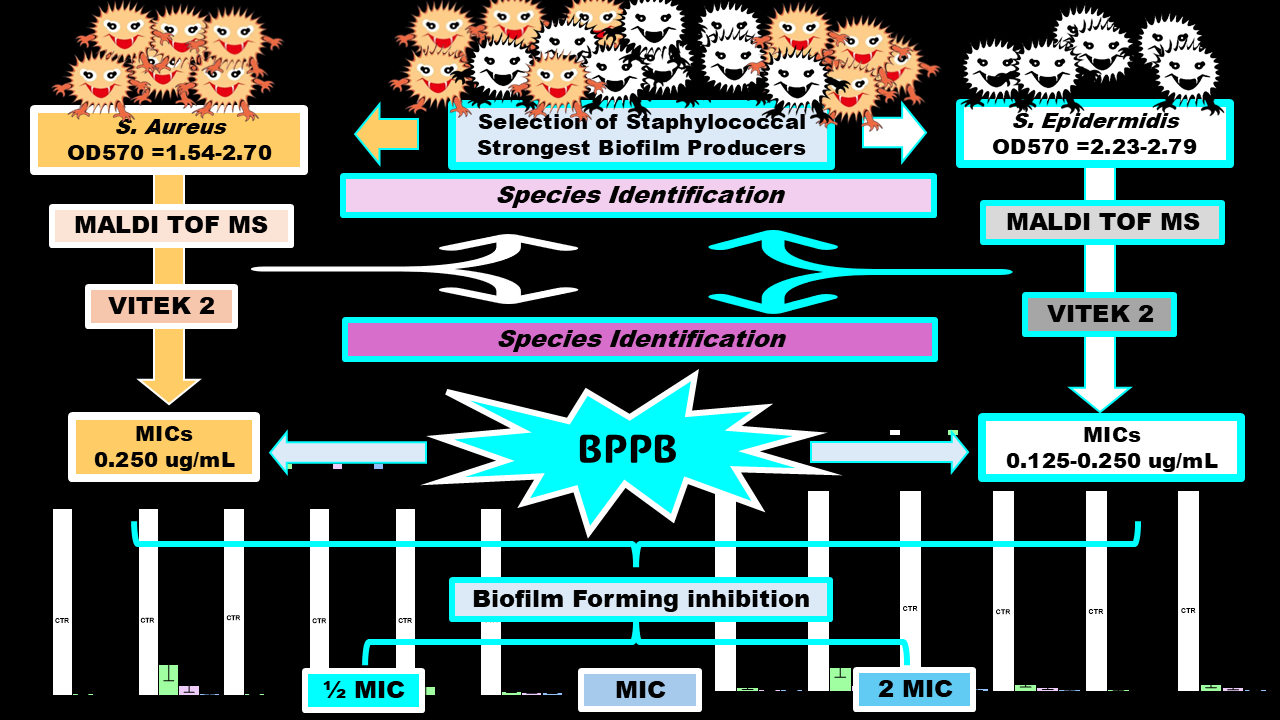
Background. Multidrug resistance (MDR) has become a major global health threat, leading to the emergence of difficult-to-treat bacterial “superbugs” among both Gram-positive and Gram-negative species. In hospital settings, biofilm (BF)-producing staphylococci further aggravates this problem by markedly increasing tolerance to conventional antibiotics, thereby promoting chronic and potentially life-threatening infections. In the present study, 1,12-bis-triphenyl phosphonium dodecane bromide nanovesicles (BPPB, 45 nm), previously reported as bacteriostatic, but never investigated for their effects on formation of staphylococcal BF, were evaluated as a potential novel agent contrasting its development. Methods. A total of 12 highly BF-producing isolates from our collection, comprising 6 Staphylococcus aureus and 6 S. epidermidis strains, were selected and tested against BPPB to determine minimum inhibitory concentrations (MICs). Subsequently, BF inhibition activity was evaluated at ½ MIC, MIC, and 2× MIC concentrations. Vancomycin (V), used as reference antibiotic, was tested under the same experimental conditions. Results. BPPB exhibited MIC values ranging from 0.25 to 1.00 µg/mL, which were 1–4-fold lower than those of V. While V significantly inhibited BF formation only at concentrations 2 × MIC, and mainly against Bam and Aam isolates (96–97% inhibition), BPPB demonstrated potent and consistent inhibition activity against all strains, irrespective of species or resistance profile, determined by VITEK. BF inhibition values of 83–99%, 95–>99%, and 98–>99% were observed at ½ MIC, MIC, and 2 × MIC, respectively. Conclusions. Overall, the findings highlight both the strong BF-forming capability and MDR phenotype of the selected staphylococcal isolates, as well as the remarkable antibacterial and BF inhibition efficacy of BPPB nanovesicles, further confirming the superiority of nanomaterials (NMs) in exert biological effects. Importantly, the low cytotoxicity previously observed against eukaryotic Cos-7 and HepG2 cells resulting in high selectivity index (SI) values (23.0–90.5), supports BPPB as a promising candidate for the development of new NMs-based therapeutic strategies against MDR staphylococcal BF-associated infections.