

Submitted:
15 June 2026
Posted:
17 June 2026
You are already at the latest version
Abstract
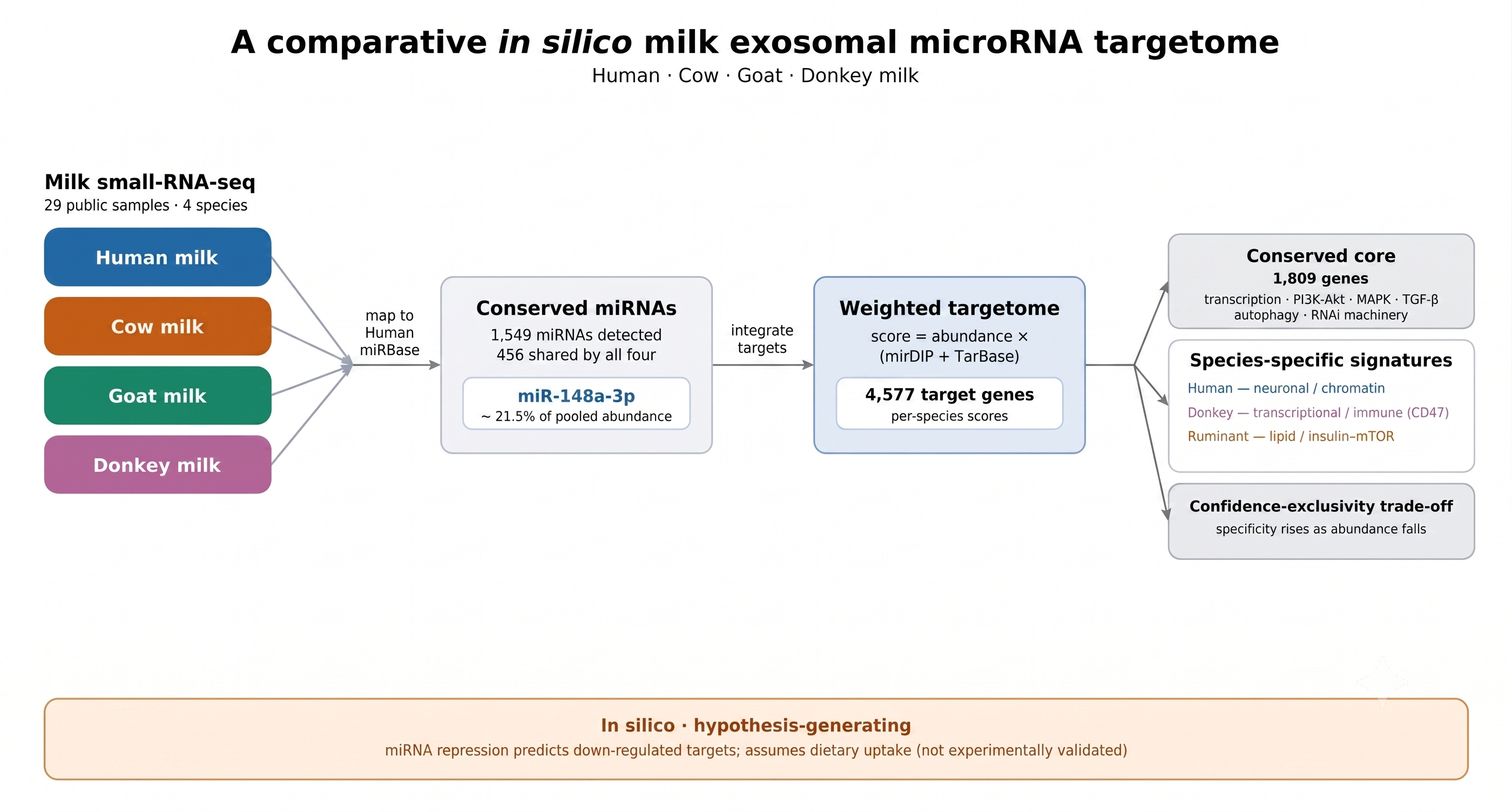
Milk-derived extracellular vesicles (EVs) transport microRNAs (miRNAs) that are un-usually stable and have been proposed to survive digestion and modulate gene expres-sion in the consumer, although their dietary bioavailability and physiological rele-vance remain debated. How the predicted regulatory potential of these miRNAs differs among the milks most relevant to human nutrition has not been systematically com-pared. Here we performed an integrative in silico analysis of publicly available small-RNA sequencing data from 29 milk and milk-cell samples of human, cow, goat and donkey origin. miRNAs were quantified against human (hsa) miRBase refer-ences—thereby restricting the analysis to evolutionarily conserved miRNAs with hu-man orthologs—and their predicted effect on the human transcriptome was modeled by integrating predicted (mirDIP) and experimentally supported (TarBase v9) miR-NA–target interactions into a per-gene, per-species weighted targeting score. Because miRNAs act predominantly as repressors, this score is read as a prediction of which genes would be post-transcriptionally down-regulated in a recipient. miR-148a-3p dominated the exosomal spectrum of all four species (≈21.5% of pooled abundance), and the twenty most abundant miRNAs accounted for roughly three quarters of the signal. Of 4,577 robustly targeted genes, a 1,809-gene conserved “pan-milk” core showed the highest cross-species targeting and was enriched for transcriptional regu-lation, PI3K–Akt, MAPK and TGF-β/SMAD signaling, autophagy and—strikingly—the components of the RNA-interference machinery itself. Species-restricted gene sets re-capitulated biologically plausible programs, including a human-biased neu-ronal/axon-guidance and chromatin module, a donkey-biased transcriptional, epithe-lial and immune (CD47) module, and a ruminant lipid/cholesterol and insulin–mTOR module. Across categories we observed a reproducible confidence–exclusivity trade-off. We emphasize that these results are computational predictions that assume dietary miRNA uptake and do not constitute experimental validation. We provide the complete targetome (Supplementary Materials S1–S9) as a hypothesis-generating re-source to prioritize candidate genes, pathways and milk types for future functional, nutritional and epigenetic investigation.
Keywords:
milk exosomes
; extracellular vesicles
; microRNA
; targetome
; in silico analysis
; comparative transcriptomics
; epigenetic regulation
; miR‐148a
; donkey milk
; cross‐species
Copyright: This open access article is published under a Creative Commons CC BY 4.0 license, which permit the free download, distribution, and reuse, provided that the author and preprint are cited in any reuse.


