

Submitted:
16 June 2026
Posted:
17 June 2026
You are already at the latest version
Abstract
In addition to barges, floating conveyor belt routes are used to ensure the continuous transport of granular materials extracted by floating dredgers from the water environment. These routes are composed of individual conveyor belts, where the end sections of the steel structure are held up by floating support bodies. This paper deals with the graphical and analytical determination of the coordinates of the centre of gravity of the buoyant force and the stability arm during the deflection of a floating body, consisting of two floats with a circular cross-section, from the equilibrium position. The coordinates of the centre of buoyancy were determined by a graphical-numerical method in the 3D CAD environment on the created three-dimensional model of the floating body. The coordinates of the centre of buoyancy were determined by analysing the geometric and physical properties of the model using the "Physical Properties" tool. The analytical procedure for determining the coordinates of the centre of buoyancy when a floating body is deflected from its equilibrium position is divided into three characteristic phases, which are mathematically described by means of certain integrals with differently defined integration limits corresponding to the given state of immersion of the body. Under laboratory conditions, the magnitude of the buoyant force was detected on the experimental apparatus using two force transducers. The experiment was carried out for three levels of float immersion, where the floating body was gradually tilted from the equilibrium position in a range of angles from 0° to 50°. The measured values were used to analyse the effect of the immersion depth and angle of heel on the magnitude of the buoyant force. The experimental tests carried out verified the correctness of the analytical and graphical procedure for determining the coordinates of the centre of buoyancy and for determining the stability arm.
Keywords:
deflection of floating body from equilibrium state
; floating belt conveyor
; buoyant force
; centre of gravity of displacement
; stability arm
; experimental setup
1. Introduction
Historically, the extraction of mineral resources in the form of sands and gravels from below the water surface [1,2] was originally called water dredging [3] and included a complex of works involving disconnecting, transporting and storing the extracted mineral. In the present day, the operations specified above are carried out by surface mining. The desire to reduce the economic costs associated with transporting the dredged material to the shore of the mining lake has led to the total automation of the dredging process. Automation thus brings with it a range of technical equipment that enables the continuous routing of the mining material from the floating mining equipment to the stationary sorting plants installed on the shore of the mining area. Therefore, in inland navigation, in addition to basket, suction and dredge floating dredgers, technical vessels such as floating gravel treatment plants, bucket dredgers, floating cranes and last but not least floating conveyor belts are also used [4‒7], see Figure 1(a).
In the design of technical vessels [8], it is necessary to achieve the required design and dimensional parameters in order to ensure that these devices are sufficiently stable and provide seaworthiness throughout their area of operation for a particular navigation area. Of the wide range of technical navigation requirements imposed on a given floating device, it is essential to ensure buoyancy [9,10] and sufficient stability [11]. Buoyancy [12,13] is defined by the ability of a vessel to remain in a state of equilibrium when placed on a water surface. Buoyancy [14] is defined as the ability of a body to float on a still liquid surface by the action of hydrostatic buoyancy [11]. Buoyancy is one of the basic properties of a floating body, characterized by the ability of the body to remain in an equilibrium state when immersed in a liquid. The buoyancy reserve is defined as the mass amount of load (which the floating body is capable of carrying) that will cause the total immersion of the floating body in the liquid [15].
Stability [16,17] is generally defined as the ability of a vessel to return to its initial equilibrium position after a deflection, if the external forces of a static or dynamic nature cease to act on it [18]. The relative position of the centre of gravity of the floating body of gravity , called the metacentre , see Figure 1(b) (intersection of the axis of the floating body and a vertical line passing through the centre of gravity of the displaced fluid of gravity in an inclined position by an angle )has a fundamental influence on the stability of the floating body ). Stability defines the equilibrium positions of floating bodies: a) stable − metacentre lying above the centre of gravity, a pair of forces is generated that try to return the floating body to a vertical position; b) unstable − metacentre lies below the centre of gravity , the deflection causes the body to overturn; and c) indifferent − centre of gravity and metacentre merge (e.g. homogeneous cylinder), the body remains in any position).
Stability [19‒21] falls inherently into a broader group of navigation properties of floating bodies. Stability of a floating body [22,23] is defined as the ability of a floating body to return to its equilibrium position after deflection if the external forces causing the deflection cease to act on it.
According to the direction of deflection of the floating body, two variants of stability are recognized, “transverse” stability [3,24,25] and “longitudinal” stability.
Depending on the amount of deflection of the floating body, we distinguish between “initial” stability and “high angle of heel” stability.
According to the time effect of external forces and the influence of inertia of masses, it is possible to define “static” stability (which is defined by the magnitude of the return moment when the body is deflected from the equilibrium position) and “dynamic” stability (which is determined by the magnitude of the work that the floating body is able to absorb when deflected from the equilibrium position).
The behaviour of a body in a fluid is determined by the buoyant force and the gravitational force , which is described by Archimedes’ law. According to the correlation of these forces (or according to a comparison of the density of the body and the density of the fluid ), three basic situations can occur: a) the body sinks (force condition , density condition ); b) the body floats (force condition , density condition ); c) the body floats on the surface (force condition , density condition ).
The floating of a body on the surface is understood as a process when the body is partially immersed in the liquid and partially protrudes above the free surface of the liquid [26]. An important factor for bodies floating on the surface is that a small deflection (by an angle of ) of the body from its equilibrium position produces a moment of force , which returns the deflected body to its equilibrium position.
A body floats on the surface when the buoyant force exerted at the centre of gravity on a fully immersed body is greater than its gravity , exerted at the centre of gravity . In this case, the body emerges from the liquid sufficiently so that the buoyancy acting on its immersed part just equals the gravity of the body , i.e. so that the resultant of the forces acting on the body is zero. For equilibrium surface floating to occur, it is necessary for the resulting moment of the forces acting on the body to be zero [10,27,28].
Buoyancy and gravity must act in one vertical line, which is called the “axis of buoyancy”. Thus, both the centre of mass (centre of gravity) of the body and the centre of buoyancy, which is the centre of mass (centre of gravity) of the displaced fluid, must lie on the axis of buoyancy. If the floating body is homogeneous, then every geometric axis of symmetry of the body can theoretically be an axis of floating. However, true surface floating occurs only for the axis with respect to which surface floating is “stable” or “indifferent” [27,28]. The surface floating of a body is stable [10,29], when at any deflection of the floating body from its equilibrium position the pair of forces consisting of buoyancy and gravity of the body tries to return the body to its equilibrium position. The surface floating of a body (e.g. a homogeneous sphere or a homogeneous cylinder for rotation about the axis of the cylinder) is indifferent [11,30] when no moment of force is produced when the body is deflected from its equilibrium position.
The stability of surface floating can be investigated if we find the so-called “surface of gravities” in the body, on which lies the effect of buoyancy for various rotations of the floating body [28]. The surface centre of gravity is the centre of gravity of the fluid displaced by the body, see Figure 1(b). Figure 1(b) shows the cross-section of a cube, running through its geometric (and, due to the assumed homogeneity, its material) centre perpendicular to its two edges. The intersections with the surface centres of gravity are marked on the cross-sections (sections running thus are called the main sections). When the cube is deflected from the equilibrium position, the force pair of the body’s gravity (acting in the centre of mass ) and buoyancy leads to the resumption of the surface floating. If floating on the narrower side, the same force pair overturns the block.
The term “metacentre” is introduced to capture the degree of stability [27,28]. Metacentres are usually defined as the centres of curvature of the main normal sections of the centre of gravity surface where the axis of float intersects it. Figure 1(b) shows the metacentres for the illustrated main sections of the block. The metacentre in this case falls at the centre of mass (centre of gravity) of the body .
These specific designs of floating bodies can significantly affect the buoyancy distribution, the position of the centre of gravity and the overall stability behaviour of the system, but available literature only marginally addresses this issue. Insufficient knowledge of these influences poses a risk in the design and operation of the equipment, especially in terms of the possibility of loss of stability under variable operating conditions. Detailed research on this issue is therefore necessary to gain a deeper understanding of the behaviour of these systems, to refine design methods and to improve the safety and reliability of floating conveyors.
The issue of stability of floating belt conveyors has not yet been fully investigated systematically, especially in the case of floating body designs using floats with circular cross-sections [27]. These specific designs of floating bodies can significantly affect the buoyancy distribution, the position of the centre of gravity and the overall stability behaviour of the system, but the available literature only marginally addresses this area. Insufficient knowledge of these influences poses a risk in the design and operation of the equipment, especially in terms of the possibility of loss of stability under variable operating conditions. Detailed research on this issue is therefore necessary to gain a deeper understanding of the behaviour of these systems, to refine design methods and to improve the safety and reliability of floating conveyors.
The current state of knowledge in the field of stability of floating bodies has been analysed on the basis of available literature. It was found that the vast majority of the publications searched focus mainly on the issue of buoyancy and stability of ships [8,15], while the specific area of floating conveyor belts remains virtually uncovered in professional sources. This disparity points to an existing gap in research and highlights the need for a focused study of the stability of these devices, whose design and operating conditions differ from conventional vessels in many respects.
2. Materials and Methods
The detailed description of the procedures and methods used in this section is intended to ensure the transparency of the research, to enable reproducibility of the results and to support their use in subsequent studies or practical applications.
The analytical determination of the transverse stability of a floating body consisting of floats with a circular cross-section is, from a practical point of view, quite complex, time-consuming and requires knowledge of integral calculus. A more appropriate way to determine the coordinates of the centre of gravity of the buoyant force is to use a 3D CAD modeler, such as SolidWorks, Autodesk Inventor or Fusion 360.
Generative Artificial Intelligence (GenAI) was not used to generate text, data or graphics in the drafting of this paper.
In this section, subsection 2.1 outlines the methodology for determining the coordinates of the centre of gravity of the buoyant force displacement and the stability arm for three different positions of the centre of gravity of the floating body , based on a 3D model of the floating body created in the SolidWorks software environment.
The total gravity [N] acting on the floating body is assumed. The gravity [N] acts at the centre of gravity , which is [m] away from the bottom plane of the floating body, see Figure 2. In the equilibrium position (), the horizontal axes of the two floats with a circular cross-section are parallel to the water surface. The buoyant force , acting at the centre of gravity of displacement , must be in equilibrium with the gravity (1).
where is the density of water; is the total volume of the immersed parts of both floats; is the footprint of the immersed part of the left float; is the footprint of the immersed part of the right float; is the depth of immersion of the floats in the equilibrium position; is the diameter of the float with a circular cross-section; is the length of the float.
2.1. Coordinates of the Centre of Gravity of Displacement Determined from the 3D Model Created in SOLIDWORKS
In the following text, the coordinates of the centre of gravity of the buoyant force and the stability arm are given for three possible variants of immersion of the floating body and for three different distances of the centre of gravity , when the floating body is deflected from the equilibrium state by an angle of . The coordinates of the centre of gravity of the buoyant force are read in SolidWorks software [31] (version Premium 2012×64, edition SP5.0) in the “ANALYSIS-PHYSICAL PROPERTIES menu.
2.1.1. Transverse Heel of the Floating Body When the Floats Are Immersed
Phase 1 starts at the equilibrium position of the floating body , see Figure 3(a) and ends with the right side of the cylindrical float immersed below the surface (2), see Figure 3(b).
The coordinates of the centre of gravity of the buoyant force (displacement) given in Table 1 are read from the 3D model of the floating body created in SolidWorks (version Premium 2012×64, edition SP5.0) [31] for the angle of deflection of the floating body from the equilibrium state .
Figure 4 presents the size of the stability arm [32], when the floating body is deflected from the equilibrium state by an angle of , for an immersion depth of , for different distances [m] of the centre of gravity from the bottom plane of the floating body.
Phase 2 begins when the floating body is deflected from its equilibrium position , see Figure 5(a), and ends with the loss of buoyancy .
is the angle of heel of the floating body at which the stability arm size becomes zero , and the stability of the floating body is lost [9,28]. When the floating body deflects by an angle of the reciprocating moment [27] that would return the floating body to its equilibrium position ceases to act (, see Figure 3a), and the floating body tips over [33].
The coordinates of the centre of gravity of the buoyant force (displacement) given in Table 2 are read from the 3D model of the floating body created in SolidWorks (version Premium 2012×64, edition SP5.0) for the angle of deflection of the floating body from the equilibrium state .
2.1.2. Transverse Heel of the Floating Body When the Floats Are Immersed
Phase 1 starts at the equilibrium position of the floating body , see Figure 6(a) and ends with the left side of the cylindrical float immersed below the surface (3), see Figure 6(b).
The coordinates of the centre of gravity of the buoyant force (displacement) given in Table 3 are read from the 3D model of the floating body created in SolidWorks (version Premium 2012×64, edition SP5.0) for the angle of deflection of the floating body from the equilibrium state .
Figure 7 presents the size of the stability arm (4) when the floating body is
deflected from its equilibrium state by an angle of , for various distances of the centre of gravity , for the depth of immersion of the floating body of in the equilibrium state, see Figure 6(a).
Phase 2 begins when the floating body is deflected from its equilibrium position and ends and ends with the right side of the cylindrical float submerging below the surface (5), see Figure 8(a).
The coordinates of the centre of gravity of the buoyant force (displacement) given in Table 4 are read from the 3D model of the floating body created in SolidWorks (version Premium 2012×64, edition SP5.0) [11] for the angle of deflection of the floating body from the equilibrium state .
Phase 3 begins when the floating body is deflected from its equilibrium position and ends with the loss of buoyancy .
The coordinates of the centre of gravity of the buoyant force (displacement) given in Table 5 are read from the 3D model of the floating body created in SolidWorks (version Premium 2012×64, edition SP5.0) for the angle of deflection of the floating body from the equilibrium state .
2.1.3. Cross Heel of the Floating Body when The Floats Are Immersed
Phase 1 starts in the equilibrium position deg, see Figure 8(b), and ends with the upper right part of the cylindrical float immersed below the water surface (6), see Figure 9(a).
The coordinates of the centre of gravity of the buoyant force (displacement) given in Table 6 are read from the 3D model of the floating body created in SolidWorks (version Premium 2012×64, edition SP5.0) [11] for the angle of deflection of the floating body from the equilibrium state .
Figure 10 presents the size of the stability arm when the floating body is deflected from its equilibrium state by an angle of , for distances of the centre of gravity , for the depth of immersion of the floating body of in the equilibrium state, see Figure 9(a).
Phase 2 begins with the rising of the left cylindrical float above the surface (6), see Figure 9(a), and ends with the
immersion of the right cylindrical float below the water surface (7) (), see Figure 9(b).
The coordinates of the centre of gravity of the buoyant force (displacement) given in Table 7 are read from the 3D model of the floating body created in SolidWorks (version Premium 2012×64, edition SP5.0) [11] for the angle of deflection of the floating body from the equilibrium state .
Phase 3 begins when the floating body is deflected from its equilibrium position , see Figure 9(b), and ends with the loss of buoyancy .
The coordinates of the centre of gravity of the buoyant force (displacement) given in Table 8 are read from the 3D model of the floating body created in SolidWorks (version Premium 2012×64, edition SP5.0) for the angle of deflection of the floating body from the equilibrium state .
Figure 11 presents the size of the stability arm [32], when the floating body is deflected from the equilibrium state by an angle of , for an immersion depth of , for distances = 1600 mm of the centre of gravity from the bottom plane of the floating body.
In the following text, subsection 2.2 gives the analytically calculated coordinates of the centre of gravity of the buoyant force for three possible variants of the buoyancy of the floating body , when the floating body is deflected from the equilibrium state by an angle of .
2.2. Analytical Determination of the Coordinates of the Centre of Gravity of a Floating Body
The floating body, a floating conveyor belt, consists of two floats on which the actual technology for transporting the mining material is placed. The float consists of a cylindrical body whose geometry is determined, from a lateral view, see Figure 12, by the radius of the floats with a circular cross-section and the length of the cylindrical float. The depth of immersion (called draft) of a floating body in the equilibrium state () is defined by the expression in the coordinate system of Figure 2(a), or by the expression in Figure 12. is the vertical distance of the left front surface of the cylindrical float of the floating body of the water surface plane from the longitudinal axis. The origin of the coordinate system is chosen at the centre of the height of the left front wall (circular surface in plan view) of the floating body and is oriented according to Figure 12.
The following text defines the procedure for calculating the position of the centre of gravity of displacement of a cylindrical float, when it is deflected from the equilibrium position by an angle of , and the values of the coordinates of the centre of gravity of displacement for the defined values of the heel angle of the floating body.
The solution to calculating the position of the centre of gravity of the displacement of a floating body consisting of cylindrical floats can be divided into three basic phases. These three phases result from the existence of a limiting angle , see Figure 12.
The angle is subject to a relation (3) expressed from the geometric dimensions of the float Figure 3 and Figure 12. The limiting angle is defined as the angle subtended by a line segment in the plane drawn from the upper right corner of the cylindrical float to its lower left corner.
From a general point of view, the heel angle of a floating body can take three limiting values. For Phase 1, the angle is defined as , see Phase 1 below for more details; for Phase 2, the angle is defined as , see Phase 2 below for more details; and for Phase 3, the angle is defined as , see Phase 3 below for more details.
Phase 1 occurs when the heel angle of the floating body is less than, or equal to, the limiting angle and greater than , see relation (8).
If the floats with a circular cross-section of the floating body are immersed below the water surface at exactly half of their diameter, i.e. , see Figure 3(b), the angle can be determined according to (2).
If the floats with a circular cross-section of the floating body are immersed below the water surface below half of their diameter, i.e. , see Figure 6(b), the angle can be determined according to (4).
If the floats with a circular cross-section of the floating body are immersed below the water surface above half of their diameter, i.e. , see Figure 9(a), the angle can be determined according to (6).
Phase 2 occurs when the angle of heel of the floating body is greater than the limiting angle and less than or equal to the angle , see (9).
If the floats with a circular cross-section of the floating body are immersed below the water surface below half of their diameter, i.e. , see Figure 8(a), the angle can be determined according to (5).
If the floats of a circular cross-section of the floating body are immersed below the water surface above half of their diameter, i.e. (see Figure 9(b)), the angle can be determined according to (7).
Phase 3 occurs in the opposite case, if the angle of heel of the floating body takes on a value greater than the limiting angle and is less than or equal to the limiting (critical) angle , see (10). The critical angle is the angle at which loss of buoyancy of the floating body occurs.
In the case where the floats with a circular cross-section of the floating body are immersed below the water surface at exactly half of their diameter, i.e. , the angle is defined by Table 2. In this state, the angle is .
If the floats with a circular cross-section of the floating body are immersed below the water surface below half of their diameter, i.e. , the angle is defined by Table 5.
If the floats with a circular cross-section of the floating body are immersed below the water surface above half of their diameter, i.e. , the angle is defined by Table 8.
Now the three basic phases will be subjected to a closer analysis. For this purpose the solution of the position of the centre of gravity of the floating body must be further broken down for:
Phase 1, when the angle of heel of the floating body lies in the interval defined by equation (8). This situation requires breaking down the further solution procedure into three states: 1a), 1b) and 1c), see below. The three different directions of the solution to determine the position of the centre of gravity of displacement of the floating body arise from the position of point and the position of point , defined as the point of intersection of the plane of the water surface with the imaginary vertical plane (see Figure 13) drawn at a distance of [m] from the origin of the coordinate system (the plane tangent to the right frontal circular wall of the cylindrical floats).
Condition 1a) Both cylindrical floats at equilibrium () of the floating body are immersed below the water surface by a degree of (), see Figure 13.
The position of point located on the axis of the coordinate system in the plane can be calculated according to (11), see Figure 13.
The position of point located on the plane (plane is parallel to the axis at a distance of from the origin of the coordinate system) in the plane , can be determined according to (12).
According to Figure 13, point in state 1a) is located in the interval and point is located in the interval .
It follows from the above (for the state defined as 1a) that the volume of the immersed parts of the floats of the floating body, determined by the sum of the two triple integrals, can be determined according to the equation (13).
The coordinate of the centre of gravity of displacement can be expressed according to relation (14), see Supplementary Materials to article No. 1 (Chapter I), see Table 9.
The coordinate of the centre of gravity of displacement can be expressed according to relation (14), see Supplementary Materials to article No. 1 (Chapter I), see Table 9.
Condition 1b) The floats with a circular cross-section of the floating body are in the equilibrium state of the floating body immersed under the water surface by a degree of (), see Figure 14.
The position of point in the plane can be expressed according to (16), see Figure 14. The position of point in the plane can be determined according to (17).
According to Figure 14, point in state 1b) is located in the interval and point is located in the interval .
For state 1b), the volume of the immersed parts of the floating body can be determined according to equation (13) by replacing the expressions (11), (12) with the expressions (16), (17), see Supplementary Materials to article No. 1
(Chapter II).
The coordinates of the centre of gravity of displacement can be expressed according to the relation (14) and (15) by replacing the expressions (11), (12) with the expressions (16), (17), see Supplementary Materials to article No. 1
(Chapter II), see Table 10.
State 1c) The floats of the floating body are immersed below the water surface by a degree of () in the equilibrium state of the floating body.
The position of point in the plane can be expressed according to (18), see Figure 15.
The position of point located on the plane (plane is parallel to the axis at a distance of from the origin of the coordinate system) in the plane can be determined according to (19).
According to Figure 15, point is located in the interval and point is located in the interval .
For state 1c), the volume of the immersed parts of the floating body can be determined according to equation (13) by replacing the expressions (11), (12) with the expressions (18), (19), see Supplementary Materials to article No. 1
(Chapter III), see Table 11.
The coordinates of the centre of gravity of displacement can be expressed according to the relation (14) and(15) by replacing the expressions (11), (12) with the expressions (18), (19), see Supplementary Materials to article No. 1
(Chapter III), see Table 11.
Phase 2, when the angle of heel of the floating body lies in the interval defined by equation (9). This situation requires breaking down the further solution procedure into two directions 2a) and 2b), see below. The two different directions of the solution to determine the position of the centre of gravity of displacement of the floating turntable arise from the position of point , and point as a point defined as the point of intersection of the water surface plane with the imaginary vertical plane drawn through the right wall of the float at a distance a [m] from the origin of the coordinate system.
2a) The floats of the floating body are immersed below the water surface by a degree of () in the equilibrium state of the floating body.
The position of point located in the plane can be determined by (16) and Figure 16.
The position of point located on the plane (plane is parallel to the axis at a distance of from the origin of the coordinate system), in the plane can be determined by (17) and Figure 16.
For condition 2a), the volume of the immersed parts of the floats of the floating body can be determined according to the equation (13) by replacing the expressions (11), (12) with the expressions (16) (17), see Supplementary Materials to article No. 2
(Chapter I).
It follows from the above (for the state defined as 2a) that the volume of the immersed parts of the floats of the floating body, determined by the sum of the two triple integrals, can be determined according to the equation (20).
The coordinate of the centre of gravity of displacement can be expressed according to relation (21), see Supplementary Materials to article No. 2 (Chapter I), see Table 12.
The coordinate of the centre of gravity of displacement can be expressed according to relation (22), see Supplementary Materials to article No. 2 (Chapter I), see Table 12.
2b) The floats of the floating body are immersed below the water surface by a degree of () in the equilibrium state of the floating body.
The position of point located in the plane can be determined by (18) and Figure 17.
The position of point located on the plane (plane is parallel to the axis at a distance of from the origin of the coordinate system), in the plane can be determined by (19) and Figure 17.
For condition 2b), the volume of the immersed parts of the floats of the floating body can be determined according to the equation (13) by replacing the expressions s (11), (12) with the expressions , (18) (19), see Supplementary Materials to article No. 2
(Chapter II).
The coordinates of the centre of gravity of displacement can be expressed according to the relation (14) and(15) by replacing the expressions (11), (12) with the expressions (18), (19), see Supplementary Materials to article No. 1
(Chapter III), see Table 11.
It follows from the above (for the state defined as 2b) that the volume of the immersed parts of the floats of the floating body, determined by the sum of the two triple integrals, can be determined according to the equation (23).
The coordinate of the centre of gravity of displacement can be expressed according to relation (24), see Supplementary Materials to article No. 2 (Chapter II), see Table 13.
The coordinate of the centre of gravity of displacement can be expressed according to relation (24), see Supplementary Materials to article No. 2 (Chapter II), see Table 13.
Phase 3, when the angle of heel of the floating body lies in the interval defined by equation (10). This situation requires breaking down the further solution procedure into three directions 3a, 3b) and 3c), see below. The three different directions of the solution to determine the position of the centre of gravity of displacement of the floating turntable arise from the position of point , and point as a point defined as the point of intersection of the water surface plane with the imaginary vertical plane drawn through the right wall of the float at a distance a [m] from the origin of the coordinate system.
3a) The floats of the floating body are immersed below the water surface by a degree of () in the equilibrium state of the floating body.
The position of point S located in the plane can be determined by (11) and Figure 18.
The position of point located on the plane (plane is parallel to the axis at a distance of from the origin of the coordinate system), in the plane can be determined by (12) and Figure 18.
According to Figure 18, point in state 3a) is located in the interval and point is located in the interval .
It follows from the above (for the state defined as 1a) that the volume of the immersed parts of the floats of the floating body, determined by the sum of the two triple integrals, can be determined according to the equation (26).
The coordinate of the centre of gravity of displacement can be expressed according to relation (27), see Supplementary Materials to article No. 3 (Chapter I), see Table 14.
The coordinate of the centre of gravity of displacement can be expressed according to relation (28), see Supplementary Materials to article No. 3 (Chapter I), see Table 14.
For state 3b), the volume of the immersed parts of the floats of the floating body can be determined according to equation (20) by replacing the expressions (11), (12) with the expressions (16), (17), see Supplementary Materials to article No. 3
(Chapter II). Submersion of the floats in equilibrium state (), see Figure 6(a) and Figure 19.
Point is located according to Figure 19 in the interval, point is located according to Figure 19 in the interval.

Table 15.
Coordinates of the centre of gravity of the buoyant force of the floating body during phase 3 of the deflection at an immersion depth of , .
Table 15.
Coordinates of the centre of gravity of the buoyant force of the floating body during phase 3 of the deflection at an immersion depth of , .
| , , , | |||||||
| 30 | 35 | 40 | 45 | 50 | 51.17 1 | ||
| (27) | 903.69 | 891.42 | 892.29 | 898.84 | 907.97 | 910.32 | |
| 1 | 109.31 | 1,108.58 | 1,107.71 | 1,101.16 | 1,092.03 | 1,089.68 | |
| (28) | ‒183.79 | ‒142.94 | ‒114.23 | ‒92.67 | ‒75.66 | ‒72.15 | |
| 1 | 611.21 | 652.06 | 680.77 | 702.33 | 719.34 | 722.85 | |
| (26) | 5,913,195.68 | 6,269,213.43 | 6,546,147.04 | 6,770,780.82 | 6,959,273.25 | 6,999,357.43 | |
1 see Table 5.
For state 3c), the volume of the immersed parts of the floats of the floating body can be determined according to equation (20) by replacing the expressions (11), (12) with the expressions (18), (19), see Supplementary Materials to article No. 3
(Chapter III). Submersion of the floats in equilibrium state (), see Figure 8(b) and Figure 20.
According to Figure 20, it applies that .
Point is located according to Figure 20 in the interval, point is located according to Figure 20 in the interval.
Table 16.
Coordinates of the centre of gravity of the buoyant force of the floating body during phase 3 of the deflection at an immersion depth of , .
Table 16.
Coordinates of the centre of gravity of the buoyant force of the floating body during phase 3 of the deflection at an immersion depth of , .
| , , , | |||||
| 30 | 35 | 40 | 42.09 1 | ||
| (27) | 1,349.98 | 1,277.20 | 1,223.50 | 1,204.92 | |
| 1 | 650.13 | 722.80 | 776.50 | 795.08 | |
| (28) | ‒108.99 | ‒93.20 | ‒80.08 | ‒75.19 | |
| 1 | 686.01 | 701.80 | 714.92 | 719.81 | |
| (26) | 9,971,338.97 | 9,615,317.52 | 9,338,385.45 | 9,239,227.27 | |
1 see Table 8.
The coordinates of the centre of gravity of the buoyant force of the floating body during deflection at various immersion depths with are presented in Figure 21.
3. Results
The transverse stability of the floating body was investigated in laboratory conditions on a test rig, whose 3D model created in SolidWorks software (version Premium 2012×64, edition SP5.0) [11] is presented in Figure 22. The test rig consists of a watertight tank 1 and a floating body 2 (which consists of two floats made of PLEXI pipe of 80/72 mm outer/internal diameter [34], length 200 mm and two connecting parts), which is mechanically attached to two force transducers 3, type MCF-100 N [35].
Both floats with a circular cross-section of the floating body 2 are fitted with 75-80 mm twin-screw sleeves 4 [36] with a hexagonal nut length of 18 mm with internal threading M8/M10 length 8 mm/10 mm, see Figure 22.
According to Archimedes’ law, the floating body of the test device with a mass of will immerse below the water surface up to the volume , at which it is buoyed by a buoyant force corresponding to the gravity of fluid of the same volume as the immersed part of the body.
In the equilibrium state of the floating body of the test device (angle ) with a mass of , the front walls of both floats (diameter and length of one float , see Figure 2) of the floating body are immersed below the water surface by a degree of . If the floating body is designed so that its centre of gravity lies on the vertical axis of the axis of symmetry of the floating body, see Figure 23, then the longitudinal axes of both floats are parallel to the water surface.
A schematic diagram of the measurement chain for laboratory measurement of tensile forces , when a floating body is laterally deflected out of equilibrium by an angle of , is shown in Figure 24. The measurements were carried out while the cylindrical floats were immersed in equilibrium state to a depth of below the water level of the laboratory device tank, see Figure 22.
A load sensor cable equipped with a D-Sub plug 4 was plugged into the socket of the measuring module BR4-D 4 [37] of the strain gauge apparatus DS NET during the laboratory measurements, see Figure 24. A PC 8 (ASUS K72JR-TY131 laptop) was connected to the DS NET strain gauge 6 using a network cable with RJ-45 connectors 7 at both ends.
The total immersion volume of a floating body (1)
is given by the sum of the immersion volumes of the two floats . Assuming that and (see Figure 2), and knowing the value of the intrinsic mass of the floating body of the test device , it is possible to calculate in the Mathcad software environment (version 14.0.0.163) [39] using the command “Given−Find” the central angle of the immersed area (circular segment) of one float from relation (30), and the depth of the immersed float (height of the circular segment) from relation (31), or according to (32).
where is the central angle of the circular segment [32]; .
A buoyant force of , Figure 25(b) is applied to the floating body of the test device, consisting of cylindrical floats with a diameter of and length of , at an immersion depth of , see Figure 25(a).
With a known degree of immersion of the floats of the floating body at equilibrium () below the water surface, the floating body was deflected in the transverse direction by a known angle of . When the floating body was deflected out of its equilibrium state, the force sensors 3, see Figure 23, detected the magnitudes of buoyant forces (where is the force sensor number, is the measurement number).
The results of the experimental measurements of buoyant force at the depth of immersion of the floating body of the test device below the water surface and the known value of the longitudinal deflection of the floating body from the equilibrium state are shown in Table 17.
Figure 26(a) shows the values of buoyant forces measured by the MCF30-100 N force sensors, when the floats with a circular cross-section were not immersed below the water surface and at a float immersion depth of , at a deflection angle of .
Figure 26(b) shows the values of buoyant forces measured by the MCF30-100 N force sensors at an immersion depth of of the floats below the water surface, with gradual deflection of the floating body of the test device.
The results of the experimental measurements of buoyant force at an immersion depth of the floating body of the test device below the water surface and the known value of the longitudinal deflection of the floating body from the equilibrium state are shown in Table 18.
A buoyant force, see Figure 27(a), is exerted on the floating body of the test device, consisting of cylindrical floats with a diameter of and length of , at an immersion depth of and own mass of the floating body of the test device.
Figure 28(a) presents the floating body of the laboratory immersion device .
Figure 28(b) shows the values of buoyant forces measured by the MCF30-100 N force sensors at an immersion depth of of the floats below the water surface, with gradual deflection of the floating body of the test device.
From three times () repeated measurements under the same technical conditions, the arithmetic mean and the marginal error (33) were calculated
according to Student’s distribution [40].
where is the Student’s coefficient (for the chosen risk and the number of measured values can be determined according to [40] ); is the standard deviation of the arithmetic mean (34).
From the measured mean value of the buoyant force , it is possible to express the total immersed volume of the floats of the floating body of the test device at an immersion depth of and deflection angle of of the floating body from the equilibrium state according to the relation (35).
Table 19 shows the total immersed volume of the floats of the floating body of the test device at an immersion depth of and deflection angle of of the floating body from equilibrium.
The results of the experimental measurements of buoyant force at an immersion depth of the floating body of the test device below the water surface and the known value of the longitudinal deflection of the floating body from the equilibrium state are shown in Table 20.
A buoyant force, see Figure 29(a), is exerted on the floating body of the test device, consisting of cylindrical floats with a diameter of and length of , at an immersion depth of and own mass of the floating body of the test device.
Figure 30(a) shows a floating body immersed beneath the water’s surface of the laboratory device in equilibrium position.
Figure 30(b) shows the values of buoyant forces measured by the MCF30-100 N force sensors at an immersion depth of of the floats below the water surface, with gradual deflection of the floating body of the test device.
Table 21.
Immersed volume of the floats of the floating body of the test device at an immersion depth of and angle of deflection of .
Table 21.
Immersed volume of the floats of the floating body of the test device at an immersion depth of and angle of deflection of .
| 0 | 10 | 20 | 30 | 40 | 50 | |
| 1 | 2.08 | 2.90 | 4.04 | 5.10 | 6.15 | 6.63 |
| 2 | 212.10 | 295.72 | 411.97 | 520.06 | 627.13 | 676.07 |
| 3 | 260.98 | 298.50 | 420.20 | 572.29 | 705.79 | 794.42 |
| 4 | 2.56 | 2.93 | 4.12 | 5.61 | 6.92 | 7.79 |
Figure 31(a) shows the mean values calculated according to Student’s distribution [39] of the values of buoyant forces measured by the MCF30-100 N force sensors, when the floating body is deflected out of equilibrium.
Figure 31(b) shows the laboratory device for the detection of buoyant forces during deflection of a floating body from its equilibrium position.
4. Discussion
The issue of longitudinal and transverse stability of floating belt conveyors using floating bodies with floats of circular cross-section [16,29] has not been comprehensively and systematically analysed so far, which is evidenced by the lack of relevant scientific articles and publications in this area.
The presented paper describes two methodological approaches to determine the position of the centre of gravity of the displacement of a floating body during its lateral deflection from equilibrium state.
The first method (see section 2.1) is based on the graphical and numerical determination of the centre of gravity of the displacement of the floating body, which is complemented by the use of 3D modelling tools (e.g. SolidWorks [33] or Inventor). The computationally demanding and time-consuming analytical procedure for determining the position of the centre of gravity of the displacement when the body is deflected from its equilibrium position can be effectively replaced by determining the centre of gravity based on a volume model created in a CAD system environment.
The results obtained for the coordinates of the centre of gravity of the displacement (i.e. the centre of buoyancy force ) at each stage of the deflection of the floating body from the equilibrium state by a known magnitude of angle , at three immersion depths are given in Table 1 to Table 8.
Maximum stability arm value is achieved for cylindrical floats with a diameter of , whose immersion below the water surface reaches exactly half the float diameter, i.e. , at an angle of heel of (see Table 2), for the position of the centre of mass .
Maximum stability arm value is achieved for cylindrical floats of diameter whose submergence below the water surface does not exceed half the diameter, e.g. , at an angle of heel (see Table 4), for the position of the centre of mass .
Maximum stability arm size is achieved for cylindrical floats of diameter whose submergence below the water surface exceeds half the diameter, e.g. , at an angle of heel (see Table 7), for the position of the centre of mass .
The second method (see section 2.2) is based on the analytical determination of the coordinates of the centre of gravity of the displacement of the floating body. The coordinates of the centre of gravity of the displacement are identical to the values of determined by the “first method”.
Table 9 presents the coordinates of the centre of gravity of the buoyant force of the floating body in phase 1 of deflection, at an immersion depth of .
Table 10 presents the coordinates of the centre of gravity of the buoyant force of the floating body in phase 1 of deflection, at an immersion depth of , and Table 11 at an immersion depth of .
Table 12 presents the coordinates of the centre of gravity of the buoyant force of the floating body in phase 2 of deflection, at an immersion depth of , and Table 13 at an immersion depth of .
Table 14 presents the coordinates of the centre of gravity of the buoyant force of the floating body in phase 3 of deflection, at an immersion depth of , Table 15 at an immersion depth of , and Table 16 at an immersion depth of .
The aim of the experimental tests carried out on laboratory equipment (see Figure 22) was to determine the actual buoyancy force values based on direct measurements using force transducers [35], depending on the angle of inclination and at different levels of immersion of the floating body below the liquid surface [1].
Experimental measurements verified the correctness of the analytical determination of the position of the centre of gravity of the displacement of the floating body during its lateral deflection from the equilibrium position.
Based on Figure 26(b) and Figure 31 the conclusion can be formulated that when the floating body is submerged below the surface by a value exceeding half of the float diameter (circular cross-section), the magnitude of the buoyancy force decreases with increasing angle of inclination.
Based on Figure 28(b), it can be concluded that when a floating body is immersed below the surface by more than half the float diameter (circular cross-section), the magnitude of the buoyant force decreases with increasing angle of heel, see Figure (31).
Based on Figure 30(b), it can be concluded that when a floating body is immersed below the surface by a value not exceeding half the float diameter (circular cross-section), the magnitude of the buoyant force increases with increasing angle of heel, see Figure (31).
Future research directions in the area of floating conveyor belt buoyancy should also focus on a detailed analysis of the stability loss mechanisms in relation to the transverse stability of the floating body. The key topic is to deepen the understanding of critical states, in which the transition from steady state to unsteady behaviour occurs due to changes in buoyancy distribution and metacentre shift during transverse deflection of the floating body.
Furthermore, it is appropriate to extend the research by experimental and numerical modelling of the dynamic response of floating conveyors to external loads, including the effects of waves, uneven loading and changes in embedment. Attention should also be paid to the influence of the geometrical parameters of the floats and their arrangement on the so-called “metacentric height” [9,28] and the overall lateral stability of the system.
Optimization of the structural design to increase the stability margin is also a promising area, especially through modifications of the shape of the floats, their mutual configuration and the weight distribution of the conveyor [19,29]. At the same time, the development of advanced computational methods [18,19,22,30] can be recommended, which allow reliable prediction of stability limit states in real operating conditions [41].
5. Conclusions
In this paper, the stability analysis of floating bodies consisting of two parallel cylindrical floats with a circular cross-section is considered. The floating body acts as the supporting element of serially arranged belt conveyors for the continuous transport of the extracted granular substrate from the water environment.
A systematic mathematical apparatus for predicting the trajectory of the centre of gravity (centre of buoyancy) as a function of the angle of transverse heel of the body has been developed and verified. This procedure defines the methodology for calculating the stability arm as a critical criterion for assessing the hydrostatic stability of a structure.
The analytical modelling of the three variants of floating body immersion showed that the maximum value of the stability arm was achieved at the initial static immersion of the floating body, which takes exactly the value of half the float diameter.
Through strain gauge measurements on a physical laboratory model for three discrete levels of initial immersion, the correlation between the analytical model and the real behaviour of the system was verified.
The research quantified the nonlinear changes in buoyant force during heeling as a function of the initial dive footprint. The system exhibits a constant buoyant force during heeling only when immersed to the level of half the float diameter. At lower initial drafts, increasing roll generates an increase in total buoyancy, while at deeper initial drafts, the trend in buoyant force tends to decrease with increasing roll angle.
The obtained knowledge and the proposed computational procedures provide an exact engineering basis for the dimensioning and optimisation of a safe operating envelope for floating conveyor systems in terms of their hydrostatic stability.
Subsequent phases of research should focus on the transition from a static stability description to the nonlinear dynamic stability of the floating system. This dynamic approach allows the definition of complex system transfer functions and the setting of safe operating limits under realistic non-stationary conditions. A key area for future development is quantification of the total deformation work that the floating body is able to absorb when angularly deflected from the equilibrium position before reaching the capsize limit state. Another unexplored area is the modelling of the stochastic effects of the external environment, in particular the hydrodynamic forces of waves, wind shocks and variable force loads from the irregular flow of the conveyed bulk material on the conveyor belt.
This dynamic approach allows the definition of complex system transfer functions and the setting of safe operating limits under realistic non-stationary conditions.
Supplementary Materials
The following supporting information can be downloaded at the website of this paper posted on Preprints.org, Calculation in MathCAD S1: Appendix 1; Calculation in MathCAD S2: Appendix 2; Calculation in MathCAD S3: Appendix 3.
Author Contributions
Conceptualization, L.H.; methodology, L.H.; software, L.H.; validation, L.H., V.J. and J.B.; formal analysis, L.H.; investigation, L.H. and V.J.; resources, L.H., V.J. and J.B.; data curation, L.H.; writing—original draft preparation, L.H.; writing—review and editing, L.H.; visualization, L.H.; supervision, J.B.; project administration, J.B.; funding acquisition, J.B. All authors have read and agreed to the published version of the manuscript.
Funding
This research was funded by The Ministry of Education, Youth and Sports (MEYS, MŠMT in Czech), grant number SP2026/001. The APC was funded by MŠMT SV20266640 Specific research of VŠB‒Technical University of Ostrava.
Institutional Review Board Statement
Not applicable.
Informed Consent Statement
Not applicable.
Data Availability Statement
Measured data of buoyancy forces
Acknowledgments
I would like to express my sincere gratitude to all collaborators who contributed to this research by providing intellectual support, technical assistance, and specialized equipment. I also wish to thank VSB–Technical University of Ostrava for their financial support. This work has been supported by The Ministry of Education, Youth and Sports of the Czech Republic from the Specific Research Project SV 3406641 (SP2026/001).
Conflicts of Interest
The authors declare no conflicts of interest. The funders had no role in the design of the study; in the collection, analyses, or interpretation of data; in the writing of the manuscript; or in the decision to publish the results.
Nomenclature
| length of the floats | ||
| diameter of the circular float | ||
| buoyancy force | ||
| measurement buoyancy force | ||
| gravitational force of the body | ||
| draught | ||
| distance of the point of application of the gravitational force | ||
| submersion of a floating body | ||
| righting lever | ||
| submerged plan area of the floats | ||
| sumberged area of the left float | ||
| submerged area of the right float | ||
| standard deviation of the arithmetic mean | ||
| ength of the chord of a circular segment | ||
| Student’s coefficient | ||
| sagitta of a circular segment | ||
| total volume of the submerged parts of the two floats | ||
| centre of gravity | ||
| central angle of a circular segment | ||
| angle of deviation of a floating body from the equilibrium position | ||
| density of water |
Appendix A
—a XMCD file (created in Mathcad 2014 software, version 14.0.0.163 [39]) named “S1”.
—a XMCD file (created in Mathcad 2014 software, version 14.0.0.163 [39]) named “S2”.
—a XMCD file (created in Mathcad 2014 software, version 14.0.0.163 [39]) named “S3”.
References
- Floating Conveyor Systems. Available online: https://swo-foerdertechnik.de/en/2019/11/25/floating-conveyor-systems/ (accessed on 06 June 2026).
- Floating Belt Conveyors. Available online: https://karundzovel.com/product/floating-belt-conveyors/ (accessed on 28 May 2026).
- Livecka, E.; Melzer, L. Vodní bagrování (In English: Water dredging), 1st ed.; SNTL, Czech Republic: Publisher, 1964; p. 302. Available online: https://vufind.mzk.cz/Record/svkpk.PNA01-000303323.
- Floating Belts. Available online: https://3bh.hu/en/our-products/floating-belts.html (accessed on 2 June 2026).
- Floating Belt Conveyor. Available online: https://gtktupesy.cz/en/dopravniky-dle-ucelu-funkce/plovouci-dopravnik-na-pontonech/ (accessed on 18 March 2026).
- Floating conveyor belts. Available online: https://prosand.cz/stroje/plovouci-dopravnikove-pasy (accessed on 18 March 2026).
- Floating conveyor belts. Available online: https://en.bsi-impianti.com/conveyor-belts/floating-conveyor-belts.html (accessed on 5 June 2026).
- Zadnik, B. Stavba a opravy lodí, (In English: Shipbuilding and ship repair), 1st ed.; NADAS: Praha, Czech Republic, 1980; p. 461. [Google Scholar]
- Hrabovsky, L. Pásové Dopravní Trasy ve Vodních Pískovnách, (In English: Belt Conveyor Systems in Sand and Gravel Quarries with Water-Filled Pits), 1st ed.; VSB—Technical University of Ostrava: Ostrava, Czech Republic, 2010; p. 156. ISBN 8024823136. Available online: https://ceskadigitalniknihovna.cz/view/uuid:ba286a00-7495-11e8-87bd-005056827e52?page=uuid:cb42f540-8a06-11e8-9690-005056827e51&source=mzk (accessed on 6. May 2026).
- Francescutto, A.; Papanikolaou, A.D. Buoyancy, stability, and subdivision: from Archimedes to SOLAS 2009 and the way ahead. Proceedings of the Institution of Mechanical Engineers, Part M: Journal of Engineering for the Maritime Environment 2011, 225(1), 17–32. [Google Scholar] [CrossRef]
- Ruponen, P. Principles of Ship Buoyancy and Stability, 1st ed.; Aalto University: Helsinki, Finland, 2021; p. 174. Available online: https://aaltodoc.aalto.fi/server/api/core/bitstreams/a9de4444-baa0-4009-96a6-88a96b8e669a/content (accessed on 15 January 2026).
- Jeevanjee, N.; Romps, D.M. Effective buoyancy at the surface and aloft. Q. J. R. Meteorol. Soc. 2016, 142(695), 811–820. [Google Scholar] [CrossRef]
- Turner, J.S. Buoyancy effects in fluids, 1st ed.; Cambridge university press: Publisher; Cambridge, 1979; p. 368. [Google Scholar] [CrossRef]
- Govoni, J.J.; Forward, R.B. Buoyancy. In Fish Larval Physiology, 1st ed.; CRC Press: Publisher; Boca Raton, 2020; pp. 495–521. [Google Scholar] [CrossRef]
- Martic, I.; Degiuli, N.; Grlj, C.G.; Borcic, K.; Andrisic, J.; Lalovic, I. Impact of the longitudinal center of buoyancy on the total resistance of a passenger ship. J. Mar. Sci. Eng. 2024, 12, 1749. [Google Scholar] [CrossRef]
- Schmid, P.J. Nonmodal stability theory. Annu. Rev. Fluid Mech. 2007, 39(1), 129162. [Google Scholar] [CrossRef]
- Li, Y. Linear hydrodynamic stability. Not. AMS 2018, 65(10). Available online: https://ww2.ams.org/journals/notices/201810/rnoti-p1255.pdf. [CrossRef]
- Georgescu, A. Hydrodynamic stability theory, 1st ed.; Springer Science & Business Media: Publisher; Boston, 2013; p. 306. Available online: https://archive.org/details/hydrodynamicstab0000geor.
- Spyrou, K.J. The stability of floating regular solids. Ocean Eng. 2022, 257, 111615. [Google Scholar] [CrossRef]
- Cao, X.; Zhou, Z.; Zhang, H.; Zhang, N. A review on the stability of towed floating bodies during wet towing operations. Ocean Eng. 2025, 340, 122449. [Google Scholar] [CrossRef]
- Ruban, A.; Gajjar, J.; Walton, A. Fluid Dynamics: Part 4: Hydrodynamic Stability Theory, 1st ed.; Oxford University Press: Publisher; Oxford, 2023; p. 368. [Google Scholar]
- H. Shames, I. Mecánica de fluidos; Mc Graw Hill, Colombia: Publisher, 1995; p. 814. Available online: https://www.academia.edu/8066544/Mecanica_de_fluidos_shames_ISBN 958-600-246-2.
- Streeter, V. L.; et al. Mecánica de los fluidos, 1st ed.; Mc GRAW-HILL INTERAMERICANA, S.A., Colombia: Publisher, 2000; p. P. 740. Available online: https://www.google.cz/books/edition/Mec%C3%A1nica_de_los_fluidos/CMsK0QEACAAJ?hl=cs.
- Atua, K.; Ayyub, B.M. Reliability analysis of transverse stability of surface ships. Nav. Eng. J. 1997, 109(3), 129‒140. [Google Scholar] [CrossRef]
- Haddara, M.R.; Wishahy, M.; Wu, X. Assessment of ship’s transverse stability at sea. Ocean Eng. 1994, 21, 781–800. [Google Scholar] [CrossRef]
- Hrabovský, L.; Maslarić, M. Device designed for detection and setting the required tensile force in ropes. Adv. Sci. Technol. Res. J. 2018, 12(1), 200‒206. [Google Scholar] [CrossRef] [PubMed]
- Hrabovsky, L. Příčná stabilita plovoucího tělesa válcového tvaru plováků (In English: Transverse stability of a floating body with cylindrical-shaped floats). Perner’s Contacts 2010, 5(1), 85−94. Available online: https://pernerscontacts.upce.cz/index.php/perner/article/view/942.
- Zadnik, B. Stavba a Opravy Lodí, (In English: Shipbuilding and Ship Repair), 1st ed.; NADAS: Praha, Czech Republic, 1980; p. 461. [Google Scholar]
- Ruzicka, M.C. On buoyancy in dispersion. Chem. Eng. Sci. 2006, 61(8), 2437‒2446. [Google Scholar] [CrossRef]
- Palmieri, P. The cognitive development of Galileo’s theory of buoyancy. Arch. Hist. Exact. Sci. 2005, 59(2), 189‒222. Available online: https://www.jstor.org/stable/41134201.
- Pagac, M. Učebnice SolidWorks (In English: SolidWorks textbook), 1st ed.; Nová media s. r. o.: Prague, Czech Republic, 2020; p. 416. Available online: https://eshop.solidvision.cz/ucebnice-solidworks-2/ISBN 978-80-270-0918-3.
- Hrabovský, L.; Karbanová, P.; Kovář, L. Displacement centre of gravity and stability arm in longitudinal tilt of a floating body with circular floats. Machines 2026, 14(5), 576. [Google Scholar] [CrossRef]
- Hrabovsky, L. Podélná stabilita plovoucího tělesa válcového tvaru plováků−1. fáze (In English: Longitudinal stability of a floating body with cylindrical-shaped floats – Phase 1.). Perner’s Contacts 2010, 5(3), 84–94. Available online: https://pernerscontacts.upce.cz/index.php/perner/article/view/997.
- PLEXIGLAS® Trubky a tyče Technický list (In English: LEXIGLAS® Tubes and Rods – Technical Data Sheet). Available online: https://www.zenit.cz/public/media/Plasty/Zenit_Technicky_List_Plasty_Plexiglas_trubky_tyce.pdf?_ga=2.46977383.1190389475.1773304708-1782010313.1773304708 (accessed on 13. August 2025).
- Tenzometrický snímač síly EMS30‒100 N (In English: EMS30 Strain Gauge Force Sensor). Available online: https://www.emsyst.sk/products/force-sensors/standard/files/EMS30_sk.pdf (accessed on 28. July 2025).
- Objímka dvoušroubová M8/M10 (In English: Two-bolt clamp M8/M10). Available online: https://www.wintech.cz/objimka-dvousroubova-m8-m10-81-86-1-ks_z10783/ (accessed on 28. July 2025).
- Technical reference manual DS‒NET V20‒1. Available online: https://d36j349d8rqm96.cloudfront.net/3/6/Dewesoft-DS-NET-Manual-EN.pdf (accessed on 17. November 2016).
- User manual Getting started with Dewesoft® V21‒1. Available online: dewesoftx-getting-started-manual-en.pdf. (accessed on 7. January 2021).
- Mathcad 14.0−User’s Guide. Available online: https://www.scribd.com/doc/3239532/Mathcad-14-Users-Guide (accessed on 8. May 2007).
- Madr, V.; Knejzlik, J.; Kopecny, I.; Novotny, I. Fyzikální Měření (In English: Physical Measurement); SNTL: Prague, Czech Republic, 1991; p. 304. ISBN 80-03-00266-4. [Google Scholar]
- Hrabovský, L.; Nenička, P.; Fries, J. Laboratory machine verification of force transmission provided by friction acting on the drive drum of a conveyor belt. Machines 2023, 11(5), 544. [Google Scholar] [CrossRef]
Figure 1.
(a) floating belt conveyor with cylindrical floats, (b) deflection of the floating body from the equilibrium position, I‒floating body, II‒belt conveyor, 1‒turntable structure, 2‒float with a circular cross-section.
Figure 1.
(a) floating belt conveyor with cylindrical floats, (b) deflection of the floating body from the equilibrium position, I‒floating body, II‒belt conveyor, 1‒turntable structure, 2‒float with a circular cross-section.
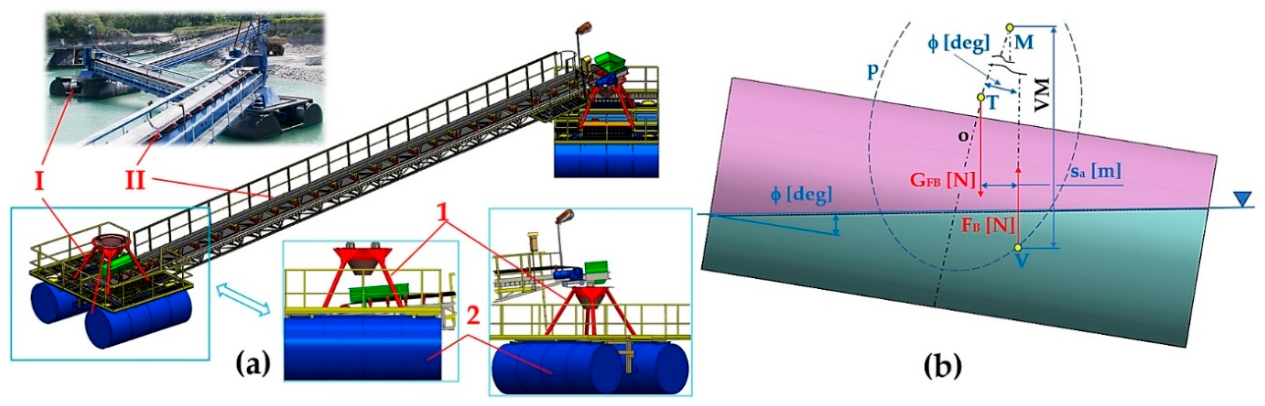
Figure 2.
Floating body of a conveyor belt with floats with a circular cross-section.

Figure 3.
Floating body (a) in equilibrium , (b) when deflected by an angle of .
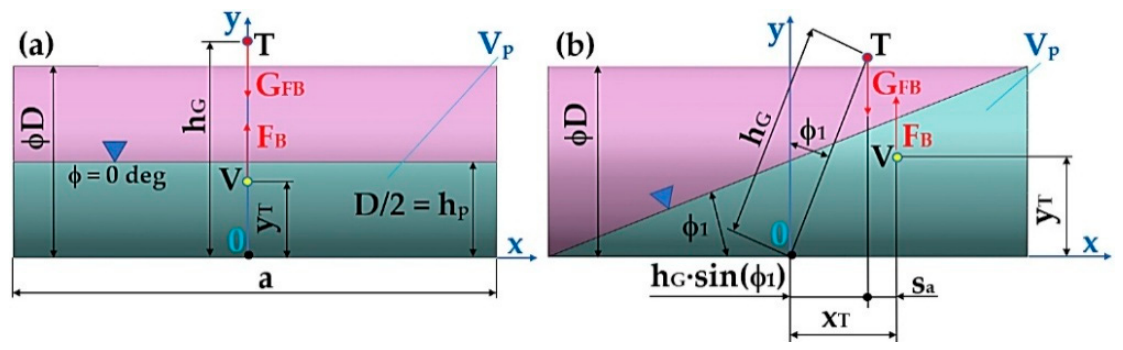
Figure 4.
Stability arm size at deflection of a floating body from equilibrium at a immersion of , for −1.6; −2.0; −2.5.
Figure 4.
Stability arm size at deflection of a floating body from equilibrium at a immersion of , for −1.6; −2.0; −2.5.
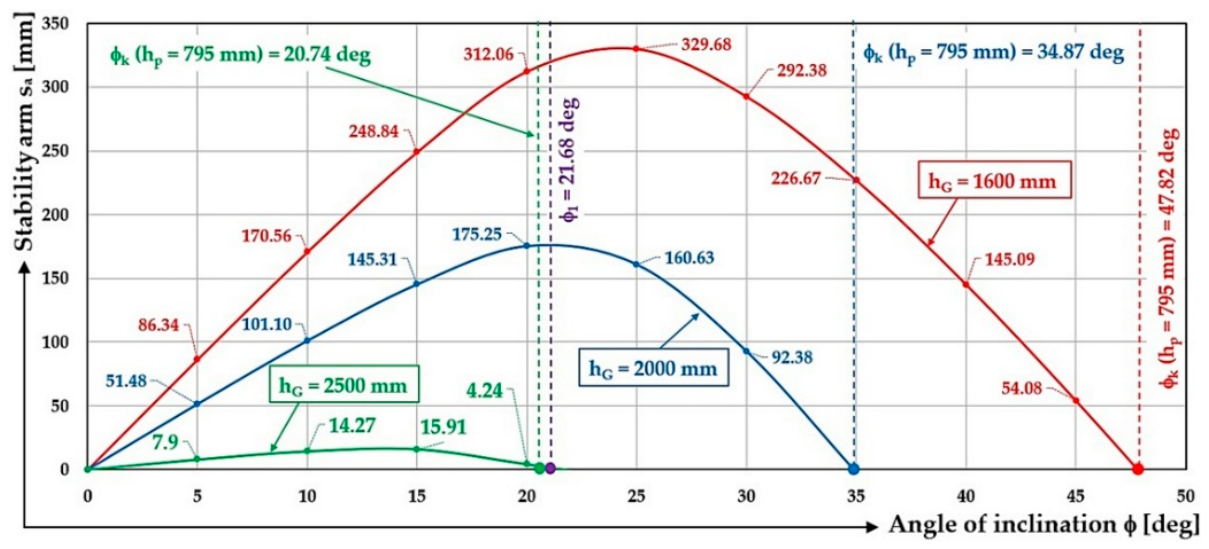
Figure 5.
Floating body during phase 2 deflection (a) , (b) .
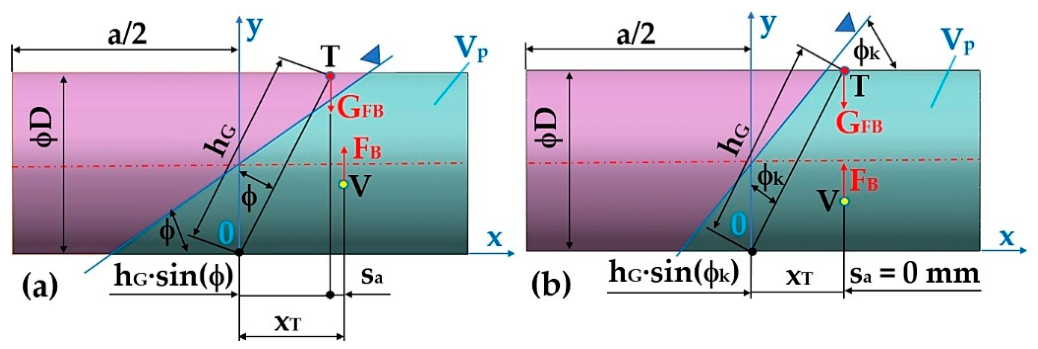
Figure 6.
Floating body (a) in equilibrium , (b) when deflected by an angle of .
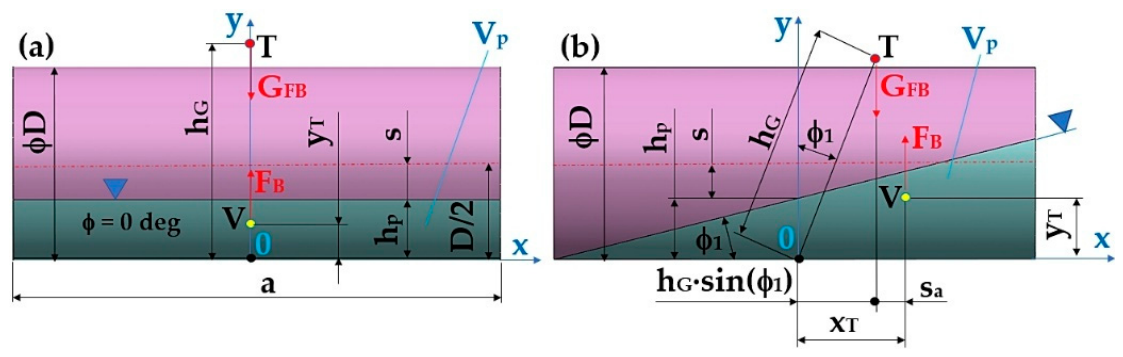
Figure 7.
Stability arm size at deflection of a floating body from equilibrium at a immersion of , for −1600; −2000; −2500.
Figure 7.
Stability arm size at deflection of a floating body from equilibrium at a immersion of , for −1600; −2000; −2500.
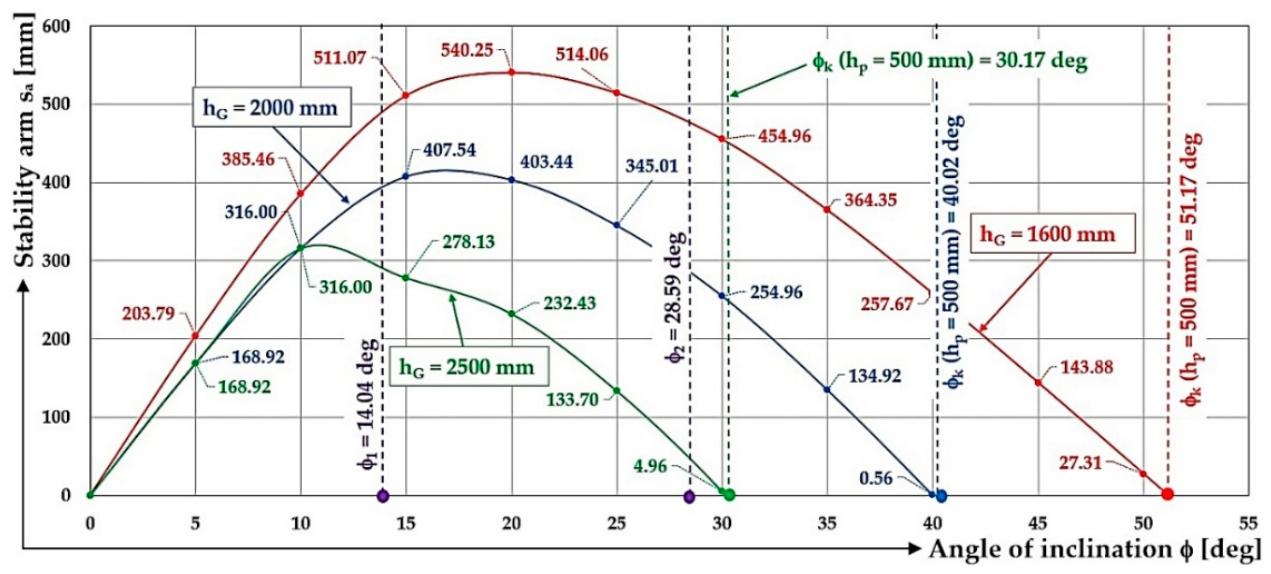
Figure 8.
Floating body (a) during completion of deflection phase 2 when the floats are immersed , (b) at equilibrium during float immersion .
Figure 8.
Floating body (a) during completion of deflection phase 2 when the floats are immersed , (b) at equilibrium during float immersion .
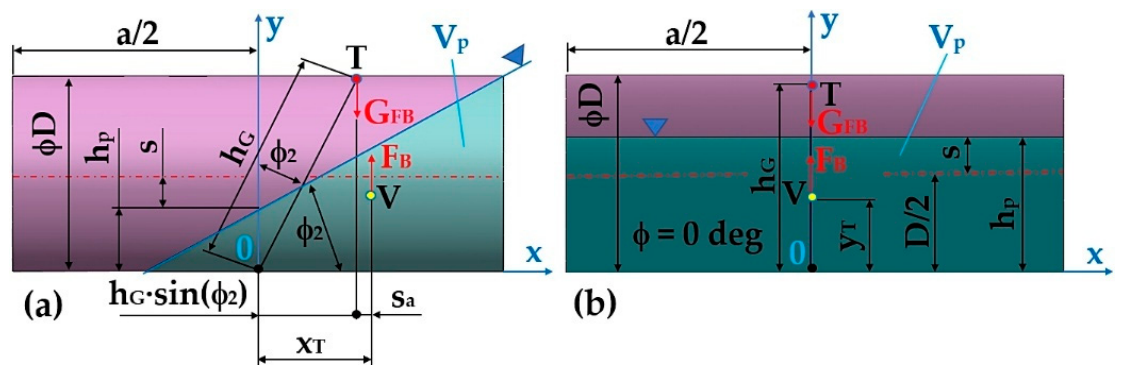
Figure 9.
Floating body at the end of (a) phase 1 of deflection , (b) phase 2 of deflection .
Figure 10.
Stability arm size at deflection of the floating body from equilibrium, at .
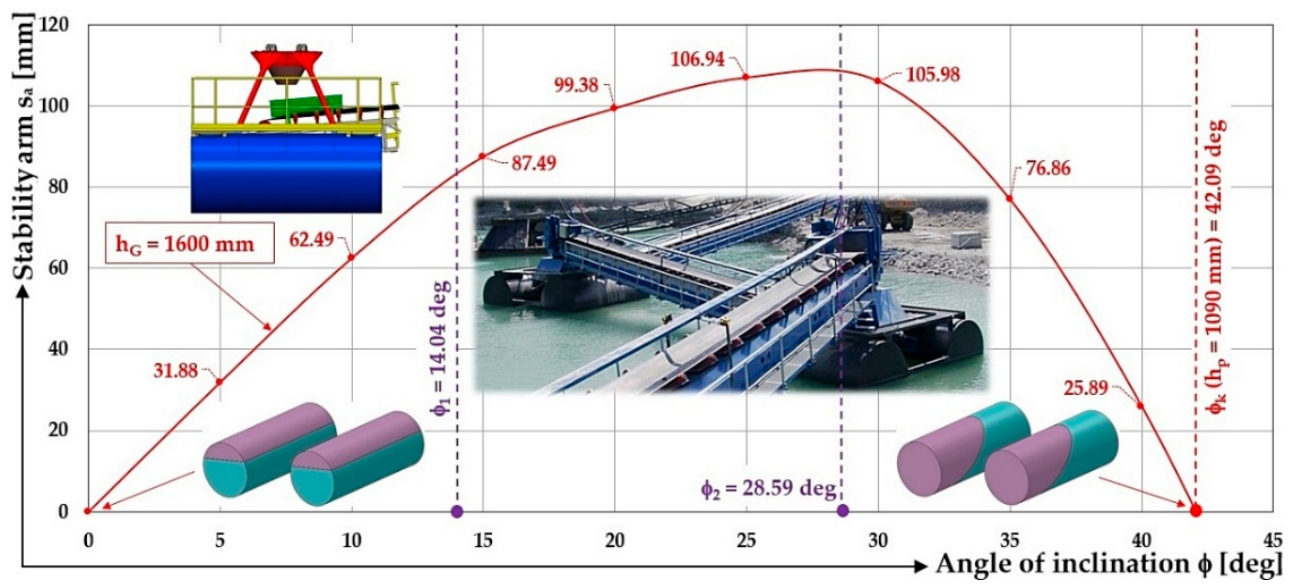
Figure 11.
Stability arm size at deflection of the floating body from equilibrium, at and different sizes of immersion .
Figure 11.
Stability arm size at deflection of the floating body from equilibrium, at and different sizes of immersion .
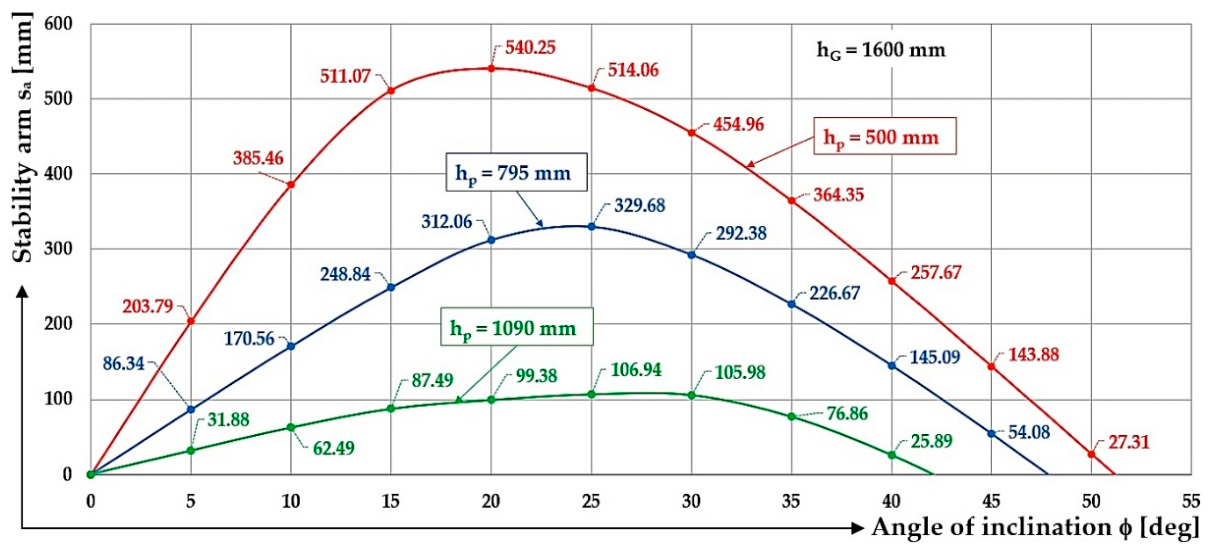
Figure 12.
Plan description of a cylindrical float, general geometrical conditions.
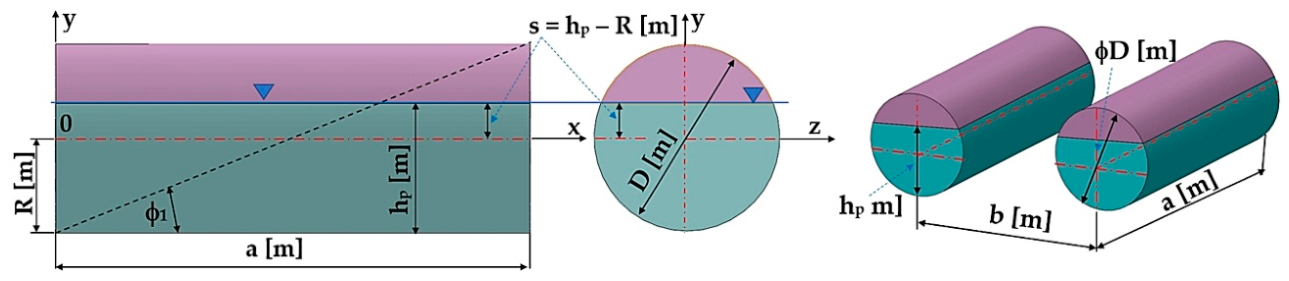
Figure 13.
Position of point on the axis and the position of point in the plane at a distance of from the origin of the coordinate system, at a immersion of .
Figure 13.
Position of point on the axis and the position of point in the plane at a distance of from the origin of the coordinate system, at a immersion of .
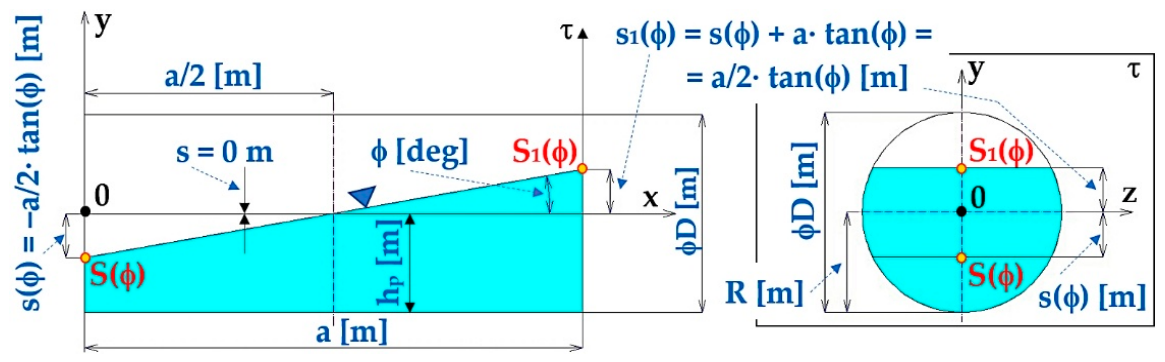
Figure 14.
Position of point on the axis and the position of point in the plane at a distance of from the origin of the coordinate system, at a heel of , in phase 1 of the heel of the floating body.
Figure 14.
Position of point on the axis and the position of point in the plane at a distance of from the origin of the coordinate system, at a heel of , in phase 1 of the heel of the floating body.
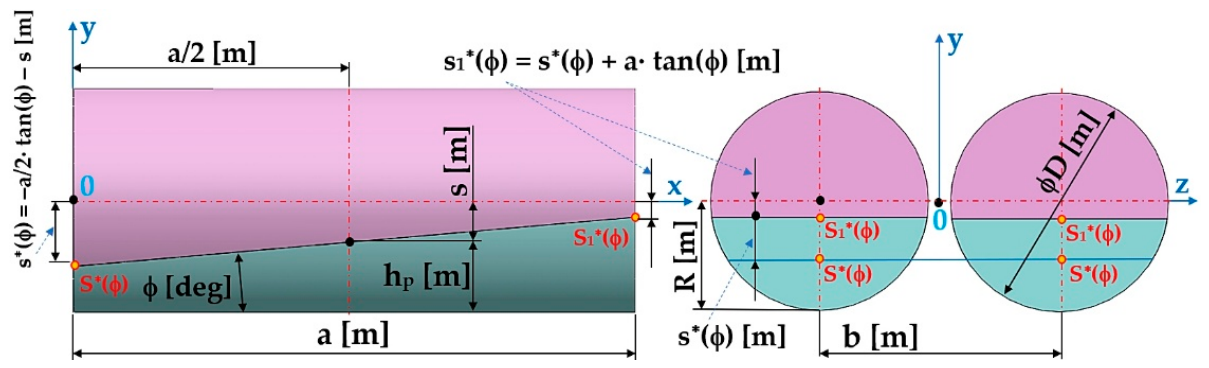
Figure 15.
Position of point on the axis and the position of point in the plane at a distance of from the origin of the coordinate system, at a heel of .
Figure 15.
Position of point on the axis and the position of point in the plane at a distance of from the origin of the coordinate system, at a heel of .
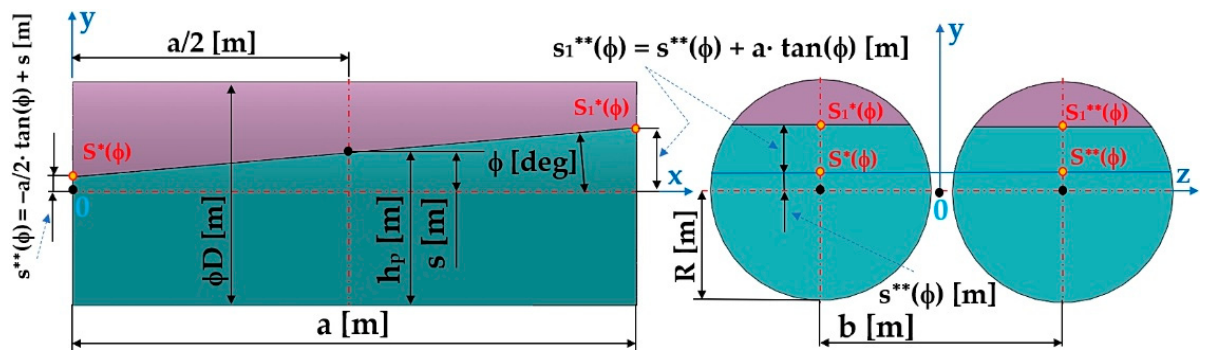
Figure 16.
Position of point on the axis and the position of point in the plane at a distance of from the origin of the coordinate system, at a heel of , in phase 2 of the heel of the floating body.
Figure 16.
Position of point on the axis and the position of point in the plane at a distance of from the origin of the coordinate system, at a heel of , in phase 2 of the heel of the floating body.
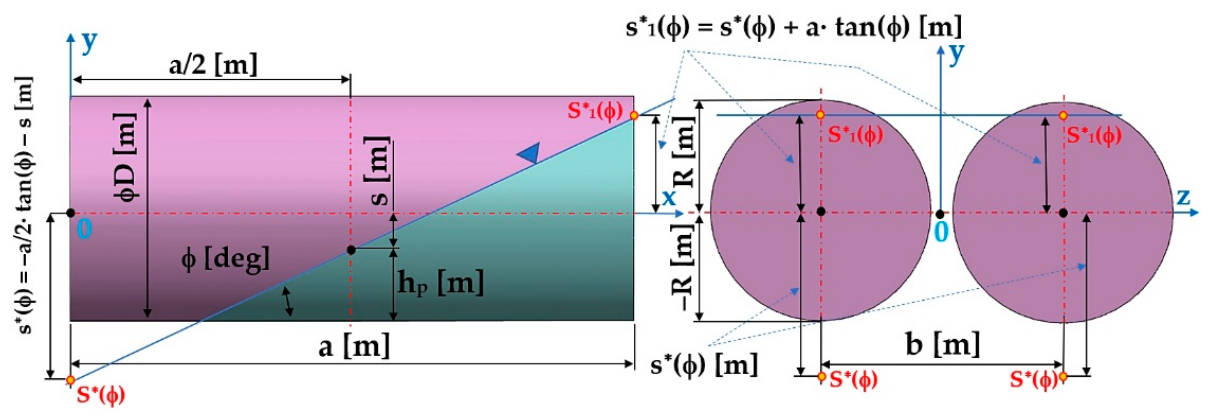
Figure 17.
Position of point on the axis and the position of point in the plane at a distance of from the origin of the coordinate system, at a heel of , in phase 2 of the heel of the floating body.
Figure 17.
Position of point on the axis and the position of point in the plane at a distance of from the origin of the coordinate system, at a heel of , in phase 2 of the heel of the floating body.
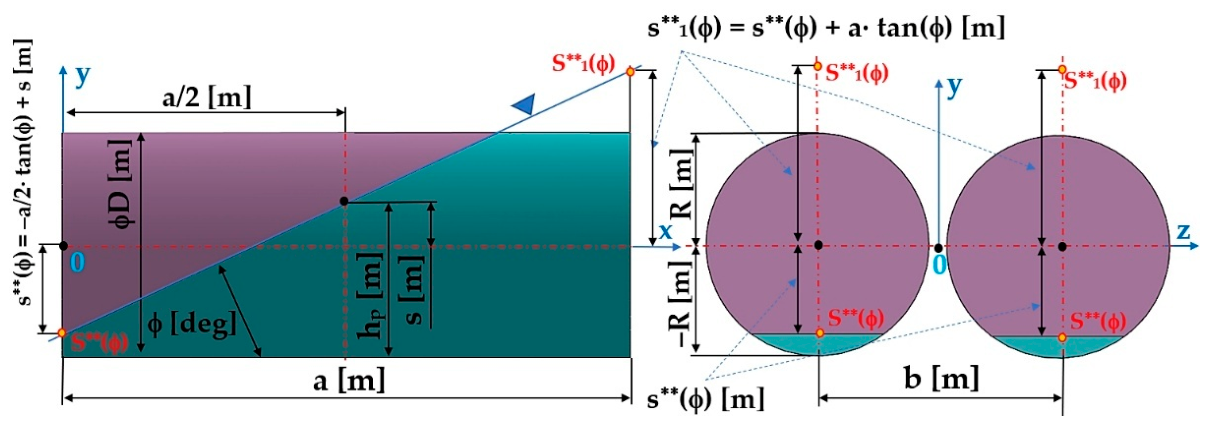
Figure 18.
Position of point on the axis and the position of point in the plane at a distance of from the origin of the coordinate system, at a heel of , in phase 3 of the heel of the floating body.
Figure 18.
Position of point on the axis and the position of point in the plane at a distance of from the origin of the coordinate system, at a heel of , in phase 3 of the heel of the floating body.
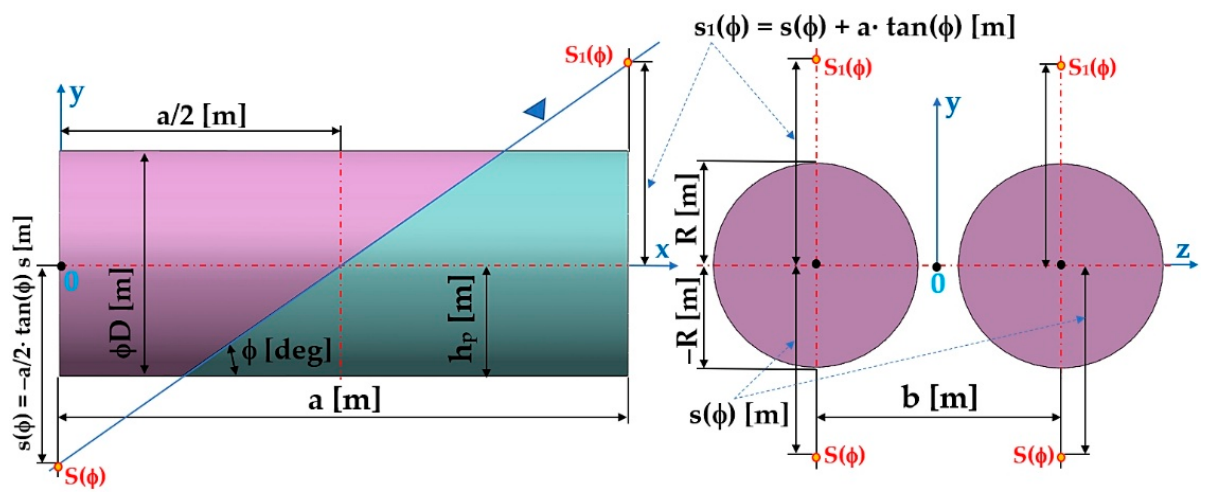
Figure 19.
Position of point on the axis and position of point in the plane at a distance of from the origin of the coordinate system, at a heel of , in phase 3 of heel of the floating body.
Figure 19.
Position of point on the axis and position of point in the plane at a distance of from the origin of the coordinate system, at a heel of , in phase 3 of heel of the floating body.
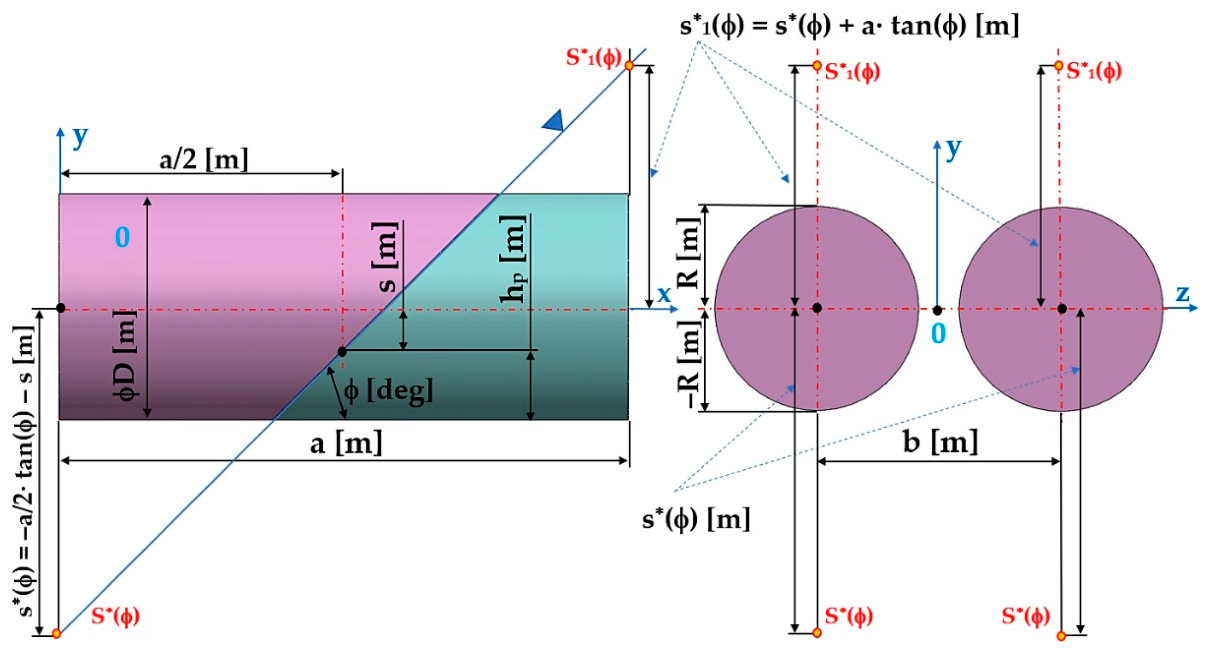
Figure 20.
Position of point on the axis and position of point in the plane at a distance of from the origin of the coordinate system, at a heel of , in phase 3 of heel of the floating body.
Figure 20.
Position of point on the axis and position of point in the plane at a distance of from the origin of the coordinate system, at a heel of , in phase 3 of heel of the floating body.
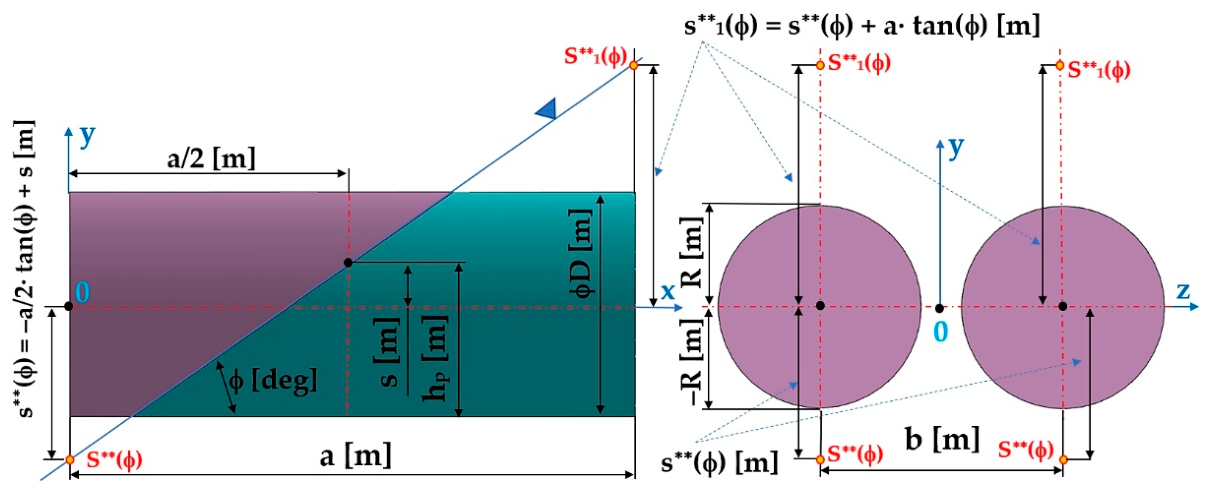
Figure 21.
Coordinates of the centre of gravity of the buoyant force of the floating body during a deflection of at an immersion depth of .
Figure 21.
Coordinates of the centre of gravity of the buoyant force of the floating body during a deflection of at an immersion depth of .
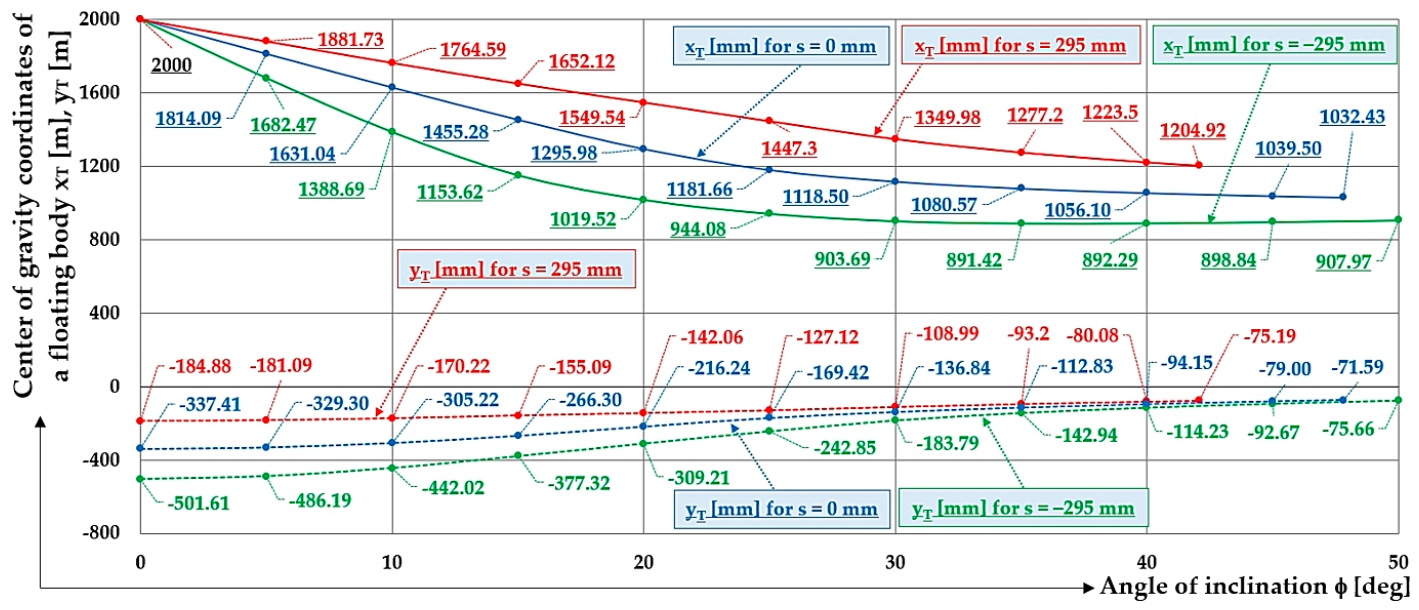
Figure 22.
3D model of the laboratory device to determine the buoyancy of a floating body. 1‒tank, 2‒floating body, 3‒force transducer, 4‒twin-screw sleeve, 5‒connecting assembly of the axis with the force transducer.
Figure 22.
3D model of the laboratory device to determine the buoyancy of a floating body. 1‒tank, 2‒floating body, 3‒force transducer, 4‒twin-screw sleeve, 5‒connecting assembly of the axis with the force transducer.
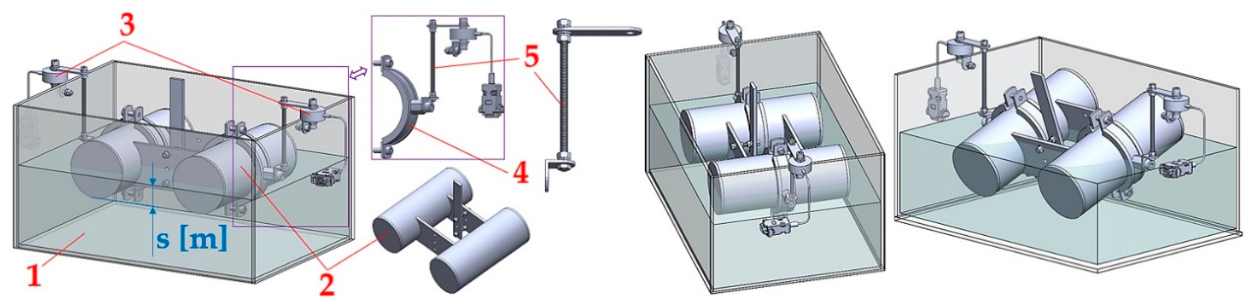
Figure 23.
Basic dimensions of the test device. 1‒tank, 2‒floating body, 3‒force transducer [35], 4‒twin-screw sleeve [36], 5‒connecting assembly of the axis with the force transducer.
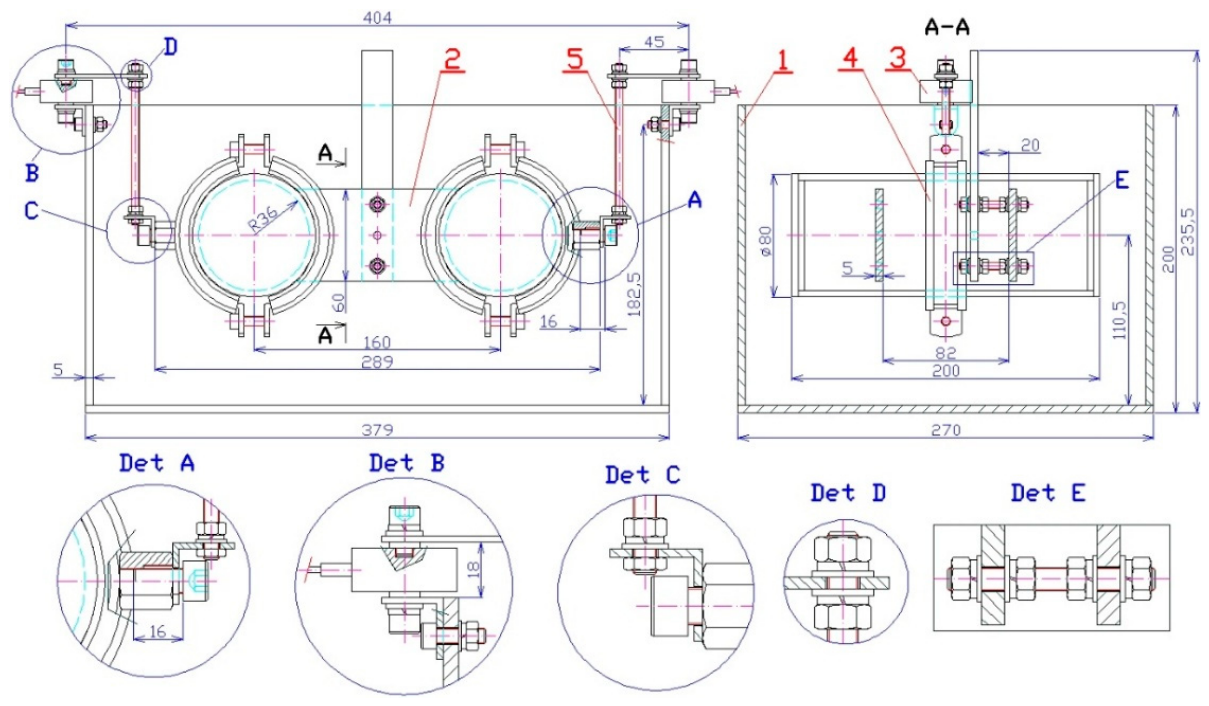
Figure 24.
Measurement chain using DS NET to sense tensile forces . 1‒tank, 2‒floating body, 3‒force sensor [35], 4‒D‒Sub plug, 5‒measuring module [37], 6‒gateway module DS GATE [37], 7‒ network cable with RJ-45 connectors, 8‒ASUS K72JR-TY131, 8‒software DEWESOFT [38].
Figure 25.
(a) immersion of the floating body from its own mass , (b) buoyant force of the floating body of its own mass .
Figure 25.
(a) immersion of the floating body from its own mass , (b) buoyant force of the floating body of its own mass .
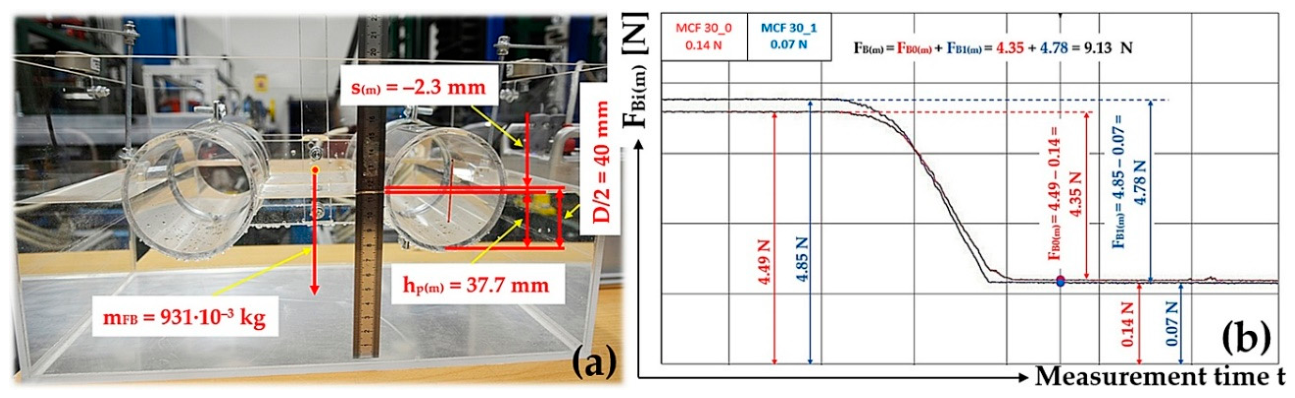
Figure 26.
Measured course of buoyant force (a) of the non-immersed and immersed floating body, (b) when immersed at with a deflection of of the floating body from the equilibrium position.
Figure 26.
Measured course of buoyant force (a) of the non-immersed and immersed floating body, (b) when immersed at with a deflection of of the floating body from the equilibrium position.
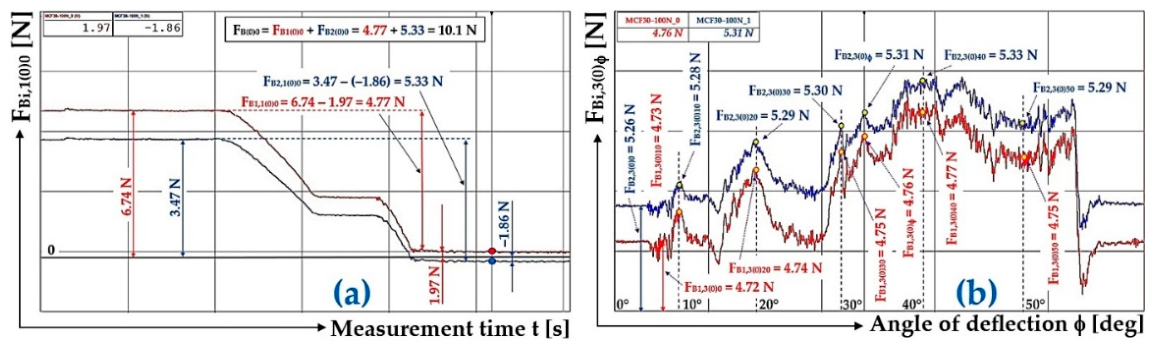
Figure 27.
Measured course of buoyant force (a) of the non-immersed and immersed floating body, (b) when immersed at with a deflection of of the floating body from the equilibrium position.
Figure 27.
Measured course of buoyant force (a) of the non-immersed and immersed floating body, (b) when immersed at with a deflection of of the floating body from the equilibrium position.
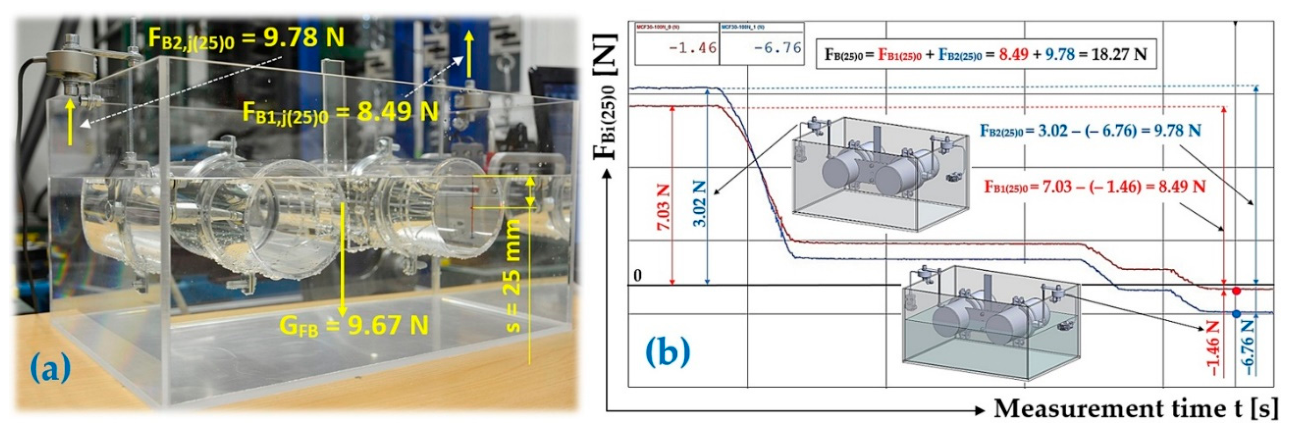
Figure 28.
(a) immersion of the floating body of the laboratory device, (b) measured buoyant force during immersion and deflection of the floating body from the equilibrium position.
Figure 28.
(a) immersion of the floating body of the laboratory device, (b) measured buoyant force during immersion and deflection of the floating body from the equilibrium position.
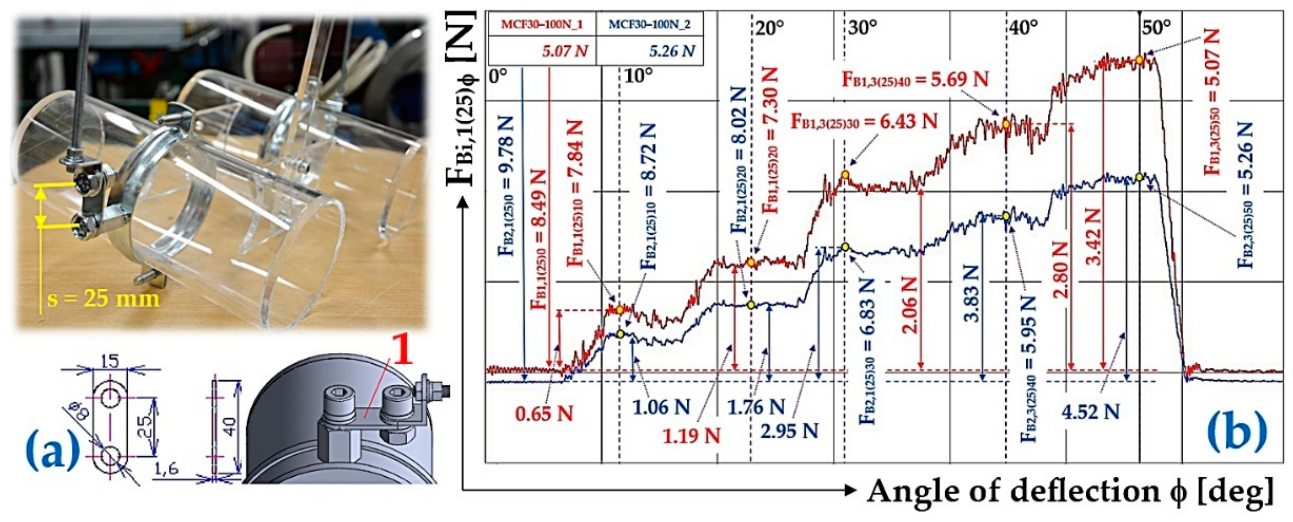
Figure 29.
Measured course of buoyant force (a) of the non-immersed and immersed floating body, (b) when immersed at and with a deflection of of the floating body from the equilibrium position.
Figure 29.
Measured course of buoyant force (a) of the non-immersed and immersed floating body, (b) when immersed at and with a deflection of of the floating body from the equilibrium position.
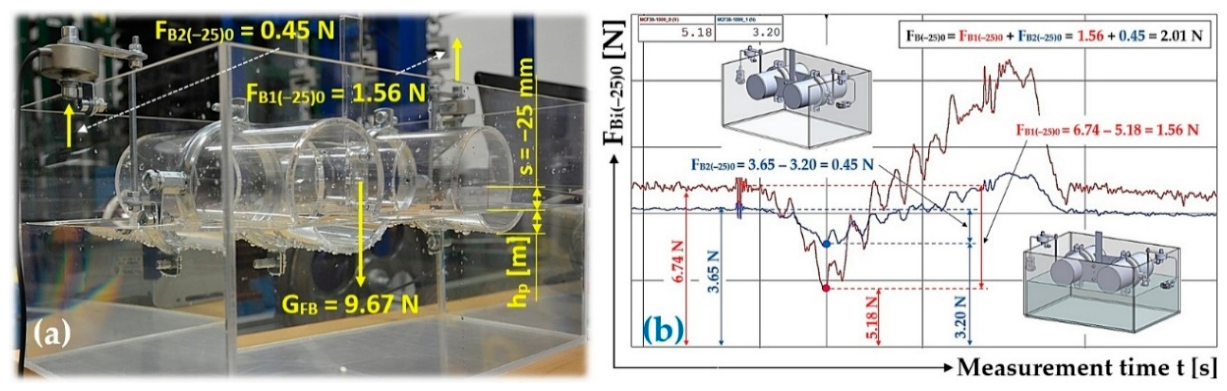
Figure 30.
Measured course of buoyant force (a) of the non-immersed and immersed floating body, (b) when immersed at and with a deflection of of the floating body from the equilibrium position.
Figure 30.
Measured course of buoyant force (a) of the non-immersed and immersed floating body, (b) when immersed at and with a deflection of of the floating body from the equilibrium position.
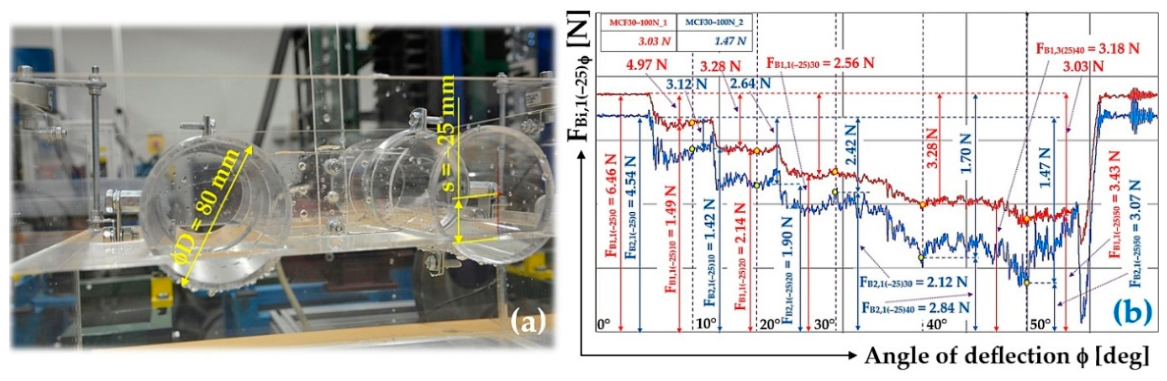
Figure 31.
This is a figure. Schemes follow the same formatting.
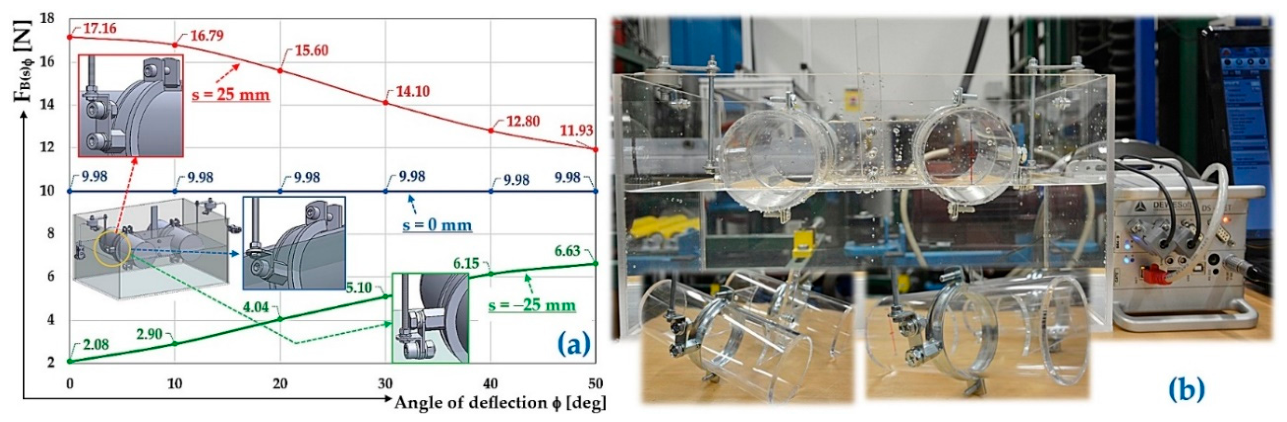
Table 1.
Coordinates of the centre of gravity of the buoyant force of the floating body during phase 1 of the deflection at an immersion depth of and different distances of the centre of gravity .
Table 1.
Coordinates of the centre of gravity of the buoyant force of the floating body during phase 1 of the deflection at an immersion depth of and different distances of the centre of gravity .
| a = 4 m, D = 1.59 m, = 1.6 m, = 0.795 m | ||||||||
| 0 | 5 | 10 | 15 | 20 | 21.68 | |||
| 0 | 185.91 | 368.95 | 544.68 | 703.83 | 750.03 | |||
| 0 | 185.20 | 363.34 | 526.12 | 661.38 | 697.00 | |||
| 457.59 | 465.70 | 489.78 | 528.68 | 578.65 | 596.26 | |||
| 0 | 40.59 | 85.05 | 136.83 | 197.91 | 218.36 | |||
| 0 | 139.45 | 277.84 | 414.11 | 547.23 | 591.08 | |||
| 0 1 | 86.34 1 | 170.56 1 | 248.84 1 | 312.06 1 | 324.28 | |||
| V | 7,942,260.39 | 7,942,260.04 | 7,942,260.30 | 7,942,337.71 | 7,943,195.10 | 7,942,366.46 | ||
| a = 4 m, D = 1.59 m, = 2.0 m, = 0.795 m | ||||||||
| 0 | 5 | 10 | 15 | 20 | 21.68 | |||
| 0 | 174.31 | 347.30 | 517.64 | 684.04 | 738.84 | |||
| 0 1 | 51.48 1 | 101.10 1 | 145.31 1 | 175.25 1 | 176.52 | |||
| a = 4 m, D = 1.59 m, = 2.5 m, = 0.795 m | ||||||||
| 0 | 5 | 10 | 15 | 20 | 21.68 | 20.74 | ||
| 0 | 217.89 | 434.12 | 647.05 | 855.05 | 923.56 | 885.32 | ||
| 0 1 | 7.90 1 | 14.27 1 | 15.91 1 | 4.24 1 | ‒8.20 | 0.16 | ||
1 see Figure 4.
Table 2.
Coordinates of the centre of gravity of the buoyant force of the floating body during phase 2 of the deflection at an immersion depth of and different distances of the centre of gravity .
Table 2.
Coordinates of the centre of gravity of the buoyant force of the floating body during phase 2 of the deflection at an immersion depth of and different distances of the centre of gravity .
| a = 4 m, D = 1.59 m, = 1.6 m, = 0.795 m | ||||||||
| 25 | 30 | 35 | 40 | 45 | 50 | 47.82 | ||
| 818.19 | 881.41 | 919.40 | 943.88 | 960.49 | 972.18 | 967.56 | ||
| 741.53 | 763.36 | 753.13 | 723.05 | 679.17 | 624.91 | 949.68 | ||
| 625.47 | 658.12 | 682.15 | 700.84 | 715.99 | 728.70 | 723.41 | ||
| 264.34 | 329.06 | 391.27 | 450.49 | 506.28 | 558.22 | 536.08 | ||
| 676.19 | 800.00 | 917.72 | 1,028.46 | 1,131.37 | 1,225.67 | 1,185.66 | ||
| 1 | 329.68 | 292.38 | 226.67 | 145.09 | 54.08 | ‒42.55 | 0.09 | |
| V | 7,943,300.73 | 7,942,633.28 | 7,942,525.23 | 7,942,369.70 | 7,942,338.76 | 7,942,288.43 | 7,942,307.66 | |
| a = 4 m, D = 1.59 m, = 2.0 m, = 0.795 m | ||||||||
| 25 | 30 | 35 | 34.87 | |||||
| 845.24 | 1,000.00 | 1,147.15 | 1,143.43 | |||||
| 1 | 160.63 | 92.38 | ‒2.76 | ‒0.06 | ||||
1 see Figure 4.
Table 3.
Coordinates of the centre of gravity of the buoyant force of the floating body during phase 1 of the deflection at an immersion depth of and different distances of the centre of gravity .
Table 3.
Coordinates of the centre of gravity of the buoyant force of the floating body during phase 1 of the deflection at an immersion depth of and different distances of the centre of gravity .
| a = 4 m, D = 1.59 m, = 1.6 m, = 0.5 m | |||||
| 0 | 5 | 10 | 14.04 | ||
| 0 | 317.53 | 611.29 | 808.62 | ||
| 0 | 316.32 | 602.00 | 784.46 | ||
| 293.39 | 308.81 | 352.97 | 404.33 | ||
| 0 | 26.91 | 61.29 | 98.09 | ||
| 0 | 139.45 | 277.84 | 388.16 | ||
| 1 | 0 | 203.79 | 385.46 | 494.40 | |
| V | 4,277,845.56 | 4,310,799.37 | 4,416,382.70 | 4,575,370.37 | |
| a = 4 m, D = 1.59 m, = 2.0 m, = 0.5 m | |||||
| 0 | 5 | 10 | 14.04 | ||
| 0 | 174.31 | 347.30 | 485.20 | ||
| 1 | 0 | 168.92 | 316.00 | 397.36 | |
| a = 4 m, D = 1.59 m, = 2.5 m, = 0.5 m | |||||
| 0 | 5 | 10 | 14.04 | ||
| 0 | 217.89 | 434.12 | 606.50 | ||
| 1 | 0 | 125.35 | 229.18 | 276.06 | |
1 see Figure 7.
Table 4.
Coordinates of the centre of gravity of the buoyant force of the floating body during phase 2 of the deflection at an immersion depth of and different distances of the centre of gravity .
Table 4.
Coordinates of the centre of gravity of the buoyant force of the floating body during phase 2 of the deflection at an immersion depth of and different distances of the centre of gravity .
| a = 4 m, D = 1.59 m, = 1.6 m, = 0.5 m | ||||||
| 15 | 20 | 25 | 28.59 | |||
| 845.95 | 980.46 | 1,055.85 | 1,088.23 | |||
| 817.12 | 921.33 | 956.93 | 784.46 | |||
| 417.49 | 485.78 | 552.09 | 596.18 | |||
| 108.05 | 166.15 | 233.32 | 285.30 | |||
| 414.11 | 547.23 | 676.19 | 765.66 | |||
| 1 | 511.07 | 540.25 | 514.06 | 475.17 | ||
| V | 4,628,671.65 | 5,000,501.98 | 5,457,931.98 | 5,793,026.50 | ||
| a = 4 m, D = 1.59 m, = 2.0 m, = 0.5 m | ||||||
| 15 | 20 | 25 | 28.59 | |||
| 517.64 | 684.04 | 845.24 | 957.08 | |||
| 1 | 407.54 | 403.44 | 345.01 | 283.76 | ||
| a = 4 m, D = 1.59 m, = 2.5 m, = 0.5 m | ||||||
| 15 | 20 | 25 | 28.59 | |||
| 647.05 | 855.05 | 1,056.55 | 1,196.35 | |||
| 1 | 278.13 | 232.43 | 133.70 | 44.49 | ||
1 see Figure 7.
Table 5.
Coordinates of the centre of gravity of the buoyant force of the floating body during phase 3 of the deflection at an immersion depth of .
Table 5.
Coordinates of the centre of gravity of the buoyant force of the floating body during phase 3 of the deflection at an immersion depth of .
| a = 4 m, D = 1.59 m, = 1.6 m, = 0.5 m | ||||||||
| 30 | 35 | 40 | 45 | 50 | 55 | 51.17 | ||
| 1,096.25 | 1,108.56 | 1,107.70 | 1,101.16 | 1,092.02 | 1,081.68 | 1,089.68 | ||
| 949.38 | 908.08 | 848.55 | 778.64 | 701.94 | 620.43 | 683.24 | ||
| 611.16 | 652.04 | 680.76 | 702.32 | 719.34 | 733.31 | 722.84 | ||
| 305.58 | 373.99 | 437.58 | 496.62 | 551.05 | 600.69 | 563.10 | ||
| 800.00 | 917.72 | 1,028.46 | 1,131.37 | 1,225.67 | 1,310.64 | 1,246.42 | ||
| 1 | 454.96 | 364.35 | 257.67 | 143.88 | 27.31 | ‒89.52 | ‒0.07 | |
| V | 5,913,524.05 | 6,269,388.16 | 6,546,223.86 | 6,770,838.79 | 6,959,292.66 | 7,121,975.43 | 6,999,369.55 | |
| a = 4 m, D = 1.59 m, = 2.0 m, = 0.5 m | ||||||||
| 30 | 35 | 40 | 45 | 40.02 | ||||
| 1,000.00 | 1,147.15 | 1,285.58 | 1,414.21 | 1,286.11 | ||||
| 1 | 254.96 | 134.92 | 0.56 | ‒138.96 | 0.00 | |||
| a = 4 m, D = 1.59 m, = 2.5 m, = 0.5 m | ||||||||
| 30 | 35 | 30.17 | ||||||
| 1,250.00 | 1,433.94 | 1,256.42 | ||||||
| 1 | 4.96 | ‒151.87 | 0.01 | |||||
1 see Figure 7.
Table 6.
Coordinates of the centre of gravity of the buoyant force of the floating body during phase 1 of the deflection at an immersion depth of and different distances of the centre of gravity .
Table 6.
Coordinates of the centre of gravity of the buoyant force of the floating body during phase 1 of the deflection at an immersion depth of and different distances of the centre of gravity .
| b = 3.18 m, D = 1.59 m, = 1.6 m, = 1.09 m | |||||
| 0 | 5 | 10 | 14.04 | ||
| 0 | 118.27 | 235.41 | 327.13 | ||
| 0 | 117.82 | 231.83 | 317.36 | ||
| 610.12 | 613.91 | 624.78 | 637.07 | ||
| 0 | 53.51 | 108.49 | 155.24 | ||
| 0 | 139.45 | 277.84 | 388.16 | ||
| 1 | 0 | 31.88 | 62.49 | 84.44 | |
| V | 11,606,675.22 | 11,573,721.08 | 11,468,171.34 | 11,310,648.30 | |
| b = 3.18 m, D = 1.59 m, = 2.0 m, = 1.09 m | |||||
| 0 | 5 | 4.68 | |||
| 0 | 174.31 | 162.49 | |||
| 1 | 0 | ‒2.99 | 0.02 | ||
| b = 3.18 m, D = 1.59 m, = 2.5 m, = 1.09 m | |||||
| 0 | 5 | 0.04 | |||
| 0 | 217.89 | 2.18 | |||
| 1 | 0 | ‒46.56 | ‒0.14 | ||
1 see Figure 10.
Table 7.
Coordinates of the centre of gravity of the buoyant force of the floating body during phase 2 of the deflection at an immersion depth of and distances of the centre of gravity .
Table 7.
Coordinates of the centre of gravity of the buoyant force of the floating body during phase 2 of the deflection at an immersion depth of and distances of the centre of gravity .
| b = 3.18 m, D = 1.59 m, = 1.6 m, = 1.09 m | |||||
| 15 | 20 | 25 | 28.59 | ||
| 347.84 | 450.46 | 552.66 | 624.64 | ||
| 335.99 | 423.29 | 500.88 | 548 | ||
| 639.89 | 652.95 | 667.85 | 680.88 | ||
| 165.62 | 223.32 | 282.25 | 325.83 | ||
| 414.11 | 547.23 | 676.19 | 765.66 | ||
| 1 | 87.49 | 99.38 | 106.94 | 108.64 | |
| V | 11,257,268.13 | 10,884,298.21 | 10,427,303.22 | 10,092,370.06 | |
1 see Figure 10.
Table 8.
Coordinates of the centre of gravity of the buoyant force of the floating body during phase 3 of the deflection at an immersion depth of .
Table 8.
Coordinates of the centre of gravity of the buoyant force of the floating body during phase 3 of the deflection at an immersion depth of .
| = 1.09 m | ||||||
| 30 | 35 | 40 | 45 | |||
| 650.09 | 722.76 | 776.48 | 818.07 | 795.06 | ||
| 562.99 | 592.05 | 594.82 | 578.46 | 590.01 | ||
| 685.97 | 701.79 | 714.91 | 726.15 | 719.80 | ||
| 342.99 | 402.53 | 459.54 | 513.47 | 482.48 | ||
| 800.00 | 917.72 | 1,028.46 | 1,131.37 | 1,072.48 | ||
| 1 | 105.98 | 76.86 | 25.89 | ‒39.44 | 0.01 | |
| V | 9,971,790.60 | 9,615,662.30 | 9,338,515.54 | 9,113,838.73 | 9,239,327.33 | |
1 see Figure 11.
Table 9.
Coordinates of the centre of gravity of the buoyant force of the floating body during phase 1 of the deflection at an immersion depth of , .
Table 9.
Coordinates of the centre of gravity of the buoyant force of the floating body during phase 1 of the deflection at an immersion depth of , .
| , , , | |||||||
| 0 | 5 | 10 | 15 | 20 | 21.68 | ||
| (14) | 2,000 | 1,814.09 | 1,631.04 | 1,455.28 | 1,295.98 | 1,250 | |
| 1 | 0 | 185.91 | 368.96 | 544.72 | 704.02 | 750 | |
| (15) | ‒337.41 | ‒329.30 | ‒305.22 | ‒266.30 | ‒216.24 | ‒198.75 | |
| 1 | 457.59 | 465.70 | 489.78 | 528.70 | 578.76 | 596.25 | |
| (13) | 7,942,263.41 | 7,942,262.47 | 7,942,261.64 | 7,942,261.98 | 7,942,262.06 | 7,942,263.39 | |
1 see Table 1.
Table 10.
Coordinates of the centre of gravity of the buoyant force of the floating body during phase 1 of the deflection at an immersion depth of , .
Table 10.
Coordinates of the centre of gravity of the buoyant force of the floating body during phase 1 of the deflection at an immersion depth of , .
| , , , | |||||
| 0 | 5 | 10 | 14.04 1 | ||
| (14) | 2,000 | 1,682.47 | 1,388.69 | 1,191.07 | |
| 1 | 0 | 317.53 | 611.29 | 808.93 | |
| (15) | ‒501.61 | ‒486.19 | ‒442.02 | ‒390.53 | |
| 1 | 293.39 | 308.81 | 352.97 | 404.47 | |
| (13) | 4,277,847.07 | 4,310,799.76 | 4,416,349.07 | 4,573,738.85 | |
1 see Table 3.
Table 11.
Coordinates of the centre of gravity of the buoyant force of the floating body during phase 1 of the deflection at an immersion depth of , .
Table 11.
Coordinates of the centre of gravity of the buoyant force of the floating body during phase 1 of the deflection at an immersion depth of , .
| , , , | |||||
| 0 | 5 | 10 | 14.04 1 | ||
| (14) | 2,000 | 1,881.73 | 1,764.59 | 1,672.89 | |
| 1 | 0 | 118.27 | 235.41 | 327.11 | |
| (15) | ‒184.88 | ‒181.09 | ‒170.22 | ‒157.92 | |
| 1 | 610.12 | 613.91 | 624.78 | 637.08 | |
| (13) | 11,606,680.08 | 11,573,725.54 | 11,468,175.09 | 11,310,785.31 | |
1 see Table 6.
Table 12.
Coordinates of the centre of gravity of the buoyant force of the floating body during phase 2 of the deflection at an immersion depth of , .
Table 12.
Coordinates of the centre of gravity of the buoyant force of the floating body during phase 2 of the deflection at an immersion depth of , .
| , , , | |||||
| 15 | 20 | 25 | 28.59 1 | ||
| (21) | 1153.62 | 1019.52 | 944.08 | 911.70 | |
| 1 | 846.38 | 980.48 | 1,055.48 | 1,088.30 | |
| (22) | ‒377.32 | ‒309.21 | ‒242.85 | ‒198.75 | |
| 1 | 417.68 | 485.79 | 552.15 | 596.25 | |
| (20) | 4,627,088.40 | 5,000,410.74 | 5,457,742.35 | 5,792,751.74 | |
1 see Table 4.
Table 13.
Coordinates of the centre of gravity of the buoyant force of the floating body during phase 2 of the deflection at an immersion depth of , .
Table 13.
Coordinates of the centre of gravity of the buoyant force of the floating body during phase 2 of the deflection at an immersion depth of , .
| , , , | |||||
| 15 | 20 | 25 | 28.59 1 | ||
| (24) | 1,652.12 | 1,549.54 | 1,447.30 | 1,375.33 | |
| 1 | 347.88 | 450.46 | 552.70 | 624.67 | |
| (25) | ‒155.09 | ‒142.06 | ‒127.12 | ‒114.09 | |
| 1 | 639.91 | 652.94 | 667.88 | 680.91 | |
| (23) | 9,254,176.80 | 10,000,821.48 | 10,915,484.70 | 11,585,256.33 | |
1 see Table 7.
Table 14.
Coordinates of the centre of gravity of the buoyant force of the floating body during phase 3 of the deflection at an immersion depth of , .
Table 14.
Coordinates of the centre of gravity of the buoyant force of the floating body during phase 3 of the deflection at an immersion depth of , .
| , , , | |||||||
| 25 | 30 | 35 | 40 | 45 | 47.82 1 | ||
| (27) | 1,181.66 | 1,118.50 | 1,080.57 | 1,056.10 | 1,039.50 | 1,032.43 | |
| 1 | 818.34 | 881.50 | 919.43 | 943.90 | 960.50 | 967.57 | |
| (28) | ‒169.42 | ‒136.84 | ‒112.83 | ‒94.15 | ‒79.00 | ‒71.59 | |
| 1 | 625.58 | 658.16 | 682.17 | 700.85 | 716.00 | 723.41 | |
| (26) | 7,942,268.23 | 7,942,266.71 | 7,942,267.99 | 7,942,264.87 | 7,942,265.08 | 7,942,265.19 | |
1 see Table 2.
Table 17.
Buoyant force at an immersion depth of the floating body of and lateral deflection of the floating body from equilibrium .
Table 17.
Buoyant force at an immersion depth of the floating body of and lateral deflection of the floating body from equilibrium .
| 0 | j | ||
| 1 | 4.77 1 | ||
| 2 | 4.68 | ||
| 3 | 4.72 | ||
| 4.72 | |||
| ± 0.11 | |||
| 0 | j | ||
| 1 | 5.33 1 | ||
| 2 | 5.21 | ||
| 3 | 5.24 | ||
| 5.26 | |||
| ± 0.16 | |||
| 9.98 | |||
| 1017.68 | |||
| 1005.31 2 | |||
| 9.86 3 | |||
1 see Figure 26(a), 2 according to SolidWorks, 3 according to (1).
Table 18.
Buoyant force at an immersion depth of the floating body of and lateral deflection of the floating body from equilibrium .
Table 18.
Buoyant force at an immersion depth of the floating body of and lateral deflection of the floating body from equilibrium .
| 0 | 10 | 20 | 30 | 40 | 50 | |||
| 25 | j | |||||||
| 1 | 8.49 1 | 7.84 2 | 7.30 2 | 6.43 2 | 5.69 2 | 5.07 2 | ||
| 2 | 8.31 | 7.71 | 7.21 | 6.35 | 5.53 | 4.92 | ||
| 3 | 8.36 | 7.69 | 7.23 | 6.38 | 5.55 | 4.96 | ||
| 8.39 | 7.75 | 7.25 | 6.39 | 5.59 | 4.98 | |||
| ± 0.23 | ± 0.20 | ± 0.12 | ± 0.10 | ± 0.22 | ± 0.19 | |||
| 0 | 10 | 20 | 30 | 40 | 50 | |||
| 25 | j | |||||||
| 1 | 9.78 1 | 8.72 2 | 8.02 2 | 6.83 2 | 5.95 2 | 5.26 2 | ||
| 2 | 9.59 | 8.58 | 7.89 | 6.70 | 5.82 | 5.11 | ||
| 3 | 9.62 | 8.64 | 7.97 | 6.76 | 5.87 | 5.13 | ||
| 9.66 | 8.65 | 7.96 | 6.76 | 5.88 | 5.17 | |||
| ± 0.25 | ± 0.17 | ± 0.16 | ± 0.16 | ± 0.16 | ± 0.20 | |||
| 0 | 10 | 20 | 30 | 40 | 50 | |||
| 18.05 | 16.40 | 15.21 | 13.15 | 11.47 | 10.15 | |||
Table 19.
Immersed volume of the floats of the floating body of the test device at an immersion depth of and angle of deflection of .
Table 19.
Immersed volume of the floats of the floating body of the test device at an immersion depth of and angle of deflection of .
| 0 | 10 | 20 | 30 | 40 | 50 | |
| 1 | 18.05 | 16.40 | 15.21 | 13.15 | 11.47 | 10.15 |
| 2 | 1,840.59 | 1,672.33 | 1,550.99 | 1,340.93 | 1,169.61 | 1,035.01 |
| 3 | 1,749.64 | 1,712.07 | 1,590.40 | 1,438.30 | 1,304.84 | 1,216.20 |
| 4 | 17.16 | 16.79 | 15.60 | 14.10 | 12.80 | 11.93 |
Table 20.
Buoyant force at an immersion depth of the floating body of and lateral deflection of the floating body from equilibrium .
Table 20.
Buoyant force at an immersion depth of the floating body of and lateral deflection of the floating body from equilibrium .
| 0 | 10 | 20 | 30 | 40 | 50 | |||
| ‒25 | j | |||||||
| 1 | 1.56 1 | 1.49 2 | 2.14 2 | 2.56 2 | 3.18 2 | 3.43 2 | ||
| 2 | 1.61 | 1.61 | 1.92 | 2.63 | 3.30 | 3.55 | ||
| 3 | 1.59 | 1.54 | 2.08 | 2.67 | 3.24 | 3.51 | ||
| 1.59 | 1.55 | 2.05 | 2.62 | 3.24 | 3.50 | |||
| ± 0.06 | ± 0.15 | ± 0.28 | ± 0.14 | ± 0.14 | ± 0.15 | |||
| 0 | 10 | 20 | 30 | 40 | 50 | |||
| ‒25 | j | |||||||
| 1 | 0.45 1 | 1.42 2 | 1.90 2 | 2.42 2 | 2.84 2 | 3.07 2 | ||
| 2 | 0.49 | 1.36 | 2.09 | 2.48 | 2.93 | 3.21 | ||
| 3 | 0.52 | 1.40 | 1.98 | 2.54 | 2.97 | 3.12 | ||
| 0.49 | 1.39 | 1.99 | 2.48 | 2.91 | 3.13 | |||
| ± 0.09 | ± 0.08 | ± 0.24 | ± 0.15 | ± 0.17 | ± 0.18 | |||
| 0 | 10 | 20 | 30 | 40 | 50 | |||
| 2.08 | 2.90 | 4.04 | 5.10 | 6.15 | 6.63 | |||
Disclaimer/Publisher’s Note: The statements, opinions and data contained in all publications are solely those of the individual author(s) and contributor(s) and not of MDPI and/or the editor(s). MDPI and/or the editor(s) disclaim responsibility for any injury to people or property resulting from any ideas, methods, instructions or products referred to in the content. |
© 2026 by the authors. Licensee MDPI, Basel, Switzerland. This article is an open access article distributed under the terms and conditions of the Creative Commons Attribution (CC BY) license (http://creativecommons.org/licenses/by/4.0/).
Copyright: This open access article is published under a Creative Commons CC BY 4.0 license, which permit the free download, distribution, and reuse, provided that the author and preprint are cited in any reuse.


