

Submitted:
14 September 2026
Posted:
15 September 2026
You are already at the latest version
Abstract
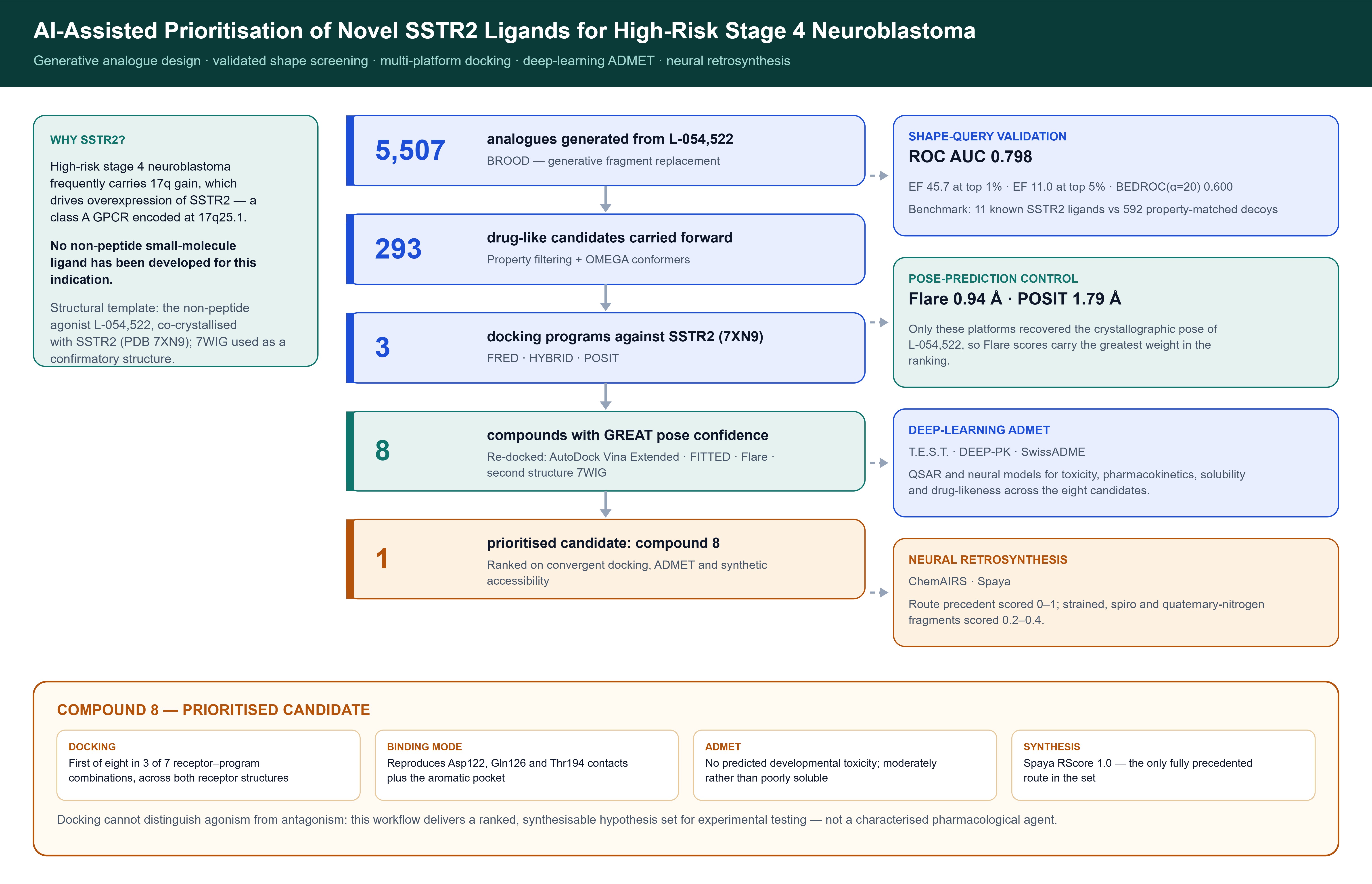
Somatostatin receptor subtype 2 (SSTR2), a class A G protein-coupled receptor encoded at chromosome 17q25.1, is overexpressed in high-risk stage 4 neuroblastoma with 17q gain, yet no non-peptide small-molecule ligand has been developed for this indication. We applied an AI-assisted computational workflow to identify and prioritise candidate SSTR2 ligands using the non-peptide agonist L-054,522 as the structural template. BROOD generated 5,507 analogues, of which 293 drug-like candidates were docked to SSTR2 (PDB 7XN9) with FRED, HYBRID and POSIT. The shape-based query was validated against a purpose-built benchmark of known SSTR2 ligands and property-matched decoys, achieving a ROC AUC of 0.798 with enrichment factors of 45.7 and 11.0 at the top 1% and 5%. Compounds achieving GREAT pose confidence were re-docked with AutoDock Vina Extended, FITTED and Flare, and against a second SSTR2 structure (7WIG). ADMET properties were predicted using the QSAR and deep-learning platforms T.E.S.T., DEEP-PK and SwissADME, and synthetic accessibility was assessed using the neural retrosynthesis platforms ChemAIRS and Spaya. Eight compounds achieved GREAT pose confidence. Re-docking of the crystallographic ligand recovered the experimental pose with Flare (heavy-atom RMSD 0.94 Å) and POSIT (1.79 Å) but not with the remaining platforms, and Flare scores were therefore given the greatest weight. Compound 8 ranked first among the eight candidates in three of seven receptor–program combinations, reproduced interactions with Asp122, Gln126, Thr194 and the aromatic pocket, showed no predicted developmental toxicity, was moderately rather than poorly soluble, and alone received a Spaya RScore of 1.0 indicating a fully precedented synthetic route. Because docking cannot distinguish agonism from antagonism, this work delivers a ranked, synthesisable hypothesis set for experimental testing rather than a characterised pharmacological agent.
Keywords:
artificial intelligence
; machine learning
; deep learning
; virtual screening
; retrosynthesis prediction
; ADMET prediction
; somatostatin receptor 2
; neuroblastoma
; molecular docking
; structure–property relationship
1. Introduction
Neuroblastoma (NB) is the third most common solid tumour in infants and children [1], accounting for approximately 15% of all paediatric cancer deaths globally. [2,3] The disease originates from embryonic sympathoadrenal cells of the neural crest and is closely linked to genetic and molecular characteristics rather than behavioural or environmental factors. [4,5]. Clinical outcomes vary dramatically: some tumours undergo spontaneous regression, while others progress aggressively despite intensive therapy. [6] For patients diagnosed with stage 4 disease (NBS4), survival rates remain between 40–50%, underscoring the urgent need for novel therapeutic strategies.[7]
A hallmark genetic abnormality in high-risk NBS4 is segmental gain of chromosome 17q, detected in over 80% of tumours [8]. The region 17q23.1 to 17qter is most frequently amplified, with gains at 17q25 strongly associated with an unfavourable prognosis. Notably, somatostatin receptor subtype 2 (SSTR2), located at 17q25.1, is overexpressed in high-risk NBS4. [8,9,10,11,12,13] Previous studies have demonstrated that somatostatin receptors, particularly SSTR2, are expressed in many neuroblastoma tumours and cell lines, and that activation of these receptors can inhibit neuroblastoma cell proliferation and tumour growth.[14,15,16]
Somatostatin receptors belong to the G protein-coupled receptor (GPCR) superfamily and mediate diverse physiological effects [17], including inhibition of growth hormone, regulation of neurotransmission, and suppression of cell proliferation. [15] SSTR2 is the most extensively studied mediator of somatostatin’s antiproliferative action and the primary pharmacological target of clinically prescribed somatostatin analogues. [18,19] Its activation inhibits adenylyl cyclase, blocks voltage-dependent calcium channels, and upregulates cell-cycle inhibitors such as CDKN1B. [20]
The nonpeptide compound L-054,522 was selected as the structural template for this work. L-054,522 binds SSTR2 with a dissociation constant of 0.01 nM and exhibits greater than 3000-fold selectivity over other somatostatin receptor subtypes. [21,22]. Using the co-crystal structure of L-054,522 with SSTR2 (PDB: 7XN9) [23] as a reference, this study employed a multi-platform computational workflow to design and evaluate potential SSTR2 ligands.
Computational approaches offer significant value at early stages of drug discovery by enabling rapid screening of chemical space, predicting binding modes, and prioritising candidates for synthesis and testing.[24] However, docking studies alone cannot determine whether a compound acts as an agonist, antagonist, partial agonist, or inactive binder—such functional characterisation requires experimental validation.[25] The present study therefore aims to identify computationally promising SSTR2 ligand candidates and provide a foundation for subsequent experimental investigation.
Two additional GPCRs on chromosome 17 are also expressed in NB cell lines: corticotropin-releasing hormone receptor 1 (CRHR1) at 17q21.31 and galanin receptor type 2 (GALR2) at 17q25.3. [26,27,28,29,30] As an exploratory analysis, we assessed whether top-ranked SSTR2 ligand candidates might also bind these receptors, though the therapeutic implications of such multi-target binding remain speculative pending experimental studies.
2. Materials and Methods
2.1. Lead Compound and Receptor Selection
L-054,522 (C₃₅H₄₇N₇O₅; MW 645.80) was identified as a structural template based on its high affinity and selectivity for SSTR2. [21,22] The crystal structure of SSTR2 in complex with L-054,522 (PDB: 7XN9) [23] was retrieved from the Protein Data Bank and used as the primary docking target. The receptor was prepared for docking using the MakeReceptor application (OpenEye), which defines the binding site based on the crystallographic ligand position and generates a shape-based receptor grid.[31]
A second SSTR2 structure (PDB: 7WIG) [33] served as a confirmatory target to assess binding site consistency. For exploratory multi-target analysis, CRHR1 (PDB: 8GTI) [32] and GALR2 (PDB: 7WQ4, 7XBD, 7XJK, 7XJL) [33,34,35] structures were also obtained.
During validation, L-054,522 failed to re-dock successfully using FRED and HYBRID [36,37] (“Undocked”) and received a POOR confidence score in POSIT. [31] This likely reflects conformational constraints of the ligand and the sensitivity of pose prediction to starting geometry. The crystallographic pose was used directly as the reference for evaluating analogue binding modes, and the MakeReceptor-defined binding site faithfully represents the experimental ligand position.
2.2. Analogue Generation Using BROOD
The BROOD application (OpenEye Scientific) was used to generate structural analogues of L-054,522 by replacing molecular fragments with bioisosteres of similar shape and electrostatics but different chemical properties. [38,39] BROOD identifies fragments from known chemical space (medicinal chemistry databases) and substitutes them into the lead structure while preserving overall molecular shape and pharmacophore features. Ten rounds of fragment searching were performed:
- Shape & Electrostatics mode: 4 rounds (1,557 compounds)
- Shape & Colour mode: 6 rounds (3,950 compounds)
Druglike filters were applied: molecular weight ≤500, LogP ≤5.0, topological polar surface area ≤150 Ų, Lipinski donor count ≤5, Lipinski acceptor count ≤10, rotatable bonds ≤10, heavy atom count ≤30, and ≤1 Lipinski violation. From each round, the top 20–30 compounds were selected based on Tanimoto combo scores (combined shape and electrostatic/colour similarity), yielding 293 candidates for docking.
2.3. Query Validation
The performance of the shape-based query was assessed prospectively against a purpose-built benchmark. Known SSTR2 ligands were retrieved from ChEMBL (target CHEMBL1804, Homo sapiens, single protein), yielding 3,804 bioactivity records. Records were filtered to Ki or IC50 determinations reported with an exact relation in human assays and with an associated pChEMBL value, and compounds with pChEMBL ≥ 7 (100 nM or better) were retained, giving 227 unique molecules. Because shape-based similarity to a 646 Da non-peptide template is not a meaningful test for macrocyclic peptides, the set was restricted to non-peptidic and peptidomimetic ligands of molecular weight ≤ 900 Da, giving 81 compounds. L-054,522 was excluded, as it constitutes the query. To limit analogue bias arising from congeneric series, at most five compounds were retained per source publication, selected by potency, giving 35 actives spanning ten publications.
Property-matched decoys were generated for these actives using the DUDE-Z service (tldr.docking.org). Decoys were matched on molecular weight (± 125 Da), calculated logP (± 3.6), rotatable bonds (± 5), hydrogen-bond acceptors (± 4), hydrogen-bond donors (± 3) and net formal charge (exact match), with topological similarity to any active constrained below a Tanimoto coefficient of 0.35 and mutual decoy similarity below 0.8. Fifty decoys were requested per active, with a minimum of 20 required for an active to be retained. Thirteen actives met this criterion, yielding 650 decoys at a uniform ratio of 50 decoys per active.
Conformers for actives and decoys were generated together in a single OMEGA run (OMEGA 6.1.1.3, classic mode; maximum 200 conformers per molecule, 10 kcal mol⁻¹ energy window, 0.5 Å RMSD duplicate threshold, MMFF94s_NoEstat force field) to ensure identical treatment of both sets. Two macrocyclic actives and 58 decoys were not processed in classic mode and were excluded, leaving 11 actives and 592 decoys. The query was the crystallographic conformation of L-054,522 extracted from PDB 7XN9, expanded to 200 conformers under the same settings. Screening was performed with ROCS 3.9.0.3 (OEChem 4.3.0.3) using the Implicit Mills–Dean colour force field, ranking by TanimotoCombo with no hit-list limit so that all molecules were ranked. Performance was quantified by the area under the receiver operating characteristic curve, by enrichment factors at the top 1% and 5% of the ranked database, and by BEDROC (α = 20).
Validation against the DUD and DUD-E decoy collections was considered and rejected. Decoys in these collections are property-matched to the actives of their respective targets: across the 40 DUD sets (124,413 molecules) median decoy molecular weight ranged from 229 to 518 Da, and across five class A GPCR DUD-E sets (approximately 99,800 molecules) the median was 429 Da, against a query molecular weight of 645.8 Da; fewer than 0.05% of DUD molecules exceeded 600 Da. Enrichment measured against such a background would reflect molecular size rather than shape complementarity. In addition, SSTR2 is represented in neither collection, so neither can supply target-relevant actives. A property-matched benchmark was therefore constructed specifically for this work, in which 33.7% of decoys exceed 600 Da, and median decoy molecular weight (546 Da) approximates that of the actives (582 Da).
2.4. Molecular Docking
Primary docking (OpenEye suite): All 293 compounds were docked to 7XN9 using FRED (fast exhaustive docking) and HYBRID (ligand-guided docking). [36,37] FRED performs systematic, exhaustive sampling of ligand poses within the binding site, while HYBRID uses the co-crystallised ligand to guide pose generation.
Final pose selection and ranking were performed using POSIT [31], which automatically selects the optimal docking algorithm based on 2D (graph) and 3D (structural) similarity between the docked ligand and the bound reference ligand. POSIT assigns pose confidence categories based on the probability that the predicted pose lies within 2.0 Å of the true binding mode:
- GREAT: 75–100% probability
- GOOD: 50–75%
- MEDIOCRE: 33–50%
- POOR: <33%
POSIT probabilities were validated against X-ray crystallography data in the original method development [31], providing a rigorous basis for pose confidence assessment.
2.4.1. Confirmatory docking
2.4.2. Interpretation of cross-platform results
Different docking programs use different scoring functions with different scales and physical meanings. FRED scores reflect shape complementarity and chemical matching; AutoDock Vina uses an empirical free energy function; FITTED incorporates induced-fit effects. Raw scores are not directly comparable across platforms. Instead, cross-platform consistency—a compound ranking well across multiple independent methods—provides confidence in the predicted binding mode. [46] Cross-platform rank consistency is therefore used in preference to absolute score magnitudes, and the results are interpreted in Section 3.4.
2.4.3. Exploratory multi-target docking
The eight top-ranked compounds were docked to CRHR1 (8GTI) and GALR2 (7WQ4) using AutoDock Vina Extended. Binding site similarity across receptors was assessed using Protein Aligner [47]. These results are presented as hypothesis-generating rather than confirmatory.
2.4.4. Docking parameters
For the OpenEye suite (FRED, HYBRID, POSIT) and FITTED, the binding site was defined from the co-crystallised coordinates of L-054,522 using MakeReceptor, with an expanded search volume of approximately 14,000 ų. AutoDock Vina Extended, as implemented in Samson 2026 R1 (version 11.0.1), used a grid box of approximately 27,000 ų centred on the same site, with exhaustiveness set to 8 and up to 20 binding modes retained per ligand. FITTED does not employ a Vina-style exhaustiveness parameter; search depth is governed by its genetic algorithm settings, and 10 non-redundant poses were retained per ligand. Flare 12.0.0 (Cresset BioMolecular Discovery, build 5e580cdab4f7) was run with default accuracy settings, with the binding site defined from the co-crystallised ligand. In each case the largest available search volume was used; this increases computational cost but reduces the risk of excluding valid poses.
2.4.5. Re-Docking Validation
The crystallographic ligand L-054,522 (residue GI9) was extracted from PDB 7XN9 and re-docked into the prepared receptor with each platform used in this study, applying the parameters given above. Pose accuracy was assessed by heavy-atom root-mean-square deviation from the crystallographic coordinates, calculated in place without superposition, with atoms matched by element using nearest-neighbour assignment. A deviation below 2 Å was taken to indicate successful pose recovery. Closest-approach distances to residues implicated in SSTR2 ligand recognition were computed for each re-docked pose and compared with the crystallographic values.
2.4.6. Ligand and receptor preparation.
Compound 8 was modelled with the primary amine protonated, giving a net charge of +1, consistent with the dominant microspecies expected at physiological pH; this assignment was confirmed during force field parameterisation with CGenFF. Receptor protonation states were assigned by each docking program’s default preparation routine at pH 7.4 (MakeReceptor for the OpenEye suite; the built-in protein preparation routines of Samson 2026 R1 and Flare 12.0.0 for the remaining platforms). No manual adjustment of ionisable residues or histidine tautomers was performed.
Independent pose corroboration was performed with DiffDock, a diffusion-based generative docking model, using the unmodified 7XN9 structure. DiffDock performs blind docking over the entire receptor and returns poses ranked by a learned confidence estimate.
2.5. ADMET Evaluation
Toxicity profiles were assessed using Toxicity Estimation Software Tools (T.E.S.T.) [48], including:
- Bioconcentration factor
- Mutagenicity (Ames test prediction)
- Oral rat LD₅₀
- 48-hour IGC₅₀ in *Tetrahymena pyriformis*
- Developmental toxicity
Pharmacokinetic properties were predicted using DEEP-PK [49]:
- Human oral bioavailability (50% threshold)
- Blood–brain barrier penetration
- CYP1A2 substrate status
- Predicted half-life
- Carcinogenicity
Additional ADME parameters (TPSA, LogP, water solubility, GI absorption, skin permeability) were calculated using SwissADME. [50]
2.6. Retrosynthetic Analysis
Synthetic feasibility was evaluated using two AI-driven platforms: ChemAIRS [51] and Spaya [52]. Spaya assigns an RScore (0–1), where values above 0.5 indicate well-precedented synthetic routes; lower scores suggest novel or higher-risk transformations. ChemAIRS was run in standard mode where possible; compounds requiring “High Risk” settings were flagged. Retrosynthetic analysis was performed using ChemAIRS (software release 3.9.0, database version 3.9.0) and Spaya (version 1.13.10), both neural retrosynthesis platforms.
2.7. Structure Visualisation and Analysis
Molecular structures and binding interactions were visualised using Discovery Studio Visualizer [53] and VIDA (OpenEye) [54] . Chemical structures were drawn using PICTO (OpenEye) [55] and ChemDraw. [56] Predicted ¹H and ¹³C NMR spectra were generated using MestReNova [57] to support future synthetic characterisation.
2.8. Machine-Learning Components of the Workflow
Machine-learning components of the workflow. Four elements of the pipeline rest on trained models rather than physics-based calculations. POSIT assigns pose confidence from a probabilistic model calibrated against crystallographic poses. T.E.S.T. applies QSAR models built on curated experimental toxicity endpoints. DEEP-PK applies deep neural networks trained on curated pharmacokinetic datasets. ChemAIRS (3.9.0) and Spaya (1.13.10) apply neural retrosynthesis models trained on reaction corpora, with the Spaya RScore reflecting the density of literature precedent for the proposed disconnections. Predictions from each are interpreted as prioritisation signals rather than measurements. The compounds prioritised here have molecular weights of approximately 620.81–691.84 Da and topological polar surface areas above 160 Ų, placing them beyond the chemical space on which most ADMET models have been trained and validated; predictions for this series should therefore be regarded as indicative rather than quantitative.
2.9. Use of Generative Artificial Intelligence
During the preparation of this manuscript, the authors used Claude (Anthropic) for the purposes of manuscript drafting and editing, computation of virtual screening validation metrics, and preparation of Figure 2. The authors have reviewed and edited the output and take full responsibility for the content of this publication.
3. Results
3.1. Analogue Generation
3.2. Query Validation
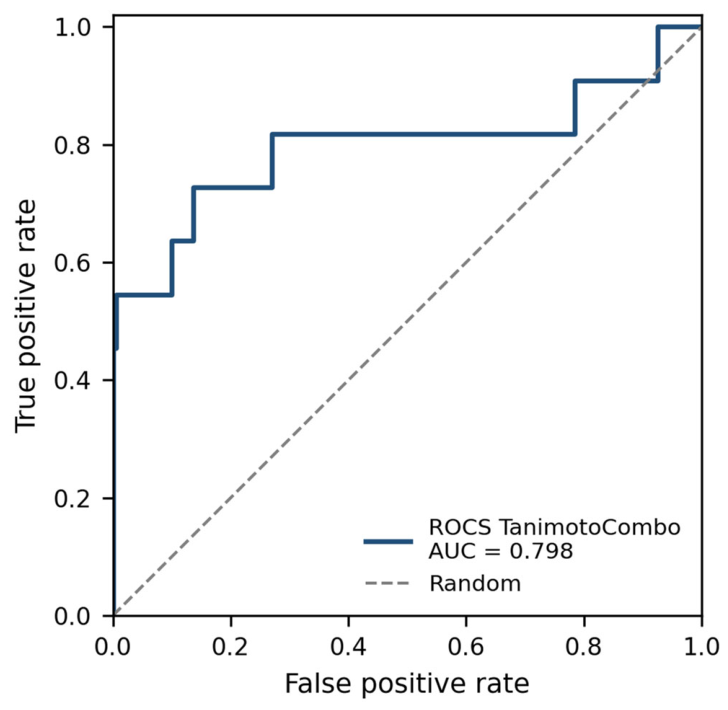
The L-054,522-derived query was screened against a benchmark of 11 known SSTR2 ligands and 592 property-matched decoys (Table 2, Figure 2). The query achieved an area under the receiver operating characteristic curve of 0.798, with enrichment factors of 45.7 at the top 1% and 11.0 at the top 5% of the ranked database, and a BEDROC (α = 20) of 0.600. Five of the eleven known actives ranked within the top six molecules of 603, and the highest-scoring molecule in the database was a known SSTR2 ligand. Active TanimotoCombo scores spanned 0.484 to 1.188 (median 0.734) against a decoy distribution of 0.373 to 0.746 (median 0.571). The two lowest-ranked actives are structurally unrelated to the L-054,522 scaffold and are not retrieved by shape-based similarity, which is expected for a single-query method.
Figure 2.
Receiver operating characteristic curve for the L-054,522-derived shape query screened against 11 known SSTR2 ligands and 592 property-matched decoys generated with DUDE-Z. Molecules were ranked by TanimotoCombo using ROCS with the Implicit Mills–Dean colour force field. The area under the curve is 0.798; the dashed diagonal indicates random selection. Enrichment factors were 45.7 and 11.0 at the top 1% and 5% of the ranked database, respectively.
Figure 2.
Receiver operating characteristic curve for the L-054,522-derived shape query screened against 11 known SSTR2 ligands and 592 property-matched decoys generated with DUDE-Z. Molecules were ranked by TanimotoCombo using ROCS with the Implicit Mills–Dean colour force field. The area under the curve is 0.798; the dashed diagonal indicates random selection. Enrichment factors were 45.7 and 11.0 at the top 1% and 5% of the ranked database, respectively.
All eight prioritised compounds were subsequently scored against the same validated query (Table 3). Every candidate exceeded the highest-scoring decoy in the benchmark (0.746), and seven of the eight ranked within the top 0.5% of the combined database. Compound 30 achieved the highest similarity of any molecule examined (TanimotoCombo 1.294), exceeding all eleven known actives, while compound 8 scored 1.074, exceeding nine of eleven. Because these compounds were generated by shape-based analogue design from L-054,522, high similarity to that template is an expected consequence of the design method and does not constitute independent evidence of receptor binding. The result establishes that the prioritised set falls within the similarity range occupied by experimentally confirmed SSTR2 ligands under a query of demonstrated retrieval performance, and outside the range occupied by property-matched decoys.
3.3. Primary Docking and Compound Selection
All 293 compounds were docked to SSTR2 (7XN9). POSIT analysis identified eight compounds (8, 12, 13, 14, 17, 22, 27, and 30) with GREAT pose confidence, indicating a 75–100% probability of the predicted pose lying within 2.0 Å of the true binding mode (Table 4).
L-054,522 itself did not dock successfully (“Undocked” in FRED/HYBRID; “POOR” in POSIT), reflecting the conformational constraints discussed in Section 2.1. The crystallographic pose served as the reference for all evaluations.
3.4. Redocking Validation
The results of the re-docking validation are shown in Table 5.
The closest approach (Å) between the re-docked ligand and residues implicated in SSTR2 ligand binding is shown in Table 6.
The Asp122 salt bridge is reproduced by Flare and POSIT, degraded by HYBRID and FRED, and lost entirely by AutoDock Vina Extended.
The crystallographic ligand L-054,522 was extracted from PDB 7XN9 and re-docked into the prepared receptor with each of the five platforms used in this study (Table 5). Two recovered the experimental binding mode. Flare achieved a heavy-atom RMSD of 0.94 Å, with 83% of heavy atoms within 1.0 Å of their crystallographic positions and a ligand centroid displacement of 0.40 Å. POSIT generated a pose at 1.79 Å with a median atom deviation of 0.52 Å, but rejected it on steric grounds; this pose is included in the comparison because it demonstrates that the correct binding mode was identified, and its rejection reflects the clash criterion applied to the prepared receptor rather than a failure of pose prediction. The remaining three platforms did not recover the experimental pose. HYBRID placed the ligand at 4.18 Å, FRED at 5.28 Å and AutoDock Vina Extended at 6.99 Å. In each case the ligand occupied the orthosteric pocket but adopted an incorrect orientation within it, with maximum single-atom deviations of 14.5, 14.2 and 15.9 Å respectively indicating that the molecule was inverted end to end relative to the crystallographic pose. For AutoDock Vina Extended no pose among the nine returned fell below 6.71 Å, indicating that the correct binding mode was not sampled rather than merely mis-ranked. Reproduction of individual binding-site contacts followed the same pattern (Table 6). The Asp122 salt bridge, at 2.65 Å in the crystal structure, was reproduced by Flare (2.72 Å) and POSIT (2.56 Å), degraded by HYBRID (3.70 Å) and FRED (5.53 Å), and lost entirely by AutoDock Vina Extended (7.64 Å). Contacts with the aromatic residues Phe208, Phe272 and Phe294 were more consistently reproduced across platforms, indicating that the aromatic pocket constrains ligand placement more strongly than the polar contacts do.
A related observation concerns the scoring rather than the poses. Three platforms assigned L-054,522 the least favourable score of the nine molecules examined: FRED −10.76 against −48.79 to −53.60 for the eight candidates, HYBRID −10.10 against −29.07 to −32.92, and AutoDock Vina Extended −9.65 against −21.39 to −23.07. Since L-054,522 has a reported Ki of 0.01 nM while none of the eight candidates has been tested experimentally, this inverts the ranking that the available experimental data would predict.
On this evidence the Flare scores are treated as the most reliable of those reported, and the docking results as a whole are interpreted through cross-platform rank consistency rather than absolute score magnitude (Section 4.3).
3.5. Confirmatory Docking
Compound 8 achieved the most favourable score of the eight candidates in FITTED against the primary receptor structure (7XN9) and in Flare against the confirmatory structure (7WIG), and ranked first in HYBRID during primary screening (Table 7). Its ranking was mid-set in the remaining columns, reflecting the sensitivity of absolute scores to receptor conformation and to scoring-function parameterisation for ligands of this size and polarity (Section 4.3). No single compound ranked first under every method. The AutoDock Vina Extended scores span only 1.7 kcal mol⁻¹ across the eight candidates, with the four highest-ranked separated by less than 0.1 kcal mol⁻¹, offering little discrimination; the Flare scores span 2.1 kcal mol⁻¹. In light of the re-docking validation (Section 3.4), the Flare scores are given the greatest weight among the platforms reported.
AutoDock Vina Extended scores were obtained with a search box of 28 × 28 × 28 Å centred on the crystallographic ligand at (19.1, 44.7, 54.5), grid spacing 0.375 Å, exhaustiveness 32 and receptor side-chain flexibility enabled. Flare scores are LF dG values from Flare 12.0.0 at default accuracy. Bold indicates the most favourable score in each column.
No compound ranked first under every method. Compound 8 achieved the most favourable score in three of the seven receptor–program combinations examined, distributed across both receptor structures, while ranking mid-set in the remainder. Figure 5 shows the Flare docking poses with compound 8.
3.6. Binding Interactions
Analysis of compound 8’s predicted binding pose revealed the following interactions:
Hydrogen bonds:
- Asp122 (salt bridge)
- Gln126
- Thr194
- Phe208 (backbone)
- Ala283
Hydrophobic contacts:
- Val103
- Phe272
- Phe294
- Leu290
- Val298
Aromatic interactions:
- π-stacking with Phe208, Phe272, Phe275, Phe294
These interactions closely (Figure 6) mirror those observed in the L-054,522 crystal structure [23] and align with residues identified in published molecular dynamics studies as critical for SSTR2 ligand binding.[58]. Gervasoni et al. demonstrated through multi-microsecond MD simulations that ligands stabilising the active conformation of SSTR2 engage Asp122, Gln126, and the aromatic residues lining the binding pocket [58]. The interaction pattern of compound 8 is consistent with these binding determinants.
While these interactions are consistent with ligand binding, docking cannot determine functional activity. Whether compound 8 acts as an agonist, antagonist, partial agonist, or inactive binder requires experimental determination through binding assays and functional studies.
Independent placement of compound 8 by DiffDock, a diffusion-based generative docking method employing no scoring function, positioned the ligand with its centroid 1.48 Å from the crystallographic ligand position and reproduced all six key binding-site contacts (Asp122 2.91 Å, Gln126 2.27 Å, Thr194 2.10 Å, Phe208 3.50 Å, Phe272 2.63 Å, Phe294 2.72 Å), corroborating the predicted binding mode by a method sharing none of the assumptions of the platforms used above. DiffDock performs blind docking across the entire receptor rather than a defined site, and its confidence estimate distinguished this result (−1.03, moderate confidence) from a parallel submission of L-054,522 itself, for which the top-ranked pose fell outside the binding site at low confidence (−2.10).
The chemical structures, molecular weights, and names of all eight compounds are presented in Table 8. All retain key structural features: an aromatic moiety capable of π-stacking, a basic centre capable of interacting with Asp122/Gln126, and overall shape similarity to L-054,522.
3.7. Comparative Structural Analysis
All eight candidates retain three features of the parent scaffold: the 2-oxo-benzimidazolone head group, the indole side chain and the tert-butyl ester terminus, with the protonated primary amine positioned to engage Asp122. Structural variation between them is confined to the fragment replaced by BROOD.
Predicted properties vary systematically with the substituted fragment. TPSA spans 159.85 Ų (compound 30) to 206.18 Ų (compounds 8 and 13), while XLOGP3 varies from 3.40 to 5.64. Predicted skin permeability tracks lipophilicity closely (r = 0.954 with XLOGP3) rather than polar surface area (r = −0.33), with the most lipophilic candidates (12 and 17, XLOGP3 5.41–5.64) showing the least restricted permeability (−6.40 and −6.58) and the least lipophilic (30, XLOGP3 3.40) the most restricted (−7.67). Compounds 8 and 13 share an identical TPSA of 206.18 Ų, as do compounds 17 and 27 at 177.75 Ų, indicating that several BROOD substitutions are isosteric with respect to polar surface while differing in lipophilicity. Predicted aqueous solubility discriminates within the set: compounds 8, 13, 22, 27 and 30 are classified as moderately soluble, while compounds 12, 14 and 17 and the lead compound L-054,522 are poorly soluble. Gastrointestinal absorption was predicted as low for all nine.
The only predicted pharmacokinetic parameter that distinguishes within the set is half-life: compounds 8, 13, 14, 22 and 27 are predicted to exceed three hours, while compounds 12, 17 and 30 fall below, as does L-054,522. All other predicted toxicity and pharmacokinetic parameters are uniform across the eight candidates.
The clearest structure–property relationship in the set concerns synthetic accessibility rather than predicted binding: the only candidate with an unmodified cyclopentane-derived fragment (compound 8) received a Spaya RScore of 1.0, while candidates incorporating strained, spiro or quaternary-nitrogen fragments (14, 17, 22, 27, 30) scored 0.2–0.4 or required high-risk settings in ChemAIRS. Because no experimental activity data are available for any member of the series, these are structure–property rather than structure–activity relationships, and no inference about potency should be drawn from them.
3.8. ADMET Properties
3.8.1. Toxicity
All eight compounds showed favourable predicted toxicity profiles with no mutagenicity and no developmental toxicity (Table 9). In contrast, L-054,522 was flagged as a developmental toxicant, highlighting a potential safety advantage for the newly identified compounds.
3.8.2. Pharmacokinetics
DEEP-PK predictions indicated that all compounds, including L-054,522, exhibit low oral bioavailability, do not penetrate the blood–brain barrier, are not CYP1A2 substrates, and have safe carcinogenicity profiles (Table 10). Compounds 8, 13, 14, 22, and 27 showed predicted half-lives ≥3 hours, while compounds 12, 17, 30, and L-054,522 showed shorter half-lives.
3.7.3. Physicochemical Properties
The results from SwissADME are shown in Table 11.
3.9. Synthetic Accessibility
Retrosynthetic analysis confirmed that all eight compounds have identifiable synthetic routes (Table 12). Critically, compound 8 achieved an RScore of 1.0 in Spaya, indicating a fully precedented pathway with established reaction types. Other compounds required “High Risk” settings in ChemAIRS or achieved lower RScores (0.2–0.4), indicating less established or more challenging synthetic routes.
RScore >0.5 indicates well-precedented routes; lower scores suggest novel transformations with less literature precedent.
Given its superior synthetic accessibility, compound 8 is prioritised as the lead candidate. Detailed retrosynthetic schemes for all compounds are provided in Supplementary Materials (Scheme S1–S14).
3.10. Exploratory Multi-Target Analysis
As exploratory analysis, the eight compounds were docked to CRHR1 (8GTI) and GALR2 (7WQ4)—two additional GPCRs on chromosome 17q that are expressed in neuroblastoma cell lines [26,27,28,29,30]. Protein Aligner [47], comparison indicated structural similarity between the SSTR2 binding pocket and those of CRHR1/GALR2 (Figure 7).
Compound 8 returned the least favourable CRHR1 score of the nine molecules examined (−6.46, against −7.32 for L-054,522) and a less favourable GALR2 score than the lead compound (−7.66 against −8.16). Its predicted engagement with both off-target receptors is therefore weaker than that of L-054,522 and of most of its own analogues. Consistent with this, the SSTR2-specific Asp122 salt bridge is absent from the predicted CRHR1 and GALR2 poses. Taken together these observations suggest a degree of predicted selectivity for SSTR2 over the two other chromosome 17 GPCRs examined, although docking scores alone cannot establish selectivity and receptor-specific binding assays would be required to test this (Table 13).
These findings do not imply functional activity but highlight the possibility of polypharmacology that may influence GPCR signalling networks in neuroblastoma. Experimental receptor-specific binding assays will be required to determine whether compound 8 exhibits measurable affinity or functional effects at CRHR1 or GALR2.
3.11. Predicted NMR Spectra
3.12. Cross-Docking with Previously Identified Inhibitors
In previous work, the authors identified twelve potential multi-target inhibitors for NBS4 targeting HDAC, BRD, Hedgehog, TRK, c-Src kinase, and retinoic acid pathways.[59,60] As an exploratory analysis, these twelve compounds were cross-docked with SSTR2 (7XN9) to assess potential overlap (Figure 10).
Several previously identified inhibitors showed predicted binding to SSTR2, suggesting that combination strategies—pairing an SSTR2 ligand such as compound 8 with pathway inhibitors—might merit investigation. However, this remains hypothesis-generating; synergy cannot be inferred from docking alone.
4. Discussion
4.1. Therapeutic Rationale and Nature of the Present Contribution
The therapeutic rationale for targeting SSTR2 in high-risk stage 4 neuroblastoma rests on three established observations. First, segmental gain of chromosome 17q occurs in over 80% of high-risk tumours, and SSTR2 lies at 17q25.1 within the most frequently amplified interval. Second, SSTR2 is overexpressed in these tumours, providing a target that is enriched in malignant relative to normal tissue. Third, SSTR2 engagement is coupled to antiproliferative signalling through inhibition of adenylyl cyclase, blockade of voltage-dependent calcium channels and upregulation of the cell-cycle inhibitor CDKN1B, and somatostatin analogues have been shown to inhibit neuroblastoma cell proliferation through this axis.
The mechanistic gap this work addresses is the absence of small-molecule chemical matter directed at SSTR2 in this specific disease context. The clinically available somatostatin analogues are peptidic, with the pharmacokinetic constraints that follow, and the one well-characterised non-peptide ligand, L-054,522, carries a predicted developmental toxicity liability that is particularly unwelcome in a paediatric indication.
It is important to state precisely what the present study does and does not deliver. It delivers a ranked, synthetically accessible set of candidate SSTR2 ligands with predicted safety profiles favourable relative to the lead compound, obtained through a workflow whose query has been validated against property-matched decoys and whose binding predictions converge across independent scoring approaches. It does not deliver a characterised pharmacological agent. Because docking cannot distinguish agonism from antagonism, whether compound 8 would activate the antiproliferative signalling described above, block it, or neither, is undetermined and cannot be determined computationally. The translational value of this work is therefore that of hypothesis generation: it converts an untargeted receptor into a testable, synthesisable set of candidates, and the experimental programme required to resolve the functional question is set out in Section 4.6.
4.2. Convergent Evidence for Compound 8
This computational study employed a multi-platform workflow to identify potential SSTR2 ligands for high-risk NBS4, a paediatric cancer characterised by frequent 17q gain and SSTR2 overexpression. From 5,507 BROOD-generated analogues of L-054,522, eight compounds achieved GREAT pose confidence in POSIT, and confirmatory docking across three additional platforms (AutoDock Vina, FITTED, and Flare) corroborated these results. Compound 8 was prioritised on the following grounds:
- Compound 8 ranked first among the eight candidates in three of the seven receptor–program combinations examined—HYBRID and FITTED against the primary structure, and Flare against the confirmatory structure—and mid-set in the remainder. Because Flare was the only platform to recover the crystallographic pose without qualification, its scores are given the greatest weight; on Flare alone compound 8 ranks third against 7XN9 and first against 7WIG, with compounds 27 and 30 ranking highest against the primary structure. The prioritisation of compound 8 therefore does not rest on docking rank, but on the convergence of acceptable predicted binding across platforms with the most favourable predicted safety profile of the set, the only fully precedented synthetic route, moderate rather than poor predicted aqueous solubility, and placement within the similarity range of experimentally confirmed SSTR2 ligands under a validated query. Compound 30, while scoring more favourably in several docking and similarity measures, requires high-risk synthetic transformations and shows stronger predicted engagement with both off-target receptors examined.
- Interaction pattern. The predicted binding pose engages Asp122, Gln126, Thr194 and aromatic residues (Phe208, Phe272, Phe294) identified in crystallographic and simulation studies as key determinants of SSTR2 ligand binding.
- Shape and electrostatic similarity. Under a query of validated retrieval performance, compound 8 scored above nine of eleven experimentally confirmed SSTR2 ligands and well above the entire decoy distribution, placing it within the similarity range occupied by known binders. Compound 30 scored higher on this measure, as it did on predicted binding at the two off-target receptors examined.
- Favourable ADMET profile. Unlike L-054,522, compound 8 showed no predicted developmental toxicity, and all predicted safety parameters were within acceptable ranges.
- Synthetic accessibility. Compound 8 alone achieved a Spaya RScore of 1.0, indicating a fully precedented synthetic route. Other candidates required high-risk transformations, making compound 8 the most practical choice for experimental follow-up.
4.3. Limitations
Several important limitations must be acknowledged:
- Functional activity cannot be inferred from docking or global MD stability alone. Throughout this manuscript, compound 8 is described as a “ligand” rather than an “agonist” because docking scores and pose geometries cannot distinguish agonists from antagonists, partial agonists, or inactive binders. Functional characterisation requires experimental binding assays (e.g., radioligand displacement) and functional assays (e.g., cAMP inhibition, calcium flux, or β-arrestin recruitment).
- L-054,522 re-docking failure. The lead compound failed to re-dock successfully, which may reflect conformational constraints or sensitivity to starting geometry. This does not invalidate the approach—the crystallographic pose defined the binding site accurately—but it highlights inherent limitations of rigid-body docking.
- ADMET predictions require experimental validation. Computational ADMET tools provide useful filters but have known accuracy limitations. The predicted low GI absorption and poor water solubility of all compounds represent genuine developability concerns.
- Multi-target claims are speculative. The exploratory docking to CRHR1 and GALR2 demonstrates only that compound 8 can occupy these binding sites computationally. No evidence supports therapeutic benefit from simultaneous modulation of these receptors in NBS4.
- Scoring-function reliability outside conventional small-molecule space. The compounds prioritised here have molecular weights of approximately 620–692 Da and topological polar surface areas above 160 Ų, placing them beyond the chemical space on which most docking scoring functions were parameterised and validated. Empirical and knowledge-based scoring functions are known to lose discriminatory power for large, flexible and highly polar ligands, where desolvation and conformational entropy contributions are poorly captured. The failure of L-054,522 itself to re-dock under FRED and HYBRID illustrates this directly. Cross-platform rank consistency was therefore used in preference to absolute score magnitudes, and the docking results are treated as a prioritisation signal rather than an estimate of binding affinity.
- Differential platform reliability. The re-docking results reported in Section 3.4 provide direct evidence for these limitations within the present system. Of five platforms, only Flare reproduced the crystallographic pose of L-054,522 within the conventional 2 Å threshold without qualification. POSIT generated a pose at 1.79 Å but rejected it on steric grounds, indicating that the clash criterion applied to the prepared receptor was more stringent than the experimental structure warrants; the GREAT confidence classifications reported for the eight candidates should therefore be understood as a conservative filter on shape and chemical-feature complementarity rather than as independent evidence of pose accuracy. HYBRID, FRED and AutoDock Vina Extended placed the ligand within the orthosteric pocket but in an inverted orientation, losing the Asp122 salt bridge.
- The scoring behaviour is equally informative. Three platforms assigned the experimentally validated lead compound the least favourable score of the nine molecules examined, inverting the ranking implied by the available affinity data. Taken together with the pose results, this indicates that both pose prediction and score-based ranking degrade substantially for ligands of this size, flexibility and polarity, and supports the approach taken here of weighting the validated platform most heavily, requiring consistency across methods, and resting compound prioritisation on evidence beyond docking alone.
- Notably, the generative method that reproduced the binding mode of compound 8 employs no scoring function, suggesting that pose prediction and score-based ranking may fail independently for ligands of this class.
- Static binding-mode prediction. All poses reported here derive from docking to fixed receptor conformations. Receptor flexibility, ligand-induced conformational change and the influence of the lipid environment on the transmembrane bundle were not modelled. Molecular dynamics simulation of the prioritised complex in an explicit lipid bilayer, in replicate and on a timescale sufficient for convergence, is a necessary next step before the predicted binding mode is treated as established.
- Scale of the validation benchmark. The benchmark comprises 11 known SSTR2 ligands, a modest number reflecting the limited non-peptidic chemical matter reported for this receptor and the requirement that each active be matched to at least 20 property-matched decoys. Confidence intervals on the reported area under the curve are correspondingly wide, and the enrichment factors are sensitive to the rank of individual compounds. The reported performance should be regarded as an indication that the query discriminates known ligands from property-matched decoys rather than as a precise estimate of retrieval efficiency.
4.4. Developability Considerations
The predicted low oral bioavailability and poor water solubility of compound 8 (and all analogues) represent significant hurdles for drug development. For a paediatric neuroblastoma population, practical considerations include:
- Intravenous administration: May be clinically acceptable in patients with high-risk neuroblastoma, as treatment commonly involves intensive multimodal regimens incorporating repeated cycles of intravenous chemotherapy, surgery, radiotherapy, stem-cell transplantation, and immunotherapy.
- Formulation strategies: Nanoparticle encapsulation, cyclodextrin complexation, or lipid-based formulations could improve solubility and bioavailability.
- Prodrug approaches: Chemical modification to improve absorption followed by metabolic conversion to the active compound.
These strategies should be explored in parallel with experimental validation of binding and functional activity.
The physicochemical profile of this series—molecular weight above 600 Da, TPSA above 160 Ų, poor predicted aqueous solubility and low predicted oral bioavailability—places it in the “beyond Rule of 5” region of chemical space. This region is not a barrier to clinical use in itself: several approved agents occupy it, including venetoclax (868 Da), which requires food co-administration to achieve adequate exposure; elbasvir and velpatasvir (both ~880 Da), which are co-formulated to ensure delivery; naloxegol (652 Da), a PEGylated derivative designed with high polar surface area to restrict central nervous system entry; and vancomycin (1449 Da), administered parenterally because oral absorption is negligible. Fostamatinib (581 Da) illustrates the prodrug route to addressing exactly this combination of properties. Precedent therefore exists for developing agents in this space, but it is uniformly conditional on a deliberate delivery strategy, which for the present series would need to be established alongside experimental confirmation of target engagement.
4.5. Comparison with Previous Work
Previous studies established the therapeutic relevance of somatostatin receptors in neuroblastoma. Work in the 1990s identified SSTR2 expression across NB cell lines and tumours and demonstrated antiproliferative effects mediated through somatostatin receptors. [15,16,61] The present study extends this foundation by applying contemporary computational methods to design novel ligand candidates with improved predicted safety profiles compared to L-054,522.
The cross-docking analysis with previously identified multi-target inhibitors [59,60] suggests potential for combination strategies. High-risk NBS4 patients might benefit from treatment combining an SSTR2 ligand with pathway inhibitors targeting HDAC, BRD, Hedgehog, or TRK. However, this hypothesis requires rigorous experimental testing.
4.6. Future Directions
The following experimental studies are required to validate the computational findings:
Synthesis of compound 8: The RScore of 1.0 indicates straightforward chemistry; synthesis should be prioritised.
- Binding assays: Radioligand displacement or fluorescence polarisation assays to confirm SSTR2 binding and determine affinity (Ki or Kd).
- Functional assays: cAMP inhibition assays to determine whether compound 8 acts as an agonist (inhibits adenylyl cyclase) or antagonist. Additional assays (β-arrestin recruitment, calcium flux) could further characterise the pharmacological profile.
- Selectivity profiling: Assessment of binding to SSTR1, SSTR3, SSTR4, and SSTR5 to determine subtype selectivity.
- Cell-based studies: Evaluation of antiproliferative activity in NB cell lines (e.g., SH-SY5Y, IMR-32, SK-N-BE(2)) expressing SSTR2.
- Free-energy and enhanced-sampling studies: Binding free-energy calculations or enhanced-sampling approaches could help refine prioritisation and distinguish stable binding from activation-relevant conformational effects.
- In vivo studies: If in vitro results are promising, xenograft models of NBS4 could evaluate therapeutic efficacy and safety.
5. Conclusions
This study identified compound 8 as a computationally prioritised candidate SSTR2 ligand for high-risk neuroblastoma stage 4, through an AI-assisted workflow integrating generative analogue design, validated shape-based screening, multi-platform docking, deep-learning ADMET prediction and neural retrosynthetic analysis. The shape query underpinning the workflow was validated against known SSTR2 ligands and property-matched decoys, achieving a ROC AUC of 0.798 with enrichment factors of 45.7 and 11.0 at the top 1% and 5% of the ranked database.
Compound 8 ranked first among the eight candidates in three of the seven receptor–program combinations examined, showed no predicted developmental toxicity, was predicted moderately soluble where the lead compound was not, and was the only candidate with a fully precedented synthetic route. Its predicted interaction pattern involving Asp122, Gln126 and neighbouring aromatic residues aligns with established structural determinants of SSTR2 ligand recognition, and its similarity to the validated query places it within the range occupied by experimentally confirmed SSTR2 binders. Re-docking validation established that pose prediction was reliable for two of the five platforms used, and the docking evidence has been weighted accordingly.
These results establish a hypothesis rather than a pharmacological finding. Docking and similarity calculations cannot distinguish agonists from antagonists or inactive binders, and no experimental data are reported here. The next essential steps are synthesis, receptor-binding studies, functional assays and membrane-embedded molecular dynamics simulation. If these confirm SSTR2 engagement and favourable biological activity, compound 8 could represent a useful lead structure for targeted therapeutic development in high-risk NBS4.
Supplementary Materials
All data supporting this study are available at https://doi.org/10.5281/zenodo.22648179.
Author Contributions
Conceptualisation, A.G.; methodology, A.G.; software, A.G.; validation, A.G. and U.C.; formal analysis, A.G.; investigation, A.G.; resources, A.G.; data curation, A.G.; writing—original draft preparation, A.G.; writing—review and editing, A.G. and U.C.; visualisation, A.G.; supervision, U.C.; project administration, A.G. All authors have read and agreed to the published version of the manuscript.
Funding
This research received no external funding.
Institutional Review Board Statement
Not applicable for studies not involving humans or animals.
Informed Consent Statement
Not applicable.
Data Availability Statement
All data supporting this study are available at https://doi.org/10.5281/zenodo.22648179.
Acknowledgments
The authors thank Corinne Kay for her advice and support over the years and Colin Gaudion for testing some of the programs used in this work.
Dedication: This work is dedicated to the memory of Isabella Gerges (1998–2005), who was diagnosed with neuroblastoma stage 4 in January 2003. Isabella relapsed in March 2005 and passed away in July 2005, one week after her seventh birthday. Her memory continues to inspire this research.
Conflicts of Interest
The authors declare no conflicts of interest. The personal connection to this disease (see Dedication) motivated this research but did not influence the design, execution, or interpretation of the study.
Abbreviations
The following abbreviations are used in this manuscript:
| SSTR2 | Somatostatin receptor subtype 2 |
| NBS4 | Neuroblastoma stage 4 |
| GPCR | G protein-coupled receptor |
| CRHR1 | Corticotropin-releasing hormone receptor 1 |
| GALR2 | Galanin receptor type 2 |
| ADMET | Absorption, distribution, metabolism, excretion, and toxicity |
| MW | Molecular weight |
| TPSA | Topological polar surface area |
| BBB | Blood–brain barrier |
| ECL2 | Extracellular loop 2 |
| PDB | Protein Data Bank |
| FRED | Fast Rigid Exhaustive Docking |
| POSIT | Pose prediction tool (OpenEye) |
| T.E.S.T. | Toxicity Estimation Software Tools |
Appendix A
Detailed retrosynthetic schemes for compounds 8, 12, 13, 14, 17, 22, 27, 30, and L-054,522 are provided in the Supplementary Materials.
References
- Catherine, J.; Cullinane, S.A.B.; Squire, Jeremy A.; O’Leary, John J.; Lewis, Ian J. Molecular Biology and Pathology of Paediatric Cancer; Oxford medical publications: Oxford; New York; Oxford University Press, 2003; p. 360. [Google Scholar]
- Paraboschi, I.; Privitera, L.; Kramer-Marek, G.; Anderson, J.; Giuliani, S. Novel Treatments and Technologies Applied to the Cure of Neuroblastoma. Children 2021, Vol. 8(Page 482 8(6)), 482–482. [Google Scholar] [CrossRef] [PubMed]
- Wilson, L.M.; Draper, G.J. Neuroblastoma, its natural history and prognosis: a study of 487 cases Br Med J 1974, 3(5926), 301–7. [PubMed]
- Shimada, H.; Ikegaki, N. Neuroblastoma Pathology and Classification for Precision Prognosis and Therapy Stratification, in Neuroblastoma; Ray, S.K., Ed.; Academic Press: San Diego, United States, 2019; pp. 1–22. [Google Scholar]
- Committee, N.S. Screening for Neuroblastoma External review against programme appraisal criteria for the UK National Screening Committee (UK NSC); United Kingdom, 2015. [Google Scholar]
- Takahashi, Y.; Sipp, D.; Enomoto, H. Tissue interactions in neural crest cell development and disease. Science 2013, 341(6148), 860–3. [Google Scholar] [CrossRef] [PubMed]
- Paraboschi, I.; Privitera, L.; Kramer-Marek, G.; Anderson, J.; Giuliani, S. Novel Treatments and Technologies Applied to the Cure of Neuroblastoma. Children 2021, 8(6), 482. [Google Scholar] [CrossRef] [PubMed]
- Simi, L.; Pinzani, P.; Raggi, C.C.; Pazzagli, M.; Orlando, C. Influence of 17q gain and promoter polymorphisms on mRNA expression of somatostatin receptor type 2 in neuroblastoma Clinica Chimica Acta 2007, 384(1-2), 149–154.
- Meddeb, M.; Danglot, G.; Chudoba, I.; Vénuat, A.-M.; Bénard, J.; Avet-Loiseau, H.; Vasseur, B.; Le Paslier, D.; Terrier-Lacombe, M.-J.; Hartmann, O.; Bernheim, A. Additional copies of a 25 Mb chromosomal region originating from 17q23.1-17qter are present in 90% of high-grade neuroblastomas. Genes Chromosom. Cancer 1996, 17(3), 156–165. [Google Scholar] [CrossRef]
- Łastowska, M.; Chung, Y.-J.; Ching, N. Cheng; Haber, M.; Norris, M.D.; Kees, U.R.; Pearson, A.D.J.; Jackson, M.S. Regions syntenic to human 17q are gained in mouse and rat neuroblastoma. Genes Chromosom. Cancer 2004, 40(2), 158–163. [Google Scholar] [CrossRef] [PubMed]
- Vandesompele, J.; Michels, E.; De Preter, K.; Menten, B.; Schramm, A.; Eggert, A.; Ambros, P.F.; Combaret, V.; Francotte, N.; Antonacci, F.; De Paepe, A.; Laureys, G.; Speleman, F.; Van Roy, N. Identification of 2 putative critical segments of 17q gain in neuroblastoma through integrative genomics. Int. J. Cancer 2008, 122(5), 1177–1182. [Google Scholar] [CrossRef] [PubMed]
- Mlakar, V.; Dupanloup, I.; Gonzales, F.; Papangelopoulou, D.; Ansari, M. F. Gumy-Pause, 17q Gain in Neuroblastoma: A Review of Clinical and Biological Implications. Cancers 2024, 16(2). [Google Scholar] [CrossRef] [PubMed]
- Milosevic, J.; Fransson, S.; Svensson, J.; Otte, J.; Olsen, T.K.; Sveinbjornsson, B.; Hertwig, F.; Bartenhagen, C.; Abel, F.; Reinsbach, S.E.; Djos, A.; Javanmardi, N.; Shi, Y.; Hehir-Kwa, J.Y.; Mensenkamp, A.; Tytgat, G.A.M.; Holmberg, J.; Molenaar, J.J.; Jongmans, M.; Fischer, M.; Baryawno, N.; Gisselsson, D.; Martinsson, T.; Kogner, P.; Johnsen, J.I. Gain of chromosome 17 is an early genetic abnormality in neuroblastoma with PPM1D emerging as a strong candidate oncogene driving tumor progression. Cancer Lett. 2025, 625, 217769. [Google Scholar] [CrossRef] [PubMed]
- Alexander, N.; Marrano, P.; Thorner, P.; Naranjo, A.; Van Ryn, C.; Martinez, D.; Batra, V.; Zhang, L.; Irwin, M.S.; Baruchel, S. Prevalence and Clinical Correlations of Somatostatin Receptor-2 (SSTR2) Expression in Neuroblastoma. J. Pediatr. Hematol. 2019, 41(3), 222–227. [Google Scholar] [CrossRef] [PubMed]
- O’Dorisio, M.S.; Chen, F.; O’Dorisio, T.M.; Wray, D.; Qualman, S.J. Characterization of somatostatin receptors on human neuroblastoma tumors. Cell growth & differentiation: the molecular biology journal of the American Association for Cancer Research 1994, 5(1), 1–8. [Google Scholar]
- Albers, A.R.; O’Dorisio, M.S.; Balster, D.A.; Caprara, M.; Gosh, P.; Chen, F.; Hoeger, C.; Rivier, J.; Wenger, G.D.; O’Dorisio, T.M.; Qualman, S.J. Somatostatin receptor gene expression in neuroblastoma. Regul. Pept. 2000, 88(1), 61–73. [Google Scholar] [CrossRef] [PubMed]
- Møller, L.N.; Stidsen, C.E.; Hartmann, B.; Holst, J.J. Somatostatin receptors. Biochim. Et. Biophys. Acta (BBA) —Biomembranes 2003, 1616(1), 1–84. [Google Scholar] [CrossRef] [PubMed]
- Priyadarshini, S.; Allison, D.B.; Chauhan, A. Comprehensive Assessment of Somatostatin Receptors in Various Neoplasms: A Systematic Review Pharmaceutics 2022, 14(7), 1394. [PubMed]
- Zou, Y.; Tan, H.; Zhao, Y.; Zhou, Y.; Cao, L. Expression and selective activation of somatostatin receptor subtypes induces cell cycle arrest in cancer cells Oncol Lett 2019, 17(2), 1723–1731. [PubMed]
- Theodoropoulou, M.; Stalla, G.K. Somatostatin receptors: From signaling to clinical practice. Front. Neuroendocrinol. 2013, 34(3), 228–252. [Google Scholar] [CrossRef] [PubMed]
- Yang, L.; Berk, S.C.; Rohrer, S.P.; Mosley, R.T.; Guo, L.; Underwood, D.J.; Arison, B.H.; Birzin, E.T.; Hayes, E.C.; Mitra, S.W.; Parmar, R.M.; Schenk, K.; Wu, T.J.; Butler, B.S.; Foor, F.; Pasternak, A.; Pan, Y.; Silva, M.; Freidinger, R.M.; Smith, R.G.; Chapman, K.; Scaheffer, J.; Patchett, A.A. Synthesis and biological evaluation of potent peptidomimetics selective for somatostatin receptor subtype 2. Proc. Natl. Acad. Sci. U.S.A. 1998, 95, 10836. [Google Scholar] [CrossRef] [PubMed]
- Mentlein, R.; Eichler, O.; Forstreuter, F.; Held-Feindt, J. Somatostatin inhibits the production of vascular endothelial growth factor in human glioma cells. Int. J. Cancer 2001, 92(4), 545–550. [Google Scholar] [CrossRef] [PubMed]
- Zhao, W.; Han, S.; Qiu, N.; Feng, W.; Lu, M.; Zhang, W.; Wang, M.; Zhou, Q.; Chen, S.; Xu, W.; Du, J.; Chu, X.; Yi, C.; Dai, A.; Hu, L.; Shen, M.Y.; Sun, Y.; Zhang, Q.; Ma, Y.; Zhong, W.; Yang, D.; Wang, M.-W.; Wu, B.; Zhao, Q. Structural insights into ligand recognition and selectivity of somatostatin receptors. Cell Res. 2022, 32(8), 761–772. [Google Scholar] [CrossRef] [PubMed]
- Bender, B.J.; Gahbauer, S.; Luttens, A.; Lyu, J.; Webb, C.M.; Stein, R.M.; Fink, E.A.; Balius, T.E.; Carlsson, J.; Irwin, J.J.; Shoichet, B.K. A practical guide to large-scale docking. Nat. Protoc. 2021, 16(10), 4799–4832. [Google Scholar] [CrossRef] [PubMed]
- Kim, S.K.; Gao, Z.G.; Jeong, L.S.; Jacobson, K.A. Docking studies of agonists and antagonists suggest an activation pathway of the A3 adenosine receptor J Mol Graph Model 2006, 25(4), 562–77. [PubMed]
- Berger, A.; Lang, R.; Moritz, K.; Santic, R.; Hermann, A.; Sperl, W.; Kofler, B. Galanin Receptor Subtype GalR2 Mediates Apoptosis in SH-SY5Y Neuroblastoma Cells. Endocrinology 2004, 145(2), 500–507. [Google Scholar] [CrossRef] [PubMed]
- Rauch, I.; Kofler, B. The Galanin System in Cancer, in Galanin; Hökfelt, T., Ed.; Springer Basel: Basel, 2010; pp. 223–241. [Google Scholar]
- Pozzoli, G.; De Simone, M.L.; Cantalupo, E.; Cenciarelli, C.; Lisi, L.; Boninsegna, A.; Dello Russo, C.; Sgambato, A.; Navarra, P. The activation of type 1 corticotropin releasing factor receptor (CRF-R1) inhibits proliferation and promotes differentiation of neuroblastoma cells in vitro via p27Kip1 protein up-regulation and c-Myc mRNA down-regulation. Mol. Cell. Endocrinol. 2015, 412, 205–215. [Google Scholar] [CrossRef] [PubMed]
- Chen, Z.; Xu, Y.-Y.; Ge, J.-F.; Chen, F.-H. CRHR1 Mediates the Up-Regulation of Synapsin I Induced by Nesfatin-1 Through ERK 1/2 Signaling in SH-SY5Y Cells Cellular and Molecular Neurobiology 2018, 38(3), 627–633. [PubMed]
- Schoeffter, P.; Feuerbach, D.; Bobimac, I.; Gazi, L.; Longato, R. Funct. Endog. Expressed Corticotropin-Releas. Factor Recept. Type 1 (CRF1) and CRF1 receptor mRNA expression in human neuroblastoma SH-SY5Y cells Fundamental & Clinical Pharmacology 1999, 13(4), 484–489.
- Kelley, B.P.; Brown, S.P.; Warren, G.L.; Muchmore, S.W. POSIT: Flexible Shape-Guided Docking For Pose Prediction. J. Chem. Inf. Model. 2015, 55(8), 1771–1780. [Google Scholar] [CrossRef] [PubMed]
- Kim, H.; Lim, T.; Ha, G.E.; Lee, J.-Y.; Kim, J.-W.; Chang, N.; Kim, S.H.; Kim, K.H.; Lee, J.; Cho, Y.; Kim, B.W.; Abrahamsson, A.; Kim, S.H.; Kim, H.-J.; Park, S.; Lee, S.J.; Park, J.; Cheong, E.; Kim, B.M.; Cho, H.-S. Structure-based drug discovery of a corticotropin-releasing hormone receptor 1 antagonist using an X-ray free-electron laser. Exp. Mol. Med. 2023, 55(9), 2039–2050. [Google Scholar] [CrossRef] [PubMed]
- Duan, J.; Shen, D.-D.; Zhao, T.; Guo, S.; He, X.; Yin, W.; Xu, P.; Ji, Y.; Chen, L.-N.; Liu, J.; Zhang, H.; Liu, Q.; Shi, Y.; Cheng, X.; Jiang, H.; Xu, H. Eric; Zhang, Y.; Xie, X.; Jiang, Y. Molecular basis for allosteric agonism and G protein subtype selectivity of galanin receptors. Nat. Commun. 2022, 13(1), 1364. [Google Scholar] [CrossRef] [PubMed]
- Heo, Y.; Ishimoto, N.; Jeon, Y.E.; Yun, J.H.; Ohki, M.; Anraku, Y.; Sasaki, M.; Kita, S.; Fukuhara, H.; Ikuta, T.; Kawakami, K.; Inoue, A.; Maenaka, K.; Tame, J.R.H.; Lee, W.; Park, S.Y. Structure of the human galanin receptor 2 bound to galanin and Gq reveals the basis of ligand specificity and how binding affects the G-protein interface. PLoS Biol. 2022, 20(8), e3001714. [Google Scholar] [CrossRef] [PubMed]
- Jiang, W.; Zheng, S. Structural insights into galanin receptor signaling. Proc. Natl. Acad. Sci. U S A 2022, 119(21), e2121465119. [Google Scholar] [CrossRef] [PubMed]
- McGann, M. FRED pose prediction and virtual screening accuracy. J. Chem. Inf. Model. 2011, 51(3), 578–596. [Google Scholar] [CrossRef] [PubMed]
- McGann, M. FRED and HYBRID docking performance on standardized datasets. J. Comput.-Aided Mol. Des. 2012, 26(8), 897–906. [Google Scholar] [CrossRef] [PubMed]
- Wang, L.-h.; Evers, A.; Monecke, P.; Naumann, T. Ligand based lead generation—considering chemical accessibility in rescaffolding approaches via BROOD Journal of Cheminformatics 2012, 4, S1.
- OpenEye, C.M.S. BROOD; OpenEye, 2023. [Google Scholar]
- Eberhardt, J.; Santos-Martins, D.; Tillack, A.F.; Forli, S. AutoDock Vina 1.2.0: New Docking Methods, Expanded Force Field, and Python Bindings. J. Chem. Inf. Model. 2021, 61(8). [Google Scholar] [CrossRef] [PubMed]
- Trott, O.; Olson, A.J. AutoDock Vina: Improving the speed and accuracy of docking with a new scoring function, efficient optimization, and multithreading Journal of Computational Chemistry 2010, 31(2). [PubMed]
- Moitessier, N.; Pottel, J.; Therrien, E.; Englebienne, P.; Liu, Z.; Tomberg, A.; Corbeil, C.R. Medicinal Chemistry Projects Requiring Imaginative Structure-Based Drug Design Methods. Acc. Chem. Res. 2016, 49(9). [Google Scholar] [CrossRef] [PubMed]
- Cheeseright, T.; Mackey, M.; Rose, S.; Vinter, A. Molecular Field Extrema as Descriptors of Biological Activity: Definition and Validation. J. Chem. Inf. Model. 2006, 46(2), 665–676. [Google Scholar] [CrossRef] [PubMed]
- Bauer, M.R.; Mackey, M.D. Electrostatic Complementarity as a Fast and Effective Tool to Optimize Binding and Selectivity of Protein–Ligand Complexes Journal of Medicinal Chemistry 2019, 62(6), 3036–3050. [PubMed]
- Kuhn, M.; Firth-Clark, S.; Tosco, P.; Mey, A.S.J.S.; Mackey, M.; Michel, J. Assessment of Binding Affinity via Alchemical Free-Energy Calculations. J. Chem. Inf. Model. 2020, 60(6), 3120–3130. [Google Scholar] [CrossRef] [PubMed]
- Scardino, V.; Bollini, M.; Cavasotto, C.N. Combination of pose and rank consensus in docking-based virtual screening: the best of both worlds RSC Adv 2021, 11(56), 35383–35391. [PubMed]
- Software, S. Protein Aligner.
- Martin, T.; Harten, P.; Venkatapathy, R.; Young, D. T.E.S.T. 2021, EPA-ORD-CCTE Clowder: Public Domain Dedication. [PubMed]
- Myung, Y.; de Sá, A.G.C.; Ascher, D.B. Deep-PK: deep learning for small molecule pharmacokinetic and toxicity prediction. Nucleic Acids Res. 2024, 52(W1), W469–W475. [Google Scholar] [CrossRef] [PubMed]
- Daina, A.; Michielin, O.; Zoete, V. SwissADME: a free web tool to evaluate pharmacokinetics, drug-likeness and medicinal chemistry friendliness of small molecules Scientific Reports 2017, 7(1), 42717. [PubMed]
- ChemAIRS. Retrosynthesis programme. 2022. Available online: https://www.chemical.ai/.
- Parrot, M.; Tajmouati, H.; da Silva, V.B.R.; Atwood, B.R.; Fourcade, R.; Gaston-Mathé, Y.; Do Huu, N.; Perron, Q.; Parrot, M.; Tajmouati, H.; da Silva, V.B.R.; Atwood, B.R.; Fourcade, R.; Gaston-Mathé, Y.; Do Huu, N.; Perron, Q. Integrating synthetic accessibility with AI-based generative drug design. J. Cheminformatics 15(1).. 2023, 15:1, 2023-09-19. [Google Scholar]
- Discovery Studio Visualizer; Dassault Systemes Biovia Corp, 2023.
- OpenEye (Ed.) VIDA, in OpenEye Suite. In OpenEye; Cadence Molecular Sciences: Santa Fe, NM, 2024. [Google Scholar]
- Picto— Applications.
- ChemDraw; Revvity Singal Software, 2025.
- Williamson, D.; Ponte, S.; Iglesias, I.; Tonge, N.; Cobas, C.; Kemsley, E.K. Chemical shift prediction in 13C NMR spectroscopy using ensembles of message passing neural networks (MPNNs). J. Magn. Reson. 2024, 368, 107795. [Google Scholar] [CrossRef] [PubMed]
- Gervasoni, S.; Guccione, C.; Fanti, V.; Bosin, A.; Cappellini, G.; Golosio, B.; Ruggerone, P.; Malloci, G. Molecular simulations of SSTR2 dynamics and interaction with ligands. Sci. Rep. 2023, 13(1), 4768. [Google Scholar] [CrossRef] [PubMed]
- Gerges, A.; Canning, U.; Gerges, A.; Canning, U. High-Risk Neuroblastoma Stage 4 (NBS4): Developing a Medicinal Chemistry Multi-Target Drug Approach. Molecules 30(10). 2025, Vol. 30(Page 2211), 2025-05-19. [Google Scholar] [CrossRef] [PubMed]
- Gerges, A.; Canning, U. High-Risk Neuroblastoma Stage 4 (NBS4): multi-target inhibitors for c-Src kinases (Csk) and retinoic acid (RA) Signal. Pathw. Explor. Drug Sci. 2025. [CrossRef]
- Maggi, M.; Baldi, E.; Finetti, G.; Franceschelli, F.; Brocchi, A.; Lanzillotti, R.; Serio, M.; Camboni, M.G.; Thiele, C.J. Identification, Characterization, and Biological Activity of Somatostatin Receptors in Human Neuroblastoma Cell Lines1. Cancer Res. 1994, 54(1), 124–133. [Google Scholar] [PubMed]
Figure 1.
Representative of a section of BROOD output from round 6, showing analogues and associated Tanimoto scores.
Figure 1.
Representative of a section of BROOD output from round 6, showing analogues and associated Tanimoto scores.
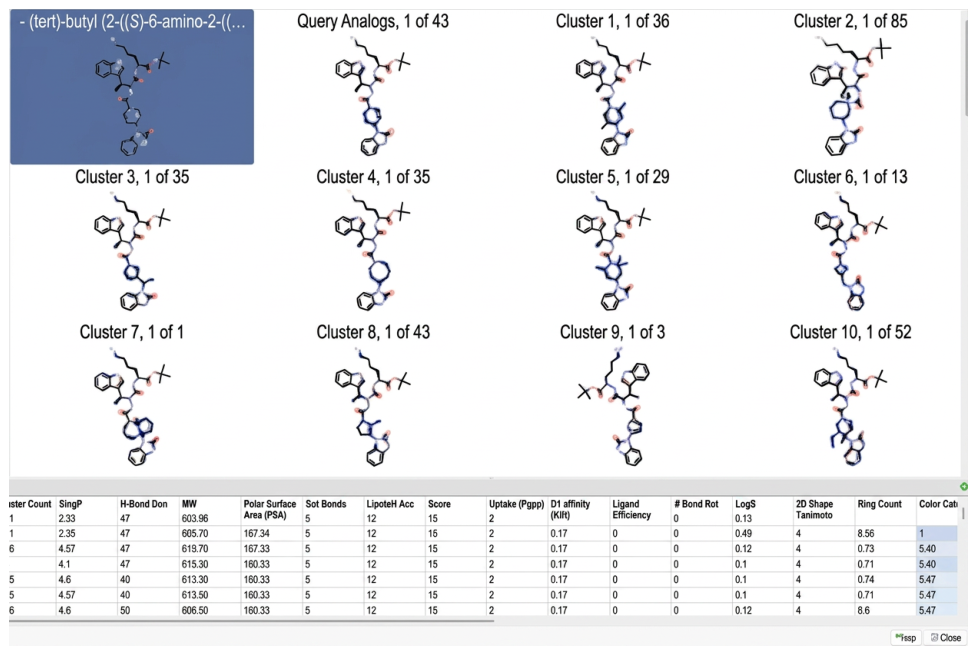
Figure 3.
Docking of 293 compounds to 7XN9 in FRED, showing binding site occupancy.
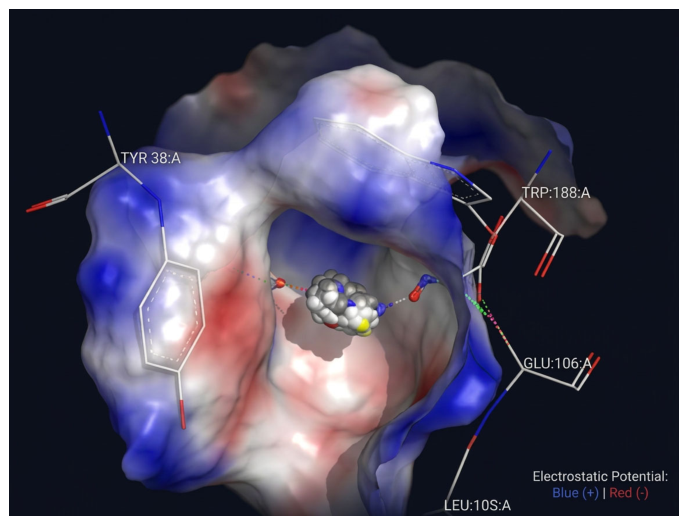
Figure 4.
POSIT results in VIDA, highlighting the eight GREAT-confidence compounds.
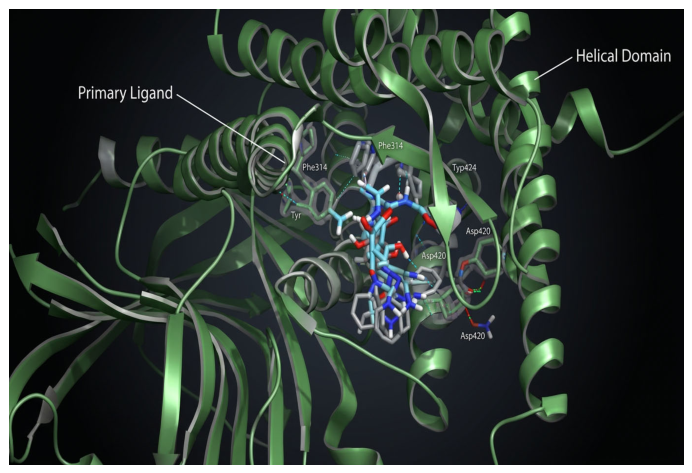
Figure 5.
Flare docking results showing the binding pose of compound 8.
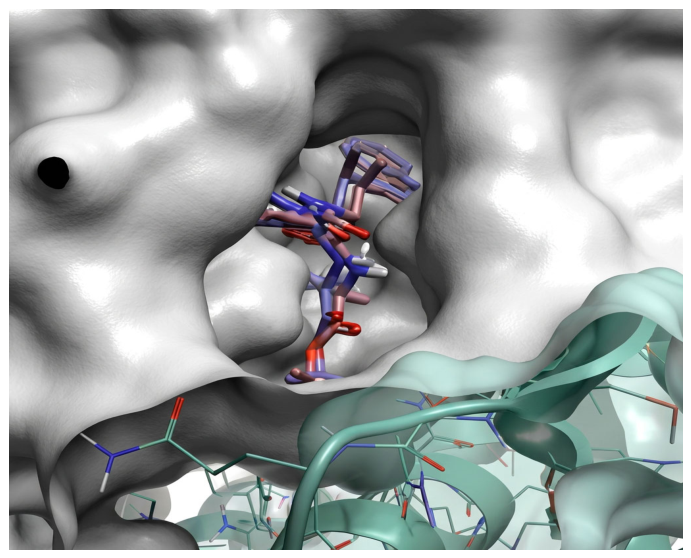
Figure 6.
Compound 8 interaction map with 7XN9, showing hydrogen bonds, hydrophobic contacts, and aromatic interactions.
Figure 6.
Compound 8 interaction map with 7XN9, showing hydrogen bonds, hydrophobic contacts, and aromatic interactions.
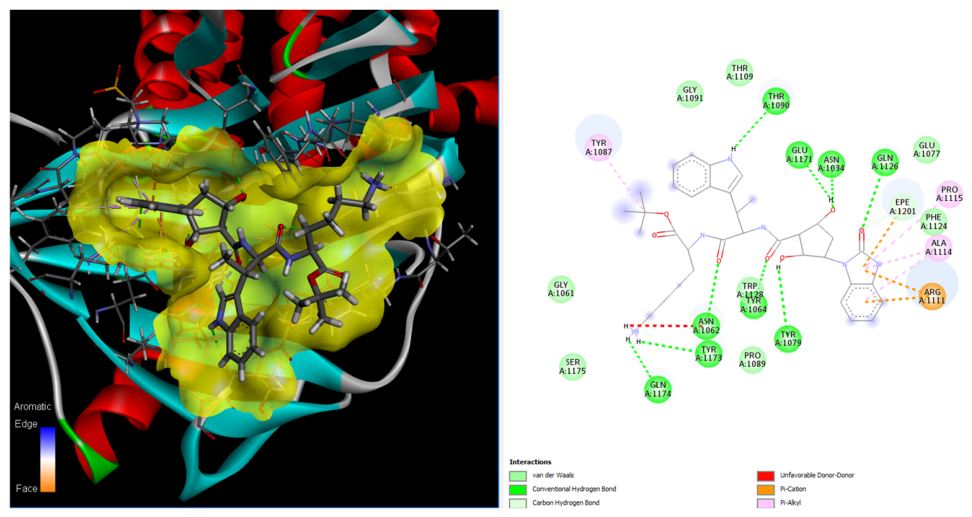
Figure 7.
Protein Aligner comparison of 7XN9, 8GTI, and 7WQ4 binding sites.
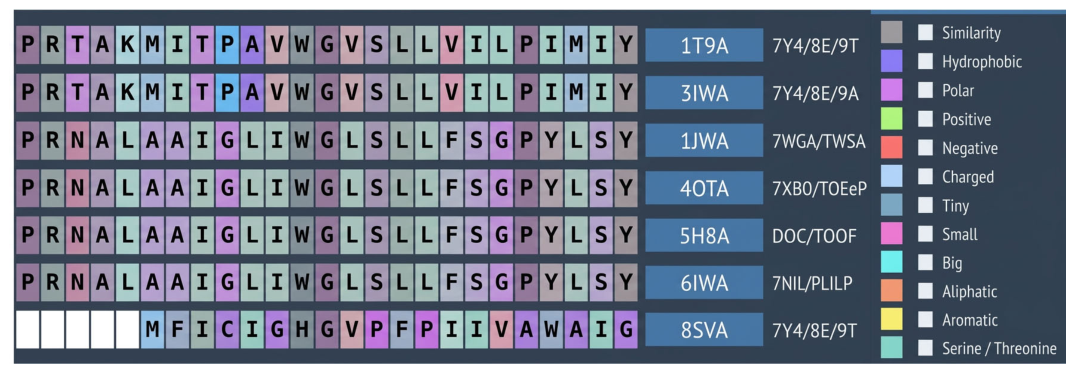
Figure 8.
Predicted ¹H NMR spectra. (a) Compound 8; (b) L-054,522.
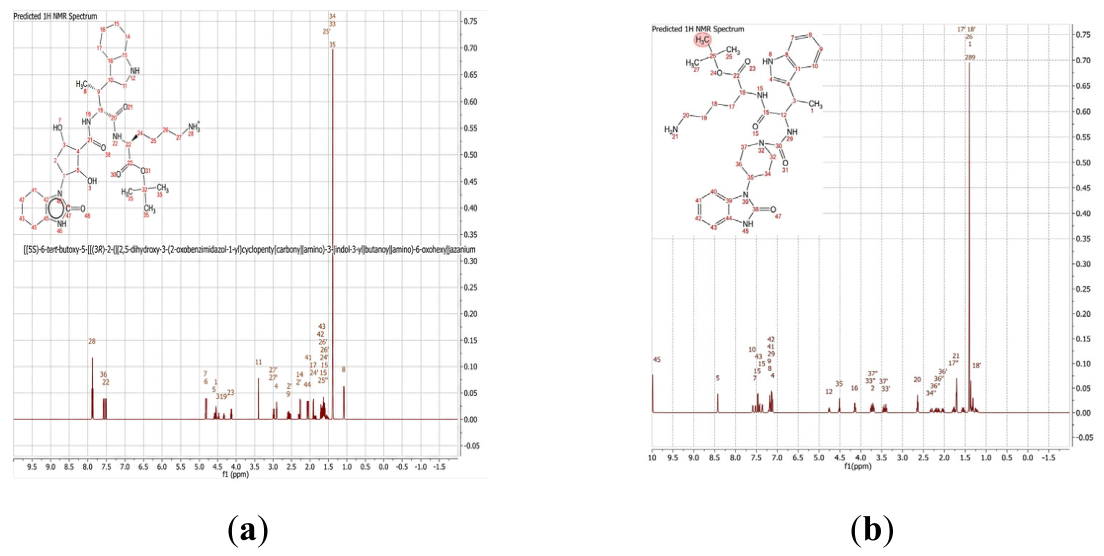
Figure 9.
Predicted ¹³C NMR spectra. (a) Compound 8; (b) L-054,522.
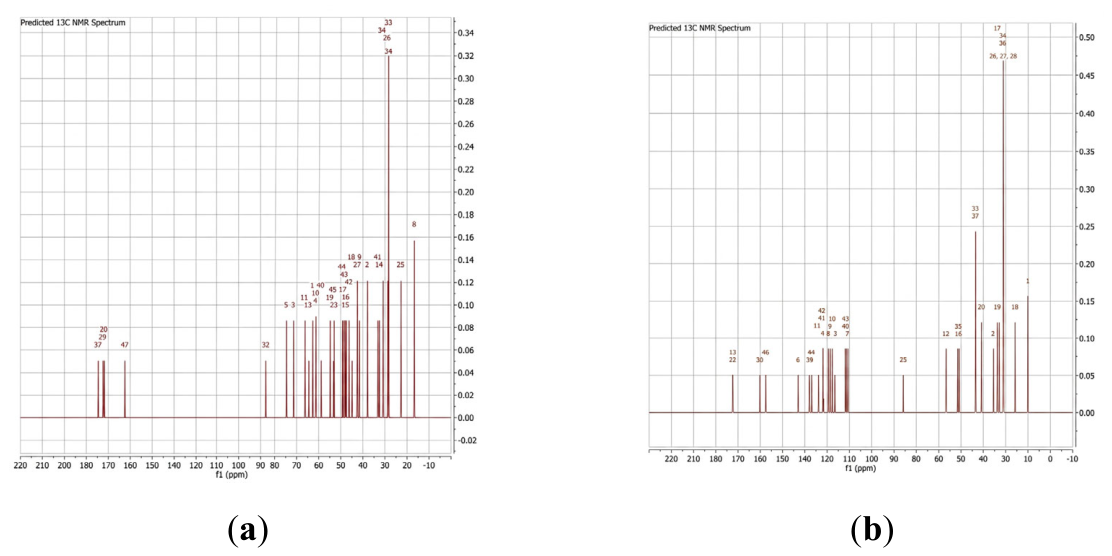
Figure 10.
Cross-docking results in AutoDock Vina Extended showing previously identified inhibitors docked to SSTR2 (7XN9).
Figure 10.
Cross-docking results in AutoDock Vina Extended showing previously identified inhibitors docked to SSTR2 (7XN9).
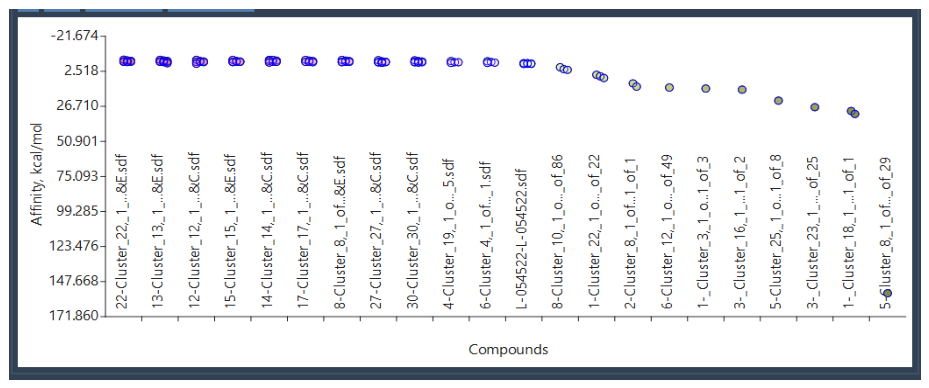

Table 1.
BROOD screening summary.
| Search Mode | Rounds | Compounds Generated |
|---|---|---|
| Shape & Electrostatics | 4 | 1,557 |
| Shape & Colour | 6 | 3,950 |
| Total | 10 | 5,507 |
Table 2.
Validation of the L-054,522 query against property-matched decoys.
| Metric | Value |
|---|---|
| Known actives | 11 |
| Property-matched decoys | 592 |
| Decoys per active (as generated) | 50 |
| ROC AUC | 0.798 |
| Enrichment factor, top 1% | 45.7 |
| Enrichment factor, top 5% | 11.0 |
| BEDROC (α = 20) | 0.600 |
| Active ranks (of 603) | 1, 2, 3, 4, 5, 9, 66, 89, 169, 474, 559 |
| Active TanimotoCombo, median (range) | 0.734 (0.484–1.188) |
| Decoy TanimotoCombo, median (range) | 0.571 (0.373–0.746) |
Table 3.
Shape and electrostatic similarity of the prioritised compounds to L-054,522. Ranks are positions within the combined 604-molecule set.
Table 3.
Shape and electrostatic similarity of the prioritised compounds to L-054,522. Ranks are positions within the combined 604-molecule set.
| Compound | TanimotoCombo | ShapeTanimoto | ColorTanimoto | Rank | Actives exceeded |
|---|---|---|---|---|---|
| 30 | 1.294 | 0.790 | 0.504 | 1 | 11 of 11 |
| 12 | 1.128 | 0.609 | 0.518 | 3 | 9 of 11 |
| 17 | 1.105 | 0.633 | 0.471 | 3 | 9 of 11 |
| 13 | 1.104 | 0.637 | 0.468 | 3 | 9 of 11 |
| 8 | 1.074 | 0.762 | 0.312 | 3 | 9 of 11 |
| 27 | 1.070 | 0.596 | 0.474 | 3 | 9 of 11 |
| 22 | 1.058 | 0.642 | 0.415 | 3 | 9 of 11 |
| 14 | 0.930 | 0.521 | 0.409 | 5 | 7 of 11 |
| Highest-scoring decoy | 0.746 | — | — | — | — |
| Median decoy | 0.571 | — | — | — | — |
Table 4.
Primary docking scores (OpenEye suite) and POSIT confidence.
| Compound | FRED (7XN9) | FRED (7WIG) | HYBRID (7XN9) | HYBRID (7WIG) | POSIT Confidence |
|---|---|---|---|---|---|
| 8 | −47.67 | −49.69 | −26.50 | −20.23 | GREAT |
| 12 | −49.59 | −52.53 | −24.36 | −20.04 | GREAT |
| 13 | −49.48 | −51.38 | −24.40 | −20.28 | GREAT |
| 14 | −48.92 | −52.22 | −25.00 | −21.32 | GREAT |
| 17 | −49.51 | −53.92 | −20.36 | −19.07 | GREAT |
| 22 | −49.87 | −52.72 | −23.62 | −20.70 | GREAT |
| 27 | −46.47 | −48.40 | −18.12 | −17.01 | GREAT |
| 30 | −45.95 | −49.10 | −26.00 | −18.13 | GREAT |
| L-054,522 | Undocked | Undocked | Undocked | Undocked | Undocked |
Table 5.
Re-docking of the crystallographic ligand L-054,522 into SSTR2 (PDB 7XN9).
| Platform | Heavy-atom RMSD (Å) | Median deviation (Å) | Atoms within 1 Å | Outcome |
|---|---|---|---|---|
| Flare 12.0.0 | 0.94 | 0.75 | 39/47 (83%) | Pose recovered |
| POSIT | 1.79 | 0.52 | 32/47 (68%) | Pose recovered, then rejected on steric grounds |
| HYBRID | 4.18 | 2.07 | 8/47 (17%) | Pose not recovered |
| FRED | 5.28 | 3.77 | 7/47 (15%) | Pose not recovered |
| AutoDock Vina Extended | 6.99 | 3.71 | 6/47 (13%) | Pose not recovered |
RMSD calculated over all 47 heavy atoms without superposition, against the crystallographic coordinates of residue GI9, with atoms matched by element using nearest-neighbour assignment. A deviation below 2 Å was taken to indicate successful pose recovery. For AutoDock Vina Extended, the value is for the top-ranked pose; across all nine returned poses, RMSD ranged from 6.71 to 7.25 Å.
Table 6.
Closest approach (Å) between the re-docked ligand and residues implicated in SSTR2 ligand binding.
Table 6.
Closest approach (Å) between the re-docked ligand and residues implicated in SSTR2 ligand binding.
| Residue | Crystallographic | Flare | POSIT | HYBRID | FRED | Vina Ext. |
|---|---|---|---|---|---|---|
| Asp122 | 2.65 | 2.72 | 2.56 | 3.70 | 5.53 | 7.64 |
| Gln126 | 2.93 | 2.89 | 3.60 | 2.30 | 3.45 | 9.98 |
| Thr194 | 2.53 | 2.78 | 2.46 | 3.85 | 1.04 | 2.83 |
| Phe208 | 4.24 | 3.54 | 4.02 | 3.40 | 3.69 | 7.66 |
| Phe272 | 3.76 | 2.17 | 3.53 | 2.01 | 3.71 | 7.17 |
| Phe294 | 3.14 | 2.75 | 2.24 | 3.25 | 2.73 | 3.28 |
Table 7.
Confirmatory docking scores.
| Compound | FITTED (7XN9) | FITTED (7WIG) | AutoDock Vina Ext. (7XN9) | Flare LF dG (7XN9) | Flare LF dG (7WIG) |
|---|---|---|---|---|---|
| 8 | −20.91 | −13.78 | −22.42 | −12.311 | −11.303 |
| 12 | −19.31 | −16.04 | −22.97 | −11.117 | −10.852 |
| 13 | −15.78 | −16.06 | −22.99 | −11.021 | −10.765 |
| 14 | −19.59 | −15.83 | −22.26 | −11.823 | −9.817 |
| 17 | −13.85 | −12.33 | −22.97 | −12.309 | −9.655 |
| 22 | −17.05 | −13.90 | −23.07 | −12.256 | −11.168 |
| 27 | −15.77 | −13.13 | −21.74 | −13.080 | −10.304 |
| 30 | −19.74 | −15.41 | −21.39 | −13.083 | −10.976 |
| L-054,522 | −16.60 | −14.54 | −9.65 | −12.453 | Dock unsuccessful |
Table 8.
Structures and names of top-ranked compounds.
| Compound | Chemical Structure and Molecular Weight (MW) | Name |
|---|---|---|
| 8 | 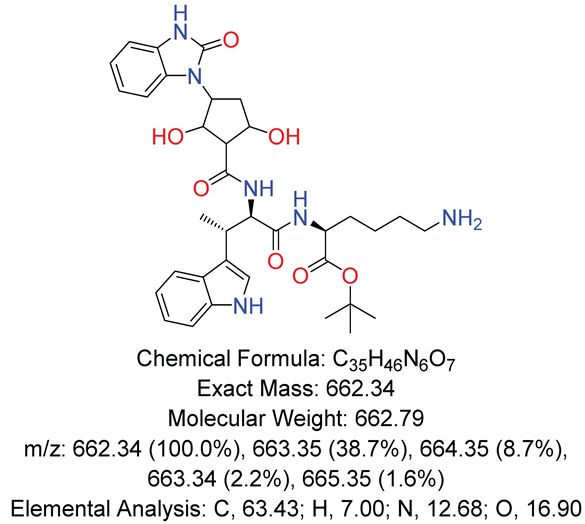 |
[(5S)-5-[[(2R,3S)-2-[[2,5-dihydroxy-3-(2-oxo-3H-benzimidazol-1-yl)cyclopentanecarbonyl]amino]-3-(1H-indol-3-yl)butanoyl]amino]-6-[(2-methylpropan-2-yl)oxy]-6-oxohexyl]azanium. |
| 12 | 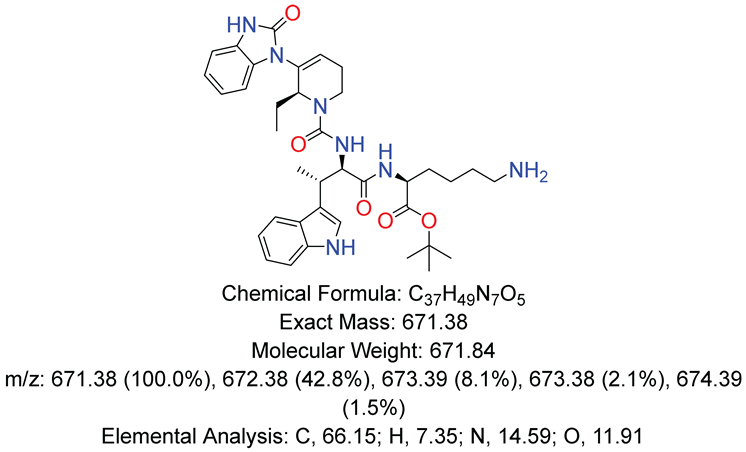 |
[(5S)-5-[[(2R,3S)-2-[[(6S)-6-ethyl-5-(2-oxo-3H-benzimidazol-1-yl)-3,6-dihydro-2H-pyridine-1-carbonyl]amino]-3-(1H-indol-3-yl)butanoyl]amino]-6-[(2-methylpropan-2-yl)oxy]-6-oxohexyl]azanium. |
| 13 | 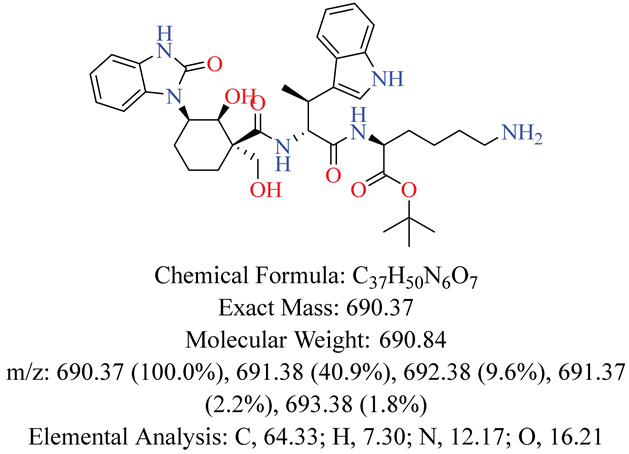 |
[(5S)-5-[[(2R,3S)-2-[[(1R,2S,3R)-2-hydroxy-1-(hydroxymethyl)-3-(2-oxo-3H-benzimidazol-1-yl)cyclohexanecarbonyl]amino]-3-(1H-indol-3-yl)butanoyl]amino]-6-[(2-methylpropan-2-yl)oxy]-6-oxohexyl]azanium. |
| 14 | 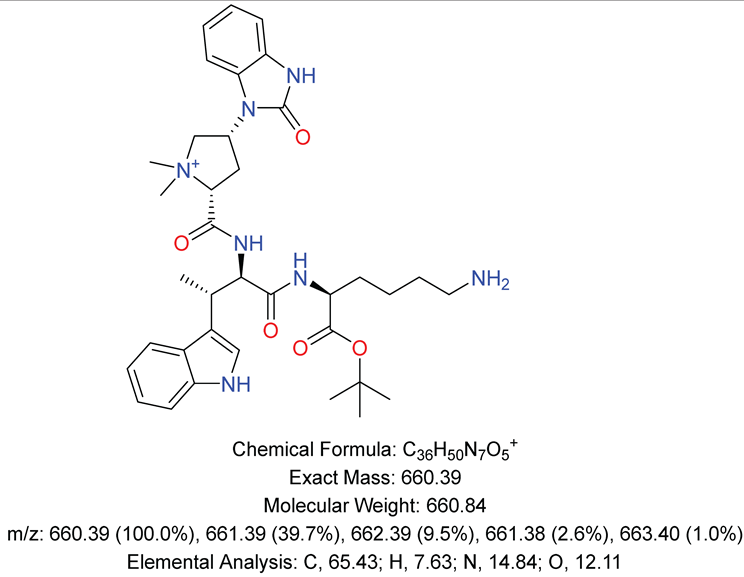 |
[(5S)-5-[[(2R,3S)-2-[[(2R,4R)-1,1-dimethyl-4-(2-oxo-3H-benzimidazol-1-yl)pyrrolidin-1-ium-2-carbonyl]amino]-3-(1H-indol-3-yl)butanoyl]amino]-6-[(2-methylpropan-2-yl)oxy]-6-oxohexyl]azanium. |
| 17 | 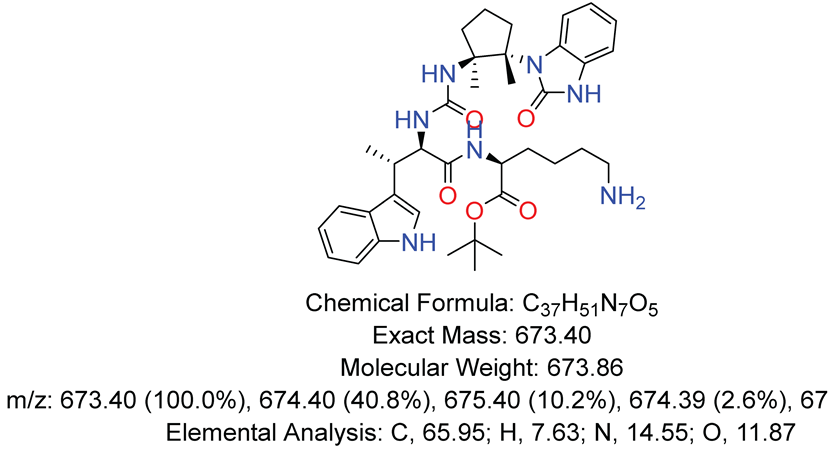 |
[(5S)-5-[[(2R,3S)-2-[[(1S,2S)-1,2-dimethyl-2-(2-oxo-3H-benzimidazol-1-yl)cyclopentyl]carbamoylamino]-3-(1H-indol-3-yl)butanoyl]amino]-6-[(2-methylpropan-2-yl)oxy]-6-oxohexyl]azanium. |
| 22 | 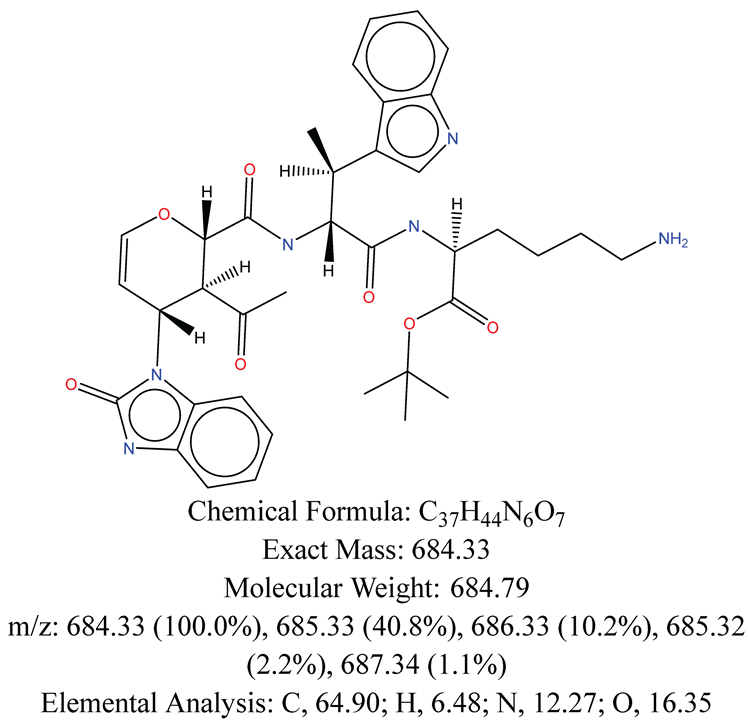 |
[(5S)-5-[[(2R,3S)-2-[[(2S,3S,4R)-3-acetyl-4-(2-oxo-3H-benzimidazol-1-yl)-3,4-dihydro-2H-pyran-2-carbonyl]amino]-3-(1H-indol-3-yl)butanoyl]amino]-6-[(2-methylpropan-2-yl)oxy]-6-oxohexyl]azanium. |
| 27 | 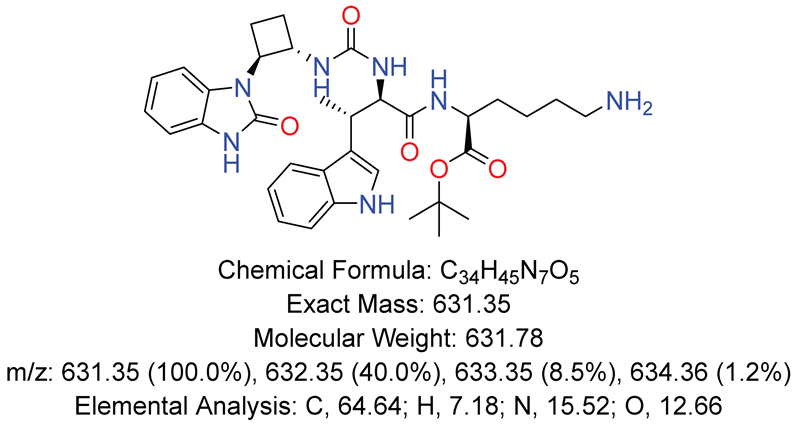 |
[(5S)-5-[[(2R,3S)-3-(1H-indol-3-yl)-2-[[(1S,2S)-2-(2-oxo-3H-benzimidazol-1-yl)cyclobutyl]carbamoylamino]butanoyl]amino]-6-[(2-methylpropan-2-yl)oxy]-6-oxohexyl]azanium. |
| 30 | 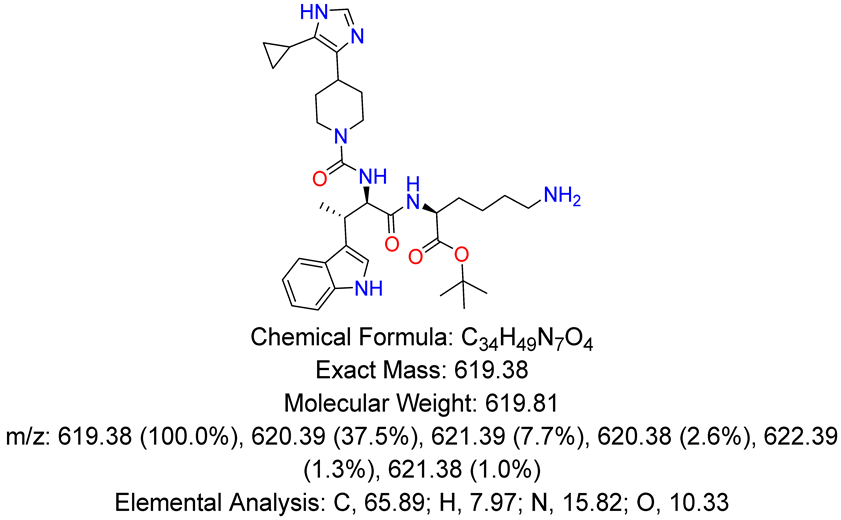 |
[(5S)-5-[[(2R,3S)-2-[[4-(5-cyclopropyl-1H-imidazol-4-yl)piperidine-1-carbonyl]amino]-3-(1H-indol-3-yl)butanoyl]amino]-6-[(2-methylpropan-2-yl)oxy]-6-oxohexyl]azanium. |
Table 9.
T.E.S.T. toxicity predictions.
| Parameter | Compounds 8, 12, 13, 14, 17, 22, 27, 30 | L-054,522 |
|---|---|---|
| Bioconcentration | Safe | 0.89 |
| Mutagenicity (Ames) | Negative | Negative |
| Oral Rat LD₅₀ | Safe | 1389.4 mg/kg |
| T. pyriformis IGC₅₀ | Safe | Safe |
| Developmental Toxicity | Non-toxicant | Toxicant |
Table 10.
DEEP-PK pharmacokinetic predictions.
| Parameter | 8, 13, 14, 22, 27 | 12, 17, 30, L-054,522 |
|---|---|---|
| Oral Bioavailability (50%) | Non-bioavailable | Non-bioavailable |
| BBB Penetration | Non-penetrable | Non-penetrable |
| CYP1A2 Substrate | Non-substrate | Non-substrate |
| Half-life | ≥3 hours | <3 hours |
| Carcinogenicity | Safe | Safe |
Table 11.
SWISSADME predictions.
| Compound | Formula | MW Da | TPSA (Ų) | XLOGP3 | Consensus LogP | Log Kp (cm/s) | Solubility | GI absorption | Lipinski violations |
|---|---|---|---|---|---|---|---|---|---|
| 8 | C₃₅H₄₇N₆O₇⁺ | 663.78 | 206.18 | 4.26 | 0.42 | −7.32 | Moderate | Low | 3 |
| 12 | C₃₇H₅₀N₇O₅⁺ | 672.84 | 168.96 | 5.64 | 2.06 | −6.40 | Poor | Low | 2 |
| 13 | C₃₇H₅₁N₆O₇⁺ | 691.84 | 206.18 | 4.18 | 0.87 | −7.55 | Moderate | Low | 3 |
| 14 | C₃₆H₅₁N₇O₅²⁺ | 661.83 | 165.72 | 4.54 | −0.41 | −7.11 | Poor | Low | 2 |
| 17 | C₃₇H₅₂N₇O₅⁺ | 674.85 | 177.75 | 5.41 | 2.34 | −6.58 | Poor | Low | 3 |
| 22 | C₃₇H₄₇N₆O₇⁺ | 687.81 | 192.02 | 4.33 | 1.10 | −7.42 | Moderate | Low | 2 |
| 27 | C₃₄H₄₆N₇O₅⁺ | 632.77 | 177.75 | 4.68 | 1.45 | −6.84 | Moderate | Low | 3 |
| 30 | C₃₄H₅₀N₇O₄⁺ | 620.81 | 159.85 | 3.40 | 2.41 | −7.67 | Moderate | Low | 2 |
| L-054,522 | C₃₅H₄₇N₇O₅ | 645.79 | 167.34 | 4.79 | 2.62 | −6.84 | Poor | Low | 2 |
Descriptors were computed for the protonated species predominant at pH 7.4, consistent with the forms used for docking. Compound 14 carries an additional permanent positive charge from its quaternary ammonium. iLOGP could not be determined for any compound in this series and XLOGP3 is reported in its place.
Table 12.
Retrosynthetic accessibility summary.
| Compound | ChemAIRS | Spaya RScore | Interpretation |
|---|---|---|---|
| 8 | Direct route | 1.0 | Fully precedented; straightforward synthesis |
| 12 | High Risk required | Not scored | Challenging synthesis |
| 13 | High Risk required | Not scored | Challenging synthesis |
| 14 | High Risk required | Not scored | Challenging synthesis |
| 17 | High Risk required | 0.4 | Higher-risk transformations |
| 22 | High Risk required | 0.3 | Higher-risk transformations |
| 27 | High Risk required | 0.4 | Higher-risk transformations |
| 30 | High Risk required | 0.2 | Novel/challenging route |
Table 13.
Exploratory multi-target docking scores (AutoDock Vina).
| Compound | CRHR1 (8GTI) | GALR2 (7WQ4) |
|---|---|---|
| 8 | −6.46 | −7.66 |
| 12 | −6.94 | −7.41 |
| 13 | −7.64 | −7.41 |
| 14 | −6.88 | −7.12 |
| 17 | −7.07 | −7.69 |
| 22 | −7.63 | −7.43 |
| 27 | −7.71 | −6.85 |
| 30 | −8.92 | −7.94 |
| L-054,522 | −7.32 | −8.16 |
Disclaimer/Publisher’s Note: The statements, opinions and data contained in all publications are solely those of the individual author(s) and contributor(s) and not of MDPI and/or the editor(s). MDPI and/or the editor(s) disclaim responsibility for any injury to people or property resulting from any ideas, methods, instructions or products referred to in the content. |
© 2026 by the authors. Licensee MDPI, Basel, Switzerland. This article is an open access article distributed under the terms and conditions of the Creative Commons Attribution (CC BY) license (http://creativecommons.org/licenses/by/4.0/).
Copyright: This open access article is published under a Creative Commons CC BY 4.0 license, which permit the free download, distribution, and reuse, provided that the author and preprint are cited in any reuse.