

Submitted:
15 June 2026
Posted:
16 June 2026
You are already at the latest version
Abstract
Background: Standard sepsis risk stratification relies on static scores and single time-point biomarkers, failing to capture the temporal complexity of the host response. The dynamic interplay between immune dysregulation and metabolic distress remains poorly integrated into clinical phenotyping. We hypothesized that early longitudinal trajectories of these domains could reveal distinct immunometabolic phenotypes predicting intensive care unit-acquired infection (ICU-AI) and mortality.
Methods: This multicenter retrospective study leveraged high-granularity data from the Medical Information Mart for Intensive Care IV (MIMIC-IV) and the eICU Collaborative Research Database (eICU-CRD), enrolling adult patients with a diagnosis of sepsis identified by the International Classification of Diseases (ICD) coding. We employed unsupervised latent class growth modeling (LCGM) to identify phenotypes based on 72-hour serial measurements of core immunometabolic indices, including lymphocyte, neutrophil, and platelet counts, lactate, and the lactate dehydrogenase-to-albumin ratio (LAR). Associations with the primary outcome (ICU-AI) and secondary outcomes (28-day mortality and a composite of ICU-AI/death) were quantified using multivariable Fine-Gray competing-risk models and multivariable logistic regression. We assessed the incremental prognostic value of trajectory phenotypes beyond a baseline model comprising age and sequential organ failure assessment (SOFA) scores.
Results: We identified three reproducible immunometabolic trajectory phenotypes, each exhibiting distinct temporal profiles of inflammation and organ function. Trajectory 3 (“Rapid Recovery”) demonstrated swift normalization of biomarkers and favorable outcomes. In contrast, Trajectory 2—characterized by distinct “Immunometabolic Paralysis” (persistent lymphopenia paired with sustained hyperlactatemia and elevated LAR)—conferred the poorest prognosis. Compared to the Rapid Recovery phenotype, Trajectory 2 was associated with a more than two-fold increase in ICU-AI risk and significantly higher 28-day mortality. Integrating trajectory phenotypes into baseline severity models significantly enhanced predictive accuracy and demonstrated superior net benefit in decision curve analysis (DCA).
Conclusion: Early 72-hour trajectories of routine biomarkers identify a distinct “Immunometabolic Paralysis” phenotype characterized by sustained metabolic stress and immunosuppression. This dynamic classification outperforms static severity scores in predicting ICU-AI. By distinguishing patients with entrenched dysregulation from those with rapid recovery, this approach offers a scalable framework for risk stratification and predictive enrichment in future trials of immunomodulatory or metabolic therapies.
Keywords:
sepsis
; immunometabolic trajectory
; phenotyping
; ICU-acquired infection
; database
Introduction
Sepsis represents a profound dysregulation of host homeostasis, where life-threatening organ dysfunction arises from a chaotic interplay between pathogen factors and the host’s immune response [1]. Despite improvements in bundle-based care, sepsis remains a primary driver of global critical care mortality, a burden compounded by significant biological heterogeneity that defies a “one-size-fits-all” therapeutic approach [2,3,4]. This heterogeneity is driven by biphasic derangements in immune function—simultaneous inflammation and immunosuppression—alongside severe metabolic reprogramming [5]. These domains are inextricably linked: metabolic substrates shape immune defense, while inflammatory signaling dictates tissue tolerance and energy expenditure [6].
In clinical practice, this complex immunometabolic interface is often monitored via separate, static surrogates. Leukocyte differentials serve as proxies for immune competence (e.g., lymphopenia reflecting immunosuppression), while lactate, glucose, and albumin indicate metabolic stress and mitochondrial dysfunction [7,8]. However, current risk stratification relies heavily on single time-point measurements or aggregate acuity scores like the Sequential Organ Failure Assessment (SOFA). These static “snapshots” fail to capture the dynamic evolution of the host response. By collapsing longitudinal complexity into a baseline value, standard severity models may obscure critical phenotypic divergences—such as the patient who rapidly resolves hyperlactatemia versus one with persistent metabolic inertia, despite identical admission values.
Emerging evidence suggests that composite biomarkers may better capture this immunometabolic interface. For instance, the lactate dehydrogenase-to-albumin ratio (LAR) integrates two pivotal pathophysiological axes: lactate dehydrogenase (LDH) reflects both tissue damage and the glycolytic shift characteristic of activated immune cells (the “Warburg effect”), while albumin levels inversely correlate with systemic inflammation and capillary leakage [9,10]. A rising LAR trajectory, therefore, may serve as a potent surrogate for unchecked catabolism and immune paralysis, yet its dynamic evolution remains poorly integrated in sepsis phenotyping. The clinical consequences of this uncharacterized immunometabolic dysfunction are perhaps most evident in the development of intensive care unit-acquired infection (ICU-AI). Patients surviving the initial septic insult often enter a state of persistent inflammation, immunosuppression, and catabolism, rendering them highly susceptible to secondary infections [11]. While data-driven approaches have begun to identify sepsis subphenotypes using longitudinal trajectories, most efforts have been unidimensional, focusing solely on inflammatory markers or vital signs while neglecting concurrent metabolic status [12,13,14]. Furthermore, few studies have rigorously accounted for the competing risk of death when evaluating susceptibility to secondary infection, leaving a critical gap in our ability to predict which patients are on a trajectory toward immunoparalysis.
To bridge this gap, we hypothesized that the joint temporal evolution of immune and metabolic indices during the early phase of critical illness delineates distinct biological phenotypes with divergent clinical trajectories. Leveraging granular data from the Medical Information Mart for Intensive Care IV (MIMIC-IV) and the eICU Collaborative Research Database (eICU-CRD), this study aimed to derive and validate sepsis phenotypes based on routine but underutilized immunometabolic trajectories over the first 72 hours of ICU admission [15,16,17]. We specifically sought to determine whether these dynamic phenotypes could predict ICU-AI and mortality independently of baseline severity scores, thereby offering a more granular framework for precision risk stratification.
Materials and Methods
Study Design and Data Sources
This multicenter retrospective cohort study utilized high-resolution clinical data from two independent critical care registries. The MIMIC-IV (v3.1, covering 2008-2022) served as the derivation cohort for phenotype identification, while the eICU-CRD (v2.0, covering 2014-2015) was employed for external validation. This dual-cohort design was chosen to ensure the generalizability of the identified phenotypes across diverse healthcare systems and geographic locations. The study was conducted in accordance with the Strengthening the Reporting of Observational Studies in Epidemiology (STROBE) guidelines.
Population Selection
We identified all adult patients (aged ≥ 18 years) admitted to the ICU. From this broad population, we screened for patients with a diagnosis of sepsis based on International Classification of Diseases (ICD) coding. Specifically, patients were included if their hospital discharge records contained ICD-9 codes or ICD-10 codes explicitly indicating sepsis, severe sepsis, or septic shock. For patients with multiple ICU admissions, only the first qualifying ICU stay was included to ensure statistical independence.
To capture the early dynamic evolution of the host response, inclusion was restricted to patients with an ICU length of stay (LOS) ≥ 24 hours. To ensure the reliability of trajectory modeling, we required sufficient longitudinal data density, defined as having at least one valid measurement in ≥ 3 of the 4 defined time windows during the first 72 hours. This criterion serves to enrich the cohort for patients who survive the initial resuscitation phase yet remain prone to persistent immunometabolic dysregulation. Patients with significant missingness (>50%) in baseline covariates or limitation-of-care orders within the first 24 hours were excluded to minimize confounding by indication. The systematic selection process is illustrated in Figure 1.
Definition of Immunometabolic Trajectories
Prior to modeling, all biomarker values were log-transformed and standardized to Z-score to account for skewed distributions and disparate measurement scales. For patients with multiple measurements within a single time window, the worst physiological value (e.g., highest lactate, lowest lymphocyte count) was selected to capture the maximum physiological derangement. Missing data within the longitudinal windows were handled using full information maximum likelihood (FIML) estimation under the missing-at-random (MAR) assumption, a robust approach for longitudinal data in the latent class growth modeling (LCGM).
We selected five biomarkers to serve as dynamic surrogates for the immunometabolic interface: absolute lymphocyte, neutrophil, and platelet counts (reflecting immune competence and coagulation status) alongside serum lactate and the LAR (reflecting metabolic stress and mitochondrial dysfunction). Data were aggregated into four sequential time windows post-admission (0-6 h, 6-24 h, 24-48 h, and 48-72 h) to capture early physiological transitions.
In the derivation cohort, we employed unsupervised LCGM to identify distinct, latent subpopulations following similar developmental trajectories [18]. This approach allows for the data-driven classification of heterogeneity without a priori assumptions. Model fit was assessed using a combination of the Bayesian information criterion (BIC), the Akaike information criterion (AIC), and entropy (values > 0.8 indicating clear class separation) [19]. The optimal number of classes was determined by the Lo-Mendell-Rubin likelihood ratio test (LMR-LRT), where a non-significant p-value suggests that adding further classes does not improve model fit [20]. To validate these phenotypes, patients in the eICU-CRD cohort were assigned to the derived trajectory classes using a predictive algorithm trained on the MIMIC-IV centroid characteristics (code available in Additional File 2).
Clinical Outcomes
The primary outcome was the development of ICU-AI. To minimize surveillance bias, ICU-AI was rigorously defined as a positive culture from a sterile site (blood, cerebrospinal fluid, pleural fluid) or a quantitative respiratory culture (>104 CFU/mL) occurring > 48 hours post-admission, accompanied by a new start or escalation of antimicrobial therapy for ≥ 4 consecutive days, consistent with pragmatic definitions used in previous electronic health record studies [21]. This definition ensures the capture of clinically significant infections requiring intervention, distinguishing them from mere colonization. Secondary outcomes included 28-day all-cause mortality and a composite endpoint of ICU-AI or death.
Statistical Analysis
Continuous variables were compared across trajectory phenotypes using the Kruskal-Wallis test, and categorical variables using the Chi-square test. To evaluate the independent prognostic value of the trajectories, we constructed multivariable models adjusted for a comprehensive set of potential confounders. This ensures that the prognostic value of trajectories is independent of baseline organ failure and treatment intensity.
Given that death acts as a competing risk for the development of secondary infections, we estimated the cumulative incidence of ICU-AI using the cumulative incidence function and evaluated phenotypic associations using Fine-Gray subdistribution hazard models. For 28-day mortality analyses, we utilized multivariable logistic regression and visualized survival probabilities via Kaplan-Meier curves. We further conducted stratified analyses across age, gender, and sepsis severity subgroups to assess the consistency of the phenotypic associations (Supplementary Figure S1).
Finally, we assessed the incremental predictive value of adding trajectory phenotypes to a baseline risk model (Age + SOFA) by comparing the Area Under the Receiver Operating Characteristic Curve (AUC-ROC) and calculating the Net Reclassification Improvement (NRI). Decision Curve Analysis (DCA) was applied to quantify the net clinical benefit. All analyses were performed using R software (version 4.2.2). A two-sided p-value < 0.05 was considered statistically significant.
Results
Derivation and Structural Validation of Immunometabolic Phenotypes
The systematic selection process for both the derivation (MIMIC-IV) and external validation (eICU-CRD) cohorts is detailed in Figure 1. Following the application of strict exclusion criteria to ensure data density, the final analytic sample comprised 8217 patients from the MIMIC-IV database and 10679 patients from the eICU-CRD. In the derivation cohort, unsupervised latent class growth modeling applied to the first 72 hours of data identified three distinct immunometabolic trajectory phenotypes. To confirm that these trajectories represented genuine biological heterogeneity rather than statistical artifacts, we performed rigorous structural validation. The subphenotypes exhibited a balanced distribution (Supplementary Figure S2), and principal component analysis (PCA) demonstrated clear separation in low-dimensional space, indicating a robust internal clustering structure (Supplementary Figure S3). Furthermore, Z-score heatmaps revealed distinct biological signatures: Trajectory 2 was defined by a hyper-inflammatory and hyper-metabolic profile, contrasting sharply with the rapid normalization pattern observed in Trajectory 3 (Supplementary Figure S4).
Baseline Characteristics and Distinct Immunometabolic Signatures
Baseline characteristics, stratified by trajectory, are summarized in Table 1 (MIMIC-IV derivation cohort) and Table 2 (eICU-CRD validation cohort). In the derivation cohort, the subphenotypes displayed divergent immunometabolic signatures at the time of ICU admission. Trajectory 2 exhibited the most severe clinical profile, characterized by profound metabolic derangement and inflammation. Patients in this group presented with significantly elevated markers of tissue hypoxia and immune activation, including the highest median levels of lactate (3.14 mmol/L), white blood cell counts (12.25 × 10⁹/L), C-reactive protein (48.67 mg/L), and procalcitonin (1.42 ng/mL) compared to other subphenotypes (p < 0.001). Additionally, this group showed evidence of worse organ dysfunction, indicated by elevated serum creatinine (1.94 mg/dL) and blood urea nitrogen levels (Table 1).
In contrast, Trajectory 3 represented a phenotype of metabolic stability, maintaining the lowest baseline levels of lactate (1.99 mmol/L) and creatinine (1.08 mg/dL). Notably, Trajectory 1 was distinguished by preserved immune competence, exhibiting the highest median lymphocyte counts (1.92 × 10⁹/L), in sharp contrast to the pronounced lymphopenia observed in Trajectories 2 and 3. These significant baseline disparities confirm that the identified trajectories correspond to biologically distinct host response patterns present at the time of ICU admission.
Temporal Characterization: Defining Immunometabolic Paralysis
Beyond baseline snapshots, the longitudinal analysis over the first 72 hours revealed fundamental differences in the dynamic evolution of the host response (Figure 2). Trajectory 1 was characterized by relatively stable lymphocyte counts and moderate metabolic distress. Trajectory 2, designated as the “Immunometabolic Paralysis” phenotype, demonstrated a maladaptive response defined by persistent lymphopenia (<1.0 × 10⁹/L) coupled with non-resolving hyperlactatemia and persistently elevated LAR across all time points. Notably, while neutrophil counts in Trajectory 2 peaked within the 6-24 hour window, the metabolic blockade failed to resolve, suggesting a state of simultaneous immune exhaustion and mitochondrial dysfunction.
Conversely, Trajectory 3 exhibited a “Rapid Recovery” profile, maintaining the highest lymphocyte and platelet counts alongside swift normalization of metabolic markers. These dynamic patterns underscore a critical finding: patients in Trajectory 2 do not merely start with higher severity; they exhibit a specific failure of homeostasis that does not resolve within the standard resuscitation window.
Association with Clinical Outcomes
The divergence in biological trajectories translated into marked differences in clinical prognosis (Figure 3). Survival probability was significantly lower for Trajectory 2 compared to Trajectories 1 and 3 (Log-rank p < 0.0001). The cumulative incidence of ICU mortality reached its highest level in Trajectory 2, exceeding 40% by day 28. Crucially, regarding secondary complications, Trajectory 2 was associated with a significantly higher burden of ICU-AI. Fine-Gray cumulative incidence curves demonstrated that patients in Trajectory 2 were nearly twice as likely to develop secondary infections compared to Trajectory 3, consistent with the hypothesis of sustained immunoparalysis.
Multivariable analysis confirmed the independent prognostic value of these subphenotypes (Figure 4). Even after adjusting for robust confounders—including age, sex, SOFA score, and baseline lactate levels—Trajectory 2 remained strongly associated with an increased risk of 28-day mortality [adjusted odds ratio (aOR) 2.20, 95% CI 2.08-2.34, p < 0.001]. In subgroup analyses, acute kidney injury (AKI) consistently emerged as a strong predictor of mortality across all three trajectories [odds ratio (OR) > 2.5], whereas the prognostic weight of inflammatory biomarkers varied by phenotype (Supplementary Figure S5).
Cross-Cohort Consistency and Validation
To ensure the generalizability of our findings, we validated the trajectory patterns and their associated risks in the independent eICU-CRD cohort. The longitudinal evolution of lymphocyte counts in the eICU-CRD cohort mirrored the MIMIC-IV findings, with Trajectory 3 consistently maintaining the highest Z-score and Trajectory 2 the lowest (Figure 5A). Consistent temporal patterns were also observed for secondary biomarkers, including lactate and platelet counts (Supplementary Figure S6).
The direction and magnitude of risk were strictly preserved across databases. Kaplan-Meier survival analysis in the eICU-CRD cohort confirmed significantly lower survival rates for Trajectory 2 (Figure 5B). Furthermore, multivariable analysis demonstrated robust concordance between the two databases; in both cohorts, Trajectory 2 was associated with a significantly increased risk of death (aOR > 1.5), while Trajectory 3 showed a protective effect (aOR < 1.0) compared to Trajectory 1 (Figure 5C). This cross-cohort consistency confirms that these immunometabolic phenotypes are not artifacts of a single dataset but represent reproducible clinical states.
Incremental Predictive Value and Clinical Utility
Finally, we evaluated whether trajectory-based subtyping provided added value over traditional static clinical models for predicting ICU-AI (Figure 6). In the derivation cohort (MIMIC-IV), the baseline model (Age + SOFA) exhibited limited discriminative ability (AUC = 0.582), reflecting the inherent complexity of predicting secondary infections using static admission metrics alone. However, the integration of trajectory subtypes yielded a statistically significant improvement in discrimination (AUC = 0.607, p < 0.05).
Crucially, the prognostic value of these phenotypes was robustly confirmed in the external validation cohort (eICU-CRD). While the trajectory phenotype alone showed moderate discrimination (AUC = 0.58), its integration with baseline covariates yielded a substantial enhancement in predictive performance (AUC = 0.76; Supplementary Figure S7).
Furthermore, DCA demonstrated the superior clinical utility of the trajectory-based approach. The trajectory-enhanced model consistently yielded a higher net benefit compared to the baseline model across a wide range of clinically relevant risk thresholds (Figure 6). This indicates that incorporating dynamic immunometabolic phenotyping into risk stratification strategies offers a tangible advantage for guiding infection surveillance decisions—identifying more at-risk patients without increasing the burden of false-positive interventions—compared to using standard severity scores alone.
Discussion
In this multicenter study, we identified and validated three distinct sepsis phenotypes based on the early 72-hour longitudinal trajectories of core immunometabolic biomarkers. Our central finding is that the dynamic evolution of the host response—specifically the interplay between immune function and metabolic clearance—provides prognostic information that is fundamentally missed by static admission severity scores. While traditional stratification relies on single time-point assessments, we demonstrate that the failure to normalize immunometabolic indices defines a high-risk phenotype (Trajectory 2) characterized by “Maladaptive Immunometabolic Paralysis”. This group exhibited a two-fold higher risk of ICU-AI and significantly increased mortality, independent of baseline SOFA scores and admission lactate levels. These findings challenge the binary view of sepsis phases; rather than a linear progression from hyper-inflammation to immunosuppression, our data suggest that fatal sepsis often involves a catastrophic, simultaneous failure of homeostasis where profound immune exhaustion coexists with metabolic inertia [22,23].
Our approach advances beyond prior trajectory-based studies that focused on unidimensional markers. For instance, Ye et al. and Bhavani et al. demonstrated the prognostic value of longitudinal platelet counts and vital signs, respectively, yet these models capture only isolated components of the syndrome [24,25]. By integrating immune (lymphocyte/neutrophil) and metabolic (lactate/LAR) domains, we capture the inextricably coupled nature of the host response [26]. Biologically, lactate is no longer viewed merely as a waste product of hypoxia; it is an active signaling molecule that regulates immune cell function via GPR81 signaling and lactylation, driving macrophage polarization and T-cell suppression [27,28]. In this context, the sustained hyperlactatemia observed in Trajectory 2 likely reflects widespread mitochondrial dysfunction and “metabolic inertia”, which impairs the cellular bioenergetic capacity required for lymphocyte proliferation and survival. The resulting persistent lymphopenia is a hallmark of immunoparalysis. Therefore, Trajectory 2 does not simply represent “sicker” patients, but rather a specific biological state echoing the “overlapping immune dysregulation” described by Saavedra-Torres, where metabolic failure enforces immune suppression [29].
Our findings also complement the landmark sepsis phenotypes identified by Seymour et al. derived from static admission data (alpha, beta, gamma, delta) [25]. While their “Delta” phenotype captured liver dysfunction and shock, it represented a snapshot at presentation. In contrast, our trajectory-based approach unmasks the dynamic response to initial resuscitation. A patient might present with a “Delta-like” profile but rapidly normalize (our Trajectory 3), whereas another with similar baseline values might deteriorate into immunometabolic paralysis (our Trajectory 2). By incorporating the temporal dimension of both immune and metabolic domains, our model likely captures the “non-resolving” subset of Seymour’s high-risk phenotypes, offering finer granularity for prognostication and trial enrollment.
This mechanistic link explains why Trajectory 2 patients remained uniquely susceptible to ICU-AI despite receiving standard critical care. The phenotypic profile aligns closely with biological endotypes described in recent translational literature. The persistent lymphopenia and high secondary infection rate we observed mirror the findings of Zhao et al. and the “SRS1” endotype identified by Davenport et al., which is characterized by T-cell exhaustion, downregulation of HLA-DR, and endotoxin tolerance [30,31]. Consistent with prior work showing that early depletion of CD3+ and CD4+ T-cells independently predicts secondary infection, our Trajectory 2 phenotype serves as a clinical surrogate for this cellular exhaustion [32]. Furthermore, the temporal pattern of neutrophils in this group—an initial peak followed by dysfunction—echoes findings on the expansion of myeloid-derived suppressor cells (MDSCs) in fatal sepsis [33]. These immature, immunosuppressive neutrophils inhibit T-cell proliferation via PD-L1, effectively “braking” the adaptive immune response while failing to clear the primary infection.
The identification of these divergent trajectories has immediate implications for precision medicine. The heterogeneity of the host response underscores why “one-size-fits-all” immunomodulatory trials have historically failed [3]. As noted by Zhang and others, therapies such as hydrocortisone or activated protein C may harm immunocompetent hosts while benefiting others [34,35]. The superior net benefit observed in our DCA suggests that trajectory-based phenotyping could serve as a pragmatic tool for predictive enrichment. Patients in Trajectory 2—who exhibit clear signs of immunoparalysis—may be optimal candidates for trials of immunostimulatory therapies (e.g., IL-7, anti-PD-L1) or metabolic resuscitation. Conversely, applying these therapies to Trajectory 3 patients, who demonstrate rapid spontaneous recovery, would likely be futile. By identifying high-risk patients early within the first 72 hours, clinicians could pivot from standard protocolized care to personalized strategies, such as enhanced surveillance for secondary infections.
Our study has limitations inherent to its retrospective design. Our study has several limitations. First, the data span a decade (2008-2022 for MIMIC-IV), during which sepsis management guidelines (e.g., fluid resuscitation volumes, EGDT protocols) have evolved significantly. While these temporal changes in standard-of-care might influence the baseline severity or early mortality, the fundamental biological pathways governing the host’s immunometabolic response remain conserved. The consistent prognostic performance of our trajectory phenotypes across both the derivation (spanning 11 years) and validation (2014-2015) cohorts strongly suggests that “Immunometabolic Paralysis” represents an intrinsic pathophysiological state rather than a mere artifact of historical treatment eras. Second, although we identified distinct phenotypes, the underlying molecular mechanisms driving these trajectories require further validation using prospective multi-omics data. Third, as with any observational study, unmeasured confounders may exist, although we adjusted for a comprehensive set of clinical variables. Finally, the retrospective nature of the analysis precludes causal inference regarding specific therapeutic interventions.
Conclusions
Early 72-hour trajectories of routine biomarkers identify a distinct “Immunometabolic Paralysis” phenotype characterized by sustained metabolic stress and immunosuppression. This dynamic classification significantly outperforms static severity scores in predicting ICU-acquired infection and mortality. By distinguishing patients with entrenched dysregulation from those with rapid physiological recovery, this phenotype-based approach offers a scalable framework for risk stratification and predictive enrichment in future clinical trials.
Supplementary Materials
The following supporting information can be downloaded at the website of this paper posted on Preprints.org. Additional file 1. Contains Figure S1: Subgroup analysis of ICU mortality in the derivation cohort (MIMIC-IV). Figure S2: Distribution of immunometabolic trajectory subphenotypes in the derivation cohort. Figure S3: Visualization of subphenotype separation using PCA. Figure S4: Heatmap of standardized biomarker profiles characterizing the biological signatures. Figure S5: Univariate associations of clinical factors with mortality stratified by trajectories. Figure S6: Additional biomarkers across trajectory subphenotypes in the validation cohort (eICU-CRD). Figure S7: ROC curves for mortality prediction in the validation cohort. Additional file 2. The R code used for data preprocessing and trajectory derivation. Additional file 3. The STROBE checklist.
Author Contributions
Data curation, Zhuan Zou; Formal analysis, Hao Song; Methodology, Shaoying Liu and Haiyang Zhang; Resources, Haiyang Zhang; Supervision, Deyuan Li; Validation, Hao Song and Haiyang Zhang; Writing – original draft, Zhuan Zou and Shaoying Liu; Writing – review & editing, Lina Qiao, Deyuan Li and Haiyang Zhang. All authors will be updated at each stage of manuscript processing, including submission, revision, and revision reminder, via emails from our system or the assigned Assistant Editor.
Funding
This research did not receive any specific grant from funding agencies in the public, commercial, or not-for-profit sectors.
Institutional Review Board Statement
The study protocol was approved by the Ethics Committee of West China Second University Hospital, Sichuan University (Approval No. Medical Research 2023-App 176). This study was a retrospective analysis utilizing the MIMIC-IV and the eICU-CRD. Both databases contain de-identified health information; therefore, the requirement for individual informed consent was waived by the Ethics Committee of West China Second University Hospital, Sichuan University. The establishment of the MIMIC-IV database was approved by the Institutional Review Boards of the Massachusetts Institute of Technology (MIT) and Beth Israel Deaconess Medical Center (BIDMC). The eICU-CRD was released under the Safe Harbor provision of the US Health Insurance Portability and Accountability Act (HIPAA). The author Z.Z. has completed the required Collaborative Institutional Training Initiative (CITI) training and obtained permission to access the datasets (Record ID: 68756927). All methods were carried out in accordance with relevant guidelines and regulations (Declaration of Helsinki).
Informed Consent Statement
Not applicable.
Data Availability Statement
The datasets generated and/or analyzed during the current study are available in the PhysioNet repository. The MIMIC-IV database is available at https://physionet.org/content/mimiciv/. The eICU-CRD is available at https://physionet.org/content/eicu-crd/. Access to these databases is restricted to credentialed users who have completed the CITI training program and signed a Data Use Agreement.
Acknowledgments
We acknowledge the contributors who developed and maintained the MIMIC-IV and eICU-CRD databases and the PhysioNet platform, and we thank the hospitals, clinicians, and patients whose deidentified data made this research possible.
Conflicts of Interest
The authors declare that they have no competing interests.
Abbreviations
ICU: Intensive care unit; SOFA: Sequential organ failure assessment; ICU-AI: ICU-acquired infection; MIMIC-IV: Medical Information Mart for Intensive Care IV; eICU-CRD: eICU Collaborative Research Database; LCGM: Latent class growth modeling; LDH: Lactate dehydrogenase; LAR: Lactate dehydrogenase-to-albumin ratio; aOR: Adjusted odds ratio; AUC: Area under the curve; ROC: Receiver operating characteristic; DCA: Decision curve analysis; AKI: Acute kidney injury
References
- Singer, M.; Deutschman, C.S.; Seymour, C.W.; Shankar-Hari, M.; Annane, D.; Bauer, M.; et al. The Third International Consensus Definitions for Sepsis and Septic Shock (Sepsis-3). JAMA 2016, 315, 801–810. [Google Scholar] [CrossRef] [PubMed]
- Rudd, K.E.; Johnson, S.C.; Agesa, K.M.; Shackelford, K.A.; Tsoi, D.; Kievlan, D.R.; et al. Global, regional, and national sepsis incidence and mortality, 1990–2017: analysis for the Global Burden of Disease Study. Lancet 2020, 395, 200–211. [Google Scholar] [CrossRef] [PubMed]
- Kox, M.; Bauer, M.; Bos, L.D.J.; Bouma, H.; Calandra, T.; Calfee, C.S.; et al. The immunology of sepsis: translating new insights into clinical practice. Nat. Rev. Nephrol. 2026, 22, 30–49. [Google Scholar] [CrossRef]
- Yealy, D.M.; Huang, D.T.; Delaney, A.; Knight, M.; Randolph, A.G.; Daniels, R.; et al. Recognizing and managing sepsis: what needs to be done? BMC Med. 2015, 13, 98. [Google Scholar] [CrossRef] [PubMed]
- Zhu, J.L.; Yuan, S.Q.; Huang, T.; Zhang, L.M.; Xu, X.M.; Yin, H.Y.; et al. Influence of systolic blood pressure trajectory on in-hospital mortality in patients with sepsis. BMC Infect. Dis. 2023, 23, 90. [Google Scholar] [CrossRef] [PubMed]
- Hotchkiss, R.S.; Monneret, G.; Payen, D. Sepsis-induced immunosuppression: from cellular dysfunctions to immunotherapy. Nat. Rev. Immunol. 2013, 13, 862–874. [Google Scholar] [CrossRef] [PubMed]
- Padovani, C.M.; Yin, K. Immunosuppression in Sepsis: Biomarkers and Specialized Pro-Resolving Mediators. Biomedicines 2024, 12, 175. [Google Scholar] [CrossRef] [PubMed]
- Payen, D.; Velho, T.R.; Moita, L.F. Beyond inflammation: the role of metabolic dysregulation in sepsis diagnosis and treatment. Intensive Care Med. 2025, 51, 1359–1362. [Google Scholar] [CrossRef] [PubMed]
- Dou, X.; Fu, Q.; Long, Q.; Liu, S.; Zou, Y.; Fu, D.; et al. PDK4-dependent hypercatabolism and lactate production of senescent cells promotes cancer malignancy. Nat. Metab. 2023, 5, 1887–910. [Google Scholar] [CrossRef] [PubMed]
- Ren, D.; Liu, Y.; Qin, Y. Effects of Human Serum Albumin Infusion on Microcirculation, Capillary Leakage, and Endothelial Function in Sepsis Patients: A Retrospective Cohort Study. Shock. 2026, 65(3), 418–429. [Google Scholar] [CrossRef] [PubMed]
- van Vught, L.A.; Klein Klouwenberg, P.M.C.; Spitoni, C.; Scicluna, B.P.; Wiewel, M.A.; Horn, J.; et al. Incidence, Risk Factors, and Attributable Mortality of Secondary Infections in the Intensive Care Unit After Admission for Sepsis. JAMA 2016, 315, 1469–1479. [Google Scholar] [CrossRef] [PubMed]
- Miao, S.; Liu, Y.; Li, M.; Yan, J. Clinical subtypes identification and feature recognition of sepsis leukocyte trajectories based on machine learning. Sci. Rep. 2025, 15, 12291. [Google Scholar] [CrossRef] [PubMed]
- Yang, J.; Ma, B.; Tong, H. Lymphocyte count trajectories are associated with the prognosis of sepsis patients. Crit. Care 2024, 28, 399. [Google Scholar] [CrossRef] [PubMed]
- Li, L.; Li, L.; Zhao, Q.; Liu, X.; Liu, Y.; Guo, K.; et al. High serum magnesium level is associated with increased mortality in patients with sepsis: an international, multicenter retrospective study. MedComm 2024, 5, e713. [Google Scholar] [CrossRef] [PubMed]
- Johnson, A.E.W.; Bulgarelli, L.; Shen, L.; Gayles, A.; Shammout, A.; Horng, S.; et al. MIMIC-IV, a freely accessible electronic health record dataset. Sci. Data 2023, 10, 1. [Google Scholar] [CrossRef] [PubMed]
- Johnson, A.; Bulgarelli, L.; Pollard, T.; Gow, B.; Moody, B.; Horng, S.; et al. MIMIC-IV (version 3.1). PhysioNet 2024. [Google Scholar] [CrossRef]
- Pollard, T.J.; Johnson, A.E.W.; Raffa, J.D.; Celi, L.A.; Mark, R.G.; Badawi, O. The eICU Collaborative Research Database, a freely available multi-center database for critical care research. Sci. Data 2018, 5, 180178. [Google Scholar] [CrossRef] [PubMed]
- Lennon, H.; Kelly, S.; Sperrin, M.; Buchan, I.; Cross, A.J.; Leitzmann, M.; et al. Framework to construct and interpret latent class trajectory modelling. BMJ Open. 2018, 8, e020683. [Google Scholar] [CrossRef] [PubMed]
- Herle, M.; Micali, N.; Abdulkadir, M.; Loos, R.; Bryant-Waugh, R.; Hübel, C.; et al. Identifying typical trajectories in longitudinal data: modelling strategies and interpretations. Eur. J. Epidemiol. 2020, 35, 205–222. [Google Scholar] [CrossRef] [PubMed]
- Vermunt, J.K. The Vuong-Lo-Mendell-Rubin Test for Latent Class and Latent Profile Analysis: A Note on the Different Implementations in Mplus and LatentGOLD. Methodology 2024, 20, 72–83. [Google Scholar] [CrossRef]
- Ylipalosaari, P.; Ala-Kokko, T.I.; Laurila, J.; Ohtonen, P.; Syrjälä, H. Intensive care acquired infection is an independent risk factor for hospital mortality: a prospective cohort study. Crit. Care 2006, 10, R66. [Google Scholar] [CrossRef] [PubMed]
- Giamarellos-Bourboulis, E.J.; Aschenbrenner, A.C.; Bauer, M.; Bock, C.; Calandra, T.; Gat-Viks, I.; et al. The pathophysiology of sepsis and precision-medicine-based immunotherapy. Nat. Immunol. 2024, 25, 19–28. [Google Scholar] [CrossRef] [PubMed]
- Boomer, J.S.; To, K.; Chang, K.C.; Takasu, O.; Osborne, D.F.; Walton, A.H.; et al. Immunosuppression in Patients Who Die of Sepsis and Multiple Organ Failure. JAMA 2011, 306, 2594–2605. [Google Scholar] [CrossRef] [PubMed]
- Ye, Q.; Wang, X.; Xu, X.; Chen, J.; Christiani, D.C.; Chen, F.; et al. Serial platelet count as a dynamic prediction marker of hospital mortality among septic patients. Burn. Trauma 2024, 12, tkae016. [Google Scholar] [CrossRef] [PubMed]
- Seymour, C.W.; Kennedy, J.N.; Wang, S.; Chang, C.-C.H.; Elliott, C.F.; Xu, Z.; et al. Derivation, Validation, and Potential Treatment Implications of Novel Clinical Phenotypes for Sepsis. JAMA 2019, 321, 2003–2017. [Google Scholar] [CrossRef] [PubMed]
- Rademaker, E.; Van Amstel, R.B.E.; El Bouhaddani, S.; Bonten, M.J.M.; Derde, L.P.G.; Van Vught, L.; et al. Temporal robustness of biomarker-based classification algorithms for sepsis. Intensive Care Med. 2026, 52(1), 22–30. [Google Scholar] [CrossRef] [PubMed]
- Chen, Y.; Hu, H.; Wang, C.; Wu, J.; Zan, J.; Liu, Y. Epigenetic Modulation by Lactylation in Sepsis: Linking Metabolism to Immune Dysfunction. J. Inflamm. Res. 2025, 18, 7357–7367. [Google Scholar] [CrossRef] [PubMed]
- Choi, E.J.; Jang, Y.Y.; Choi, E.J.; Oh, C.J. The Role of Lactate in Immune Regulation: A Metabolic Rheostat via Transporters, Receptors, and Epigenetic Modifiers. Cells 2025, 14, 1096. [Google Scholar] [CrossRef] [PubMed]
- Saavedra-Torres, J.S.; Pinzón-Fernández, M.V.; Nati-Castillo, H.A.; Cadena Correa, V.; Lopez Molina, L.C.; Gaitán, J.E.; et al. Immunodynamic Disruption in Sepsis: Mechanisms and Strategies for Personalized Immunomodulation. Biomedicines 2025, 13, 2139. [Google Scholar] [CrossRef] [PubMed]
- Jing, J.; Li, X.; Liu, S.; Yu, J.; Wang, K.; Li, Y.; et al. Molecular patterns of microbial and metabolic interactions in septic patients with persistent lymphopenia. Microb. Pathog. 2024, 197, 107093. [Google Scholar] [CrossRef] [PubMed]
- Davenport, E.E.; Burnham, K.L.; Radhakrishnan, J.; Humburg, P.; Hutton, P.; Mills, T.C.; et al. Genomic landscape of the individual host response and outcomes in sepsis: a prospective cohort study. Lancet Respir. Med. 2016, 4, 259–271. [Google Scholar] [CrossRef] [PubMed]
- Zhao, J.; Dai, R.S.; Chen, Y.Z.; Zhuang, Y.G. Prognostic significance of lymphocyte subpopulations for ICU-acquired infections in patients with sepsis: a retrospective study. J. Hosp. Infect. 2023, 140, 40–45. [Google Scholar] [CrossRef] [PubMed]
- Venet, F.; Monneret, G. Advances in the understanding and treatment of sepsis-induced immunosuppression. Nat. Rev. Nephrol. 2018, 14, 121–137. [Google Scholar] [CrossRef] [PubMed]
- Zhang, Z.; Pan, Q.; Ge, H.; Xing, L.; Hong, Y.; Chen, P. Deep learning-based clustering robustly identified two classes of sepsis with both prognostic and predictive values. eBioMedicine 2020, 62, 103081. [Google Scholar] [CrossRef] [PubMed]
- Sinha, P.; Kerchberger, V.E.; Willmore, A.; Chambers, J.; Zhuo, H.; Abbott, J.; et al. Identifying Molecular Phenotypes in Sepsis: A Prospective Analysis of Two Observational Cohorts and Secondary Analysis of Two Randomised Controlled Trials. Lancet Respir. Med. 2023, 11, 965–974. [Google Scholar] [CrossRef] [PubMed]
Figure 1.
Study flowchart of patient selection and immunometabolic phenotyping. Multicenter derivation (MIMIC-IV) and validation (eICU-CRD) cohorts were used to identify and confirm immunometabolic trajectory phenotypes. The diagram details patient selection, exclusion criteria, and the analytical pipeline for trajectory modeling (LCGM) and outcome assessment (ICU-AI and mortality).
Figure 1.
Study flowchart of patient selection and immunometabolic phenotyping. Multicenter derivation (MIMIC-IV) and validation (eICU-CRD) cohorts were used to identify and confirm immunometabolic trajectory phenotypes. The diagram details patient selection, exclusion criteria, and the analytical pipeline for trajectory modeling (LCGM) and outcome assessment (ICU-AI and mortality).
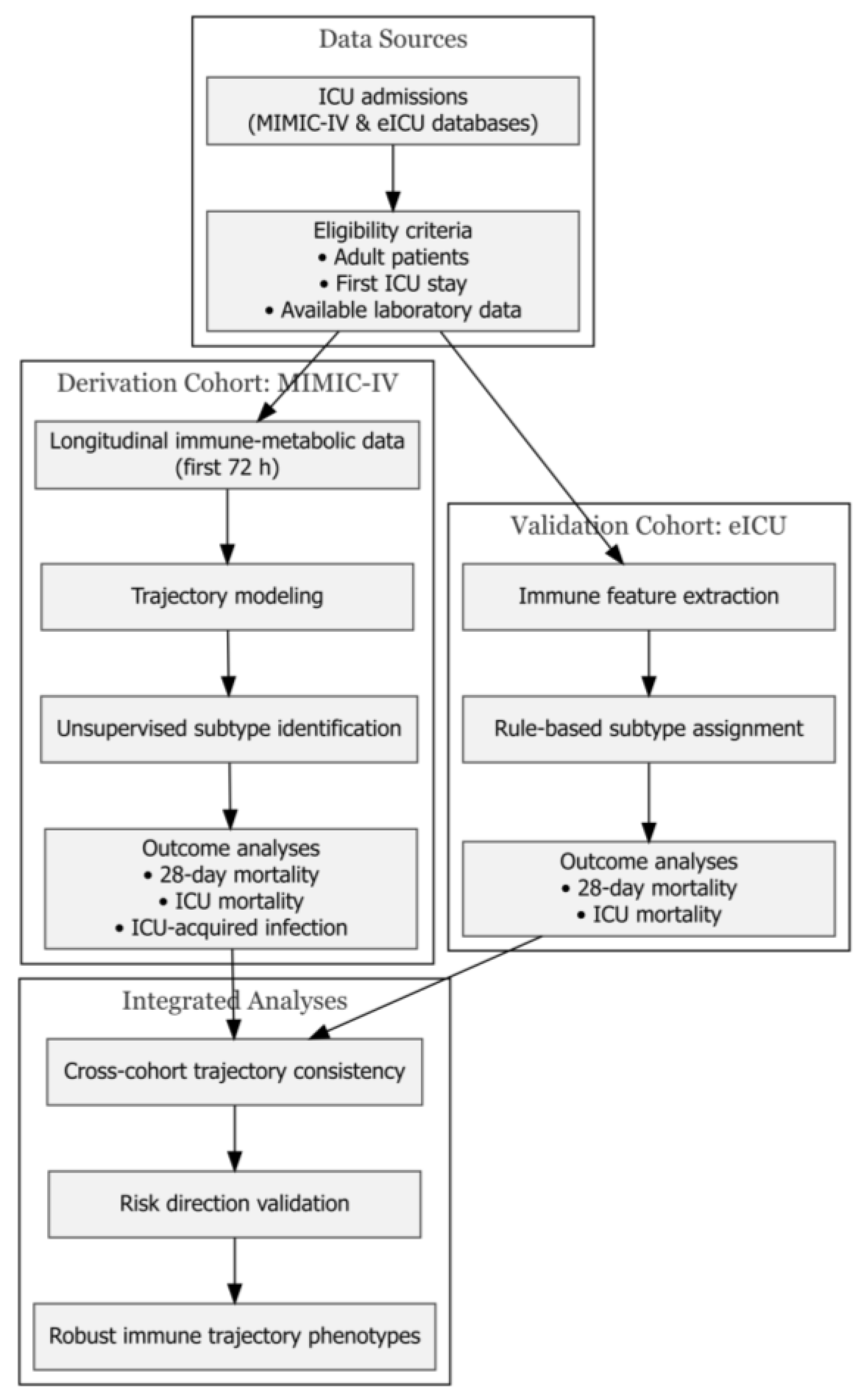
Figure 2.
Temporal evolution of key immunometabolic biomarkers defining the three trajectory phenotypes. Longitudinal trends of core biomarkers over the first 72 hours of ICU admission characterize the distinct host response patterns. (A) Lymphocyte counts; (B) Platelet counts; (C) Lactate levels; (D) LAR; (E) Neutrophil counts.
Figure 2.
Temporal evolution of key immunometabolic biomarkers defining the three trajectory phenotypes. Longitudinal trends of core biomarkers over the first 72 hours of ICU admission characterize the distinct host response patterns. (A) Lymphocyte counts; (B) Platelet counts; (C) Lactate levels; (D) LAR; (E) Neutrophil counts.
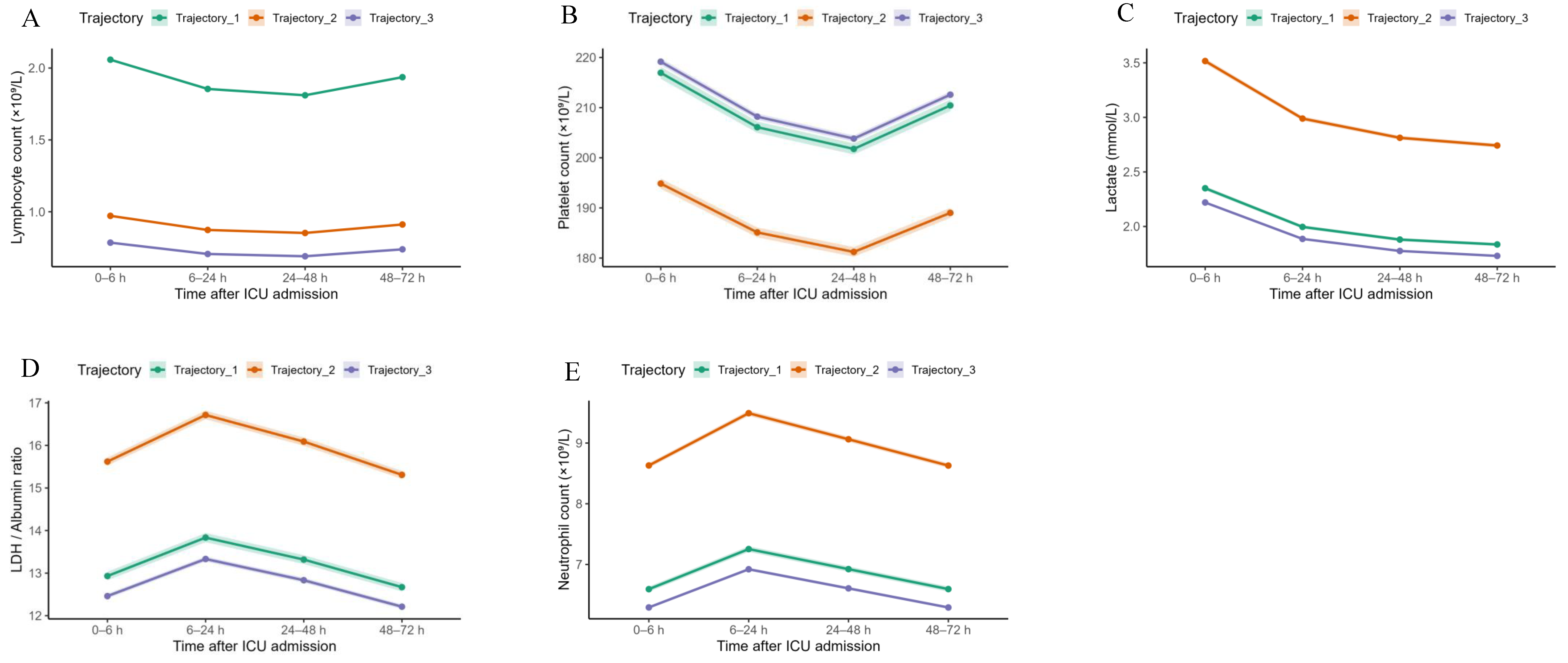
Figure 3.
Association of immunometabolic phenotypes with survival and secondary complications. (A) Kaplan-Meier survival curves for 28-day mortality, showing significantly lower survival probability for Trajectory 2 (Log-rank test p < 0.001); (B) Cumulative incidence functions for ICU mortality; (C) Cumulative incidence of ICU-AI. Statistical significance for cumulative incidence (B and C) was assessed using Gray’s test for competing risks, confirming that Trajectory 2 carries the highest burden of secondary infection and early death.
Figure 3.
Association of immunometabolic phenotypes with survival and secondary complications. (A) Kaplan-Meier survival curves for 28-day mortality, showing significantly lower survival probability for Trajectory 2 (Log-rank test p < 0.001); (B) Cumulative incidence functions for ICU mortality; (C) Cumulative incidence of ICU-AI. Statistical significance for cumulative incidence (B and C) was assessed using Gray’s test for competing risks, confirming that Trajectory 2 carries the highest burden of secondary infection and early death.
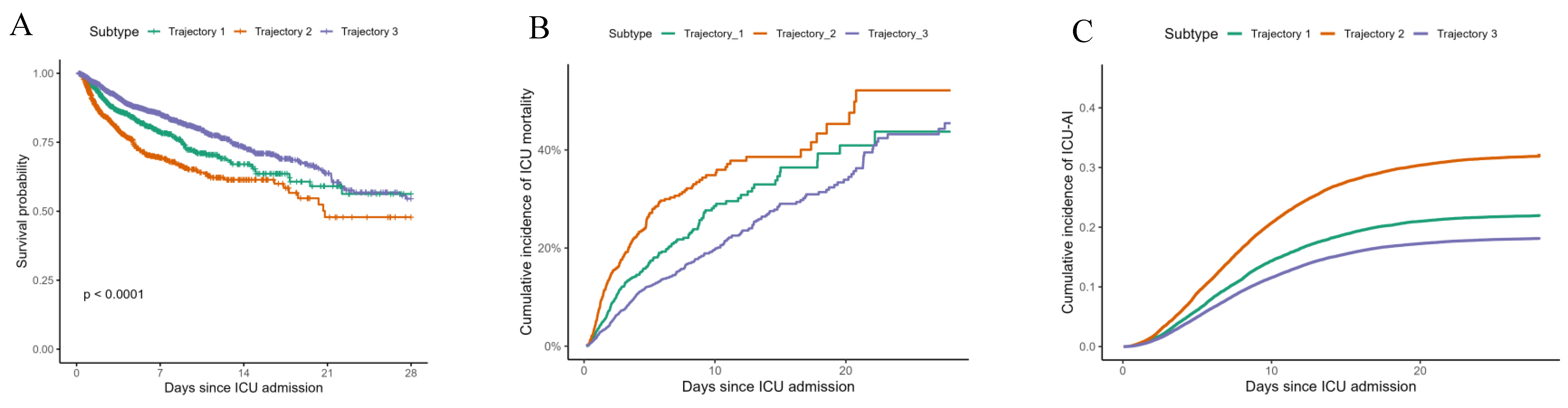
Figure 4.
Independent prognostic value of immunometabolic trajectories for 28-day mortality.
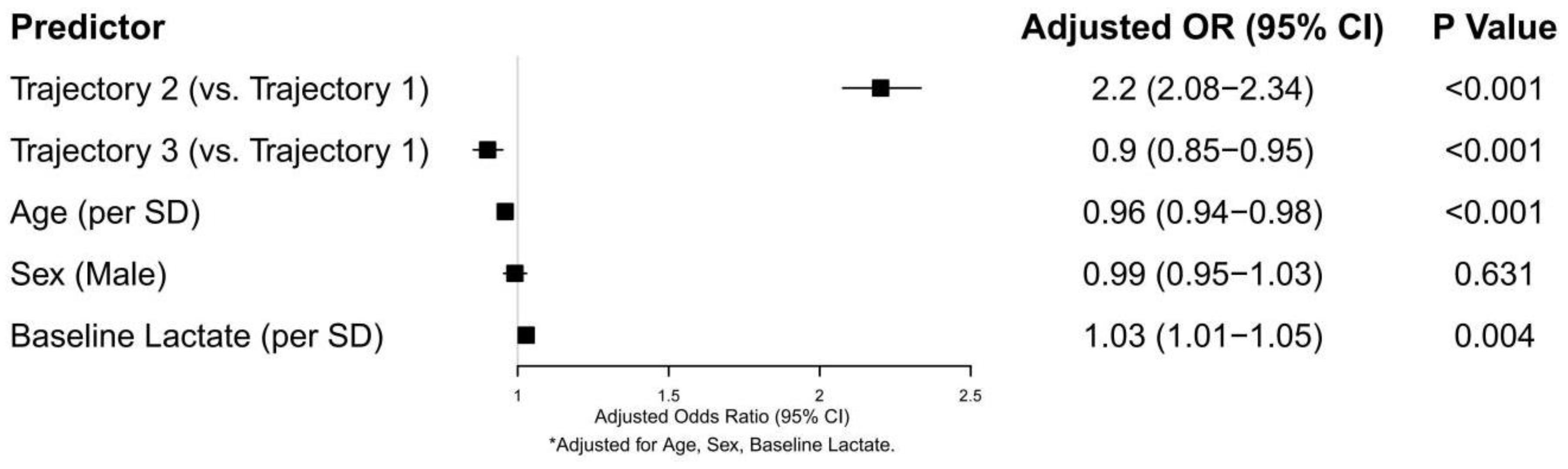
Figure 5.
Cross-cohort consistency of immunometabolic trajectories and clinical prognosis. External validation in the eICU-CRD cohort confirms the robustness and reproducibility of the identified phenotypes. (A) Comparison of standardized longitudinal lymphocyte trends (Z-score) between the derivation (MIMIC-IV) and validation (eICU-CRD) cohorts, showing highly similar temporal shapes; (B) Kaplan-Meier survival analysis in the external validation cohort (eICU-CRD); (C) Forest plot comparing aOR for 28-day mortality between cohorts. Risk stratification remains consistent across databases, with Trajectory 2 showing the highest risk and Trajectory 3 the lowest.
Figure 5.
Cross-cohort consistency of immunometabolic trajectories and clinical prognosis. External validation in the eICU-CRD cohort confirms the robustness and reproducibility of the identified phenotypes. (A) Comparison of standardized longitudinal lymphocyte trends (Z-score) between the derivation (MIMIC-IV) and validation (eICU-CRD) cohorts, showing highly similar temporal shapes; (B) Kaplan-Meier survival analysis in the external validation cohort (eICU-CRD); (C) Forest plot comparing aOR for 28-day mortality between cohorts. Risk stratification remains consistent across databases, with Trajectory 2 showing the highest risk and Trajectory 3 the lowest.
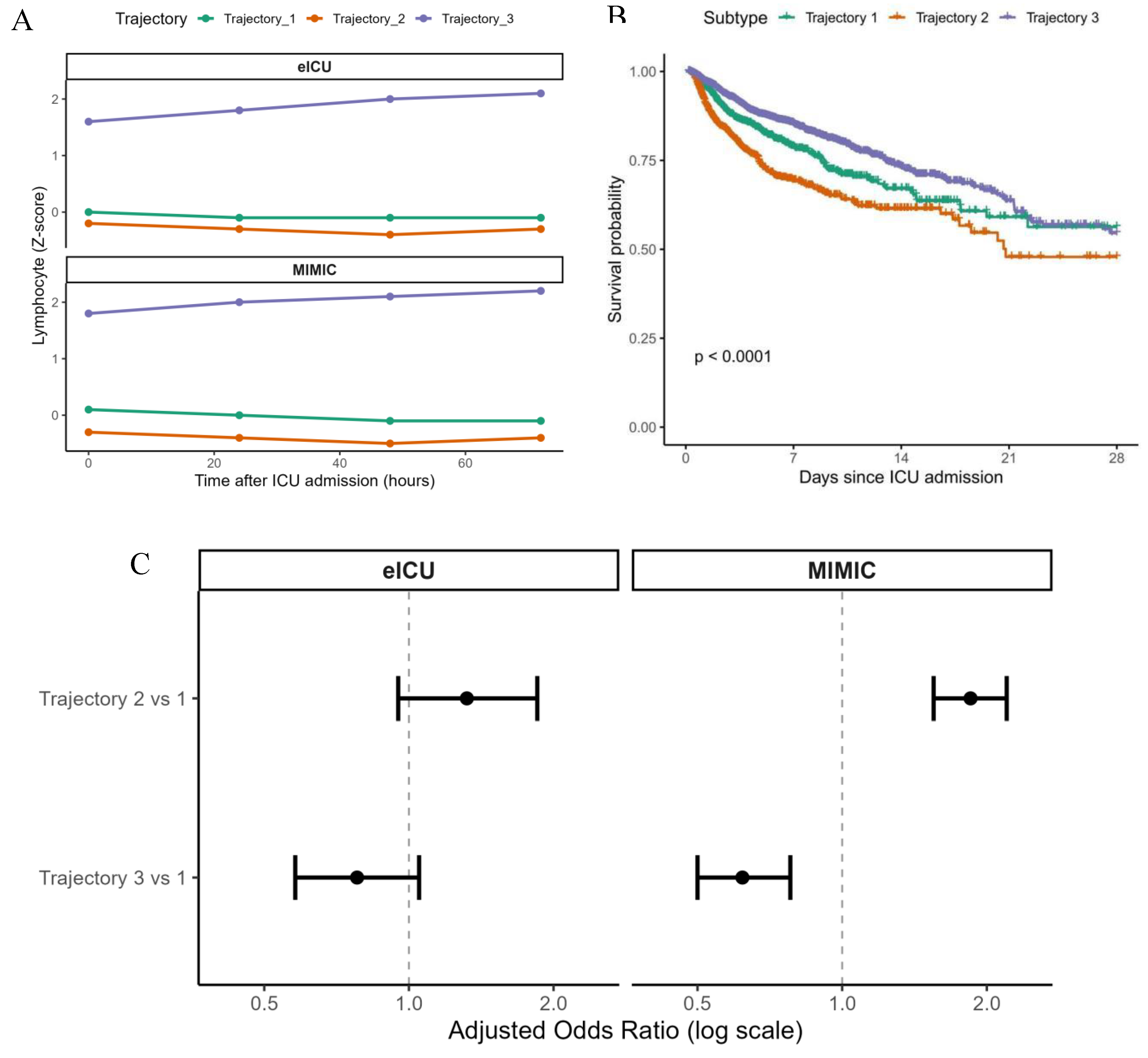
Figure 6.
Incremental predictive value and clinical utility of trajectory integration. (A) ROC analysis comparing the baseline (Age + SOFA) and trajectory-enhanced (+Subtype) models. Adding trajectory phenotypes yields a significant improvement in AUC; (B) DCA. The enhanced model (Red line) provides higher net benefit than the baseline model (Blue line) across relevant risk thresholds, supporting improved risk stratification.
Figure 6.
Incremental predictive value and clinical utility of trajectory integration. (A) ROC analysis comparing the baseline (Age + SOFA) and trajectory-enhanced (+Subtype) models. Adding trajectory phenotypes yields a significant improvement in AUC; (B) DCA. The enhanced model (Red line) provides higher net benefit than the baseline model (Blue line) across relevant risk thresholds, supporting improved risk stratification.
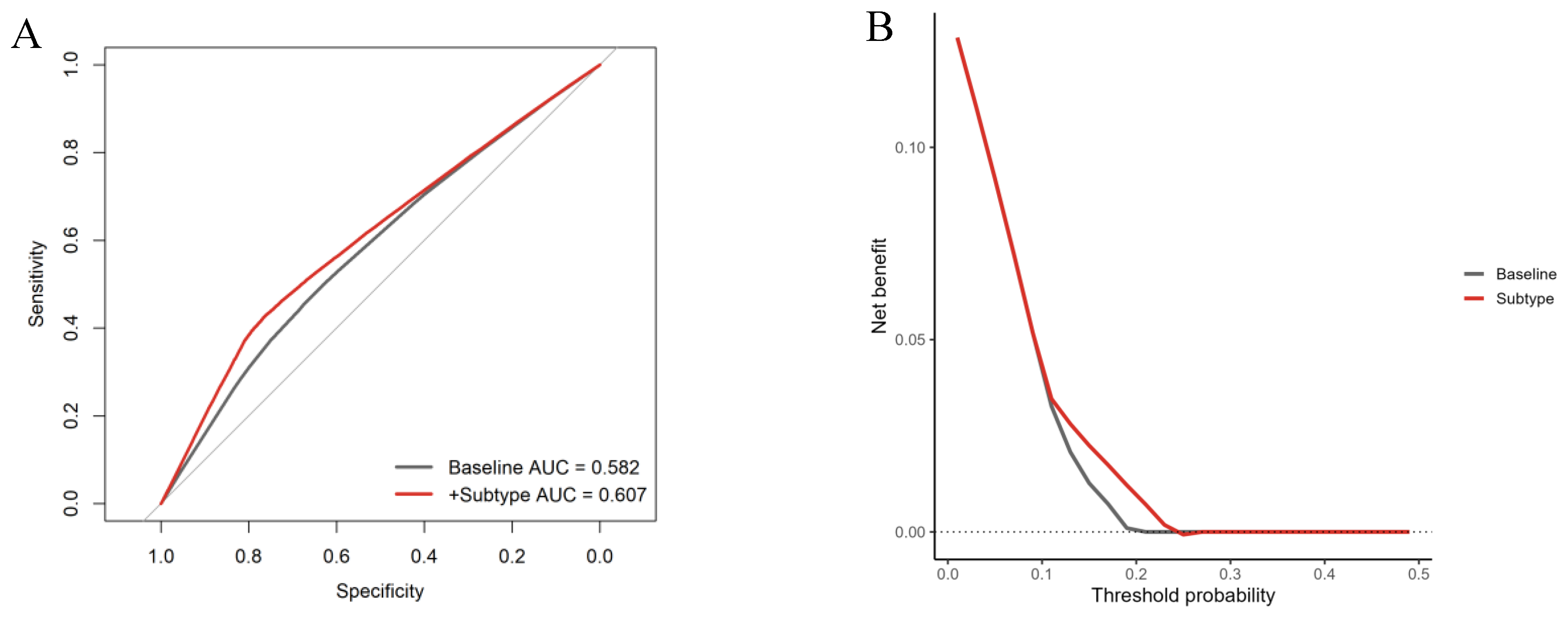

Table 1.
Baseline clinical and immunometabolic characteristics of the derivation cohort (MIMIC-IV) stratified by trajectory.
Table 1.
Baseline clinical and immunometabolic characteristics of the derivation cohort (MIMIC-IV) stratified by trajectory.
| Characteristic | Overall (n=8217) |
Trajectory 1 (n=1463) | Trajectory 2 (n=1856) | Trajectory 3 (n=4898) | P-value |
|---|---|---|---|---|---|
| Demographics | |||||
| Age, years | 58 [48-69] | 59 [49-70] | 58 [48-69] | 56 [46-67] | <0.001 |
| Sex, n (%) | 0.184 | ||||
| Female | 3437 (41.8) | 581 (39.7) | 791 (42.6) | 2065 (42.2) | |
| Male | 4780 (58.2) | 882 (60.3) | 1065 (57.4) | 2833 (57.8) | |
| Race/Ethnicity, n (%) | 0.509 | ||||
| Asian | 802 (9.8) | 129 (8.8) | 191 (10.3) | 482 (9.8) | |
| Black | 1221 (14.9) | 236 (16.1) | 269 (14.5) | 716 (14.6) | |
| White | 4993 (60.8) | 899 (61.4) | 1120 (60.3) | 2974 (60.7) | |
| Other | 1201 (14.6) | 199 (13.6) | 276 (14.9) | 726 (14.8) | |
| Marital status | 0.633 | ||||
| Divorced | 1241 (15.1) | 205 (14.0) | 285 (15.4) | 751 (15.3) | |
| Married | 4128 (50.2) | 760 (51.9) | 946 (51.0) | 2422 (49.4) | |
| Single | 2432 (29.6) | 427 (29.2) | 531 (28.6) | 1474 (30.1) | |
| Widowed | 416 (5.1) | 71 (4.9) | 94 (5.1) | 251 (5.1) | |
| Vital Signs | |||||
| Temperature, °C | 37.2 [36.7–37.6] | 37.1 [36.7–37.5] | 37.3 [36.8–37.7] | 37.1 [36.7–37.5] | <0.001 |
| Respiratory rate, bpm | 19 [16-21] | 18 [16-21] | 19 [16-21] | 19 [16-22] | <0.001 |
| Heart rate, bpm | 86 [76–97] | 86 [75–97] | 90 [80–100] | 85 [75–95] | <0.001 |
| MAP, mmHg | 77 [69–85] | 77 [69–86] | 74 [66–82] | 78 [70–85] | <0.001 |
| SpO2, % | 96 [94–99] | 97 [95–99] | 95 [93–97] | 97 [95–99] | <0.001 |
| Laboratory Findings | |||||
| WBC, ×109/L | 9.7 [6.8–12.5] | 9.2 [6.6–11.9] | 12.1 [9.6–14.8] | 8.9 [6.2–11.6] | <0.001 |
| Neutrophil count, ×109/L | 6.6 [4.6–8.8] | 6.4 [4.5–8.3] | 8.4 [6.4–10.5] | 6.1 [4.2–8.1] | <0.001 |
| Lymphocyte count, ×109/L | 0.9 [0.6–1.3] | 2.0 [1.7–2.5] | 0.9 [0.6–1.3] | 0.8 [0.6–1.0] | <0.001 |
| Hemoglobin, g/dL | 11.7 [10.4–13.1] | 11.9 [10.6–13.1] | 11.1 [9.7–12.4] | 11.9 [10.6–13.3] | <0.001 |
| Platelet count, ×109/L | 213 [158–268] | 219 [163–274] | 198 [142–251] | 219 [165–274] | <0.001 |
| Creatinine, mg/dL | 1.26 [0.83–1.75] | 1.21 [0.79–1.61] | 1.97 [1.53–2.36] | 1.08 [0.70–1.46] | <0.001 |
| BUN, mg/dL | 23.1 [15.5–31.6] | 21.3 [14.2–28.2] | 35.7 [28.4–42.1] | 19.9 [13.4–26.6] | <0.001 |
| Lactate, mmol/L | 2.2 [1.6–3.2] | 2.1 [1.5–2.9] | 3.1 [2.3–4.3] | 2.0 [1.4–2.8] | <0.001 |
| Sodium, mmol/L | 137.6 [134.3–141.1] | 137.7 [134.5–141.4] | 137.1 [133.8–140.2] | 137.9 [134.4–141.3] | <0.001 |
| Potassium, mmol/L | 4.0 [3.8–4.3] | 4.0 [3.8–4.3] | 4.2 [3.9–4.4] | 4.0 [3.7–4.3] | <0.001 |
| CRP, mg/L | 28.4 [18.3–44.2] | 25.7 [16.5–38.3] | 48.2 [32.5–72.5] | 24.2 [16.6–36.3] | <0.001 |
| Procalcitonin, ng/mL | 0.51 [0.29–0.96] | 0.44 [0.27–0.73] | 1.38 [0.83–2.30] | 0.41 [0.25–0.66] | <0.001 |
| Albumin, g/L | 3.1 [2.7–3.5] | 3.3[2.8–3.6] | 3.2 [2.7–3.6] | 3.2 [2.8–3.5] | 0.081 |
| LDH, U/L | 367 [265–517] | 349 [254–490] | 449 [338–598] | 342 [248–485] | <0.001 |
| Clinical Outcomes | |||||
| SOFA Score | 5 [4–8] | 7 [5–9] | 10 [8–13] | 4 [2–6] | <0.001 |
| AKI, n (%) | 2019 (24.6) | 163 (11.1) | 1609 (86.7) | 247 (5.0) | <0.001 |
| 28-day mortality, n (%) | 1097 (13.4) | 189 (12.9) | 399 (21.5) | 509 (10.4) | <0.001 |
*MAP, mean arterial pressure; WBC, white blood cell; SpO2, peripheral oxygen saturation; BUN, blood urea nitrogen; CRP, C-reactive protein; LDH, lactate dehydrogenase; AKI, acute kidney injury; SOFA, Sequential Organ Failure Assessment.
Table 2.
Baseline clinical and immunometabolic characteristics of the external validation cohort (eICU-CRD) stratified by trajectory.
Table 2.
Baseline clinical and immunometabolic characteristics of the external validation cohort (eICU-CRD) stratified by trajectory.
| Characteristic | Overall (n=10679) |
Trajectory 1 (n=9183) | Trajectory 2 (n=1342) | Trajectory 3 (n=154) | P-value |
|---|---|---|---|---|---|
| Demographics | |||||
| Age, years | 65 [54-75] | 65 [54-75] | 64 [53-74] | 67 [56-76] | 0.041 |
| Sex, n (%) | 0.055 | ||||
| Female | 5565 (52.1) | 4846 (52.8) | 650 (48.4) | 69 (44.8) | |
| Male | 5114 (47.9) | 4337 (47.2) | 692 (51.6) | 85 (55.2) | |
| Race/Ethnicity, n (%) | <0.001 | ||||
| Asian | 85 (0.8) | 71 (0.8) | 13 (1.0) | 1 (0.6) | |
| Black | 534 (5.0) | 465 (5.1) | 63 (4.7) | 6 (3.9) | |
| Hispanic | 421 (3.9) | 369 (4.0) | 43 (3.2) | 9 (5.8) | |
| White | 1098 (10.3) | 963 (10.5) | 104 (7.7) | 31 (20.1) | |
| Other | 8541 (80.0) | 7315 (79.7) | 1119 (83.4) | 107 (69.5) | |
| Vital Signs | |||||
| BMI, kg/m² | 28.2 [23.8-34.3] | 28.1 [23.8-34.1] | 28.9 [24.2-35.4] | 28.9 [24.0-34.9] | 0.005 |
| Temperature, °C | 36.4 [35.9-36.7] | 36.4 [35.9-36.8] | 36.2 [35.5-36.7] | 36.4 [36.1-36.8] | <0.001 |
| Respiratory rate, /min | 30 [12-38] | 30 [12-38] | 32 [15-39] | 28 [10-37] | <0.001 |
| Heart rate, bpm | 112 [96-129] | 112 [96-128] | 119 [103-134.8] | 102 [88.3-121.8] | <0.001 |
| MAP, mmHg | 60 [49-131] | 61 [50-131] | 55 [45-132] | 63.5 [51.3-130.8] | <0.001 |
| APS III | 66 [48-88] | 64 [46-85] | 86 [63-112] | 64 [47-82.8] | <0.001 |
| Laboratory Findings | |||||
| WBC, ×10⁹/L | 12.1 [7.8-17.8] | 10.7 [7.4-15.4] | 23.3 [20.11-28.79] | 7.7 [5.6-10.95] | <0.001 |
| Neutrophil count, ×109/L | 9.8 [6.5–14.5] | 8.9 [6.2–13.0] | 19.5 [16.0–24.0] | 6.2 [4.5–8.8] | <0.001 |
| Lymphocyte count, ×109/L | 1.8 [1.2–2.3] | 1.9 [1.5–2.4] | 0.8 [0.6–1.2] | 0.9 [0.7–1.3] | <0.001 |
| Platelet count, ×109/L | 212 [160–270] | 215 [165–275] | 165 [115–225] | 225 [170–285] | <0.001 |
| Lactate, mmol/L | 2.2 [1.5–3.2] | 2.1 [1.4–2.9] | 3.3 [2.3–4.8] | 1.8 [1.2–2.5] | <0.001 |
| pH | 7.36 [7.30-7.42] | 7.38 [7.32-7.43] | 7.27 [7.21-7.31] | 7.41 [7.37-7.45] | <0.001 |
| Albumin, g/dL | 2.8 [2.3-3.2] | 2.8 [2.3-3.2] | 2.6 [2.1-3.1] | 2.8 [2.32-3.2] | <0.001 |
| BUN, mg/dL | 25 [16-41] | 24 [15-40] | 29 [19-45] | 34 [25.3-57.5] | <0.001 |
| Glucose, mg/dL | 164 [97-223] | 160 [96-216] | 198.5 [113-274.8] | 156.5 [91-255.5] | <0.001 |
| Clinical Outcomes | |||||
| 28-day mortality, n (%) | 1547 (14.5) | 1166 (12.7) | 360 (26.8) | 21 (13.6) | <0.001 |
*BMI, body mass index; APS III, Acute Physiology III Score.
Disclaimer/Publisher’s Note: The statements, opinions and data contained in all publications are solely those of the individual author(s) and contributor(s) and not of MDPI and/or the editor(s). MDPI and/or the editor(s) disclaim responsibility for any injury to people or property resulting from any ideas, methods, instructions or products referred to in the content. |
© 2026 by the authors. Licensee MDPI, Basel, Switzerland. This article is an open access article distributed under the terms and conditions of the Creative Commons Attribution (CC BY) license (http://creativecommons.org/licenses/by/4.0/).
Copyright: This open access article is published under a Creative Commons CC BY 4.0 license, which permit the free download, distribution, and reuse, provided that the author and preprint are cited in any reuse.


